The power in the wind
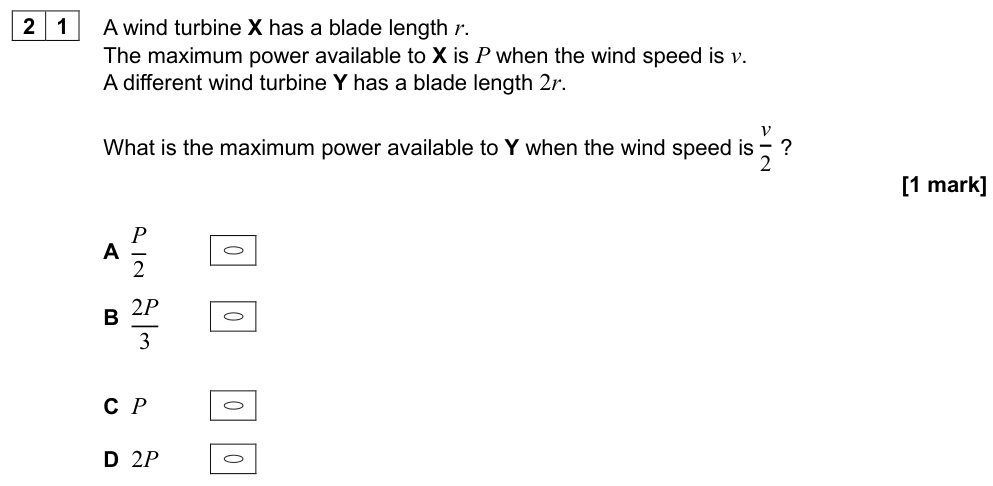
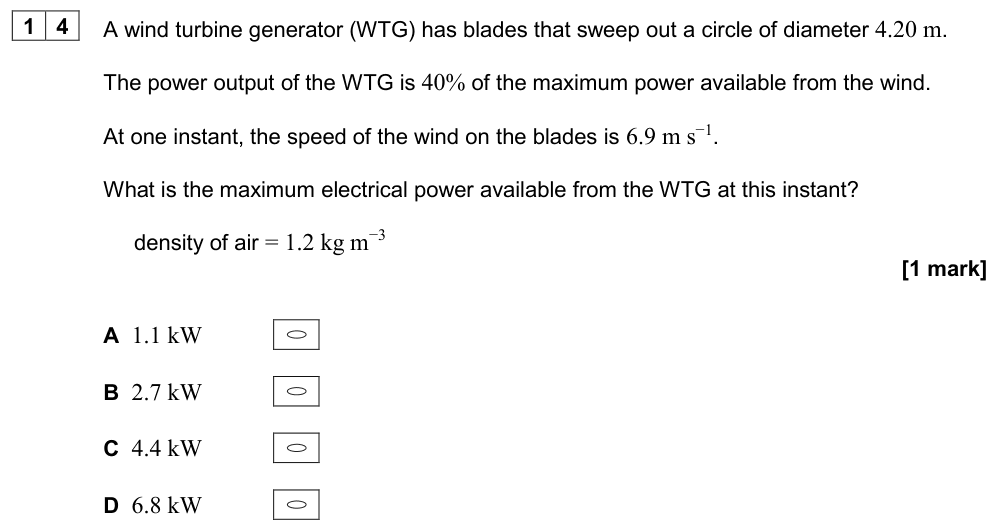
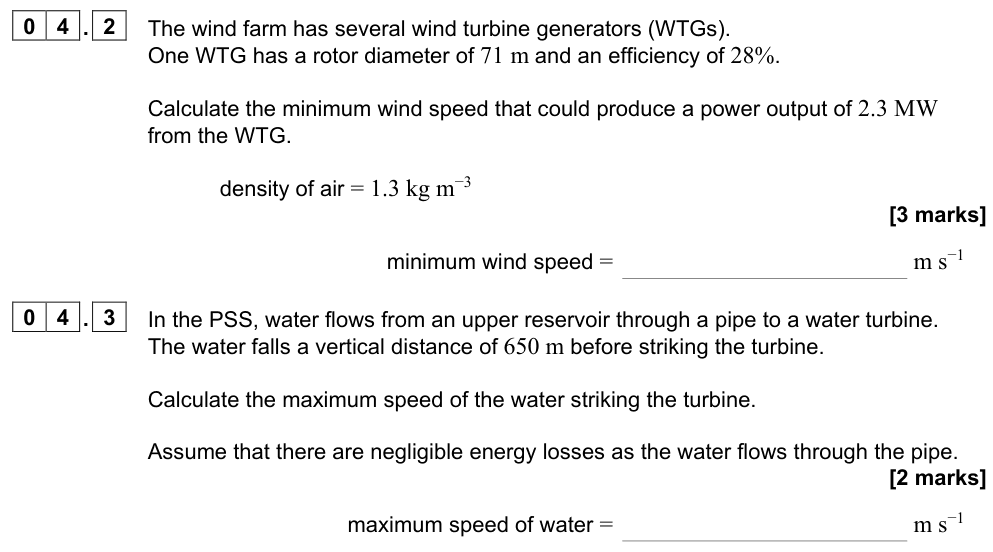
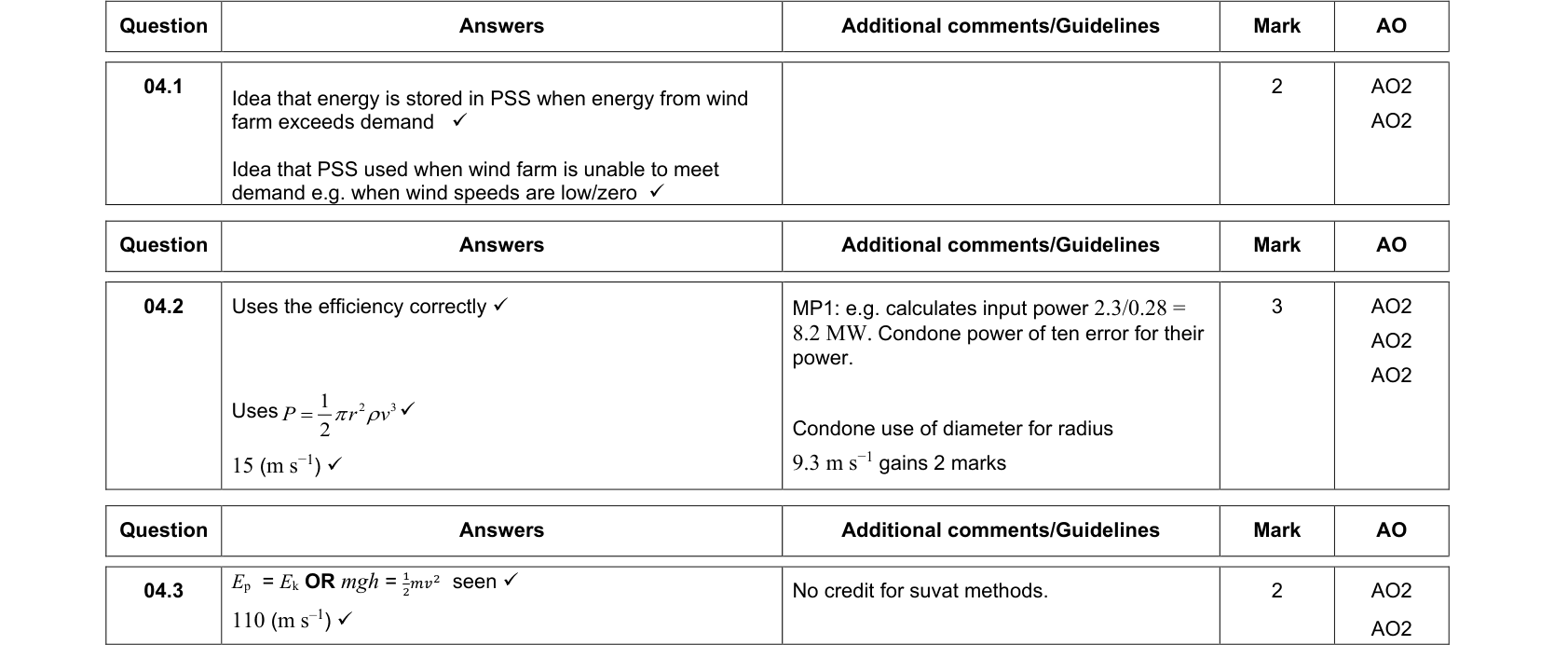
A wind turbine converts some of the kinetic energy of moving air into electrical energy. The blades sweep out a circle of radius $r$ (the blade length), area $A = \pi r^2$.
Derivation. In time $t$, wind of speed $v$ moves a distance $vt$, so a cylinder of air of volume $Avt$ passes through the blades.
- Mass of this air: $m = \rho Avt$ (where $\rho$ is the density of air, about 1.2–1.3 kg m⁻³).
- Its kinetic energy: $E_k = \tfrac12mv^2 = \tfrac12\rho Avt \times v^2 = \tfrac12\rho Av^3t$.
- Power = energy ÷ time:
Maximum power available from a wind turbine
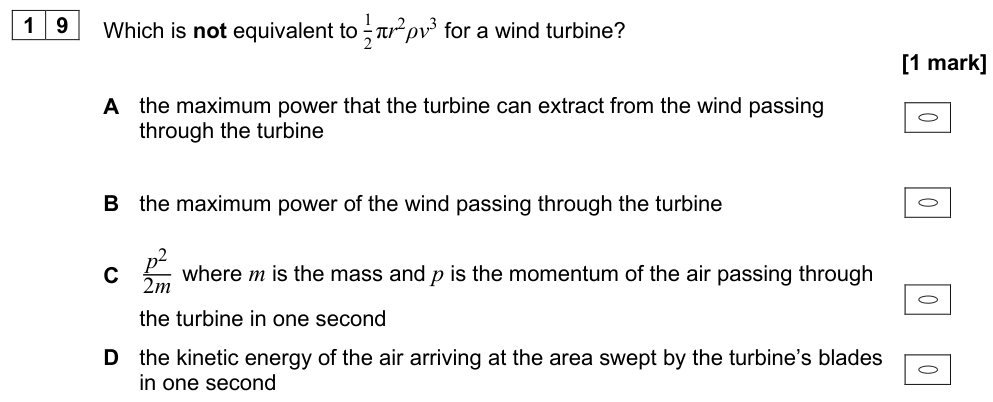
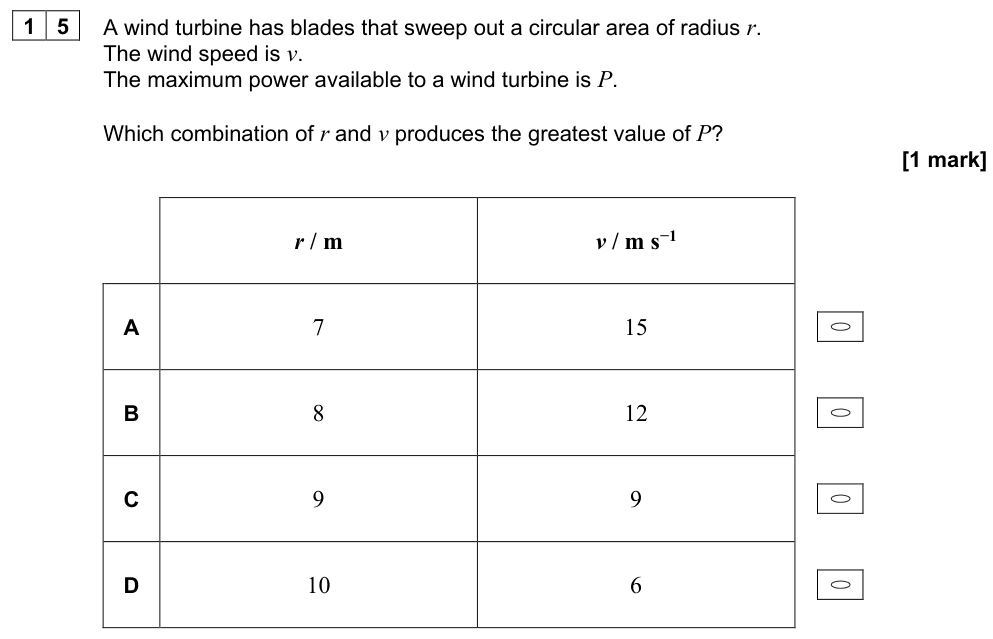
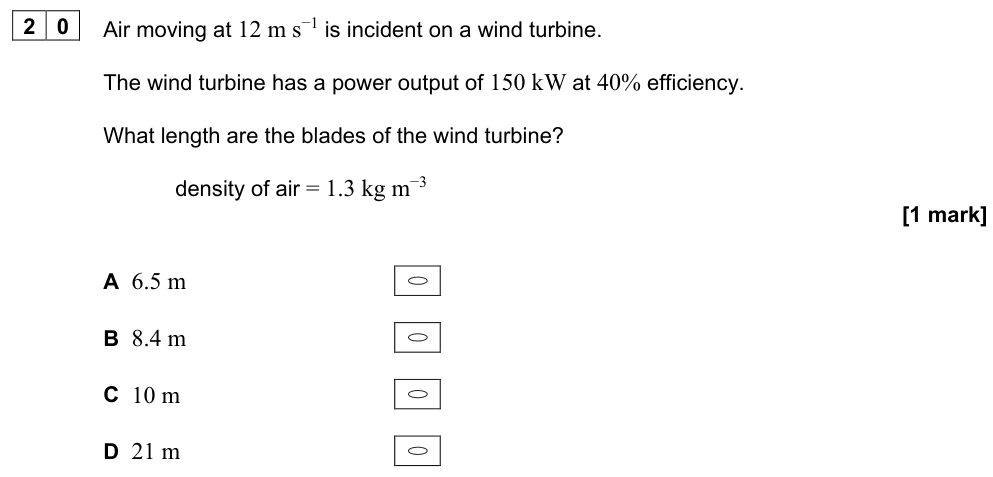
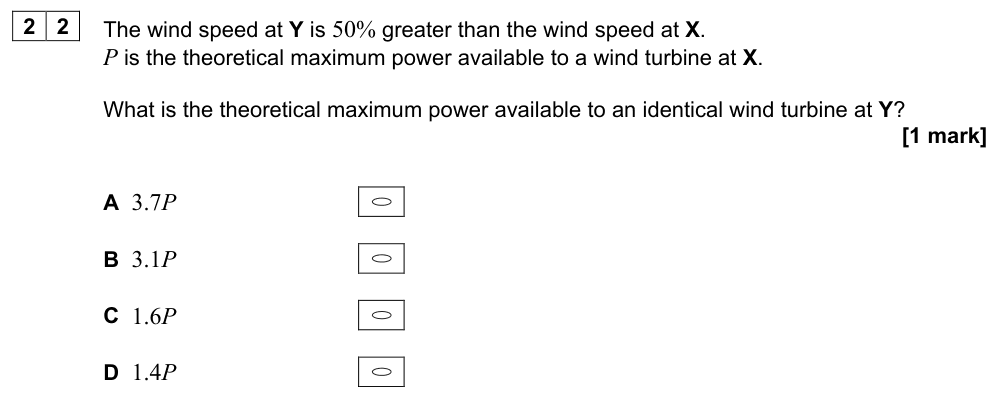
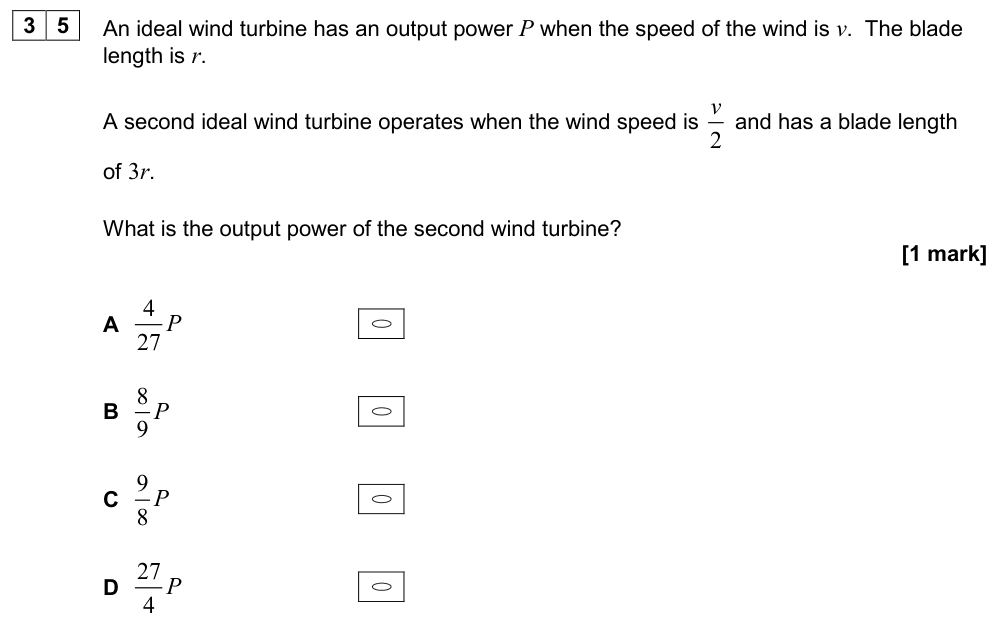
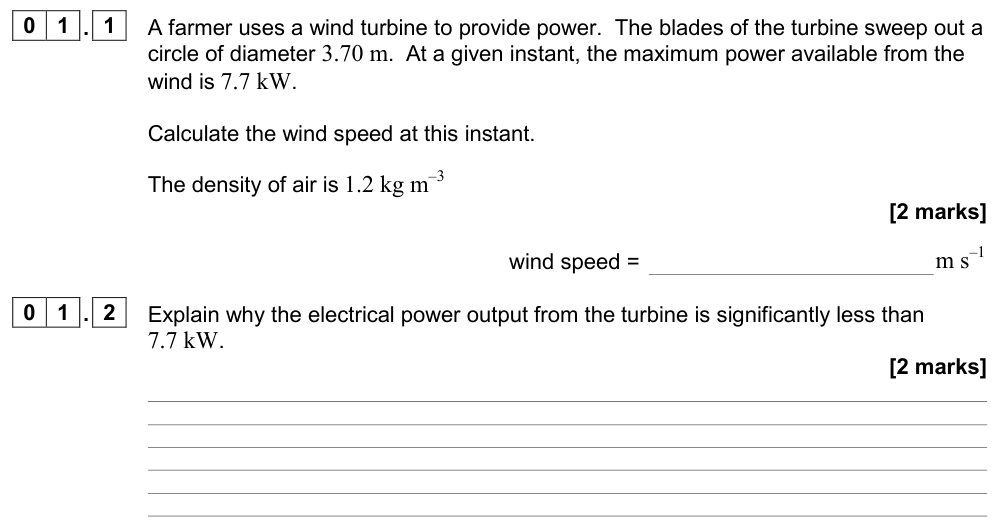
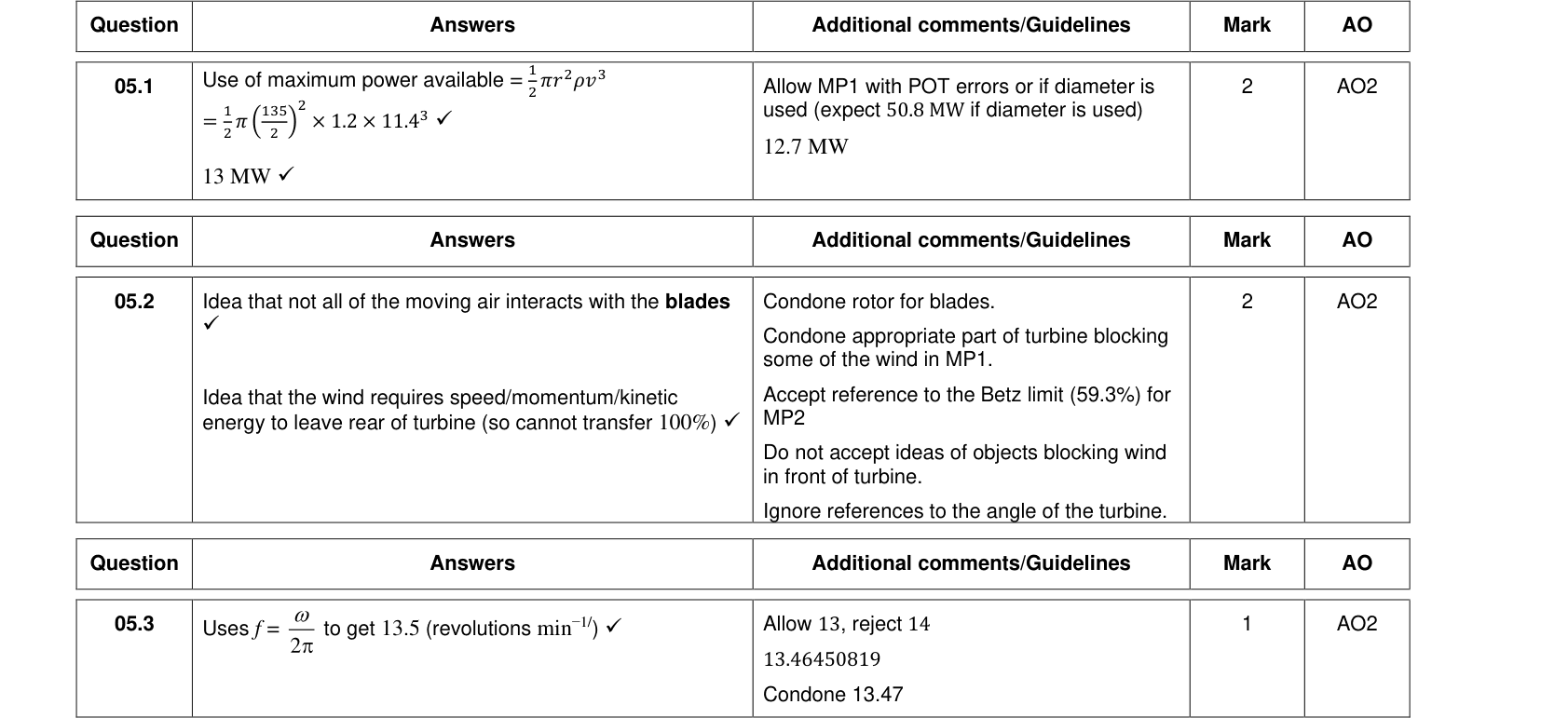
$$P = \tfrac12\rho\pi r^2v^3$$
$\rho$ = density of air; $r$ = blade length (radius of the swept area); $v$ = wind speed.
Two important consequences:
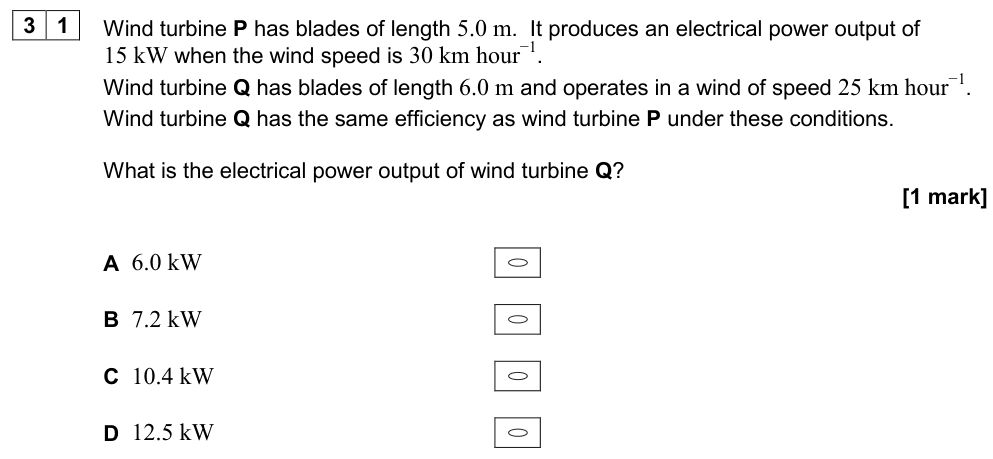
- $P \propto r^2$: doubling the blade length gives 4 times the power. This is why modern turbines are enormous (blades over 80 m long offshore).
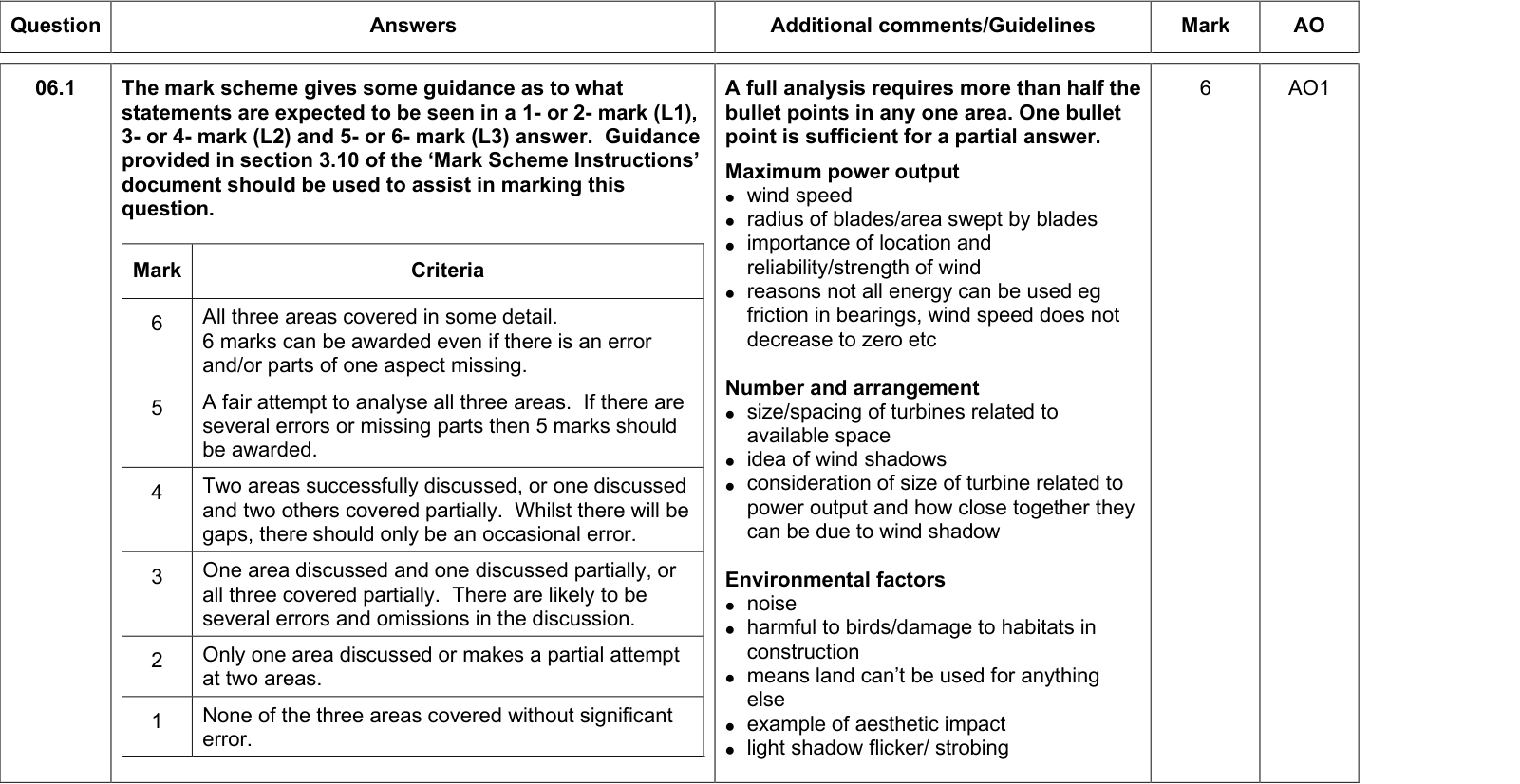
- $P \propto v^3$: doubling the wind speed gives 8 times the power. A site with a slightly higher average wind speed (hilltops, coasts, offshore) produces far more energy, so siting is crucial.
Worked example
A turbine has blades 40 m long and the wind speed is 12 m s⁻¹ ($\rho = 1.2$ kg m⁻³).
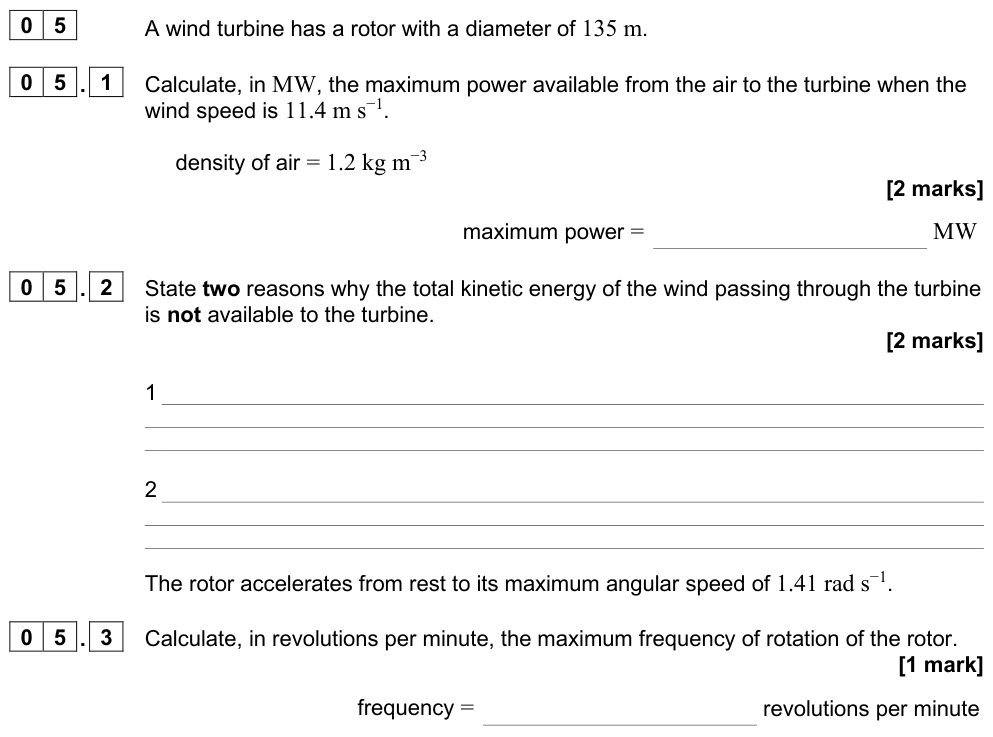
$P = \tfrac12 \times 1.2 \times \pi \times 40^2 \times 12^3 = 5.2 \times 10^{6}$ W (5.2 MW) of wind power passes through the blades.
If the wind drops to 6 m s⁻¹, the power available falls by a factor of $2^3 = 8$, to 0.65 MW.
Why not all of this power can be used
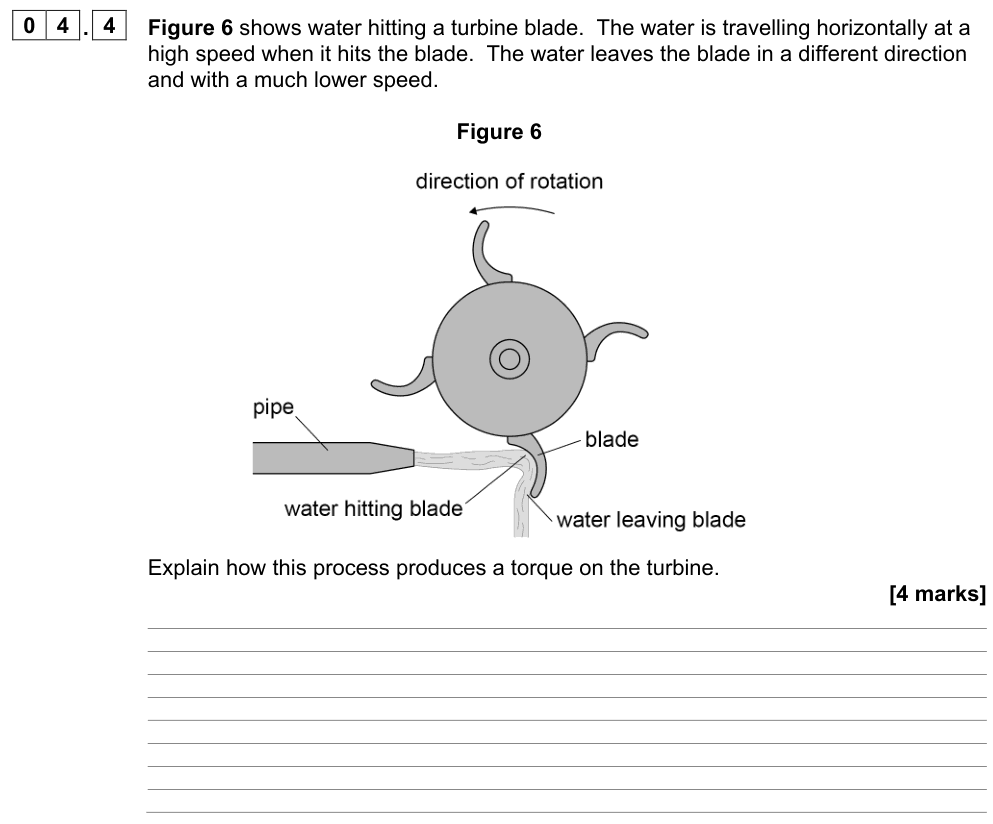
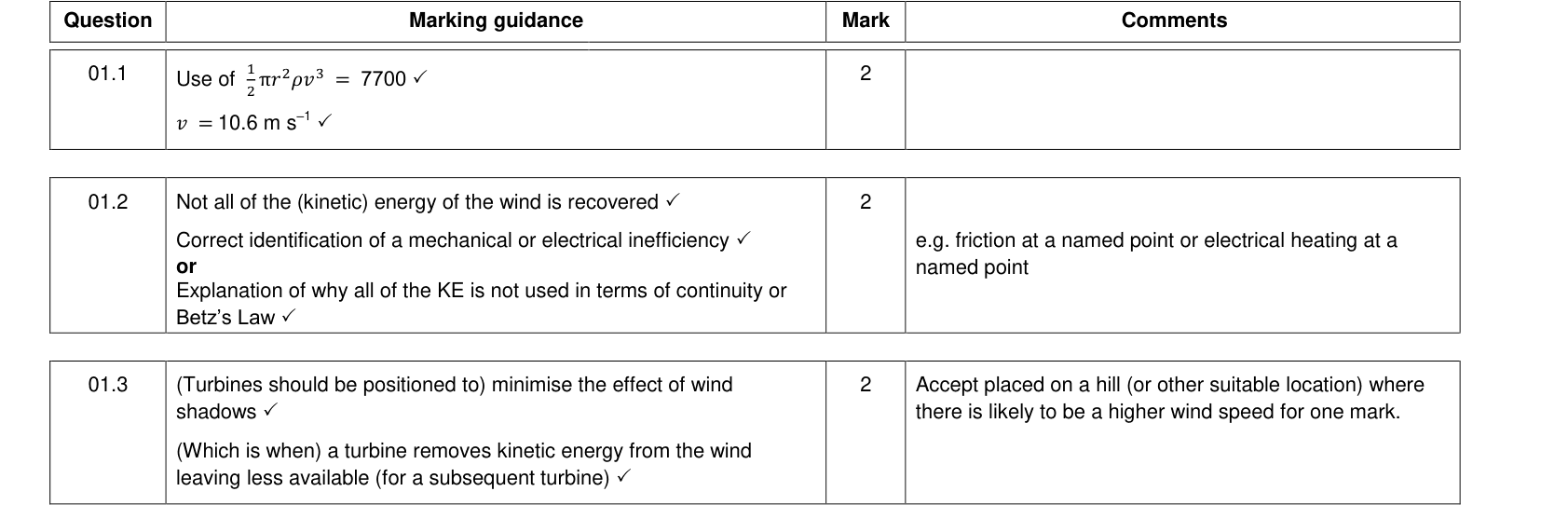
- The air must keep moving. If the turbine extracted all the kinetic energy, the air behind the blades would stop and block the flow of new air. Some kinetic energy must be left in the air for it to move away. Theory shows that at most about 59% of the power can be extracted (the Betz limit); real blades achieve less.
- Mechanical and electrical losses: friction in the bearings and gearbox, resistance (heating) in the generator coils and cables, and turbulence around the blades.
- Operating range: the turbine produces nothing below the cut-in speed (about 3–4 m s⁻¹), where the wind cannot overcome friction. Above the rated speed (about 12–15 m s⁻¹) the blades are turned (pitched) to spill wind and keep the output at the generator's maximum. Above the cut-out speed (about 25 m s⁻¹) the turbine is stopped to prevent damage.
- The wind is variable: the average output over a year is typically only 25–45% of the rated power (the capacity factor).
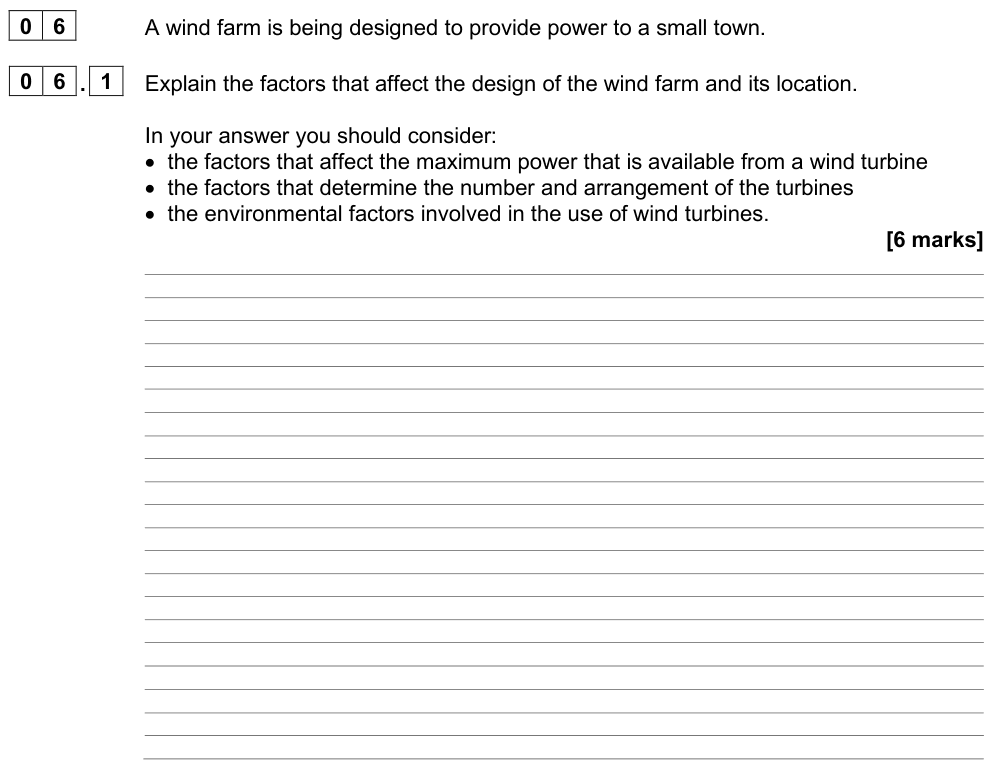
Wind shadows and wind farms
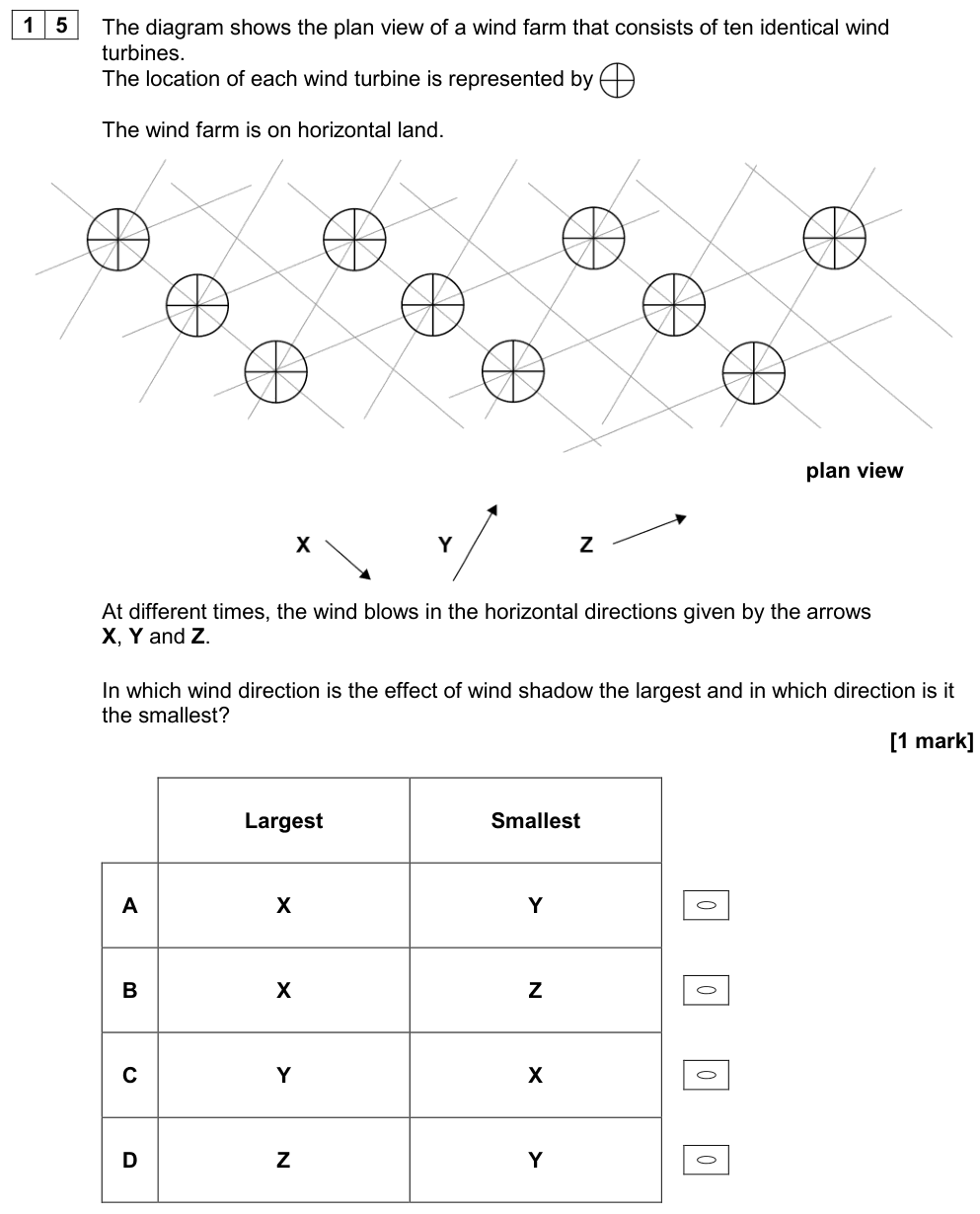
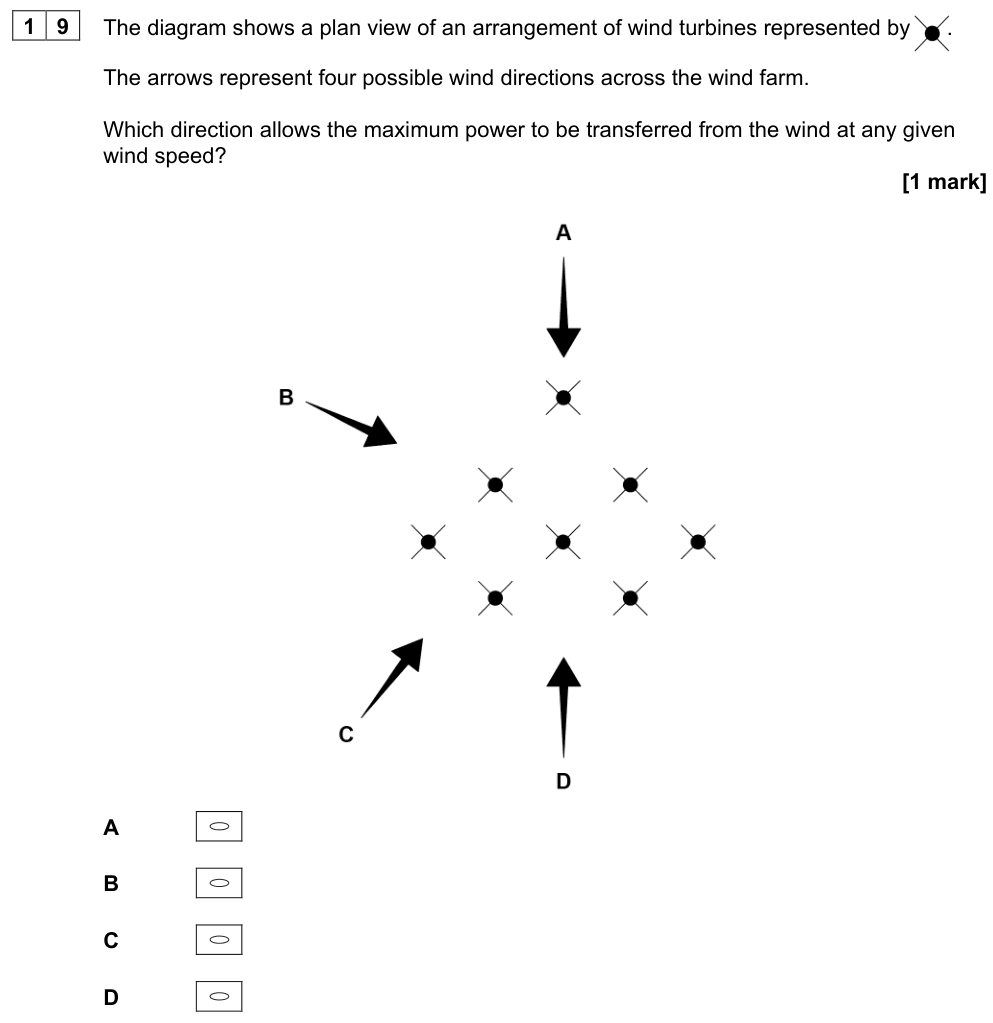
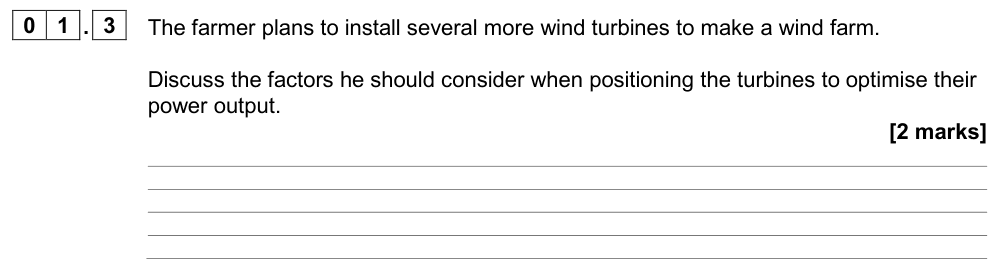
A turbine takes energy out of the wind, so the air behind it (downwind) is slower and more turbulent. This region is the turbine's wind shadow (or wake).
- A turbine placed in the wind shadow of another produces much less power (remember $P \propto v^3$), and the turbulence increases wear on its blades and bearings.
- In a wind farm, turbines are therefore spaced well apart: typically about 5–10 rotor diameters apart in the direction of the prevailing wind, and about 3–5 diameters apart across it.
- Rows are often staggered, so each turbine has clear air in front of it, and the layout is planned using the most common wind directions at the site.
Environmental factors
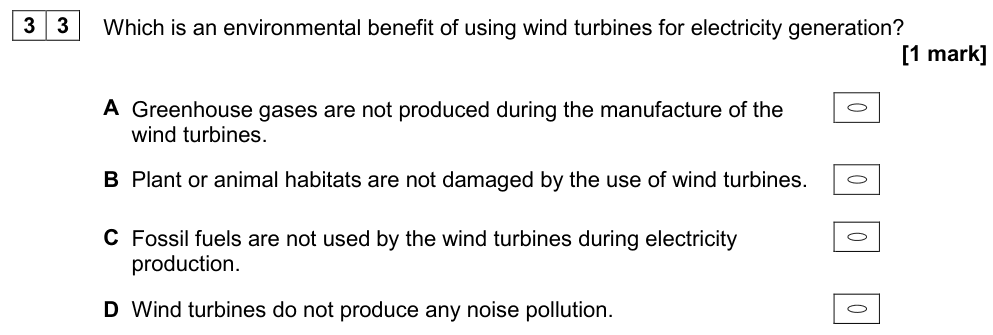
| Advantages | Disadvantages |
|---|---|
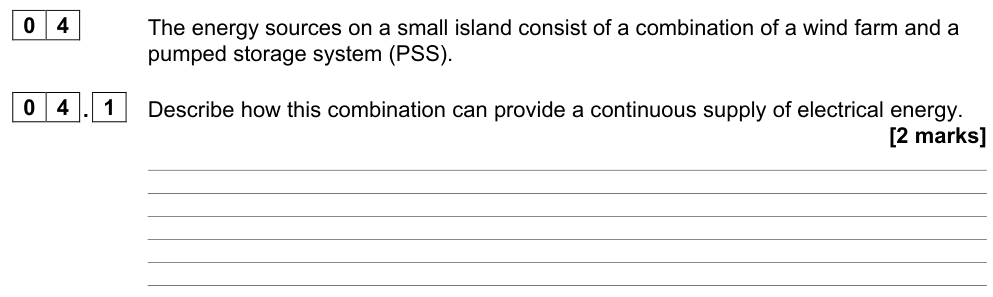
| renewable: the wind will not run out | intermittent: no output on calm days or in storms, so back-up or energy storage is needed |
| no fuel, and no carbon dioxide or other pollution while generating | visual impact on the landscape; some people object to them |
| low running costs | noise from blades and gearbox near homes |
| the land beneath can still be farmed; offshore sites have stronger, steadier winds | risk to birds and bats; offshore construction affects marine habitats |
| quick to build | many turbines and a large area are needed to match one large power station; high initial cost; energy is used to make the steel and concrete |
Worked example: how many turbines?
Each turbine in a wind farm has 50 m blades. The average wind speed is 9.0 m s⁻¹ and the overall efficiency (wind to electrical) is 35%. How many turbines are needed to give an average output of 500 MW? ($\rho = 1.2$ kg m⁻³)
Power in the wind per turbine $= \tfrac12 \times 1.2 \times \pi \times 50^2 \times 9.0^3 = 3.4 \times 10^{6}$ W.
Electrical output per turbine $= 0.35 \times 3.4 \times 10^{6} = 1.2 \times 10^{6}$ W.
Number needed $= 500 \times 10^{6}/1.2 \times 10^{6} \approx 420$ turbines.
Summary
- Mass of air per second $= \rho\pi r^2v$; maximum power $P = \tfrac12\rho\pi r^2v^3$.
- $P \propto r^2$ and $P \propto v^3$: blade length and site wind speed matter enormously.
- Not all the power can be extracted: the air must keep moving (max ~59%), plus mechanical/electrical losses, cut-in and cut-out speeds, and variable wind.
- Wind shadows: downwind air is slower and turbulent, so turbines are spaced 5–10 diameters apart along the prevailing wind.
- Environmental factors: no CO₂ in use, but intermittent, visual and noise impact, risk to wildlife, large land area.