Energy from the Sun
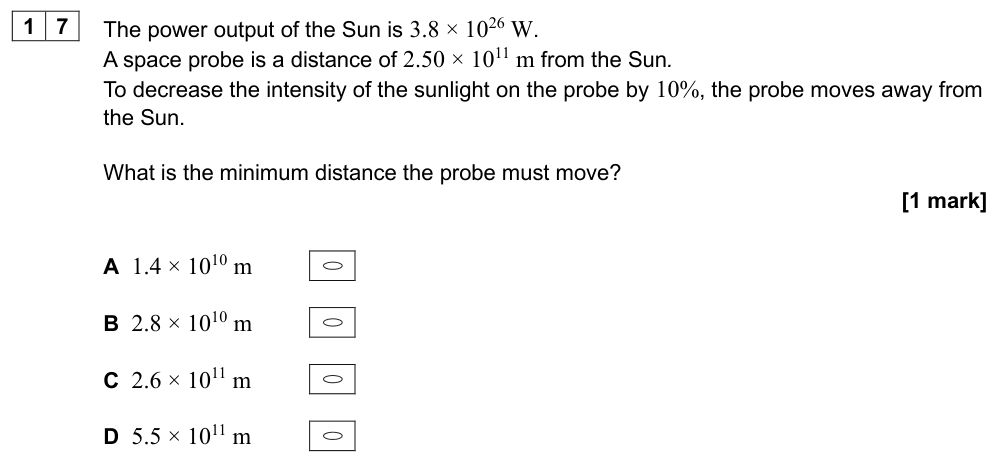
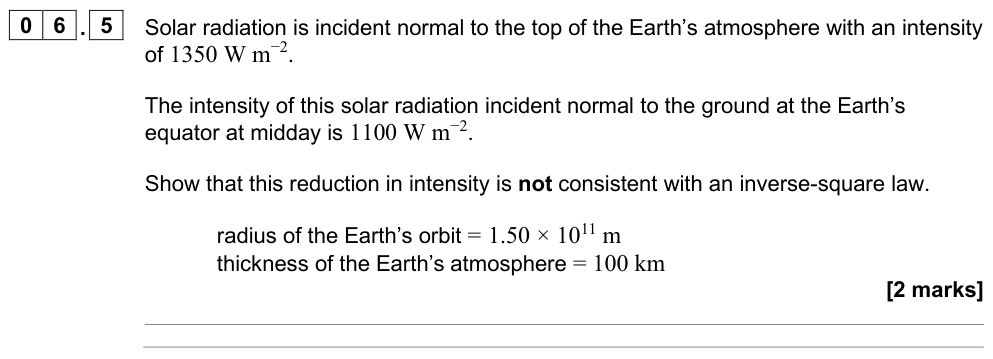
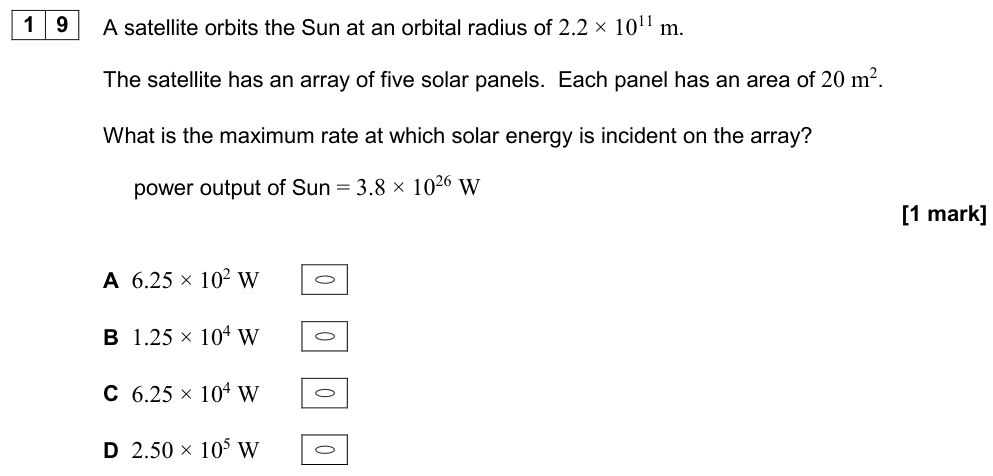
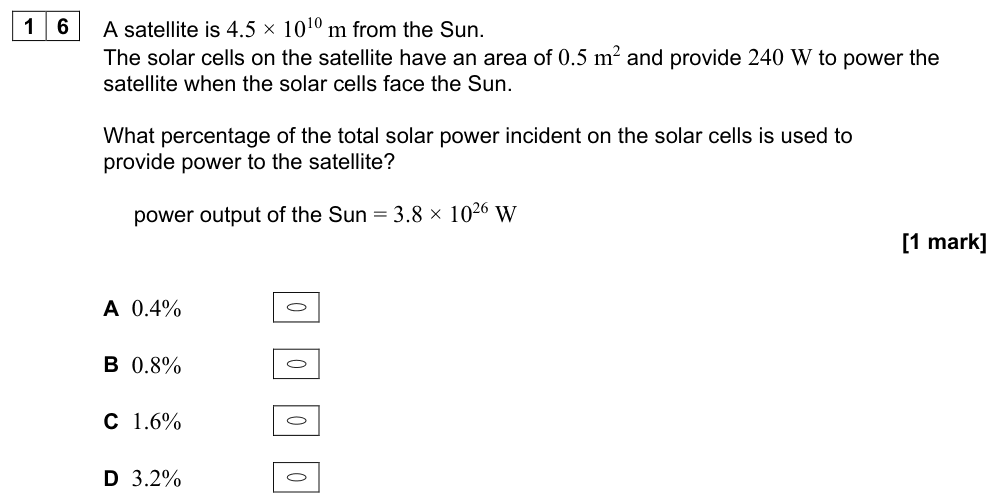
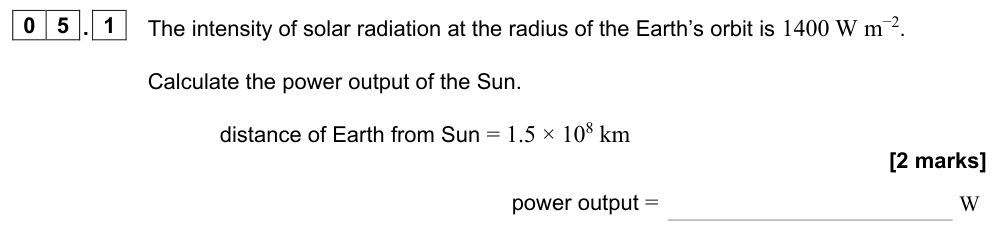
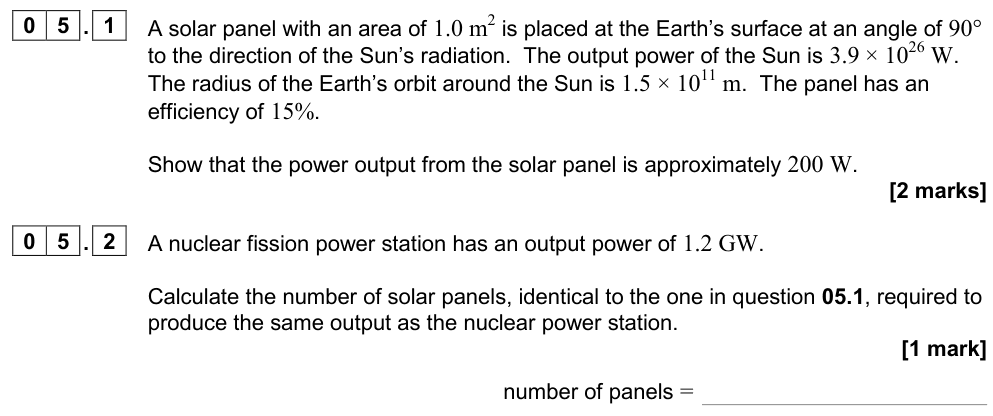
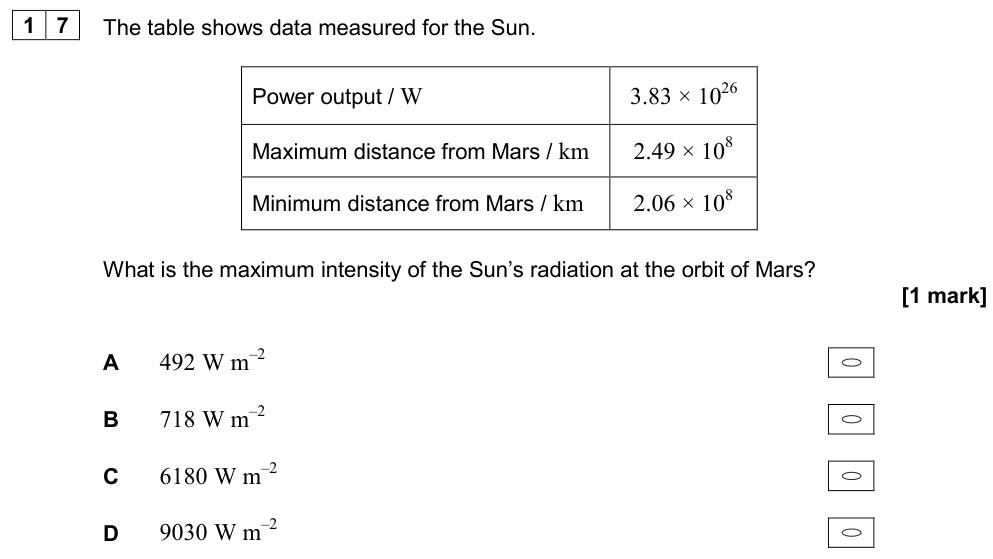
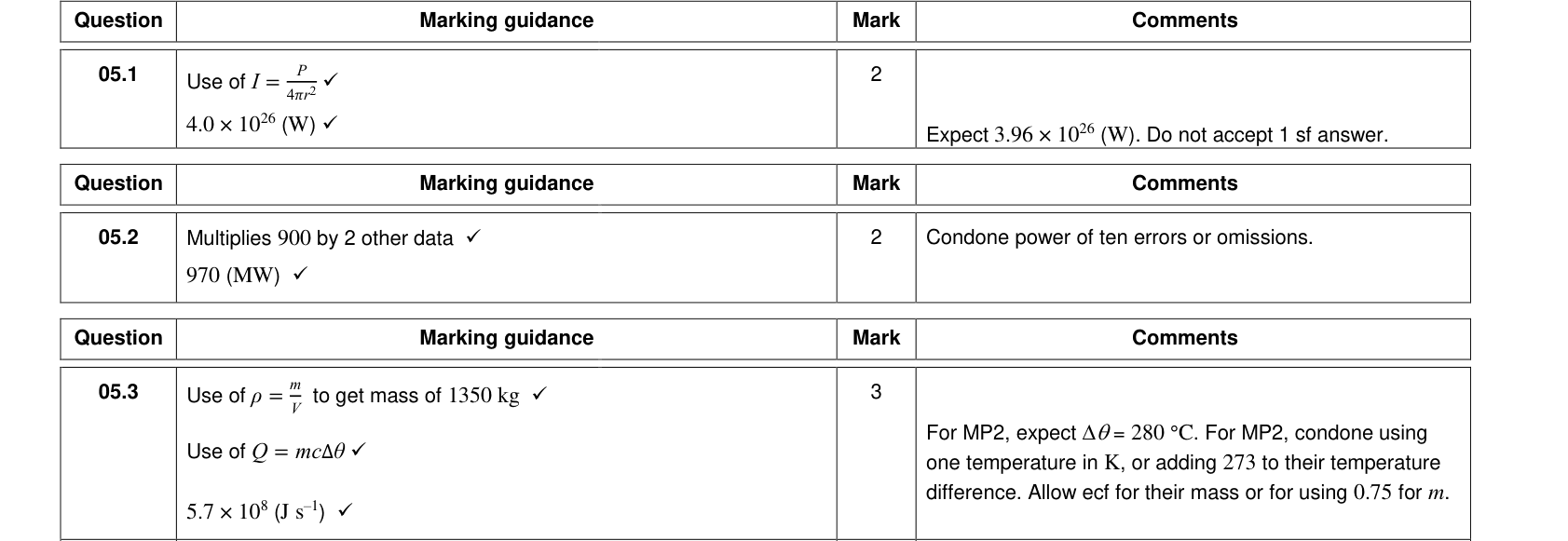
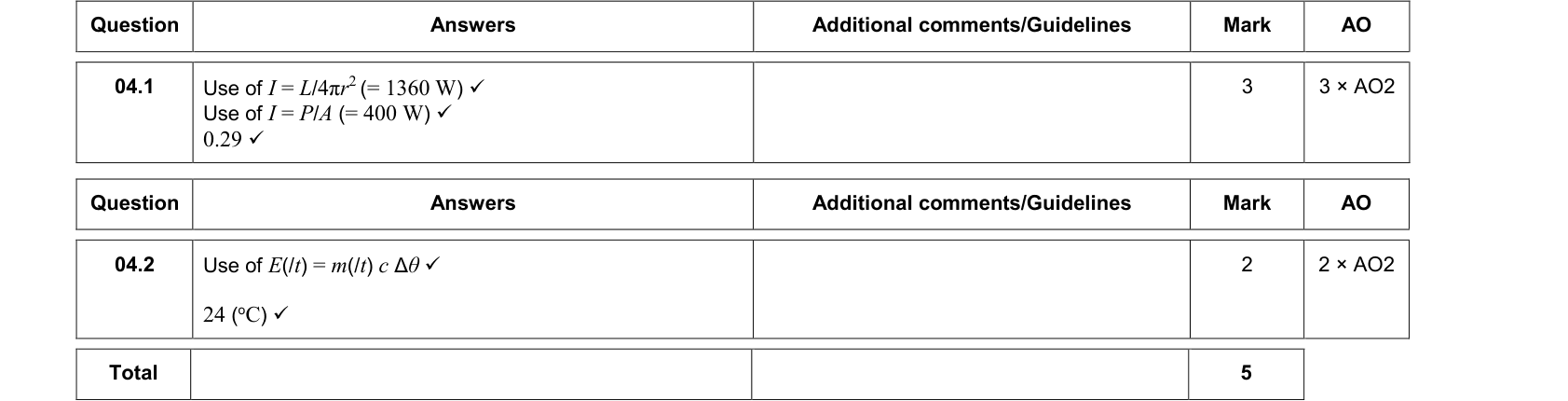
The Sun radiates energy at a rate (its luminosity or power output) of about $P = 3.8 \times 10^{26}$ W, produced by nuclear fusion in its core. This energy spreads out equally in all directions.
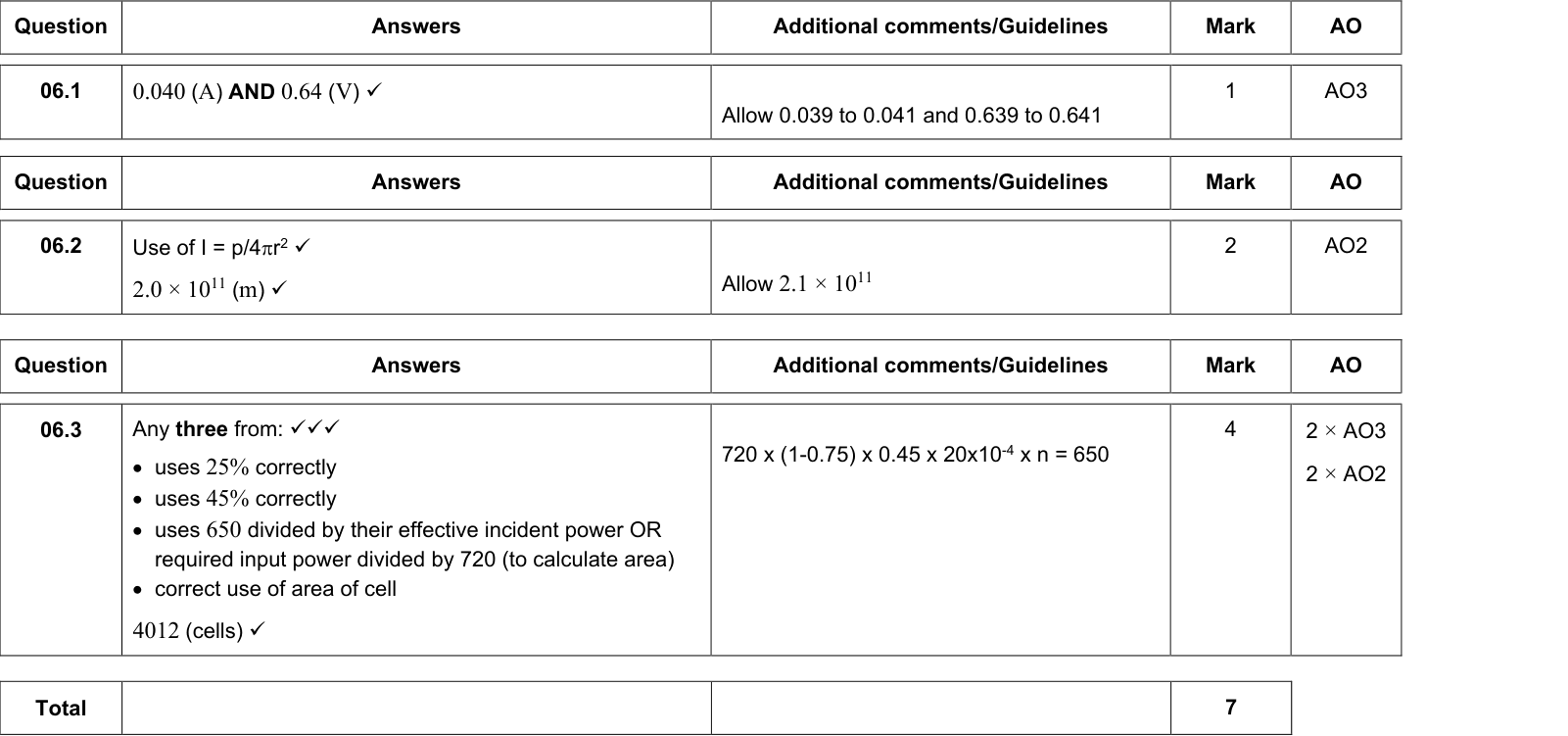
Intensity is the power per unit area received on a surface perpendicular to the radiation, measured in W m⁻².
The inverse-square law
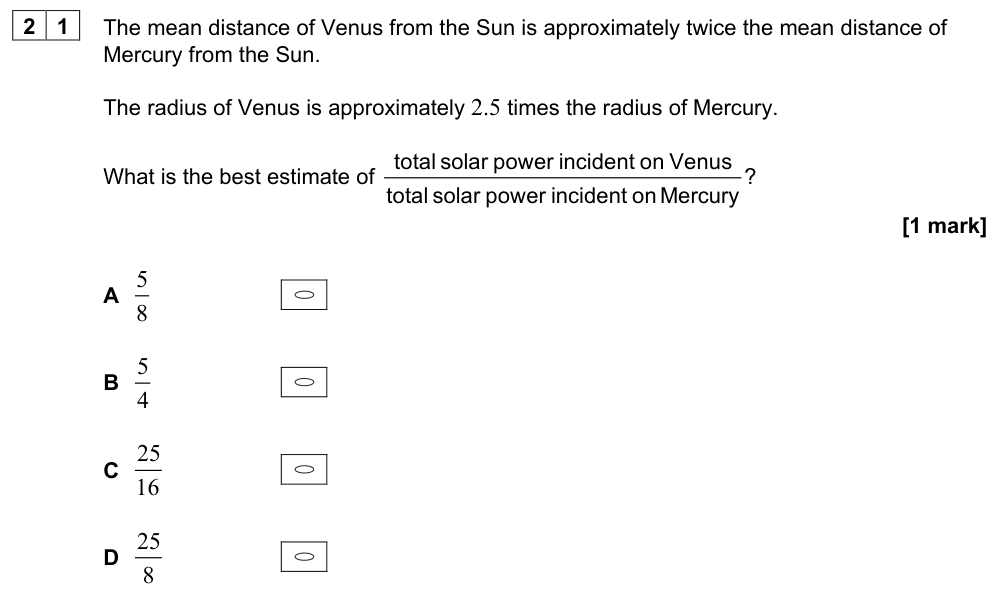
At distance $r$ from the Sun, the power is spread over the surface of a sphere of area $4\pi r^2$:
Intensity at distance r from a point source
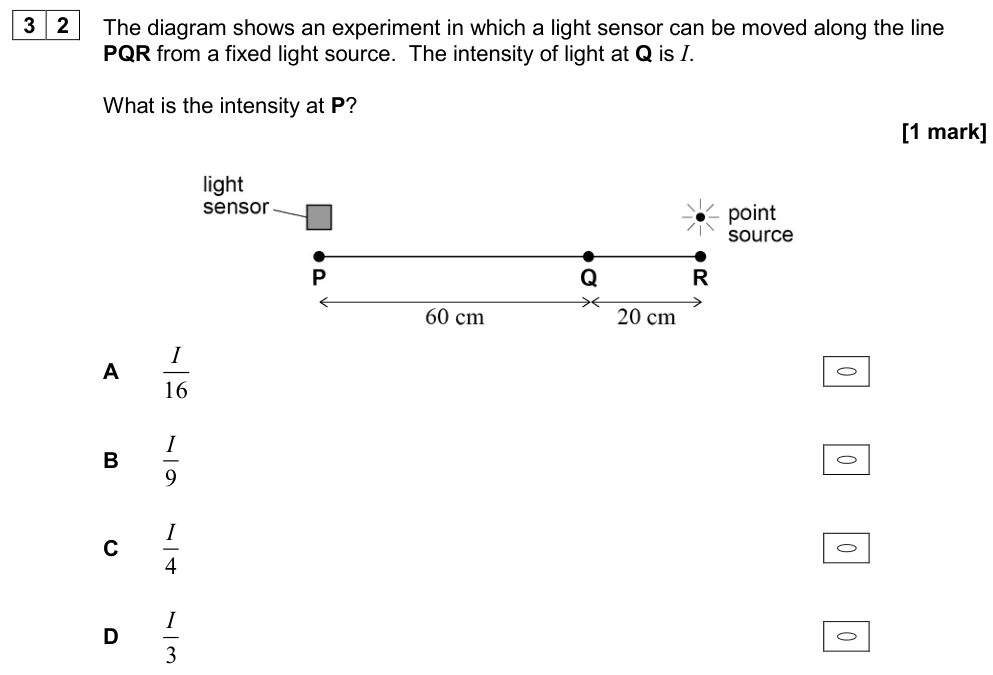
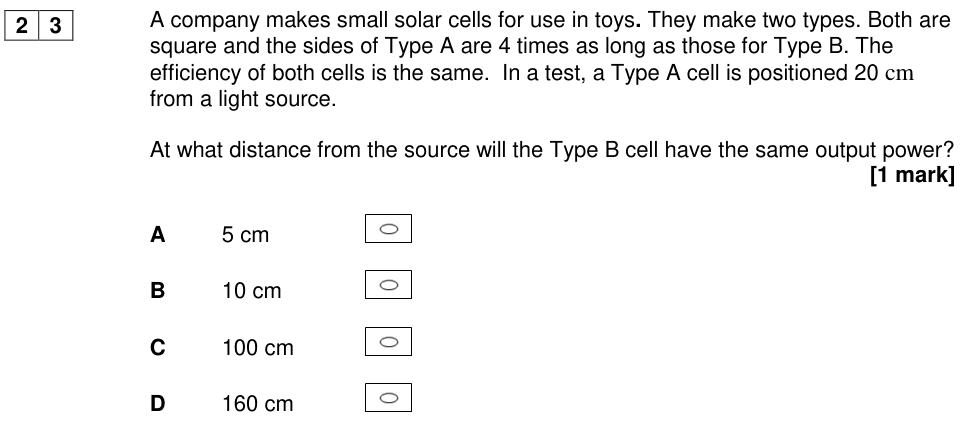
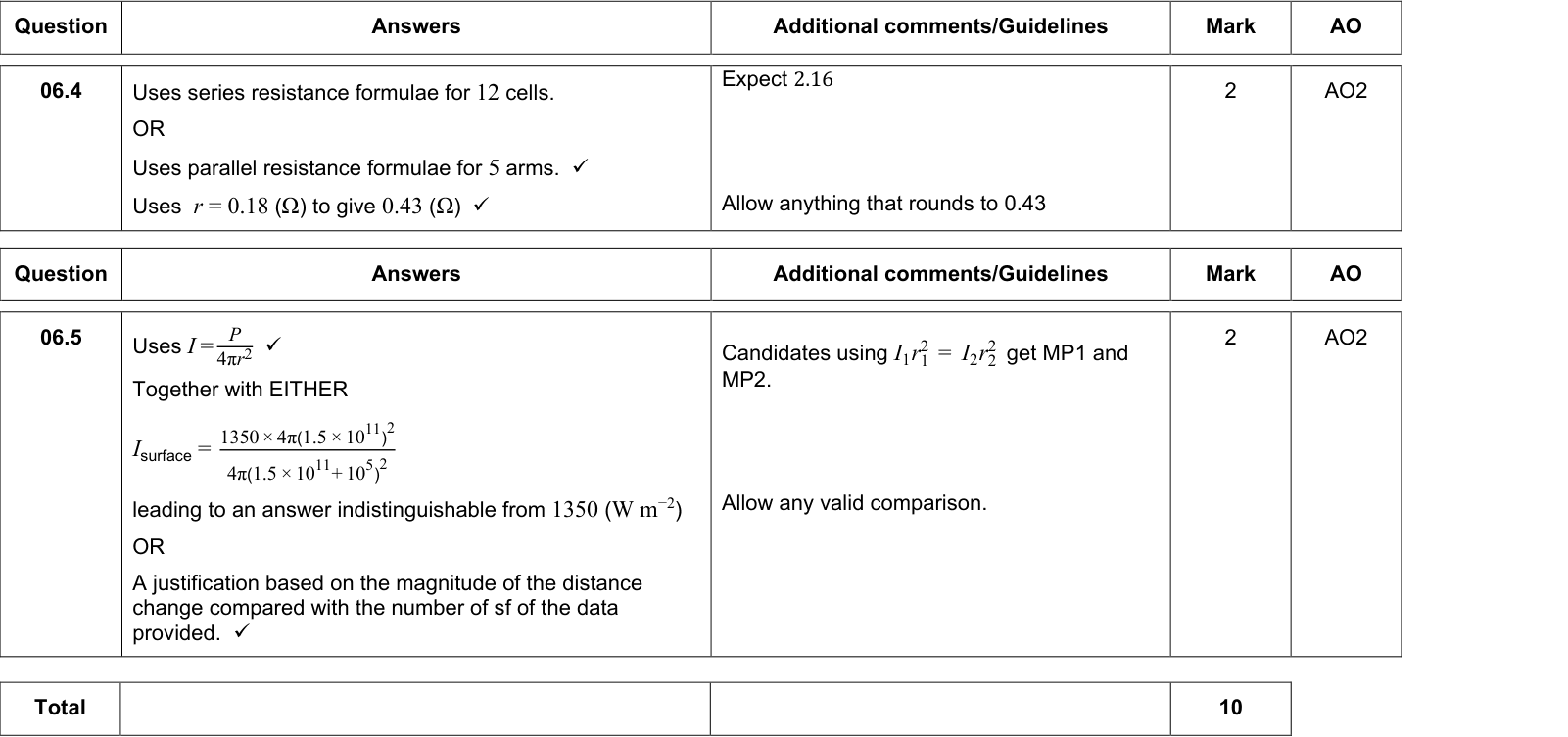
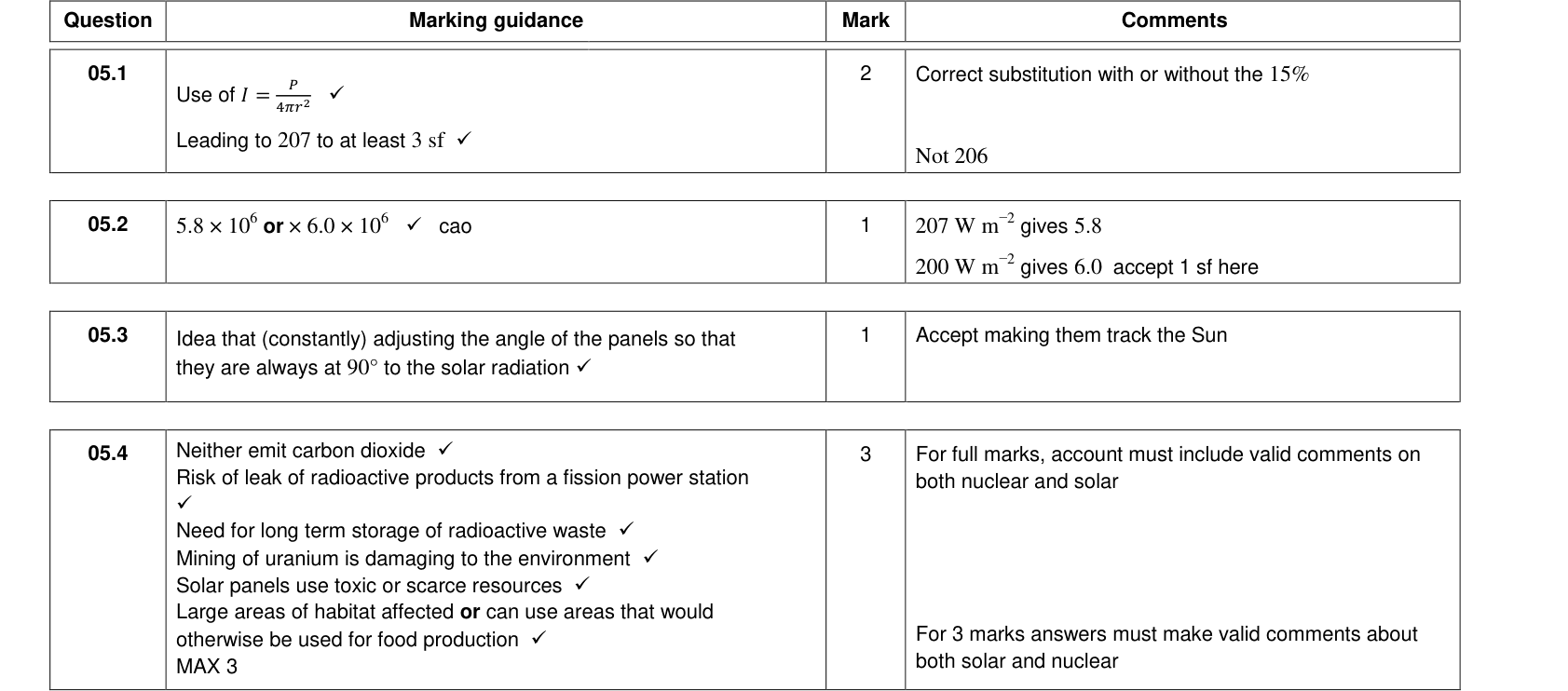
$$I = \frac{P}{4\pi r^2}$$
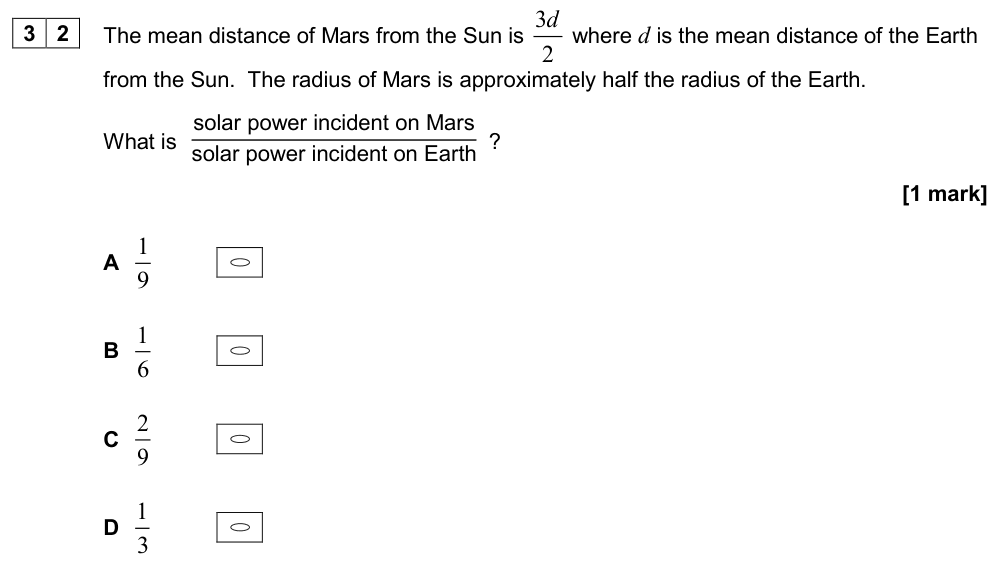
The intensity is inversely proportional to the square of the distance: doubling the distance reduces the intensity to a quarter.
Worked example: the solar constant
The Earth is $1.5 \times 10^{11}$ m from the Sun.
$I = \dfrac{3.8 \times 10^{26}}{4\pi \times (1.5 \times 10^{11})^2} = 1.3 \times 10^{3}$ W m⁻² (about 1.36 kW m⁻² with precise values).
This is the intensity above the atmosphere. Mars is 1.52 times farther from the Sun, so it receives $1/1.52^2 = 0.43$ times as much: about 590 W m⁻².
Intensity at the Earth's surface
Less reaches the ground than arrives at the top of the atmosphere:
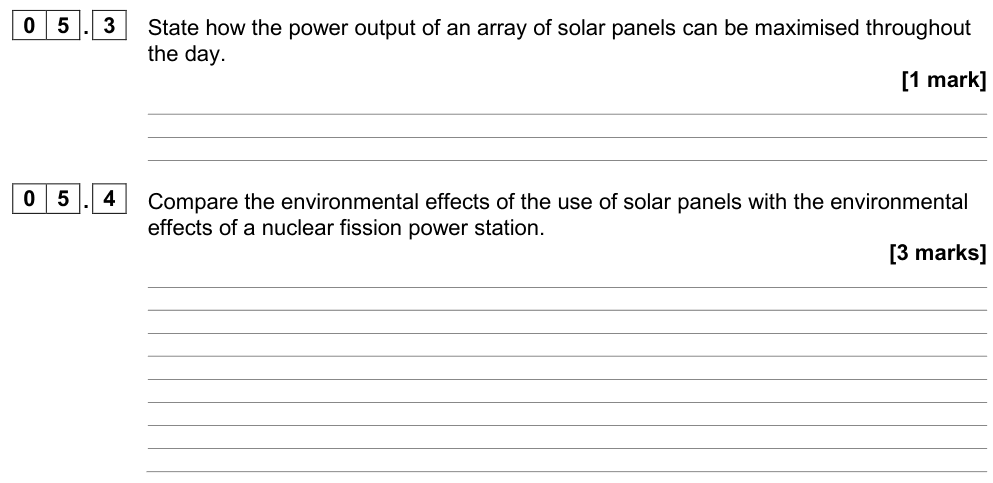
- The atmosphere absorbs and scatters some radiation (more when the Sun is low, because the path through the air is longer), and clouds reflect a lot. On a clear day with the Sun overhead, the intensity at the surface is about 1.0 kW m⁻².
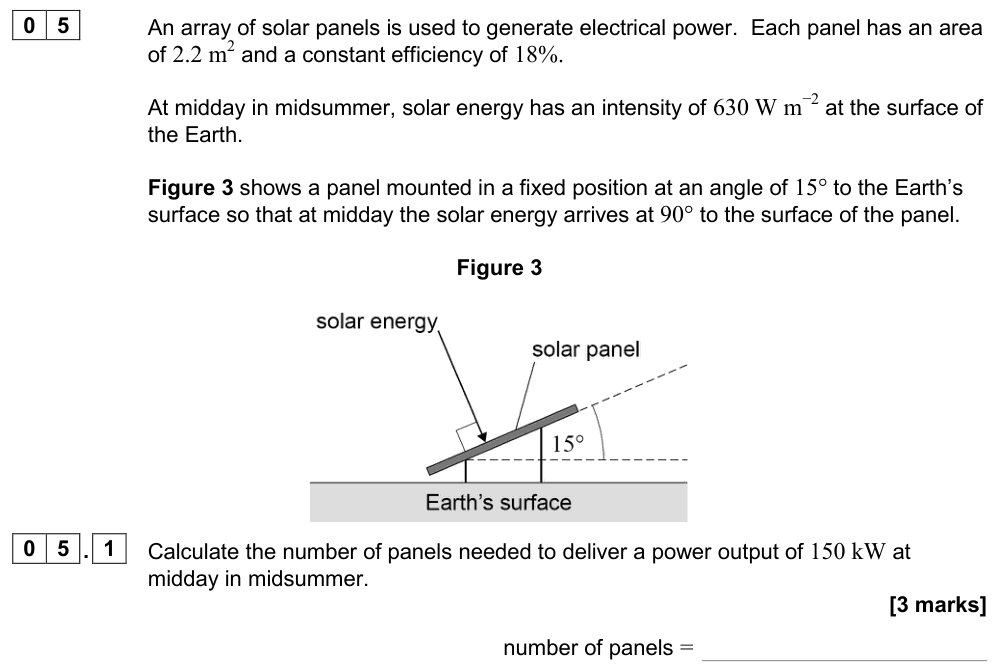
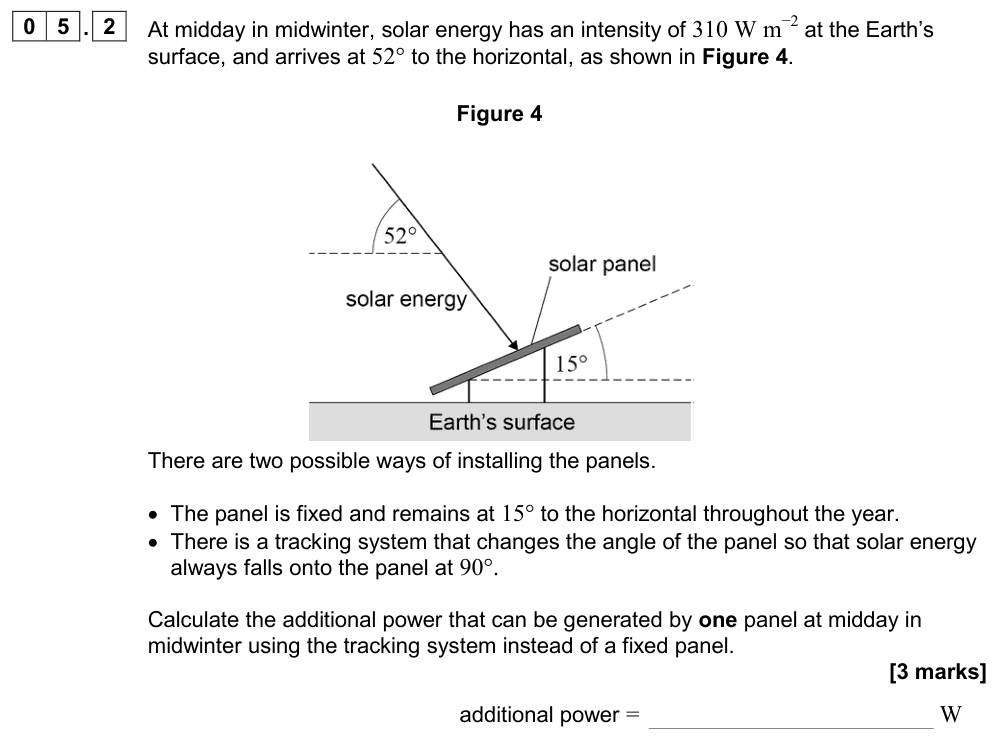
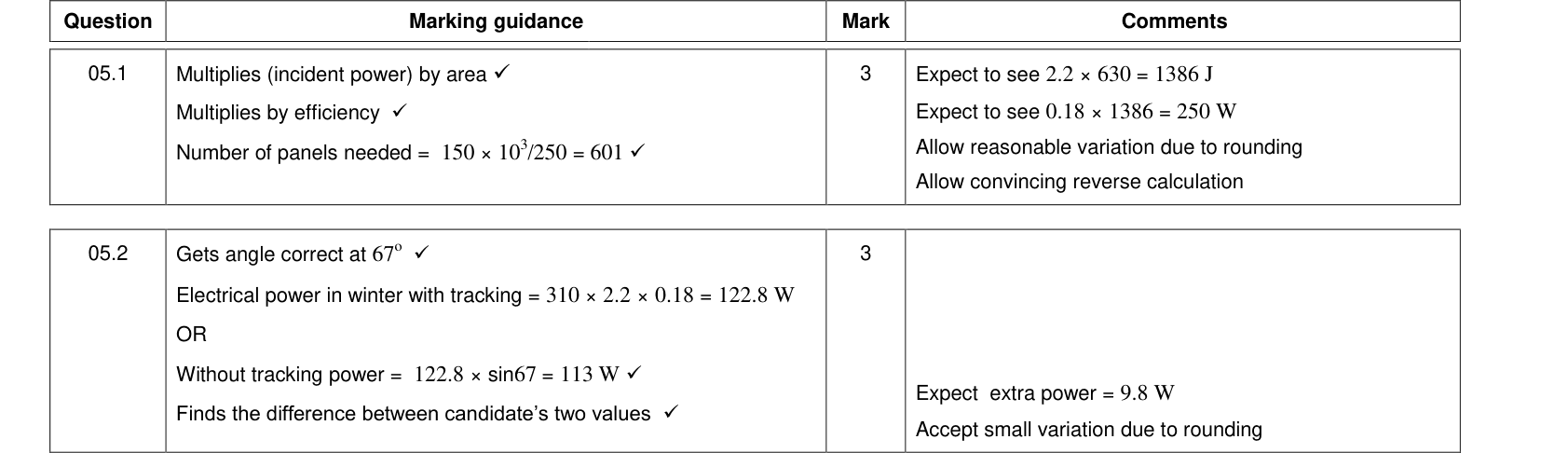
- When the Sun is not overhead, the radiation strikes a horizontal surface at an angle, so the same energy is spread over a larger area. This depends on latitude, season and time of day.
- There is no sunlight at night. Averaged over a day and night and over the year, a typical location receives only about 100–250 W m⁻² on average.
Solar panels are tilted to face the Sun as directly as possible (towards the equator), and some track the Sun across the sky.
Solar cells
A solar (photovoltaic) cell converts light energy directly into electrical energy. Each silicon cell produces an e.m.f. of about 0.5–0.6 V.
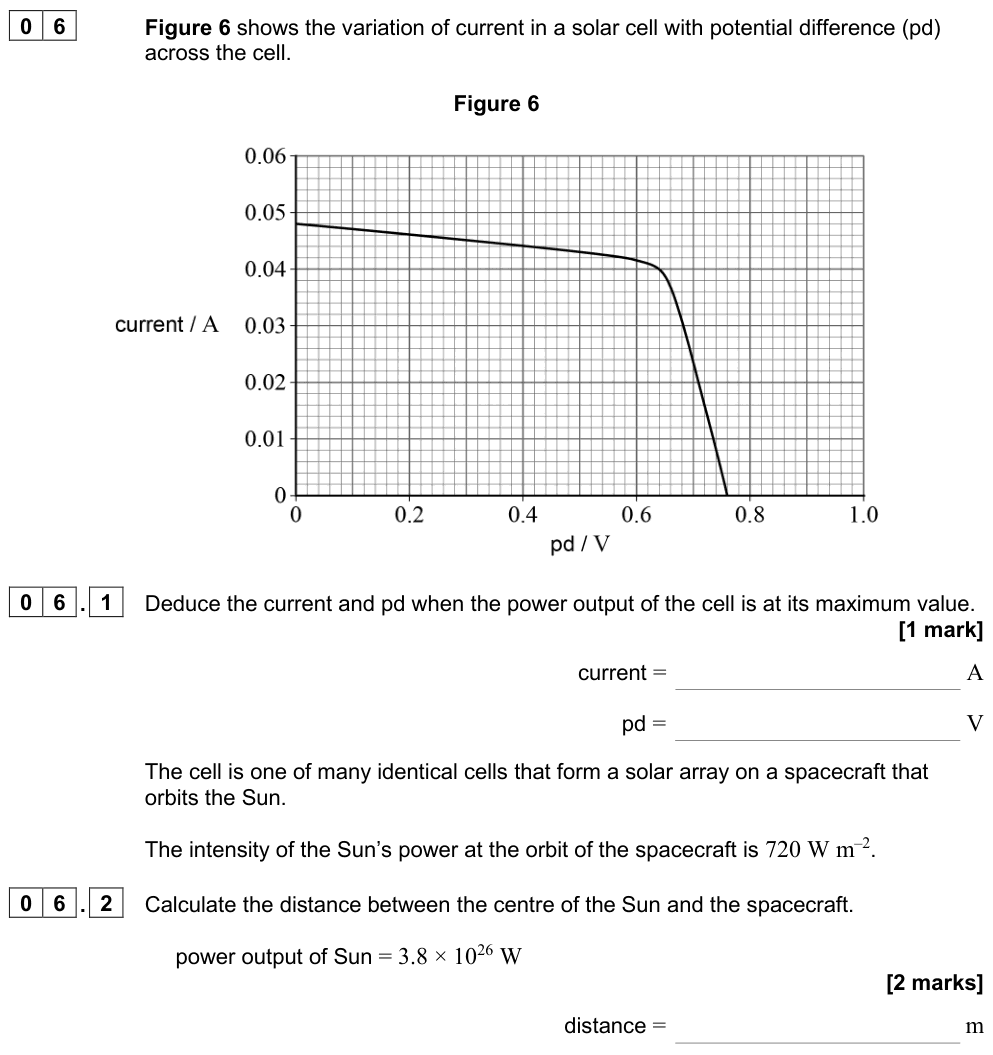
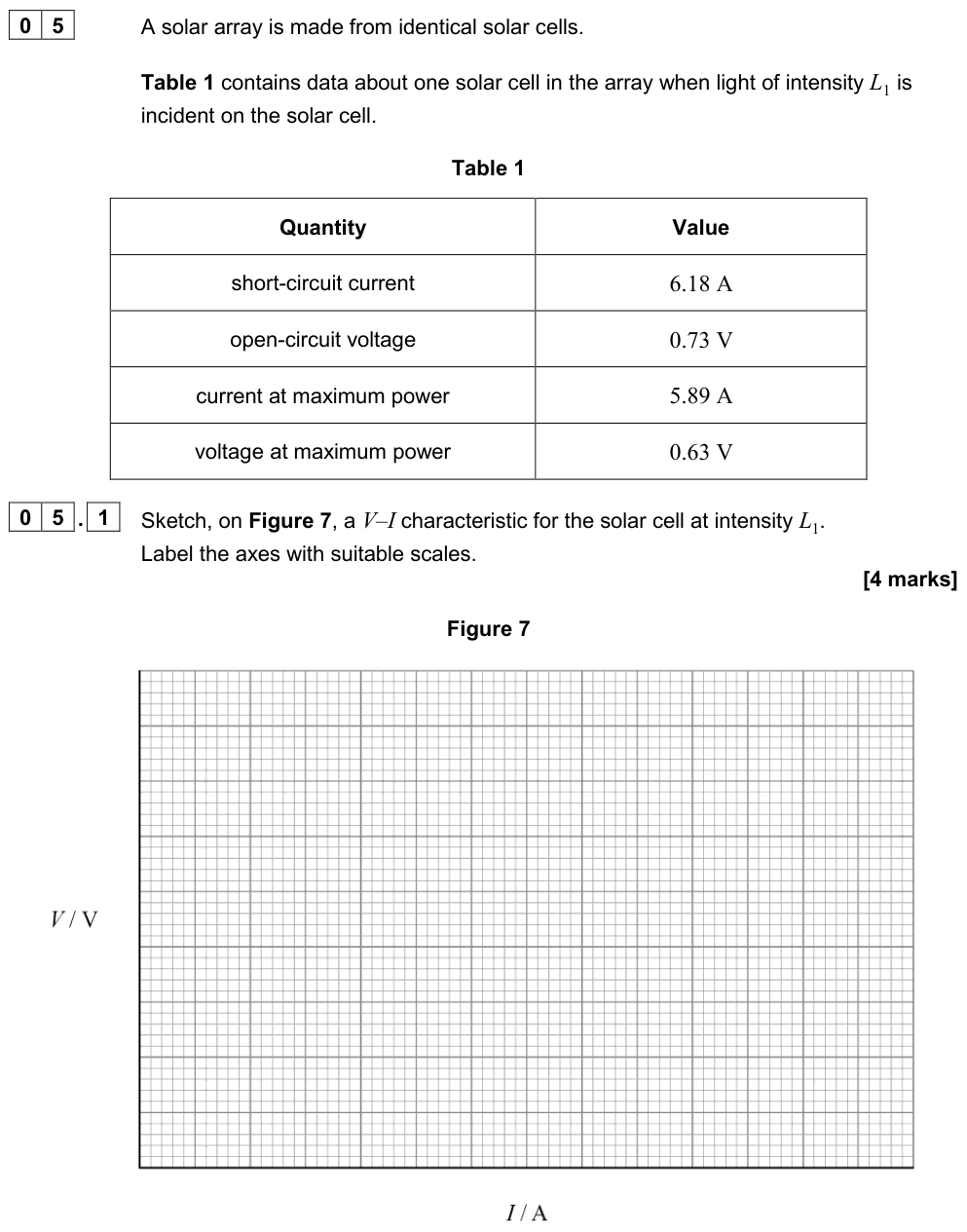
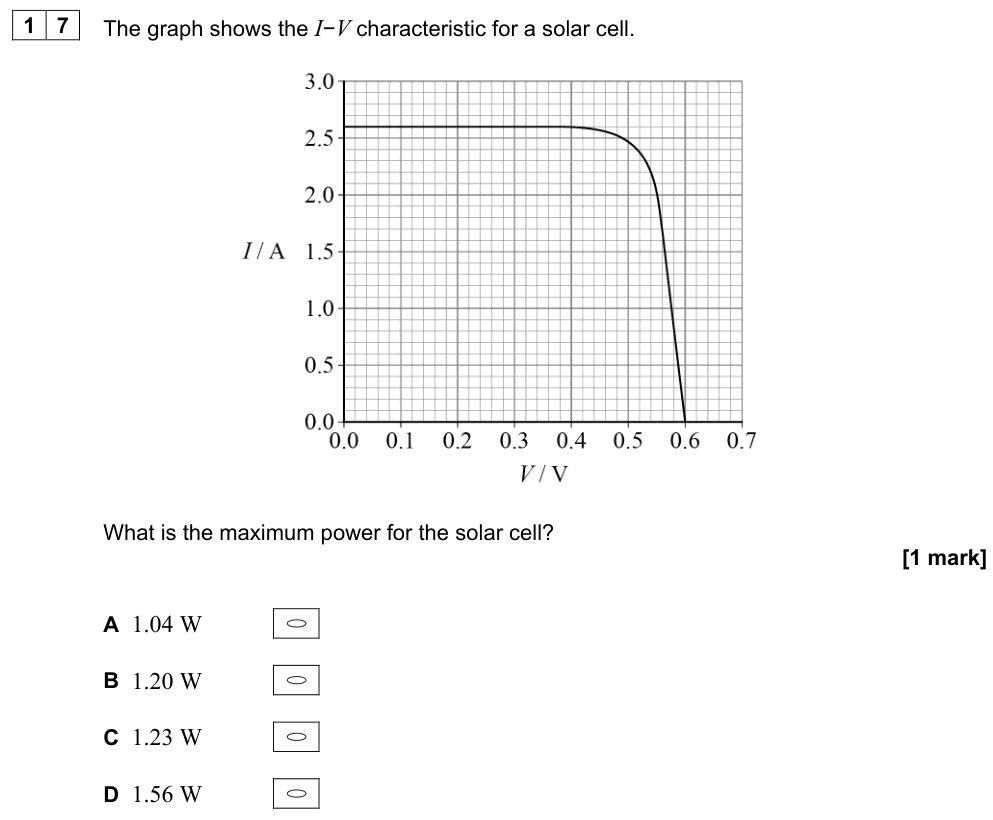
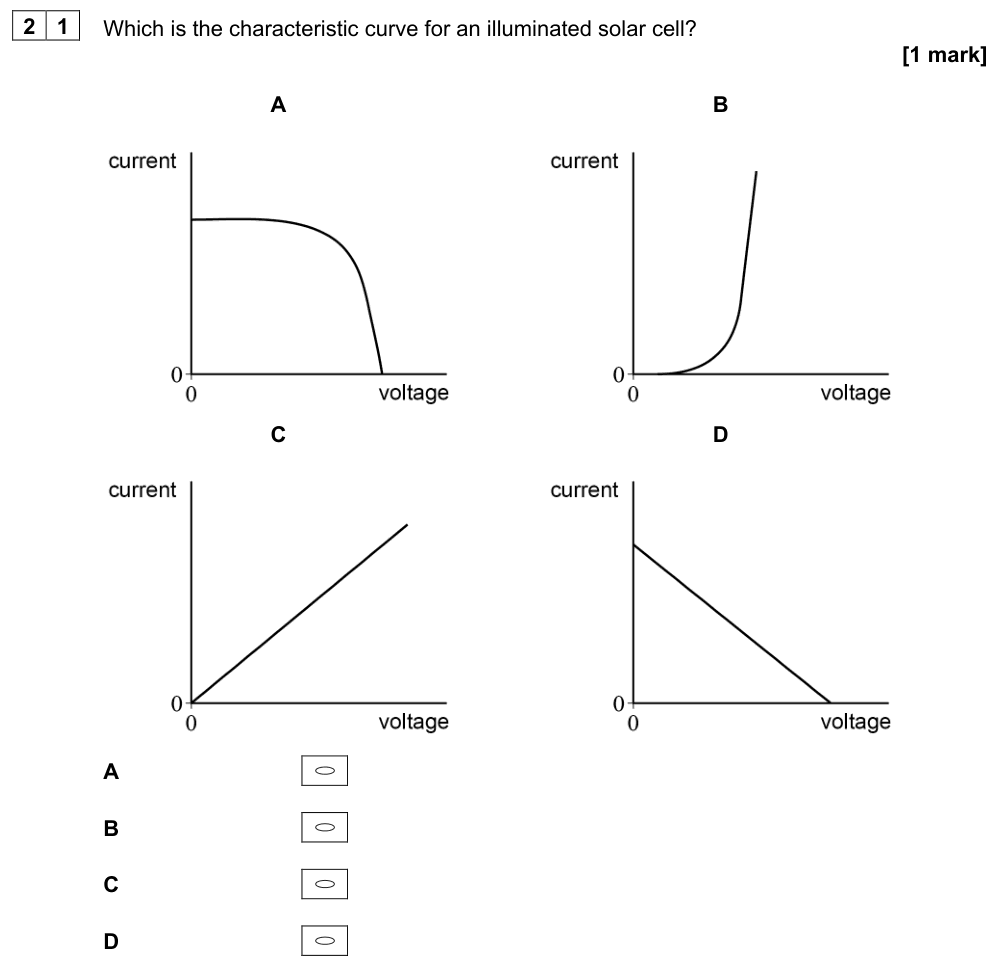
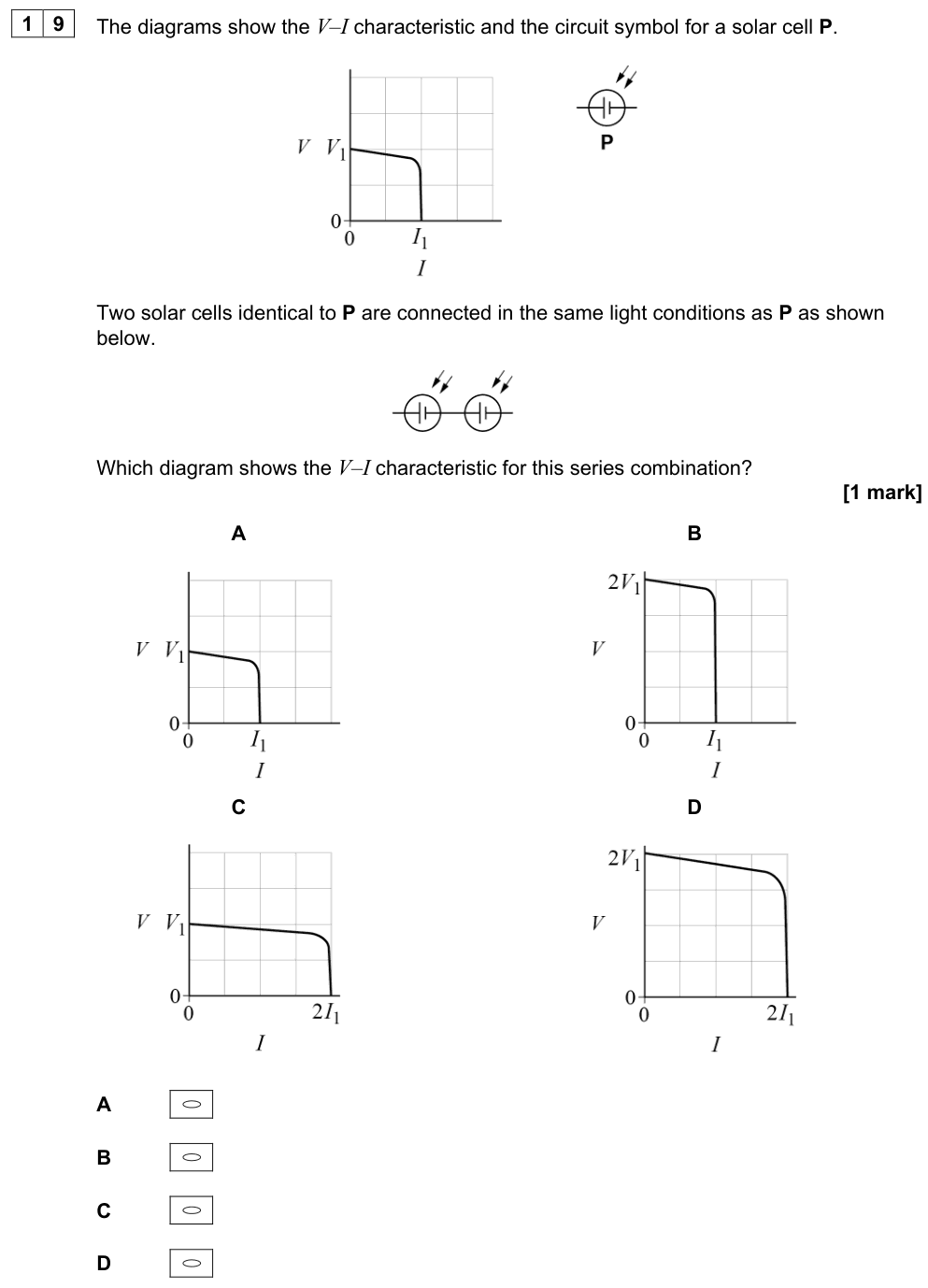
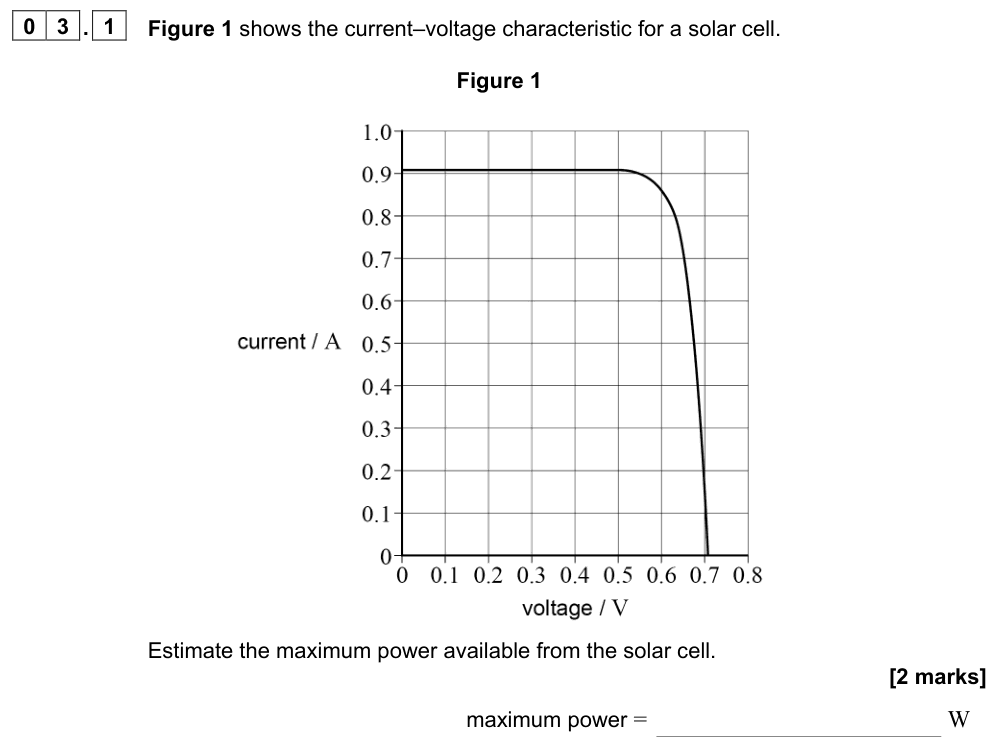
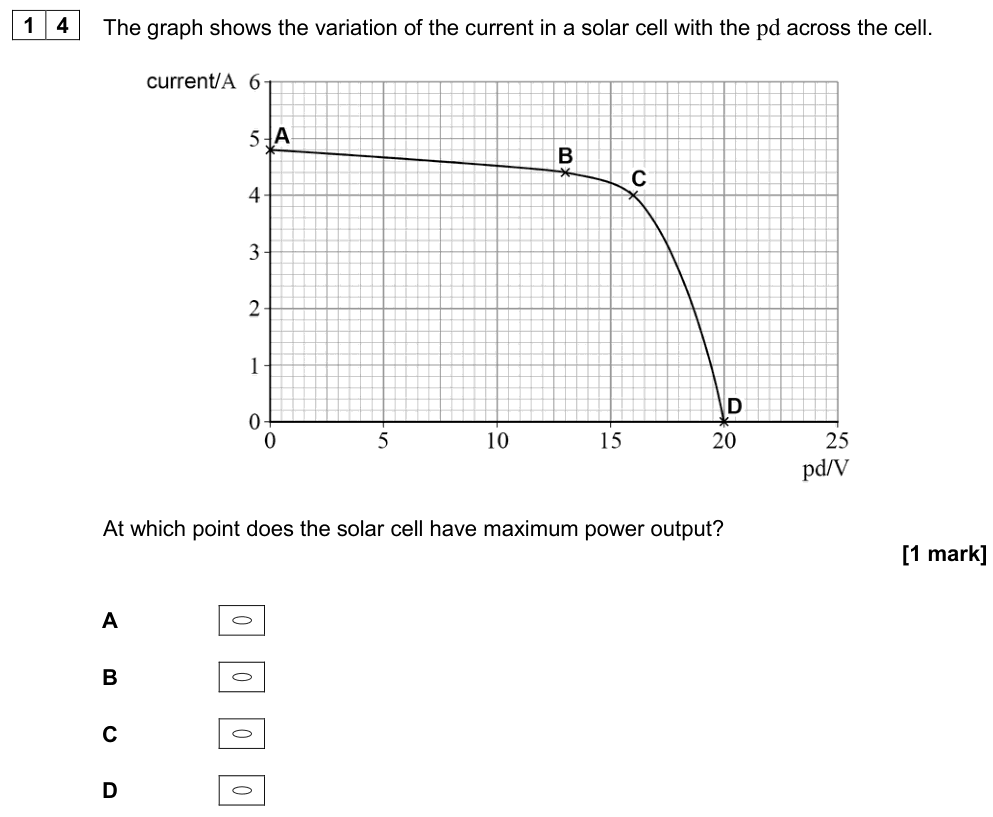
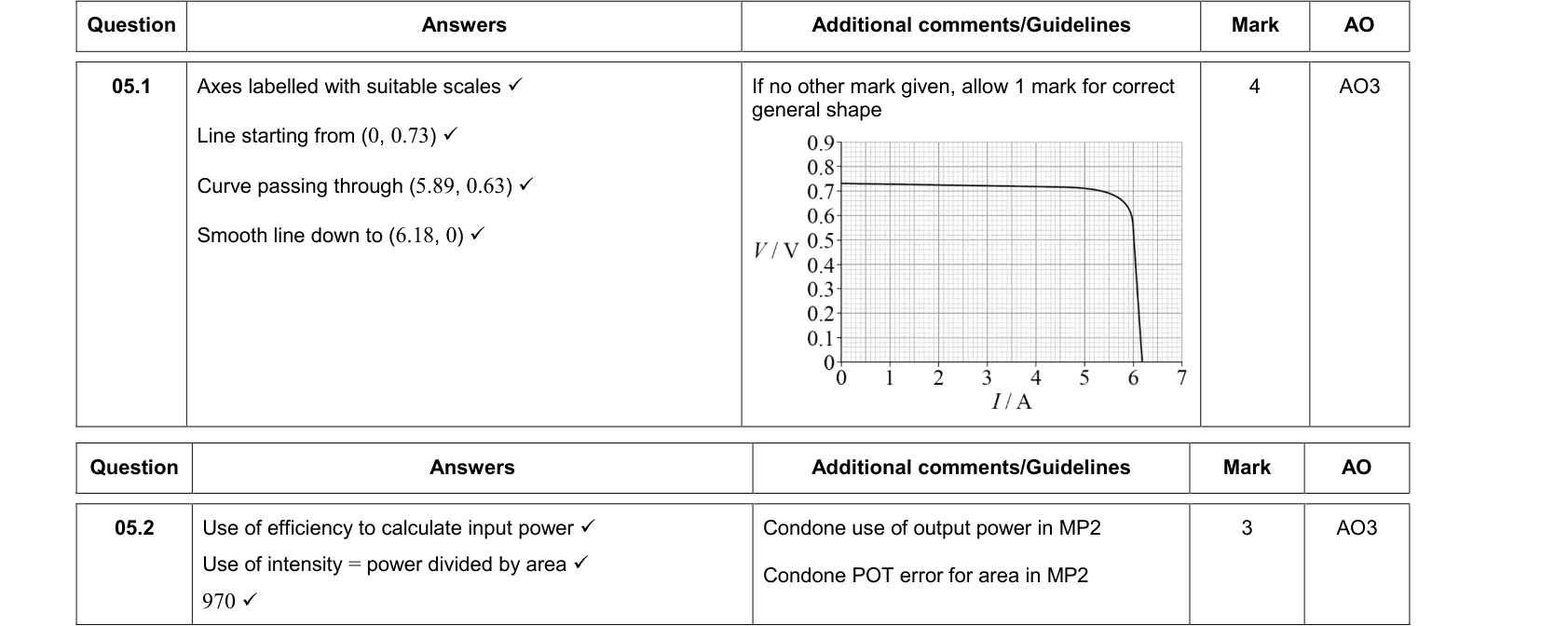
Features of the V–I characteristic:
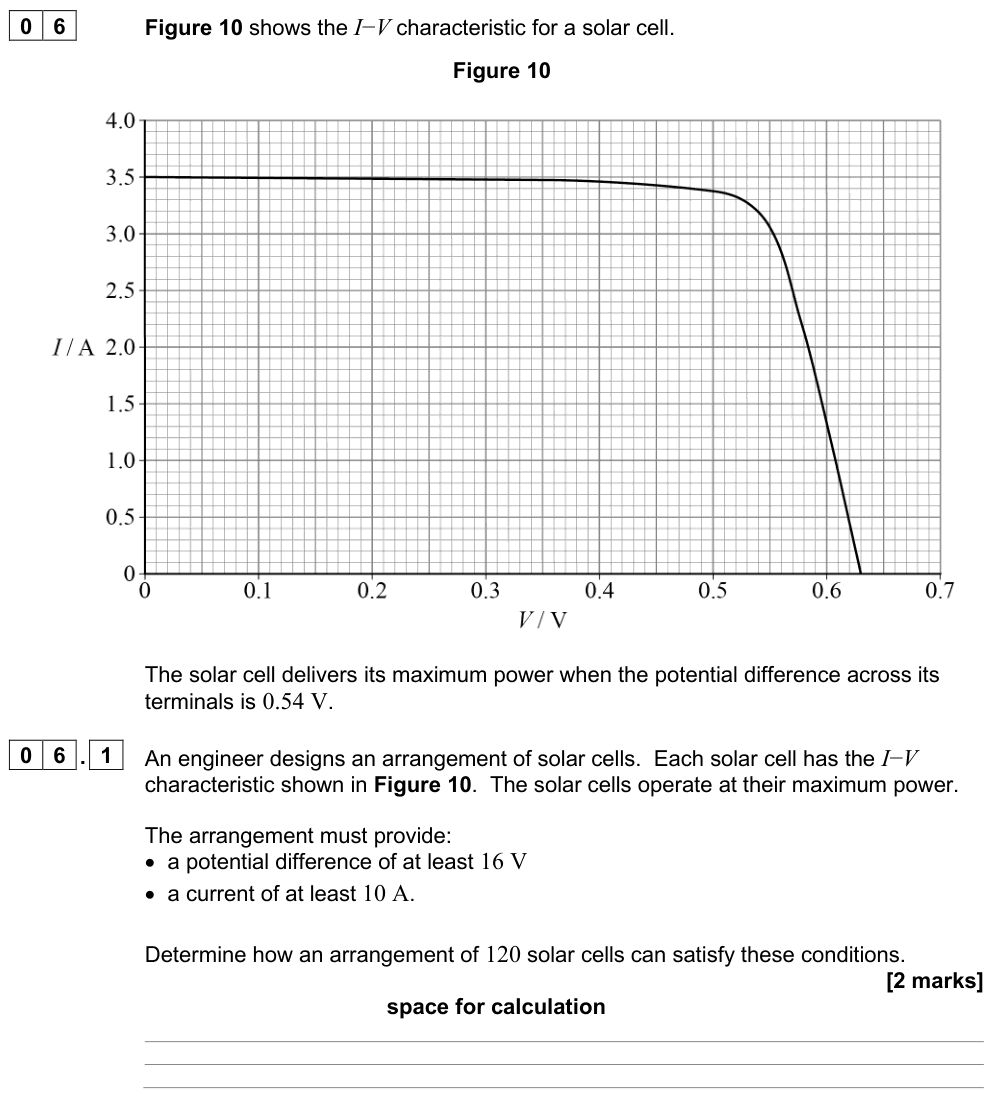
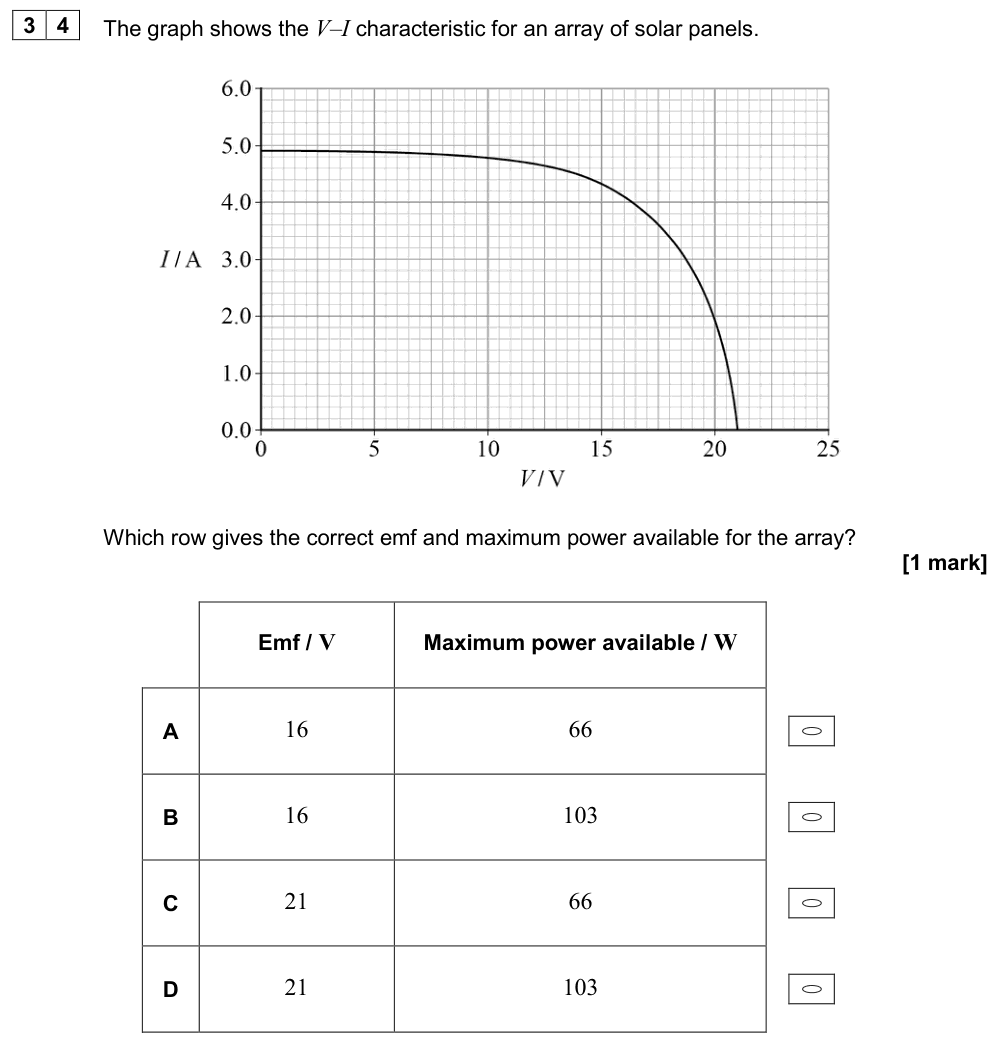
- At short circuit (V = 0) the current is a maximum, the short-circuit current $I_{sc}$, which is proportional to the light intensity.
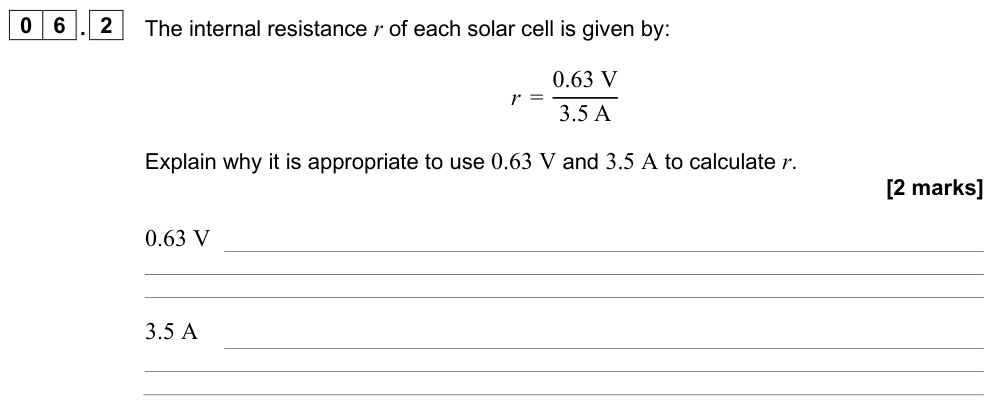
- The current stays almost constant as the p.d. increases, then falls steeply to zero at the open-circuit voltage $V_{oc}$ (the e.m.f.).
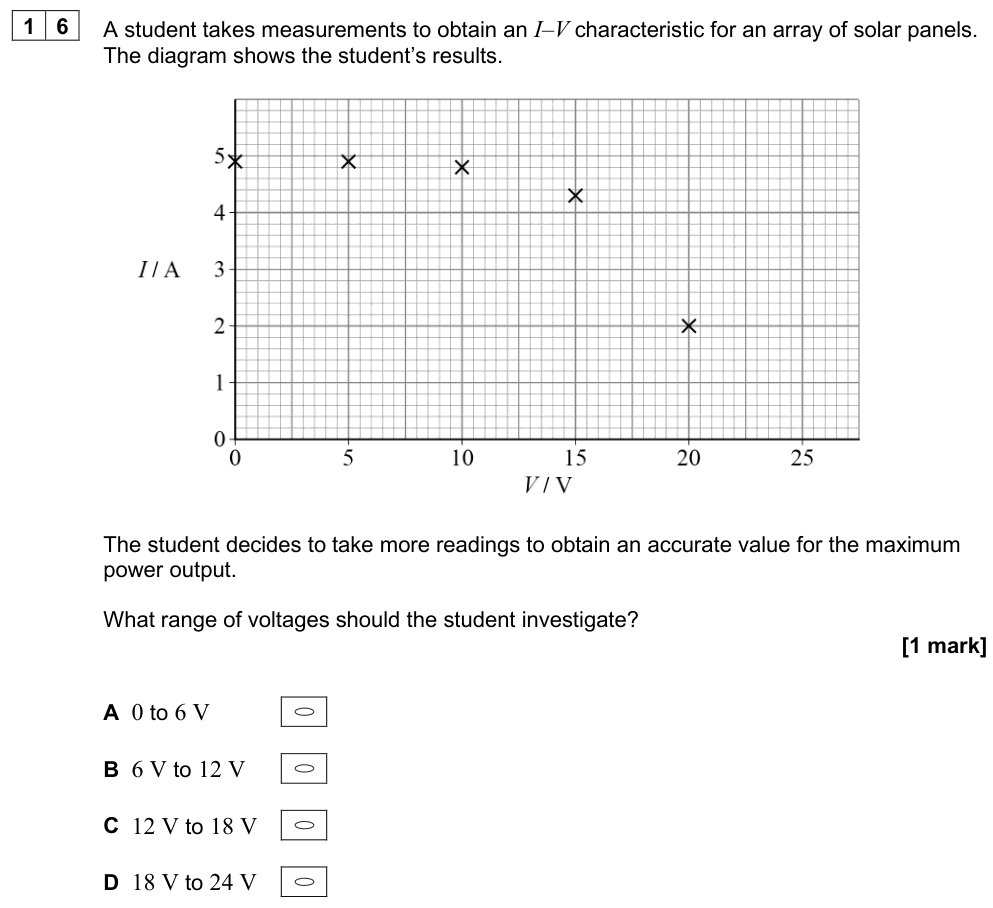
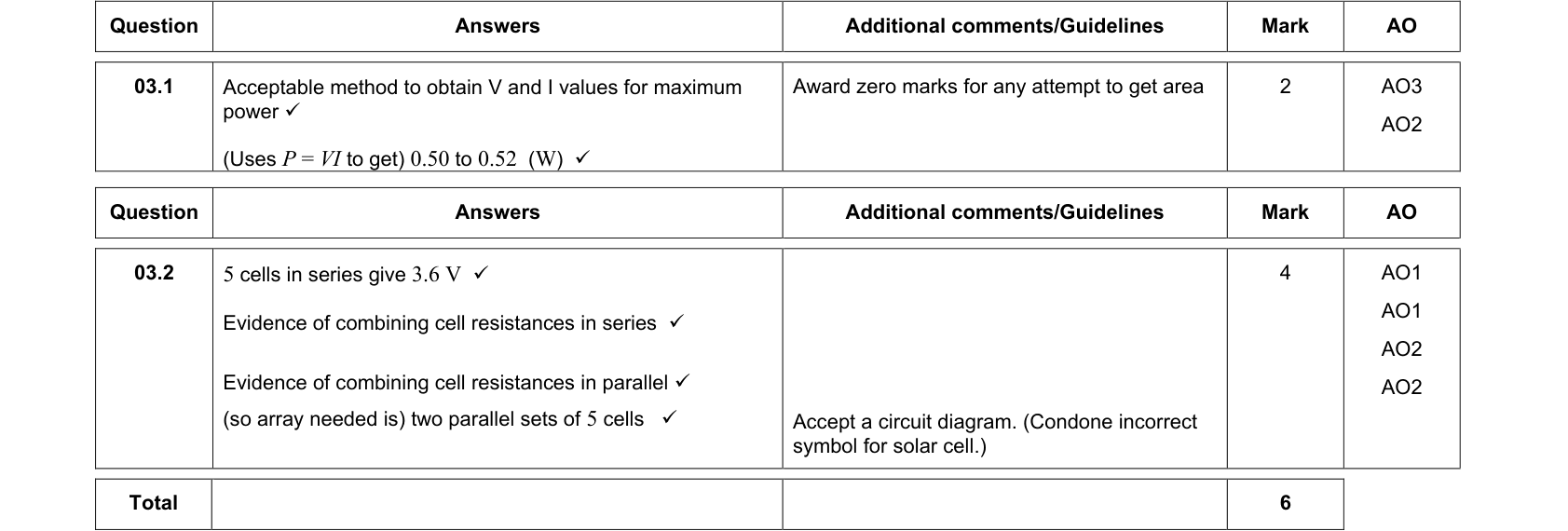
- The power delivered to the load is $P = IV$. It is zero at both ends and has a maximum at the knee of the curve (the maximum power point). The load resistance that gives maximum power is $R = V_{mp}/I_{mp}$.
- Increasing the light intensity increases the current roughly in proportion, but changes the open-circuit voltage only slightly. Cells also become less efficient as they get hotter.
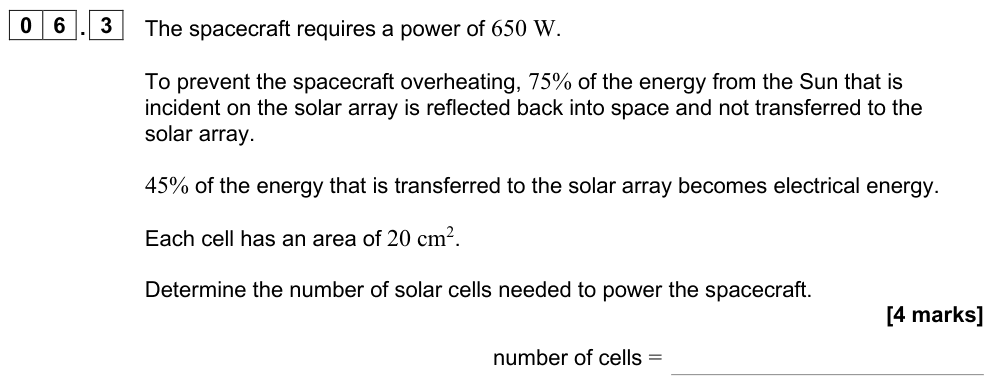
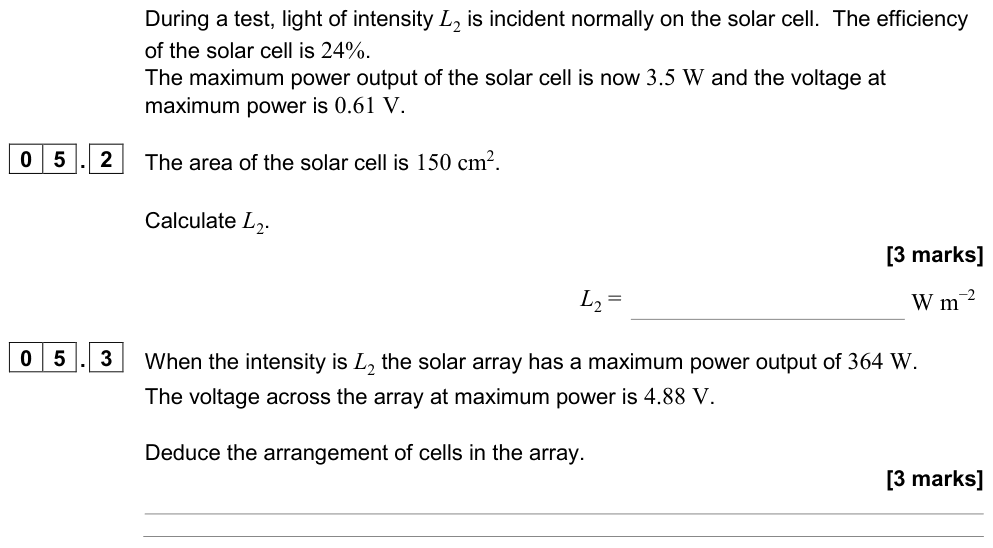
The efficiency of a cell is $$\text{efficiency} = \frac{\text{maximum electrical power output}}{\text{intensity} \times \text{area}}$$ and is typically 15–22% for commercial silicon cells.
Worked example: a solar cell
A cell of area 0.10 m × 0.10 m is in sunlight of intensity 800 W m⁻². At its maximum power point the p.d. is 0.48 V and the current is 2.6 A.
Maximum power $= 0.48 \times 2.6 = 1.25$ W. Power incident $= 800 \times 0.010 = 8.0$ W. Efficiency $= 1.25/8.0 = 0.16$ (16%). Load resistance for maximum power $= 0.48/2.6 = 0.18\ \Omega$.
Solar arrays
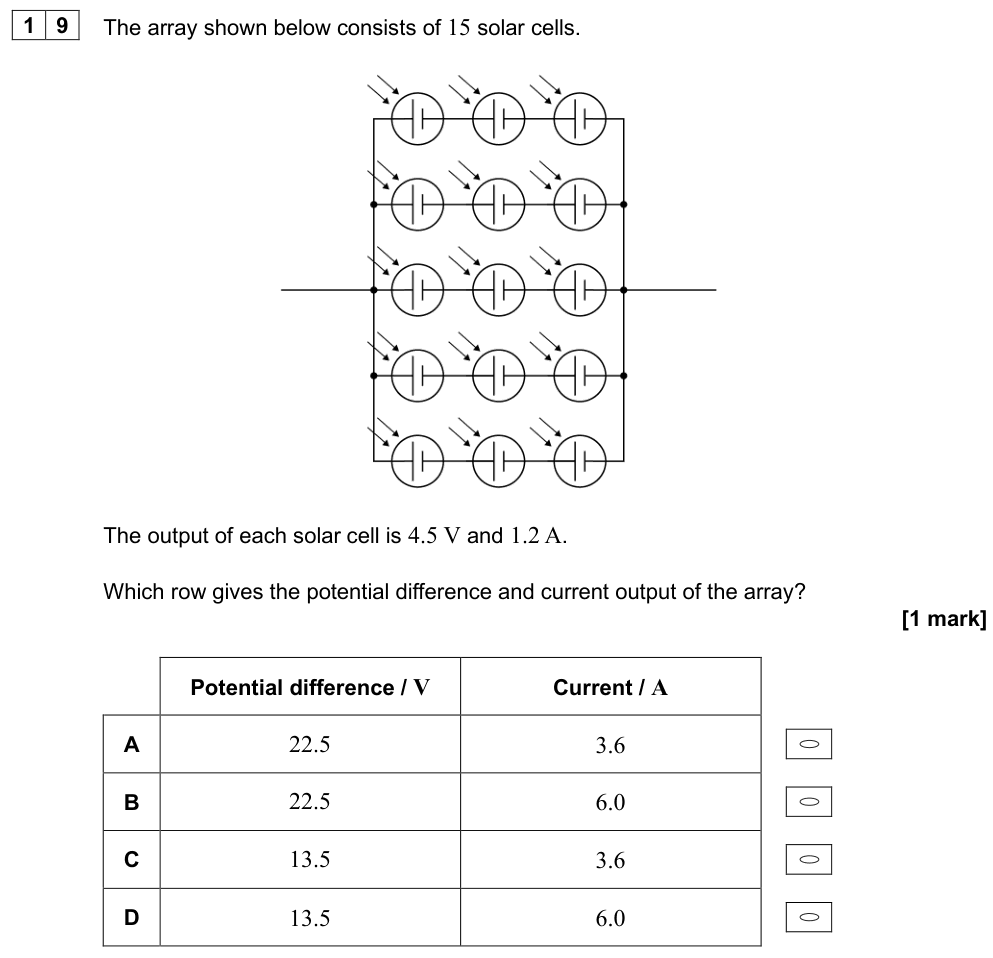
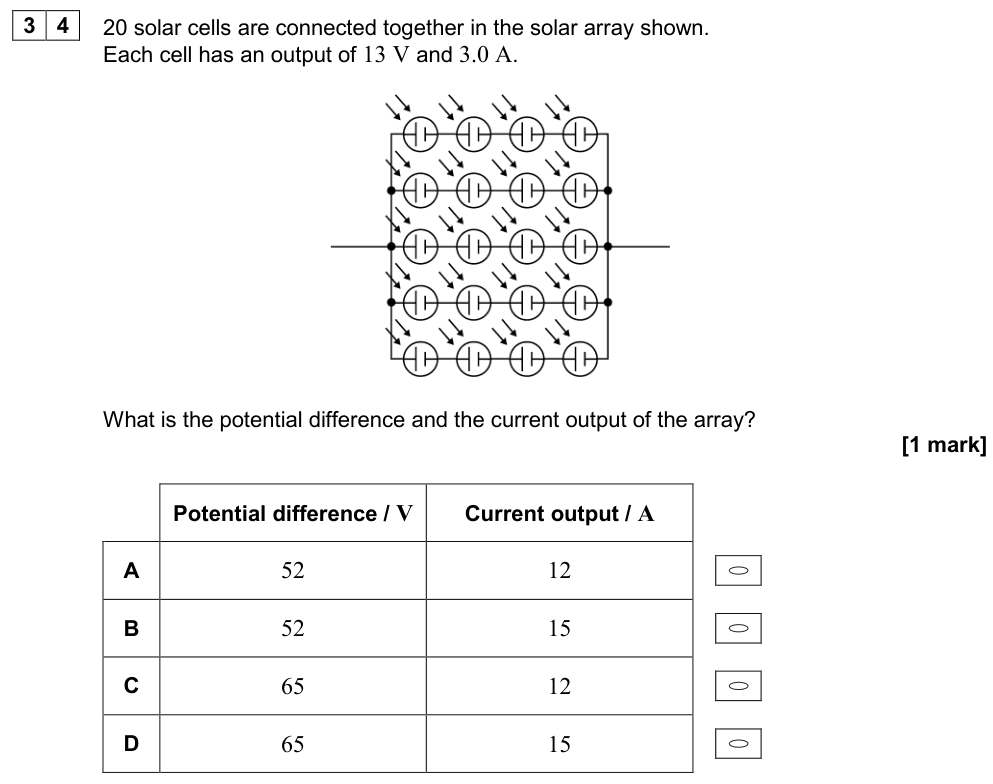
Single cells give a small p.d. and current, so they are connected into panels and arrays.
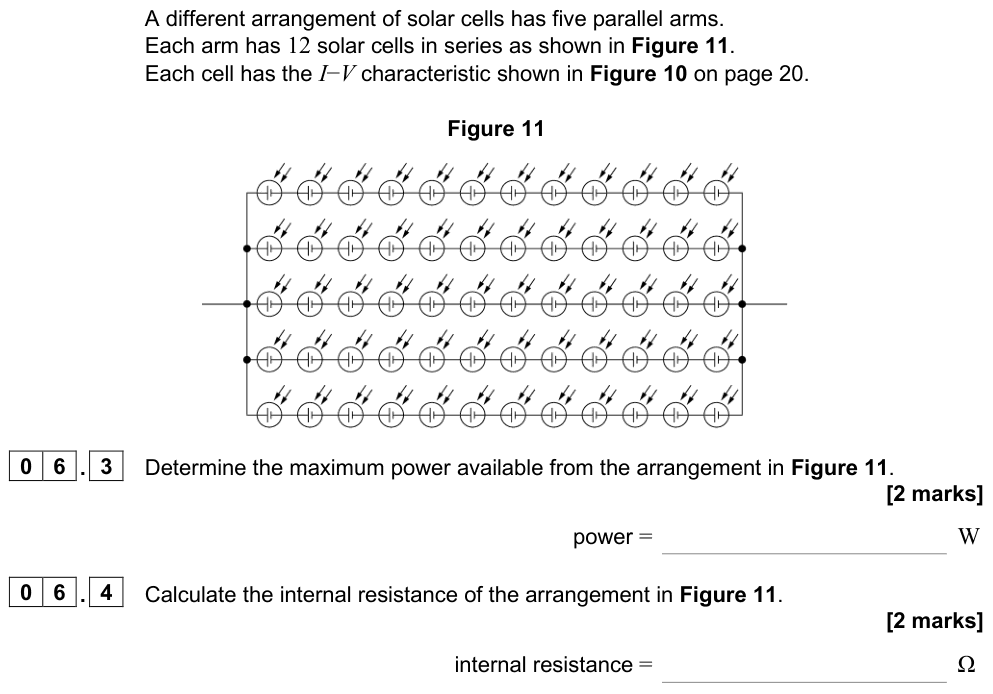
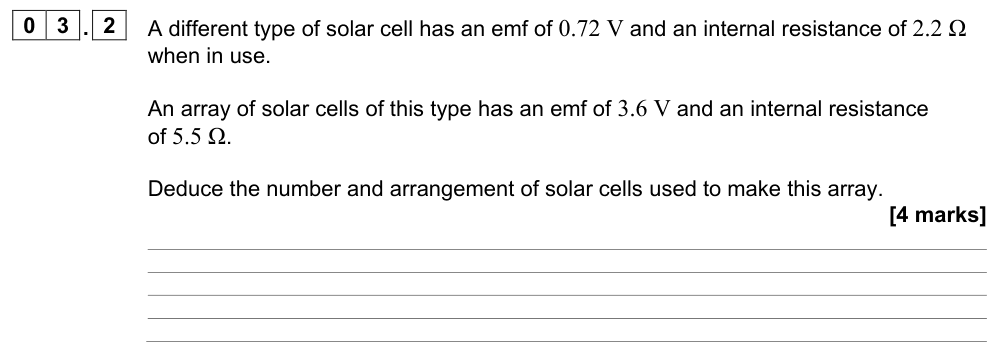
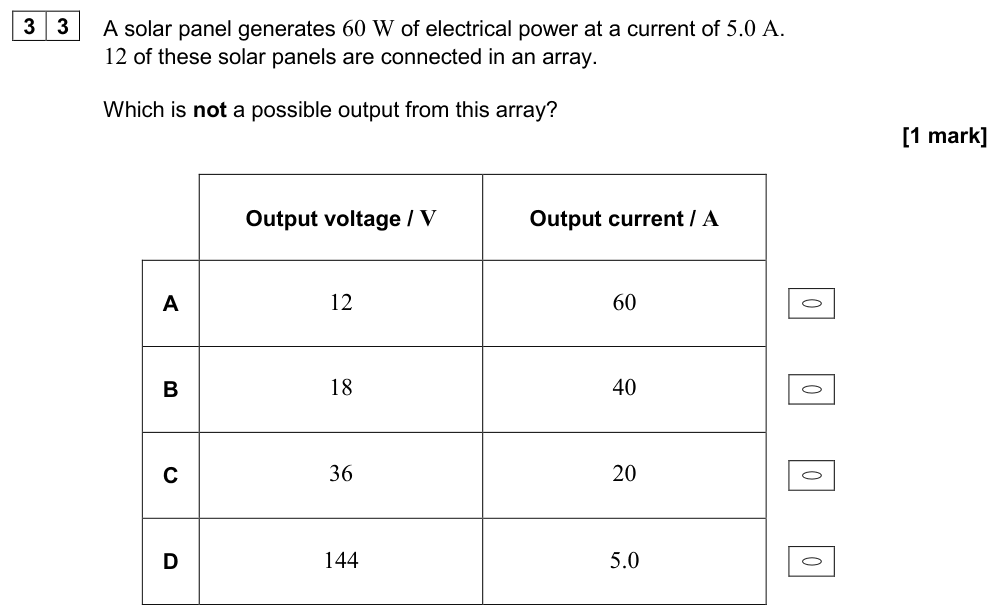
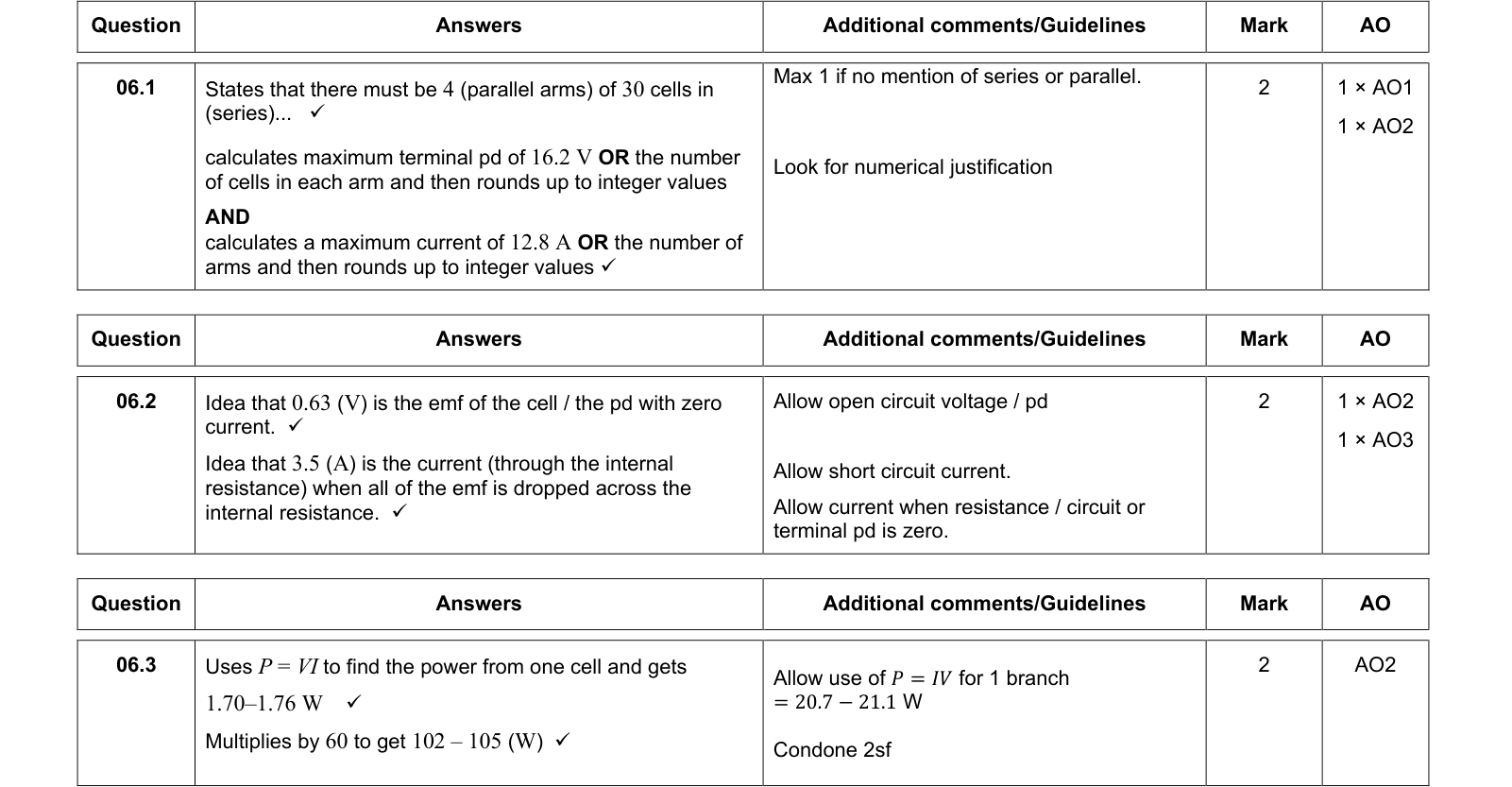
- Cells in series: the e.m.f.s add, the current is the same as for one cell. (A typical panel has 60 or more cells in series.)
- Strings of cells in parallel: the currents add, the p.d. is the same as for one string.
- The total power is the sum of the powers of all the cells.
Worked example: designing an array
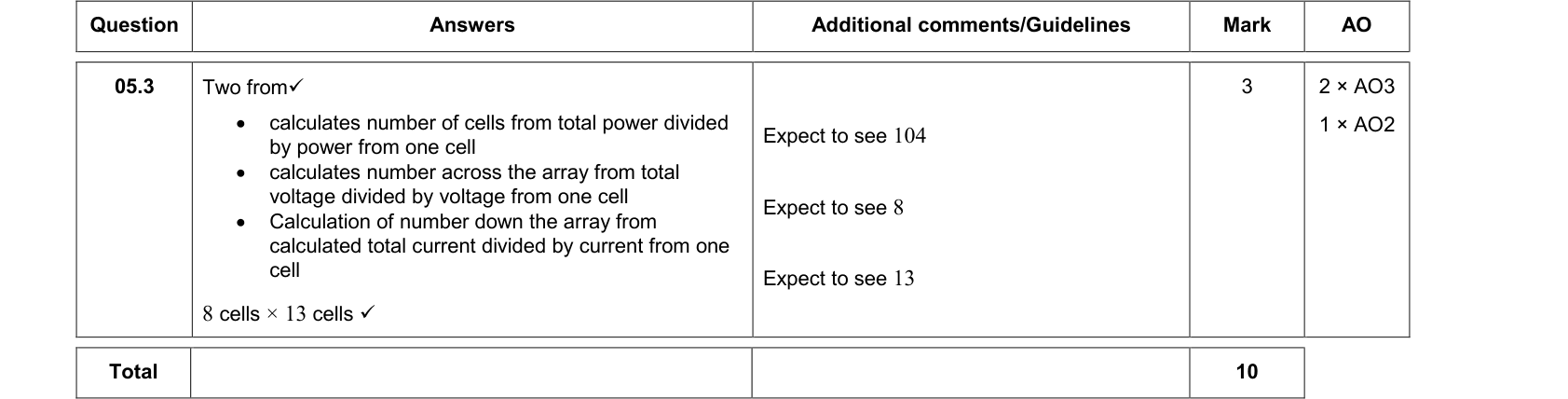
Each cell delivers 0.50 V and 3.0 A at its maximum power point. An array must supply 12 V and 9.0 A.
Cells in series in each string $= 12/0.50 = 24$. Number of parallel strings $= 9.0/3.0 = 3$. Total $= 72$ cells, delivering $12 \times 9.0 = 108$ W.
Common mistake
If one cell in a series string is shaded, the current in the whole string falls, because the same current must pass through every cell. Panels contain bypass diodes to reduce this effect.
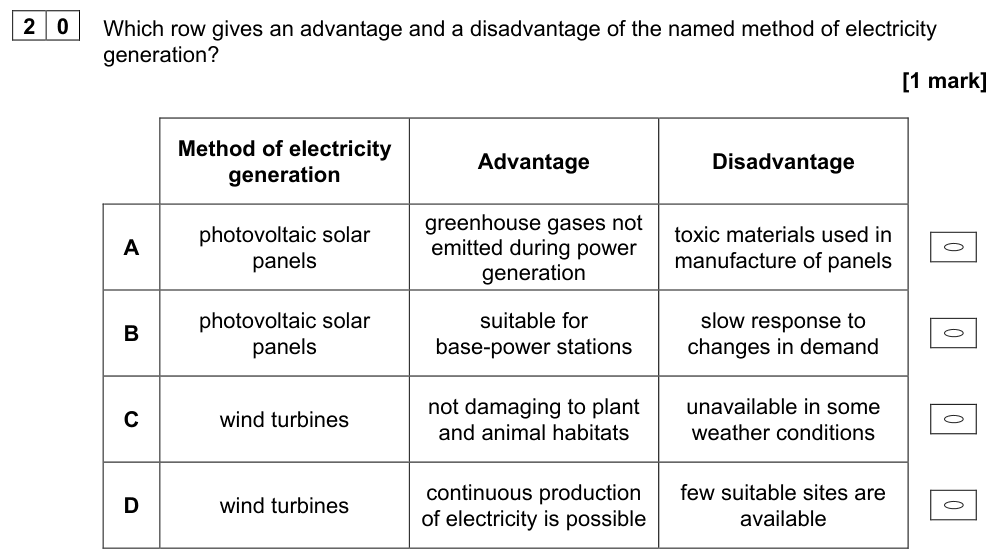
Advantages of solar power: renewable, no fuel or emissions in use, no moving parts, low maintenance, can be installed on roofs close to where the energy is used. Disadvantages: no output at night and less in cloudy weather or winter (storage or back-up needed), large areas needed for large outputs, relatively low efficiency, energy and materials needed to manufacture the panels.
Required practical 10: inverse-square law for light using an LDR
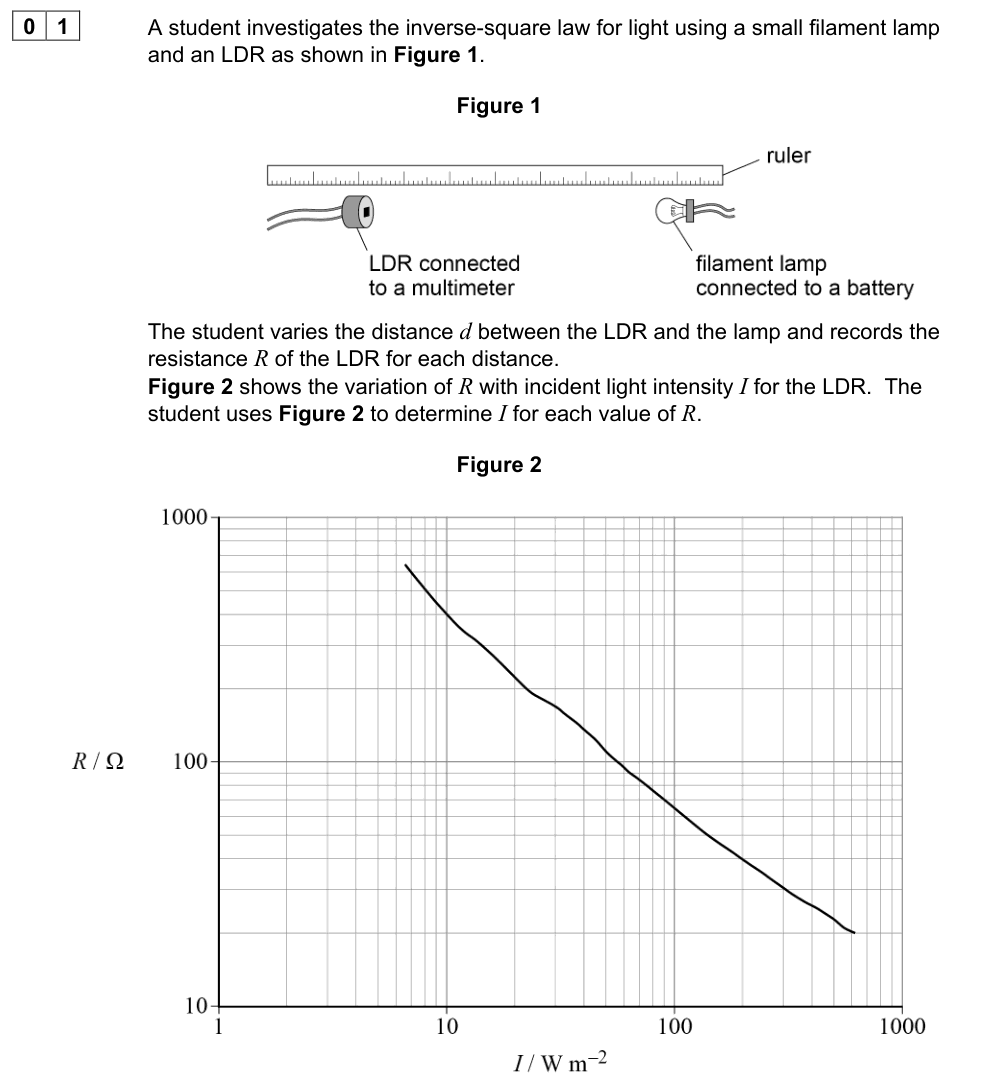
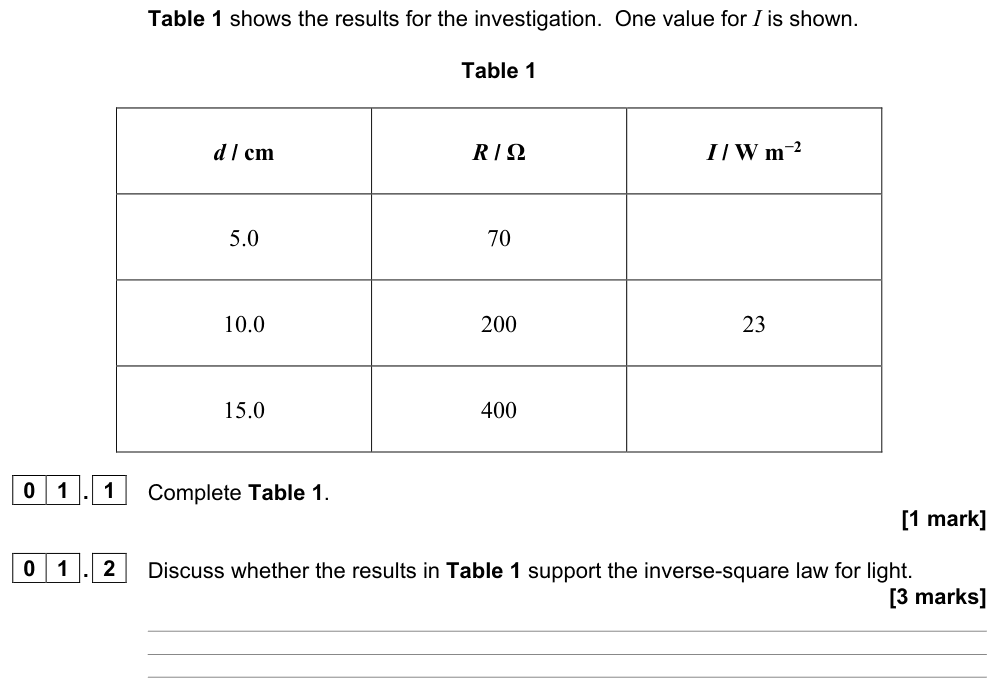
Apparatus: a small, bright filament lamp (as close as possible to a point source) on a constant power supply; a light-dependent resistor (LDR) connected to an ohmmeter (or in a circuit with a meter); a metre rule; a darkened room.
Method:
- Place the LDR facing the lamp at a measured distance $d$ along the metre rule, with its face perpendicular to the light.
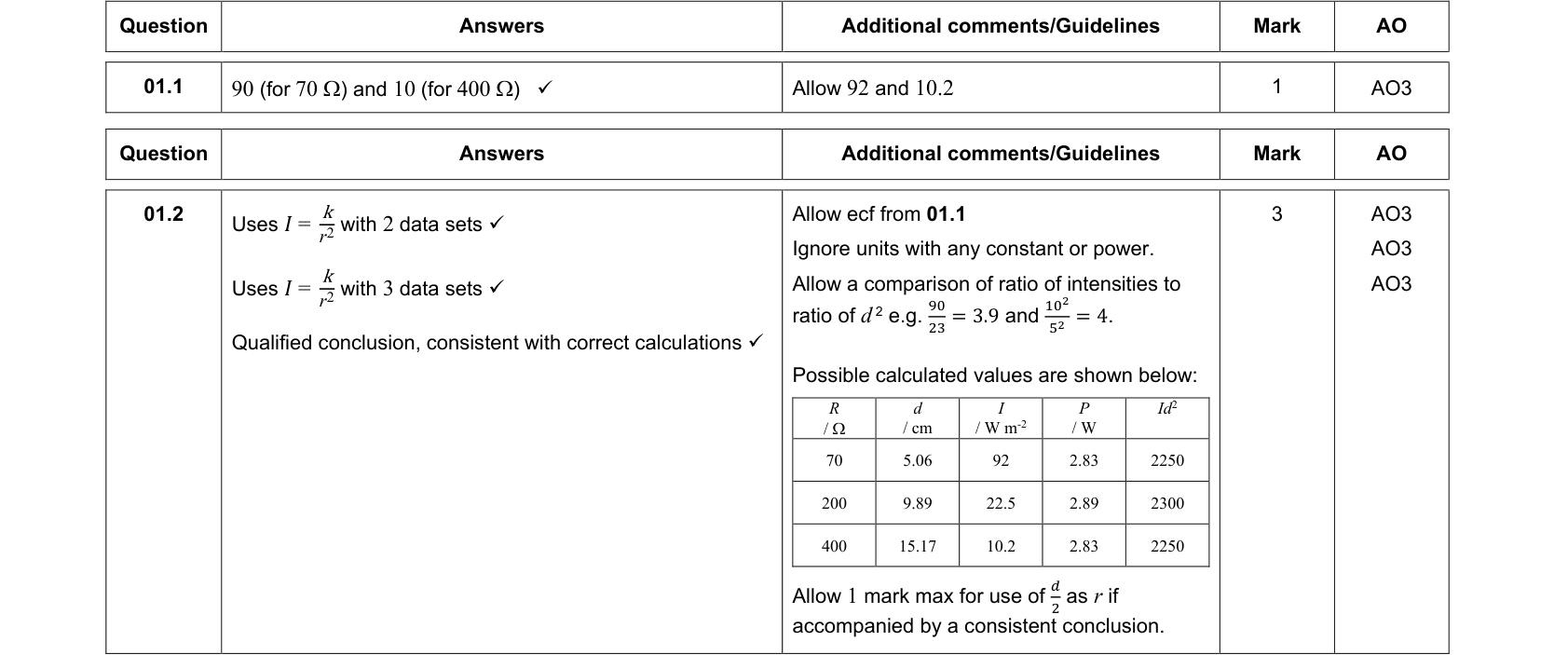
- Record the resistance $R$ of the LDR. Repeat for a range of distances (e.g. 5 cm to 50 cm), taking repeat readings.
- Use a calibration graph of the LDR's resistance against light intensity (obtained beforehand, e.g. with a light meter) to find the intensity $I$ for each value of $R$.
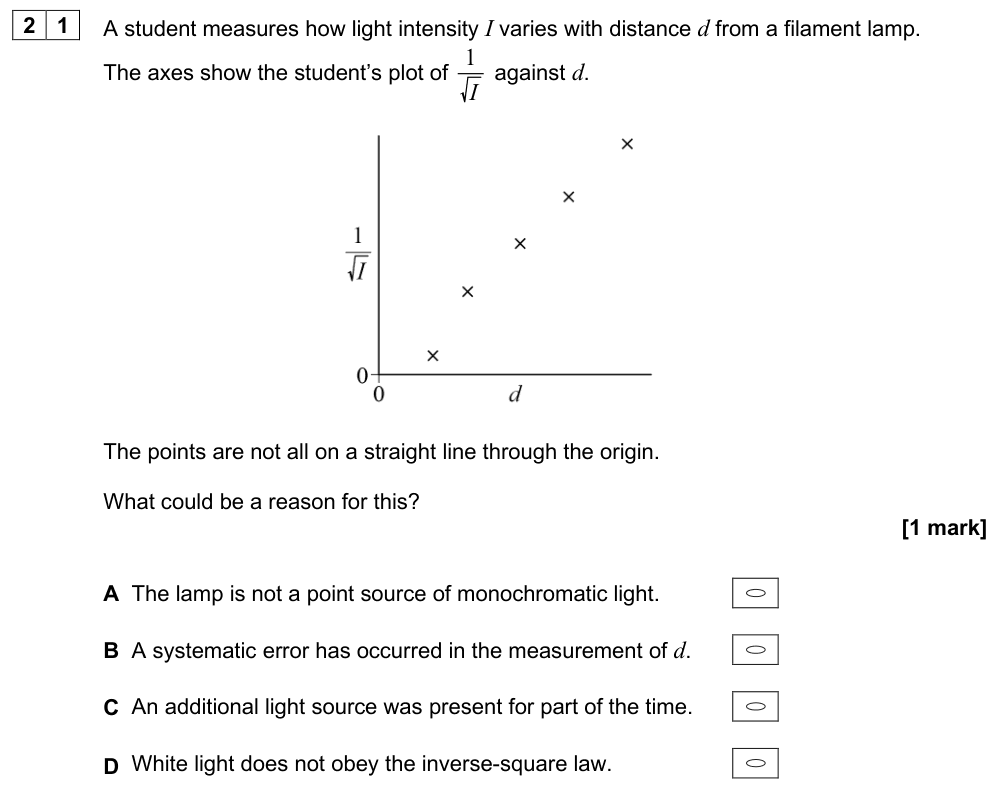
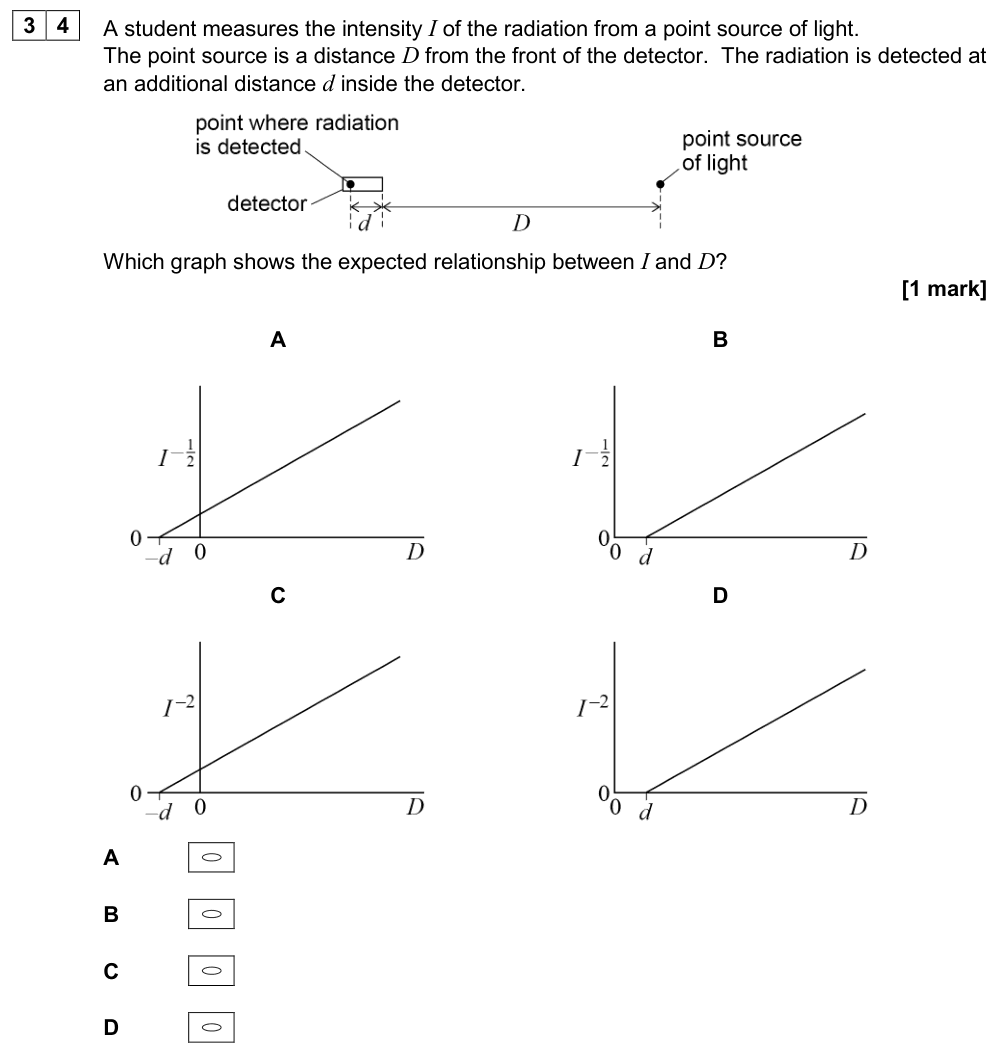
Analysis: if $I \propto 1/d^2$, then $Id^2$ is constant, and a graph of $I$ against $1/d^2$ is a straight line through the origin. Alternatively, a graph of $\log I$ against $\log d$ is a straight line of gradient −2.
The filament and the sensitive surface of the LDR are not exactly where you measure from. If the true distance is $d + c$ (where $c$ is an unknown systematic offset), plot $1/\sqrt I$ against $d$: the graph is a straight line whose intercept on the $d$-axis gives $-c$.
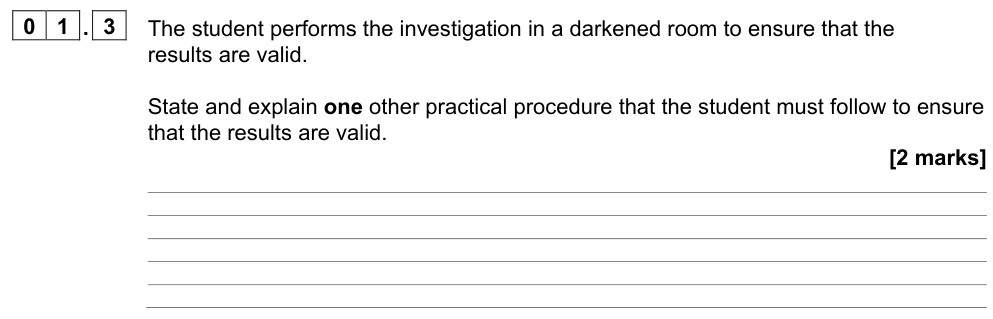
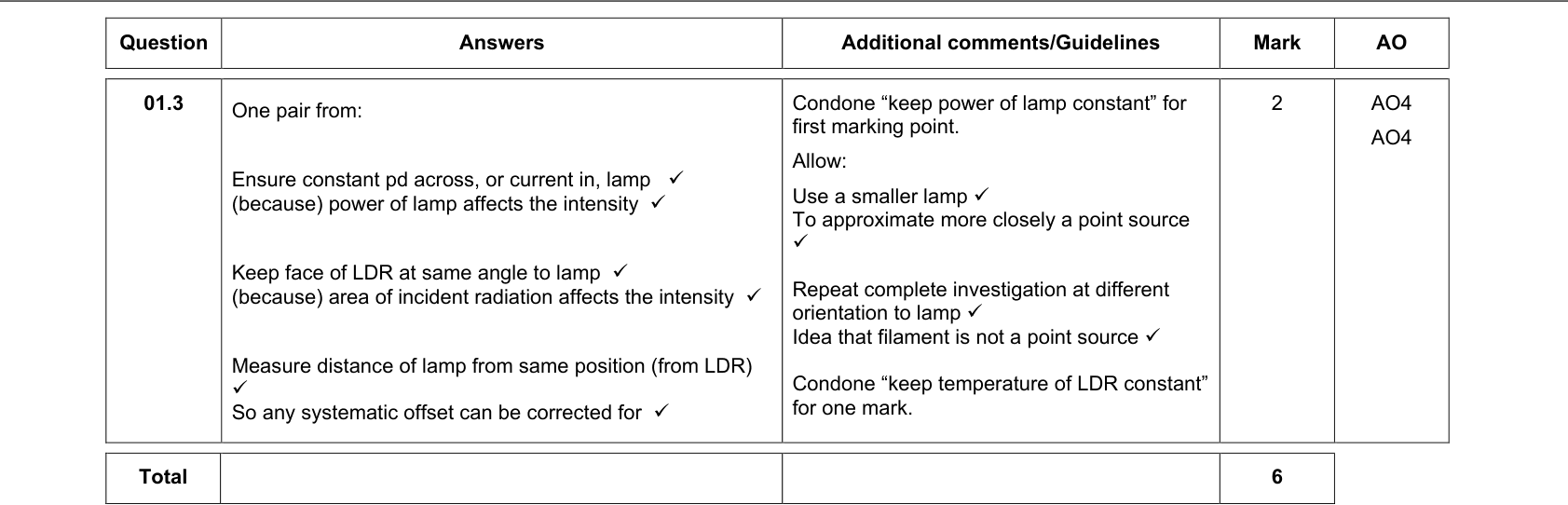
Validity: keep the lamp's p.d. (power) constant; keep the LDR's face at the same angle to the lamp; work in a darkened room to remove background light (or measure the background and subtract it); measure all distances from the same points; avoid reflections from nearby surfaces.
Safety: the lamp becomes hot; take care moving around a darkened room.
Summary
- Intensity = power per unit area (W m⁻²); from the Sun $I = P/4\pi r^2$ (≈ 1.36 kW m⁻² above the atmosphere, ≈ 1 kW m⁻² at the surface in clear sunshine, much less on average).
- Solar cell V–I characteristic: almost constant current up to the knee, then falls to zero at $V_{oc}$; maximum power at the knee.
- Efficiency = electrical output ÷ (intensity × area), about 15–22%.
- Arrays: series adds voltages, parallel adds currents.
- Required practical 10: LDR + calibration graph; $Id^2$ constant; control lamp power, angle, background light.