Describing rotation
For an object rotating about a fixed axis, every point turns through the same angle, so rotation is described with angular quantities.
| Quantity | Symbol and unit | Meaning |
|---|---|---|
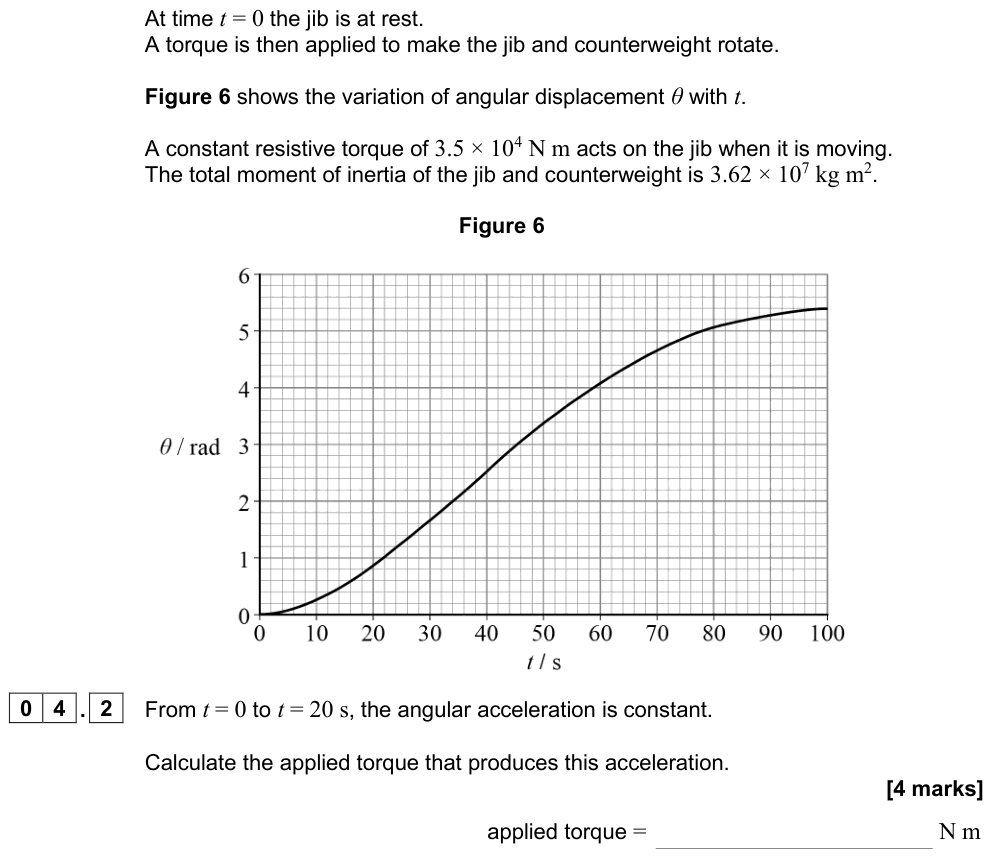
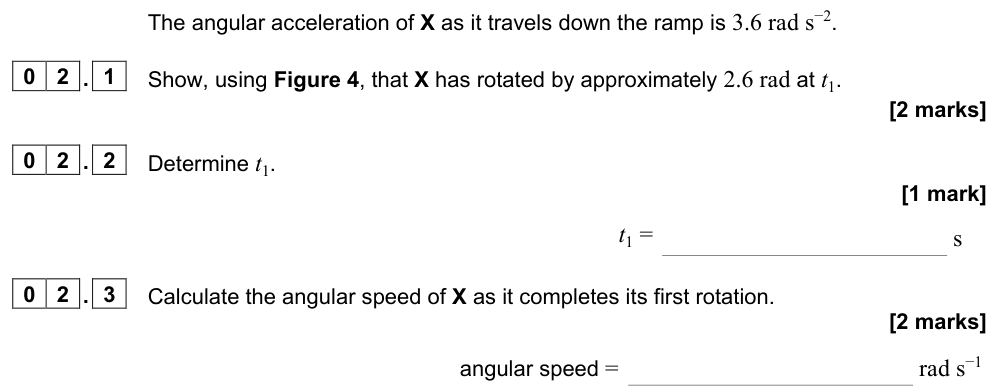
| Angular displacement | $\theta$ (rad) | angle turned through; one revolution = $2\pi$ rad |
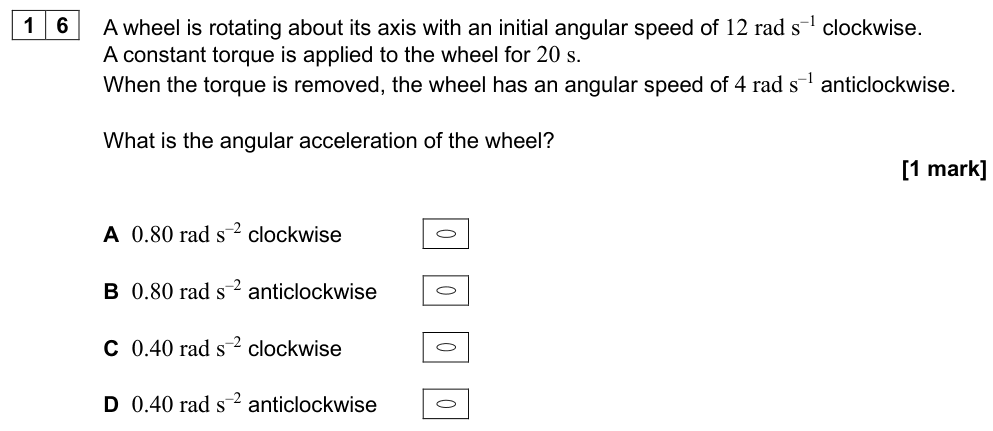
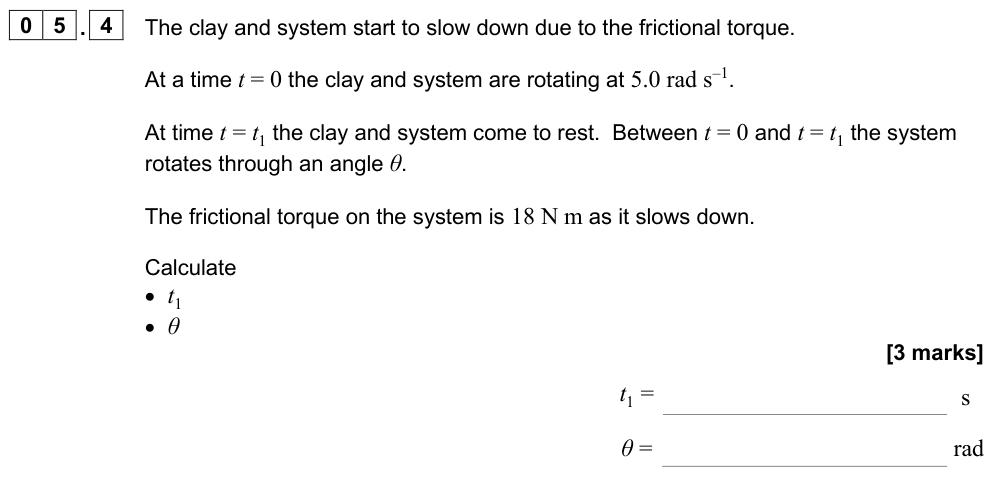
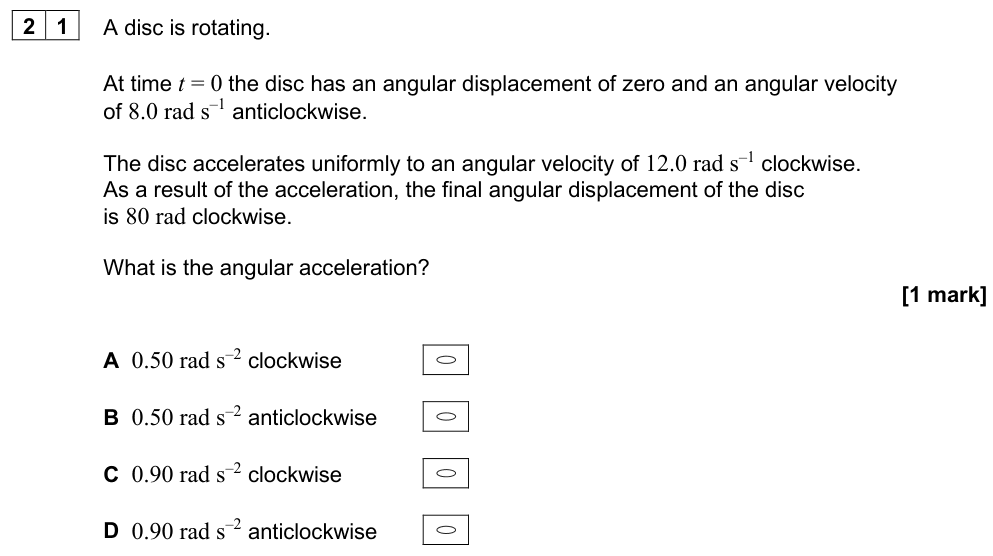
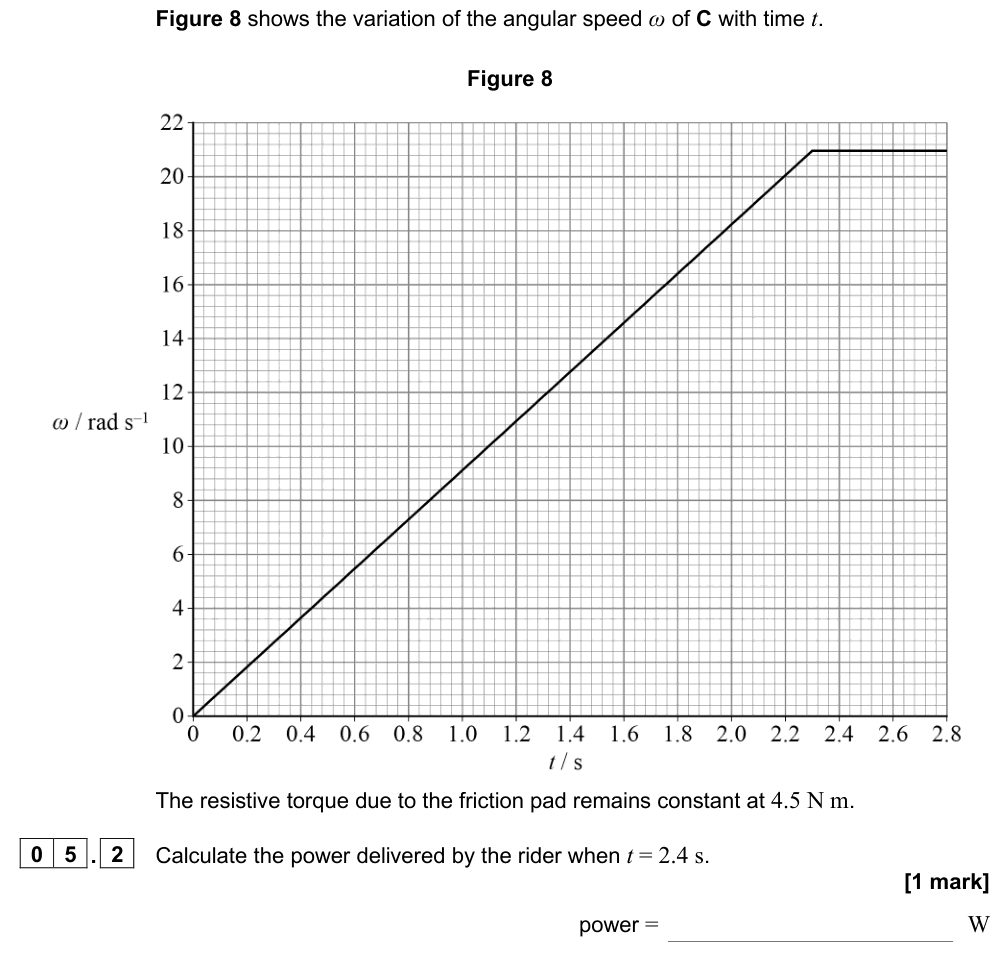
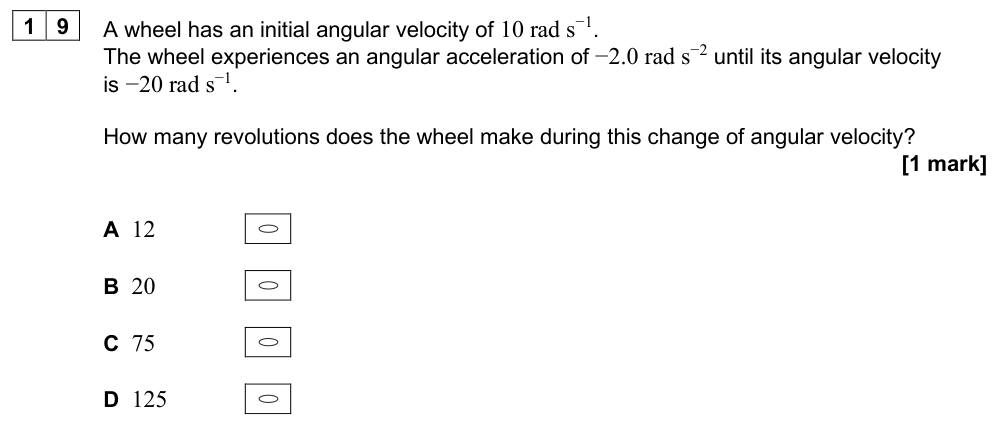
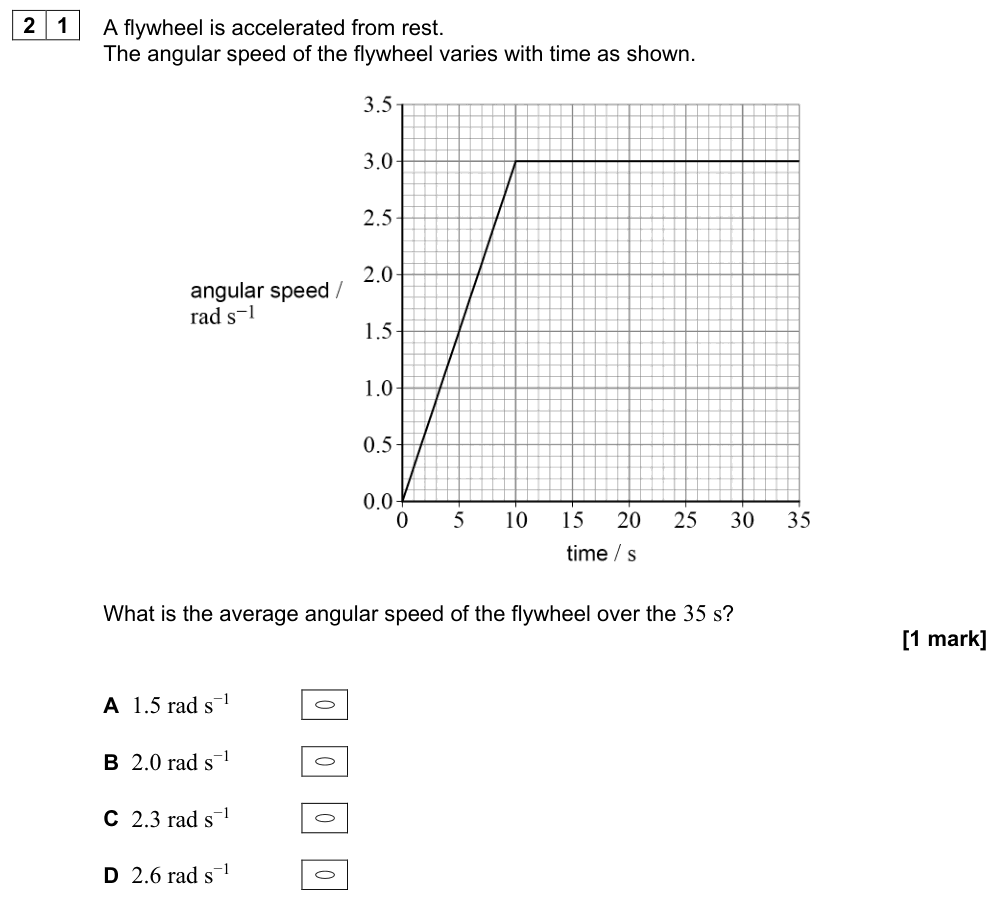
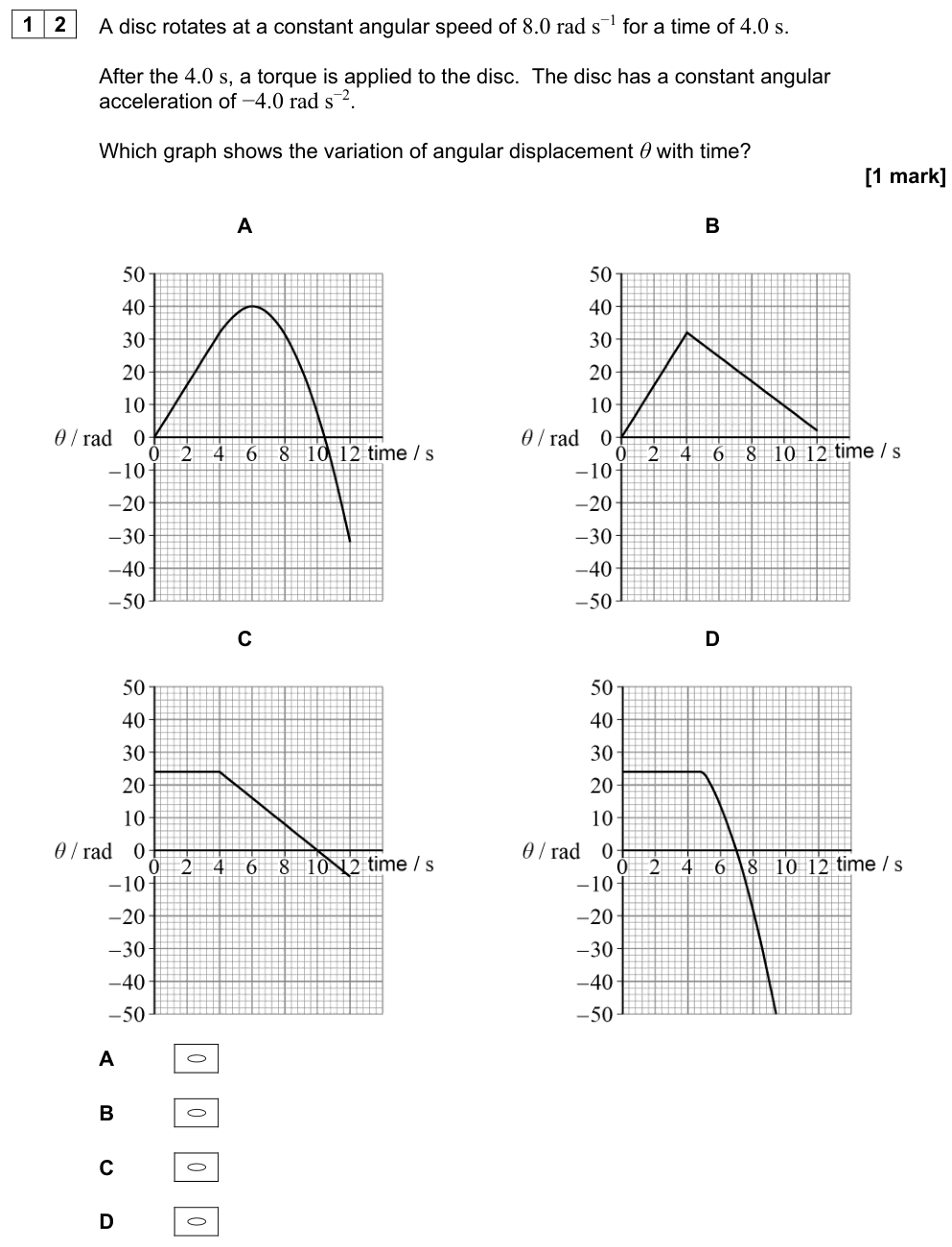
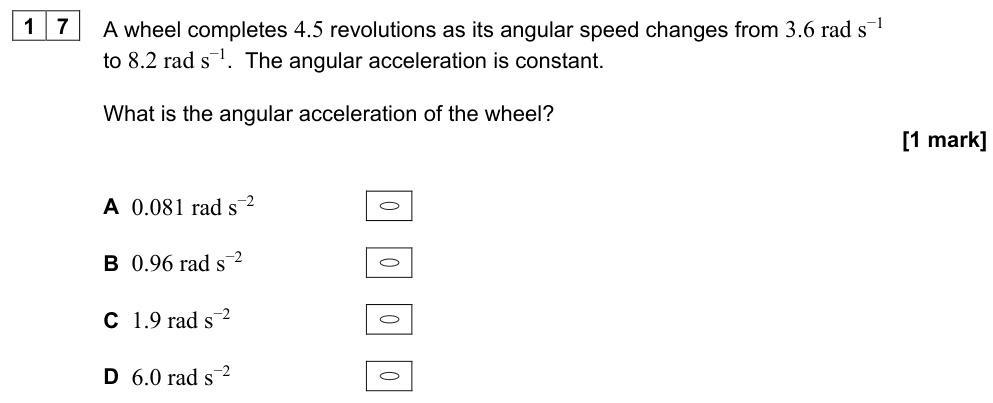
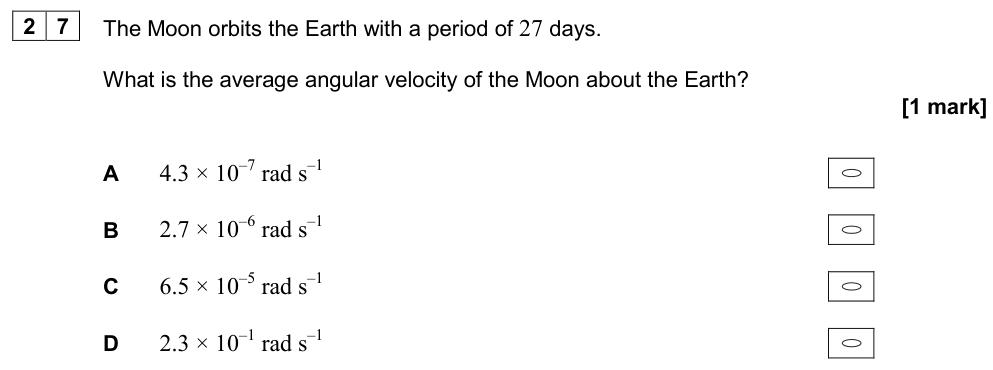
| Angular speed / velocity | $\omega$ (rad s⁻¹) | rate of change of angular displacement, $\omega = \dfrac{\Delta\theta}{\Delta t}$ (angular velocity also has a direction: clockwise or anticlockwise about the axis) |
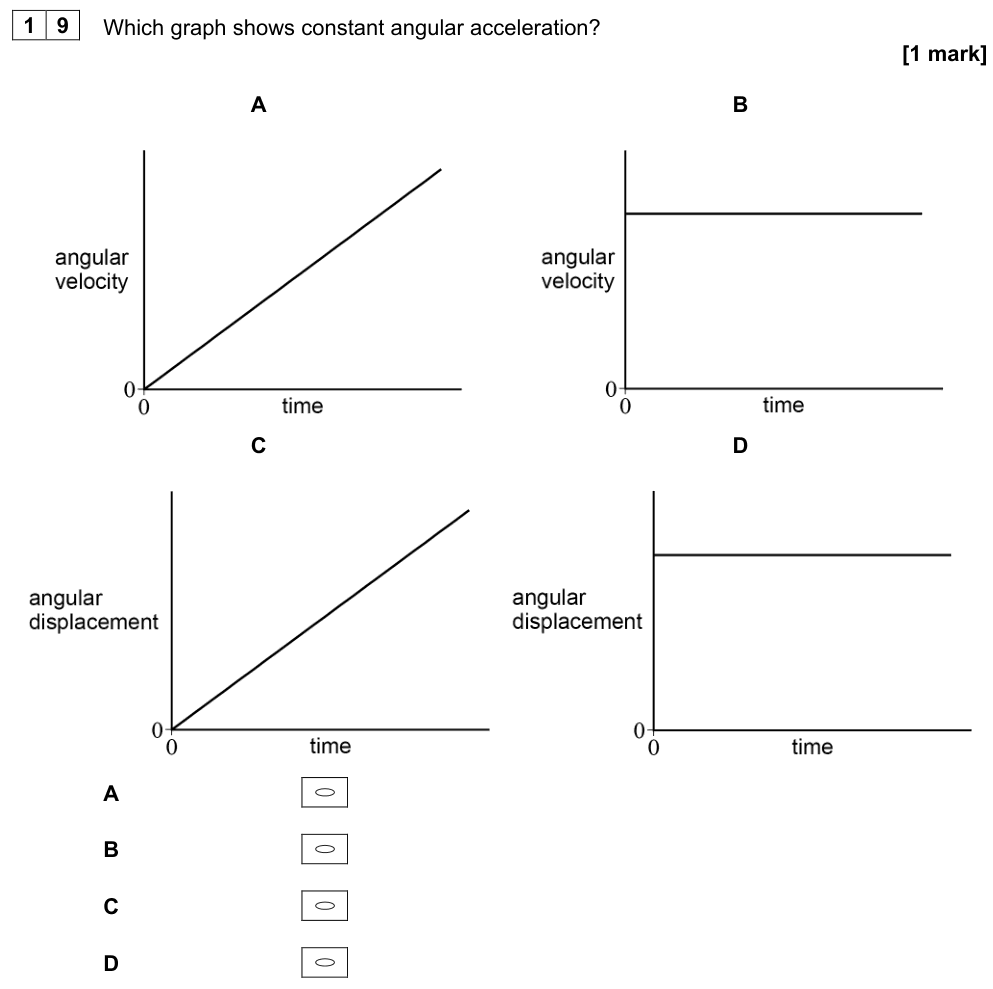
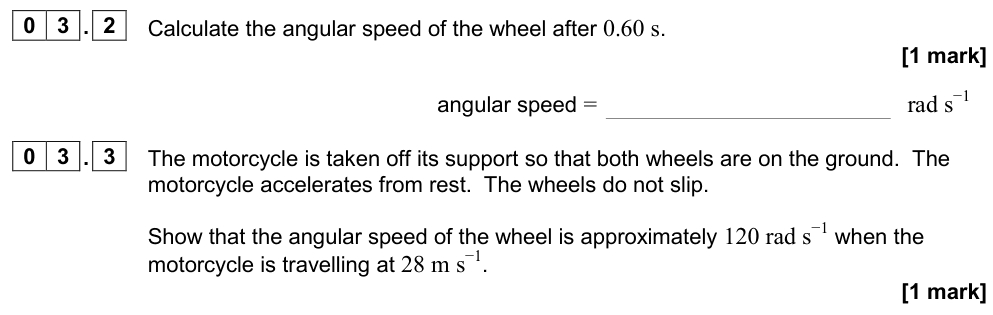
| Angular acceleration | $\alpha$ (rad s⁻²) | rate of change of angular velocity, $\alpha = \dfrac{\Delta\omega}{\Delta t}$ |
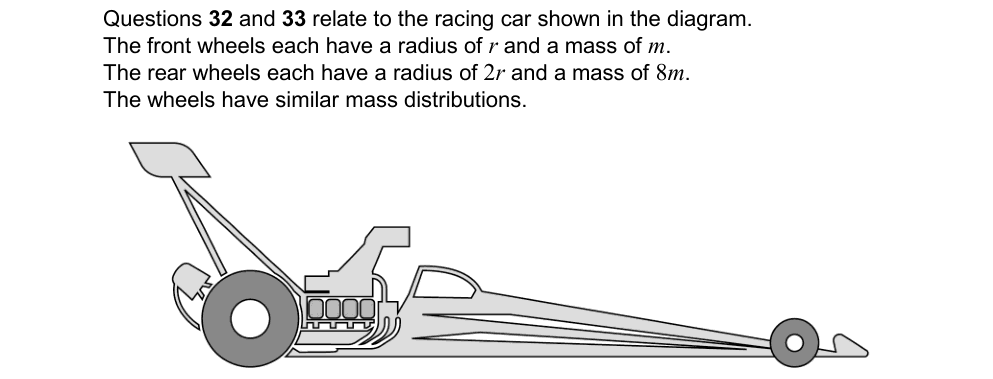
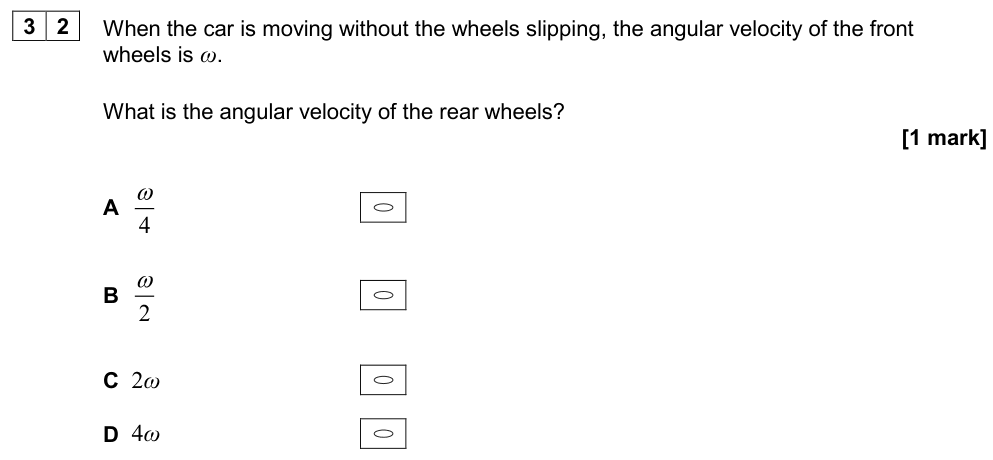
A point at distance $r$ from the axis moves a distance $s = r\theta$ with speed $v = r\omega$ and tangential acceleration $a = r\alpha$.
Exam tip: revolutions per minute
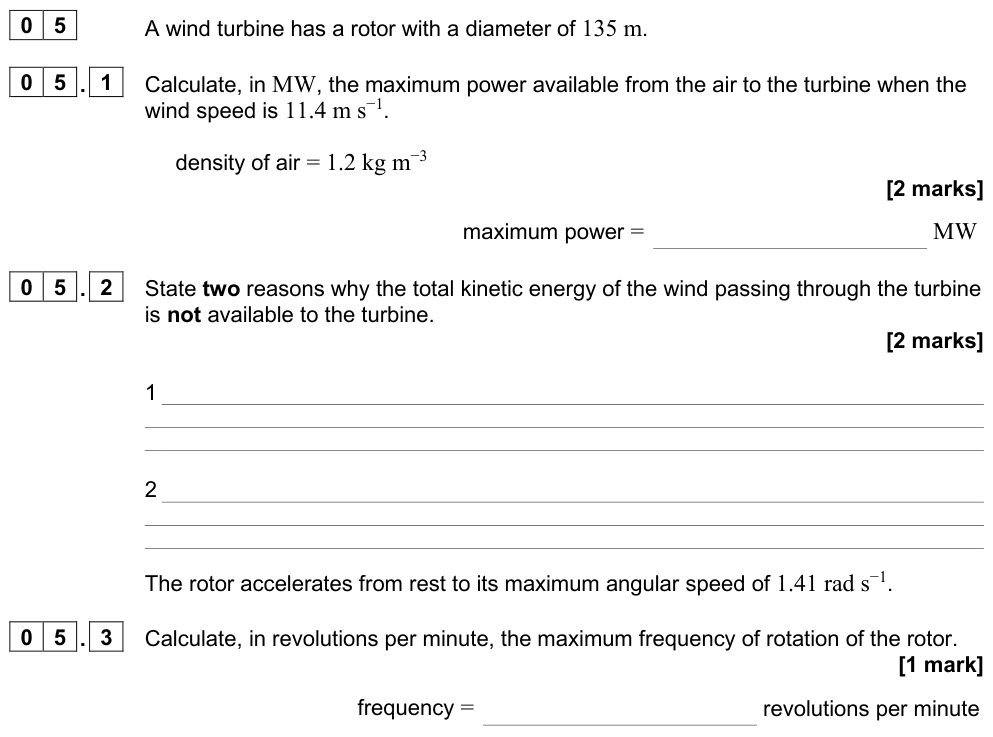
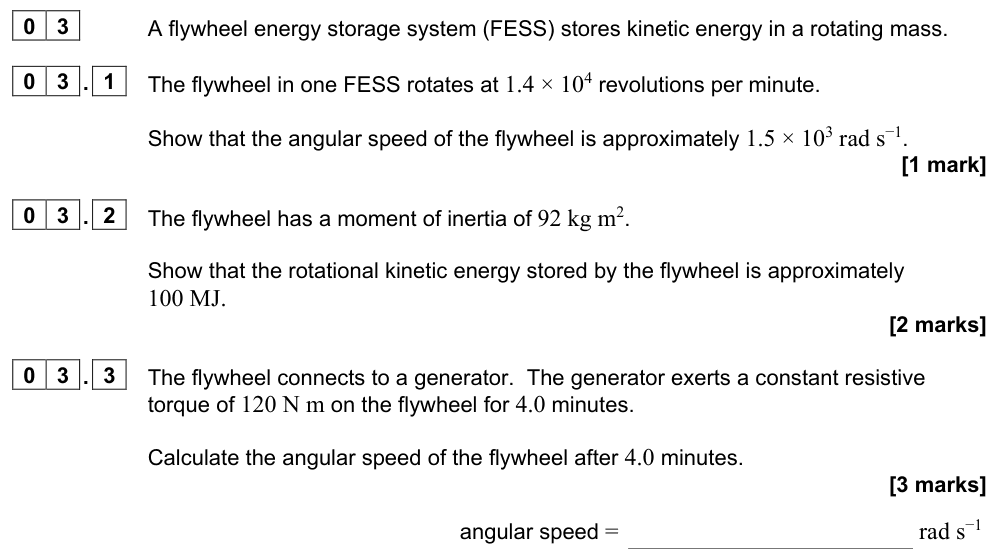
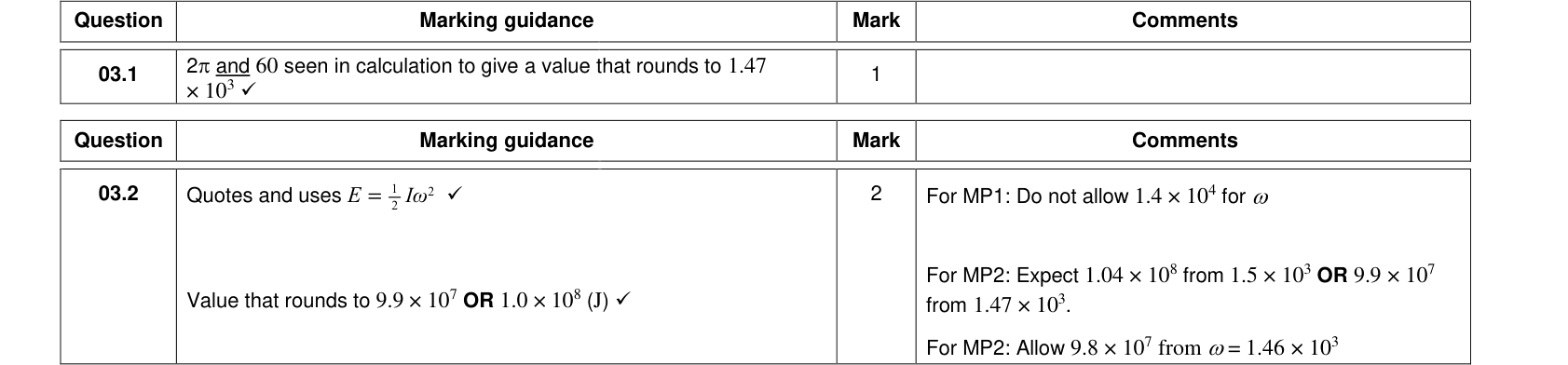
To convert a rotation rate in rev min⁻¹ to rad s⁻¹, multiply by $2\pi$ and divide by 60. For example 3000 rpm $= 3000 \times 2\pi/60 = 314$ rad s⁻¹.
Equations for uniform angular acceleration
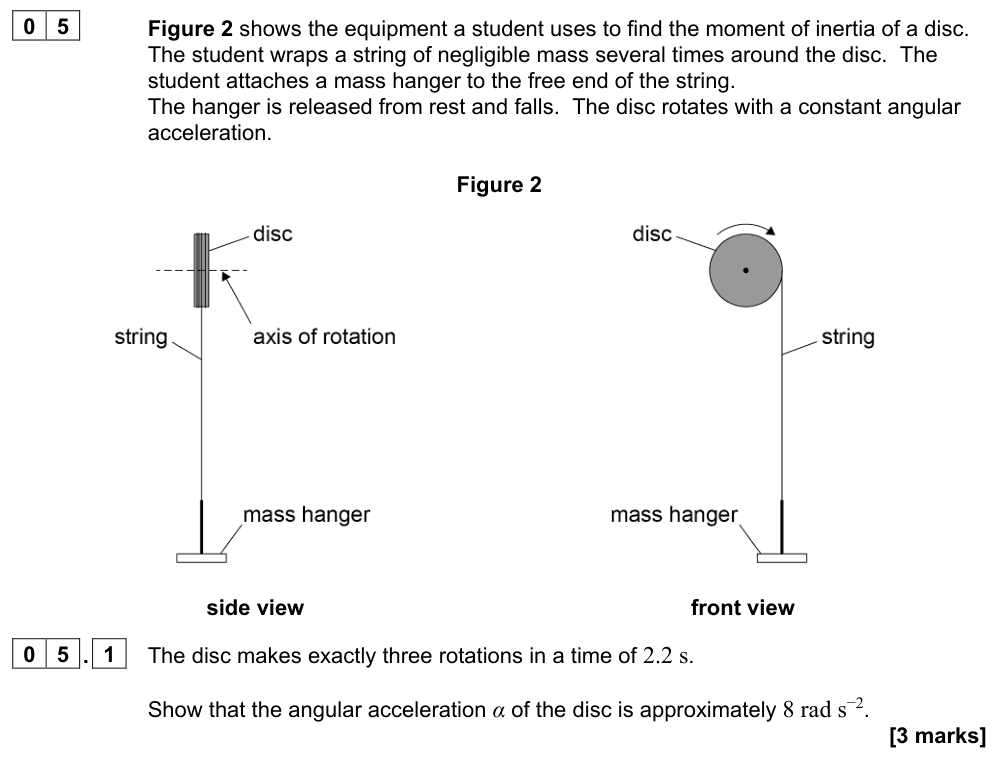
These are exactly like the equations of motion for uniform linear acceleration, with $\theta$, $\omega$ and $\alpha$ replacing $s$, $v$ and $a$:
Uniform angular acceleration
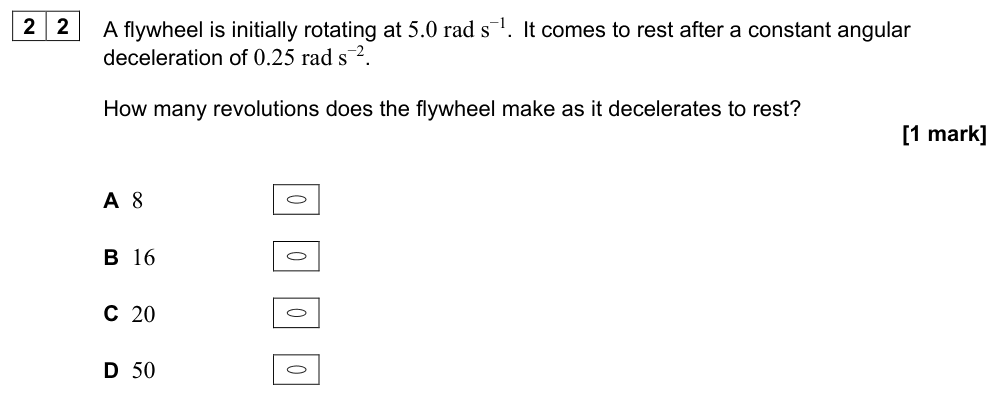
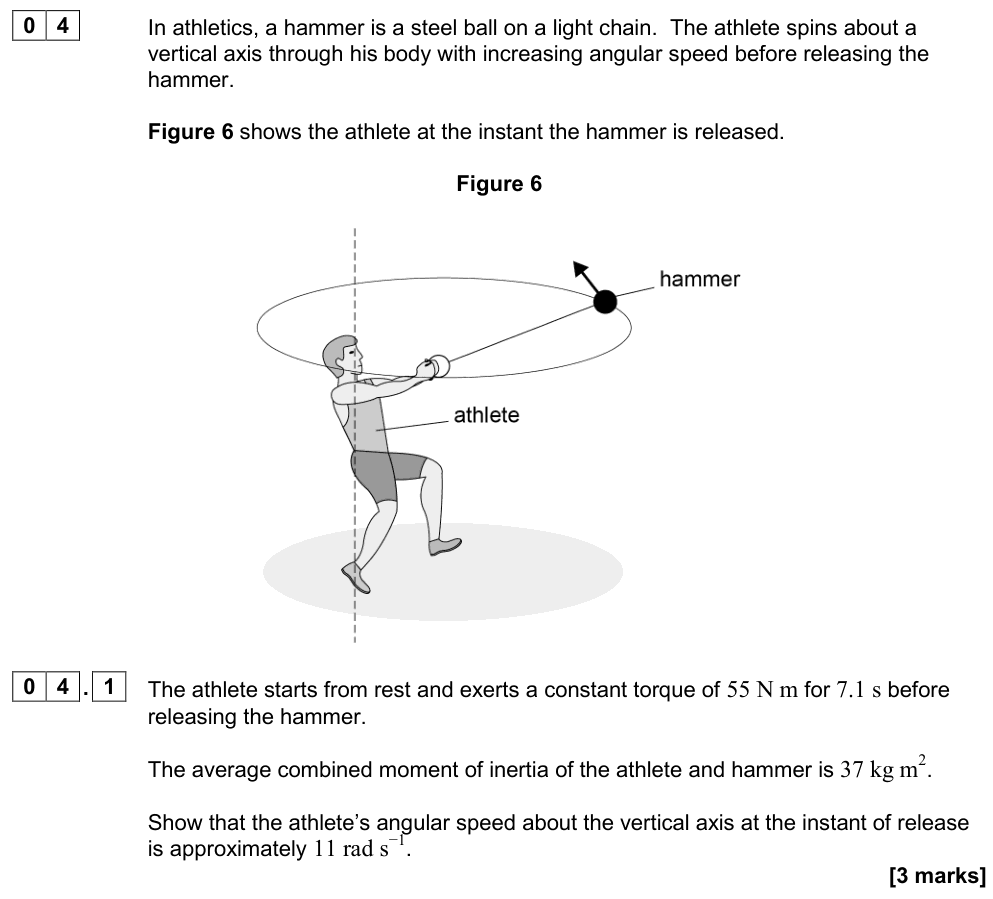
$$\omega = \omega_0 + \alpha t \qquad \theta = \tfrac12(\omega_0 + \omega)t$$ $$\theta = \omega_0t + \tfrac12\alpha t^2 \qquad \omega^2 = \omega_0^2 + 2\alpha\theta$$
Worked example
A wheel speeds up uniformly from 120 rpm to 480 rpm in 6.0 s.
$\omega_0 = 120 \times 2\pi/60 = 12.6$ rad s⁻¹ and $\omega = 50.3$ rad s⁻¹.
$\alpha = \dfrac{50.3 - 12.6}{6.0} = 6.3$ rad s⁻².
$\theta = \tfrac12(12.6 + 50.3) \times 6.0 = 189$ rad $= 189/2\pi = 30$ revolutions.
Moment of inertia
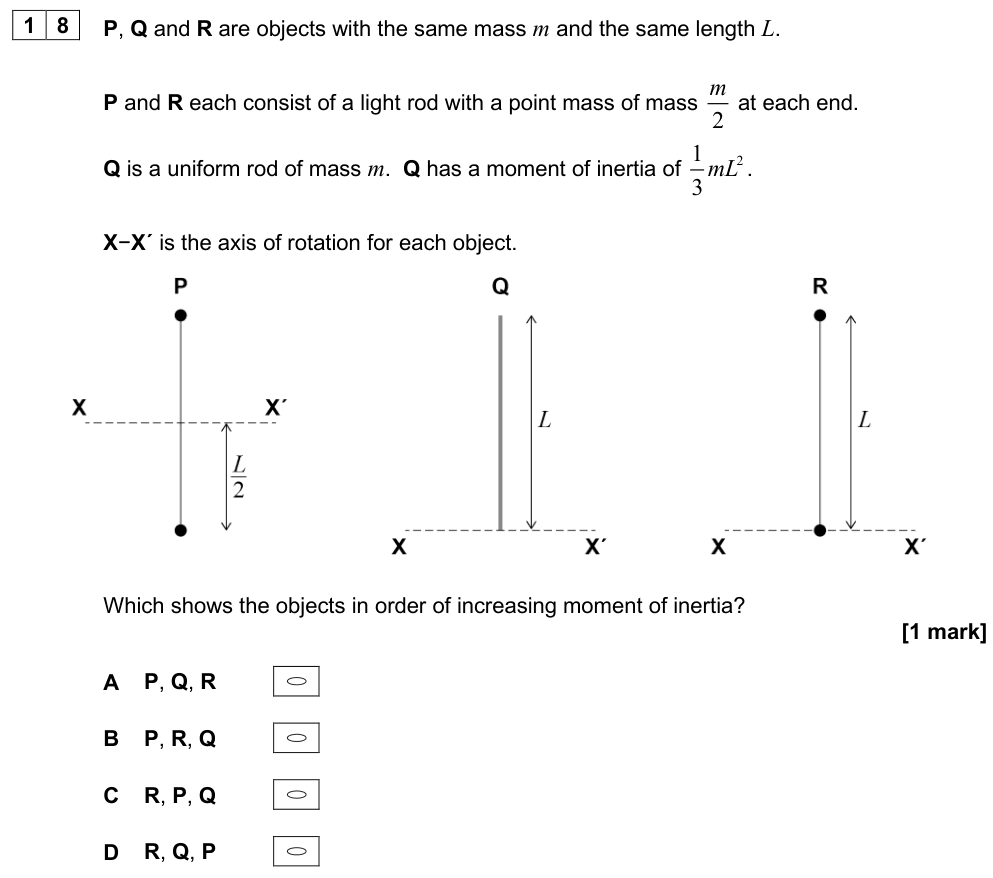
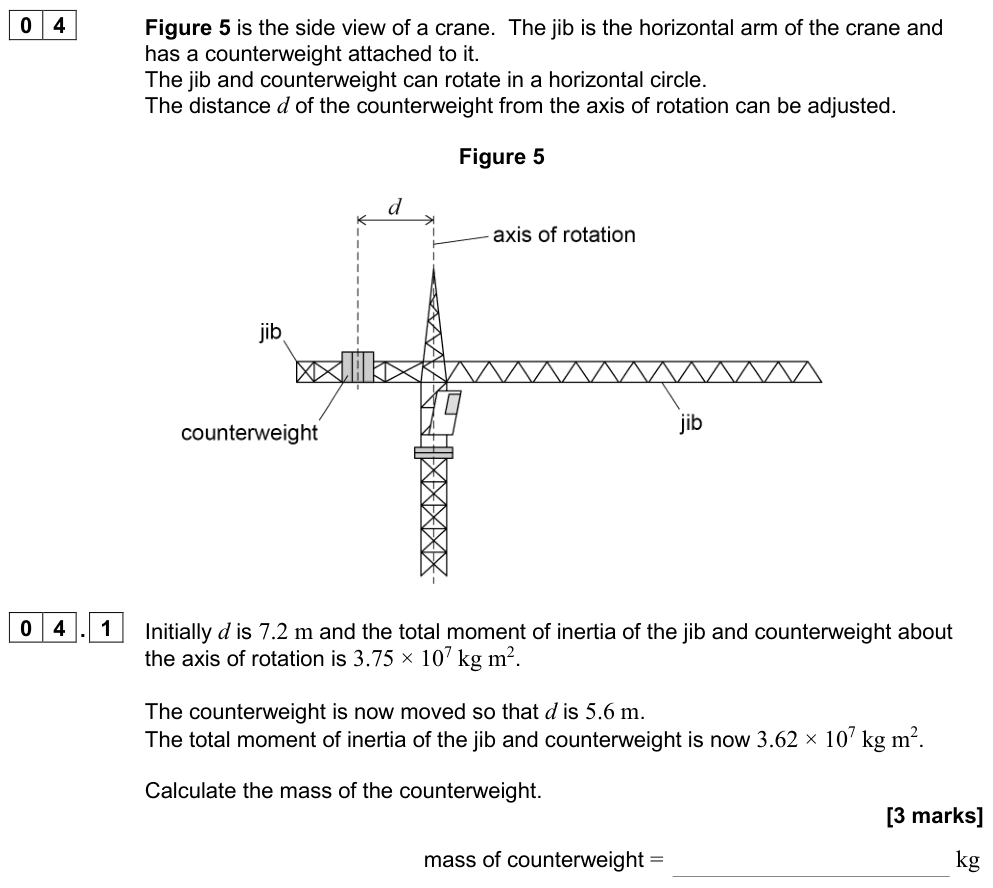
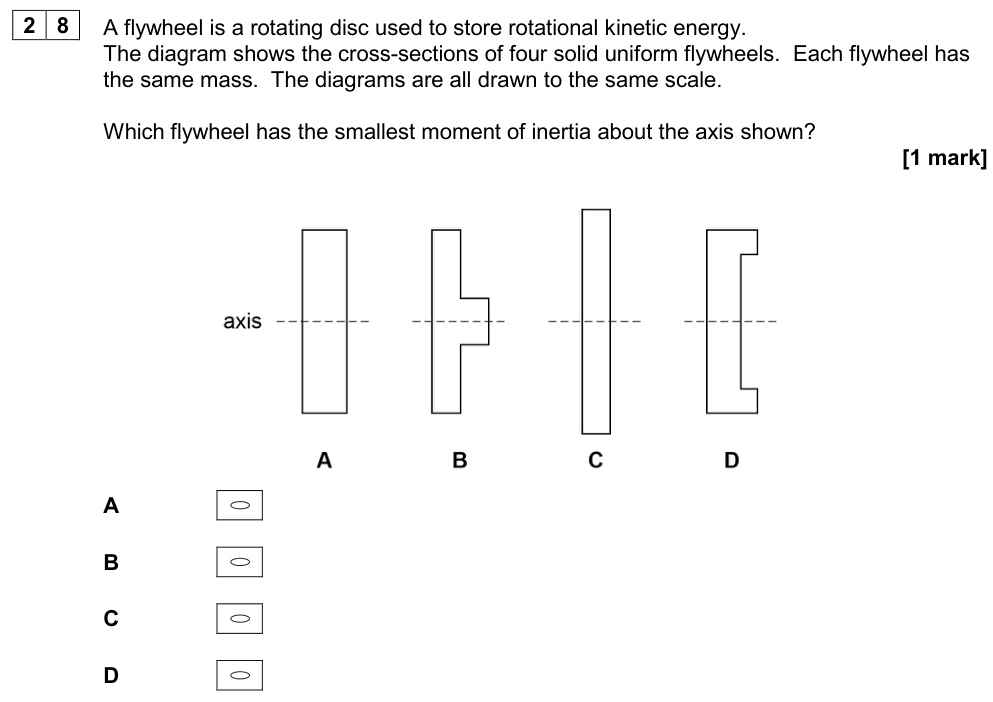
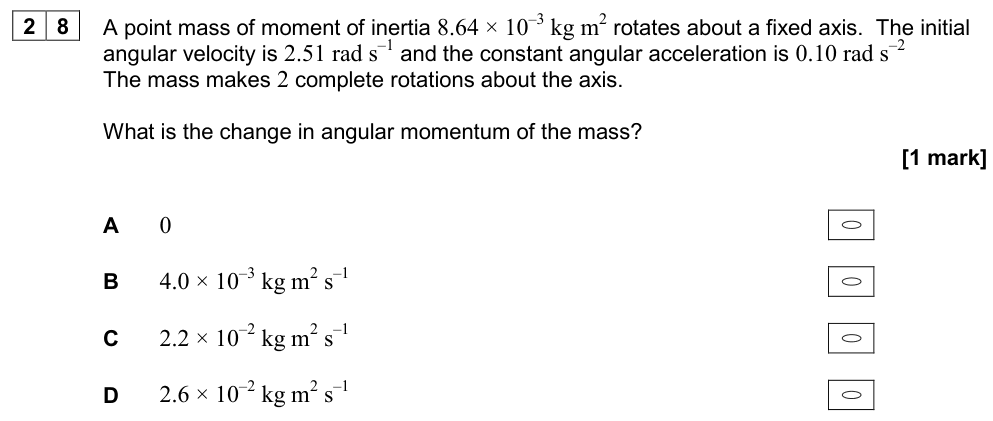
The moment of inertia $I$ of an object is the rotational equivalent of mass: it measures how hard it is to change the object's rotation.
Moment of inertia
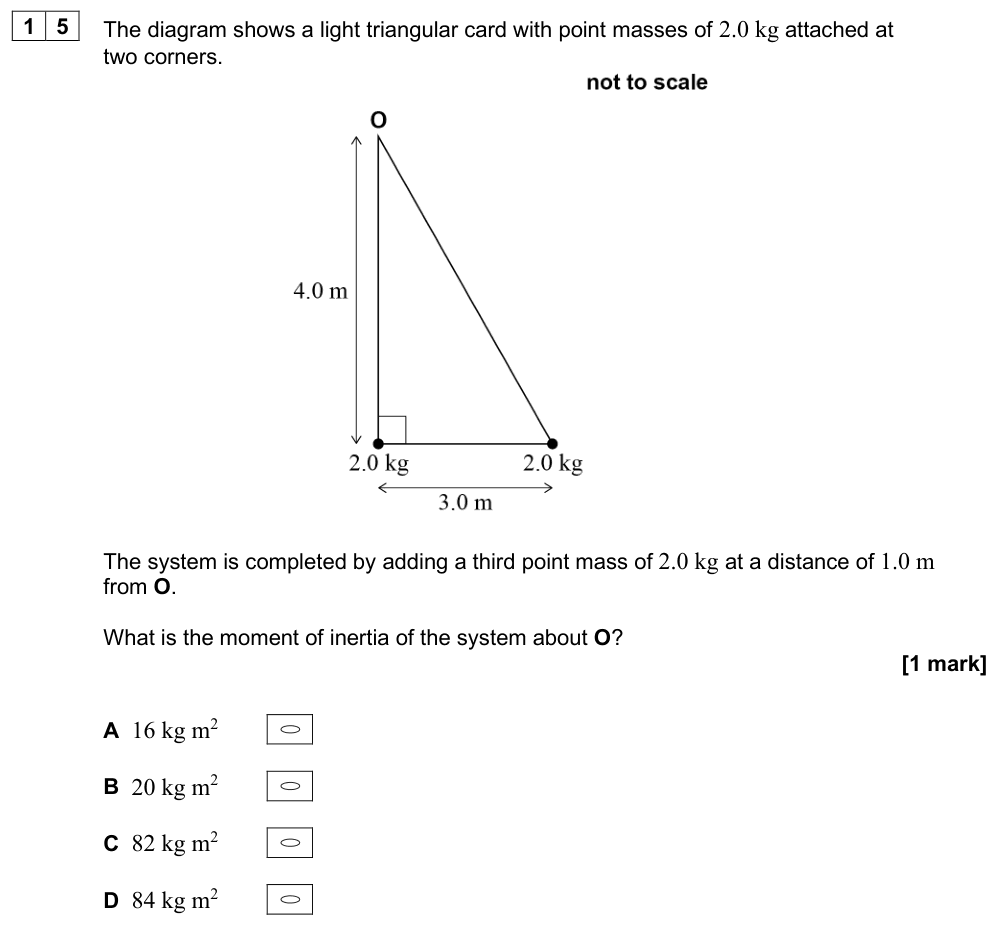
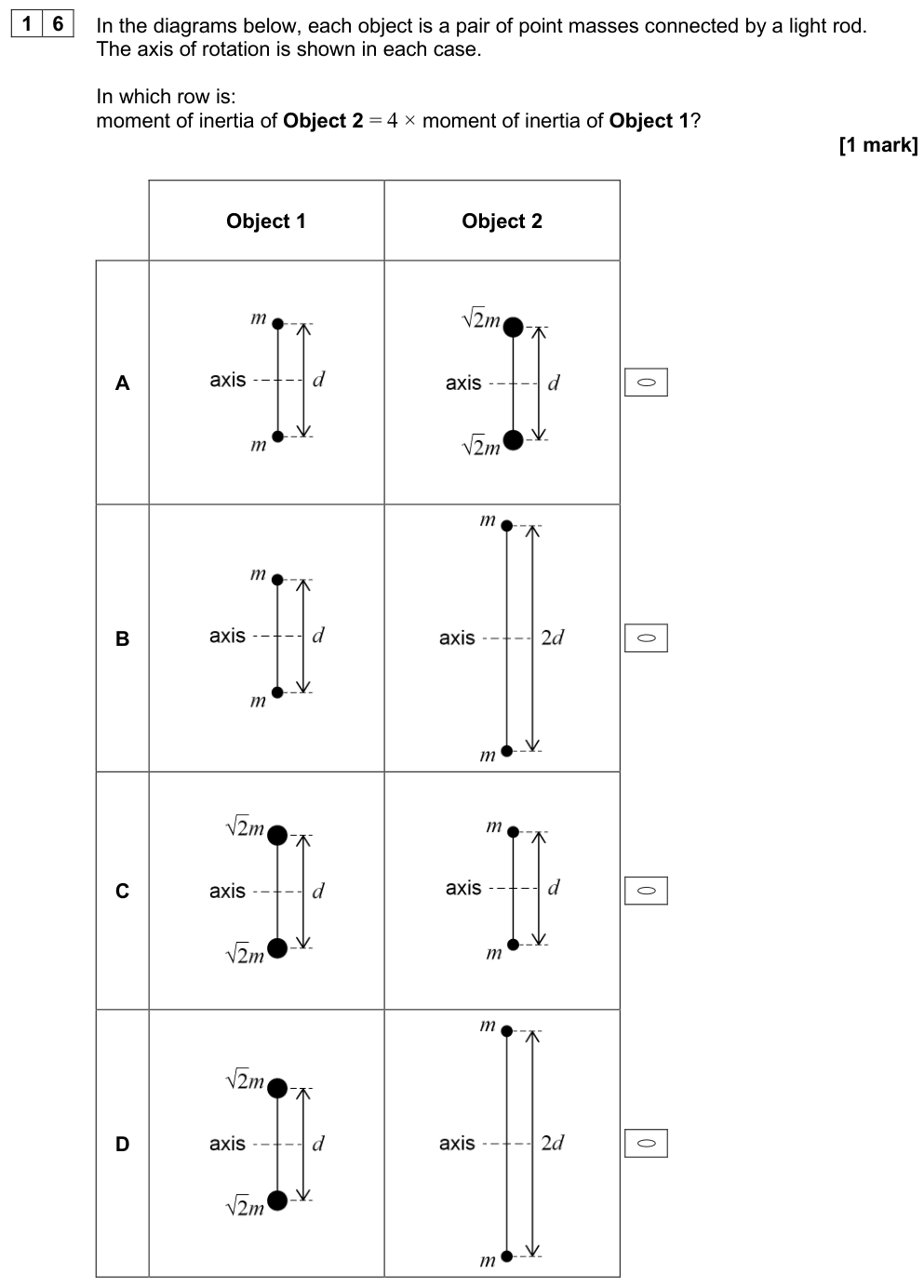
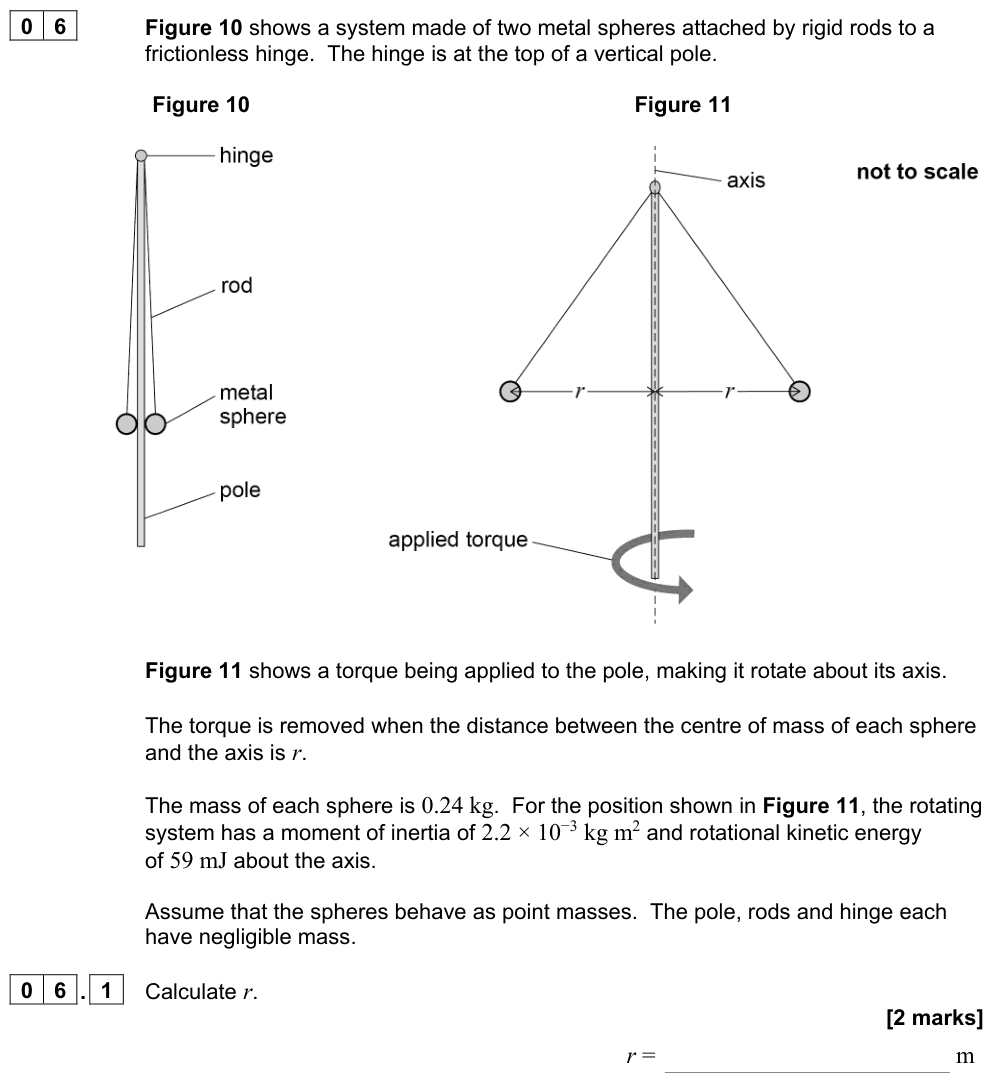
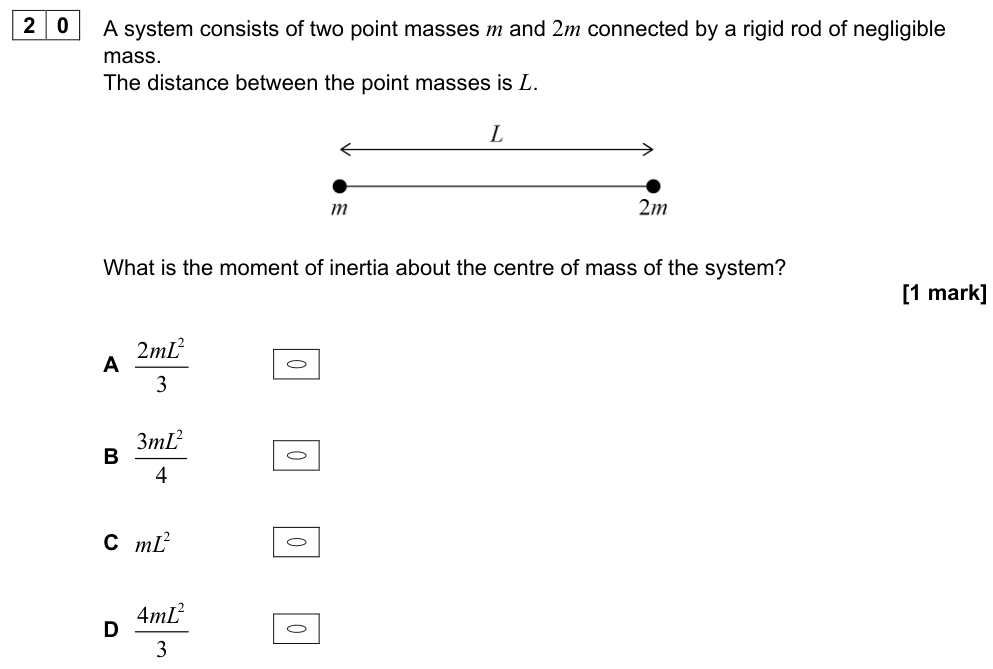
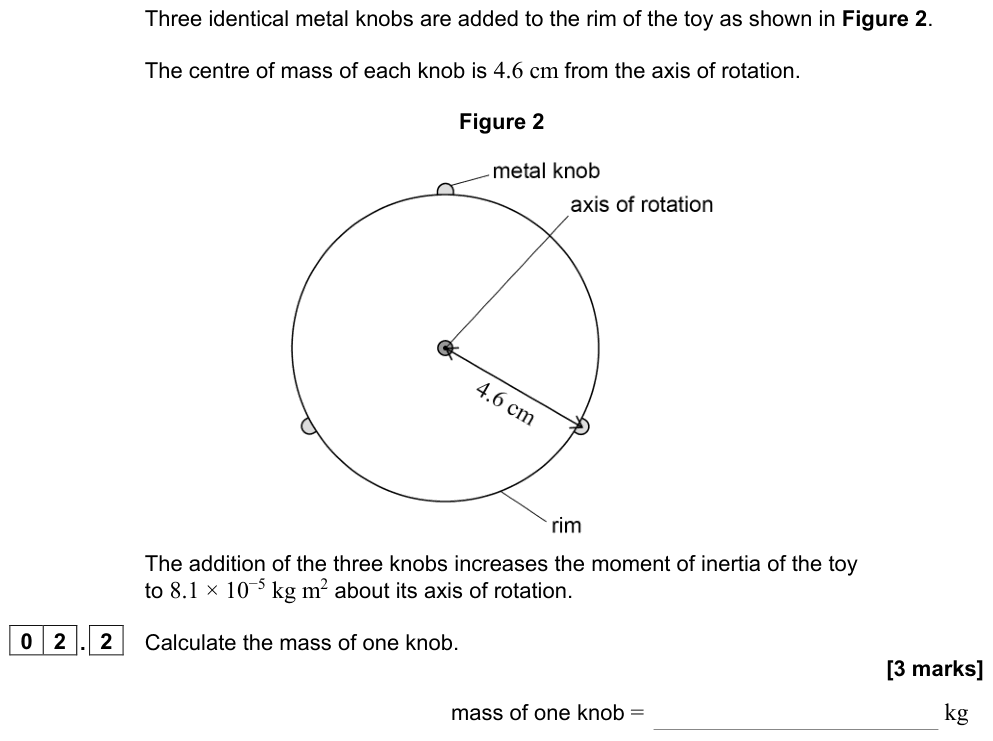
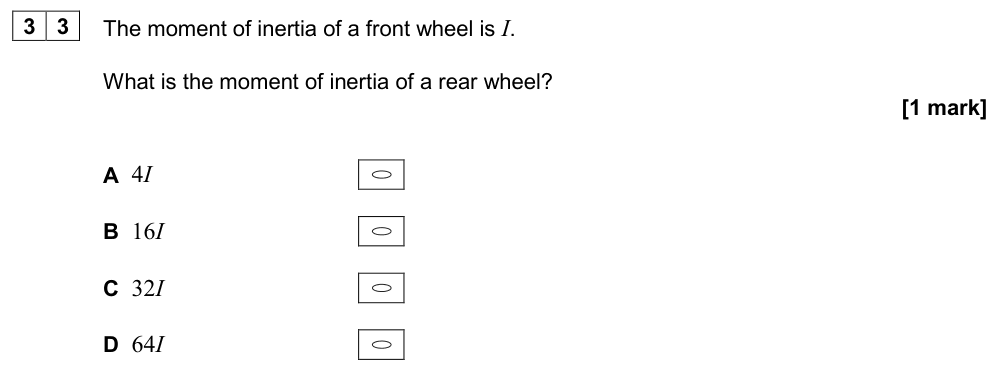
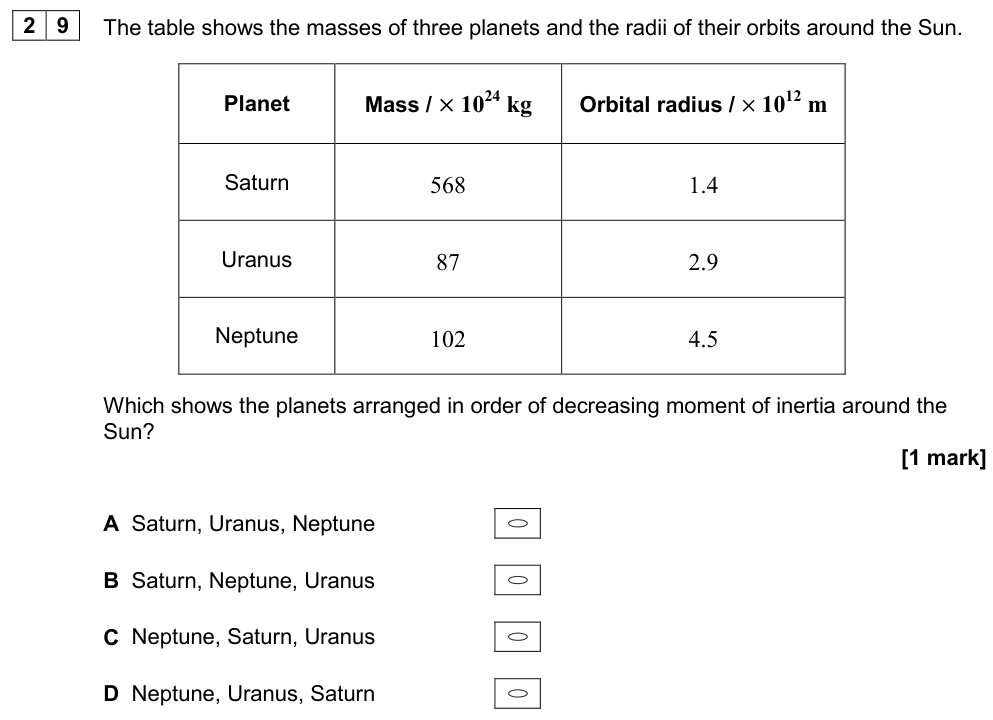
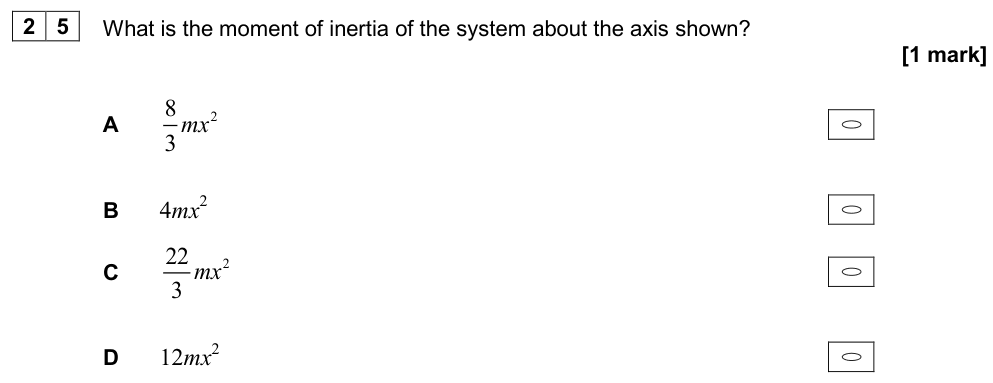
For a point mass $m$ at distance $r$ from the axis: $I = mr^2$.
For an extended object, add up the contributions of all its particles: $I = \Sigma mr^2$. Unit: kg m².
The moment of inertia depends on:
- the mass of the object;
- how the mass is distributed relative to the axis: mass far from the axis contributes much more (because of the $r^2$);
- the position of the axis.
| Object (mass $M$) | Moment of inertia |
|---|---|
| ring or thin hoop, radius $R$, about its centre | $MR^2$ |
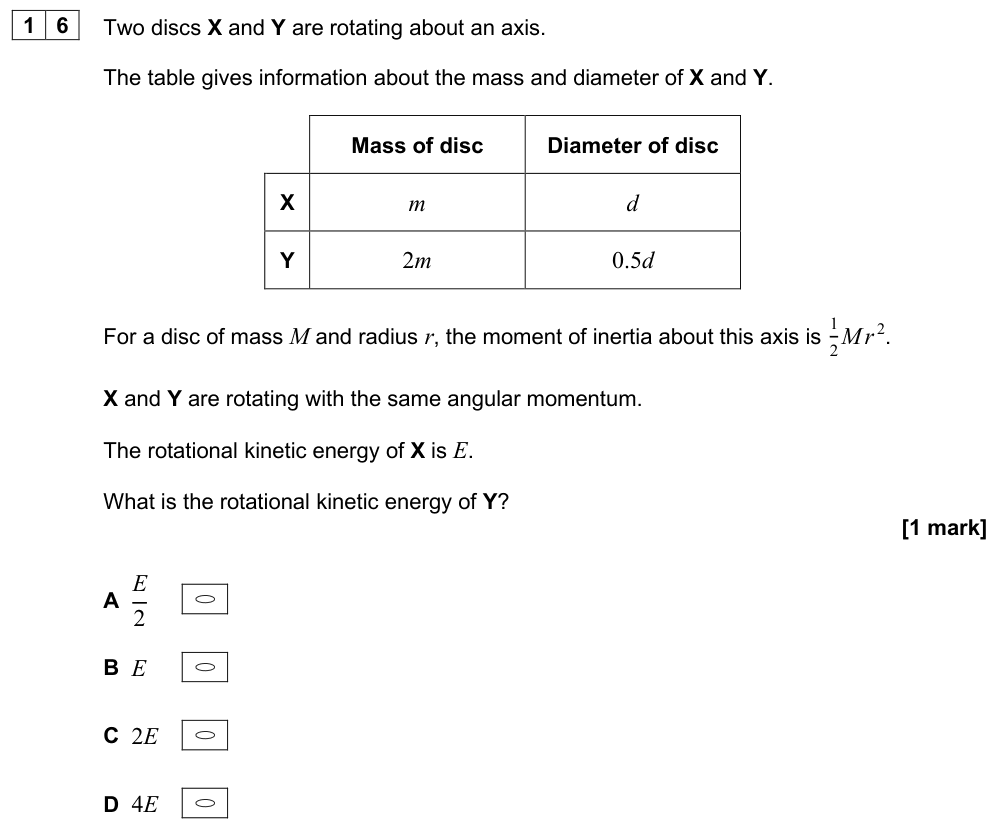
| uniform disc or solid cylinder, radius $R$, about its axis | $\tfrac12MR^2$ |
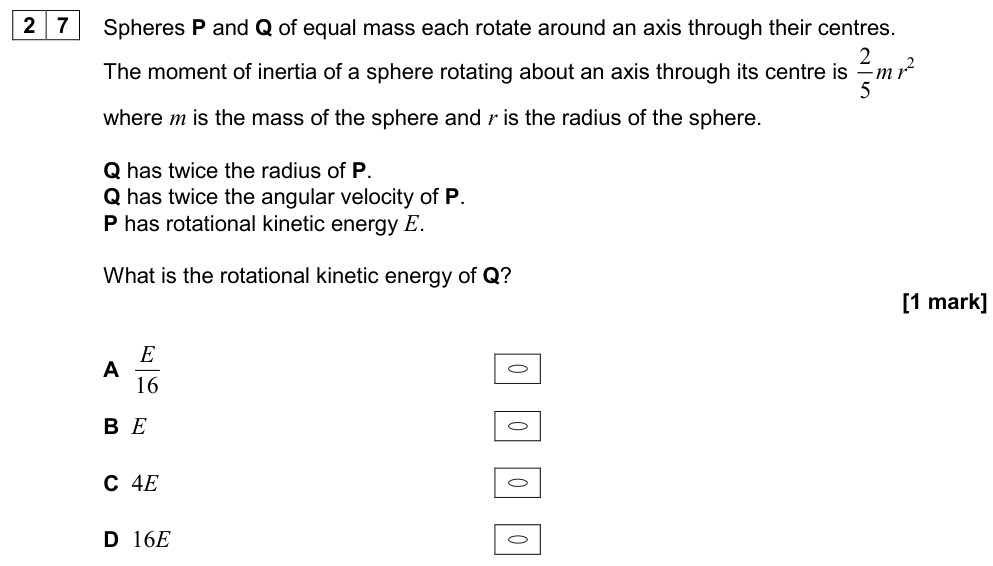
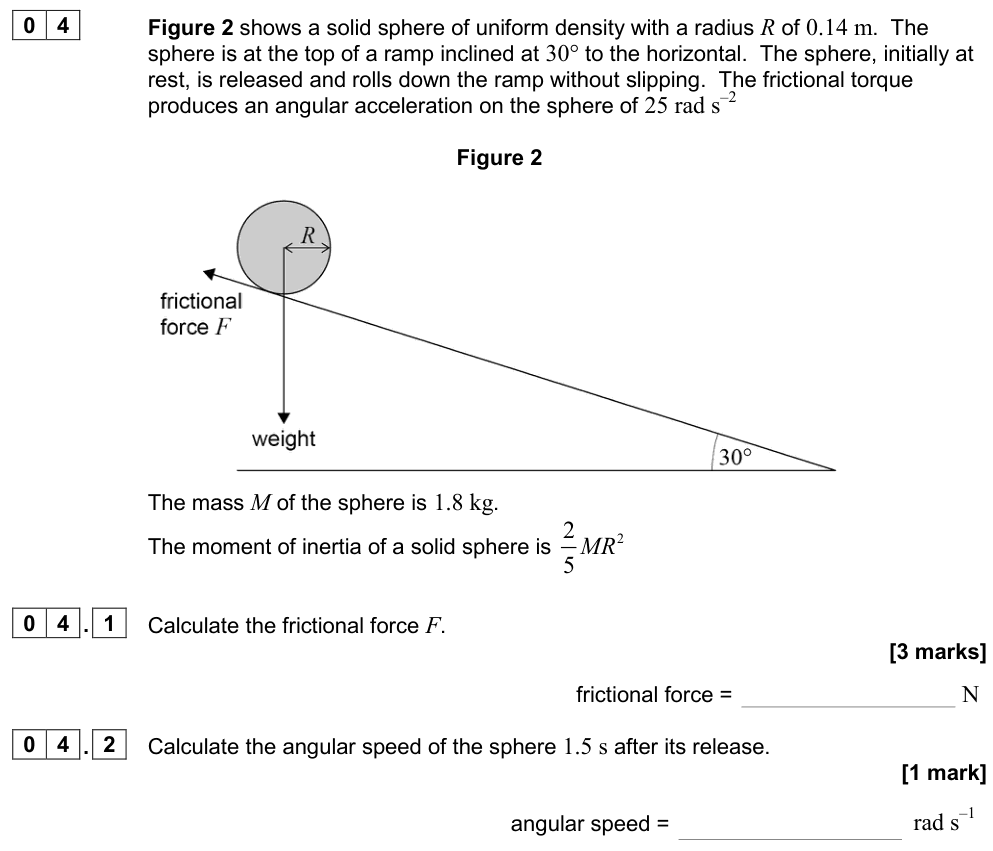
| solid sphere, radius $R$, about a diameter | $\tfrac25MR^2$ |
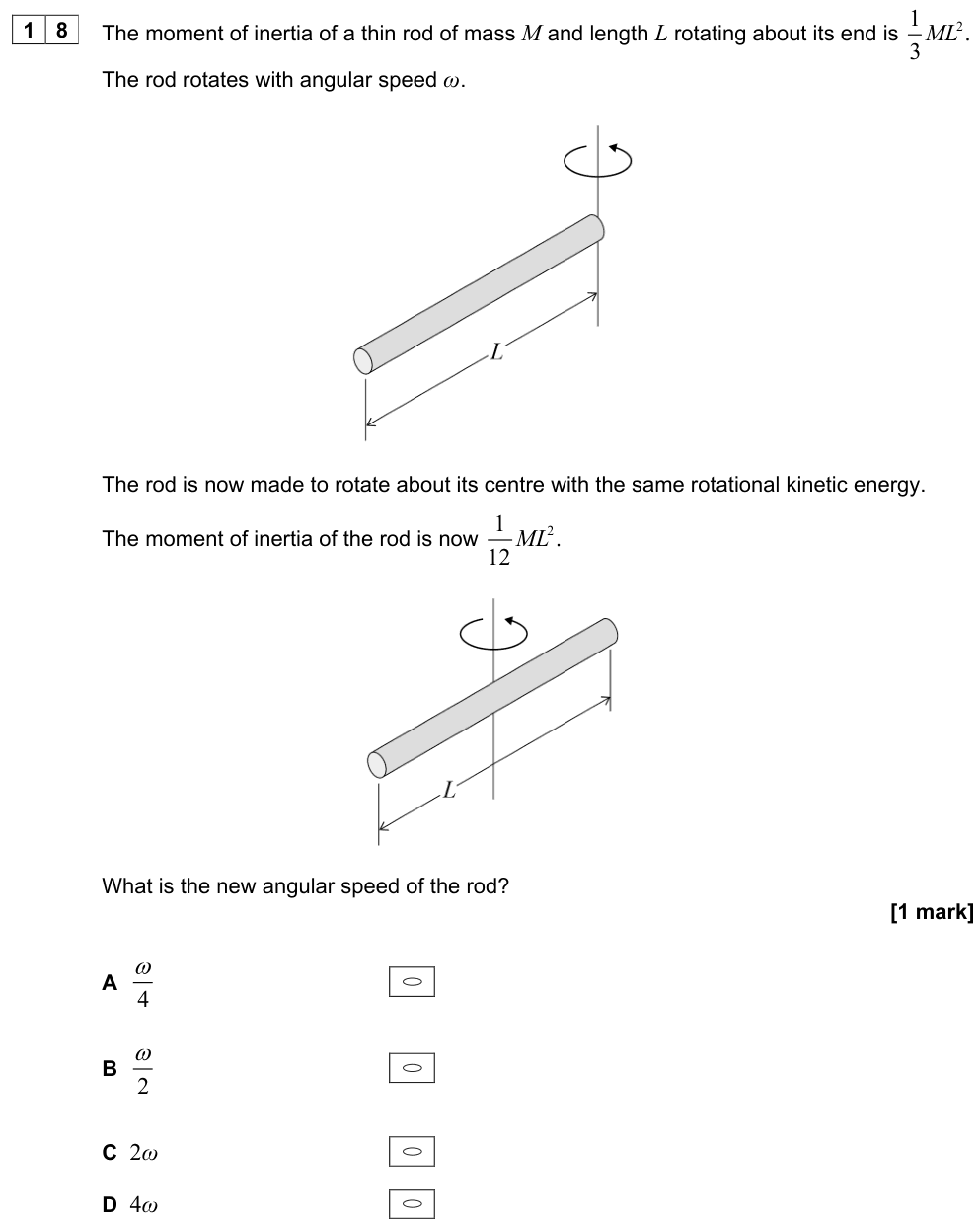
| thin rod, length $L$, about its centre | $\tfrac{1}{12}ML^2$ |
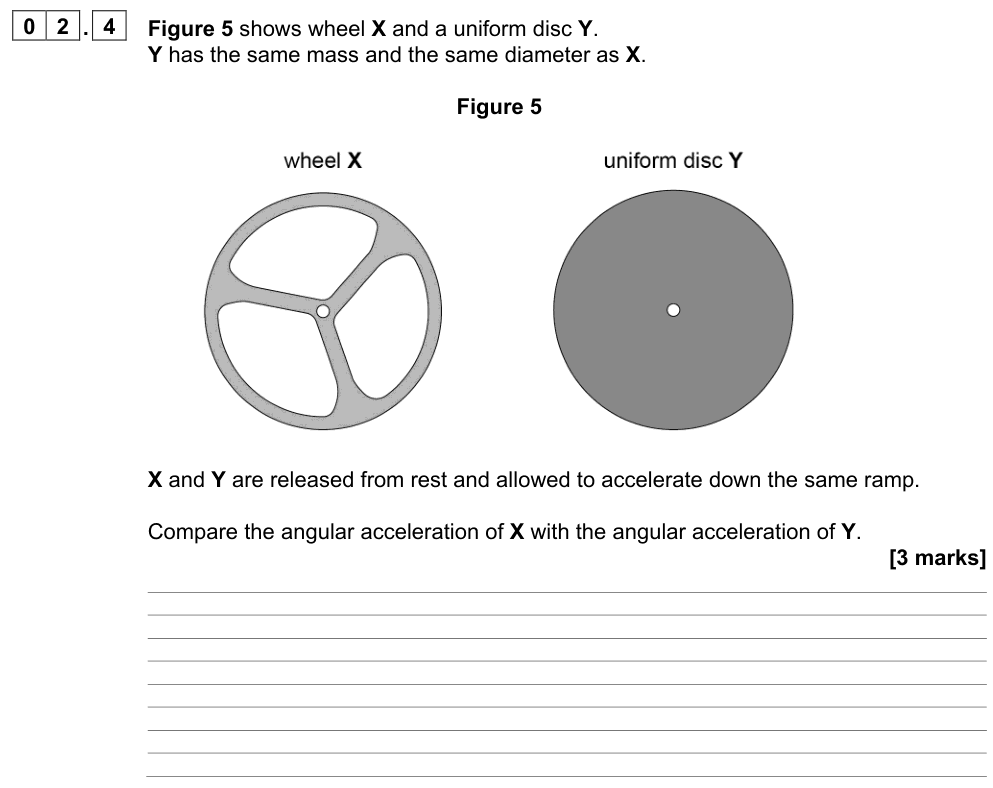
(Expressions like these will be given in a question if you need them.) A ring has twice the moment of inertia of a disc of the same mass and radius, because all its mass is at the rim.
Torque and angular acceleration
Torque and Newton's second law for rotation
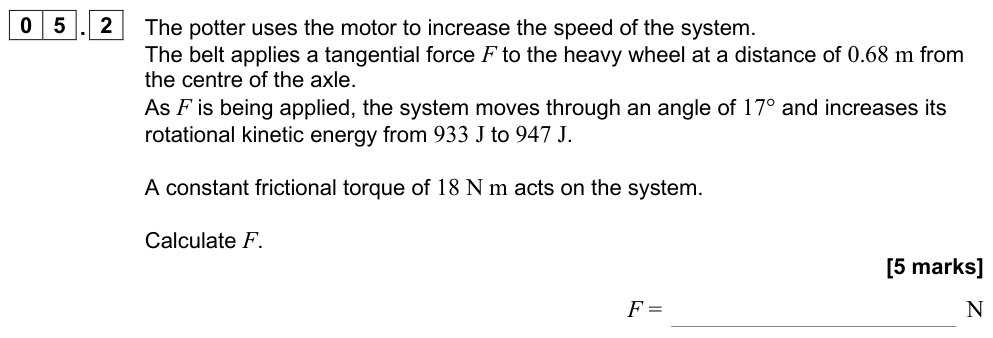
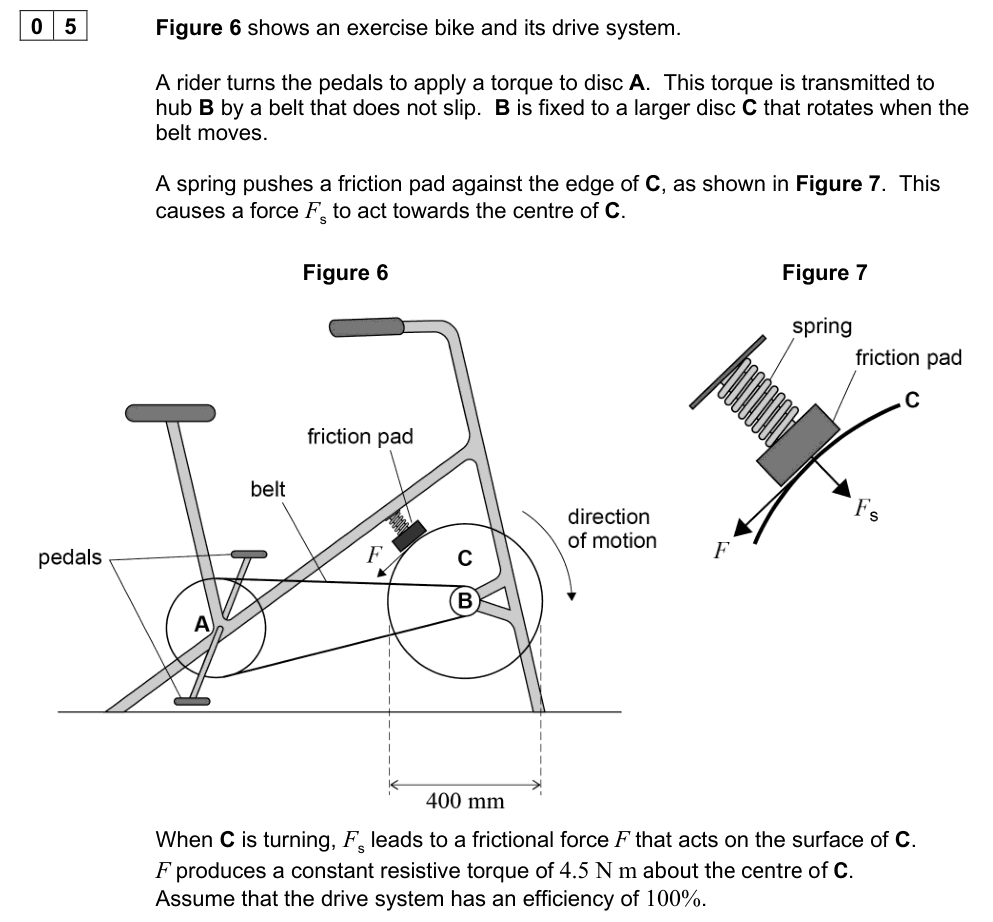
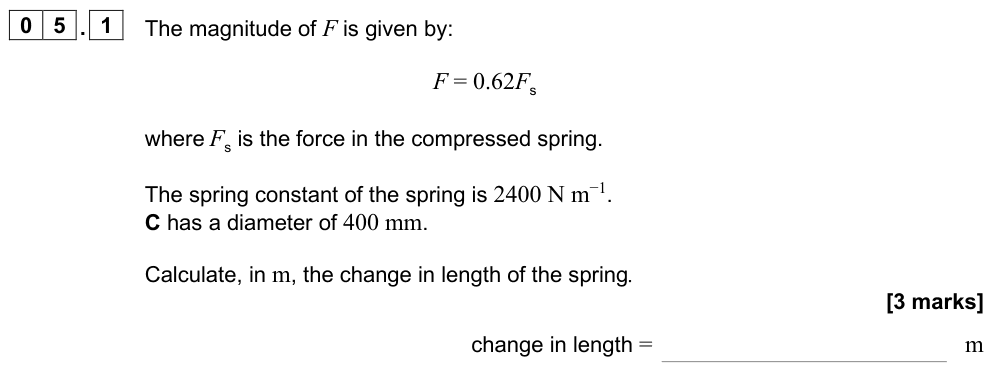
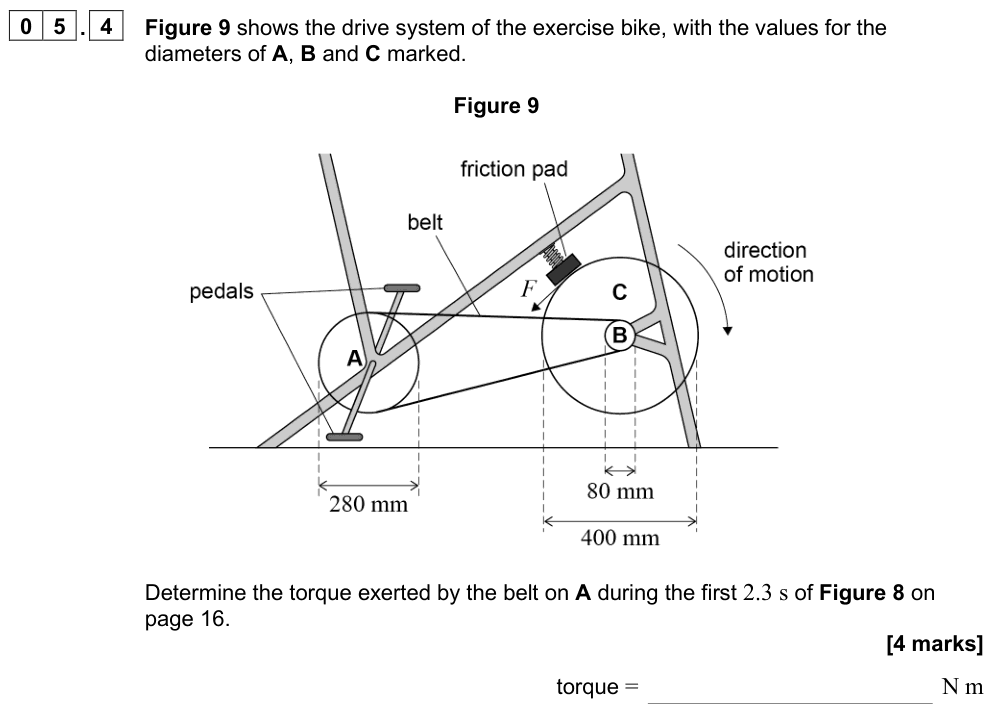
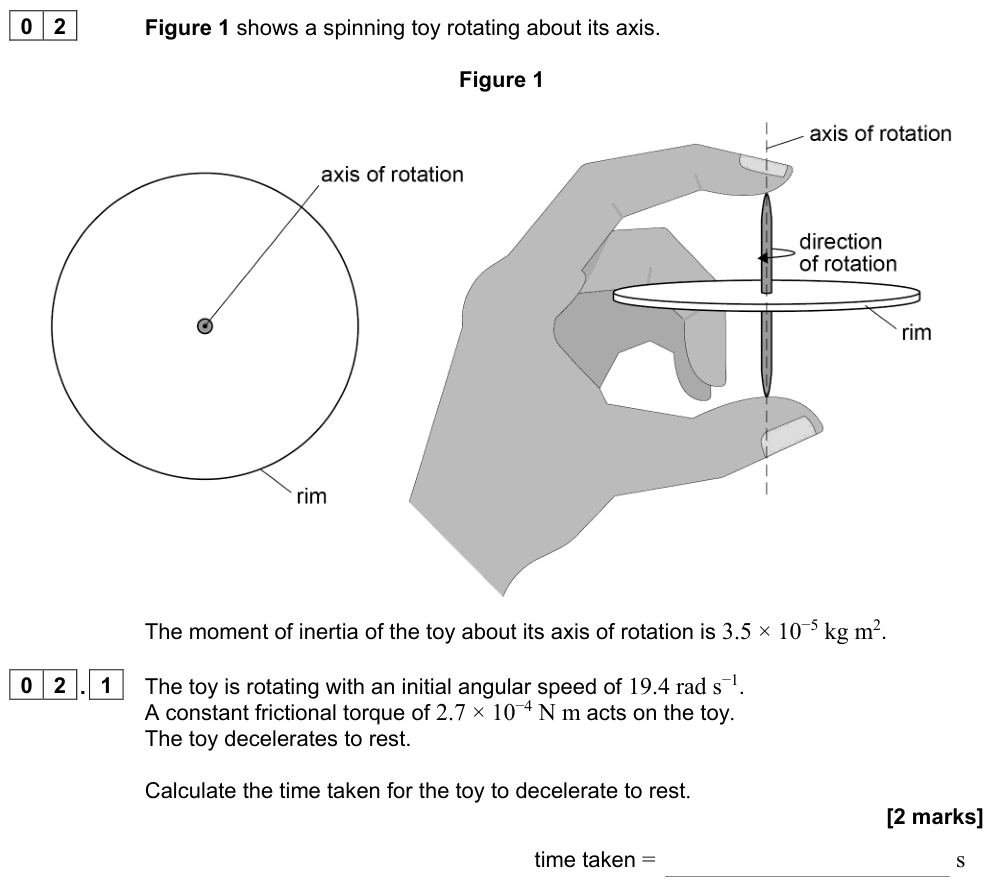
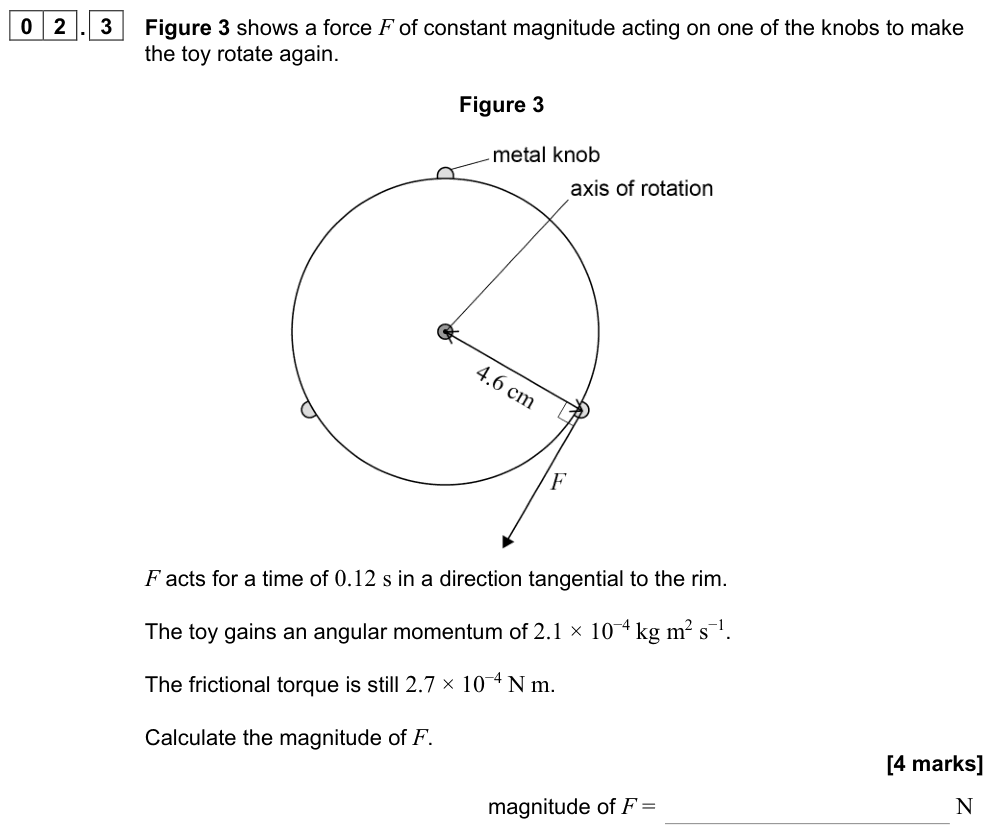
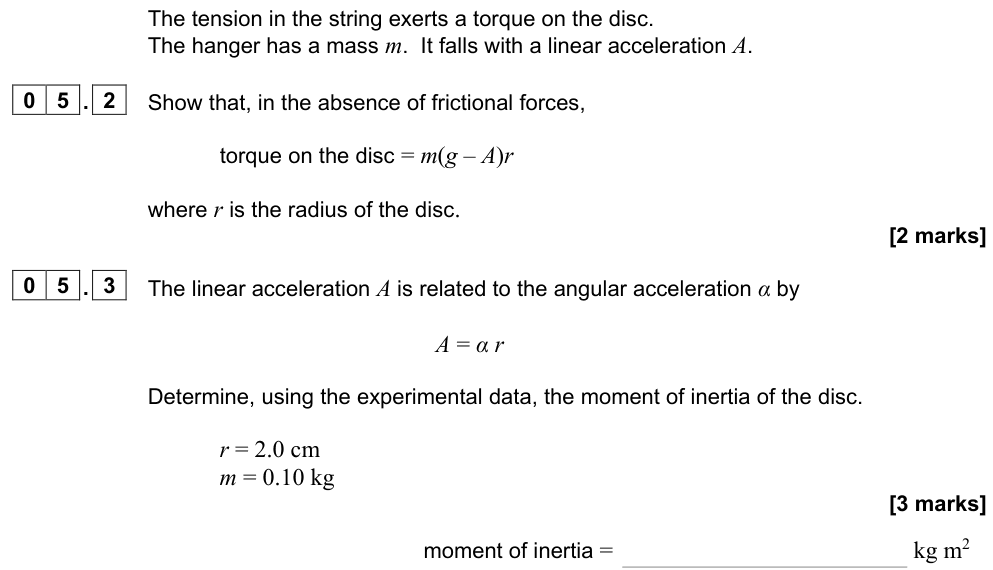
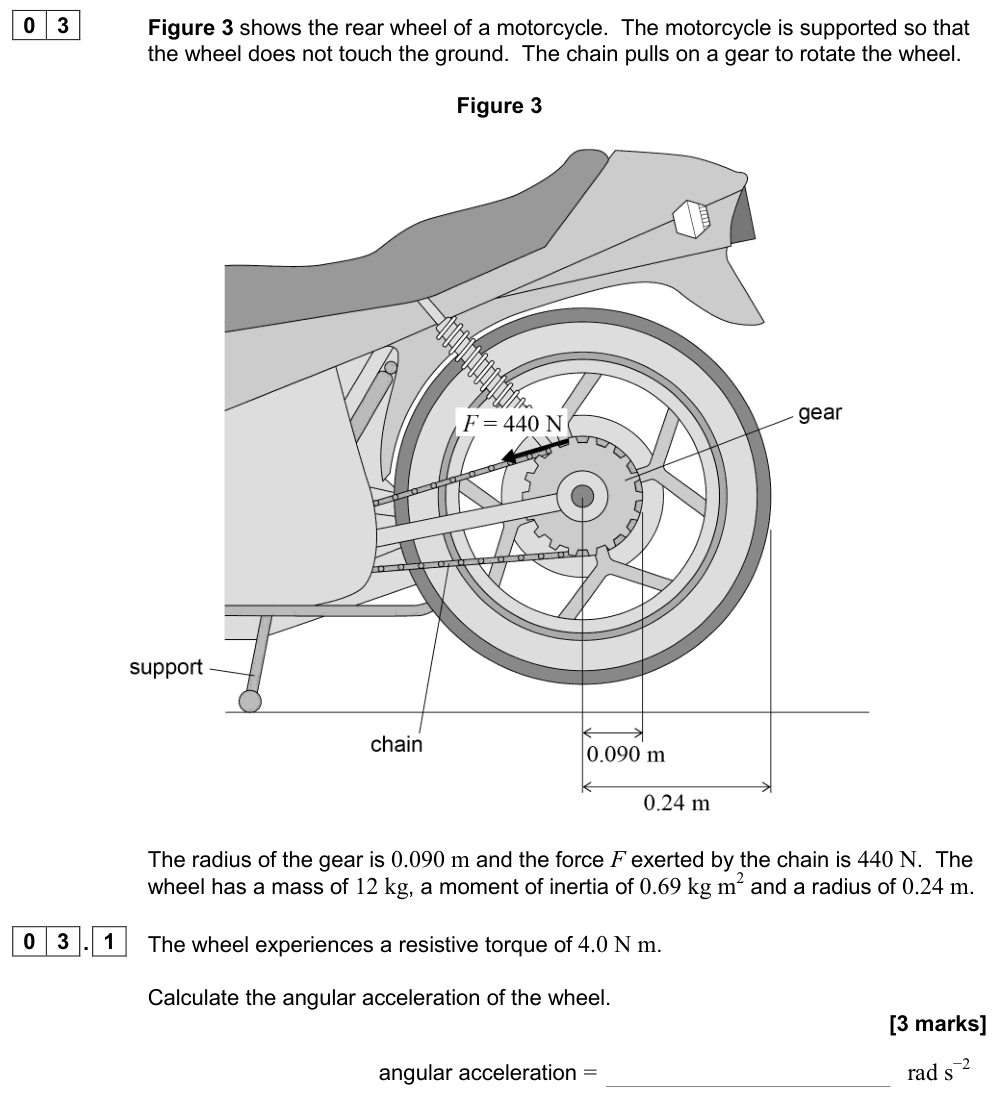
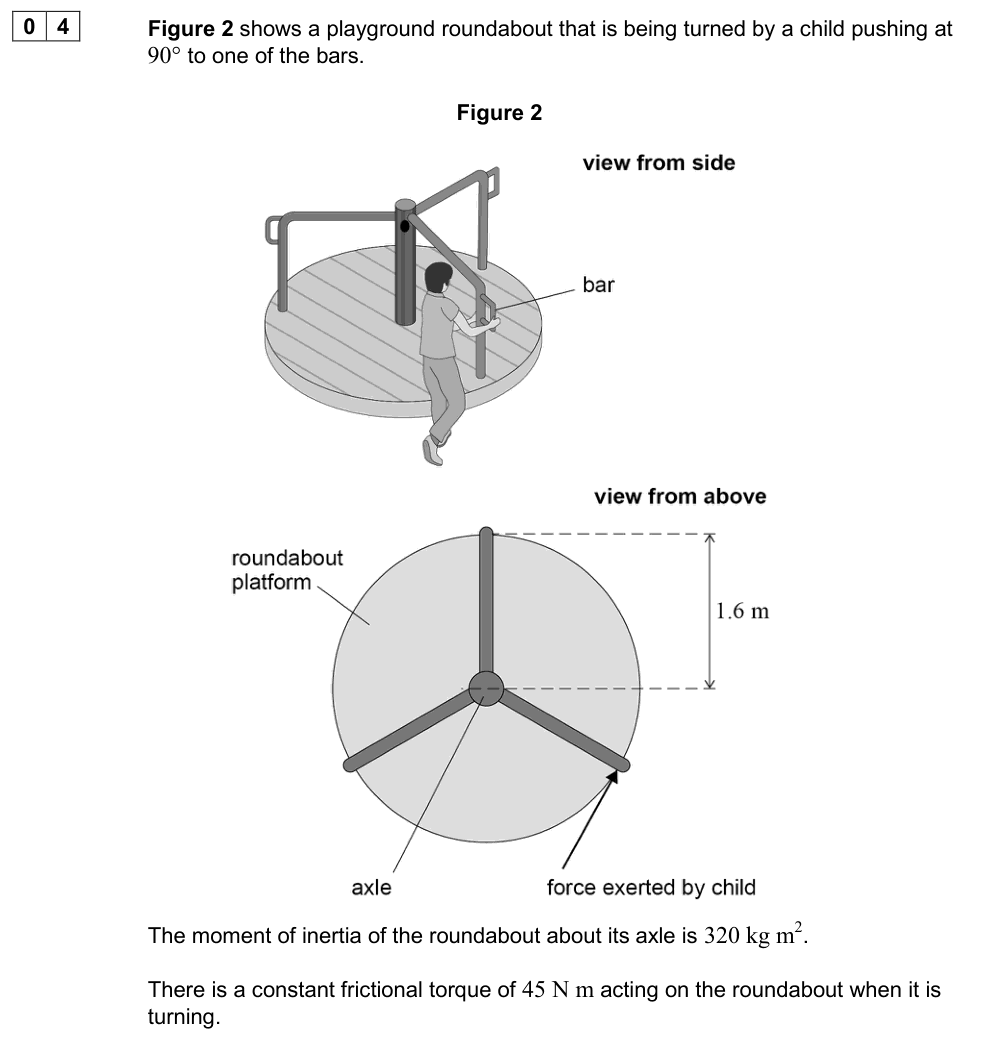
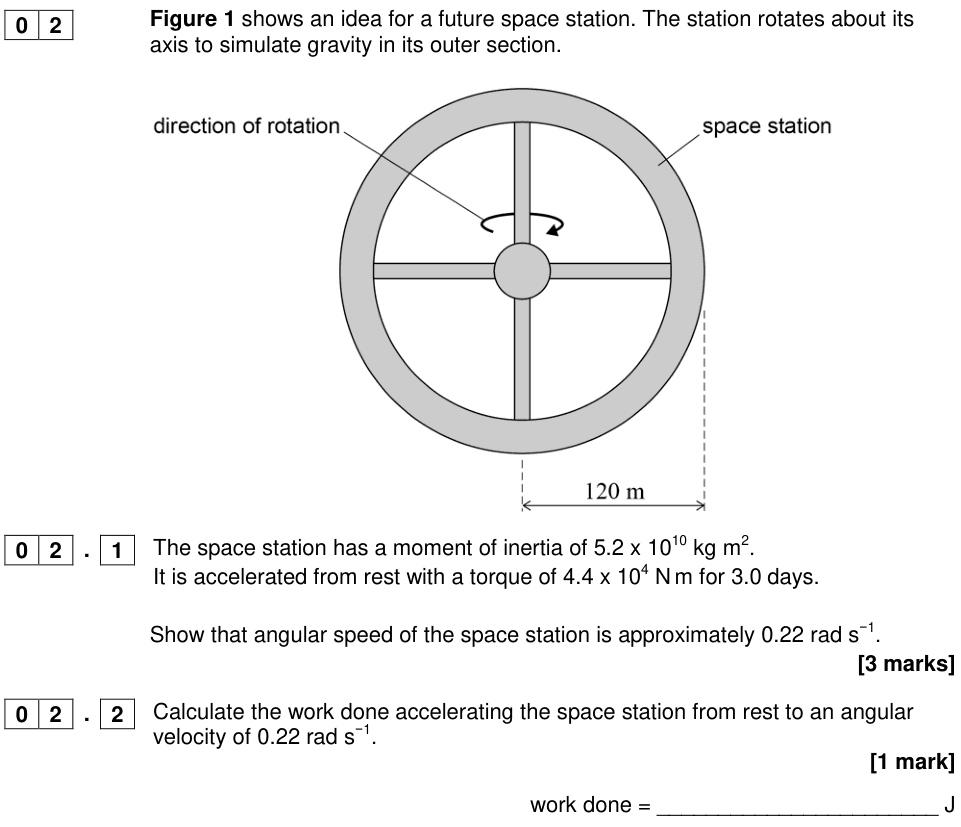
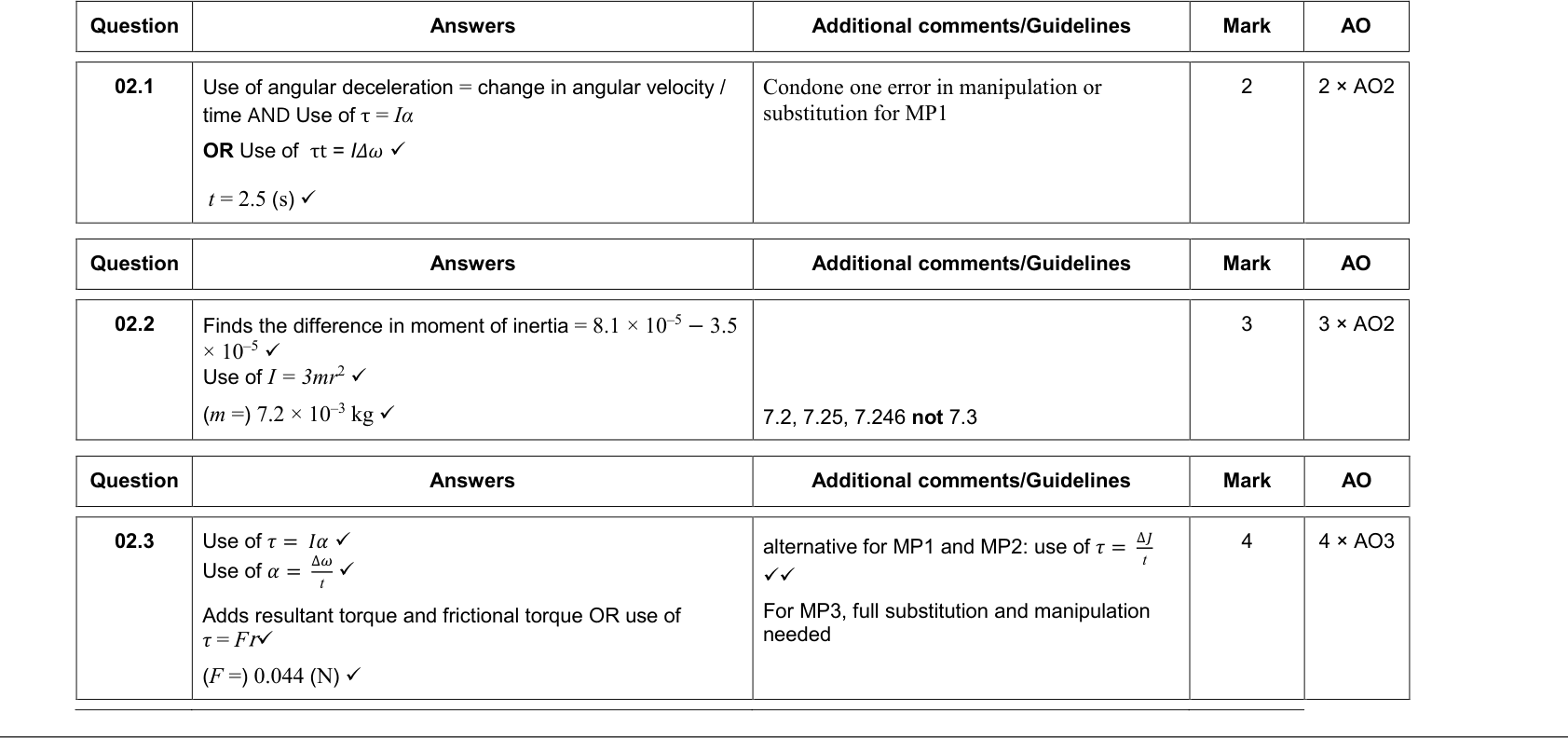
The torque $T$ of a force $F$ acting at perpendicular distance $r$ from the axis is $T = Fr$ (unit N m).
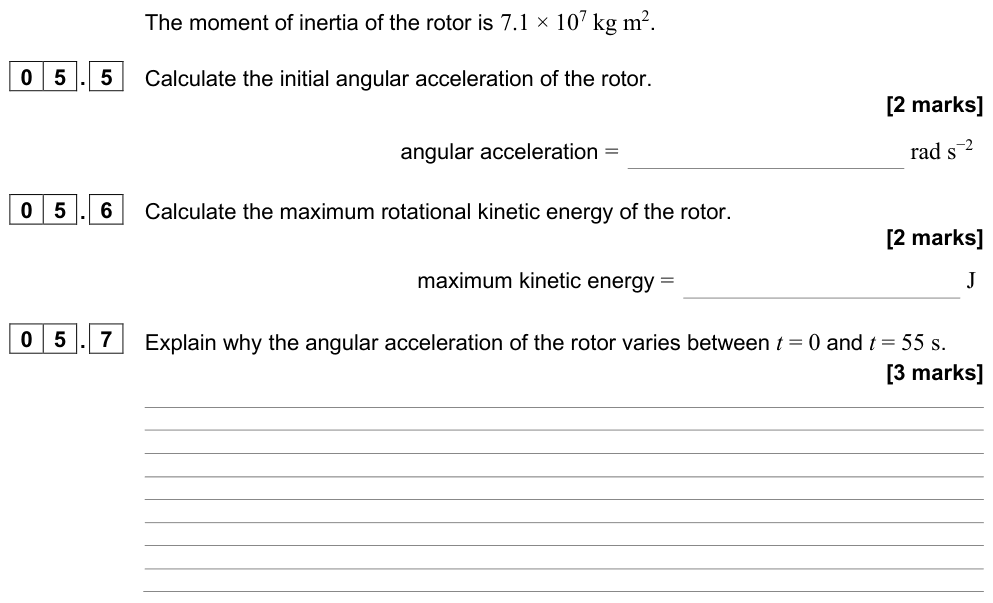
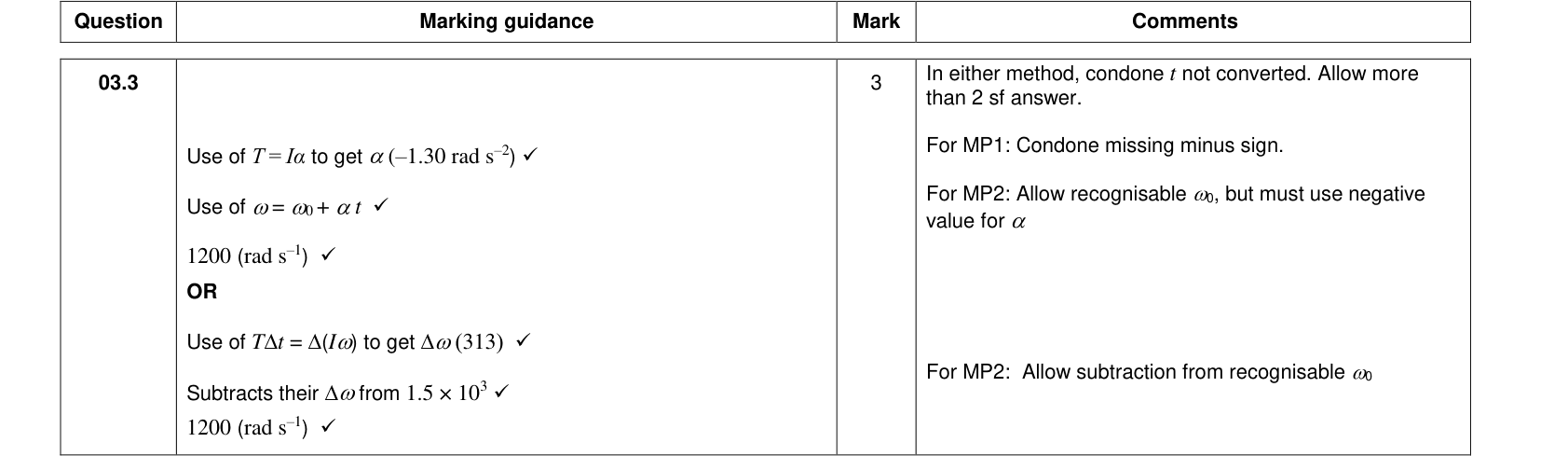
$$T = I\alpha$$
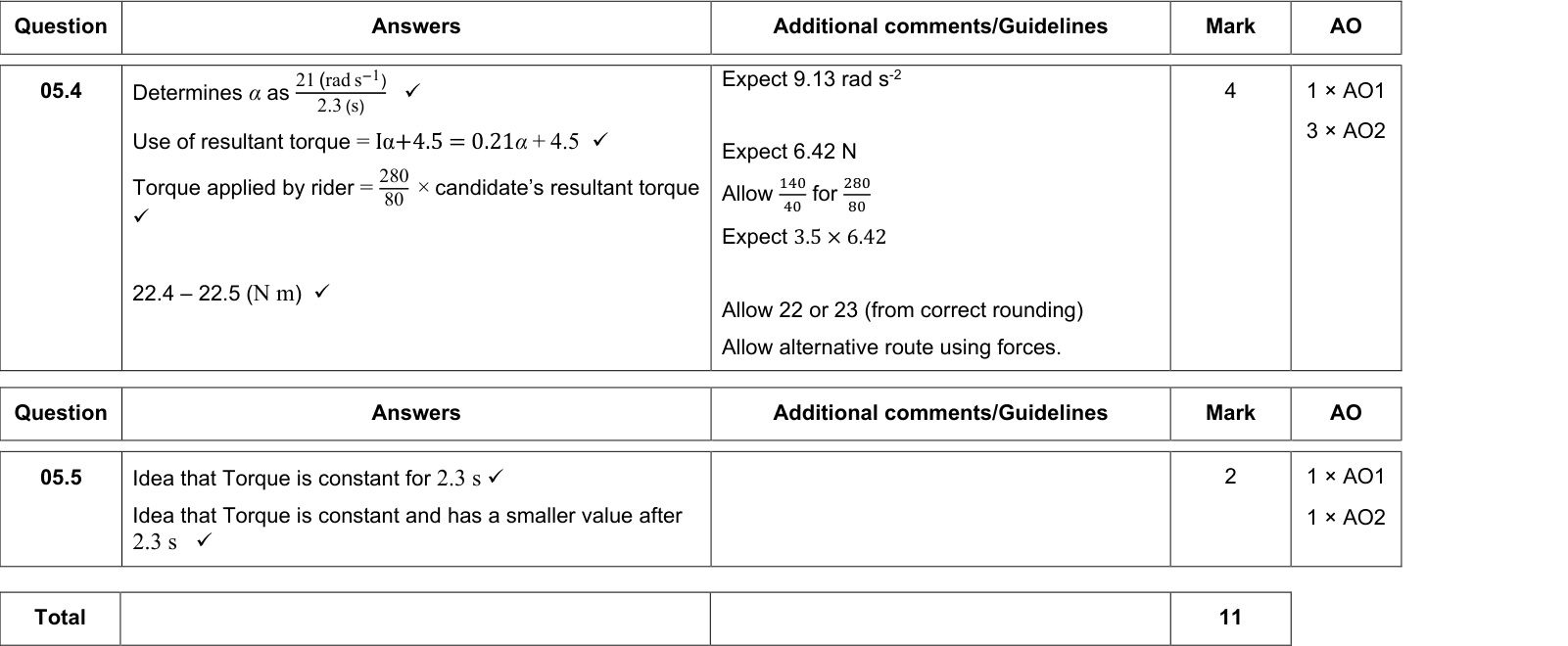
The resultant torque on an object equals its moment of inertia times its angular acceleration (compare $F = ma$).
Worked example: pulling a string
A string wound around a drum of radius 0.050 m is pulled with a constant force of 20 N. The drum's moment of inertia is 0.025 kg m² and friction is negligible.
$T = Fr = 20 \times 0.050 = 1.0$ N m, so $\alpha = \dfrac{T}{I} = \dfrac{1.0}{0.025} = 40$ rad s⁻².
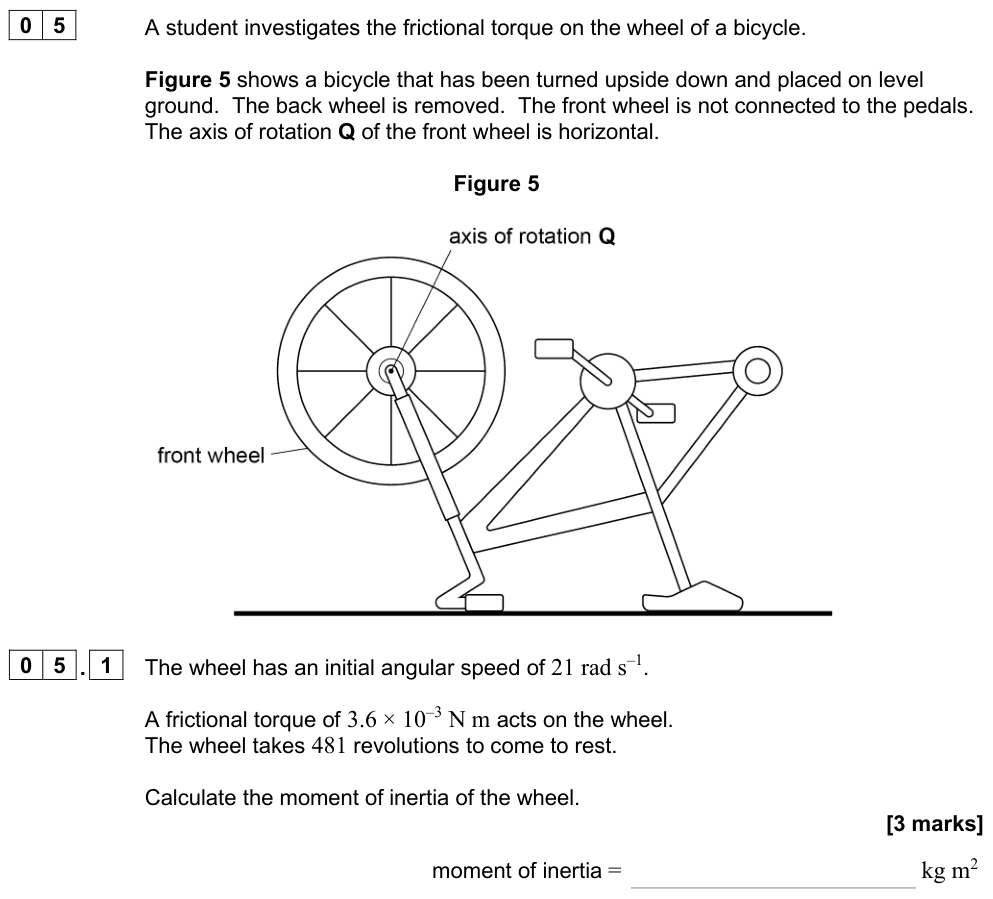
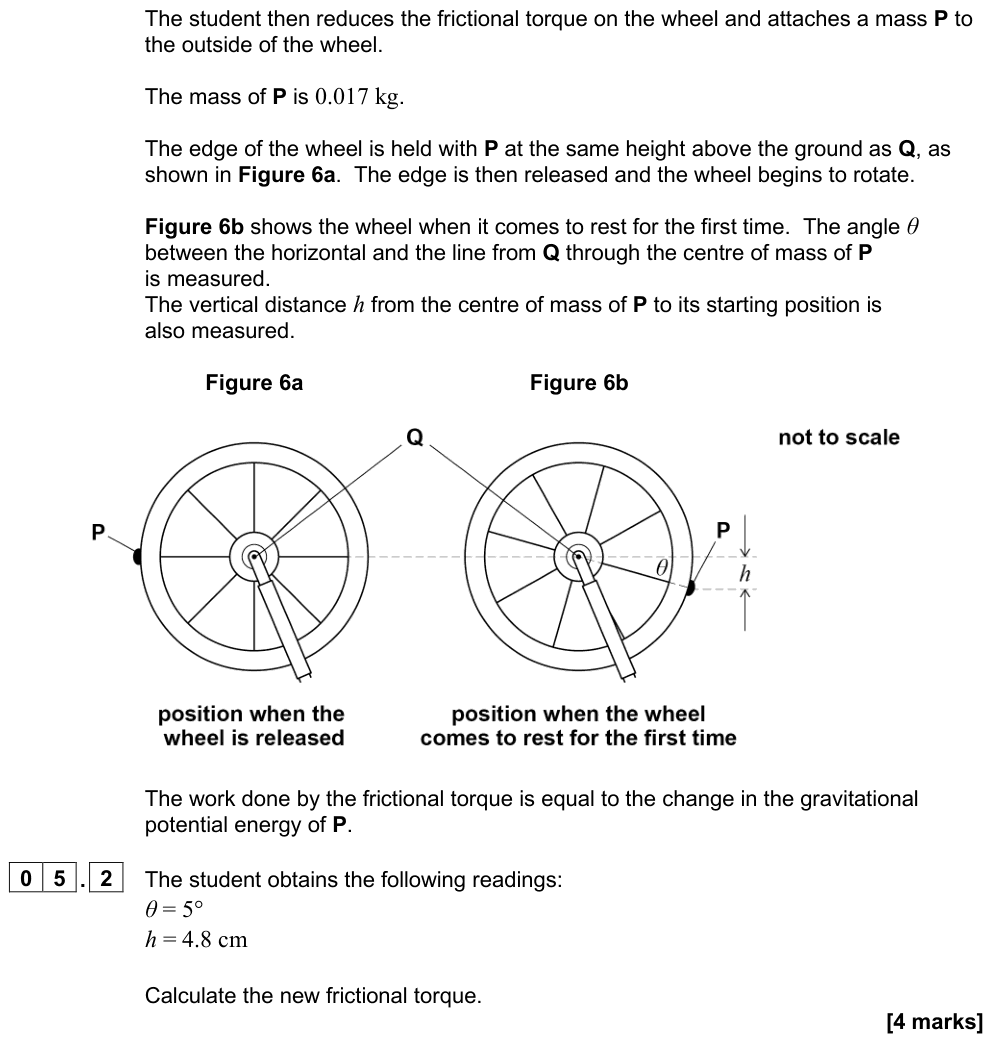
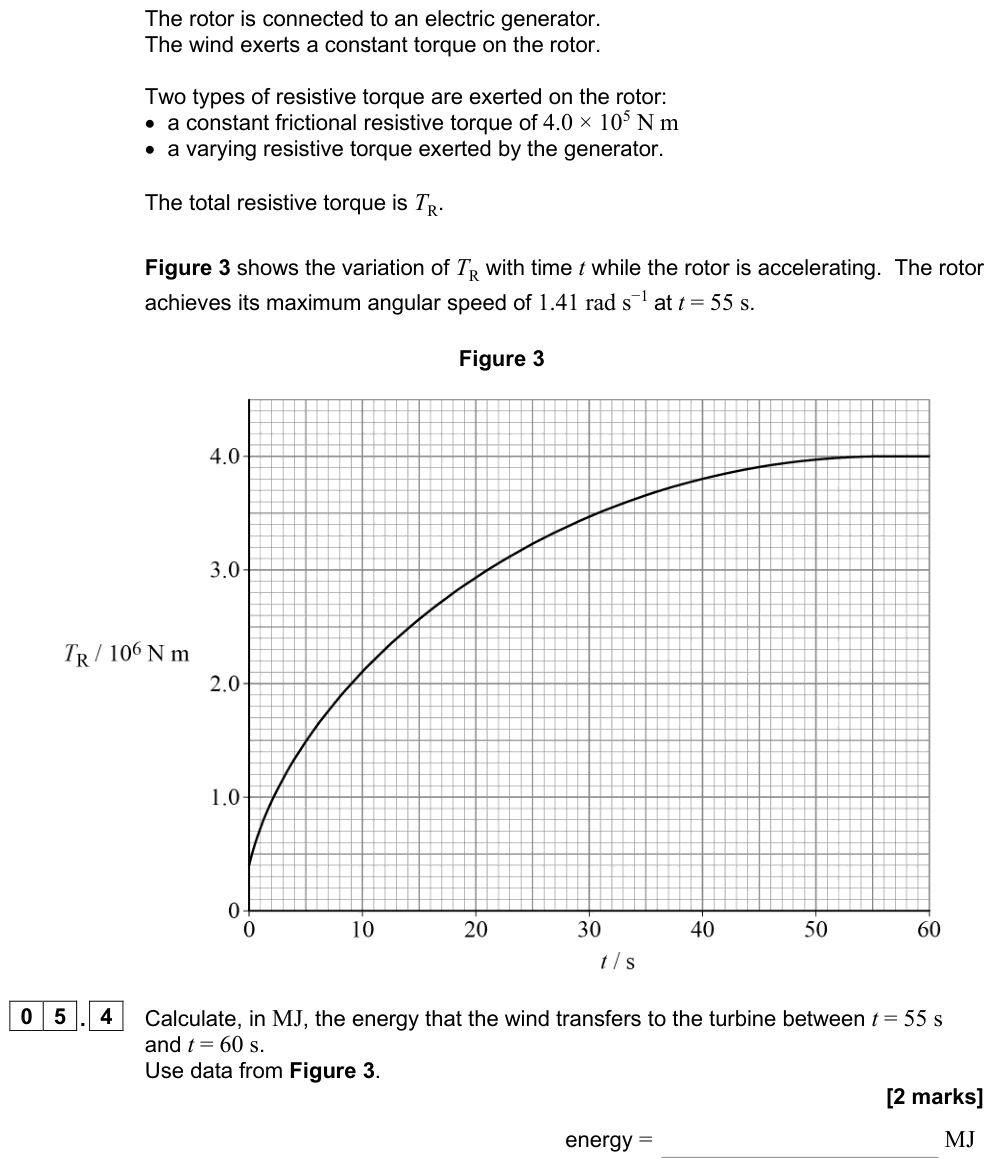
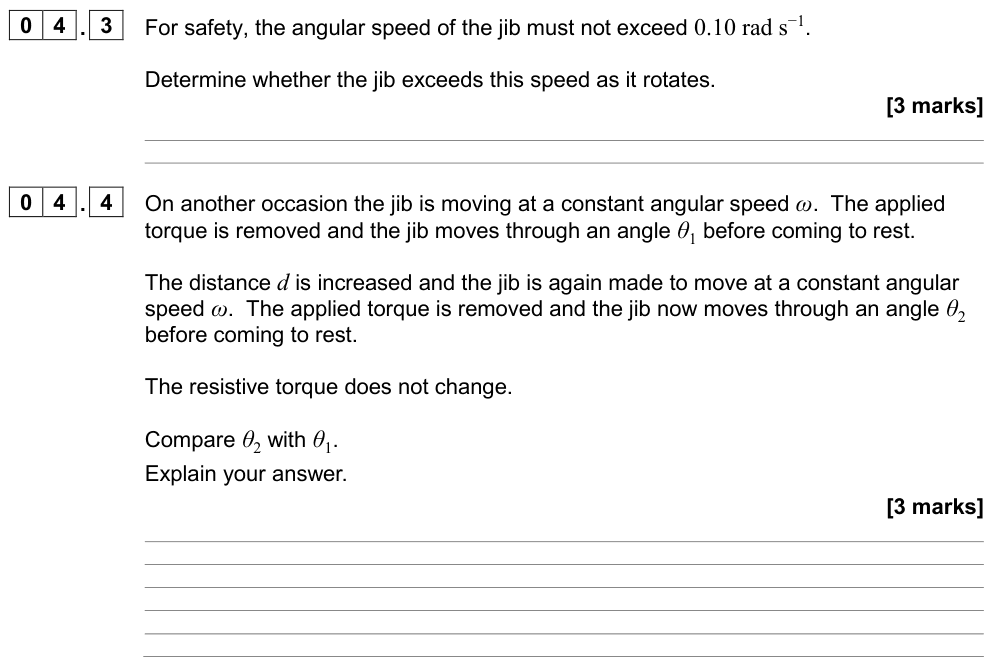
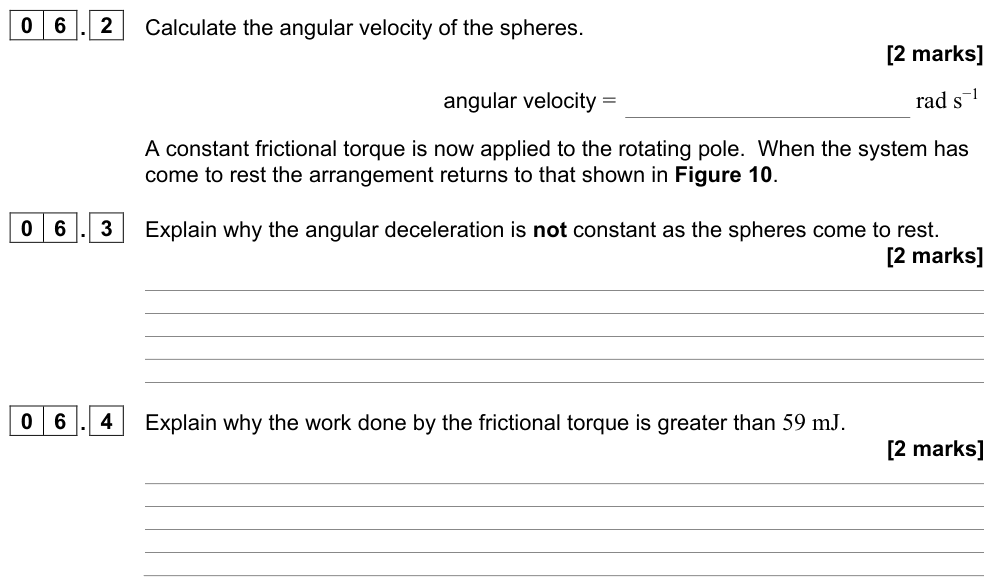
If there is a frictional torque, use the resultant torque: applied torque − frictional torque $= I\alpha$.
Rotational kinetic energy, work and power
Rotational kinetic energy
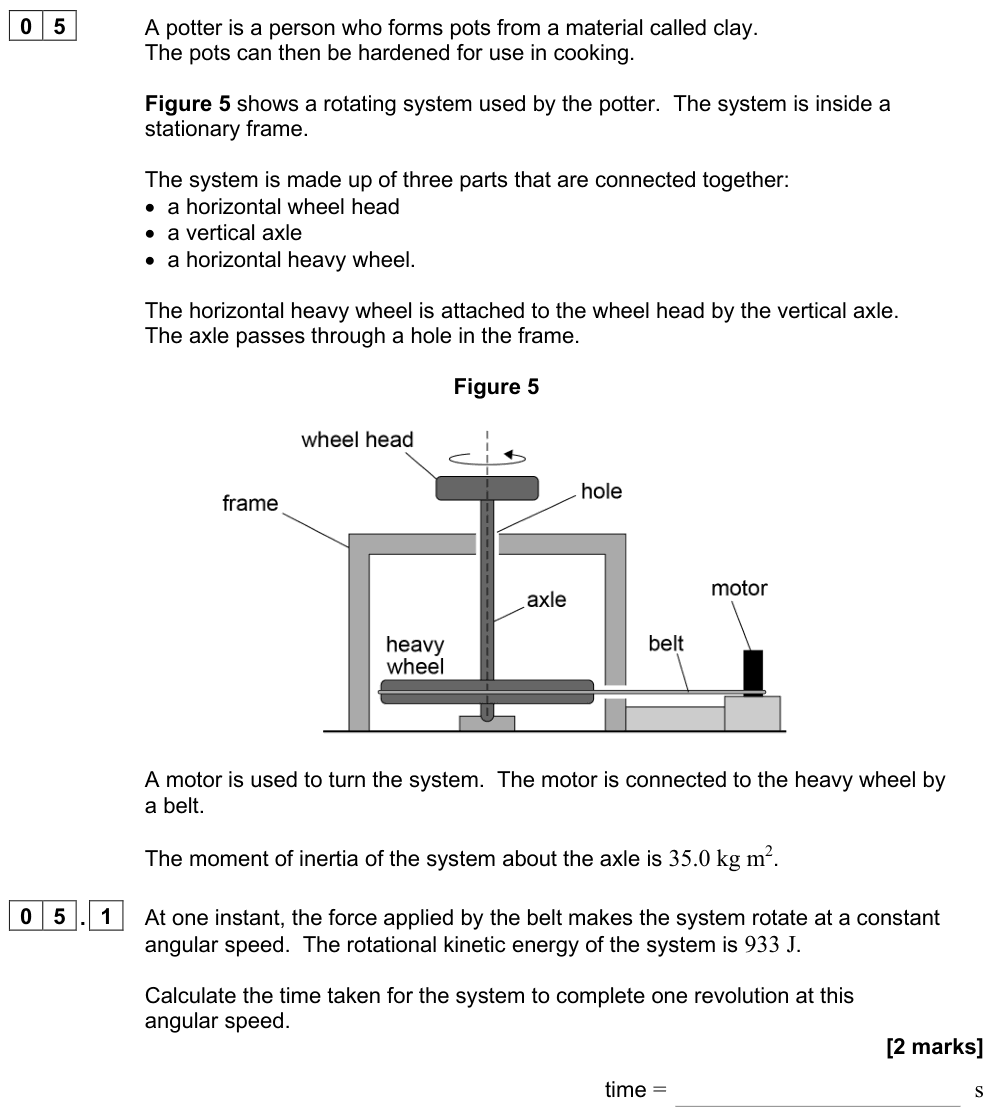
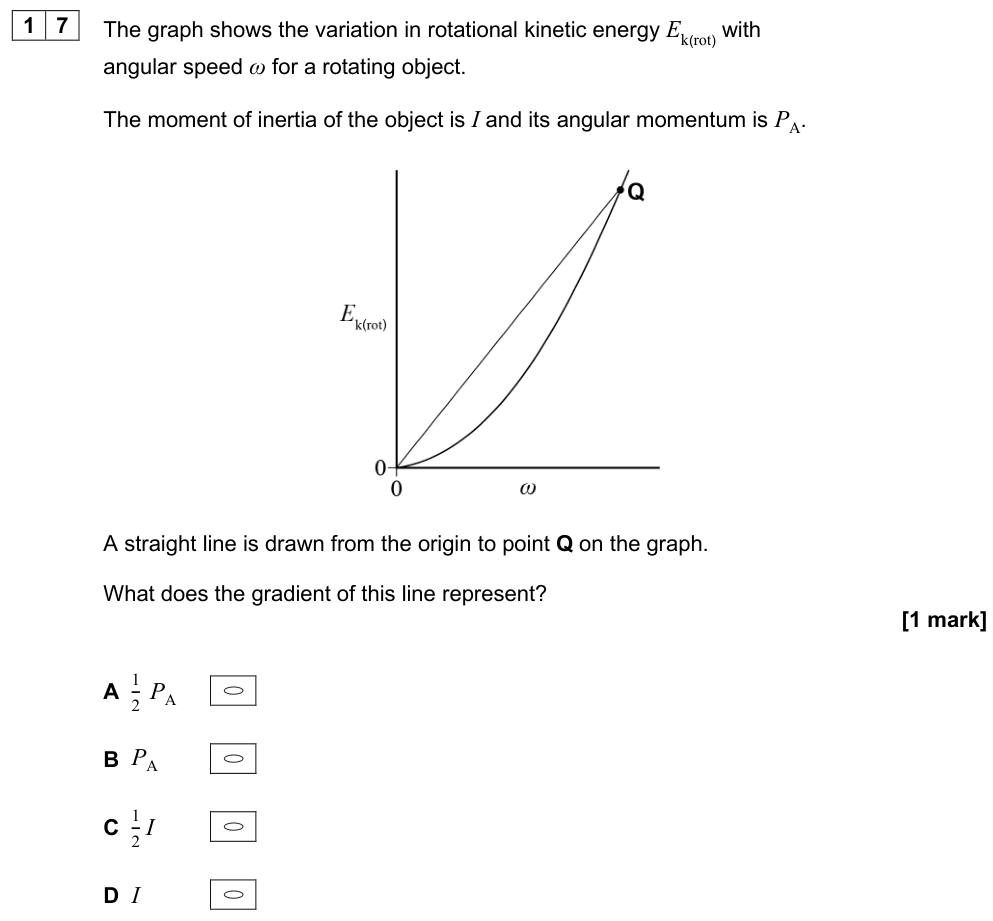
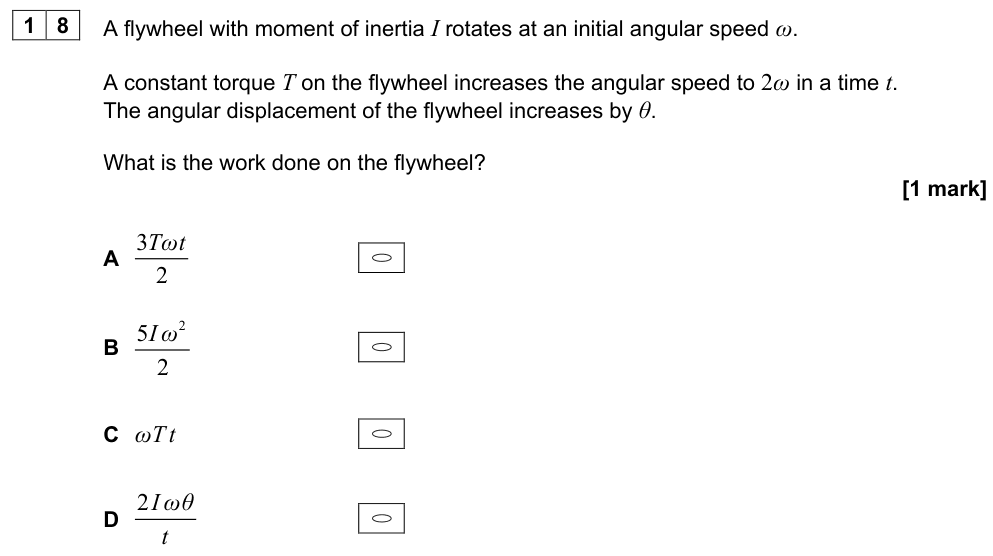
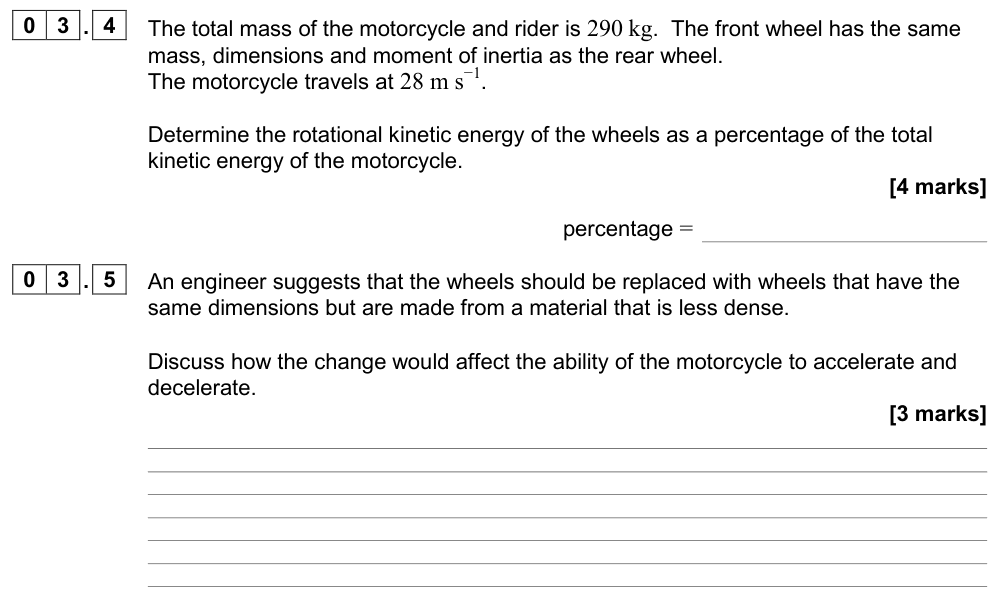
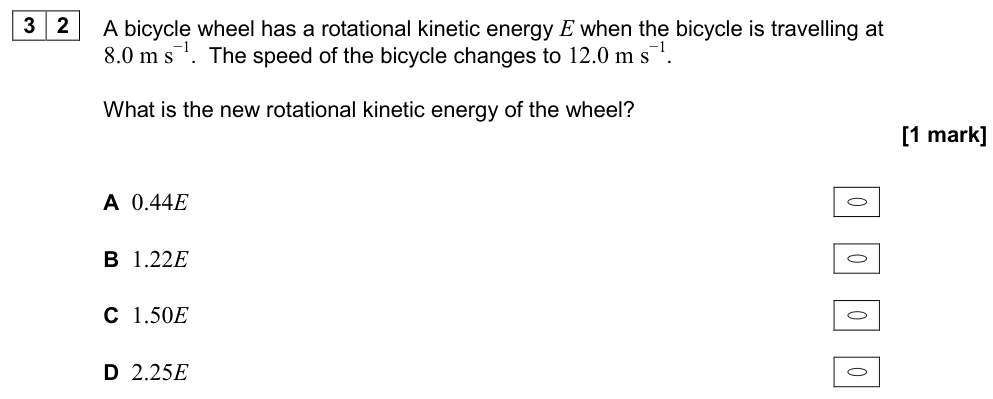
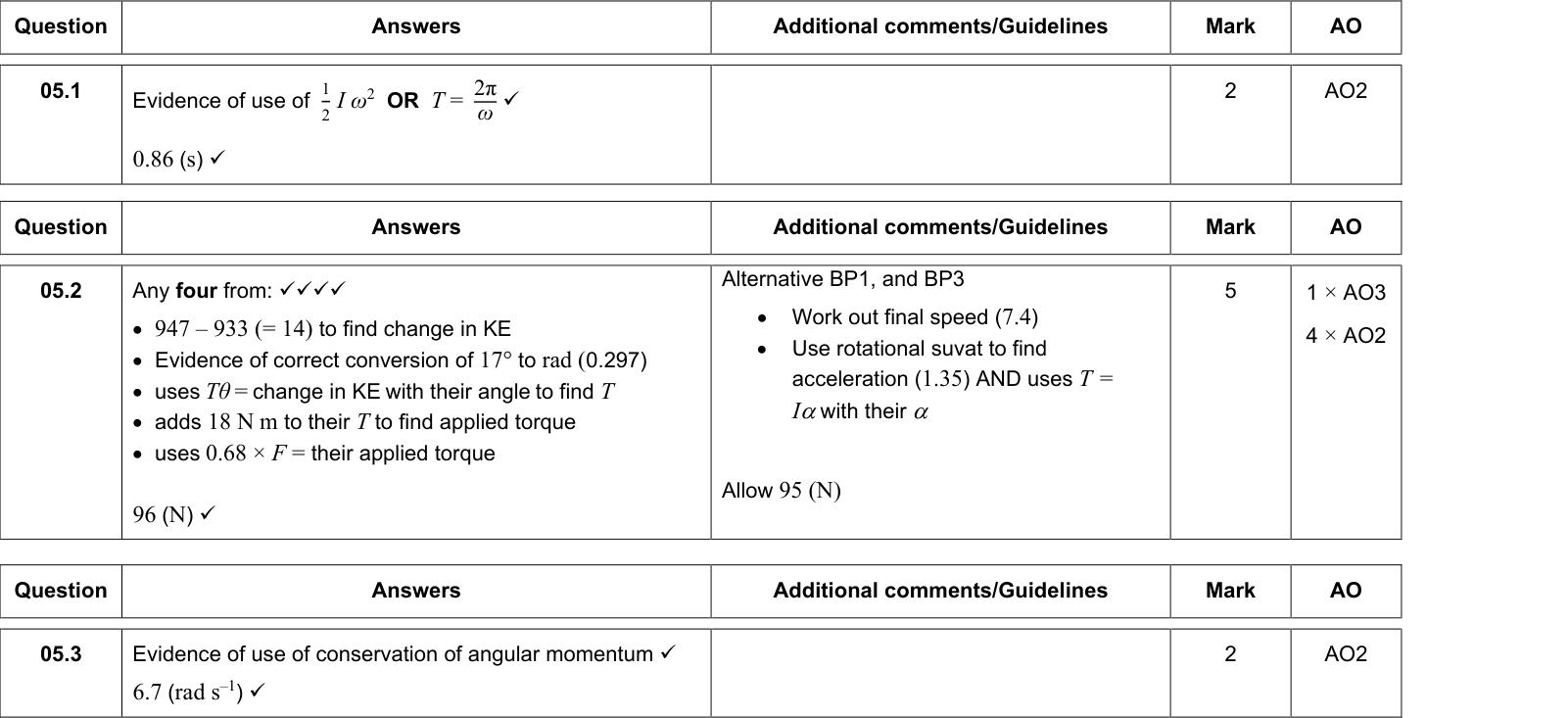
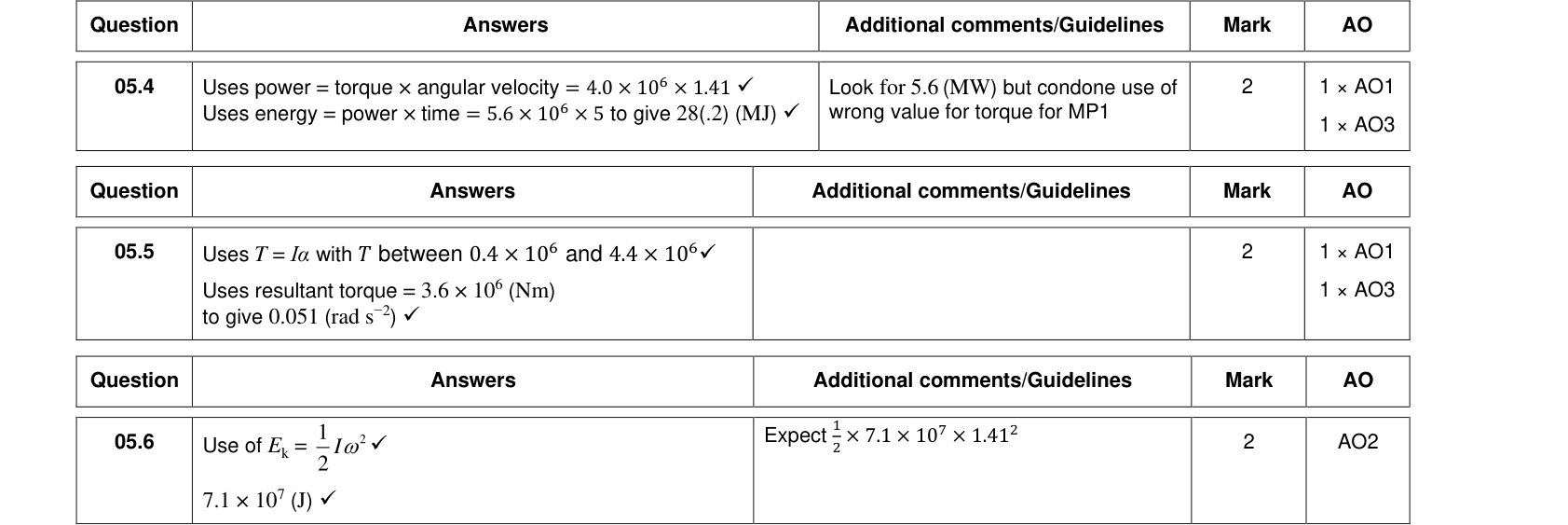
$$E_k = \tfrac12I\omega^2$$
Work and power
$$W = T\theta \qquad P = T\omega$$
(Compare $W = Fs$ and $P = Fv$.)
Worked example: a flywheel
A flywheel with $I = 2.5$ kg m² spins at 3000 rpm ($\omega = 314$ rad s⁻¹). Its kinetic energy is $\tfrac12 \times 2.5 \times 314^2 = 1.2 \times 10^{5}$ J.
A motor that exerts a torque of 40 N m at 1500 rpm ($\omega = 157$ rad s⁻¹) delivers a power of $40 \times 157 = 6.3$ kW.
Rolling objects
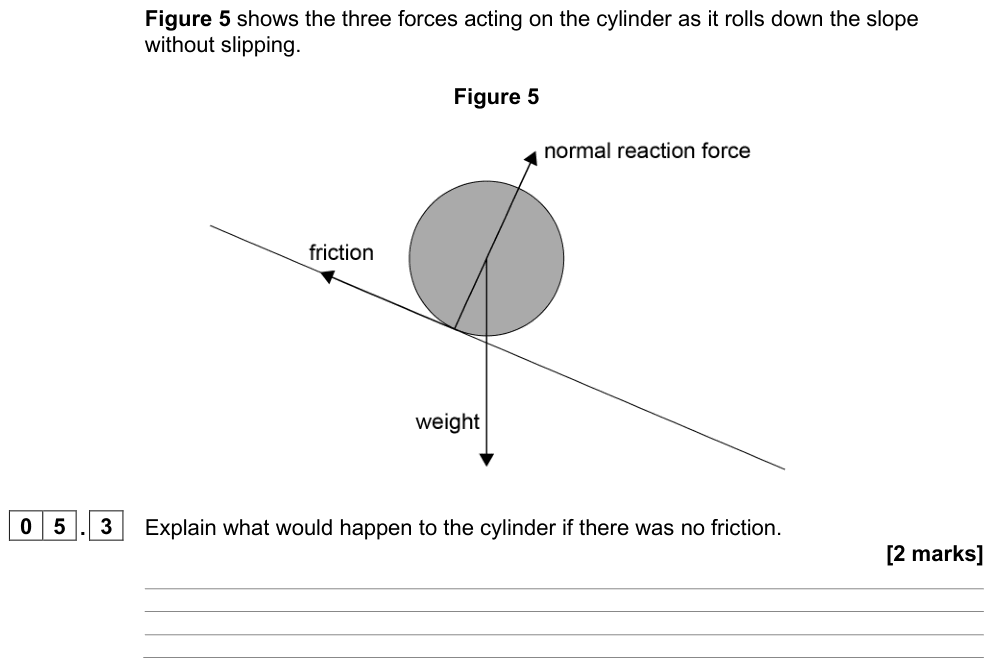
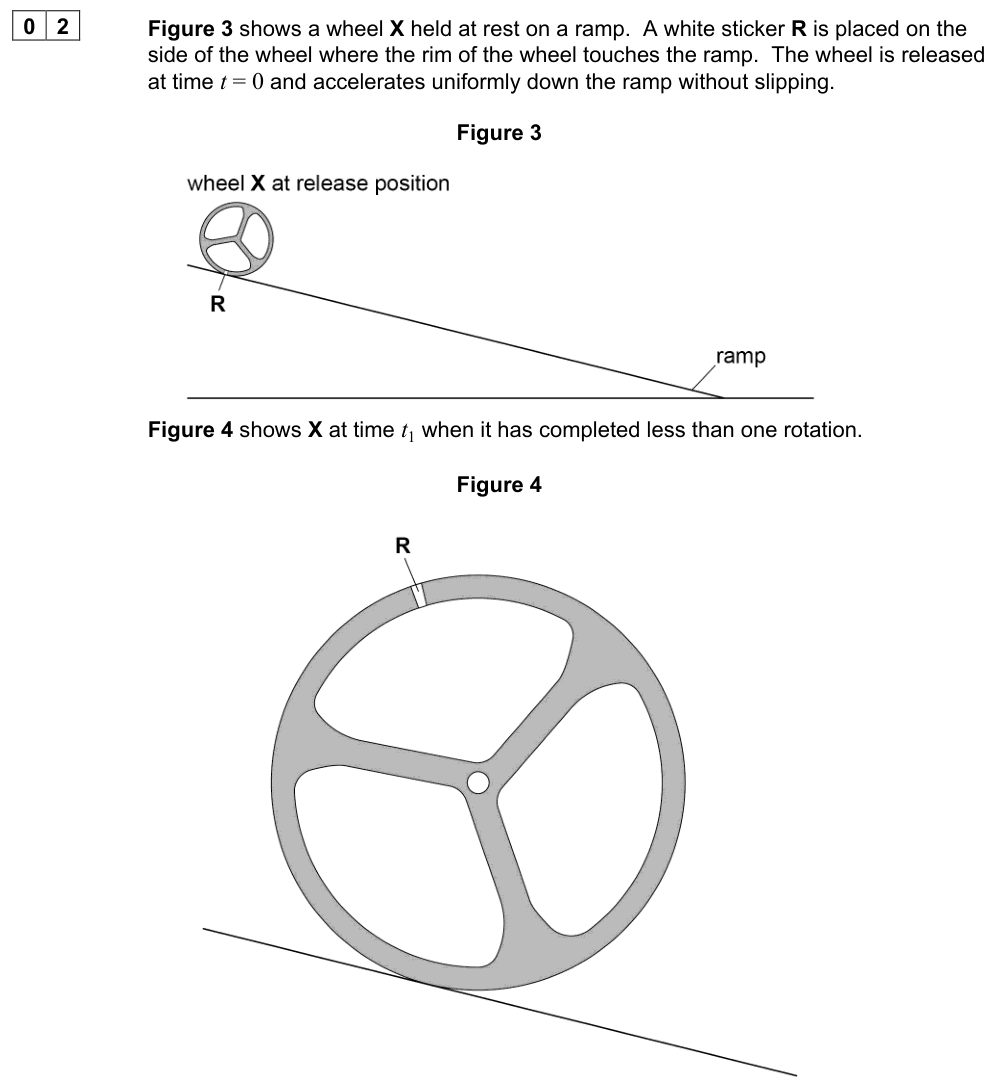
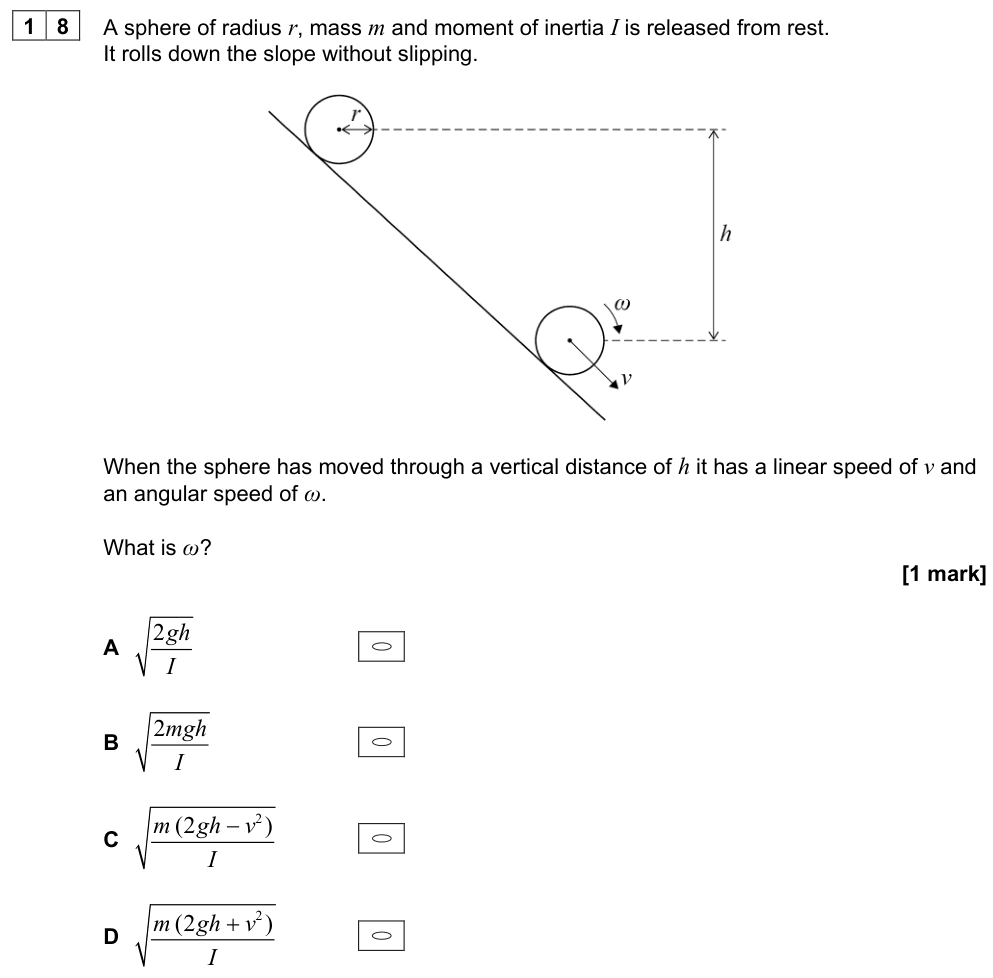
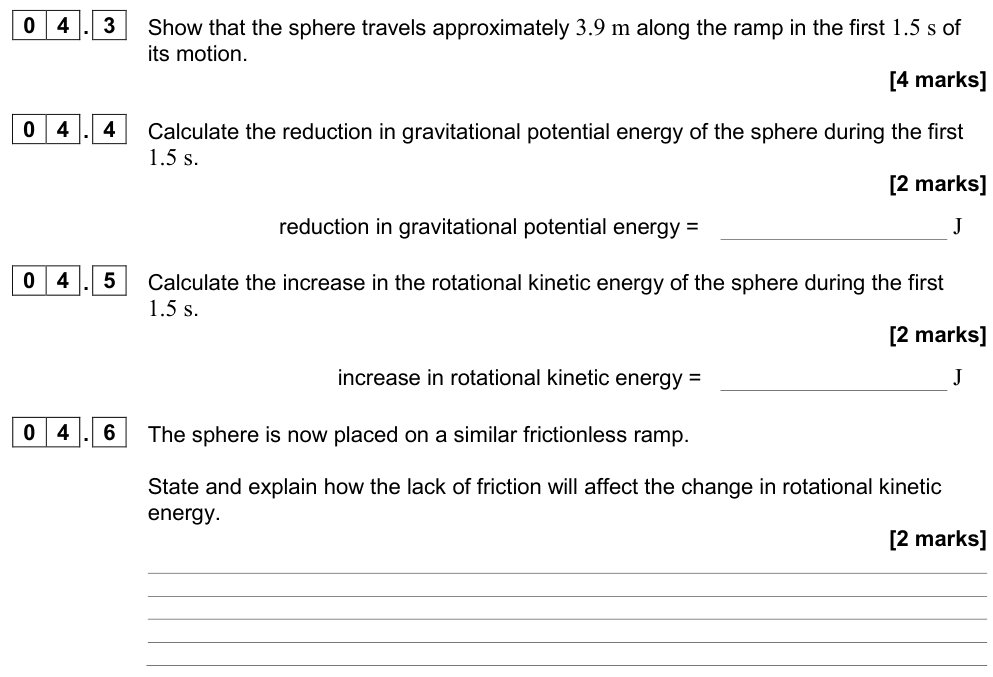
An object rolling without slipping has both translational and rotational kinetic energy, with $v = r\omega$:
$$E_k = \tfrac12mv^2 + \tfrac12I\omega^2$$
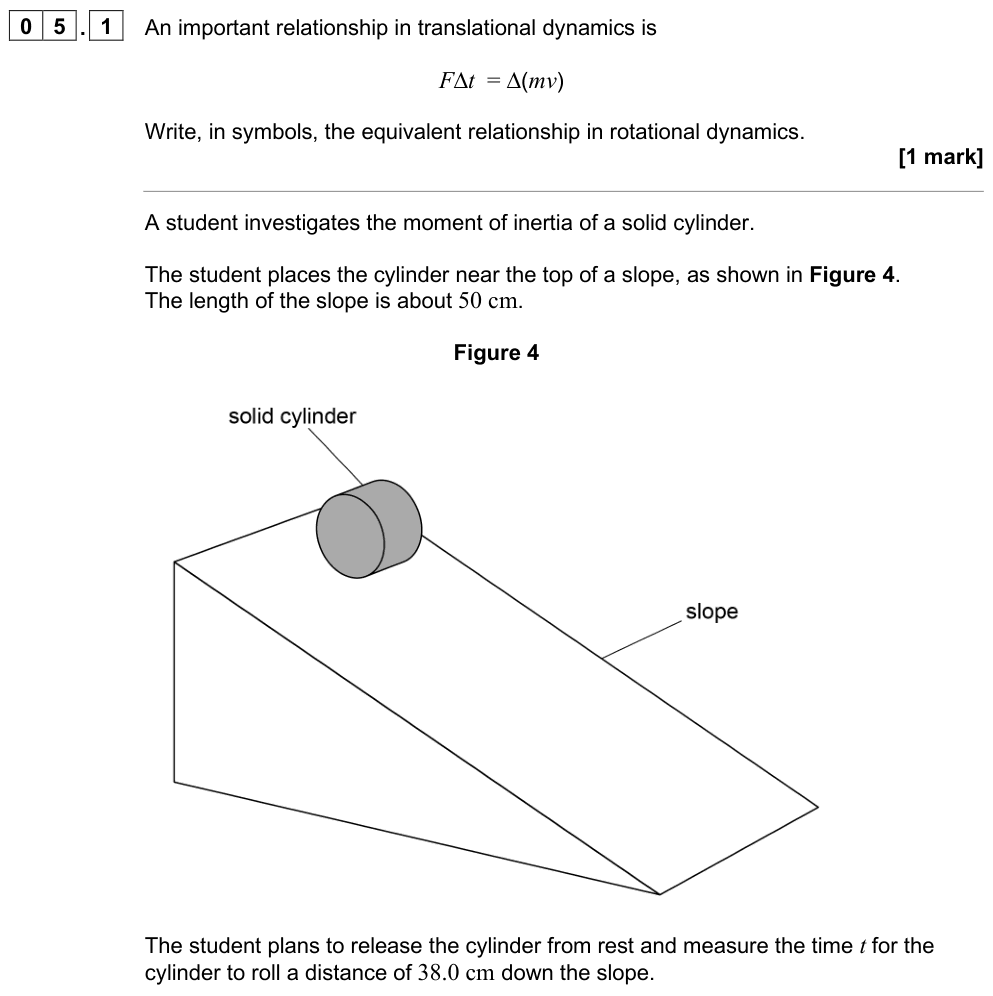
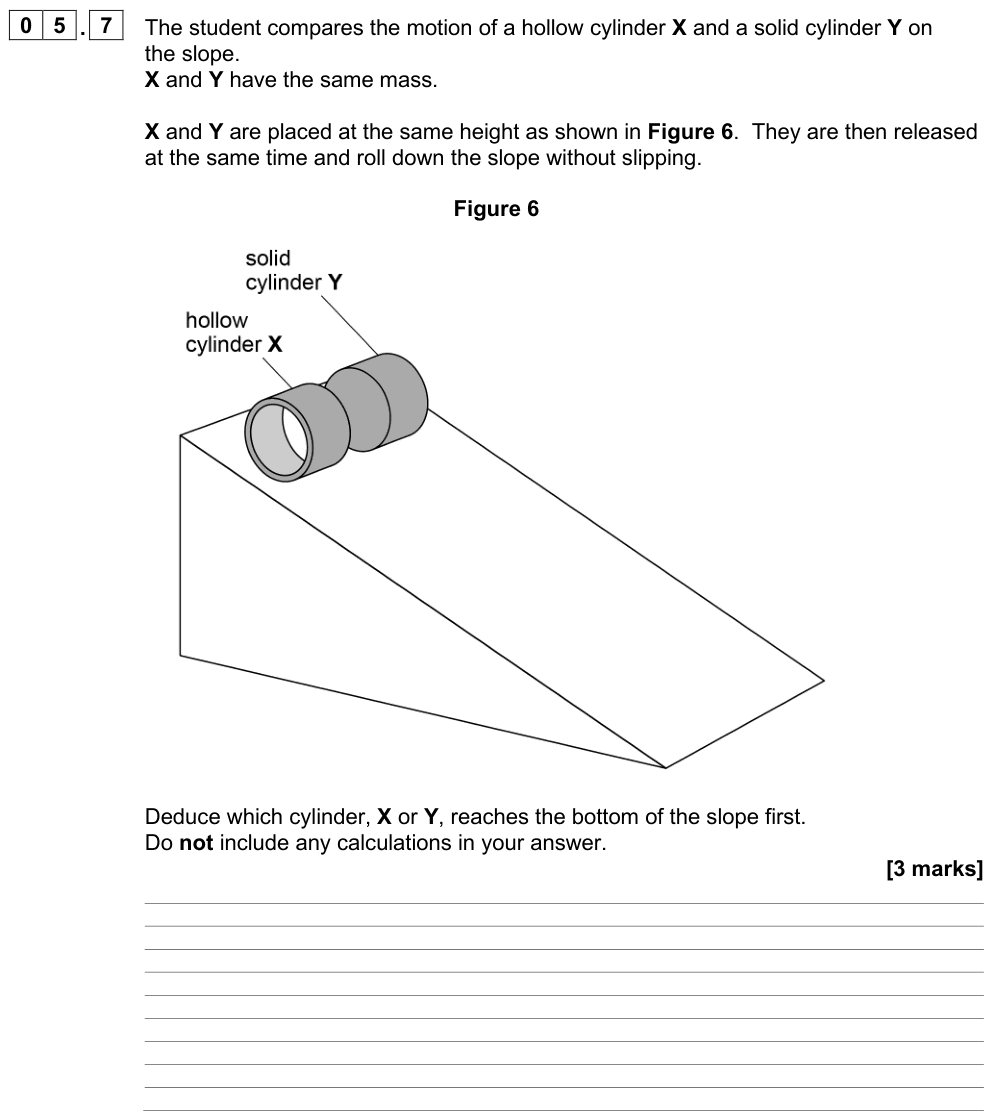
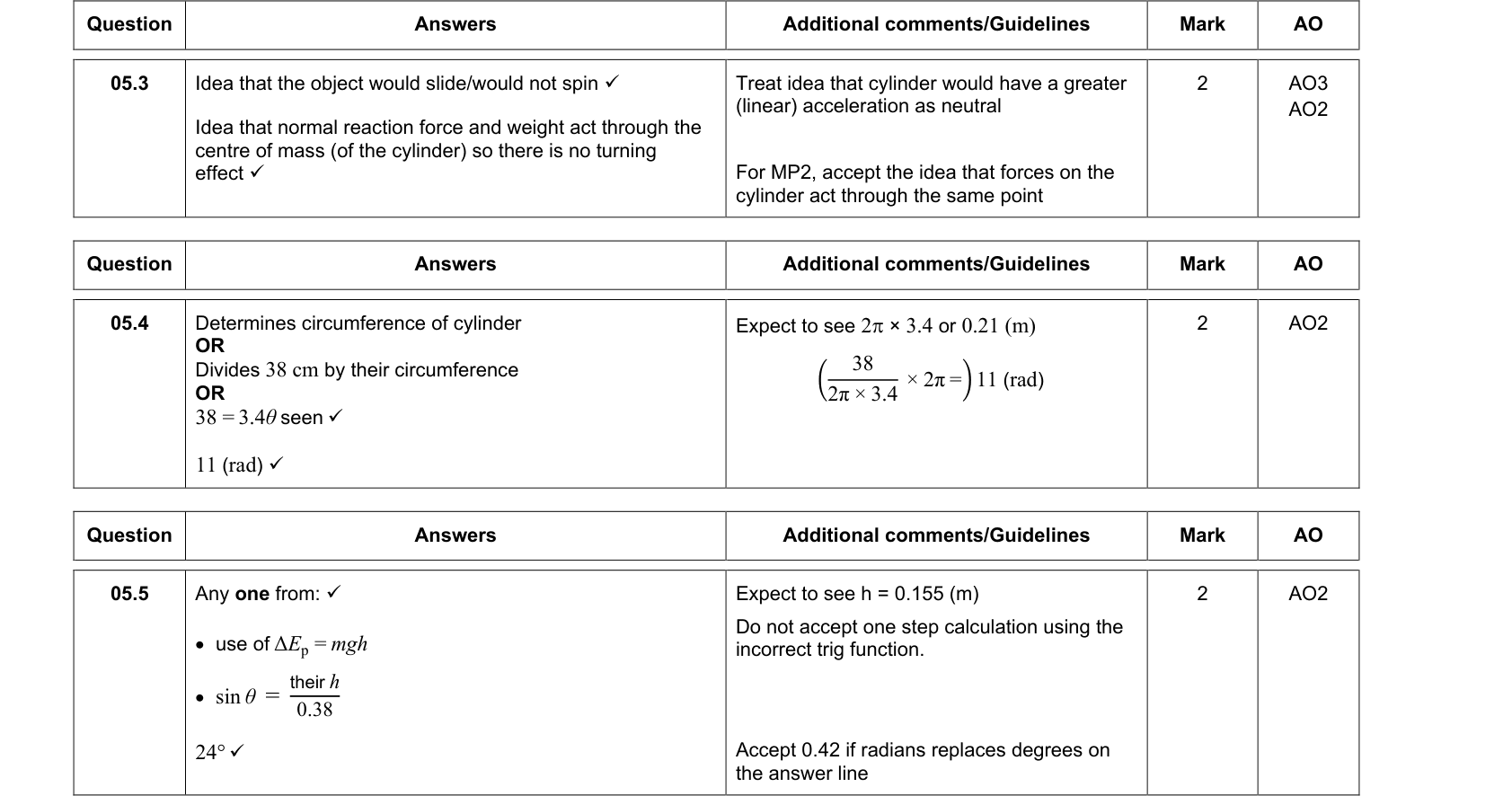
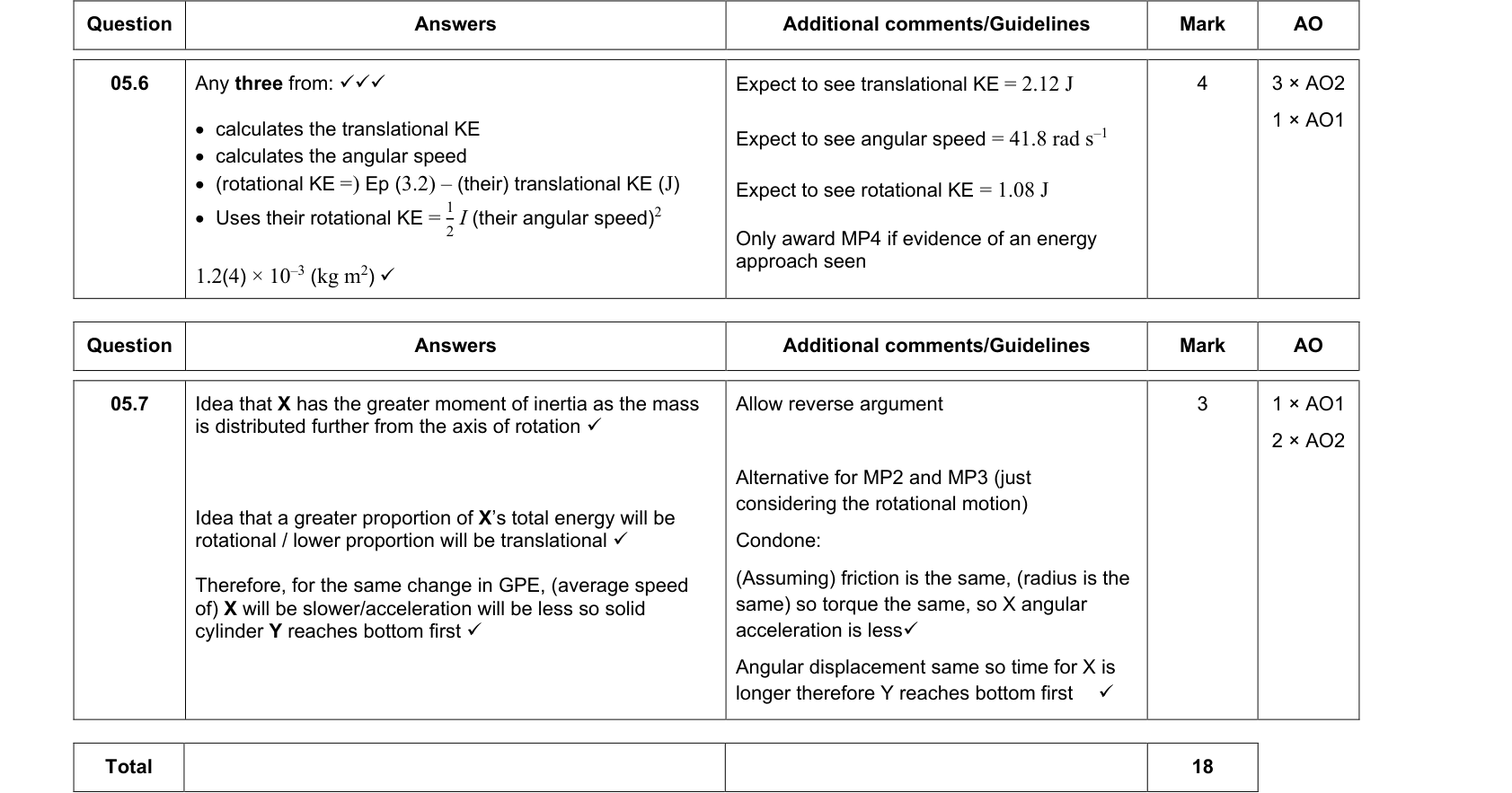
When objects roll down a slope, some of the gravitational potential energy becomes rotational kinetic energy. An object with a larger moment of inertia (for its mass and radius), such as a hoop, gains less translational speed than a solid disc or sphere, so it reaches the bottom later. For a solid sphere ($I = \tfrac25mr^2$): $mgh = \tfrac12mv^2 + \tfrac12 \cdot \tfrac25mr^2 \cdot \dfrac{v^2}{r^2} = \tfrac{7}{10}mv^2$.
Angular momentum
Angular momentum
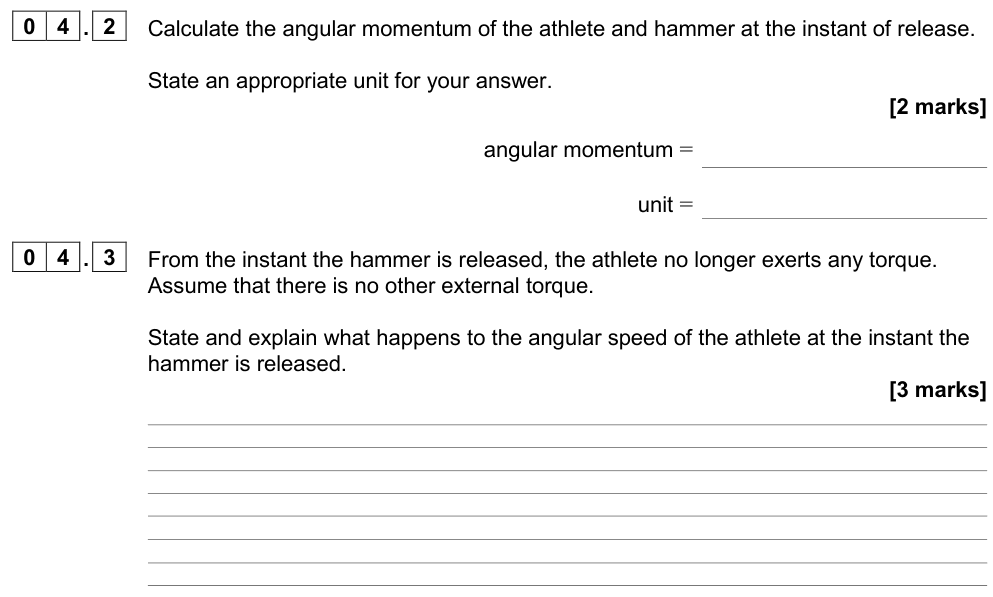
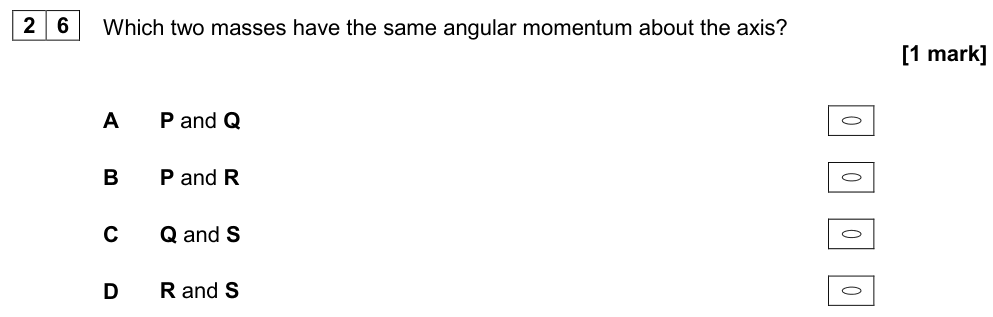
$$\text{angular momentum} = I\omega$$
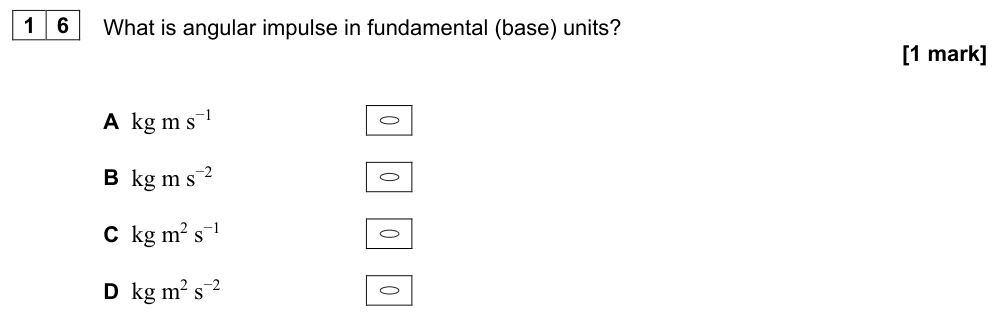
Unit: kg m² s⁻¹ (equivalently N m s).
Conservation of angular momentum
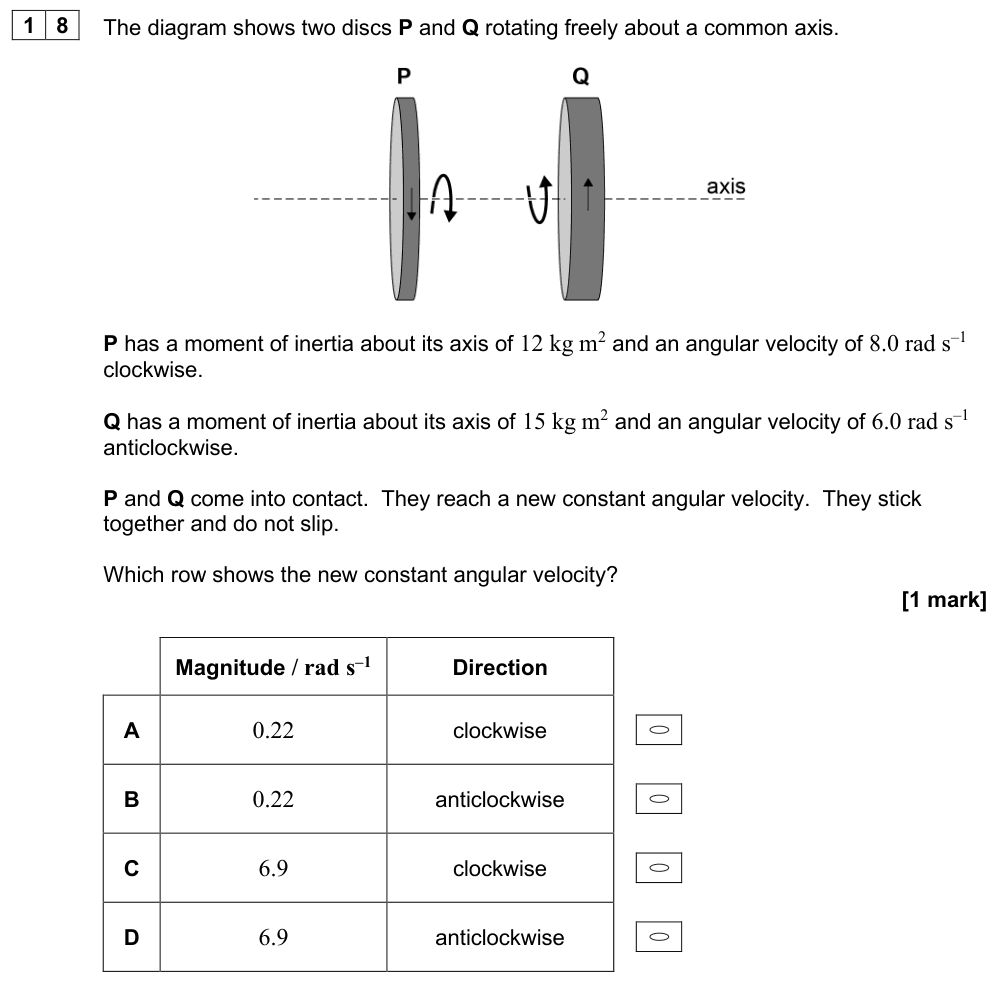
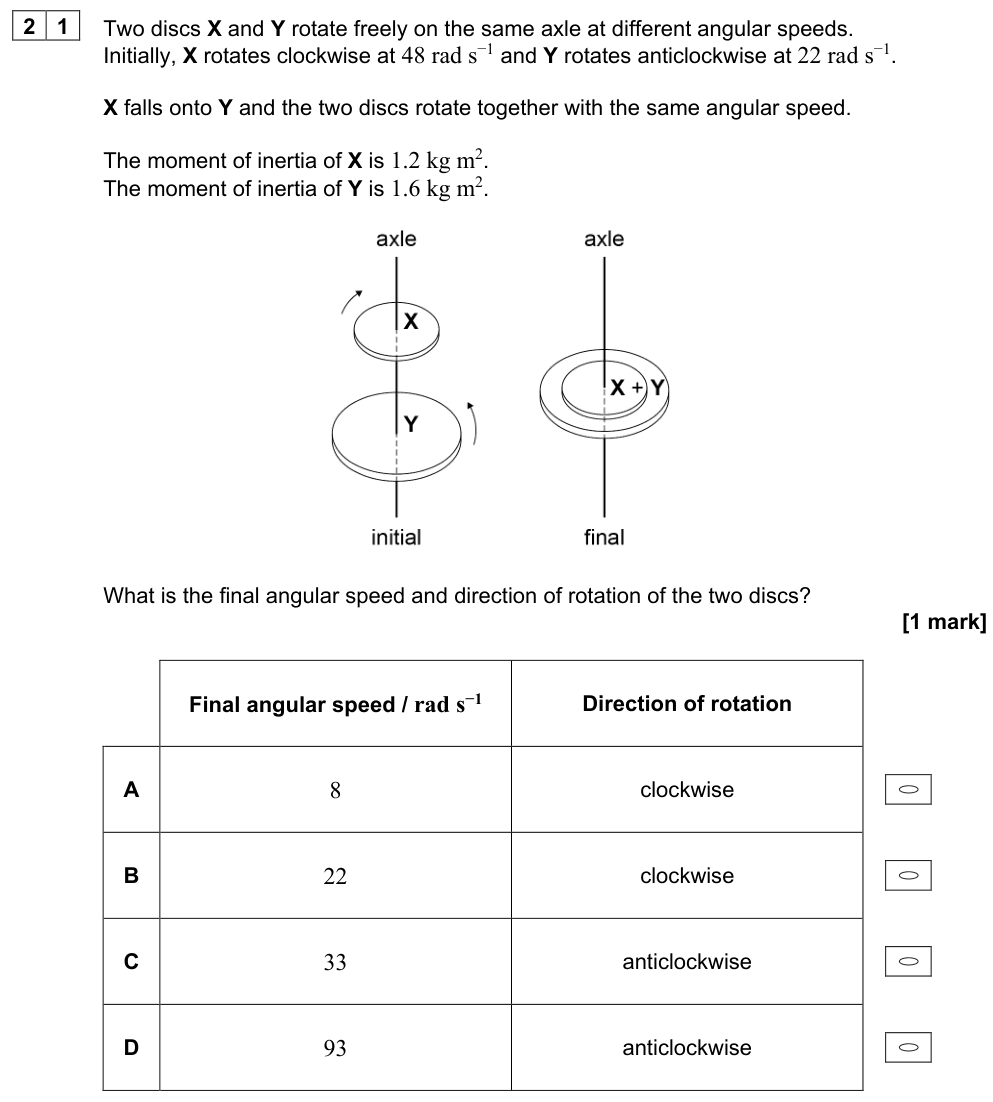
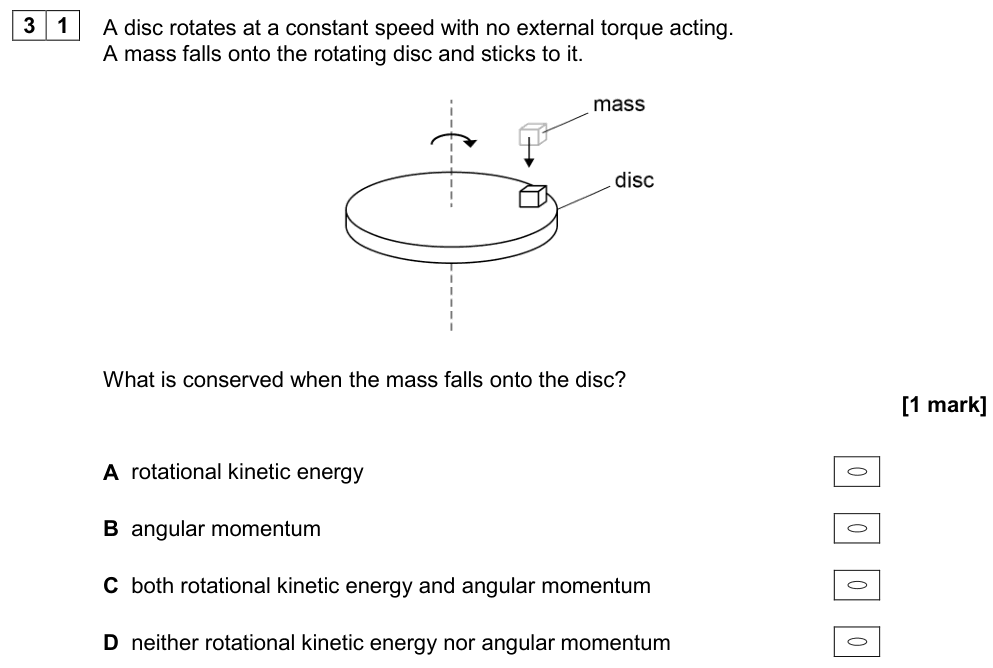
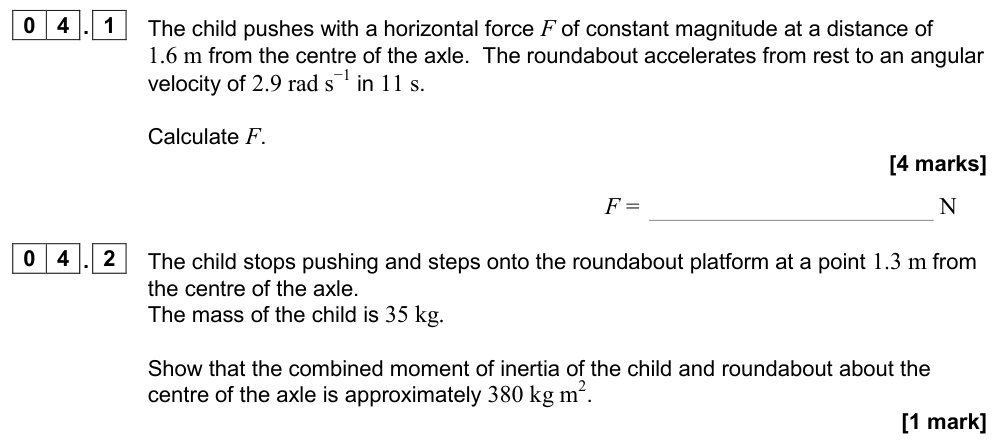
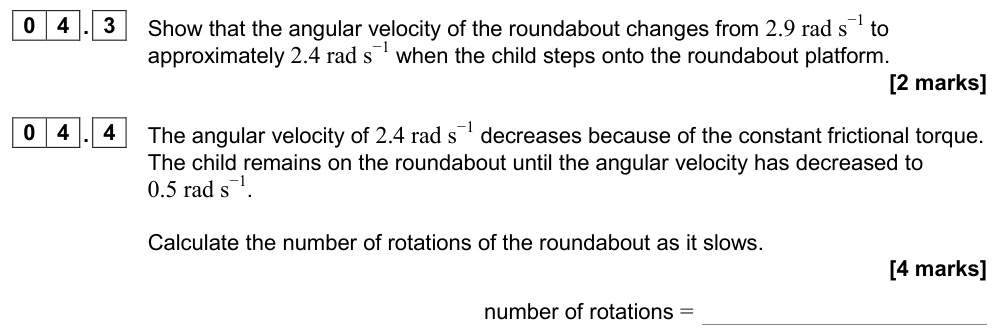
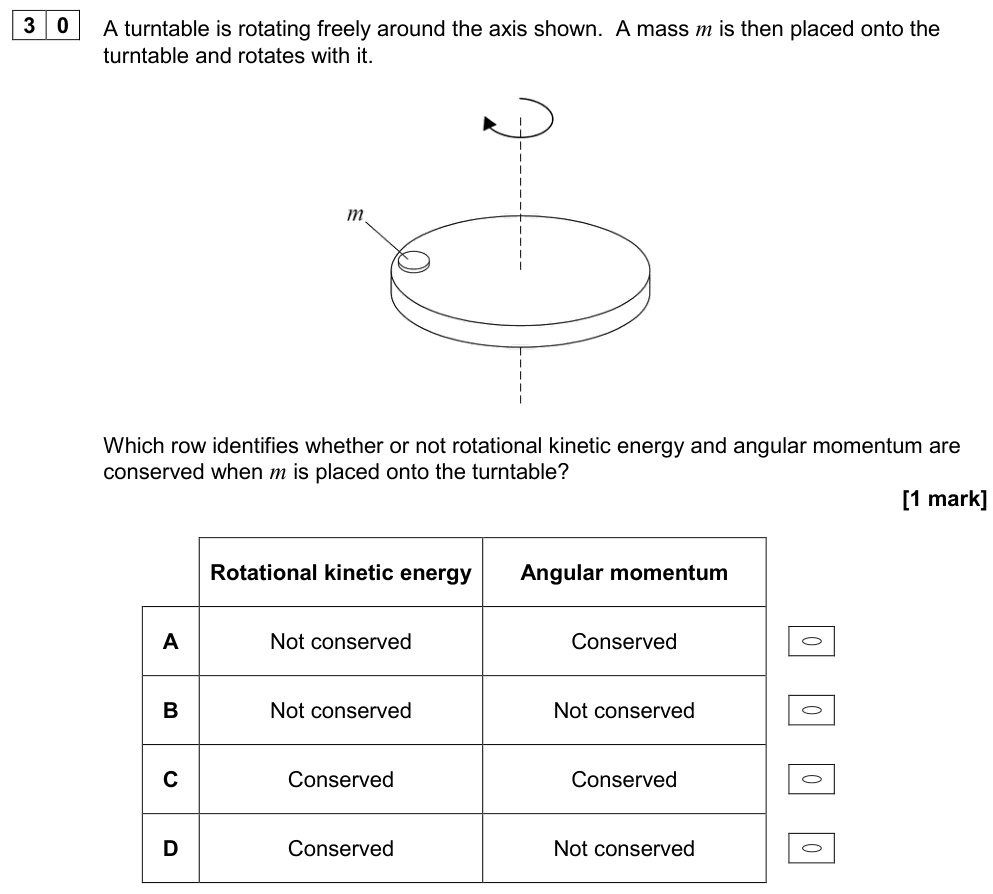
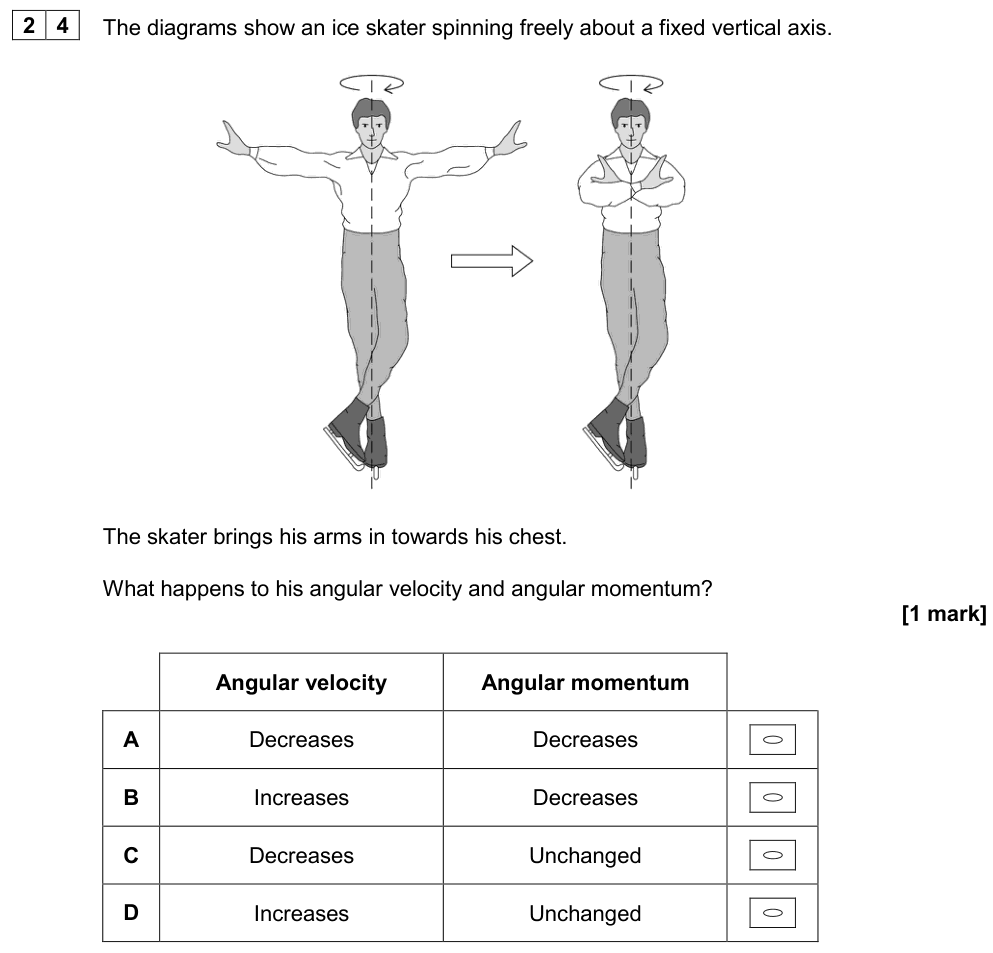
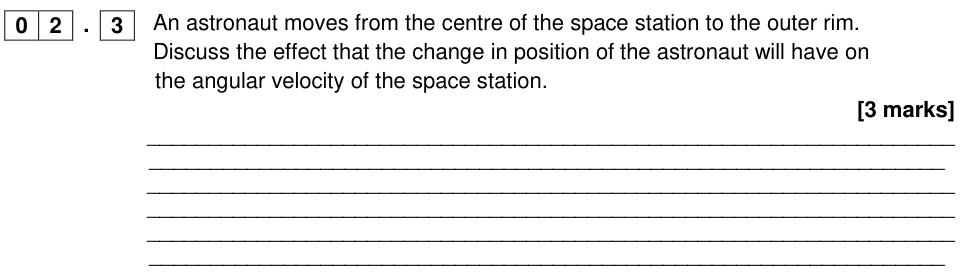
If no external torque acts on a system, its total angular momentum is constant: $$I_1\omega_1 = I_2\omega_2$$
Examples:
- An ice skater spinning with arms outstretched pulls them in: $I$ decreases, so $\omega$ increases. The skater's kinetic energy $\tfrac12I\omega^2 = \dfrac{(I\omega)^2}{2I}$ increases, because the skater does work pulling the arms in.
- A diver or gymnast tucks into a ball to spin faster, then straightens out to slow the rotation before entering the water.
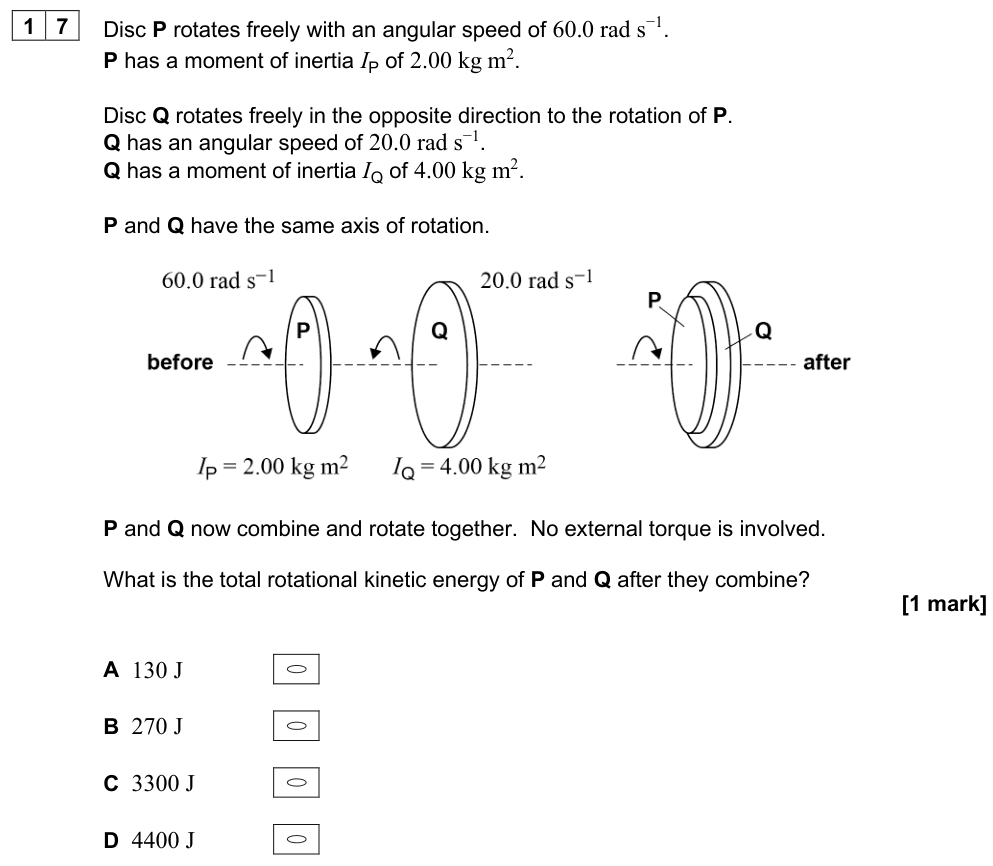
- A rotating disc dropped onto a stationary one: they end up rotating together more slowly. Angular momentum is conserved but kinetic energy is lost (converted to internal energy by friction), like an inelastic collision.
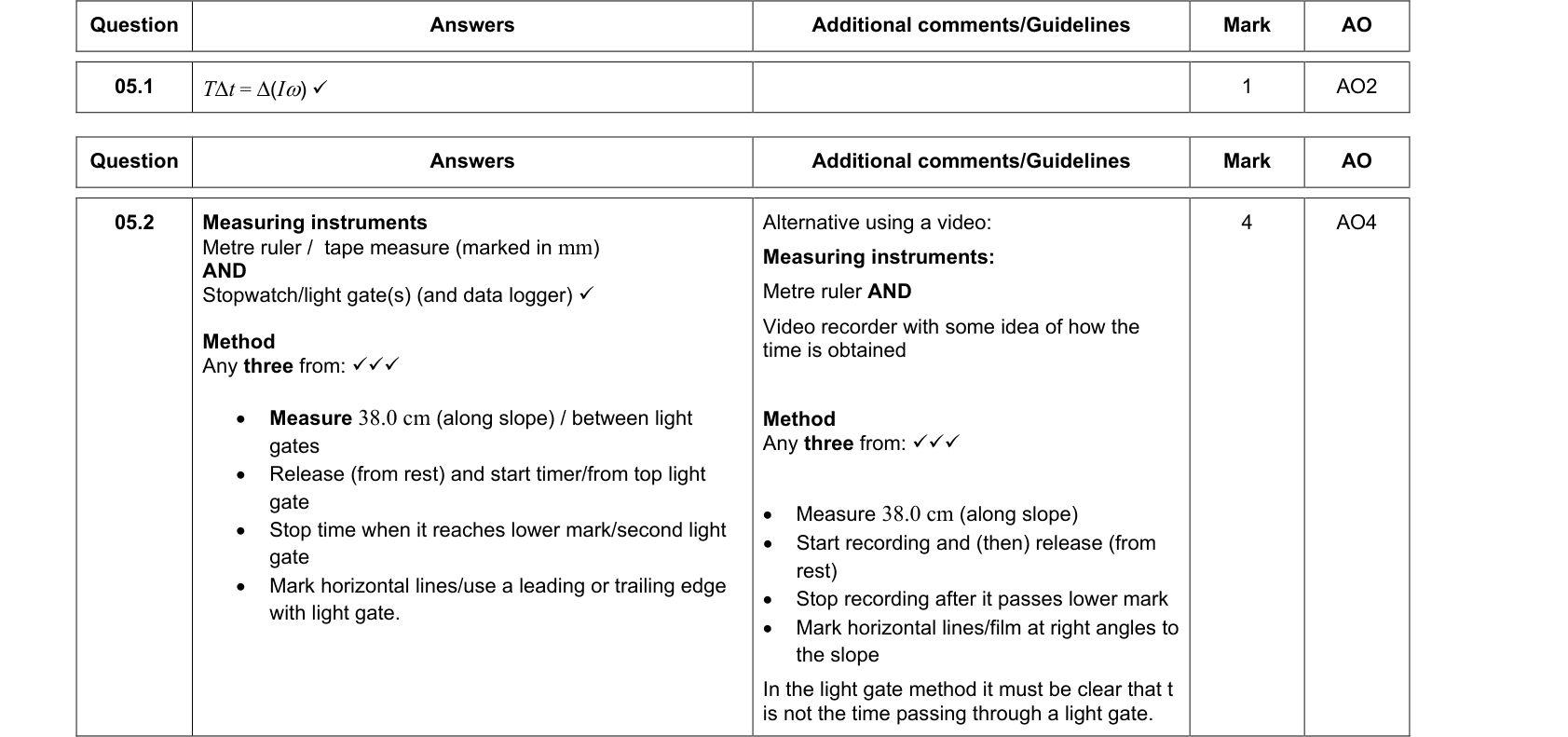
Just as force × time = change of momentum, torque × time = change of angular momentum (angular impulse): $T\Delta t = \Delta(I\omega)$.
Worked example: coupling two discs
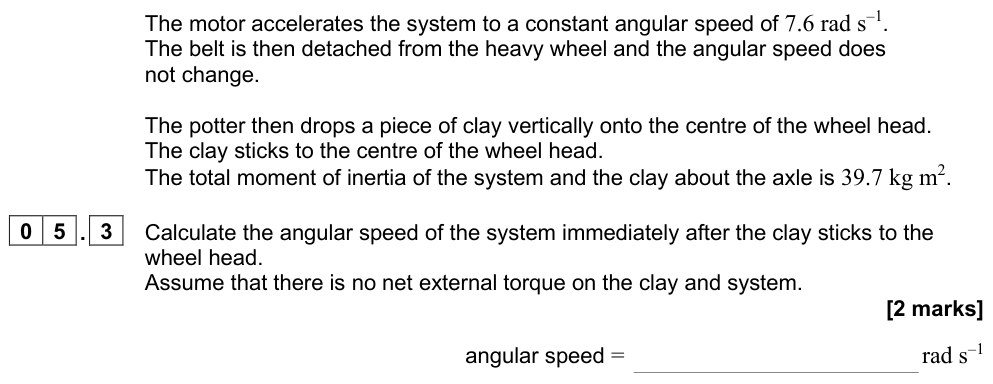
Disc A ($I = 0.12$ kg m²) spins at 20 rad s⁻¹. Disc B ($I = 0.080$ kg m²), not rotating, is dropped onto it, and they rotate together.
$0.12 \times 20 = (0.12 + 0.080)\omega \Rightarrow \omega = 12$ rad s⁻¹.
Kinetic energy before $= \tfrac12 \times 0.12 \times 20^2 = 24$ J; after $= \tfrac12 \times 0.20 \times 12^2 = 14.4$ J. 9.6 J has been transferred to internal energy by friction between the discs.
The rotational–linear analogy
| Linear motion | Rotational motion |
|---|---|
| displacement $s$ | angular displacement $\theta$ |
| velocity $v$ | angular velocity $\omega$ |
| acceleration $a$ | angular acceleration $\alpha$ |
| mass $m$ | moment of inertia $I$ |
| force $F$ | torque $T$ |
| $F = ma$ | $T = I\alpha$ |
| momentum $mv$ | angular momentum $I\omega$ |
| kinetic energy $\tfrac12mv^2$ | kinetic energy $\tfrac12I\omega^2$ |
| work $W = Fs$ | work $W = T\theta$ |
| power $P = Fv$ | power $P = T\omega$ |
| impulse $F\Delta t = \Delta(mv)$ | angular impulse $T\Delta t = \Delta(I\omega)$ |
Flywheels
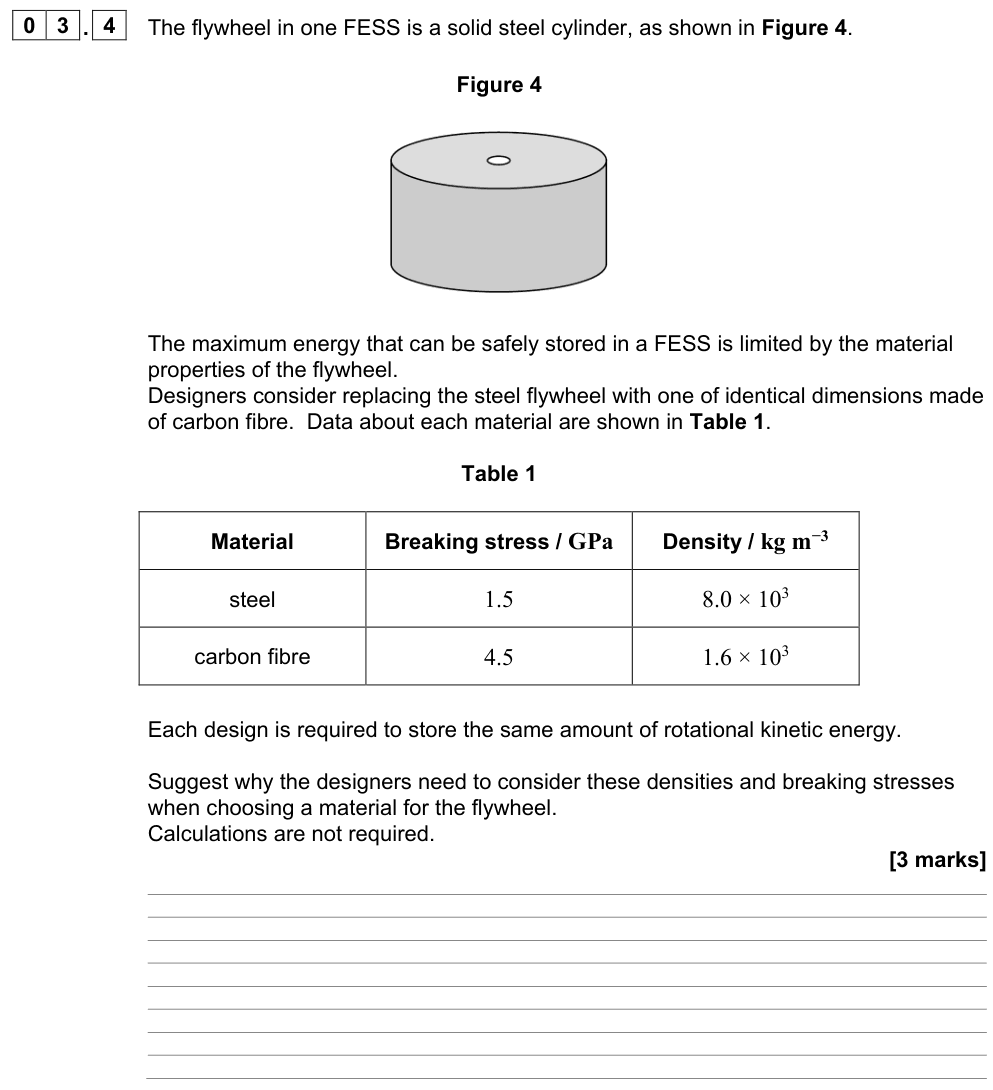
A flywheel is a heavy wheel used to store rotational kinetic energy.
Uses:
- Smoothing the output of machines whose driving torque varies, such as engines and presses: the flywheel keeps turning at a nearly steady rate between power strokes.
- Energy storage, for example regenerative braking in vehicles (kinetic energy that would be wasted as heat is stored in a flywheel and used later to accelerate) and short-term back-up power for the grid.
Design:
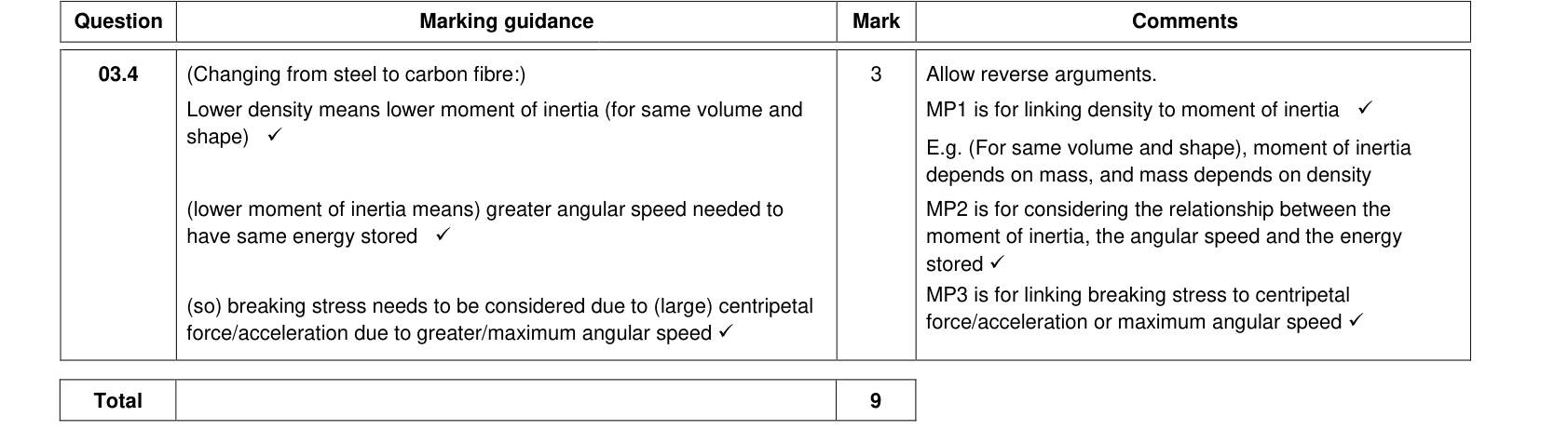
- To store as much energy as possible, the flywheel needs a large $I$ and a high $\omega$ ($E_k = \tfrac12I\omega^2$, so $\omega$ is especially important).
- Mass is concentrated at the rim (spokes or a thin web in the middle) to give a large moment of inertia for a given mass.
- The maximum speed is limited by the strength of the material: at high speed the rim needs a huge centripetal force and the flywheel could burst. Strong, light materials such as carbon-fibre composites allow higher speeds.
- Energy losses are reduced with low-friction (e.g. magnetic) bearings and by running the flywheel in a vacuum to remove air resistance.
Summary
- $\omega = \Delta\theta/\Delta t$, $\alpha = \Delta\omega/\Delta t$; $v = r\omega$; uniform angular acceleration equations match the linear ones.
- $I = \Sigma mr^2$: depends on mass and its distribution about the axis.
- $T = Fr = I\alpha$; $E_k = \tfrac12I\omega^2$; $W = T\theta$; $P = T\omega$.
- Angular momentum $I\omega$ is conserved when there is no external torque.
- Flywheels store energy and smooth rotation; mass at the rim, high speed limited by material strength, low-friction bearings.