How conduction happens
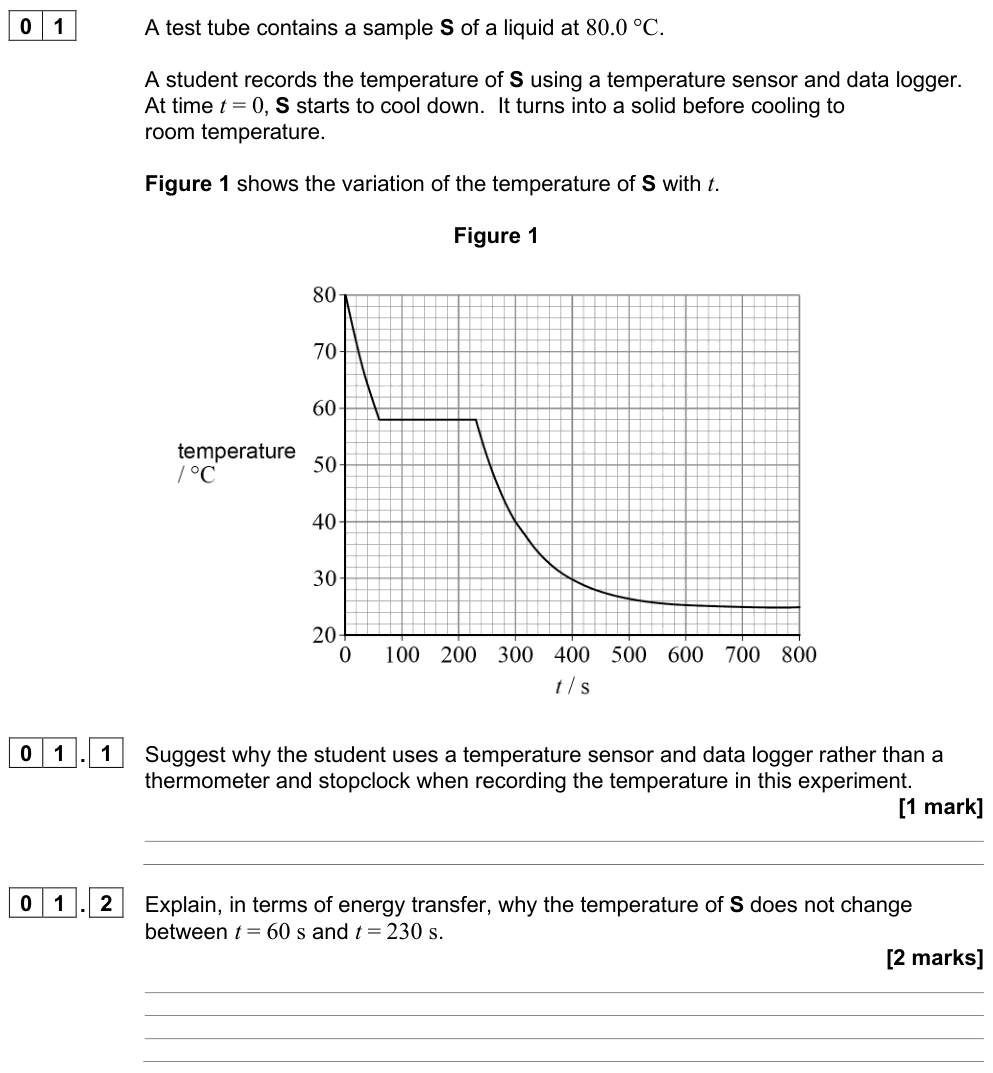
Thermal conduction is the transfer of energy through a material from a hotter region to a cooler region without the material itself moving.
- In all solids, particles at the hot end vibrate more vigorously. Through the bonds between them they pass some of this vibrational energy on to their neighbours, so energy spreads through the lattice.
- In metals there are also free (delocalised) electrons. They gain kinetic energy at the hot end and move quickly through the metal, colliding with ions elsewhere and transferring energy. This is a much faster process, which is why metals are good thermal conductors (and also good electrical conductors).
- Gases are poor conductors because their particles are far apart. Materials that trap air (wool, foam, fibreglass, double glazing) are good insulators, provided the air cannot circulate and carry energy by convection.
Rate of energy transfer by conduction
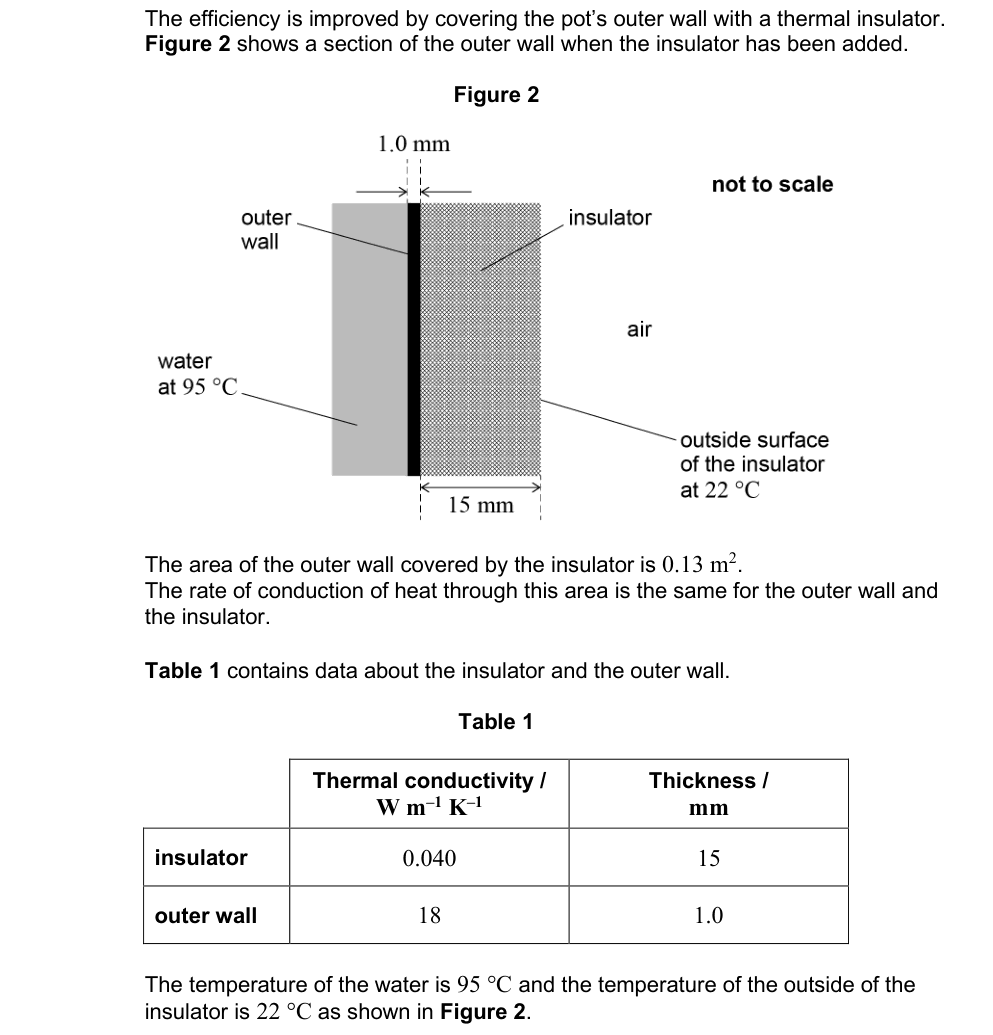
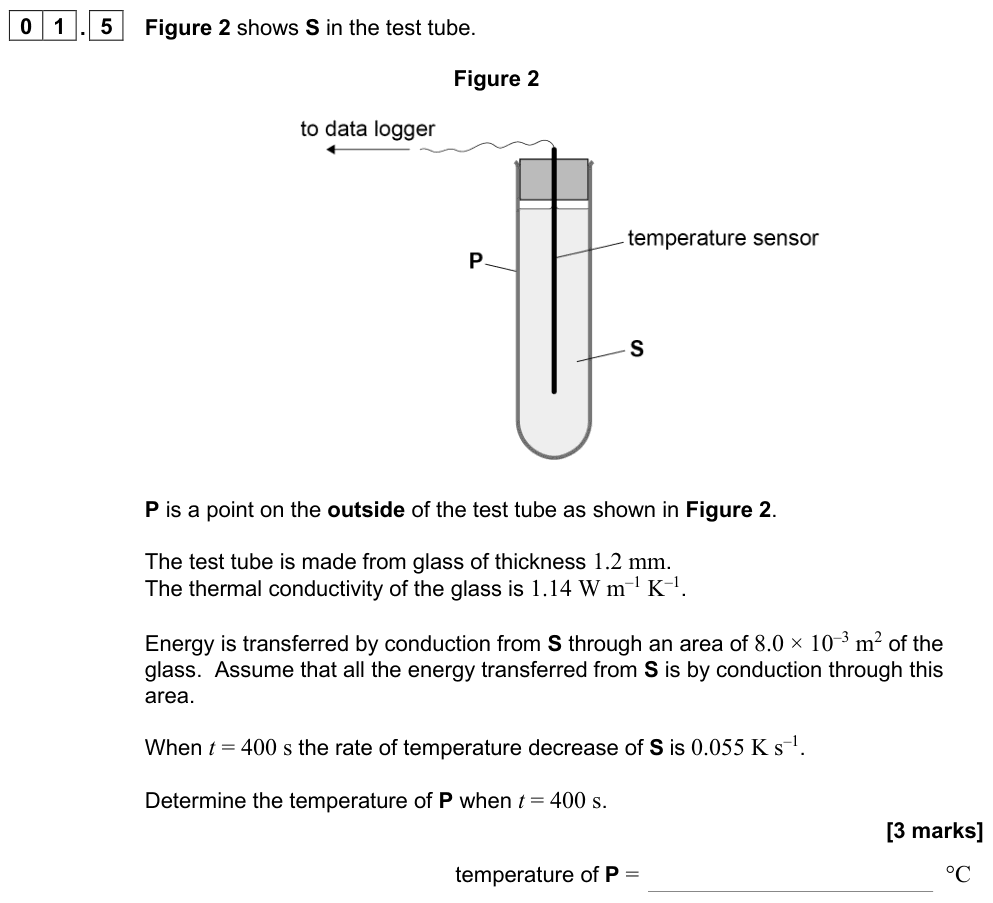
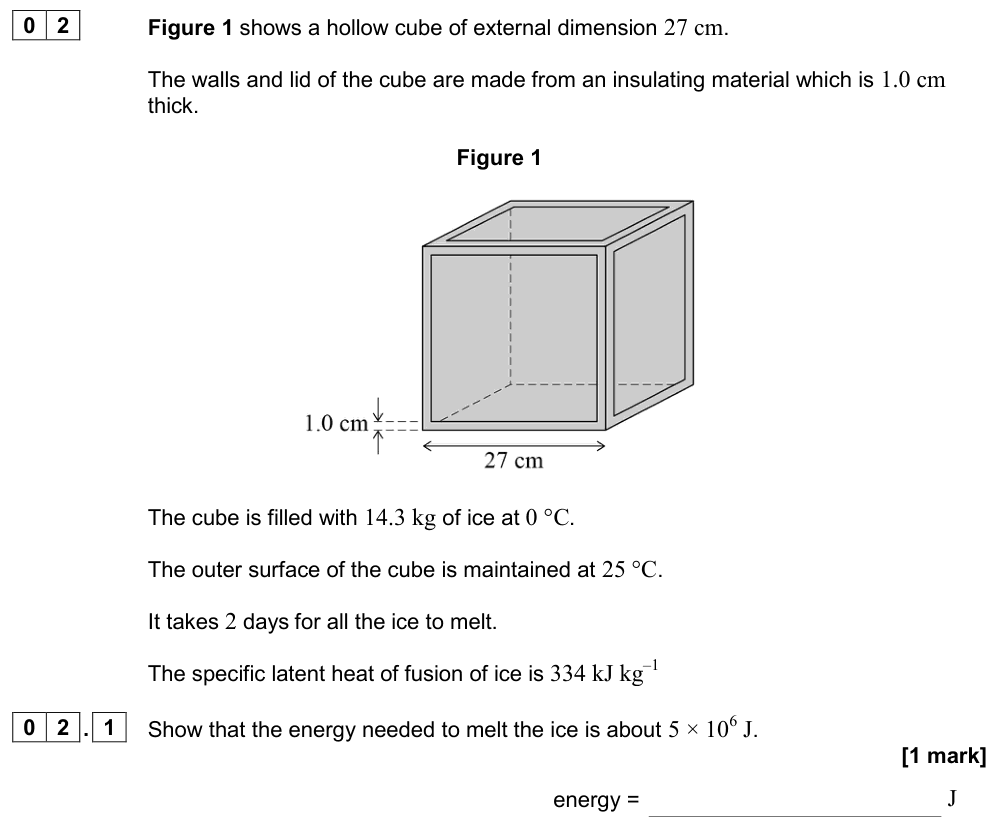
Consider a slab of material of thickness $L$ and cross-sectional area $A$, with a temperature difference $\Delta\theta$ between its faces.
Rate of energy transfer by conduction
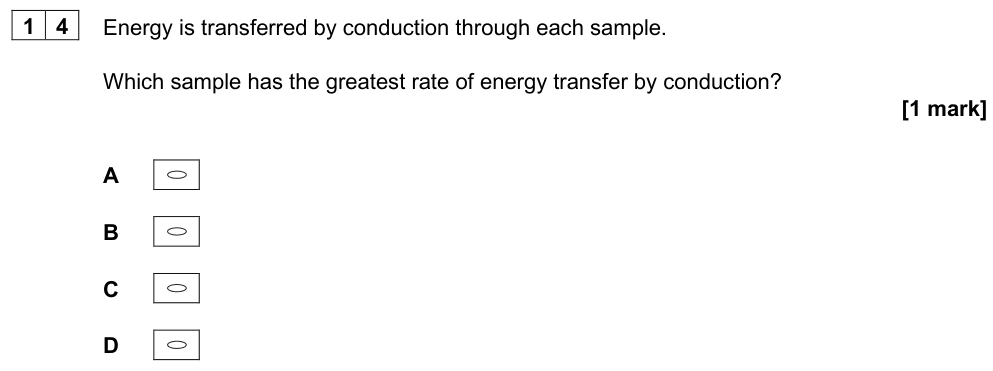
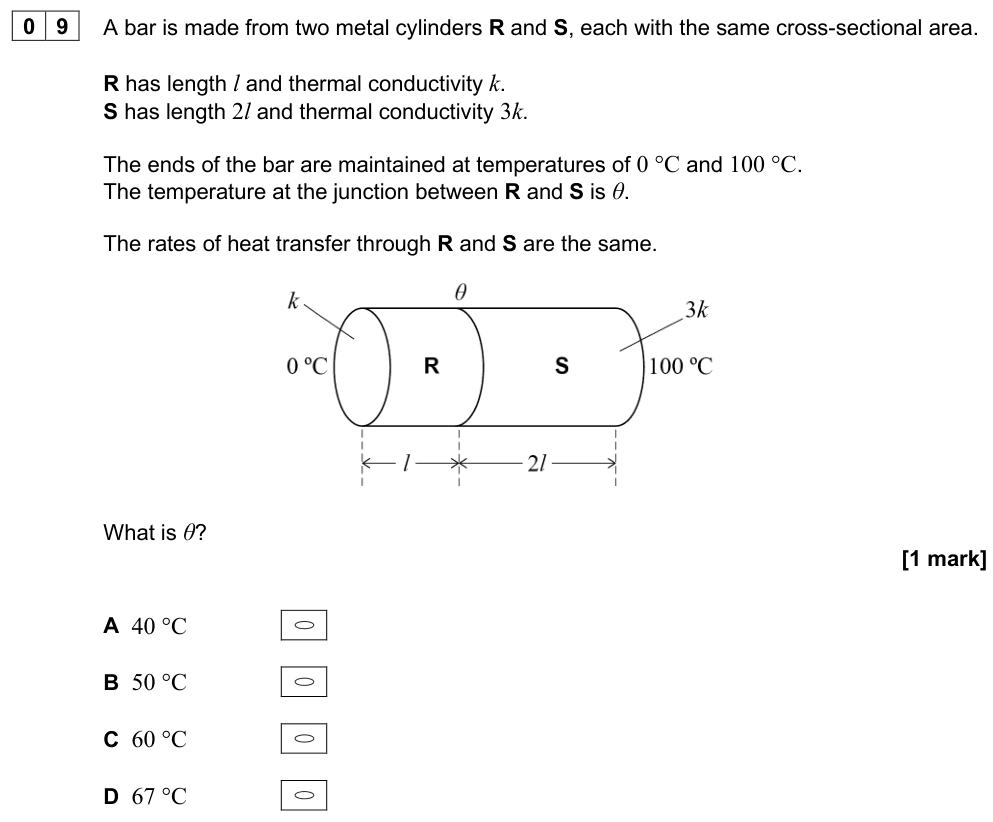
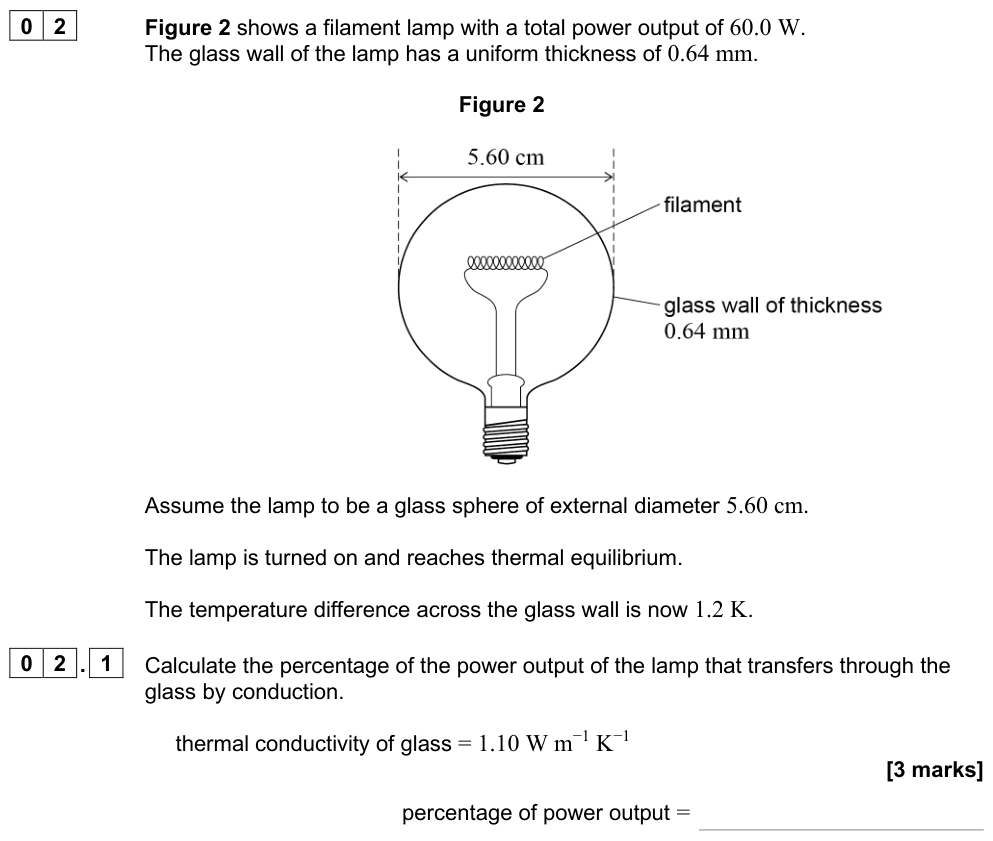
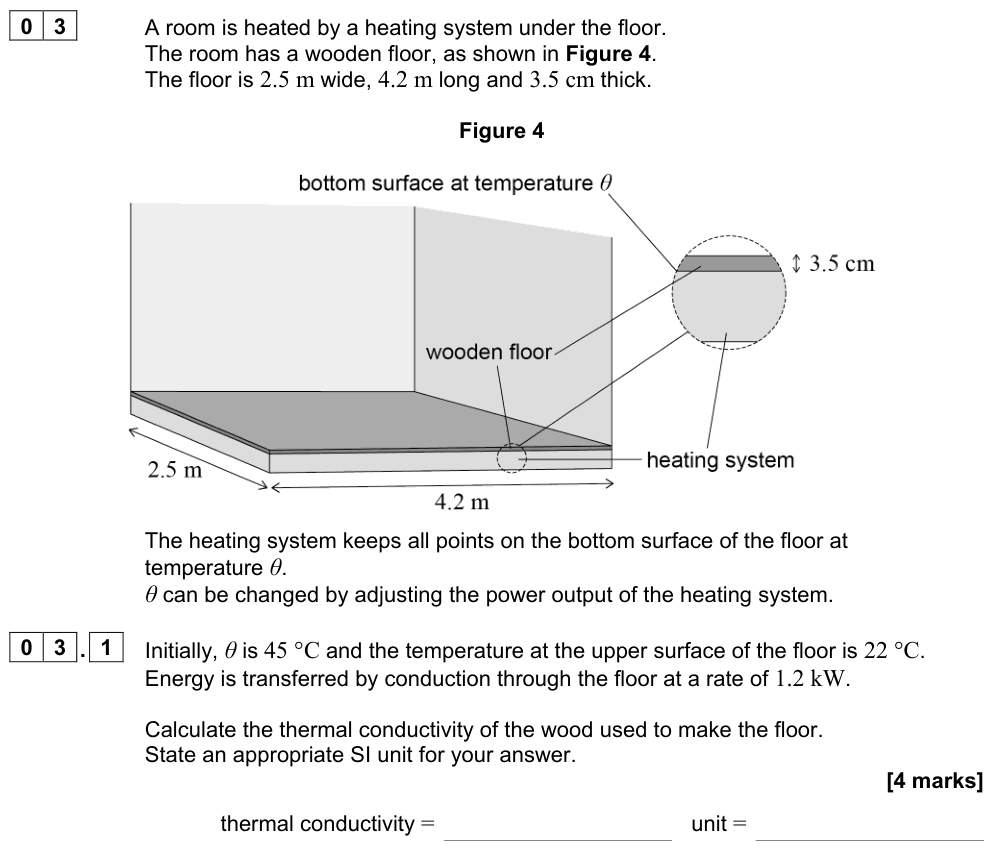
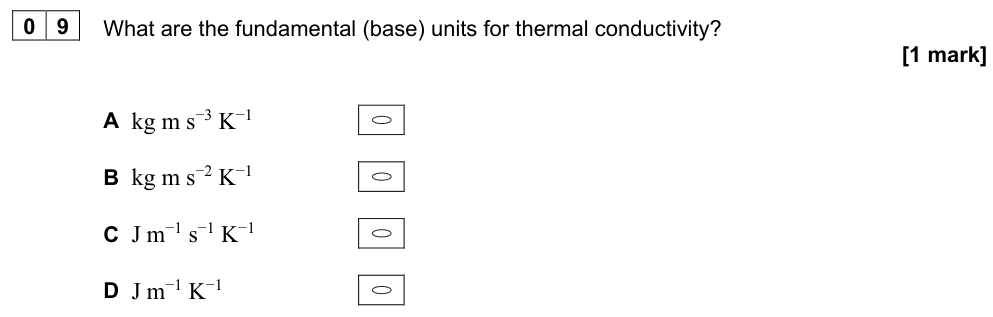
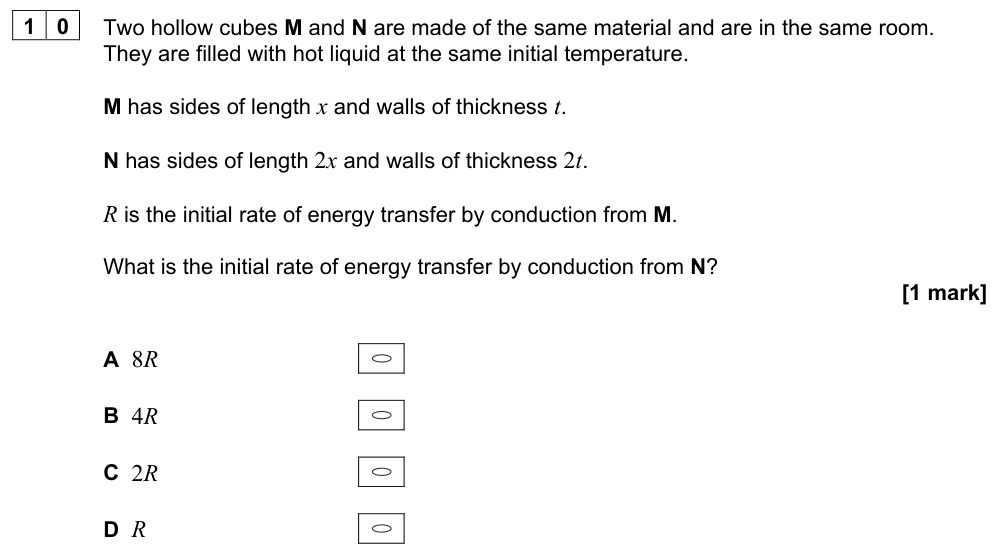
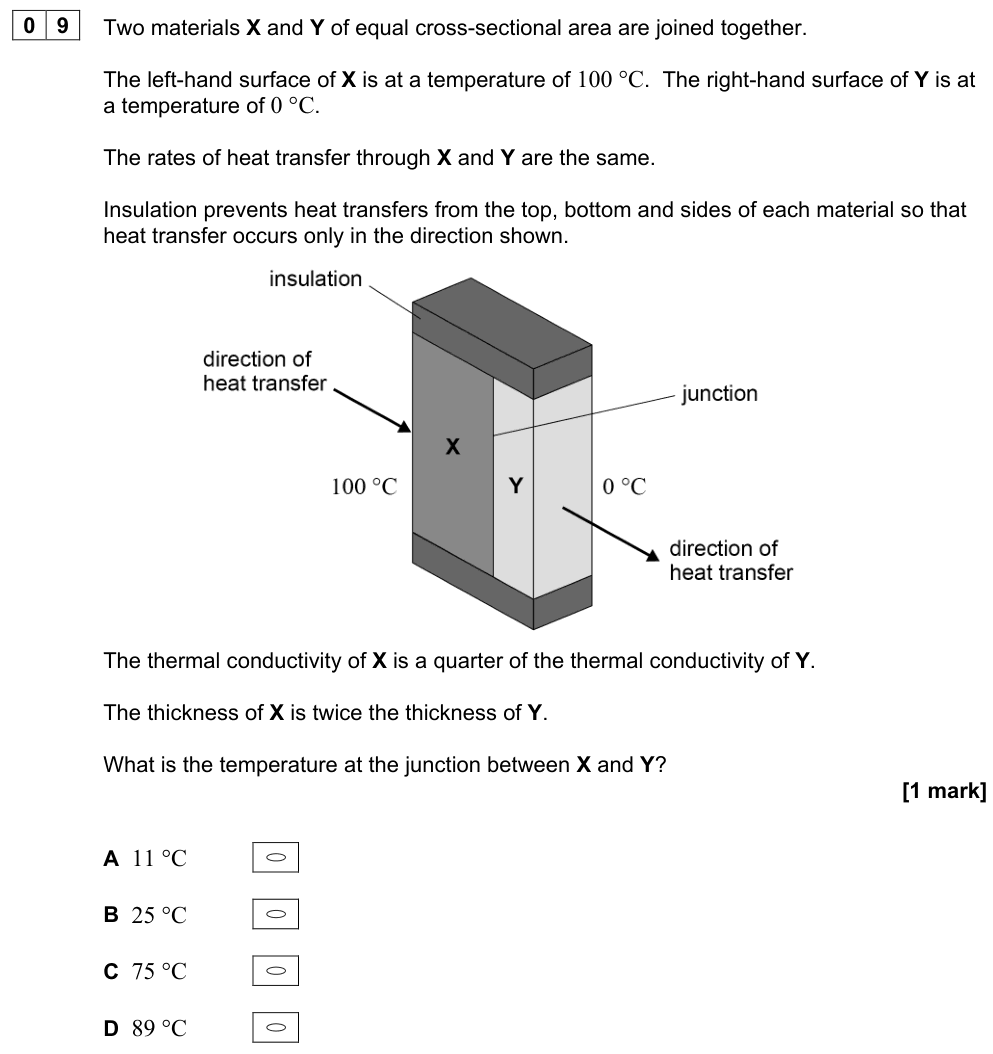
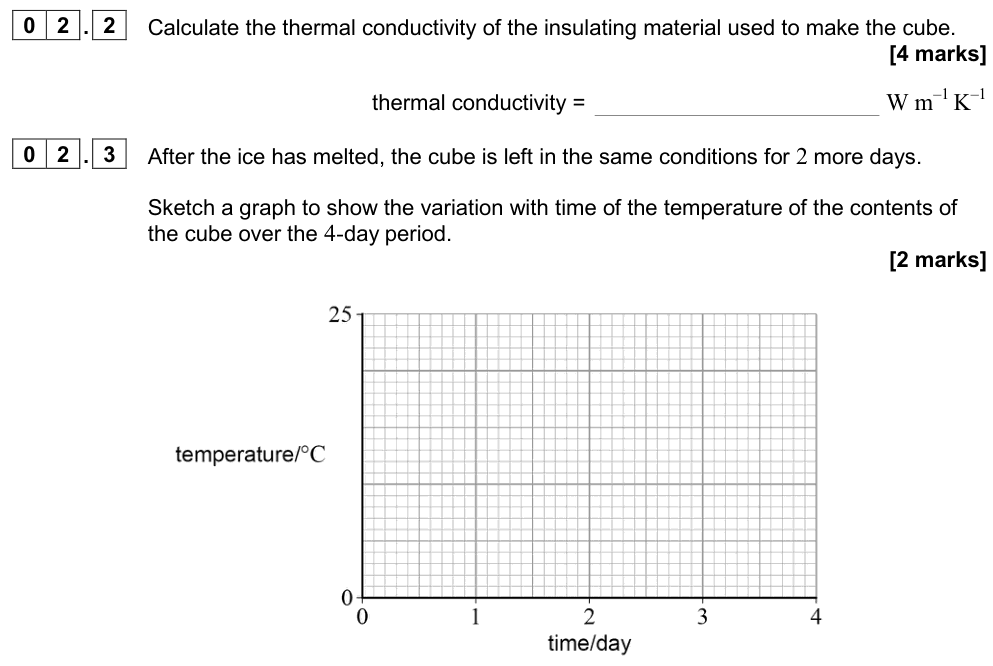
$$\frac{Q}{t} = \frac{kA\Delta\theta}{L}$$
- $\dfrac{Q}{t}$ = rate of energy transfer (W)
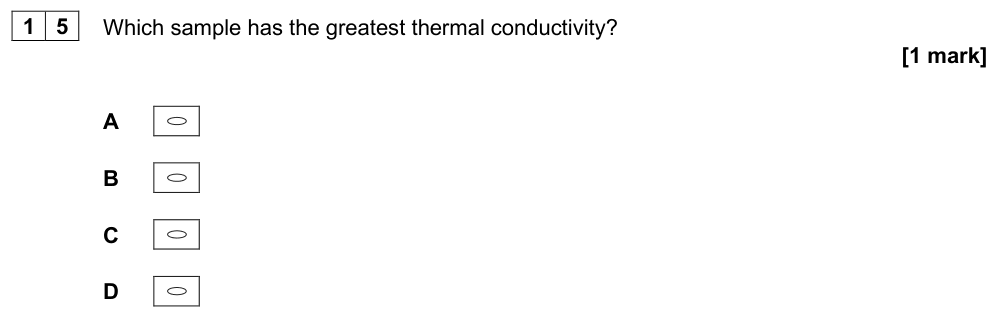
- $k$ = thermal conductivity of the material (W m⁻¹ K⁻¹)
- $A$ = cross-sectional area (m²); $L$ = thickness or length (m)
- $\Delta\theta$ = temperature difference across the material (K)
The rate of energy transfer is larger for a larger area, a larger temperature difference, a thinner slab and a material with a higher thermal conductivity. The quantity $\Delta\theta/L$ is called the temperature gradient.
| Material | Thermal conductivity $k$ / W m⁻¹ K⁻¹ |
|---|---|
| copper | 390 |
| aluminium | 240 |
| steel | 50 |
| glass | 0.8–1.0 |
| brick | 0.6–1.0 |
| water | 0.6 |
| wood | 0.1–0.2 |
| expanded polystyrene, fibreglass | 0.03–0.04 |
| still air | 0.025 |
Worked example: a copper rod
A copper rod is 0.30 m long and has a cross-sectional area of $2.0 \times 10^{-4}\ \text{m}^2$. Its sides are insulated. One end is in boiling water (100 °C) and the other in a mixture at 20 °C. $k = 390$ W m⁻¹ K⁻¹.
$\dfrac{Q}{t} = \dfrac{390 \times 2.0 \times 10^{-4} \times 80}{0.30} = 21$ W.
Exam tip: an electrical analogy
The equation has the same form as Ohm's law: the rate of energy flow is like a current, the temperature difference is like a p.d., and $\dfrac{L}{kA}$ is like a resistance (thermal resistance). A thicker or less conductive layer has a higher thermal resistance.
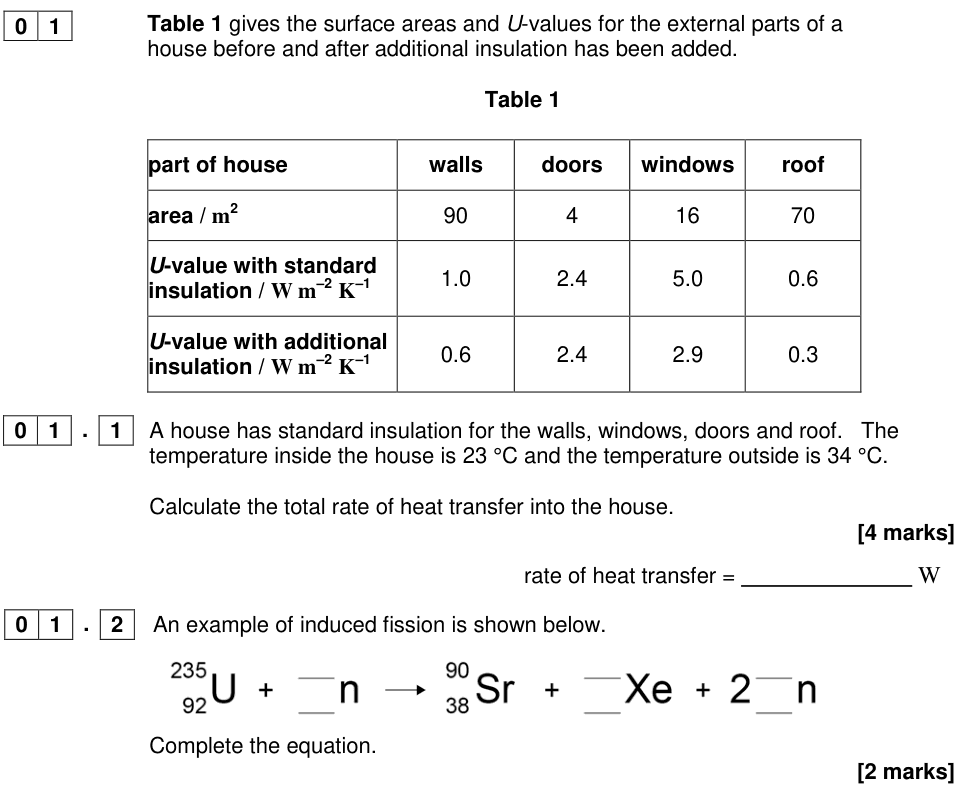
U-values
For building materials it is convenient to combine the conductivity and thickness of a wall, window or roof into a single number.
U-value
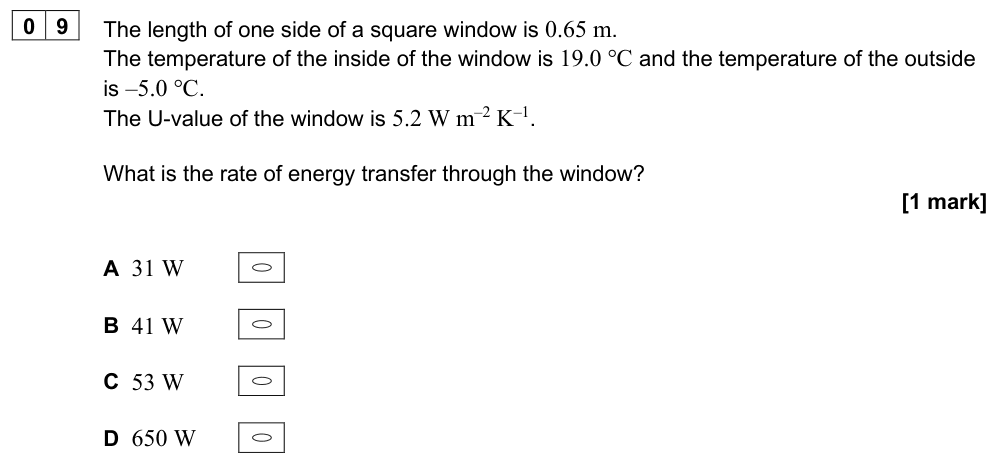
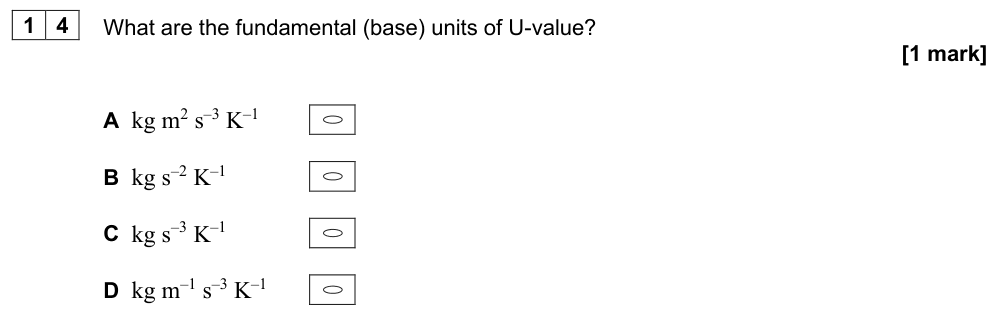
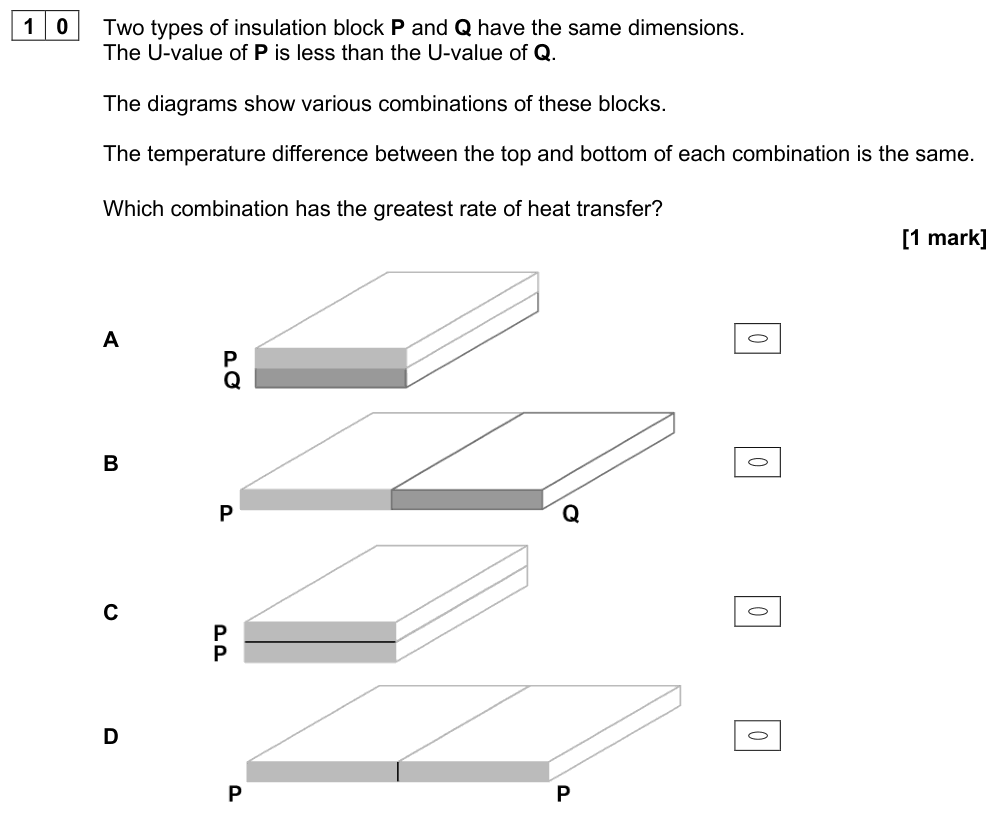
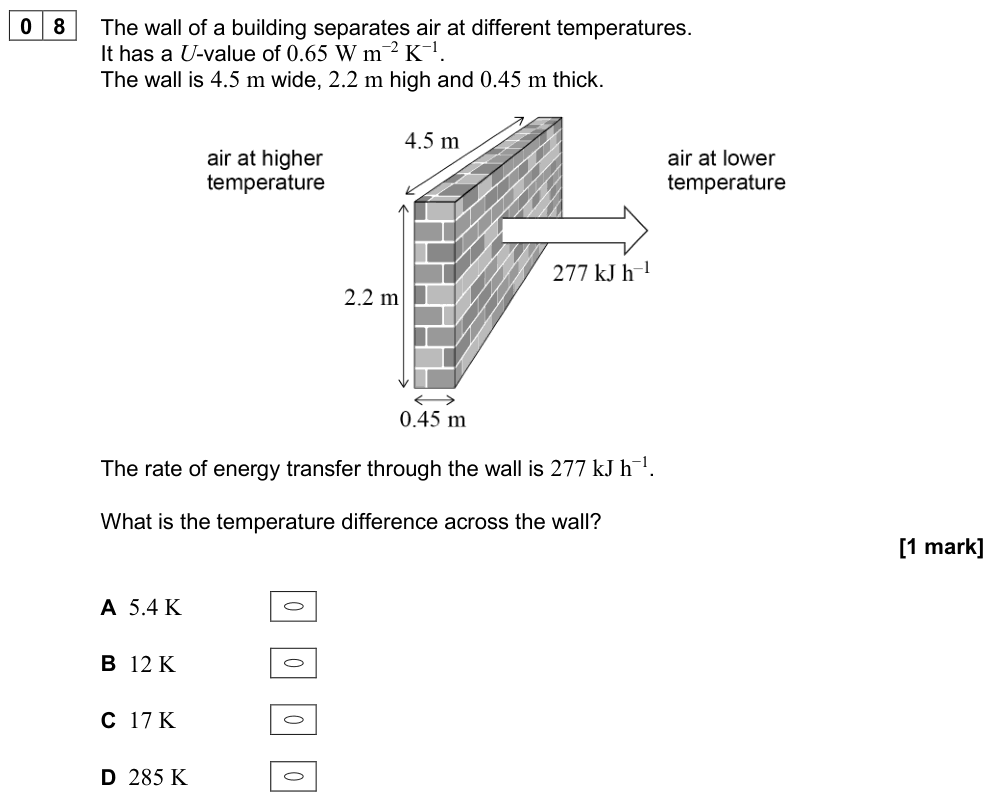
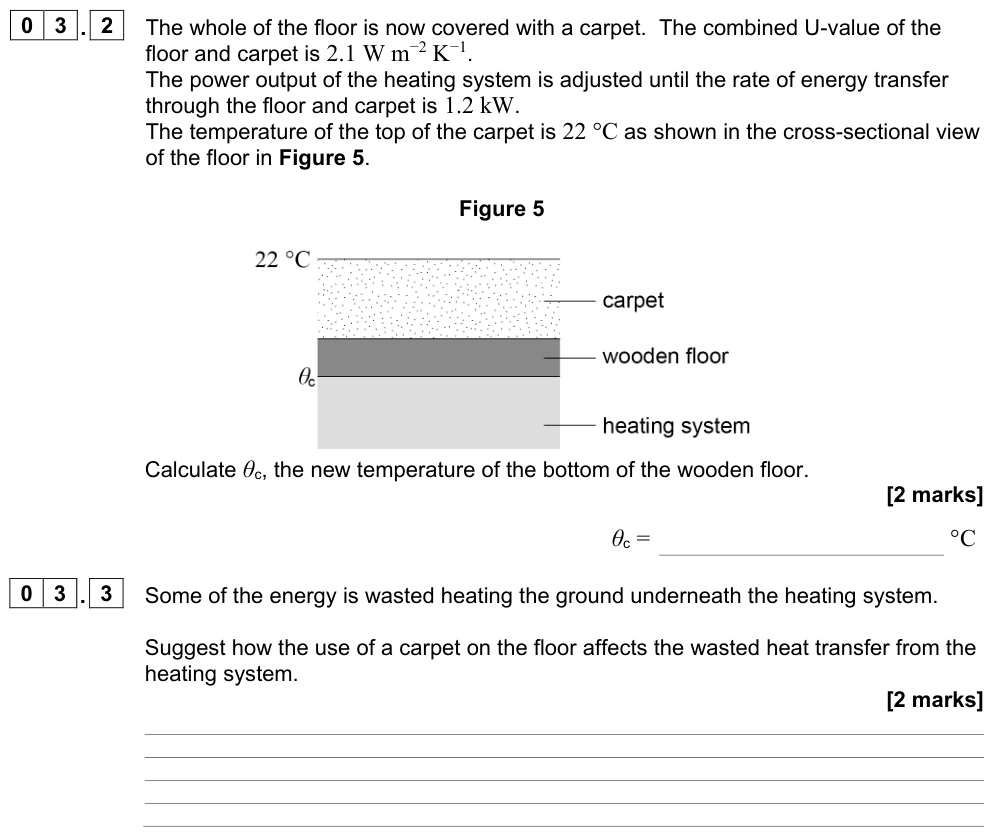
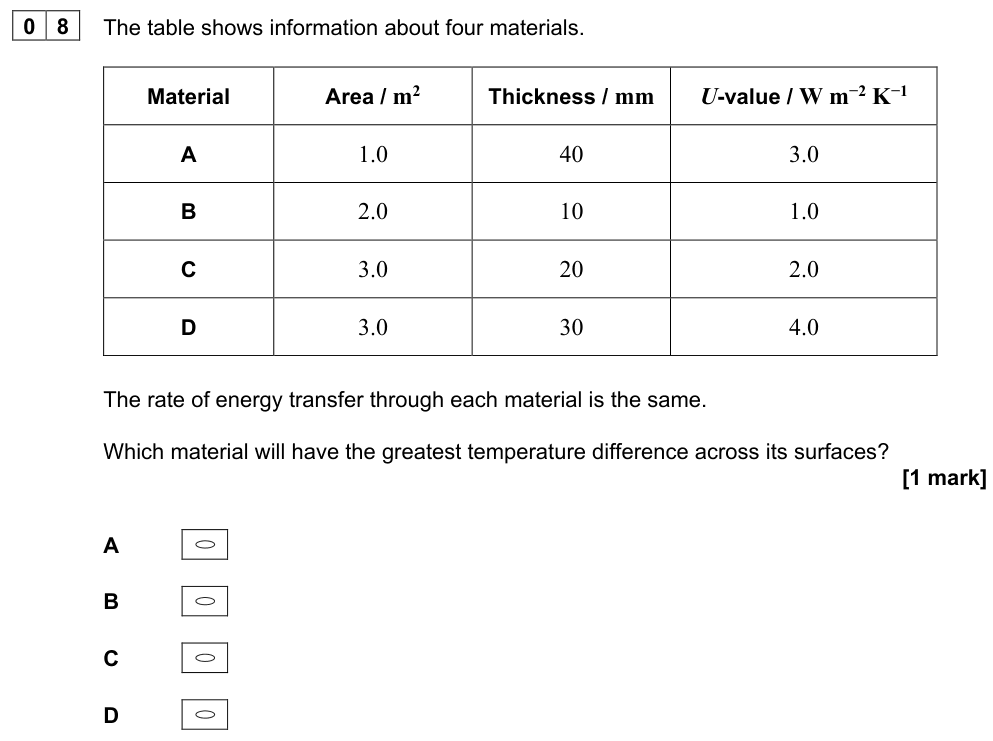
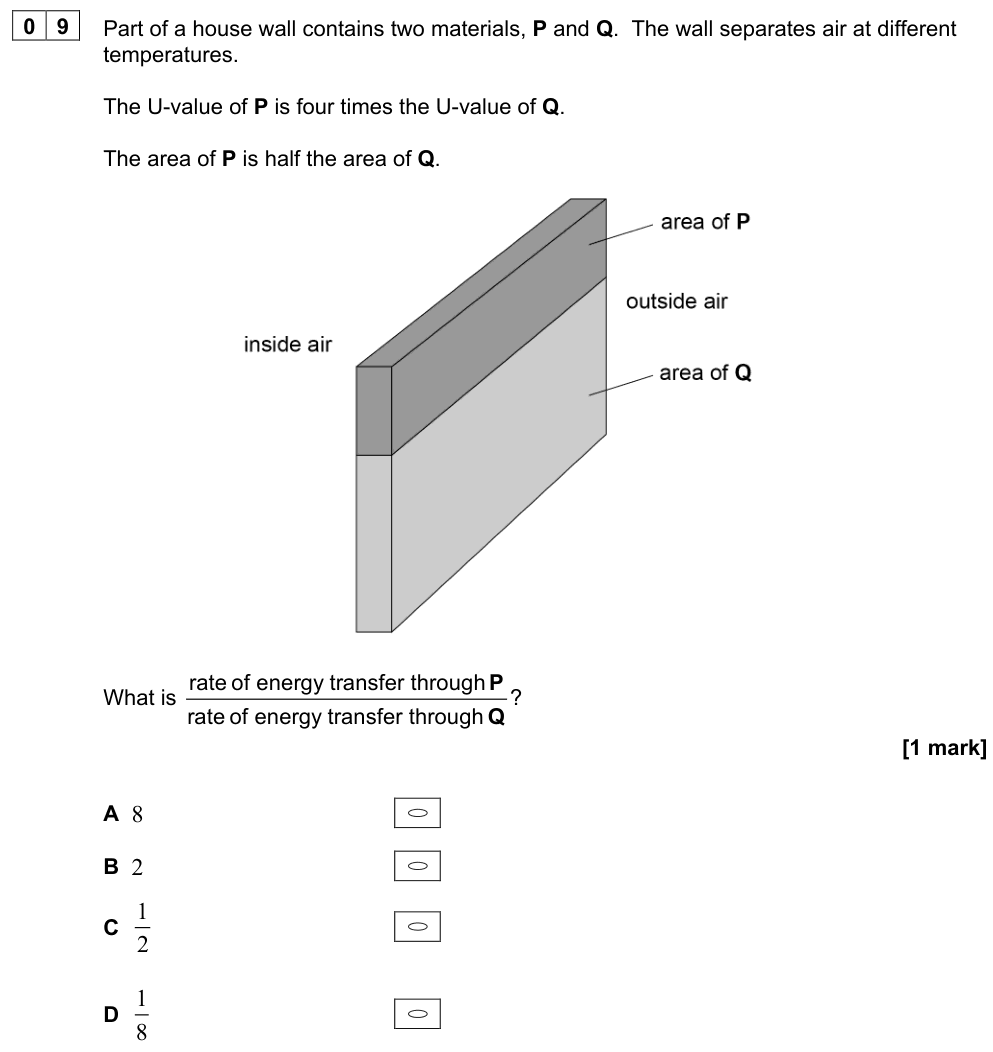
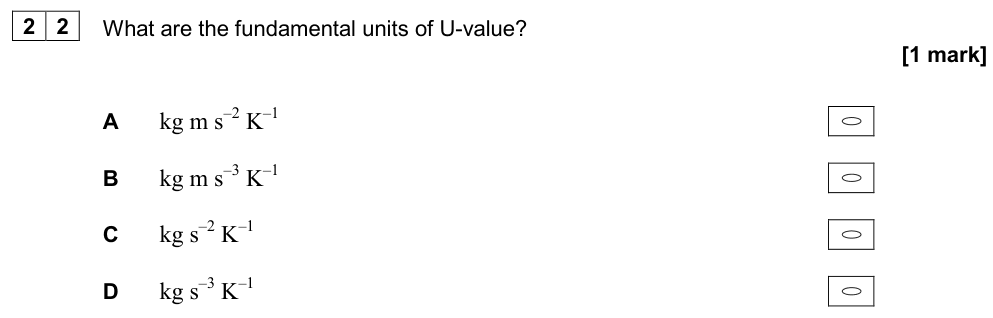
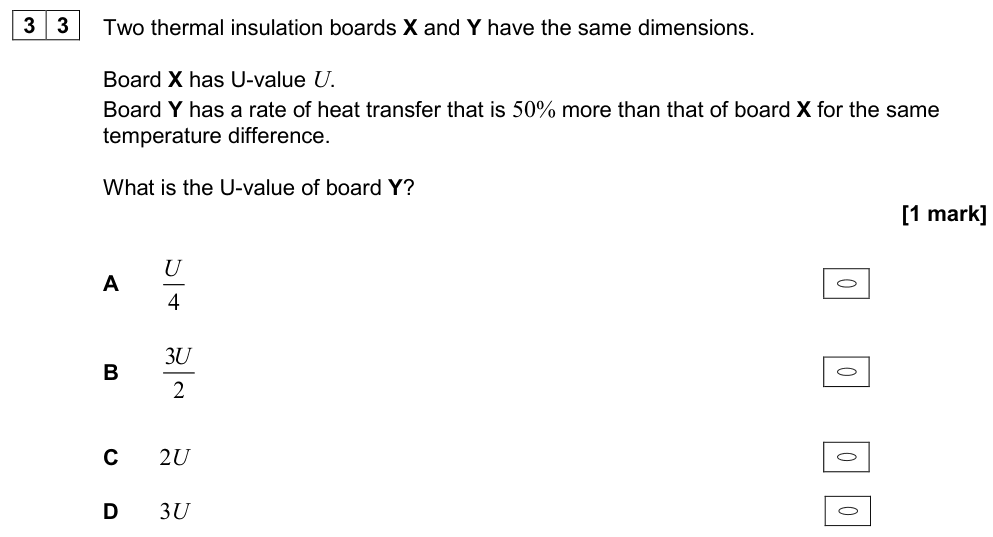
$$\frac{Q}{t} = UA\Delta\theta \qquad\text{where}\qquad U = \frac{k}{L}$$
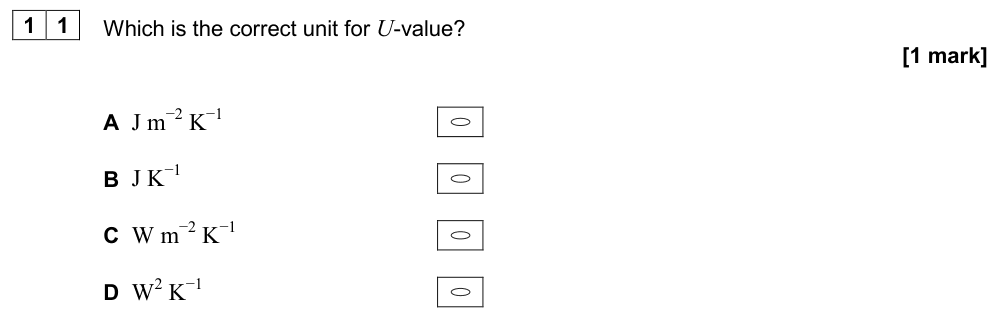
The U-value is the rate of energy transfer per square metre per kelvin of temperature difference. Unit: W m⁻² K⁻¹.
A low U-value means a good insulator. Manufacturers quote U-values for complete products (for example a window or a cavity wall), already allowing for all the layers and the air films at their surfaces.
| Building element | Typical U-value / W m⁻² K⁻¹ |
|---|---|
| single-glazed window | 5.0–5.7 |
| double-glazed window | 1.5–3.0 |
| solid brick wall | 2.0 |
| cavity wall, unfilled | 1.5 |
| cavity wall with insulation | 0.3–0.5 |
| roof with 250 mm of loft insulation | 0.15–0.25 |
Energy losses through parallel surfaces
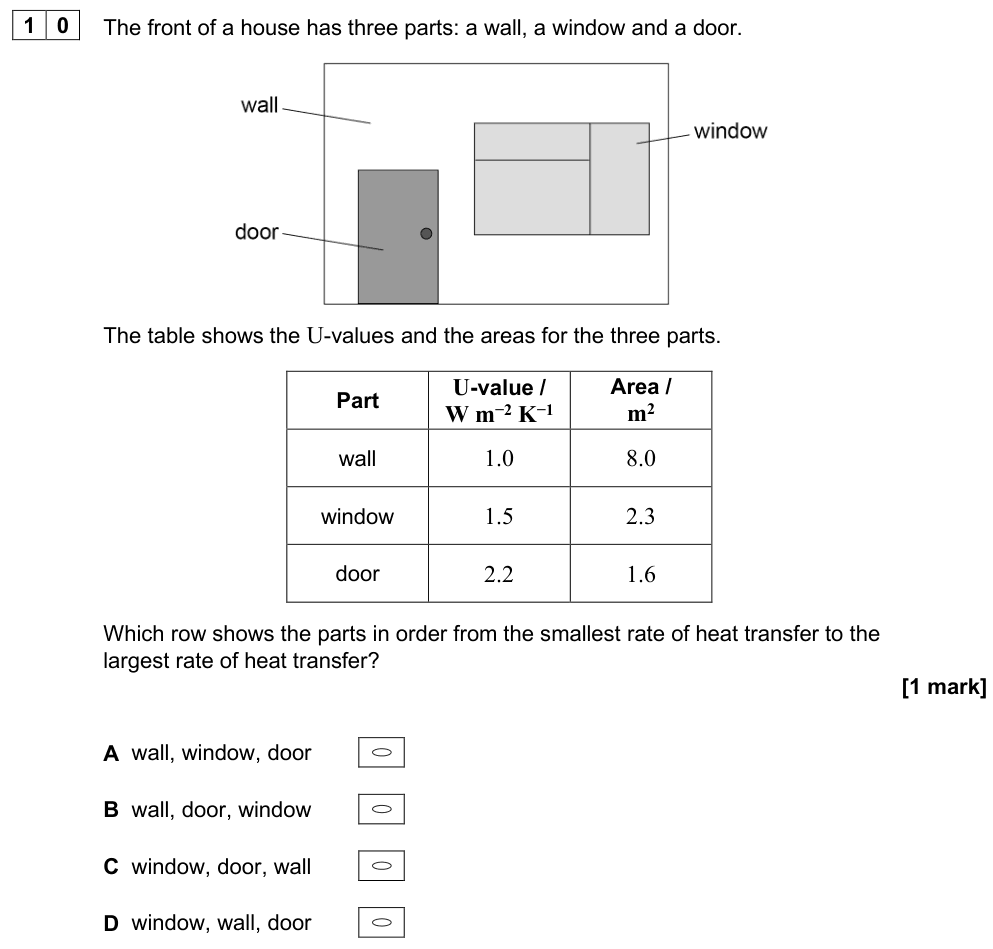
The walls, windows, roof and floor of a building all lose energy side by side (in parallel), each with the same inside–outside temperature difference. The total rate of loss is the sum of the separate rates:
$$\frac{Q}{t} = \left(U_1A_1 + U_2A_2 + U_3A_3 + \dots\right)\Delta\theta$$
Worked example: heating a house
A house is kept at 20 °C when it is 0 °C outside.
| Element | U / W m⁻² K⁻¹ | A / m² | UA / W K⁻¹ |
|---|---|---|---|
| walls | 0.50 | 120 | 60 |
| windows | 2.8 | 20 | 56 |
| roof | 0.25 | 60 | 15 |
| total | 131 |
Rate of energy loss $= 131 \times 20 = 2620$ W ≈ 2.6 kW. The heating must supply this to keep the temperature steady.
Energy lost in one day $= 2620 \times 24 \times 3600 = 2.3 \times 10^{8}$ J (63 kWh). Notice that the small window area loses almost as much as all the walls.
Common mistake
The $\Delta\theta$ in these equations is the temperature difference across the material. Make sure the area is in m² (1 m² = 10⁴ cm²) and the thickness in m when you use $U = k/L$.
Reducing energy losses from buildings
| Method | How it works |
|---|---|
| Cavity wall insulation | foam or fibre fills the gap between the two brick walls, trapping air in small pockets so that it cannot circulate by convection |
| Loft insulation | a thick layer of fibreglass or mineral wool traps air above the ceiling |
| Double (or triple) glazing | a layer of dry air or argon between two panes conducts very poorly; a narrow gap stops convection |
| Draught-proofing | reduces energy carried away by warm air leaving the building (convection) |
| Reflective foil, low-emissivity glass | reduce energy transfer by radiation |
Worked example: payback time
Replacing 20 m² of single glazing (U = 5.0) with double glazing (U = 2.0) at an average temperature difference of 10 K saves $(5.0 - 2.0) \times 20 \times 10 = 600$ W. Over a 180-day heating season this saves $600 \times 180 \times 24 \times 3600 = 9.3 \times 10^{9}$ J = 2600 kWh. At a price of 0.25 per kWh this saves 650 per year, so if the glazing costs 6500 the payback time is about 10 years.
Summary
- Conduction: lattice vibrations pass energy between neighbouring particles; in metals free electrons transfer energy much faster.
- $\dfrac{Q}{t} = \dfrac{kA\Delta\theta}{L}$; $k$ in W m⁻¹ K⁻¹.
- U-value: $\dfrac{Q}{t} = UA\Delta\theta$ with $U = k/L$ (W m⁻² K⁻¹); low U = good insulator.
- For walls, windows and roofs in parallel, add the $UA$ values and multiply by $\Delta\theta$.
- Insulation works by trapping air (a poor conductor) so it cannot circulate.