The gas laws
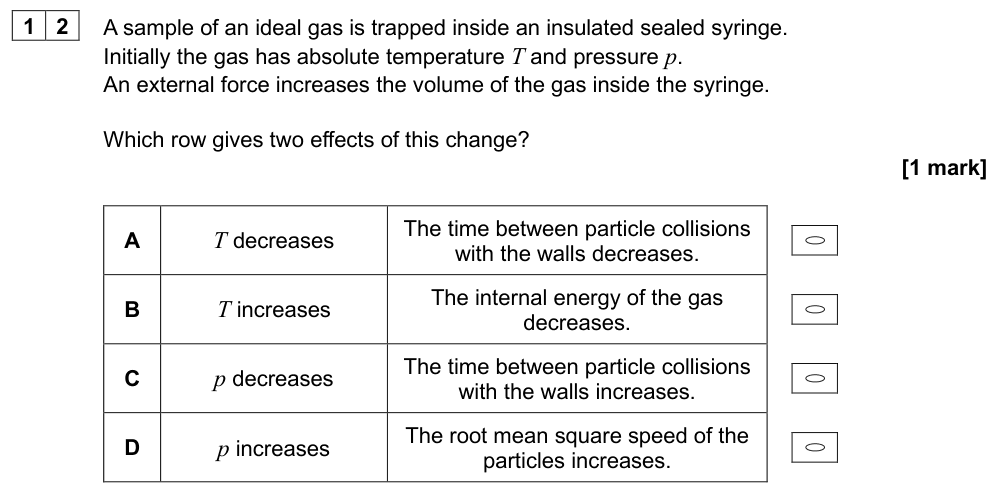
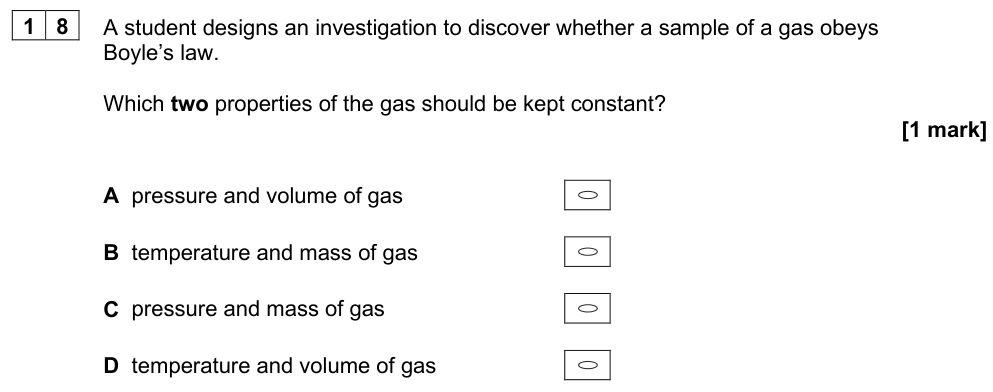
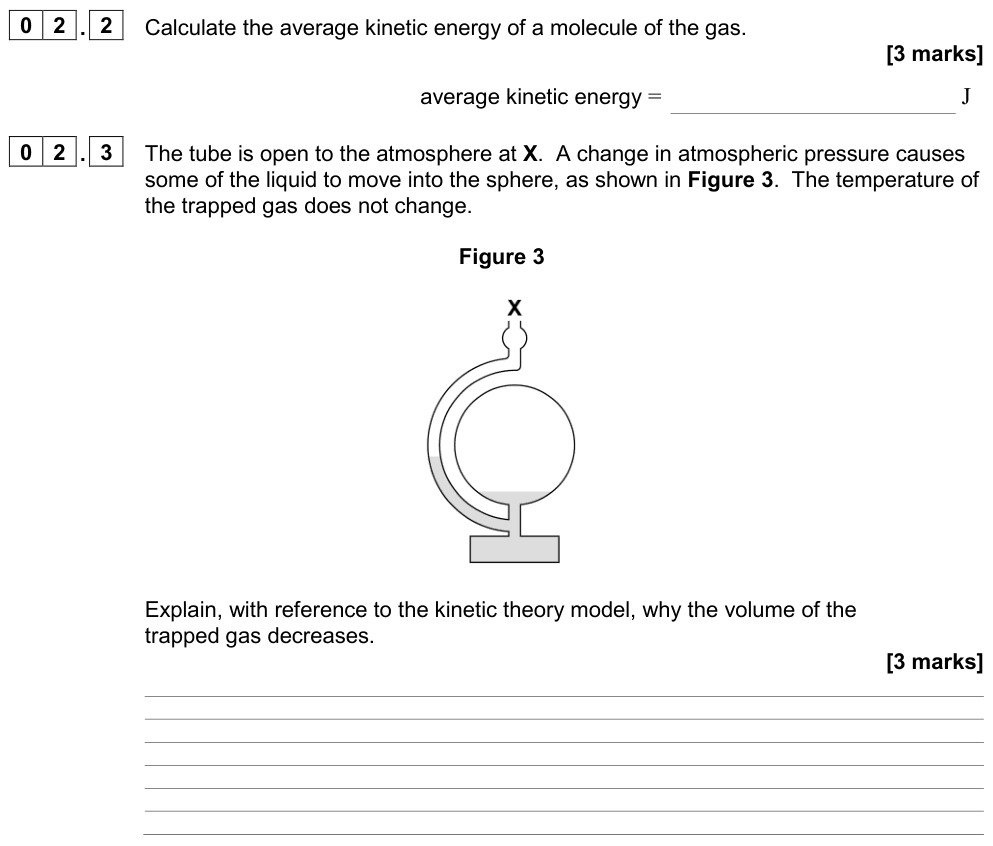
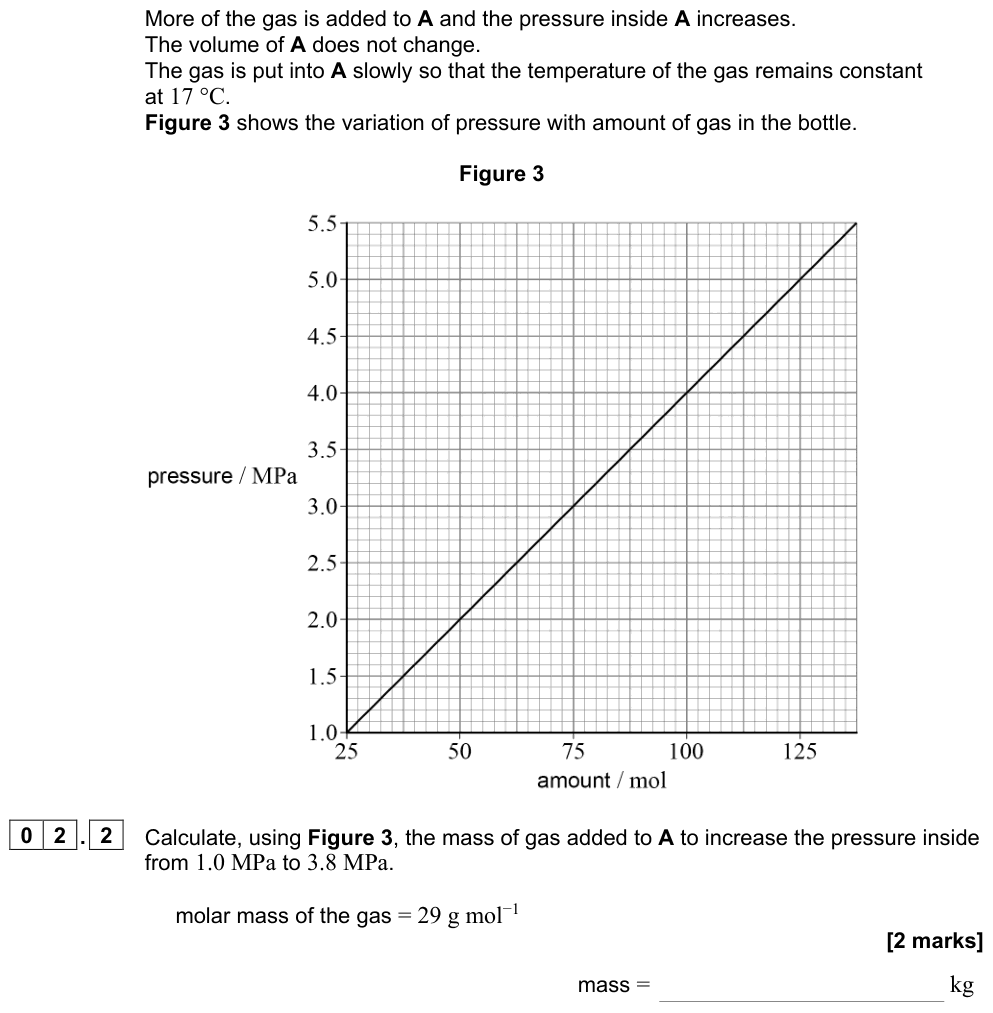
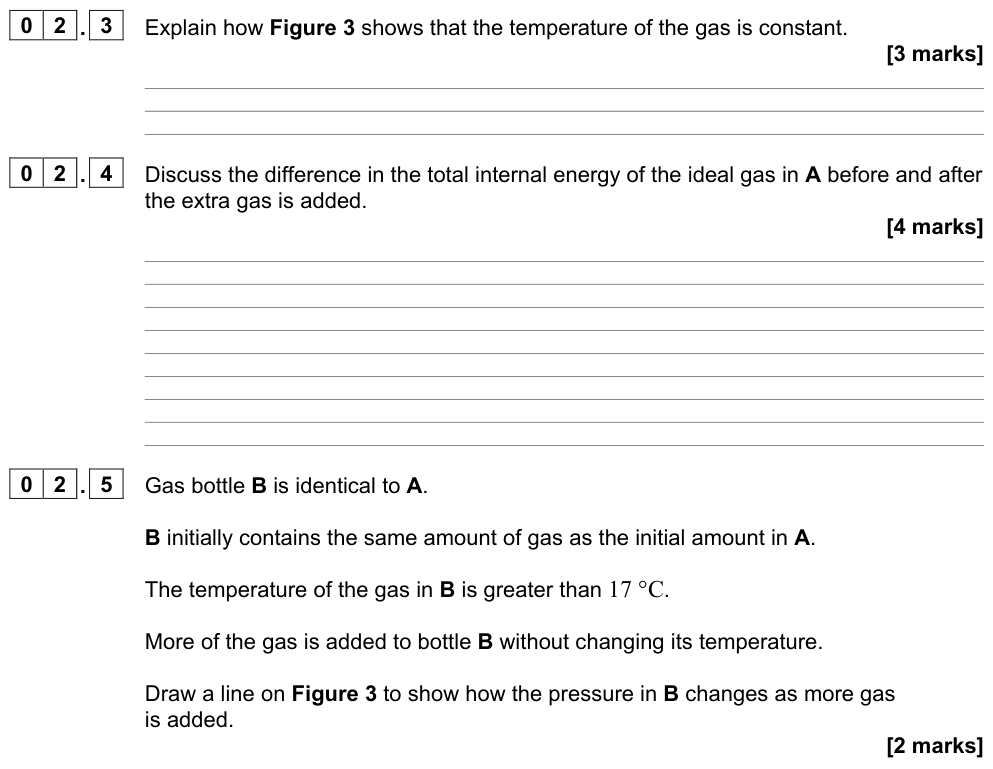
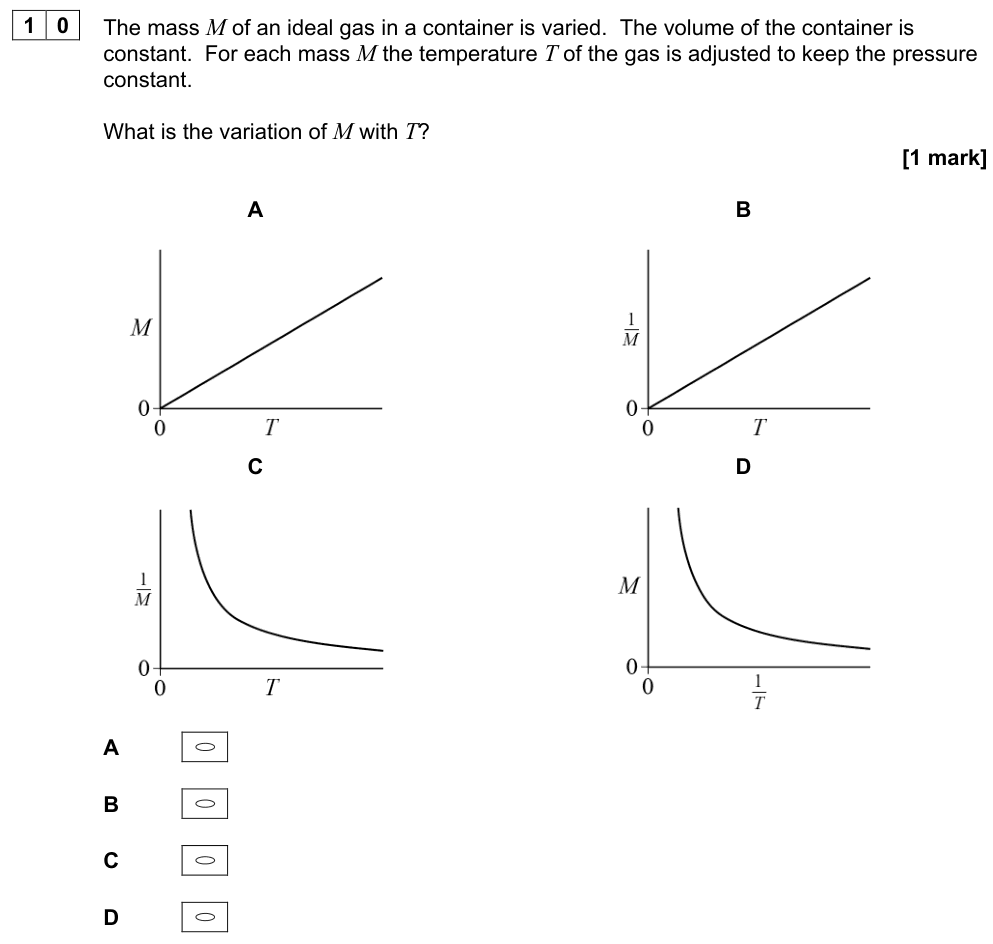
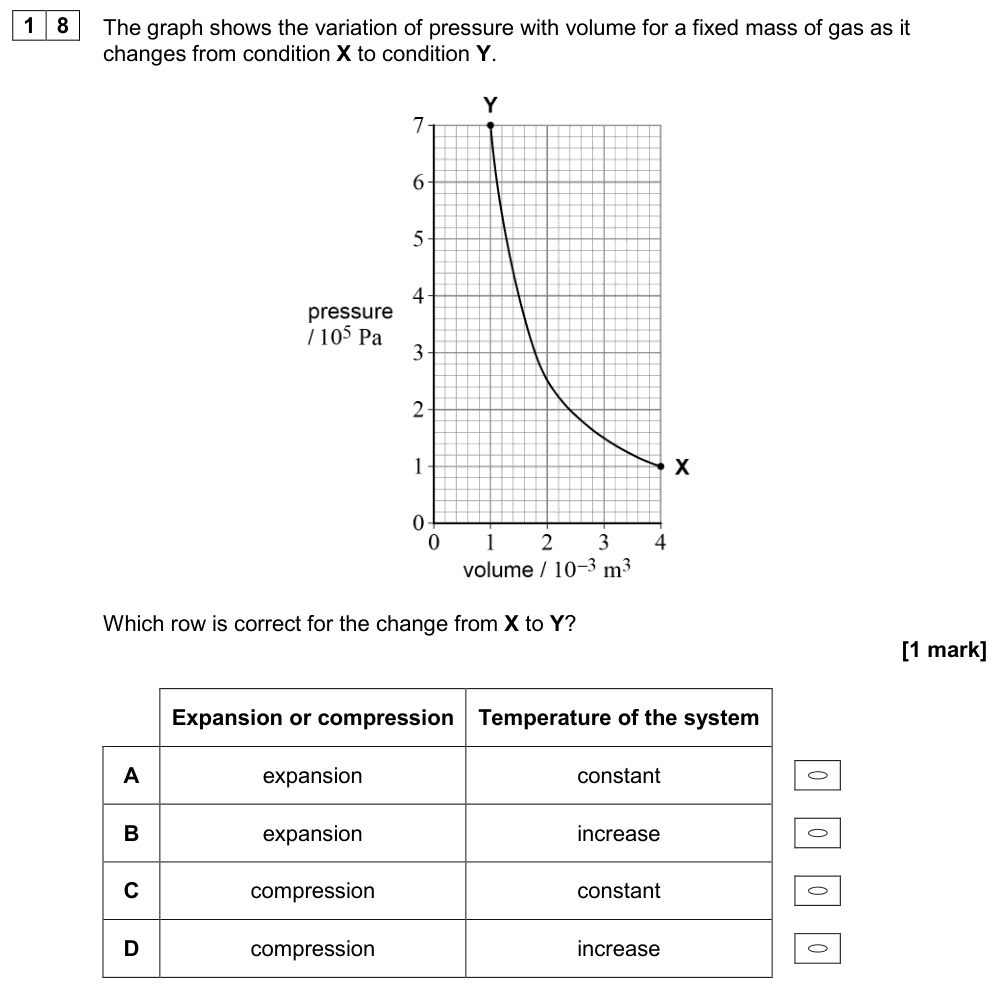
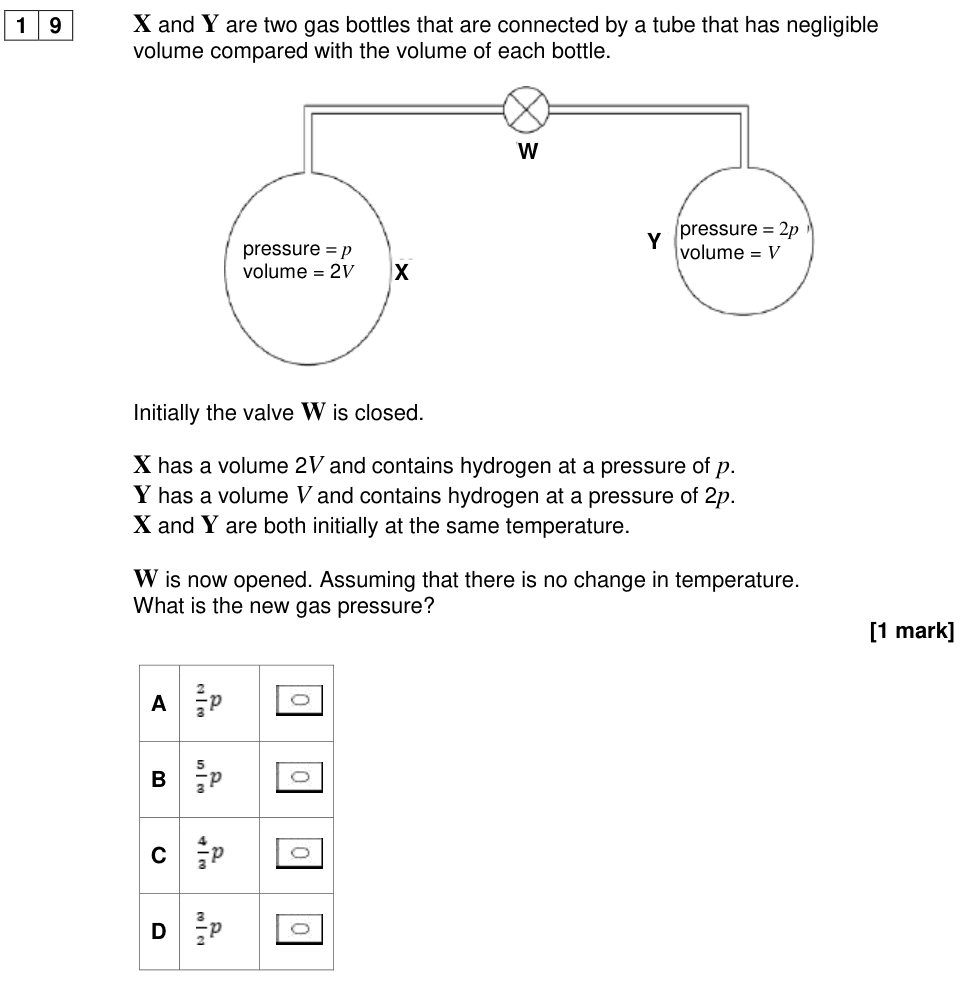
The state of a fixed mass of gas is described by its pressure $p$, volume $V$ and temperature $T$. Three laws were found by experiment; each holds one quantity constant.
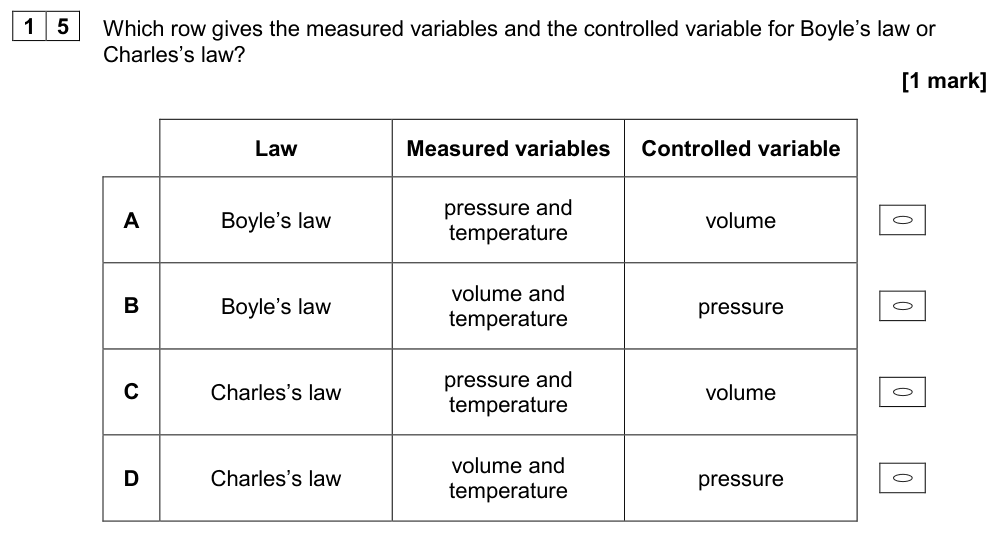
| Law | Constant | Relationship | Graph that gives a straight line |
|---|---|---|---|
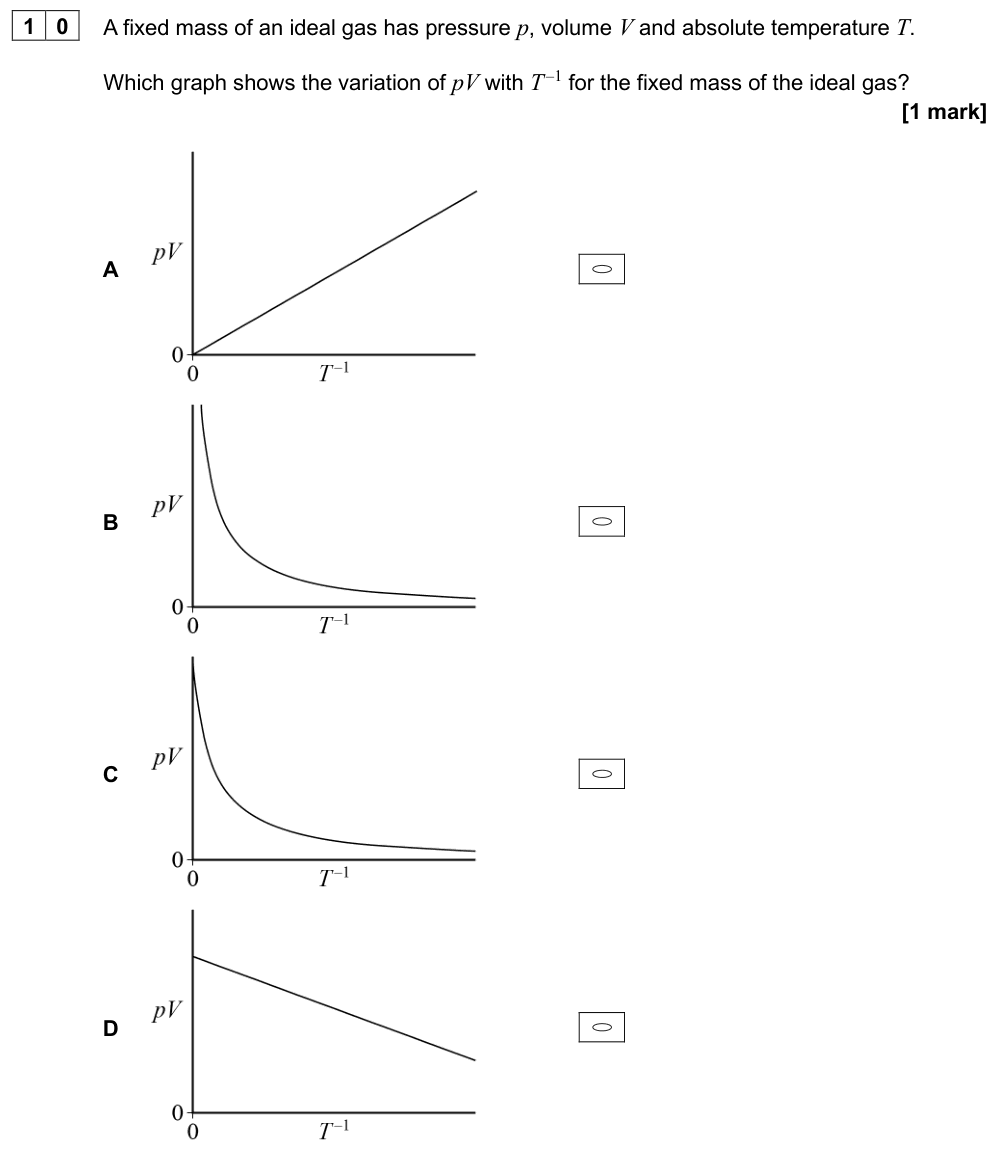
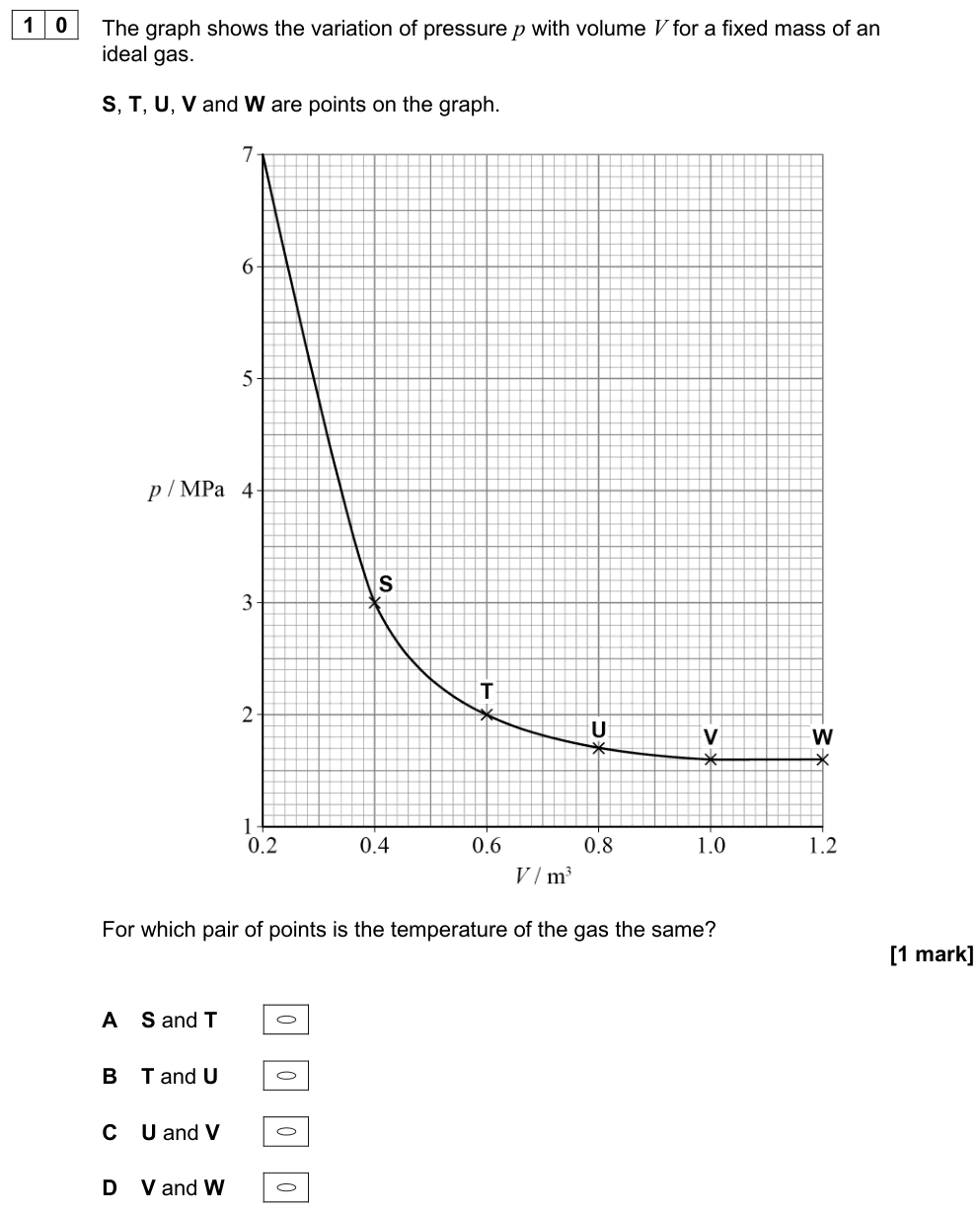
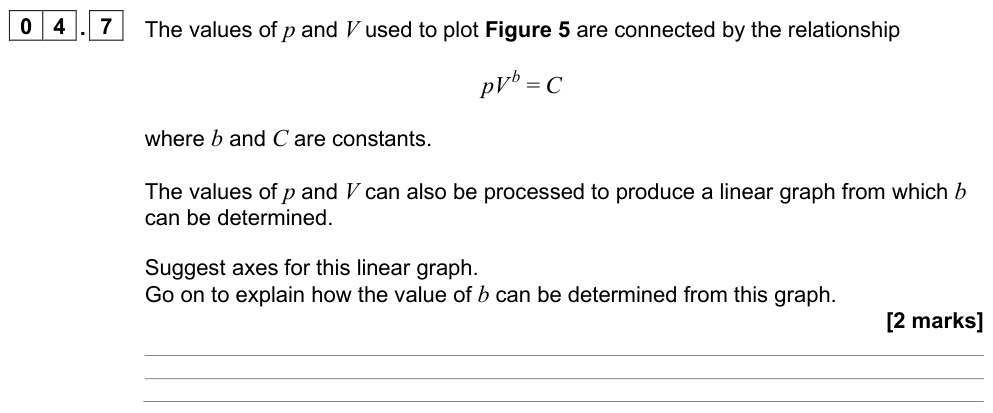
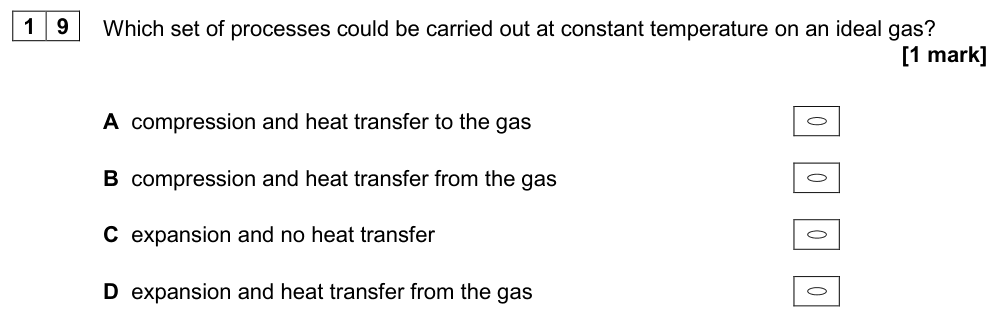
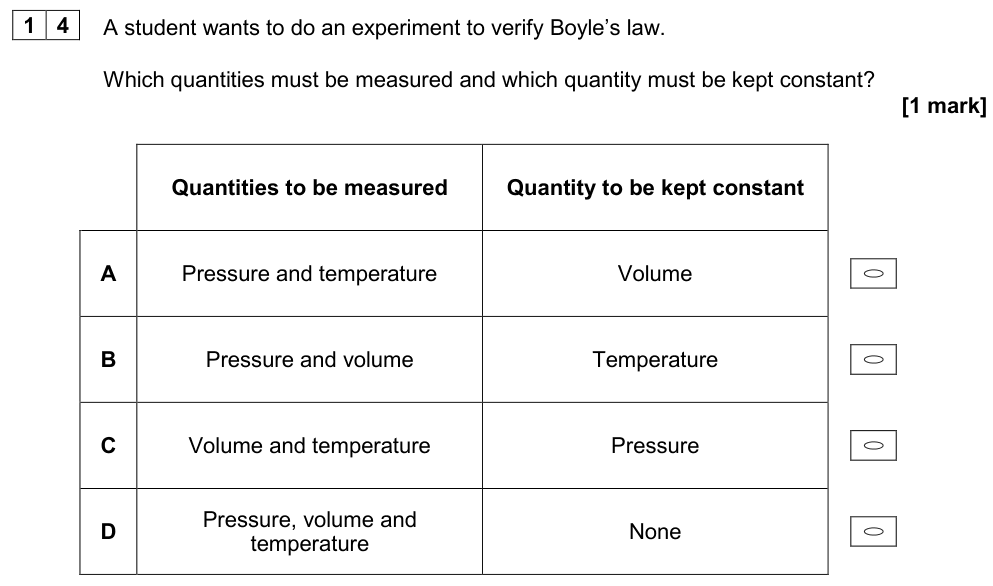
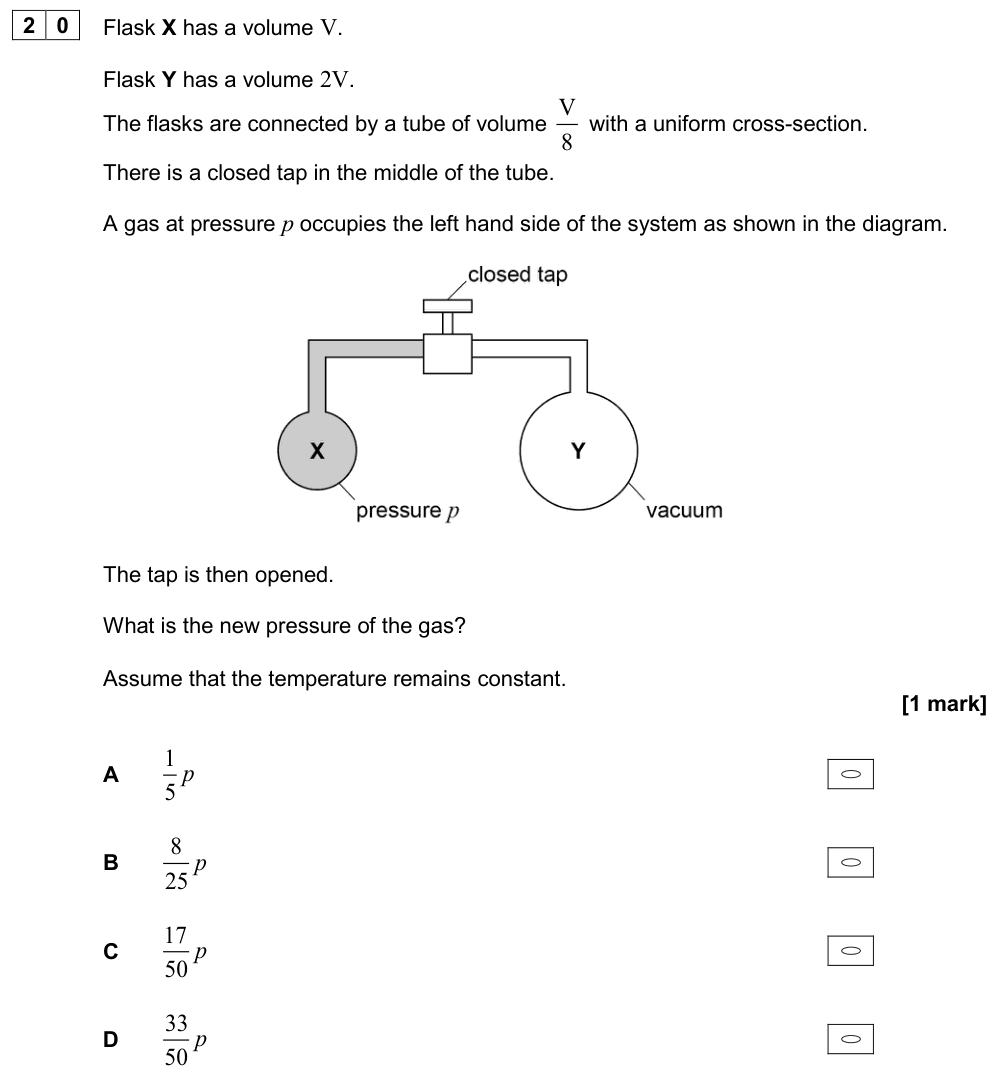
| Boyle's law | temperature | $pV = \text{constant}$ ($p \propto 1/V$) | $p$ against $1/V$ (through the origin) |
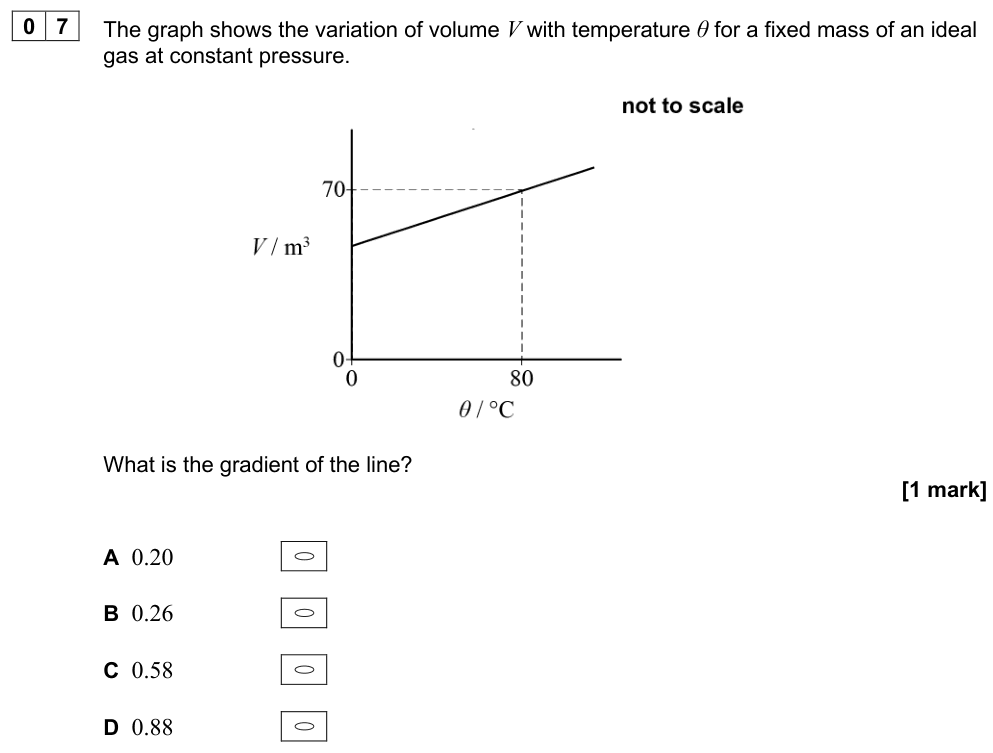
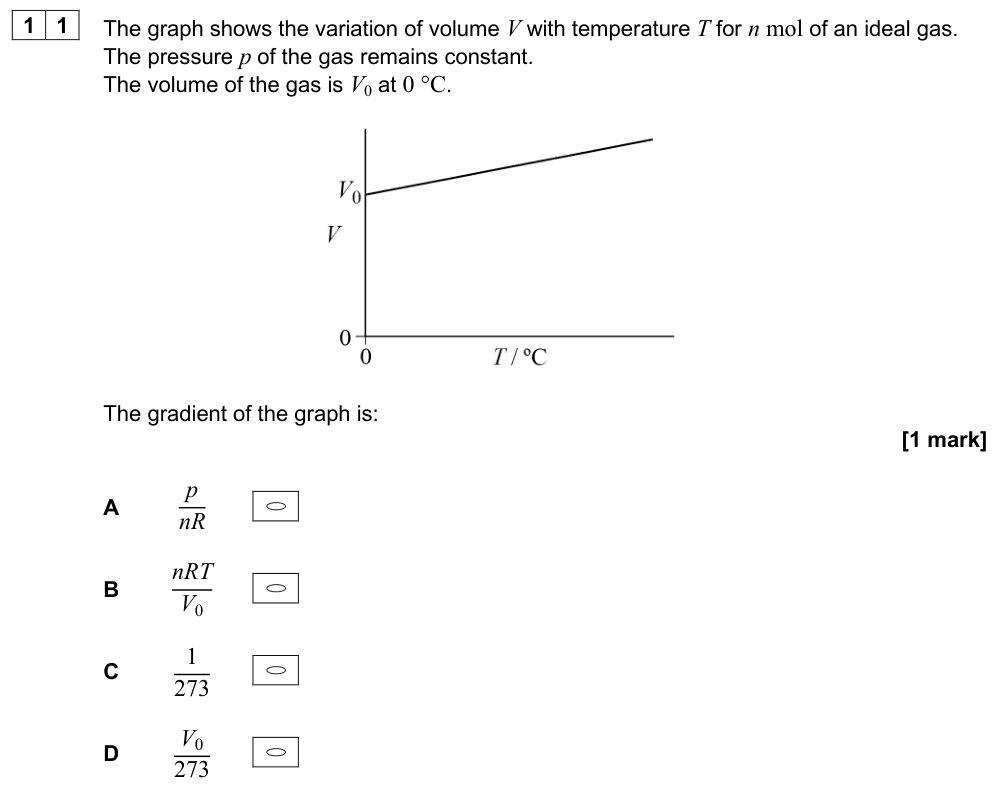
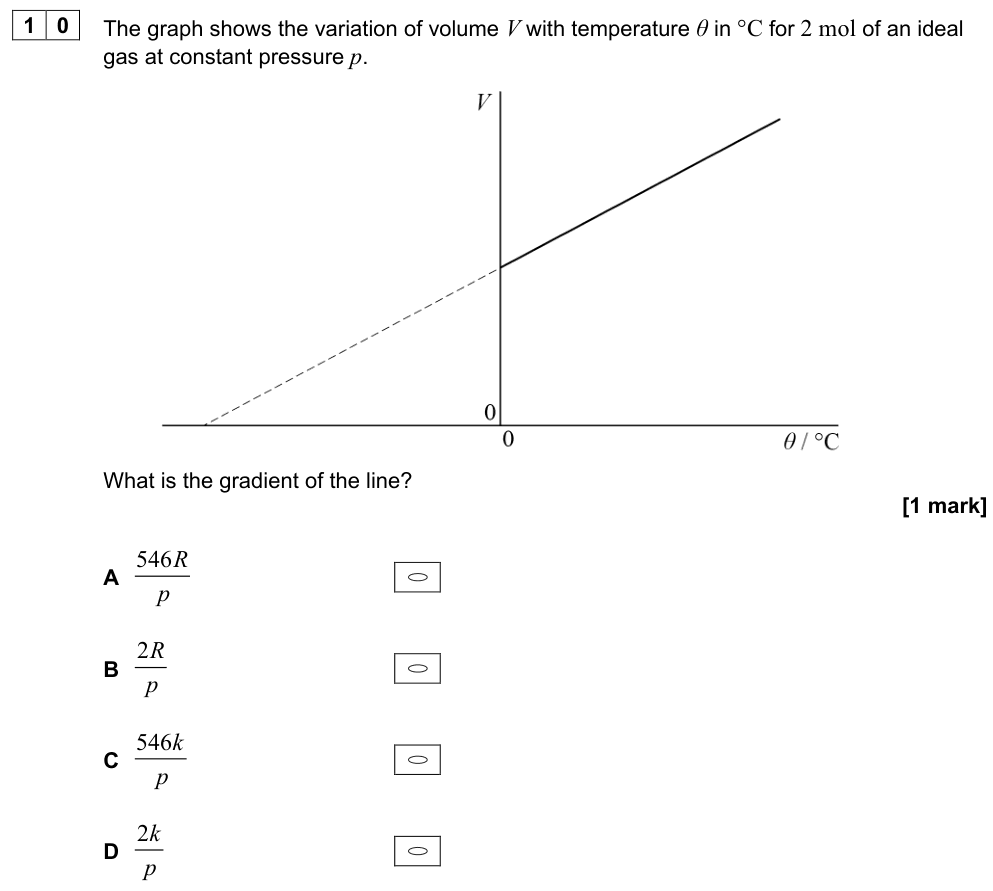
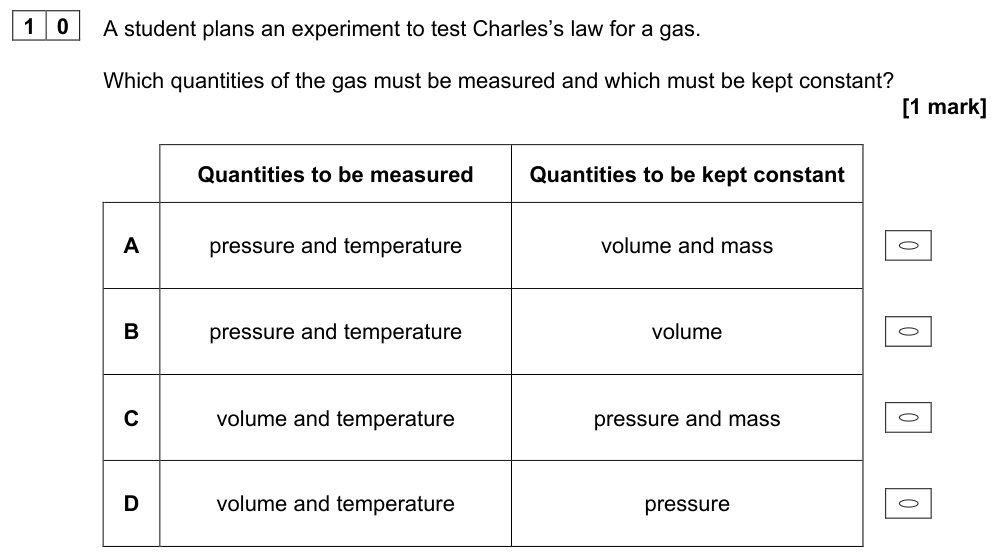
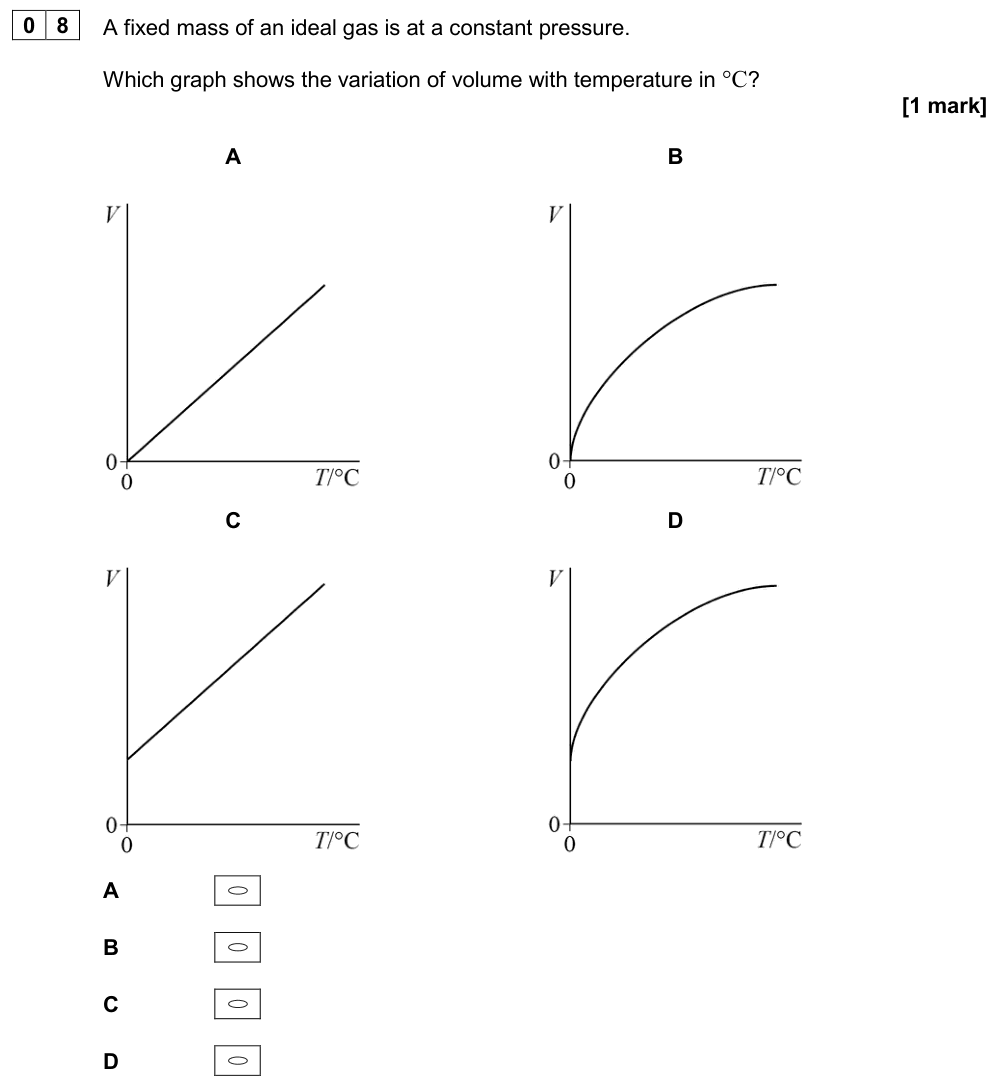
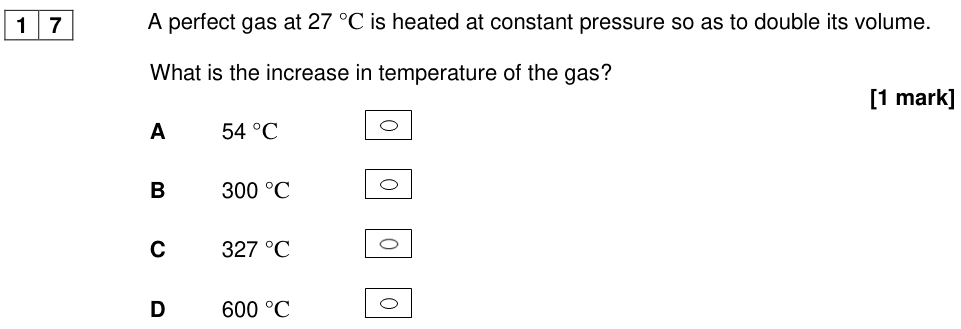
| Charles's law | pressure | $\dfrac{V}{T} = \text{constant}$ ($V \propto T$) | $V$ against $T$ in kelvin (through the origin) |
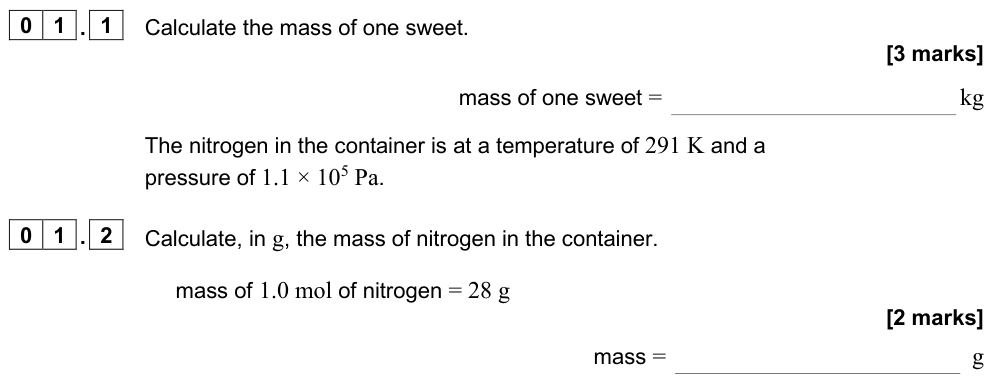
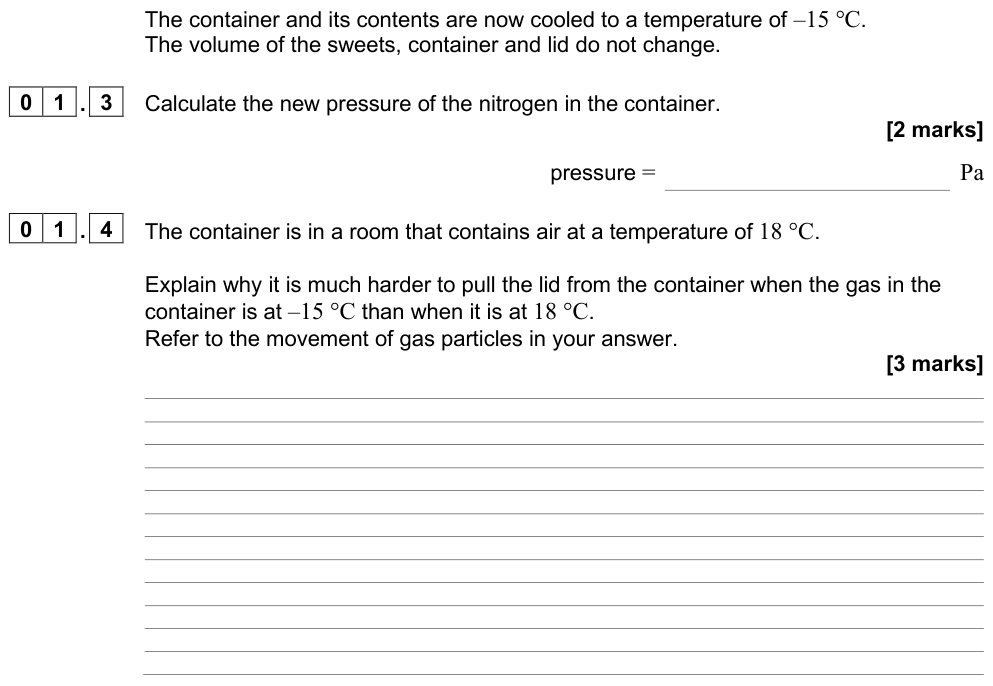
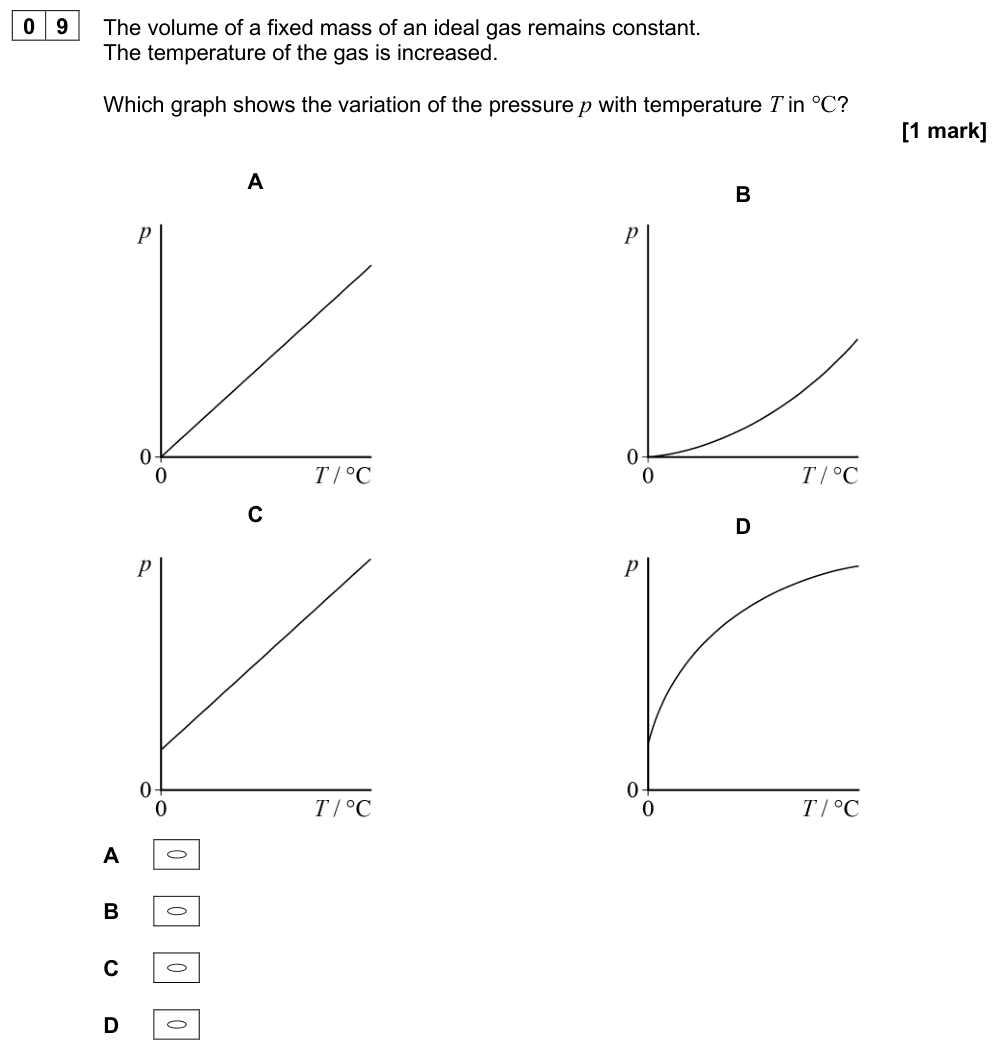
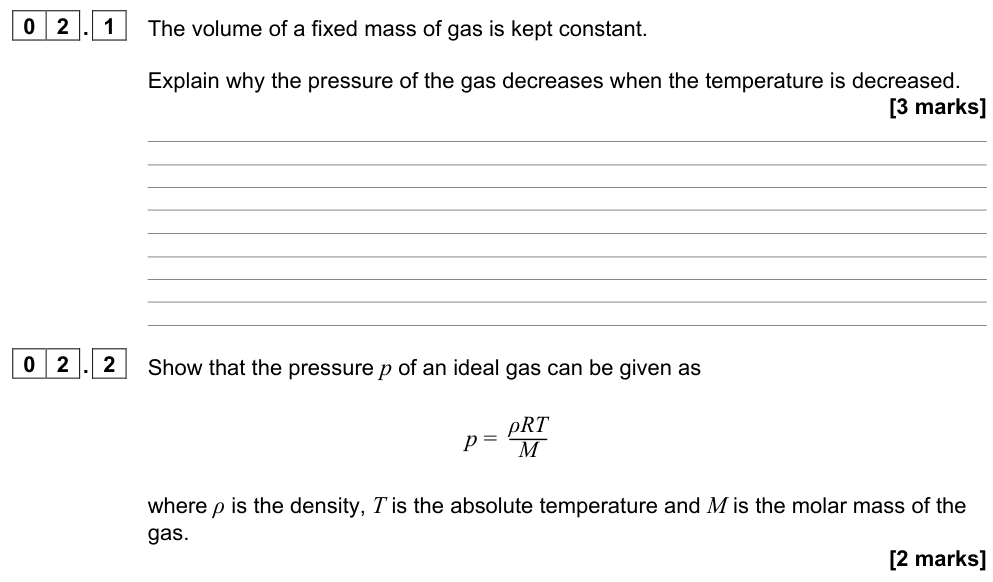
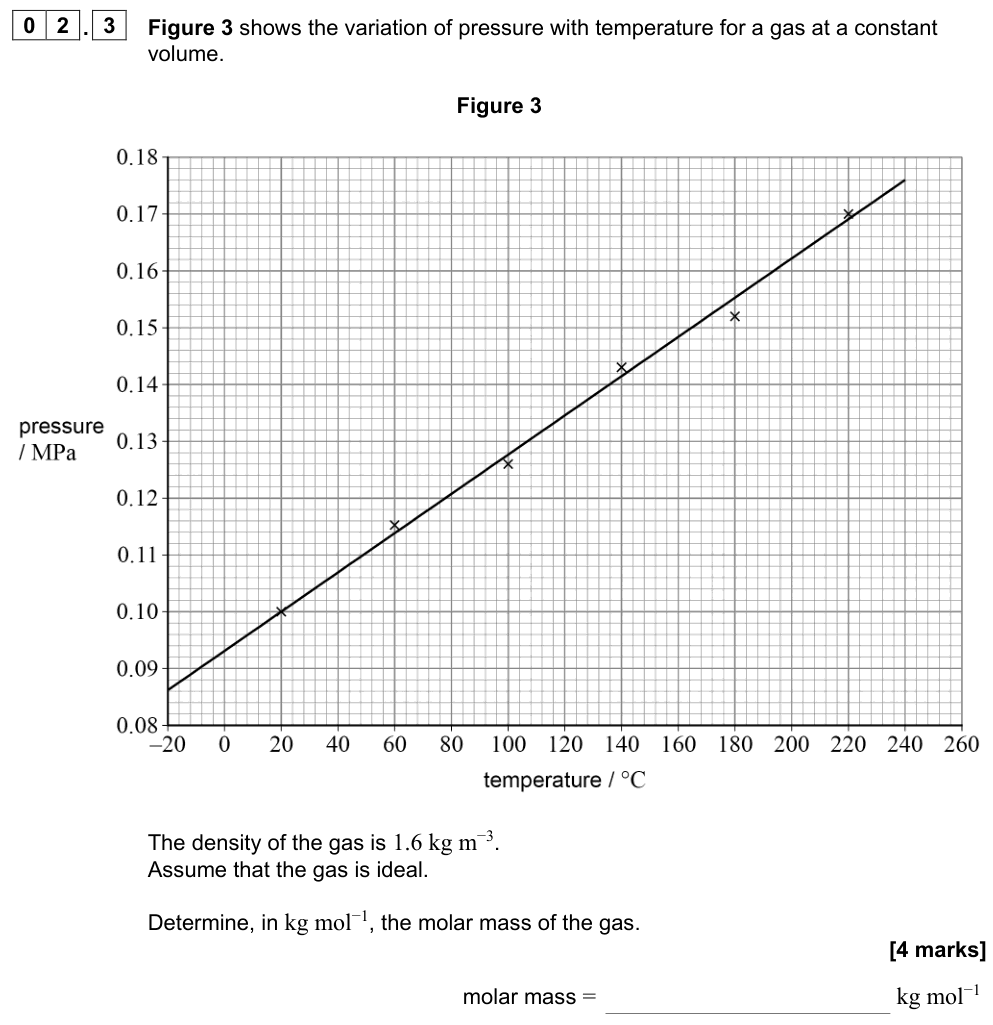
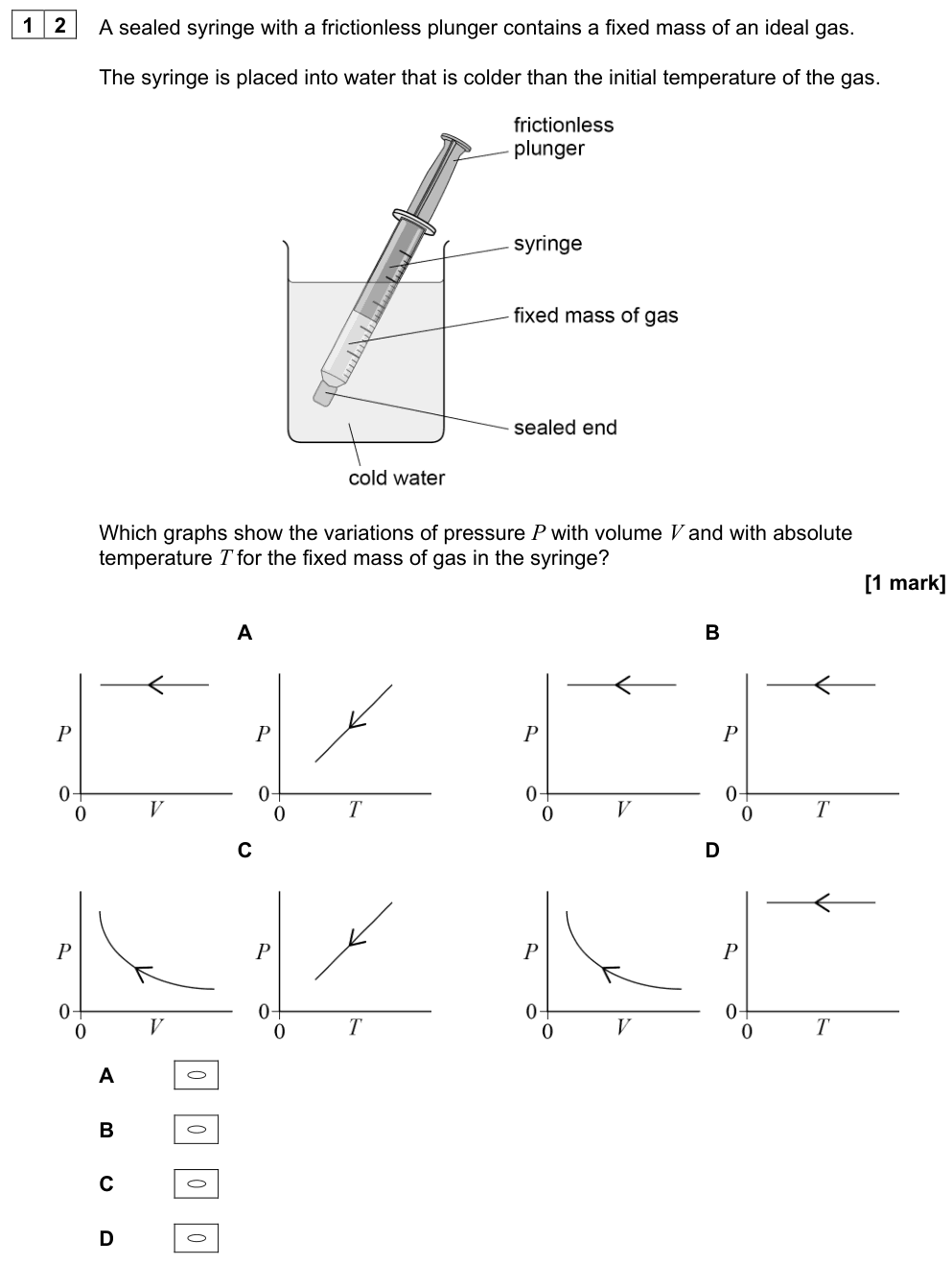
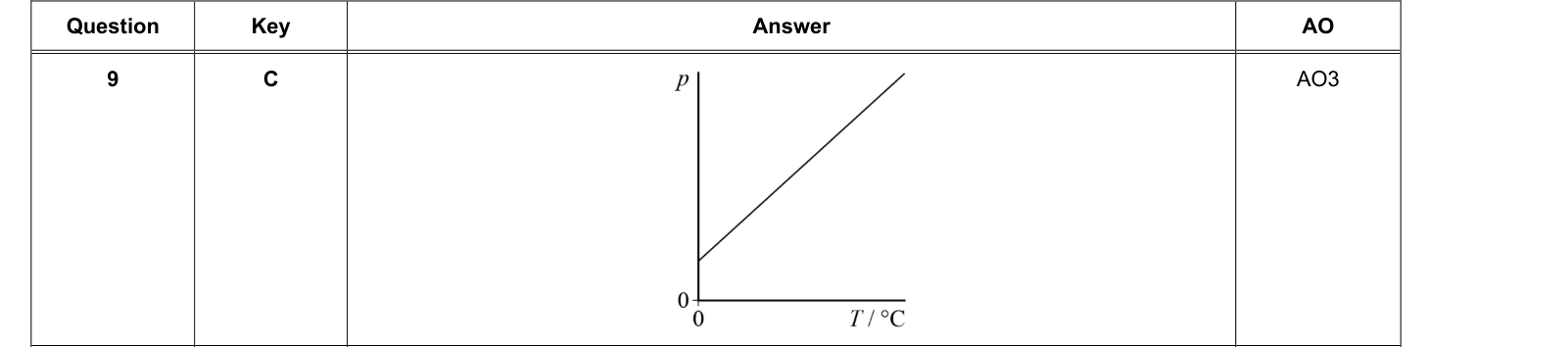
| Pressure law | volume | $\dfrac{p}{T} = \text{constant}$ ($p \propto T$) | $p$ against $T$ in kelvin (through the origin) |
All three apply to a fixed mass of gas, and $T$ must be the absolute temperature in kelvin.
Absolute zero and the kelvin scale
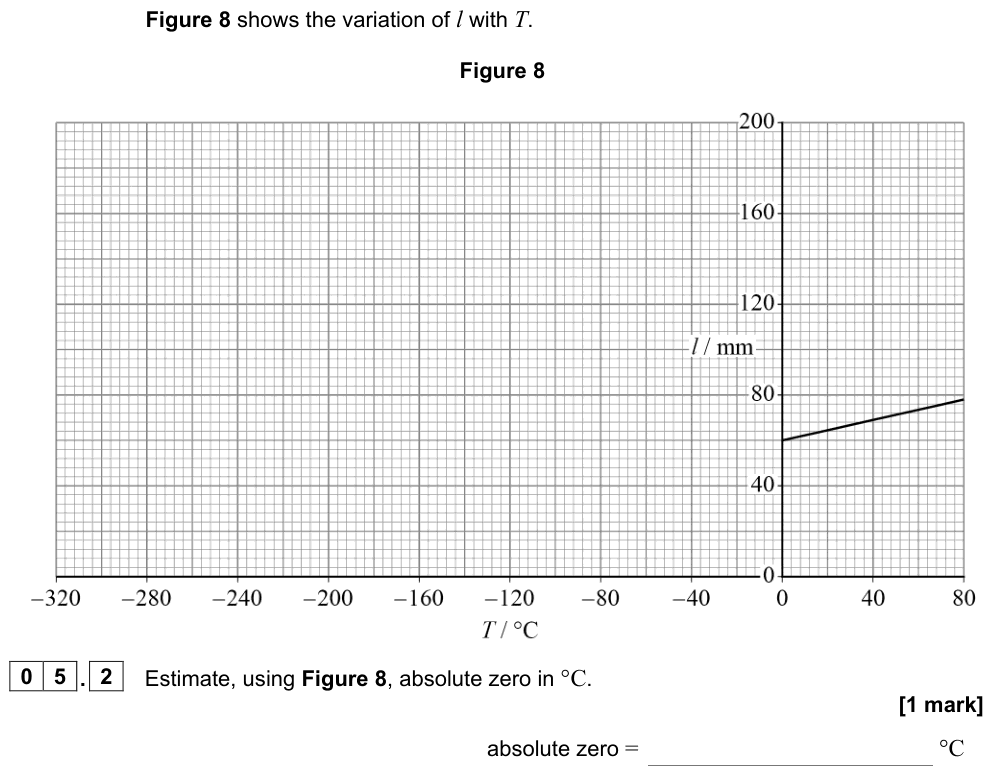
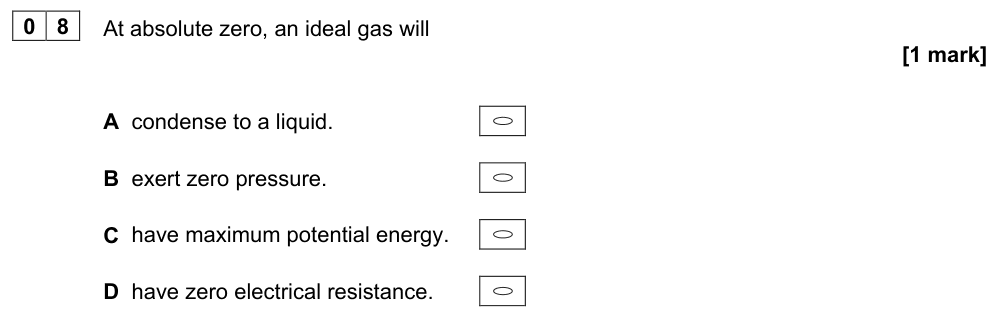
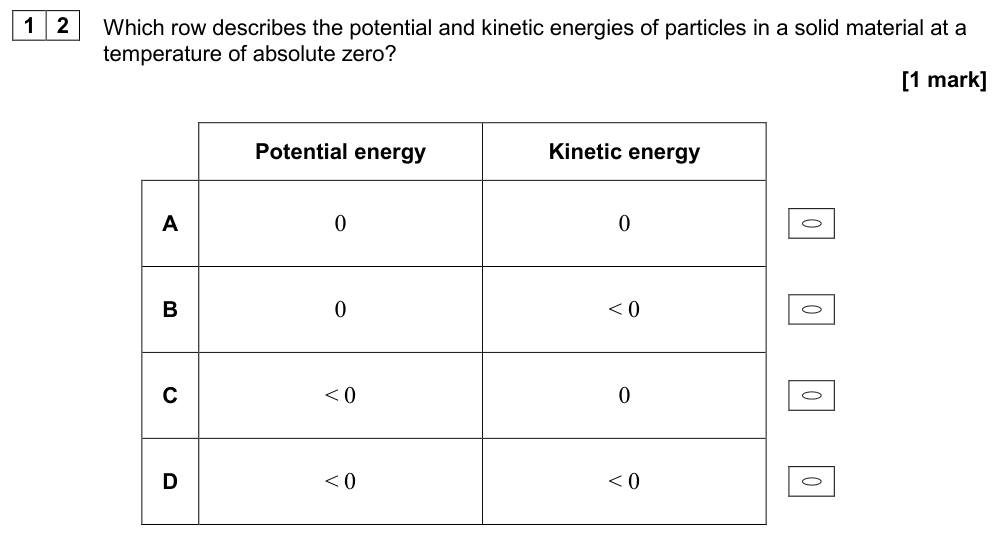
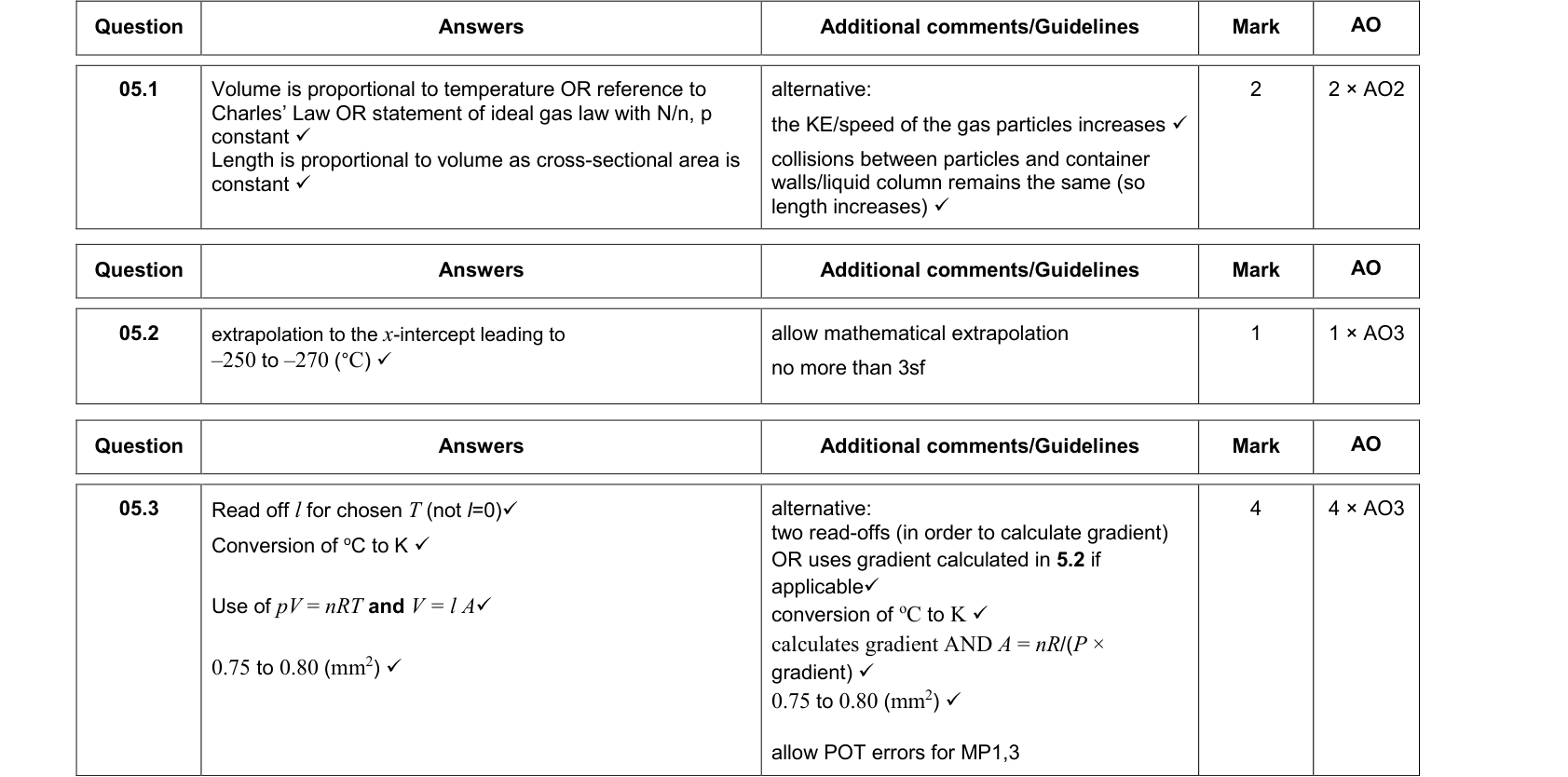
If the lines for Charles's law or the pressure law are extrapolated backwards, the volume or pressure of any gas would become zero at the same temperature, about −273 °C. This is absolute zero: the lowest possible temperature, at which the particles of a substance have the minimum possible kinetic energy.
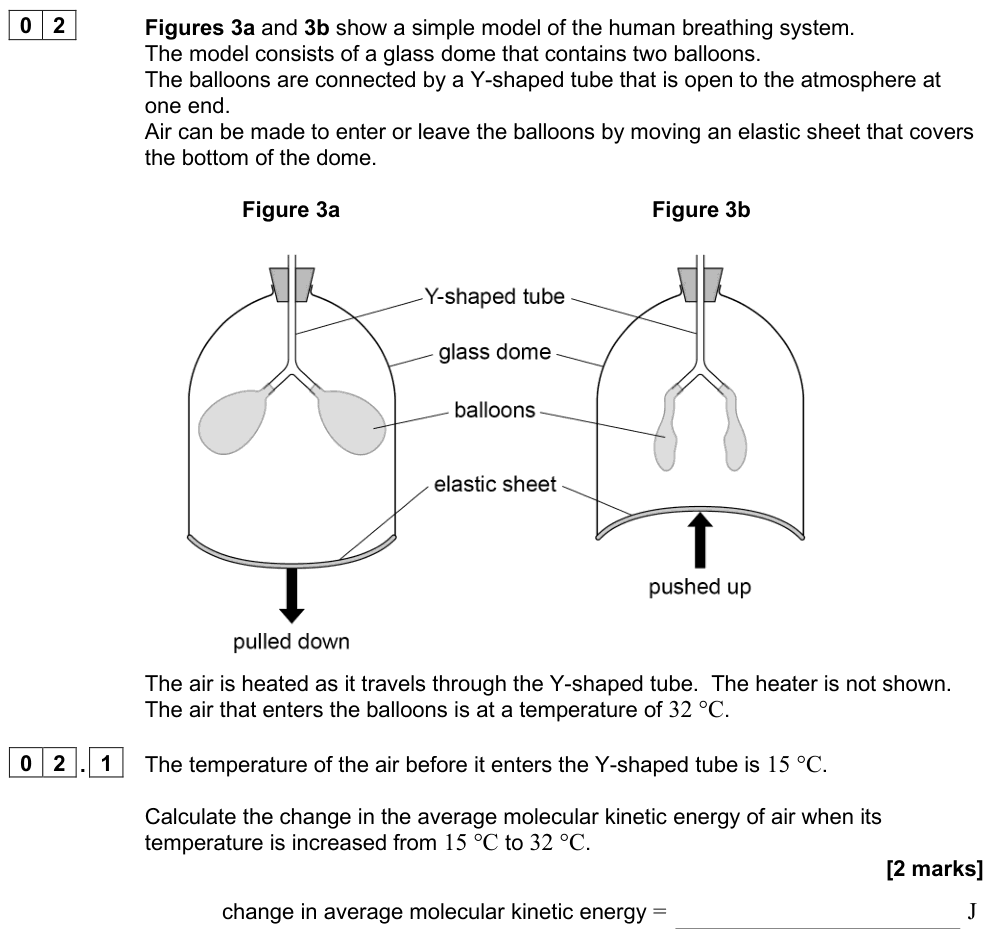
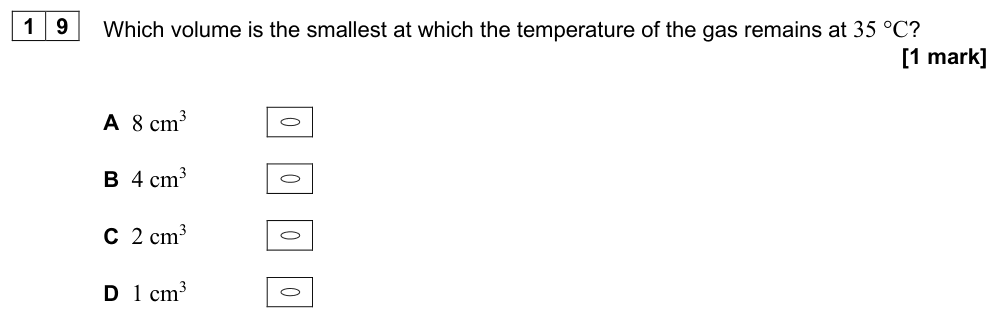
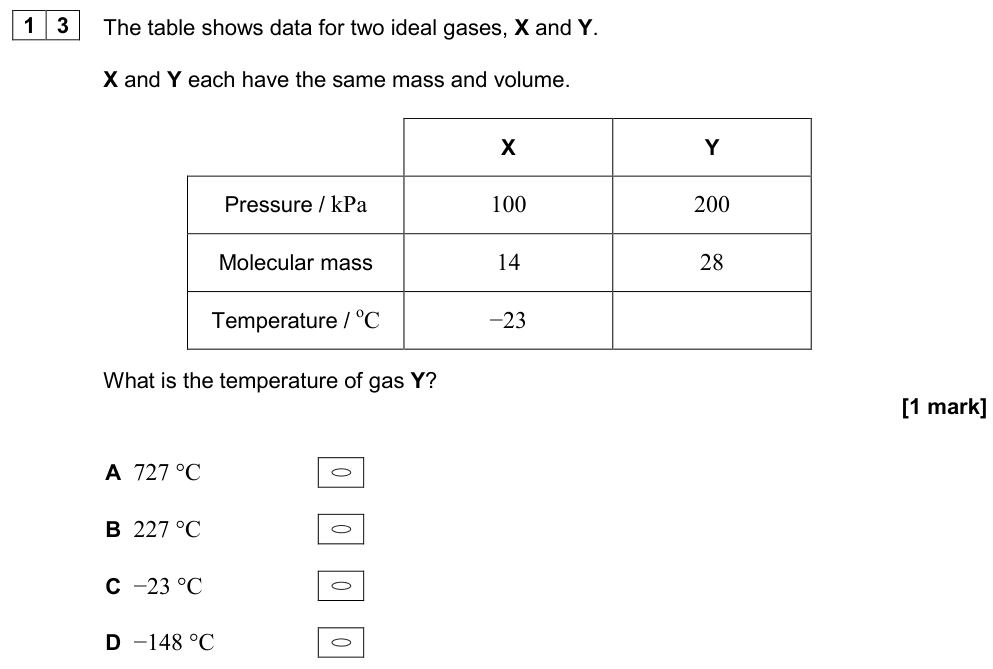
The absolute (thermodynamic) temperature scale starts at absolute zero and is measured in kelvin (K). A change of 1 K is the same as a change of 1 °C.
$$T/\text{K} = \theta/°\text{C} + 273$$
(More precisely 273.15, but 273 is good enough for calculations.)
Common mistake
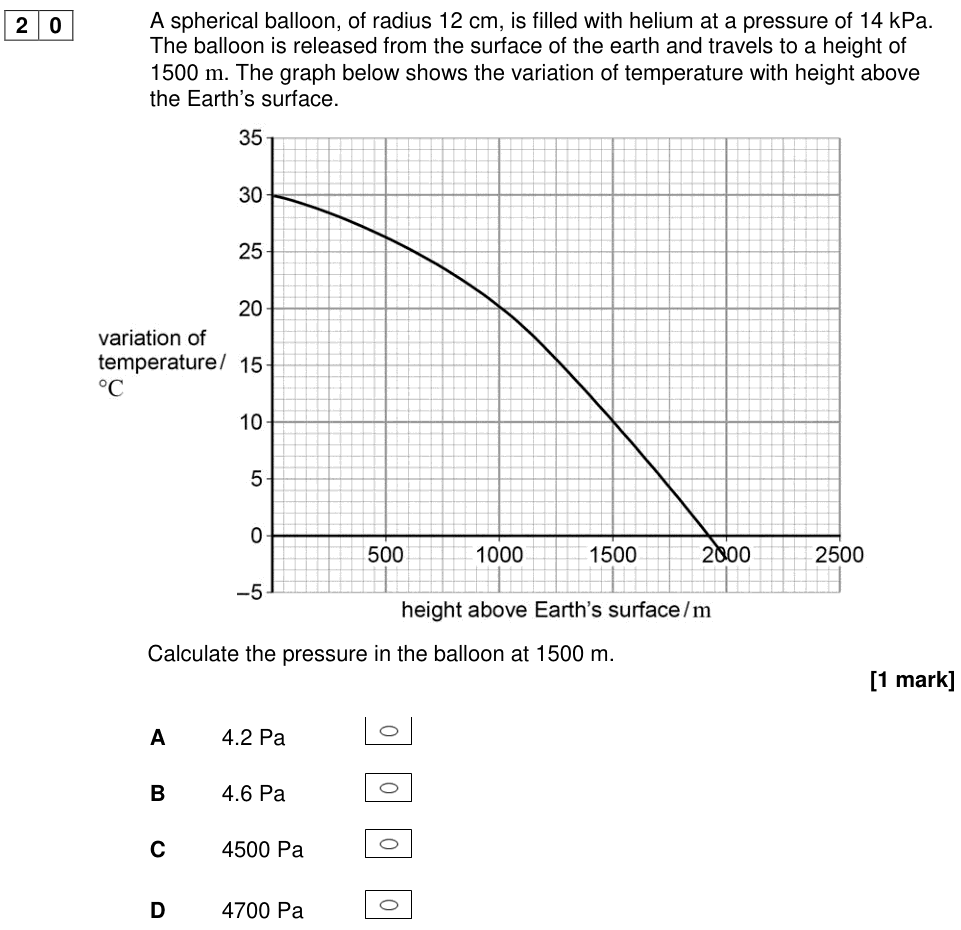
The gas laws only work with temperatures in kelvin. Heating a gas from 10 °C to 20 °C does not double its pressure: it goes from 283 K to 293 K, an increase of only 3.5%.
The ideal gas equation
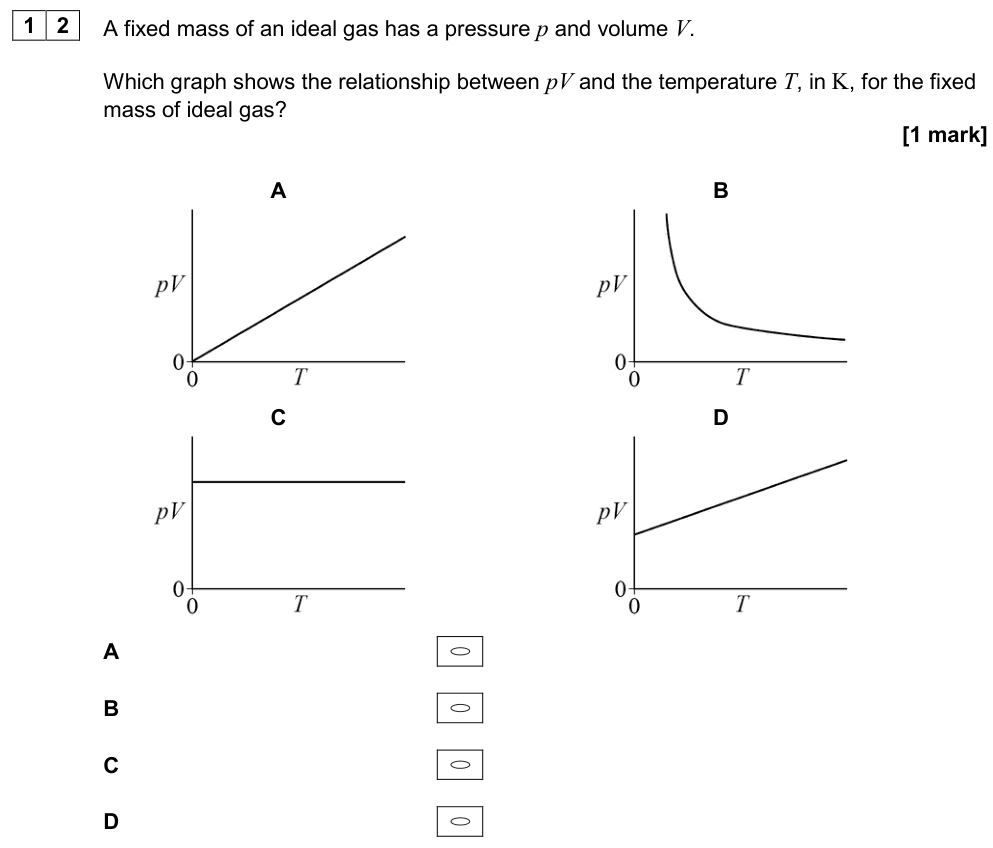
Combining the three laws gives, for a fixed mass of gas:
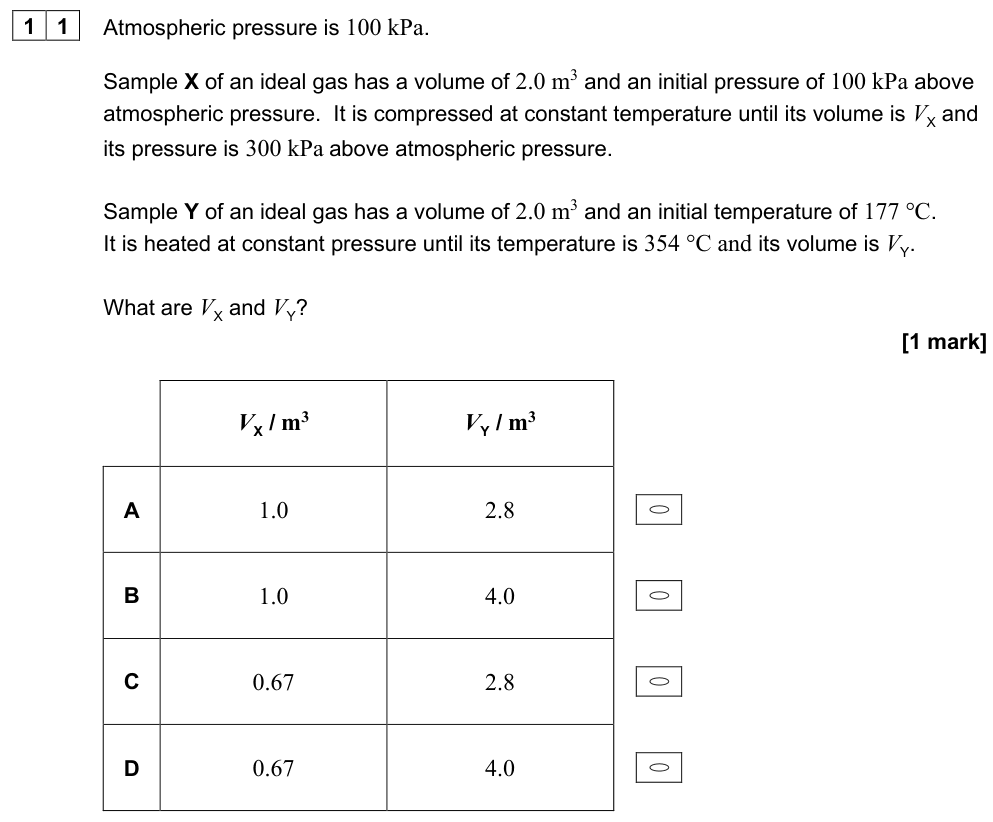
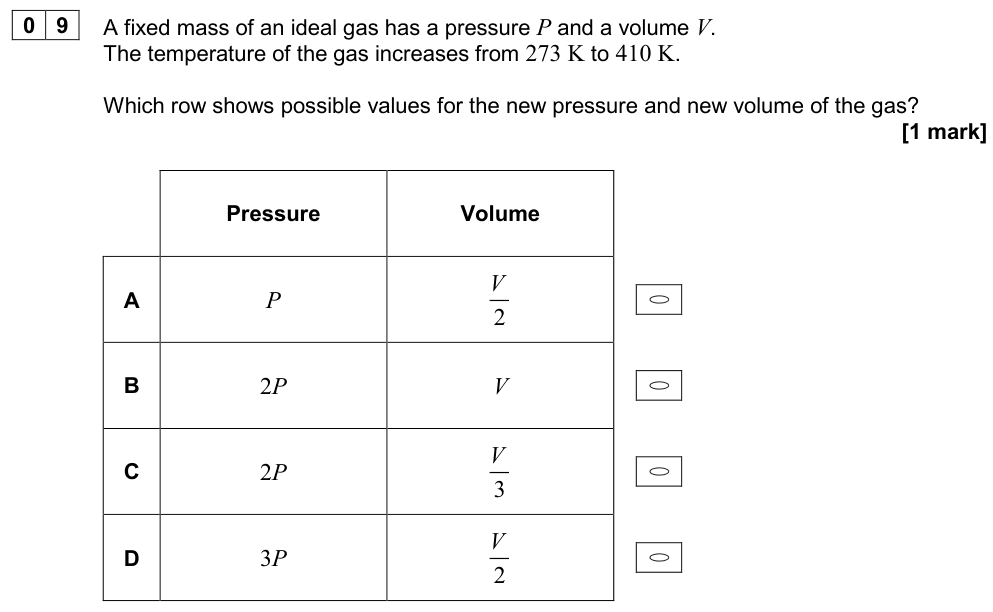
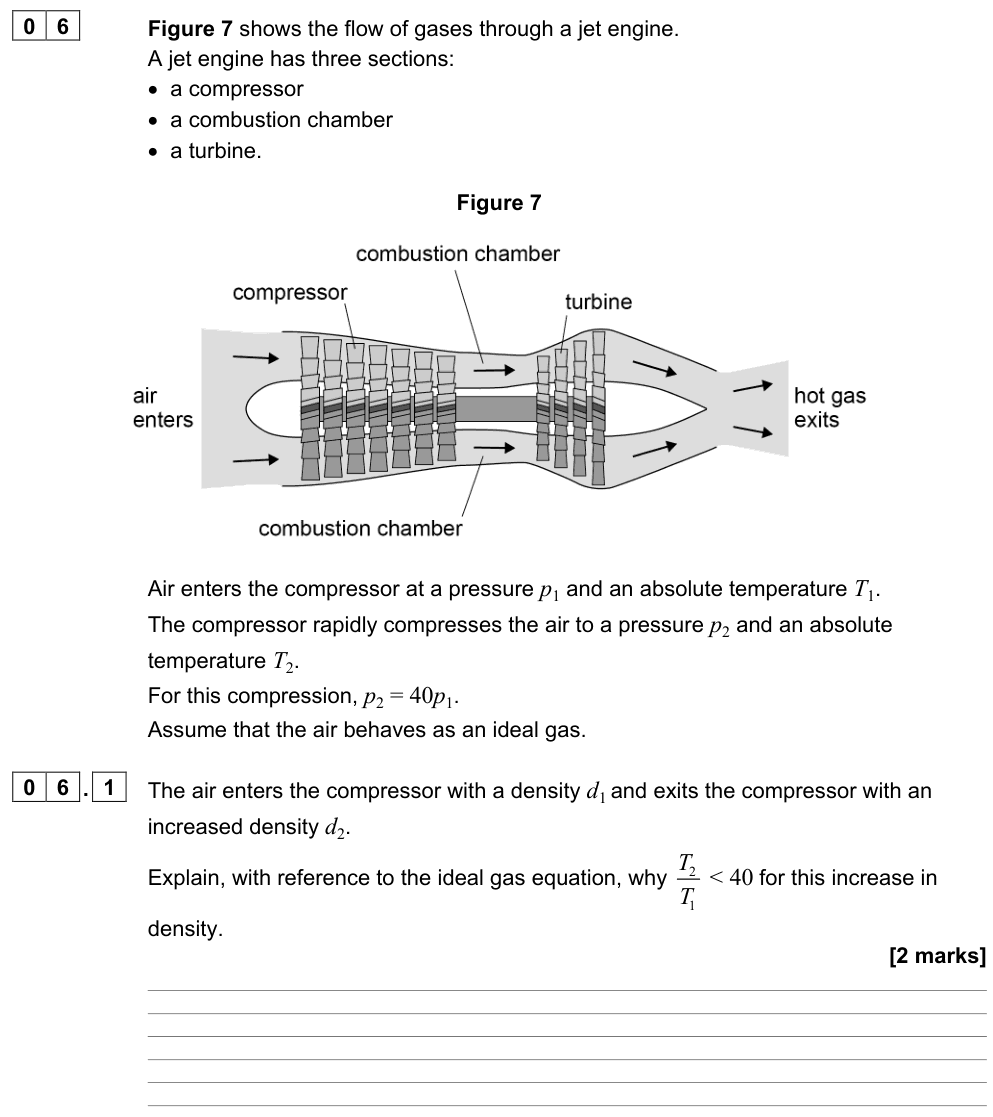
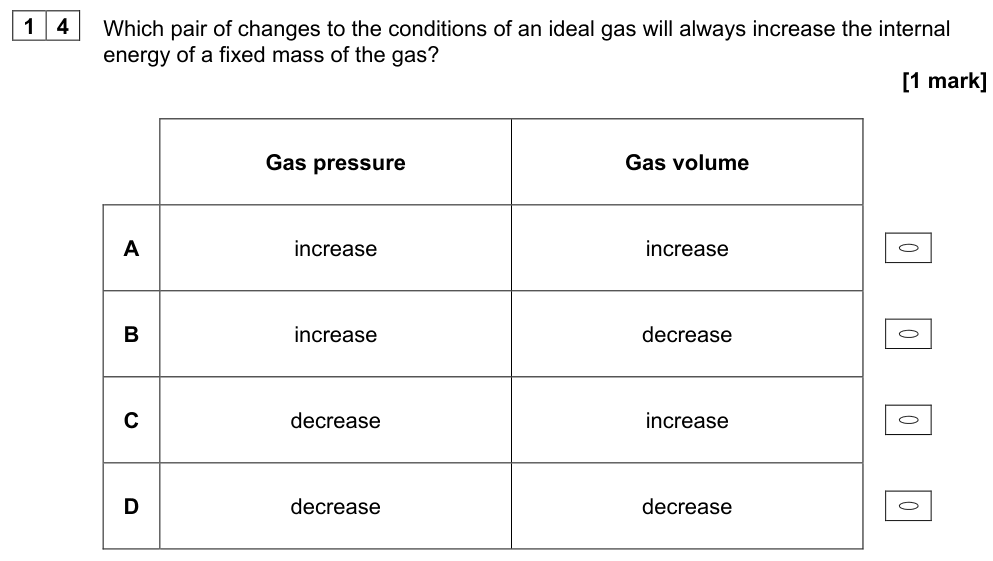
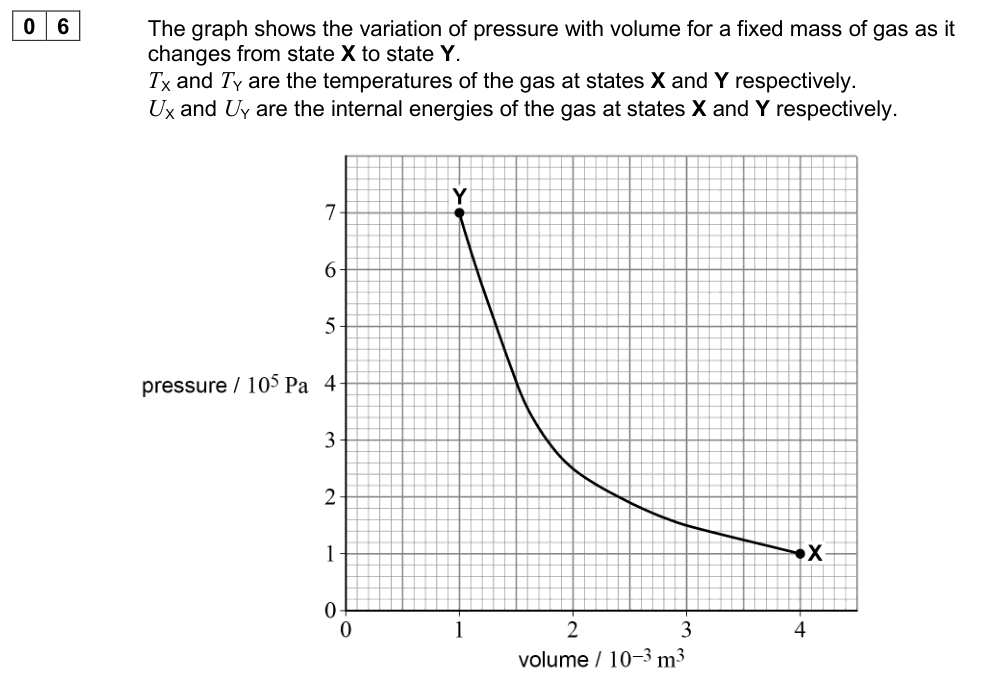
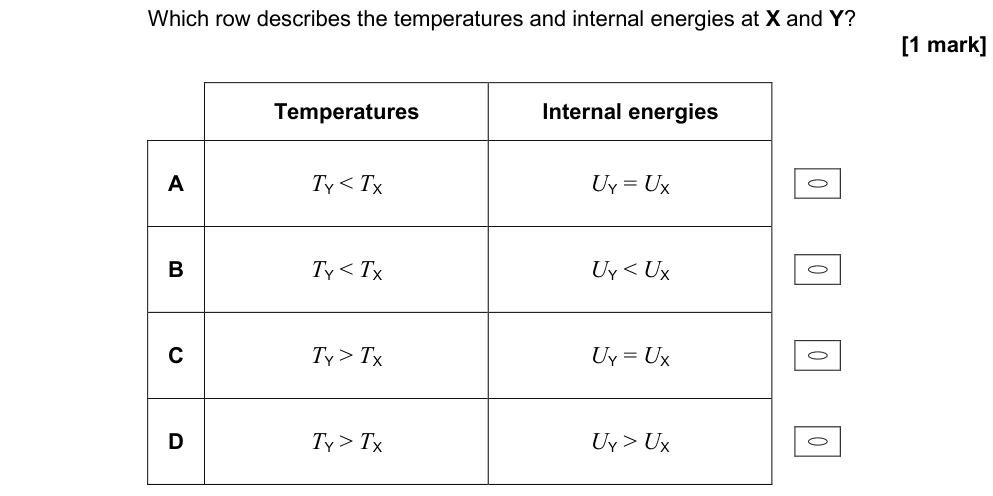
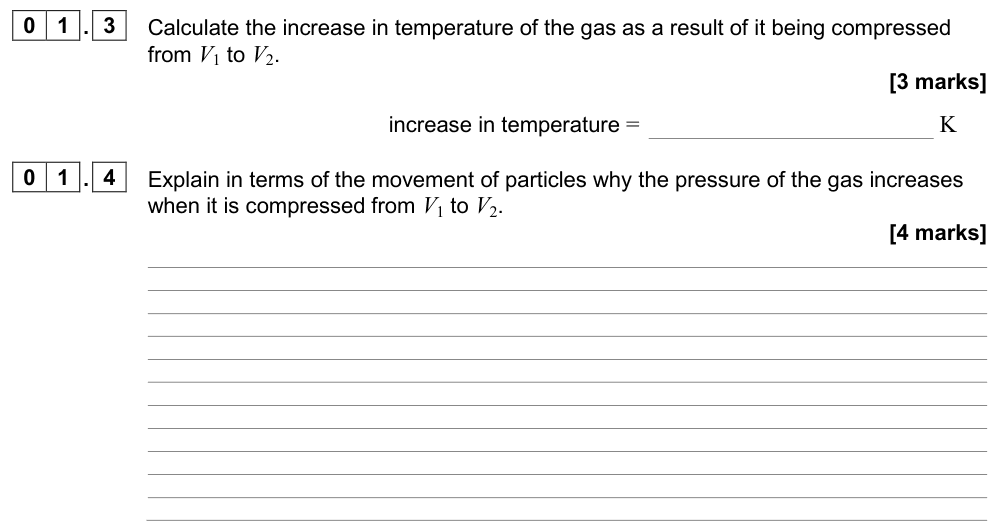
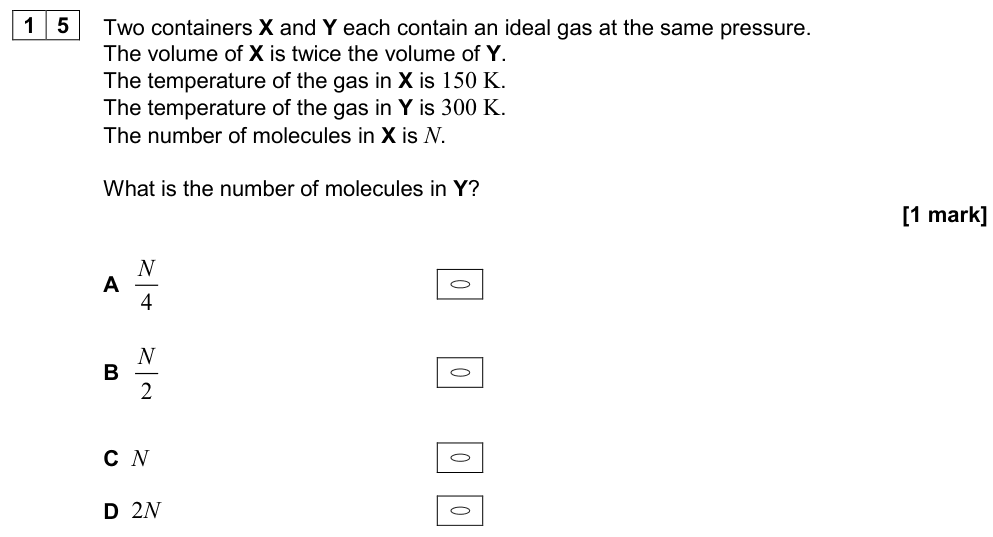
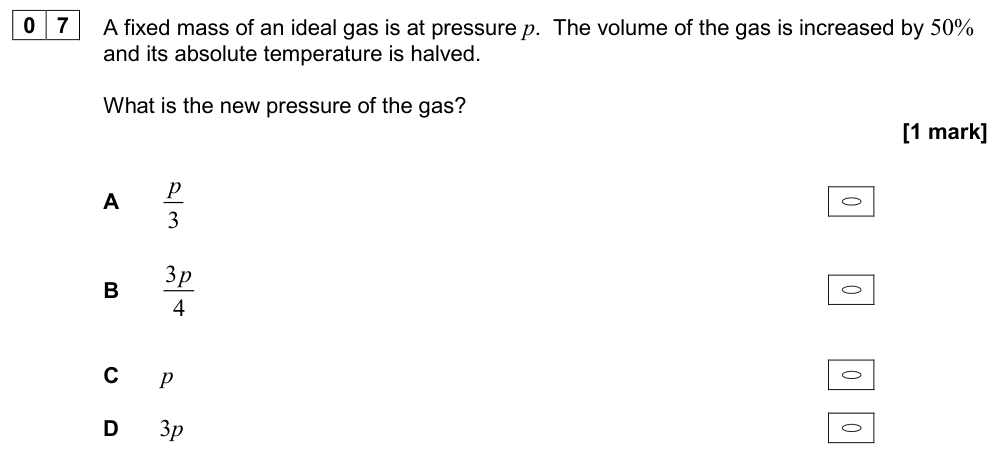
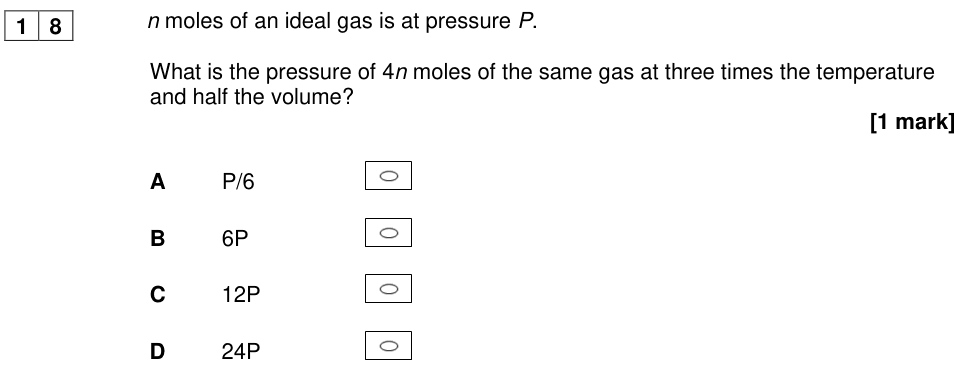
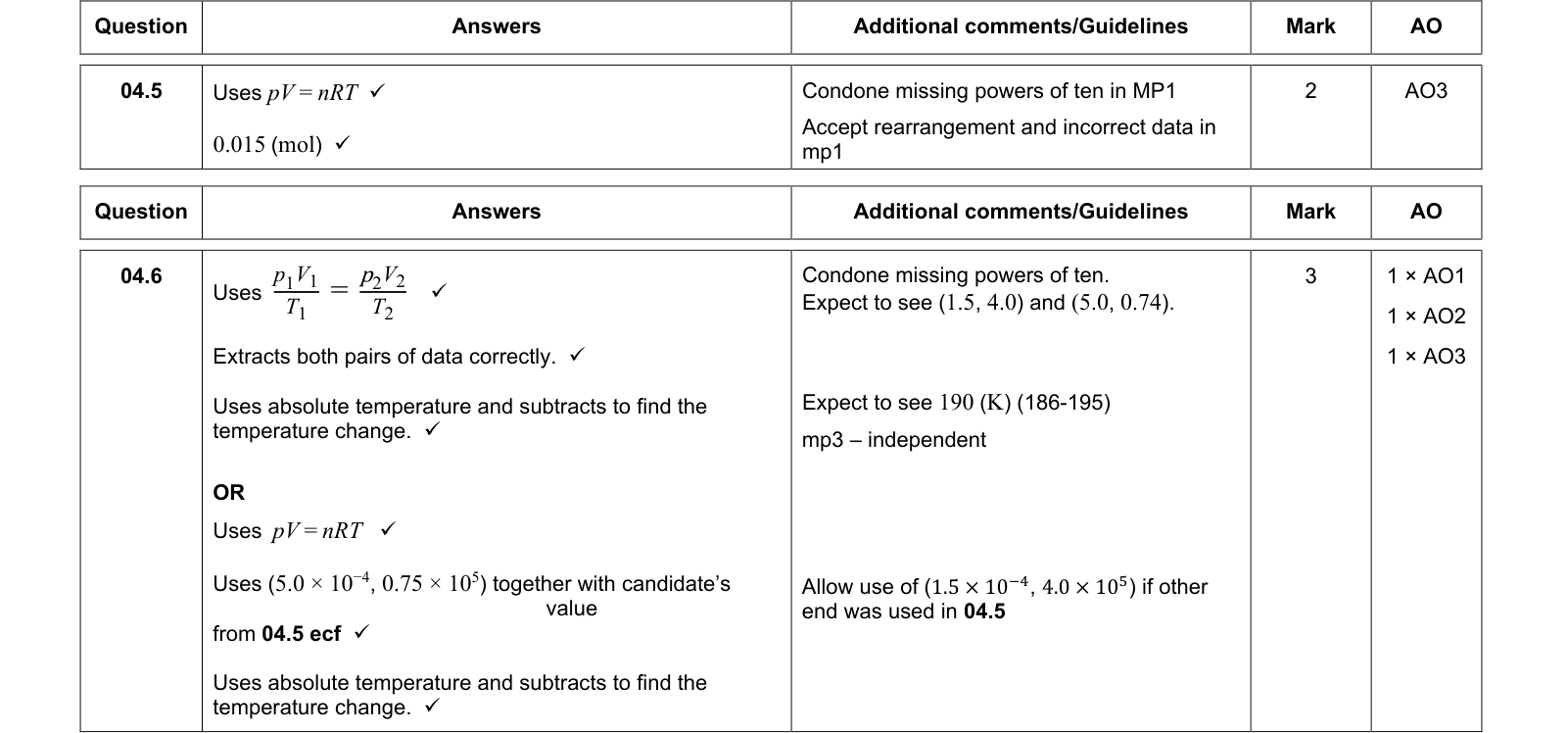
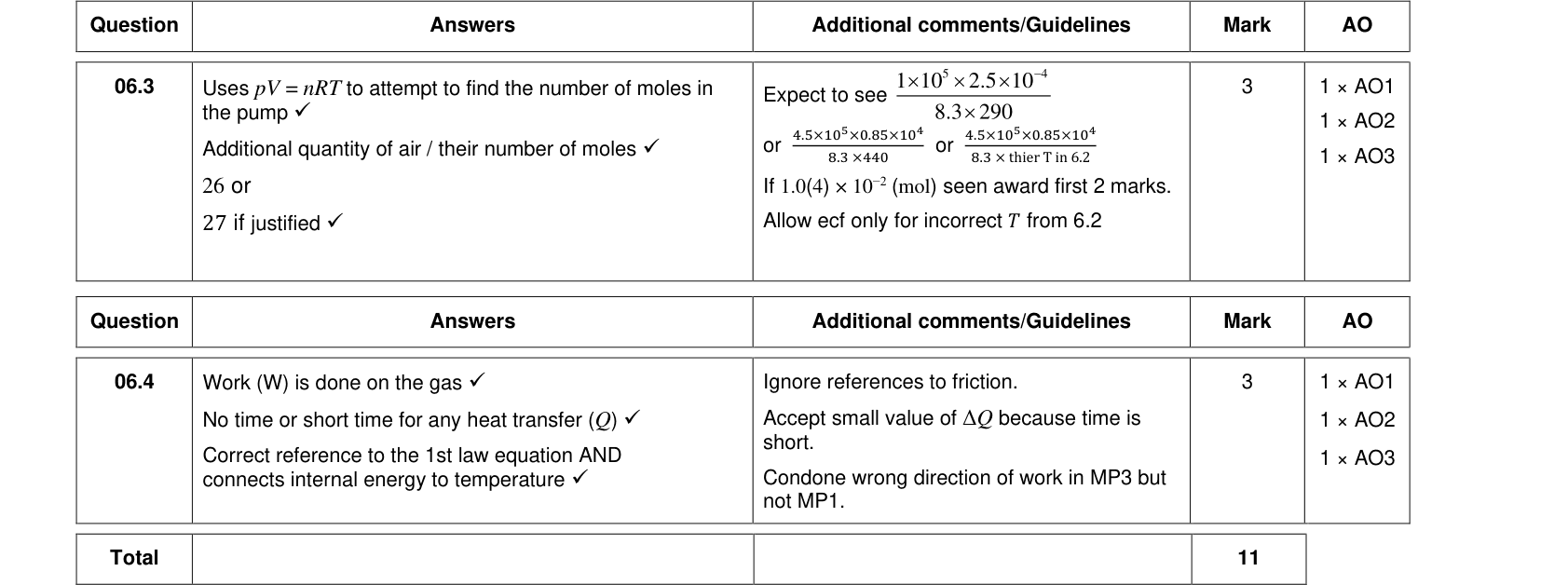
$$\frac{pV}{T} = \text{constant} \qquad\text{so}\qquad \frac{p_1V_1}{T_1} = \frac{p_2V_2}{T_2}$$
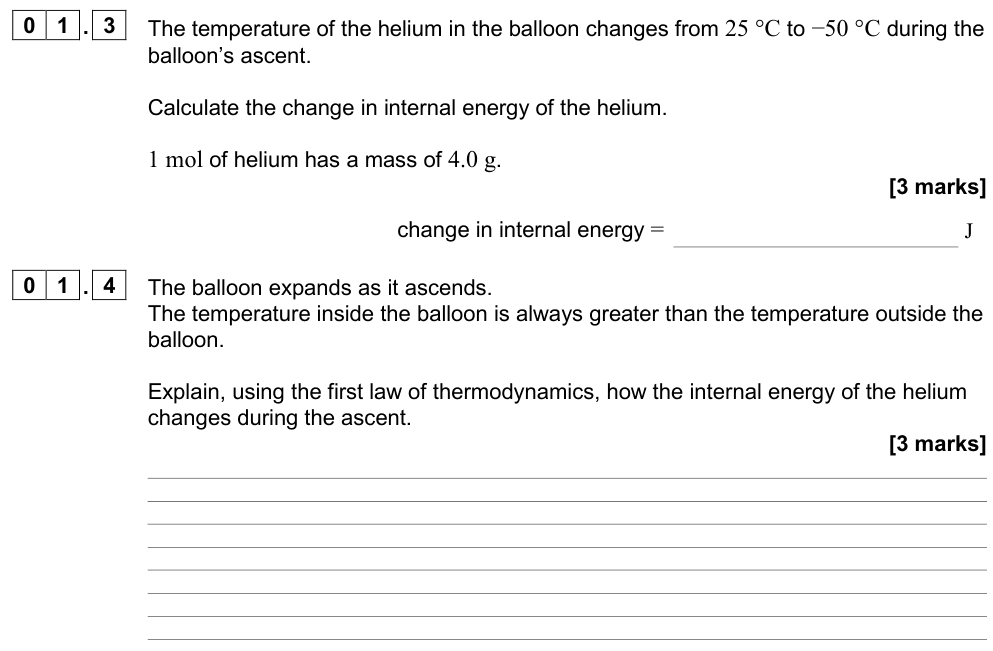
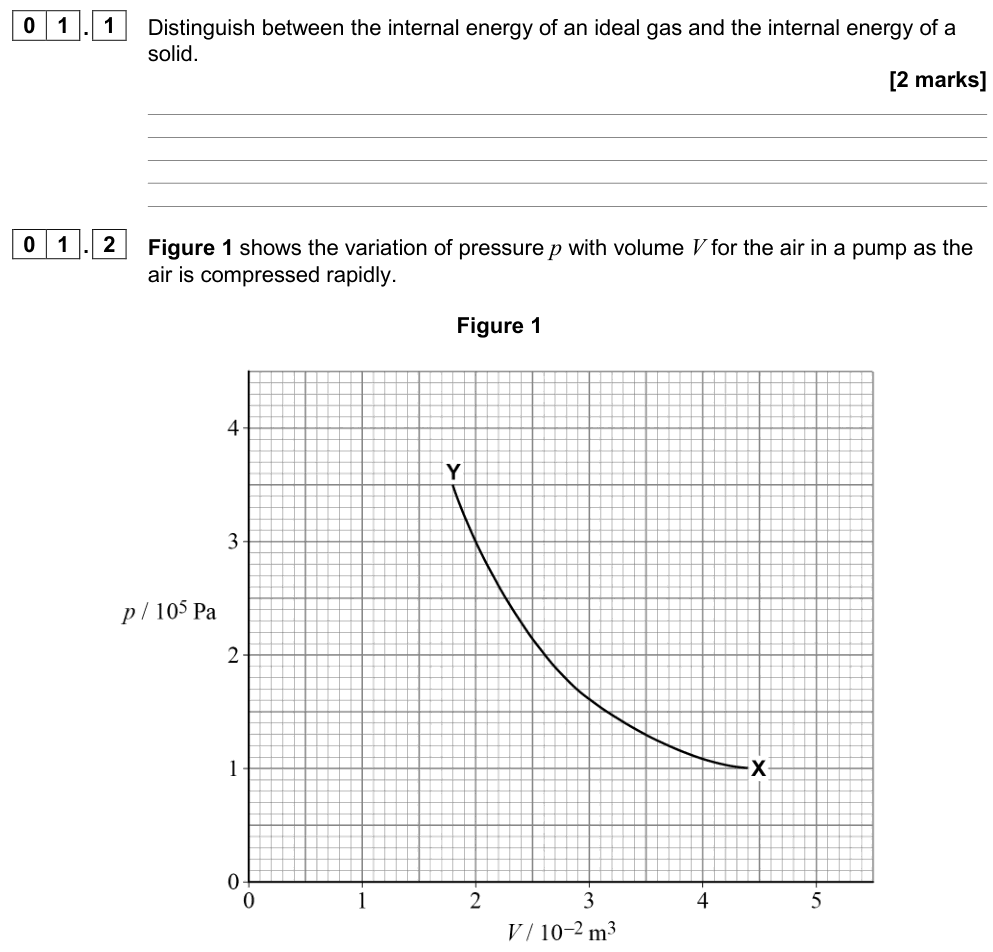
The constant is proportional to the amount of gas. An ideal gas is one that obeys this exactly at all pressures and temperatures. Real gases behave almost ideally at low pressures and at temperatures well above the point where they liquefy.
Moles and molecules
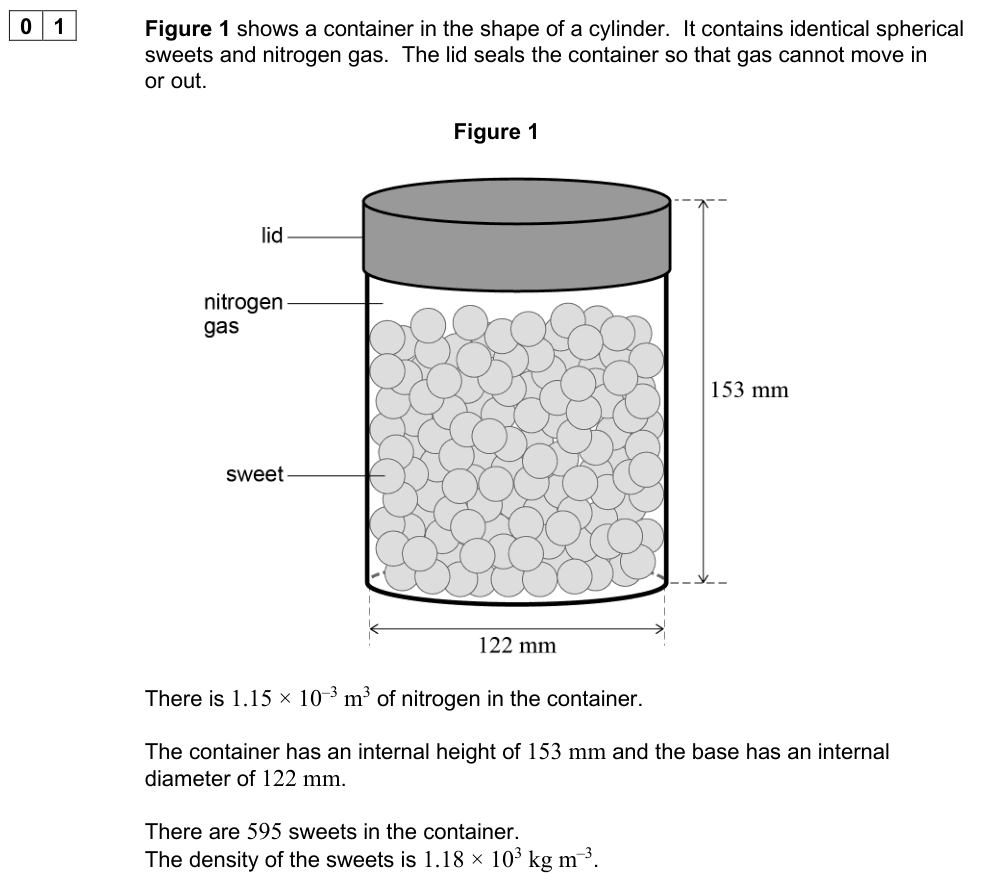
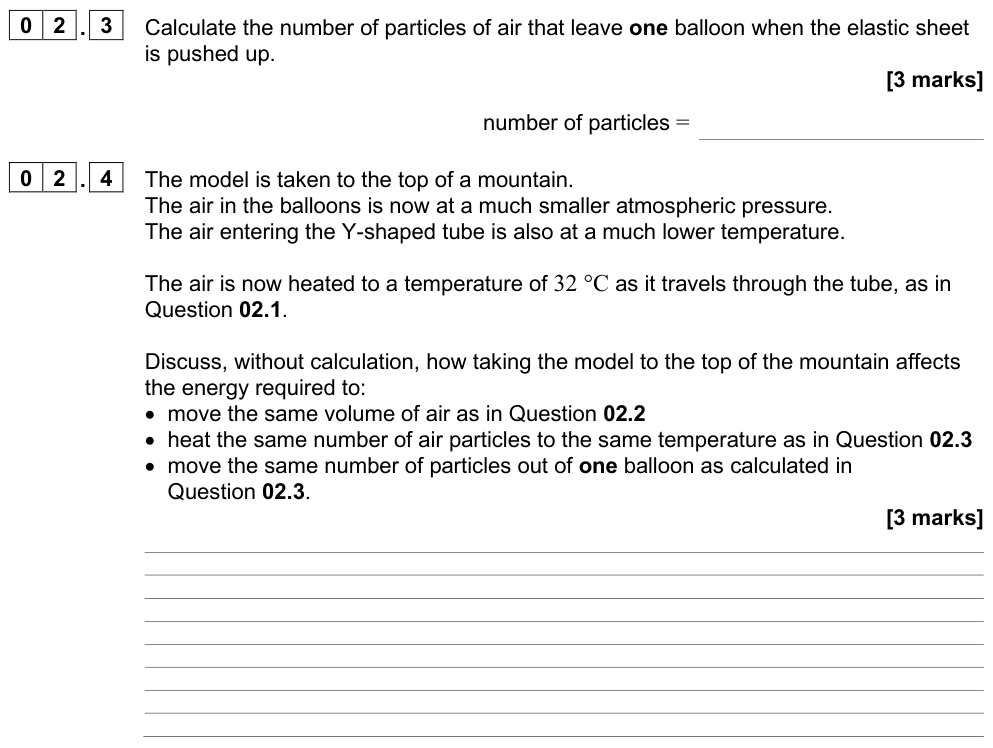
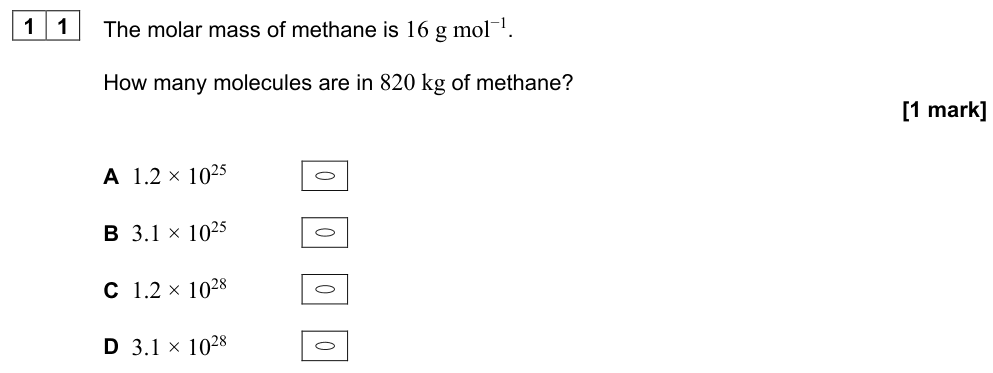
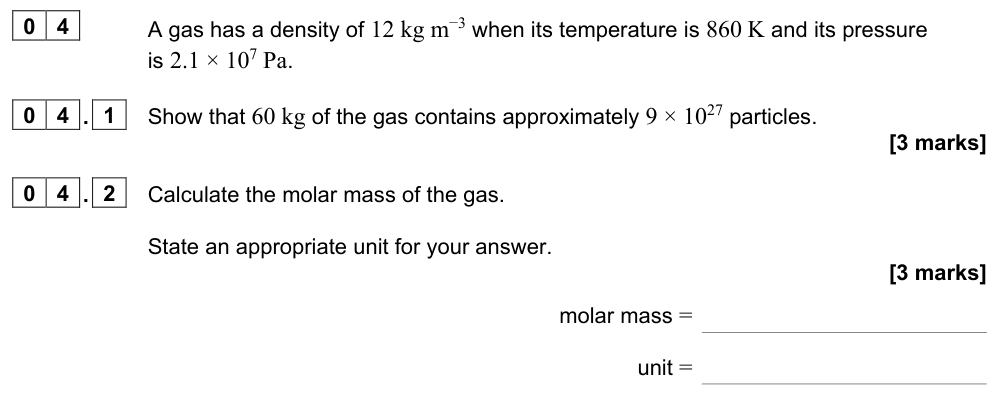
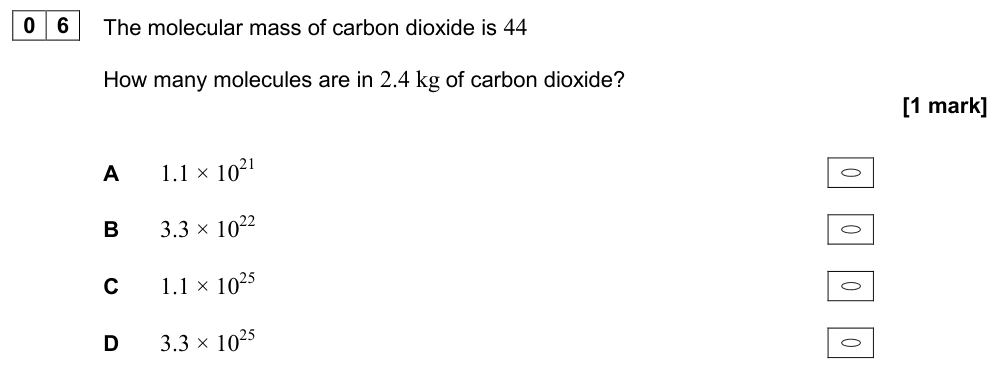
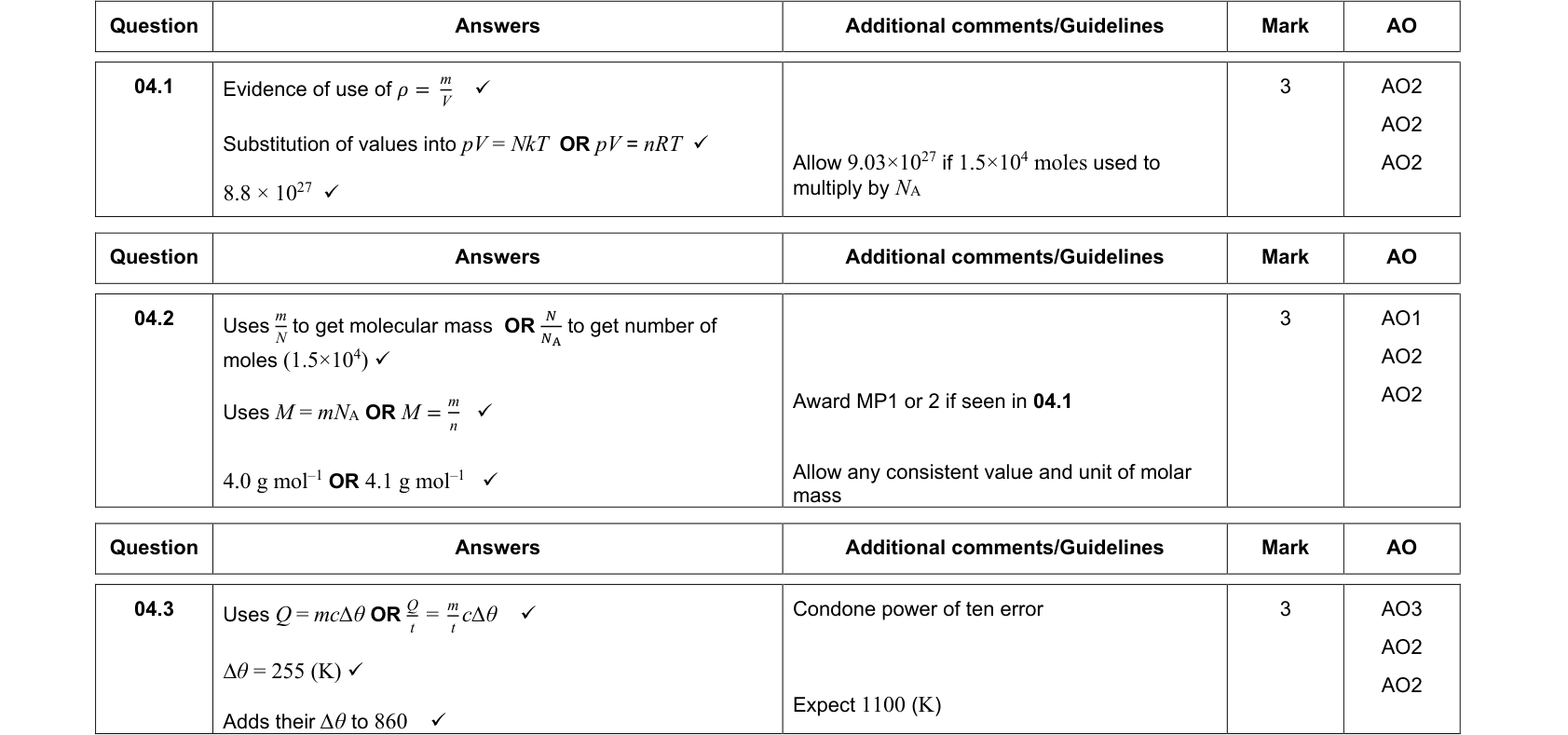
- The Avogadro constant $N_A = 6.02 \times 10^{23}$ mol⁻¹ is the number of particles in one mole of a substance.
- The molar mass $M$ is the mass of one mole (for example 0.032 kg mol⁻¹ for oxygen, O₂). The number of moles in a mass $m$ is $n = \dfrac{m}{M}$.
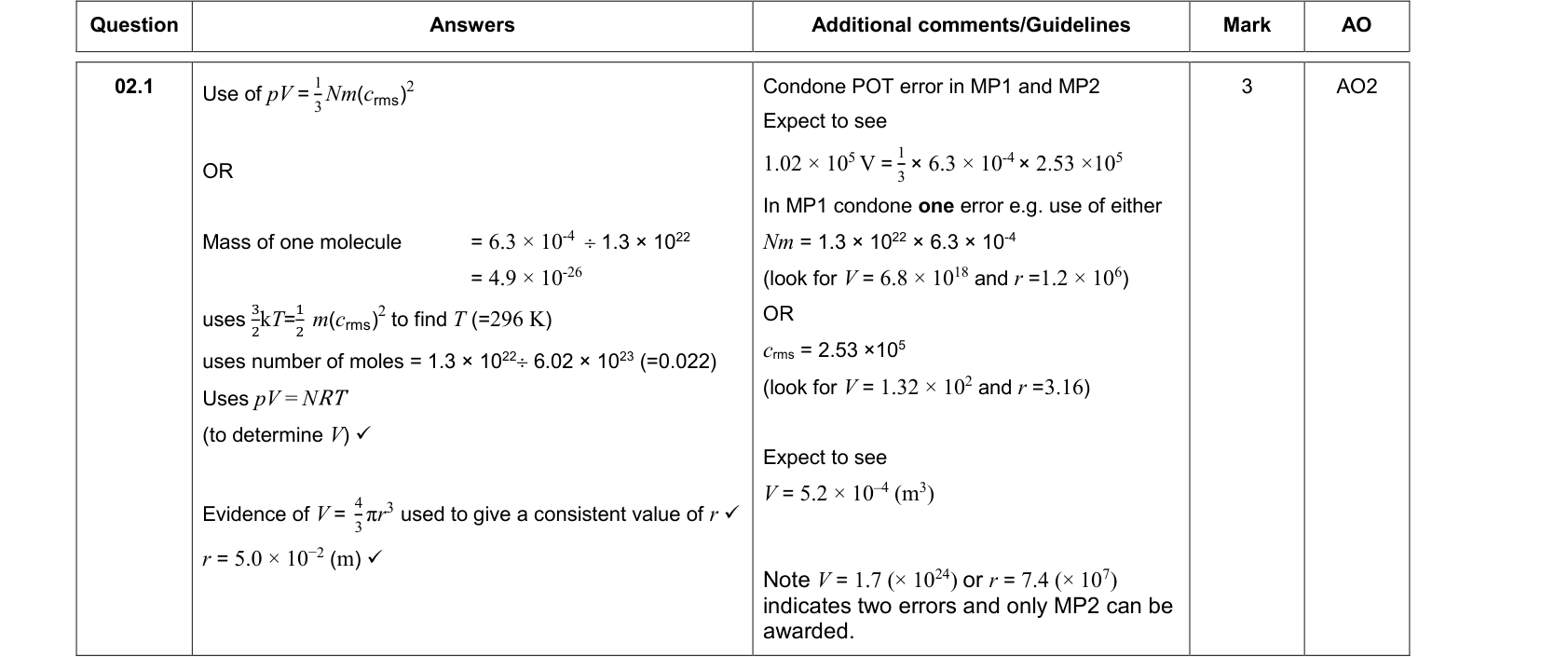
- The molecular mass (mass of one molecule) is $\dfrac{M}{N_A}$. For O₂: $\dfrac{0.032}{6.02 \times 10^{23}} = 5.3 \times 10^{-26}$ kg.
- The number of molecules is $N = nN_A$.
Ideal gas equation
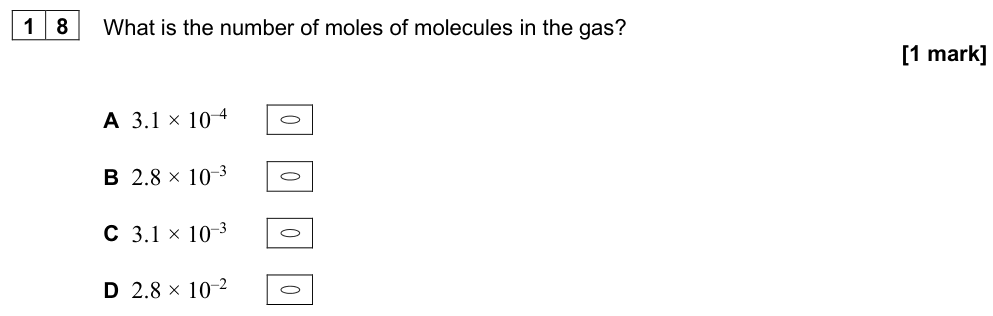
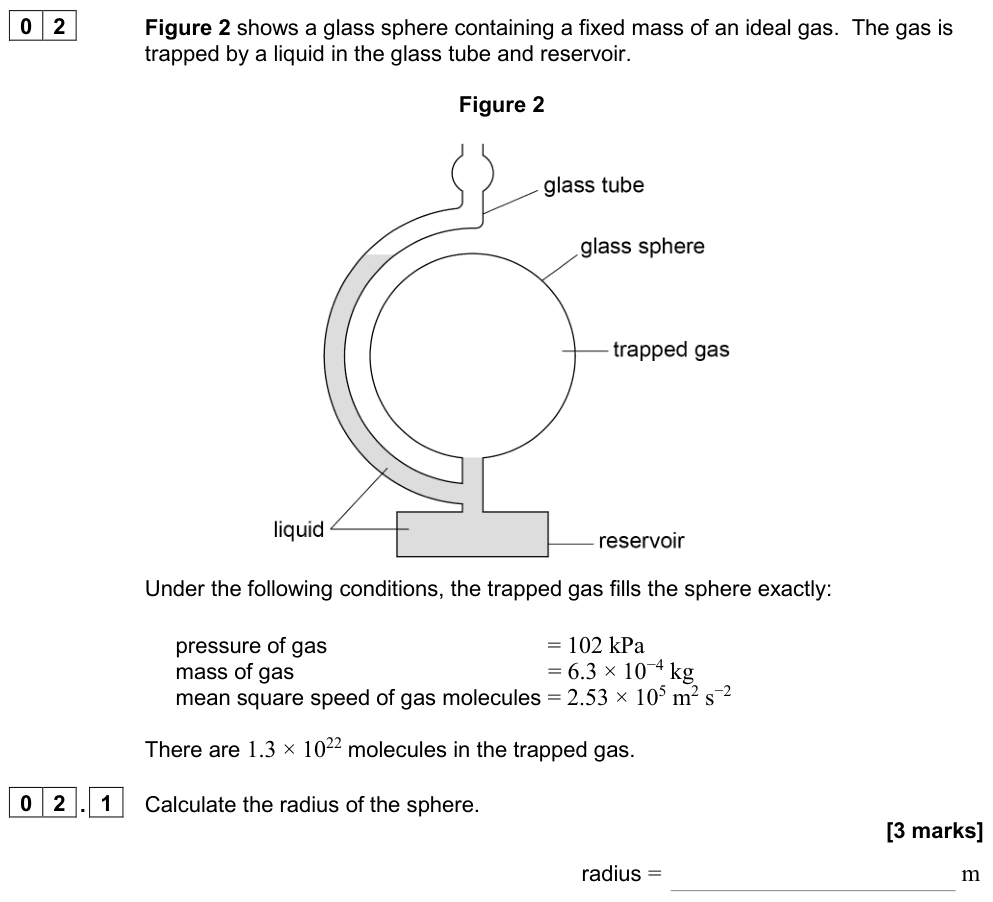
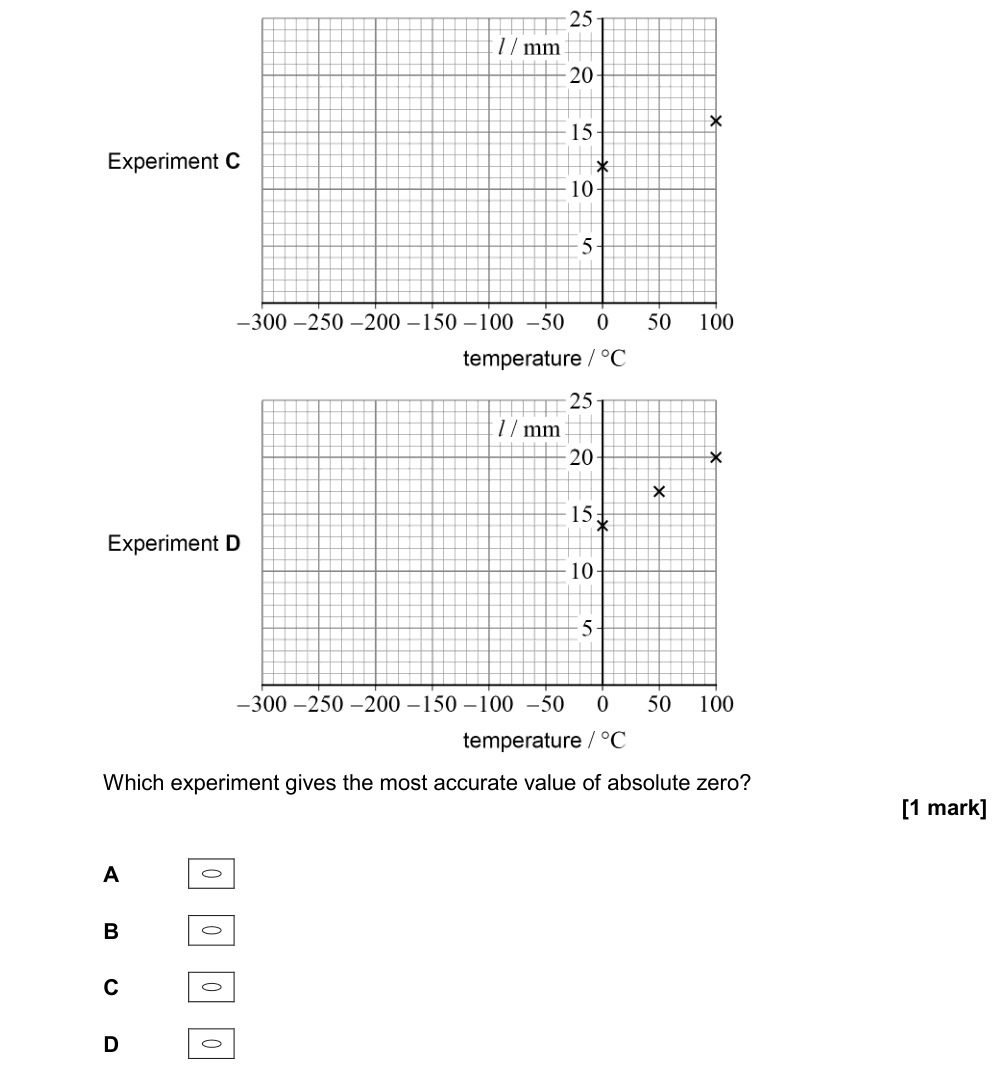
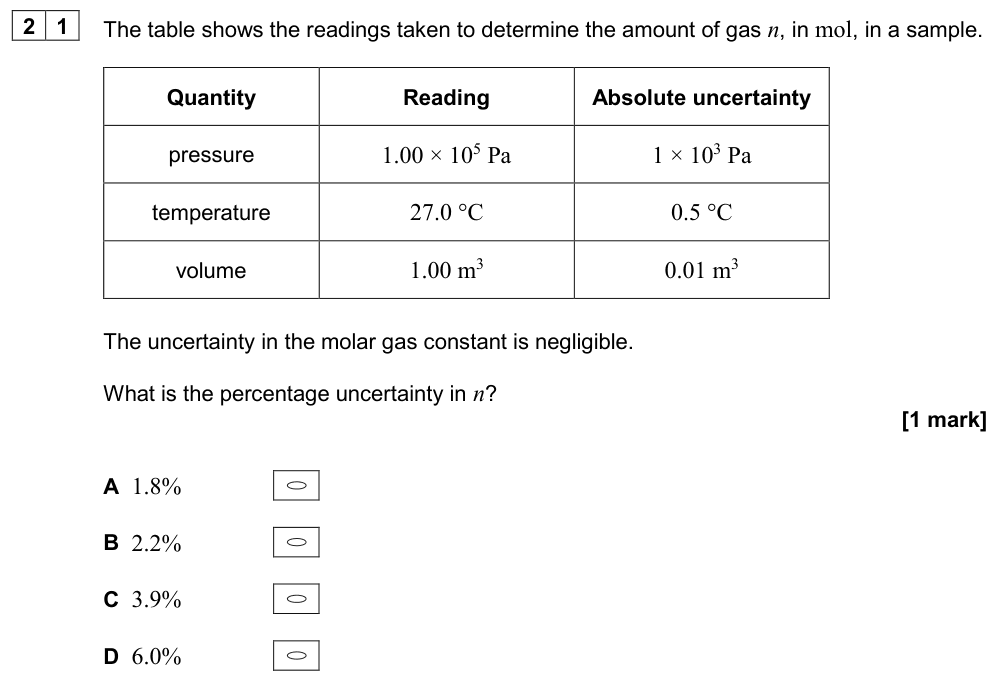
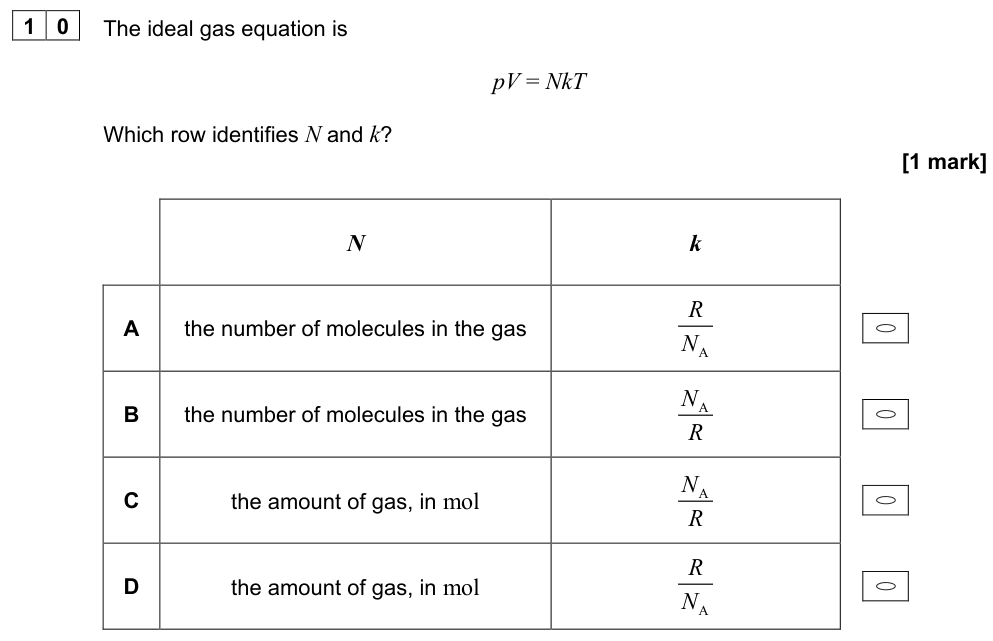
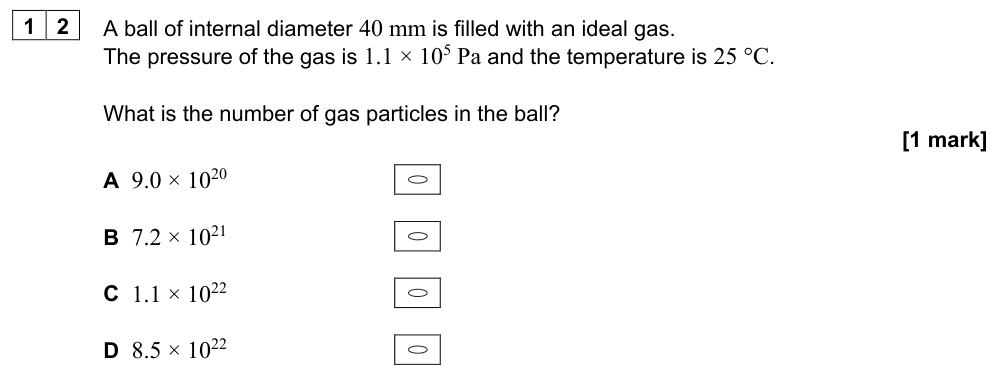
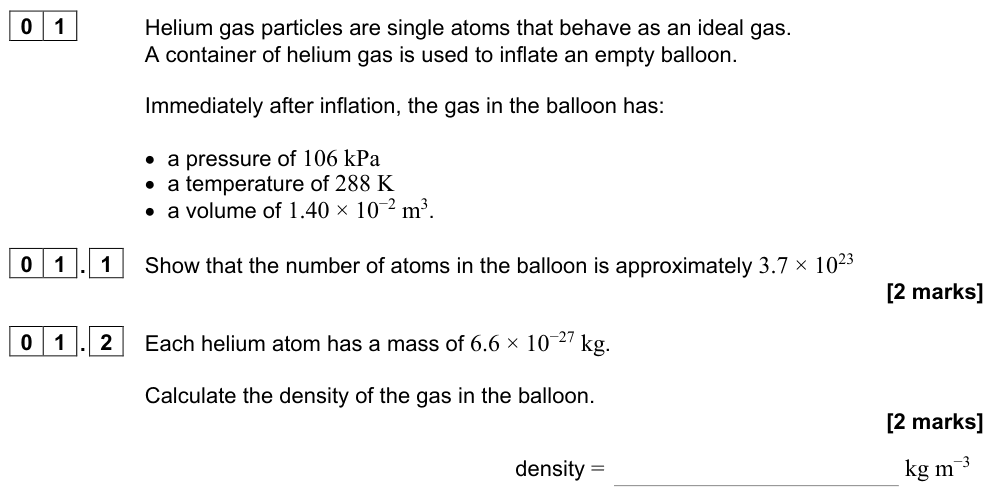
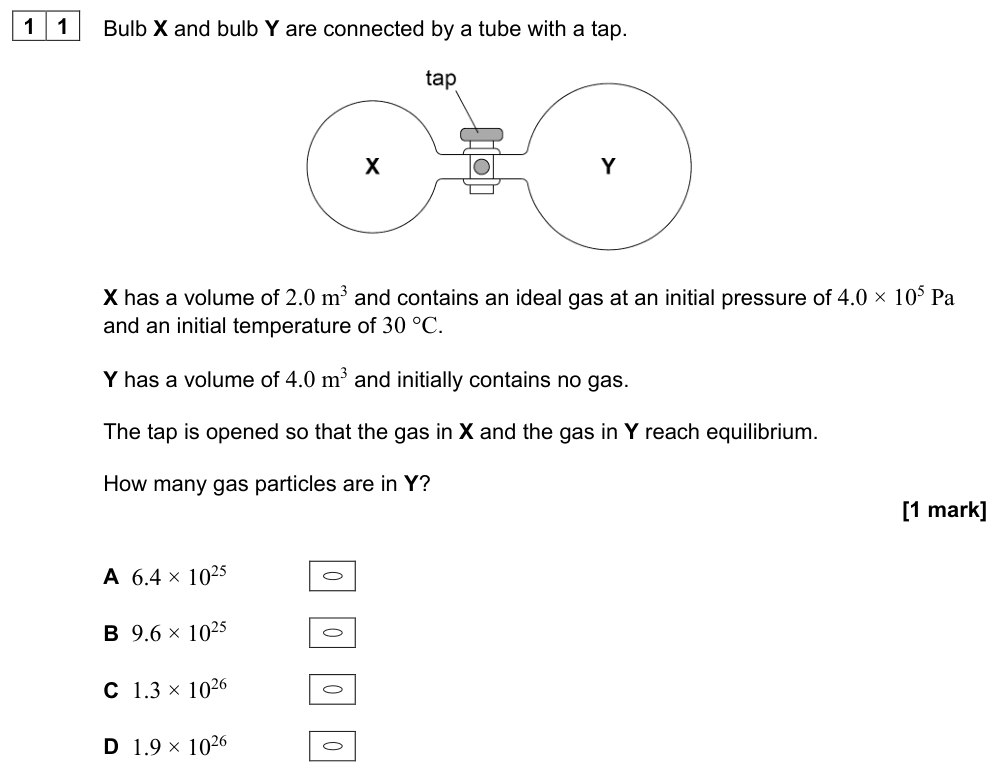
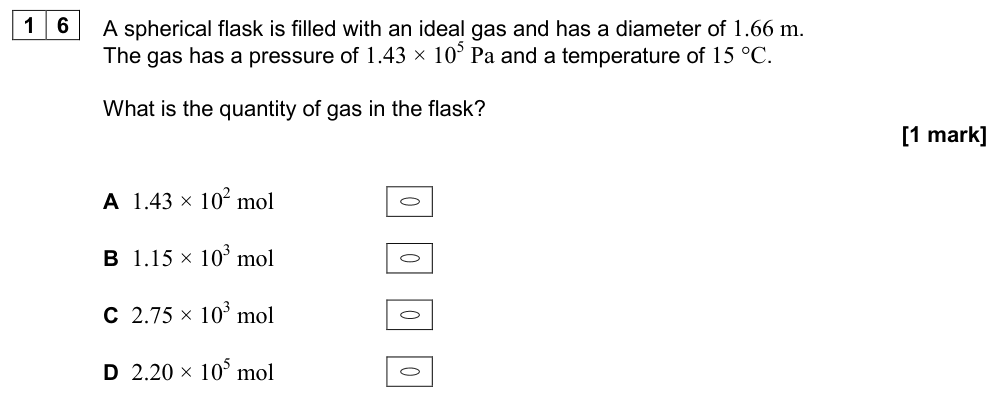
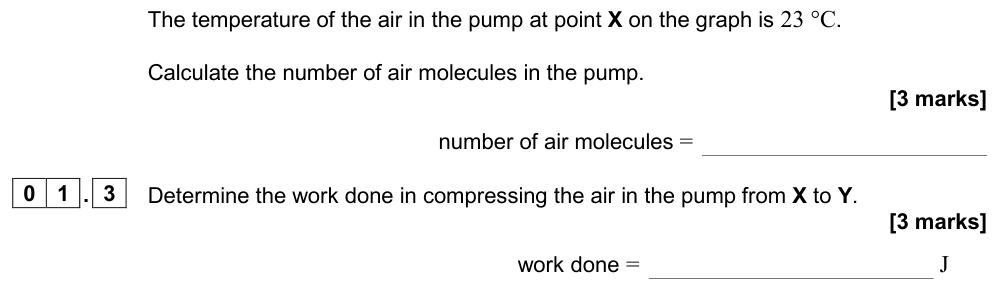
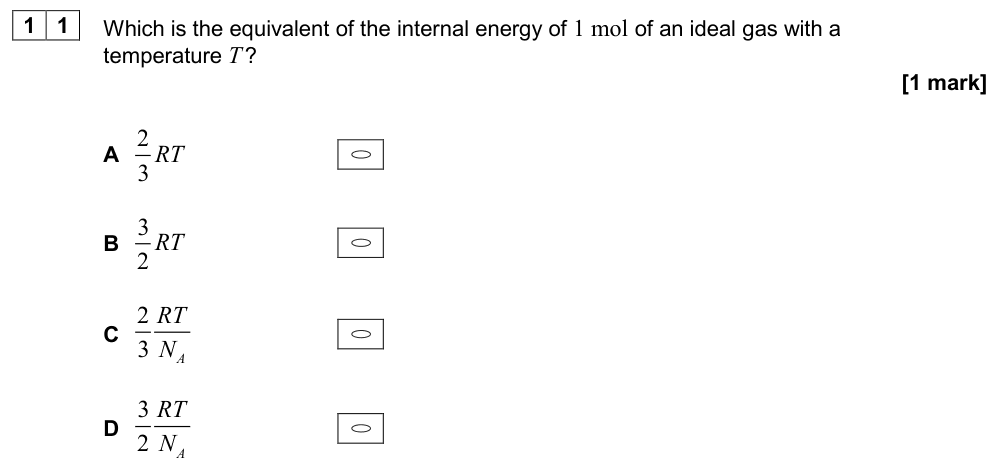
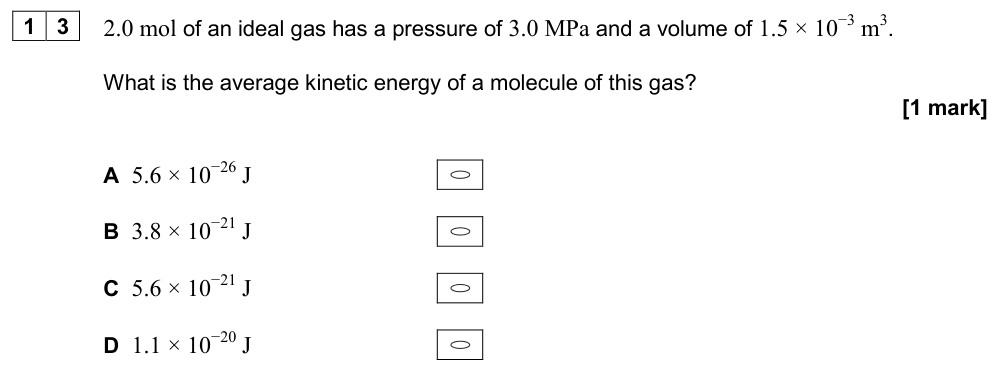
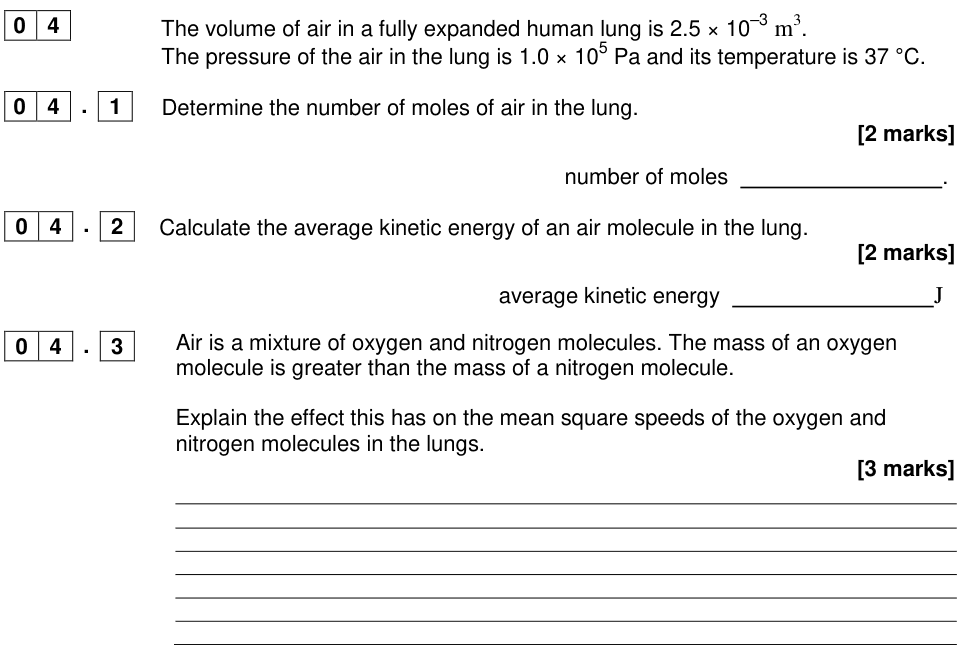
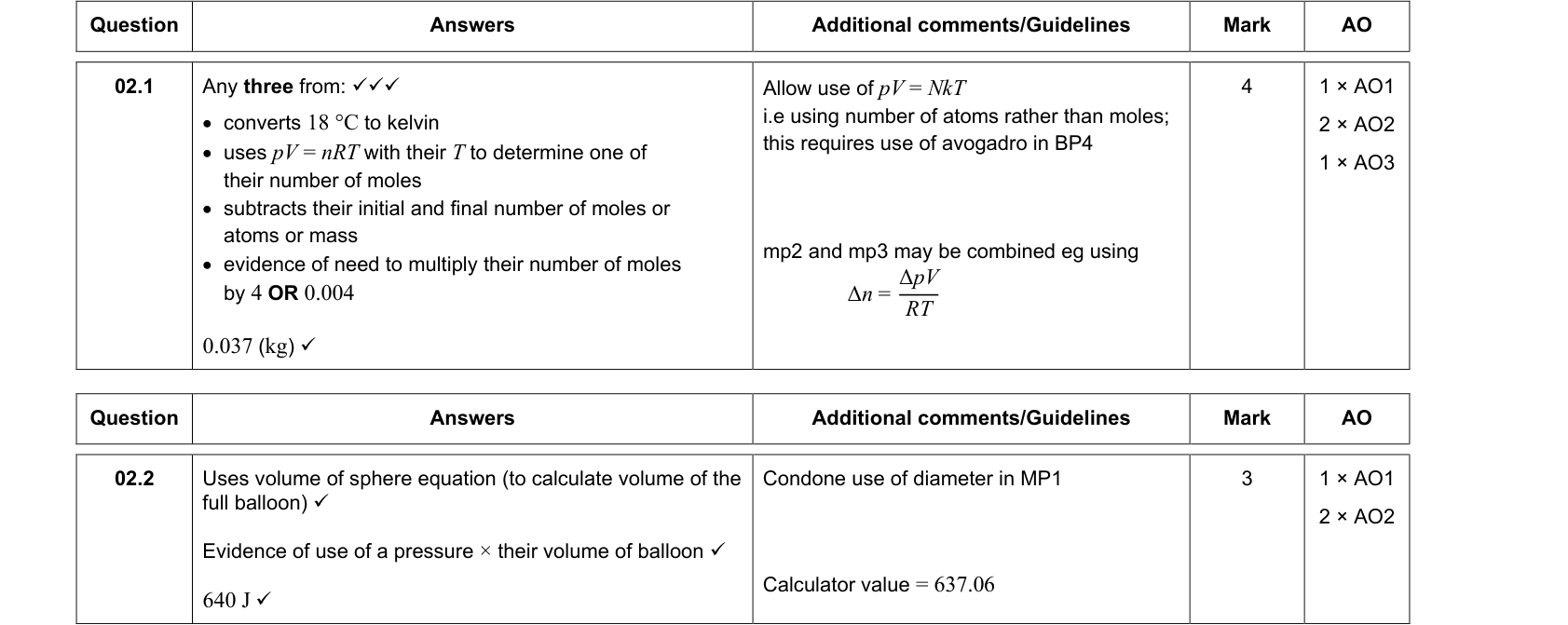
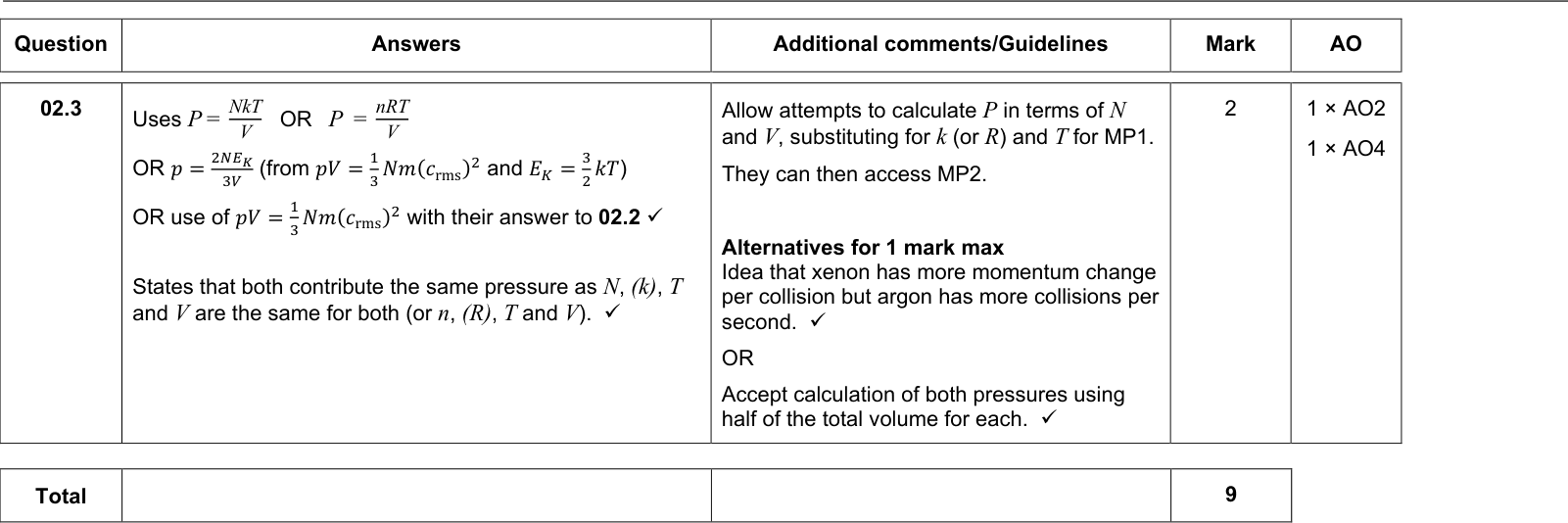
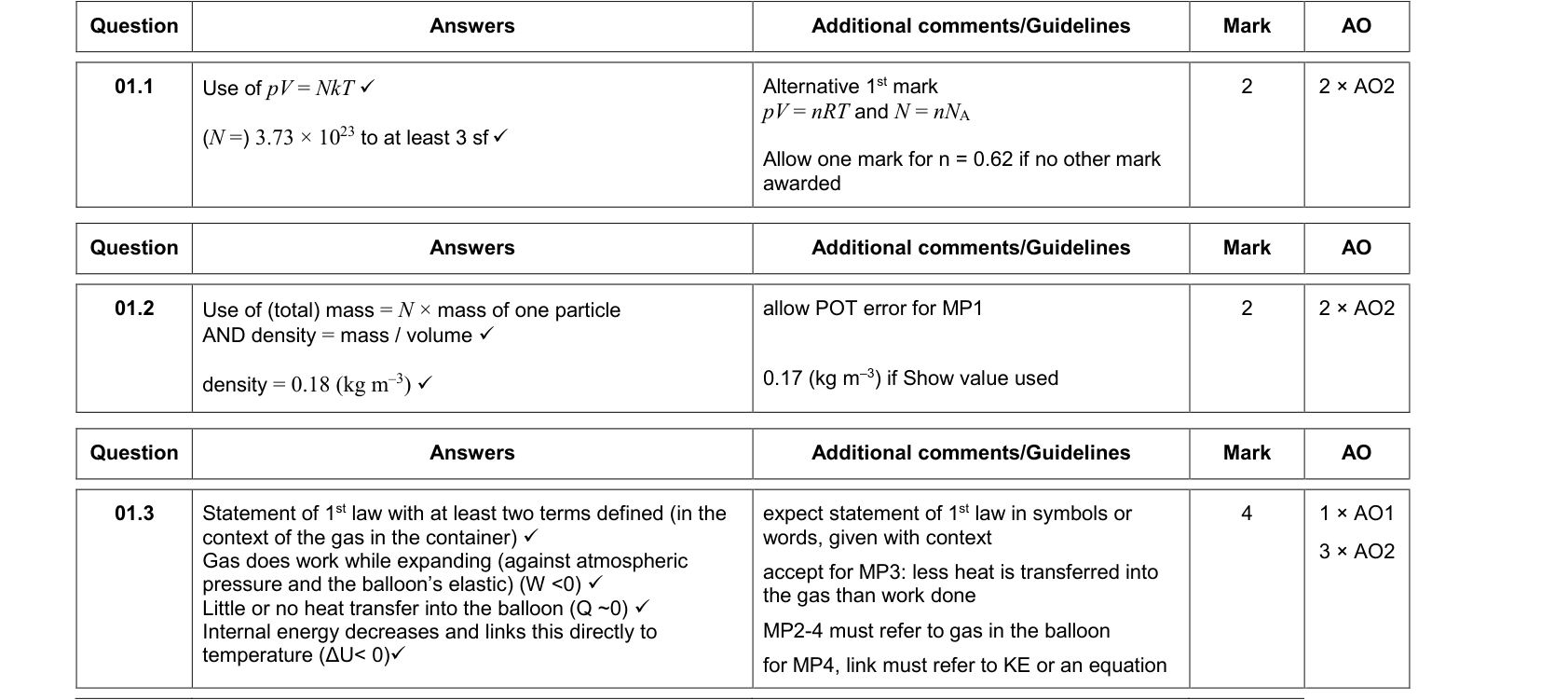
$$pV = nRT \qquad\text{or}\qquad pV = NkT$$
- $n$ = number of moles; $R = 8.31$ J mol⁻¹ K⁻¹ (the molar gas constant)
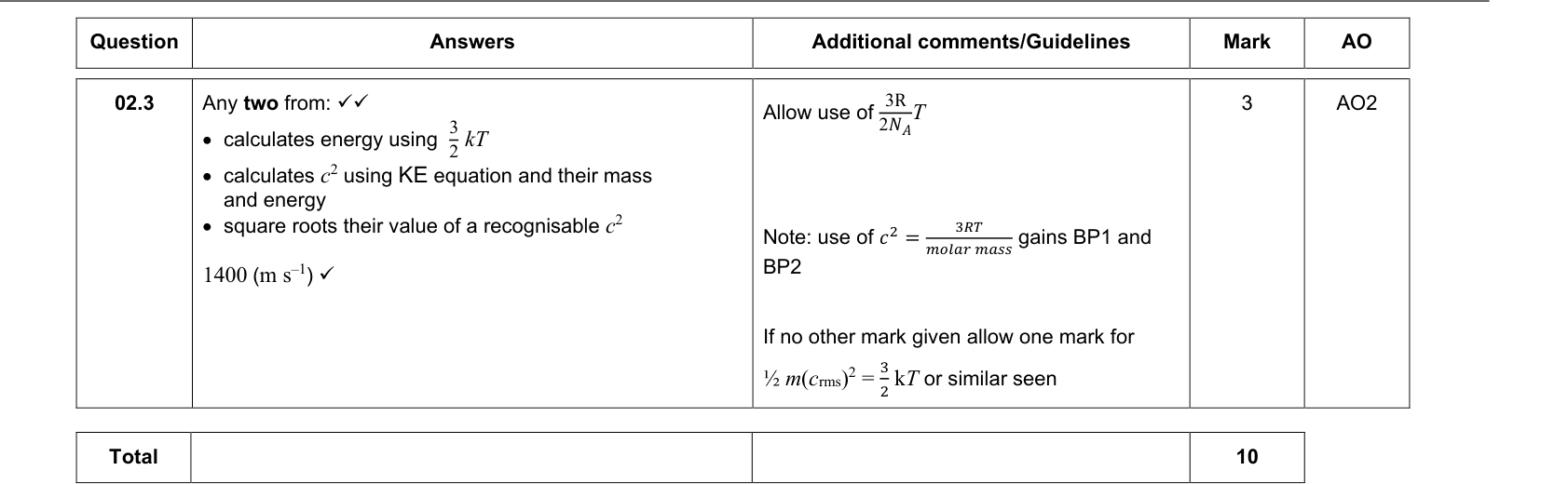
- $N$ = number of molecules; $k = \dfrac{R}{N_A} = 1.38 \times 10^{-23}$ J K⁻¹ (the Boltzmann constant)
- $p$ in Pa, $V$ in m³, $T$ in K
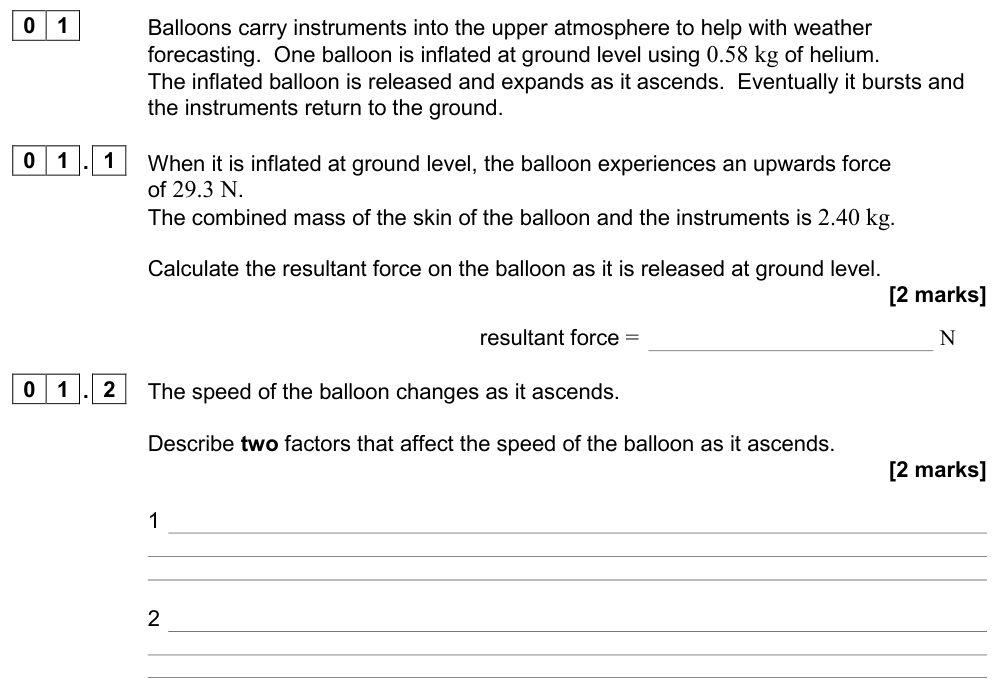
Worked example: a helium balloon
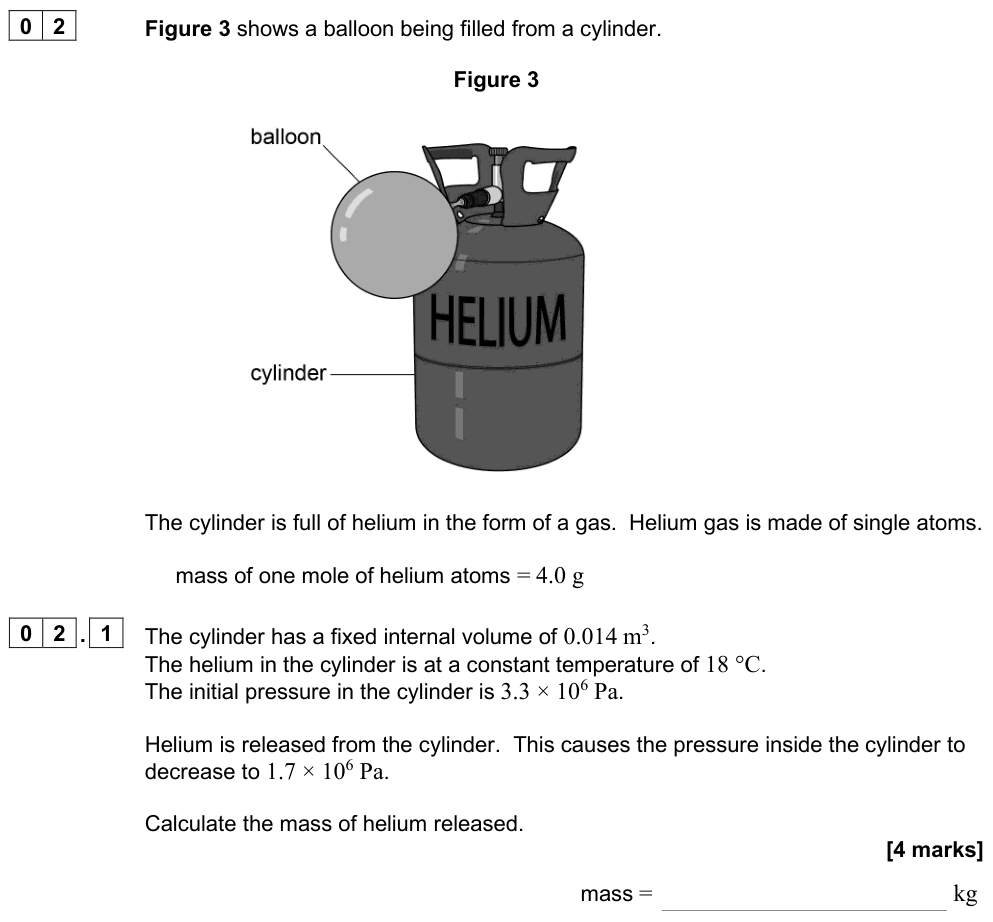
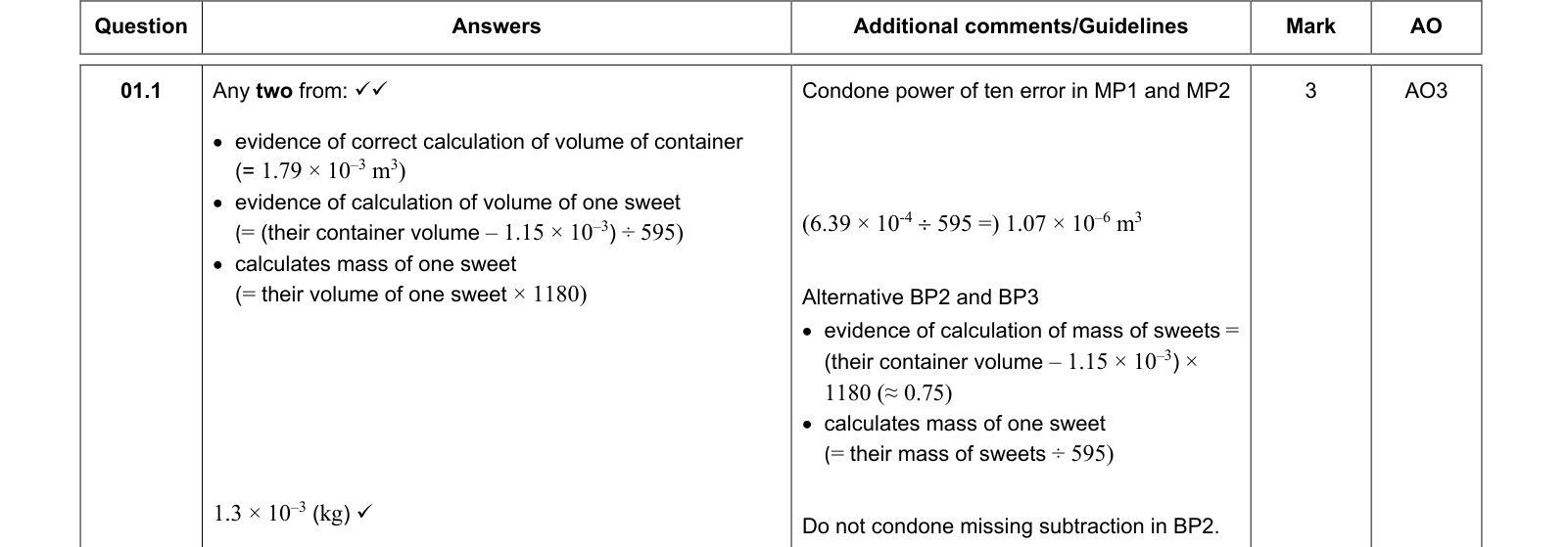
2.0 g of helium (molar mass 4.0 g mol⁻¹) is held in a 5.0 litre container at 300 K. Find the pressure.
$n = 2.0/4.0 = 0.50$ mol; $V = 5.0 \times 10^{-3}\ \text{m}^3$.
$p = \dfrac{nRT}{V} = \dfrac{0.50 \times 8.31 \times 300}{5.0 \times 10^{-3}} = 2.5 \times 10^{5}$ Pa.
Worked example: molecules in a room
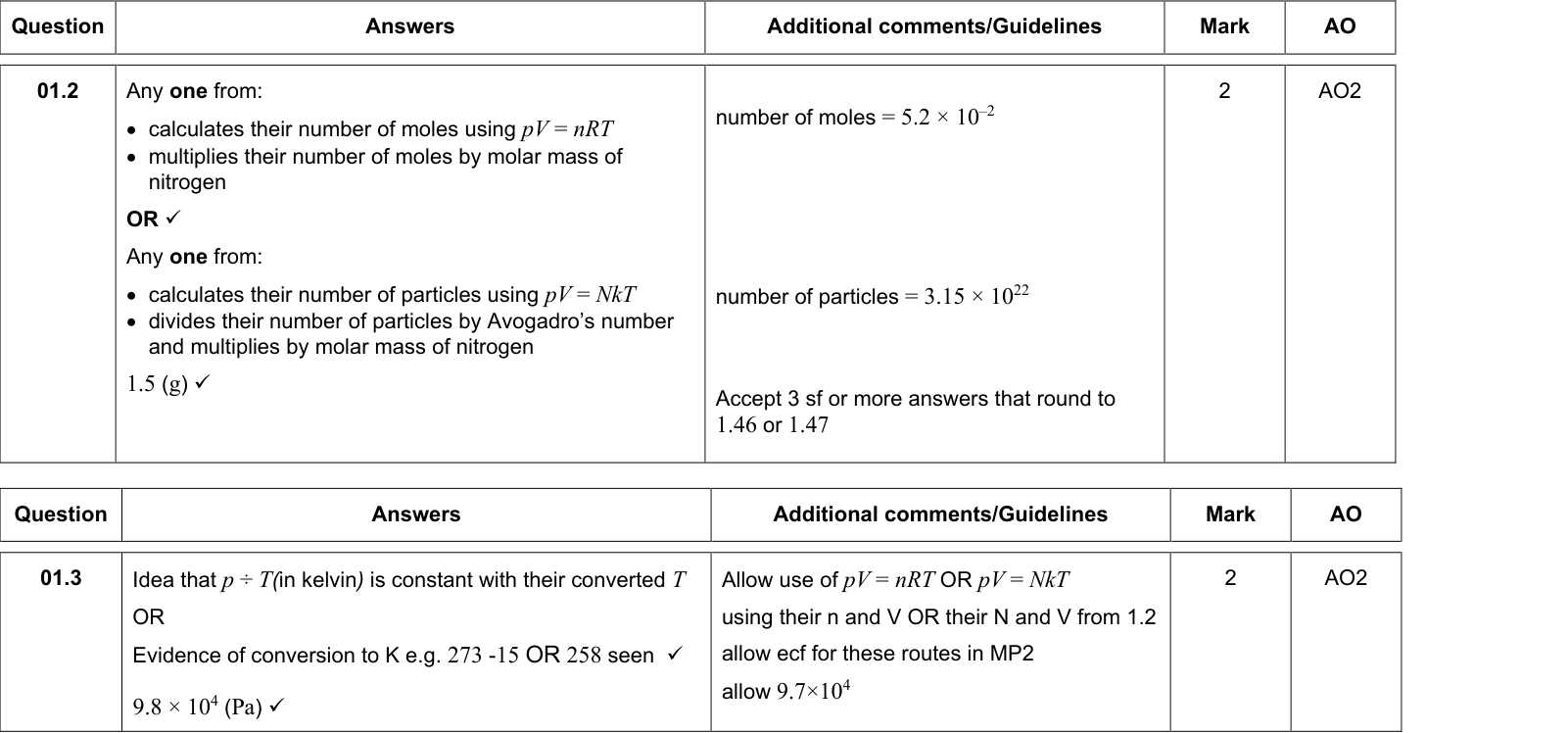
How many air molecules are there in 1.0 m³ of air at $1.0 \times 10^{5}$ Pa and 17 °C?
$N = \dfrac{pV}{kT} = \dfrac{1.0 \times 10^{5} \times 1.0}{1.38 \times 10^{-23} \times 290} = 2.5 \times 10^{25}$.
Worked example: a car tyre
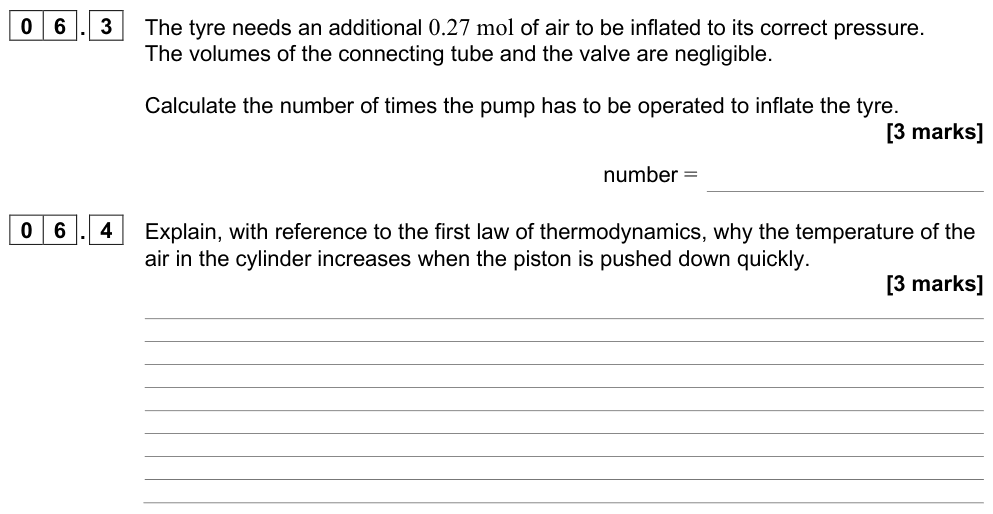
A tyre contains air at $2.2 \times 10^{5}$ Pa at 15 °C. After a drive the air is at 40 °C. Assuming the volume is constant, find the new pressure.
$p_2 = p_1 \times \dfrac{T_2}{T_1} = 2.2 \times 10^{5} \times \dfrac{313}{288} = 2.4 \times 10^{5}$ Pa.
Exam tip: units
1 litre = 1000 cm³ = $10^{-3}$ m³ and 1 cm³ = $10^{-6}$ m³. Molar masses are usually given in g mol⁻¹: convert to kg mol⁻¹ before finding the mass of one molecule in kg.
Work done by a gas
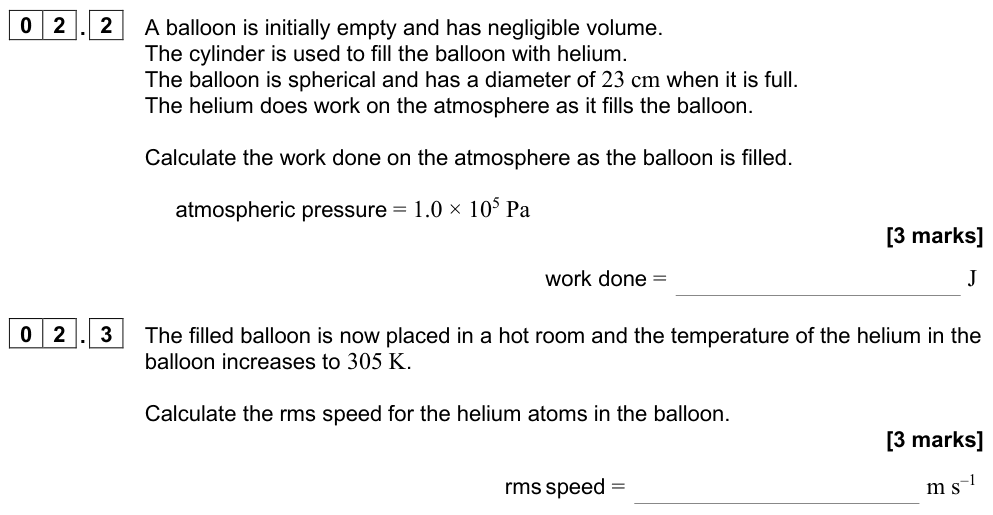
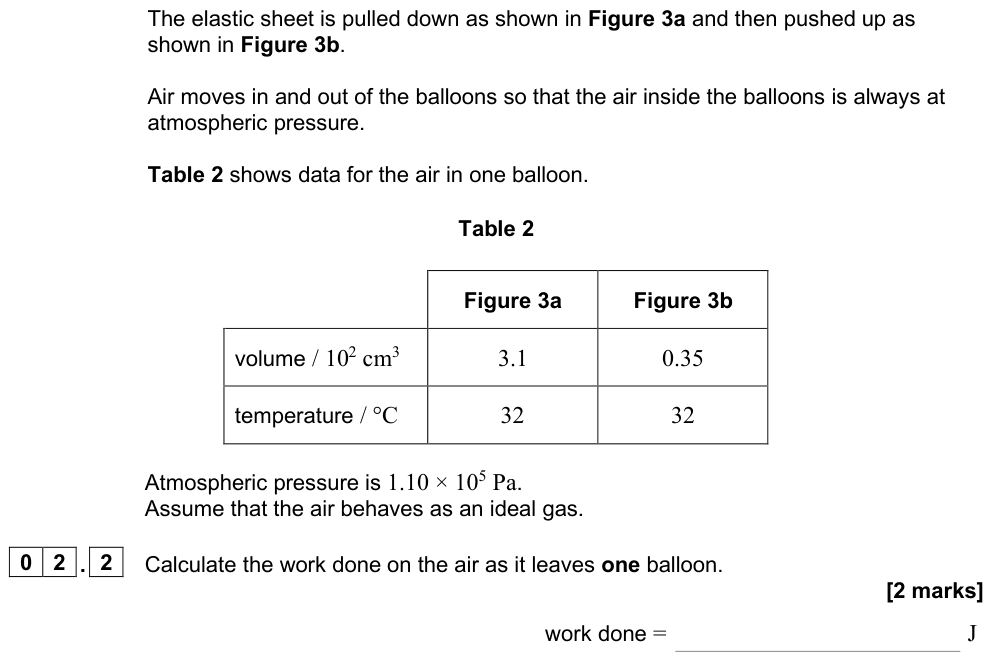
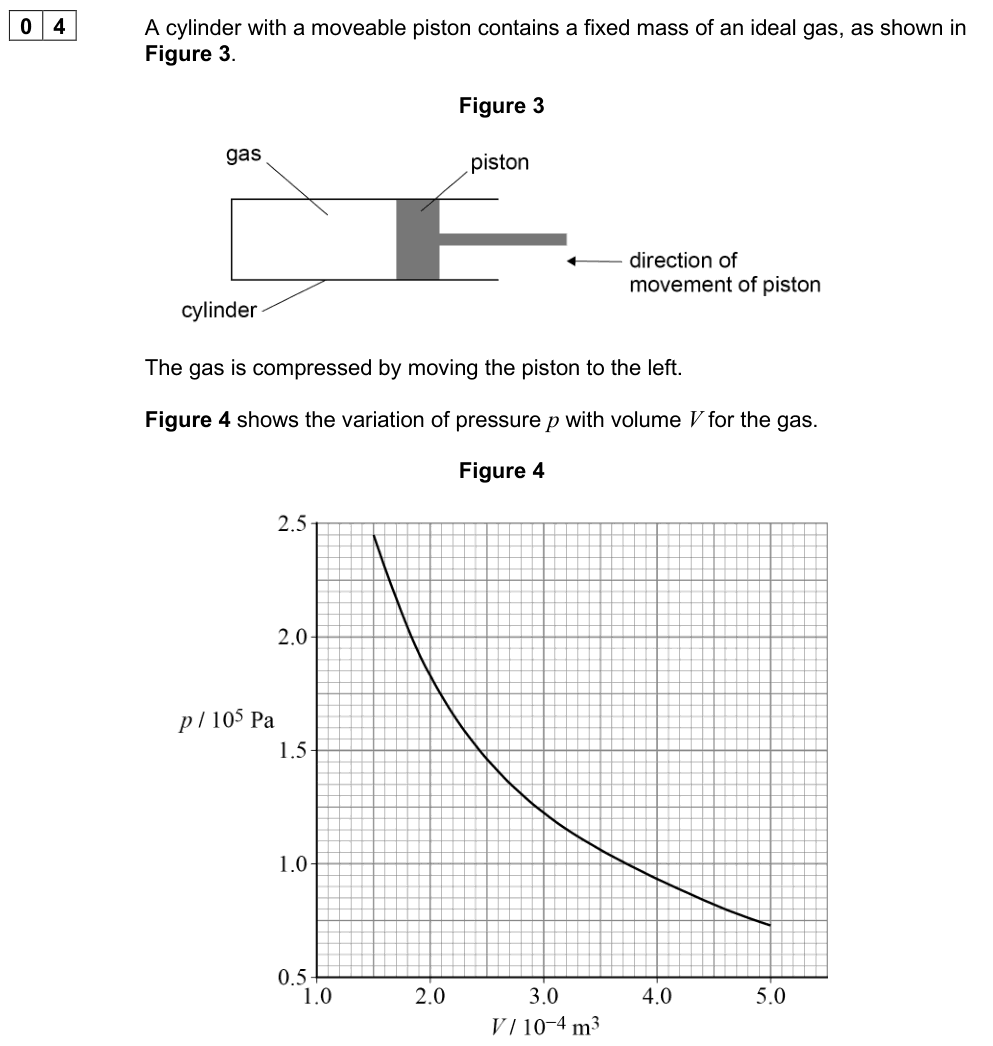
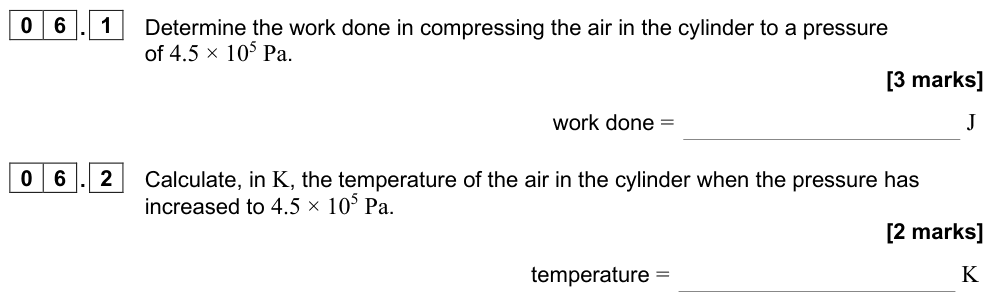
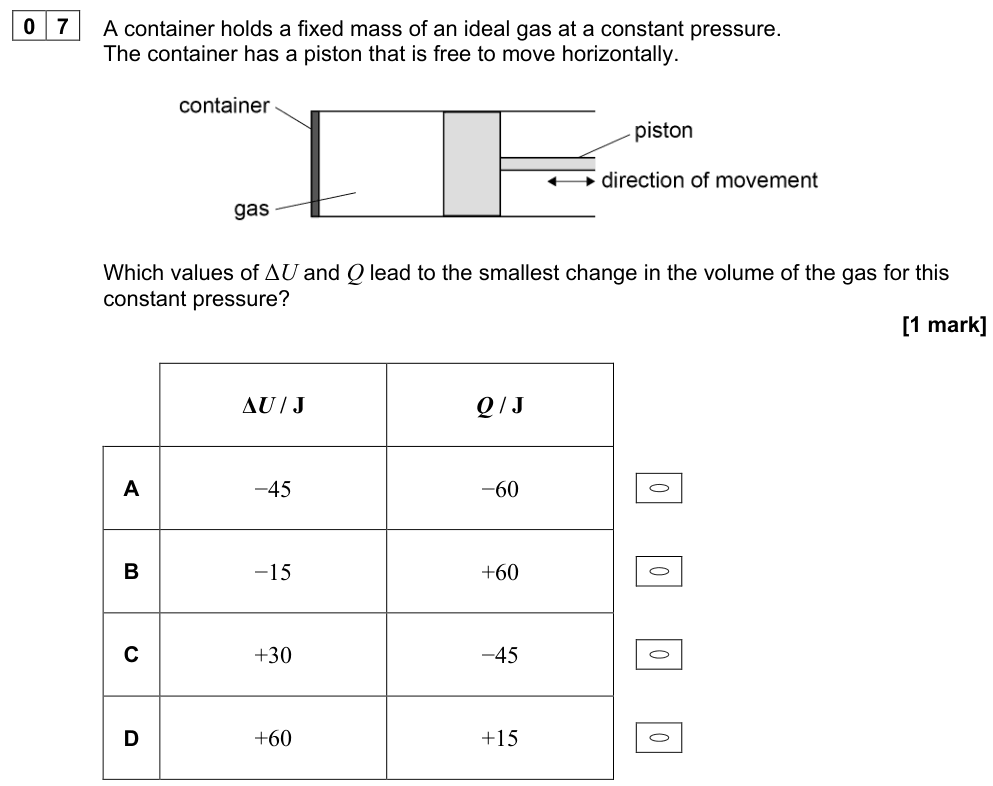
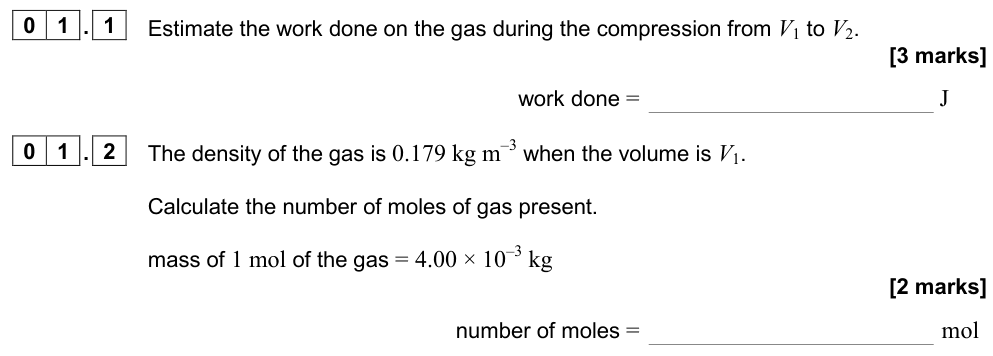
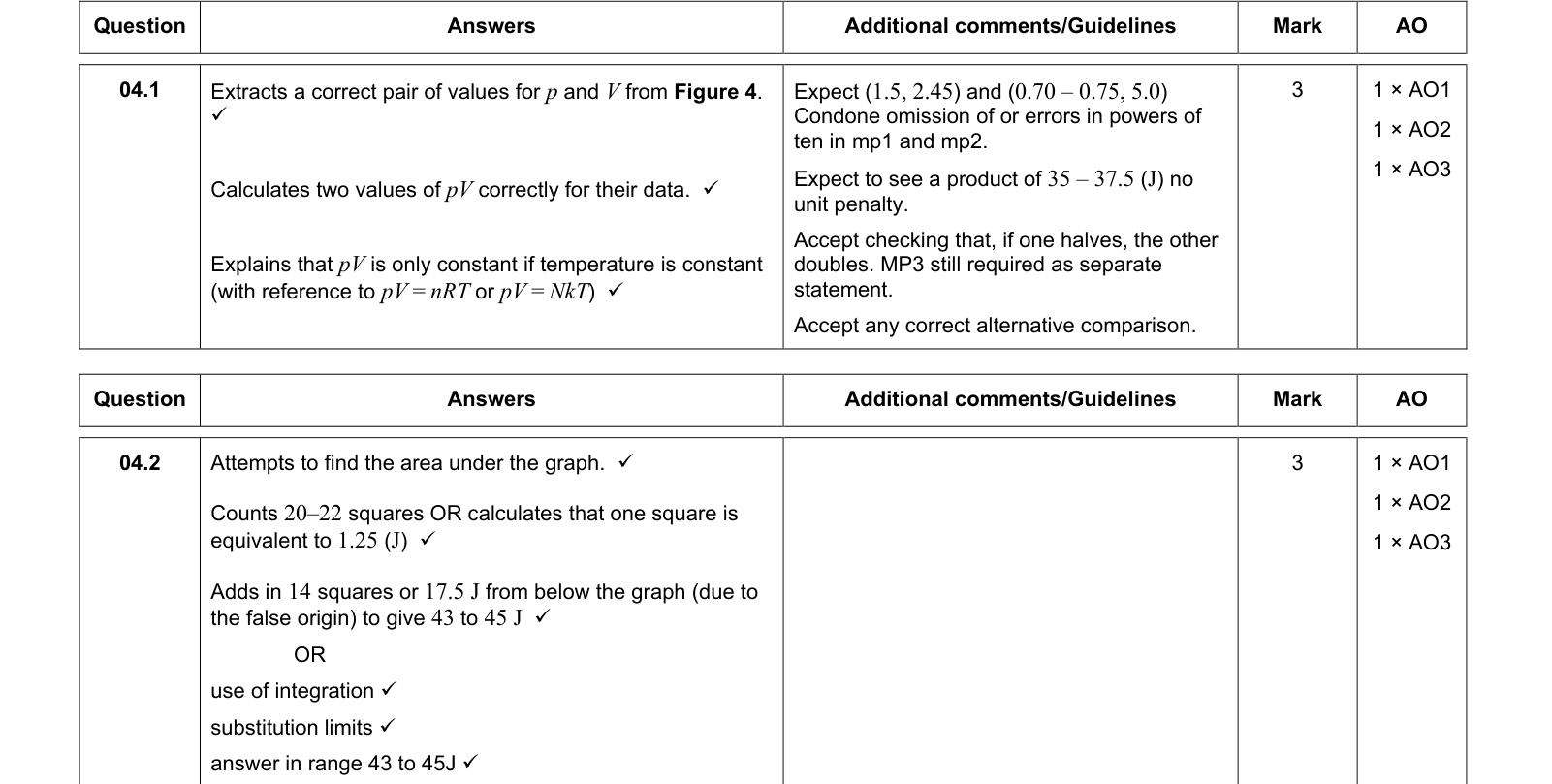
When a gas expands at constant pressure $p$ it pushes back its surroundings. If the gas pushes a piston of area $A$ a distance $\Delta x$, the force is $pA$ and the work done is $pA\Delta x$:
Work done by or on a gas at constant pressure
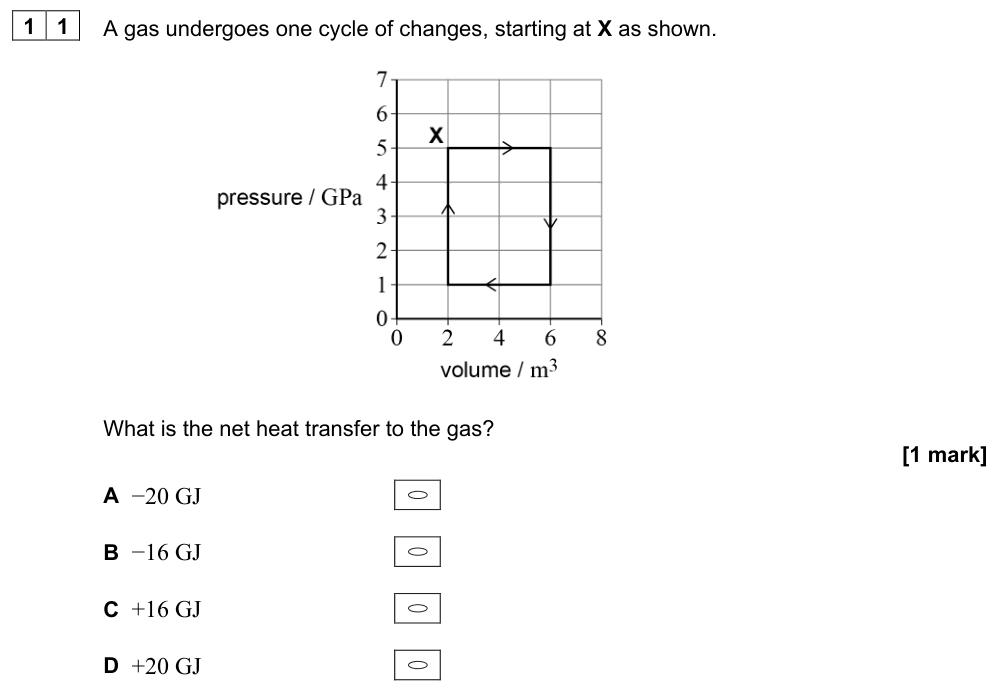
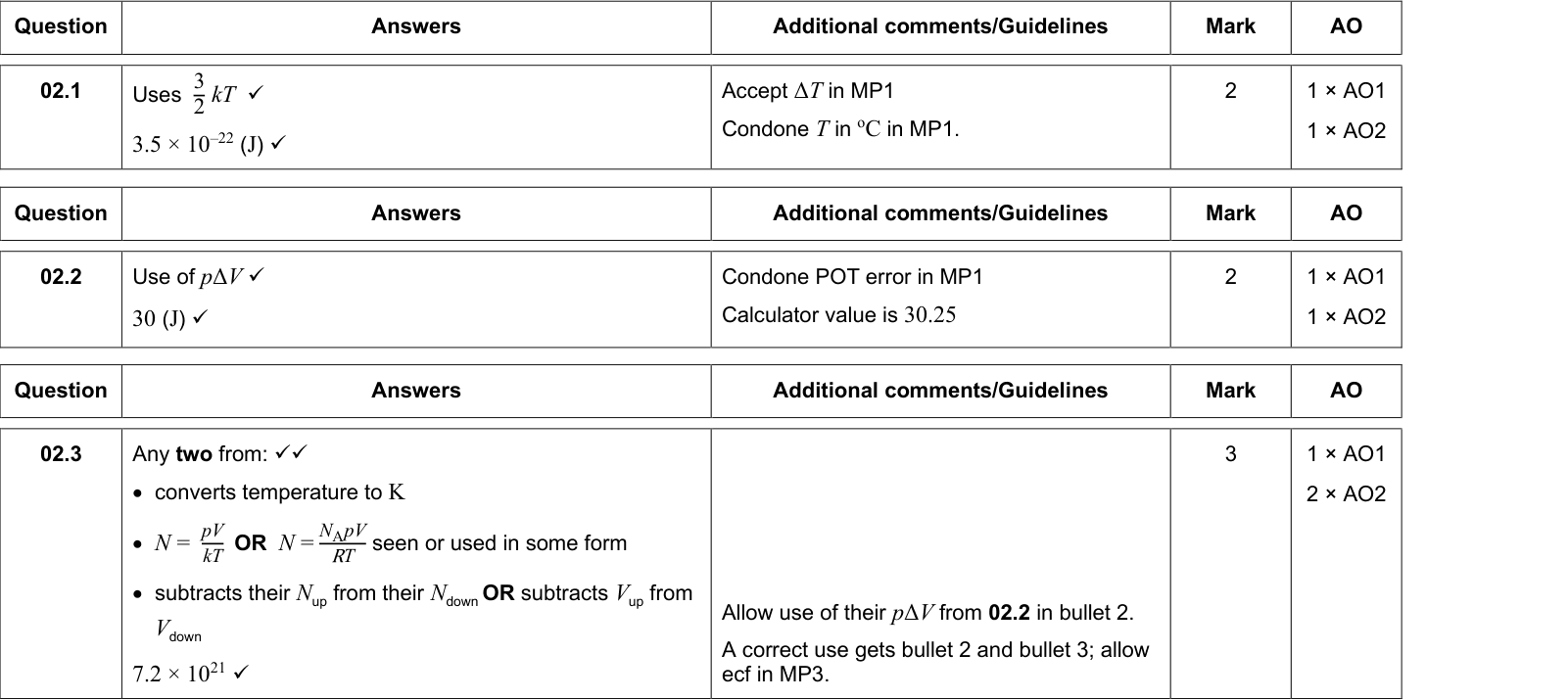
$$W = p\Delta V$$
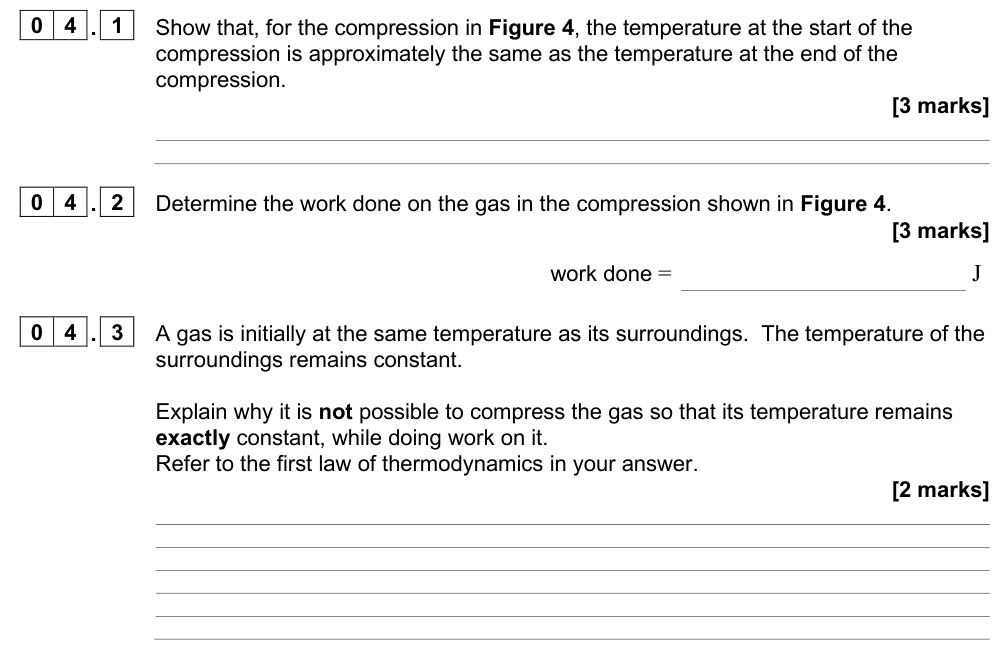
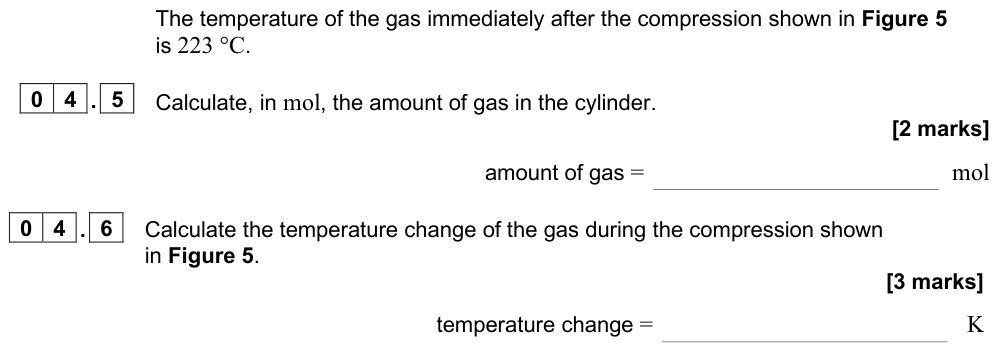
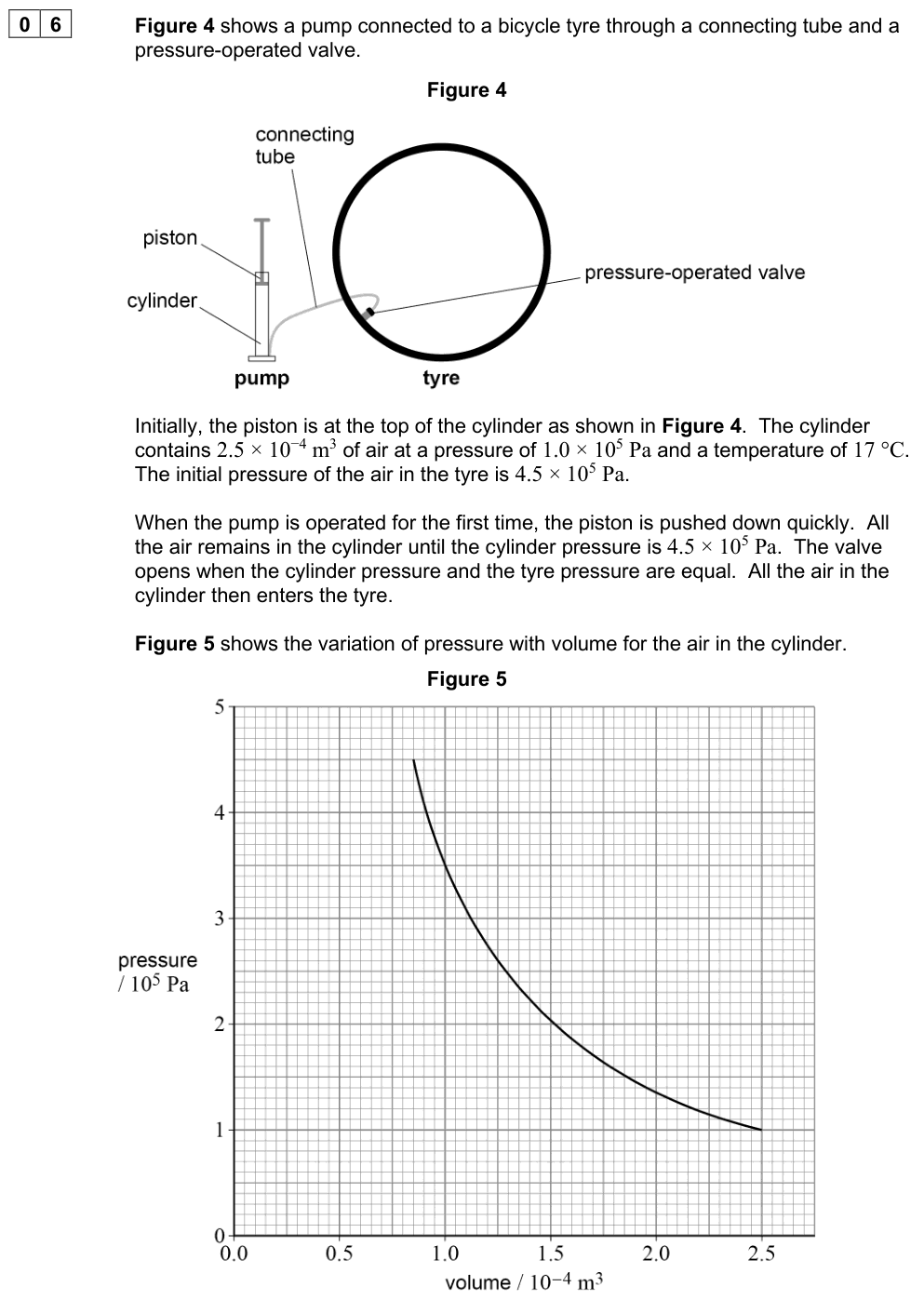
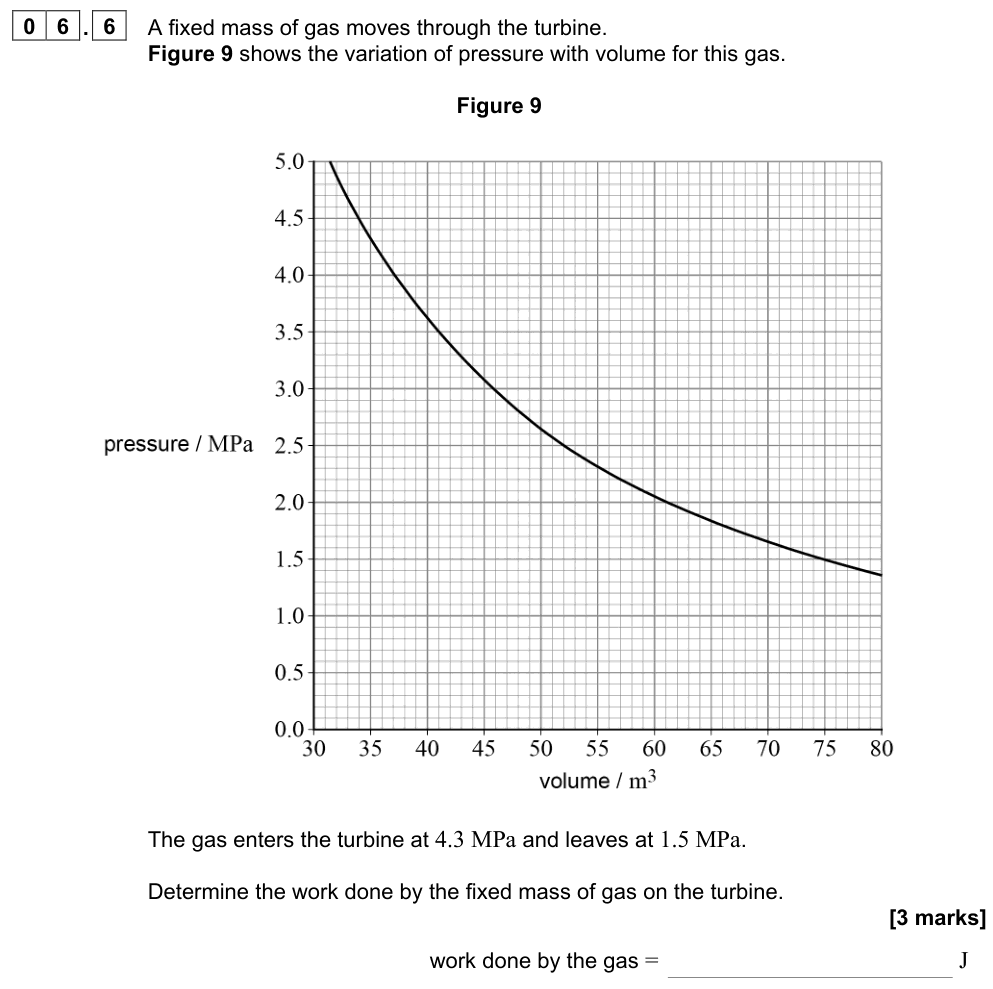
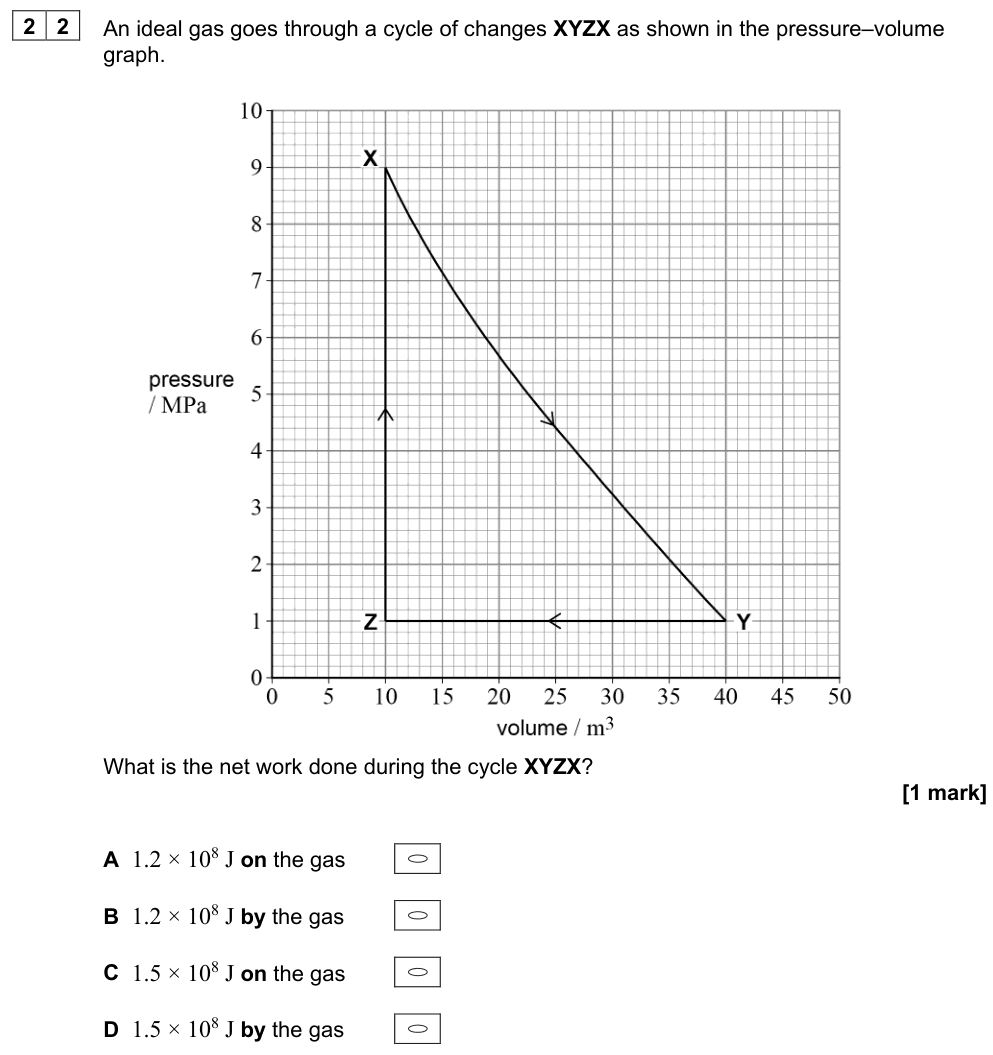
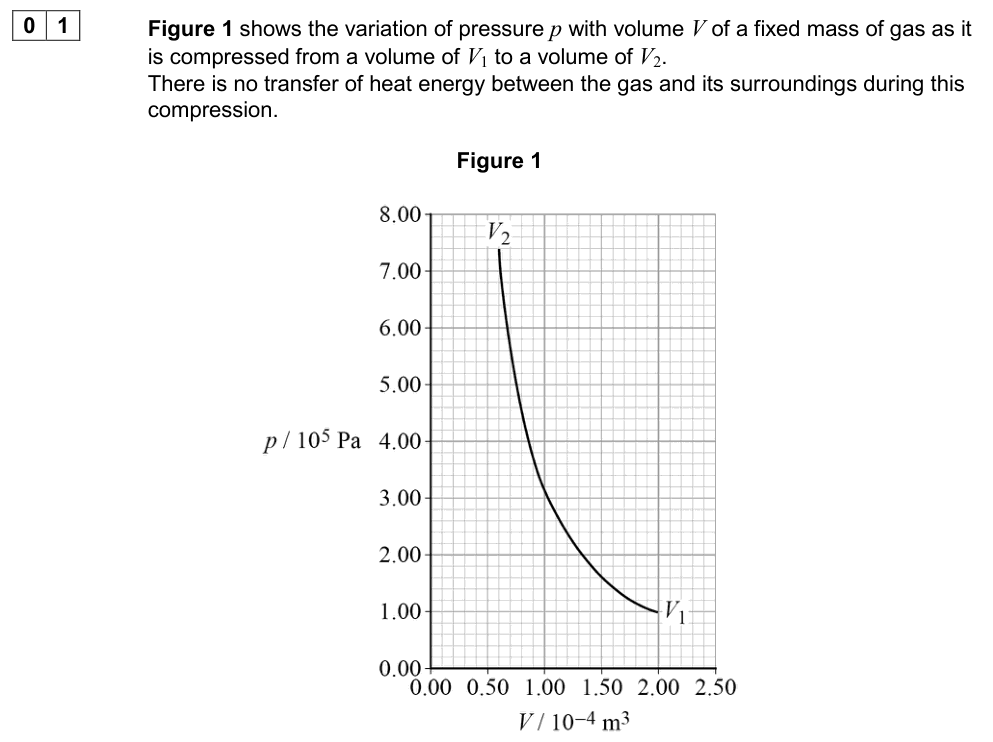
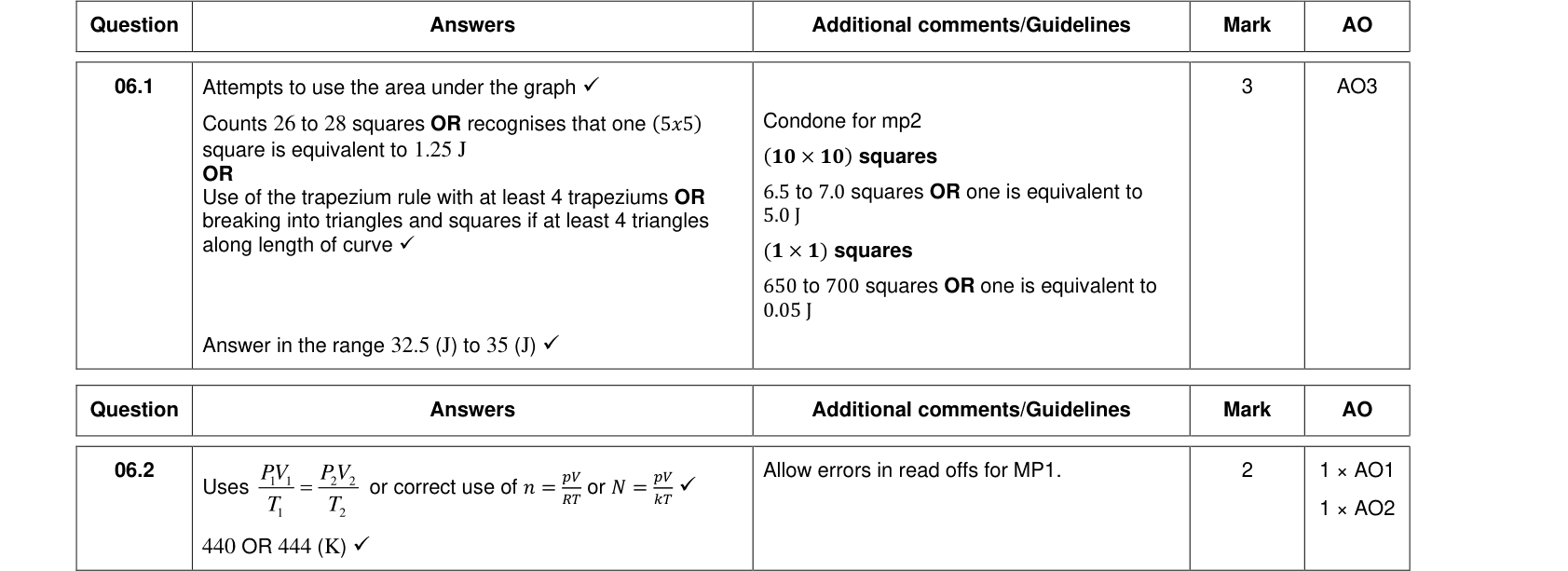
If the pressure changes, the work done equals the area under the p–V graph.
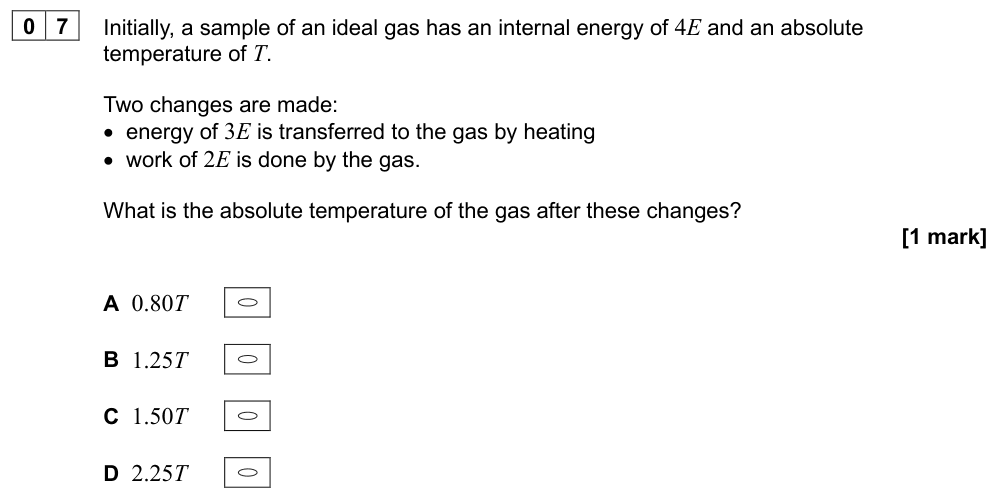
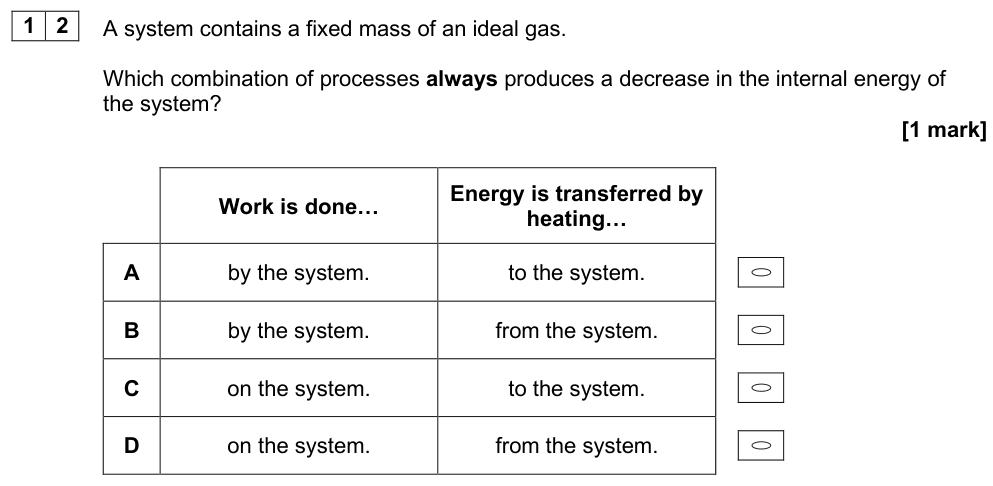
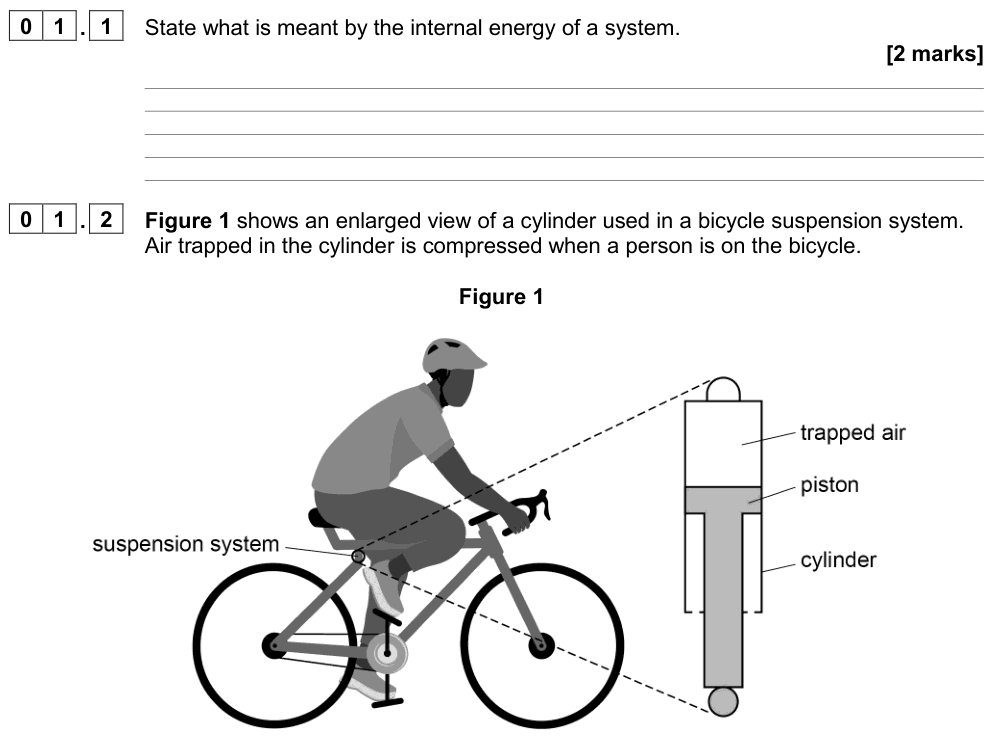
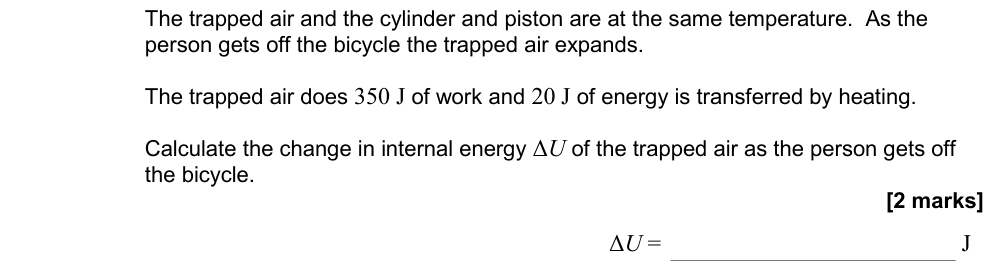
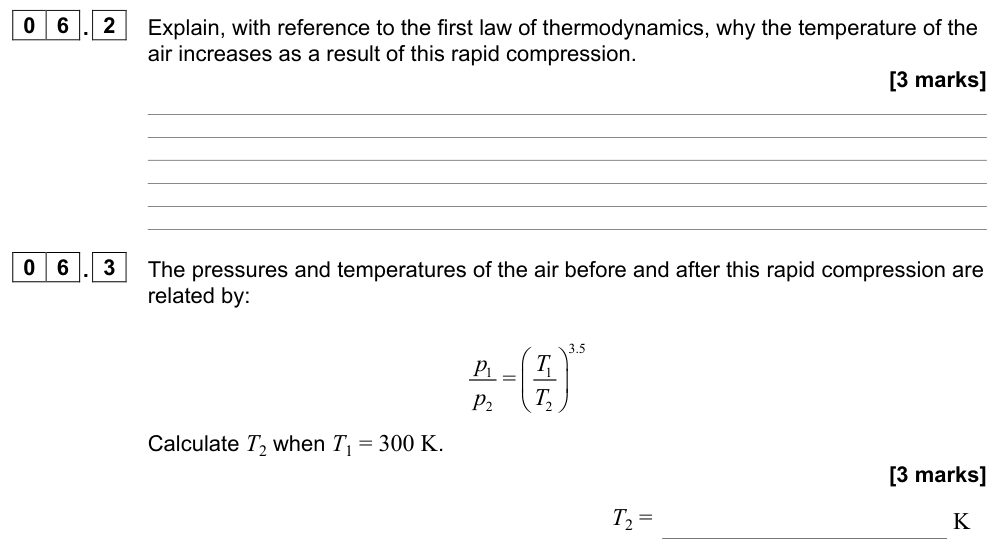
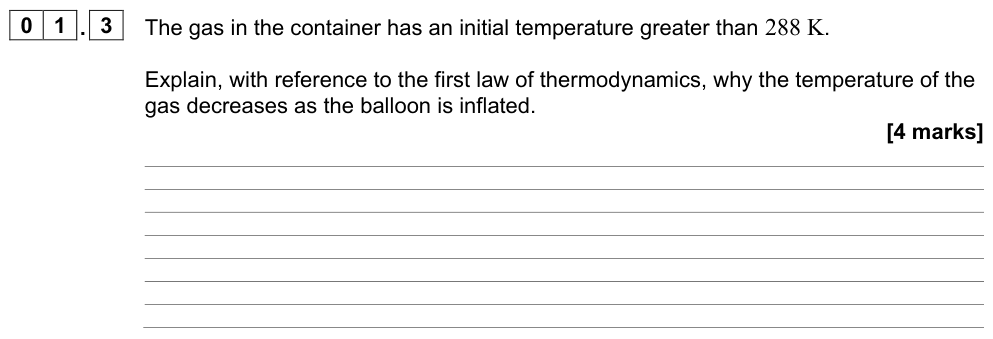
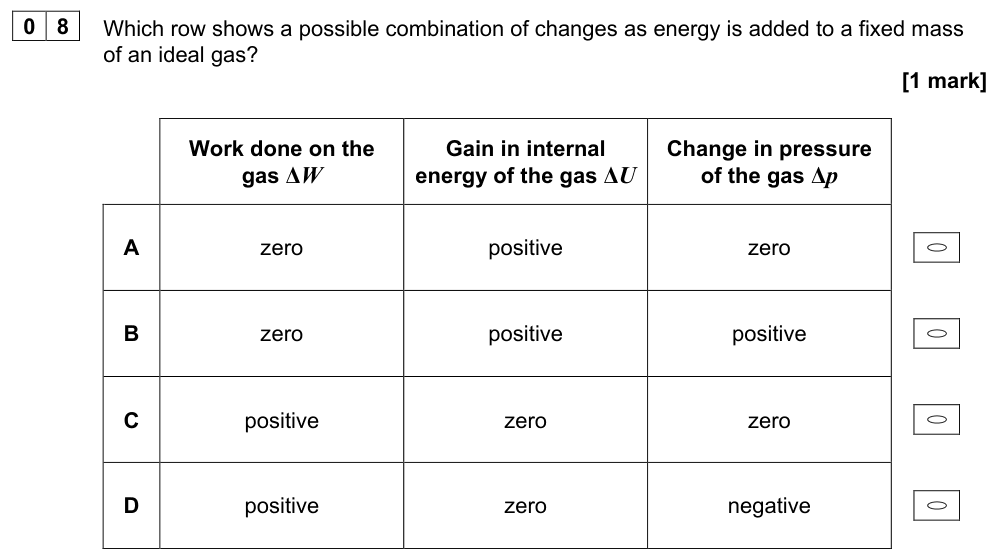
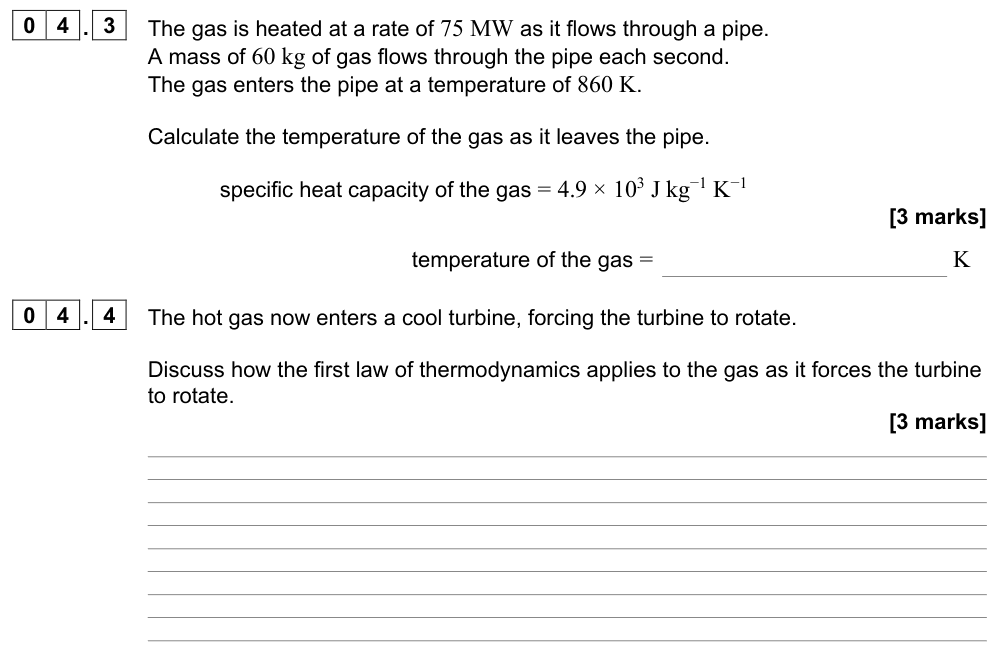
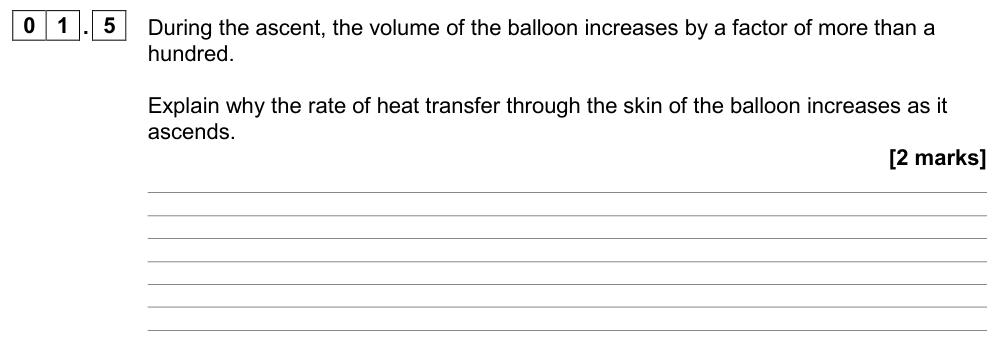
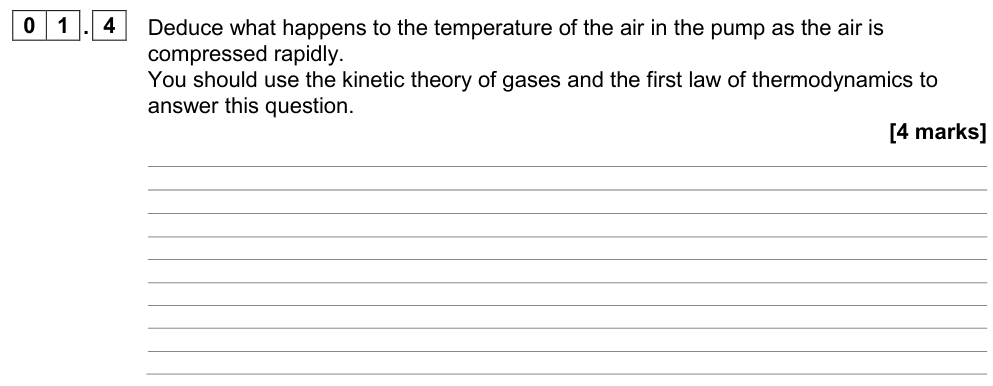
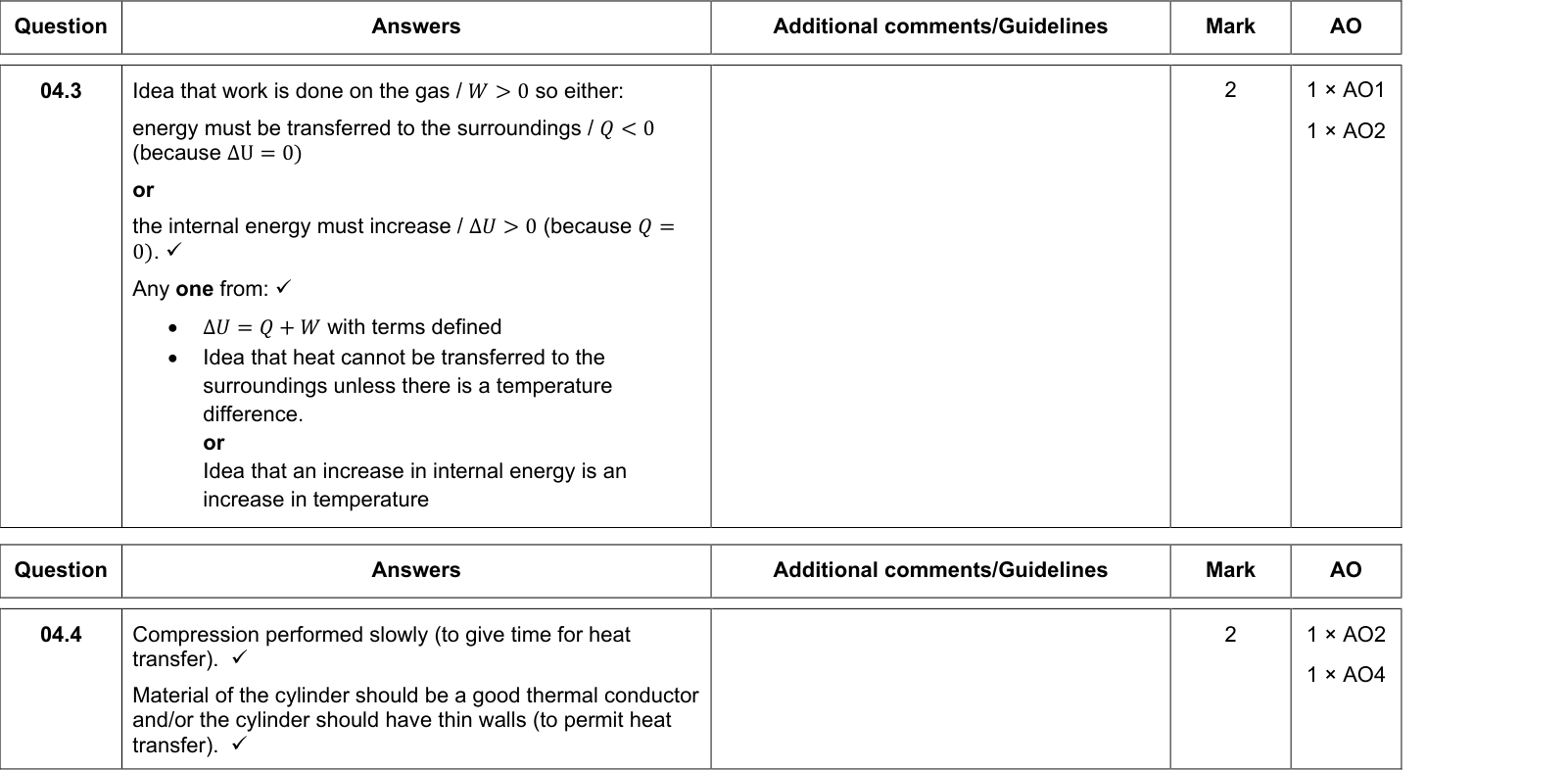
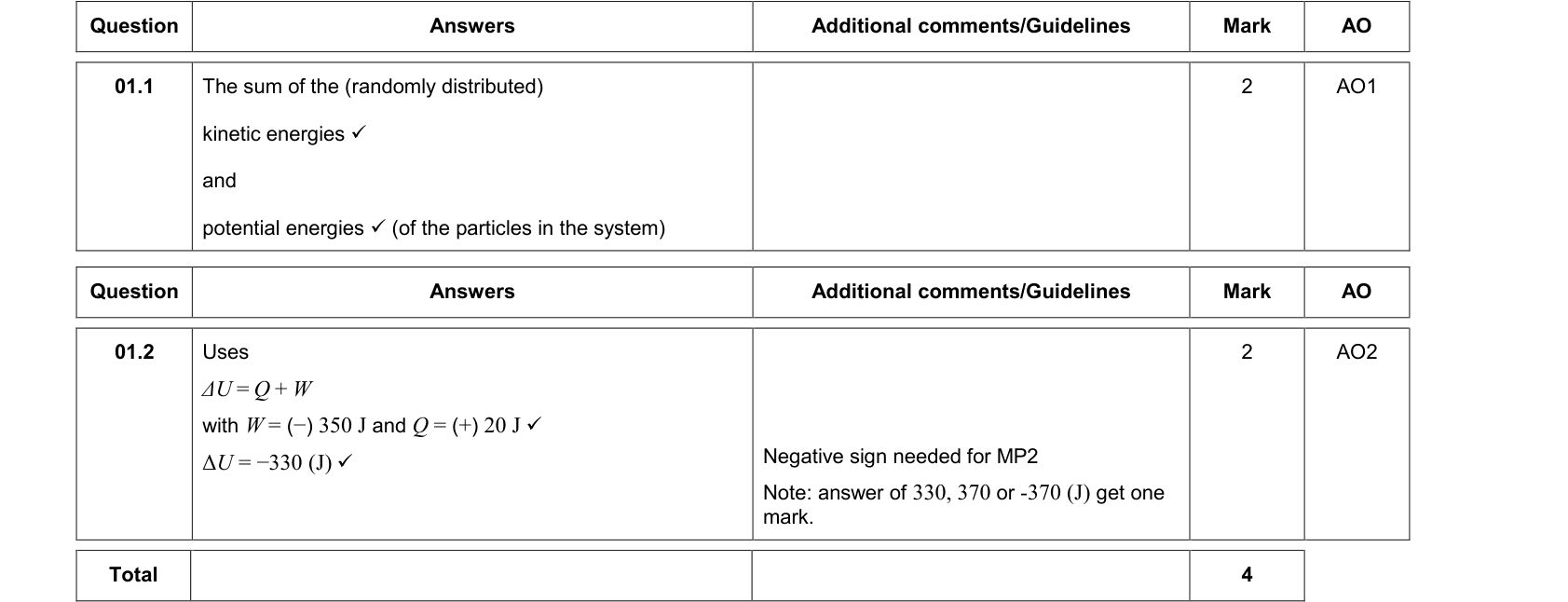
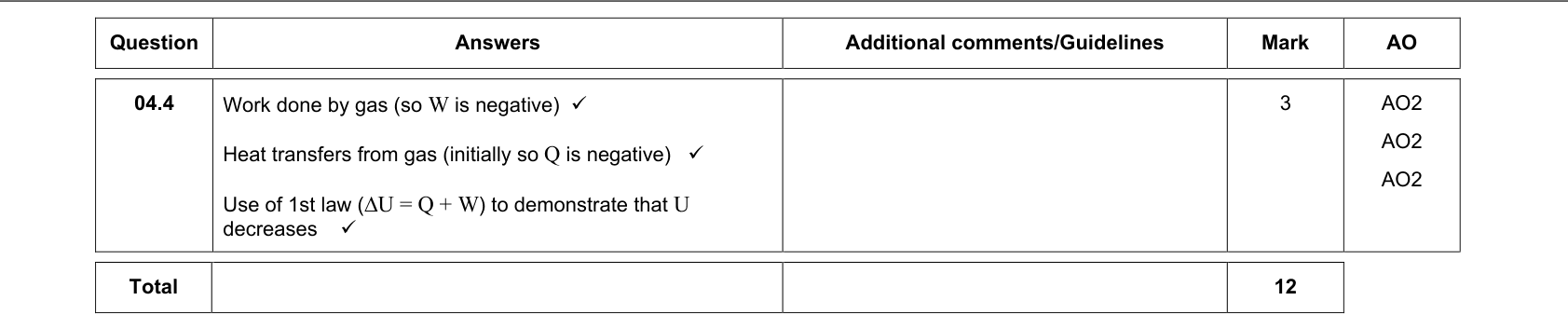
When a gas expands it does work on its surroundings (so in the first law $W$ is negative and the gas loses internal energy unless it is heated). When a gas is compressed, work is done on it.
Worked example
A gas expands from 2.0 litres to 3.5 litres at a constant pressure of $1.0 \times 10^{5}$ Pa. Work done by the gas $= 1.0 \times 10^{5} \times 1.5 \times 10^{-3} = 150$ J. If 400 J were supplied by heating, the internal energy would rise by $400 - 150 = 250$ J.
Required practical 9: Boyle's law and Charles's law
Boyle's law (constant temperature). Trap a column of air in a sealed glass tube above some oil, with a pressure gauge (Bourdon gauge) connected to a foot pump. The length of the air column is proportional to its volume.
- Pump to increase the pressure, close the valve, and wait a minute for the air to return to room temperature (compressing it warms it).
- Record the pressure and the length of the air column. Repeat for several pressures, then release the pressure in steps and repeat the readings.
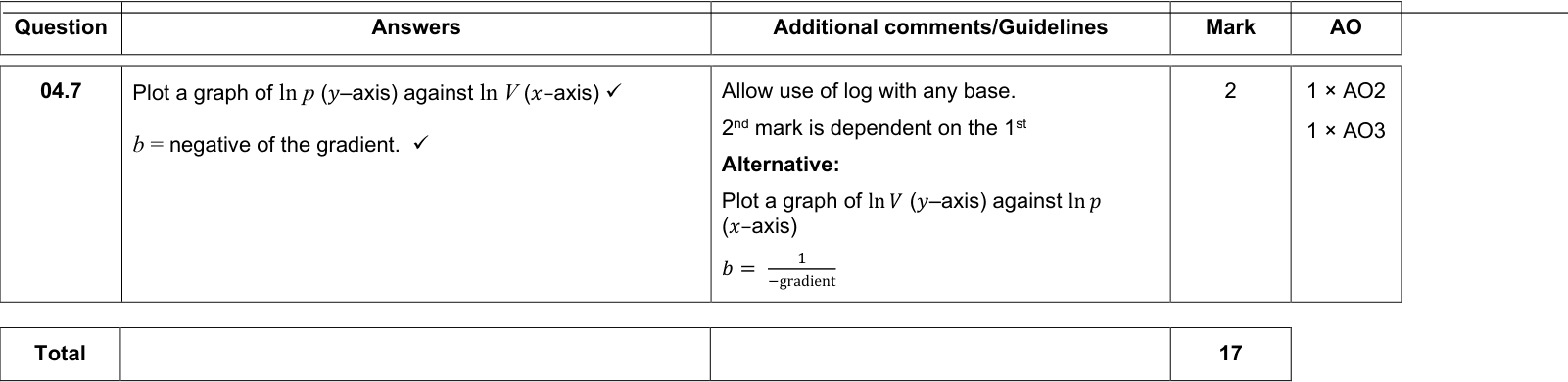
- Plot $p$ against $1/V$: a straight line through the origin confirms $p \propto 1/V$.
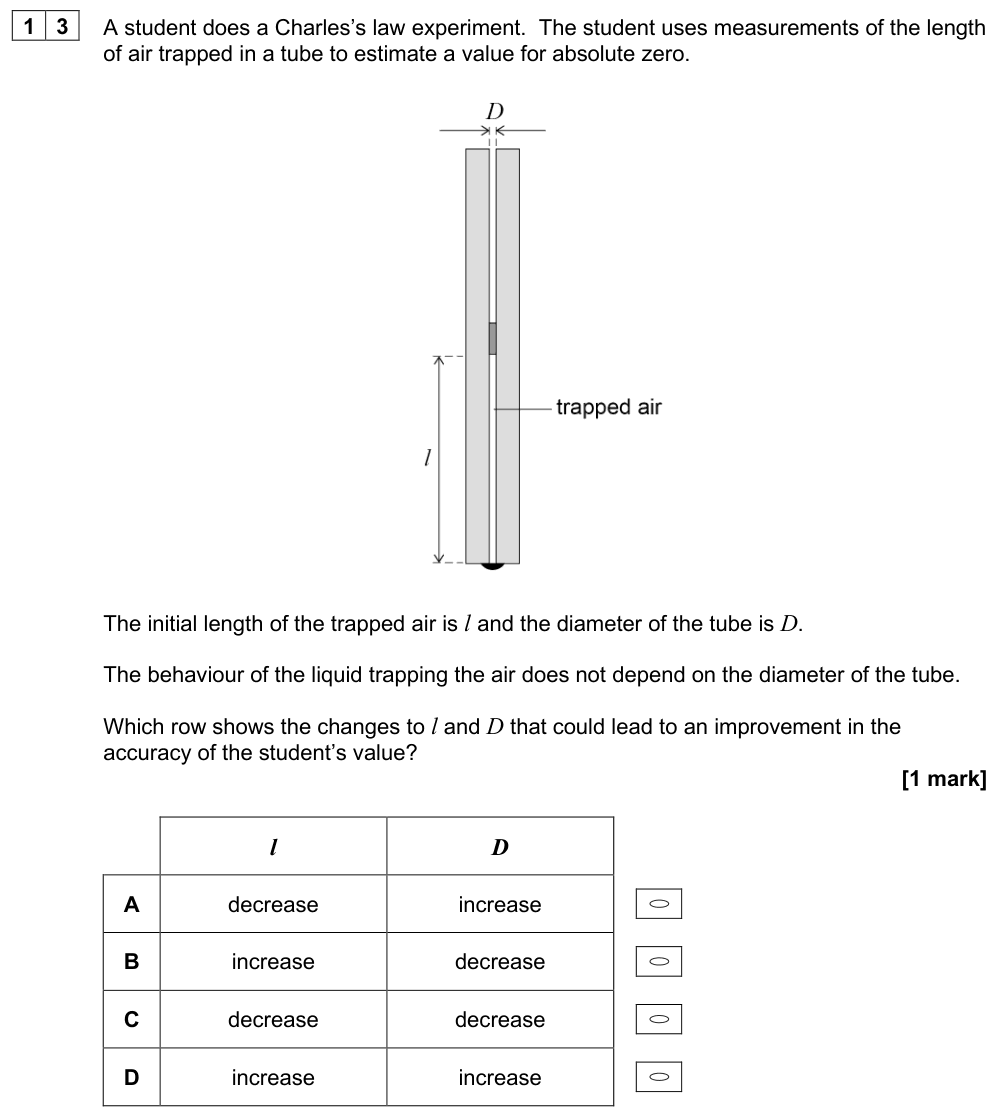
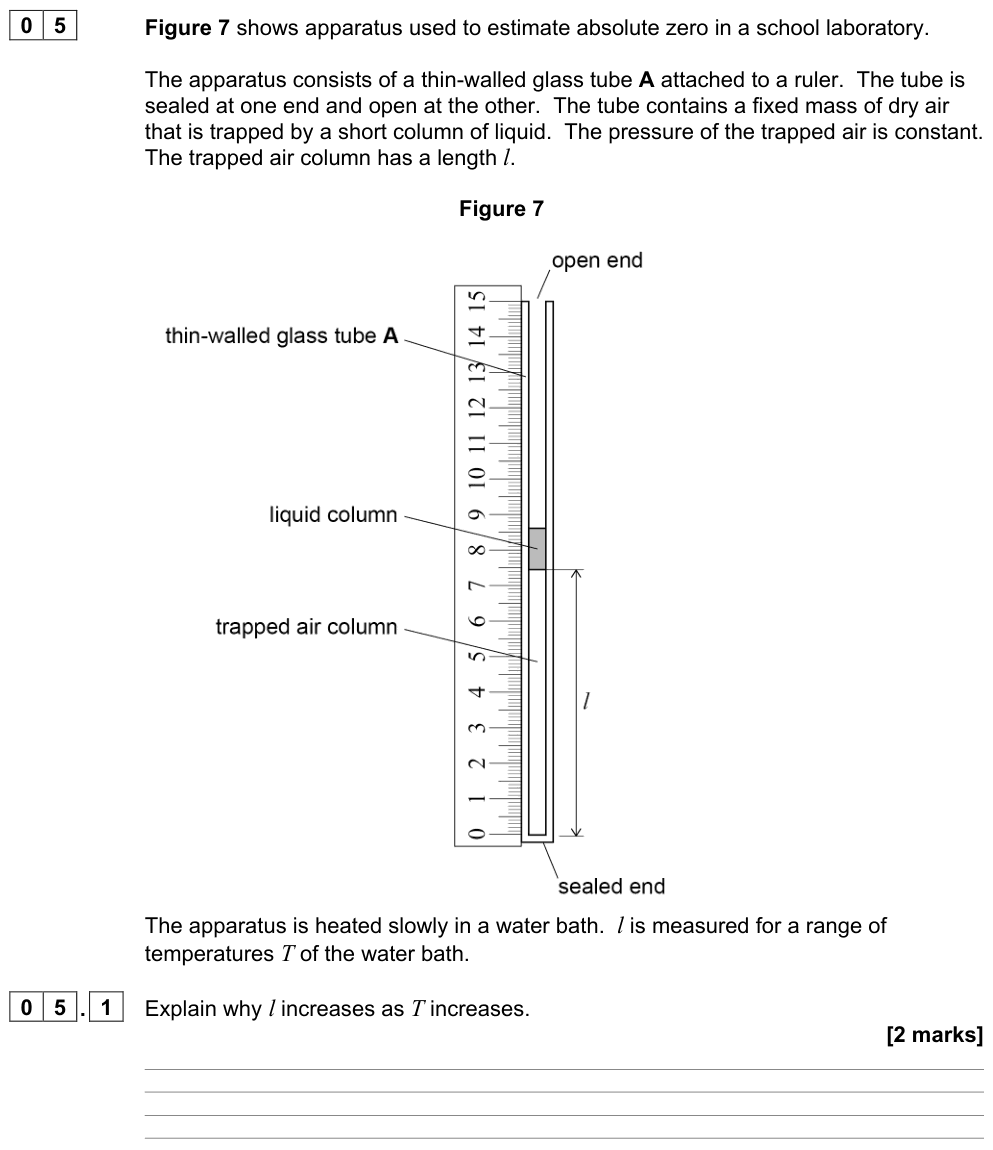
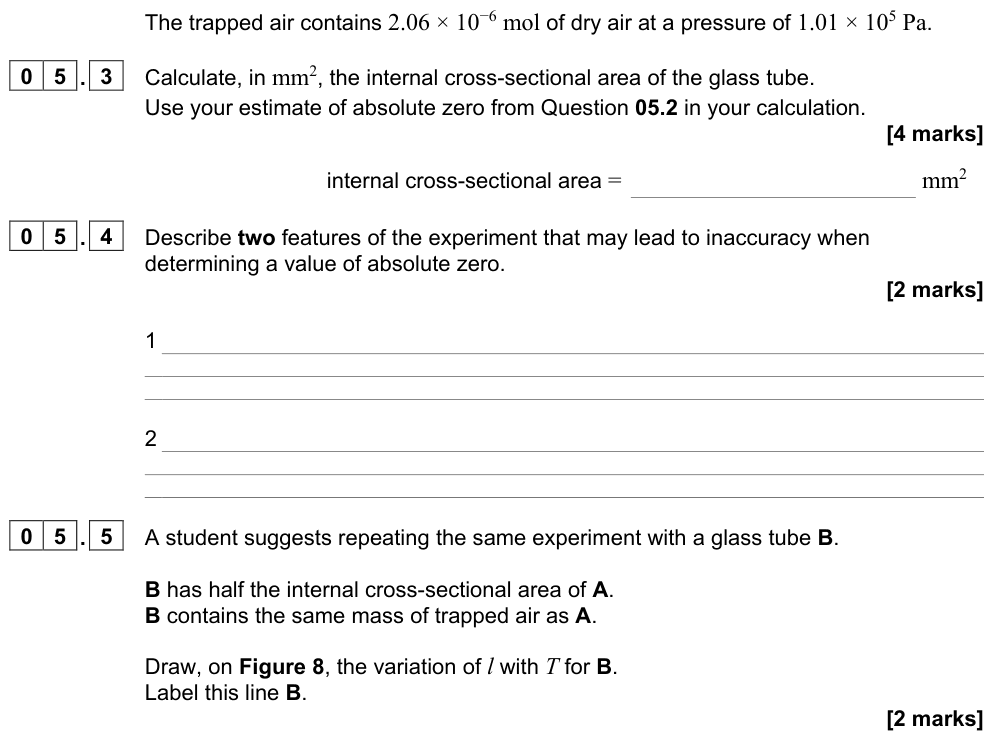
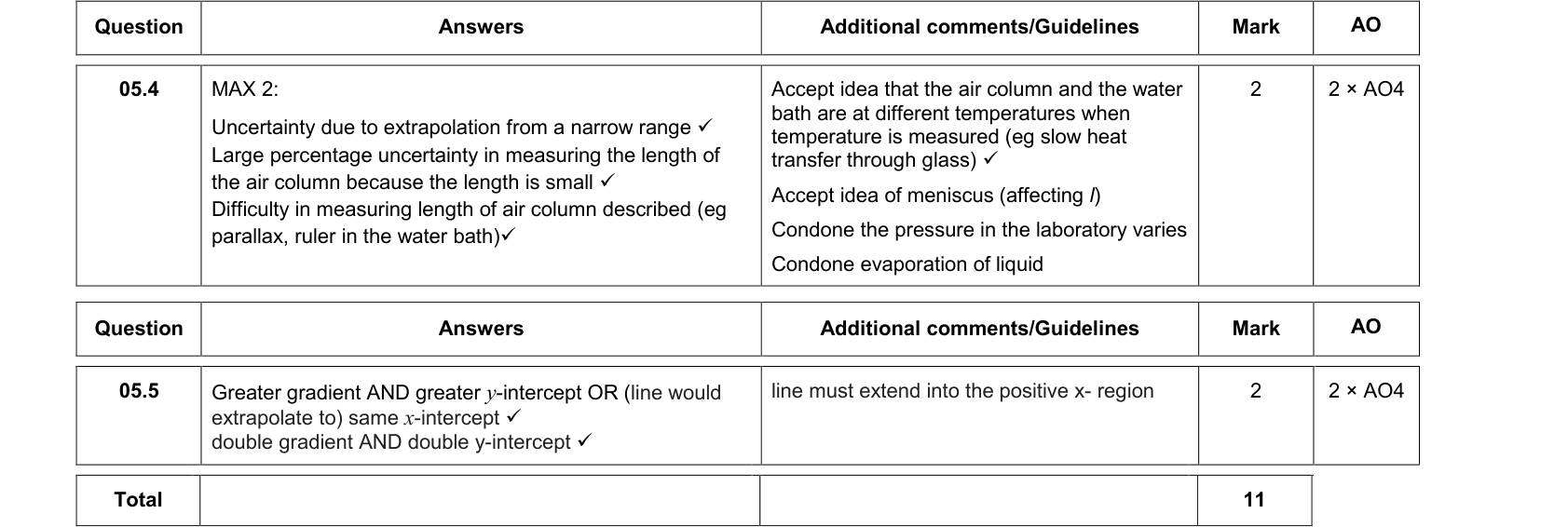
Charles's law (constant pressure). A capillary tube, sealed at the bottom, traps a column of air below a bead of liquid; the open top keeps the air at atmospheric pressure. Attach the tube to a ruler and place it in a beaker of water with a thermometer.
- Heat the water in steps, stirring well and waiting for the air to reach the water temperature before each reading.
- Record the length of the air column (proportional to its volume) and the temperature.
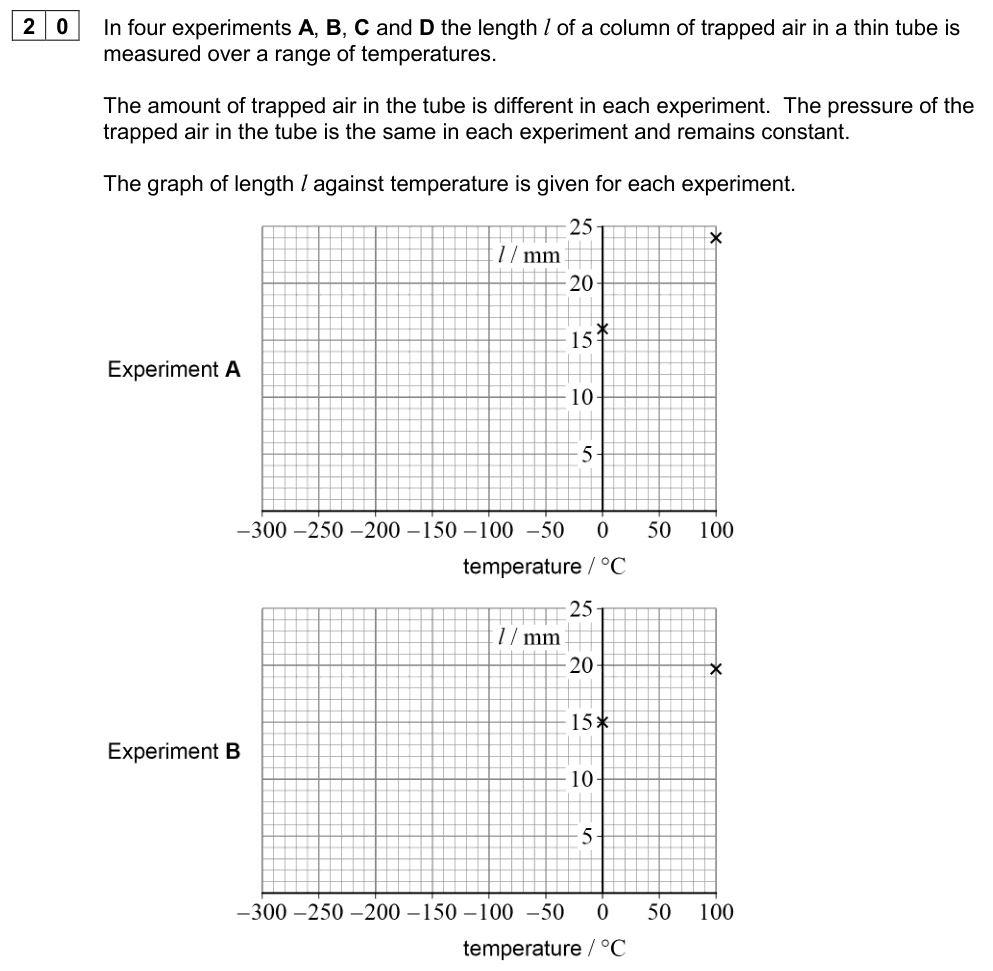
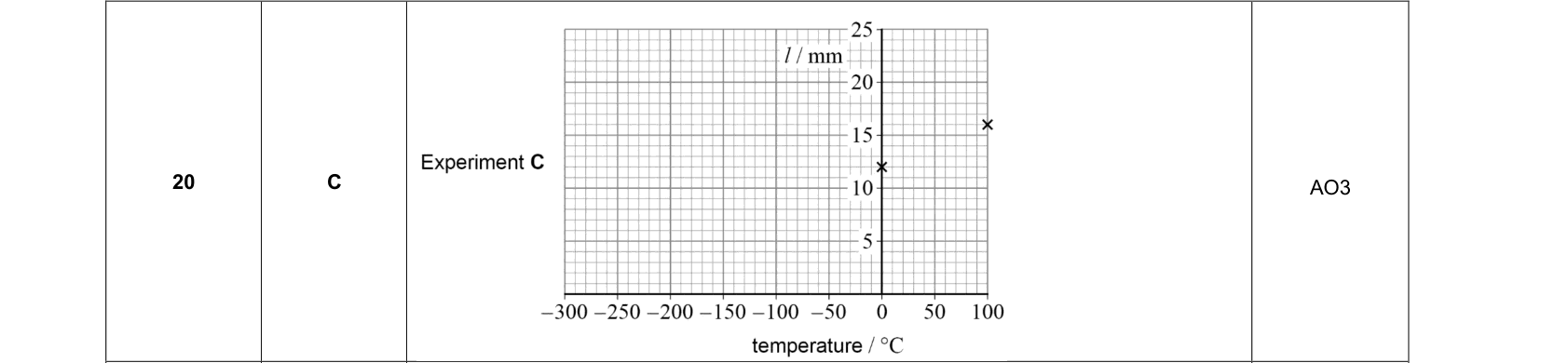
- Plot length against temperature in °C. The graph is a straight line; extrapolating it to zero length gives an estimate of absolute zero (around −273 °C).
Safety: wear eye protection with pressurised glassware; take care with hot water.
Summary
- Boyle: $pV$ constant; Charles: $V/T$ constant; pressure law: $p/T$ constant (fixed mass, $T$ in K).
- Absolute zero ≈ −273 °C = 0 K, the temperature of minimum particle kinetic energy; $T = \theta + 273$.
- $pV = nRT = NkT$; $N = nN_A$; $k = R/N_A$; $n = m/M$; molecular mass $= M/N_A$.
- Work done $= p\Delta V$ (area under a p–V graph).
- Required practical 9: $p$ against $1/V$ (Boyle); length of air column against θ, extrapolated to find absolute zero (Charles).