Internal energy
Internal energy
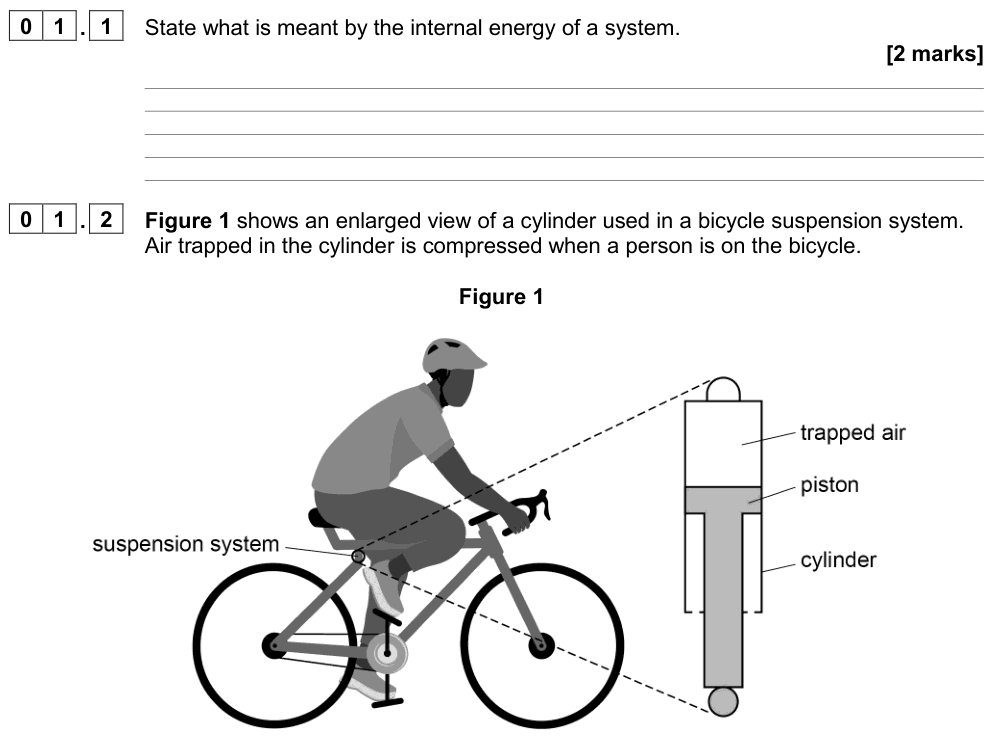
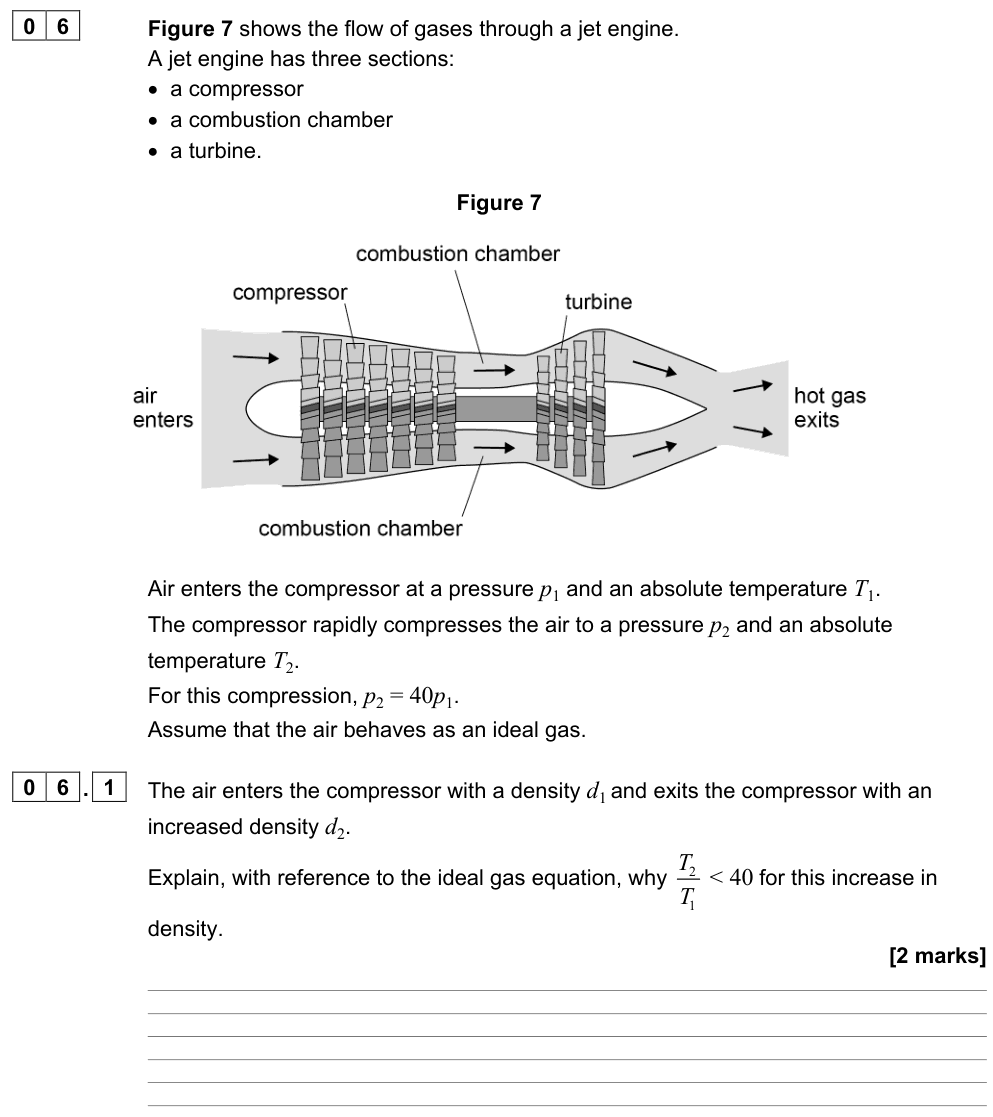
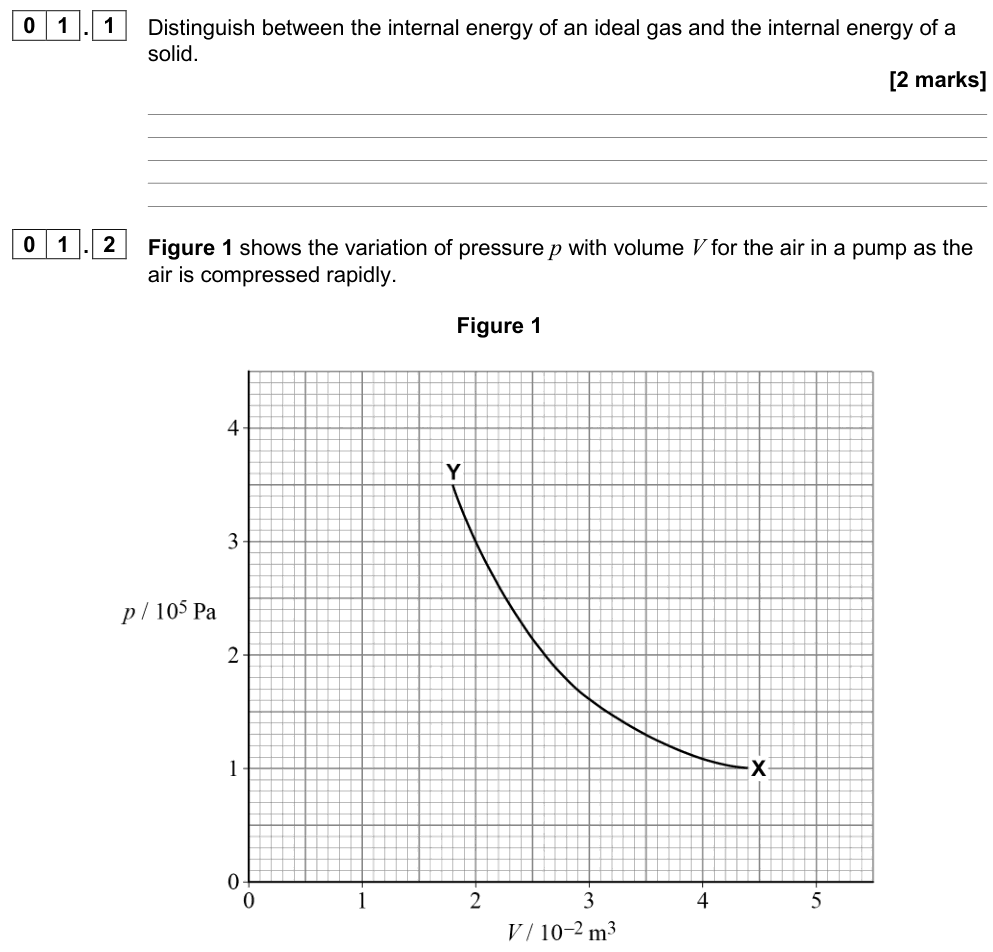
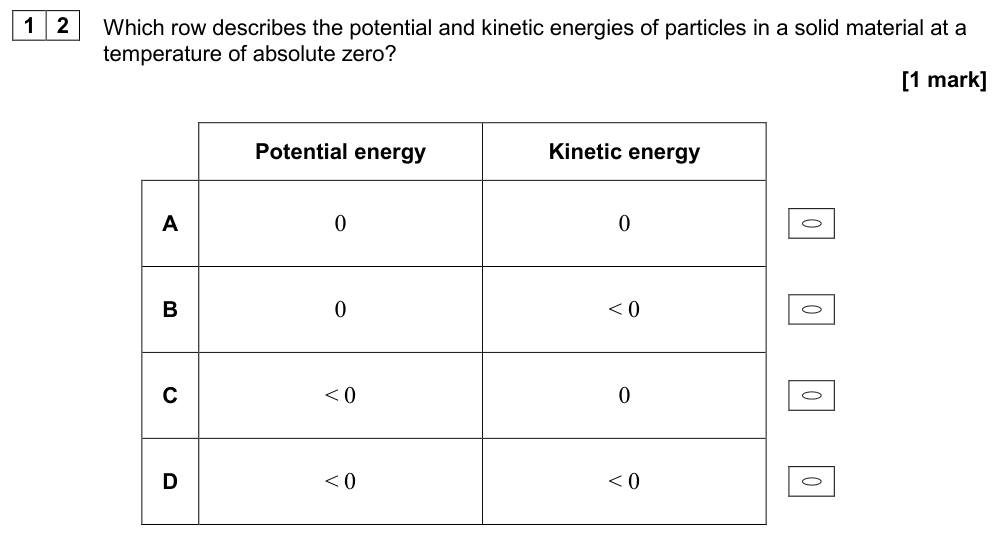
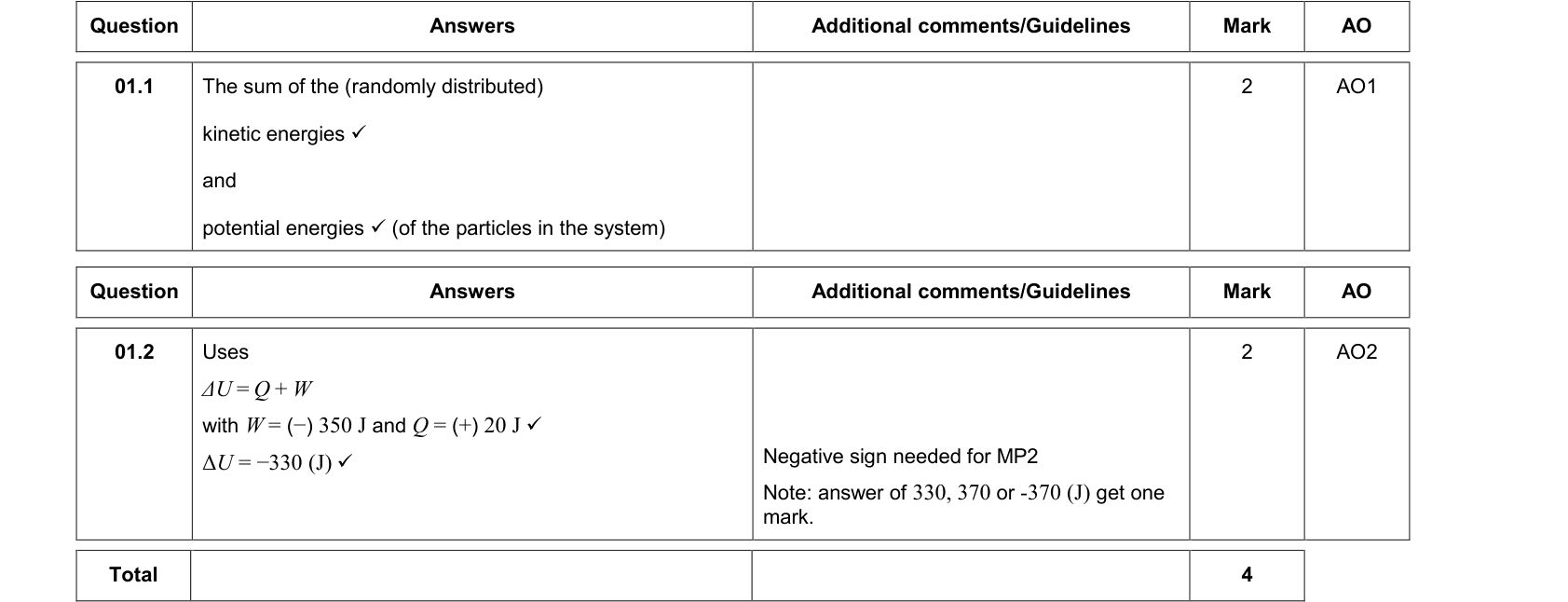
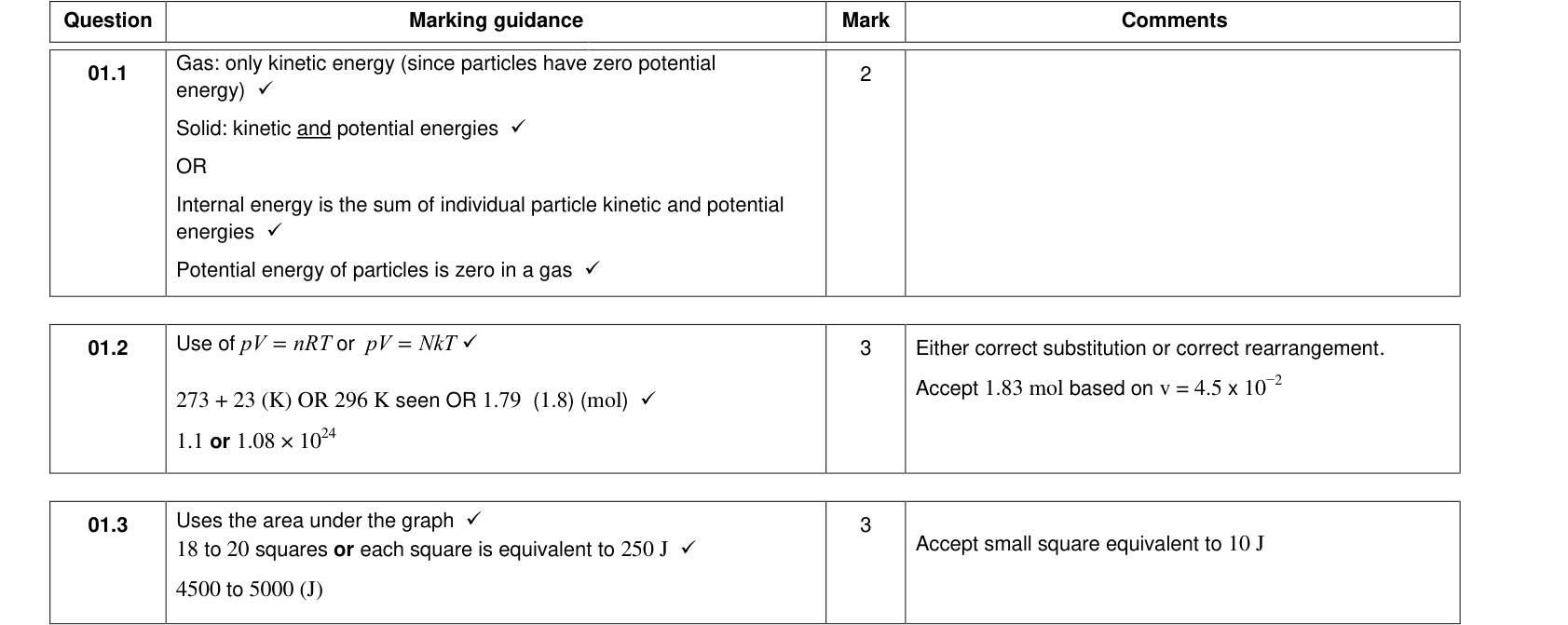
The internal energy of a body is the sum of the randomly distributed kinetic energies and potential energies of all its particles (atoms or molecules).
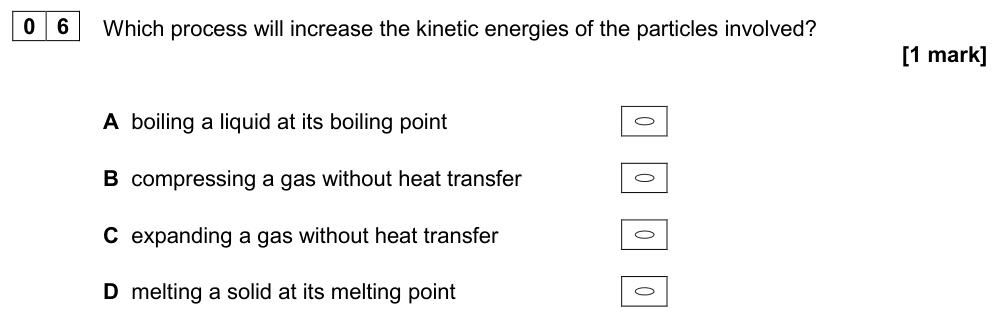
- The kinetic energy comes from the random motion of the particles (vibration in a solid; translation, rotation and vibration in liquids and gases). The temperature of a substance is a measure of the average kinetic energy of its particles.
- The potential energy comes from the forces between particles and depends on their separation. Energy is needed to pull particles apart against the attractive forces between them, so separating particles increases their potential energy.
The energies are randomly distributed: at any instant some particles move fast and others slowly, but the total is fixed for a given state and temperature.
Changing the internal energy: the first law of thermodynamics
The internal energy of a system can be increased in two ways:
- by heating it: energy is transferred because of a temperature difference;
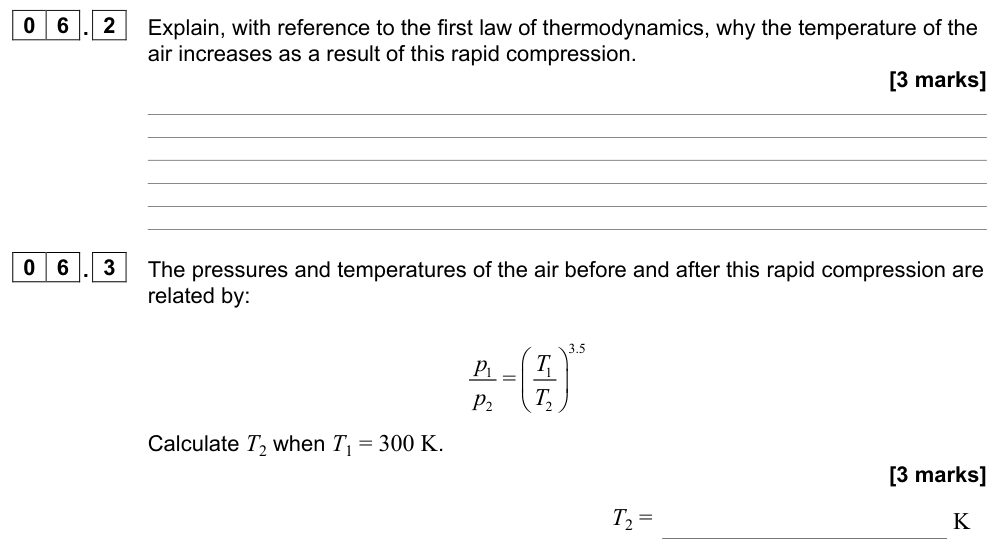
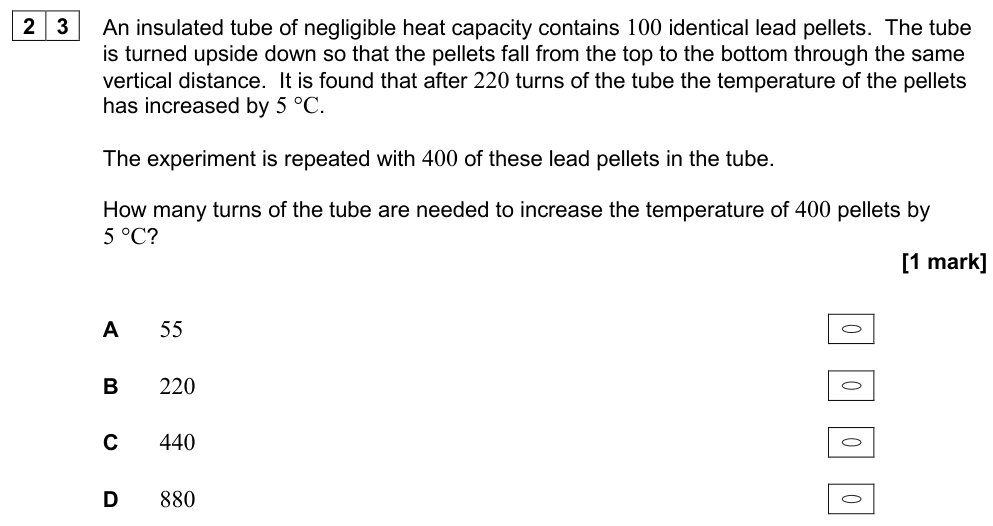
- by doing work on it: for example compressing a gas, or rubbing two surfaces together.
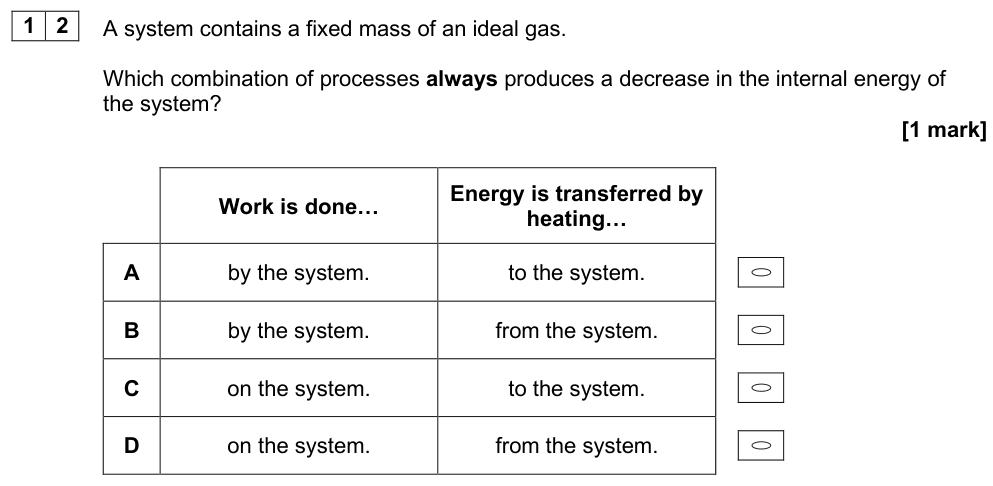
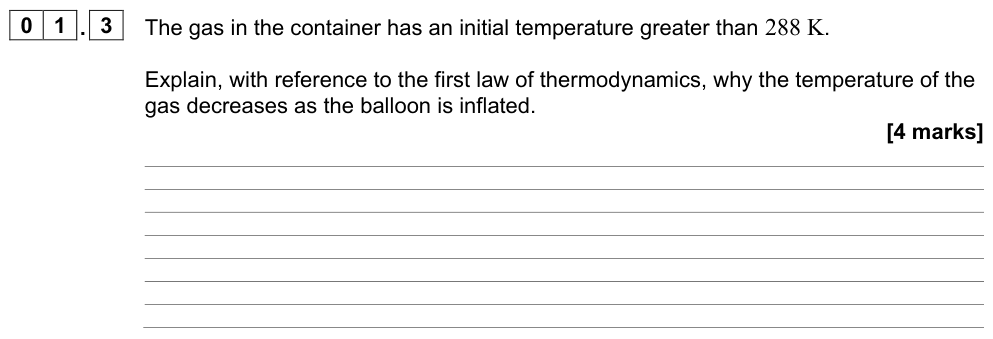
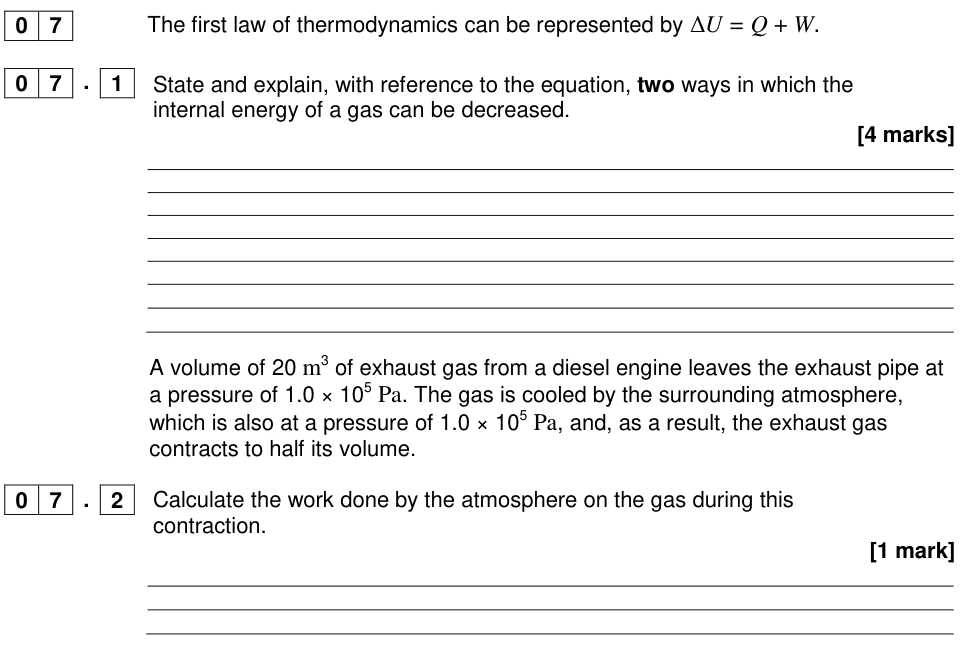
Similarly, it decreases when the system loses energy by heating its surroundings or does work on them (for example a gas expanding and pushing a piston out).
First law of thermodynamics
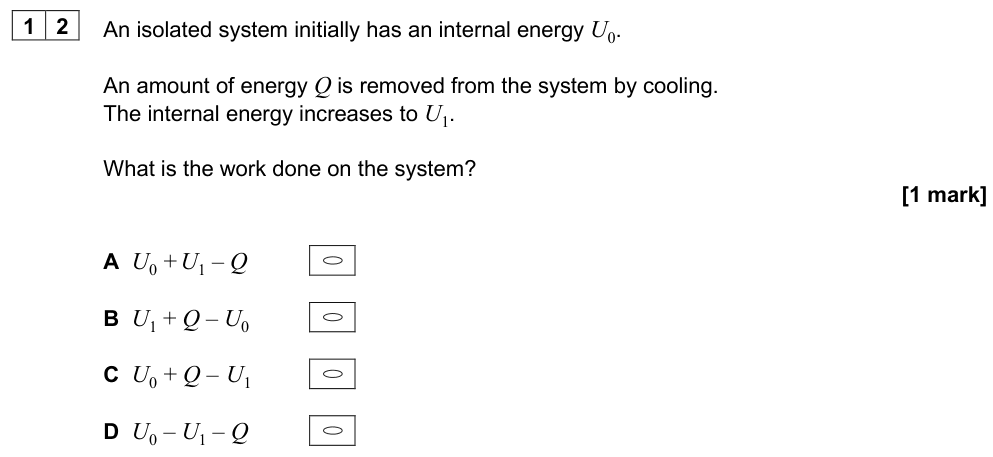
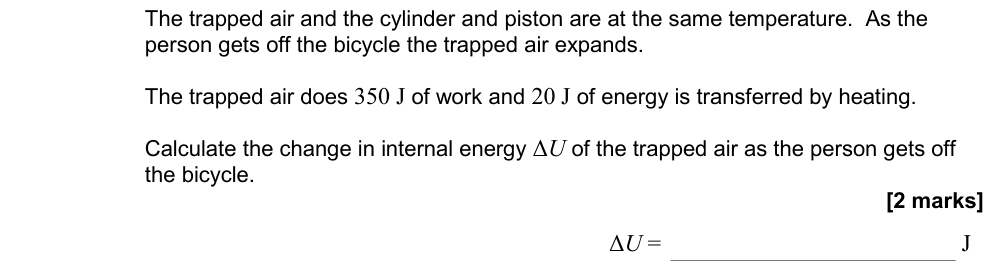
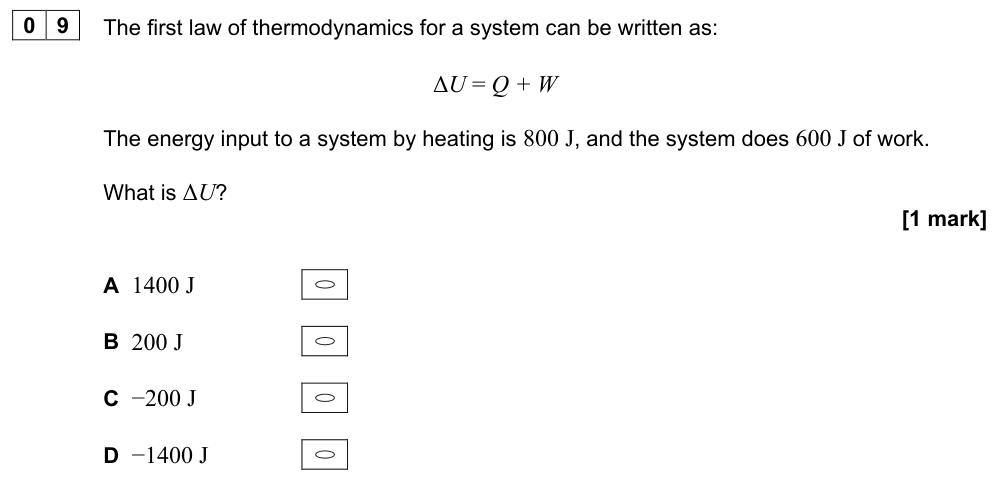
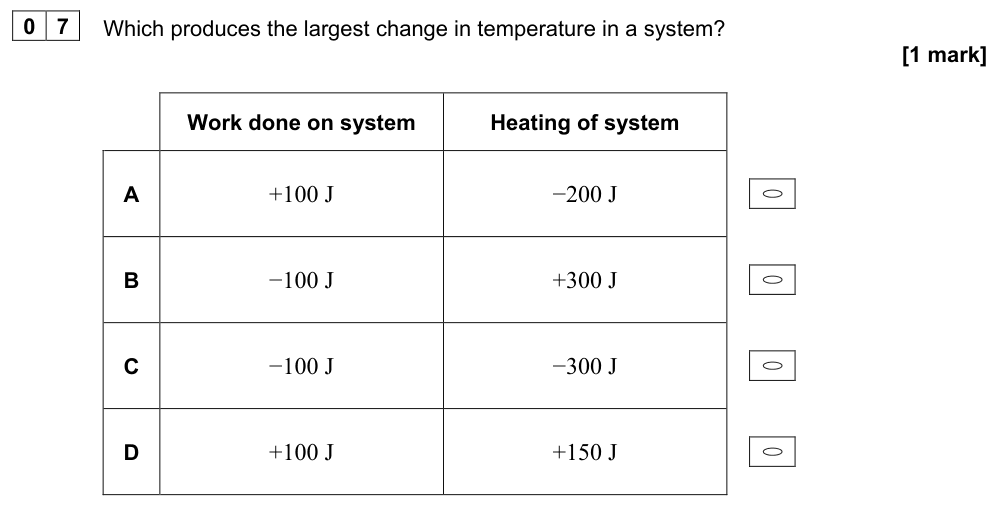
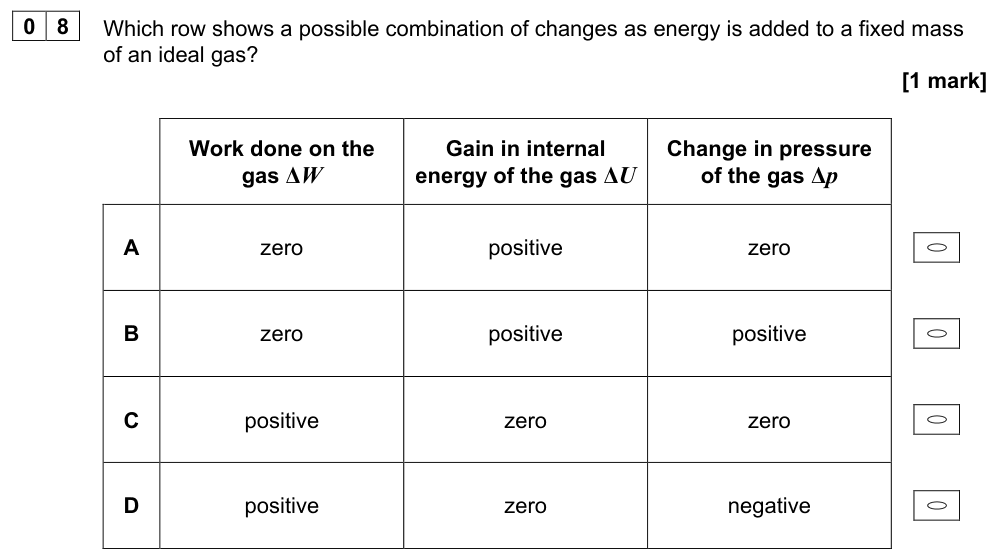
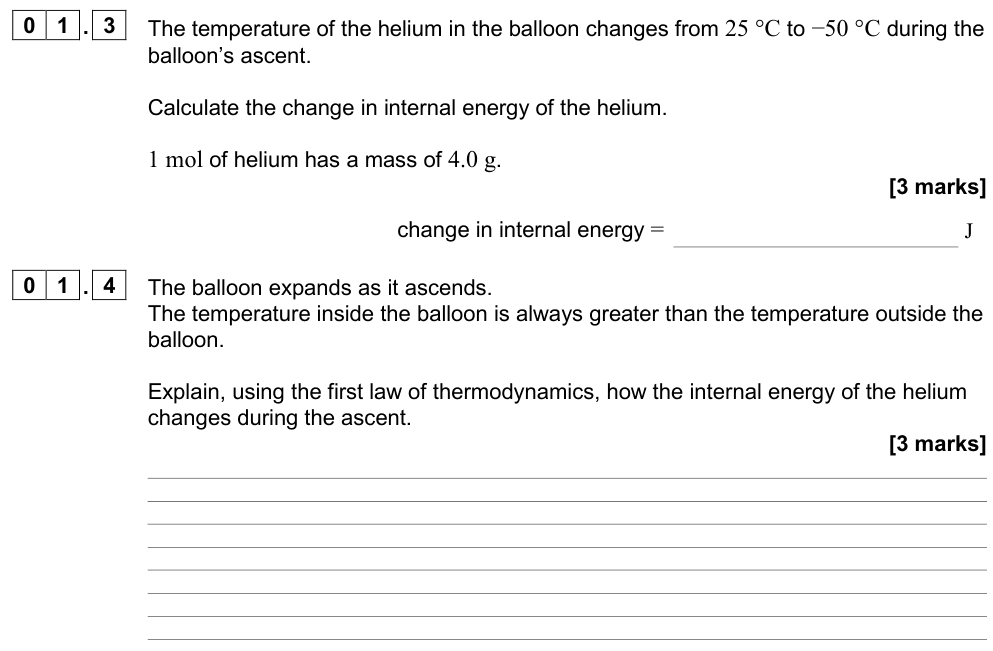
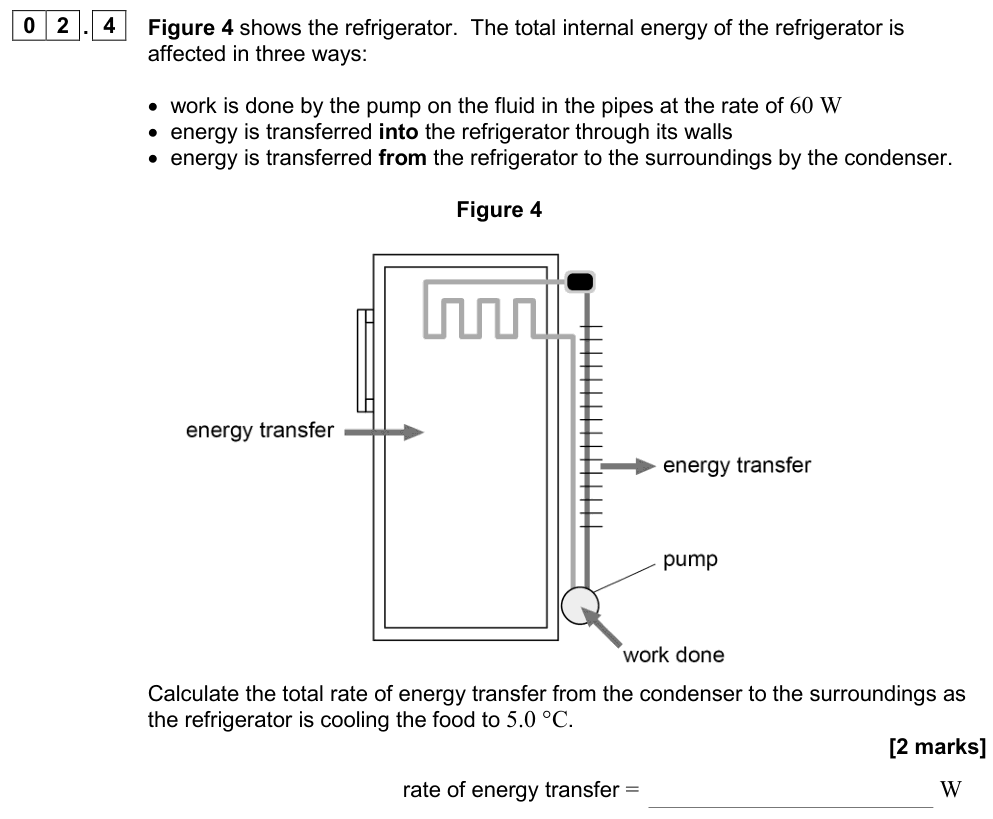
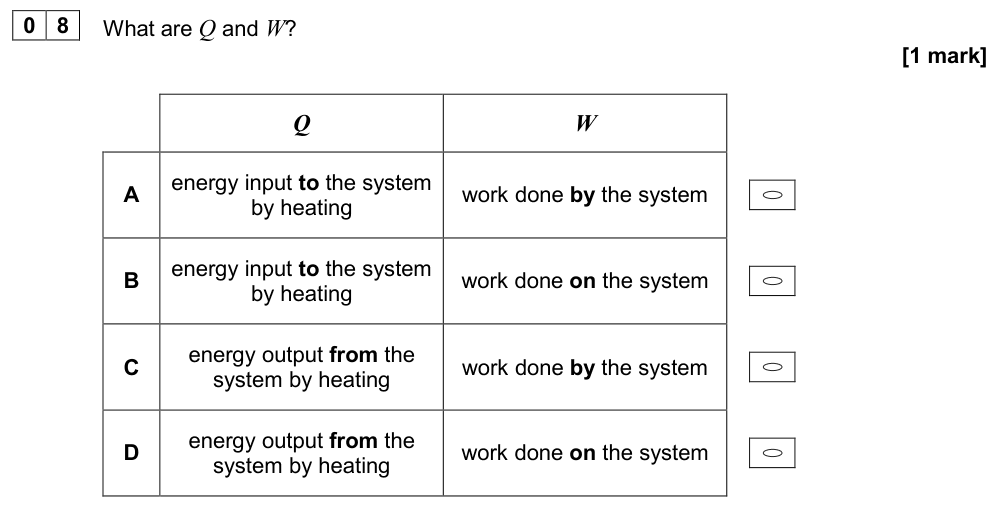
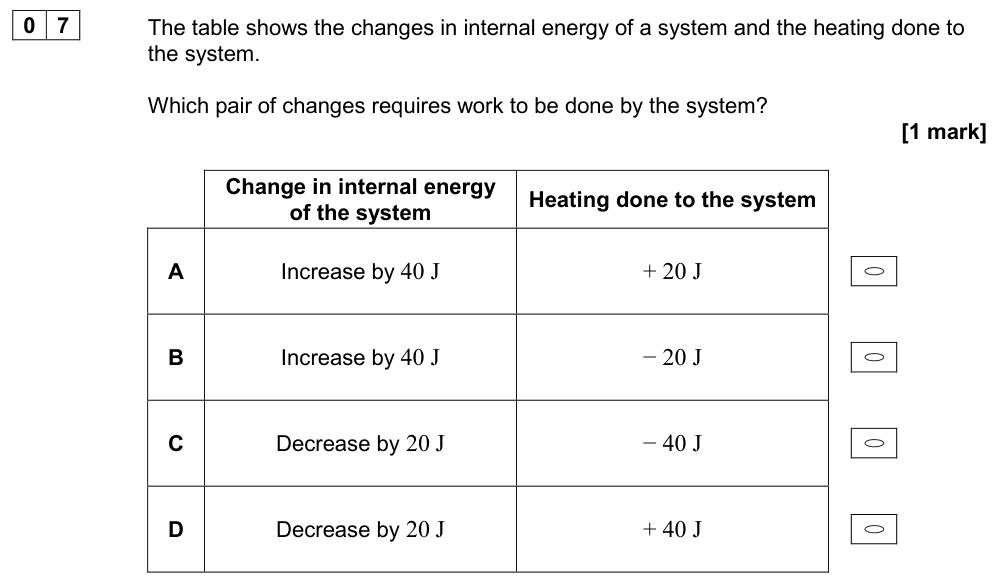
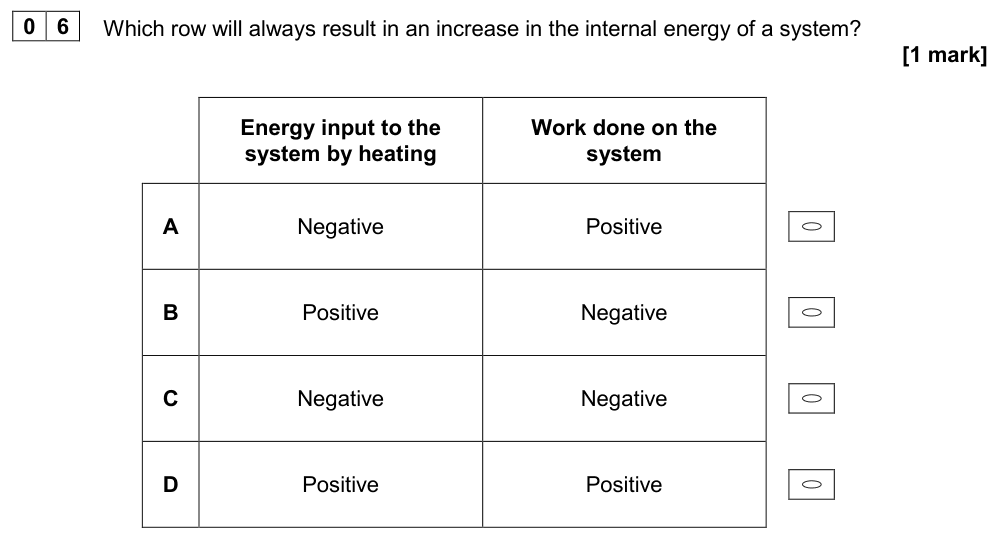
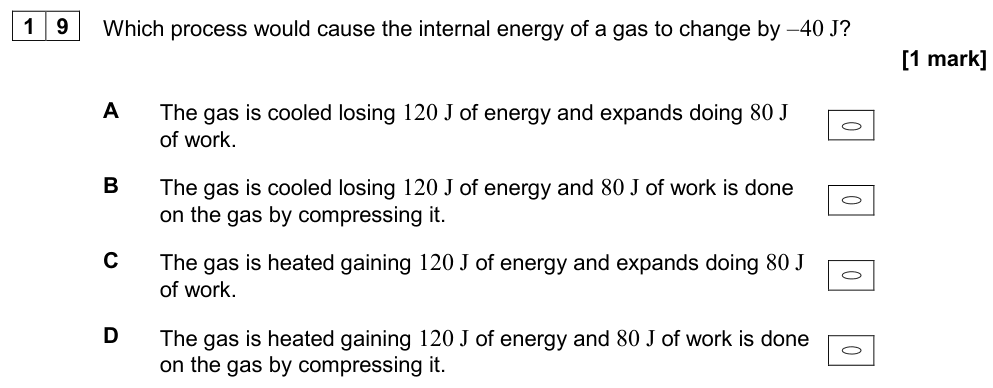
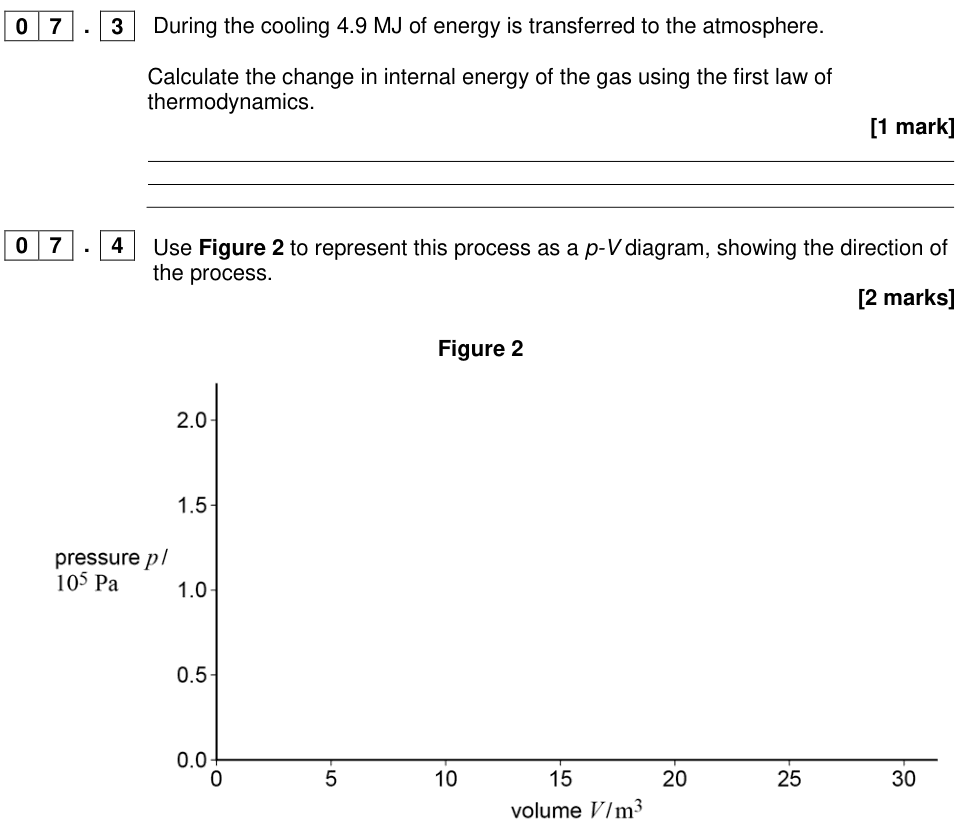
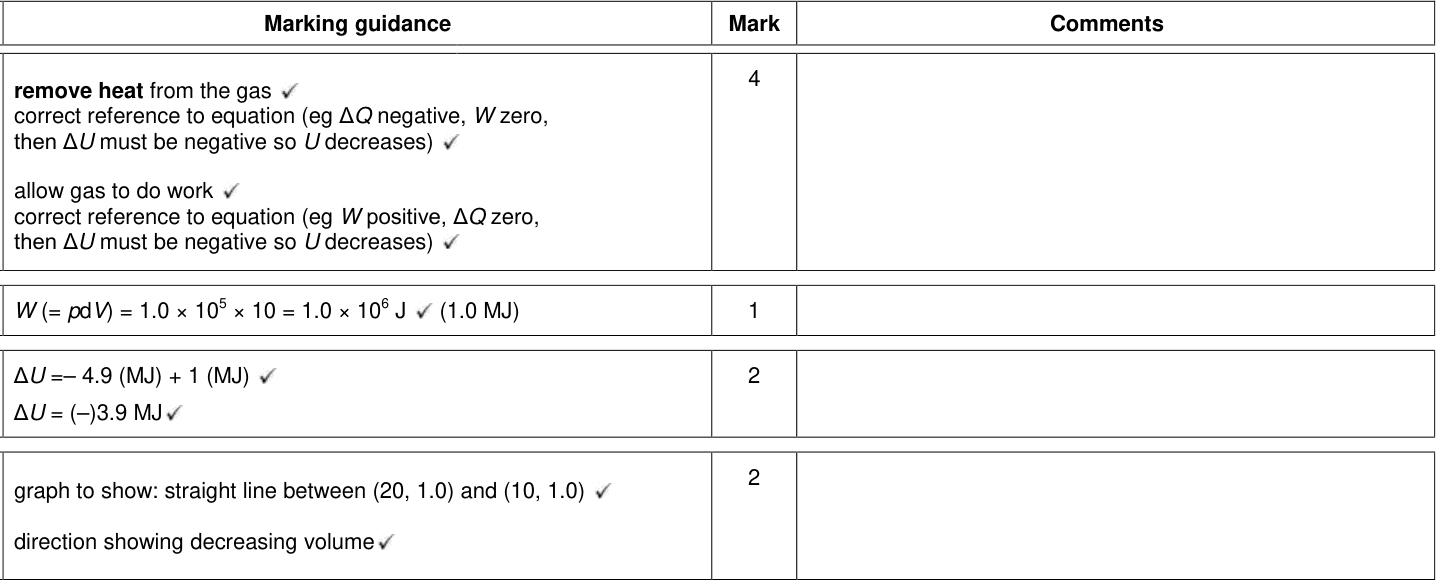
$$\Delta U = Q + W$$
- $\Delta U$ = increase in internal energy of the system
- $Q$ = energy transferred to the system by heating
- $W$ = work done on the system
Each term is negative if energy leaves the system: $Q < 0$ if the system loses energy by heating, $W < 0$ if the system does work on its surroundings.
The first law is a statement of the conservation of energy applied to a system's internal energy.
| Situation | Q | W | ΔU |
|---|---|---|---|
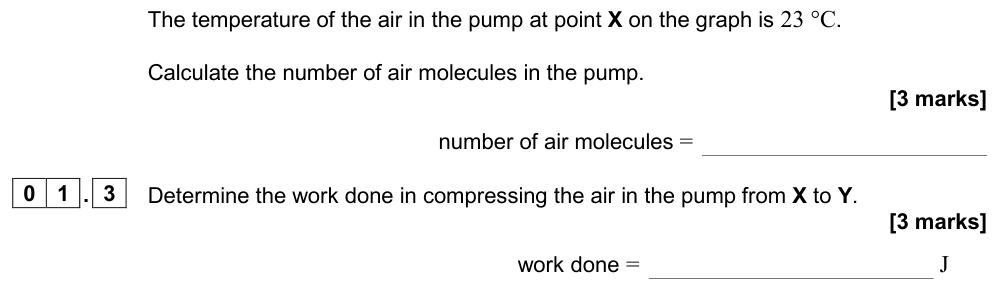
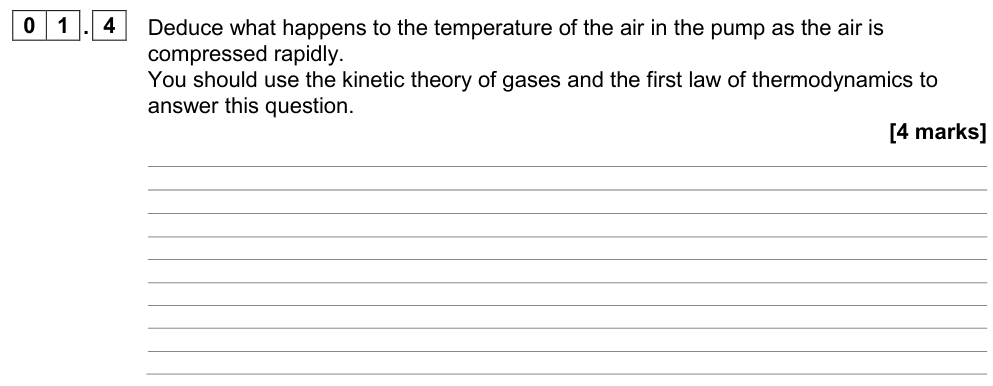
| Gas in a bicycle pump compressed quickly (no time for heat to escape) | 0 | + | + (the gas gets warmer) |
| Gas expands quickly, pushing a piston out | 0 | − | − (the gas cools) |
| Water heated in a kettle (volume change negligible) | + | 0 | + |
| Gas heated, expands and pushes a piston at constant temperature | + | − | 0 |
| A drill bit grinding into metal | (−, to surroundings) | + | + (the bit gets hot) |
Worked example: first law
A gas is heated with 500 J of energy. At the same time it expands, doing 200 J of work on its surroundings.
$Q = +500$ J and $W = -200$ J (work is done by the gas), so $\Delta U = 500 - 200 = +300$ J. The internal energy increases by 300 J.
Change of state
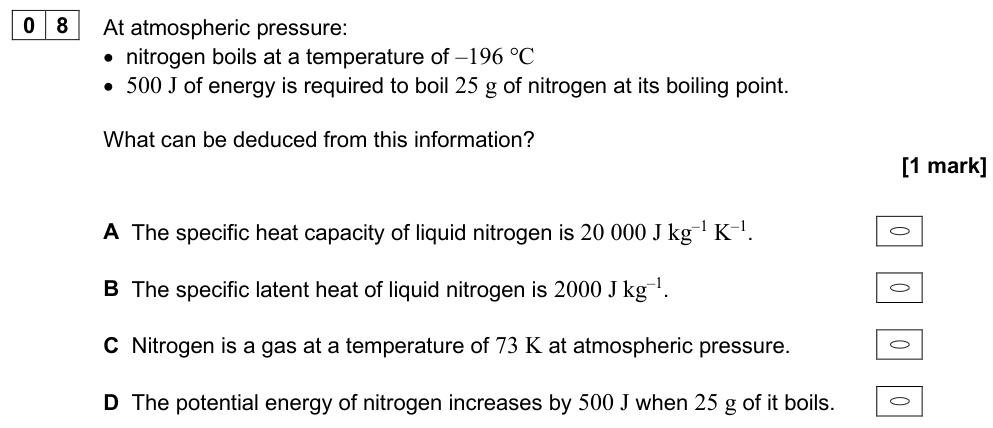
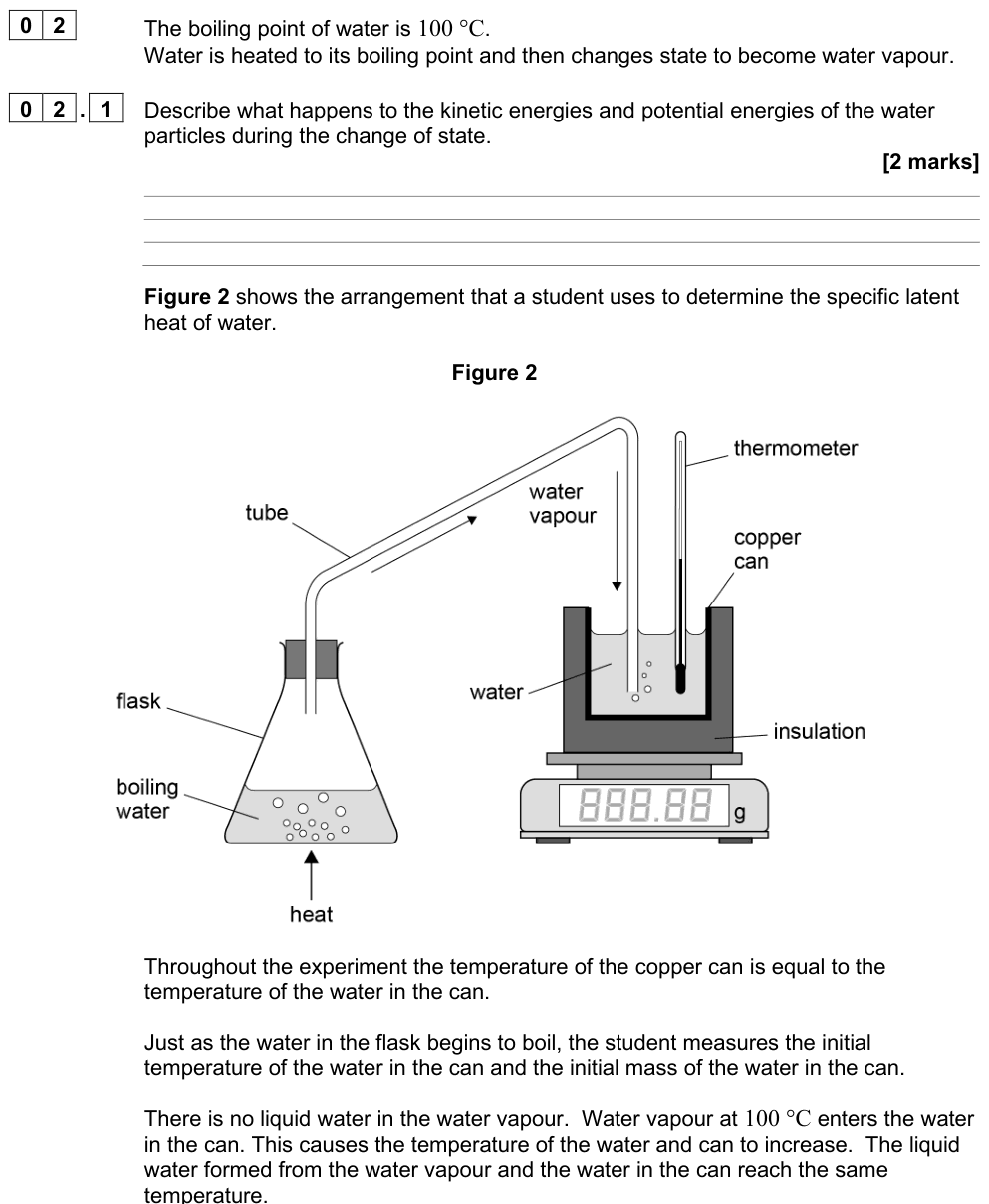
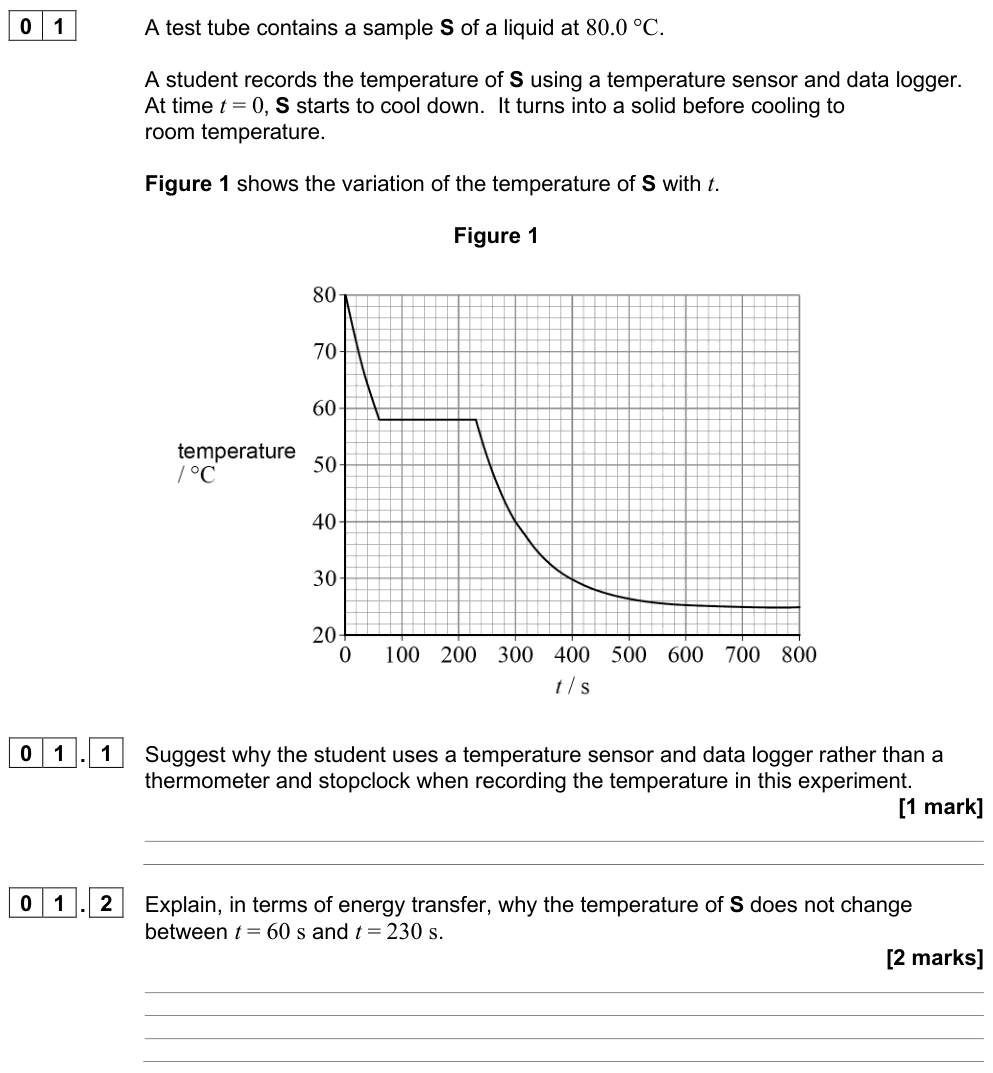
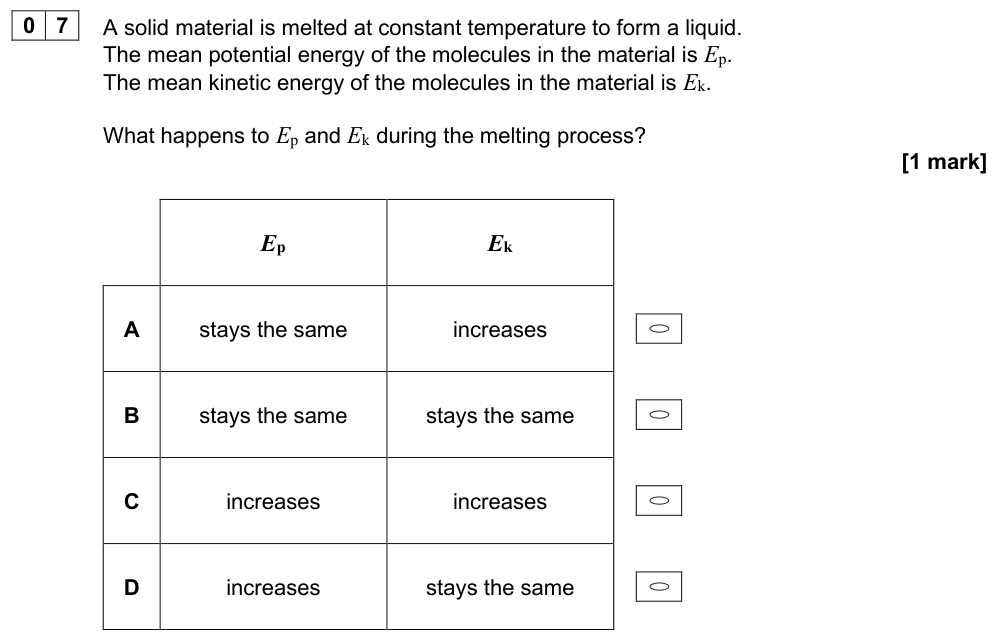
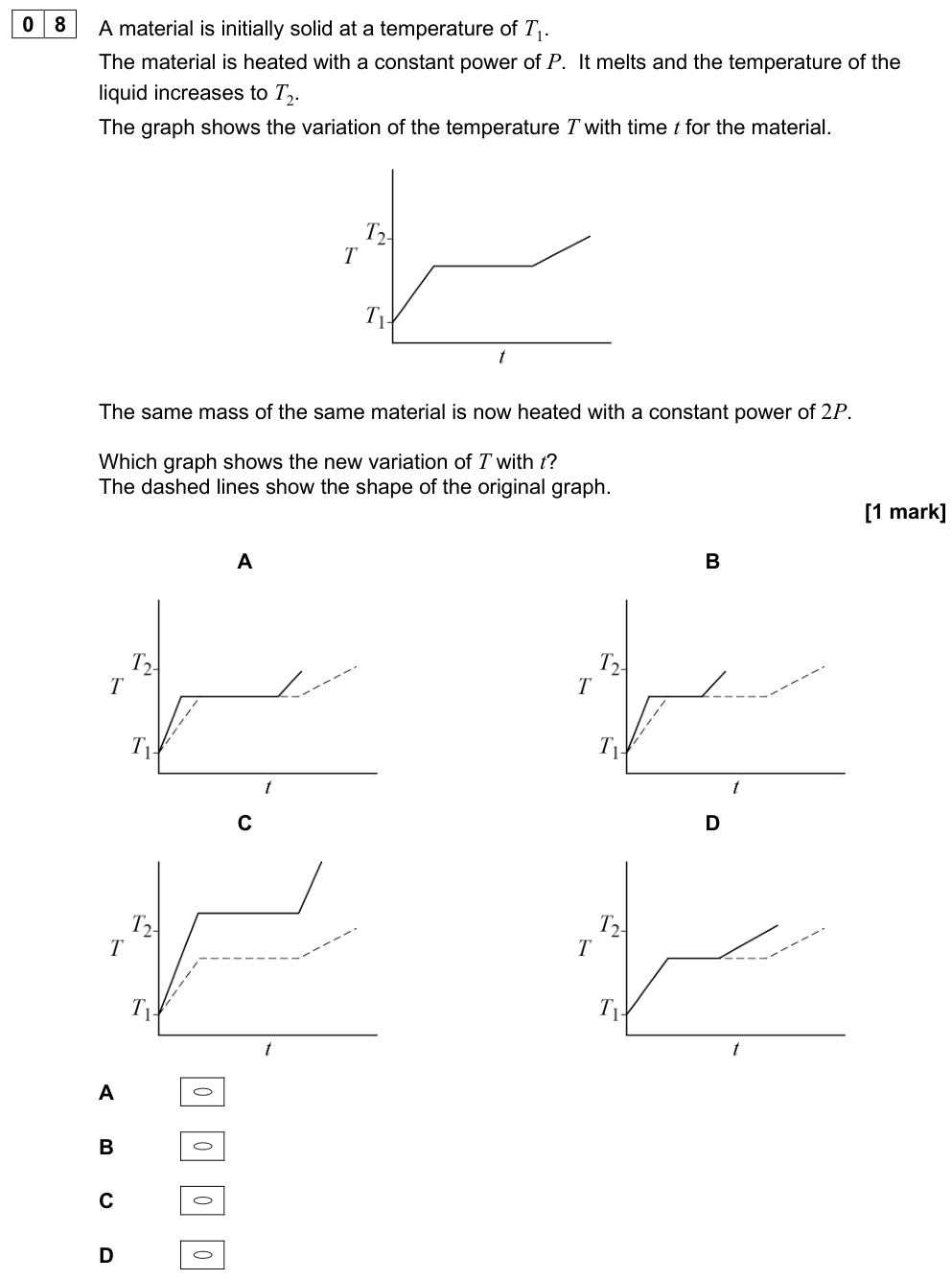
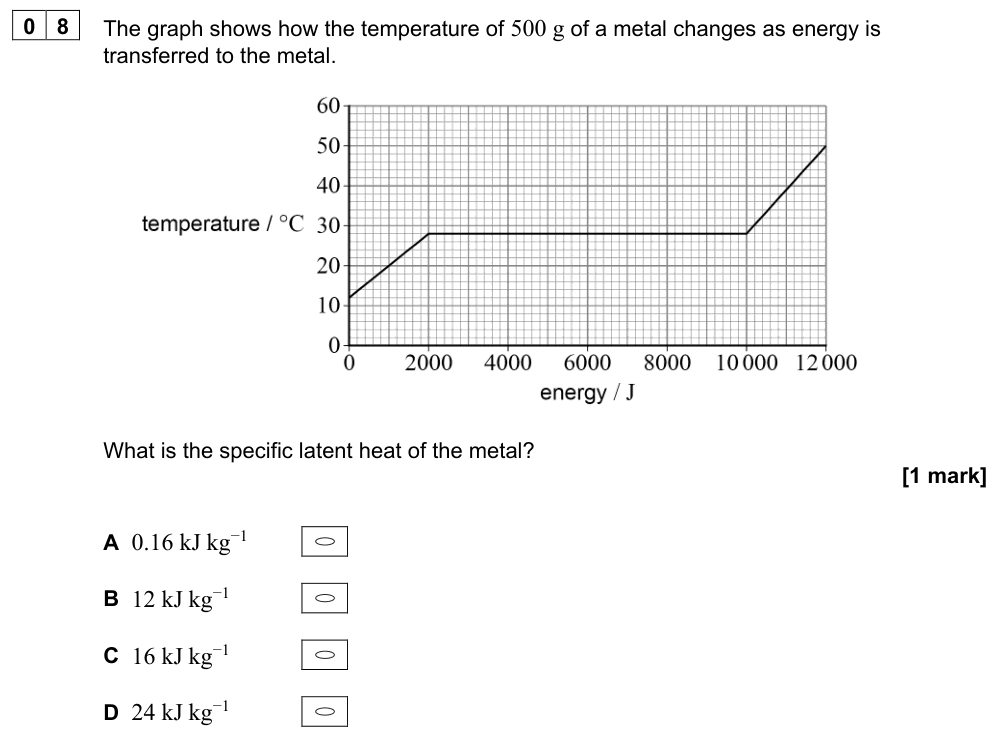
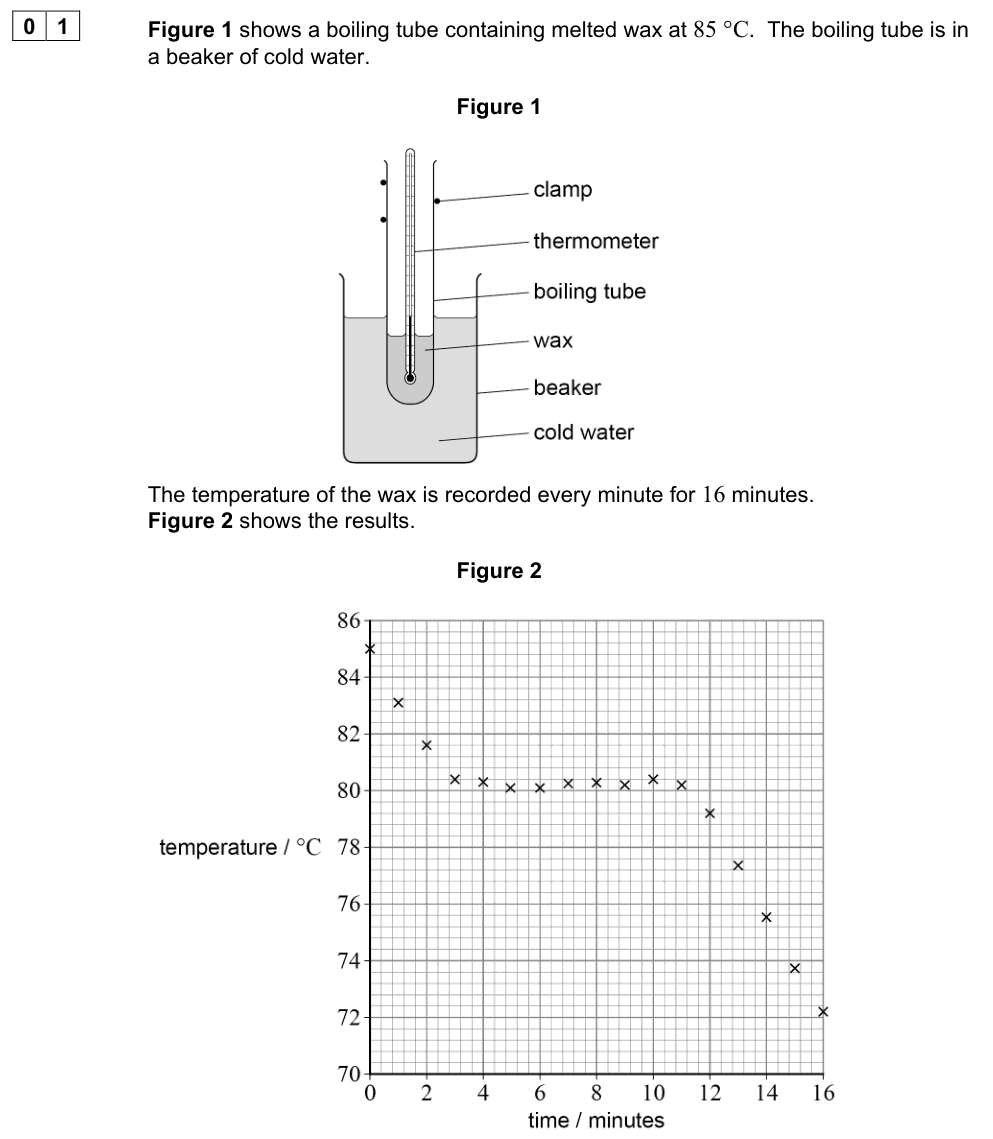
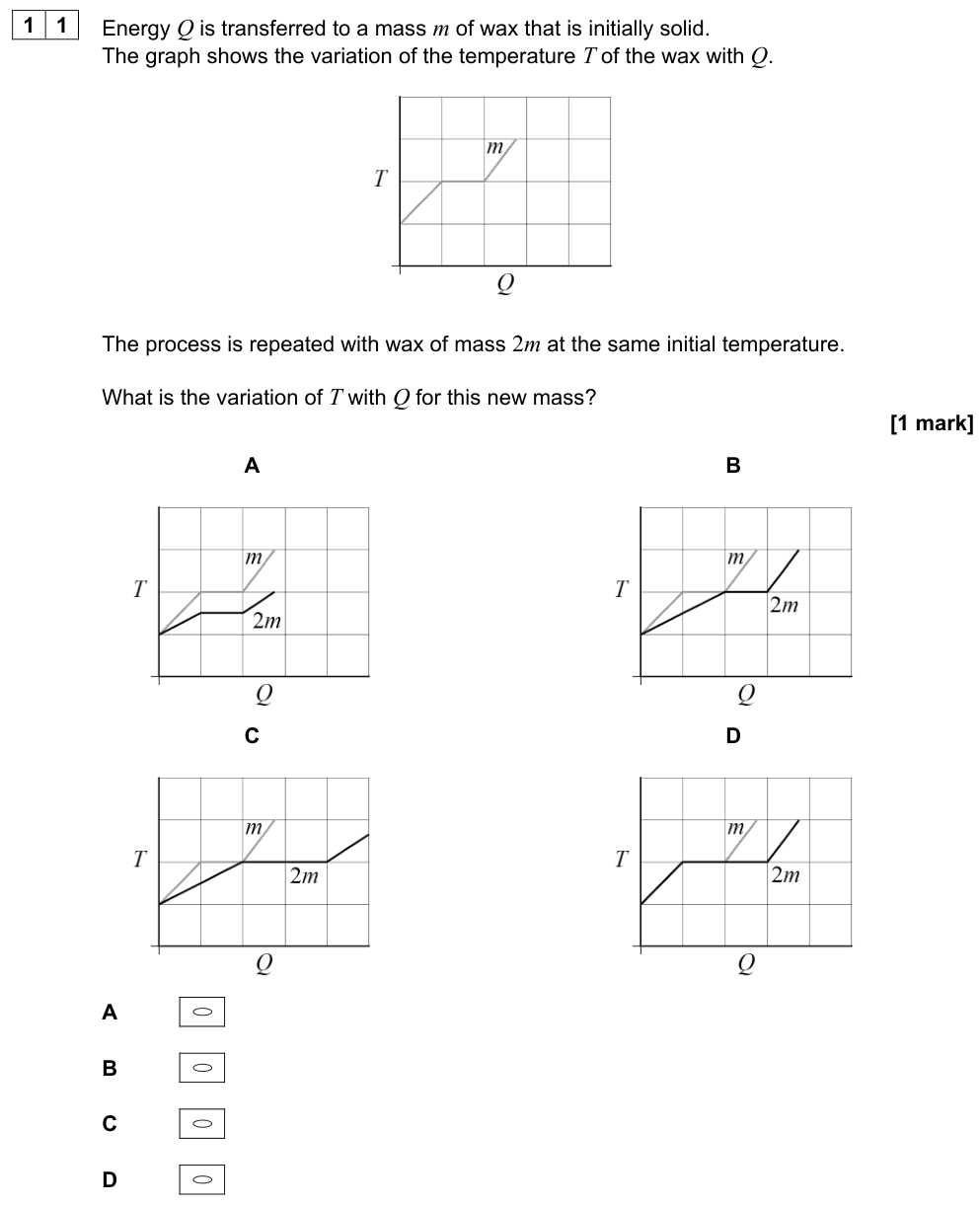
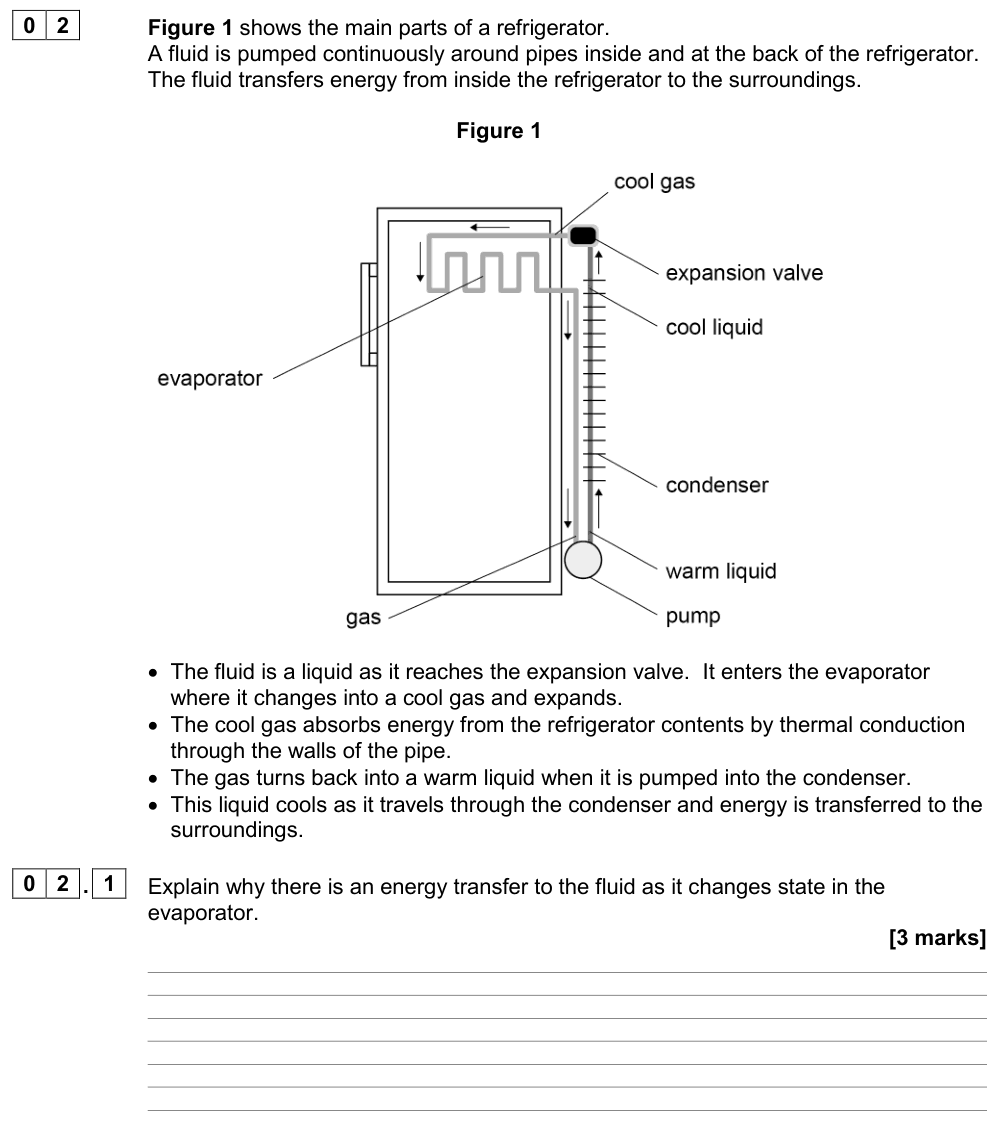
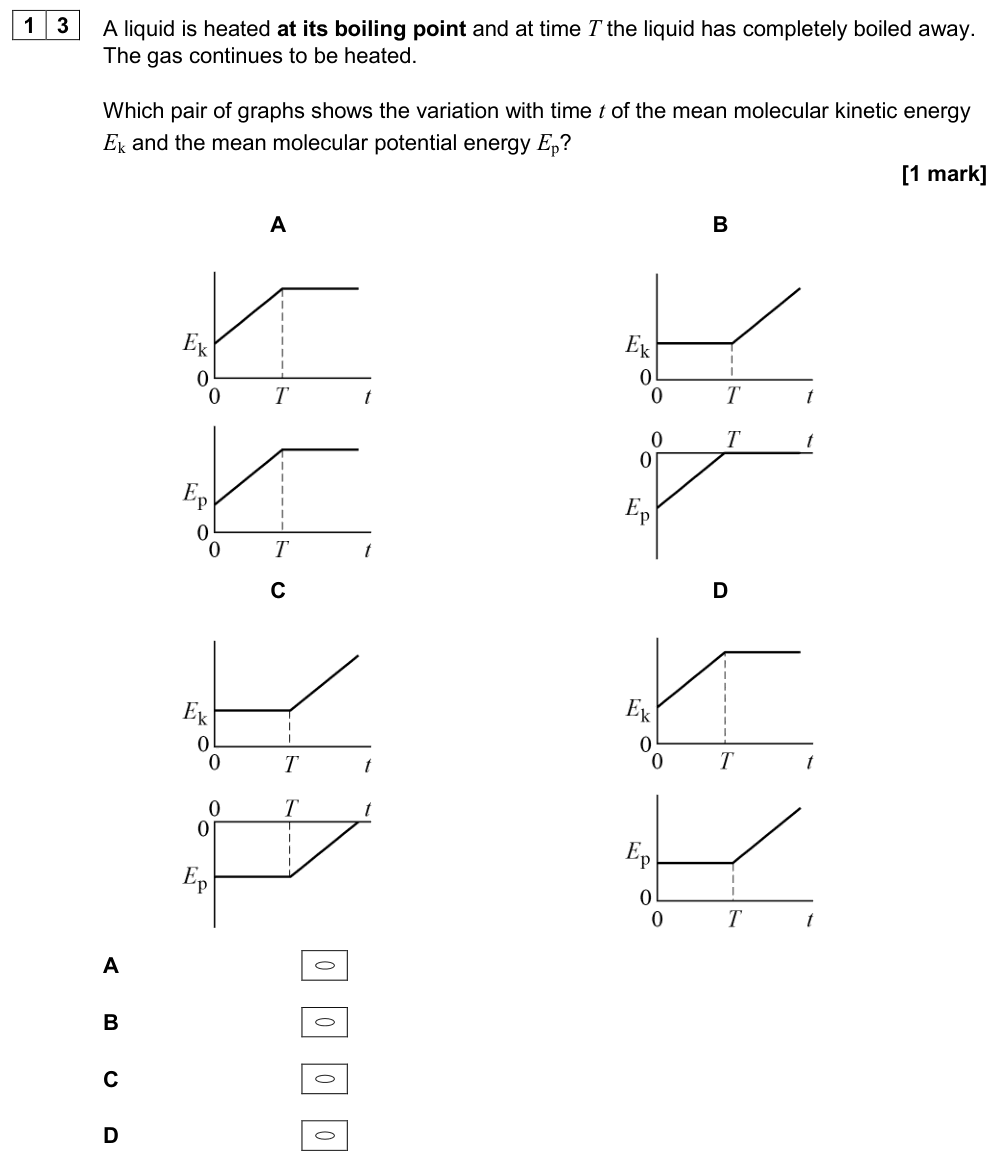
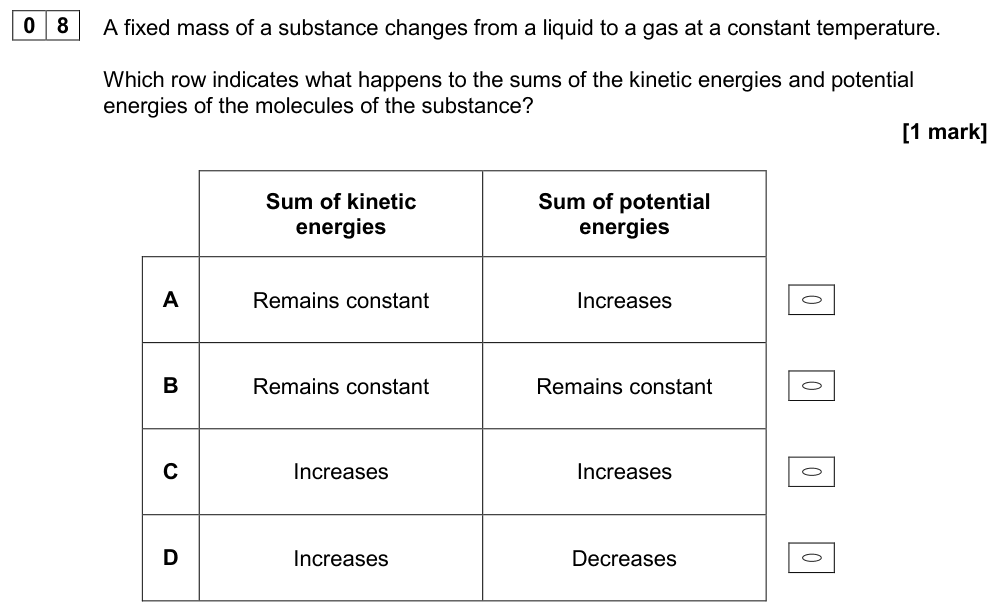
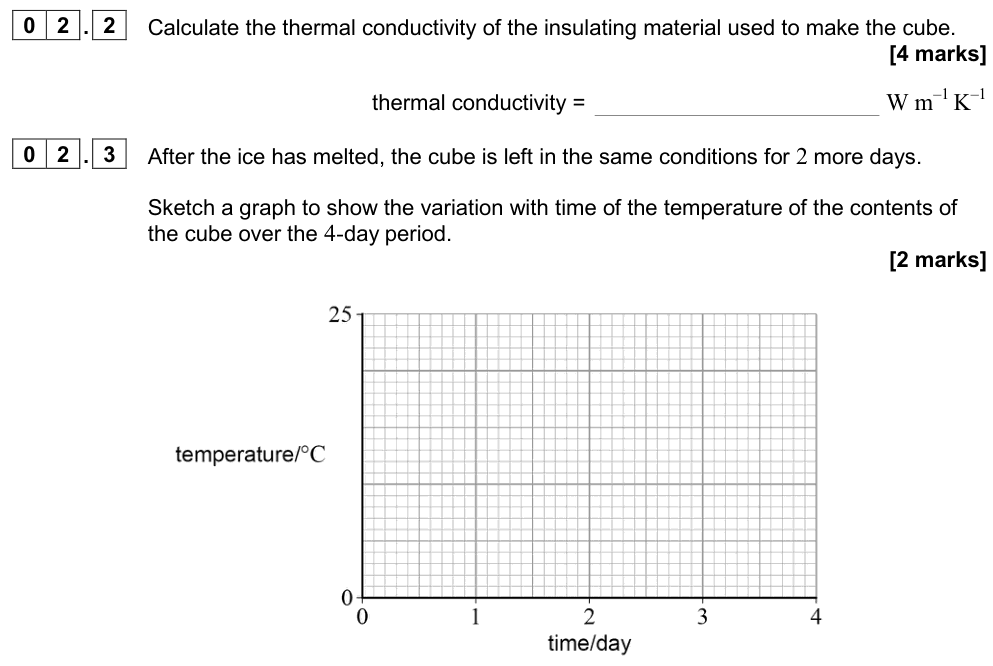
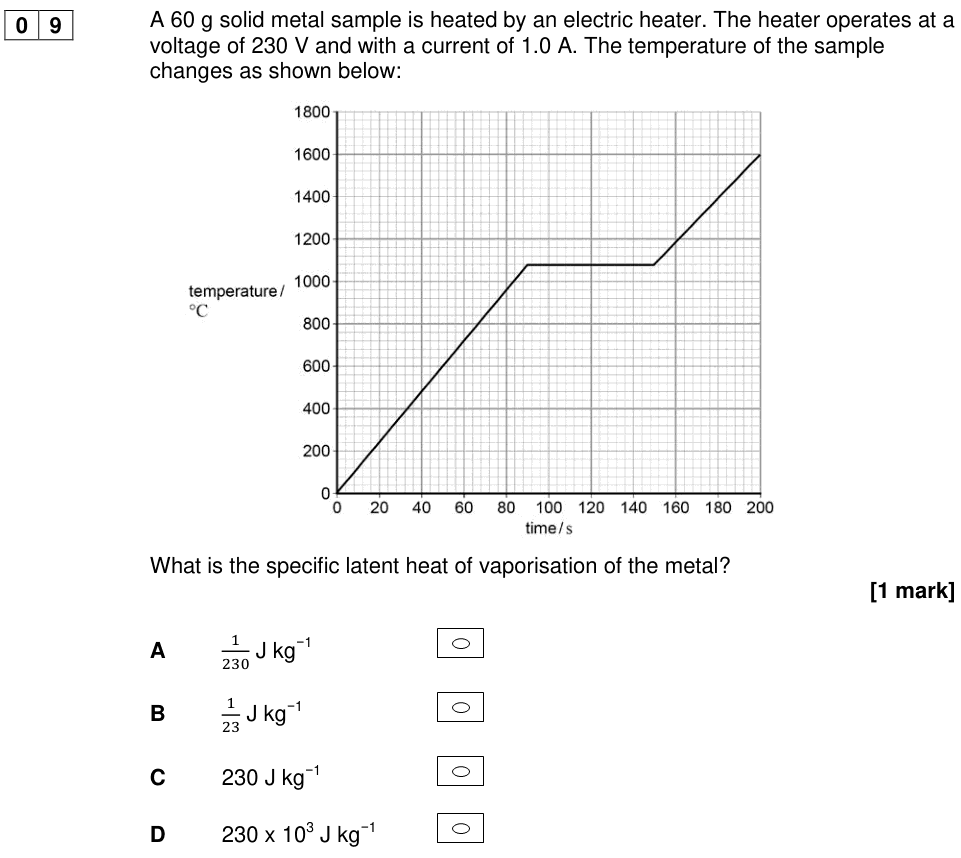
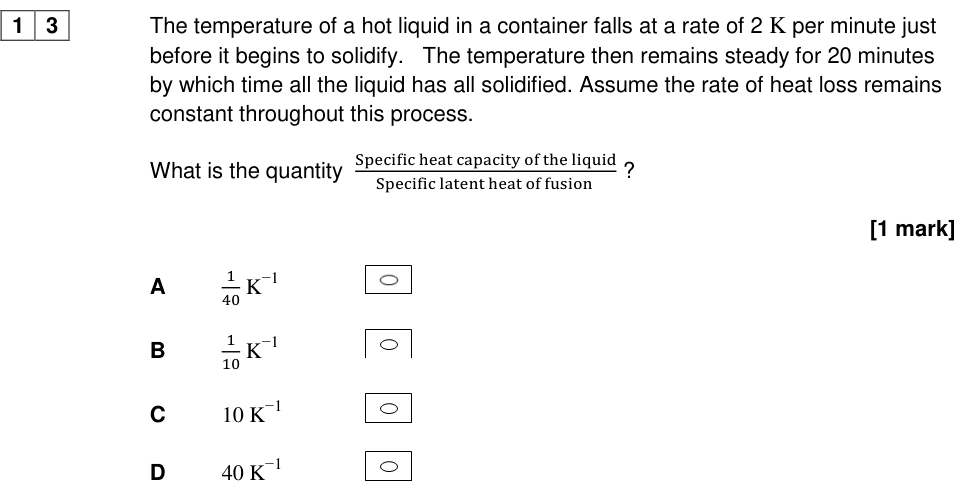
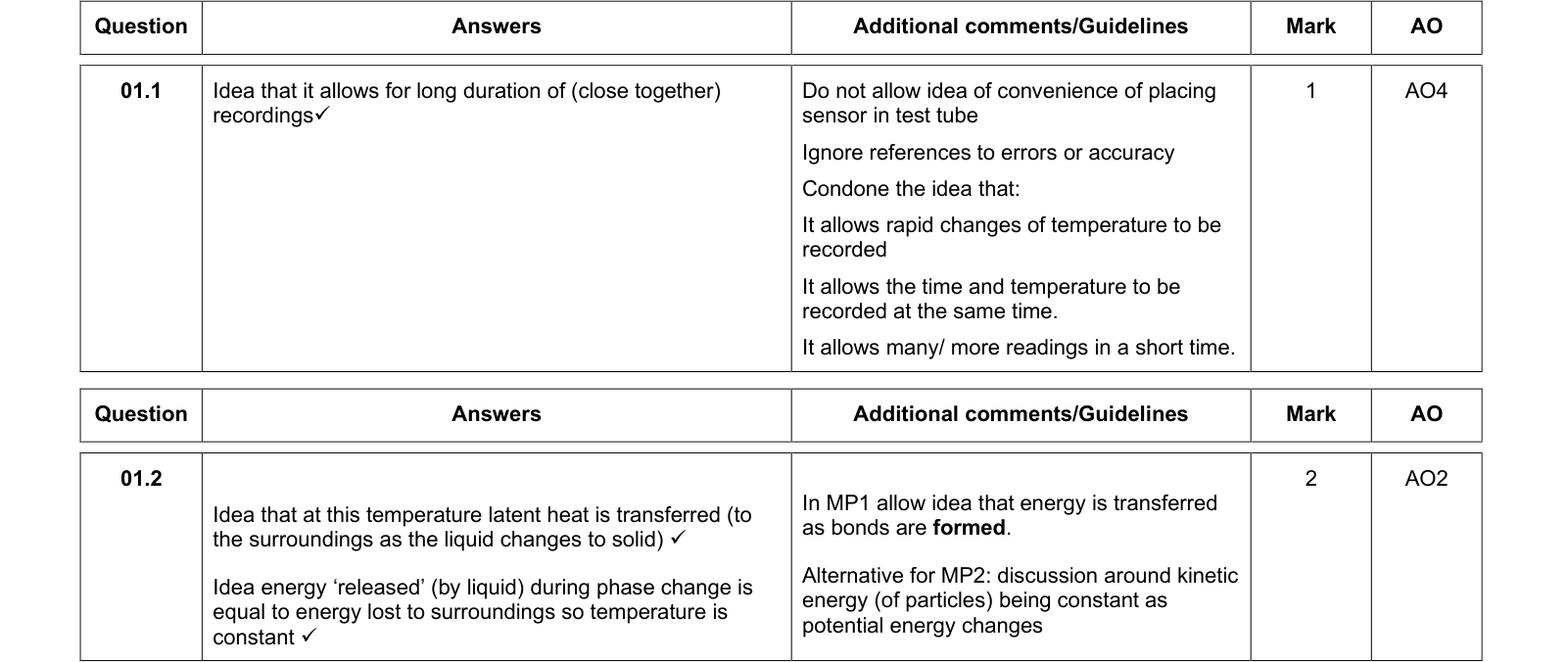
When a substance melts or boils, energy is supplied but the temperature stays constant.
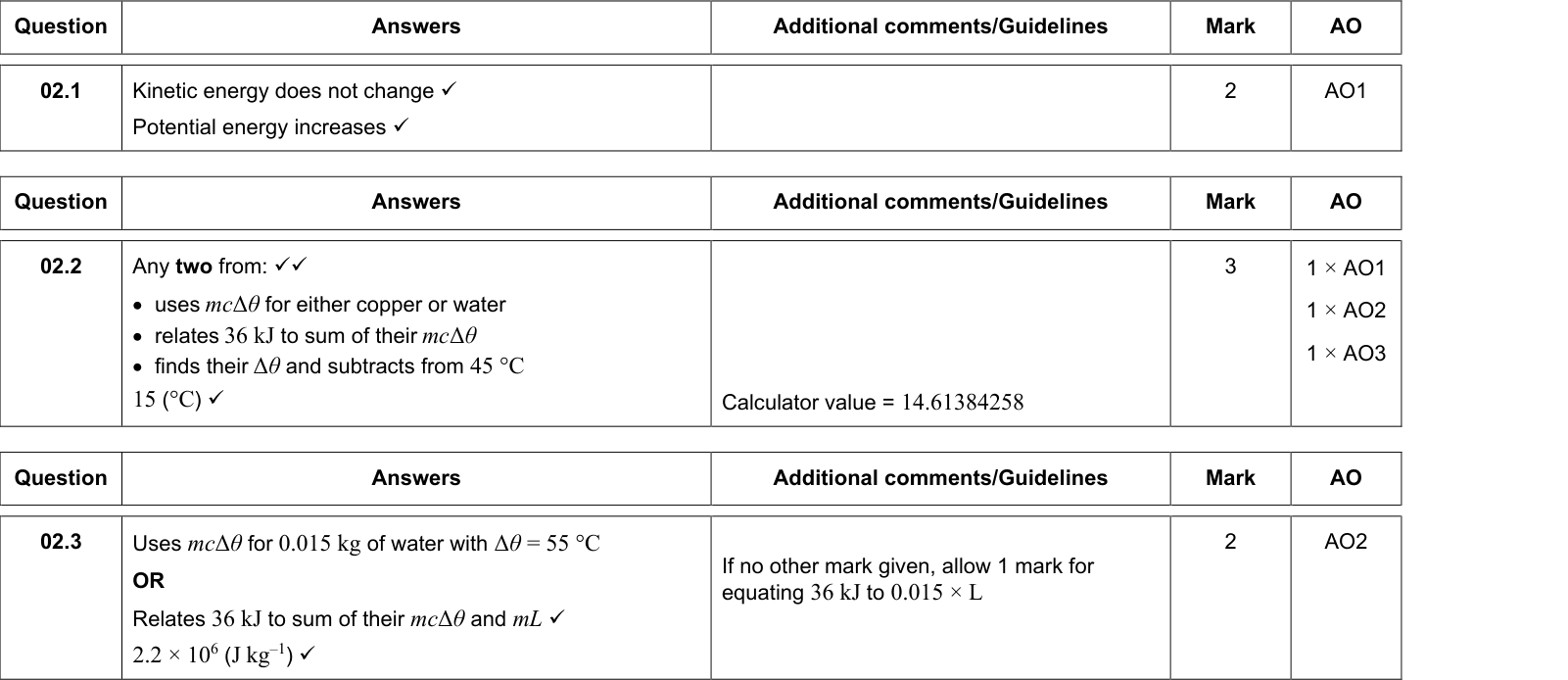
- The energy is used to break or weaken the bonds between particles and increase their separation: the potential energy of the particles increases.
- The kinetic energy of the particles does not change, because the temperature is constant.
During freezing and condensing the potential energy decreases and energy is released to the surroundings, again at constant temperature.
Specific heat capacity
Specific heat capacity
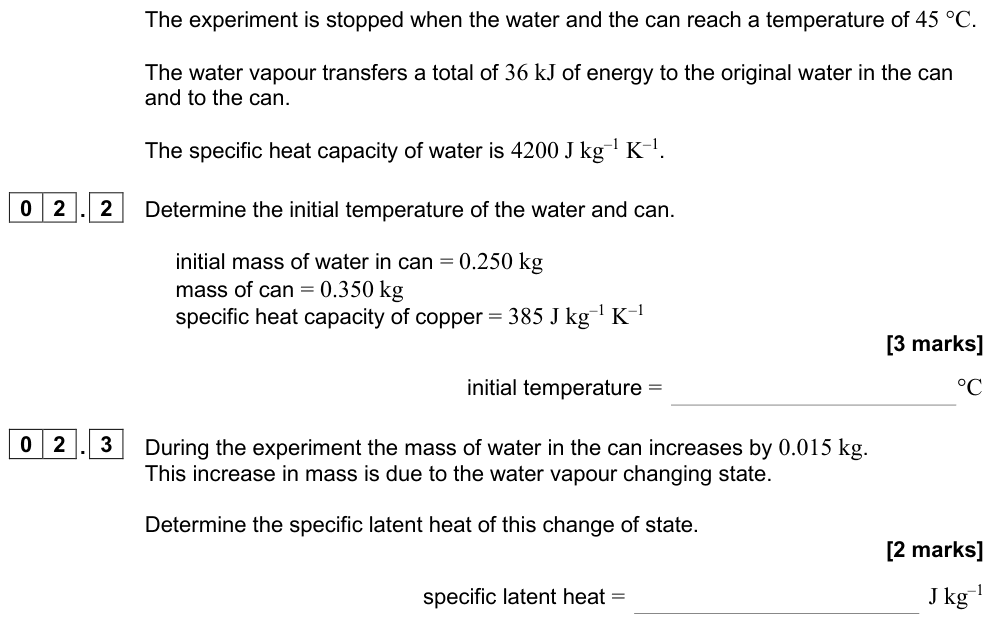
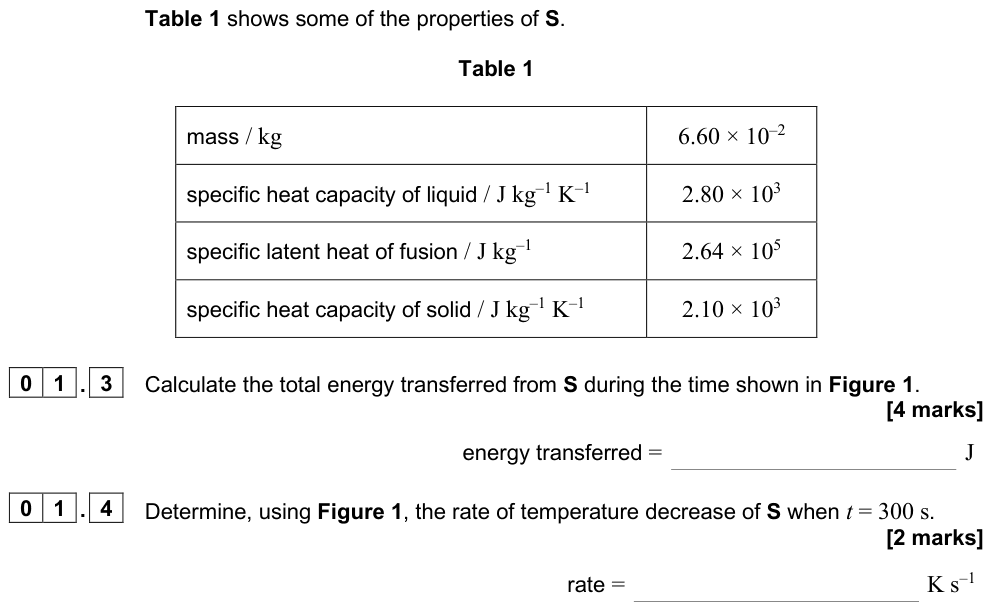
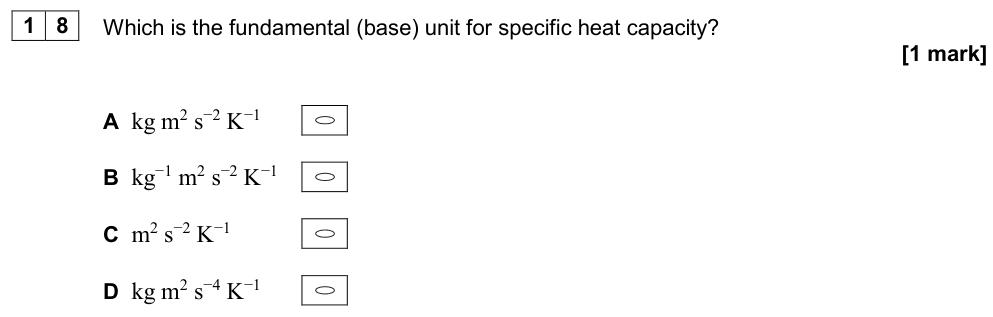
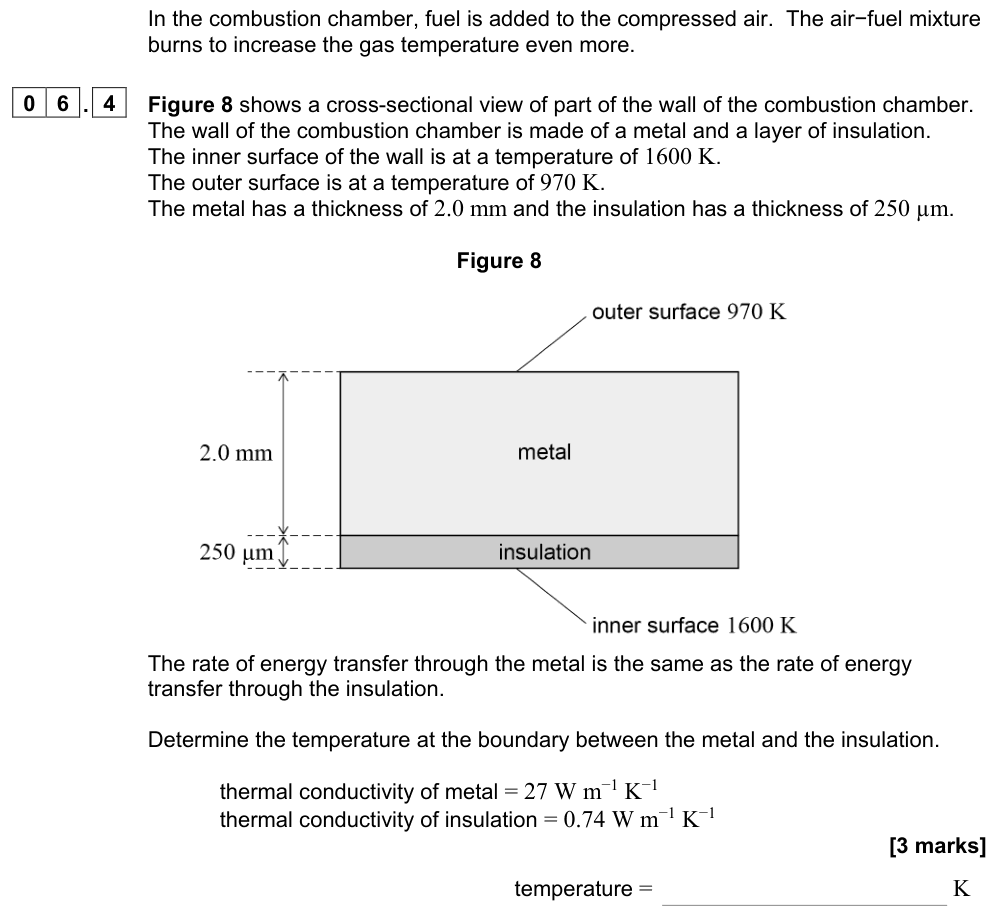
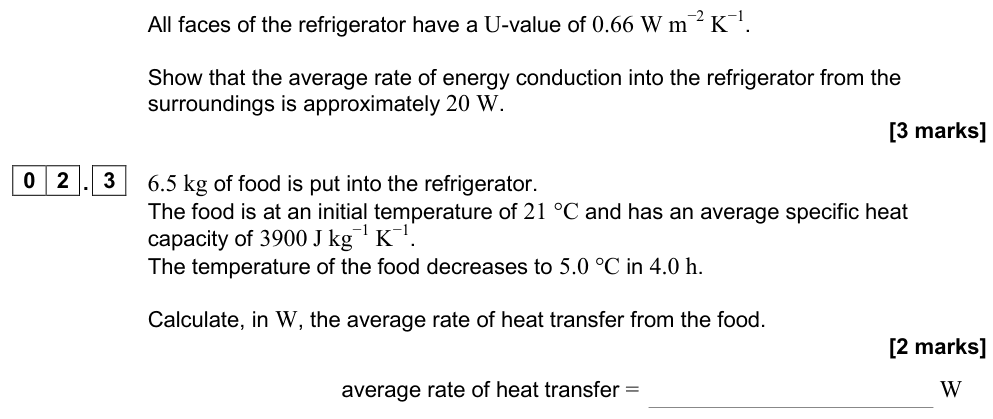
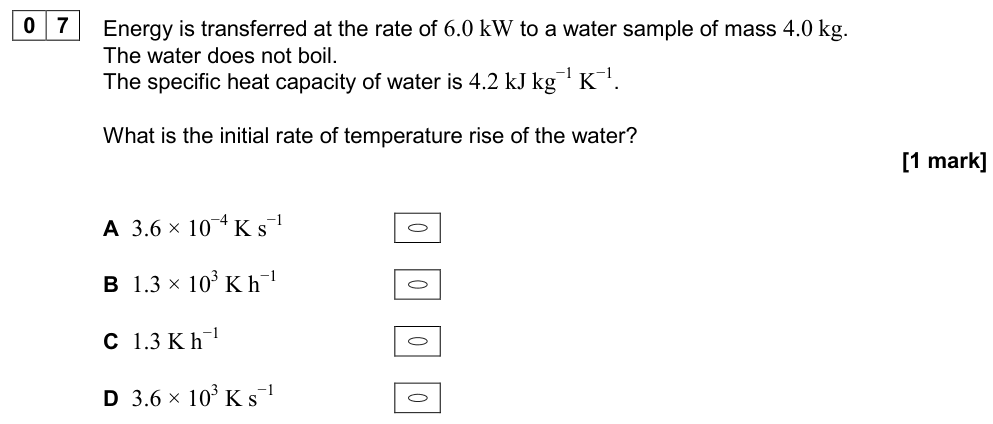
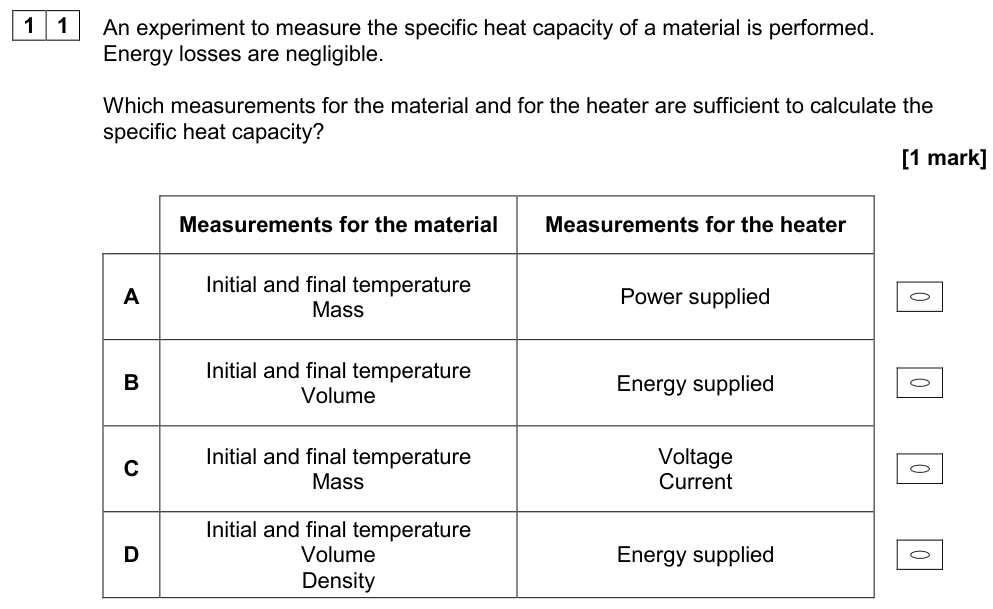
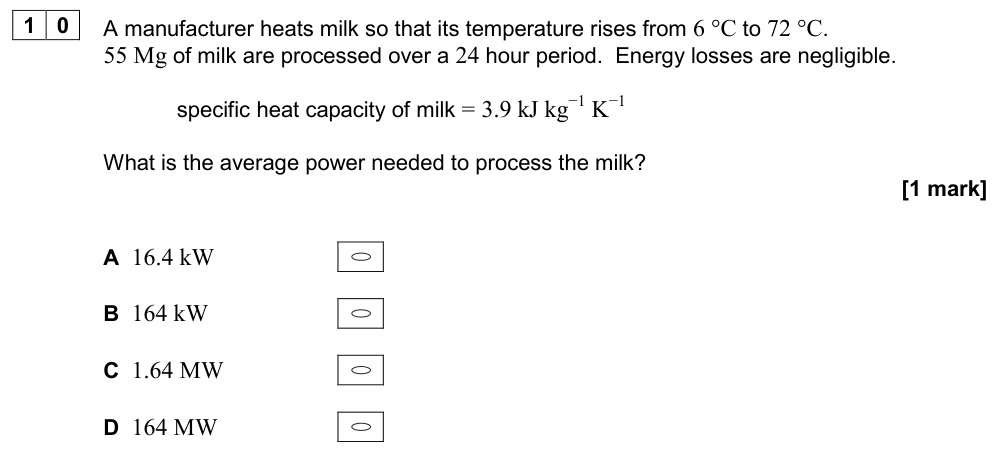
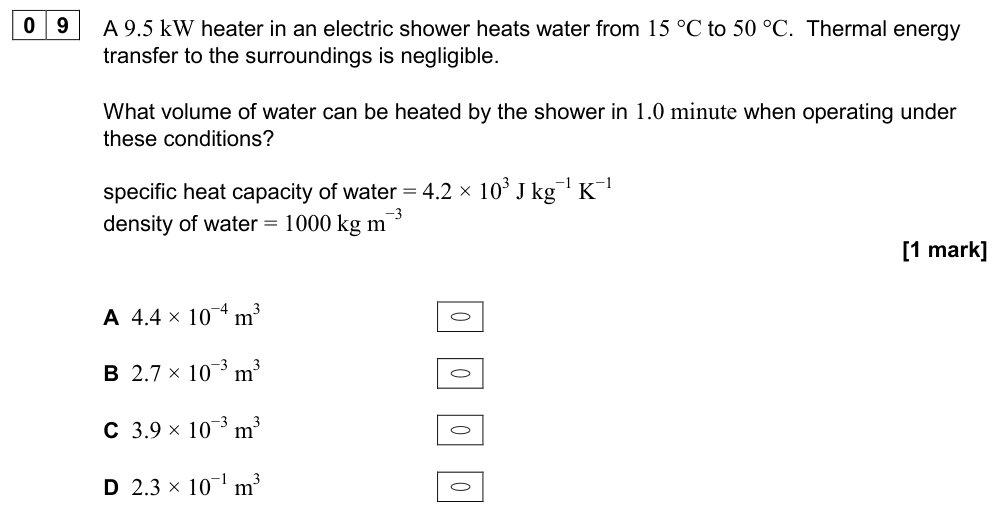
The specific heat capacity $c$ of a substance is the energy needed to raise the temperature of 1 kg of the substance by 1 K (or 1 °C), without a change of state.
Energy for a temperature change
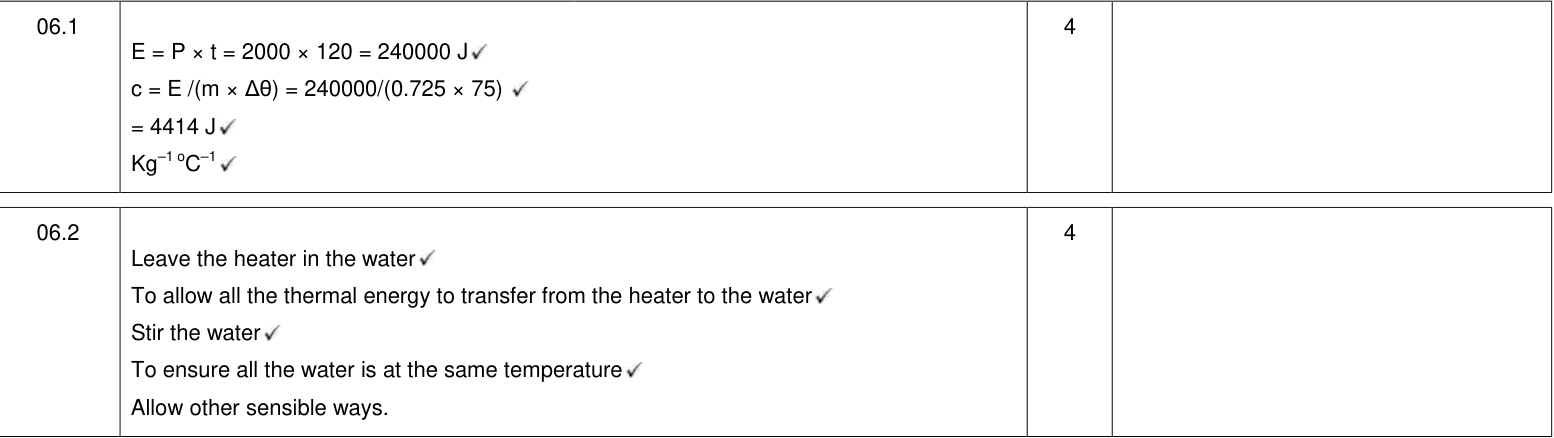
$$Q = mc\Delta\theta$$
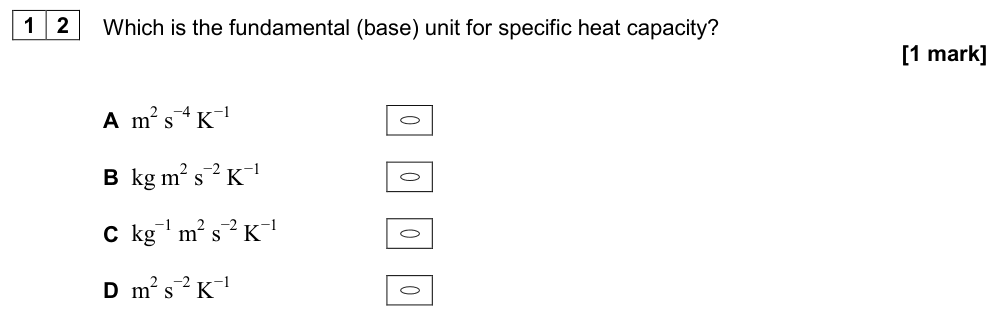
Unit of $c$: J kg⁻¹ K⁻¹. A temperature change in K is the same as a change in °C.
| Substance | $c$ / J kg⁻¹ K⁻¹ |
|---|---|
| water | 4200 |
| ice | 2100 |
| aluminium | 900 |
| copper | 390 |
| lead | 130 |
Water has a very high specific heat capacity, which is why it is used in central heating systems and as a coolant, and why coastal climates are milder.
Worked example: a kettle
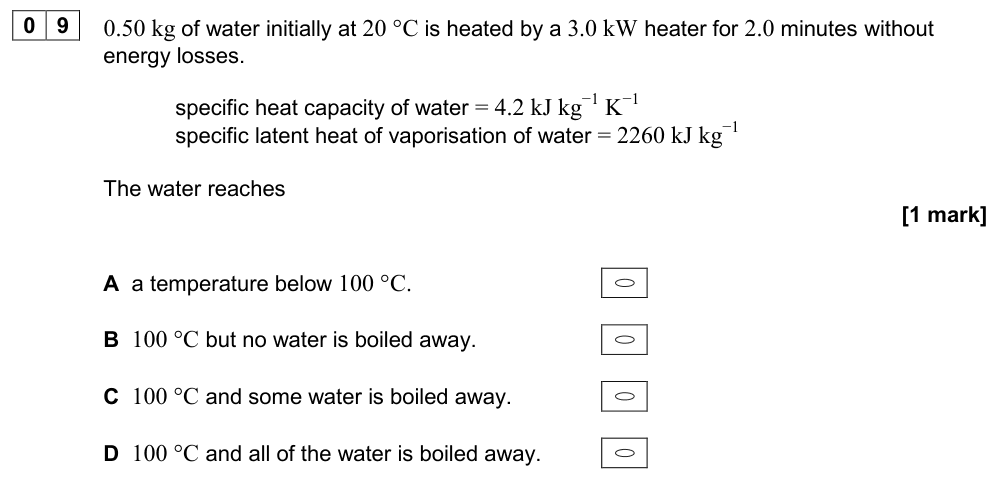
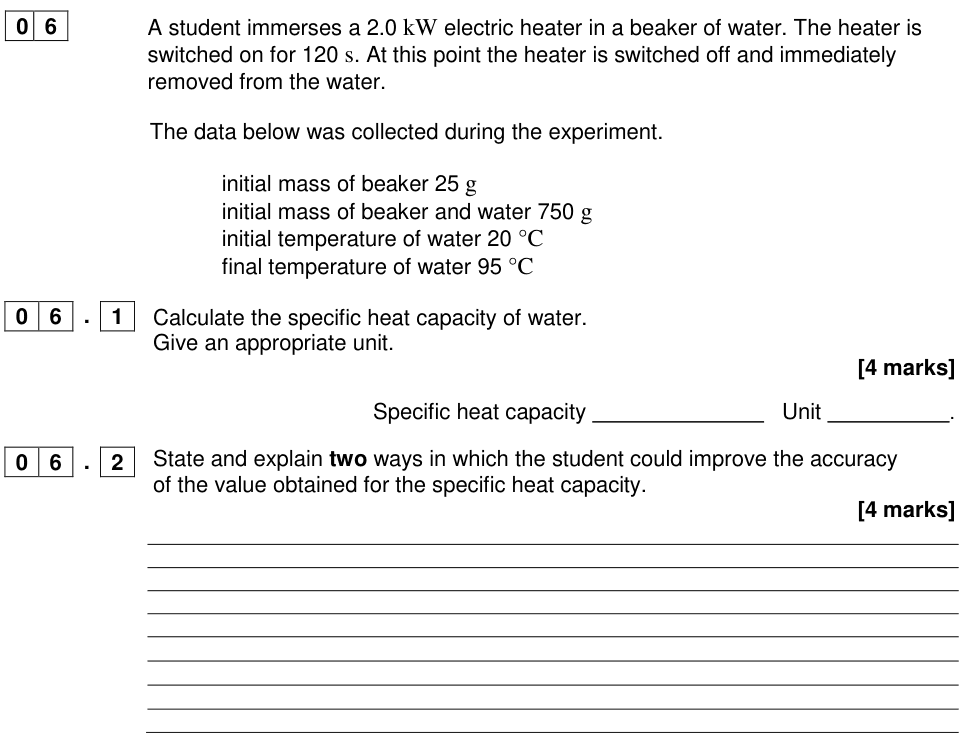
A 2.2 kW kettle contains 1.2 kg of water at 20 °C. How long does it take to reach 100 °C, assuming no energy losses?
$Q = mc\Delta\theta = 1.2 \times 4200 \times 80 = 4.03 \times 10^{5}$ J.
$t = \dfrac{Q}{P} = \dfrac{4.03 \times 10^{5}}{2200} = 183$ s (about 3 minutes). In practice it takes longer because energy also heats the kettle and is lost to the surroundings.
Mixing problems
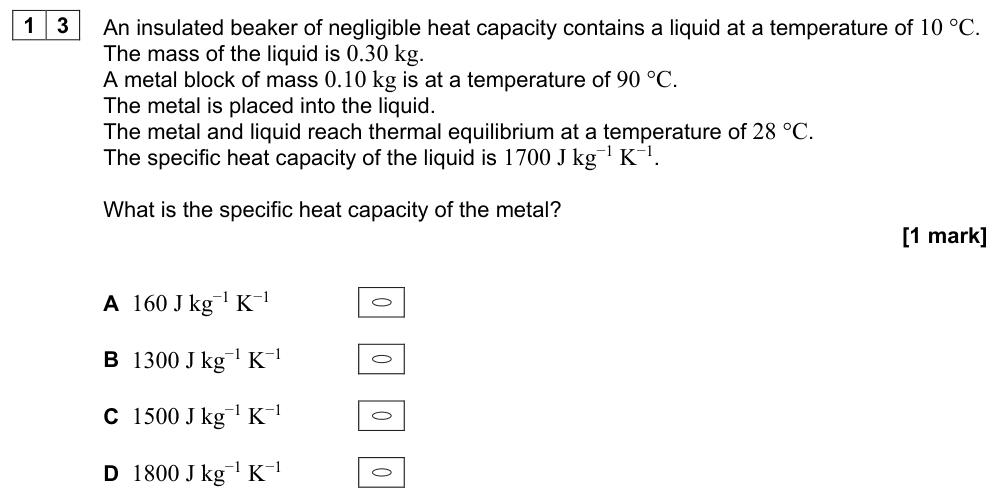
When a hot object is placed in contact with a cold one (or two liquids are mixed) and no energy is lost to the surroundings:
$$\text{energy lost by the hot object} = \text{energy gained by the cold object}$$
Worked example: mixing water
0.20 kg of water at 80 °C is mixed with 0.30 kg of water at 20 °C. Find the final temperature $\theta$.
$0.20 \times 4200 \times (80 - \theta) = 0.30 \times 4200 \times (\theta - 20)$
$16 - 0.20\theta = 0.30\theta - 6 \Rightarrow 0.50\theta = 22 \Rightarrow \theta = 44\ °\text{C}$
Specific latent heat
Specific latent heat
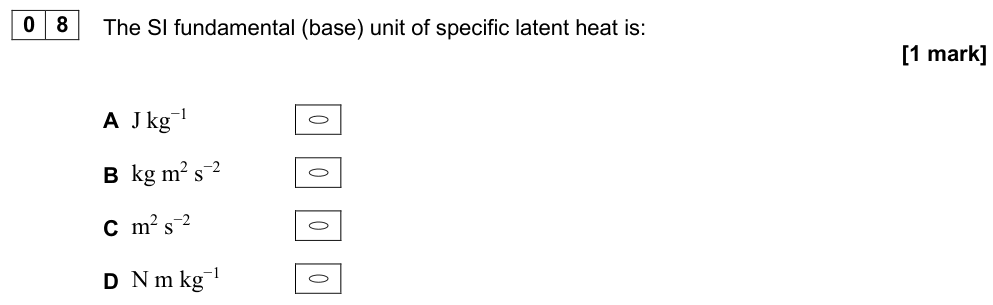
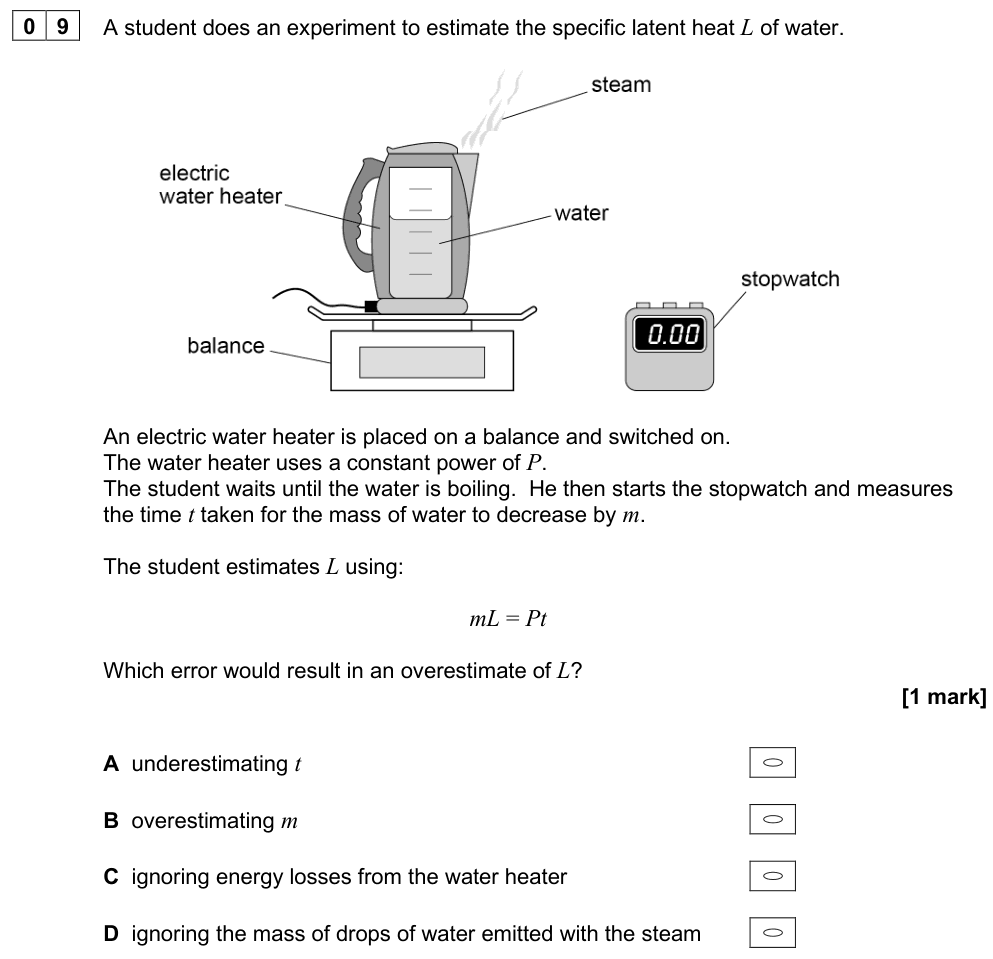
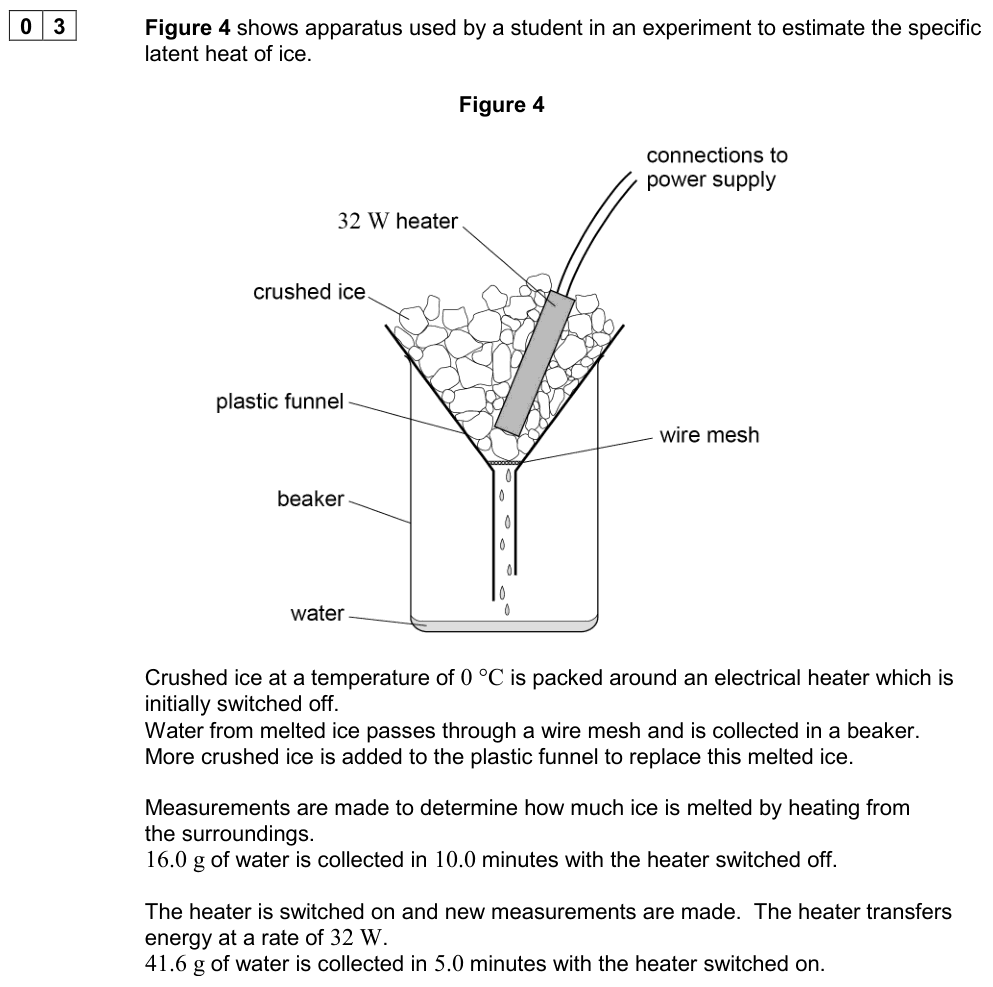
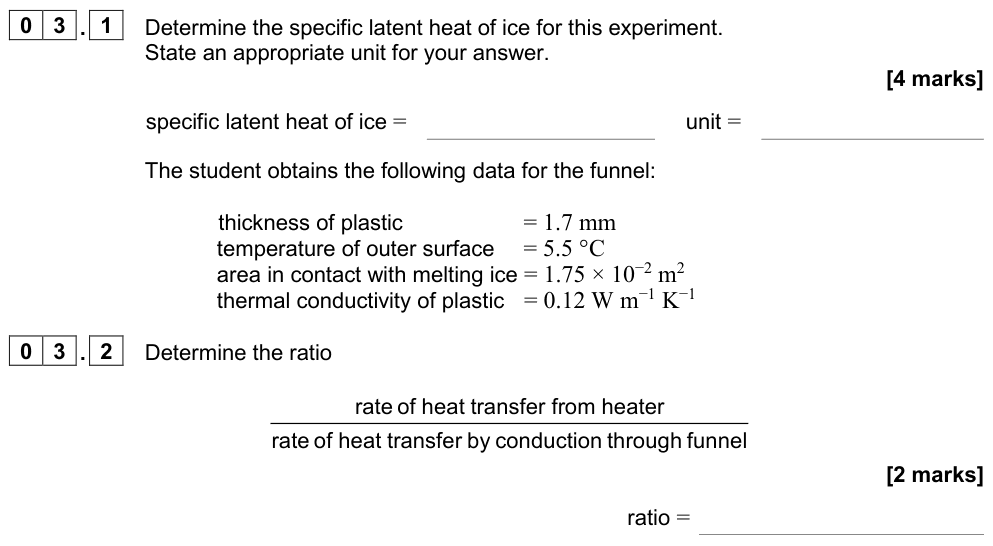
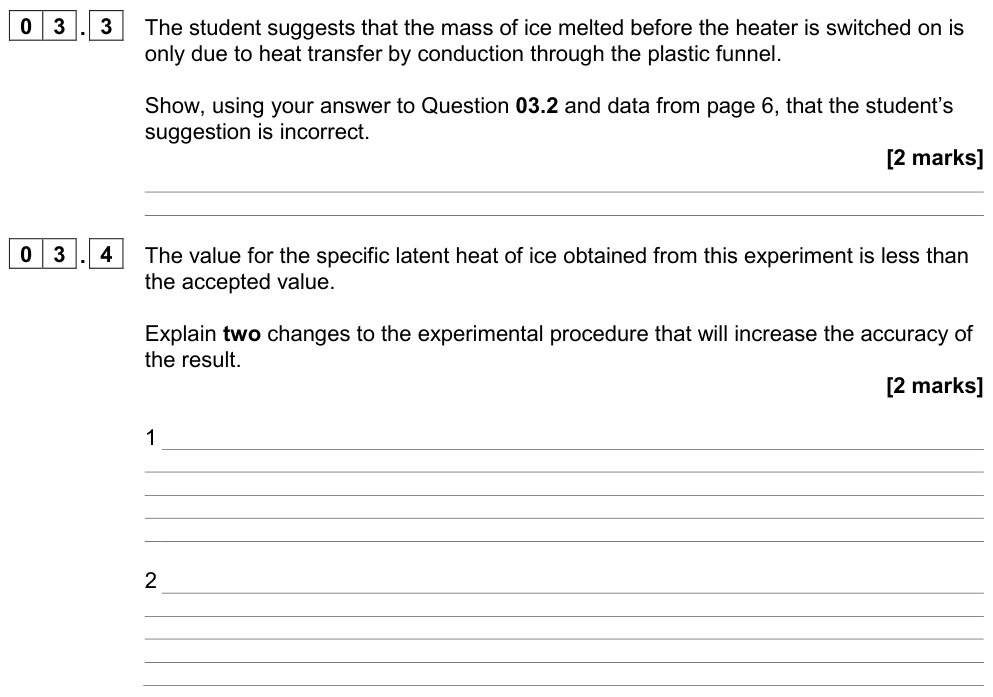
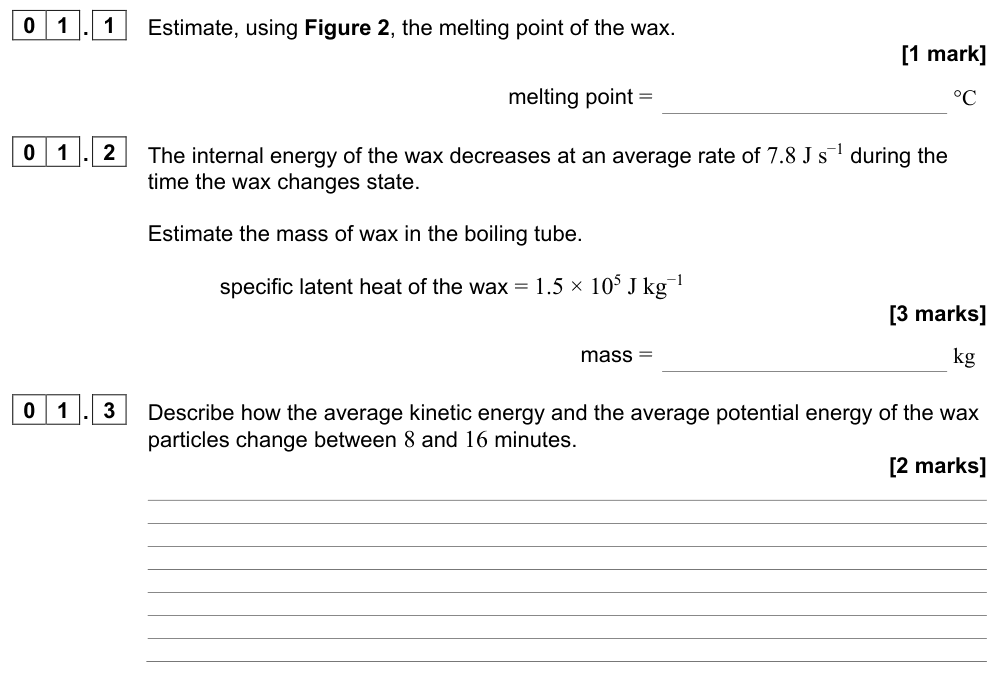
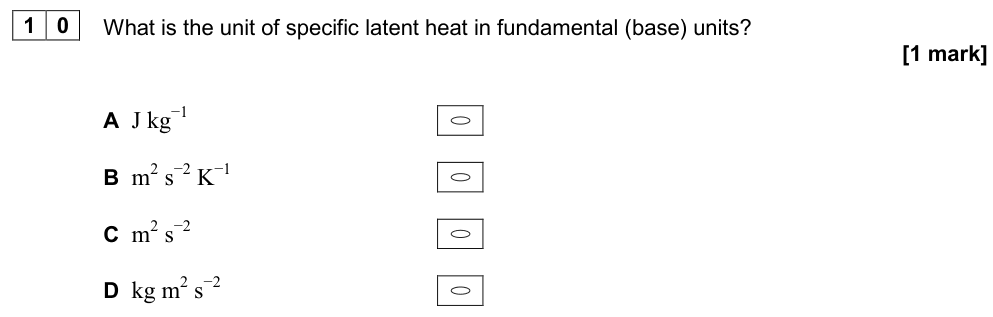
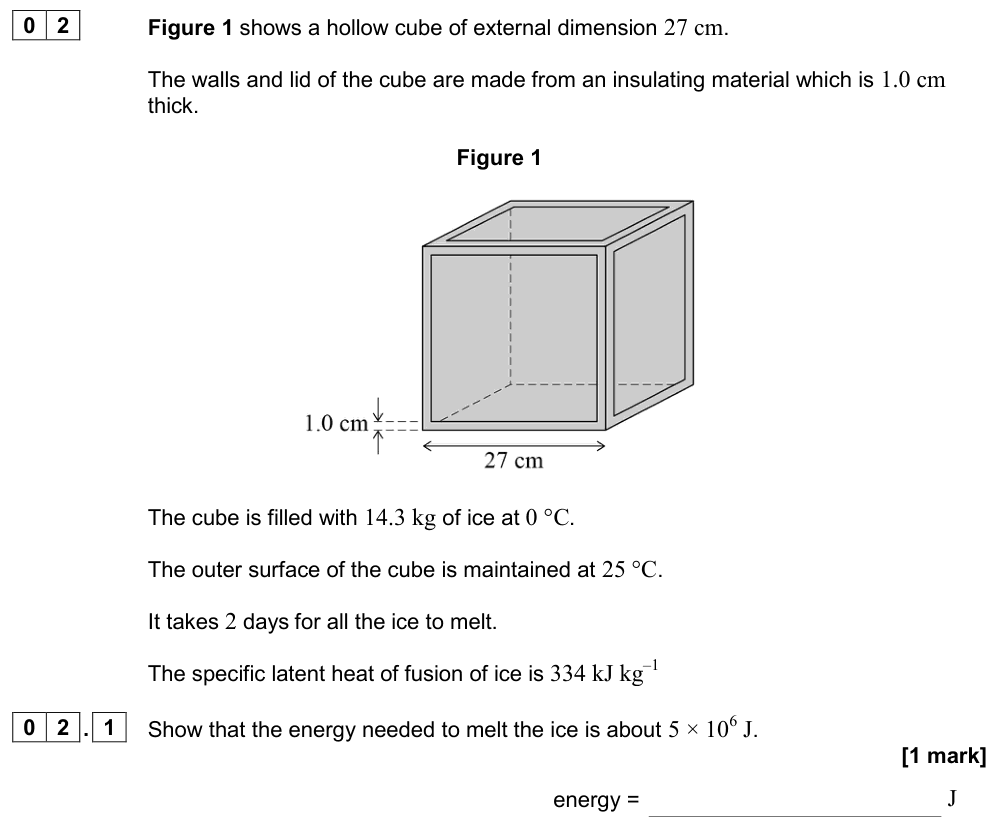
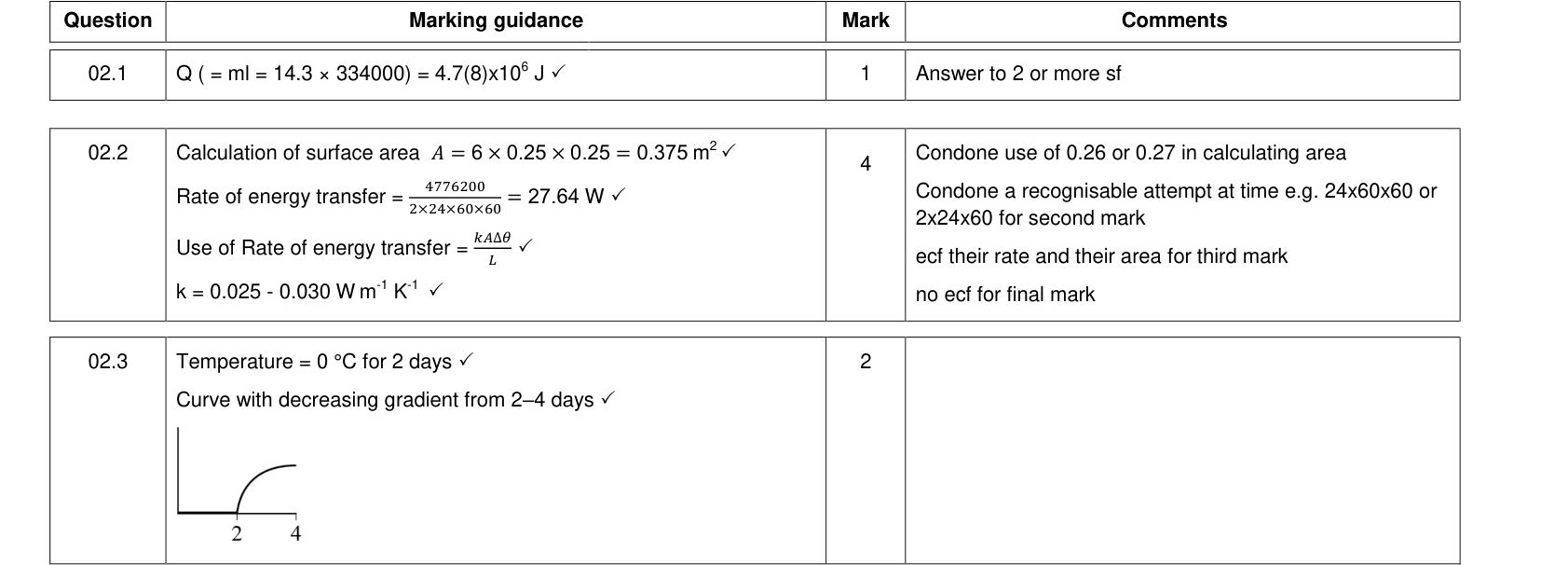
The specific latent heat $l$ of a substance is the energy needed to change the state of 1 kg of the substance without a change of temperature.
- Specific latent heat of fusion: solid ↔ liquid.
- Specific latent heat of vaporisation: liquid ↔ gas.
Energy for a change of state
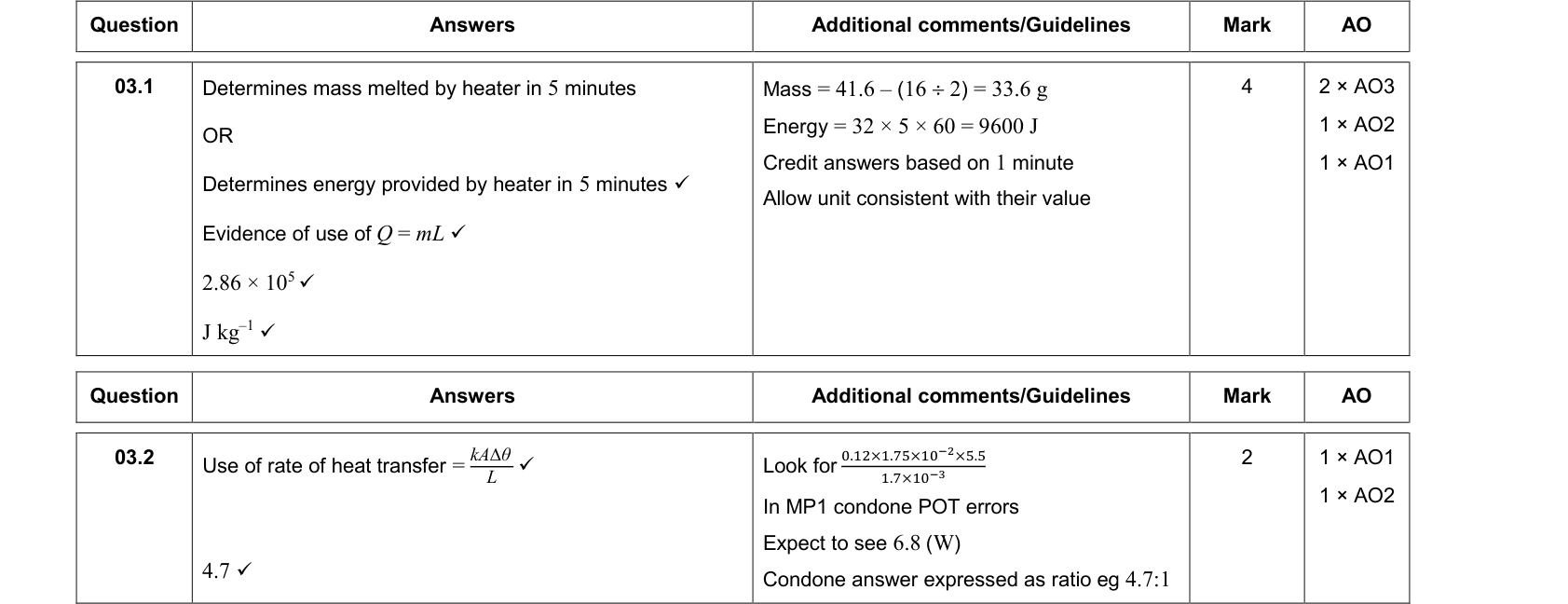
$$Q = ml$$
Unit of $l$: J kg⁻¹. For water, $l_{\text{fusion}} = 3.34 \times 10^{5}$ J kg⁻¹ and $l_{\text{vaporisation}} = 2.26 \times 10^{6}$ J kg⁻¹.
The latent heat of vaporisation is much larger than that of fusion because when a liquid boils the particles must be completely separated (bonds broken, separation increases about tenfold) and the gas must also do work pushing back the atmosphere as it expands. Melting only loosens the bonds slightly.
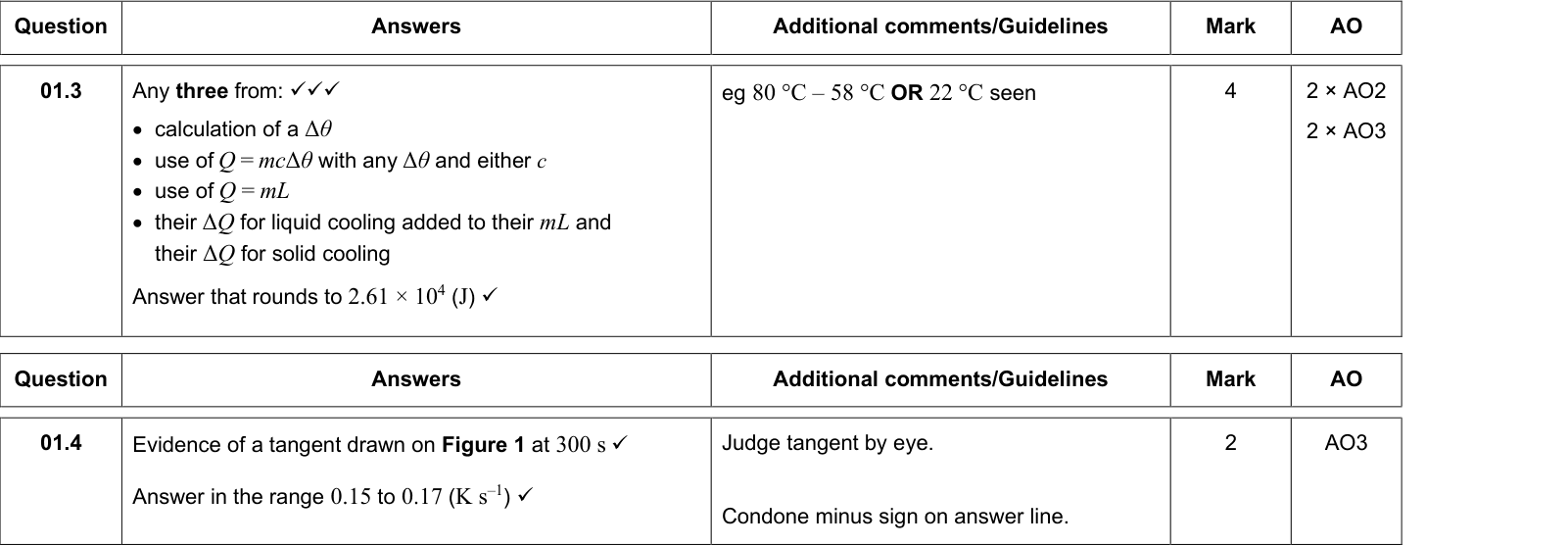
Worked example: ice to warm water
How much energy is needed to turn 50 g of ice at −10 °C into water at 30 °C?
- Warm the ice to 0 °C: $0.050 \times 2100 \times 10 = 1050$ J
- Melt the ice: $0.050 \times 3.34 \times 10^{5} = 16\,700$ J
- Warm the water to 30 °C: $0.050 \times 4200 \times 30 = 6300$ J
Total $= 24\,050$ J $\approx 2.4 \times 10^{4}$ J. Notice that melting takes the most energy.
Common mistake
Treat each stage separately. You cannot use $Q = mc\Delta\theta$ across a change of state, and the specific heat capacities of ice and water are different.
Continuous-flow systems
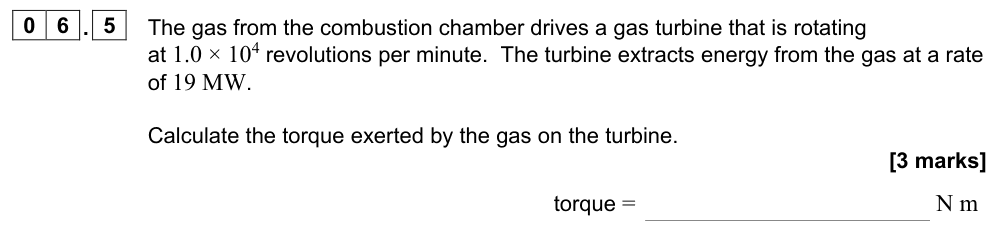
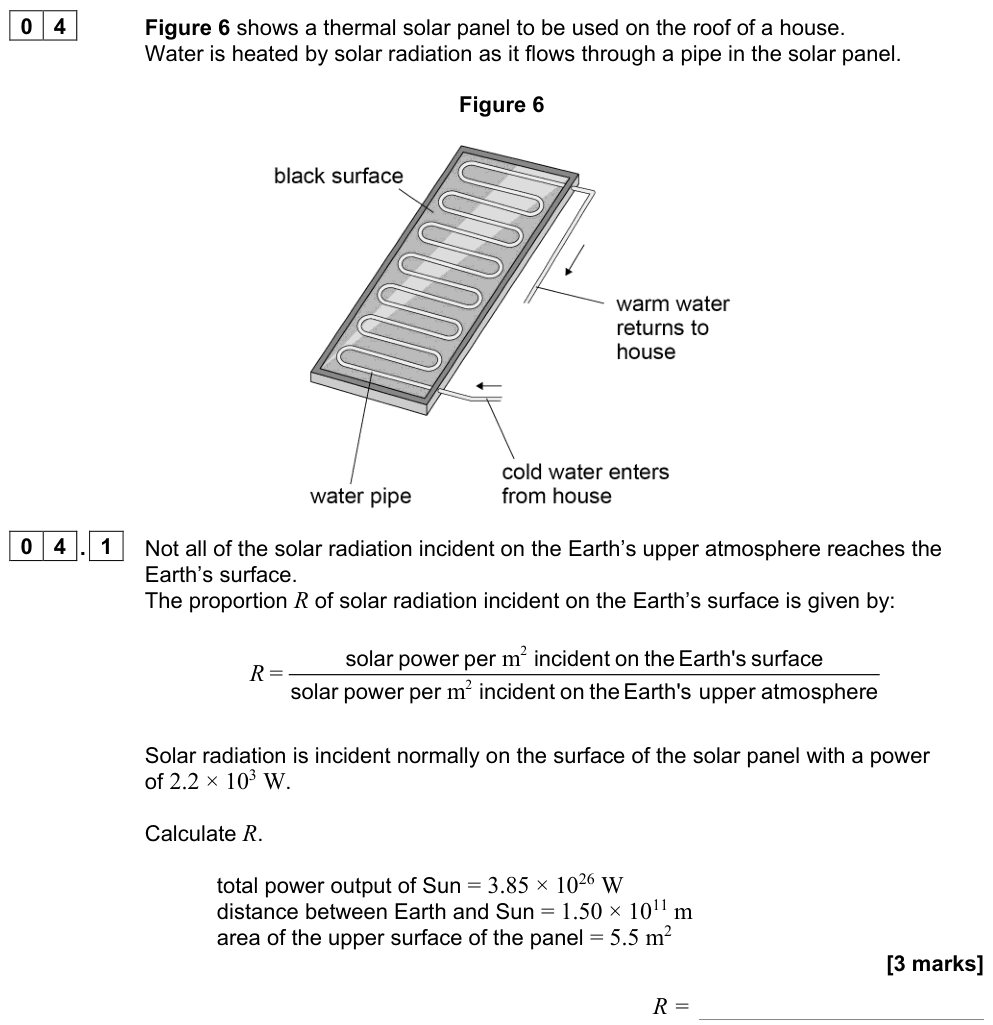
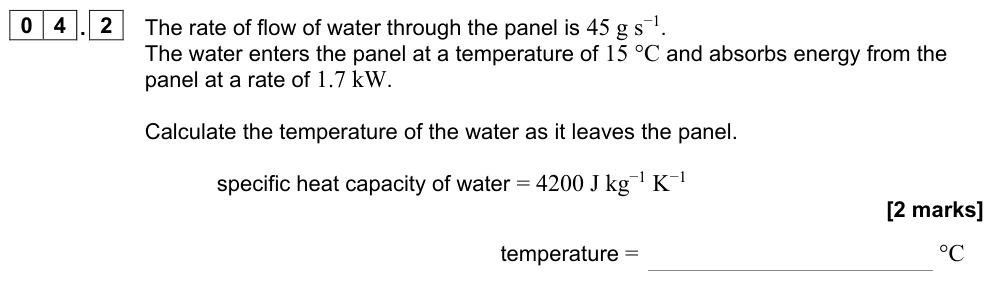
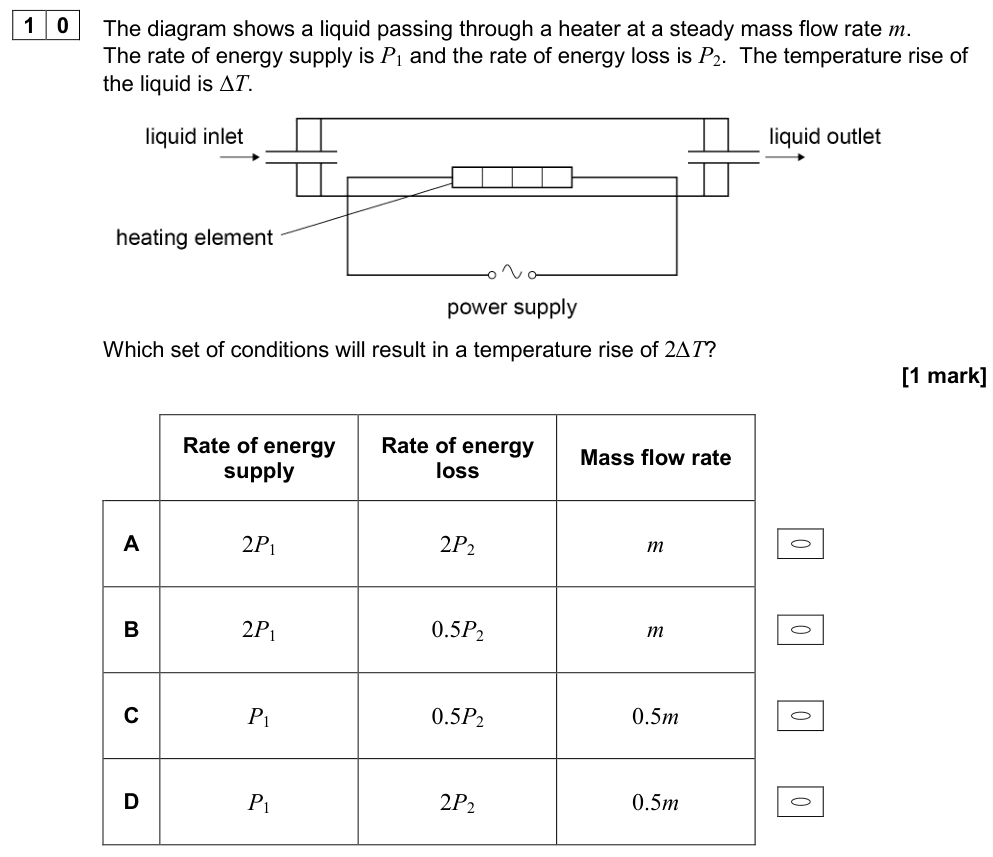
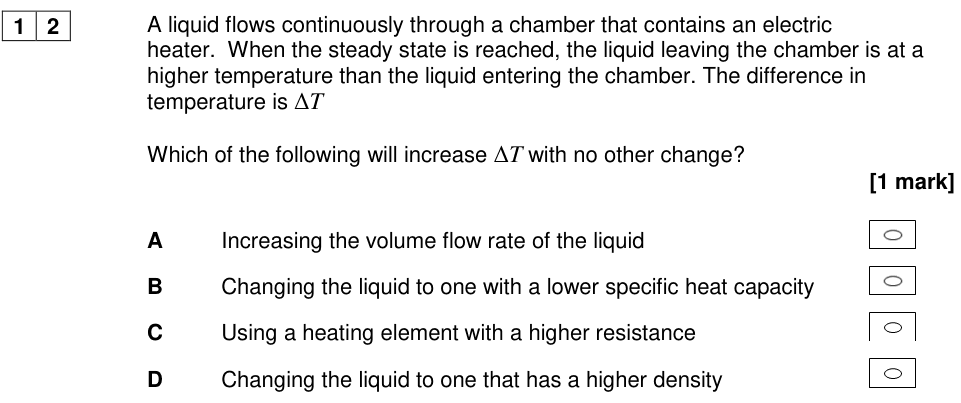
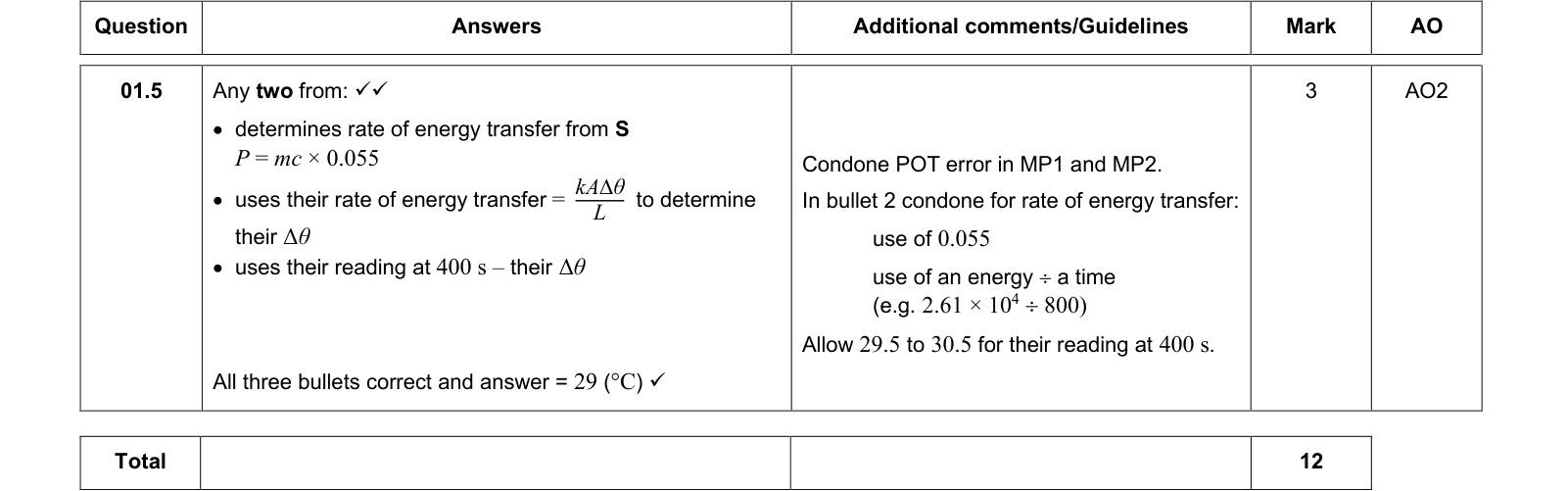
In devices such as an electric shower, a car cooling system or a flow calorimeter, a fluid flows steadily past a heater (or past something hot) and its temperature rises. Divide $Q = mc\Delta\theta$ by time:
Continuous flow
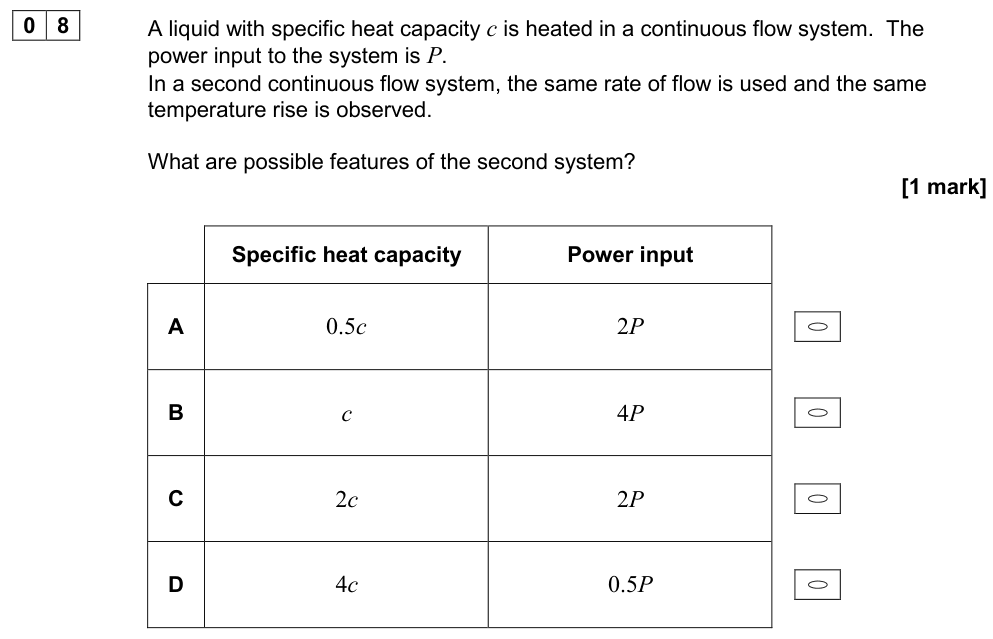
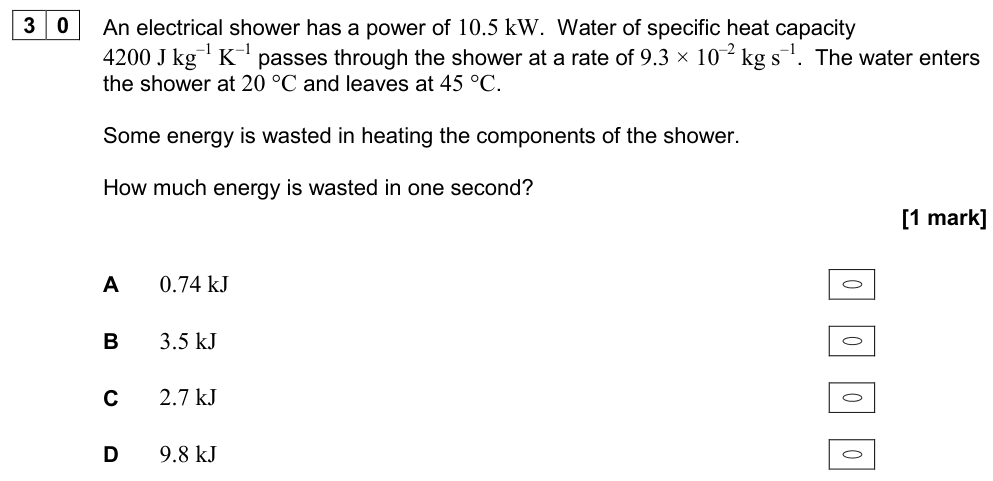
$$P = \frac{Q}{t} = \frac{m}{t}\,c\,\Delta\theta$$
$\dfrac{m}{t}$ is the mass flow rate (kg s⁻¹). For a liquid of density $\rho$ flowing at volume rate $\dfrac{V}{t}$, the mass flow rate is $\rho\dfrac{V}{t}$.
Worked example: an electric shower
A 9.0 kW shower heats water flowing at 6.0 litres per minute. Water enters at 15 °C. What is the outlet temperature?
Mass flow rate $= 6.0\ \text{kg} / 60\ \text{s} = 0.10$ kg s⁻¹ (1 litre of water has a mass of 1 kg).
$\Delta\theta = \dfrac{P}{(m/t)c} = \dfrac{9000}{0.10 \times 4200} = 21$ K, so the water leaves at about 36 °C. Halving the flow rate would double the temperature rise.
Required practical 8: specific heat capacity by an electrical method
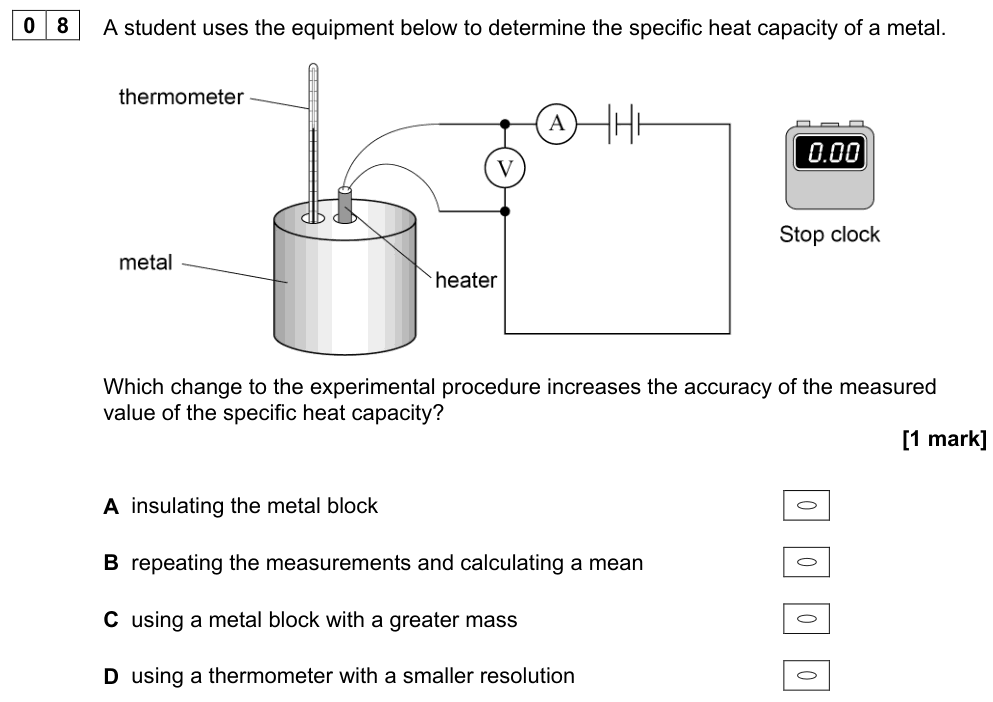
Apparatus: a metal block (e.g. 1.0 kg of aluminium) with two holes, an immersion heater in one hole and a thermometer (or temperature probe) in the other; a low-voltage supply with an ammeter and voltmeter; a stopclock; insulation (lagging) around the block.
Method:
- Measure the mass $m$ of the block. Put a few drops of oil in the thermometer hole for good thermal contact. Wrap the block in insulation.
- Record the starting temperature, switch on the heater and start the clock. Record $V$ and $I$ (keep them constant).
- Record the temperature every minute for about 10 minutes. After switching off, keep reading: the temperature continues to rise for a while, and the highest value should be used for a single-reading method.
Analysis: energy supplied $= VIt = mc\Delta\theta$. Plot a graph of temperature $\theta$ against time $t$. Its gradient is $\dfrac{VI}{mc}$, so $$c = \frac{VI}{m \times \text{gradient}}$$
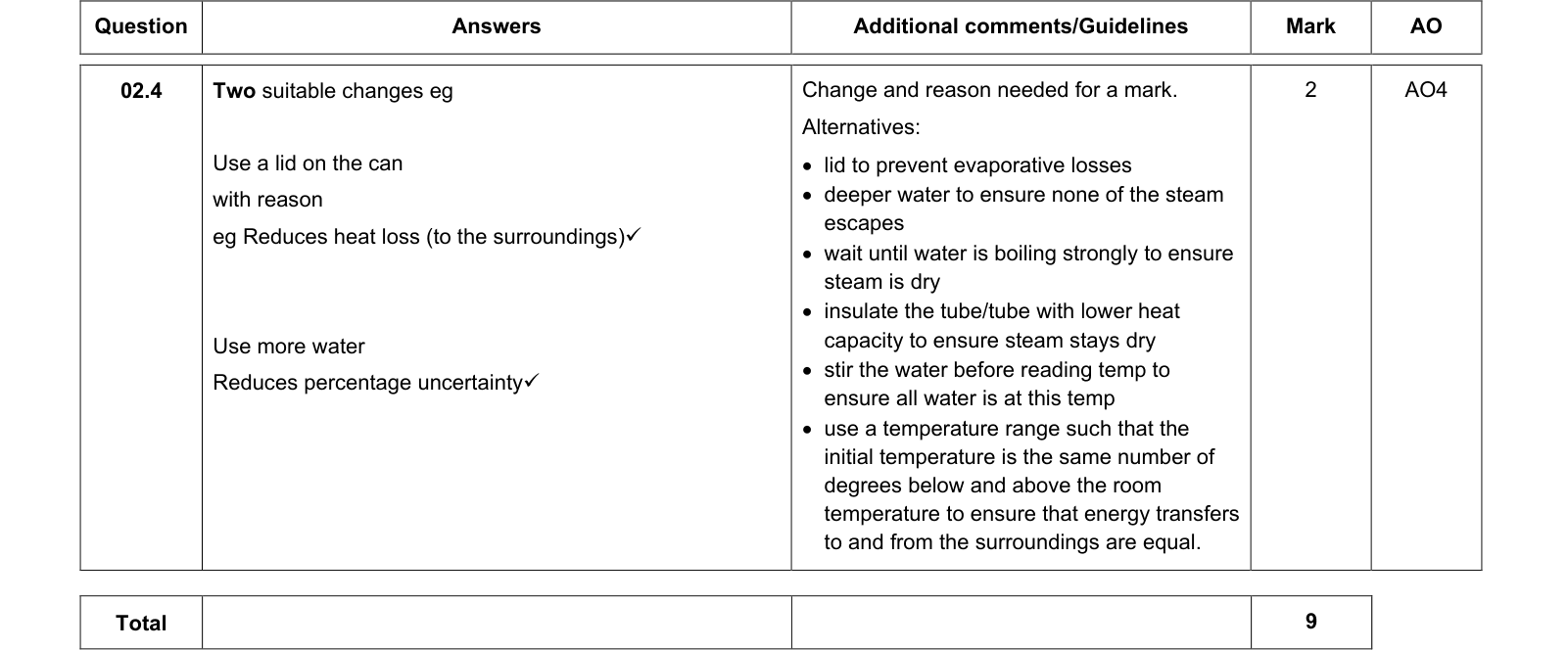
For a liquid, use a known mass of liquid in an insulated container (with a lid), stir it continuously, and allow for the energy that heats the container.
Sources of error and improvements:
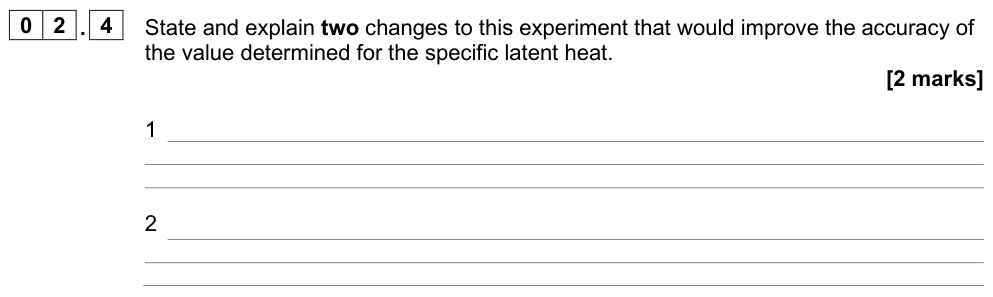
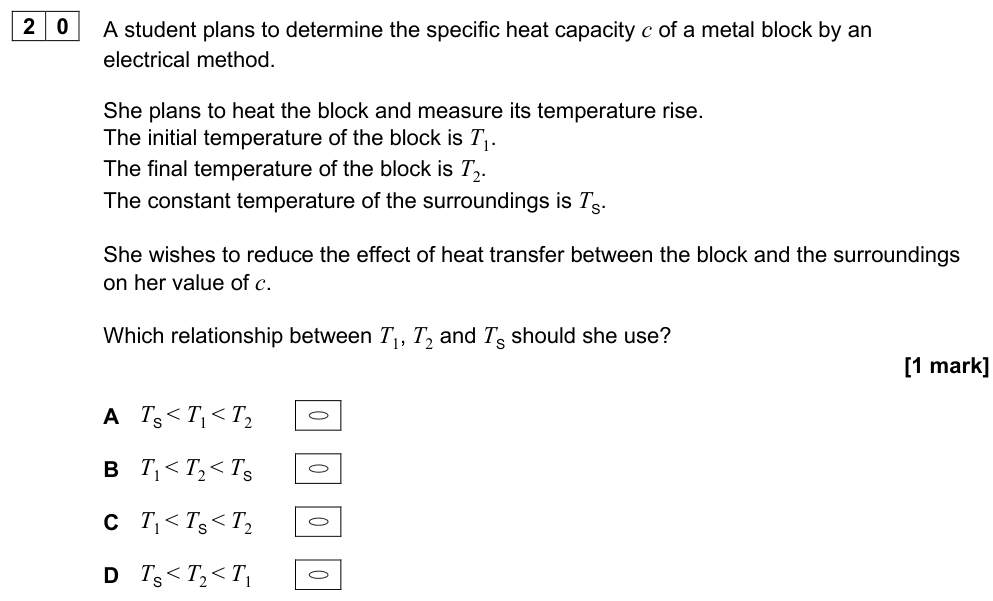
- Energy lost to the surroundings makes the measured $c$ too high (more energy supplied than the block actually gained). Reduce it with insulation; or start about 5 K below room temperature and finish about 5 K above, so that energy gained from the room cancels energy lost.
- The thermometer lags behind the heater: use the gradient of the straight part of the graph rather than one pair of readings.
- Energy is also used to heat the heater and thermometer themselves.
Safety: the heater and block become hot; do not touch them until they cool.
Summary
- Internal energy = sum of the random kinetic and potential energies of the particles.
- First law: $\Delta U = Q + W$ ($Q$ to the system by heating, $W$ done on the system).
- During a change of state the potential energy changes, not the kinetic energy, so the temperature stays constant.
- $Q = mc\Delta\theta$ for a temperature change; $Q = ml$ for a change of state.
- Continuous flow: $P = \dfrac{m}{t}c\Delta\theta$.
- Required practical 8: $c = VI/(m \times \text{gradient of } \theta\text{–}t \text{ graph})$; heat losses make $c$ too large.