How a hydroelectric power station works
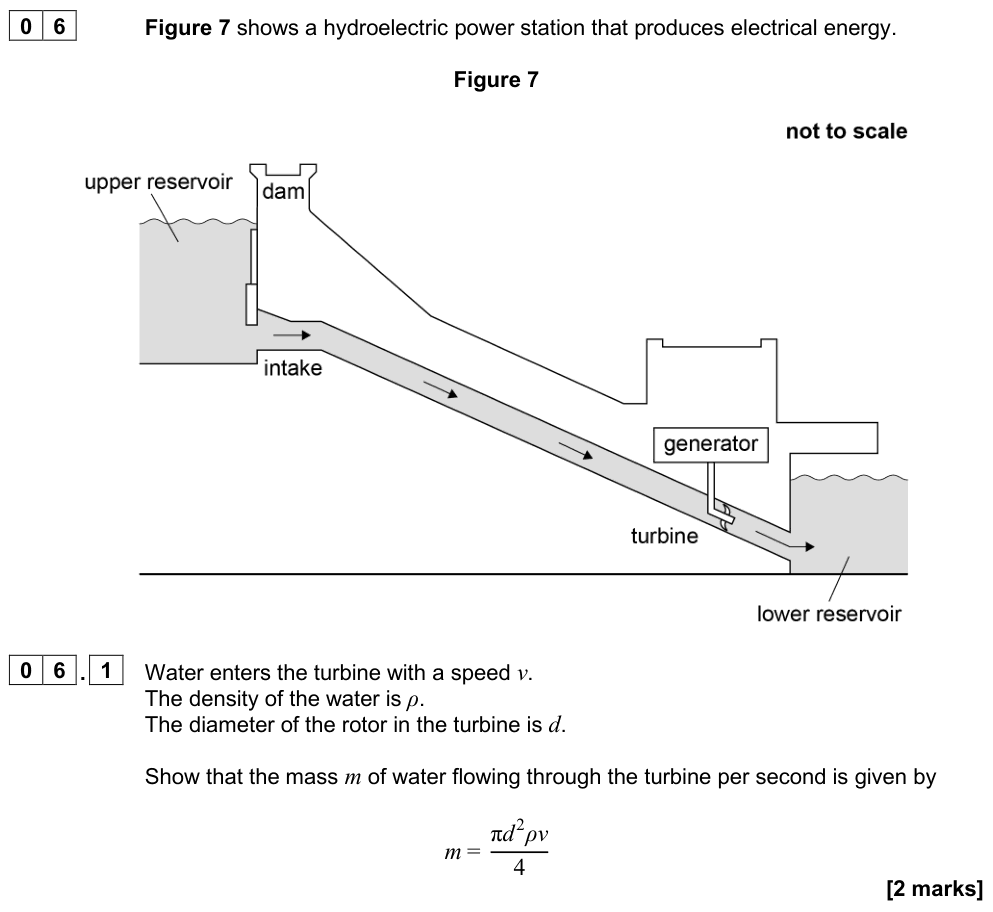
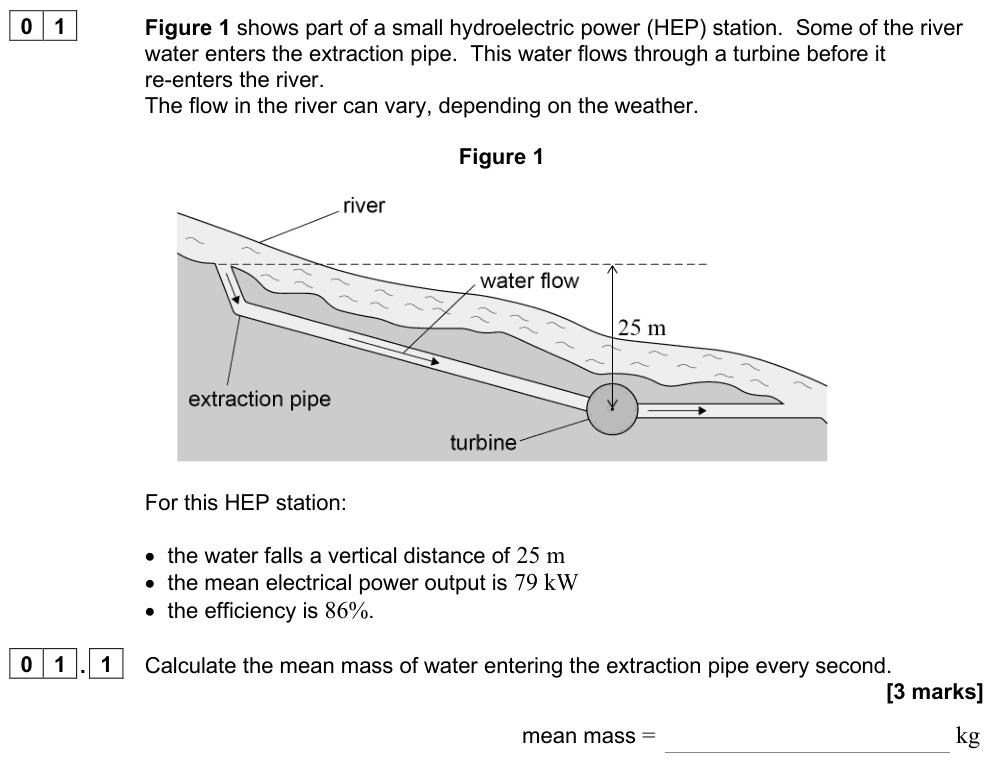
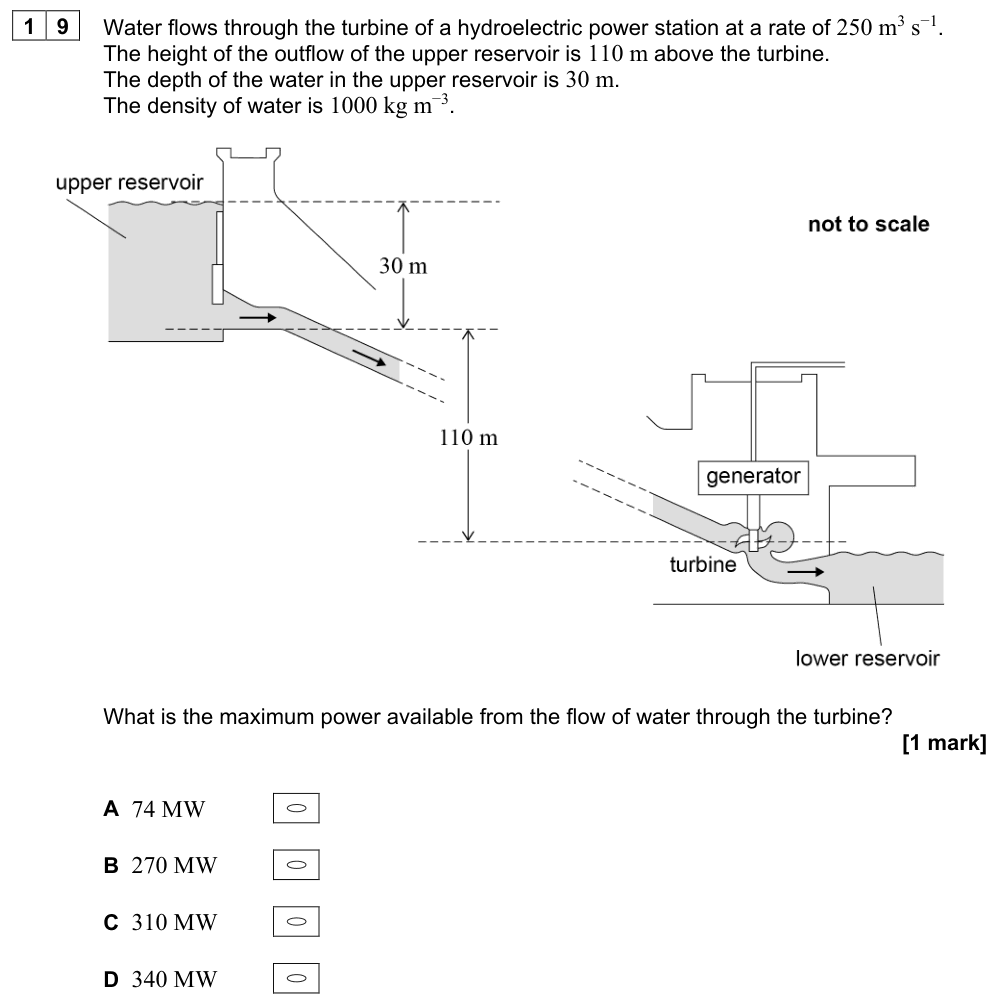
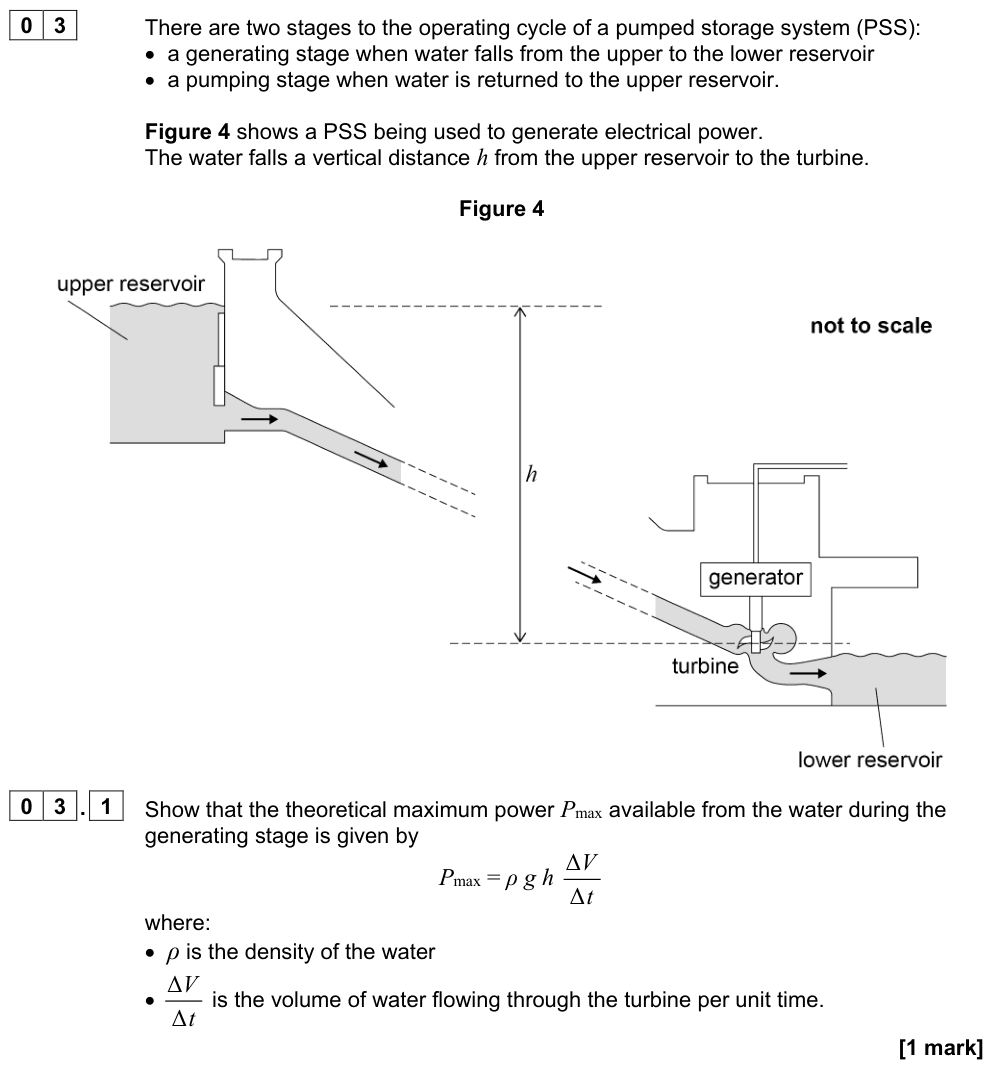
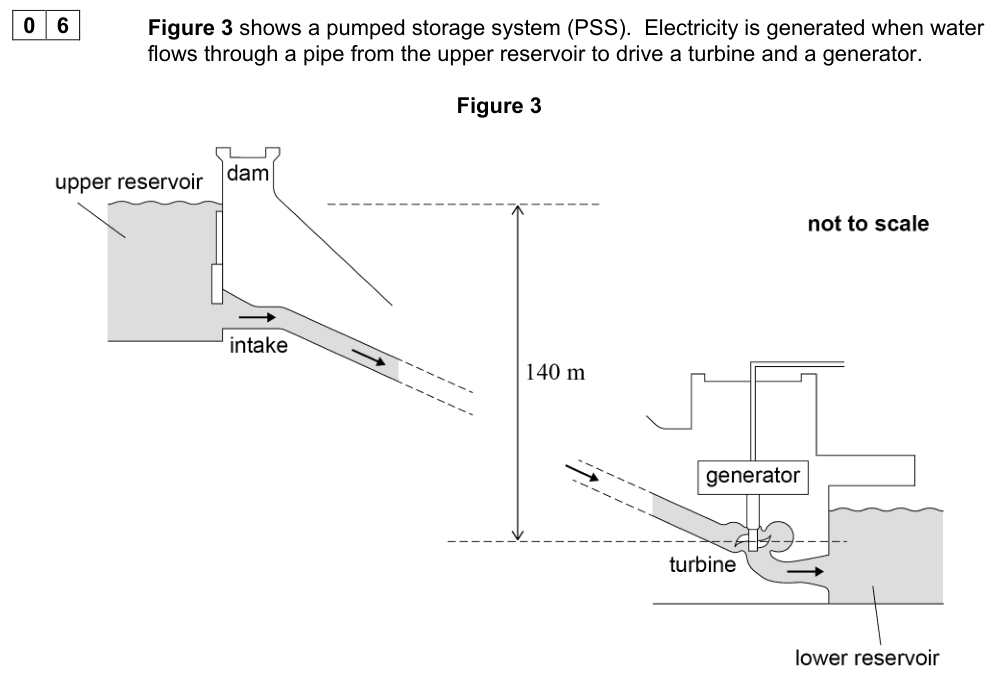
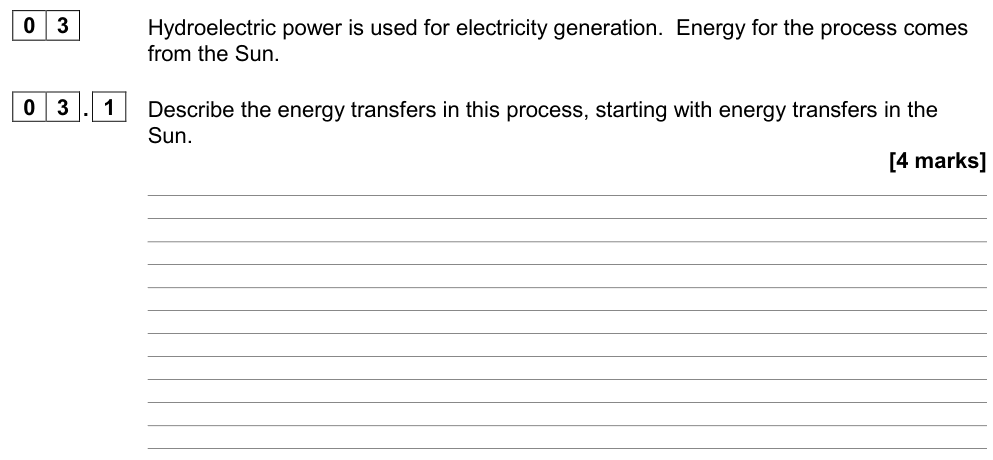
In a hydroelectric power station, water stored behind a dam in a high reservoir flows down through large pipes (penstocks) to turbines at a lower level.
- Water in the reservoir has gravitational potential energy.
- As it falls through the penstock, this becomes kinetic energy of the moving water.
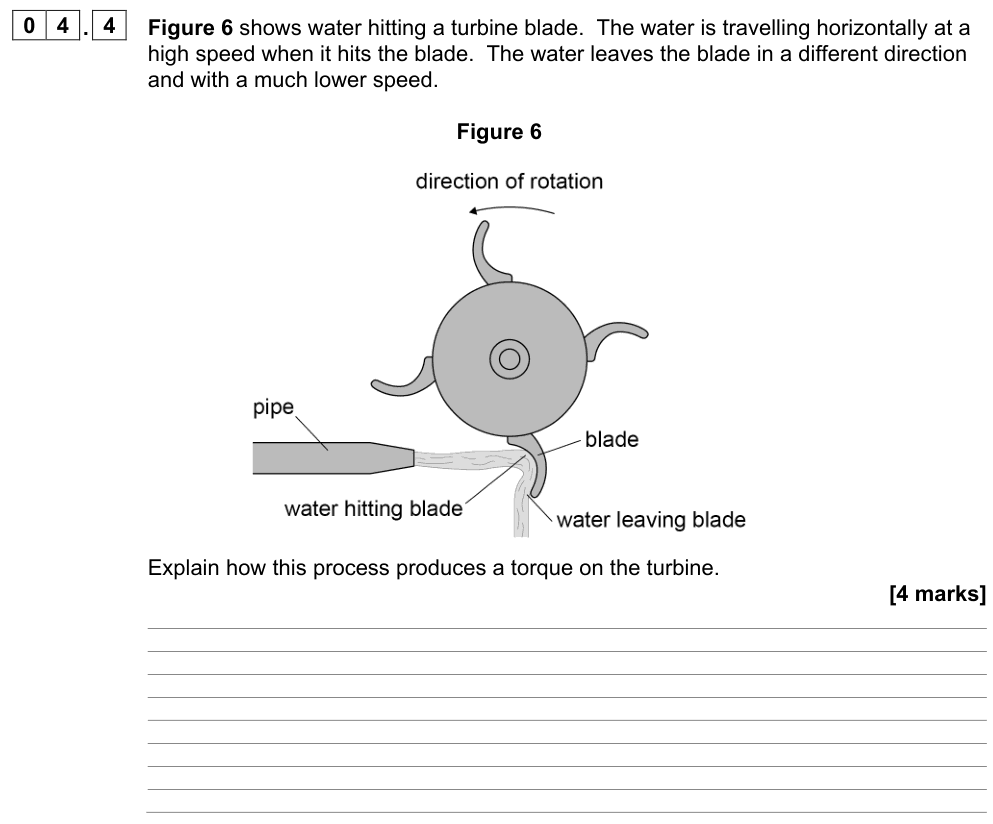
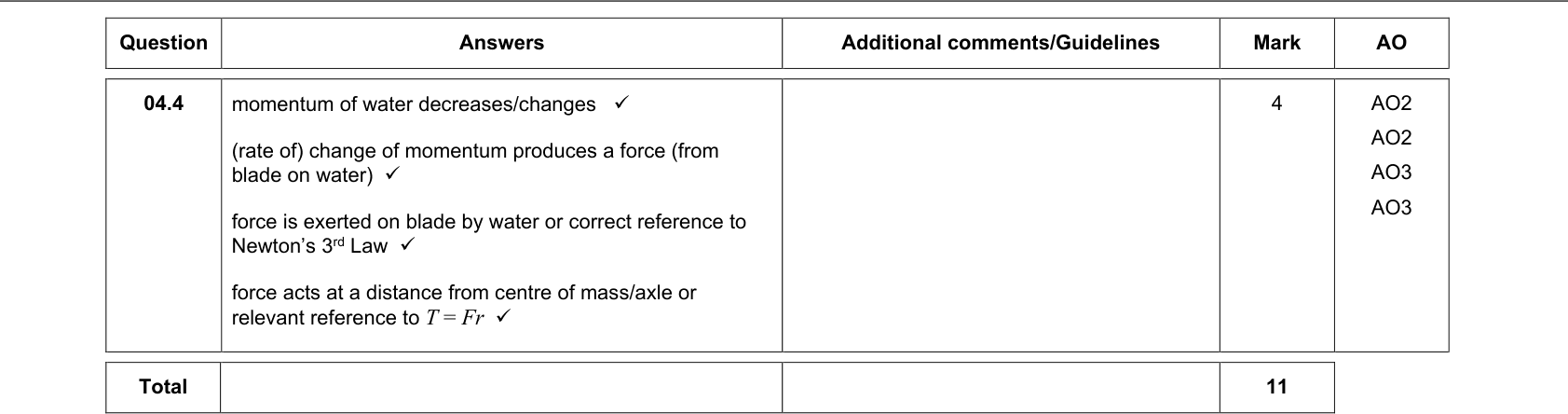
- The fast-moving water pushes on the blades of the turbine, making it rotate (rotational kinetic energy).
- The turbine turns a generator, which converts the kinetic energy into electrical energy by electromagnetic induction.
- The water leaves through the outflow (tailrace) into the river below.
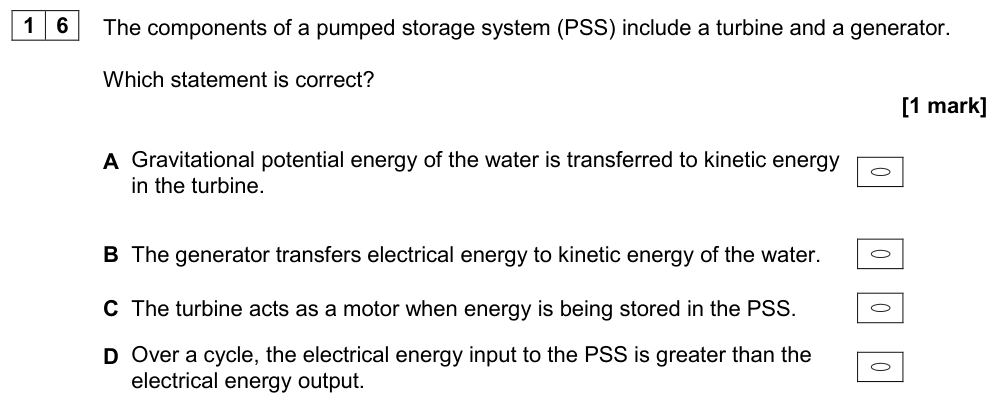
The two essential components are the turbine and the generator; transformers then step up the voltage for the grid.
Power from falling water
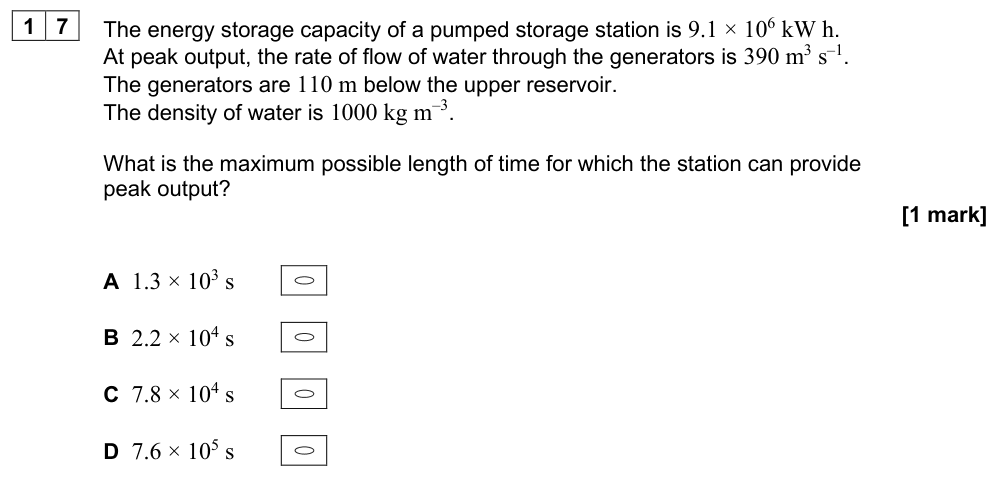
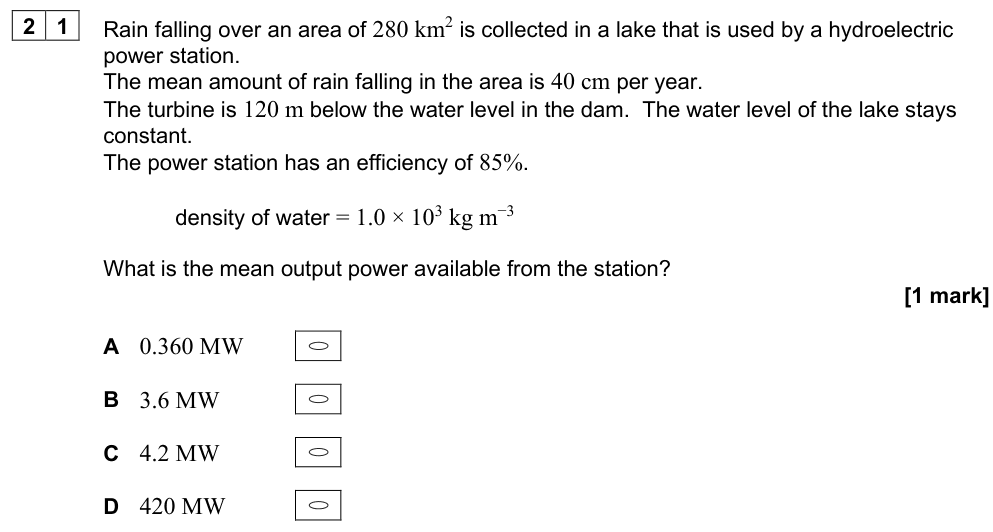
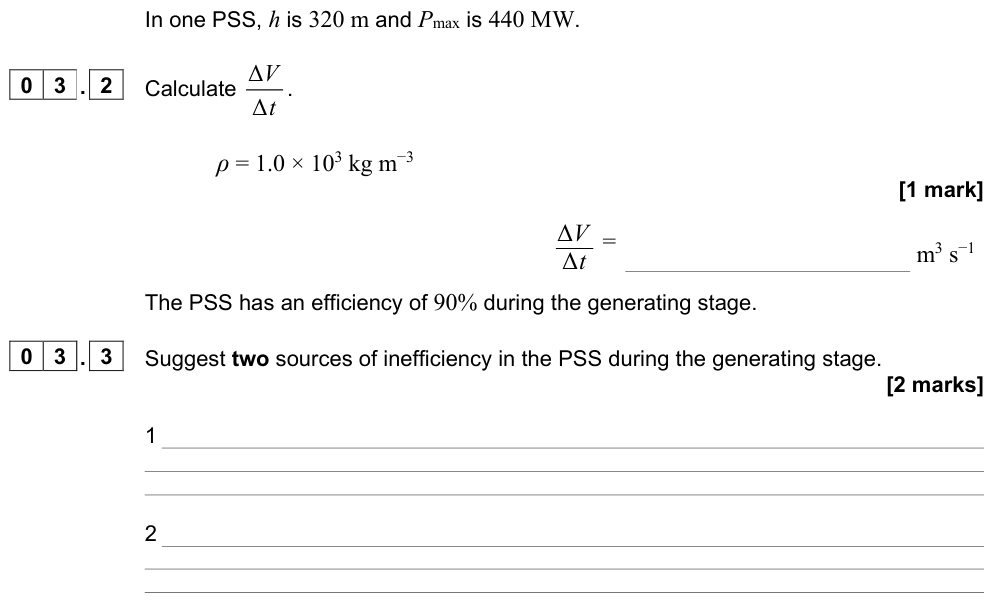
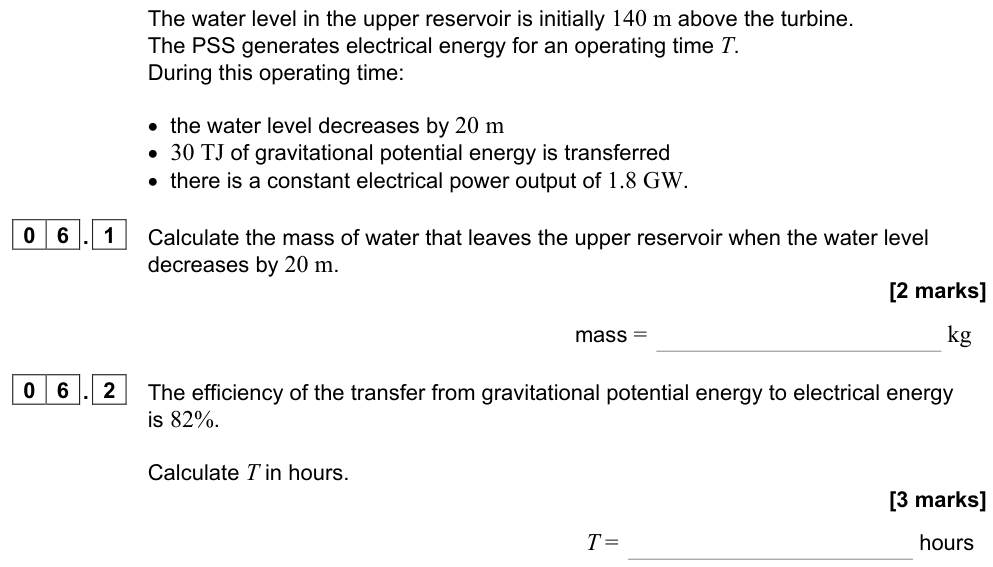
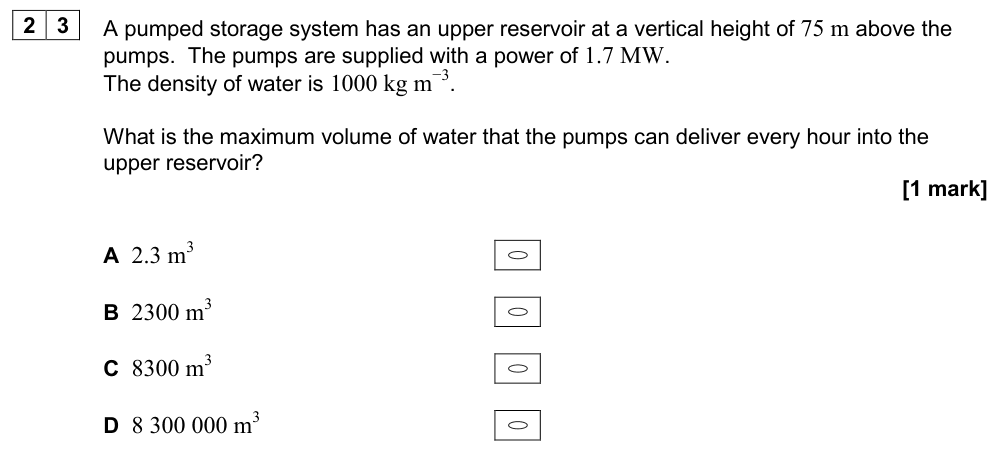
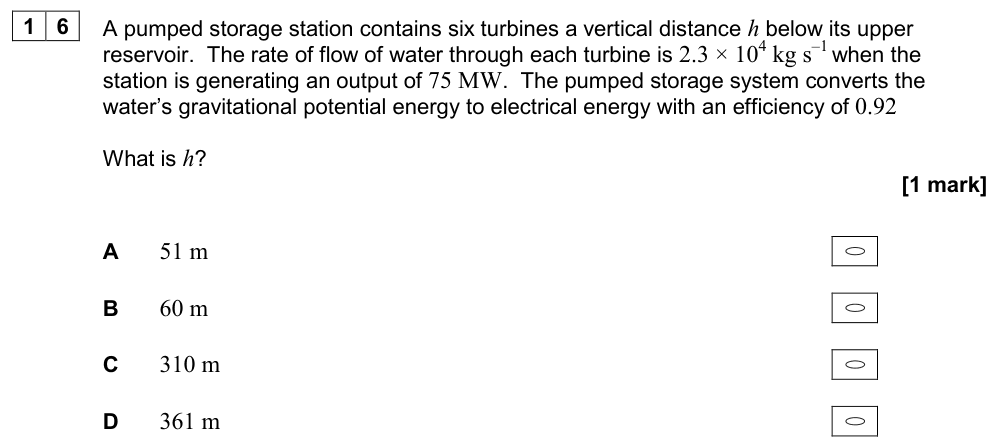
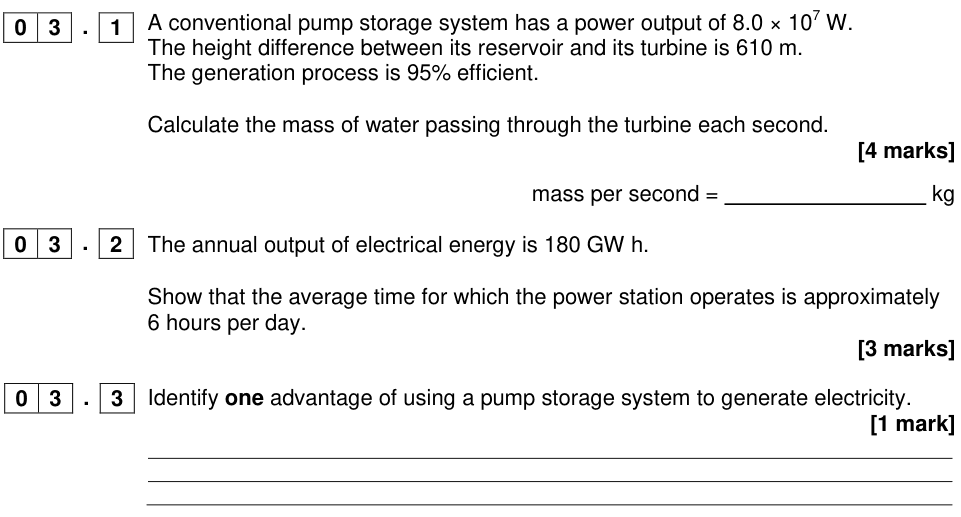
If water falls through a height $h$ (the head), each kilogram transfers $gh$ joules of gravitational potential energy. If a volume $V$ of water flows through the turbines each second (the volume flow rate), the mass flowing per second is $\rho V$:
Power available from water falling through a height h
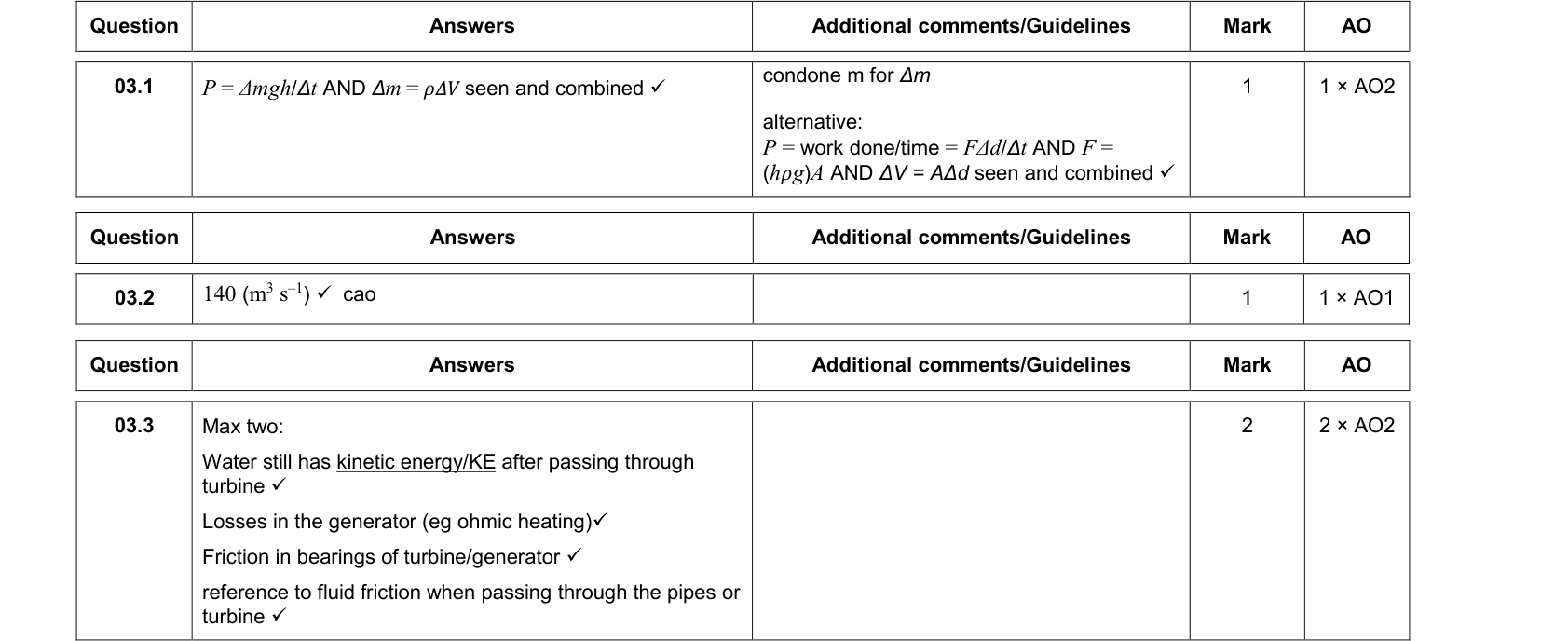
$$P = \frac{\Delta m}{\Delta t}gh = \rho\,\frac{\Delta V}{\Delta t}\,gh$$
The electrical output is this multiplied by the overall efficiency (typically 80–90% for large hydroelectric stations).
Worked example: a hydroelectric station
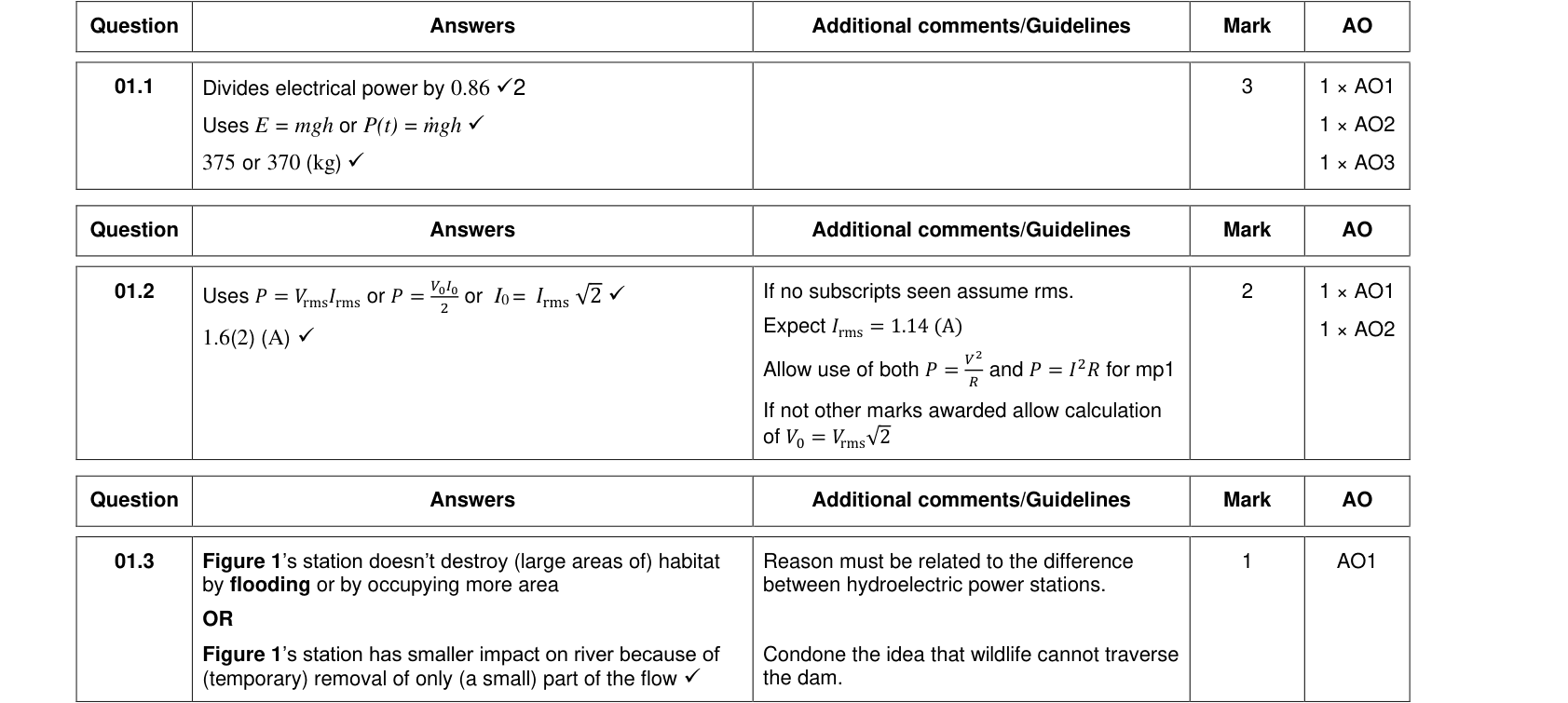
Water flows through the turbines at 120 m³ s⁻¹ from a reservoir 150 m above them. The overall efficiency is 85%. ($\rho = 1000$ kg m⁻³)
Power available $= 1000 \times 120 \times 9.81 \times 150 = 1.77 \times 10^{8}$ W.
Electrical output $= 0.85 \times 1.77 \times 10^{8} = 1.5 \times 10^{8}$ W (150 MW).
If no energy were lost in the penstock, the water would reach the turbines at $v = \sqrt{2gh} = \sqrt{2 \times 9.81 \times 150} = 54$ m s⁻¹.
Power from flowing water
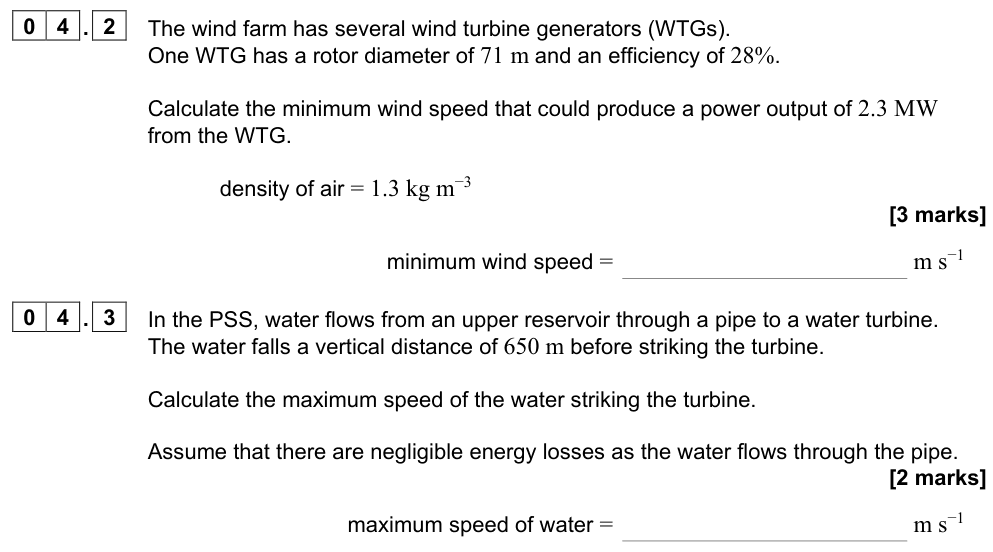
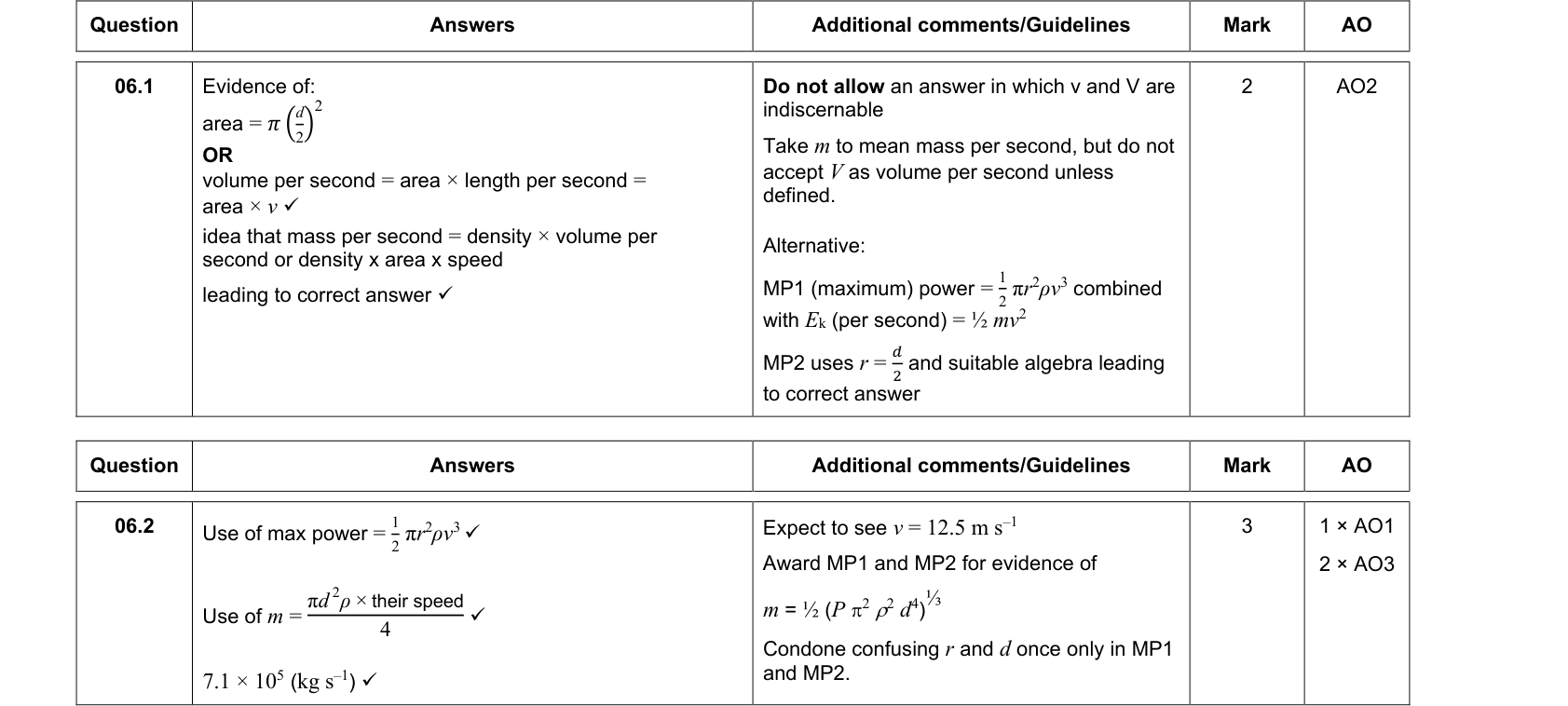
The kinetic energy of water flowing through a turbine (in a fast river, a tidal stream, or a pipe) gives the same formula as for wind, but with the density of water:
Maximum power available from water flowing through a turbine
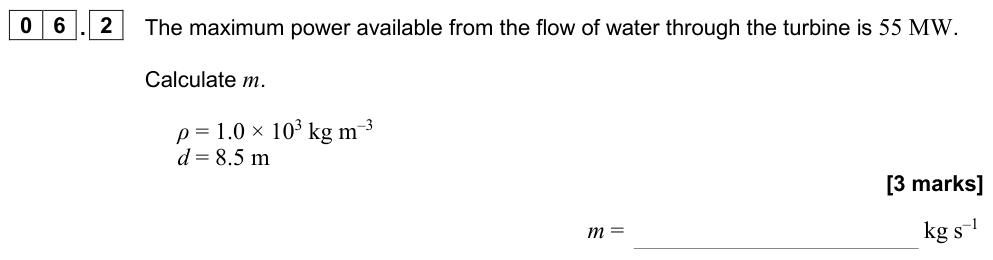
$$P = \tfrac12\rho\pi r^2v^3$$
$\rho$ = density of water (1000 kg m⁻³); $r$ = radius of the turbine blades; $v$ = speed of the water.
Water is about 800 times denser than air, so a water turbine produces far more power than a wind turbine of the same size at the same speed.
Worked example: a tidal-stream turbine
A turbine with 1.5 m blades is placed in a tidal current of 3.0 m s⁻¹.
$P = \tfrac12 \times 1000 \times \pi \times 1.5^2 \times 3.0^3 = 9.5 \times 10^{4}$ W (95 kW). A wind turbine of the same size in a 3.0 m s⁻¹ wind would have only about 0.1 kW available.
Base-power and back-up power stations
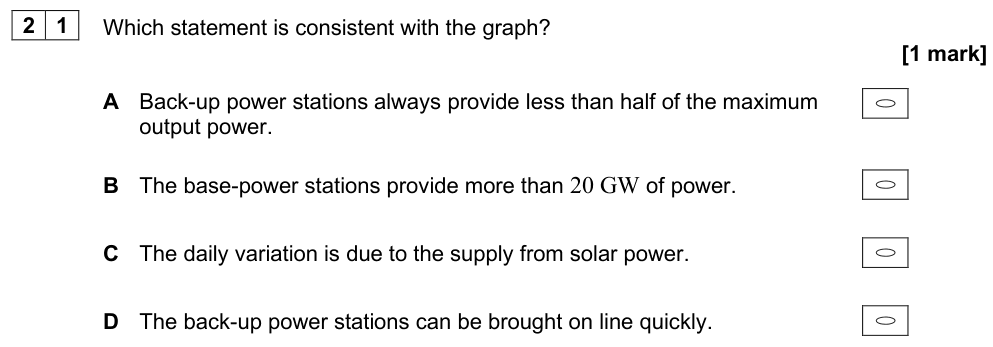
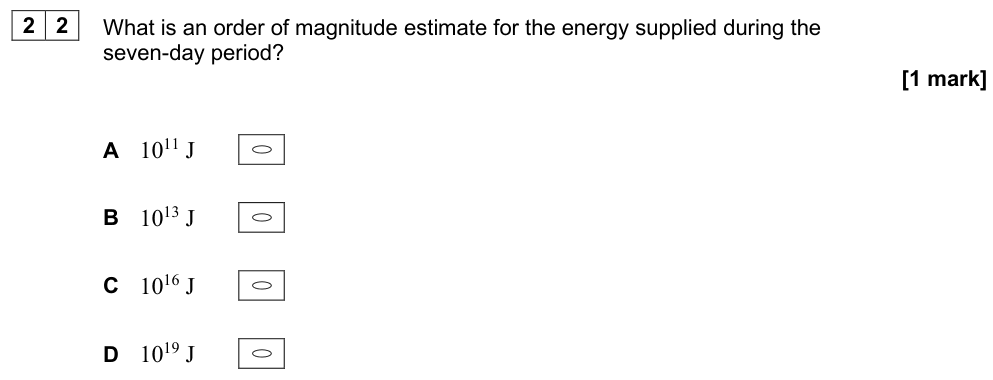
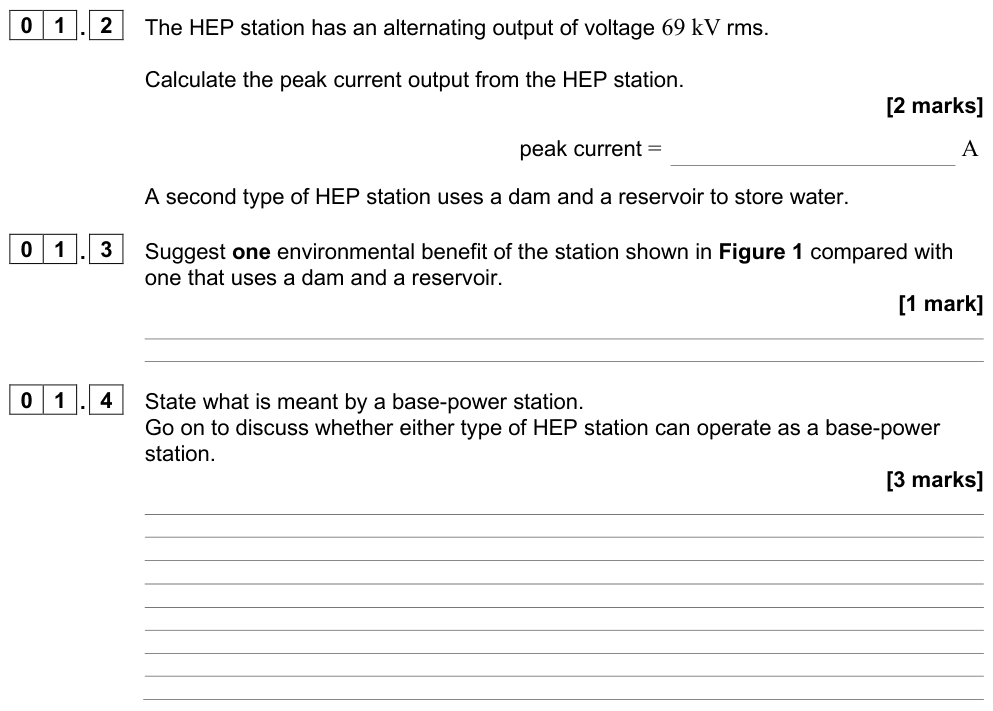
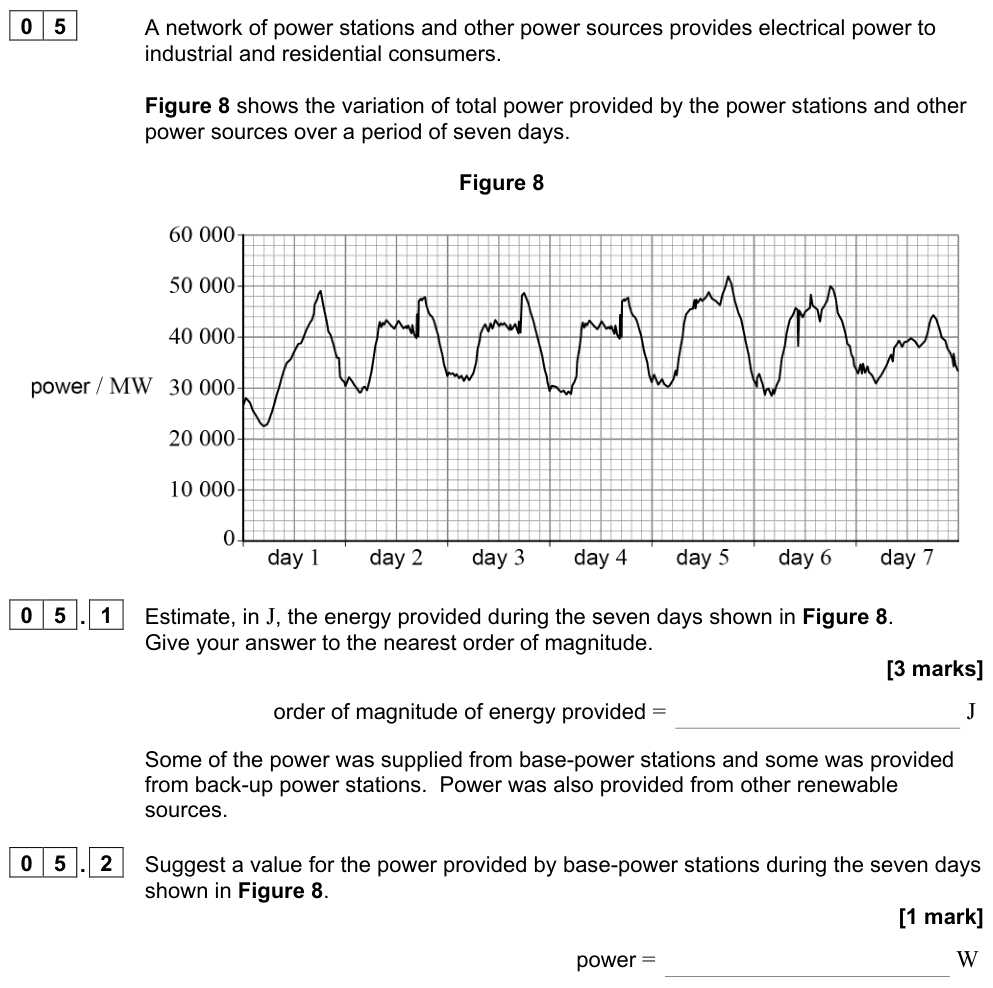
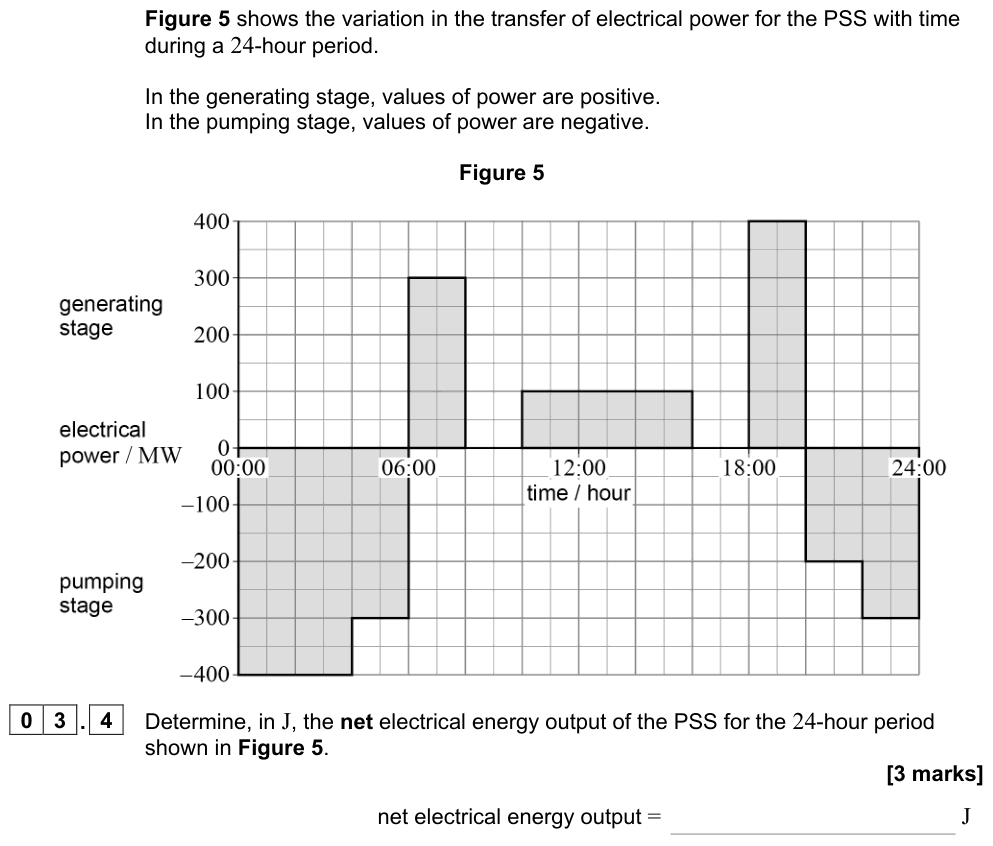
The demand for electricity varies: it is low at night, rises sharply in the morning, and peaks in the early evening; it is also higher in winter (or in summer in hot countries, for air conditioning). Sudden surges happen, for example when millions of people switch on kettles at the end of a popular television programme.
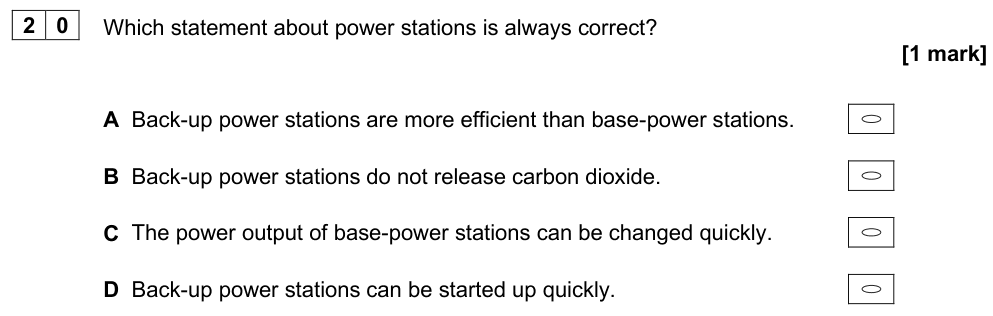
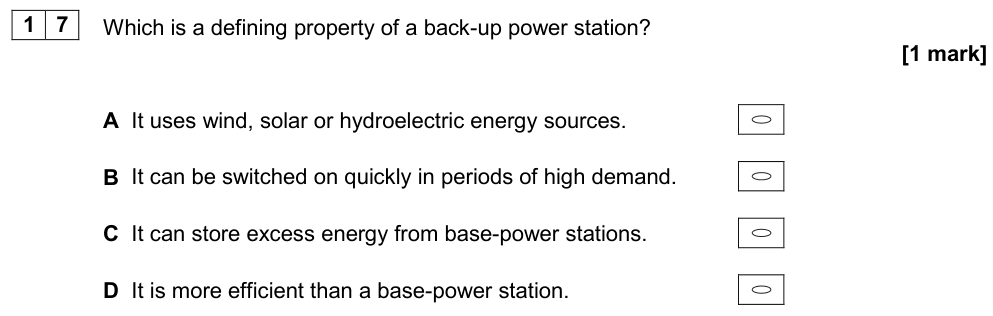
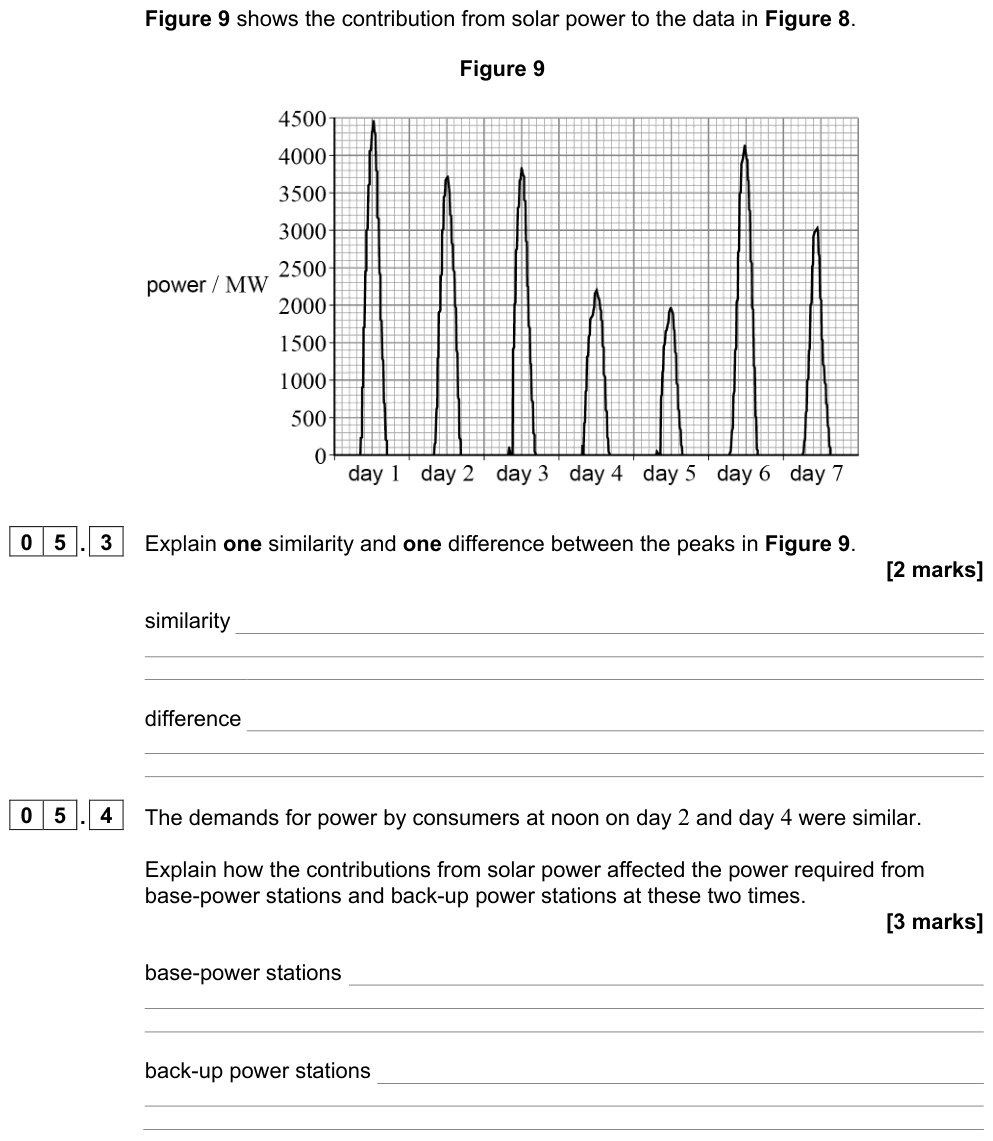
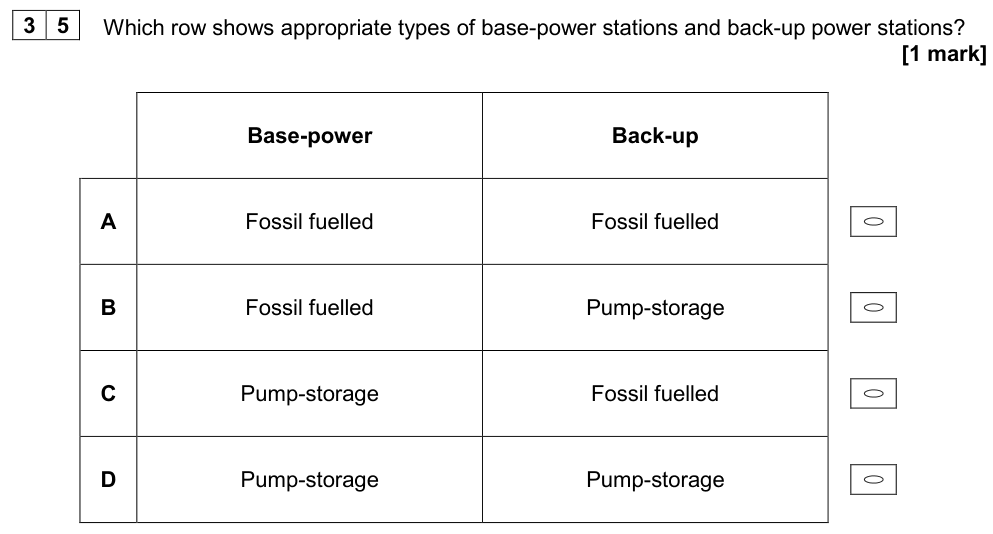
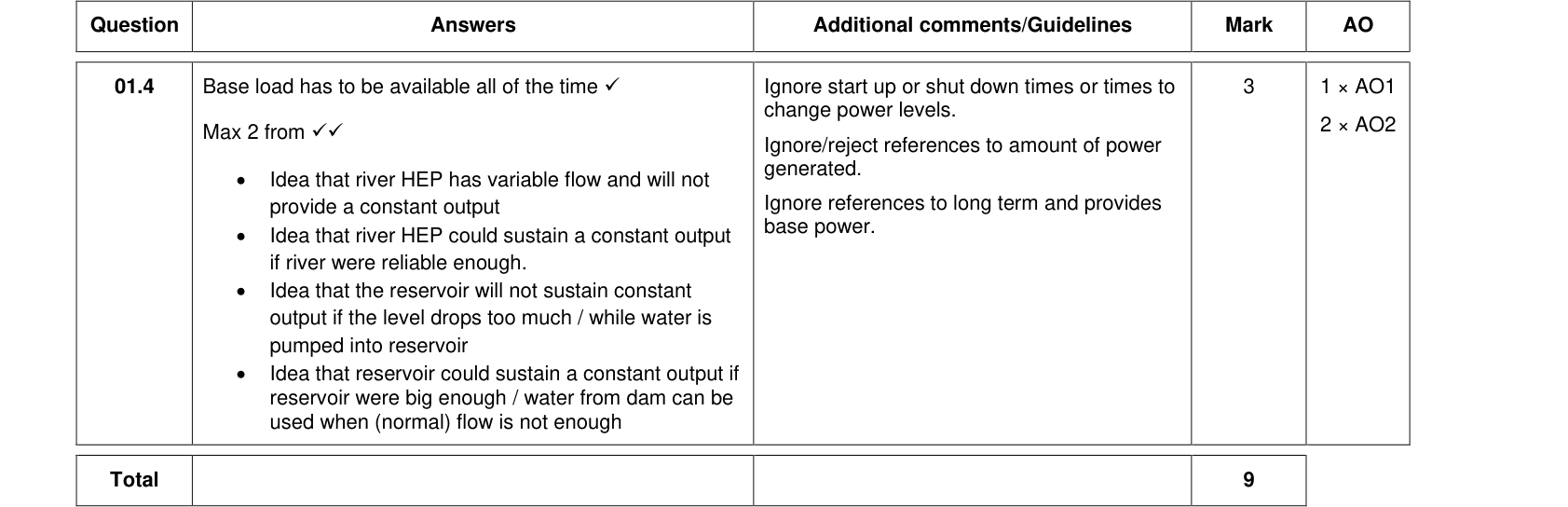
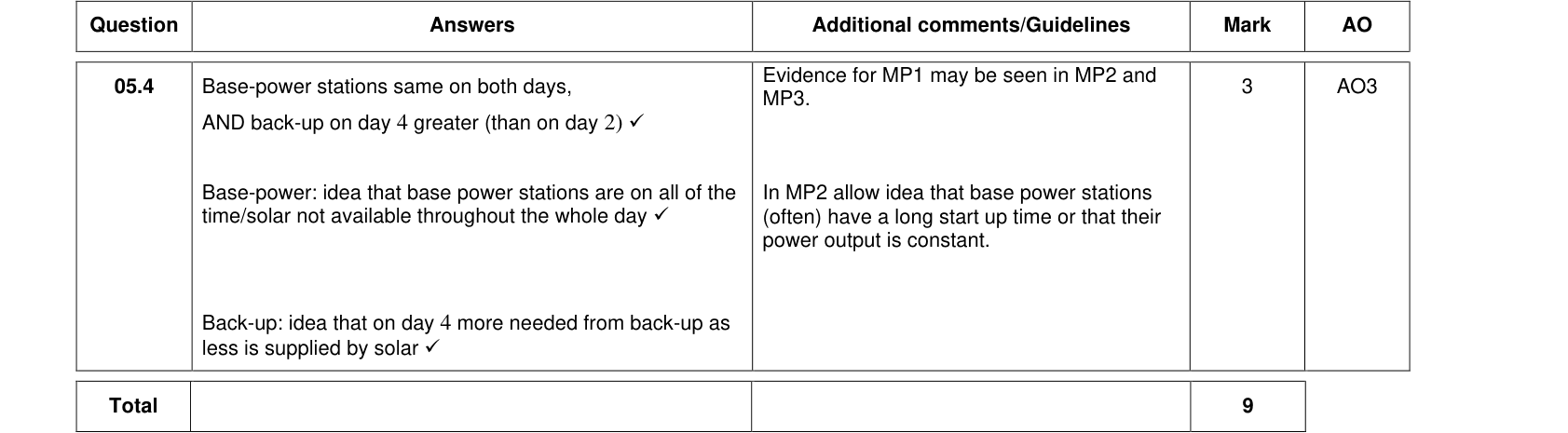
- Base-power (base-load) stations run continuously at a steady output to supply the minimum demand that is always present. They are usually large and efficient but slow to start up and change output: nuclear power stations, large coal- and gas-fired stations, and some hydroelectric stations.
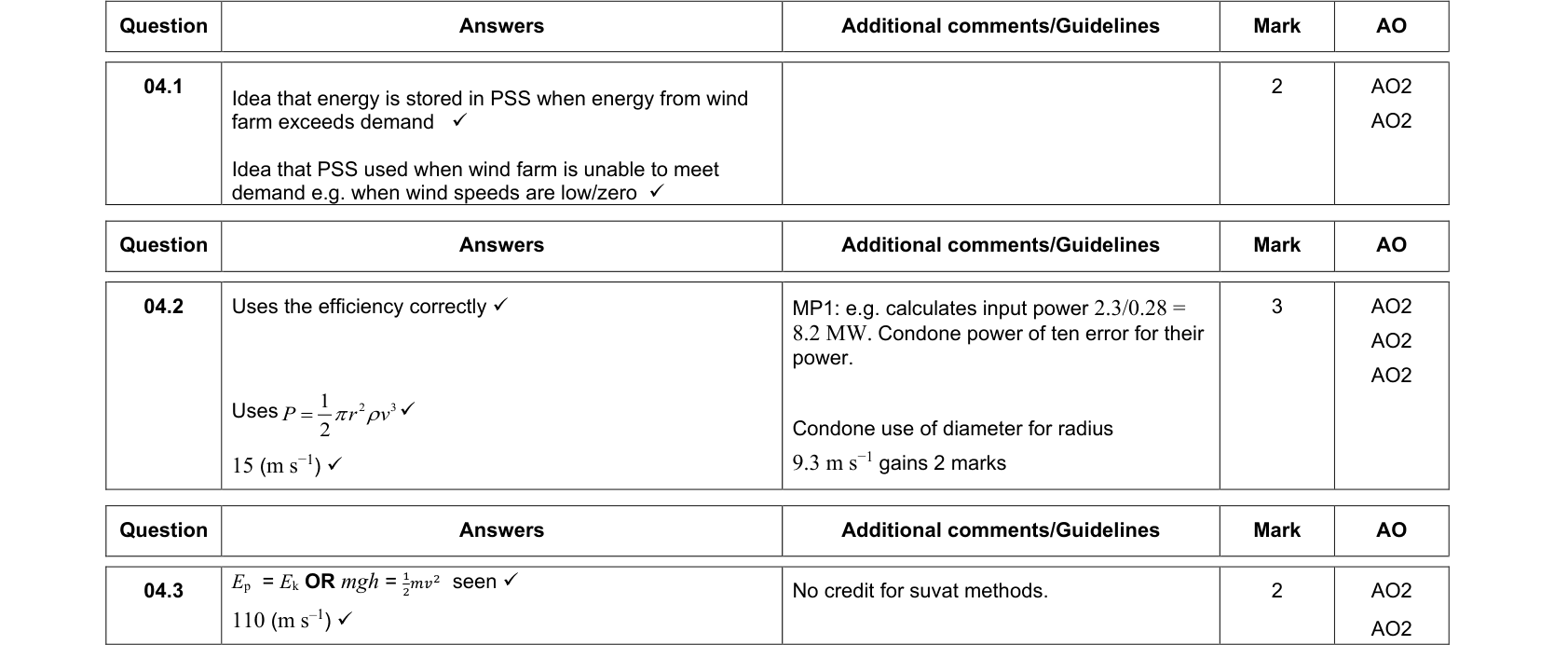
- Back-up (peak-load) power stations can be started, stopped and adjusted quickly to meet peaks in demand, sudden surges, or a failure elsewhere. Examples: pumped storage and other hydroelectric stations (which can reach full power within a minute or two), and open-cycle gas turbines.
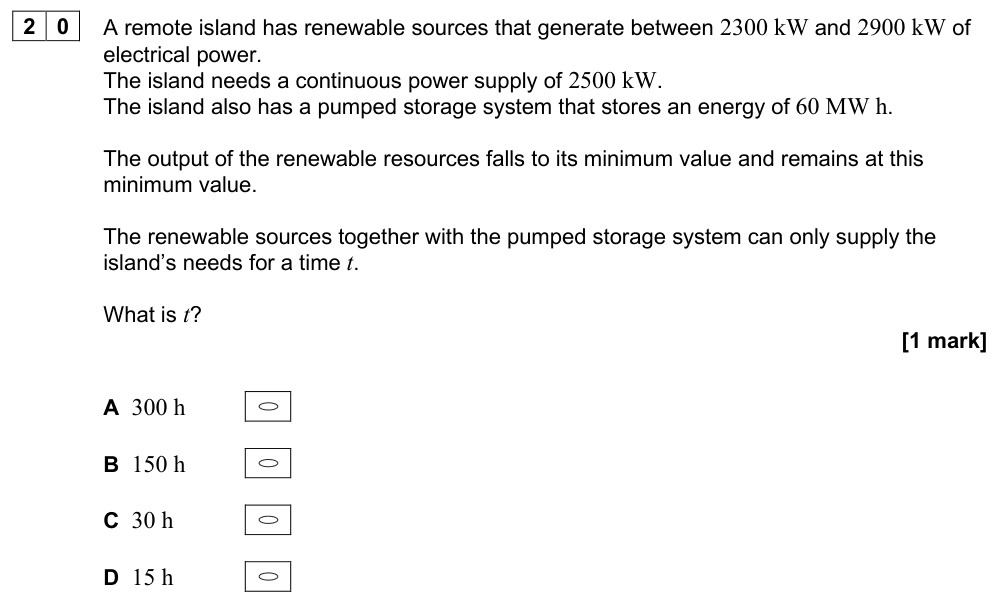
As more electricity comes from intermittent sources such as wind and solar power, fast back-up and energy storage become even more important.
Pumped storage
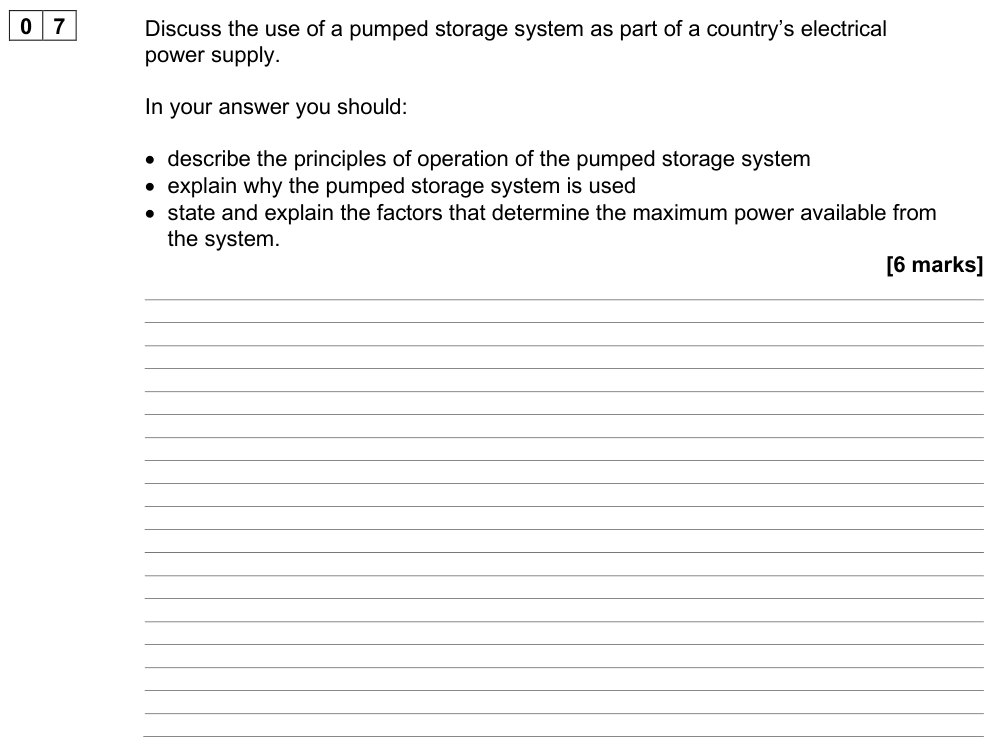
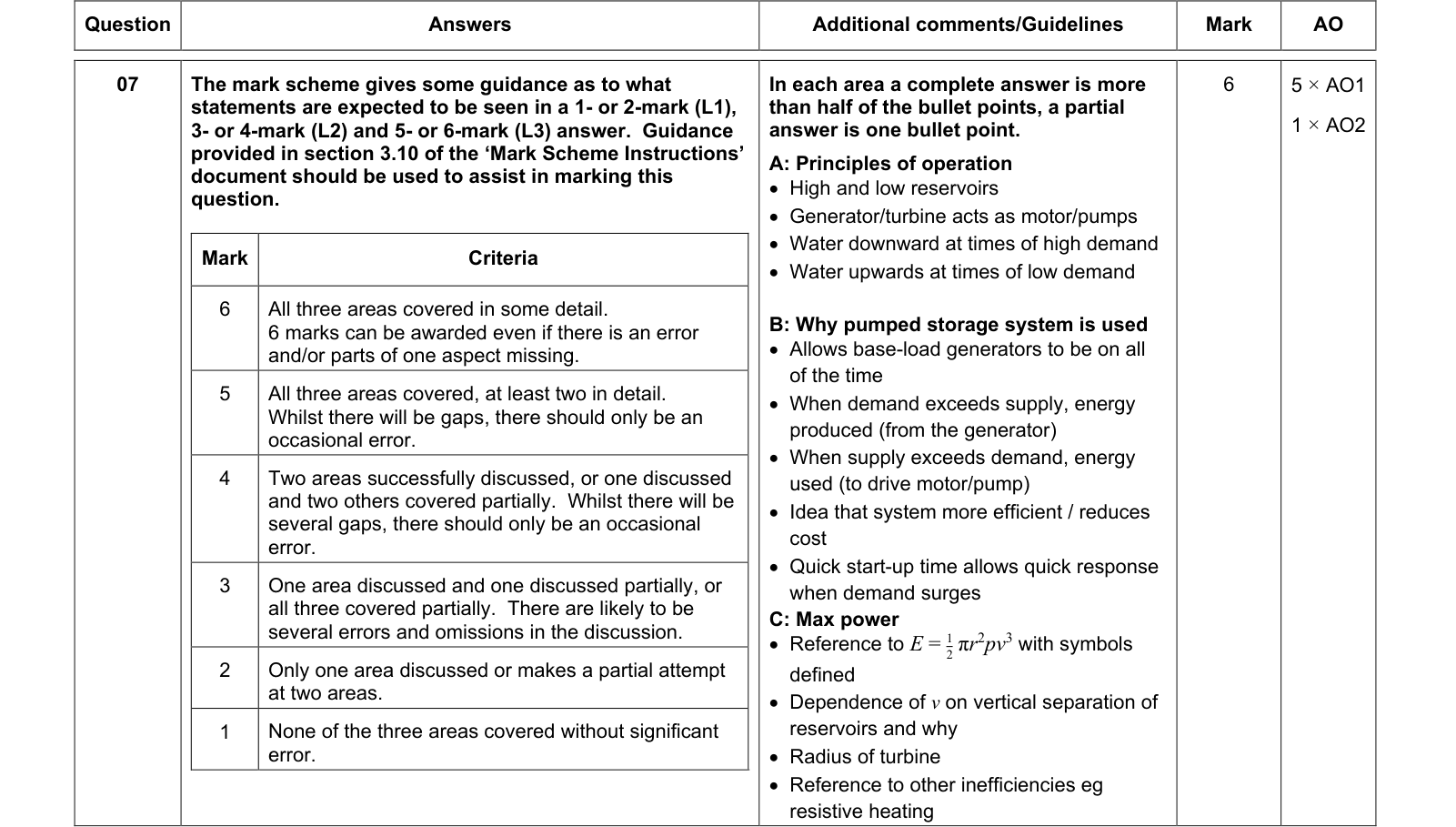
A pumped storage power station has two reservoirs at different heights, connected through reversible pump-turbines.
- When demand is low (at night) or there is surplus electricity (e.g. on a windy night), electricity from the grid drives the machines as motors and pumps, pumping water up to the upper reservoir. Electrical energy is stored as gravitational potential energy.
- When demand is high, water flows down through the same machines, now acting as turbines and generators, and electricity is fed back to the grid within seconds to minutes.
Why pumped storage is worthwhile
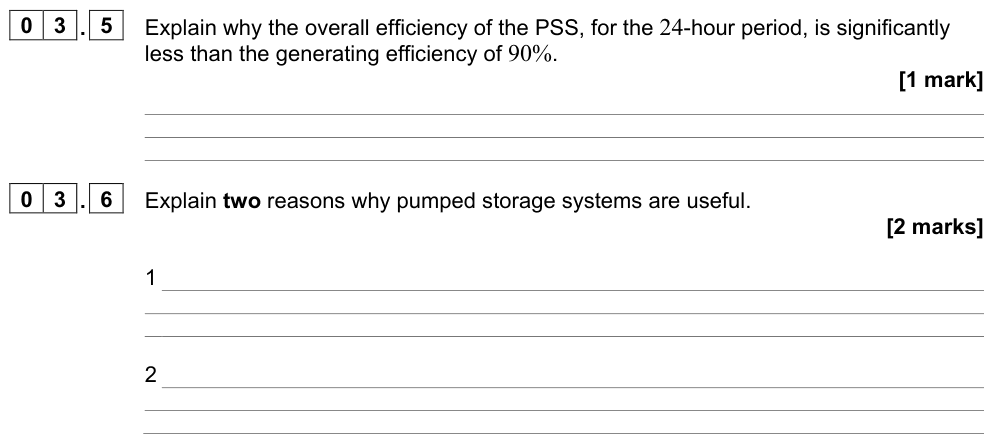
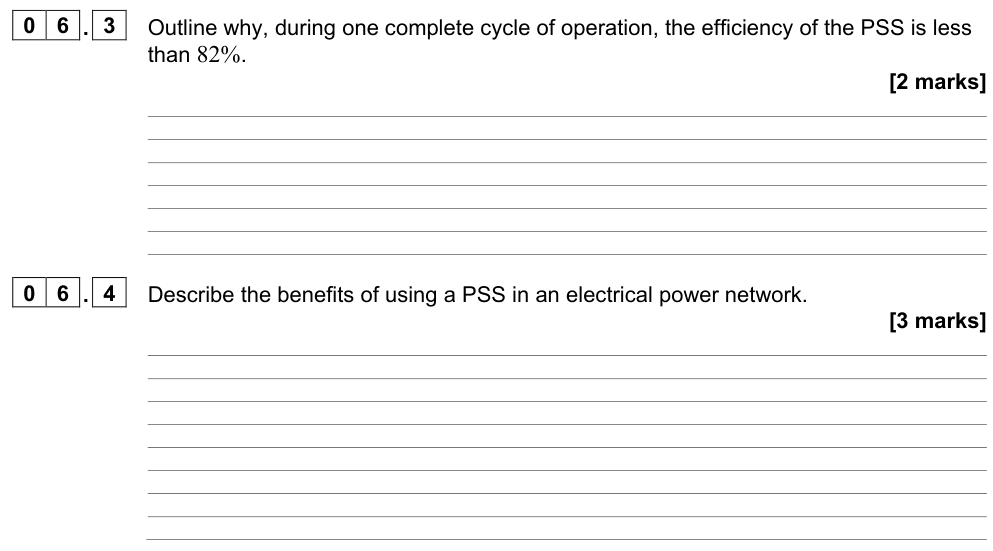
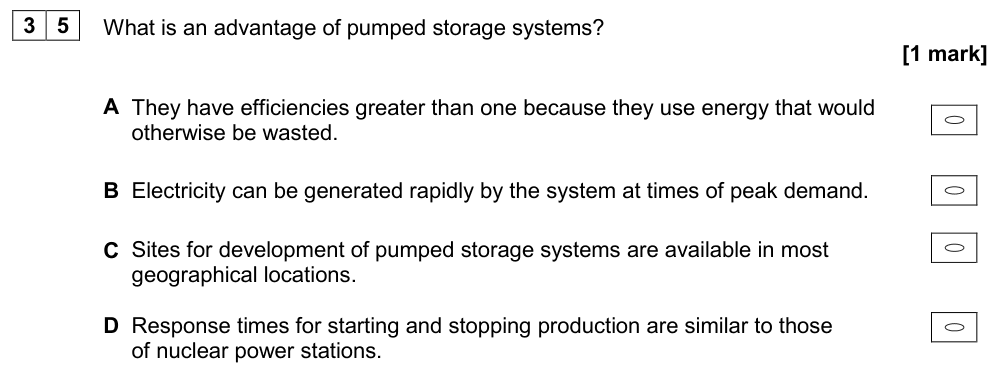
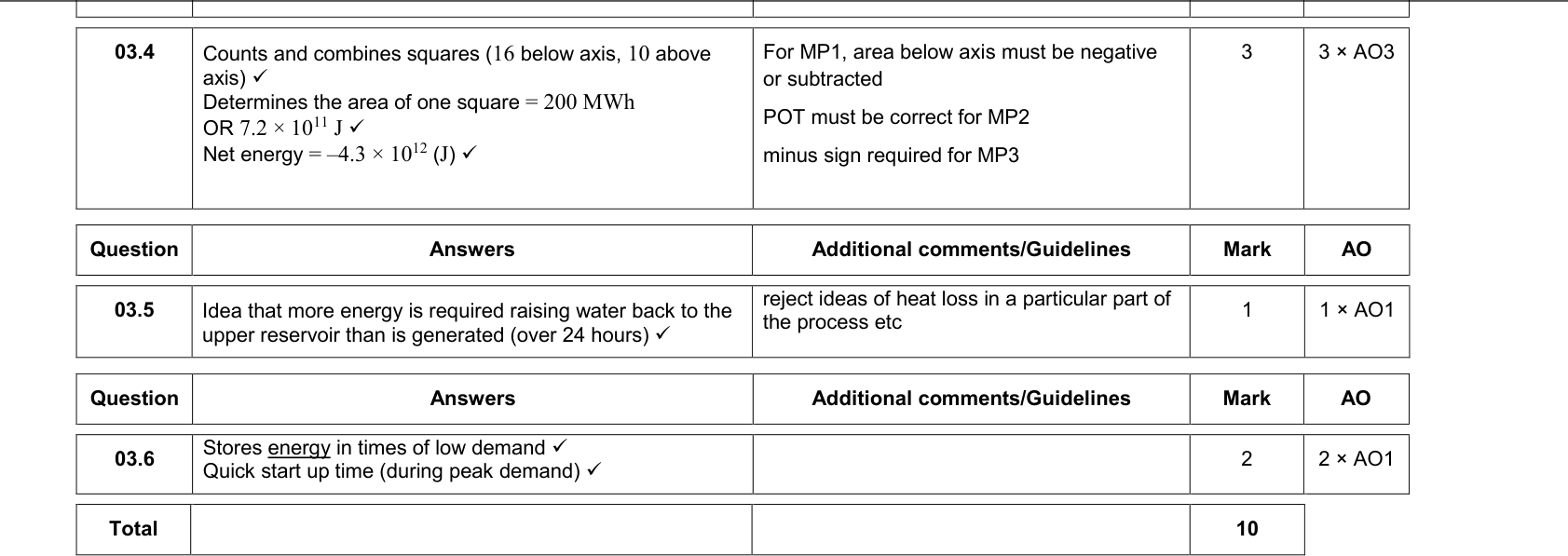
A pumped storage scheme uses more energy pumping the water up than it generates (overall efficiency about 70–80%), but it:
- stores energy when it is plentiful and cheap and supplies it when it is needed and valuable;
- lets base-power stations run steadily at their most efficient output;
- responds very quickly to surges in demand or to failures;
- helps balance intermittent renewable sources such as wind and solar.
Worked example: a pumped storage scheme
The upper reservoir holds $6.0 \times 10^{6}$ m³ of water at an average height of 500 m above the turbines. The generating efficiency is 90% and the pumping efficiency is 85%.
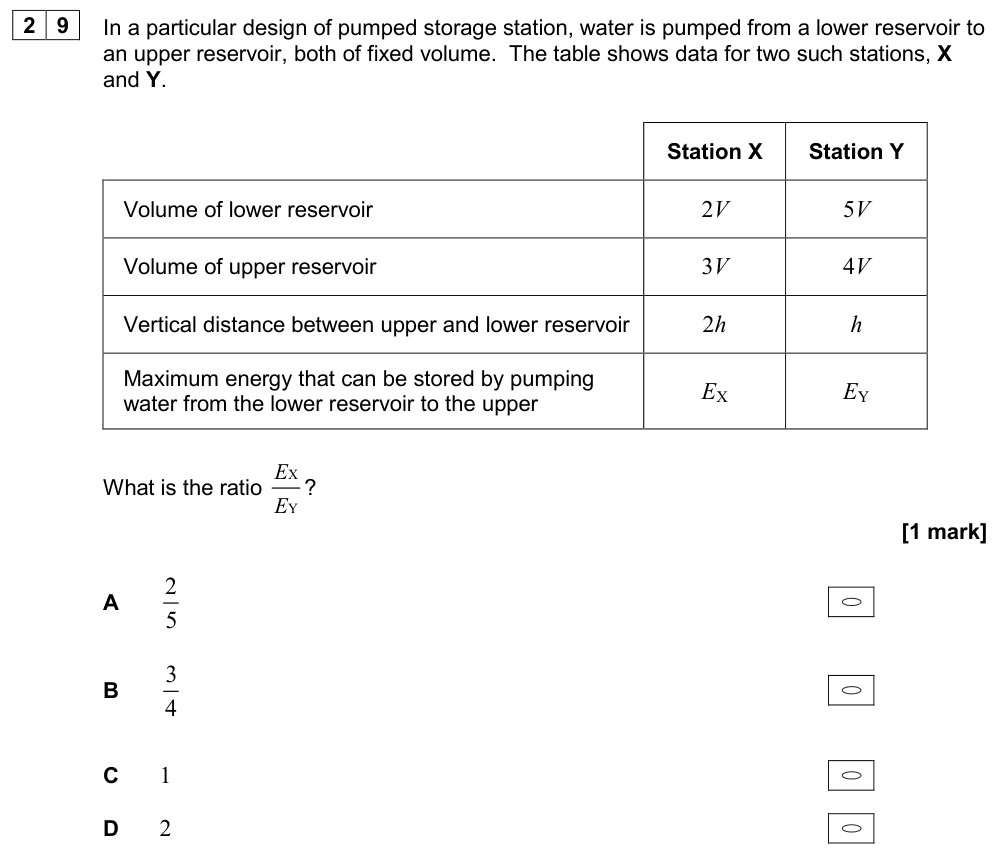
Gravitational potential energy stored $= mgh = 1000 \times 6.0 \times 10^{6} \times 9.81 \times 500 = 2.9 \times 10^{13}$ J.
Electrical energy generated $= 0.90 \times 2.9 \times 10^{13} = 2.6 \times 10^{13}$ J. At a maximum output of 1.8 GW this lasts $\dfrac{2.6 \times 10^{13}}{1.8 \times 10^{9}} = 1.5 \times 10^{4}$ s, about 4 hours.
Electrical energy needed to pump the water back up $= \dfrac{2.9 \times 10^{13}}{0.85} = 3.5 \times 10^{13}$ J. Overall efficiency $= 0.90 \times 0.85 = 77\%$.
Advantages and disadvantages of hydroelectric power
| Advantages | Disadvantages |
|---|---|
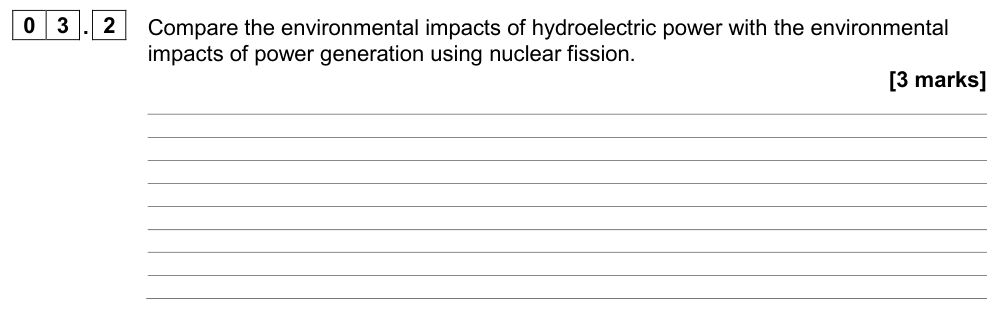
| renewable; no fuel and no carbon dioxide emitted while generating | building a dam floods large areas of land, destroying habitats and sometimes displacing communities |
| reliable and controllable: output can be changed quickly | rotting vegetation in new reservoirs releases methane and carbon dioxide |
| high efficiency and long working life; low running costs | rivers below the dam are changed: fish migration blocked, sediment trapped |
| reservoirs also provide water supply and flood control | very high building cost; only possible where geography allows (high rainfall, valleys, height difference) |
| pumped storage provides large-scale energy storage | risk of catastrophic dam failure |
Summary
- Hydroelectric: GPE of stored water → KE of flowing water → turbine → generator → electrical energy.
- Power from a head $h$: $P = \rho\dfrac{\Delta V}{\Delta t}gh$ (× efficiency); water speed $\sqrt{2gh}$ if no losses.
- Maximum power from water flowing through a turbine: $P = \tfrac12\rho\pi r^2v^3$ ($\rho$ = 1000 kg m⁻³).
- Base-power stations supply the steady minimum demand; back-up stations respond quickly to peaks.
- Pumped storage: pump water up when demand is low, generate when demand is high; ~75% efficient but stores energy and responds quickly.