What is fusion?
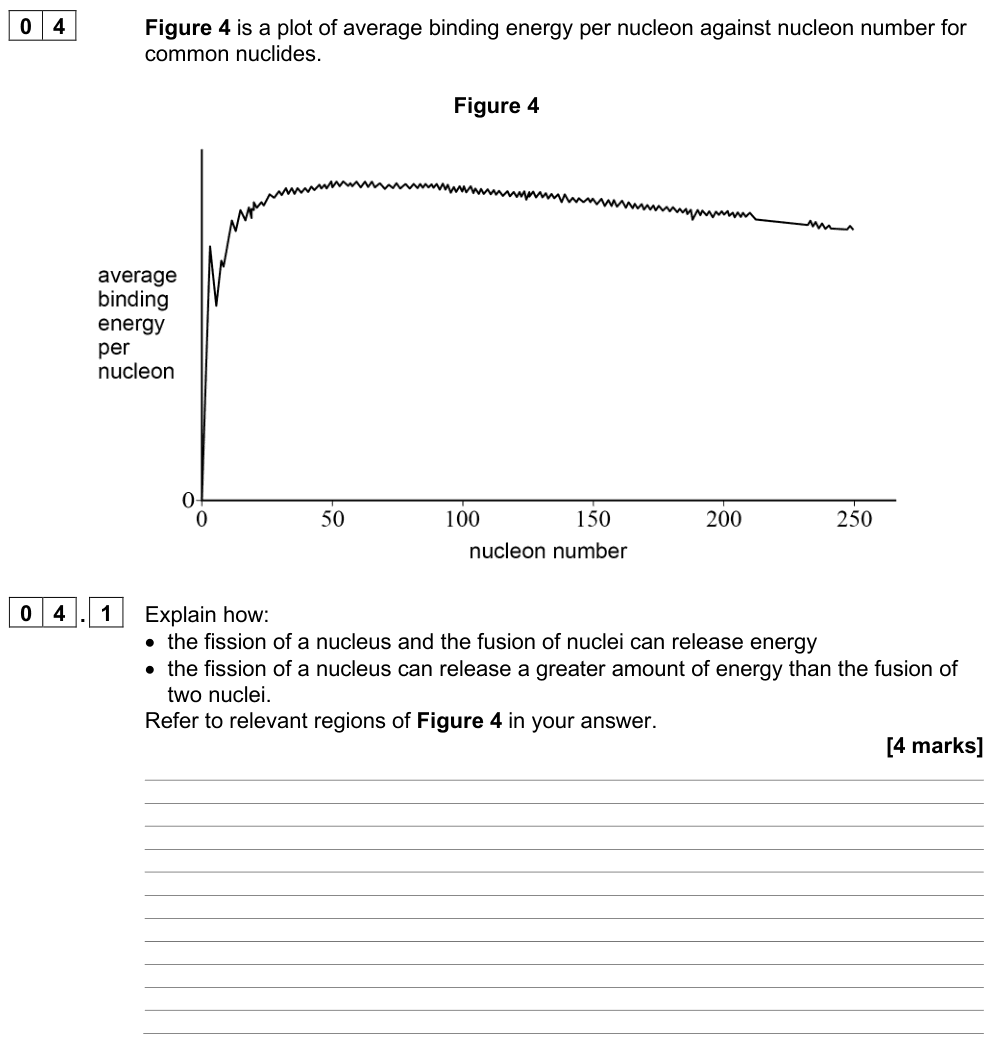
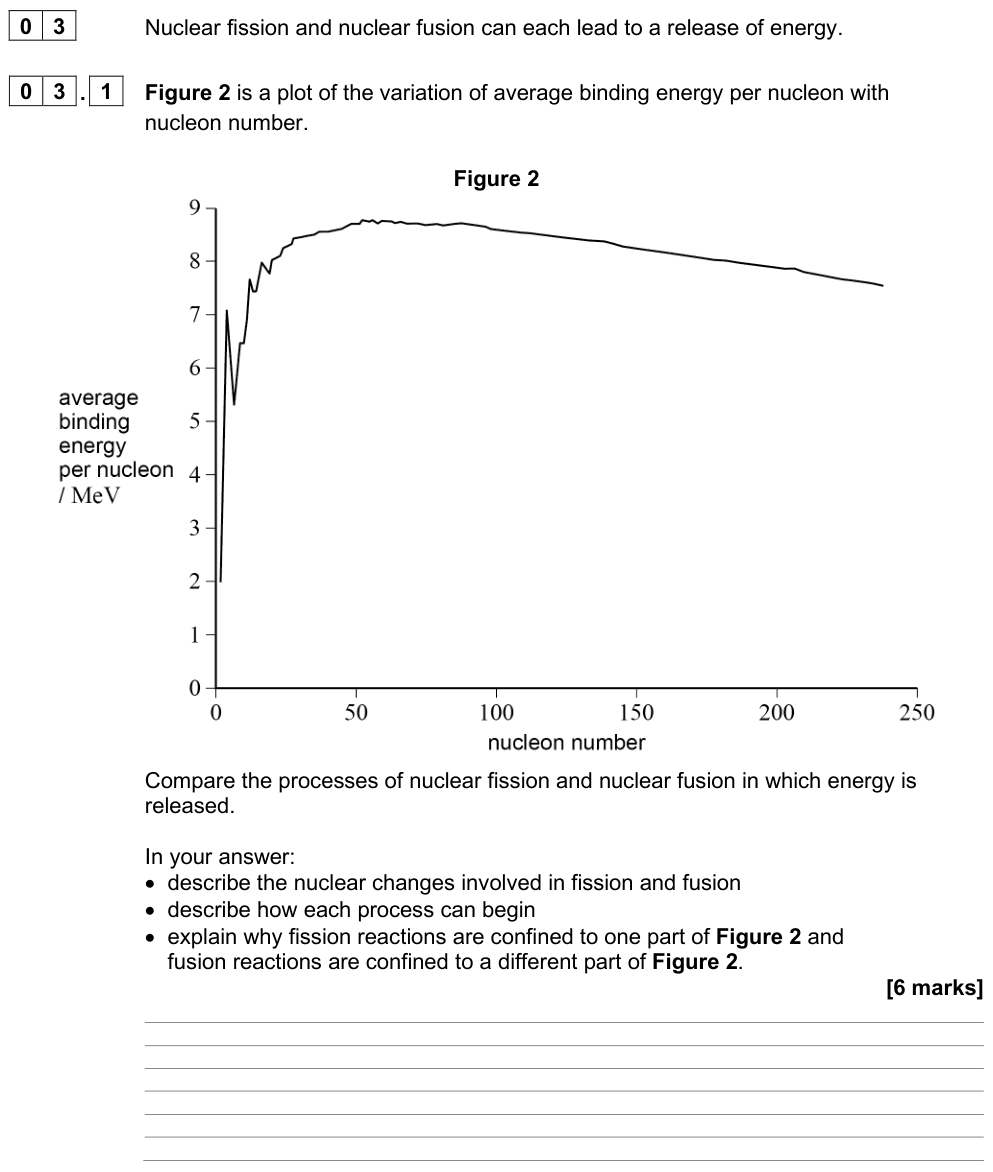
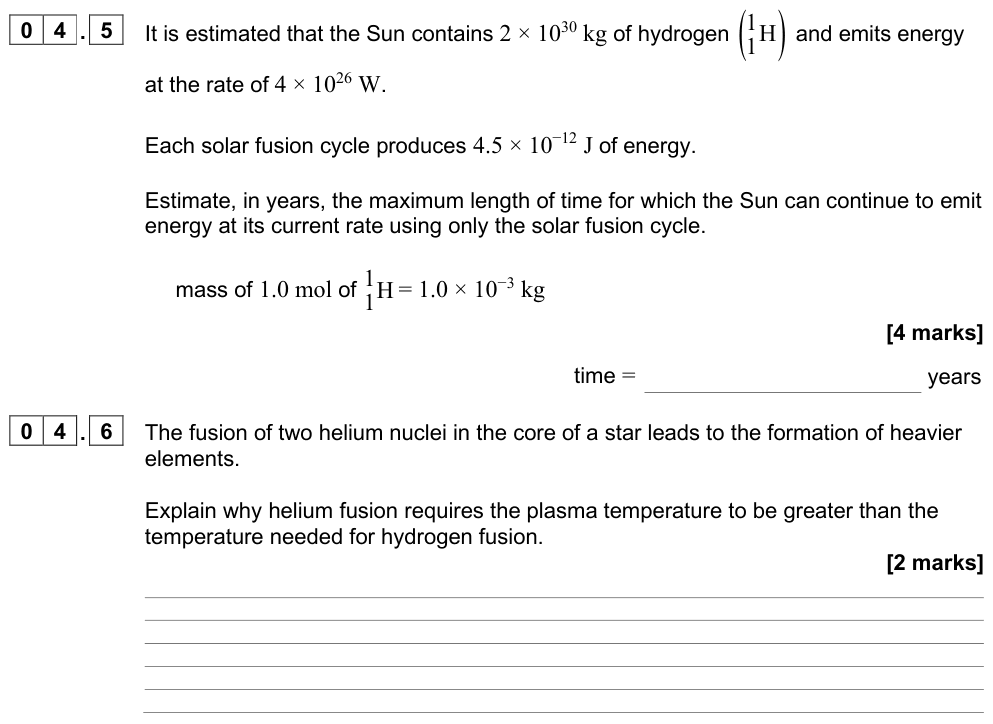
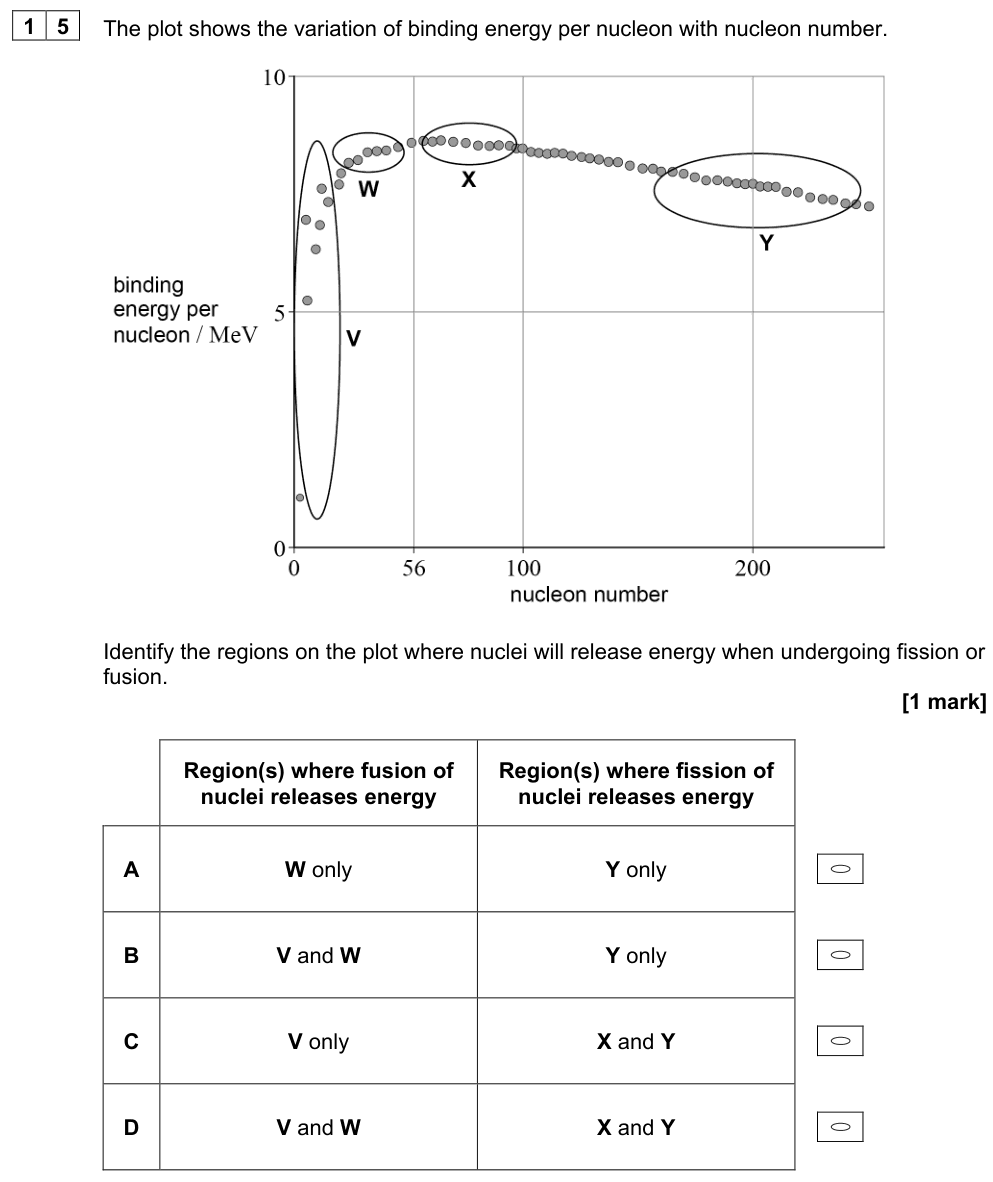
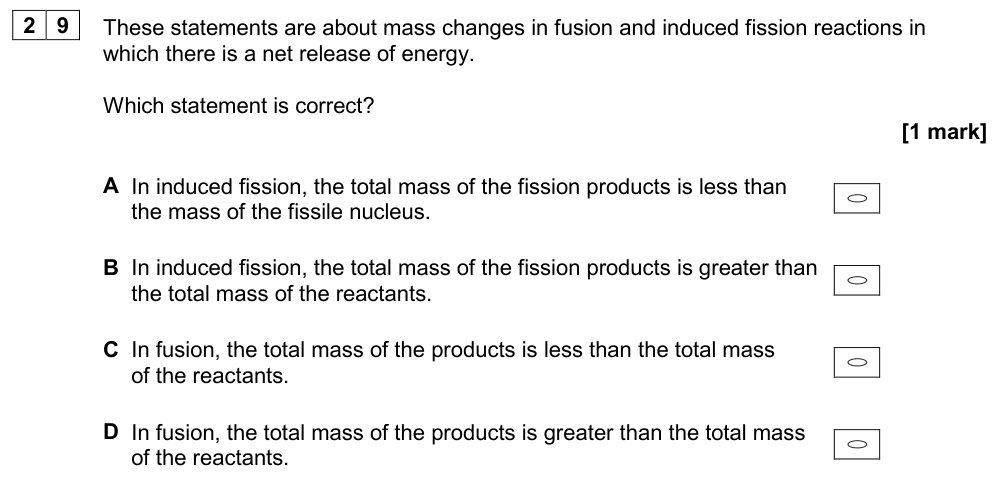
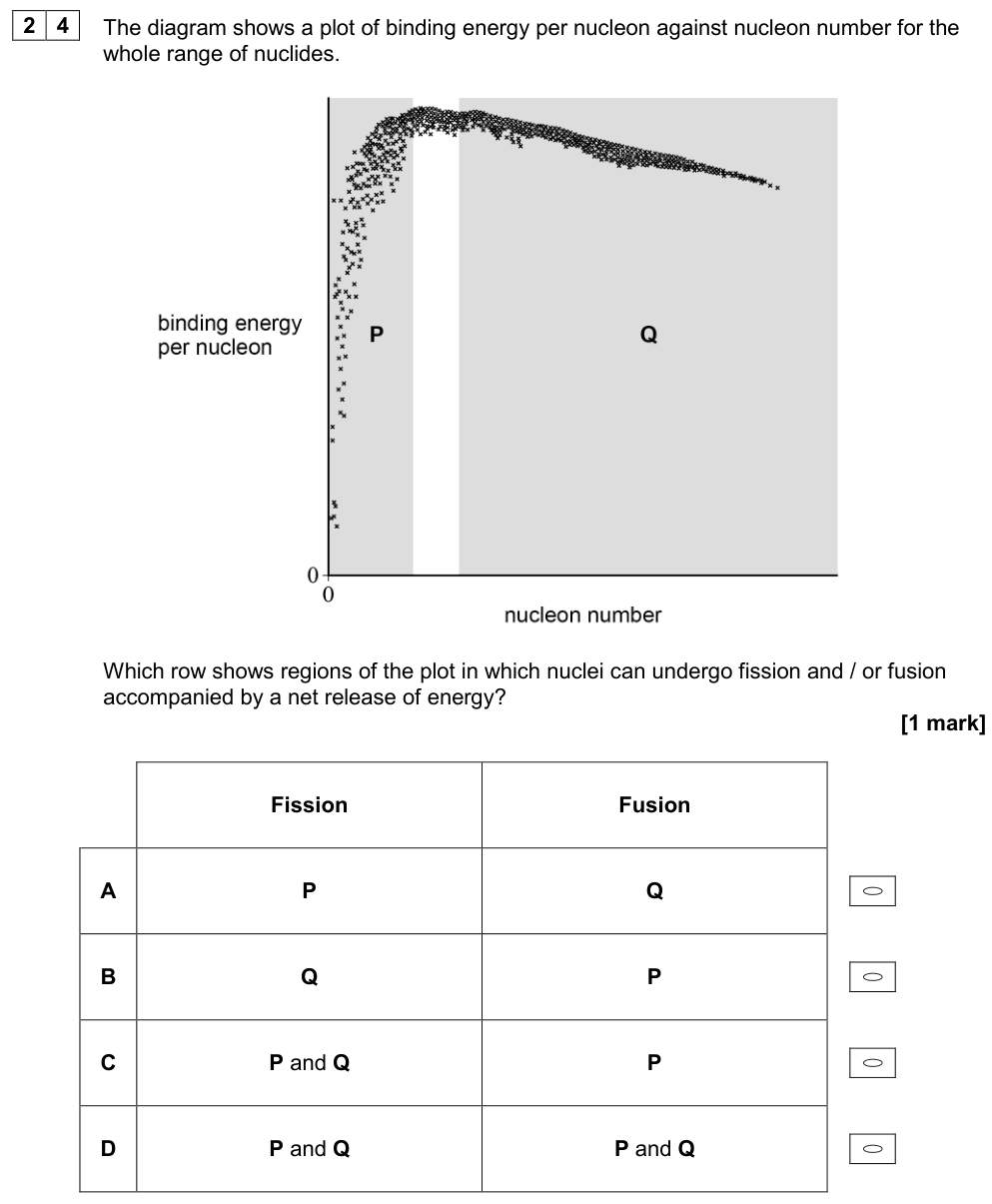
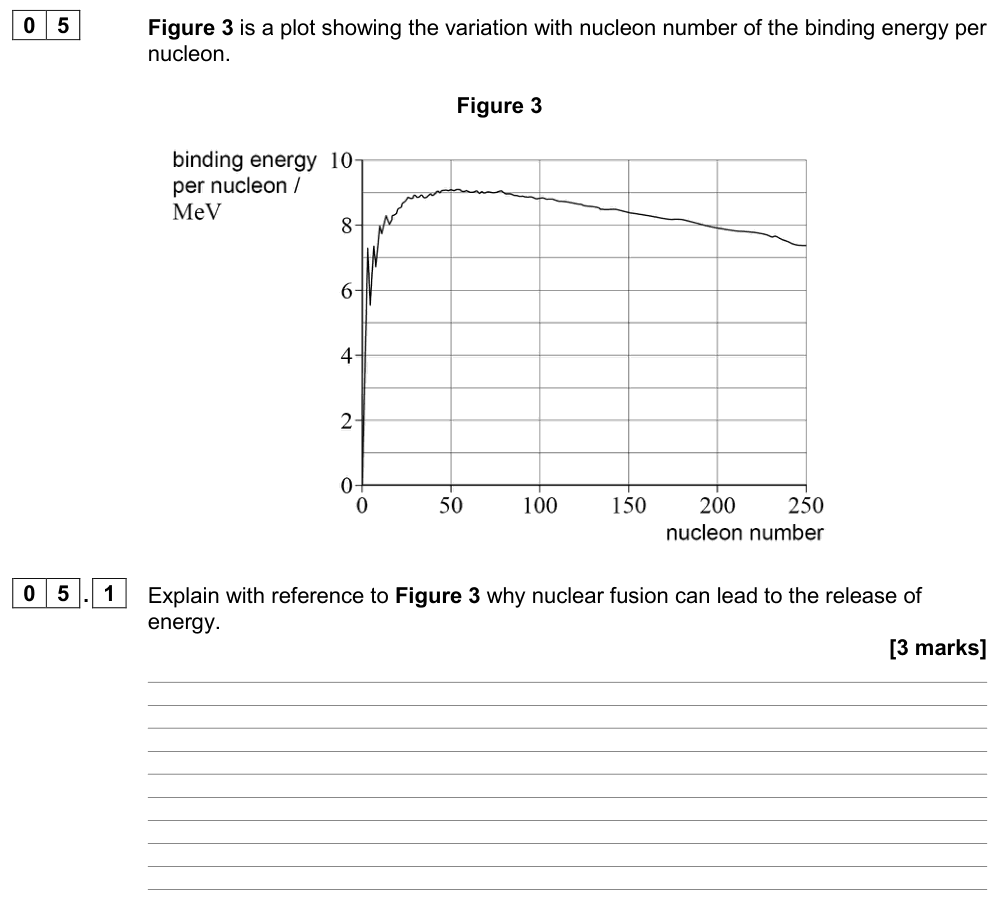
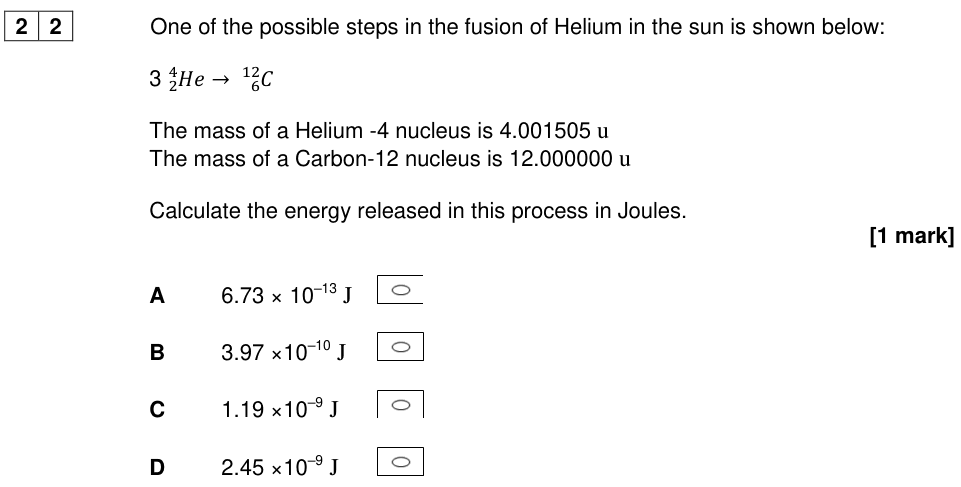
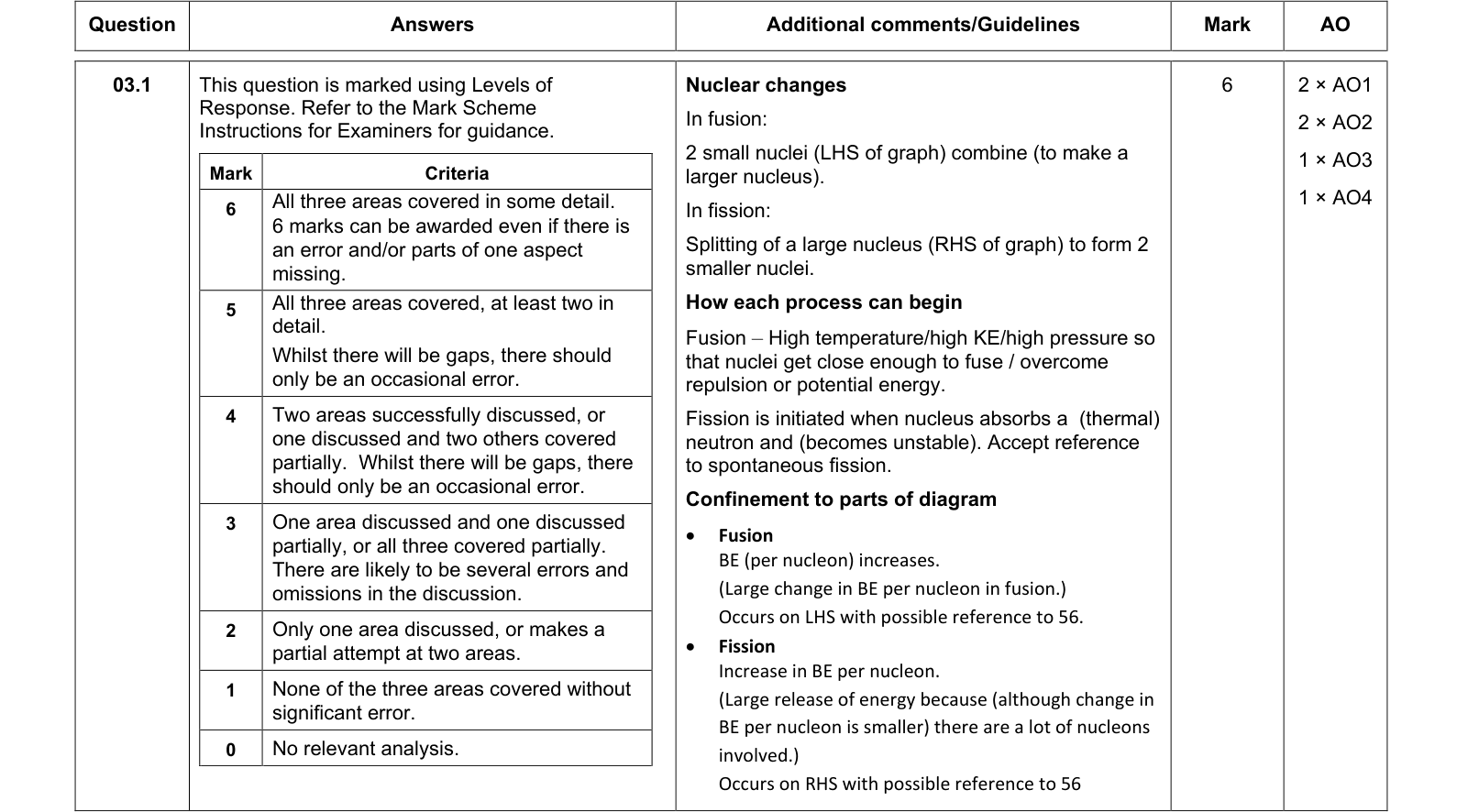
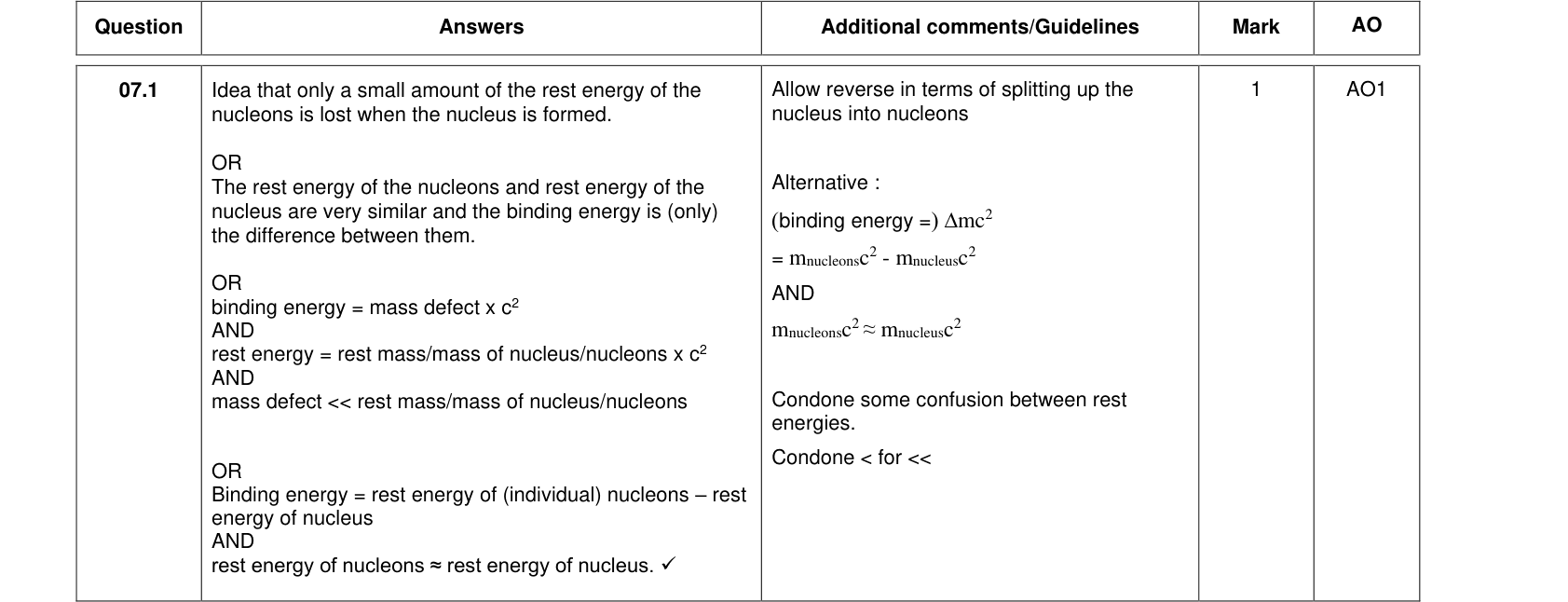
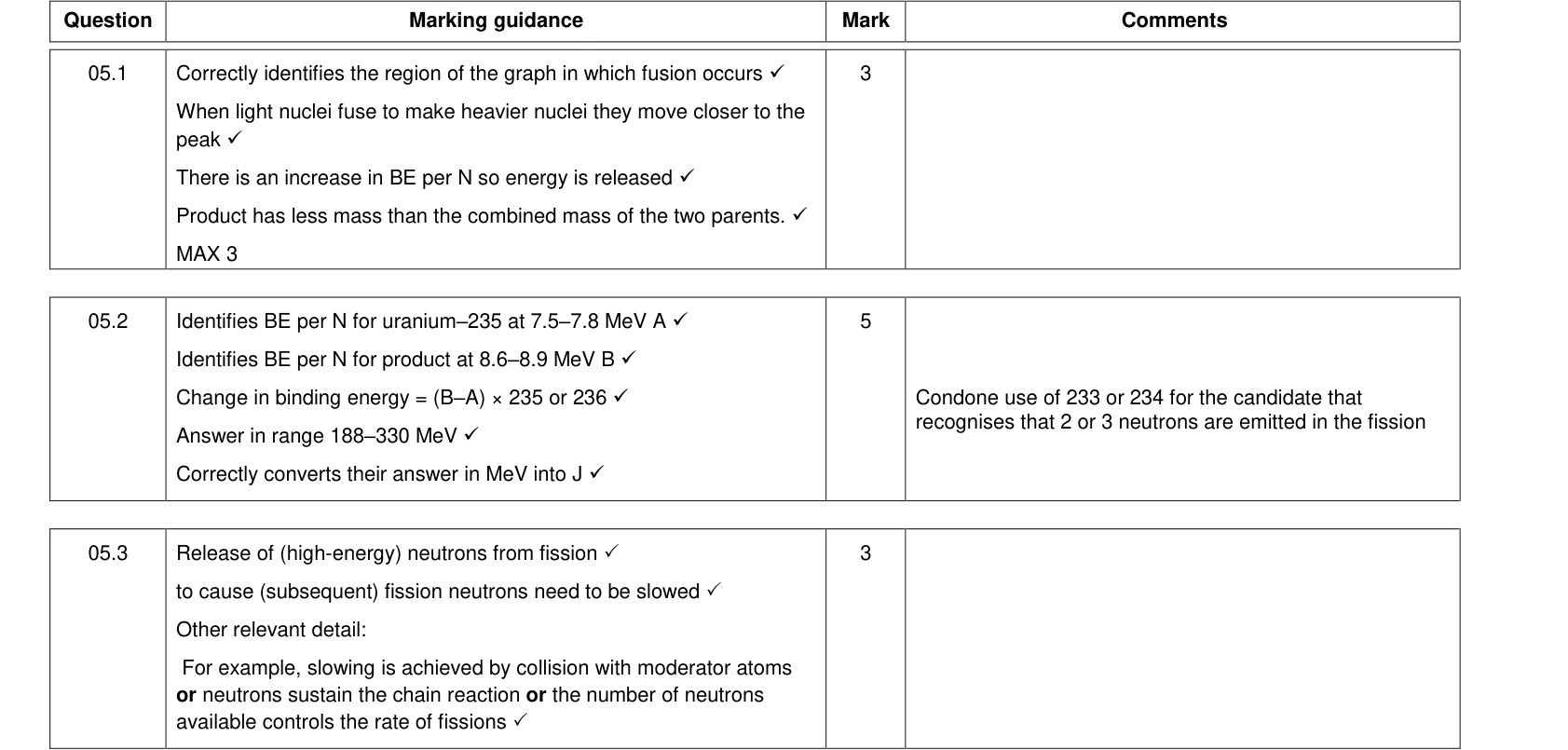
Nuclear fusion is the joining of two light nuclei to form a heavier nucleus. Because the product is more tightly bound (it has a higher binding energy per nucleon), the total mass decreases and energy is released. Fusion powers the Sun and the other stars.
Suitable nuclei for a fusion reactor
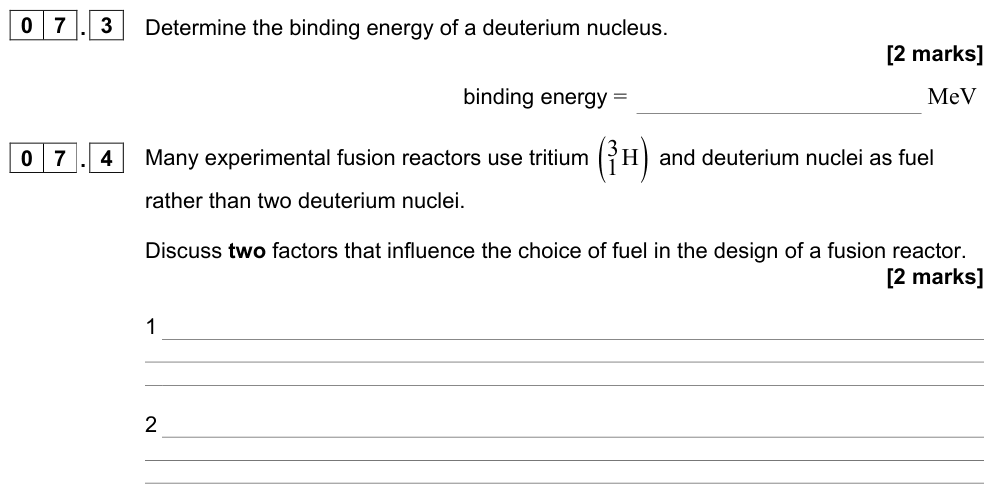
The most promising reaction for a power station is between two isotopes of hydrogen, deuterium (²H) and tritium (³H):
Deuterium–tritium fusion
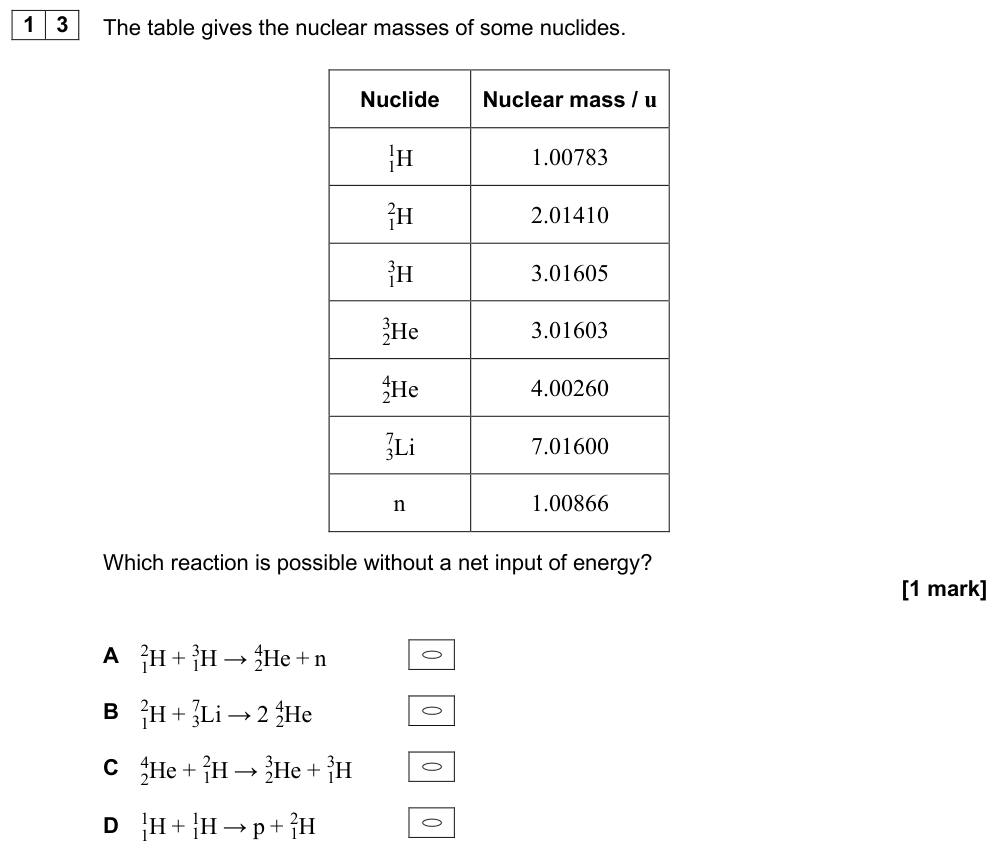
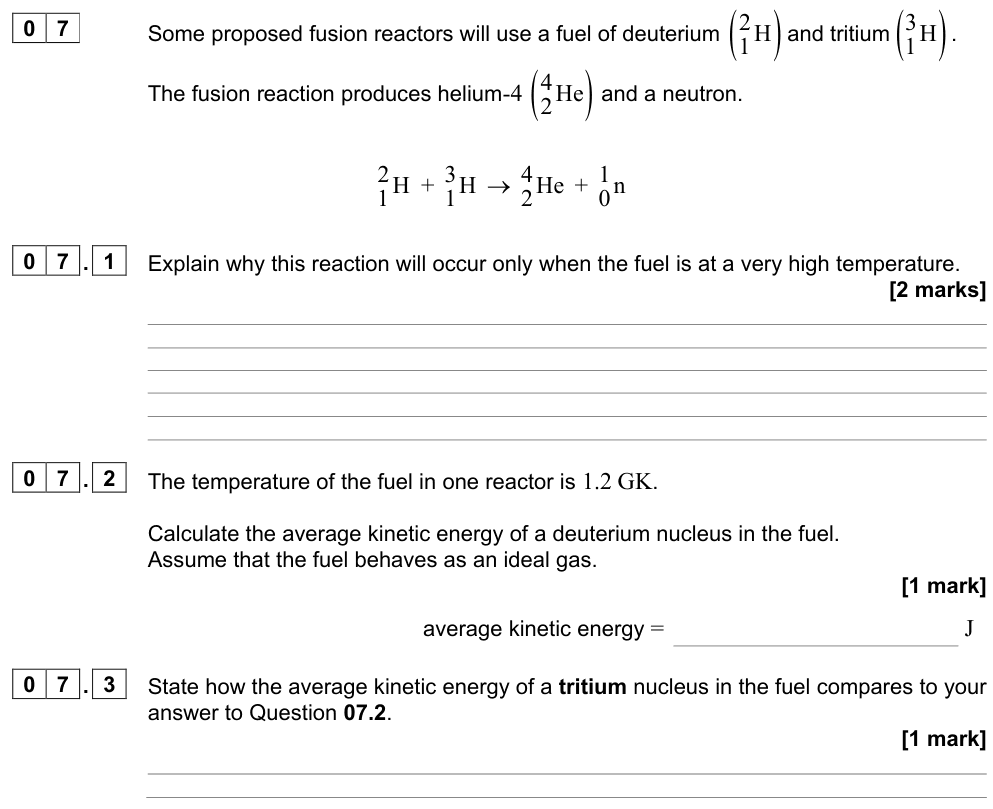
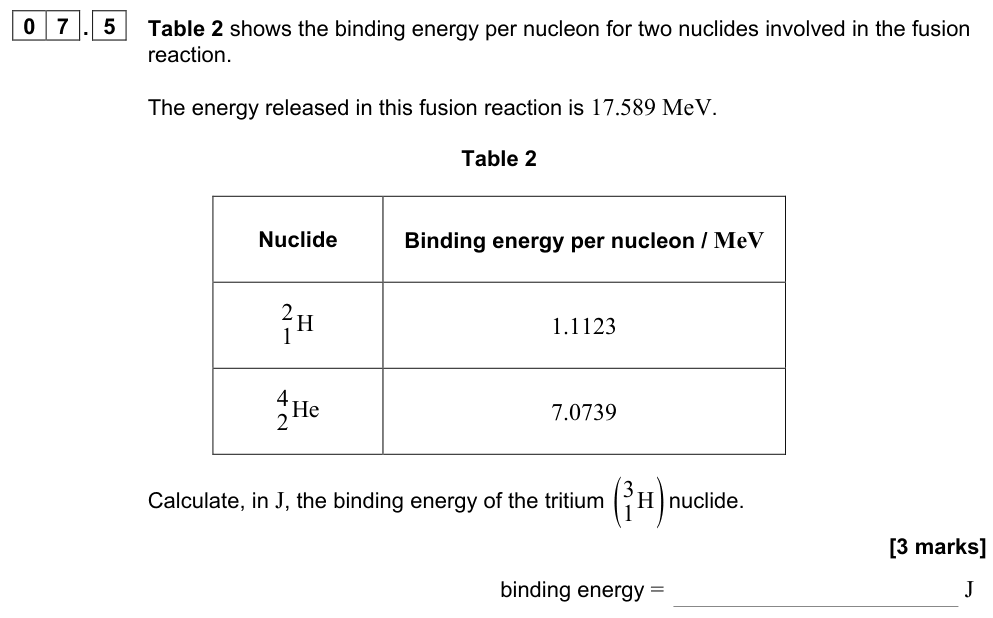
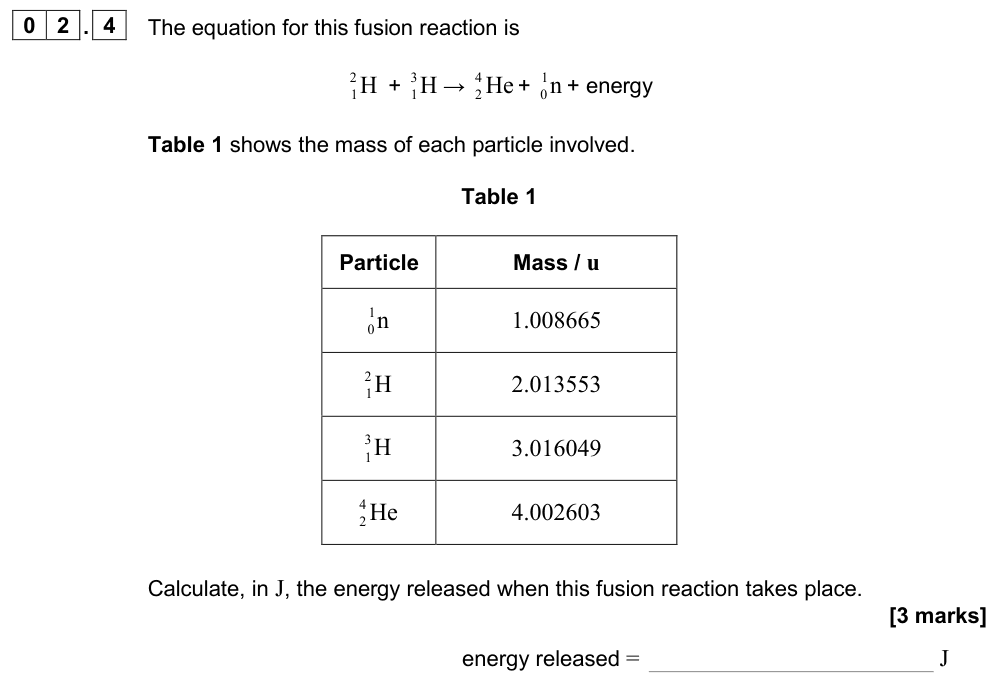
$$^{2}_{1}\text{H} + {}^{3}_{1}\text{H} \rightarrow {}^{4}_{2}\text{He} + {}^{1}_{0}\text{n} + 17.6\ \text{MeV}$$
Why these nuclei?
- They have the smallest charge (one proton each), so the electrostatic repulsion between them is as small as possible.
- The D–T reaction happens at a lower temperature than any other fusion reaction and releases a large amount of energy.
- Deuterium is plentiful: about 1 in every 6400 hydrogen atoms in seawater is deuterium, enough to last millions of years.
- Tritium is radioactive (half-life 12 years) and does not occur naturally in useful amounts. It can be made in the reactor by neutrons from the fusion reaction striking lithium in a "blanket" around the plasma: $^{6}_{3}\text{Li} + {}^{1}_{0}\text{n} \rightarrow {}^{4}_{2}\text{He} + {}^{3}_{1}\text{H}$.
Deuterium–deuterium reactions are also possible but need even higher temperatures:
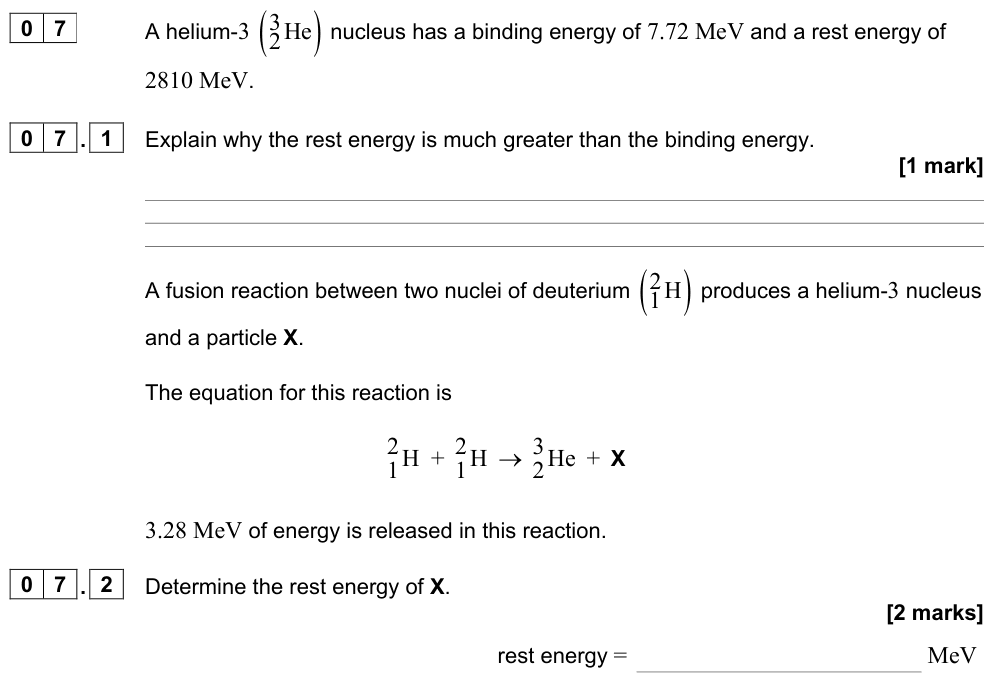
$$^{2}_{1}\text{H} + {}^{2}_{1}\text{H} \rightarrow {}^{3}_{2}\text{He} + {}^{1}_{0}\text{n} + 3.3\ \text{MeV} \qquad\text{or}\qquad {}^{2}_{1}\text{H} + {}^{2}_{1}\text{H} \rightarrow {}^{3}_{1}\text{H} + {}^{1}_{1}\text{H} + 4.0\ \text{MeV}$$
The energy needed for fusion
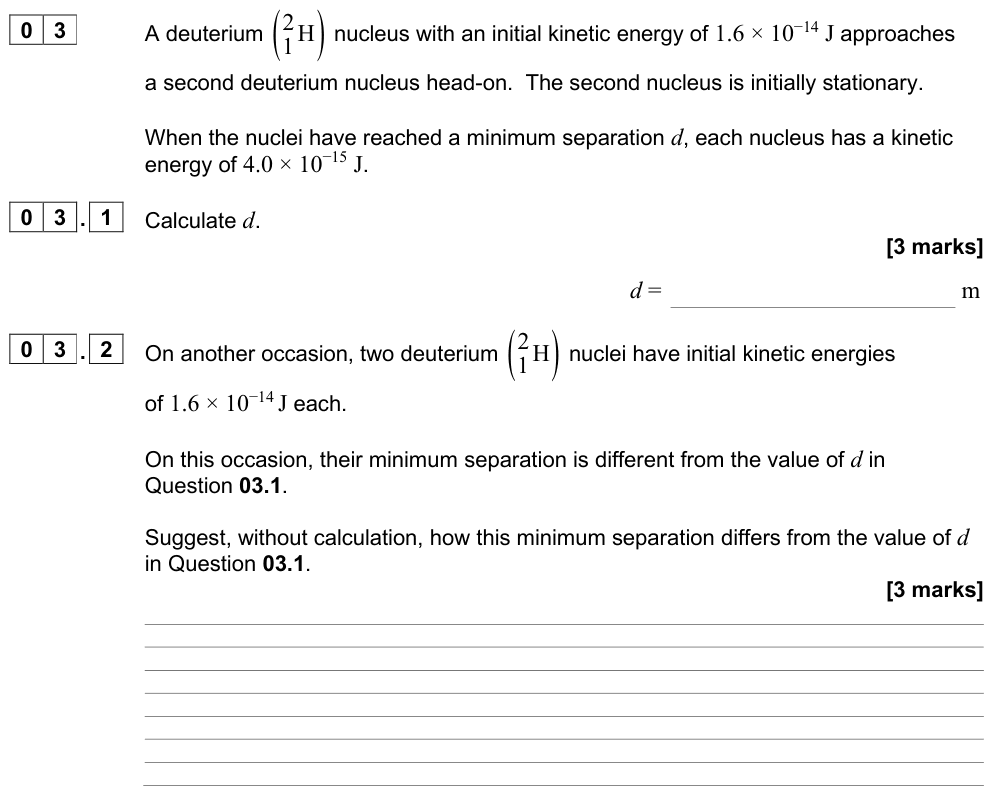
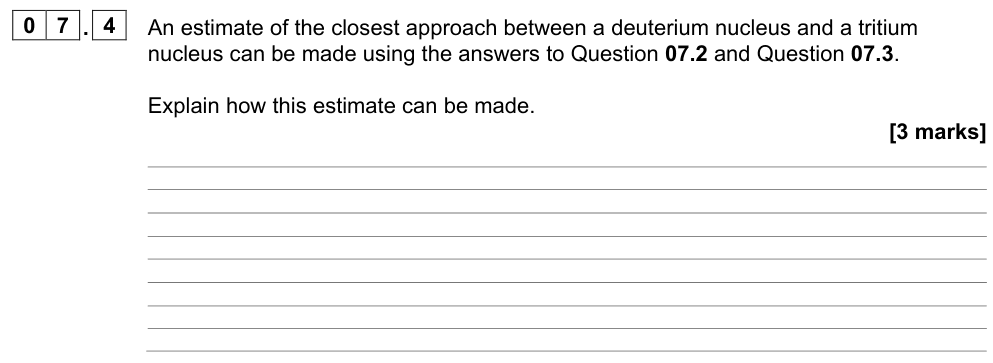
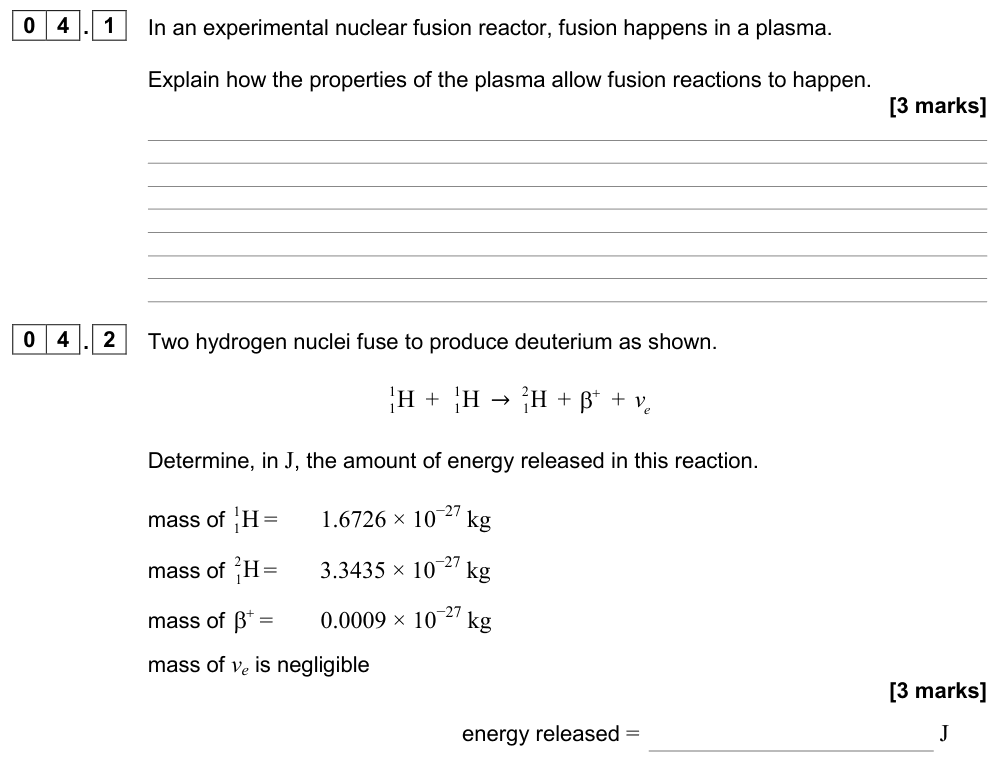
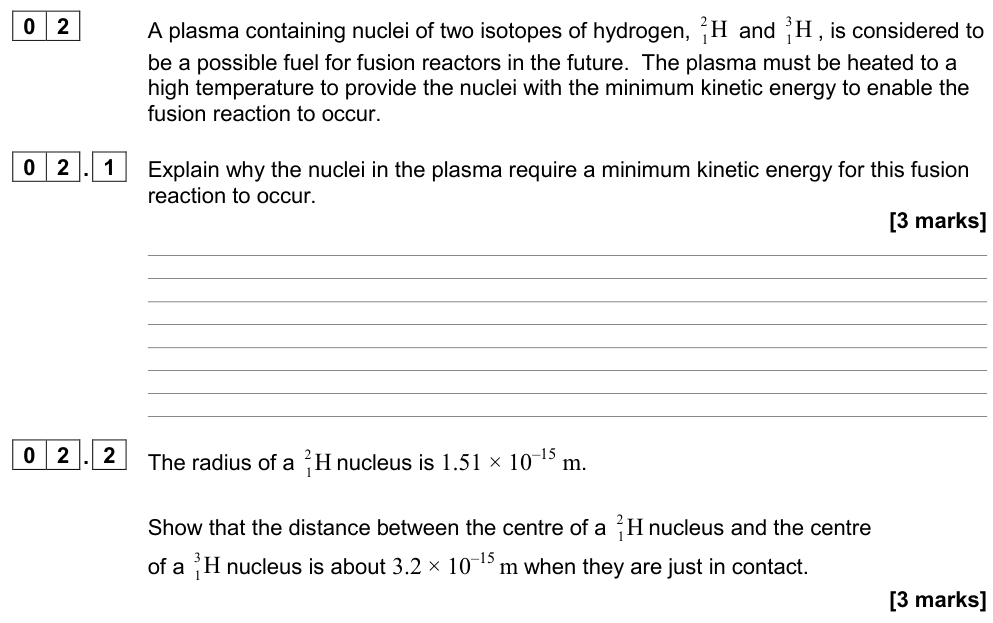
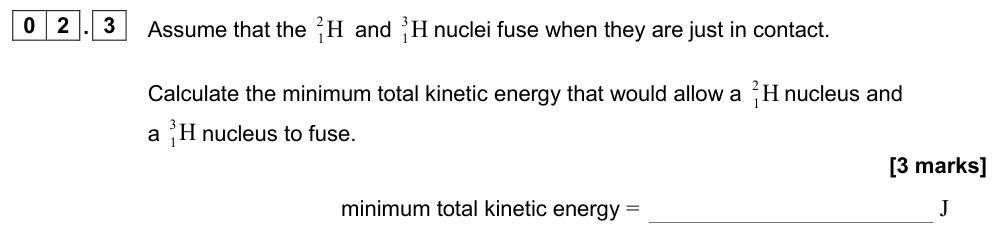
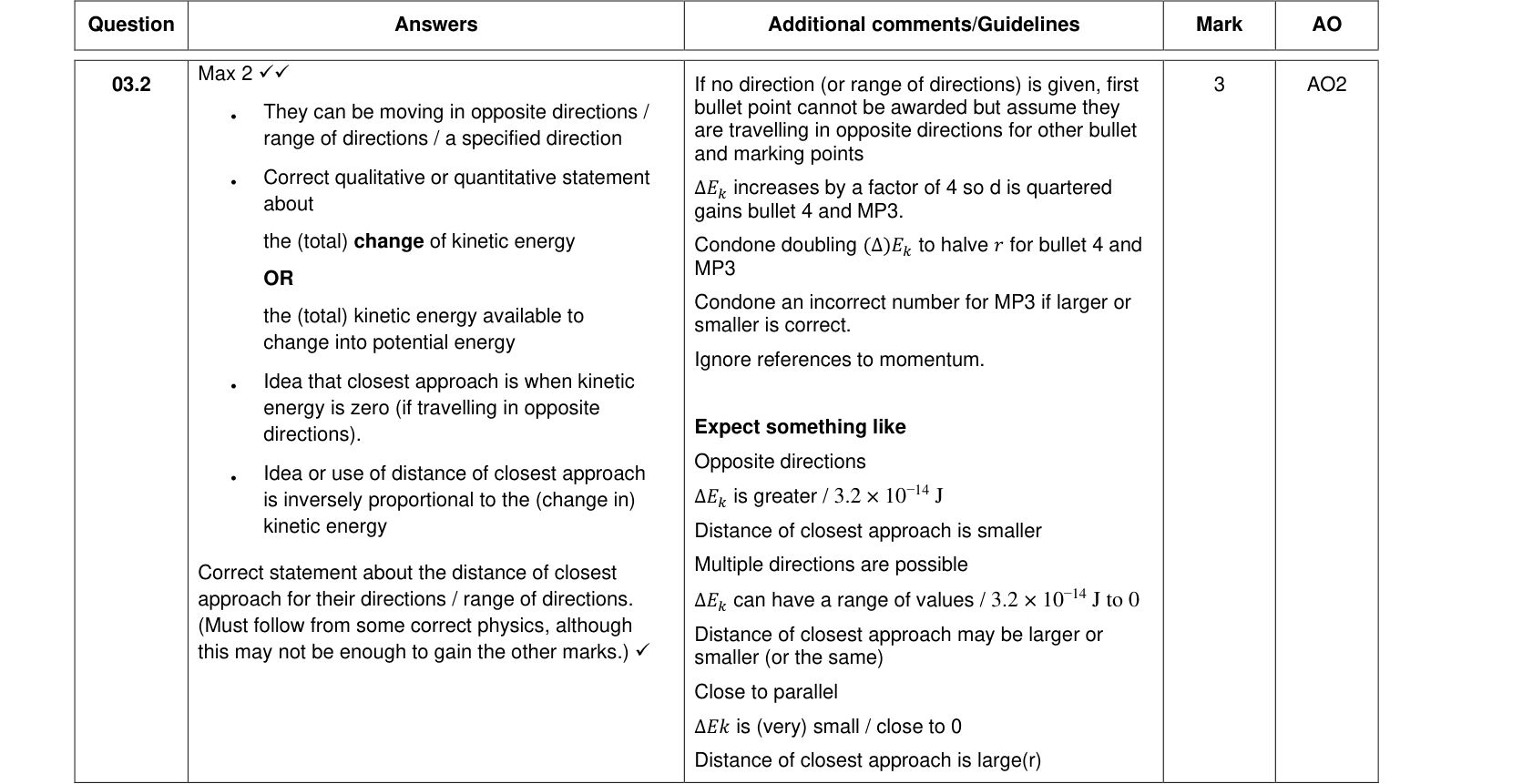
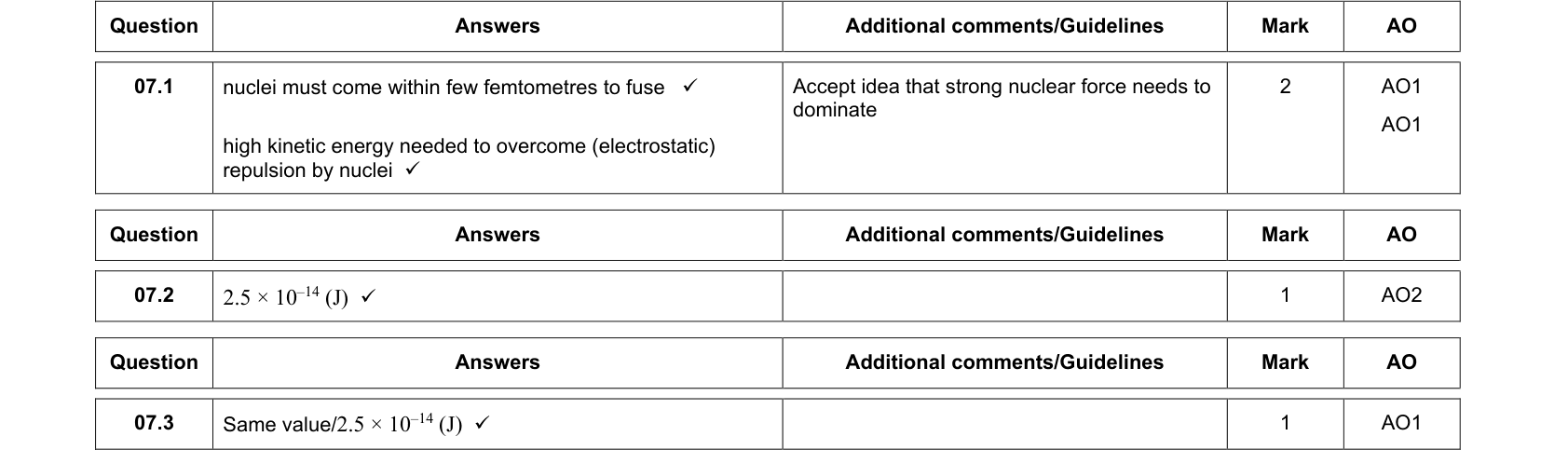
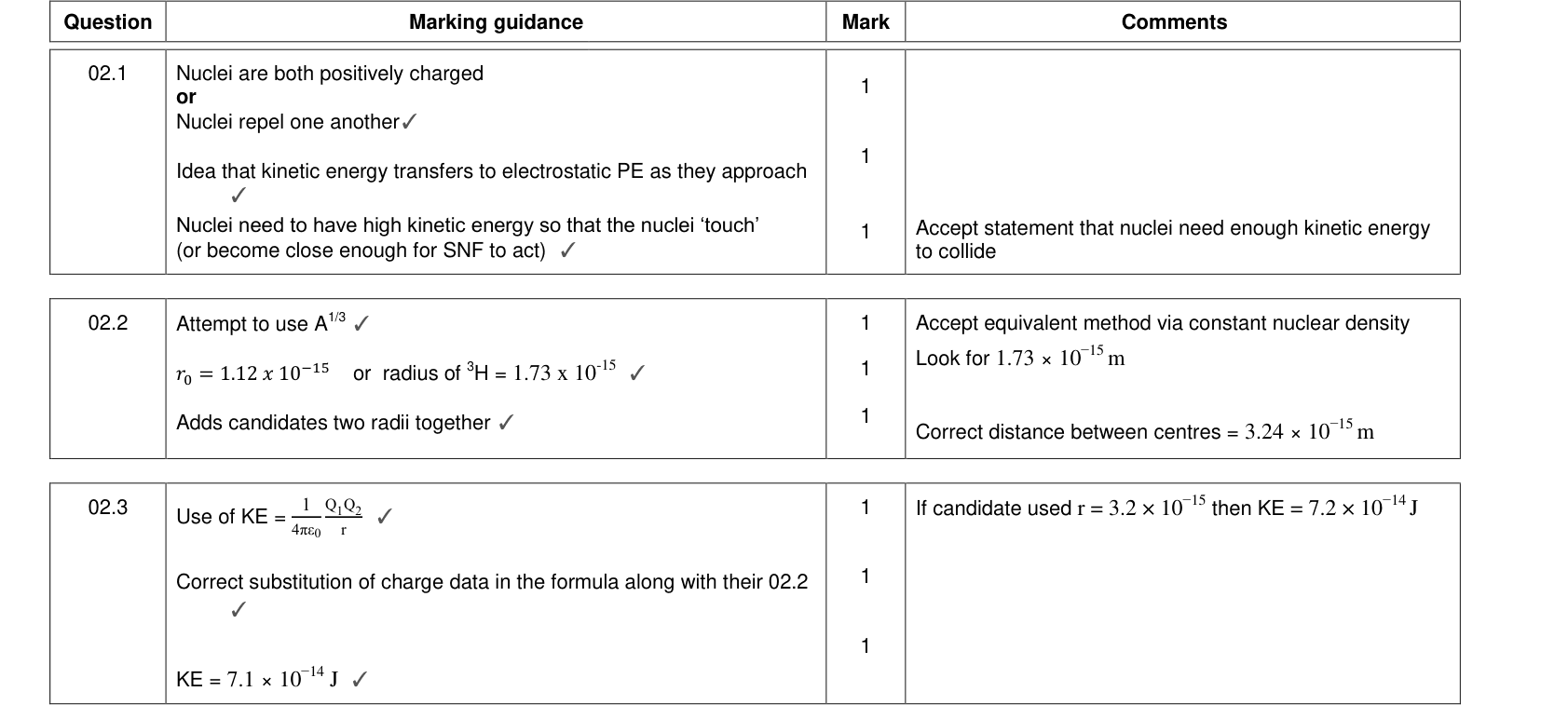
Nuclei are positively charged and repel each other. To fuse, two nuclei must get close enough (a few femtometres) for the short-range strong nuclear force to pull them together. This means overcoming the electrostatic (Coulomb) barrier.
Worked example: estimating the temperature needed
Two deuterium nuclei must approach to within about $3.0 \times 10^{-15}$ m to fuse. Estimate the kinetic energy each needs and the temperature of the gas.
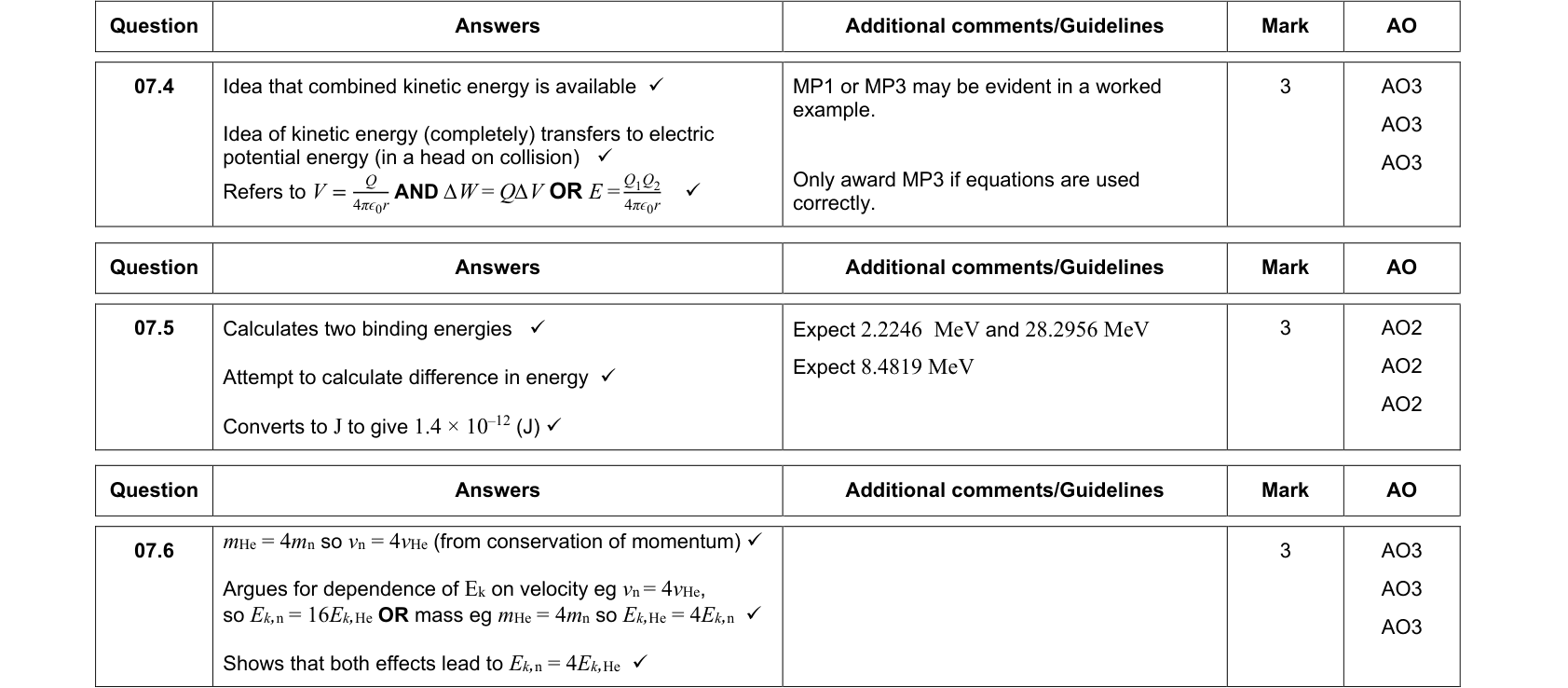
Electric potential energy at this separation: $$E_p = \frac{e^2}{4\pi\varepsilon_0 r} = \frac{8.99 \times 10^{9} \times (1.60 \times 10^{-19})^2}{3.0 \times 10^{-15}} = 7.7 \times 10^{-14}\ \text{J}\ (0.48\ \text{MeV})$$
In a head-on collision between two nuclei with equal kinetic energies, each must supply half: $E_k \approx 3.8 \times 10^{-14}$ J.
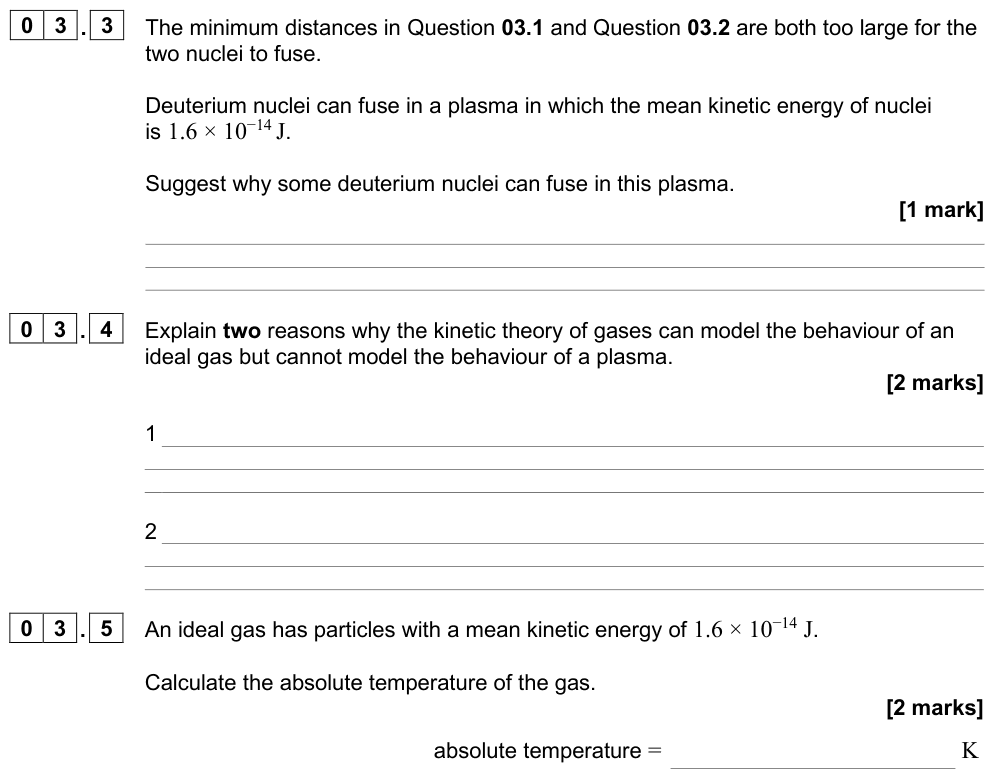
Using mean kinetic energy $= \tfrac32kT$: $$T = \frac{2E_k}{3k} = \frac{2 \times 3.8 \times 10^{-14}}{3 \times 1.38 \times 10^{-23}} \approx 2 \times 10^{9}\ \text{K}$$
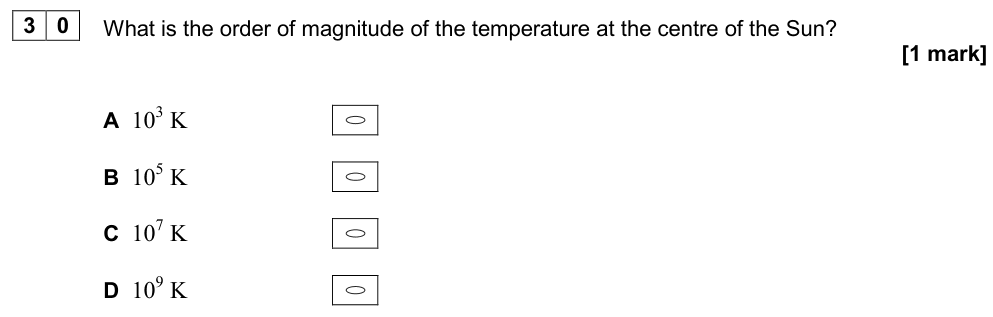
In practice fusion happens at lower temperatures (around $10^{8}$ K in experimental reactors and about $1.5 \times 10^{7}$ K in the core of the Sun) because:
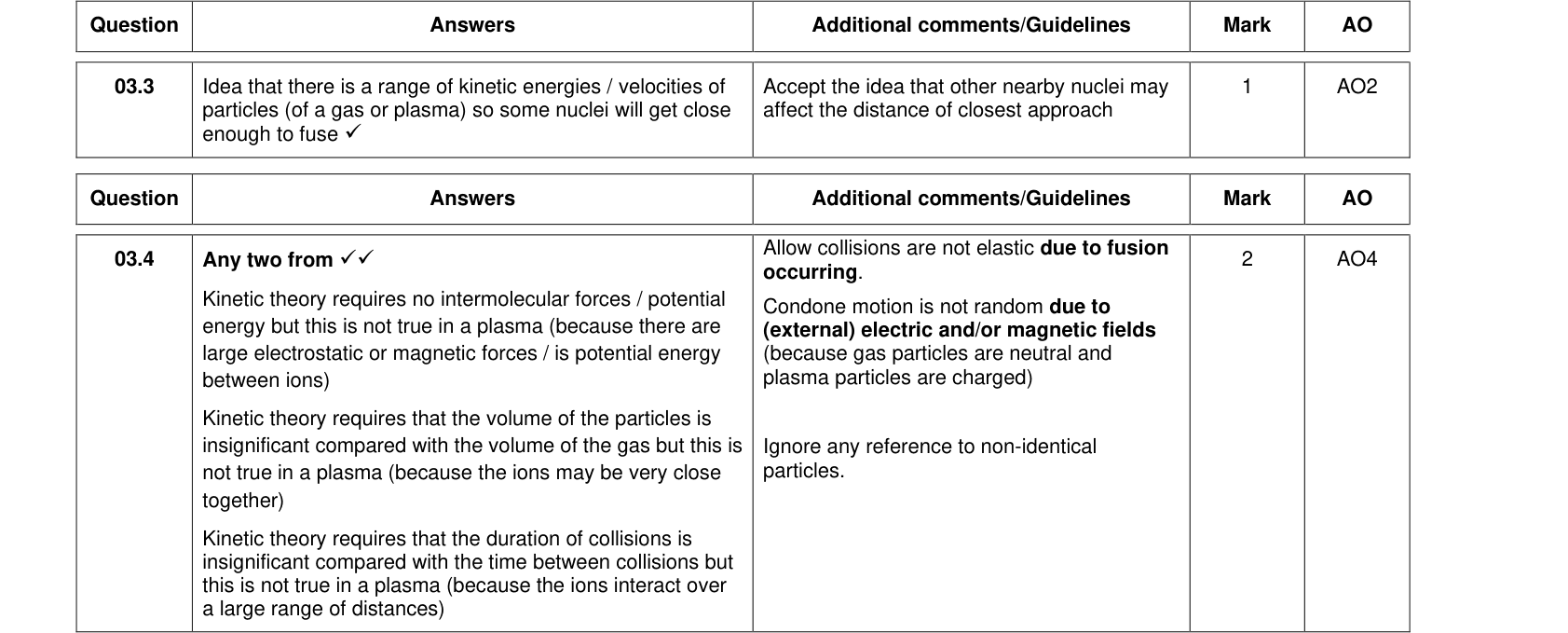
- the particles have a range of speeds: a small fraction have much more than the mean kinetic energy;
- quantum tunnelling lets some nuclei pass through the barrier without having enough energy to go over it.
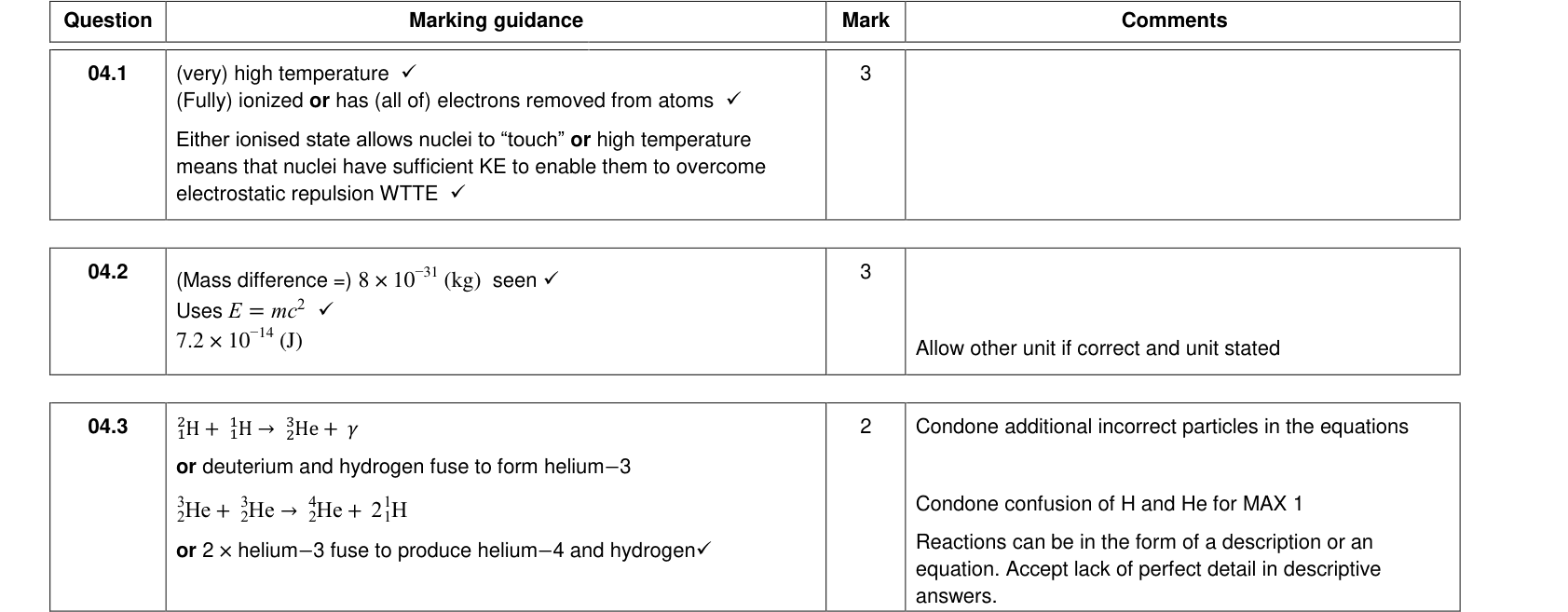
At such temperatures all the electrons are stripped from the atoms: the fuel is a plasma, a gas of bare nuclei and free electrons.
Energy released in fusion
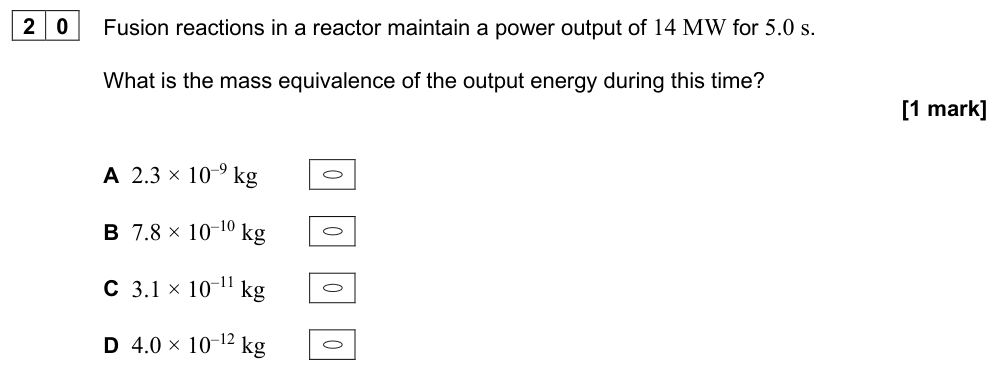
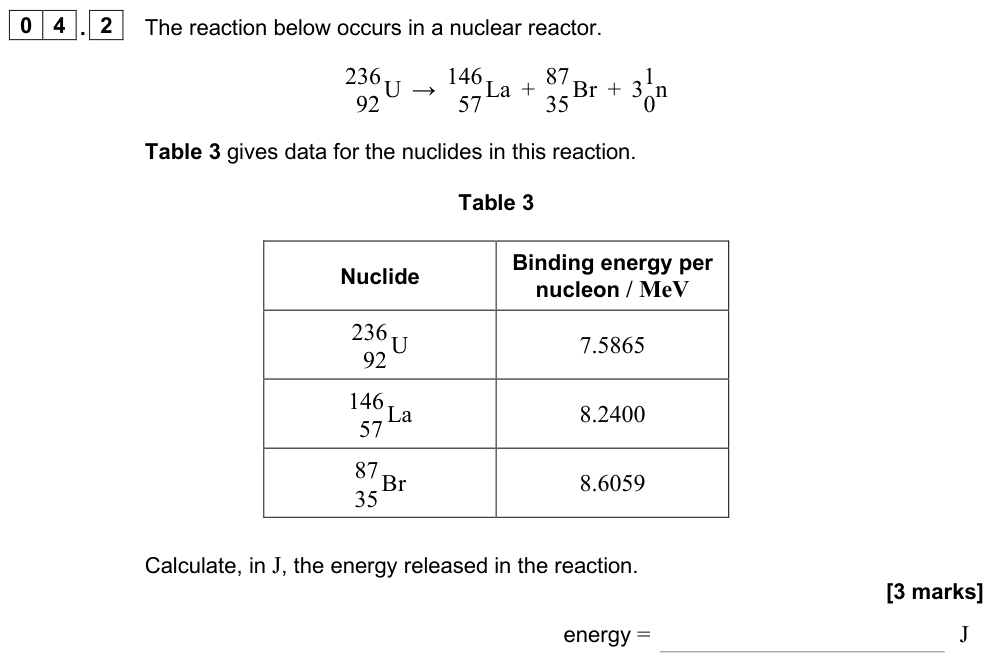
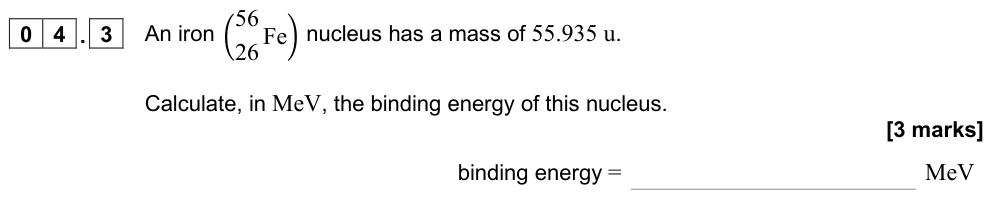
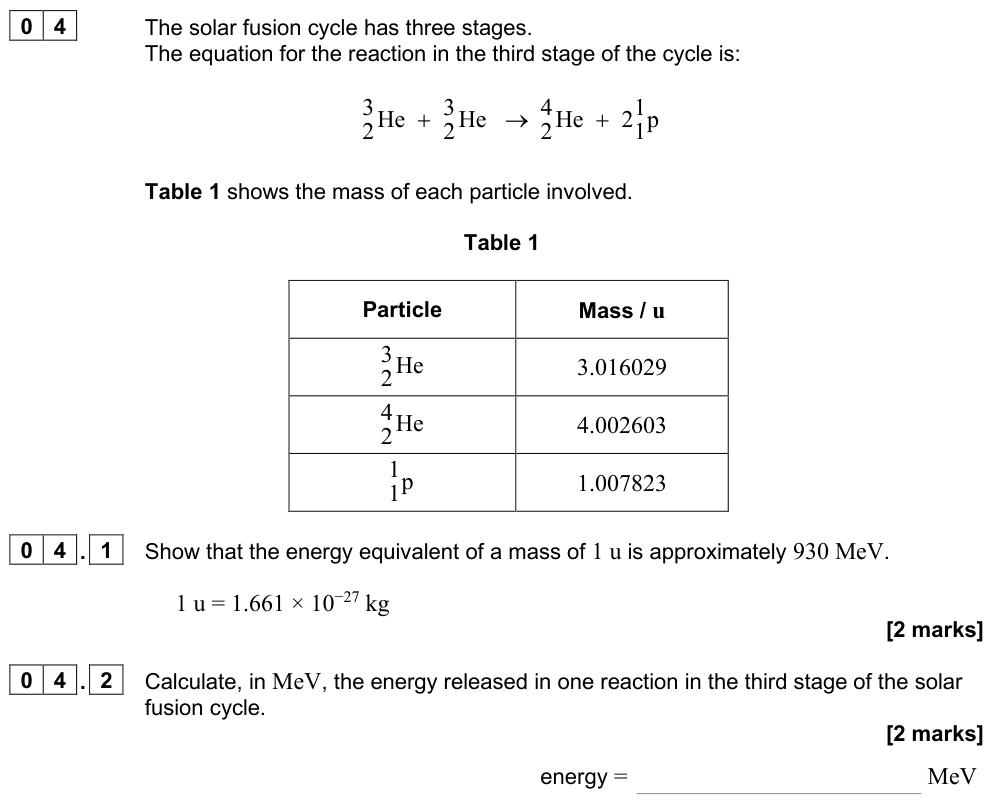
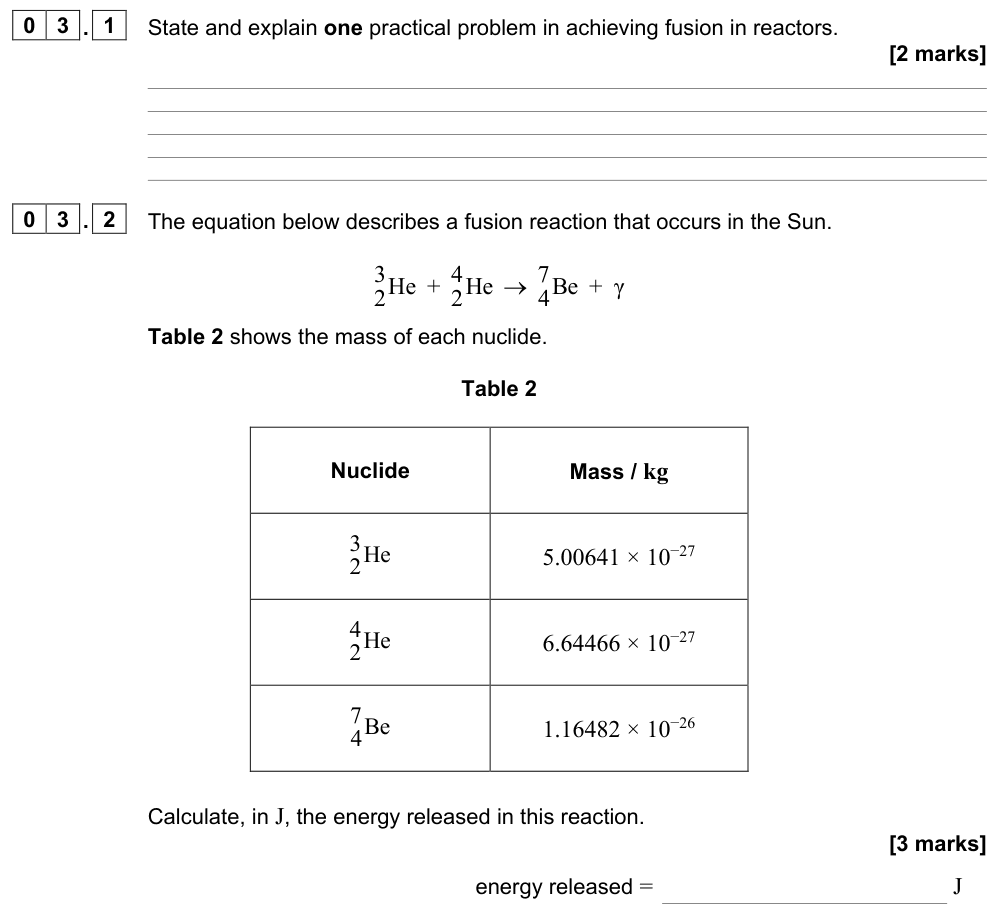
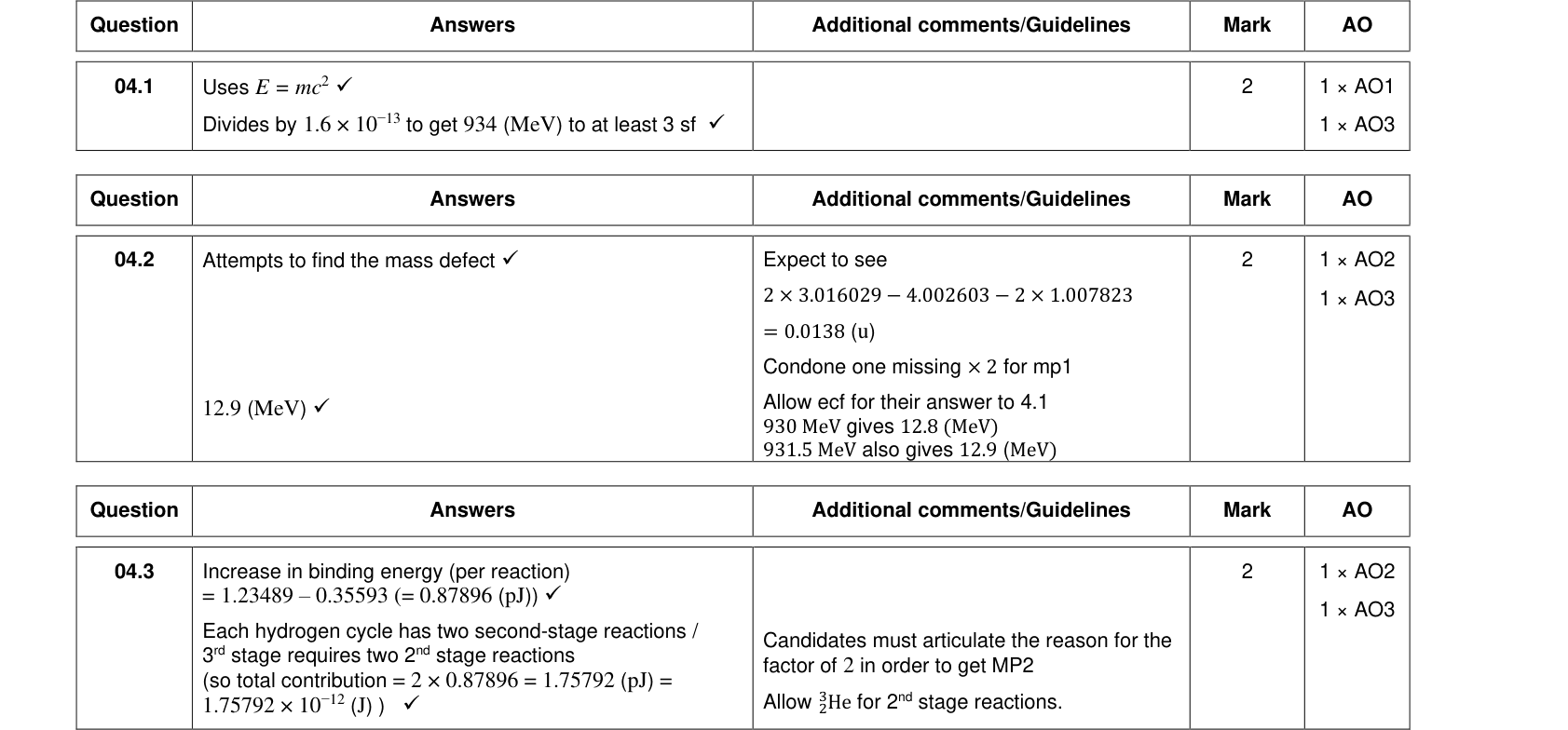
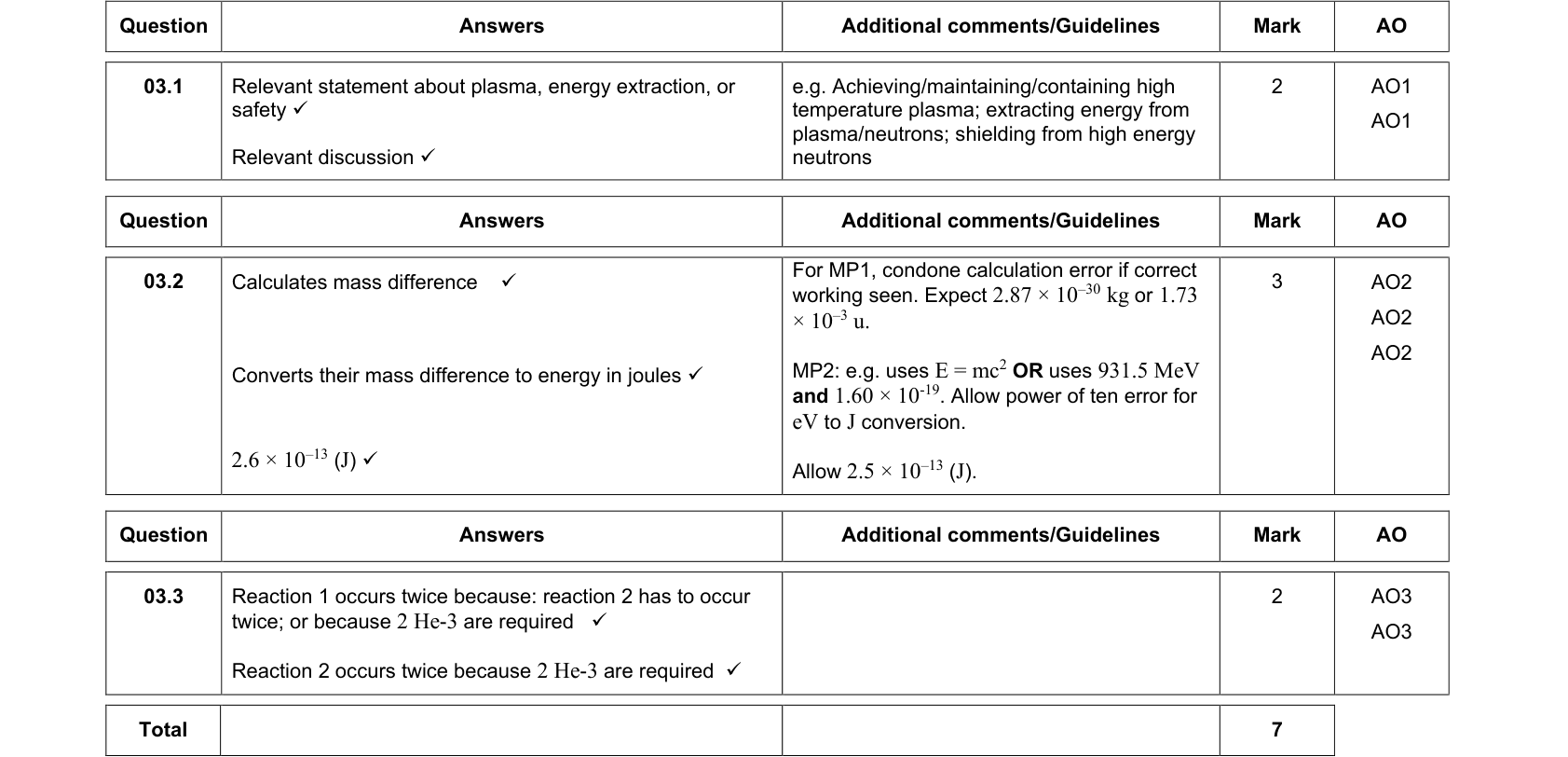
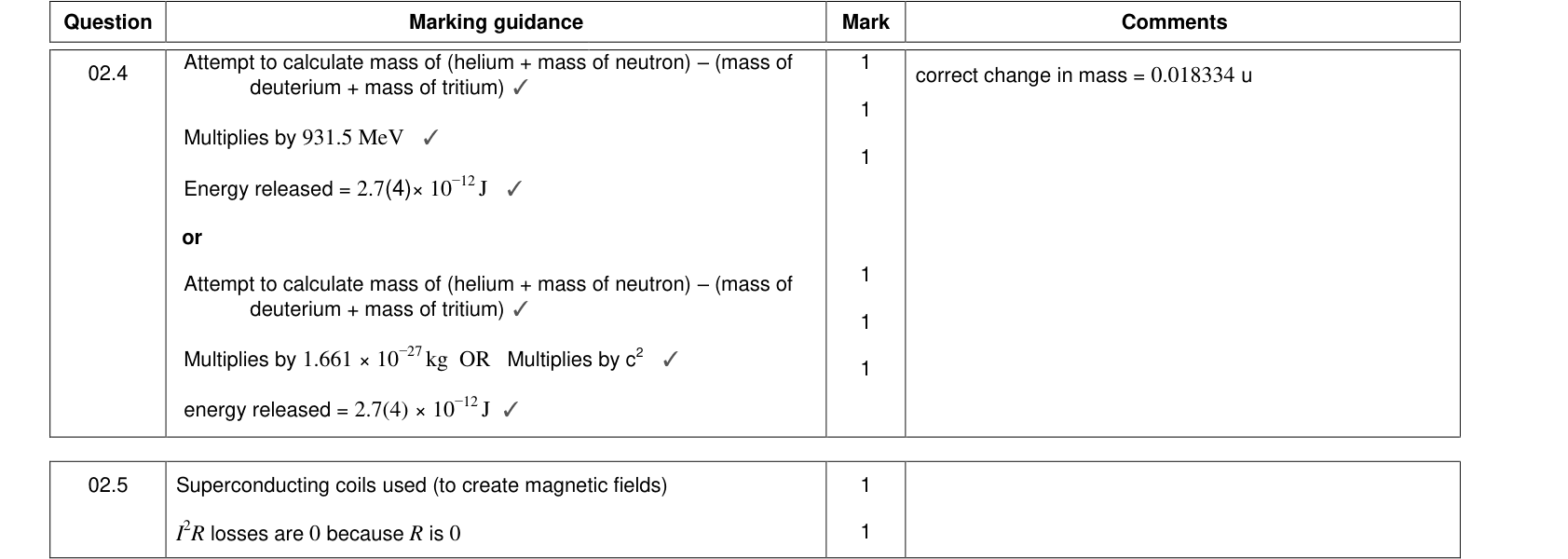
The energy released comes from the decrease in mass (see the previous chapter): for D–T fusion, $\Delta m = 0.01888$ u, so $E = 0.01888 \times 931.5 = 17.6$ MeV.
Worked example: sharing the energy
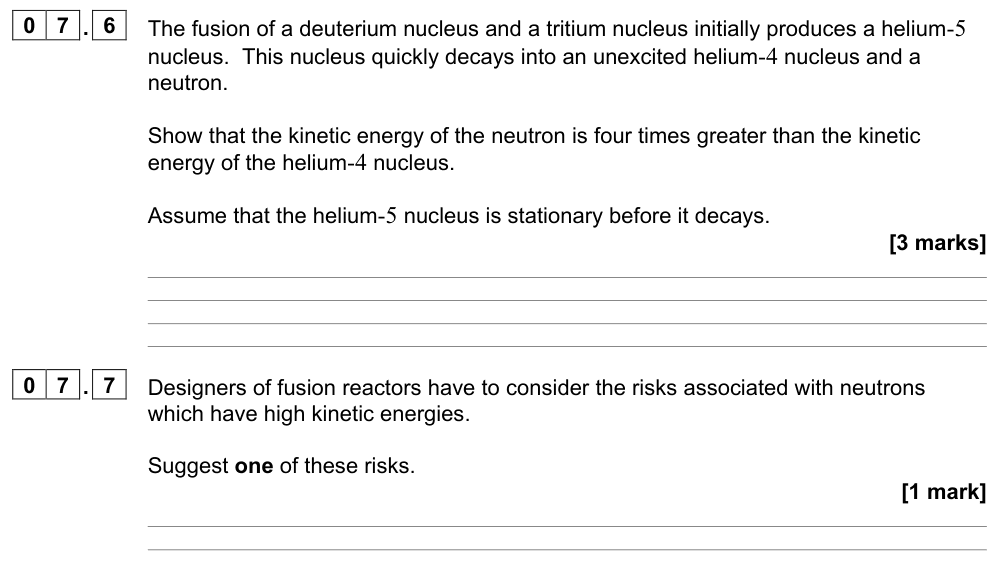
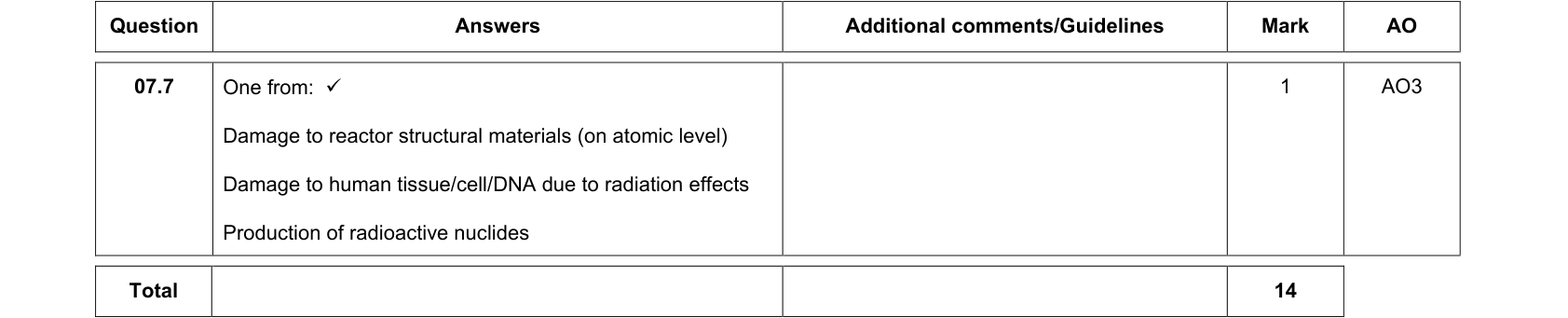
The helium nucleus and the neutron fly apart with equal and opposite momenta (the initial momentum is negligible). Since $E_k = \dfrac{p^2}{2m}$, the kinetic energy is shared inversely in proportion to mass: the neutron (1 u) gets $\tfrac45$ and the helium nucleus (4 u) gets $\tfrac15$.
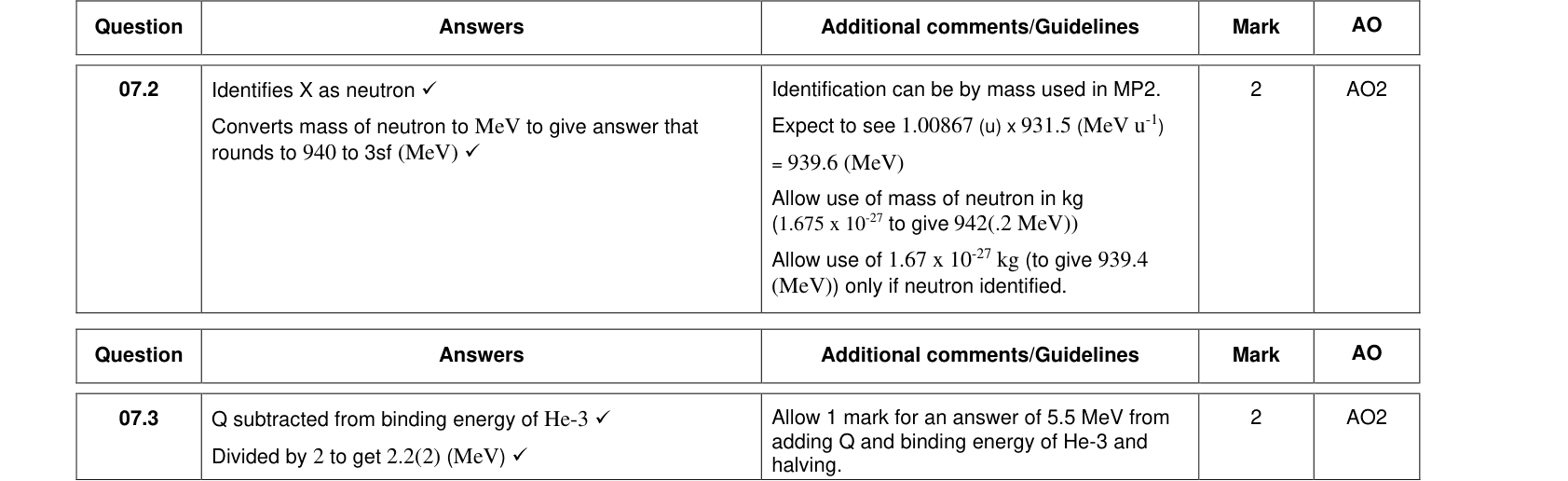
Neutron: $\tfrac45 \times 17.6 = 14.1$ MeV; helium: 3.5 MeV. The fast neutrons carry most of the energy out of the plasma into the surrounding blanket, where it is converted to heat.
Per kilogram of fuel, fusion releases several times more energy than fission: about 3.5 MeV per nucleon for D–T fusion, compared with about 0.85 MeV per nucleon for uranium fission.
Fusion in the Sun: the hydrogen cycle
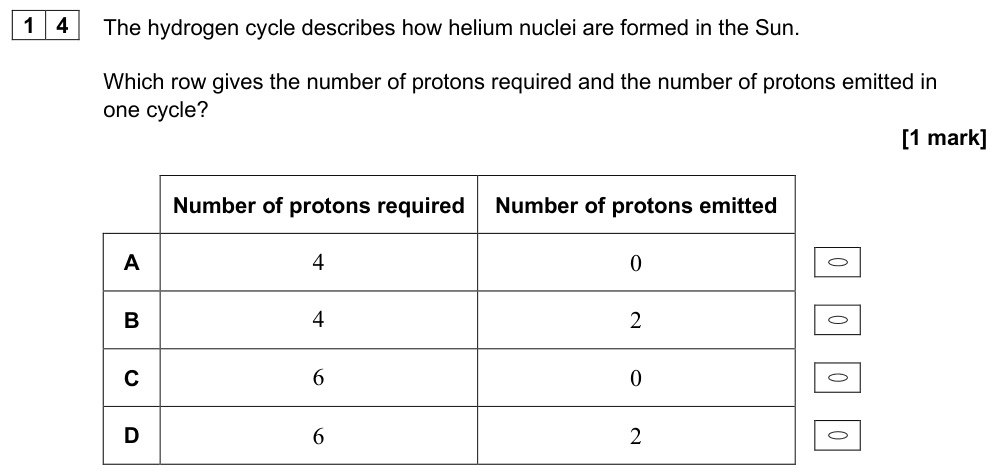
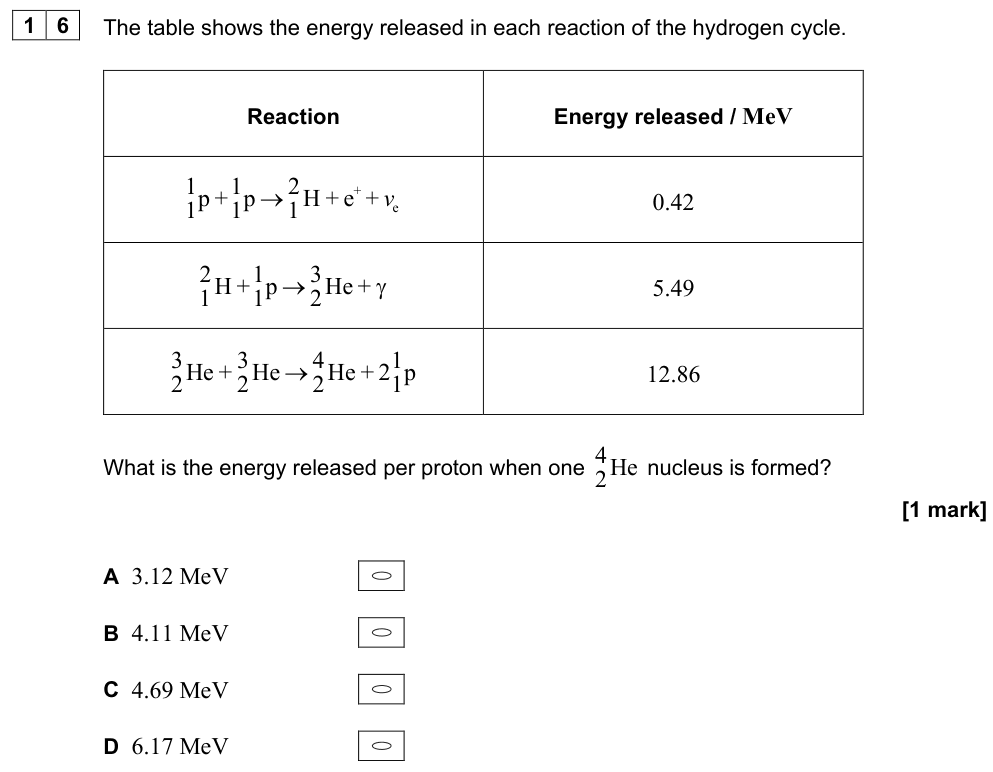
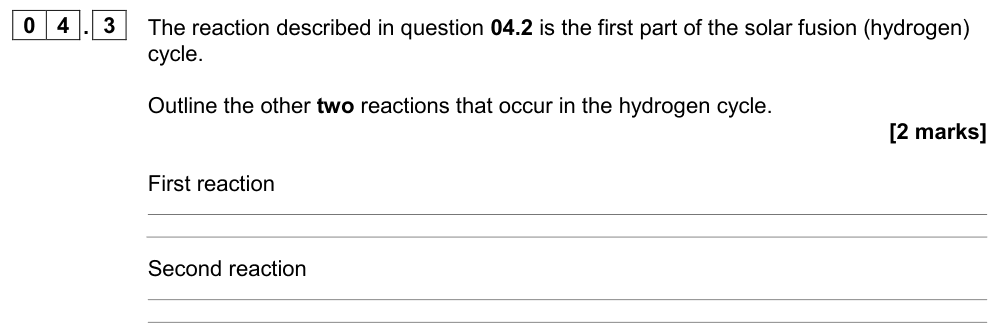
In the core of the Sun (temperature about $1.5 \times 10^{7}$ K, very high density), hydrogen is converted into helium in a series of steps called the proton–proton chain:
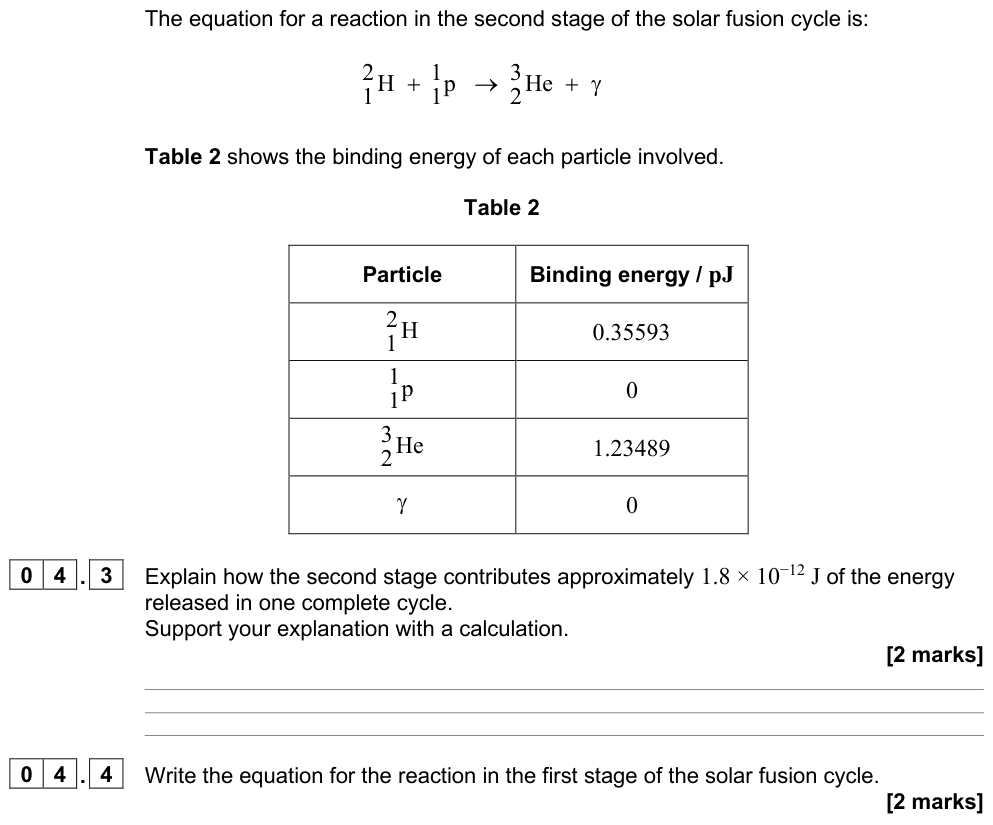
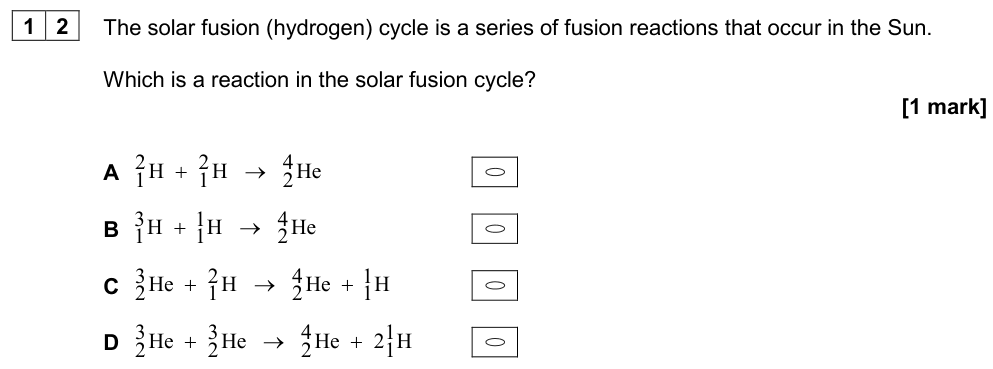
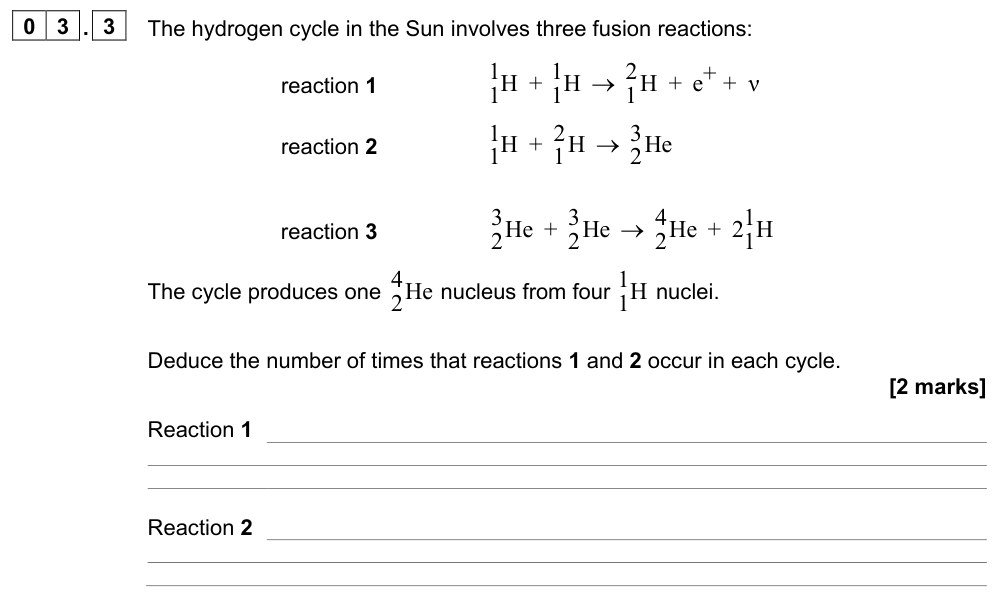
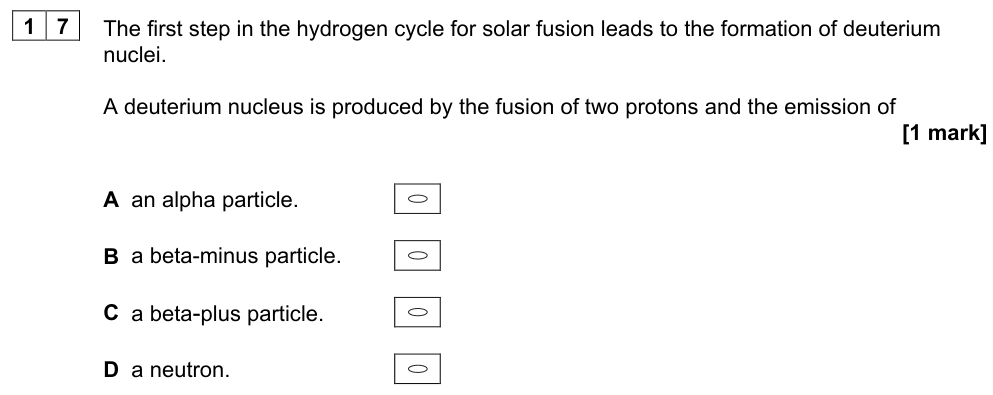
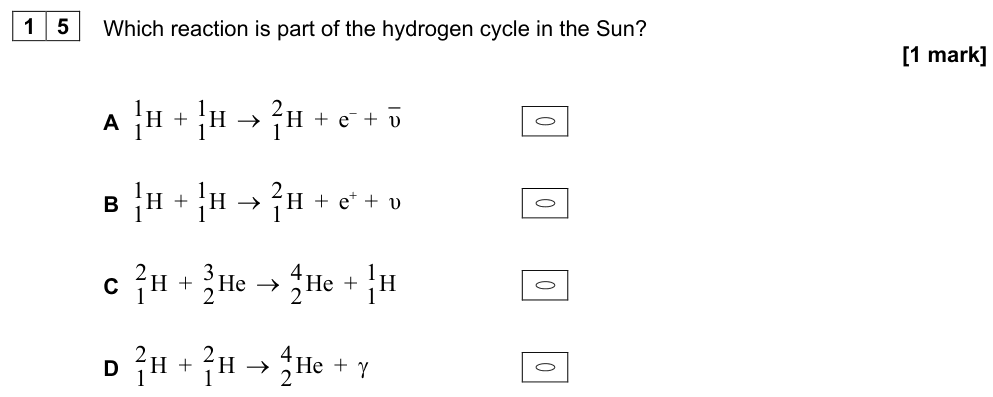
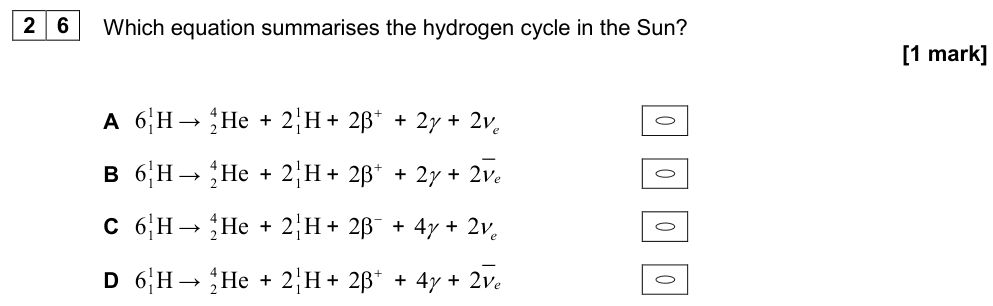
- Two protons fuse to form a deuterium nucleus, a positron and a neutrino: $$^{1}_{1}\text{H} + {}^{1}_{1}\text{H} \rightarrow {}^{2}_{1}\text{H} + {}^{0}_{+1}\text{e} + \nu_e$$
- The deuterium nucleus fuses with another proton to form helium-3, releasing a gamma ray: $$^{2}_{1}\text{H} + {}^{1}_{1}\text{H} \rightarrow {}^{3}_{2}\text{He} + \gamma$$
- Two helium-3 nuclei (from two repeats of steps 1 and 2) fuse to form helium-4 and two protons: $$^{3}_{2}\text{He} + {}^{3}_{2}\text{He} \rightarrow {}^{4}_{2}\text{He} + 2\,{}^{1}_{1}\text{H}$$
Overall reaction
$$4\,{}^{1}_{1}\text{H} \rightarrow {}^{4}_{2}\text{He} + 2\,{}^{0}_{+1}\text{e} + 2\nu_e + \text{energy}$$
The total energy released is about 26.7 MeV (including the energy from the positrons annihilating with electrons).
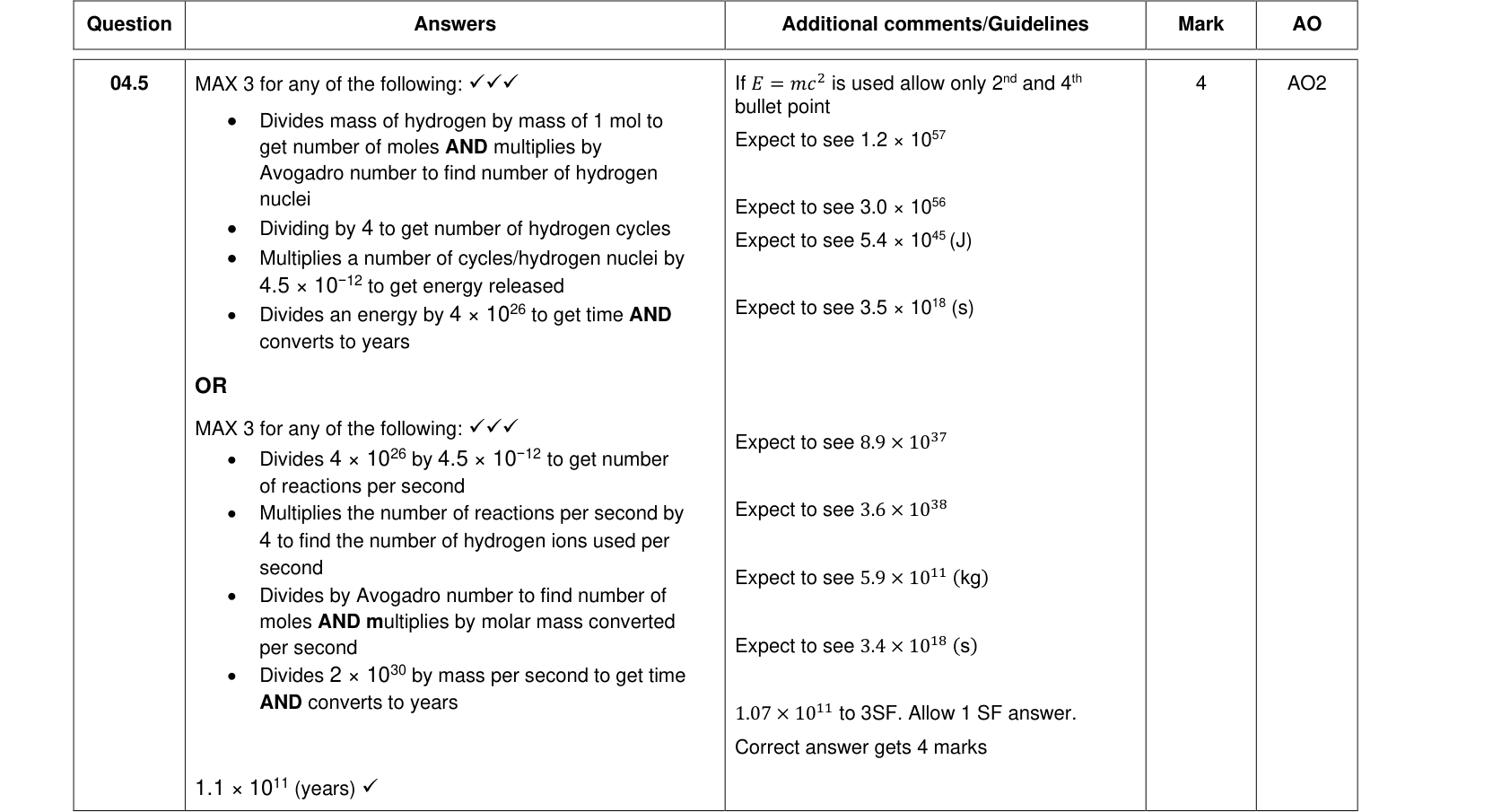
Step 1 involves the weak interaction (a proton changes into a neutron) and is extremely slow, which is why the Sun burns steadily for billions of years. The Sun radiates $3.8 \times 10^{26}$ W, so it loses mass at a rate of $\dfrac{3.8 \times 10^{26}}{(3.00 \times 10^{8})^2} = 4.2 \times 10^{9}$ kg every second.
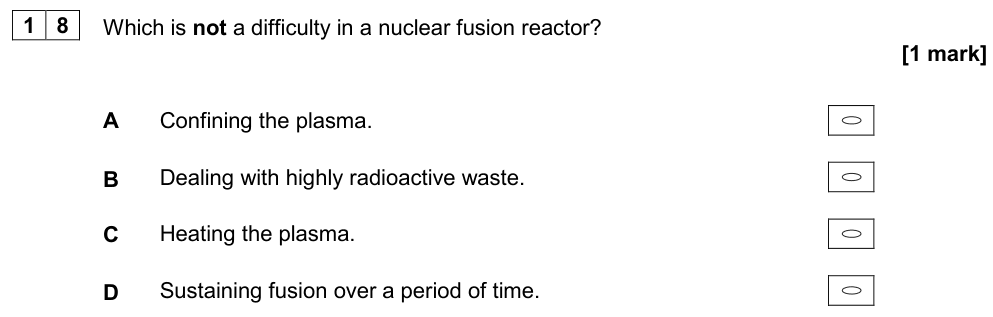
Problems in building a fusion reactor
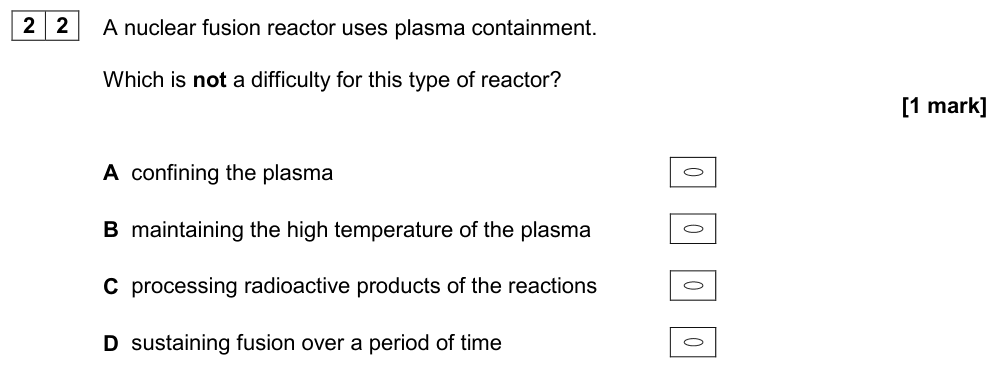
| Problem | Explanation and approach |
|---|---|
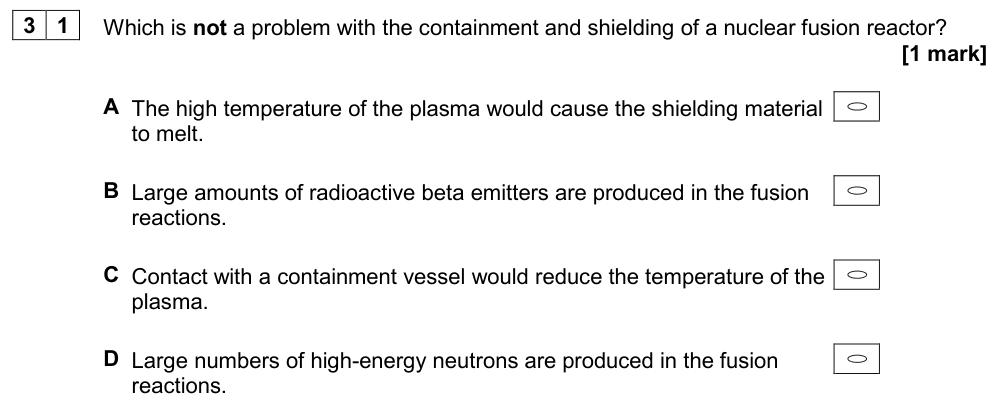
| Extremely high temperature | The plasma must be heated to about $10^{8}$ K (by electric currents, radio waves and beams of fast particles). No material container can withstand contact with it. |
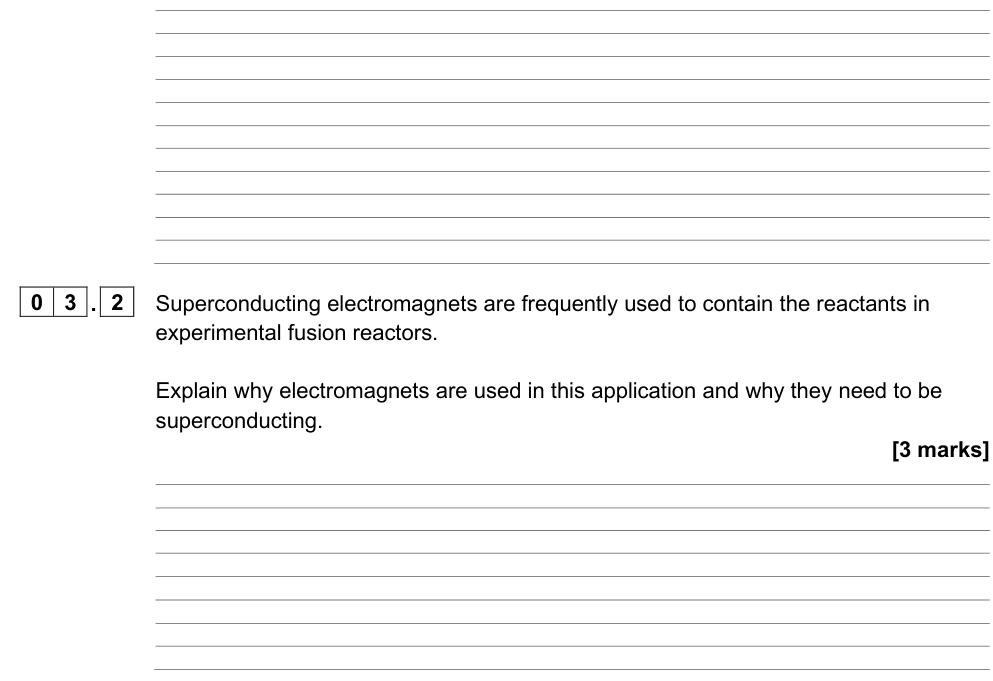
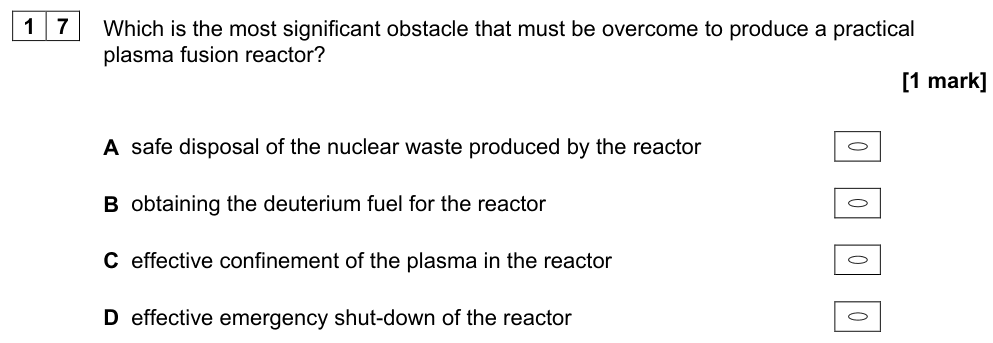
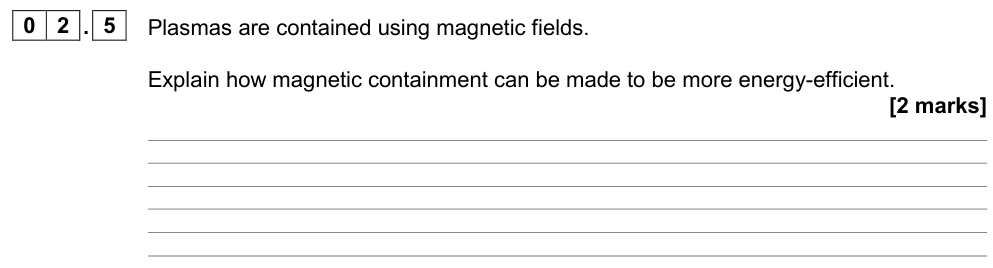
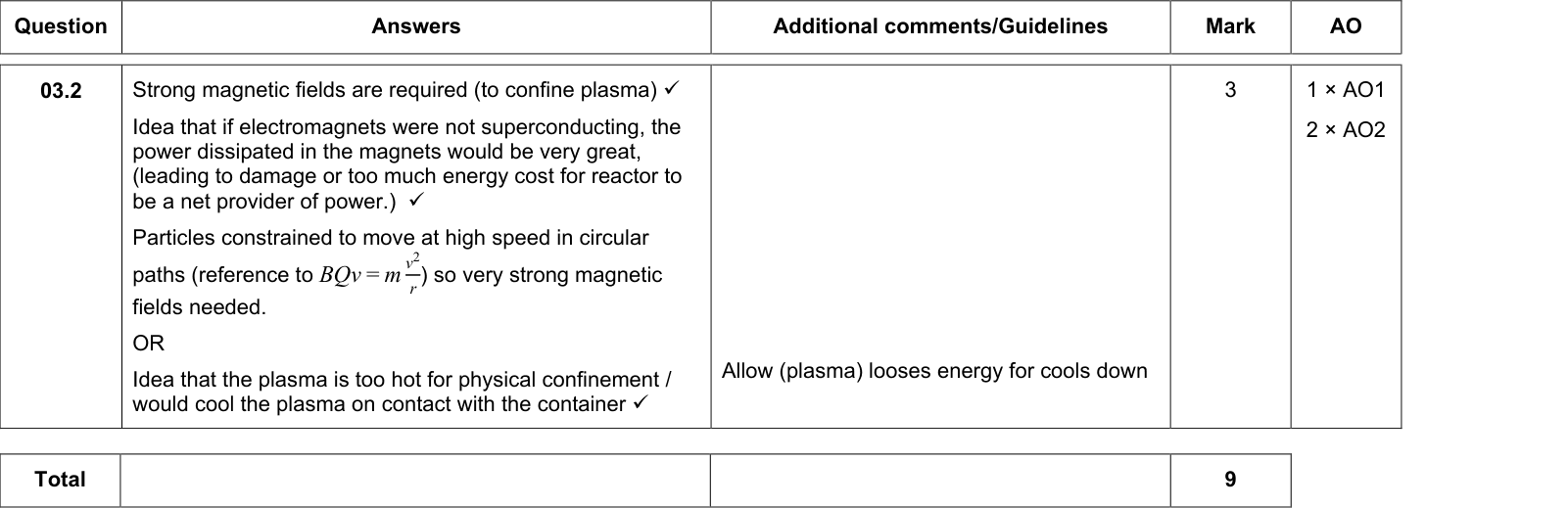
| Confinement | The plasma must be kept away from the walls. In a tokamak it is held in a ring by strong magnetic fields (the charged particles spiral along field lines). Another approach, inertial confinement, uses powerful lasers to compress and heat tiny fuel pellets. |
| Density and time | The plasma must be dense enough and held for long enough for more energy to be released than is used to heat it. The plasma is unstable and hard to control. |
| Energy output | Producing more energy than the reactor consumes has proved very hard. In 2022 an inertial-confinement experiment at the US National Ignition Facility released more fusion energy than the laser energy delivered to the target, but no reactor yet produces net electrical power. |
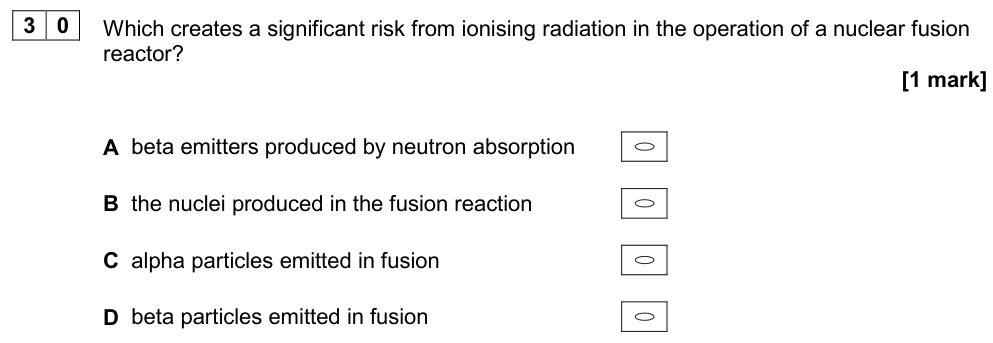
| Materials | The 14 MeV neutrons damage the reactor structure and make it radioactive; the materials must withstand intense neutron bombardment and heat. |
| Tritium | Tritium is radioactive and scarce; it must be bred from lithium and handled safely. |
Advantages if it can be achieved: an almost unlimited fuel supply (deuterium from water, lithium), no carbon dioxide emissions, no long-lived high-level waste like spent fission fuel, and no possibility of a runaway chain reaction (if anything goes wrong the plasma cools and fusion stops).
Summary
- Fusion: light nuclei join, the binding energy per nucleon increases, mass decreases, energy is released.
- Best fuel: deuterium (from seawater) + tritium (bred from lithium): 17.6 MeV per reaction.
- Nuclei must overcome electrostatic repulsion: estimate $E_k$ from $\dfrac{Q_1Q_2}{4\pi\varepsilon_0 r}$ and $T$ from $\tfrac32kT$ (~$10^{9}$ K); fusion occurs at lower temperatures because of the speed distribution and tunnelling.
- Sun: proton–proton chain, overall $4\,{}^1\text{H} \rightarrow {}^4\text{He} + 2e^+ + 2\nu$ (26.7 MeV).
- Problems: very high temperatures, confinement (magnetic or inertial), plasma instability, neutron damage, tritium supply.