How big is a nucleus?
Rutherford's alpha-scattering experiment (Unit 1) showed that the atom has a tiny, dense, positive nucleus. Two methods give the size of the nucleus:
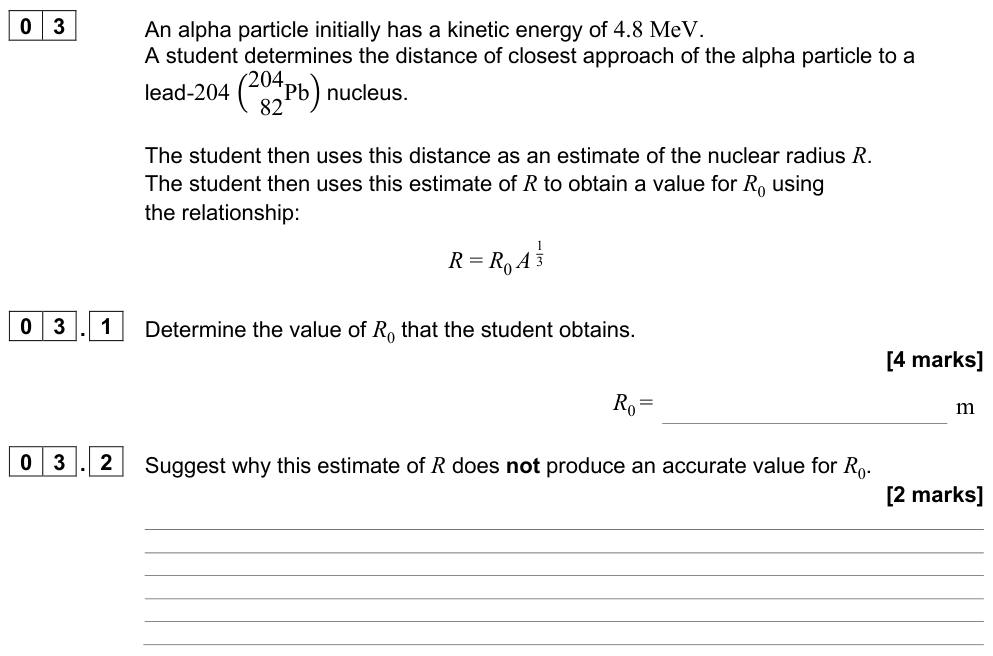
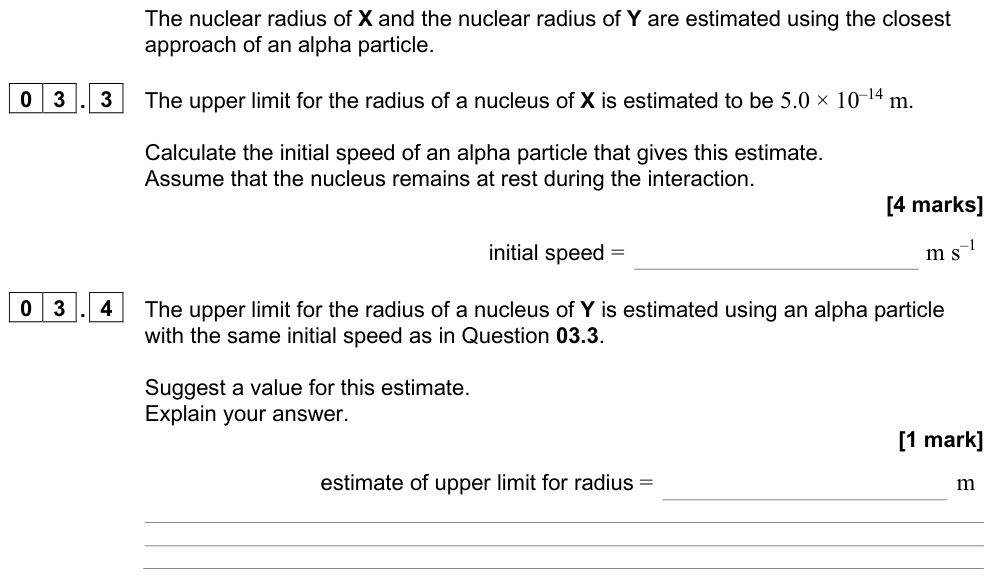
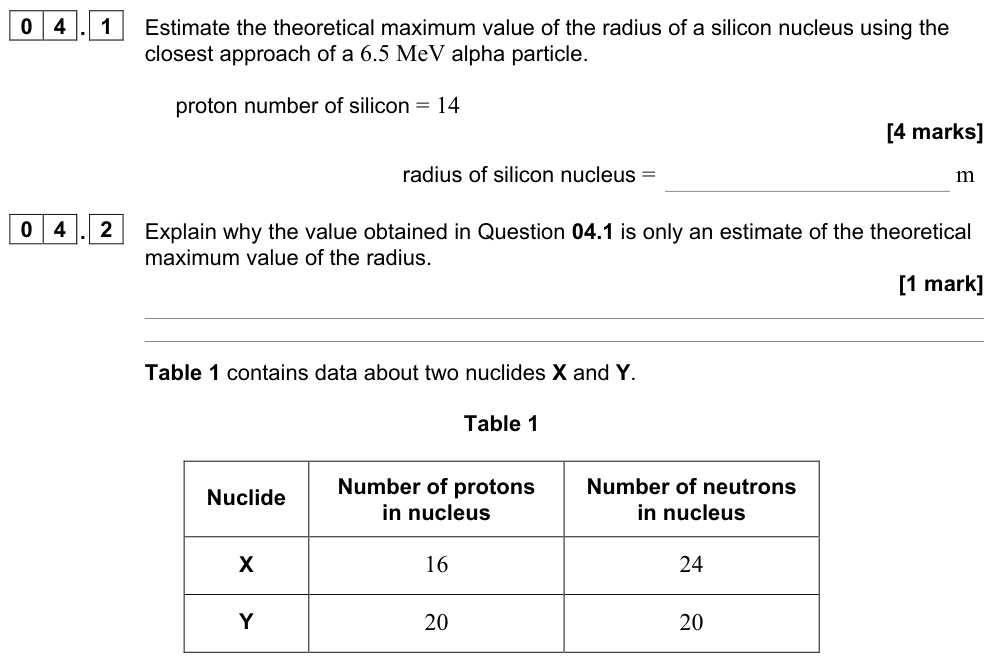
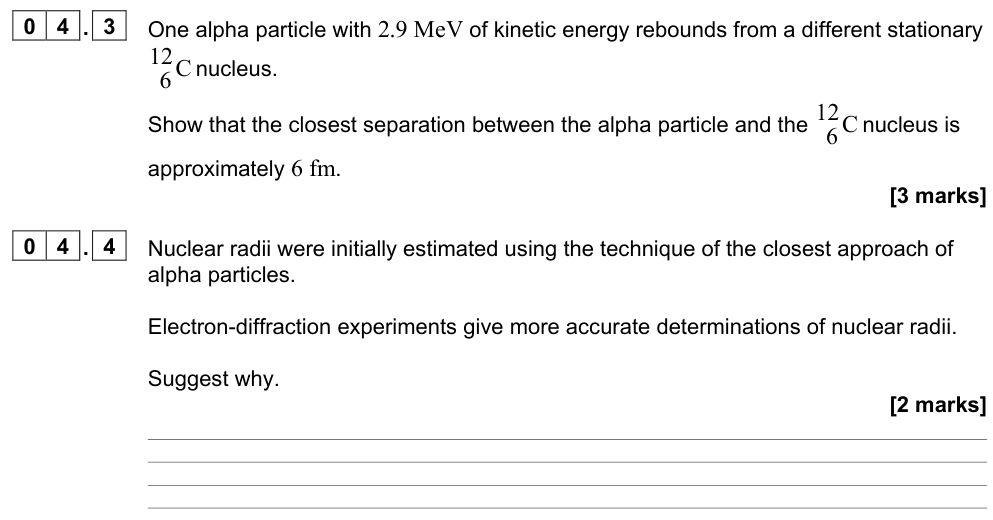
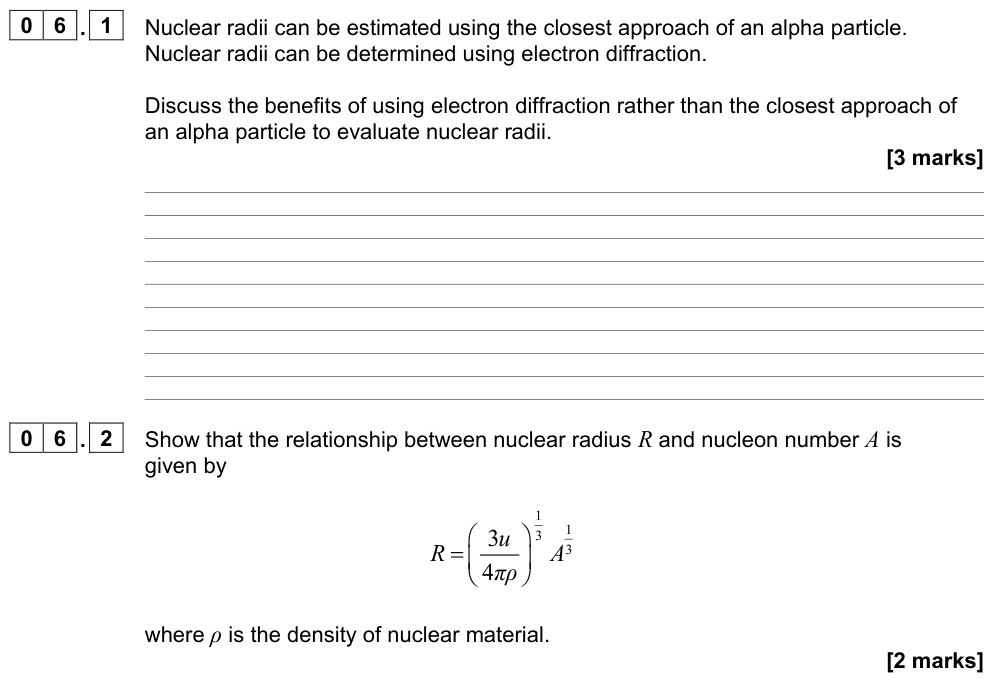
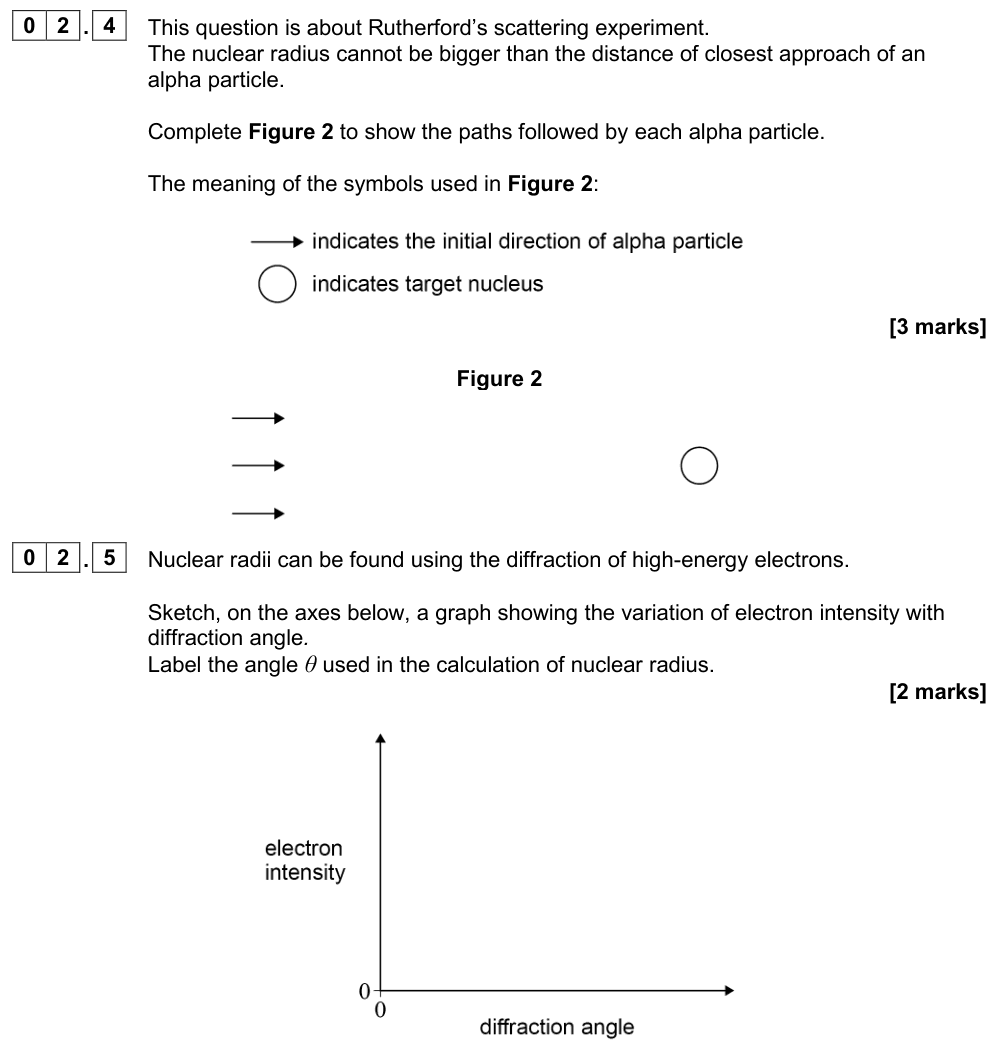
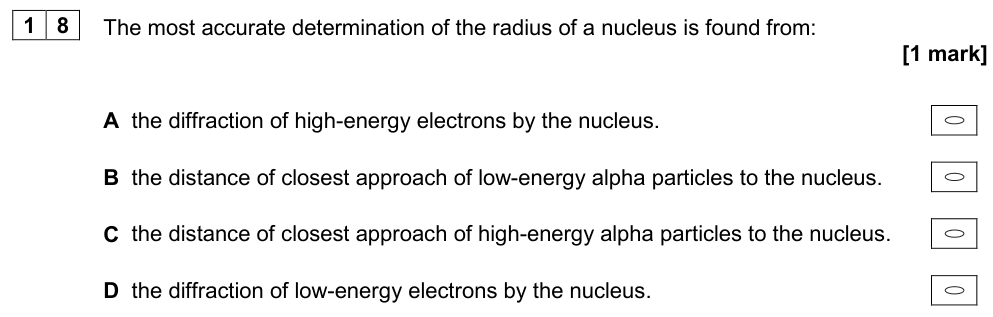
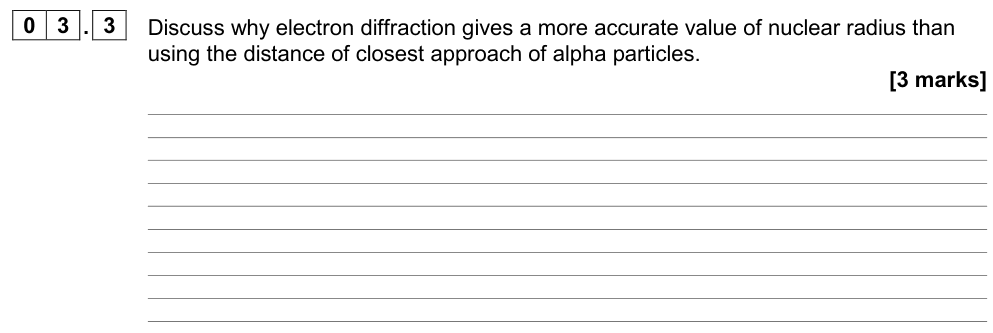
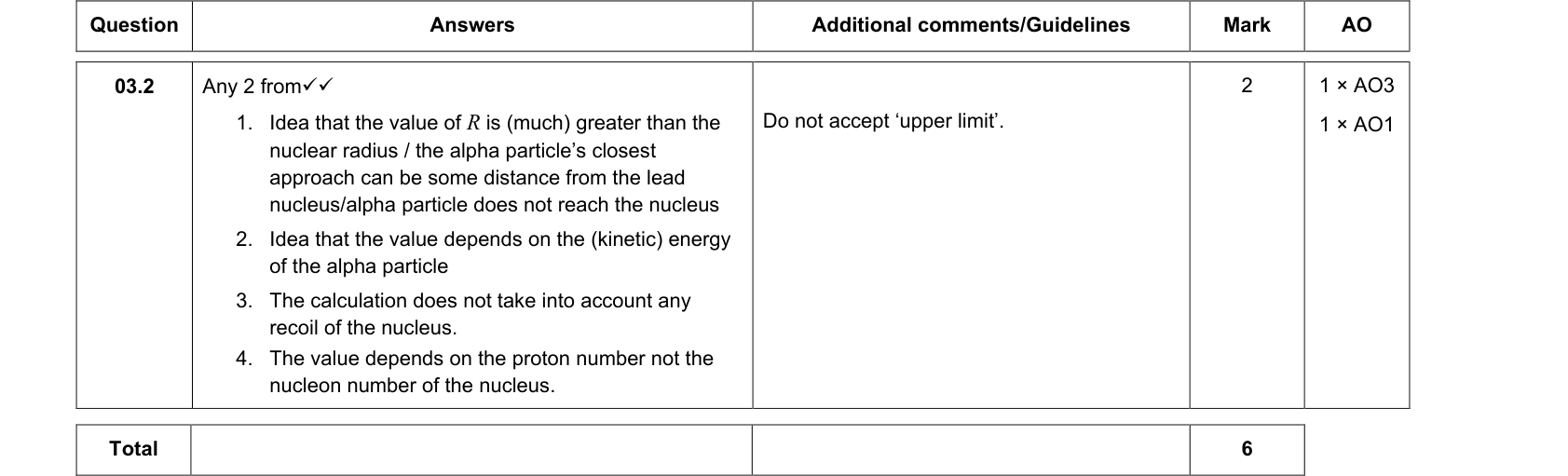
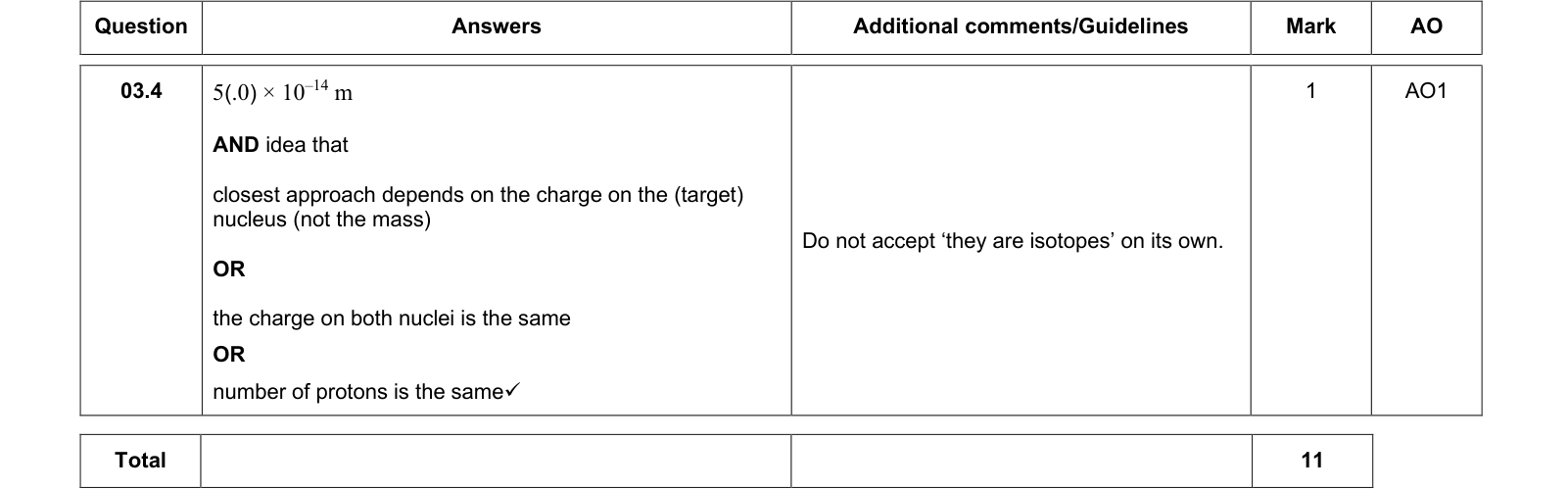
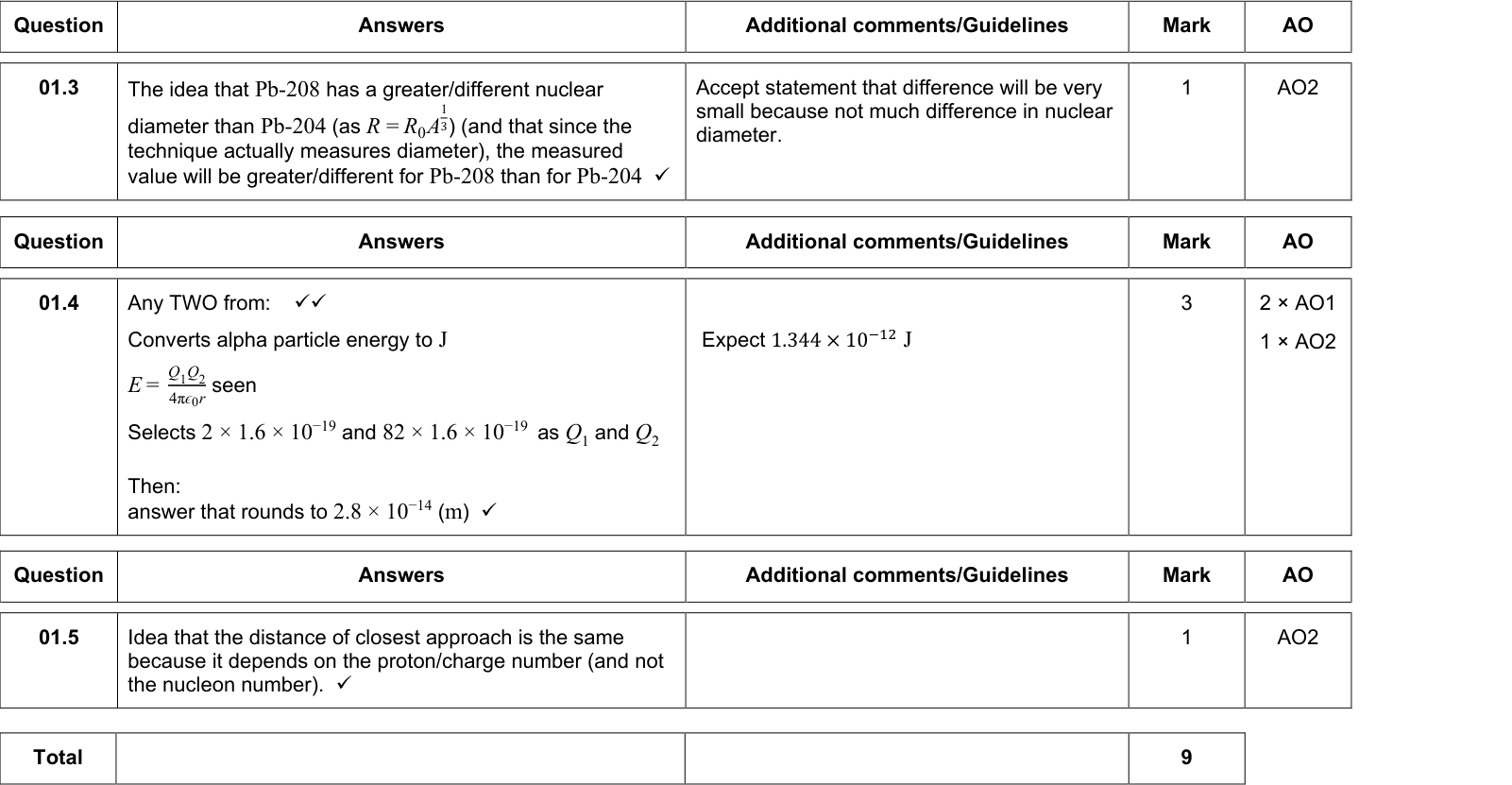
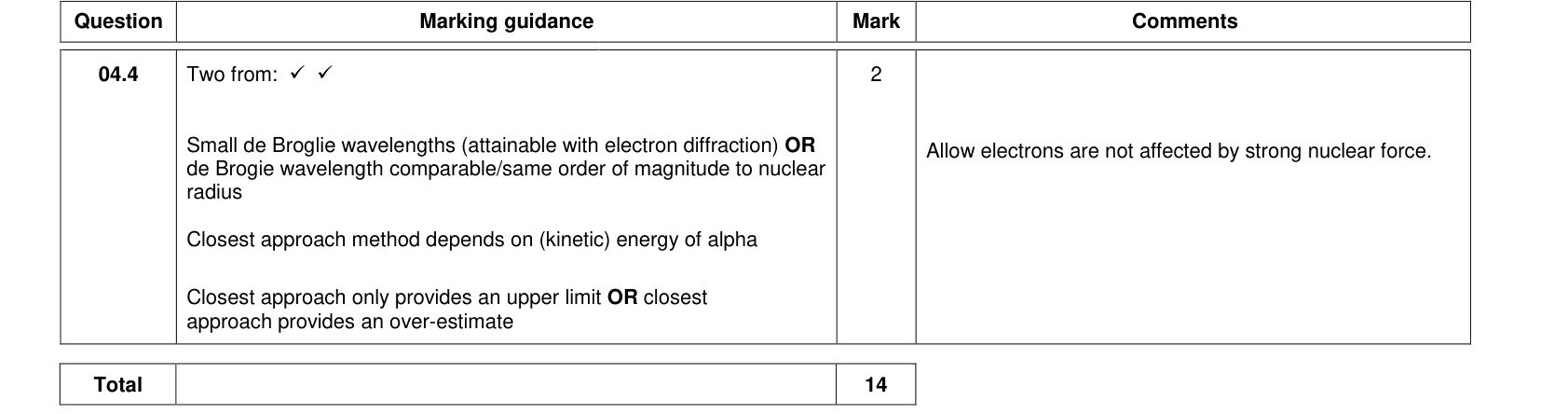
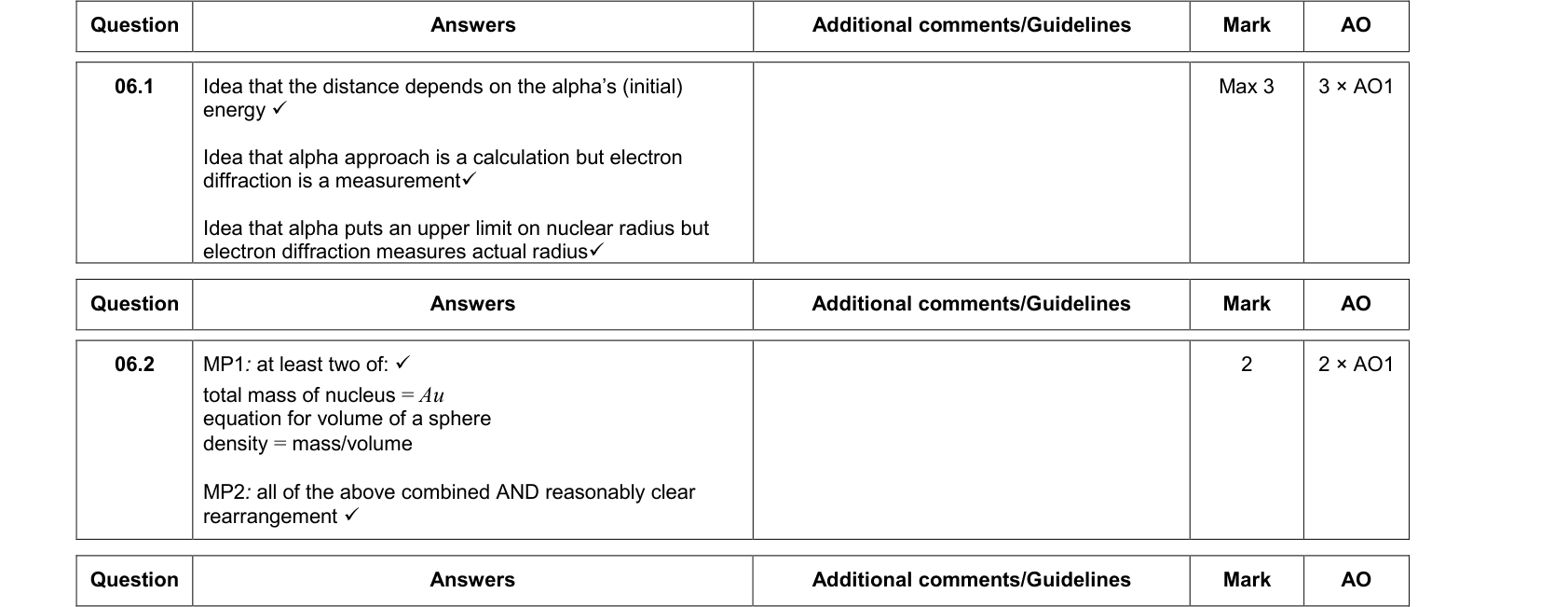
- Closest approach of alpha particles: gives an upper limit (the alpha particle never actually touches the nucleus).
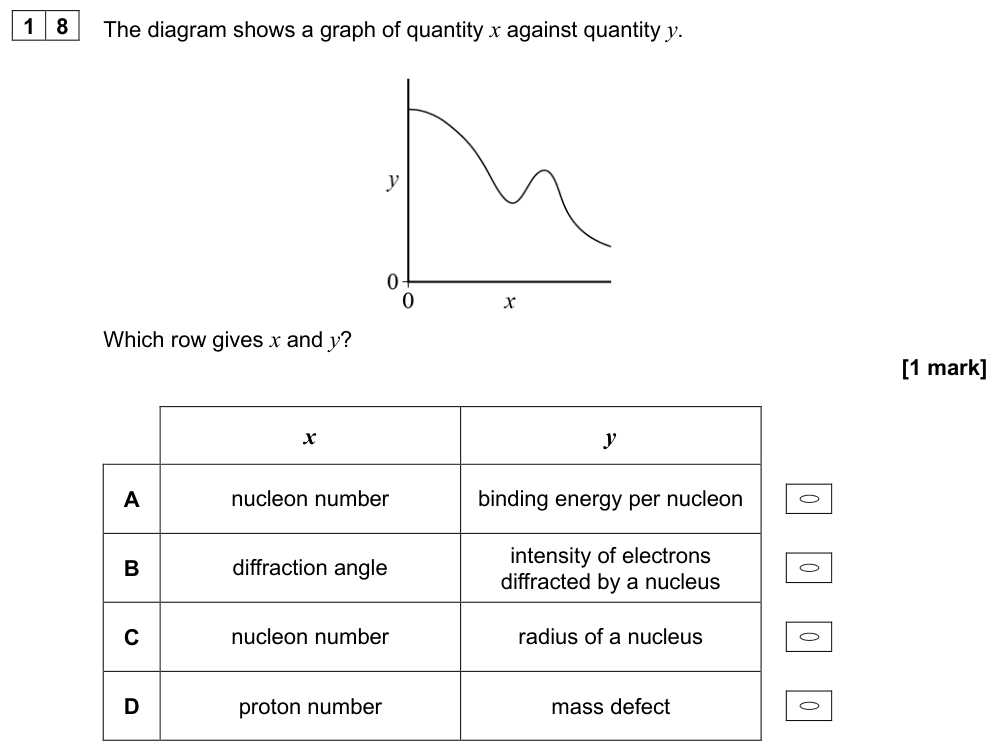
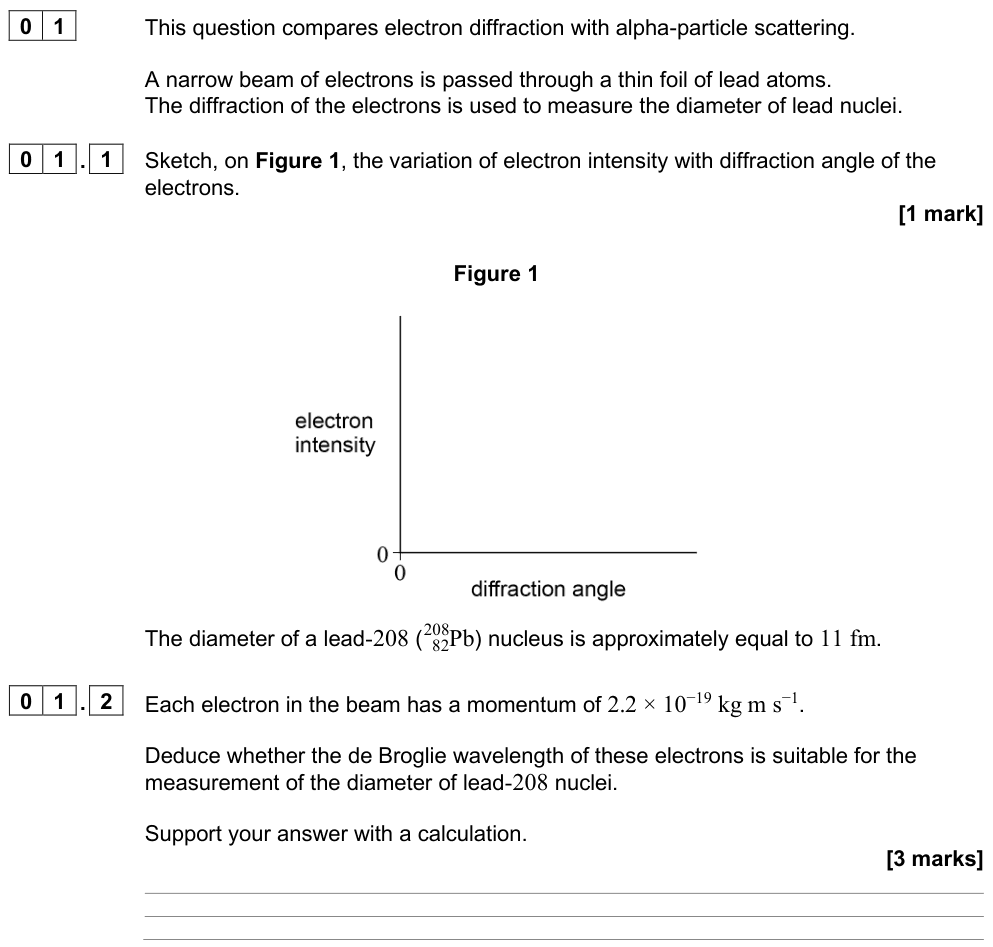
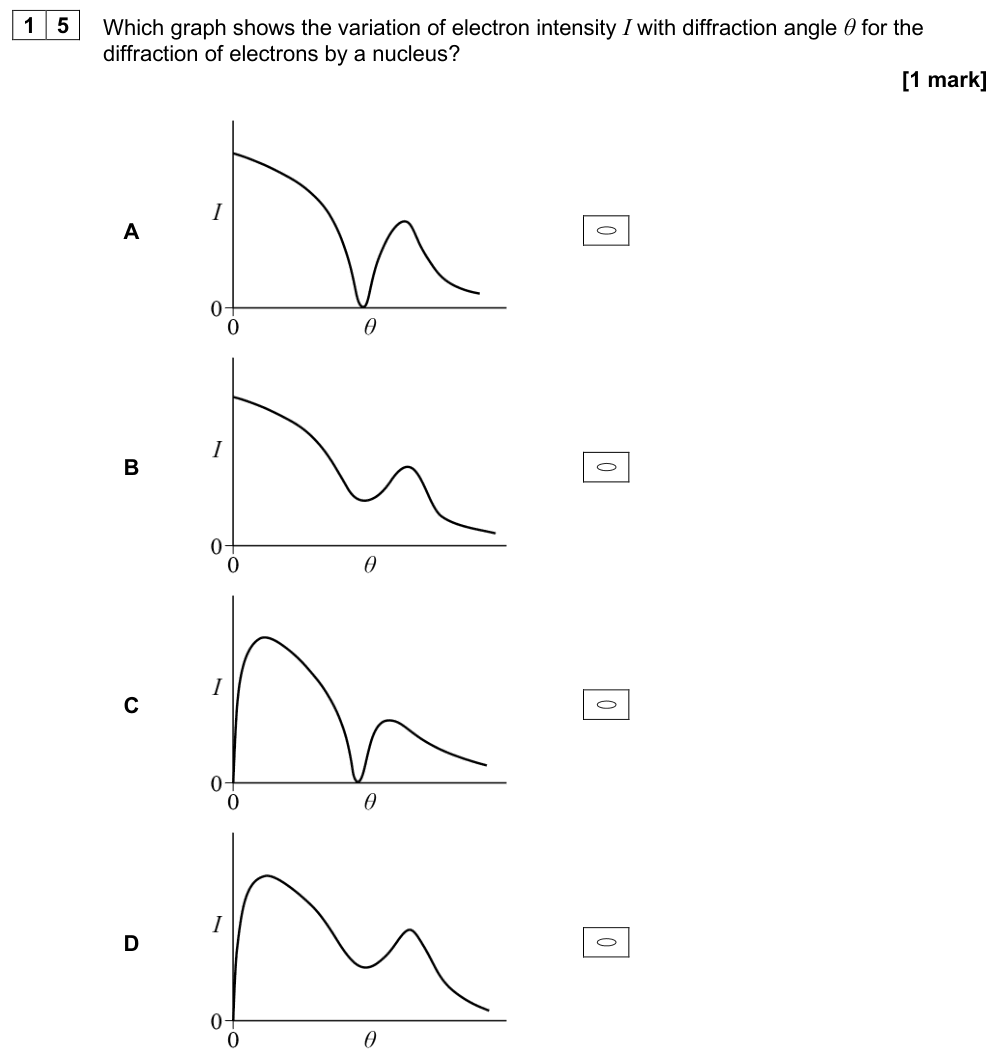
- Electron diffraction: gives a more accurate value.
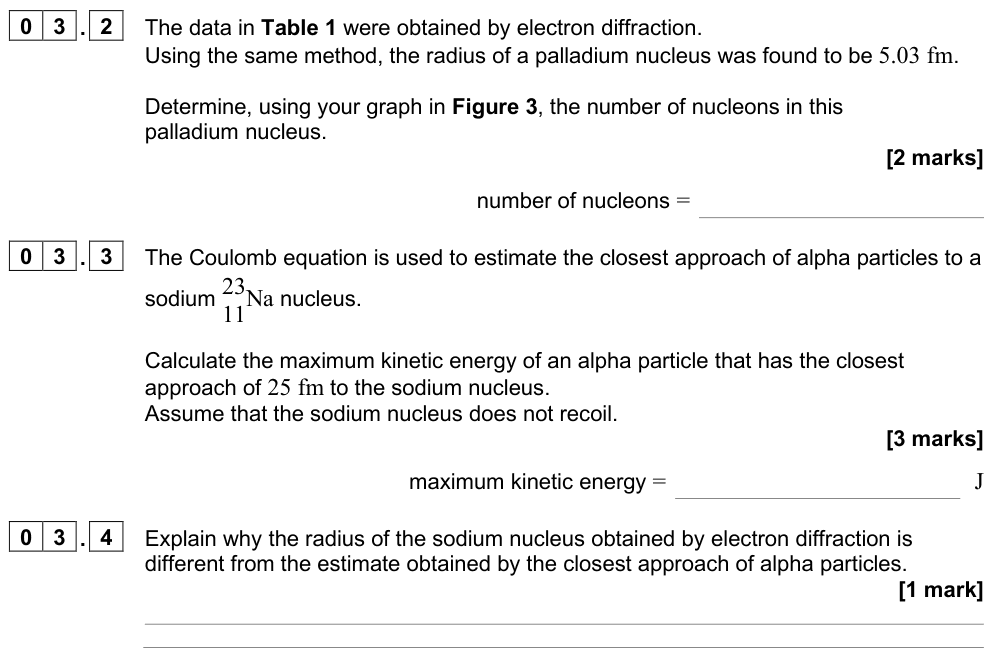
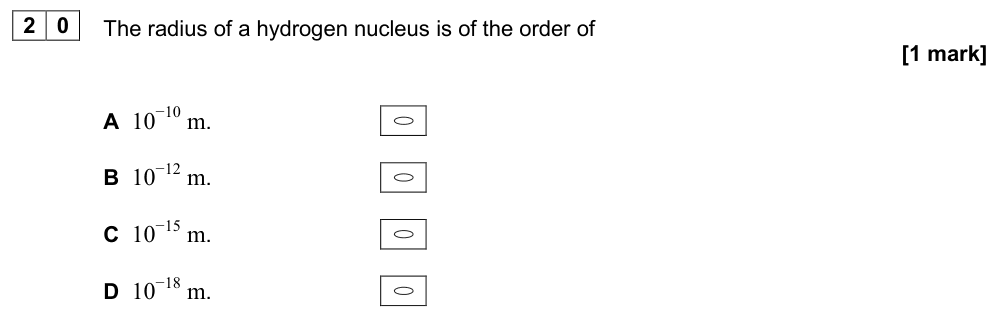
Typical results: nuclear radii are about 1–8 fm (1 femtometre = $10^{-15}$ m), compared with about $10^{-10}$ m for an atom. A nucleus is roughly 100 000 times smaller than its atom.
Closest approach of alpha particles
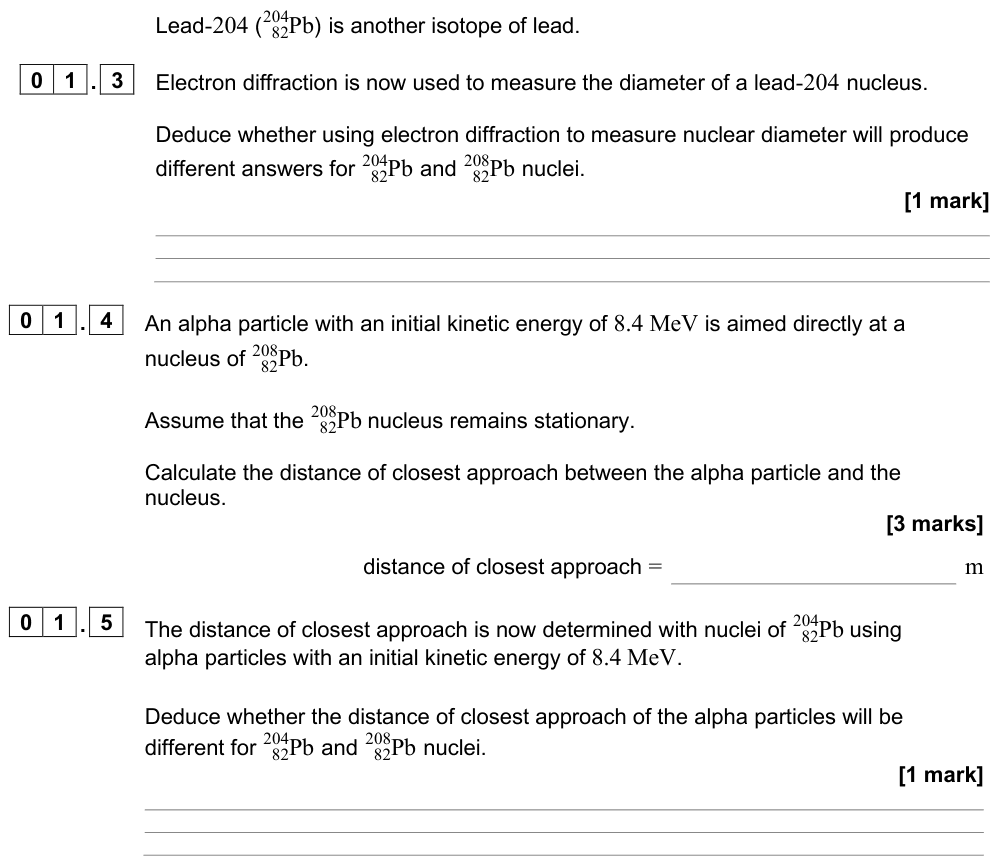
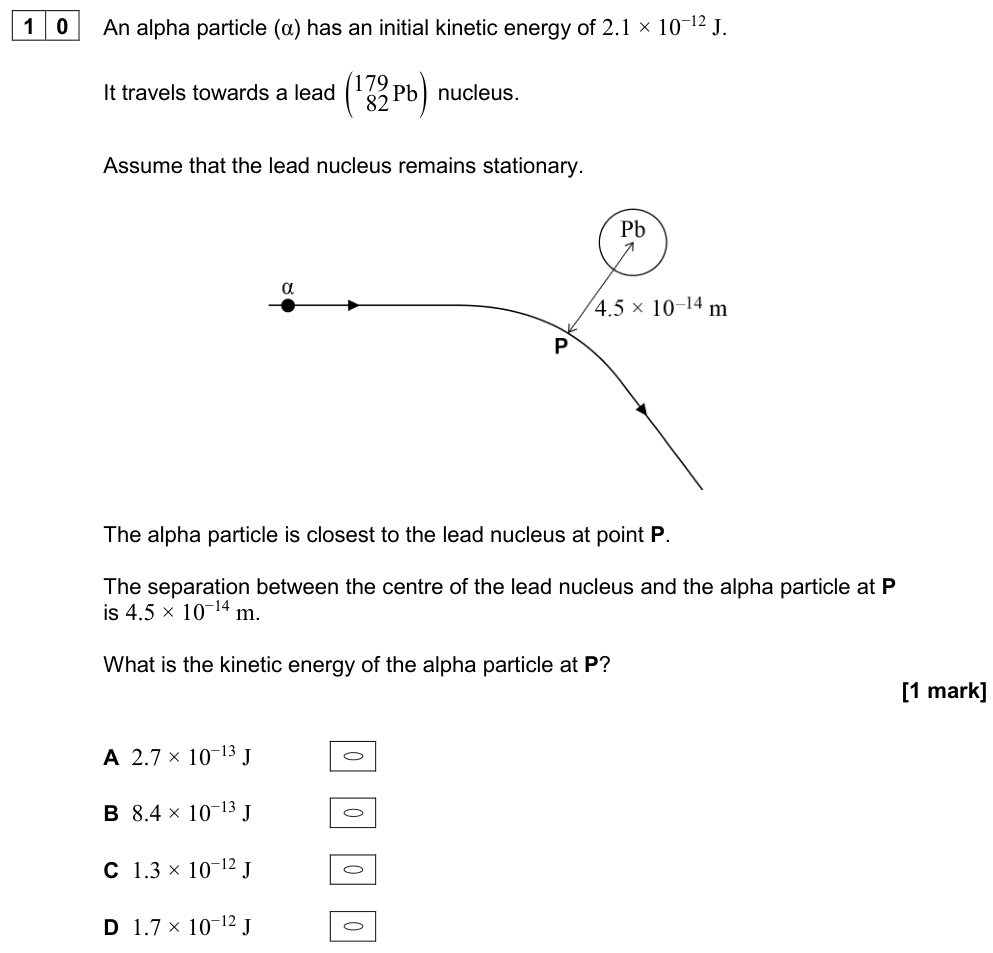
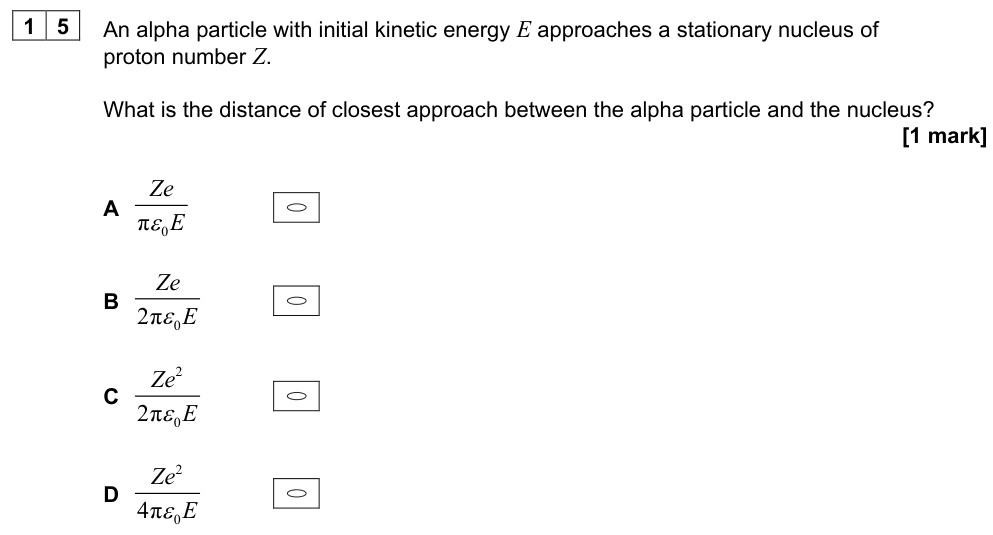
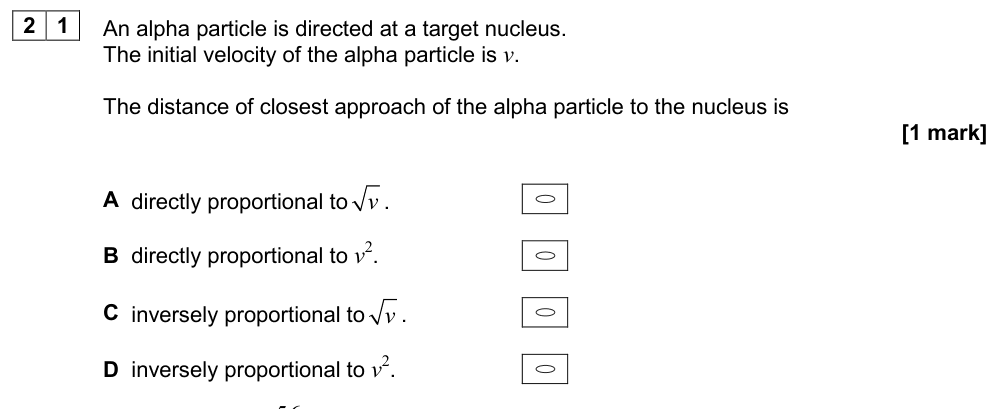
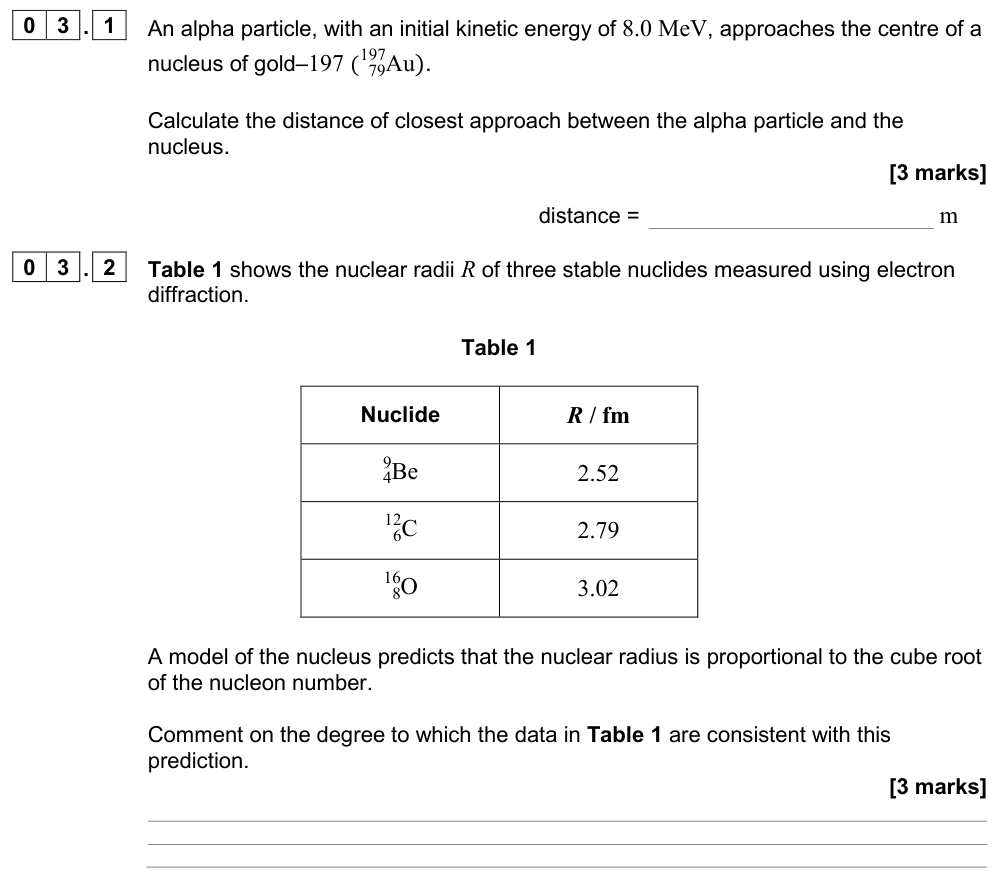
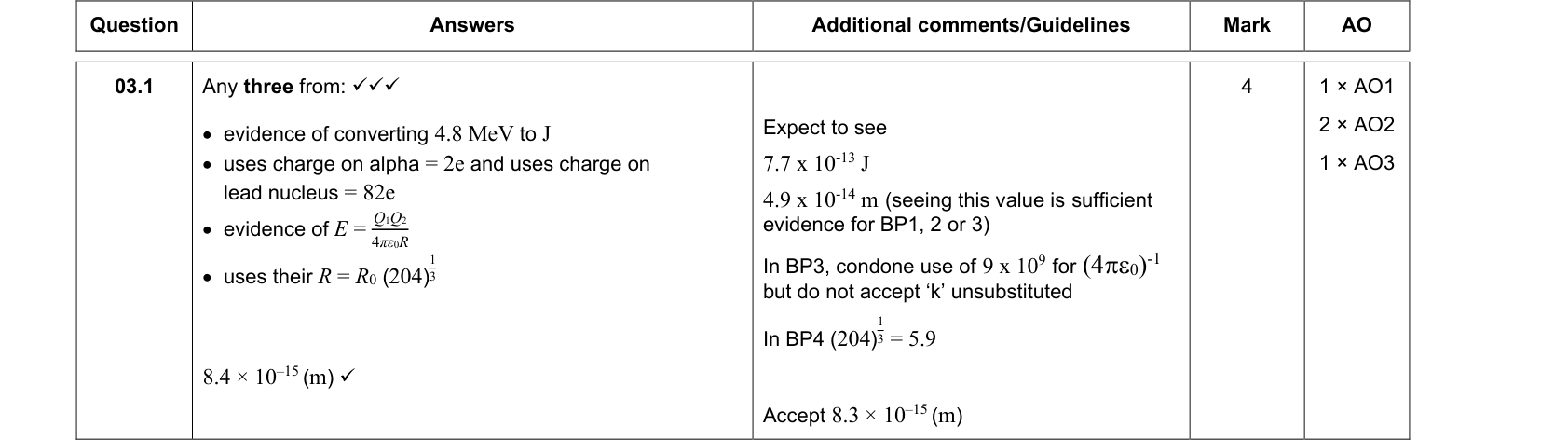
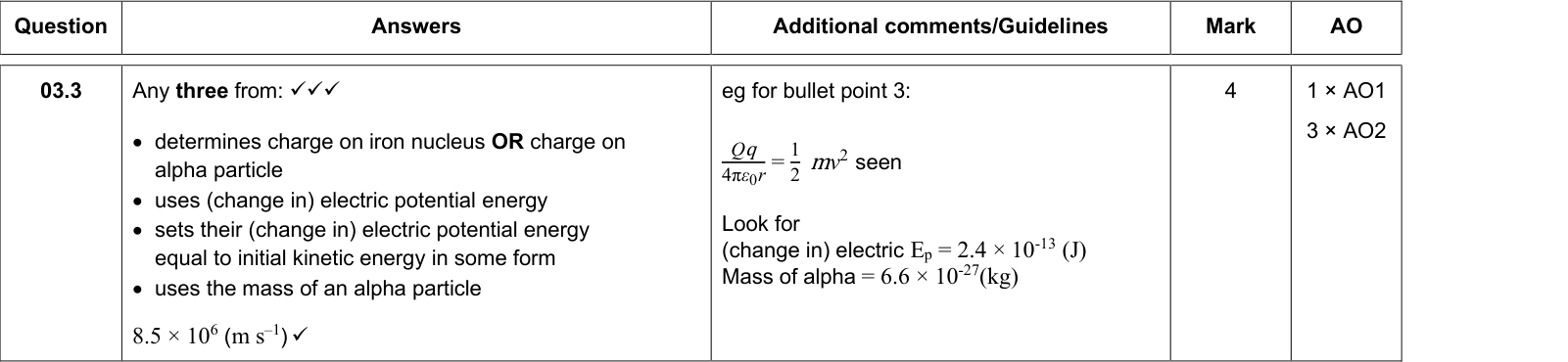
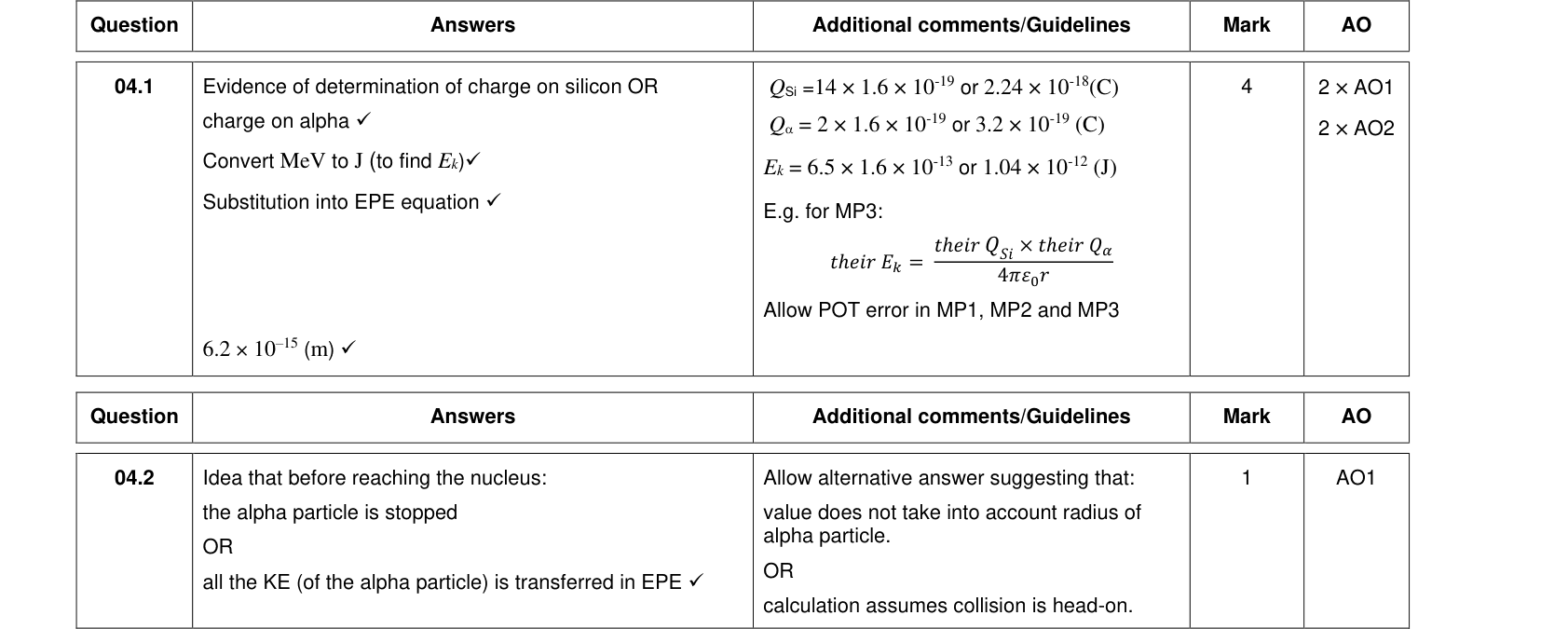
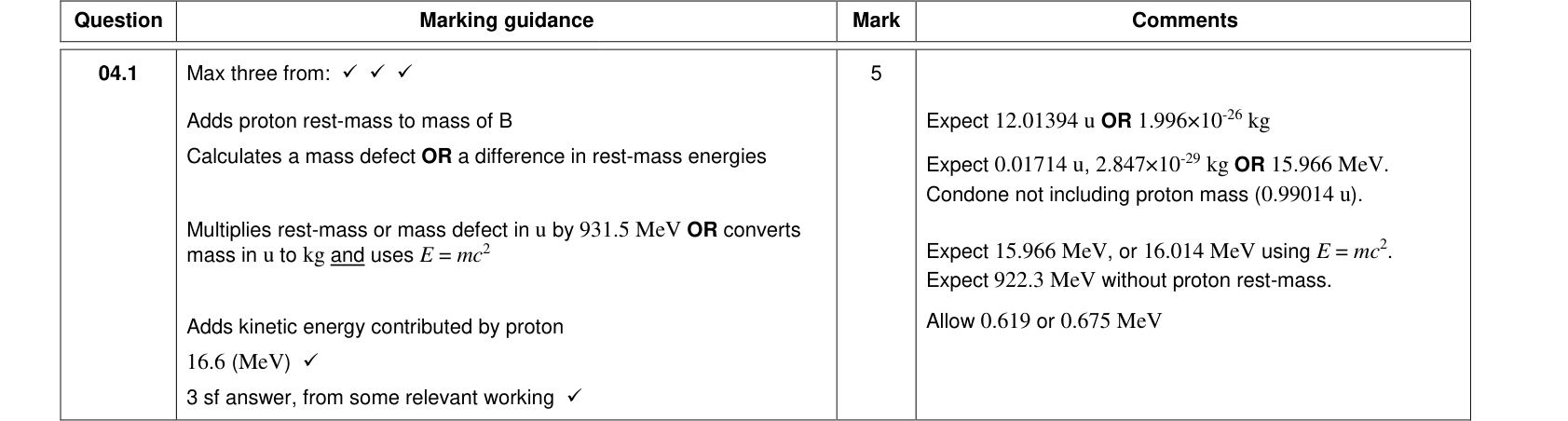
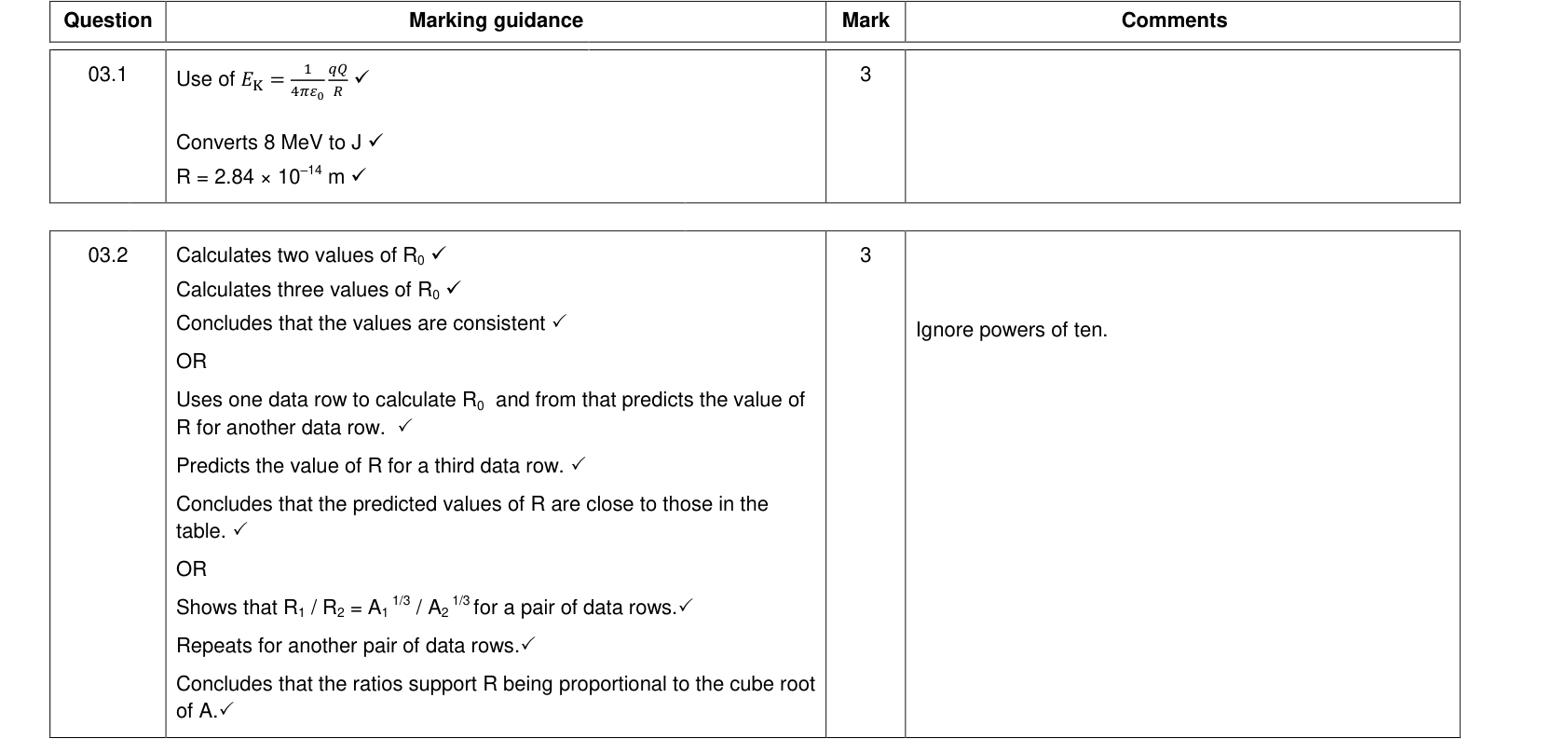
An alpha particle fired straight at a nucleus slows down as it approaches, because of the electrostatic repulsion, and stops momentarily at its distance of closest approach $r$ before being repelled back. At that point all its initial kinetic energy has become electric potential energy:
Distance of closest approach
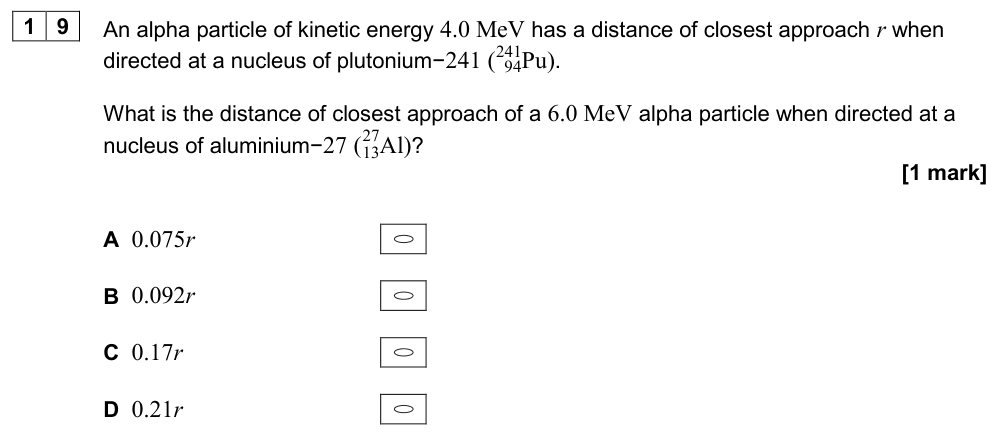
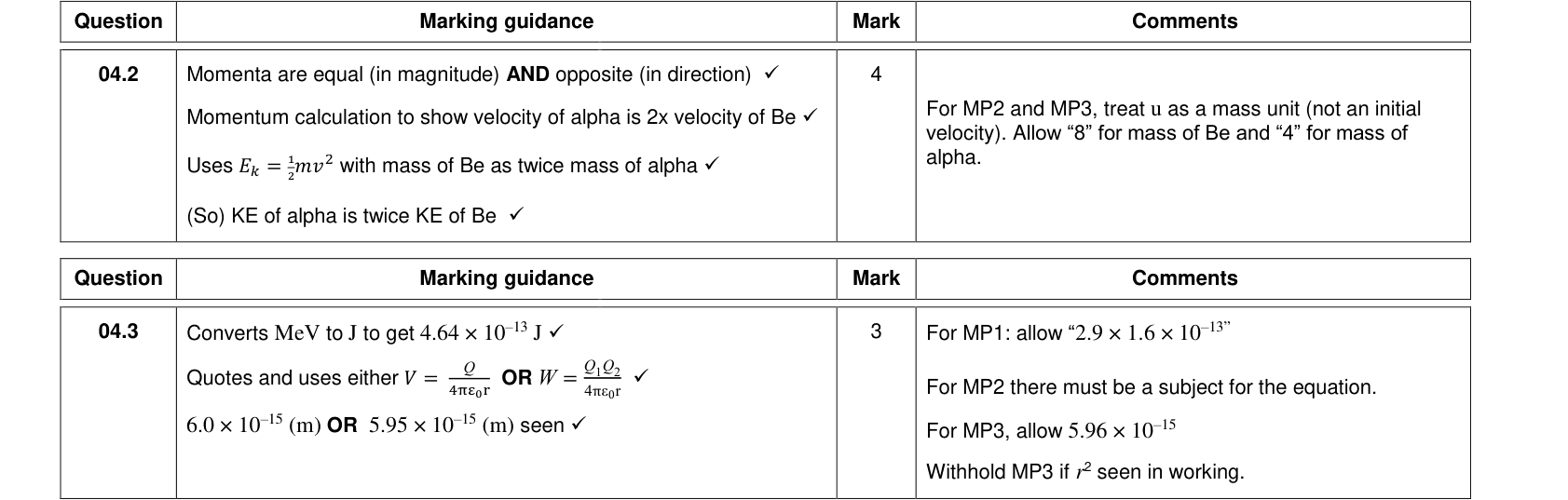
$$E_k = \frac{Q_\alpha Q_{\text{nucleus}}}{4\pi\varepsilon_0 r} = \frac{(2e)(Ze)}{4\pi\varepsilon_0 r} \qquad\Rightarrow\qquad r = \frac{2Ze^2}{4\pi\varepsilon_0E_k}$$
$Z$ = proton number of the target nucleus; $E_k$ = initial kinetic energy of the alpha particle in joules.
Worked example: alpha particles and gold
Find the distance of closest approach of a 5.0 MeV alpha particle to a gold nucleus ($Z = 79$).
$E_k = 5.0 \times 10^{6} \times 1.60 \times 10^{-19} = 8.0 \times 10^{-13}$ J.
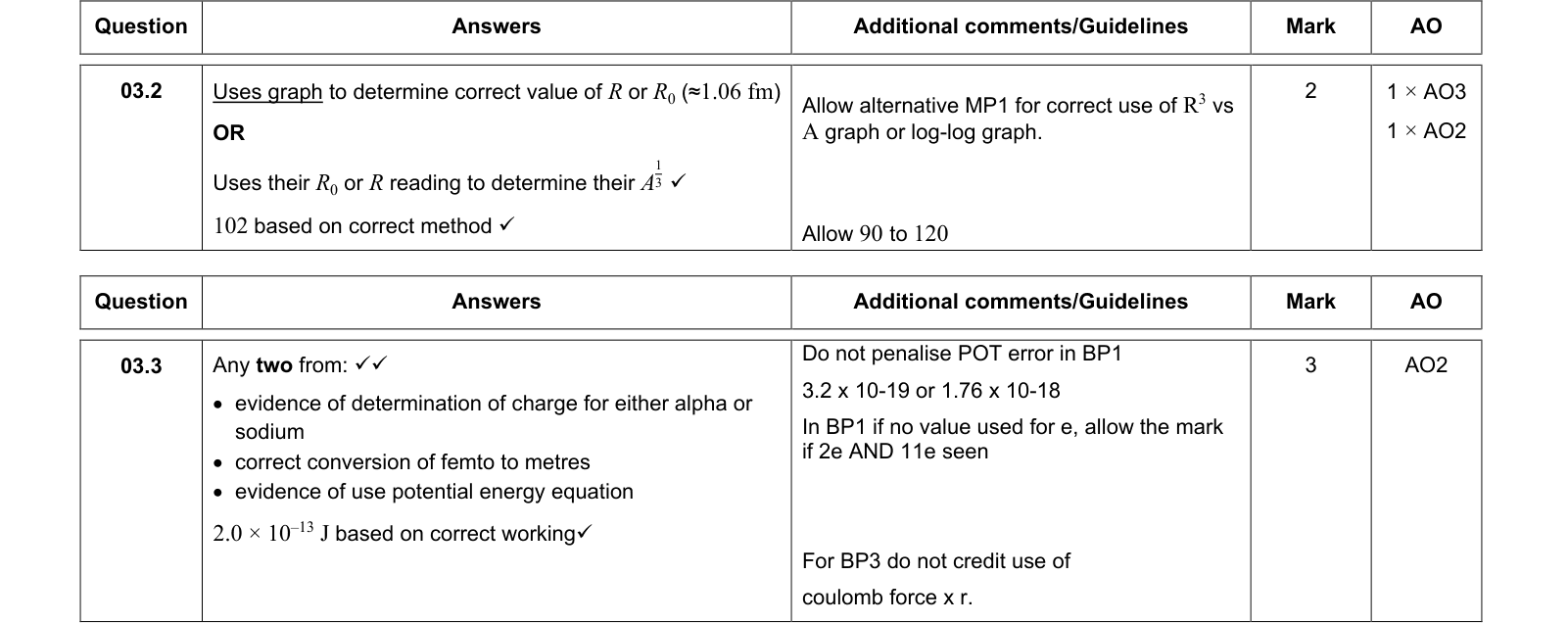
$r = \dfrac{2 \times 79 \times (1.60 \times 10^{-19})^2 \times 8.99 \times 10^{9}}{8.0 \times 10^{-13}} = 4.5 \times 10^{-14}$ m.
The radius of a gold nucleus must be less than this (about $7 \times 10^{-15}$ m).
Limitations of the method:
- It only gives an upper limit: the alpha particle stops before reaching the nucleus.
- The nucleus recoils a little, so not all the kinetic energy becomes potential energy.
- Higher-energy alpha particles would get closer, but once they reach the nucleus the strong nuclear force acts on them and the simple Coulomb calculation no longer applies.
Electron diffraction
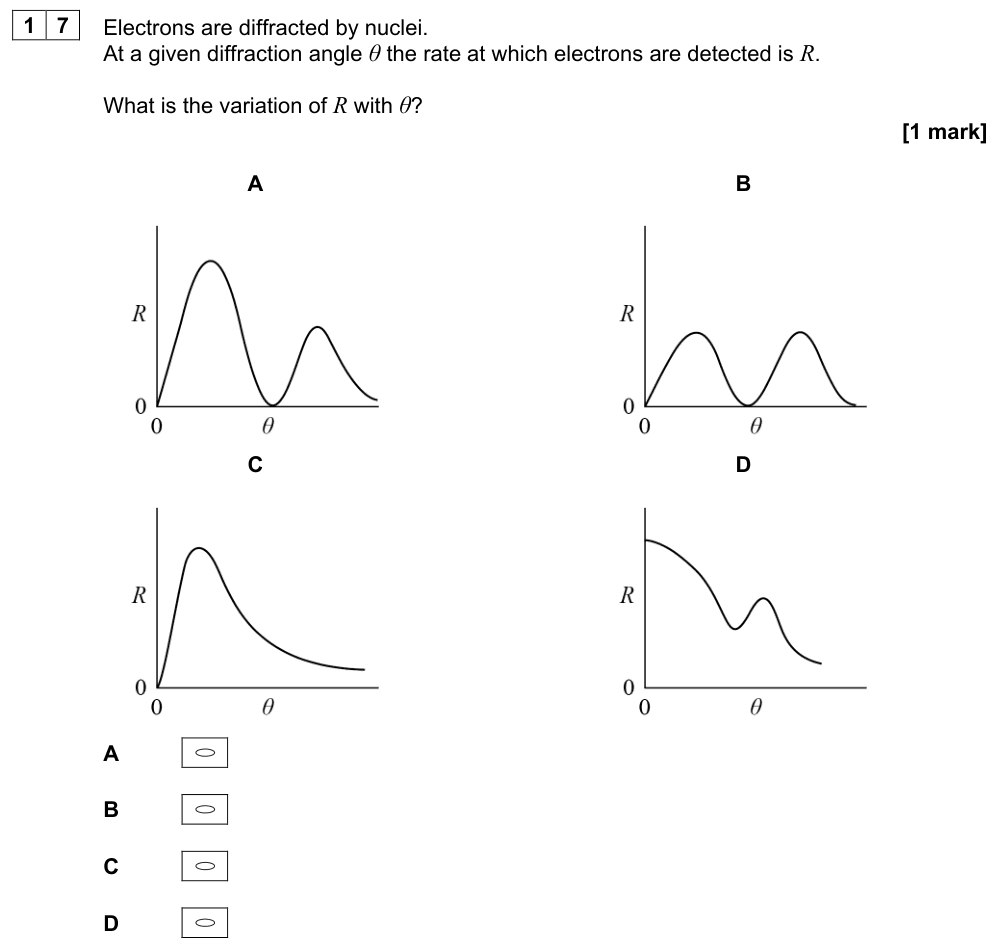
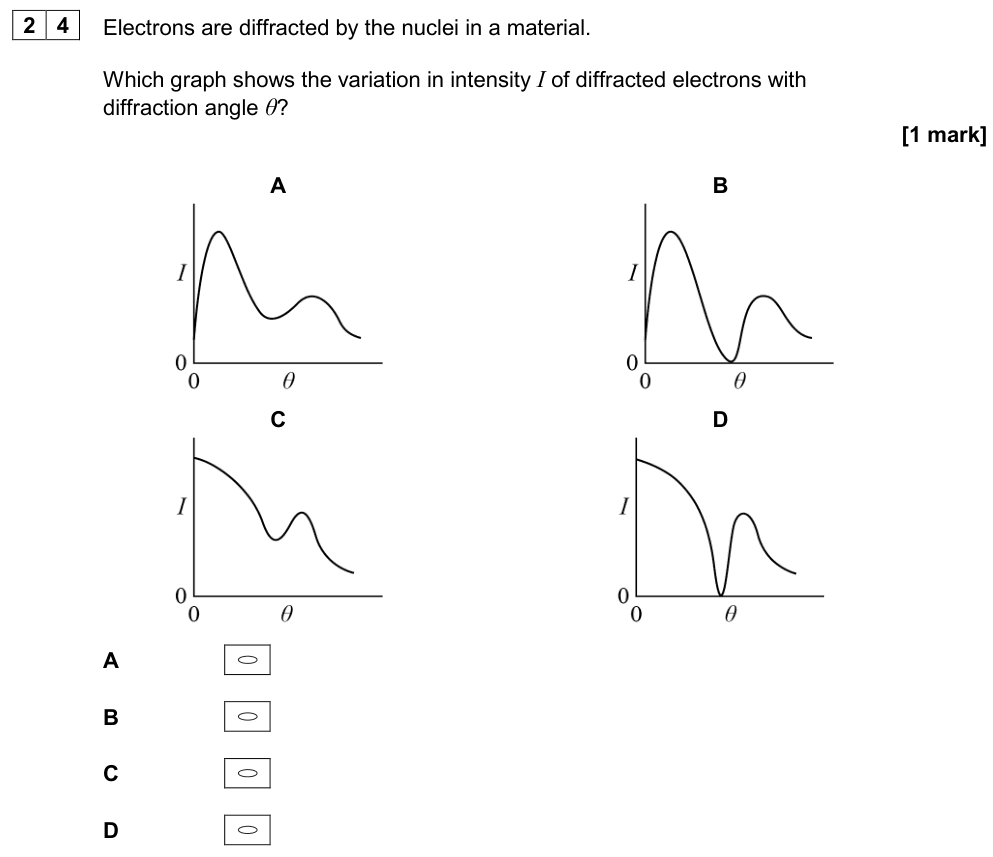
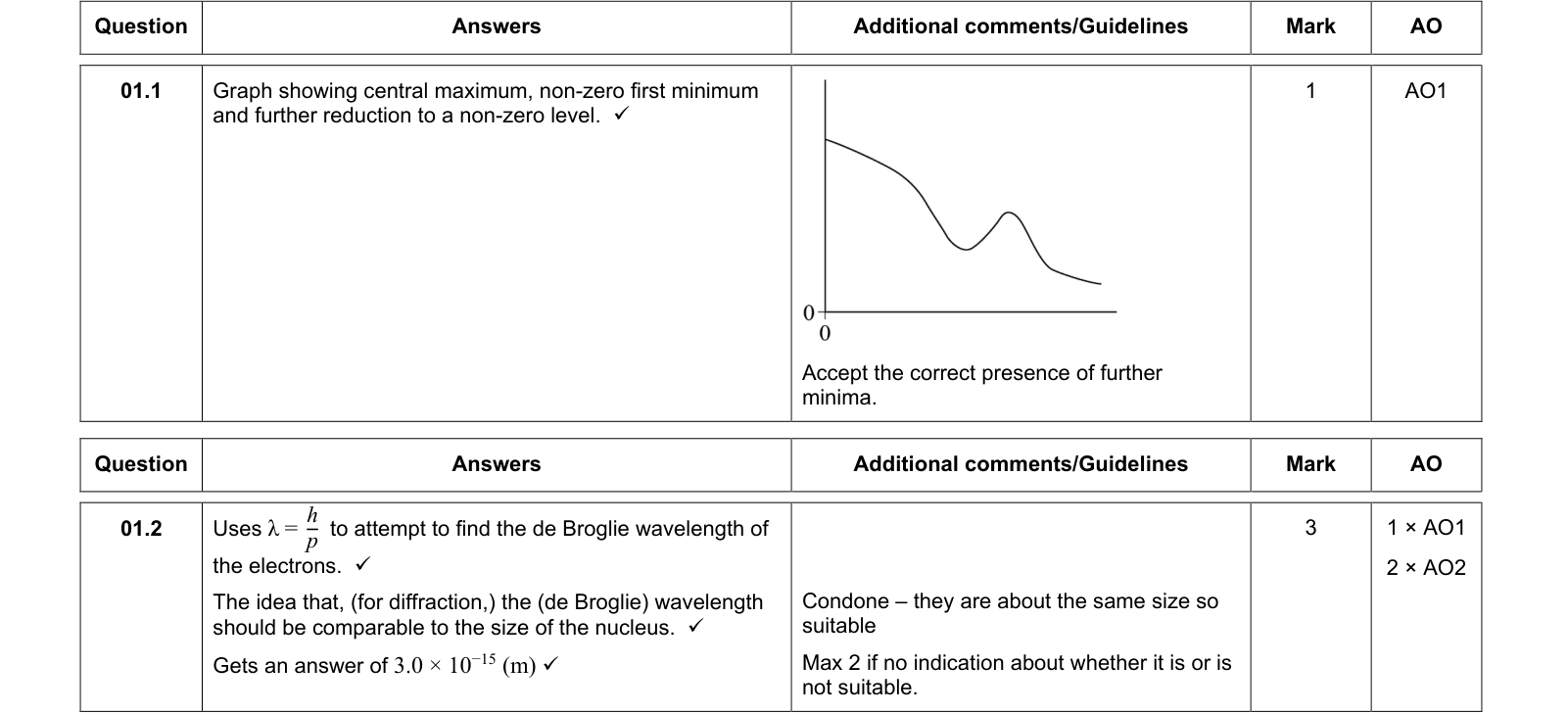
A beam of high-energy electrons directed at a thin sample is diffracted by the nuclei. Electrons behave as waves with de Broglie wavelength $\lambda = h/p$. To be diffracted noticeably by a nucleus, the wavelength must be comparable with the nuclear diameter, about $10^{-15}$ m, which needs electron energies of hundreds of MeV.
At such energies the electrons travel at almost the speed of light, and $E \approx pc$, so:
$$\lambda \approx \frac{hc}{E}$$
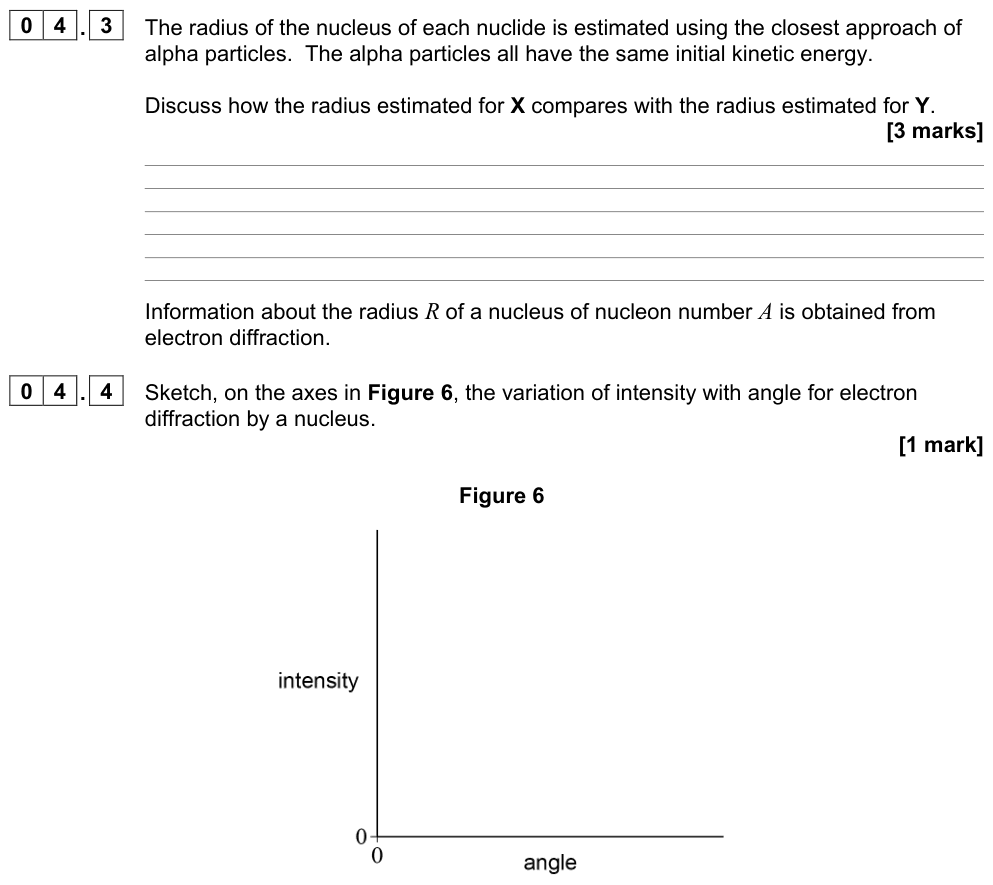
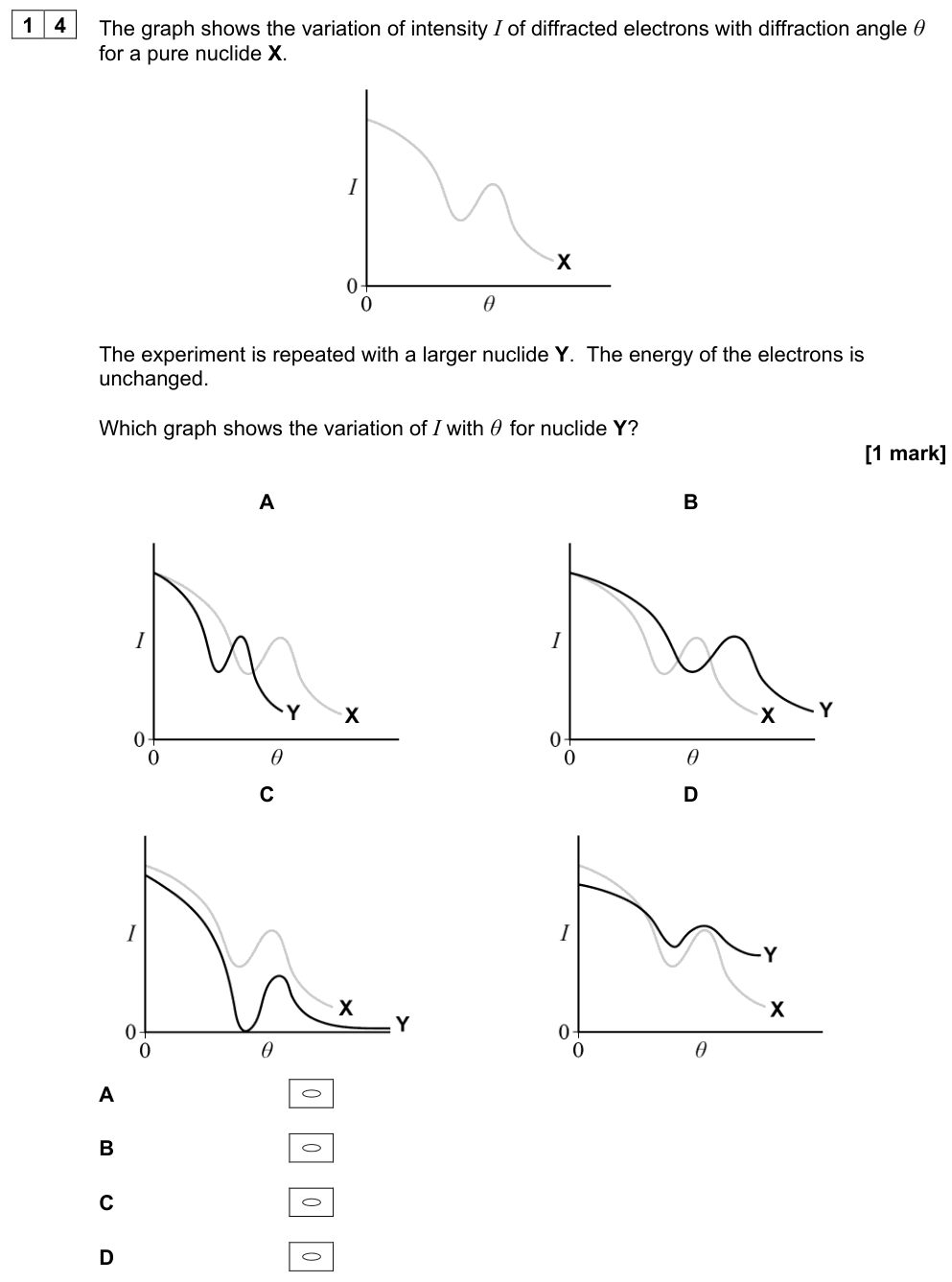
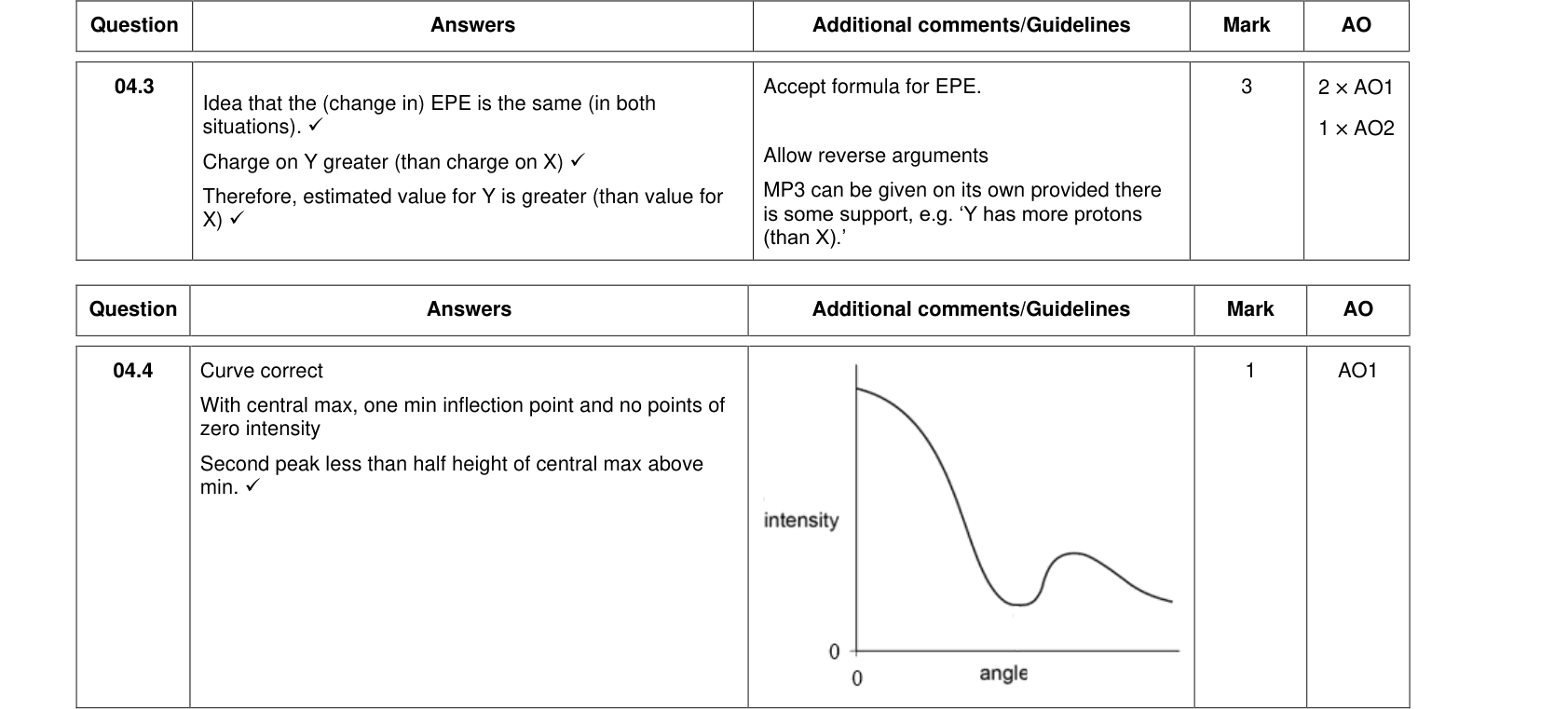
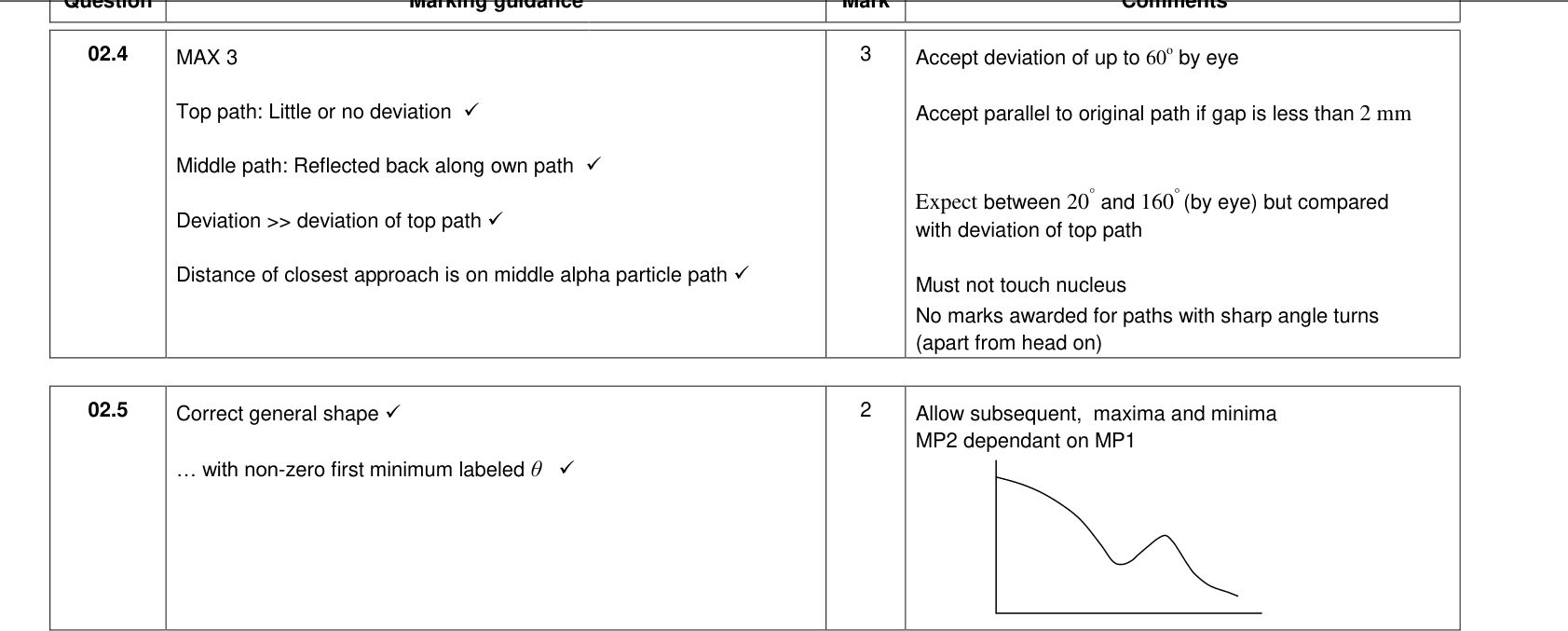
For diffraction by a sphere of radius $R$, the first minimum is at an angle $\theta$ given approximately by
$$\sin\theta \approx \frac{1.22\lambda}{2R}$$
Why electrons?
- Electrons are leptons: they are not affected by the strong nuclear force, so they interact with the nucleus only through the electromagnetic force and give a cleaner diffraction pattern. (Neutrons and protons, or alpha particles, would also feel the strong force.)
- Electrons can easily be accelerated to the very high energies needed for a short enough wavelength.
Worked example: electron diffraction
Electrons of energy 420 MeV are scattered by carbon-12 nuclei and the first minimum is at 51°. Estimate the radius of a carbon-12 nucleus.
$\lambda = \dfrac{hc}{E} = \dfrac{6.63 \times 10^{-34} \times 3.00 \times 10^{8}}{420 \times 10^{6} \times 1.60 \times 10^{-19}} = 2.96 \times 10^{-15}$ m.
$R = \dfrac{1.22\lambda}{2\sin\theta} = \dfrac{1.22 \times 2.96 \times 10^{-15}}{2 \times \sin 51°} = 2.3 \times 10^{-15}$ m (2.3 fm).
How the radius depends on nucleon number
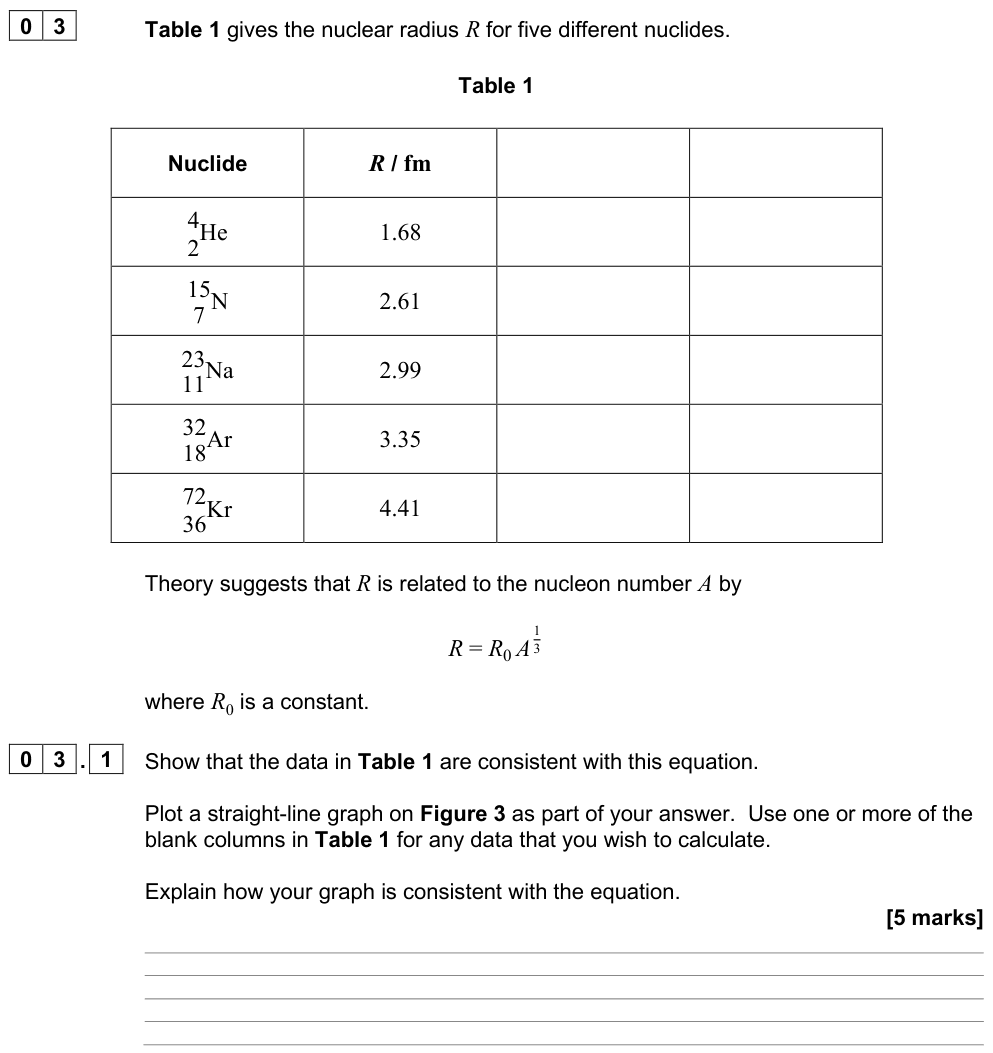
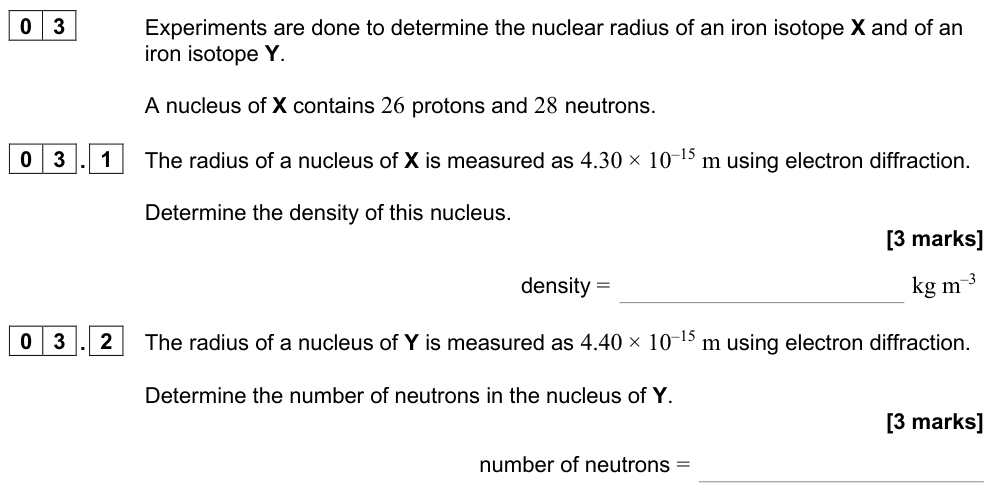
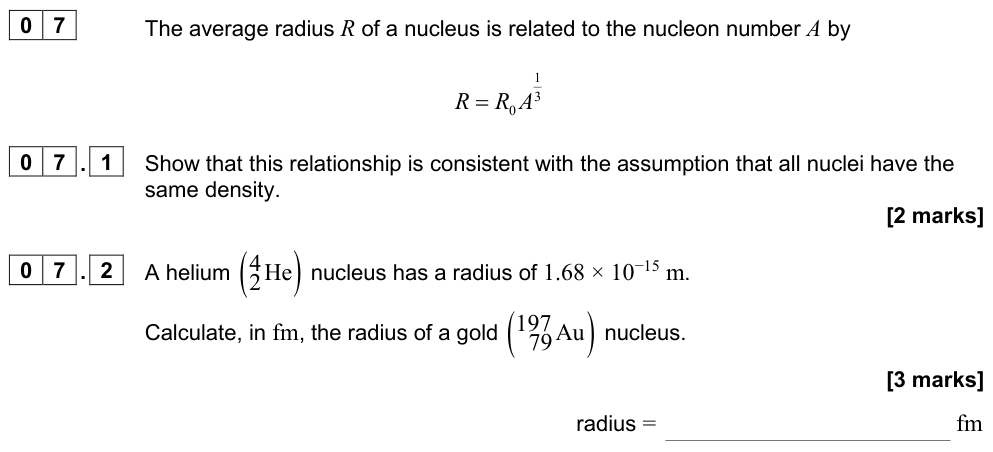
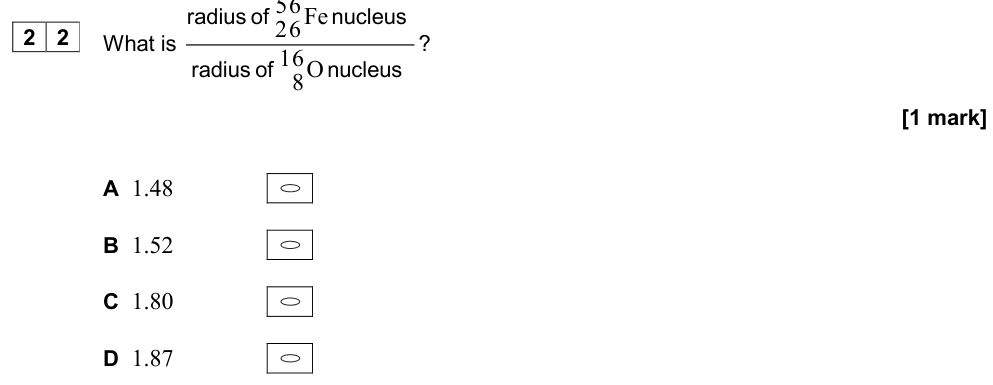
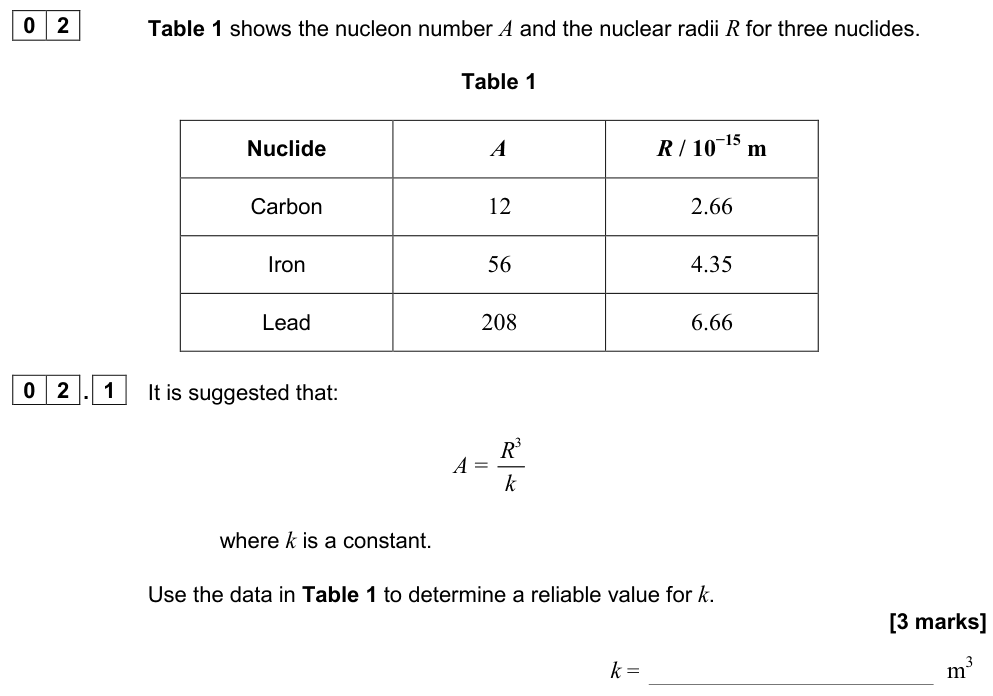
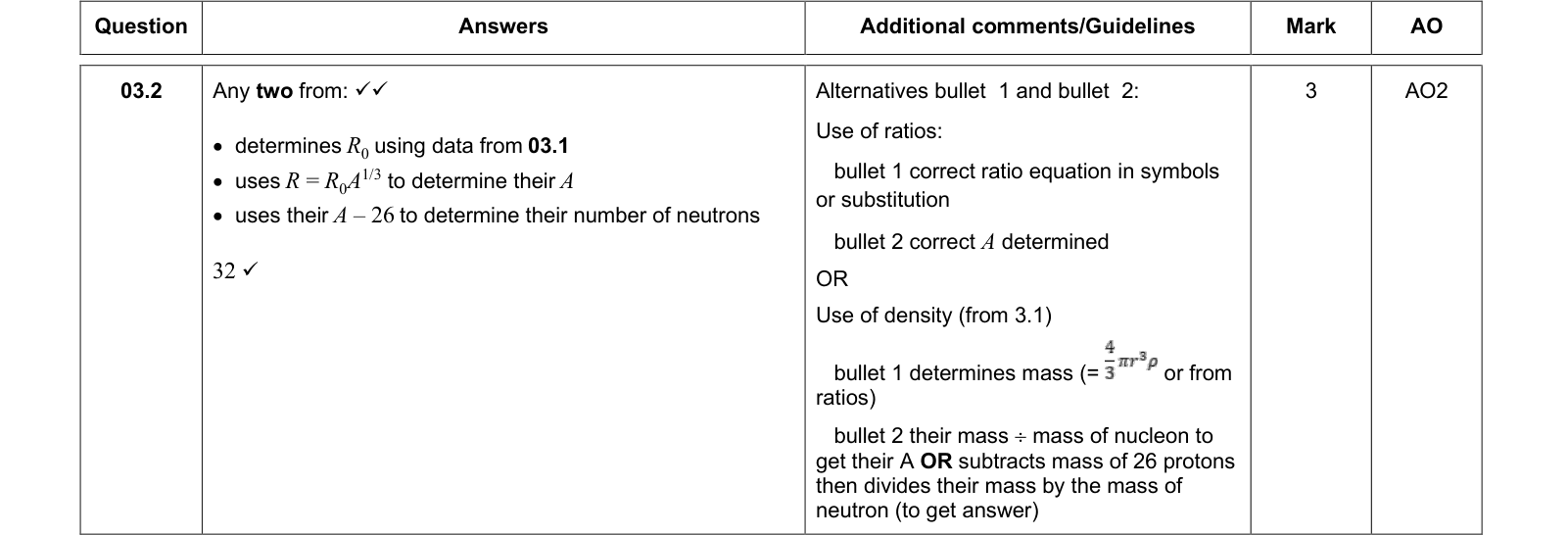
Measurements on many different nuclei show that the radius $R$ depends on the nucleon number $A$:
Nuclear radius
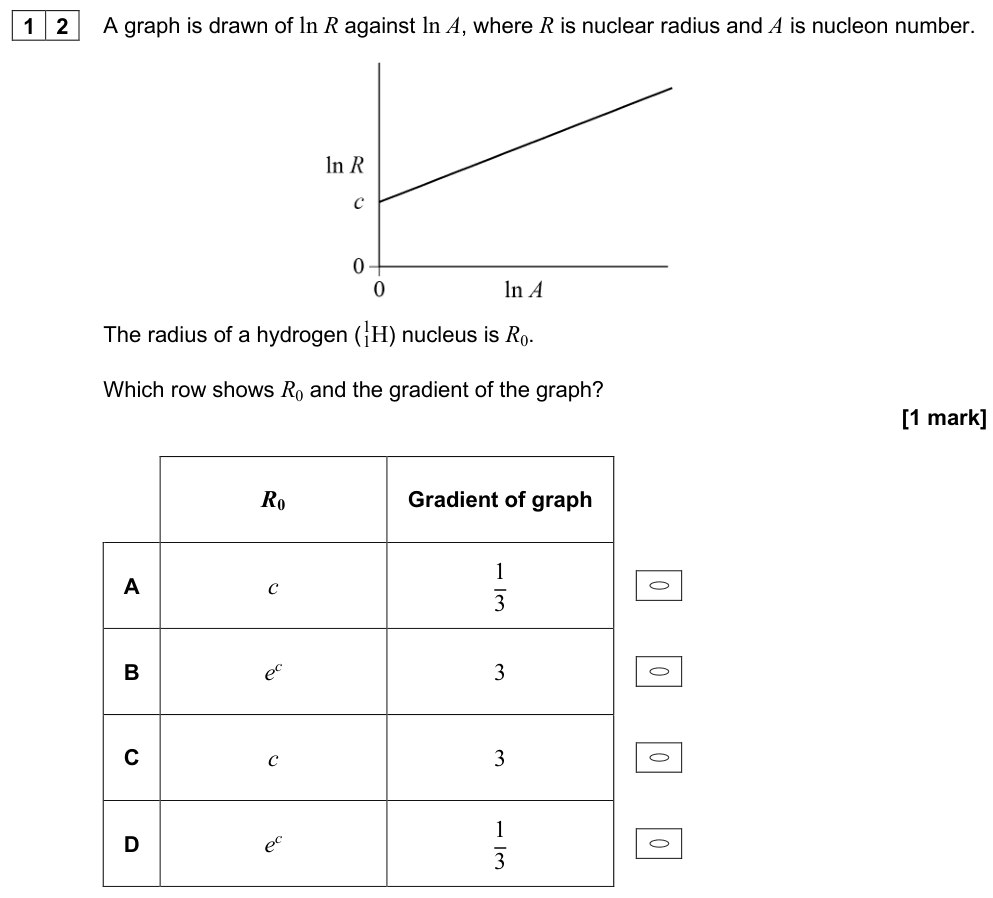
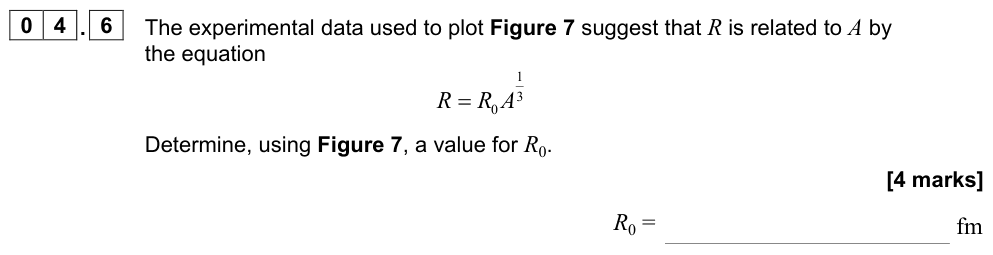
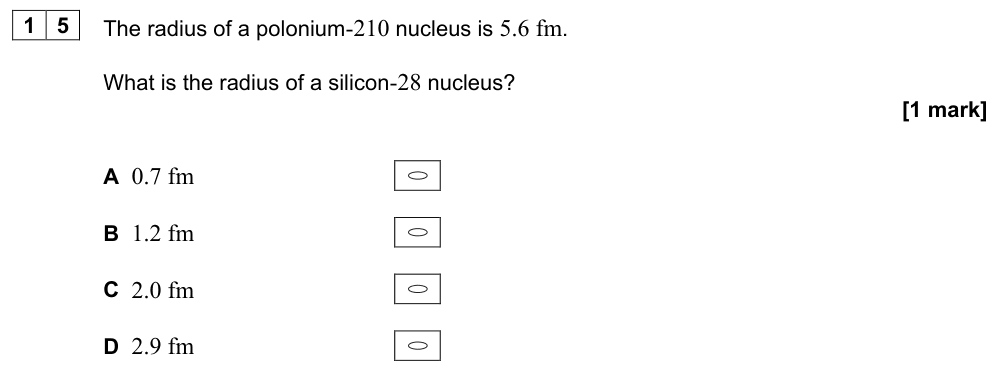
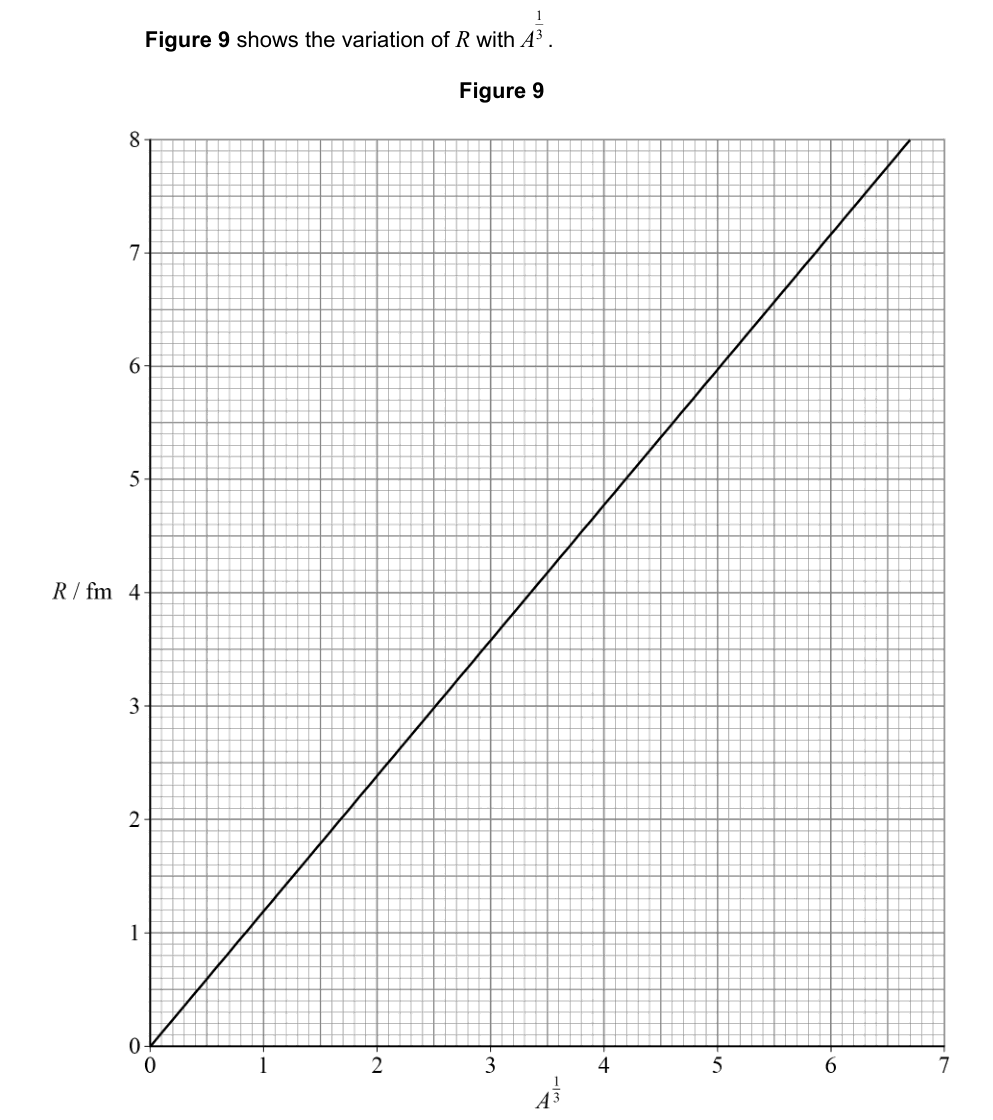
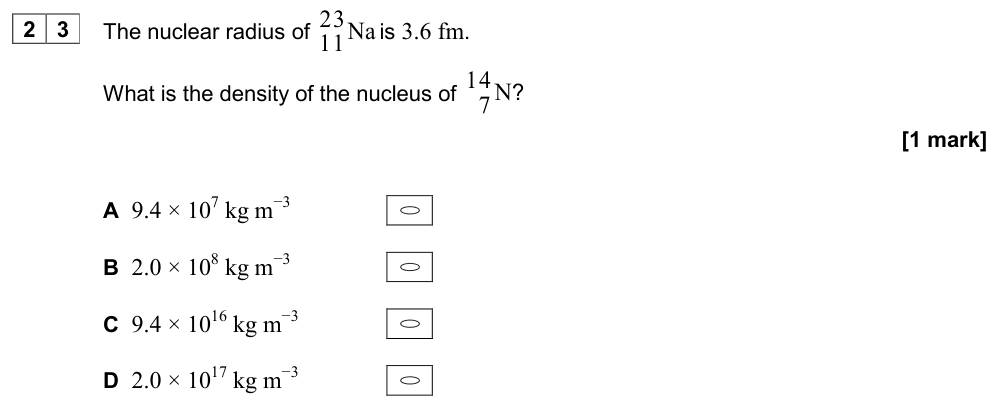
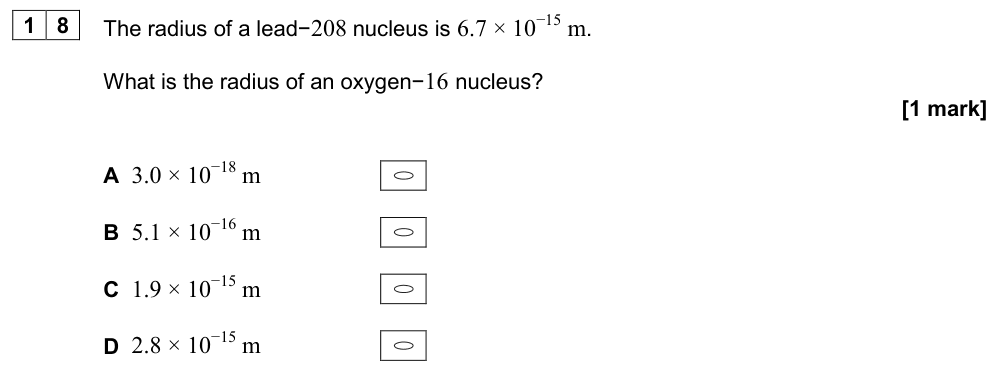
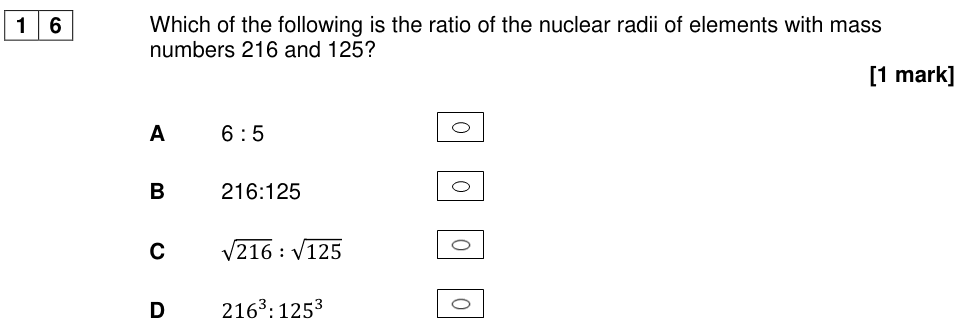
$$R = R_0A^{1/3}$$
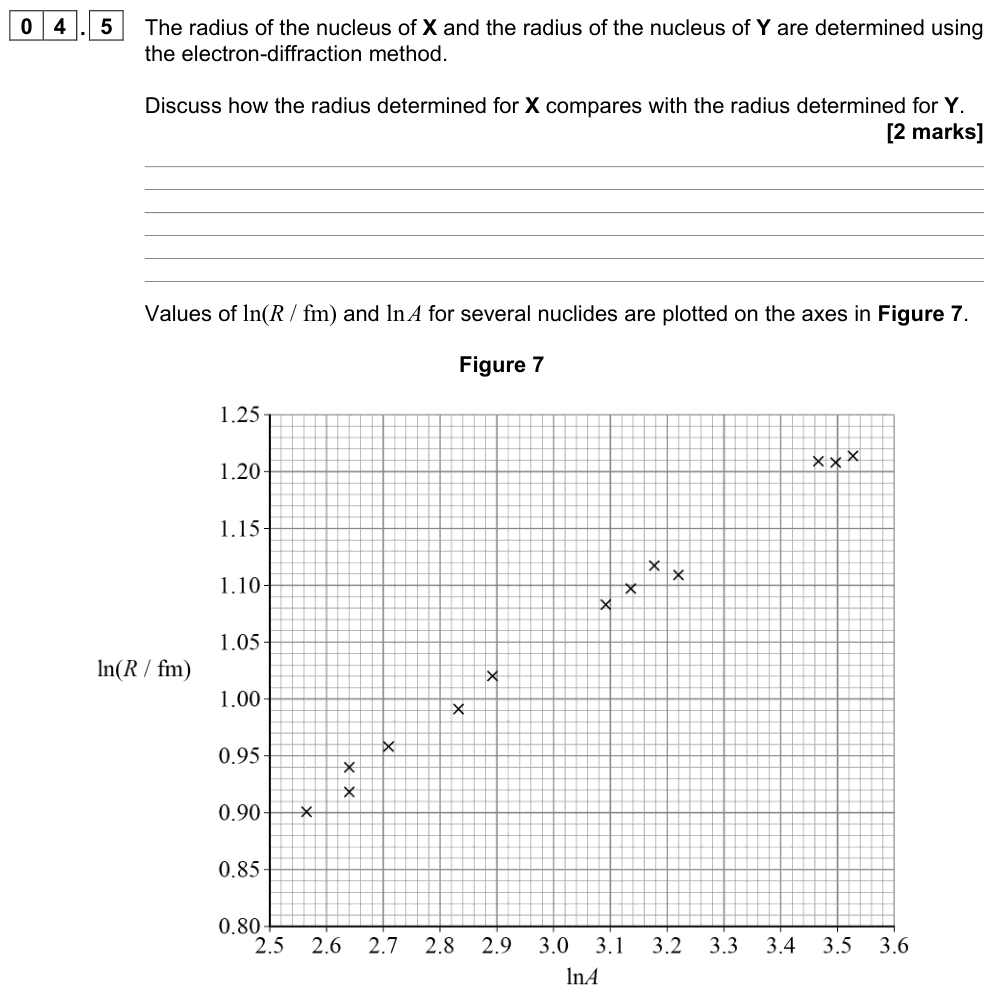
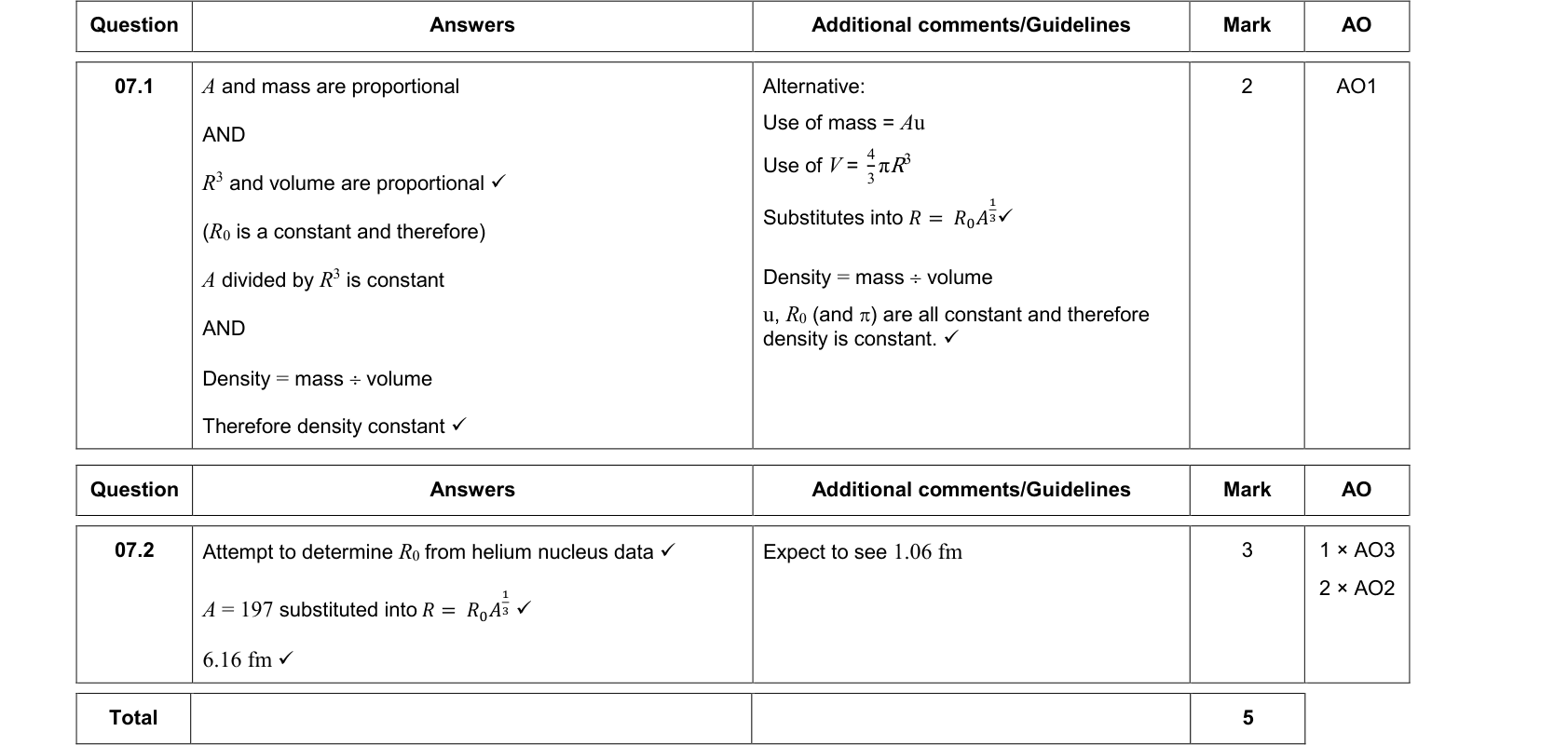
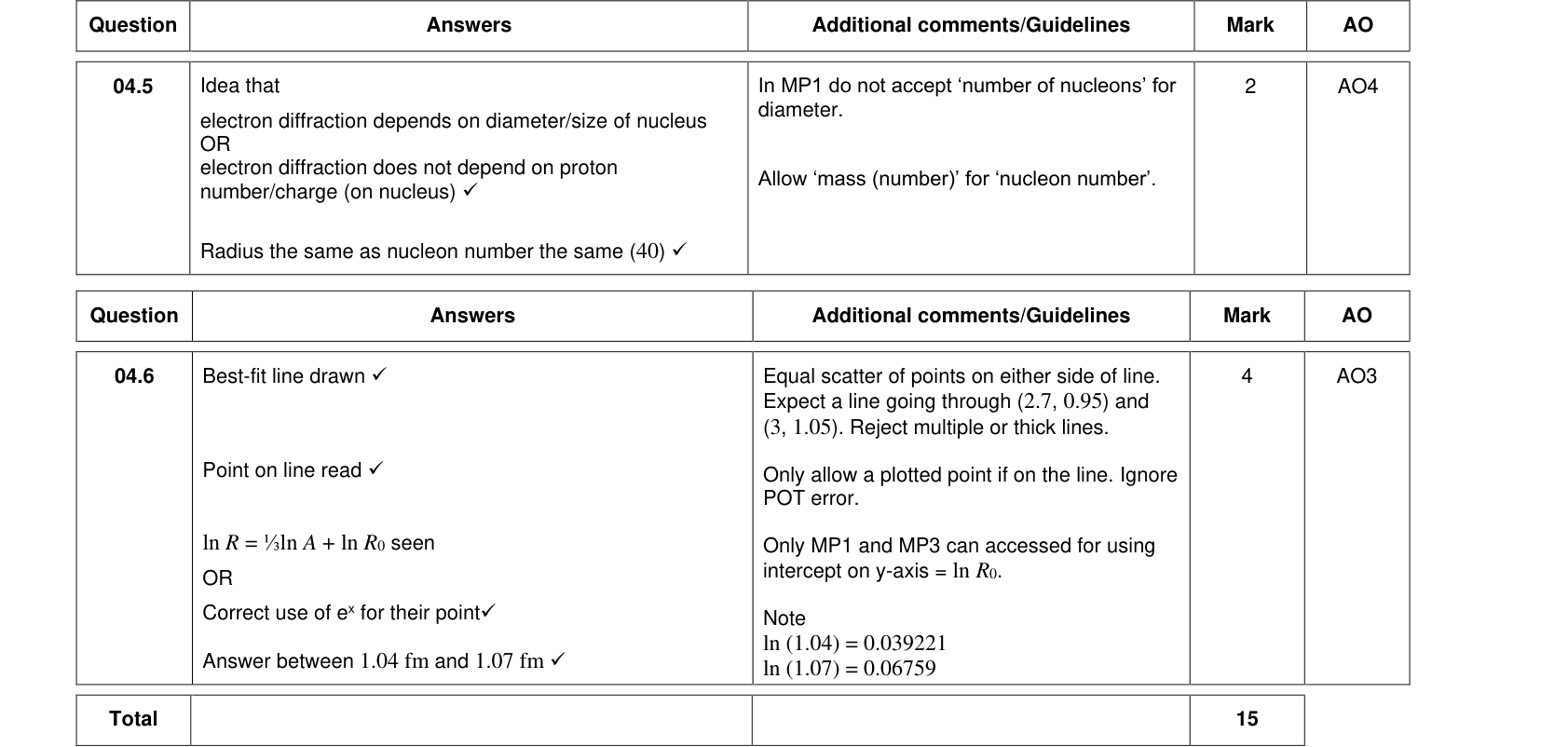
$R_0$ is a constant, approximately 1.05 fm (values between about 1.0 and 1.4 fm are quoted, depending on the experiment; always use the value given in a question). $R_0$ is roughly the radius of a single nucleon (a hydrogen nucleus, $A = 1$).
The relationship is found from experimental data:
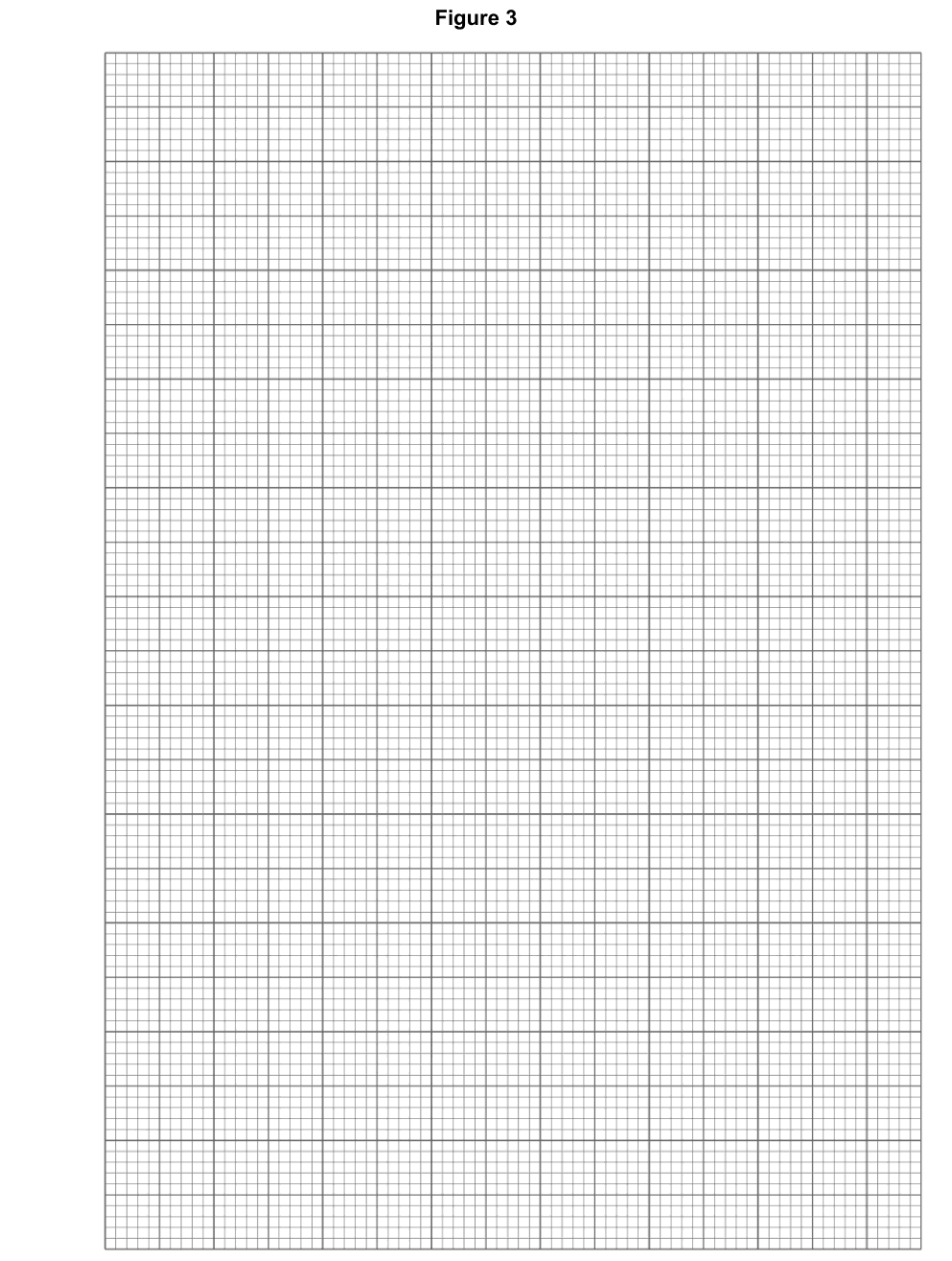
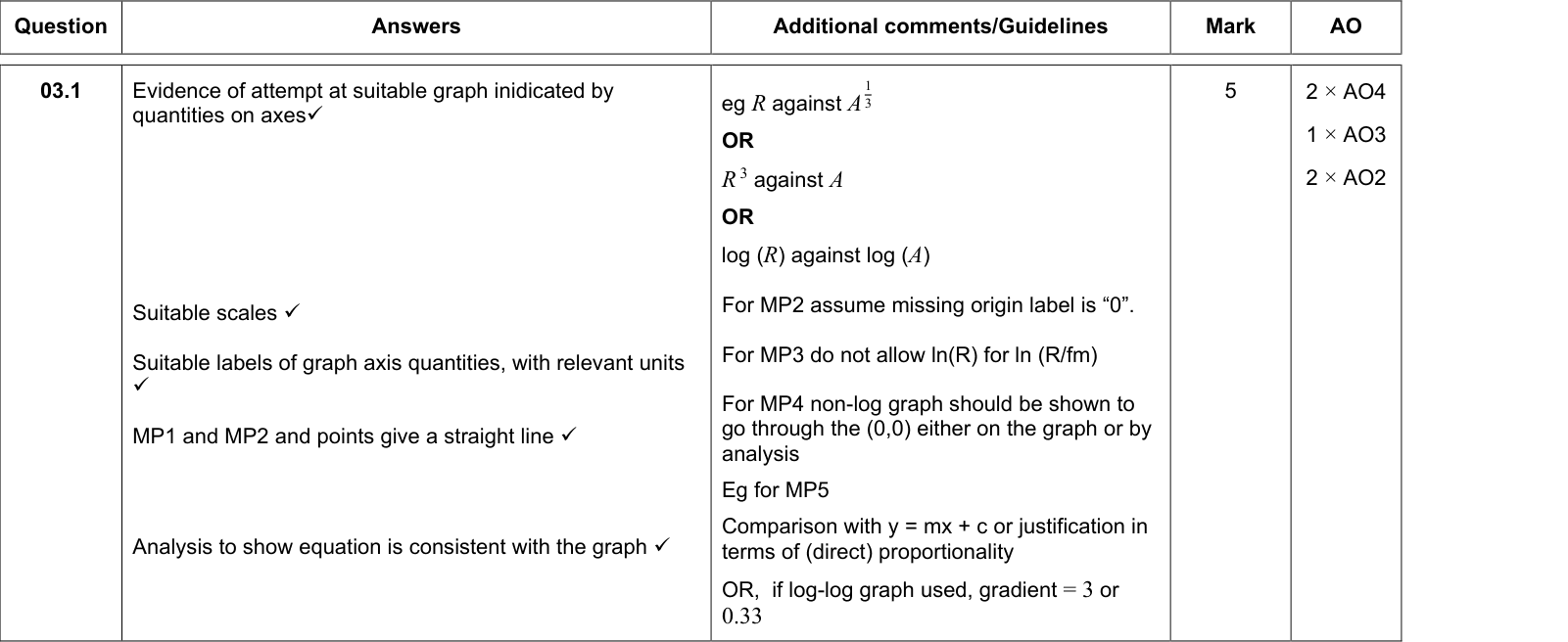
- A graph of $R$ against $A^{1/3}$ is a straight line through the origin with gradient $R_0$.
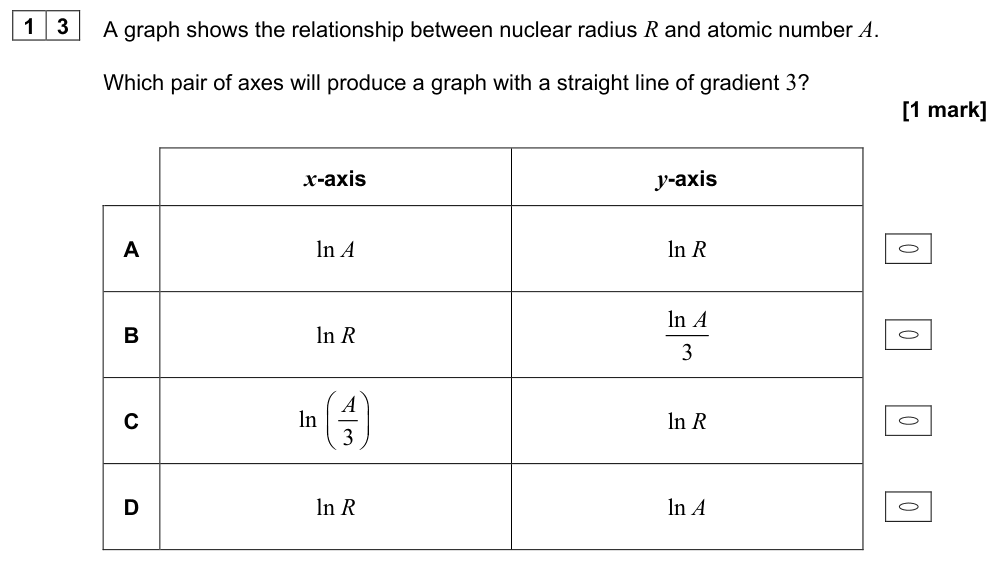
- Alternatively, $\ln R = \ln R_0 + \tfrac13\ln A$, so a graph of $\ln R$ against $\ln A$ is a straight line with gradient $\tfrac13$ and y-intercept $\ln R_0$.
Worked example
With $R_0 = 1.05$ fm, the radius of a uranium-238 nucleus is $1.05 \times 238^{1/3} = 1.05 \times 6.20 = 6.5$ fm. The ratio of the radii of uranium-238 and helium-4 is $(238/4)^{1/3} = 3.9$.
Nuclear density
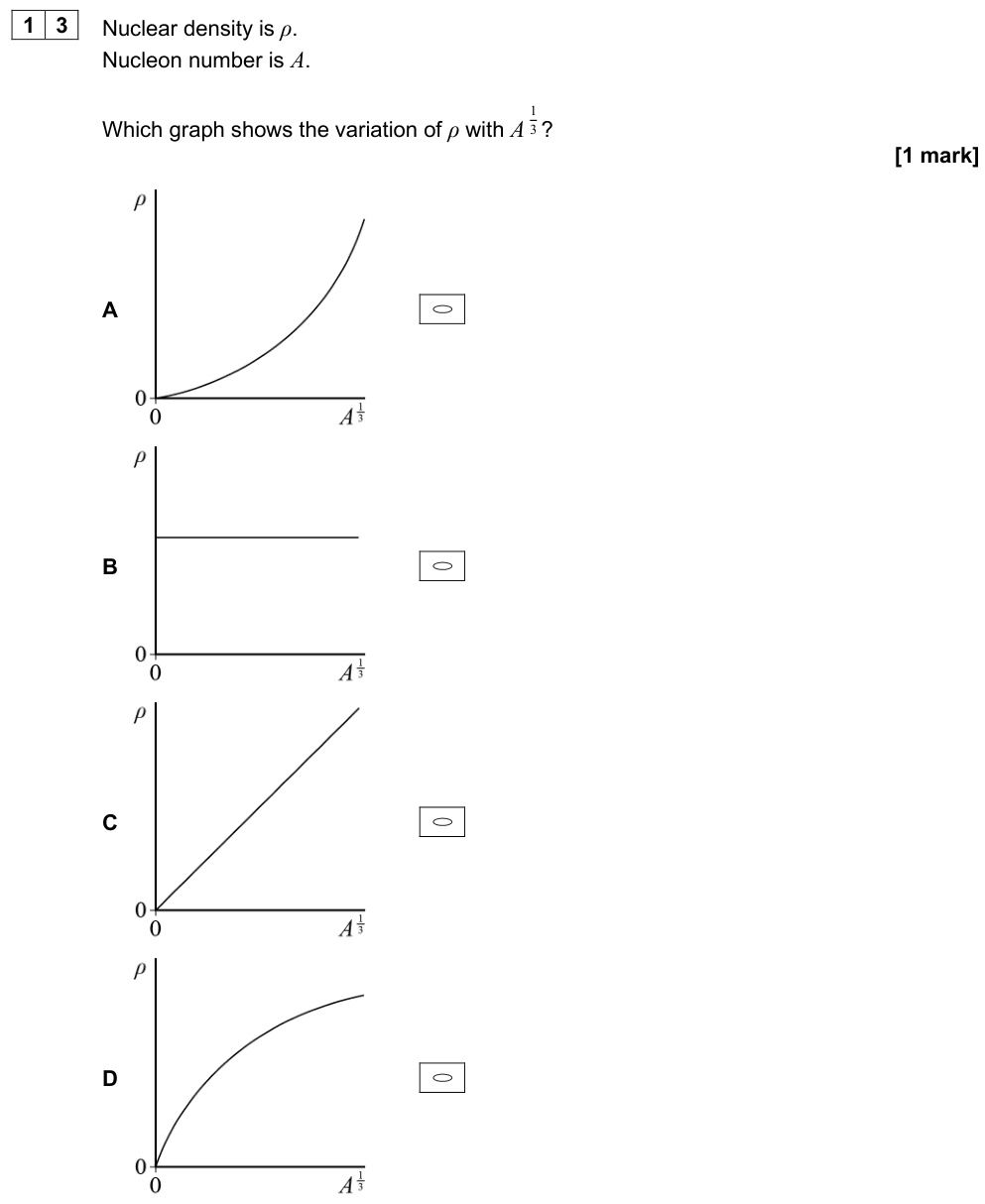
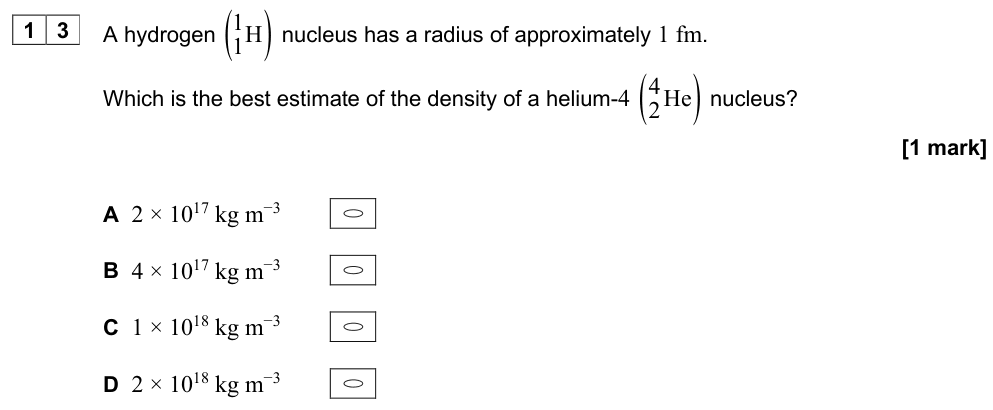
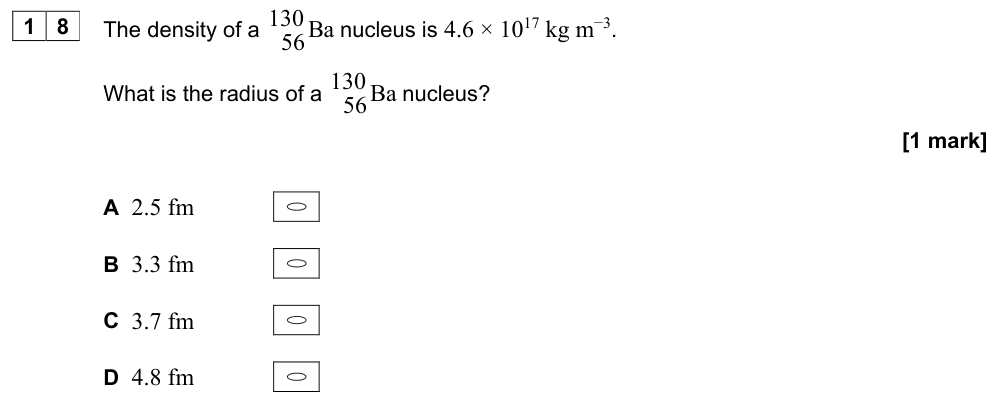
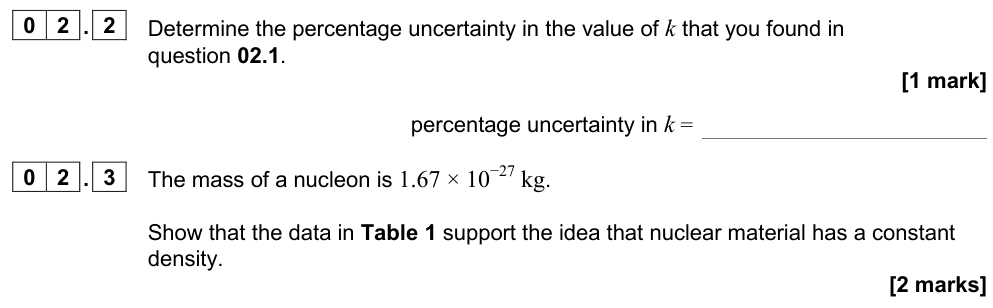
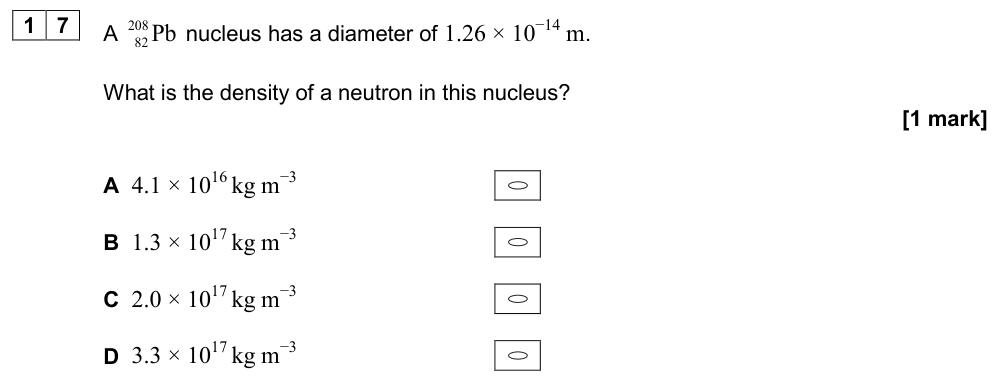
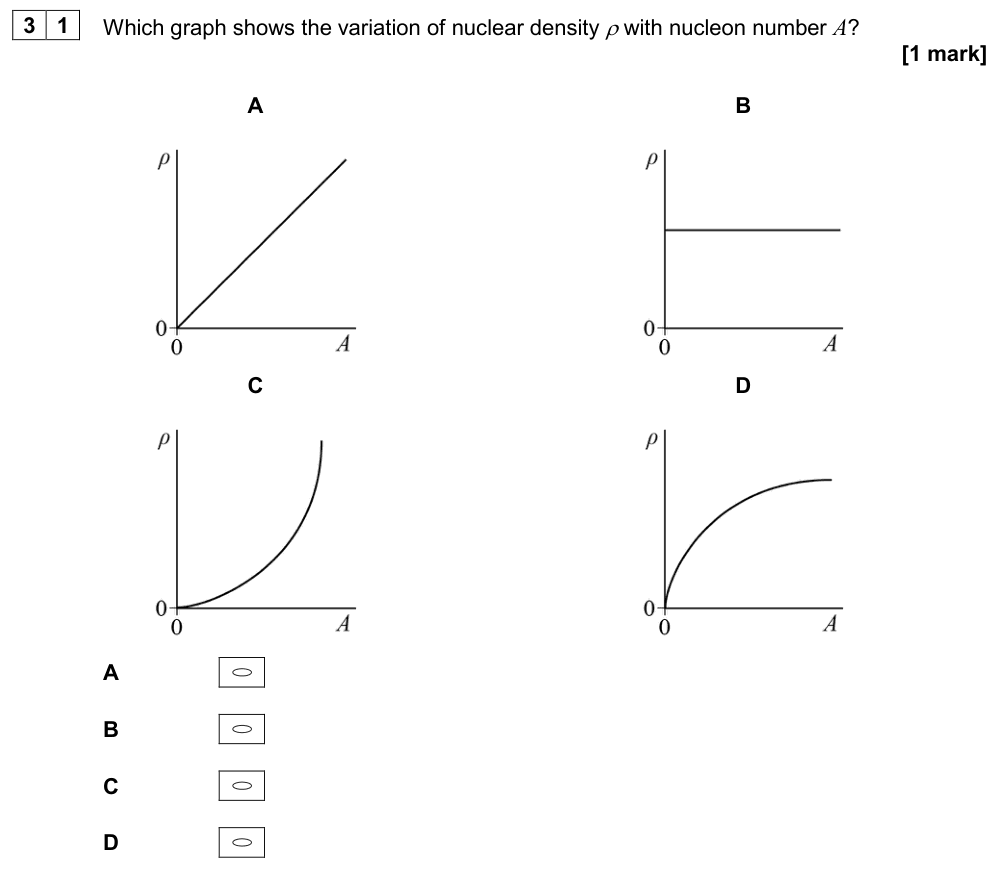
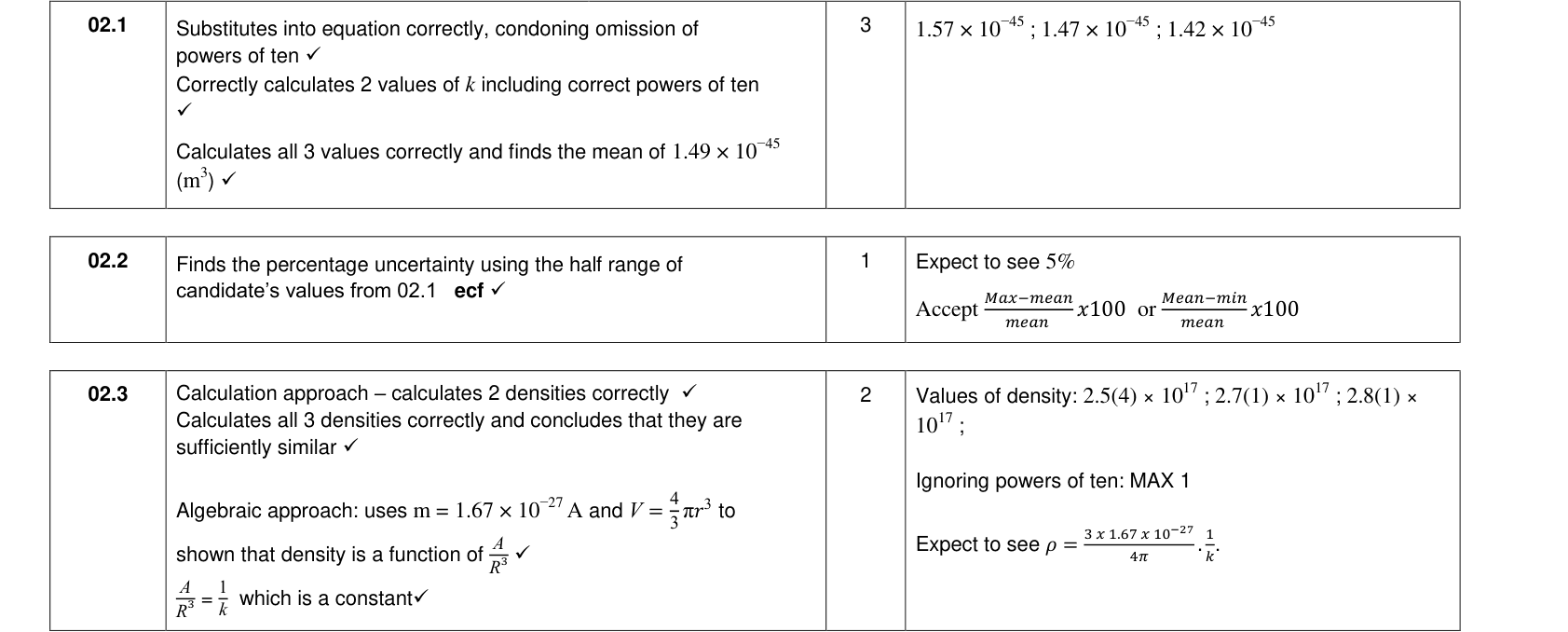
Since $R^3 = R_0^3A$, the volume of a nucleus, $\tfrac43\pi R^3 = \tfrac43\pi R_0^3A$, is proportional to $A$. The mass of a nucleus is also (approximately) proportional to $A$: mass $\approx Au$. So
$$\rho = \frac{\text{mass}}{\text{volume}} = \frac{Au}{\tfrac43\pi R_0^3A} = \frac{3u}{4\pi R_0^3}$$
$A$ cancels: all nuclei have the same density. Nucleons are packed together like marbles in a bag, each taking up the same volume.
Worked example: nuclear density
With $R_0 = 1.05 \times 10^{-15}$ m and $u = 1.661 \times 10^{-27}$ kg:
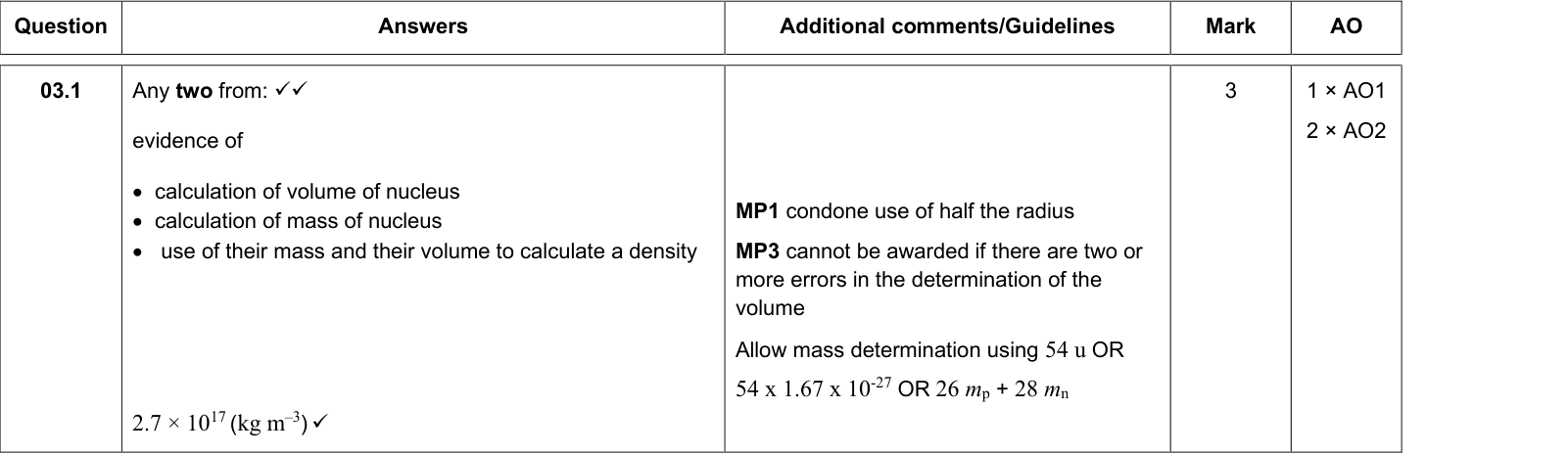
$\rho = \dfrac{3 \times 1.661 \times 10^{-27}}{4\pi \times (1.05 \times 10^{-15})^3} = 3.4 \times 10^{17}\ \text{kg m}^{-3}$
This is about $10^{14}$ times the density of water. A teaspoon of nuclear matter would have a mass of over a billion tonnes. Ordinary matter is much less dense because atoms are mostly empty space. (Neutron stars are made of matter at roughly nuclear density.)
Summary
- Closest approach: $E_k = \dfrac{2Ze^2}{4\pi\varepsilon_0 r}$; gives an upper limit for the radius.
- Electron diffraction: high-energy electrons ($\lambda \approx hc/E \sim 10^{-15}$ m), not affected by the strong force; first minimum $\sin\theta \approx 1.22\lambda/2R$.
- Nuclear radii are a few fm; $R = R_0A^{1/3}$ with $R_0 \approx 1.05$ fm.
- Volume ∝ $A$ and mass ∝ $A$, so nuclear density is constant: $\rho = 3u/4\pi R_0^3 \approx 10^{17}$ kg m⁻³.