Mass and energy are equivalent
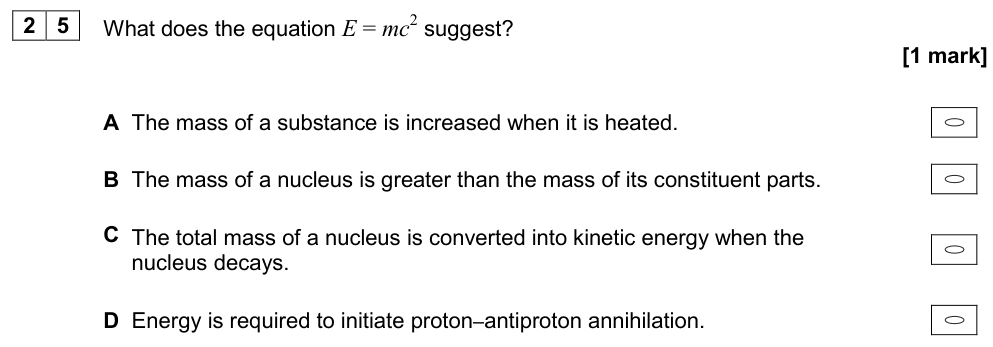
Einstein's special theory of relativity shows that mass and energy are equivalent:
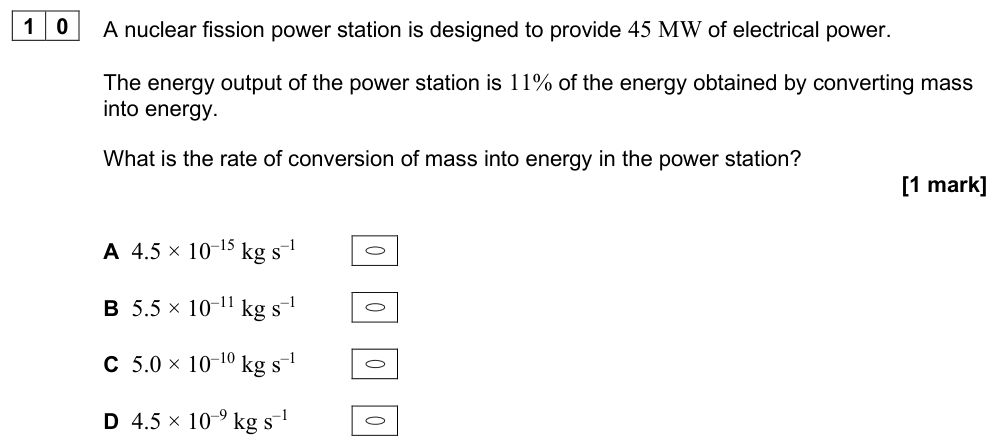
Mass–energy equivalence
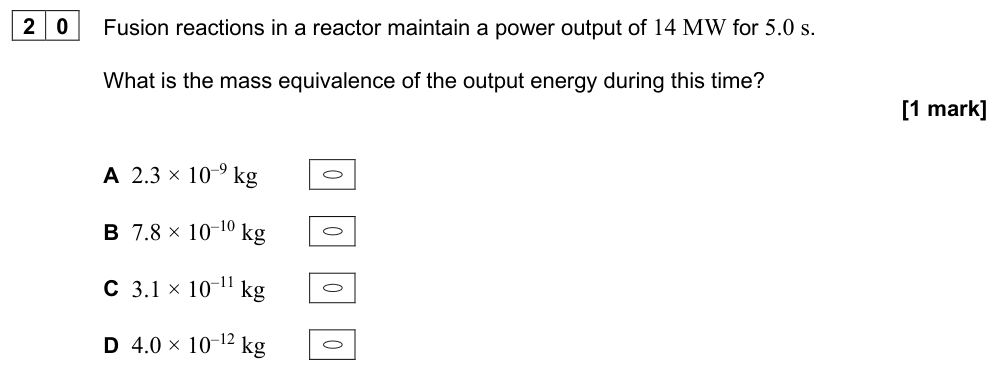
$$E = mc^2$$
A change of energy $\Delta E$ of a system is always accompanied by a change of mass $\Delta m = \Delta E/c^2$, where $c = 3.00 \times 10^{8}$ m s⁻¹.
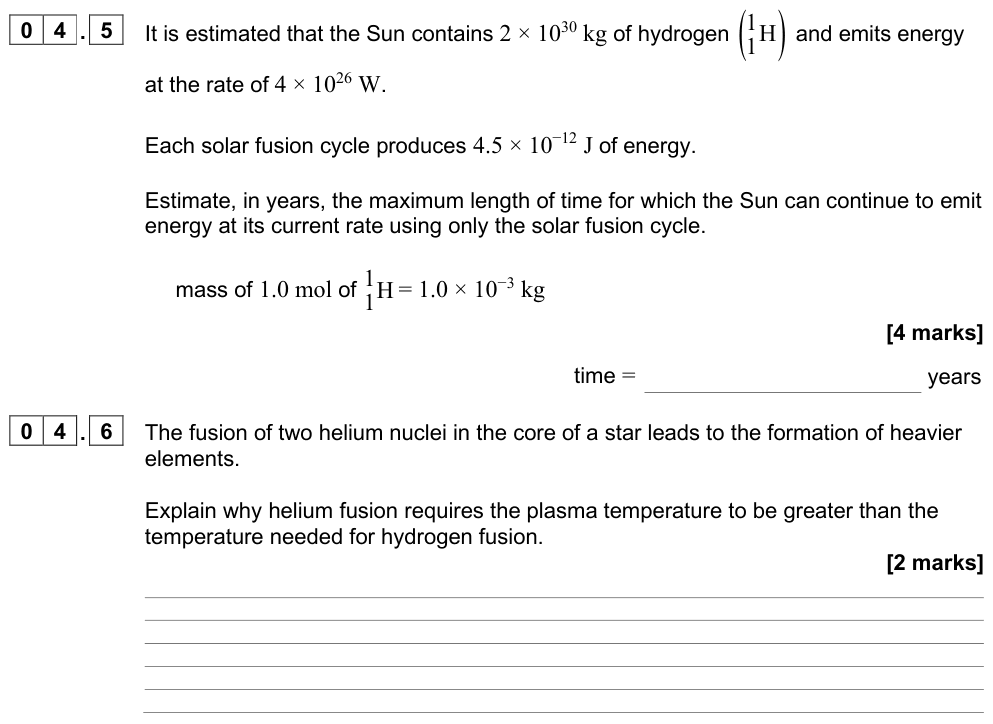
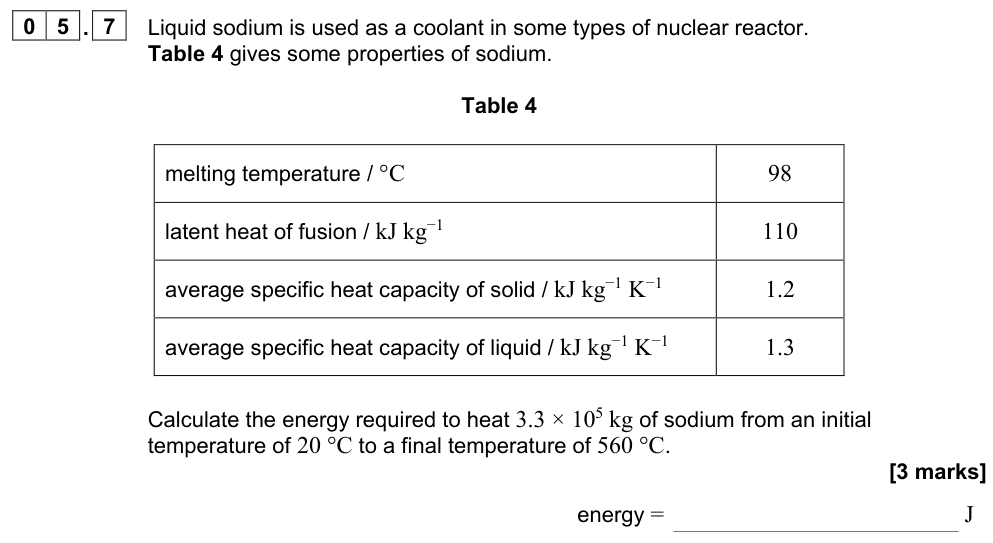
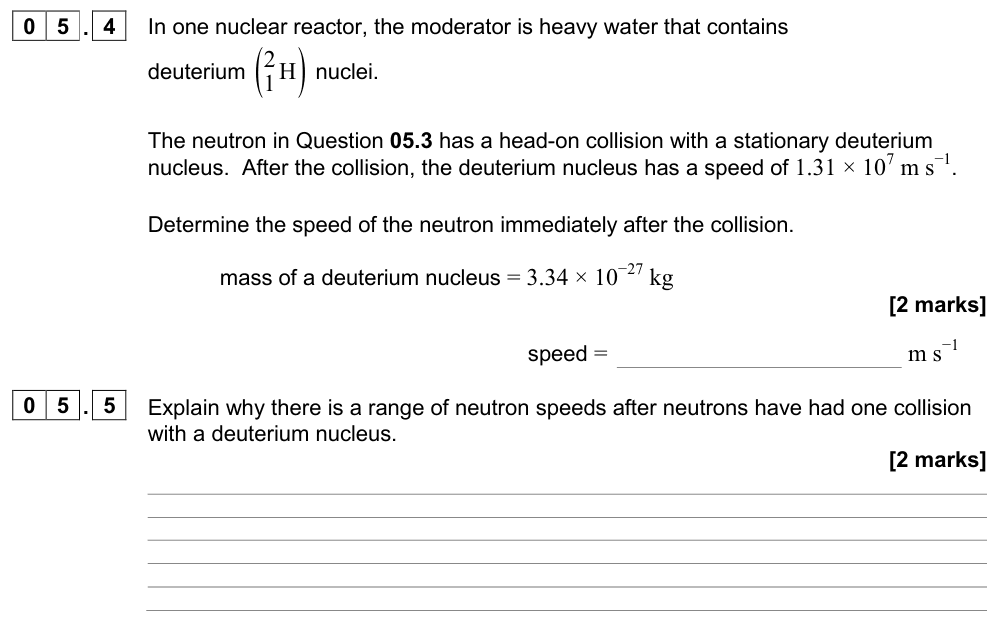
This applies to all energy changes, not just nuclear ones. A cup of hot coffee has slightly more mass than the same coffee cold; a stretched spring has slightly more mass than an unstretched one. The changes are usually far too small to measure: heating 1 kg of water by 80 K adds $3.4 \times 10^{5}$ J, which increases its mass by only $3.4 \times 10^{5}/(3.00 \times 10^{8})^2 = 3.7 \times 10^{-12}$ kg. In nuclear reactions the energy changes are about a million times larger per particle, so the mass changes are significant.
The atomic mass unit
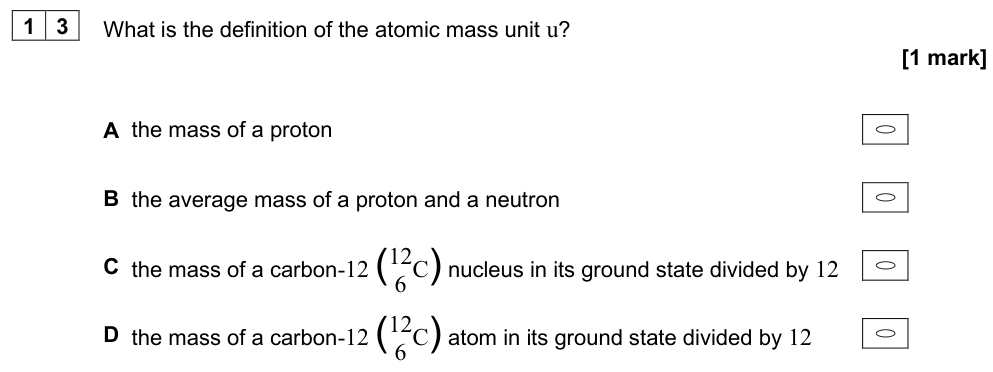
Nuclear masses are given in atomic mass units (u):
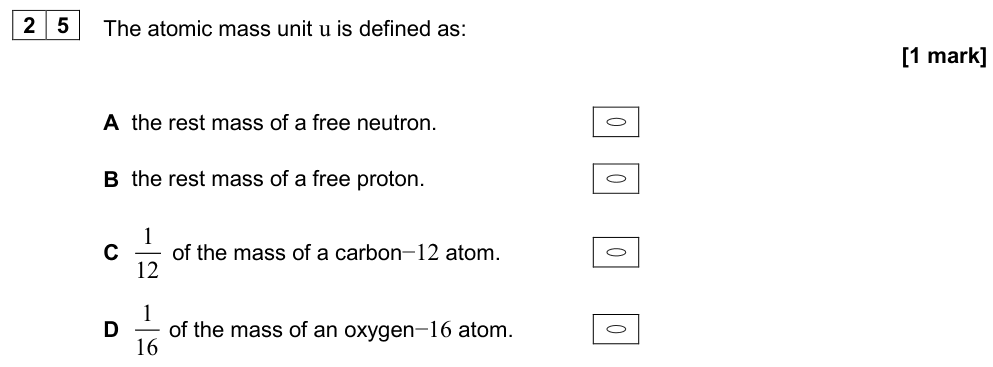
Atomic mass unit
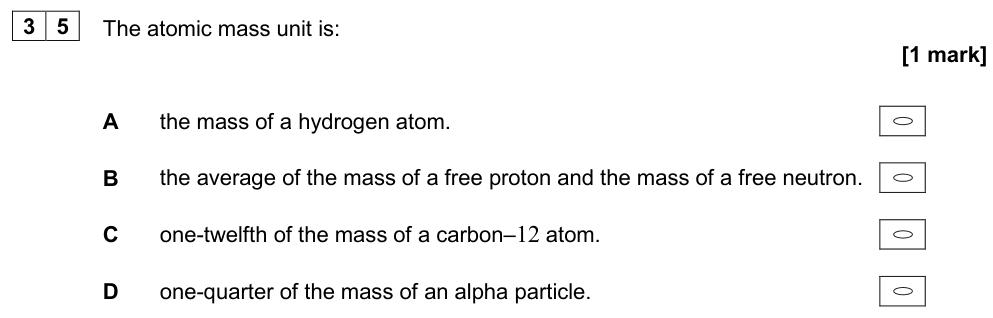
$1\ \text{u} = \dfrac{1}{12}$ of the mass of a carbon-12 atom $= 1.661 \times 10^{-27}$ kg.
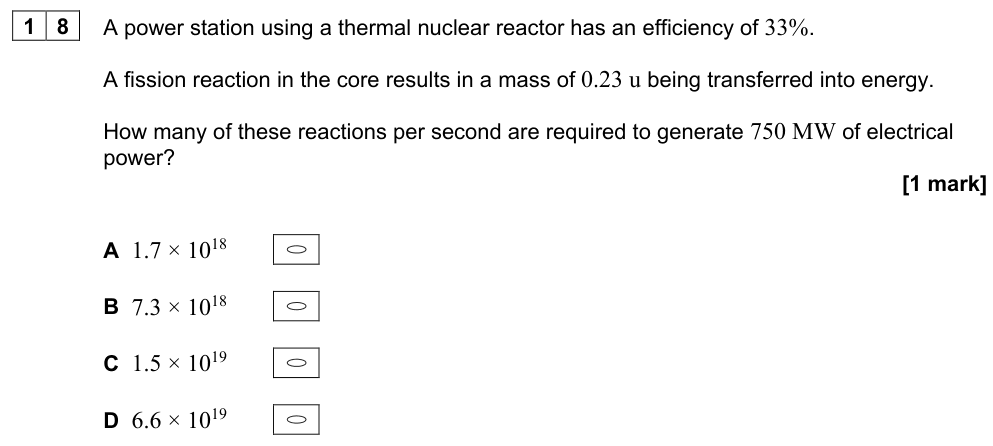
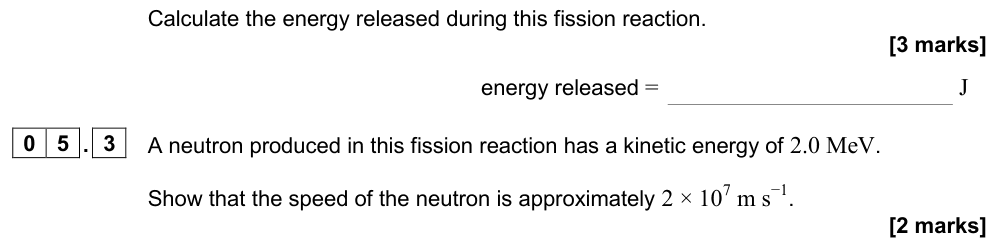
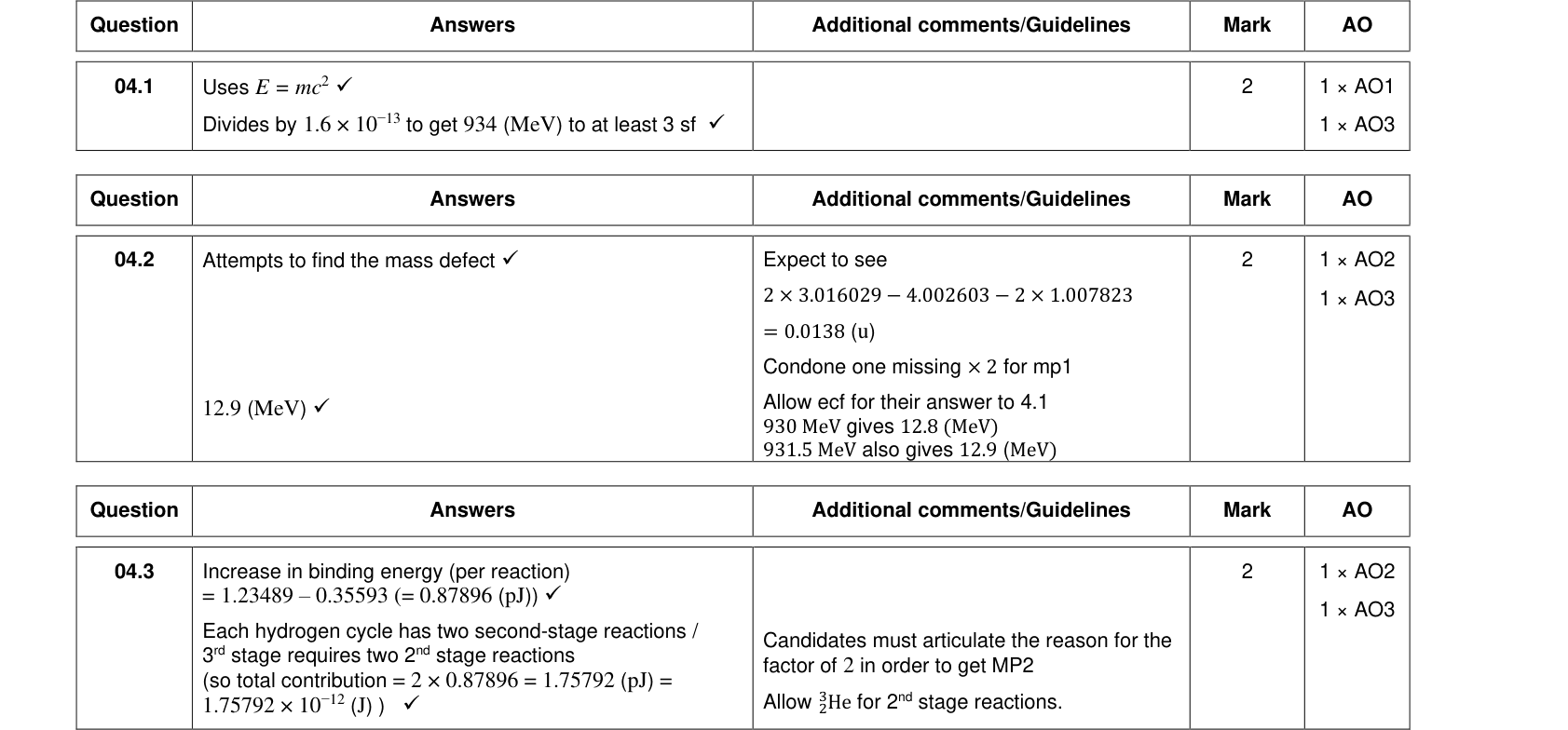
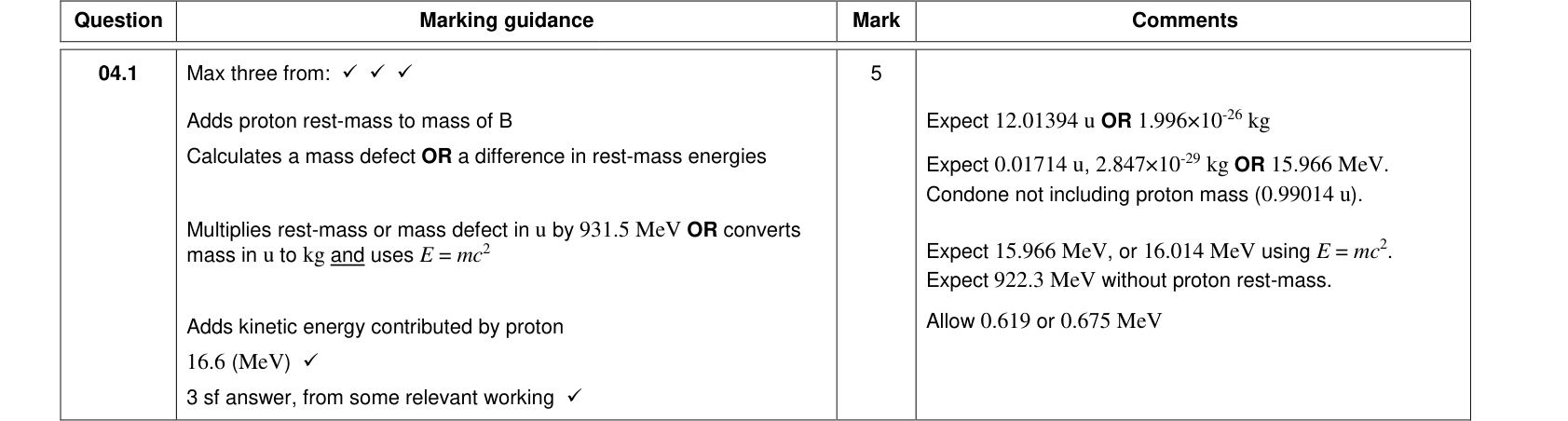
The energy equivalent of 1 u is $1.661 \times 10^{-27} \times (3.00 \times 10^{8})^2 = 1.49 \times 10^{-10}$ J $=$ 931.5 MeV (using precise constants).
Unit conversion
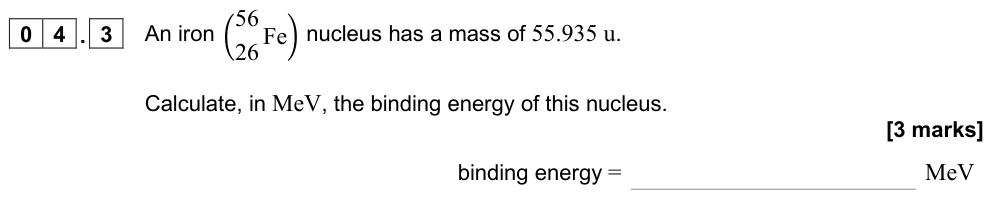
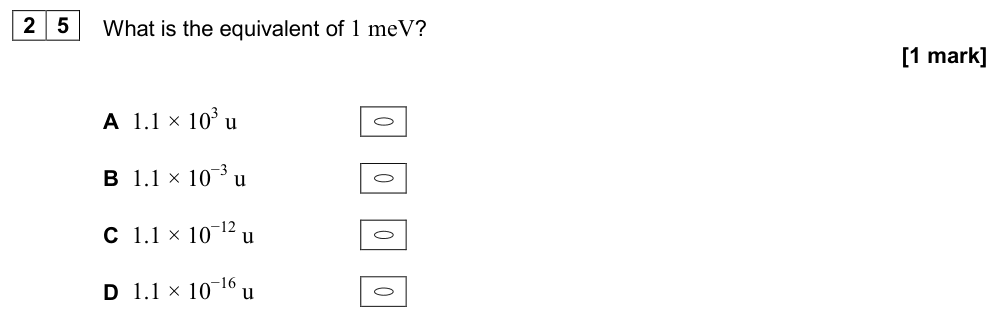
$$1\ \text{u} \equiv 931.5\ \text{MeV} \qquad 1\ \text{MeV} = 1.60 \times 10^{-13}\ \text{J}$$
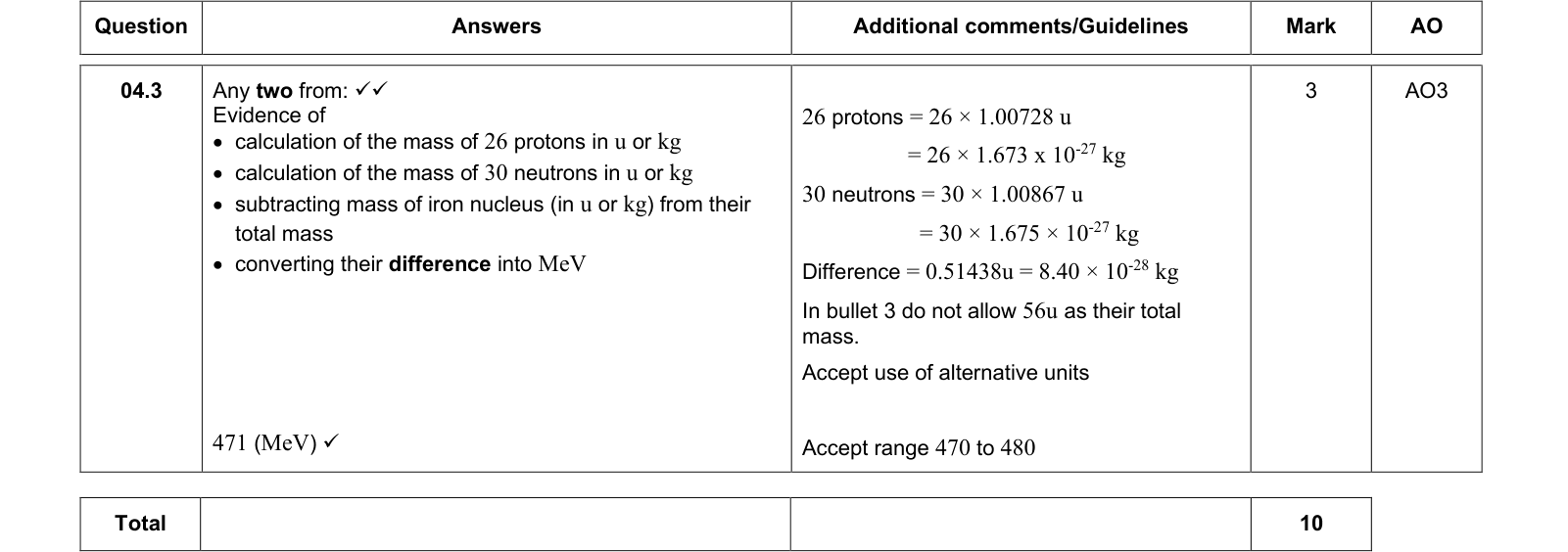
So a mass difference in u can be converted directly to energy in MeV by multiplying by 931.5.
| Particle | Mass / u |
|---|---|
| proton | 1.00728 |
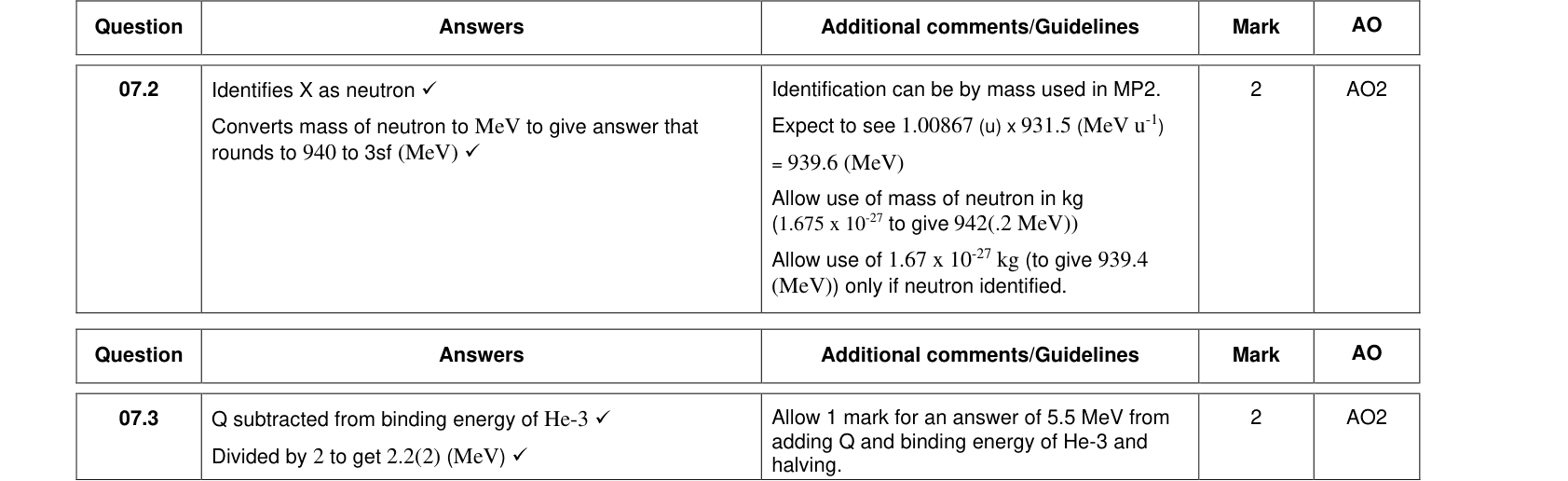
| neutron | 1.00867 |
| electron | 0.00055 |
Mass defect and binding energy
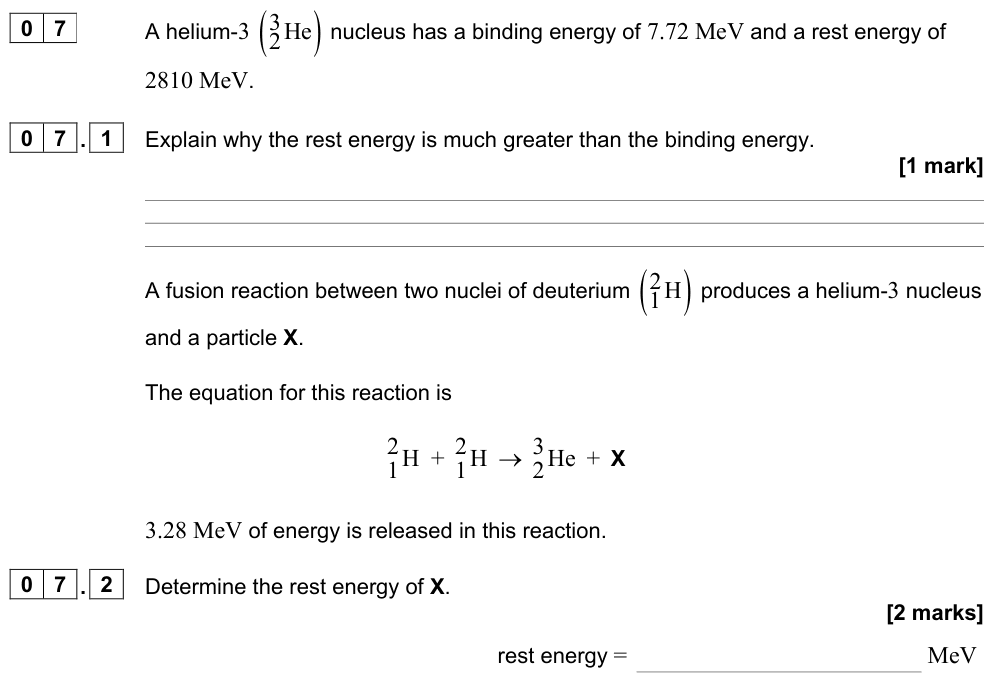
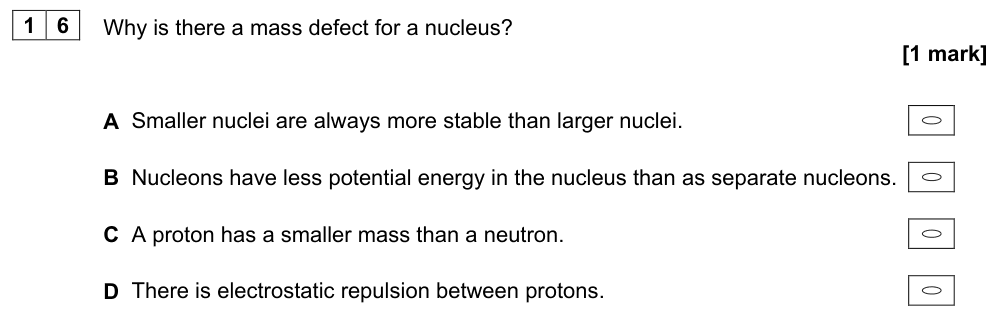
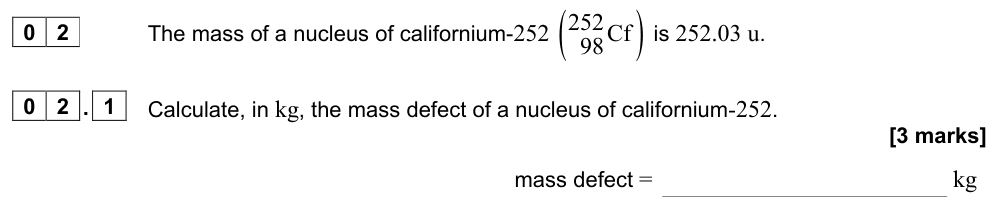
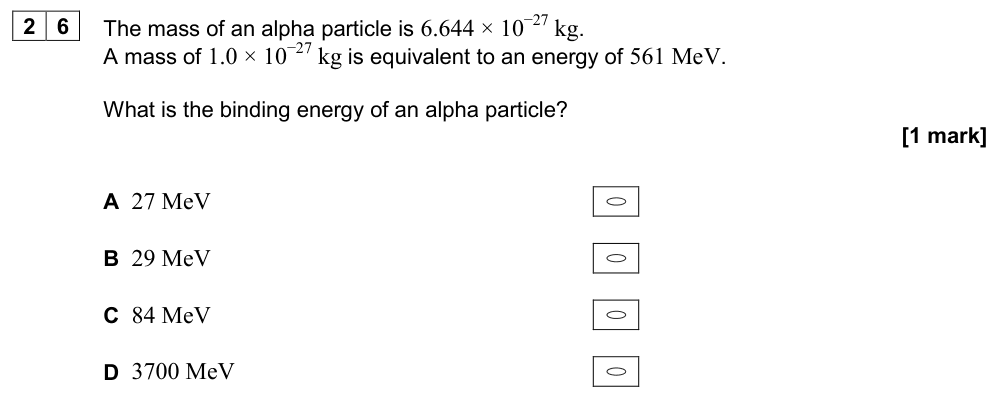
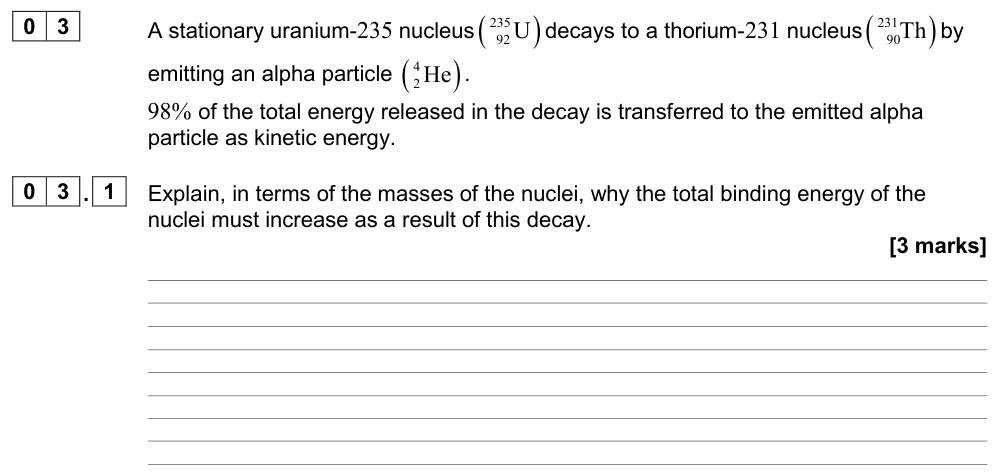
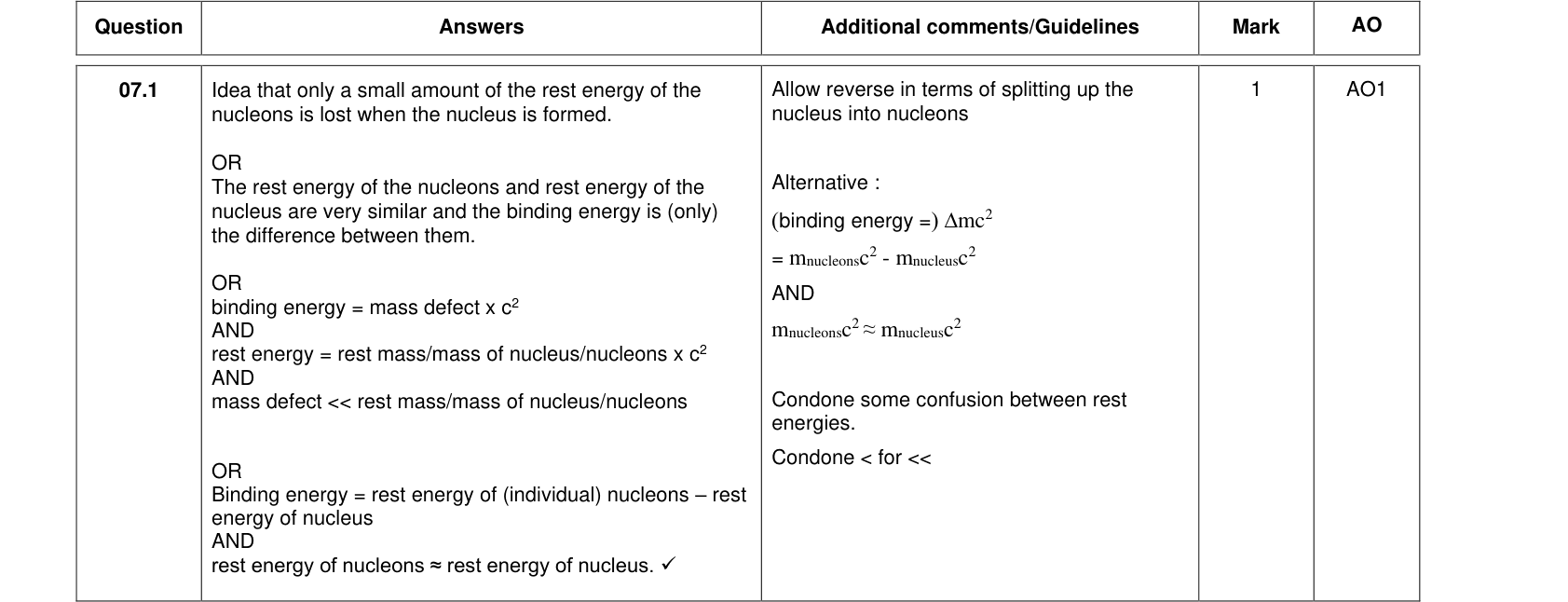
The mass of a nucleus is always less than the total mass of its separate protons and neutrons.
Mass defect
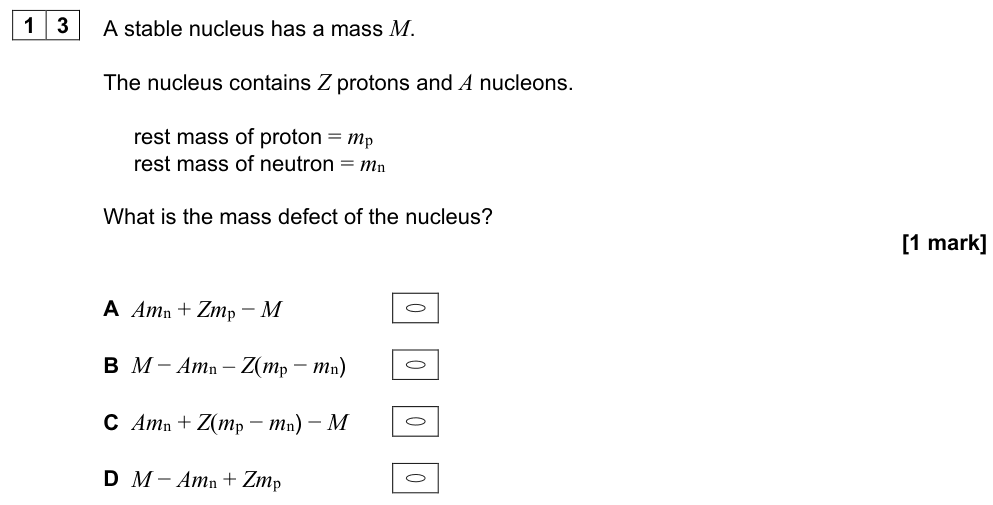
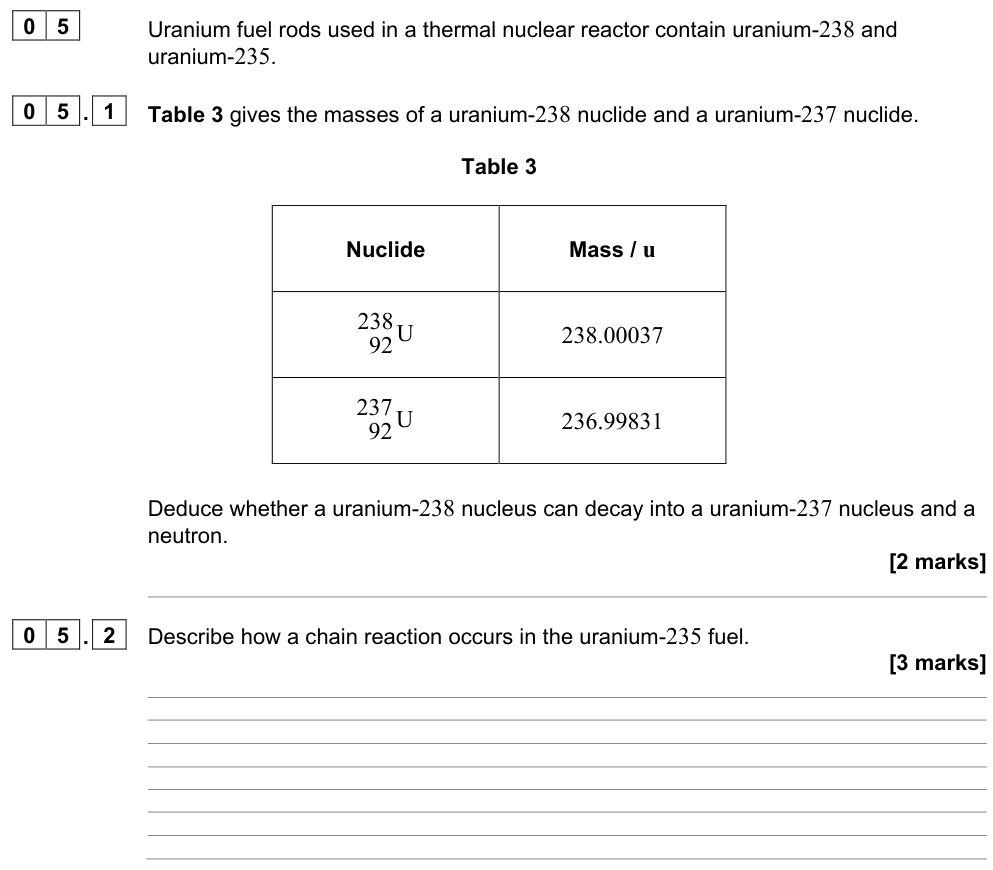
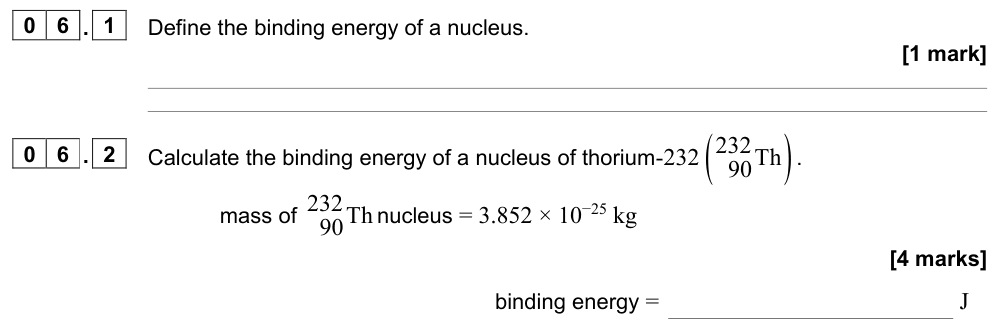
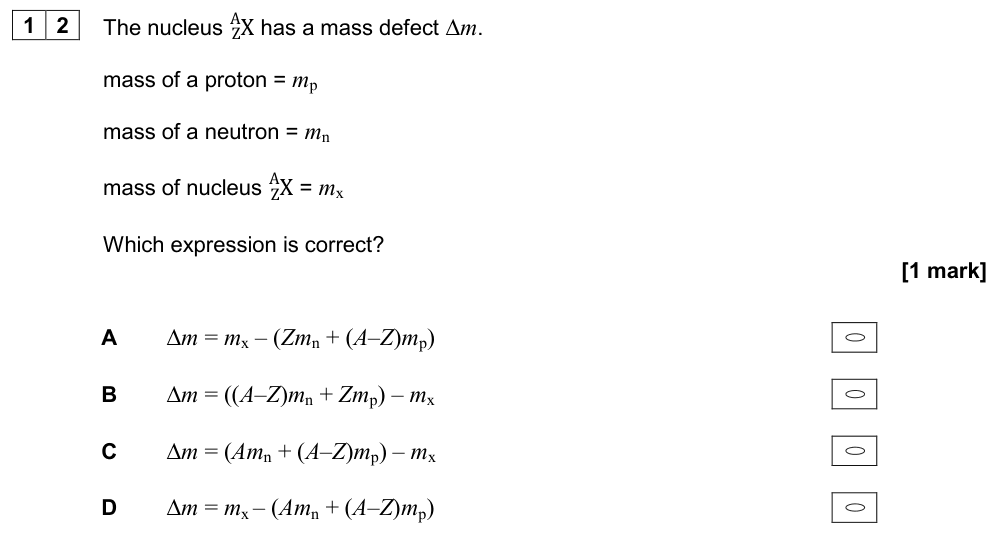
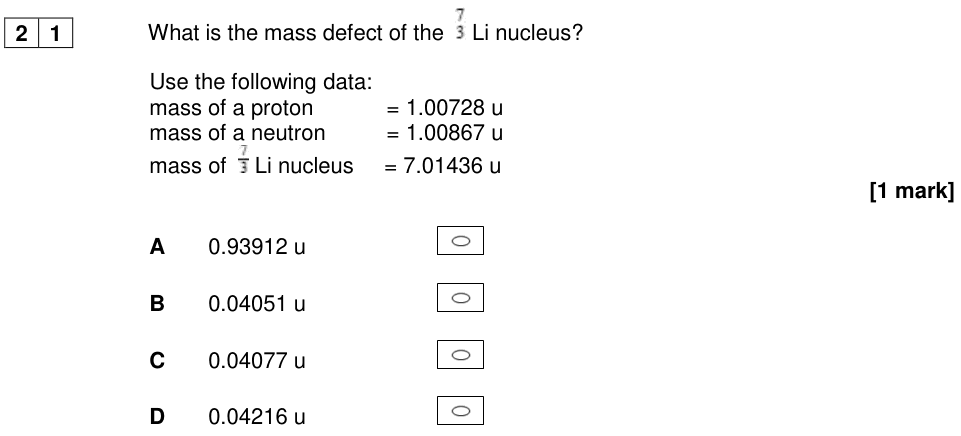
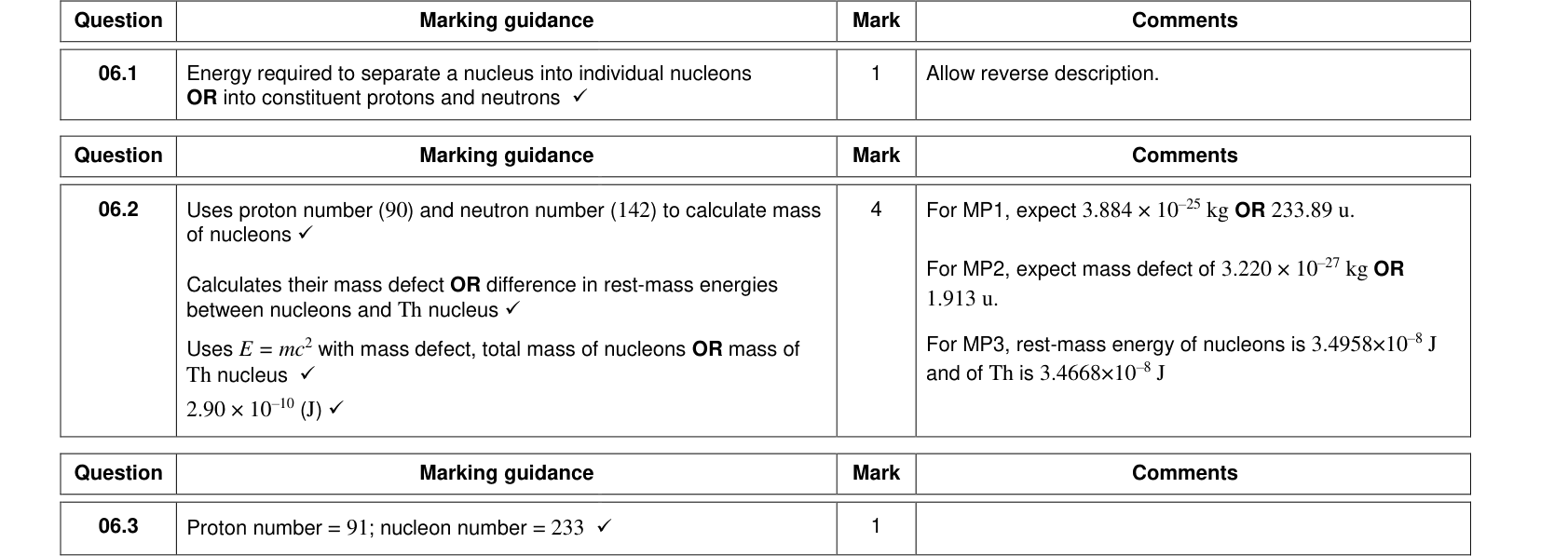
The mass defect $\Delta m$ of a nucleus is the difference between the total mass of its separate nucleons and the mass of the nucleus: $$\Delta m = Zm_p + (A - Z)m_n - m_{\text{nucleus}}$$
Binding energy
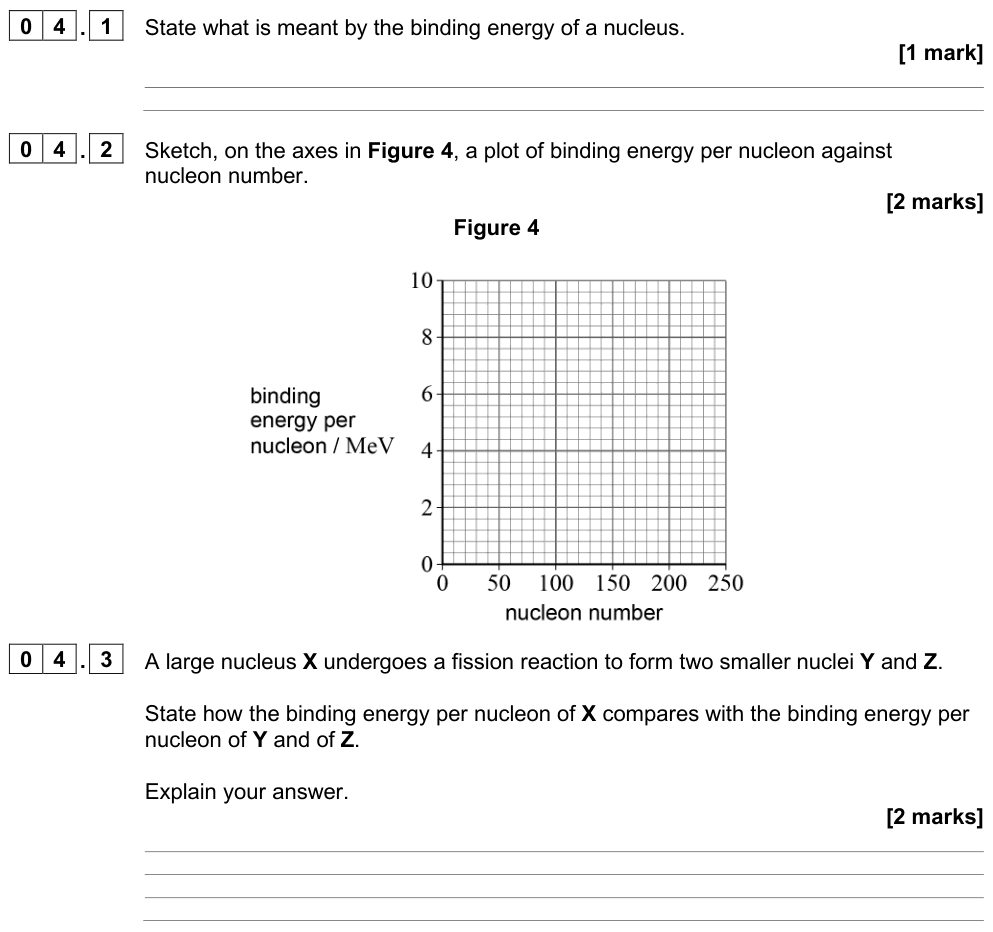
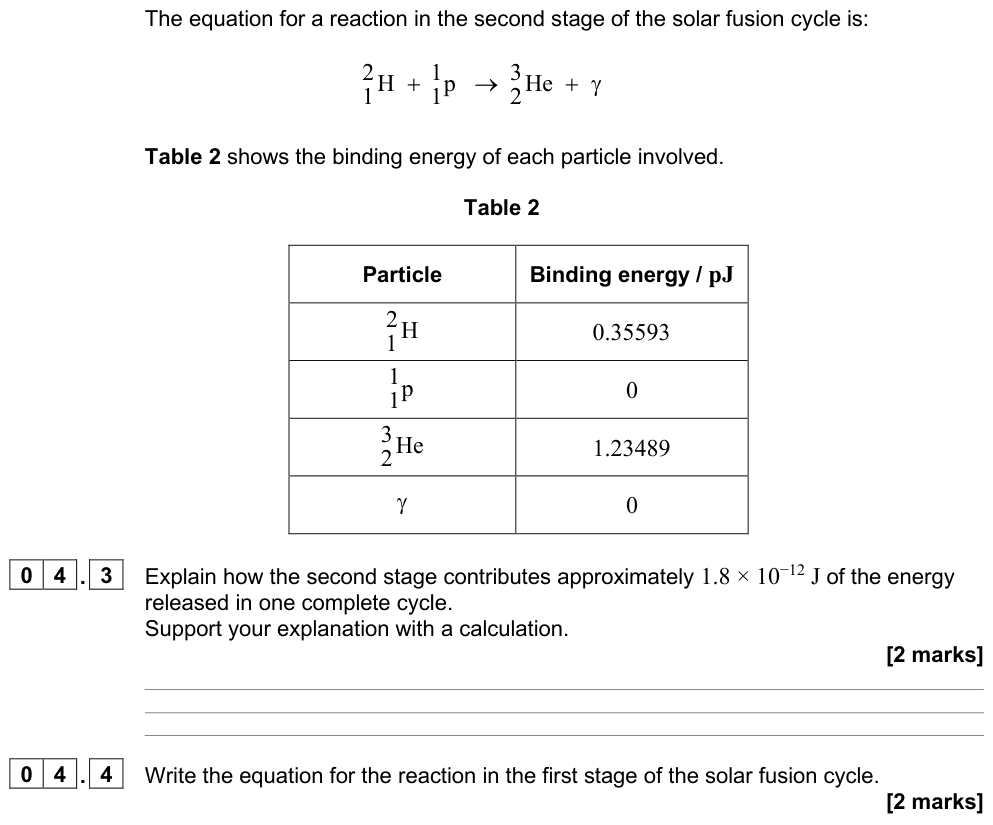
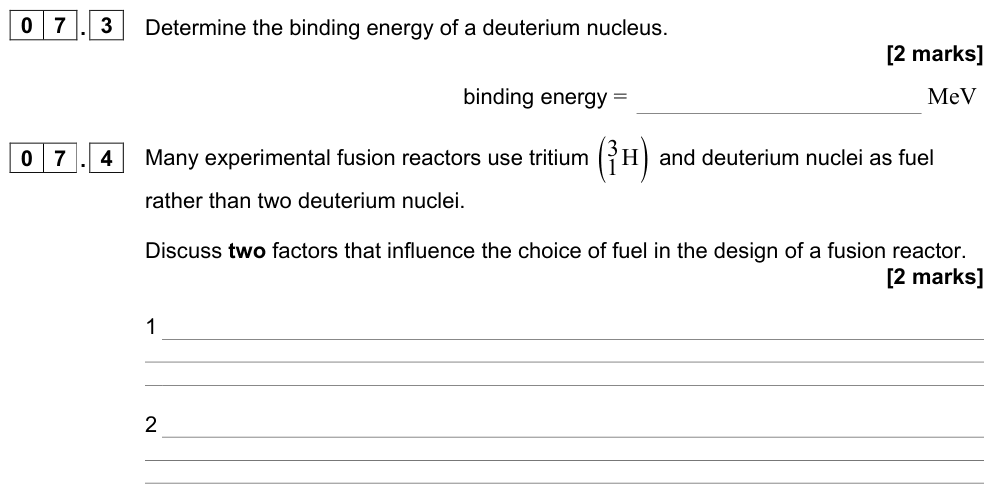
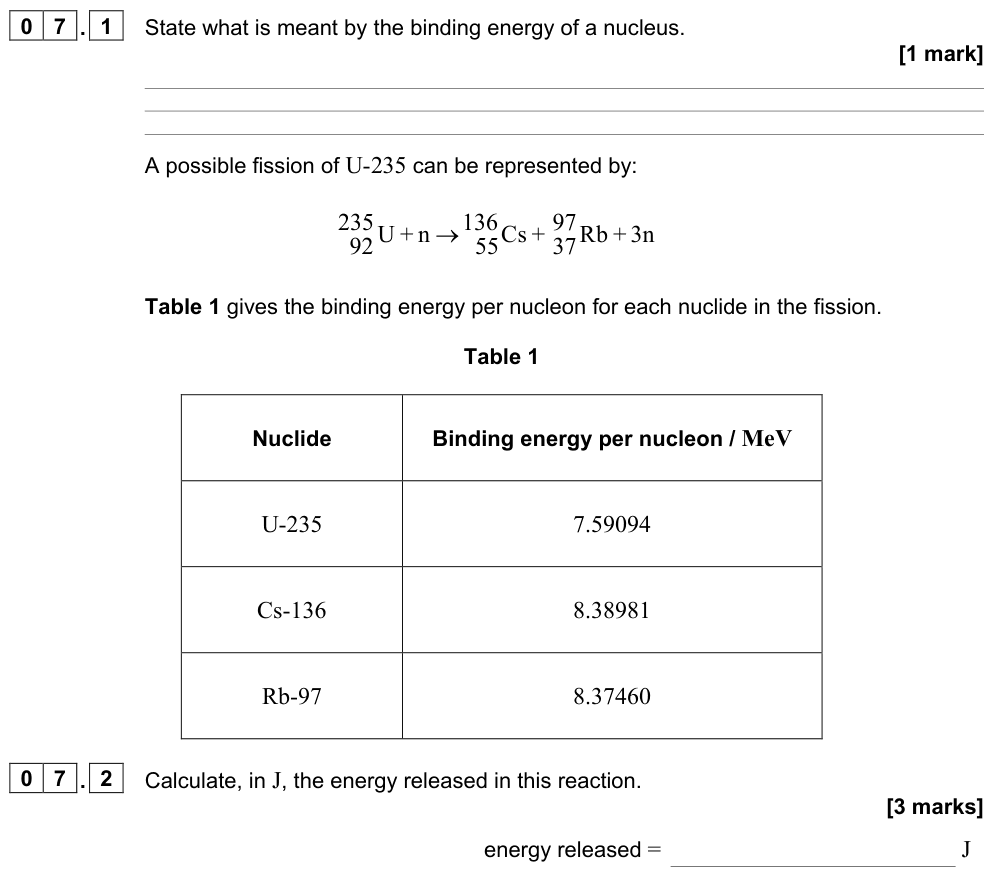
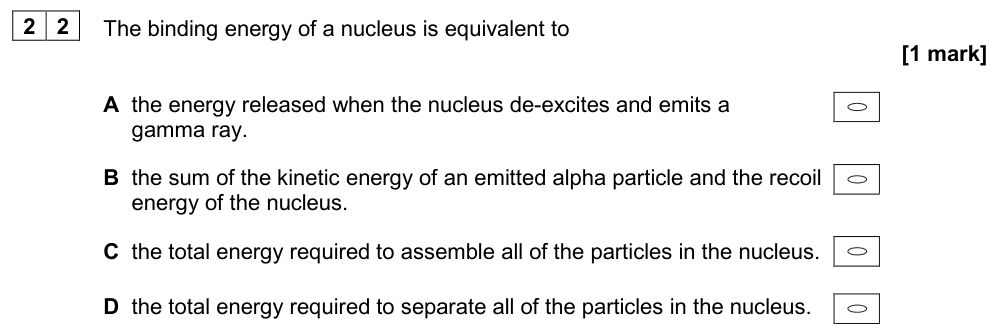
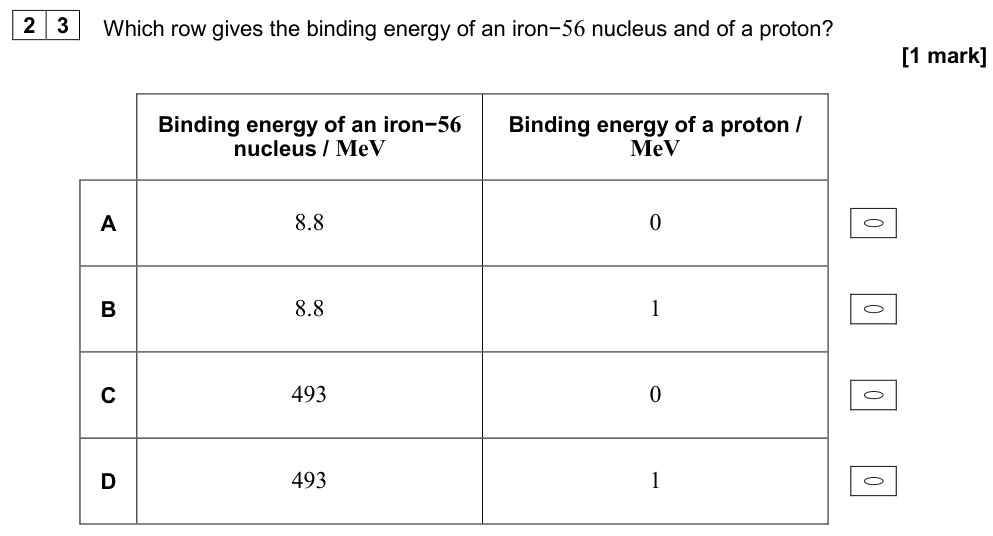
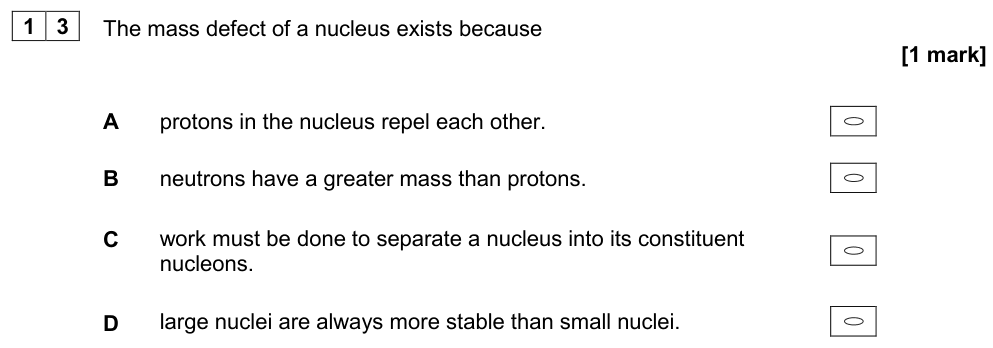
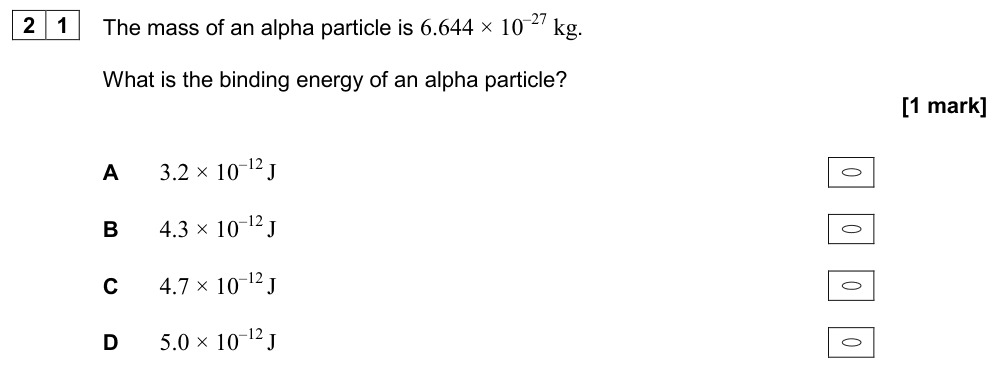
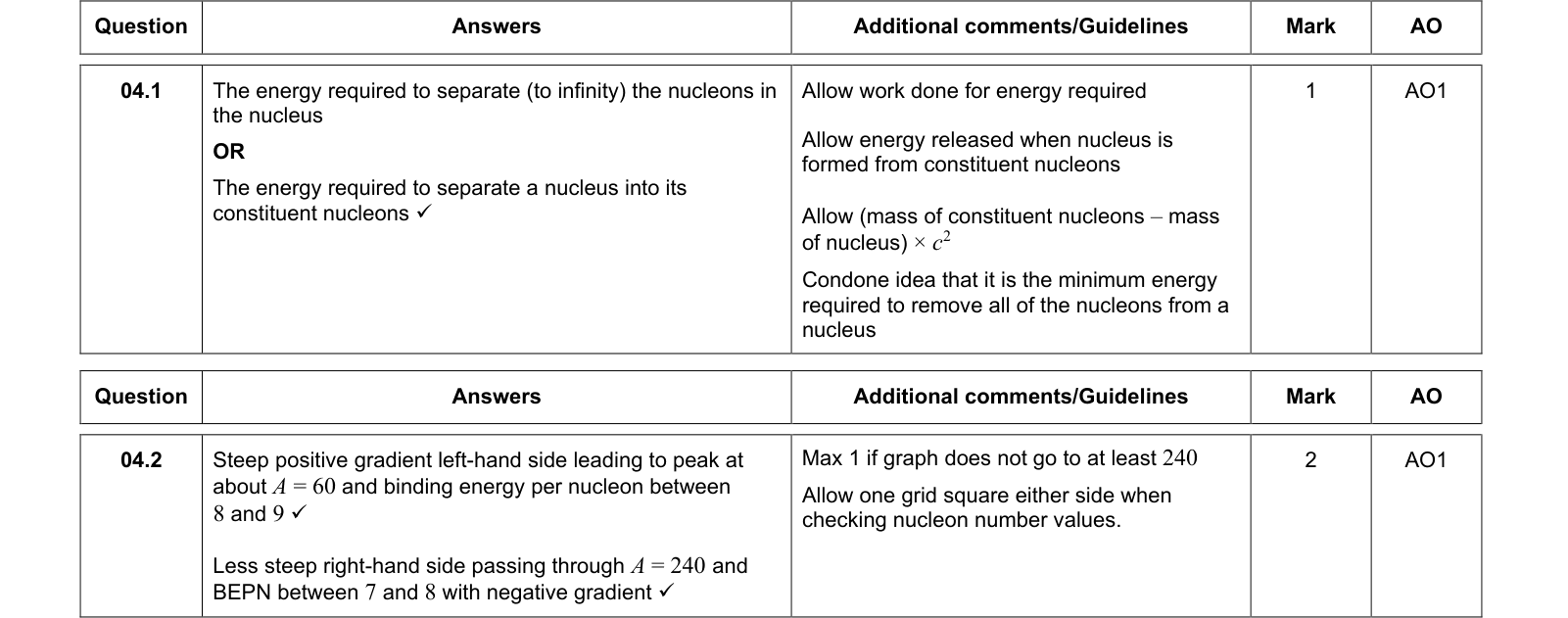
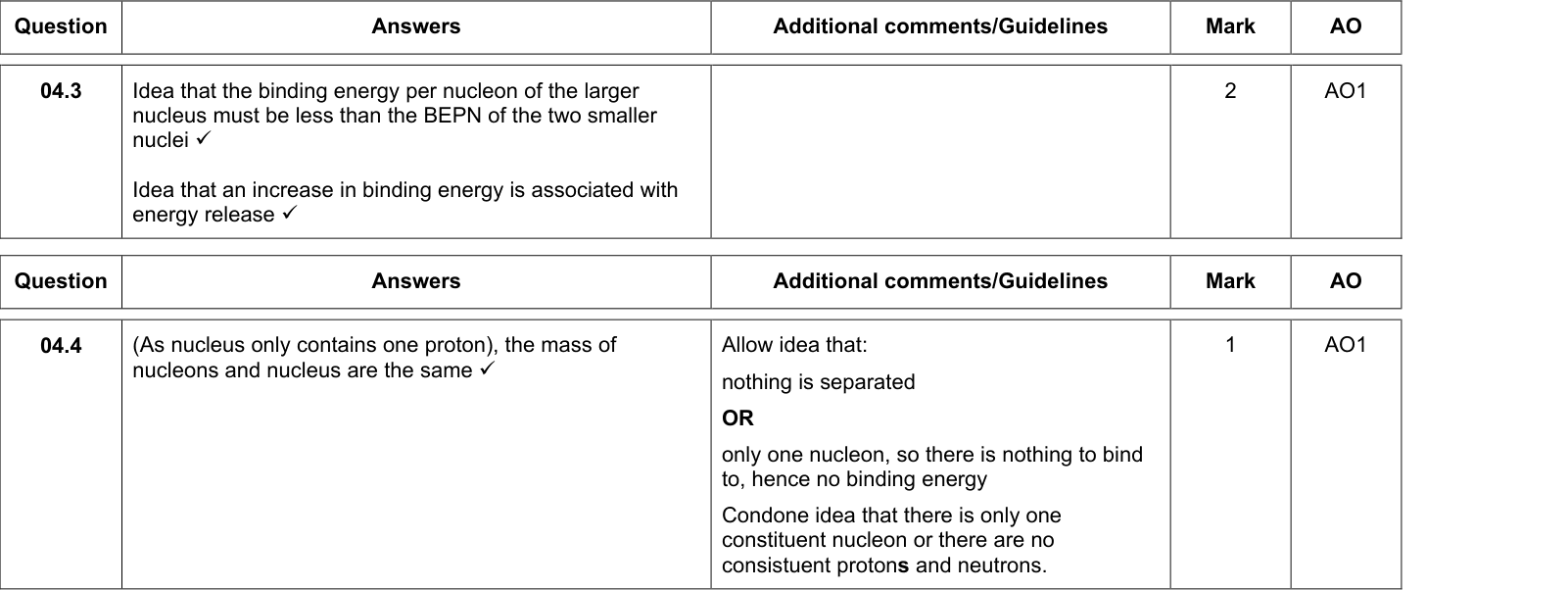
The binding energy of a nucleus is the energy needed to separate it completely into its individual protons and neutrons. It equals the energy released when the nucleus is formed from separate nucleons: $$\text{binding energy} = \Delta m\,c^2$$
When nucleons come together, the strong nuclear force does work on them and energy is released (for example as gamma radiation), so the system loses mass. The binding energy is not energy the nucleus "contains": it is the energy you would have to supply to pull it apart.
Worked example: helium-4
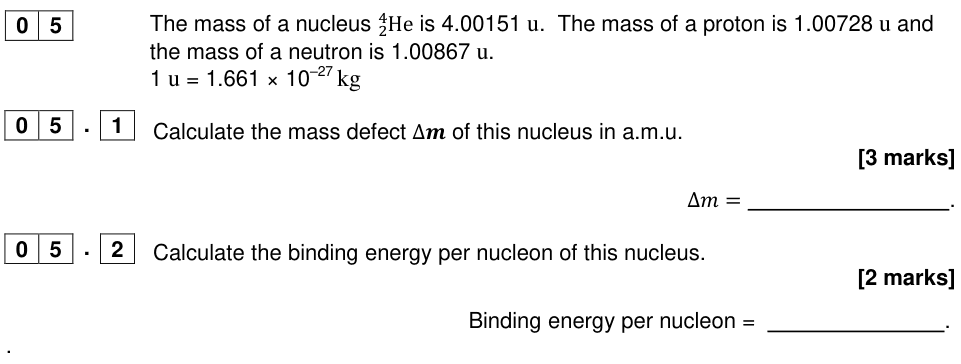
The mass of a helium-4 nucleus is 4.00151 u.
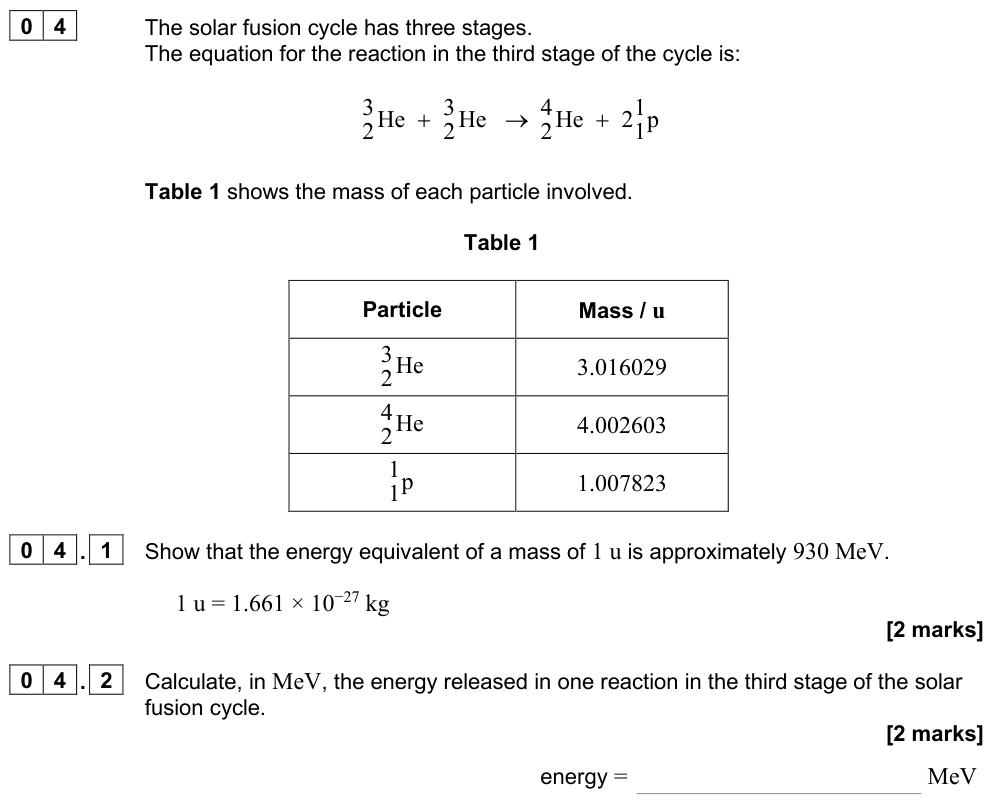
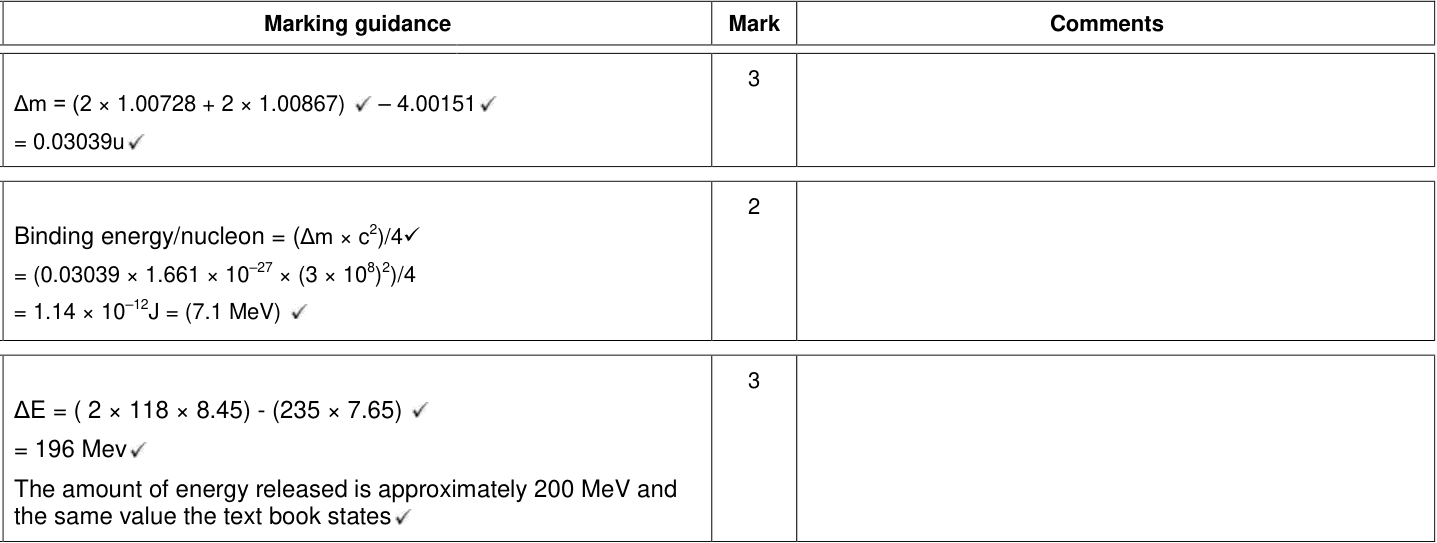
Mass of 2 protons + 2 neutrons $= 2(1.00728) + 2(1.00867) = 4.03190$ u.
Mass defect $= 4.03190 - 4.00151 = 0.03039$ u.
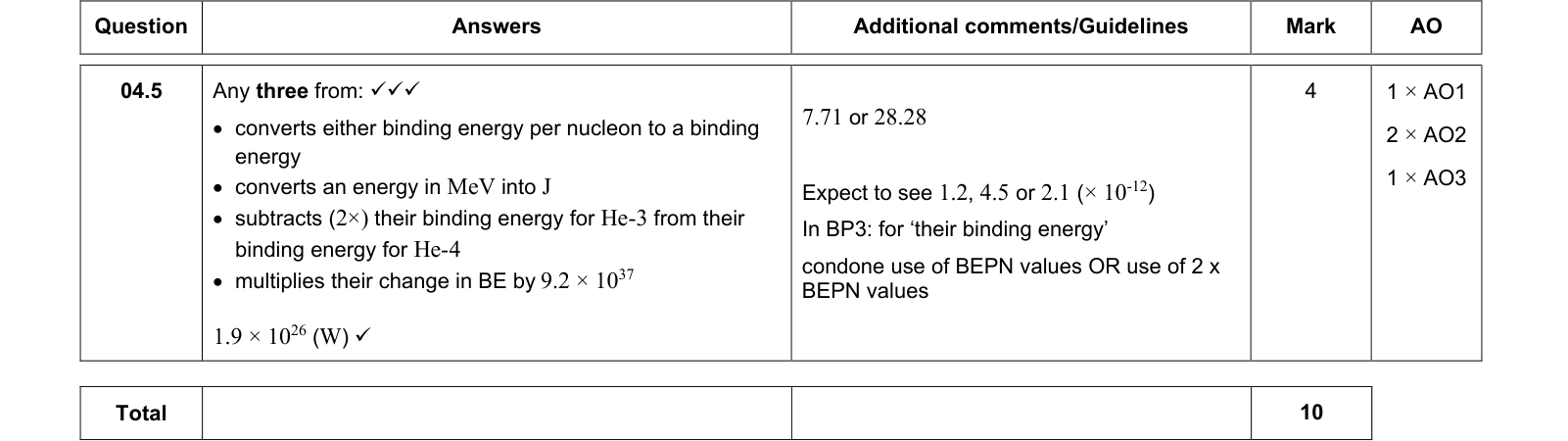
Binding energy $= 0.03039 \times 931.5 = 28.3$ MeV, so the binding energy per nucleon $= 28.3/4 = 7.1$ MeV.
Common mistake: atomic or nuclear masses?
Data tables usually give atomic masses, which include the electrons. To find the mass of a nucleus, subtract $Z$ electron masses. In reaction calculations where the number of electrons is the same on both sides, you can use atomic masses directly, because the electron masses cancel.
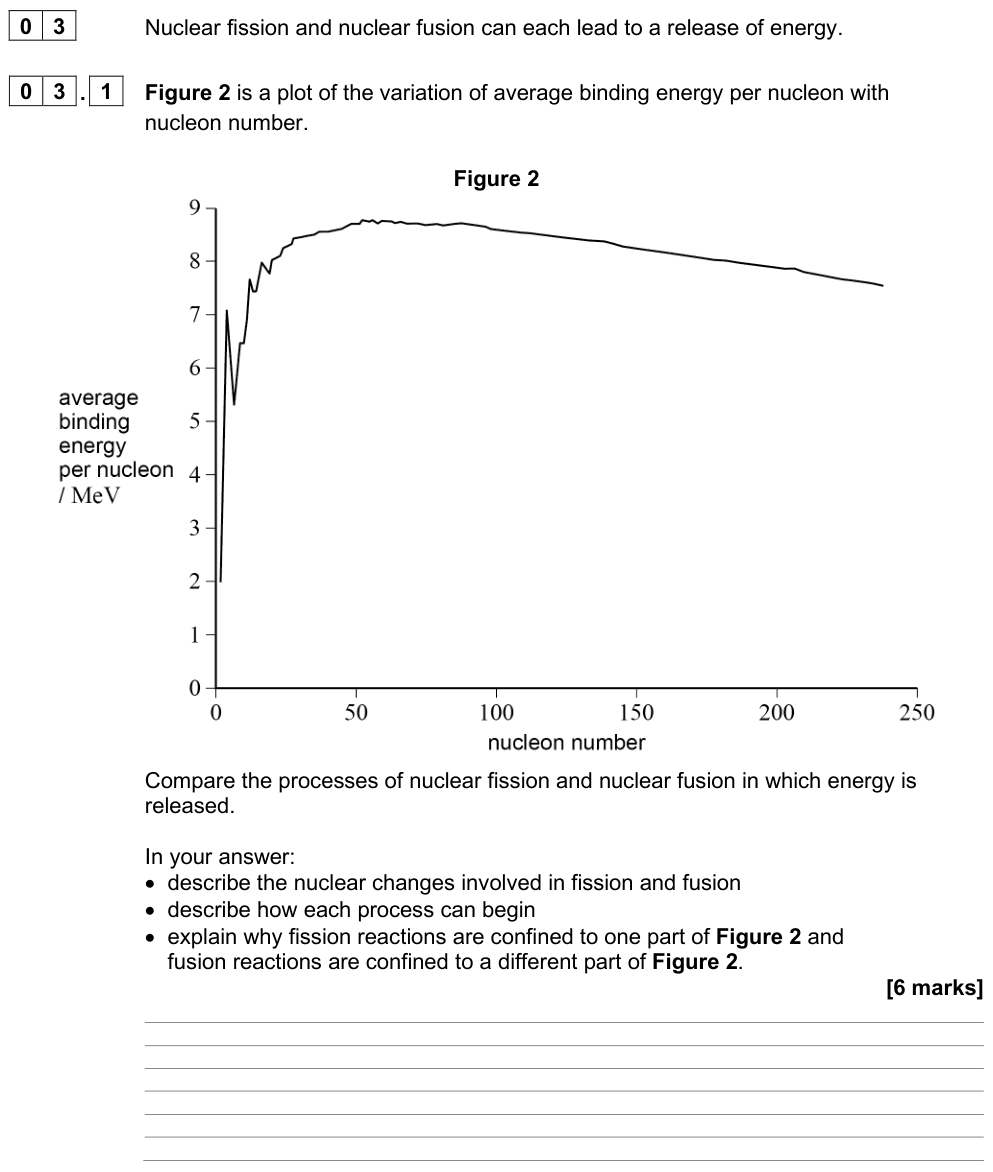
Binding energy per nucleon
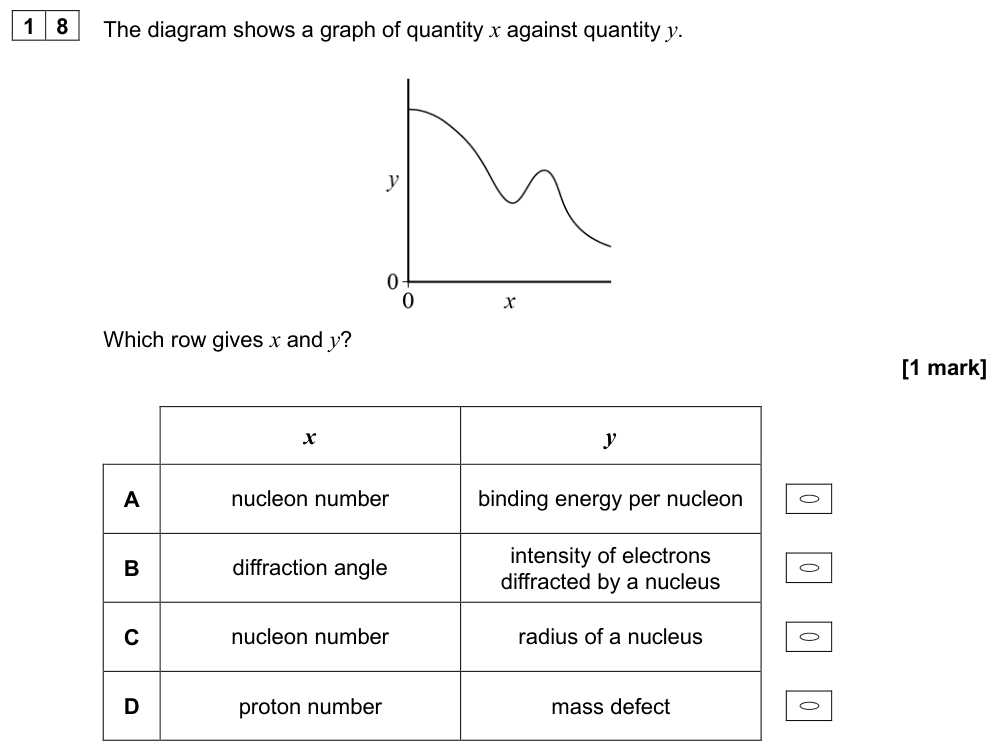
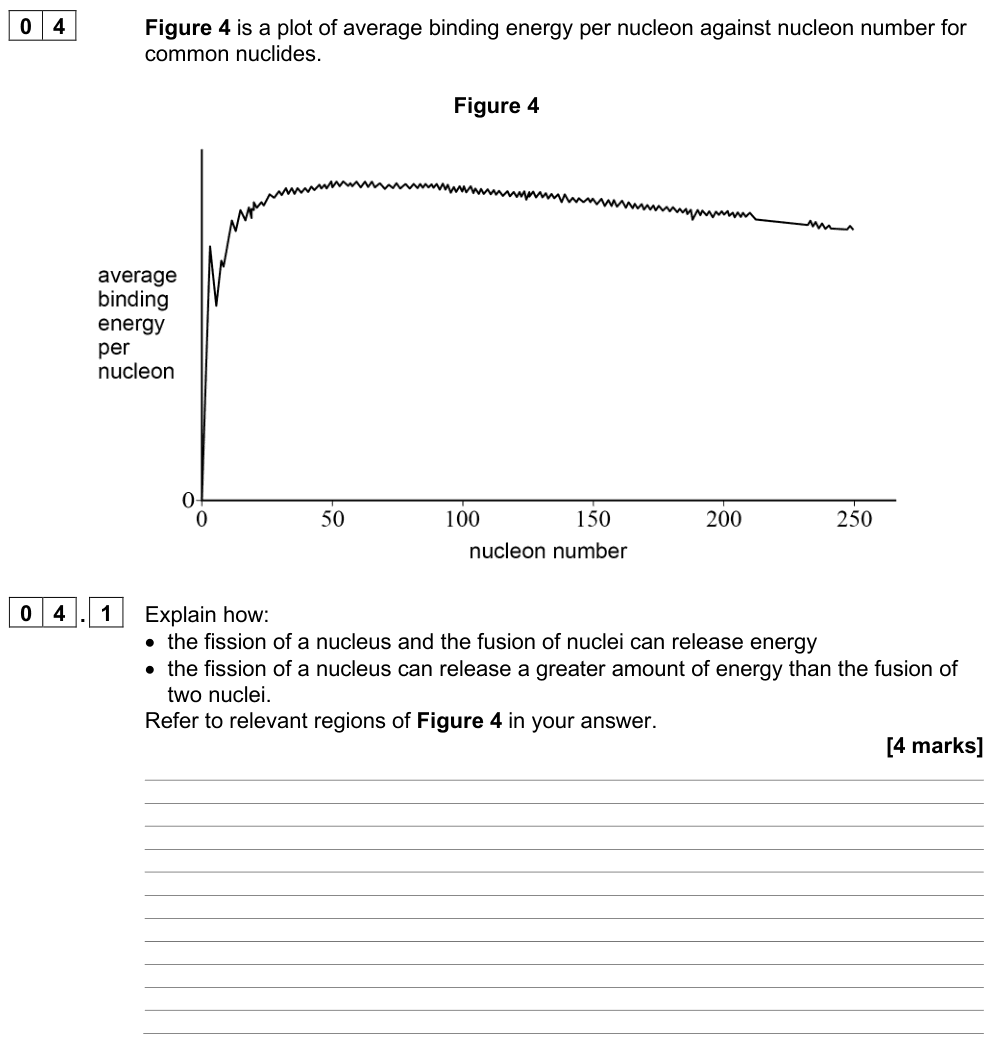
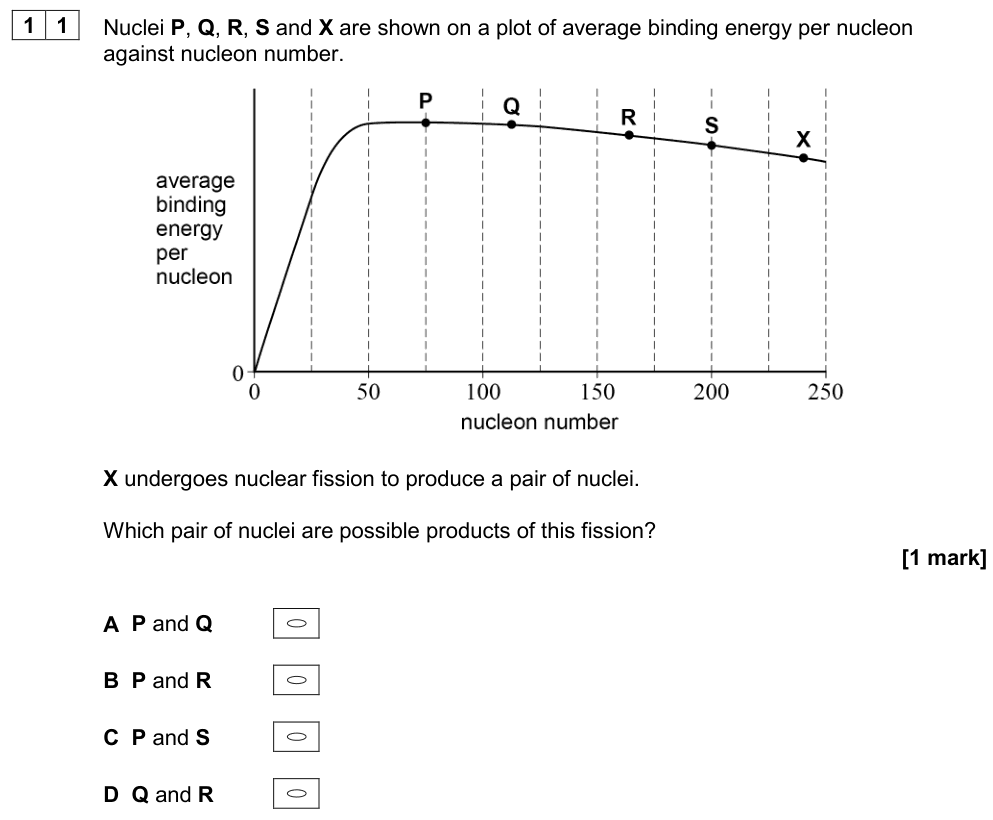
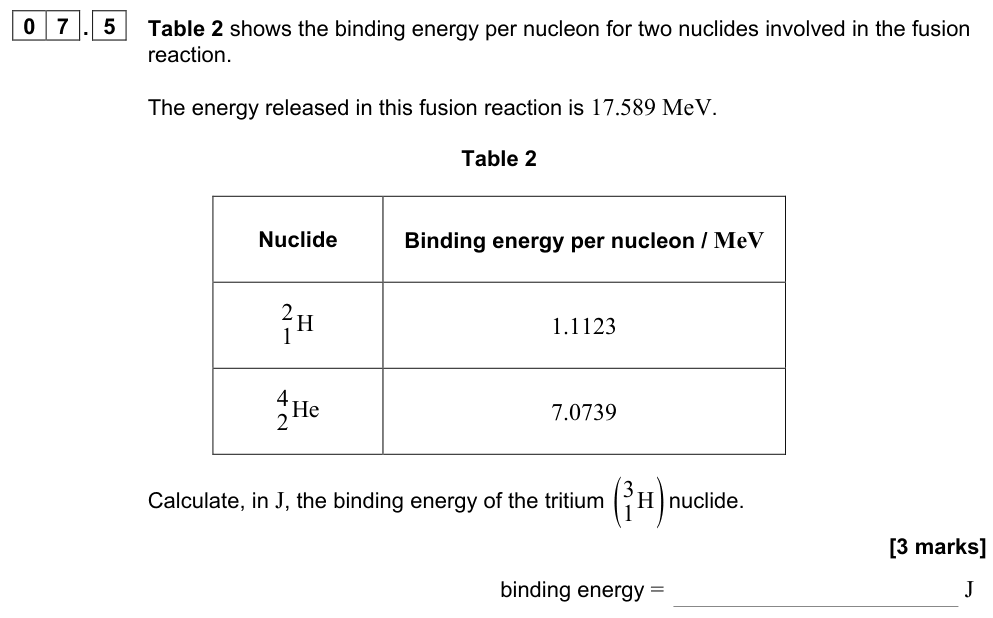
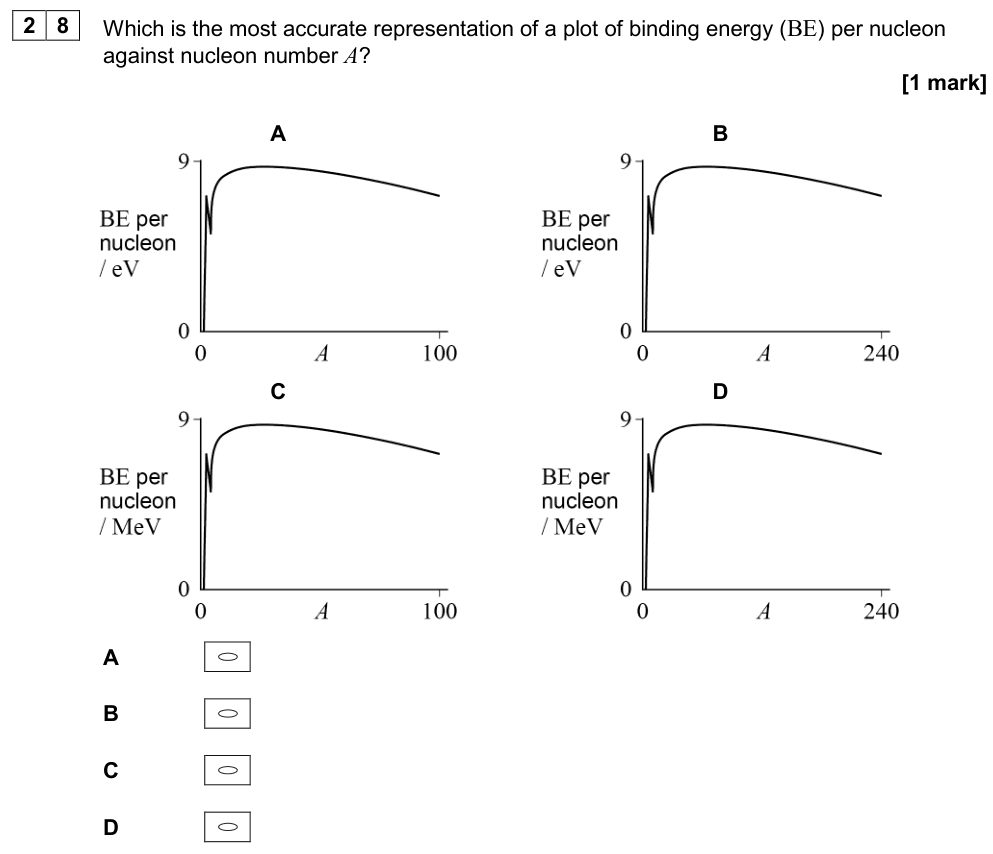
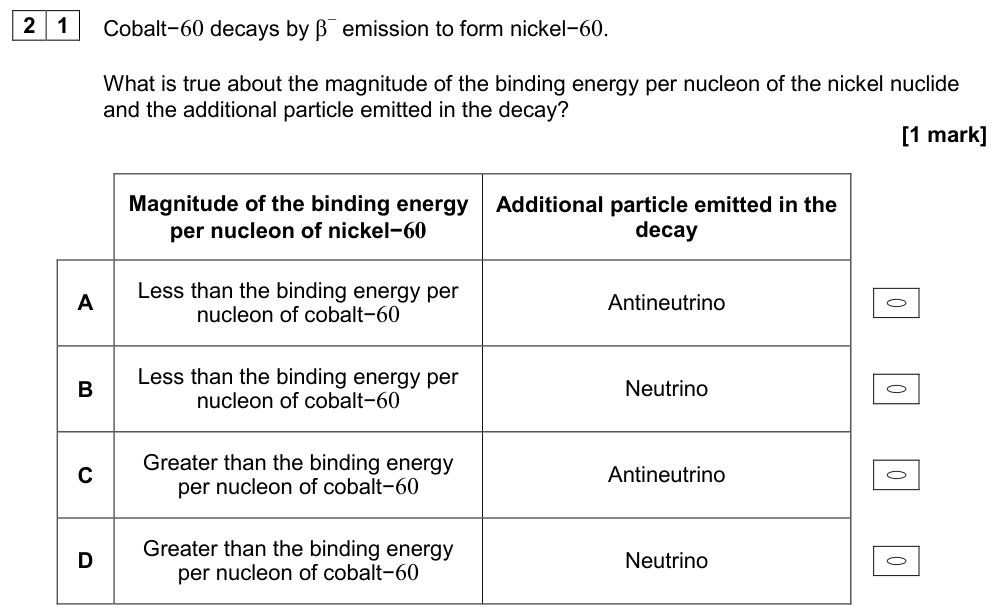
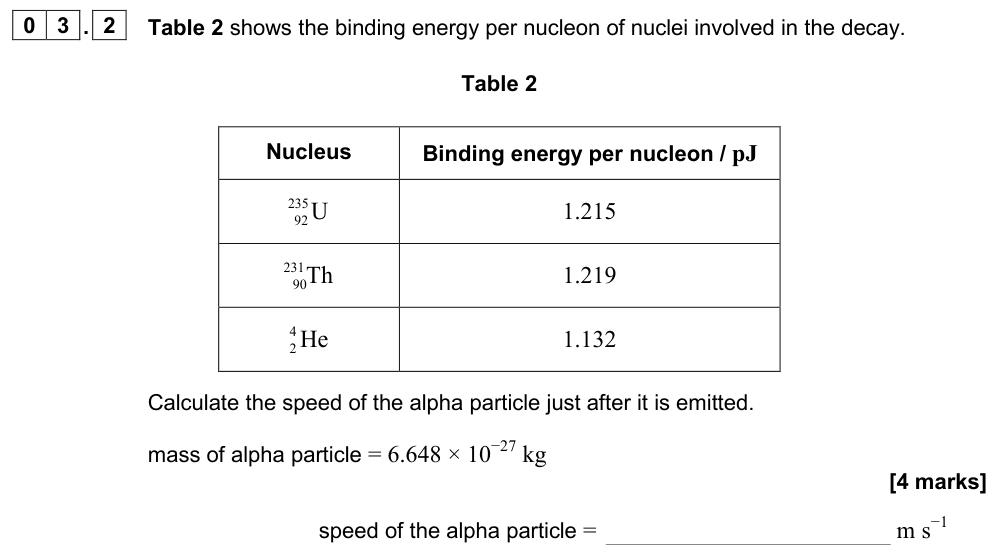
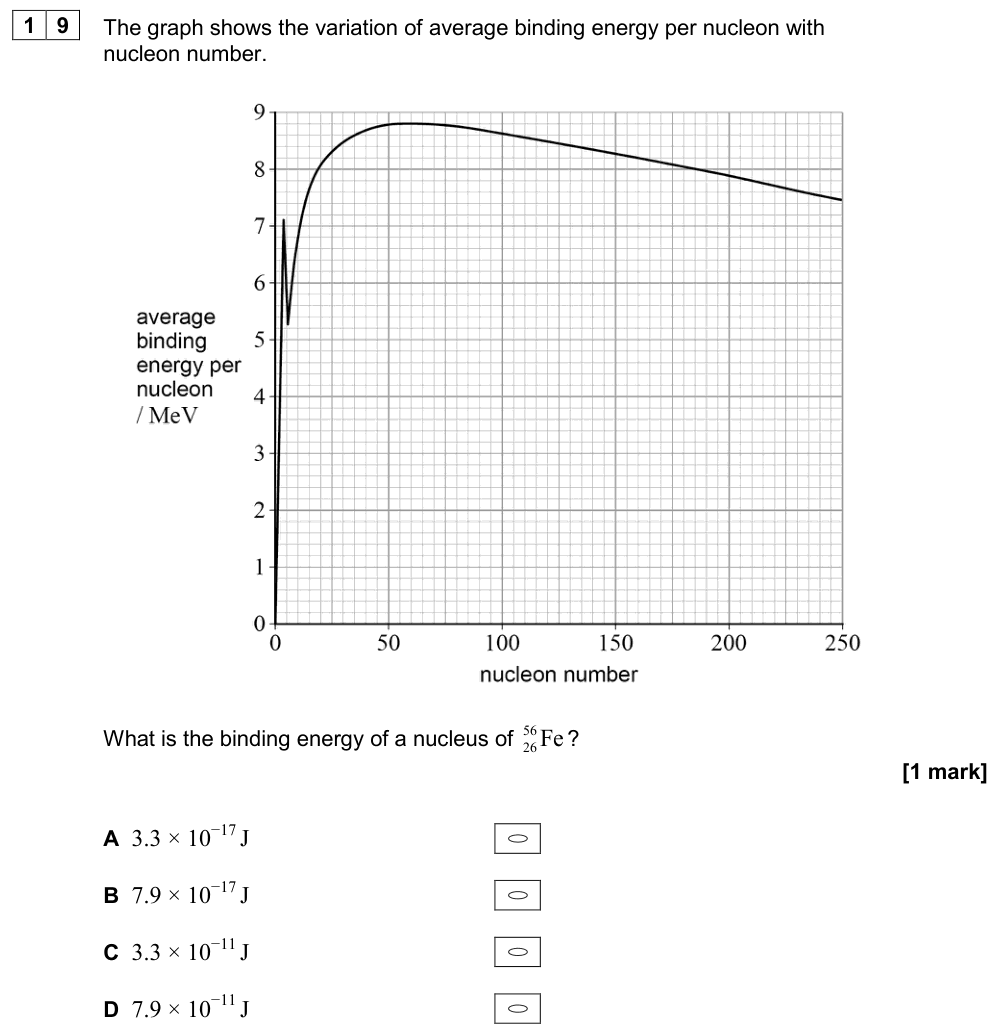
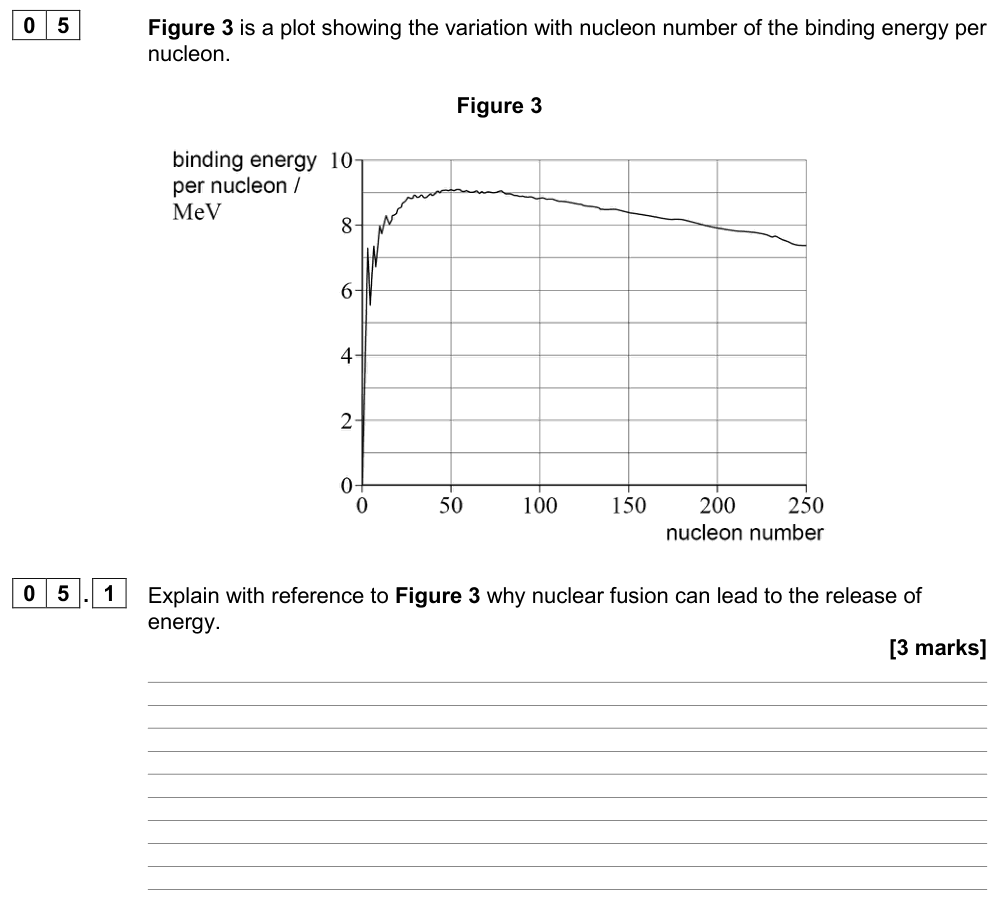
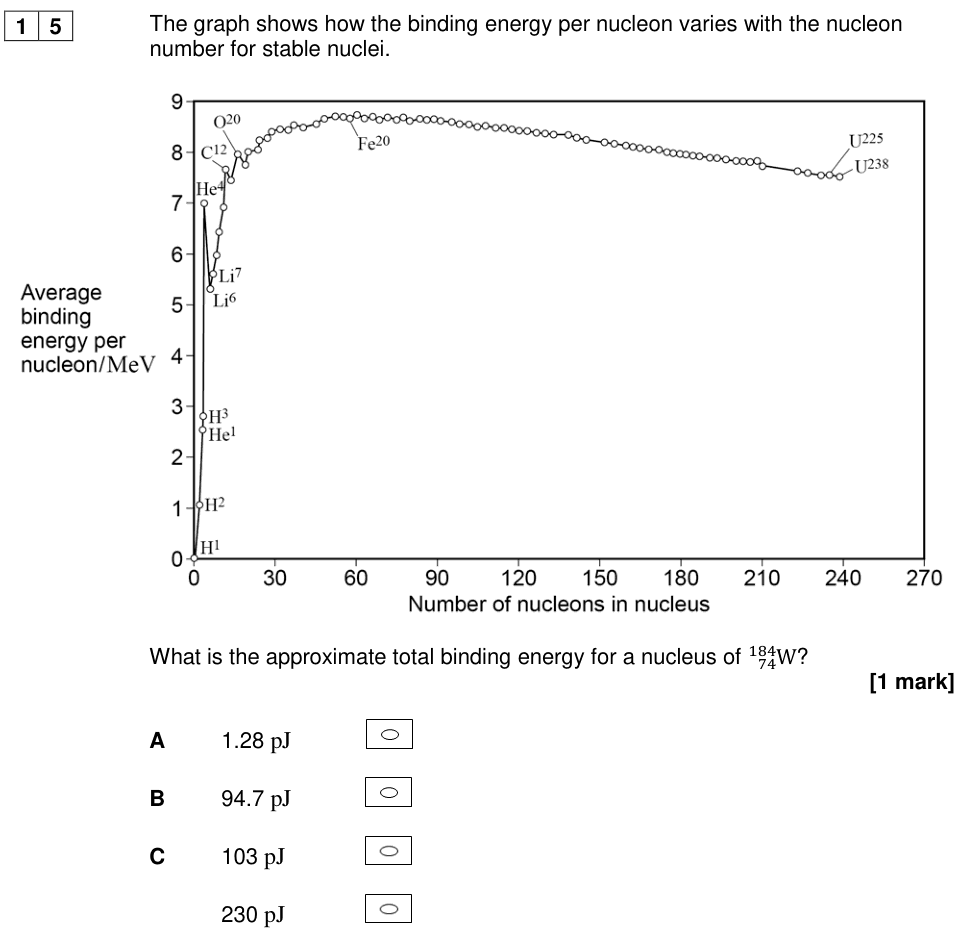
The binding energy per nucleon (binding energy ÷ $A$) measures how tightly bound a nucleus is, and therefore how stable it is.
Key features:
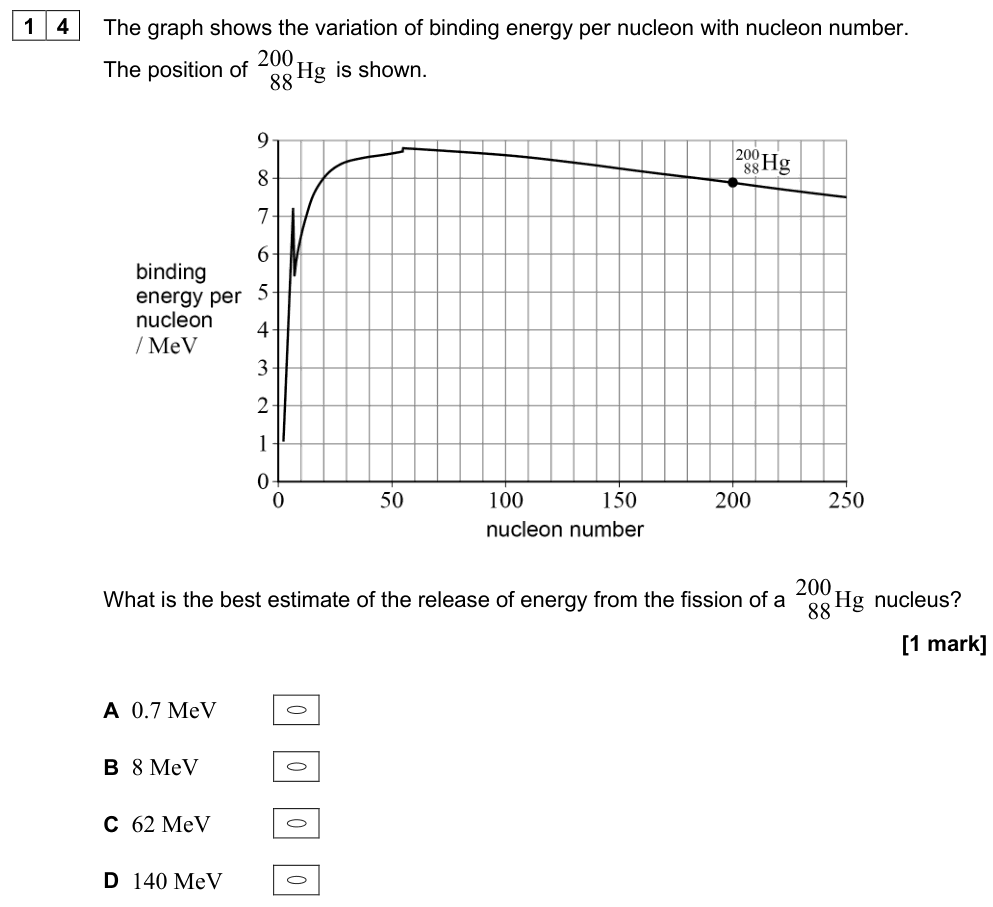
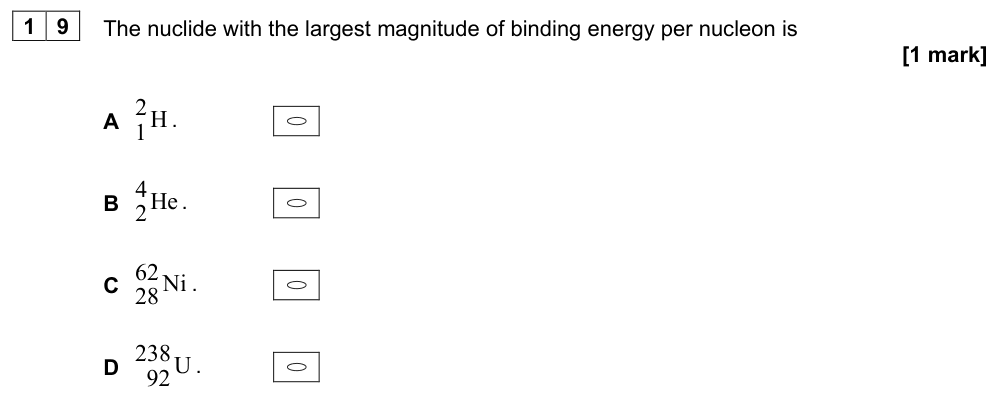
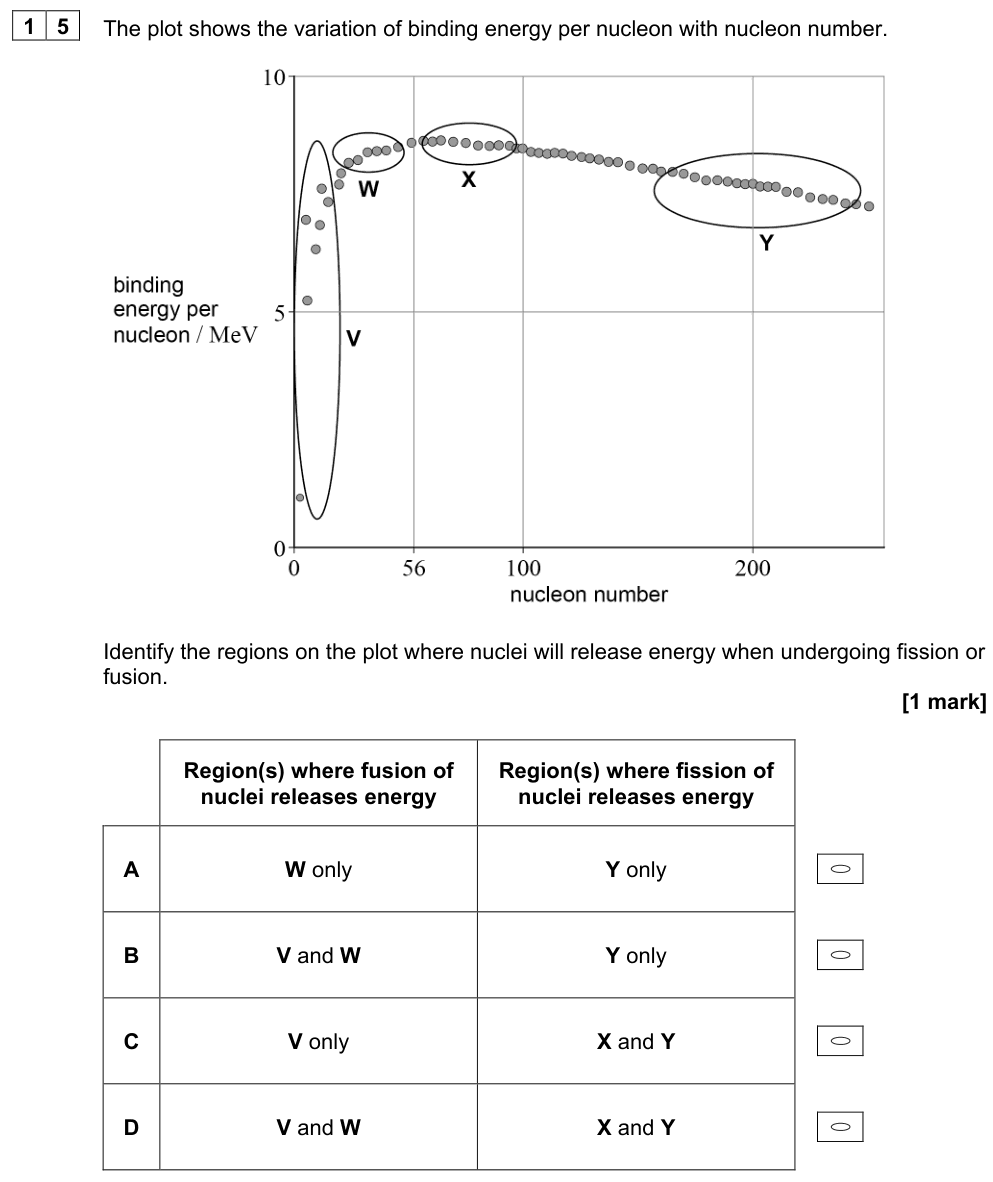
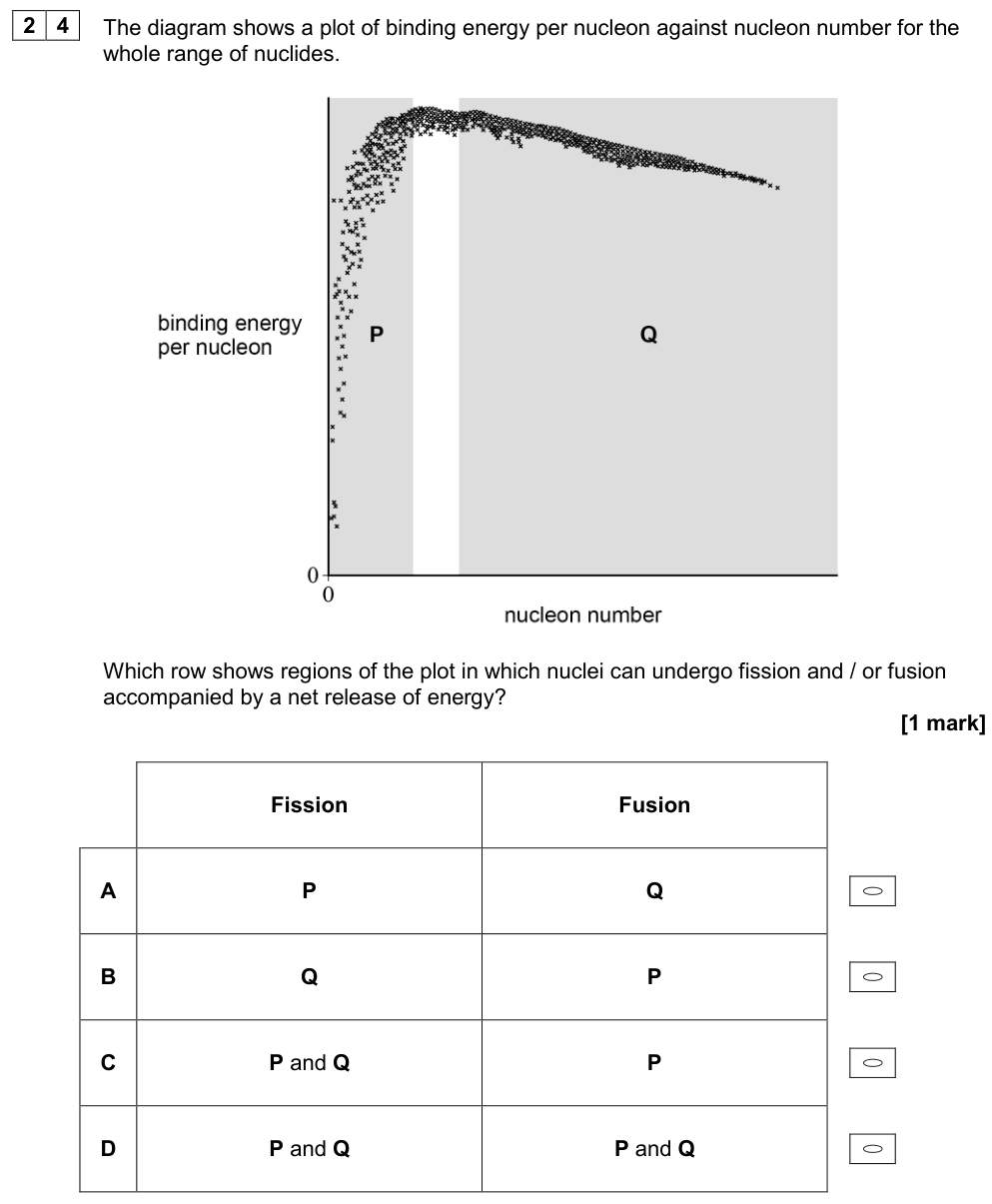
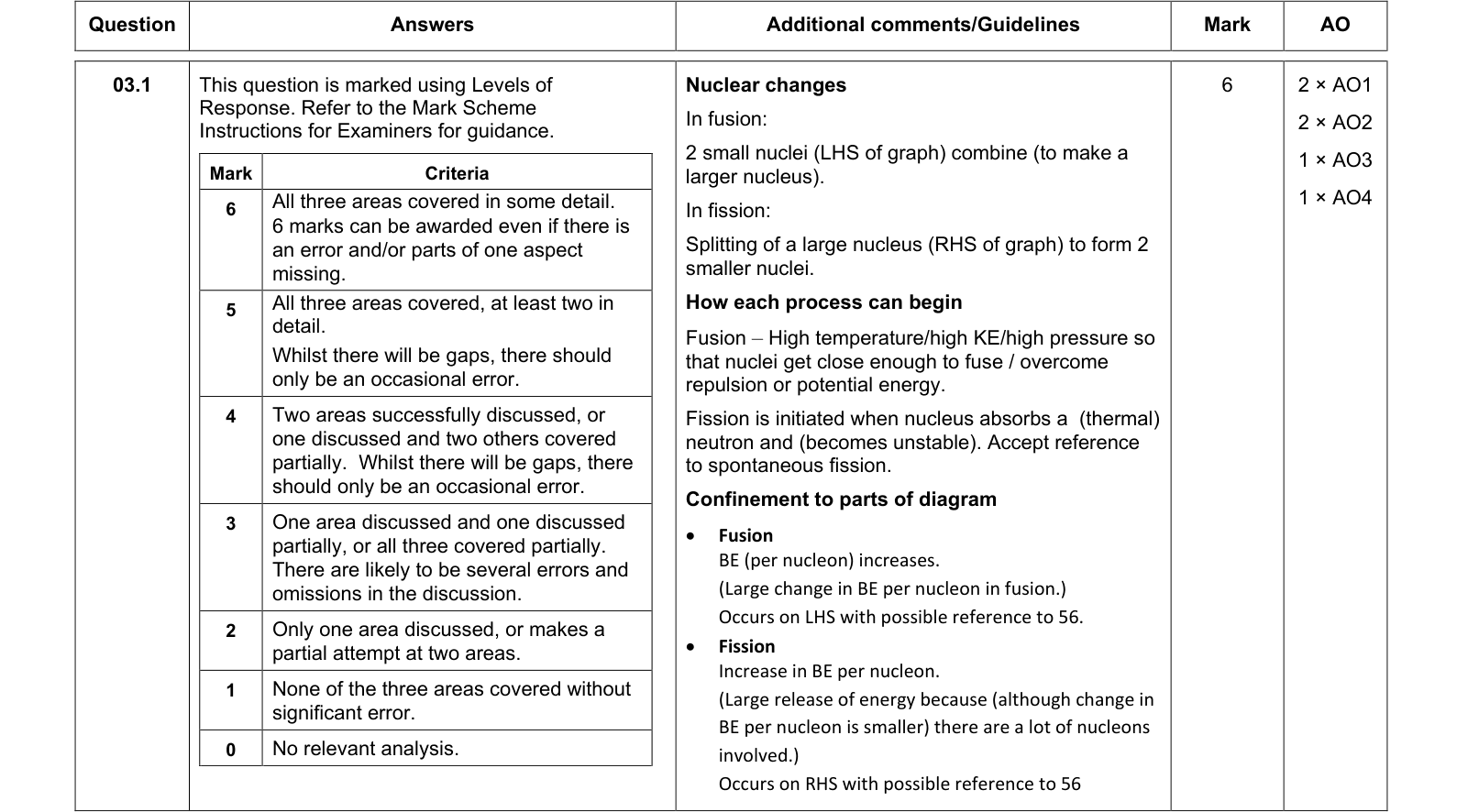
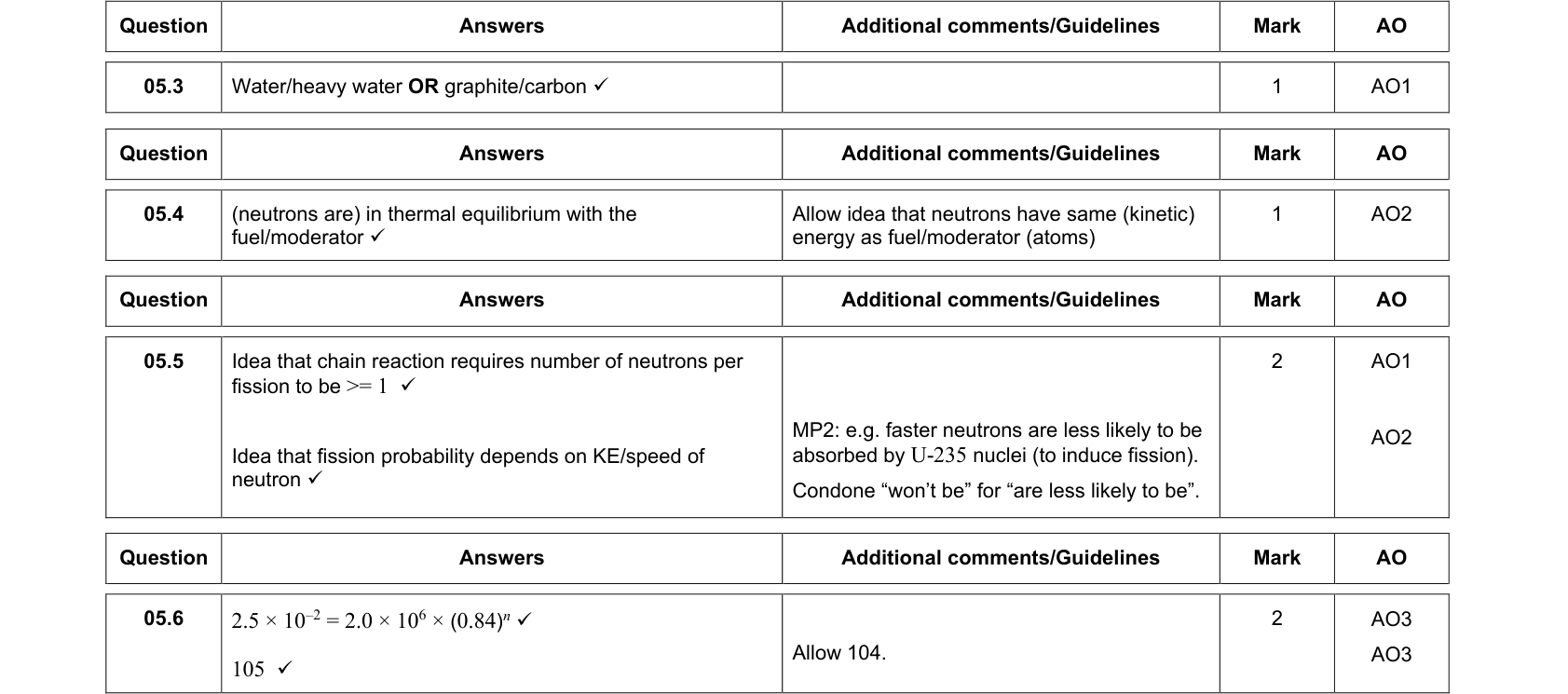
- It rises steeply for light nuclei; helium-4 is unusually stable (about 7.1 MeV per nucleon).
- It reaches a maximum of about 8.8 MeV per nucleon near iron-56: the most stable nuclei.
- It falls slowly for heavy nuclei, to about 7.6 MeV per nucleon for uranium-238.
Energy is released whenever a reaction produces nuclei with a greater total binding energy (that is, more tightly bound nuclei, higher up the curve):
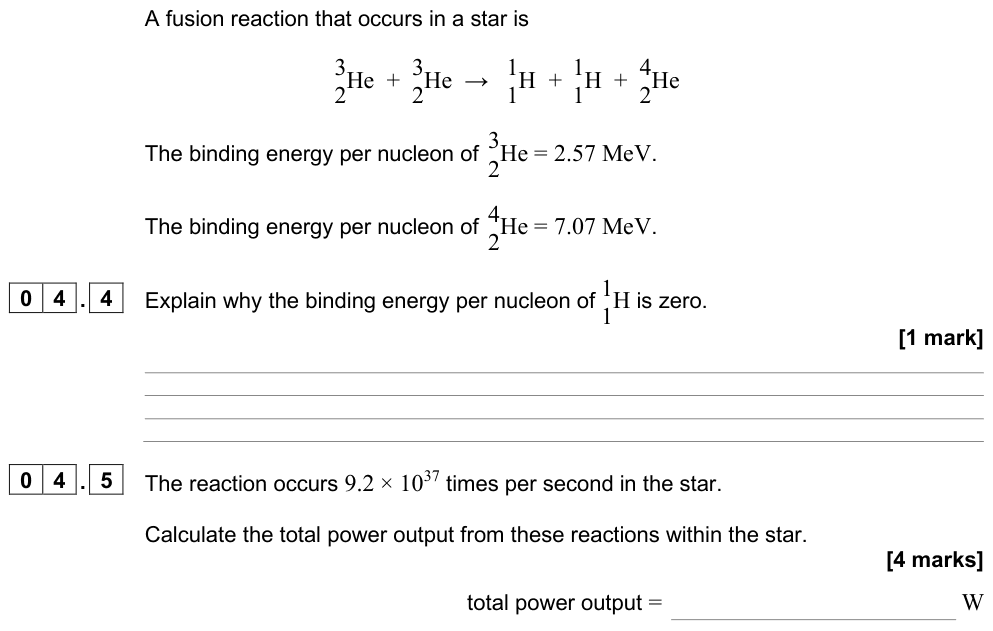
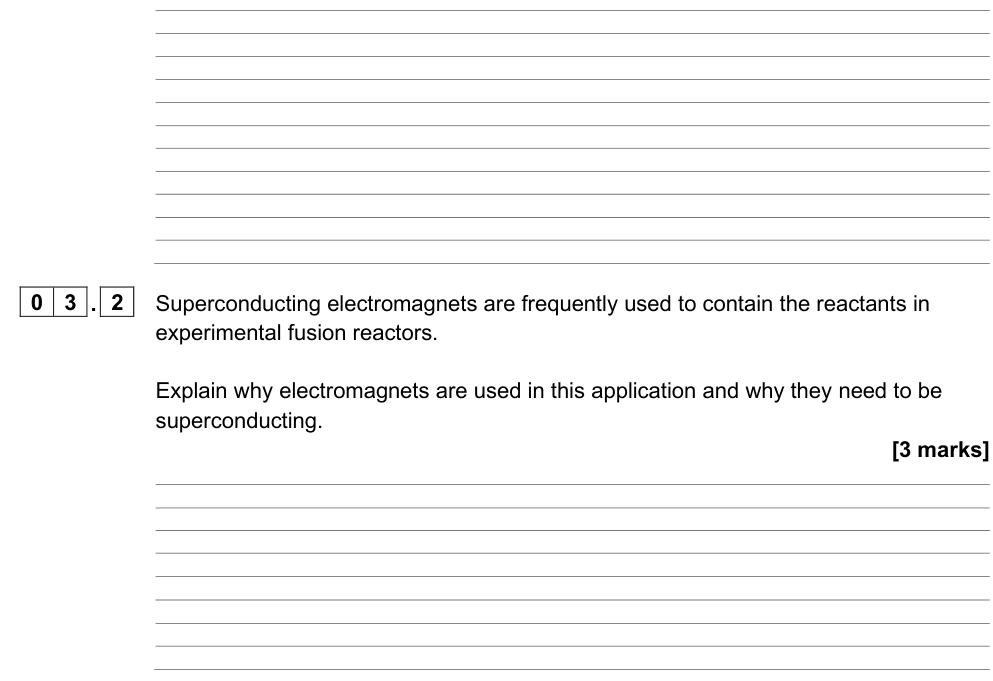
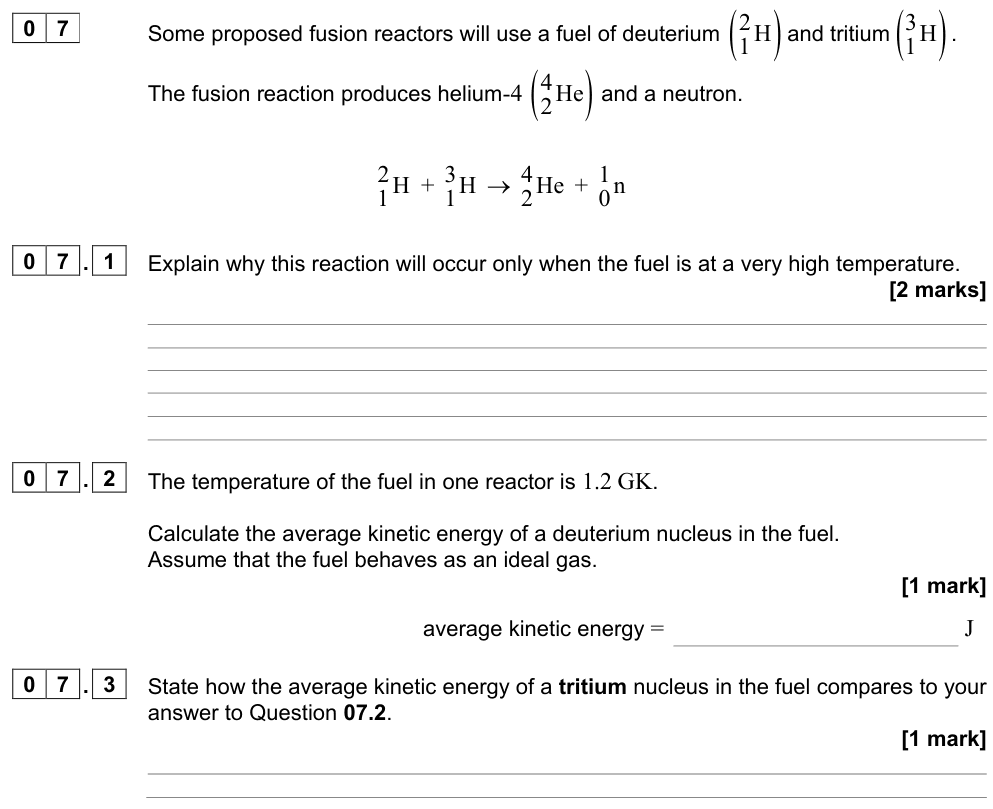
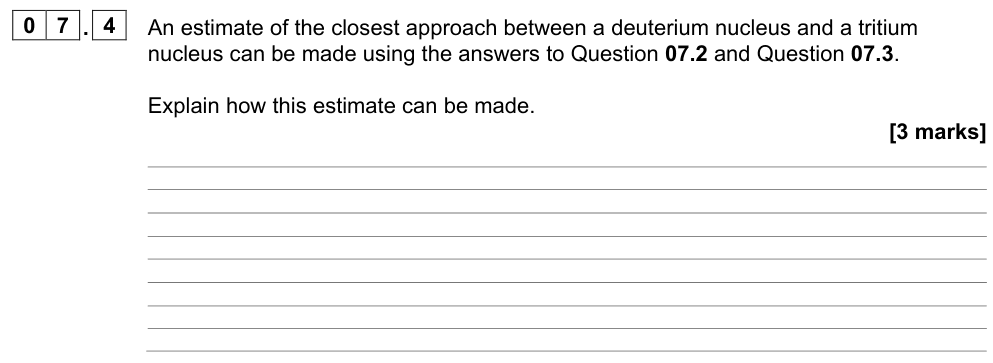
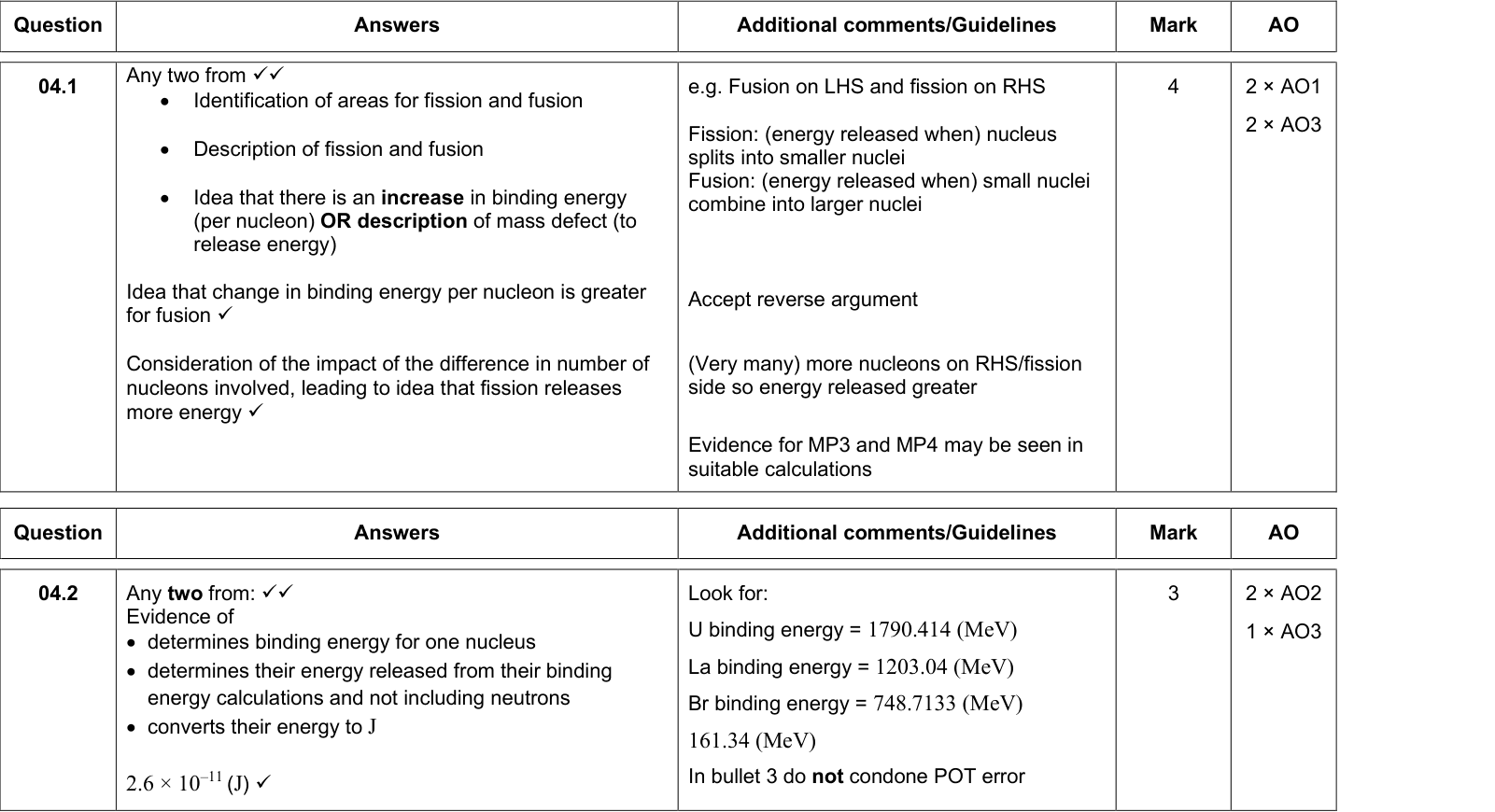
- Fusion: joining two light nuclei (left of the peak) produces a nucleus with a higher binding energy per nucleon.
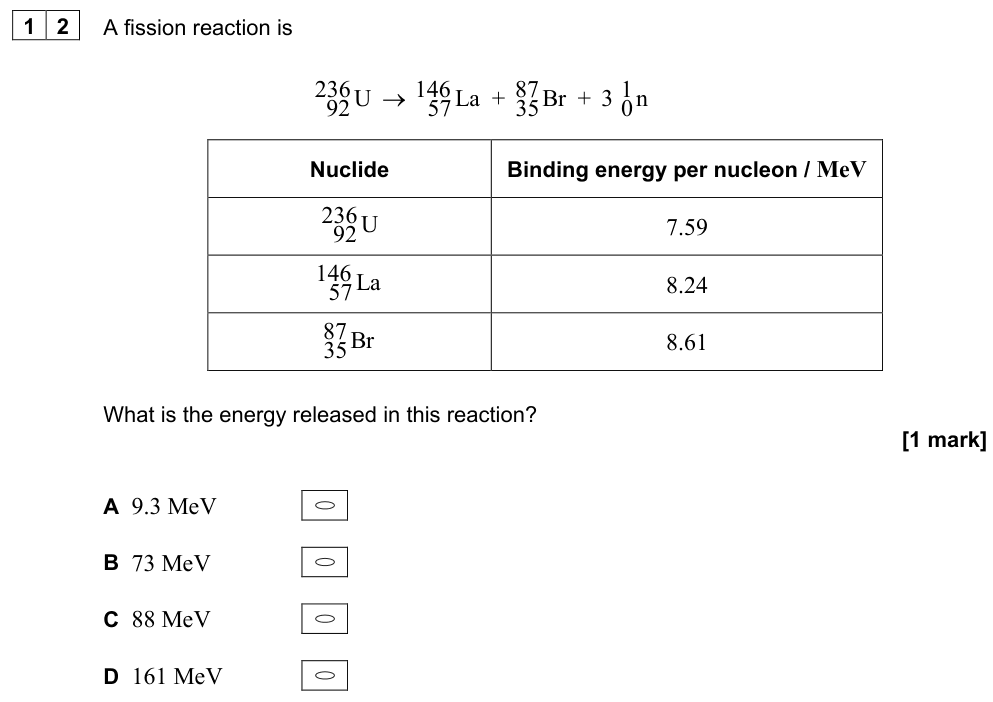
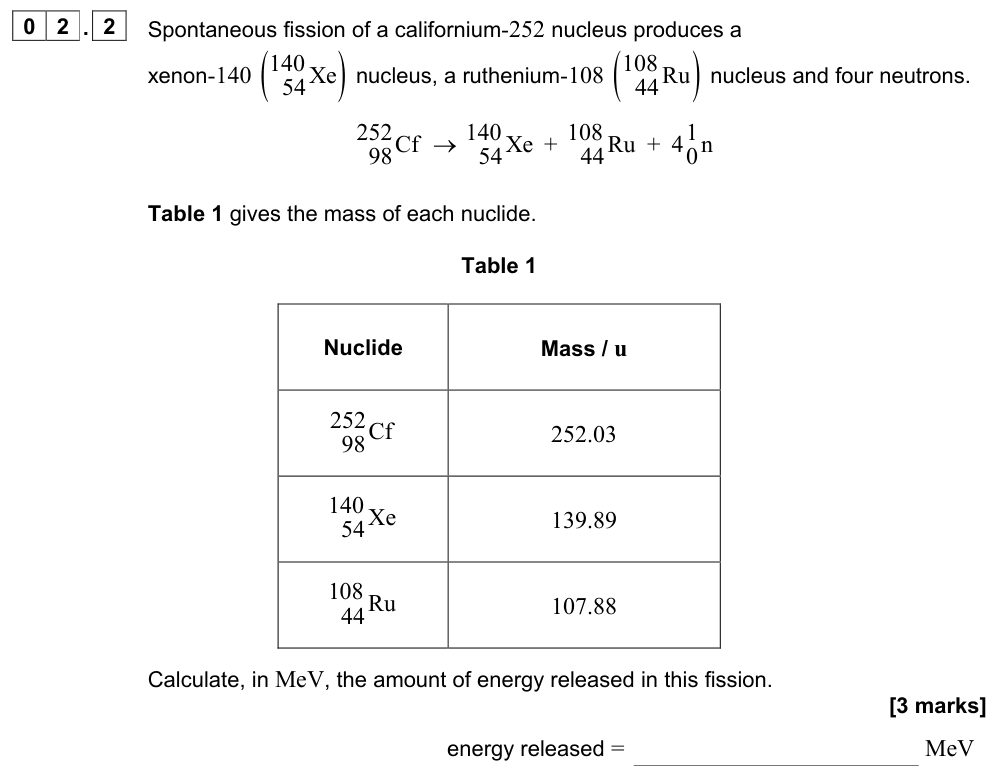
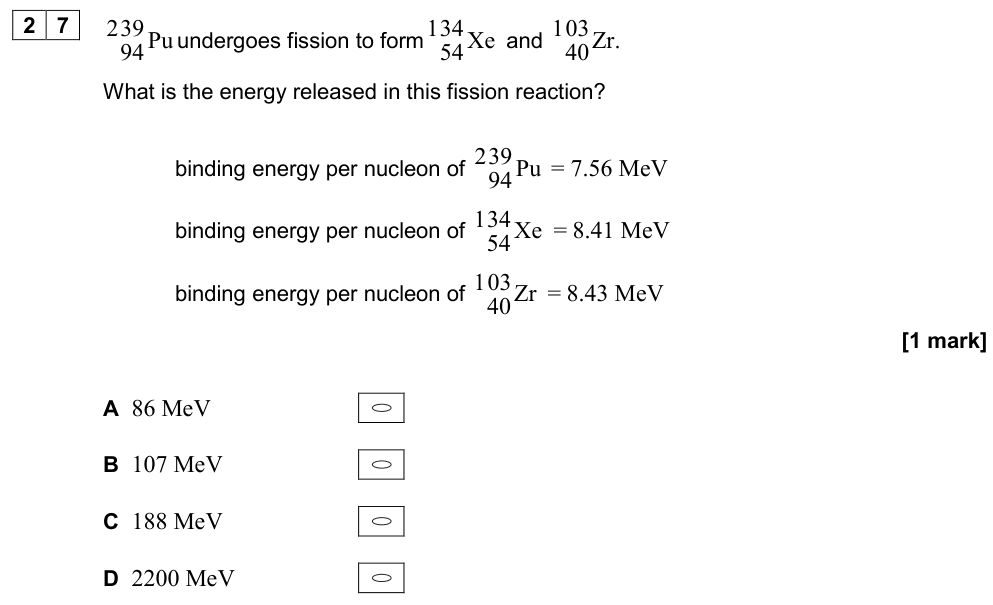
- Fission: splitting a heavy nucleus (right of the peak) into two medium-sized nuclei increases the binding energy per nucleon.
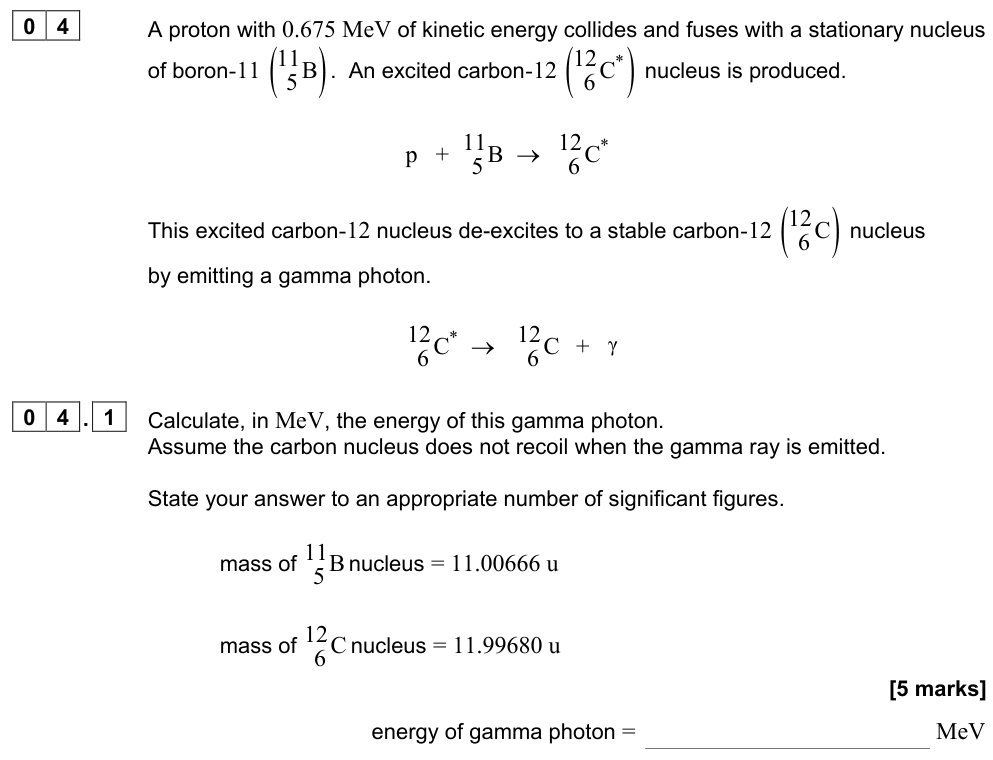
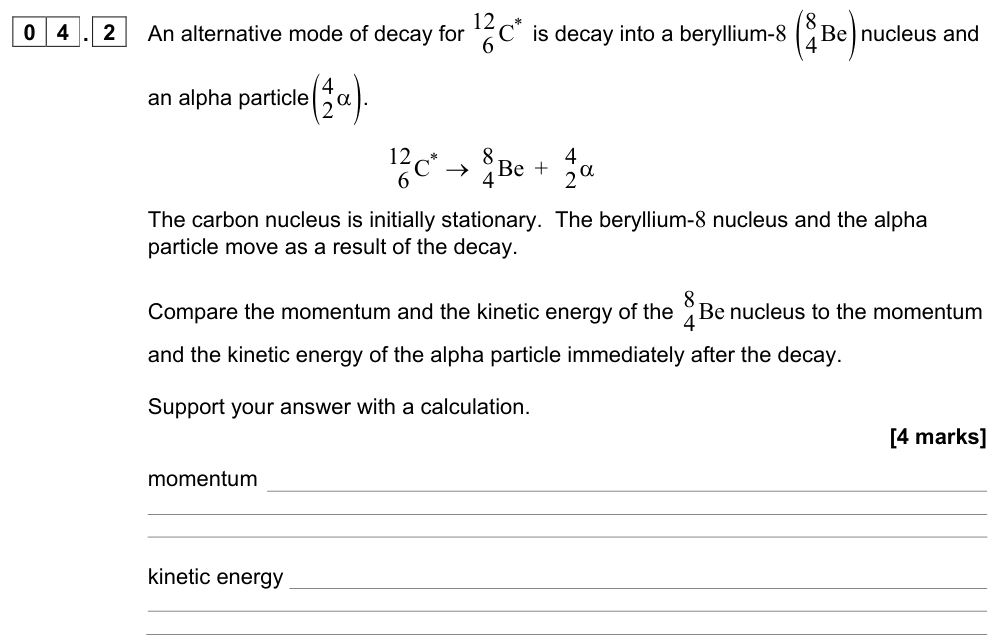
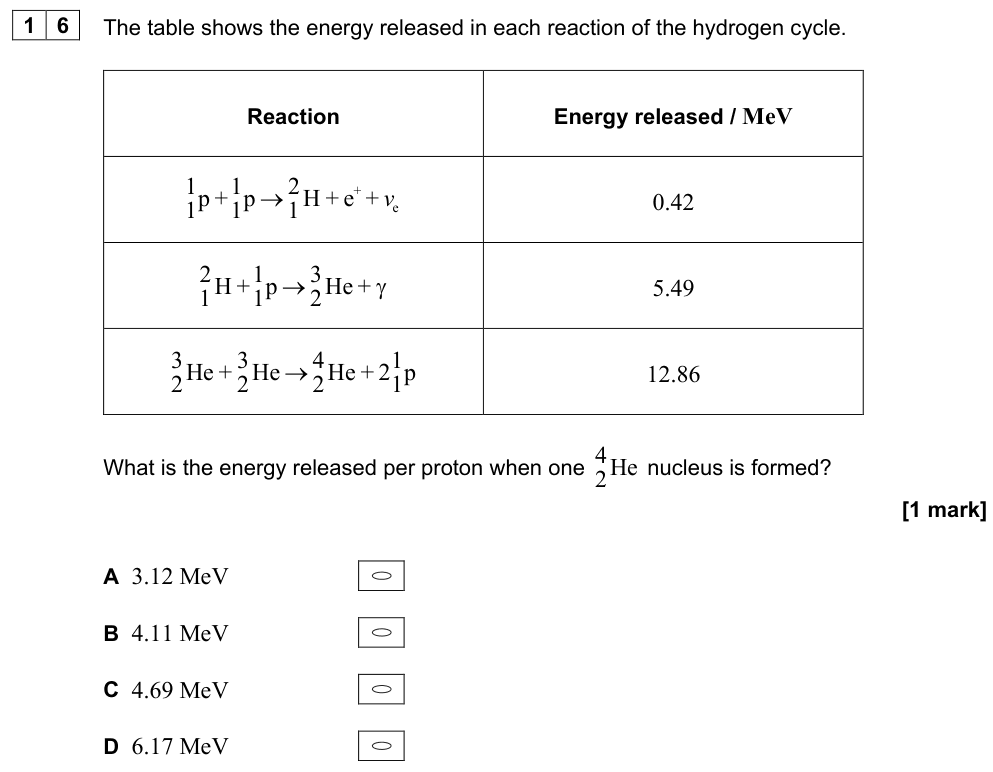
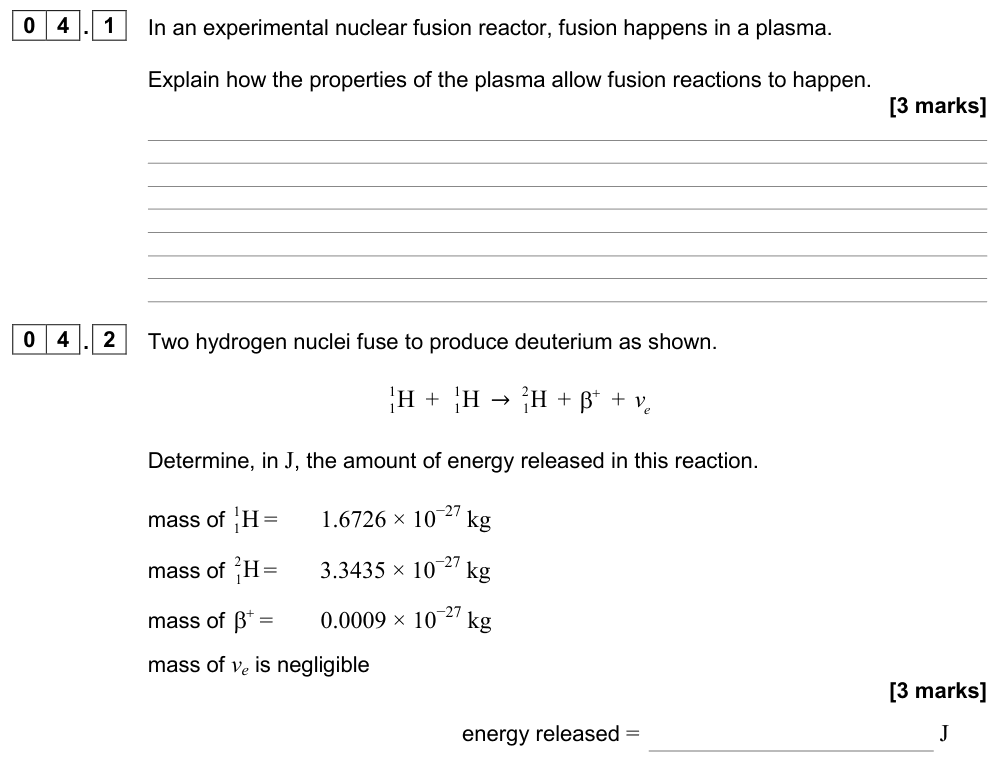
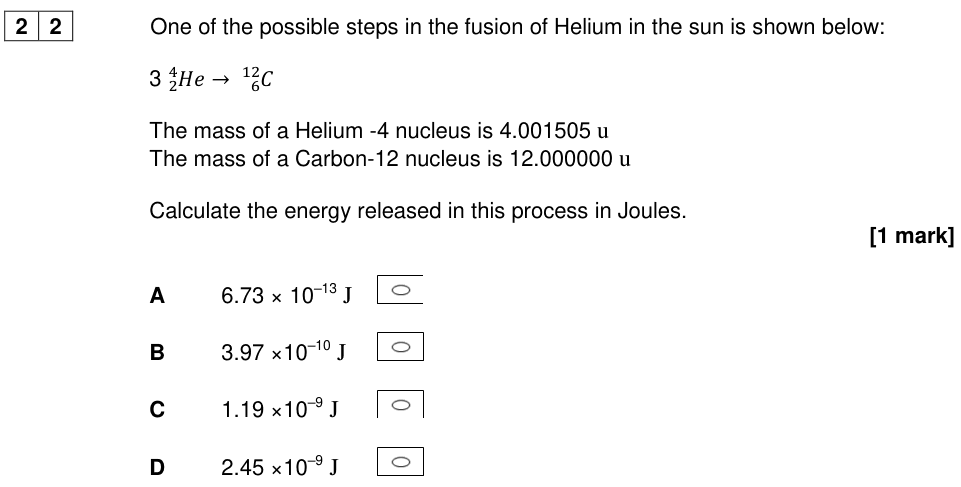
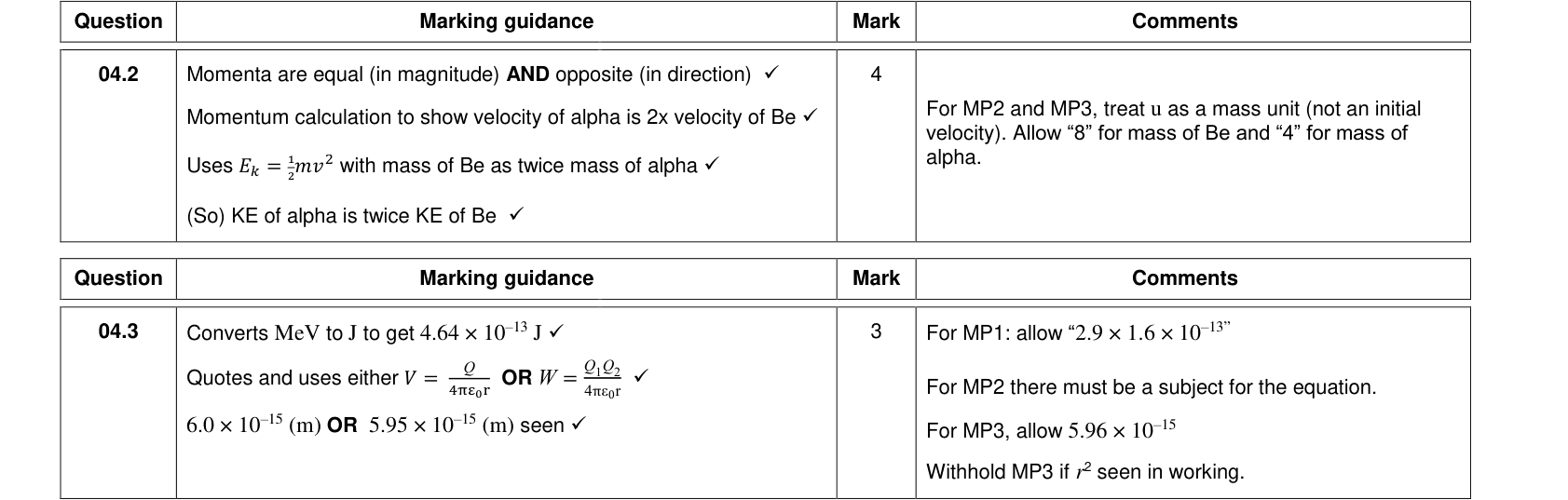
In both cases, the energy released = increase in total binding energy = (mass of reactants − mass of products) × $c^2$. It appears as kinetic energy of the products (and gamma radiation).
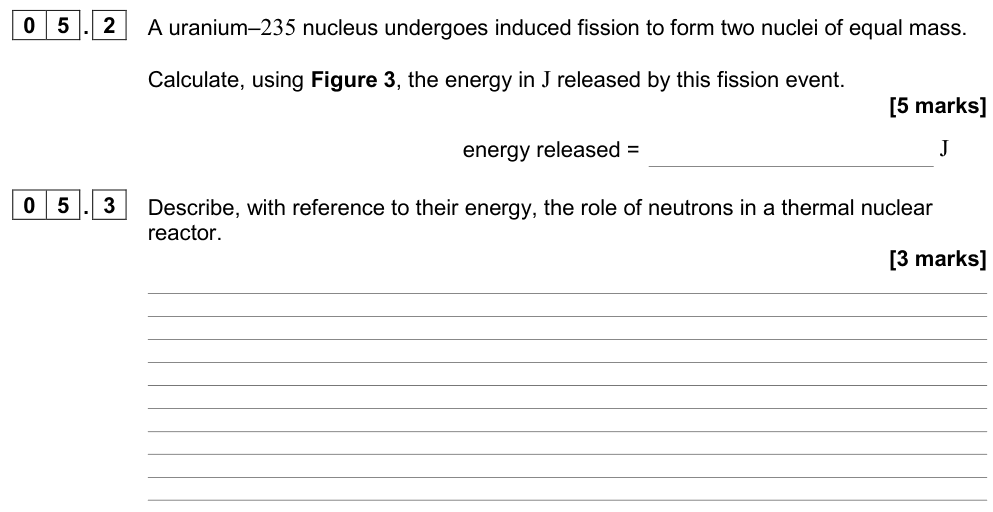
Energy released in fission
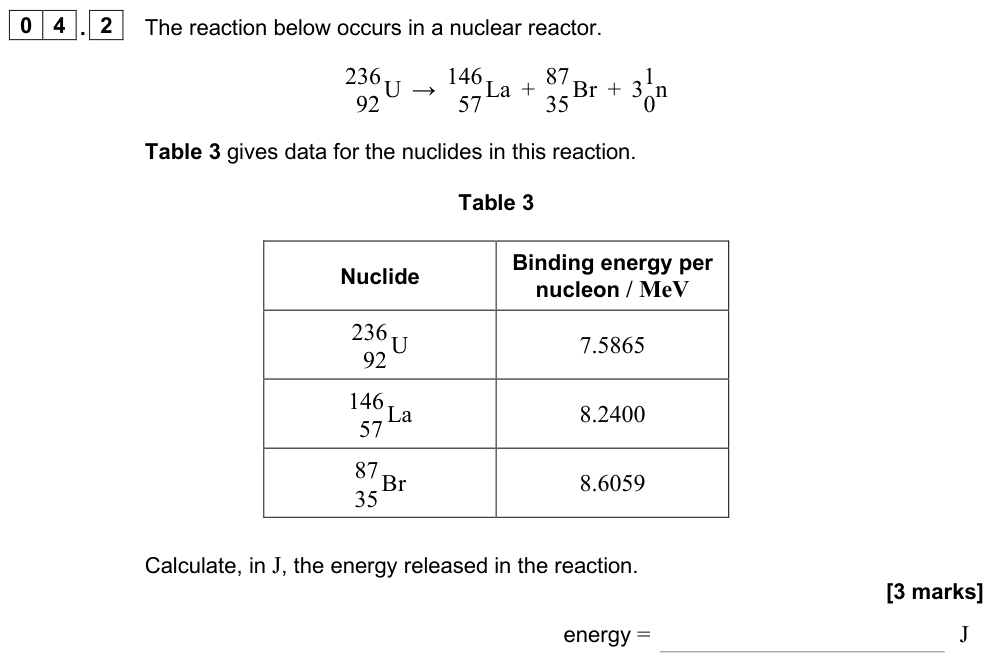
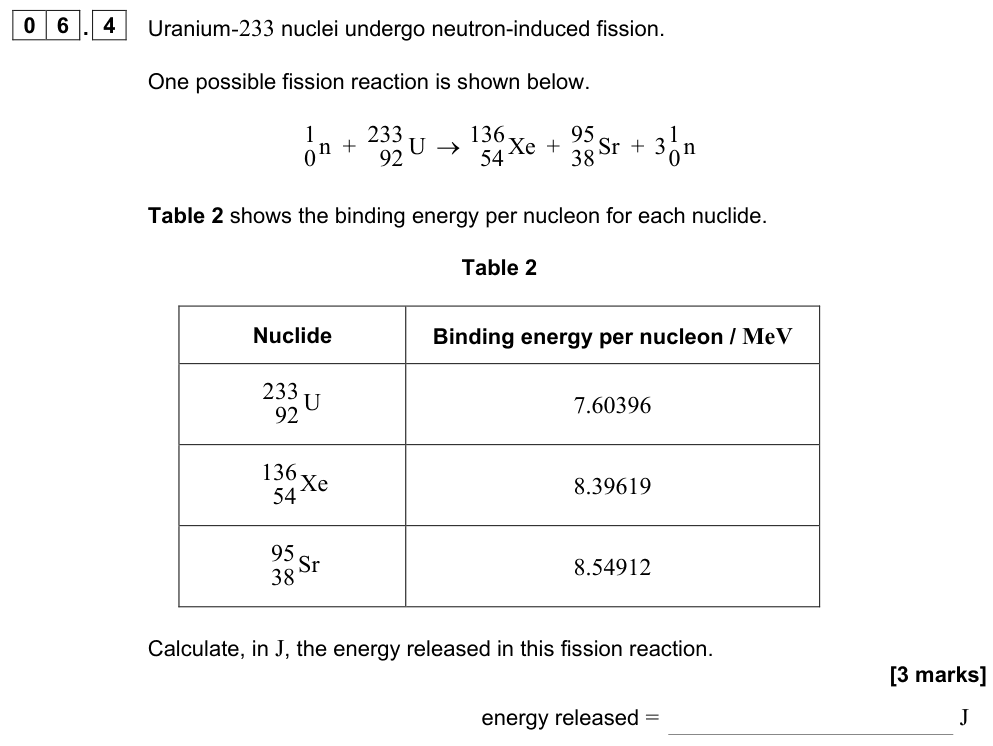
Worked example: fission of uranium-235
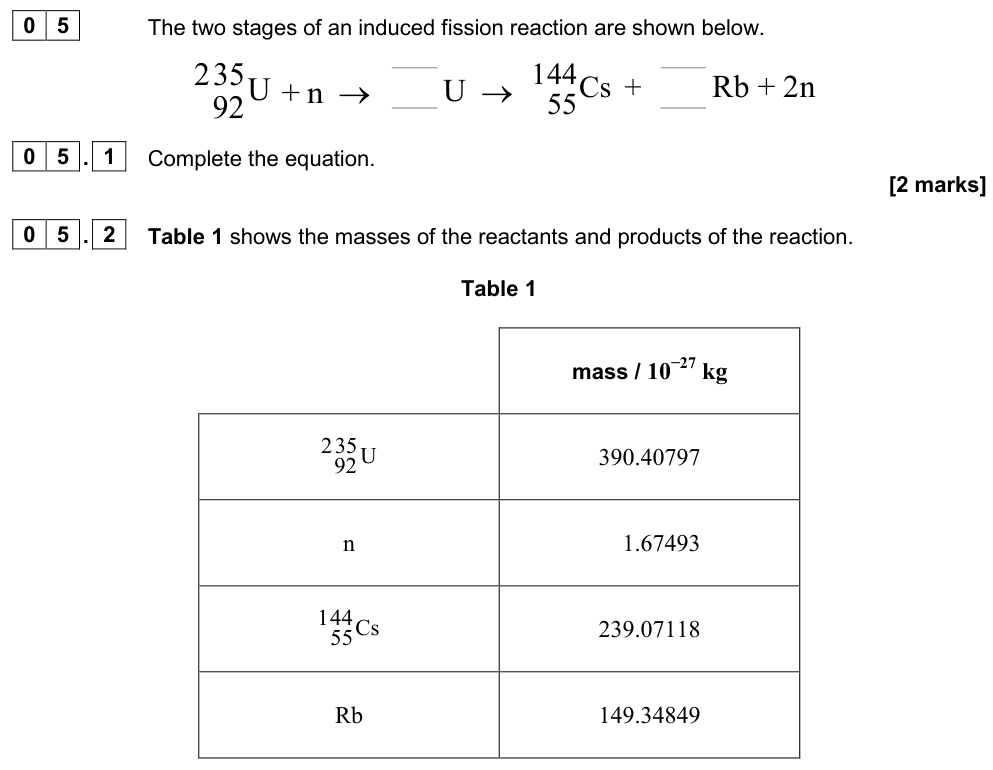
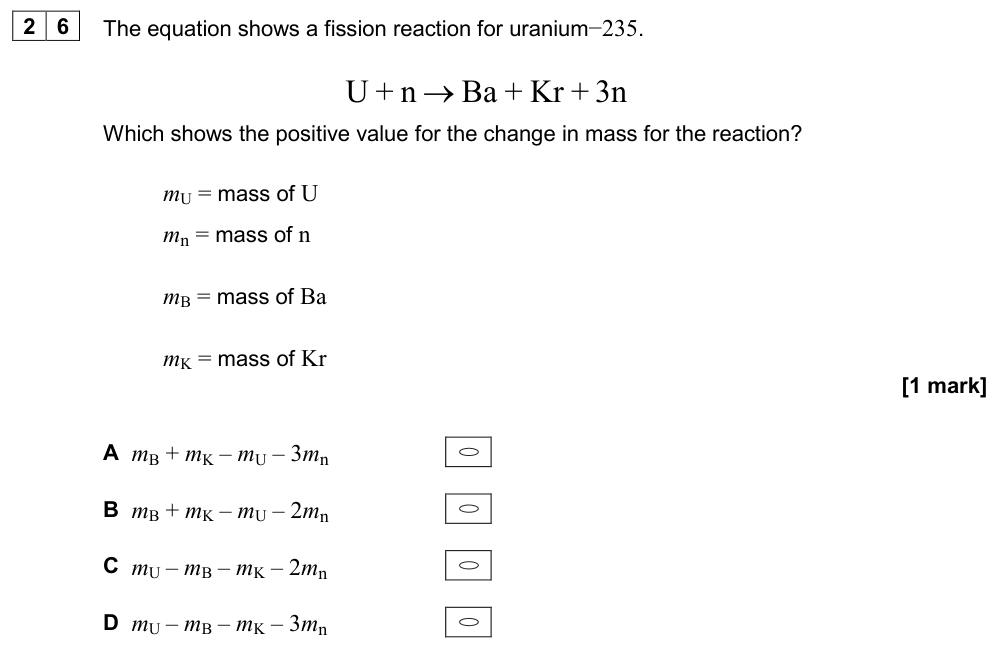
$$^{235}_{92}\text{U} + {}^{1}_{0}\text{n} \rightarrow {}^{141}_{56}\text{Ba} + {}^{92}_{36}\text{Kr} + 3\,{}^{1}_{0}\text{n}$$
Atomic masses: U-235 = 235.0439 u, Ba-141 = 140.9144 u, Kr-92 = 91.9262 u; neutron = 1.0087 u. (The 92 electrons balance on both sides, so atomic masses can be used.)
Mass before $= 235.0439 + 1.0087 = 236.0526$ u.
Mass after $= 140.9144 + 91.9262 + 3(1.0087) = 235.8667$ u.
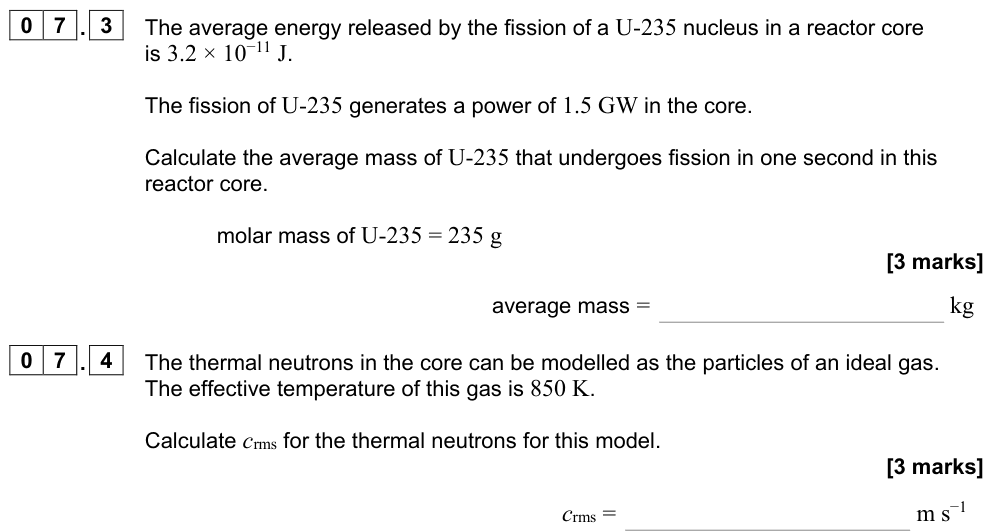
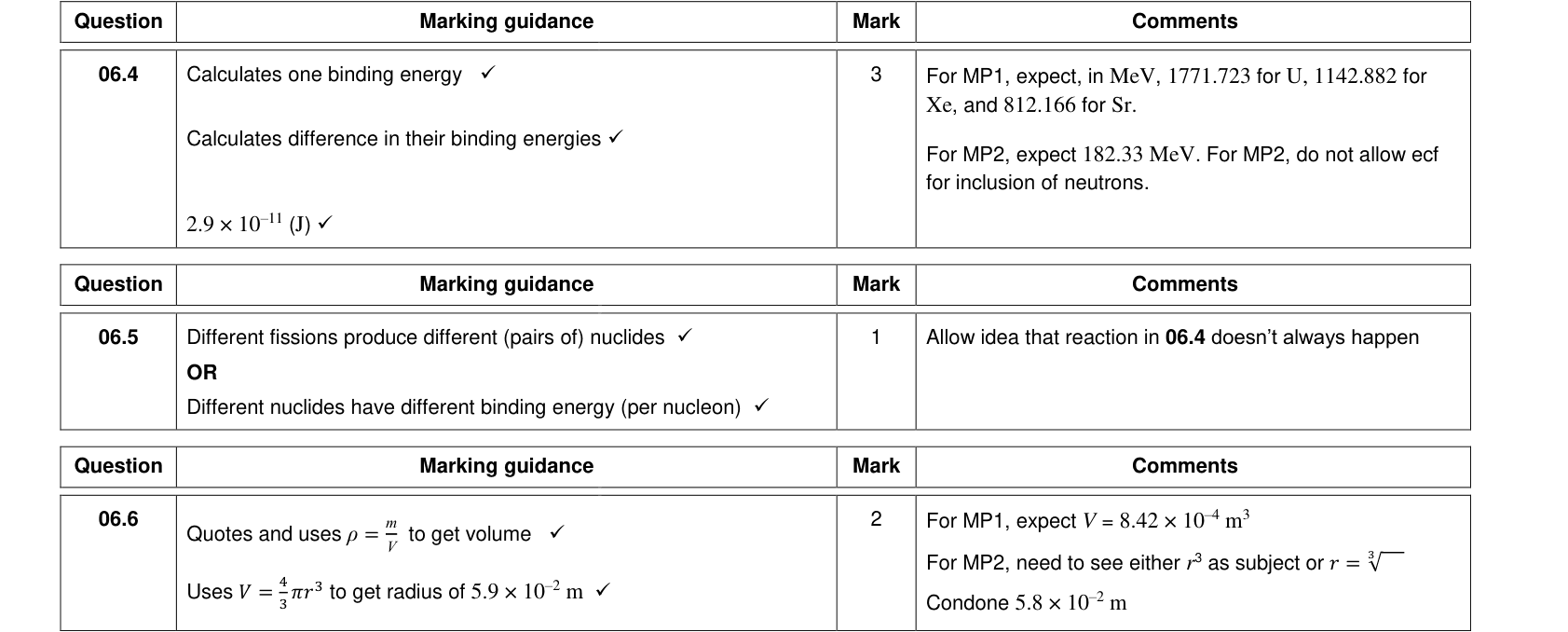
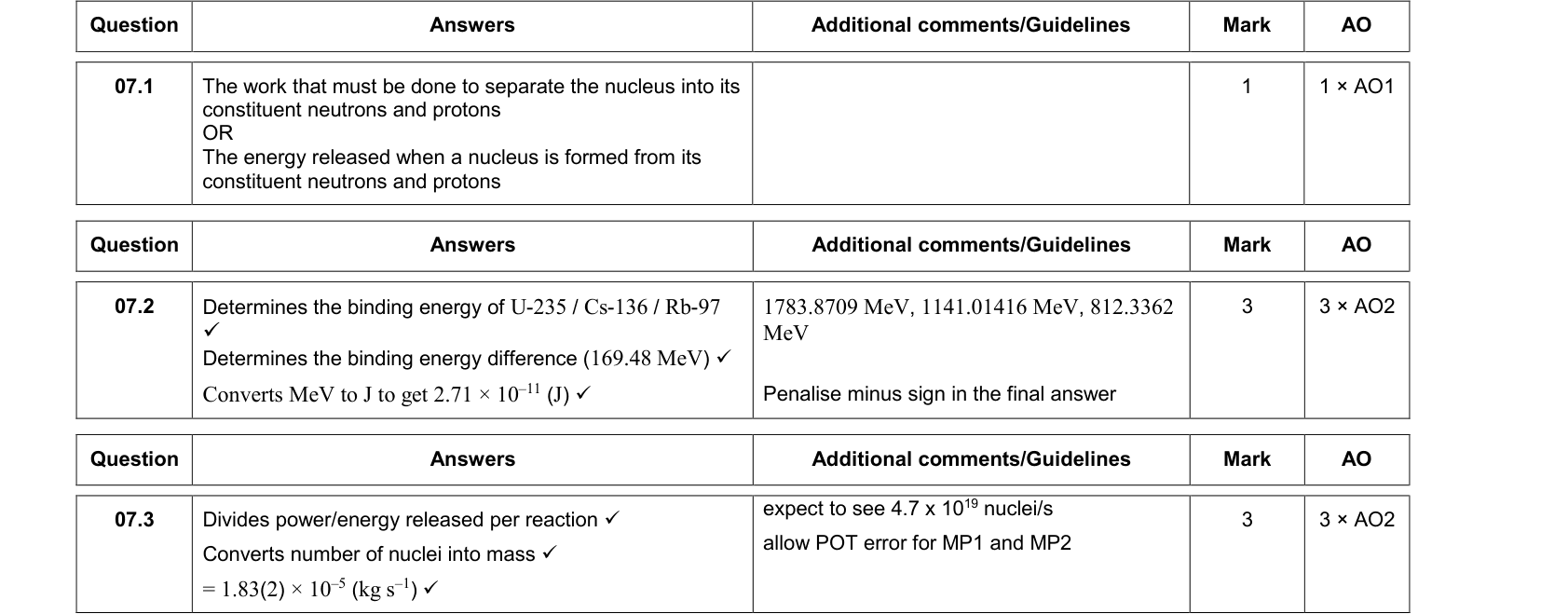
Mass difference $= 0.1859$ u, so energy released $= 0.1859 \times 931.5 = 173$ MeV $= 2.8 \times 10^{-11}$ J.
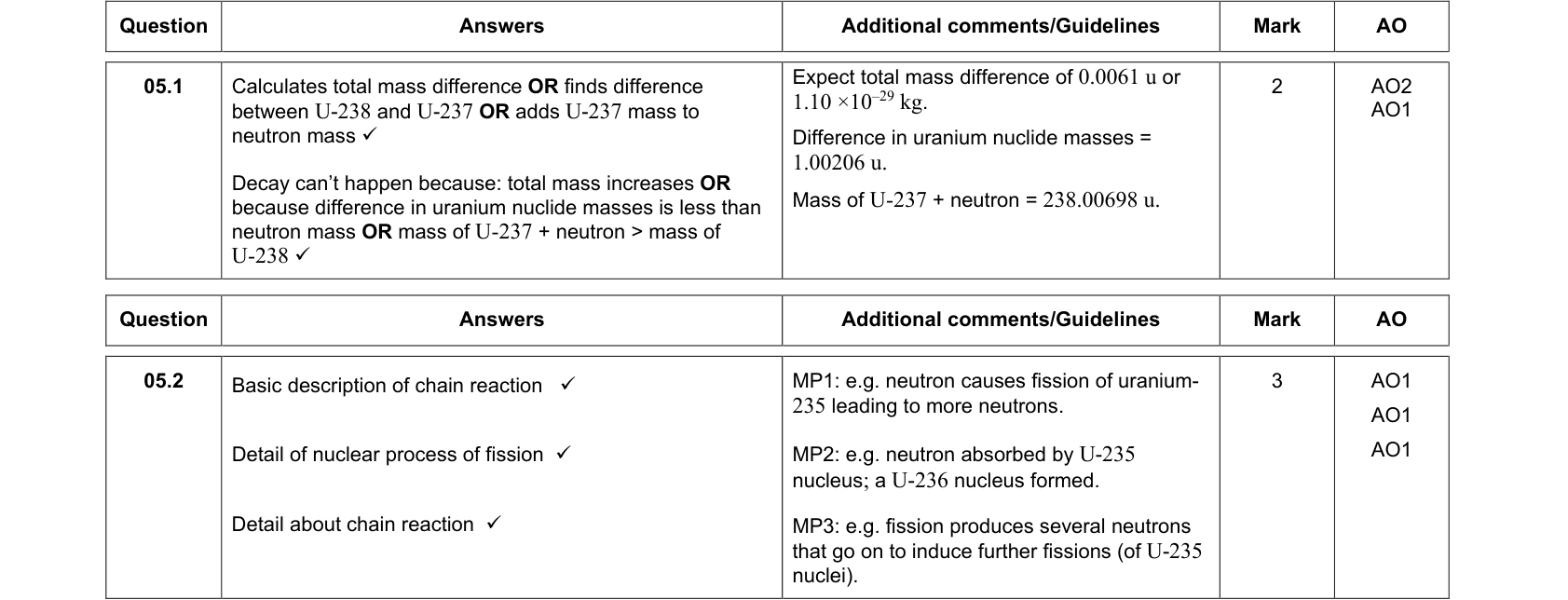
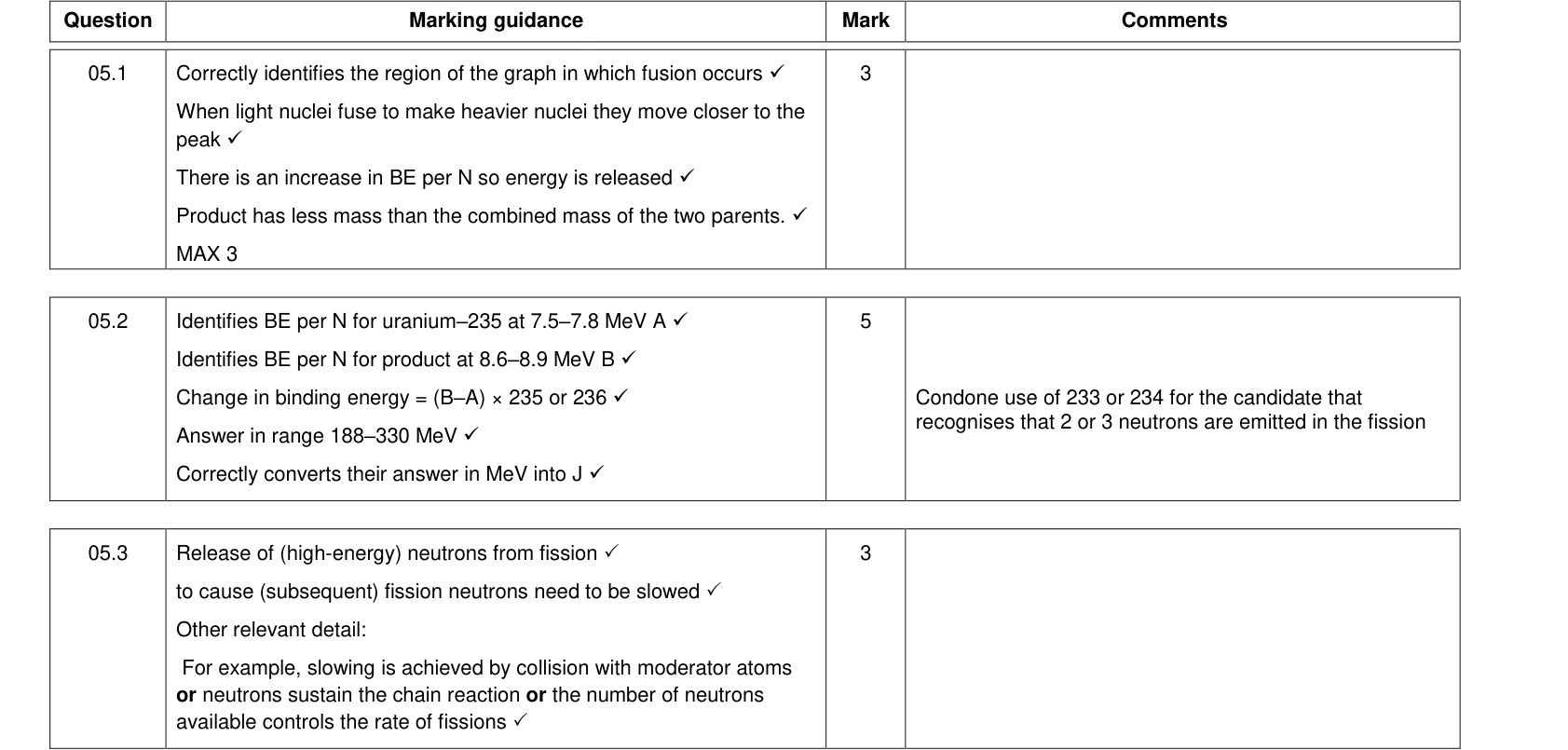
Using the graph: uranium (≈ 7.6 MeV per nucleon) splits into nuclei with ≈ 8.4–8.5 MeV per nucleon, a gain of about 0.9 MeV for each of about 235 nucleons, around 200 MeV per fission (including later decays of the fragments).
Energy released in fusion
Worked example: deuterium–tritium fusion
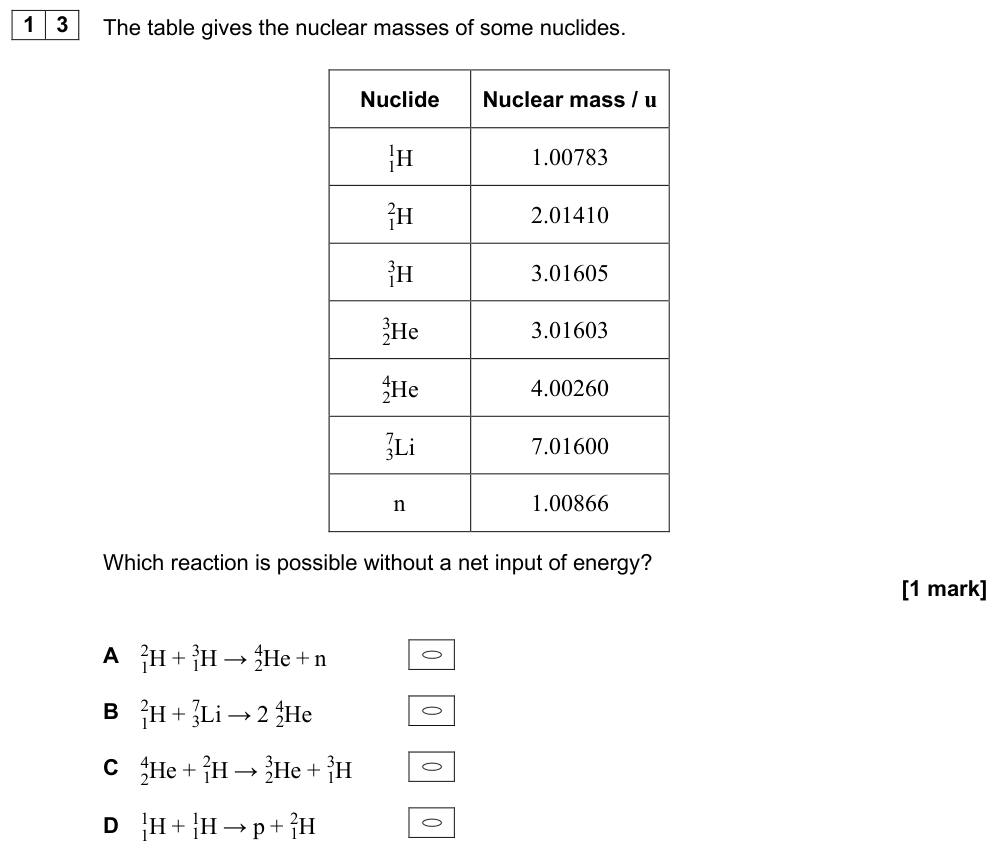
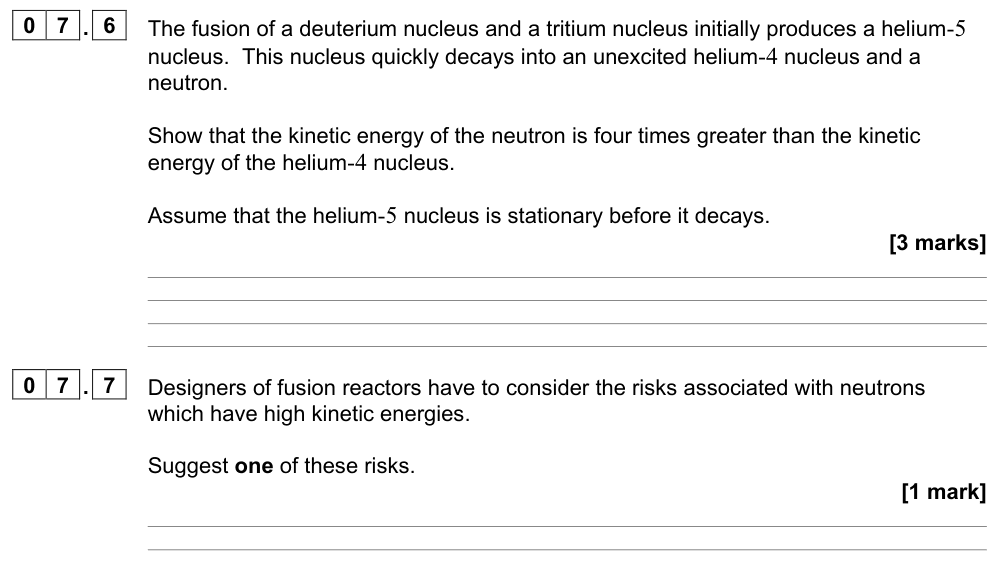
$$^{2}_{1}\text{H} + {}^{3}_{1}\text{H} \rightarrow {}^{4}_{2}\text{He} + {}^{1}_{0}\text{n}$$
Atomic masses: ²H = 2.01410 u, ³H = 3.01605 u, ⁴He = 4.00260 u; neutron = 1.00867 u.
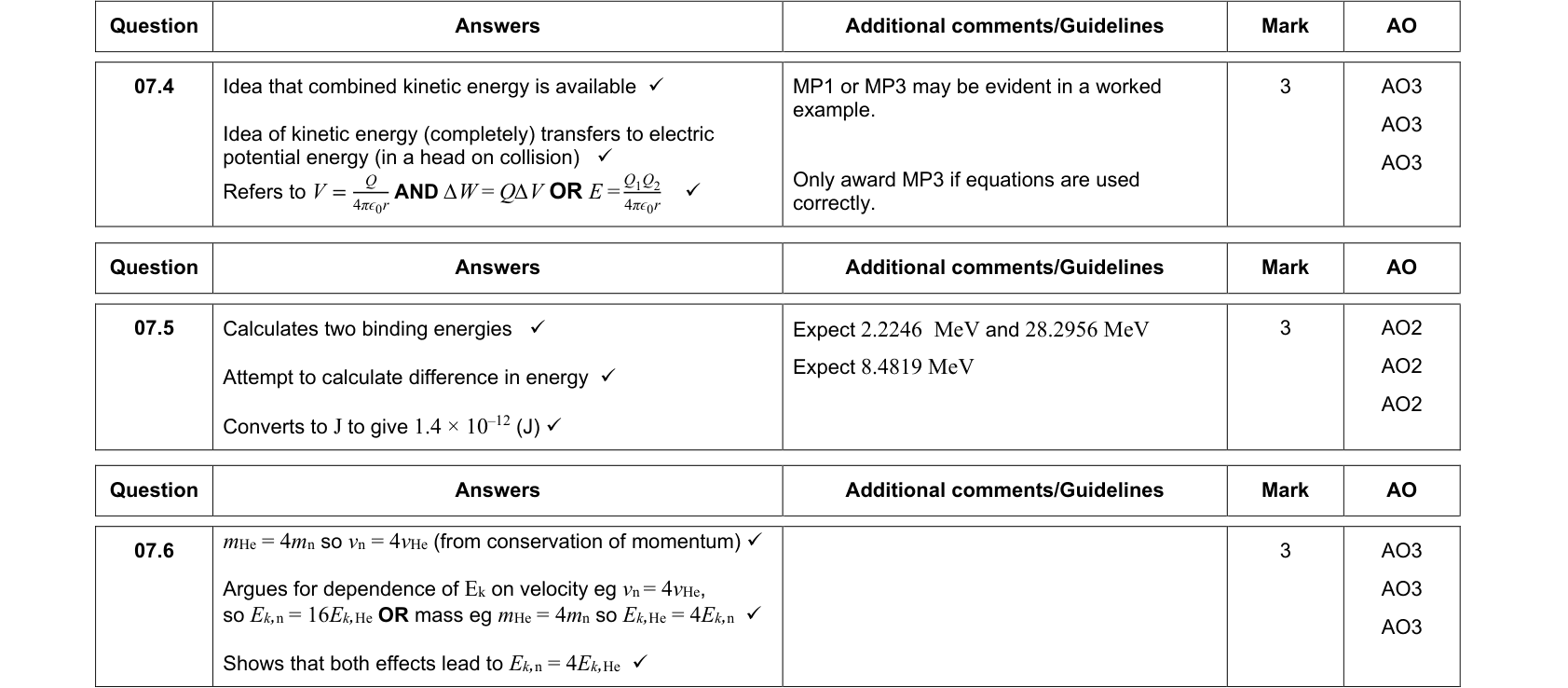
Mass difference $= (2.01410 + 3.01605) - (4.00260 + 1.00867) = 0.01888$ u.
Energy released $= 0.01888 \times 931.5 = 17.6$ MeV.
Per nucleon this is $17.6/5 = 3.5$ MeV, about four times more than fission ($200/236 = 0.85$ MeV per nucleon).
Exam tip: a reliable method
- Add up the masses on each side (check that the electrons balance if using atomic masses).
- Mass difference = mass before − mass after (it must be positive if energy is released).
- Multiply by 931.5 to get MeV; multiply MeV by $1.60 \times 10^{-13}$ to get joules.
Summary
- $E = mc^2$ applies to all energy changes; in nuclear reactions the mass changes are significant.
- 1 u = $1.661 \times 10^{-27}$ kg ≡ 931.5 MeV.
- Mass defect = mass of separate nucleons − mass of nucleus; binding energy = $\Delta m\,c^2$ (energy needed to separate the nucleus into nucleons).
- Binding energy per nucleon peaks near iron-56 (~8.8 MeV): fusion of light nuclei and fission of heavy nuclei both increase it and release energy.
- Energy released = (mass before − mass after) × 931.5 MeV u⁻¹.