Brownian motion: evidence for molecules
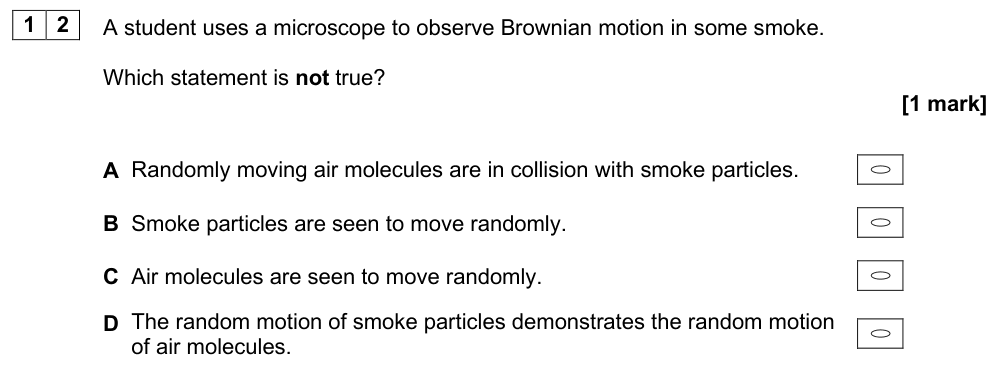
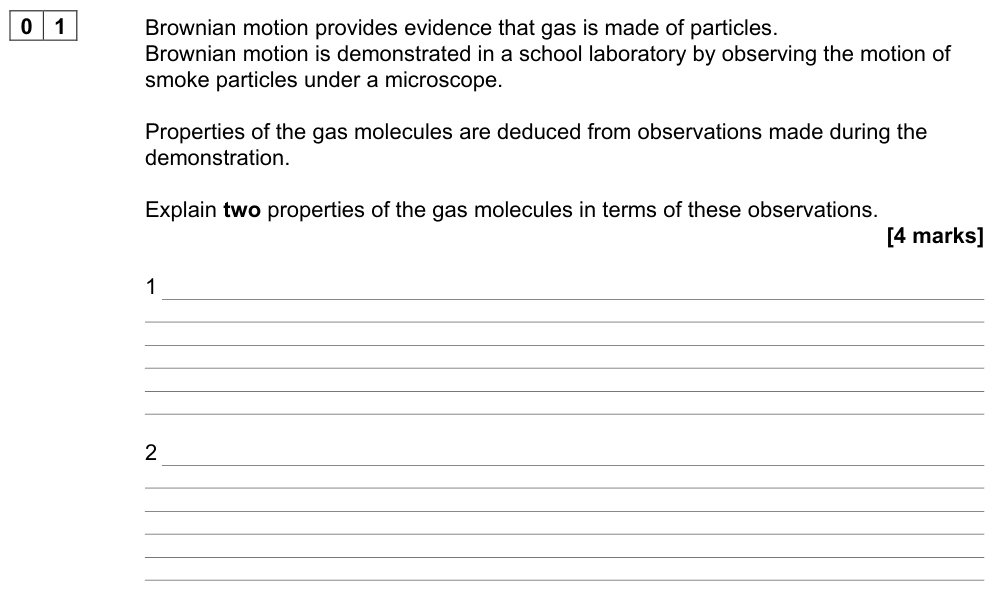
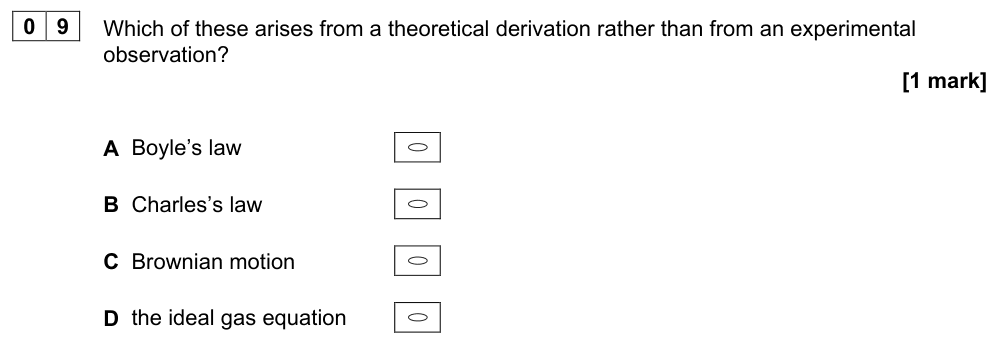
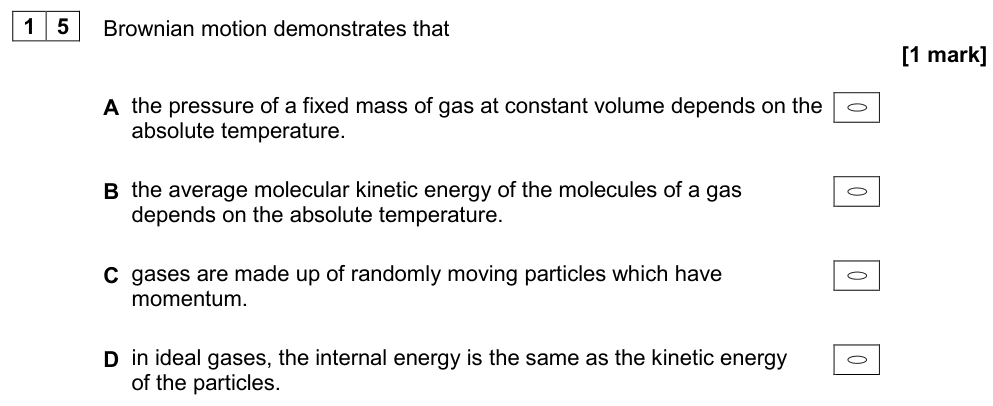
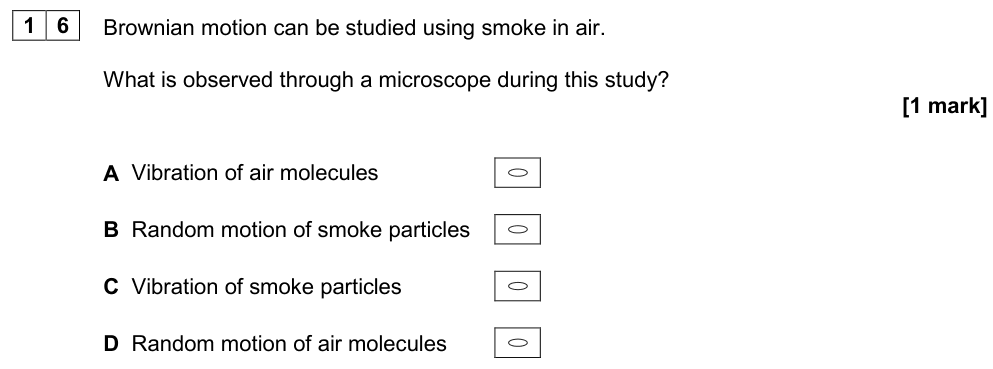
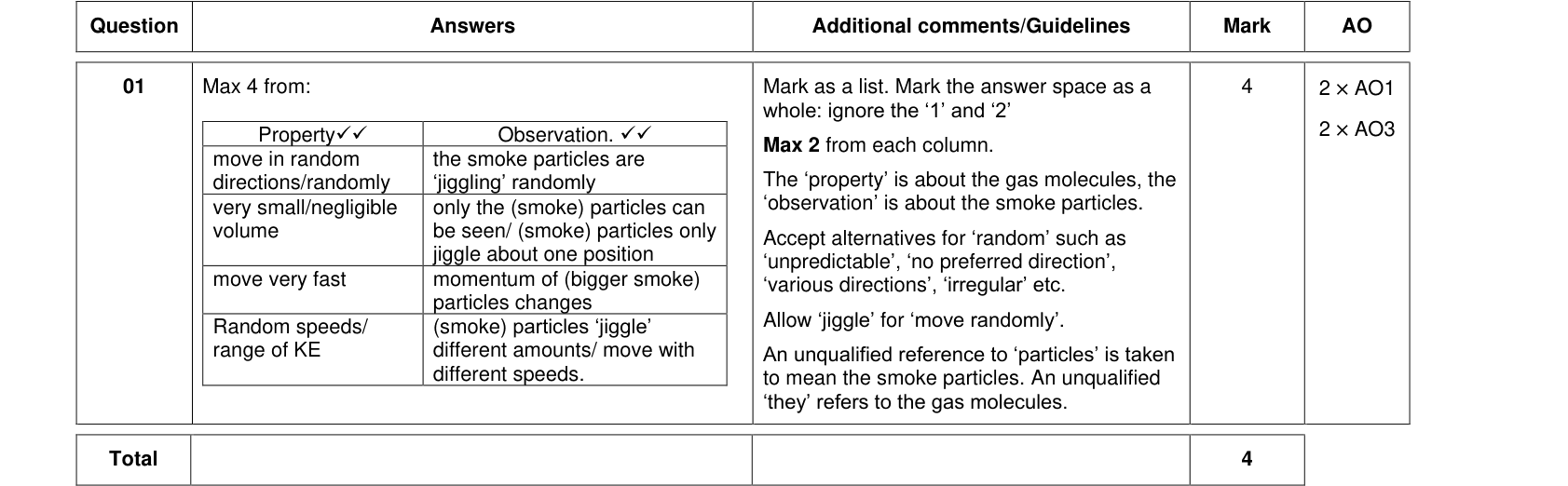
In 1827 the botanist Robert Brown saw pollen grains in water jiggling about at random under a microscope. The same effect is seen with smoke particles in air (in a small glass cell lit from the side and viewed through a microscope): the bright specks of smoke move in a random, jerky zig-zag.
The explanation is that the smoke particles are being bombarded by air molecules, which are far too small to see and which are moving randomly at high speeds. At any instant the collisions on different sides of a smoke particle do not balance, so it is pushed first one way and then another. Smaller smoke particles show more vigorous motion.
Brownian motion is evidence for the existence of atoms and molecules and for their random motion. (In 1905 Einstein used it to estimate the size of molecules.)
Explaining the gas laws with molecules
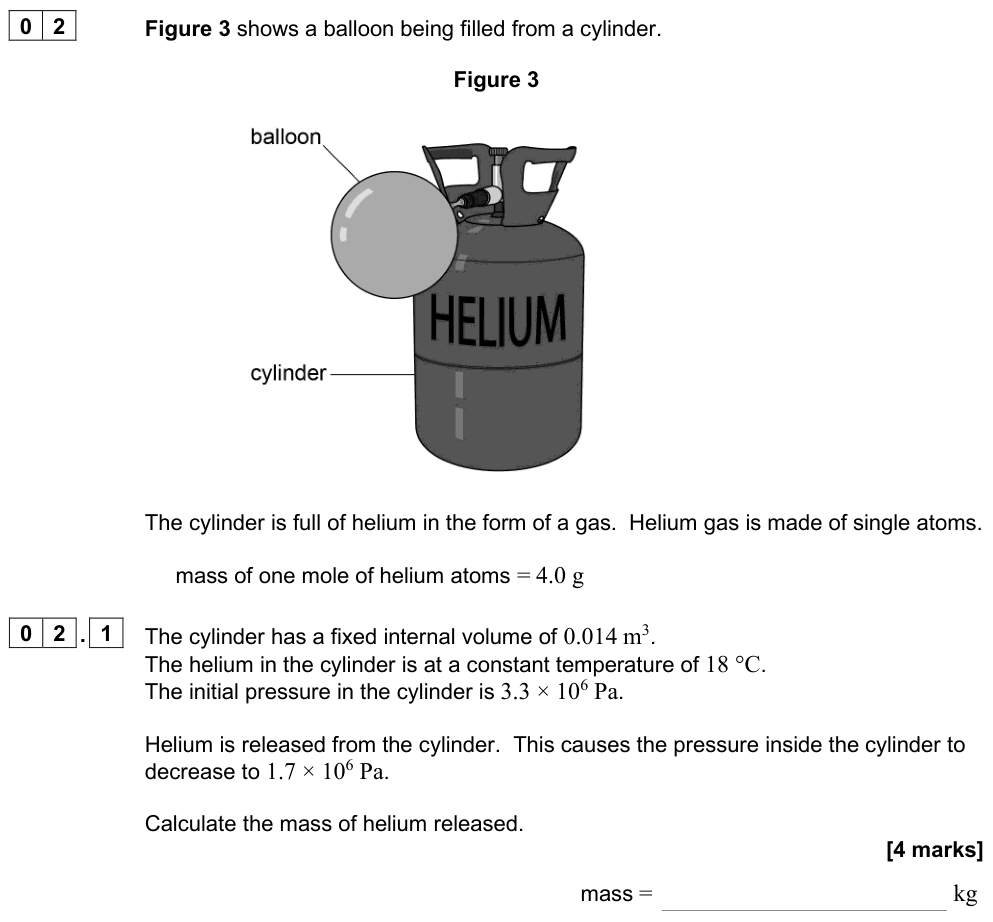
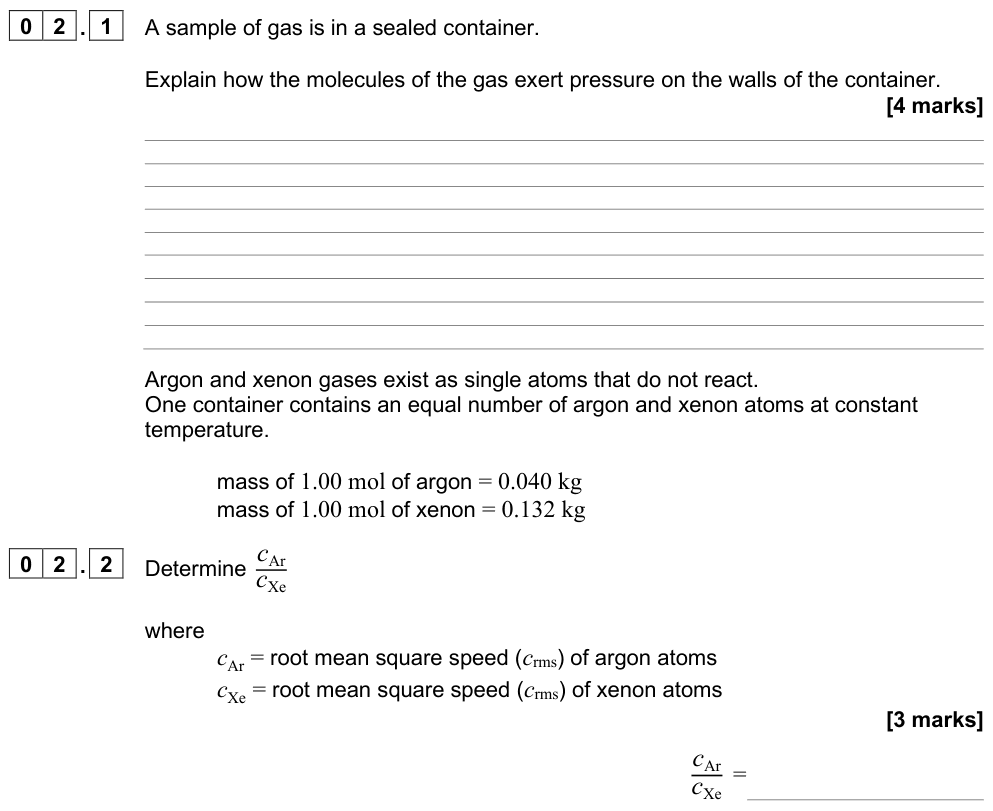
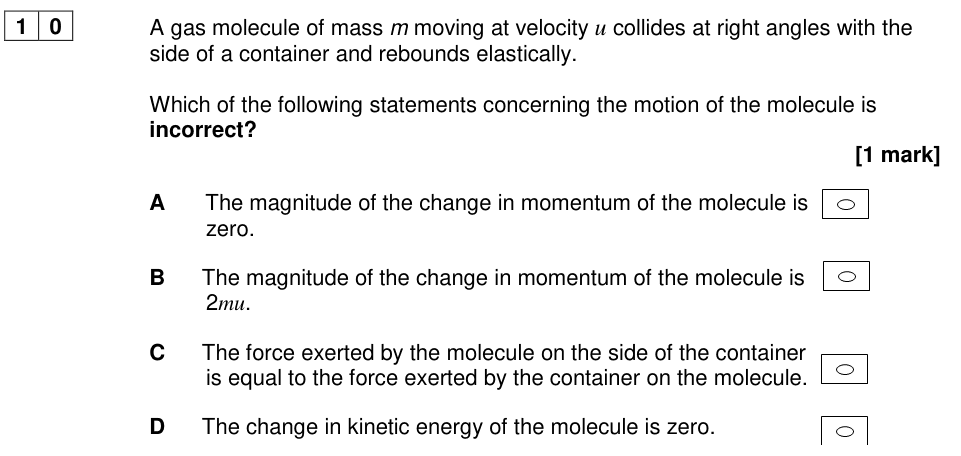
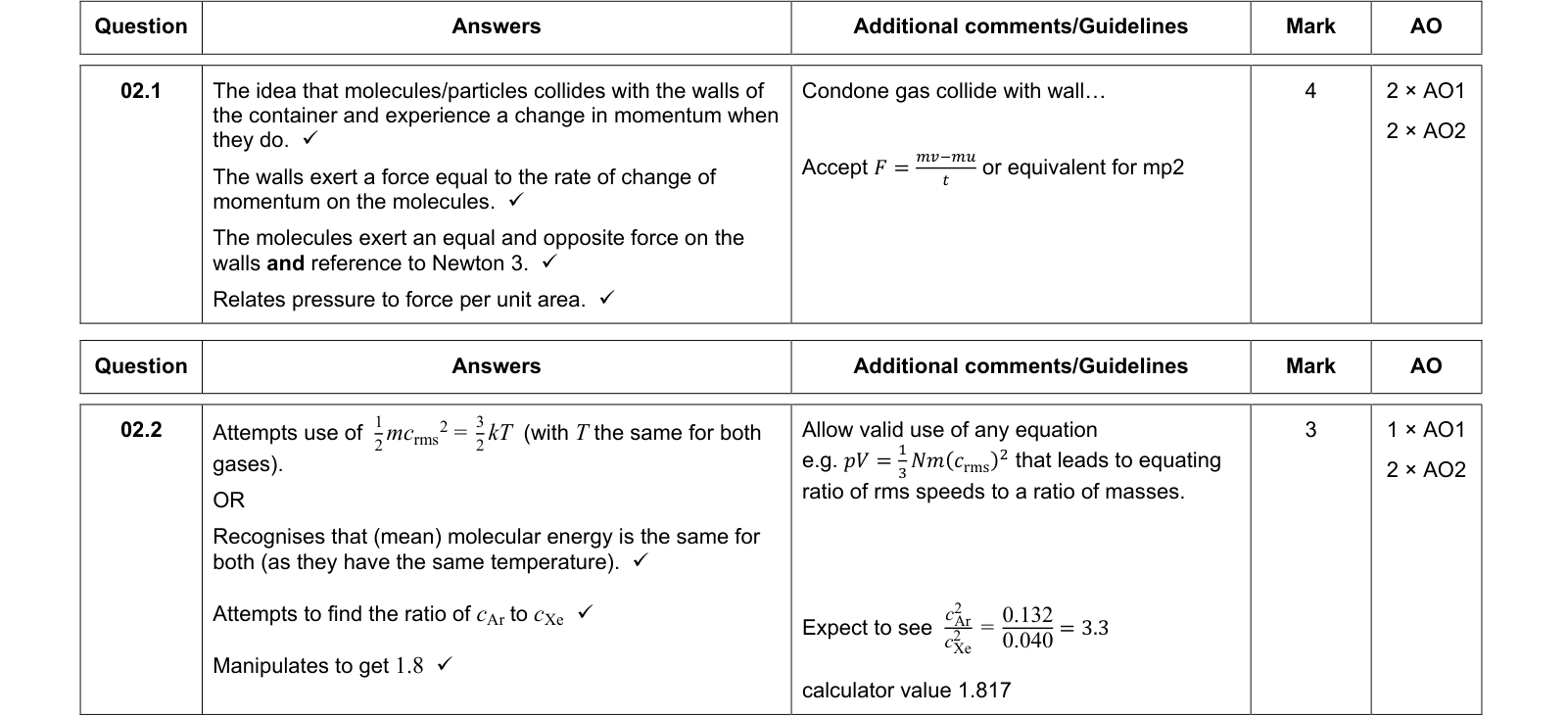
A gas consists of a very large number of molecules moving randomly. When a molecule hits a wall of the container and rebounds, its momentum changes, so it exerts a force on the wall. The total force from all the collisions, divided by the area, is the pressure.
| Law | Molecular explanation |
|---|---|
| Boyle's law (T constant): smaller volume → higher pressure | The molecules have the same mean speed, but in a smaller volume they hit each unit area of wall more often, so the force per unit area increases. |
| Pressure law (V constant): higher temperature → higher pressure | The molecules move faster, so each collision involves a larger change of momentum and collisions are more frequent. |
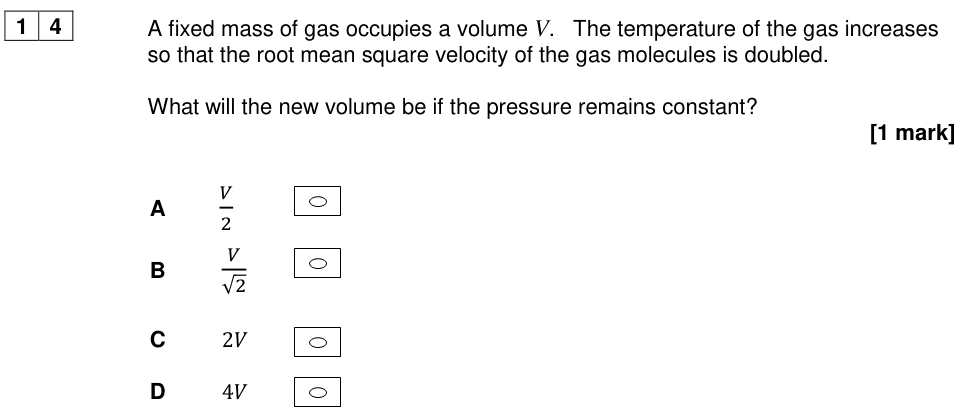
| Charles's law (p constant): higher temperature → larger volume | Faster molecules would increase the pressure, so the gas must expand until collisions with each unit area are rare enough for the pressure to return to its original value. |
Empirical laws and theory
The gas laws are empirical: they were discovered by experiment and describe what happens. The kinetic theory is a theoretical model: it starts from assumptions about molecules and uses Newton's laws to predict the behaviour of gases. Its success in explaining the gas laws is strong evidence for the model.
Assumptions of the kinetic theory
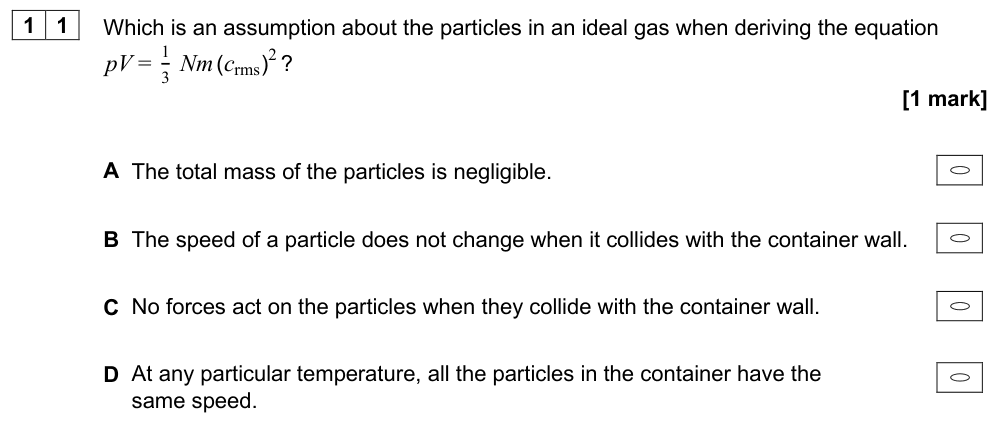
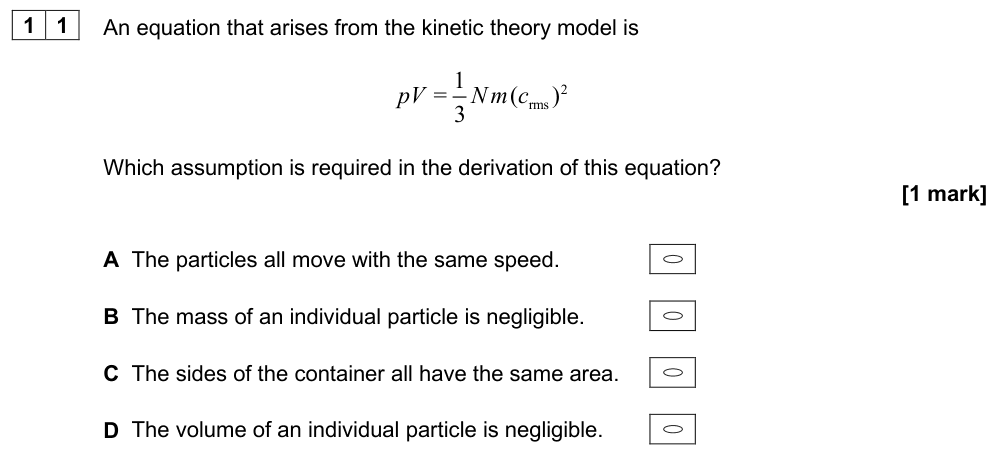
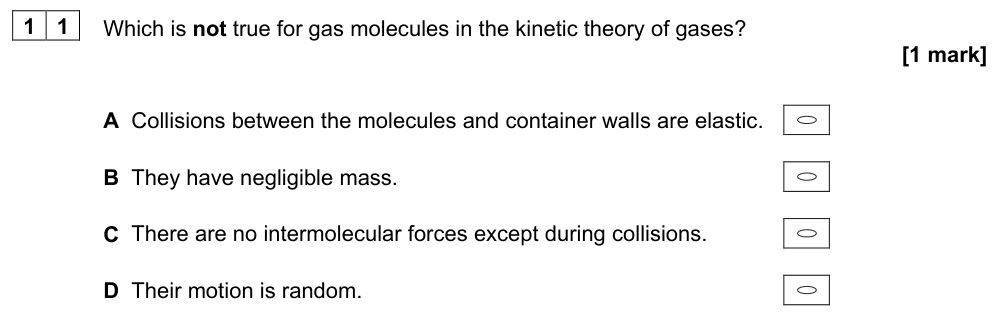
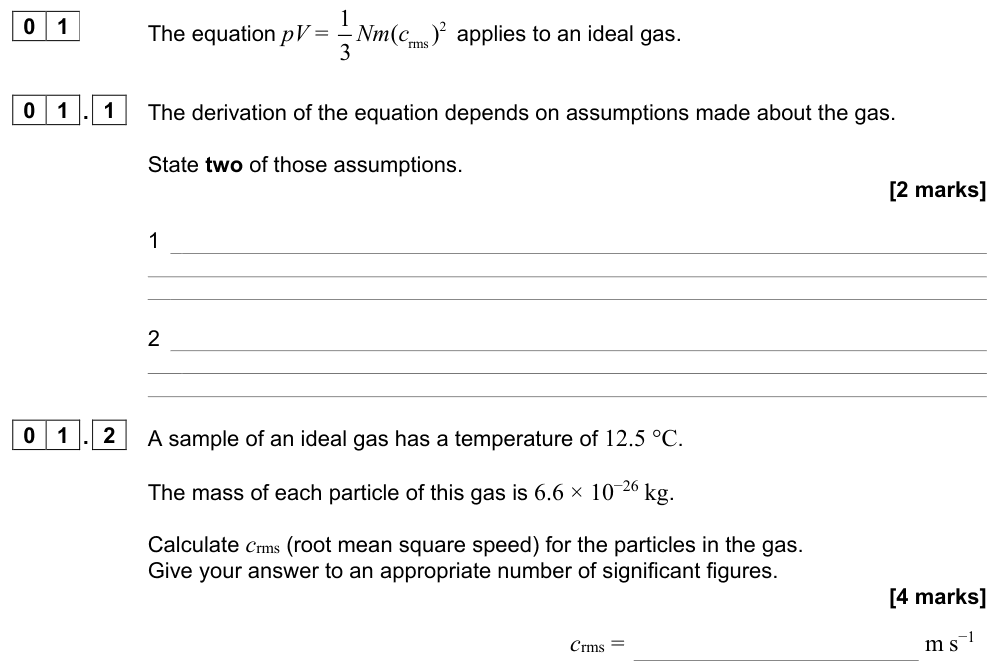
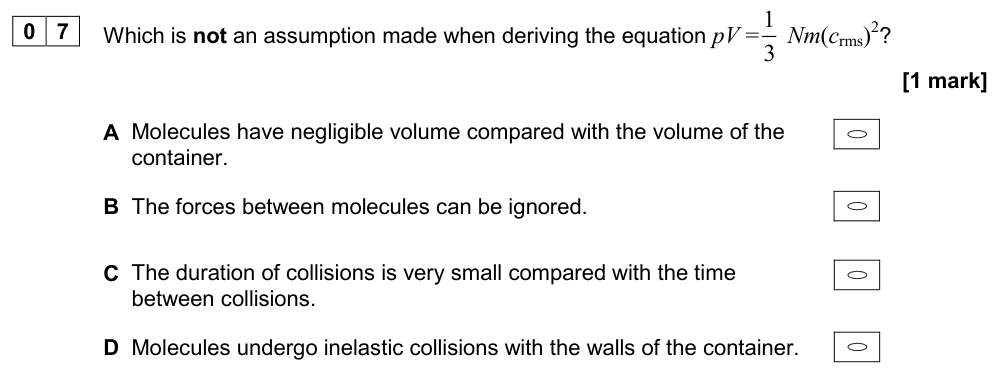
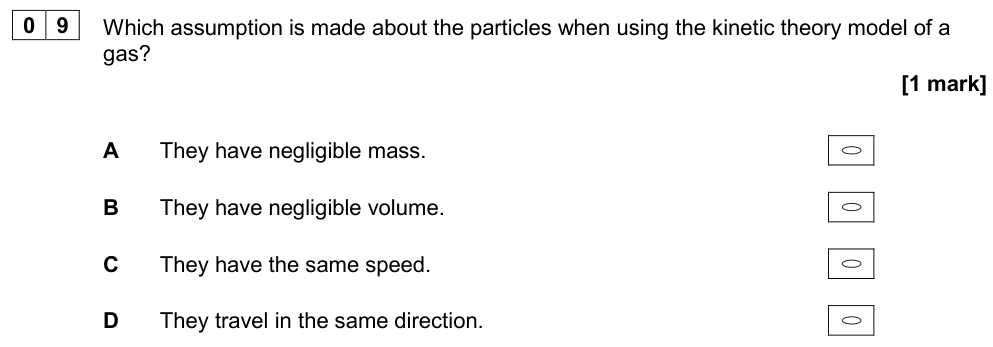
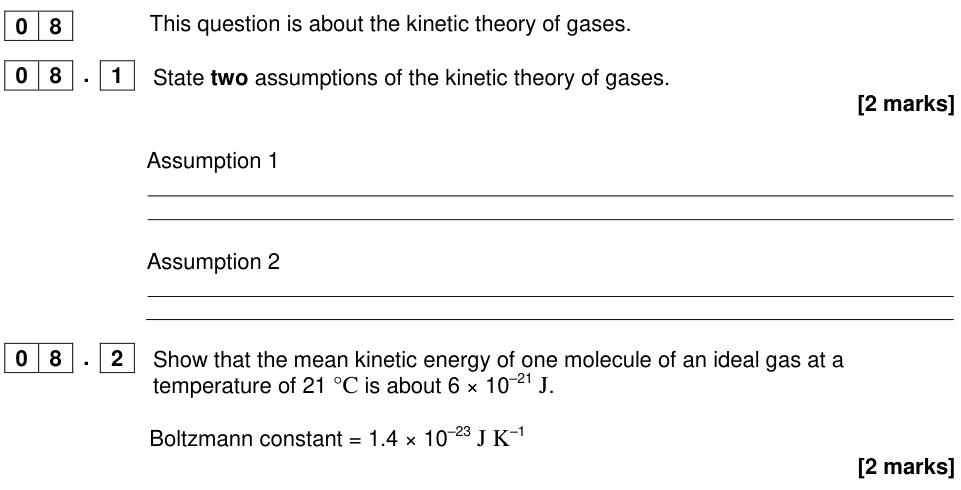
The simple kinetic theory model of an ideal gas assumes:
- The gas contains a very large number of identical molecules.
- The molecules move in random directions with a range of speeds.
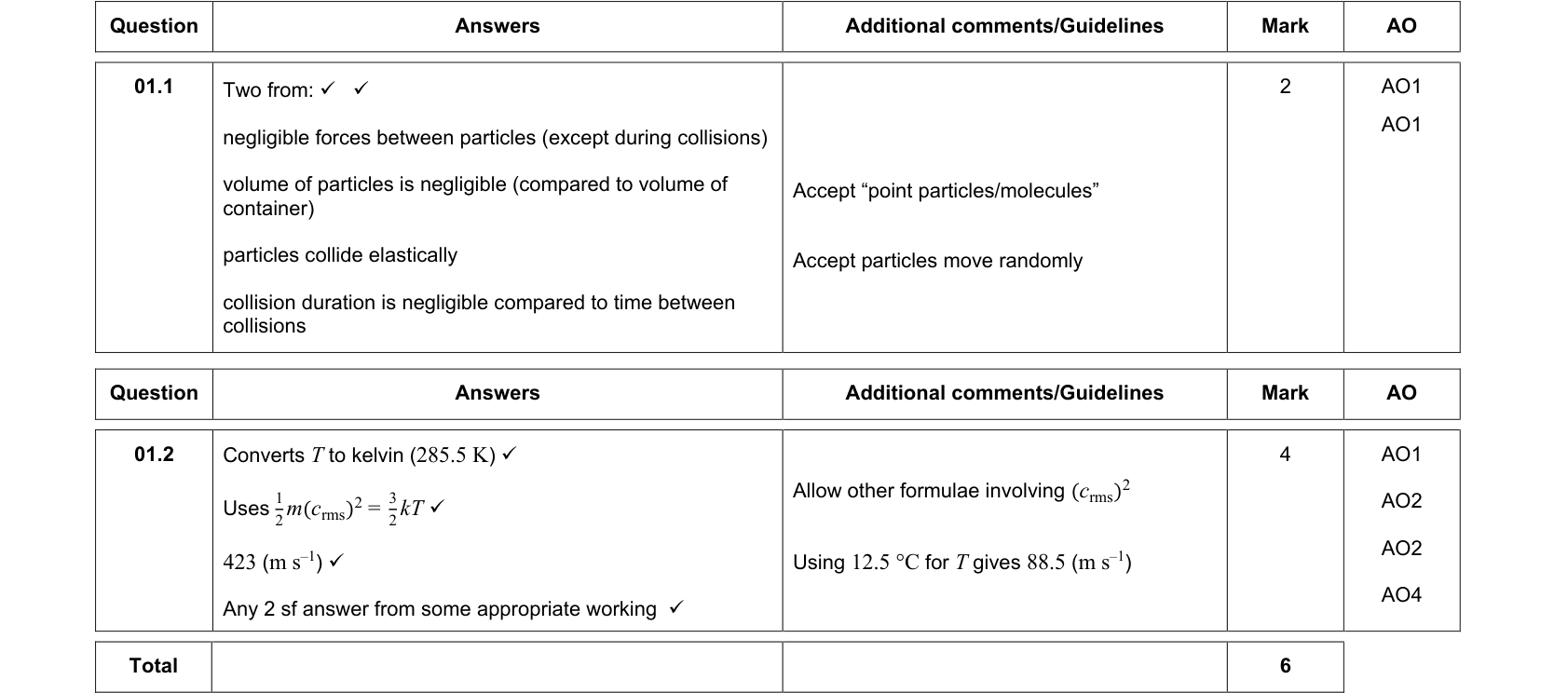
- The volume of the molecules is negligible compared with the volume of the container.
- The molecules exert no forces on each other except during collisions (so there is no potential energy between them).
- All collisions (with each other and with the walls) are elastic.
- The duration of a collision is negligible compared with the time between collisions.
- Newton's laws of motion apply to the molecules.
Deriving the pressure of a gas
Consider one molecule of mass $m$ in a cube of side $L$, moving with velocity component $u$ perpendicular to one wall.
- When it hits the wall and rebounds elastically, its momentum changes from $mu$ to $-mu$: a change of $2mu$.
- It travels $2L$ (to the opposite wall and back) before hitting the same wall again, so the time between collisions is $\dfrac{2L}{u}$.
- The mean force on the wall is the rate of change of momentum: $F = \dfrac{2mu}{2L/u} = \dfrac{mu^2}{L}$.
- For $N$ molecules with velocity components $u_1, u_2, \dots$ the total force is $\dfrac{m}{L}(u_1^2 + u_2^2 + \dots) = \dfrac{Nm\overline{u^2}}{L}$, where $\overline{u^2}$ is the mean of the squares.
- Pressure $= \dfrac{F}{L^2} = \dfrac{Nm\overline{u^2}}{L^3} = \dfrac{Nm\overline{u^2}}{V}$.
- Each molecule's speed $c$ satisfies $c^2 = u^2 + v^2 + w^2$. Because motion is random, the mean squares of the three components are equal, so $\overline{u^2} = \tfrac13\overline{c^2}$.
Kinetic theory equation
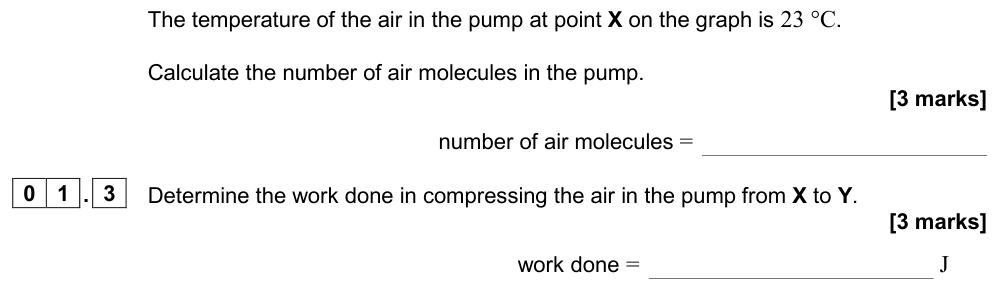
$$pV = \tfrac13Nm\left(c_{\text{rms}}\right)^2$$
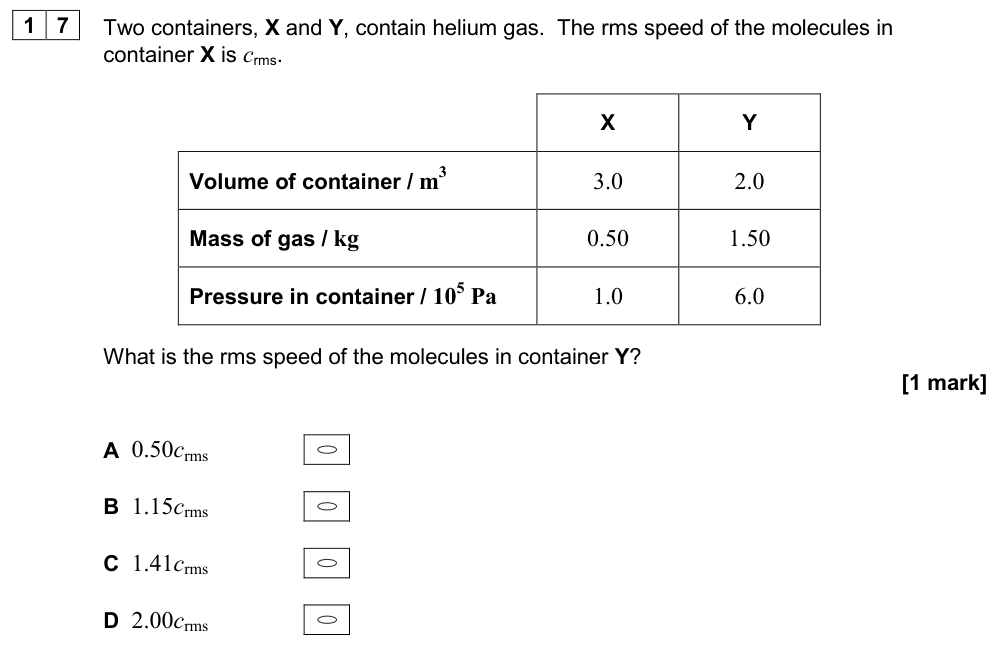
$c_{\text{rms}}$ is the root mean square speed. Since $Nm$ is the total mass, this can also be written $p = \tfrac13\rho\left(c_{\text{rms}}\right)^2$, where $\rho$ is the density of the gas.
Root mean square speed
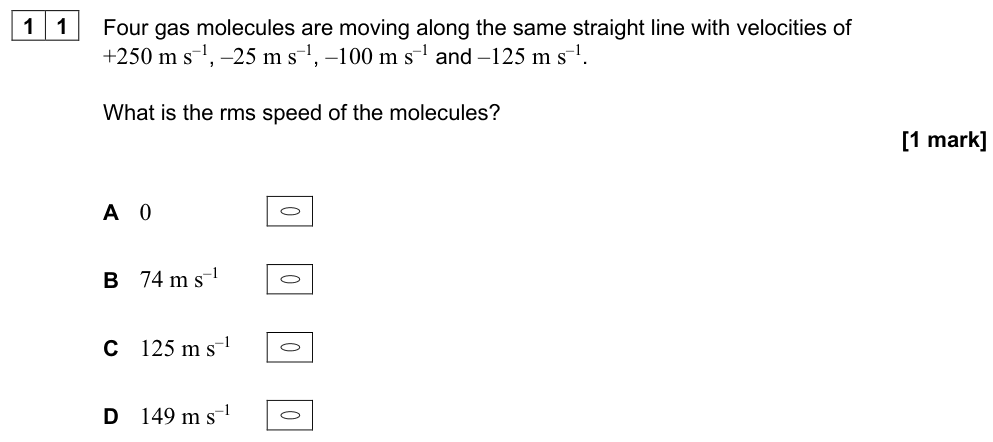
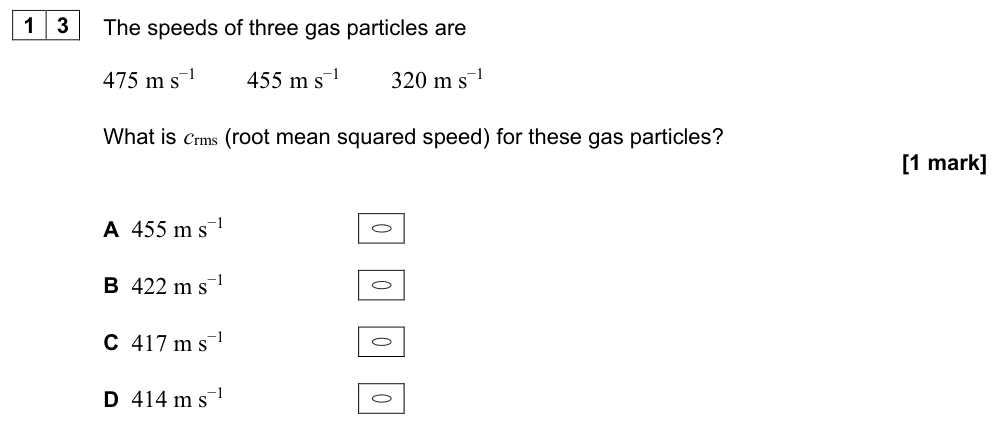
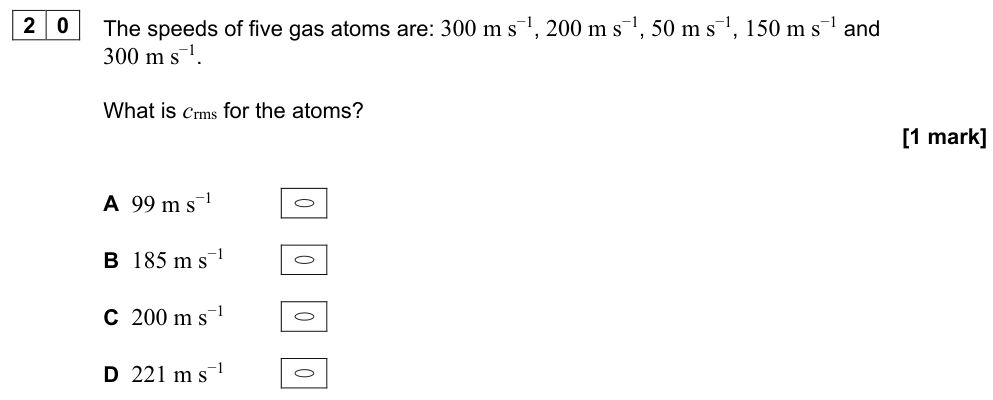
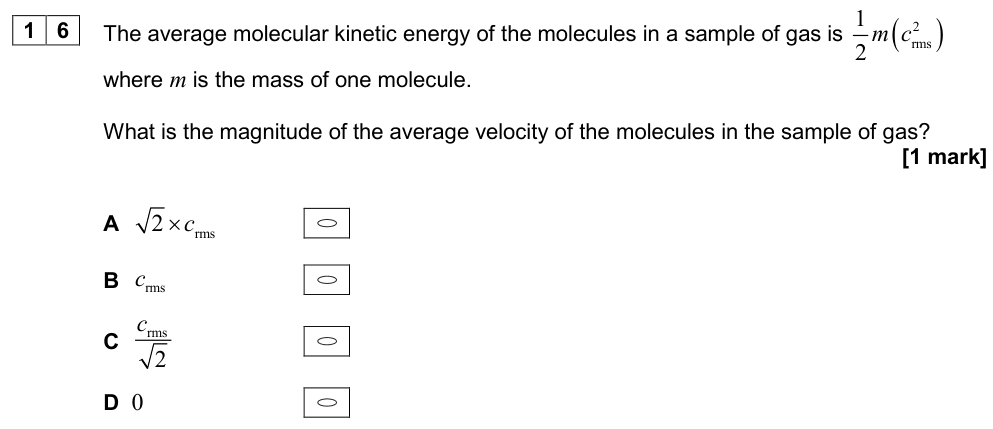
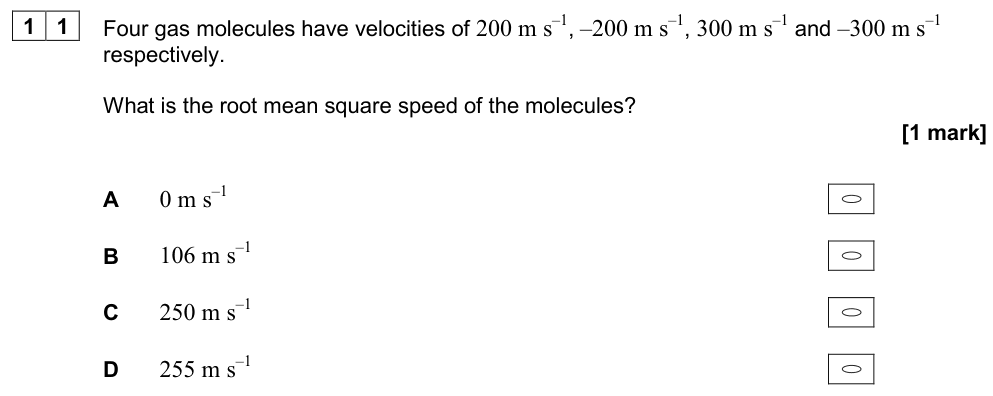
The molecules have a wide range of speeds. The root mean square (r.m.s.) speed is found by squaring all the speeds, finding the mean of the squares, and taking the square root:
$$c_{\text{rms}} = \sqrt{\frac{c_1^2 + c_2^2 + \dots + c_N^2}{N}}$$
Worked example: r.m.s. speed
Four molecules have speeds 300, 400, 500 and 600 m s⁻¹.
Mean speed $= 1800/4 = 450$ m s⁻¹.
Mean square speed $= (9 + 16 + 25 + 36) \times 10^{4}/4 = 2.15 \times 10^{5}$ m² s⁻², so $c_{\text{rms}} = 464$ m s⁻¹, slightly more than the mean speed.
Temperature and molecular kinetic energy
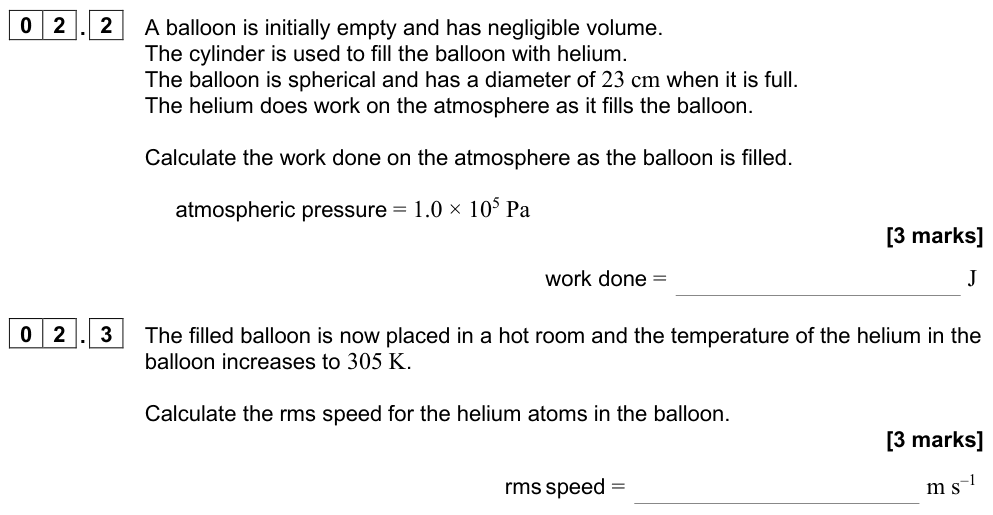
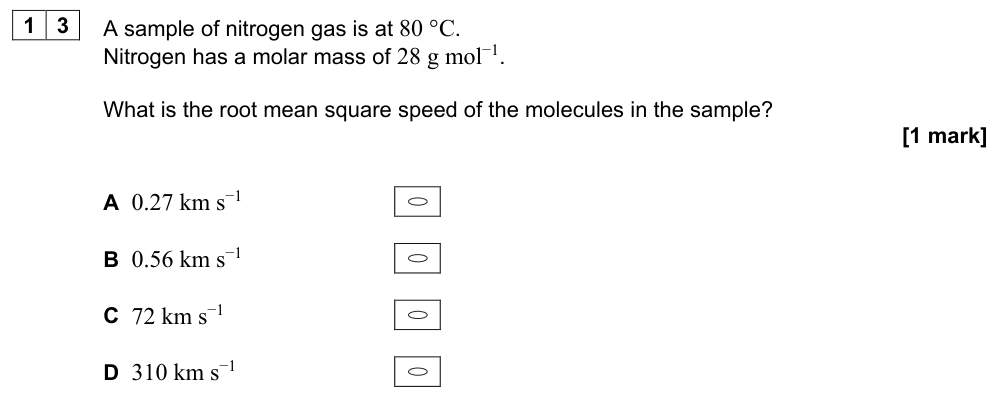
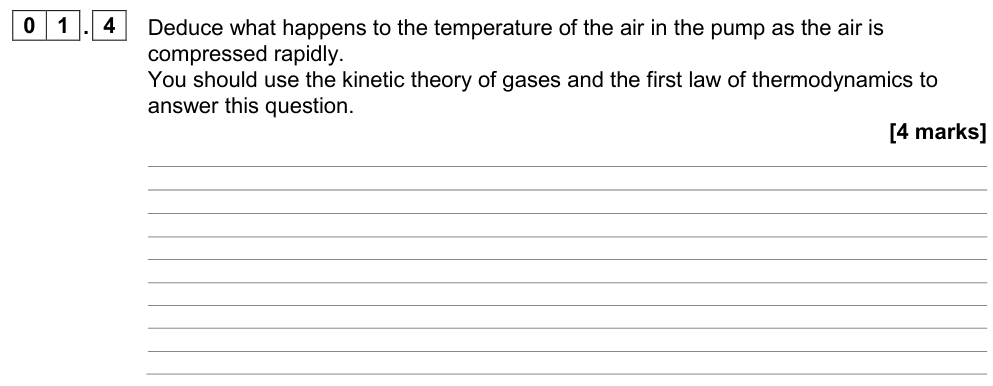
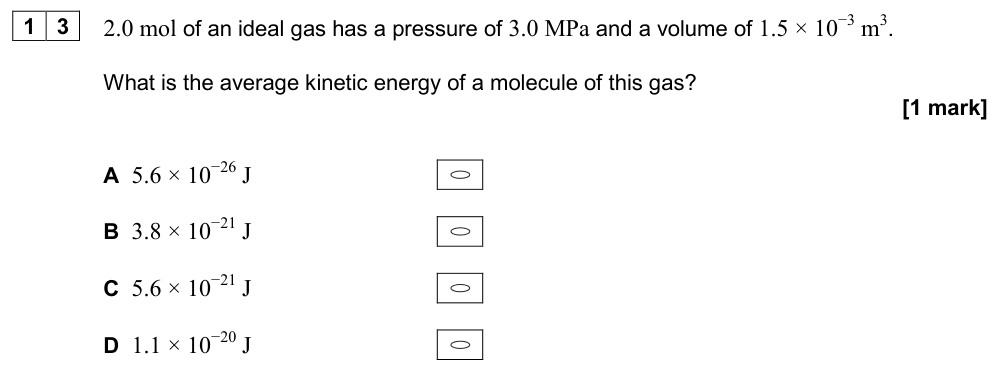
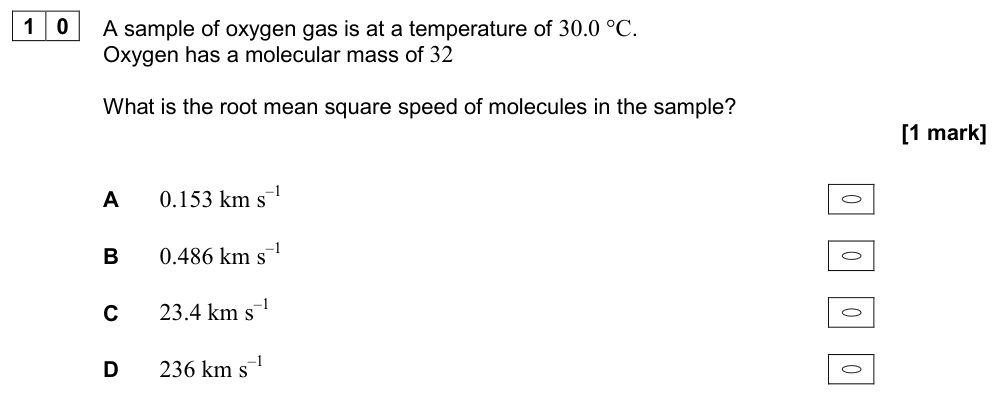
Comparing $pV = \tfrac13Nm(c_{\text{rms}})^2$ with $pV = NkT$ gives $\tfrac13m(c_{\text{rms}})^2 = kT$, so:
Mean kinetic energy of a gas molecule
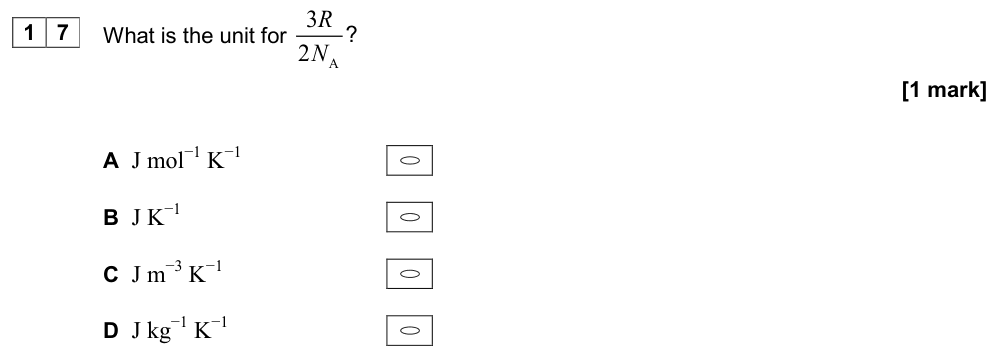
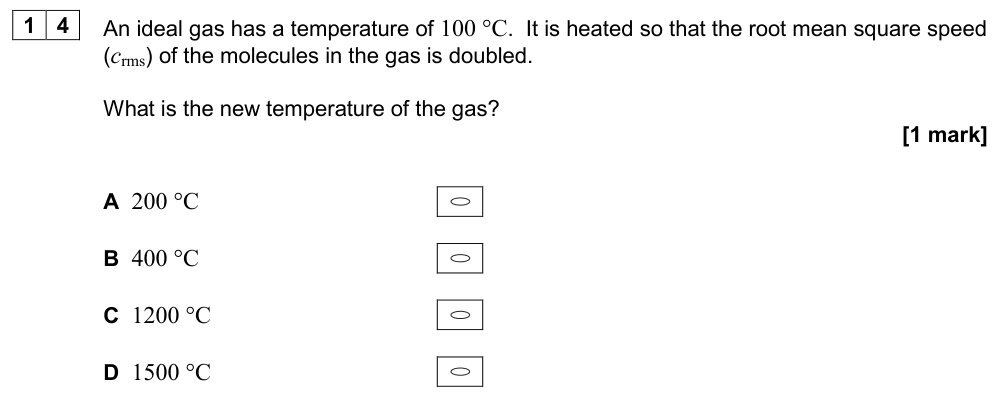
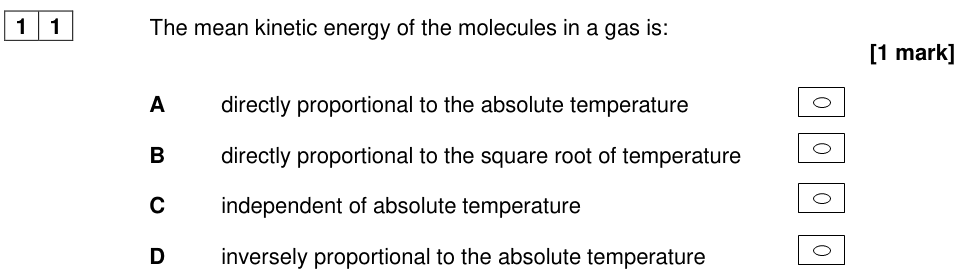
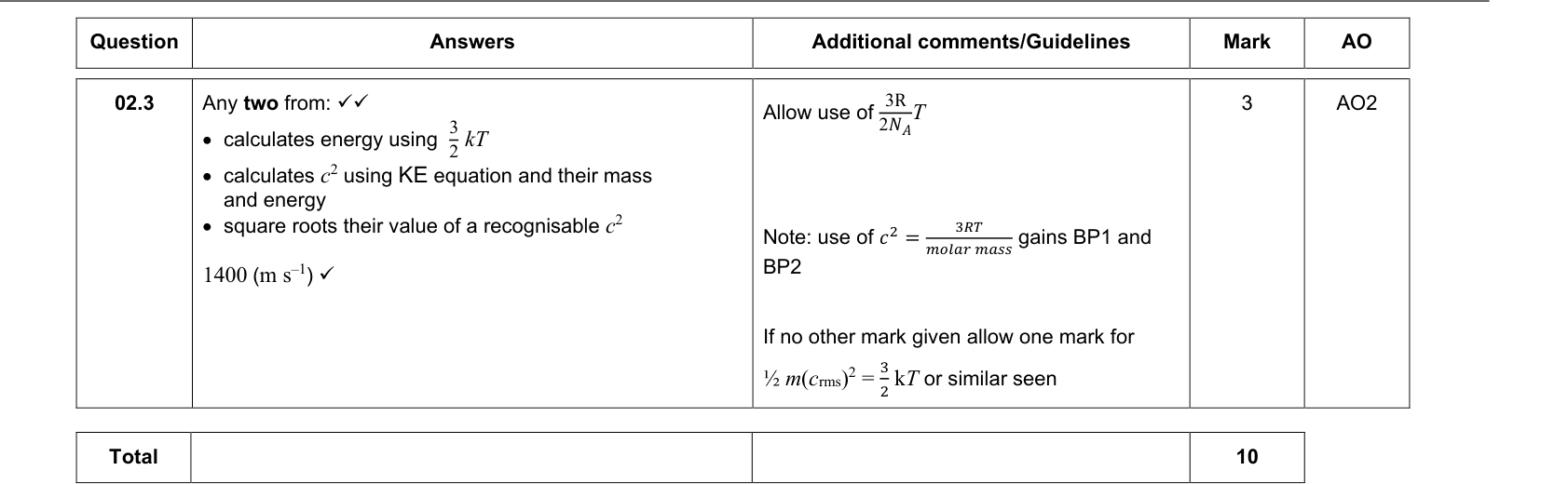
$$\tfrac12m\left(c_{\text{rms}}\right)^2 = \tfrac32kT = \frac{3RT}{2N_A}$$
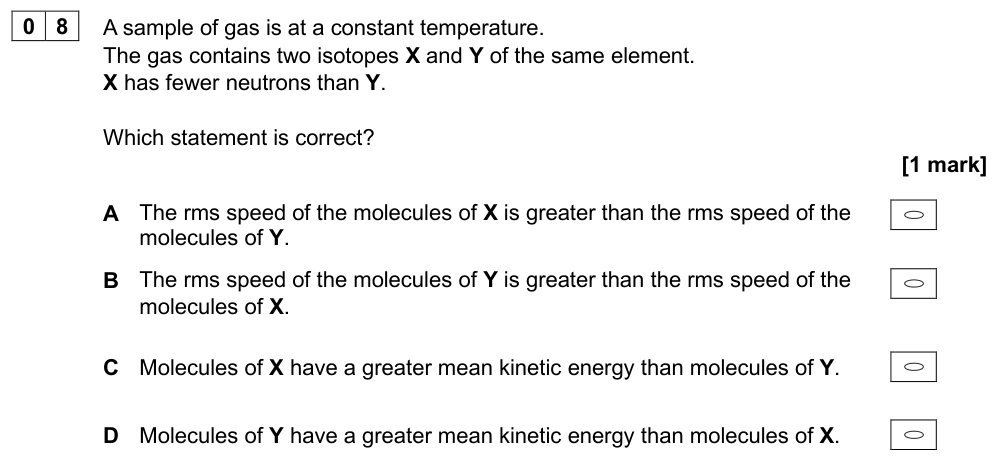
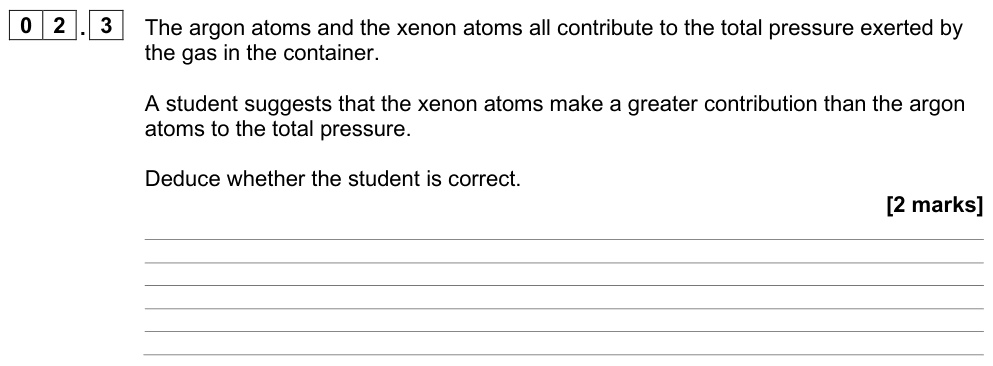
The mean kinetic energy of the molecules is proportional to the absolute temperature. It does not depend on the type of gas.
Consequences:
- At absolute zero the molecules would have zero kinetic energy.
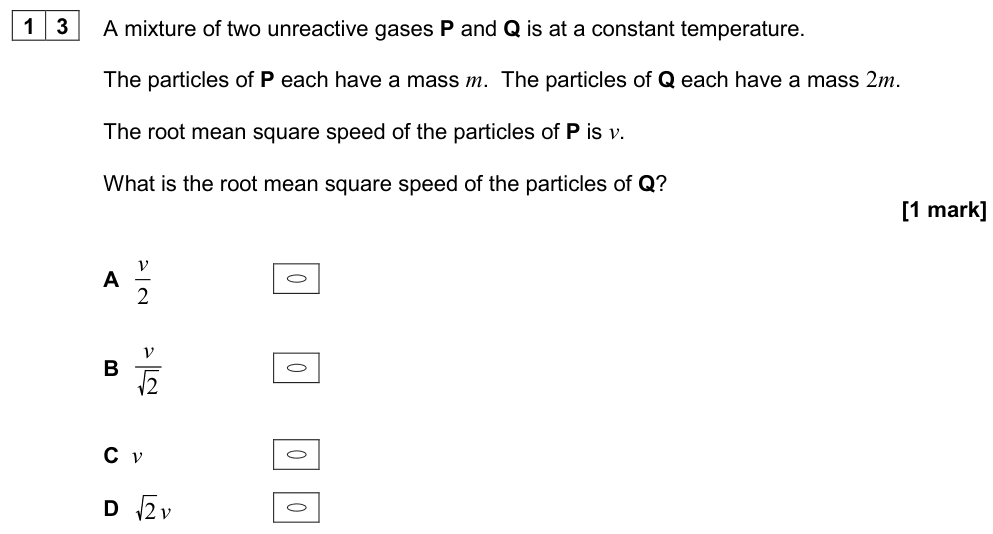
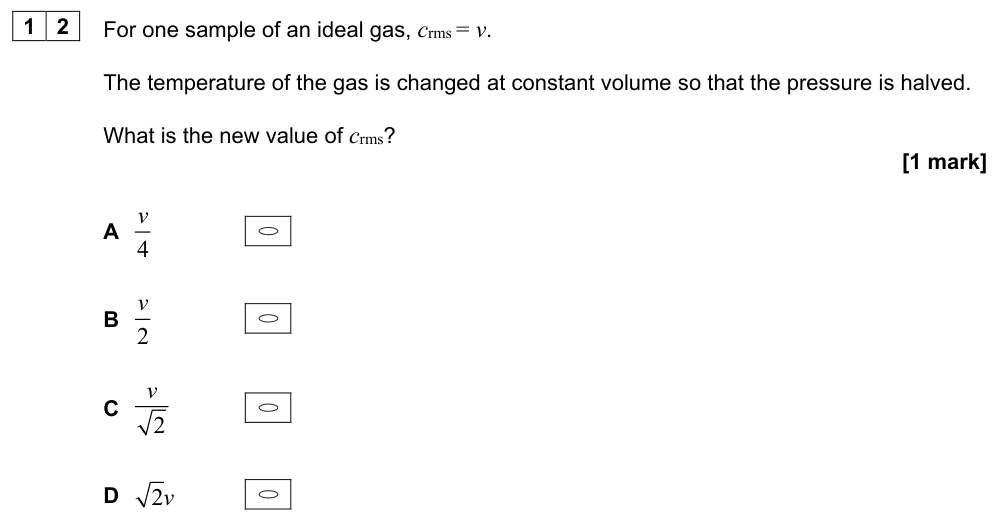
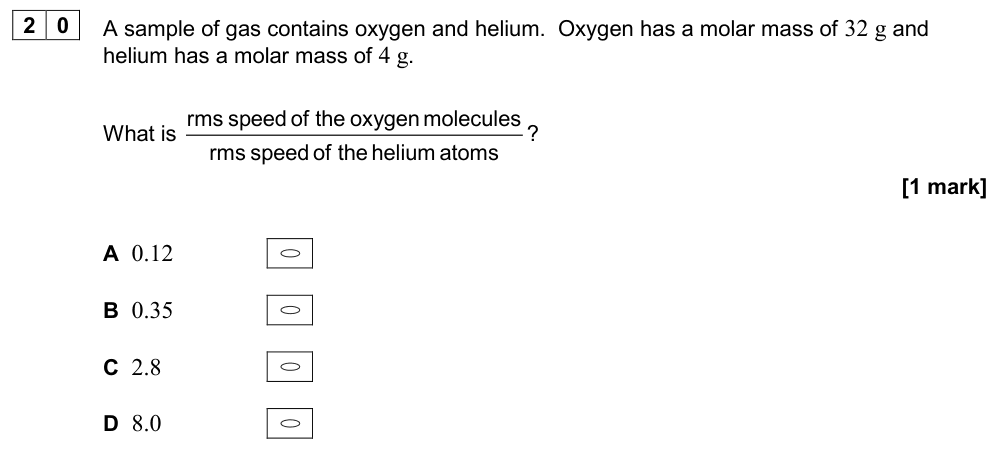
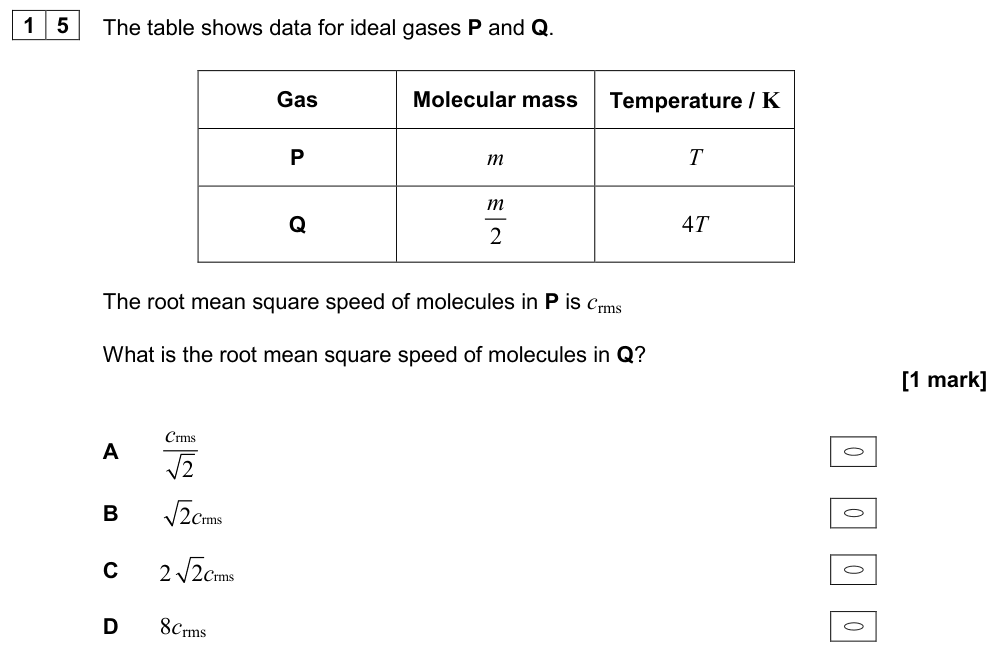
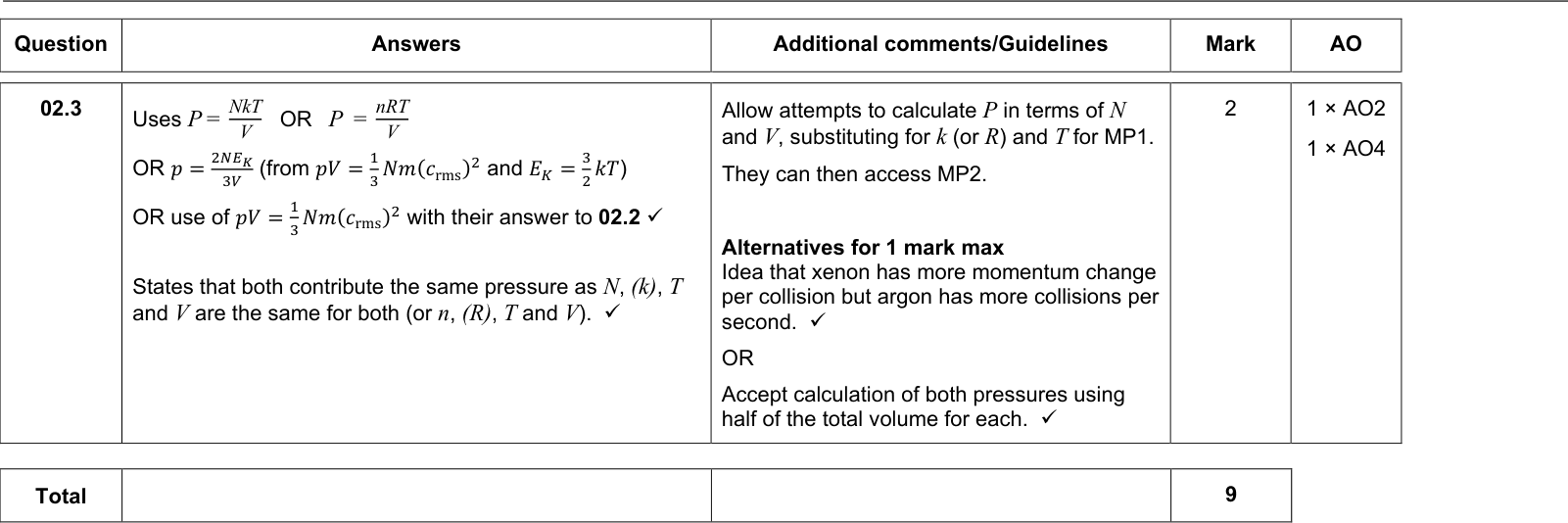
- Different gases at the same temperature have the same mean kinetic energy, so lighter molecules move faster: $c_{\text{rms}} = \sqrt{\dfrac{3kT}{m}} \propto \dfrac{1}{\sqrt m}$.
- Doubling the absolute temperature doubles the mean kinetic energy and multiplies $c_{\text{rms}}$ by $\sqrt2$.
Internal energy of an ideal gas
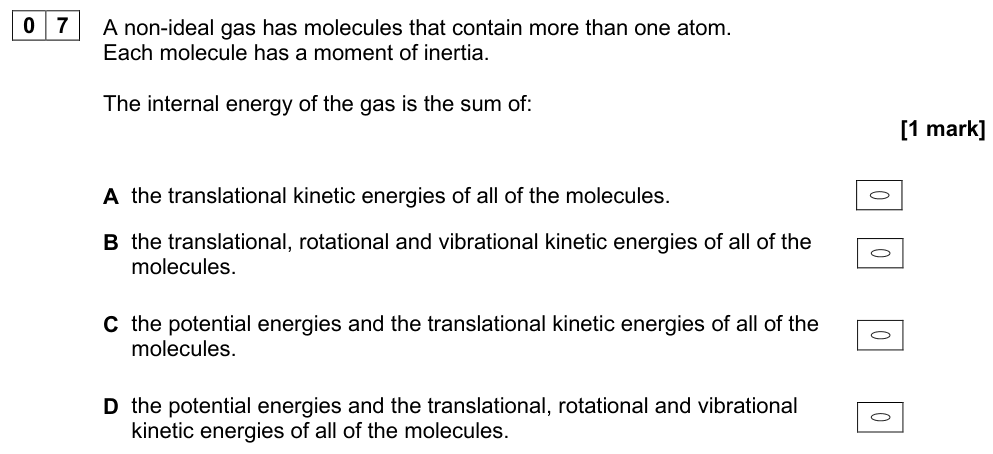
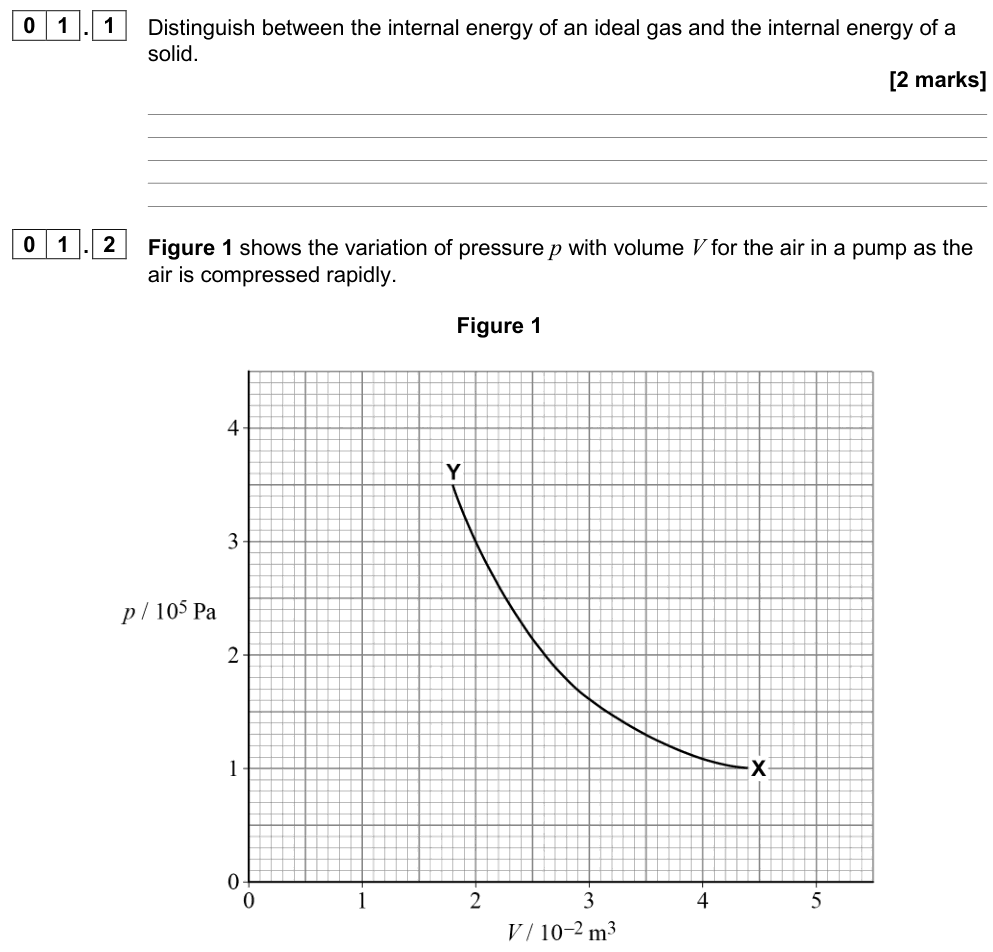
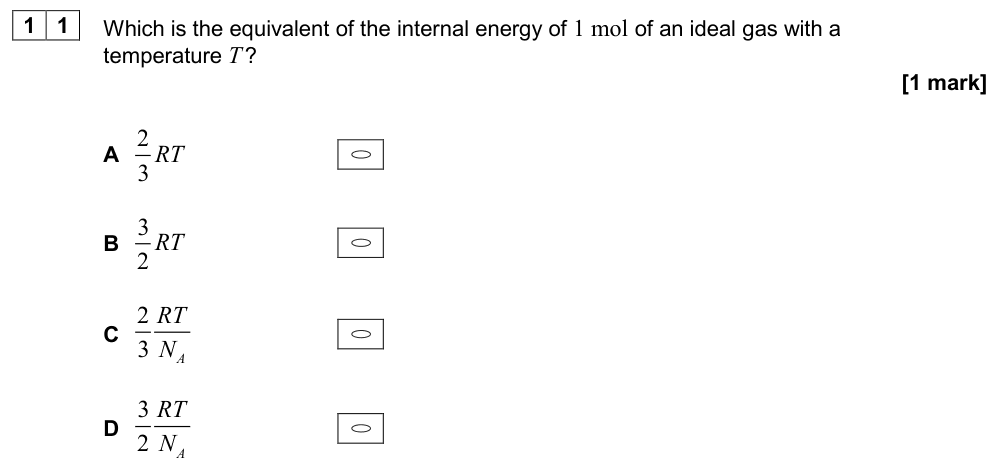
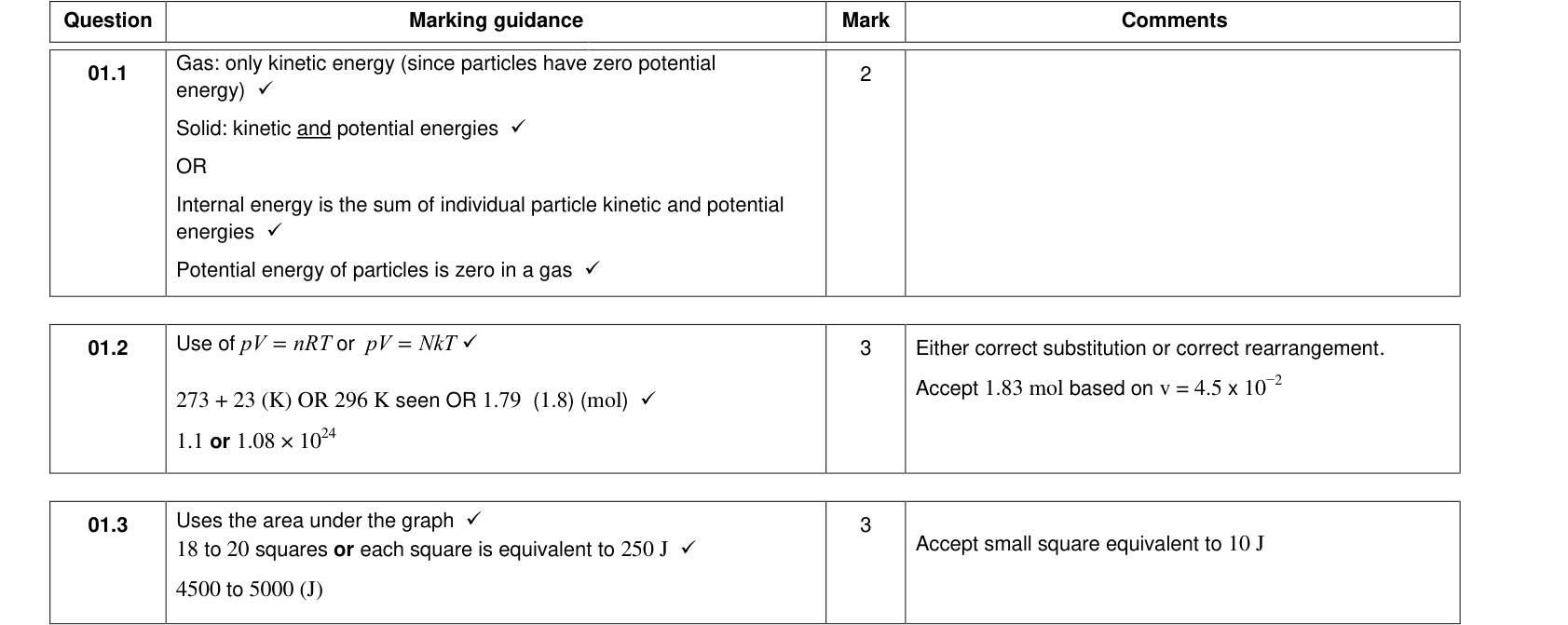
In an ideal gas there are no forces between molecules (except in collisions), so the molecules have no potential energy. The internal energy is entirely the kinetic energy of the molecules:
$$U = N \times \tfrac32kT = \tfrac32nRT$$
So the internal energy of an ideal gas depends only on its temperature.
Worked example: nitrogen molecules
Find the mean kinetic energy and r.m.s. speed of nitrogen molecules (molar mass 0.028 kg mol⁻¹) at 300 K.
Mean kinetic energy $= \tfrac32kT = 1.5 \times 1.38 \times 10^{-23} \times 300 = 6.2 \times 10^{-21}$ J.
Mass of one molecule $= 0.028/6.02 \times 10^{23} = 4.65 \times 10^{-26}$ kg.
$c_{\text{rms}} = \sqrt{\dfrac{2 \times 6.2 \times 10^{-21}}{4.65 \times 10^{-26}}} = 520$ m s⁻¹, faster than the speed of sound in air.
Total kinetic energy of one mole $= \tfrac32RT = 1.5 \times 8.31 \times 300 = 3.7$ kJ.
Common mistake
Always use the absolute temperature. And remember that $m$ in $\tfrac12m(c_{\text{rms}})^2$ is the mass of one molecule (molar mass ÷ $N_A$), not the molar mass.
Summary
- Brownian motion (random motion of smoke particles) is evidence for fast, randomly moving molecules.
- Pressure is caused by the momentum change of molecules colliding with the walls.
- Gas laws are empirical; kinetic theory is a theoretical model based on stated assumptions.
- $pV = \tfrac13Nm(c_{\text{rms}})^2$; $c_{\text{rms}}$ = square root of the mean of the squared speeds.
- $\tfrac12m(c_{\text{rms}})^2 = \tfrac32kT = \dfrac{3RT}{2N_A}$: mean kinetic energy ∝ absolute temperature.
- Internal energy of an ideal gas is all kinetic: $U = \tfrac32nRT$.