Induced fission
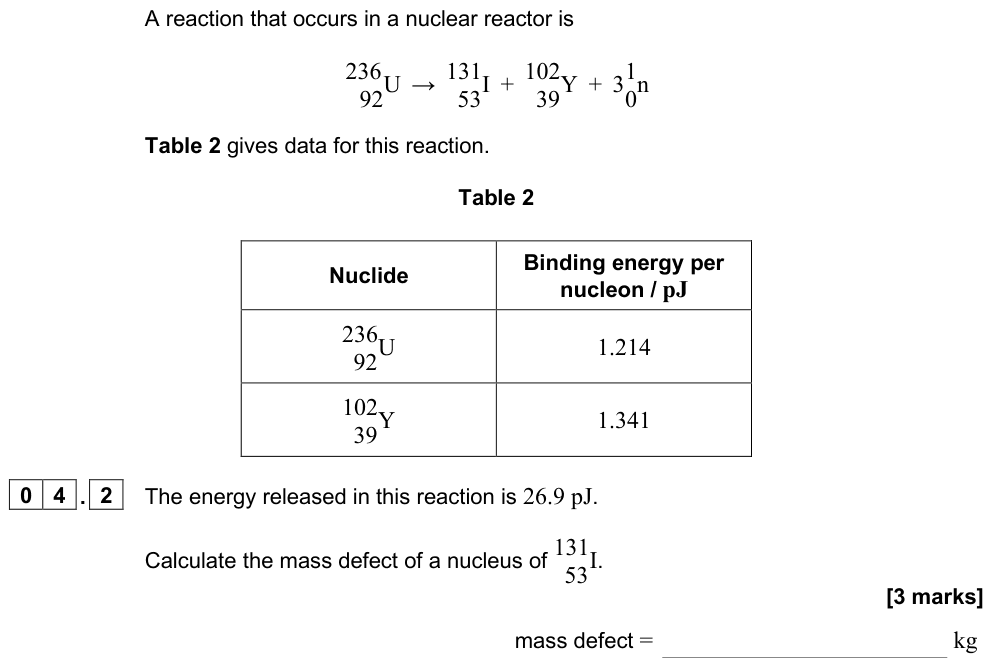
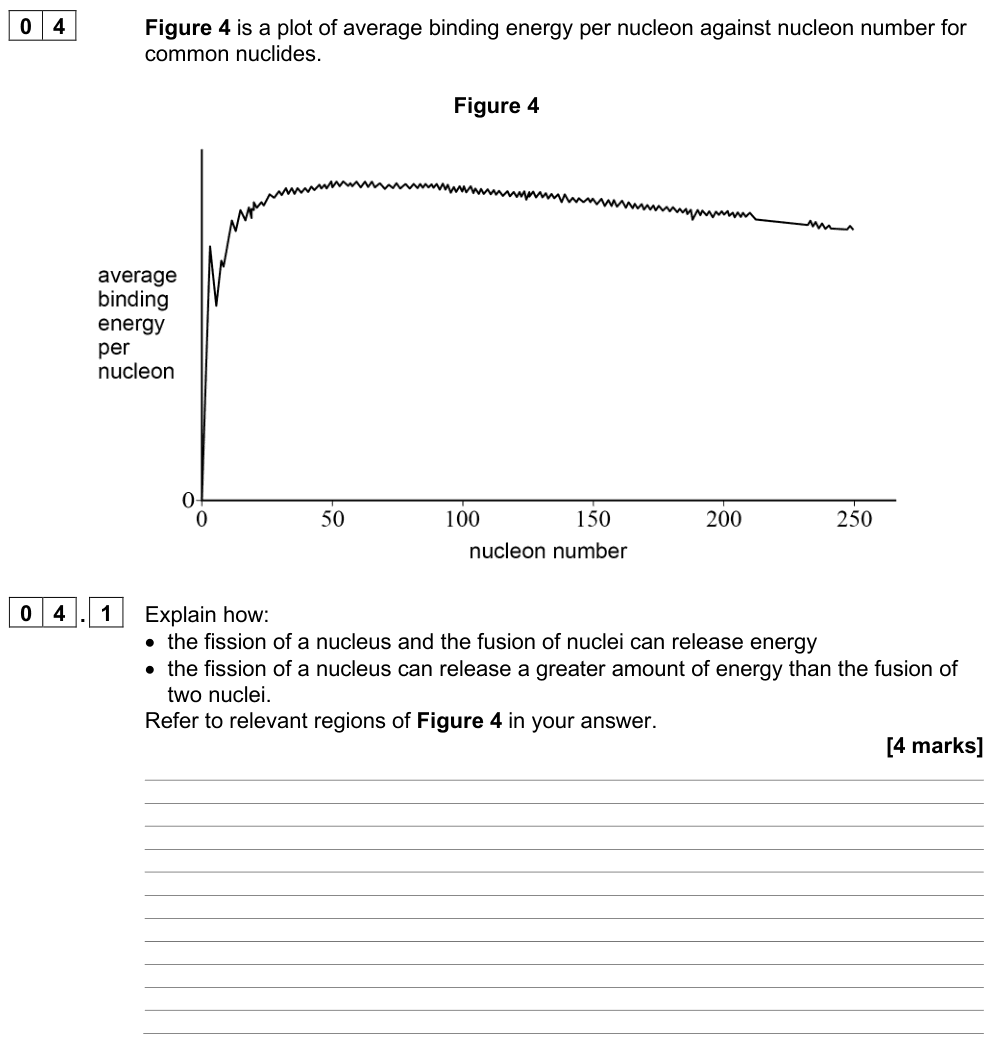
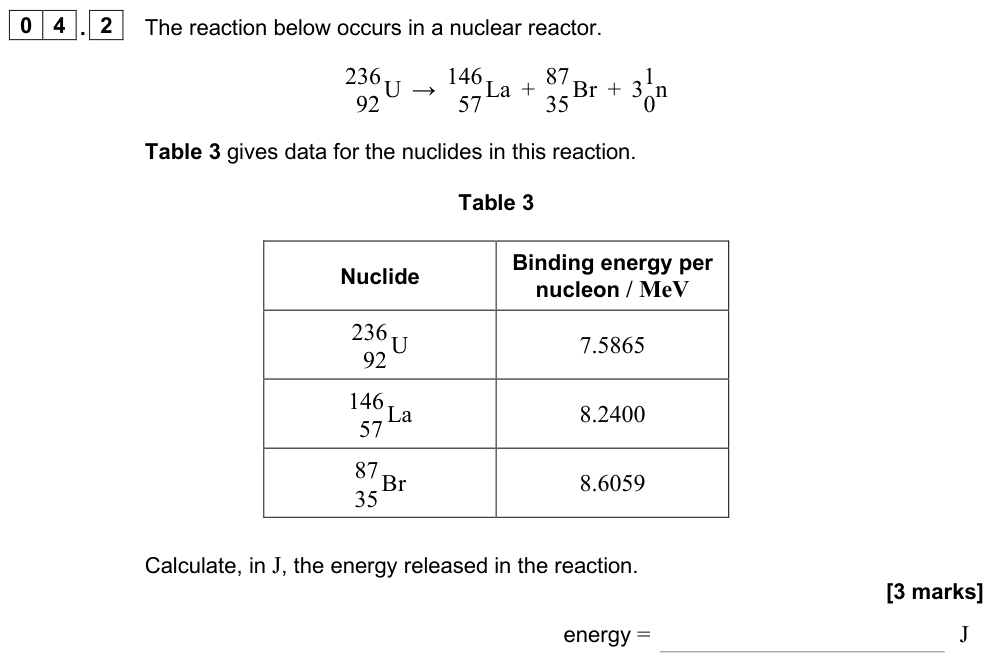
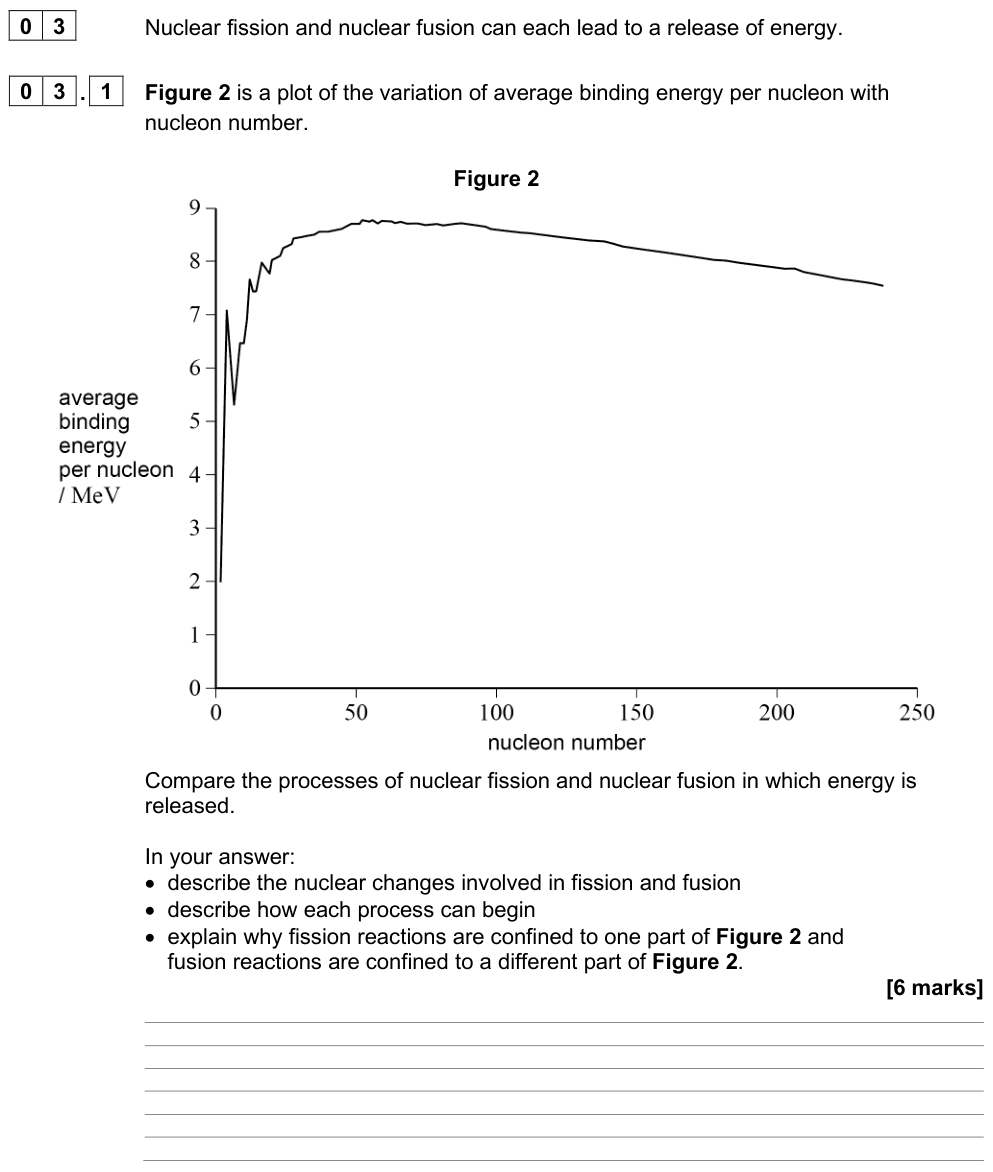
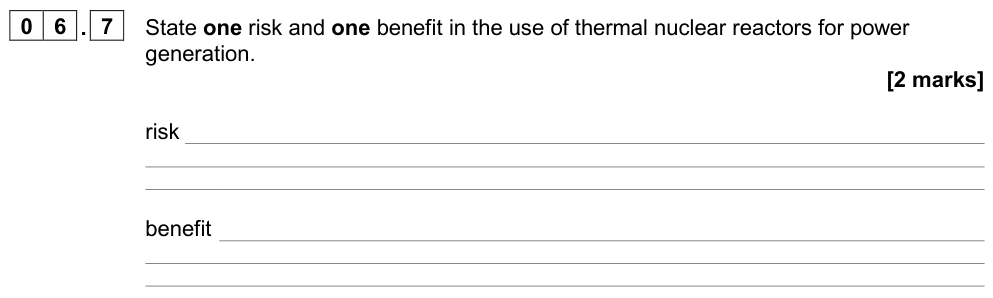
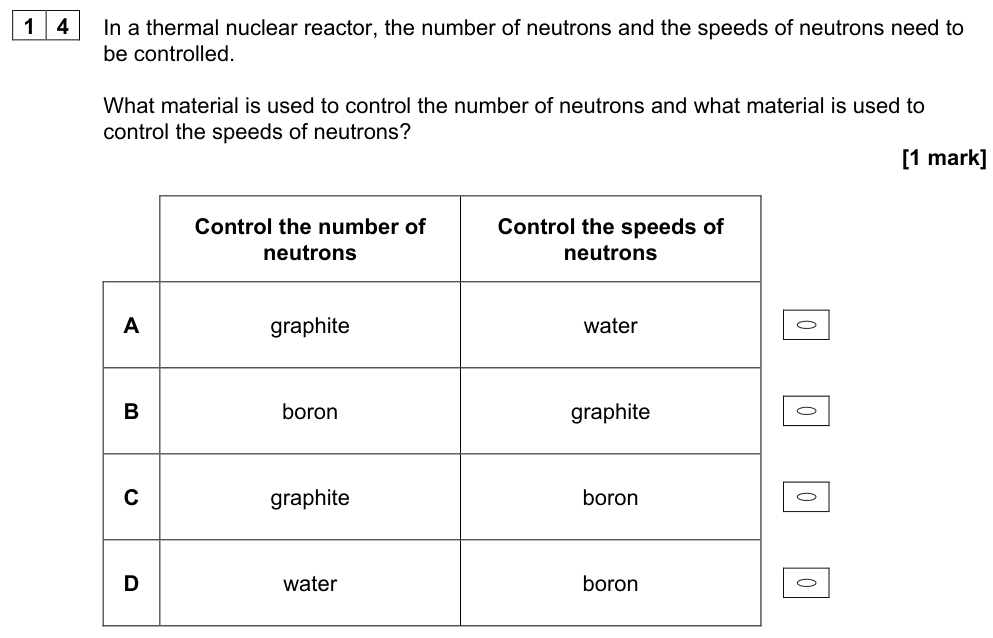
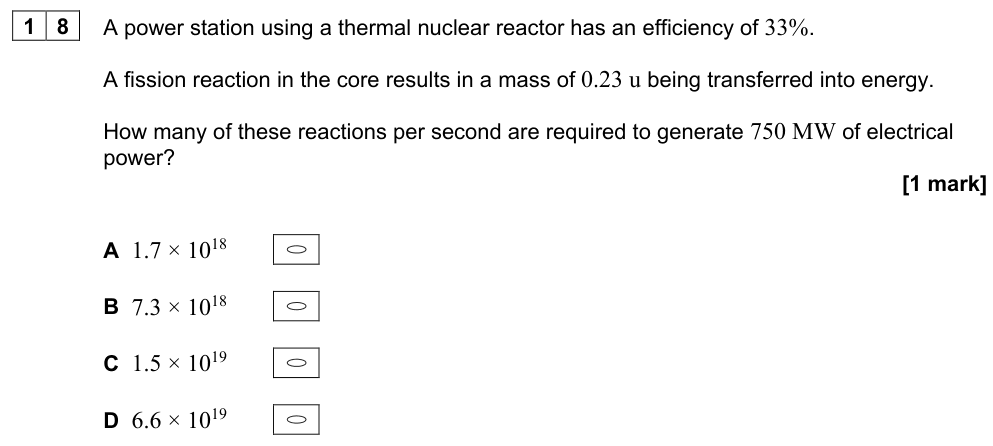
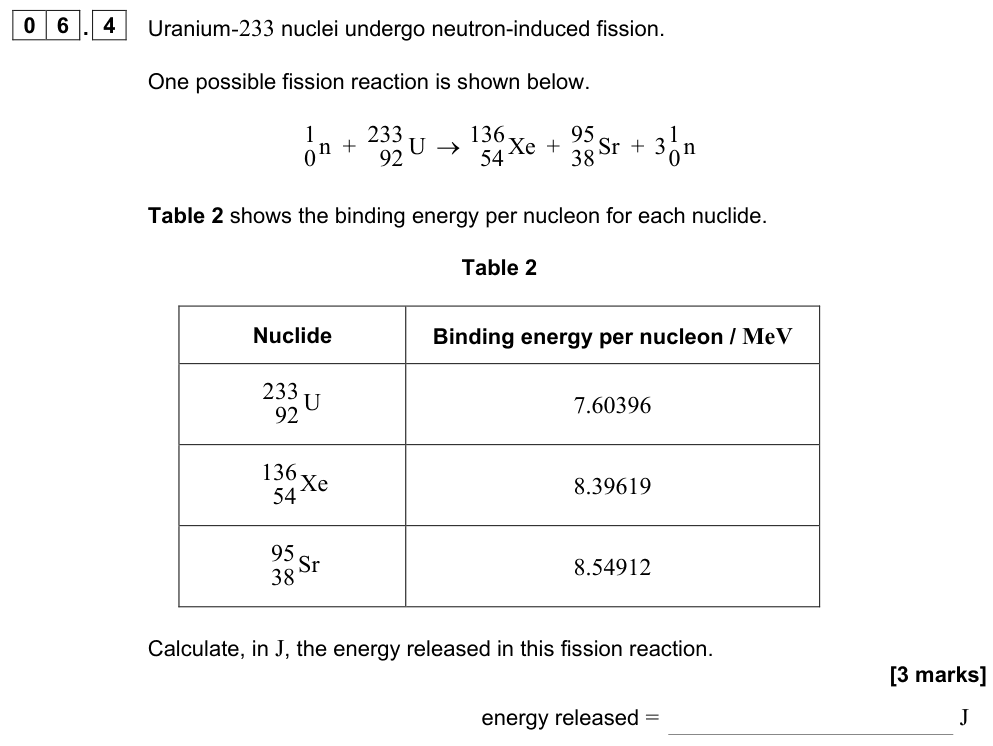
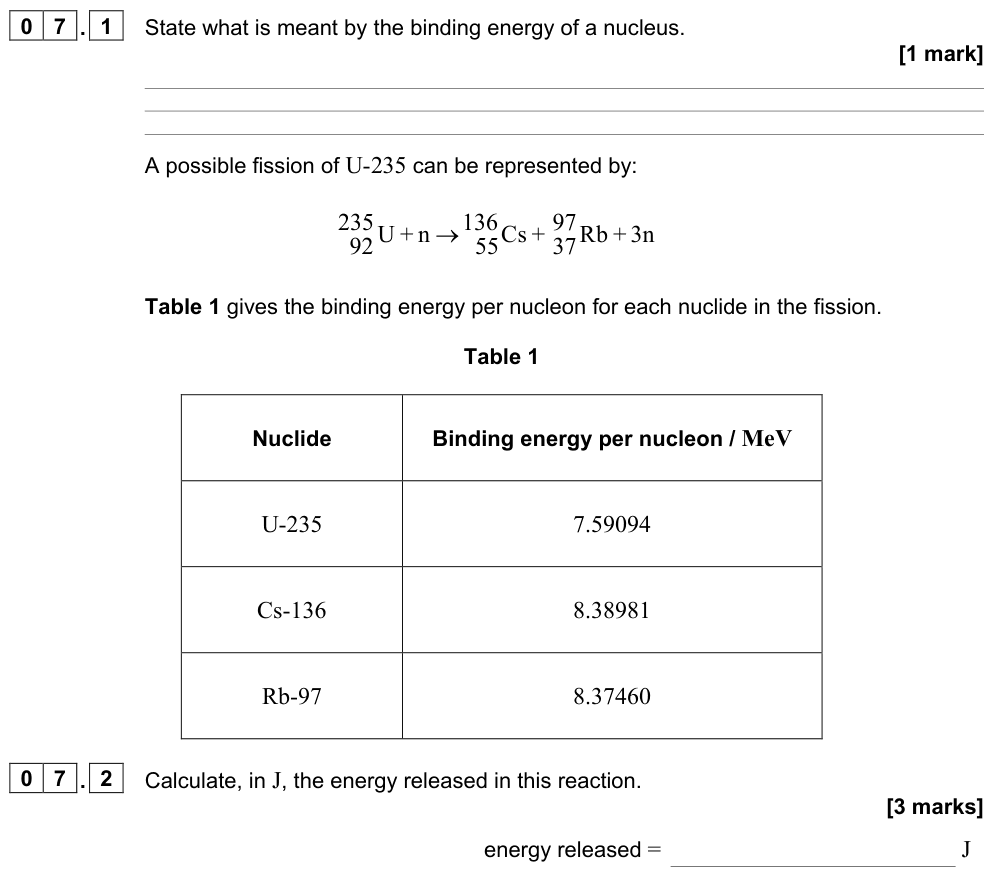
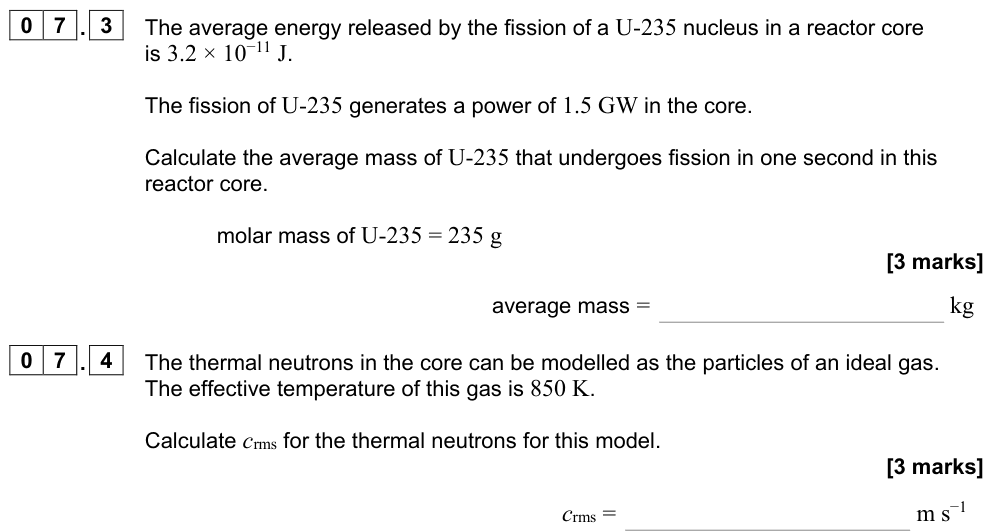
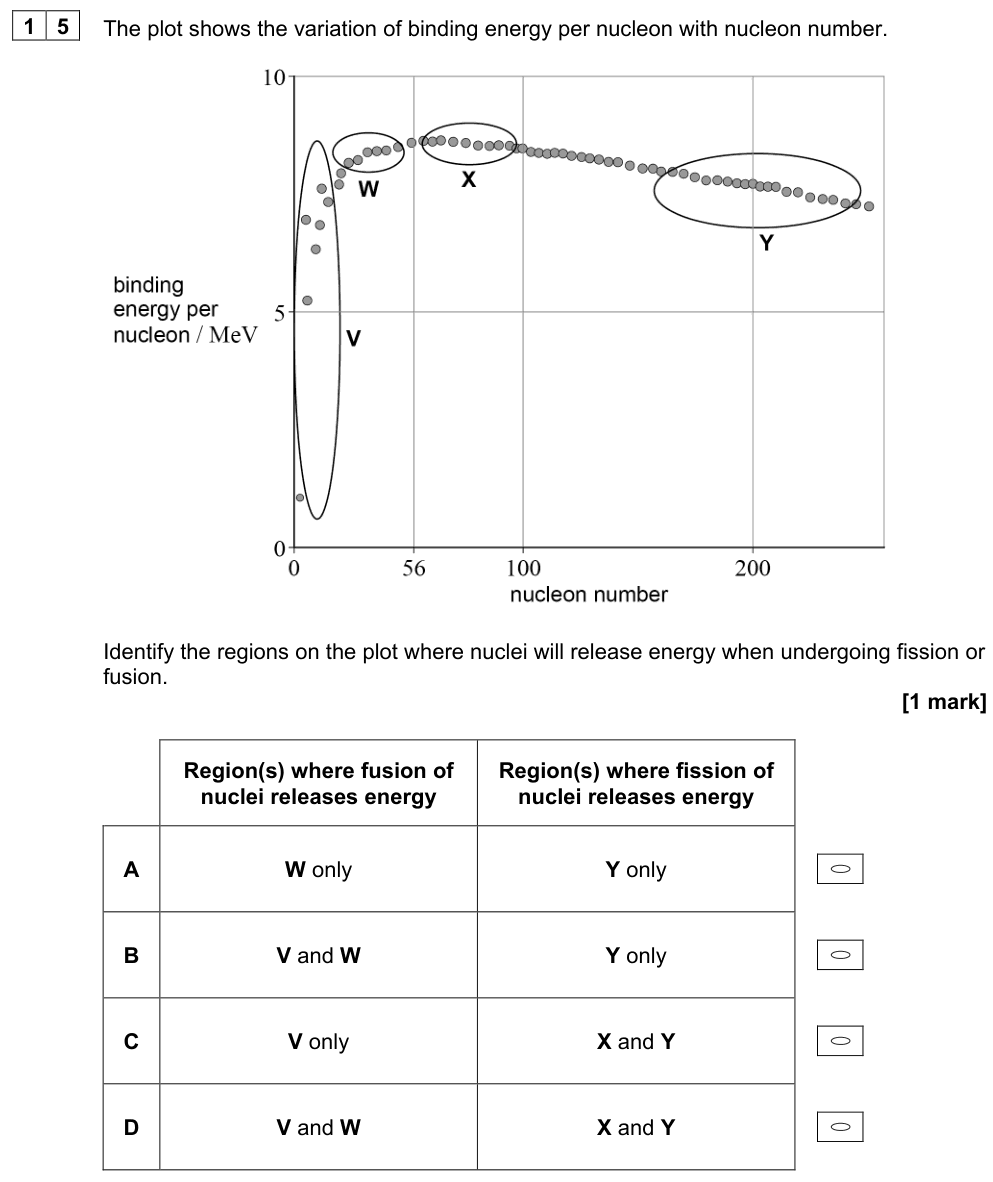
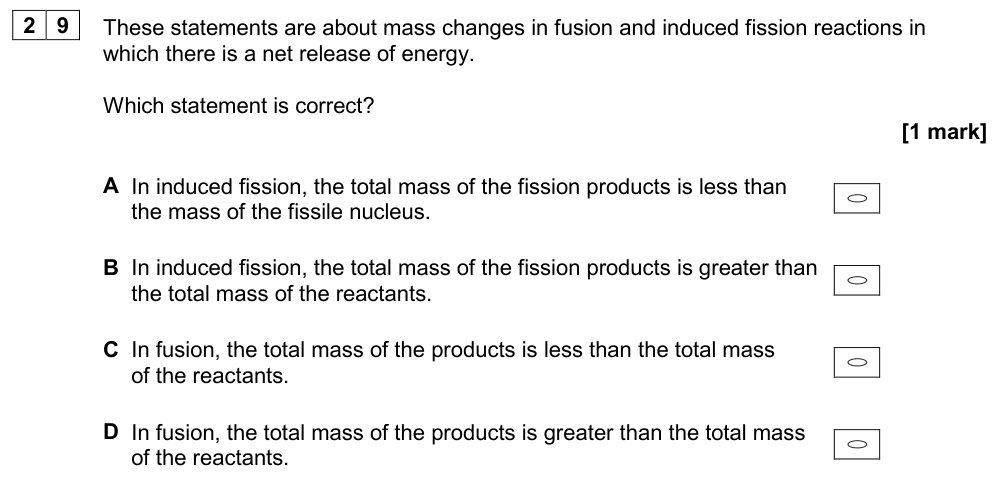
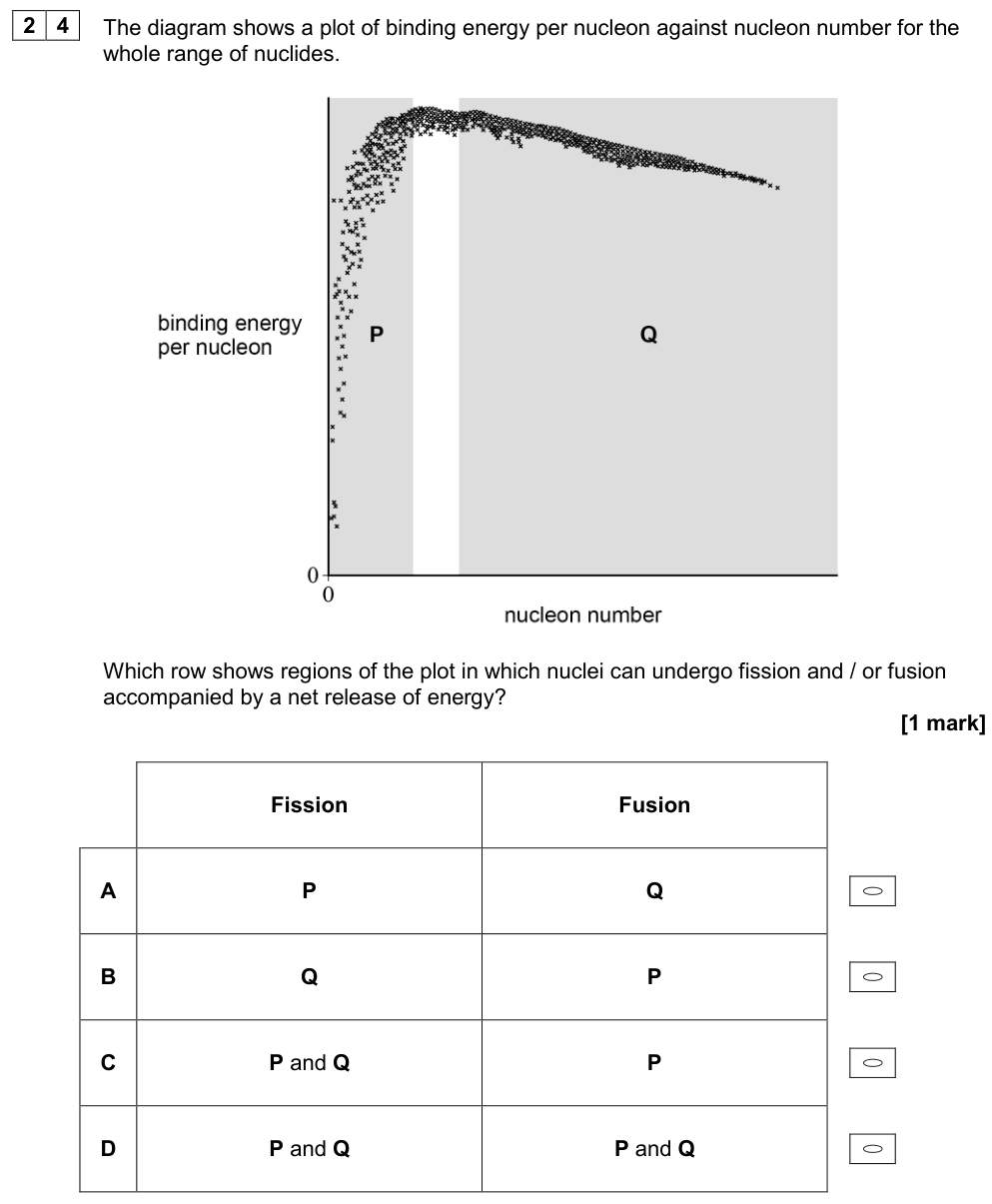
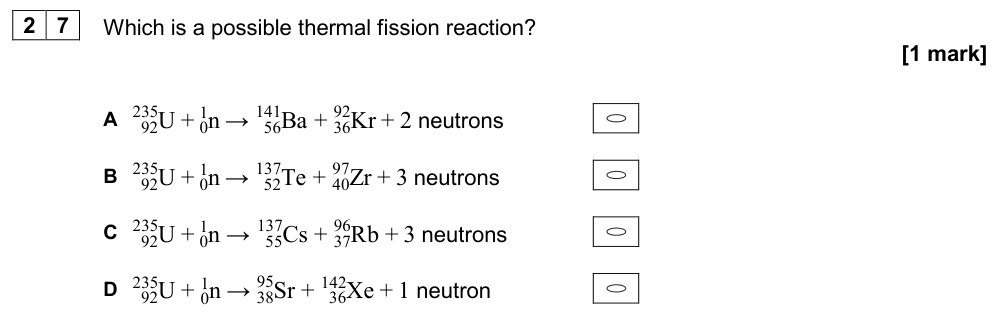
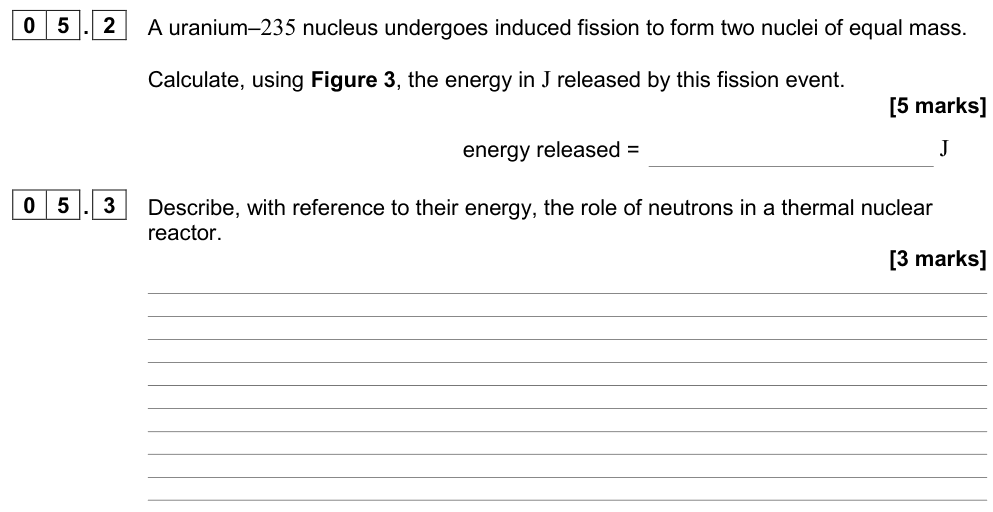
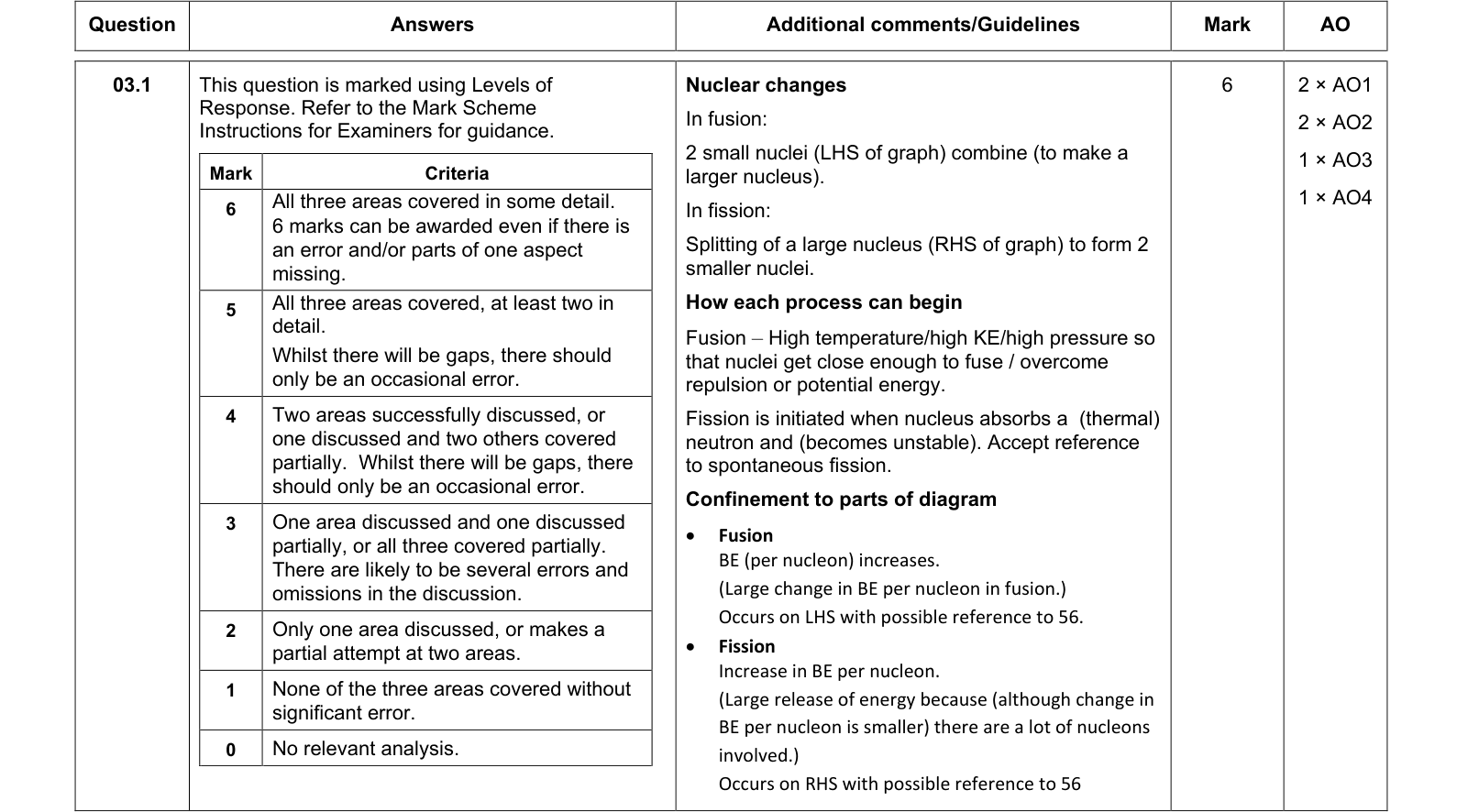
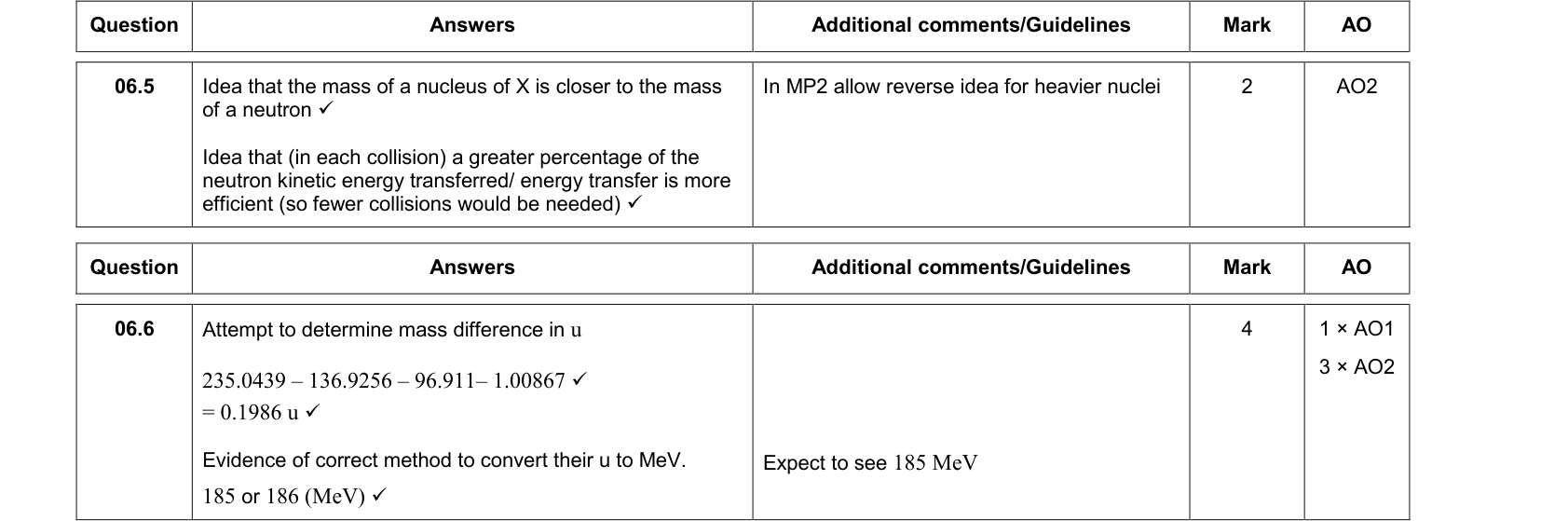
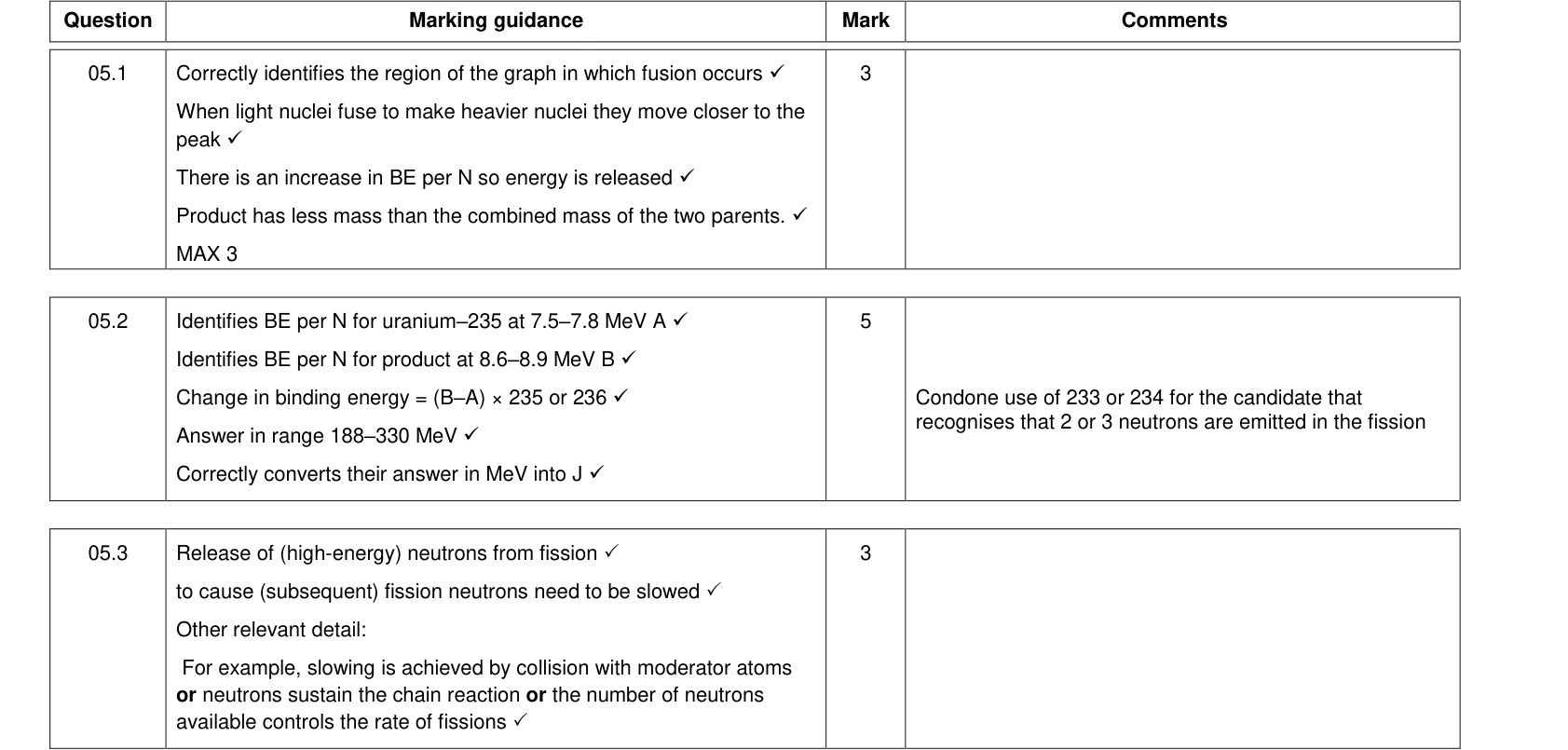
Fission is the splitting of a large nucleus into two smaller nuclei (of roughly similar size), with the release of two or three neutrons and a large amount of energy (about 200 MeV per fission).
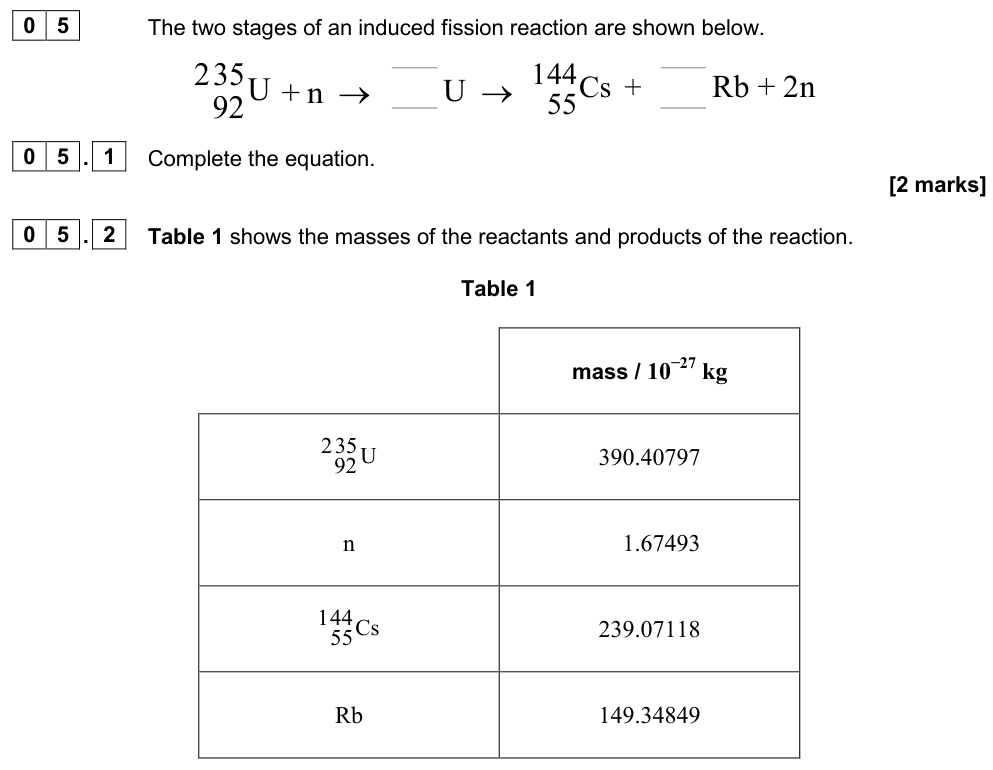
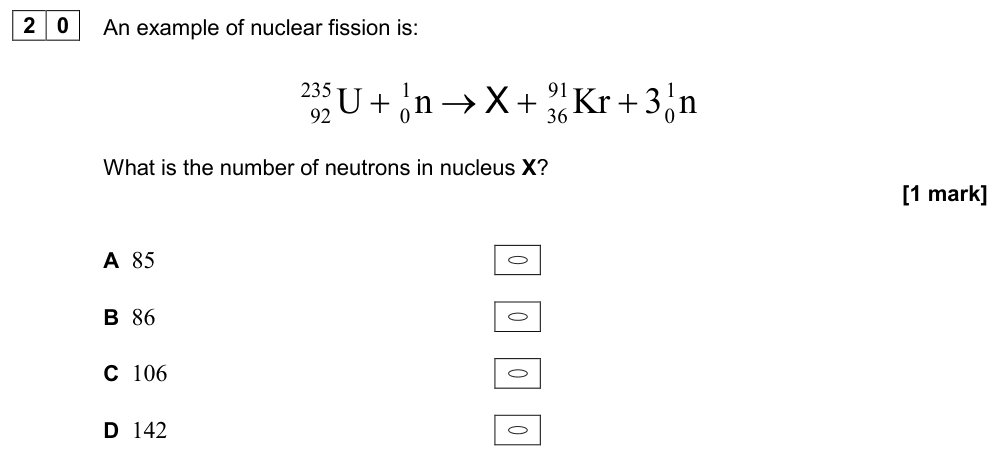
Spontaneous fission is very rare. In a reactor, fission is induced by making a nucleus absorb a neutron:
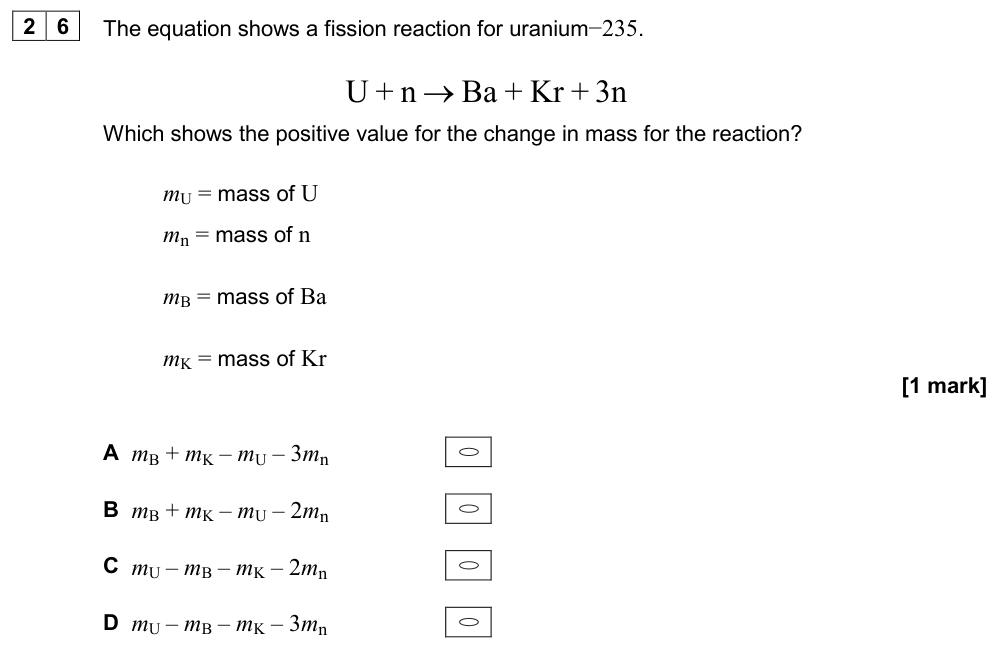
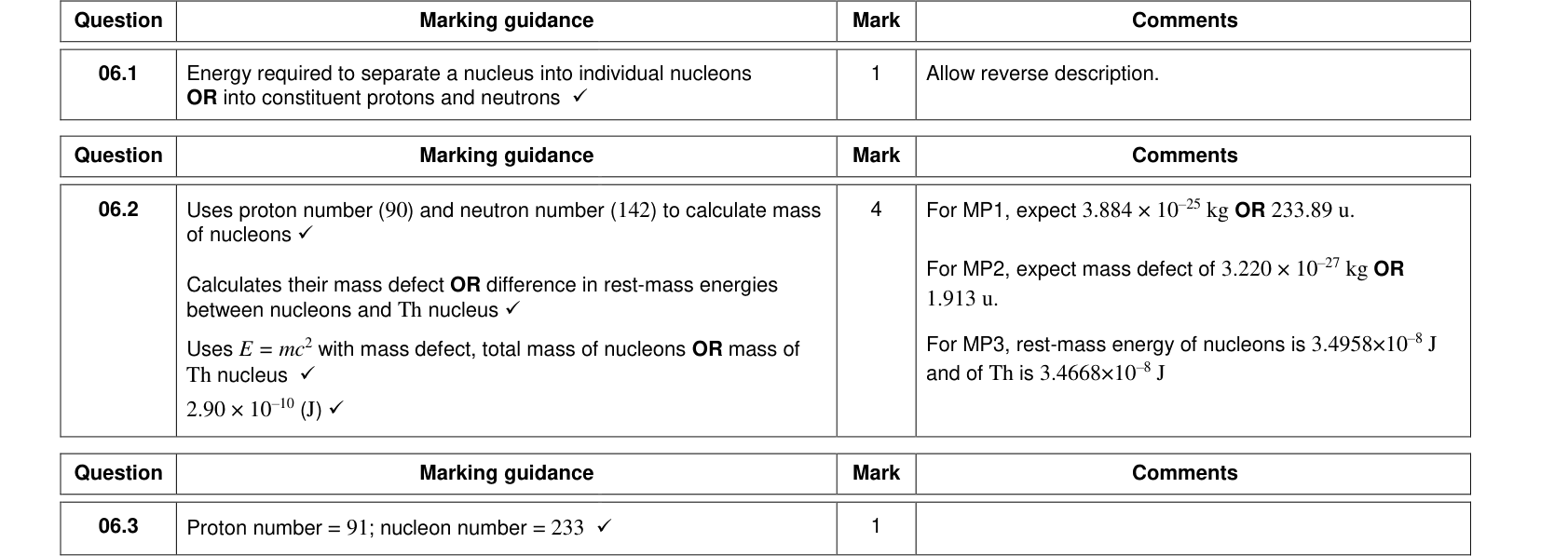
$$^{235}_{92}\text{U} + {}^{1}_{0}\text{n} \rightarrow {}^{236}_{92}\text{U} \rightarrow {}^{141}_{56}\text{Ba} + {}^{92}_{36}\text{Kr} + 3\,{}^{1}_{0}\text{n} + \text{energy}$$
- Uranium-235 absorbs the neutron to form the highly unstable uranium-236, which splits almost immediately.
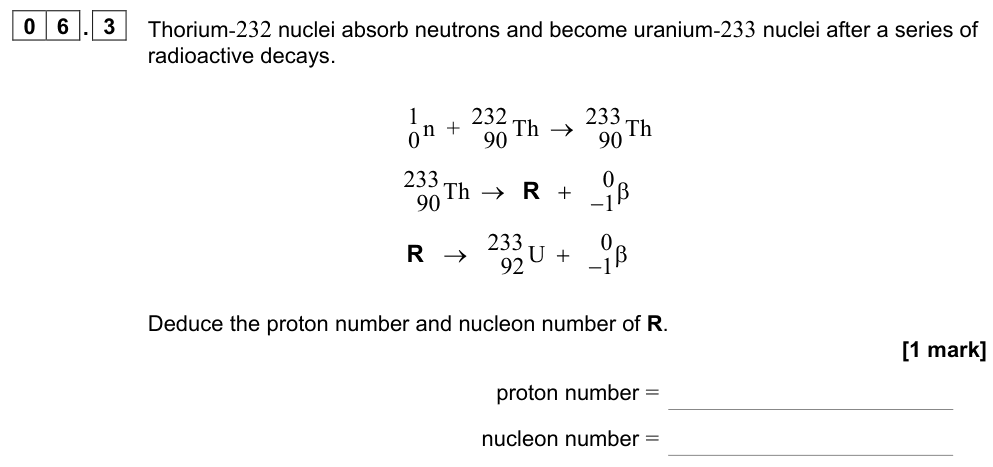
- Many different pairs of fragments are possible; nucleon number and proton number are always conserved.
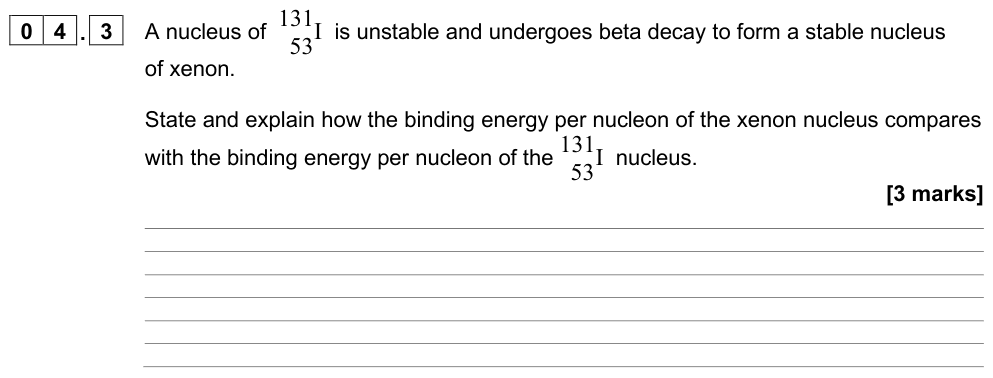
- The fragments are neutron-rich and therefore radioactive (mostly β⁻ emitters). This is the origin of most radioactive waste.
- The energy is released mainly as kinetic energy of the fragments, which becomes internal energy (heat) in the fuel.
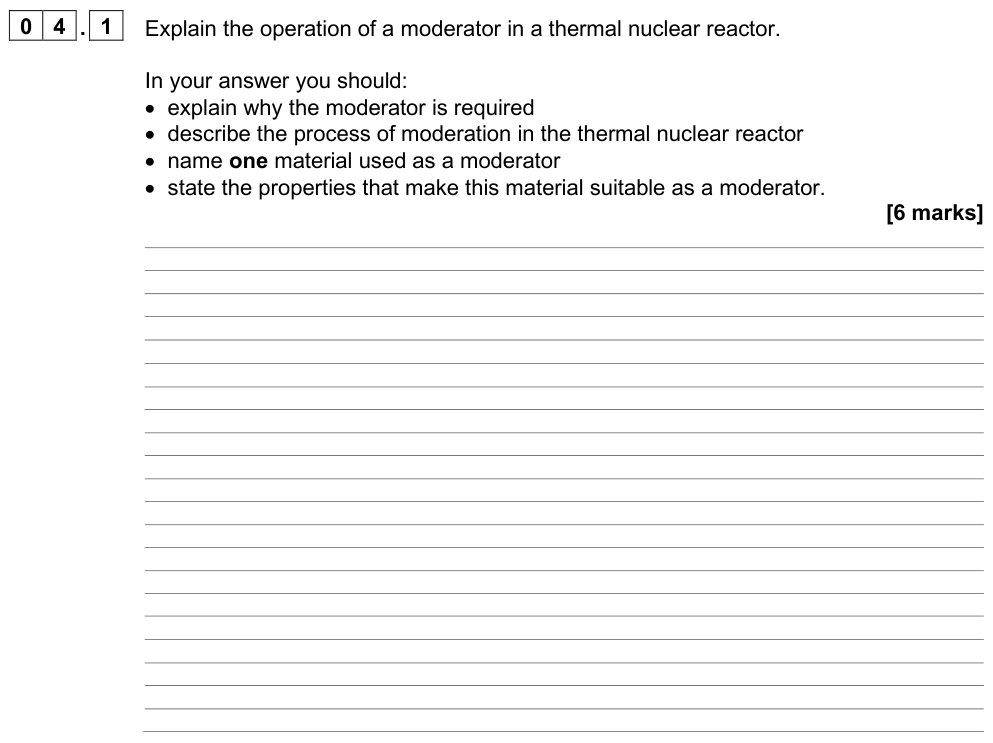
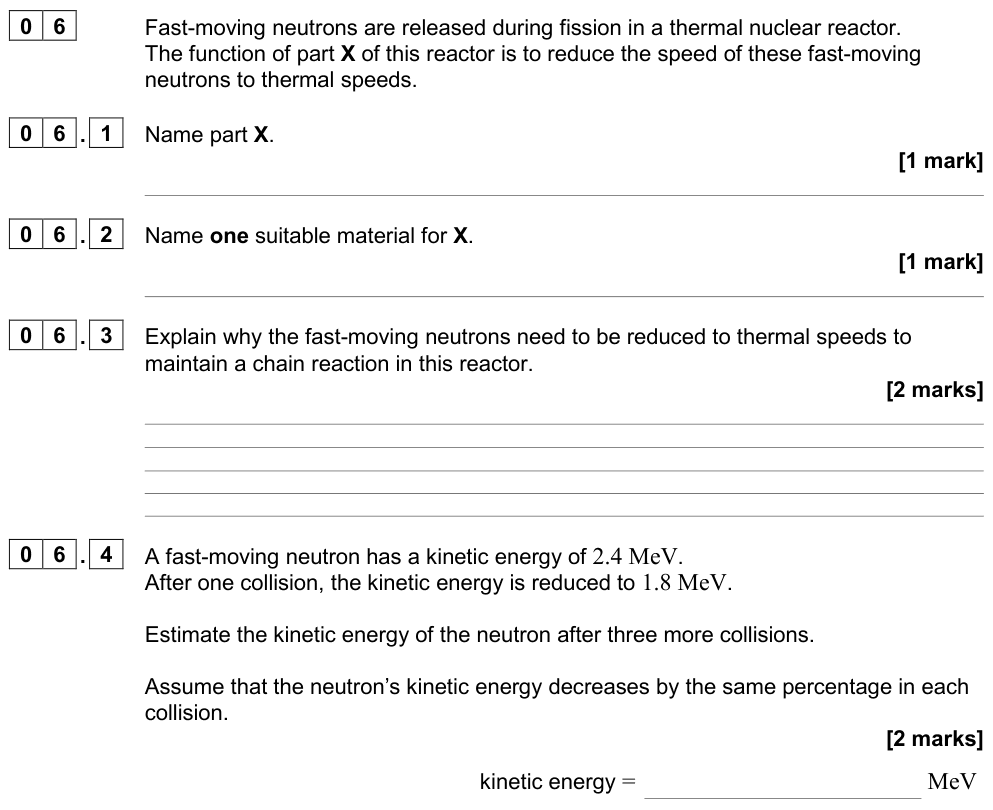
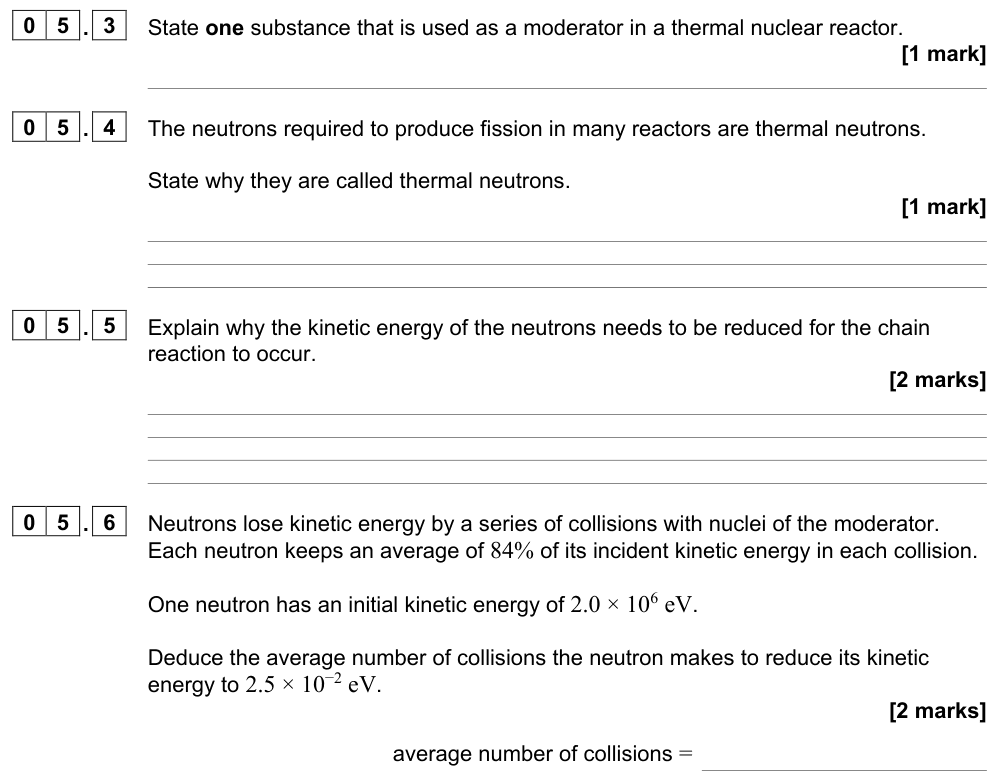
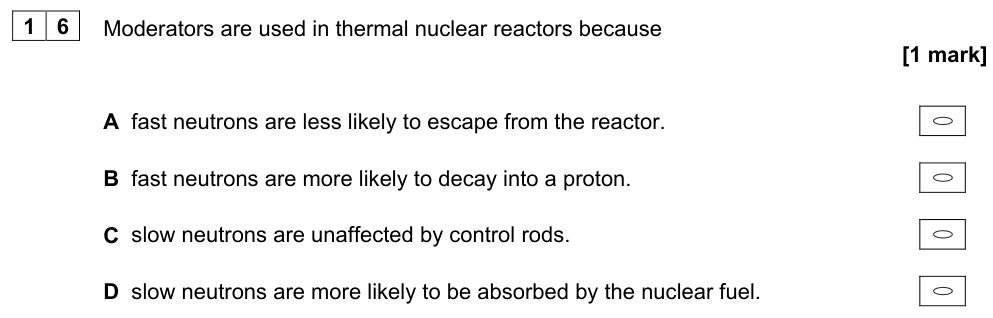
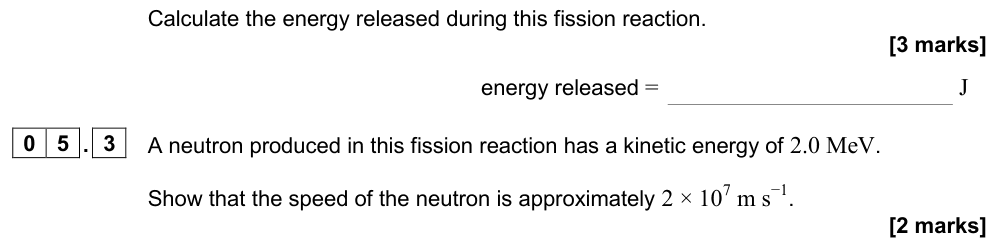
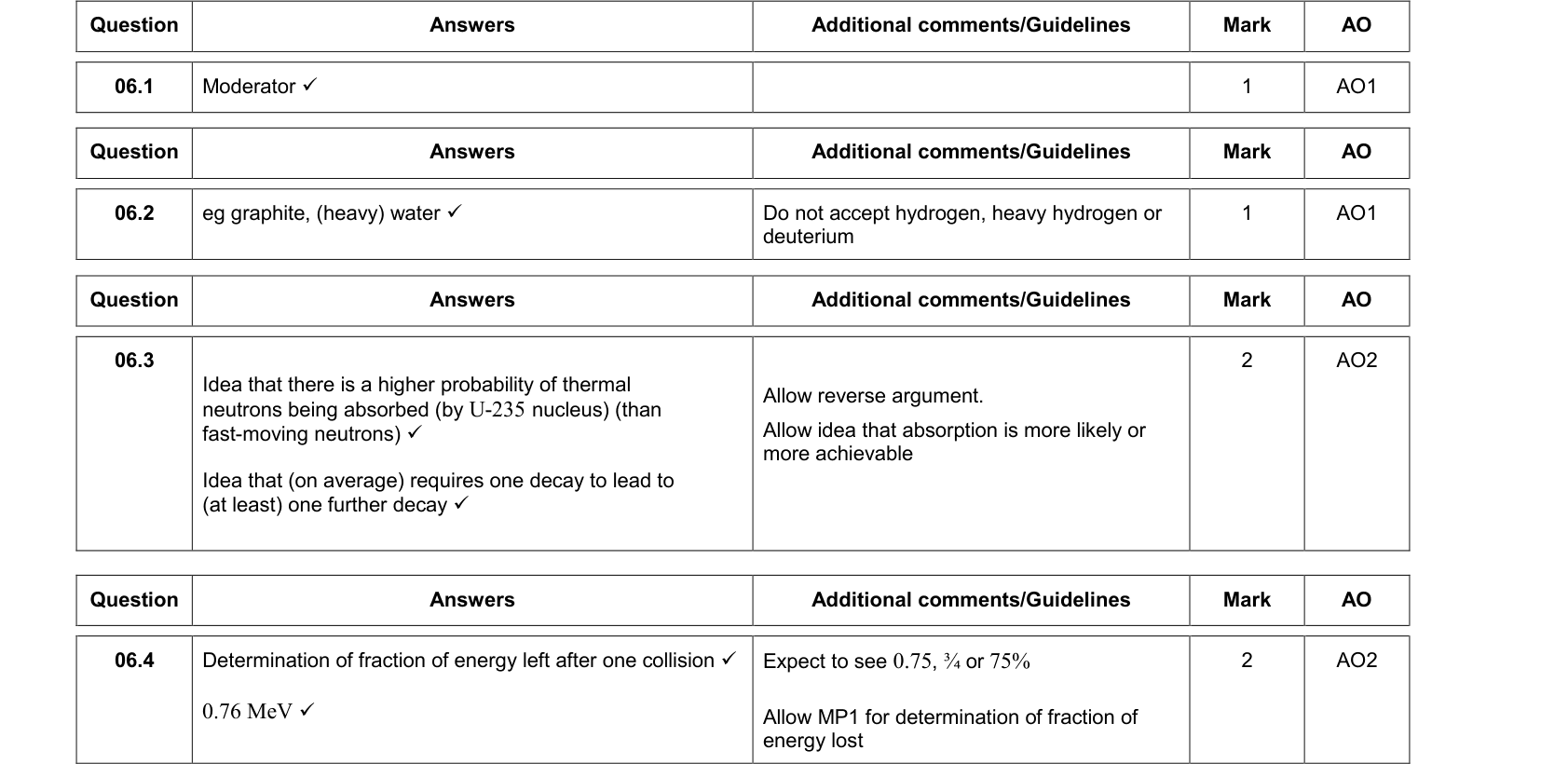
Thermal neutrons (slow neutrons with kinetic energies of about 0.025 eV, similar to the energies of gas molecules at room temperature) are far more likely to be absorbed by uranium-235 and cause fission than the fast neutrons (about 2 MeV) released by fission. This is why a thermal reactor needs a moderator.
Chain reactions and critical mass
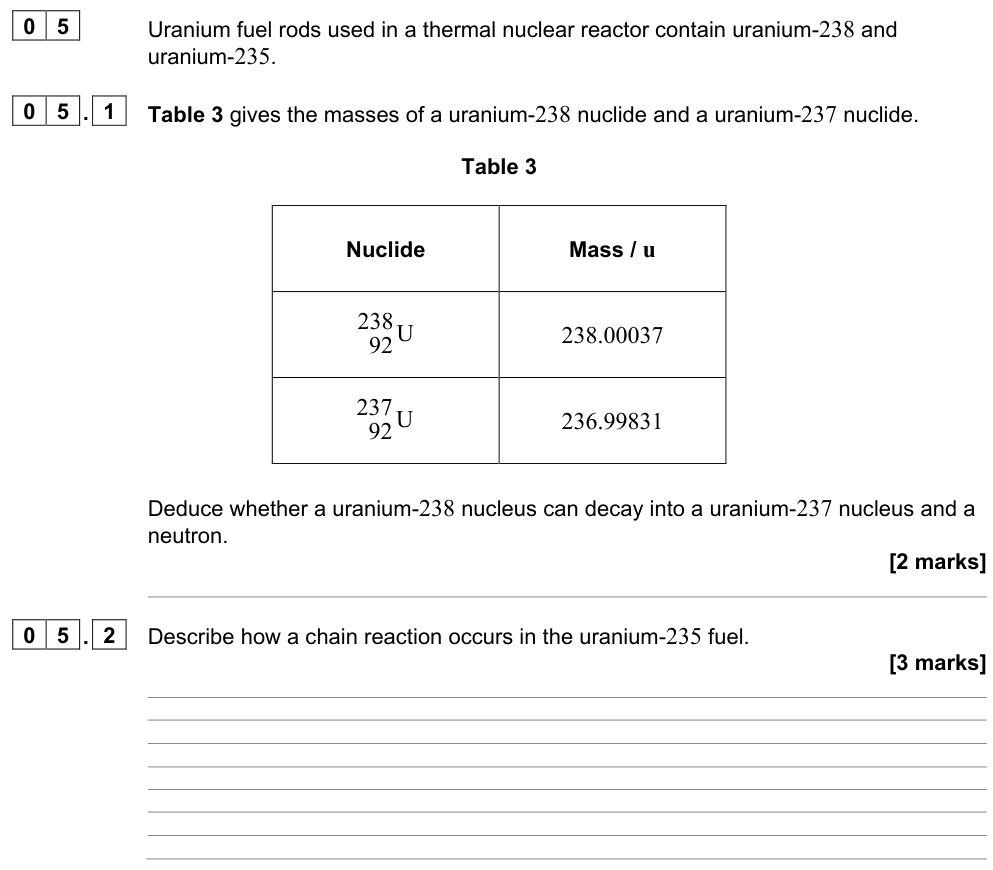
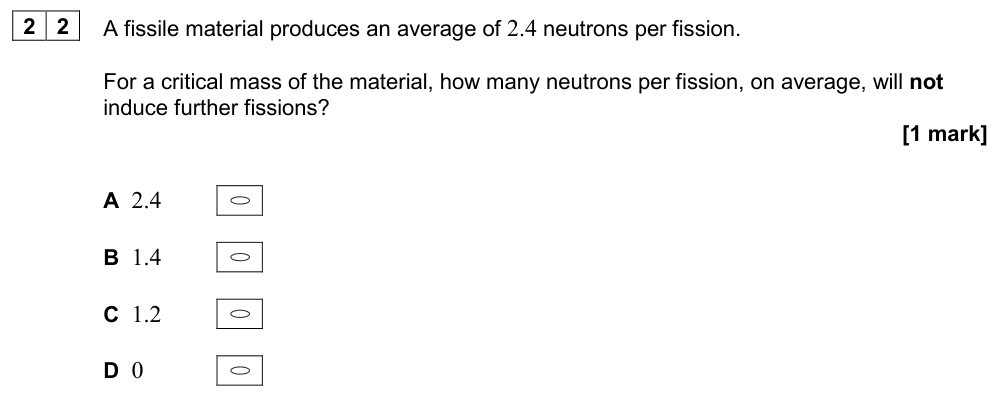
Each fission releases 2–3 neutrons, which can go on to cause further fissions: a chain reaction.
- If, on average, more than one neutron from each fission causes another fission, the rate of fission grows rapidly: an uncontrolled chain reaction (as in a nuclear weapon).
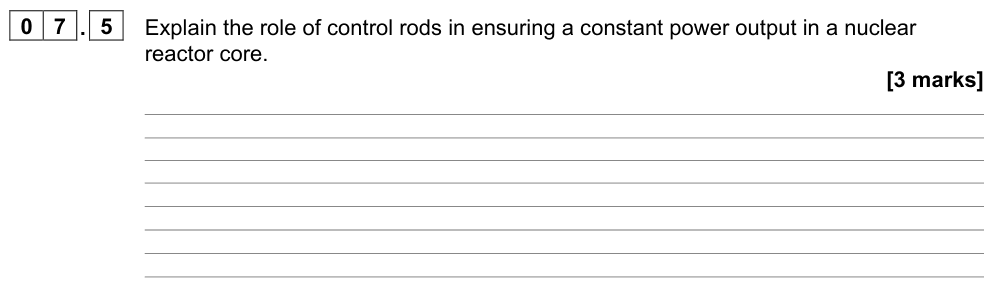
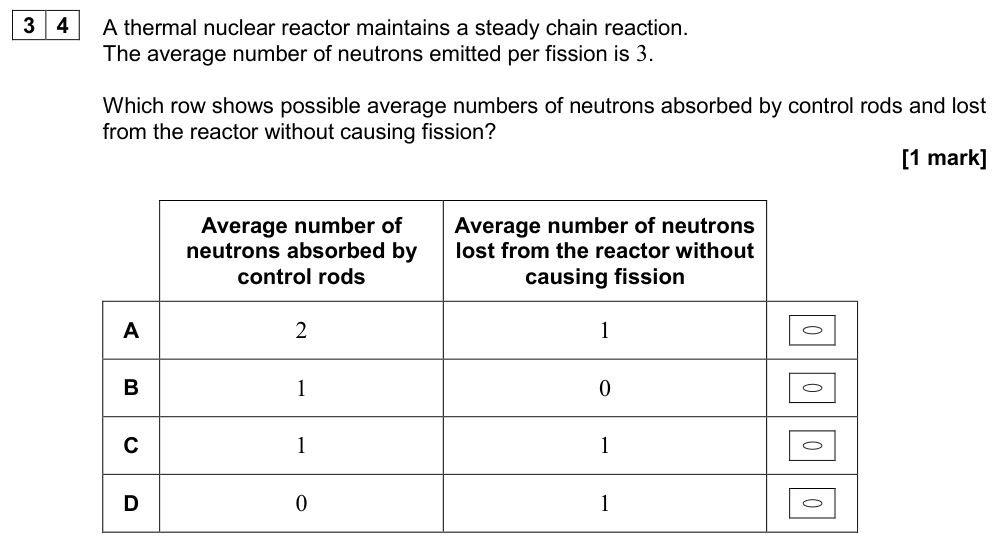
- In a reactor the chain reaction is controlled so that, on average, exactly one neutron from each fission causes another fission. The rate of energy release is then constant.
Some neutrons are lost: they escape through the surface, or are absorbed by other nuclei (for example uranium-238) without causing fission.
Critical mass
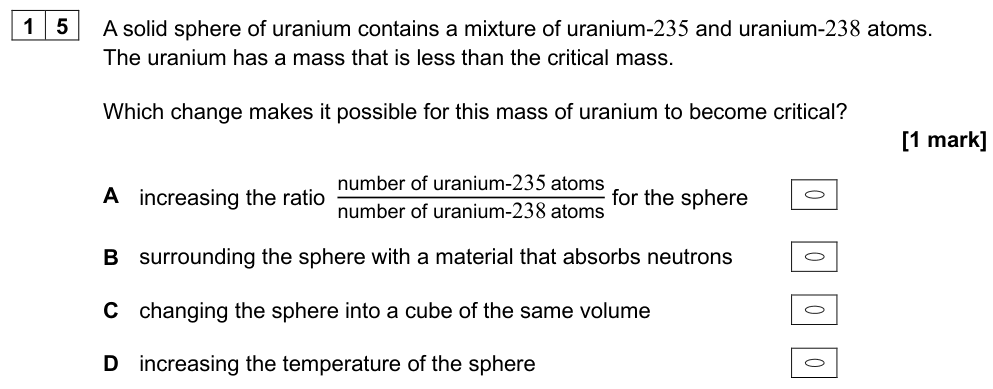
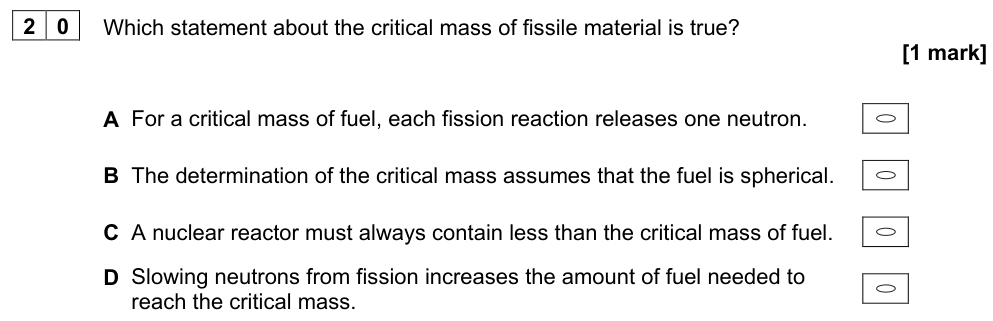
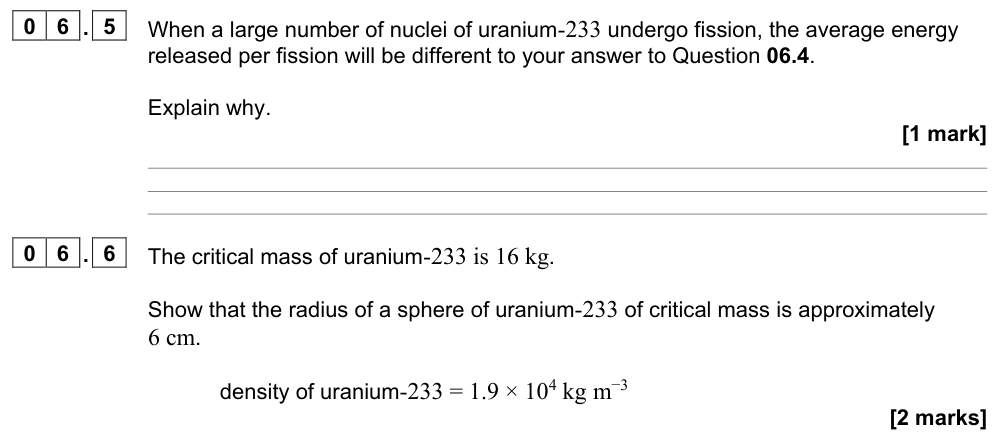
The critical mass is the minimum mass of fissile material needed for a self-sustaining chain reaction.
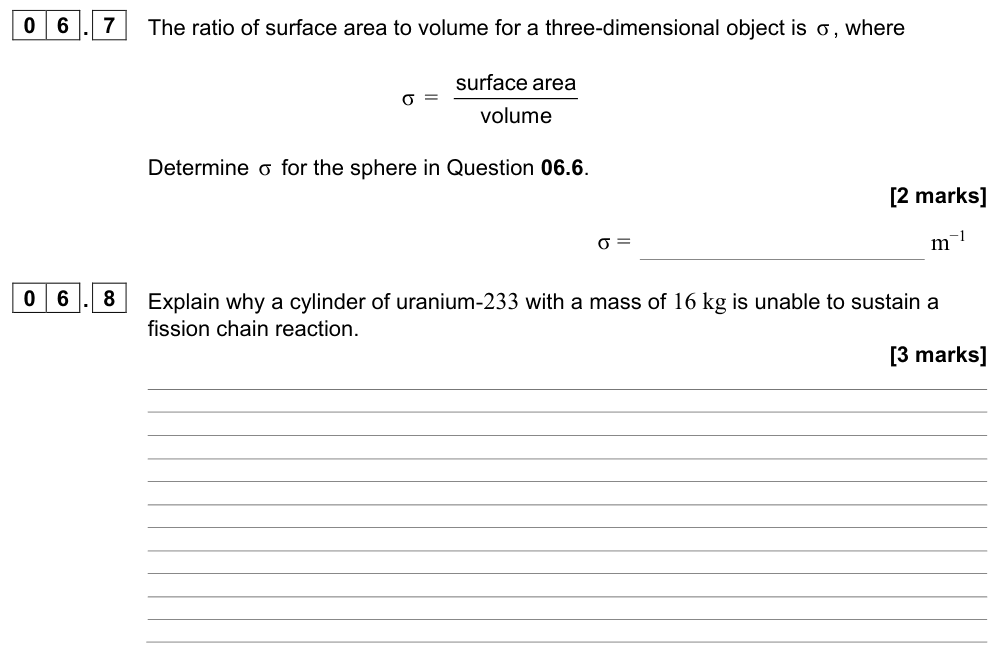
In a small lump the surface area is large compared with the volume, so too many neutrons escape. As the mass increases, the volume (where neutrons are produced) grows faster than the surface area (where they escape), so a smaller fraction is lost. The critical mass depends on the shape (a sphere has the least surface for a given volume), the density, the purity (enrichment) and whether there is a neutron reflector around it.
The thermal nuclear reactor
Fuel
The fuel is usually enriched uranium: natural uranium is 99.3% uranium-238 (which does not undergo fission with thermal neutrons) and only 0.7% uranium-235; enrichment raises the U-235 content to about 3–5%. It is in the form of uranium oxide pellets sealed in metal fuel rods.
The moderator
Moderator
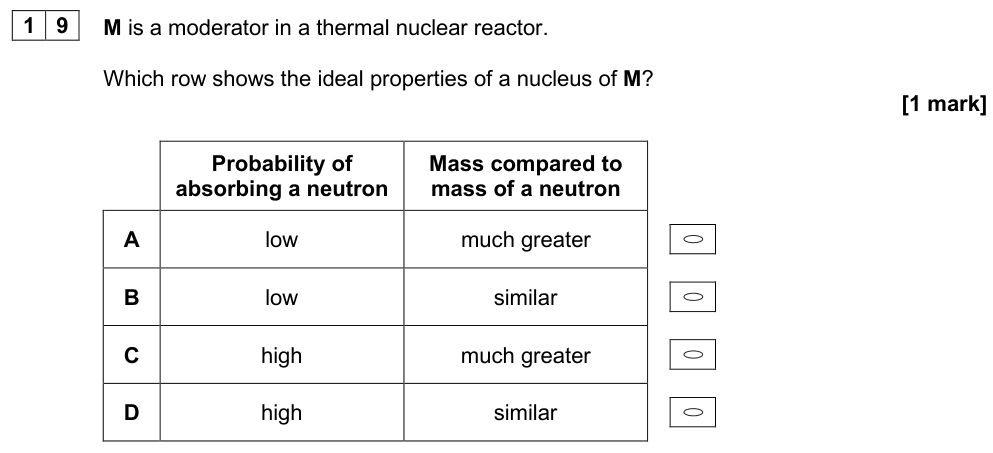
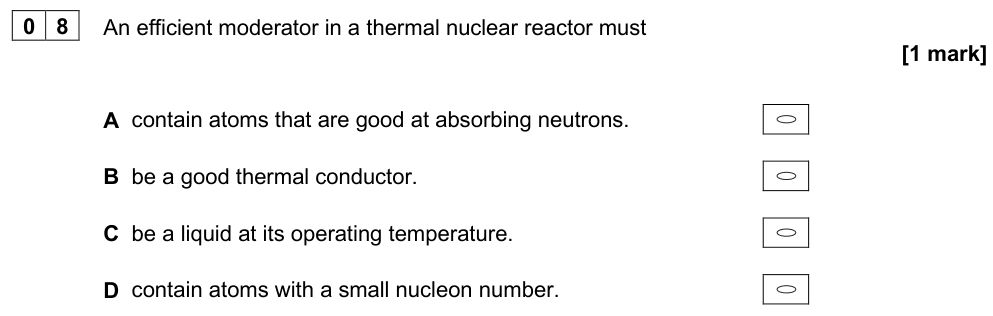
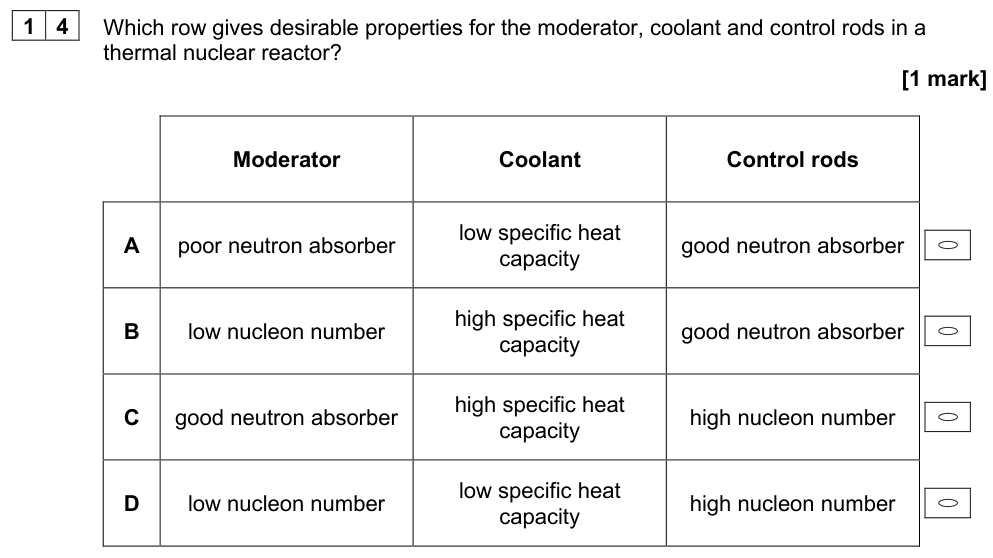
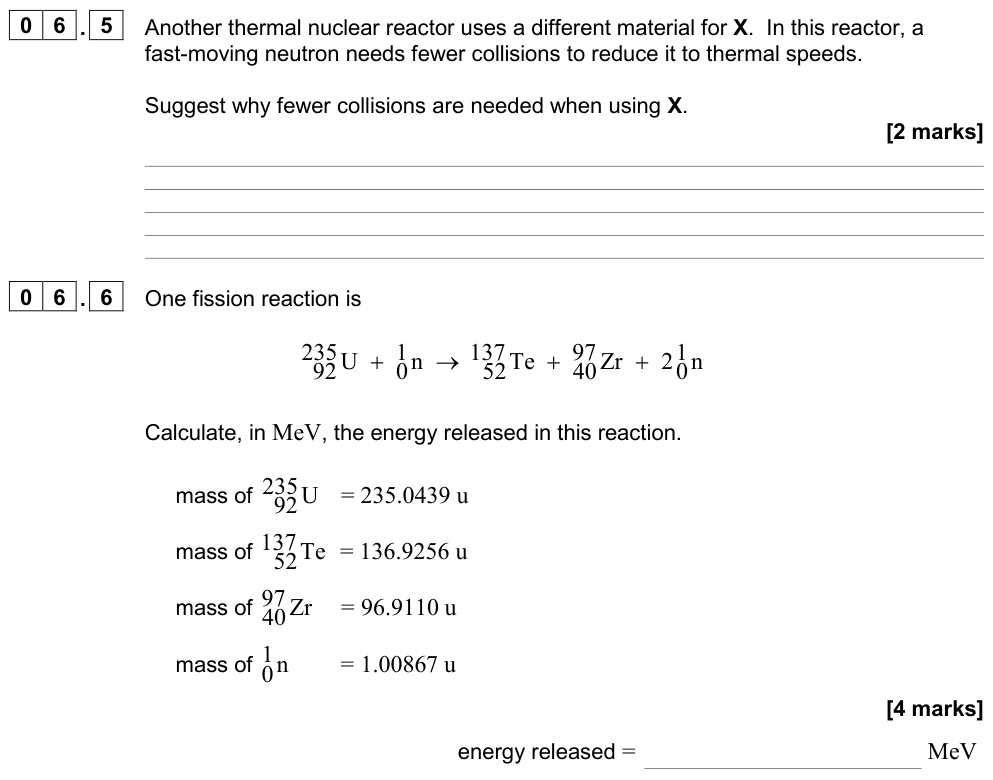
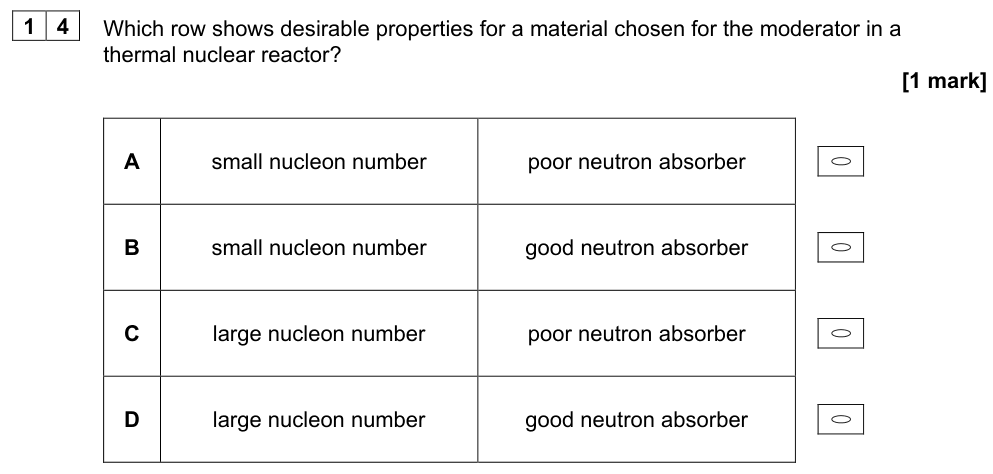
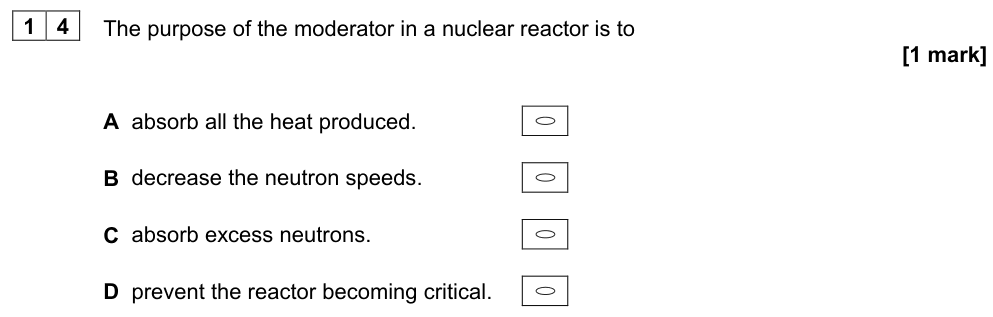
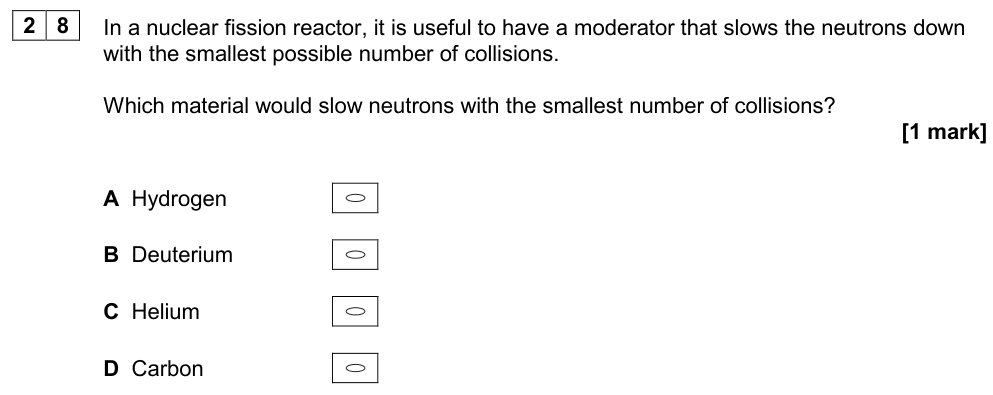
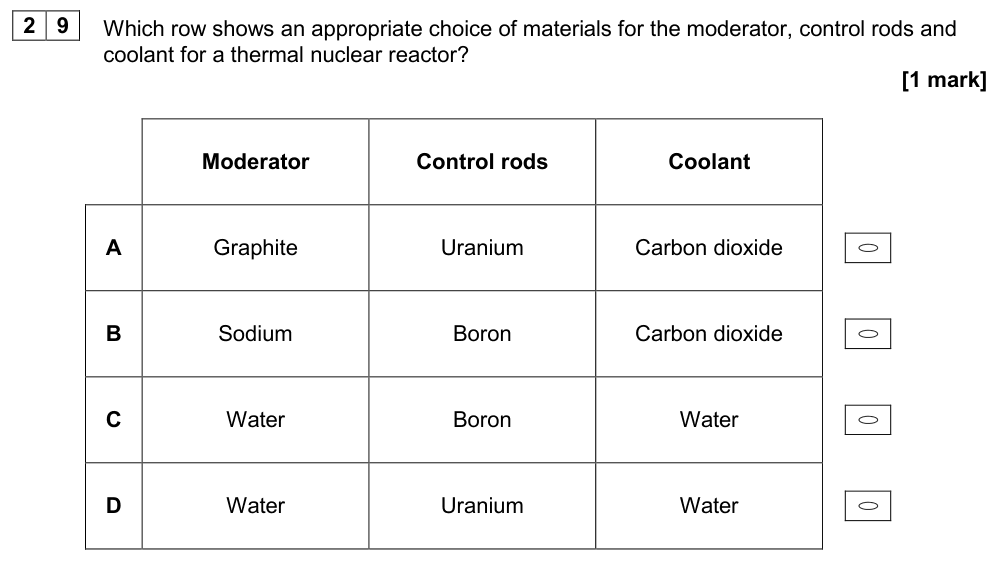
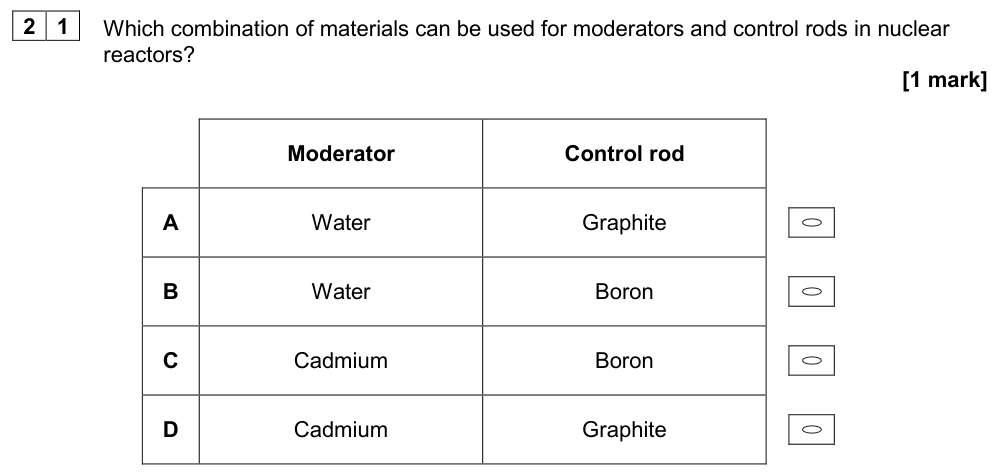
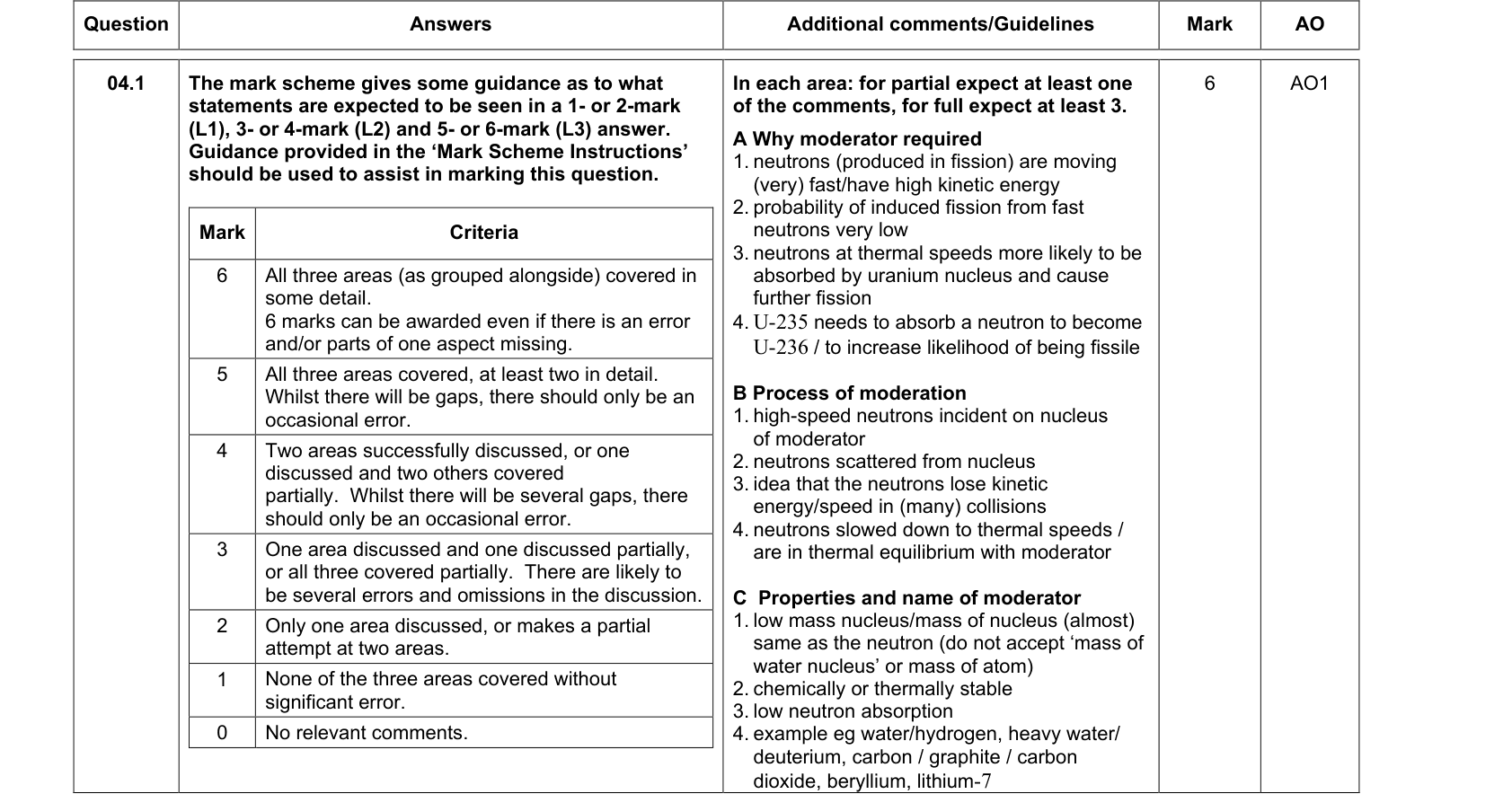
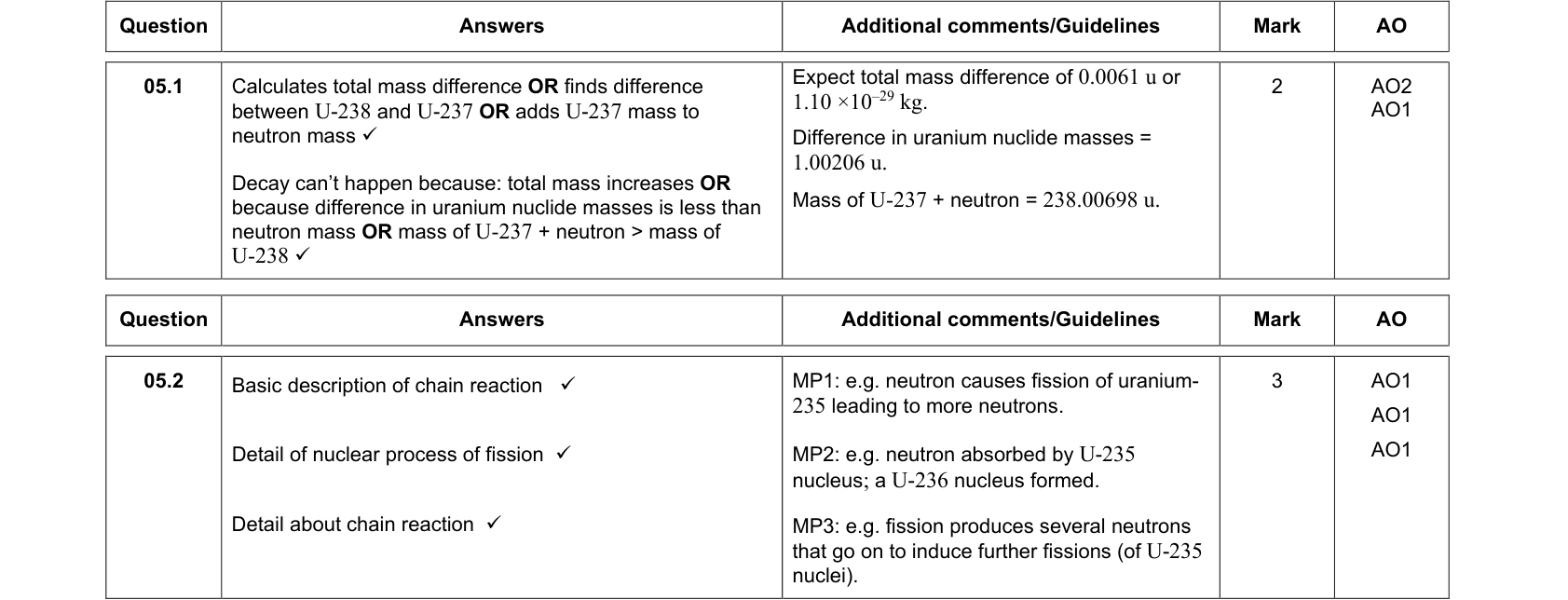
Function: to slow down the fast neutrons released by fission to thermal speeds, so they are more likely to cause further fissions.
How: neutrons lose kinetic energy in repeated elastic collisions with the nuclei of the moderator.
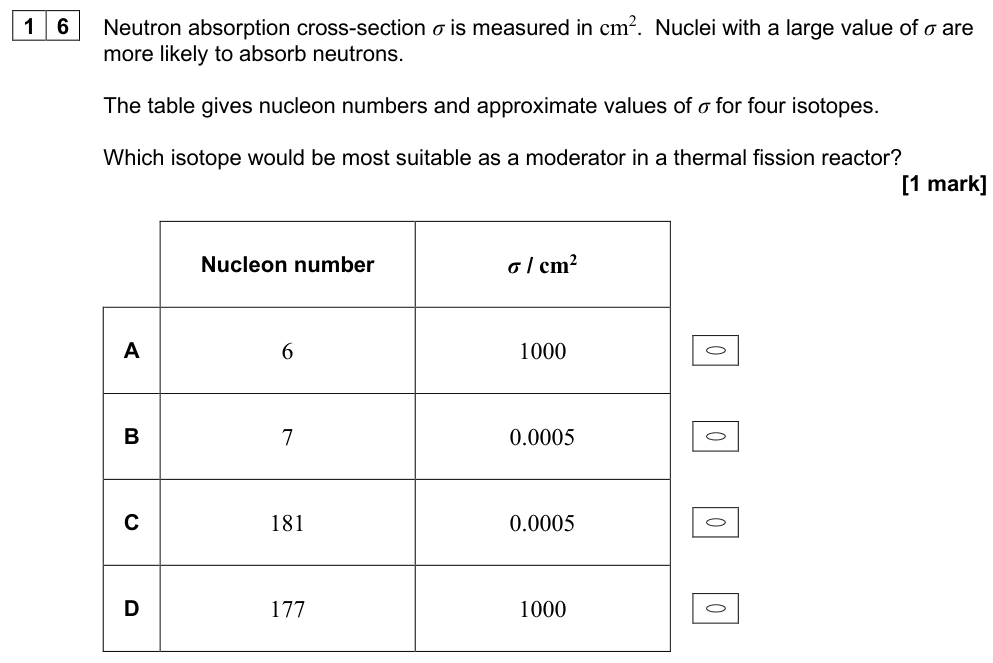
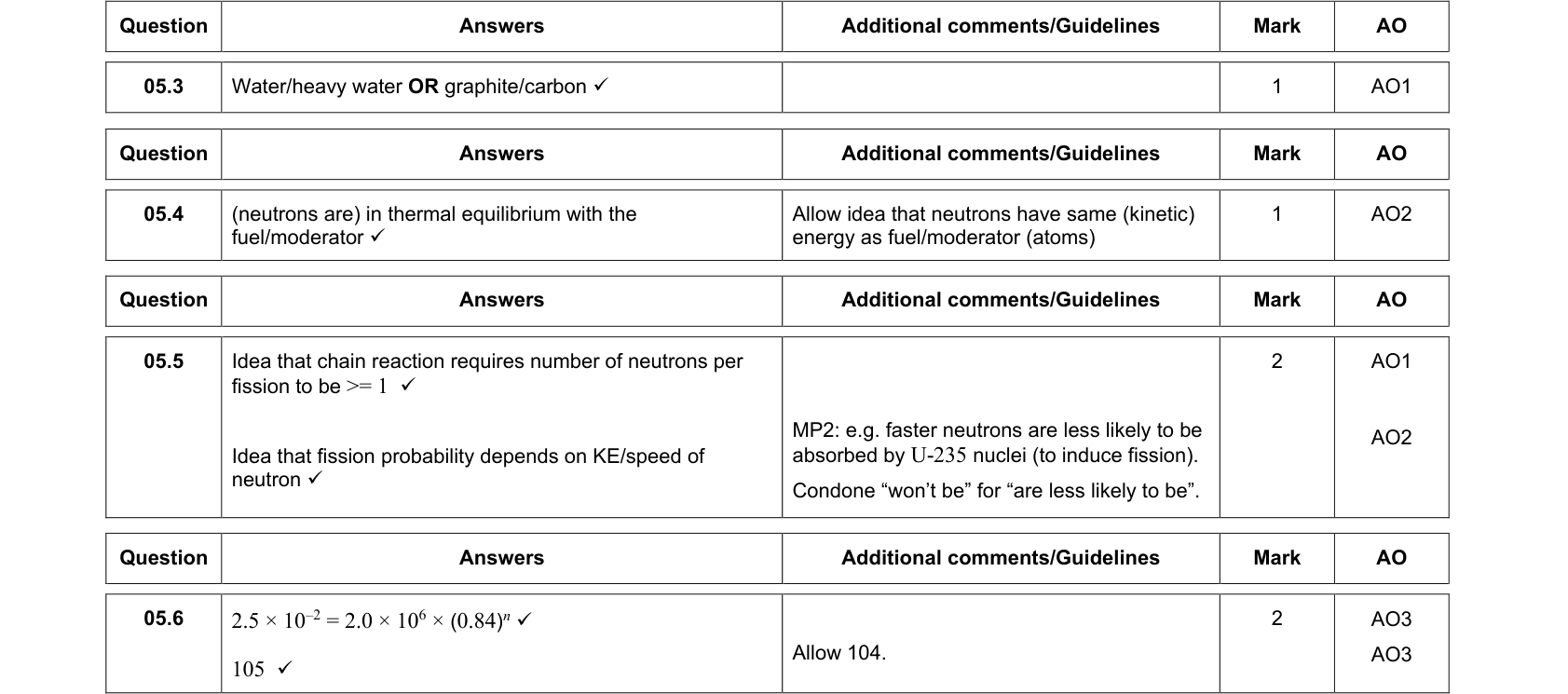
Choice of material: nuclei of low mass (similar to the neutron's mass, so that a large fraction of the neutron's energy is transferred in each collision) that do not absorb neutrons. Examples: water, heavy water (D₂O) and graphite (carbon).
The fuel rods are surrounded by moderator, so fast neutrons leaving one fuel rod are slowed down before they reach the next.
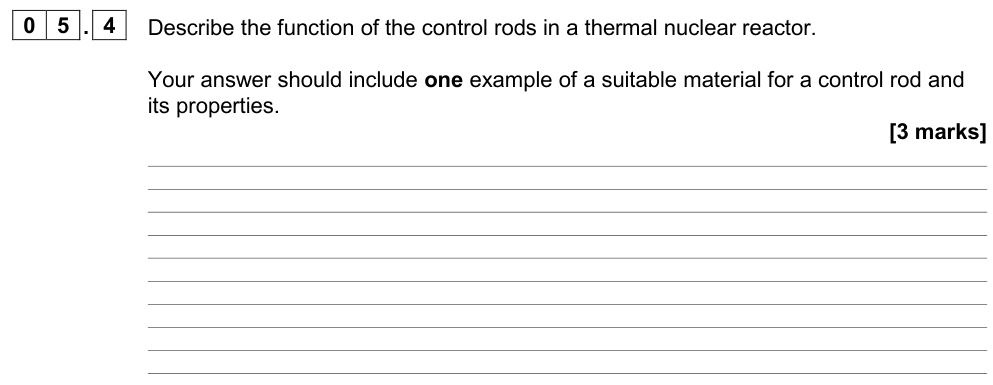
Control rods
Control rods
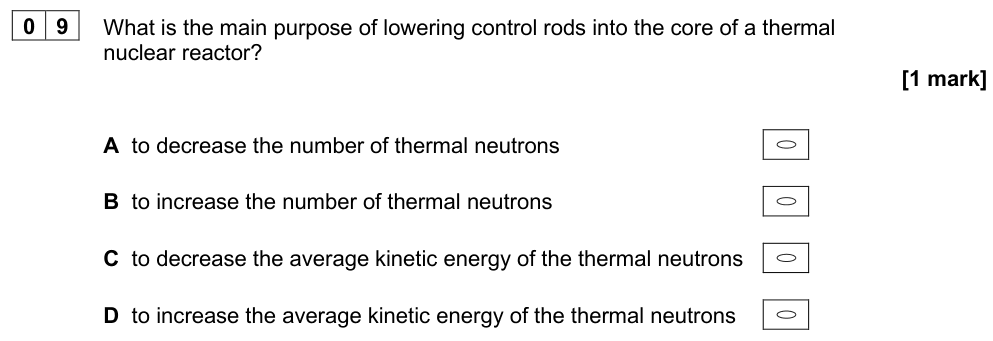
Function: to absorb neutrons and so control the rate of fission, keeping the reproduction rate at exactly one neutron per fission.
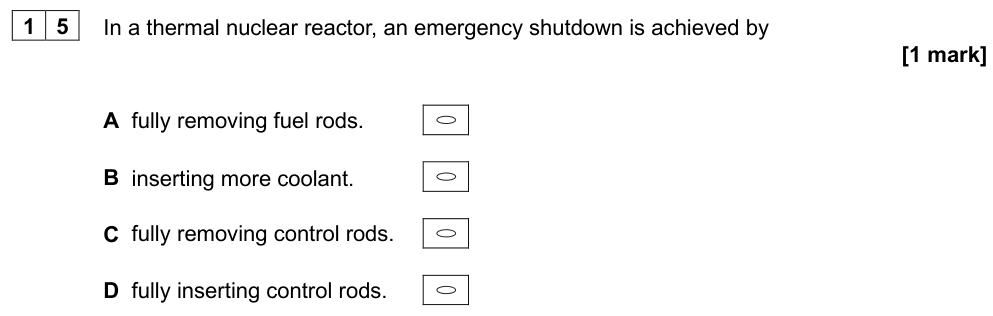
How: they are moved into the core to absorb more neutrons and slow the reaction, and out to speed it up. In an emergency they are fully inserted to stop the chain reaction.
Choice of material: elements whose nuclei absorb neutrons readily without becoming dangerously unstable, such as boron and cadmium.
The coolant
Coolant
Function: to transfer energy from the core to the heat exchanger, where it is used to make steam, and to stop the core overheating.
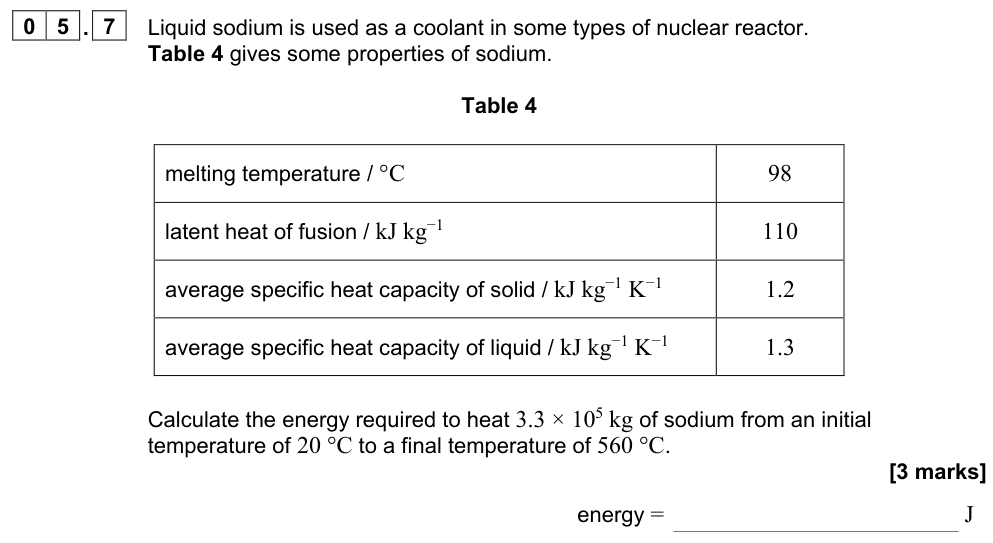
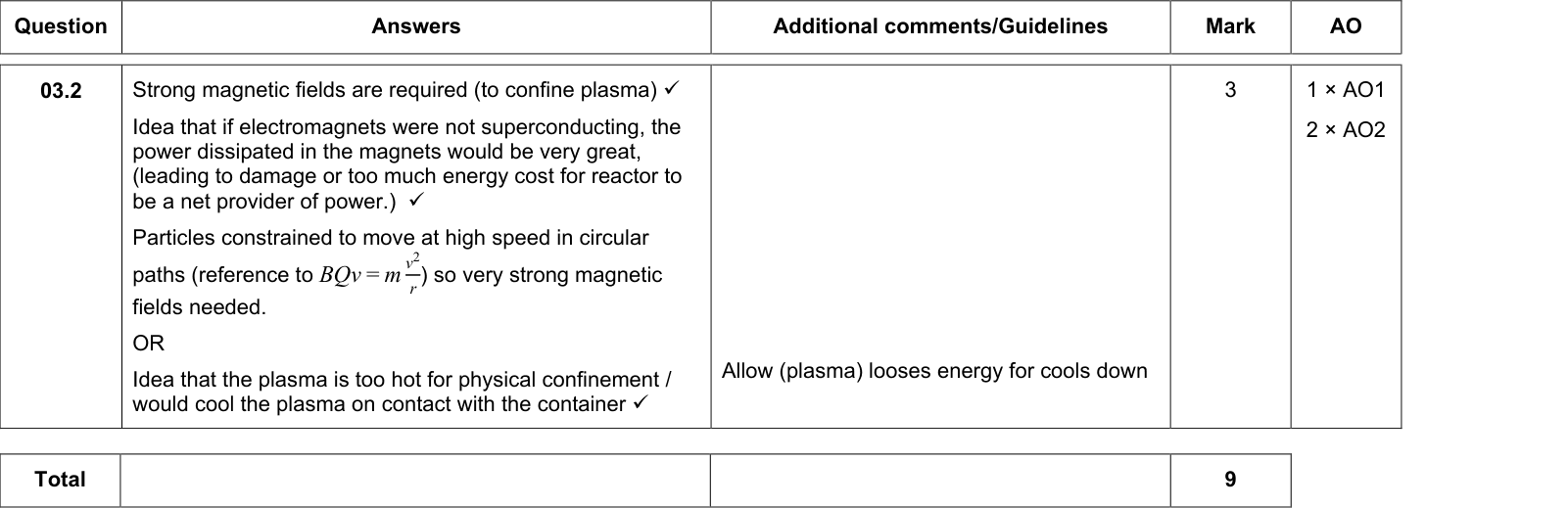
Choice of material: a fluid with a high specific heat capacity, that does not absorb neutrons much and that is easily pumped. Examples: water (often under high pressure so it does not boil), carbon dioxide gas and liquid sodium (in fast reactors).
The coolant passes through the core and becomes radioactive, so it circulates in a sealed loop and passes its energy to a separate water circuit in the heat exchanger.
A mechanical model of moderation
A neutron slowing down in a moderator can be modelled by balls colliding elastically, as on a snooker table.
- A moving ball hitting a stationary ball of equal mass head-on stops, and gives all its kinetic energy to the other ball.
- A light ball hitting a very heavy ball bounces back with almost all of its kinetic energy.
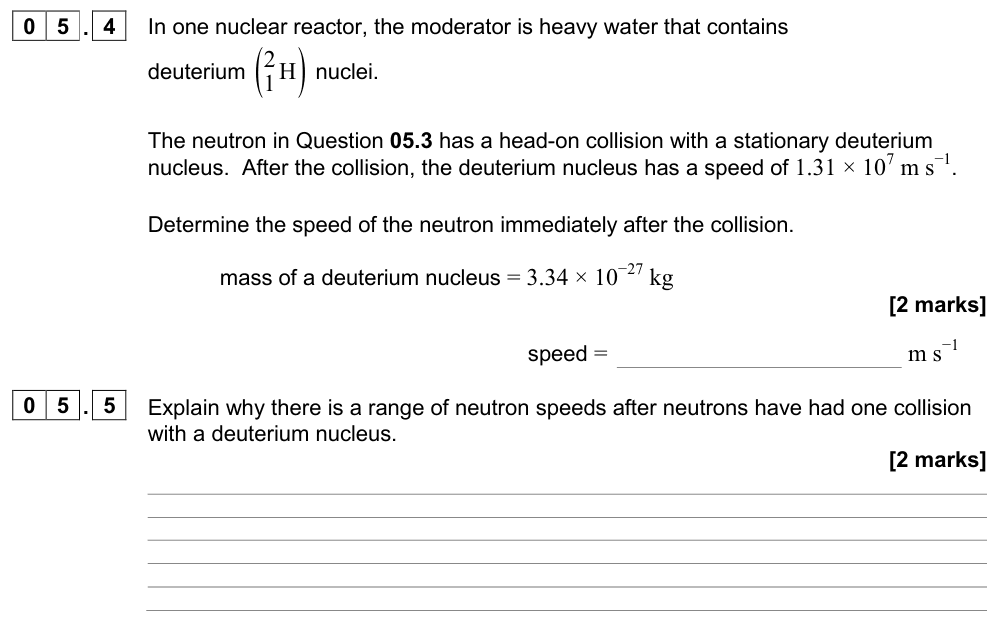
So moderator nuclei should have a mass close to that of the neutron. For a head-on elastic collision between a neutron (mass $m$, speed $u$) and a stationary nucleus of mass $M$, conservation of momentum and kinetic energy give the neutron's velocity afterwards:
$$v = \frac{m - M}{m + M}u$$
Worked example: neutron and carbon-12
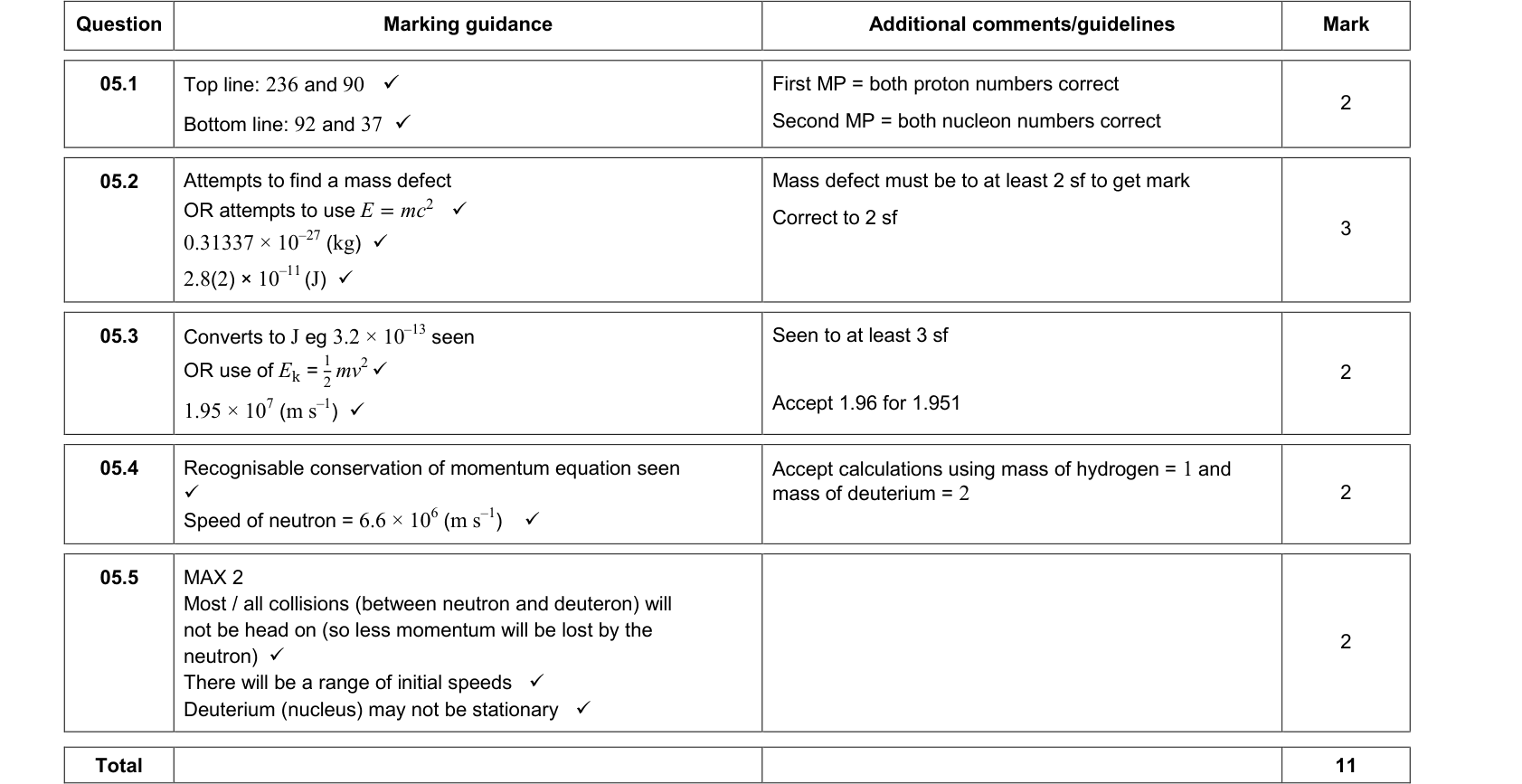
For a head-on collision with a carbon-12 nucleus ($M = 12m$): $v = \dfrac{1 - 12}{1 + 12}u = -0.846u$.
The neutron keeps $0.846^2 = 0.72$ of its kinetic energy, so it loses 28% in each collision. For a hydrogen nucleus ($M = m$) it would lose all of it in a head-on collision.
Collisions are rarely head-on, so on average it takes around 20 collisions in water, and around 100 in graphite, to slow a 2 MeV neutron to thermal energies.
Safety aspects of nuclear reactors
| Aspect | What is done |
|---|---|
| Shielding | The core is inside a thick steel pressure vessel surrounded by thick concrete, which absorbs neutrons and gamma radiation and protects workers. |
| Emergency shut-down | The control rods are fully inserted into the core (they can fall in under gravity if power fails); in some designs extra neutron absorbers (e.g. boron solution) can be injected. |
| Remote handling | Spent fuel is intensely radioactive (and hot), so fuel rods are loaded and removed using remote-controlled machines. |
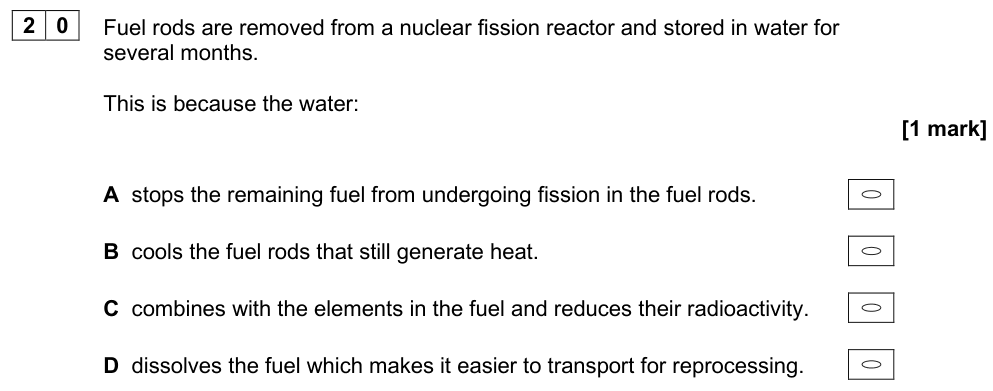
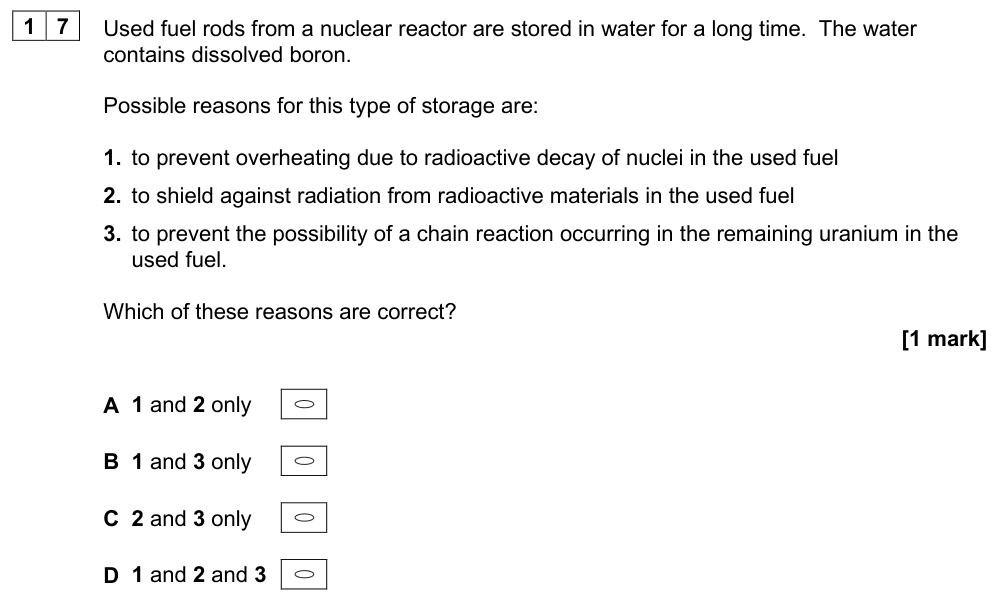
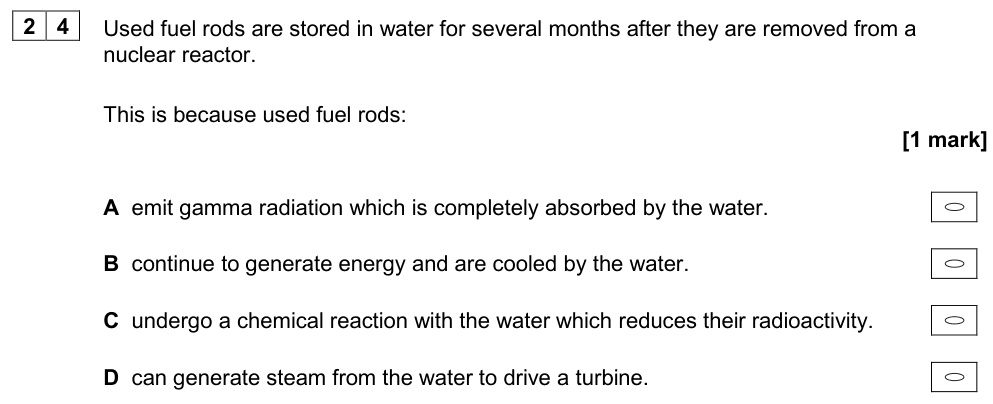
| Fuel | Spent fuel rods are first stored under water in cooling ponds: the water cools them and absorbs radiation while the short-lived isotopes decay. |
Radioactive waste
| Type | Examples | Treatment |
|---|---|---|
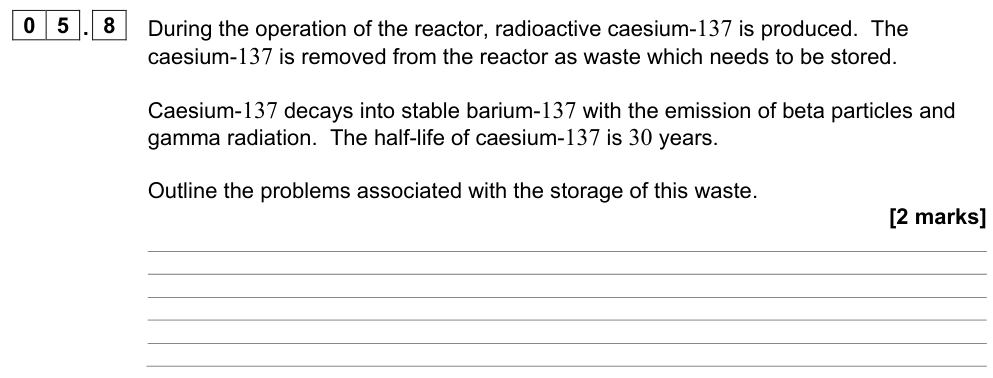
| High-level | spent fuel; waste from reprocessing | very radioactive, hot, long half-lives: cooled in ponds, then often vitrified (sealed in glass), put in steel canisters and stored, eventually deep underground in stable geological sites |
| Intermediate-level | fuel cladding, reactor components, filters | encased in concrete in steel drums and stored |
| Low-level | contaminated clothing, gloves, tools | compacted and buried in shallow, lined landfill sites |
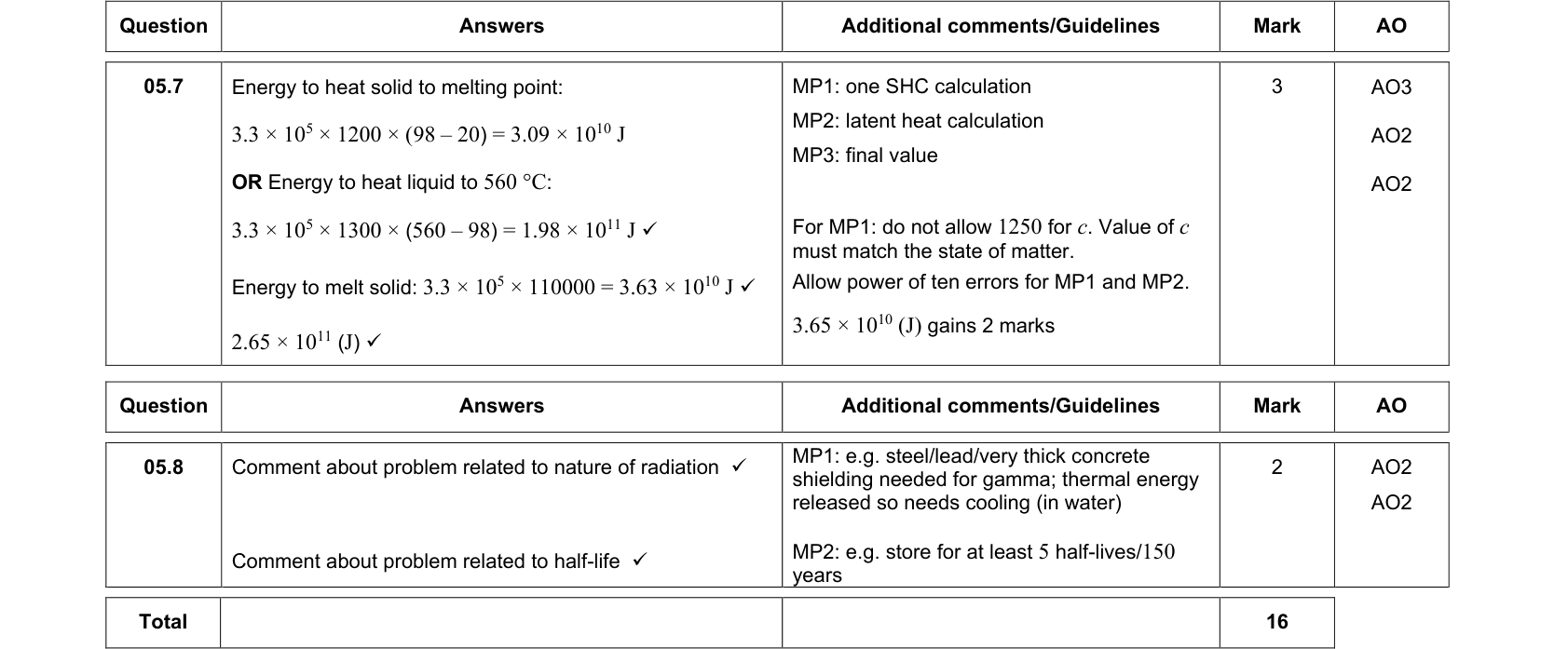
Waste must be isolated for thousands of years because some products have very long half-lives (for example plutonium-239, 24 000 years).
Risks and benefits of nuclear power
| Benefits | Risks and drawbacks |
|---|---|
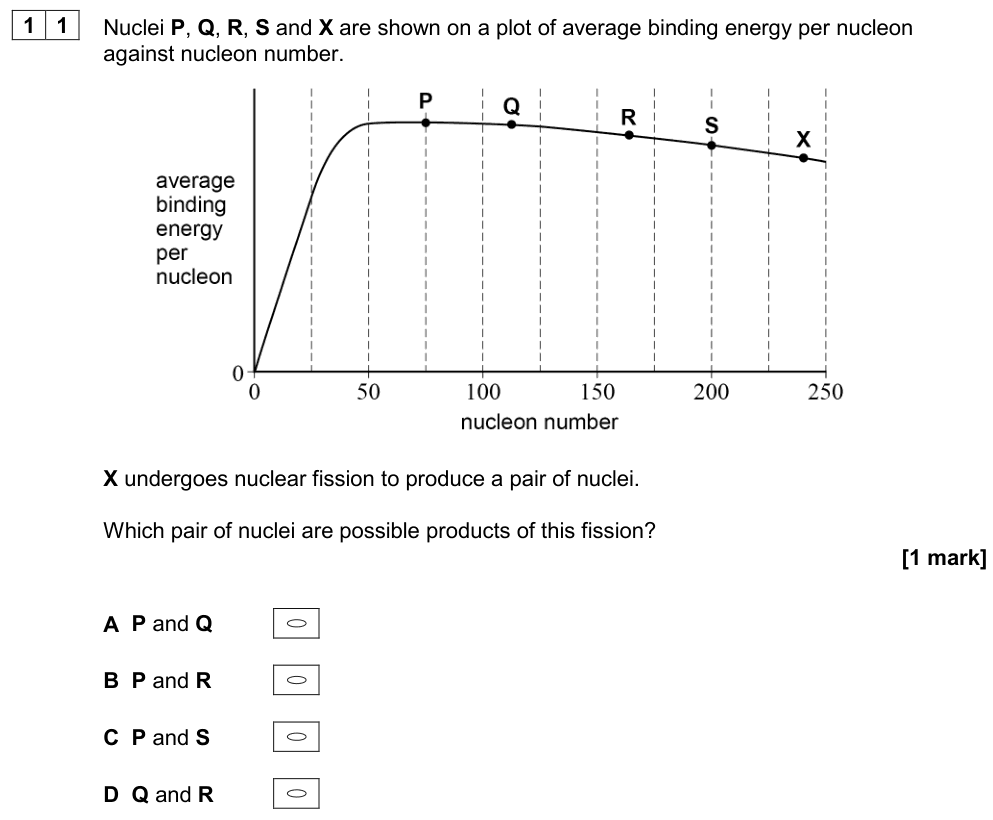
| no carbon dioxide is emitted while generating, so no direct contribution to climate change | serious accidents are possible (e.g. Chernobyl 1986, Fukushima 2011), releasing radioactive material |
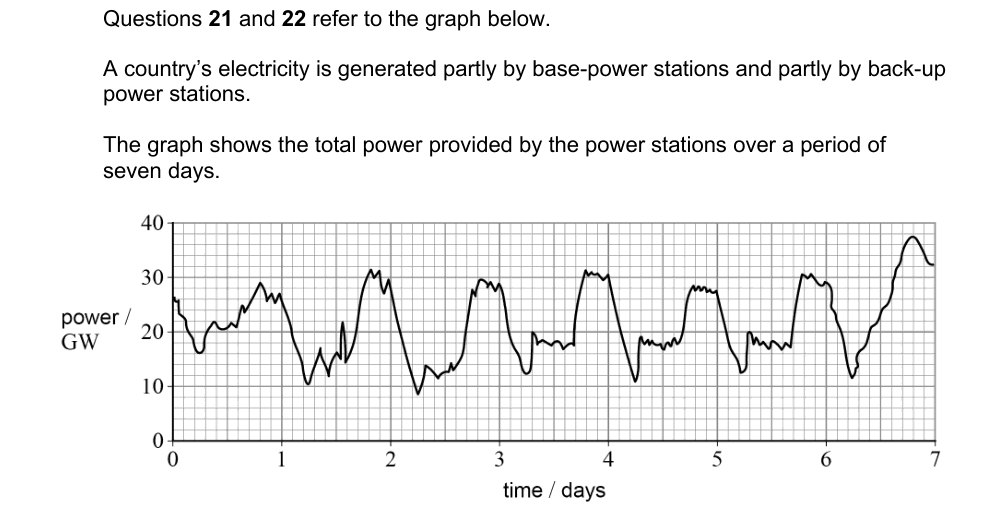
| reliable, continuous output: good for base-load supply | long-lived radioactive waste must be stored safely for thousands of years |
| enormous energy from a small mass of fuel; reserves last a long time | high building and decommissioning costs; long construction times |
| does not depend on the weather | risk of misuse of materials (weapons) or terrorism |
Decisions about nuclear power involve balancing these risks against the benefits, including comparison with the risks of alternatives such as burning fossil fuels.
Summary
- Induced fission: U-235 absorbs a thermal neutron, splits into two fragments + 2–3 neutrons + ~200 MeV.
- Chain reaction: each fission causes on average one more (controlled) or more than one (uncontrolled). Critical mass = minimum mass for a self-sustaining chain reaction.
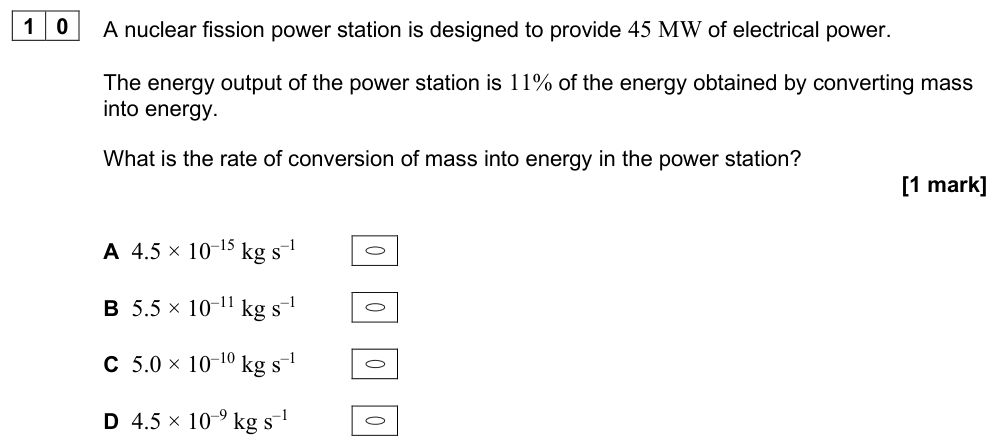
- Moderator (water, graphite): slows neutrons by elastic collisions with light nuclei. Control rods (boron, cadmium): absorb neutrons. Coolant (water, CO₂, sodium): carries energy away.
- Elastic collision model: most energy transferred when the masses are equal.
- Safety: shielding, emergency shut-down, remote handling; waste is cooled, vitrified and stored.