What is simple harmonic motion?
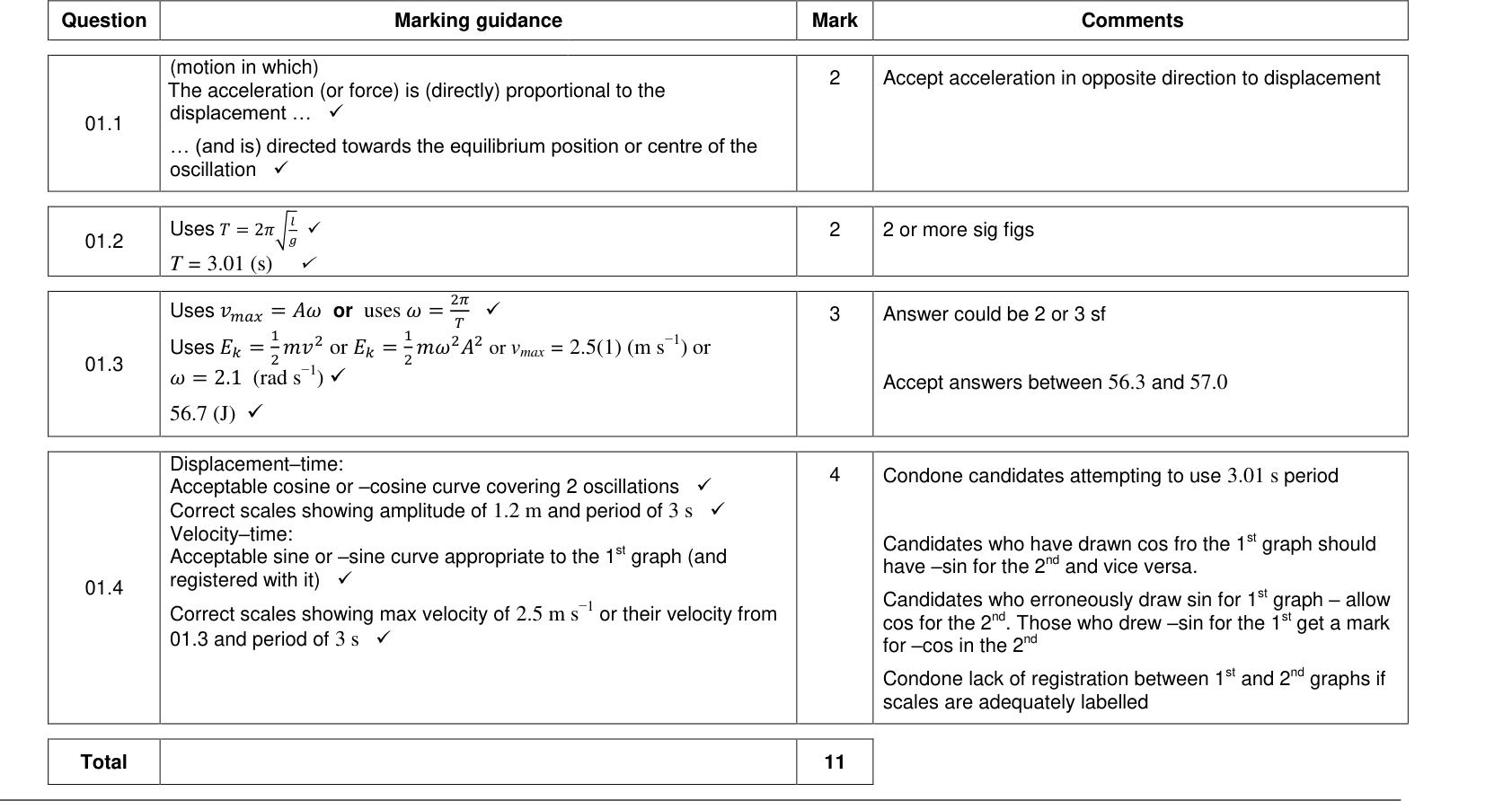
Simple harmonic motion (SHM)
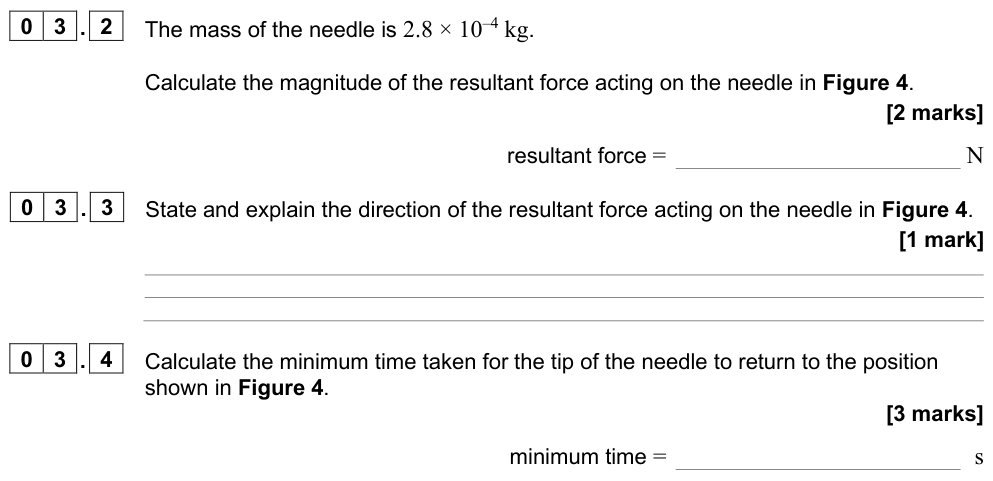
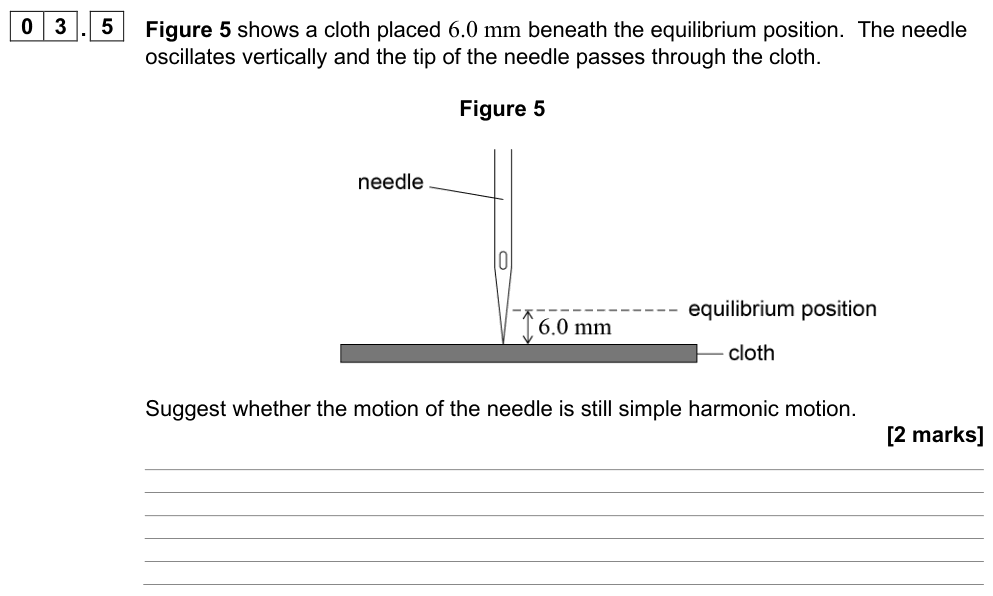
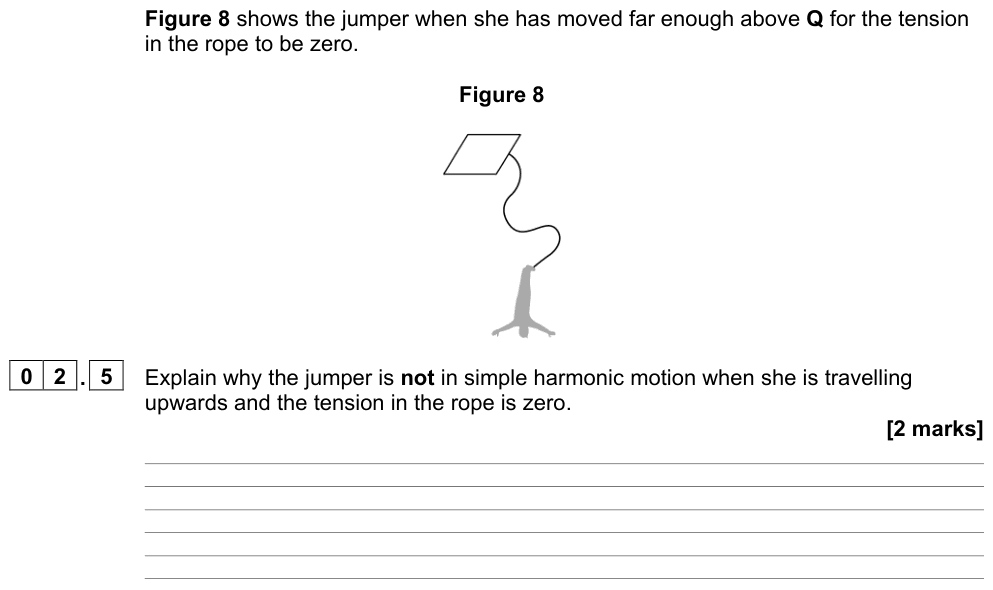
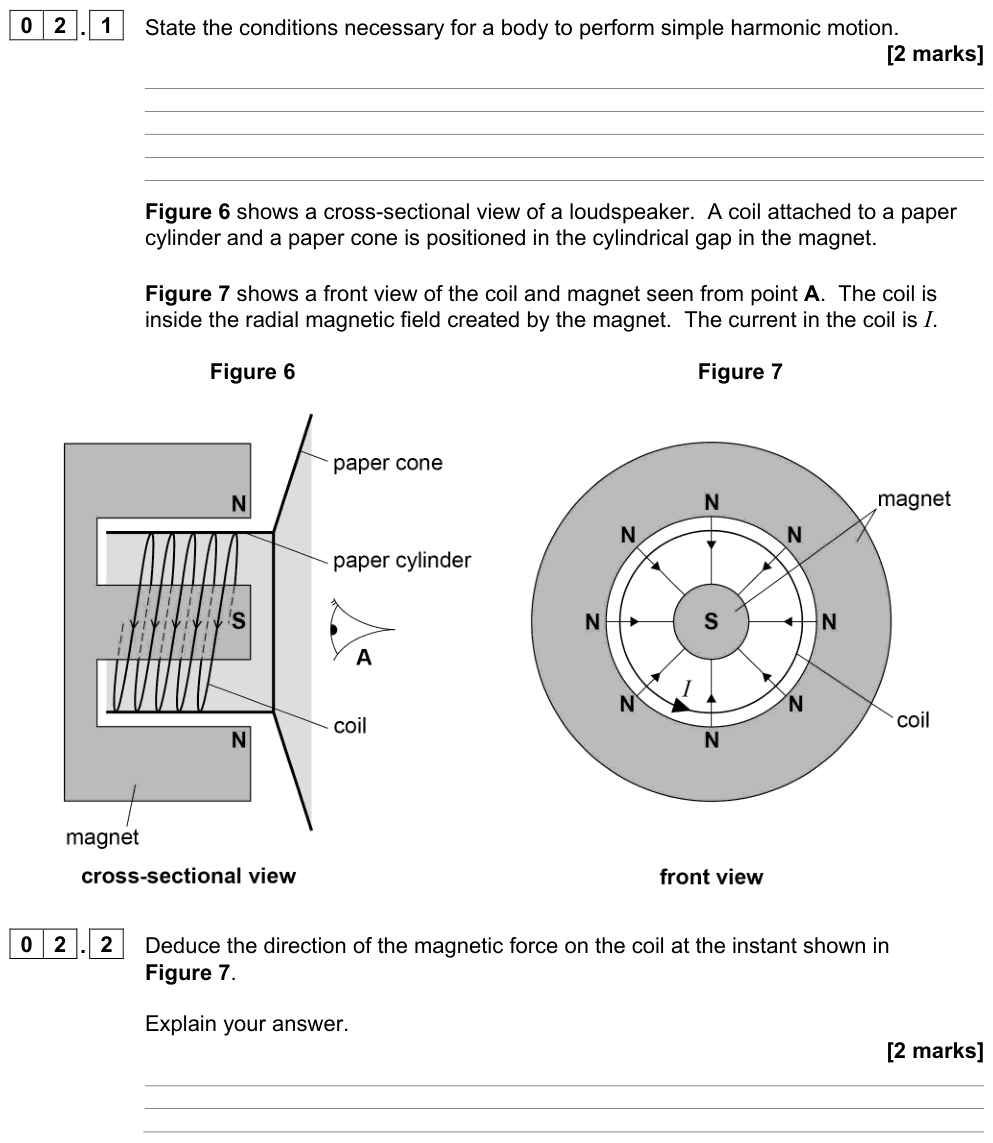
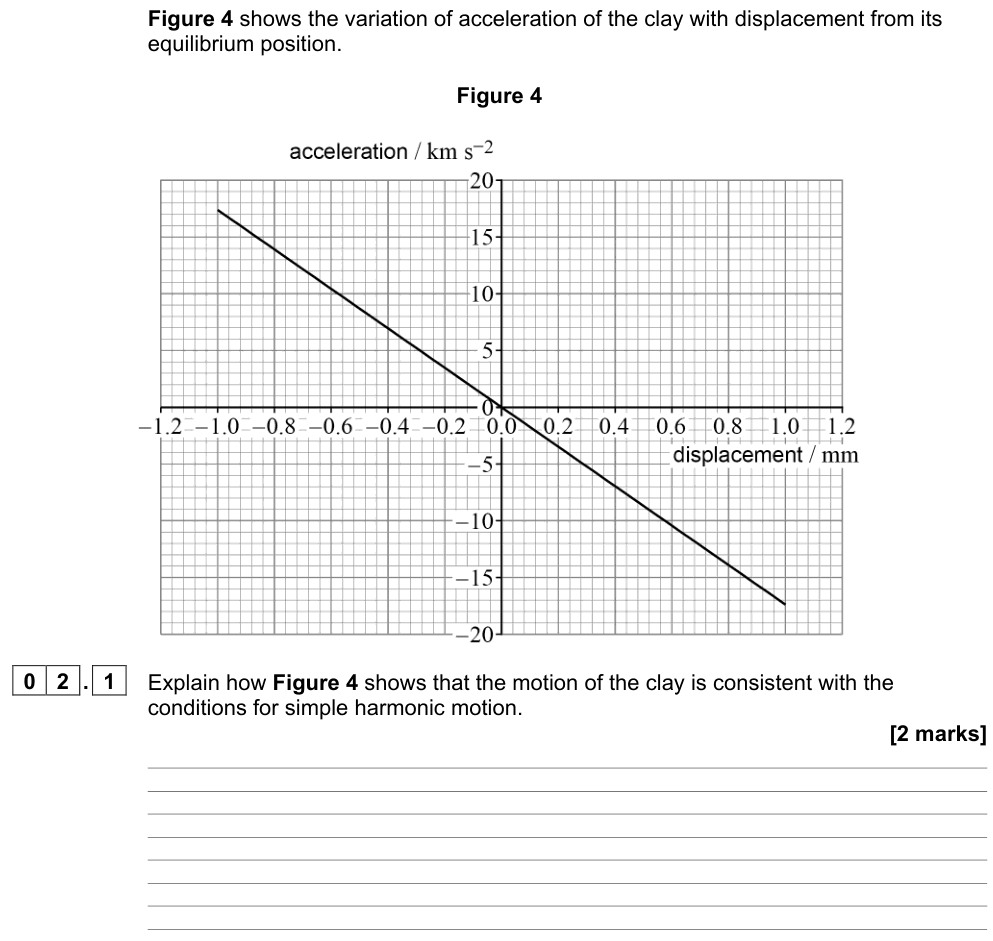
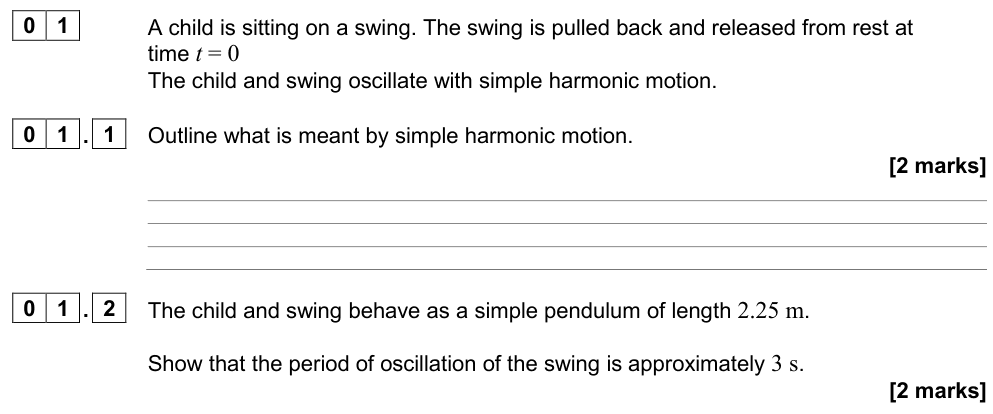
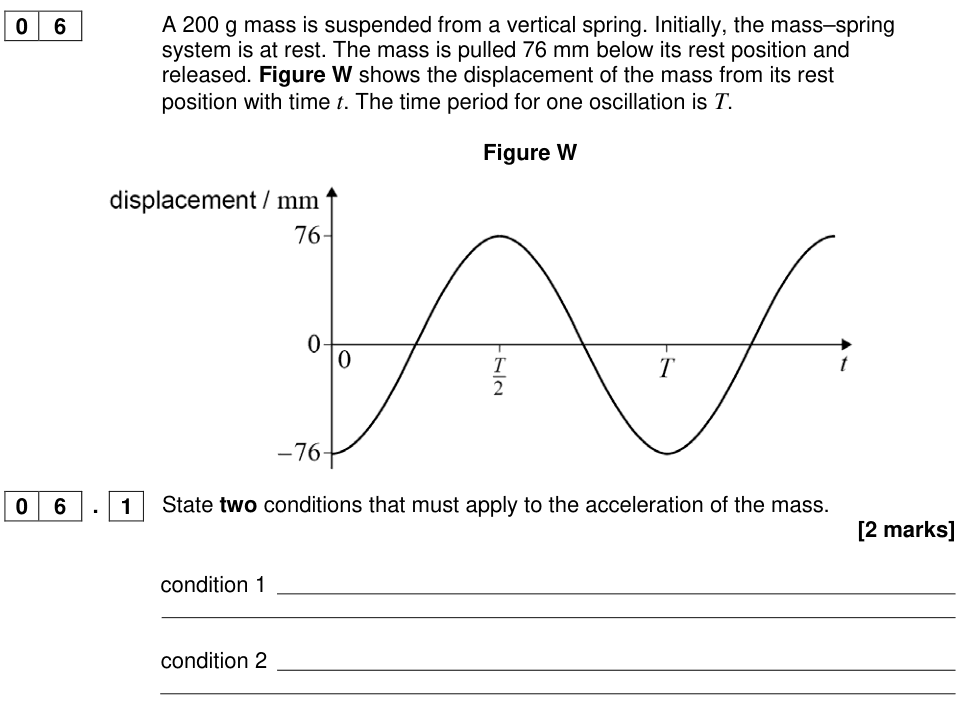
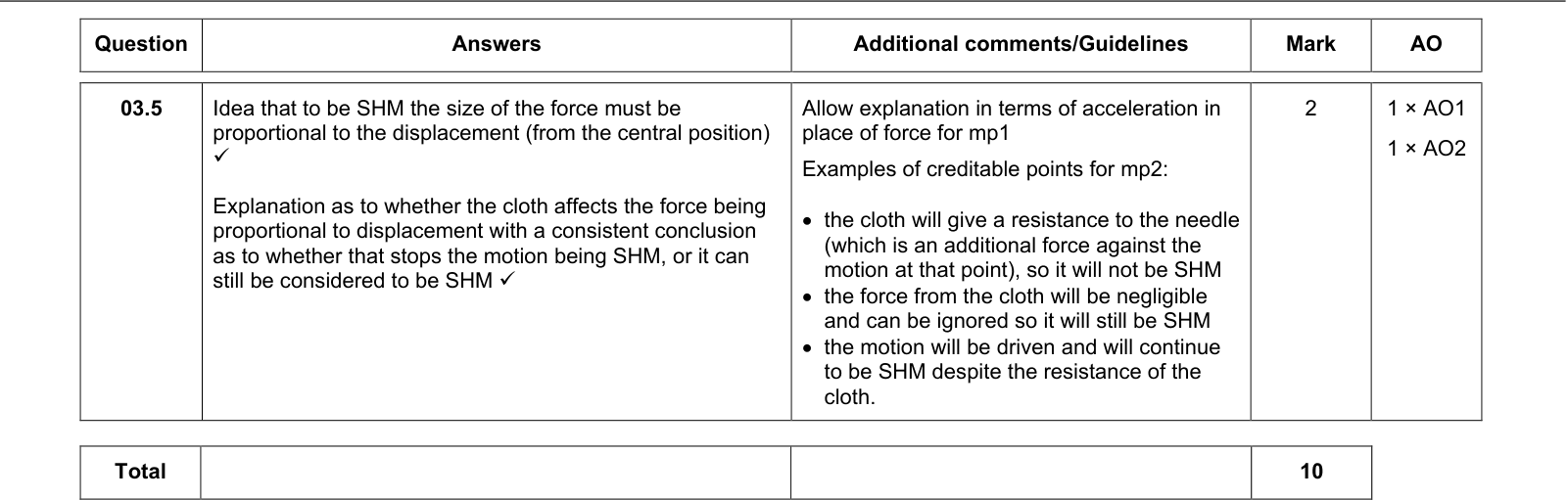
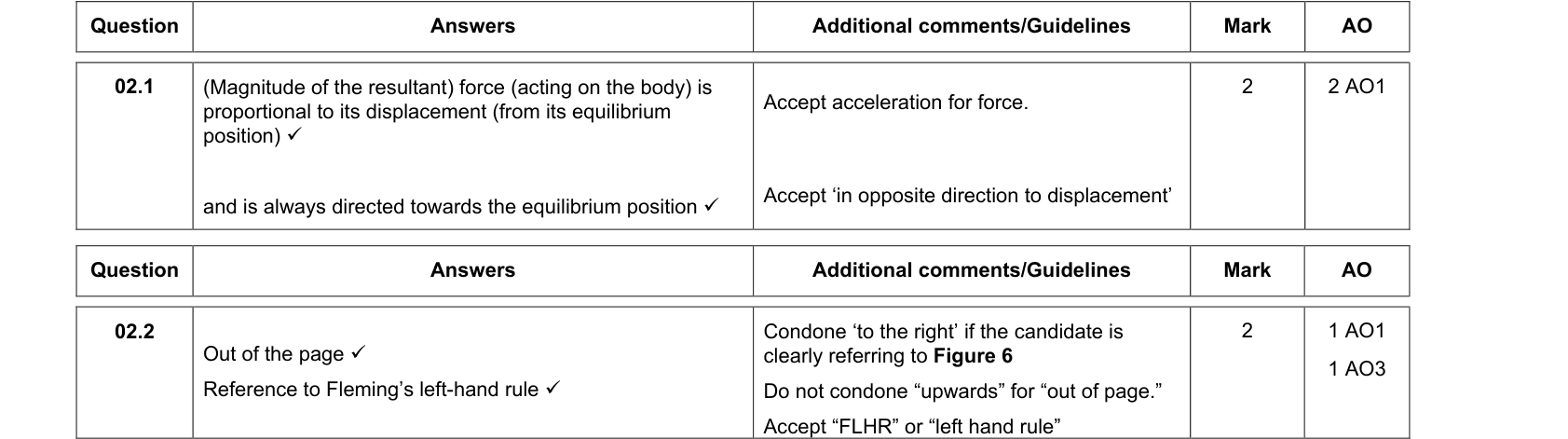
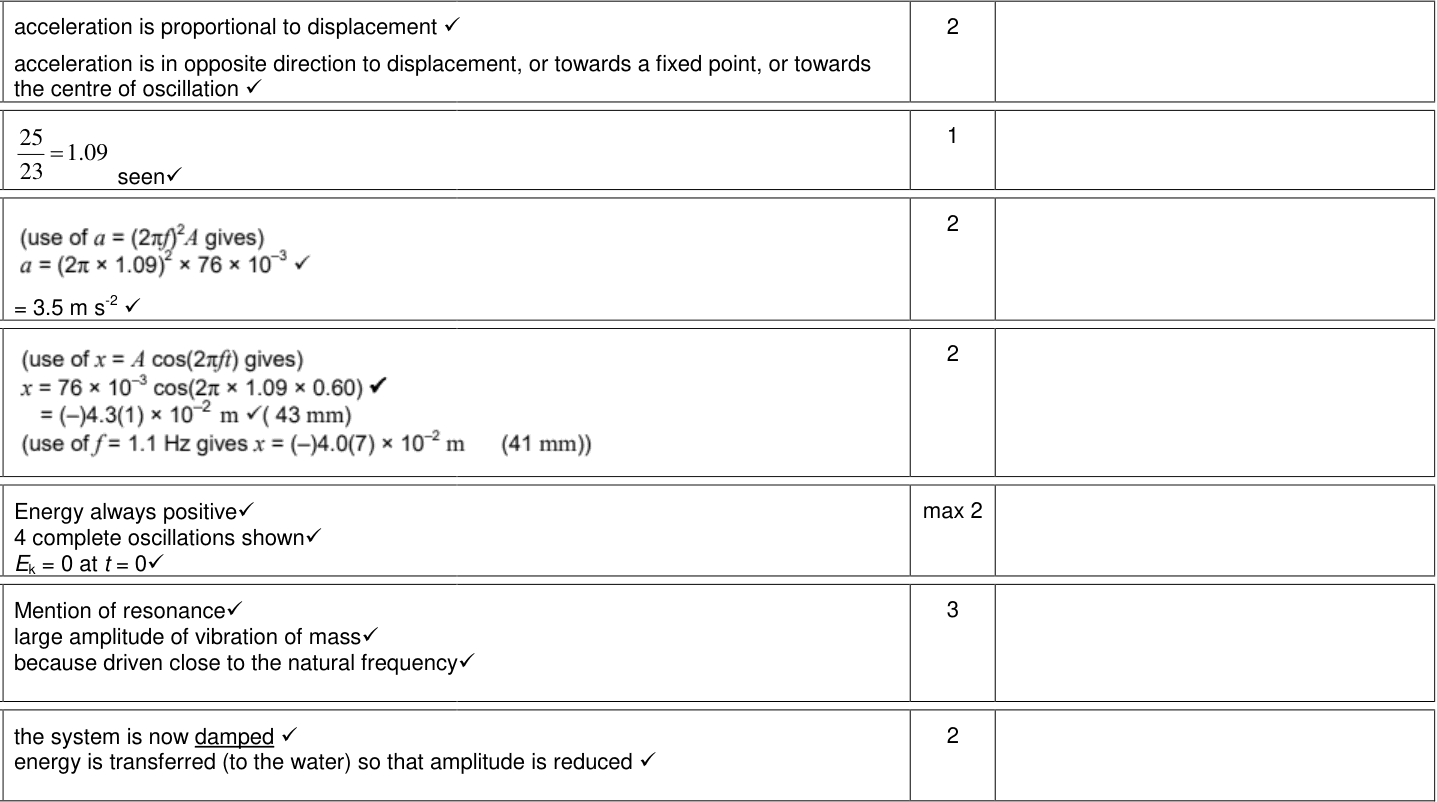
An object moves with simple harmonic motion if its acceleration is:
- directly proportional to its displacement from a fixed equilibrium point, and
- always directed towards that equilibrium point (opposite to the displacement).
The defining equation
$$a = -\omega^2 x$$
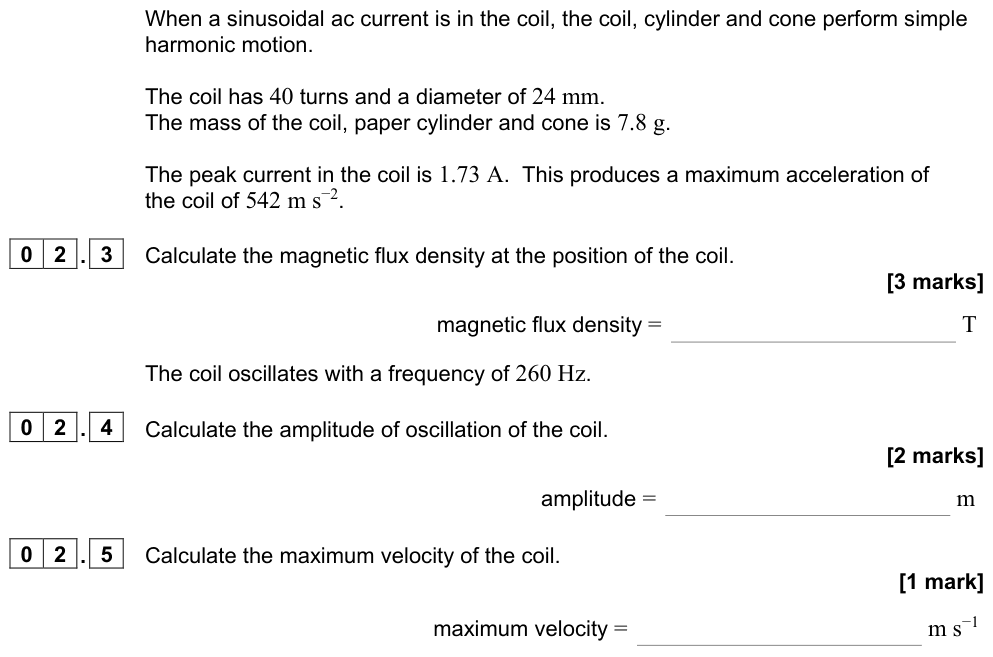
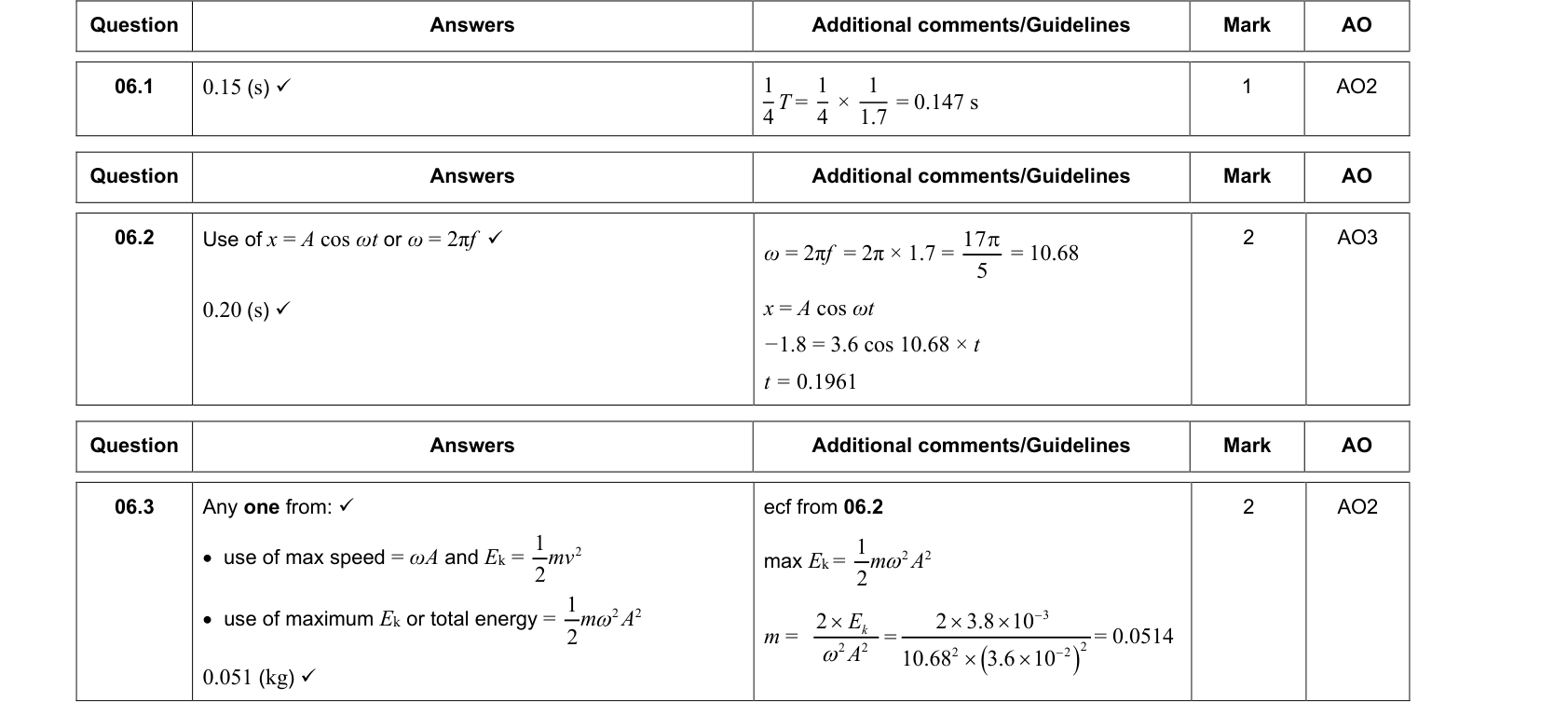
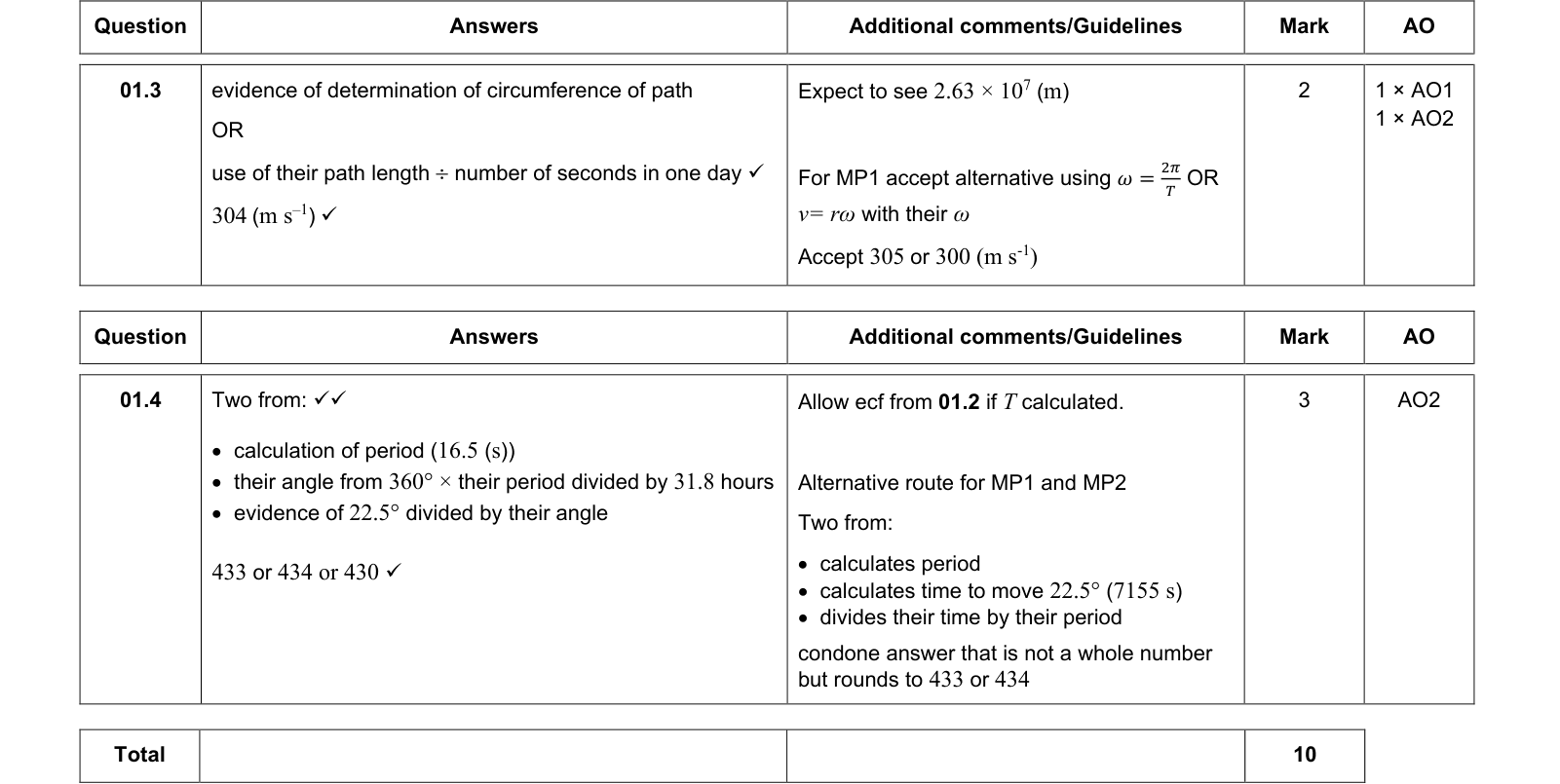
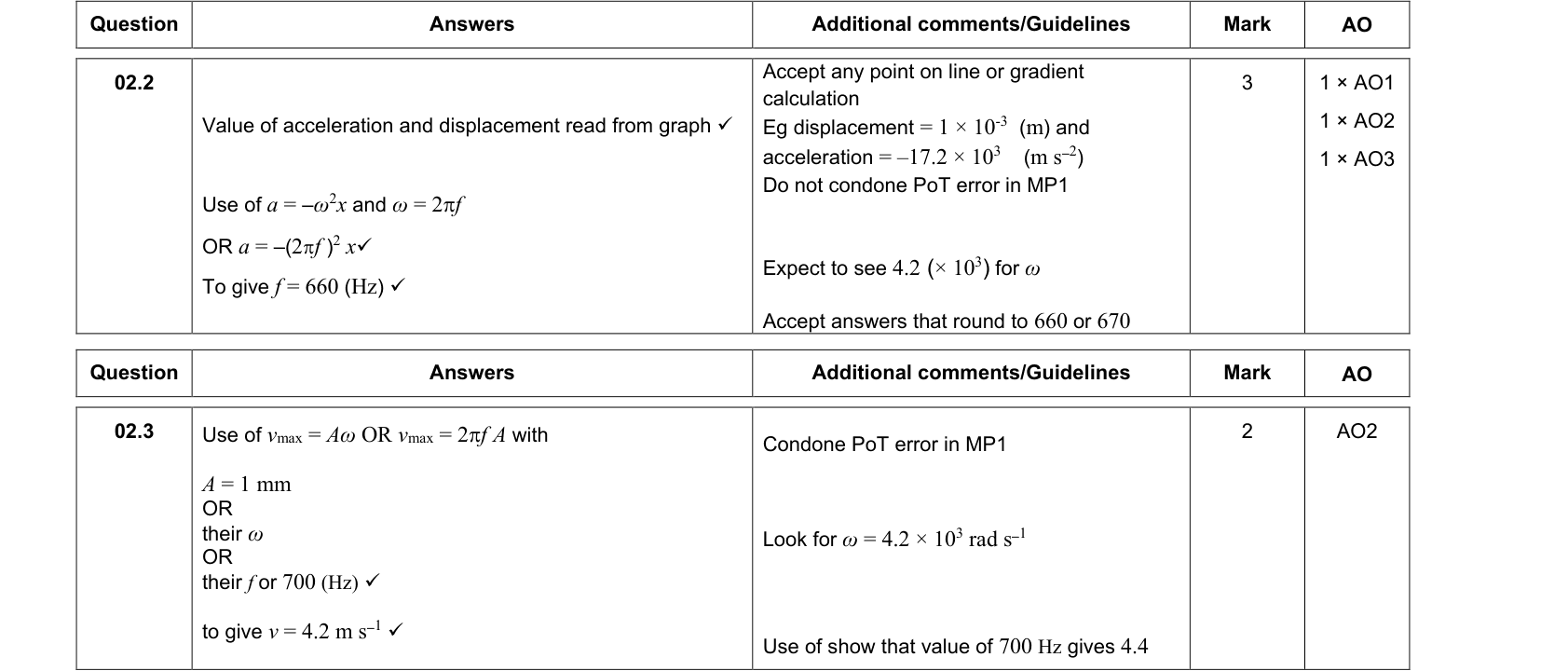
$\omega$ is a constant for the system (the angular frequency), with $\omega = 2\pi f = \dfrac{2\pi}{T}$. The minus sign shows the acceleration is opposite to the displacement.
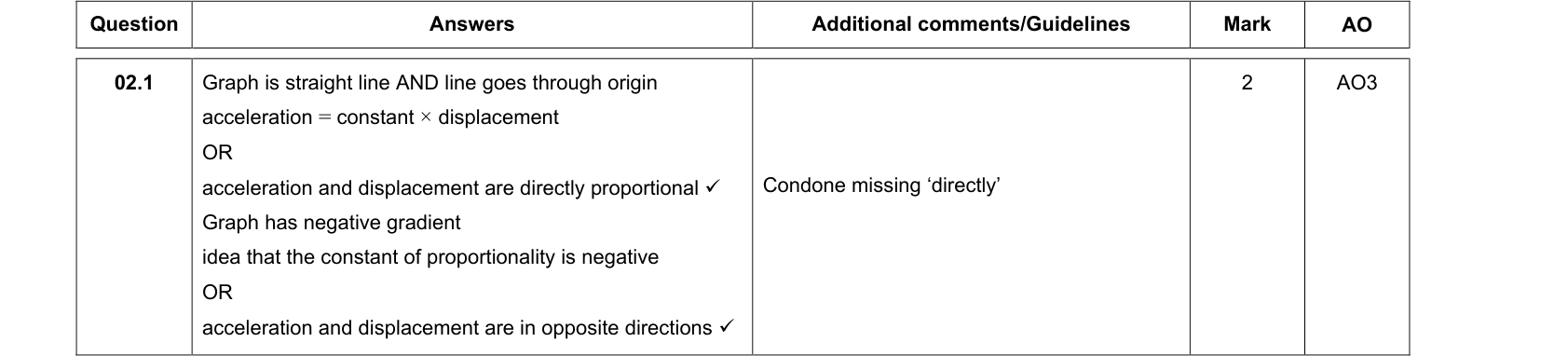
A graph of $a$ against $x$ is a straight line through the origin with a negative gradient $-\omega^2$.
Characteristic features of SHM:
- the period is independent of the amplitude (isochronous);
- the displacement, velocity and acceleration vary sinusoidally with time;
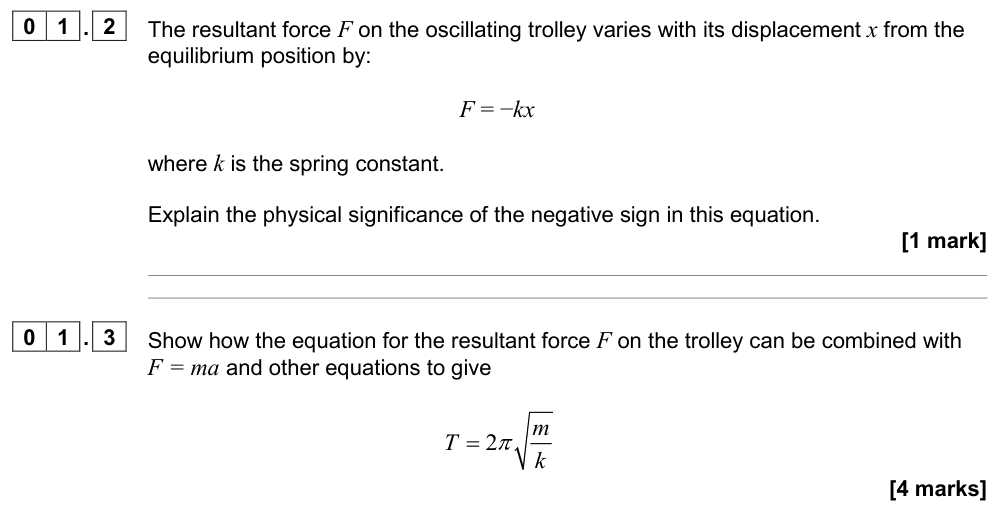
- there is a restoring force proportional to displacement, $F = -kx$.
Equations of SHM
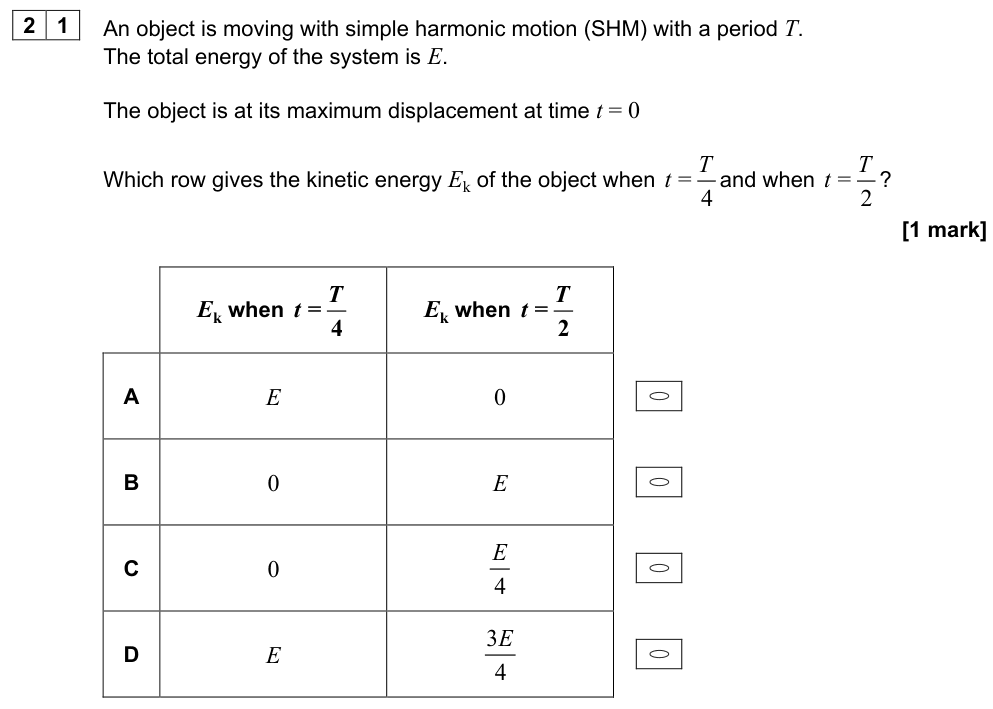
If the object is released from maximum displacement $A$ at $t = 0$:
SHM equations
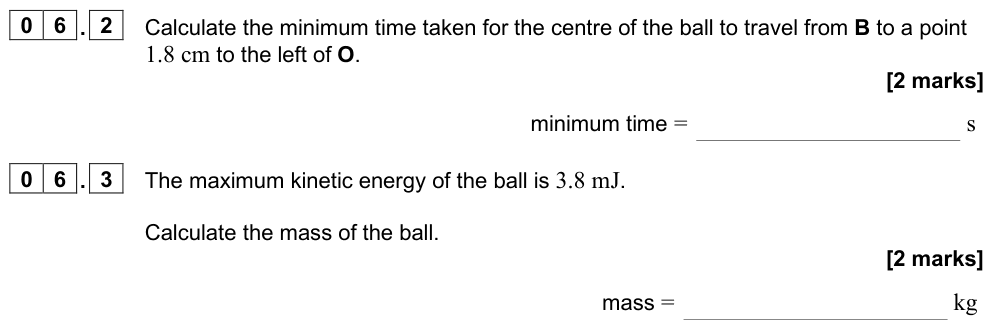
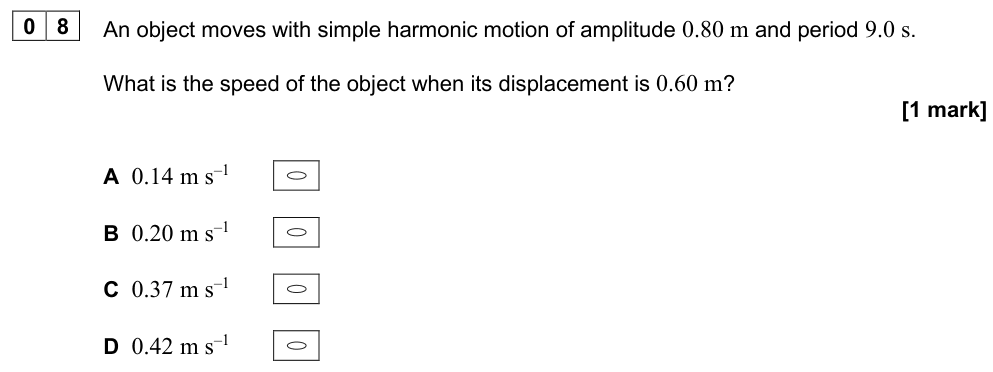
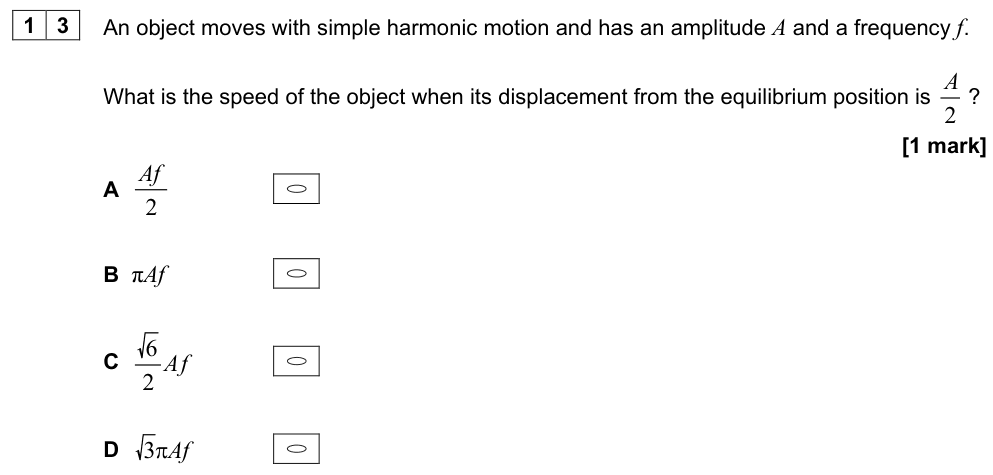
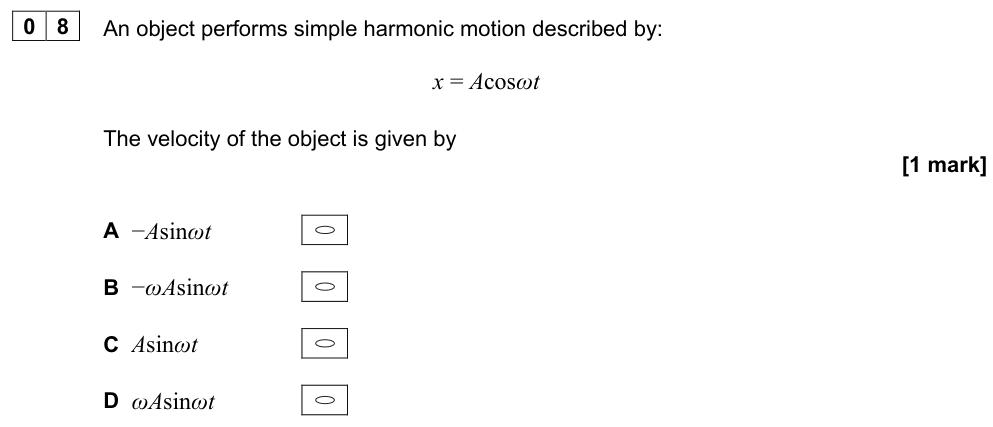
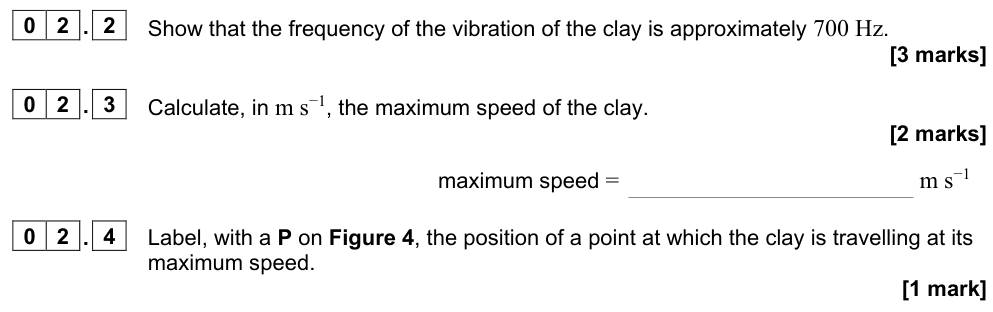
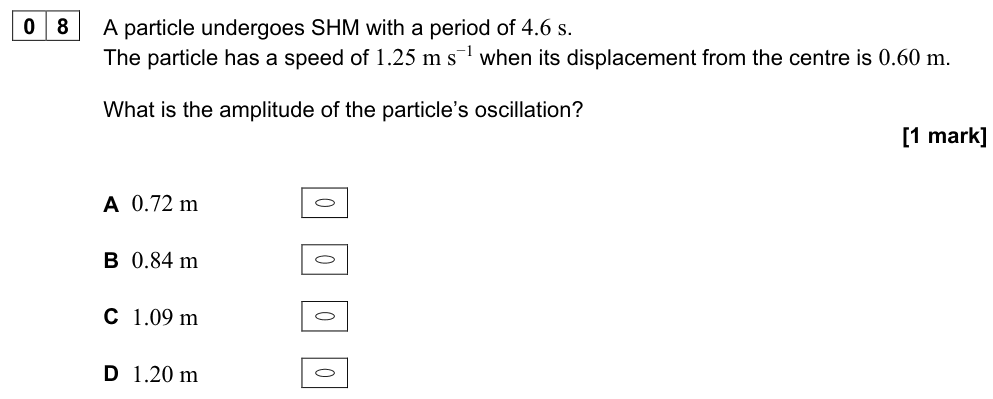
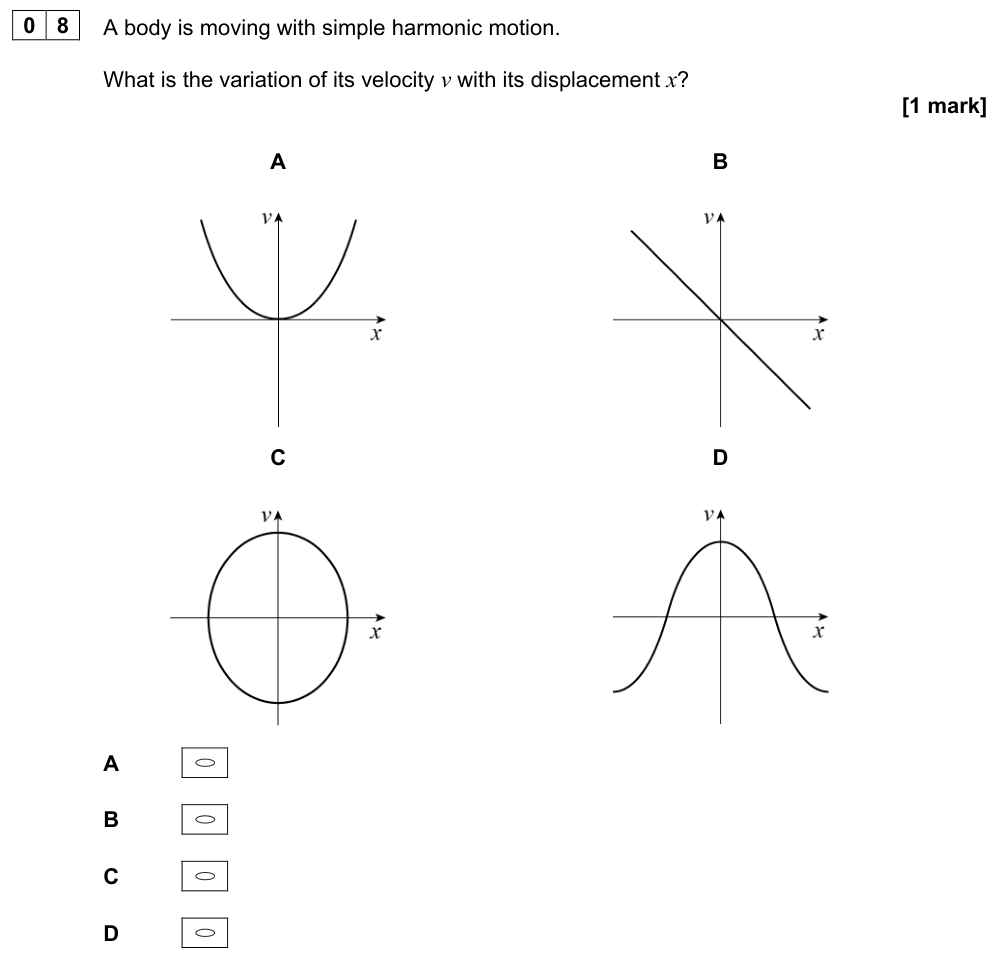
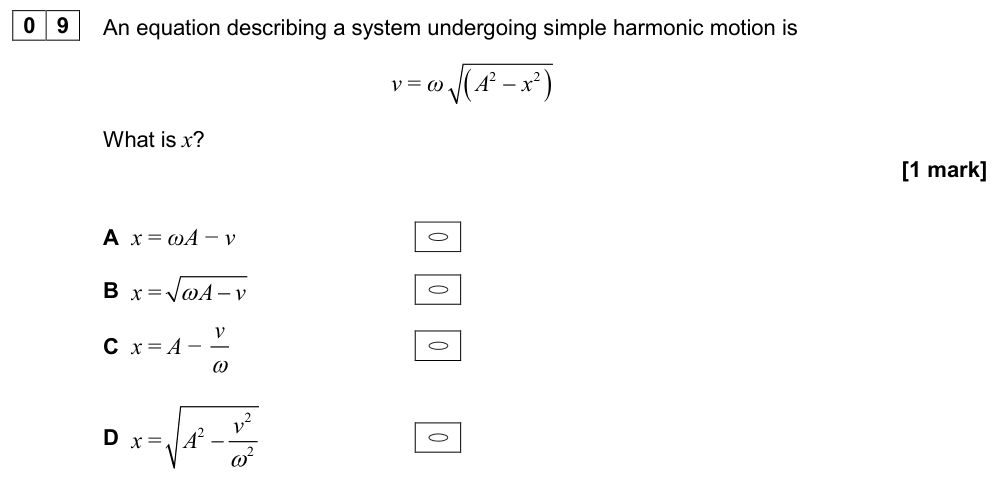
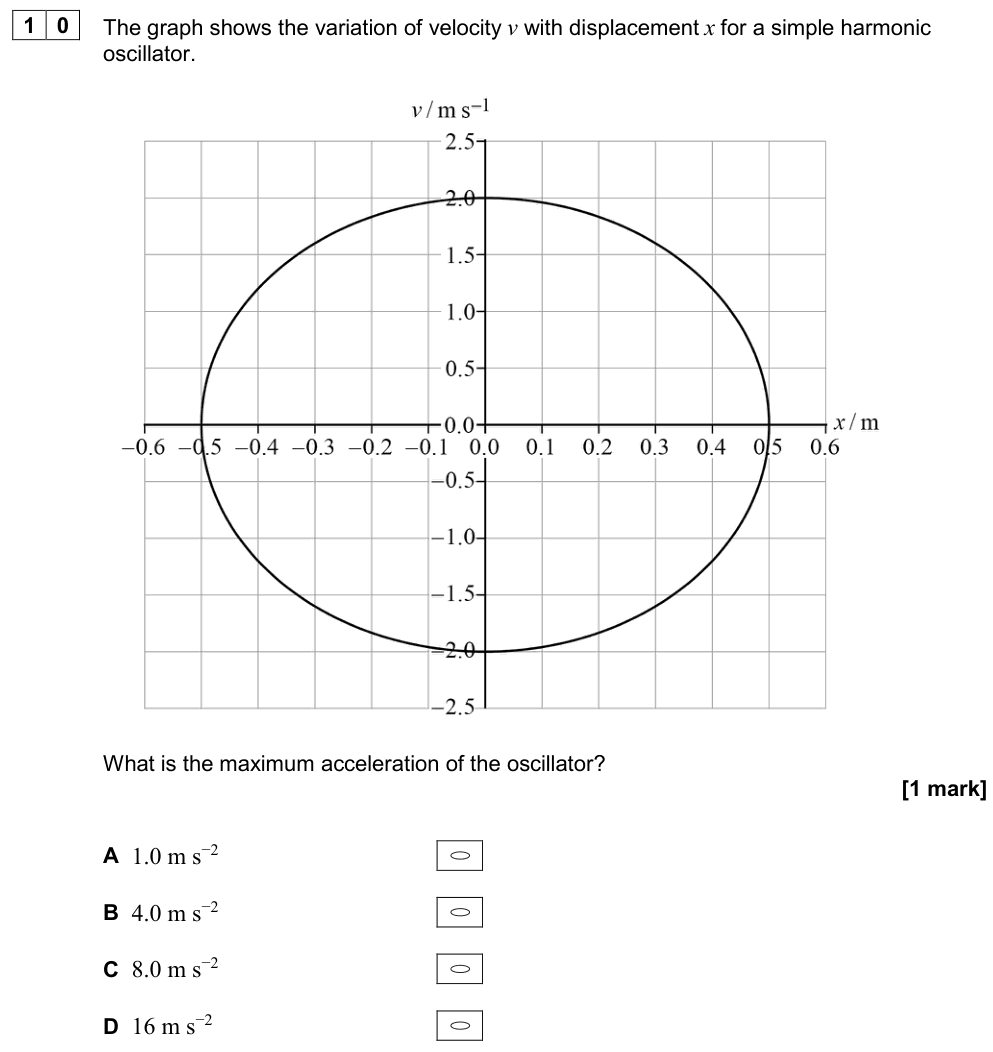
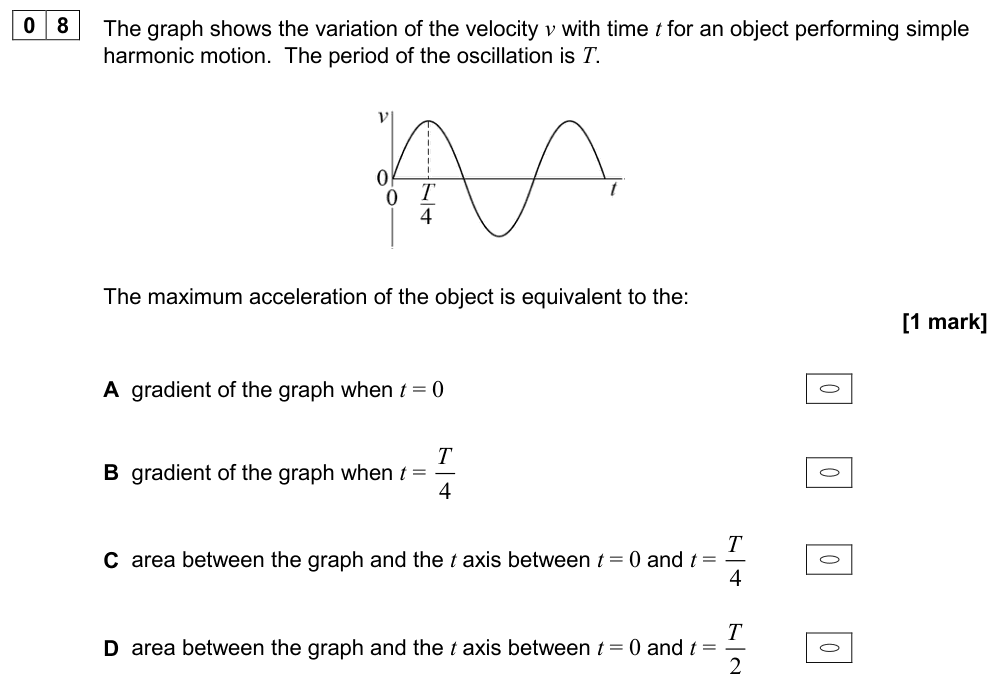
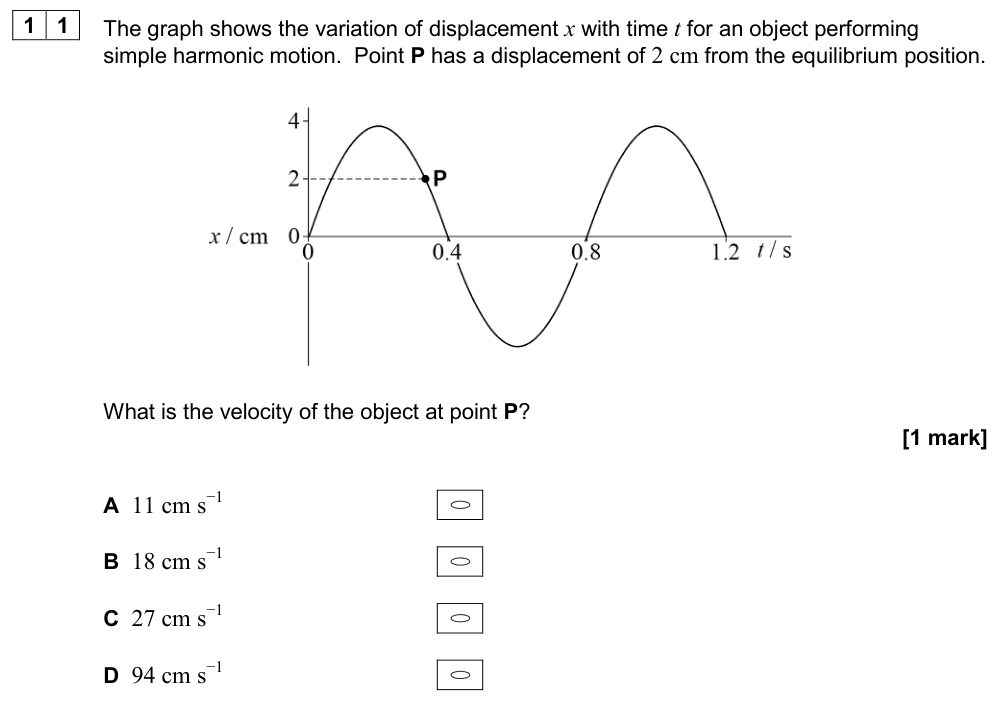
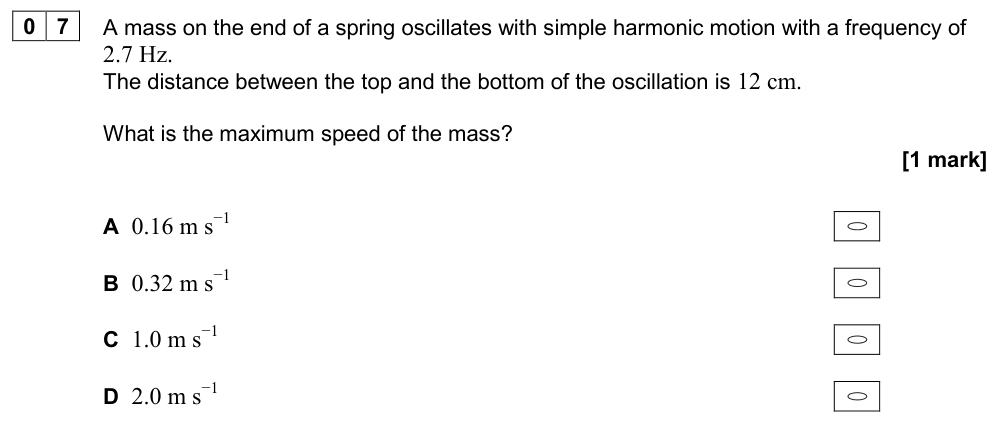
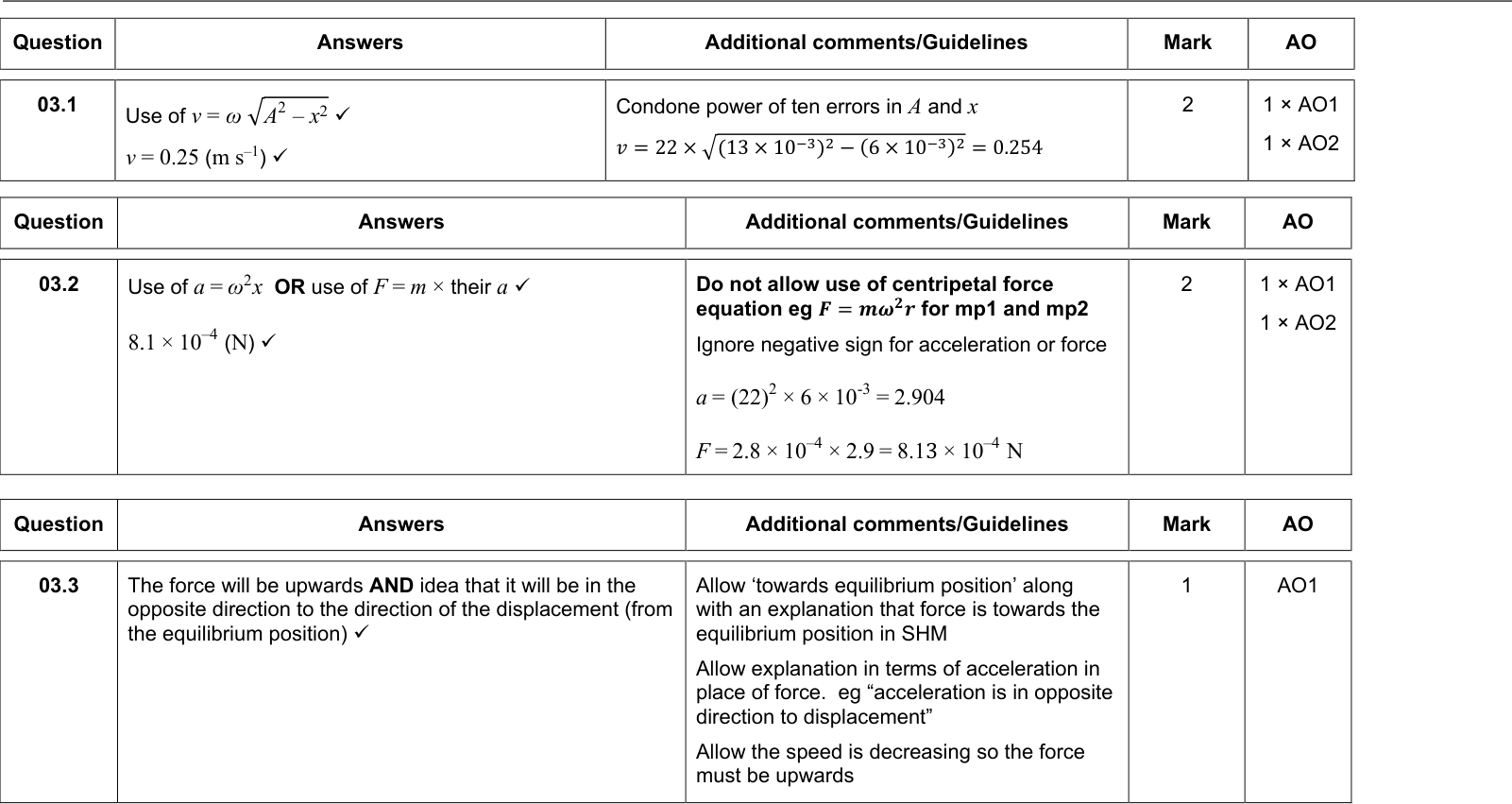
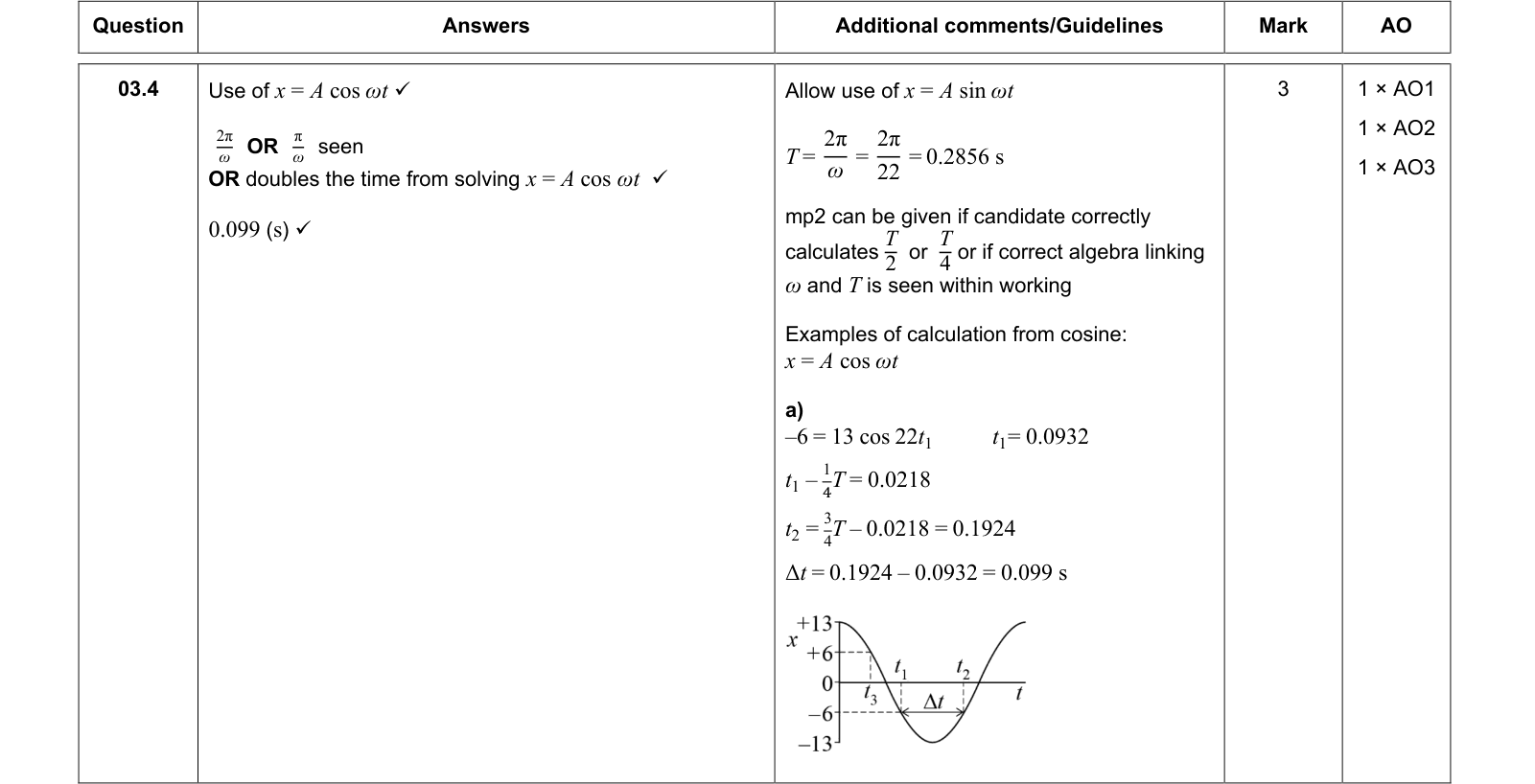
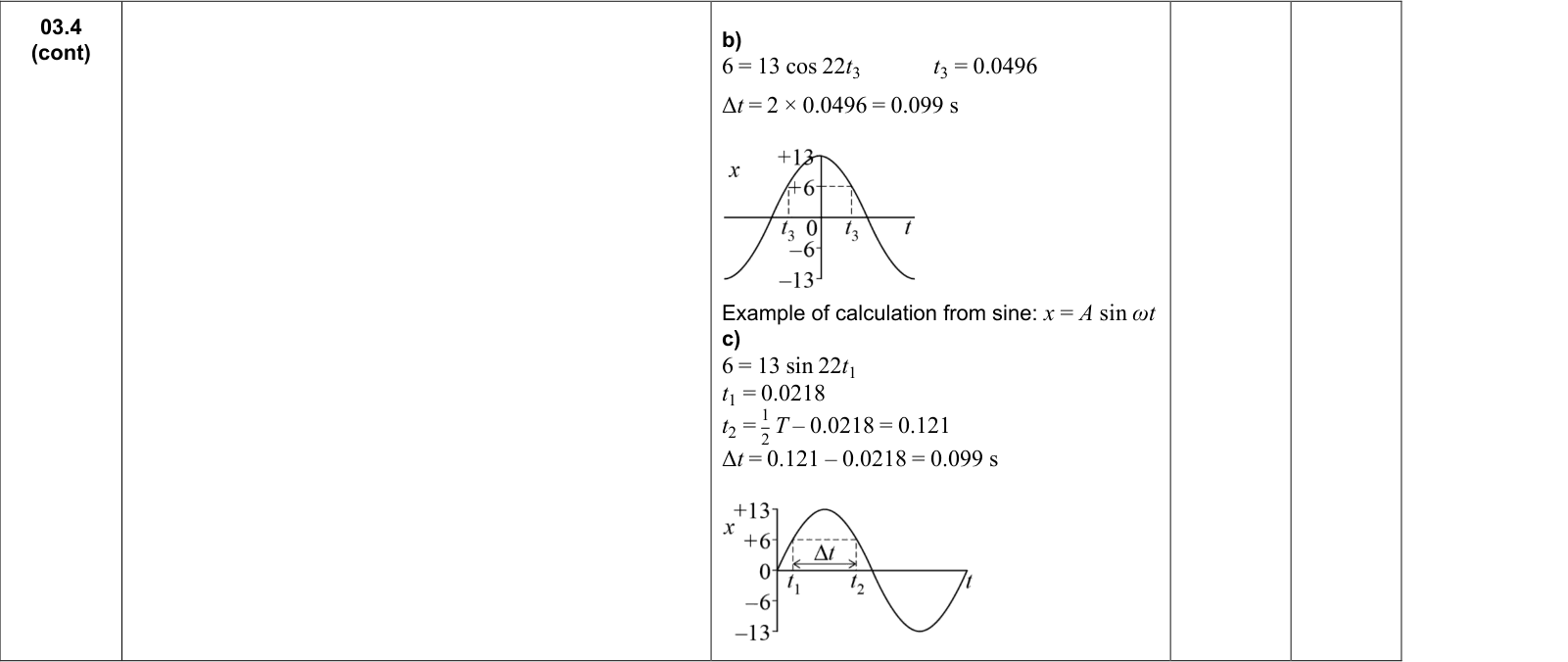
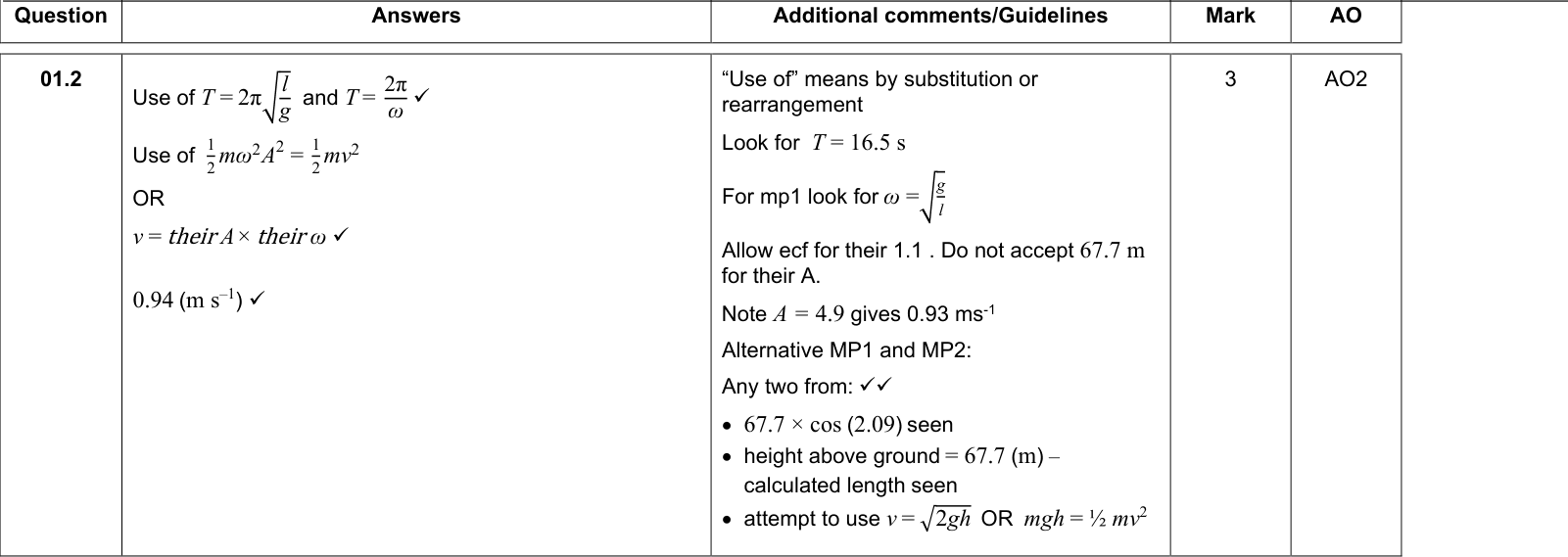
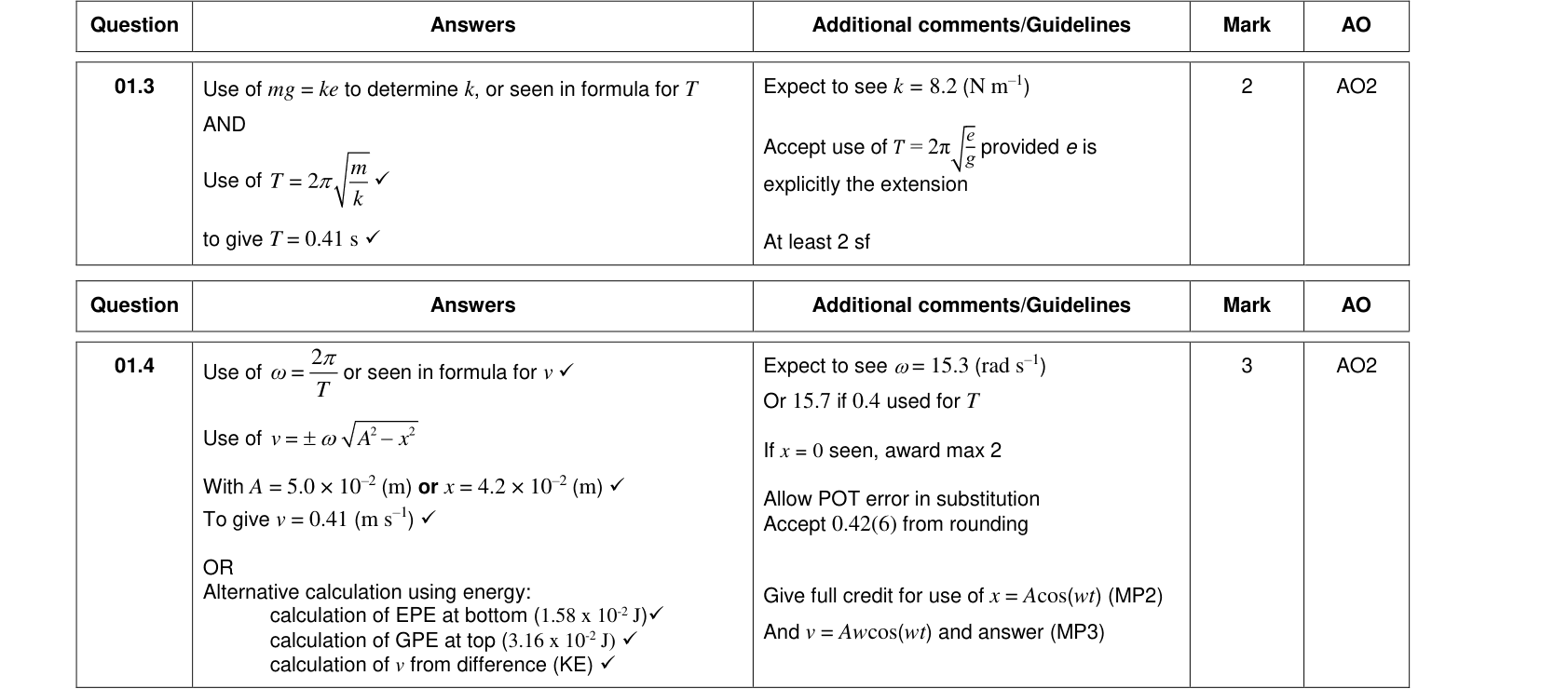
$$x = A\cos\omega t$$ $$v = \pm\,\omega\sqrt{A^2 - x^2}$$ $$\text{maximum speed } v_{\max} = \omega A \quad (\text{at } x = 0)$$ $$\text{maximum acceleration } a_{\max} = \omega^2 A \quad (\text{at } x = \pm A)$$
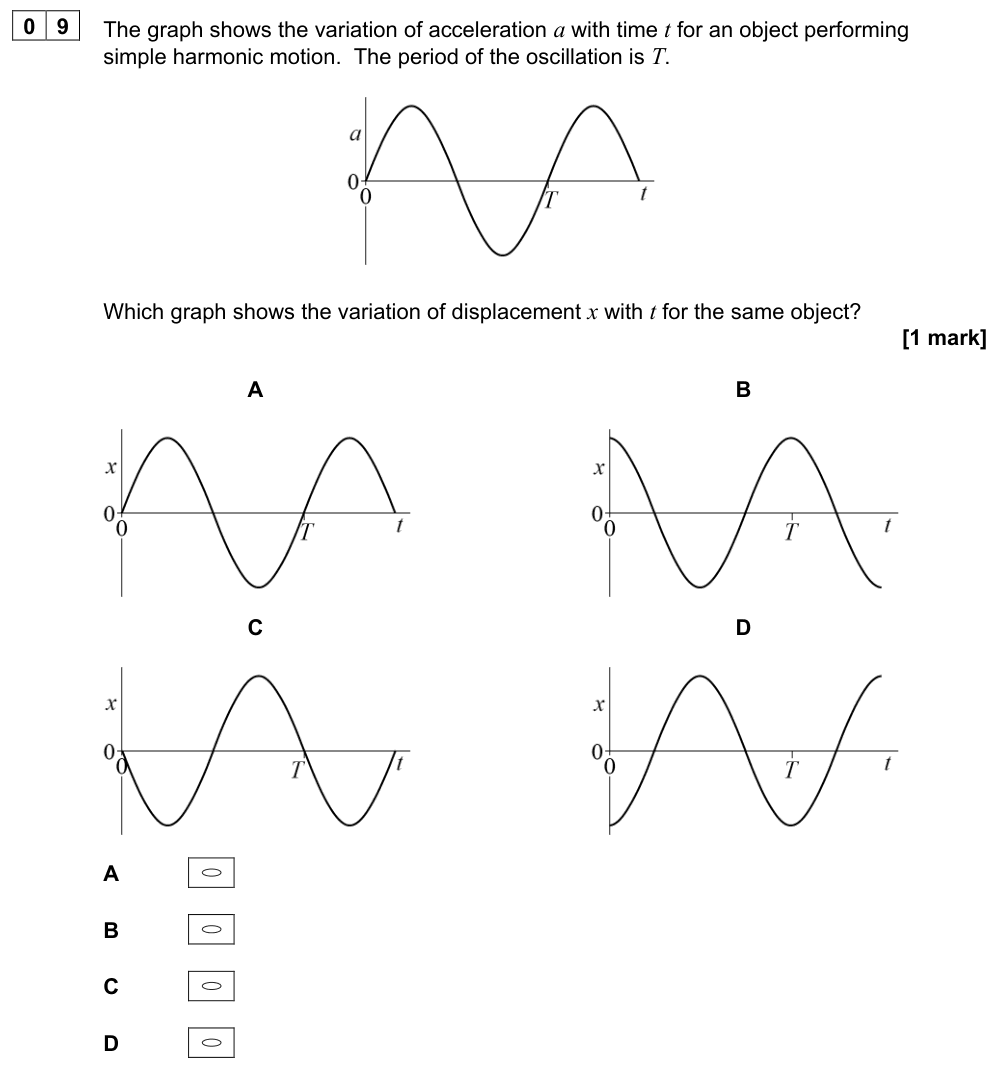
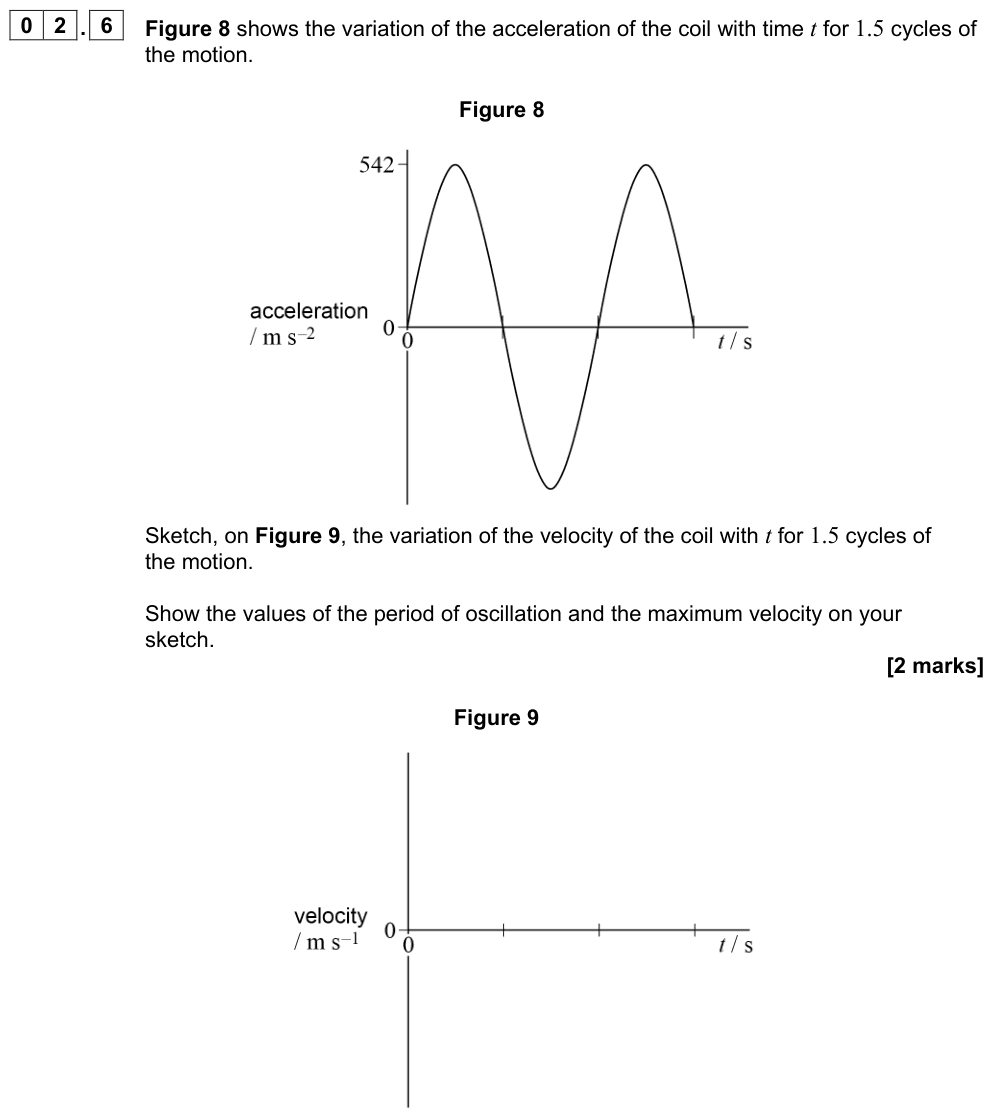
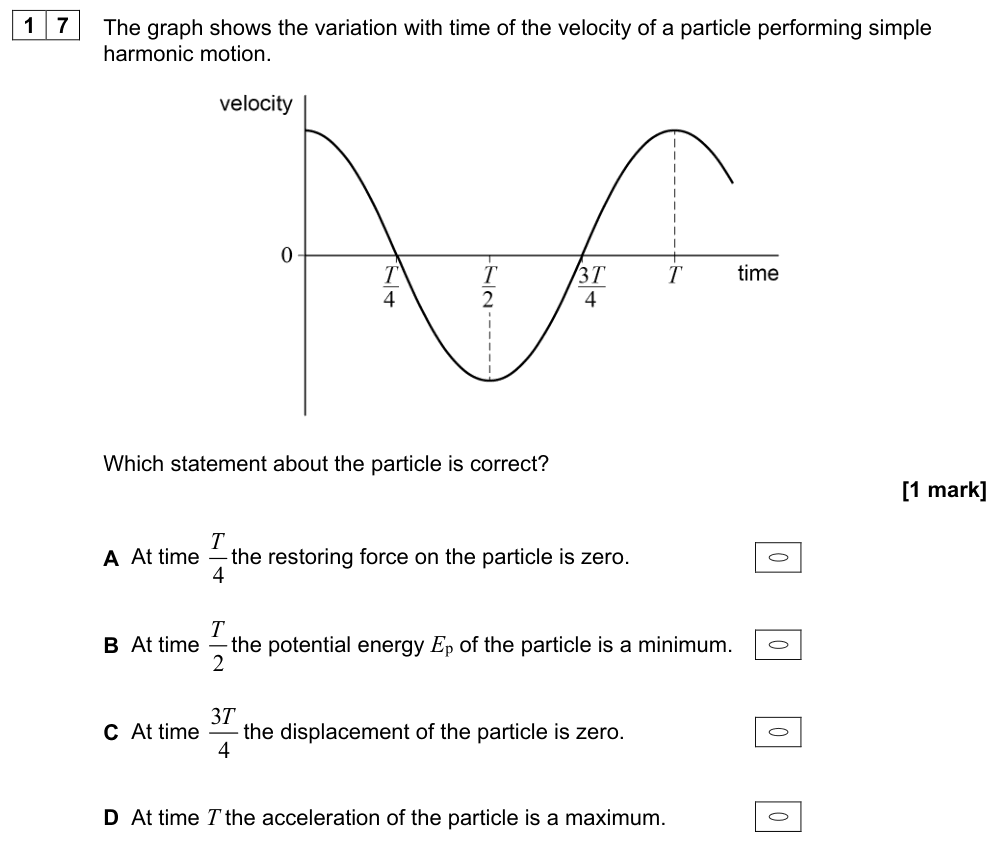
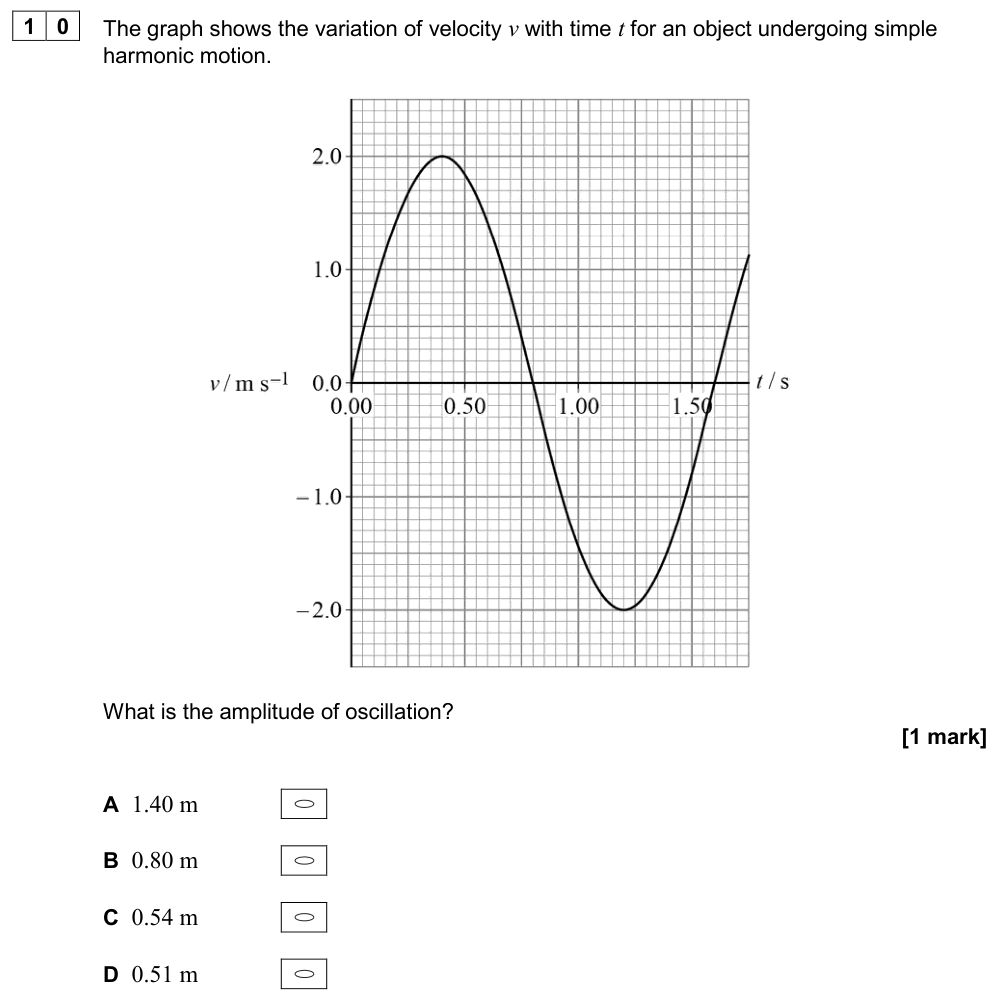
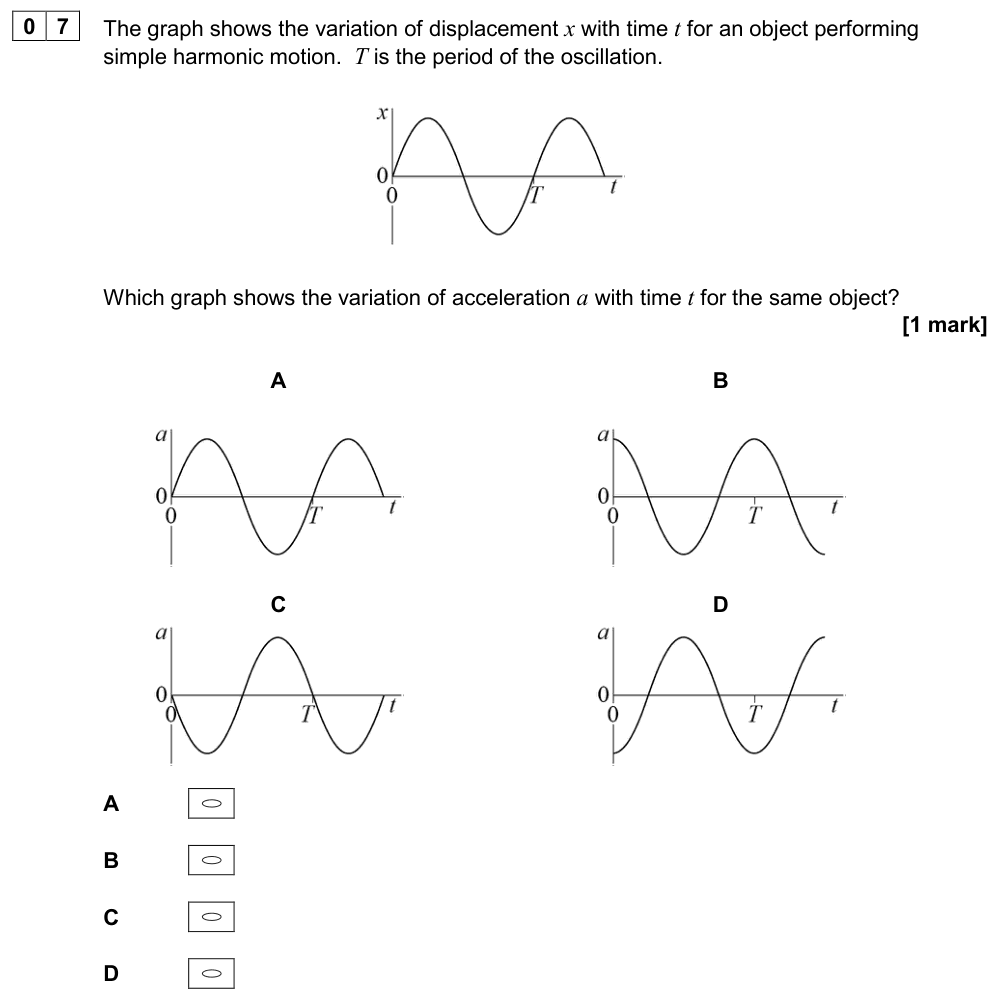
The velocity–time equation is $v = -A\omega\sin\omega t$ and the acceleration–time equation is $a = -A\omega^2\cos\omega t = -\omega^2x$.
Common mistake
Make sure your calculator is in radians when using $x = A\cos\omega t$.
Worked example
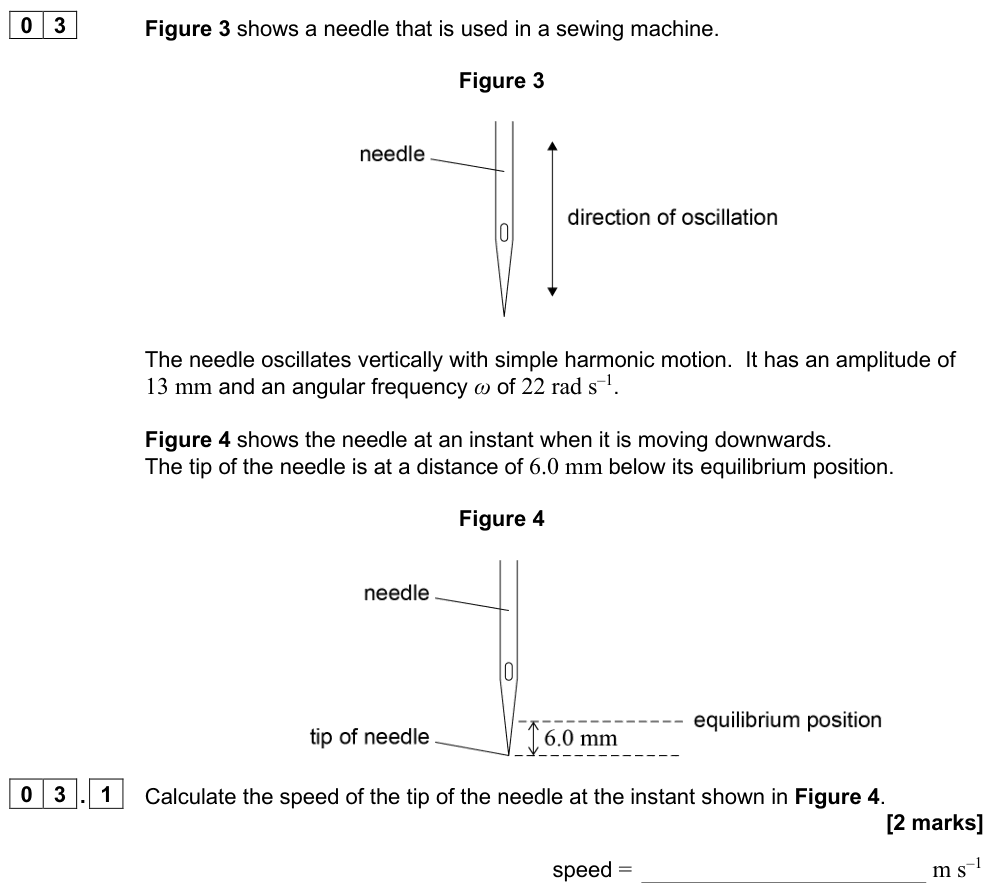
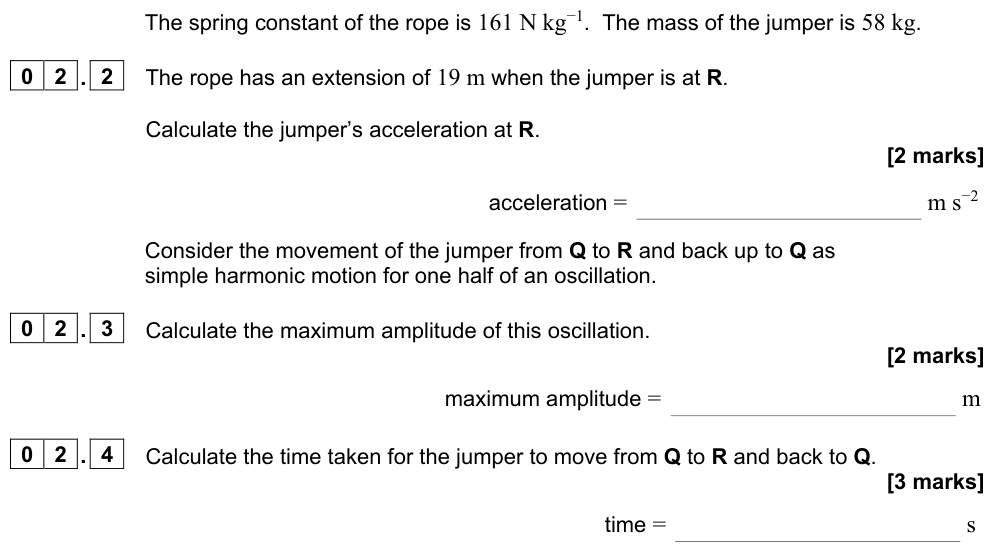
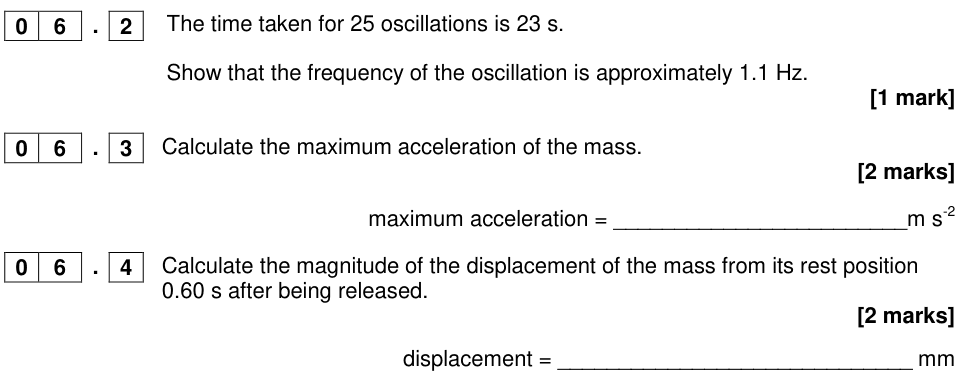
A mass oscillates with SHM of amplitude 0.050 m and frequency 2.0 Hz.
$\omega = 2\pi \times 2.0 = 12.6\ \text{rad s}^{-1}$.
Maximum speed $= \omega A = 0.63\ \text{m s}^{-1}$. Maximum acceleration $= \omega^2 A = 7.9\ \text{m s}^{-2}$.
Speed when $x = 0.030$ m: $v = 12.6\sqrt{0.050^2 - 0.030^2} = 0.50\ \text{m s}^{-1}$.
Displacement at $t = 0.10$ s: $x = 0.050\cos(1.26) = 0.015\ \text{m}$.
Graphs of SHM
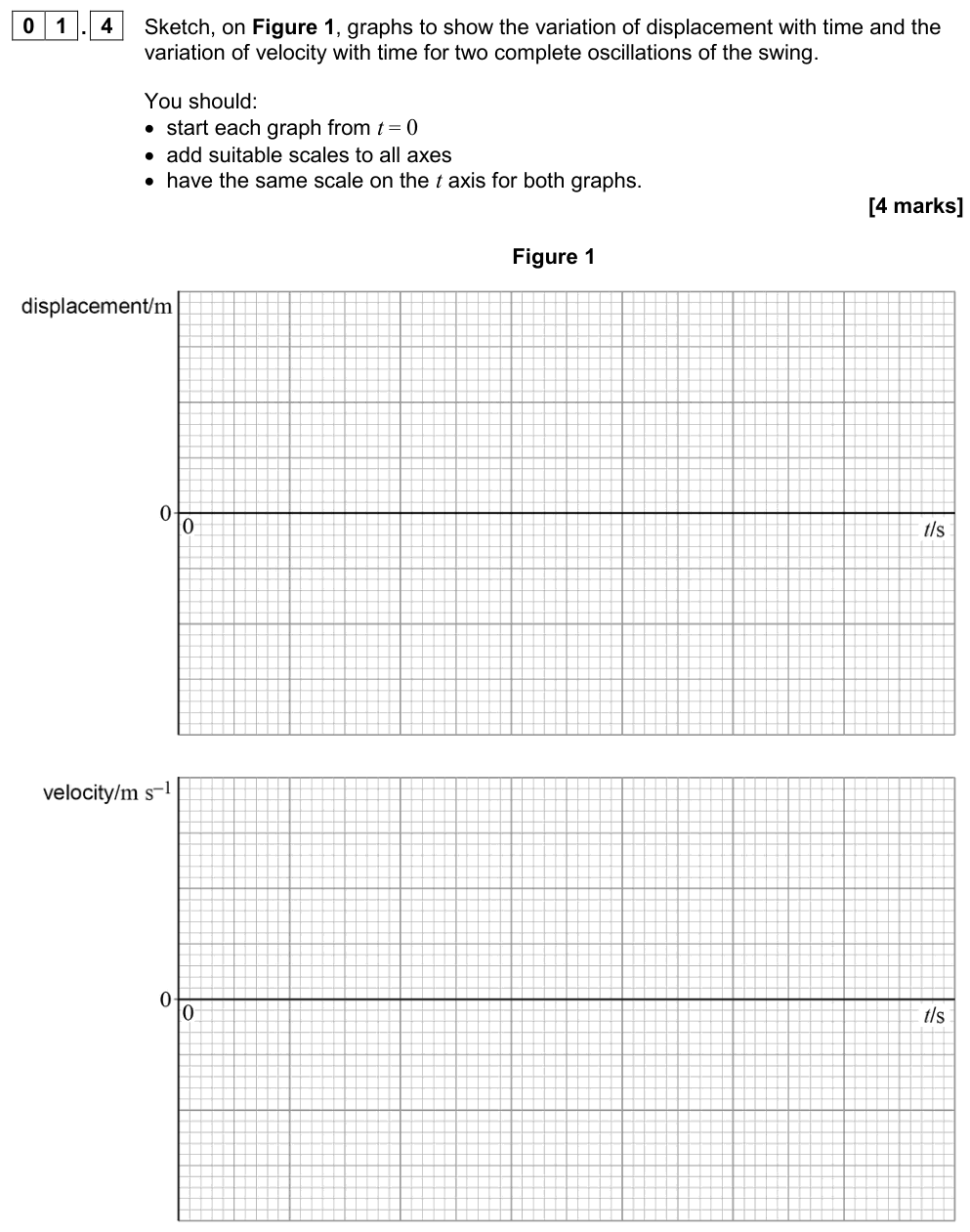
- Velocity = gradient of the displacement–time graph. It is zero at the extremes and maximum at the centre.
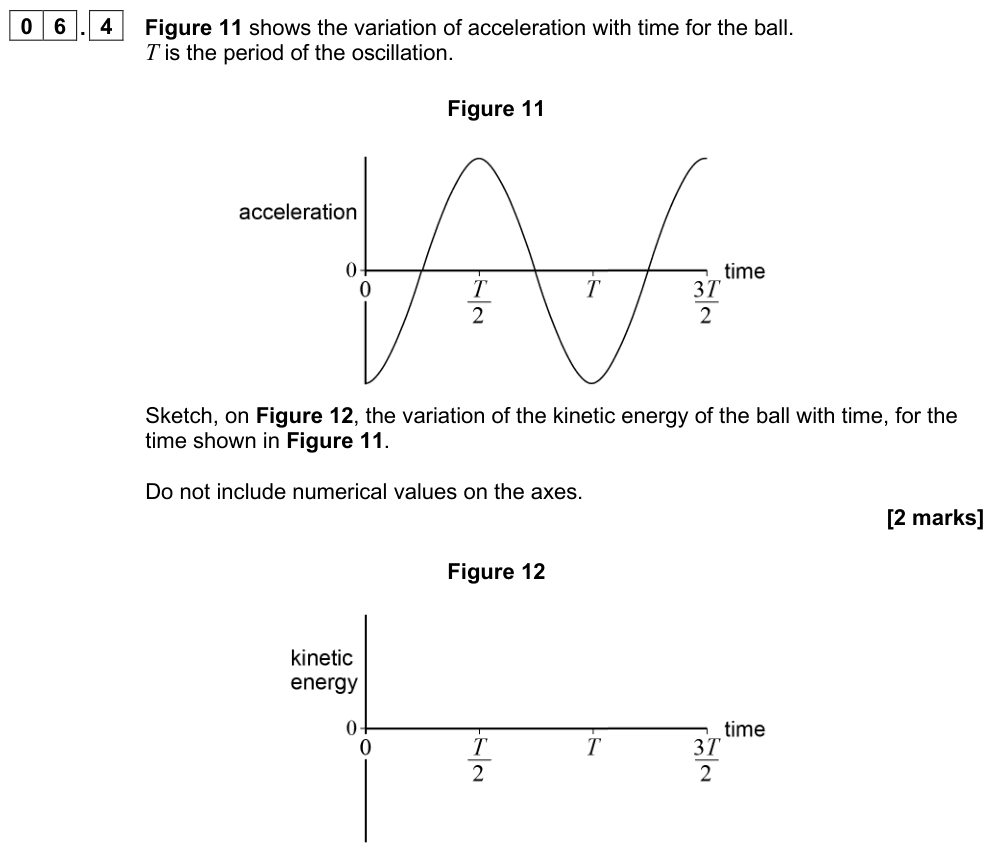
- Acceleration = gradient of the velocity–time graph. It is maximum (and opposite in direction) at the extremes and zero at the centre.
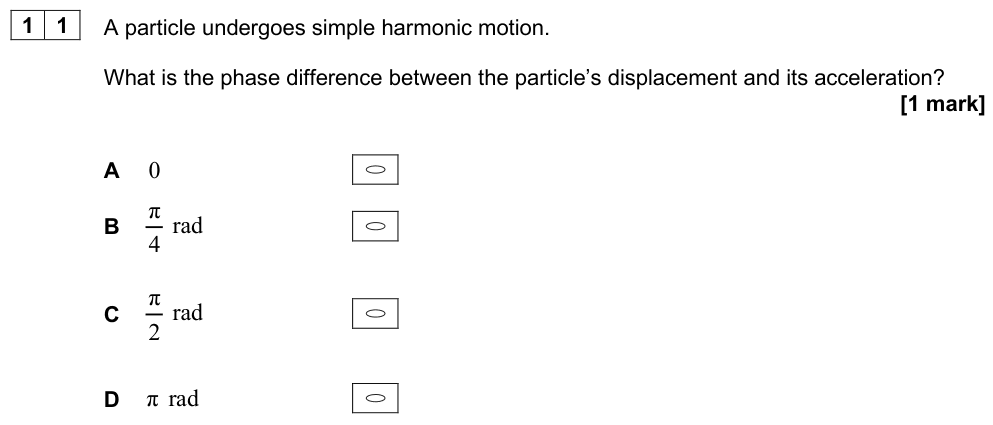
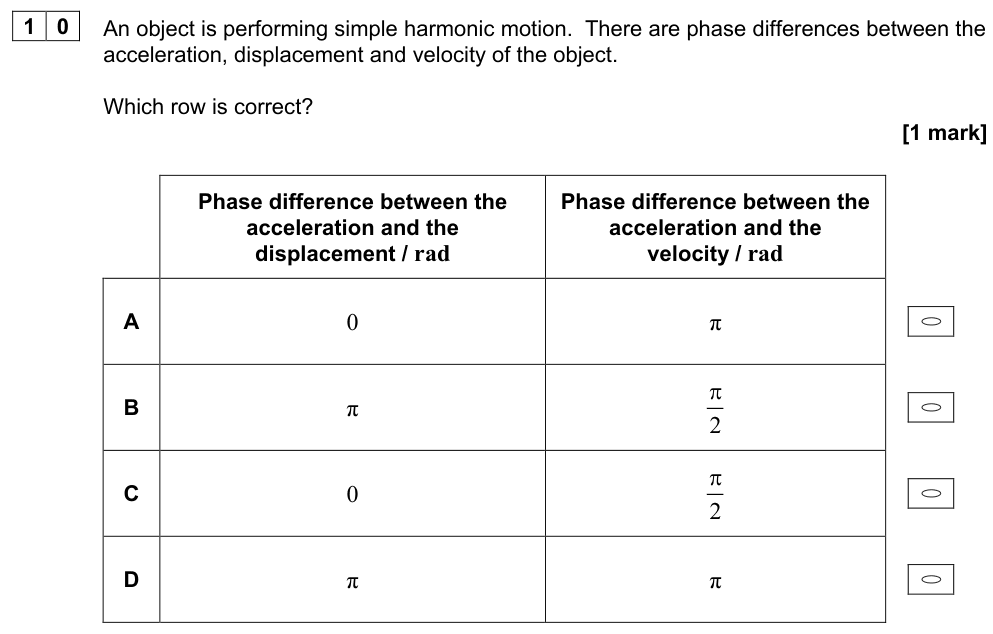
- Phase relationships: $v$ is $\pi/2$ (a quarter cycle) ahead of $x$; $a$ is $\pi$ out of phase with $x$.
Mass–spring system
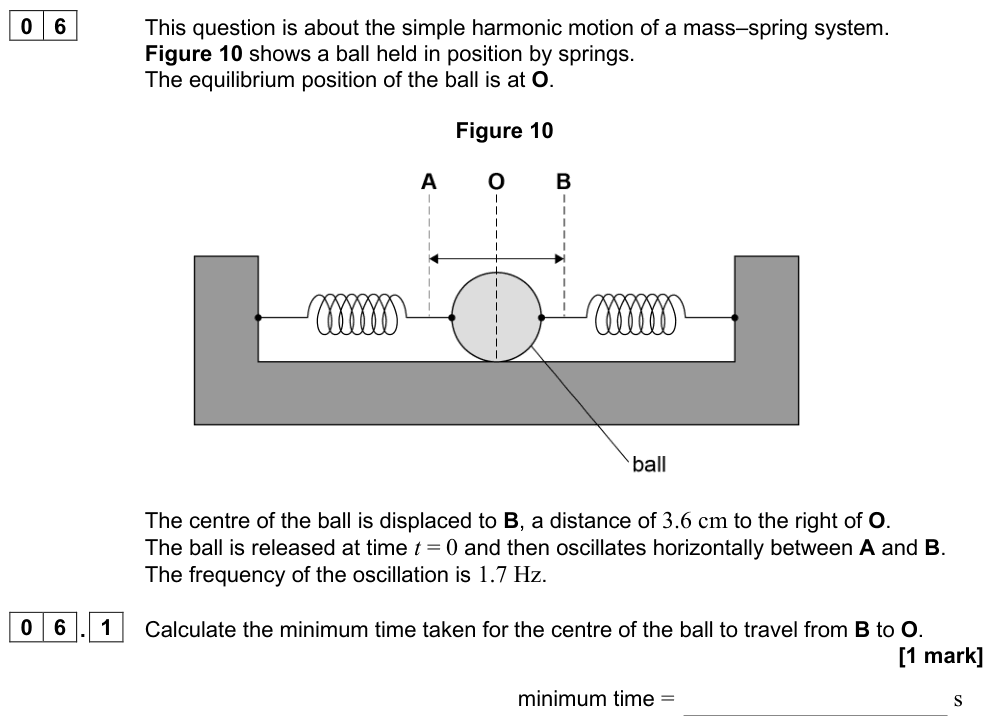
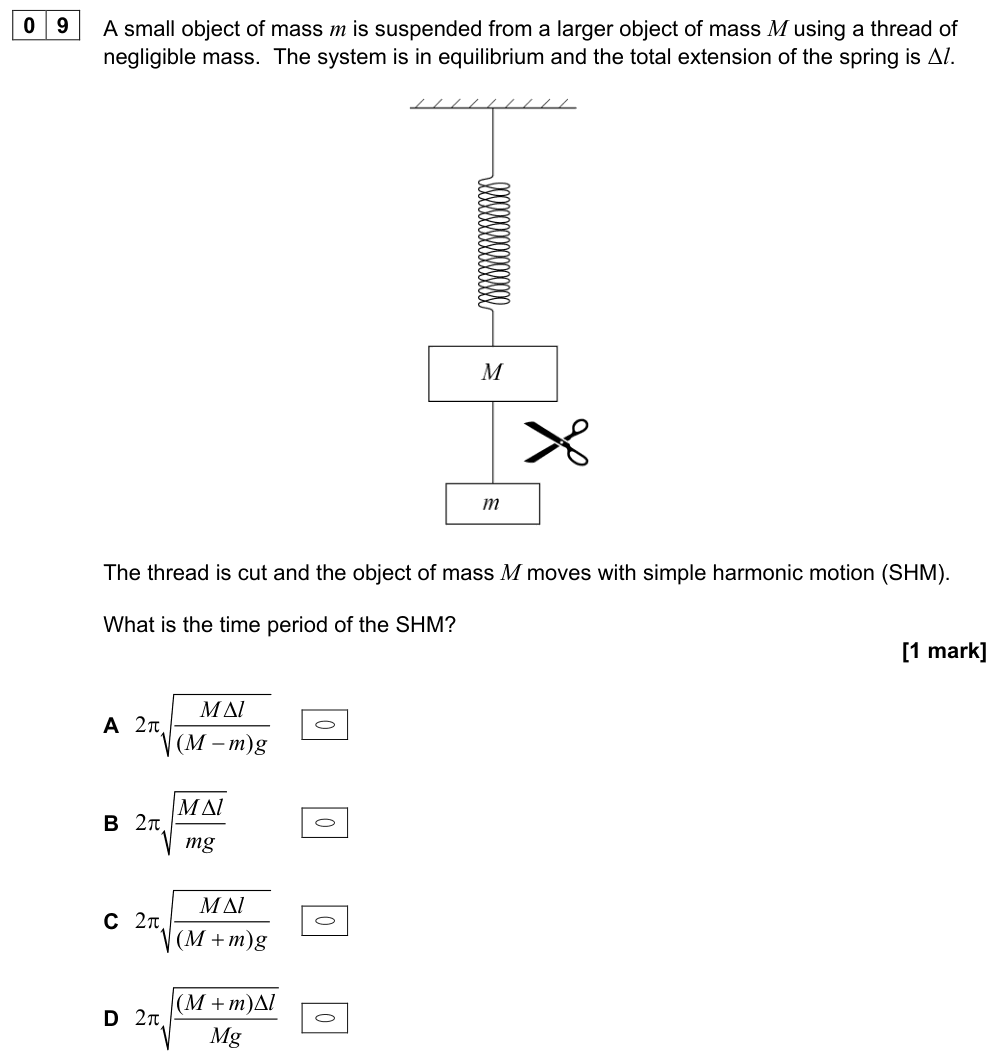
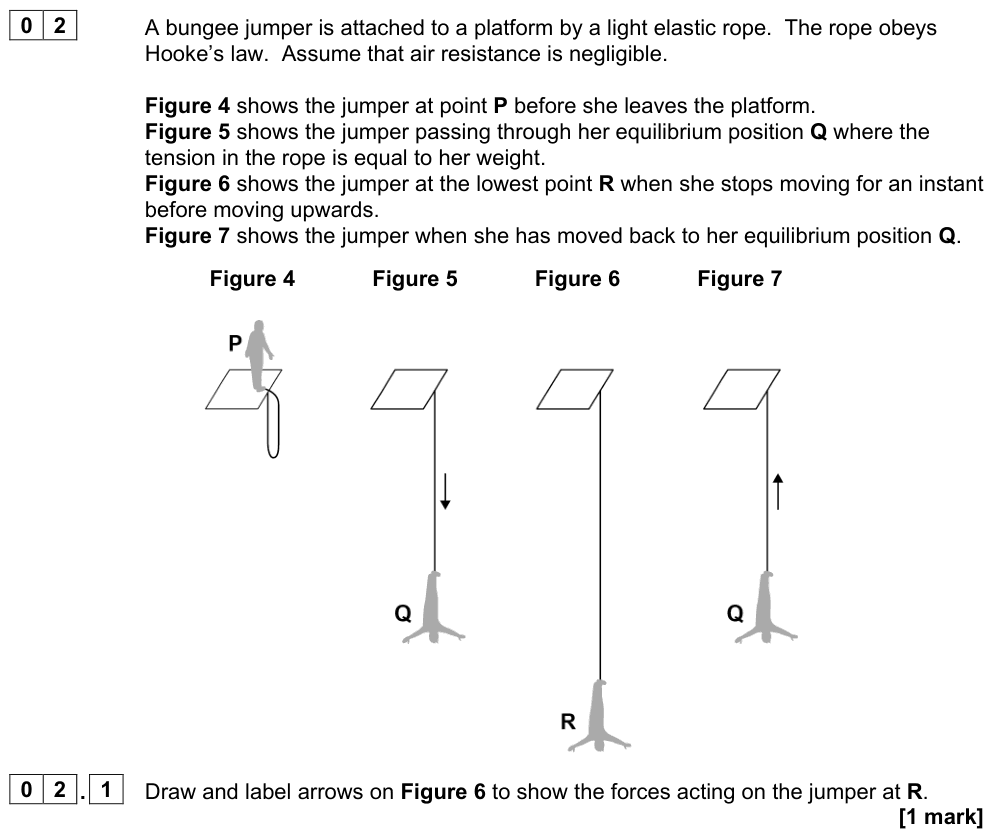
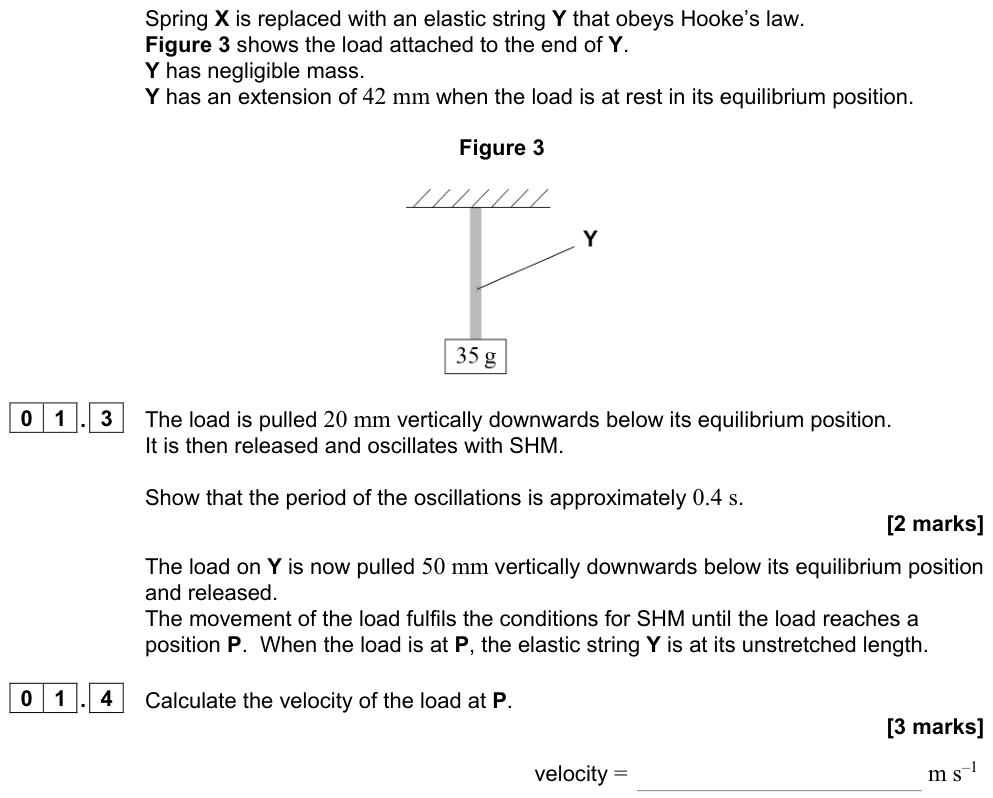
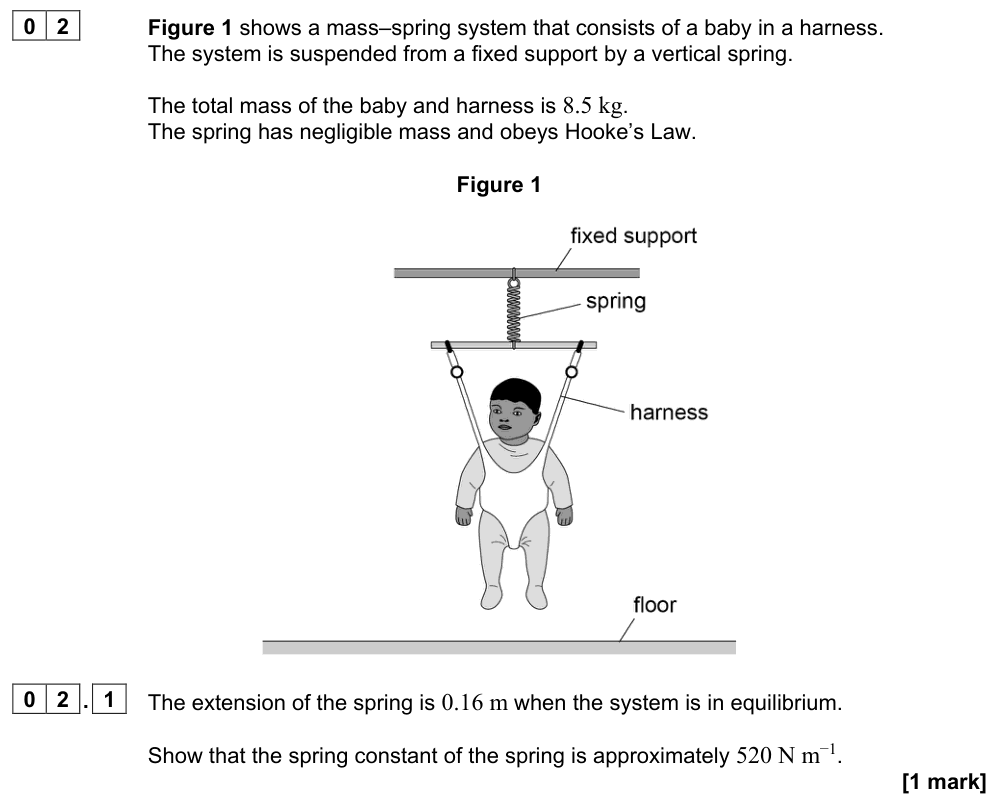
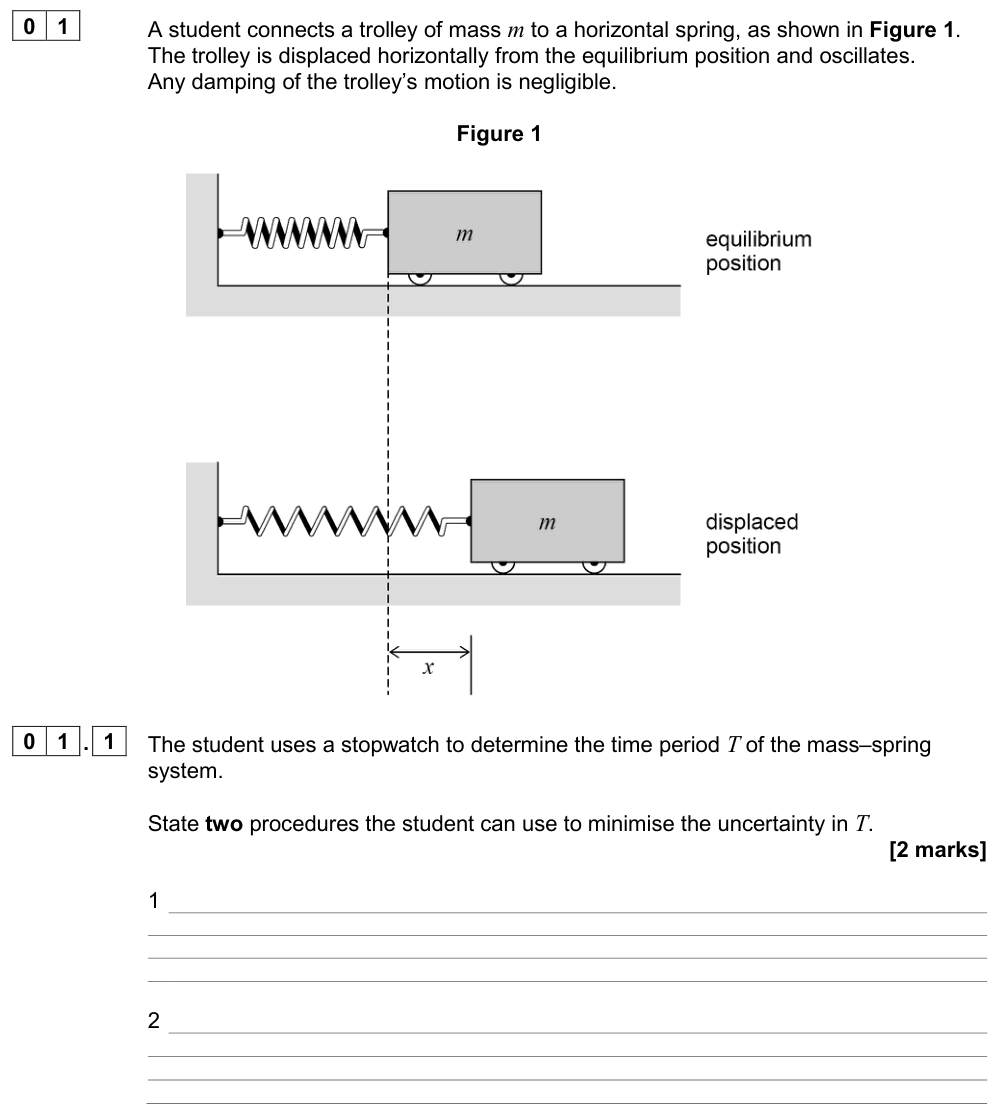
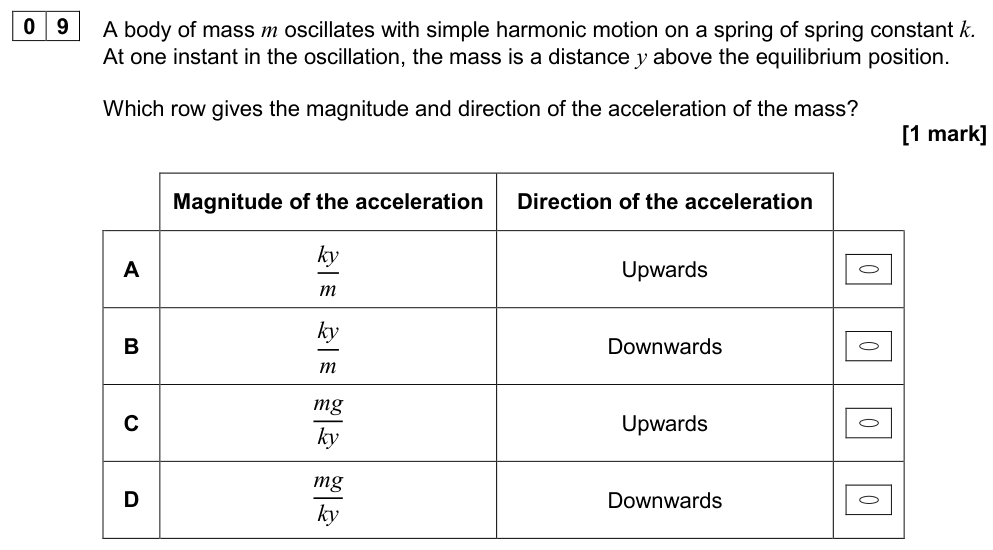
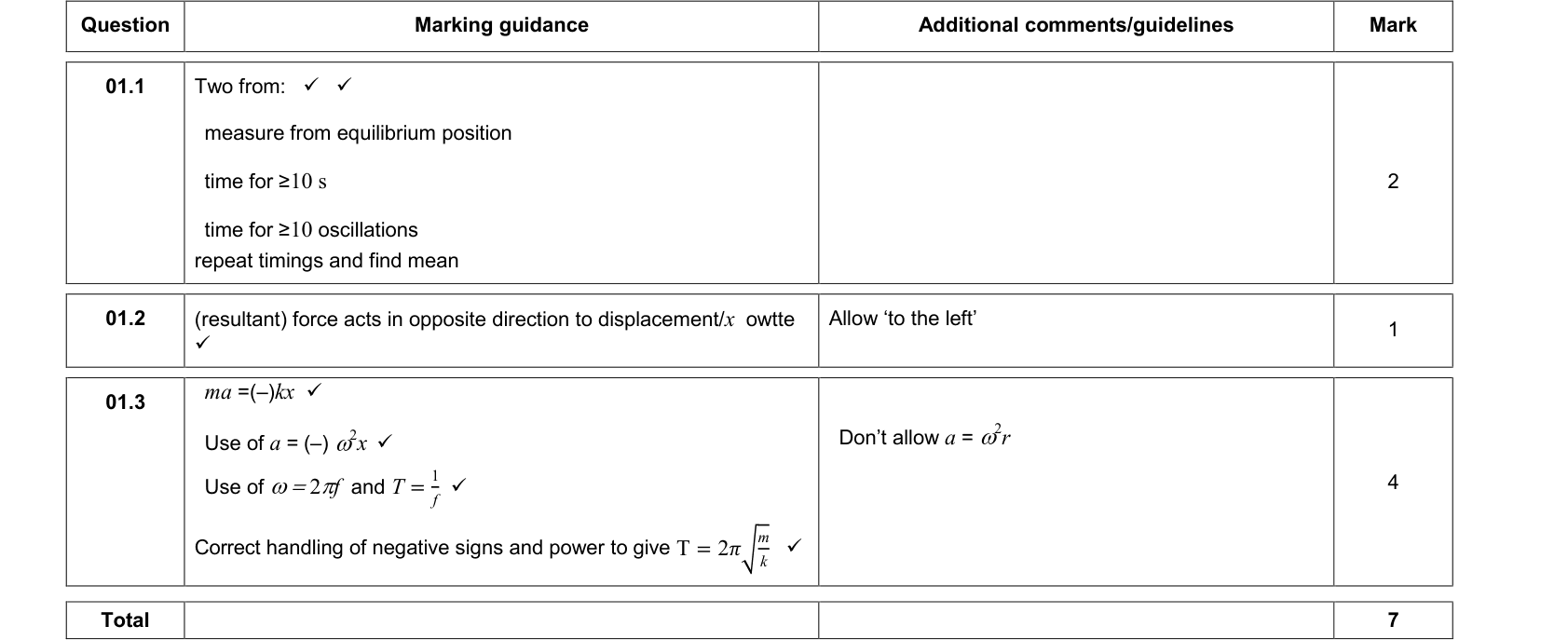
For a mass $m$ on a spring of spring constant $k$, the restoring force is $F = -kx$. Newton's second law gives
$$ma = -kx \quad\Rightarrow\quad a = -\frac{k}{m}x$$
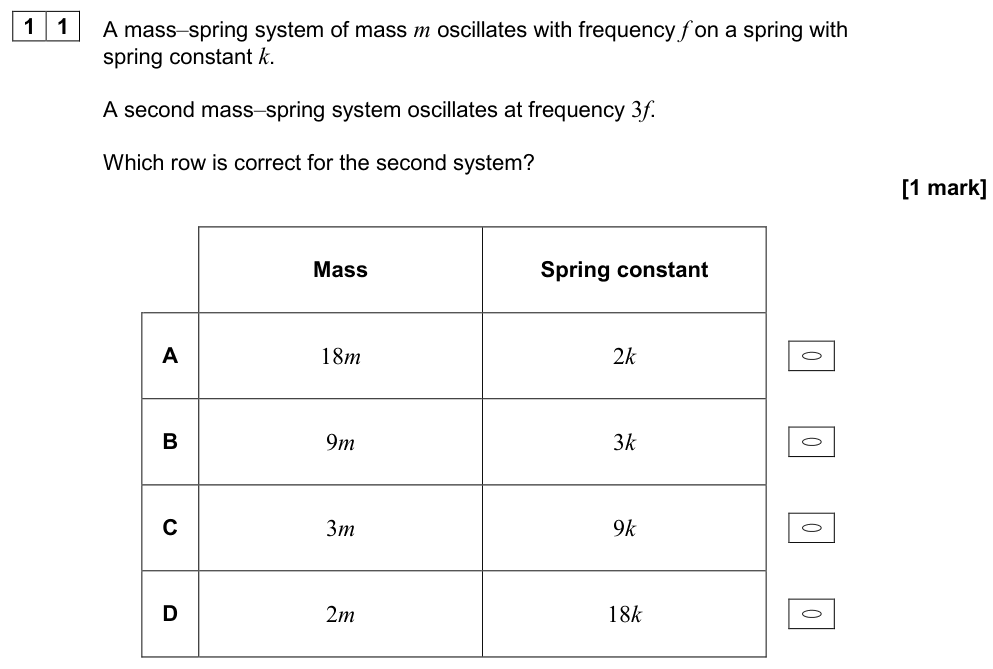
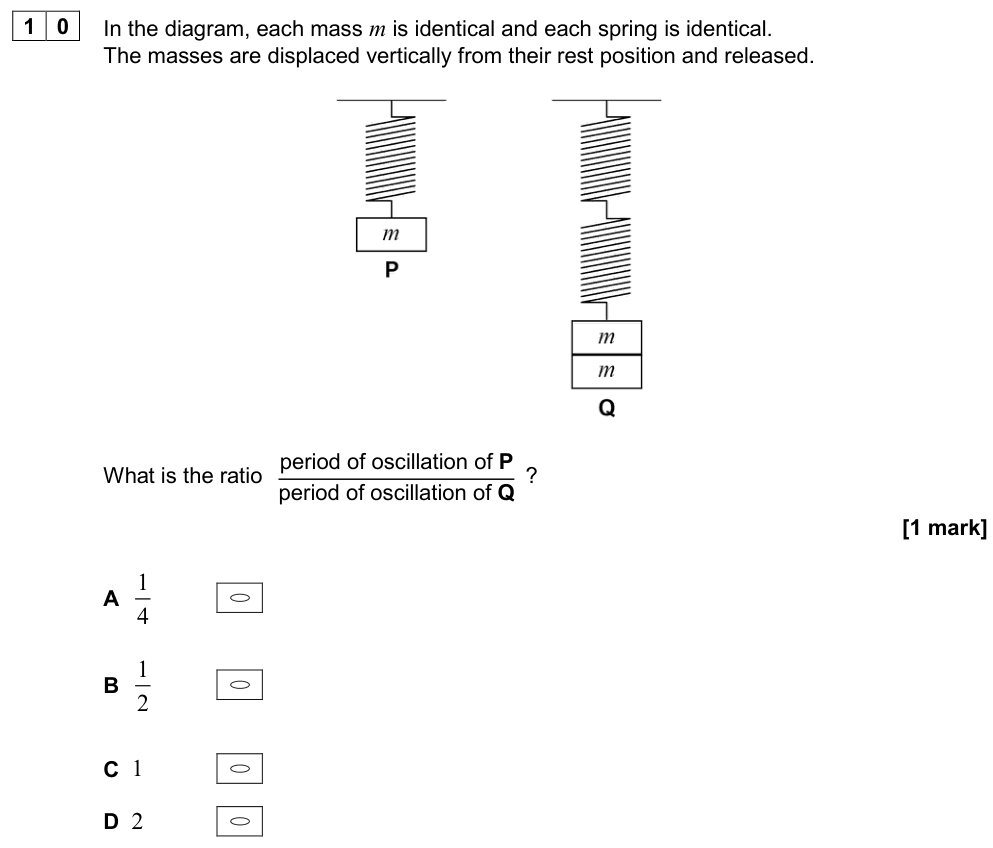
This is SHM with $\omega^2 = \dfrac{k}{m}$, so
Period of a mass–spring system
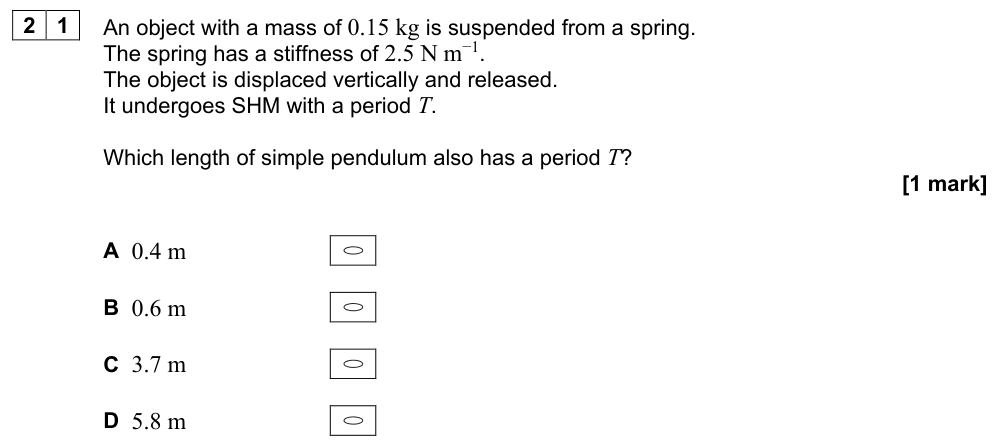
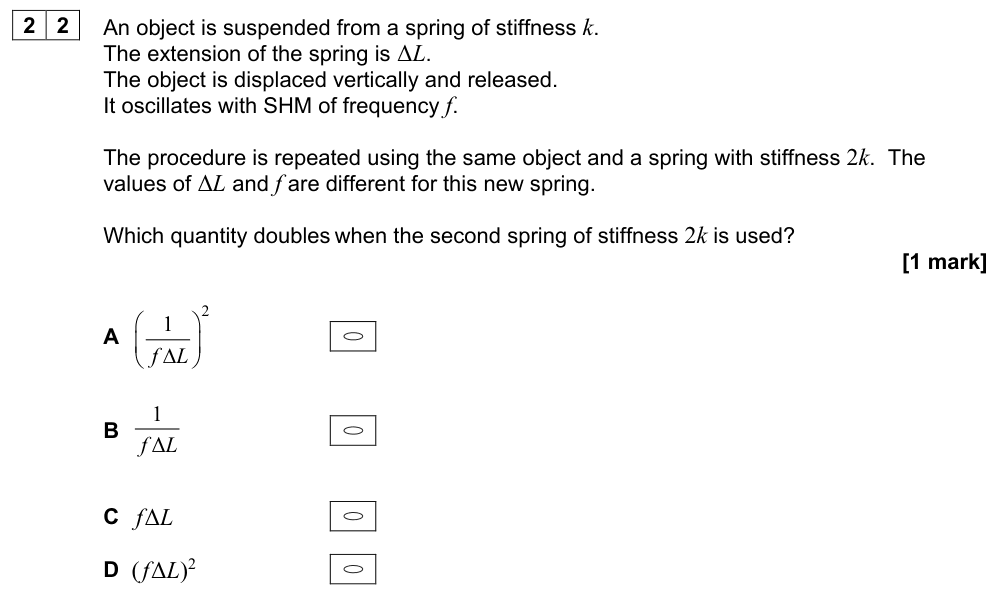
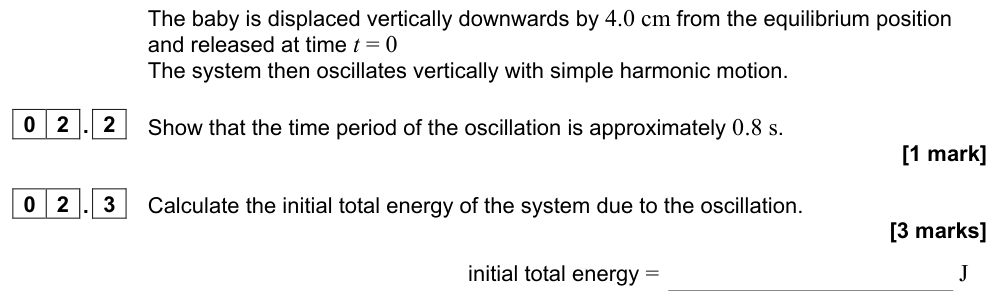
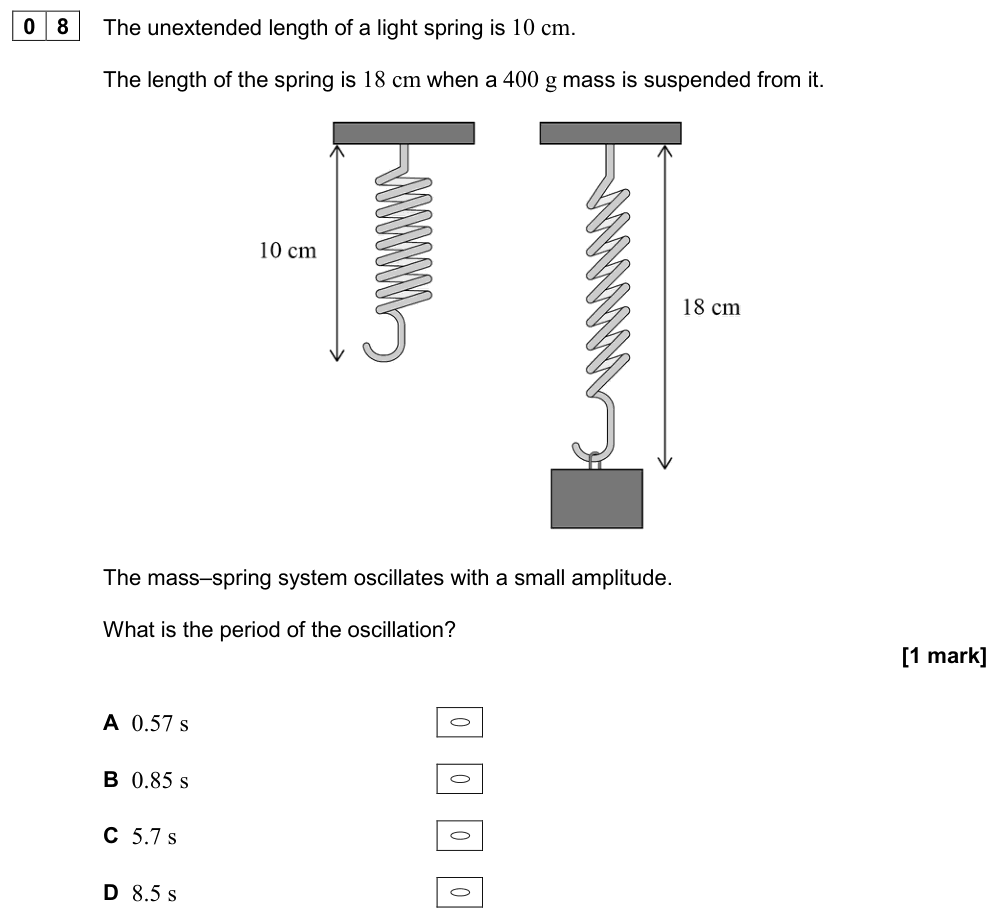
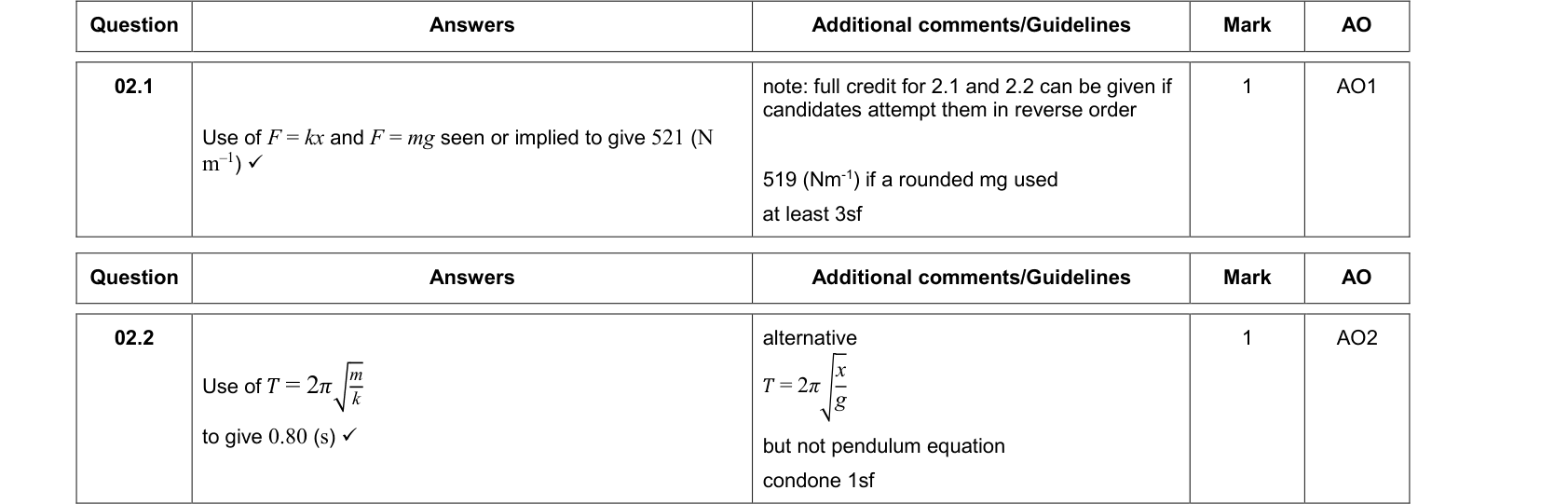
$$T = \frac{2\pi}{\omega} = 2\pi\sqrt{\frac{m}{k}}$$
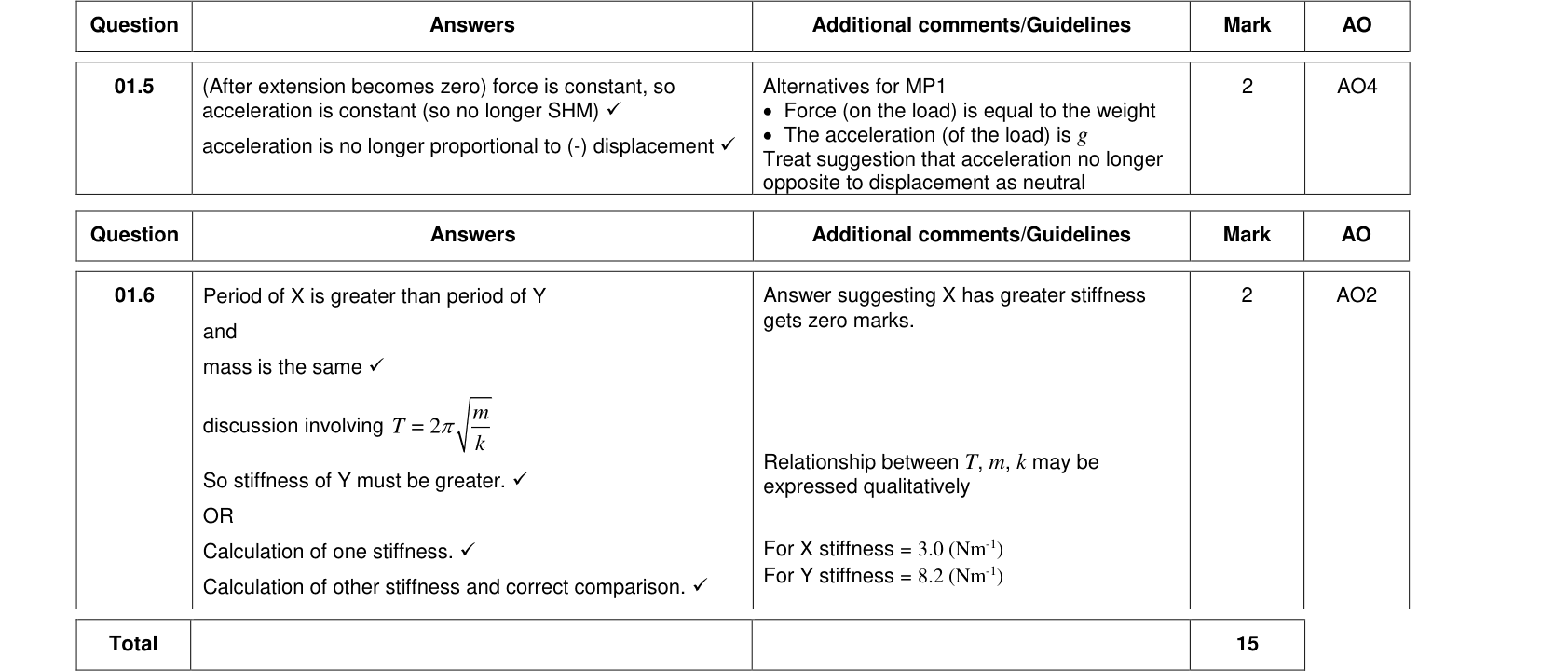
This also holds for a mass hanging vertically on a spring: gravity changes only the equilibrium position, not the period.
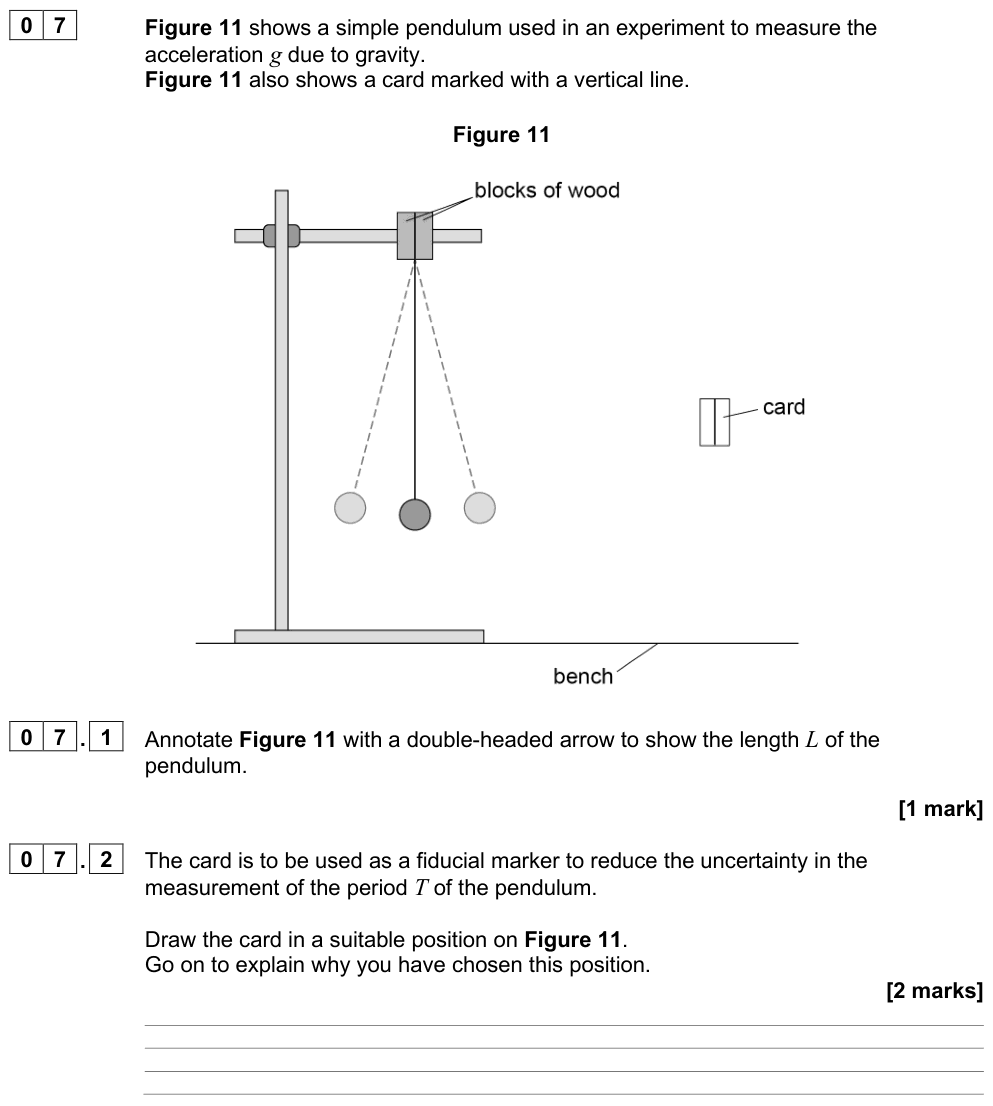
Simple pendulum
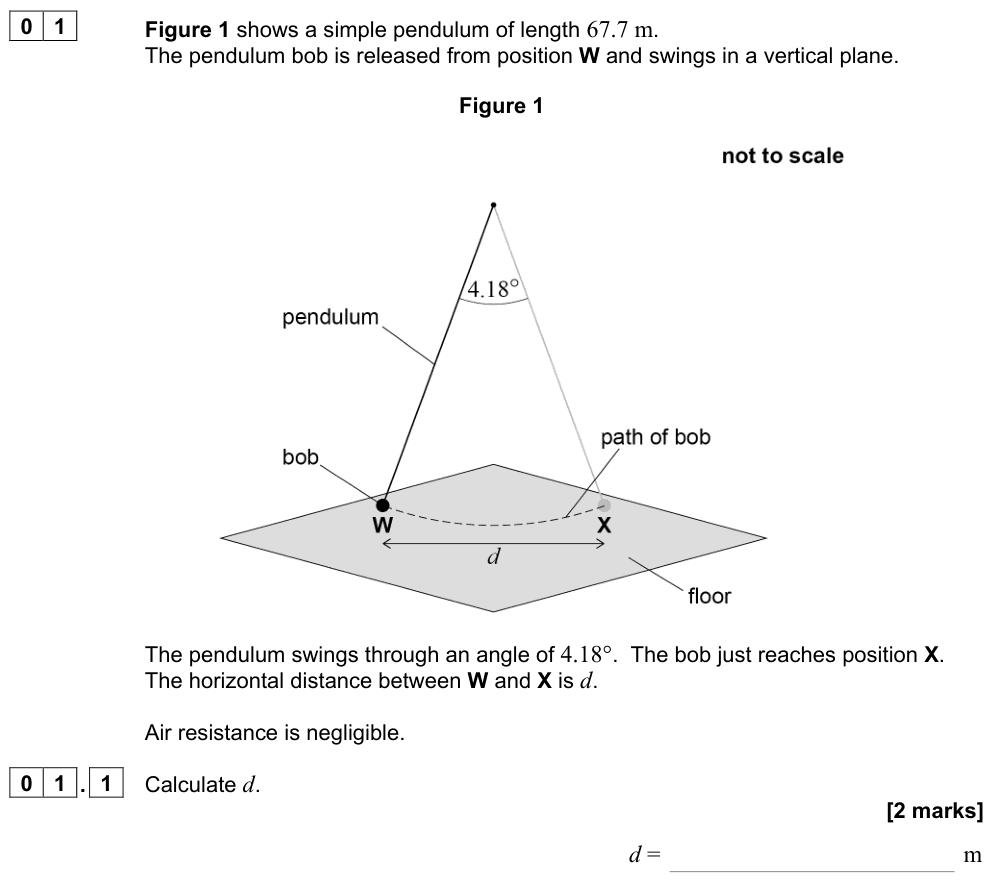
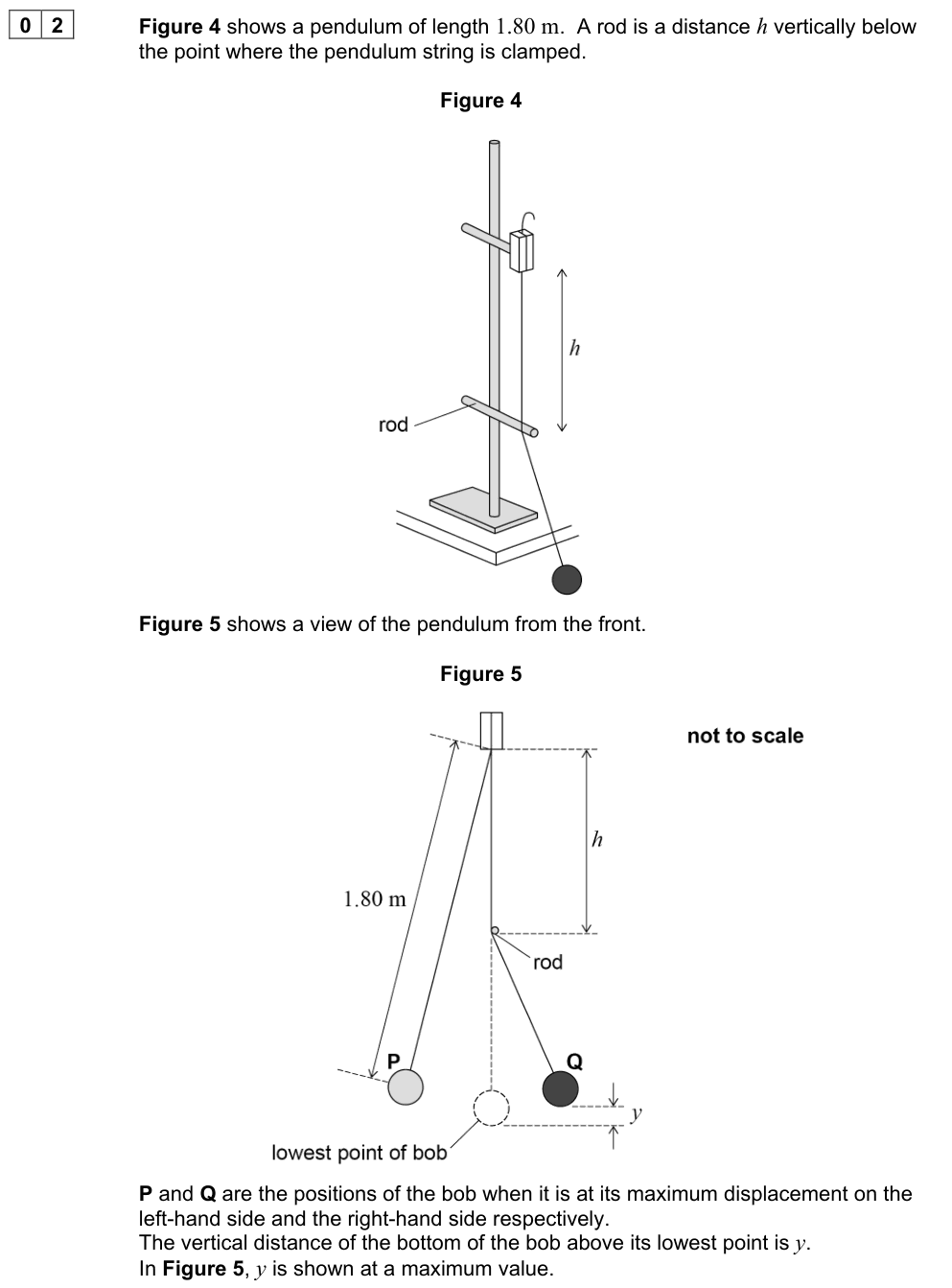
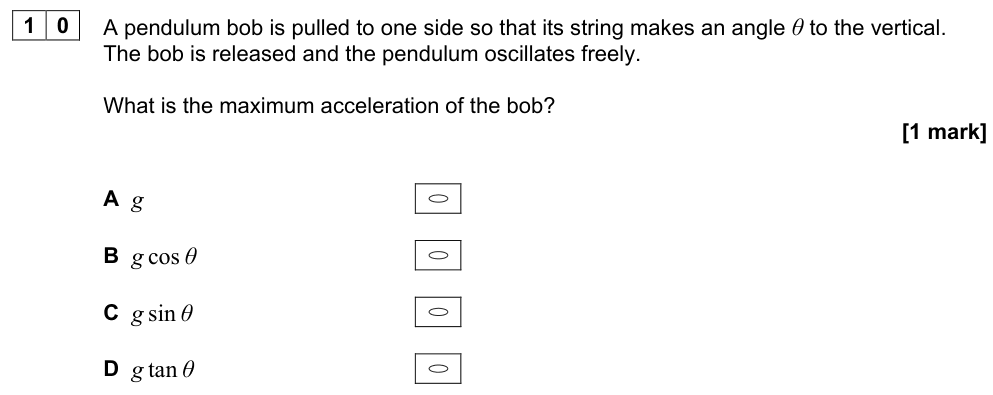
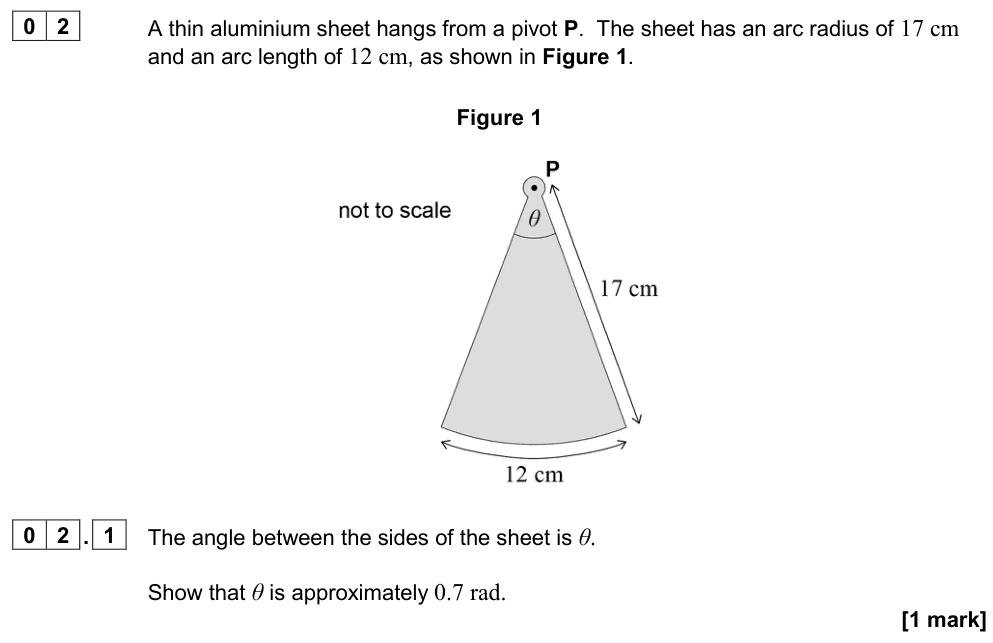
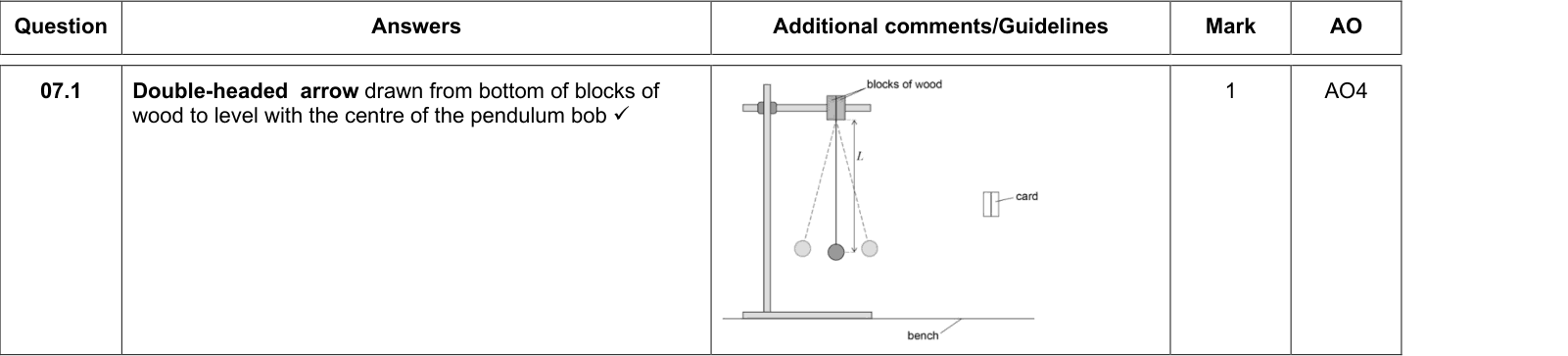
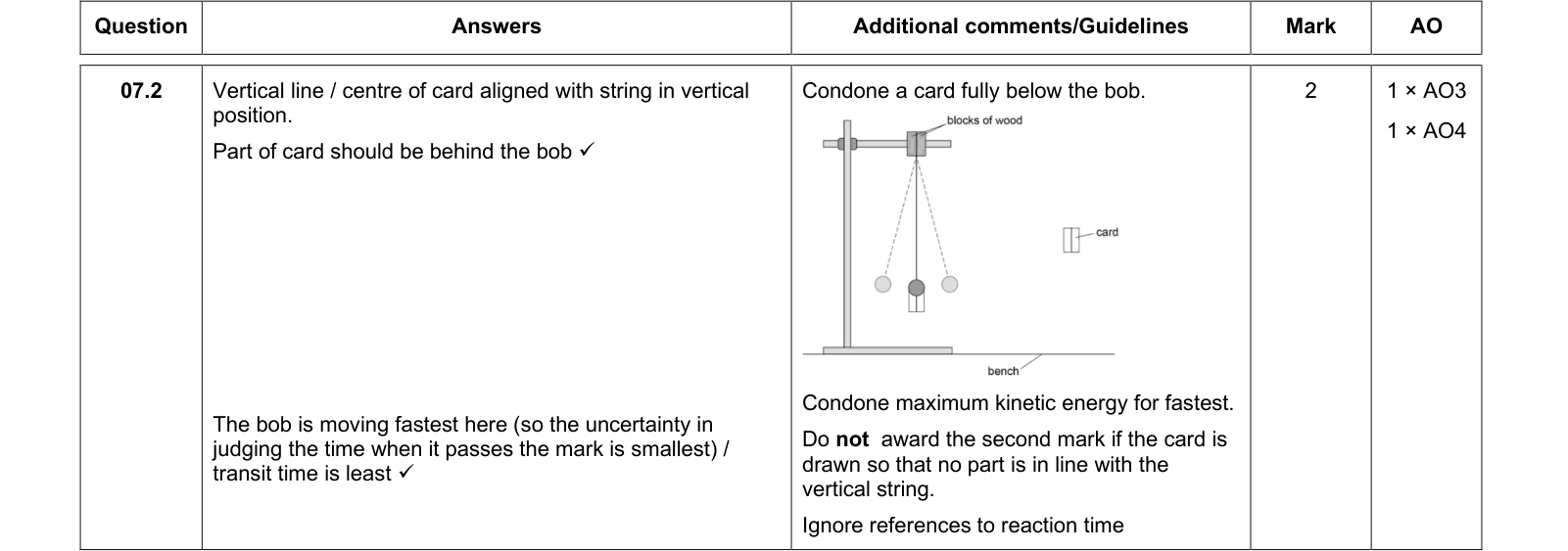
For a bob of mass $m$ on a light string of length $l$, displaced by a small angle $\theta$, the restoring force along the arc is $-mg\sin\theta$. For small angles $\sin\theta \approx \theta = x/l$, so
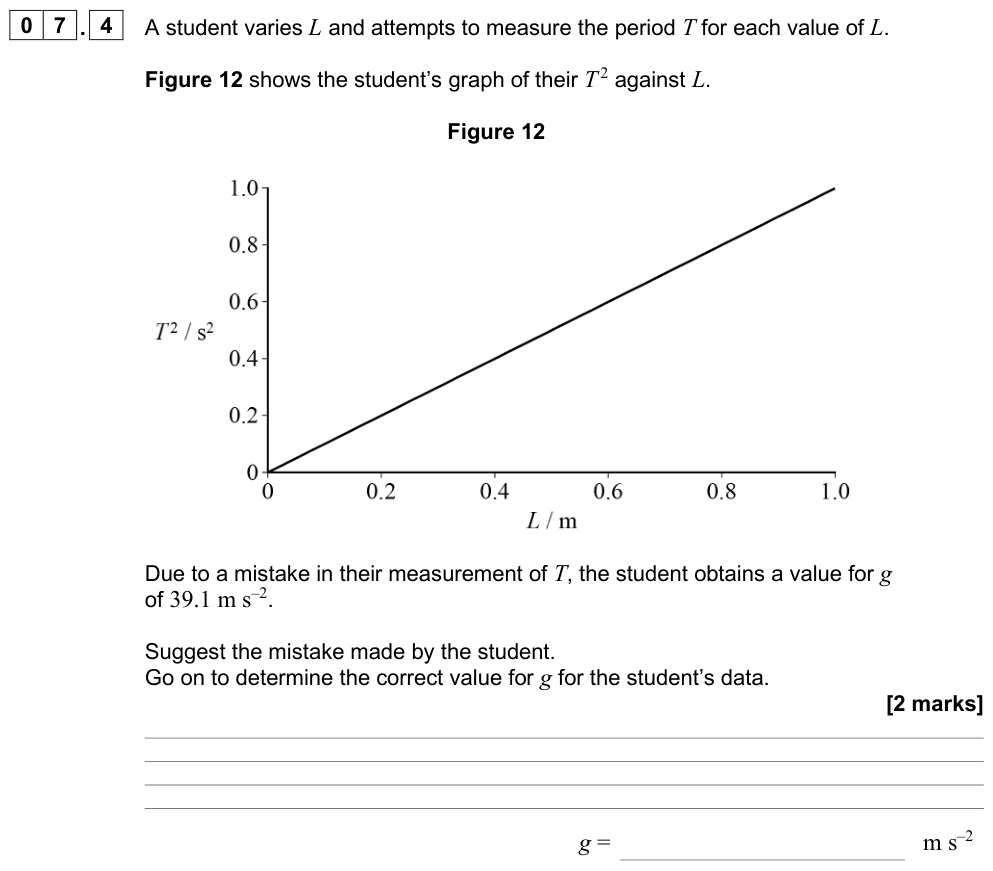
$$ma = -mg\frac{x}{l} \quad\Rightarrow\quad a = -\frac{g}{l}x$$
This is SHM with $\omega^2 = \dfrac{g}{l}$:
Period of a simple pendulum (small angles)
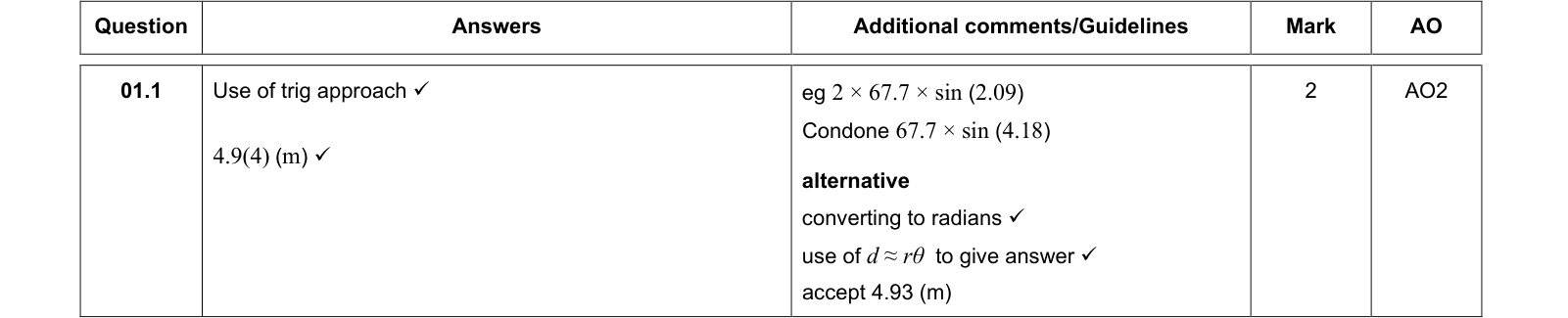
$$T = 2\pi\sqrt{\frac{l}{g}}$$
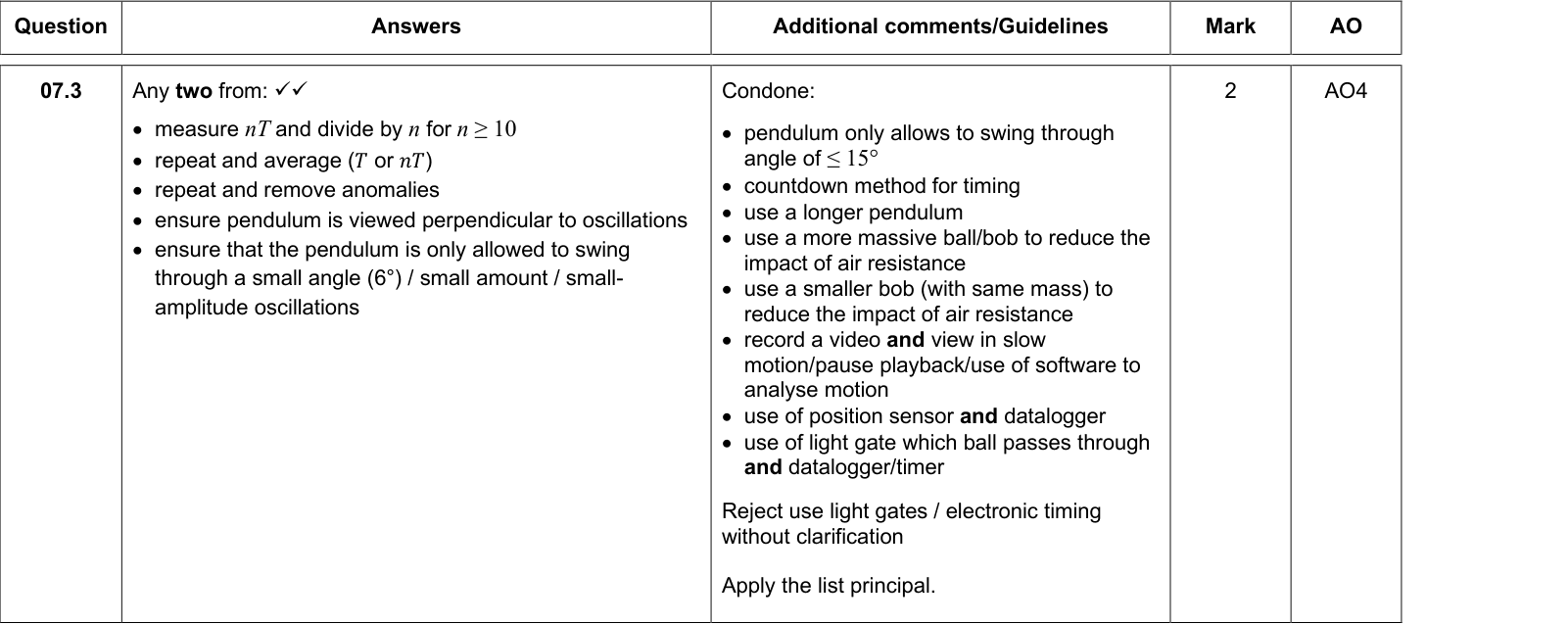
The approximation $\sin\theta \approx \theta$ is good for angles below about 10°. For larger amplitudes the period is slightly longer.
Energy in SHM
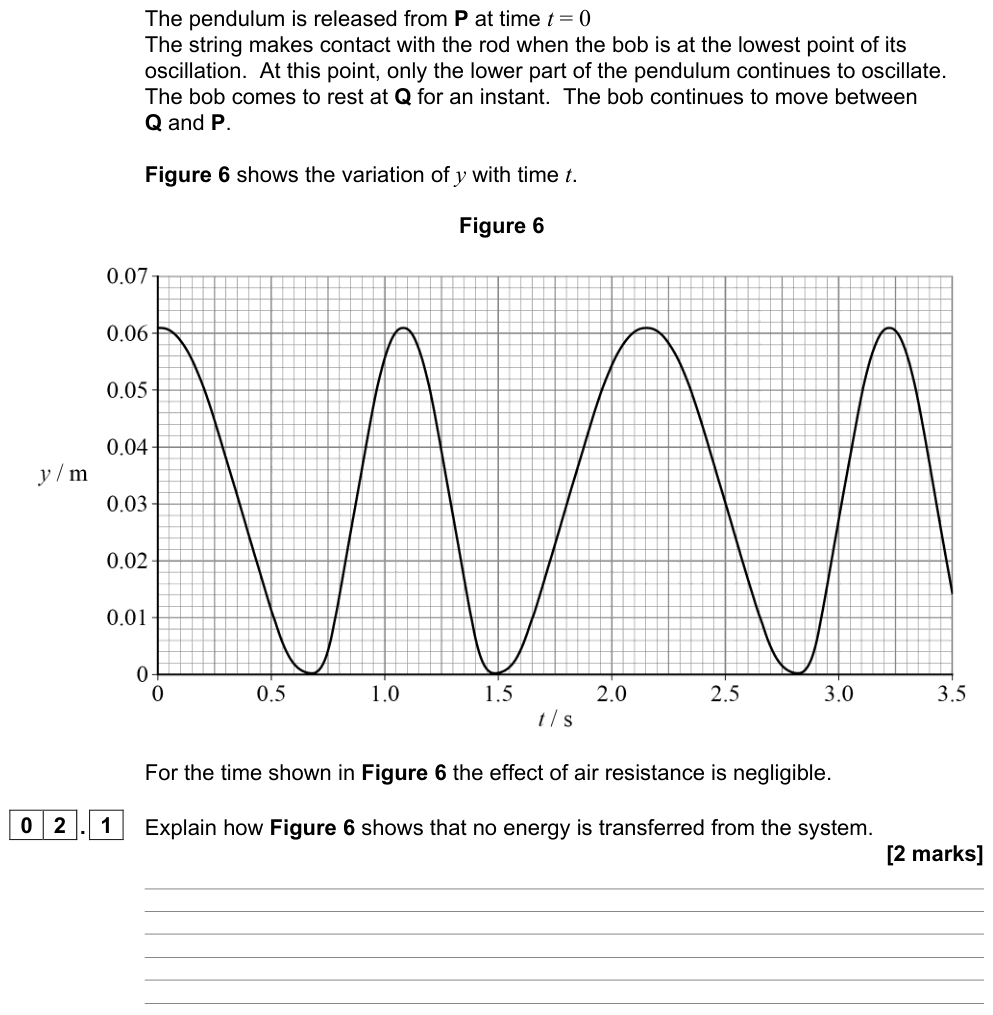
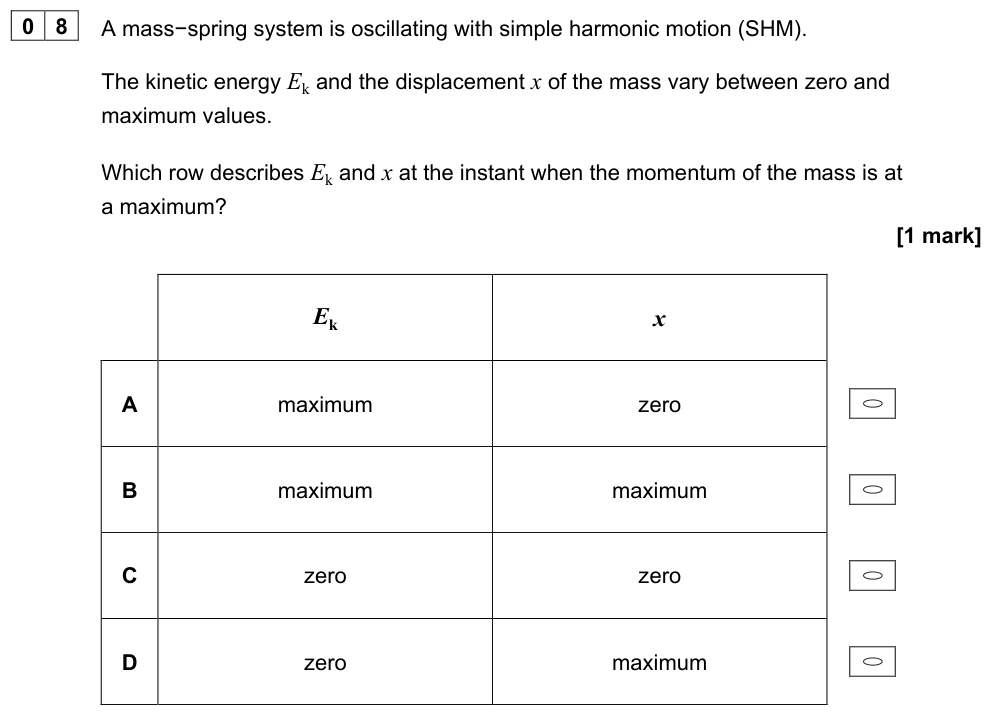
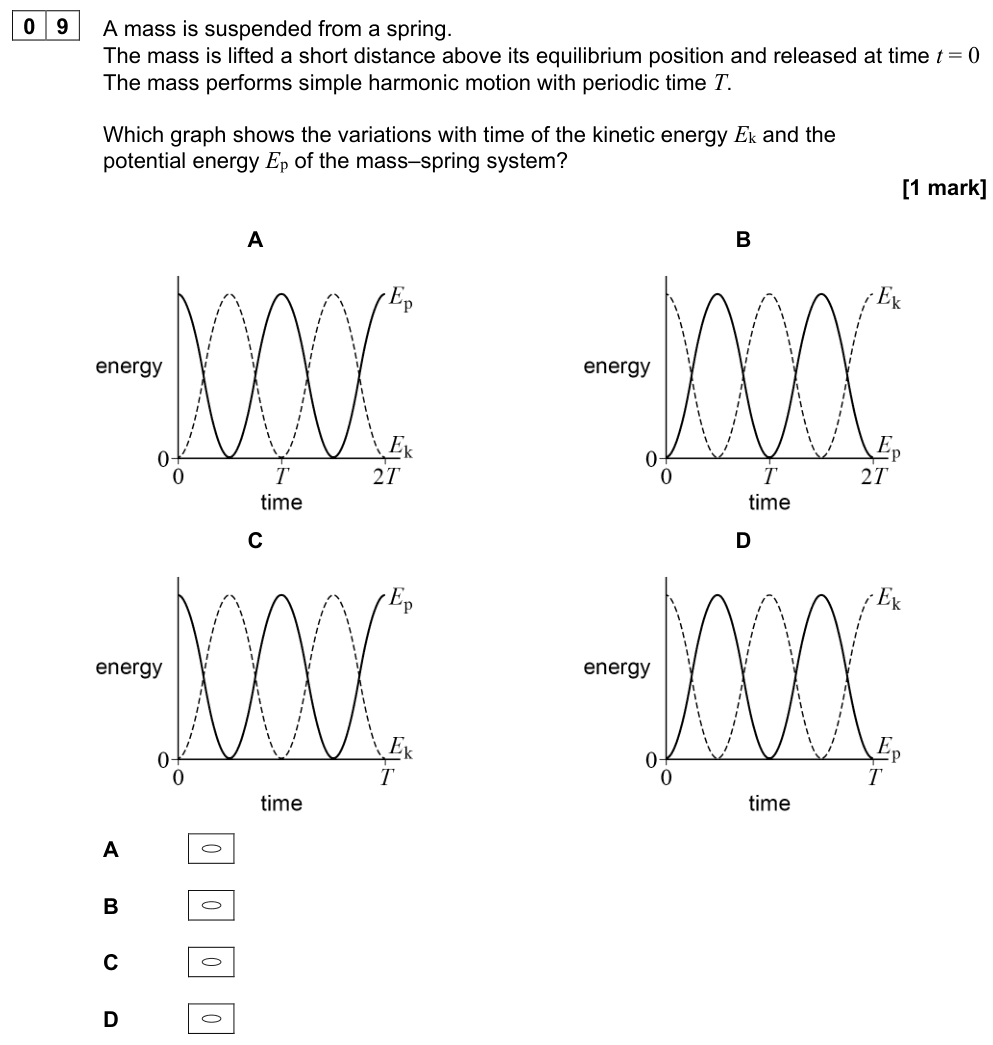
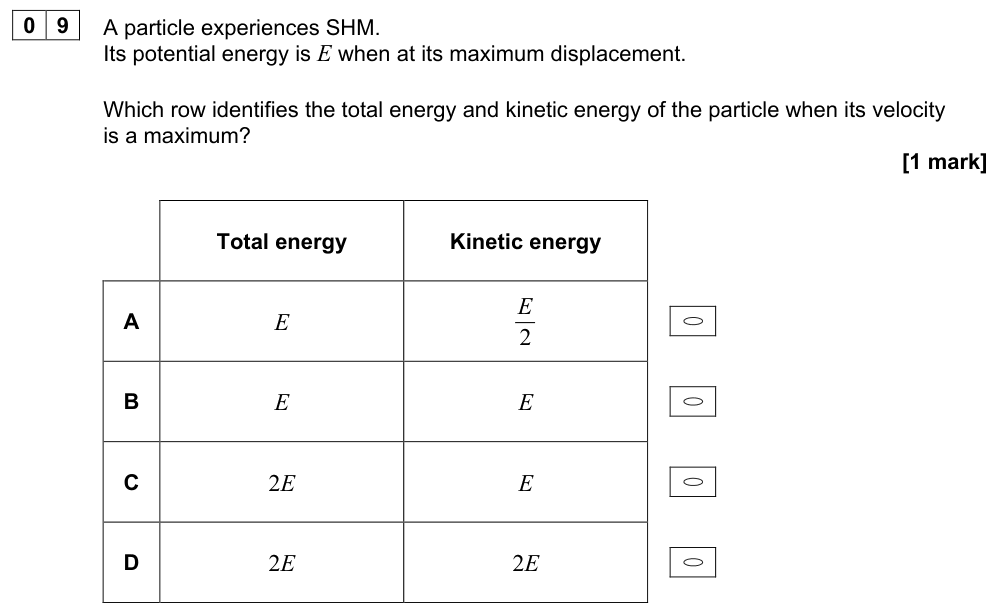
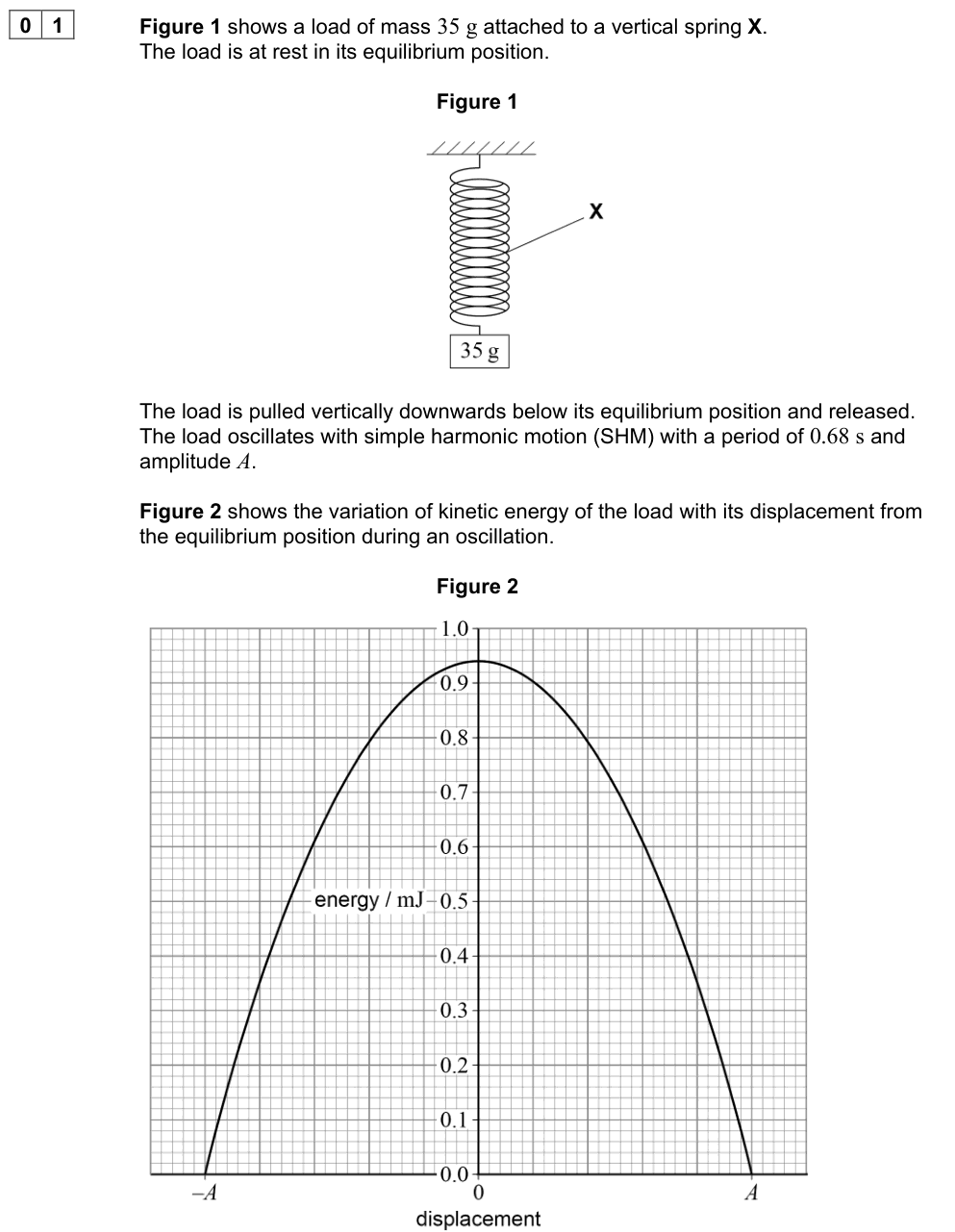
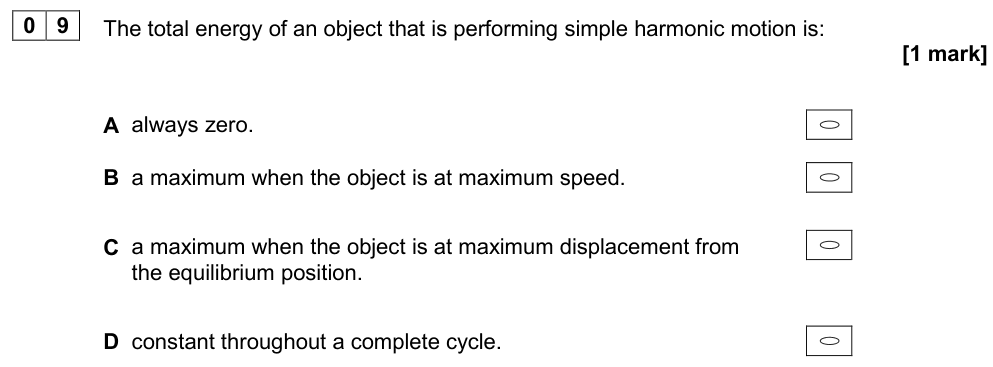
In an undamped oscillation the total energy is constant and is continually exchanged between kinetic and potential energy.
Energy equations
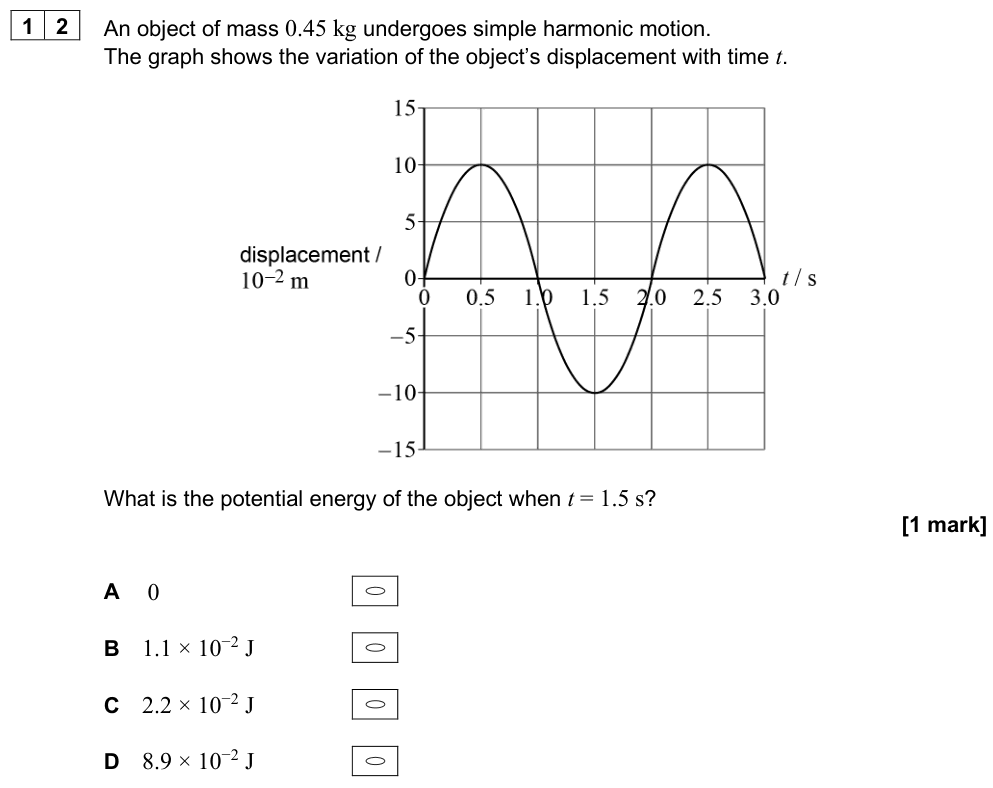
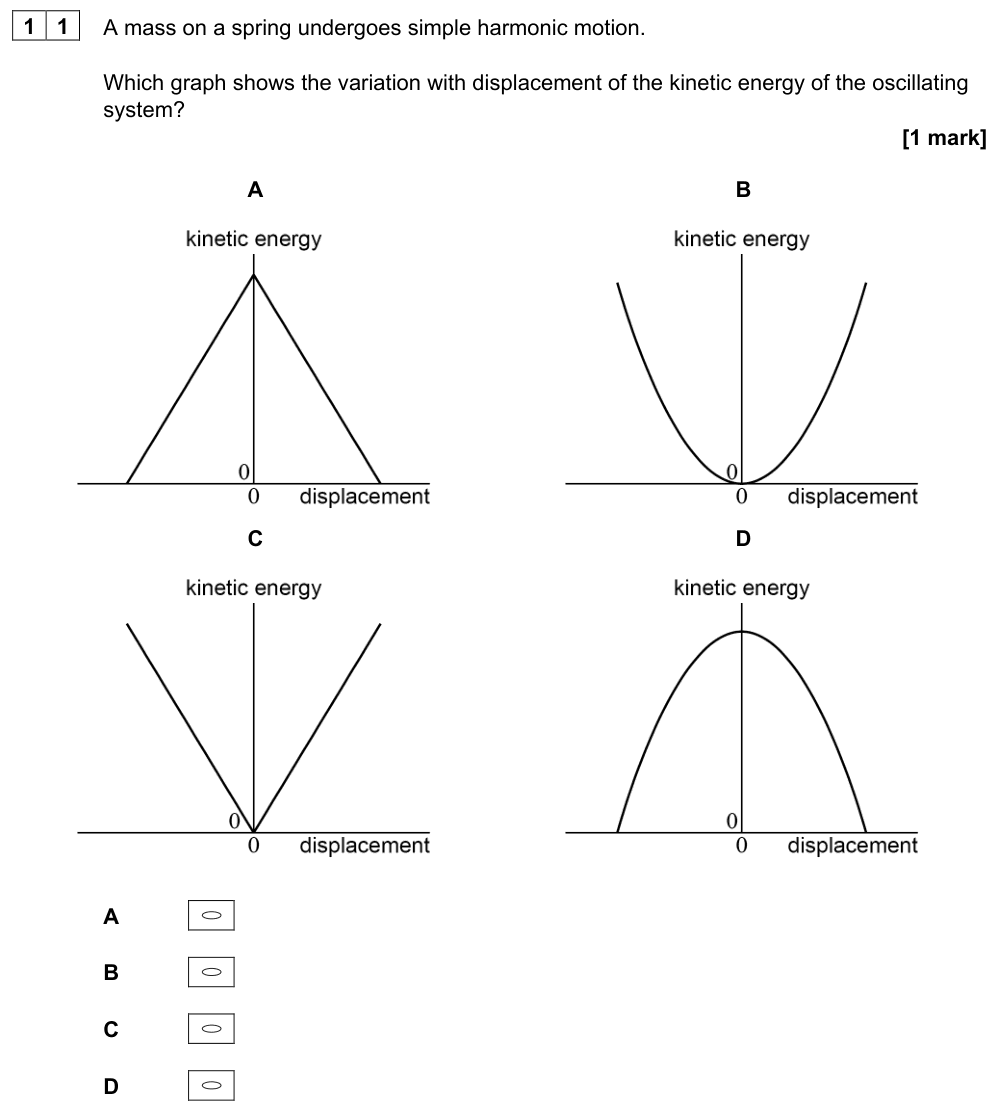
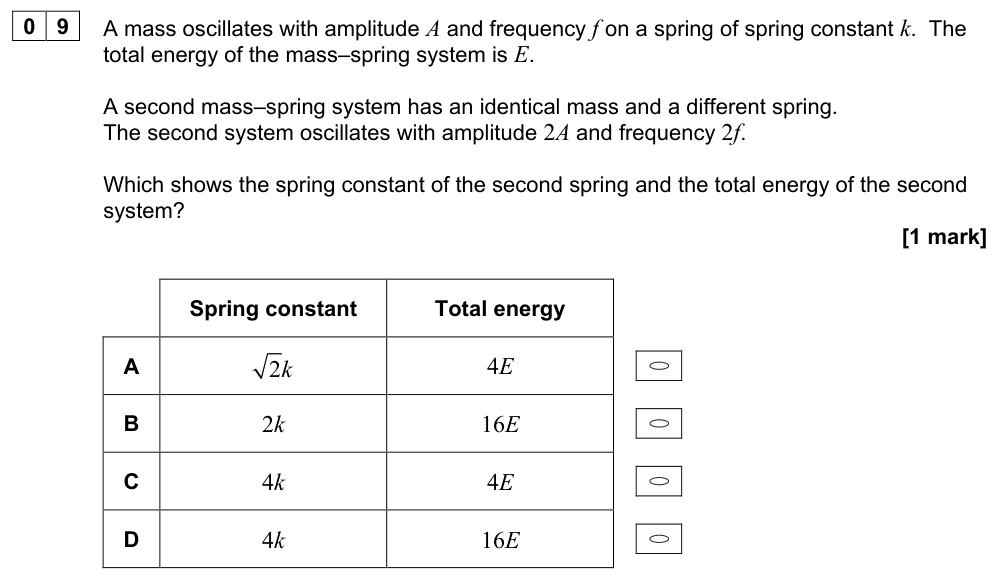
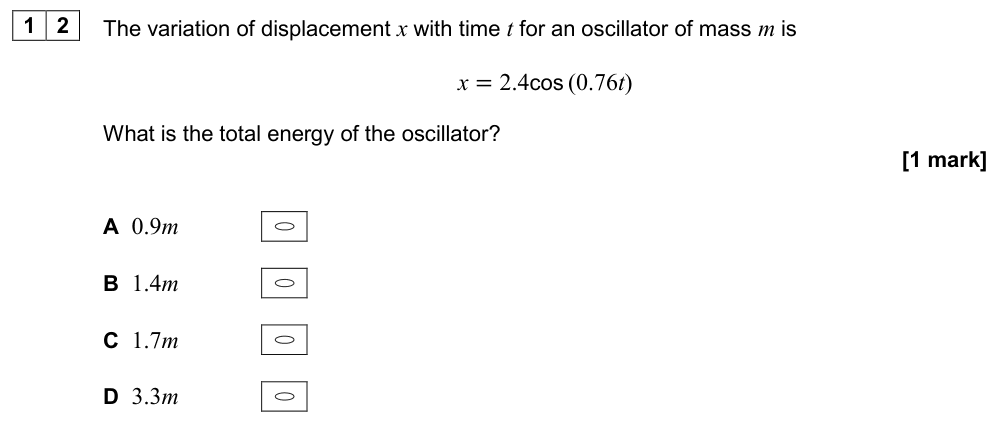
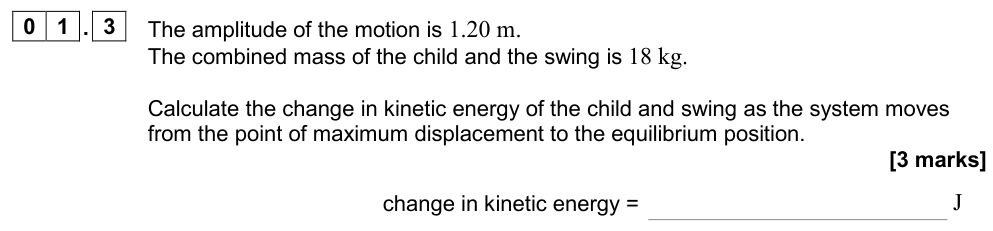
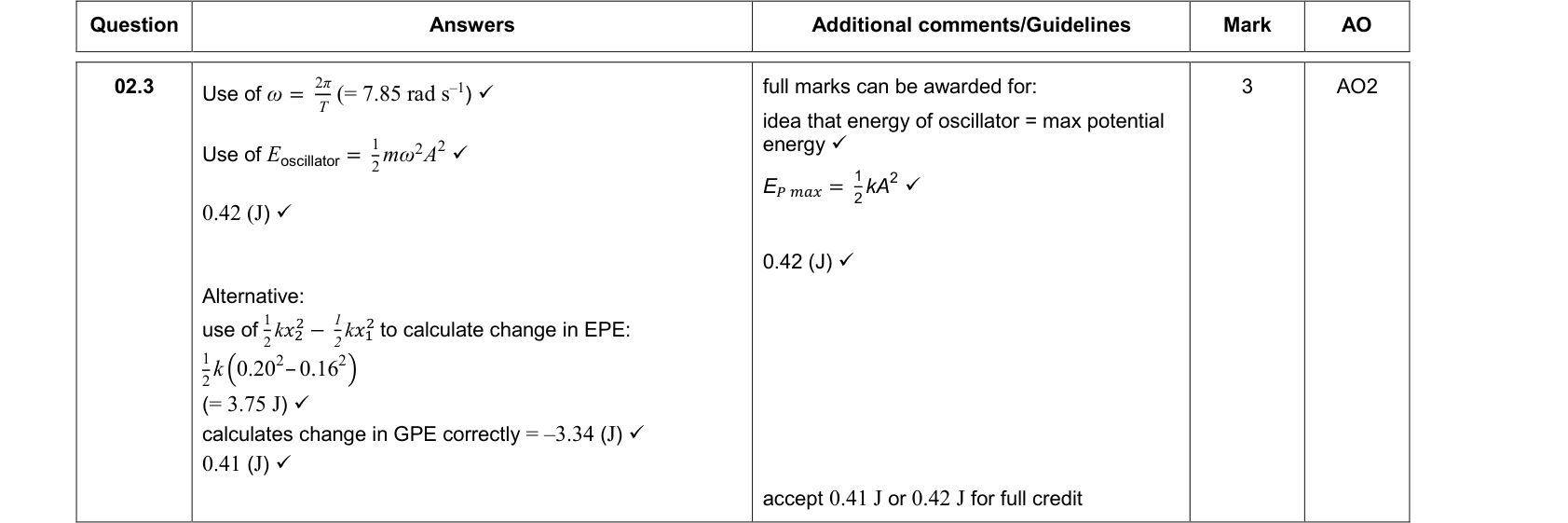
$$E_{\text{total}} = \tfrac12 m\omega^2A^2$$ $$E_k = \tfrac12 m\omega^2(A^2 - x^2) \qquad E_p = \tfrac12 m\omega^2x^2$$
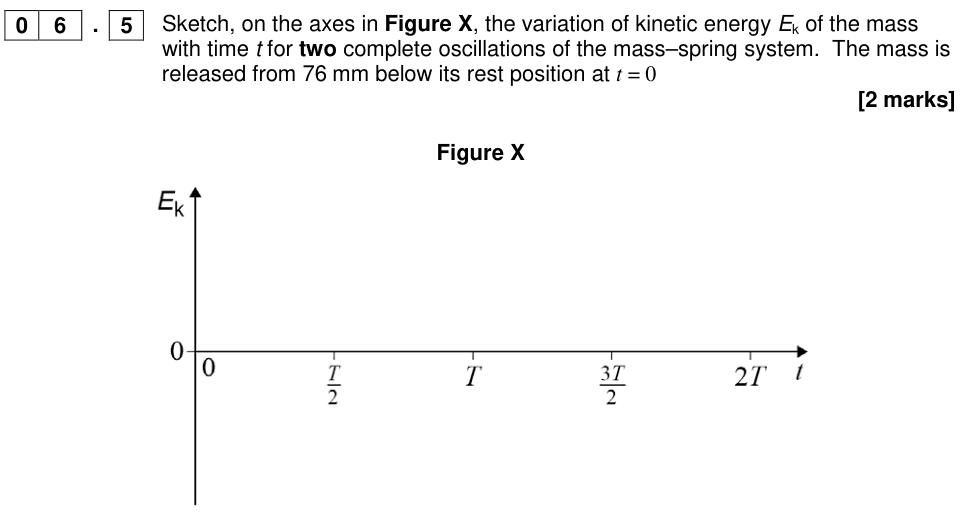
- $E_k$ is maximum at $x = 0$ and zero at $x = \pm A$; $E_p$ is the opposite.
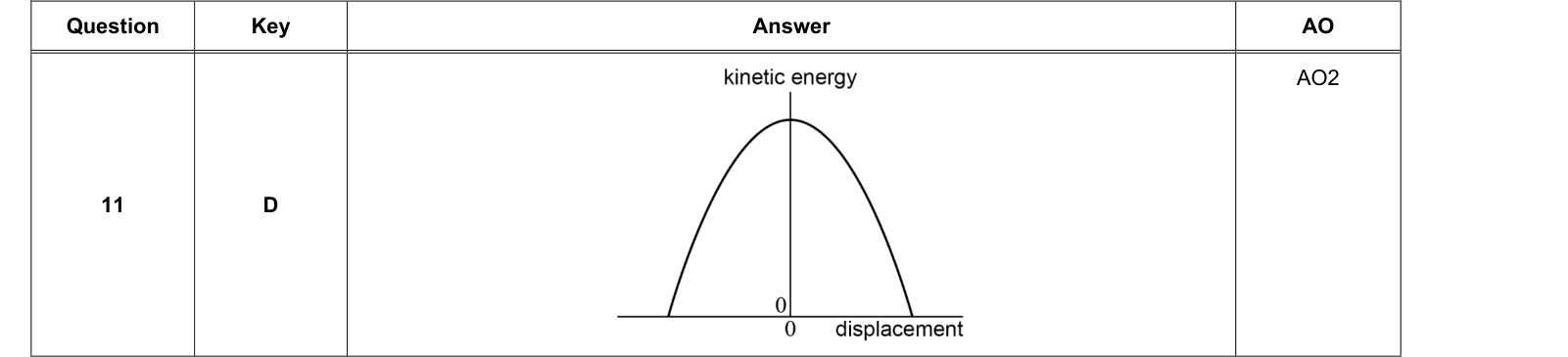
- Plotted against displacement, $E_p$ is a parabola (U-shape), $E_k$ an inverted parabola, and the total a horizontal line.
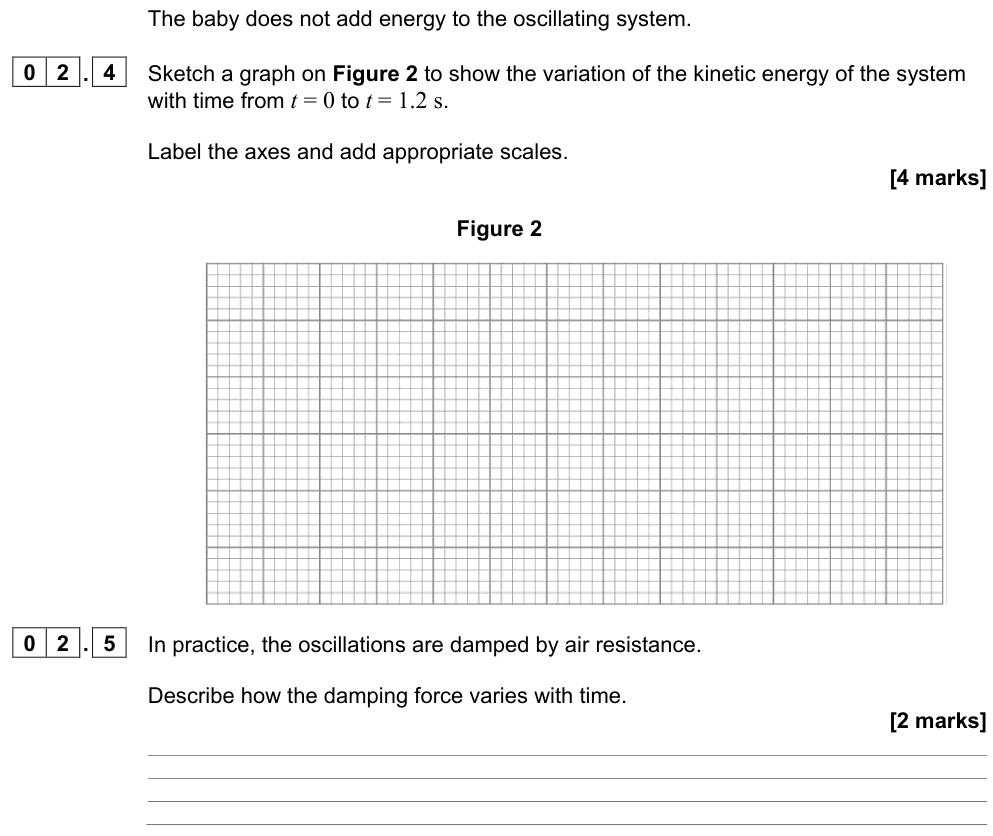
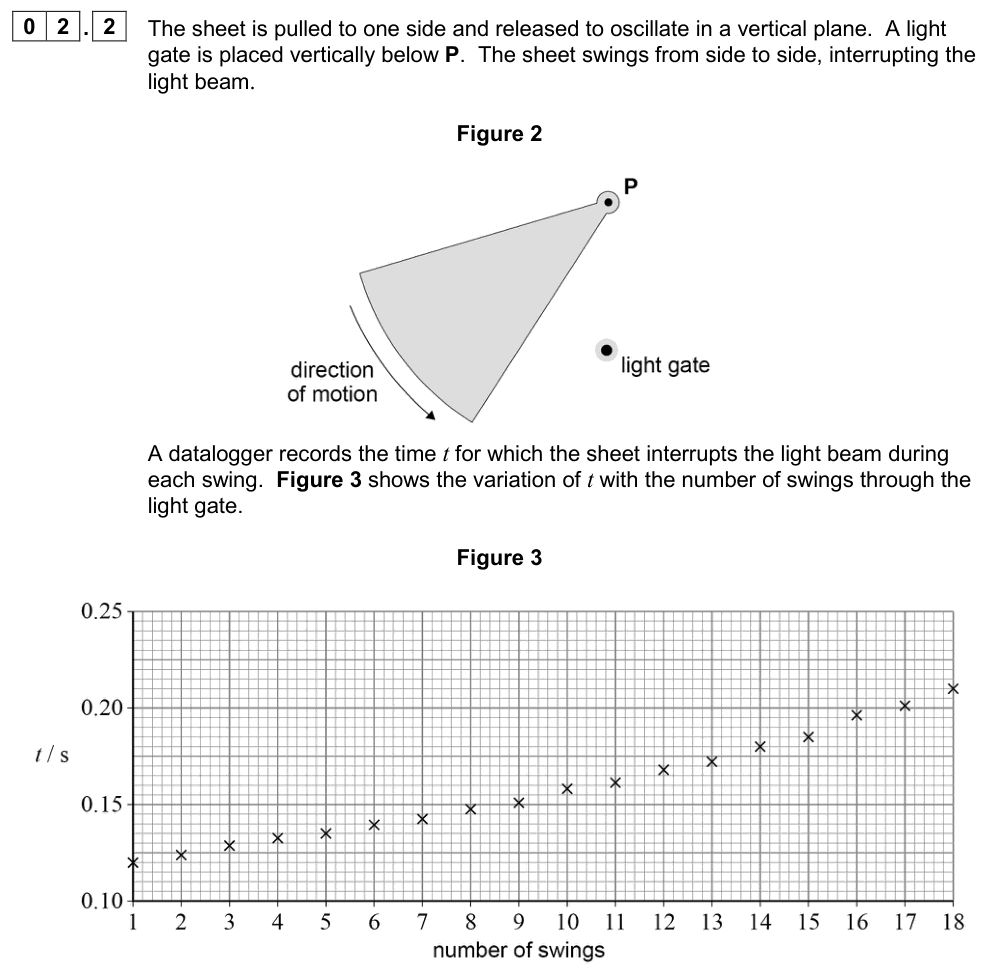
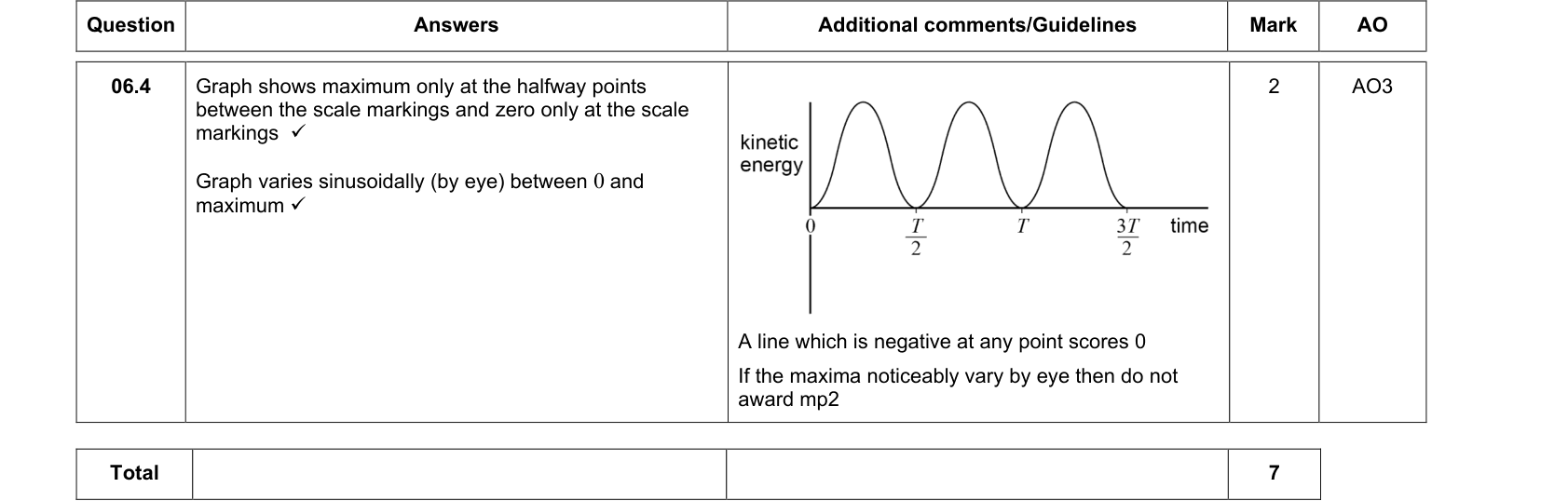
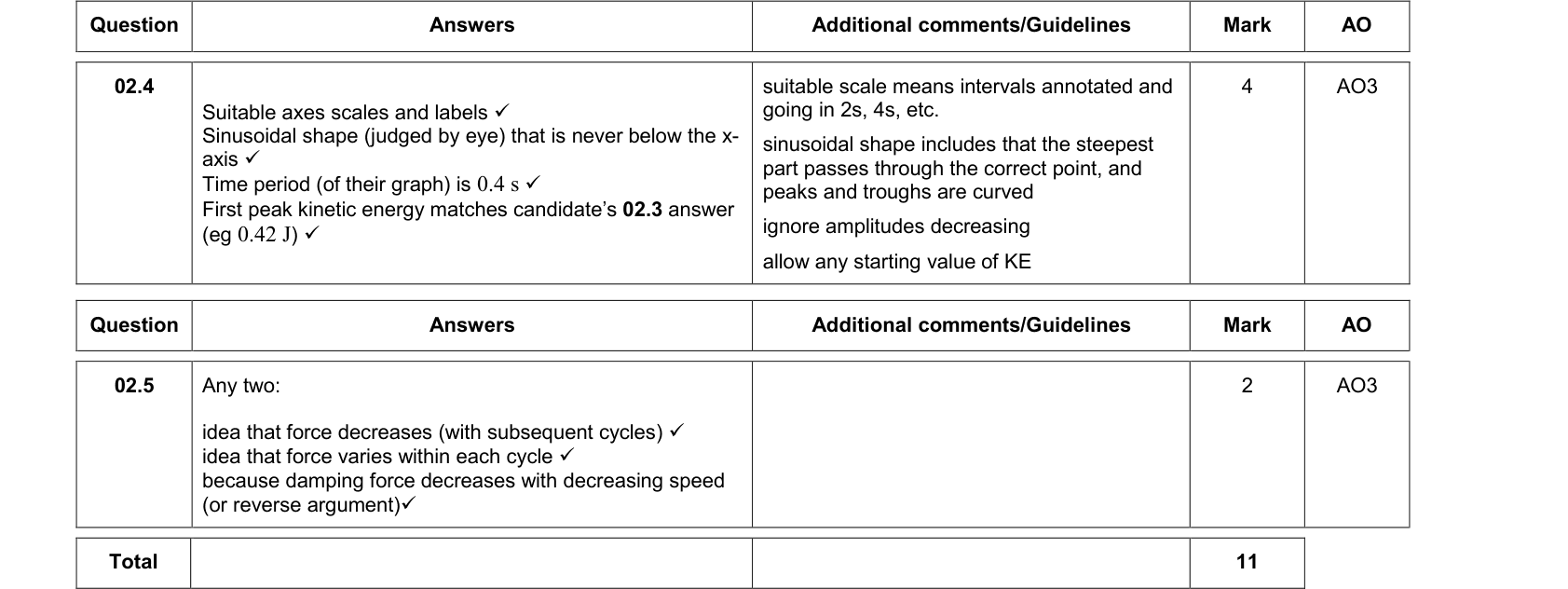
- Plotted against time, $E_k$ and $E_p$ each vary as $\sin^2$ and $\cos^2$, between 0 and $E_{\text{total}}$, at twice the frequency of the oscillation. They are always positive.
- The total energy is proportional to the square of the amplitude: doubling $A$ quadruples the energy.
Worked example: energy of an oscillator
A 0.25 kg mass oscillates on a spring with $k = 40\ \text{N m}^{-1}$ and amplitude 0.060 m.
$\omega = \sqrt{40/0.25} = 12.6\ \text{rad s}^{-1}$; $E = \tfrac12 kA^2 = \tfrac12 \times 40 \times 0.060^2 = 0.072\ \text{J}$ (the same as $\tfrac12m\omega^2A^2$).
When $x = 0.030$ m: $E_p = \tfrac12 \times 40 \times 0.030^2 = 0.018$ J, so $E_k = 0.054$ J.
Damping and resonance
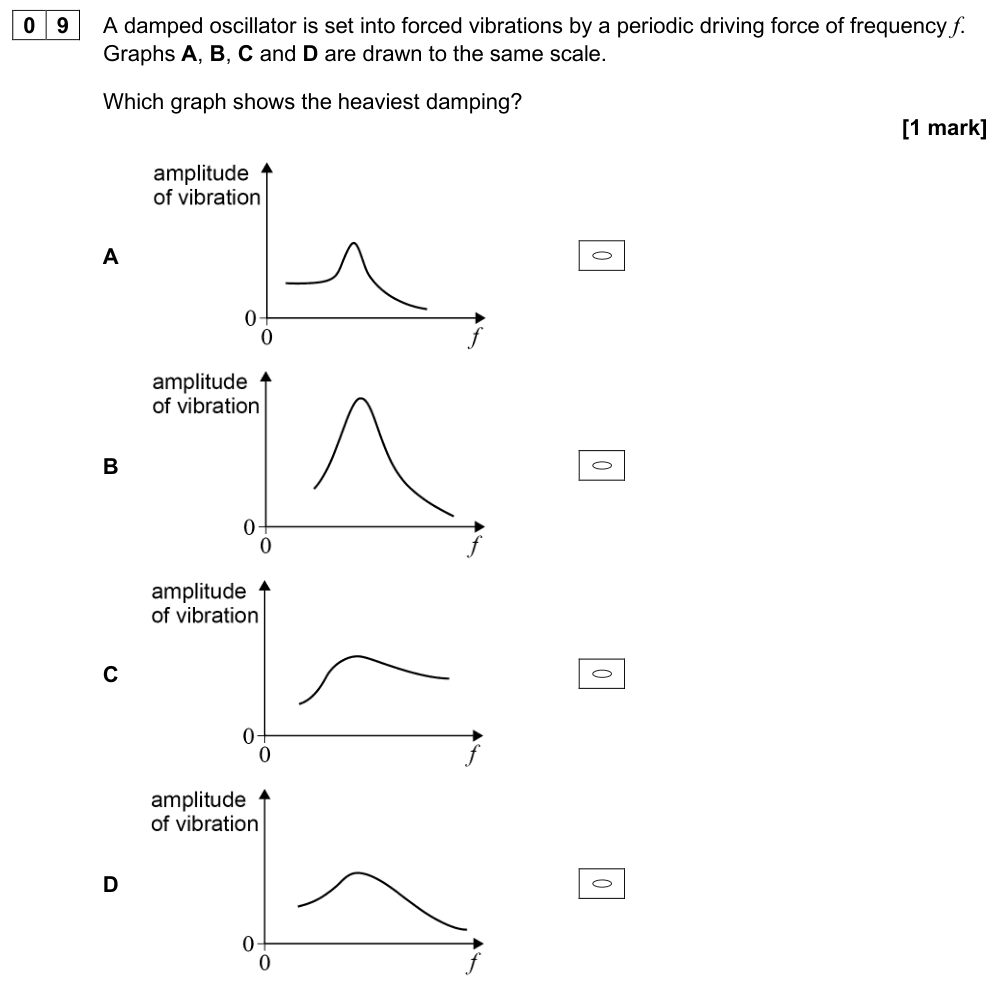
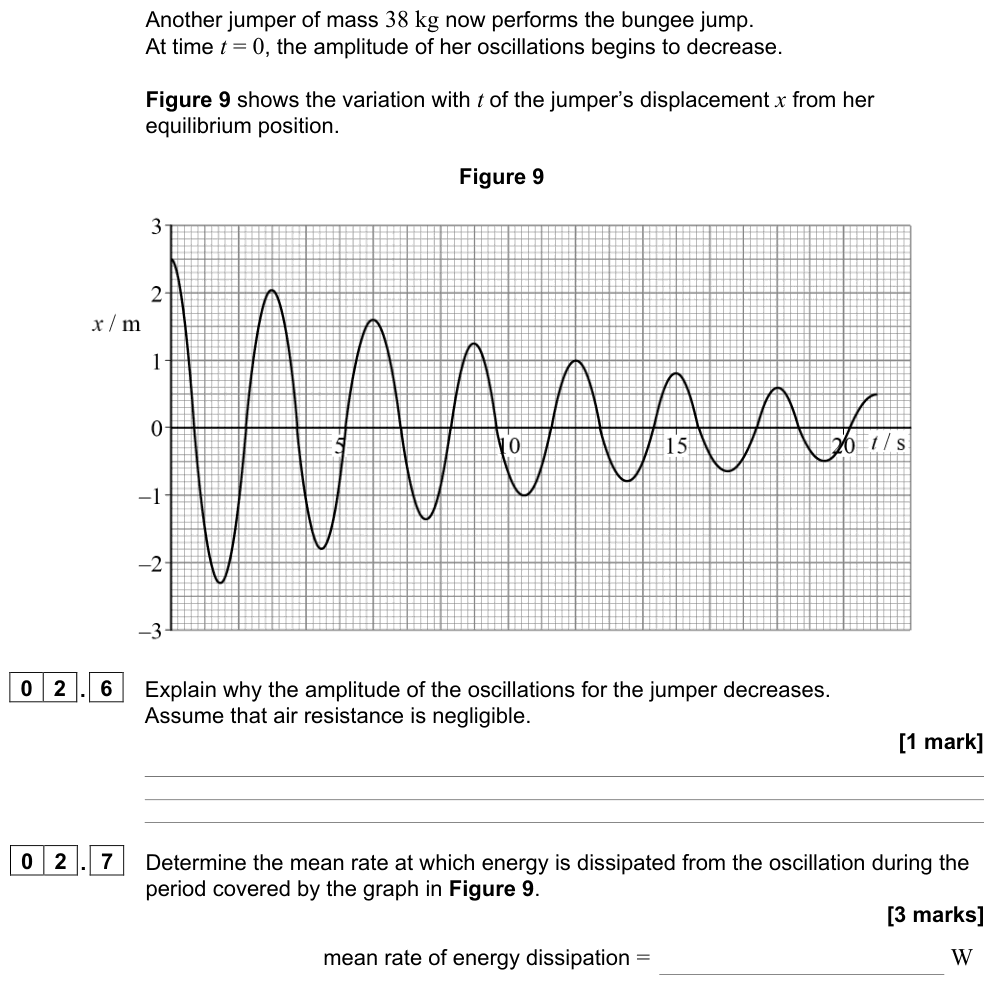
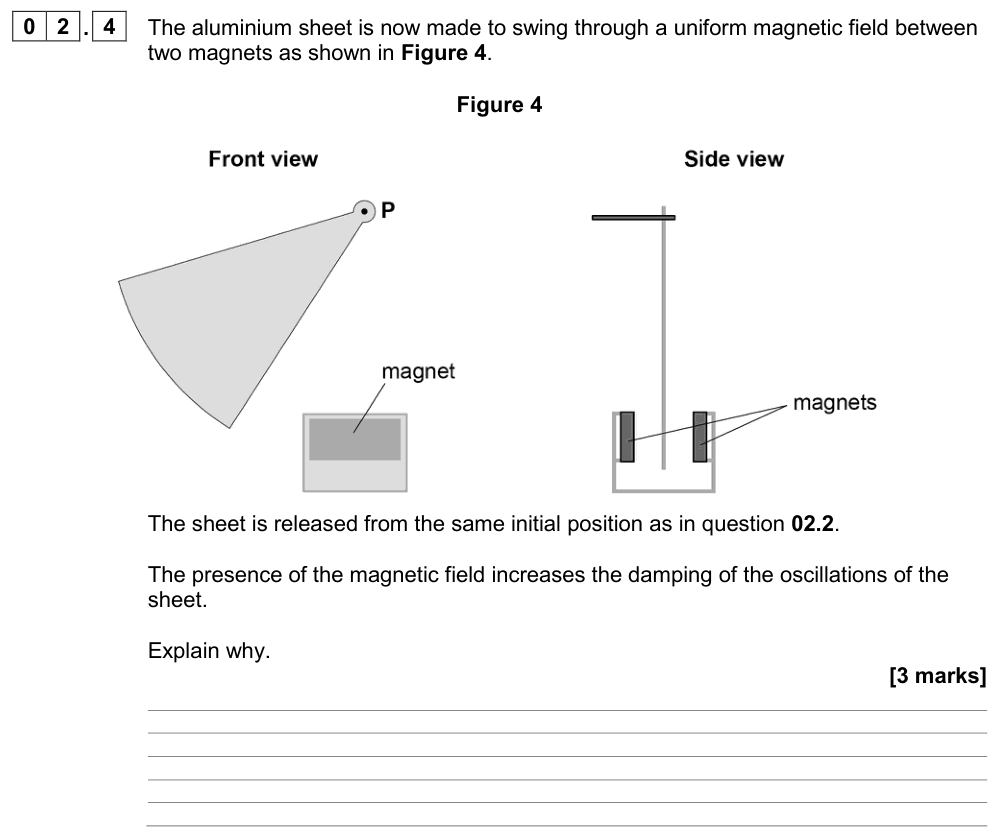
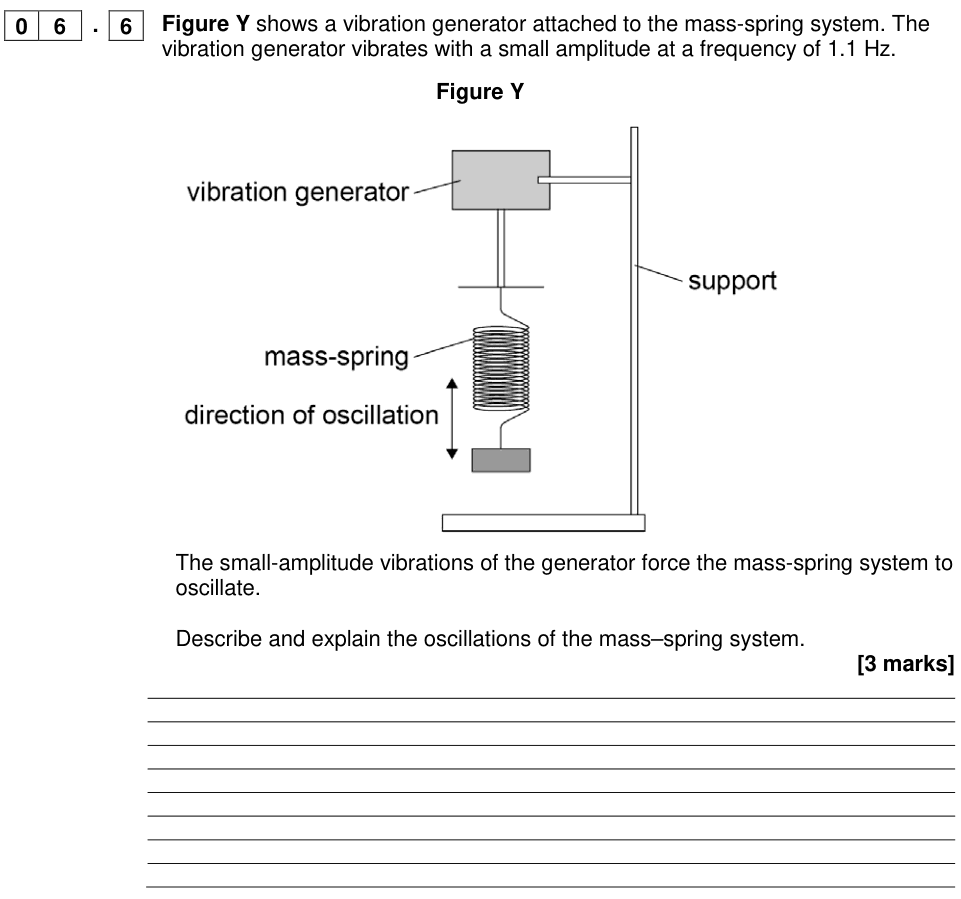
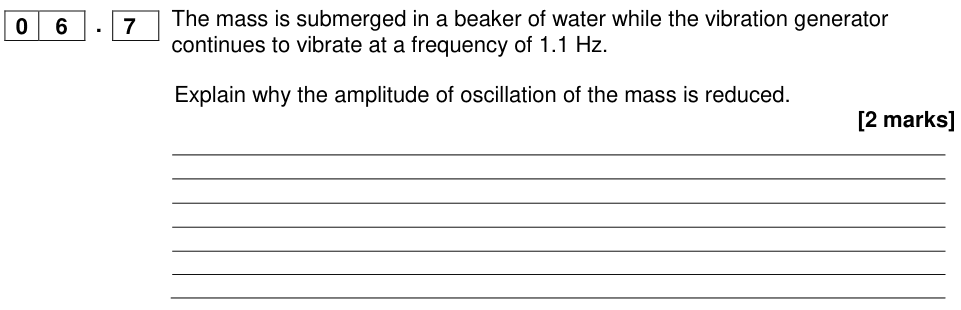
Real oscillators lose energy because of damping, and can be driven into resonance. These ideas are covered in the Unit 2 chapter Oscillations, damping and resonance; questions in Unit 3 may draw on them.
Summary
- SHM: $a = -\omega^2x$ (acceleration ∝ displacement, towards equilibrium).
- $x = A\cos\omega t$; $v = \pm\omega\sqrt{A^2 - x^2}$; $v_{\max} = \omega A$; $a_{\max} = \omega^2A$.
- $v$ = gradient of $x$–$t$; $a$ = gradient of $v$–$t$; $v$ leads $x$ by $\pi/2$, $a$ is in antiphase with $x$.
- $T = 2\pi\sqrt{m/k}$ (spring), $T = 2\pi\sqrt{l/g}$ (pendulum, small angles).
- $E_{\text{total}} = \tfrac12 m\omega^2A^2$; energy swaps between $E_k$ and $E_p$ at twice the oscillation frequency.