Newton's law of gravitation
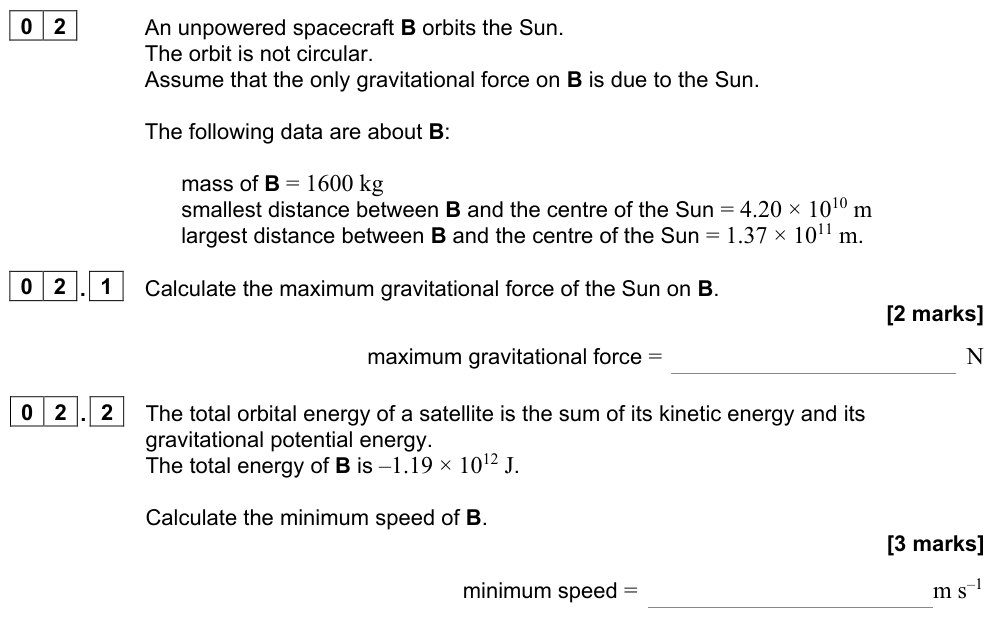
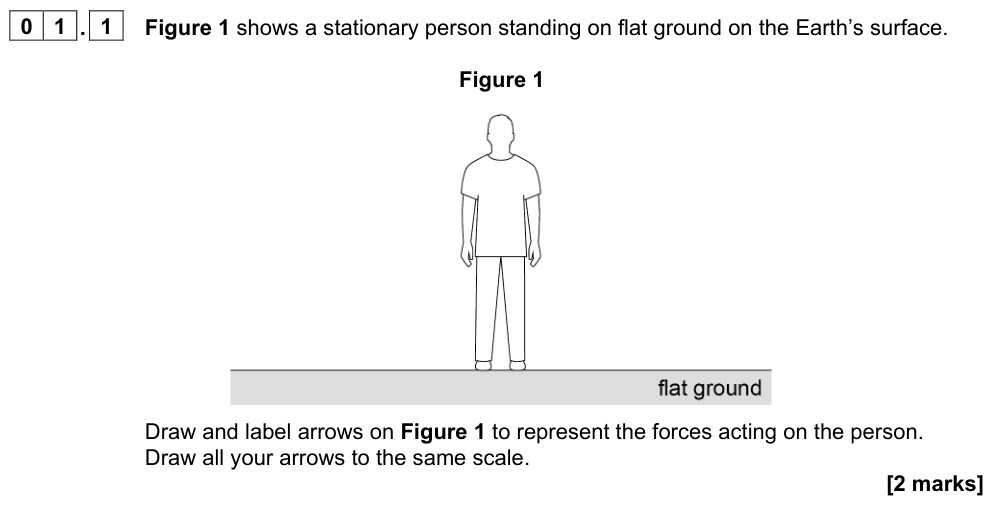
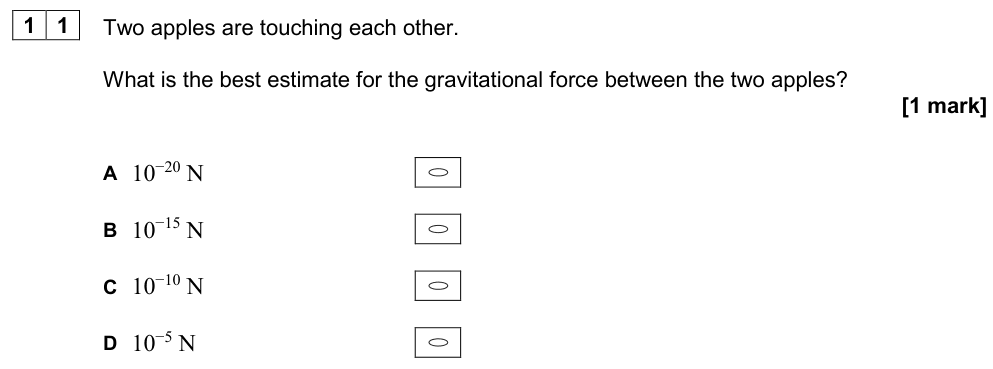
Gravity is a universal attractive force that acts between all objects with mass. It is very weak between everyday objects but dominates on the scale of planets and stars.
Newton's law of gravitation
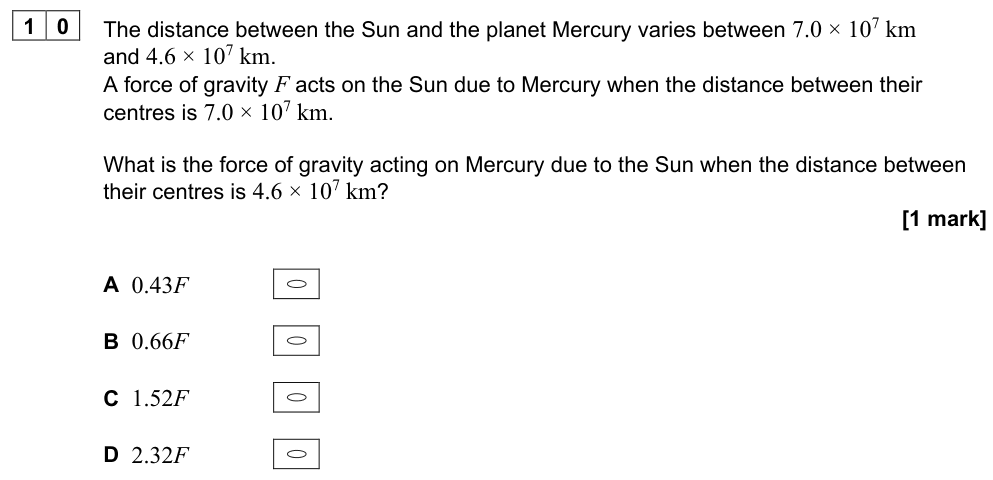
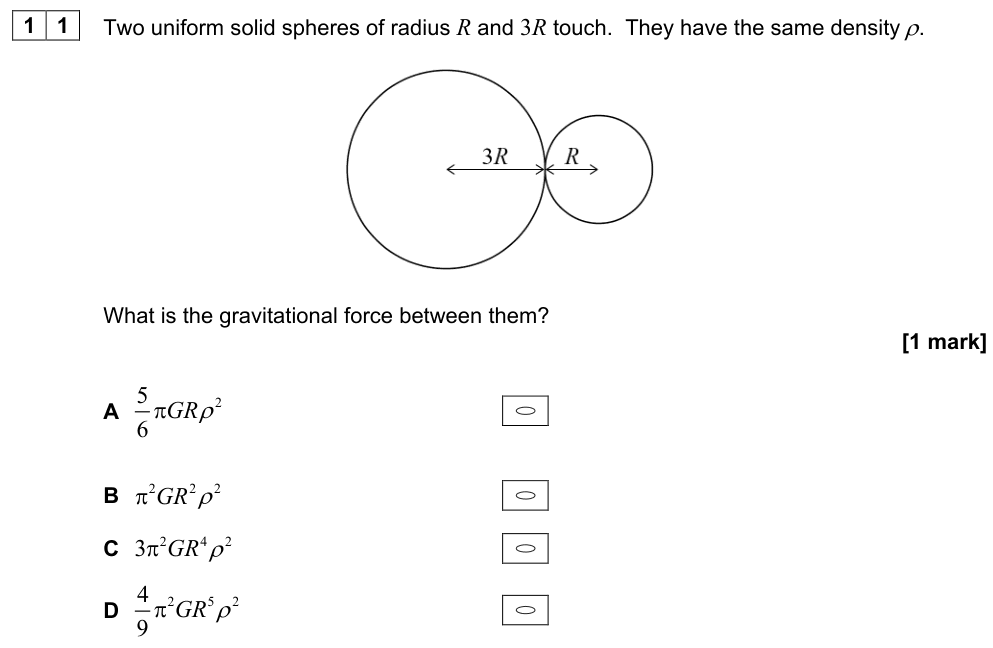
The gravitational force between two point masses is proportional to the product of their masses and inversely proportional to the square of their separation:
$$F = \frac{Gm_1m_2}{r^2}$$
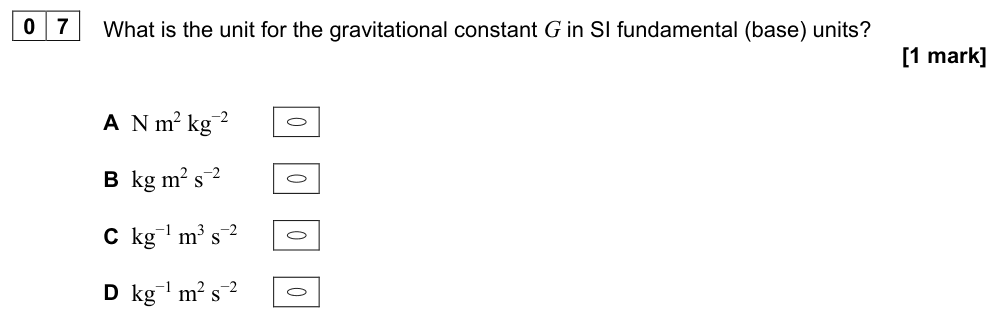
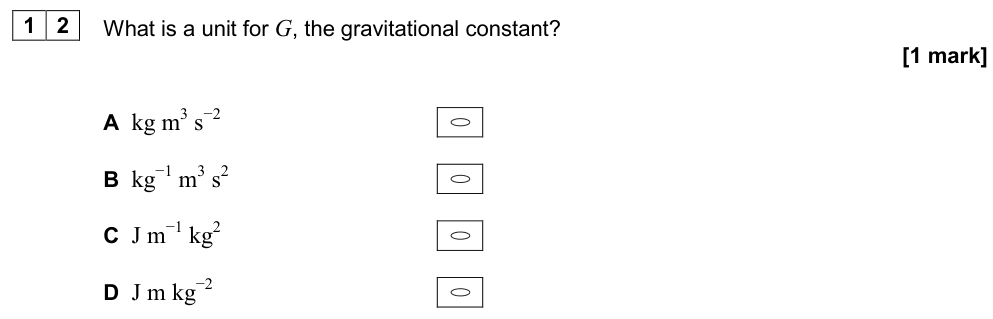
$G = 6.67 \times 10^{-11}\ \text{N m}^2\,\text{kg}^{-2}$ is the gravitational constant; $r$ is the distance between the centres of the masses.
- The force is always attractive and acts along the line joining the centres.
- By Newton's third law, each mass pulls the other with a force of the same size.
- A uniform sphere (planet, star) behaves as if all its mass were concentrated at its centre (for points outside it).
- It is an inverse-square law: doubling $r$ reduces $F$ to one quarter.
Worked example: Earth and Moon
$M_E = 5.97 \times 10^{24}$ kg, $M_M = 7.35 \times 10^{22}$ kg, separation $3.84 \times 10^{8}$ m.
$$F = \frac{6.67 \times 10^{-11} \times 5.97 \times 10^{24} \times 7.35 \times 10^{22}}{(3.84 \times 10^{8})^2} = 1.98 \times 10^{20}\ \text{N}$$
Worked example: two people
Two 70 kg people 1.0 m apart: $F = 6.67 \times 10^{-11} \times 70 \times 70/1.0^2 = 3.3 \times 10^{-7}\ \text{N}$, far too small to notice.
Gravitational fields
Force field
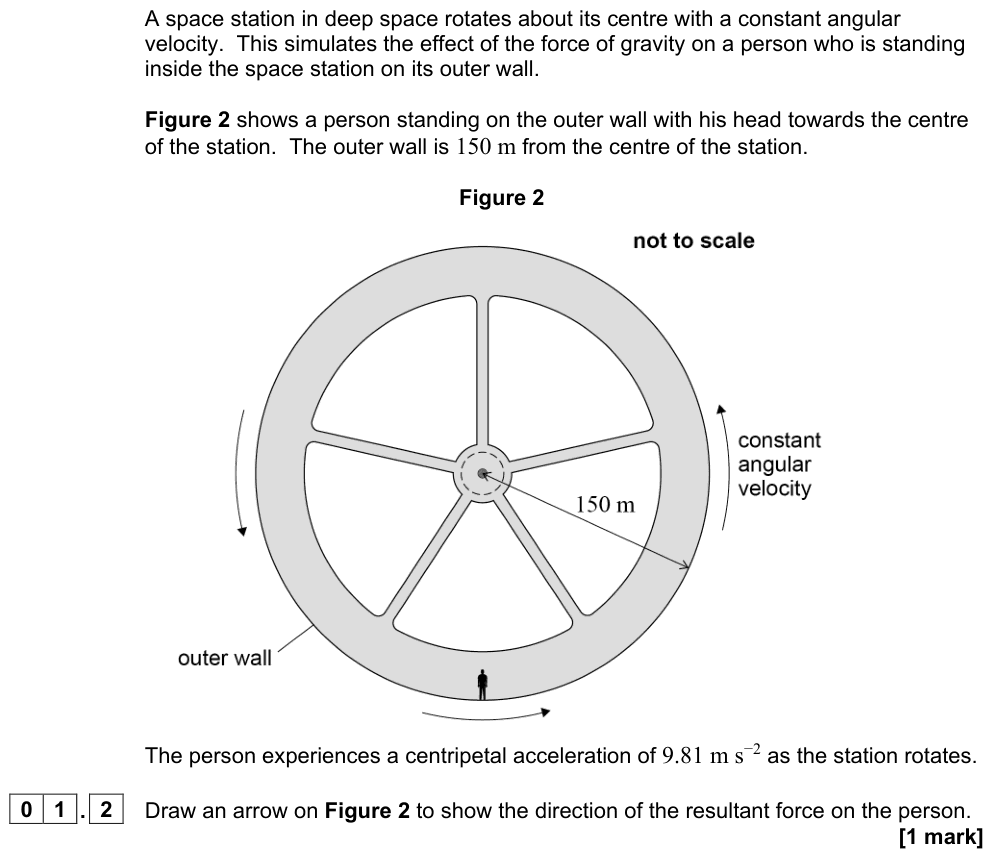
A force field is a region in which a body experiences a (non-contact) force. In a gravitational field, any object with mass experiences a force.
Field lines
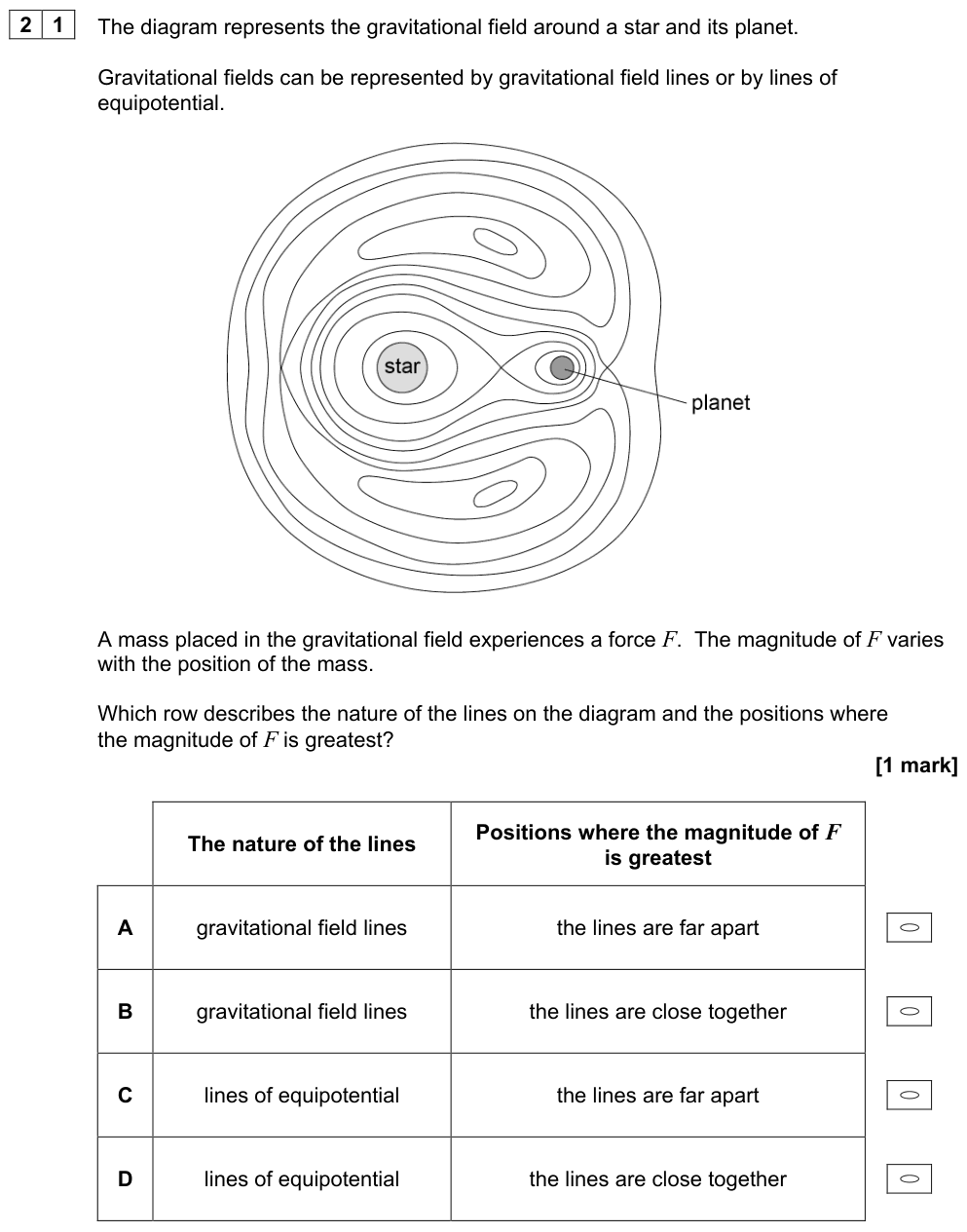
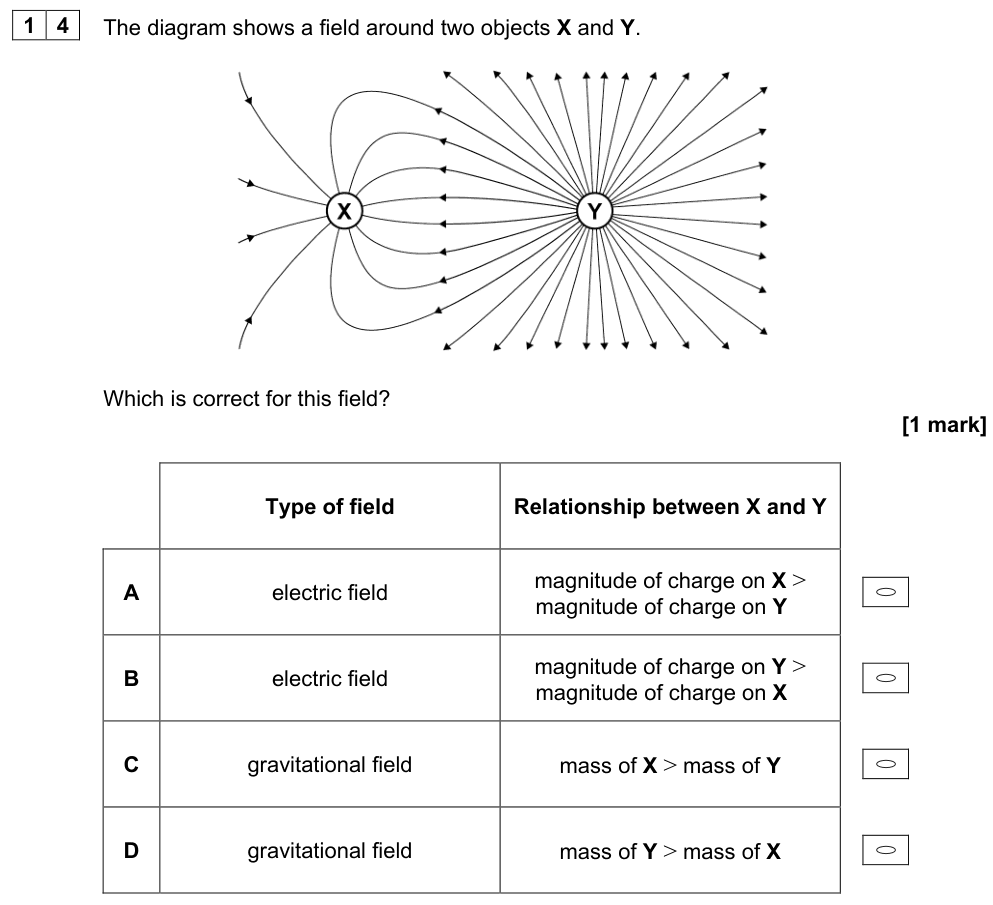
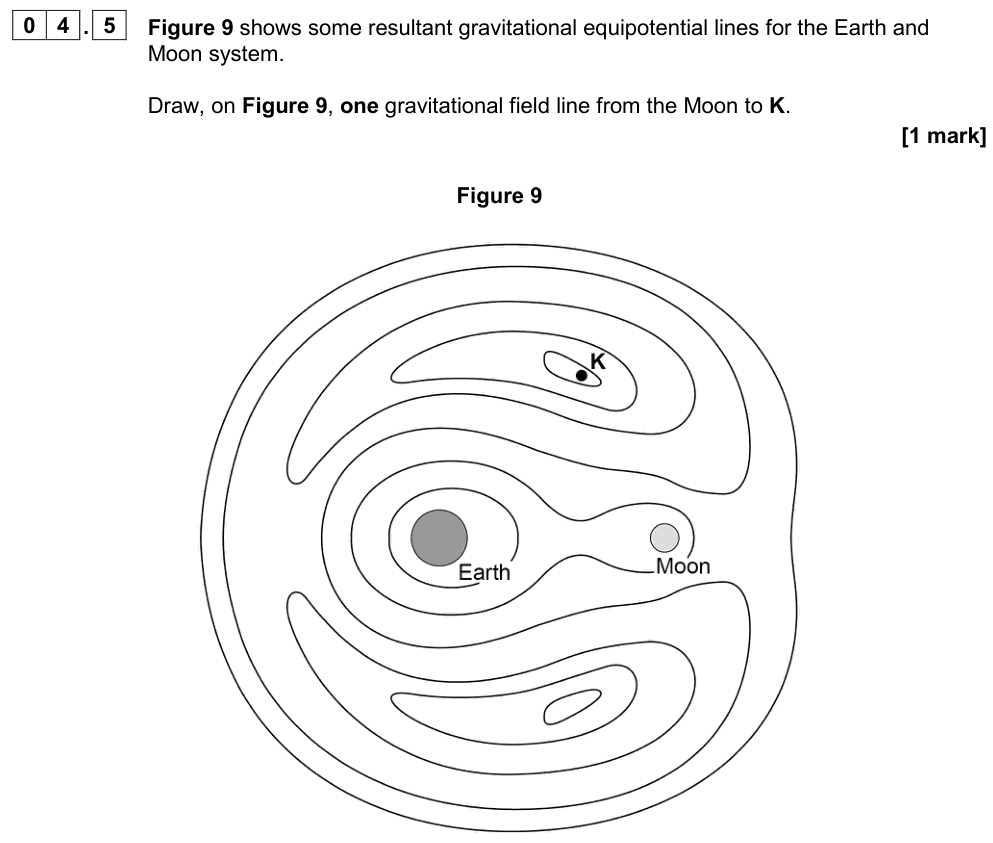
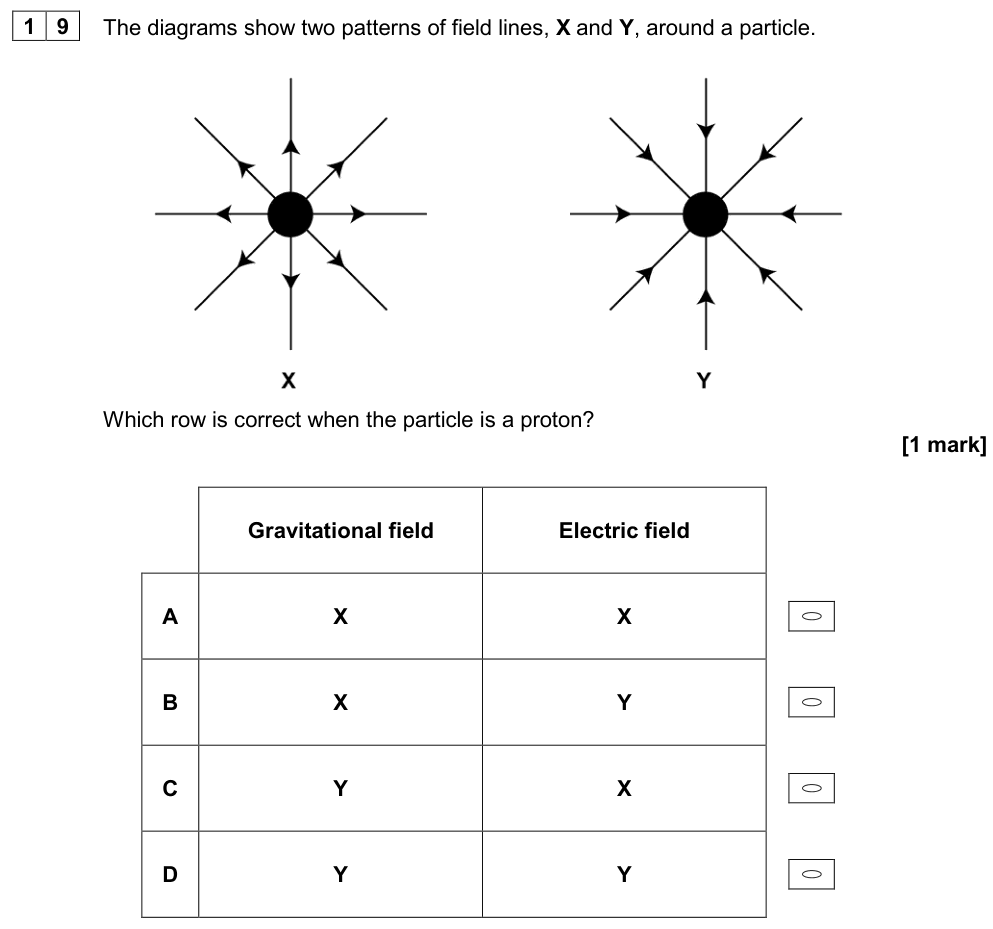
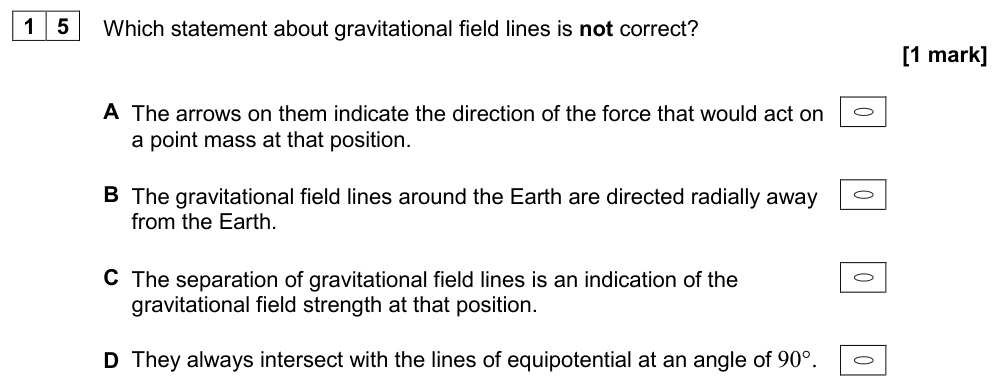
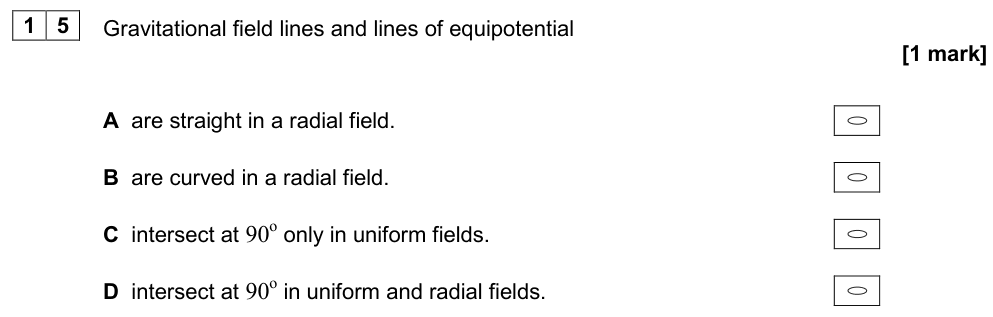
Gravitational fields are represented by field lines showing the direction of the force on a small test mass. The closer together the lines, the stronger the field.
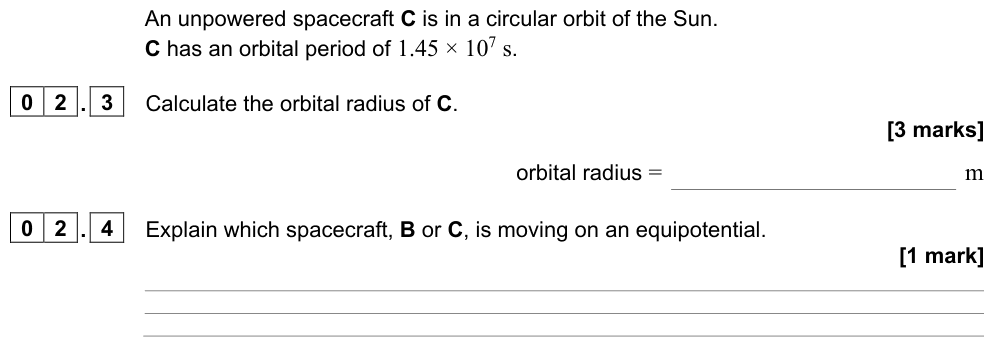
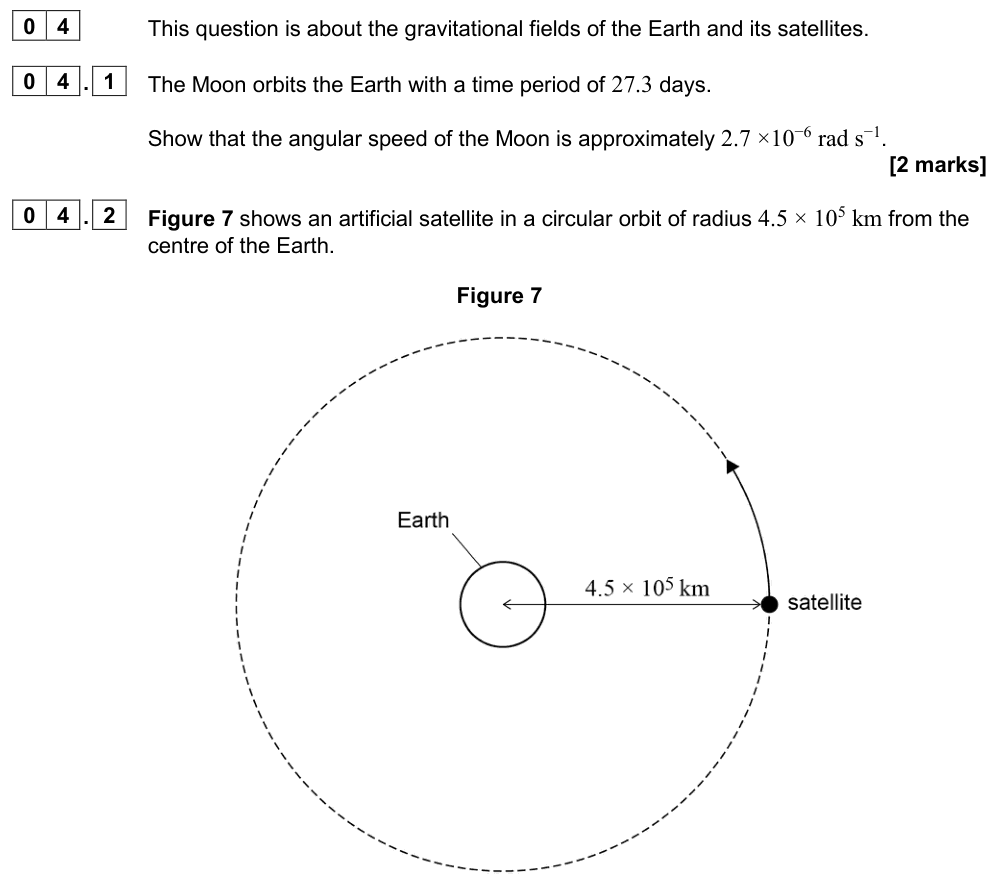
- Radial field (around a planet or point mass): lines point inwards towards the centre, spreading out with distance, so the field gets weaker further away.
- Uniform field (close to the Earth's surface, over small regions): parallel, equally spaced lines pointing down. The field strength is the same everywhere.
Gravitational field strength
Gravitational field strength
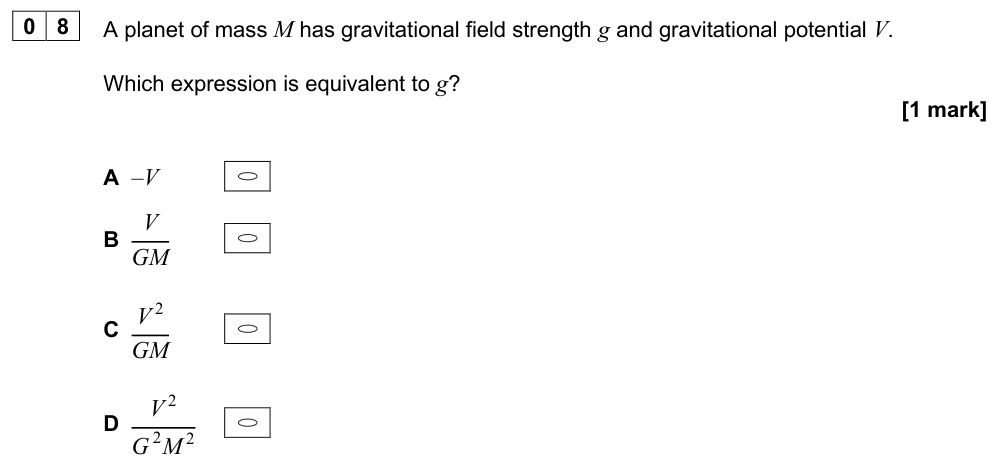
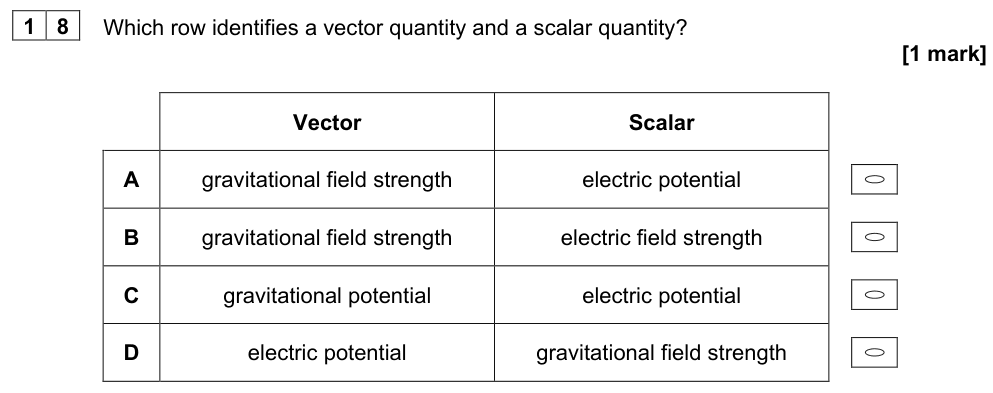
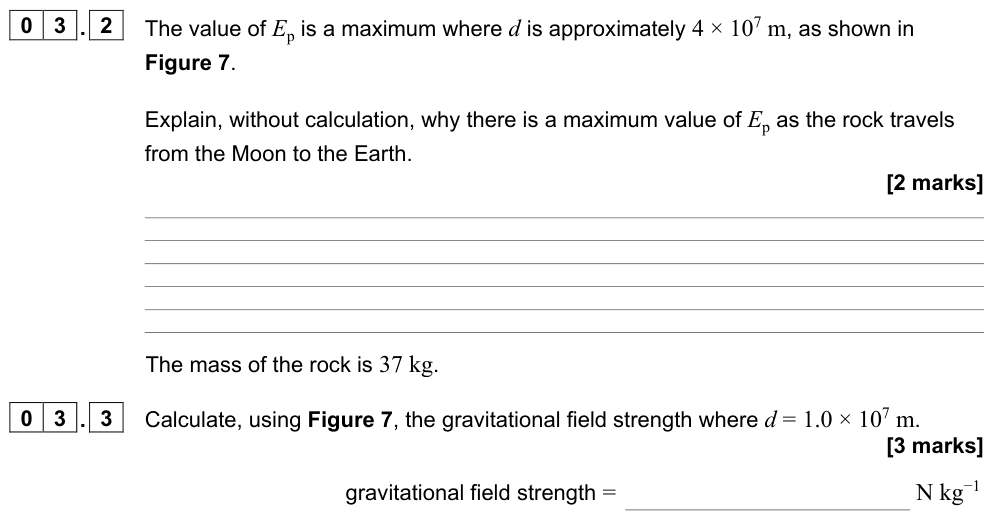
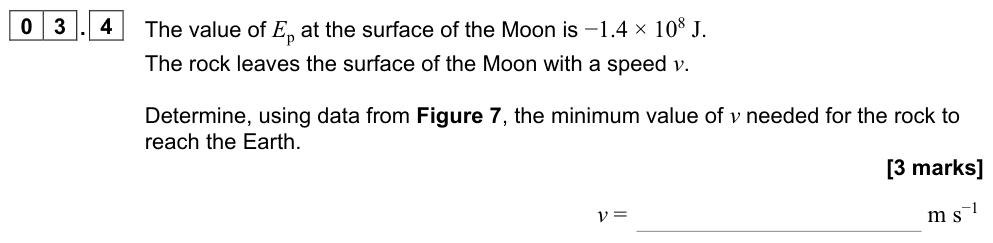
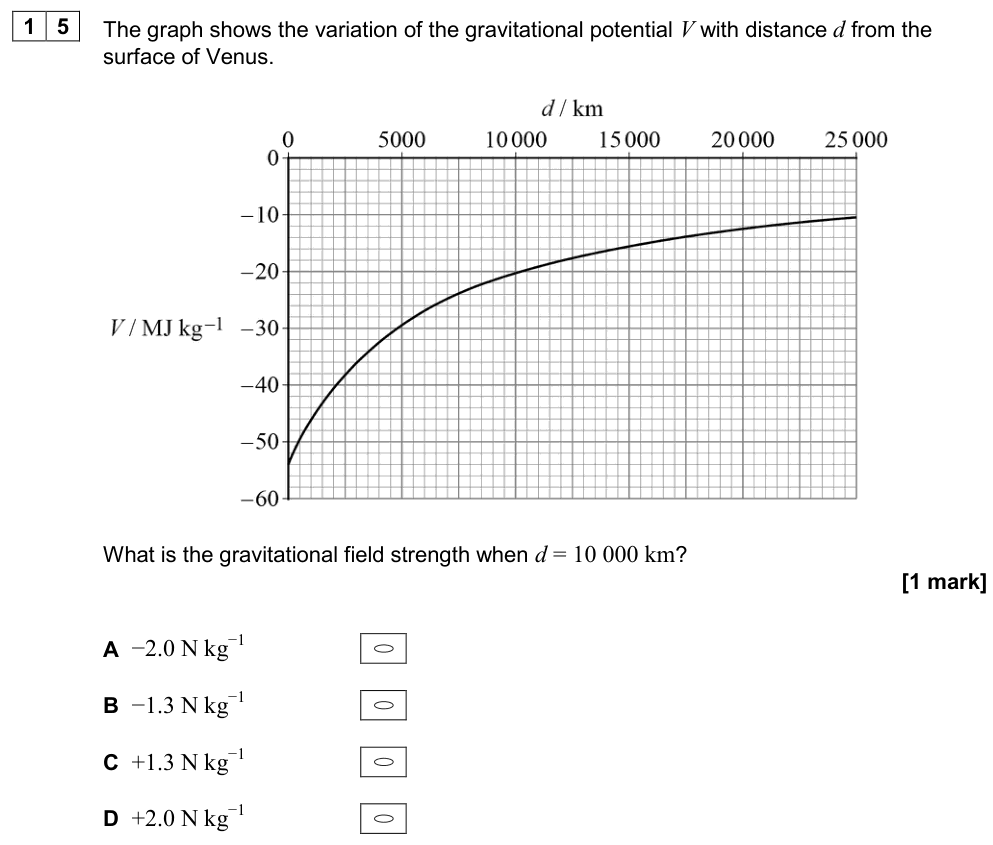
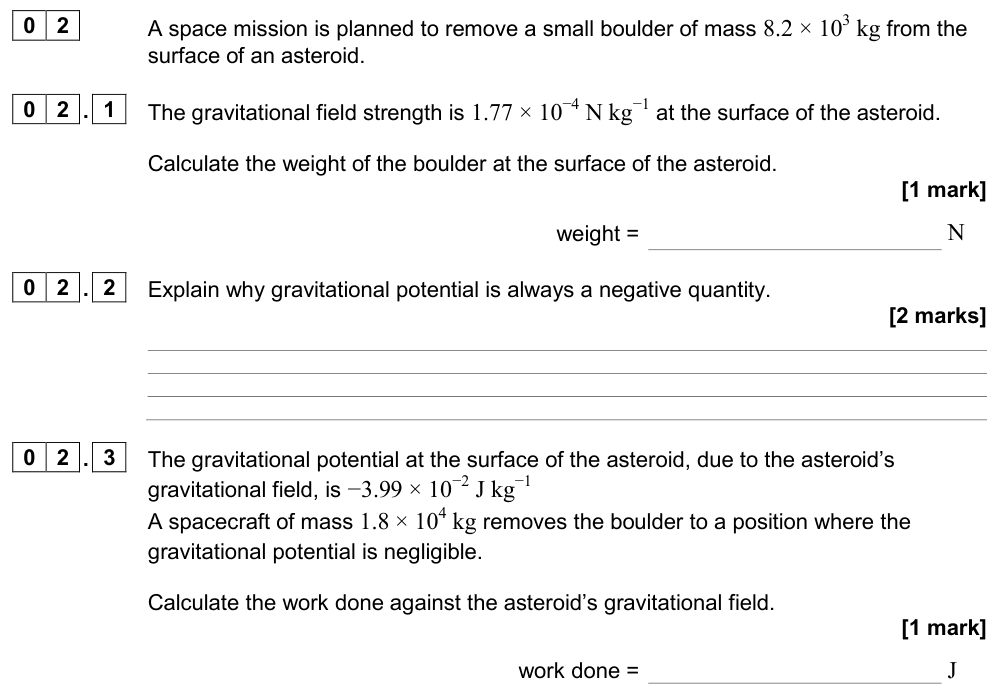
The gravitational field strength $g$ at a point is the force per unit mass on a small mass placed at that point:
$$g = \frac{F}{m} \qquad \text{unit: N kg}^{-1}\ (\text{equivalent to m s}^{-2})$$
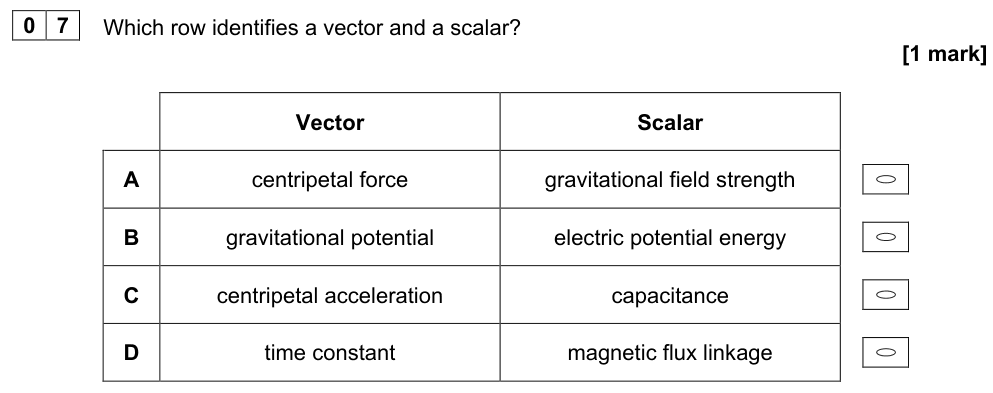
$g$ is a vector, in the direction of the force (towards the mass causing the field).
Near the Earth's surface $g = 9.81\ \text{N kg}^{-1}$, which is also the acceleration of free fall.
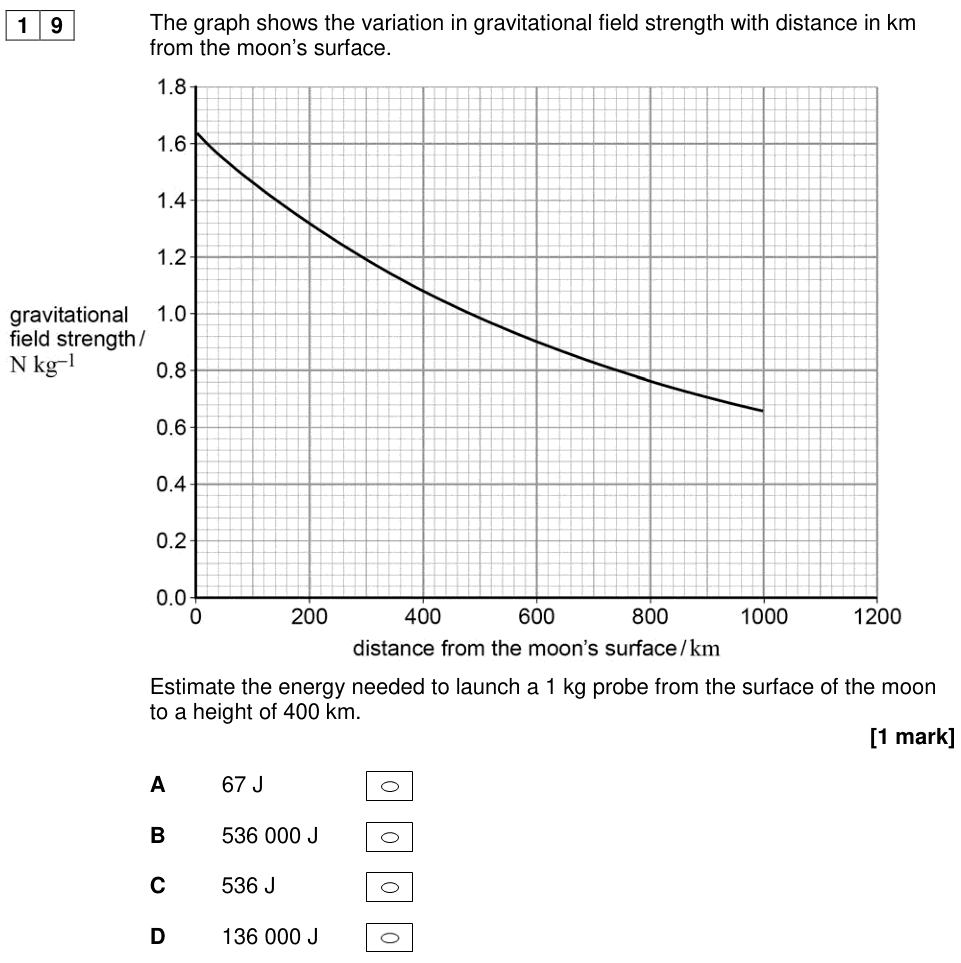
Radial field of a planet
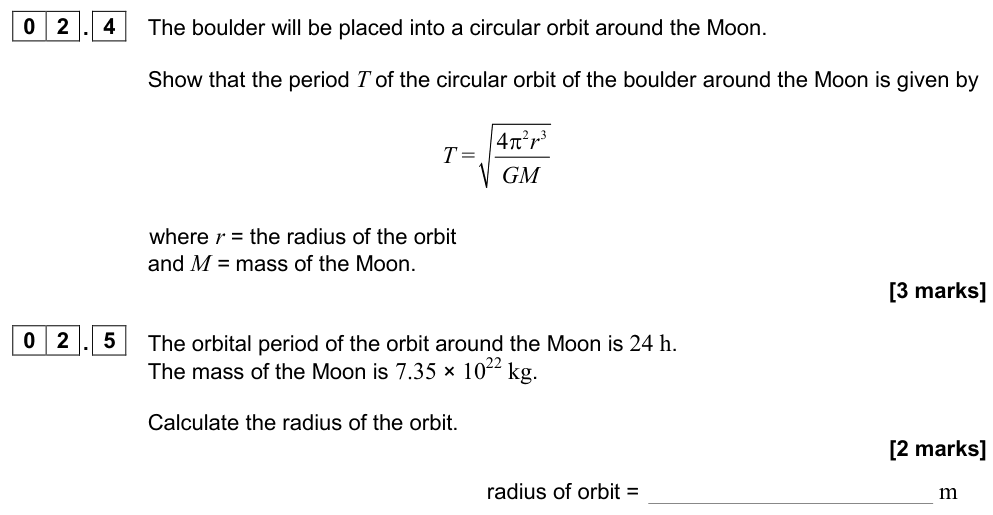
Combining $g = F/m$ with Newton's law ($F = GMm/r^2$):
Field strength in a radial field
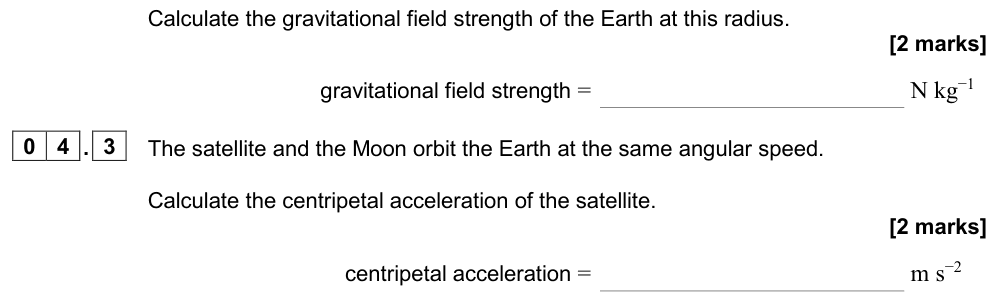
$$g = \frac{GM}{r^2}$$
for $r \ge R$ (outside a planet of mass $M$ and radius $R$).
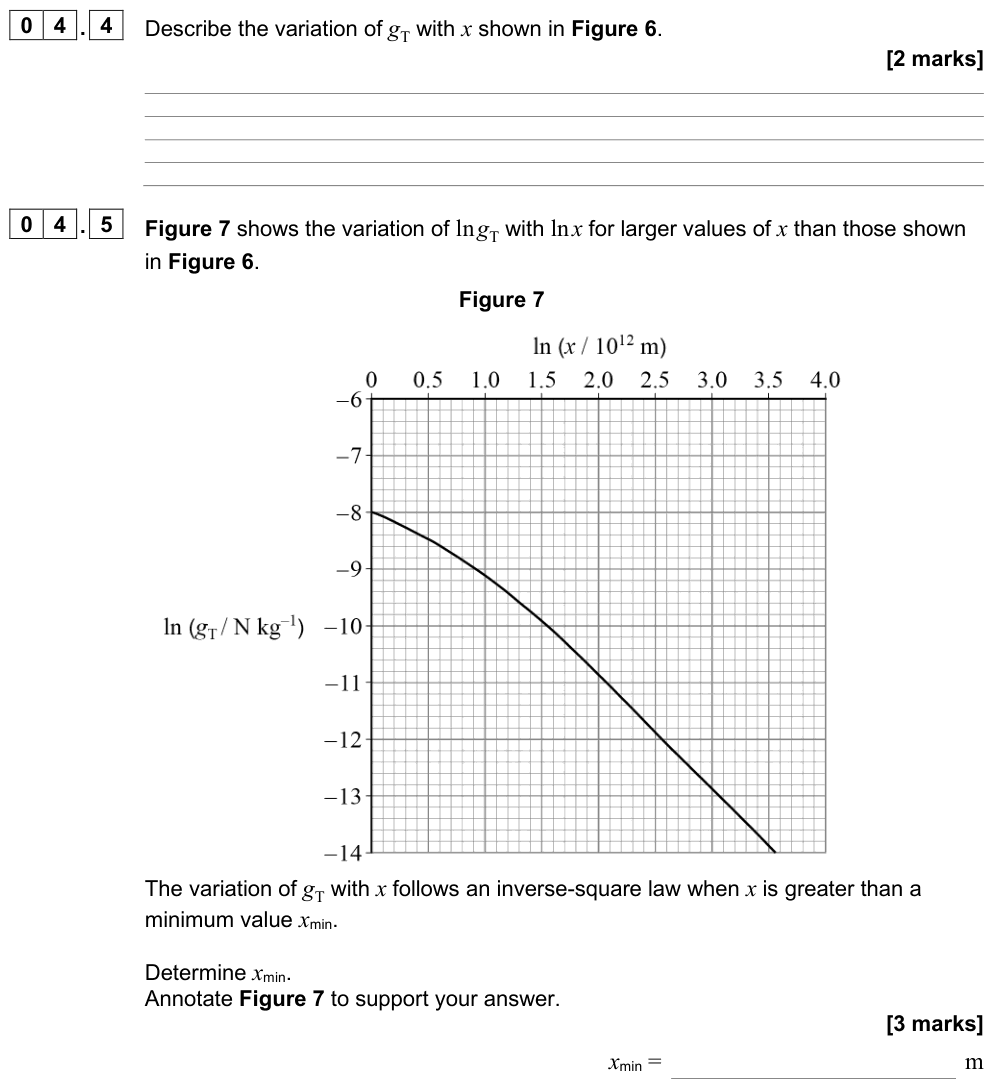
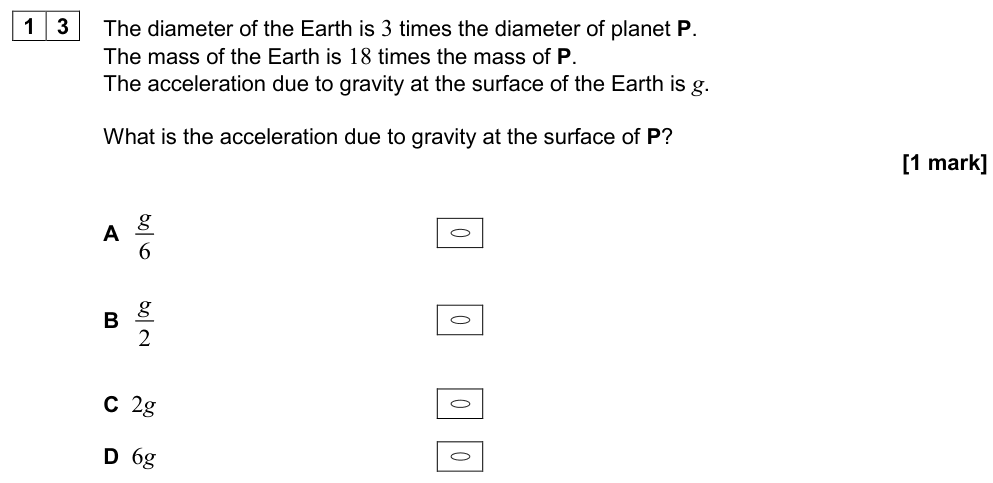
- $g \propto 1/r^2$ outside the planet: at twice the distance from the centre, $g$ is a quarter as large.
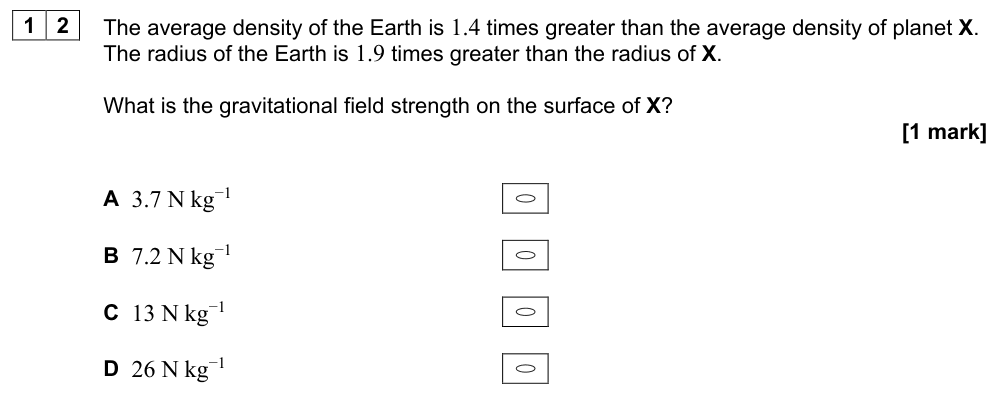
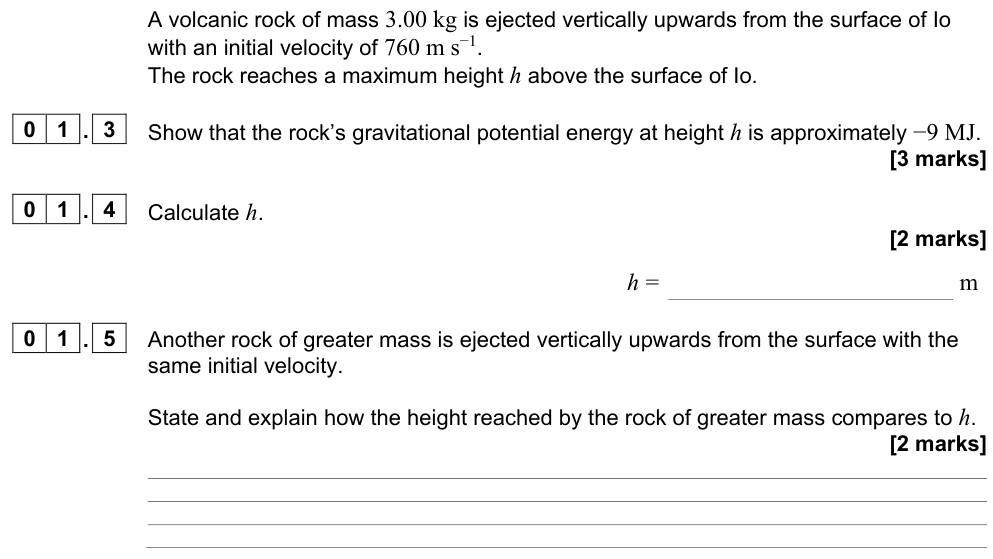
- On the surface, $g_0 = \dfrac{GM}{R^2}$. So at a height $h$ above the surface, $g = g_0\dfrac{R^2}{(R + h)^2}$.
Worked example: g at the ISS
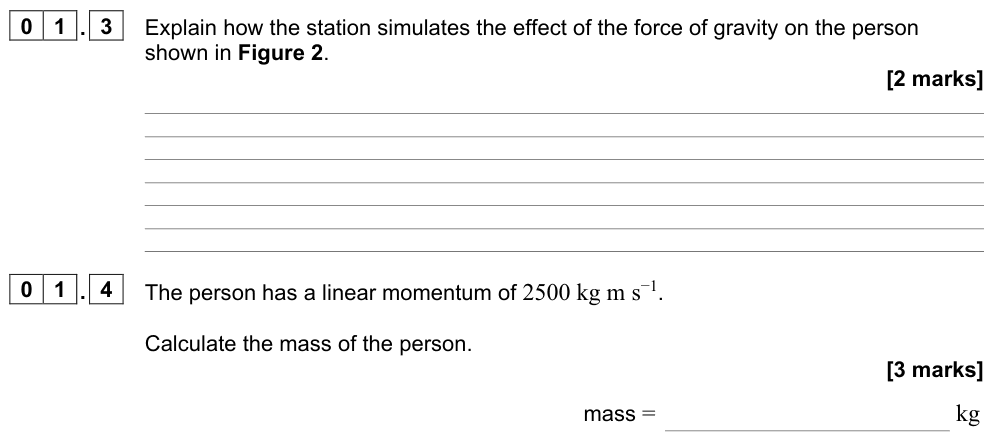
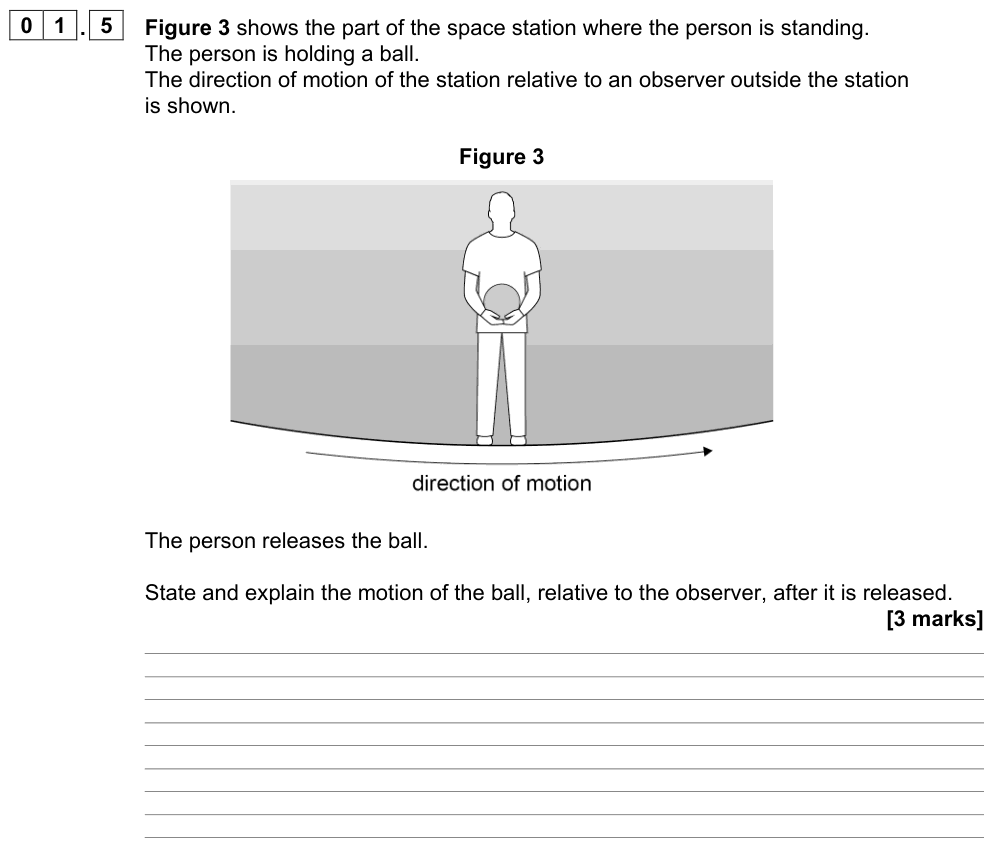
The ISS orbits 420 km above the Earth ($R = 6370$ km). $g = 9.81 \times \left(\dfrac{6370}{6790}\right)^2 = 8.6\ \text{N kg}^{-1}$. Astronauts feel weightless not because there is no gravity, but because they and the station are falling freely together.
Finding the mass or density of a planet
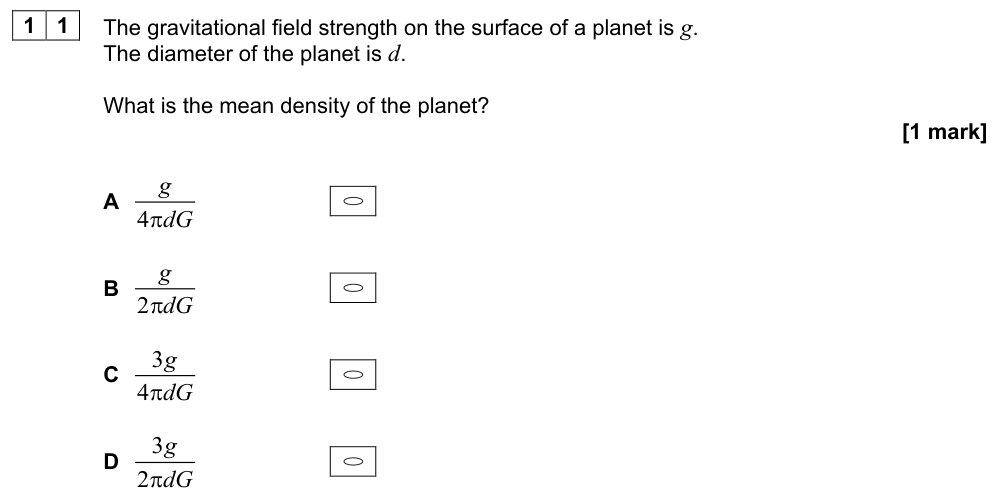
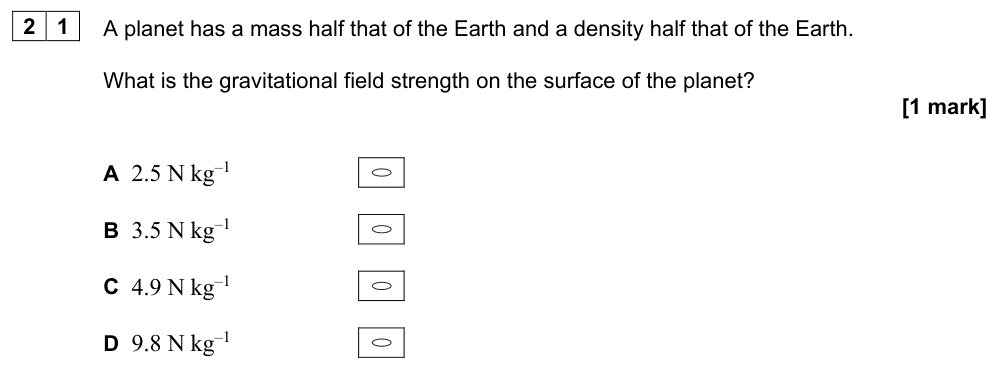
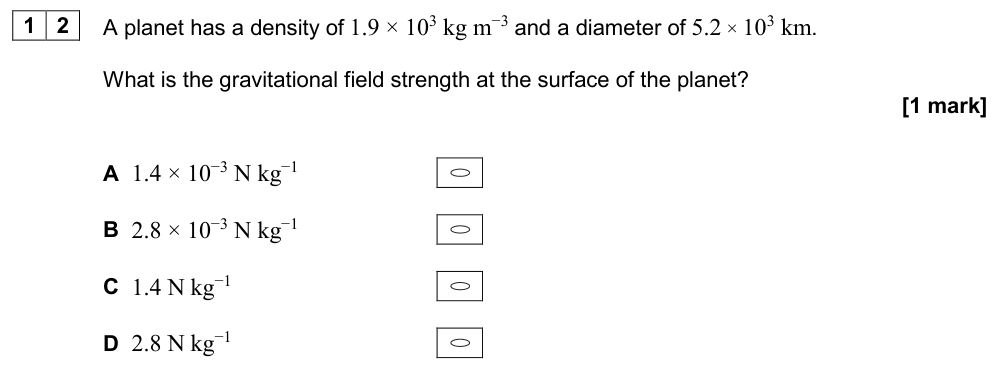
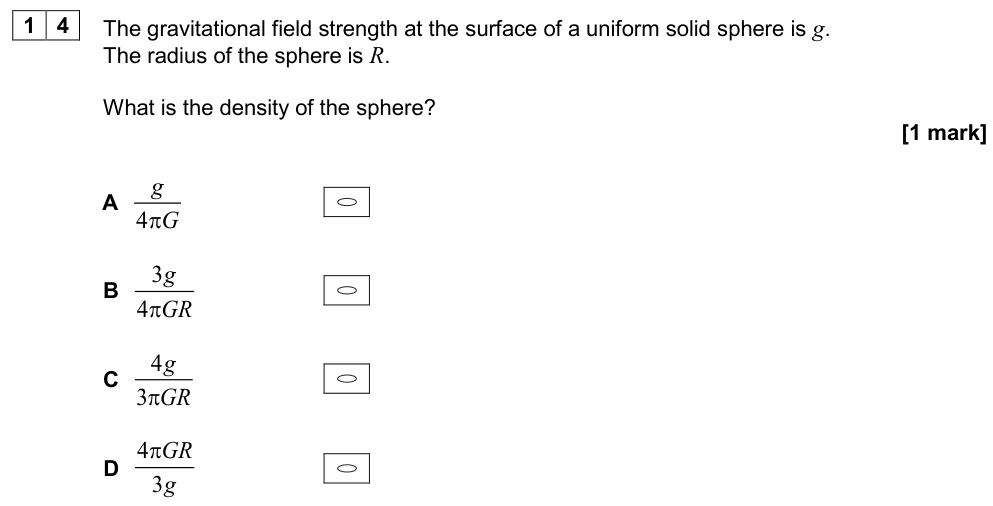
From $g_0 = GM/R^2$: $M = \dfrac{g_0R^2}{G}$. With $M = \rho \cdot \tfrac43\pi R^3$:
$$g_0 = \frac{4}{3}\pi G\rho R \qquad \Rightarrow \qquad \rho = \frac{3g_0}{4\pi GR}$$
Worked example: mass of the Earth
$M = \dfrac{9.81 \times (6.37 \times 10^{6})^2}{6.67 \times 10^{-11}} = 5.97 \times 10^{24}\ \text{kg}$.
The field between two masses
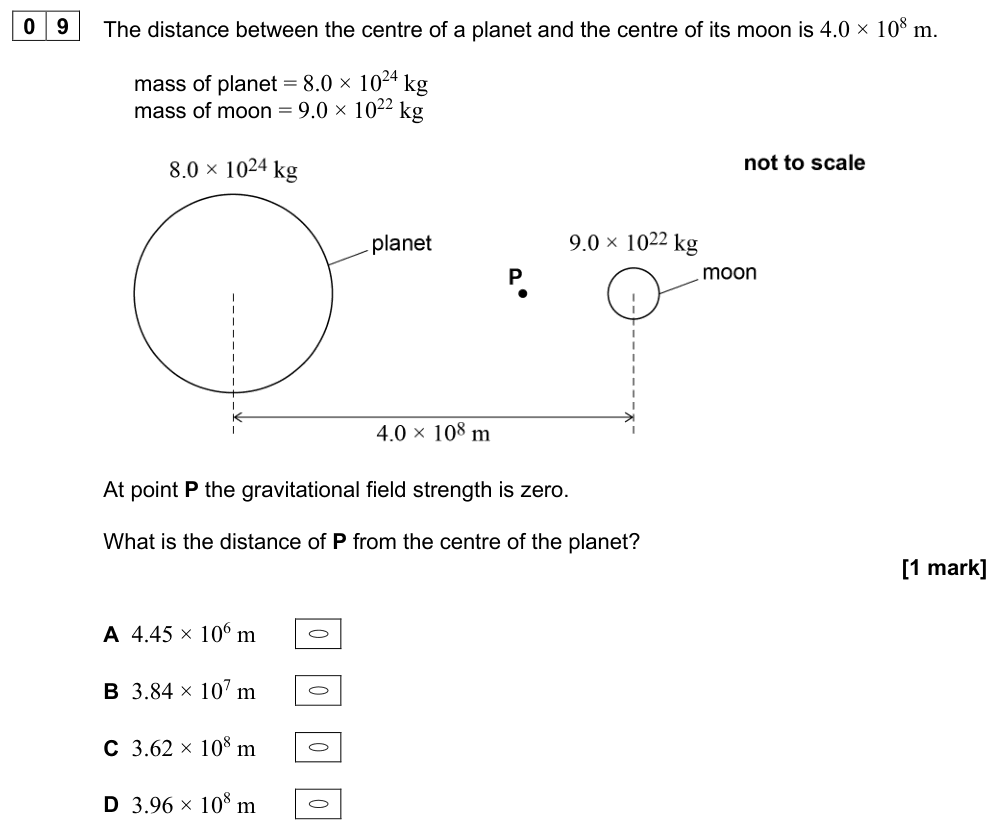
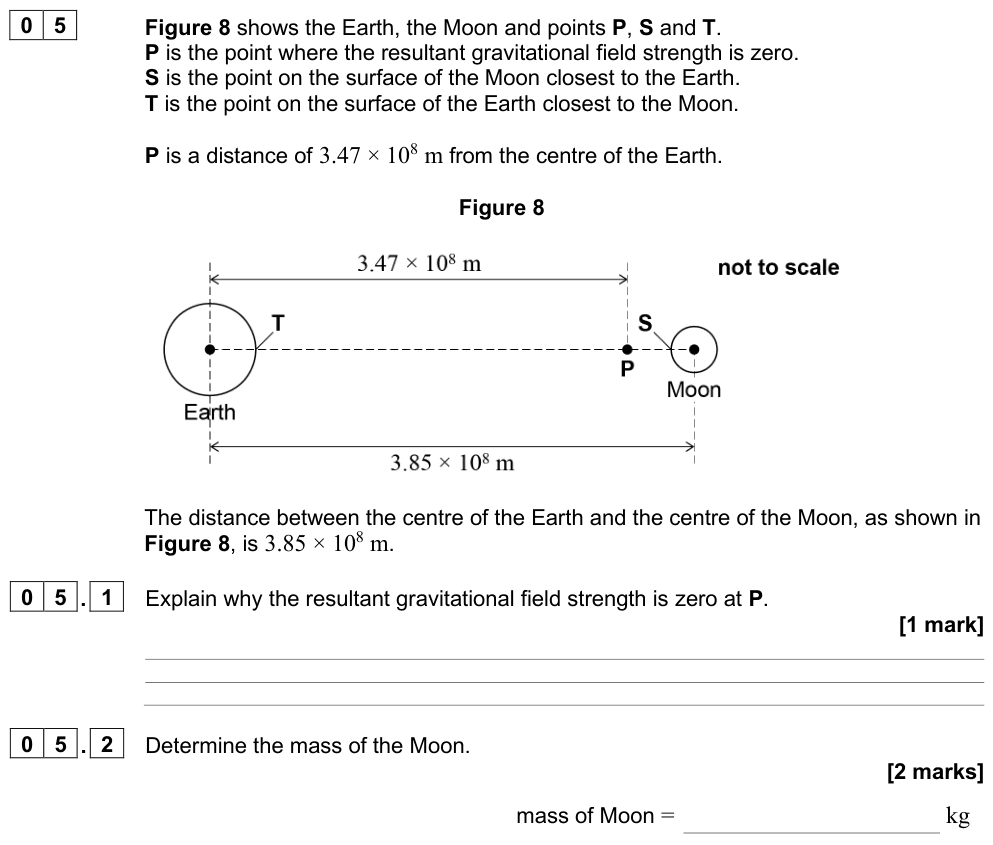
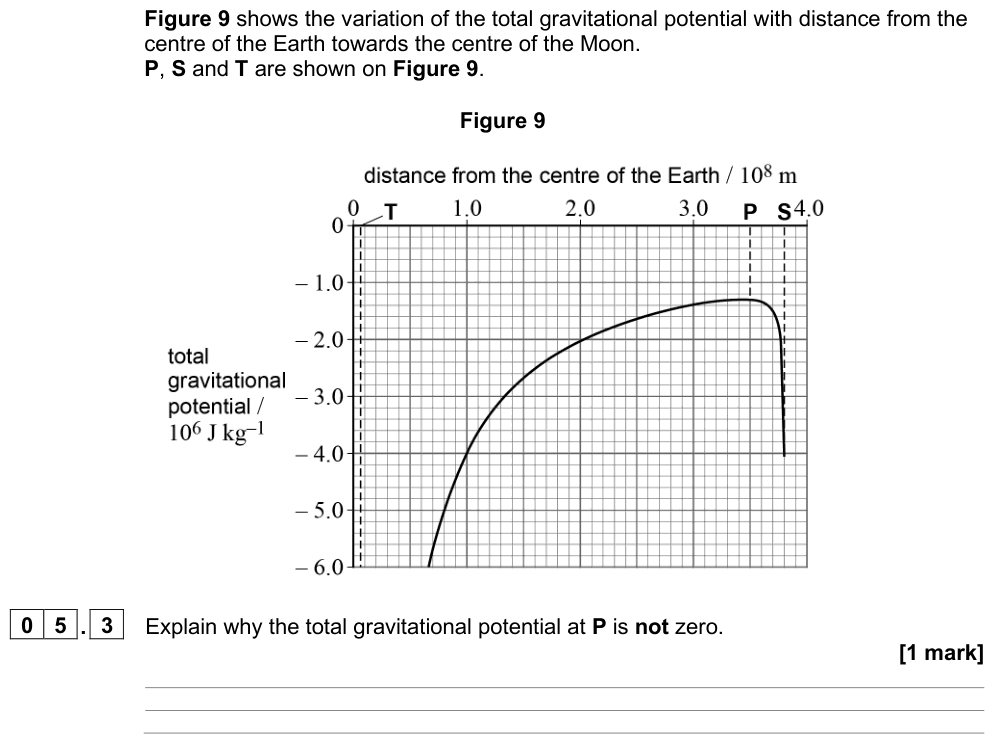
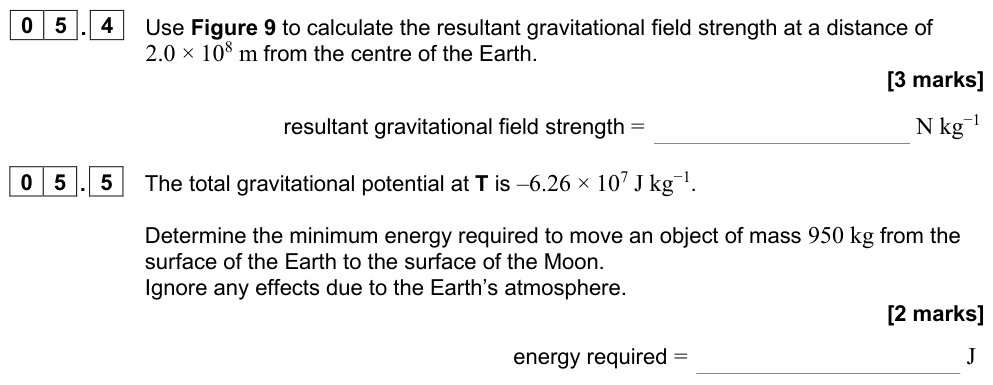
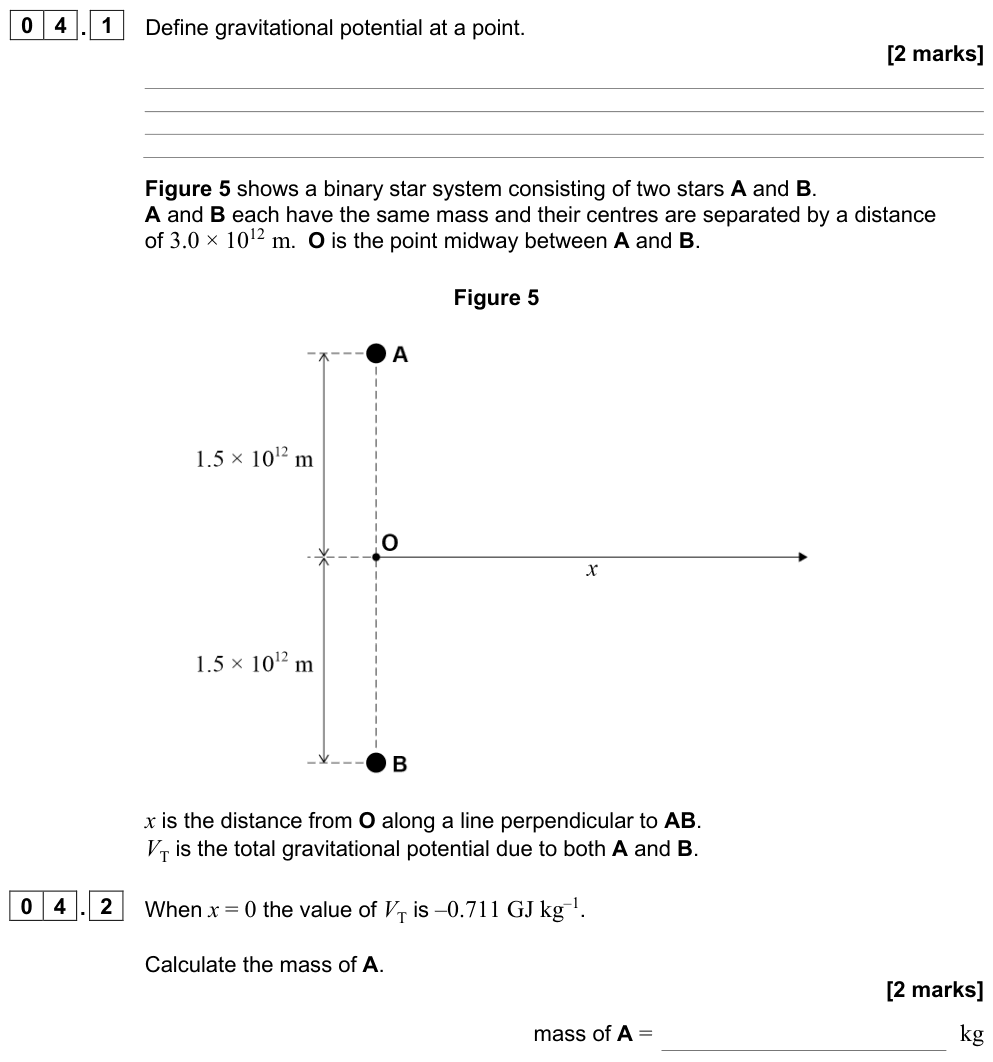
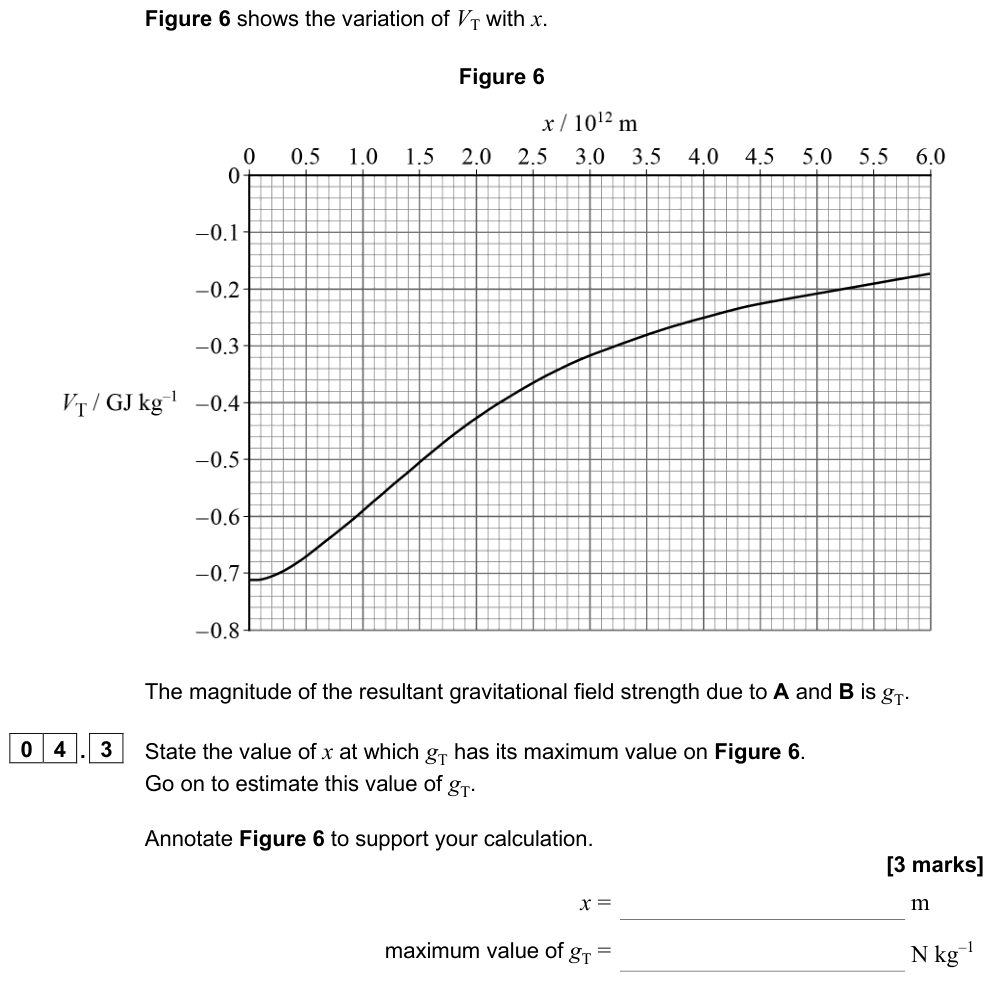
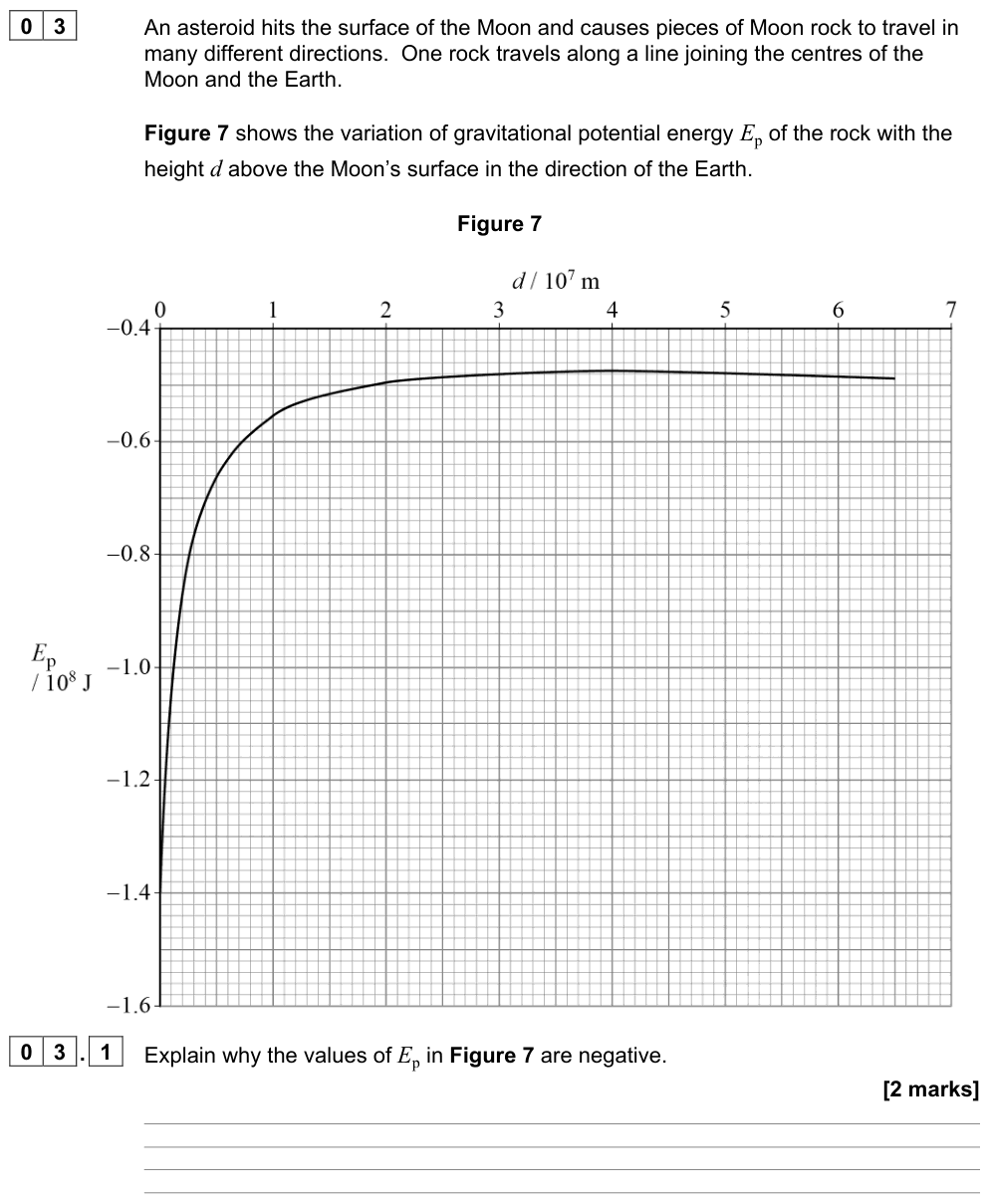
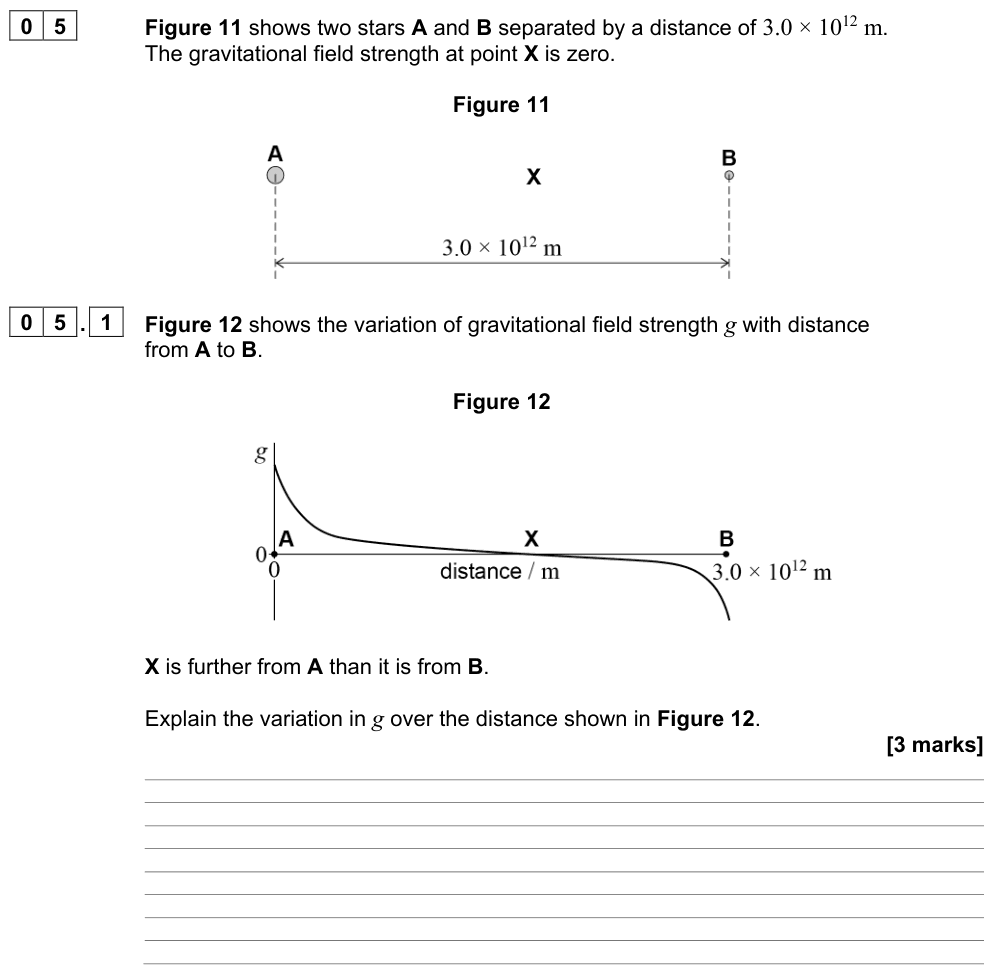
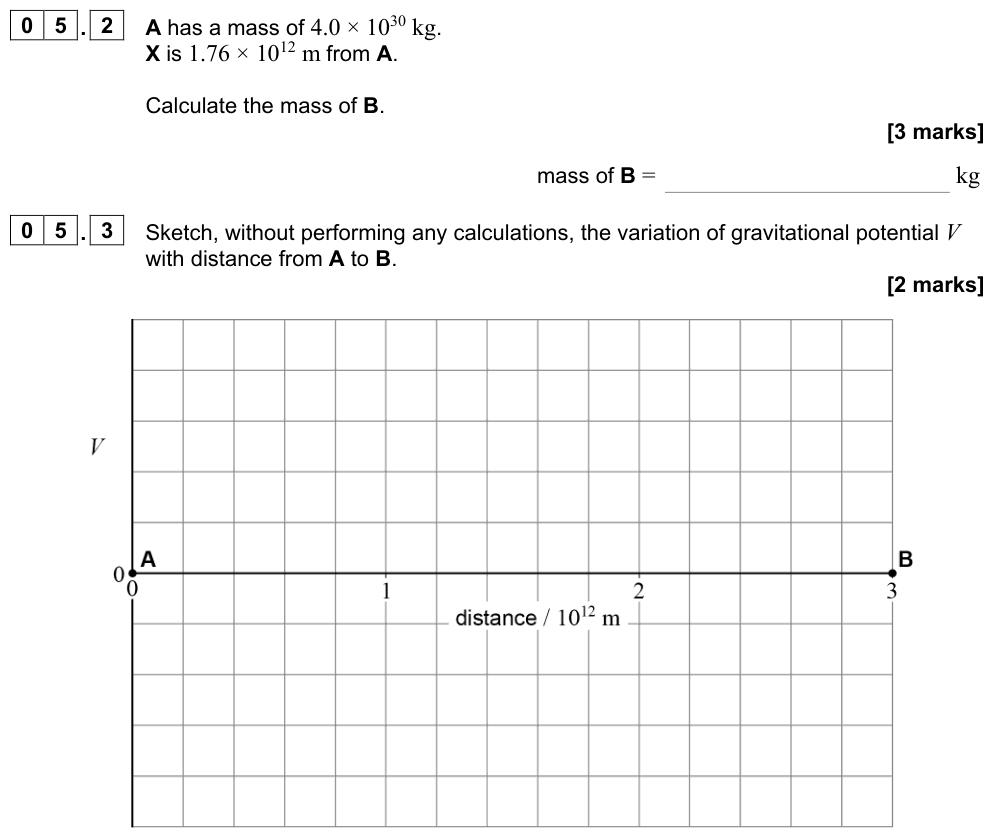
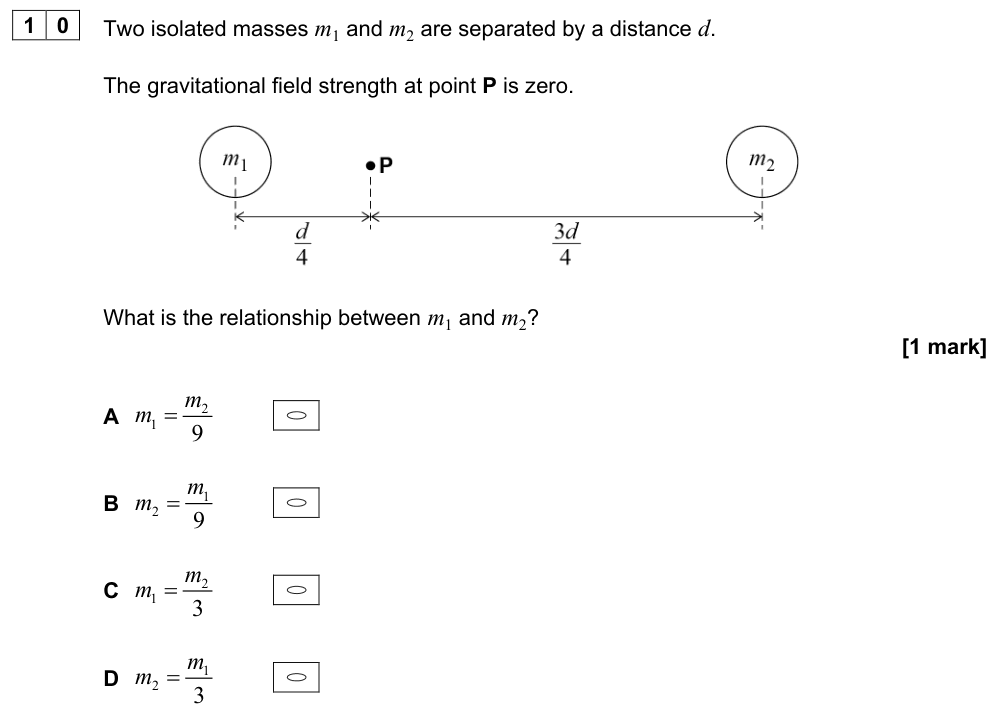
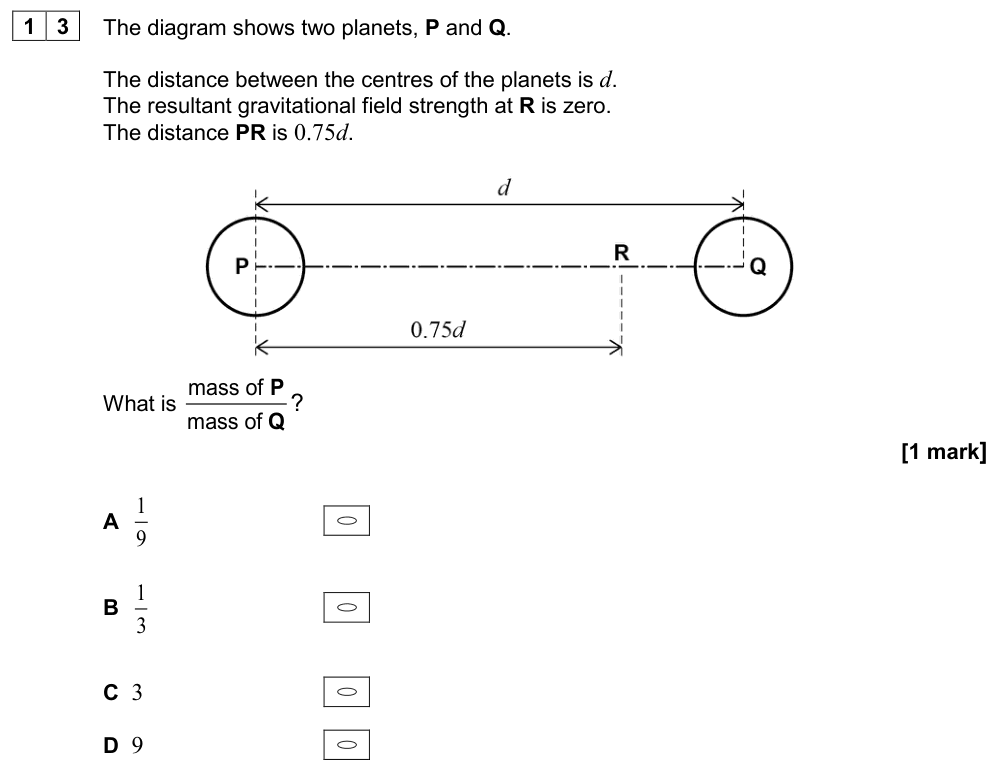
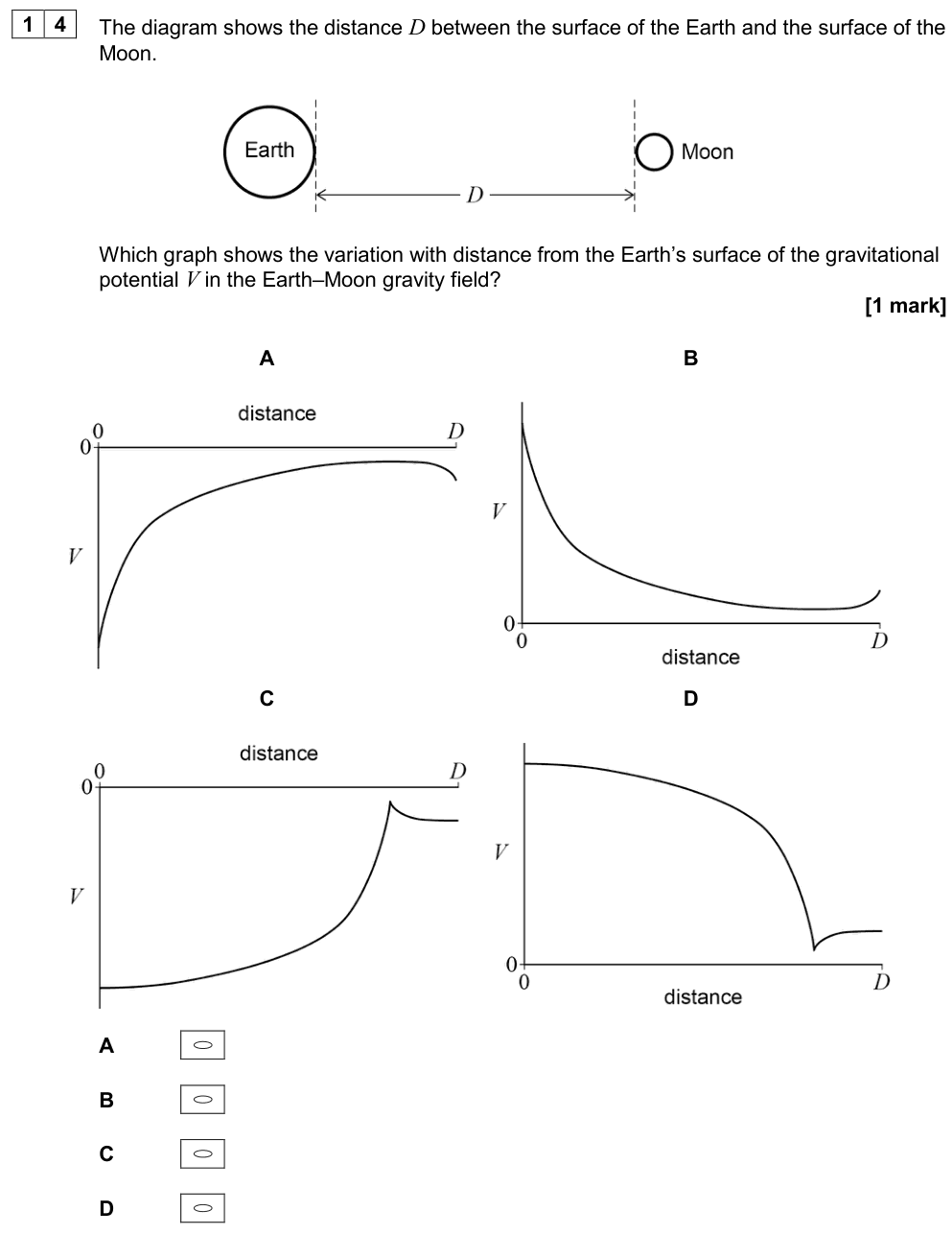
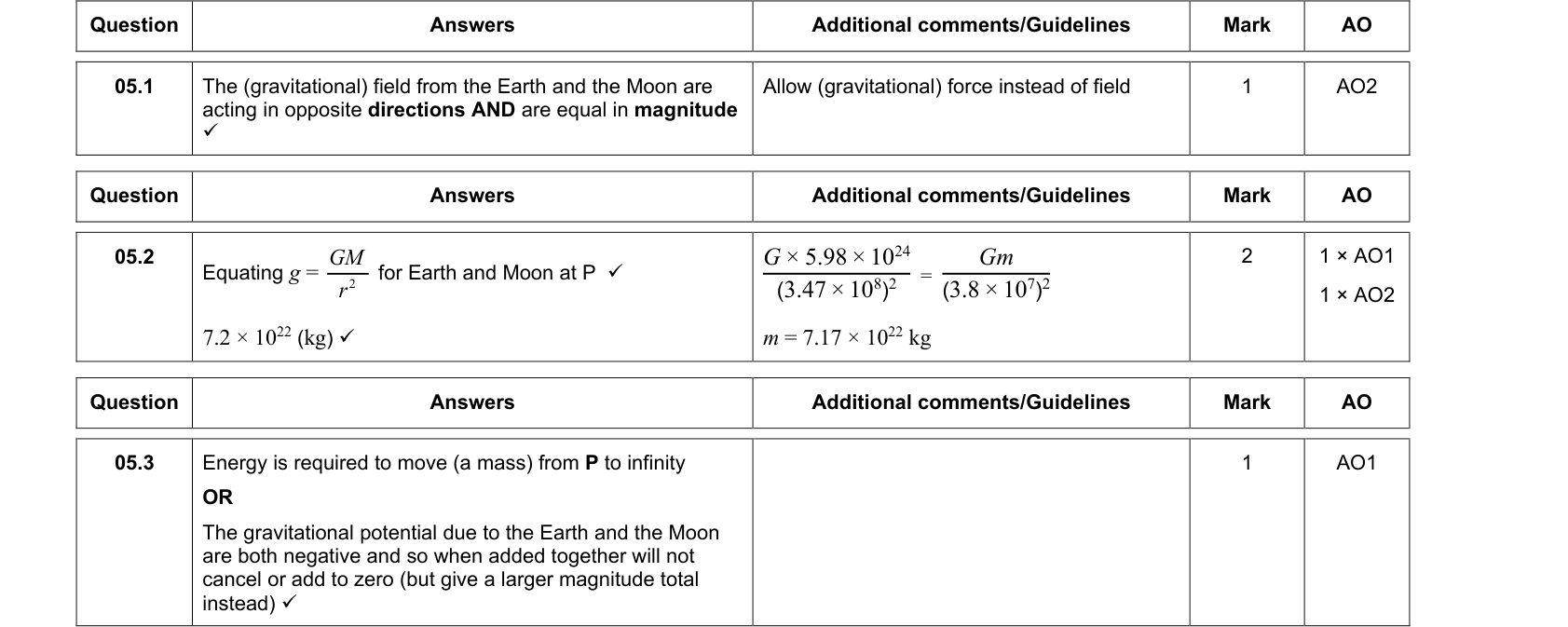
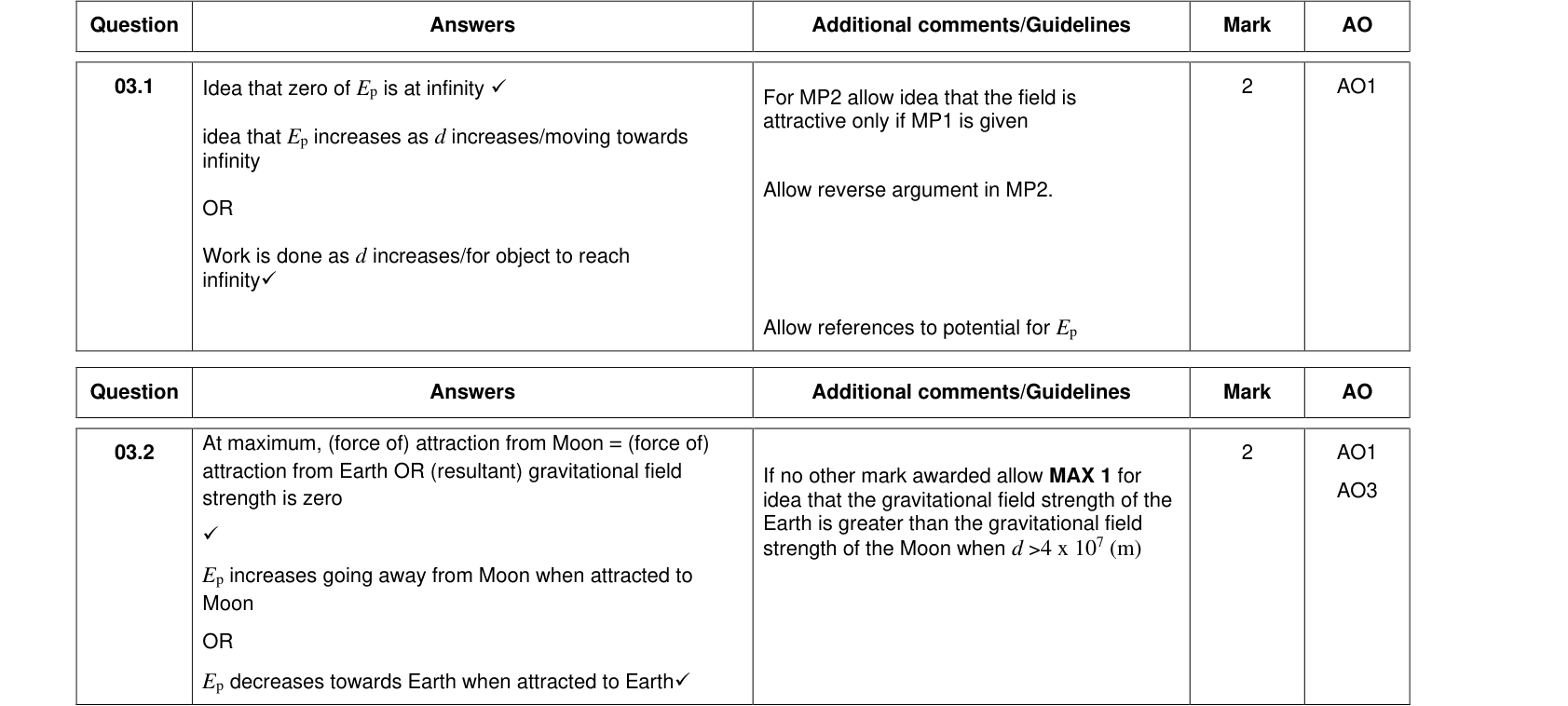
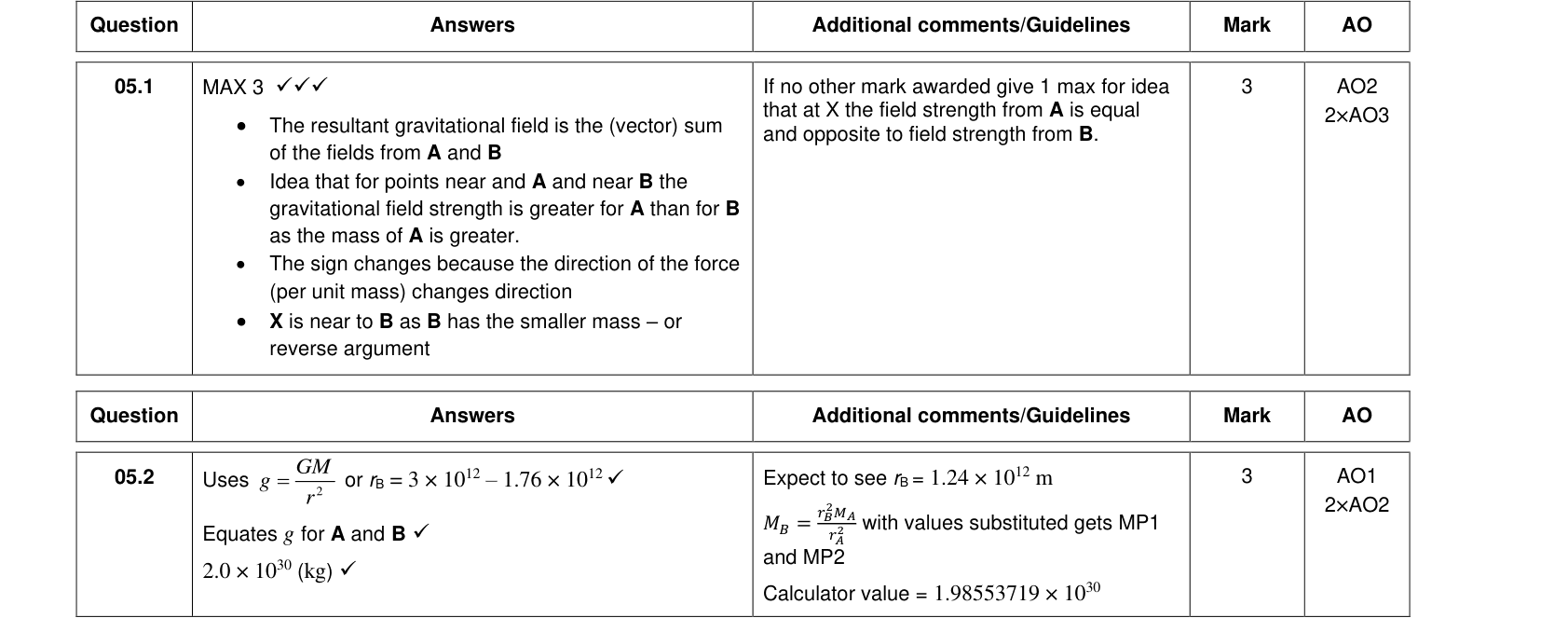
The total field at a point is the vector sum of the fields due to each mass. Between two masses the fields point in opposite directions, so there is a neutral point where the resultant field is zero:
$$\frac{GM_1}{r_1^2} = \frac{GM_2}{r_2^2} \quad\Rightarrow\quad \frac{r_1}{r_2} = \sqrt{\frac{M_1}{M_2}}$$
The neutral point is closer to the smaller mass.
Worked example: Earth–Moon neutral point
$M_E/M_M = 81$, so $r_E/r_M = 9$. The neutral point is $\tfrac{9}{10}$ of the way from the Earth to the Moon: $0.9 \times 3.84 \times 10^{8} = 3.46 \times 10^{8}$ m from the Earth's centre.
Gravity compared with other forces
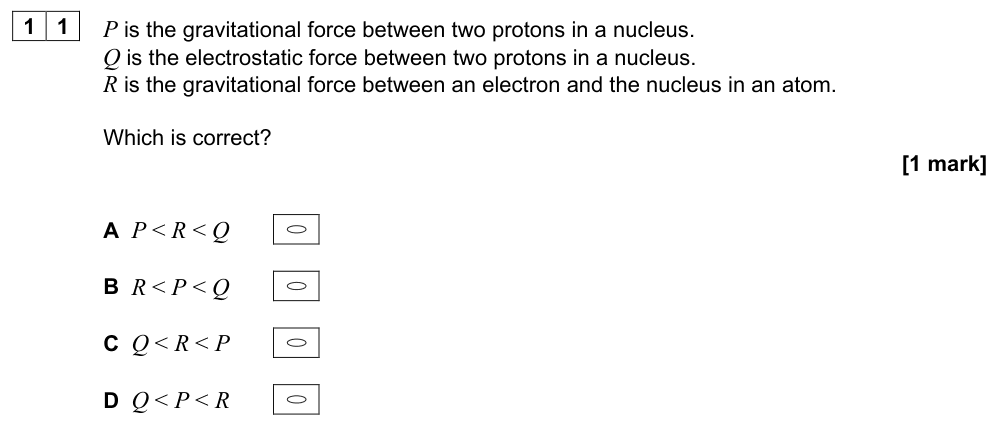
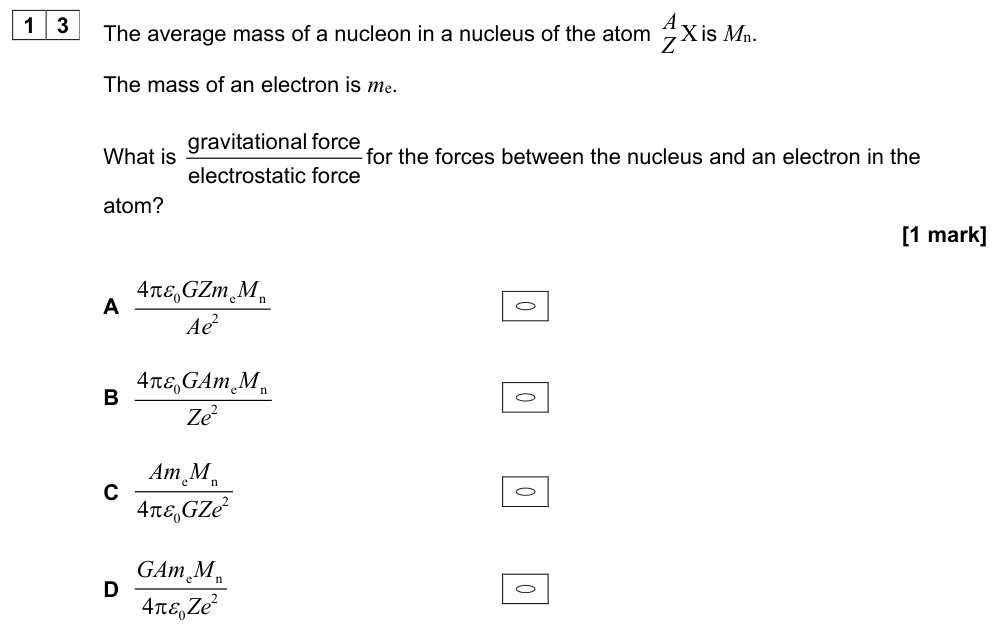
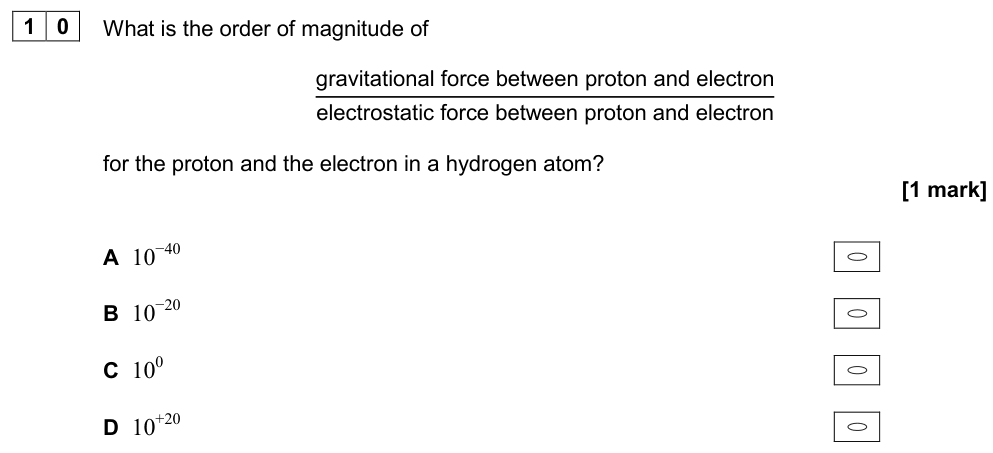
Between subatomic particles, gravity is utterly negligible compared with the electrostatic force. For two protons the electrostatic repulsion is about $10^{36}$ times larger than their gravitational attraction (see Coulomb's law). Gravity dominates on large scales only because matter is overall electrically neutral, while every piece of mass attracts every other.
Summary
- $F = Gm_1m_2/r^2$; always attractive; $r$ measured between centres.
- Field strength $g = F/m$ (N kg⁻¹); radial field $g = GM/r^2$; uniform near the surface.
- Field lines show the direction of the force on a mass; closer lines = stronger field.
- $g \propto 1/r^2$ outside a planet; $M = g_0R^2/G$; neutral point where $GM_1/r_1^2 = GM_2/r_2^2$.