Circular orbits
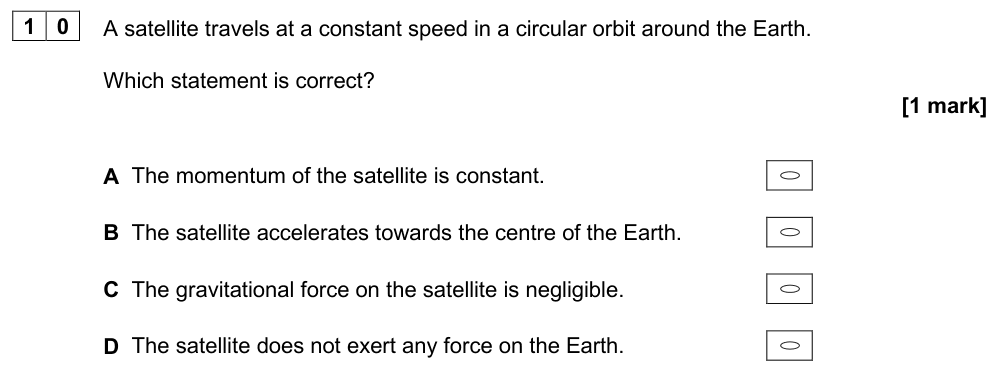
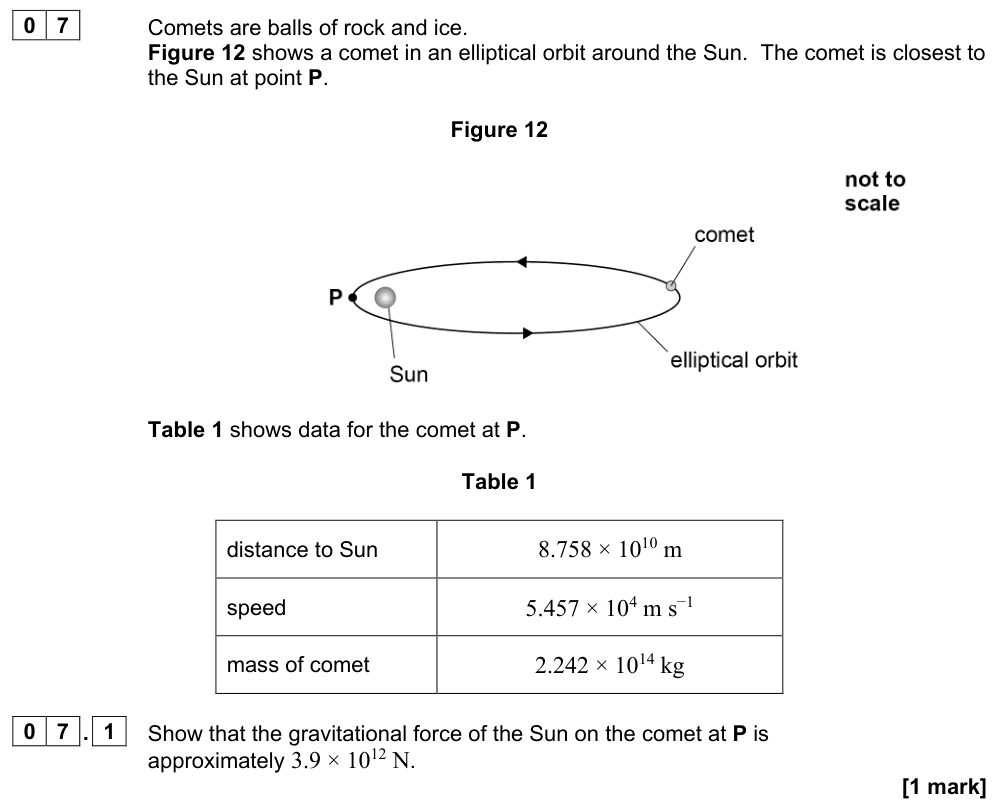
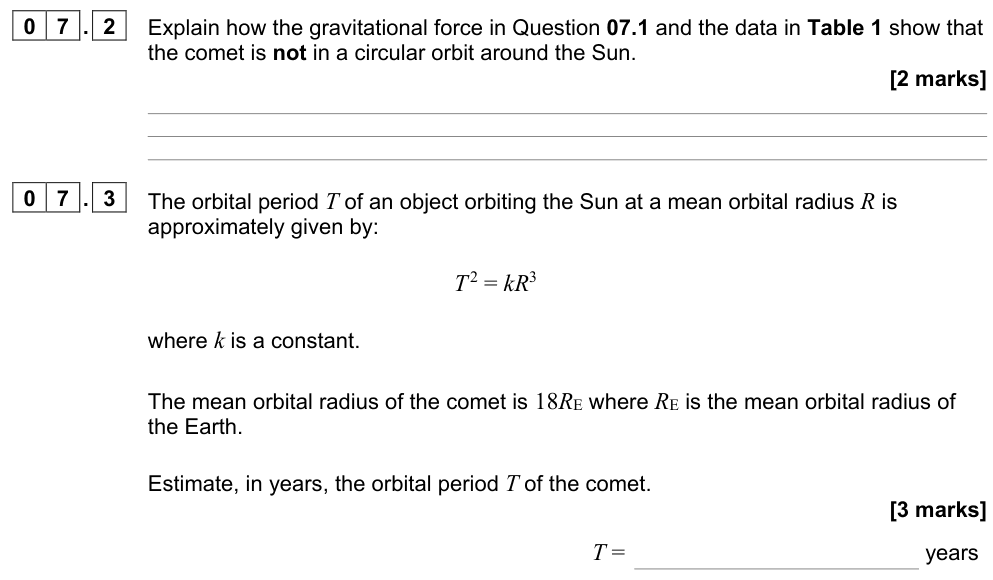
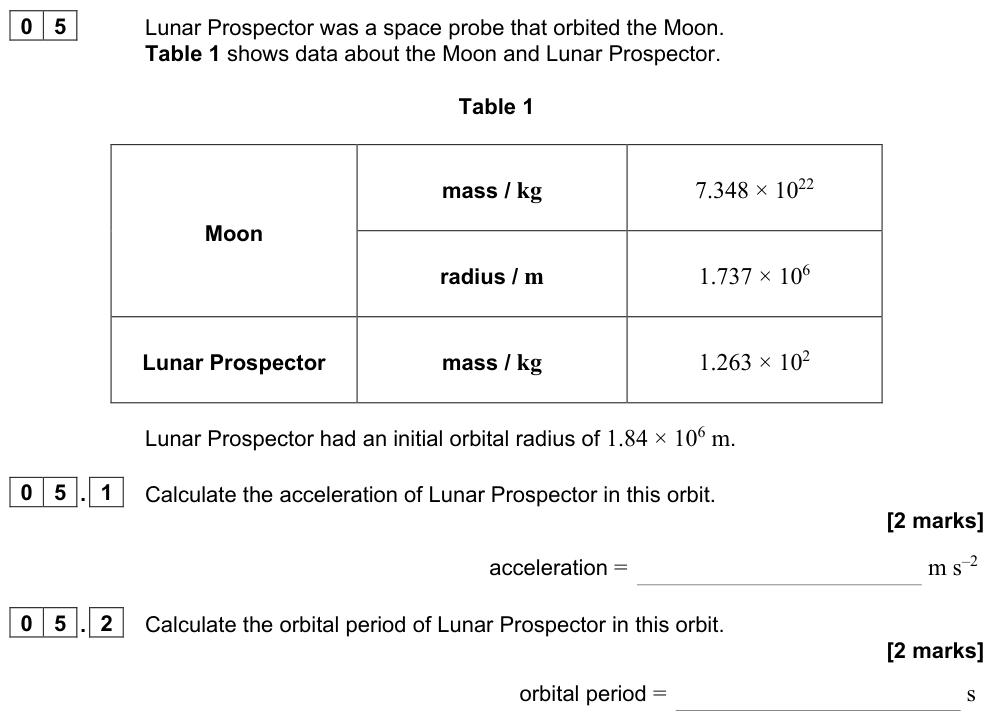
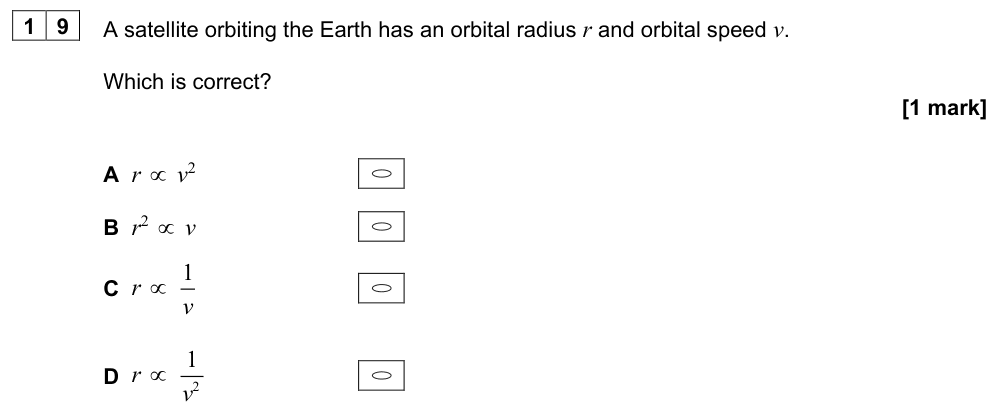
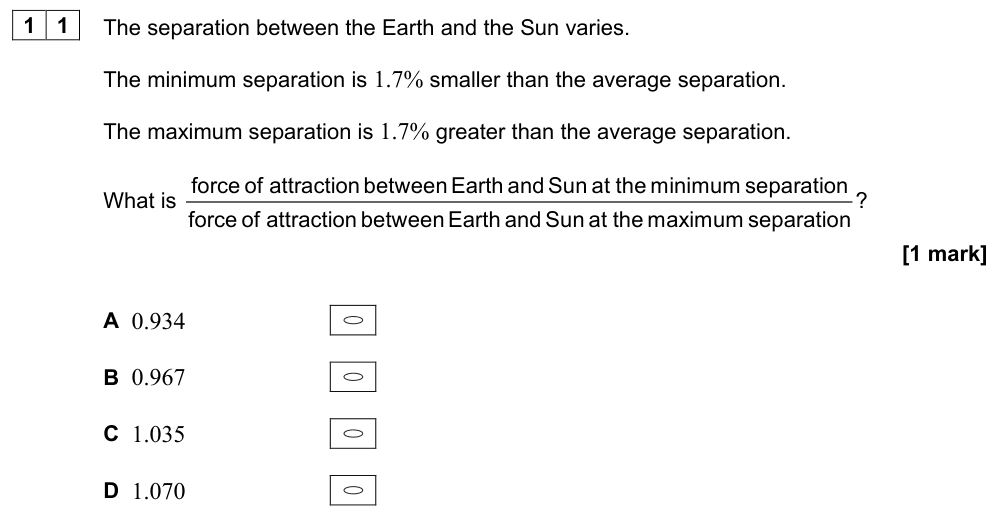
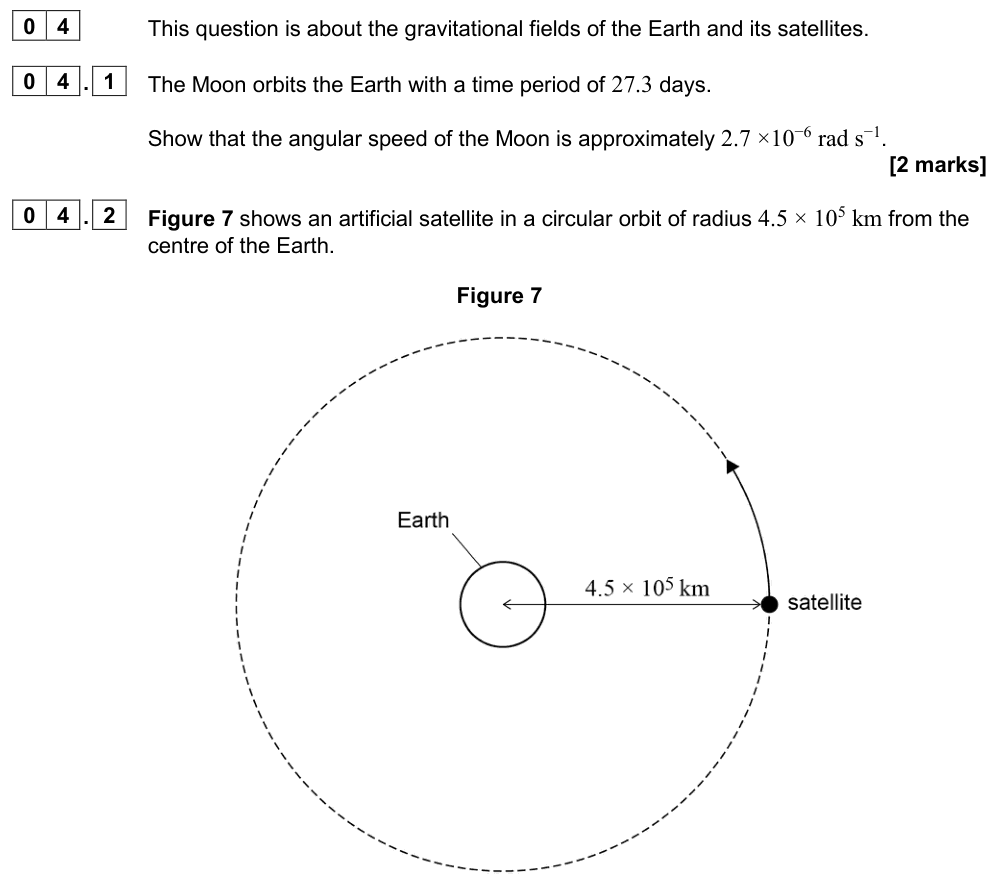
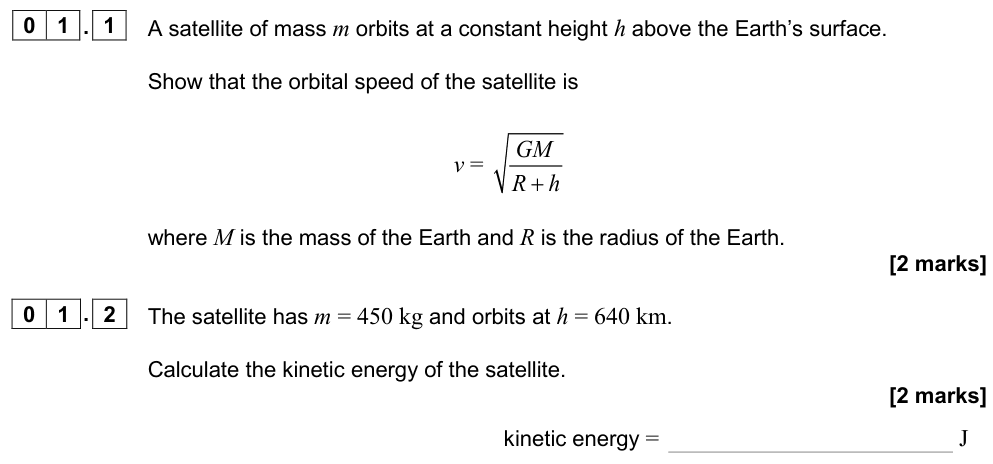
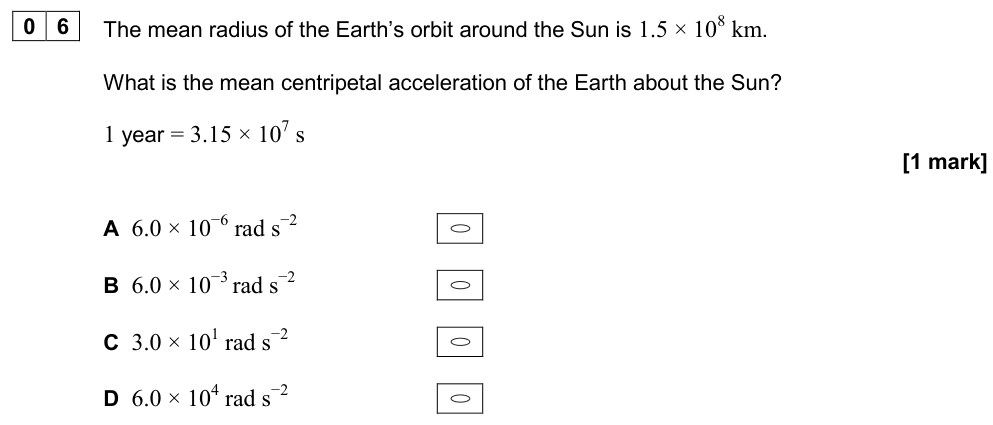
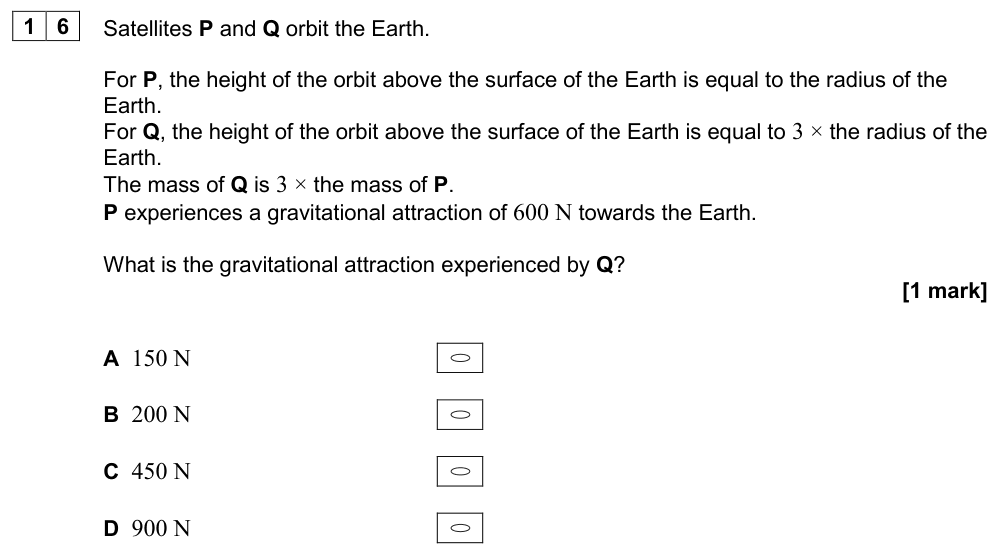
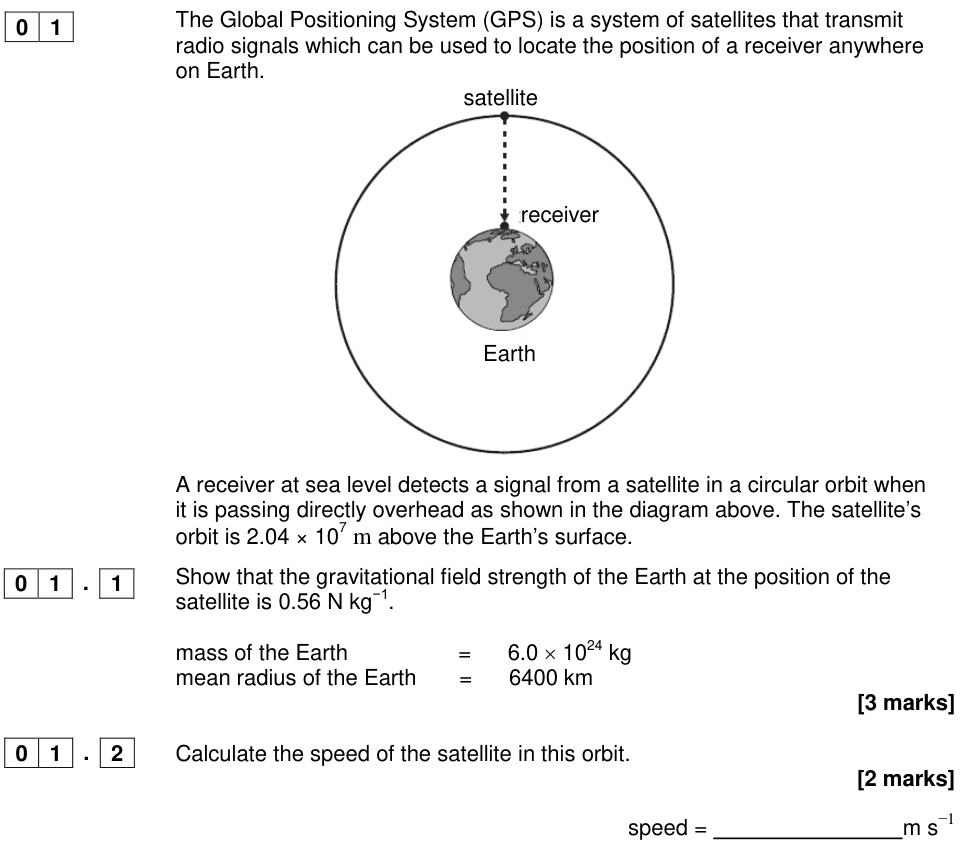
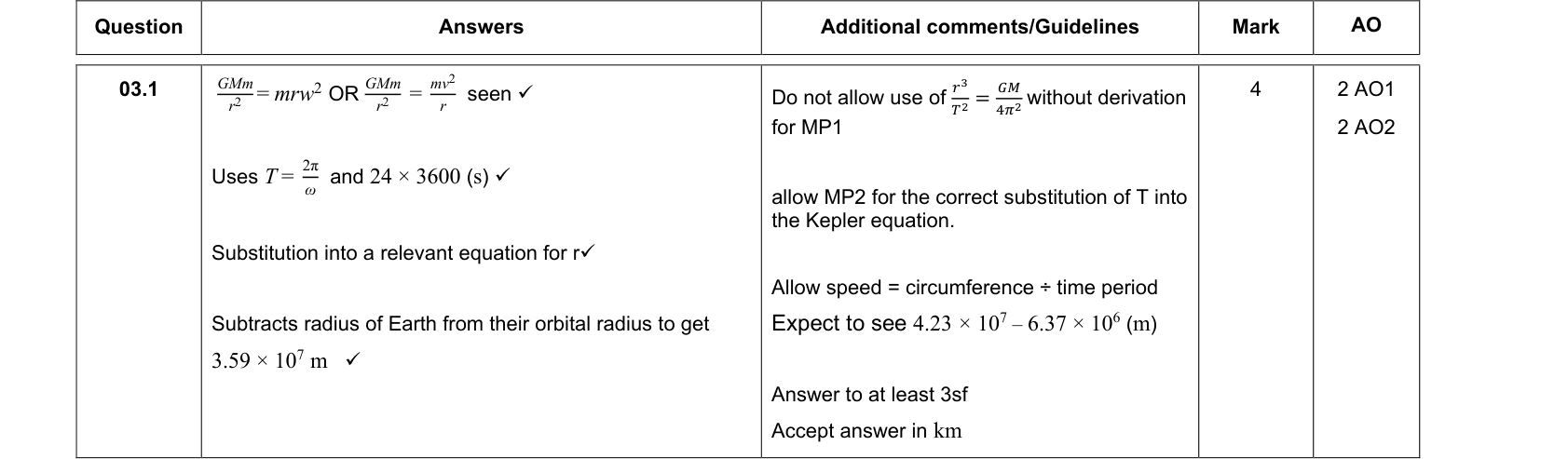
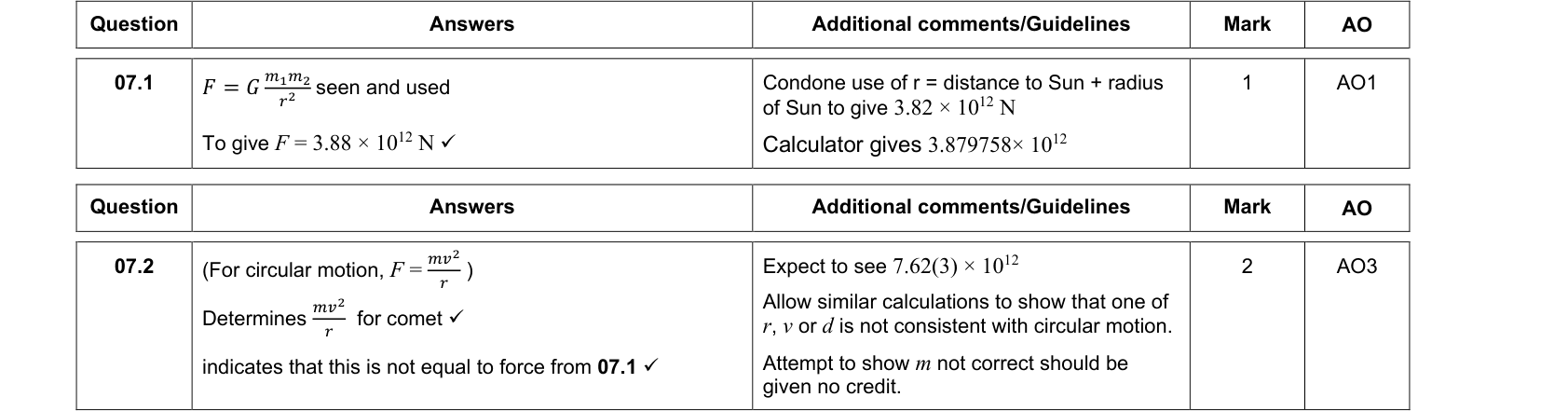
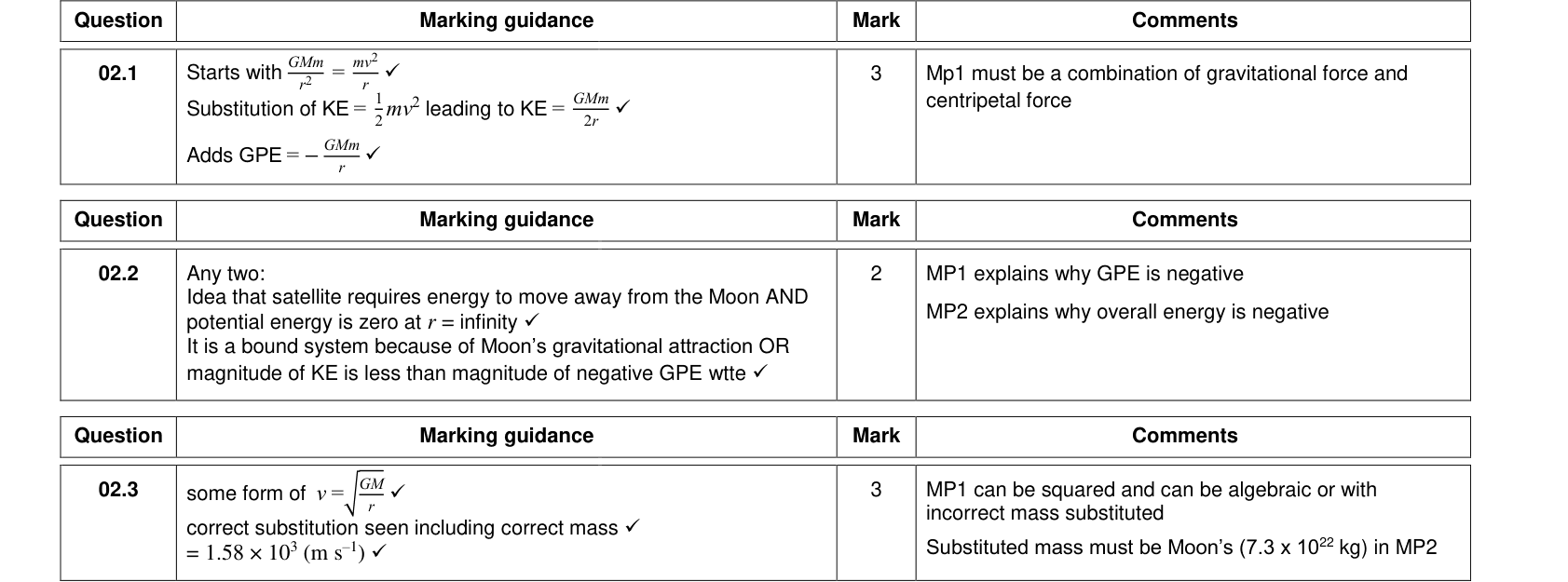
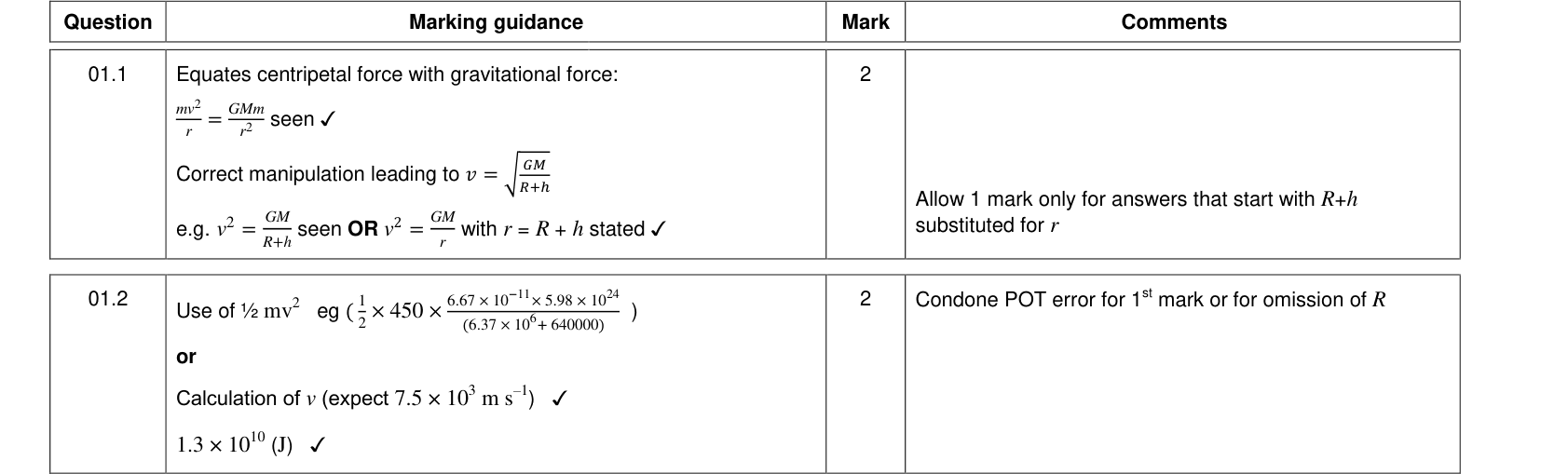
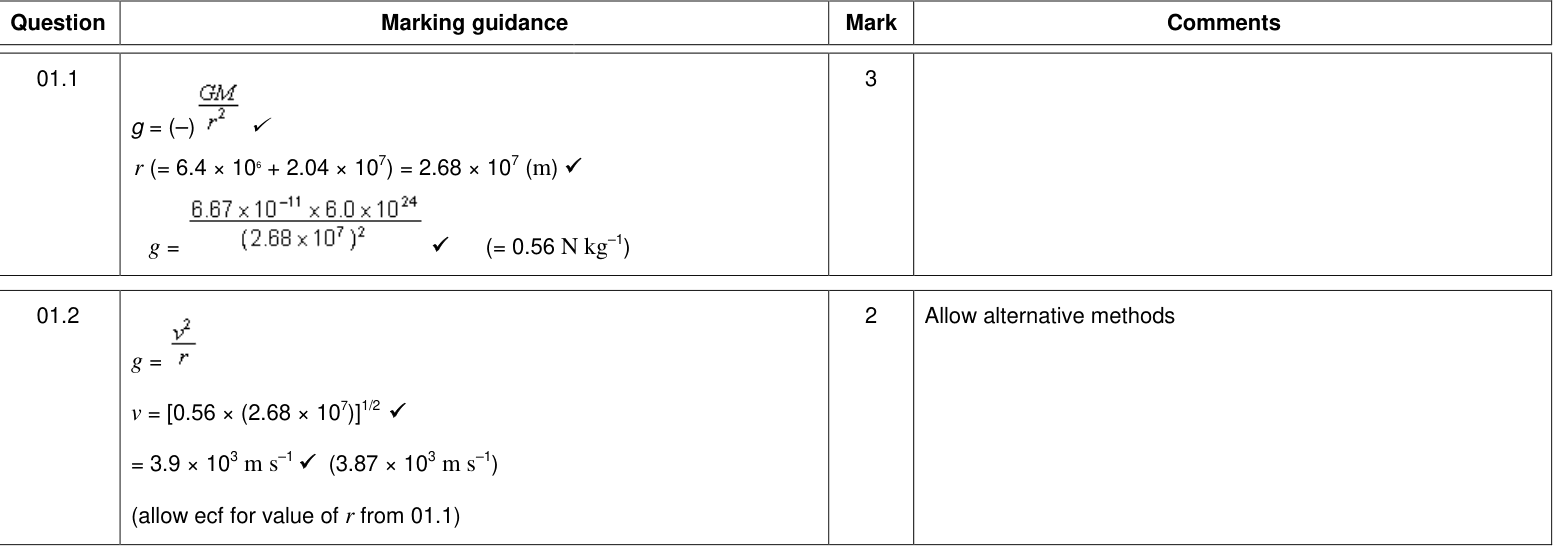
For a planet or satellite in a circular orbit, the gravitational force provides the centripetal force:
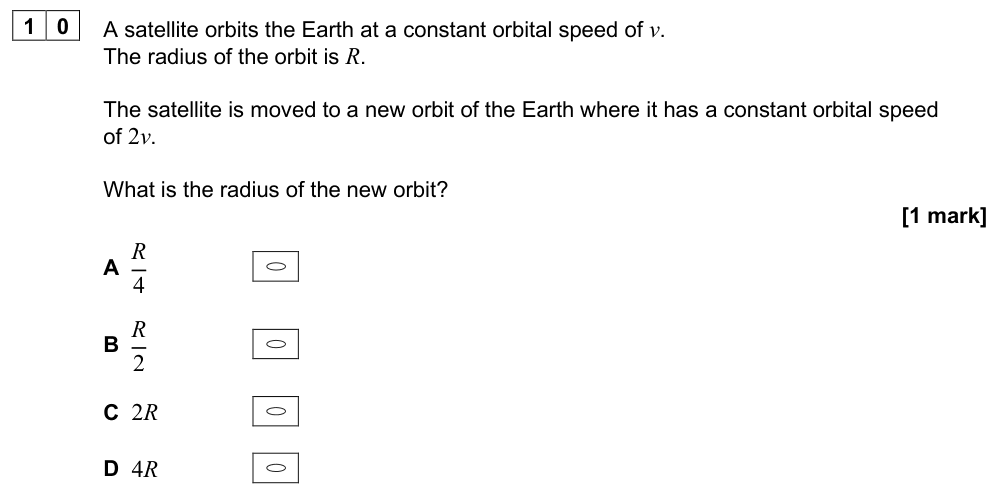
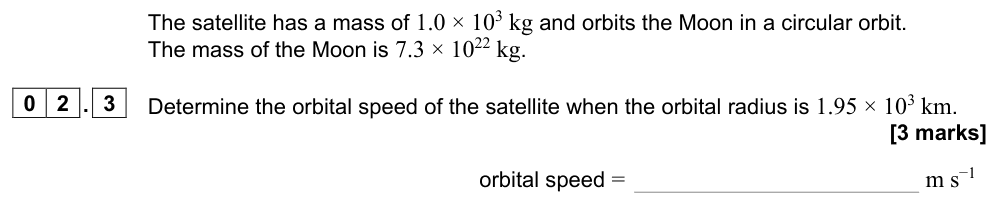
$$\frac{GMm}{r^2} = \frac{mv^2}{r}$$
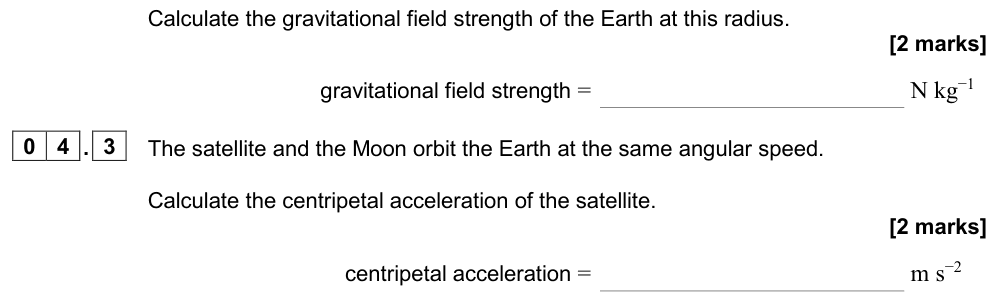
where $M$ is the mass of the central body and $r$ is the orbital radius, measured from the centre of the central body (not from its surface).
Orbital speed and period
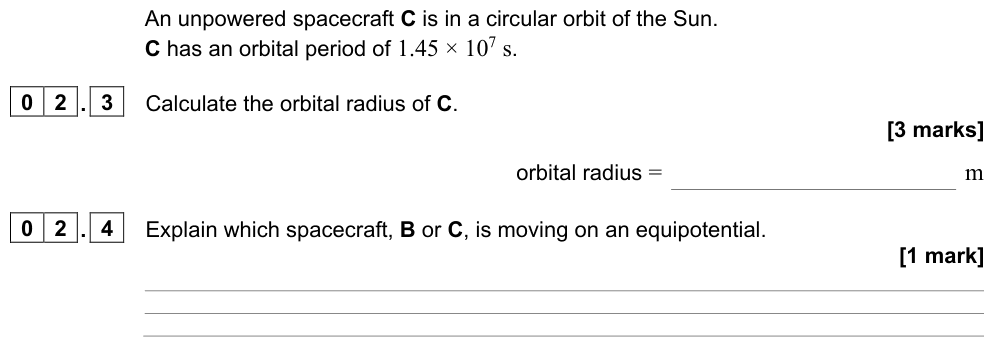
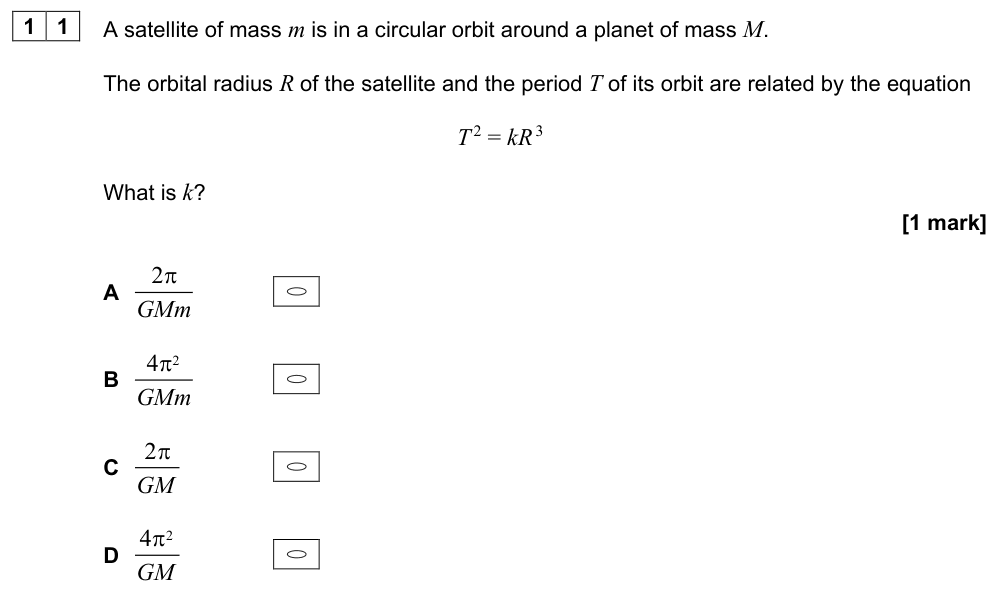
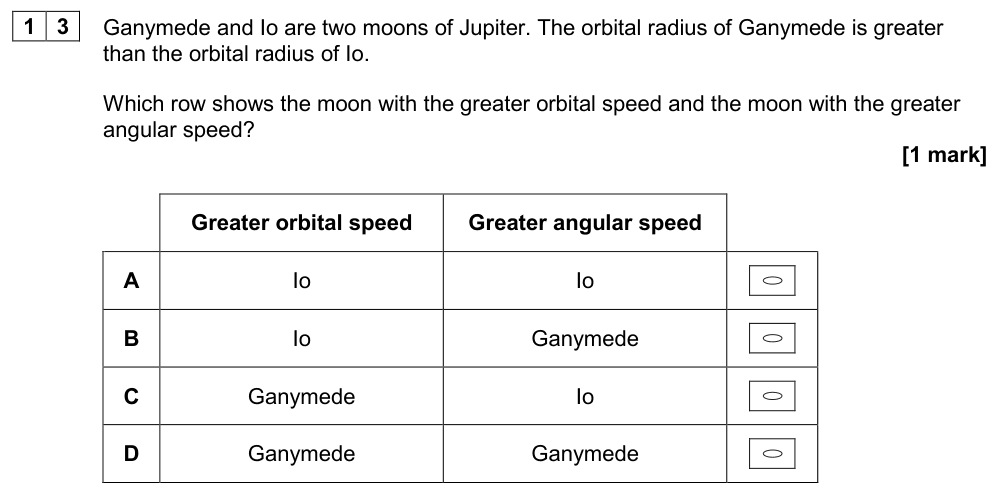
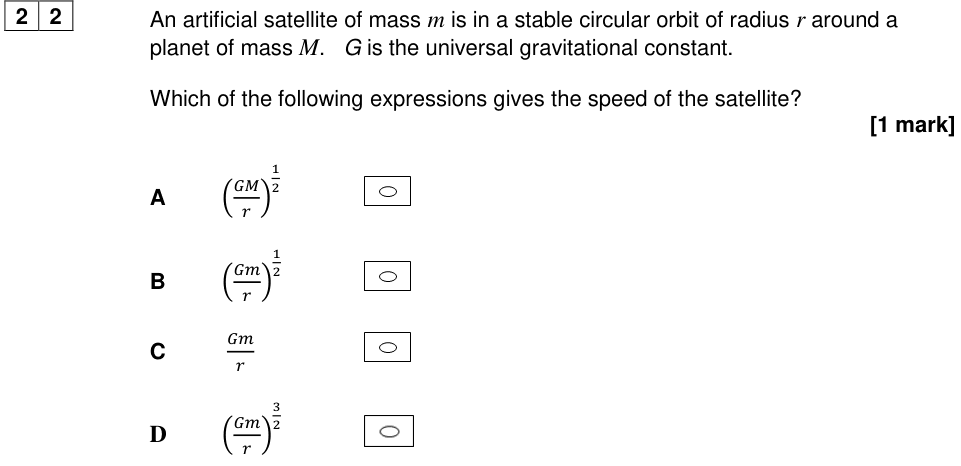
$$v = \sqrt{\frac{GM}{r}} \qquad\qquad T = \frac{2\pi r}{v} \quad\Rightarrow\quad T^2 = \frac{4\pi^2}{GM}r^3$$
- The orbital speed decreases as the radius increases ($v \propto 1/\sqrt{r}$).
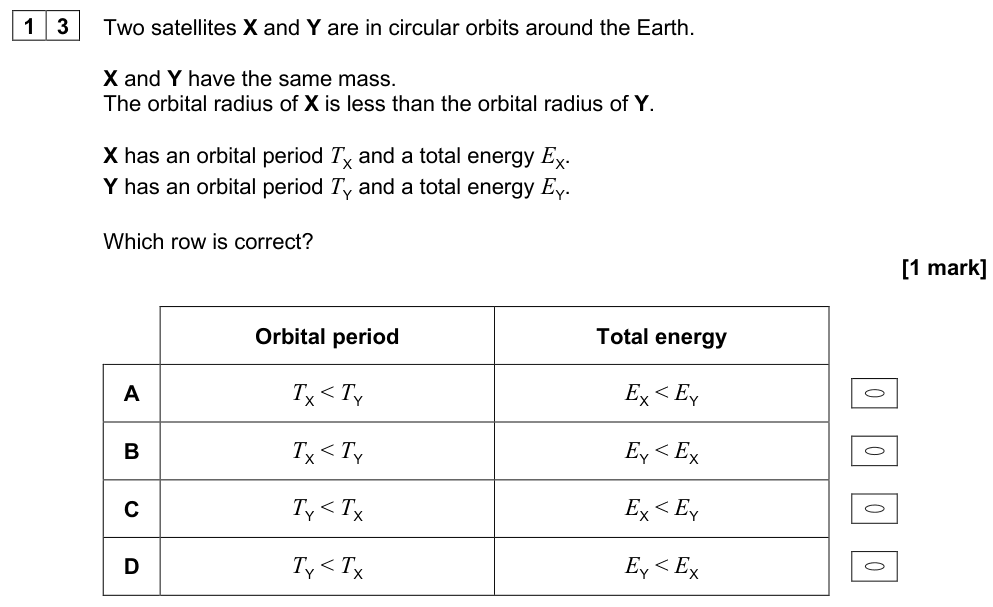
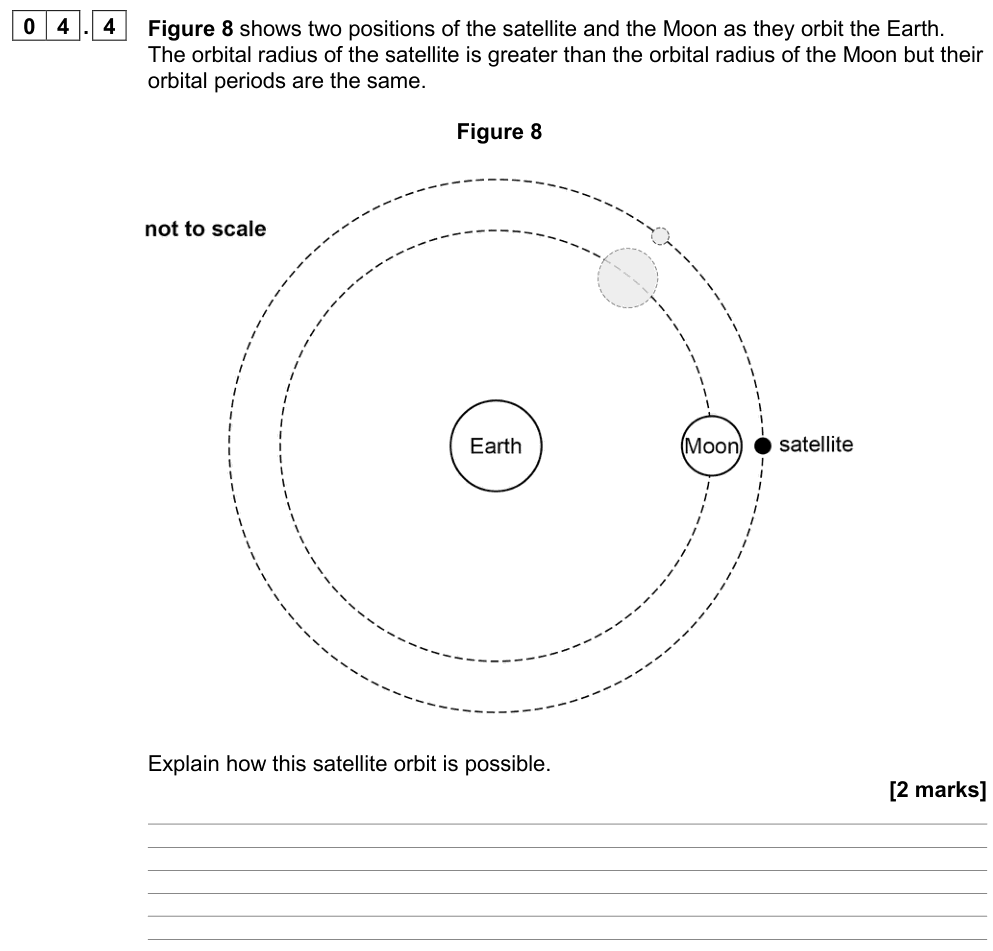
- The period increases with radius: $T^2 \propto r^3$ (Kepler's third law).
- Neither depends on the mass $m$ of the satellite.
Worked example: orbit of the ISS
The ISS orbits at a height of 420 km. $r = 6.37 \times 10^{6} + 4.2 \times 10^{5} = 6.79 \times 10^{6}$ m, $GM_E = 3.98 \times 10^{14}$.
$v = \sqrt{\dfrac{3.98 \times 10^{14}}{6.79 \times 10^{6}}} = 7.66 \times 10^{3}\ \text{m s}^{-1}$; $T = \dfrac{2\pi \times 6.79 \times 10^{6}}{7.66 \times 10^{3}} = 5570\ \text{s} \approx 93$ minutes.
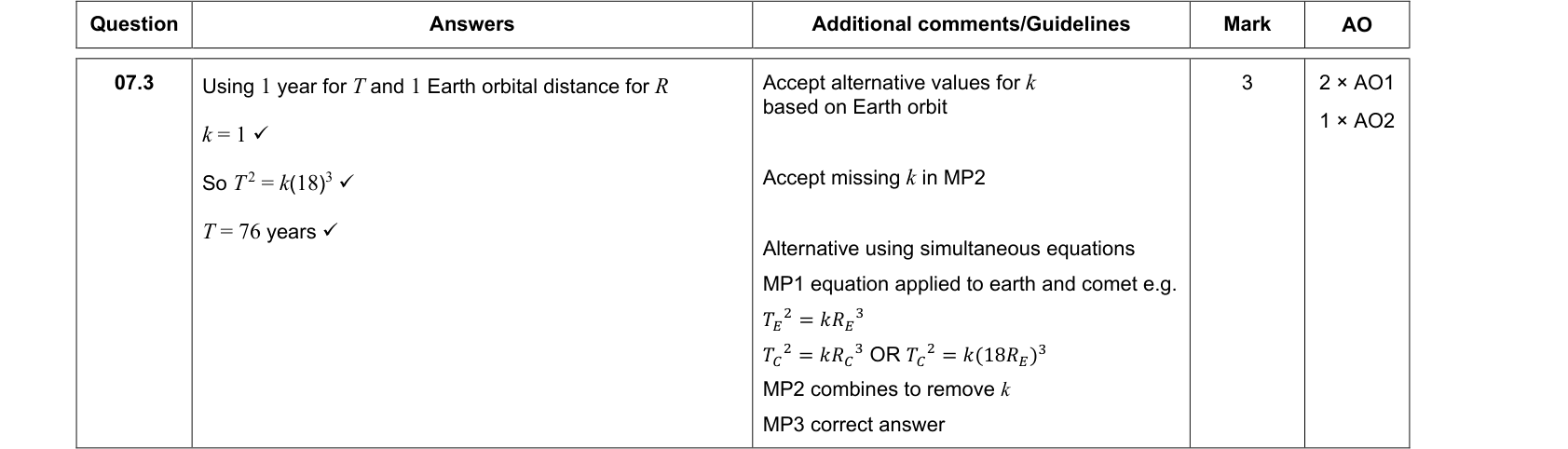
Using T² ∝ r³
For two satellites of the same planet, $\dfrac{T_1^2}{r_1^3} = \dfrac{T_2^2}{r_2^3}$. A satellite at 4 times the radius has a period $4^{3/2} = 8$ times longer. A graph of $T^2$ against $r^3$ is a straight line through the origin with gradient $4\pi^2/GM$, which can be used to find the mass of the central body.
Energy of an orbiting satellite
Energies in a circular orbit
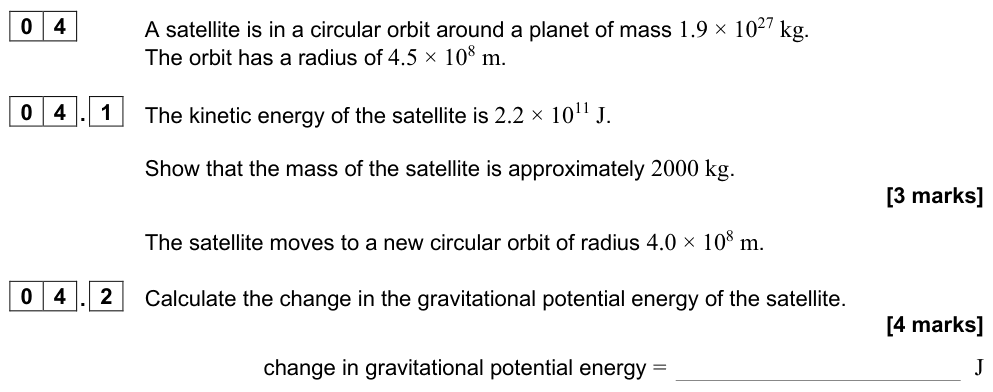
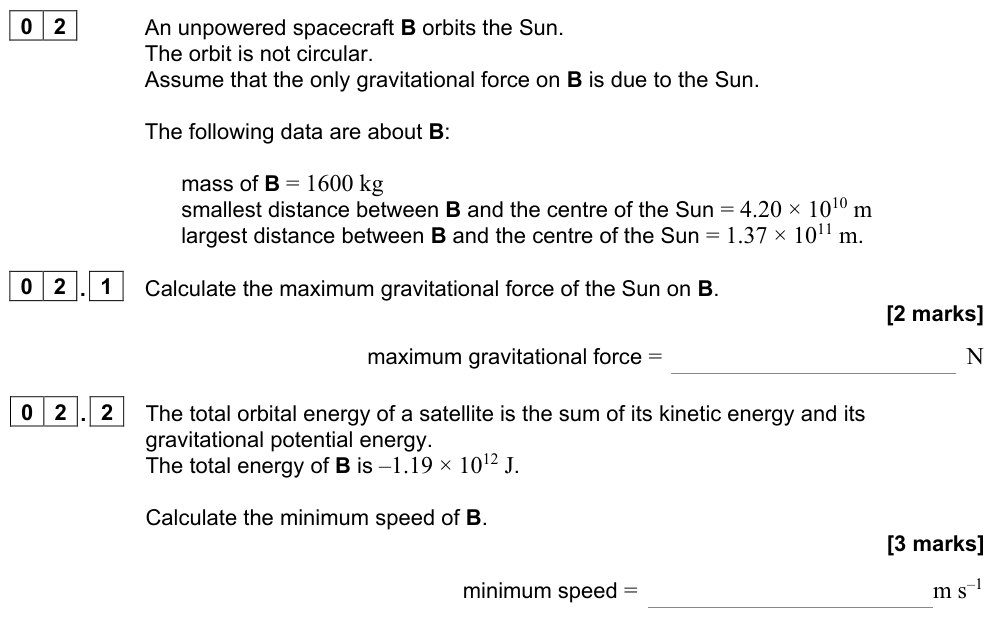
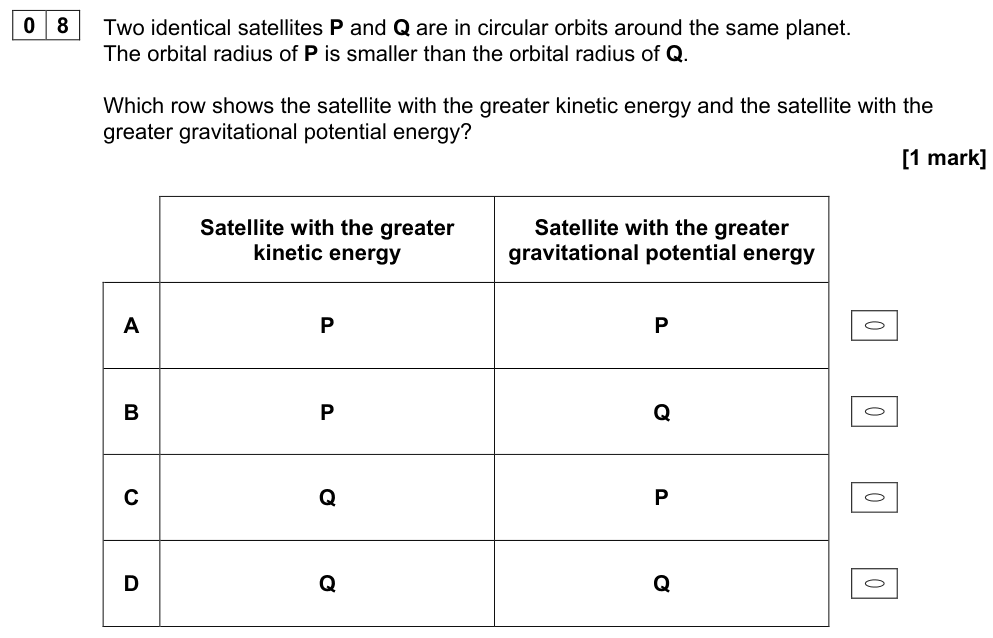
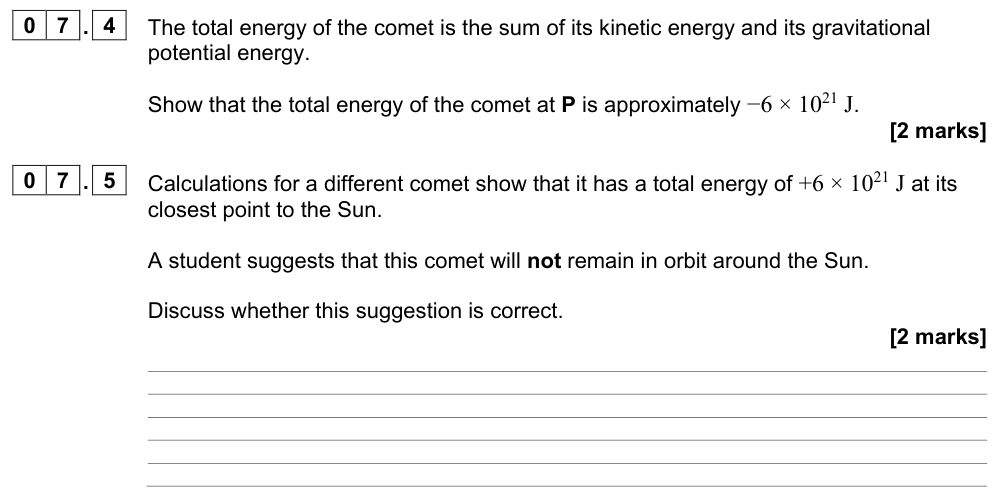
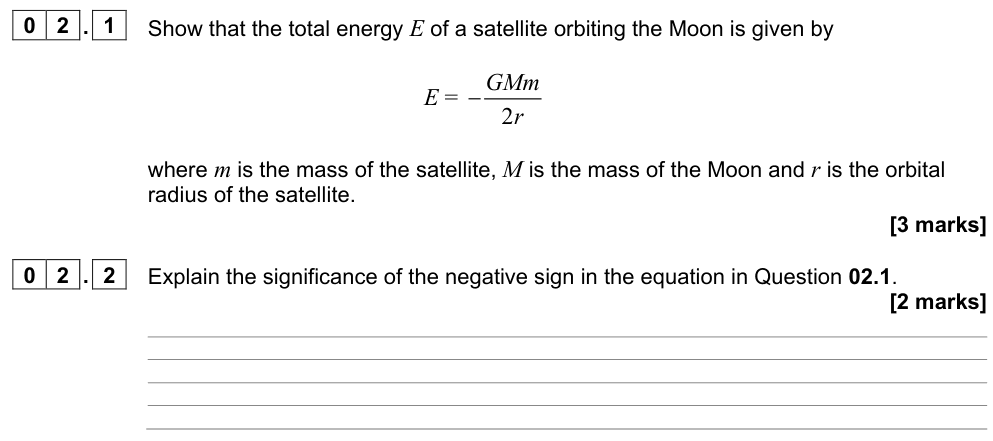
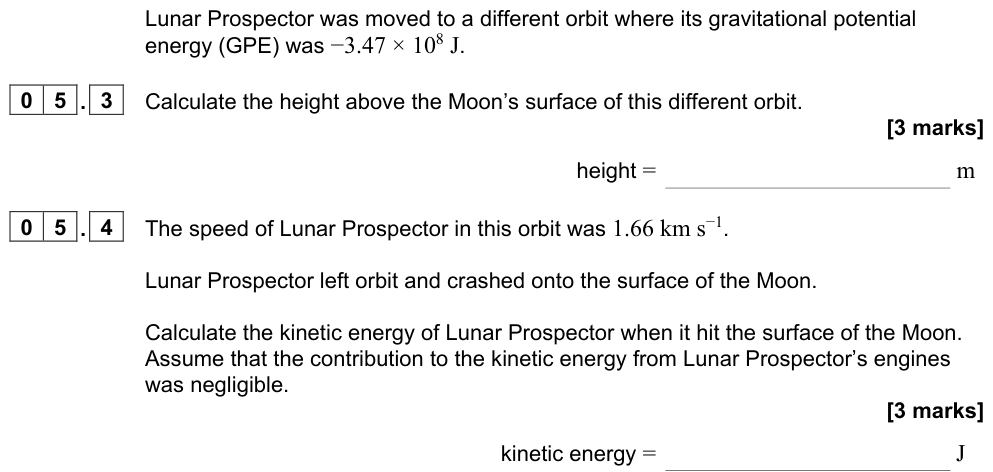
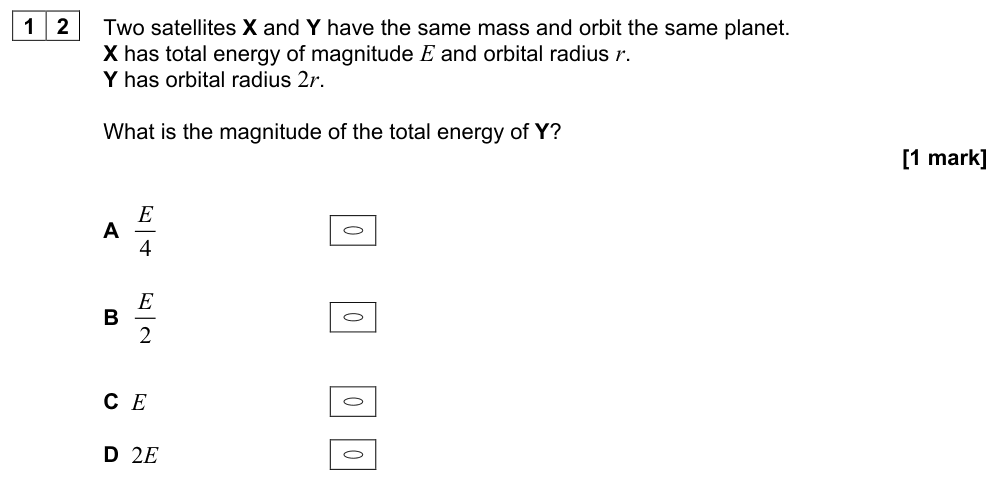
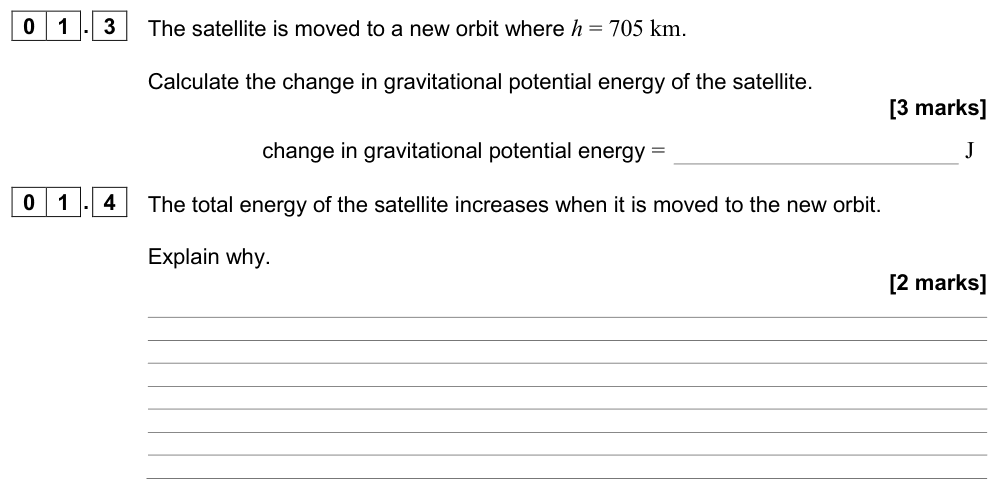
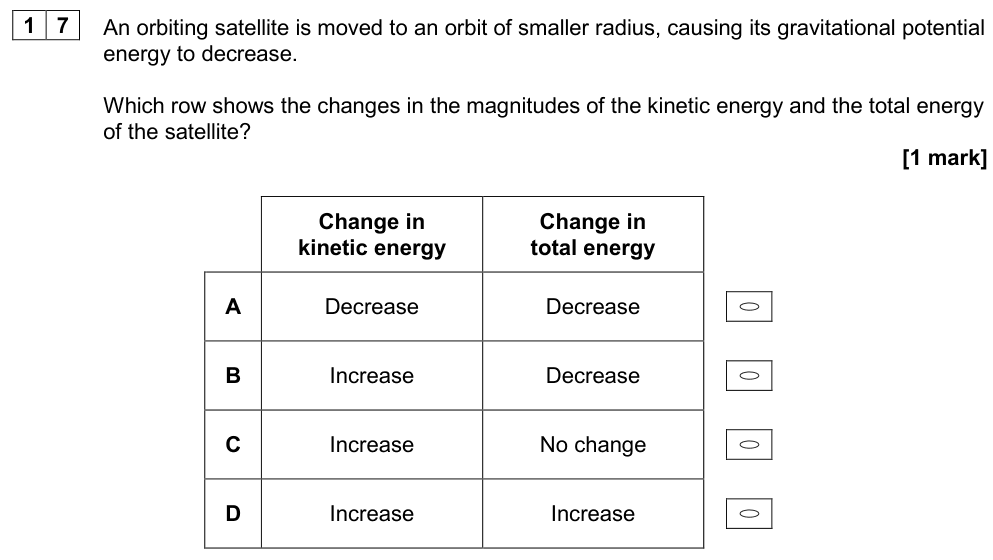
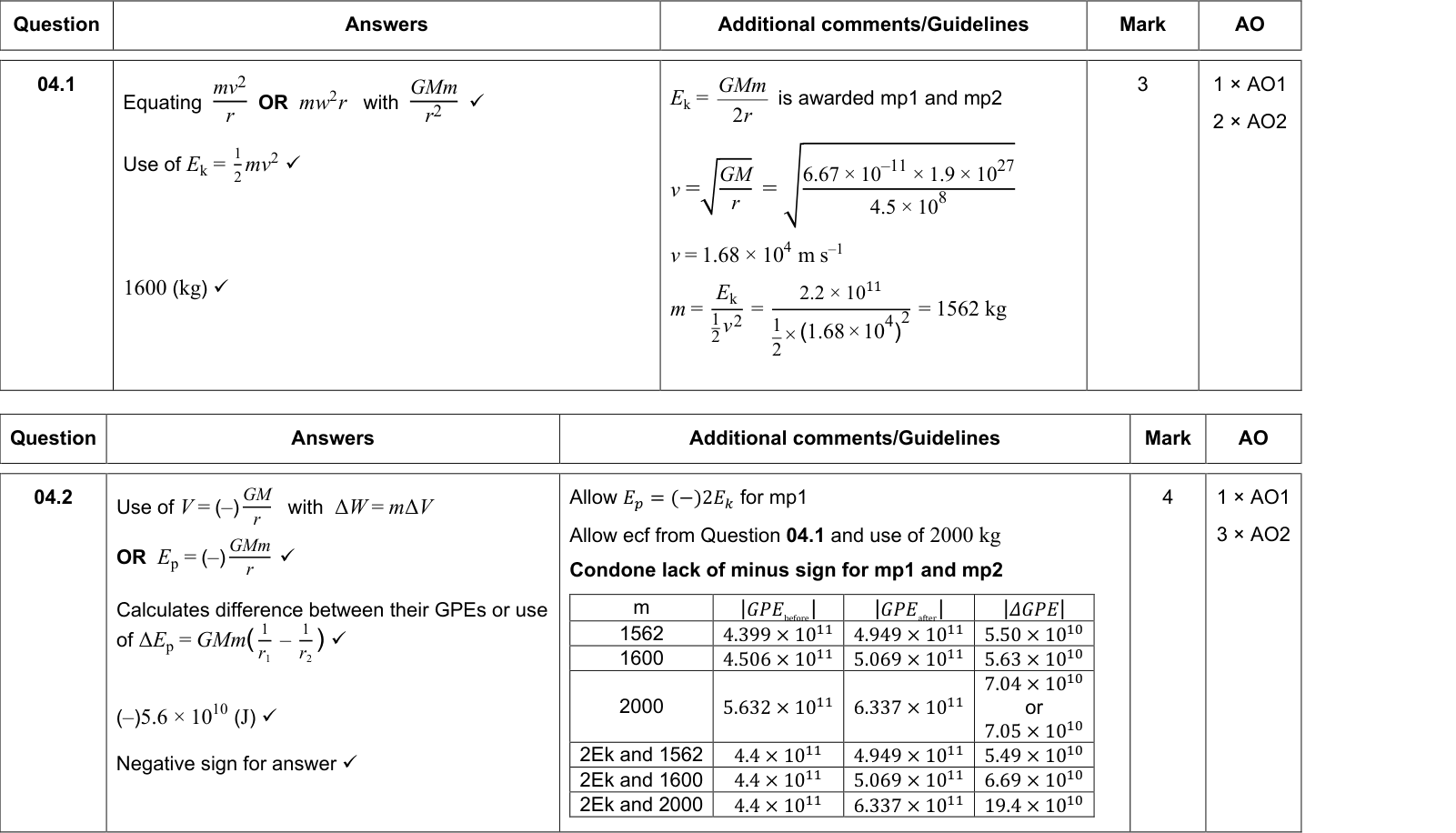
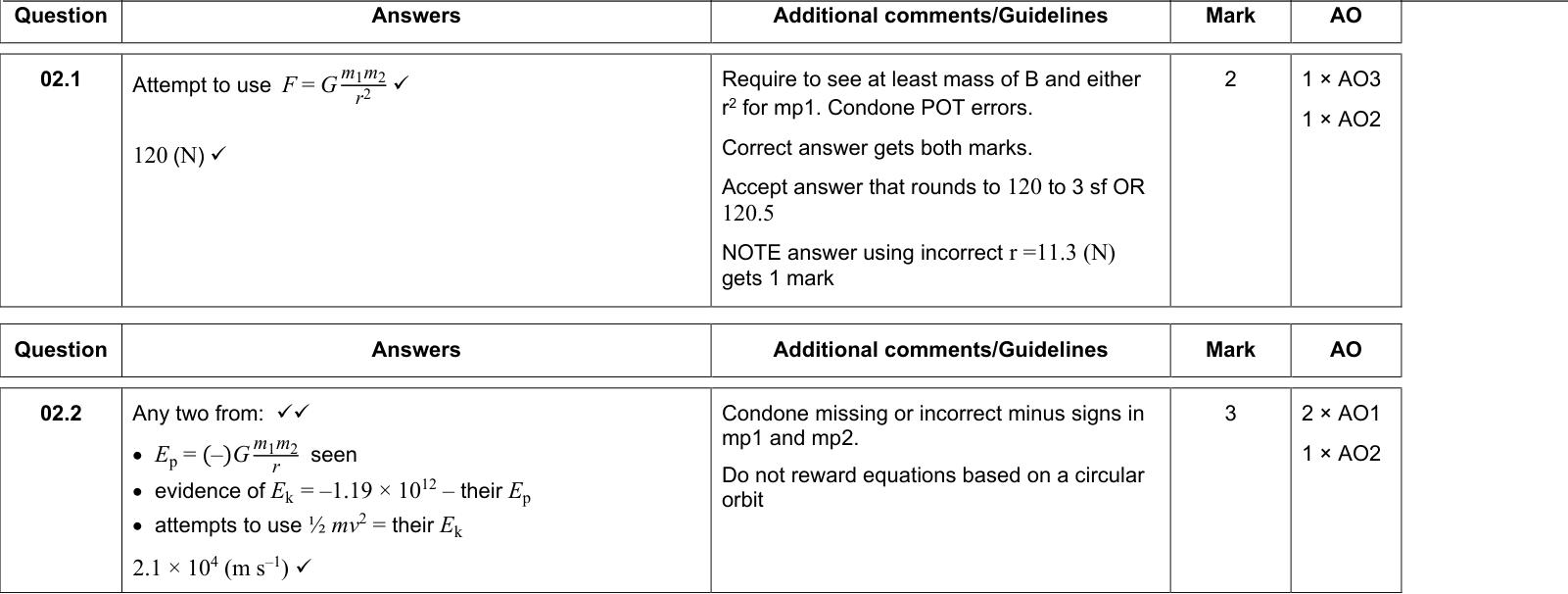
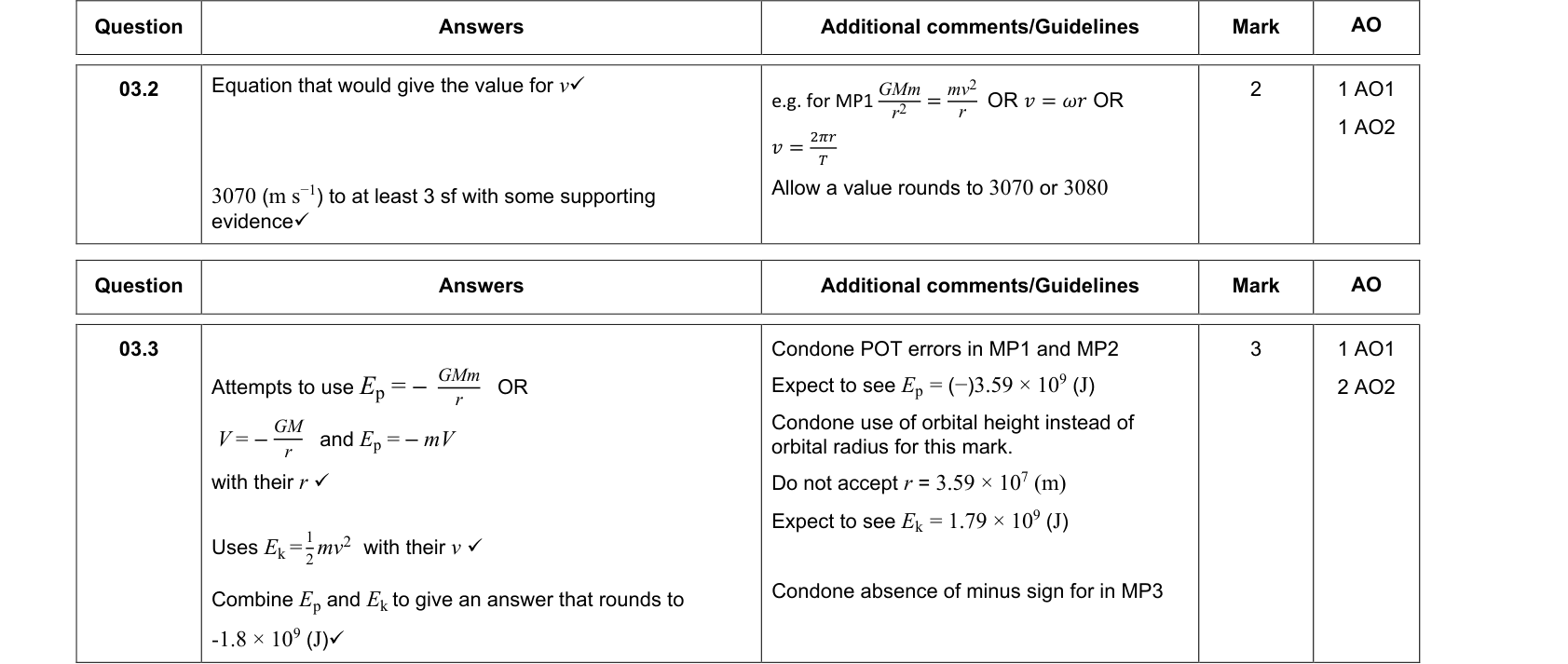
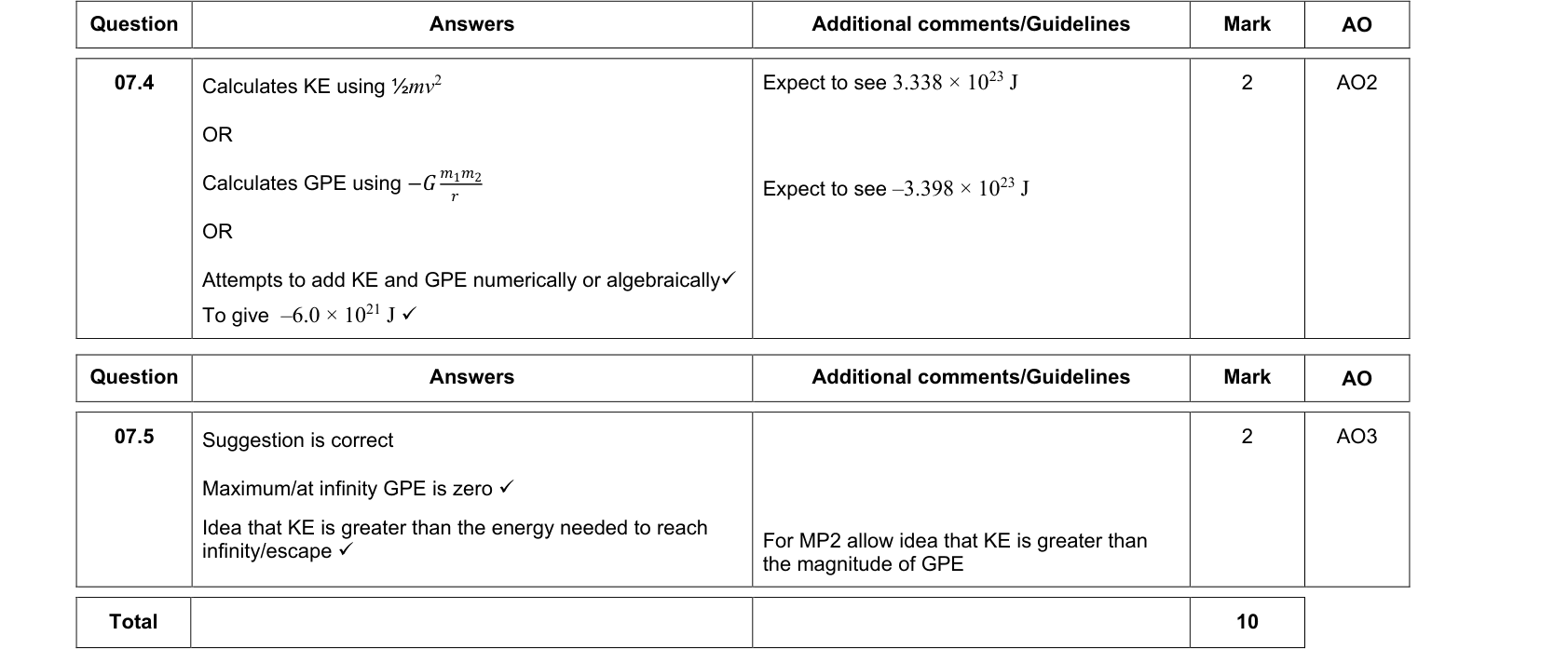
Kinetic energy: $\quad E_k = \tfrac12mv^2 = \dfrac{GMm}{2r}$
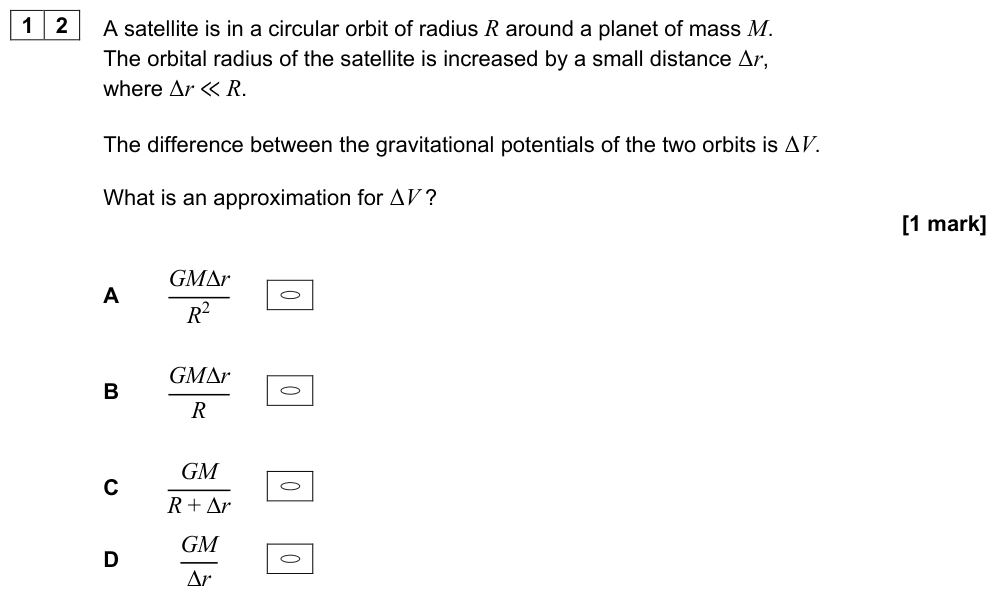
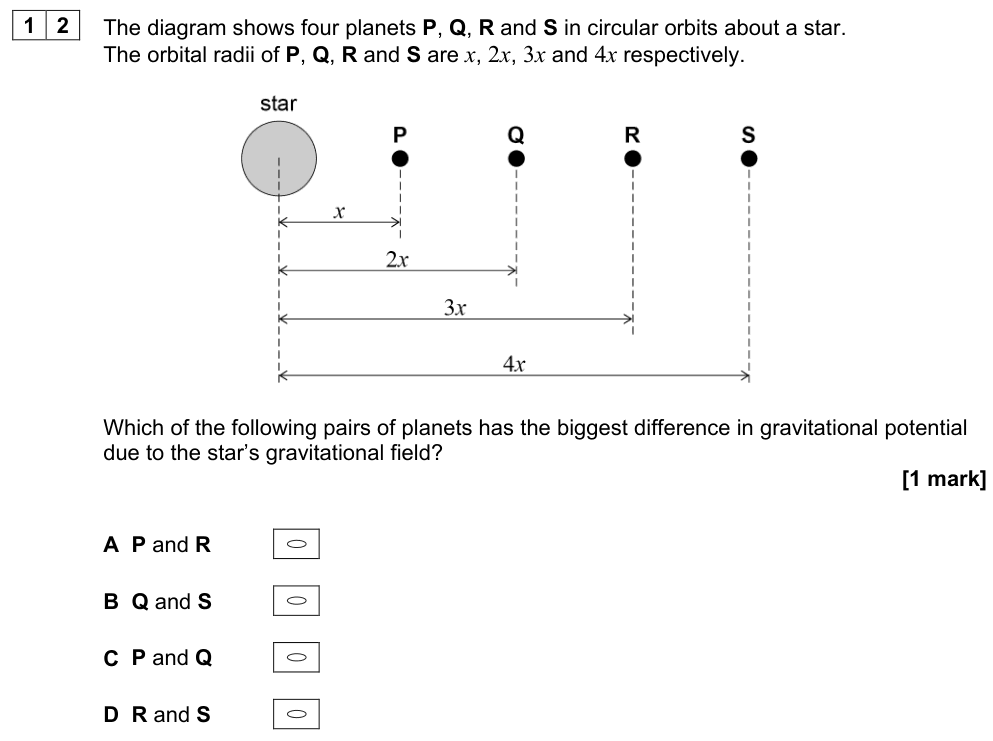
Potential energy: $\quad E_p = -\dfrac{GMm}{r}$
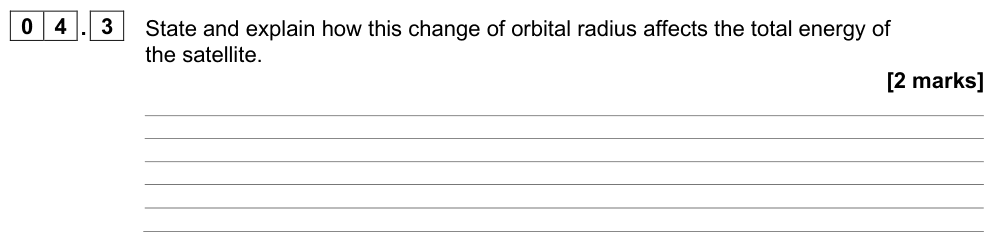
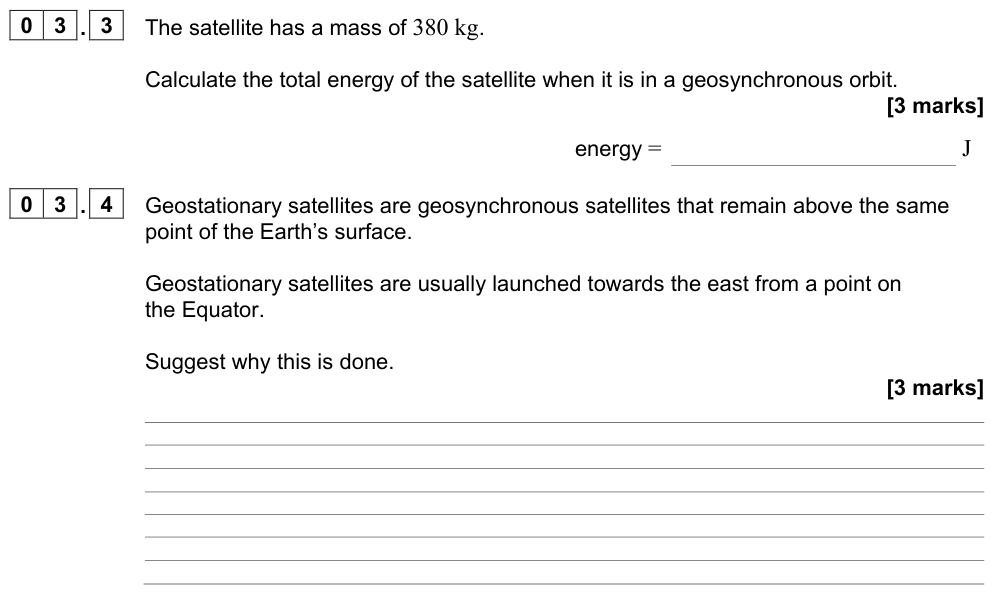
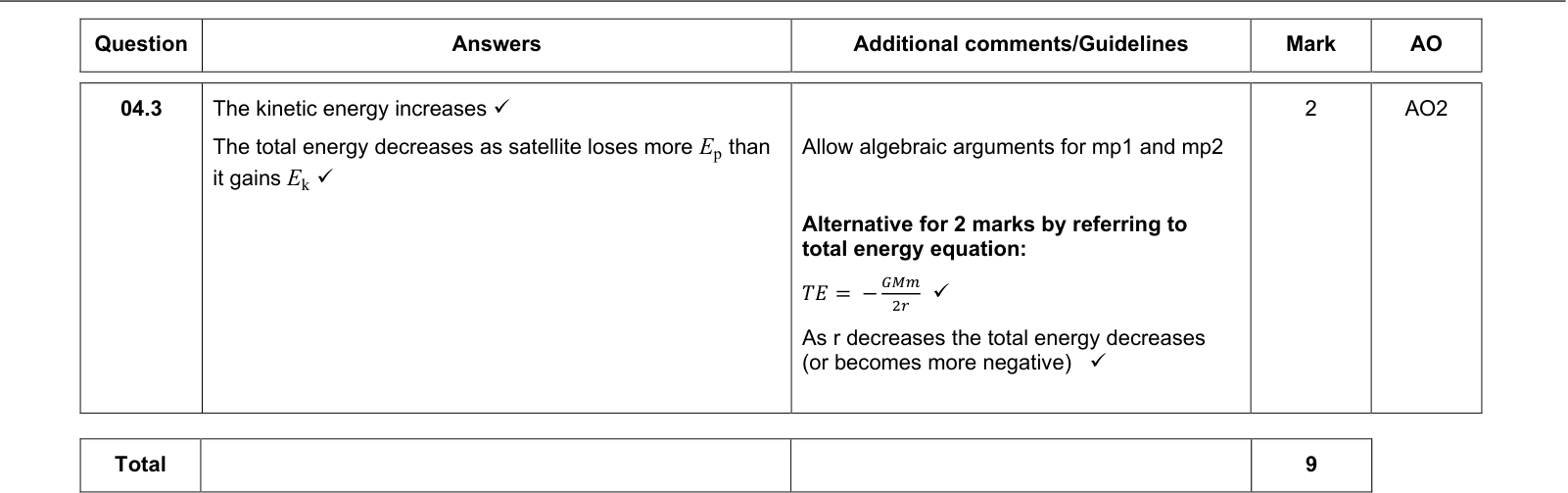
Total energy: $\quad E = E_k + E_p = -\dfrac{GMm}{2r}$
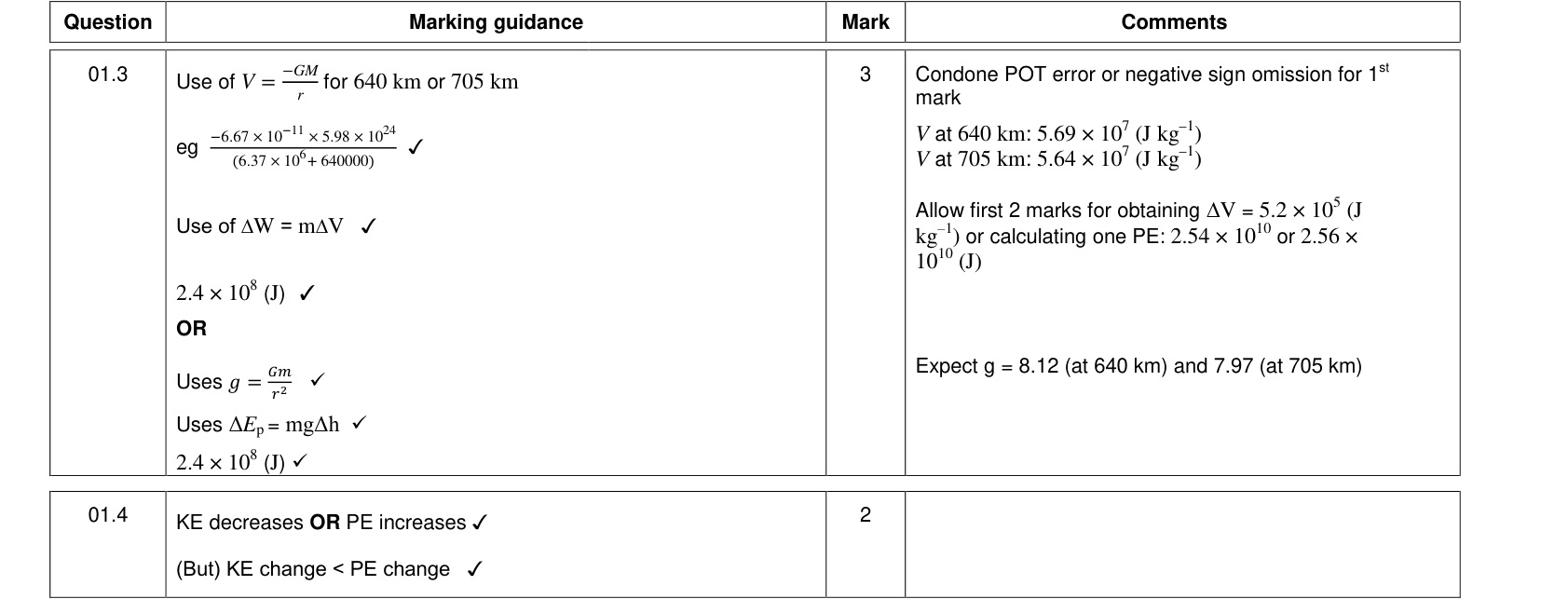
So in a circular orbit $E_k = -\tfrac12E_p$, and the total energy is negative (the satellite is bound).
Changing orbit
To move a satellite to a higher orbit (larger $r$):
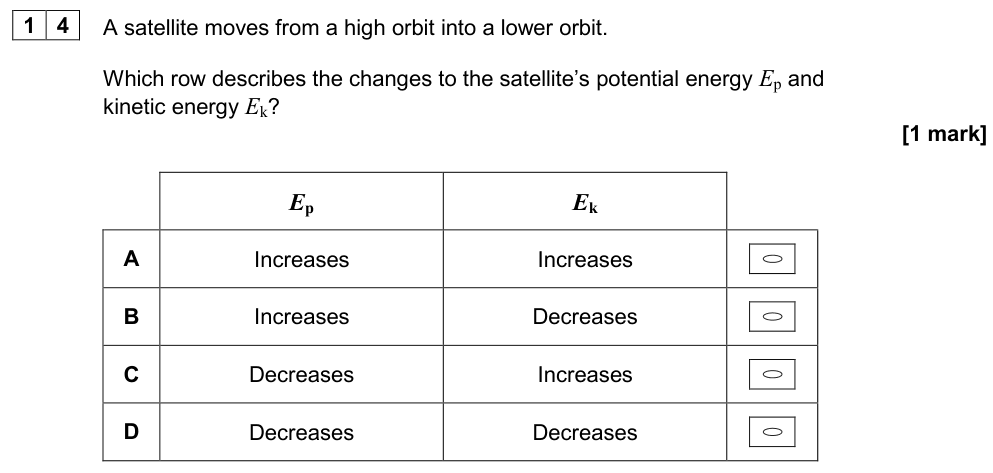
- its potential energy increases (becomes less negative);
- its kinetic energy decreases (it moves more slowly);
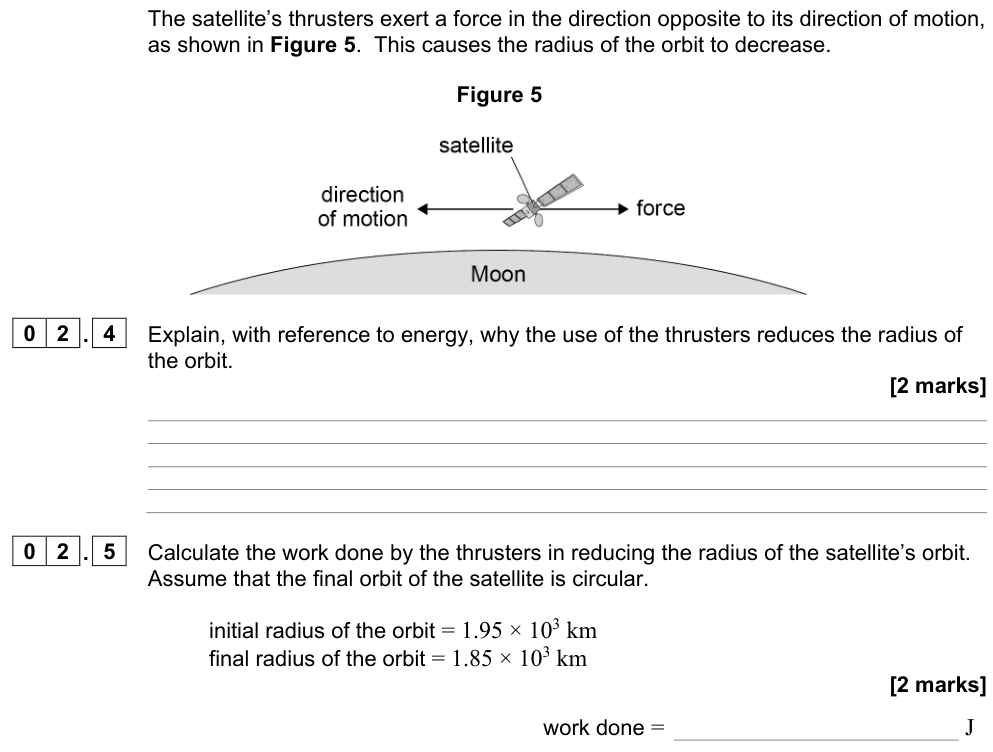
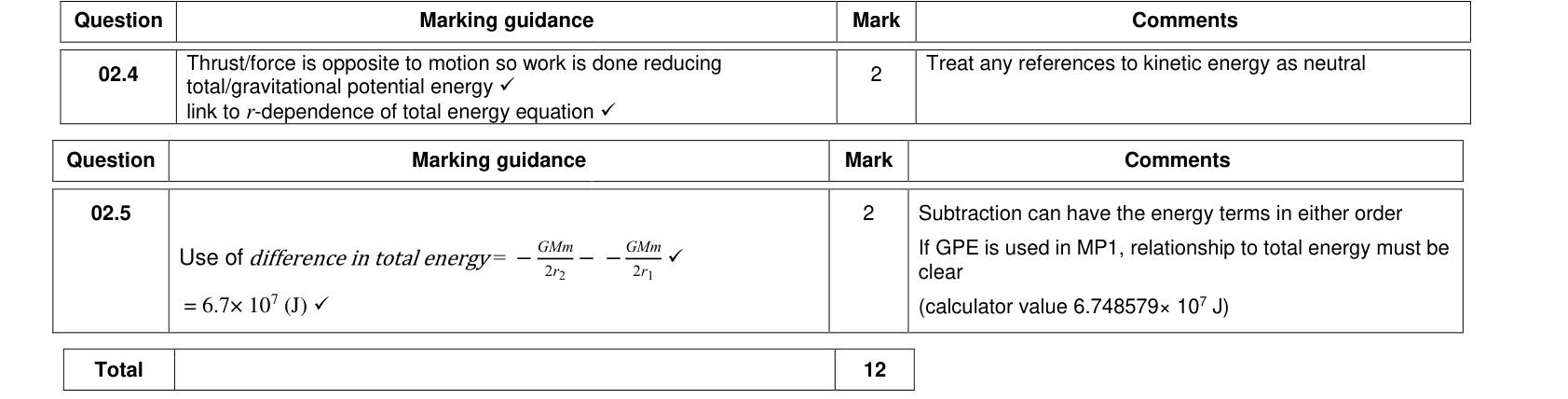
- its total energy increases (becomes less negative). Energy must be supplied by the rocket engines: the work done equals the increase in total energy, which is half the increase in potential energy.
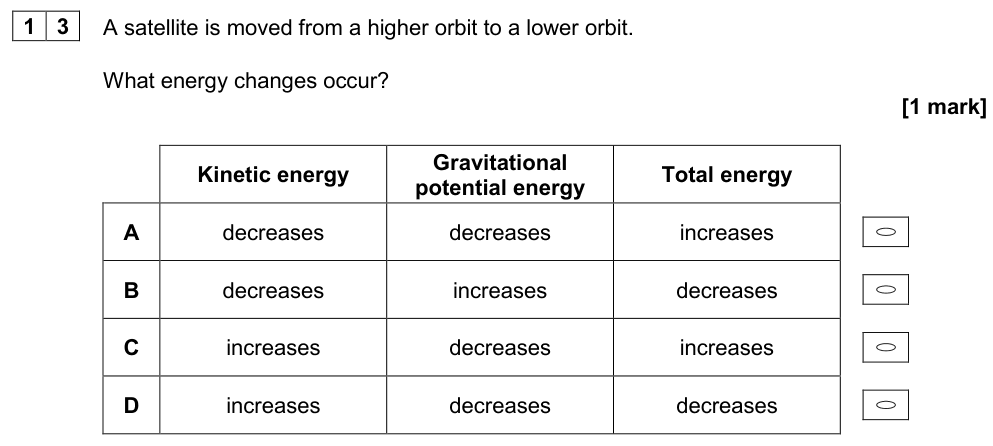
Moving to a lower orbit, the satellite speeds up and its total energy decreases. A satellite in a low orbit loses energy to air resistance in the thin upper atmosphere, so it slowly spirals inwards and actually speeds up.
Worked example: energy to change orbit
A 400 kg satellite moves from $r_1 = 7.0 \times 10^{6}$ m to $r_2 = 8.0 \times 10^{6}$ m.
$$\Delta E = -\frac{GMm}{2r_2} + \frac{GMm}{2r_1} = \frac{GMm}{2}\left(\frac{1}{r_1} - \frac{1}{r_2}\right)$$
$$\Delta E = \frac{3.98 \times 10^{14} \times 400}{2}\left(\frac{1}{7.0 \times 10^{6}} - \frac{1}{8.0 \times 10^{6}}\right) = 1.4 \times 10^{9}\ \text{J}$$
Geosynchronous (geostationary) orbits
Geosynchronous orbit
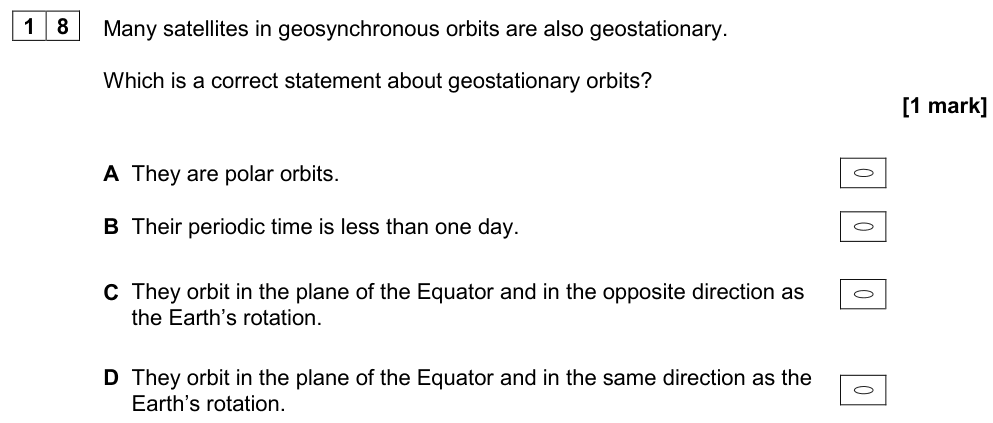
A geosynchronous satellite has an orbital period of 24 hours (strictly one sidereal day, about 23 h 56 min), the same as the Earth's rotation.
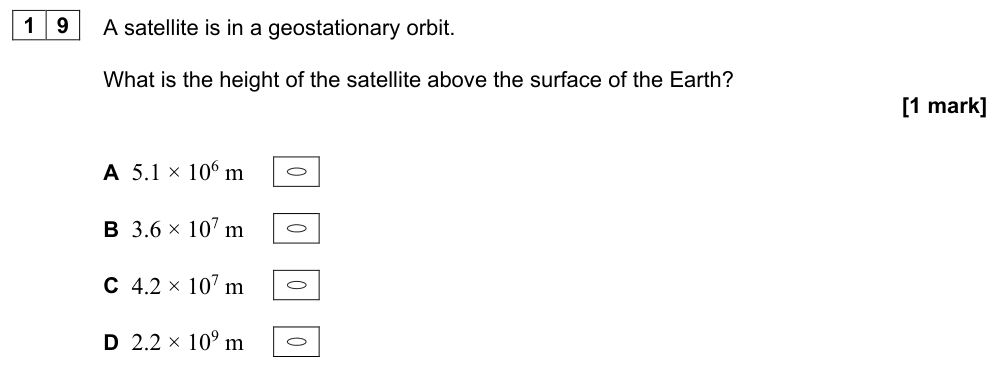
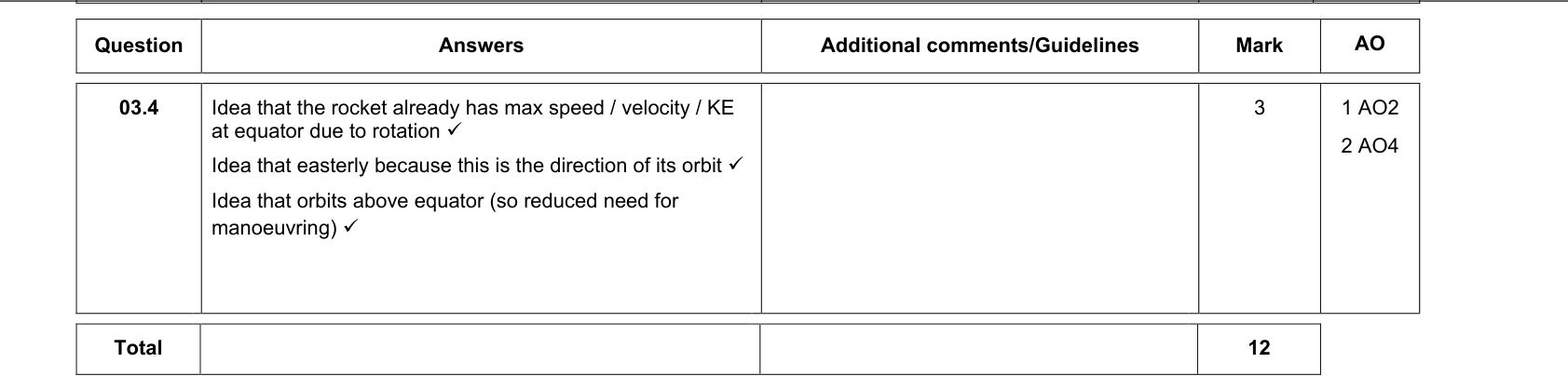
A geostationary satellite is a geosynchronous satellite in an orbit above the equator, moving in the same direction as the Earth rotates (west to east). It stays above the same point on the Earth's surface.
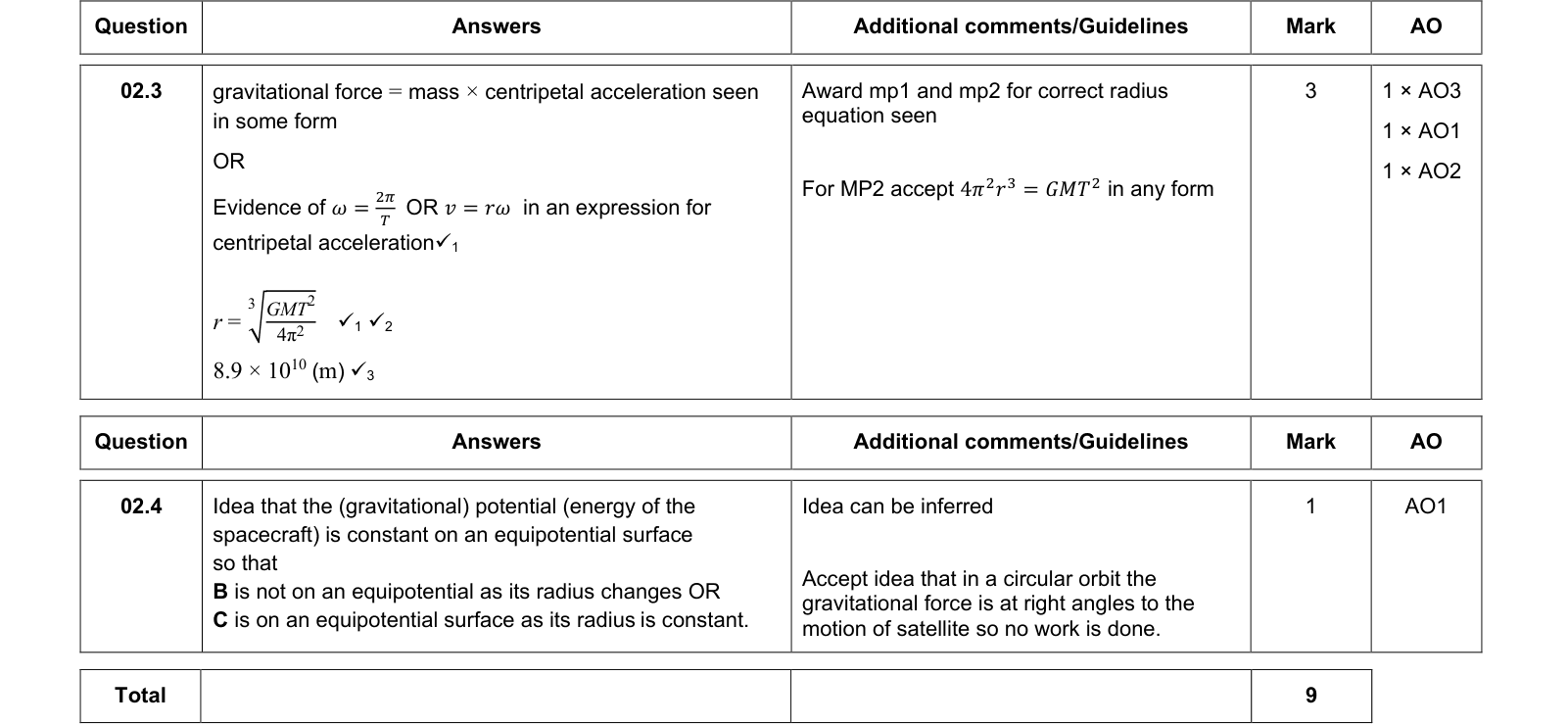
Using $T^2 = 4\pi^2r^3/GM$ with $T = 86\,400$ s gives $r = 4.2 \times 10^{7}$ m, so a geostationary satellite orbits about 36 000 km above the surface.
Significance:
- Ground stations and satellite dishes can point in a fixed direction: no tracking is needed. Ideal for communications and TV broadcasting.
- They give continuous coverage of the same large area, useful for weather monitoring.
- But they are far away, so there is a signal delay (≈ 0.24 s up and down) and they give poor detail. Low Earth orbit satellites (e.g. polar orbits, period ~ 90 min) are used for imaging, mapping and spying, as they pass over the whole surface as the Earth turns beneath them.
Summary
- Gravity provides the centripetal force: $GMm/r^2 = mv^2/r$; $v = \sqrt{GM/r}$; $T^2 = 4\pi^2r^3/GM$.
- $E_k = GMm/2r$, $E_p = -GMm/r$, $E_{\text{total}} = -GMm/2r$.
- Higher orbit: slower, more $E_p$, less $E_k$, more total energy.
- Geostationary: $T$ = 24 h, above the equator, same direction as Earth's rotation, $r \approx 4.2 \times 10^{7}$ m; used for communications.