Coulomb's law
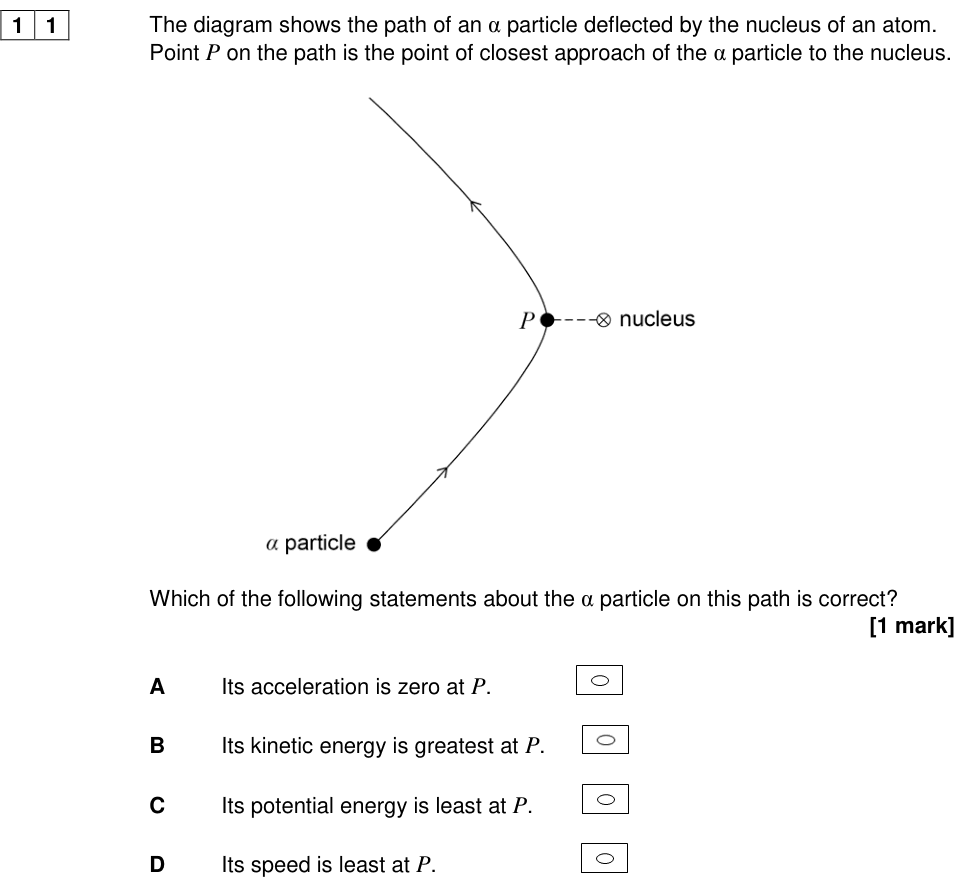
Charged objects exert forces on each other: like charges repel, unlike charges attract.
Coulomb's law
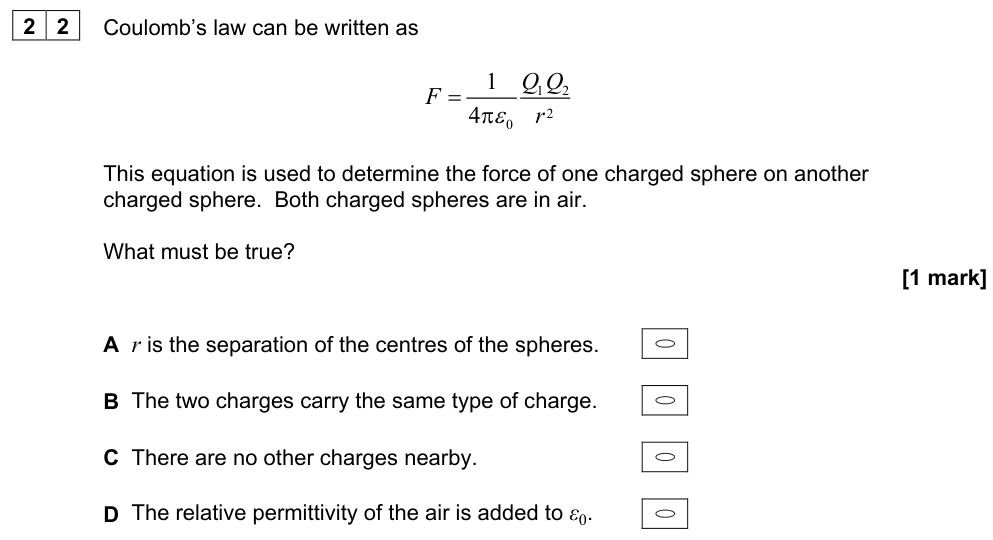
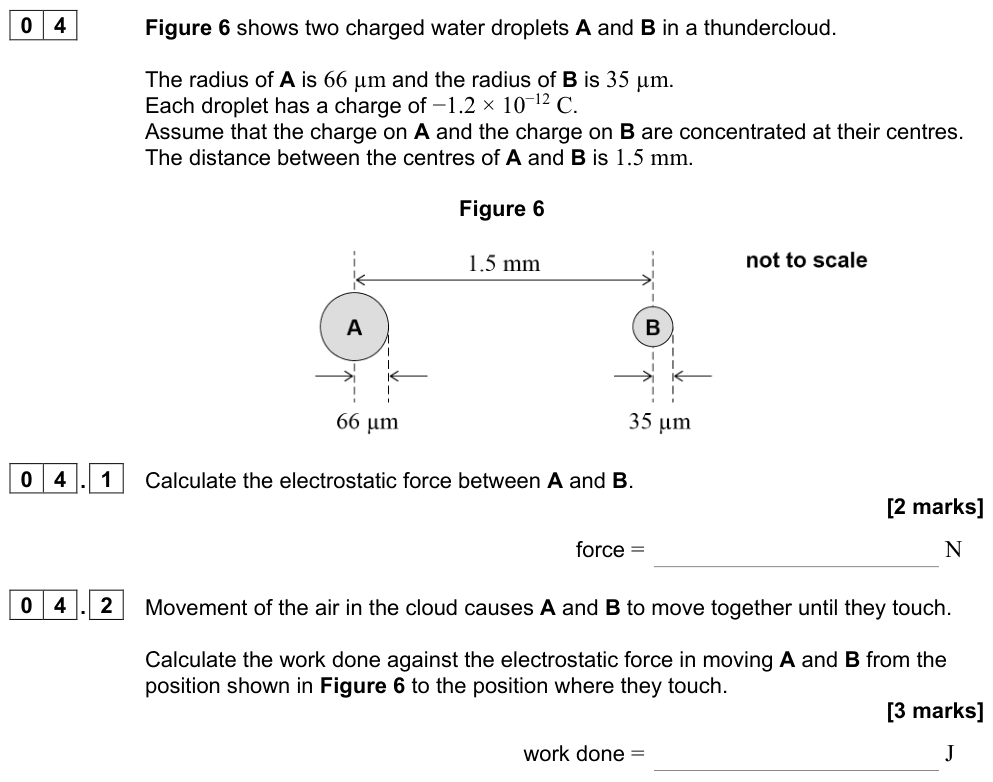
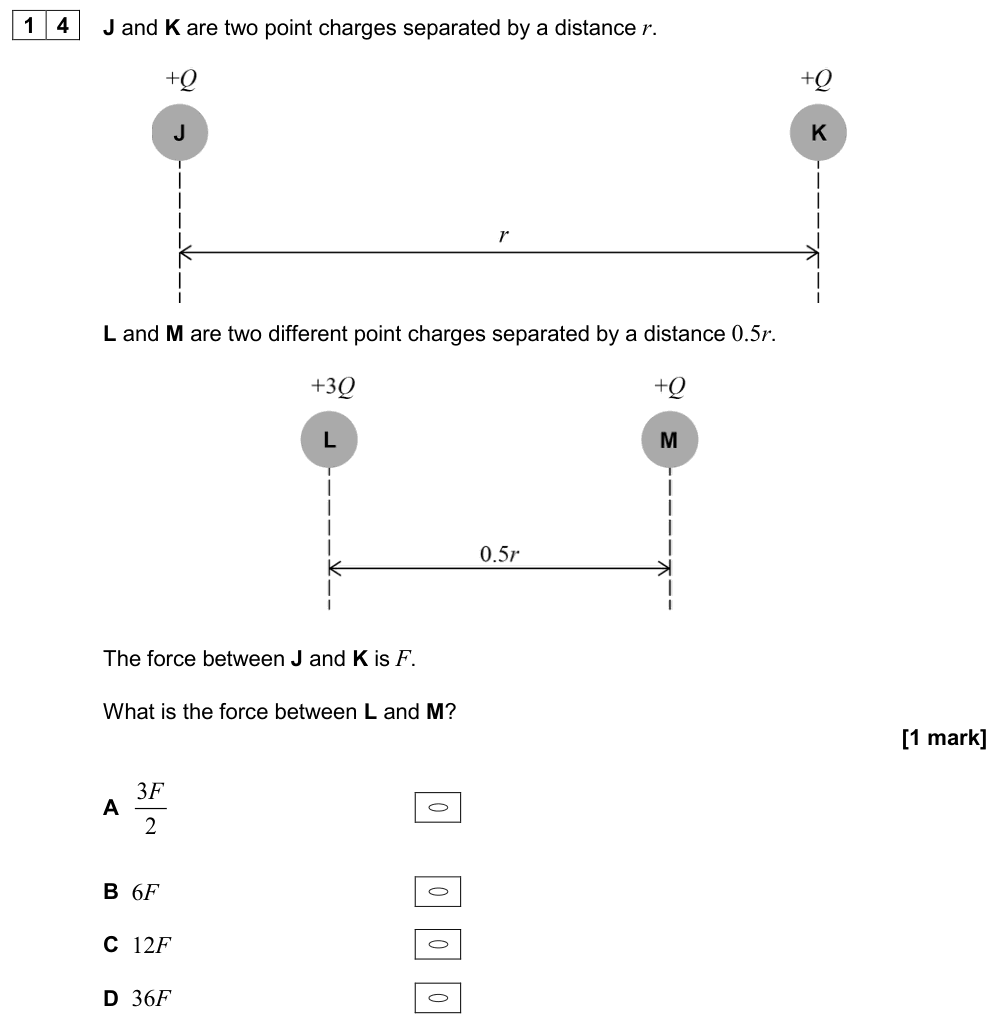
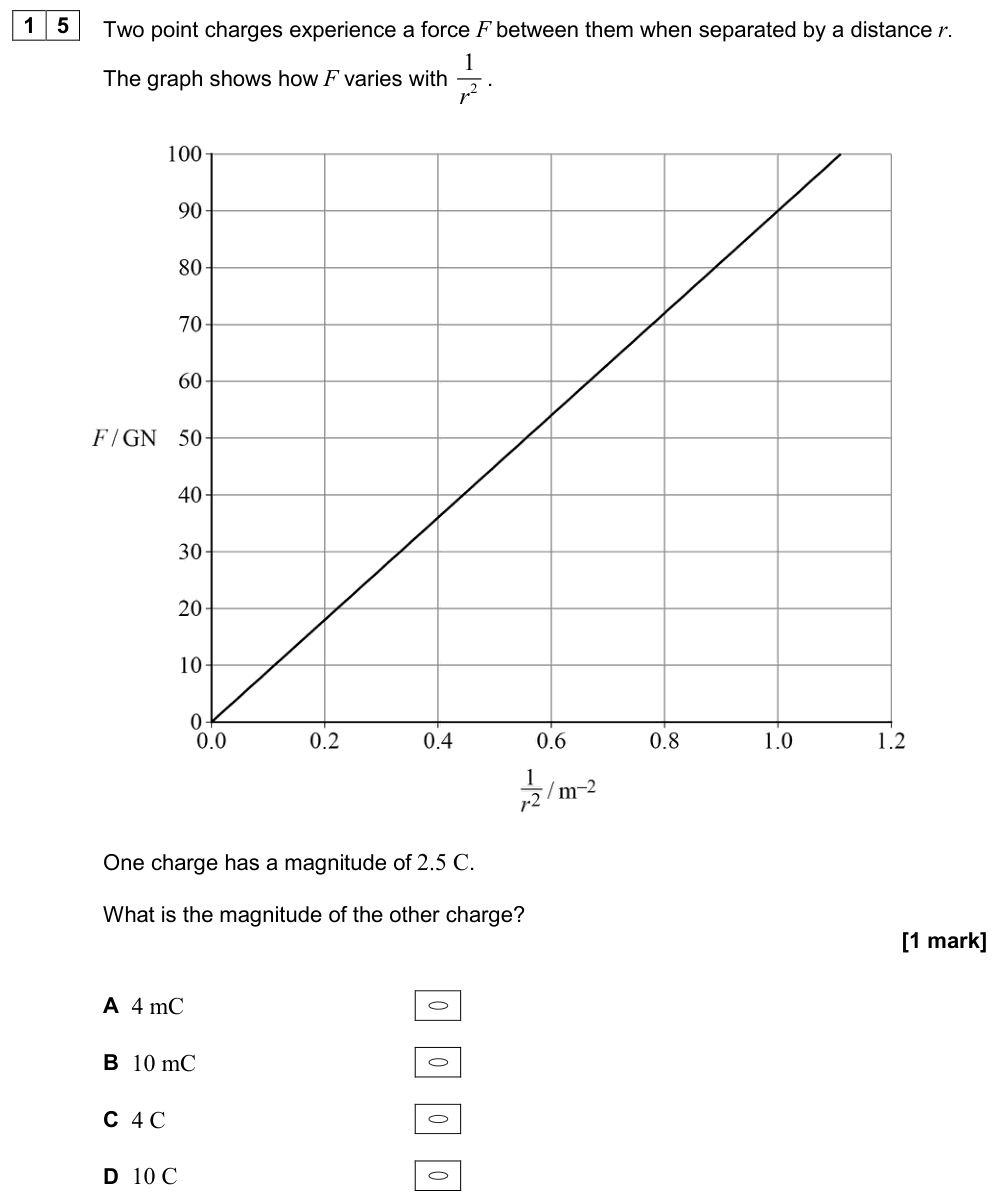
The force between two point charges in a vacuum is
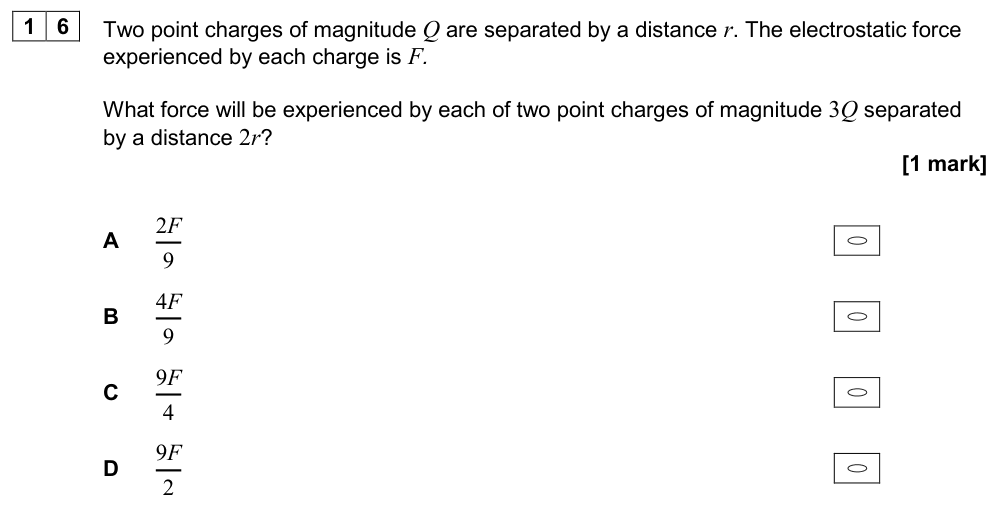
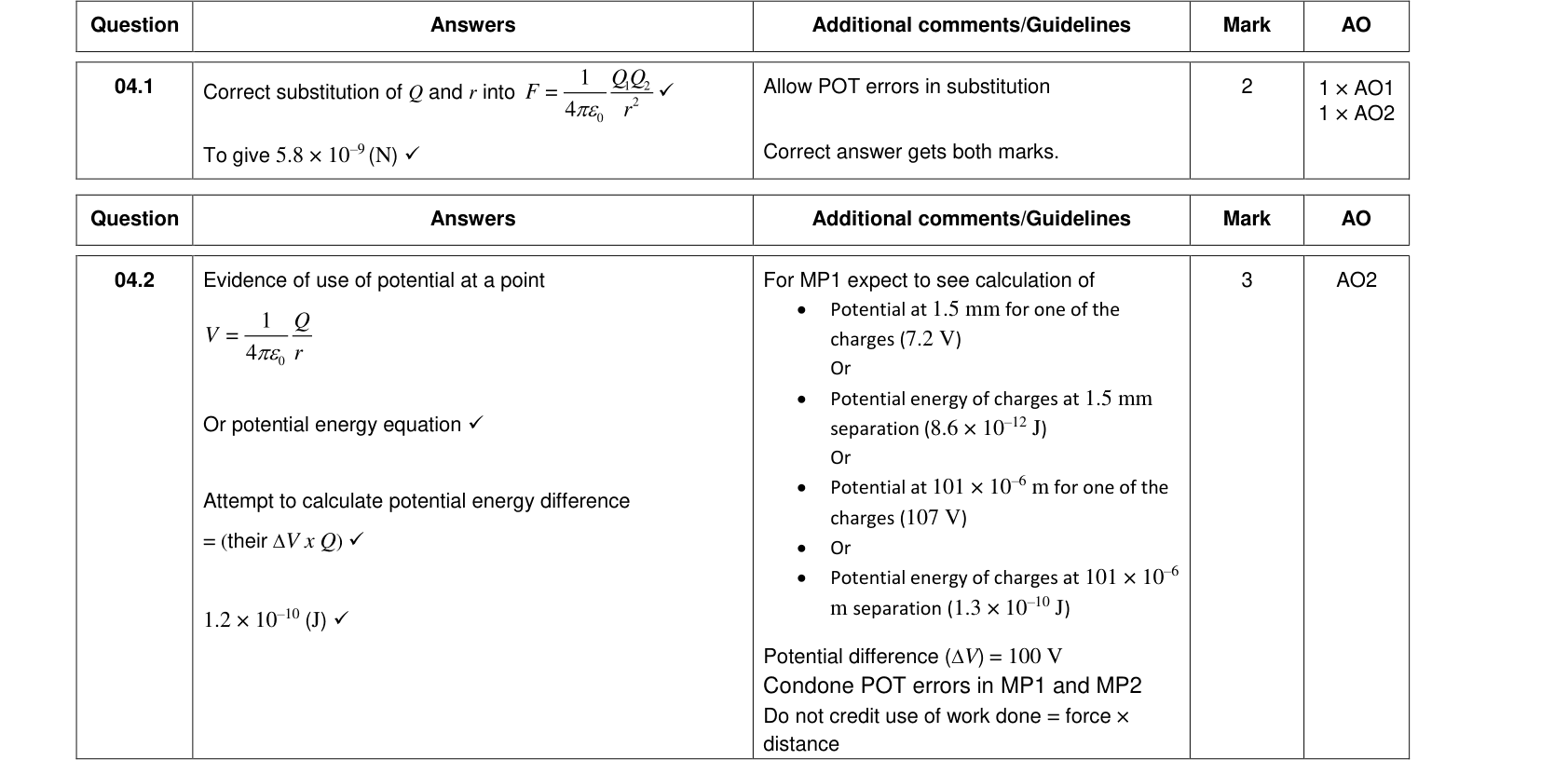
$$F = \frac{1}{4\pi\varepsilon_0}\frac{Q_1Q_2}{r^2}$$
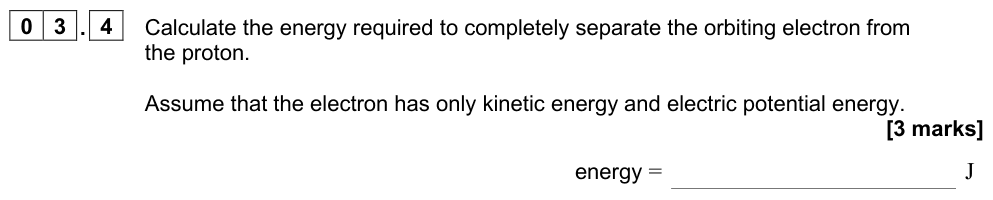
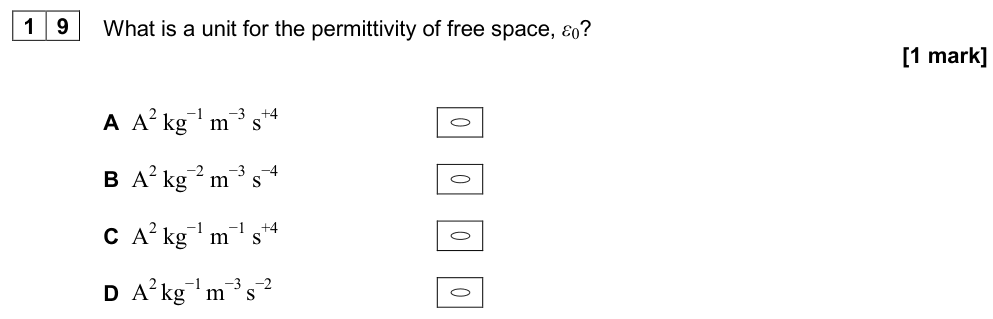
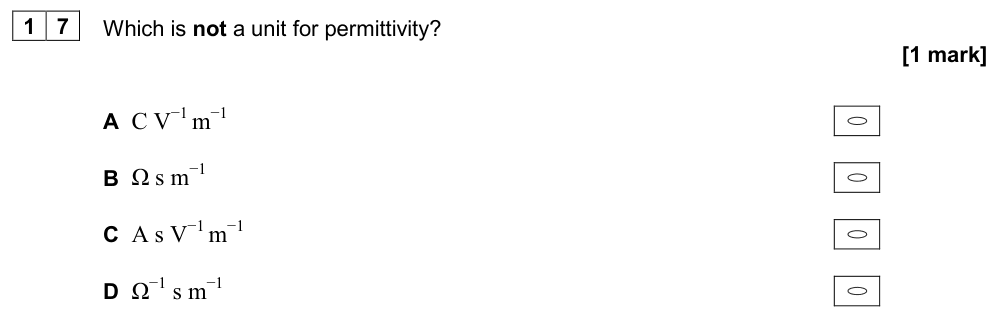
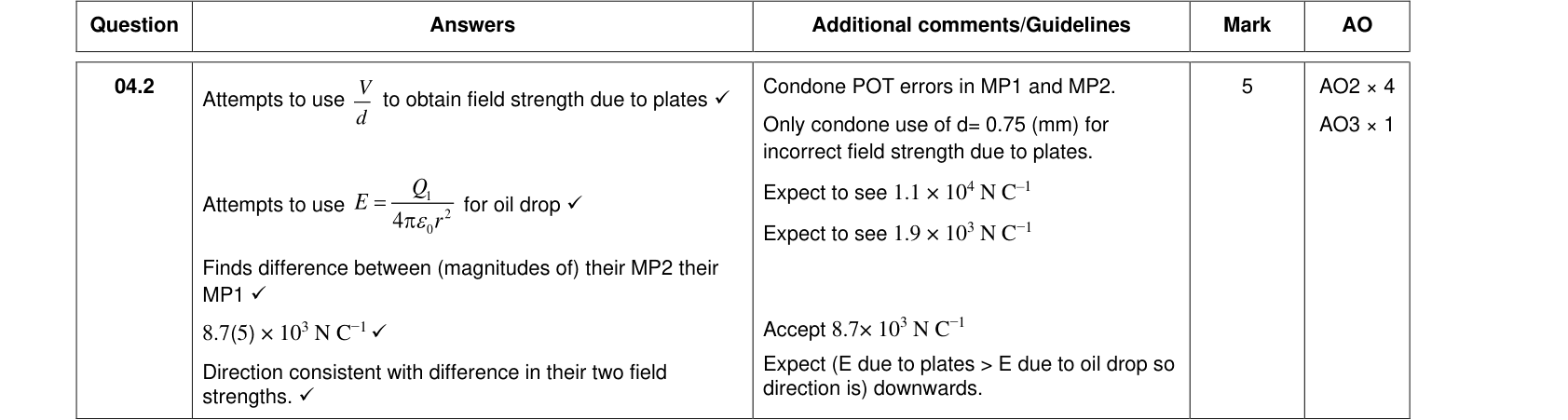
$\varepsilon_0 = 8.85 \times 10^{-12}\ \text{F m}^{-1}$ is the permittivity of free space; $\dfrac{1}{4\pi\varepsilon_0} = 8.99 \times 10^{9}\ \text{N m}^2\,\text{C}^{-2}$.
- A positive $F$ (charges of the same sign) means repulsion; a negative $F$ means attraction.
- Air can be treated as a vacuum when calculating forces between charges.
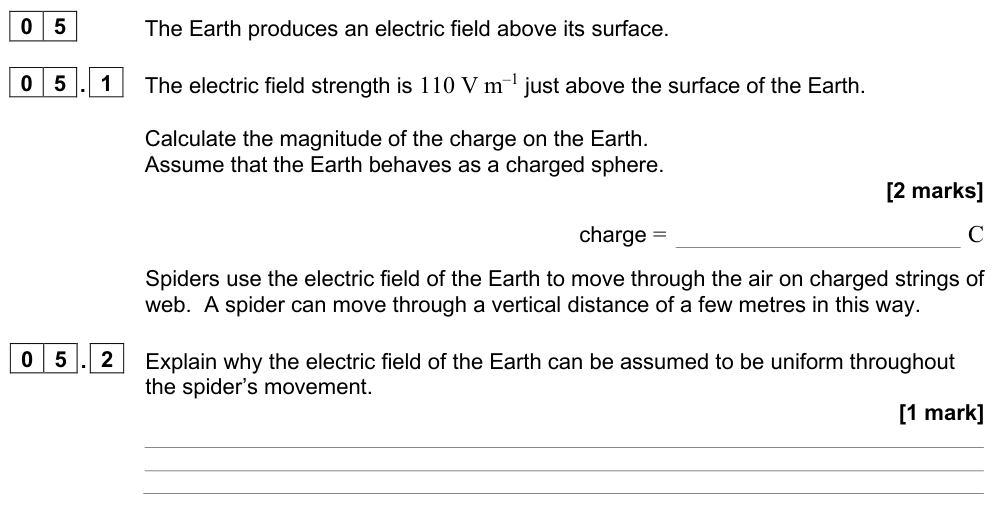
- For a charged sphere, the charge can be treated as if it were concentrated at its centre (for points outside the sphere).
- Like gravity, it is an inverse-square law.
Worked example: force in a hydrogen atom
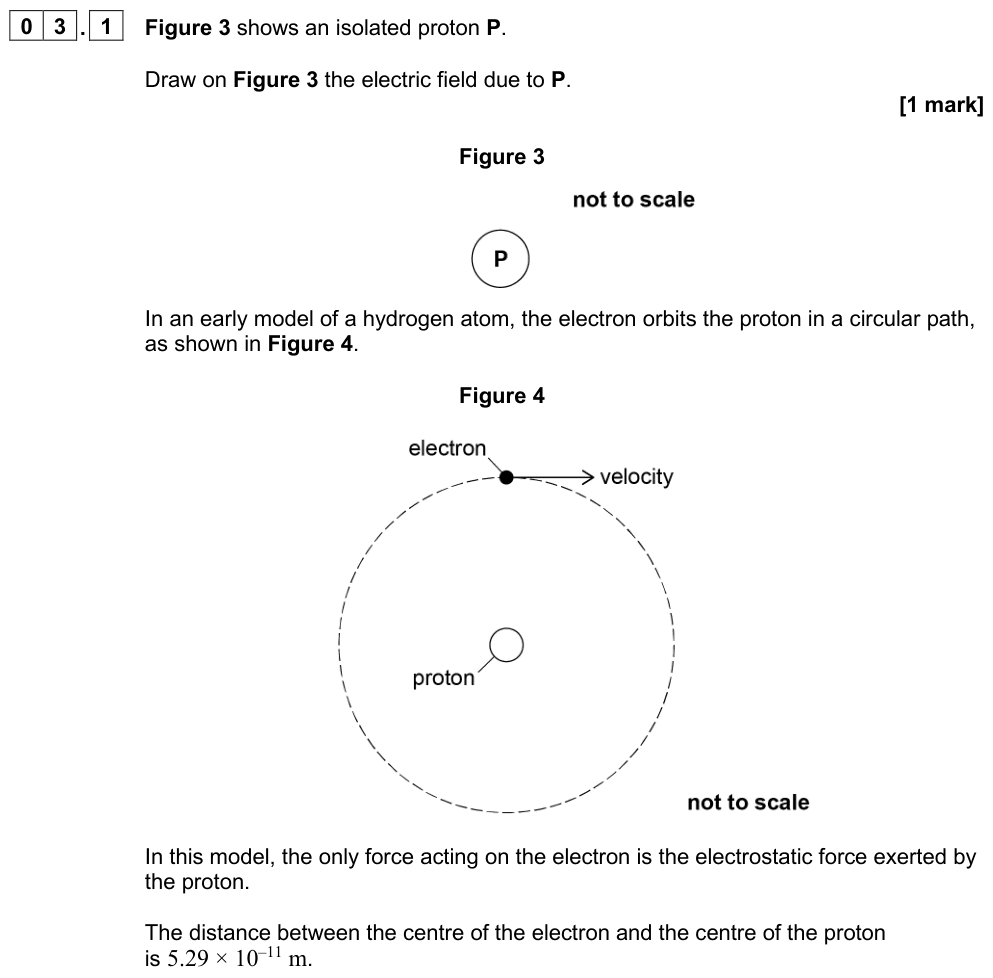
The electron and proton in hydrogen are $5.3 \times 10^{-11}$ m apart.
$$F = \frac{8.99 \times 10^{9} \times (1.60 \times 10^{-19})^2}{(5.3 \times 10^{-11})^2} = 8.2 \times 10^{-8}\ \text{N (attractive)}$$
Comparing electrostatic and gravitational forces
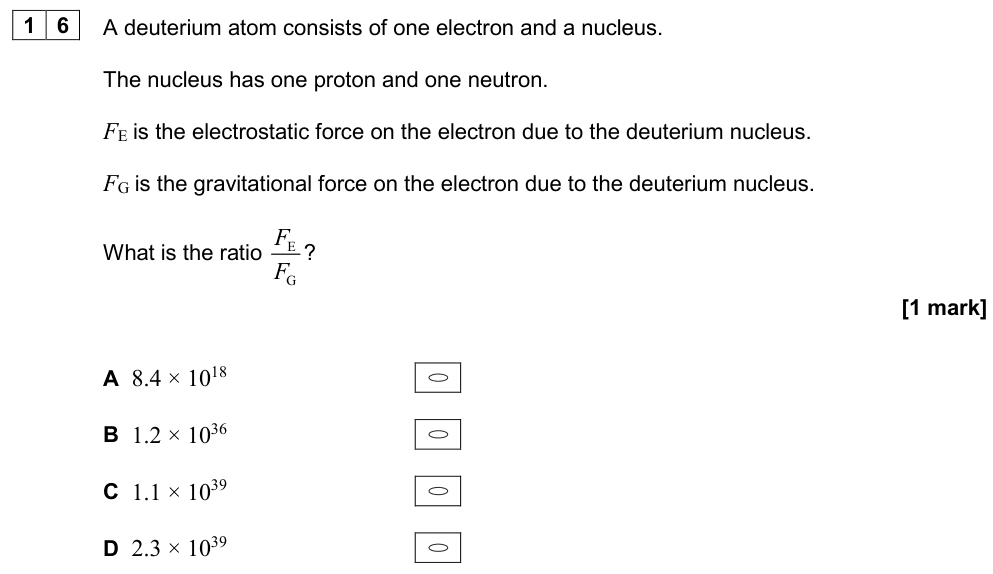
For two protons a distance $r$ apart:
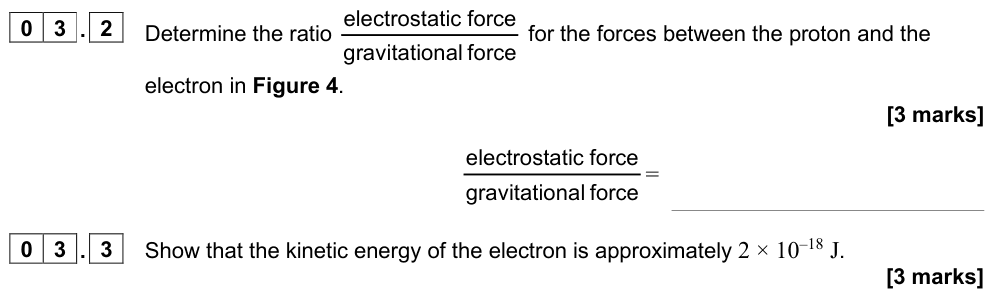
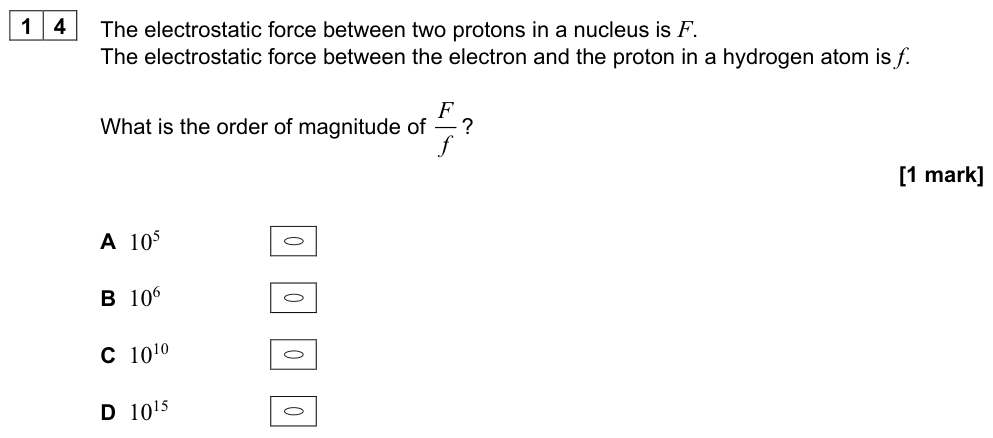
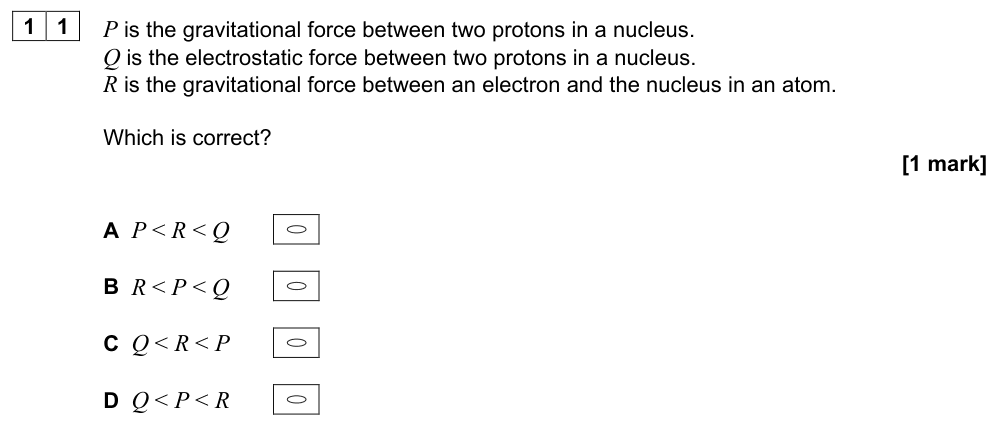
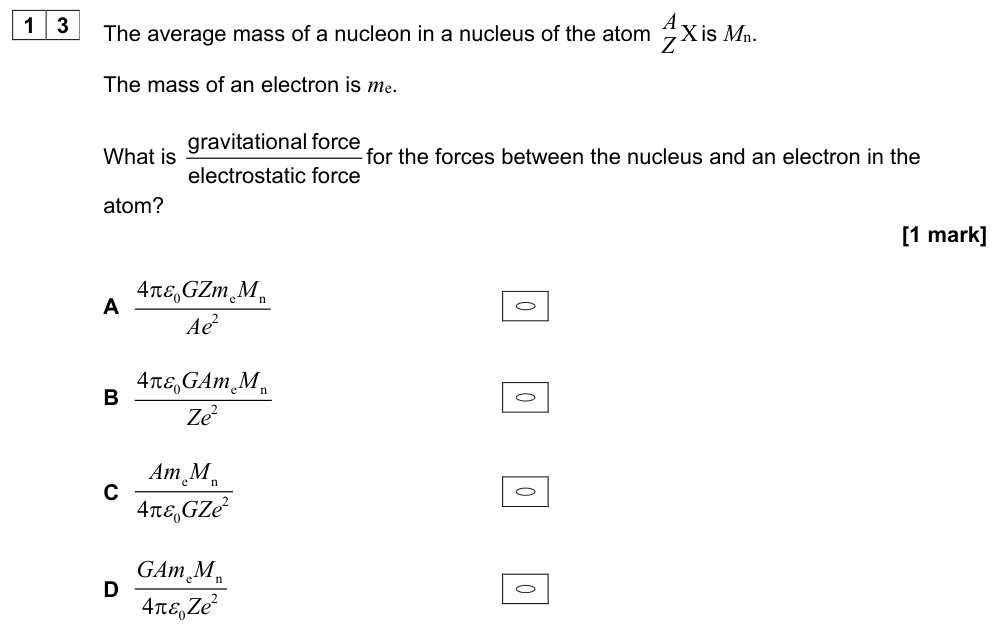
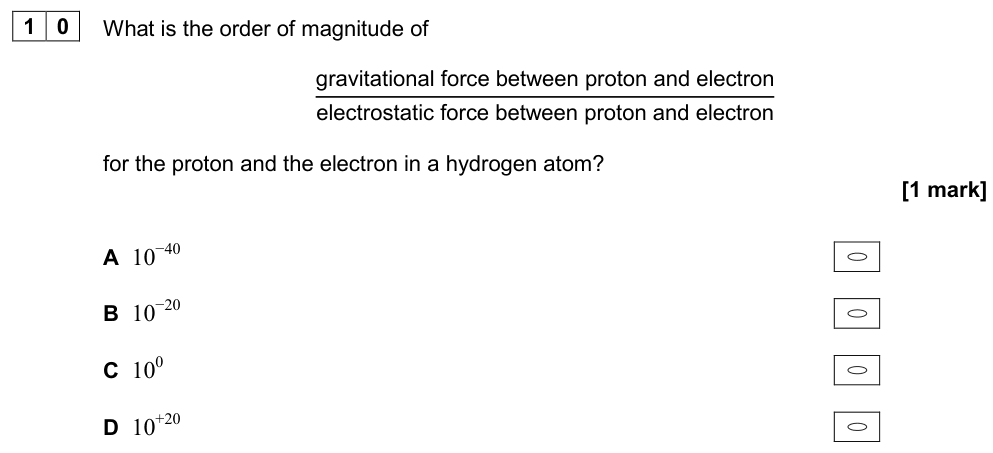
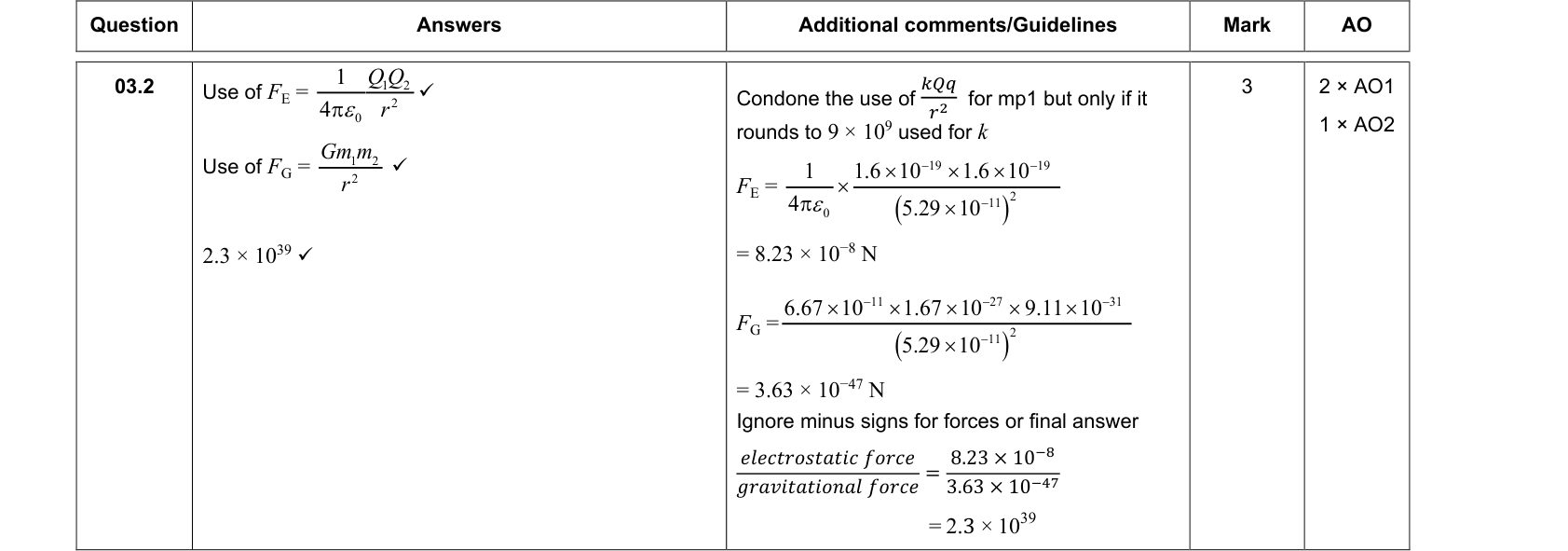
$$\frac{F_E}{F_G} = \frac{Q^2/4\pi\varepsilon_0}{Gm_p^2} = \frac{8.99 \times 10^{9} \times (1.60 \times 10^{-19})^2}{6.67 \times 10^{-11} \times (1.67 \times 10^{-27})^2} \approx 1.2 \times 10^{36}$$
The ratio does not depend on $r$, because both are inverse-square laws. Between subatomic particles gravity is negligible. (In a nucleus, protons are held together despite their huge repulsion by the strong nuclear force.)
| Gravitational | Electric | |
|---|---|---|
| Acts on | mass | charge |
| Law | $F = Gm_1m_2/r^2$ | $F = Q_1Q_2/4\pi\varepsilon_0 r^2$ |
| Nature | always attractive | attractive or repulsive |
| Field strength | $g = F/m$ | $E = F/Q$ |
| Radial field | $g = GM/r^2$ | $E = Q/4\pi\varepsilon_0 r^2$ |
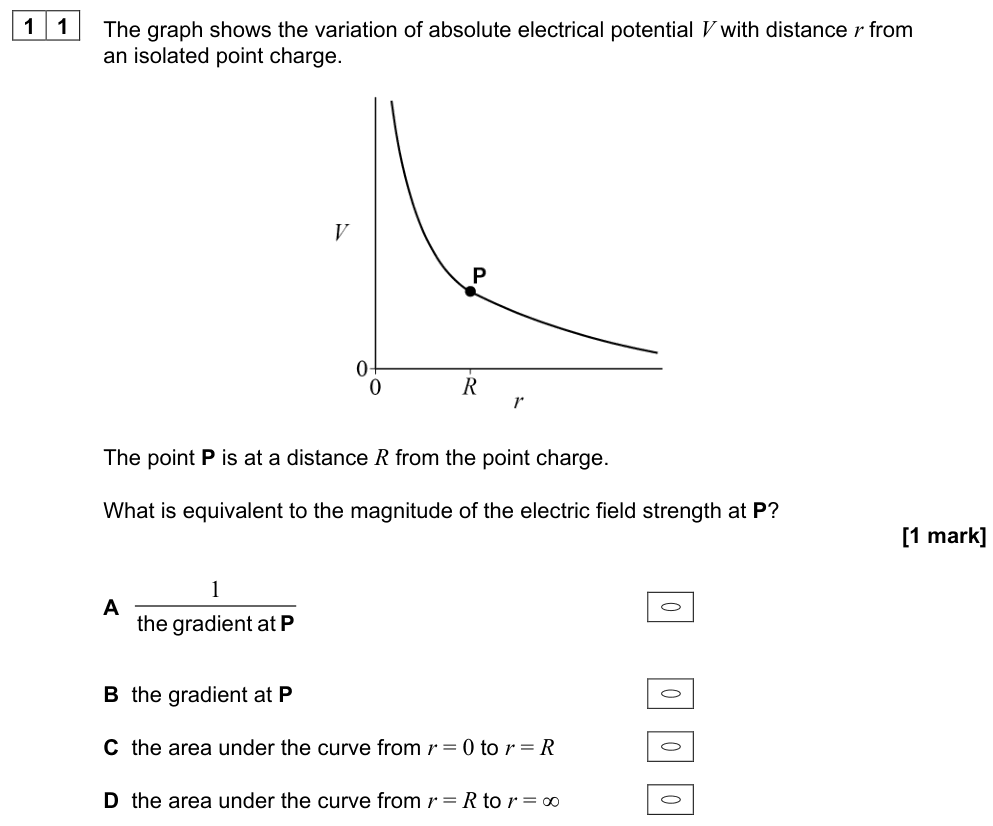
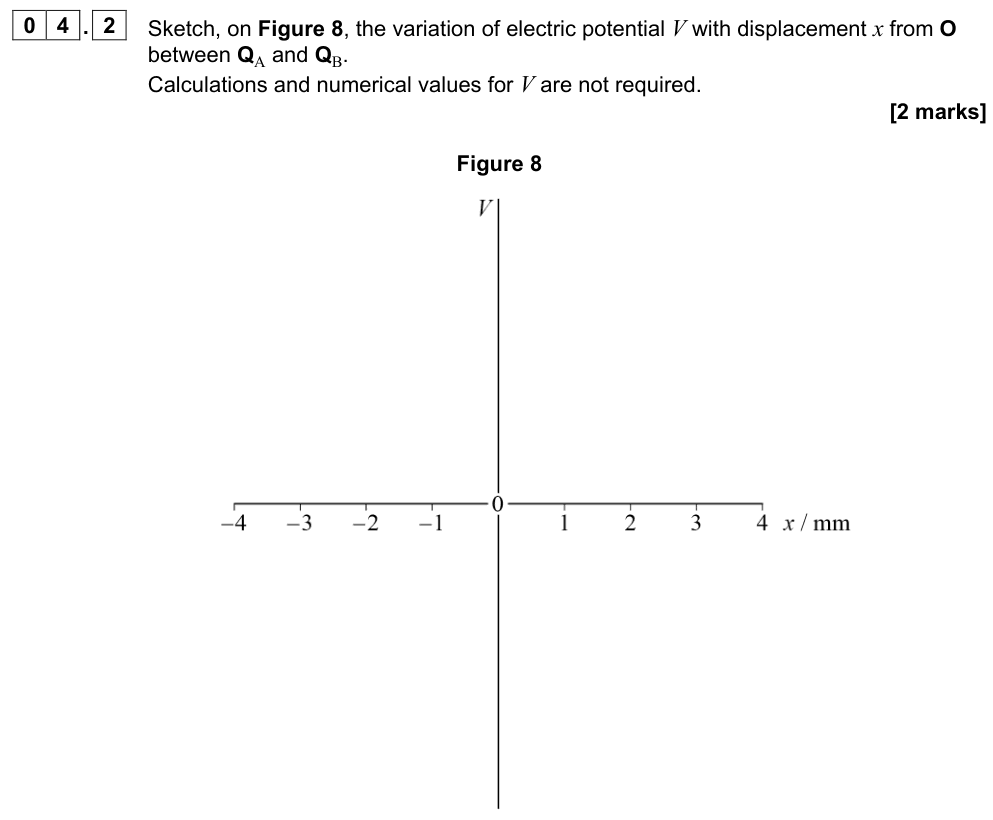
| Potential | $V = -GM/r$ | $V = Q/4\pi\varepsilon_0 r$ |
Electric fields and field lines
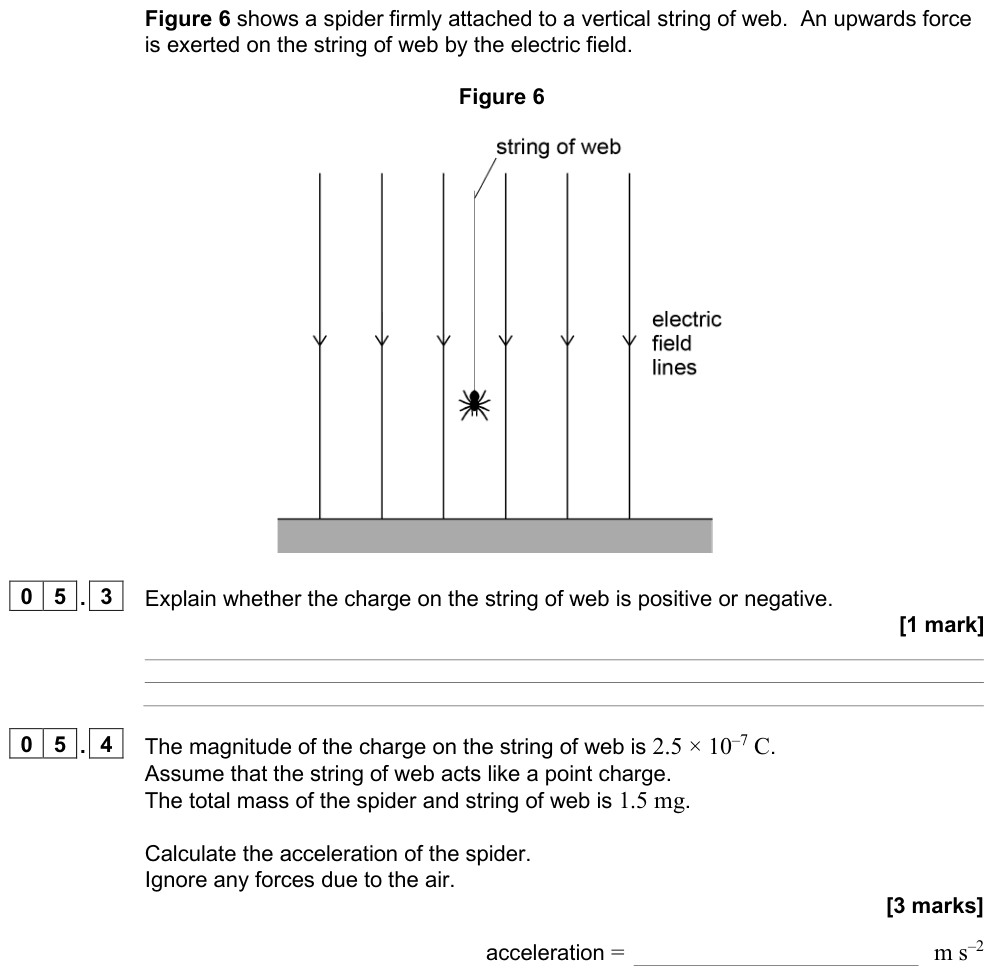
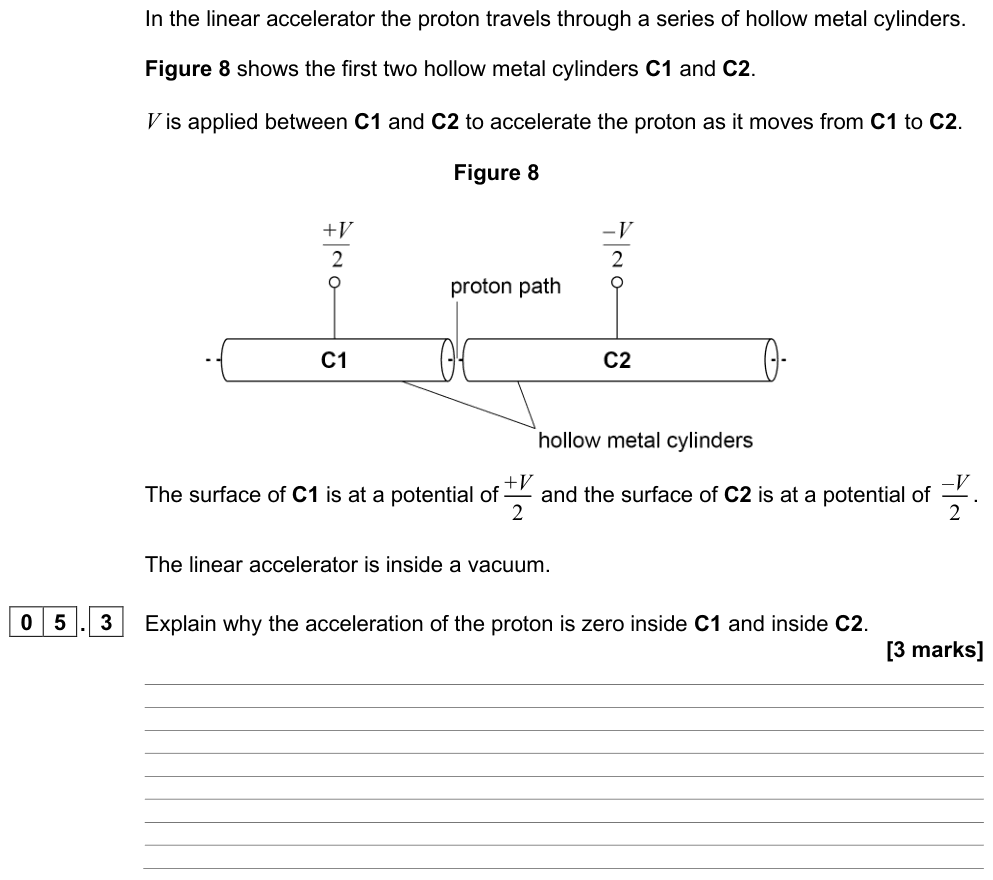
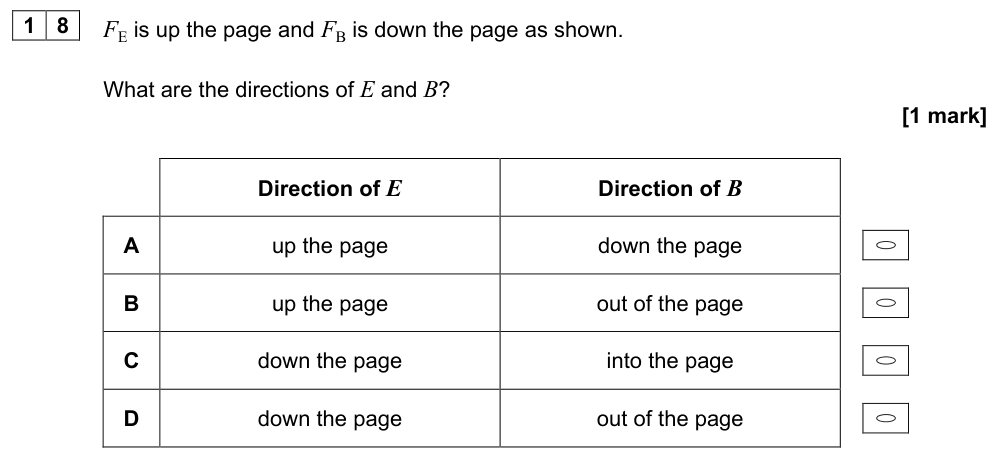
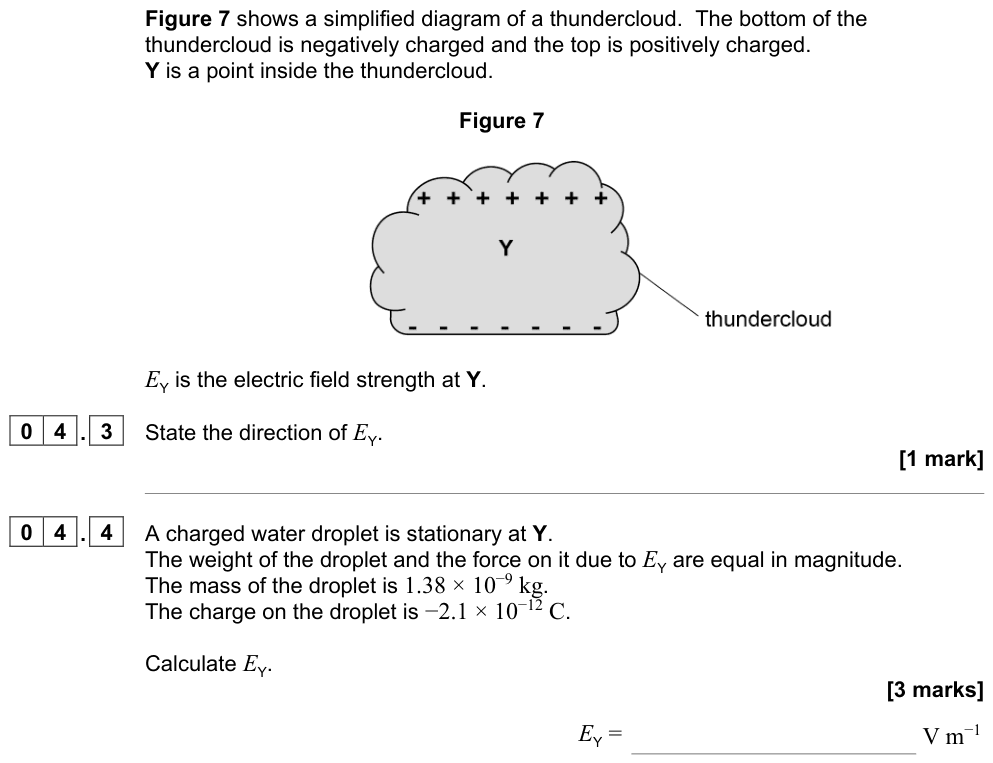
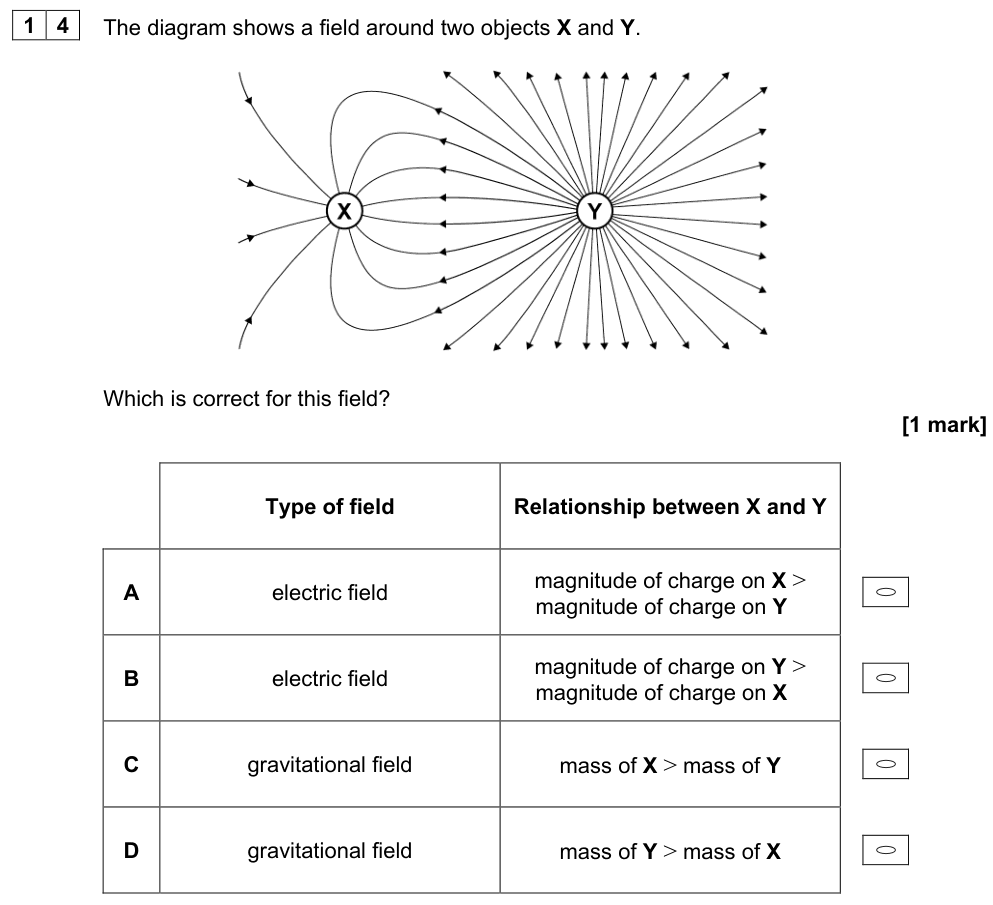
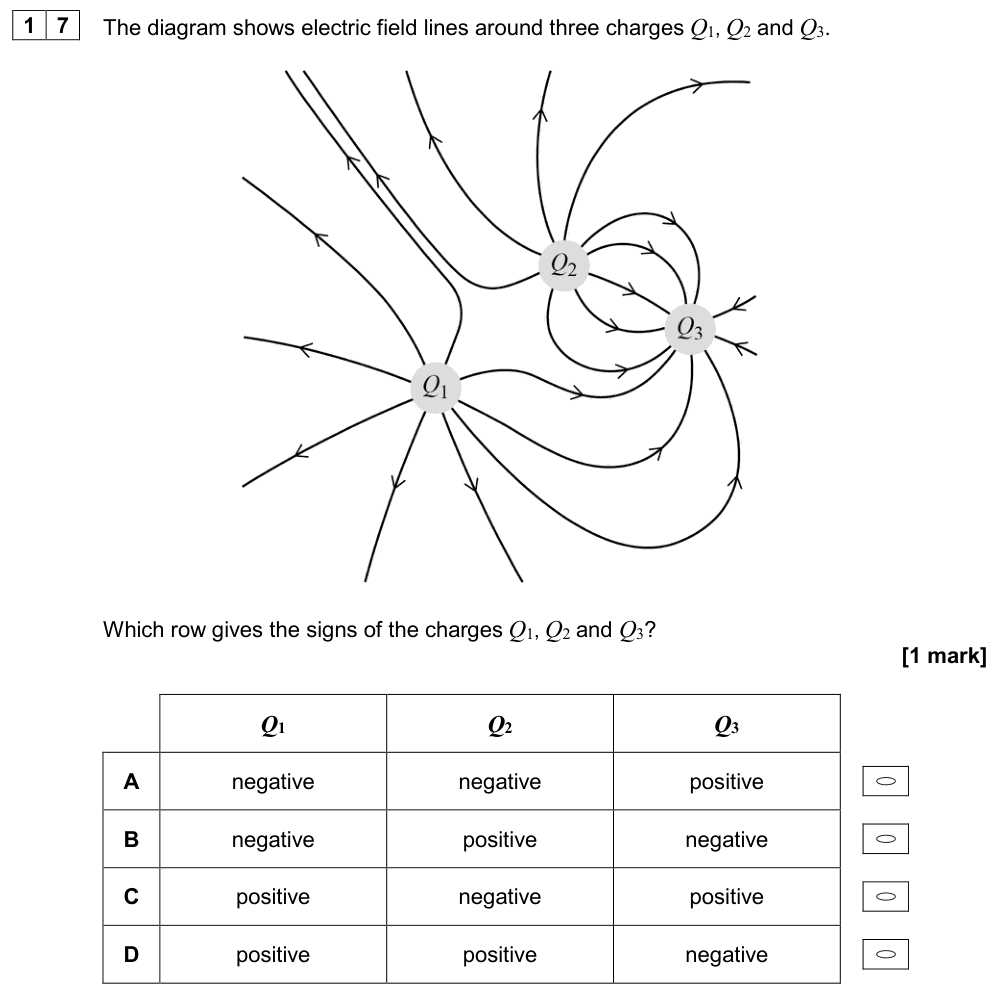
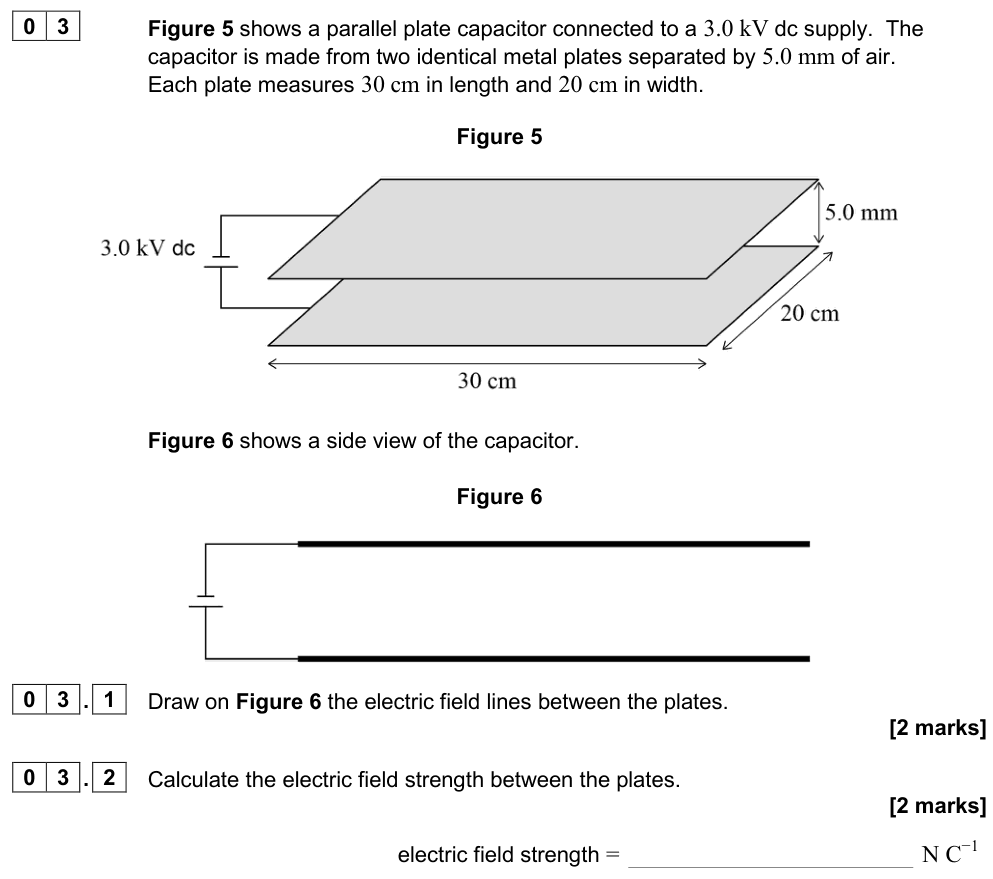
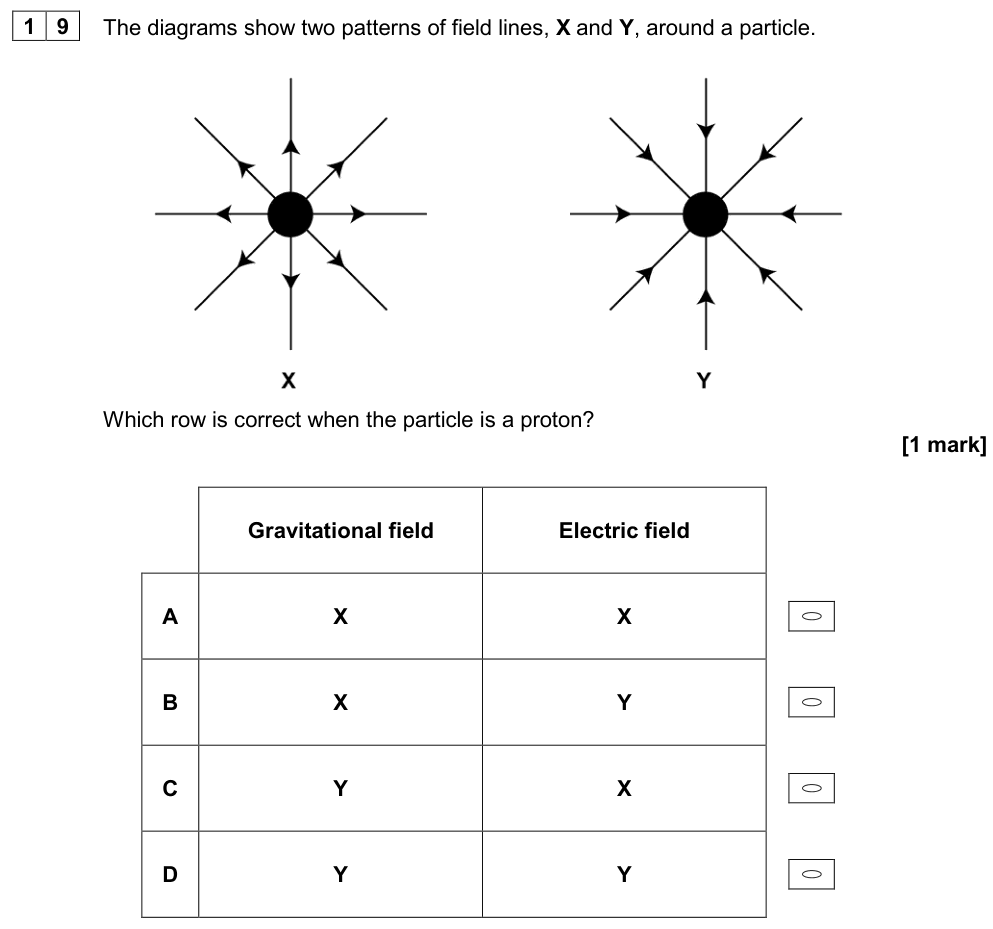
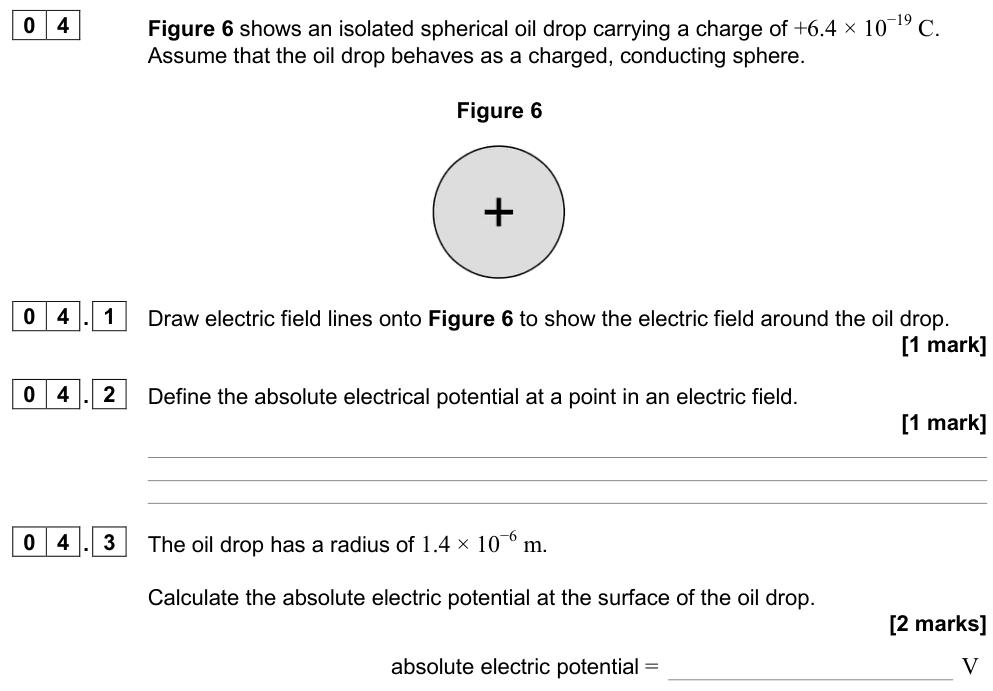
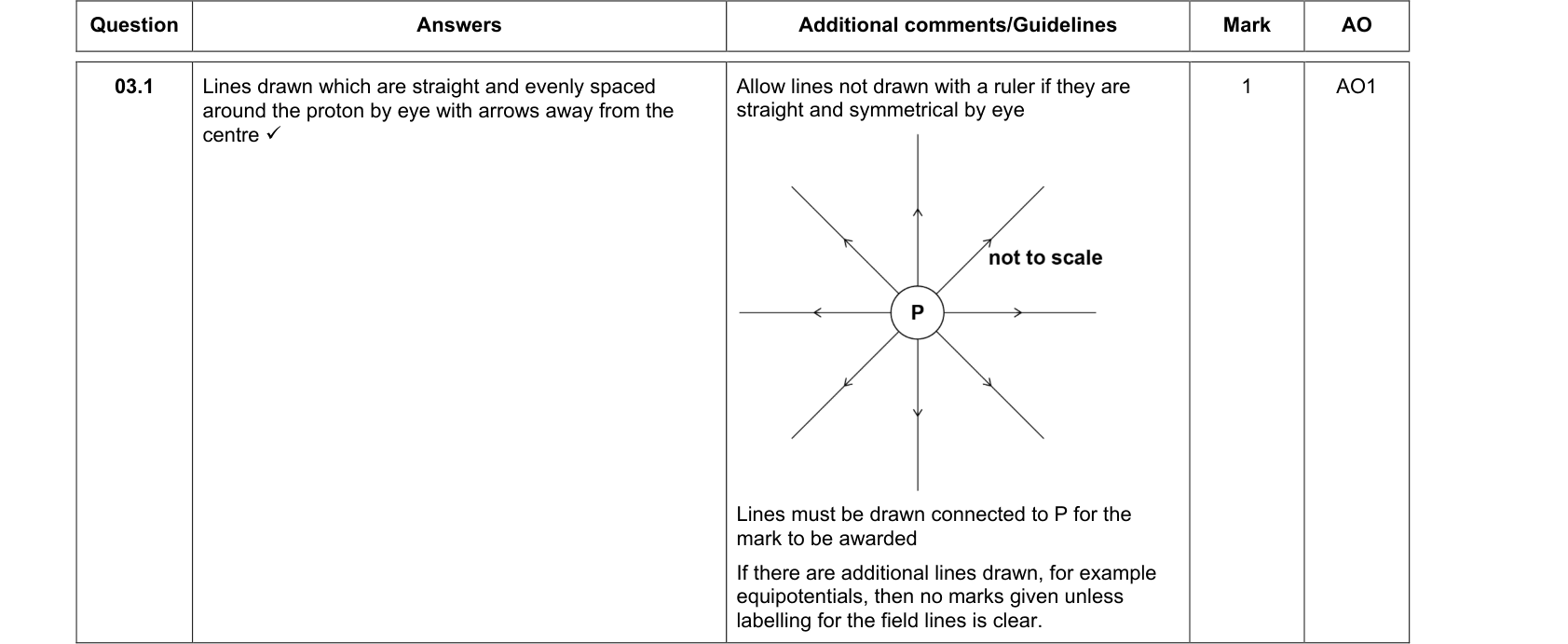
An electric field is a region in which a charge experiences a force. Electric fields are drawn with field lines that show the direction of the force on a small positive test charge:
- lines go from positive to negative charges (out of + and into −);
- lines never cross;
- the closer the lines, the stronger the field;
- field lines meet conducting surfaces at right angles.
Electric field strength
Electric field strength
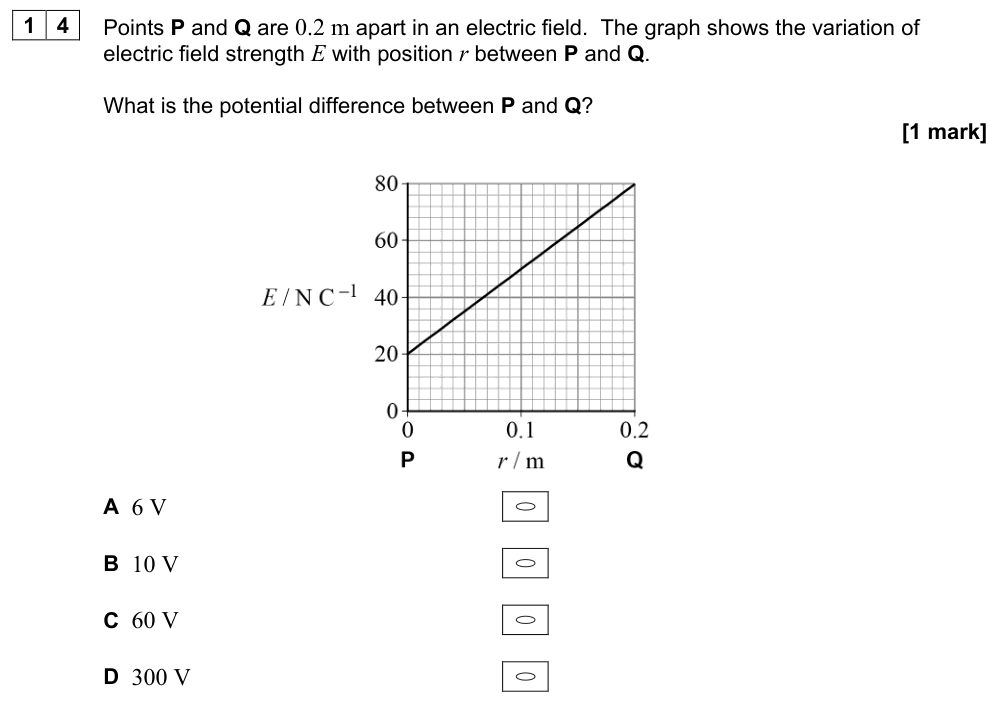
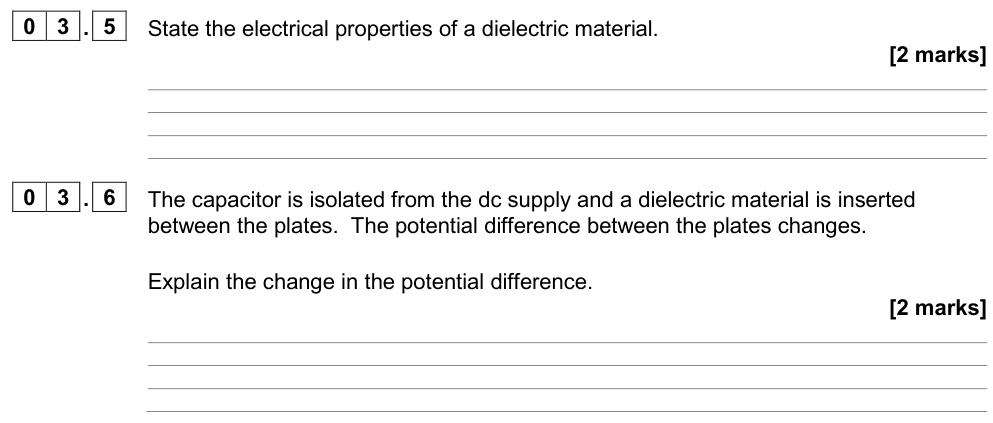
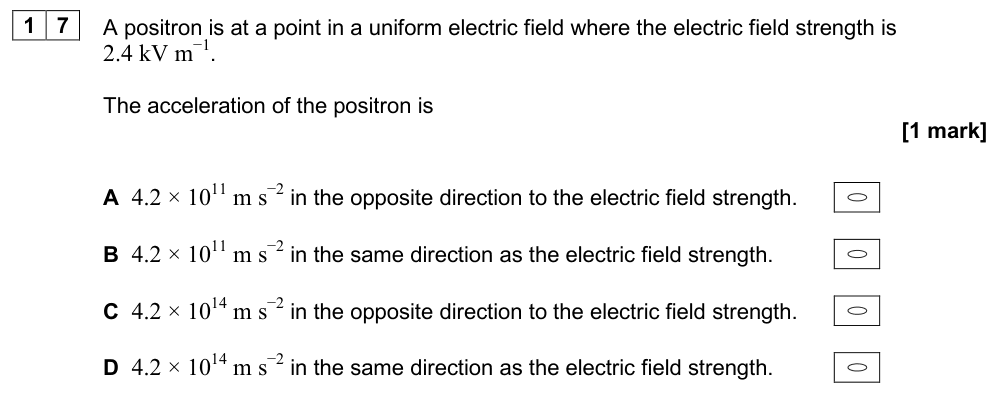
The electric field strength $E$ at a point is the force per unit charge on a small positive test charge at that point:
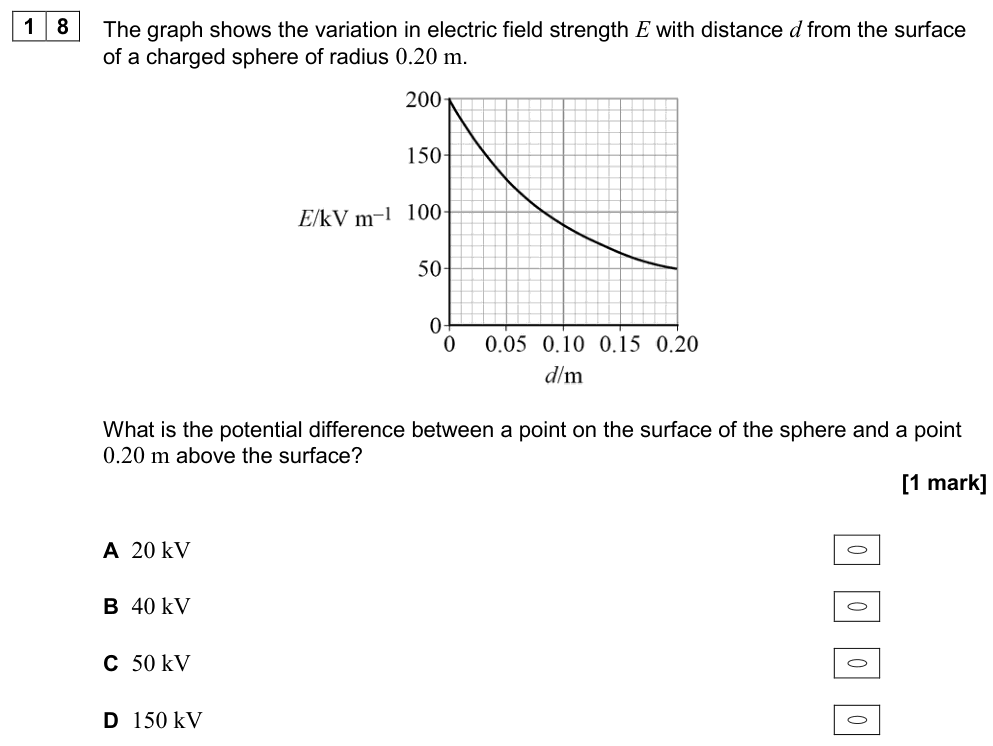
$$E = \frac{F}{Q} \qquad \text{unit: N C}^{-1}\ (\text{equivalent to V m}^{-1})$$
$E$ is a vector in the direction of the force on a positive charge.
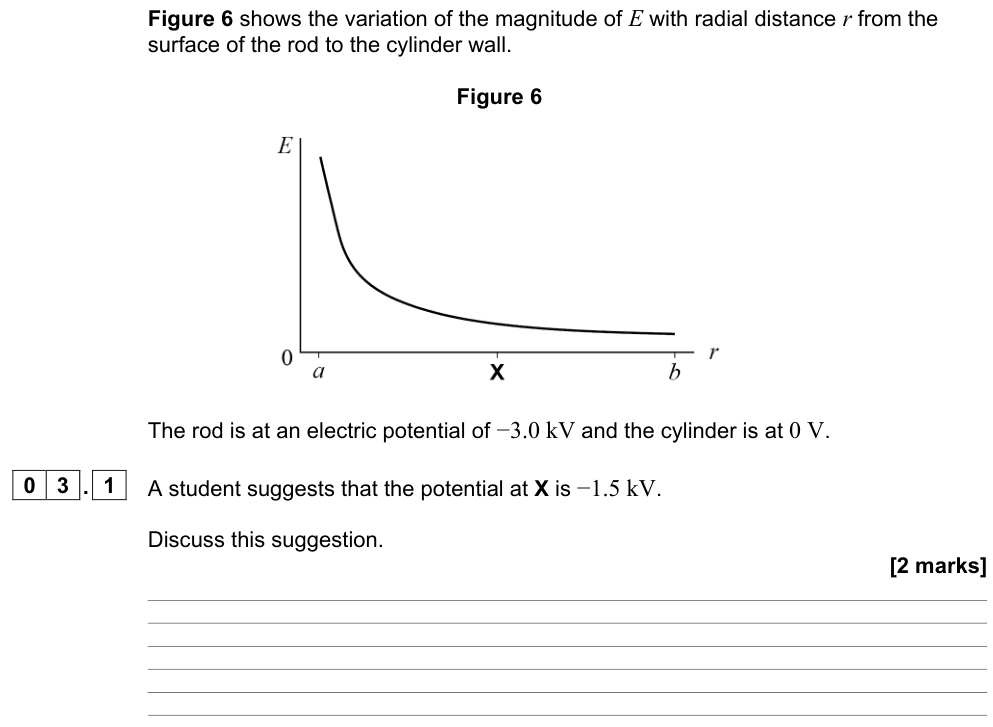
Radial field
Field of a point charge
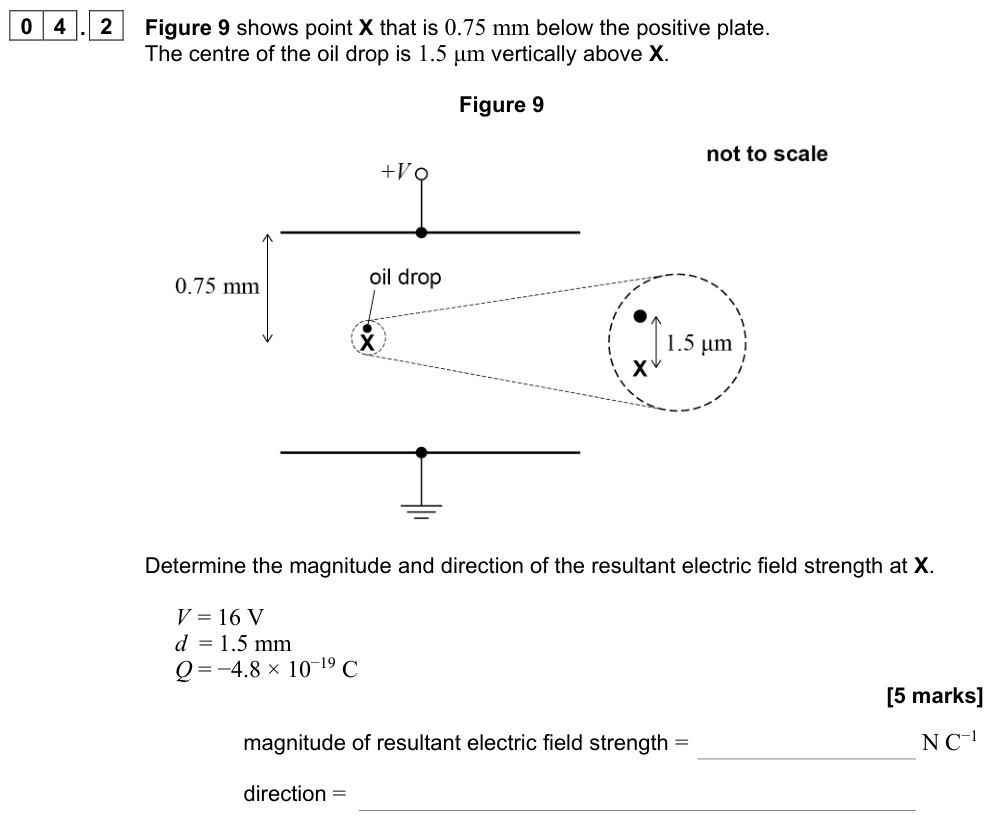
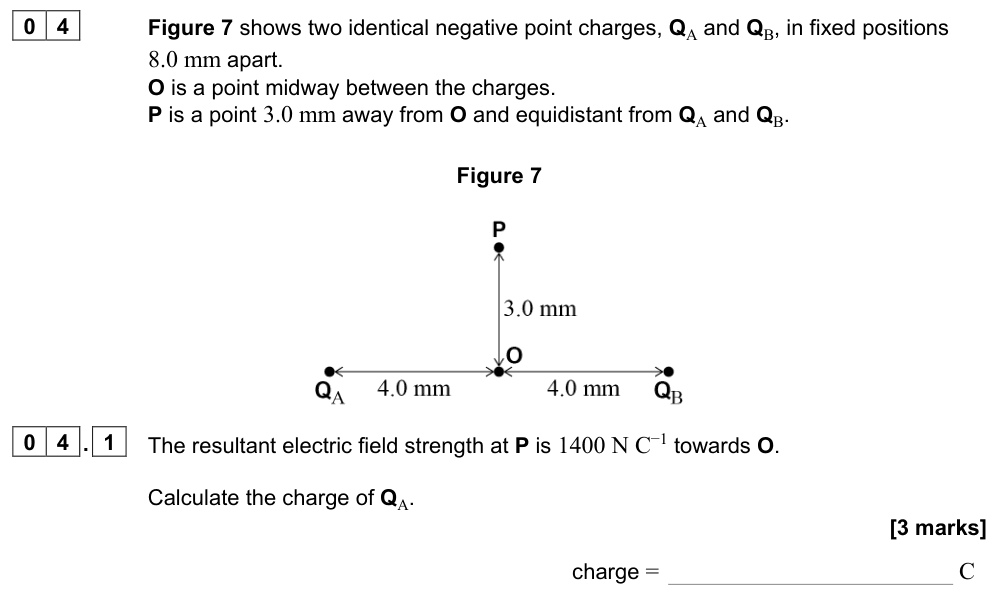
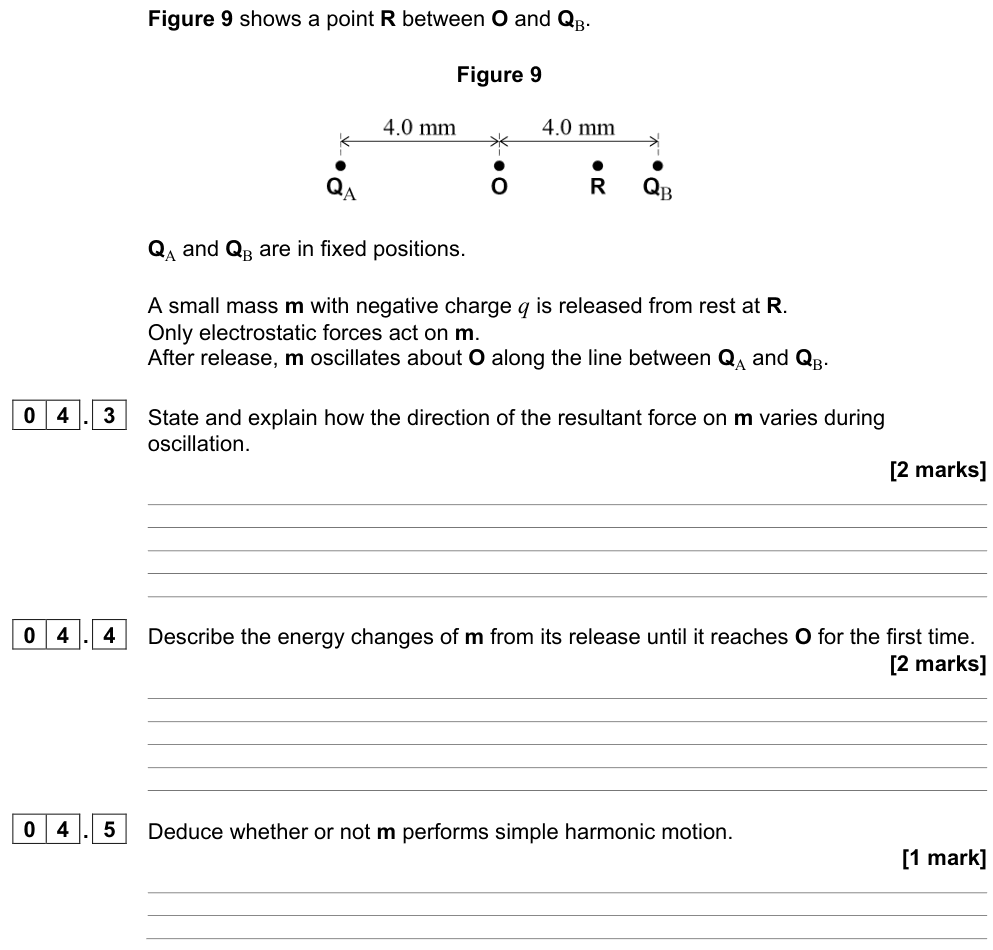
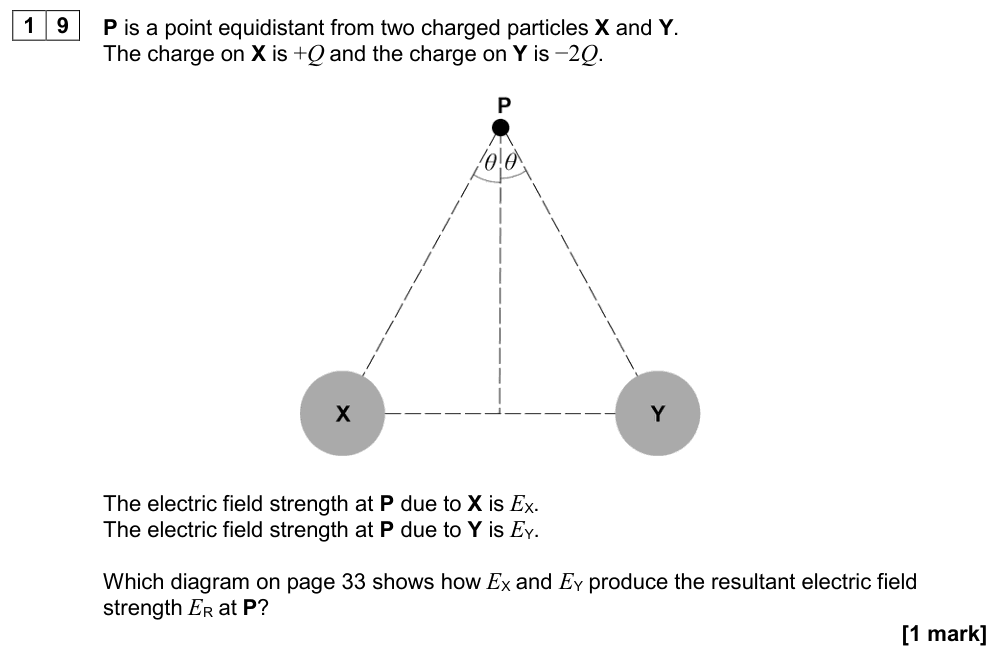
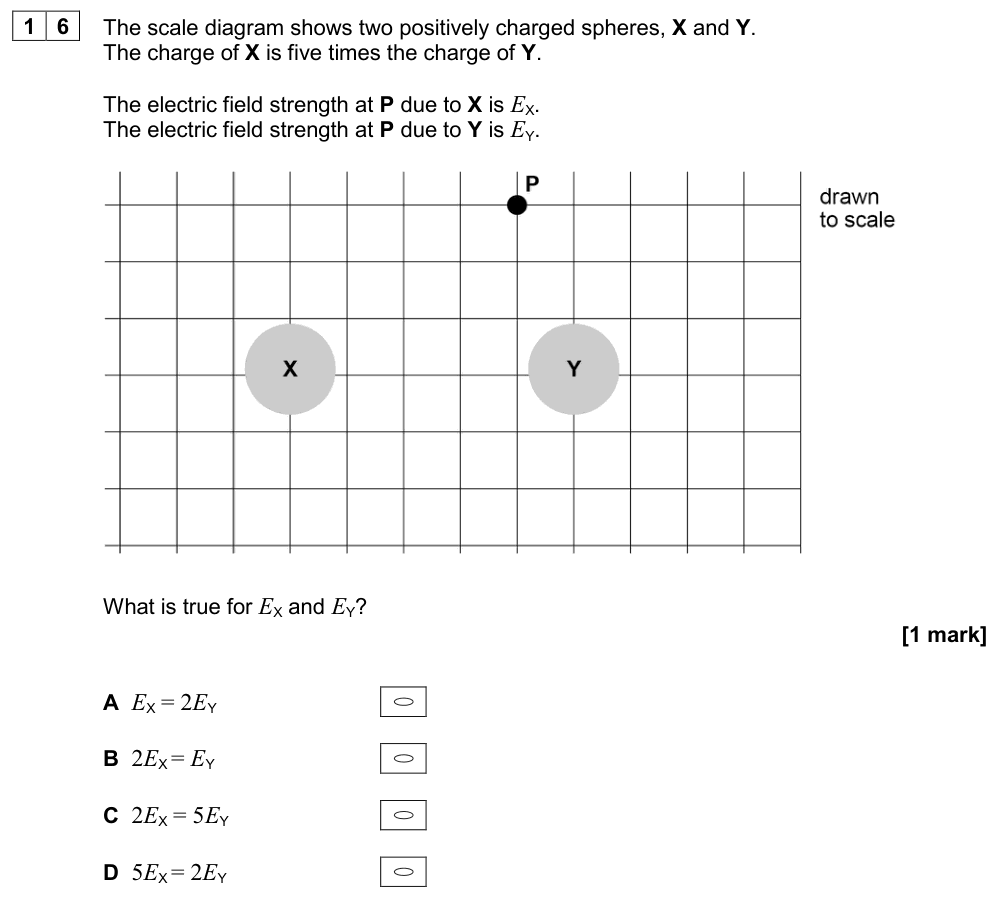
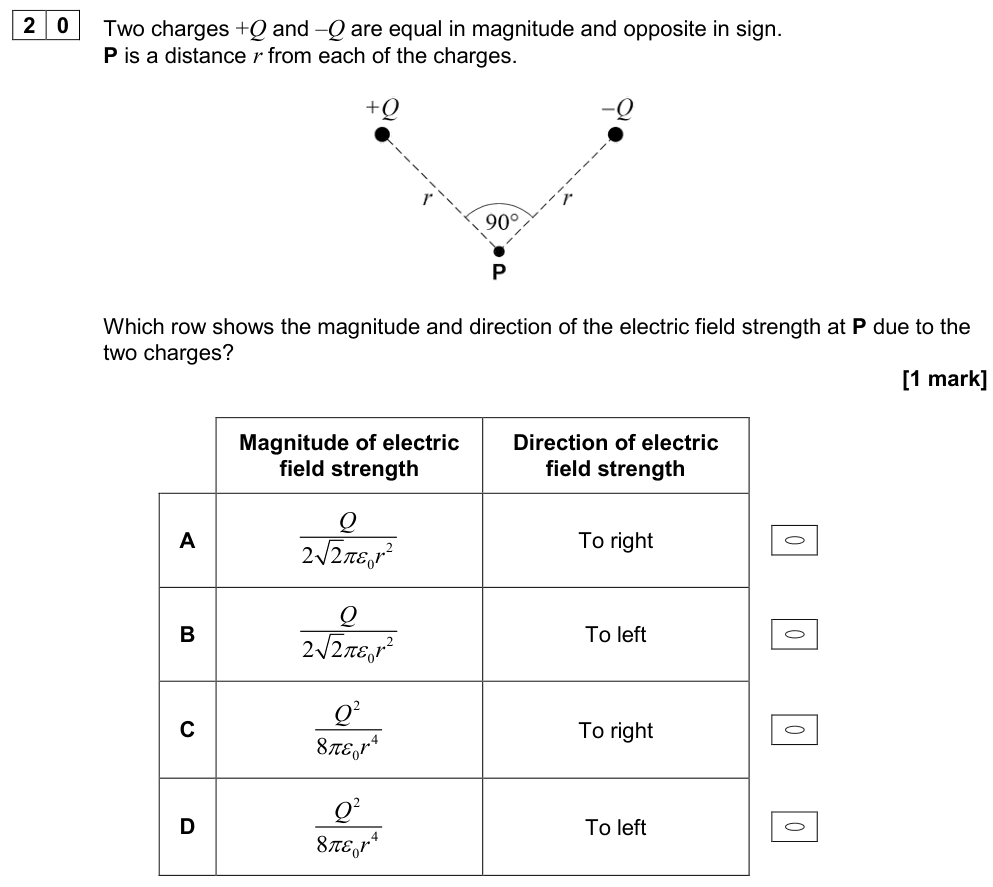
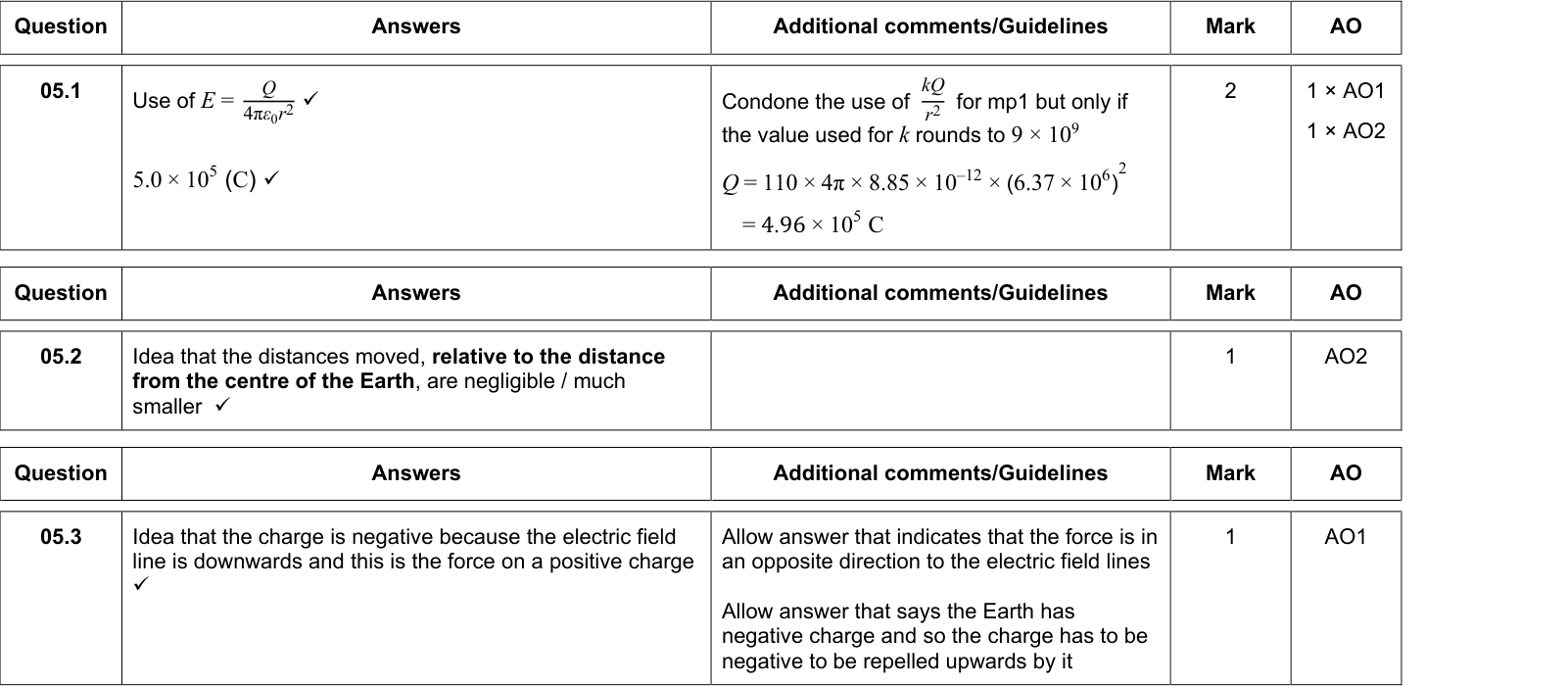
$$E = \frac{1}{4\pi\varepsilon_0}\frac{Q}{r^2}$$
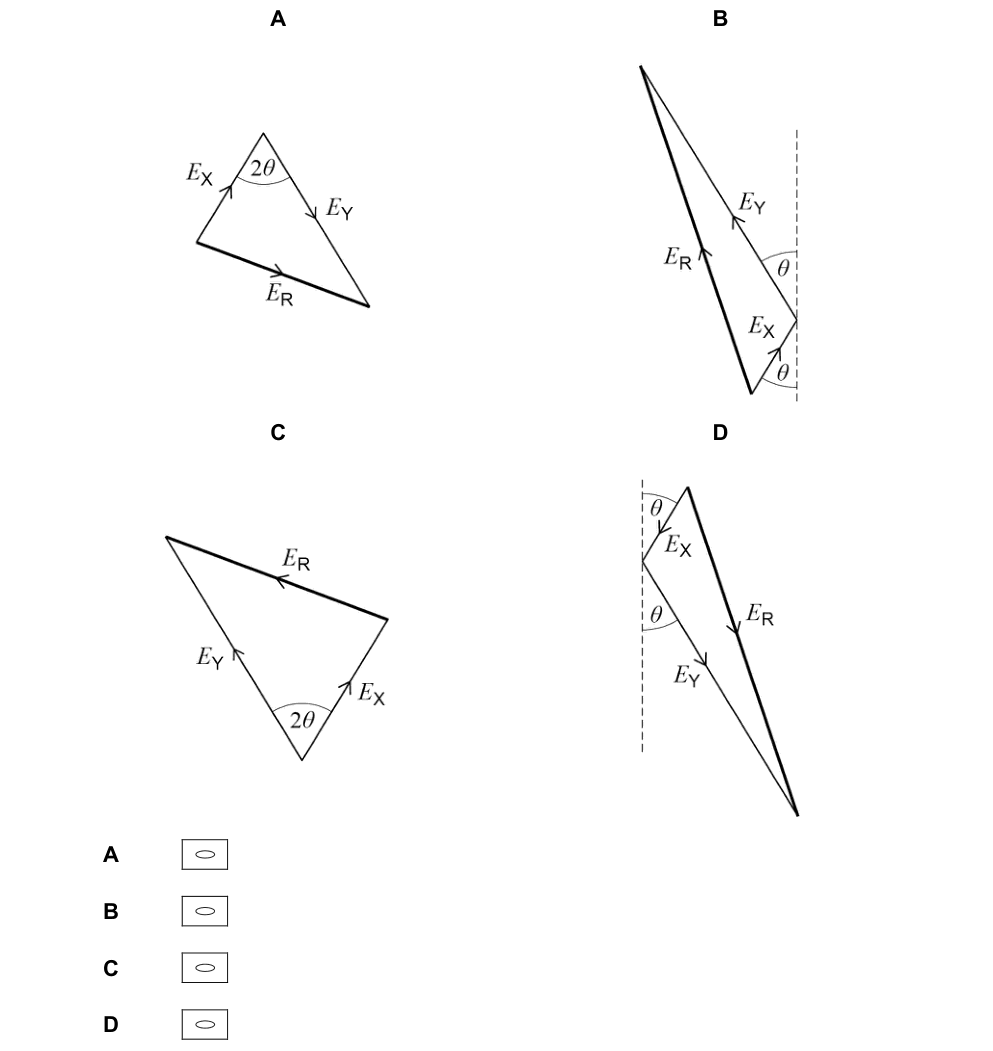
The field points away from a positive charge and towards a negative charge.
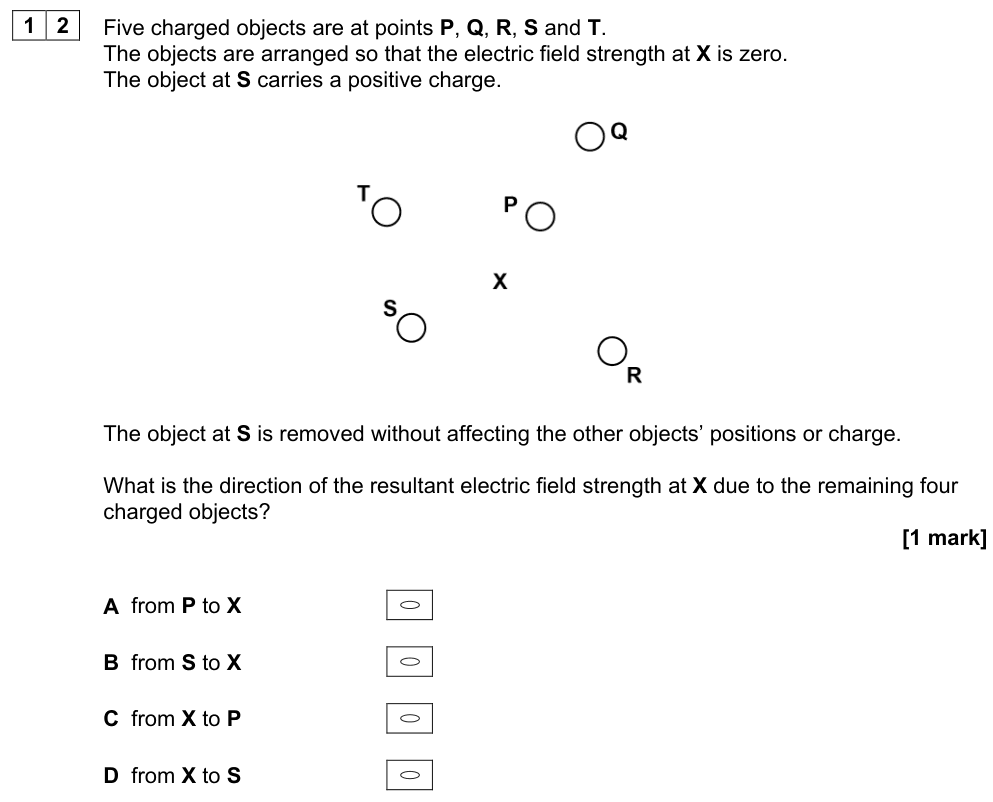
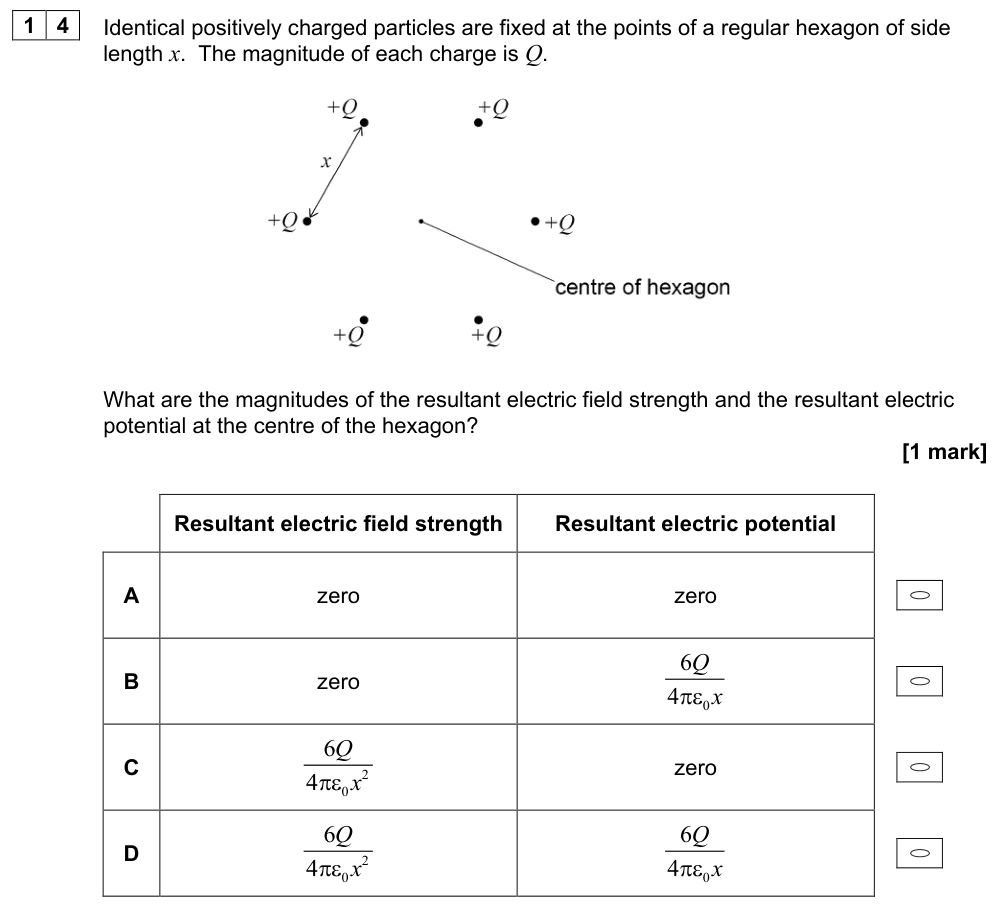
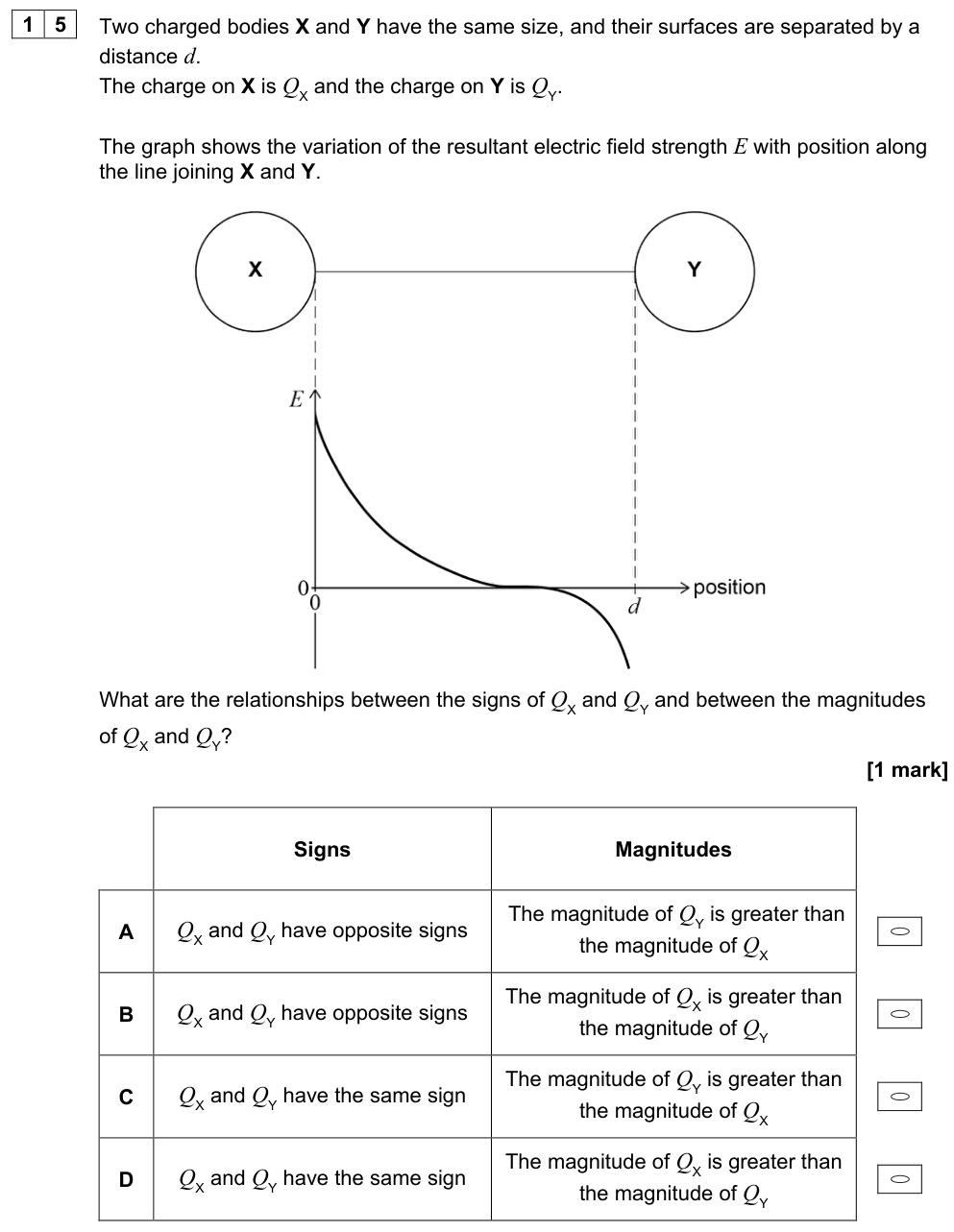
The resultant field from several charges is the vector sum of the individual fields. Between two like charges there is a neutral point where the field is zero.
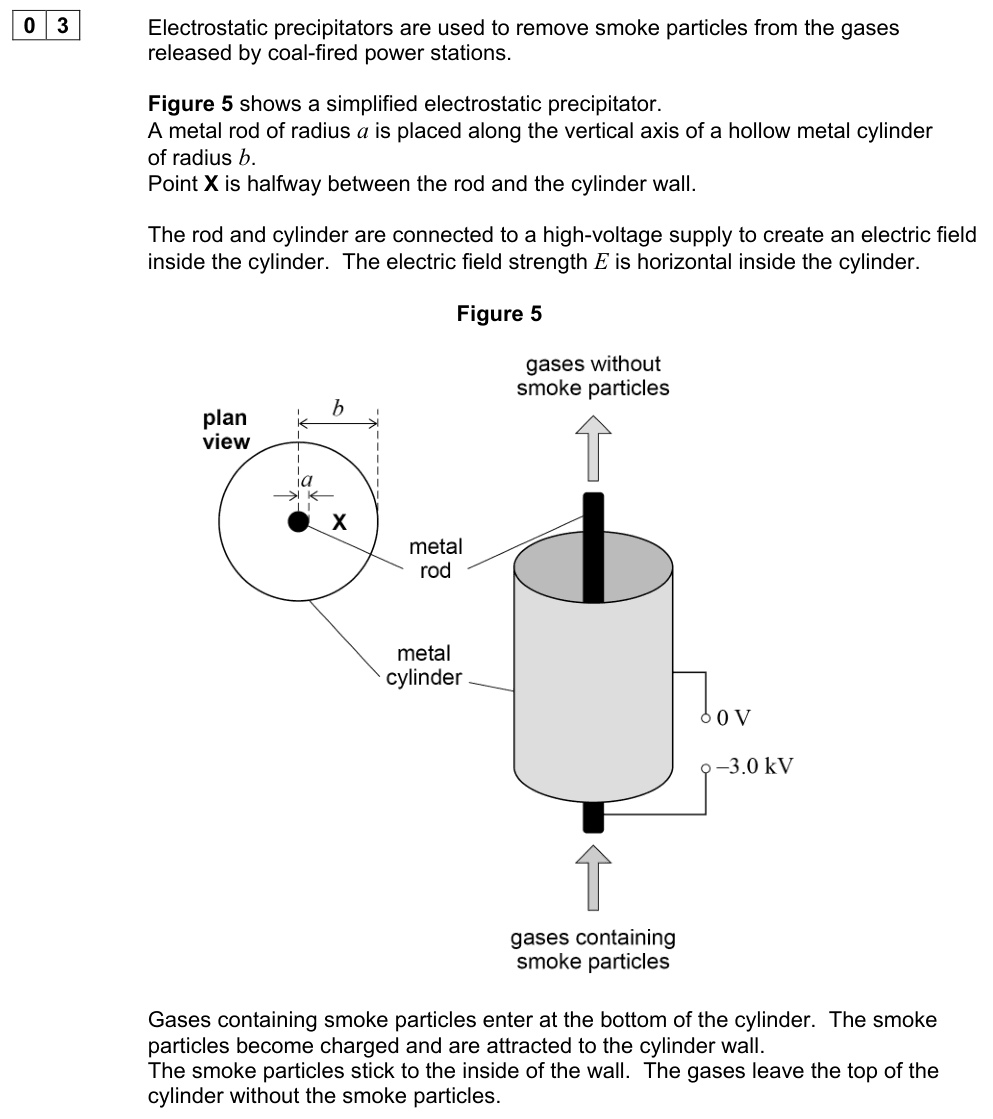
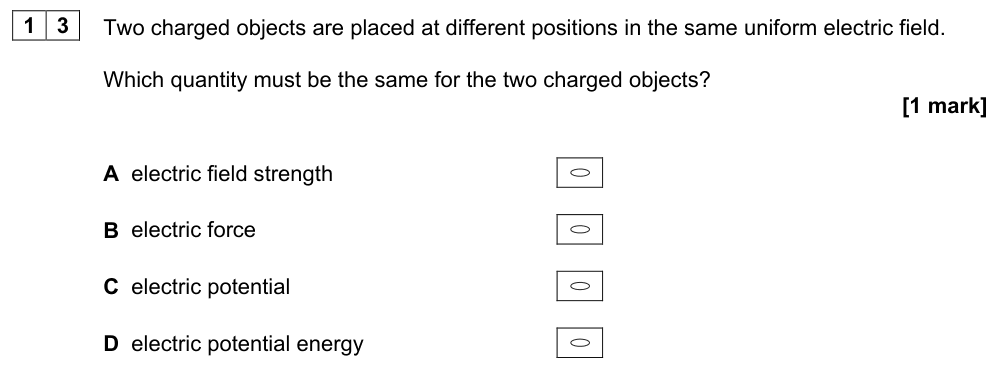
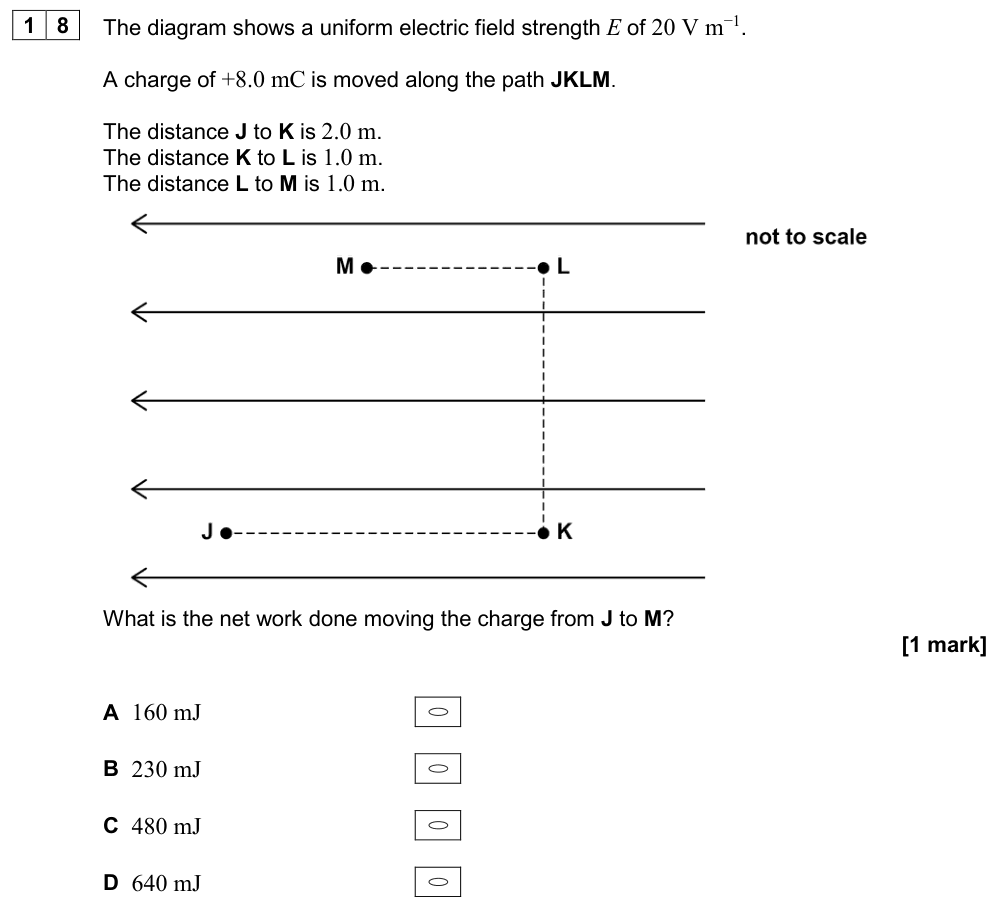
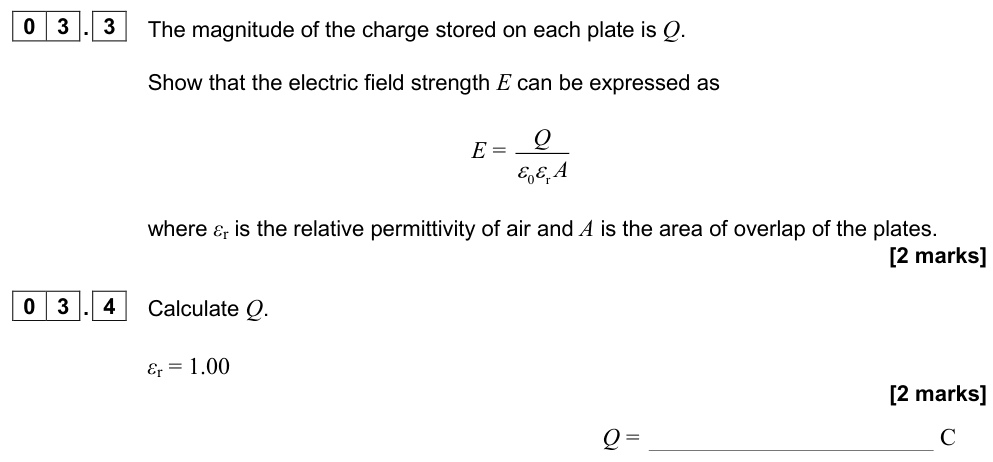
Uniform field between parallel plates
Uniform field
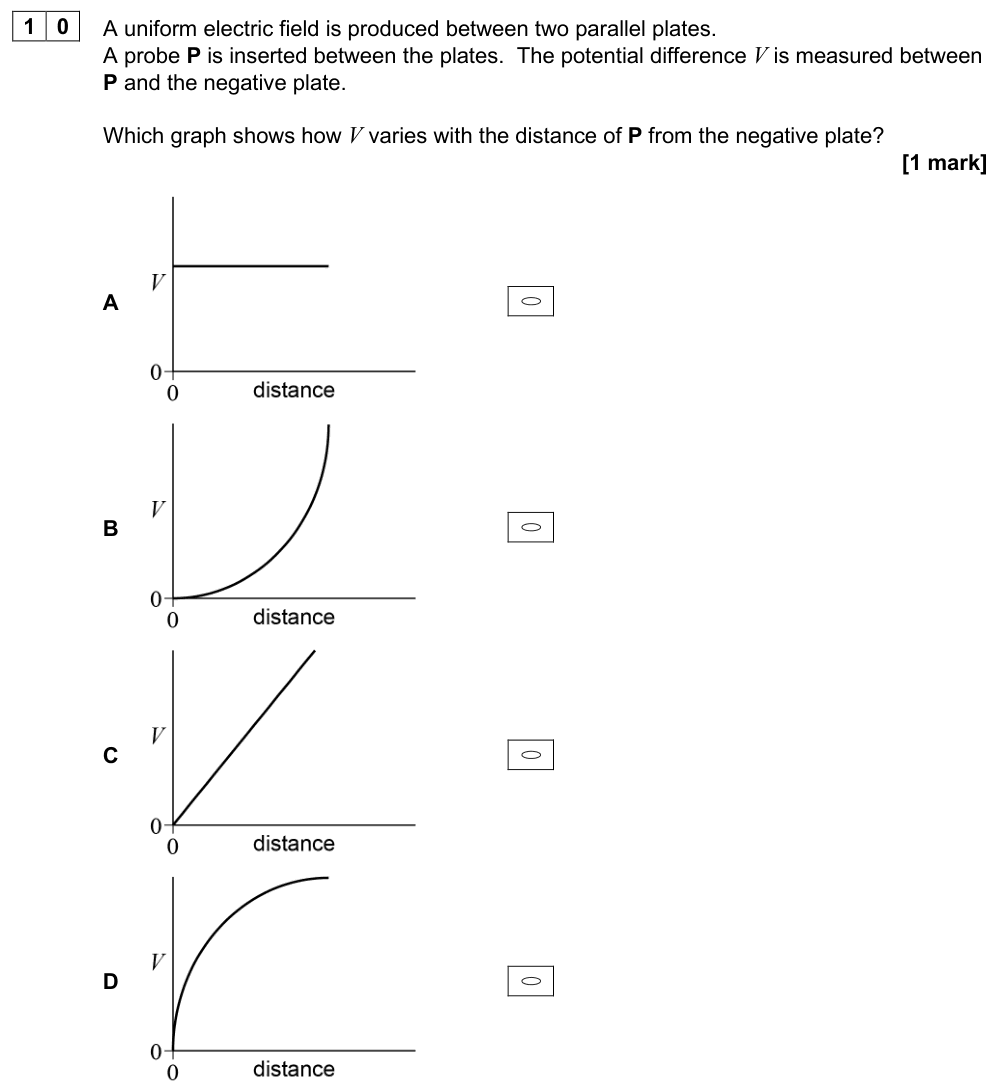
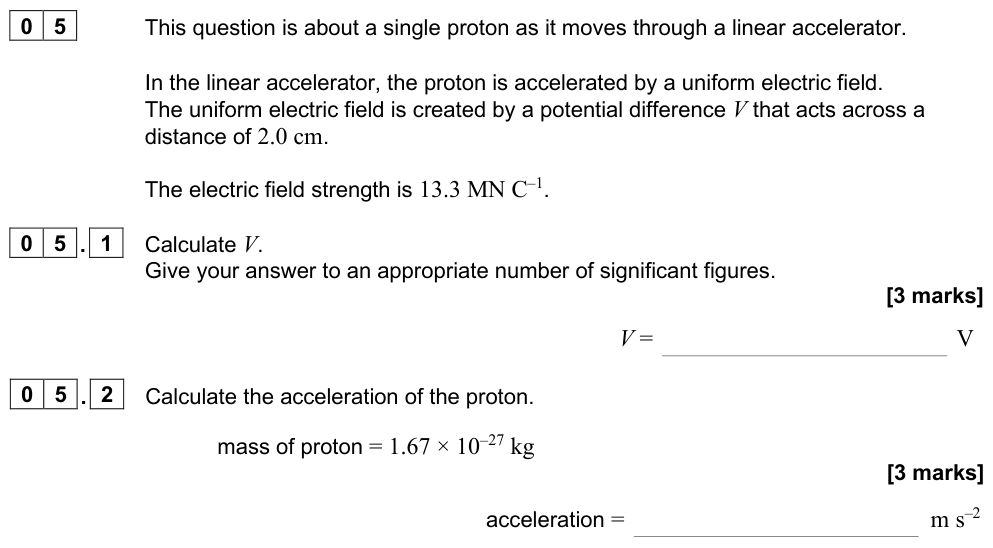
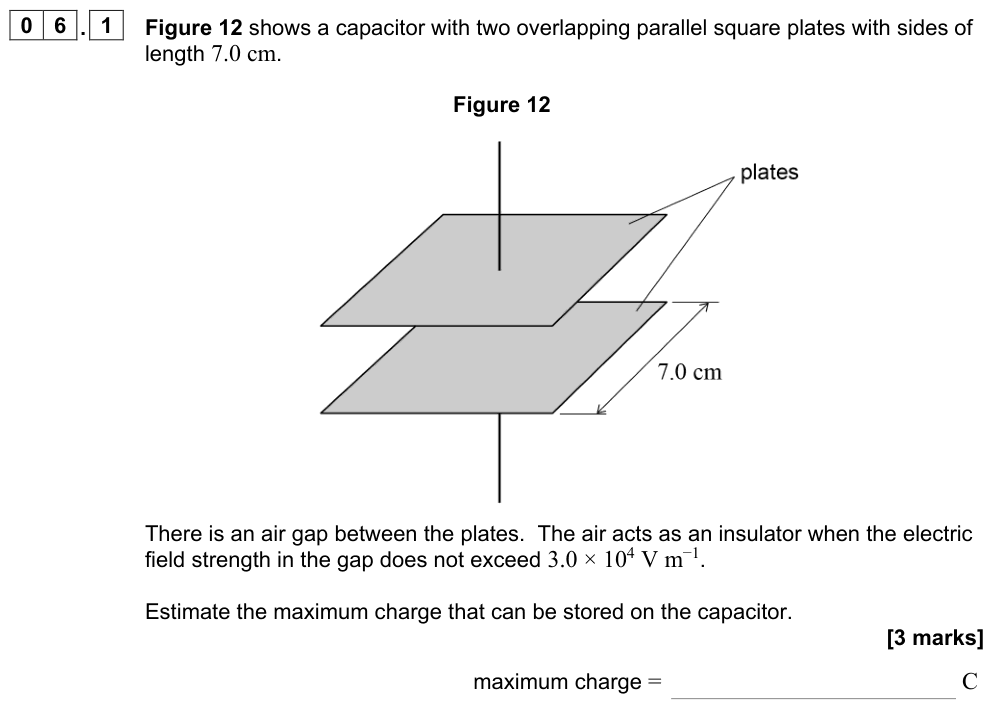
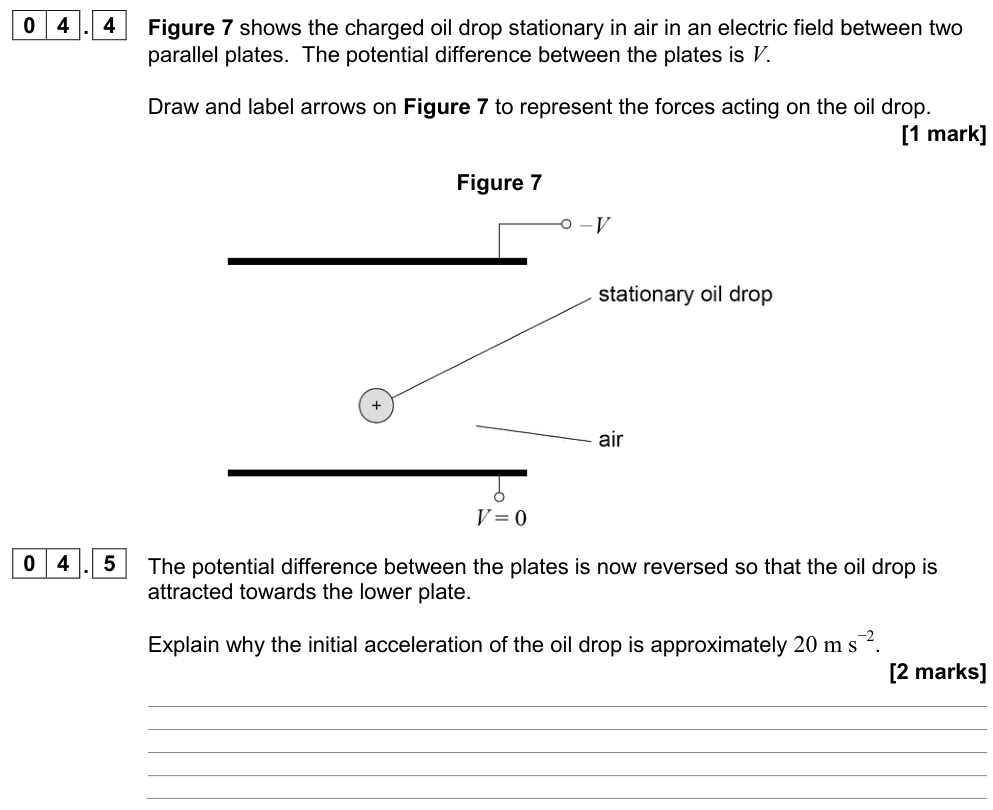
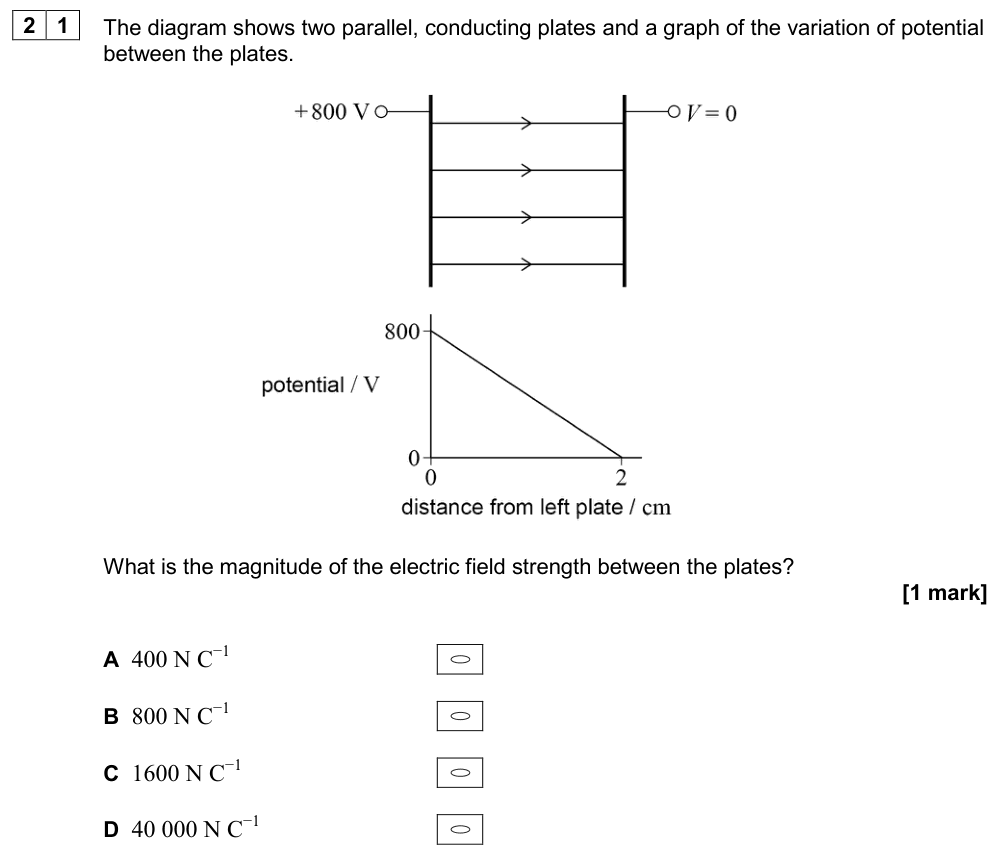
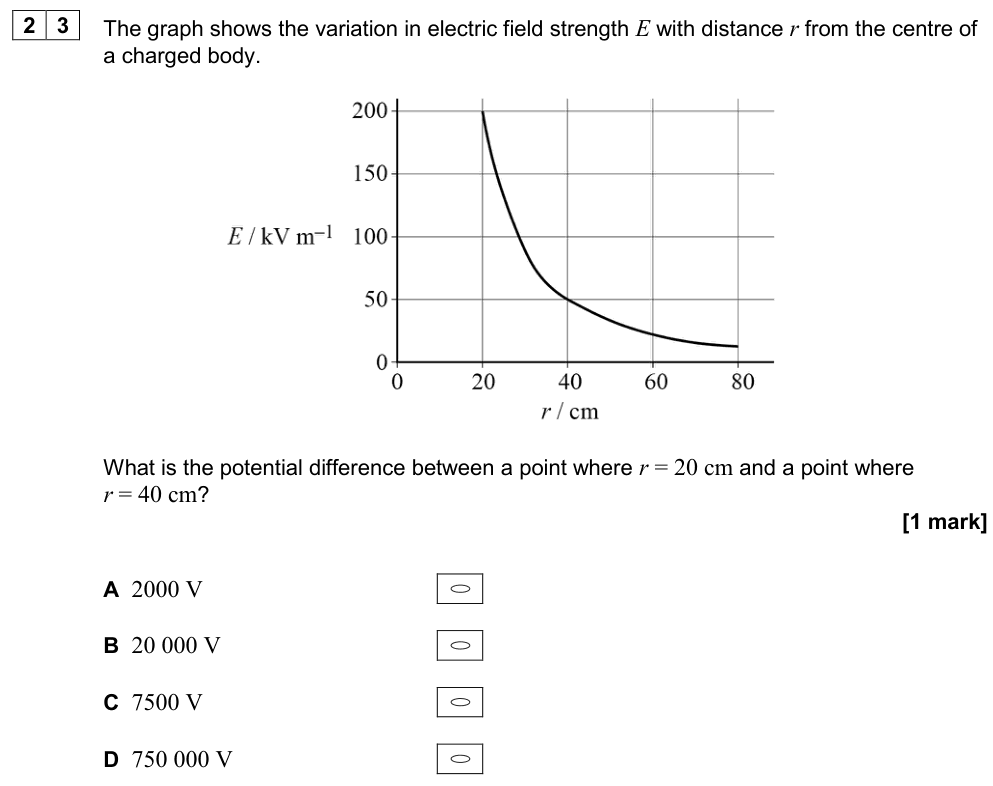
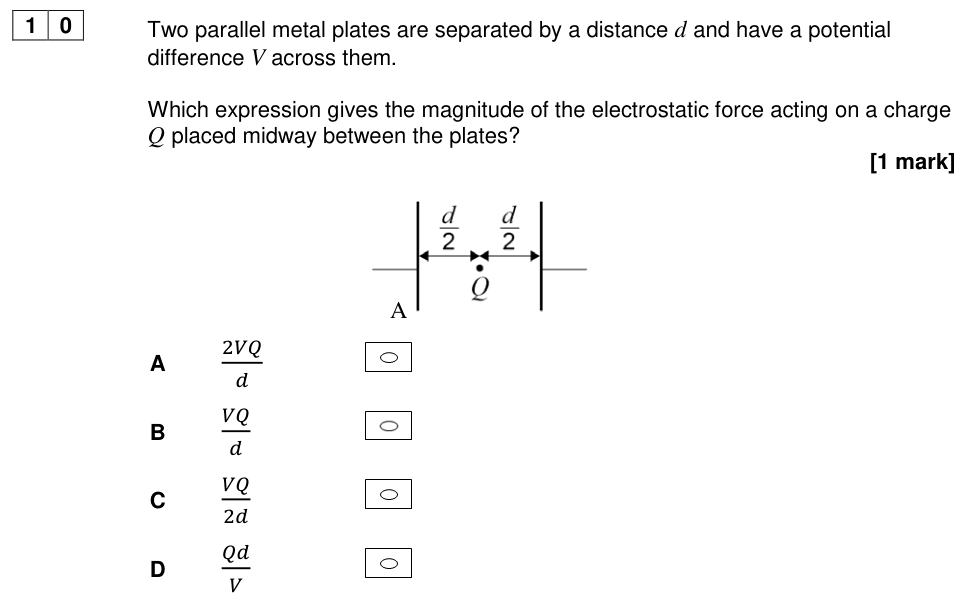
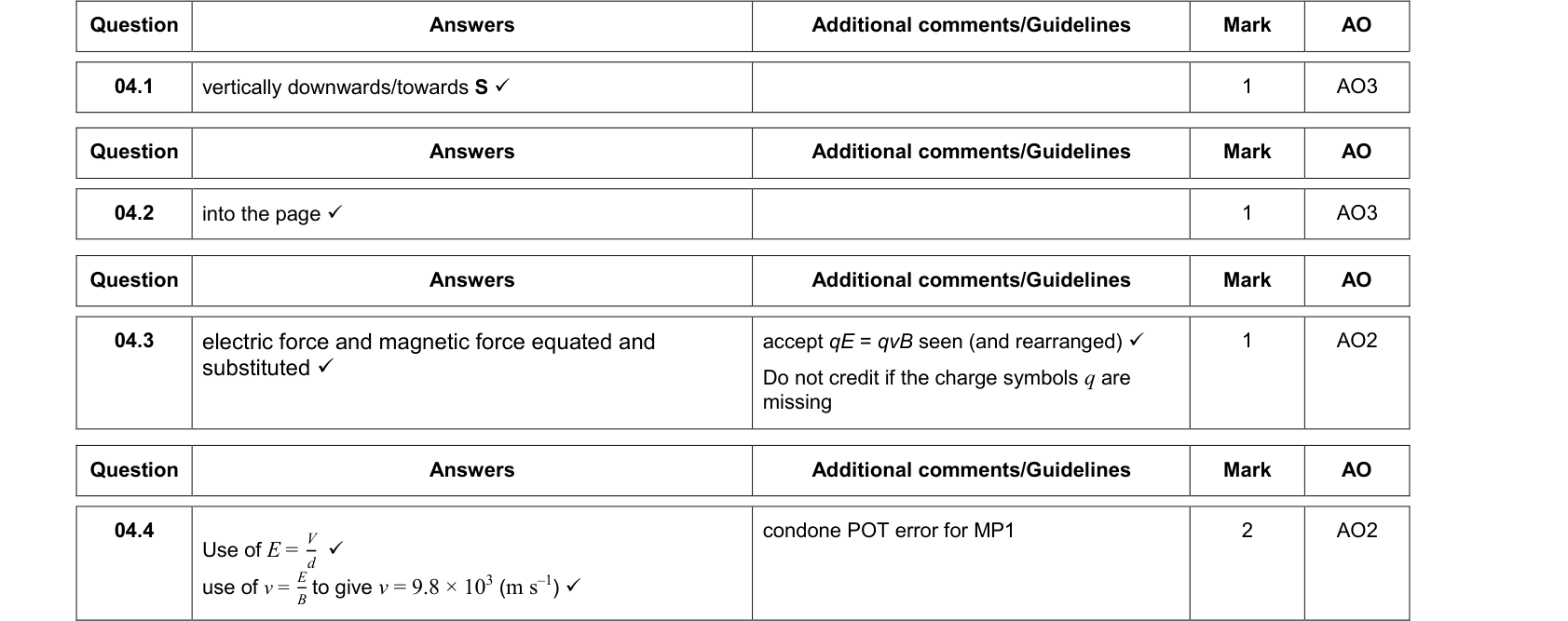
$$E = \frac{V}{d}$$
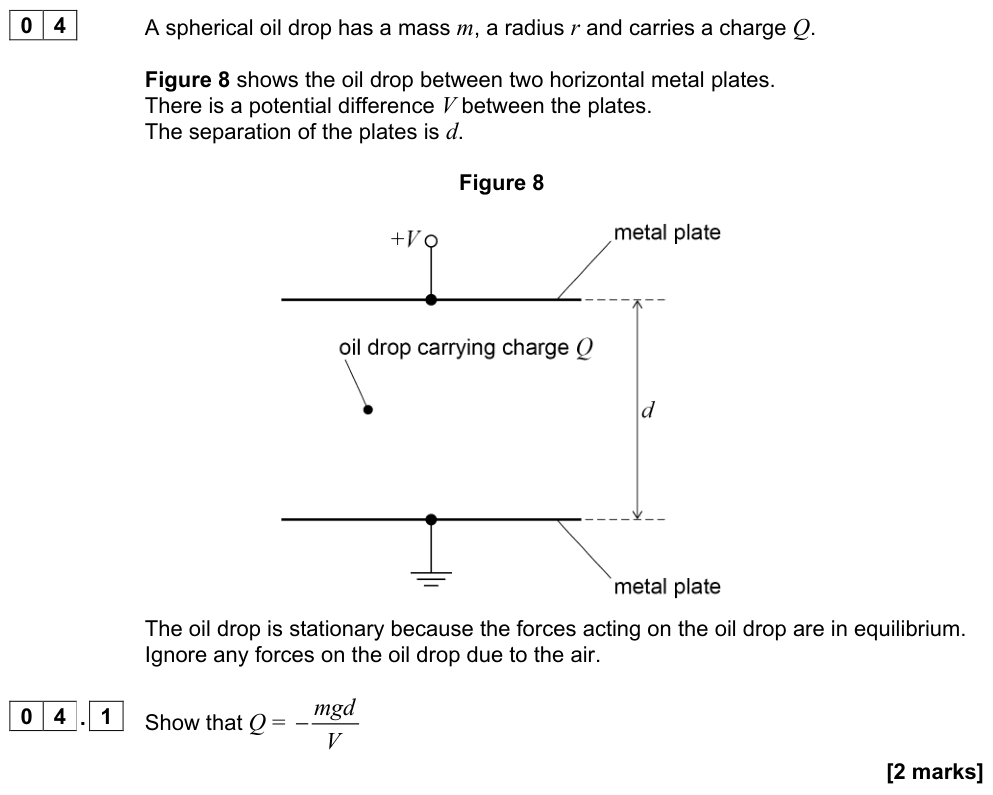
where $V$ is the p.d. between the plates and $d$ is their separation. The field is the same everywhere between the plates (except near the edges).
Derivation: moving a charge $Q$ from one plate to the other against a constant force $F$ requires work $W = Fd$. This also equals $Q\Delta V$ (from the definition of p.d.). So $Fd = QV$, giving $E = F/Q = V/d$.
Worked example: field between plates
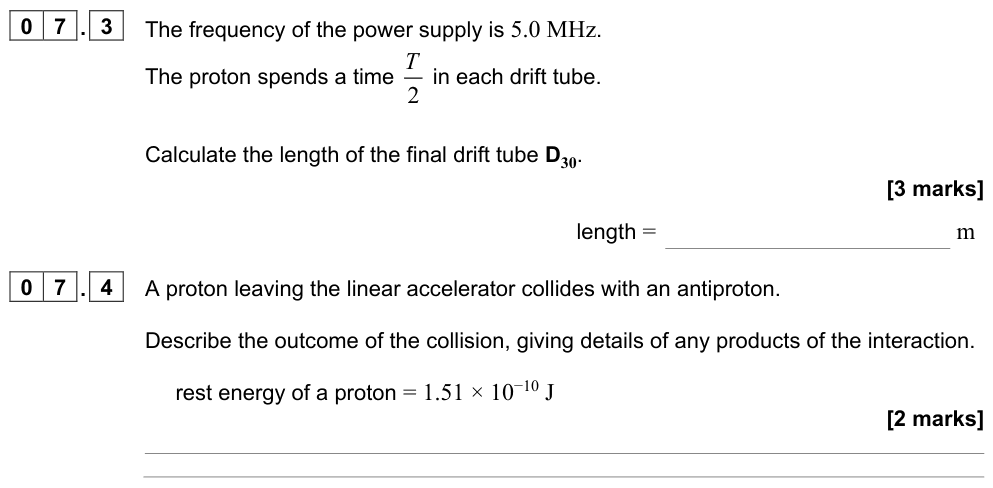
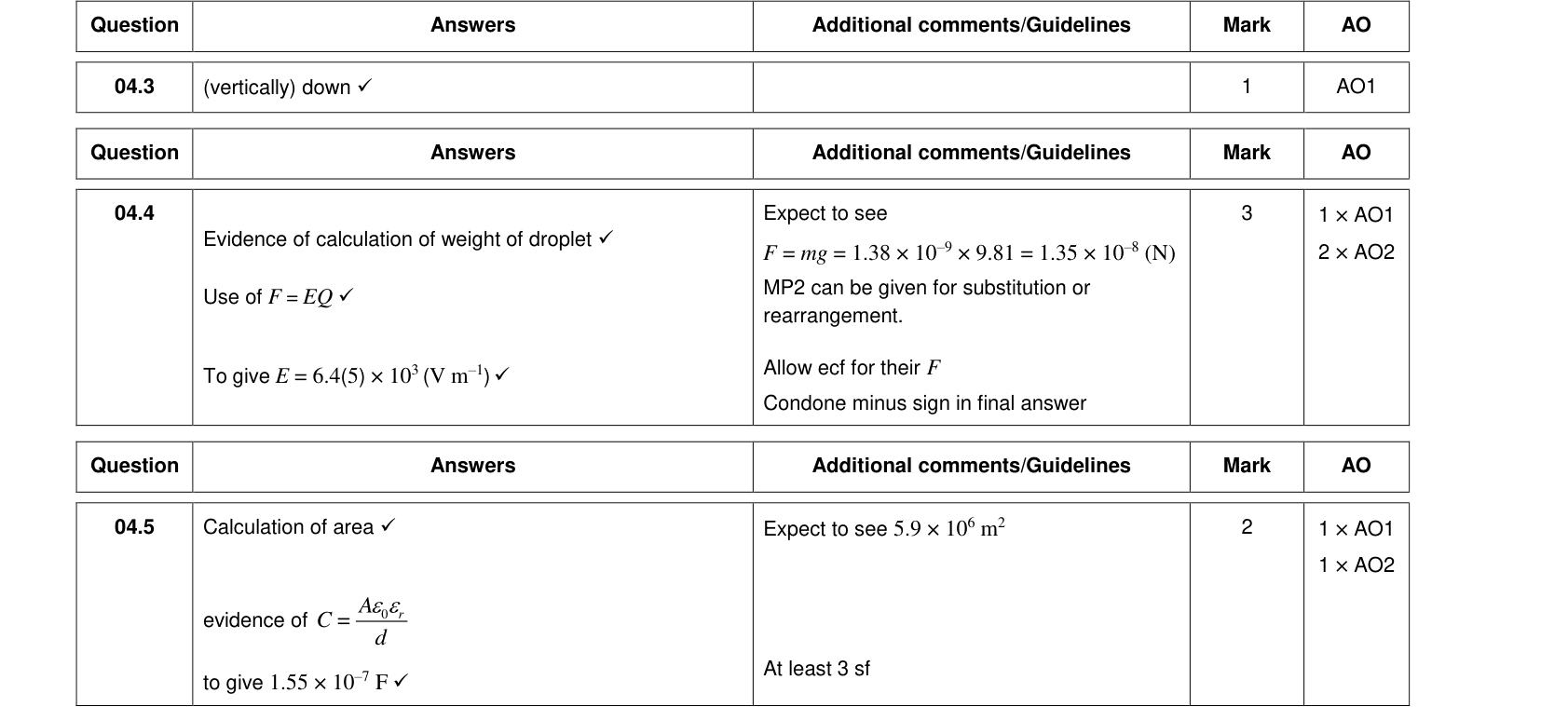
Plates 4.0 mm apart with a p.d. of 2.0 kV: $E = \dfrac{2000}{4.0 \times 10^{-3}} = 5.0 \times 10^{5}\ \text{V m}^{-1}$. Force on an electron: $F = eE = 8.0 \times 10^{-14}\ \text{N}$.
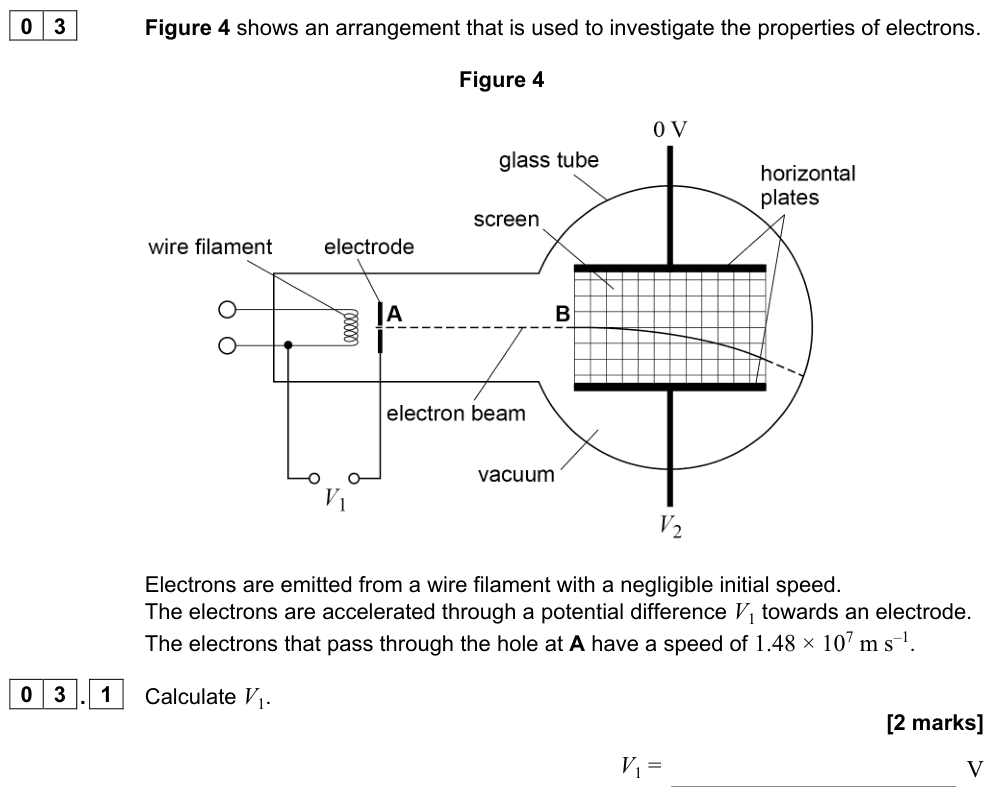
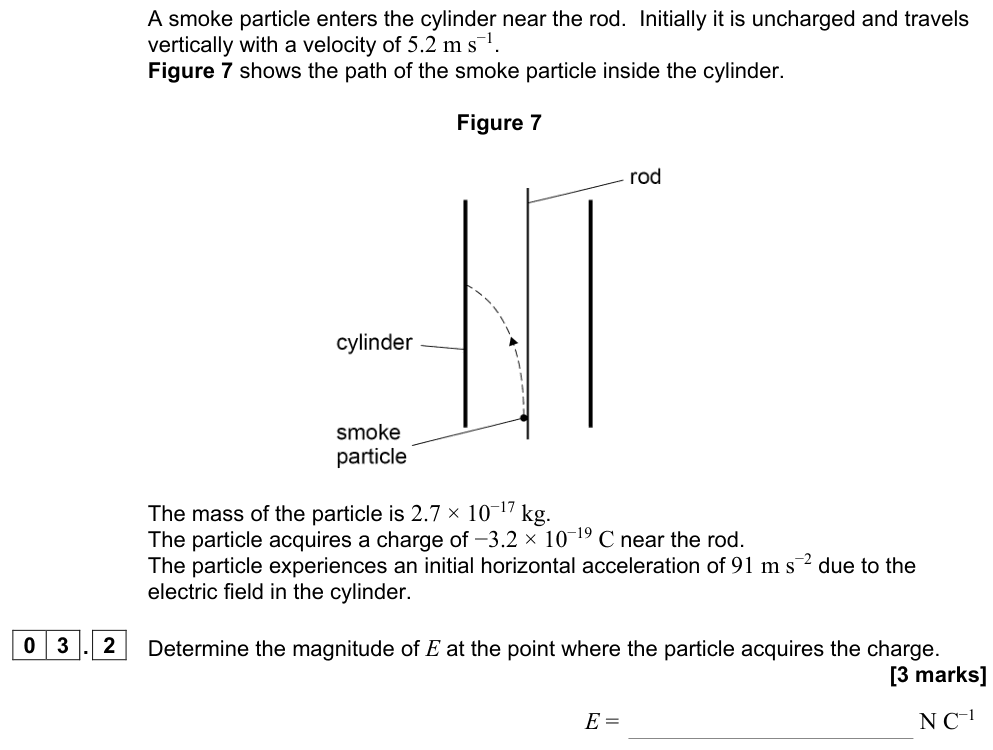
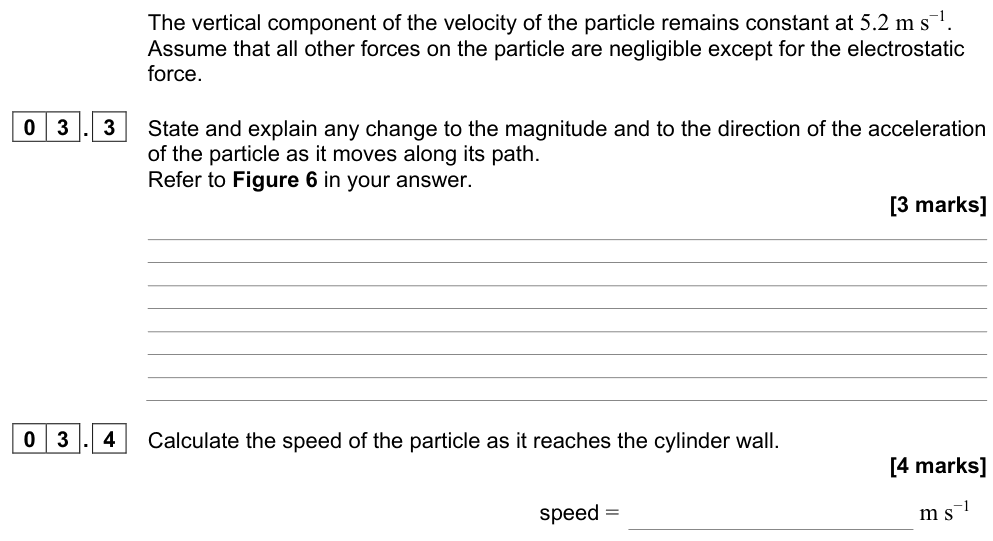
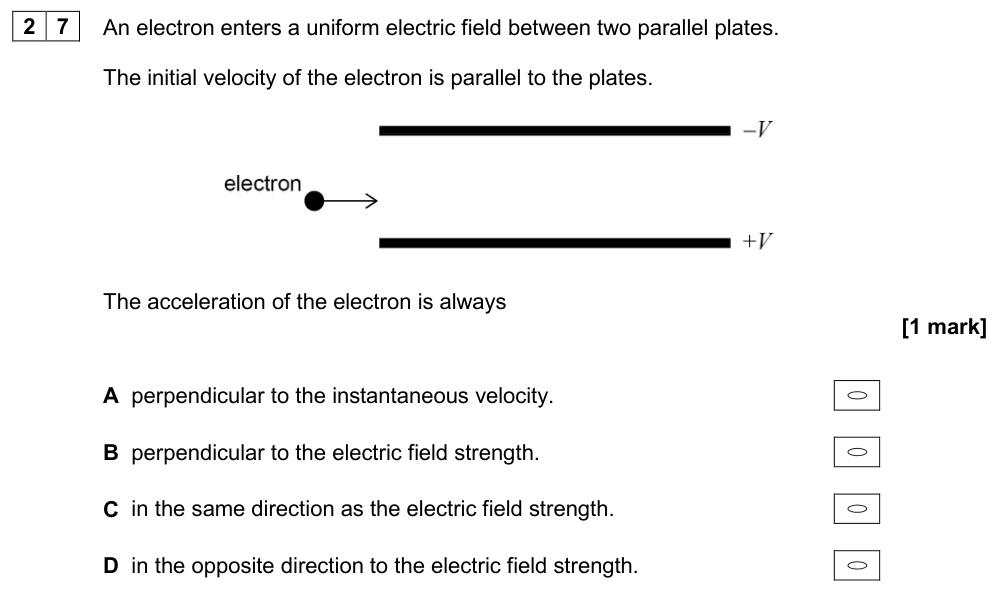
A charged particle entering a uniform field
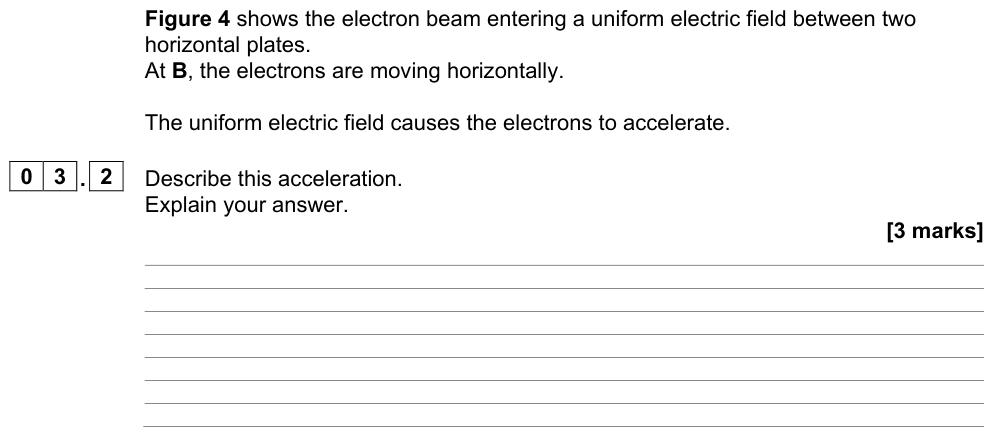
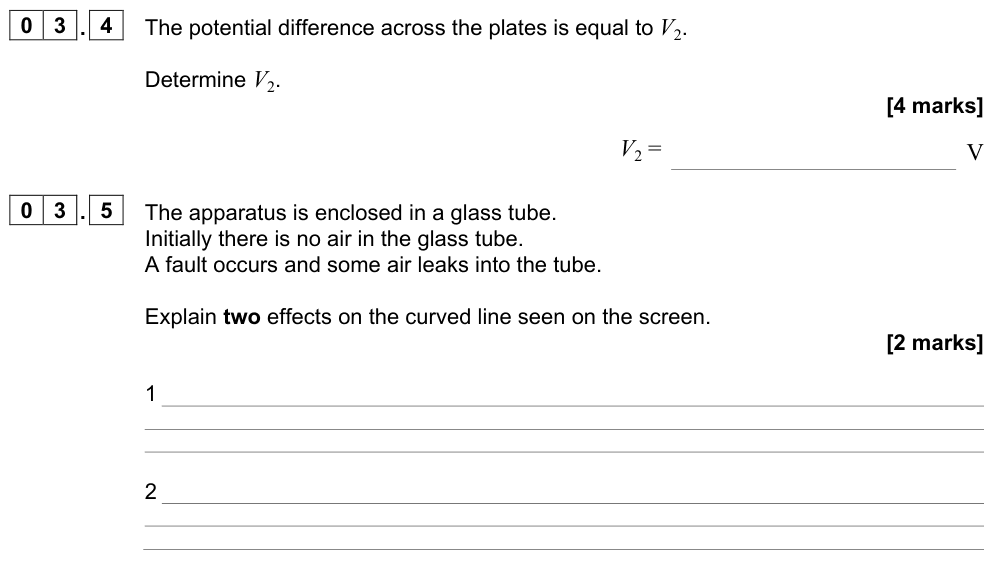
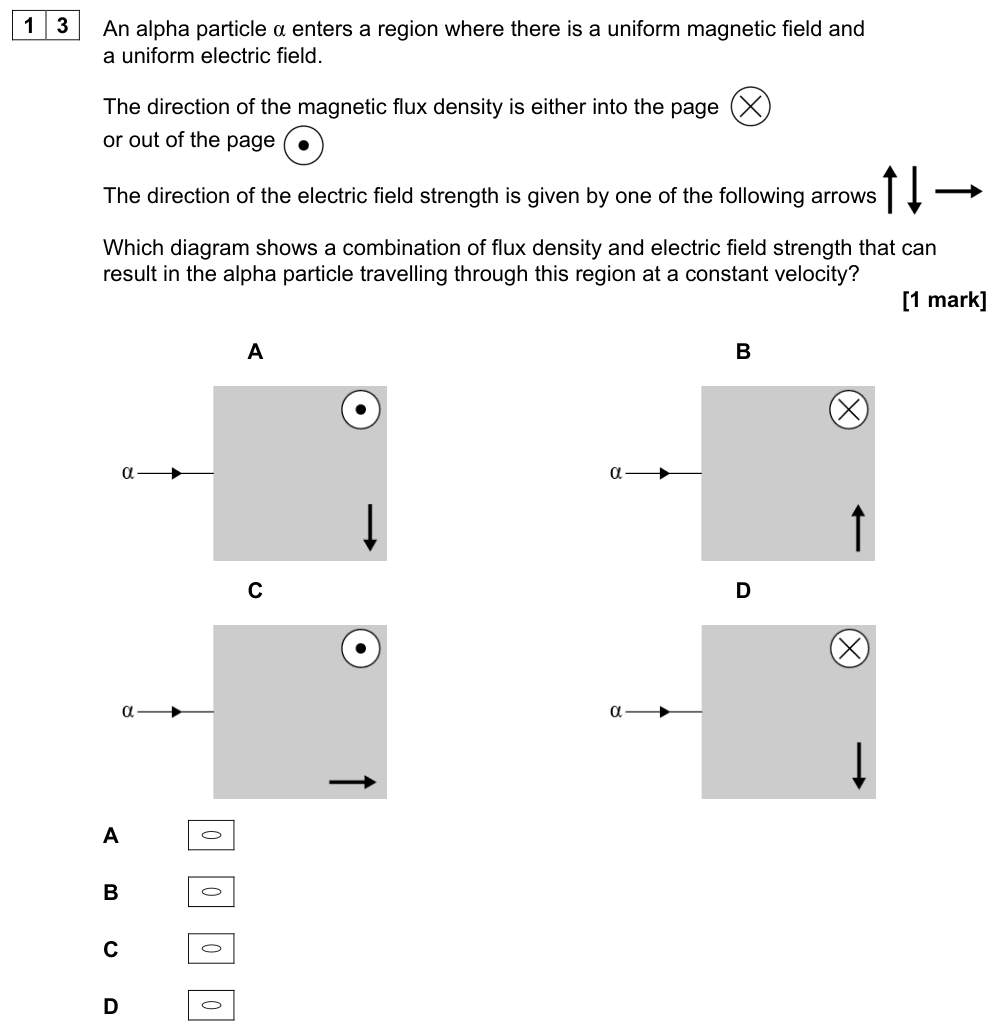
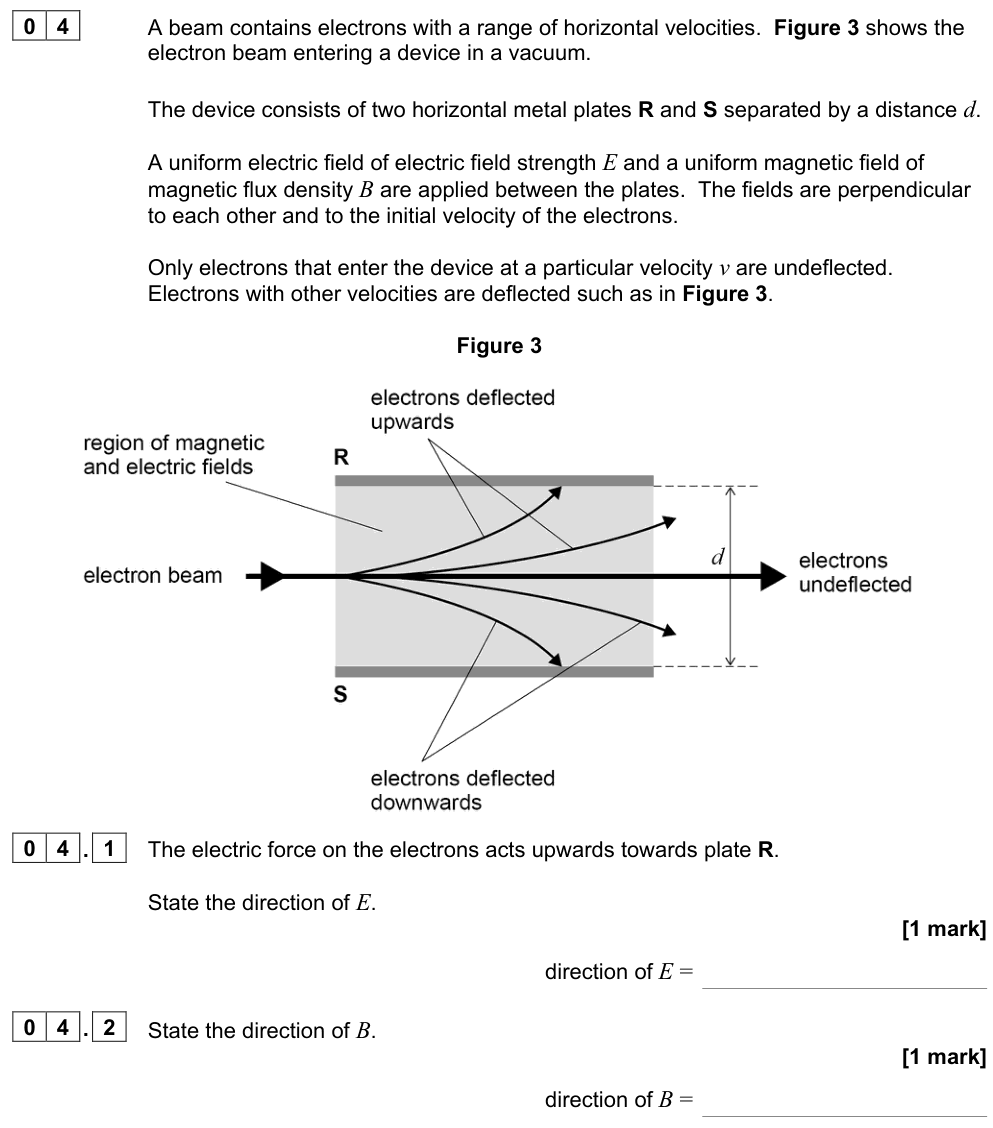
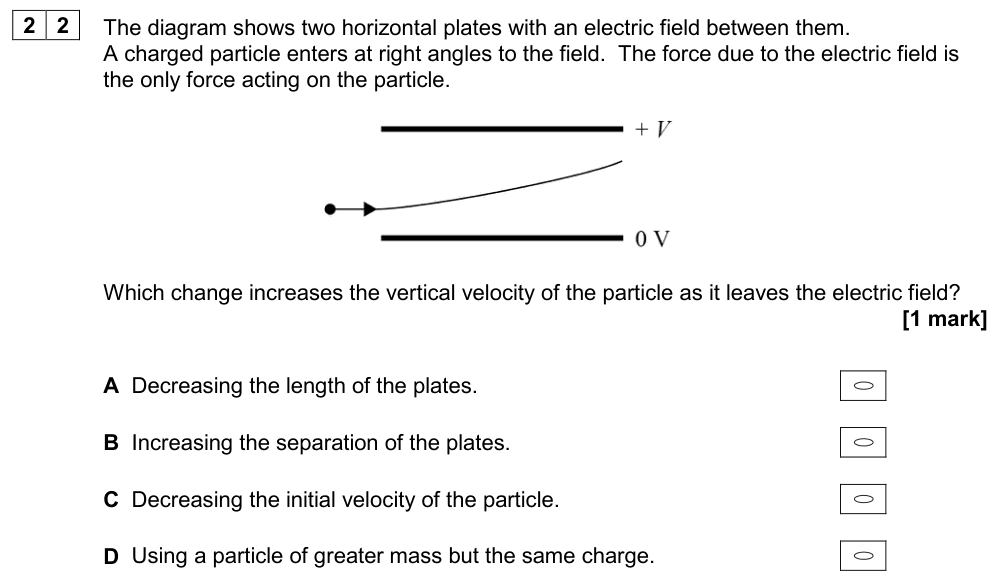
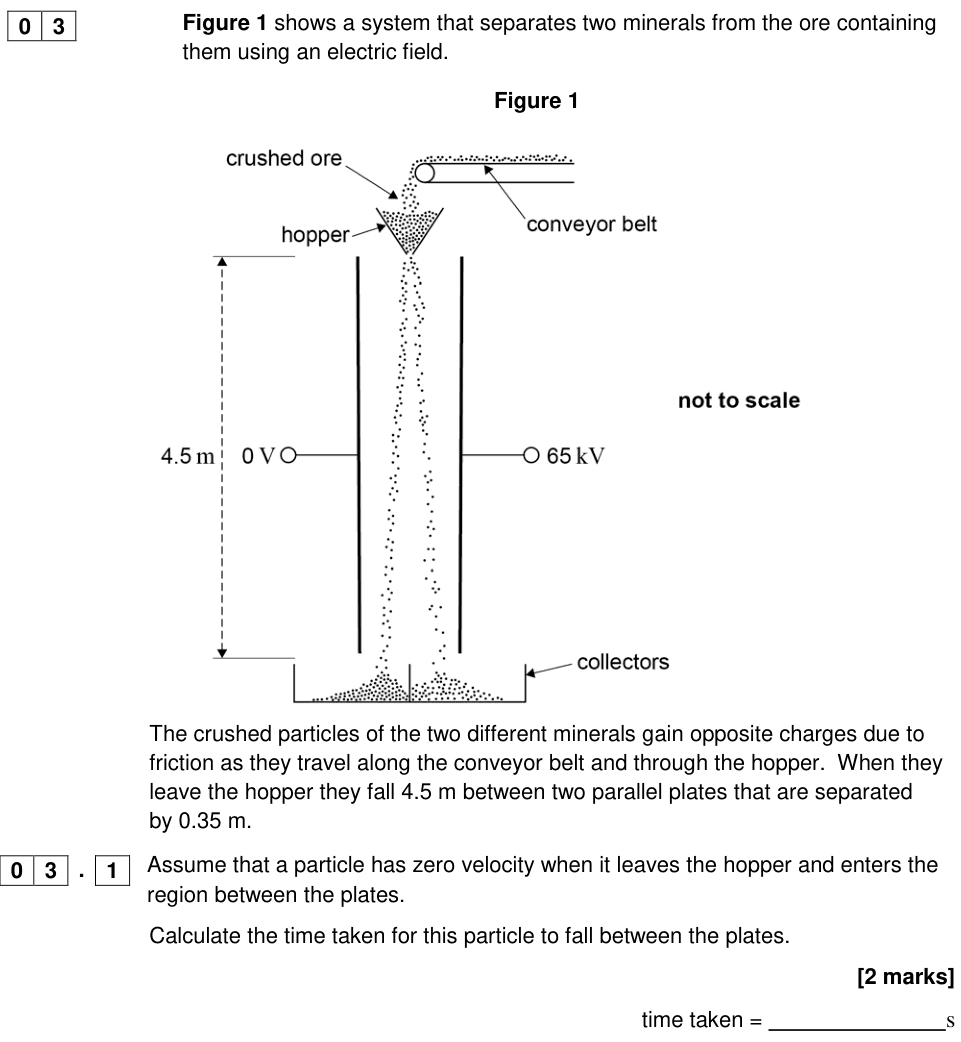
A charged particle entering a uniform field at right angles to the field behaves like a projectile in a gravitational field:
- Parallel to the plates (perpendicular to the field): no force, so constant velocity $v_x = u$.
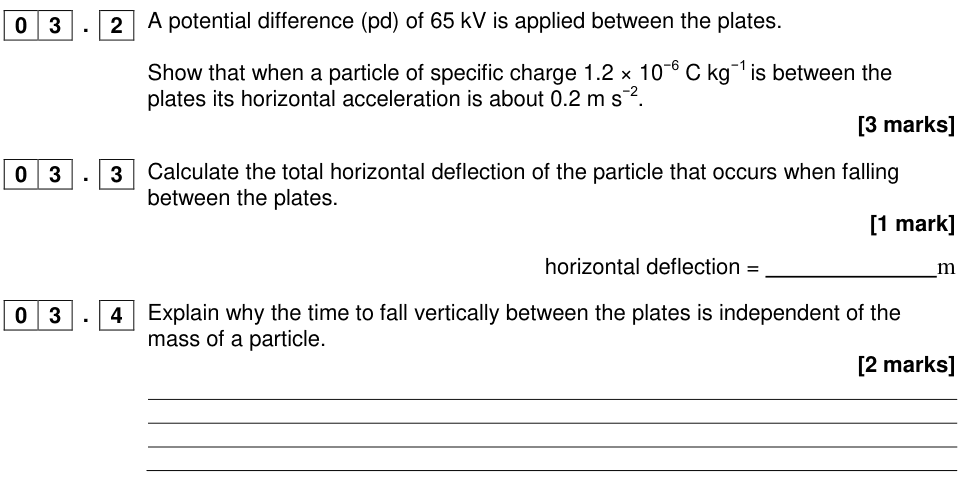
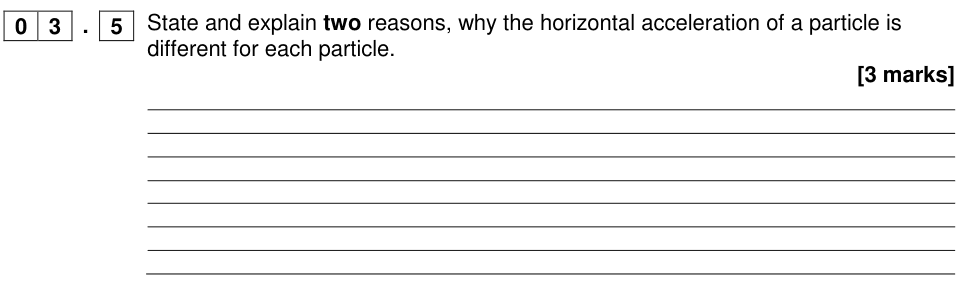
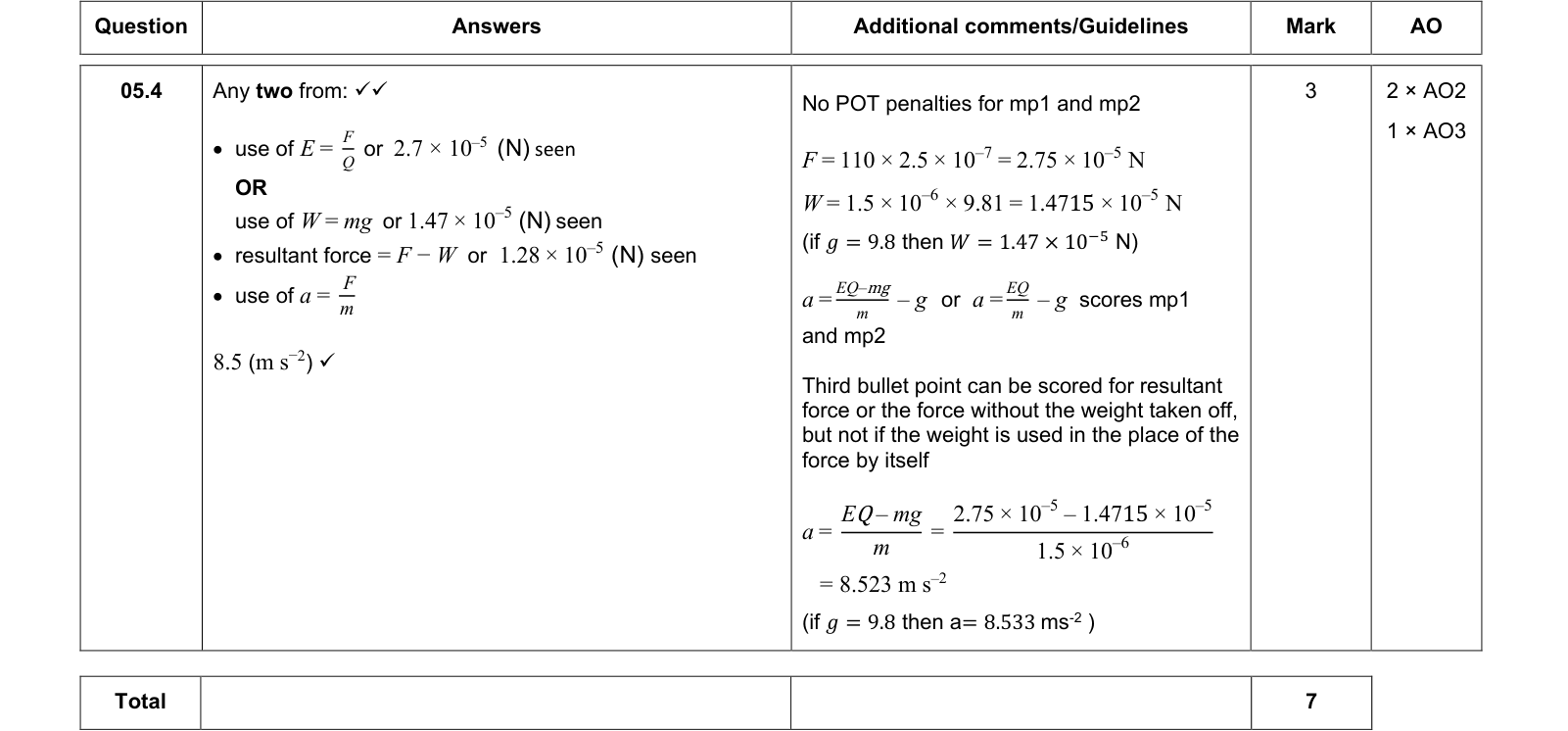
- Along the field: constant force $F = QE$, so constant acceleration $a = \dfrac{QE}{m} = \dfrac{QV}{md}$.
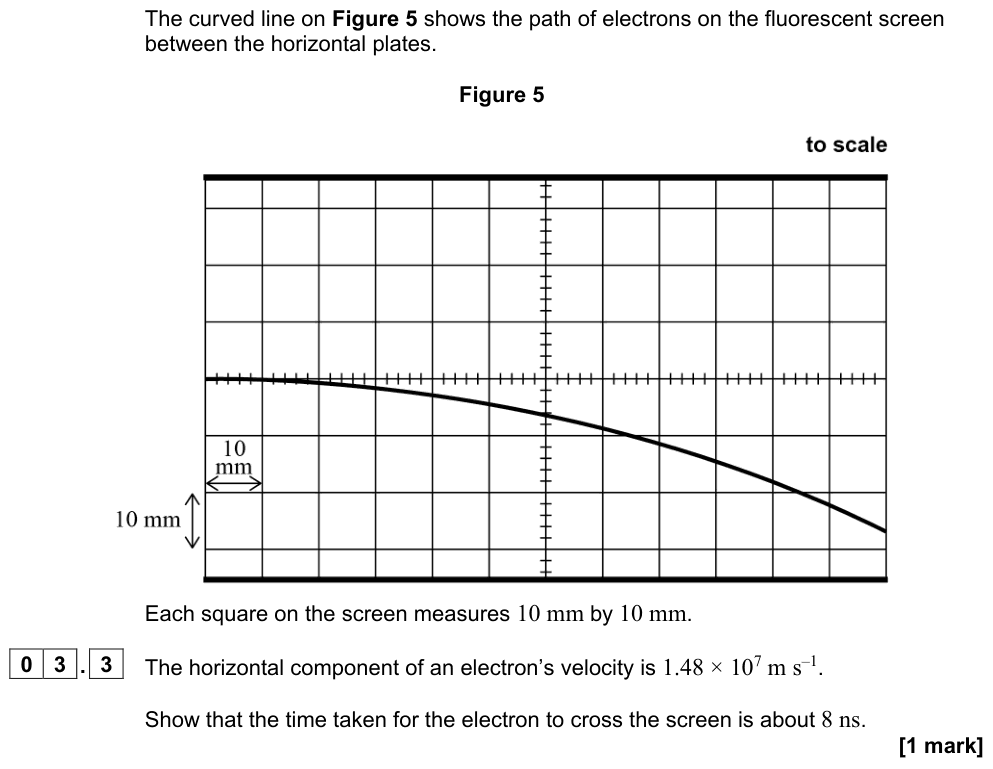
The path between the plates is therefore a parabola. After leaving the plates the particle moves in a straight line.
Worked example: electron deflection
An electron enters the field between plates of length 5.0 cm at $3.0 \times 10^{7}\ \text{m s}^{-1}$. The field strength is $2.0 \times 10^{4}\ \text{V m}^{-1}$.
Time between plates $t = 0.050/3.0 \times 10^{7} = 1.67 \times 10^{-9}$ s.
$a = \dfrac{eE}{m} = \dfrac{1.60 \times 10^{-19} \times 2.0 \times 10^{4}}{9.11 \times 10^{-31}} = 3.5 \times 10^{15}\ \text{m s}^{-2}$.
Deflection $= \tfrac12at^2 = \tfrac12 \times 3.5 \times 10^{15} \times (1.67 \times 10^{-9})^2 = 4.9 \times 10^{-3}\ \text{m} = 4.9\ \text{mm}$ (towards the positive plate).
Exam tip
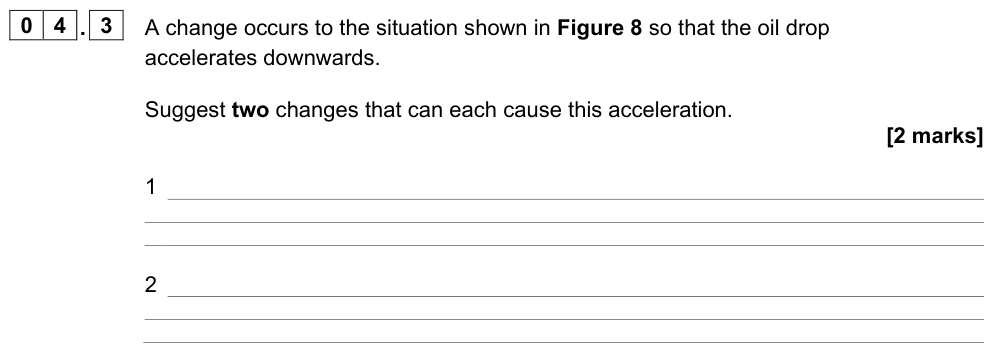
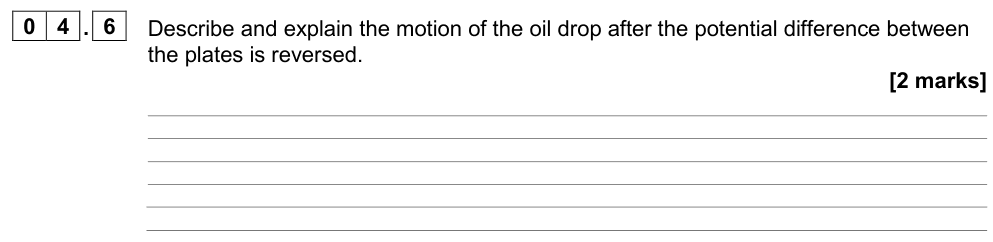
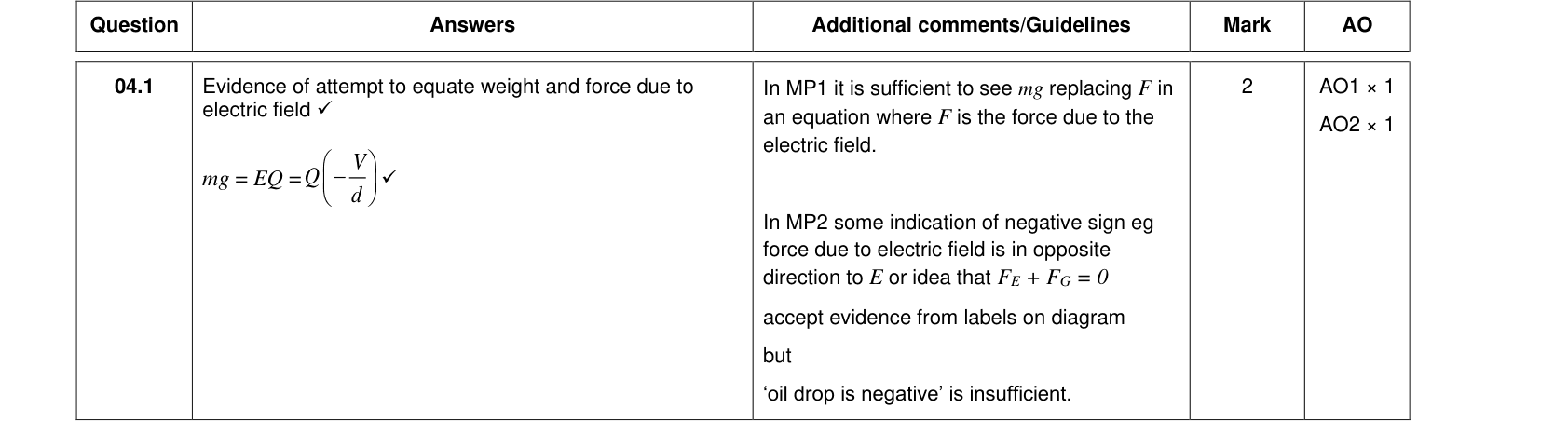
Gravity on electrons and ions is negligible compared with electric forces, so ignore their weight unless told otherwise. For larger charged objects such as oil drops, balance the forces: in equilibrium $QE = mg$, i.e. $Q\dfrac{V}{d} = mg$ (Millikan's experiment).
Summary
- $F = Q_1Q_2/4\pi\varepsilon_0r^2$; air ≈ vacuum; spheres act as point charges at their centres.
- Electrostatic forces between subatomic particles are ~$10^{36}$ times gravitational forces.
- $E = F/Q$ (N C⁻¹ = V m⁻¹); radial $E = Q/4\pi\varepsilon_0r^2$; uniform $E = V/d$.
- Charged particle entering a uniform field at right angles: constant velocity across, constant acceleration $QE/m$ along the field → parabolic path.