Magnetic flux and flux linkage
Magnetic flux
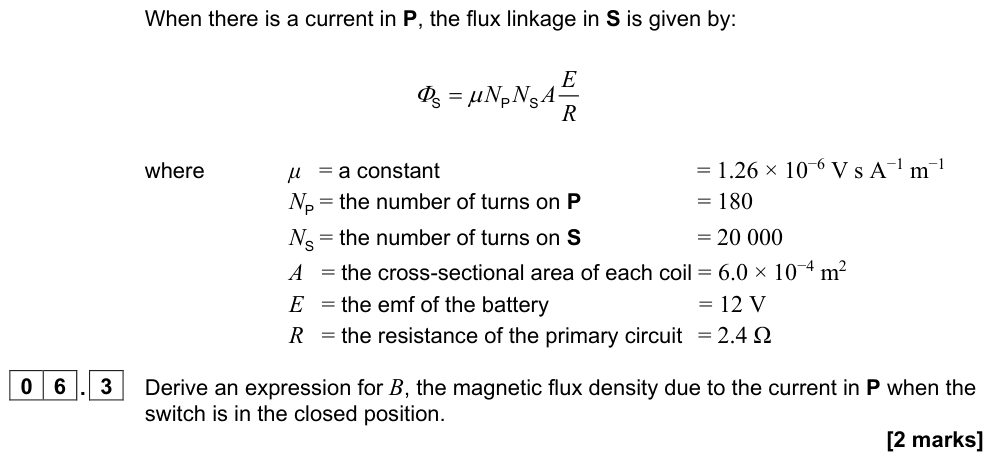
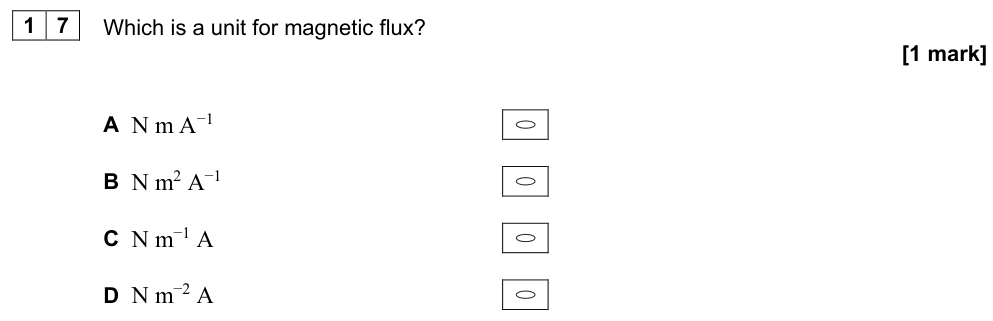
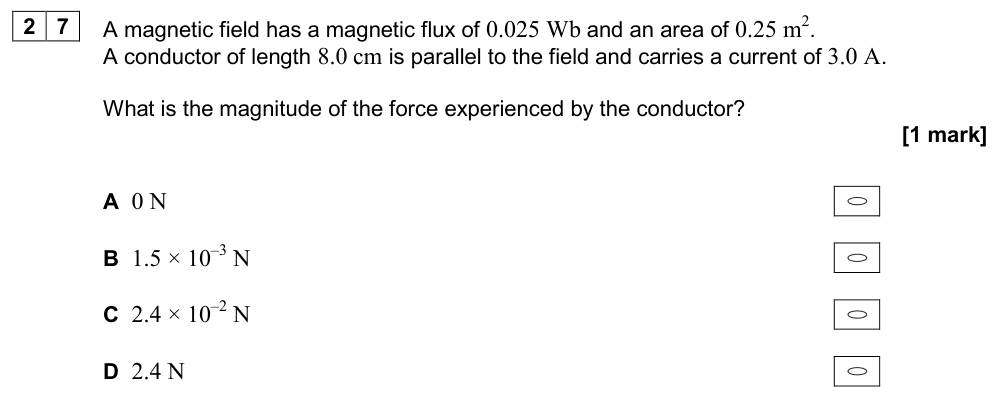
The magnetic flux $\Phi$ through an area $A$ perpendicular to a uniform magnetic field of flux density $B$ is
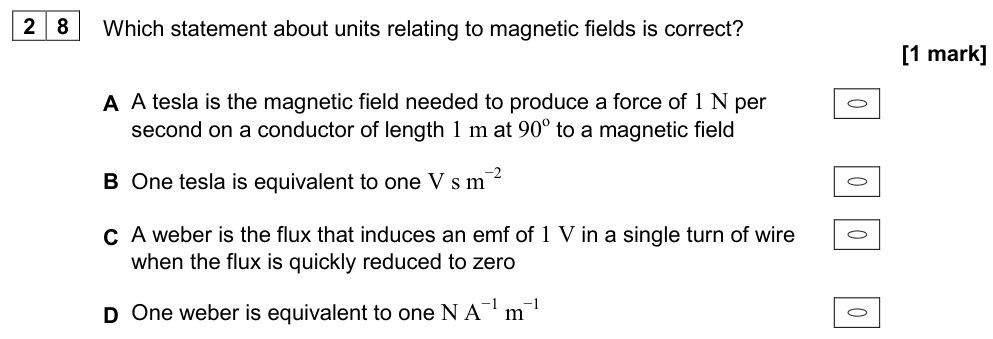
$$\Phi = BA \qquad \text{unit: weber (Wb)};\ 1\ \text{Wb} = 1\ \text{T m}^2$$
You can think of flux as the "number of field lines" passing through the area; $B$ is then the flux per unit area (hence flux density).
Flux linkage
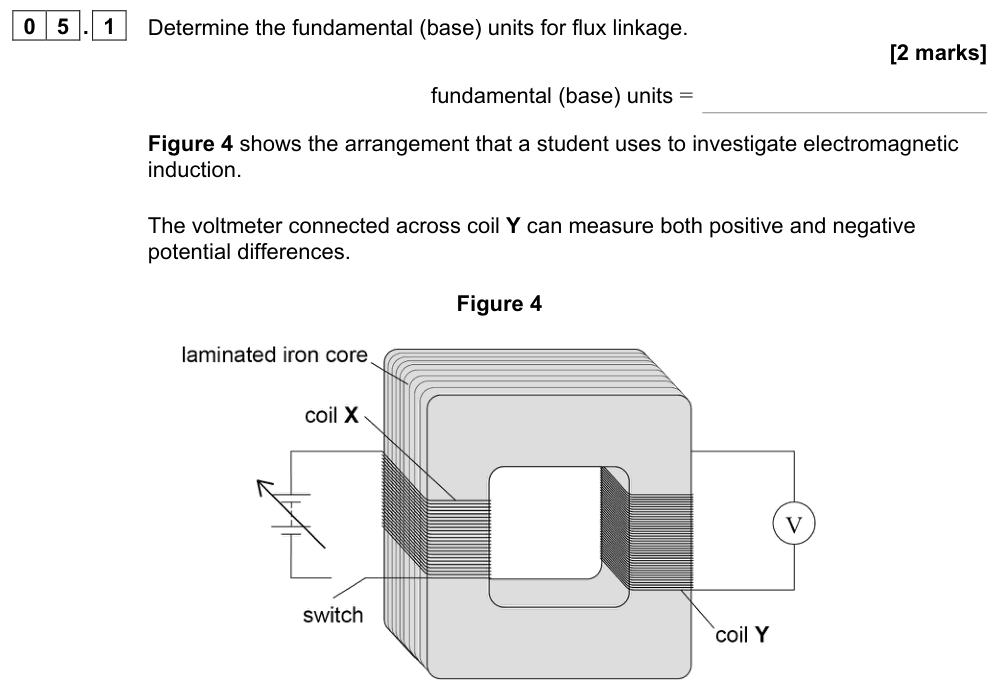
For a coil of $N$ turns, the flux linkage is $N\Phi$ (unit: Wb or Wb-turns).
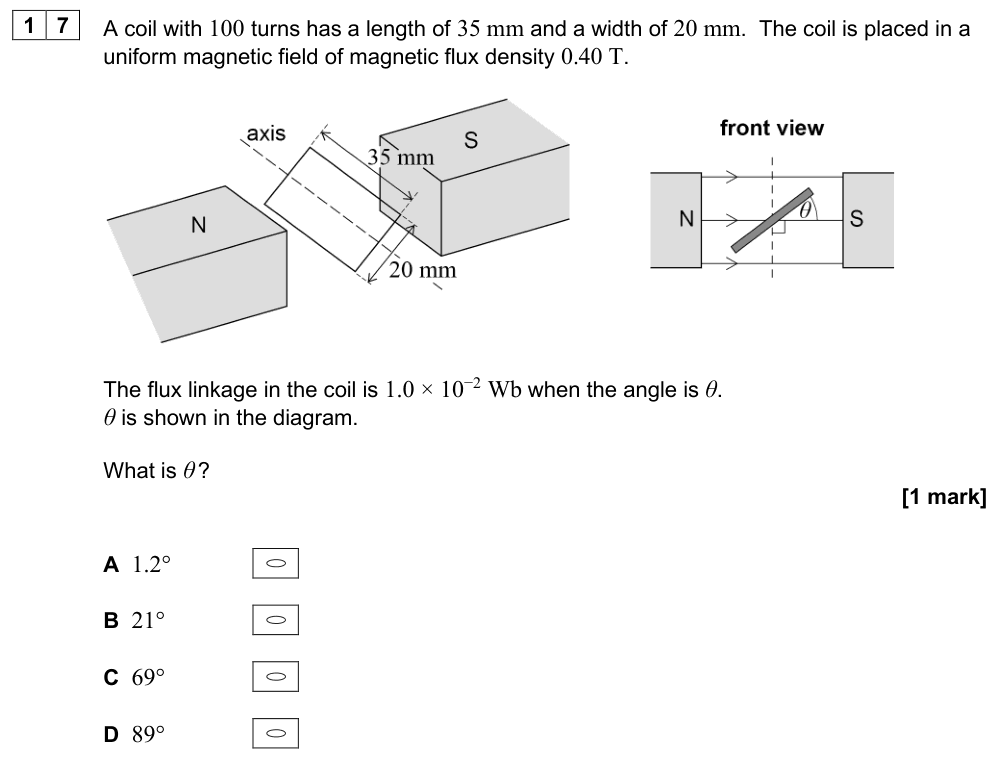
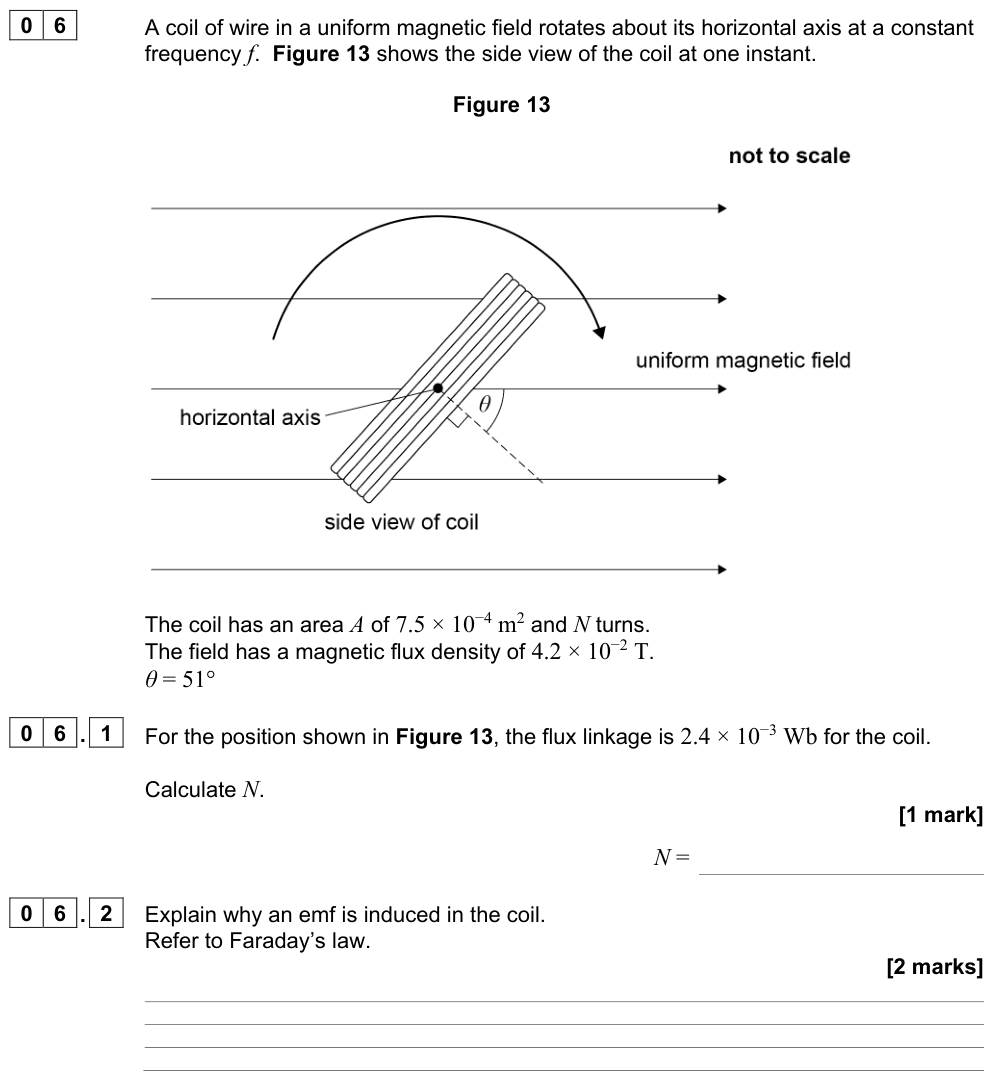
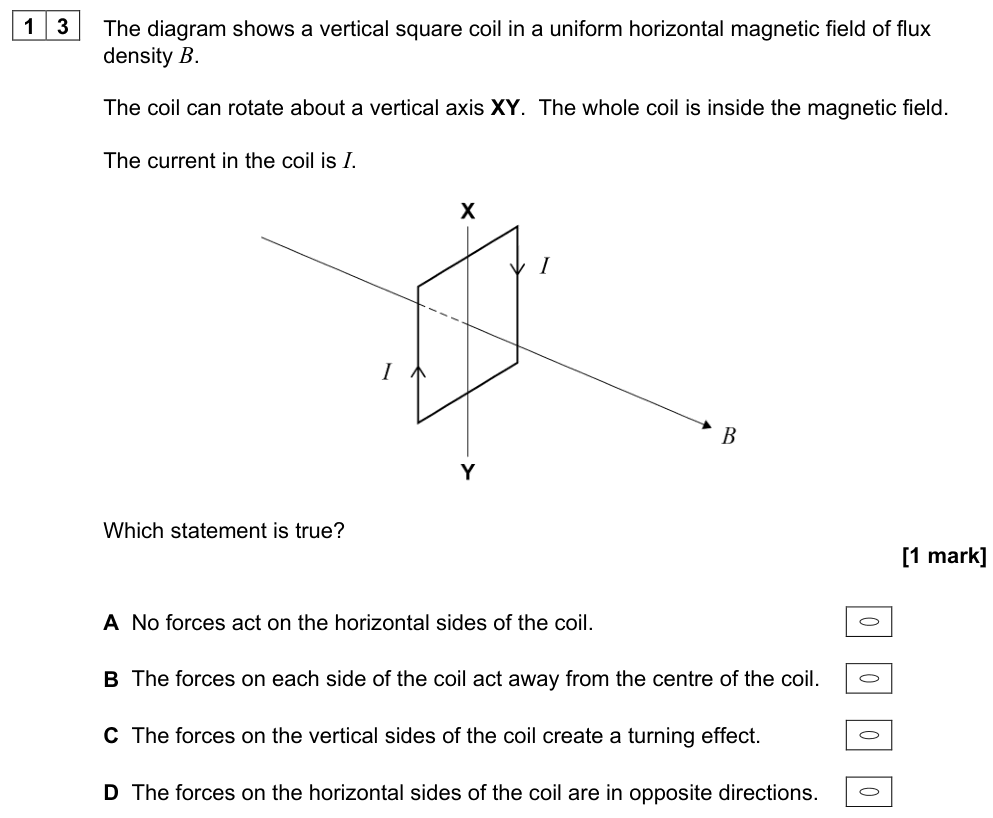
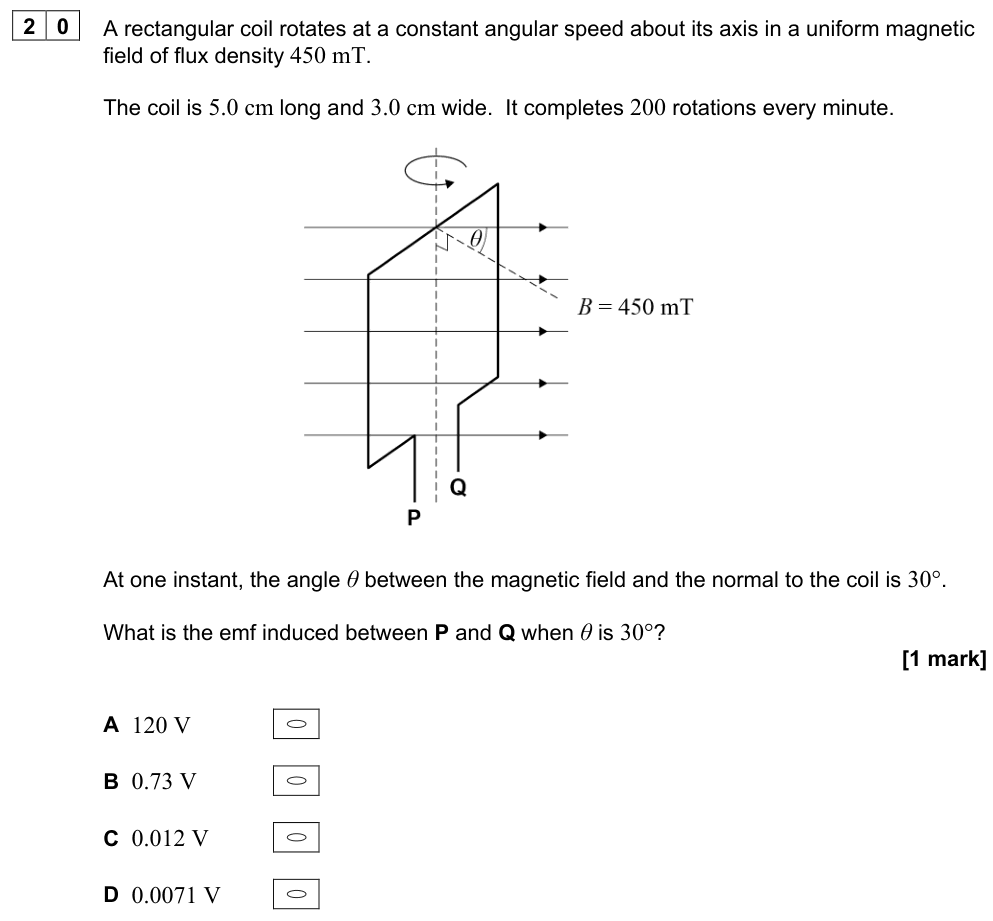
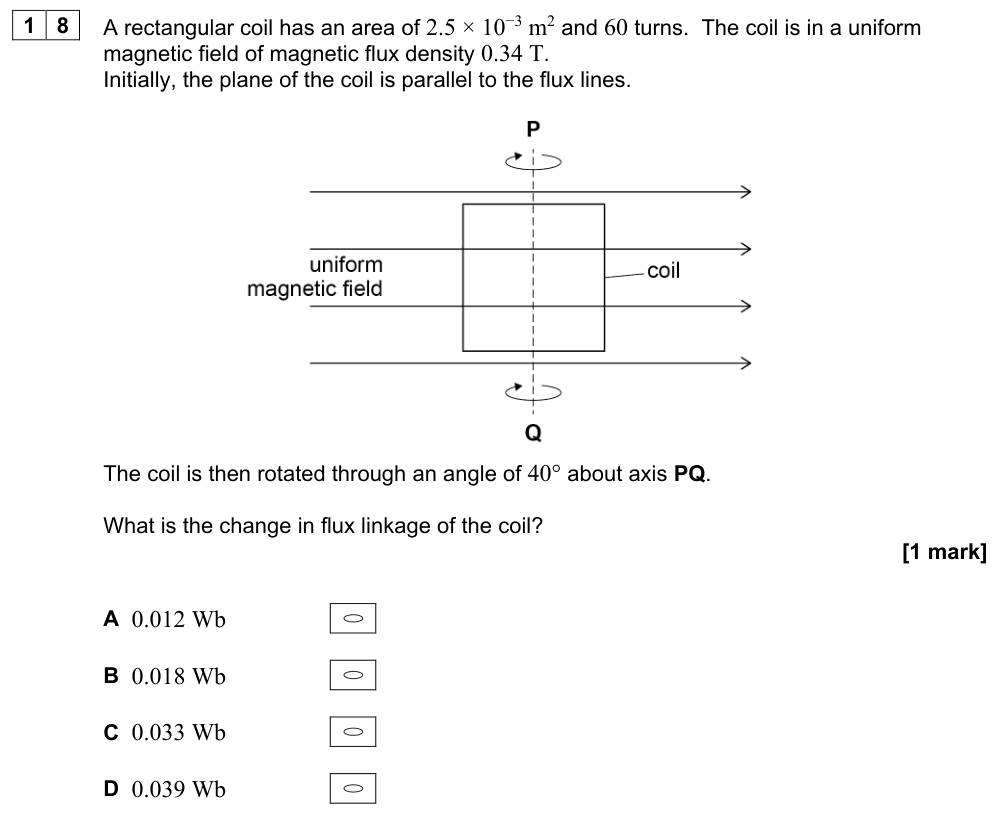
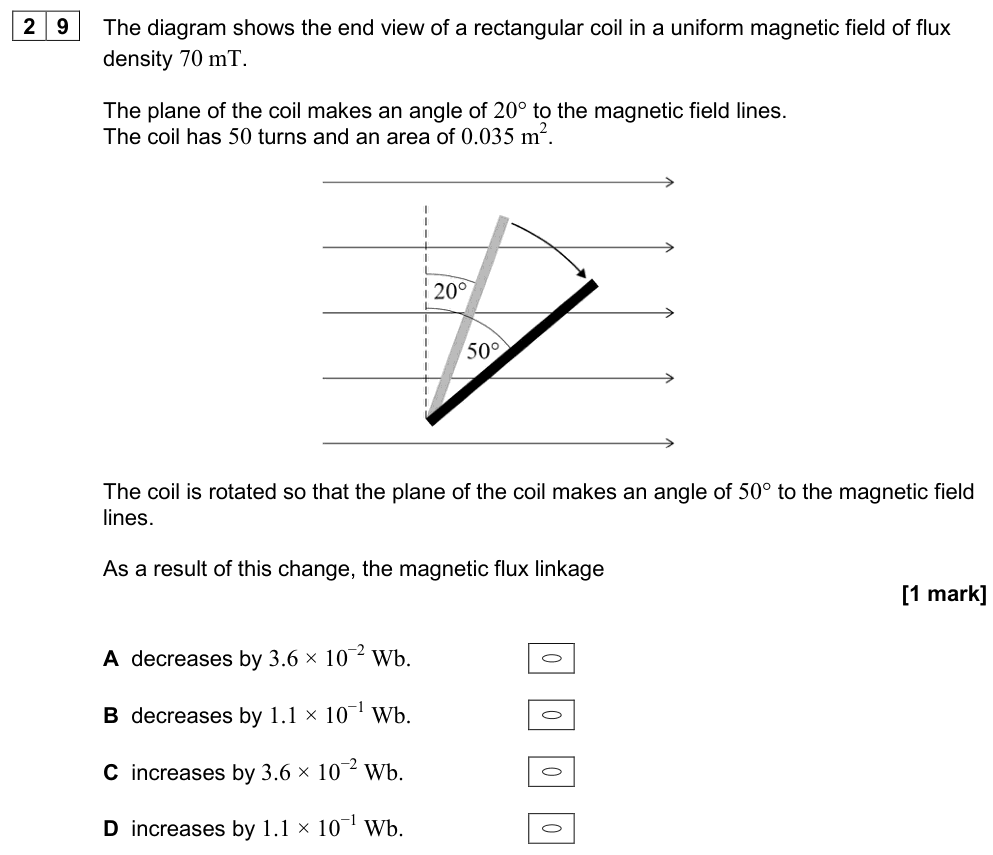
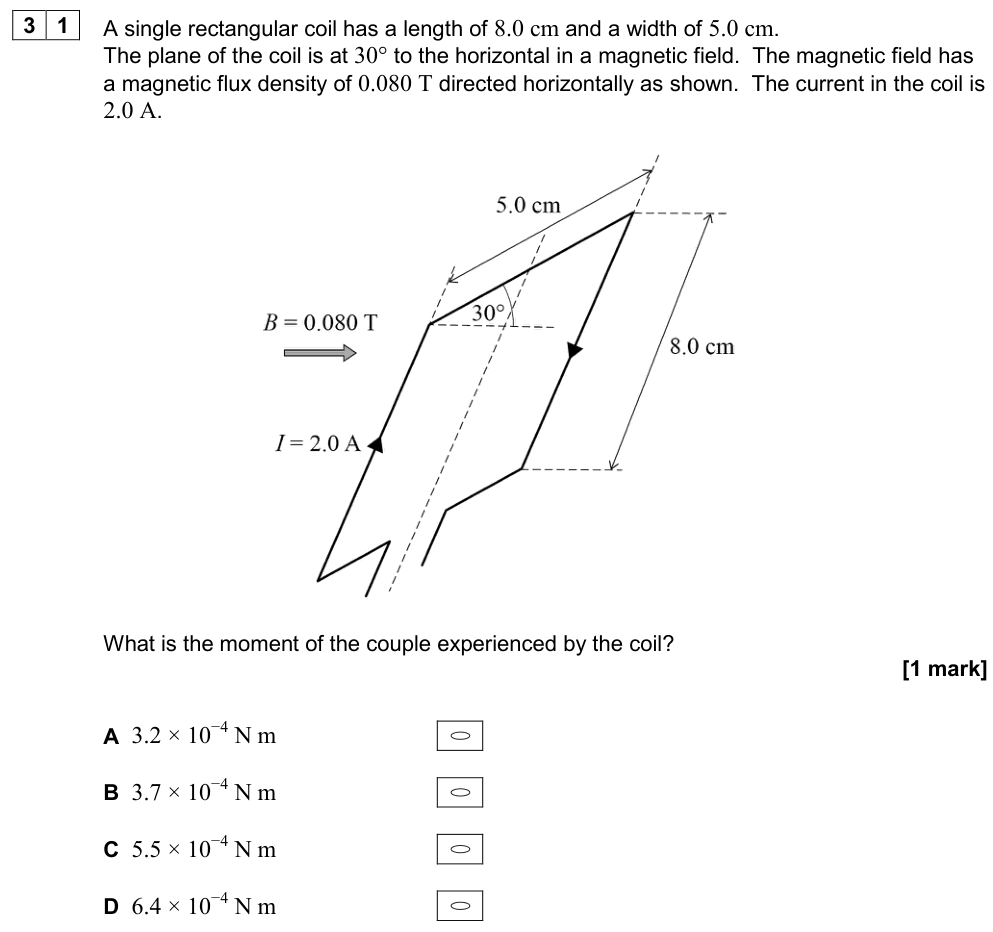
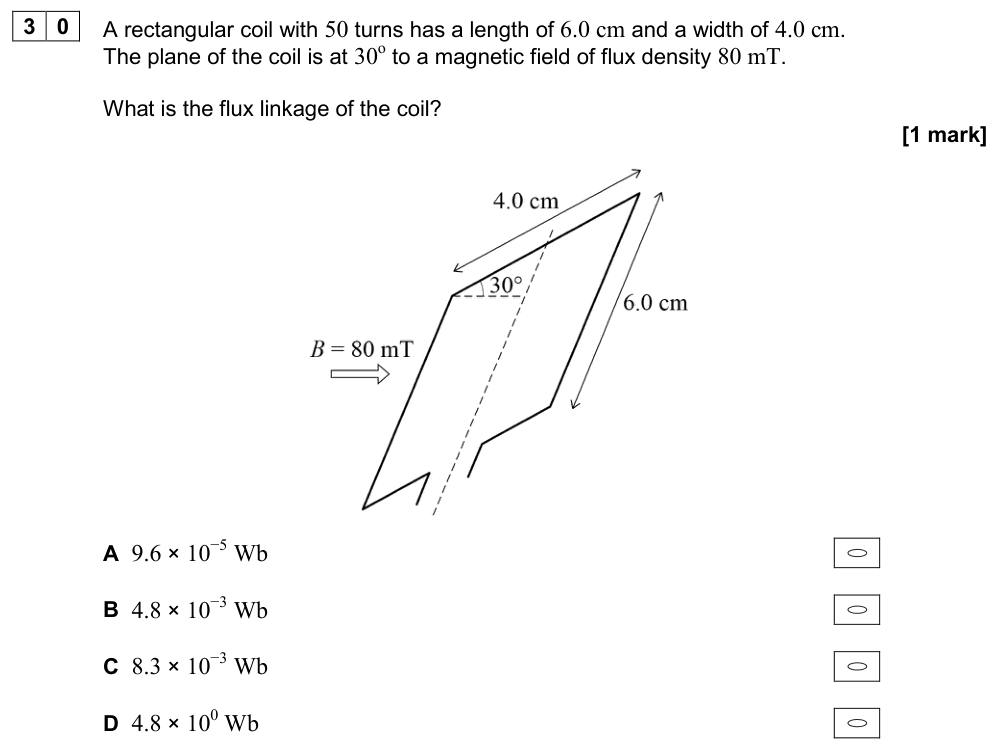
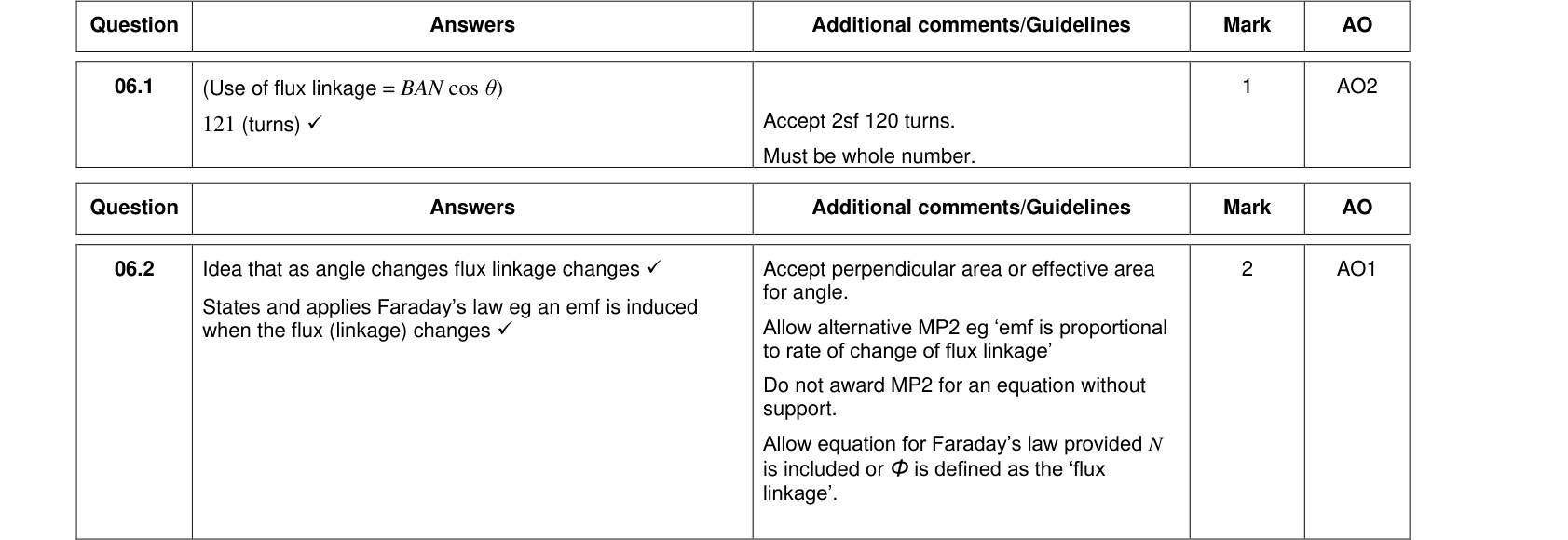
If the normal to the coil's plane makes an angle $\theta$ with the field, only the component of $B$ perpendicular to the plane passes through it:
Flux linkage of a coil at an angle
$$N\Phi = BAN\cos\theta$$
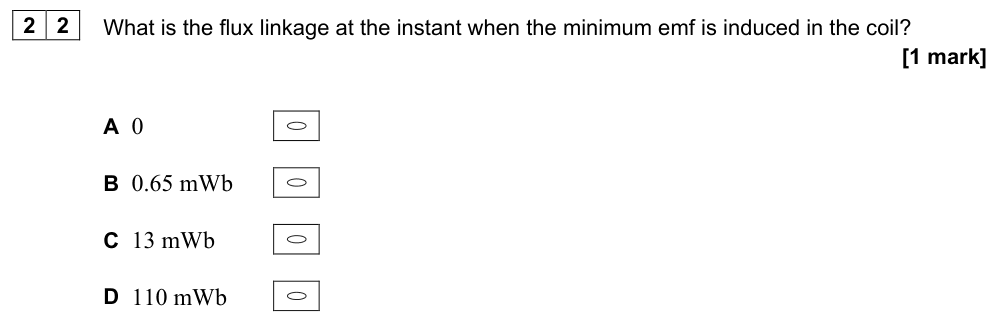
$\theta$ = angle between the field and the normal to the plane of the coil. Flux linkage is maximum when the plane of the coil is perpendicular to the field ($\theta = 0$) and zero when the plane is parallel to the field ($\theta = 90^\circ$).
Common mistake
Check which angle you are given. If the question gives the angle between the field and the plane of the coil, use $\sin$ of that angle instead.
Electromagnetic induction
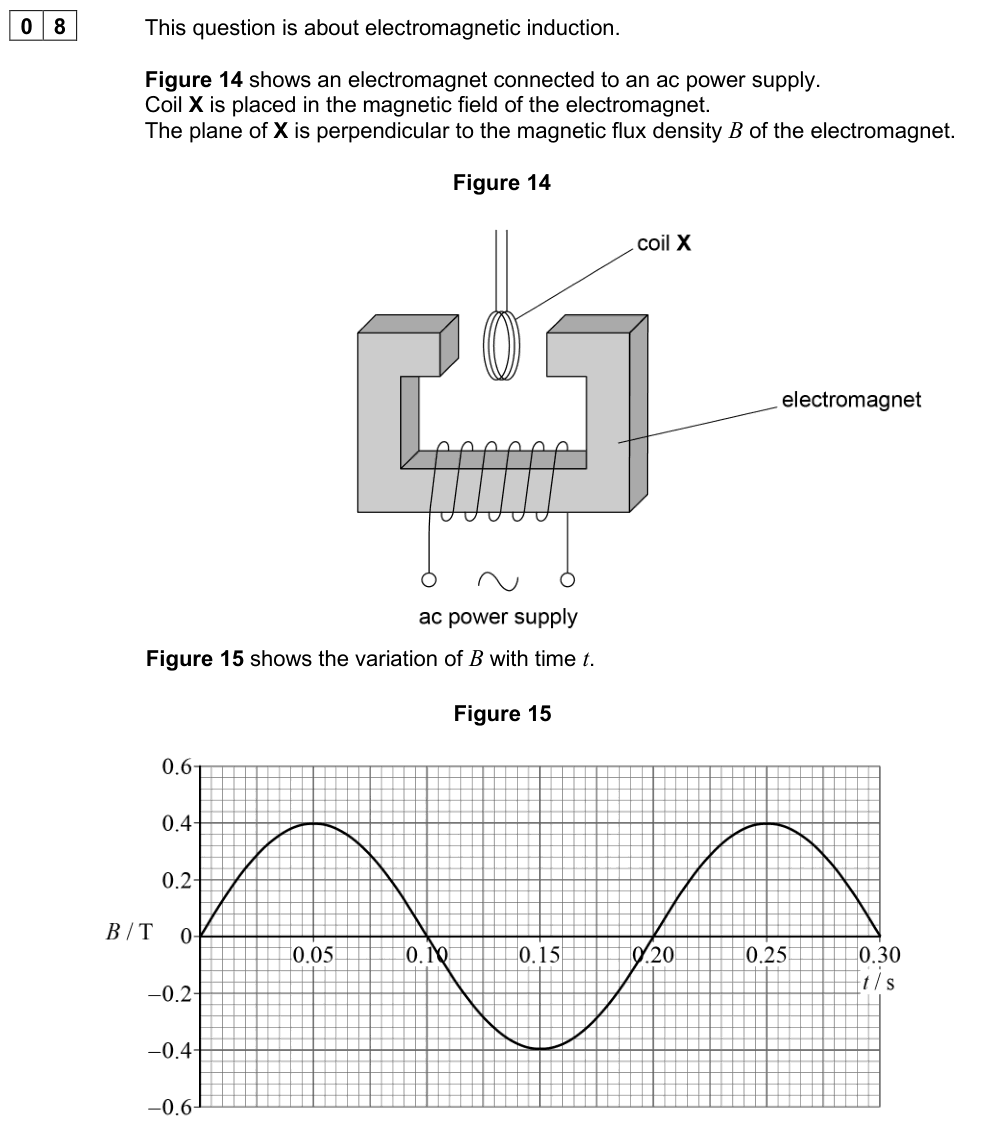
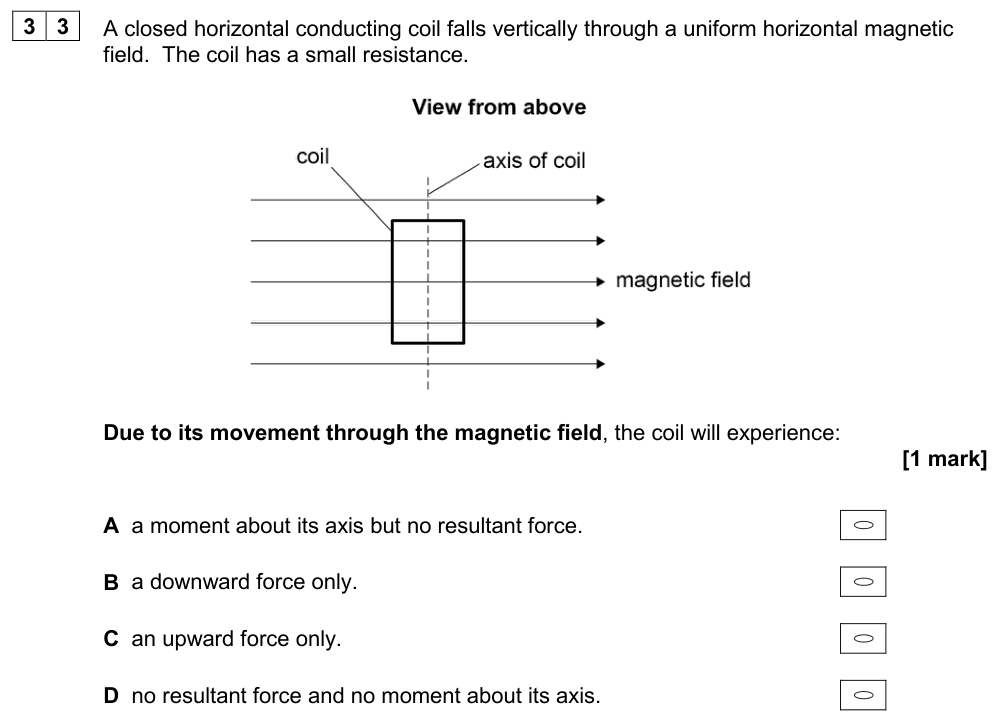
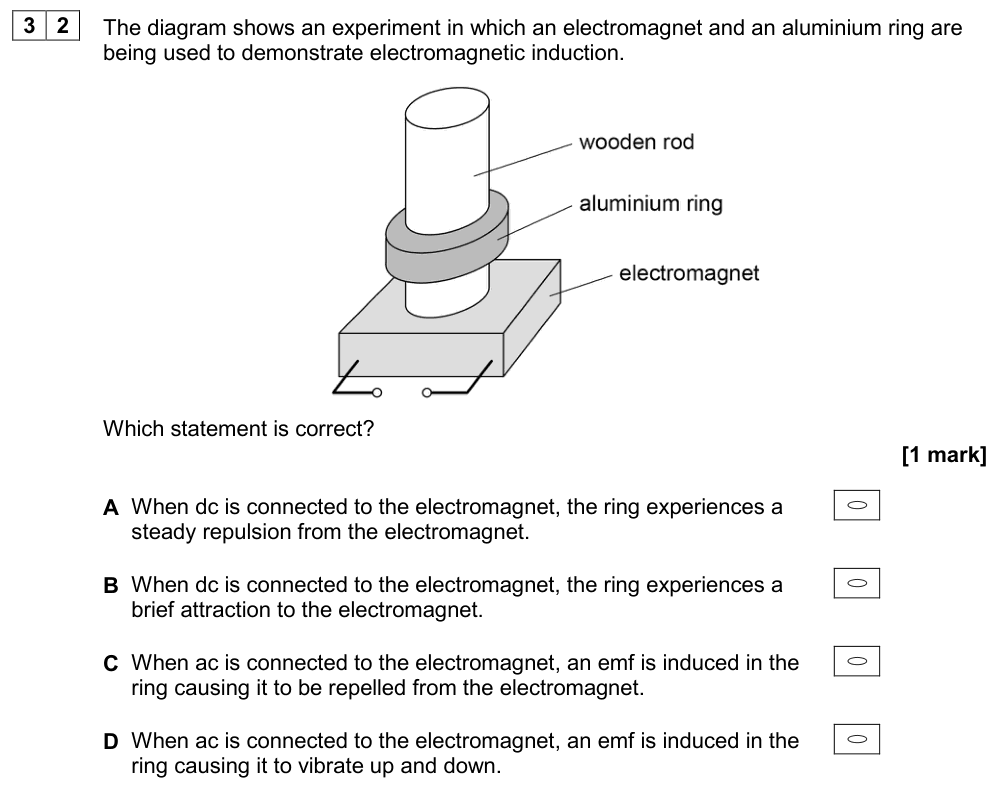
An e.m.f. is induced in a conductor whenever the magnetic flux linking it changes. This can happen when:
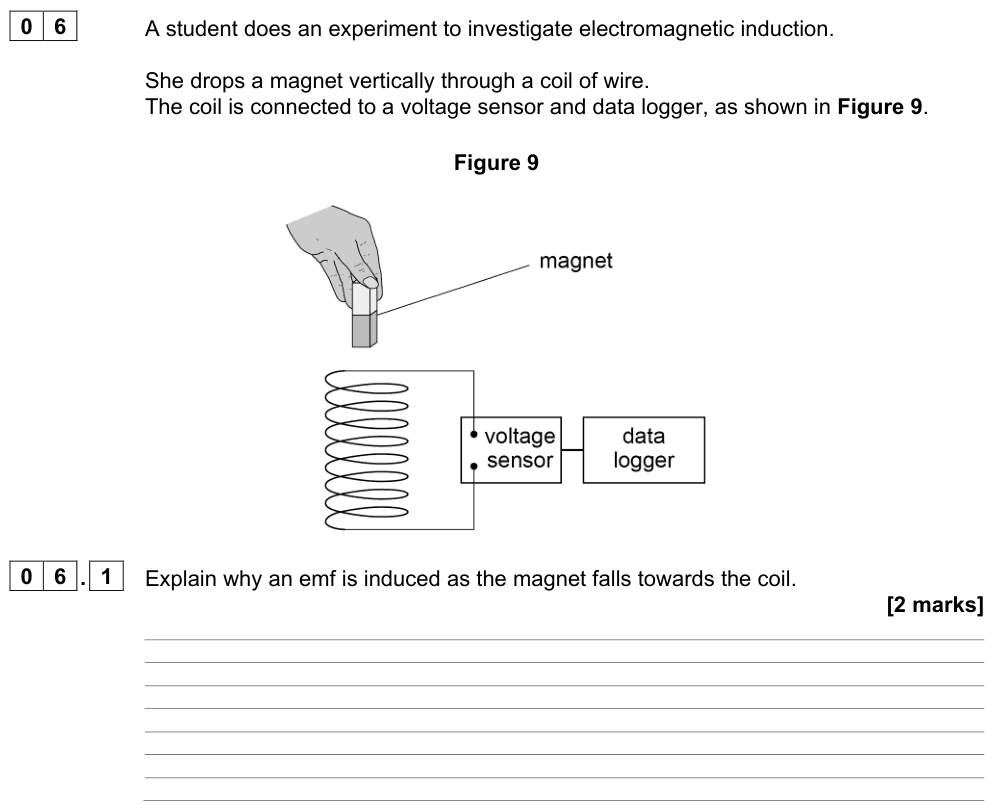
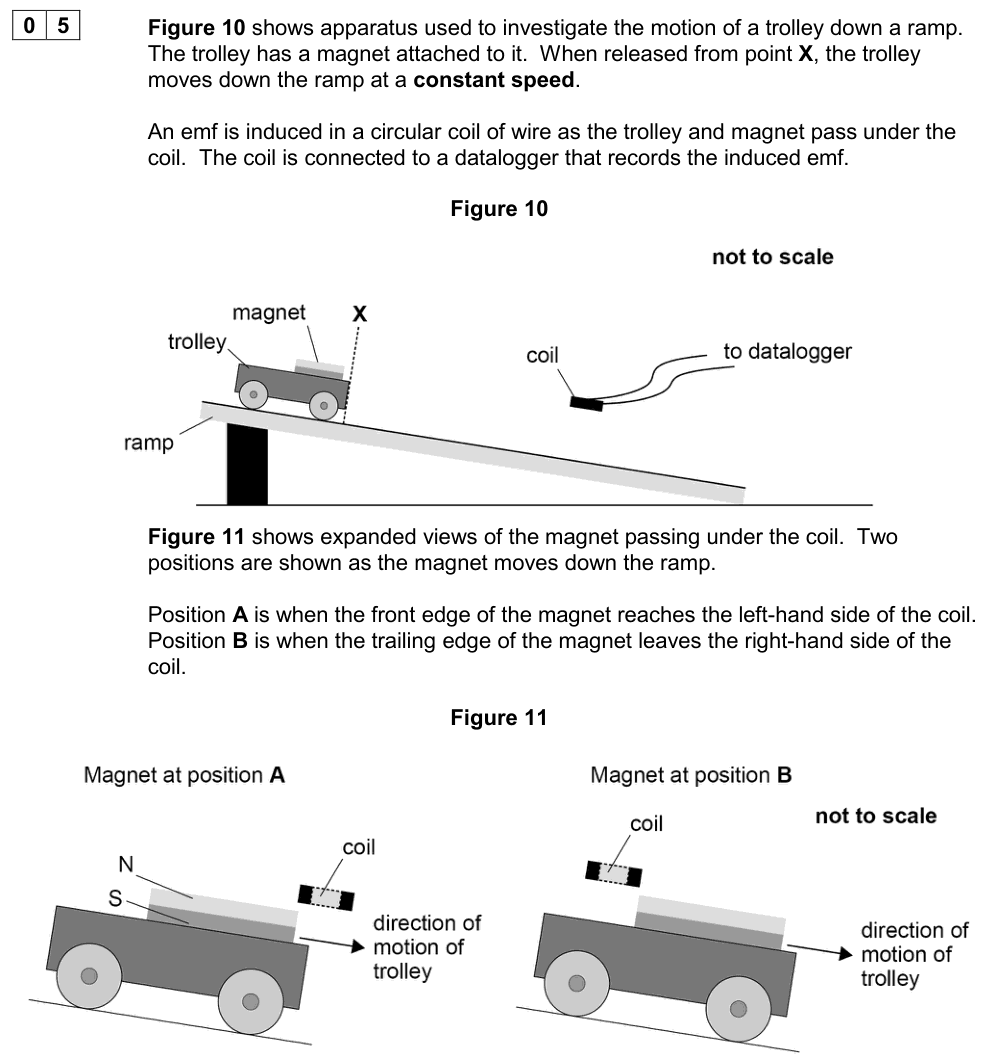
- a magnet moves into or out of a coil;
- a conductor moves across (cuts) magnetic field lines;
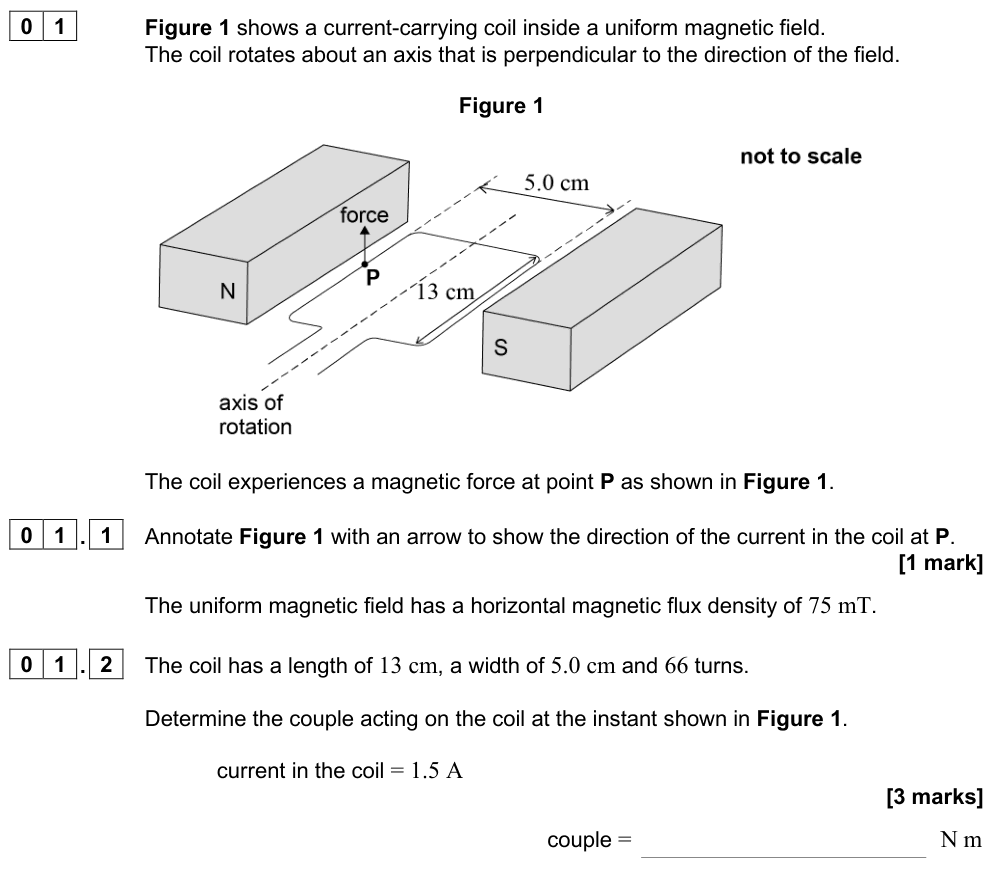
- a coil rotates in a magnetic field;
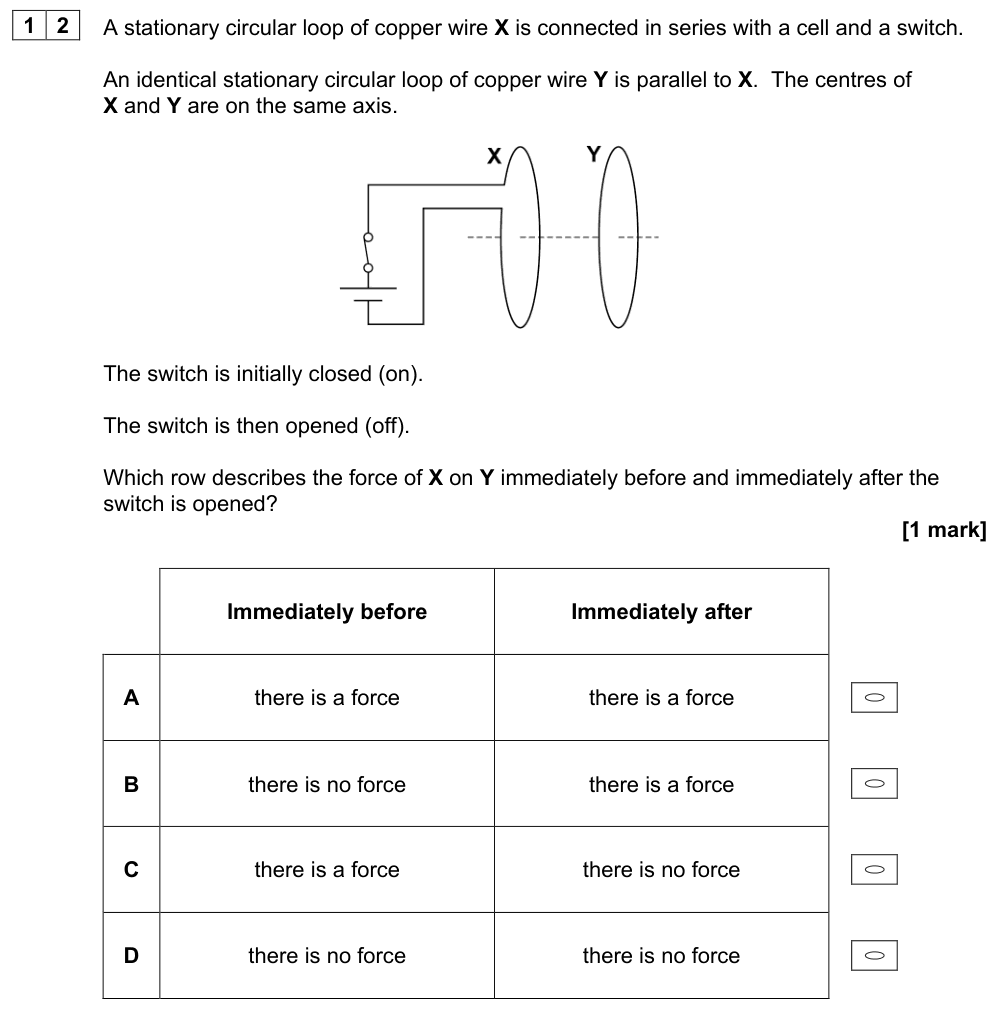
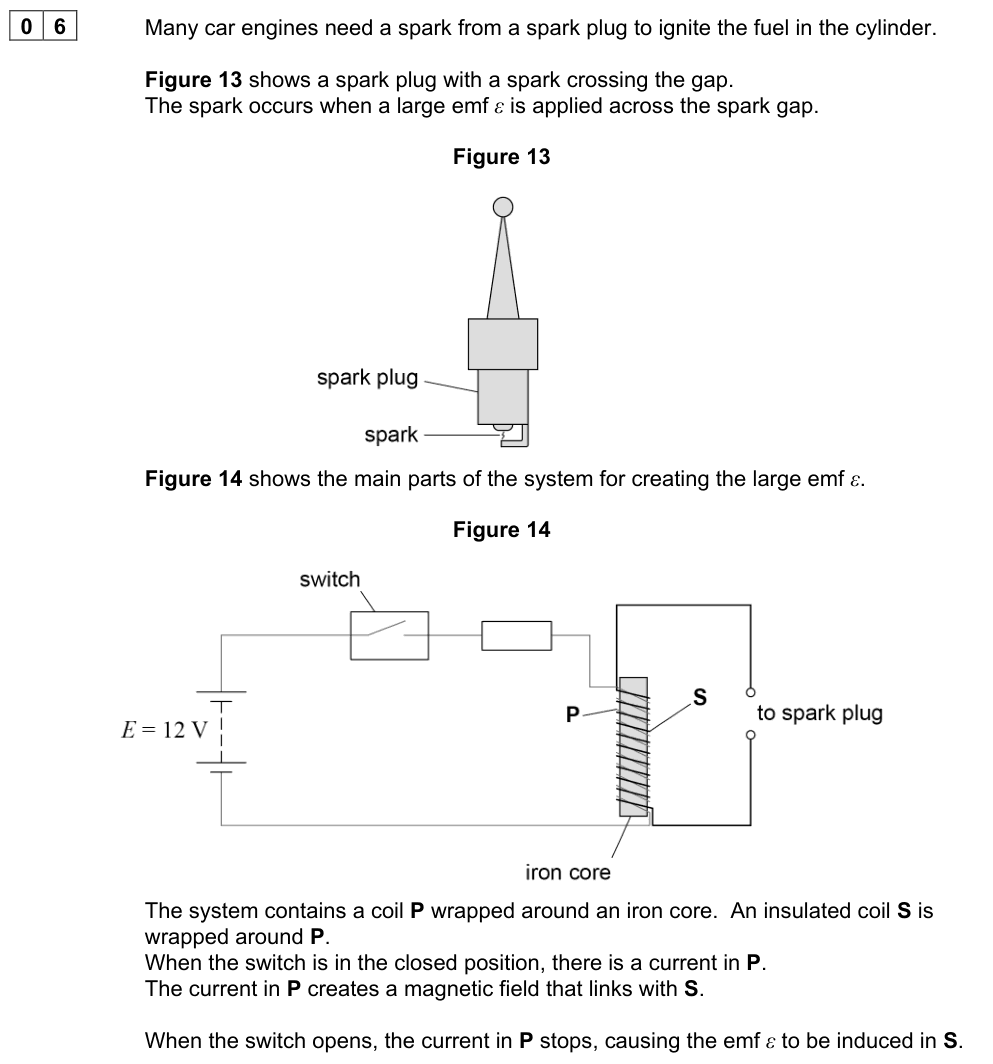
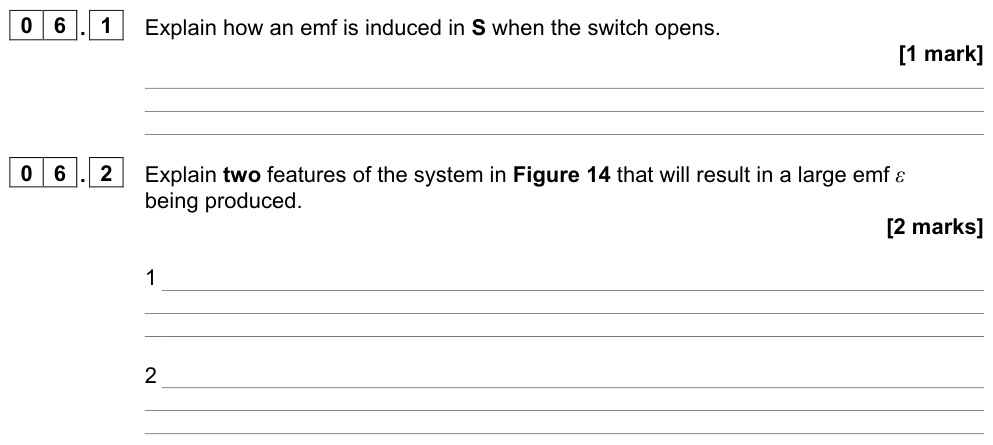
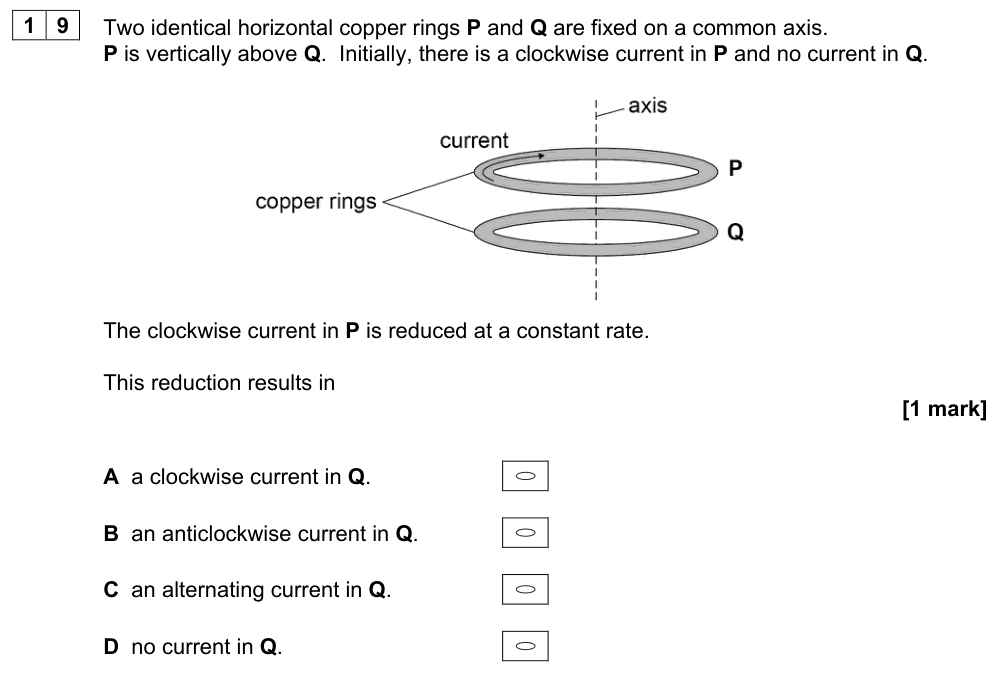
- the current in a nearby coil changes (as in a transformer).
If the conductor is part of a complete circuit, the induced e.m.f. drives an induced current.
Simple experiments: pushing a bar magnet into a coil connected to a sensitive ammeter makes the needle deflect; pulling it out deflects it the other way; holding it still gives no reading; moving it faster gives a larger deflection; more turns give a larger deflection.
Faraday's law
Faraday's law
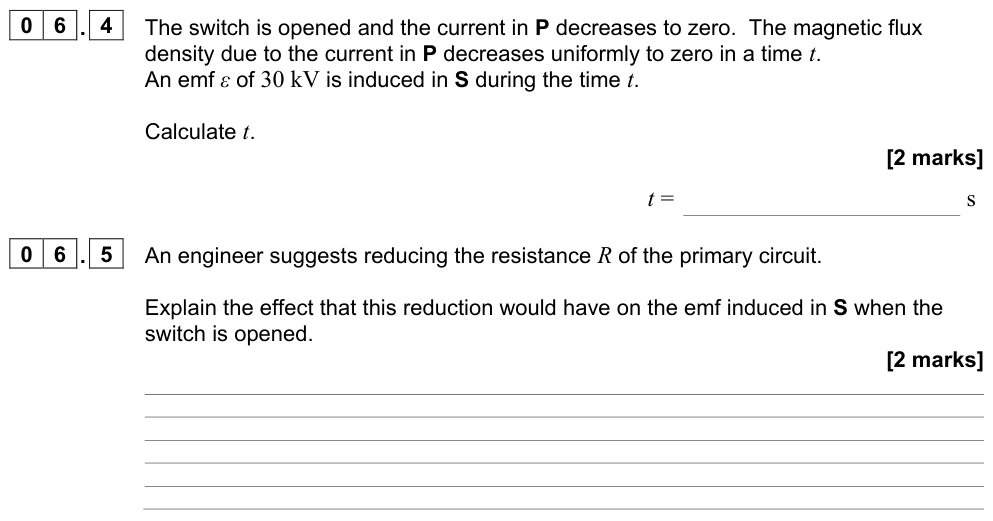
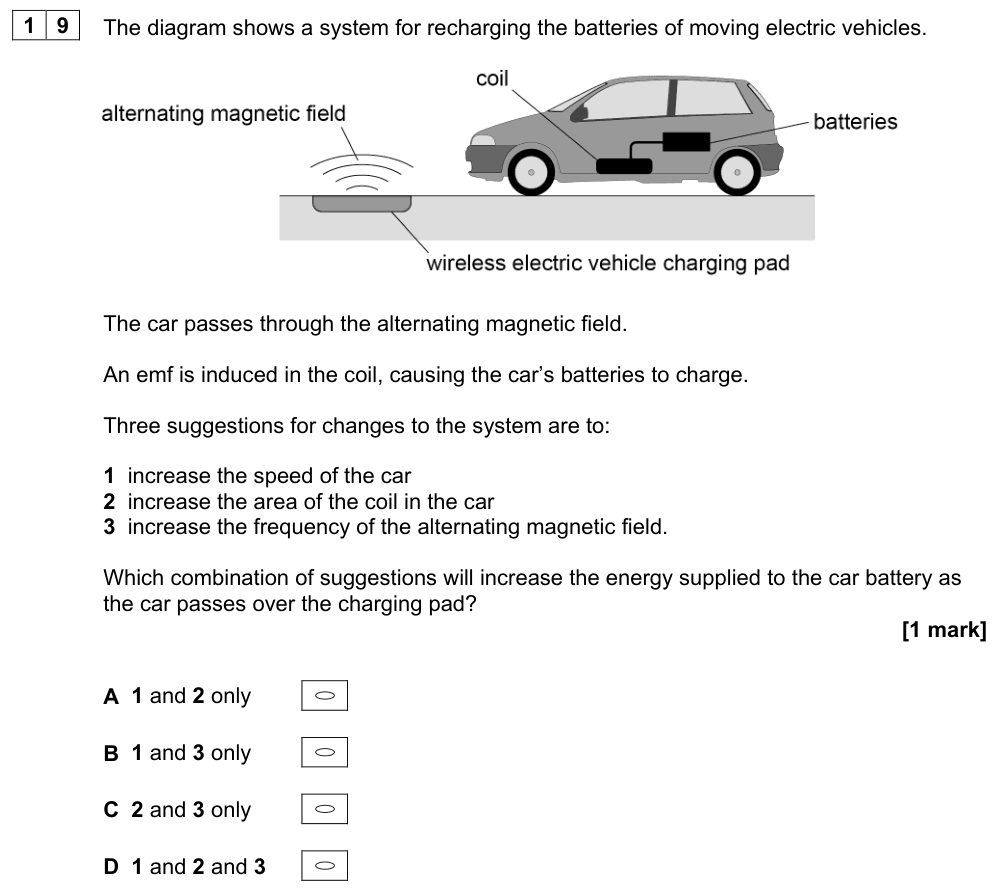
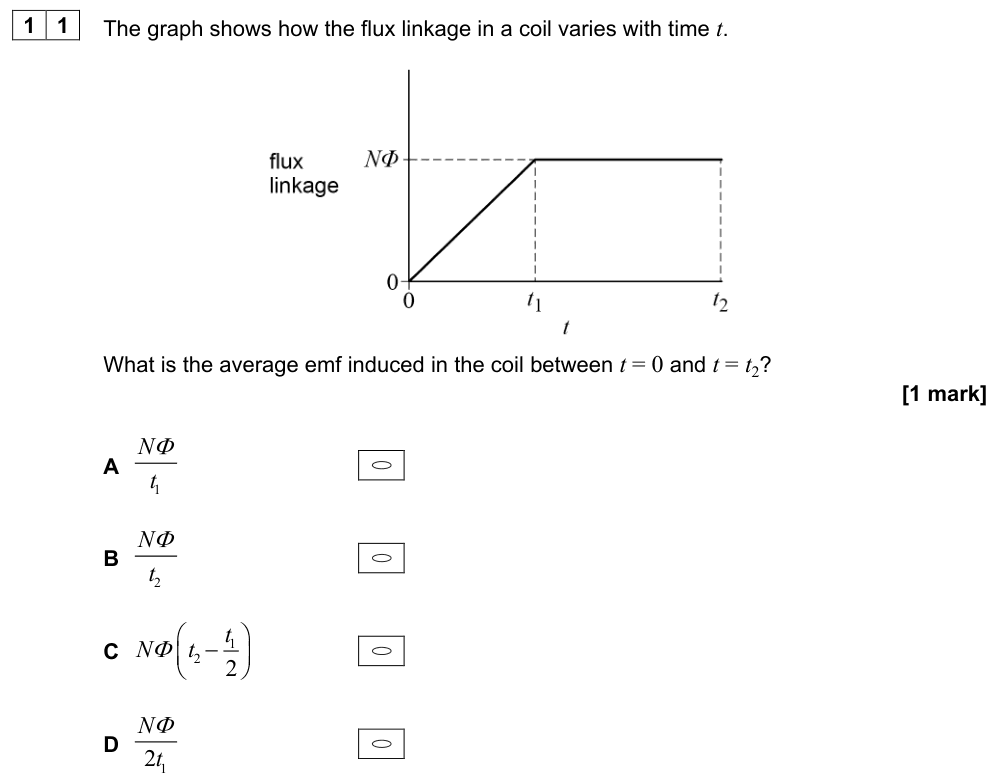
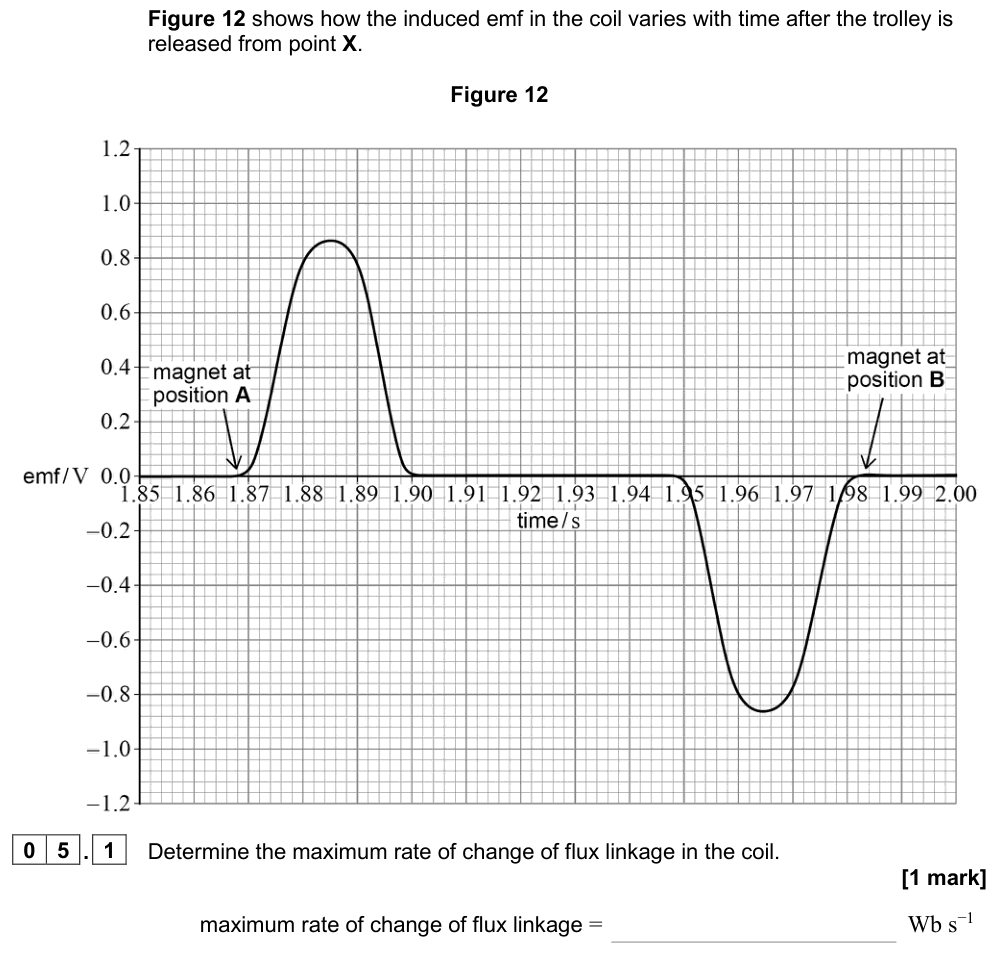
The magnitude of the induced e.m.f. equals the rate of change of flux linkage:
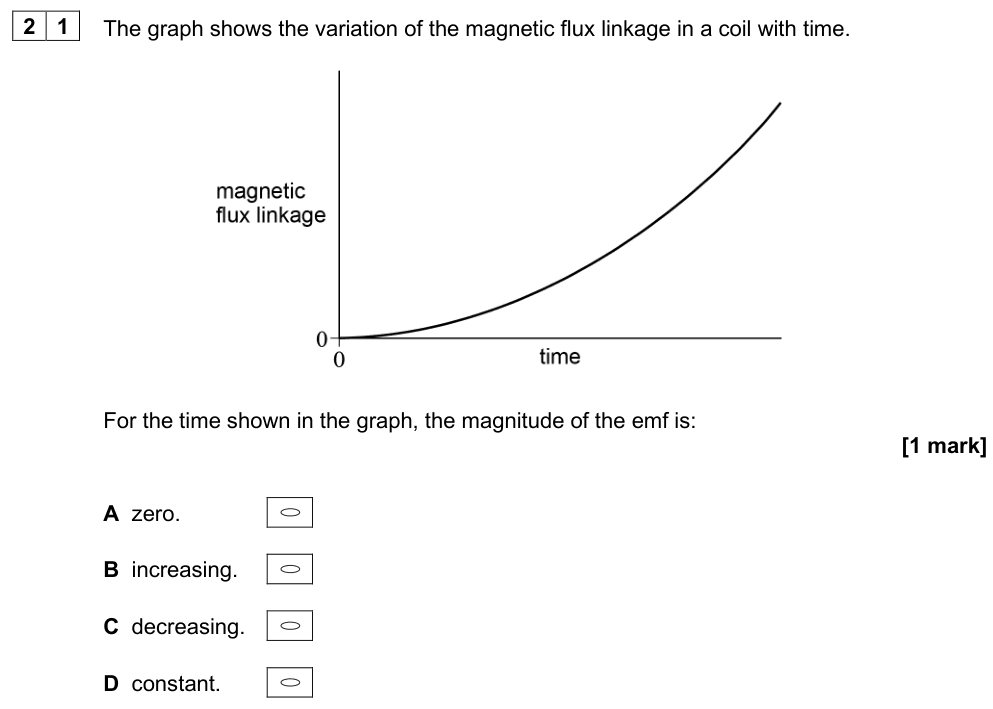
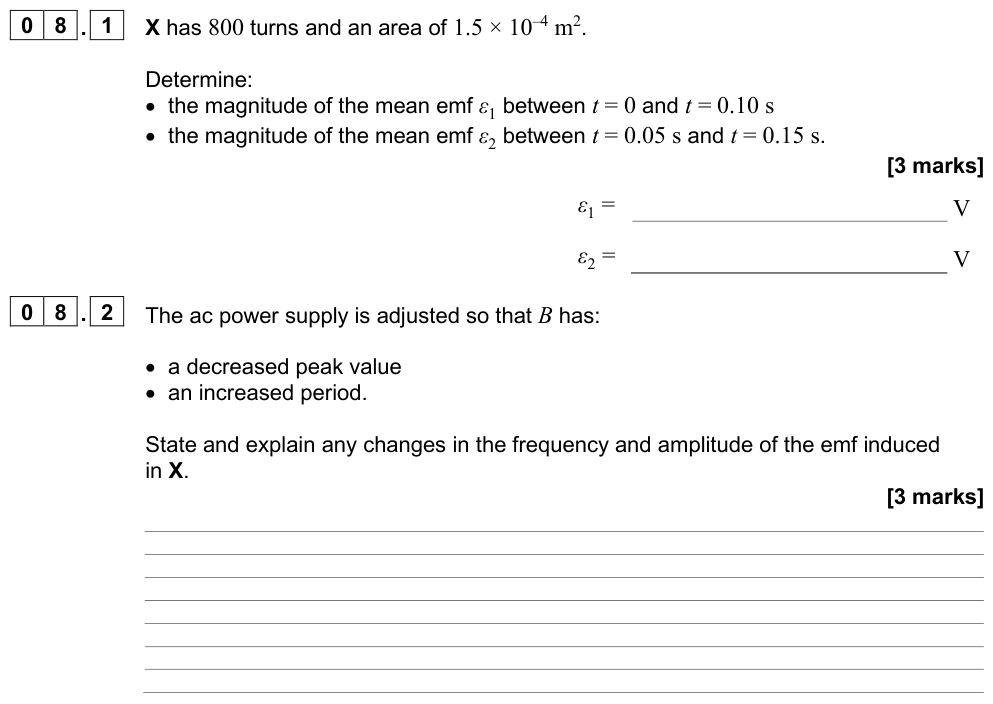
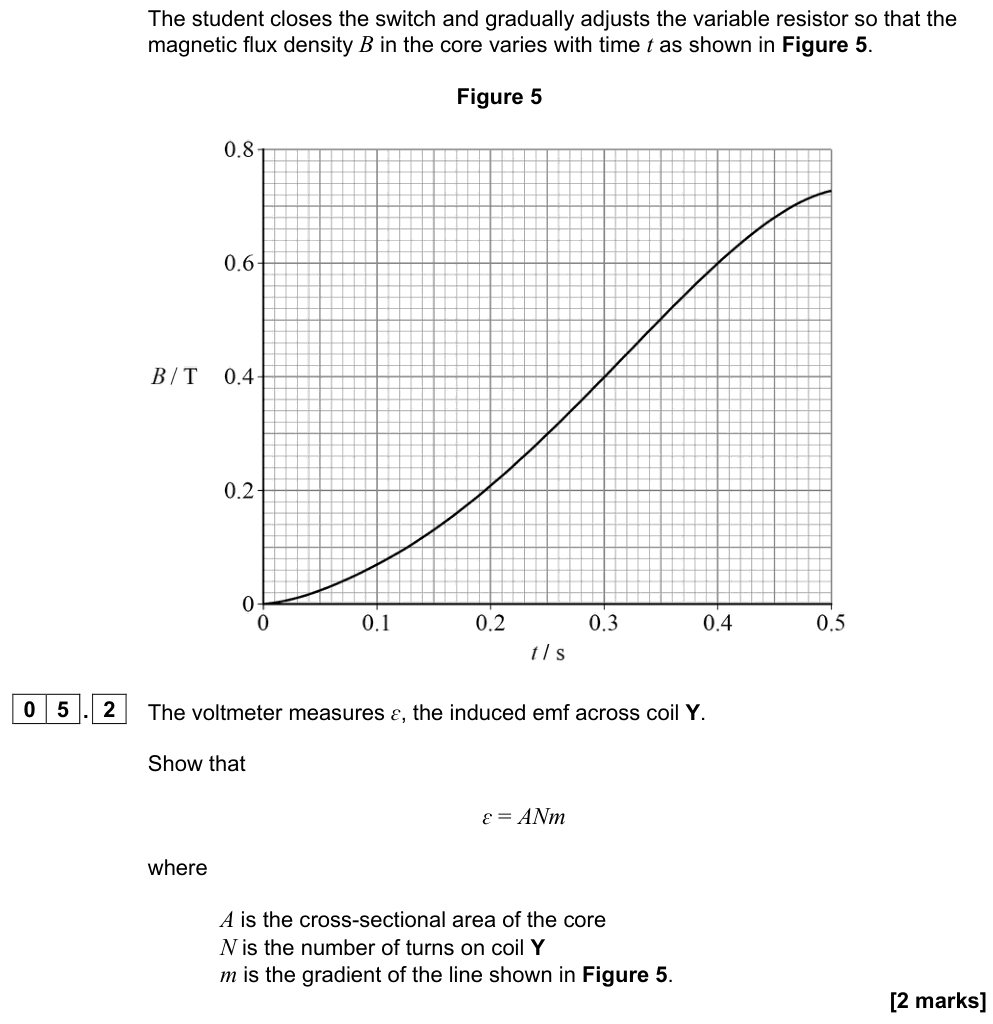
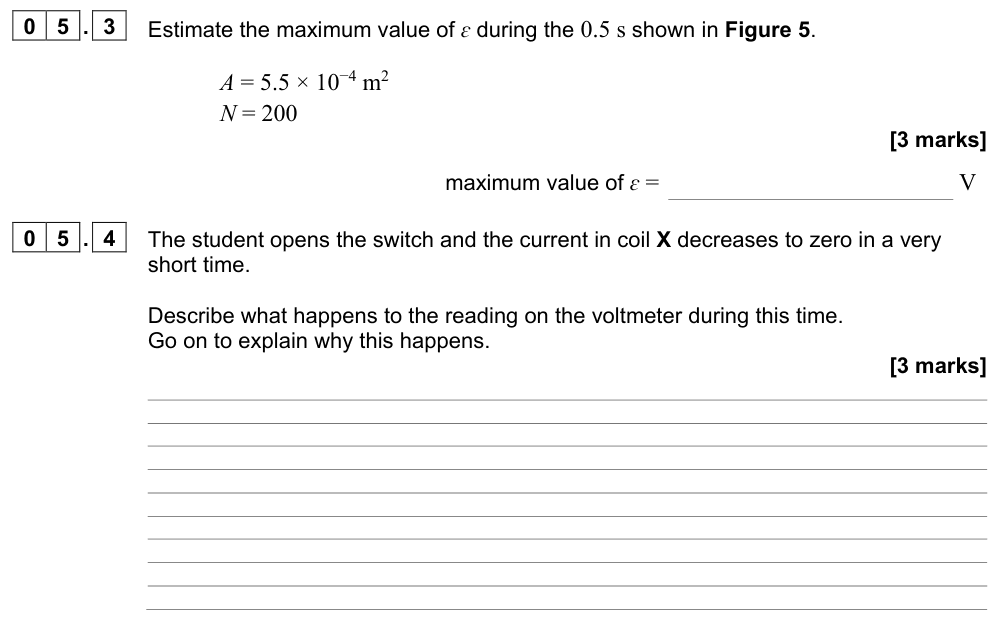
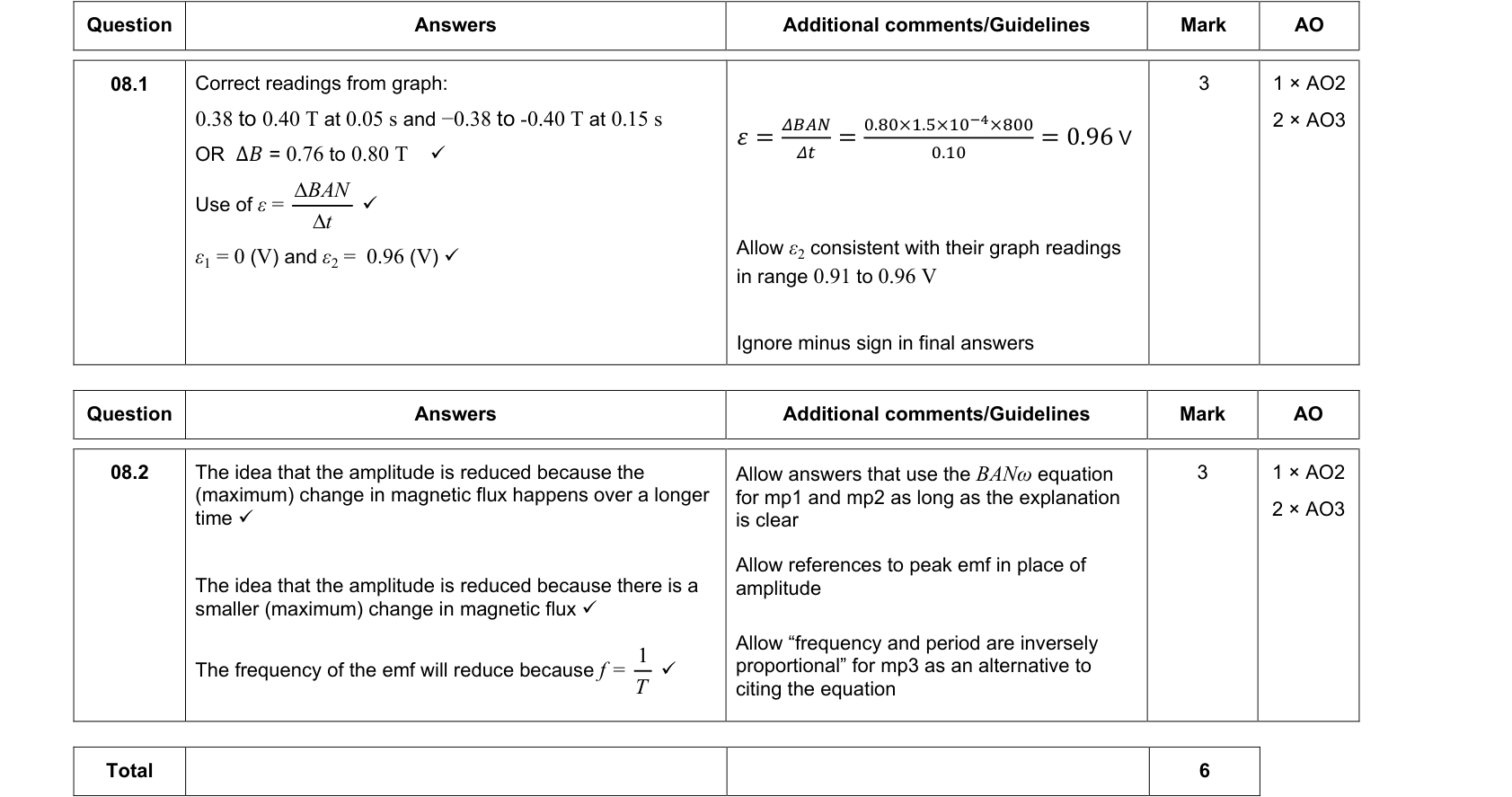
$$\varepsilon = N\frac{\Delta\Phi}{\Delta t}$$
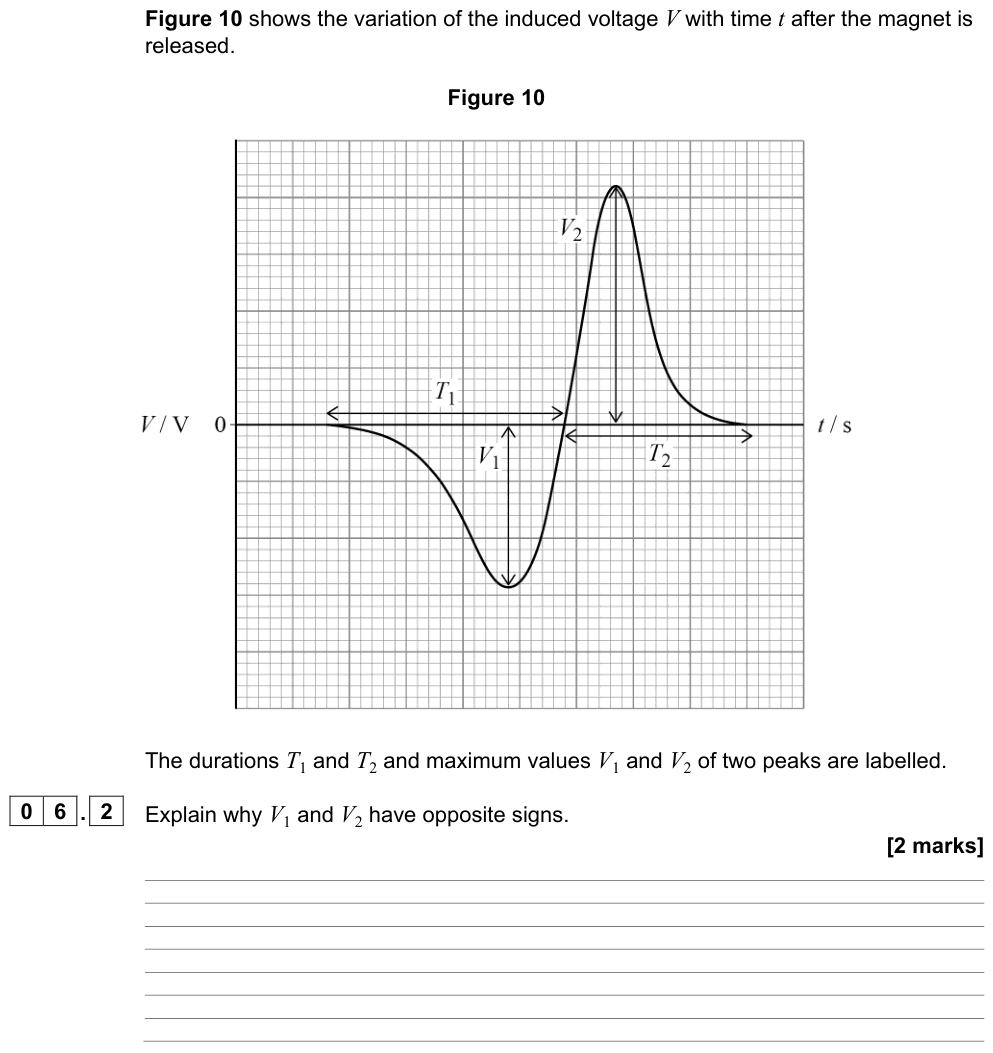
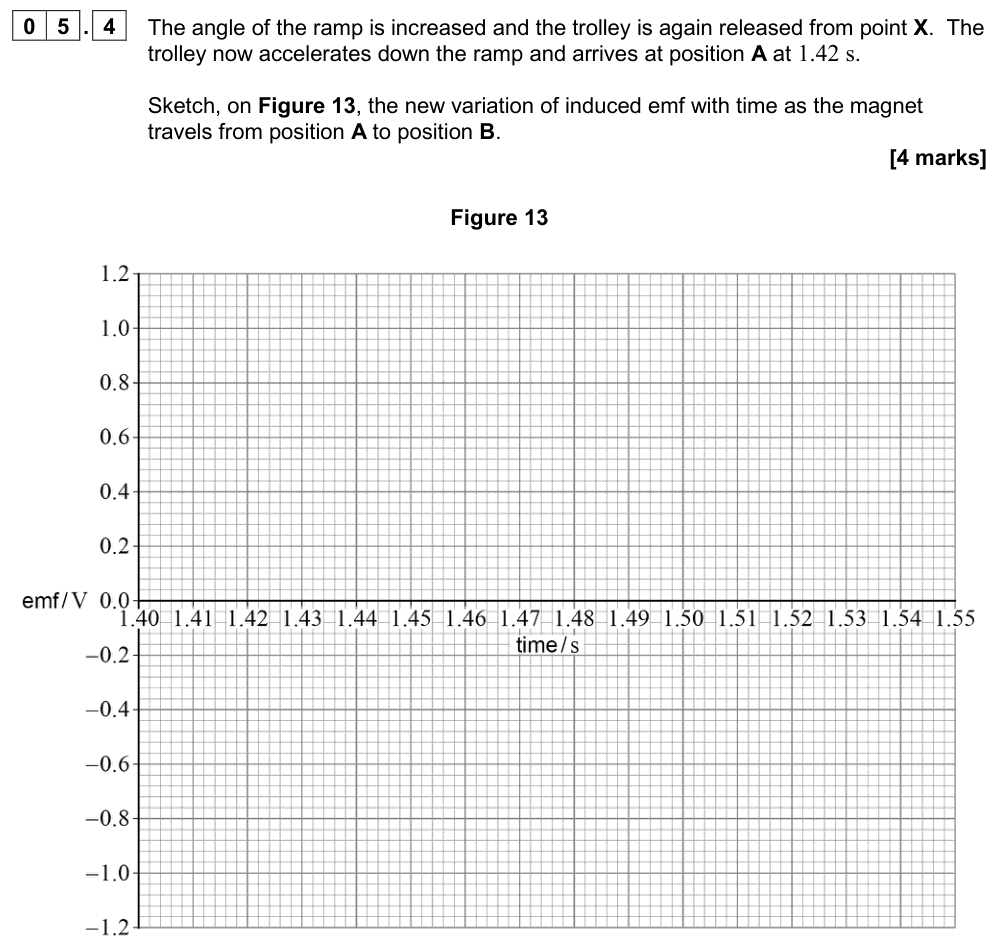
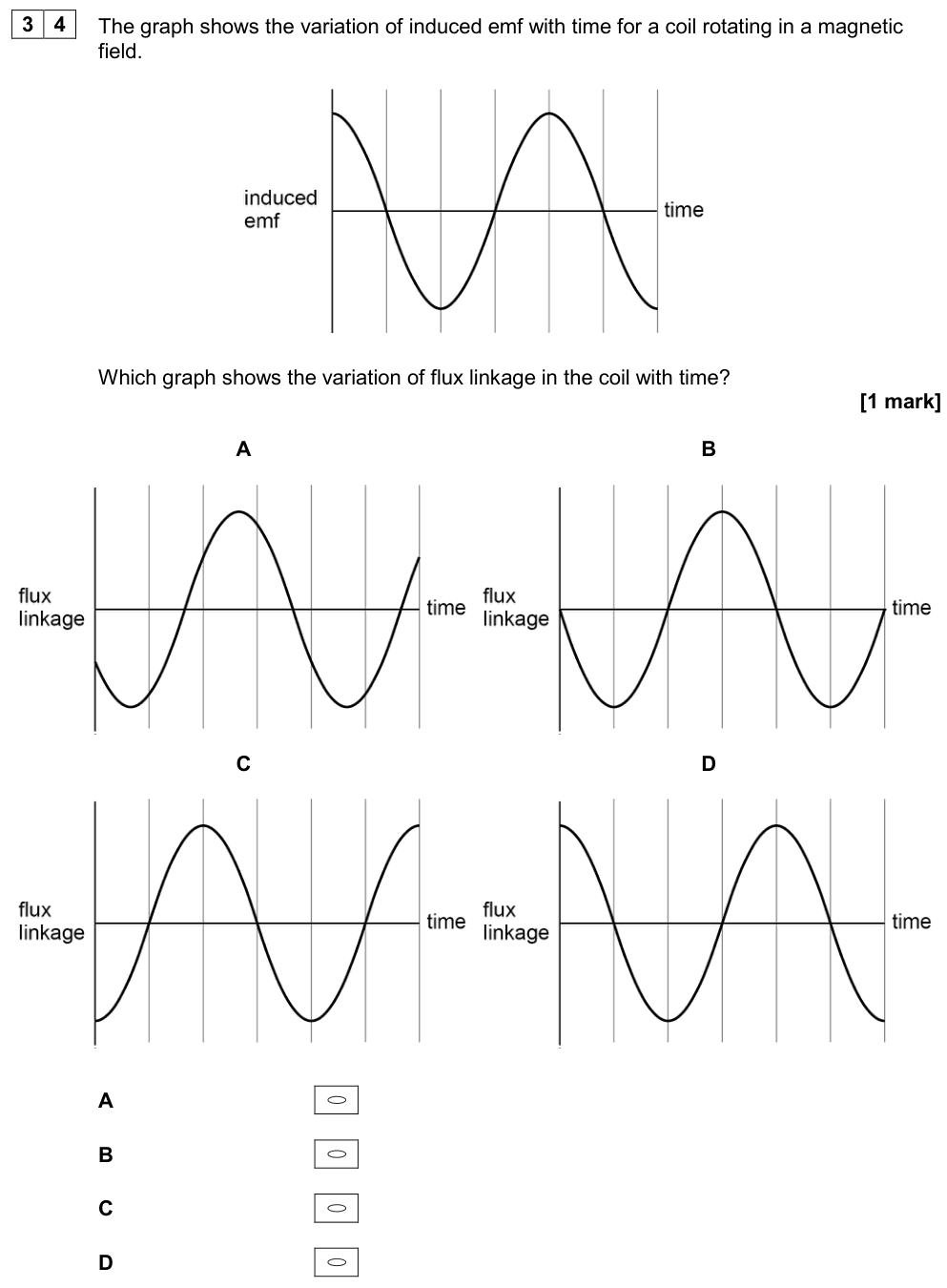
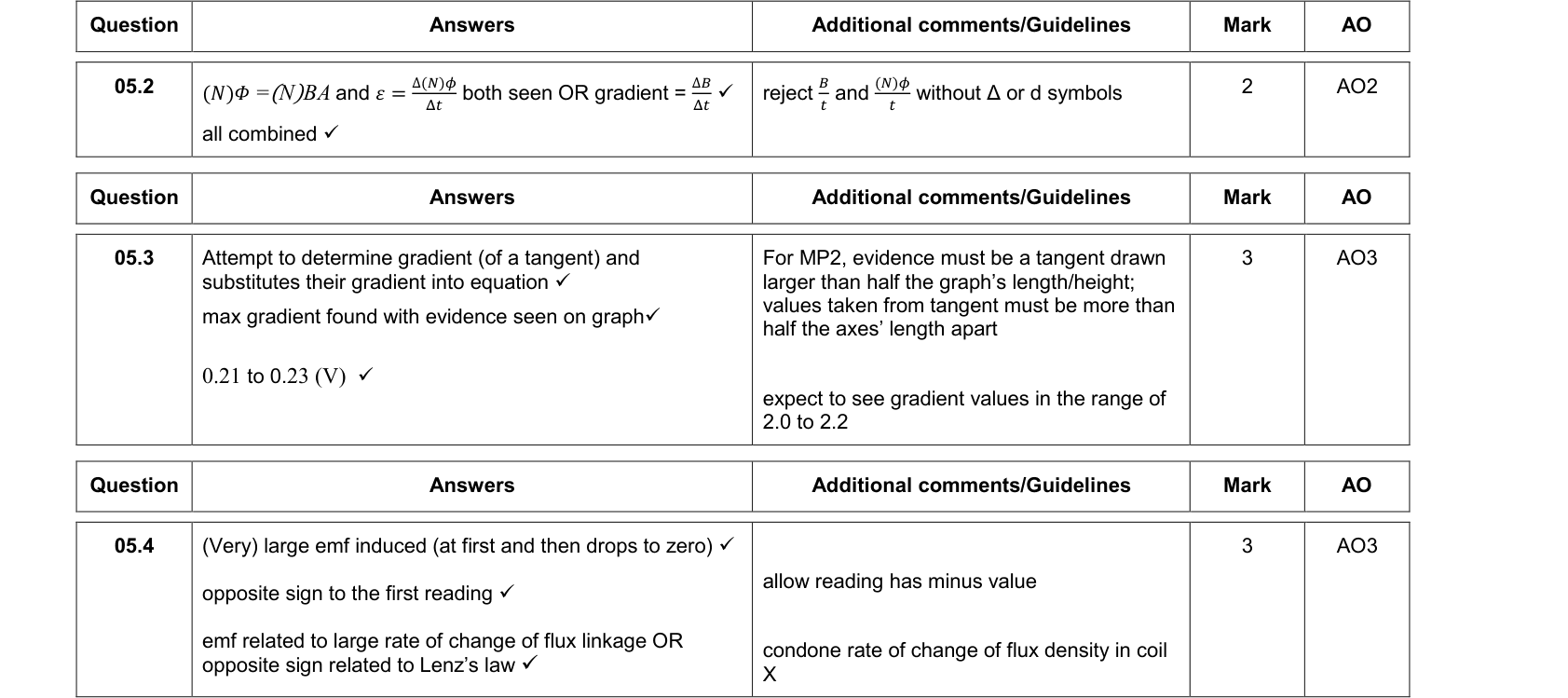
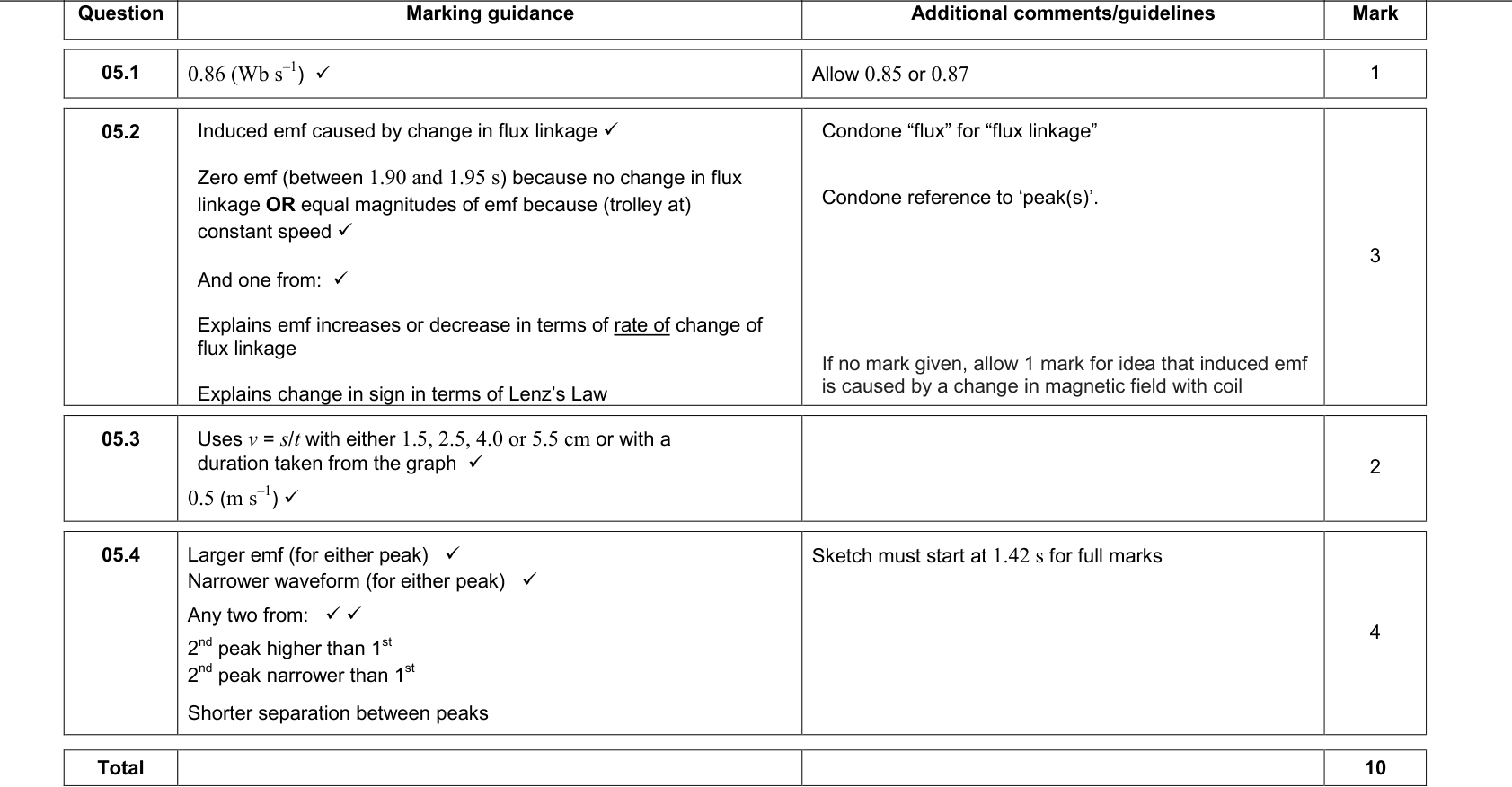
The e.m.f. is larger for a faster change, a stronger field, more turns or a larger area. On a graph of flux linkage against time, the induced e.m.f. equals the gradient.
Lenz's law
Lenz's law
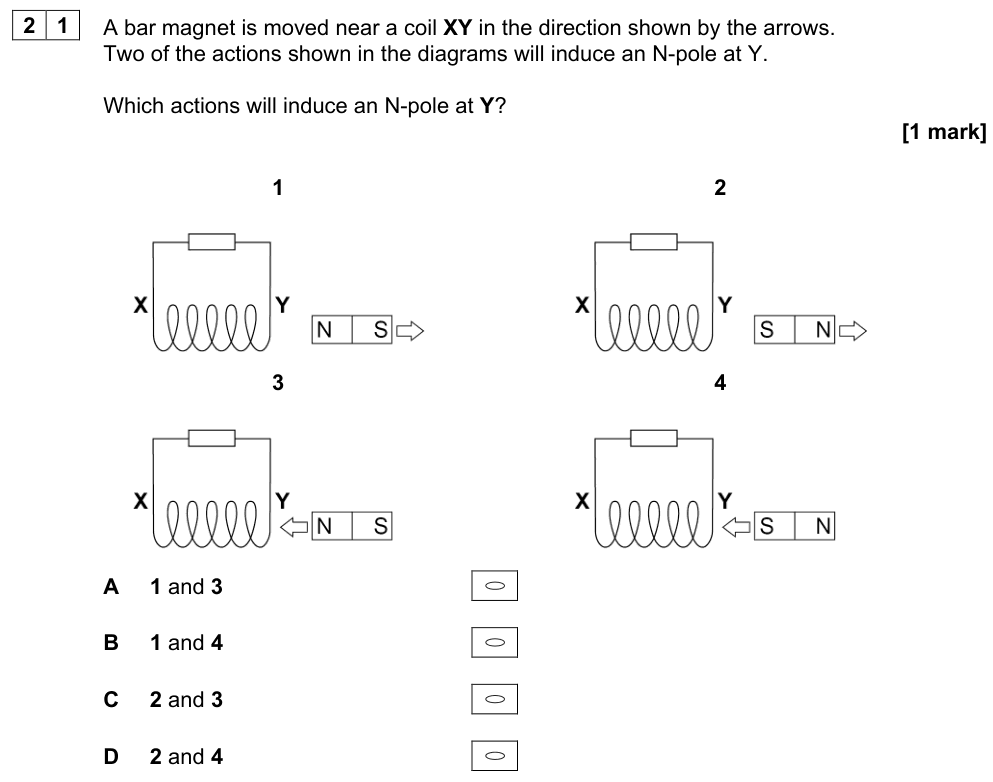
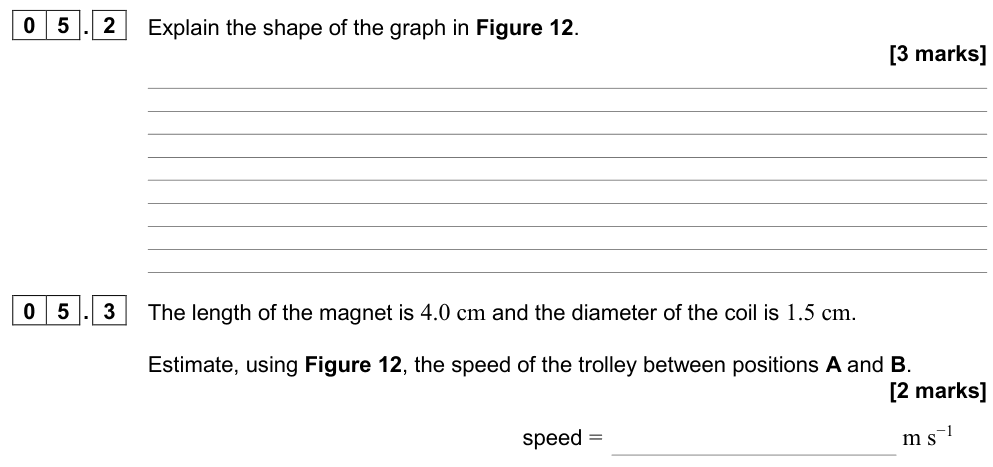
The direction of the induced e.m.f. (and current) is such that it opposes the change that produces it.
Combined: $\varepsilon = -N\dfrac{\Delta\Phi}{\Delta t}$, where the minus sign represents Lenz's law.
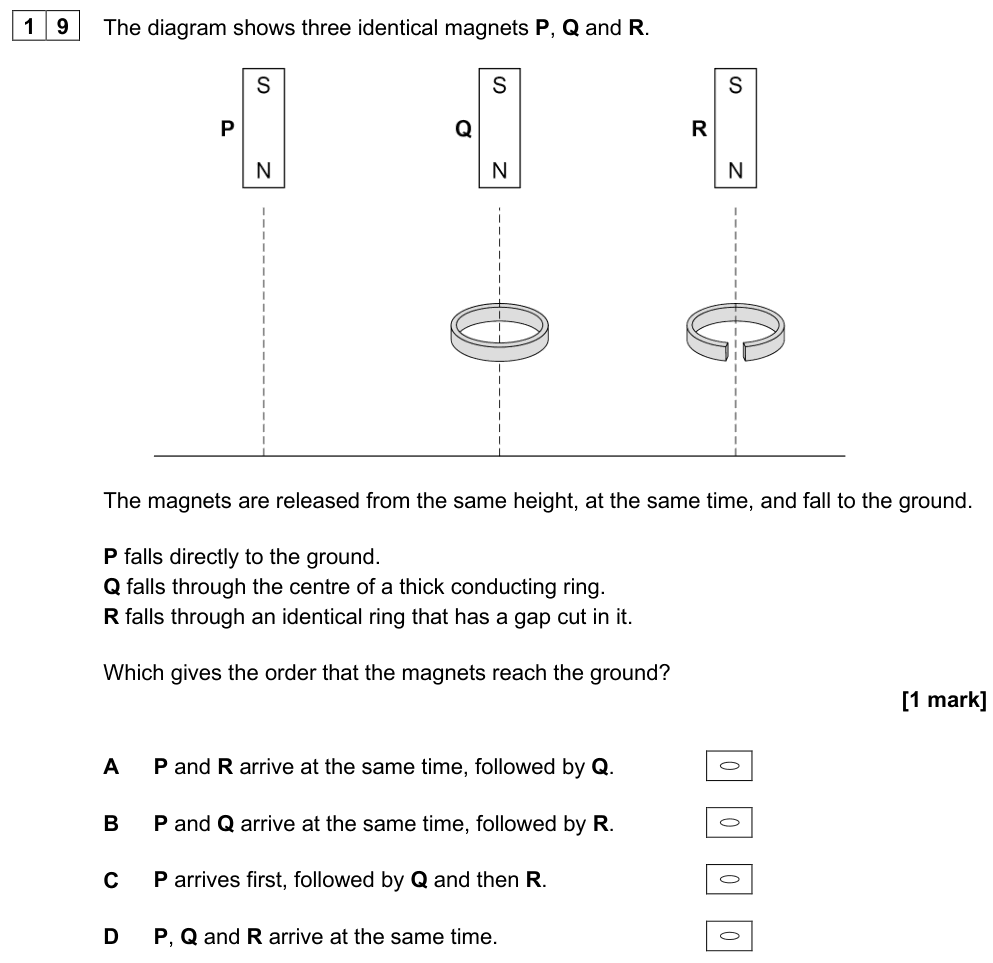
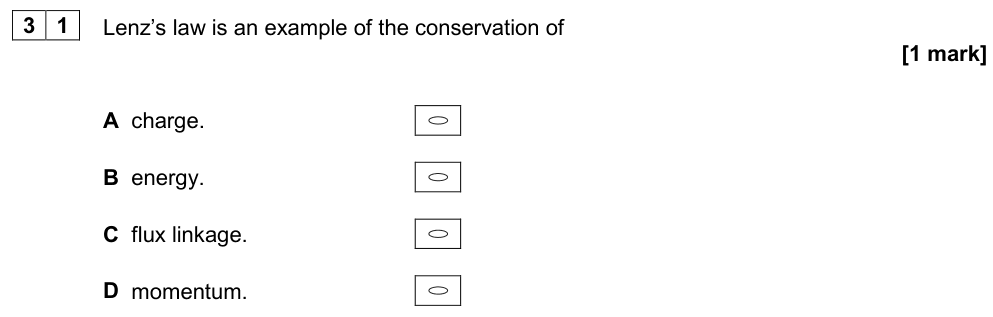
Lenz's law is a consequence of conservation of energy. If a magnet is pushed towards a coil, the induced current makes the near end of the coil a like pole that repels the magnet. Work must be done against this force, and that work becomes the electrical energy of the induced current. If the induced current attracted the magnet instead, the magnet would speed up by itself, creating energy from nothing.
Worked example: coil in a changing field
A 200-turn coil of area $3.0 \times 10^{-3}\ \text{m}^2$ is perpendicular to a field that falls uniformly from 0.40 T to 0 in 0.020 s.
$\varepsilon = N\dfrac{\Delta(BA)}{\Delta t} = \dfrac{200 \times 0.40 \times 3.0 \times 10^{-3}}{0.020} = 12\ \text{V}$.
A straight conductor moving in a field
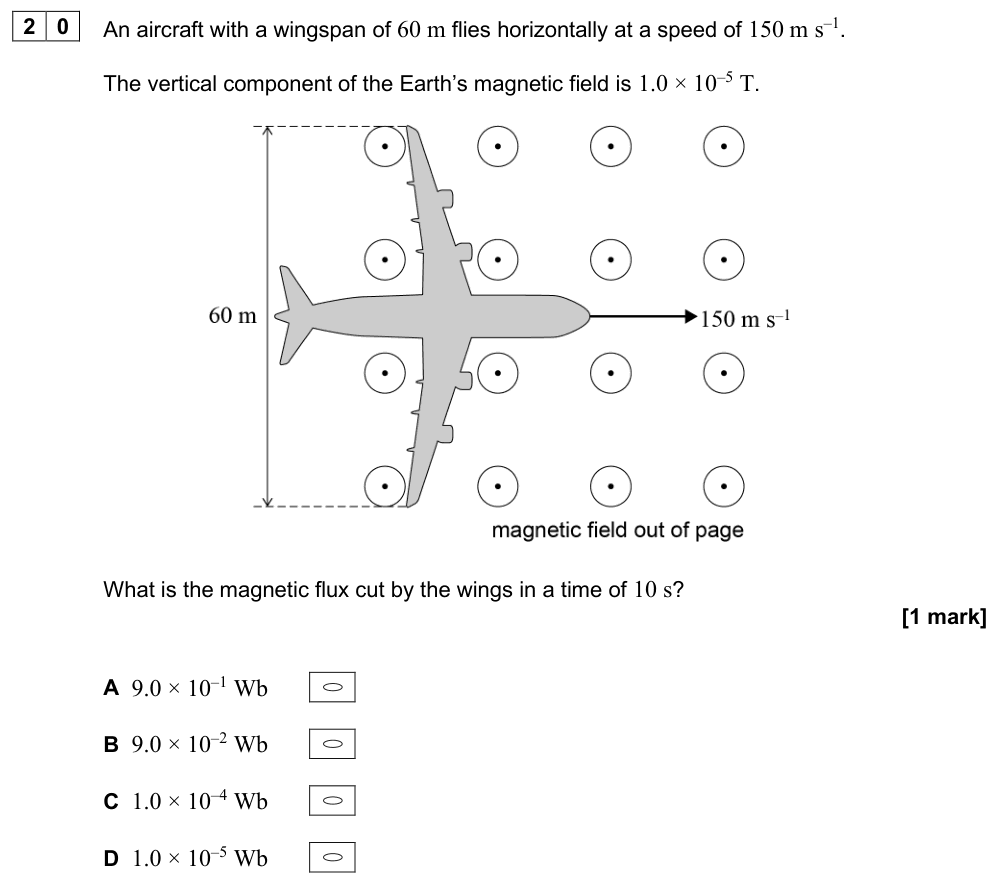
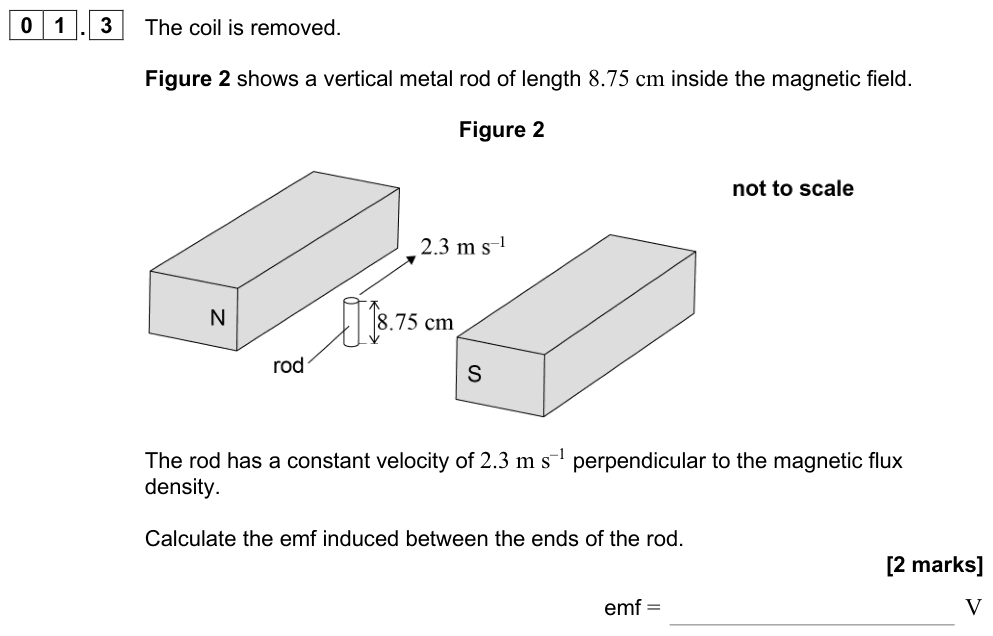
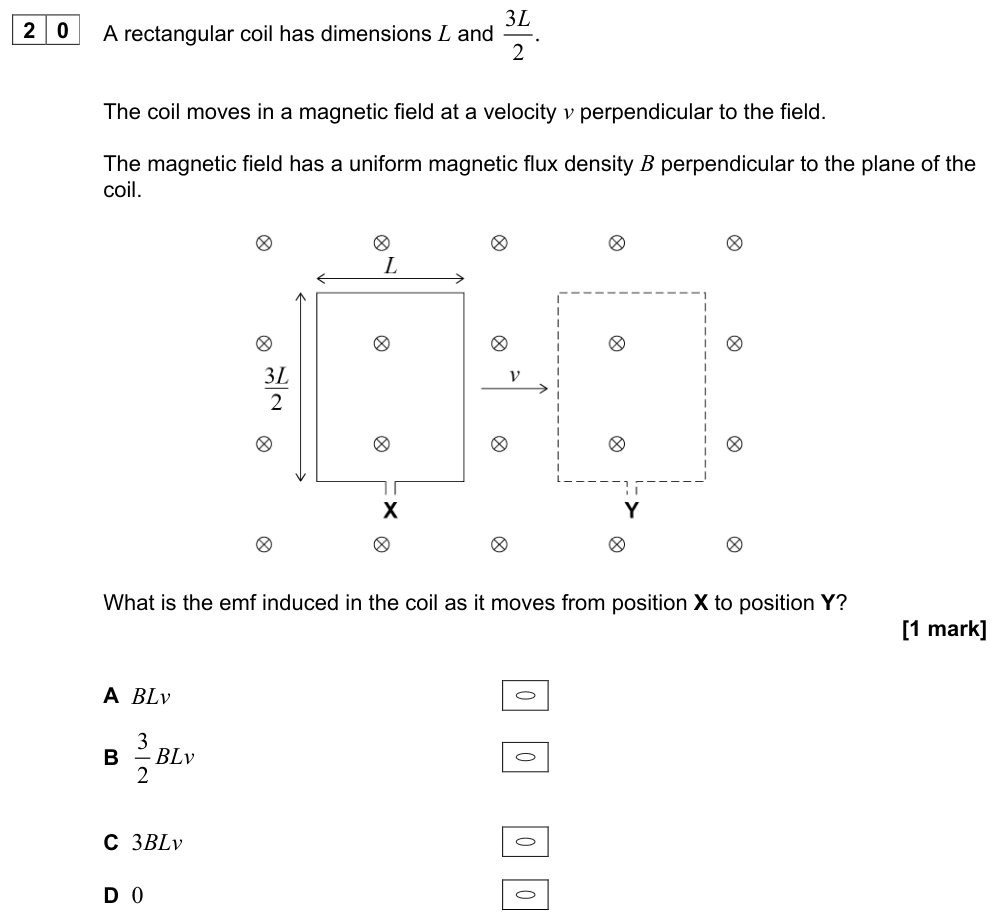
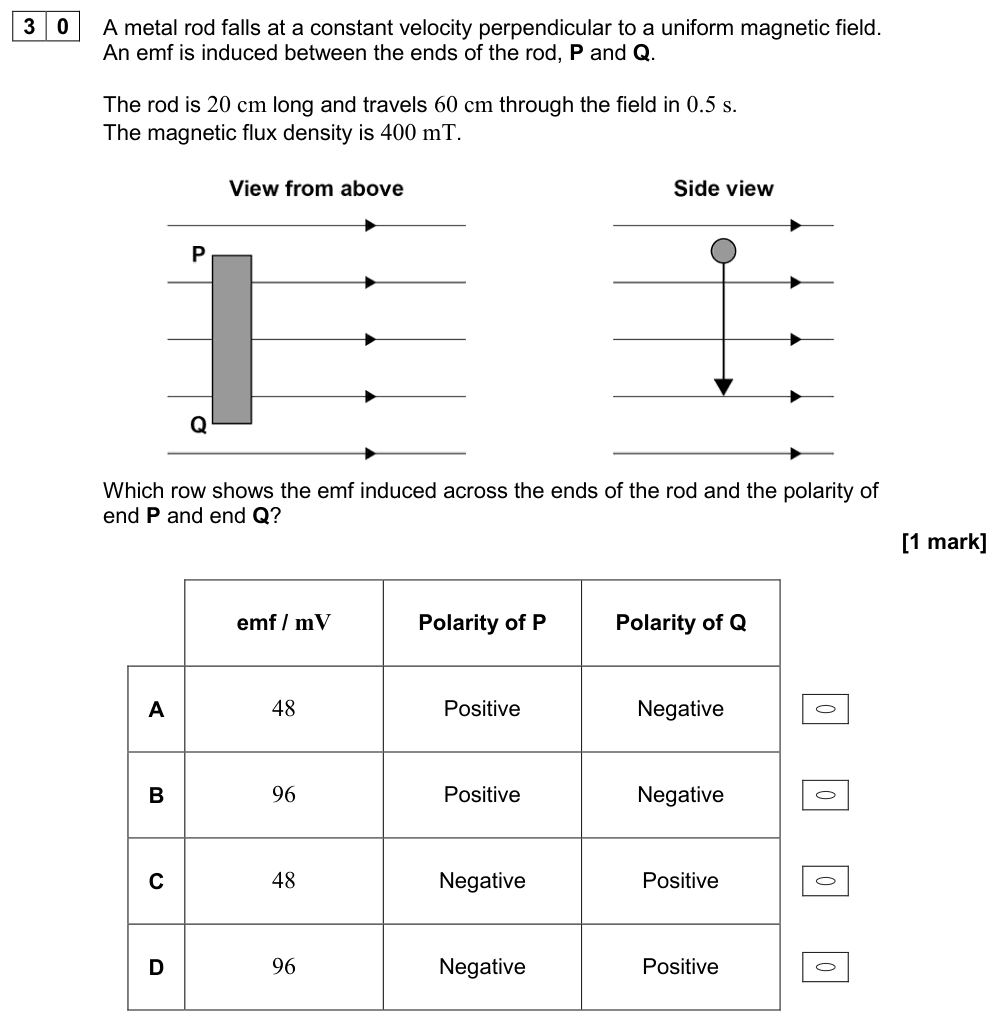
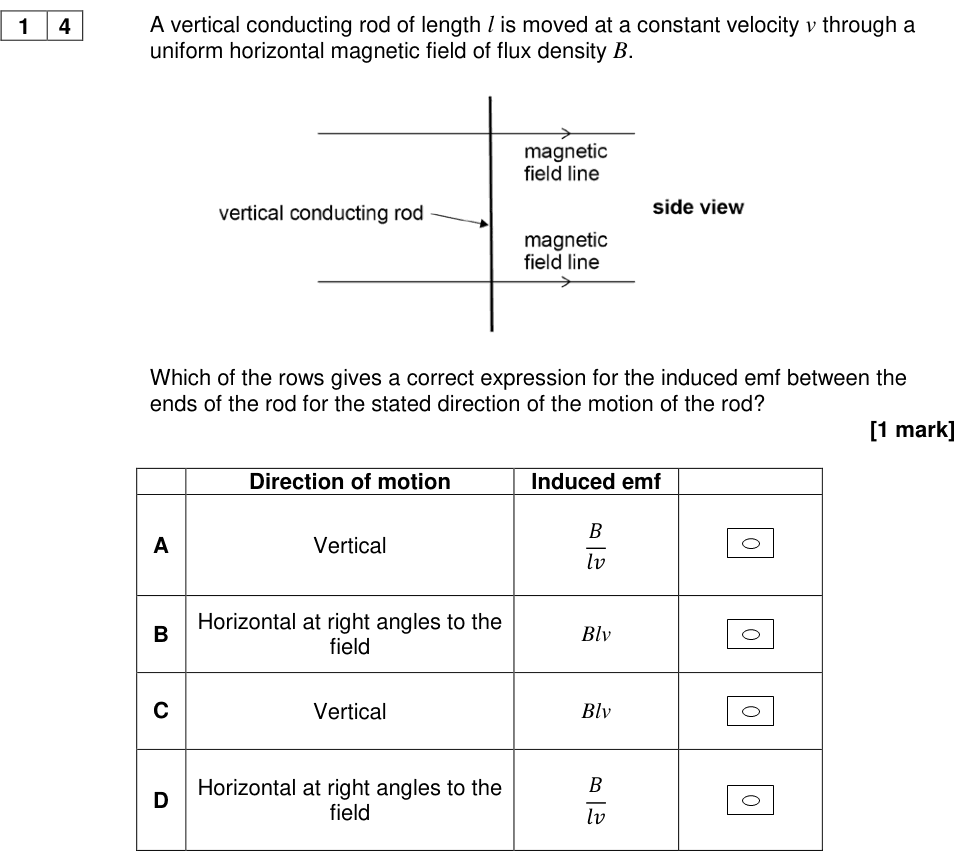
A rod of length $L$ moving at speed $v$ perpendicular to a field $B$ sweeps out an area $Lv$ each second, so the rate of cutting flux is $BLv$:
E.m.f. induced in a moving straight conductor
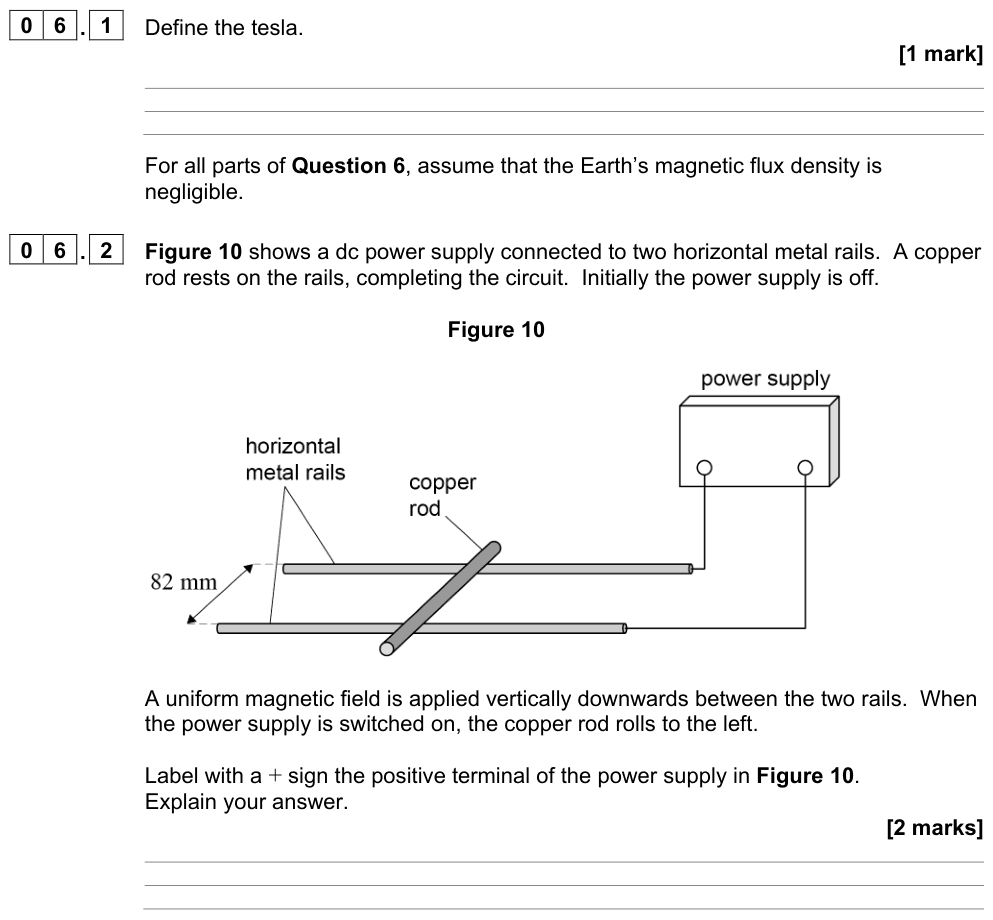
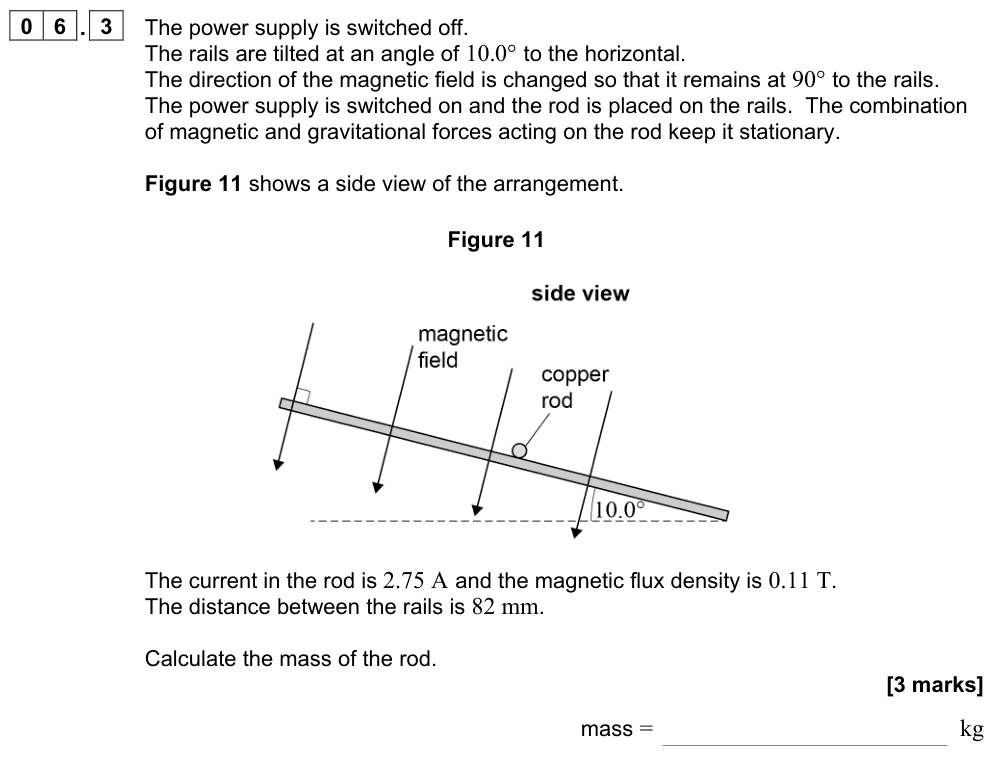
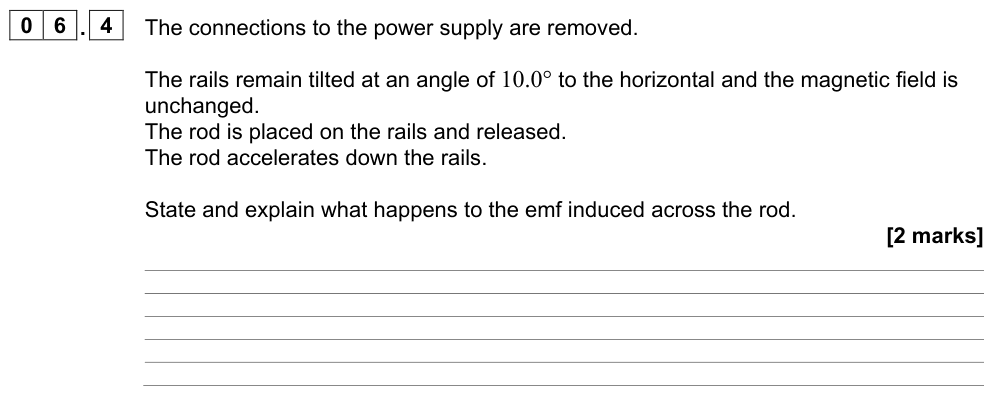
$$\varepsilon = BLv$$
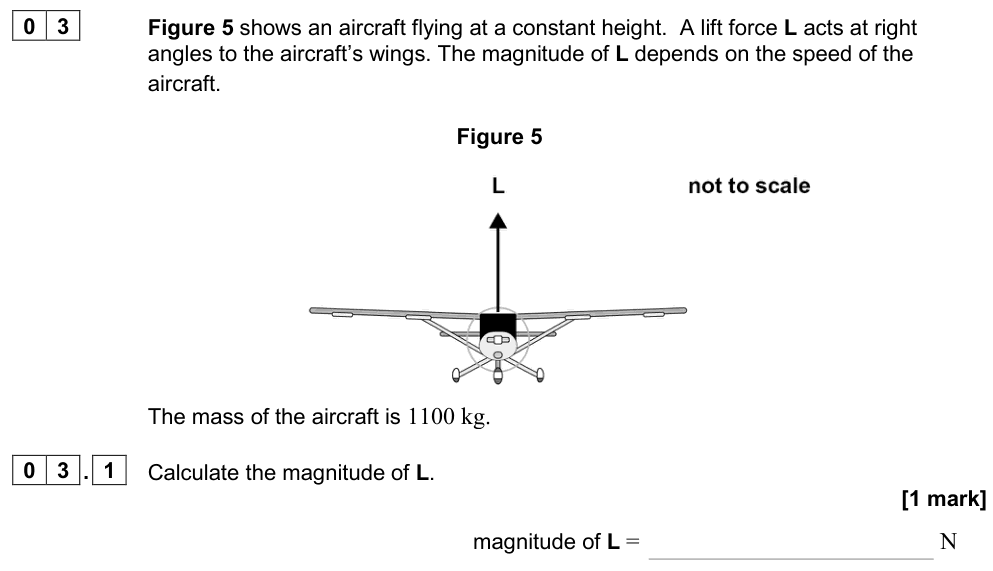
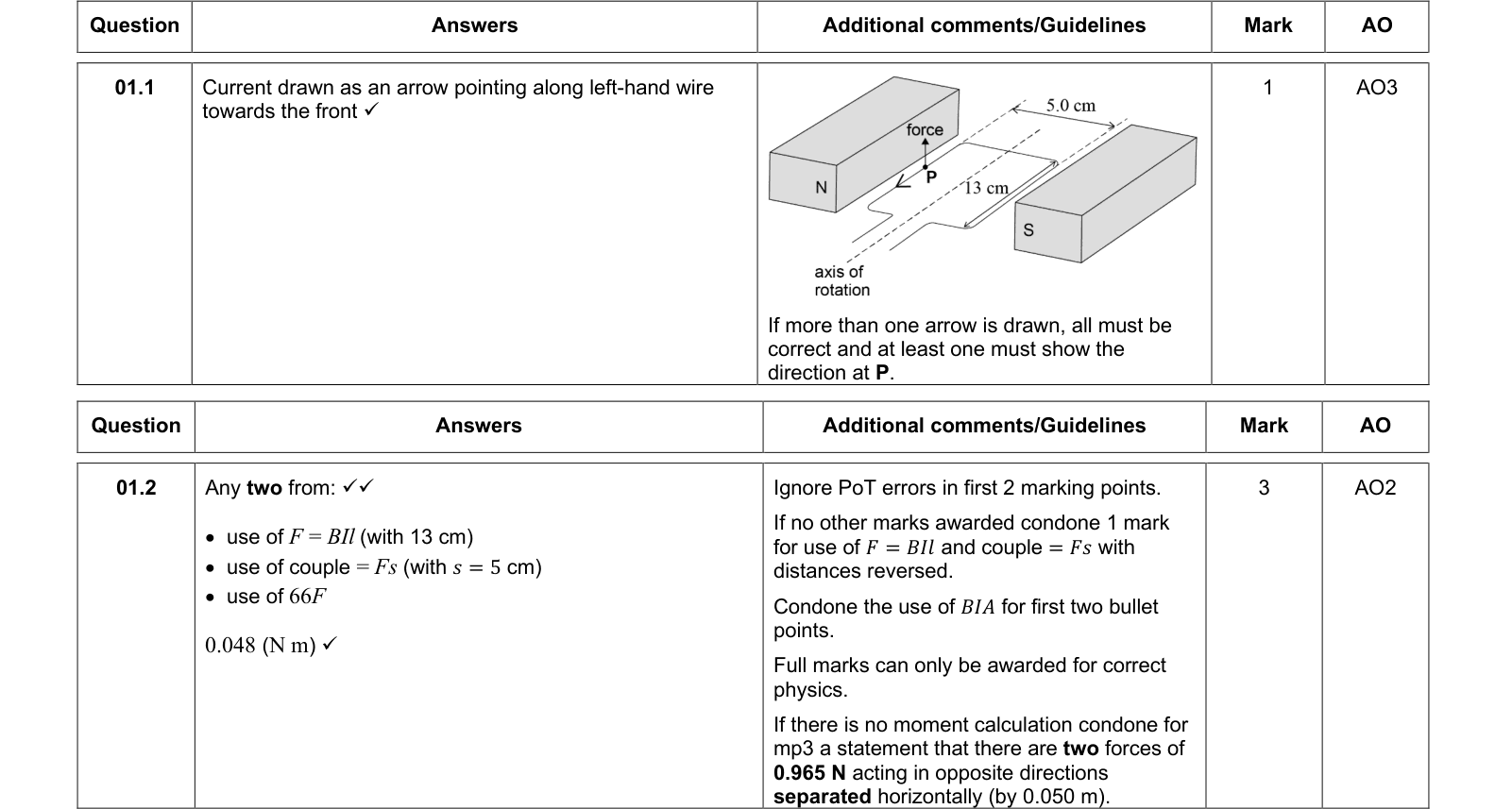
The direction of the induced current is given by Fleming's right-hand rule (thumb = motion, first finger = field, second finger = induced current) or by Lenz's law. Examples: an aircraft flying through the Earth's magnetic field has an e.m.f. between its wingtips; a metal rod rolling along rails in a field.
Worked example: aircraft wings
An aircraft with a 40 m wingspan flies horizontally at $250\ \text{m s}^{-1}$ where the vertical component of the Earth's field is $4.0 \times 10^{-5}$ T. $\varepsilon = BLv = 4.0 \times 10^{-5} \times 40 \times 250 = 0.40\ \text{V}$.
Eddy currents
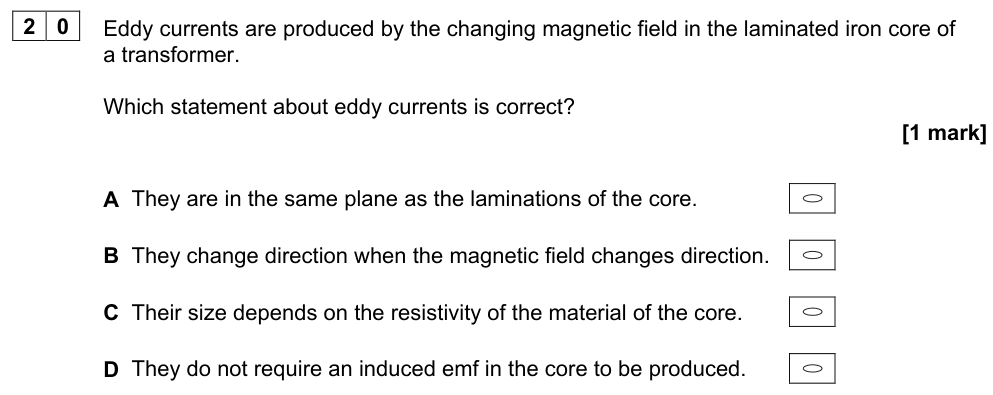
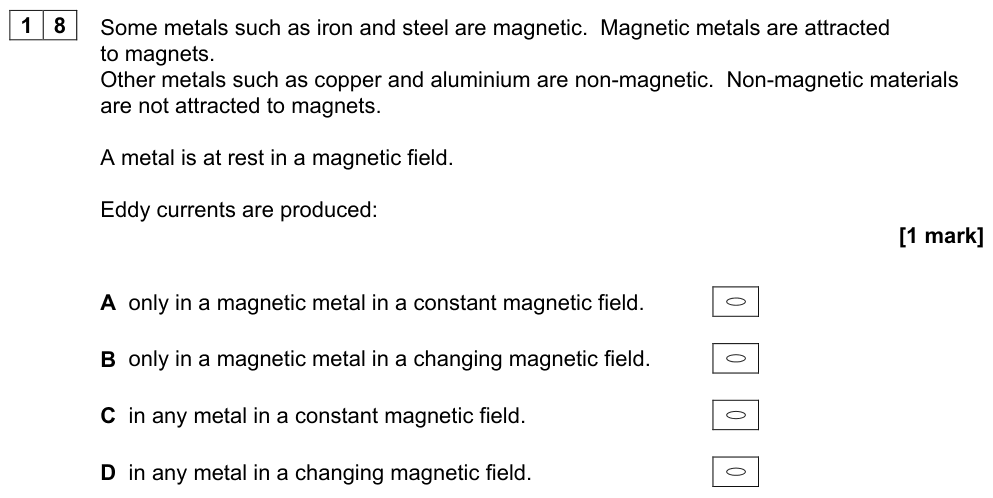
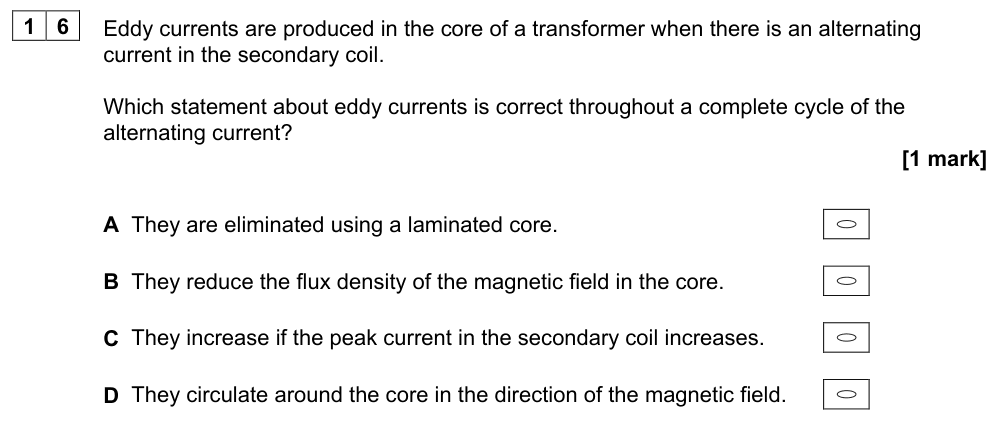
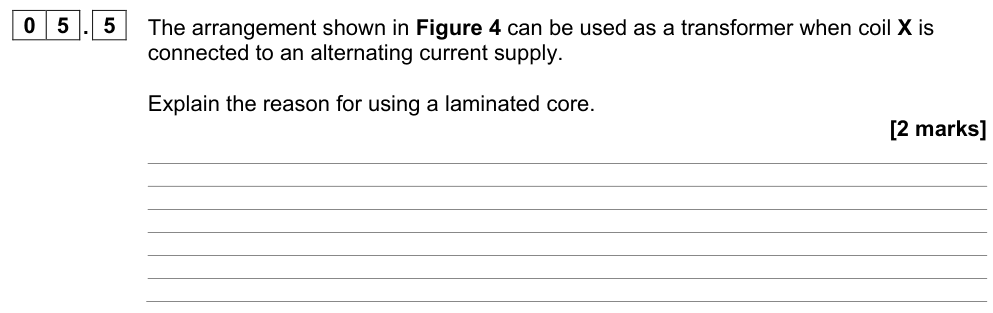
When a solid piece of metal experiences a changing magnetic flux (or moves through a field), small circulating currents called eddy currents are induced inside it. By Lenz's law, they oppose the change that causes them.
- Useful: electromagnetic braking (trains, rollercoasters), damping in balances and meters, induction cooking, metal detectors, the "magnet falling slowly down a copper tube" demonstration.
- Unwanted: in transformer and motor cores, eddy currents heat the core and waste energy. They are reduced by using a laminated core (thin insulated sheets), which breaks up the eddy current paths.
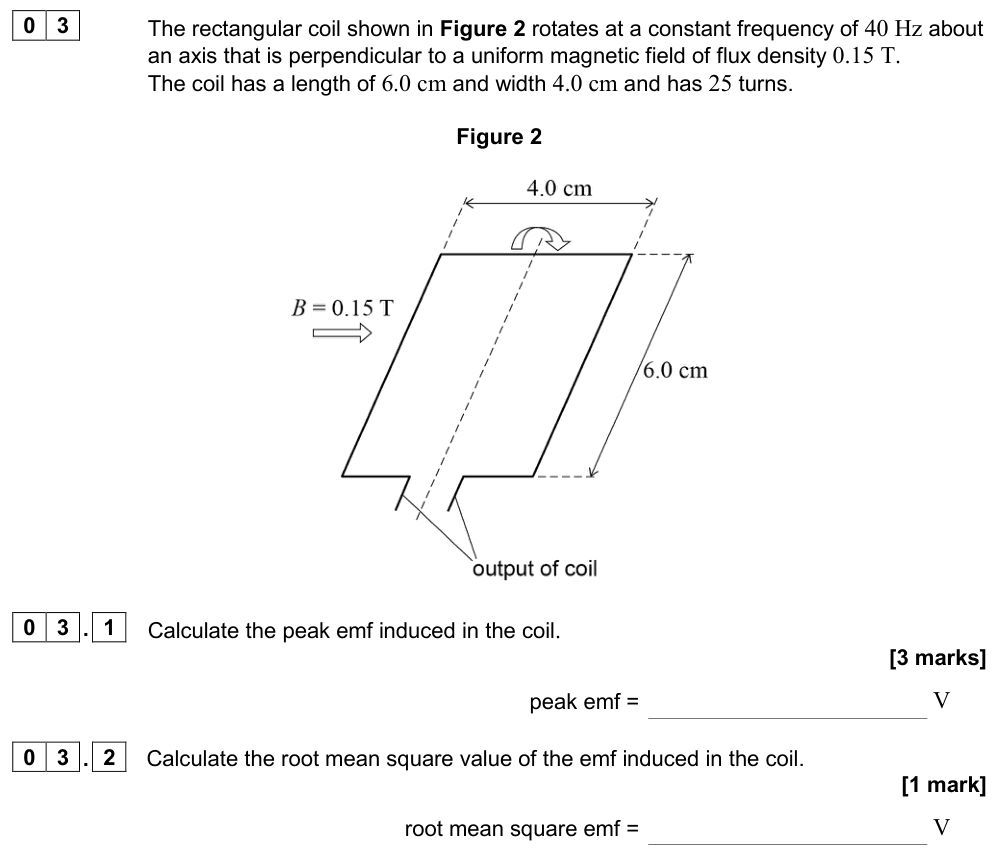
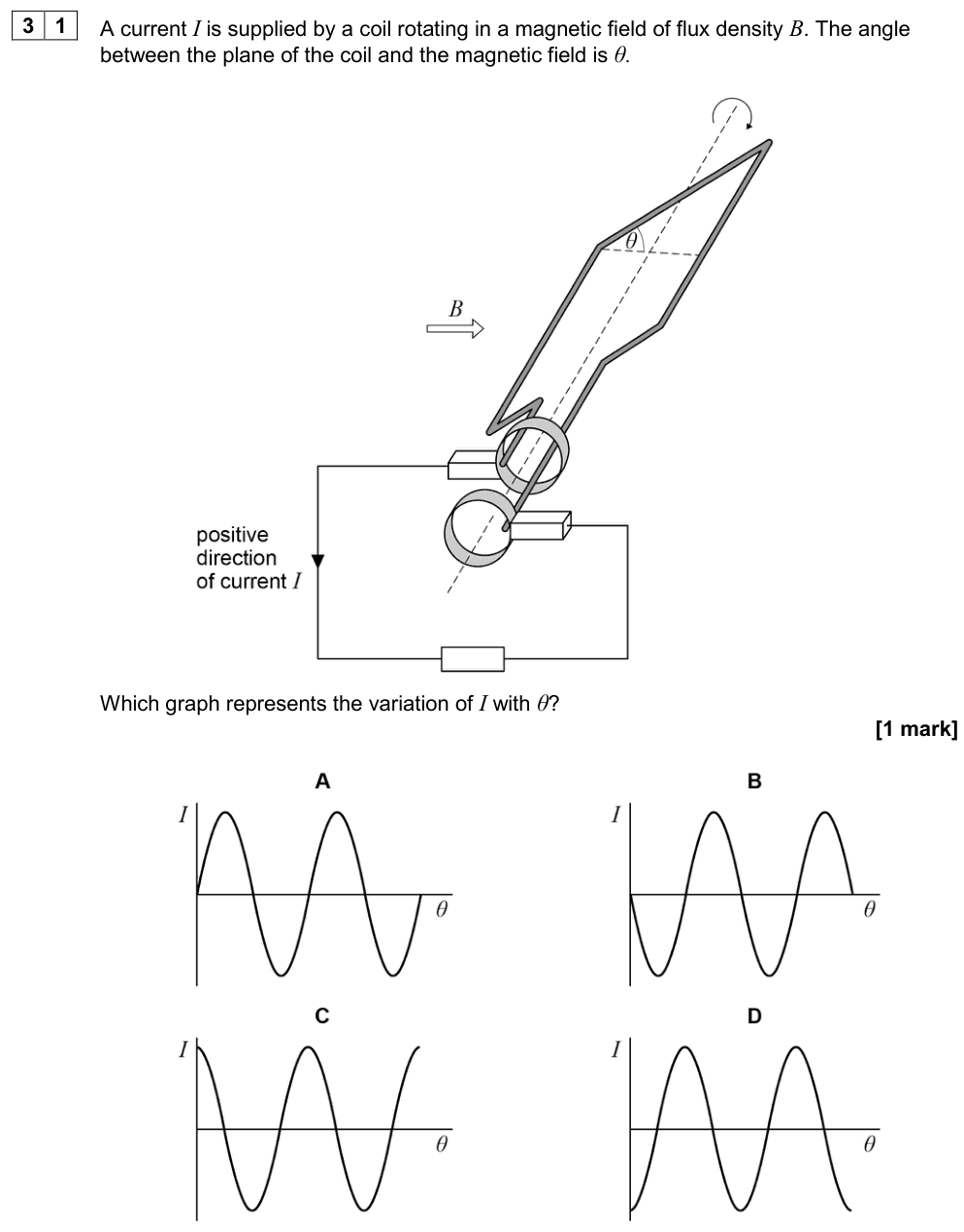
A coil rotating in a magnetic field: the generator
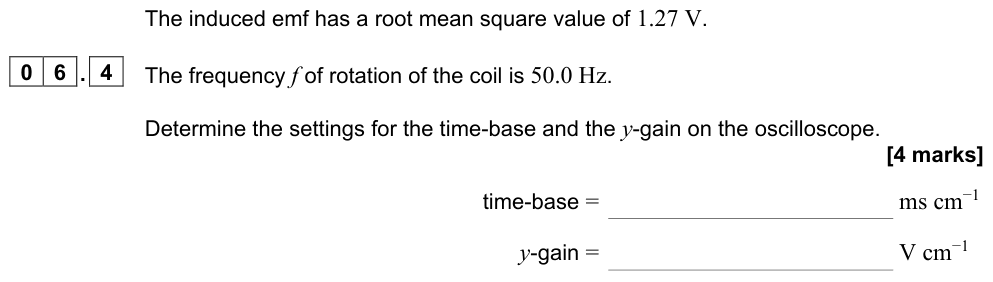
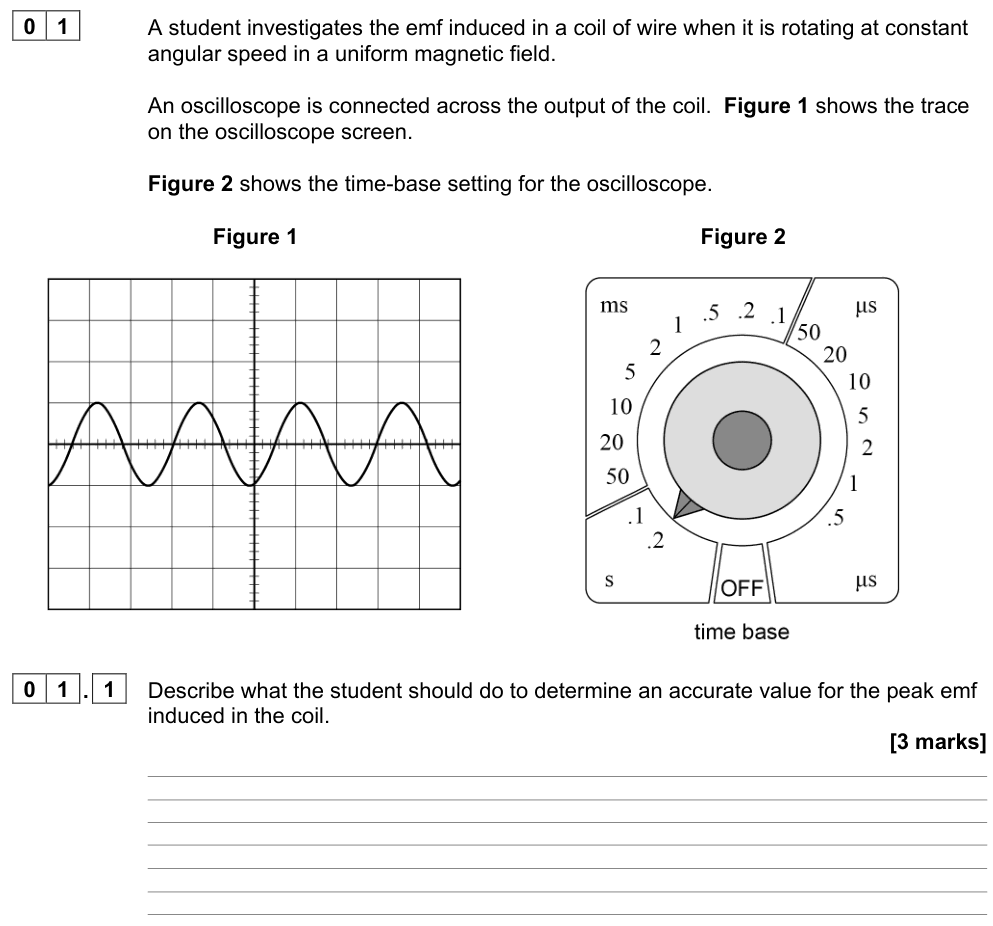
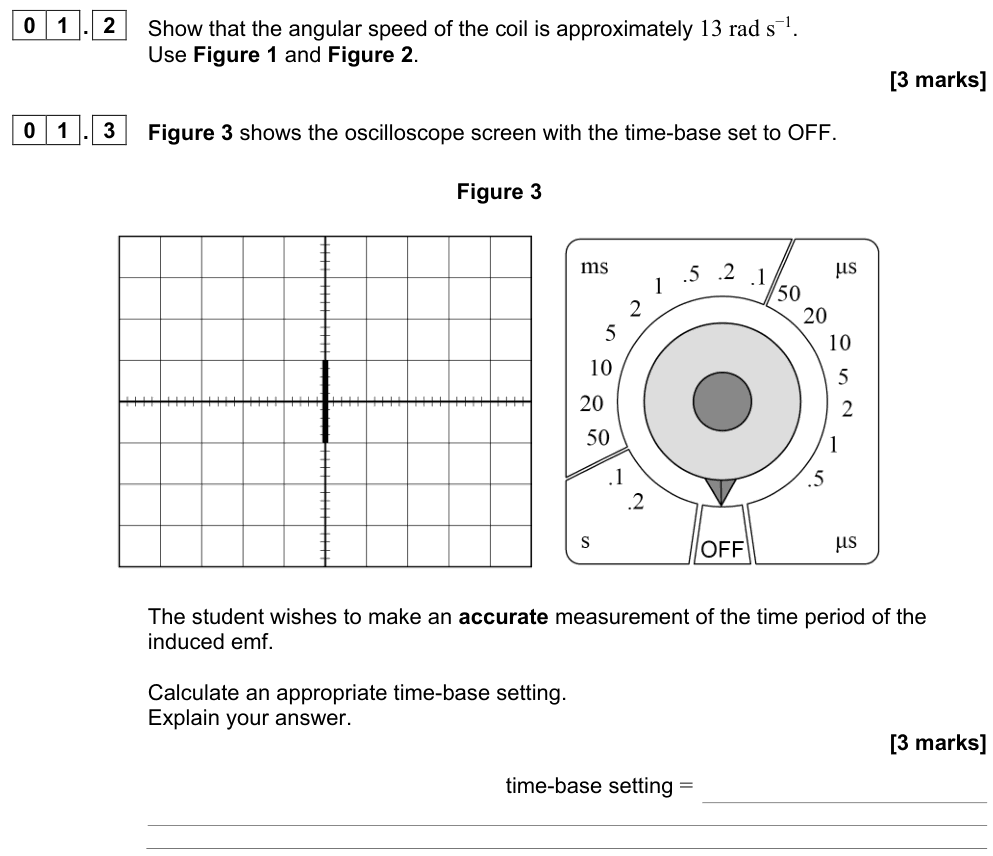
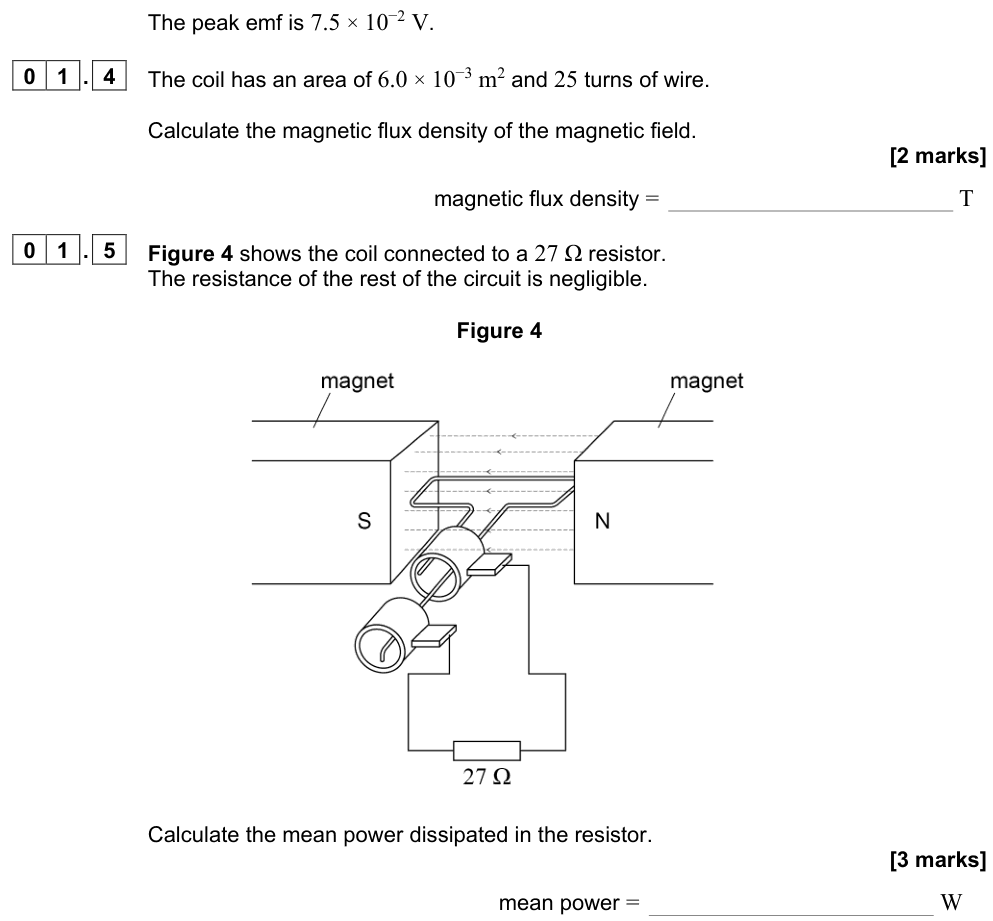
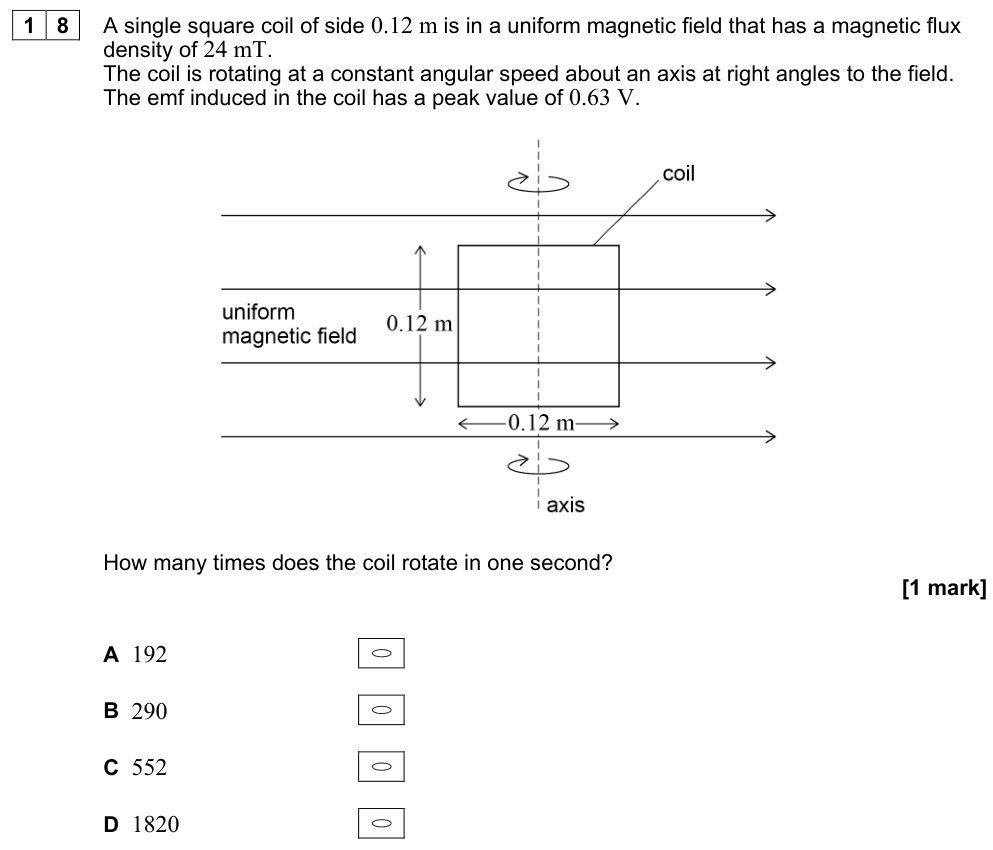
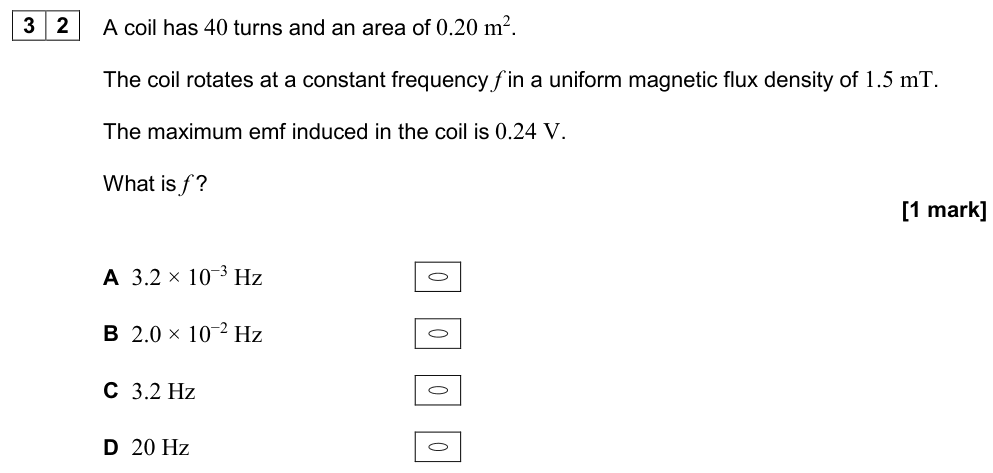
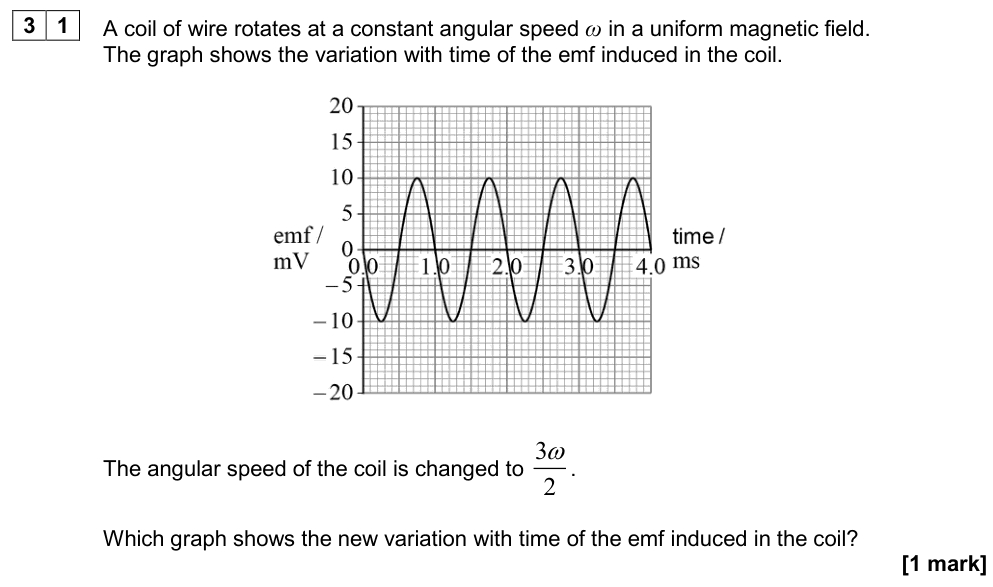
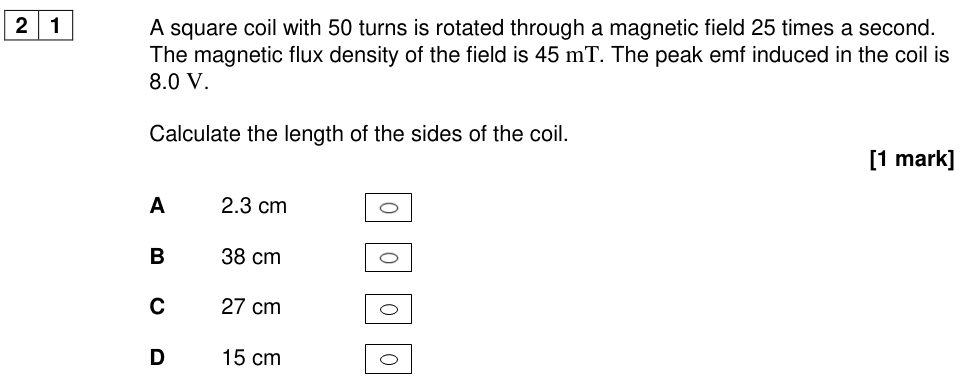
A coil of $N$ turns and area $A$ rotating with angular speed $\omega$ in a uniform field $B$ has flux linkage
$$N\Phi = BAN\cos\omega t$$
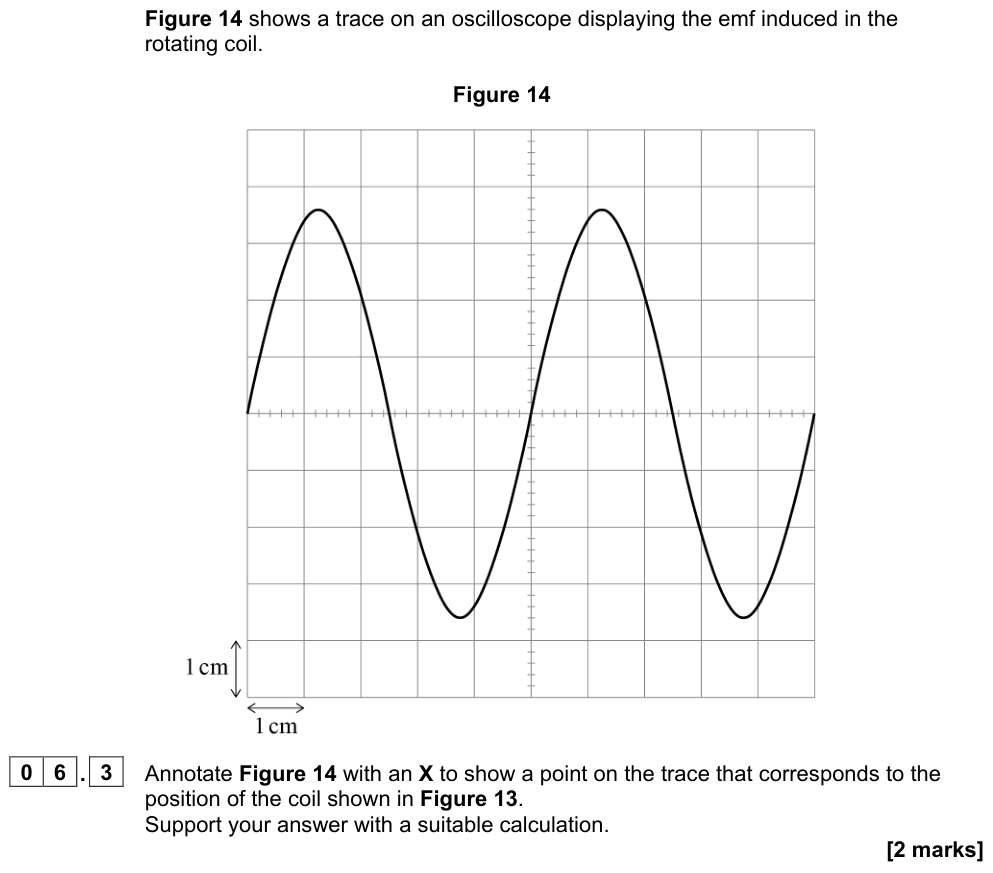
The induced e.m.f. is the rate of change of this, which varies sinusoidally:
E.m.f. of a rotating coil
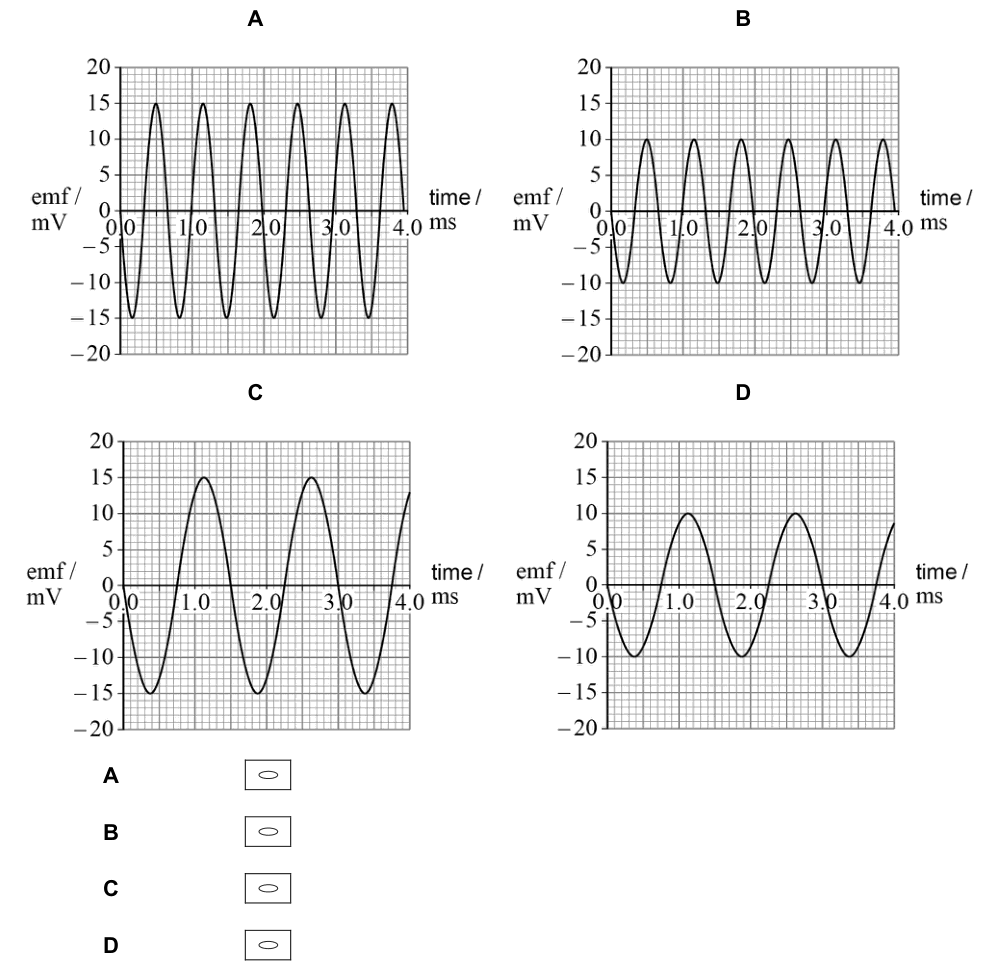
$$\varepsilon = BAN\omega\sin\omega t$$
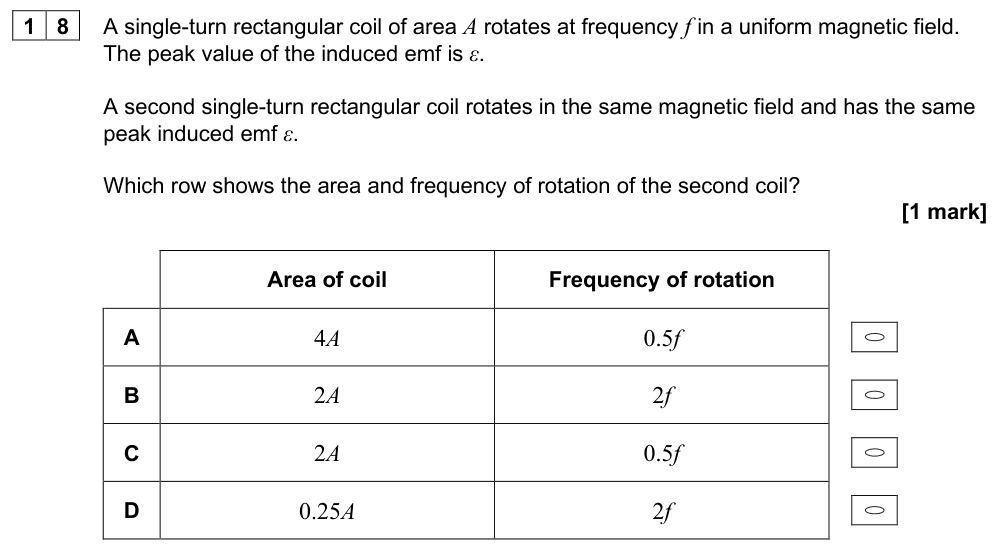
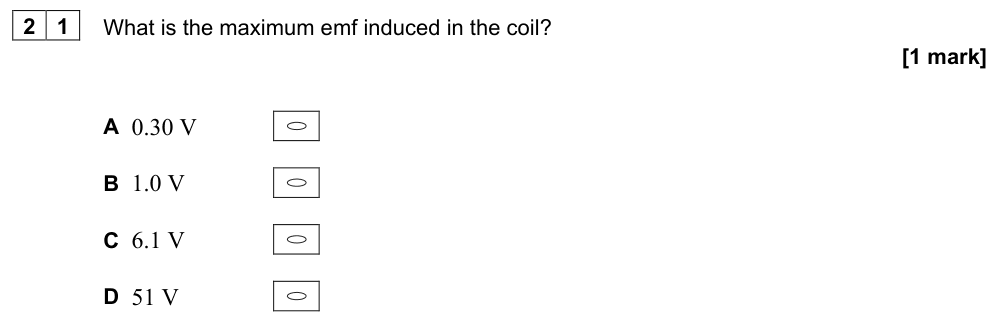
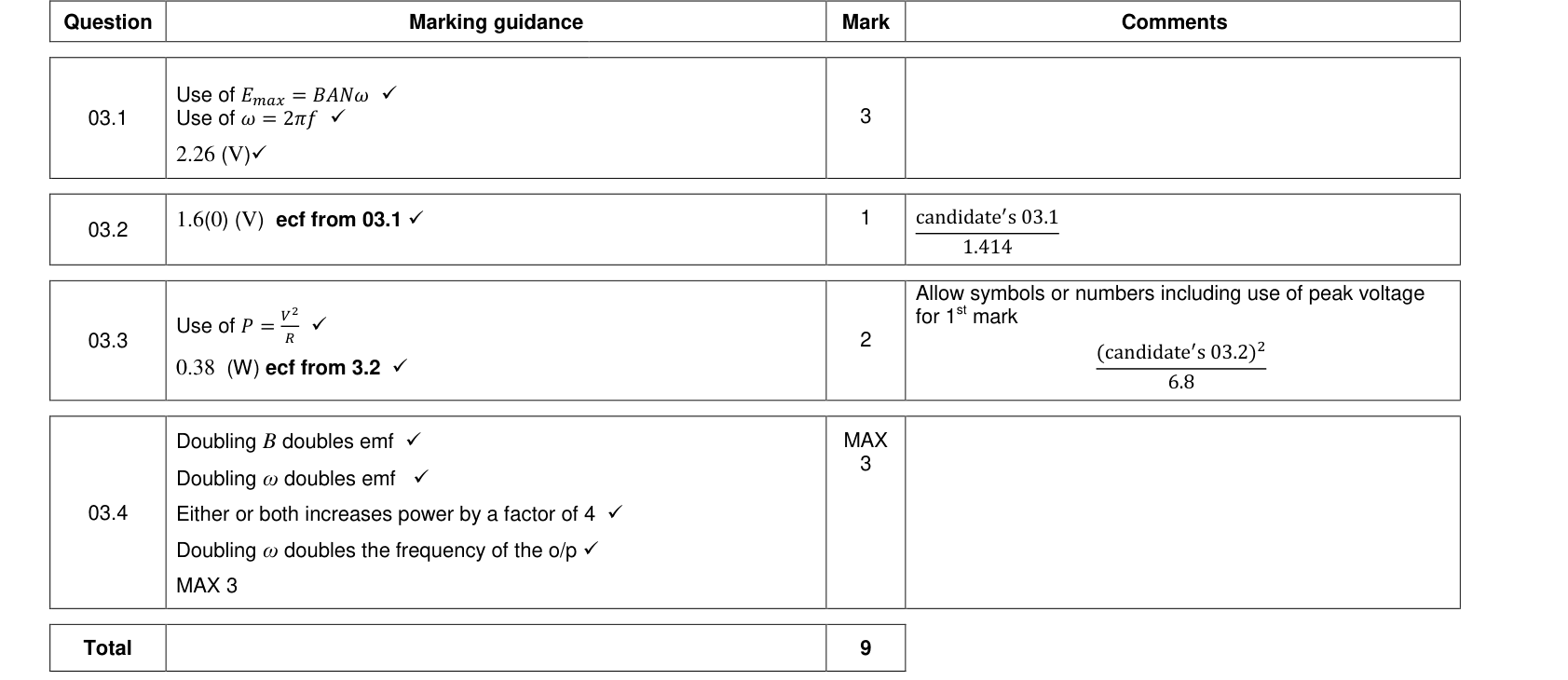
Peak e.m.f. $\varepsilon_0 = BAN\omega$.
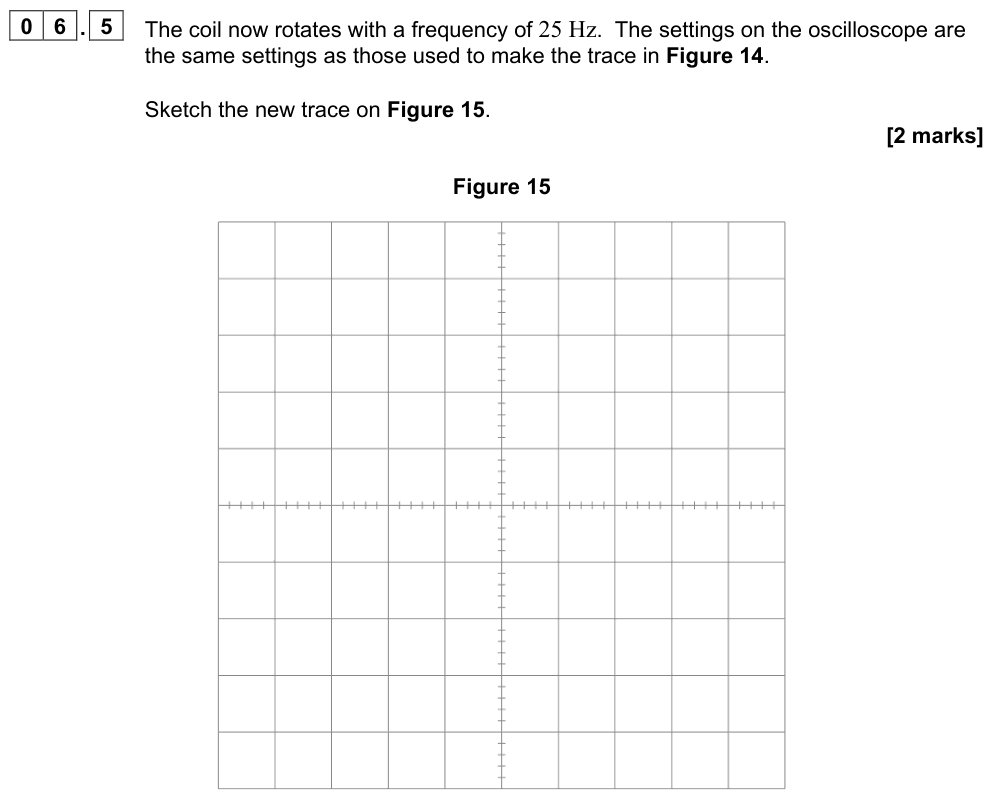
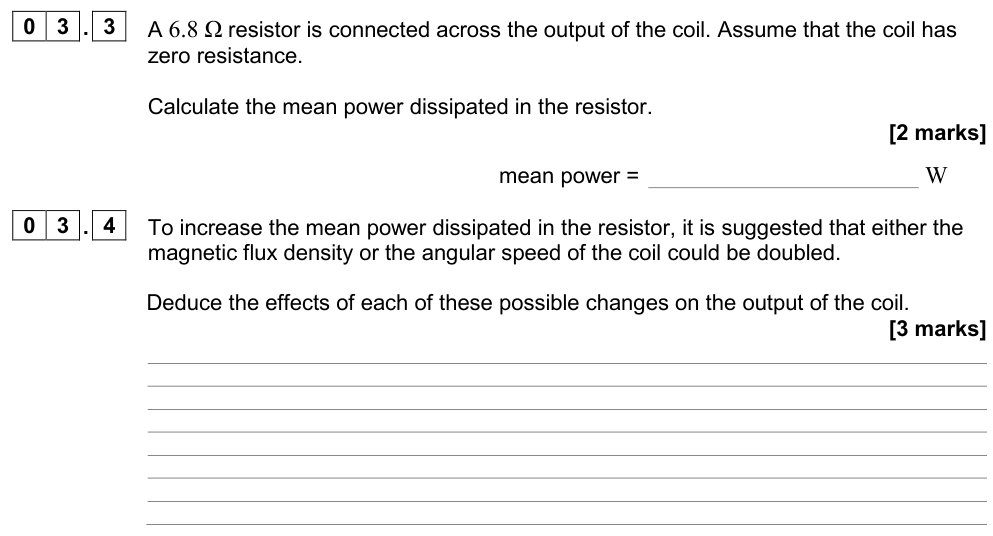
- Doubling the rotation speed doubles both the peak e.m.f. and the frequency.
- This is how an a.c. generator (alternator) works. Slip rings connect the coil to the external circuit.
Worked example: generator
A coil of 150 turns and area $4.0 \times 10^{-3}\ \text{m}^2$ rotates at 50 revolutions per second in a 0.20 T field.
$\omega = 2\pi \times 50 = 314\ \text{rad s}^{-1}$. Peak e.m.f. $= BAN\omega = 0.20 \times 4.0 \times 10^{-3} \times 150 \times 314 = 38\ \text{V}$.
Summary
- $\Phi = BA$ (Wb); flux linkage $N\Phi = BAN\cos\theta$ ($\theta$ from the normal).
- Faraday: $\varepsilon = N\Delta\Phi/\Delta t$ (gradient of flux linkage–time graph). Lenz: the induced current opposes the change (conservation of energy).
- Straight conductor: $\varepsilon = BLv$.
- Eddy currents oppose motion/change: useful for braking; reduced in cores by lamination.
- Rotating coil: $\varepsilon = BAN\omega\sin\omega t$, peak $BAN\omega$.