Alternating current
In direct current (d.c.) charge flows in one direction only. In alternating current (a.c.) the current (and p.d.) reverses direction periodically. You only need to deal with sinusoidal a.c.:
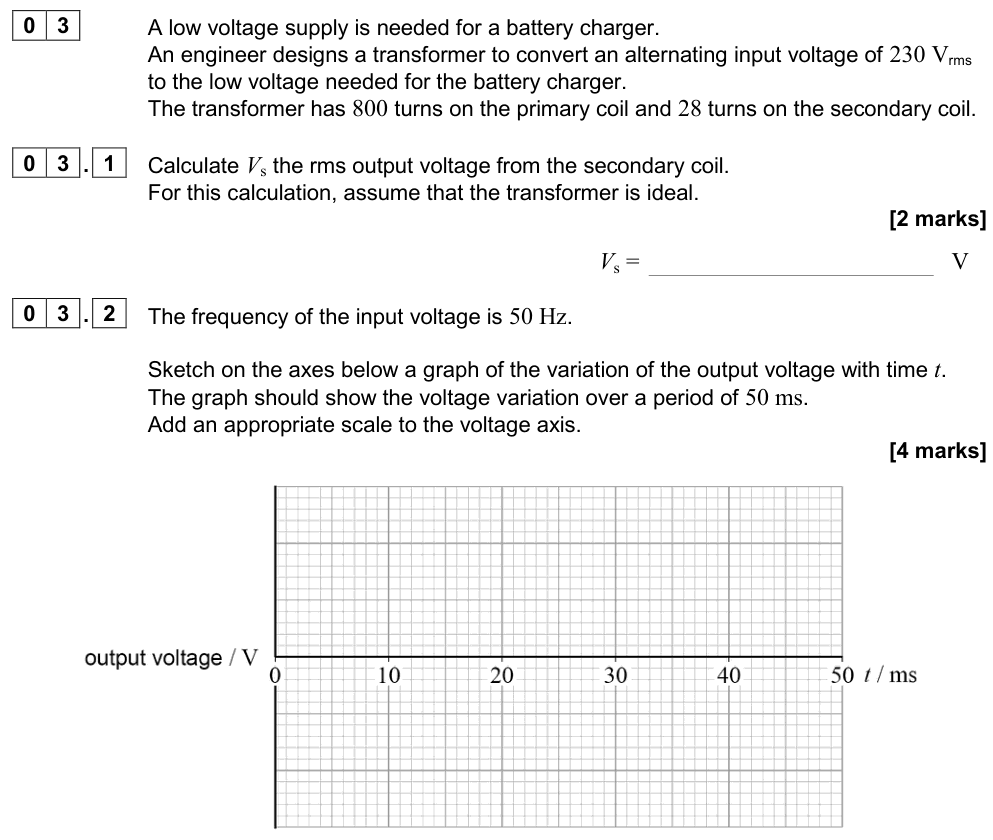
$$V = V_0\sin\omega t \qquad I = I_0\sin\omega t \qquad (\omega = 2\pi f)$$
| Term | Meaning |
|---|---|
| Peak value ($V_0$, $I_0$) | the maximum value, measured from zero |
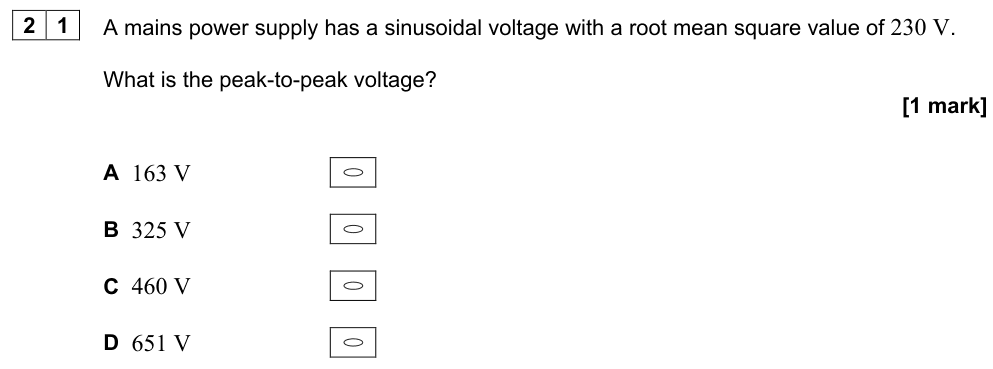
| Peak-to-peak value | the difference between the positive and negative peaks: $2V_0$ |
| Period $T$, frequency $f$ | time for one cycle; $f = 1/T$ (mains frequency is 50 Hz in many countries, 60 Hz in others) |
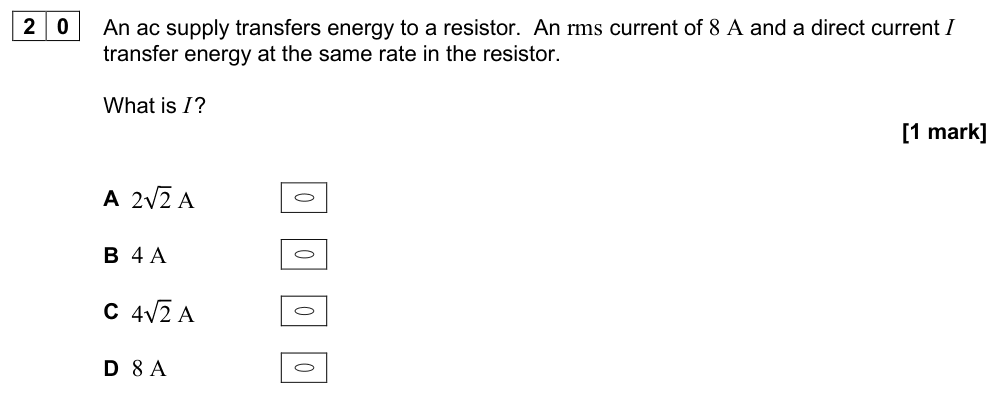
| Root mean square (r.m.s.) value | the value of the steady d.c. that would transfer energy at the same average rate in a resistor |
Root mean square values
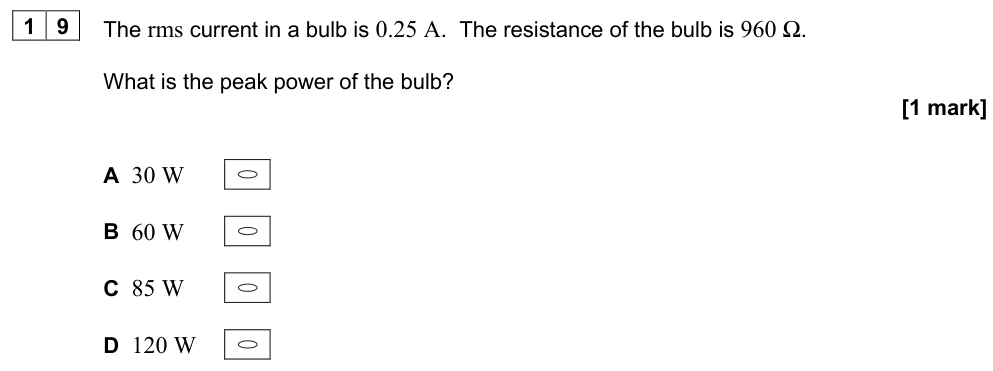
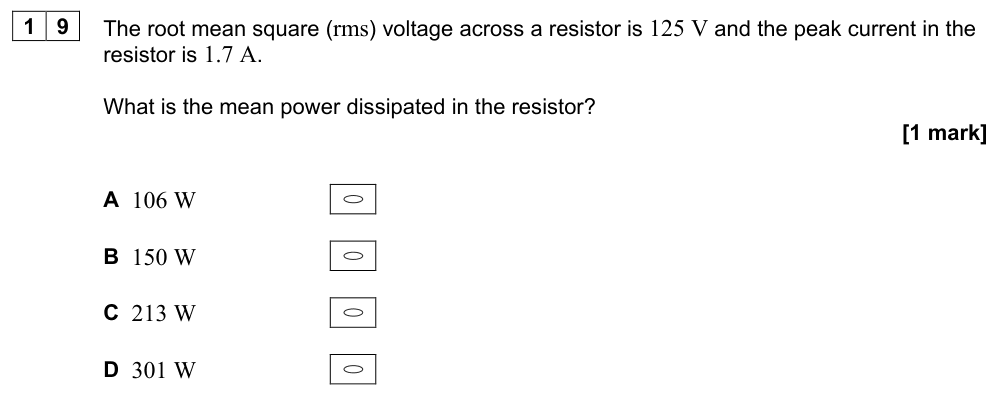
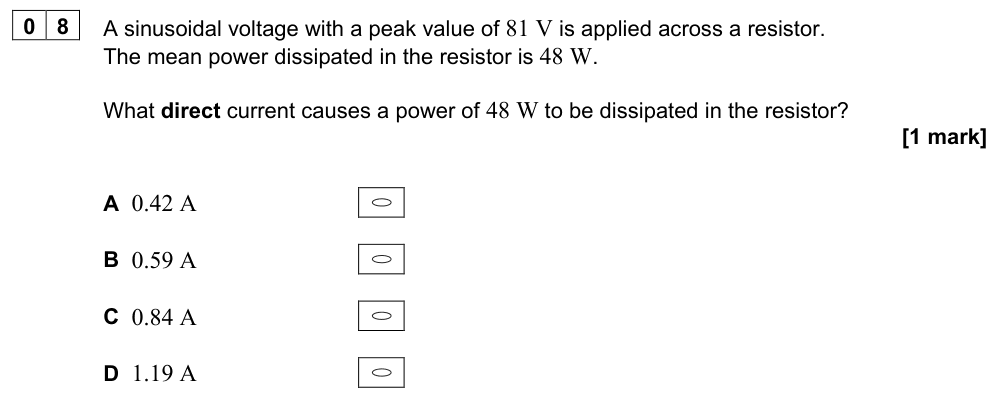
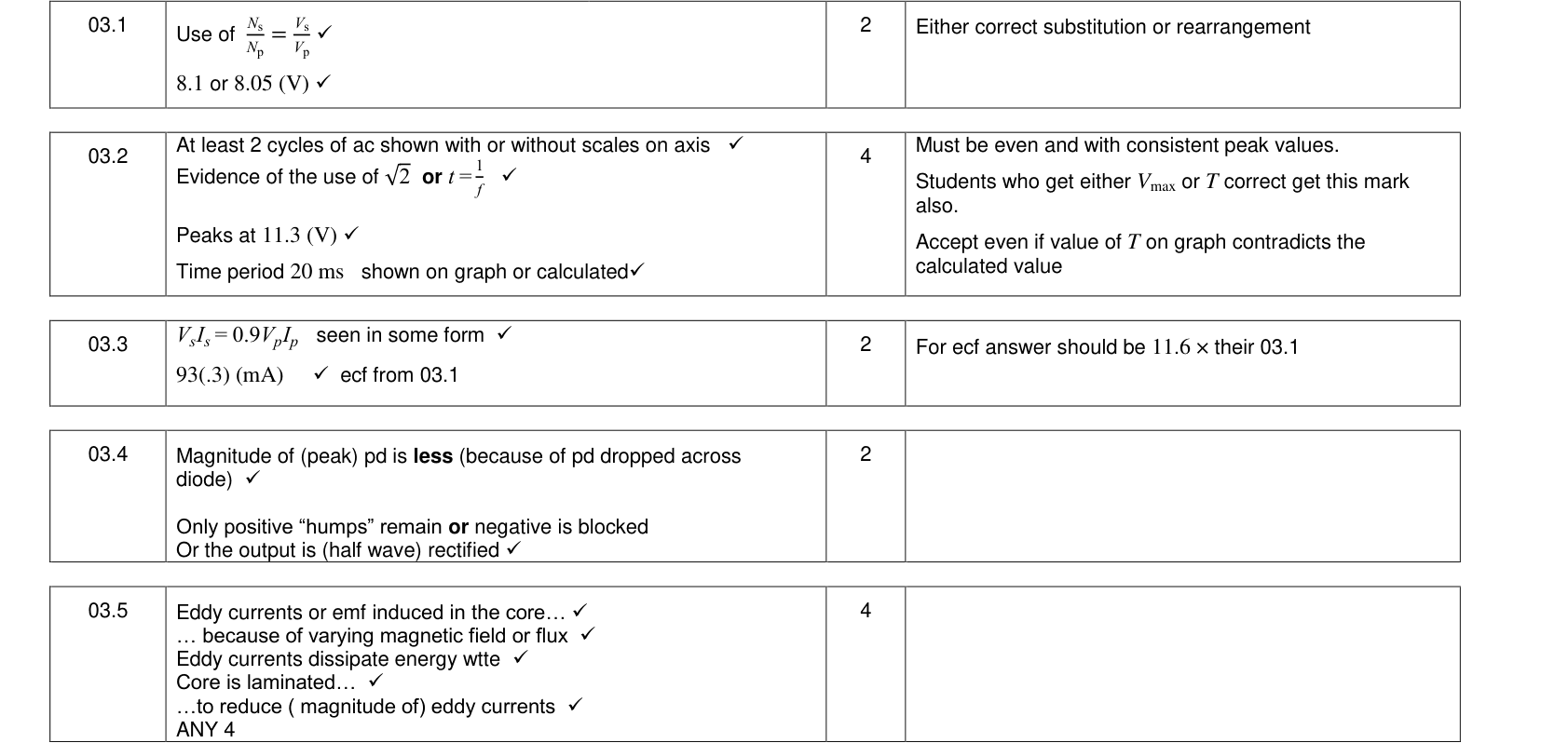
The power in a resistor is $P = I^2R$, which is always positive but changes during each cycle. Its average is $\tfrac12I_0^2R$. A d.c. current $I$ gives the same power if $I^2R = \tfrac12I_0^2R$:
r.m.s. values (sinusoidal a.c. only)
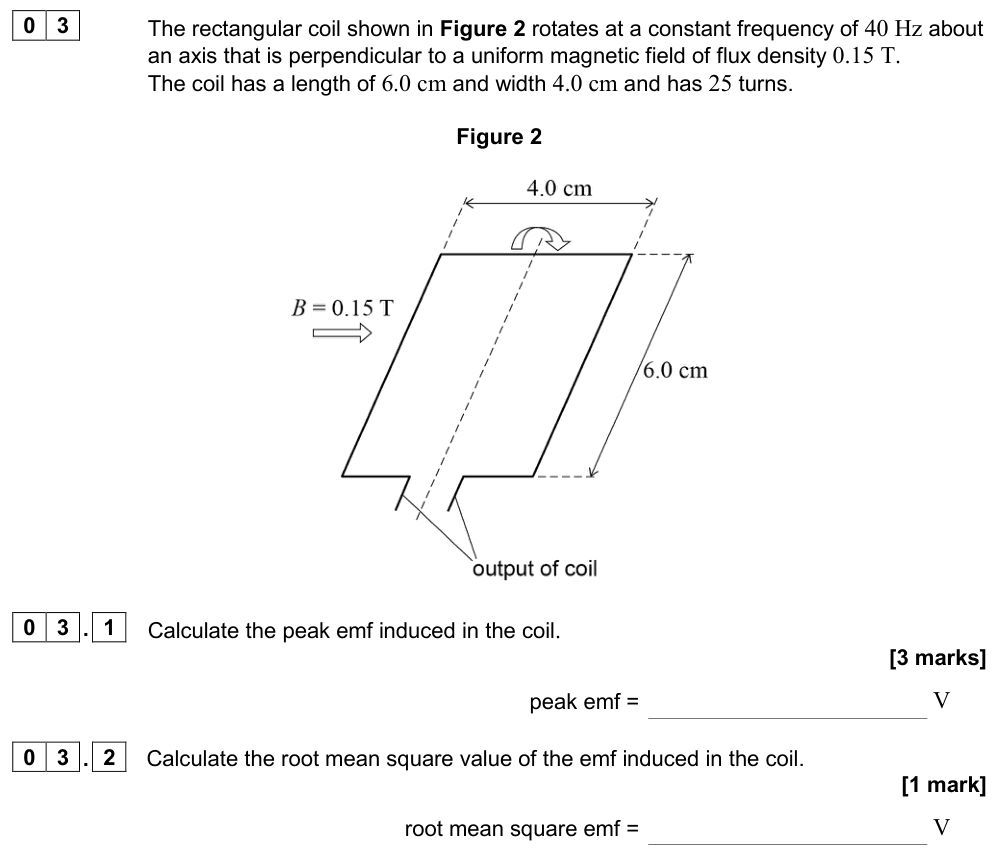
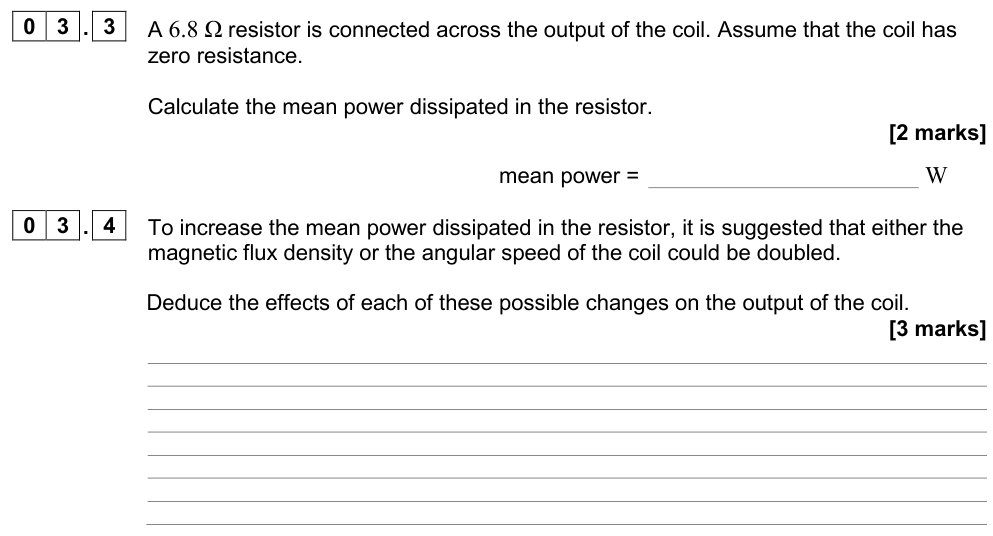
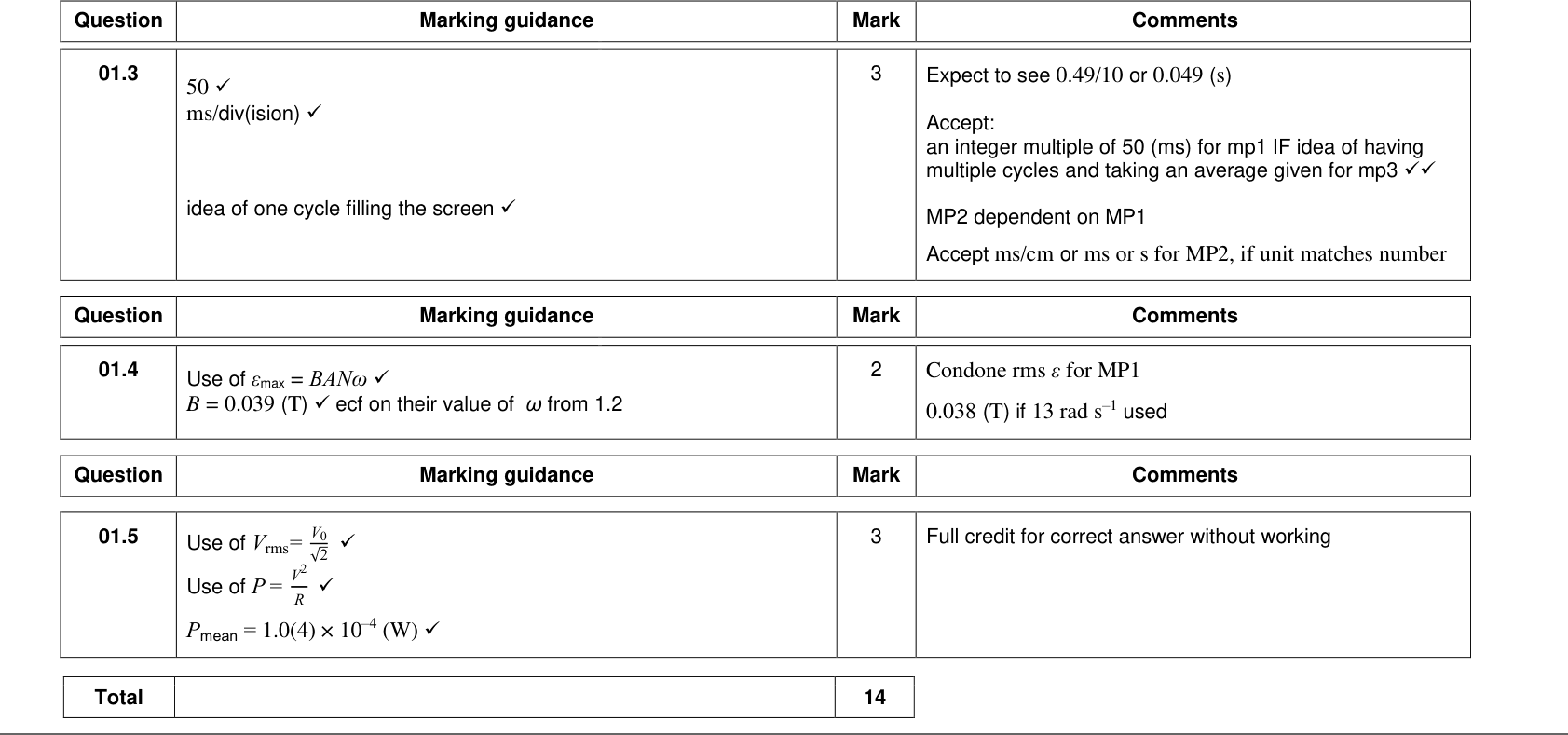
$$I_{\text{rms}} = \frac{I_0}{\sqrt2} \qquad V_{\text{rms}} = \frac{V_0}{\sqrt2}$$
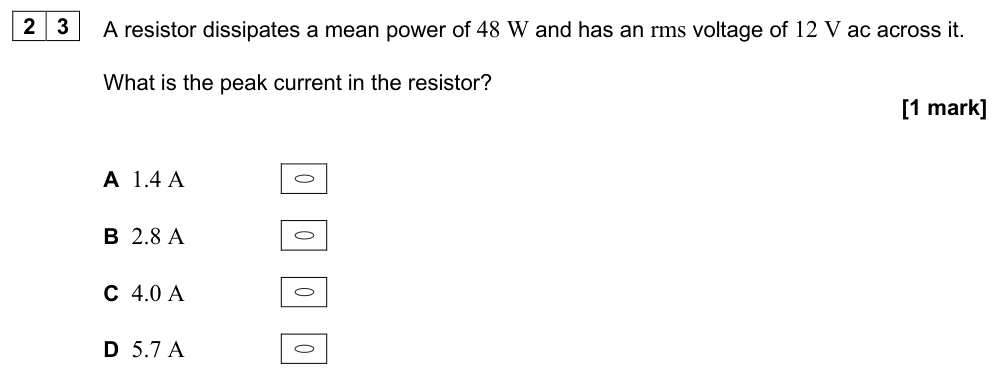
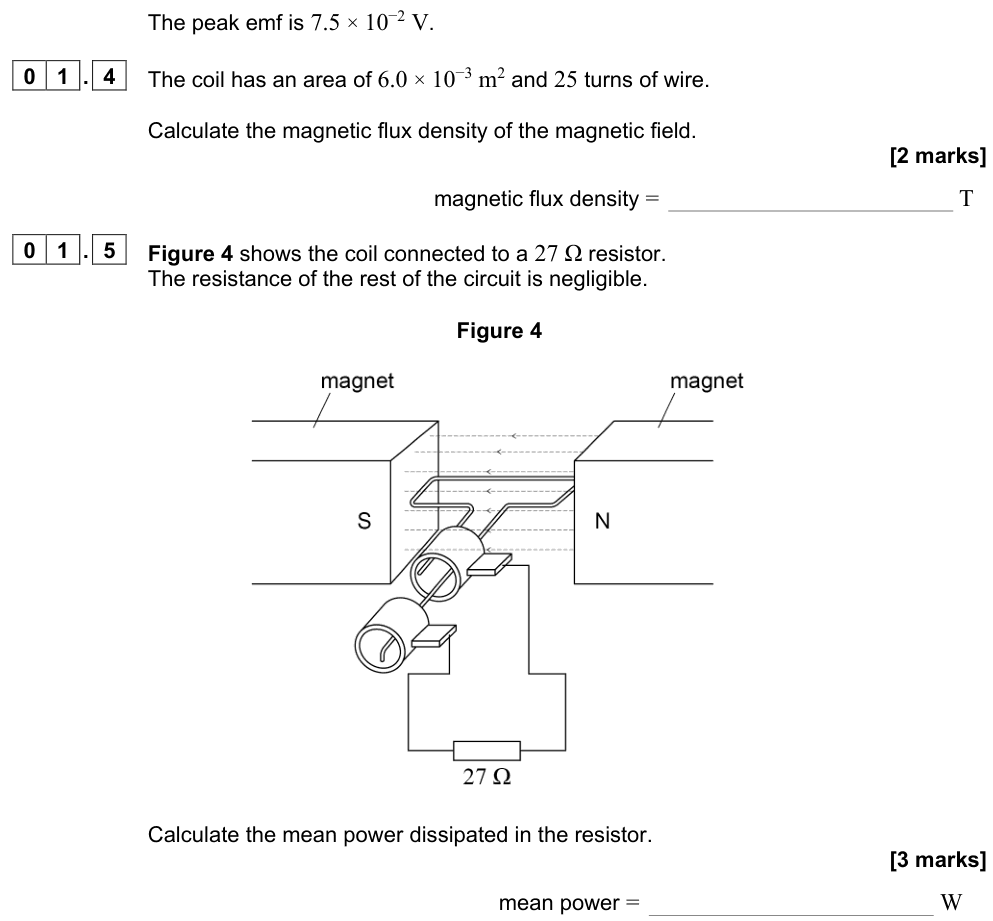
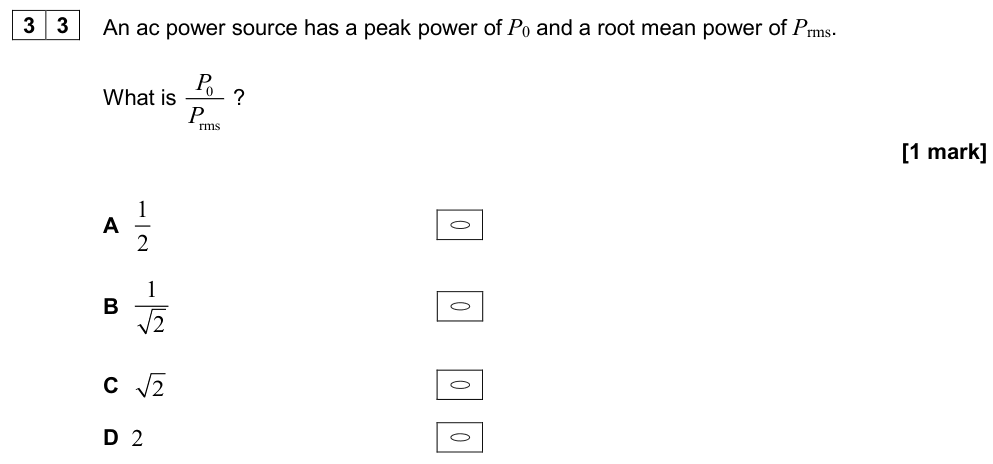
Average power in a resistor: $P = I_{\text{rms}}V_{\text{rms}} = I_{\text{rms}}^2R = \dfrac{V_{\text{rms}}^2}{R}$, and the peak power is $I_0V_0 = 2P_{\text{mean}}$.
The "name" of an a.c. supply is its r.m.s. value: a 230 V mains supply has $V_{\text{rms}} = 230$ V. Meters usually read r.m.s. values.
Worked example: mains supply
For 230 V r.m.s. mains: peak $V_0 = 230\sqrt2 = 325\ \text{V}$; peak-to-peak $= 650\ \text{V}$.
A 1.15 kW kettle on this supply: $I_{\text{rms}} = 1150/230 = 5.0\ \text{A}$, peak current $= 7.1\ \text{A}$, resistance $= 230/5.0 = 46\ \Omega$.
Common mistake
The peak-to-peak value is twice the peak, not $\sqrt2$ times. And r.m.s. values are used for power calculations, not peak values.
The oscilloscope
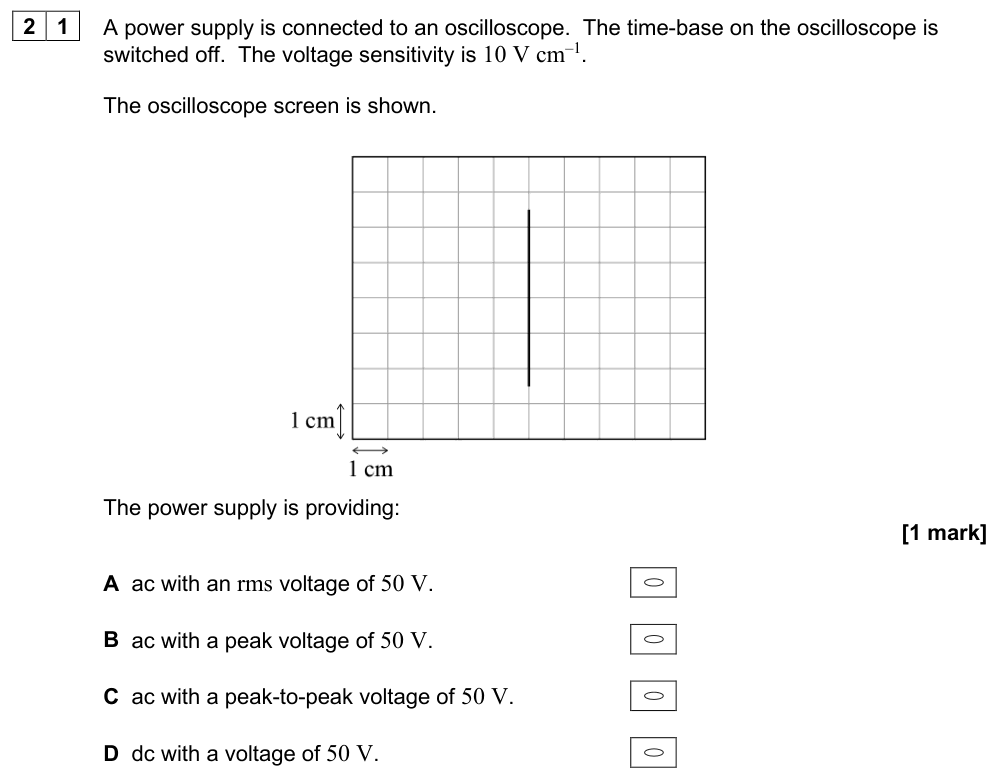
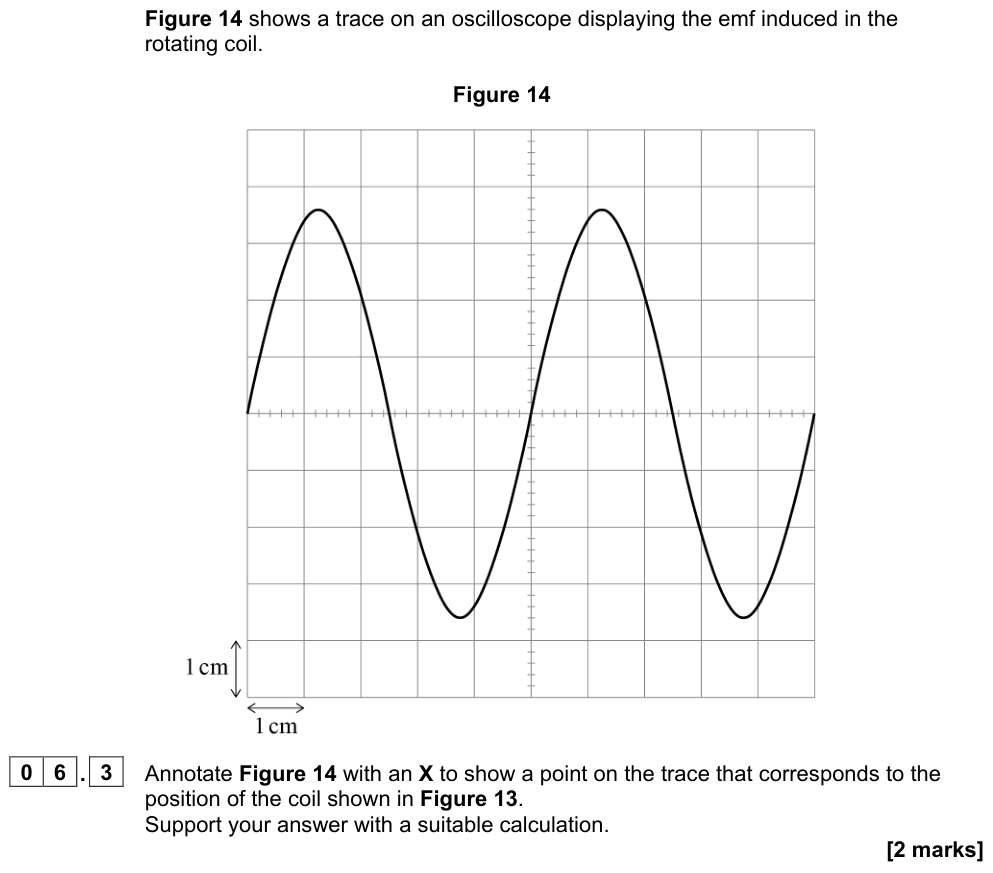
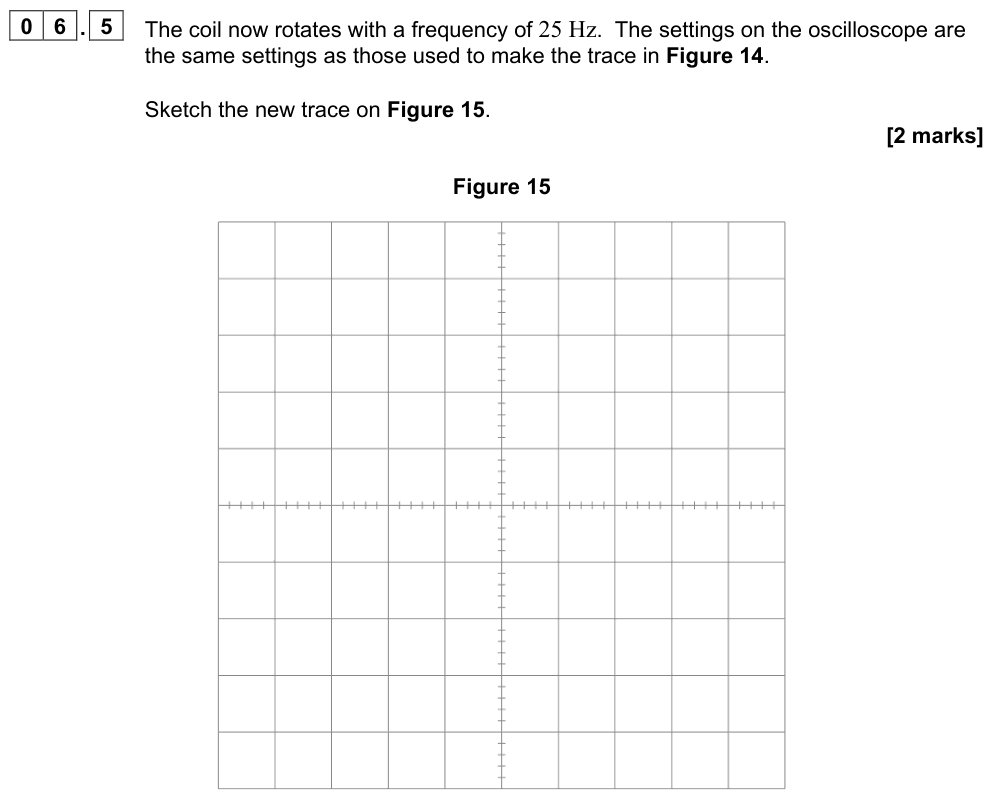
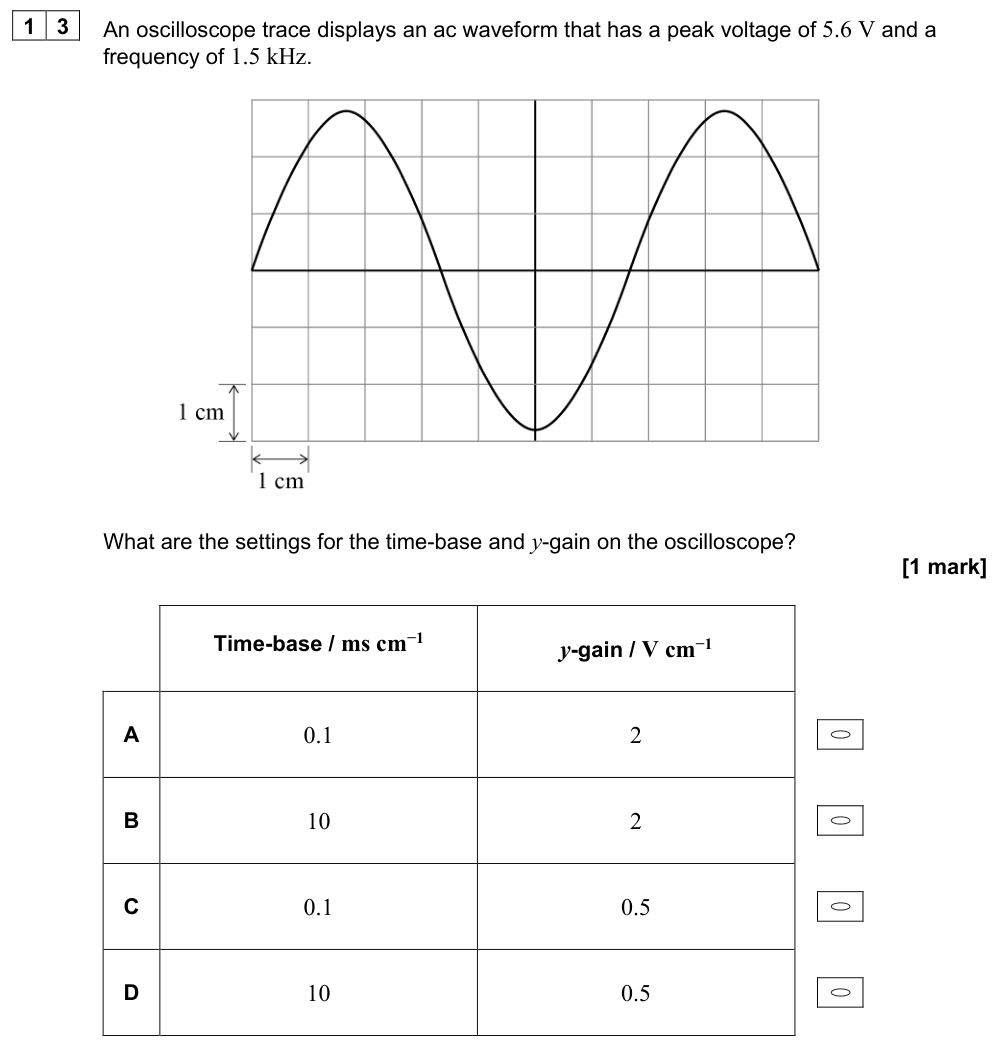
An oscilloscope displays how a p.d. varies with time, on a screen marked with a grid of squares called divisions (usually 1 cm).
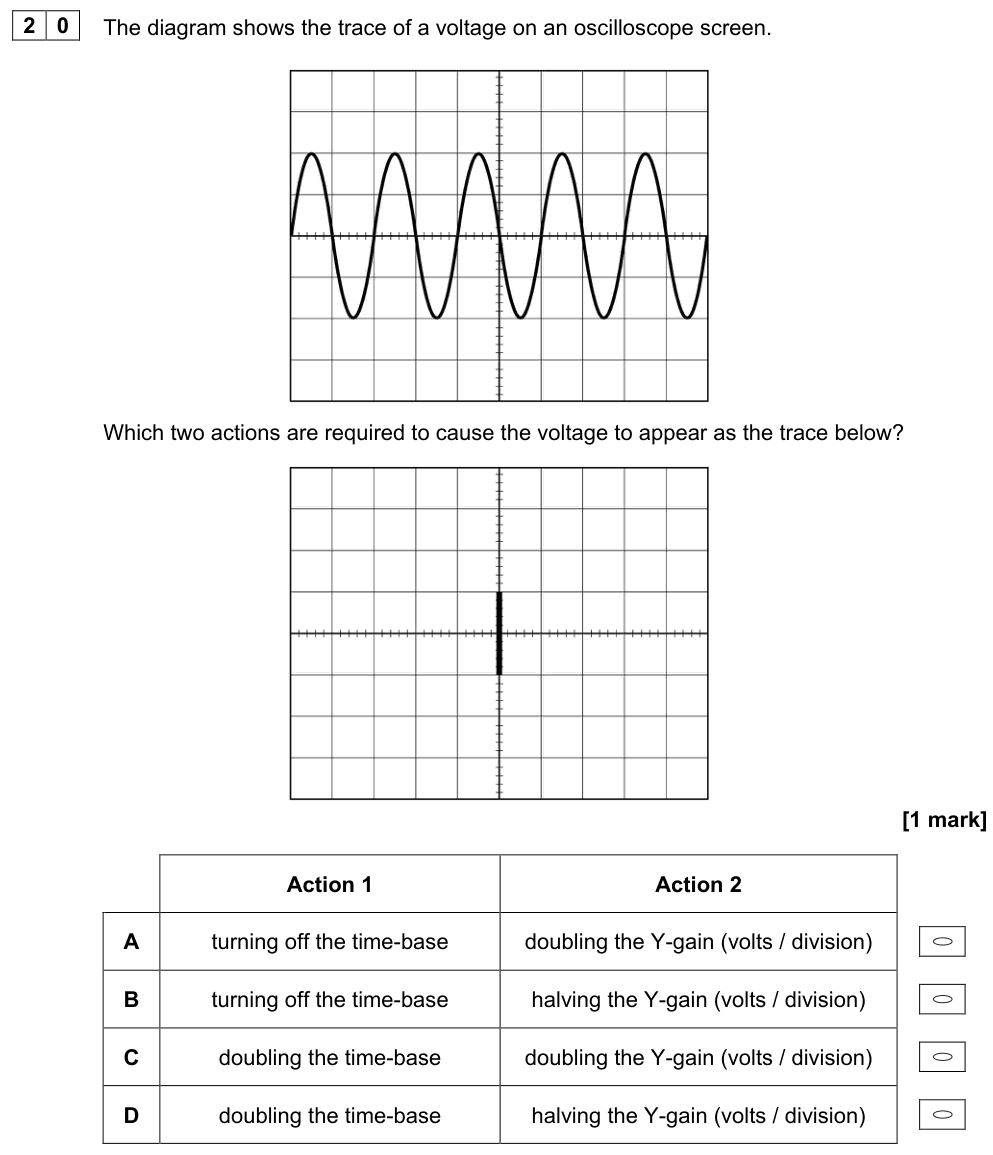
- The y-gain (volts per division, V div⁻¹) sets the vertical scale.
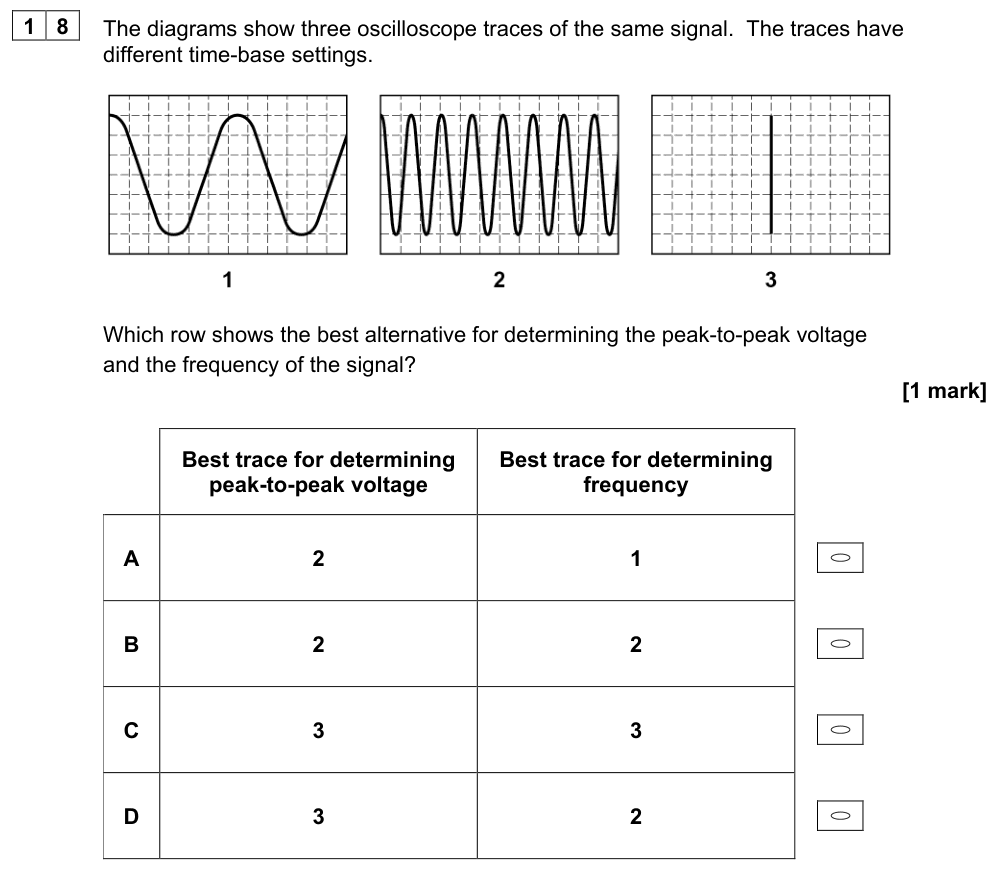
- The time-base (time per division, e.g. ms div⁻¹) sets how fast the dot sweeps across horizontally.
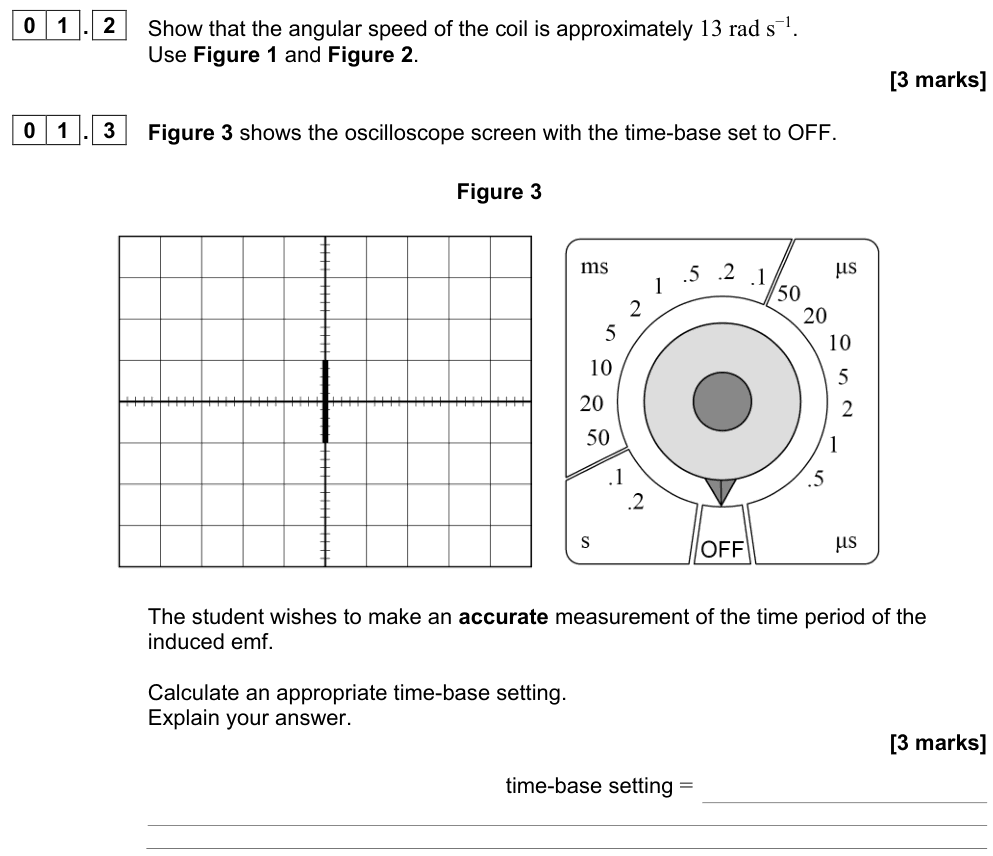
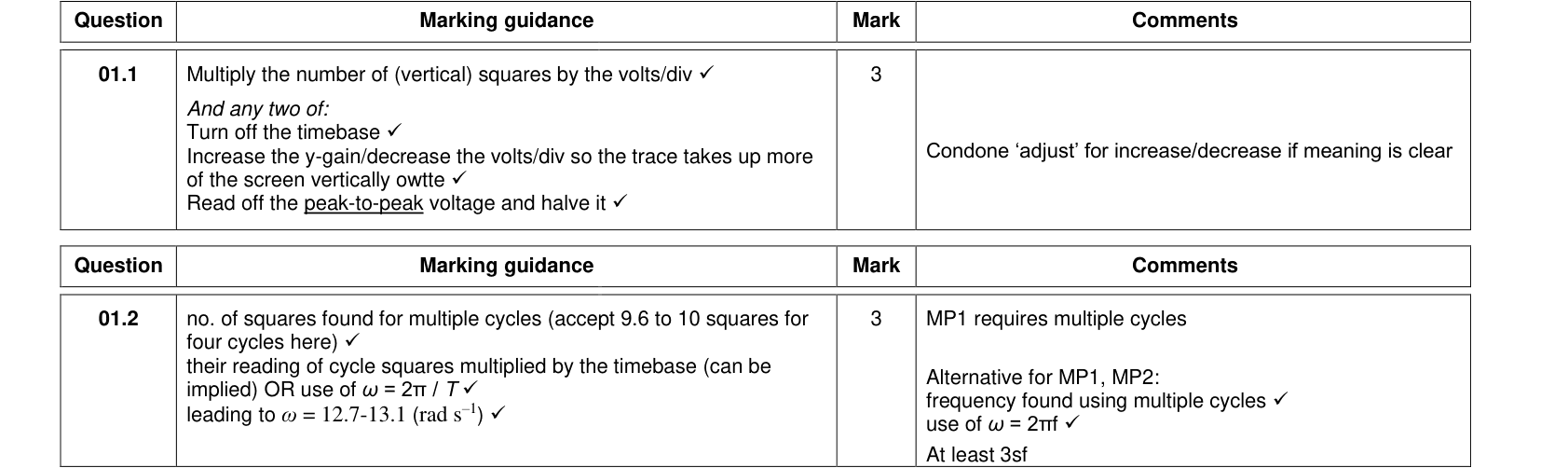
- If the time-base is switched off, the dot does not sweep: an a.c. input gives a vertical line whose length is the peak-to-peak value.
Measuring with an oscilloscope
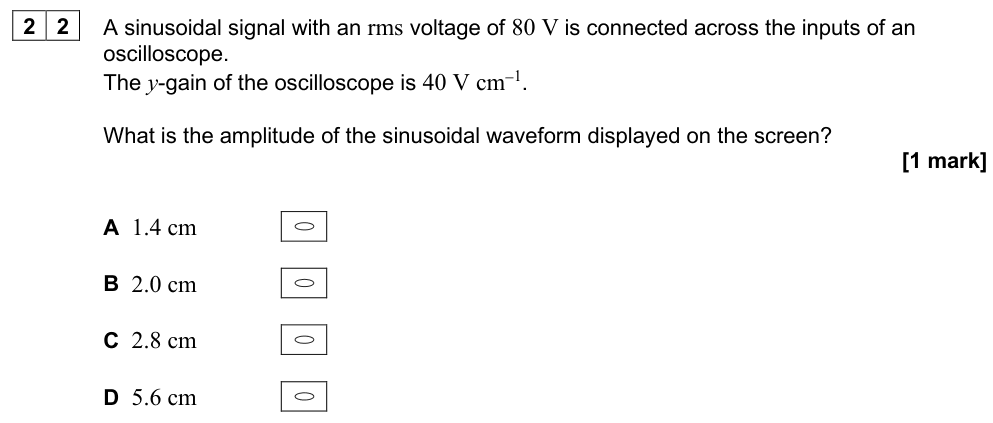
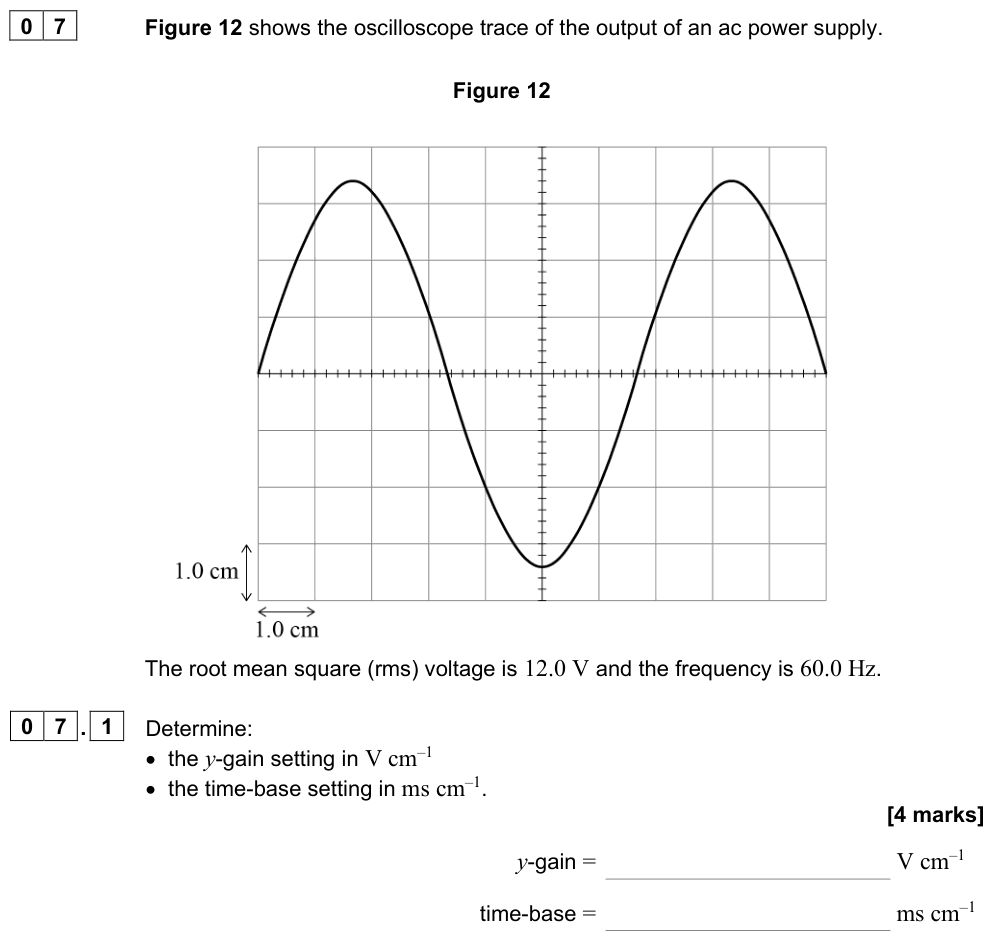
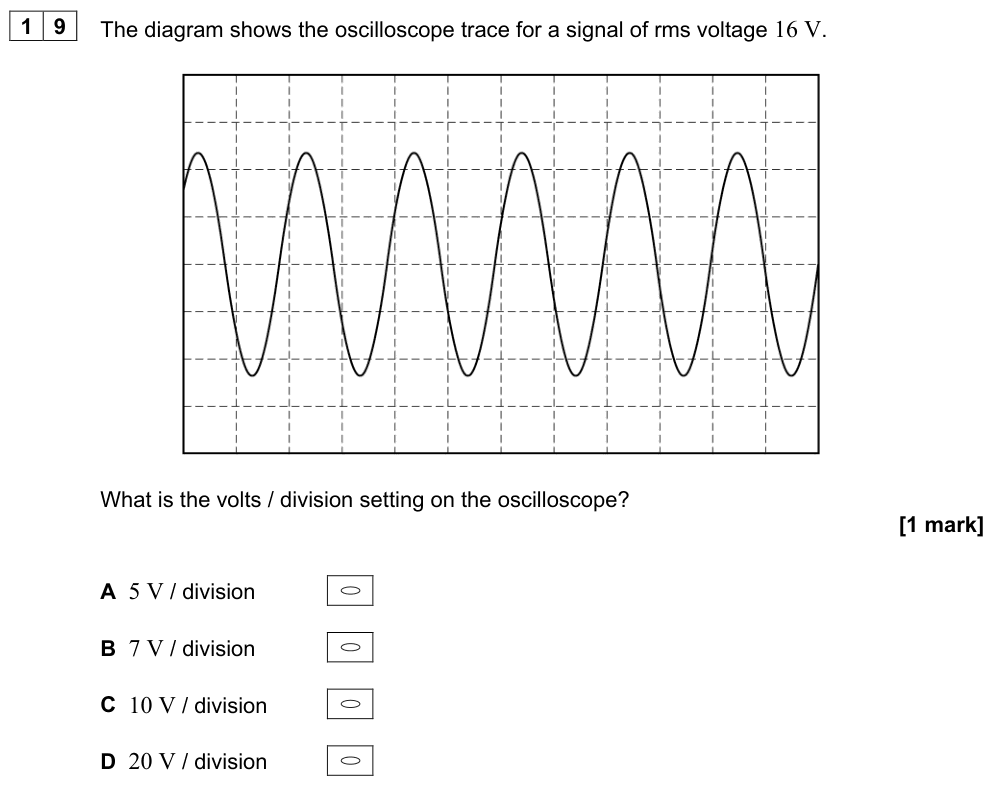
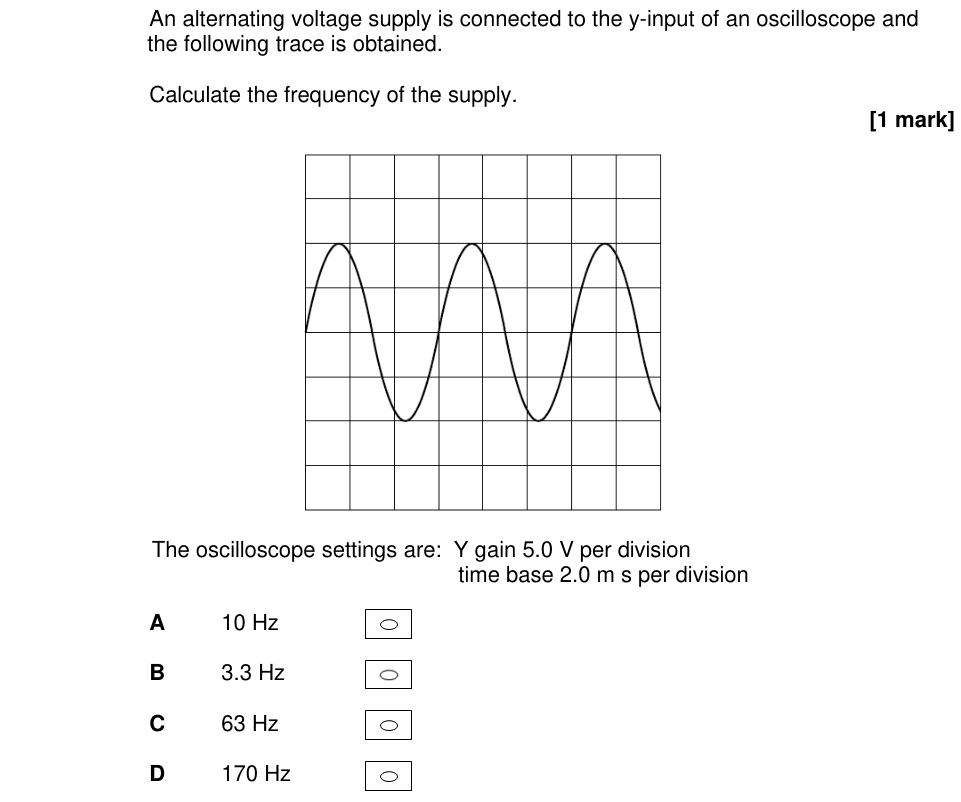
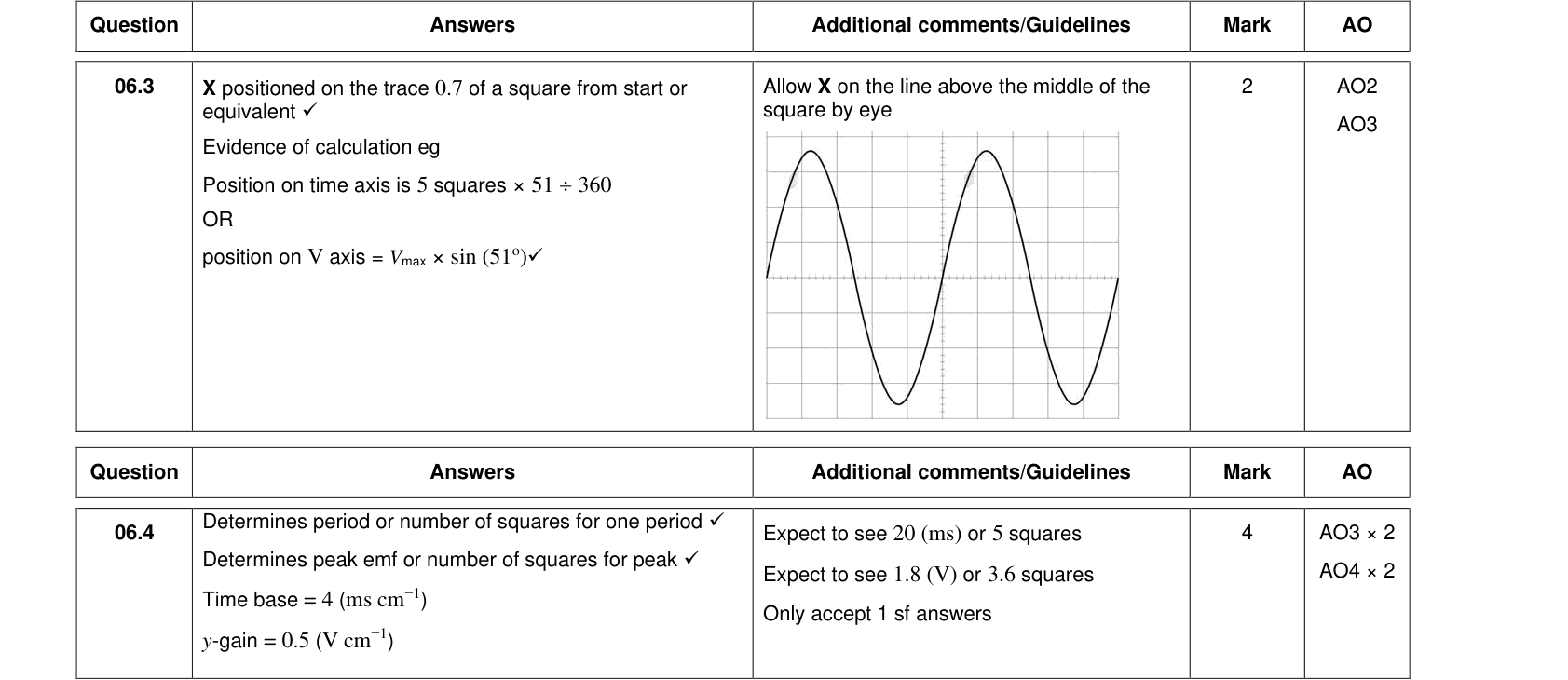
$$\text{p.d.} = \text{number of vertical divisions} \times \text{y-gain}$$ $$\text{time} = \text{number of horizontal divisions} \times \text{time-base setting}$$
As a d.c. voltmeter: a constant p.d. moves the horizontal trace up (or down) by a number of divisions.
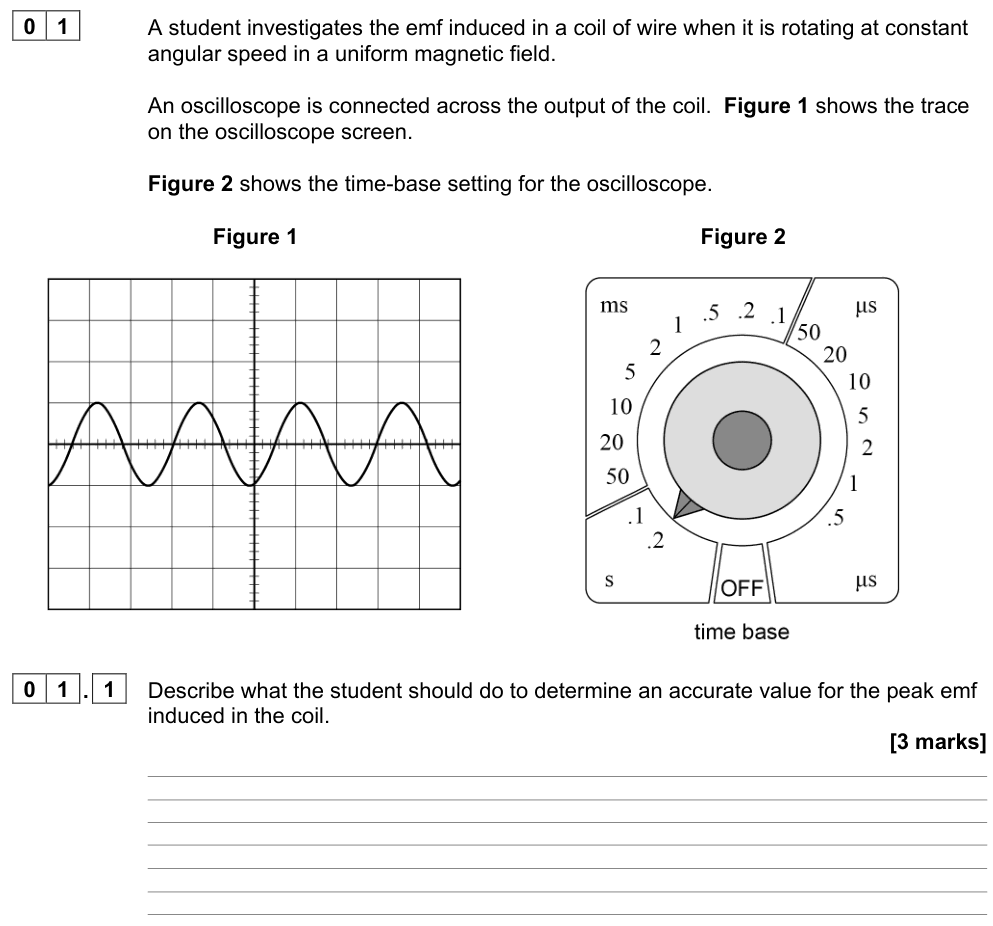
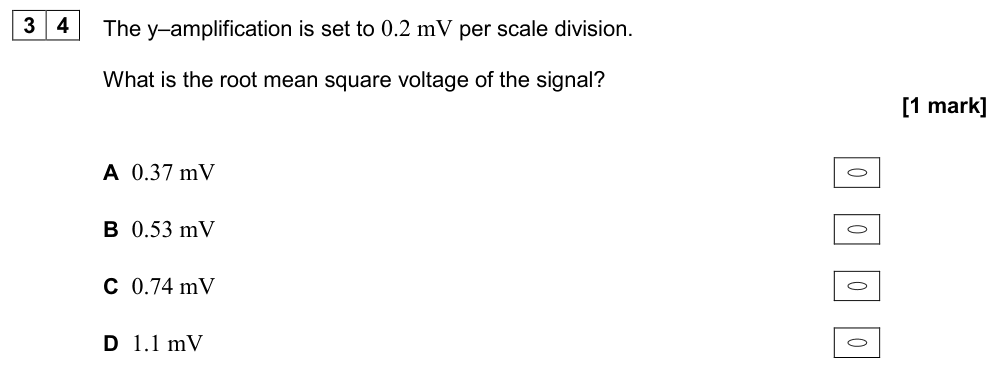
As an a.c. voltmeter: measure the peak (from the centre line to a crest) or, more accurately, the peak-to-peak height and halve it. Then $V_{\text{rms}} = V_0/\sqrt2$.
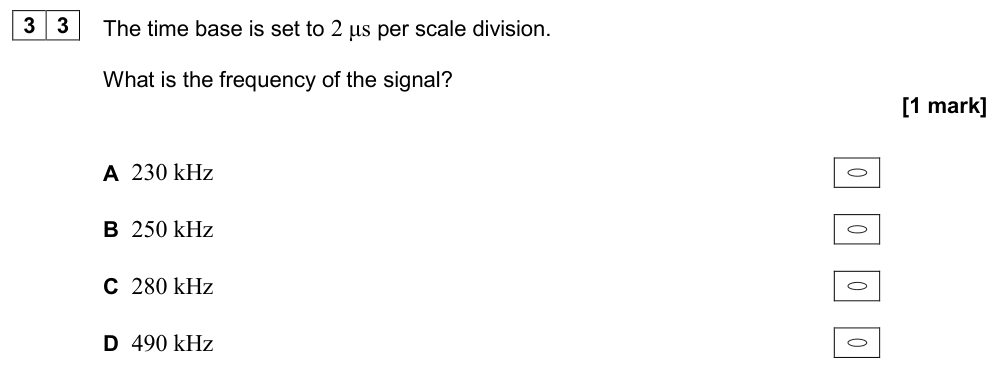
Measuring time and frequency: measure the horizontal length of one complete cycle (better: several cycles), multiply by the time-base to get $T$, then $f = 1/T$.
Worked example: reading a trace
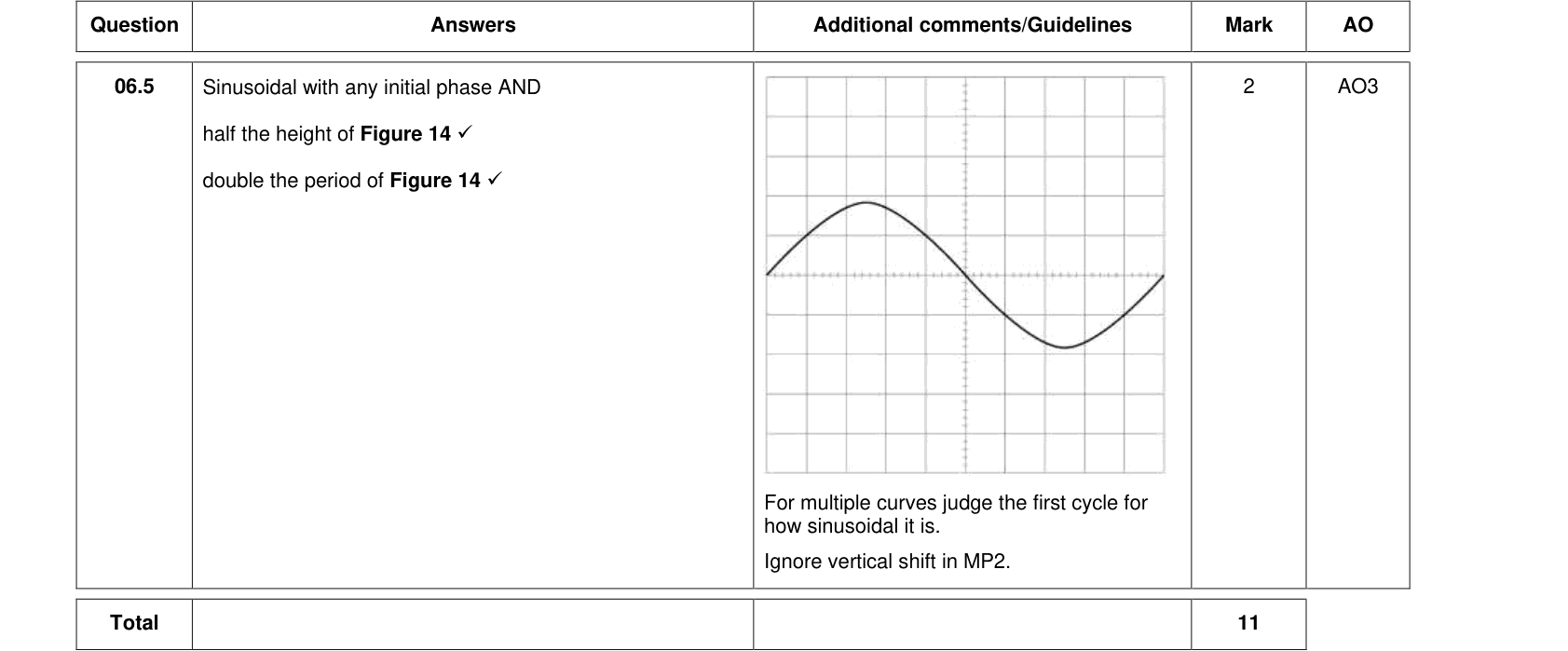
A sine wave on an oscilloscope has a peak-to-peak height of 6.0 divisions and one cycle spans 4.0 divisions. The y-gain is 2.0 V div⁻¹ and the time-base is 5 ms div⁻¹.
Peak-to-peak $= 6.0 \times 2.0 = 12\ \text{V}$, so $V_0 = 6.0\ \text{V}$ and $V_{\text{rms}} = 4.2\ \text{V}$.
$T = 4.0 \times 5 = 20\ \text{ms}$, so $f = 50\ \text{Hz}$.
Exam tip: choosing settings
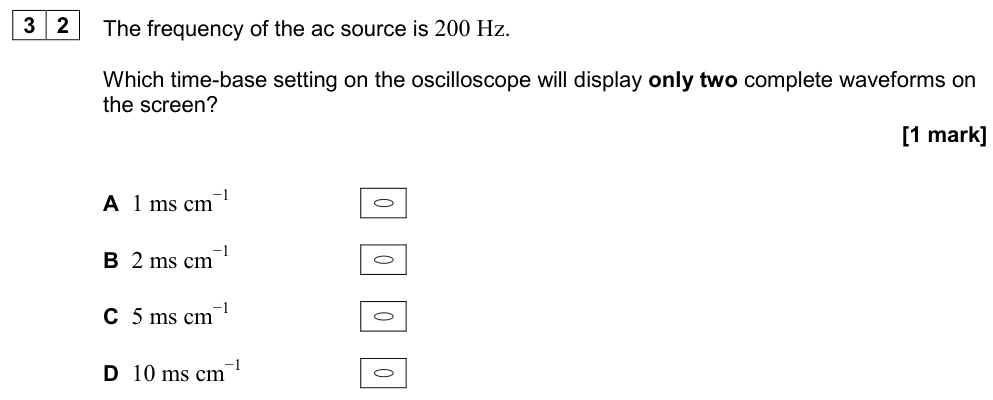
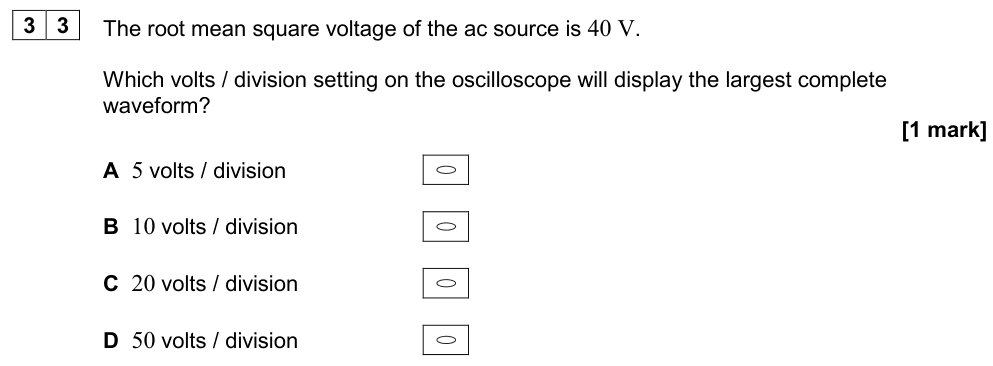
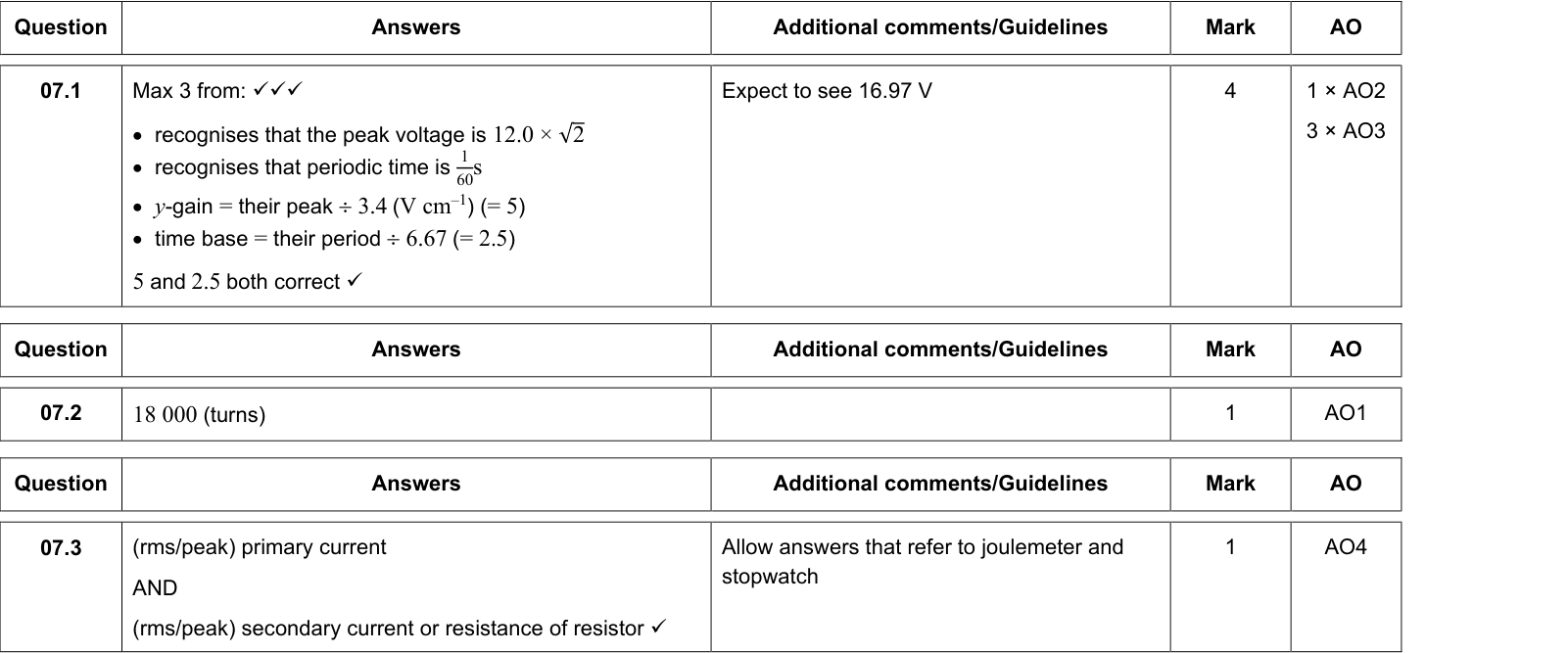
Choose the y-gain so the trace fills most of the screen height without going off it, and the time-base so that one or two complete cycles are visible. For example, to show two cycles of a 200 Hz signal on a 10-division screen, the total time is 10 ms, so use 1 ms div⁻¹.
You do not need to know how an oscilloscope works inside, but you should be familiar with its controls: y-gain, time-base, and the X and Y position (shift) controls.
Summary
- Sinusoidal a.c.: peak $V_0$, peak-to-peak $2V_0$, r.m.s. $V_0/\sqrt2$ (same for current).
- r.m.s. = the d.c. value giving the same average power in a resistor; $P_{\text{mean}} = I_{\text{rms}}V_{\text{rms}}$.
- Oscilloscope: p.d. = divisions × y-gain; time = divisions × time-base; $f = 1/T$.