Force on a moving charge
A current is a flow of charges, so the force $F = BIL$ on a wire is really the sum of forces on the individual moving charges.
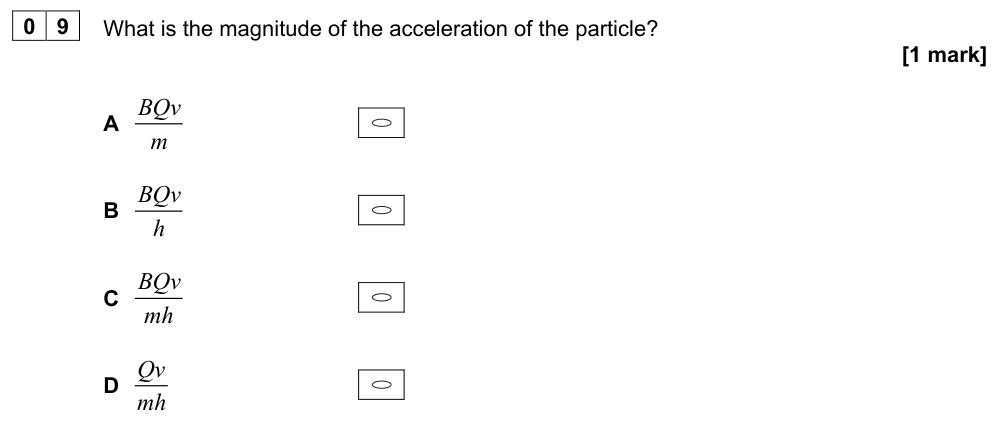
Force on a charged particle in a magnetic field
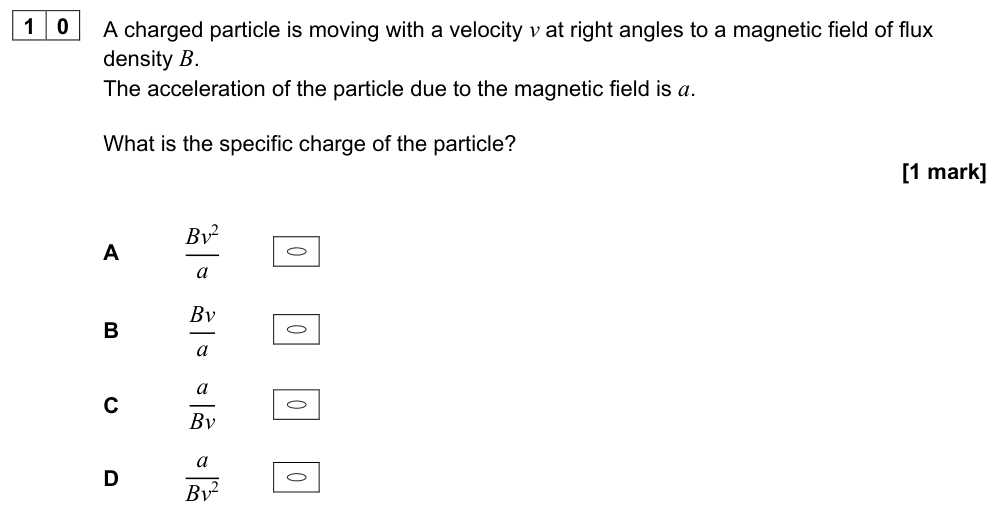
$$F = BQv$$
when the velocity $v$ is perpendicular to the field $B$. $Q$ is the charge of the particle.
Derivation: a charge $Q$ moving at speed $v$ travels a length $L$ in time $t = L/v$, so it is equivalent to a current $I = Q/t = Qv/L$. Then $F = BIL = BQv$.
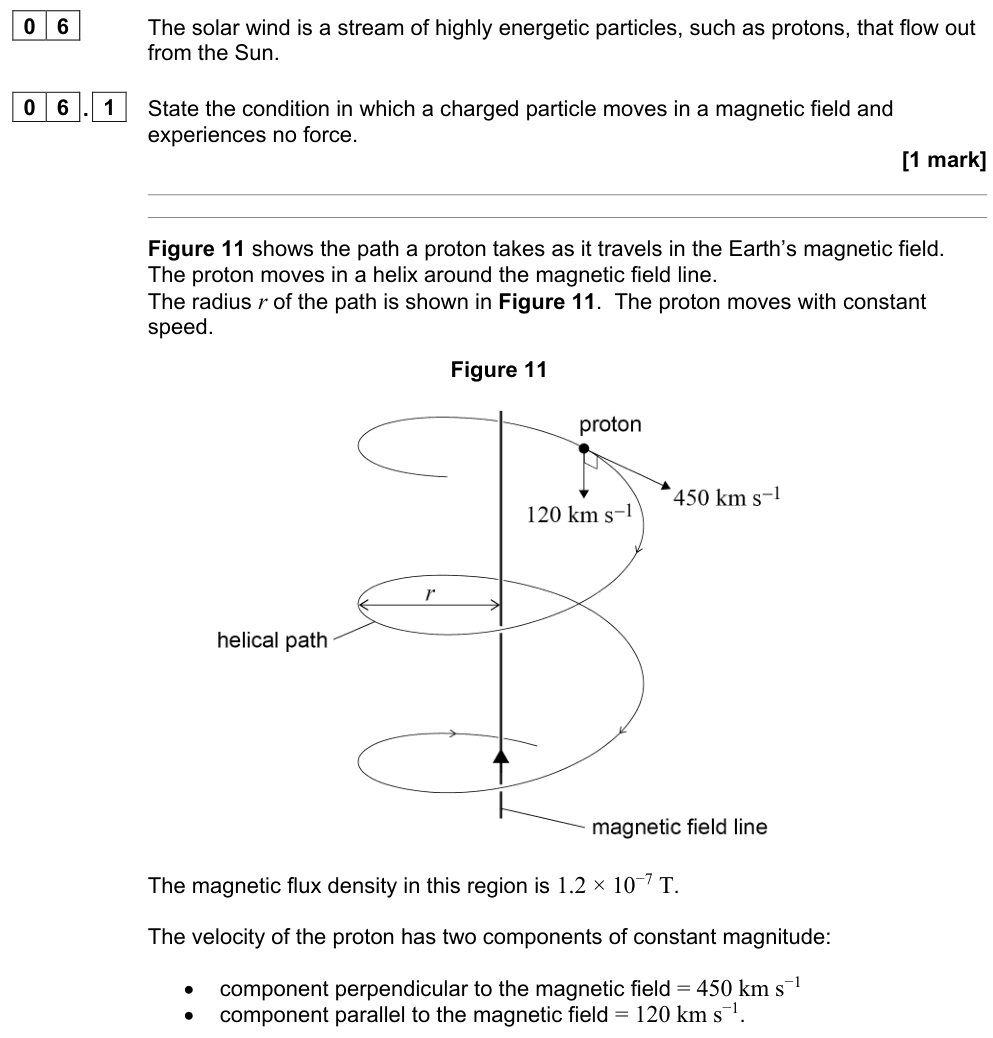
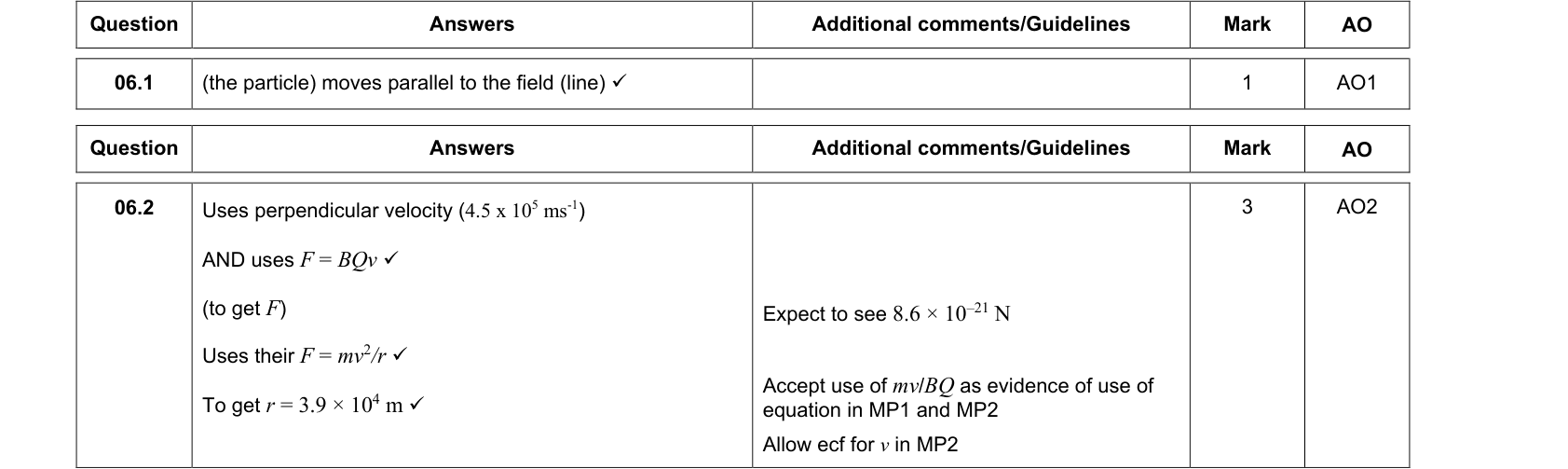
- A charge moving parallel to the field feels no force.
- A stationary charge feels no magnetic force.
Direction of the force
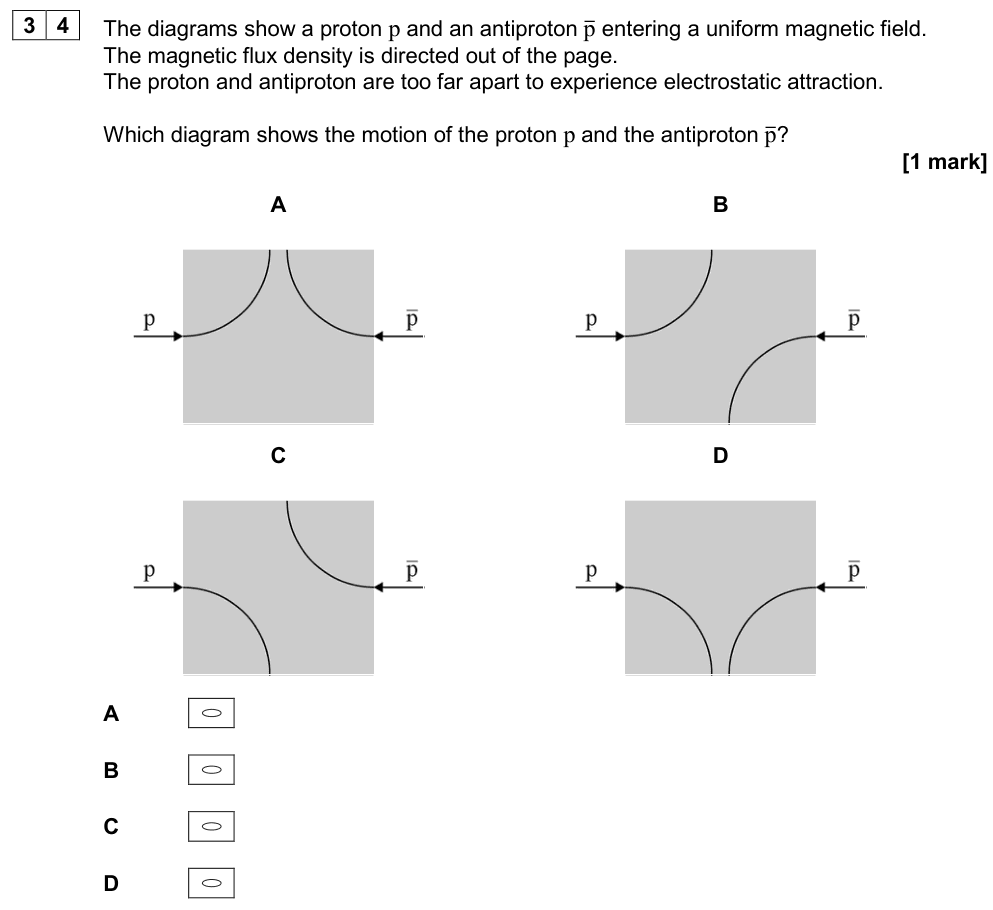
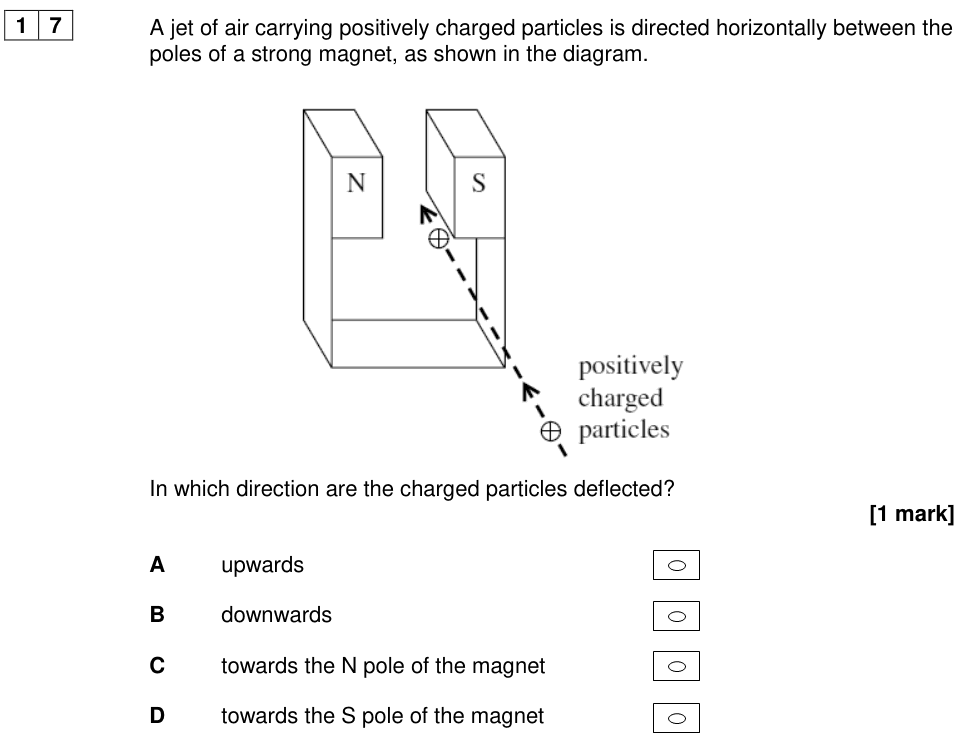
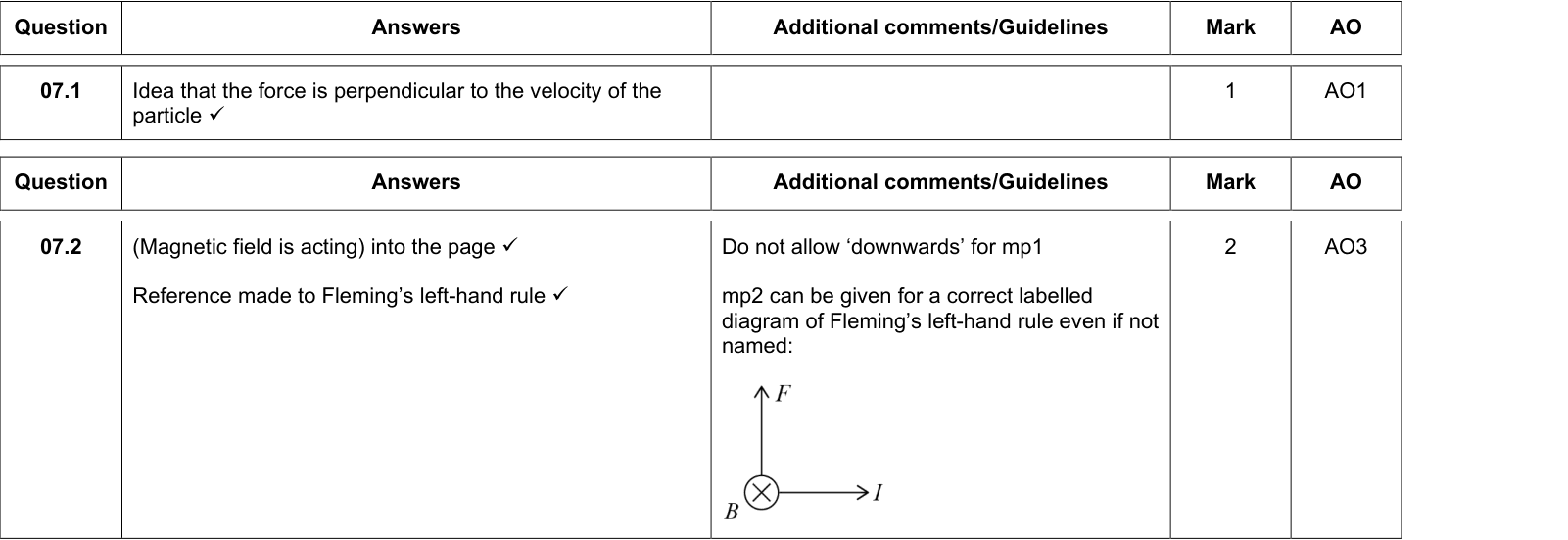
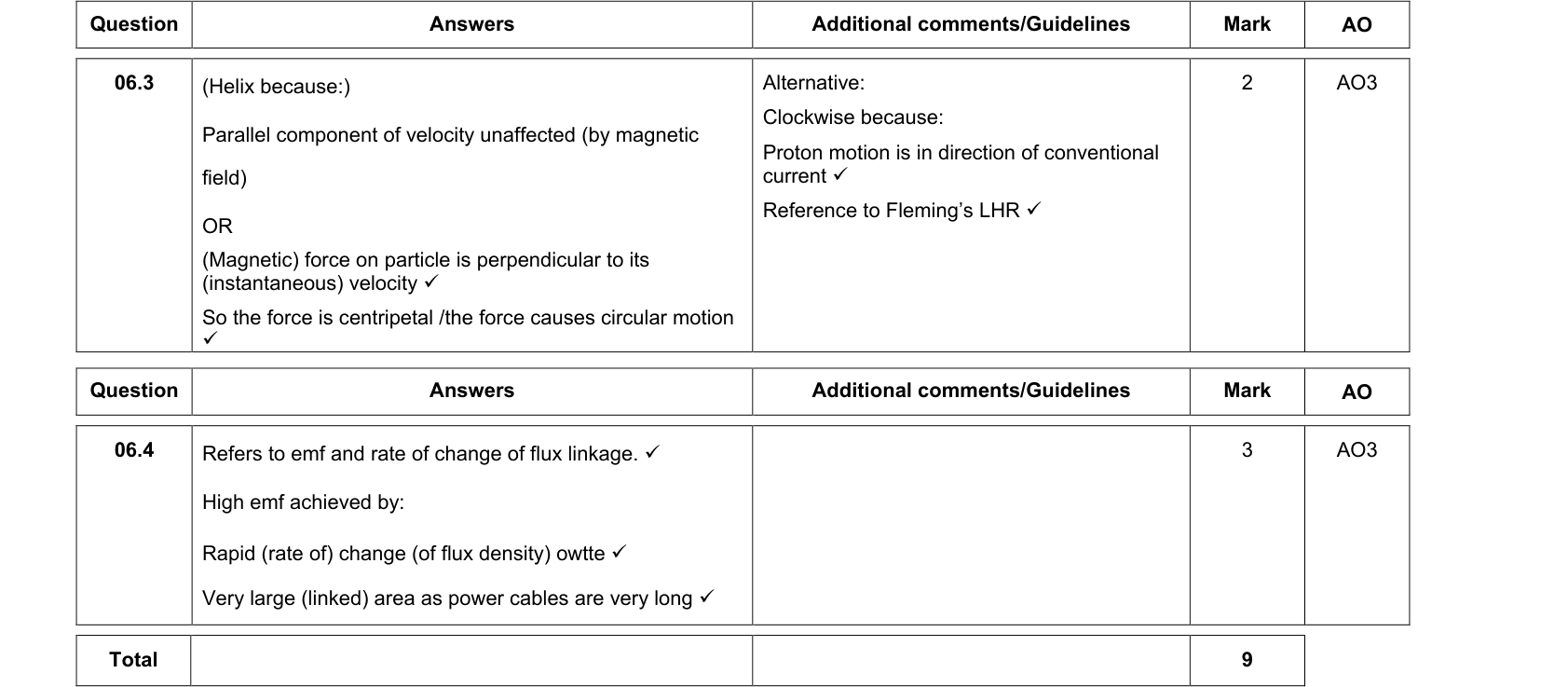
Use Fleming's left-hand rule, with the second finger pointing in the direction of conventional current:
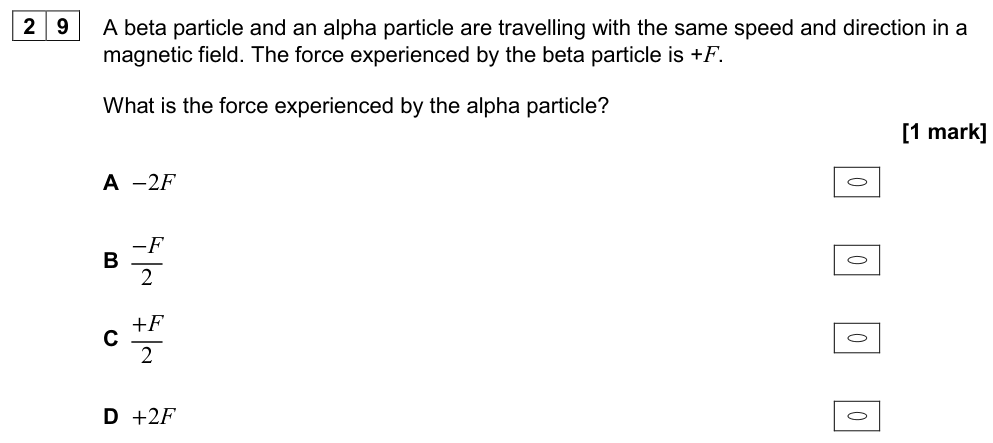
- For a positive particle, the current is in the direction of its velocity.
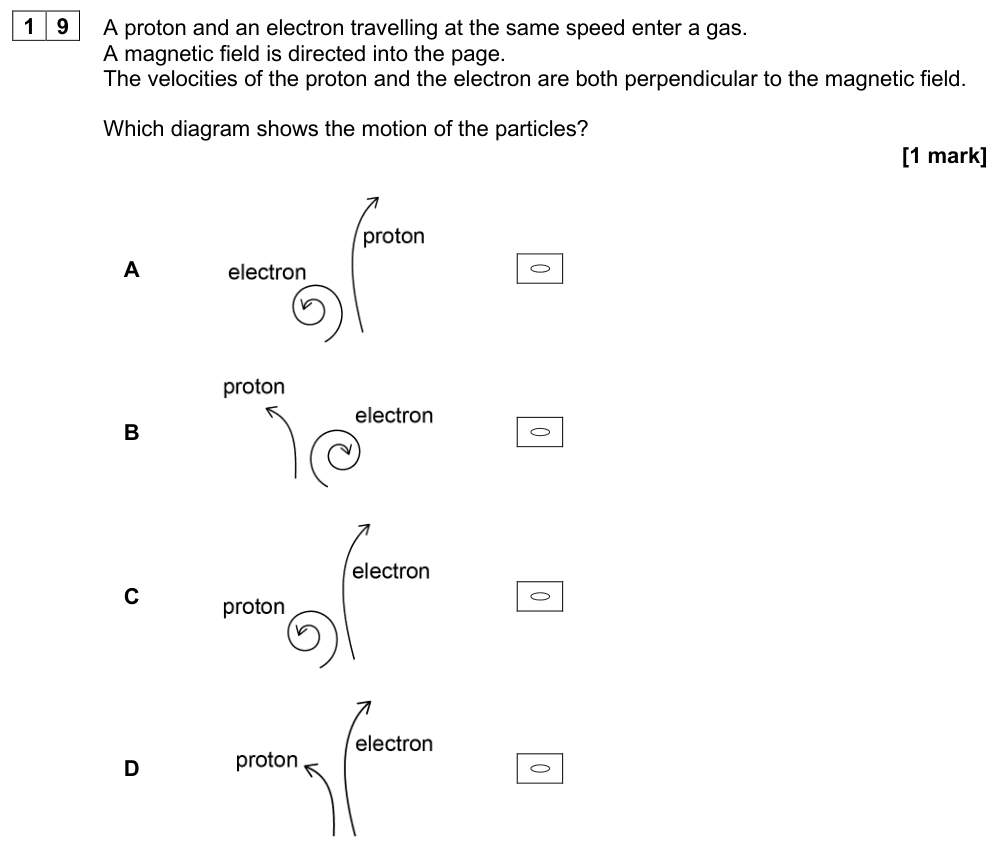
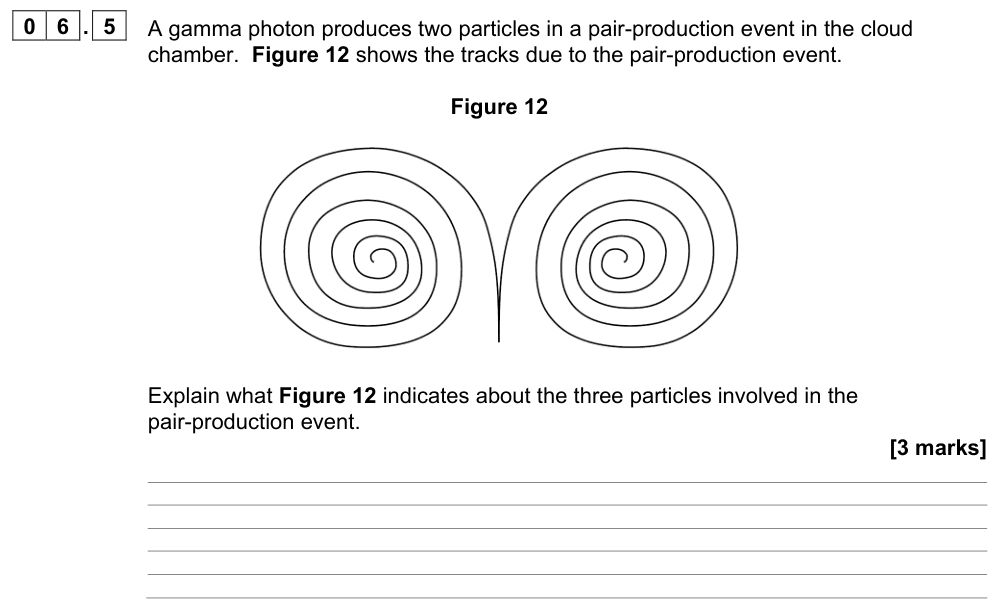
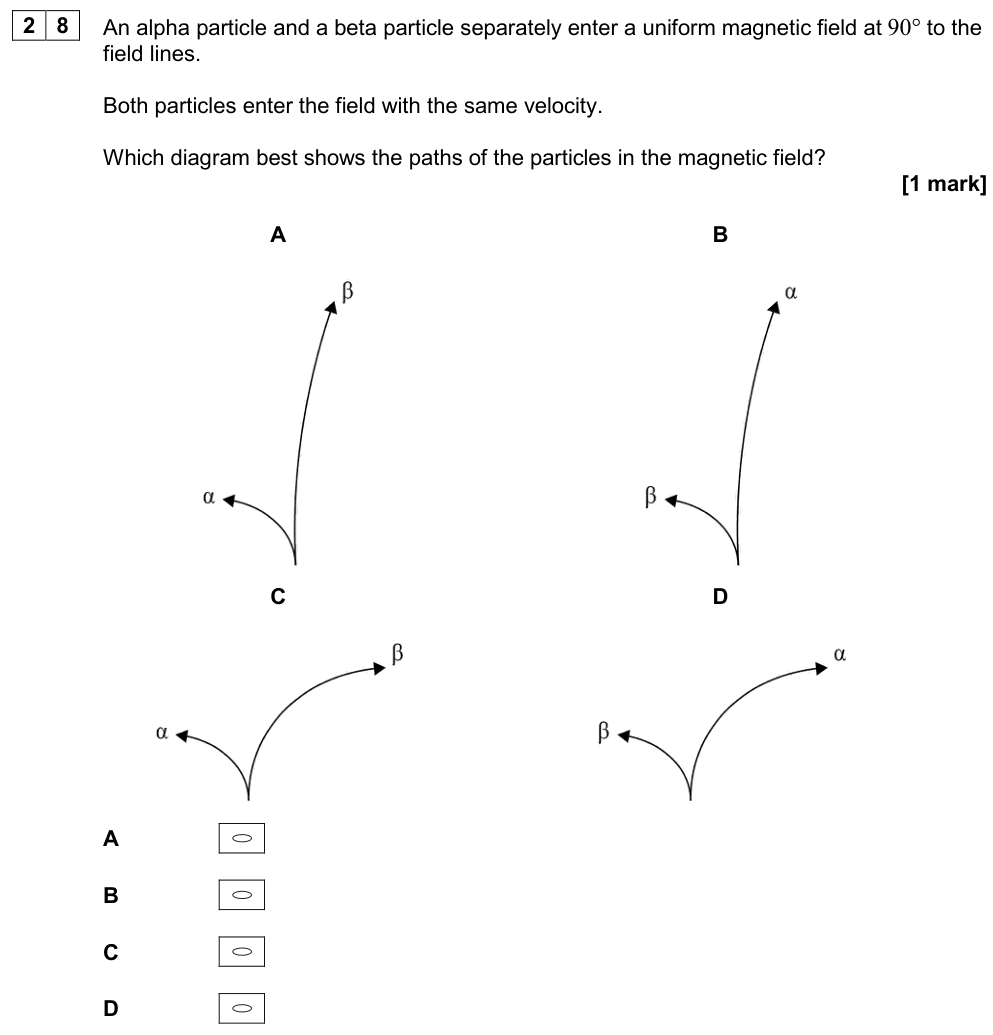
- For a negative particle (e.g. an electron), the current is opposite to its velocity, so the force is in the opposite direction to that on a positive particle moving the same way.
Circular motion in a magnetic field
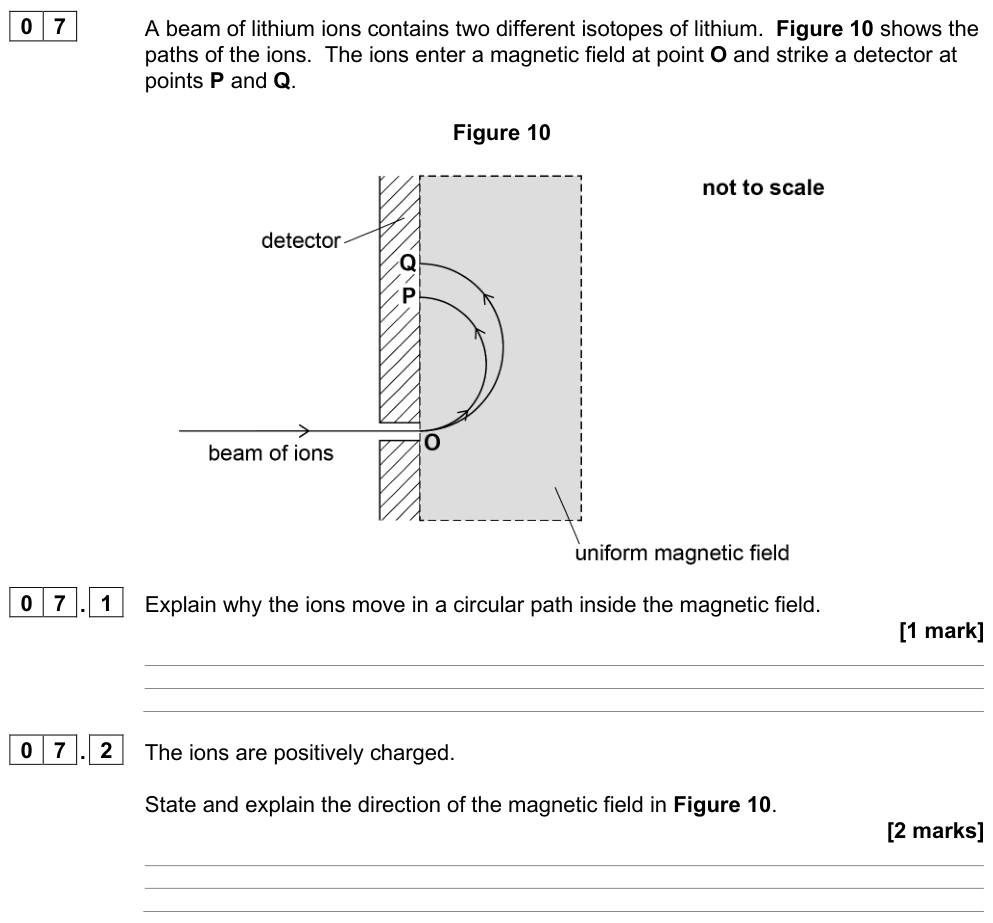
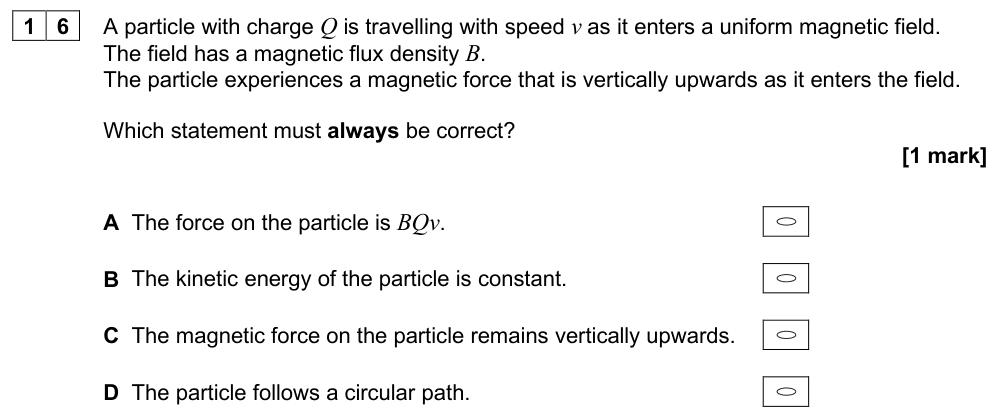
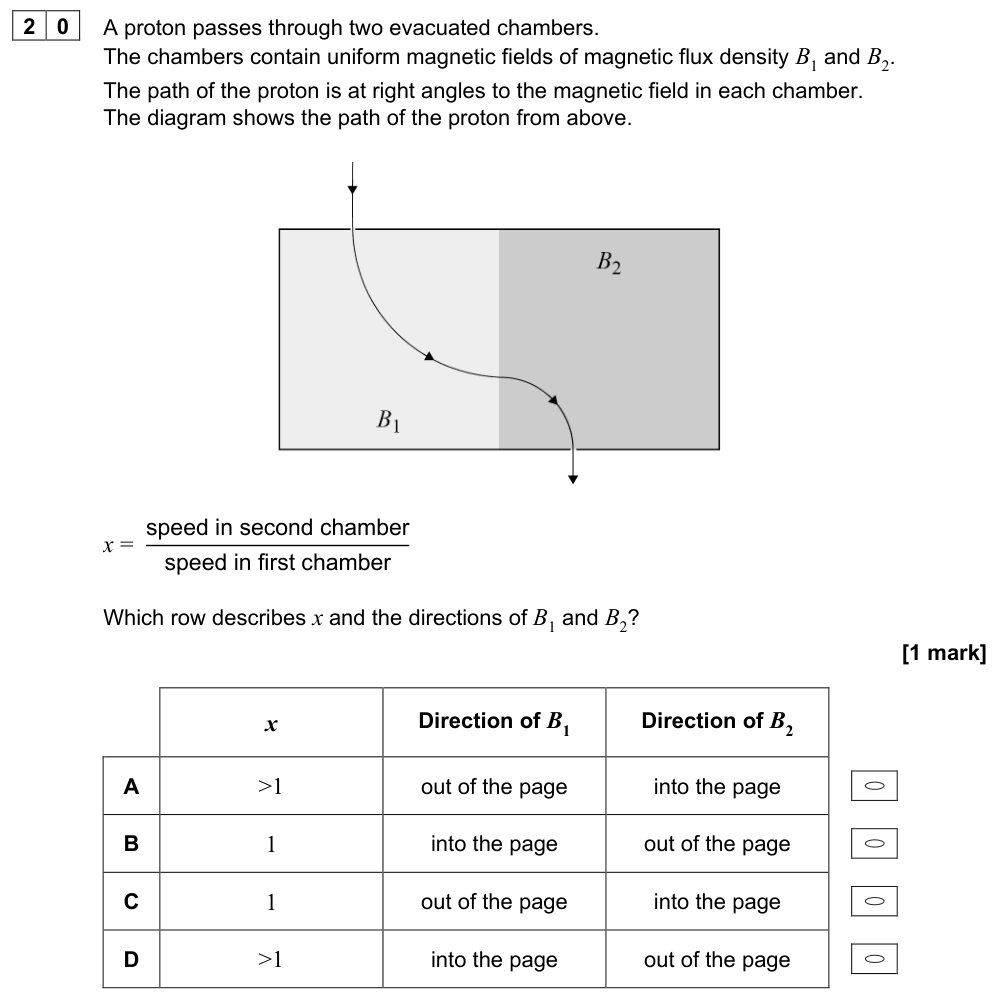
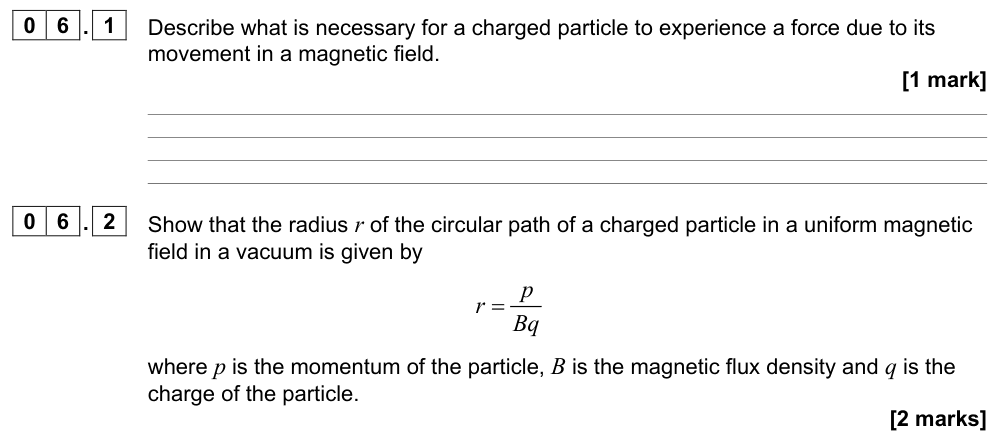
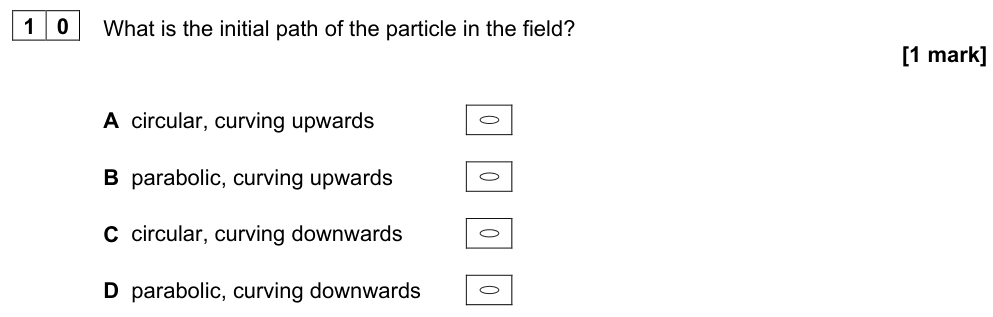
The magnetic force is always perpendicular to the velocity, so:
- it does no work on the particle: the speed and kinetic energy stay constant;
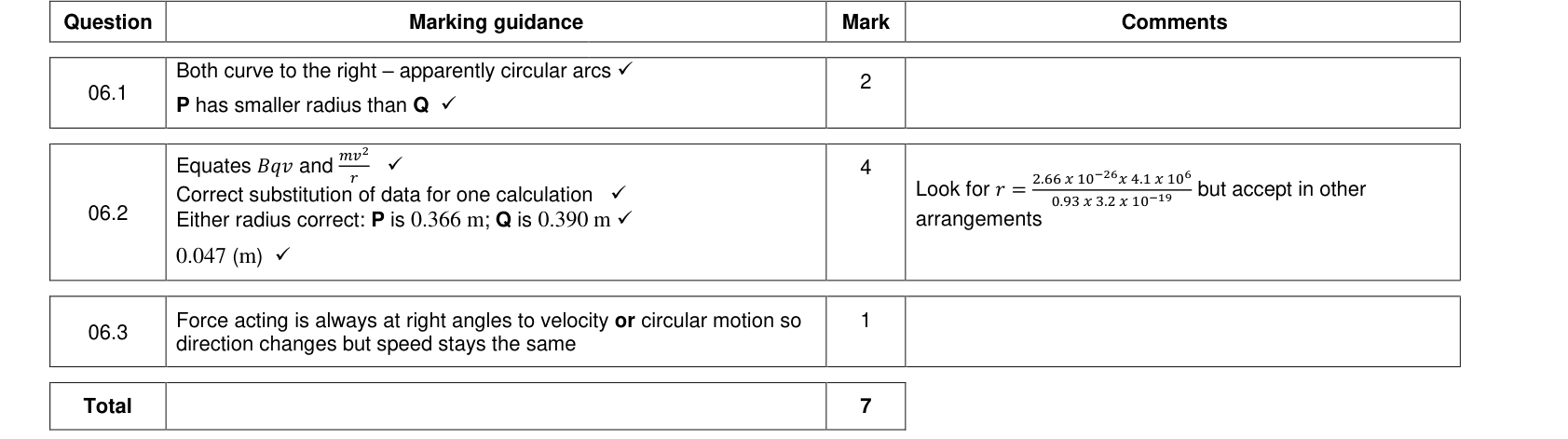
- it changes only the direction of motion, acting as a centripetal force.
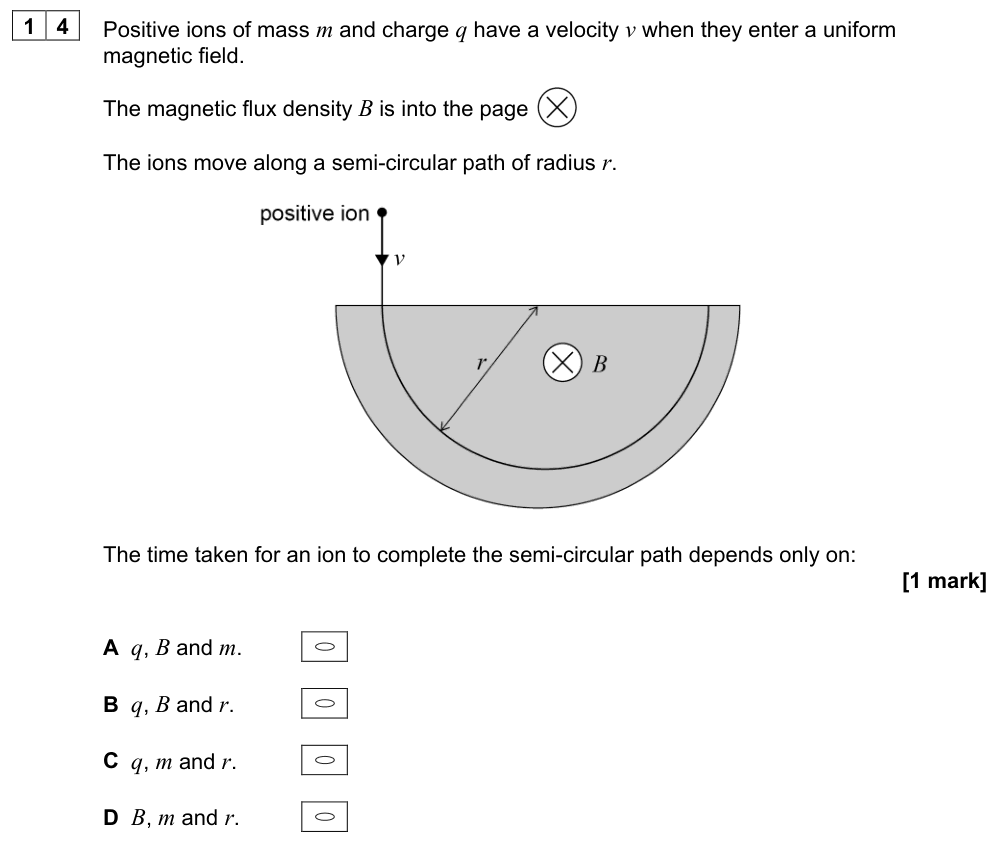
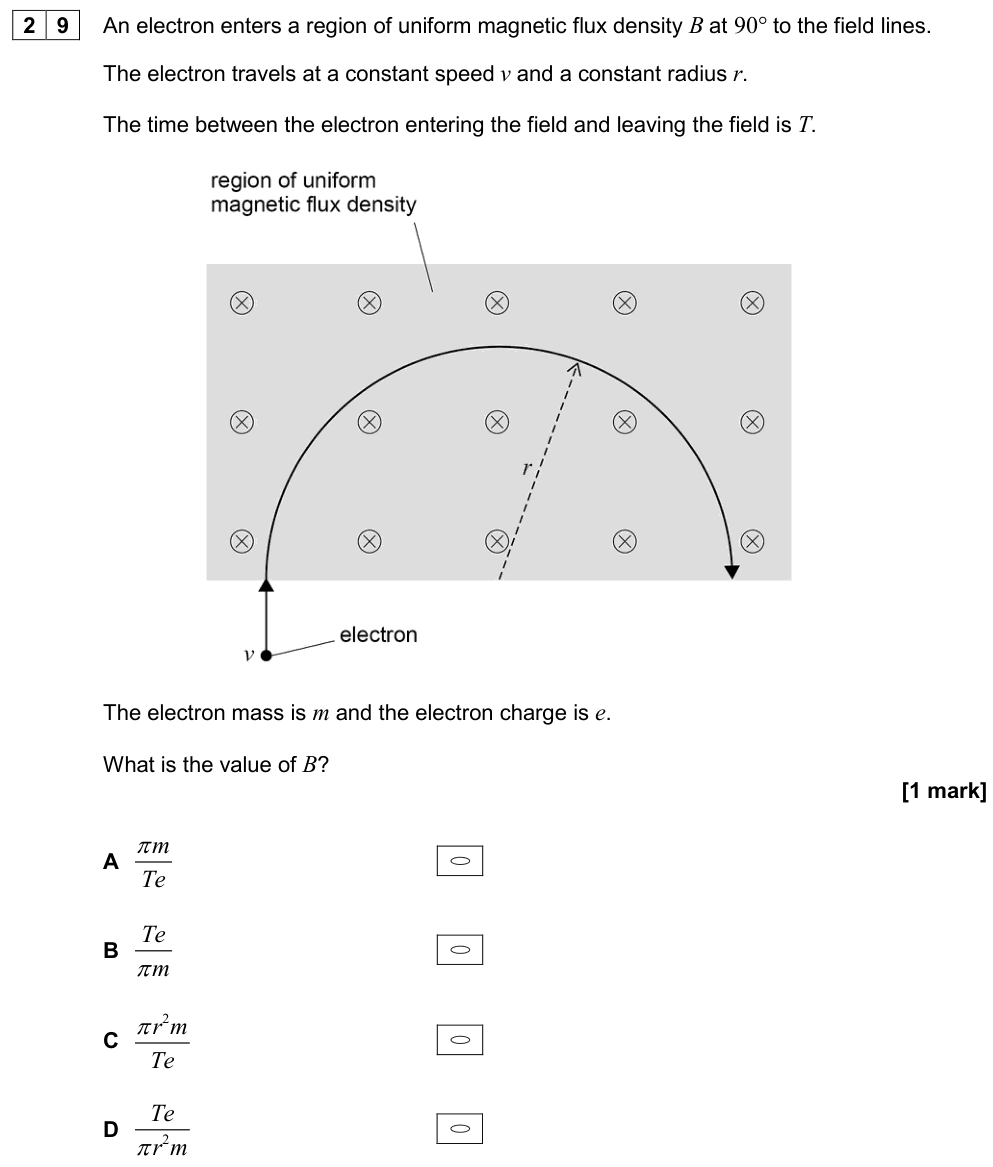
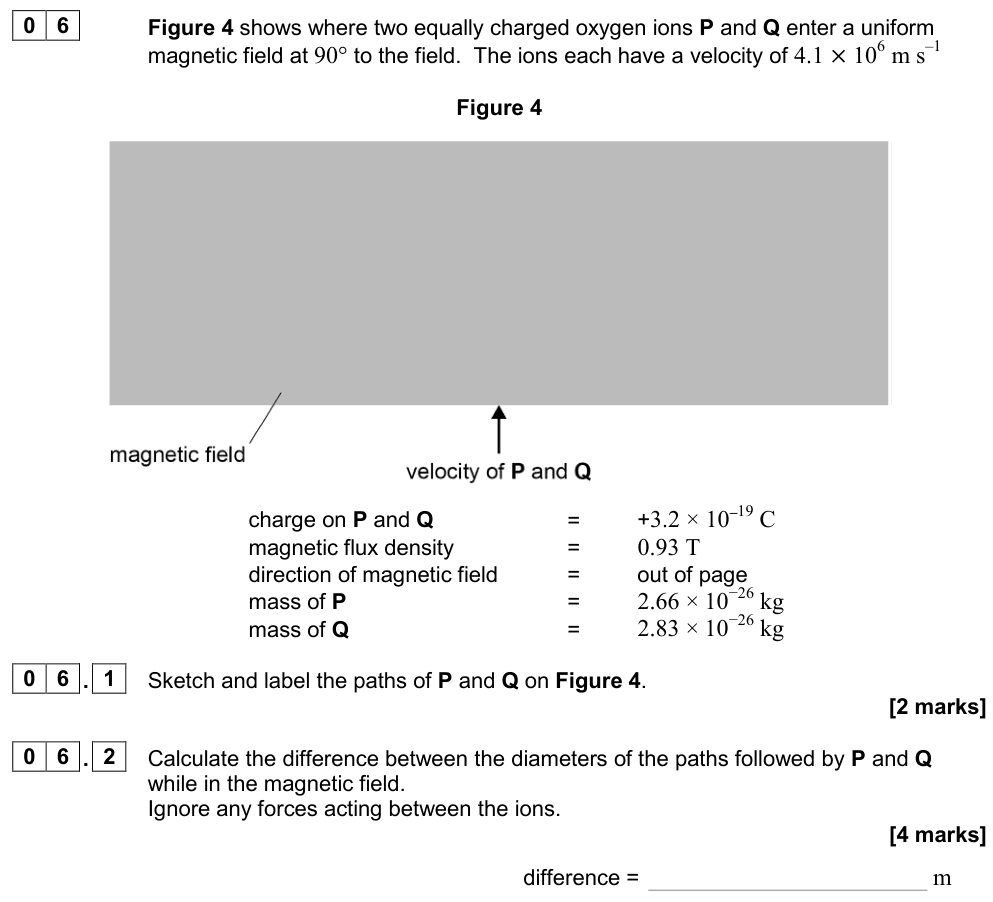
A charged particle moving perpendicular to a uniform field therefore moves in a circle:
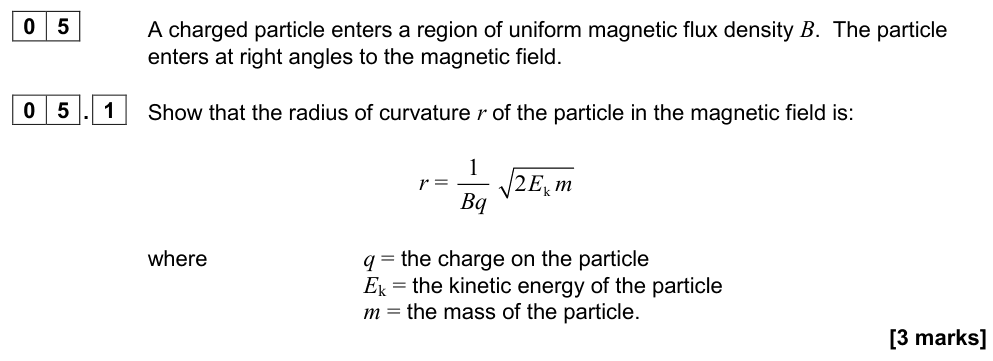
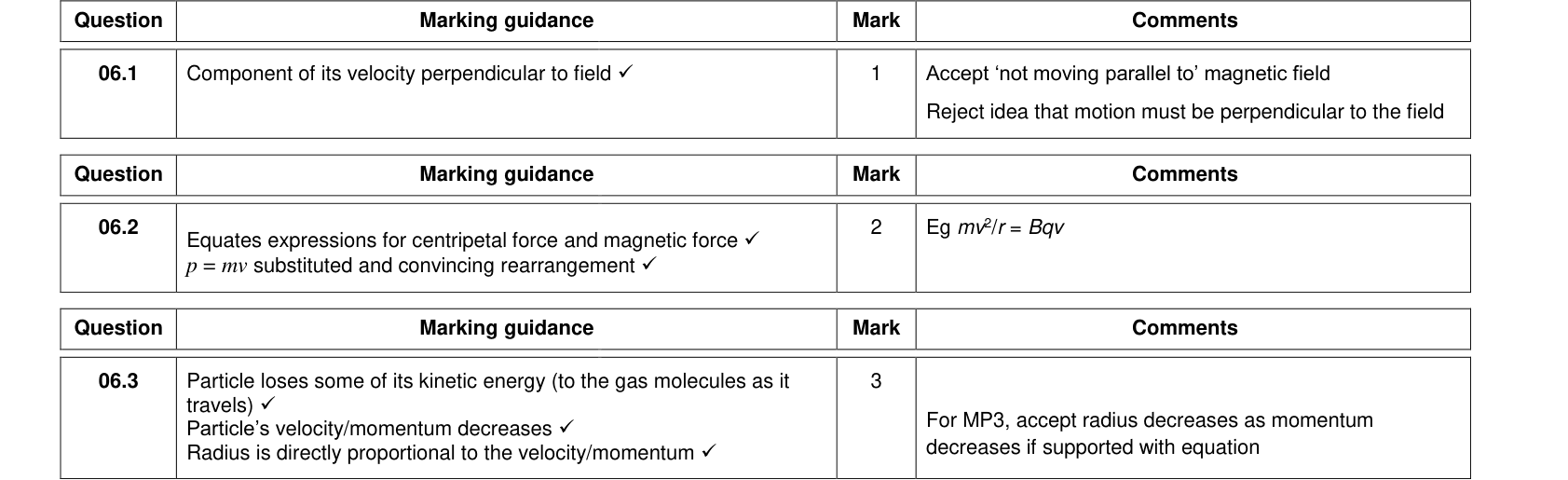
$$BQv = \frac{mv^2}{r}$$
Radius of the circular path
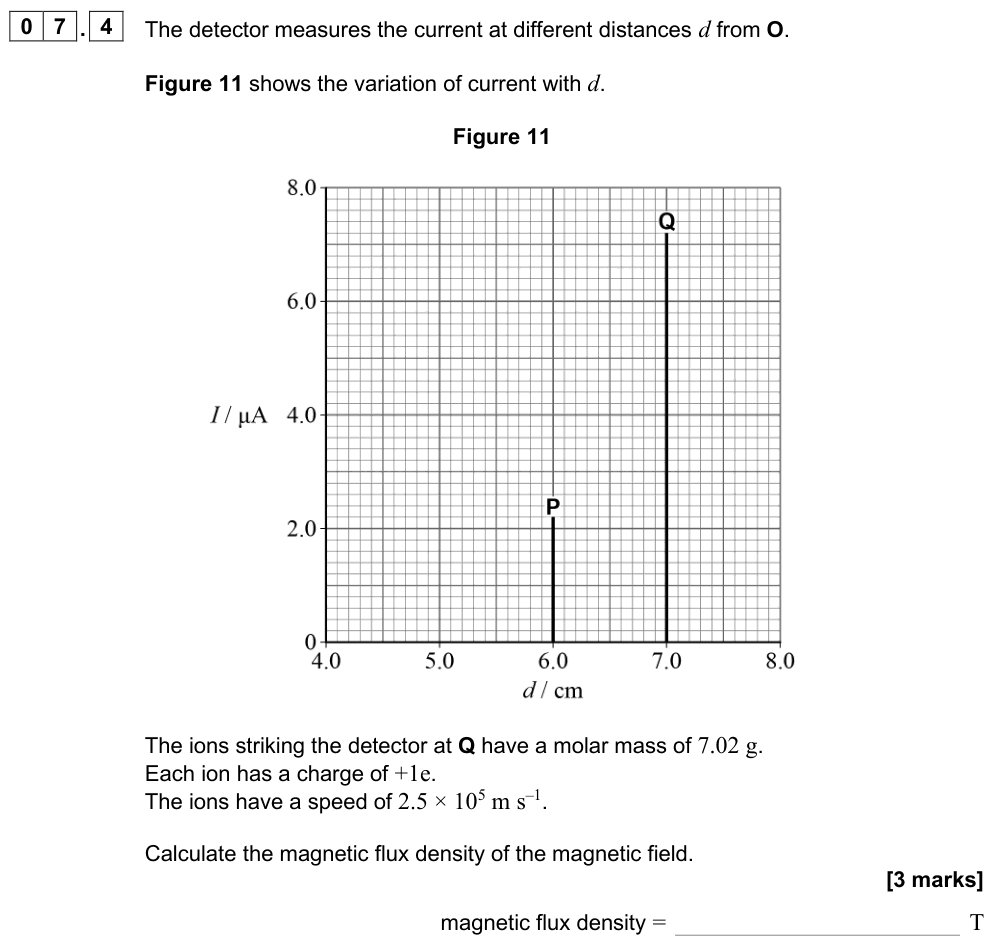
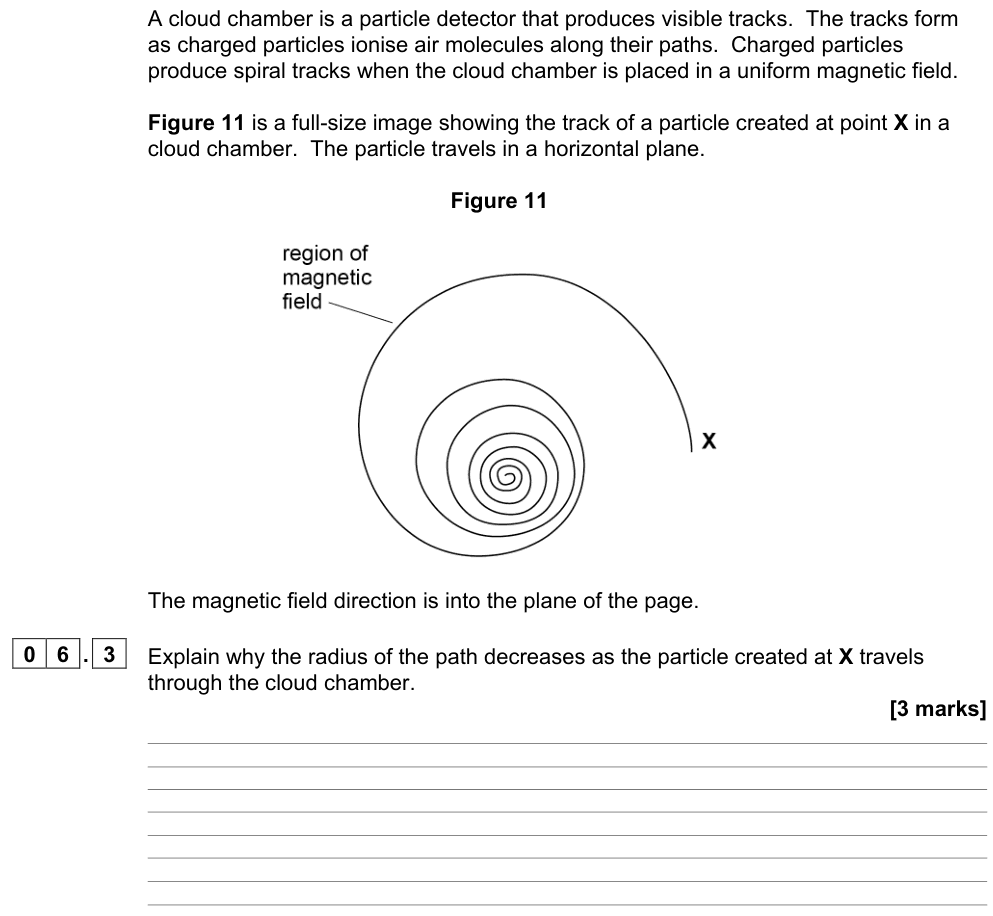
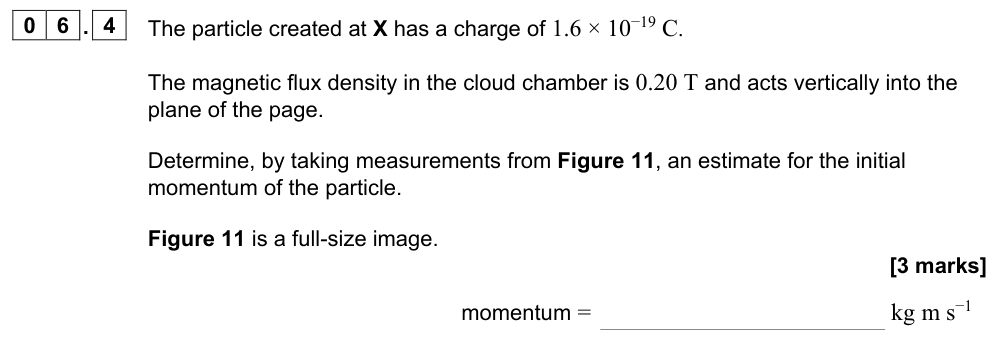
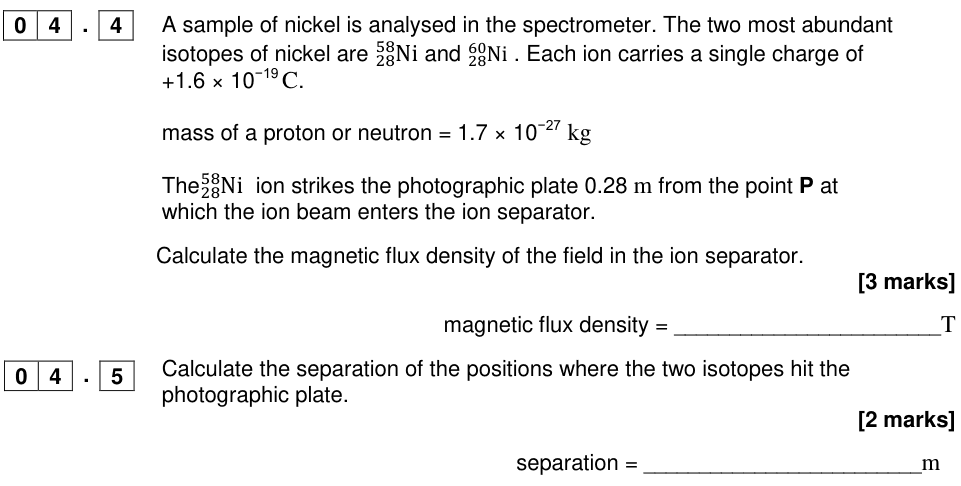
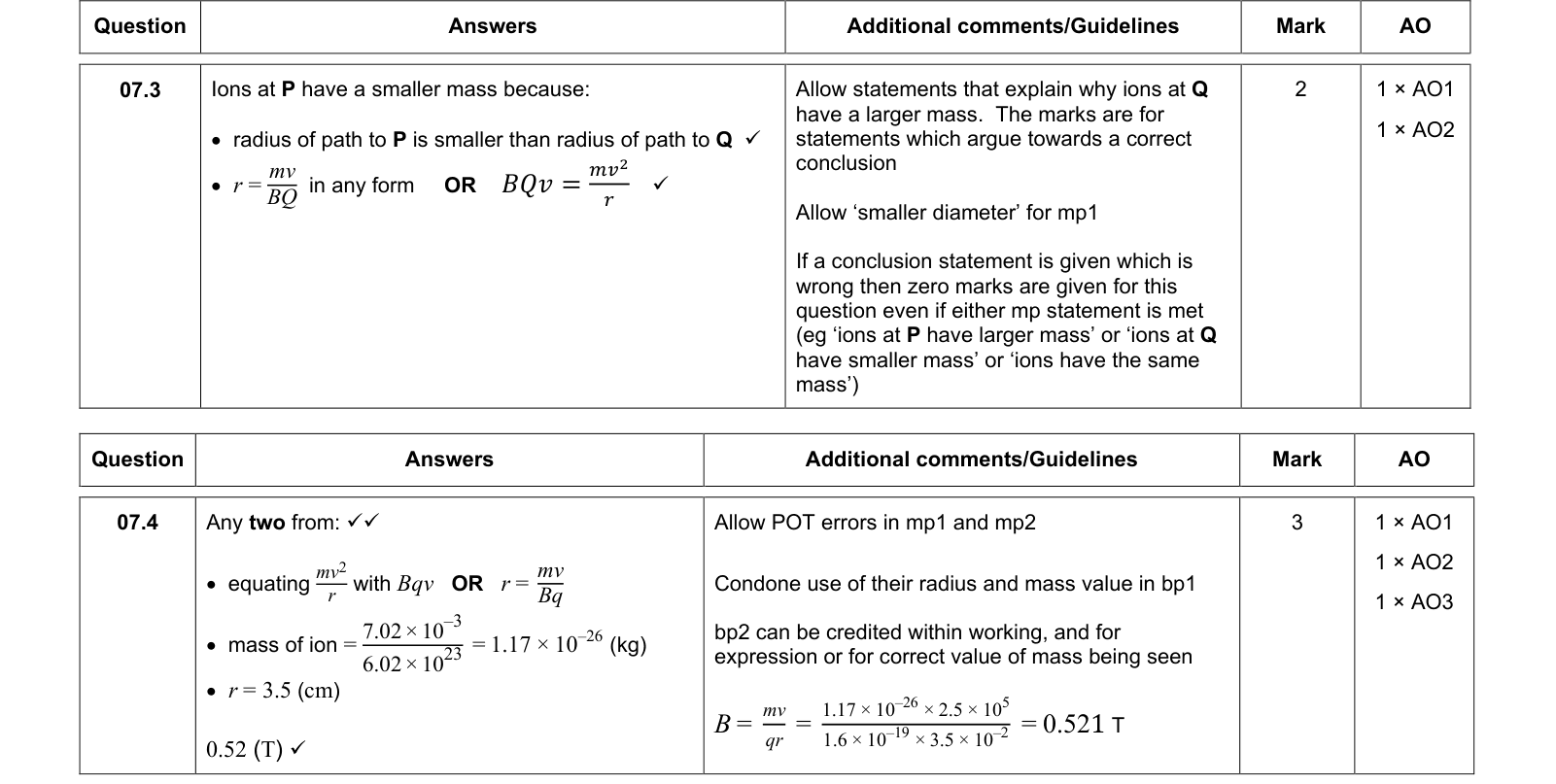
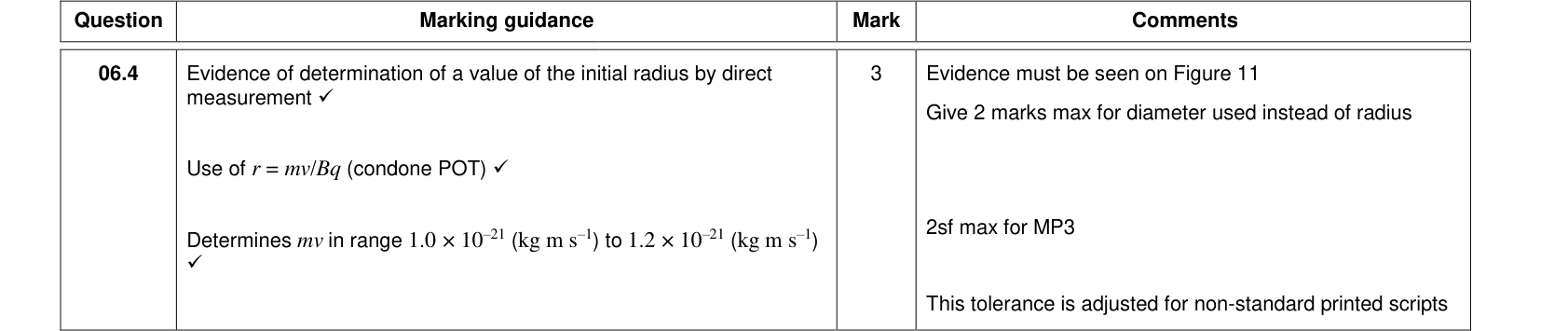
$$r = \frac{mv}{BQ} = \frac{p}{BQ}$$
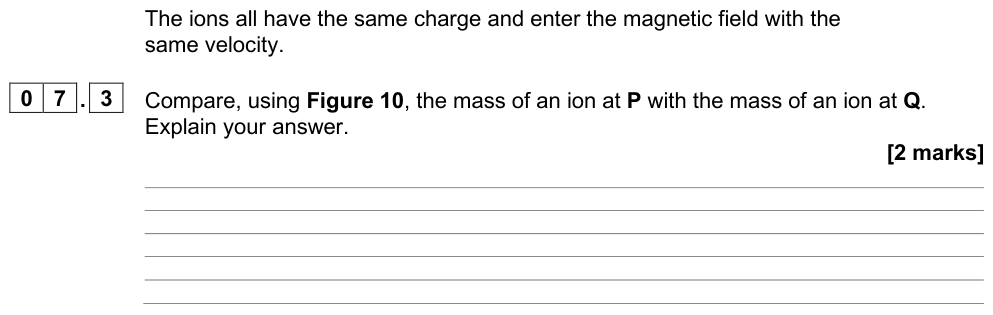
- Faster or heavier particles (more momentum) move in larger circles.
- A stronger field or a larger charge gives a smaller circle.
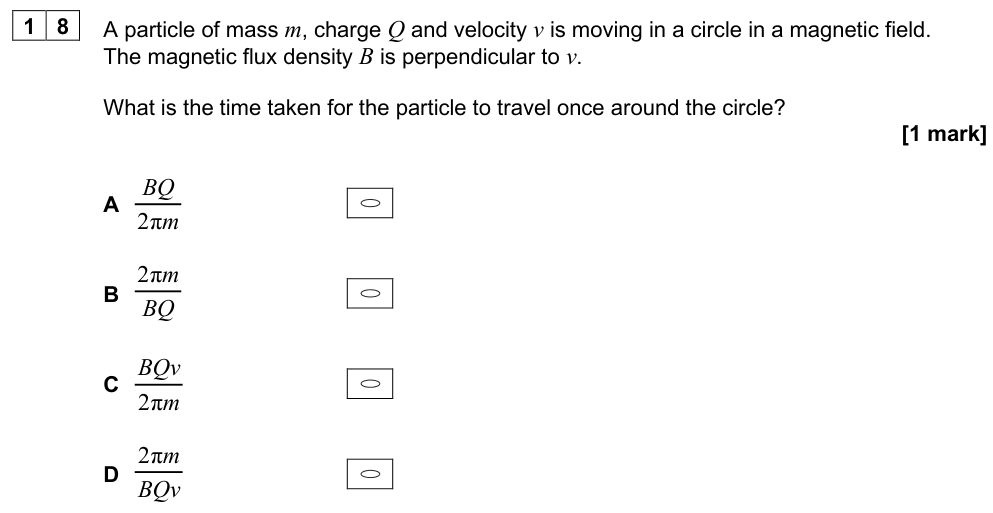
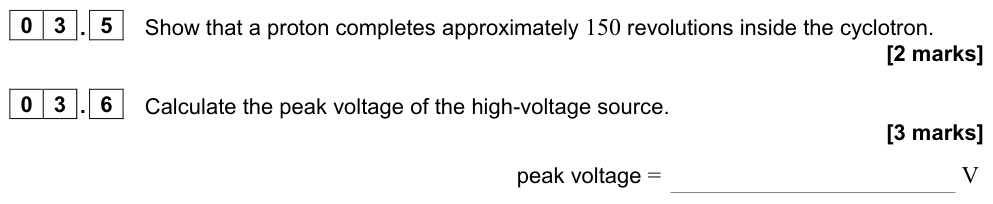
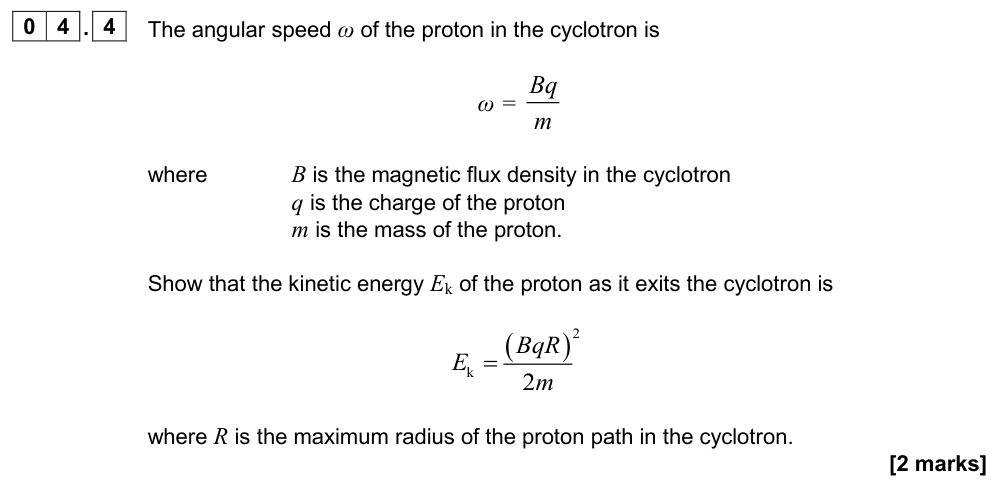
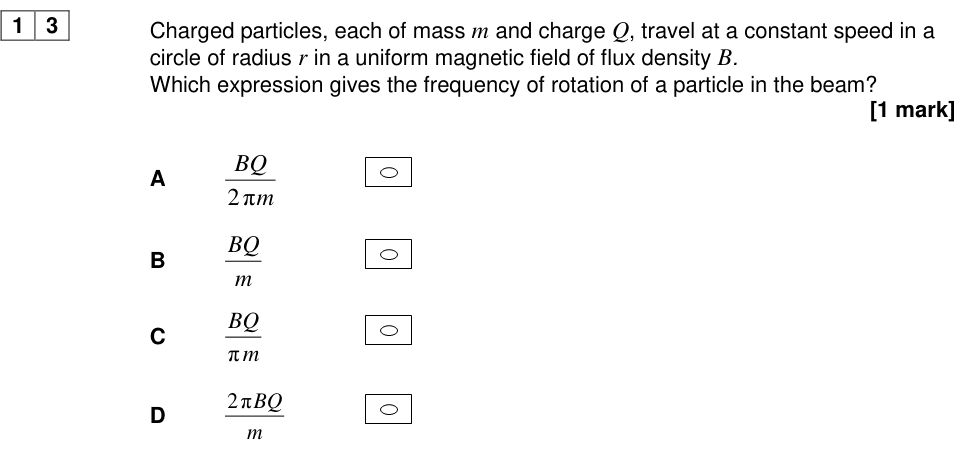
- The time for one orbit is $T = \dfrac{2\pi r}{v} = \dfrac{2\pi m}{BQ}$, which is independent of the speed. (This is the key to the cyclotron.)
Worked example: proton in a field
A proton moves at $3.0 \times 10^{6}\ \text{m s}^{-1}$ perpendicular to a 0.50 T field.
$r = \dfrac{1.67 \times 10^{-27} \times 3.0 \times 10^{6}}{0.50 \times 1.60 \times 10^{-19}} = 0.063\ \text{m}$.
An electron at the same speed would move in a circle about 1840 times smaller, curving the opposite way.
Exam tip: comparing particles
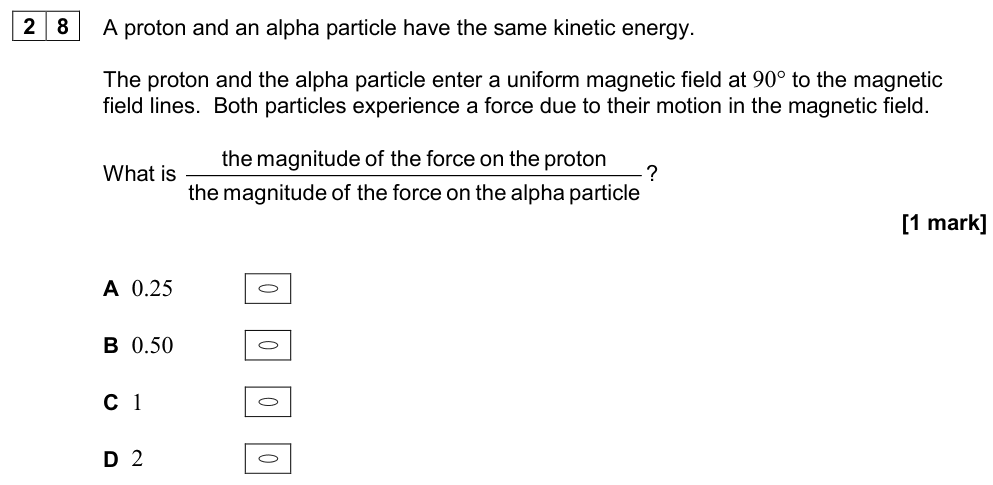
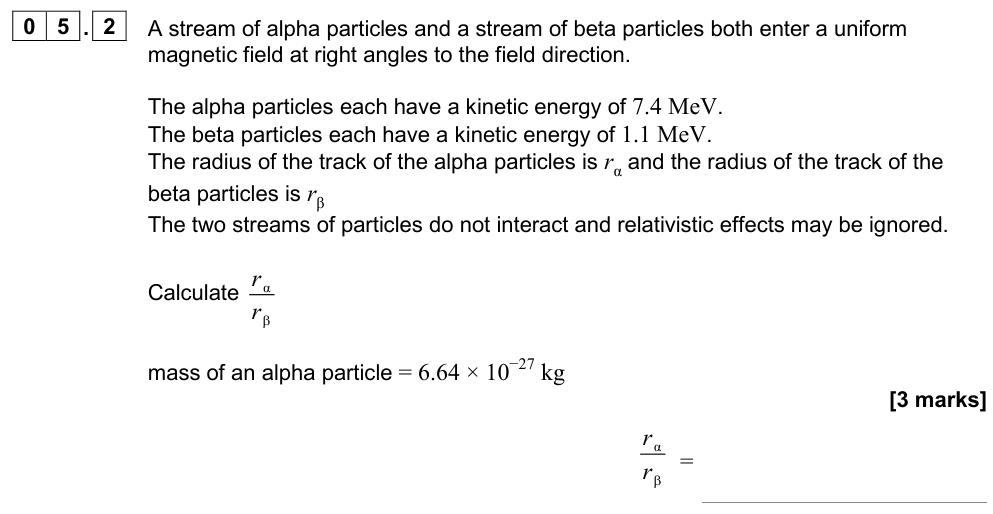
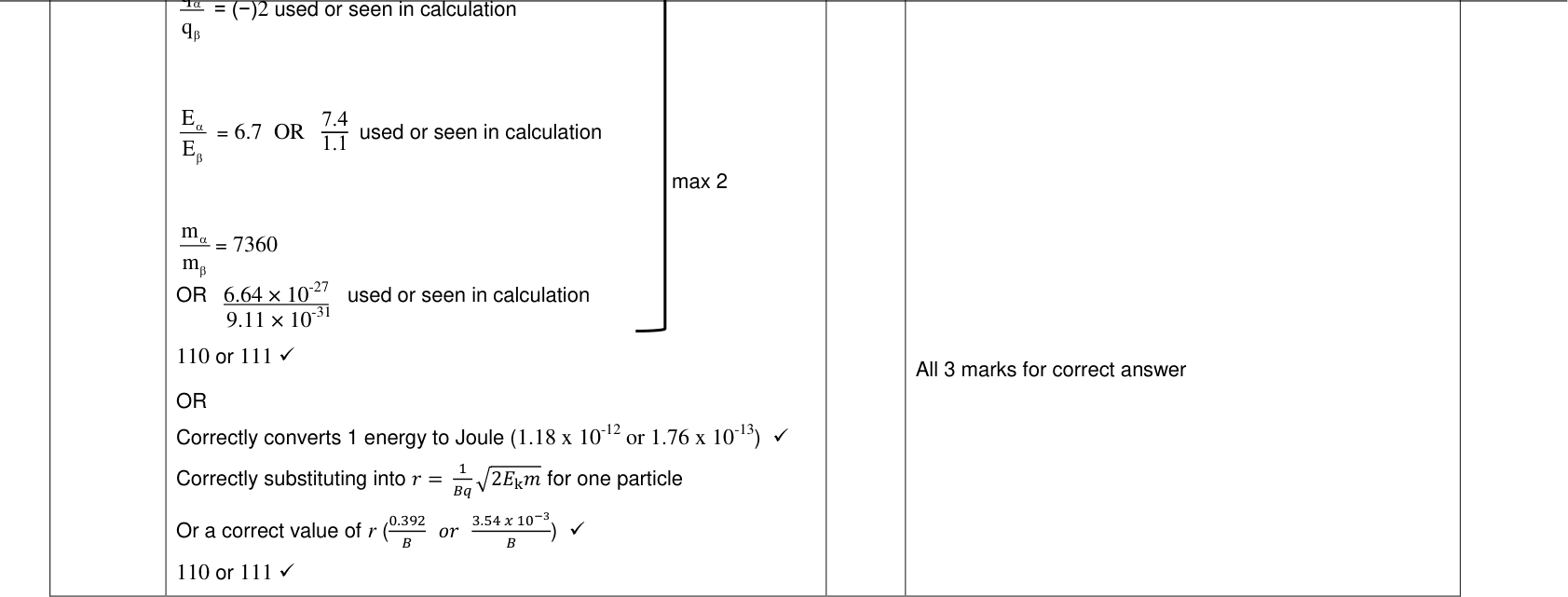
For particles with the same speed, $r \propto m/Q$. An alpha particle ($m = 4u$, $Q = 2e$) has twice the $m/Q$ of a proton, so a radius twice as large. Particles with the same kinetic energy have $p = \sqrt{2mE_k}$, so $r \propto \sqrt{m}/Q$.
The cyclotron
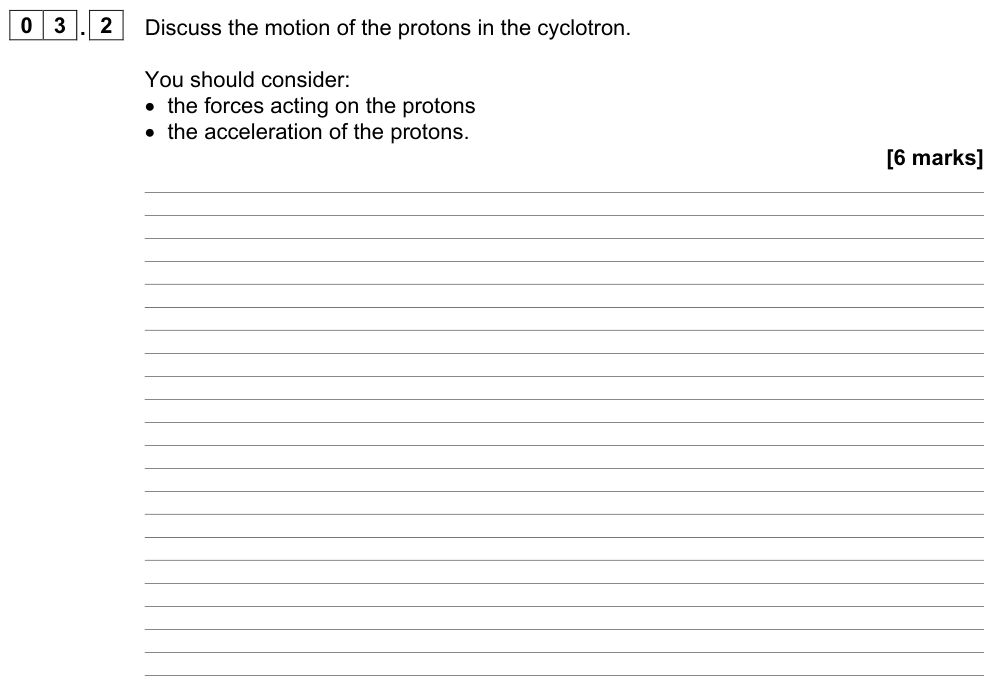
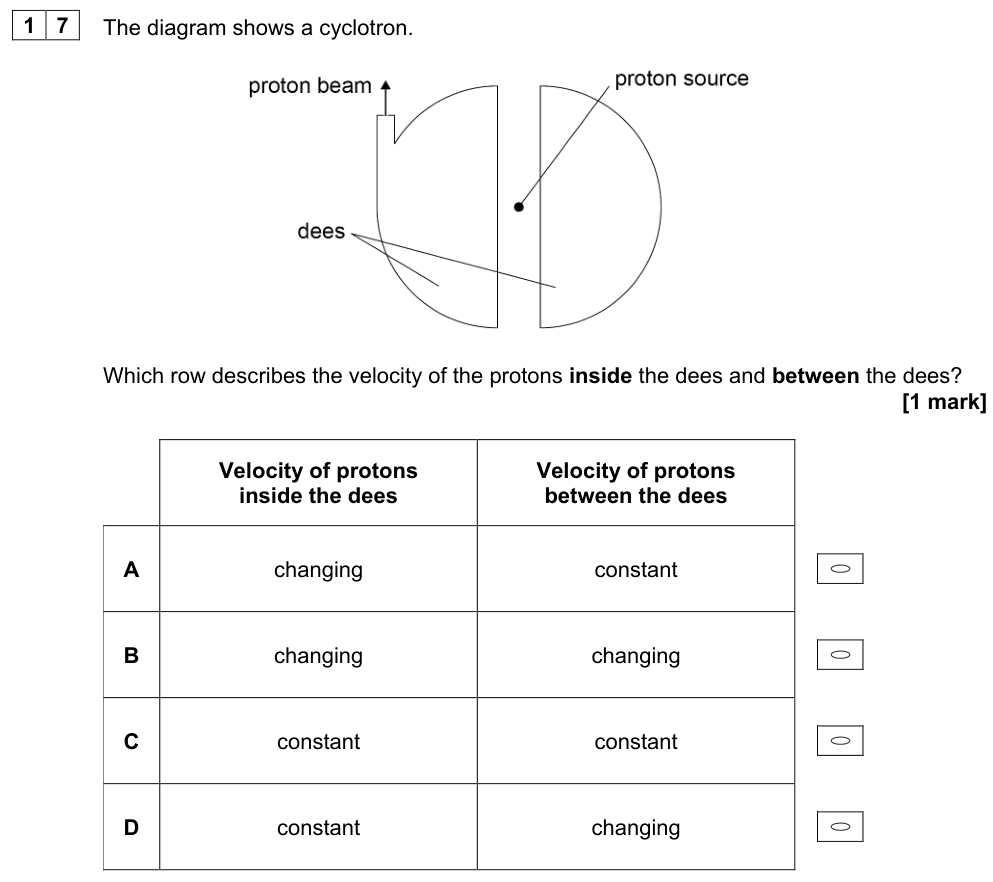
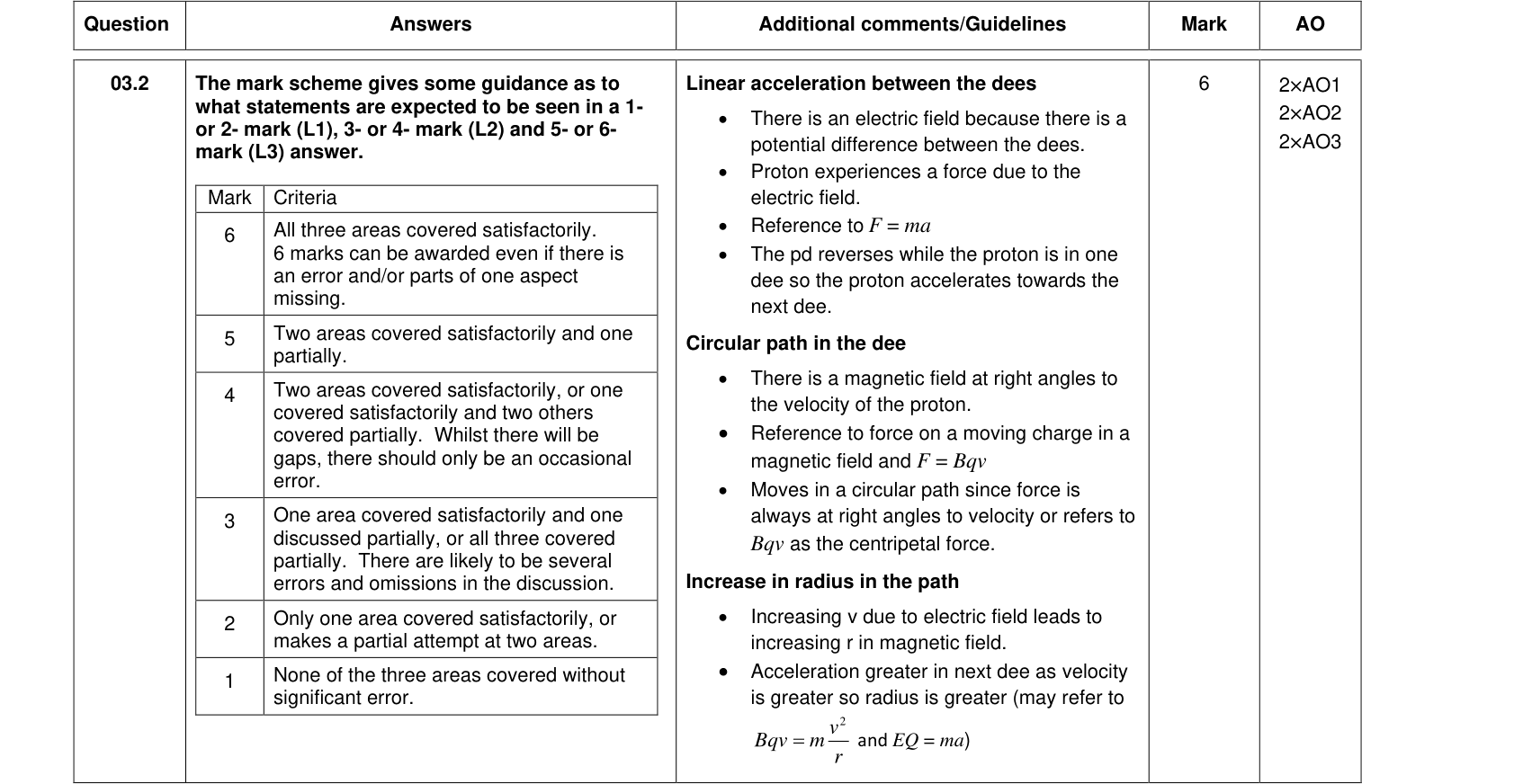
A cyclotron accelerates charged particles (e.g. protons) to high energies in a compact space.
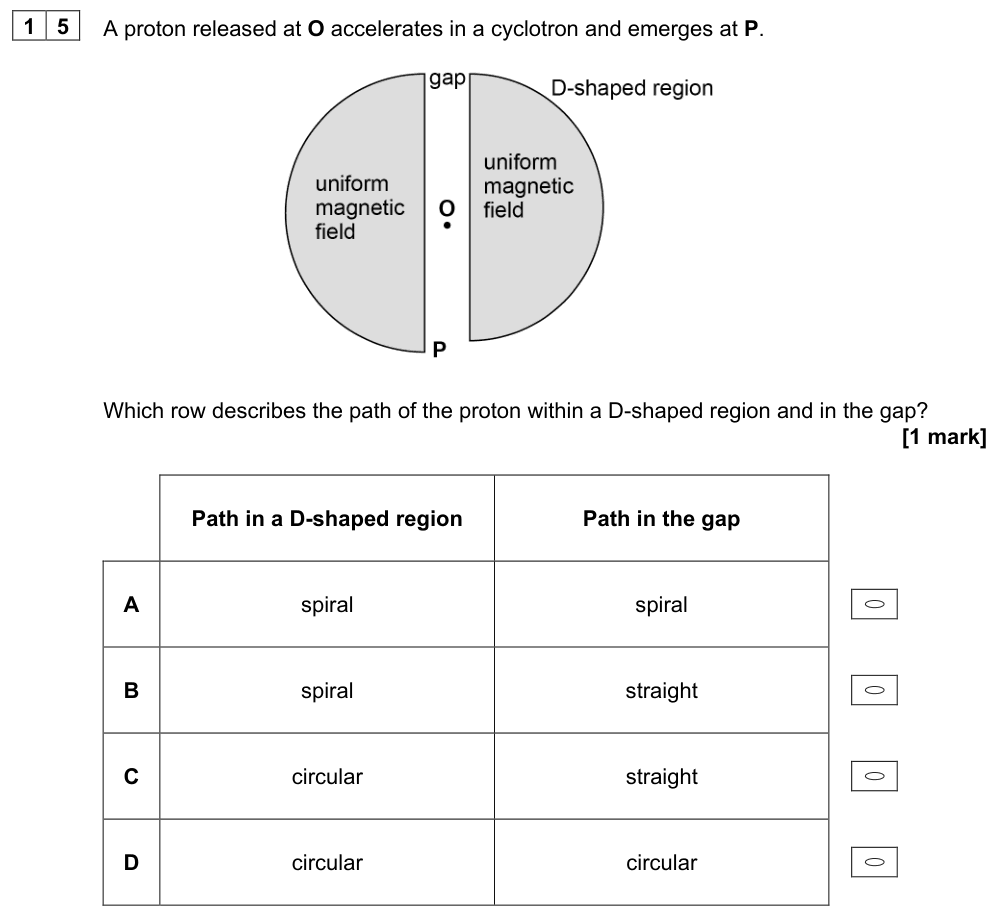
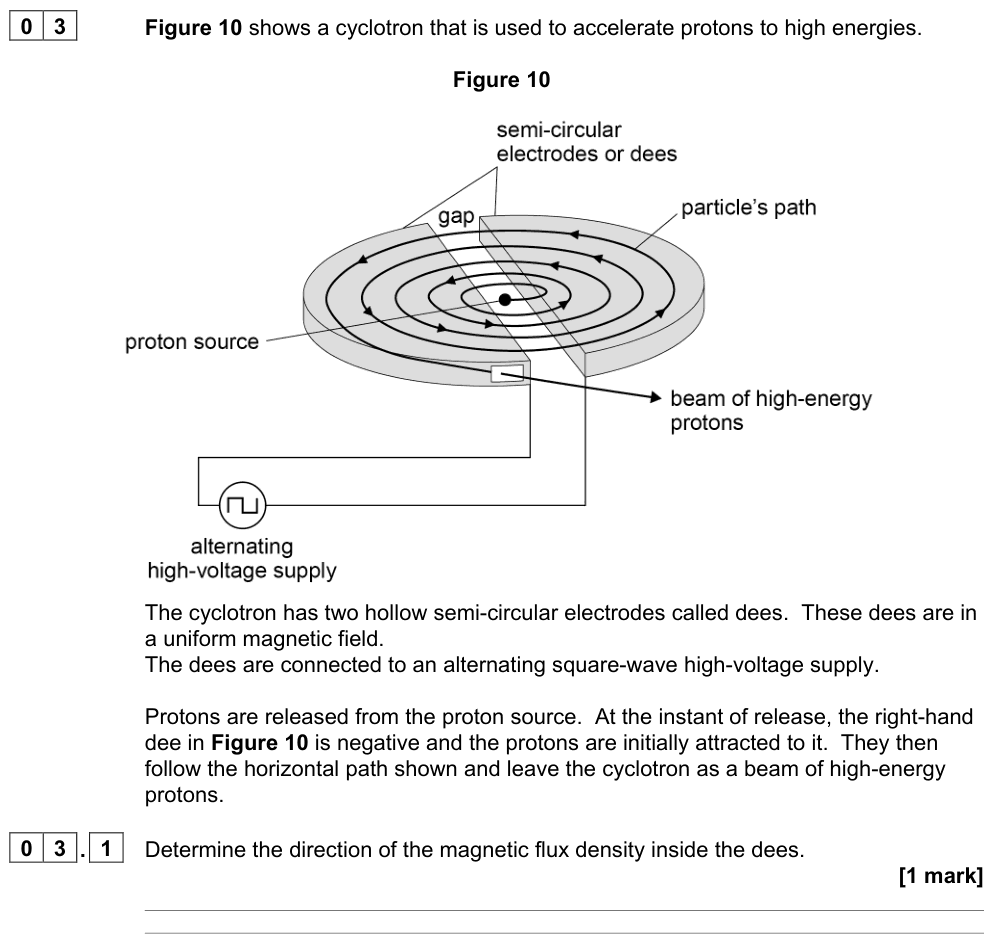
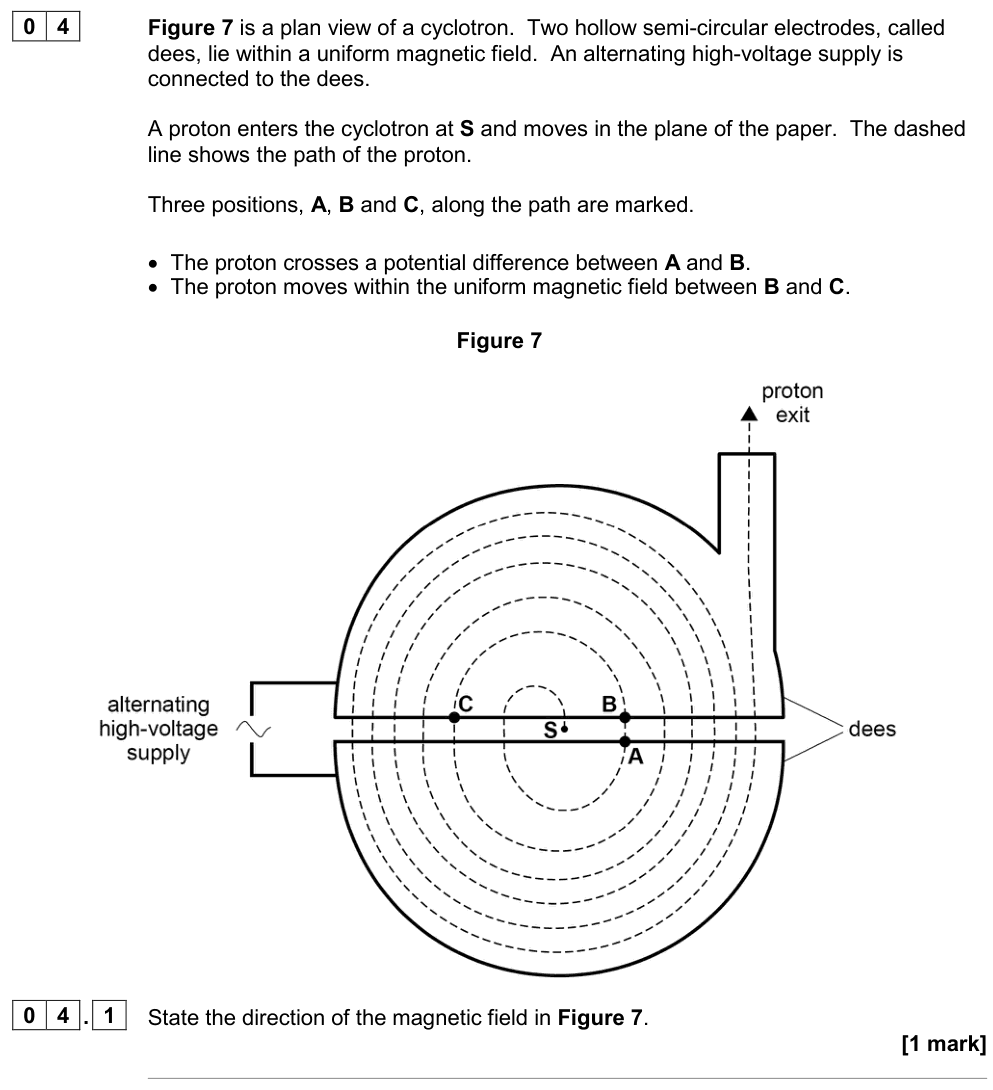
- Two hollow semicircular electrodes (dees) sit in a uniform magnetic field perpendicular to them, inside a vacuum chamber.
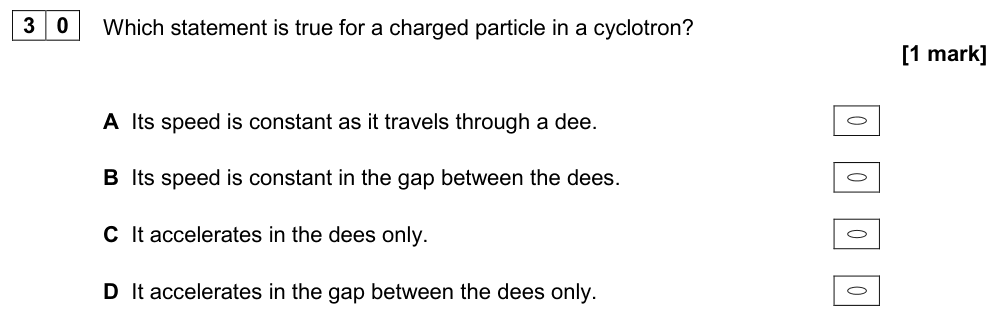
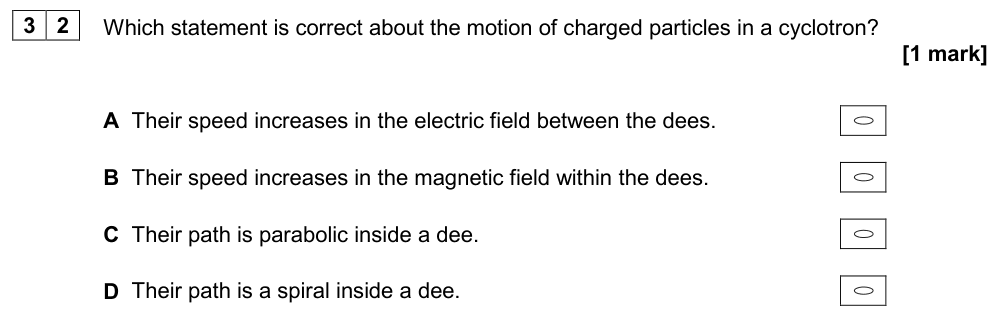
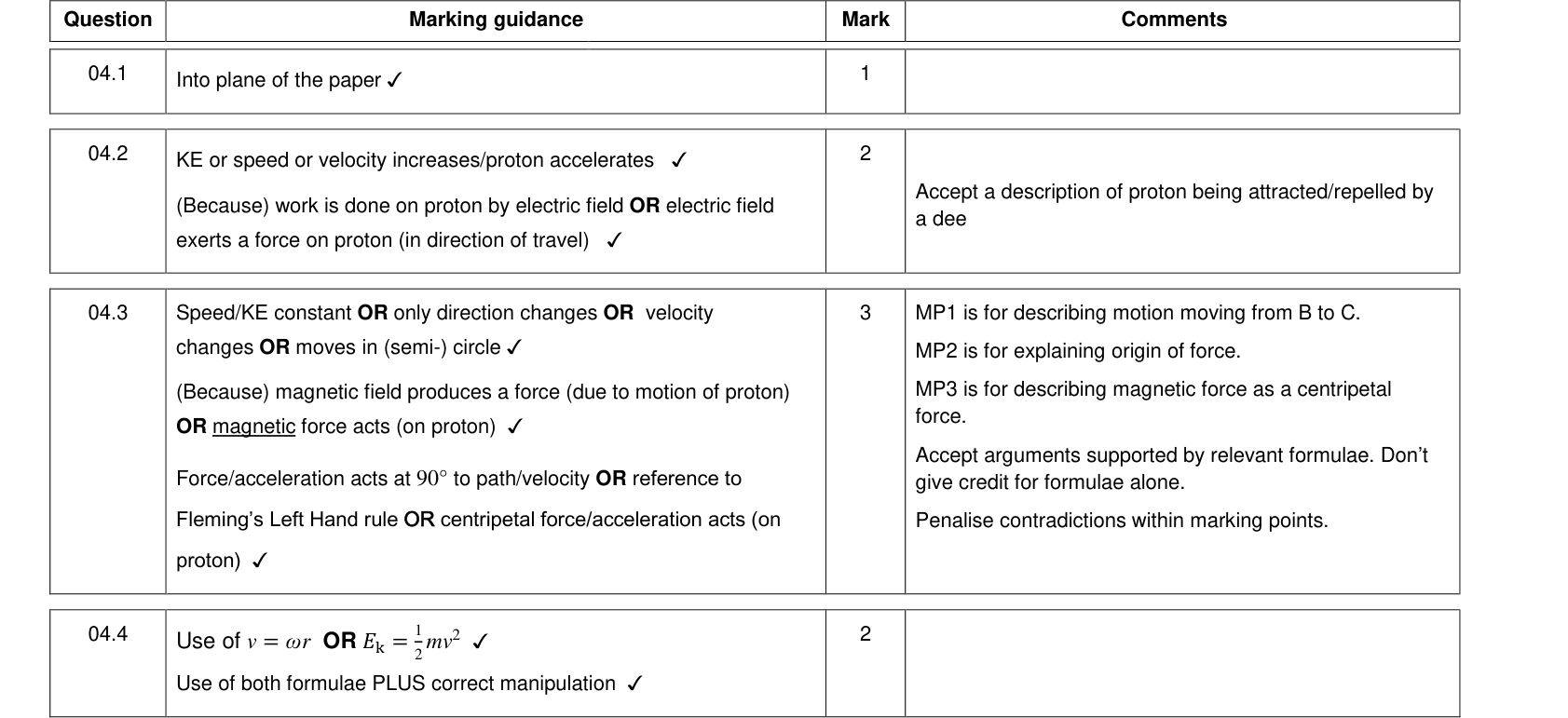
- Inside each dee there is no electric field: the particle moves in a semicircle at constant speed because of the magnetic force.
- Each time the particle crosses the gap, an alternating p.d. across the gap accelerates it, increasing its speed and kinetic energy.
- With greater speed the radius increases, so the particle follows a spiral outwards.
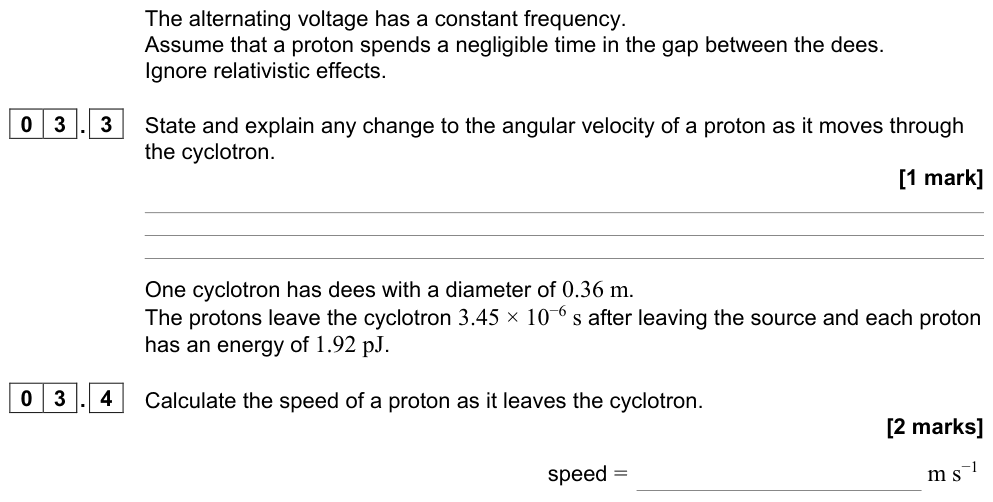
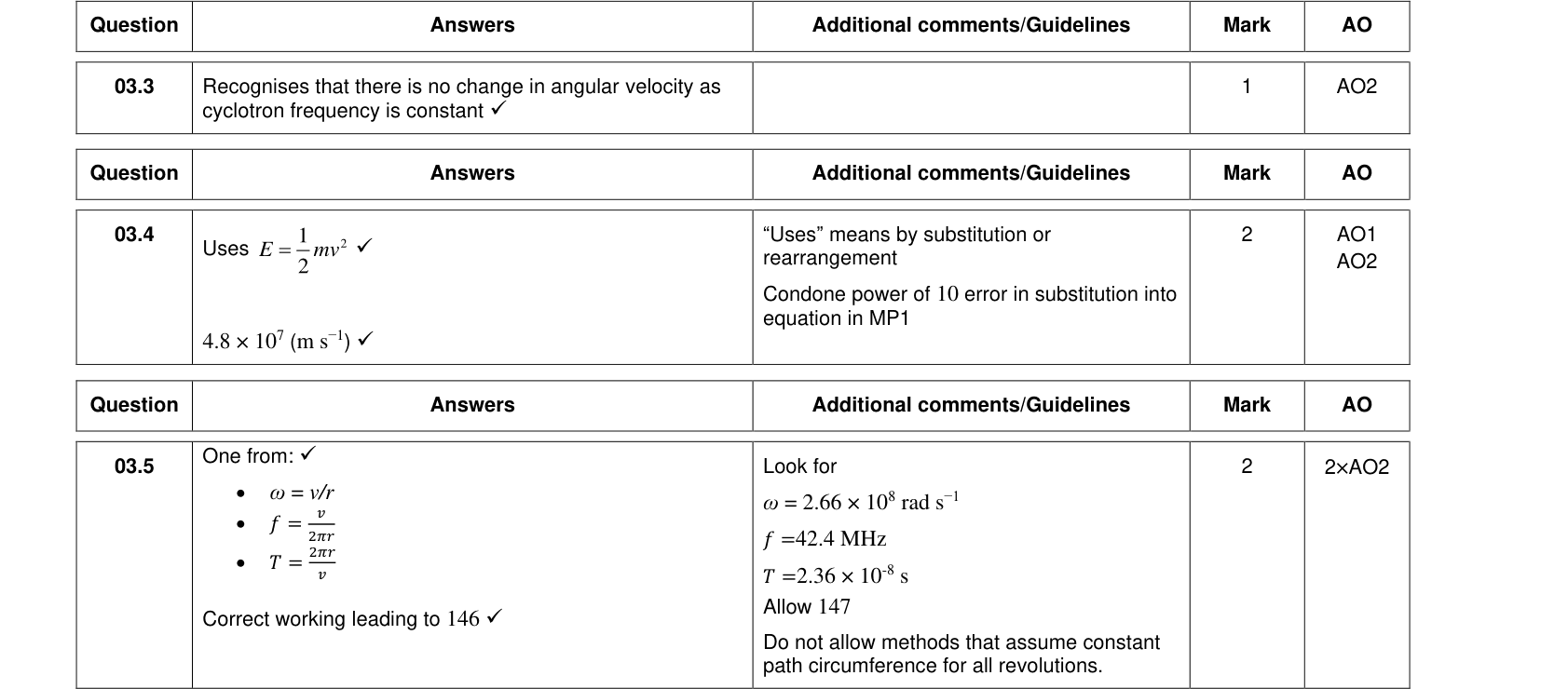
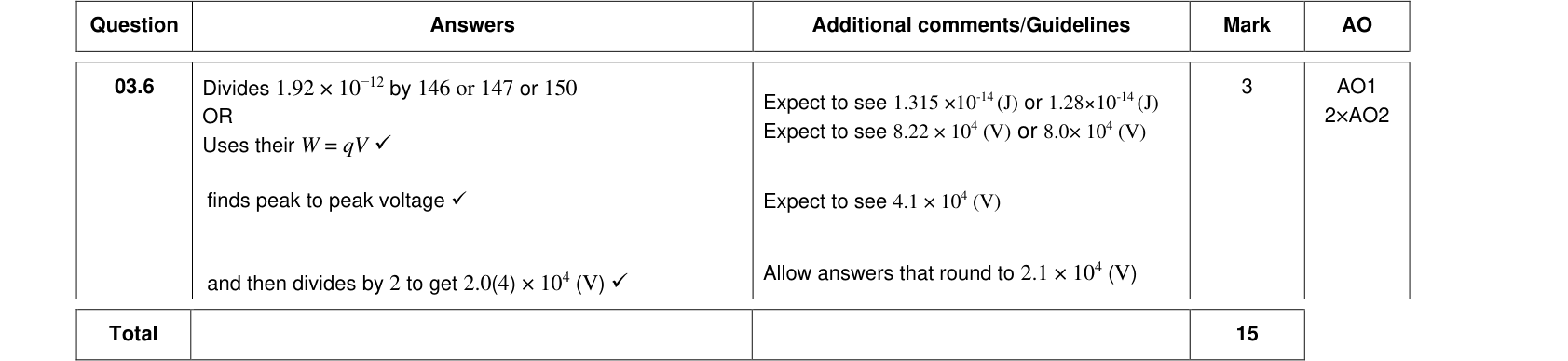
- The time to go round each semicircle ($T/2 = \pi m/BQ$) does not depend on speed, so the a.c. supply can have a fixed frequency:
$$f = \frac{BQ}{2\pi m}$$
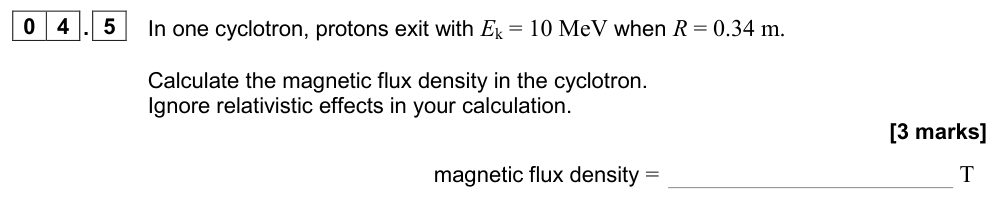
- The particle leaves at the edge, with maximum speed $v_{\max} = \dfrac{BQR}{m}$ where $R$ is the radius of the dees, so $E_{k,\max} = \dfrac{B^2Q^2R^2}{2m}$.
(At very high speeds relativistic mass increase spoils the timing, which is why very high energy machines use synchrotrons instead.)
Worked example: cyclotron
A cyclotron has a field of 1.2 T and dees of radius 0.50 m. For protons: $f = \dfrac{1.2 \times 1.60 \times 10^{-19}}{2\pi \times 1.67 \times 10^{-27}} = 1.8 \times 10^{7}$ Hz.
$v_{\max} = \dfrac{1.2 \times 1.60 \times 10^{-19} \times 0.50}{1.67 \times 10^{-27}} = 5.7 \times 10^{7}\ \text{m s}^{-1}$; $E_k = \tfrac12mv^2 = 2.8 \times 10^{-12}\ \text{J} = 17$ MeV.
Crossed fields: the velocity selector
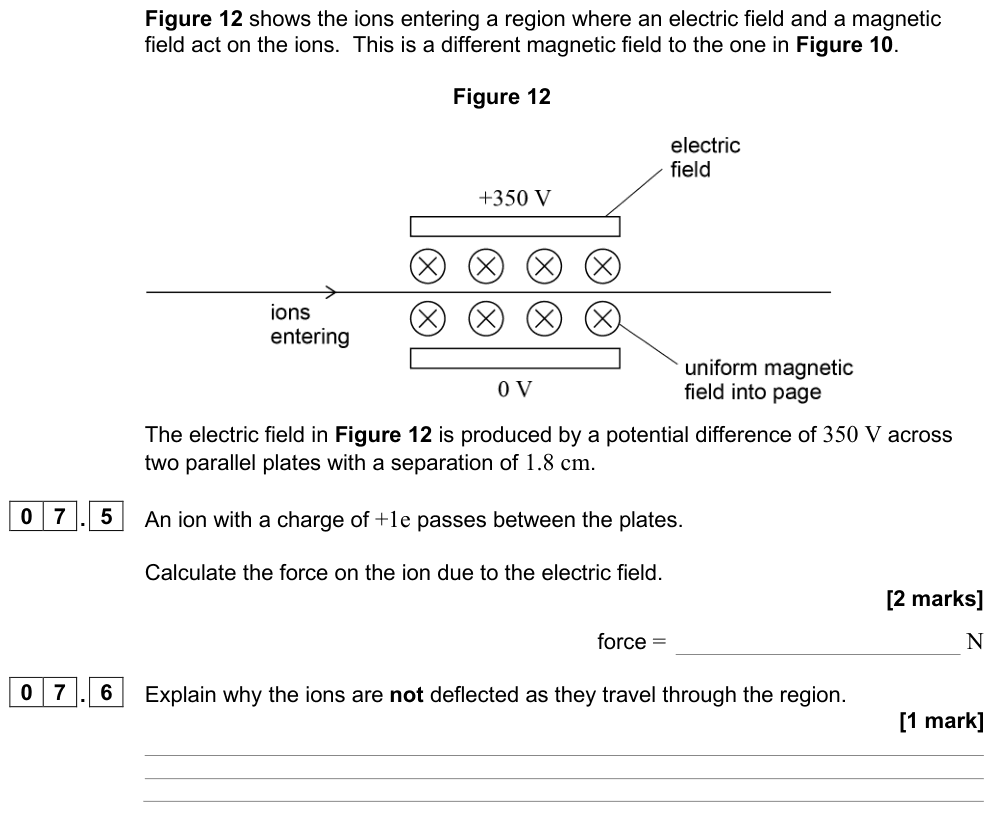
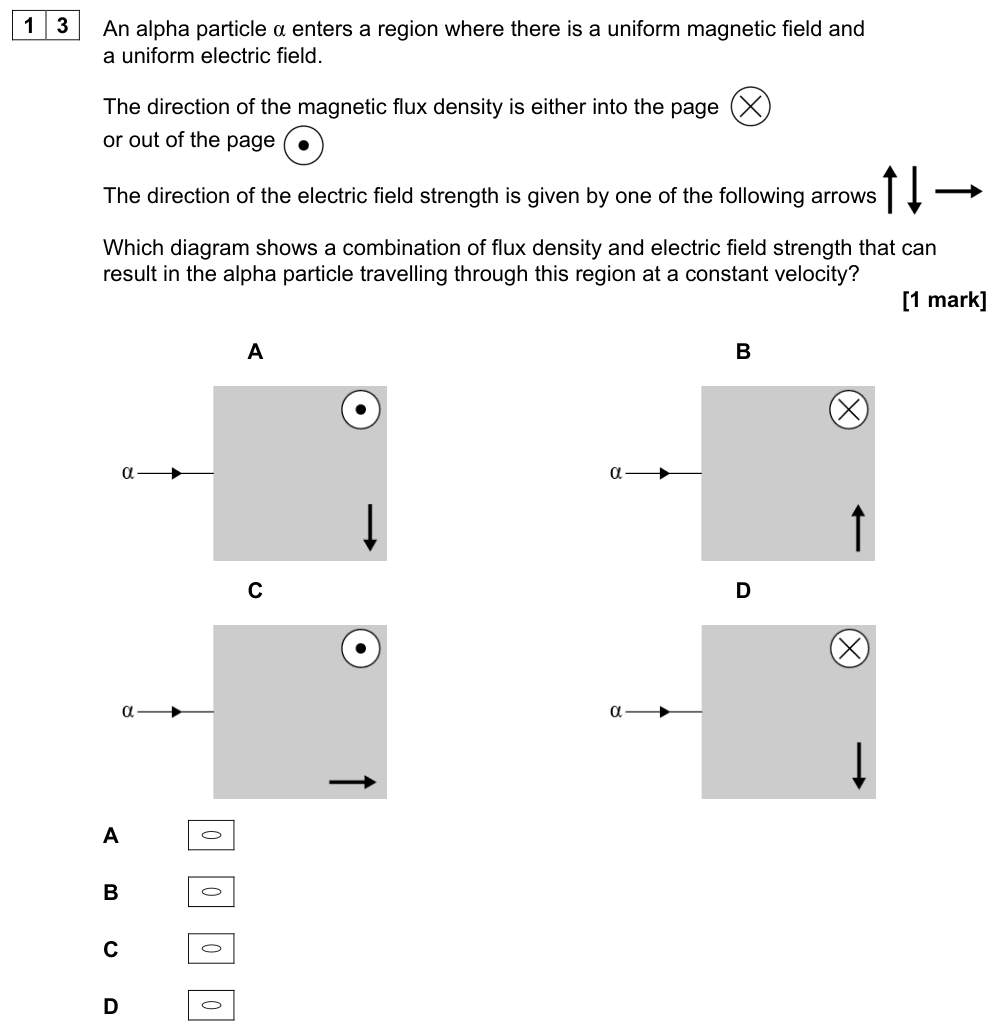
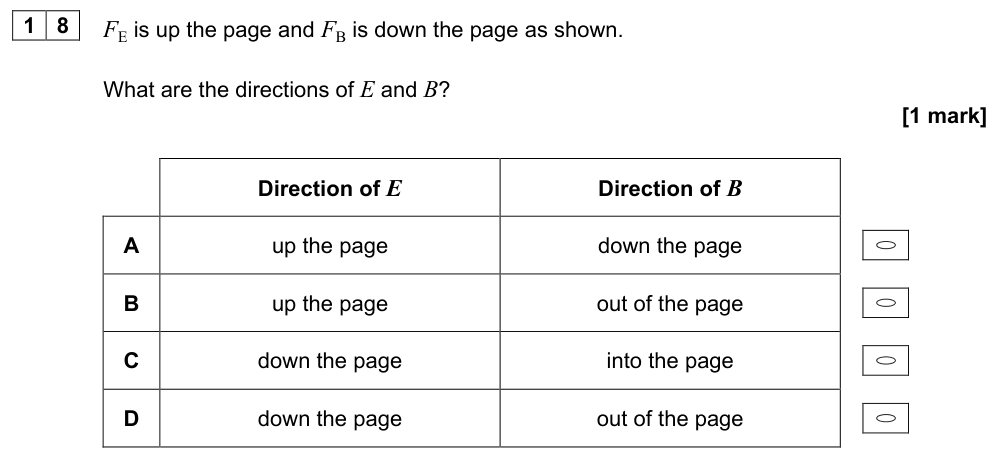
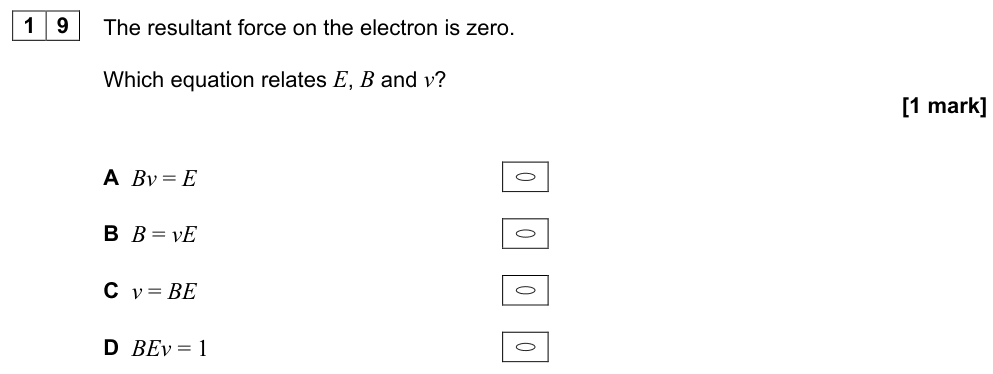
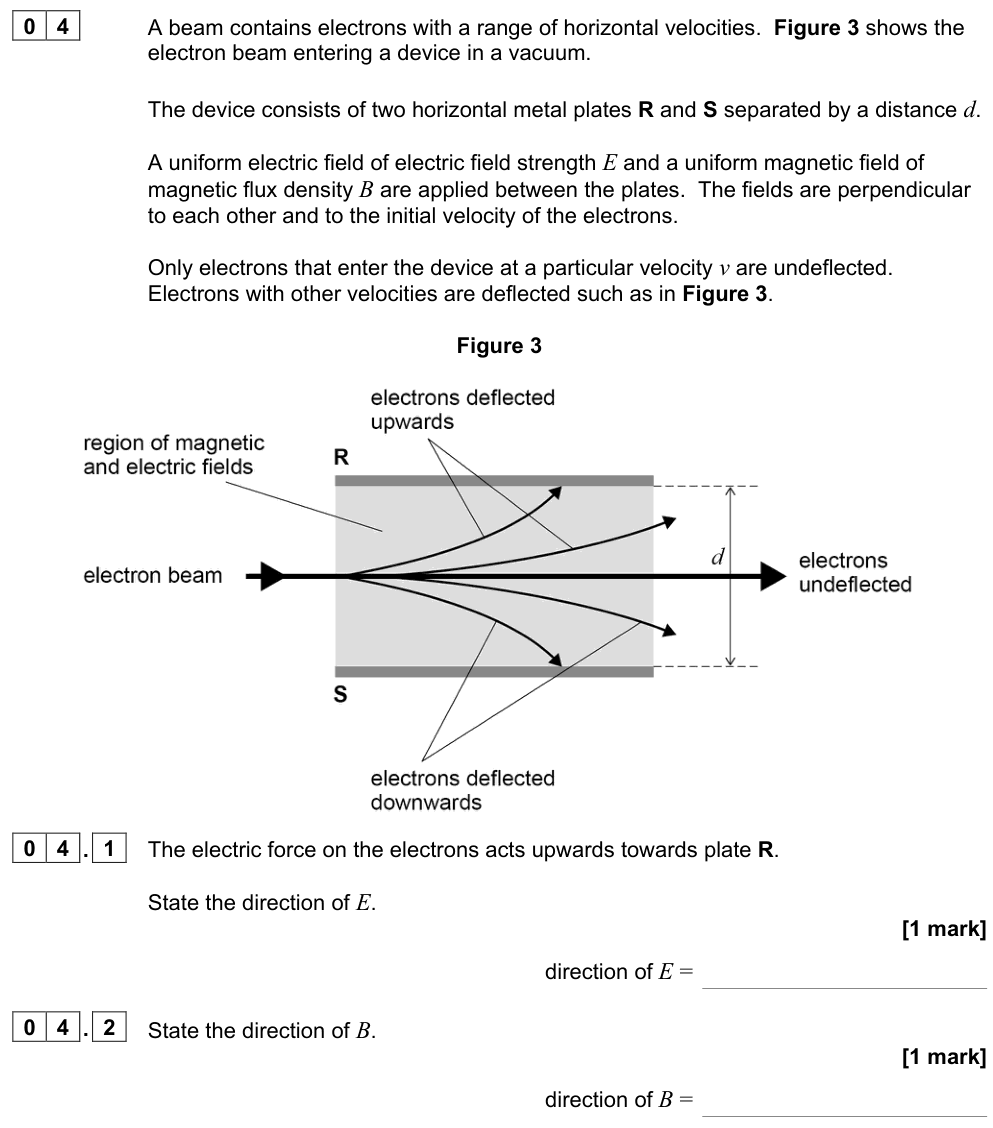
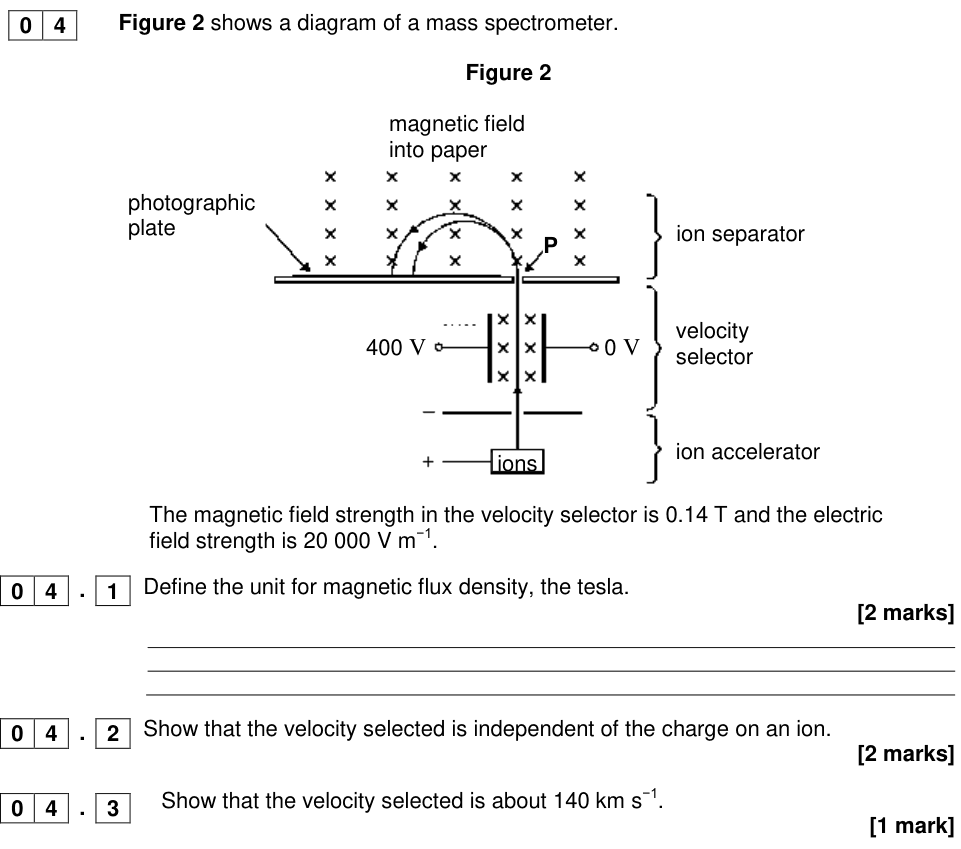
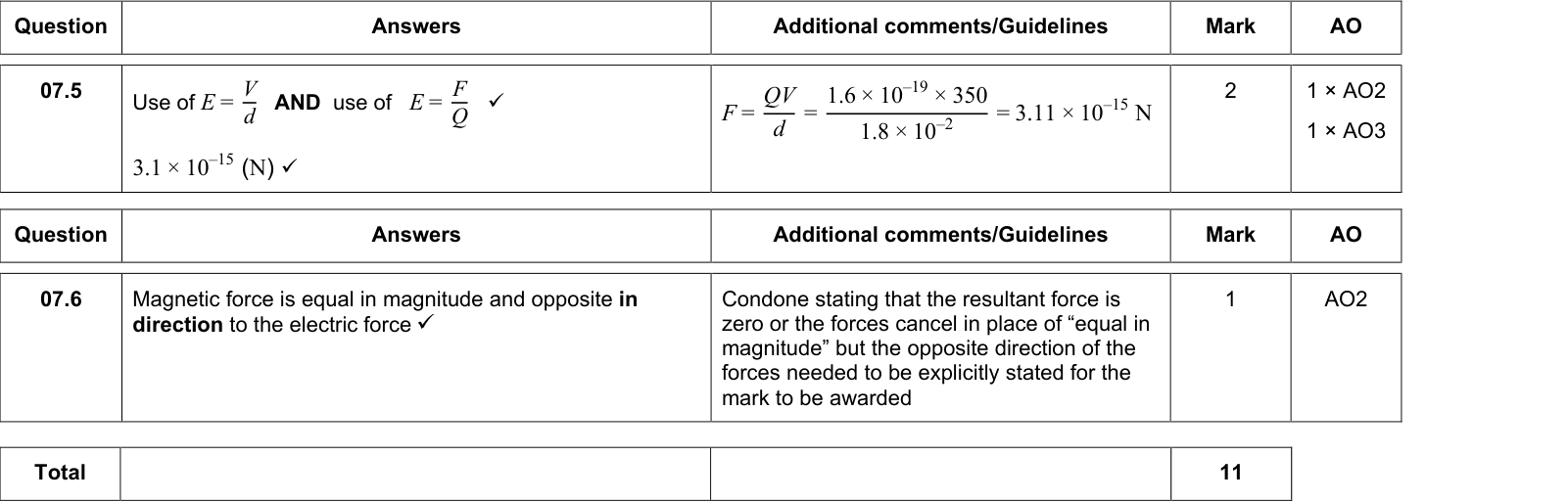
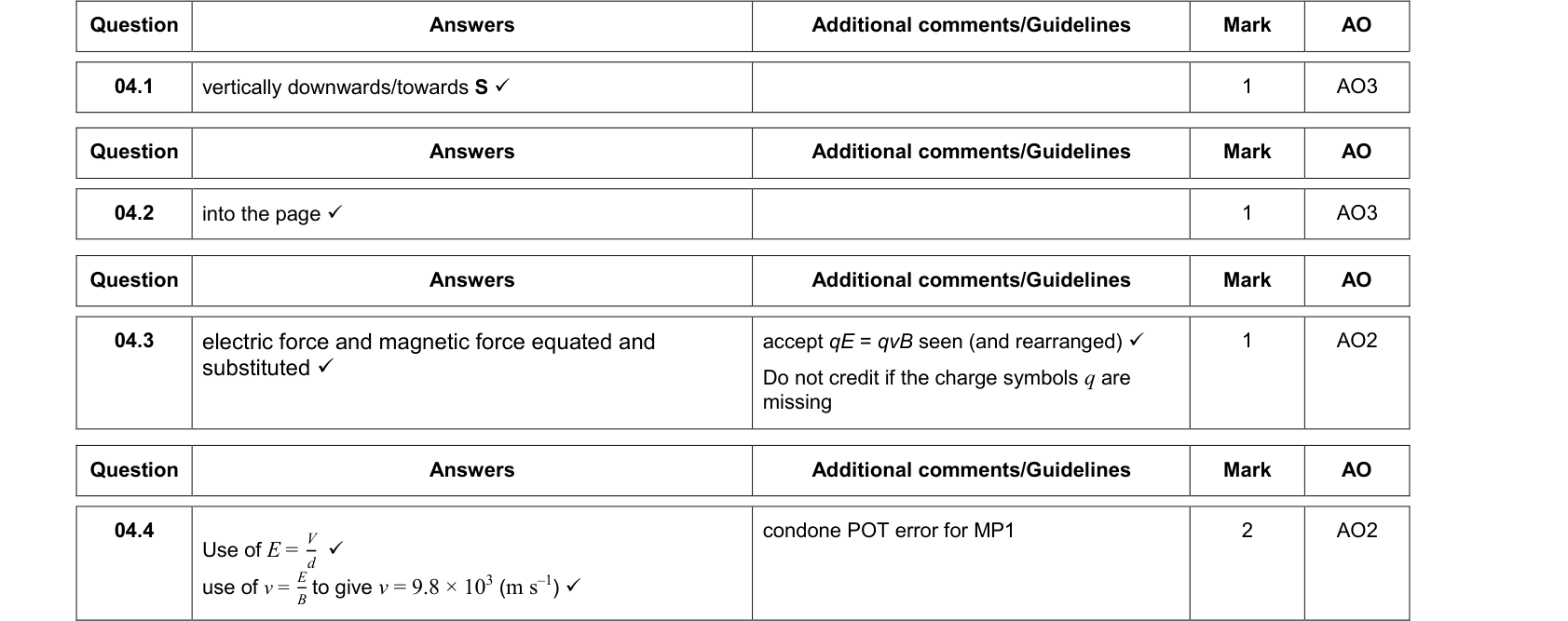
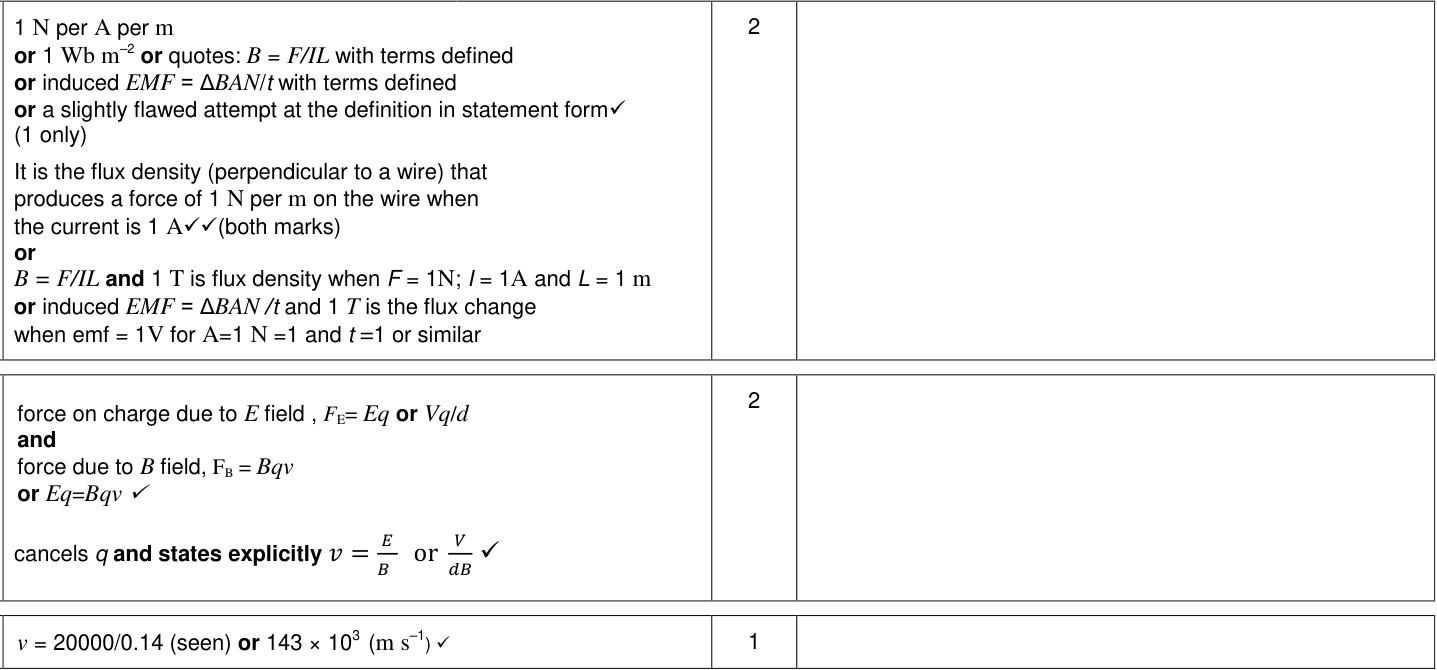
If a particle passes through a region with a uniform electric field and a perpendicular magnetic field, arranged so that the two forces are in opposite directions, it goes straight through undeflected only if the forces balance:
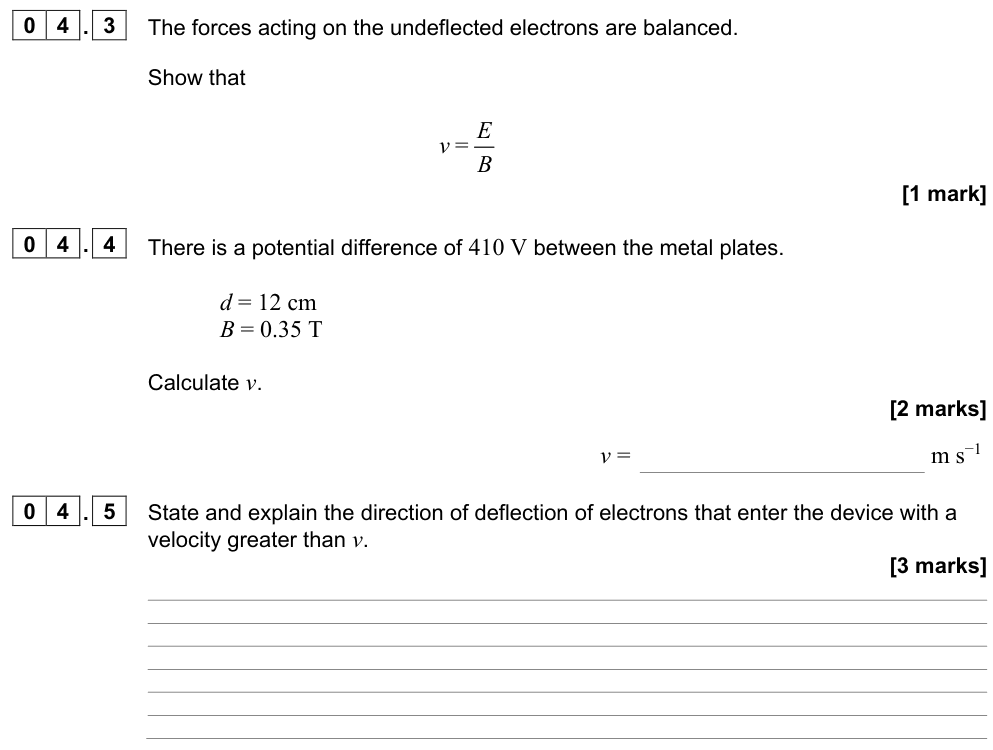
$$EQ = BQv \quad\Rightarrow\quad v = \frac{E}{B}$$
Only particles with this speed pass straight through, whatever their mass or charge. Velocity selectors are used before mass spectrometers, where a beam of ions of one speed enters a magnetic field and ions of different mass follow circles of different radius ($r = mv/BQ$).
Summary
- $F = BQv$ for $v \perp B$; direction from Fleming's left-hand rule (reverse for negative charges).
- The force is perpendicular to the velocity: no work done, constant speed, circular path with $r = mv/BQ$.
- Period $T = 2\pi m/BQ$ is independent of speed: cyclotron frequency $f = BQ/2\pi m$.
- Crossed E and B fields: undeflected when $v = E/B$.