Electric potential
Absolute electric potential
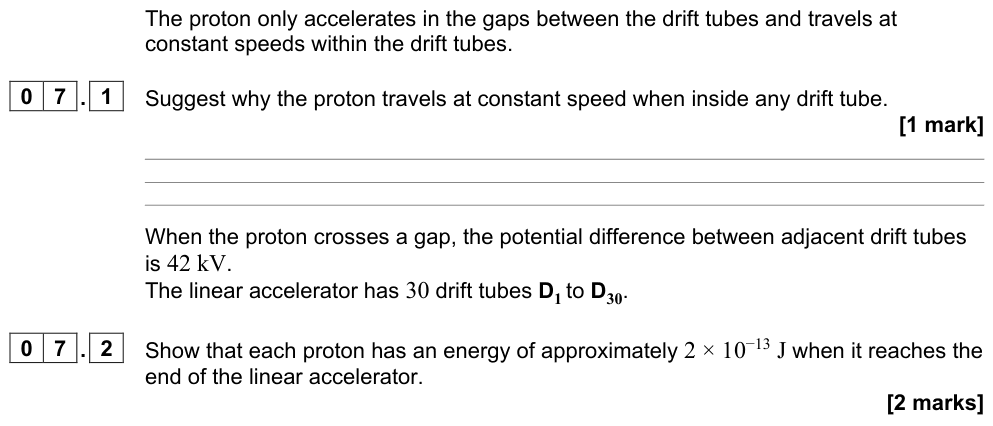
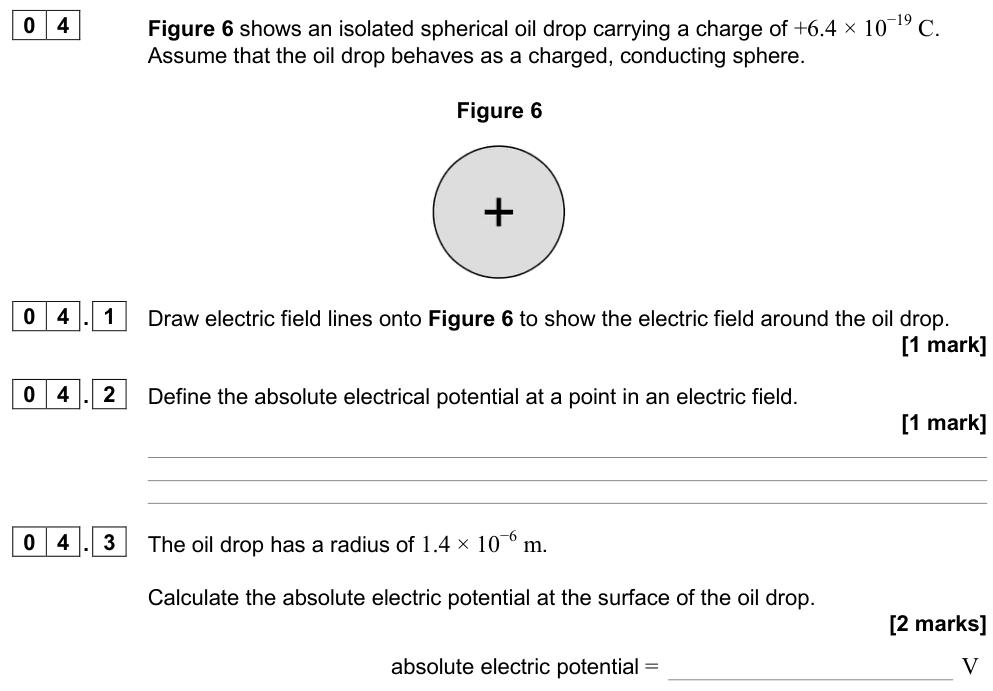
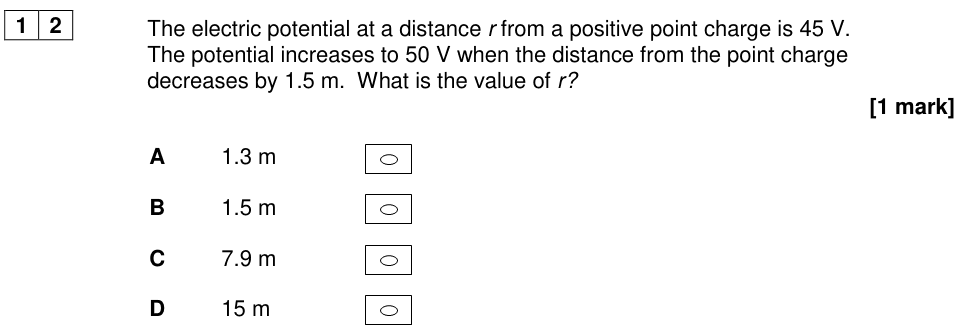
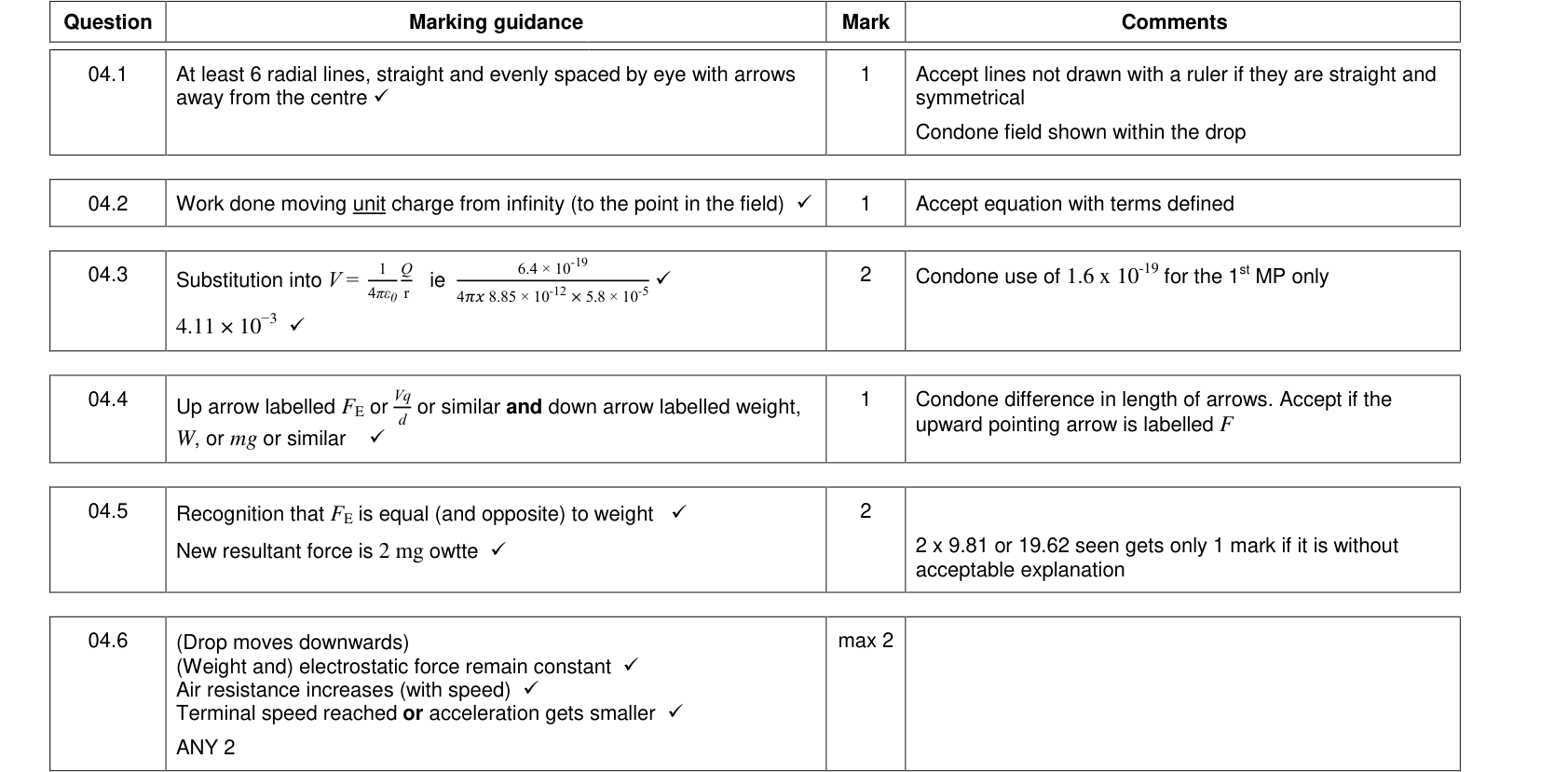
The electric potential $V$ at a point is the work done per unit charge in bringing a small positive test charge from infinity to that point.
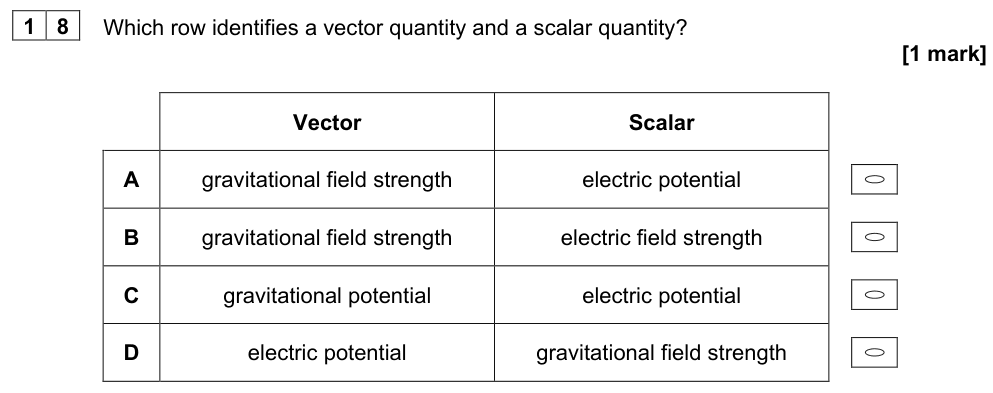
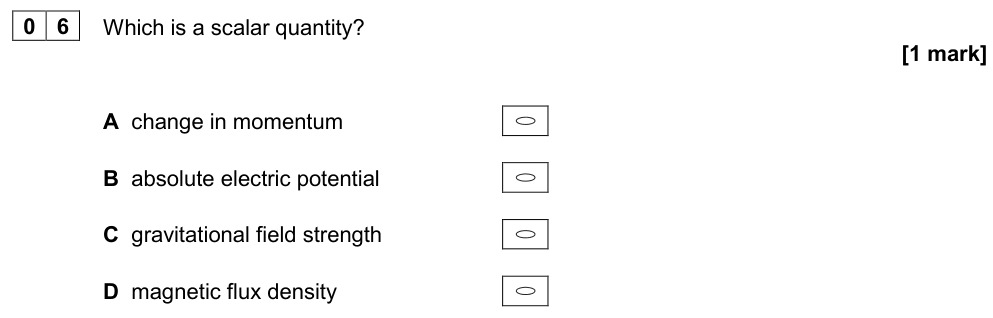
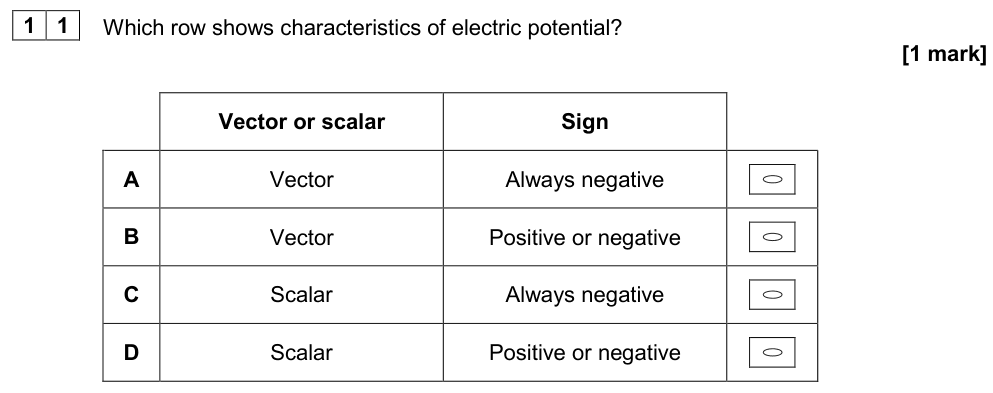
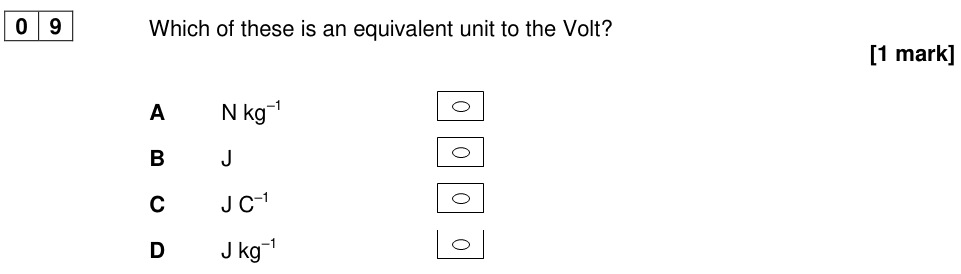
Unit: volt (V) = J C⁻¹. Electric potential is a scalar.
- The zero of potential is at infinity.
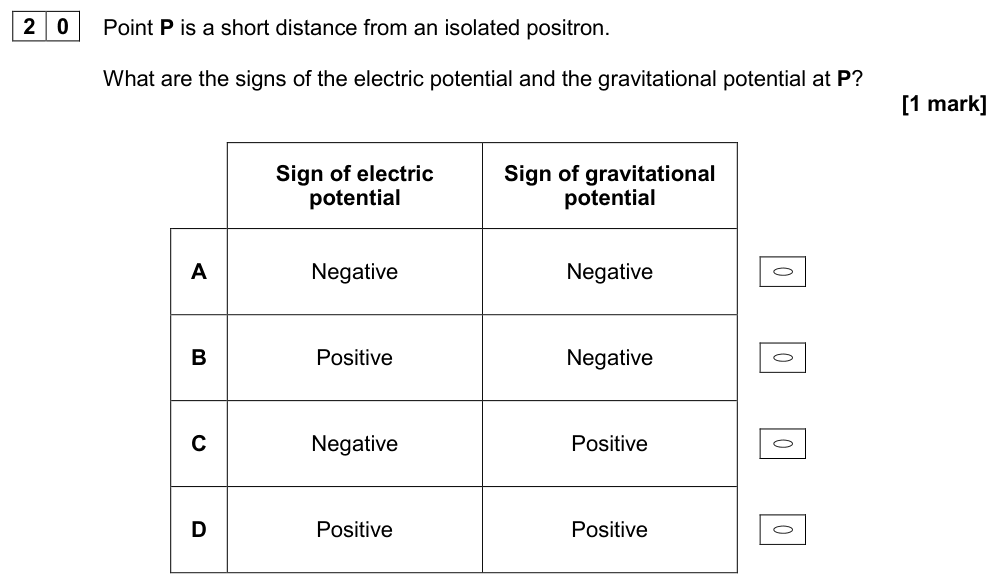
- Near a positive charge, work must be done to push a positive test charge in against the repulsion, so the potential is positive.
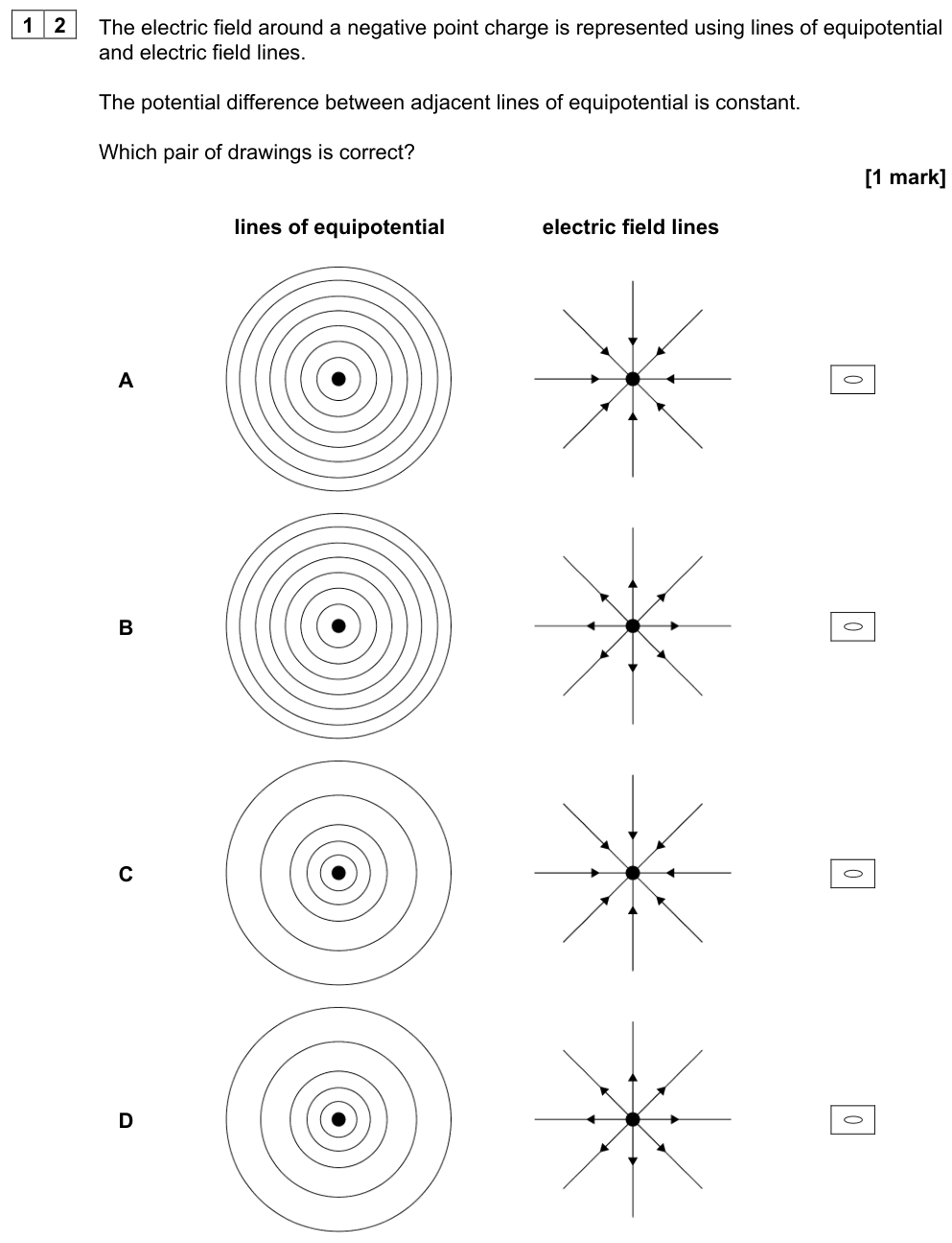
- Near a negative charge, the test charge is attracted (the field does the work), so the potential is negative.
Potential of a point charge
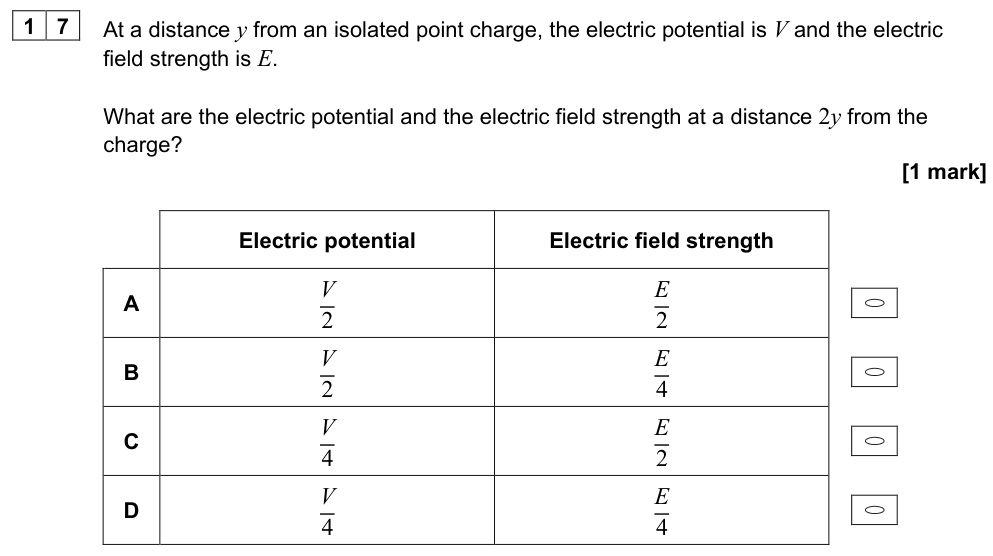
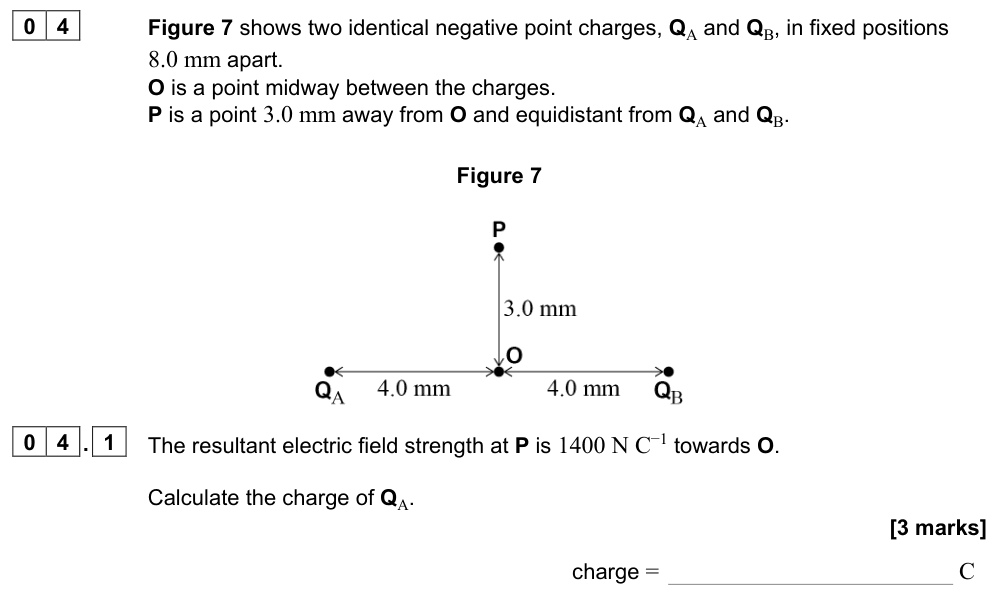
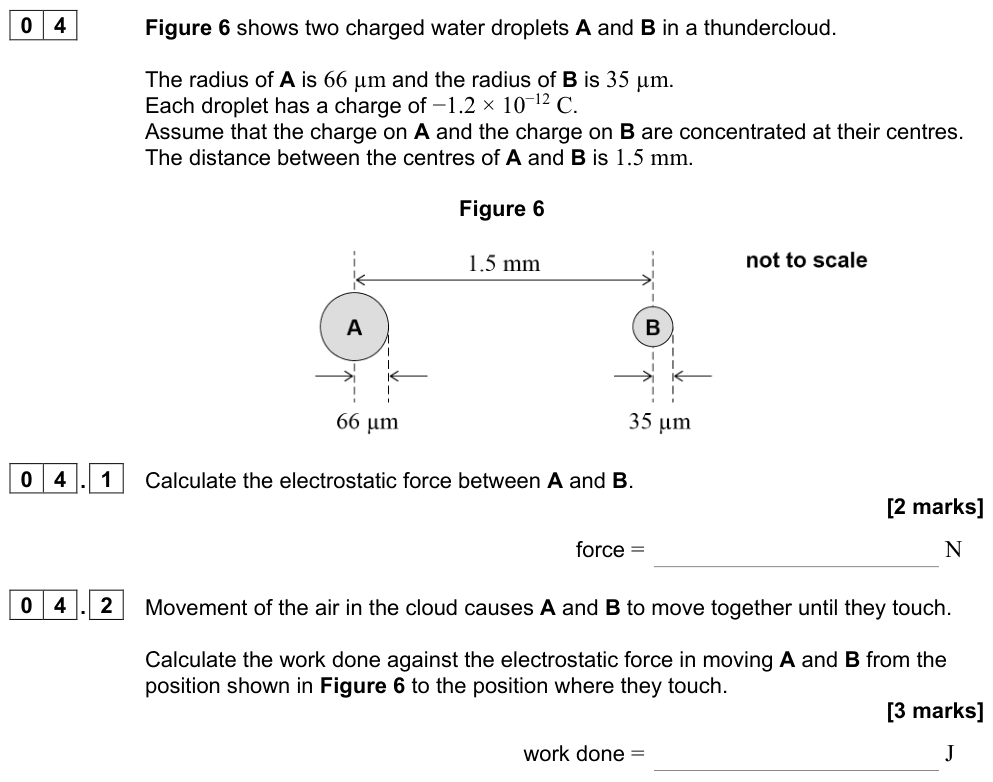
$$V = \frac{1}{4\pi\varepsilon_0}\frac{Q}{r}$$
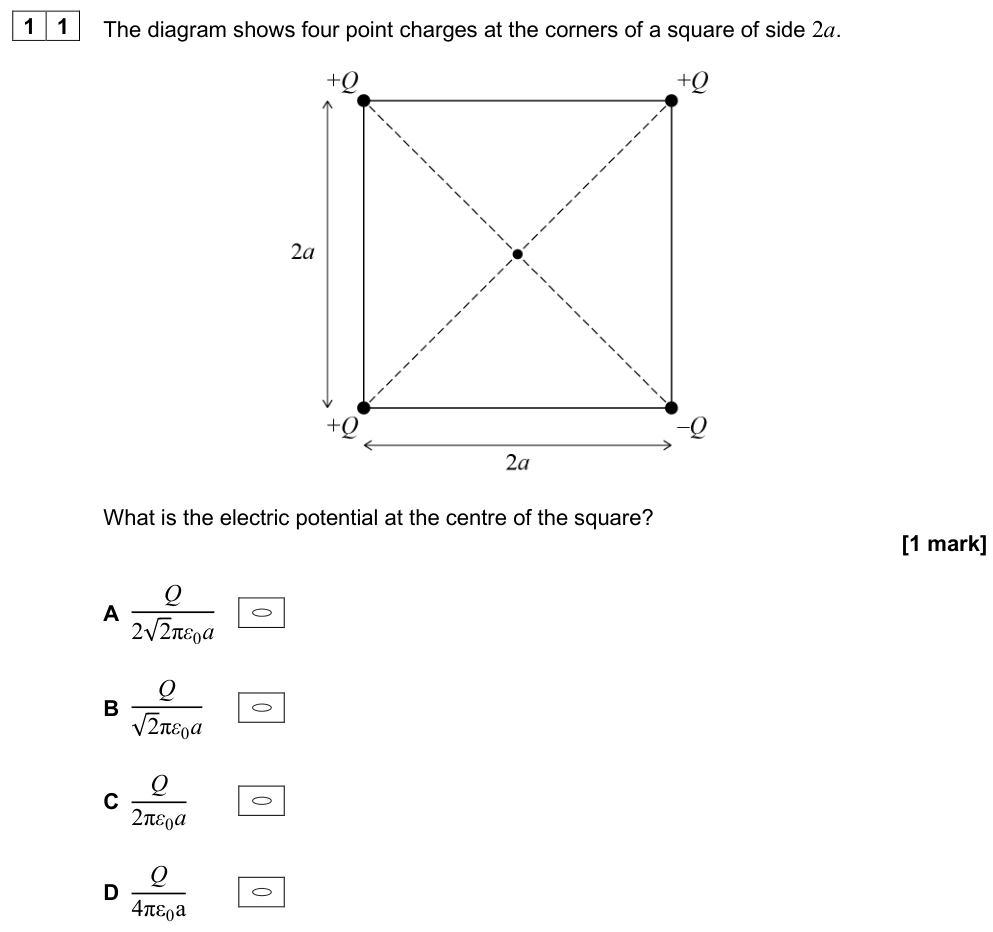
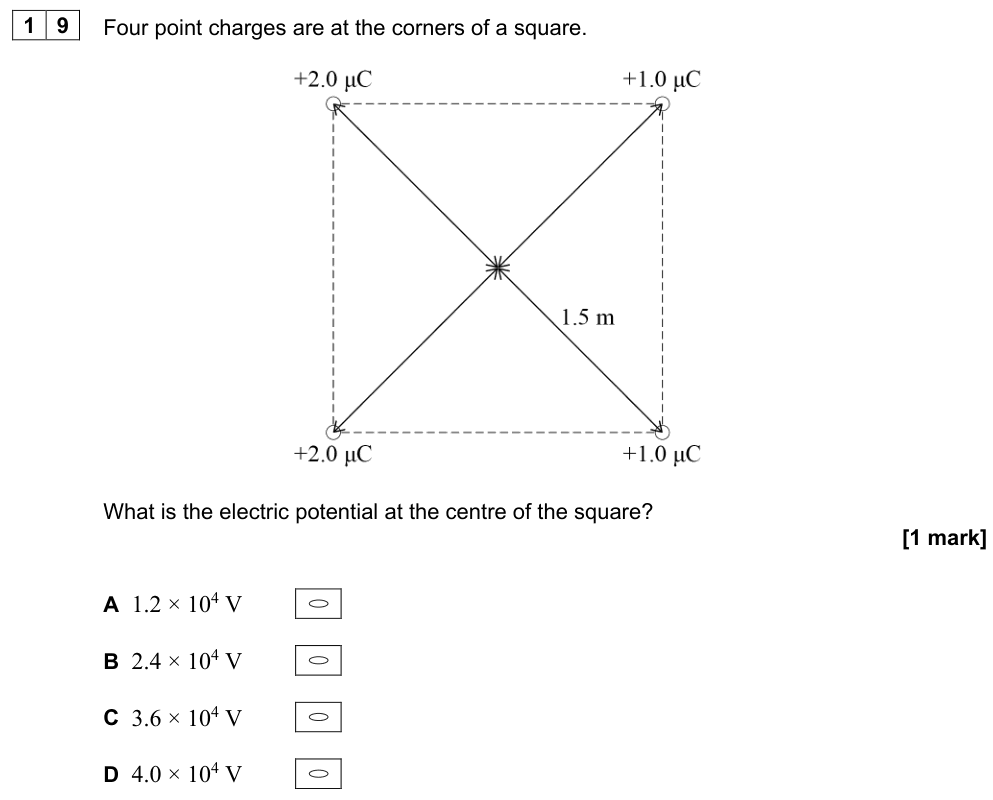
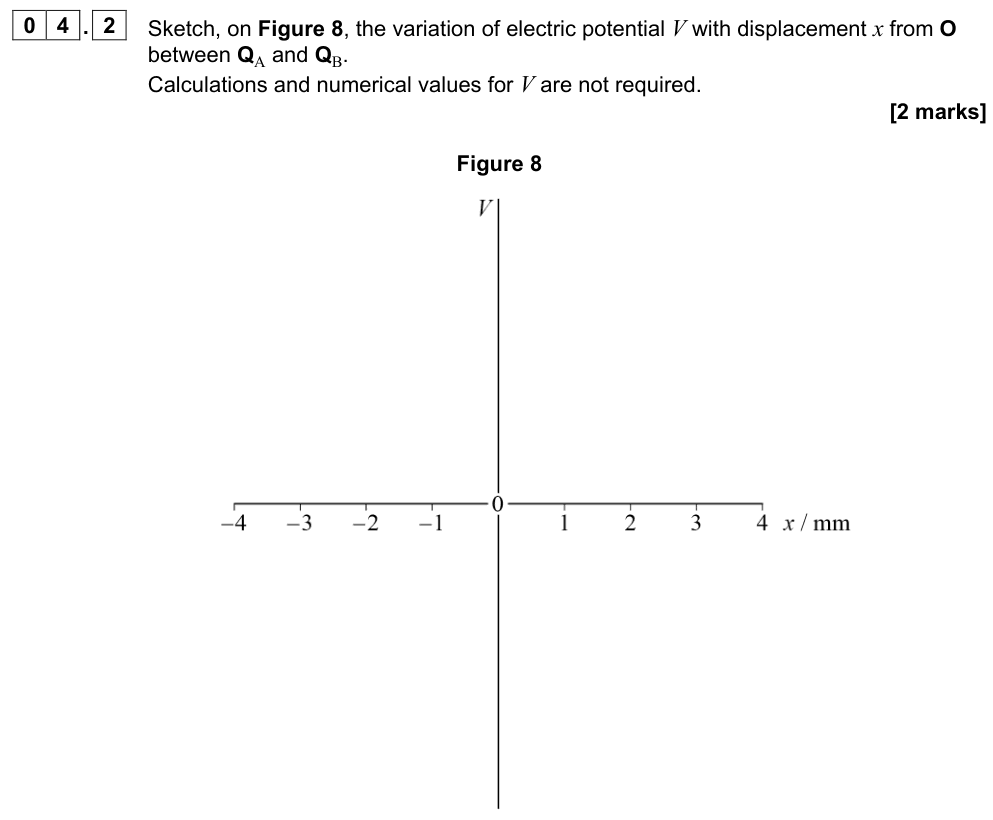
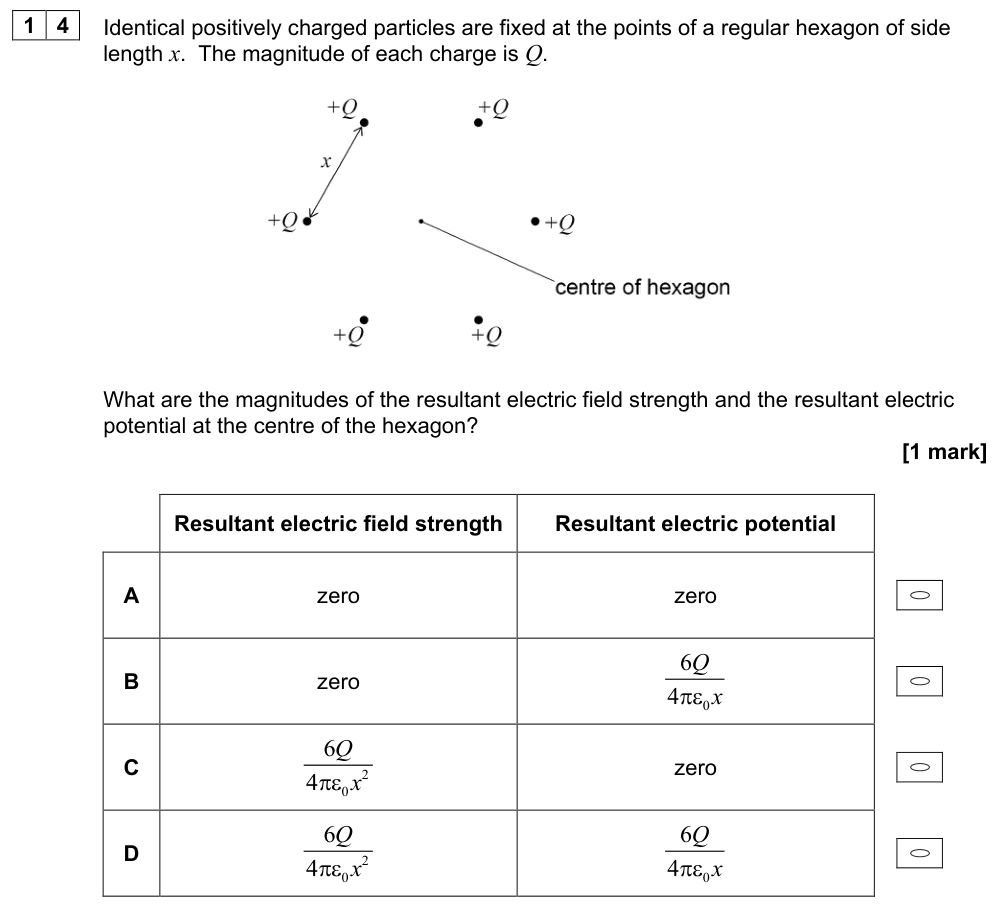
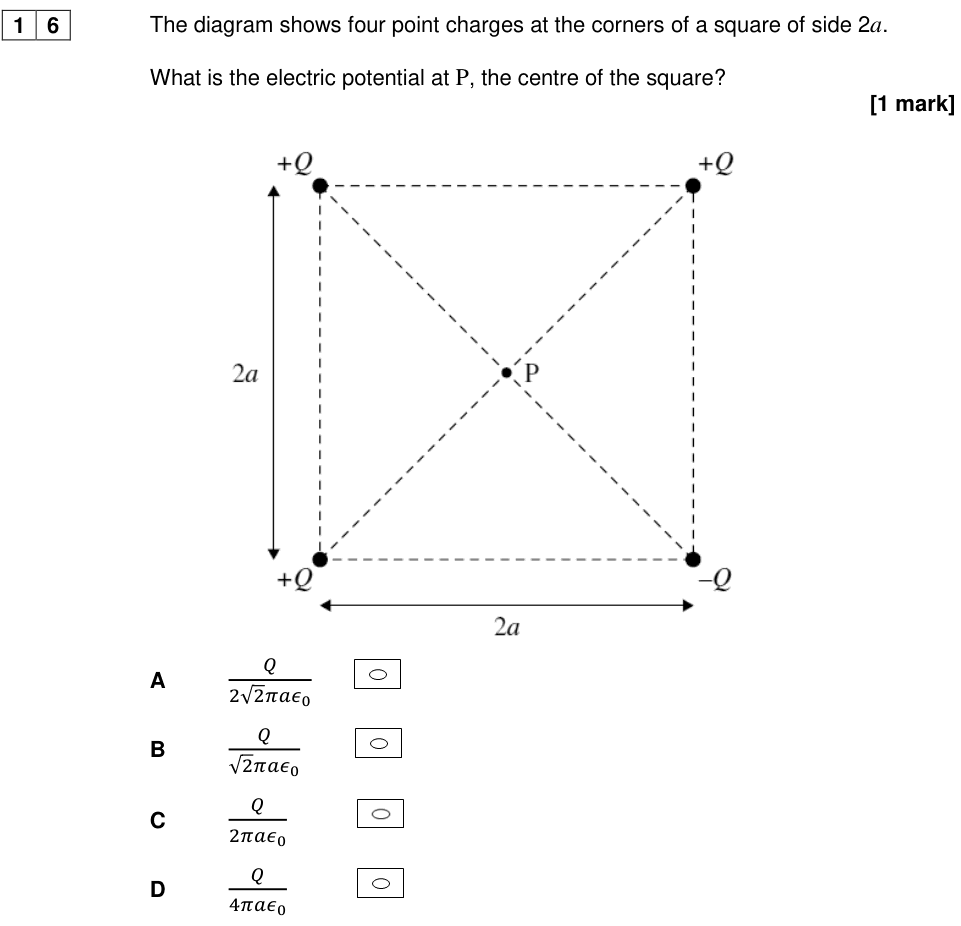
The sign of $V$ follows the sign of $Q$. Potentials from several charges add as scalars (just add them with their signs).
Potential difference and work done
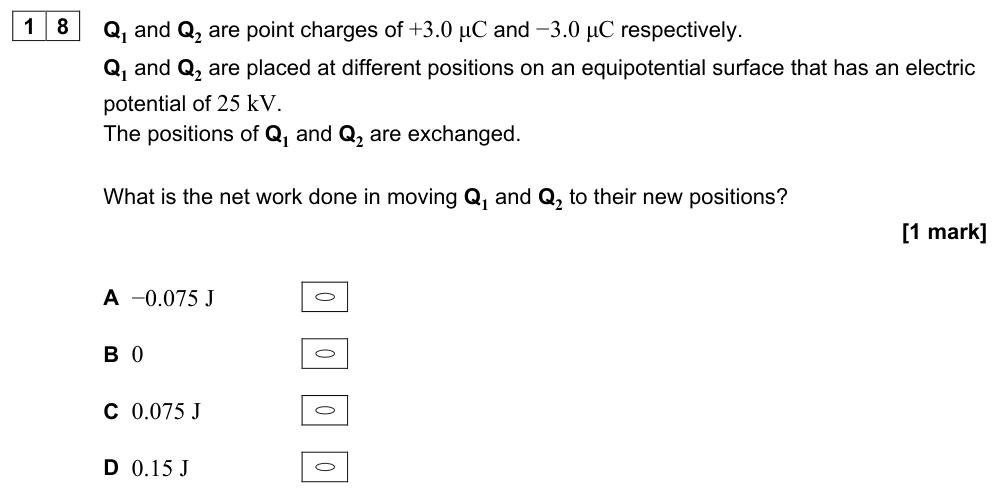
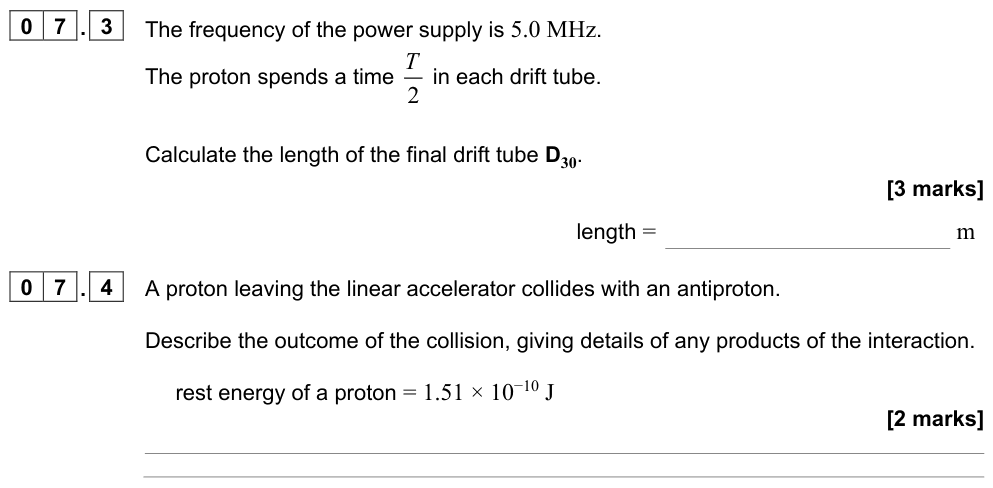
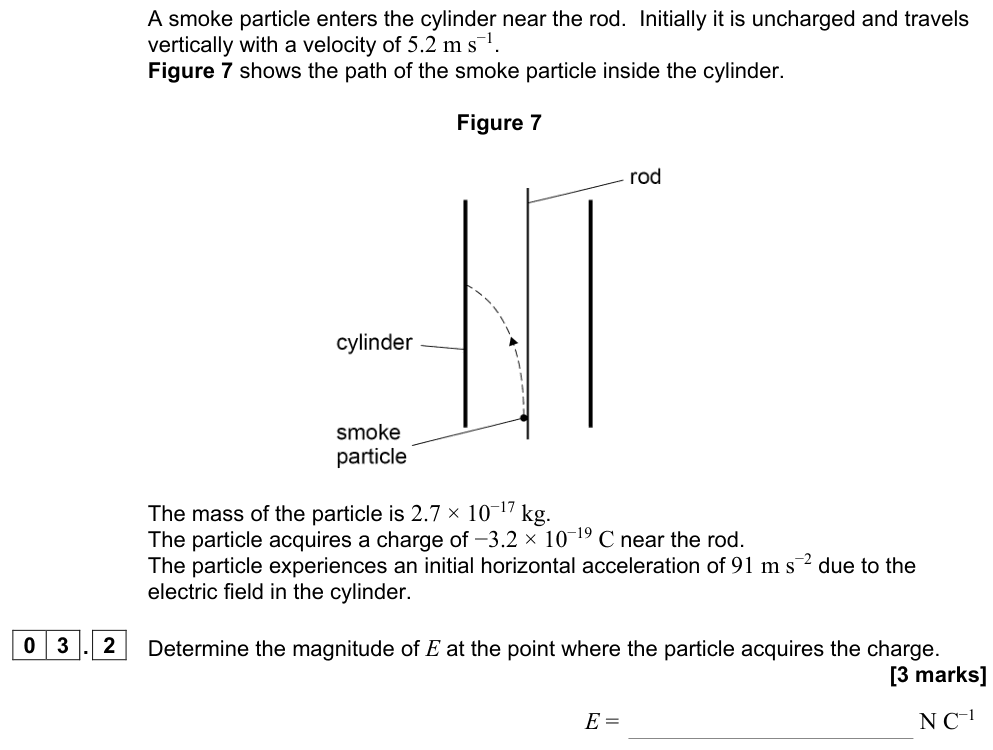
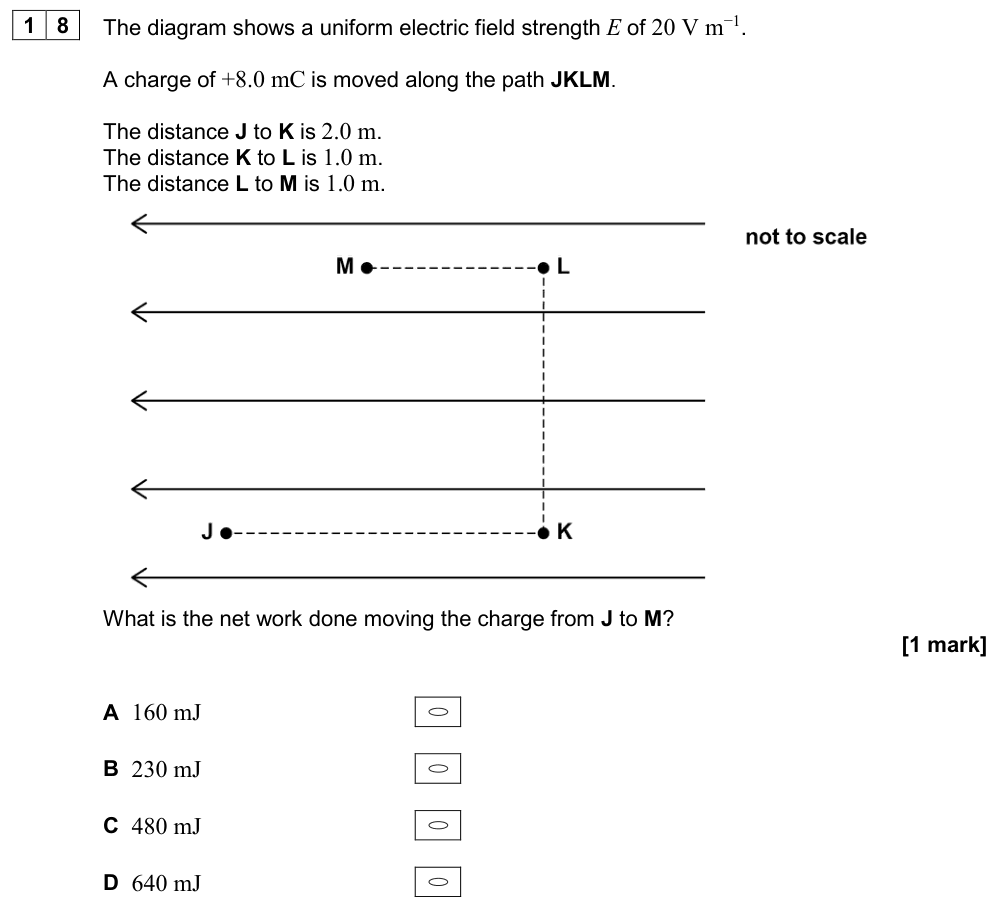
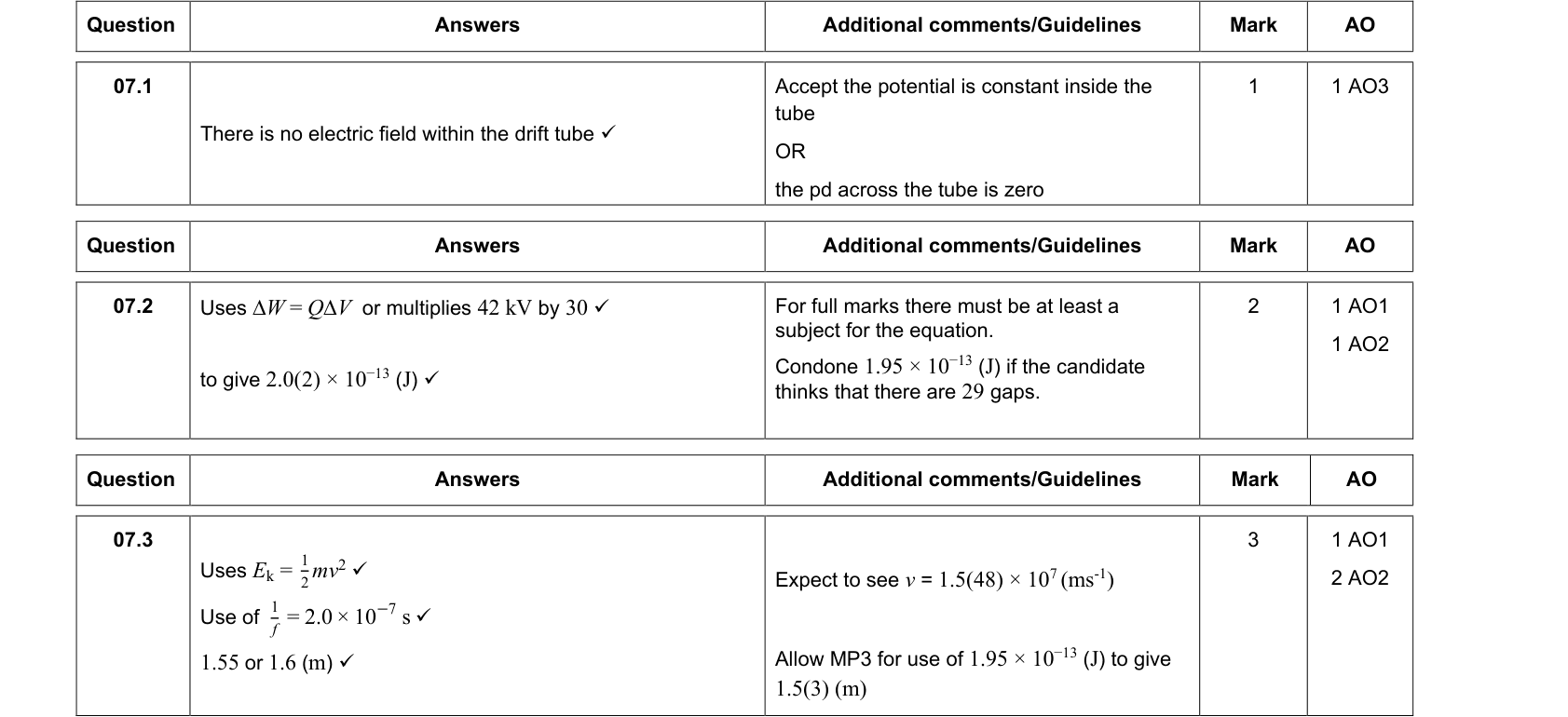
The potential difference between two points is the work done per unit charge moving between them. The work done moving a charge $Q$ through a potential difference $\Delta V$ is
$$\Delta W = Q\Delta V$$
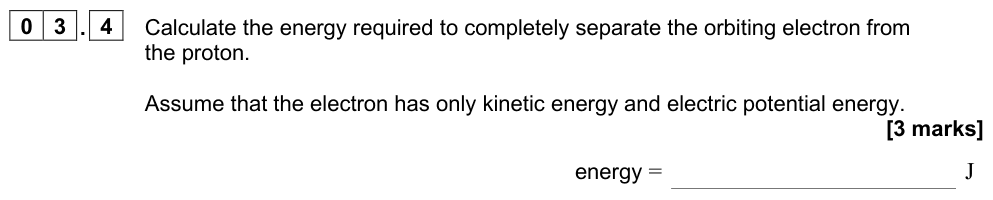
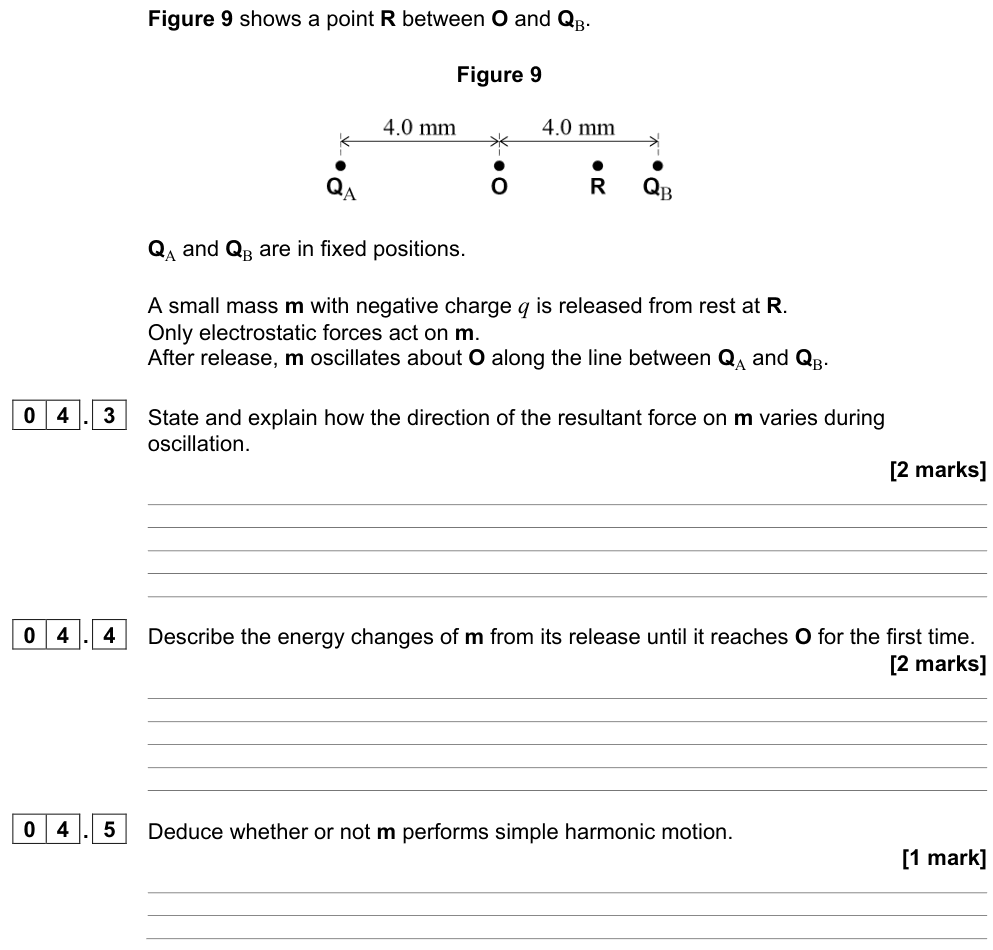
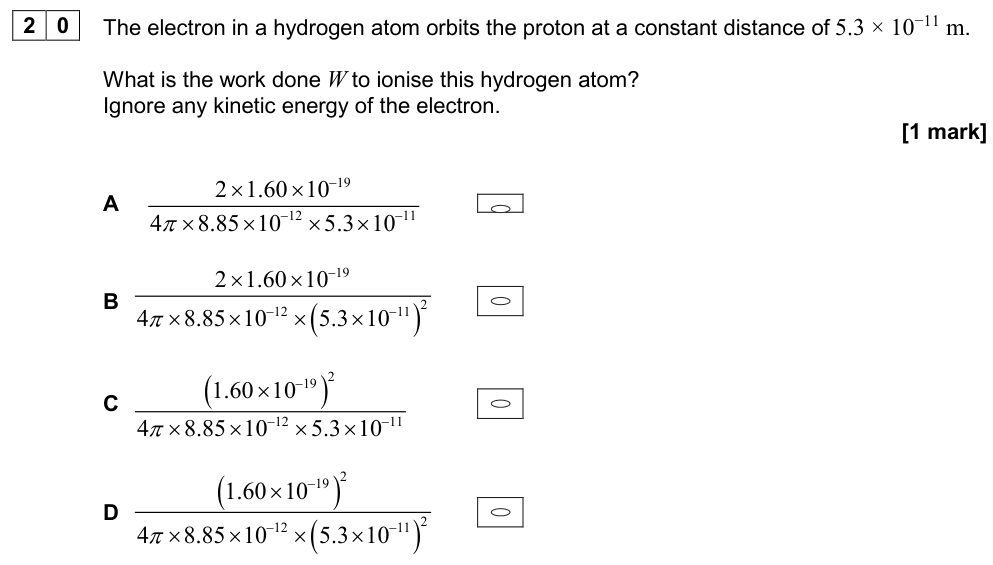
The electric potential energy of a charge $q$ at a point of potential $V$ is $E_p = qV$. For two point charges,
$$E_p = \frac{1}{4\pi\varepsilon_0}\frac{Q_1Q_2}{r}$$
(positive for like charges, which repel; negative for unlike charges, which attract).
Worked example: work to bring charges together
How much work is needed to bring a proton from infinity to $1.0 \times 10^{-14}$ m from a gold nucleus ($Z = 79$)?
$V = \dfrac{8.99 \times 10^{9} \times 79 \times 1.60 \times 10^{-19}}{1.0 \times 10^{-14}} = 1.14 \times 10^{7}\ \text{V}$
$W = QV = 1.60 \times 10^{-19} \times 1.14 \times 10^{7} = 1.8 \times 10^{-12}\ \text{J} \approx 11\ \text{MeV}$.
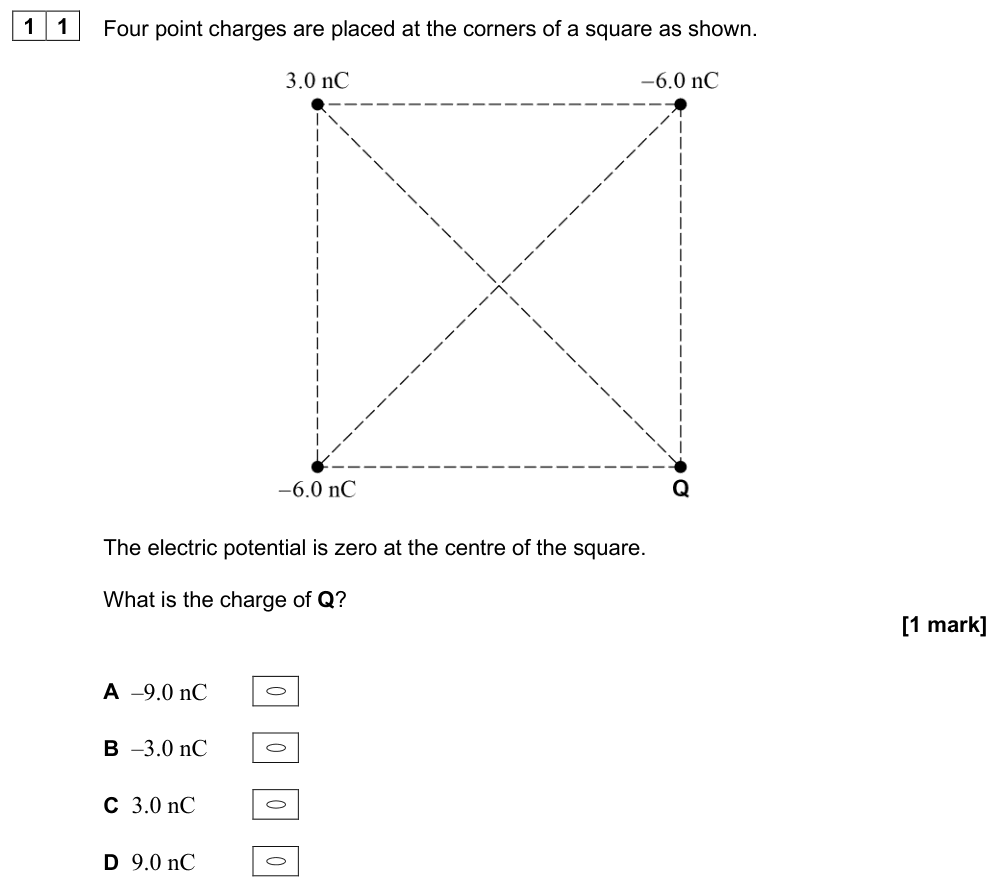
Worked example: potential at the centre of a square
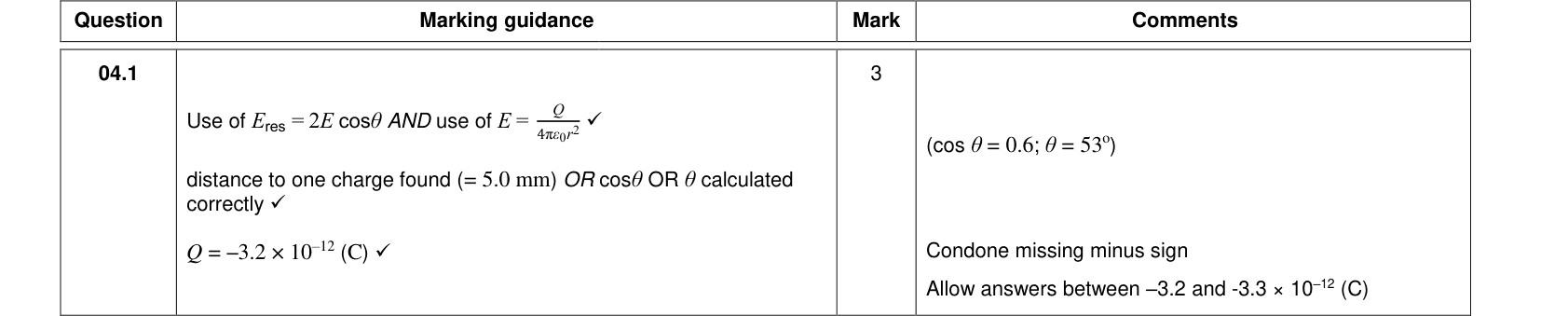
Charges of +2.0 nC, +2.0 nC, −2.0 nC and +2.0 nC sit at the corners of a square, each 0.10 m from the centre. The potentials add as scalars: $V = 8.99 \times 10^{9} \times \dfrac{(2 + 2 - 2 + 2) \times 10^{-9}}{0.10} = 360\ \text{V}$.
(The electric field at the centre must be found by adding vectors, which is different.)
Equipotential surfaces
Equipotential
An equipotential surface joins points at the same electric potential. No work is done moving a charge along an equipotential ($\Delta V = 0$).
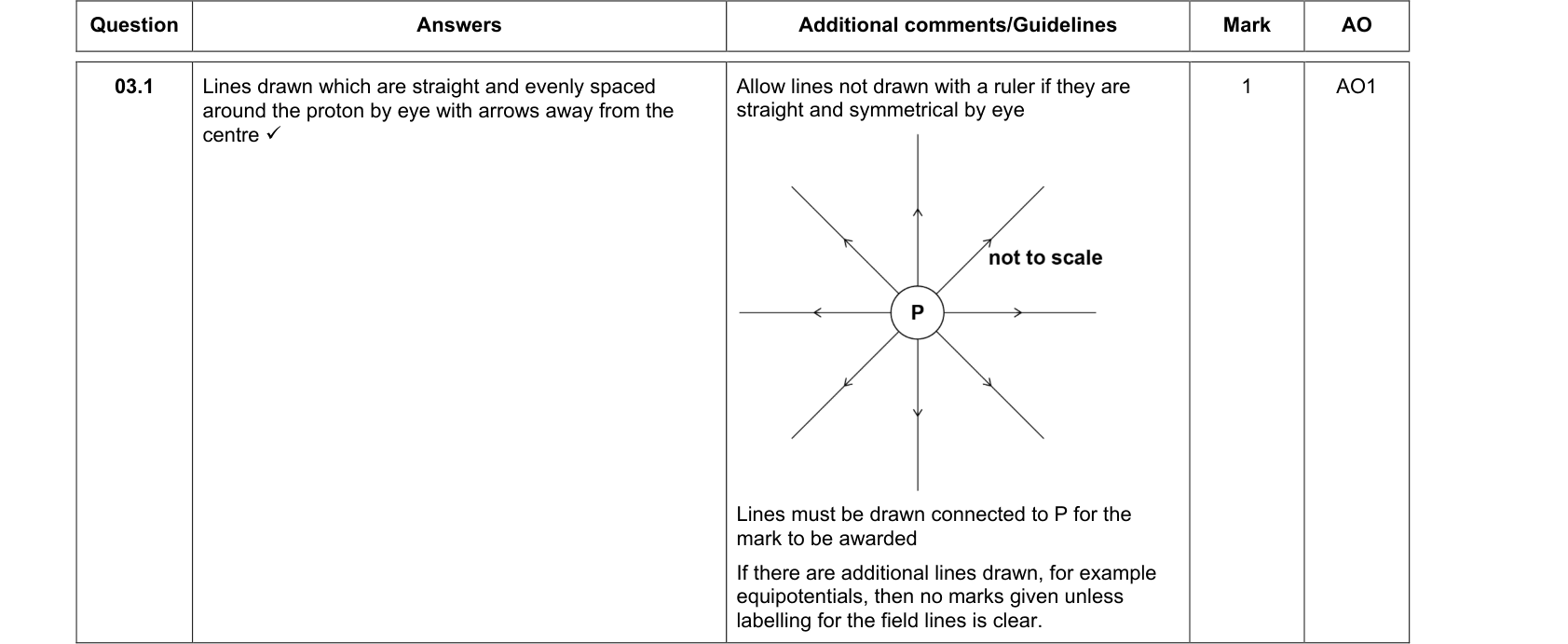
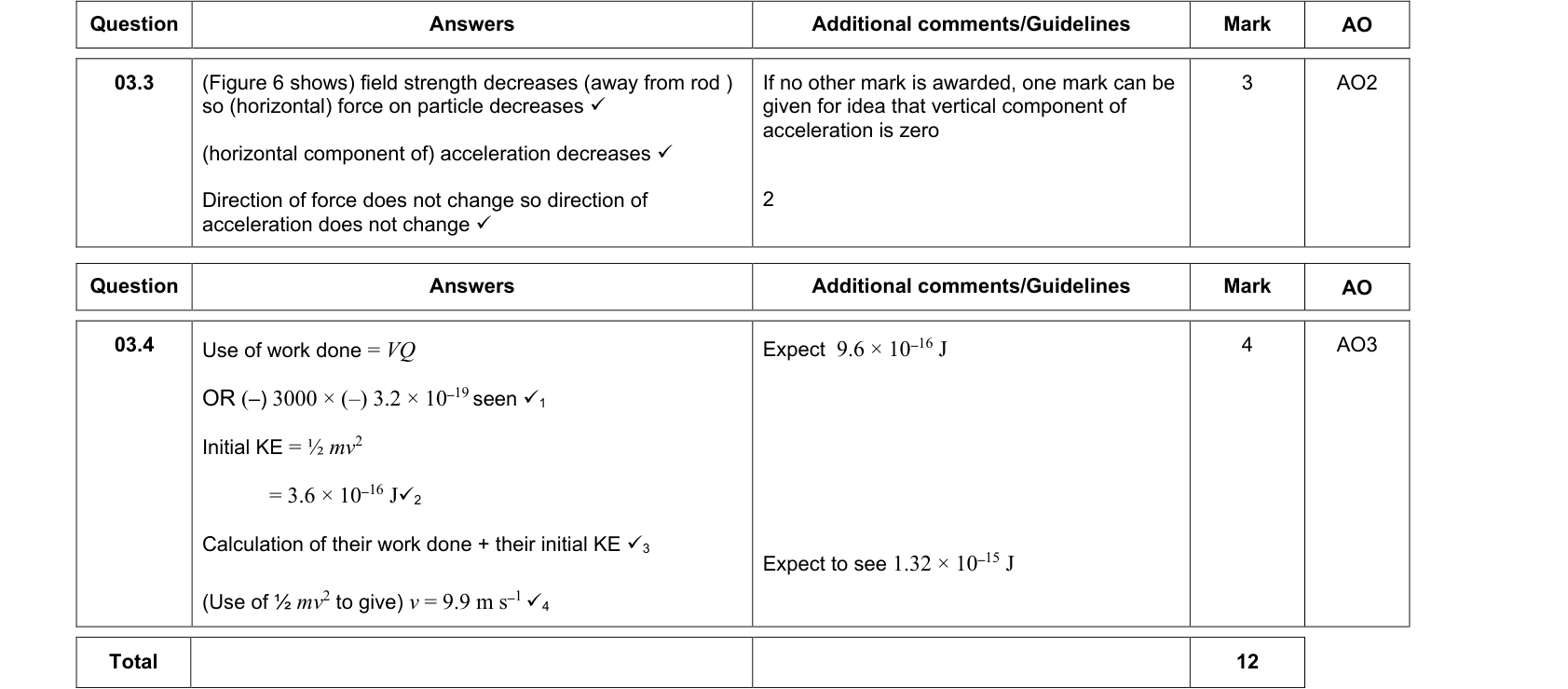
- Equipotentials are always perpendicular to field lines.
- Around a point charge they are concentric spheres, getting further apart for equal steps of $V$ further out.
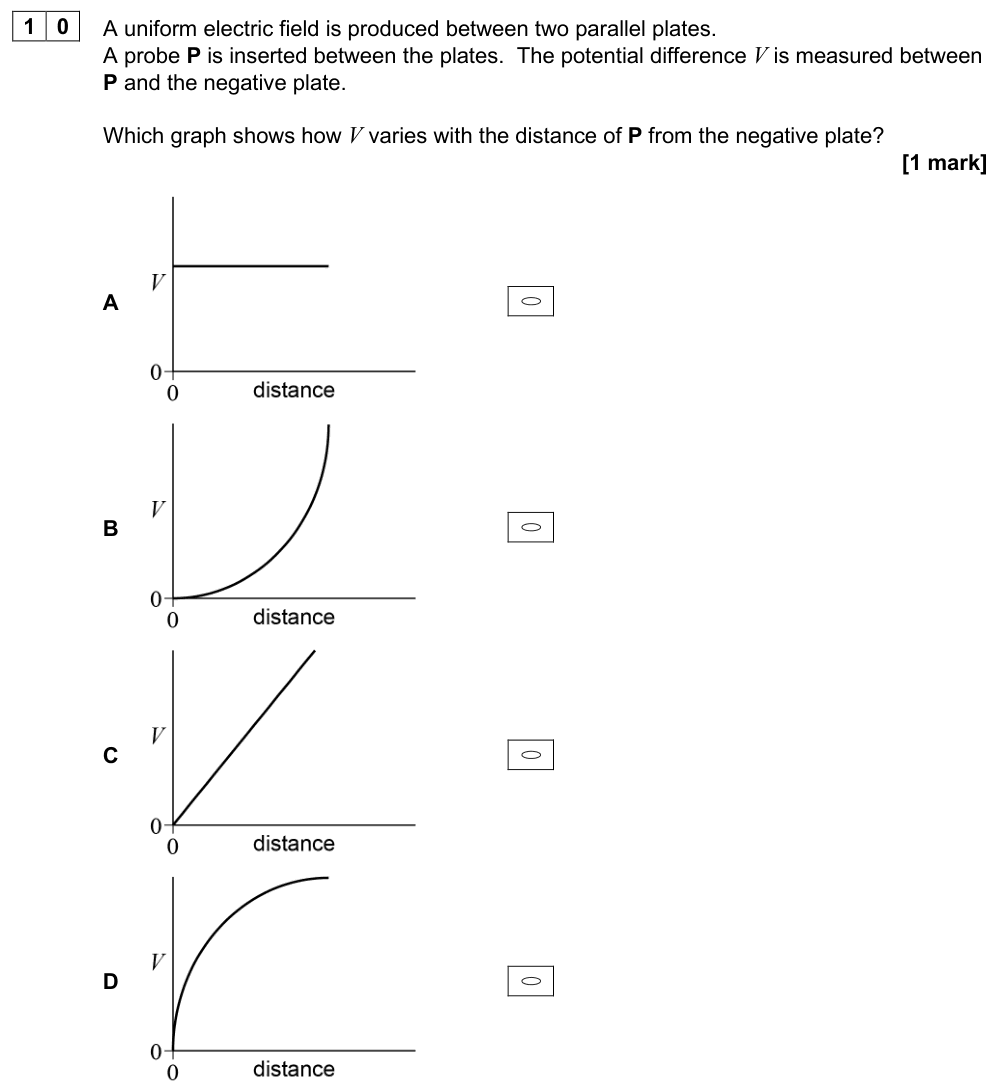
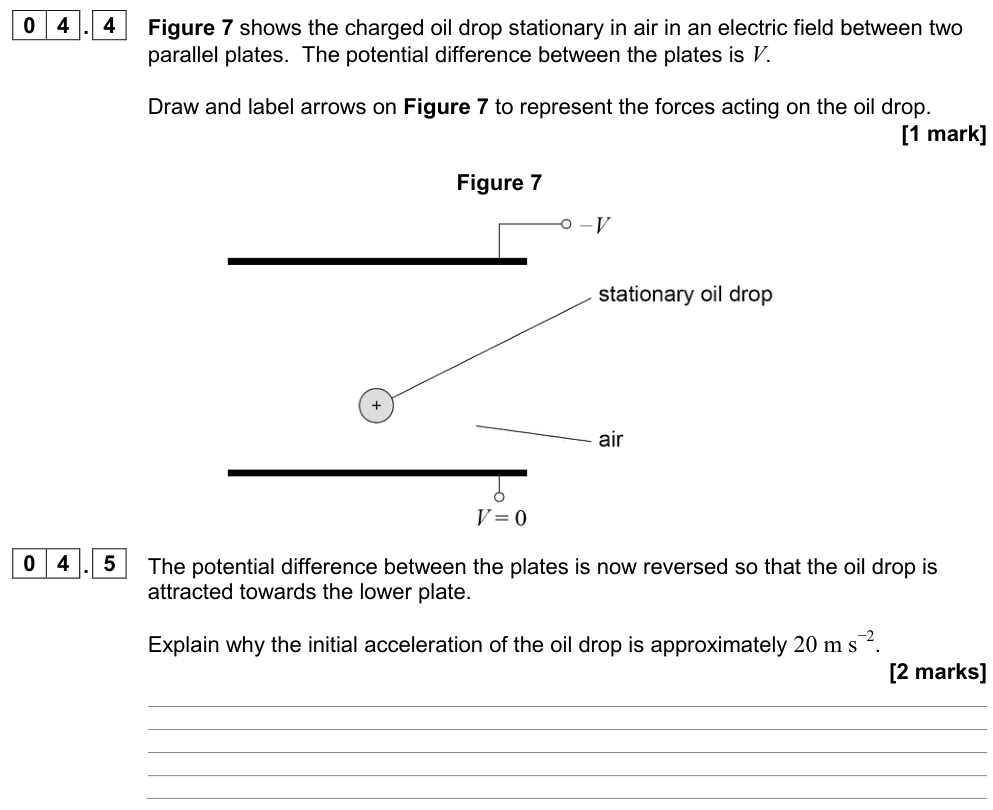
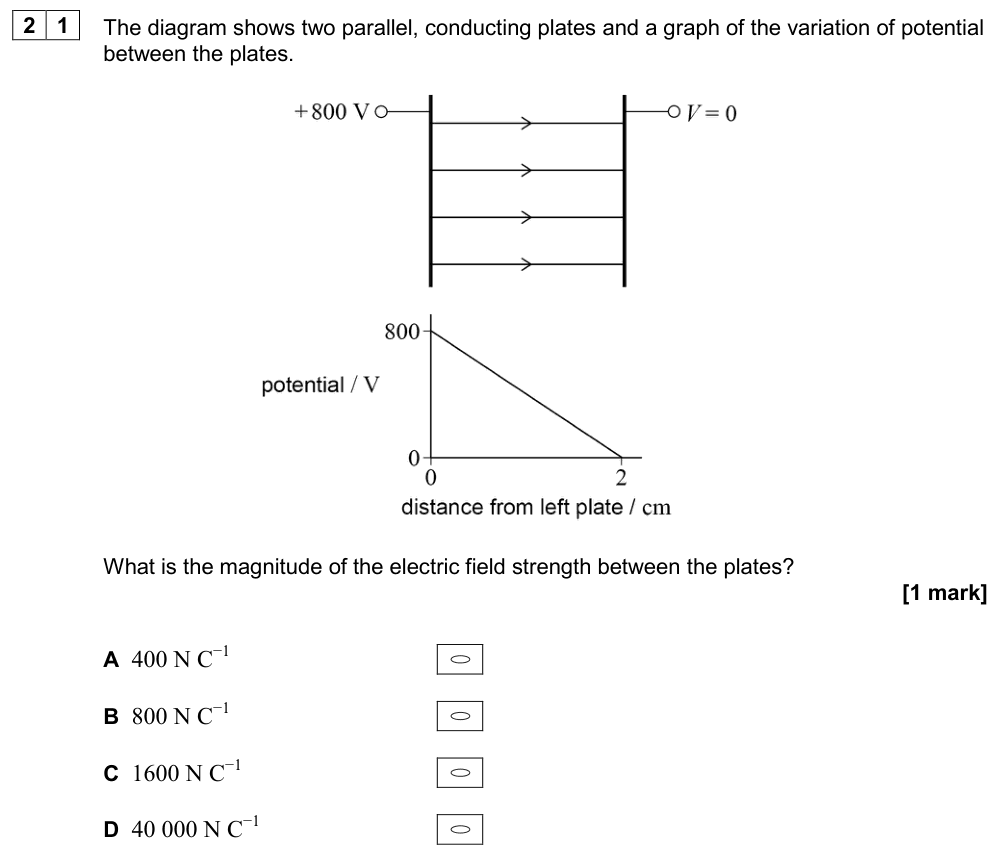
- Between parallel plates they are parallel planes, equally spaced, parallel to the plates.
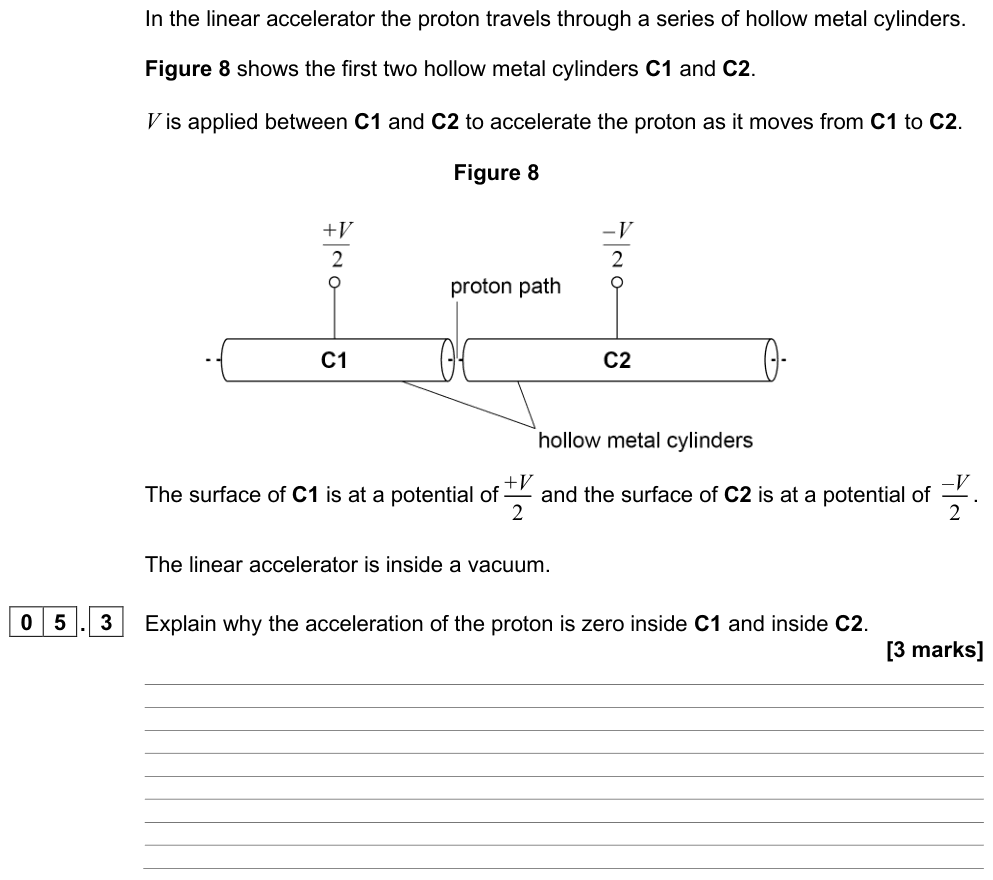
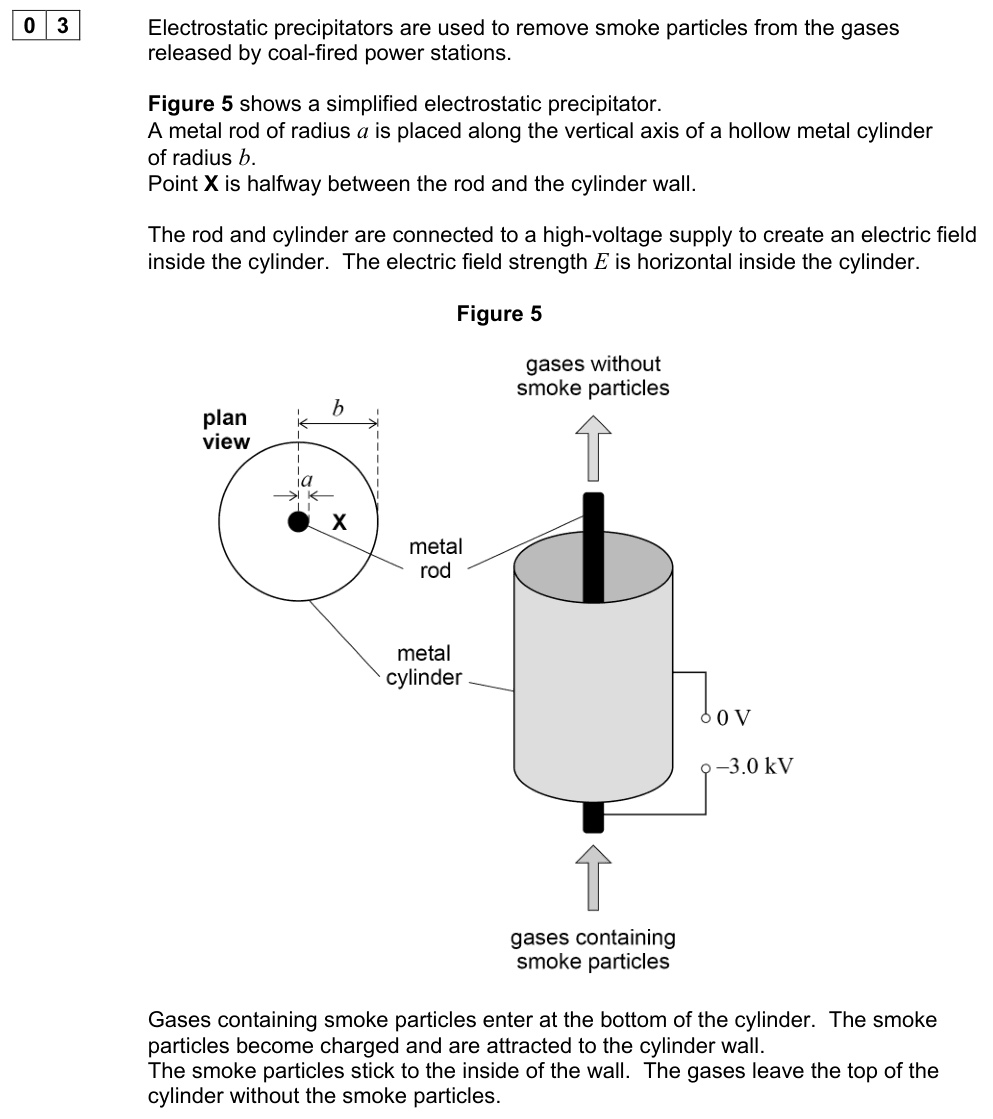
- The surface of a conductor is an equipotential.
Graphs of E and V against r
For a positive point charge:
- $E \propto 1/r^2$ (always positive, falls steeply);
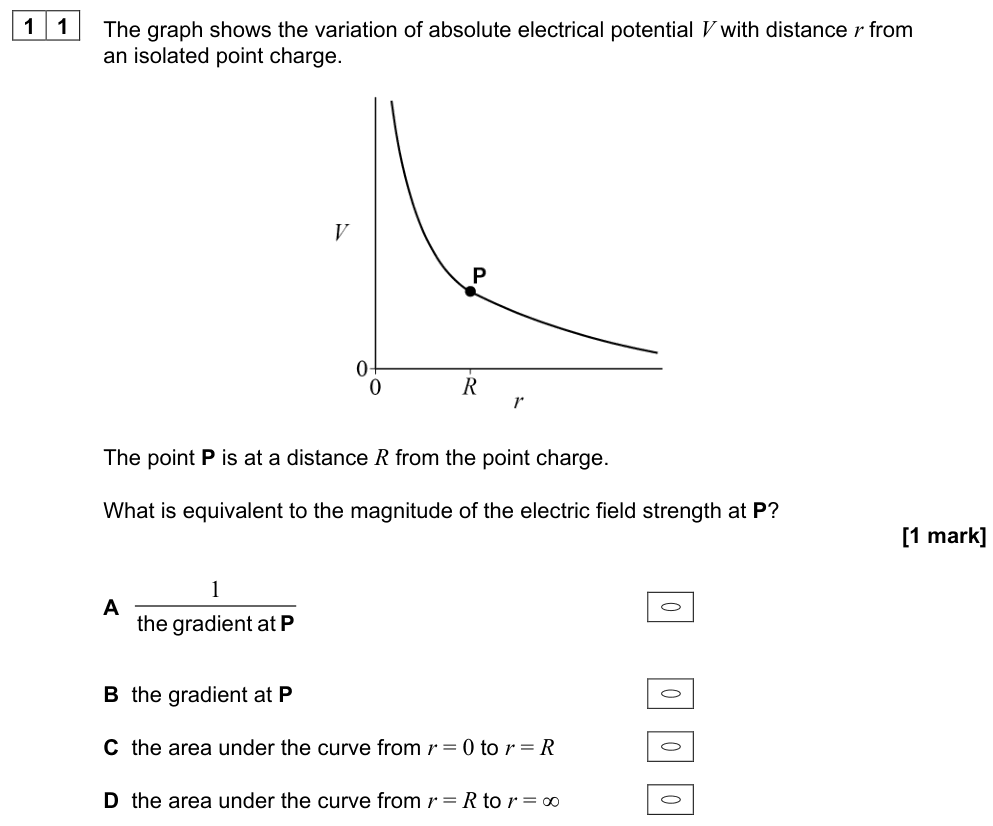
- $V \propto 1/r$ (positive, falls less steeply, approaching zero).
For a negative charge, $V$ is negative and rises towards zero.
Linking E and V
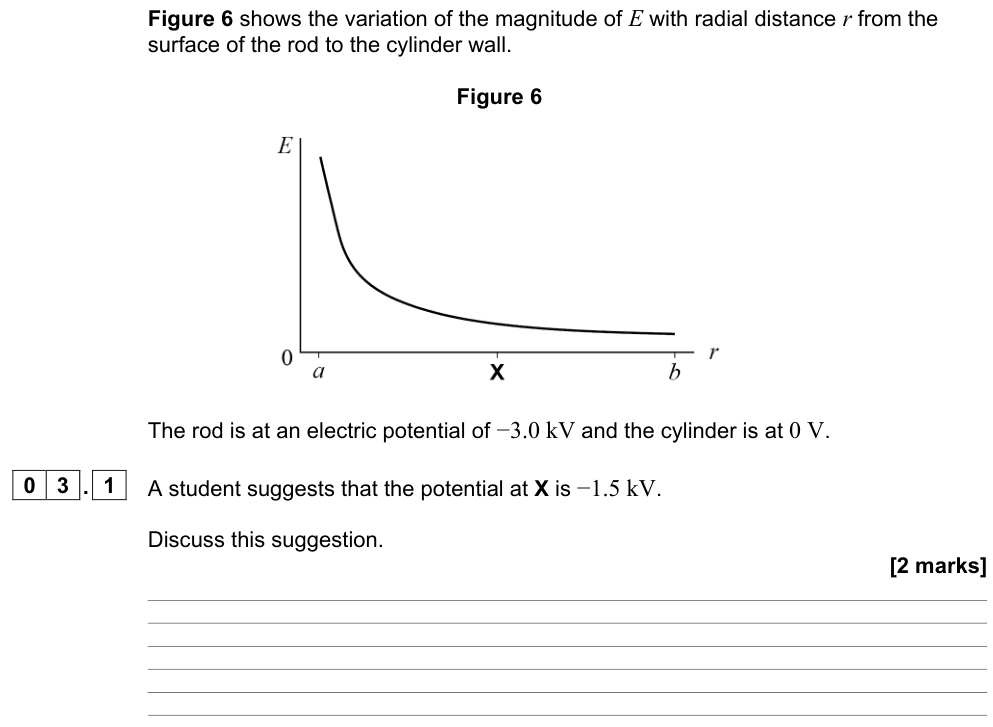
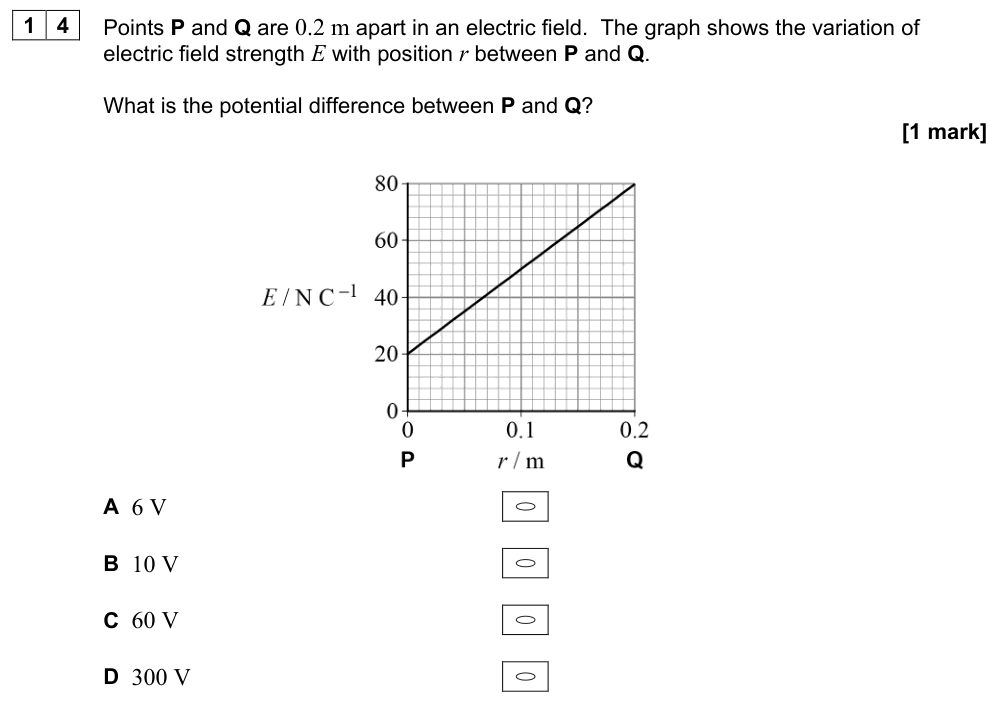
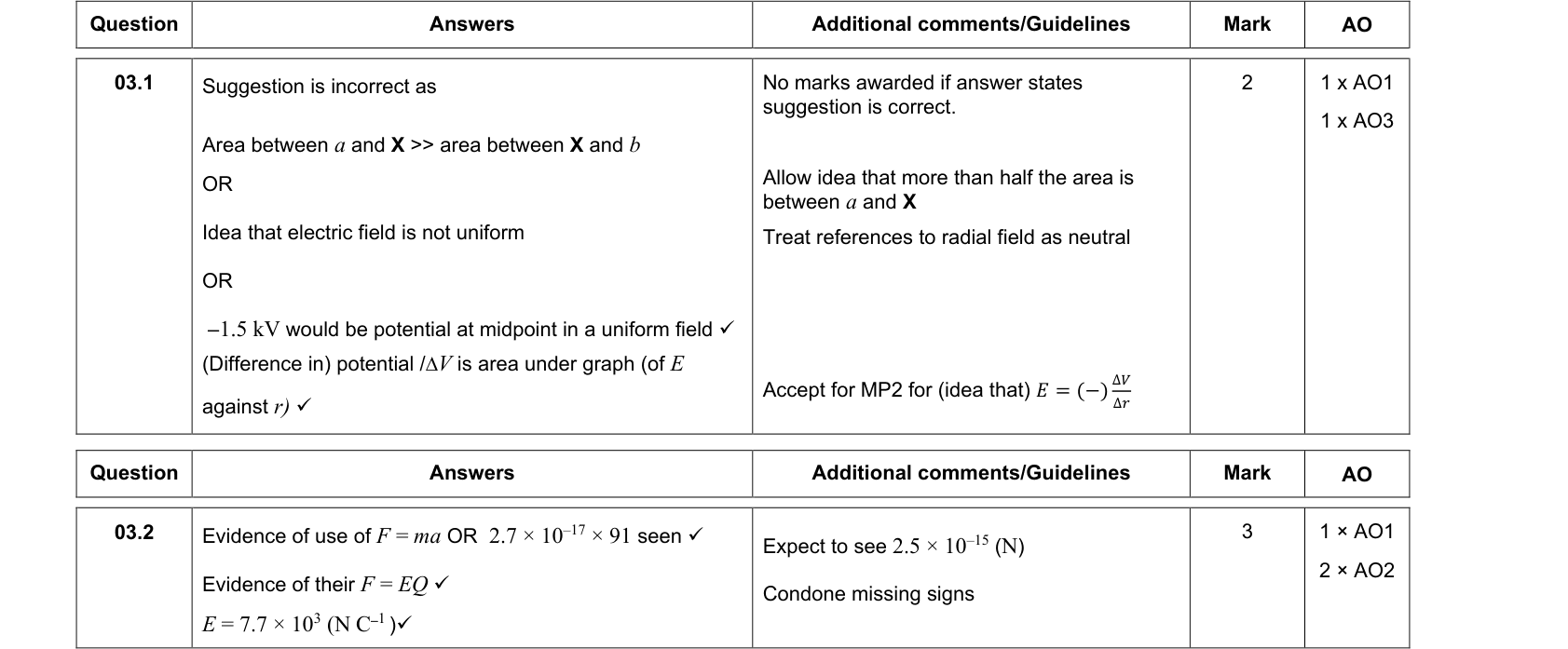
$$E = -\frac{\Delta V}{\Delta r}$$
The field strength is the negative of the potential gradient: the field points in the direction of decreasing potential. On a $V$–$r$ graph, $E$ is minus the gradient of the tangent. (The specification writes the magnitude, $E = \Delta V/\Delta r$.)
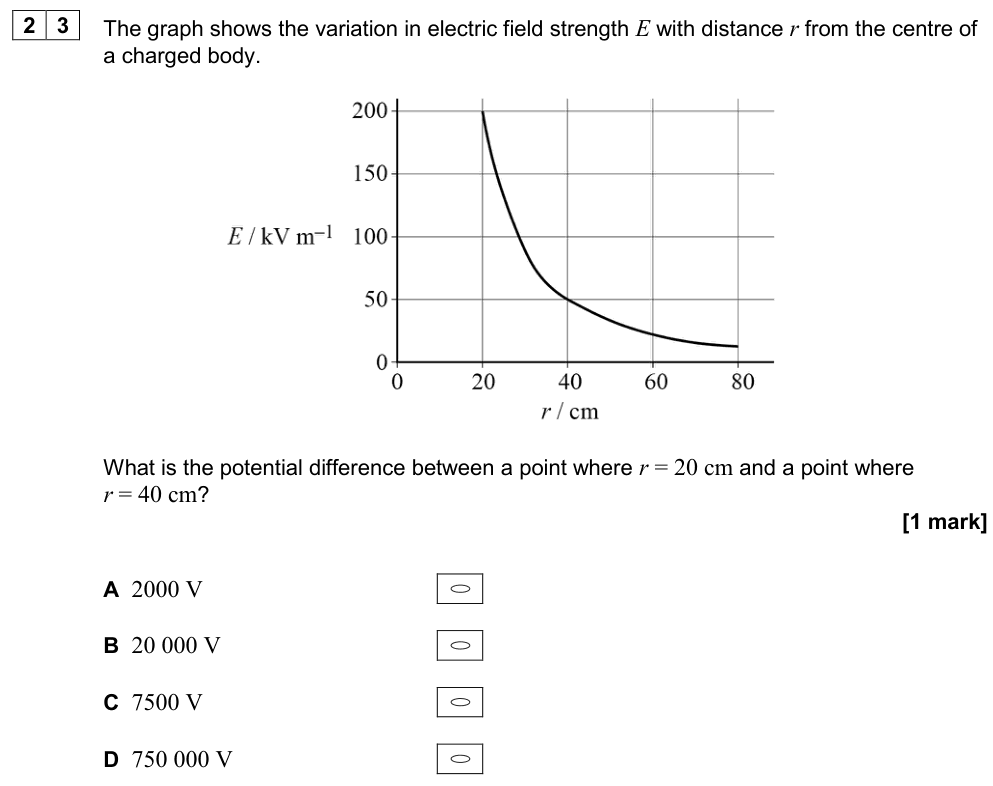
The area under a graph of $E$ against $r$ between two points equals the potential difference between them.
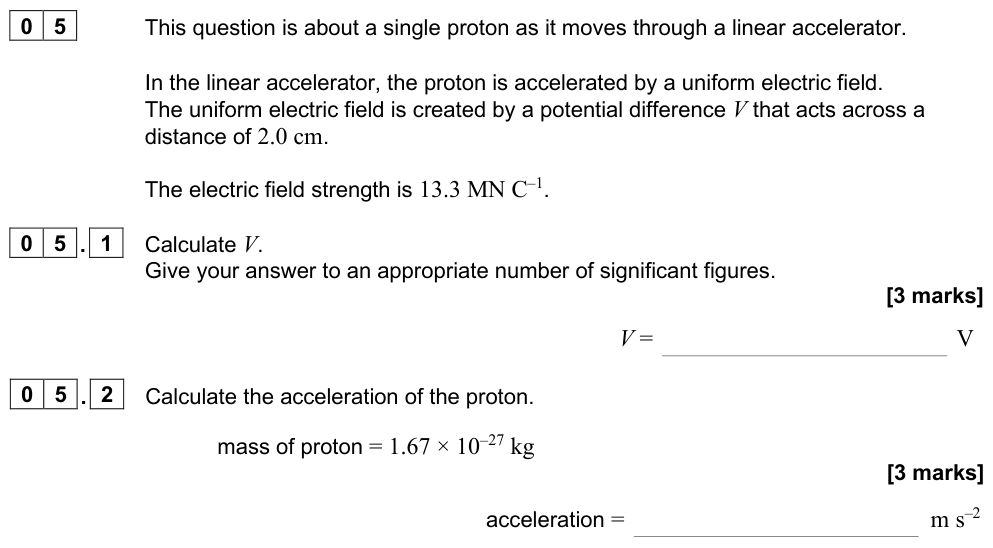
In a uniform field the gradient is constant, so $E = V/d$ as found in the previous chapter.
Worked example: from a graph
On a graph of $V$ against $r$ near a charged sphere, the tangent at $r = 0.25$ m falls from 1200 V to 0 over 0.40 m. $E = 1200/0.40 = 3.0 \times 10^{3}\ \text{V m}^{-1}$, pointing away from the (positive) sphere.
Closest approach: an energy method
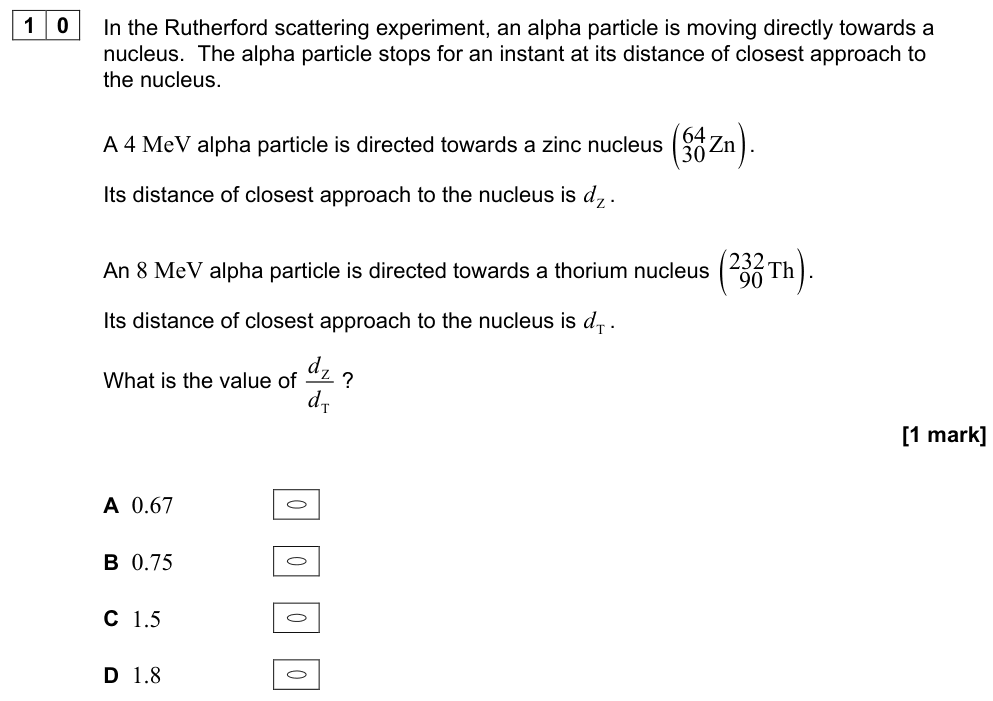
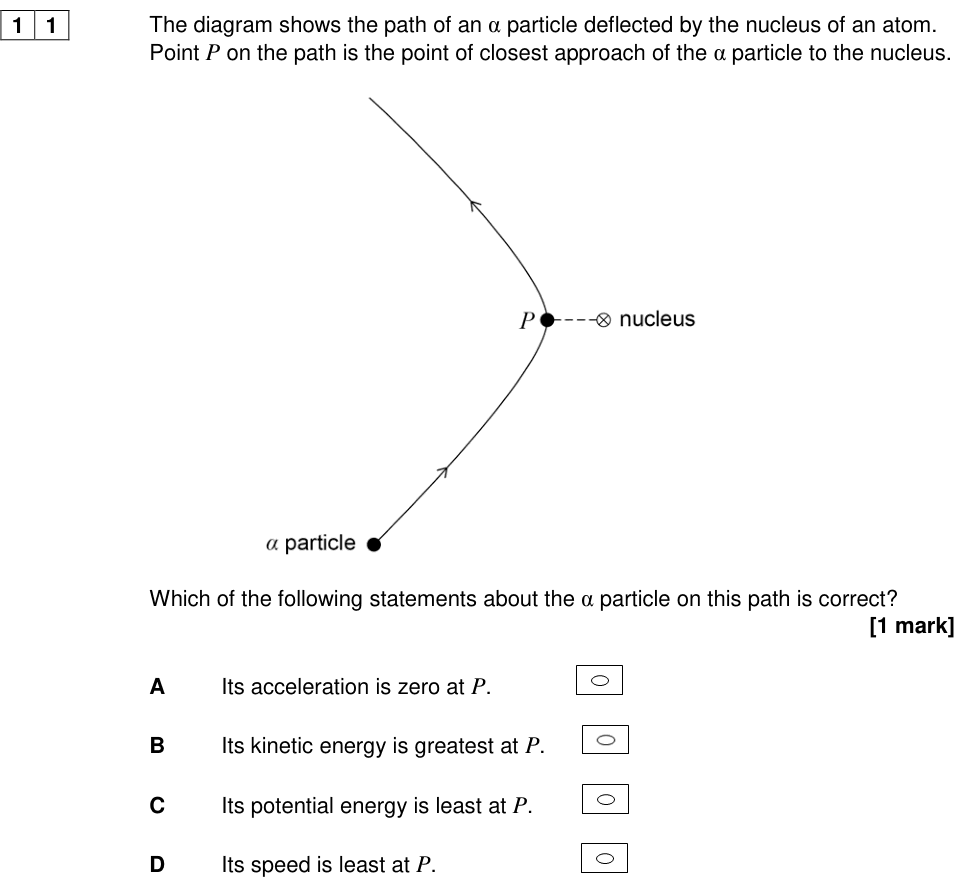
When a charged particle is fired directly at a nucleus, it slows down as its kinetic energy is converted into electric potential energy. At the distance of closest approach $d$ it is momentarily at rest, so
$$E_k = \frac{1}{4\pi\varepsilon_0}\frac{Qq}{d}$$
This gives an upper limit for the radius of the nucleus (see Unit 4, Radius of the nucleus).
Worked example
A 5.0 MeV alpha particle ($q = 2e$) is aimed at a gold nucleus ($Q = 79e$).
$d = \dfrac{8.99 \times 10^{9} \times 79 \times 2 \times (1.60 \times 10^{-19})^2}{5.0 \times 1.60 \times 10^{-13}} = 4.5 \times 10^{-14}\ \text{m}$.
Summary
- Potential: work done per unit positive charge bringing it from infinity; $V = Q/4\pi\varepsilon_0 r$; scalar; positive near + charges, negative near − charges.
- $\Delta W = Q\Delta V$; potentials add as scalars.
- Equipotentials: no work done along them; perpendicular to field lines.
- $E = -\Delta V/\Delta r$; area under $E$–$r$ = $\Delta V$.
- Closest approach: $E_k = Qq/4\pi\varepsilon_0 d$.