What a capacitor does
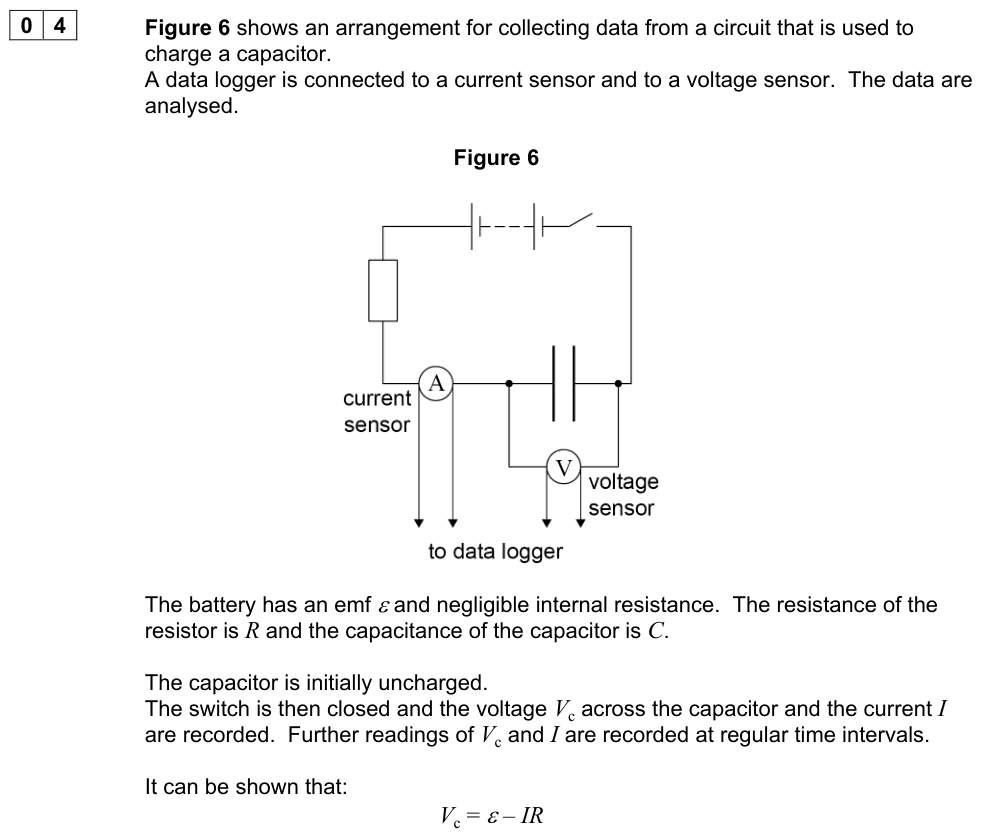
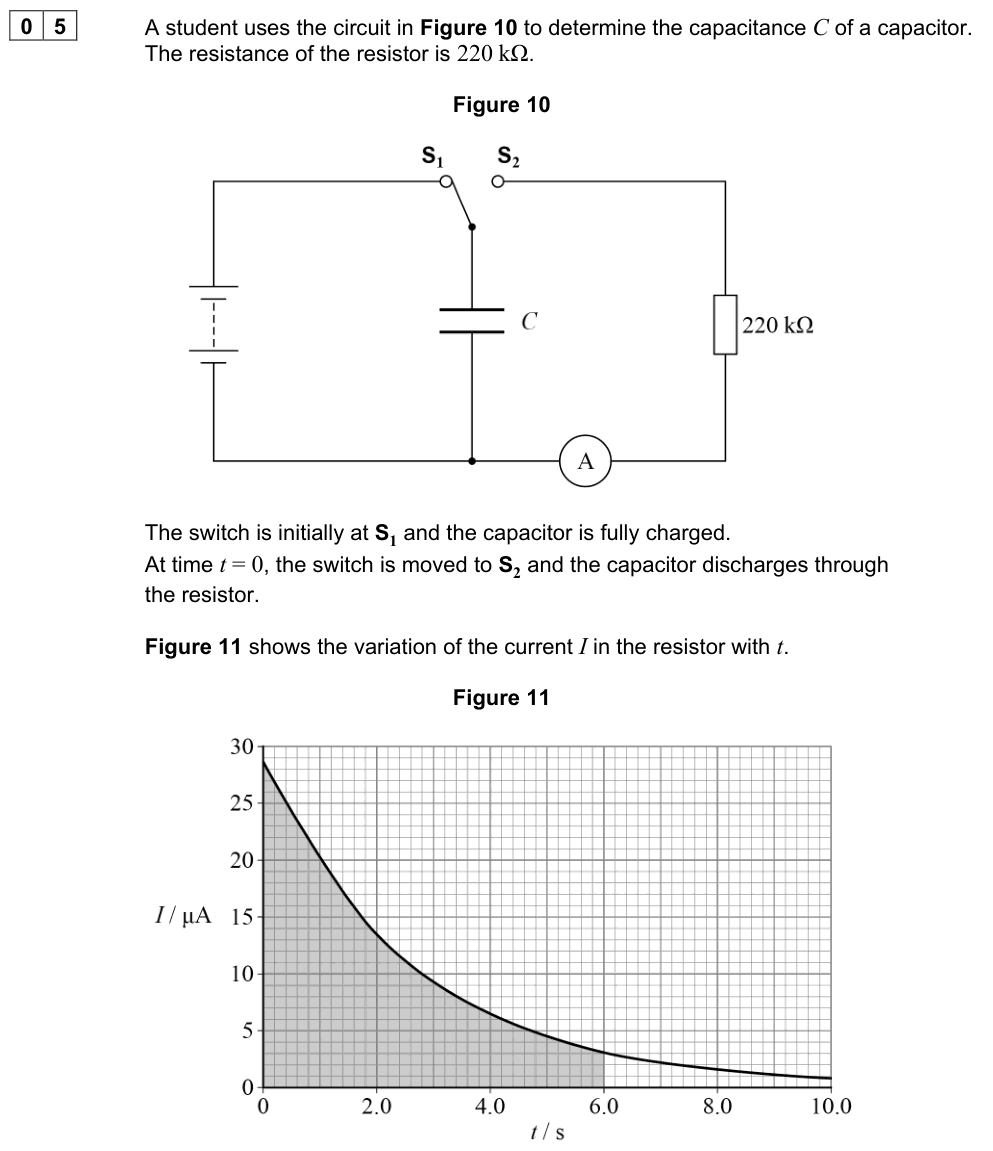
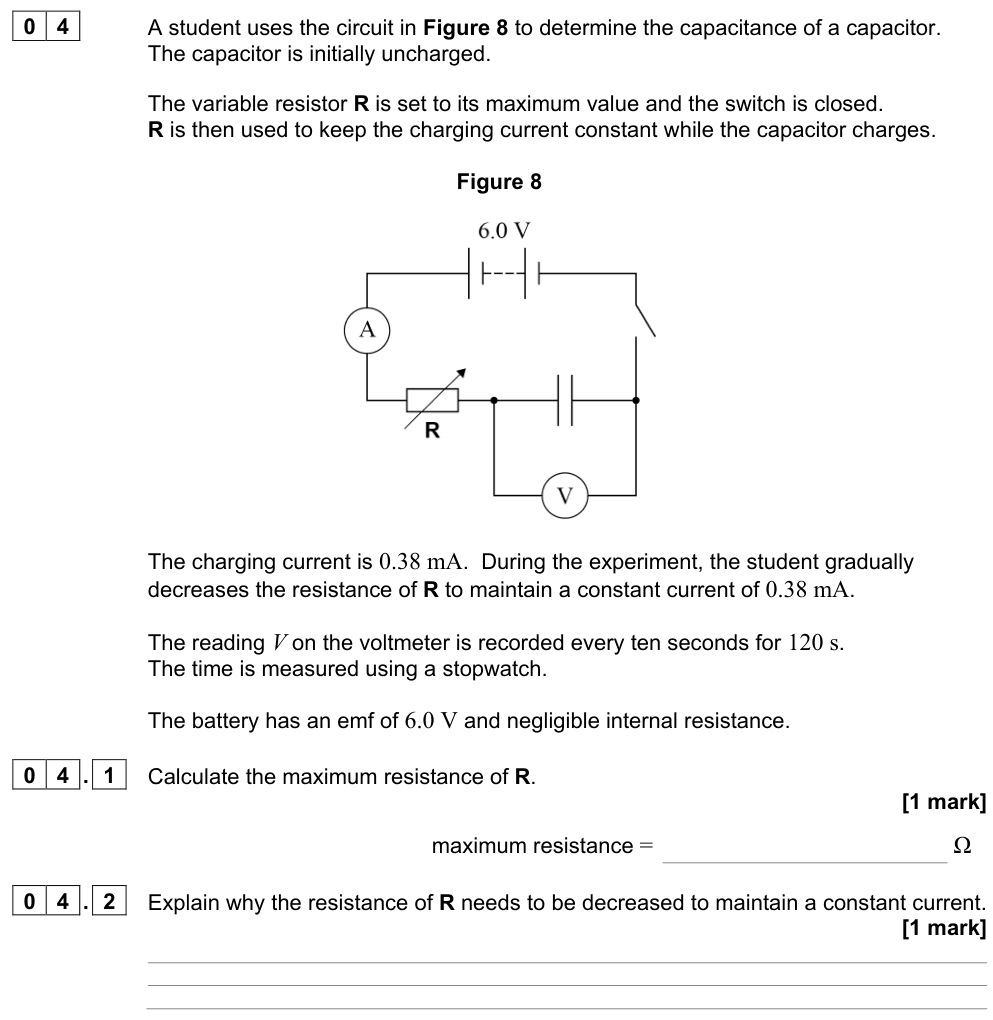
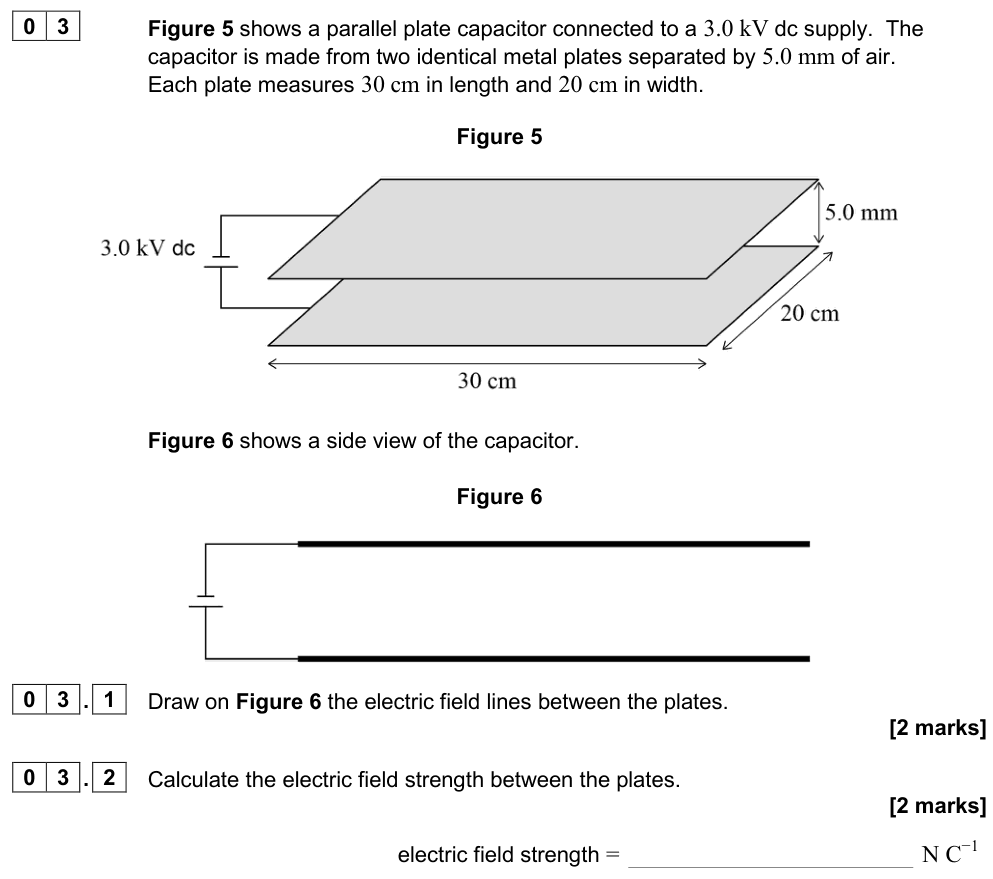
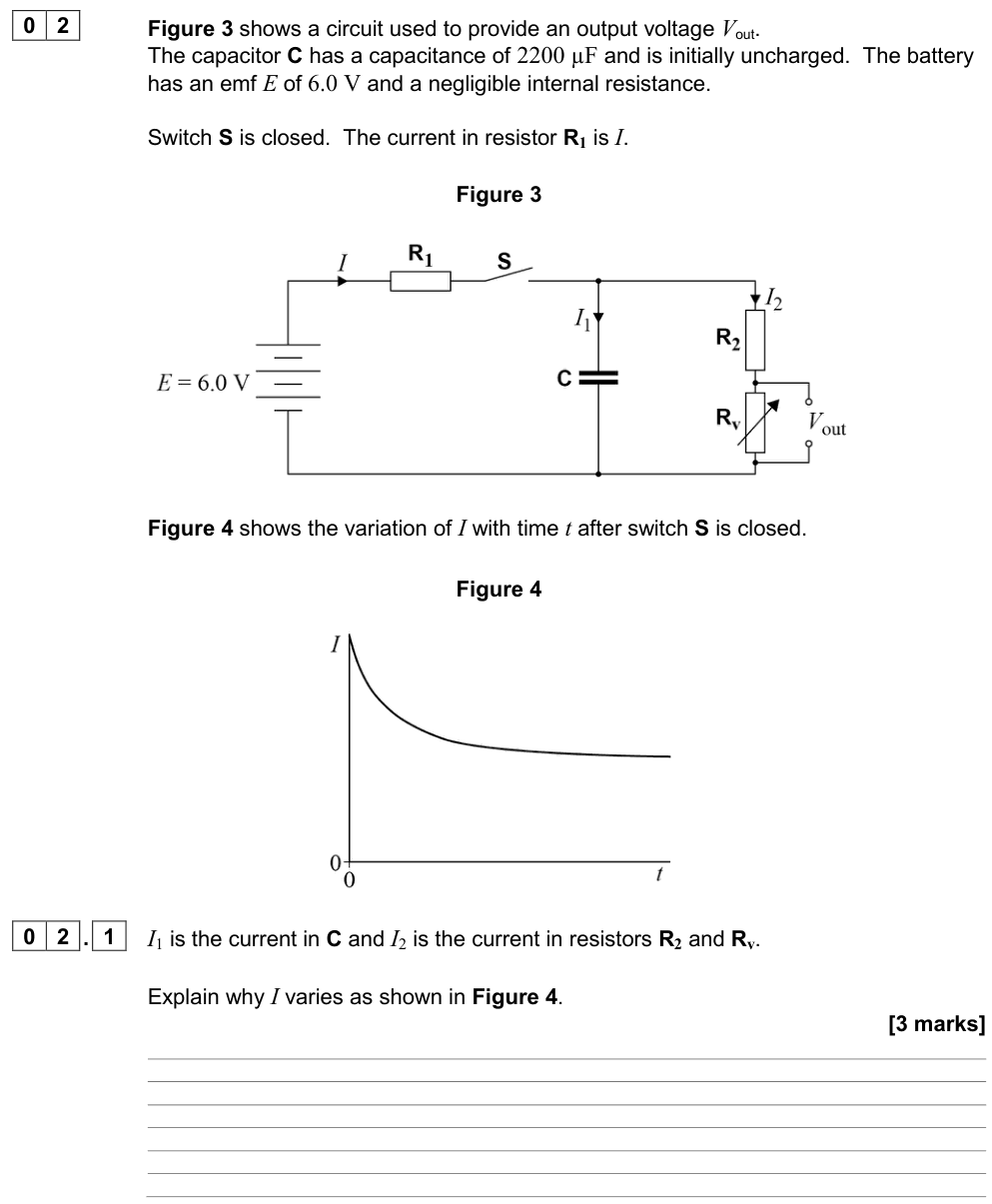
A capacitor stores charge (and therefore energy). The simplest type is two parallel metal plates separated by an insulator (air or a dielectric). When connected to a battery, electrons flow onto one plate and off the other: one plate gains charge $-Q$ and the other $+Q$. The capacitor is said to store charge $Q$ (the total charge on it is zero). No charge flows through the insulator.
Capacitance
Capacitance
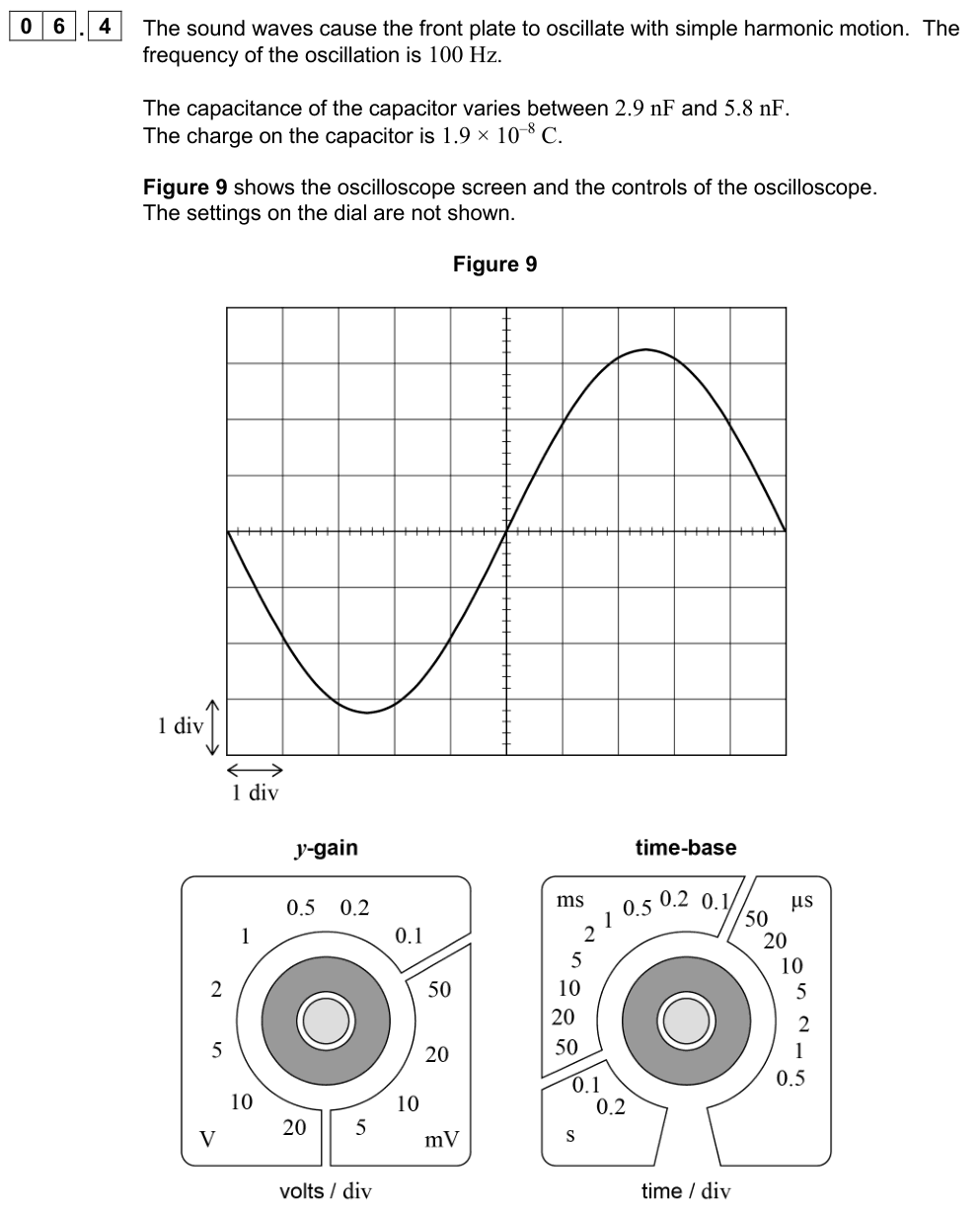
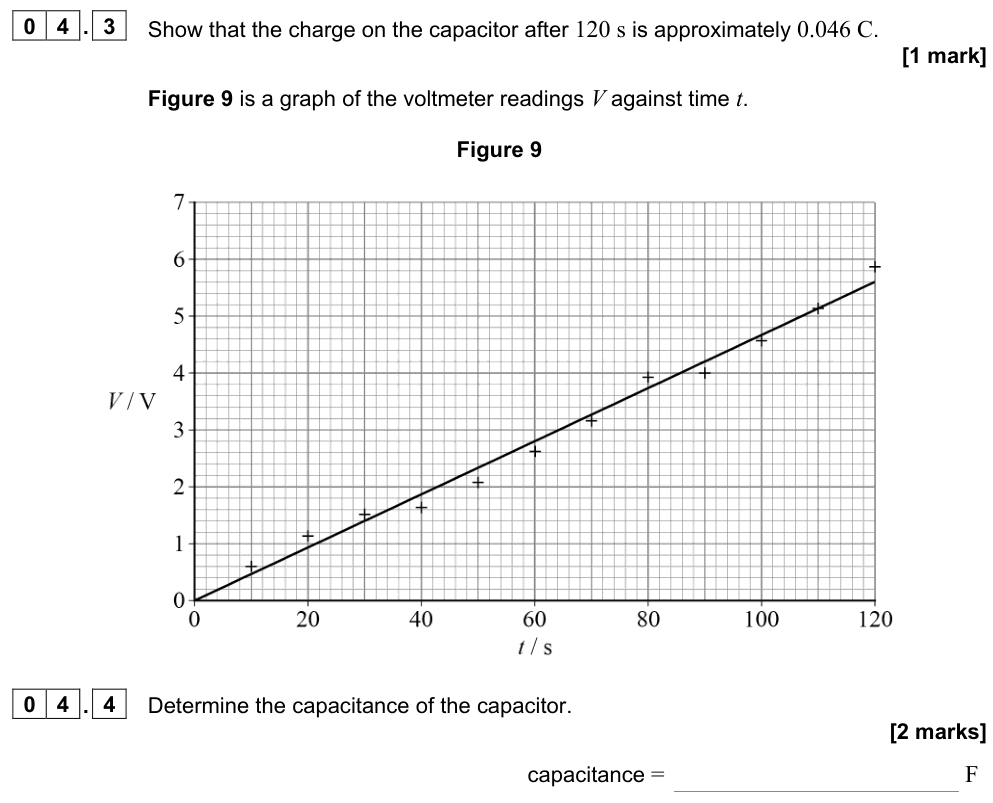
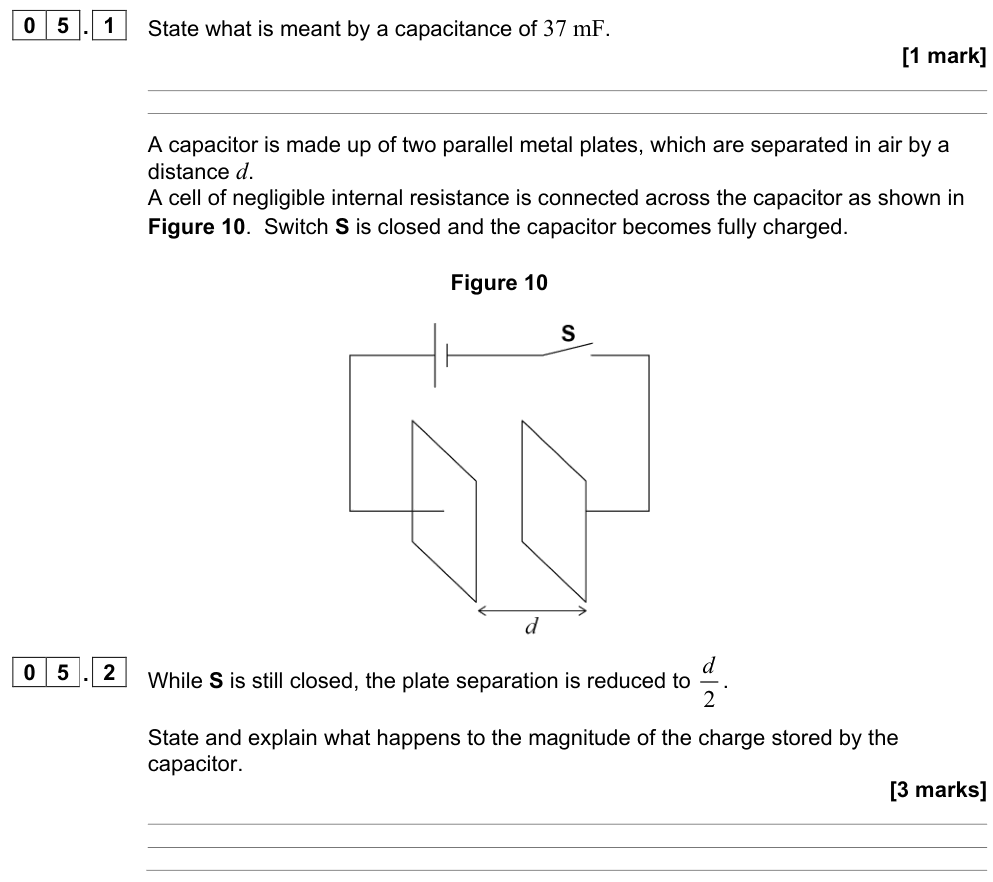
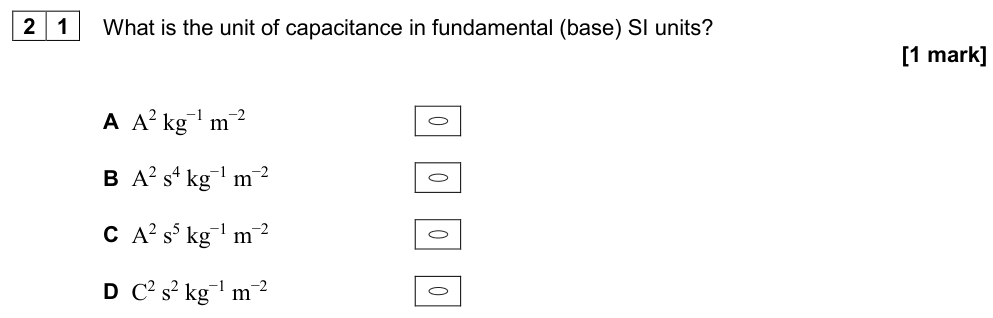
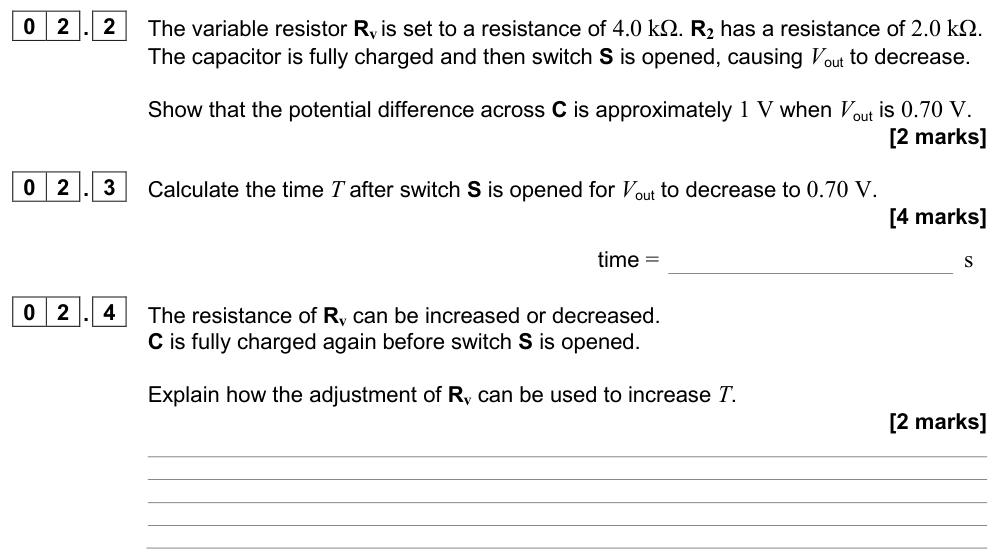
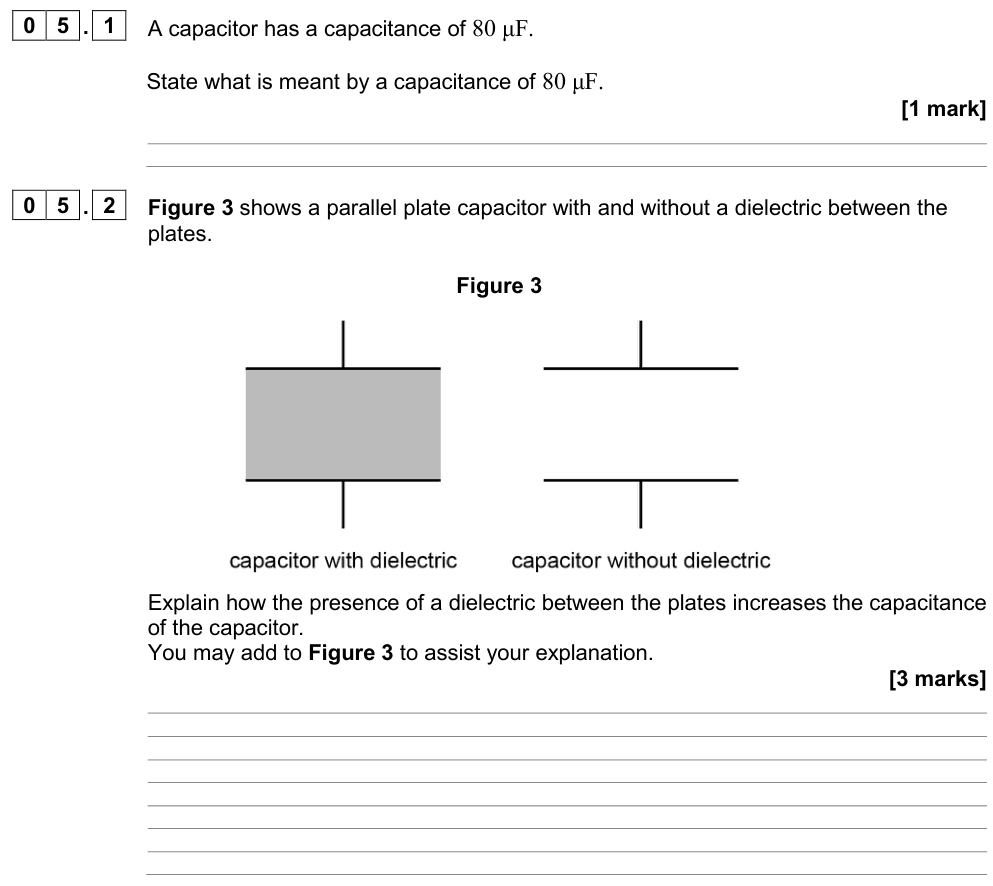
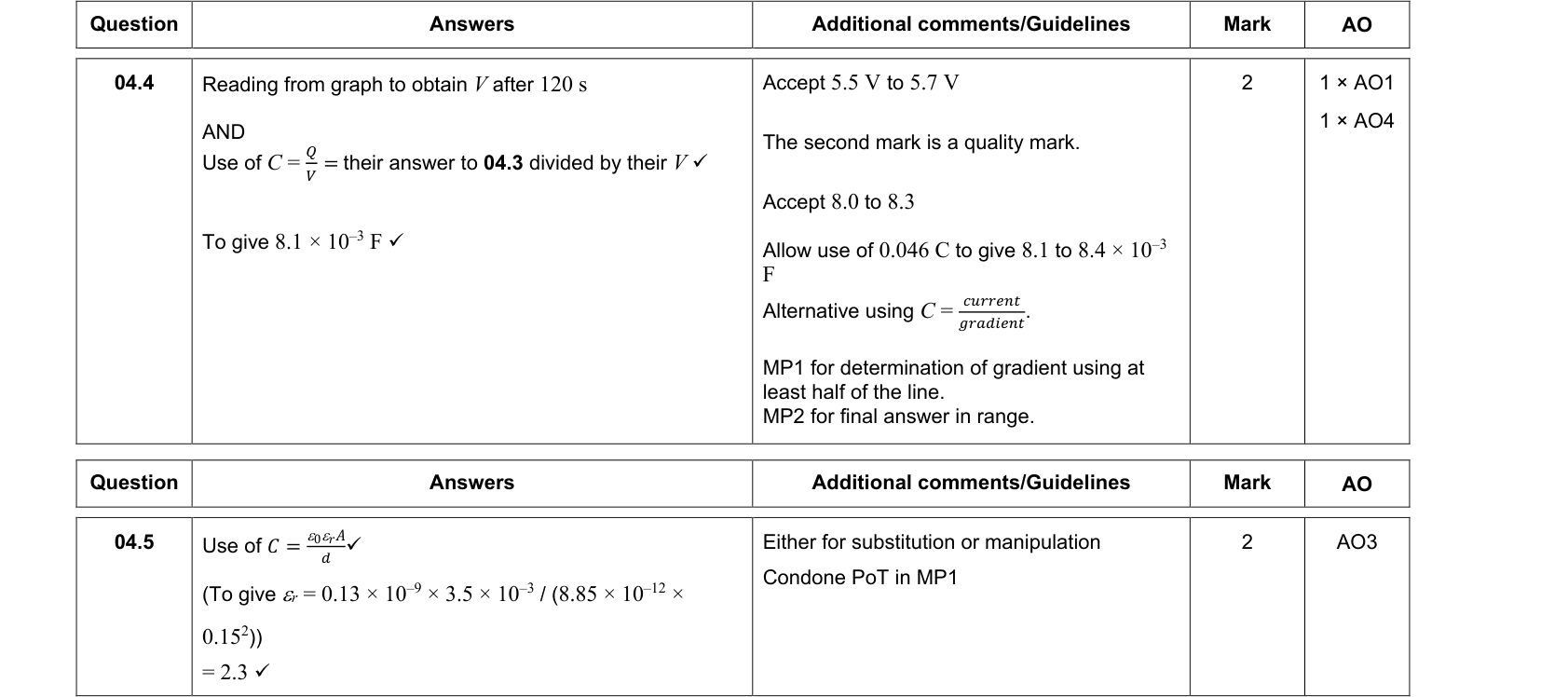
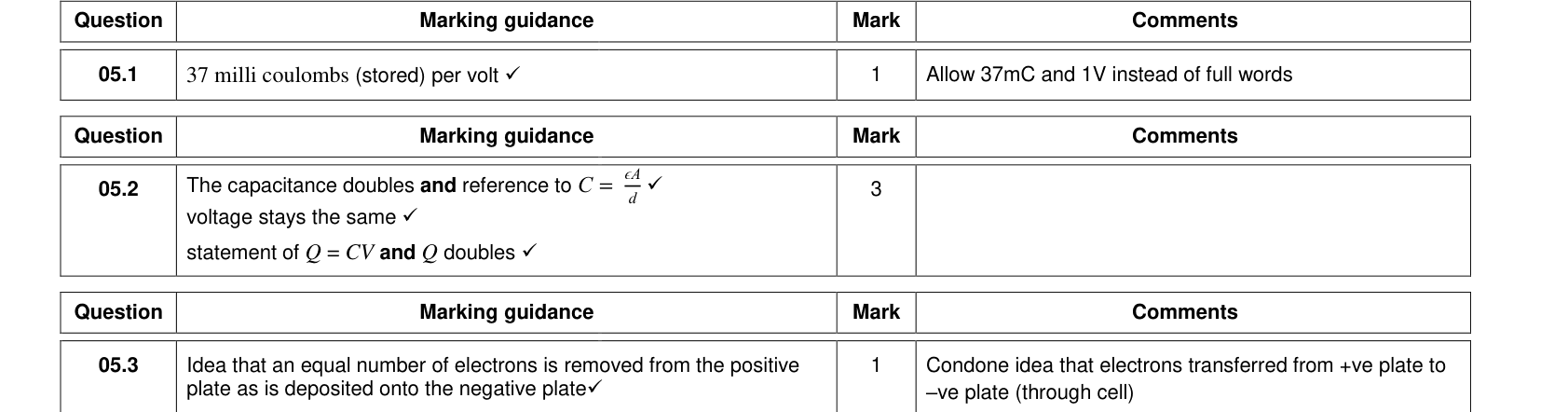
The capacitance $C$ of a capacitor is the charge stored per unit potential difference across it:
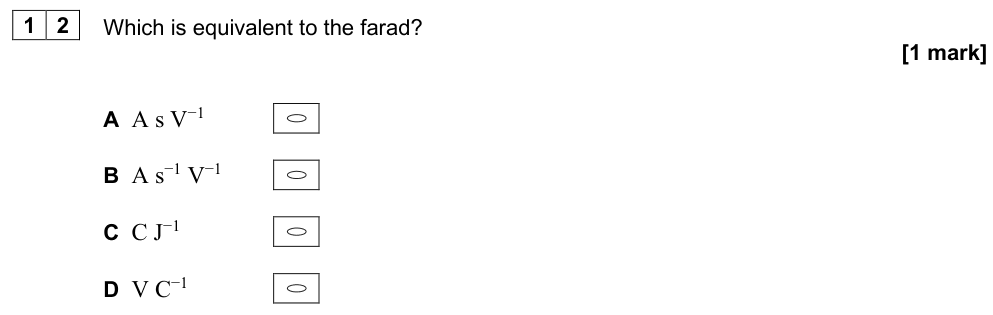
$$C = \frac{Q}{V} \qquad \text{unit: farad (F)};\ 1\ \text{F} = 1\ \text{C V}^{-1}$$
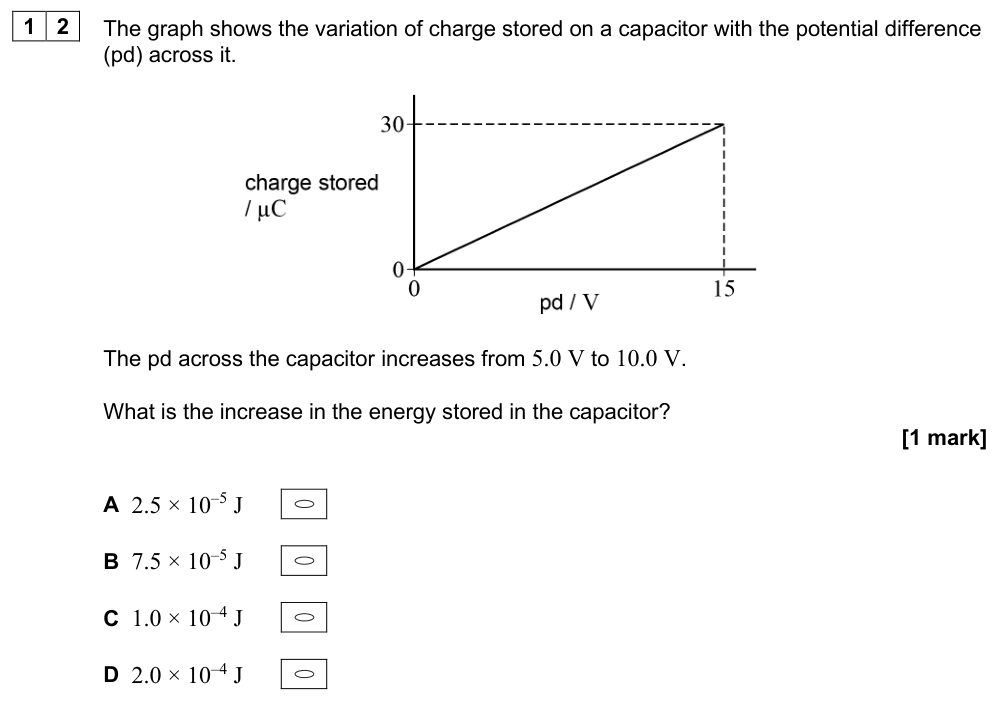
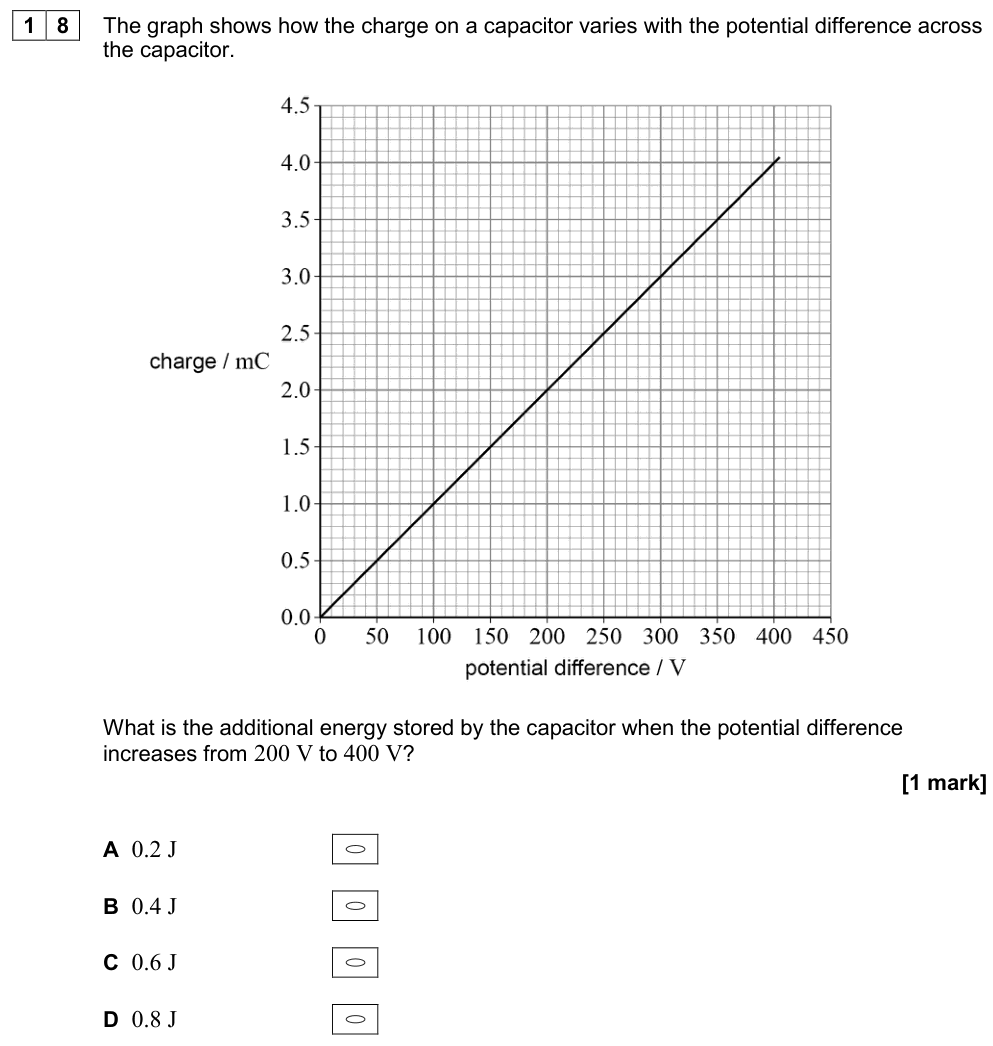
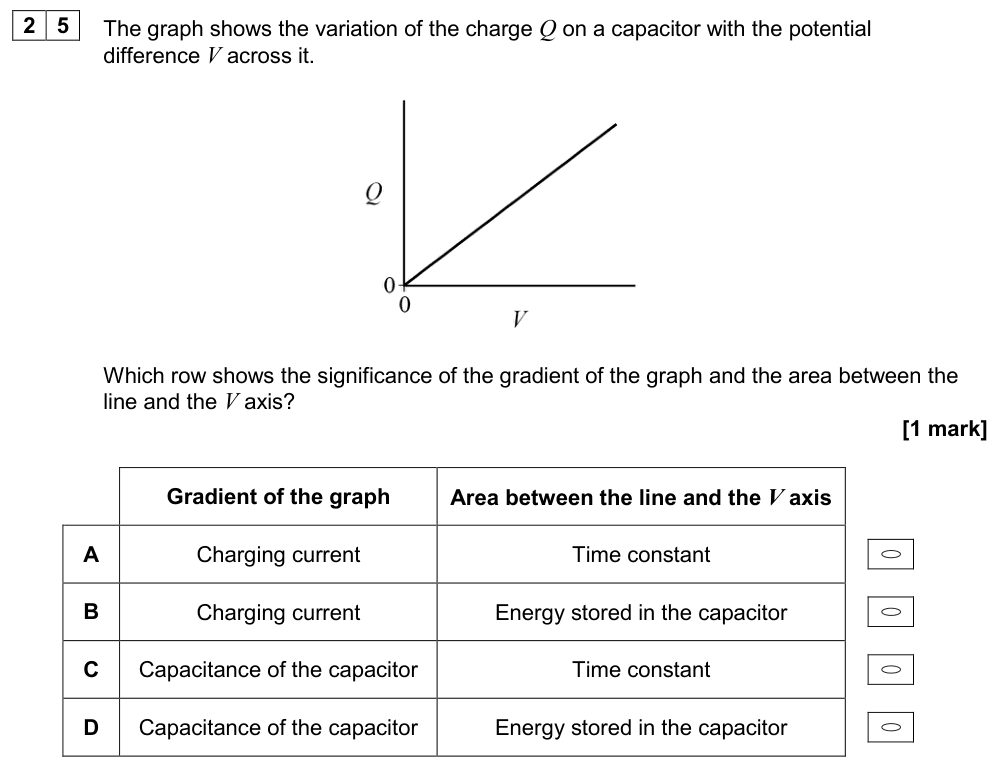
One farad is very large, so capacitances are usually given in μF, nF or pF. A graph of $Q$ against $V$ for a capacitor is a straight line through the origin with gradient $C$.
Worked example
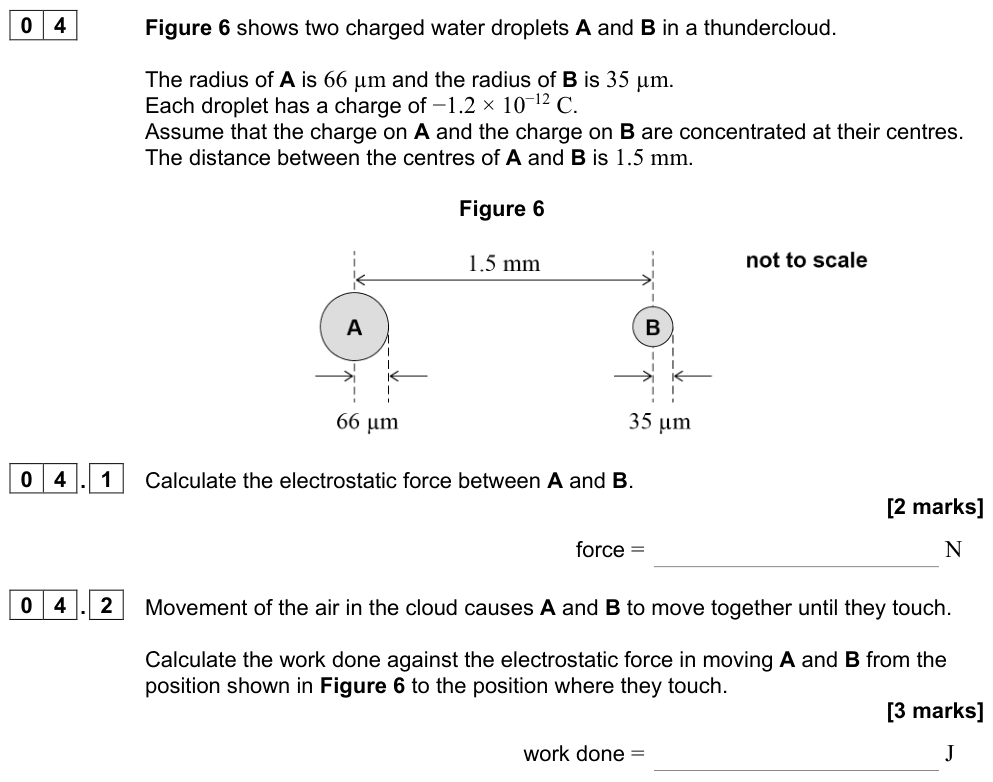
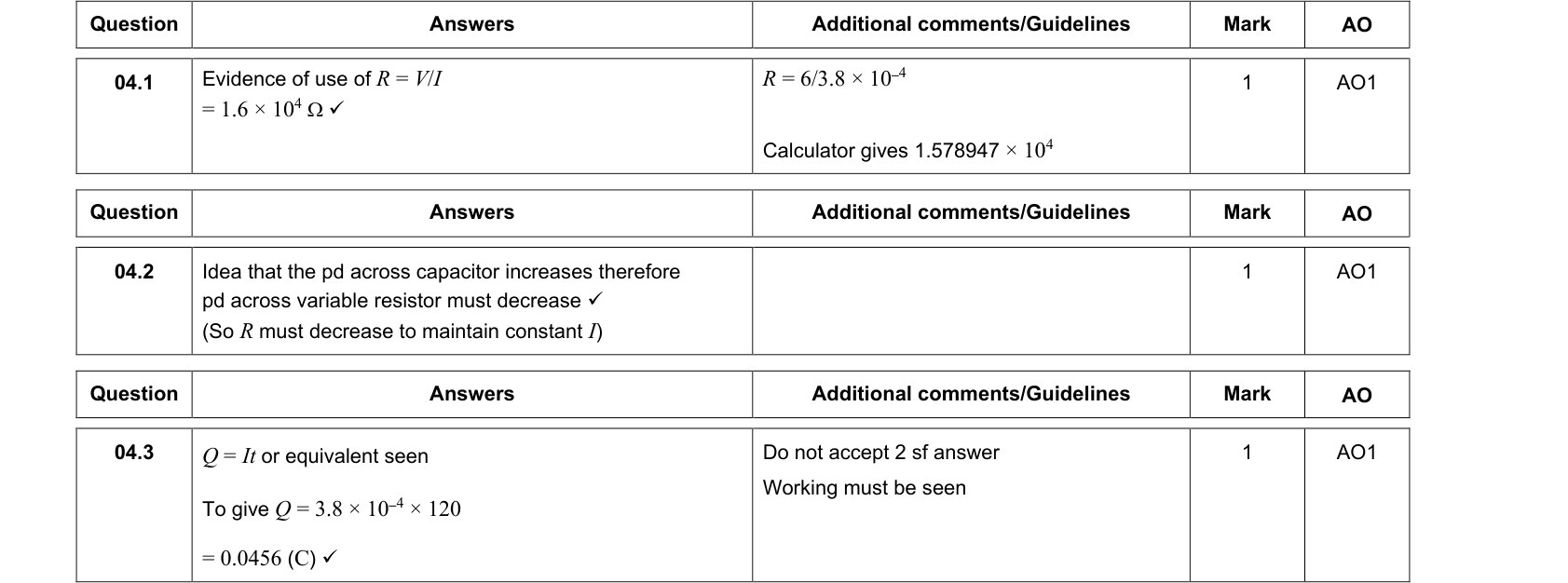
A 470 μF capacitor is charged to 9.0 V. $Q = CV = 470 \times 10^{-6} \times 9.0 = 4.2 \times 10^{-3}\ \text{C}$.
The parallel-plate capacitor
Capacitance of parallel plates
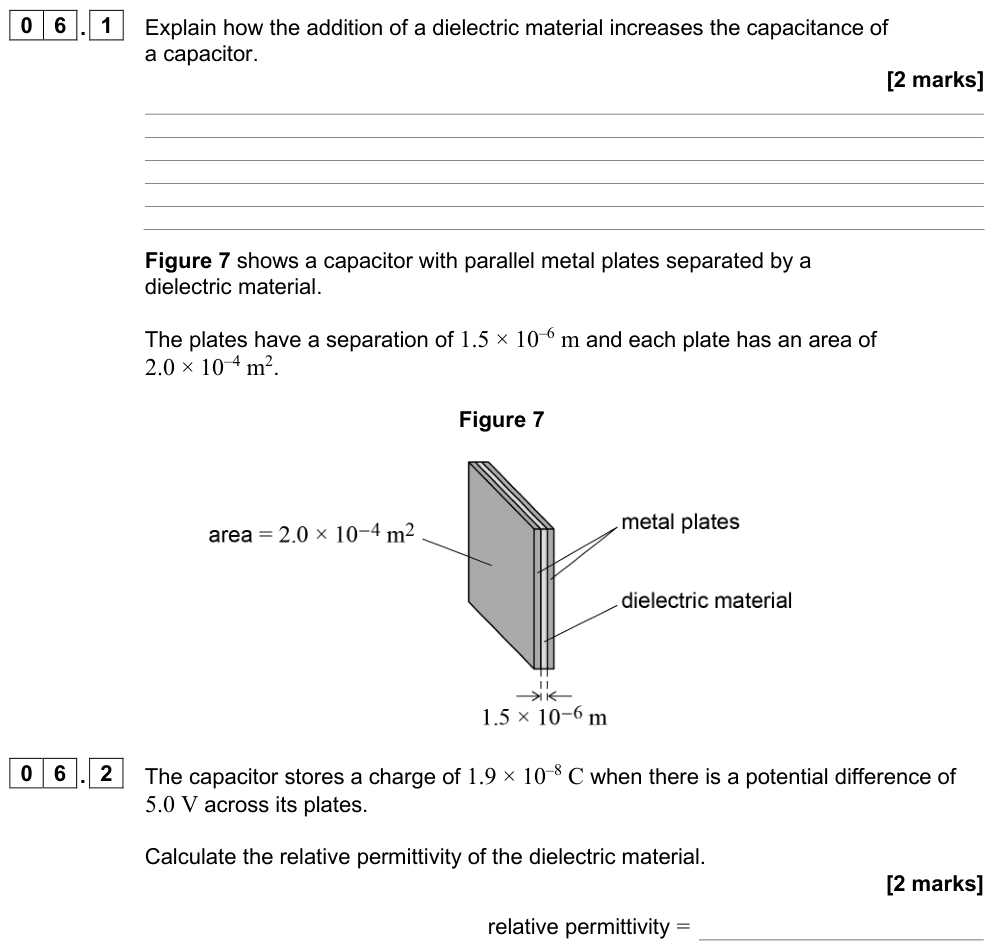
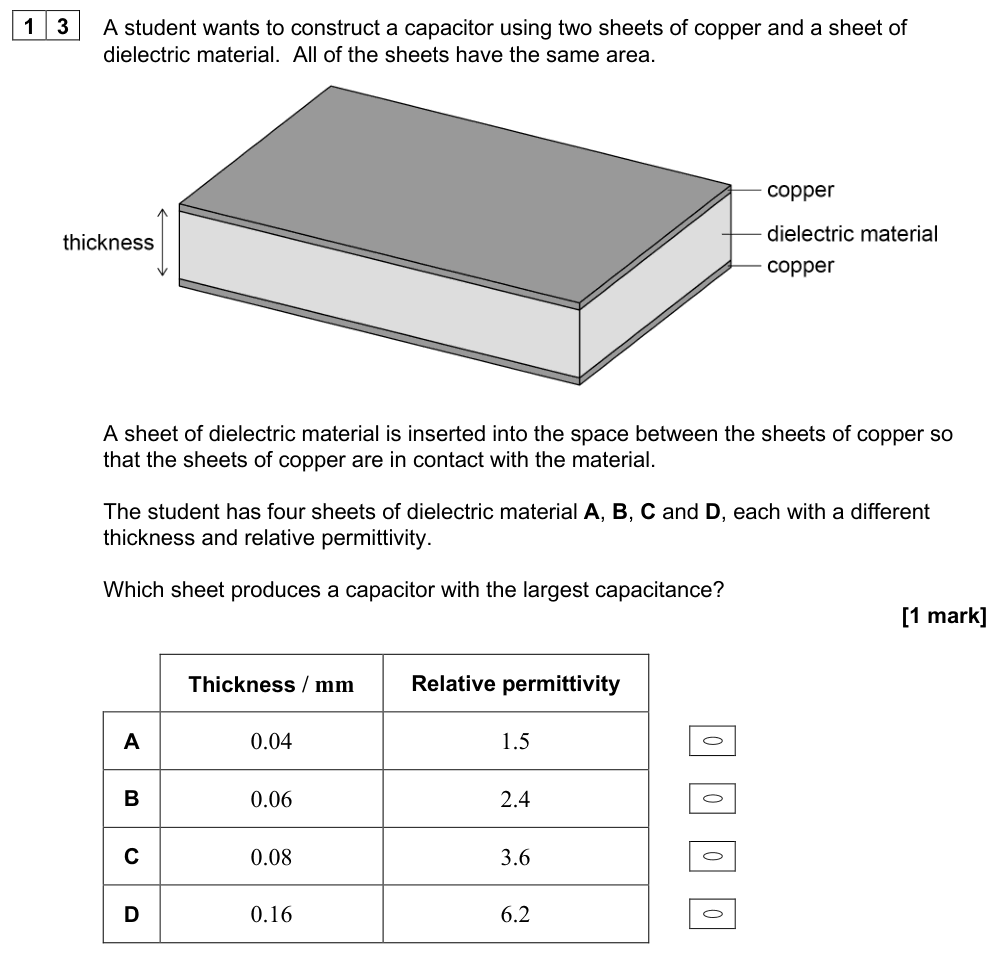
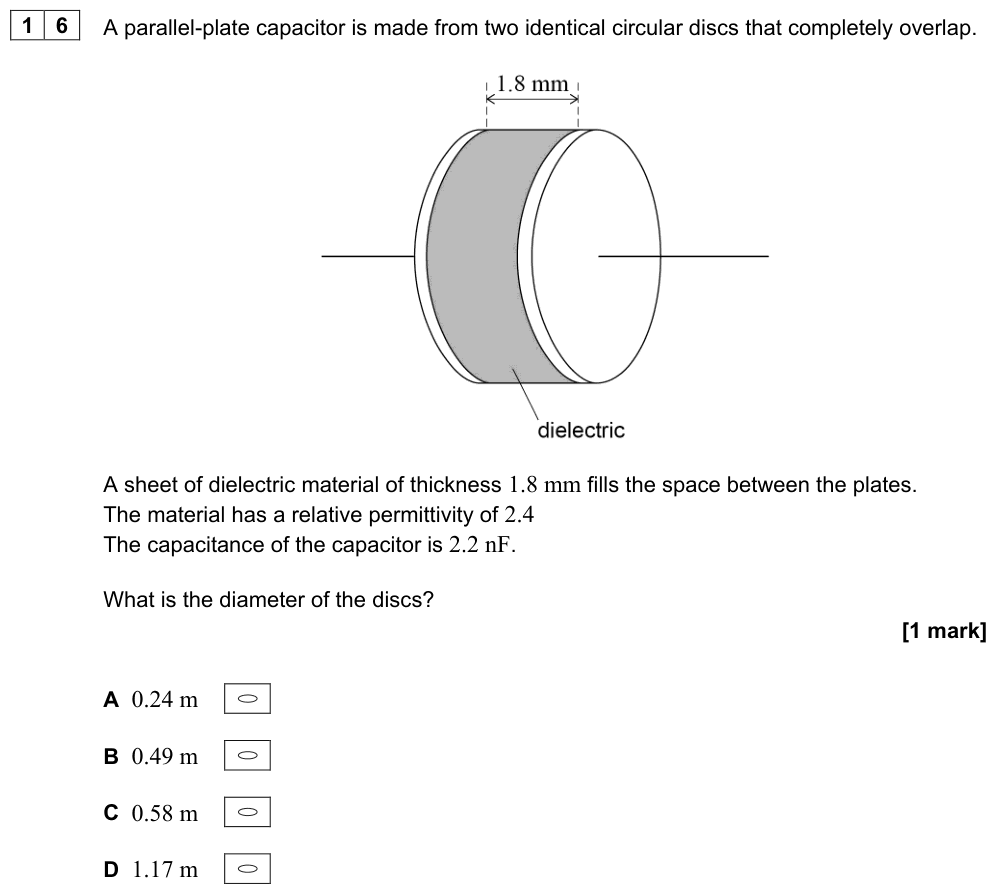
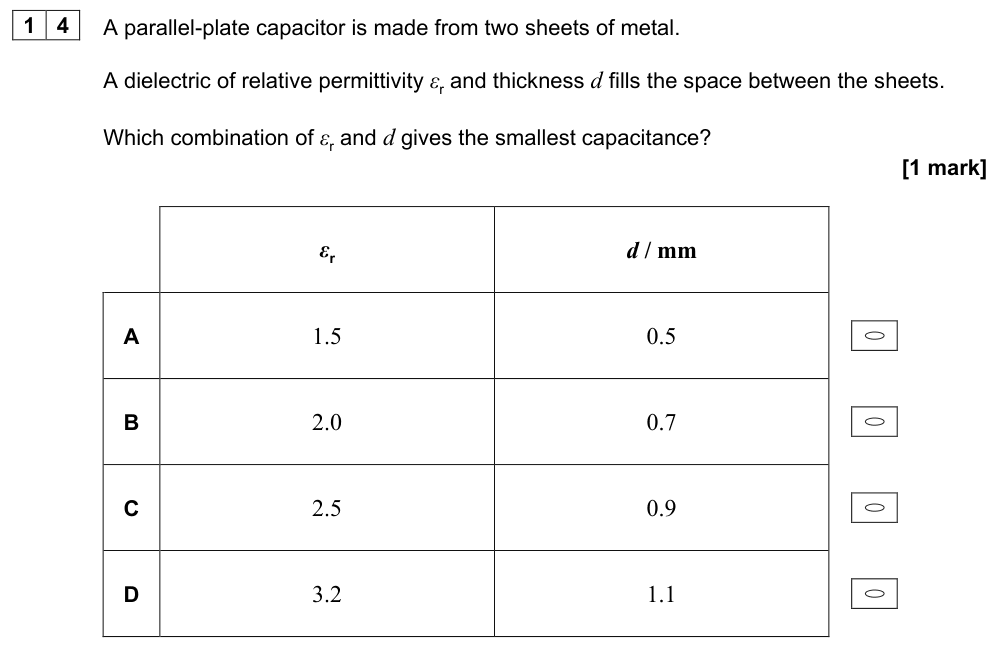
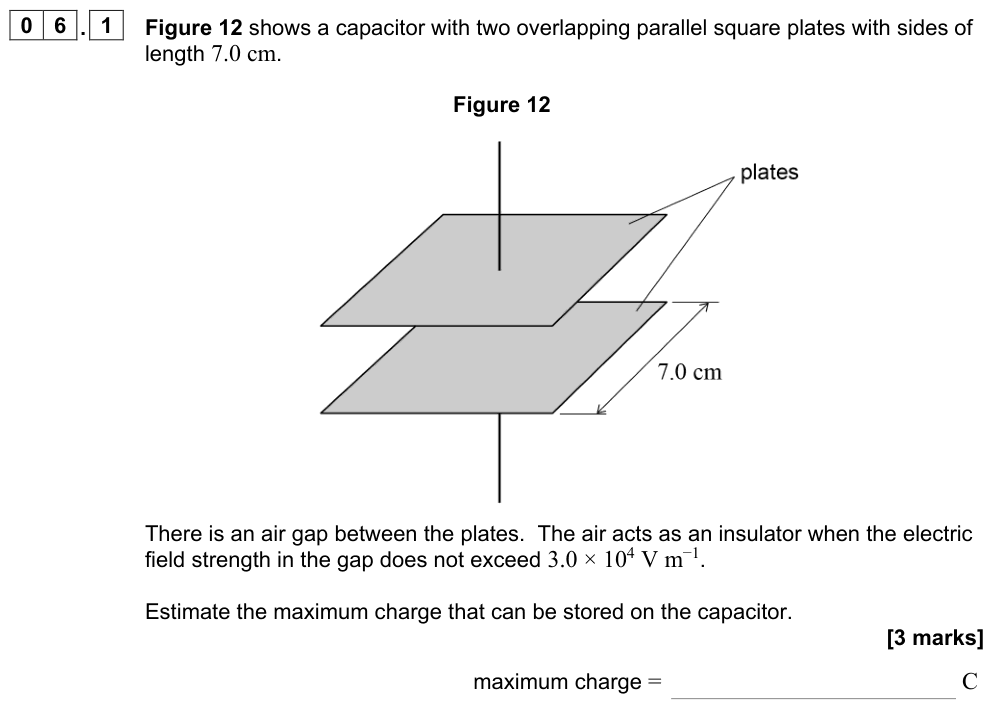
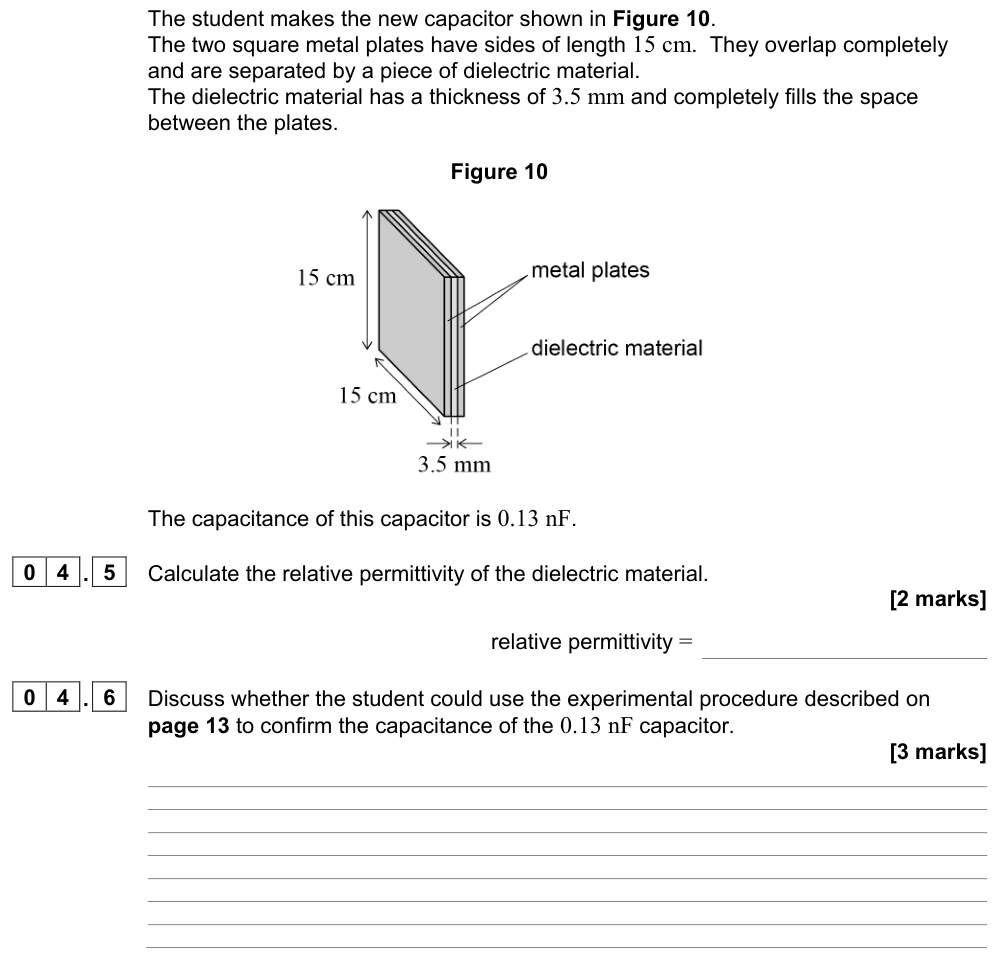
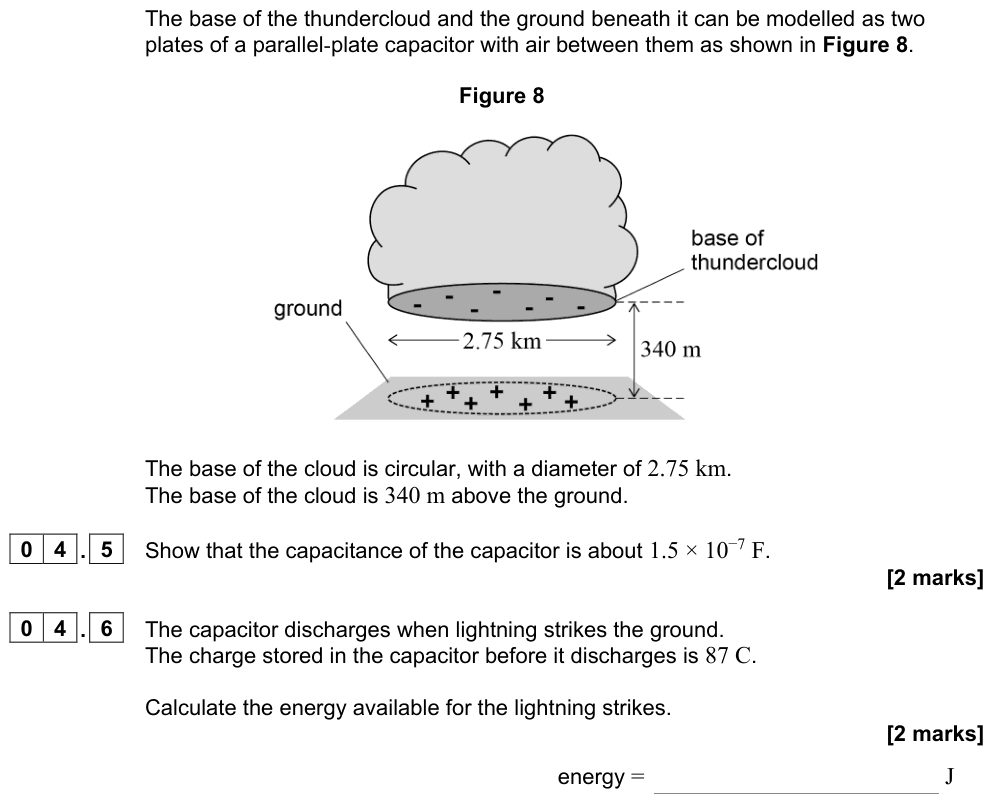
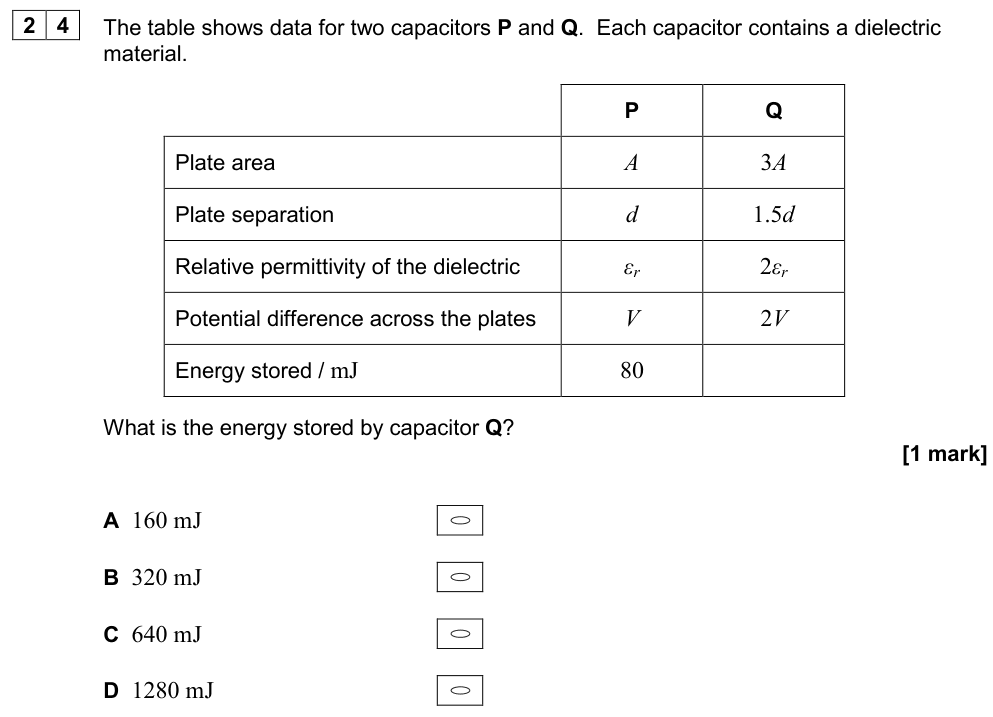
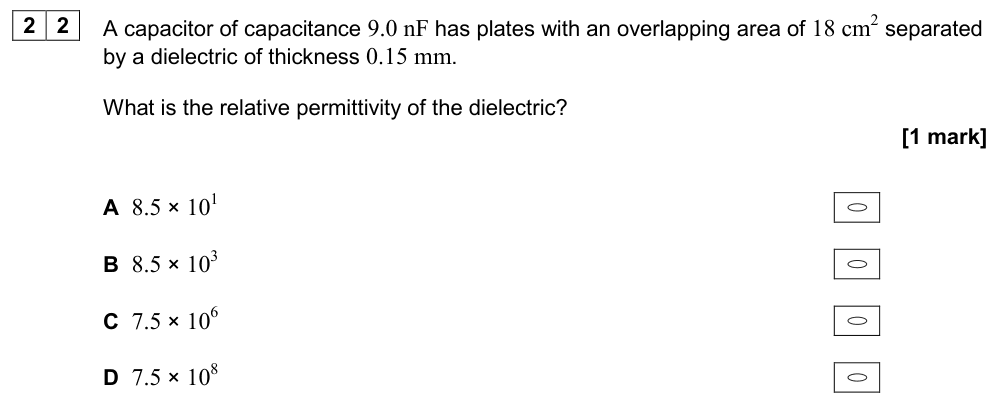
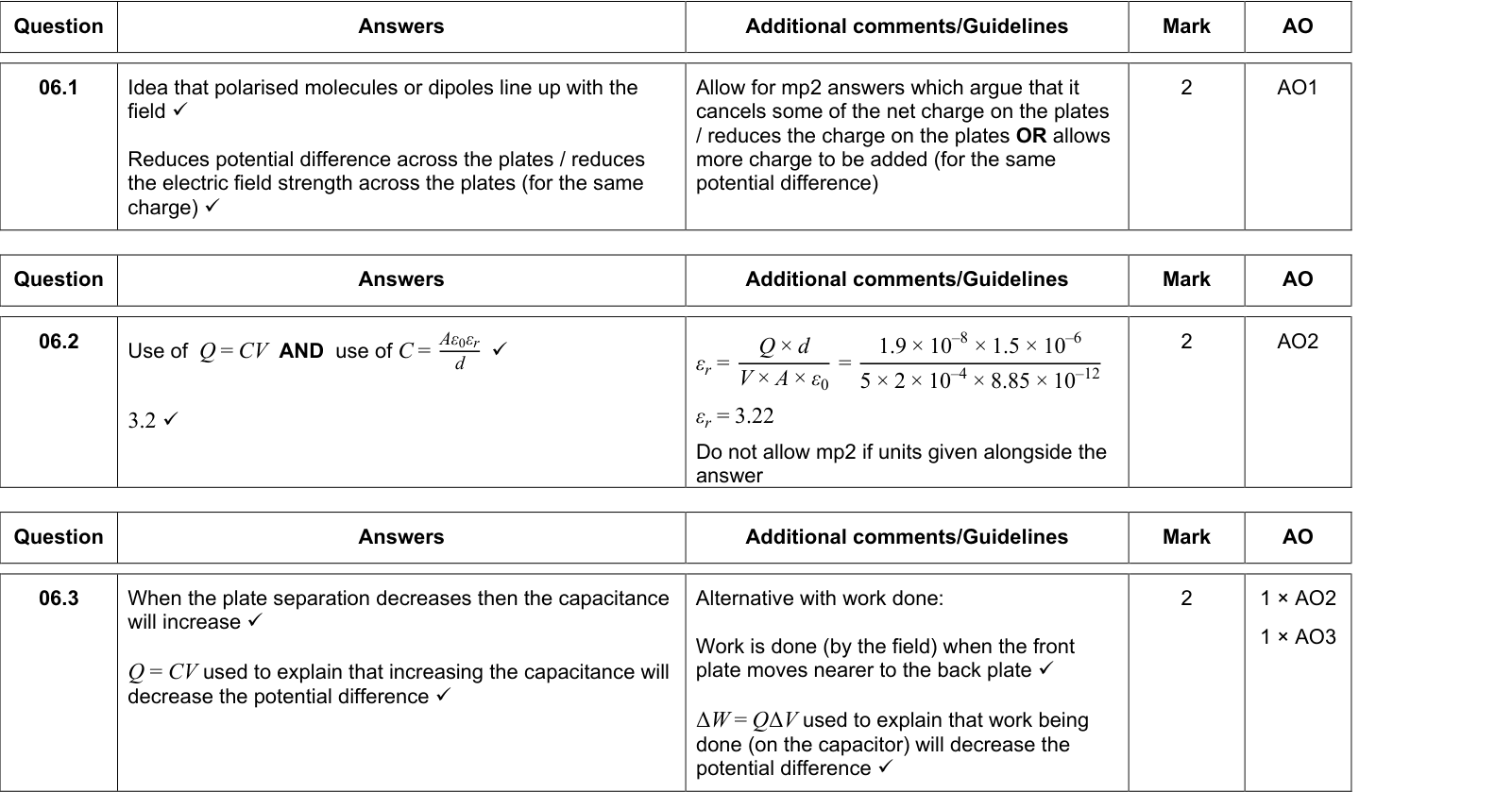
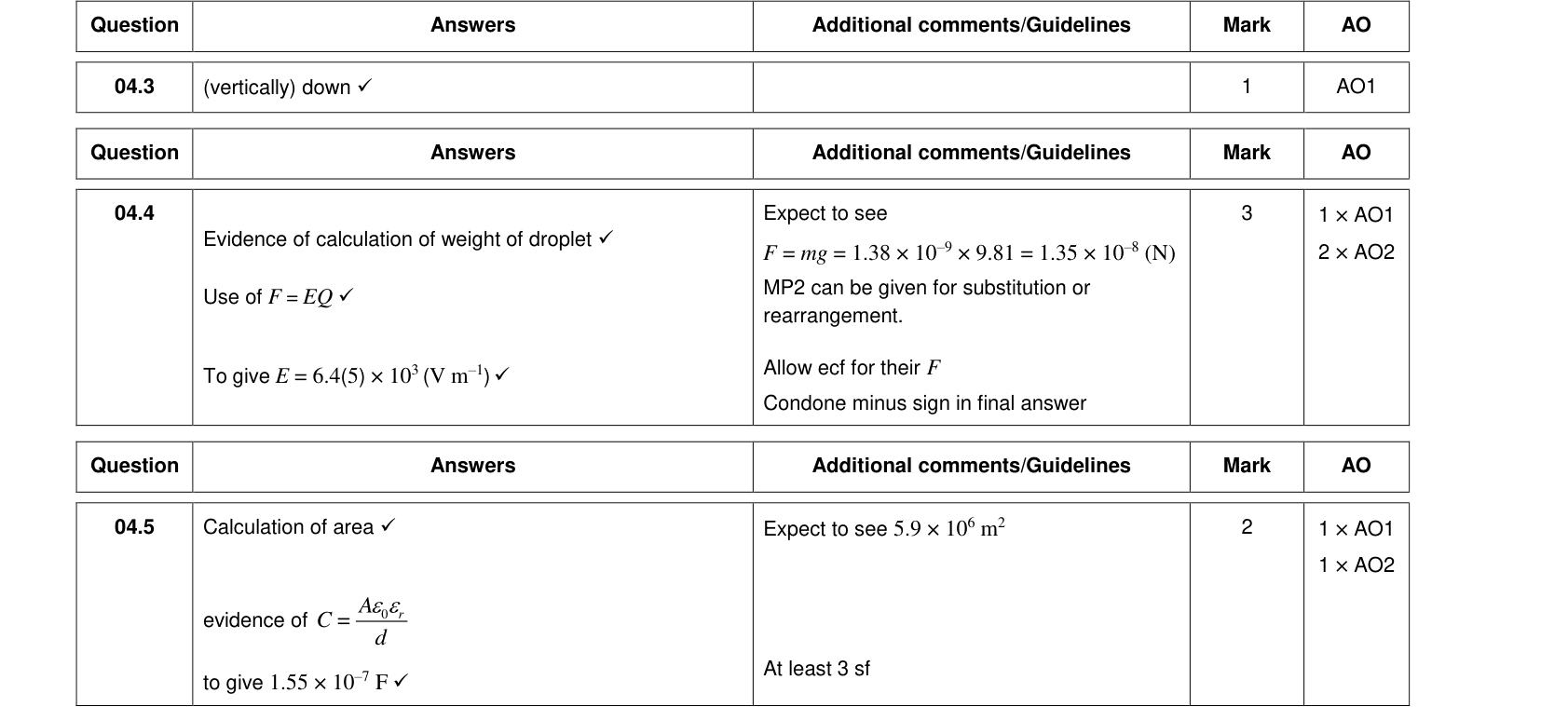
$$C = \frac{A\varepsilon_0\varepsilon_r}{d}$$
$A$ = area of overlap of the plates, $d$ = separation, $\varepsilon_0 = 8.85 \times 10^{-12}\ \text{F m}^{-1}$, $\varepsilon_r$ = relative permittivity of the material between the plates.
- Larger area → more charge for the same p.d. → larger $C$.
- Smaller separation → stronger field for the same p.d. → more charge → larger $C$.
- A dielectric with a larger $\varepsilon_r$ increases $C$.
Worked example
Square plates of side 0.15 m are 1.0 mm apart in air: $C = \dfrac{0.15^2 \times 8.85 \times 10^{-12}}{1.0 \times 10^{-3}} = 2.0 \times 10^{-10}\ \text{F} = 200\ \text{pF}$.
Relative permittivity and dielectrics
Relative permittivity (dielectric constant)
$$\varepsilon_r = \frac{\varepsilon}{\varepsilon_0} = \frac{C_{\text{with dielectric}}}{C_{\text{vacuum}}}$$
It is the factor by which the capacitance increases when the space between the plates is filled with the material. It has no unit. For air $\varepsilon_r \approx 1$.
| Material | Relative permittivity |
|---|---|
| vacuum / air | 1.0 |
| paper | ~3.5 |
| glass | ~6 |
| water | ~80 |
How a dielectric works
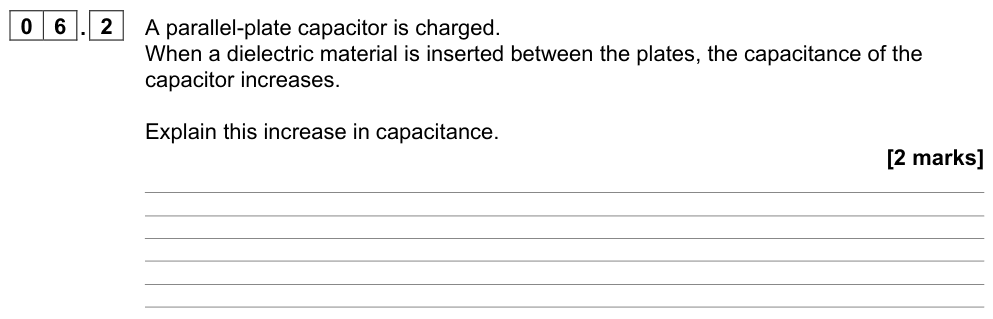
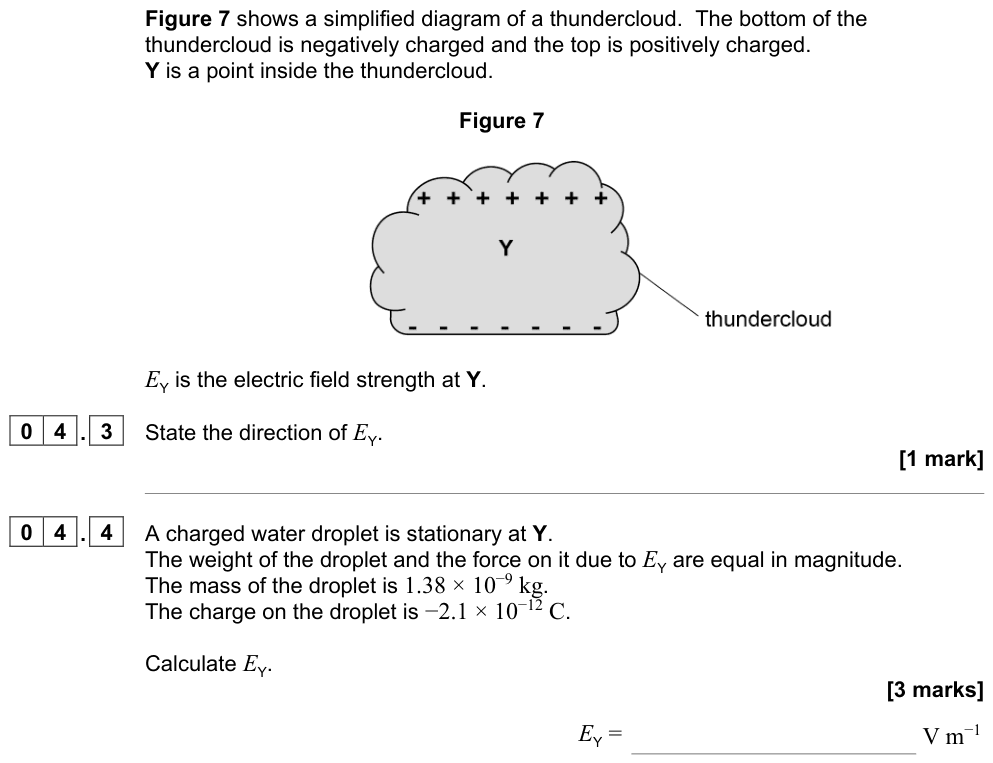
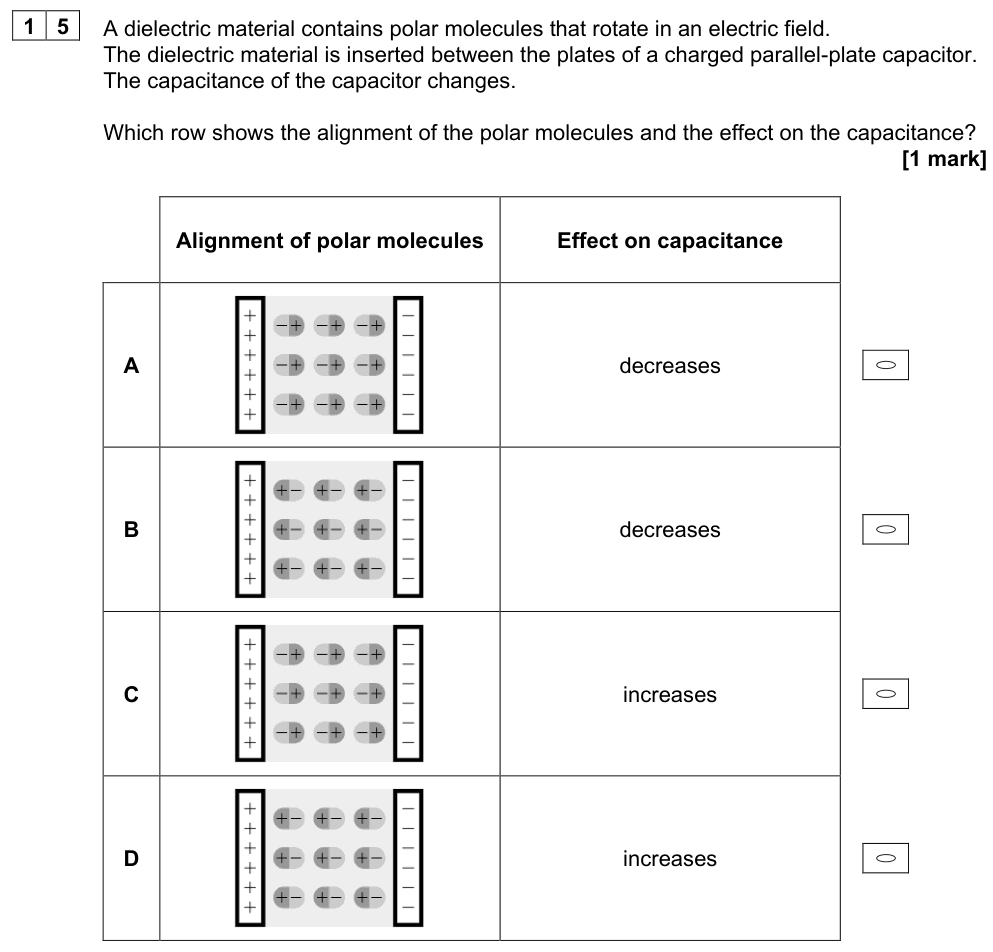
A dielectric is made of polar molecules: molecules with a slightly positive end and a slightly negative end. When the capacitor is charged:
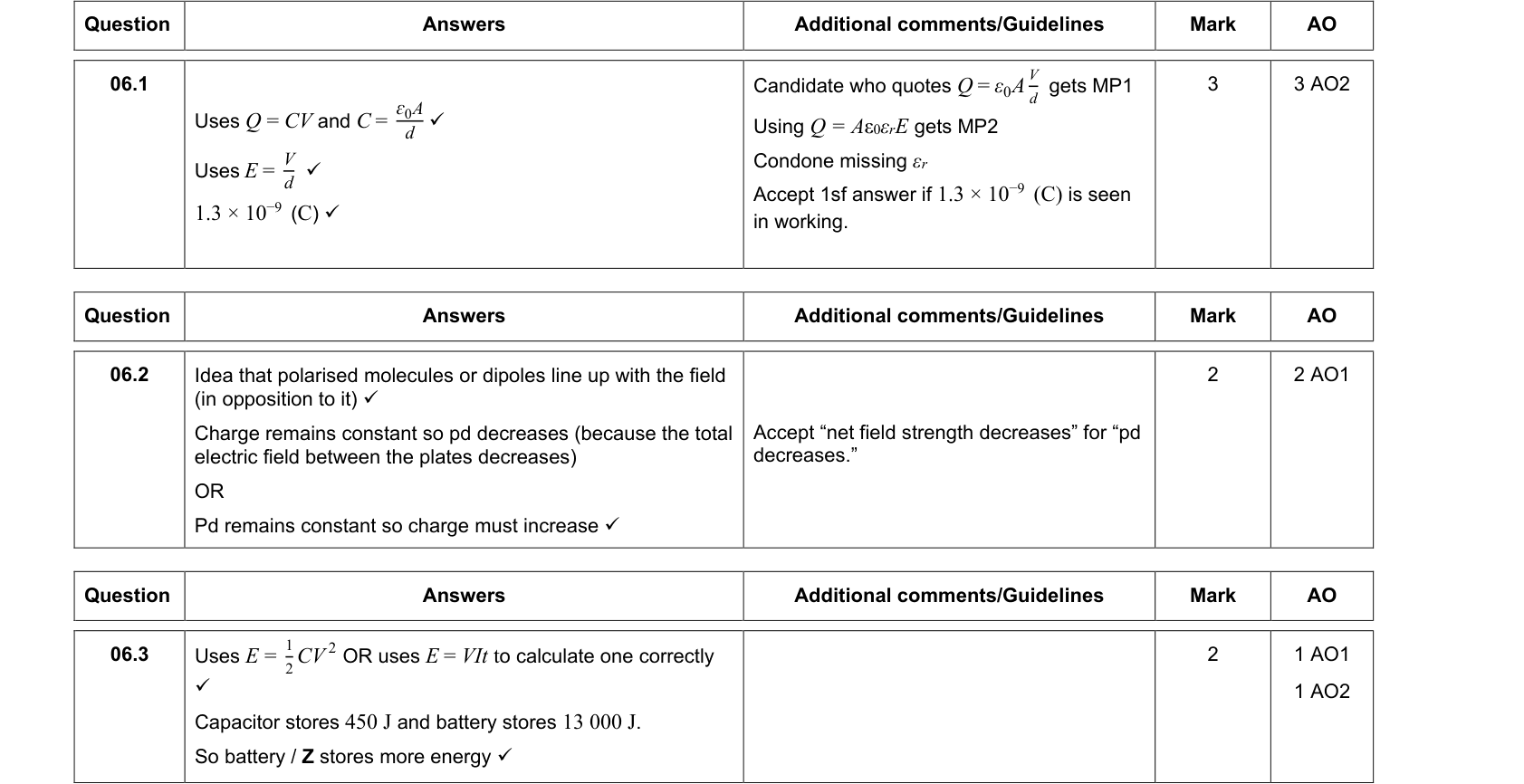
- The electric field between the plates exerts forces on the ends of each polar molecule, making them rotate so that they line up with the field: the negative ends point towards the positive plate and the positive ends towards the negative plate.
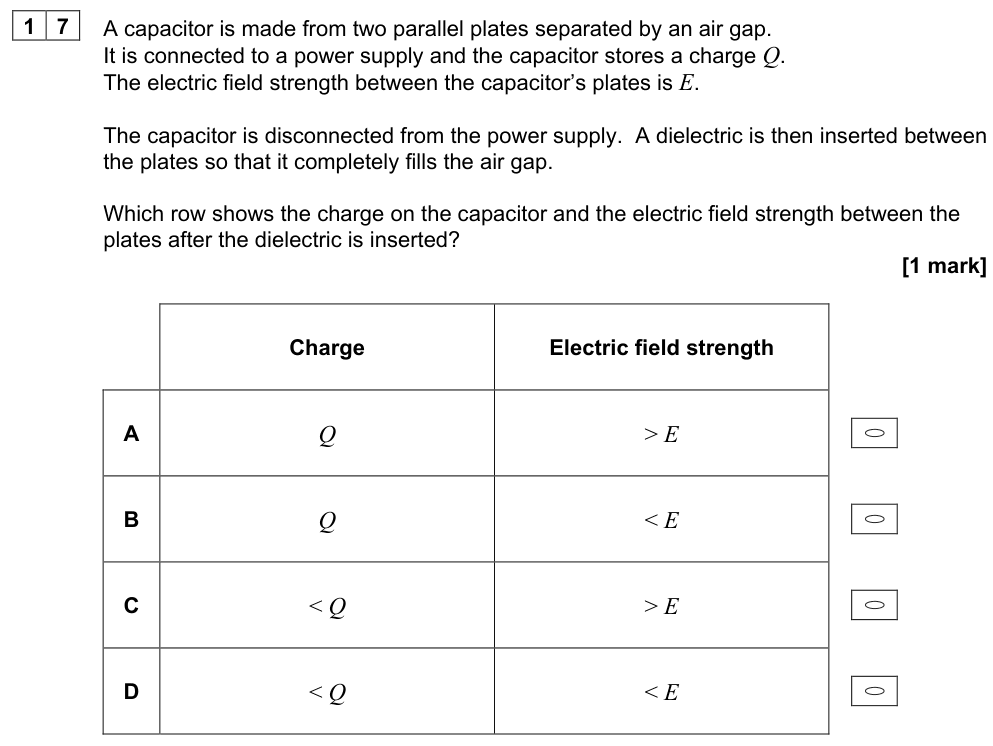
- The aligned molecules produce their own electric field opposing the field from the plates, so the resultant field between the plates is reduced.
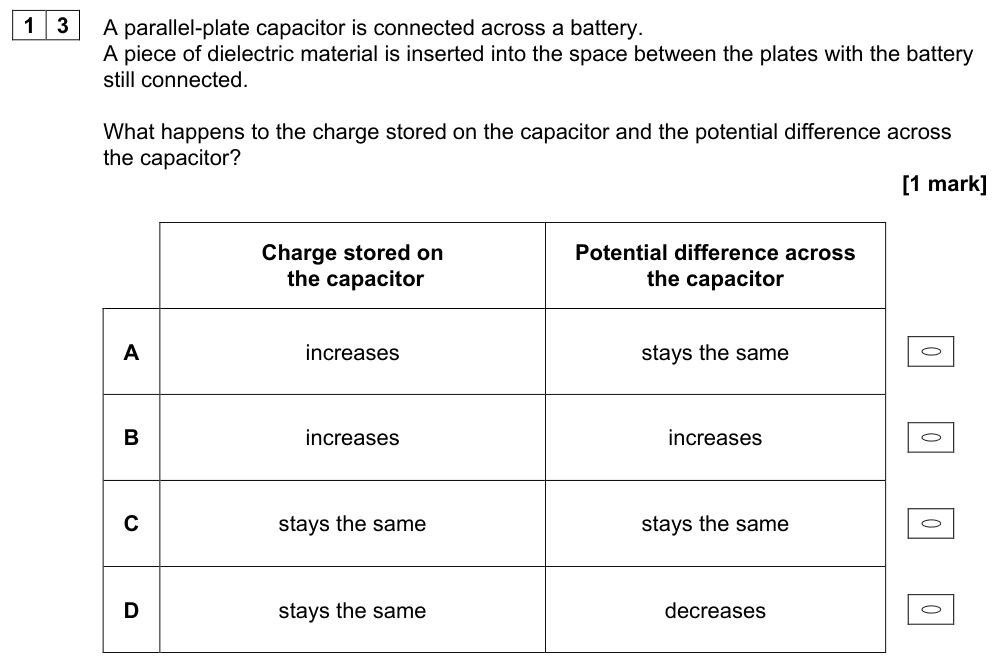
- For the same charge on the plates, the p.d. is smaller; or, if the p.d. is fixed by a battery, more charge flows onto the plates. Either way $C = Q/V$ increases.
Exam tip: isolated vs connected
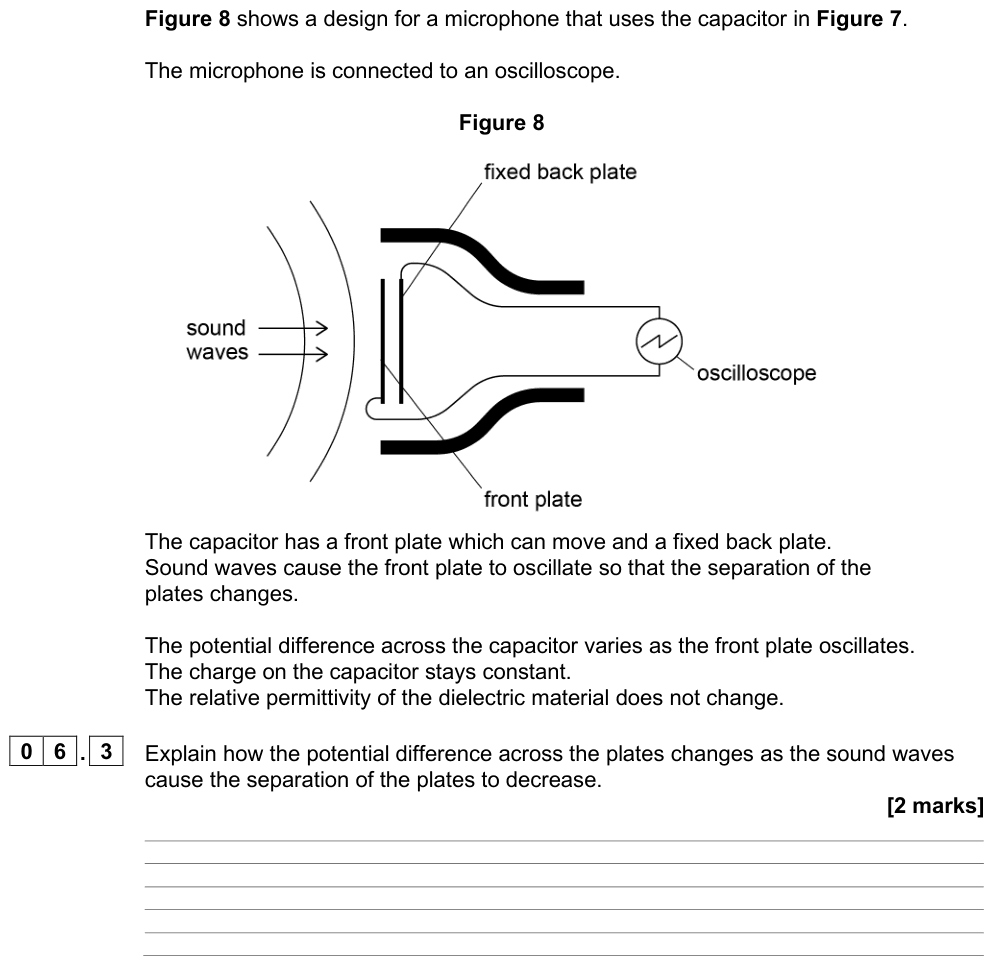
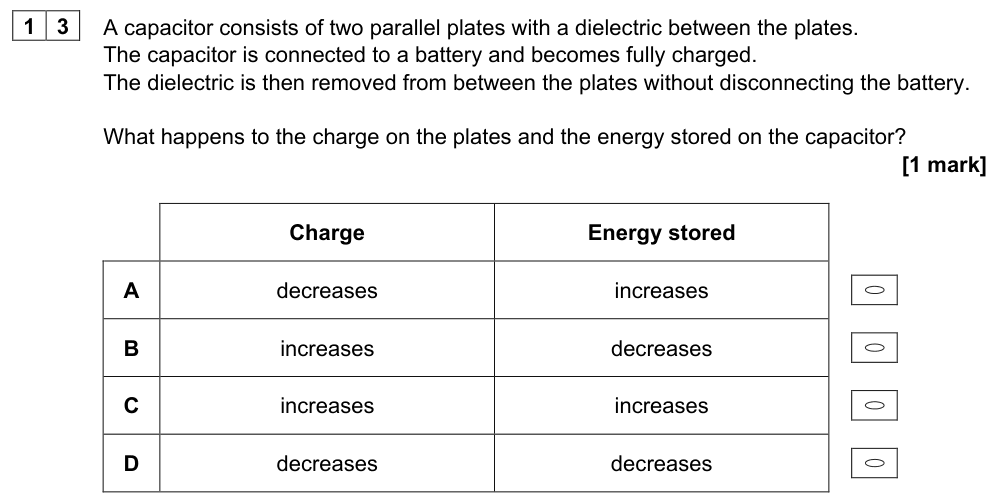
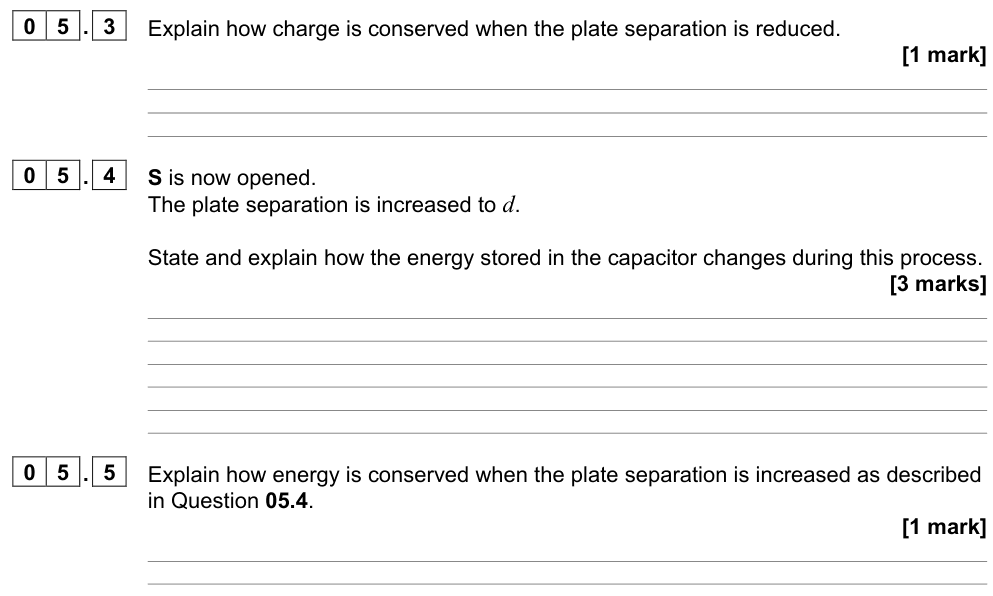
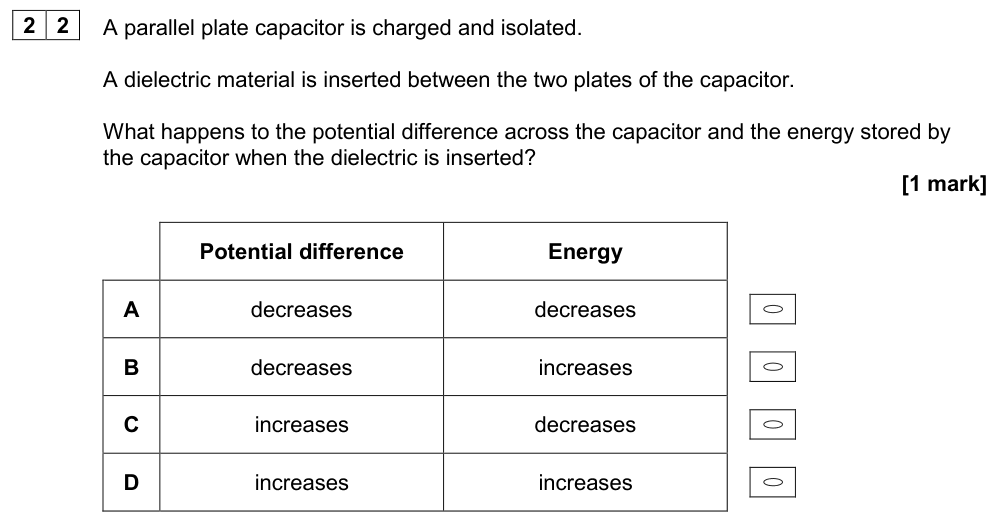
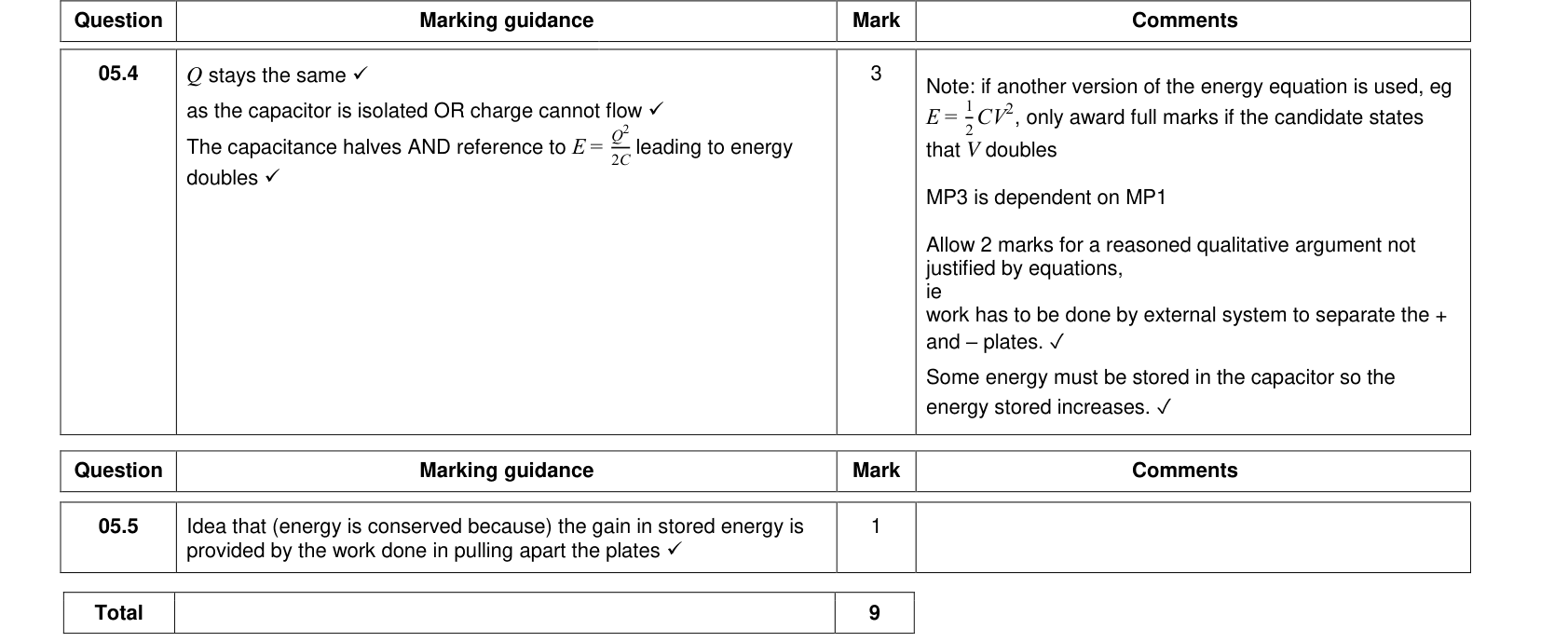
Inserting a dielectric into a capacitor that is isolated (charge fixed): $C$ increases, $Q$ stays the same, so $V = Q/C$ decreases and the energy stored $\tfrac12Q^2/C$ decreases. If the capacitor is still connected to the battery (V fixed): $C$ increases, so $Q = CV$ increases and the energy $\tfrac12CV^2$ increases.
Energy stored in a capacitor
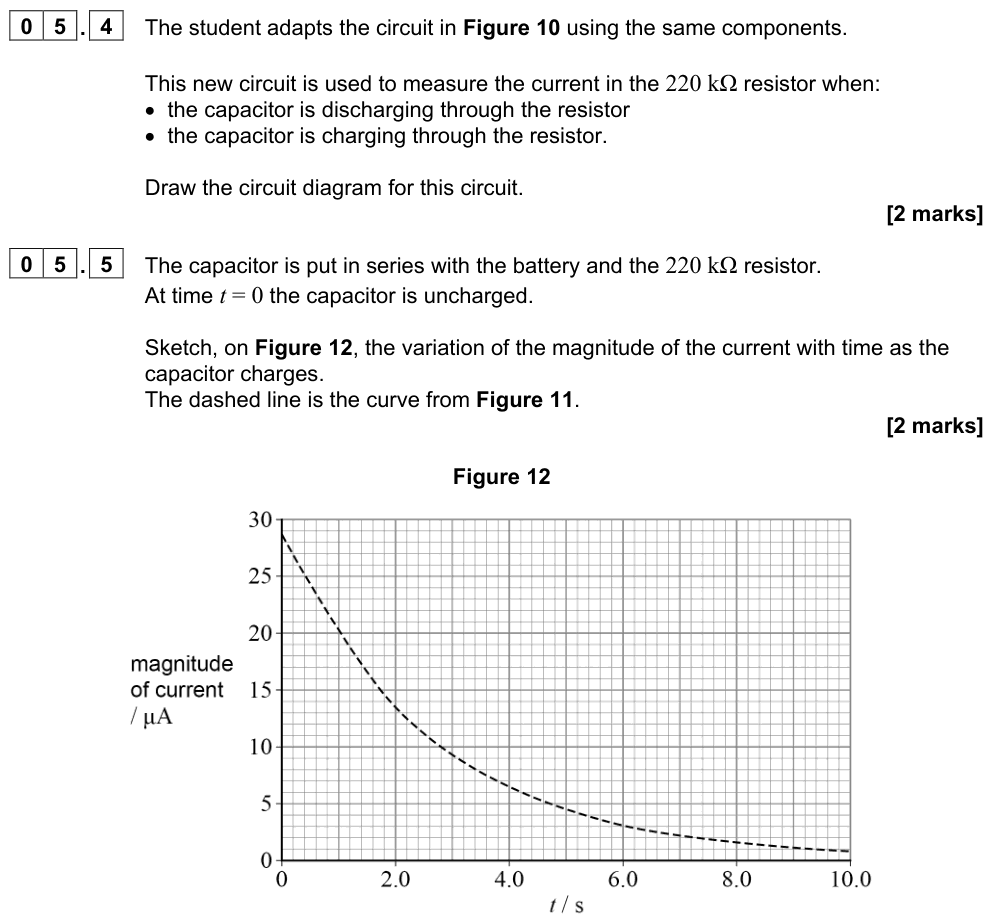
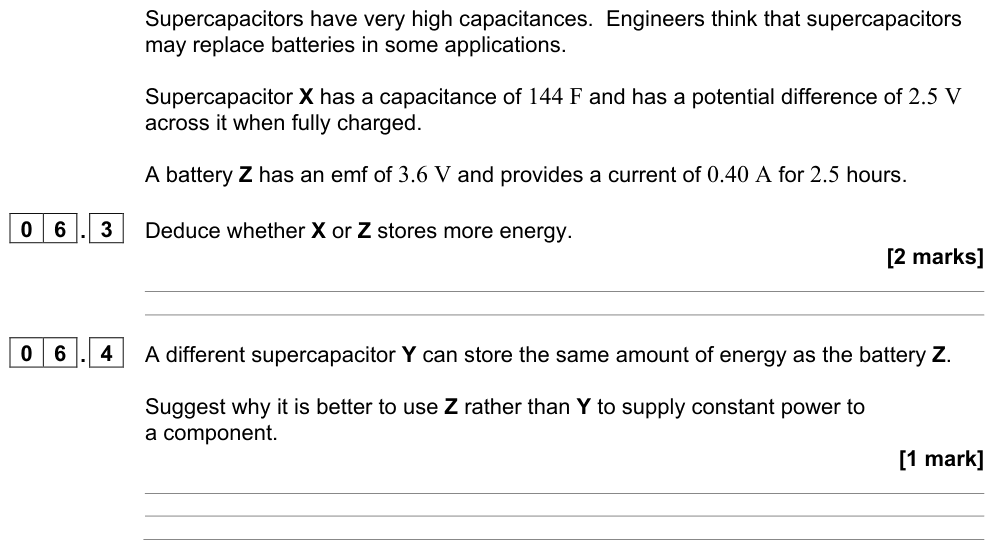
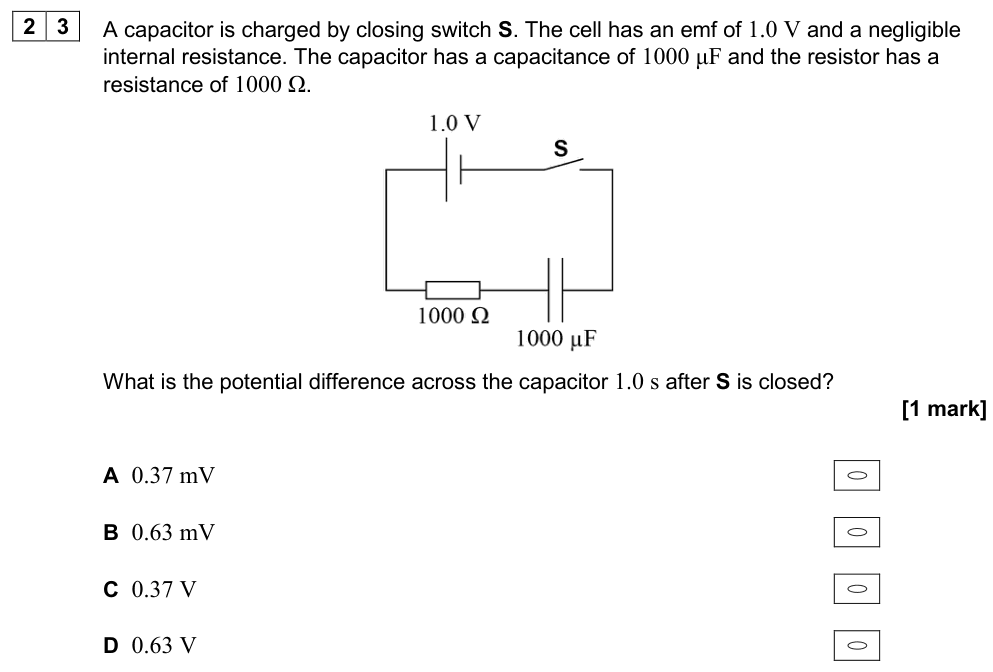
When a capacitor charges, work is done pushing more charge onto plates that already have charge on them. As the charge builds up, the p.d. increases from 0 to $V$.
Energy stored
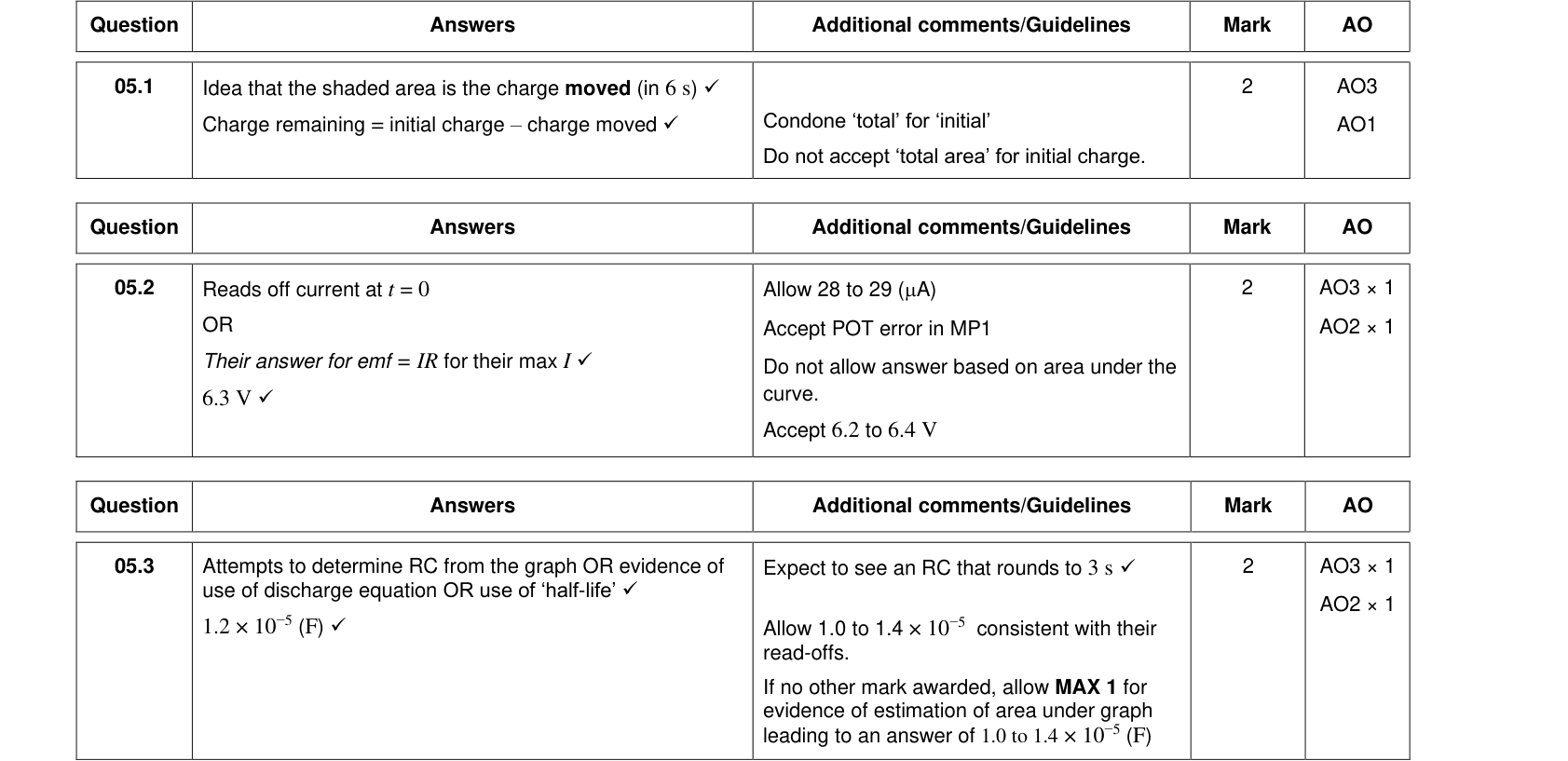
The energy stored equals the area under the graph of p.d. against charge ($V$ on the y-axis, $Q$ on the x-axis). For a capacitor this graph is a straight line through the origin, so the area is a triangle (the triangle on a charge–p.d. graph has the same area):
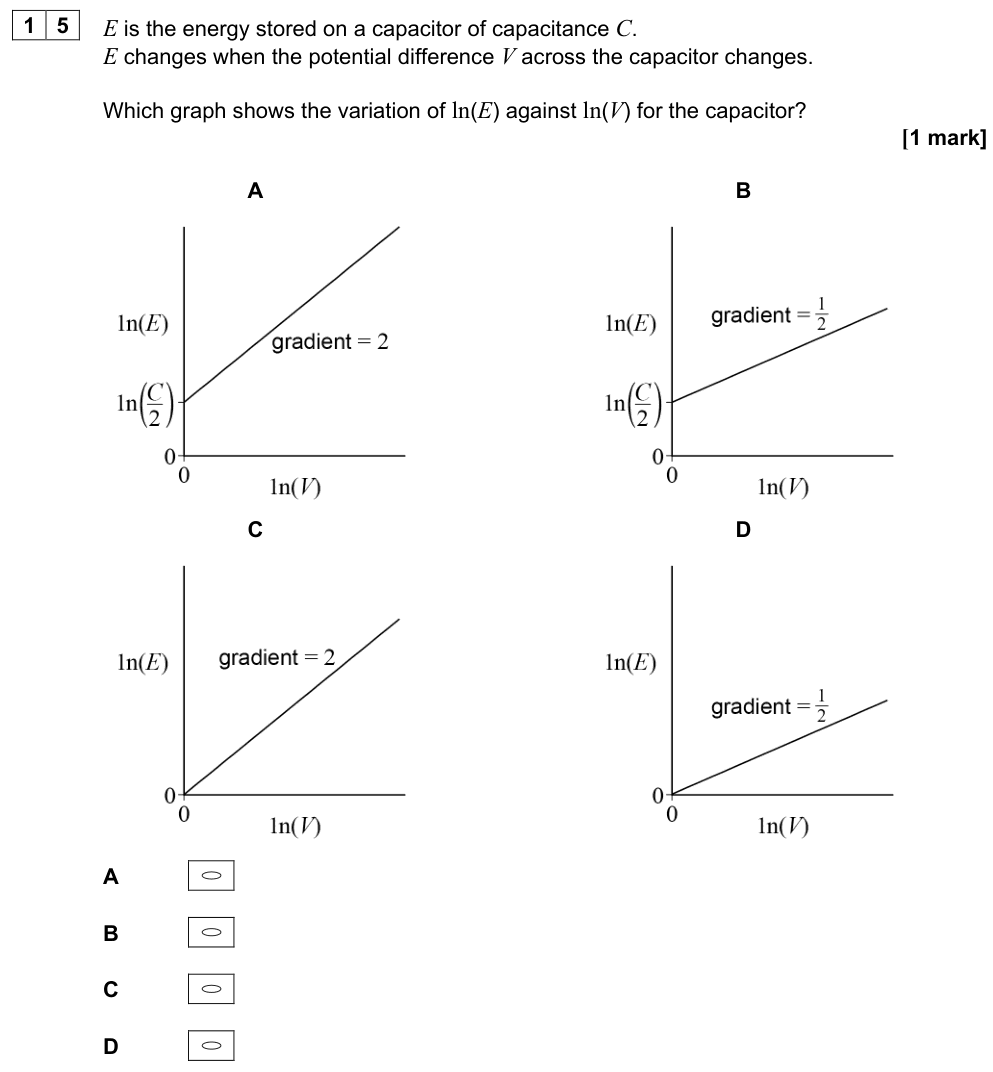
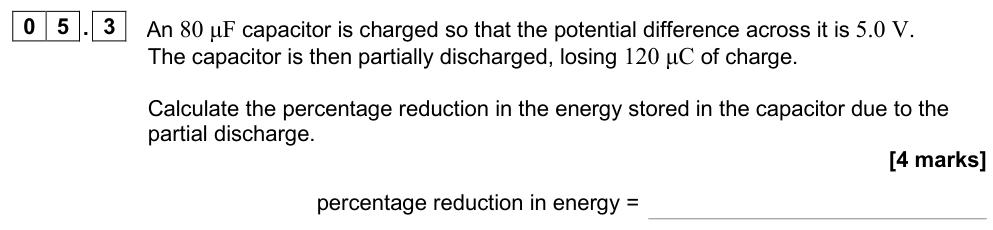
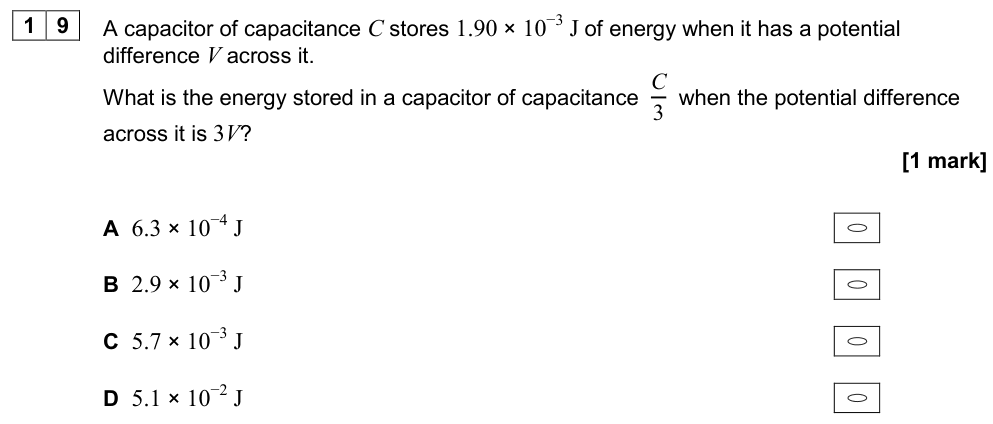
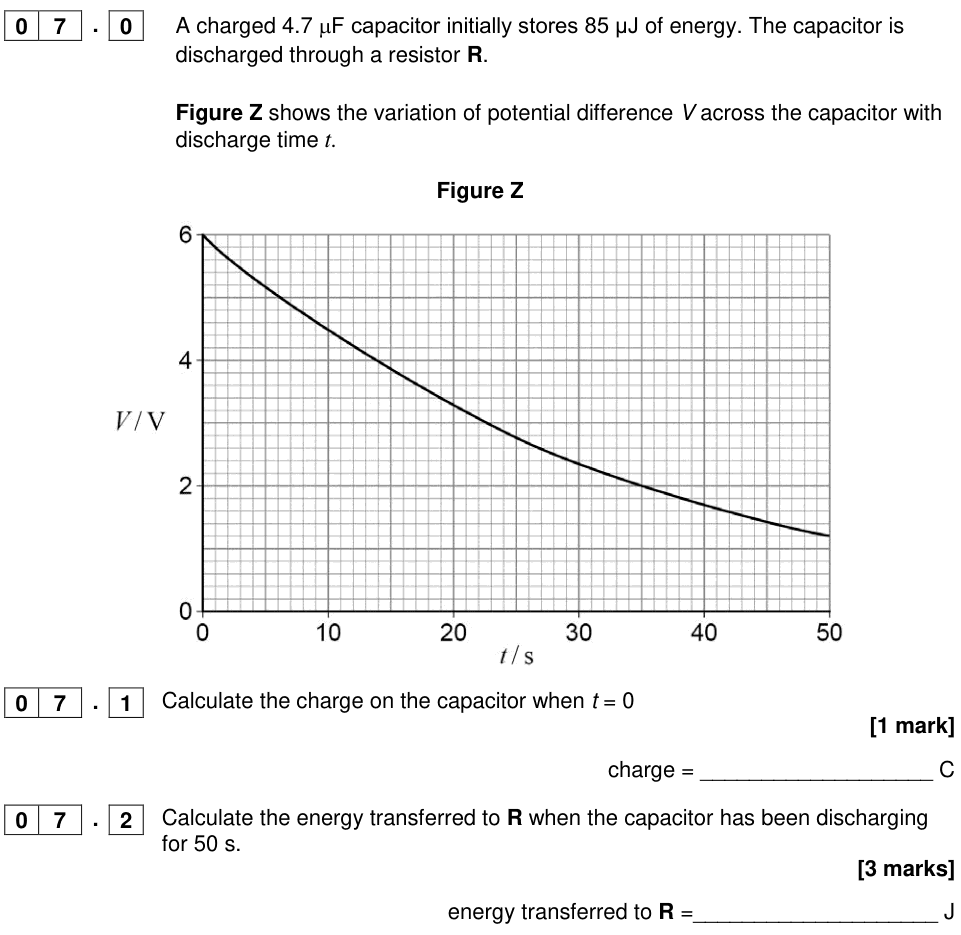
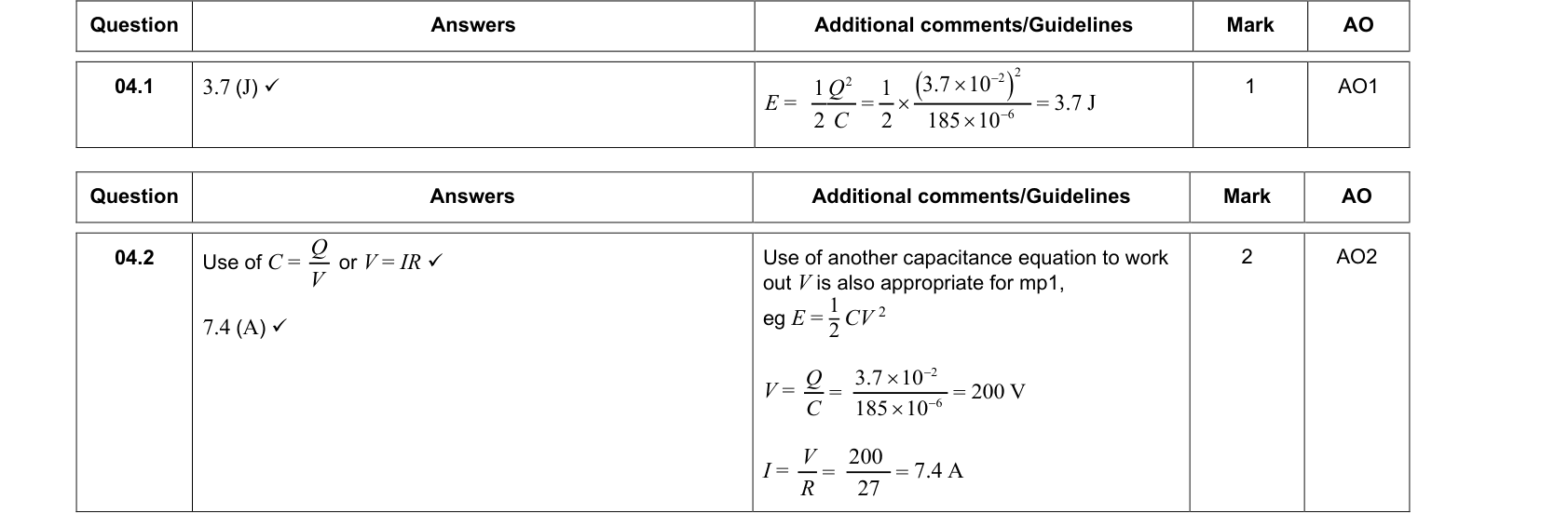
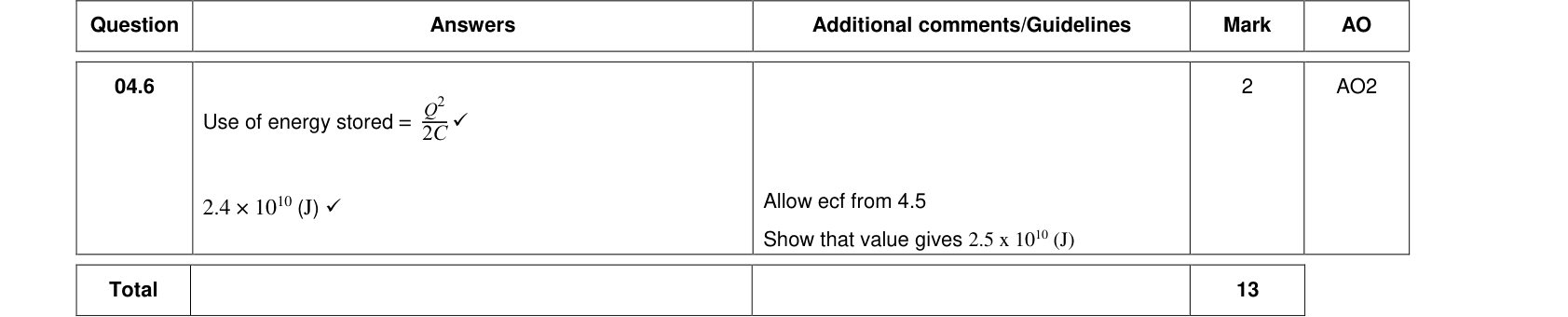
$$E = \tfrac12QV = \tfrac12CV^2 = \tfrac12\frac{Q^2}{C}$$
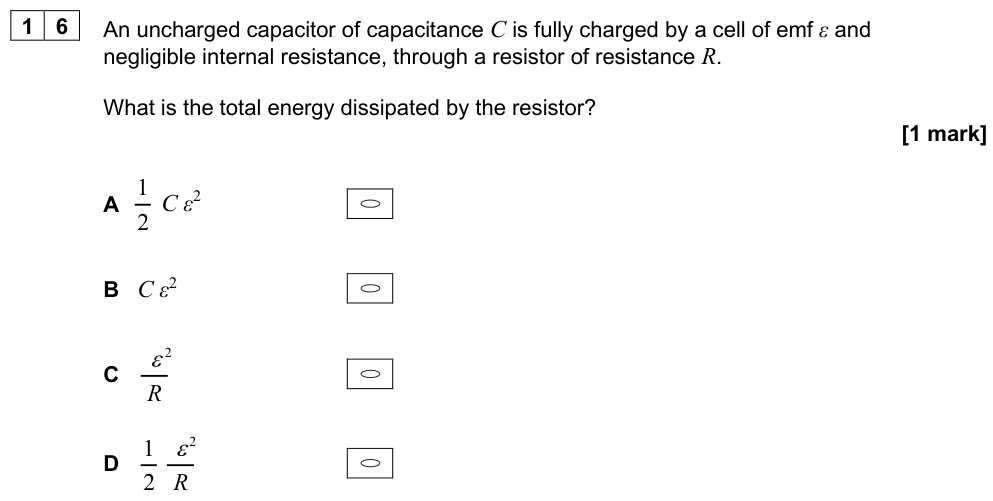
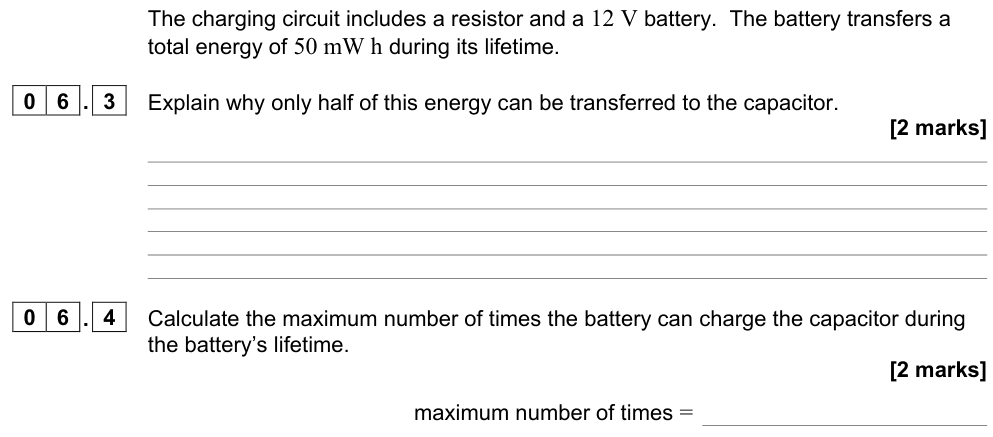
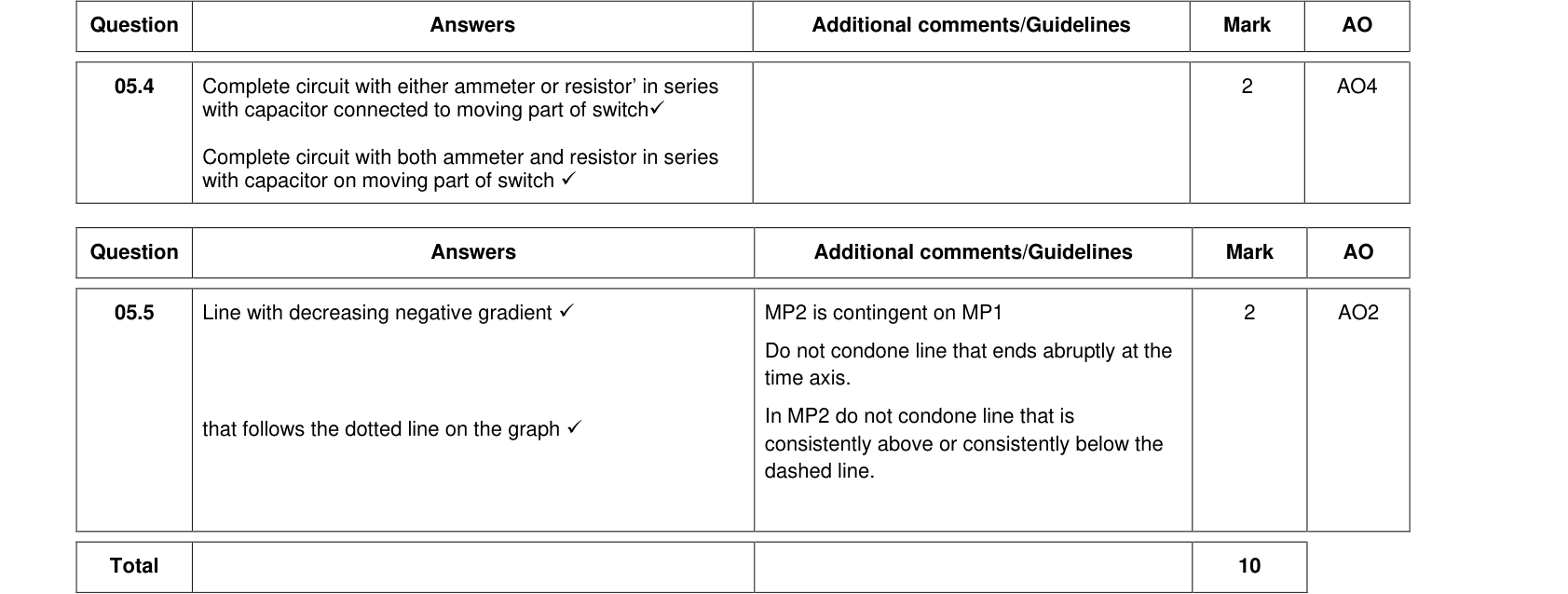
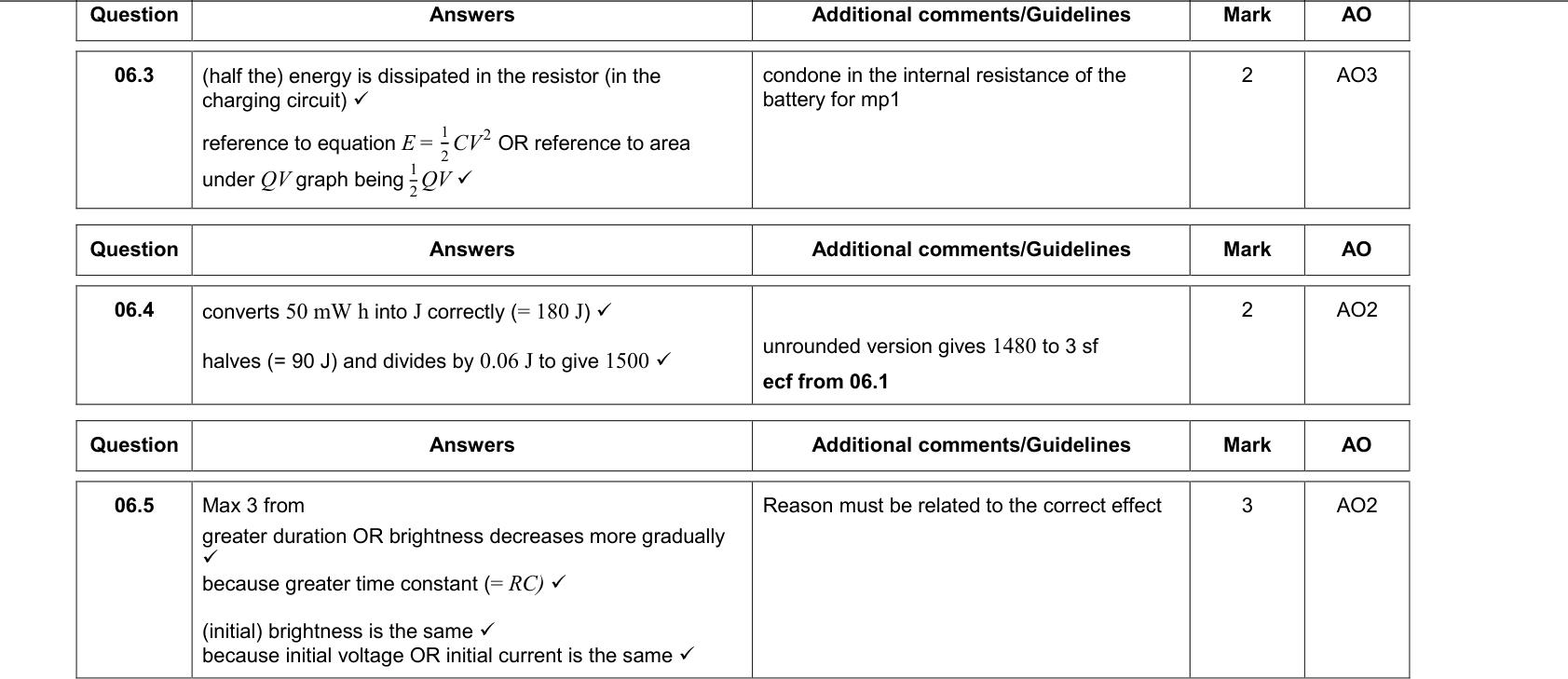
Note that a battery charging a capacitor transfers energy $QV$, but only half of it is stored; the other half is dissipated as heat in the resistance of the circuit while charging.
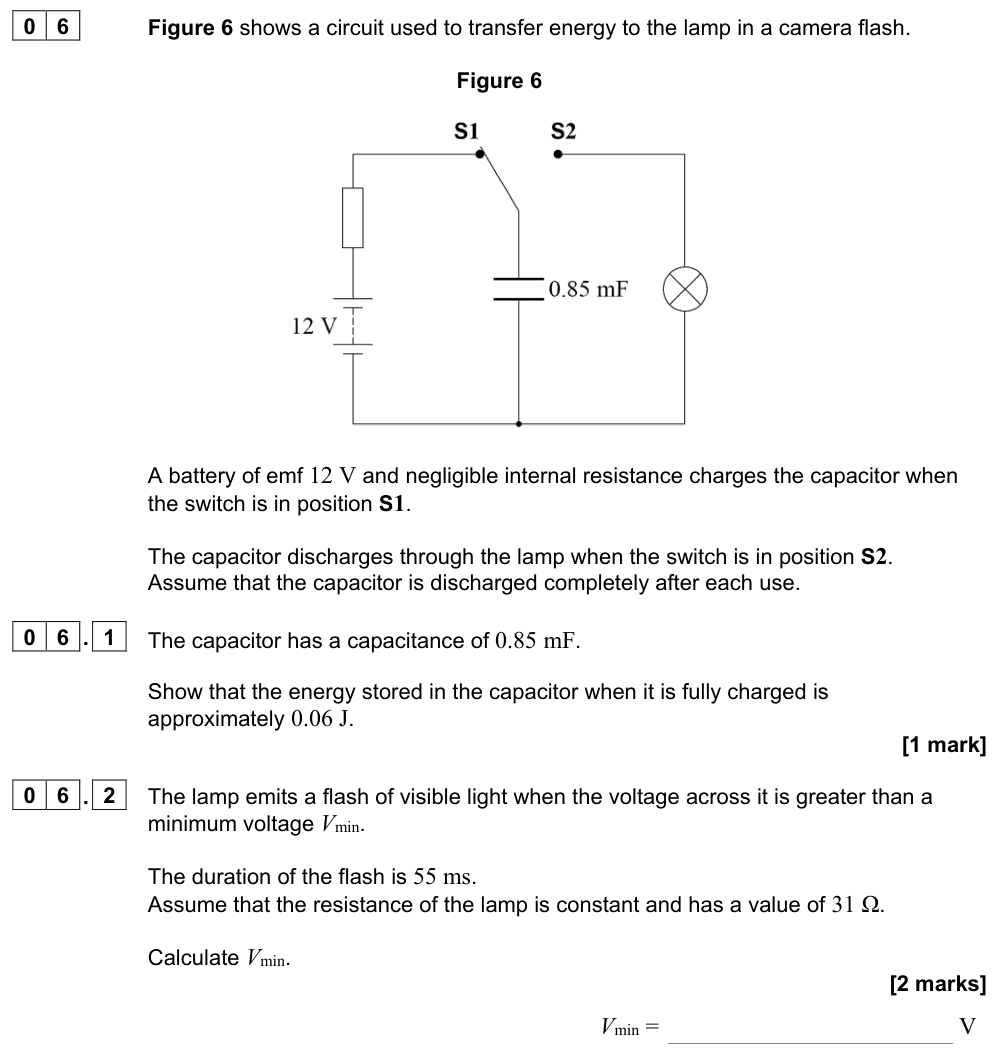
Worked example: camera flash
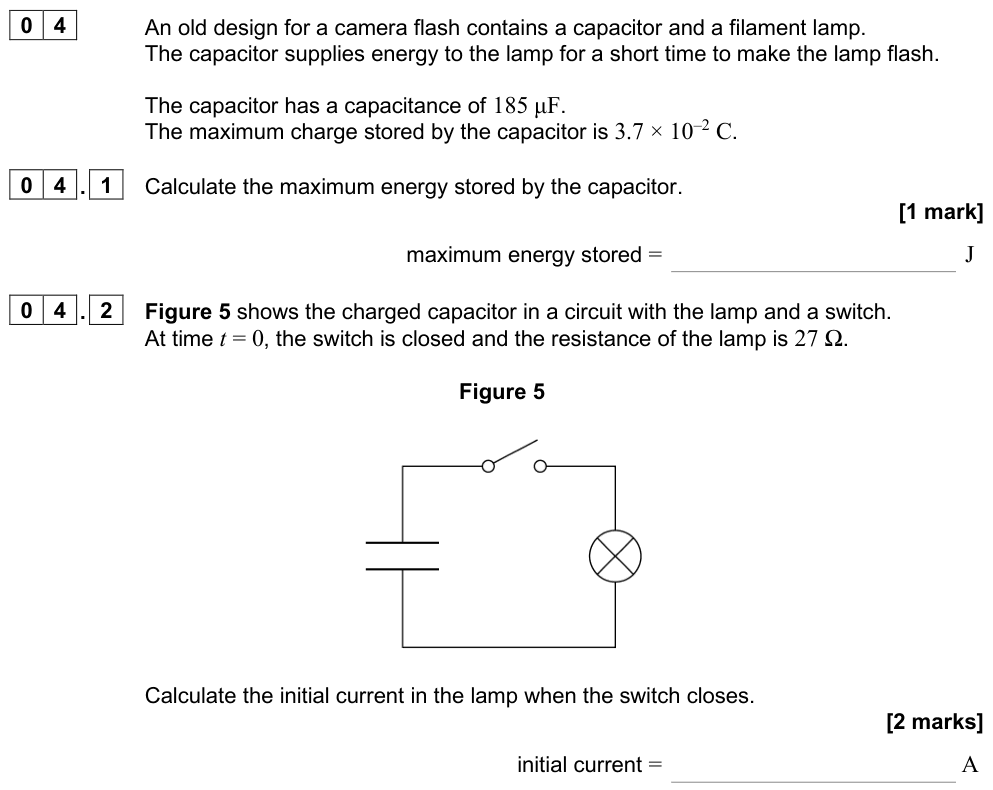
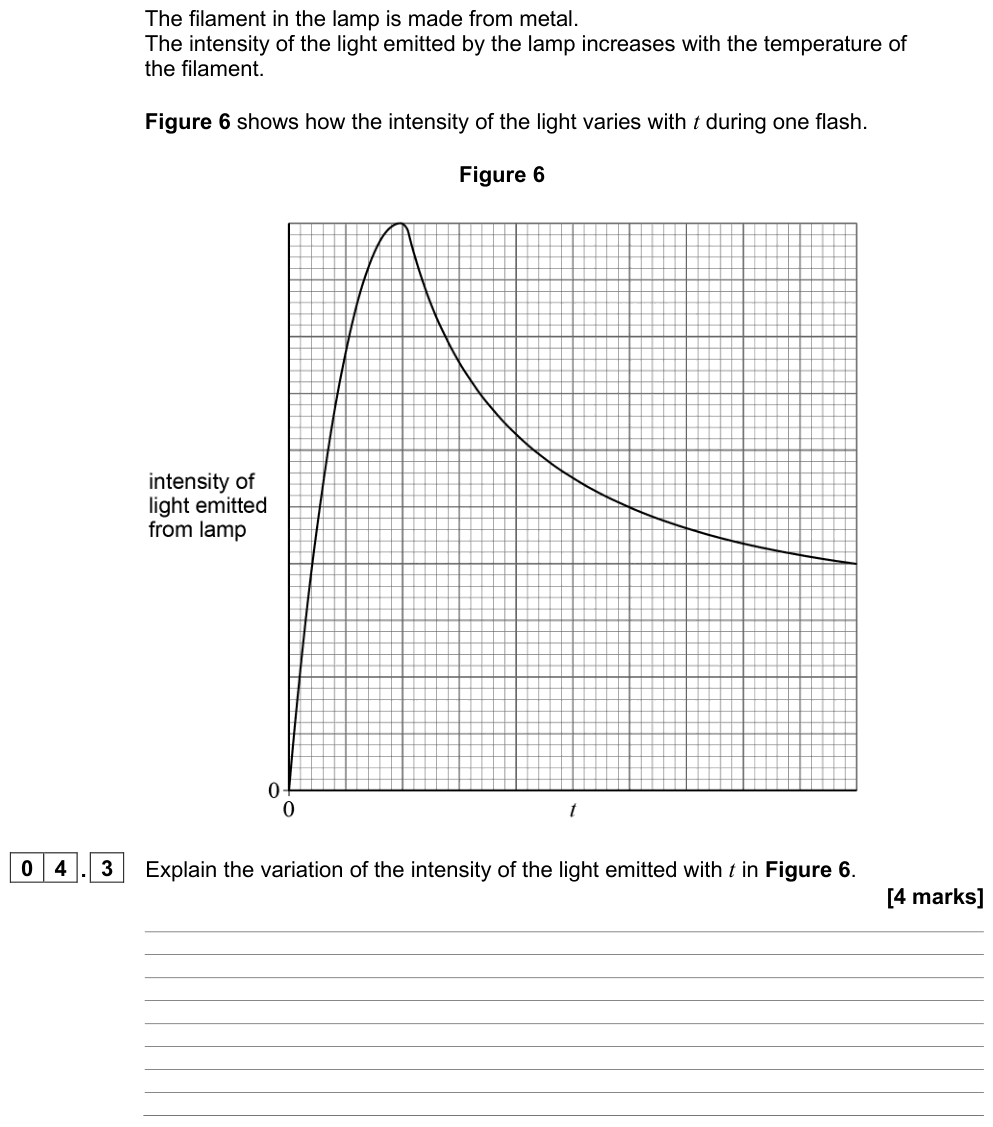
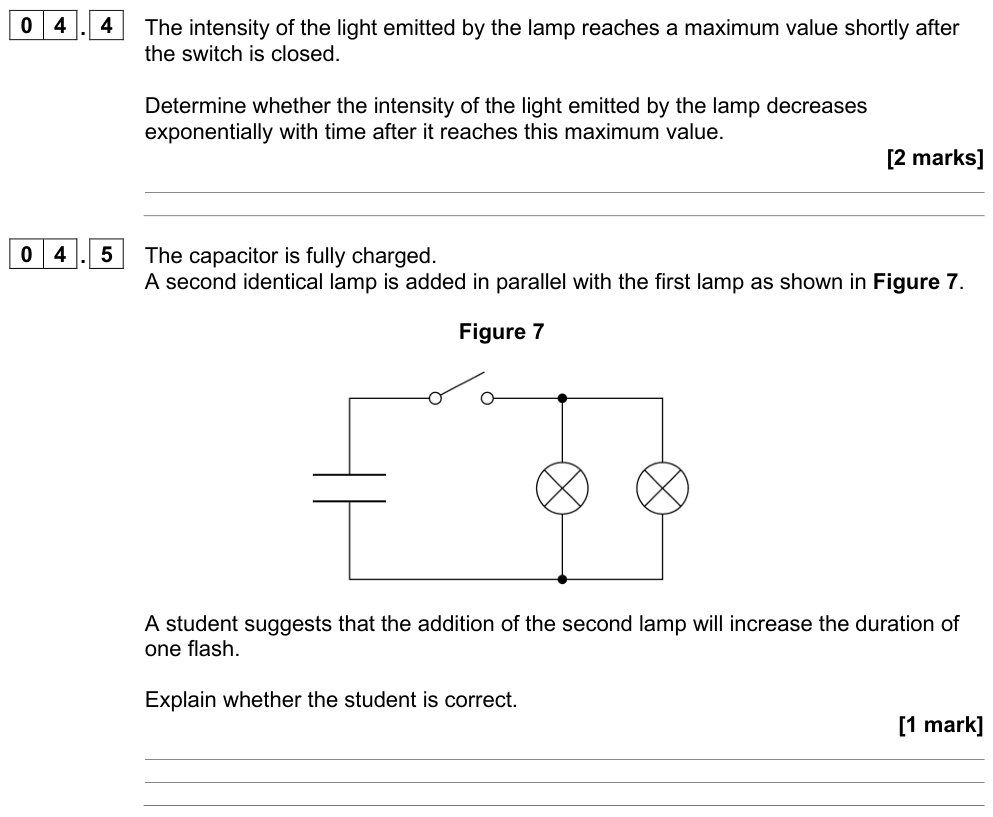
A 220 μF capacitor is charged to 300 V. Energy stored $= \tfrac12 \times 220 \times 10^{-6} \times 300^2 = 9.9\ \text{J}$. If it discharges in 1.0 ms, the average power is about 10 kW.
Common mistake
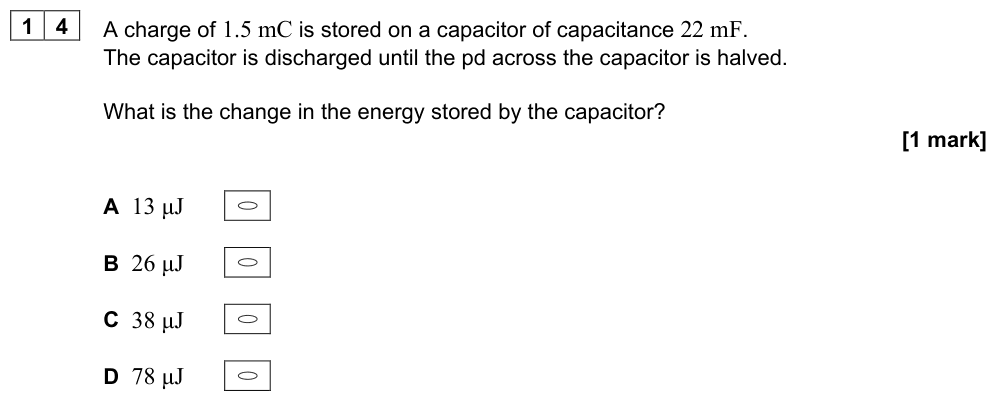
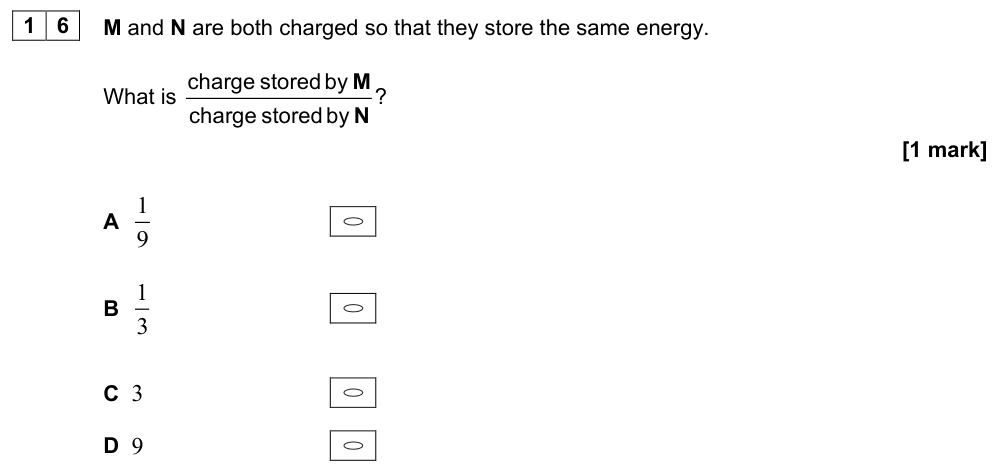
The energy depends on $V^2$: doubling the p.d. quadruples the energy stored.
Capacitors in circuits (useful extension)
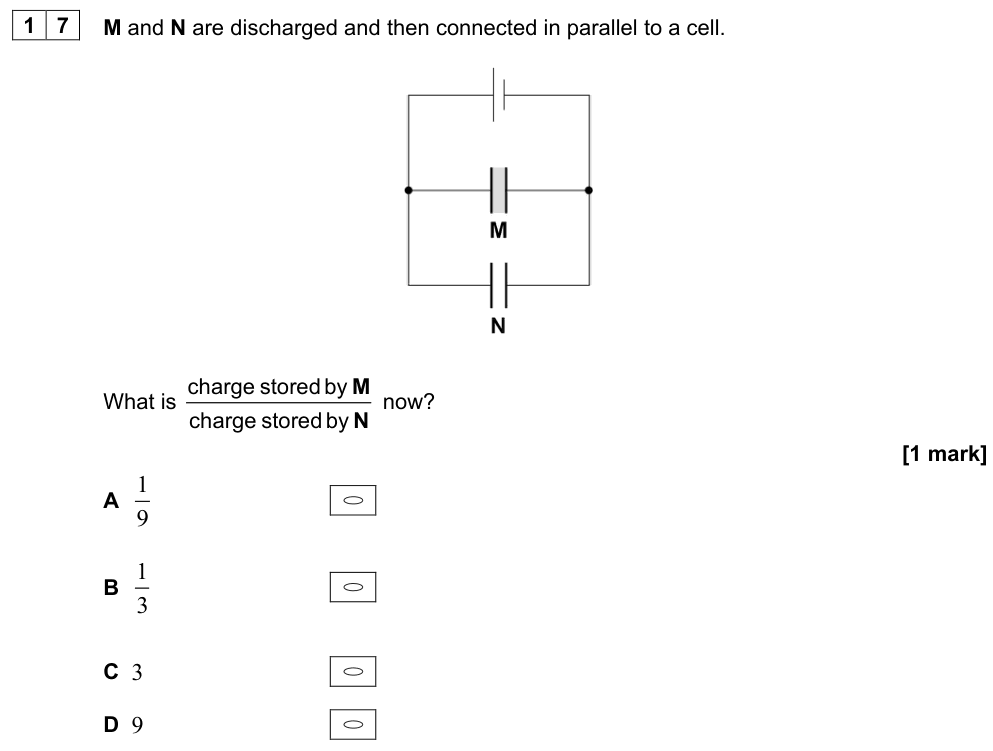
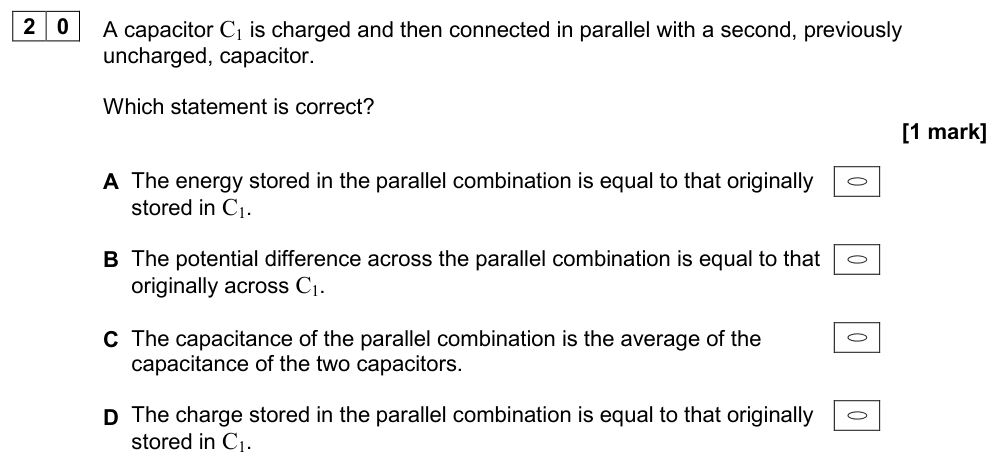
Capacitors combine opposite to resistors: in parallel $C = C_1 + C_2$; in series $\dfrac1C = \dfrac1{C_1} + \dfrac1{C_2}$. When a charged capacitor is connected in parallel with an uncharged one, the charge is shared (total charge conserved) until both have the same p.d. Some energy is lost as heat in the process.
Summary
- $C = Q/V$ (F); parallel plates $C = A\varepsilon_0\varepsilon_r/d$.
- Relative permittivity $\varepsilon_r$: factor by which a dielectric increases $C$.
- Dielectric: polar molecules rotate to line up with the field, reducing the resultant field, so $V$ falls for the same $Q$ (C increases).
- Energy = area under $V$–$Q$ graph $= \tfrac12QV = \tfrac12CV^2 = \tfrac12Q^2/C$.