Discharging a capacitor through a resistor
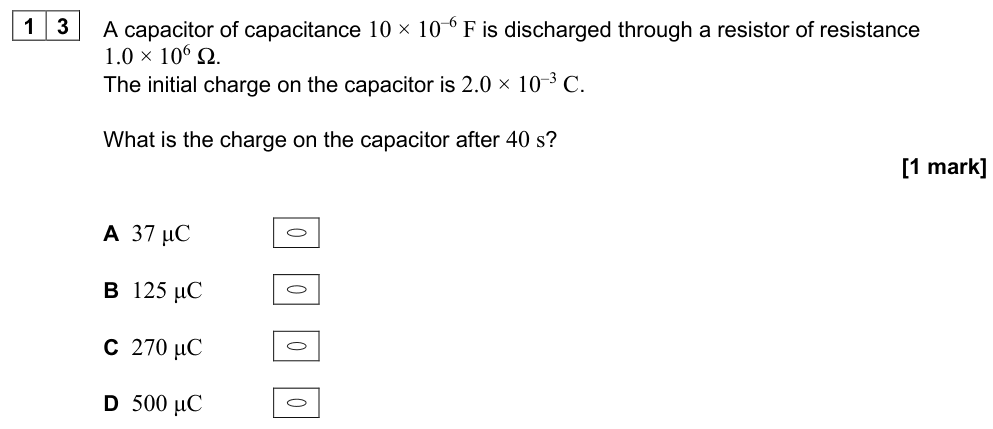
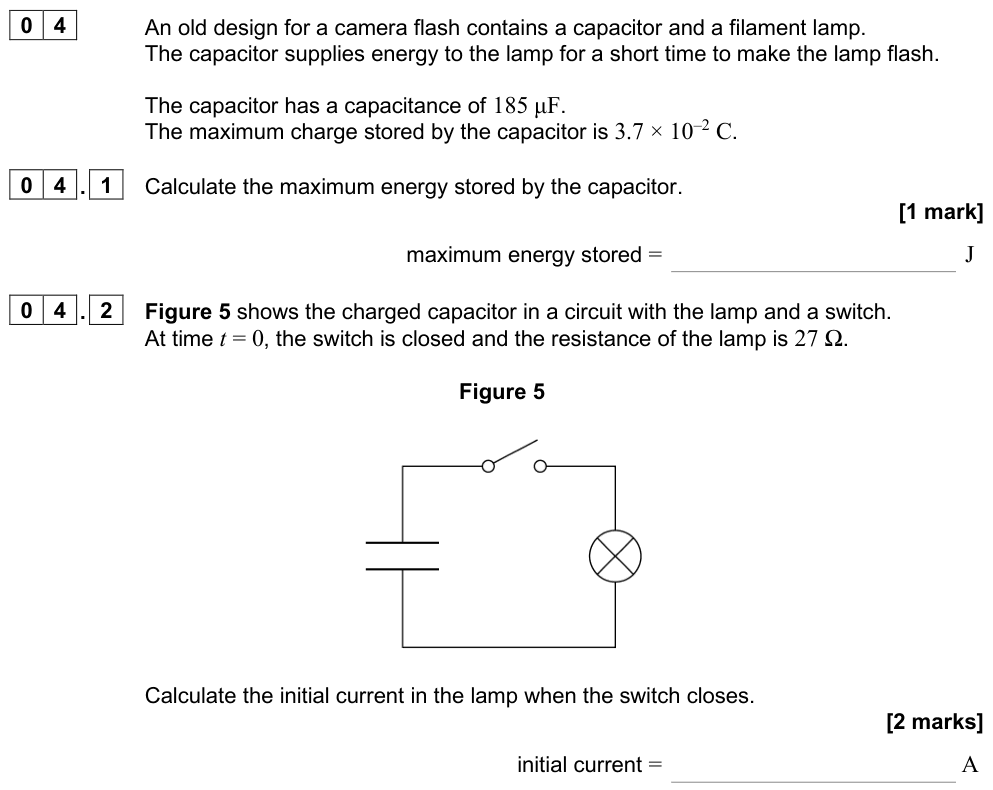
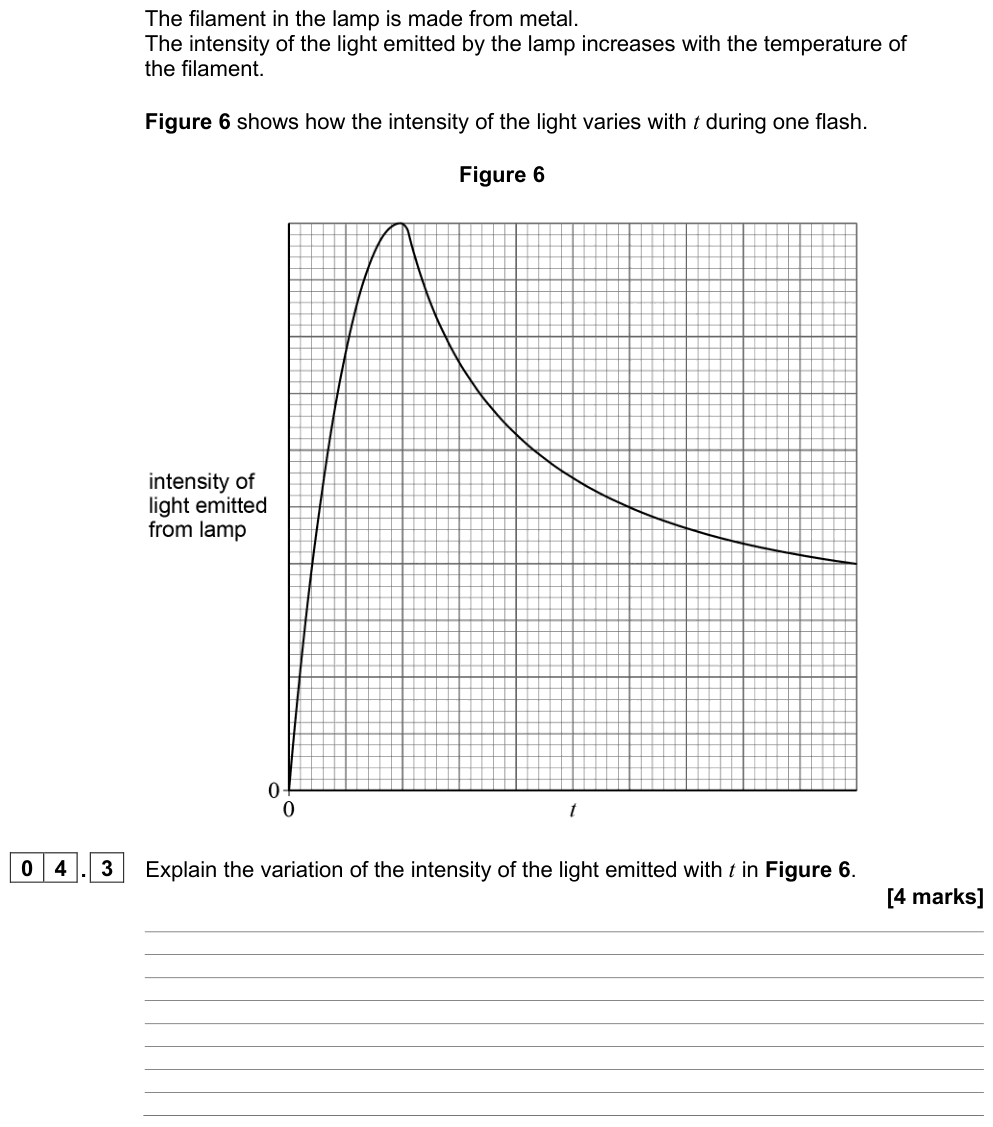
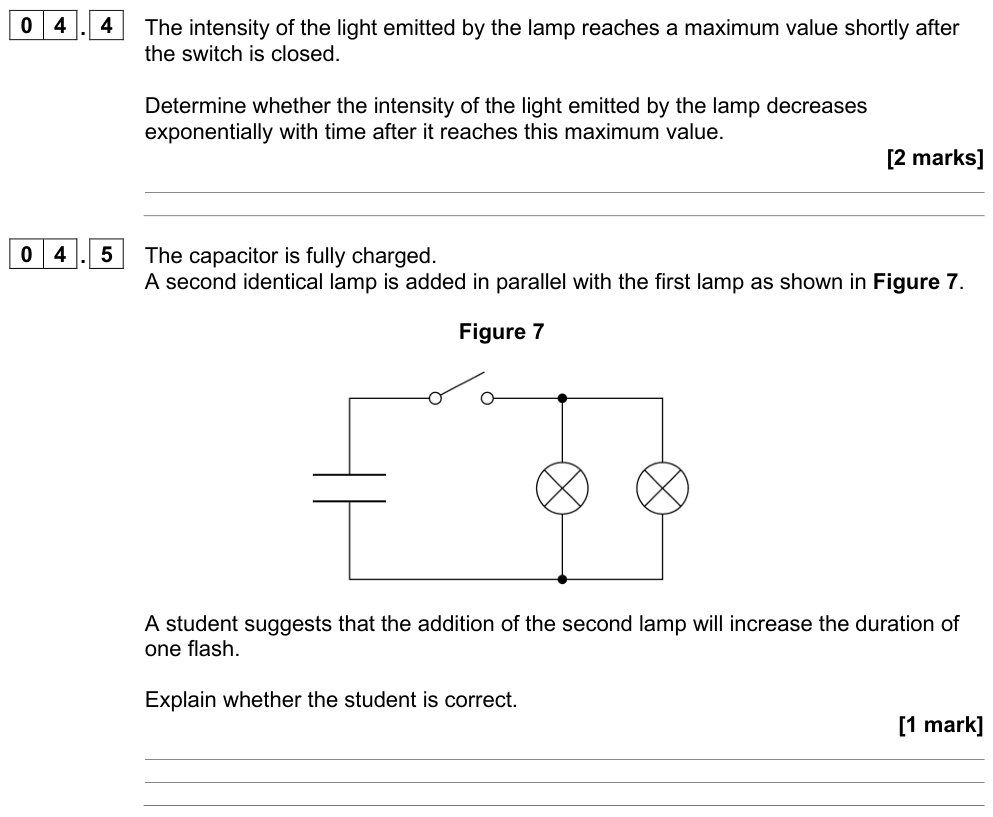
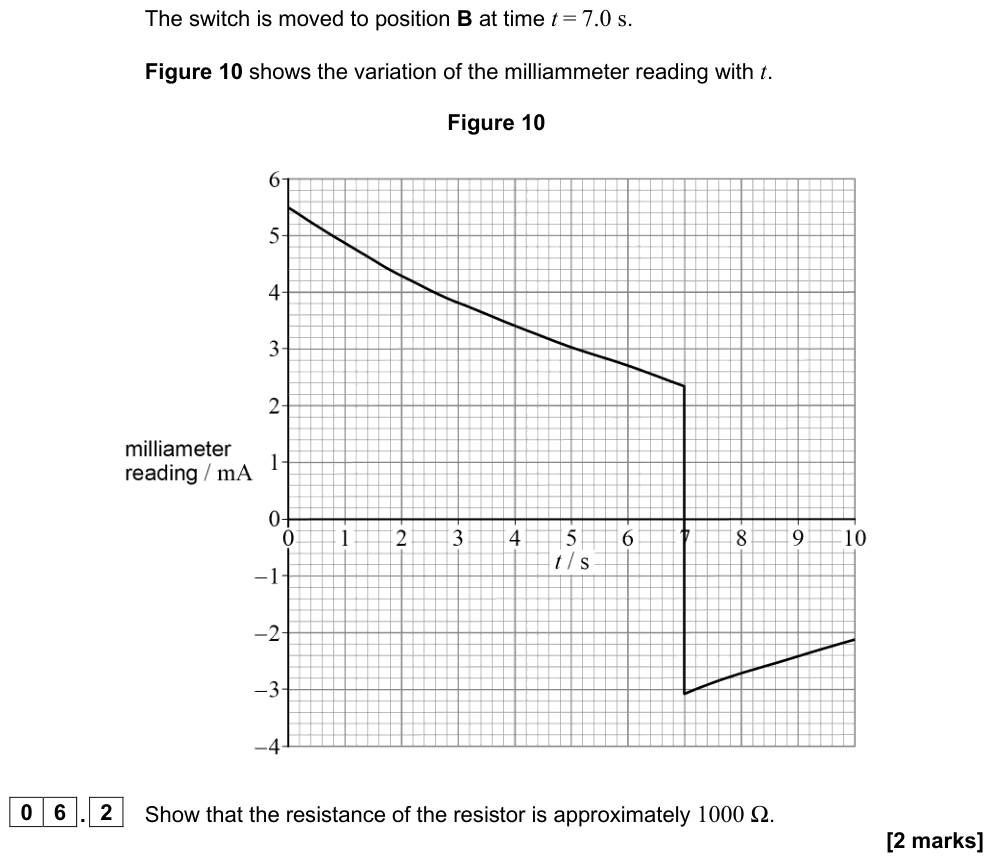
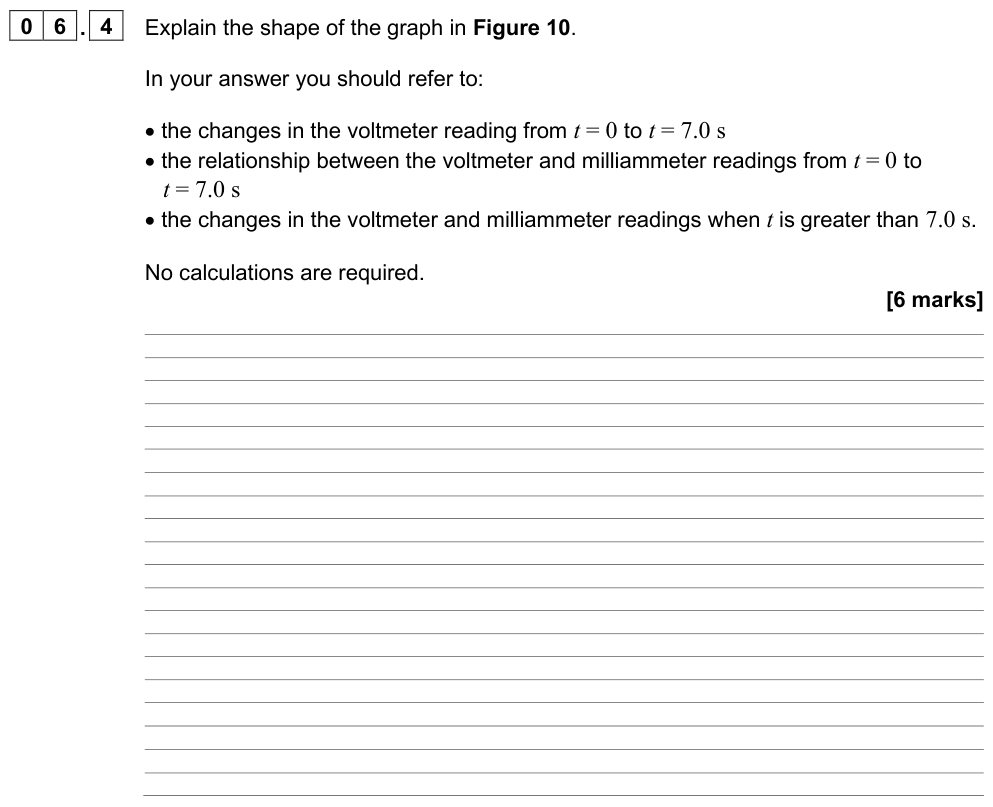
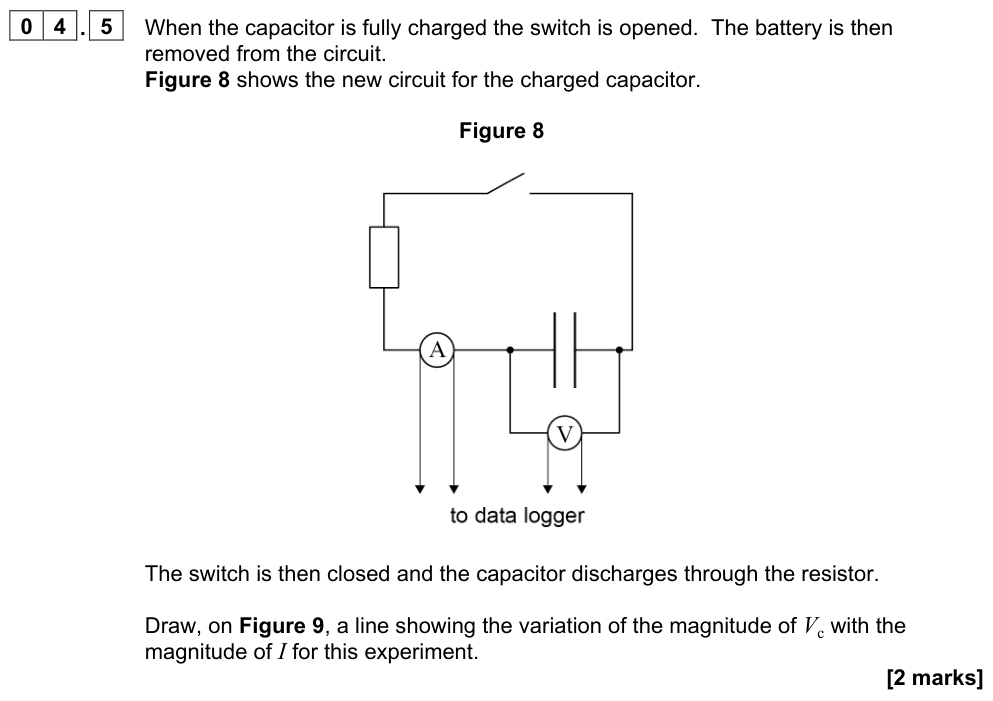
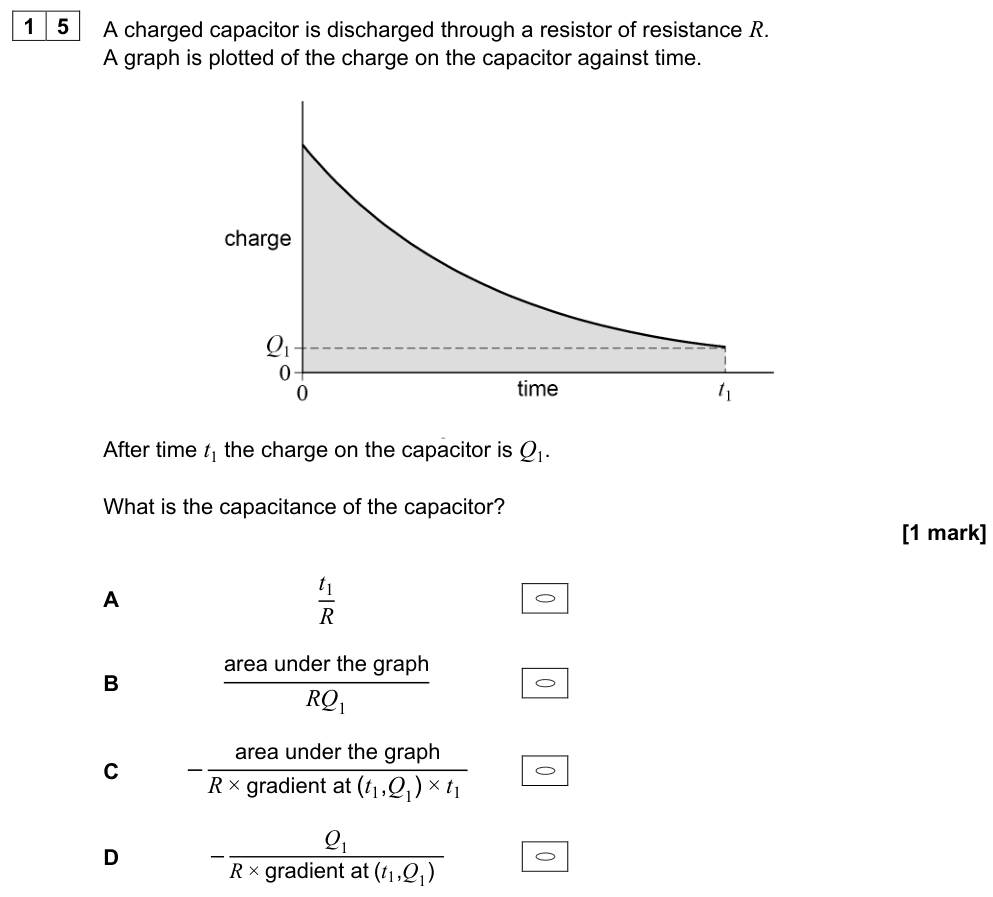
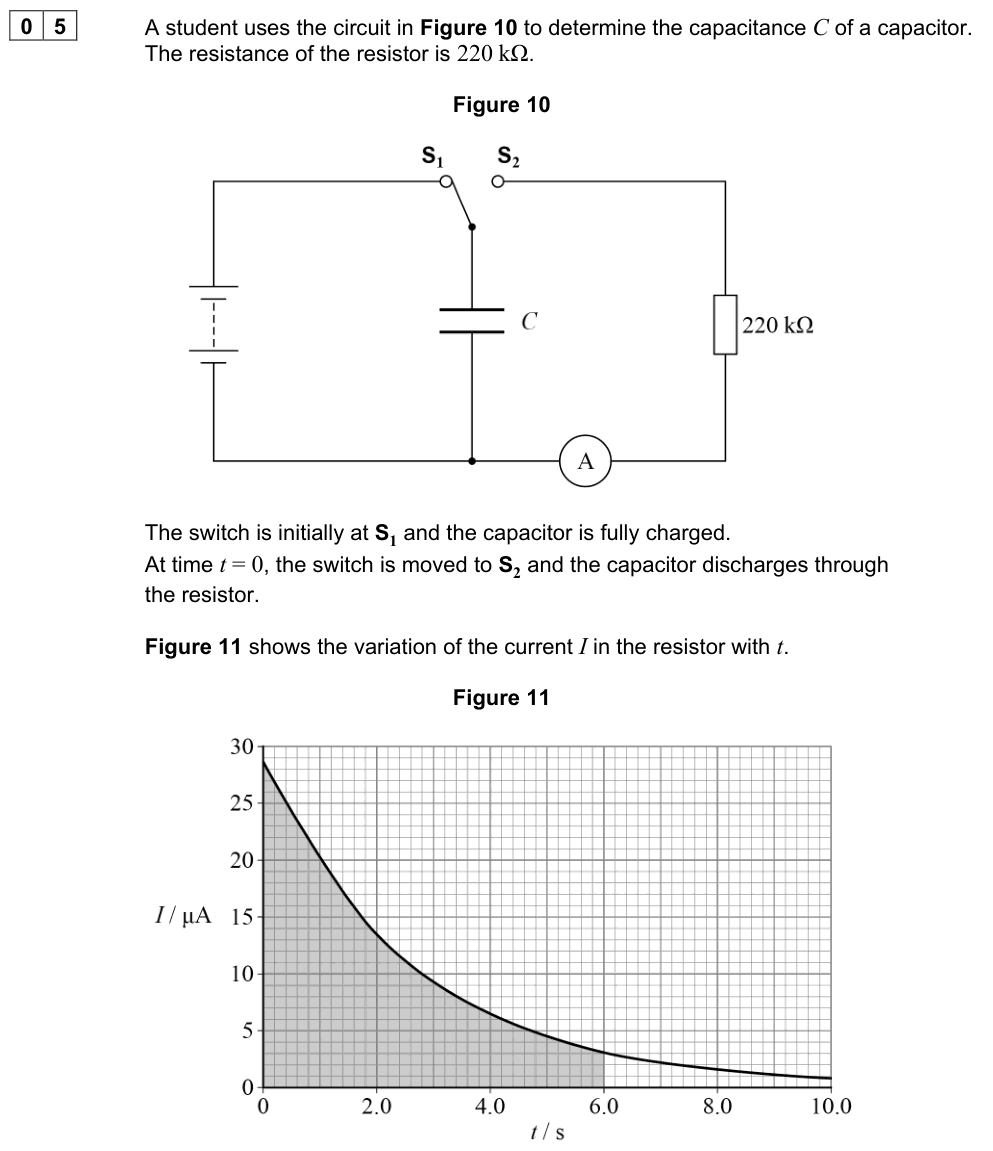
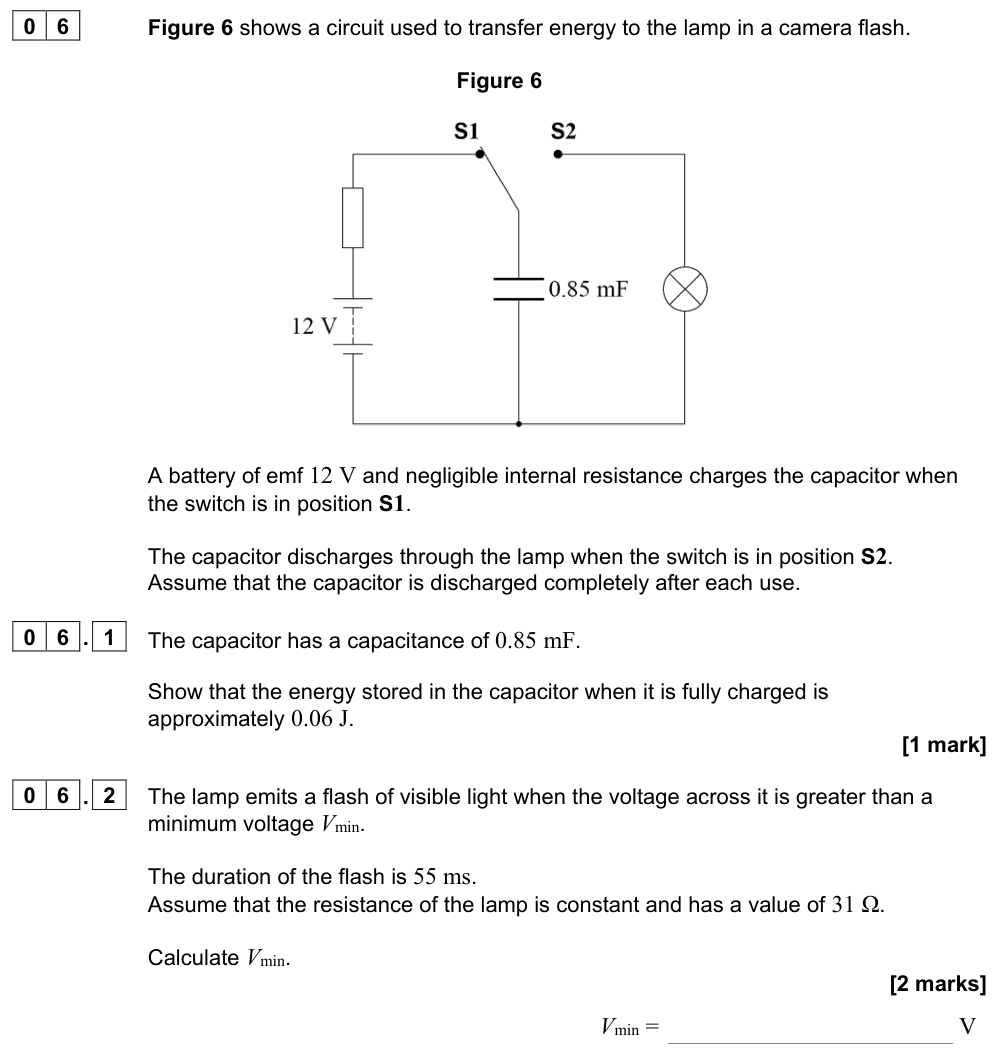
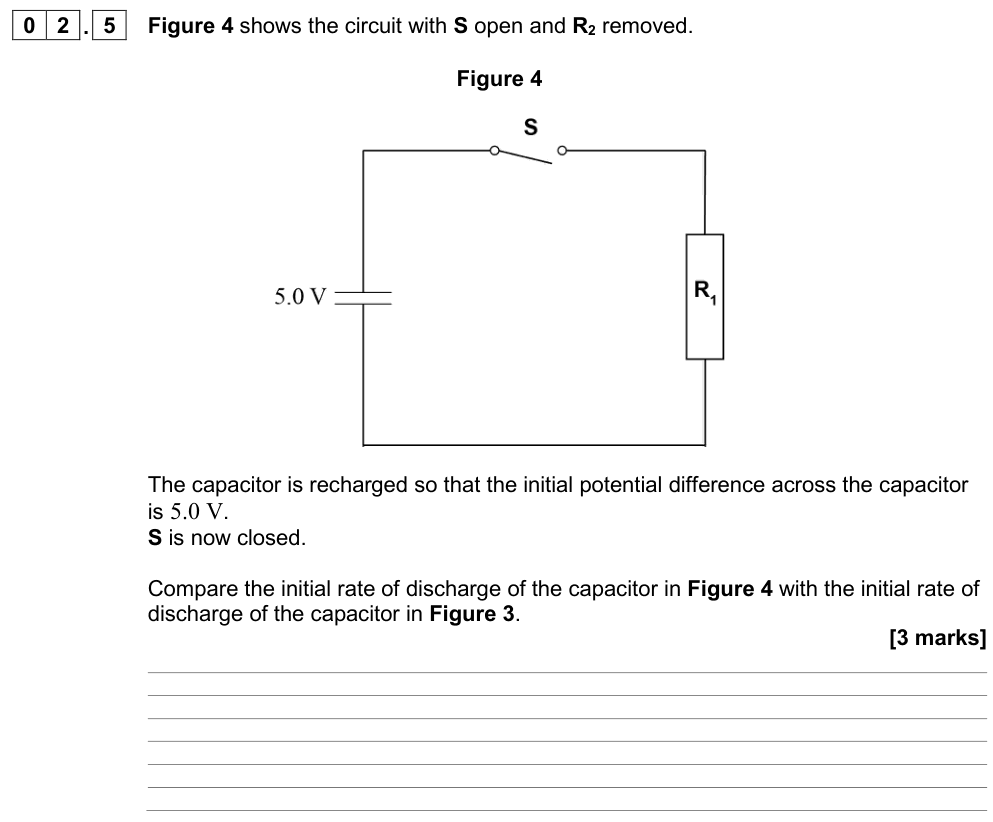
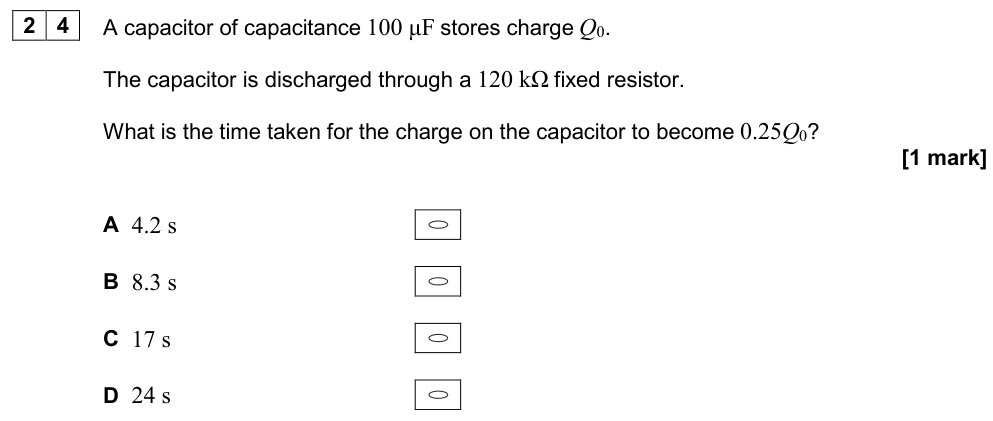
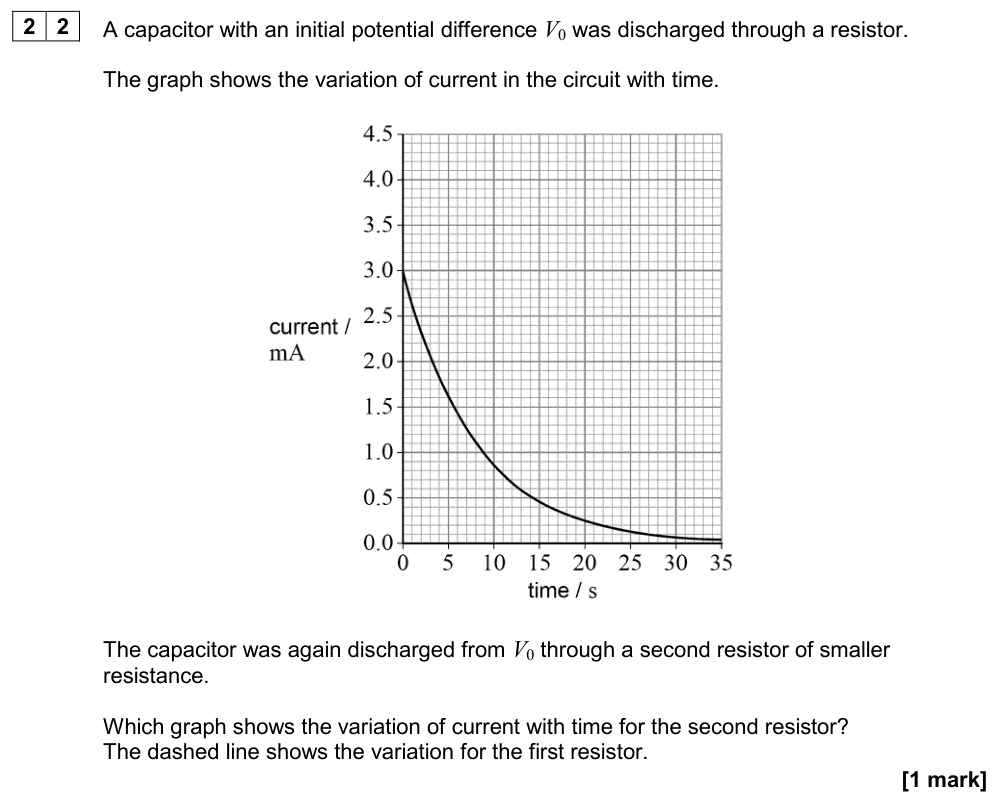
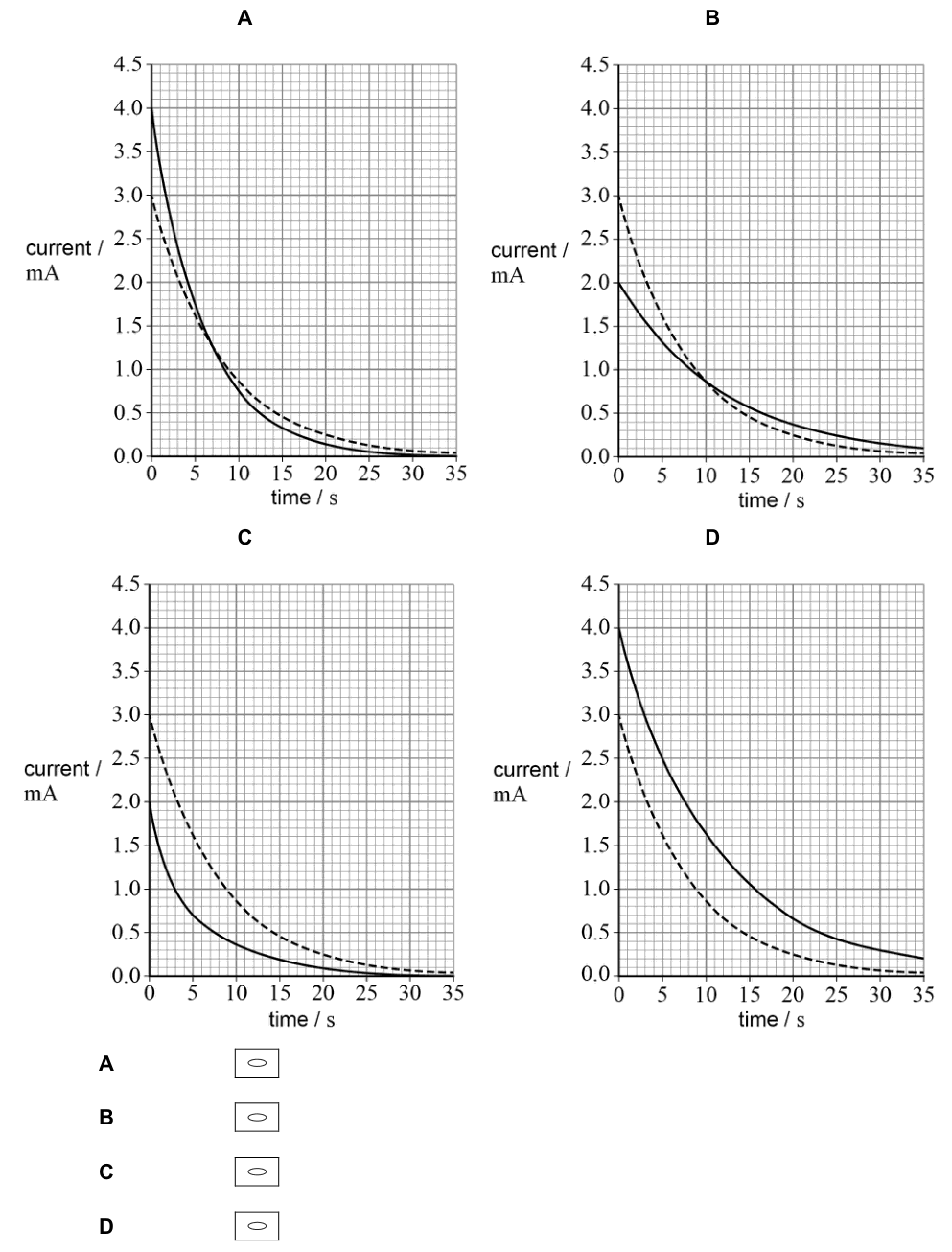
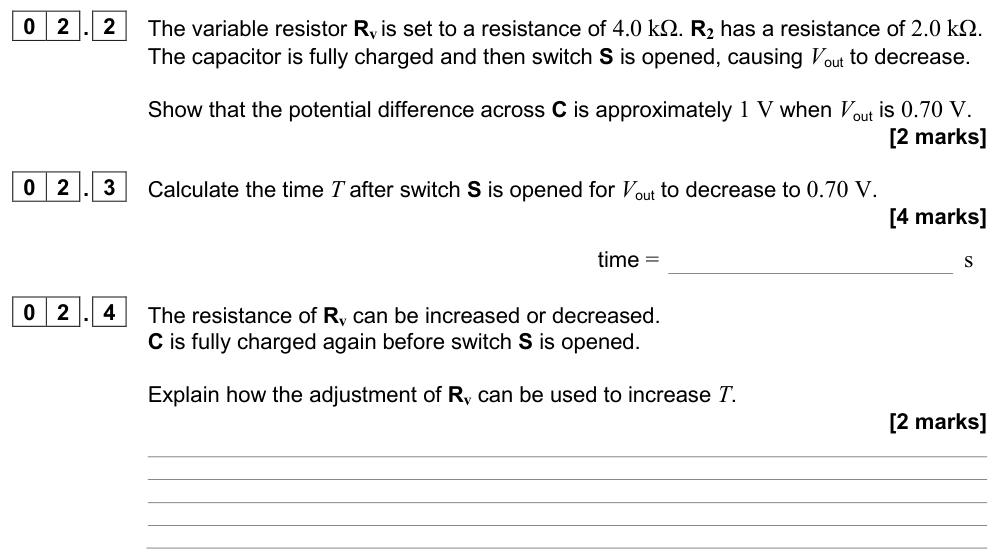
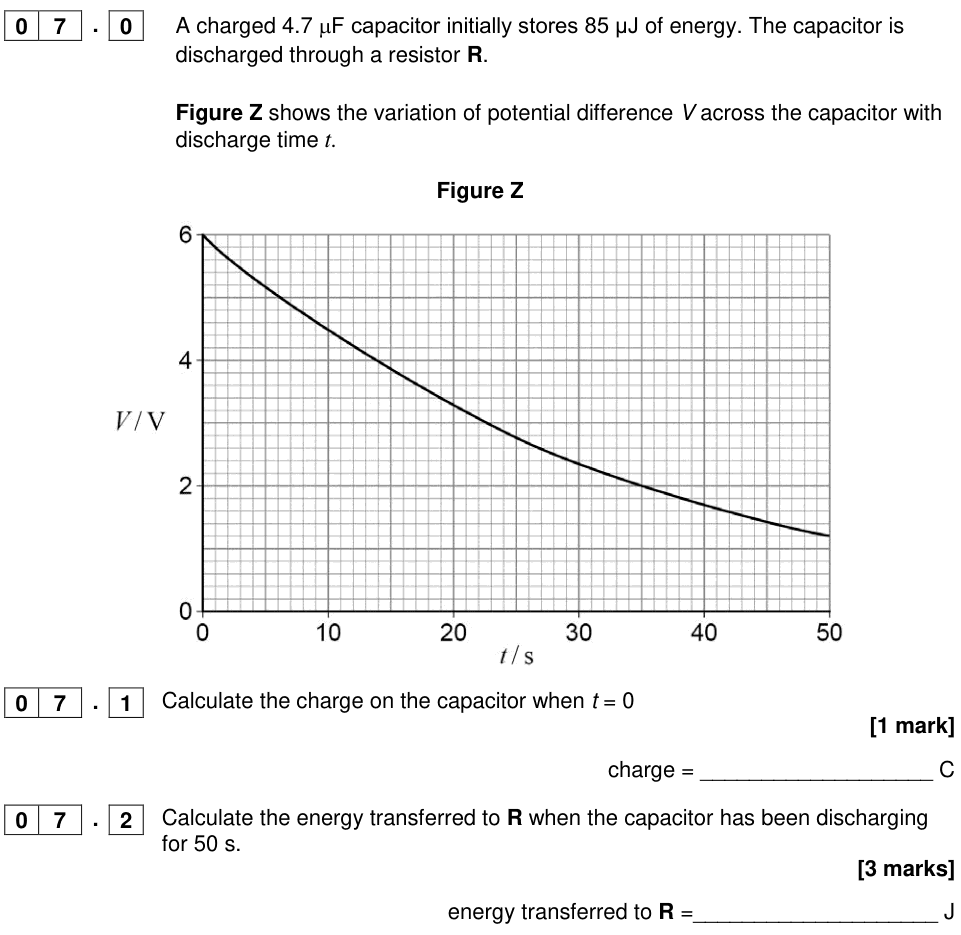
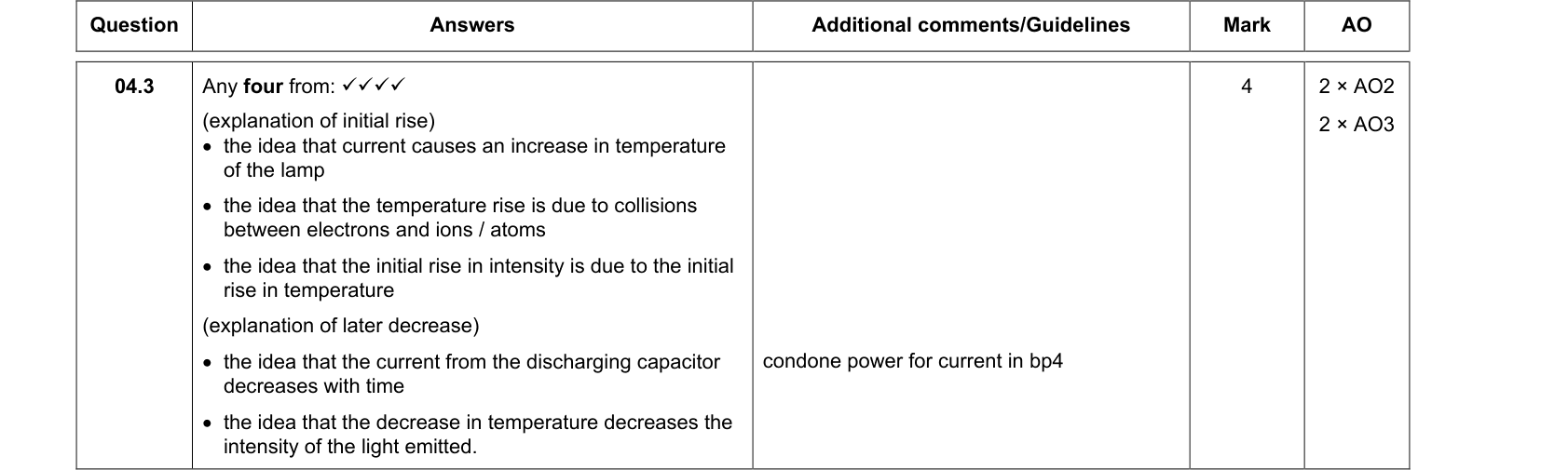
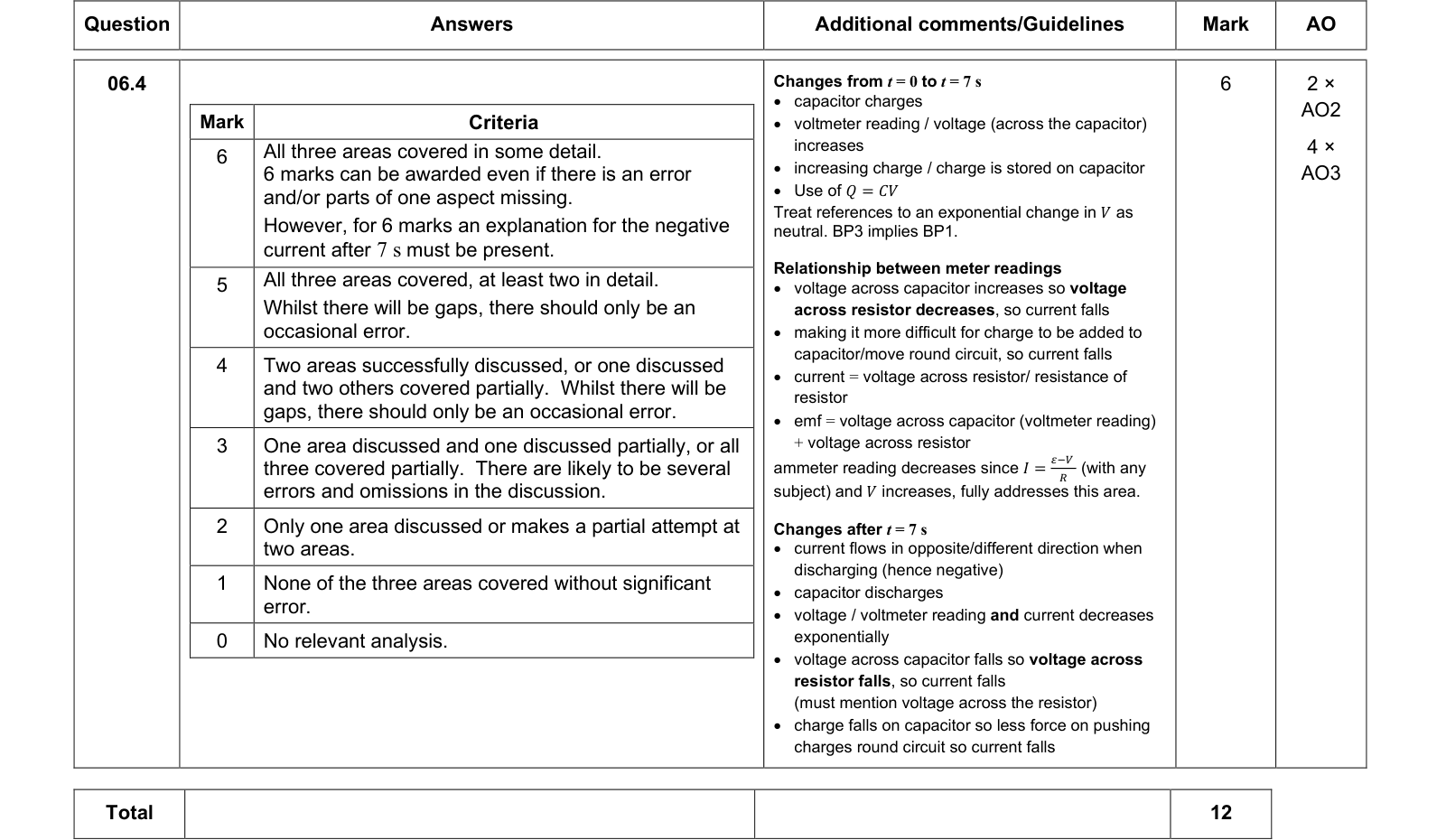
A capacitor charged to p.d. $V_0$ (charge $Q_0$) is connected across a resistor $R$. Charge flows from one plate to the other through the resistor. As the charge falls, the p.d. falls, so the current falls, so the charge falls more and more slowly. The decrease is exponential.
Discharge equations
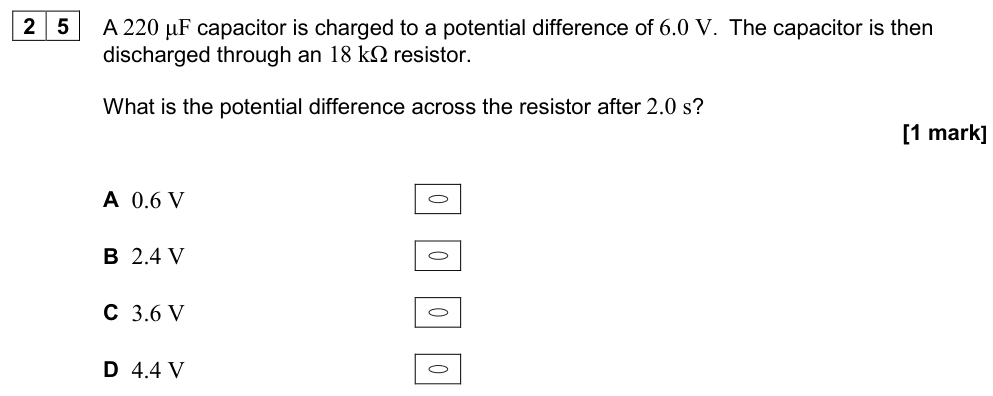
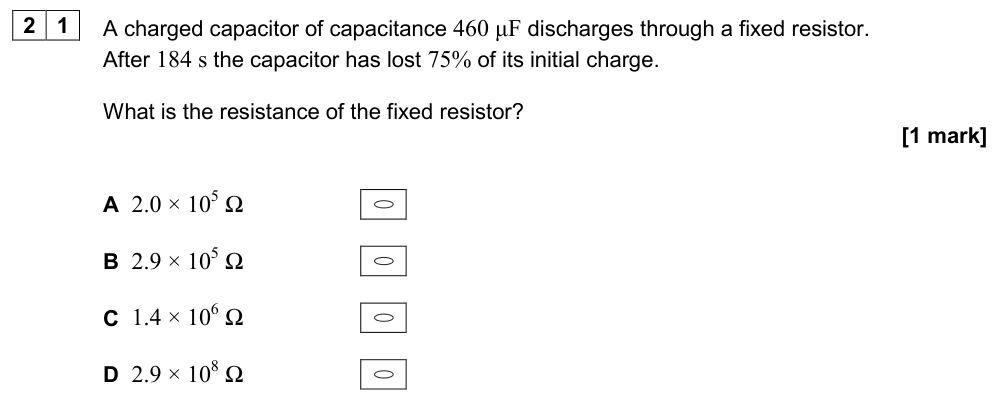
$$Q = Q_0e^{-t/RC} \qquad V = V_0e^{-t/RC} \qquad I = I_0e^{-t/RC}$$
where $I_0 = V_0/R$. All three quantities decay with the same time constant.
Time constant
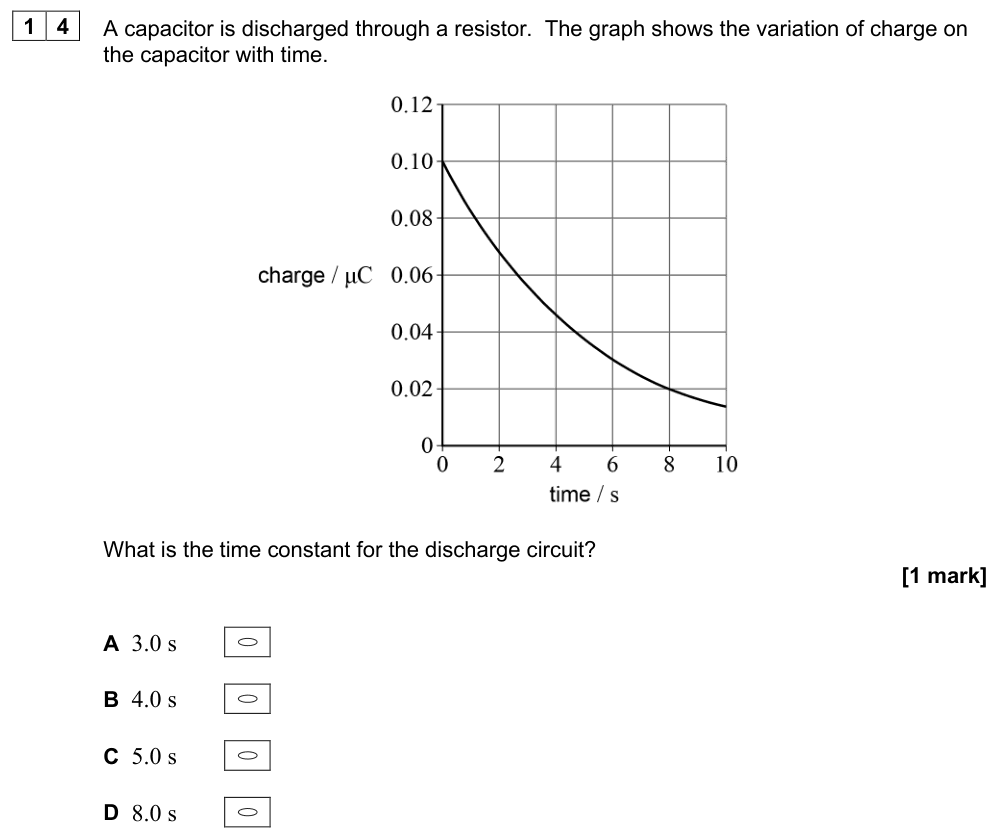
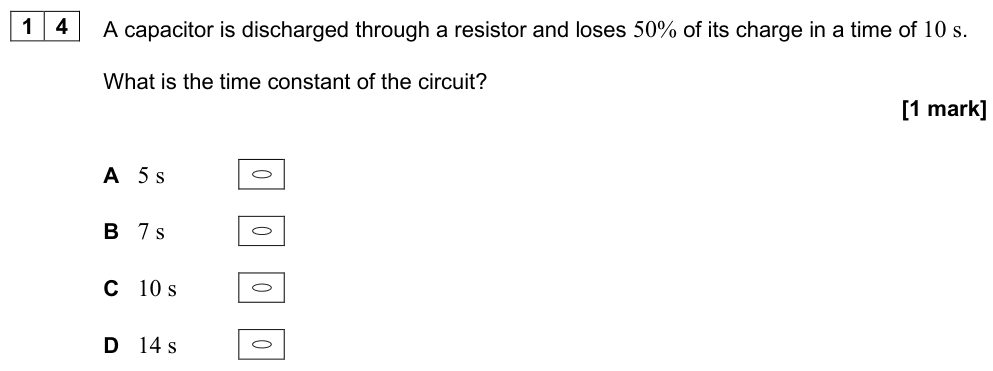
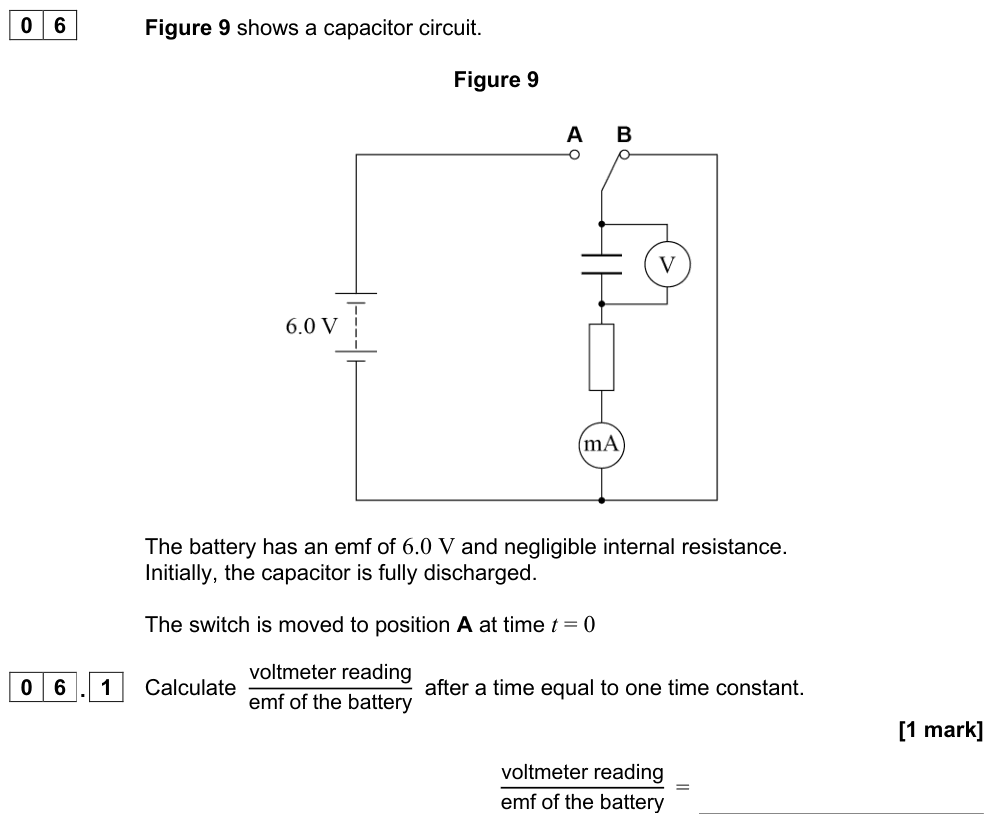
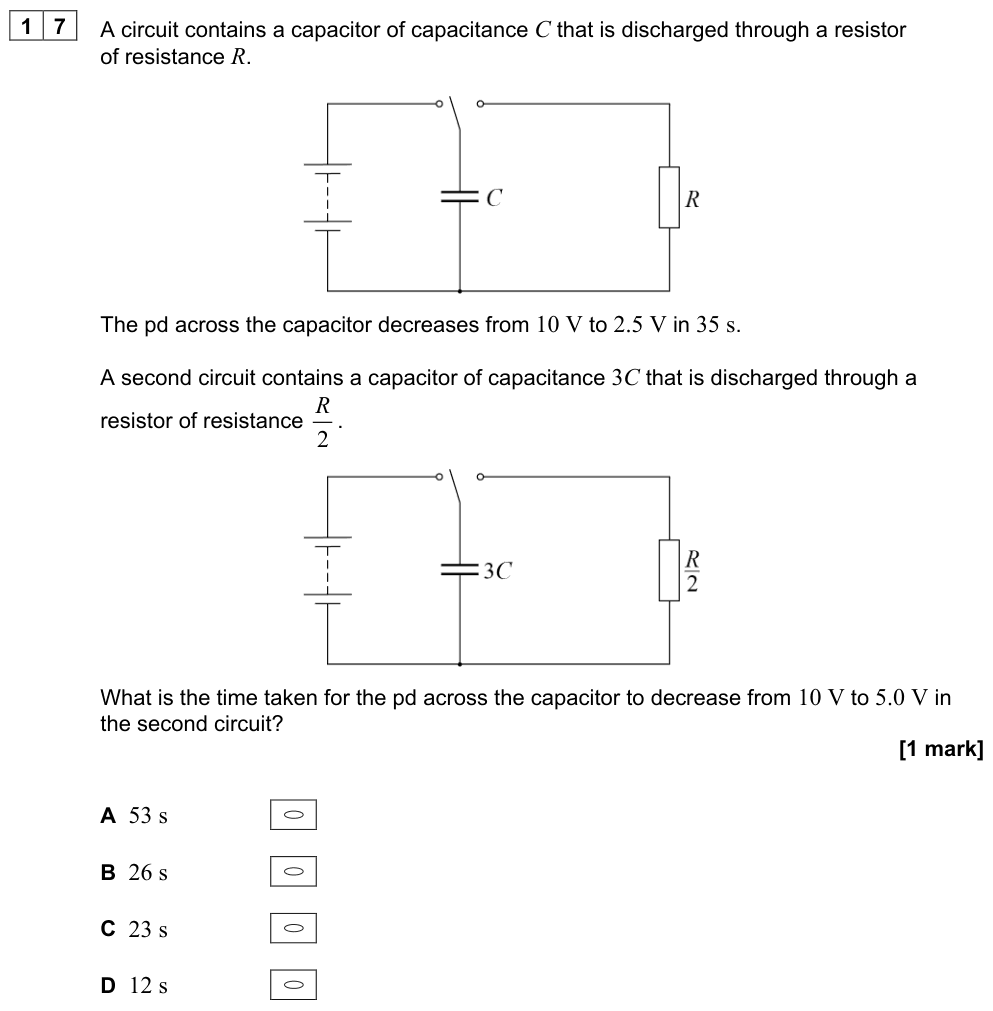
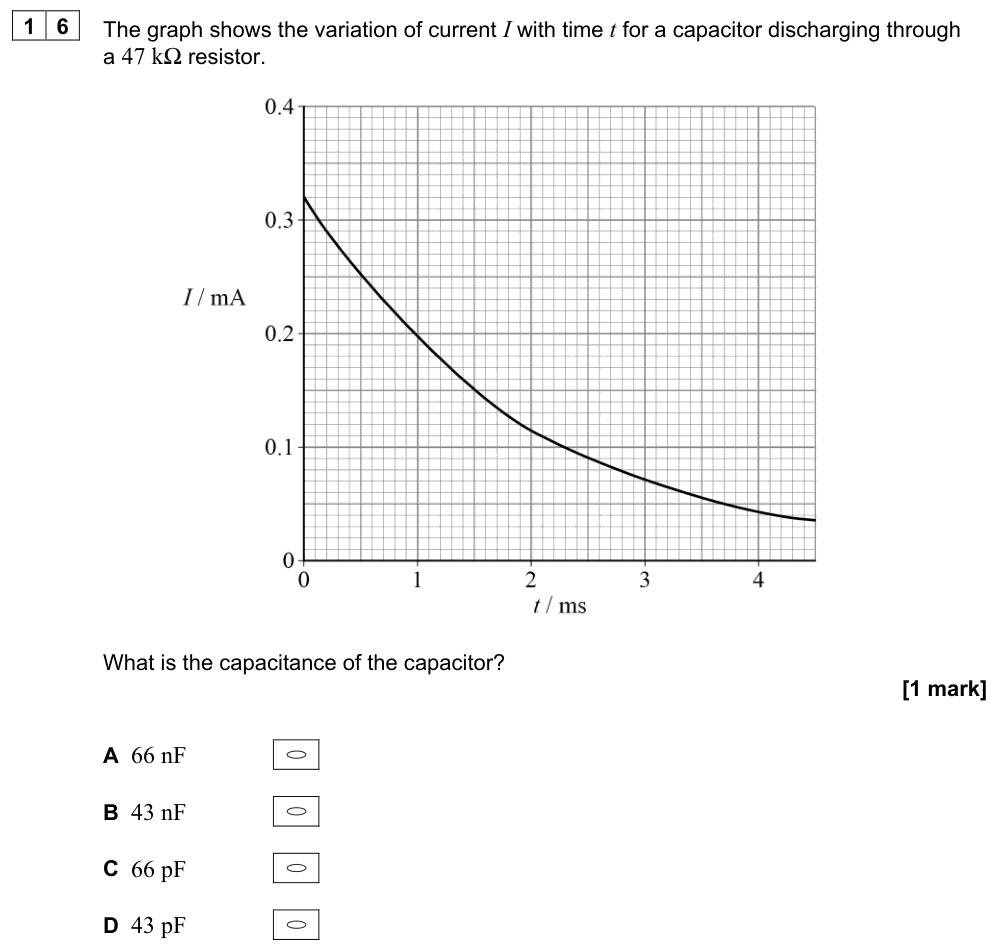
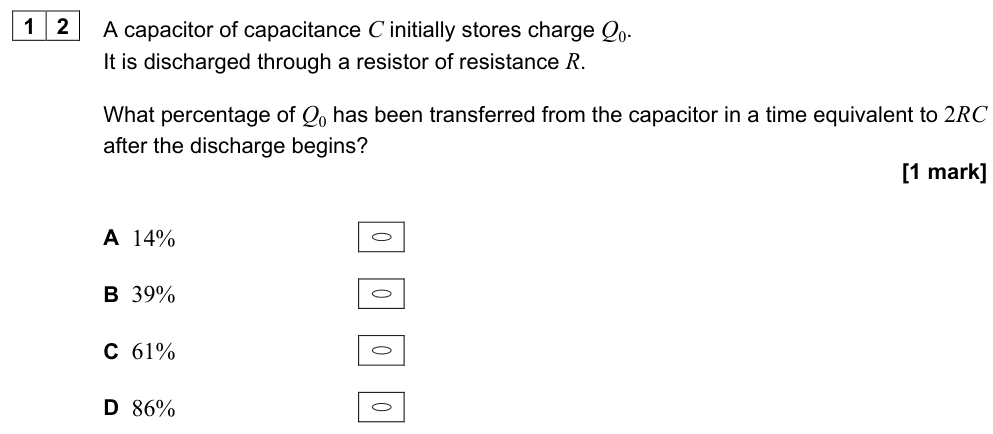
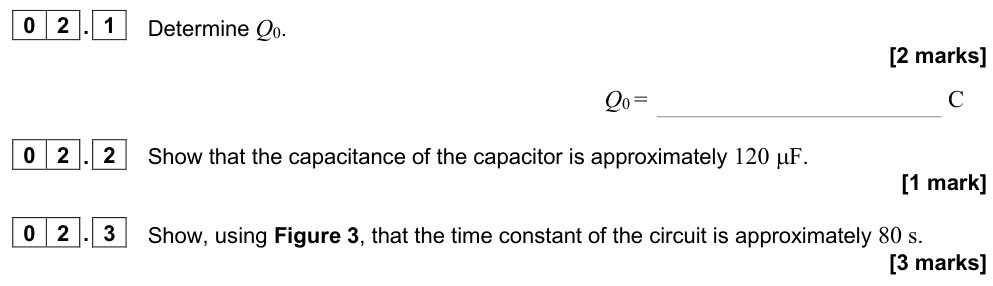
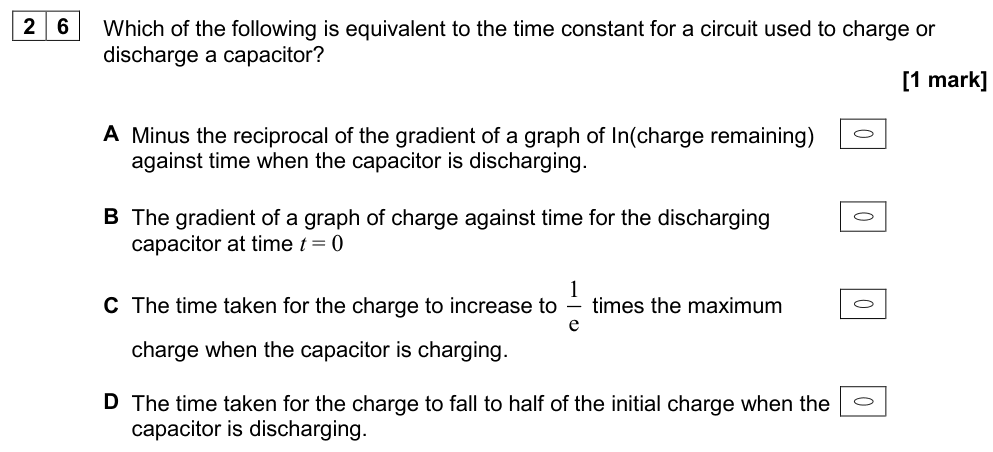
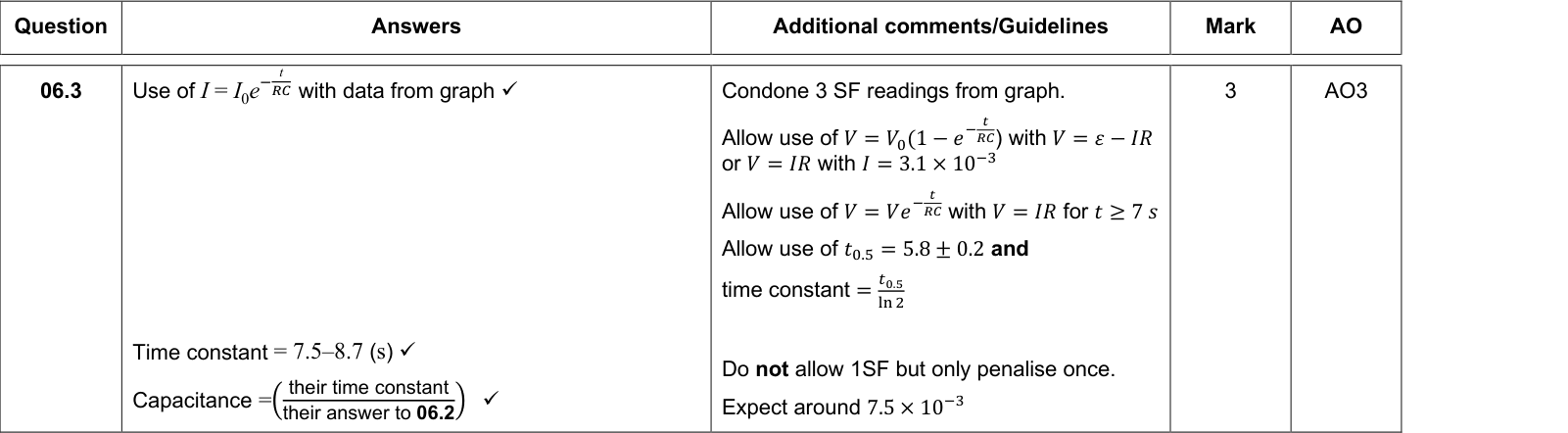
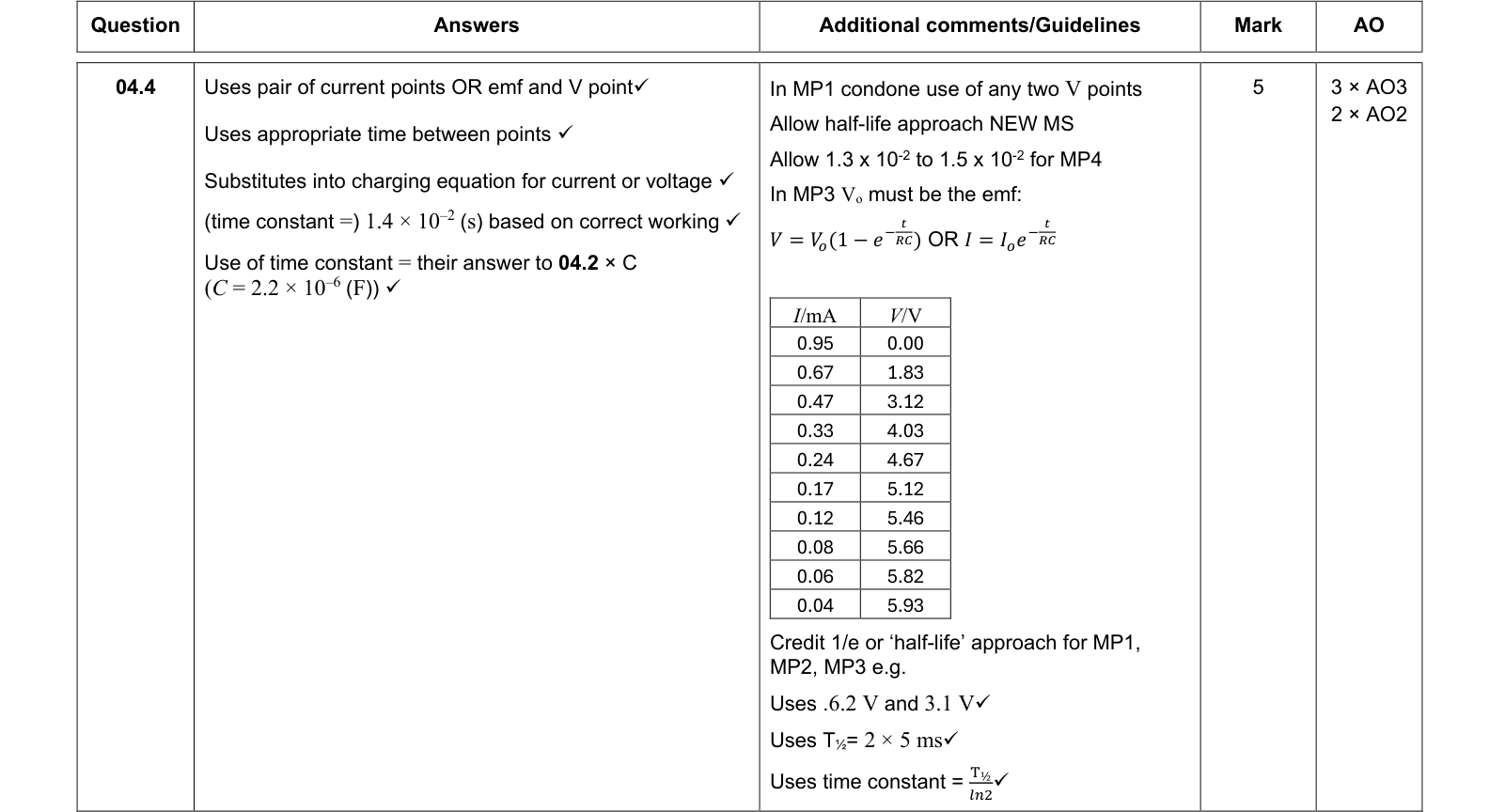
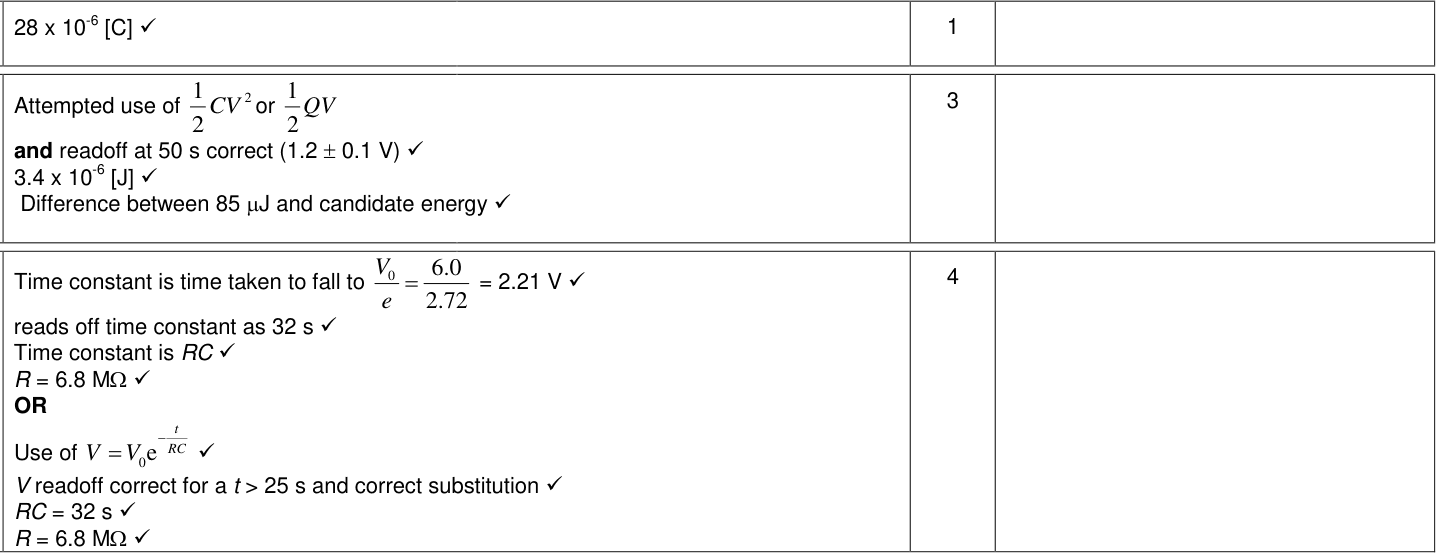
The time constant $\tau = RC$ (in seconds; Ω × F = s) is the time for the charge (or p.d. or current) to fall to $1/e$ (about 37%) of its initial value during discharge.
- After $t = RC$: 37% remains. After $2RC$: 13.5%. After $5RC$: under 1% (effectively discharged).
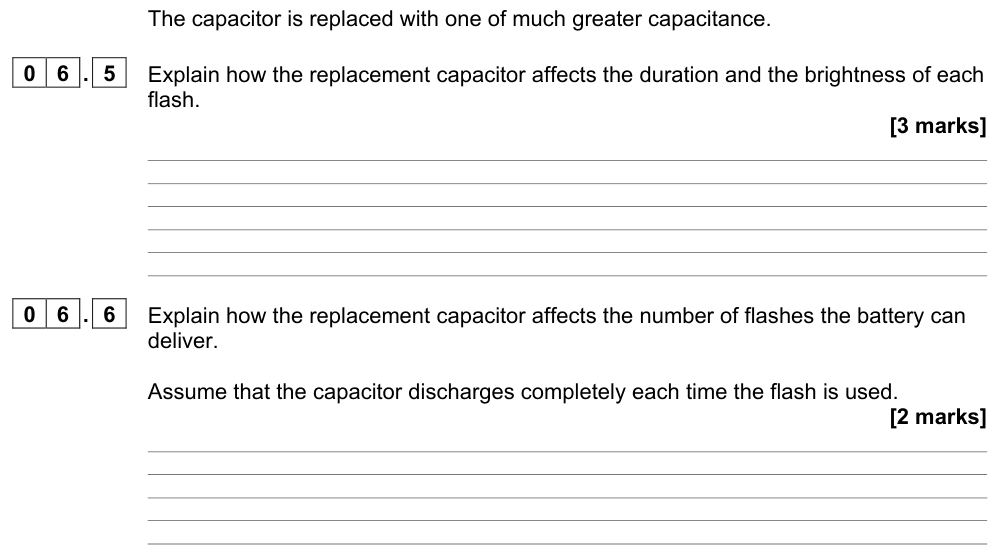
- A larger $R$ or larger $C$ gives a slower discharge.
Time to halve
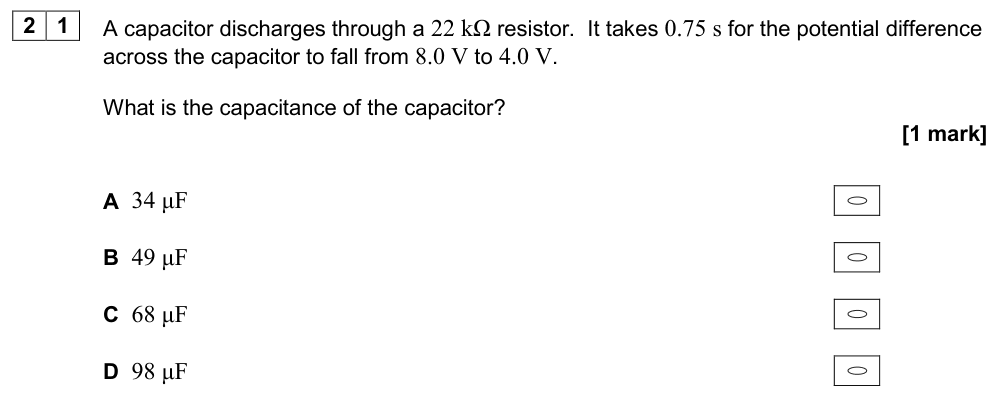
$$T_{1/2} = \ln2 \times RC = 0.69RC$$
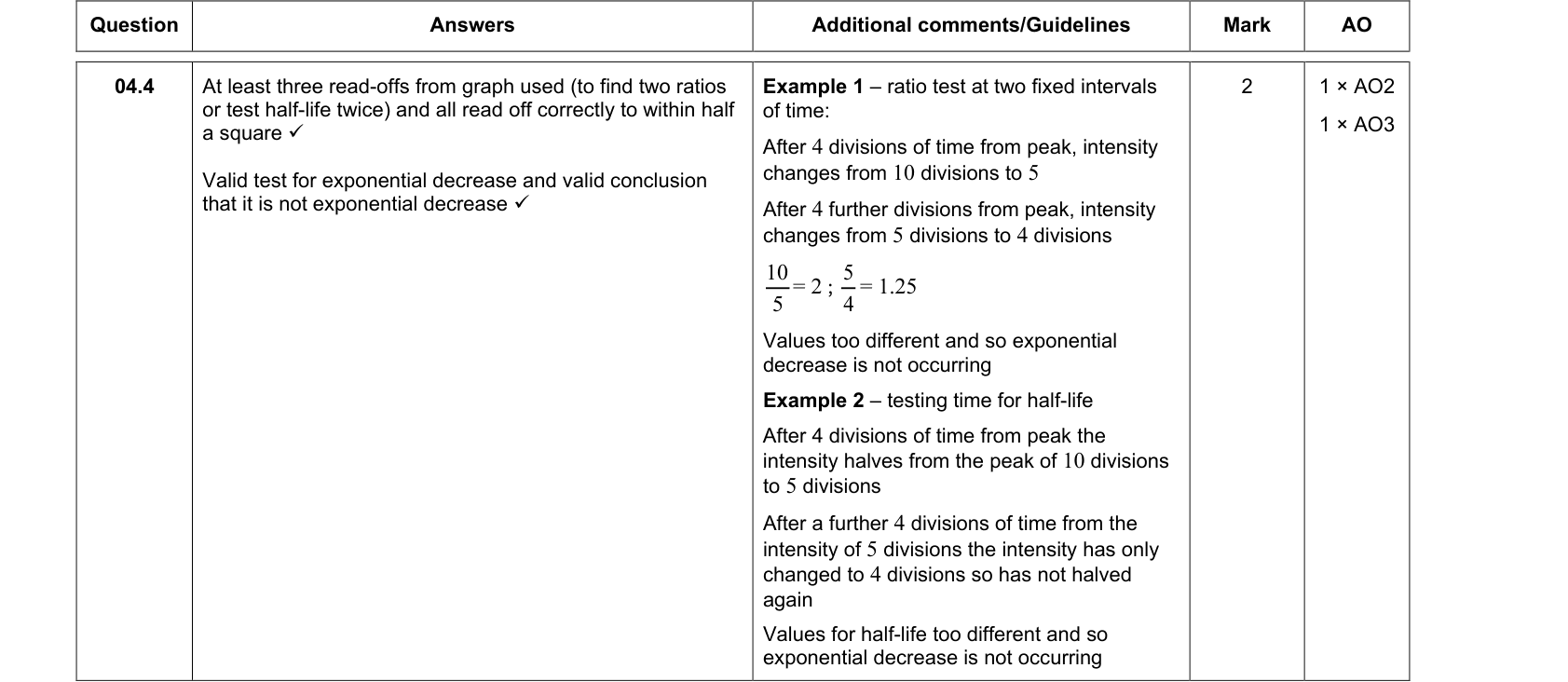
The charge (or p.d. or current) halves in every interval $T_{1/2}$, whatever its starting value. This is a property of all exponential decays.
Derivation of $T_{1/2}$: $\tfrac12Q_0 = Q_0e^{-T_{1/2}/RC}$, so $e^{T_{1/2}/RC} = 2$ and $T_{1/2} = RC\ln2$.
Worked example: discharge
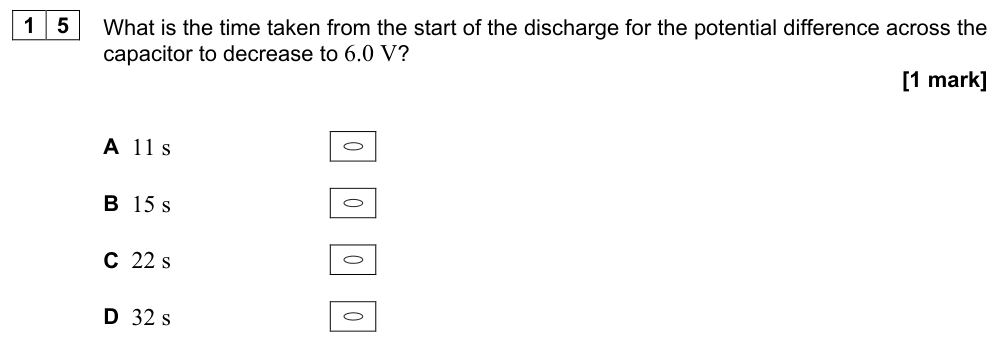
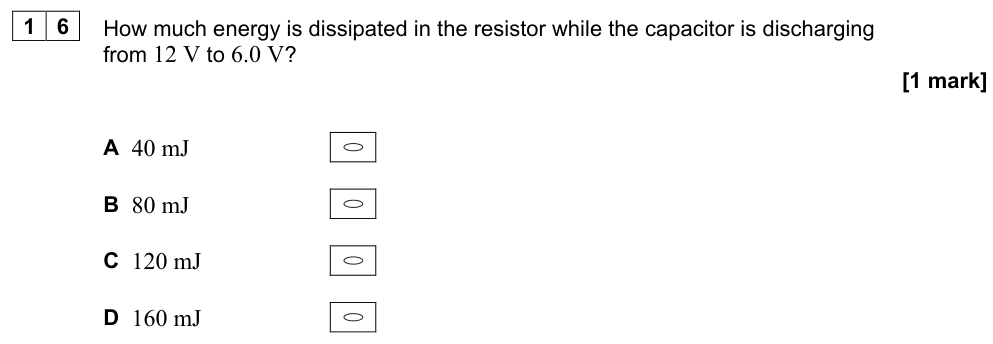
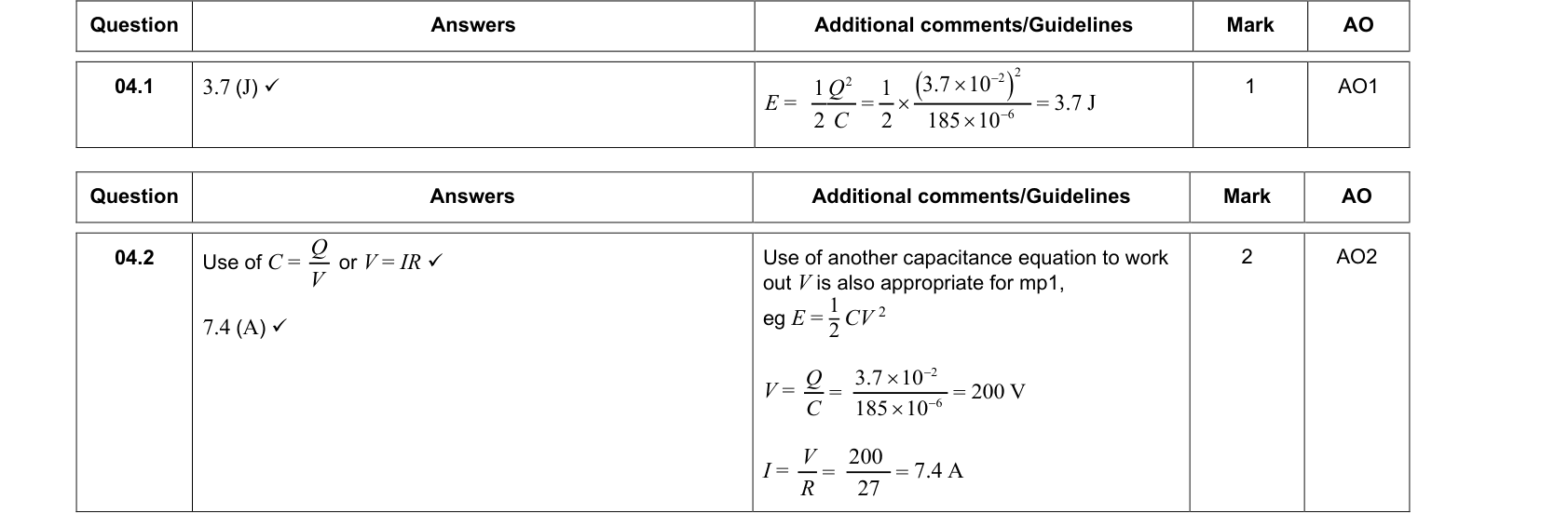
A 2200 μF capacitor charged to 12 V discharges through a 4.7 kΩ resistor.
$RC = 4700 \times 2200 \times 10^{-6} = 10.3\ \text{s}$.
After 15 s: $V = 12e^{-15/10.3} = 2.8\ \text{V}$.
Time to fall to 3.0 V: $3.0 = 12e^{-t/10.3} \Rightarrow t = 10.3\ln4 = 14.3\ \text{s}$.
Initial current $I_0 = 12/4700 = 2.6\ \text{mA}$.
Solving for time
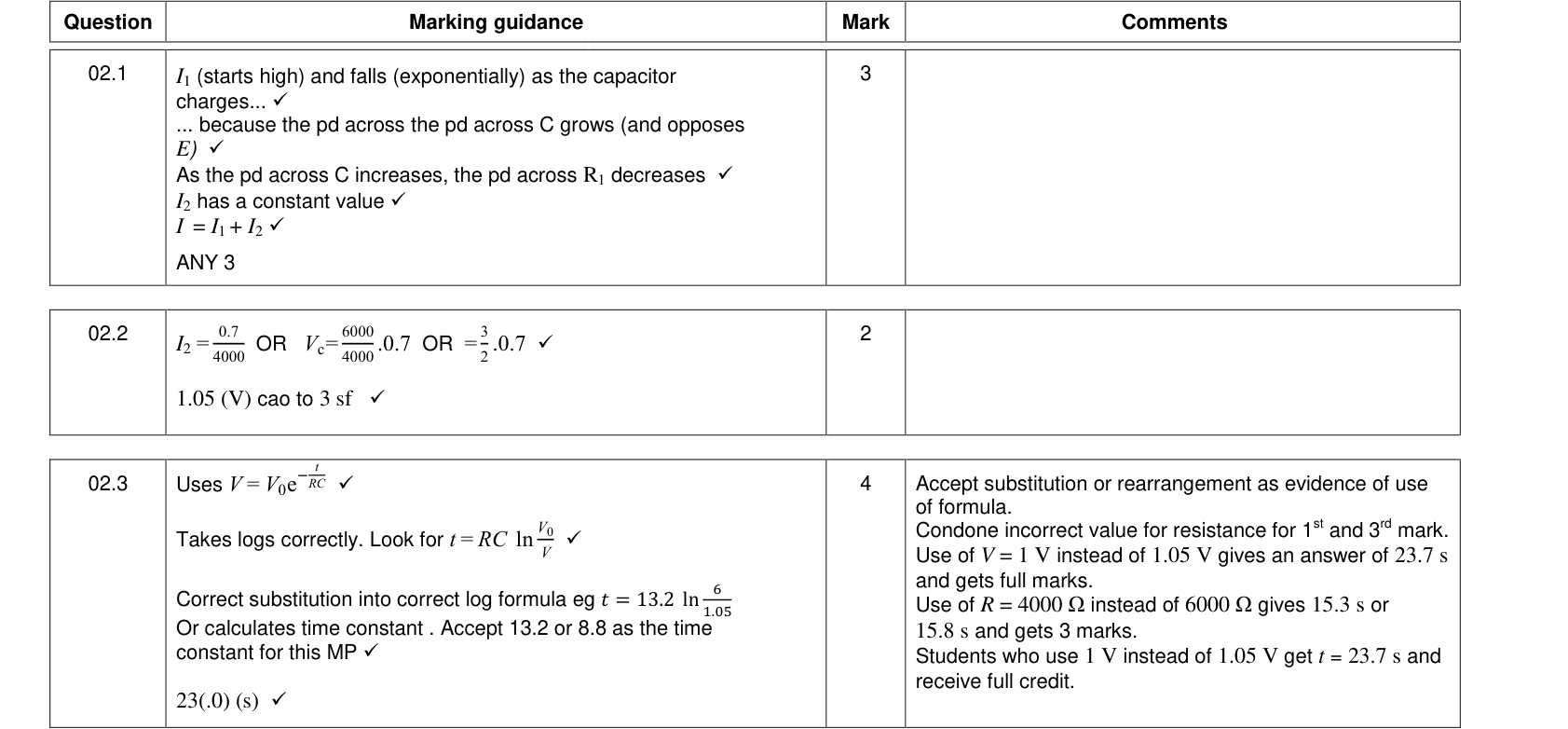
Take natural logs: $\ln\left(\dfrac{V}{V_0}\right) = -\dfrac{t}{RC}$, so $t = RC\ln\left(\dfrac{V_0}{V}\right)$.
Charging a capacitor through a resistor
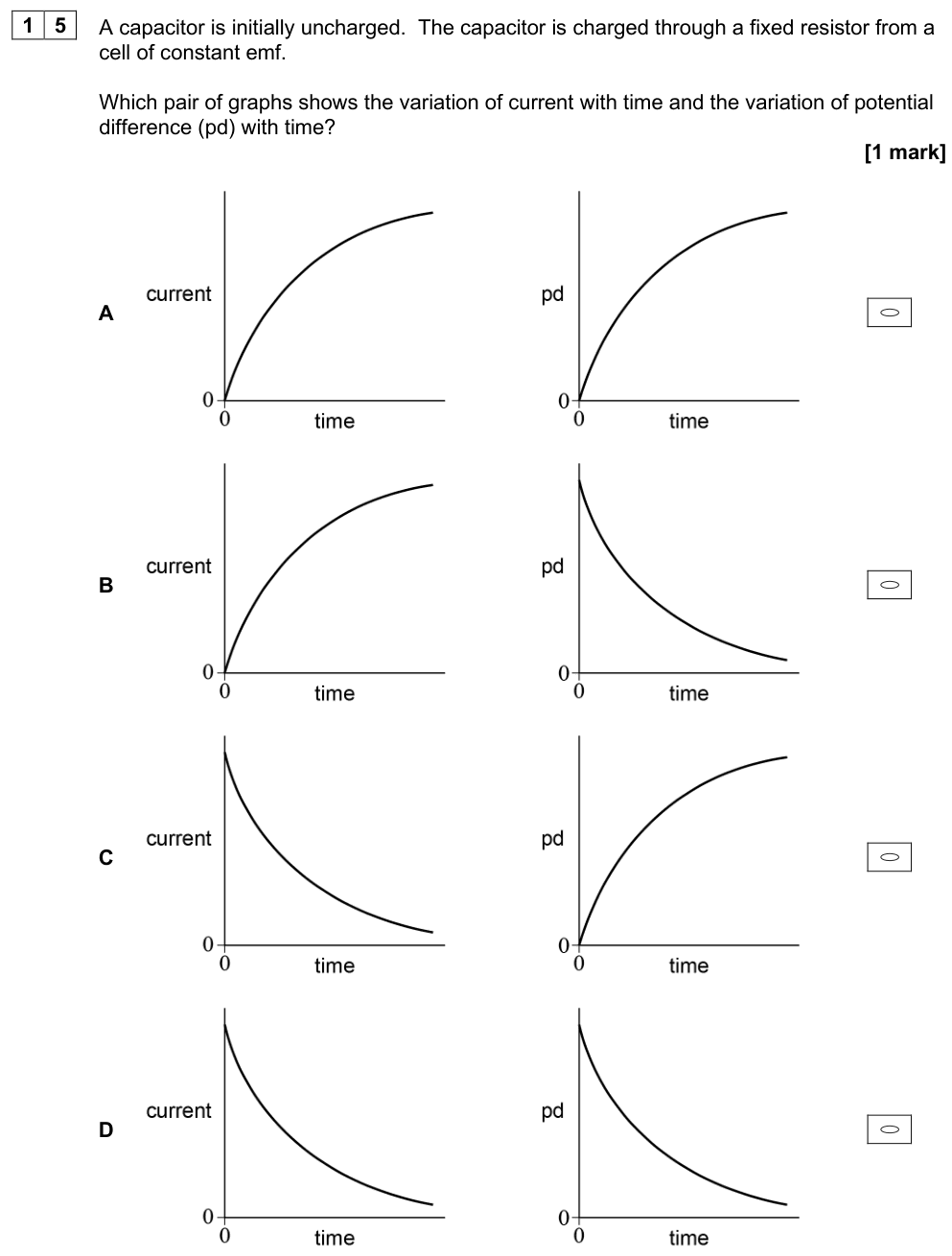
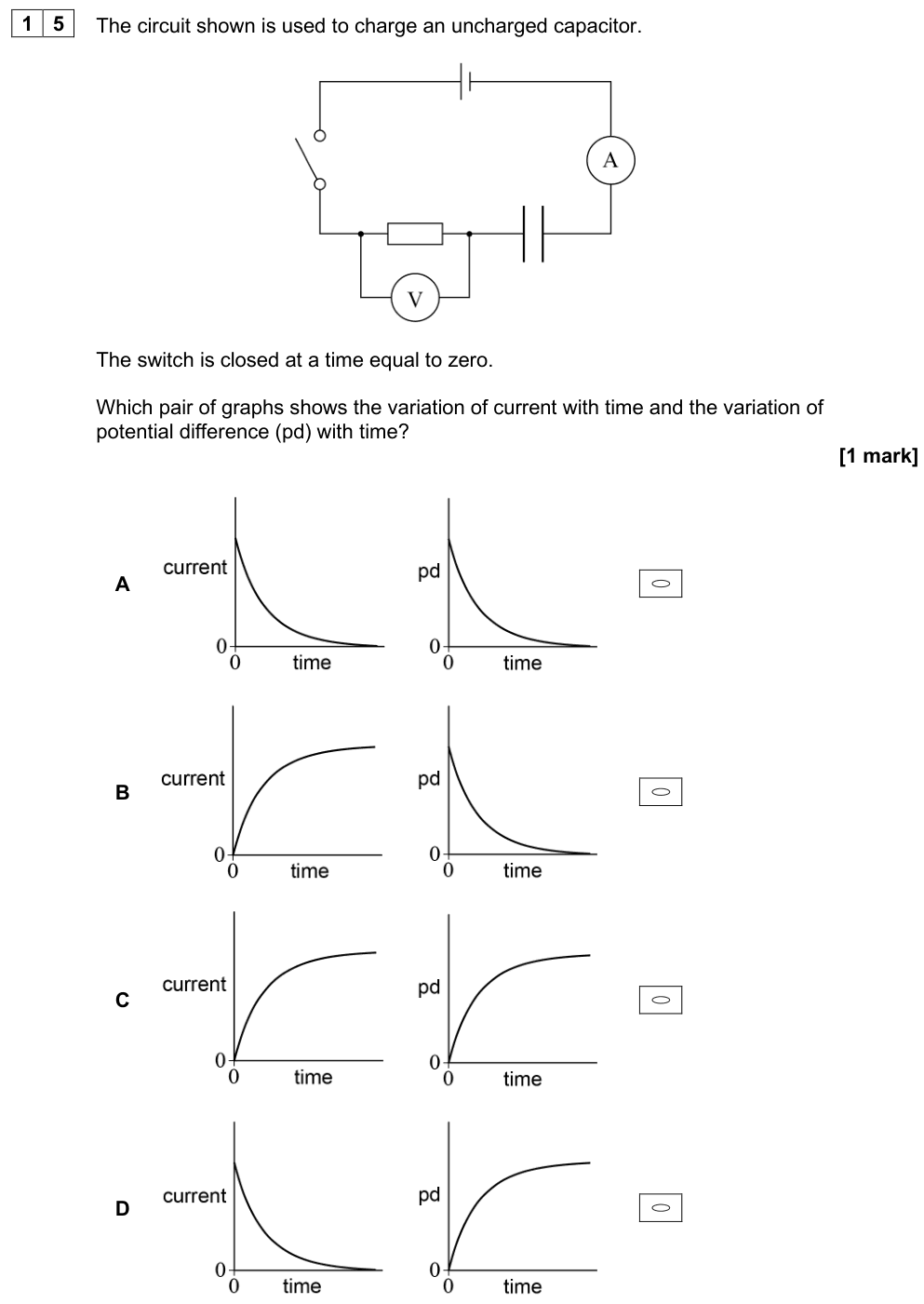
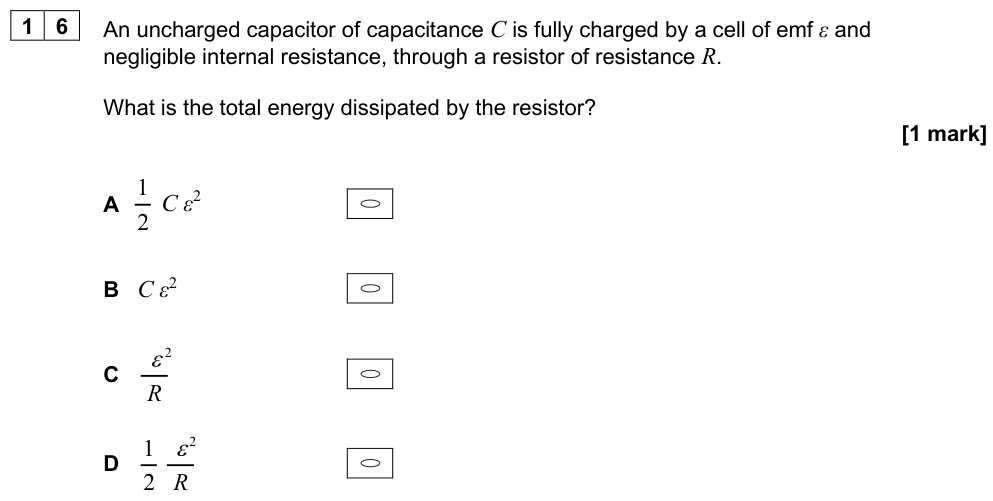
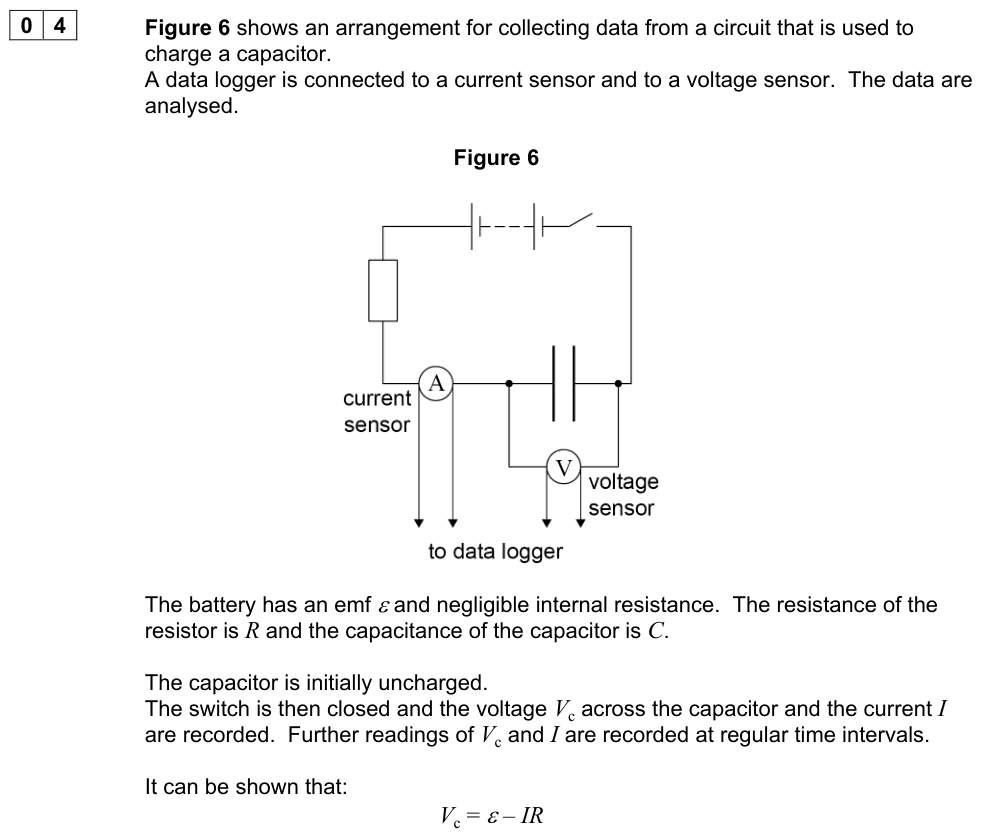
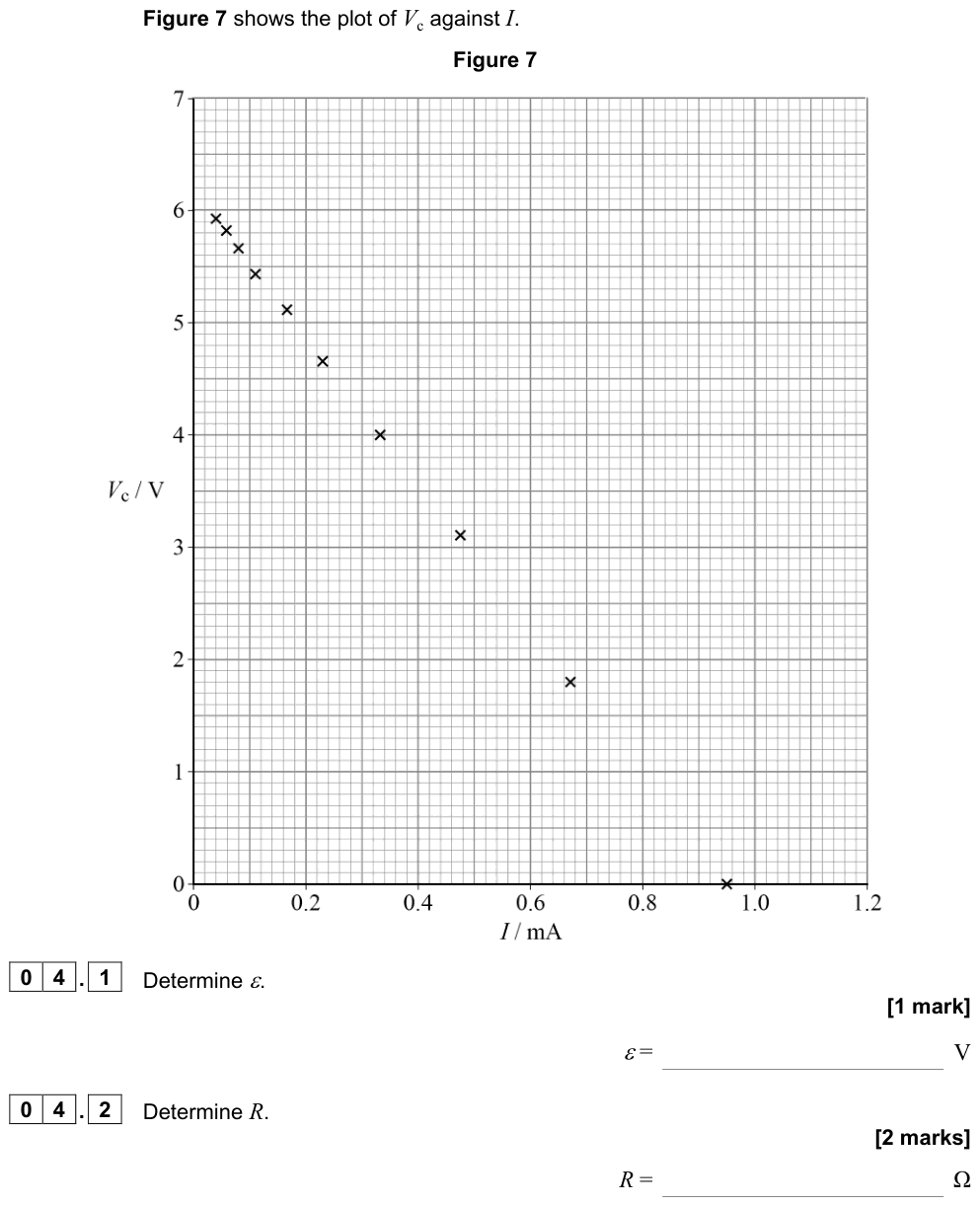
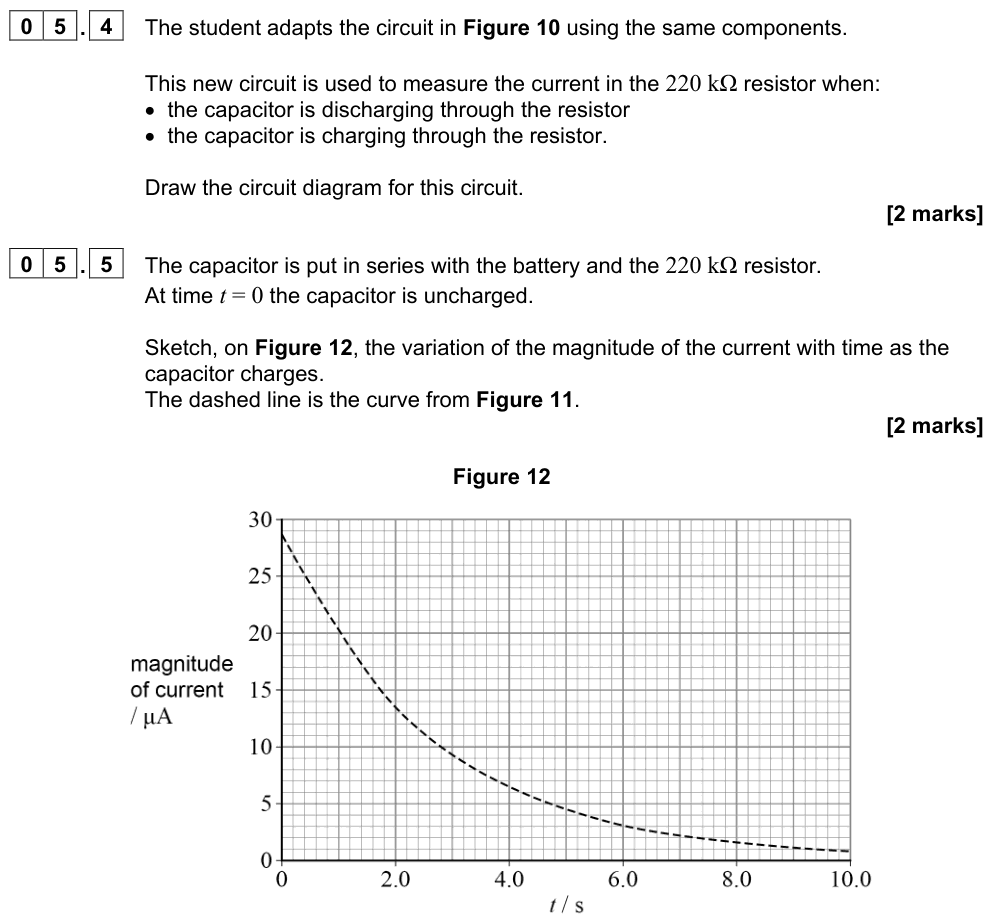
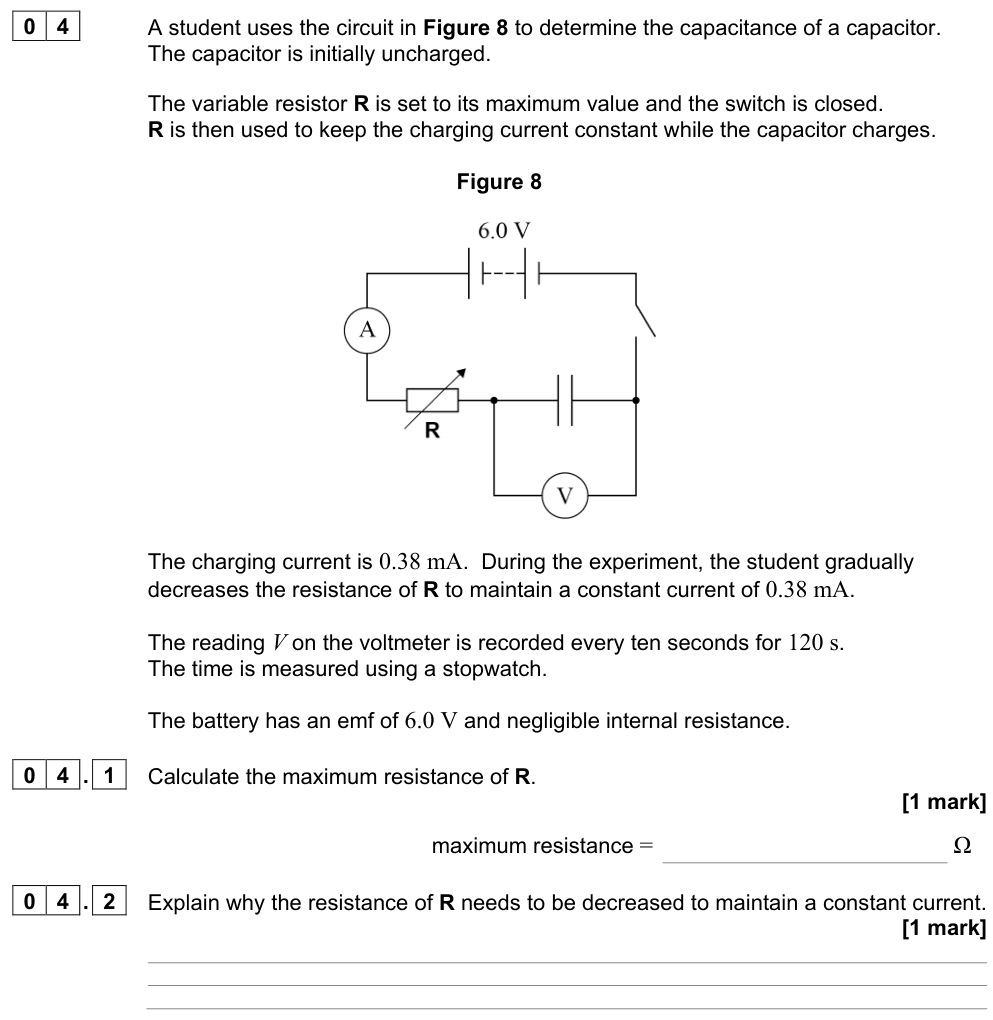
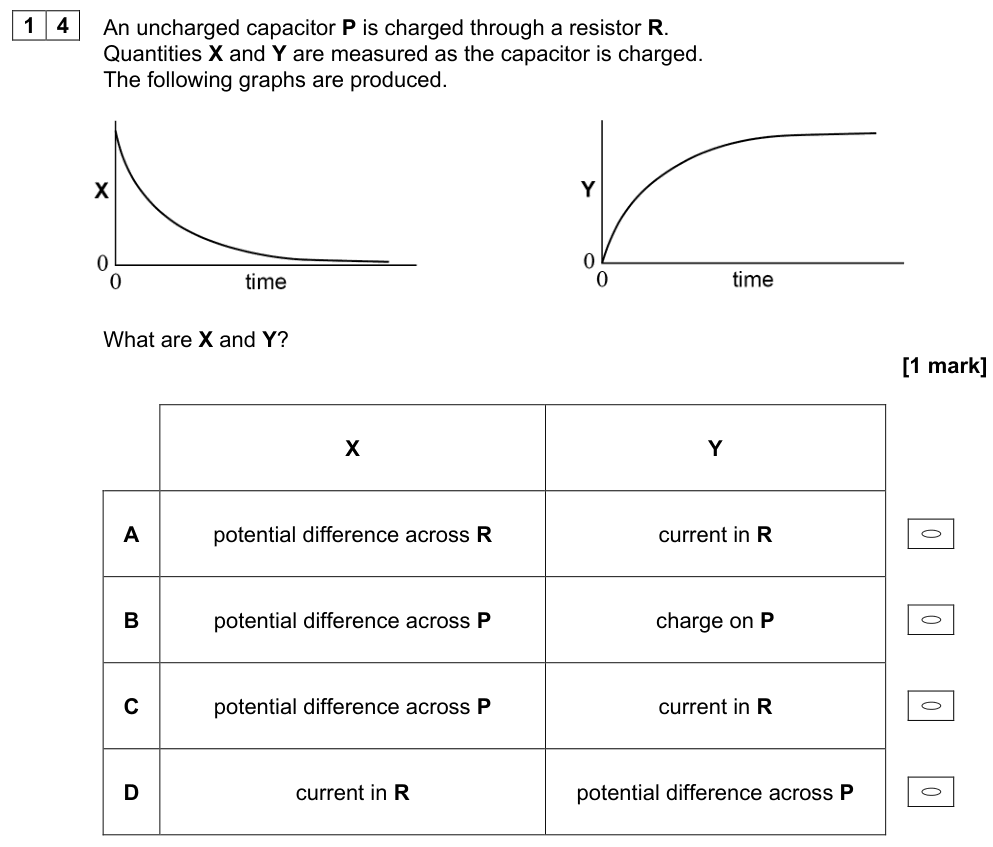
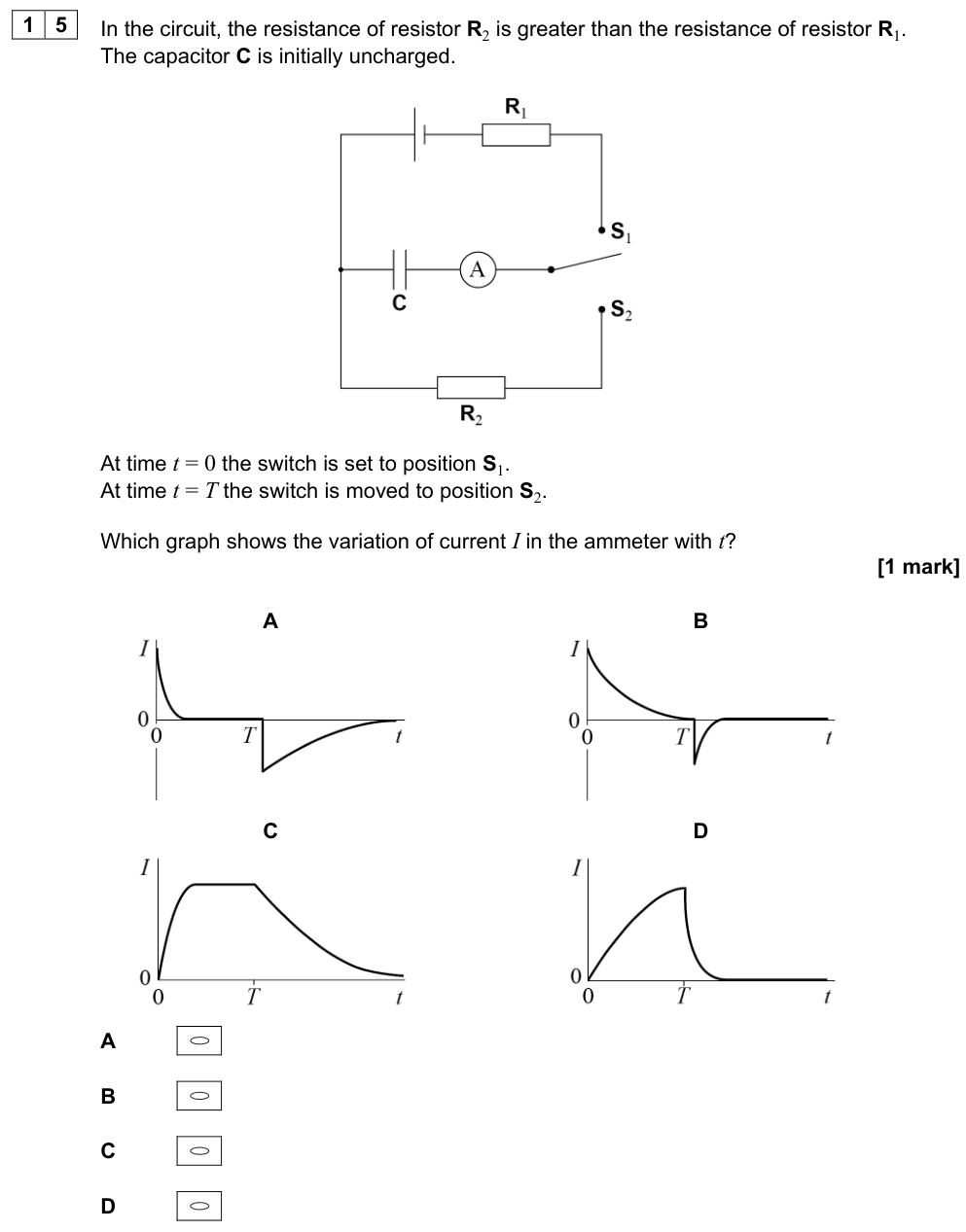
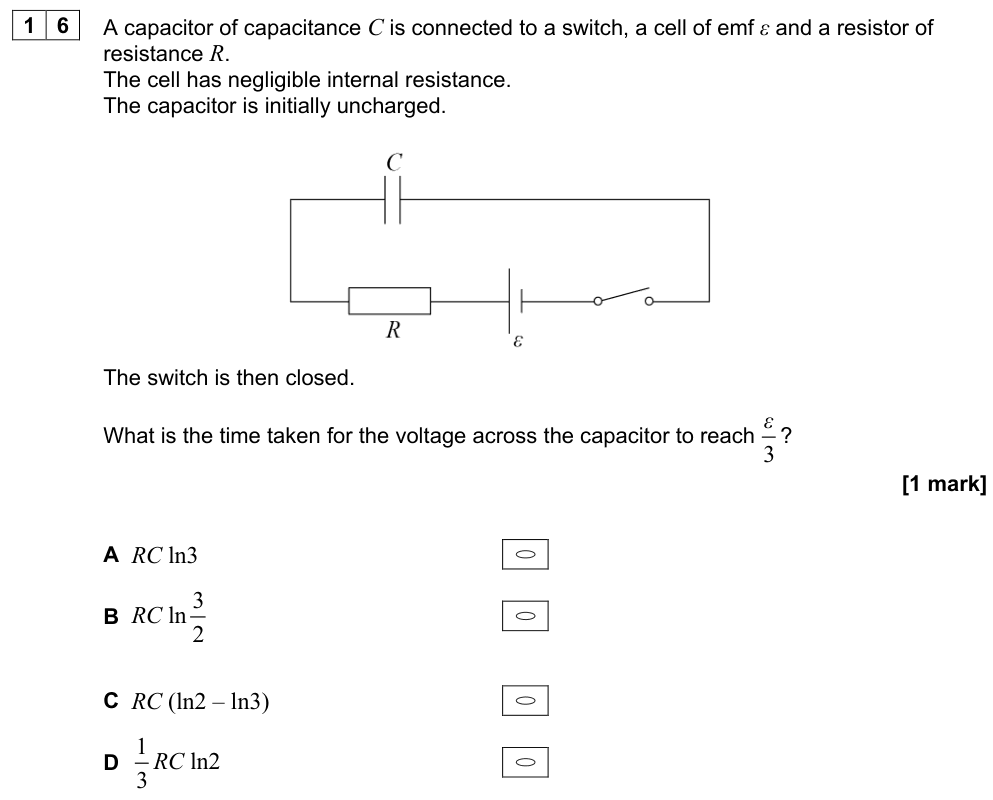
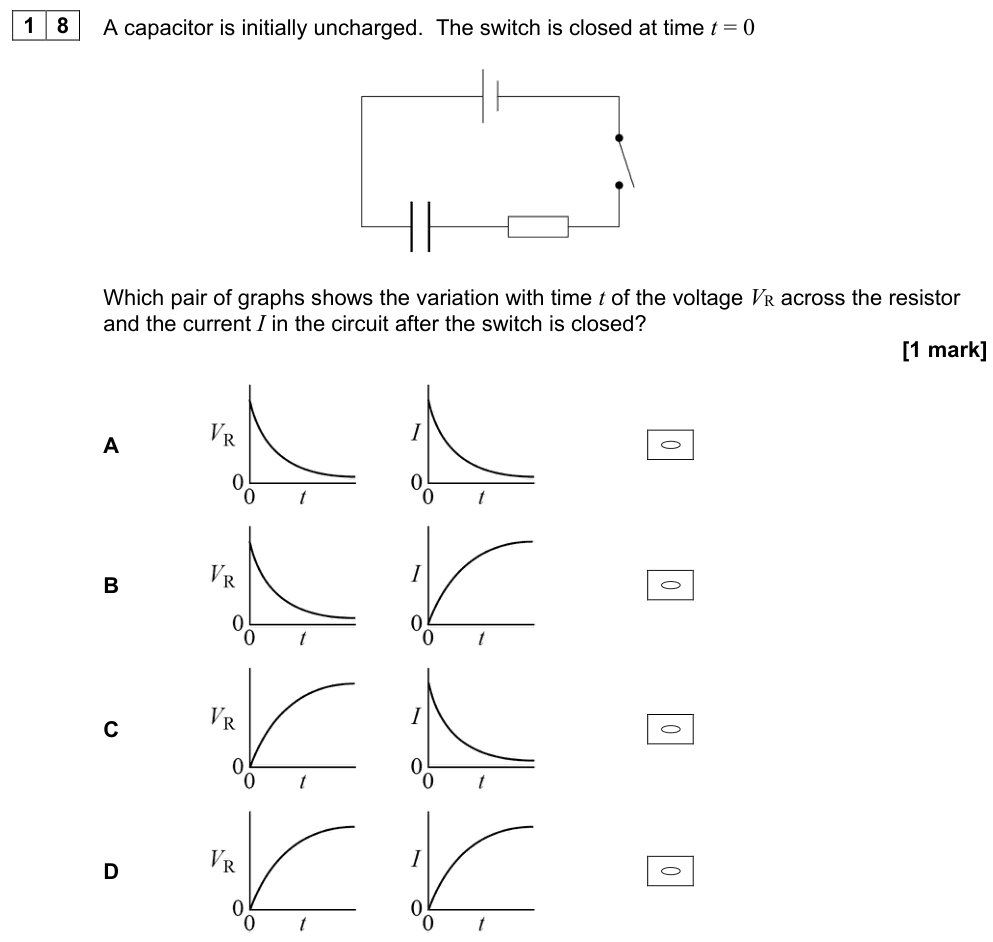
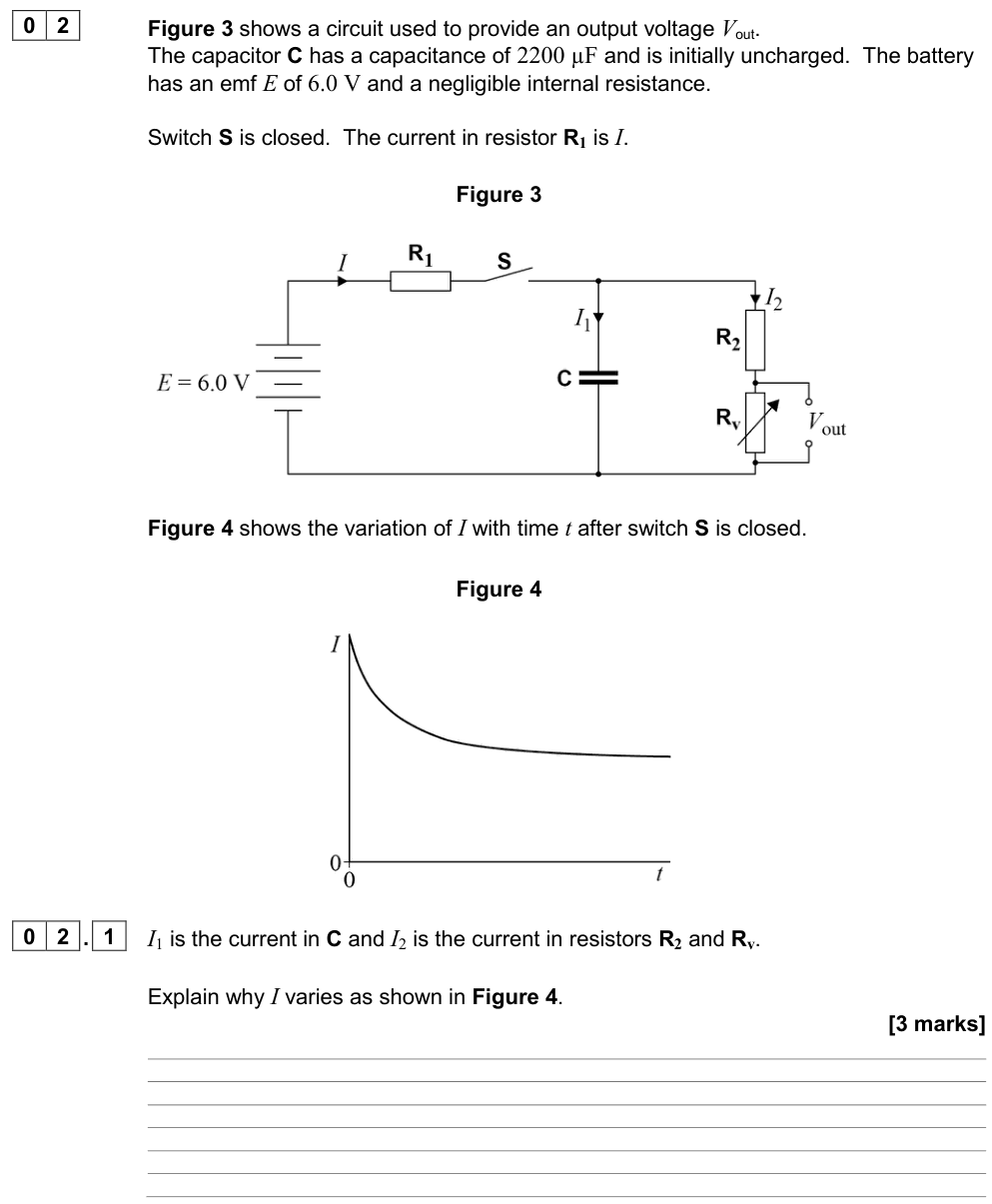
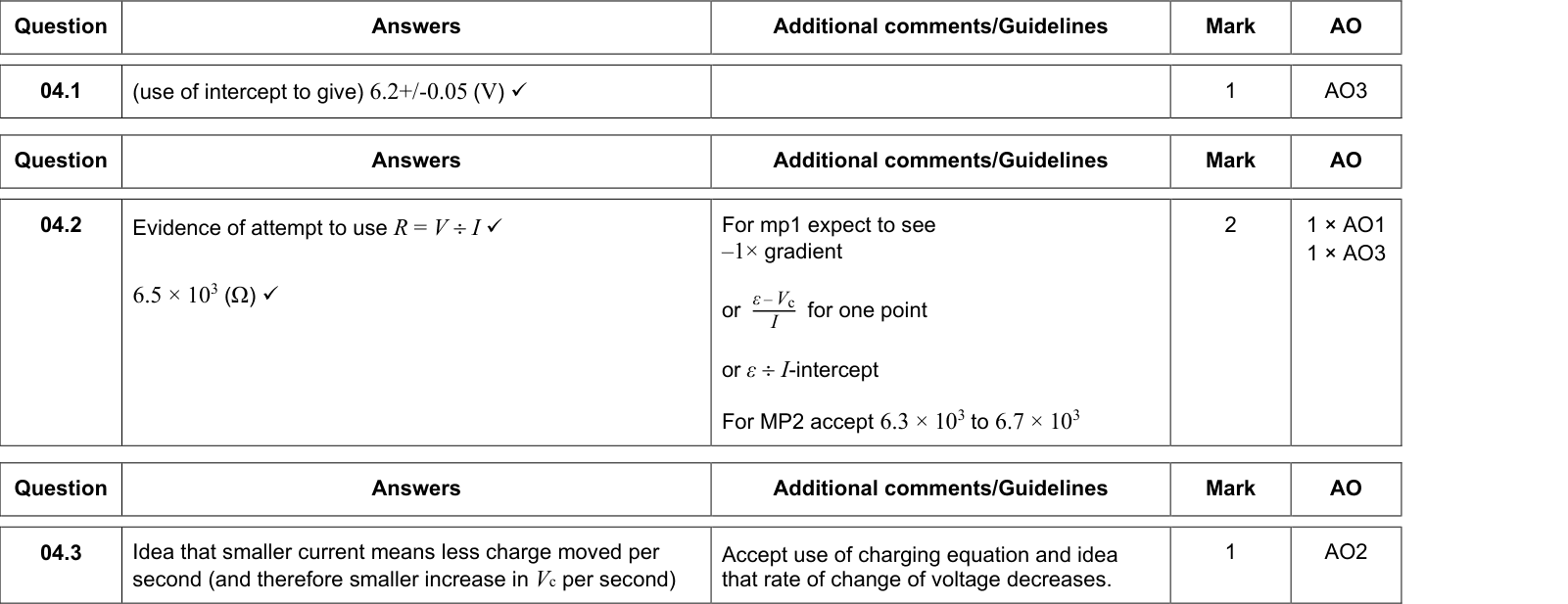
A capacitor is charged by a supply of e.m.f. $\varepsilon$ (= $V_0$) through a resistor $R$. At first the capacitor is uncharged, so the whole e.m.f. is across the resistor and the current is large, $I_0 = V_0/R$. As charge builds up, the capacitor's p.d. rises and opposes the supply, so the current falls exponentially and the charge rises ever more slowly towards $Q_0 = CV_0$.
Charging equations
$$Q = Q_0\left(1 - e^{-t/RC}\right) \qquad V_C = V_0\left(1 - e^{-t/RC}\right) \qquad I = I_0e^{-t/RC}$$
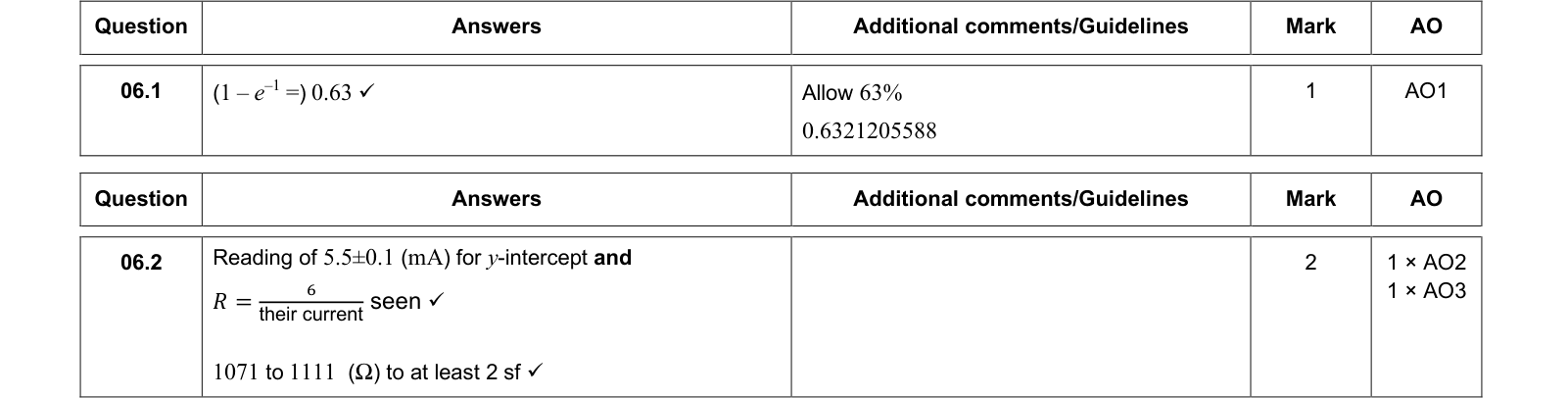
- After one time constant the capacitor has reached 63% of its final charge.
- The p.d. across the resistor, $V_R = IR$, decays exponentially, while $V_C$ rises. At every instant $V_R + V_C = V_0$.
- The current always decays exponentially, during both charging and discharging (it reverses direction between the two).
Interpreting the graphs
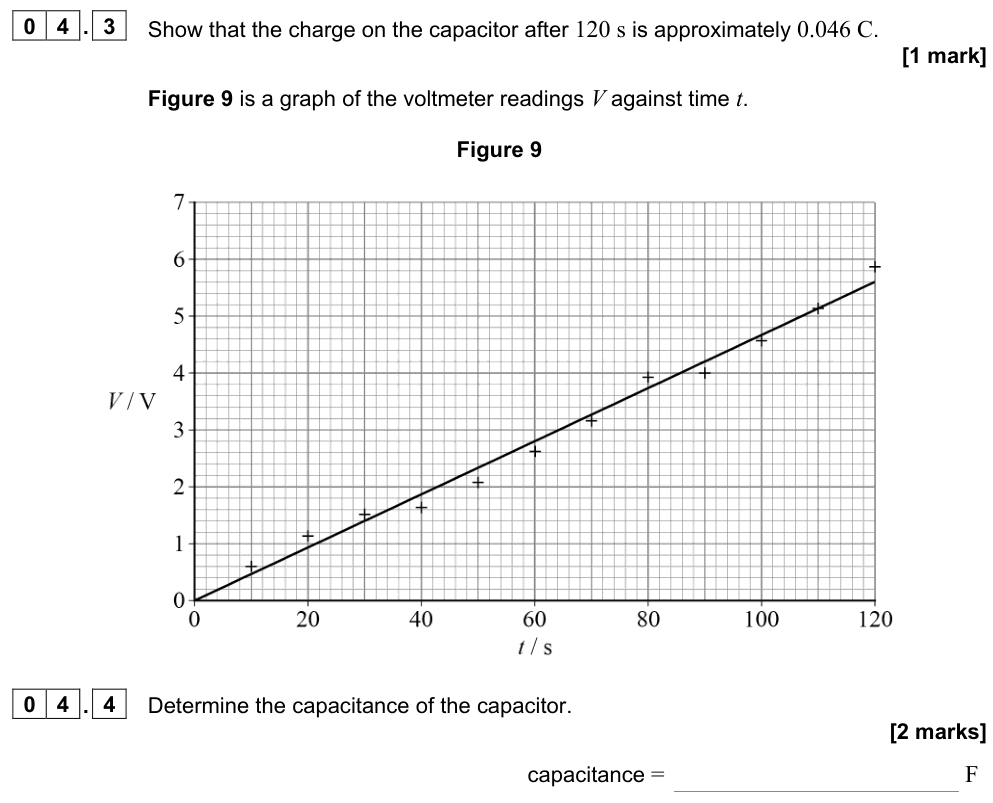
- Gradient of a $Q$–$t$ graph = current ($I = \Delta Q/\Delta t$). It is steepest at the start.
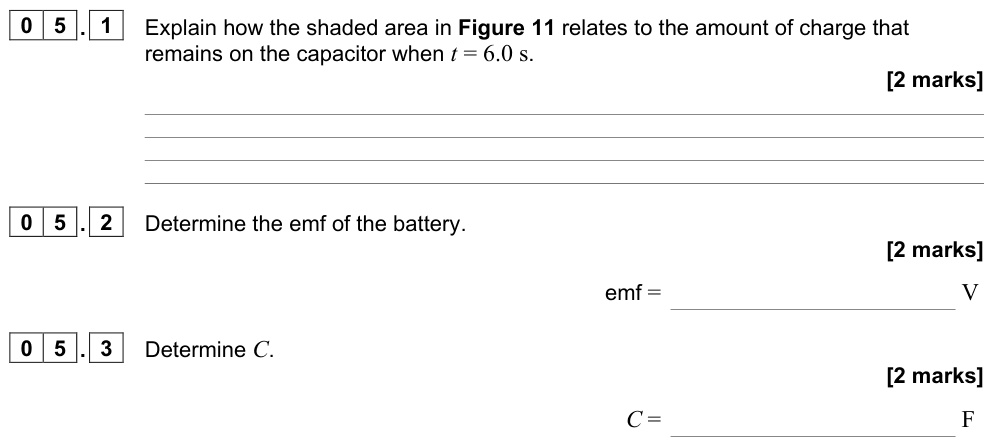
- Area under an $I$–$t$ graph = charge that has flowed.
- Initial gradient of a discharge curve meets the time axis at $t = RC$: if the current continued at its initial rate, the capacitor would be empty after one time constant.
Finding the time constant from data
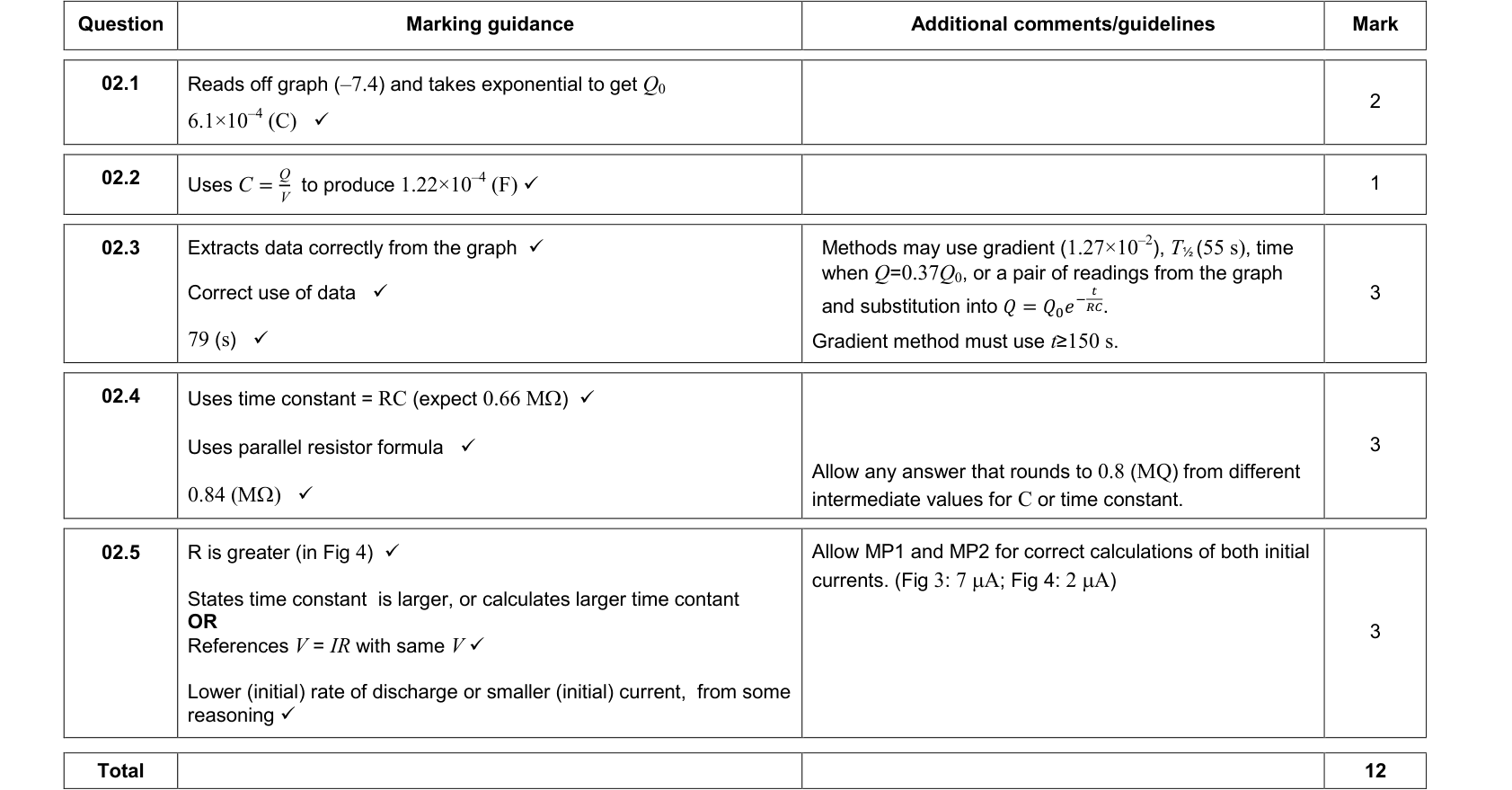
- From a decay graph: read the time for $V$ (or $Q$ or $I$) to fall to 37% of its initial value, or use the time to halve: $RC = T_{1/2}/0.69$.
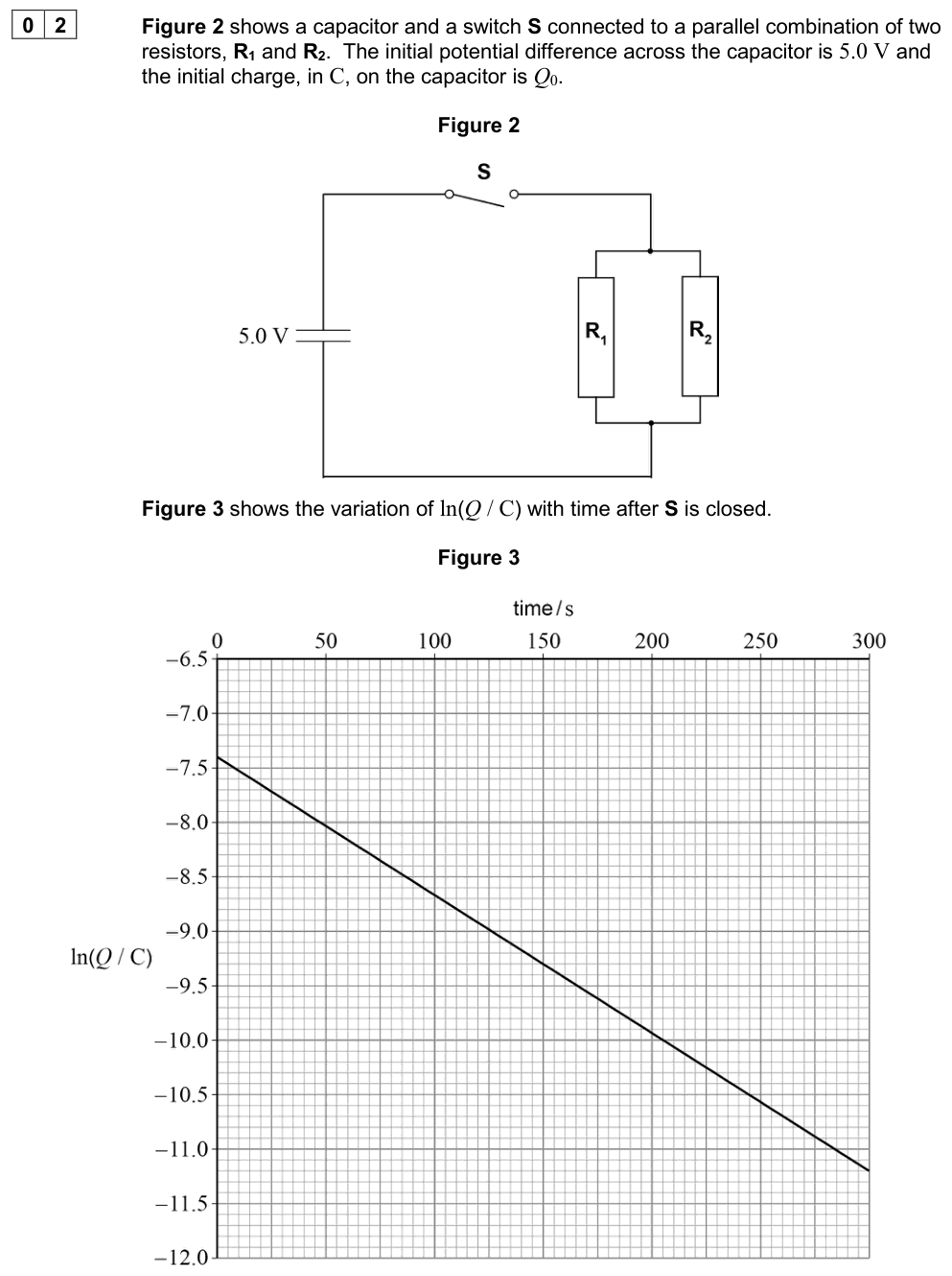
- Log-linear graph: take logs of $V = V_0e^{-t/RC}$:
$$\ln V = \ln V_0 - \frac{t}{RC}$$
A graph of $\ln V$ against $t$ is a straight line with gradient $-1/RC$ and y-intercept $\ln V_0$. This uses all the data and checks that the decay really is exponential.
Required practical 6: charging and discharging a capacitor
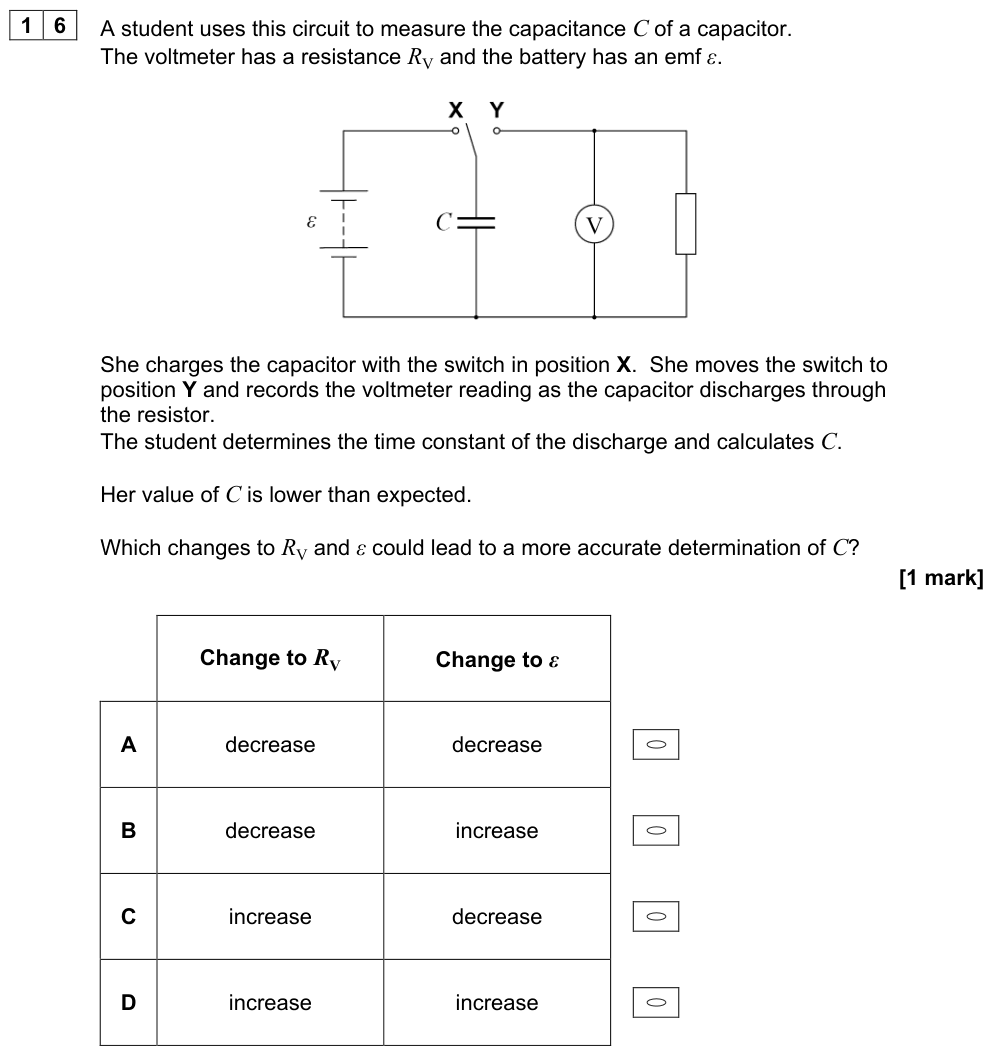
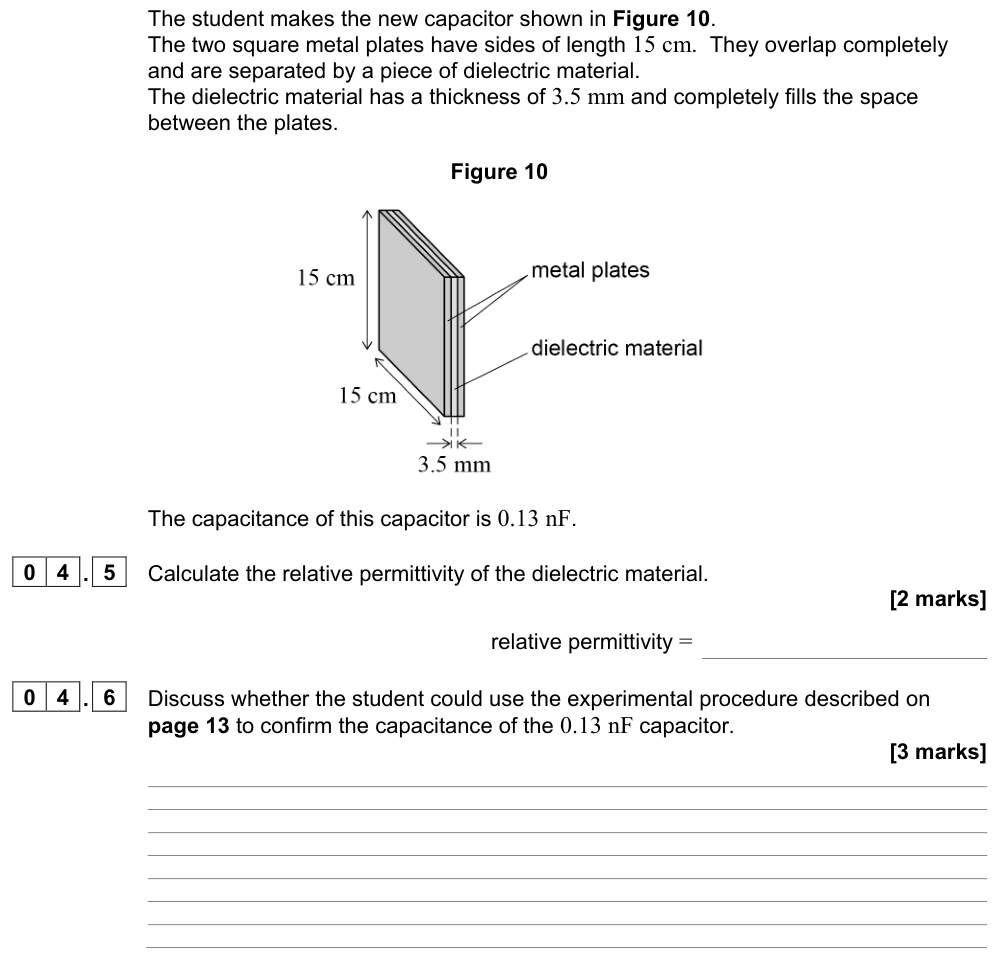
Circuit: a d.c. supply, a two-way switch, a capacitor (e.g. 470–2200 μF) and a resistor (e.g. 10–100 kΩ) so that $RC$ is tens of seconds. A voltmeter (or data-logger) across the capacitor and/or a microammeter in series.
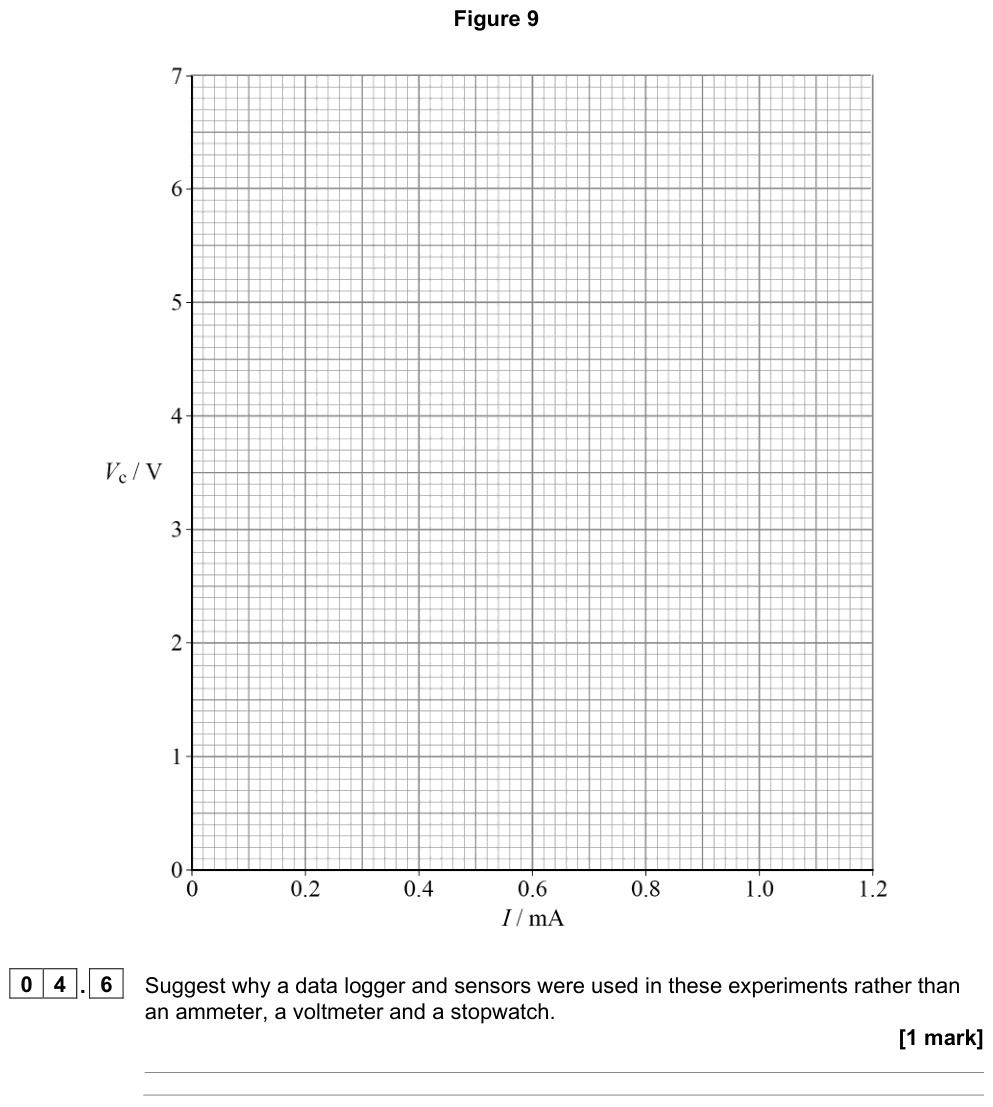
Method (discharge): charge the capacitor fully, then switch to discharge through the resistor and start a stopwatch. Record the p.d. (or current) every 5–10 s. A data-logger gives many readings and removes reaction-time errors for short time constants.
Analysis: plot $\ln(V/\text{V})$ against $t$. Gradient $= -1/RC$, so $RC = -1/\text{gradient}$. If $R$ is known, $C = RC/R$.
Notes: electrolytic capacitors must be connected the right way round; discharge capacitors before handling them; the voltmeter's own resistance should be much larger than $R$.
Worked example: log graph
A graph of $\ln(V/\text{V})$ against $t$ has a gradient of $-0.025\ \text{s}^{-1}$. $RC = 1/0.025 = 40\ \text{s}$. With $R = 82\ \text{k}\Omega$, $C = 40/82\,000 = 490\ \mu\text{F}$.
Summary
- Discharge: $Q = Q_0e^{-t/RC}$ (same for $V$ and $I$). Charge: $Q = Q_0(1 - e^{-t/RC})$, $I = I_0e^{-t/RC}$.
- Time constant $RC$: time to fall to 37% (or reach 63% when charging). $T_{1/2} = 0.69RC$.
- Gradient of $Q$–$t$ = current; area under $I$–$t$ = charge.
- $\ln V$ against $t$ is a straight line of gradient $-1/RC$ (Required practical 6).