The principle of superposition
Principle of superposition
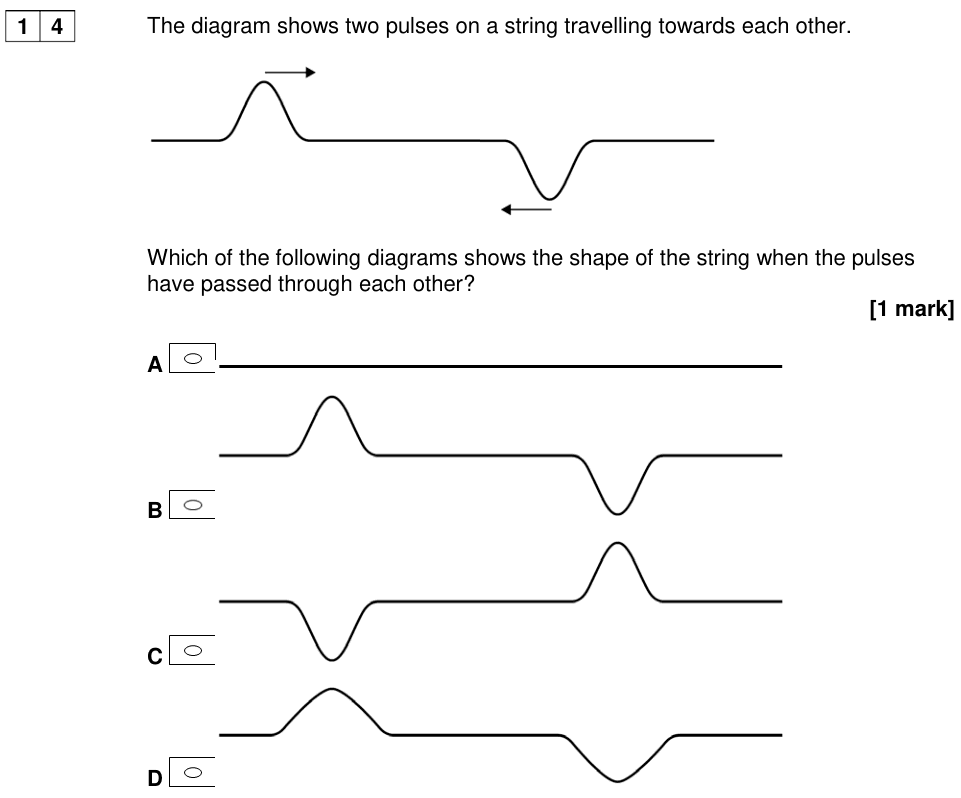
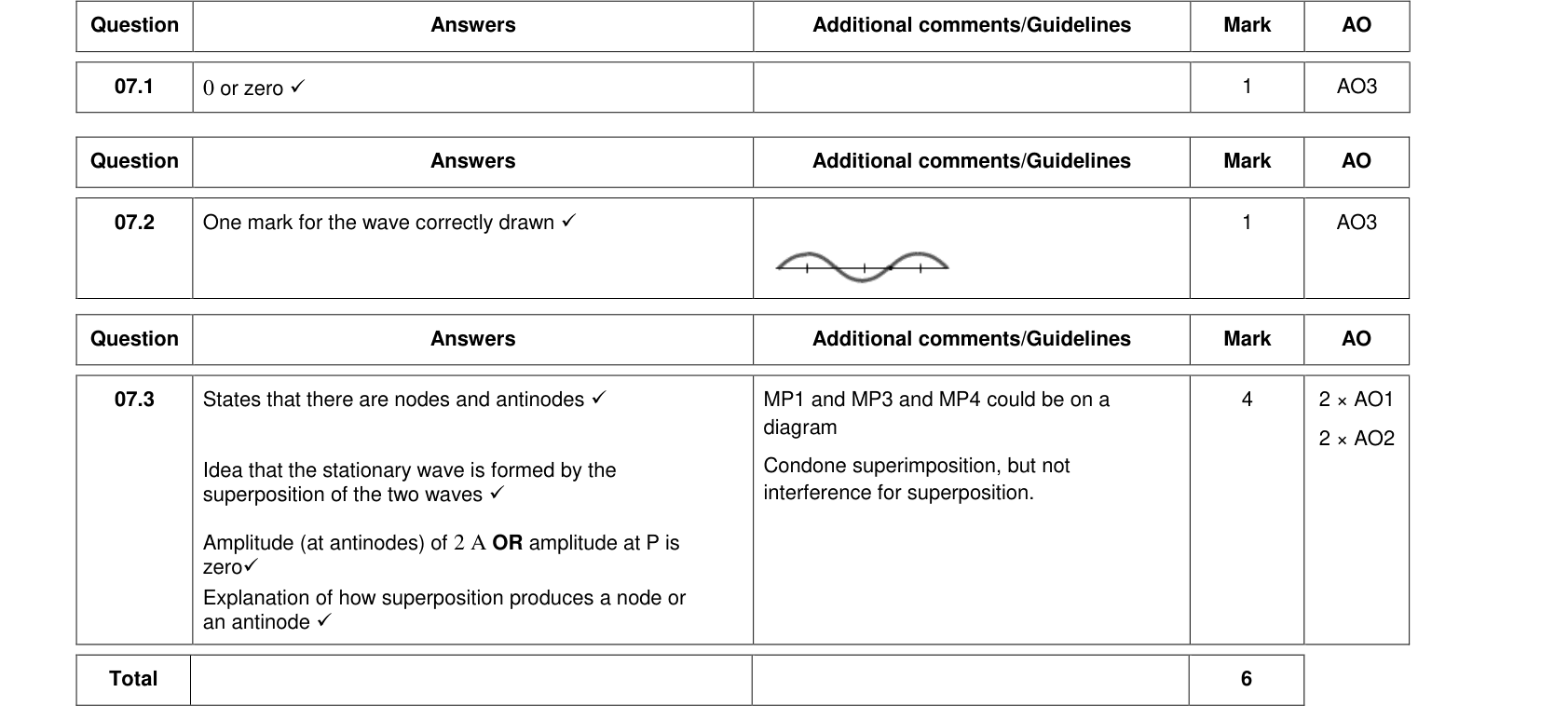
When two or more waves meet at a point, the resultant displacement is the vector sum of the individual displacements.
- Constructive interference: crest meets crest (waves in phase) → large resultant amplitude.
- Destructive interference: crest meets trough (waves in antiphase) → reduced (or zero) amplitude.
After passing through each other the waves continue unchanged.
Stationary (standing) waves
Stationary wave
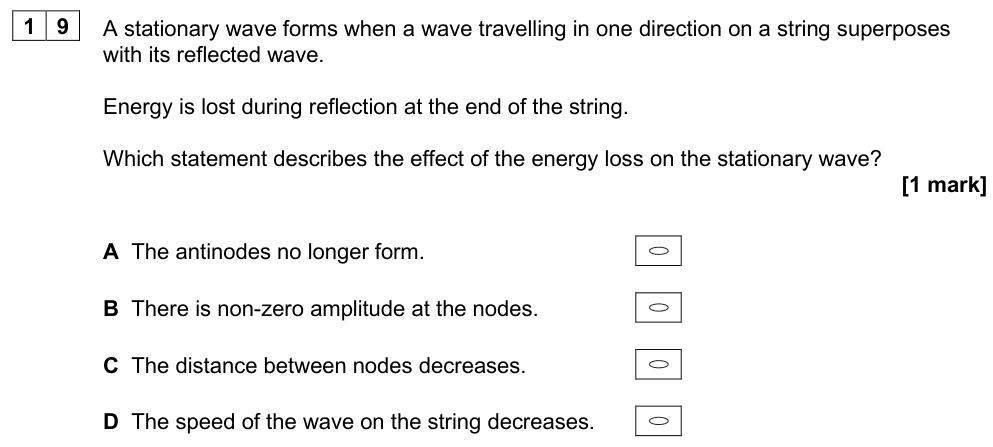
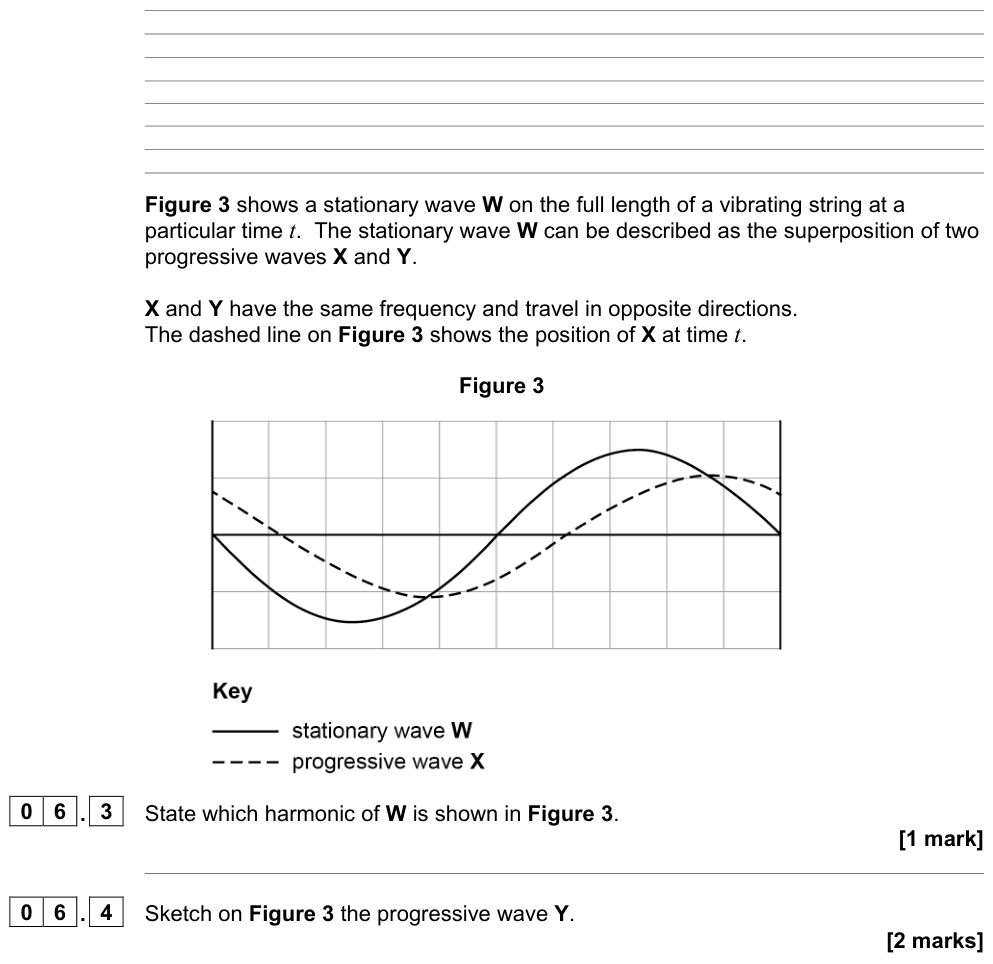
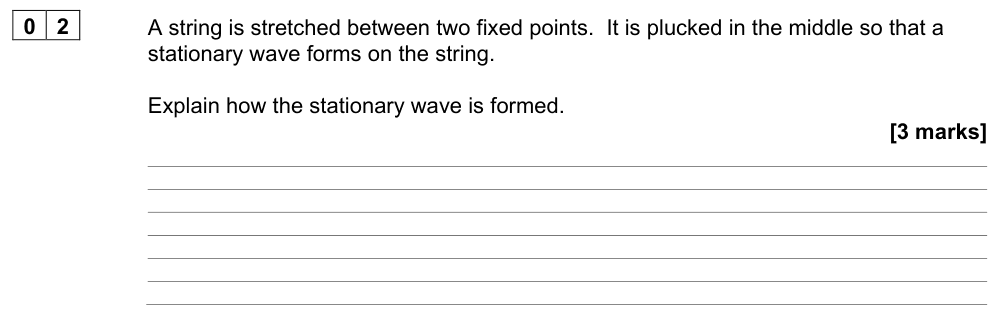
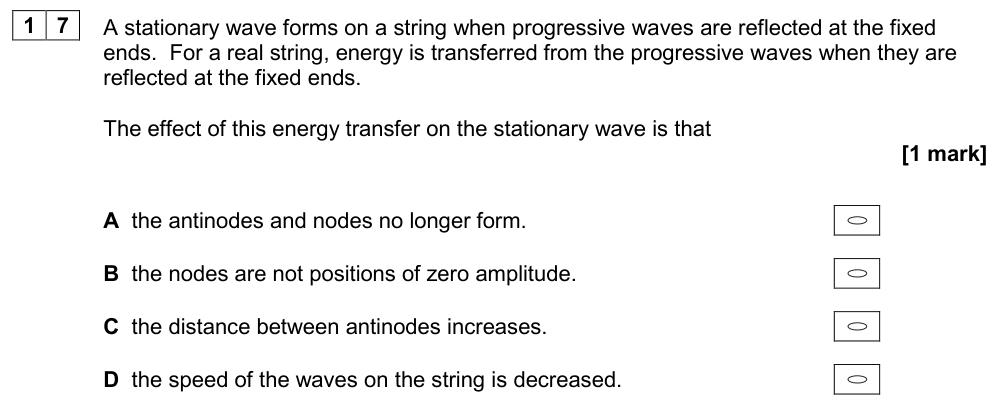
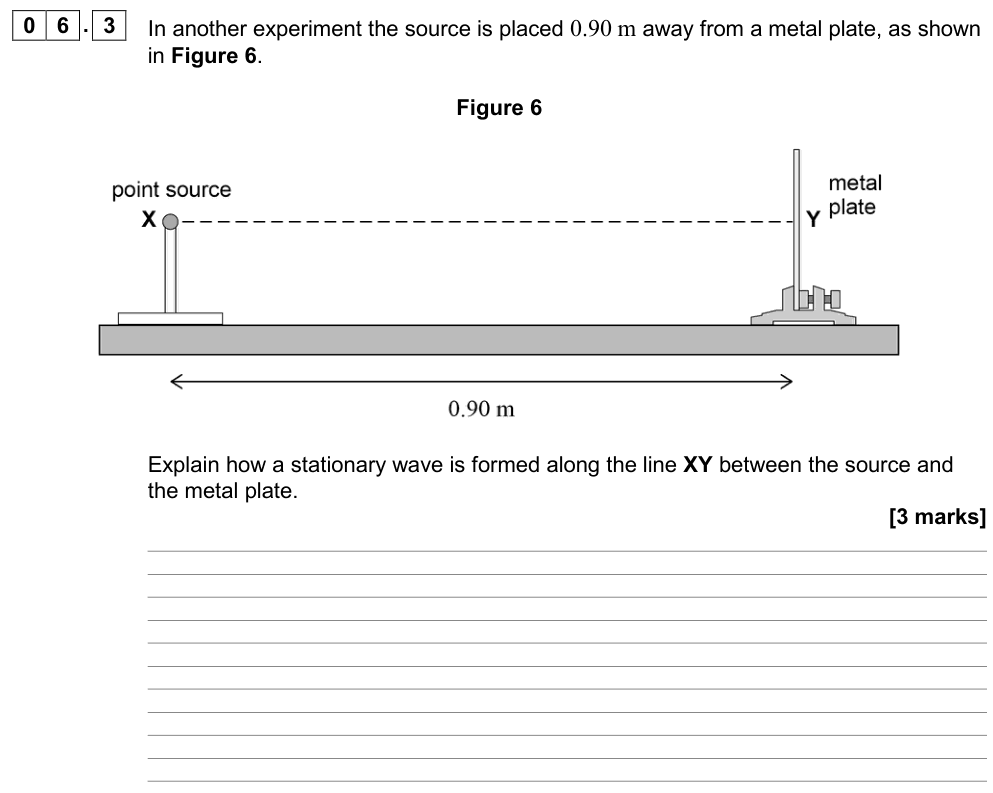
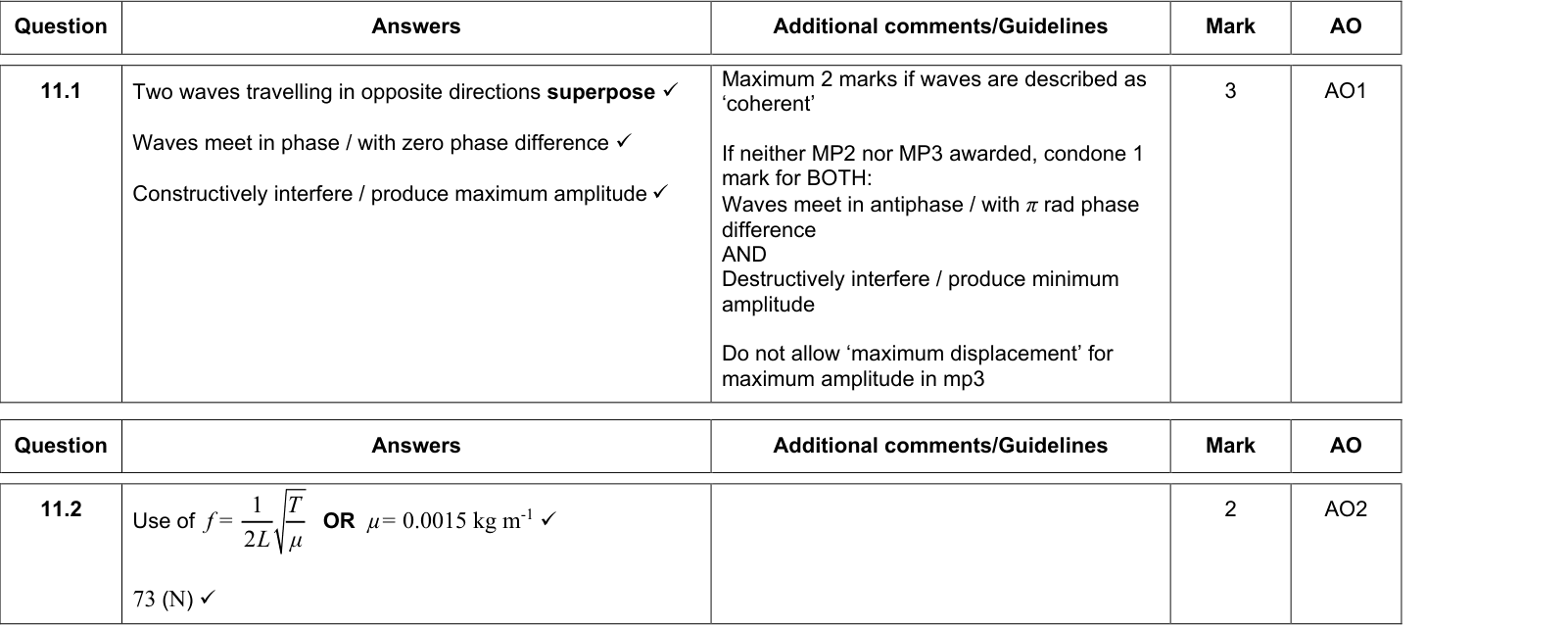
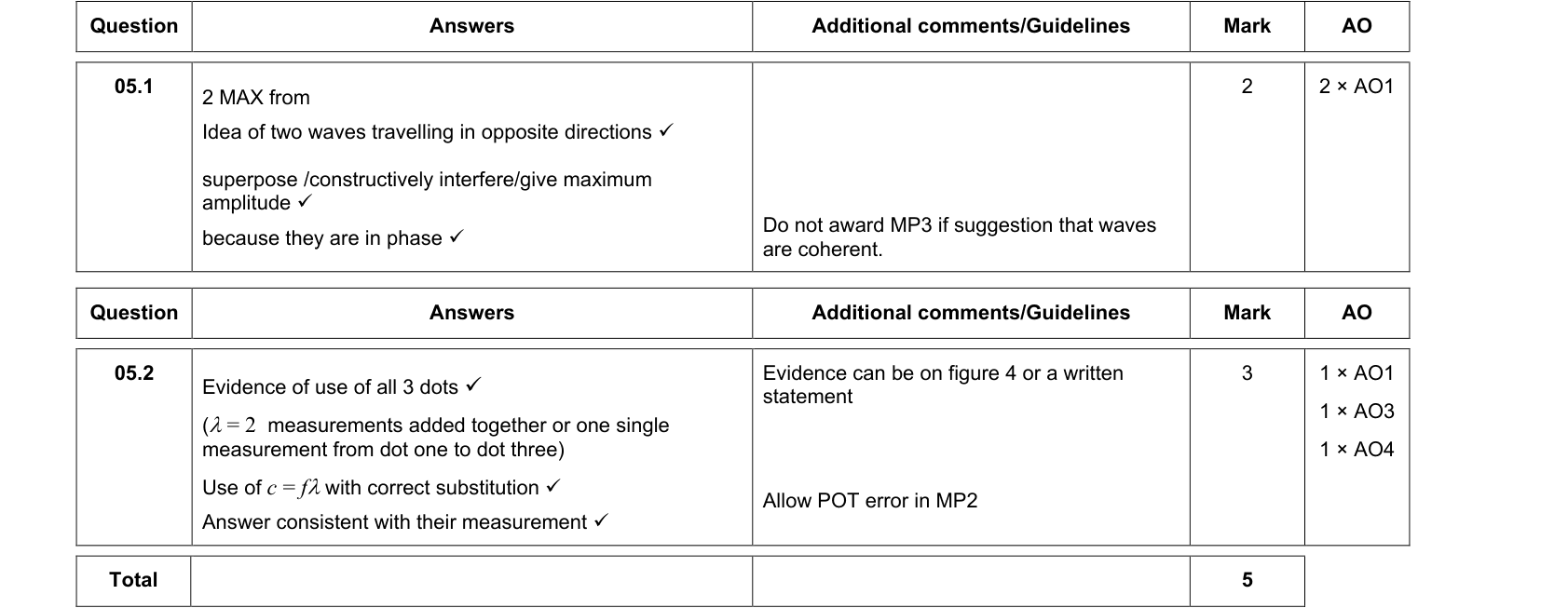
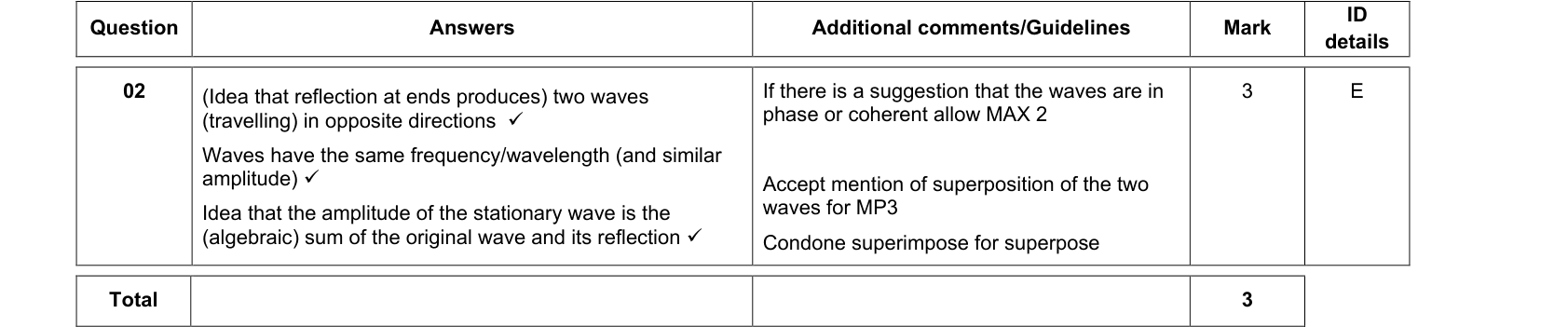
A stationary wave is formed by the superposition of two progressive waves of the same frequency (and similar amplitude) travelling in opposite directions. Usually one wave is a reflection of the other.
Nodes and antinodes
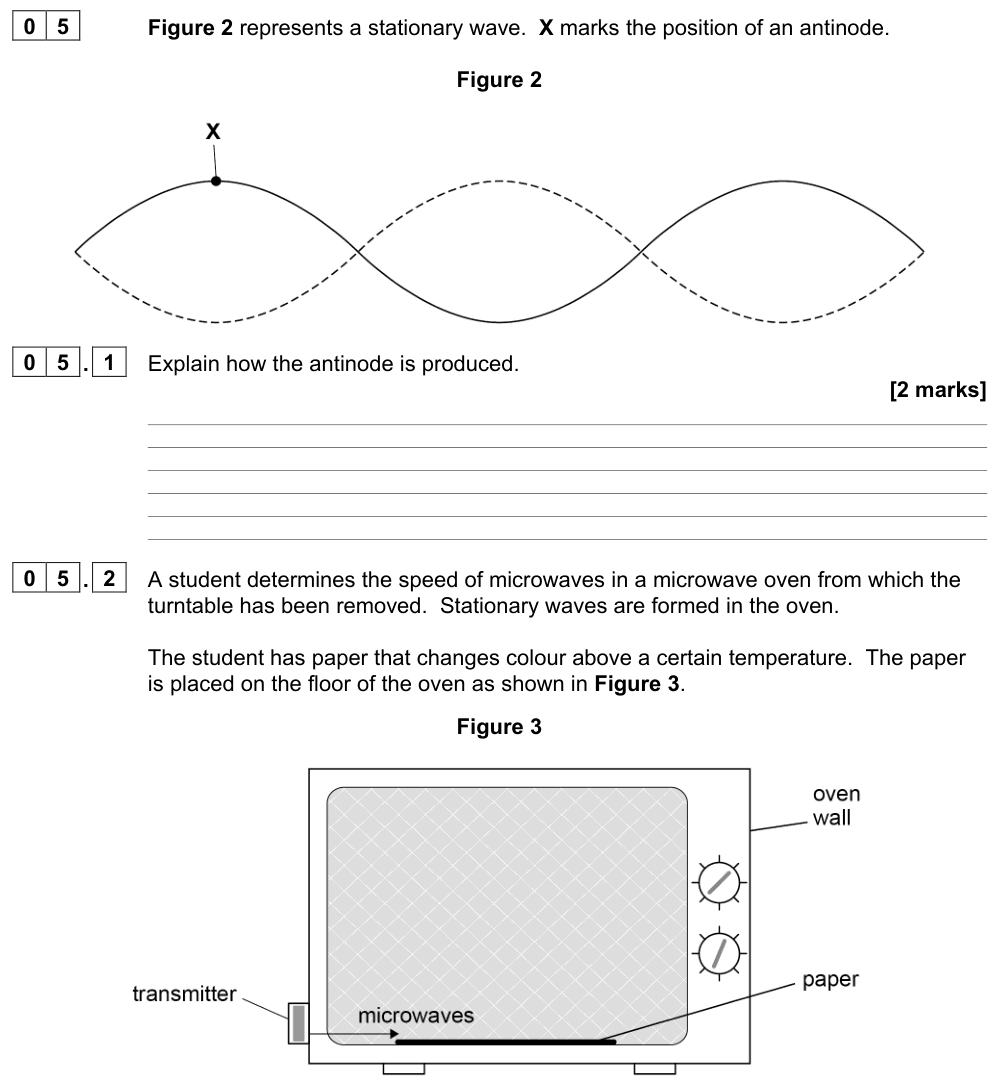
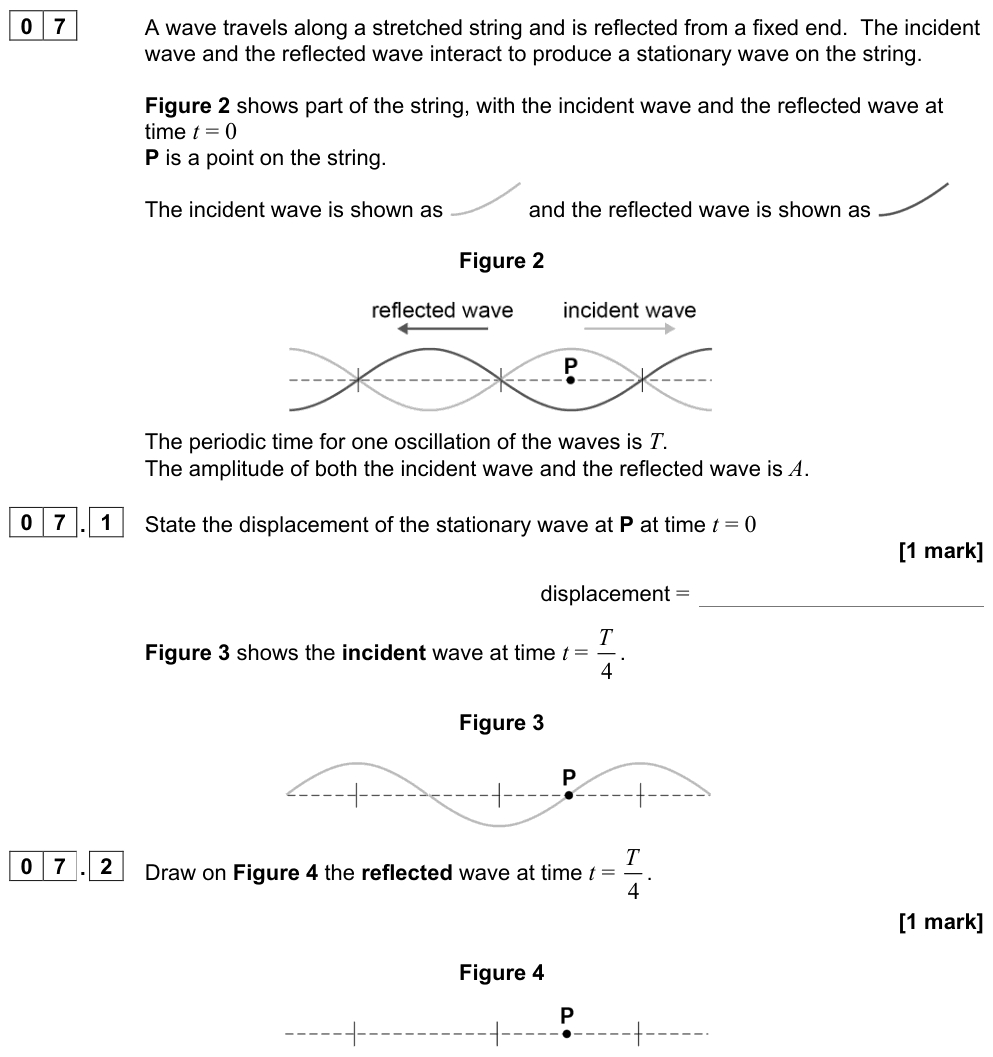
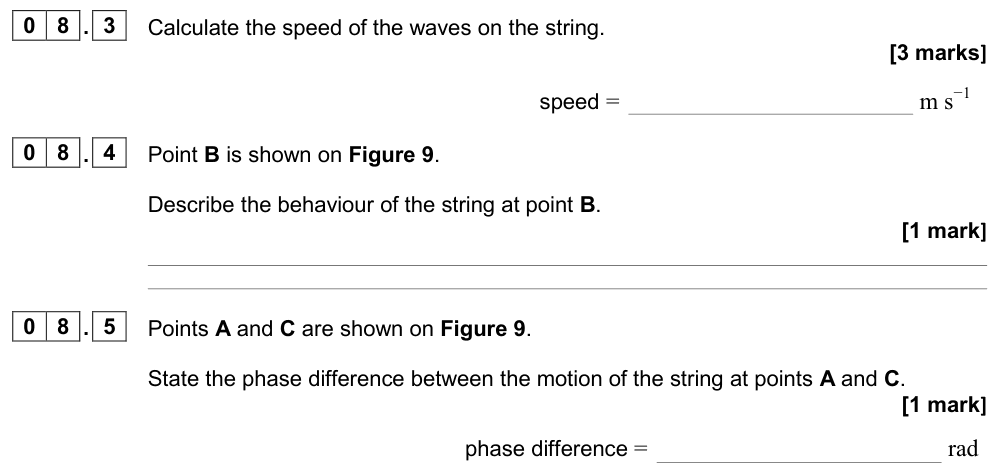
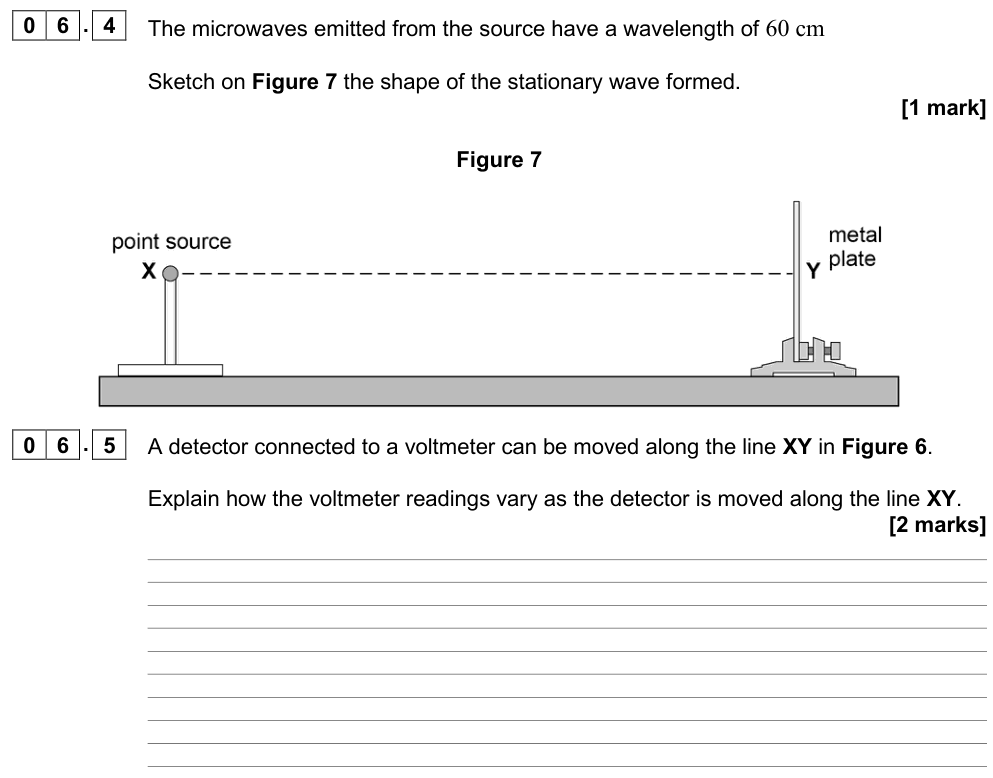
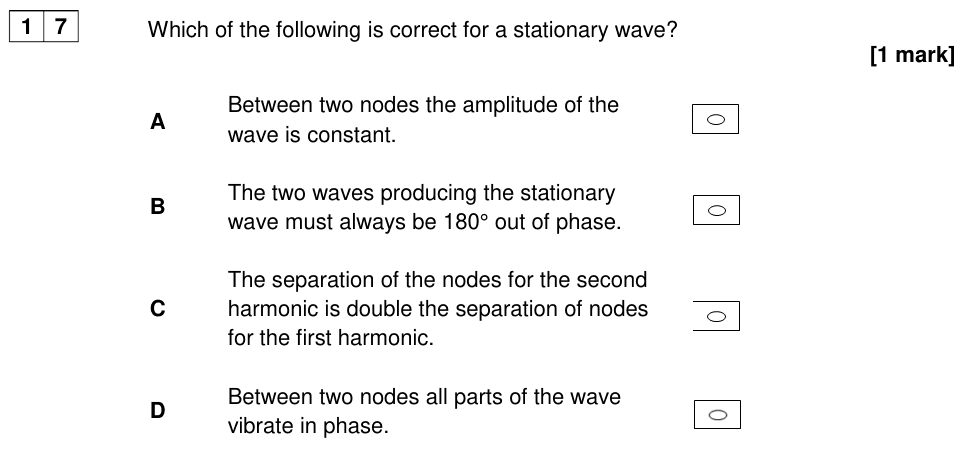
- Nodes: points that are always at rest (zero amplitude), where the two waves always cancel.
- Antinodes: points of maximum amplitude, where the two waves always reinforce.
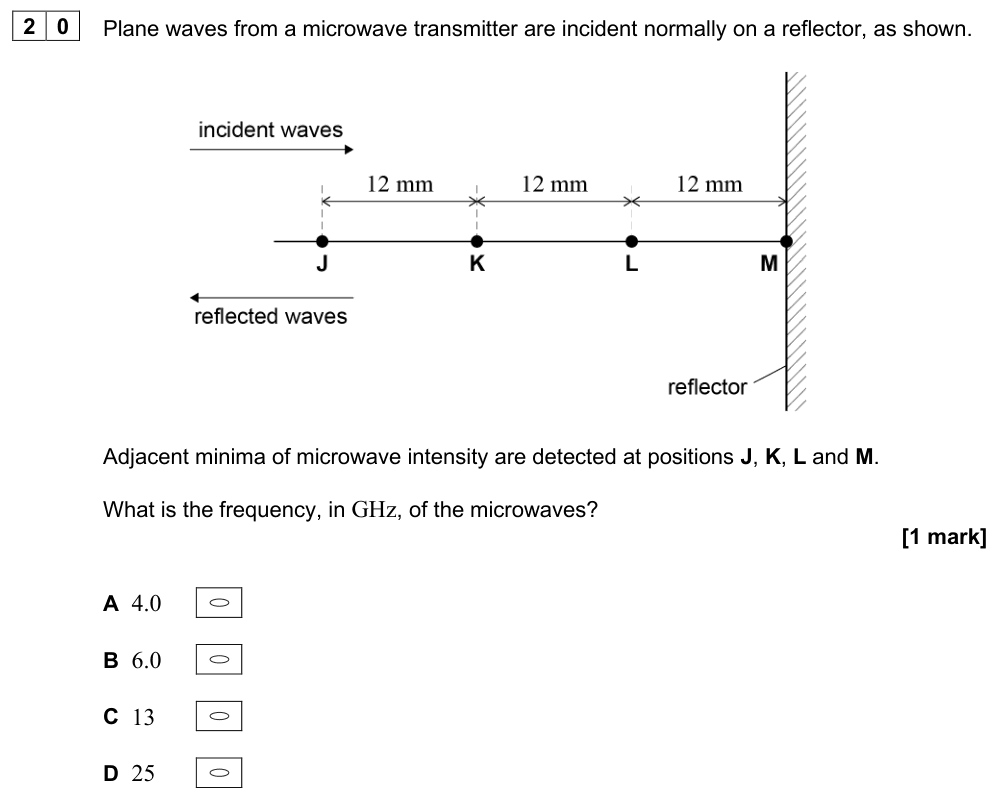
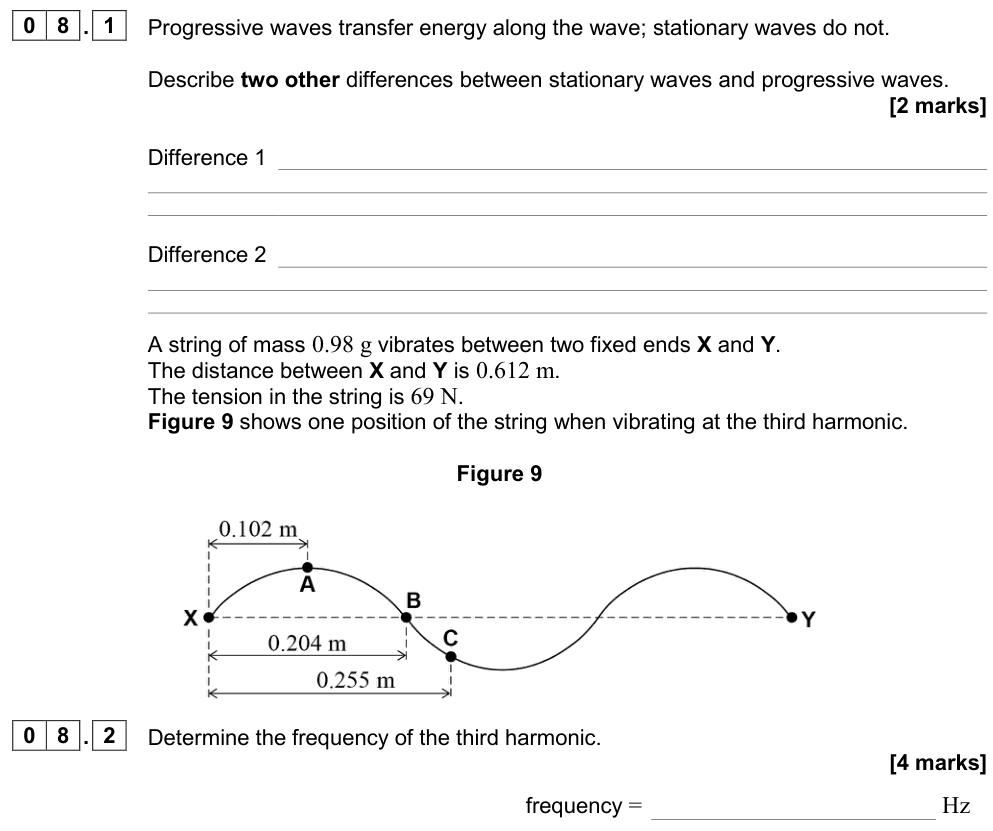
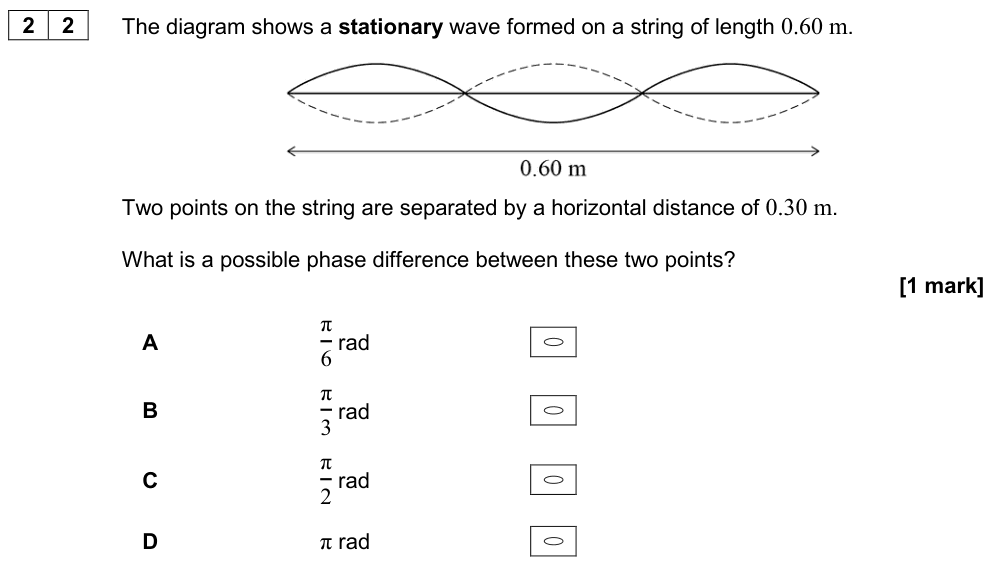
- The distance between adjacent nodes (or adjacent antinodes) is $\lambda/2$. A node and the next antinode are $\lambda/4$ apart.
How a stationary wave differs from a progressive wave
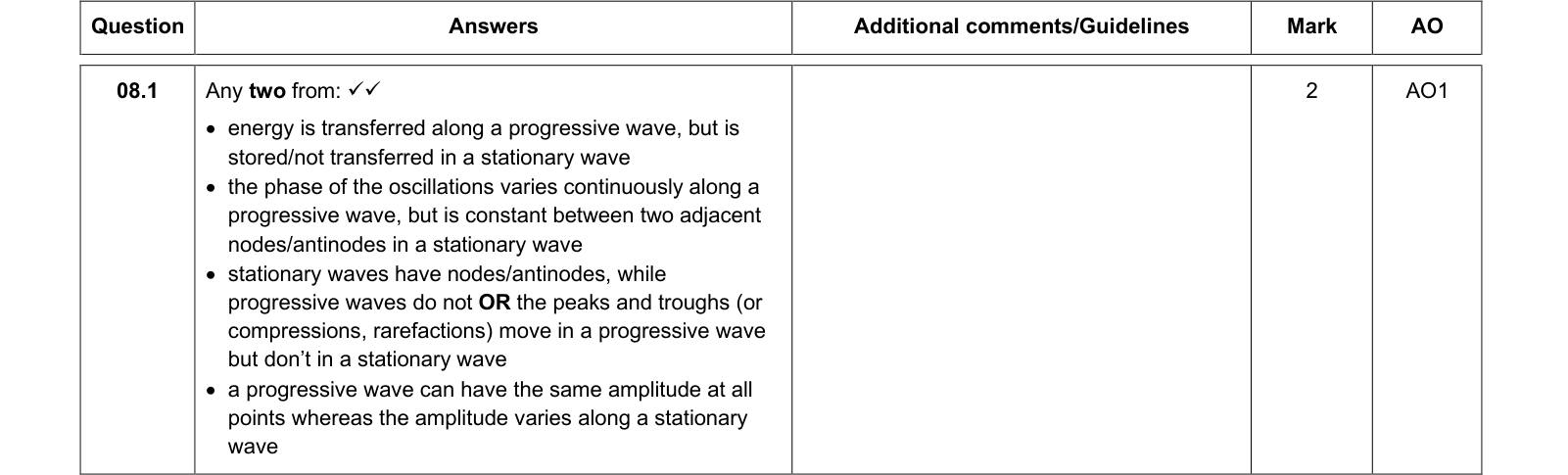
| Progressive wave | Stationary wave | |
|---|---|---|
| Energy transfer | transfers energy along the wave | no net energy transfer (energy is stored) |
| Amplitude | the same for every point (ignoring losses) | varies with position: zero at nodes, maximum at antinodes |
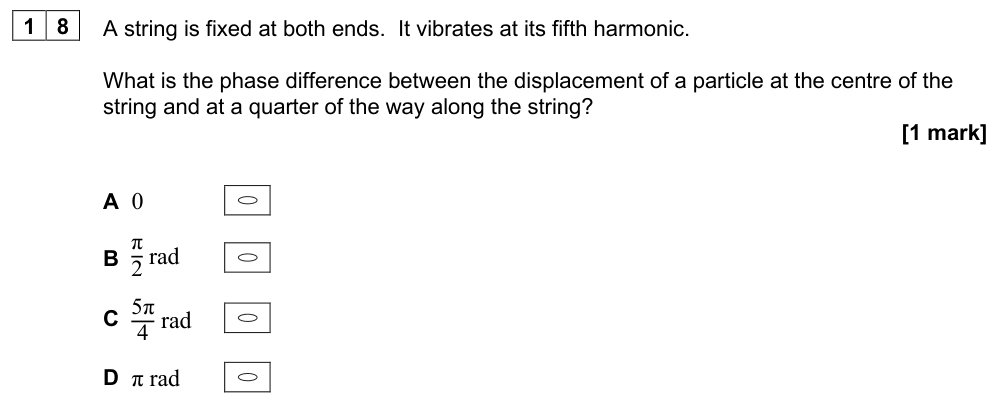
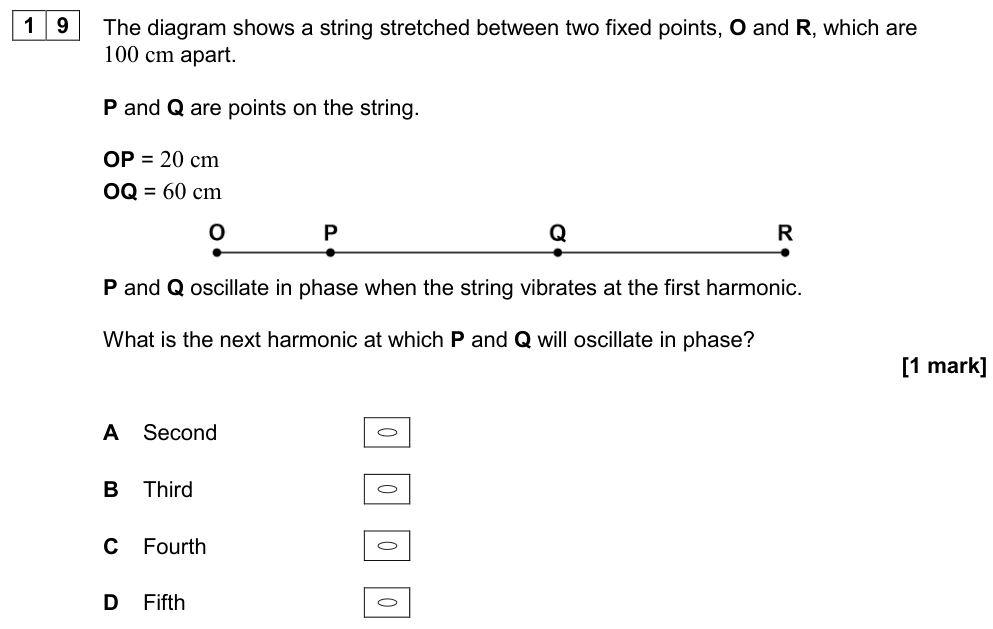
| Phase | changes continuously along the wave (phase difference $2\pi d/\lambda$) | all points between two adjacent nodes are in phase; points in adjacent loops are in antiphase |
| Waveform | moves along | does not move along |
Graphical explanation of formation
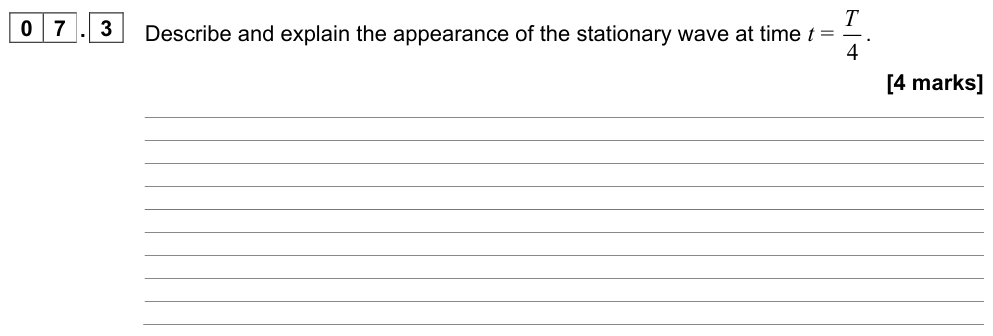
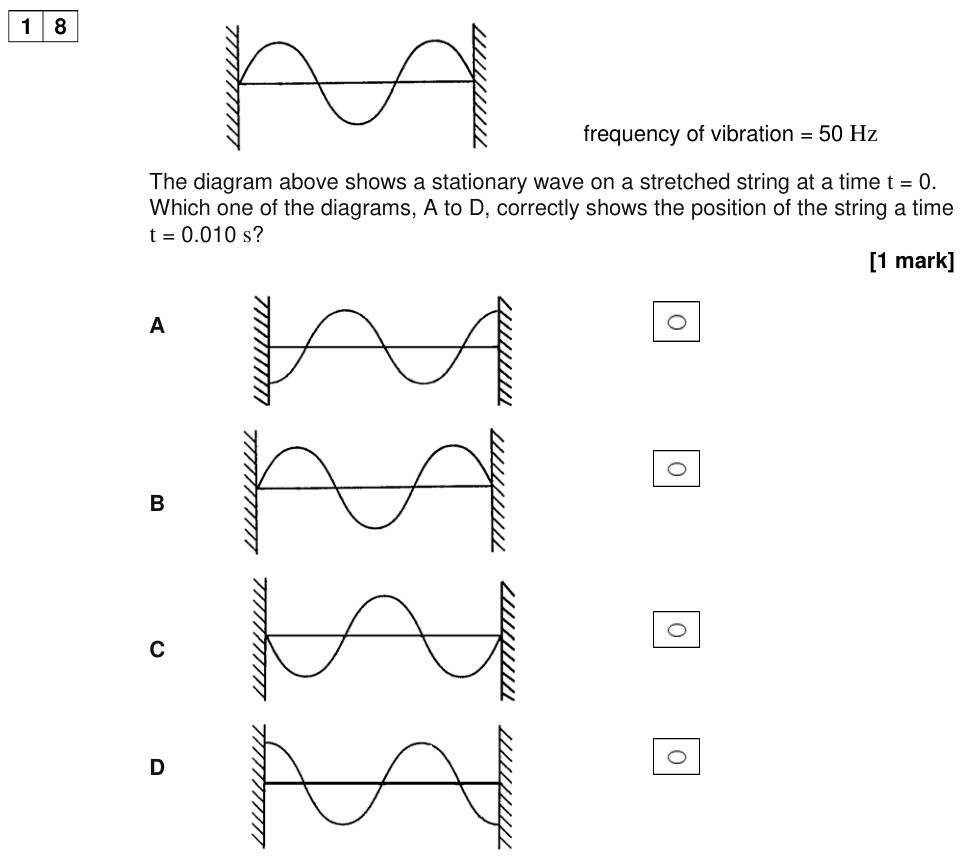
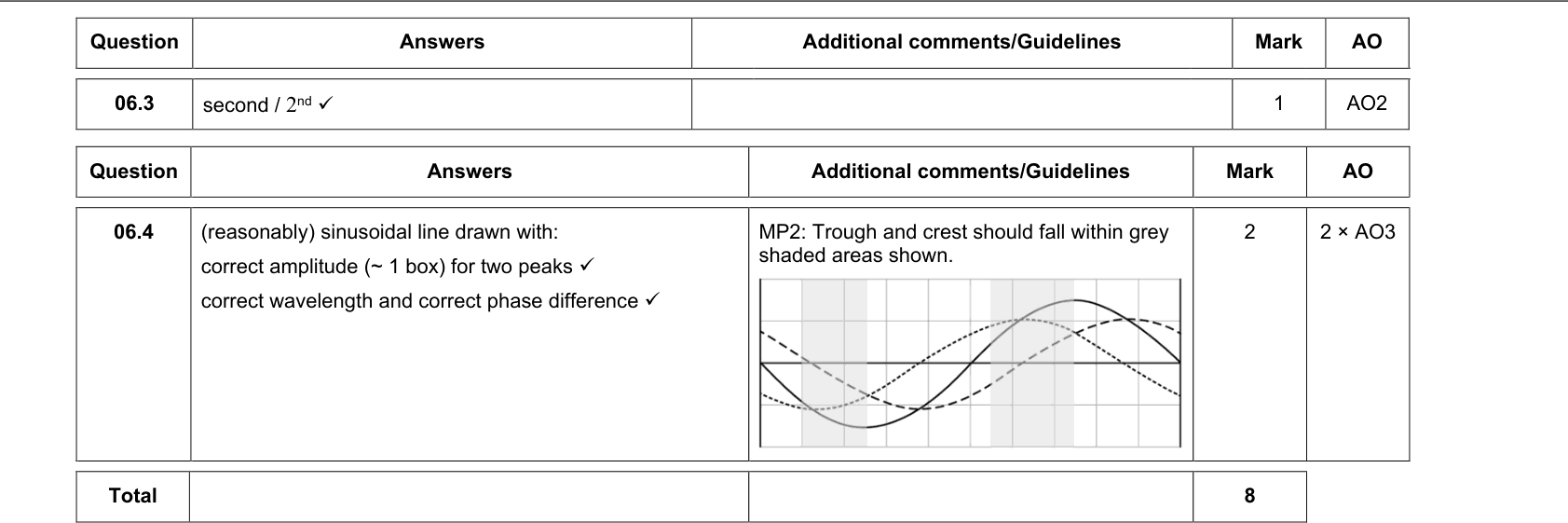
Draw the two progressive waves at intervals of $T/4$ as they move through each other and add their displacements. At $t = 0$ (in phase) the resultant has double amplitude; a quarter of a period later they are in antiphase everywhere and the string is momentarily flat; and so on. The points where the waves always cancel are the nodes. Try the Stationary wave diagram in the Interactive tab, which draws both waves and their sum.
Stationary waves on strings: harmonics
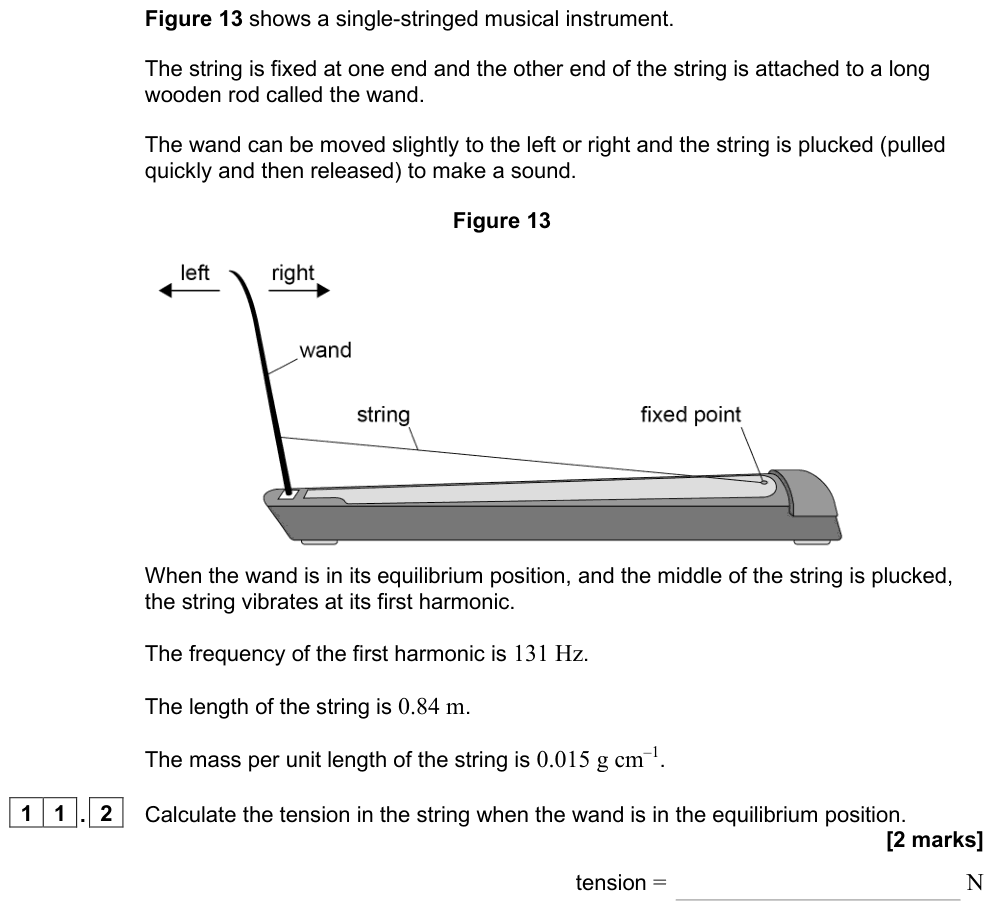
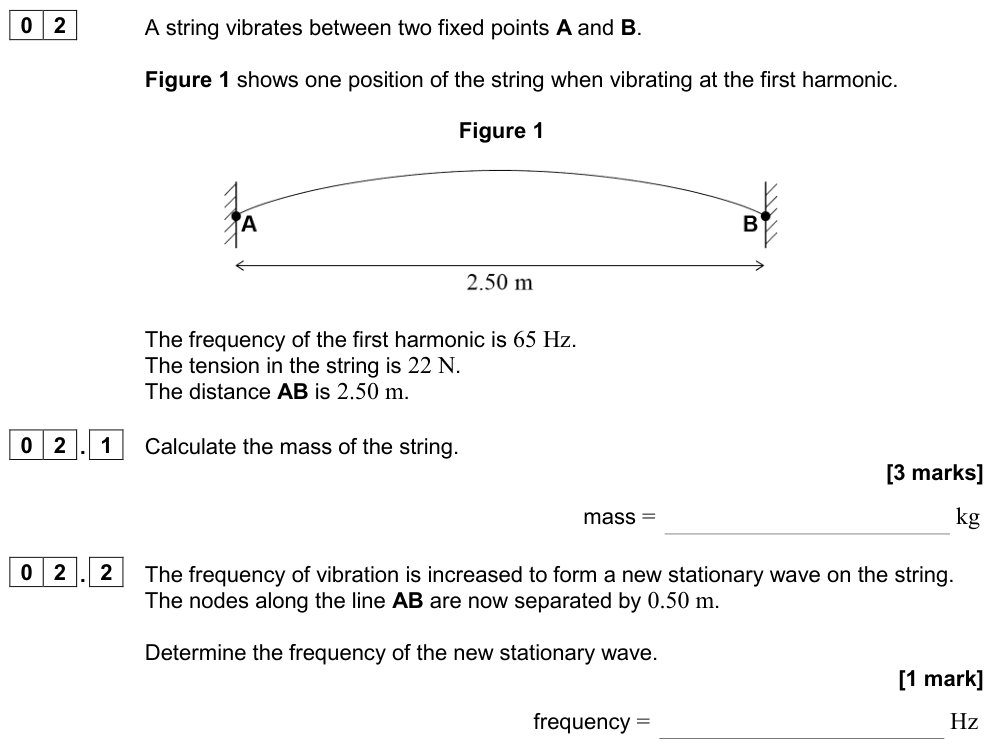
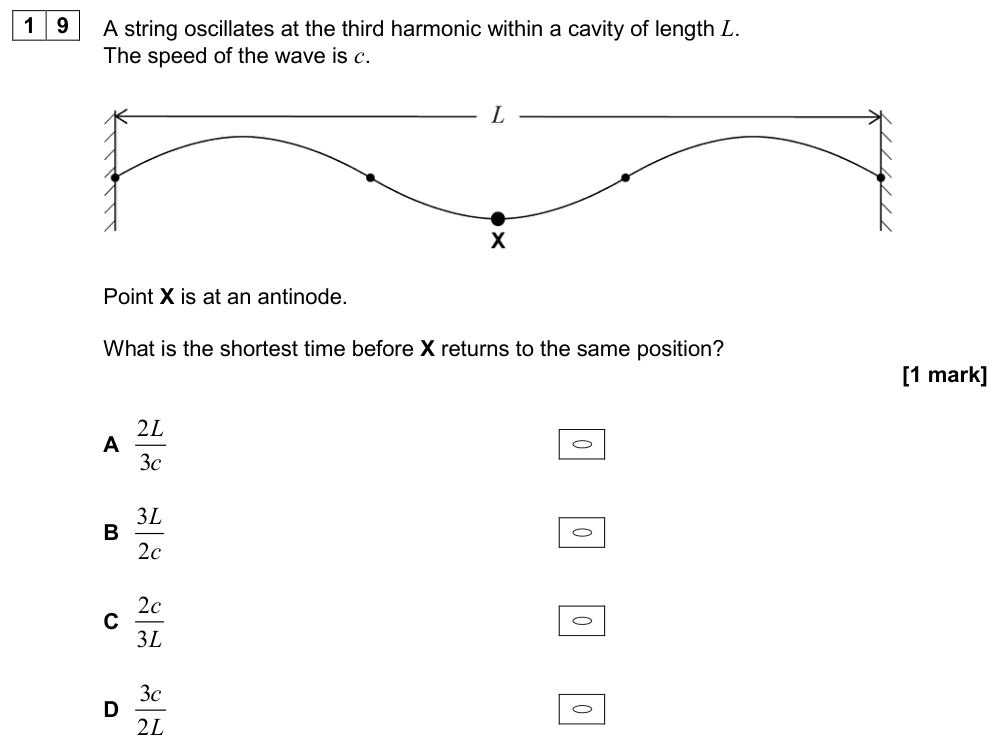
A string fixed at both ends must have a node at each end. Only certain wavelengths fit:
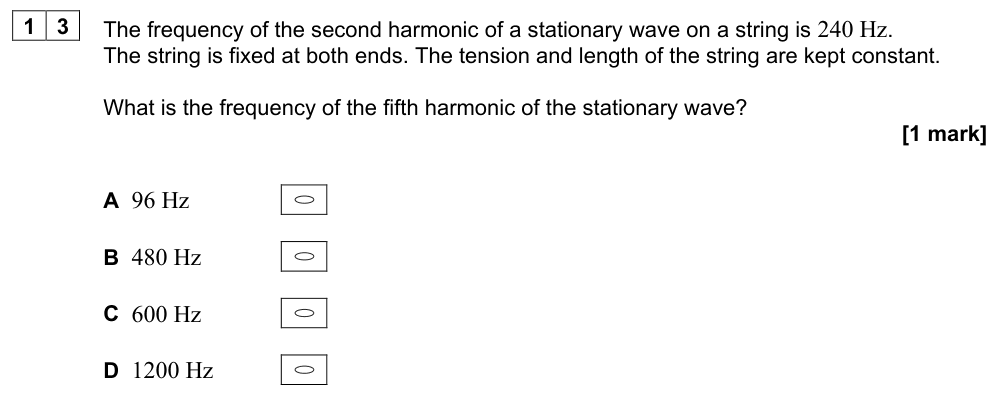
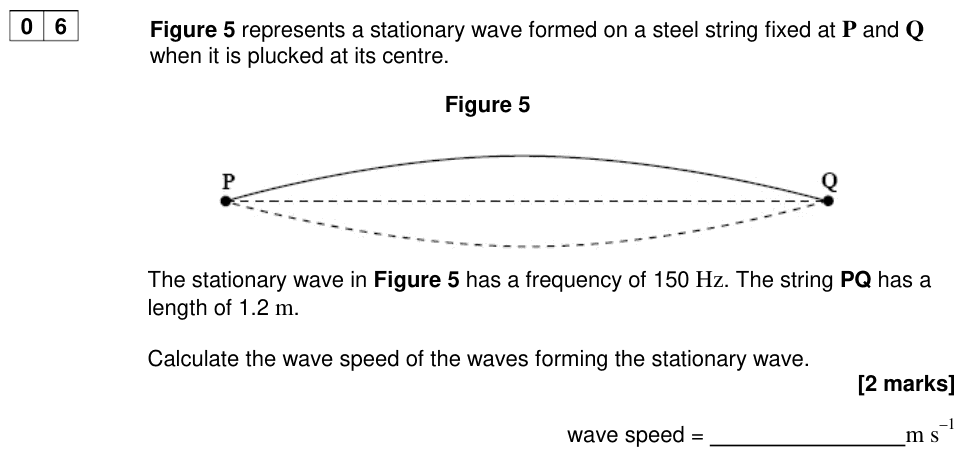
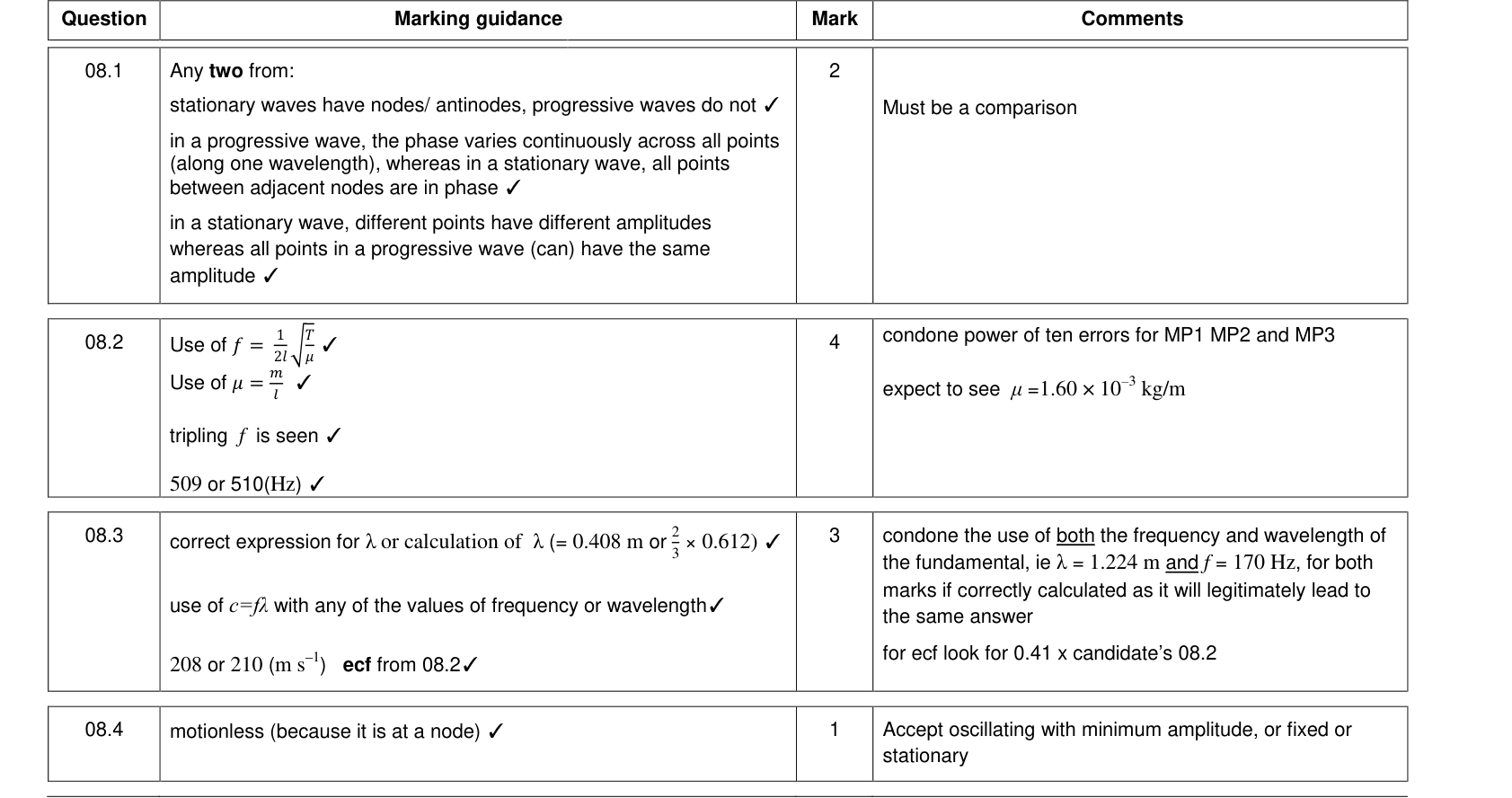
$$L = n\frac{\lambda}{2} \quad \Rightarrow \quad \lambda_n = \frac{2L}{n}, \qquad f_n = \frac{nc}{2L} = n f_1 \qquad (n = 1, 2, 3, \dots)$$
| Mode | Pattern | Wavelength | Frequency |
|---|---|---|---|
| First harmonic | 1 loop (N A N) | $\lambda = 2L$ | $f_1$ |
| Second harmonic | 2 loops | $\lambda = L$ | $2f_1$ |
| Third harmonic | 3 loops | $\lambda = 2L/3$ | $3f_1$ |
The specification uses "first harmonic" (not "fundamental") and does not use "overtone".
First harmonic of a stretched string
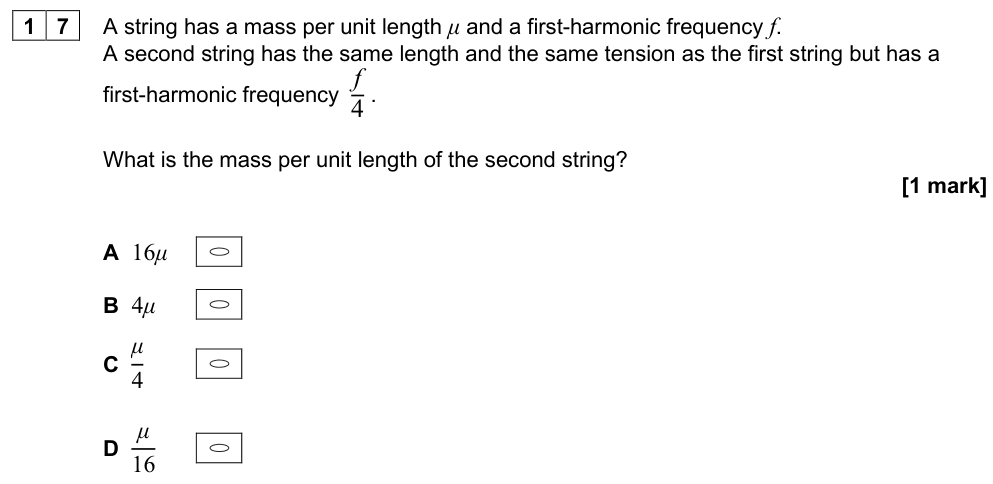
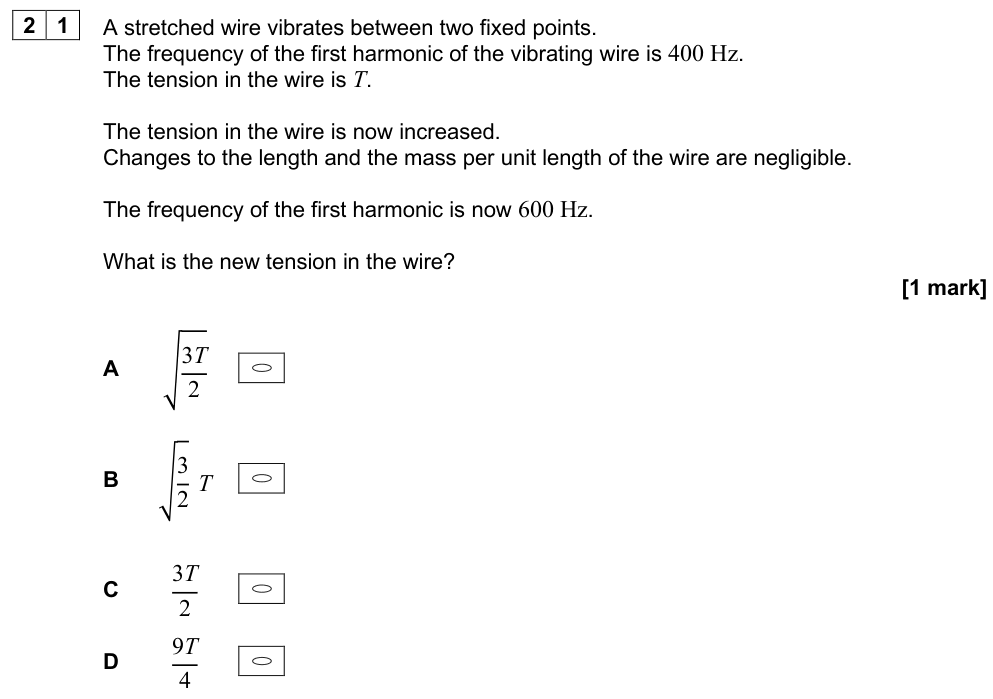
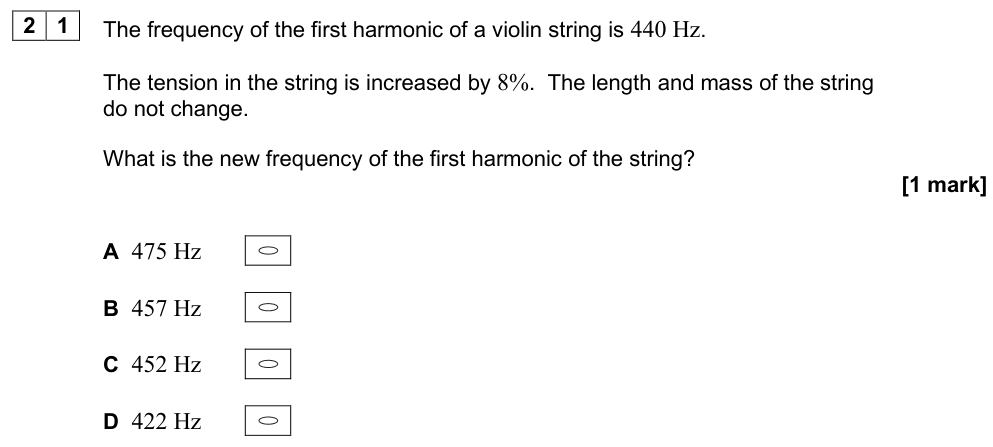
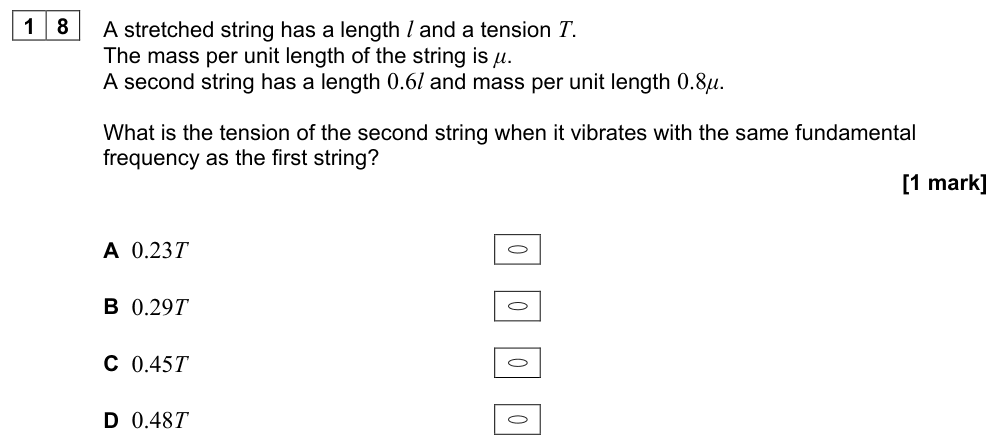
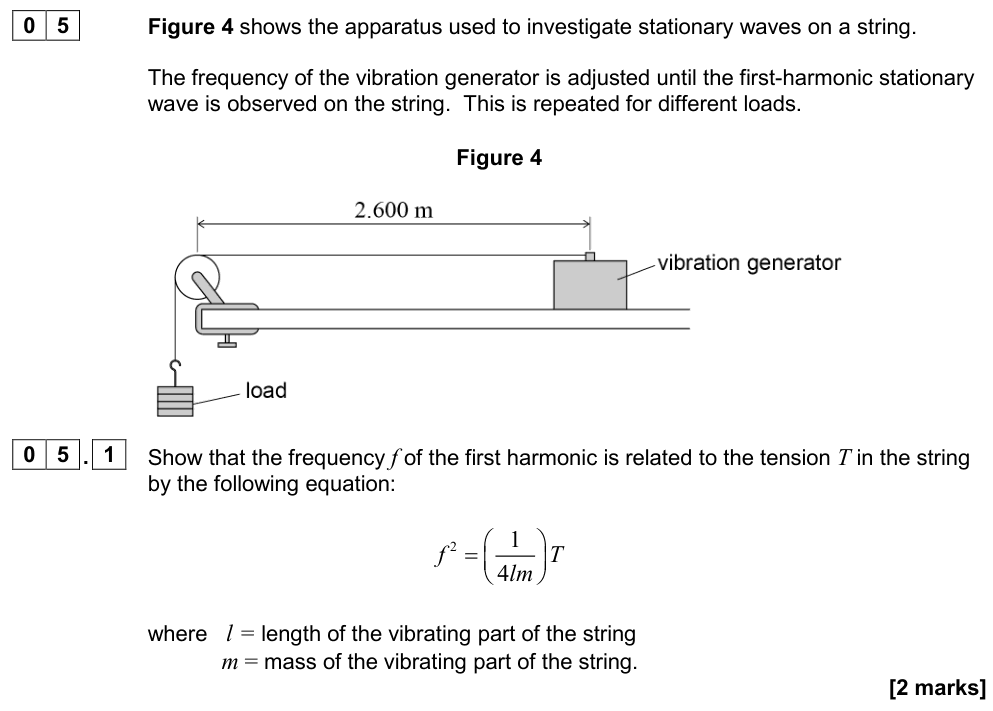
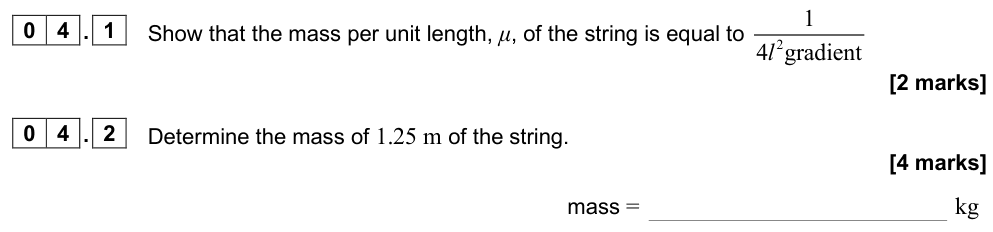
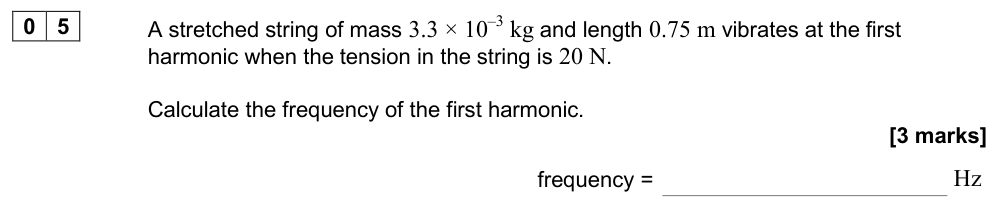
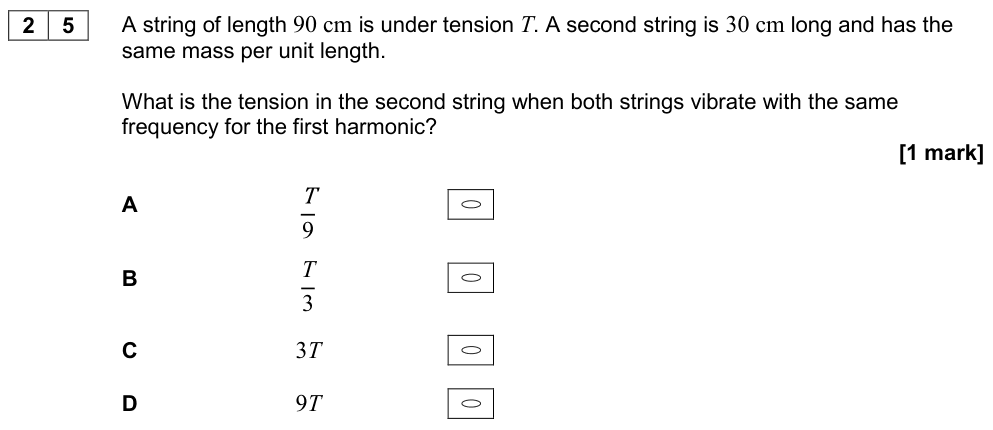
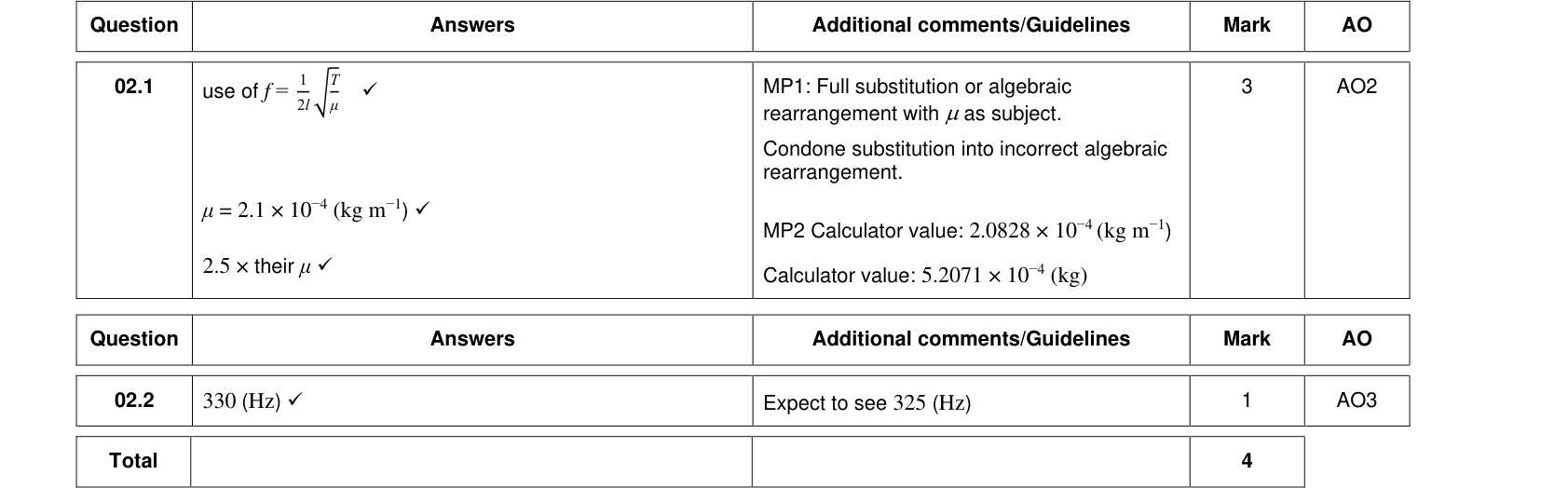
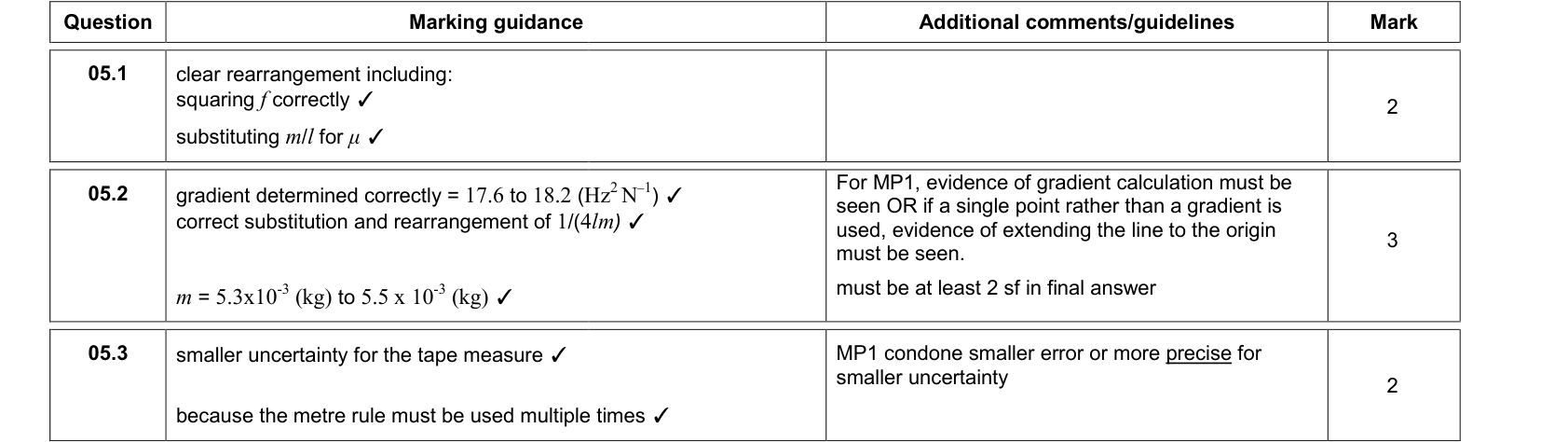
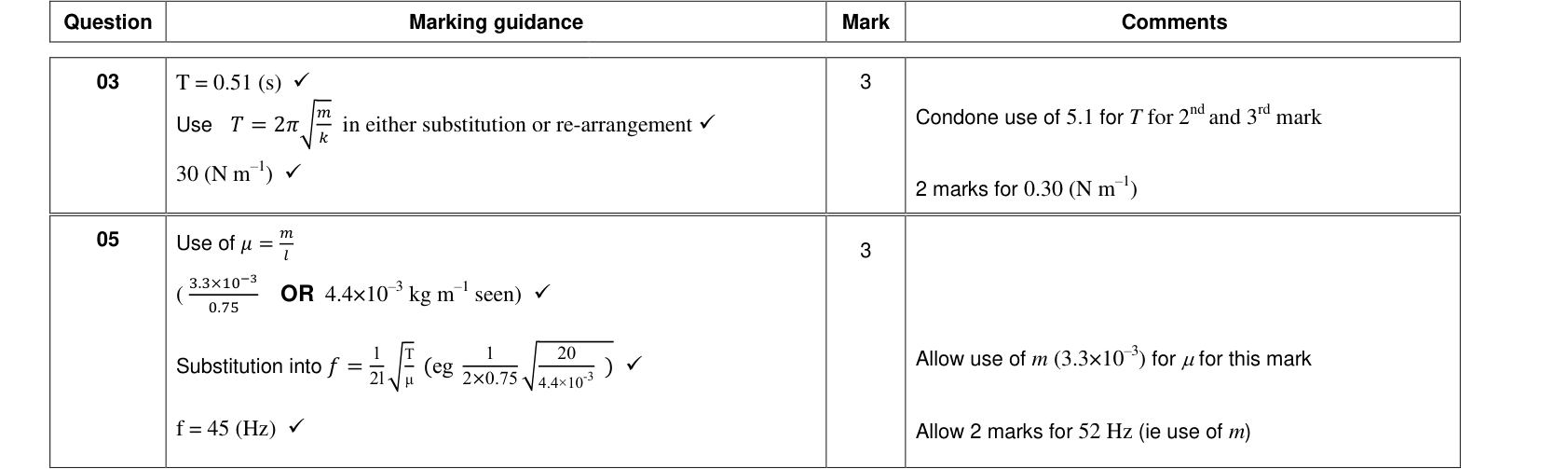
$$f_1 = \frac{1}{2L}\sqrt{\frac{T}{\mu}}$$
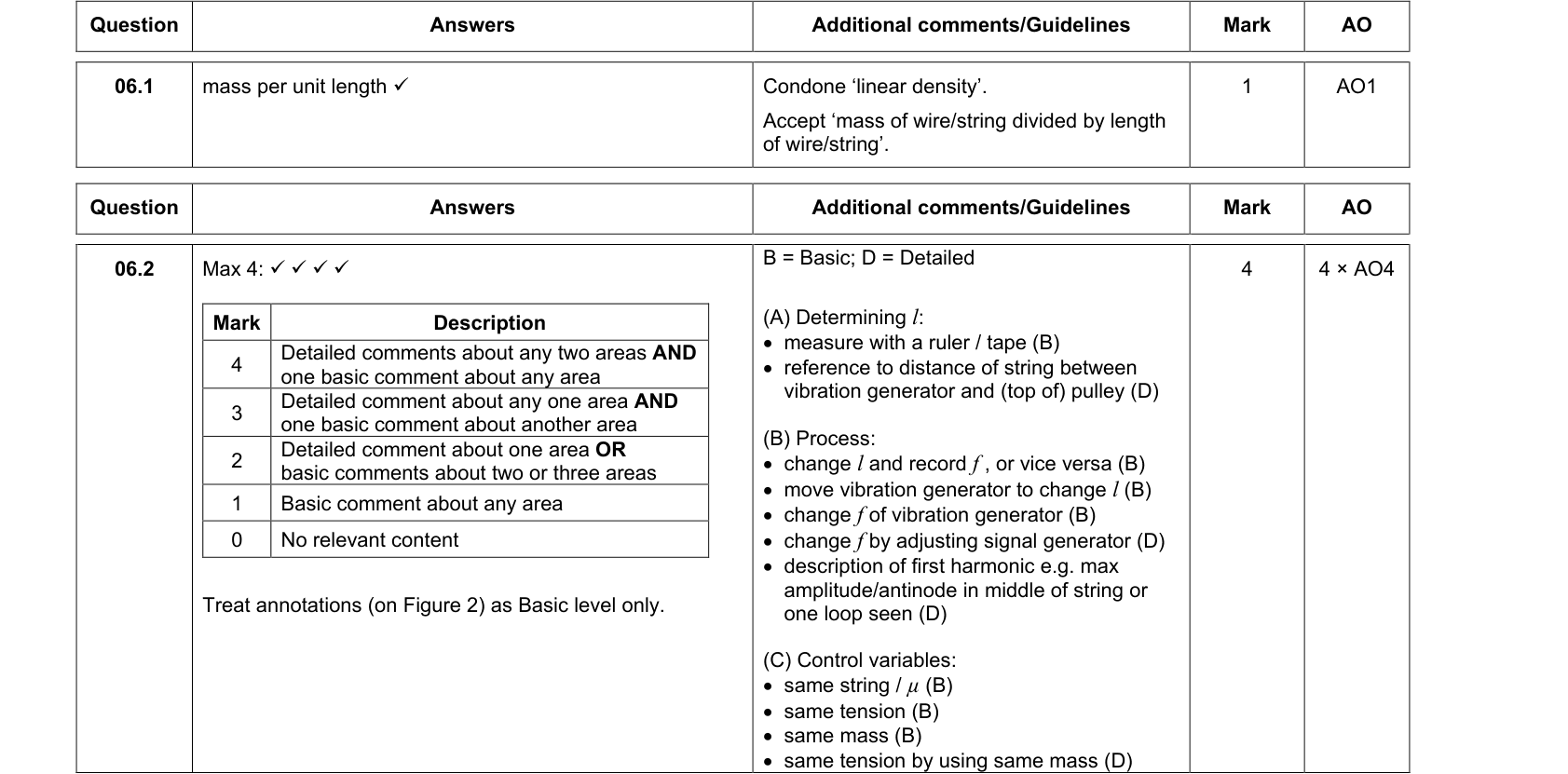
$T$ = tension (N), $\mu$ = mass per unit length (kg m⁻¹), $L$ = vibrating length. The wave speed on the string is $c = \sqrt{T/\mu}$.
So the frequency of the first harmonic:
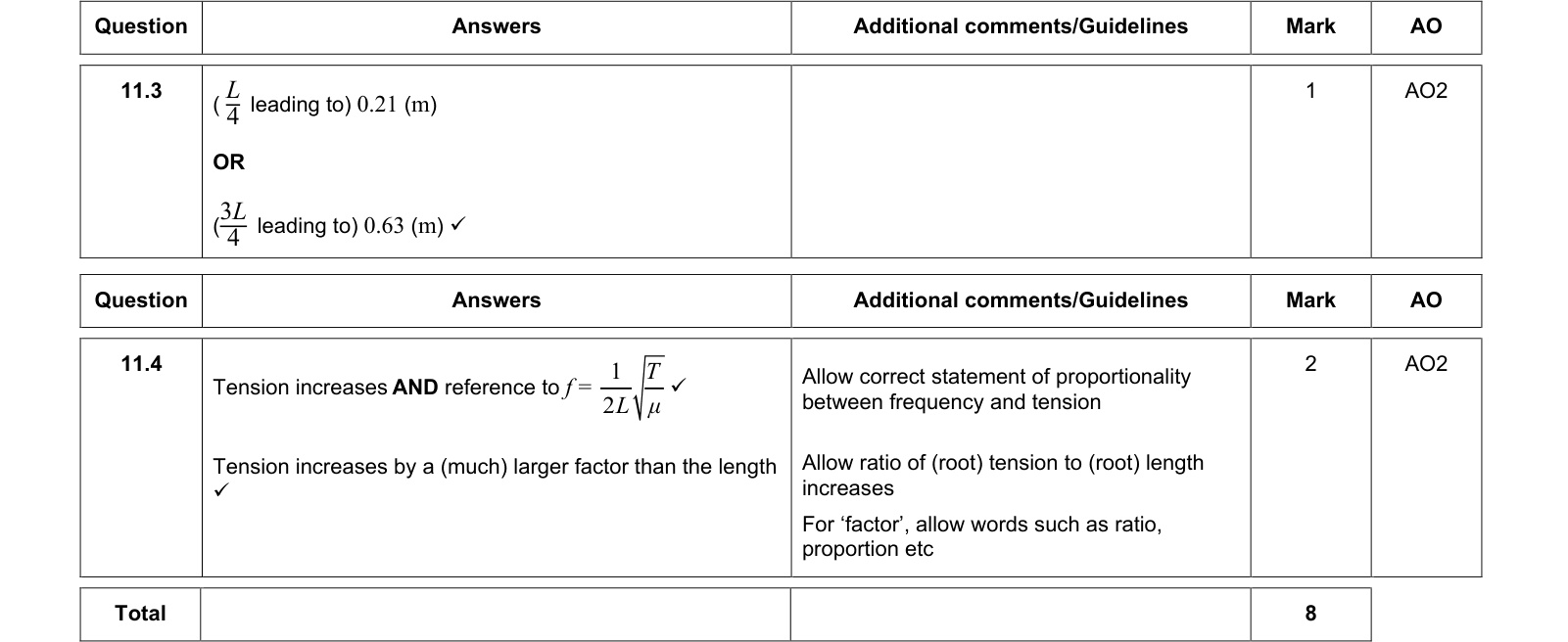
- is inversely proportional to the length ($f \propto 1/L$): shorter string, higher note;
- is proportional to the square root of the tension ($f \propto \sqrt{T}$): tightening a guitar string raises the pitch;
- is inversely proportional to the square root of the mass per unit length ($f \propto 1/\sqrt{\mu}$): thicker (heavier) strings give lower notes.
Worked example
A guitar string is 0.65 m long, has $\mu = 3.0 \times 10^{-3}\ \text{kg m}^{-1}$ and is under a tension of 80 N.
$f_1 = \dfrac{1}{2 \times 0.65}\sqrt{\dfrac{80}{3.0 \times 10^{-3}}} = \dfrac{163}{1.30} = 126\ \text{Hz}$. The third harmonic is 377 Hz.
Investigating stationary waves on a string
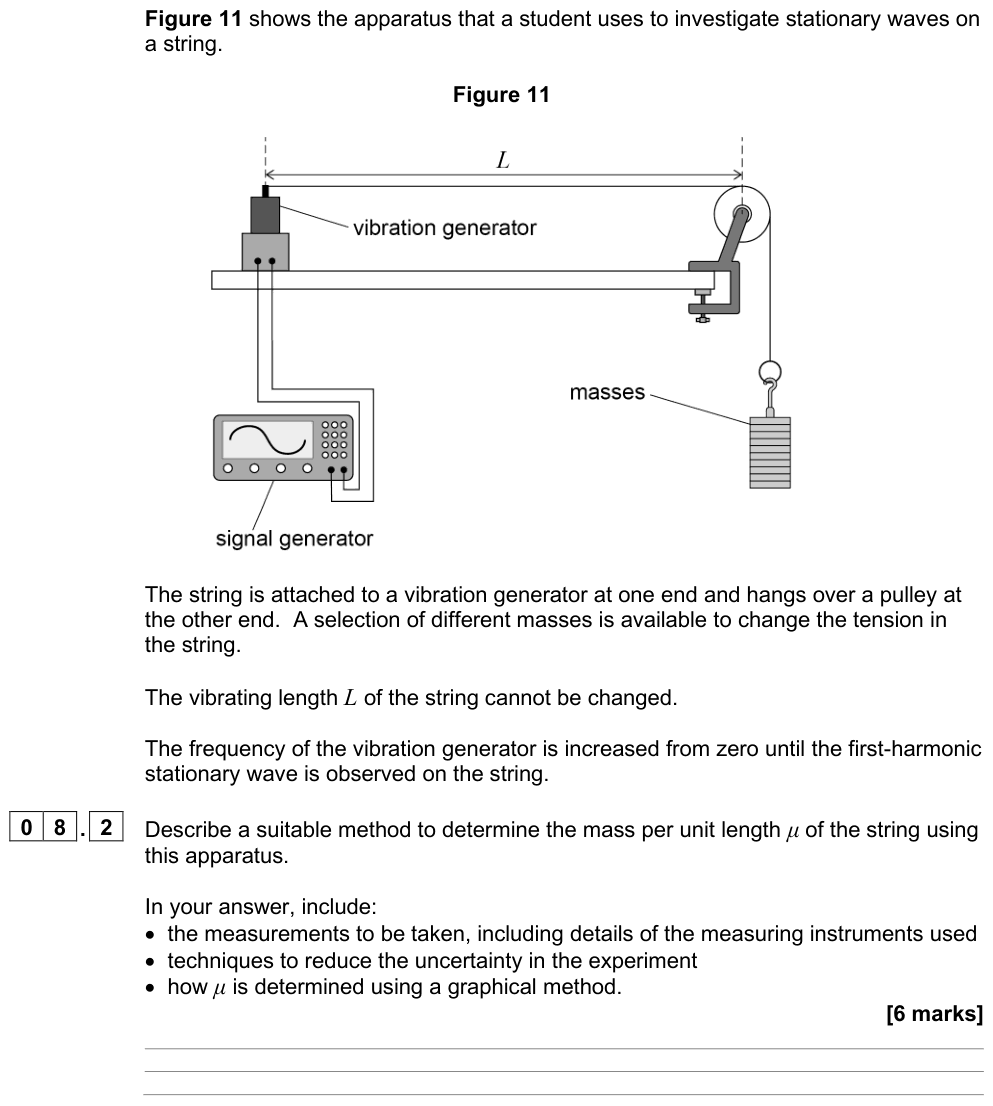
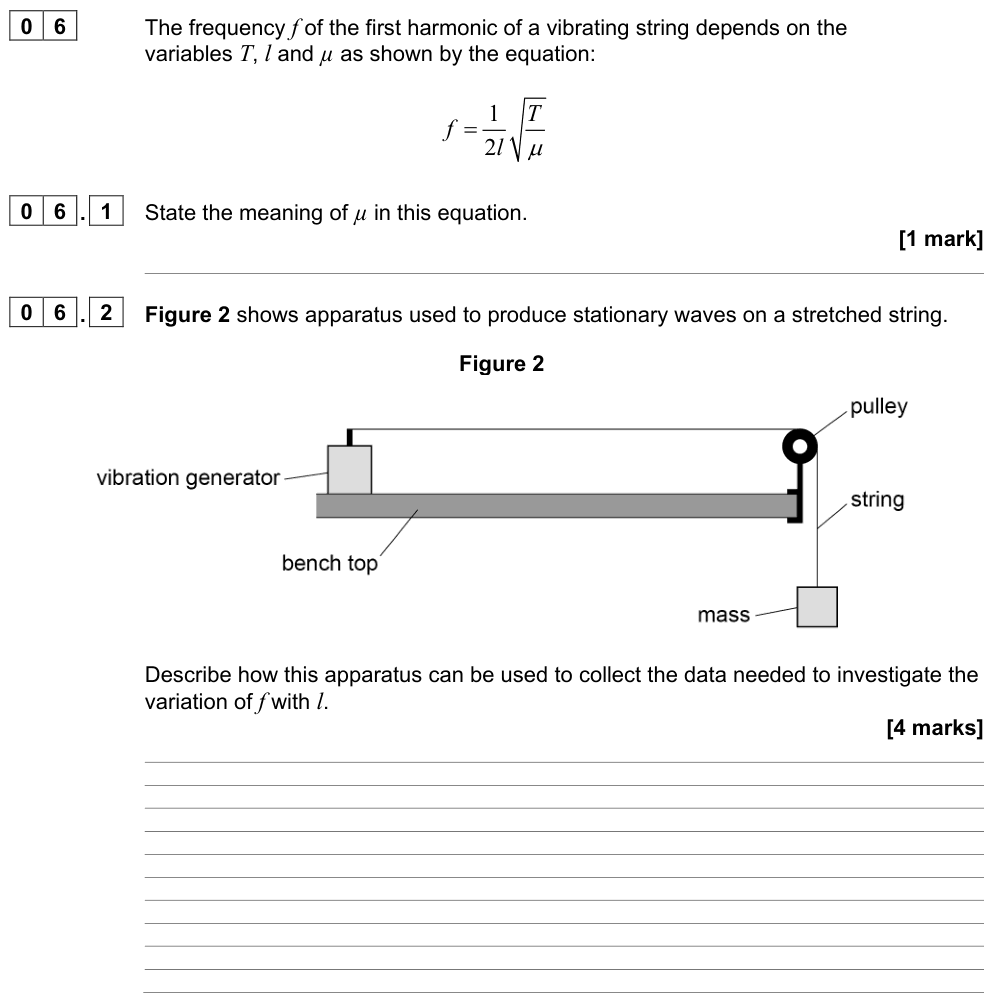
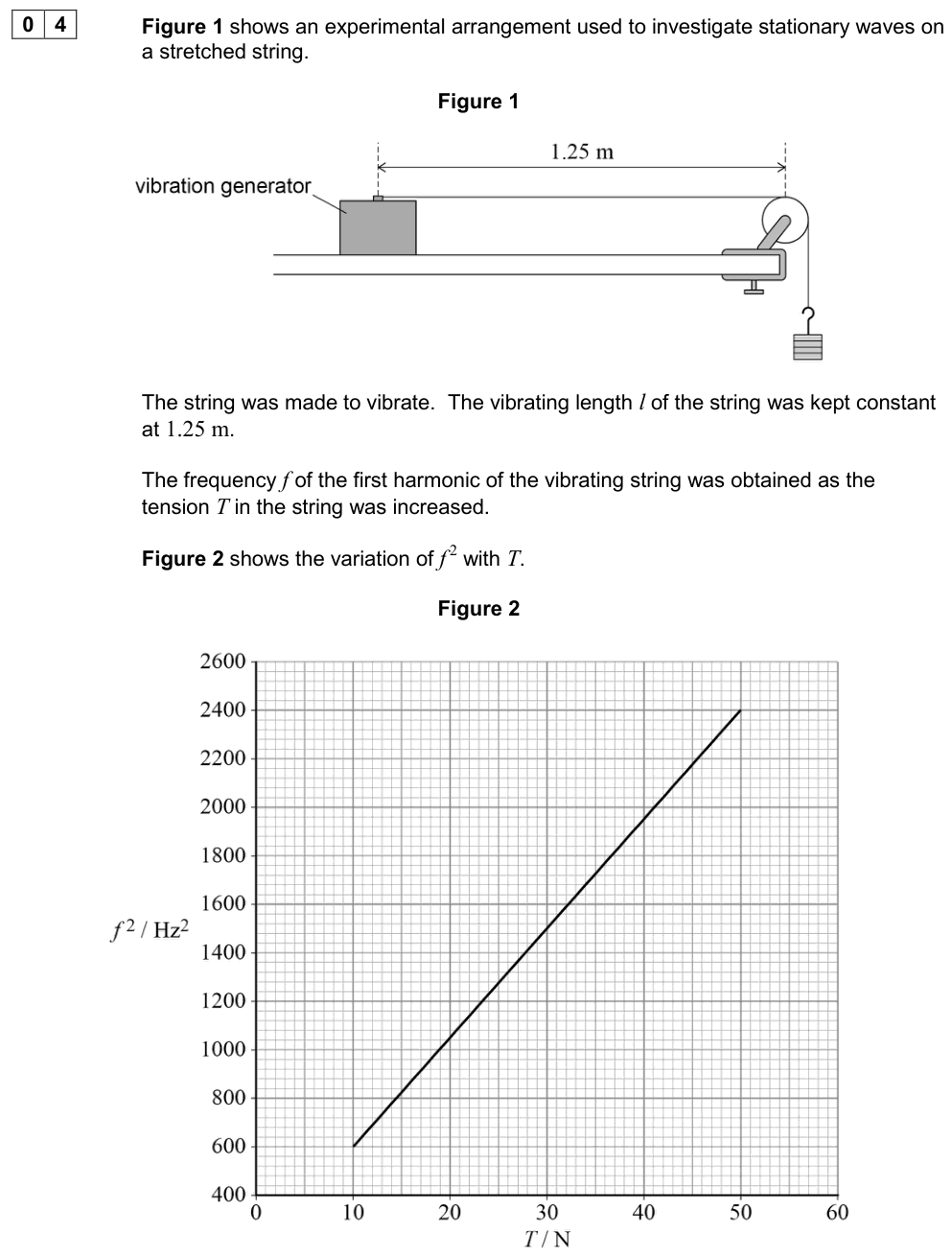
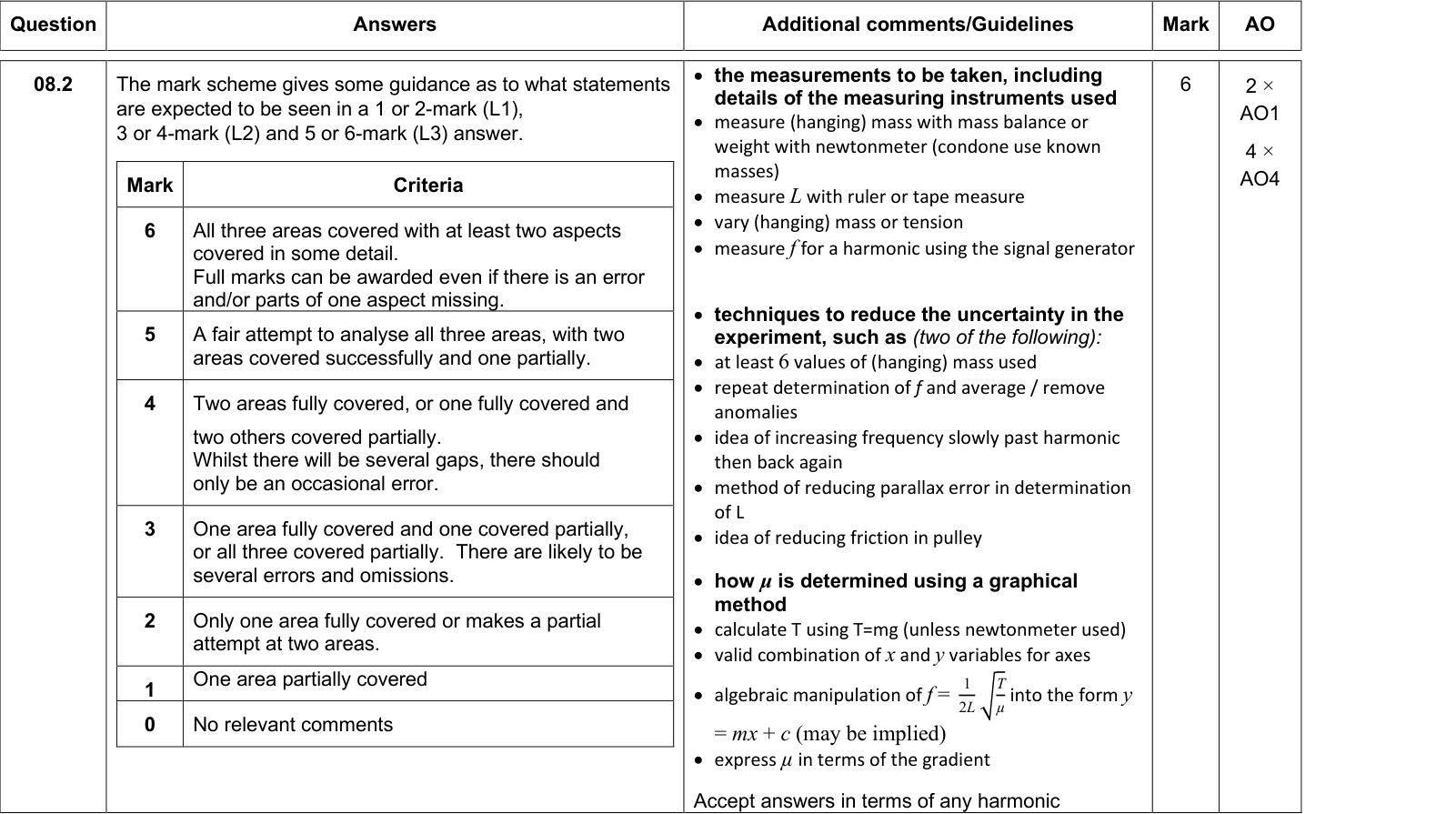
A string passes over a pulley to a hanging mass (tension $T = mg$) and is attached at the other end to a vibration generator driven by a signal generator. Adjust the frequency until the first harmonic (one loop, largest amplitude) appears. Measure $L$ between the vibrator and the pulley, and $\mu$ by weighing a measured length of the string.
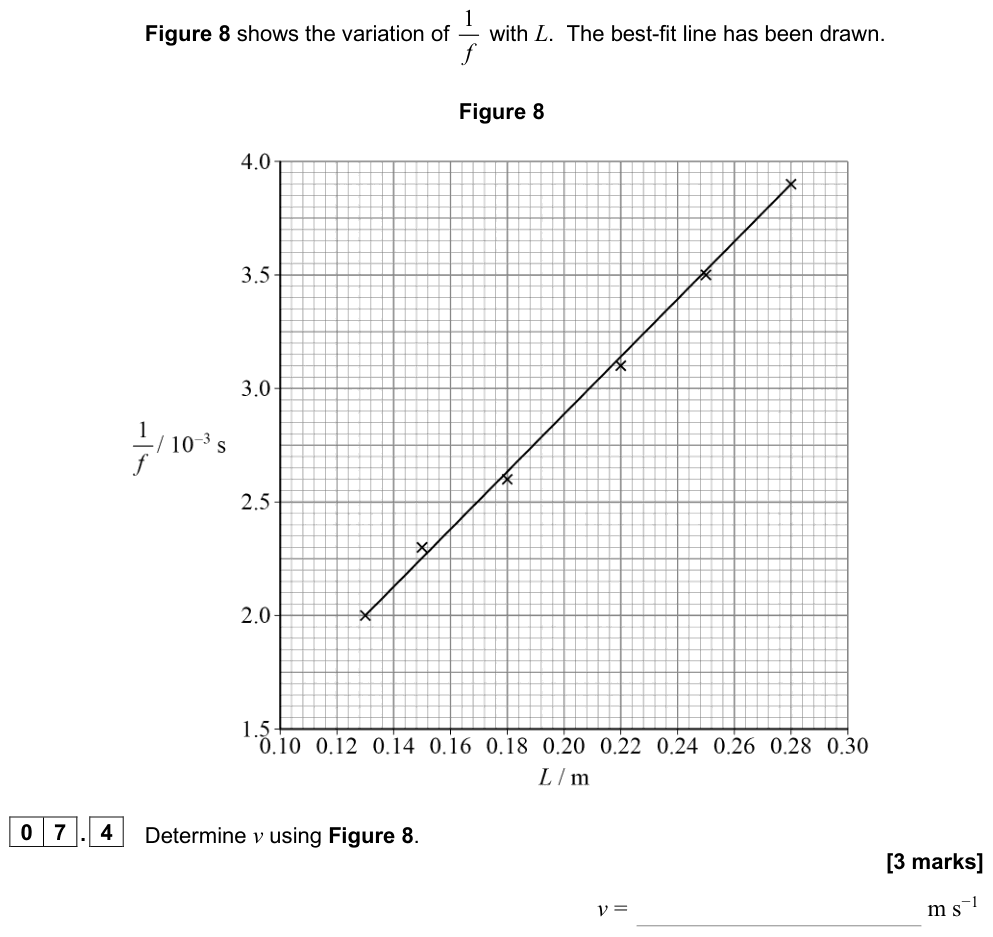
- Vary $L$ (moving the vibrator) with $T$ constant: plot $f$ against $1/L$, a straight line through the origin.
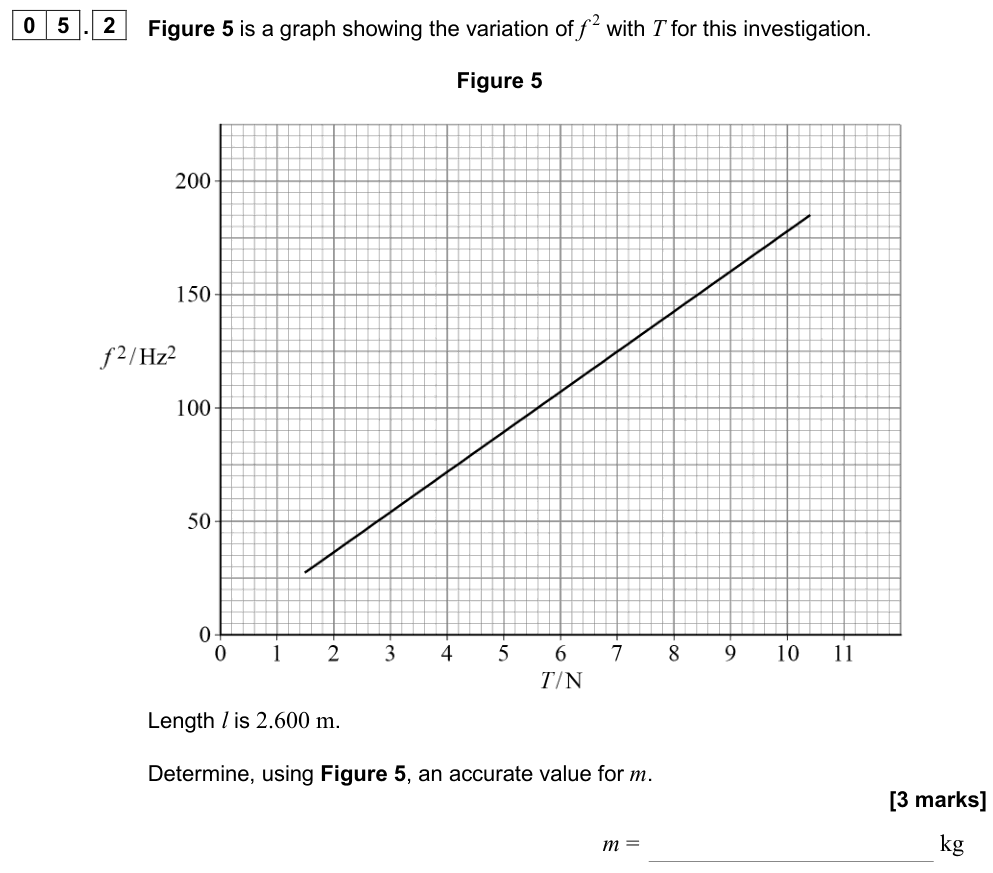
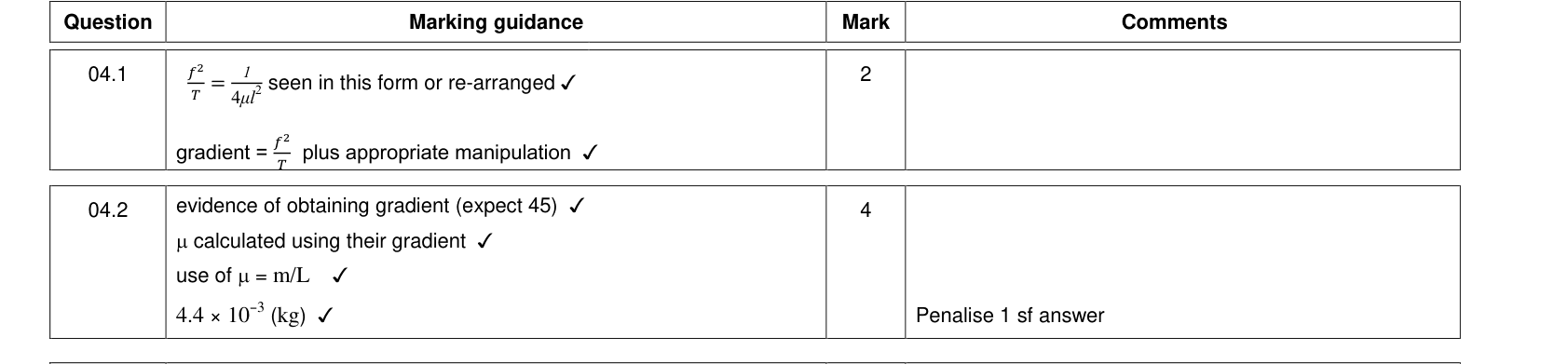
- Vary $T$ with $L$ constant: plot $f^2$ against $T$ (or $f$ against $\sqrt{T}$).
- Use strings of different $\mu$ to test $f \propto 1/\sqrt{\mu}$.
Using a stroboscope or slowly increasing the frequency helps identify the exact resonant frequency. Find the node positions precisely by measuring across several loops.
Stationary waves with microwaves and sound
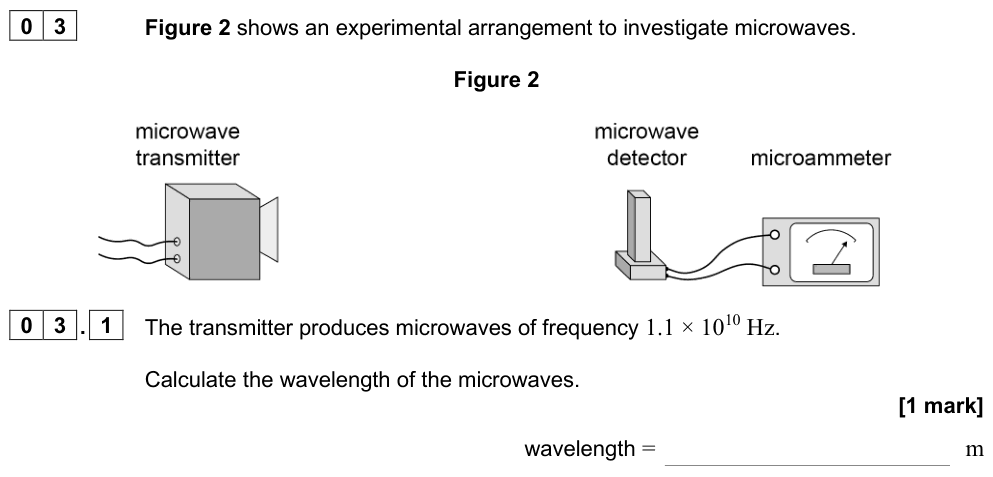
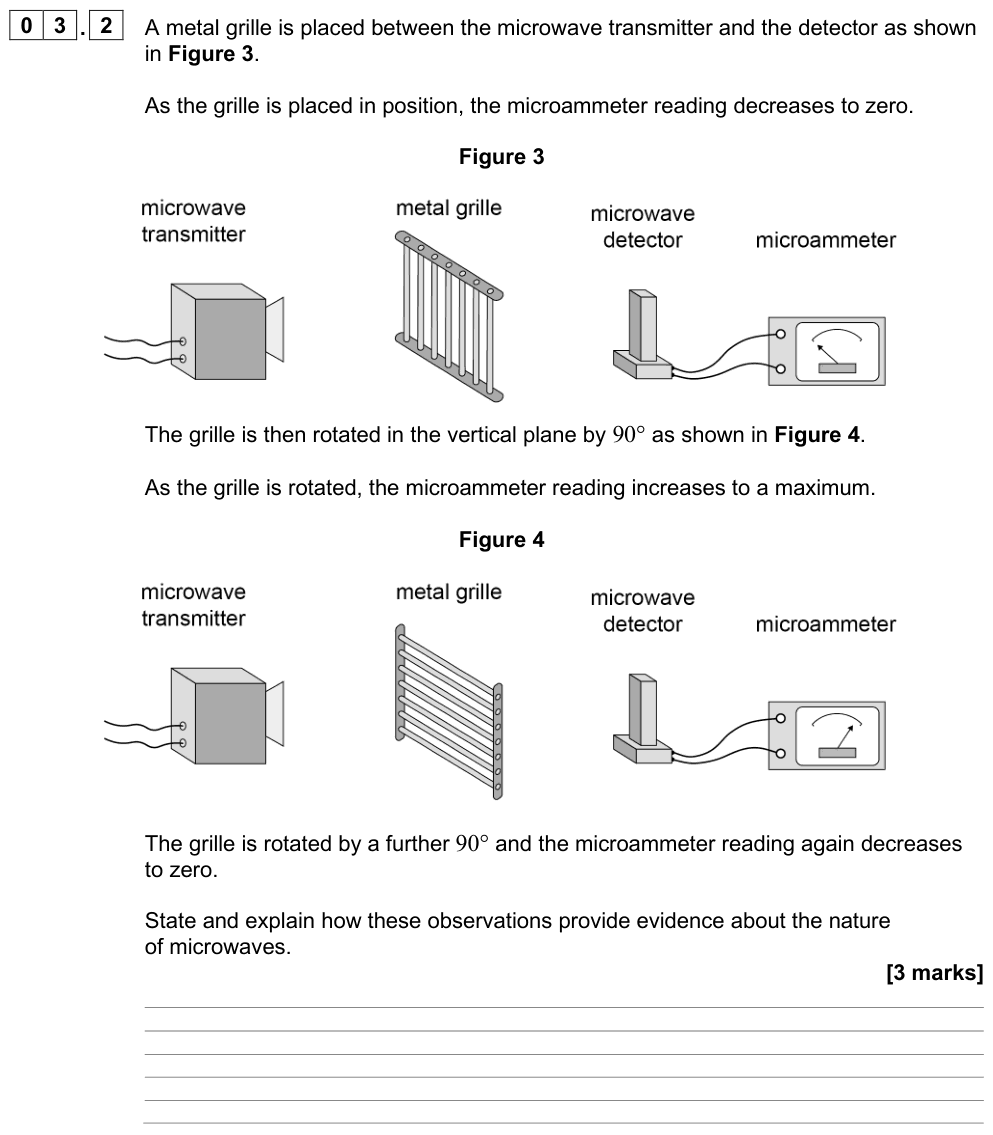
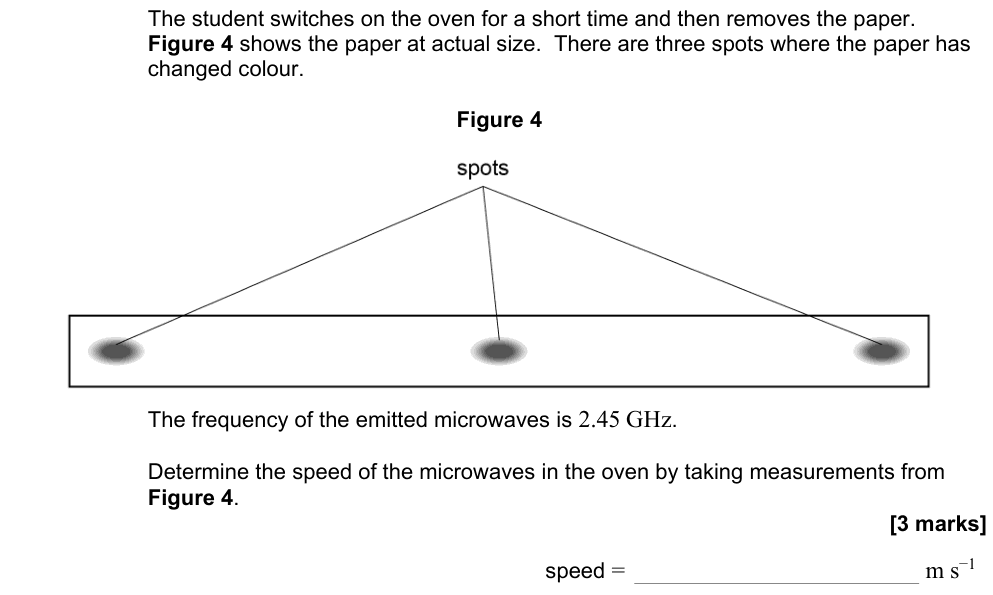
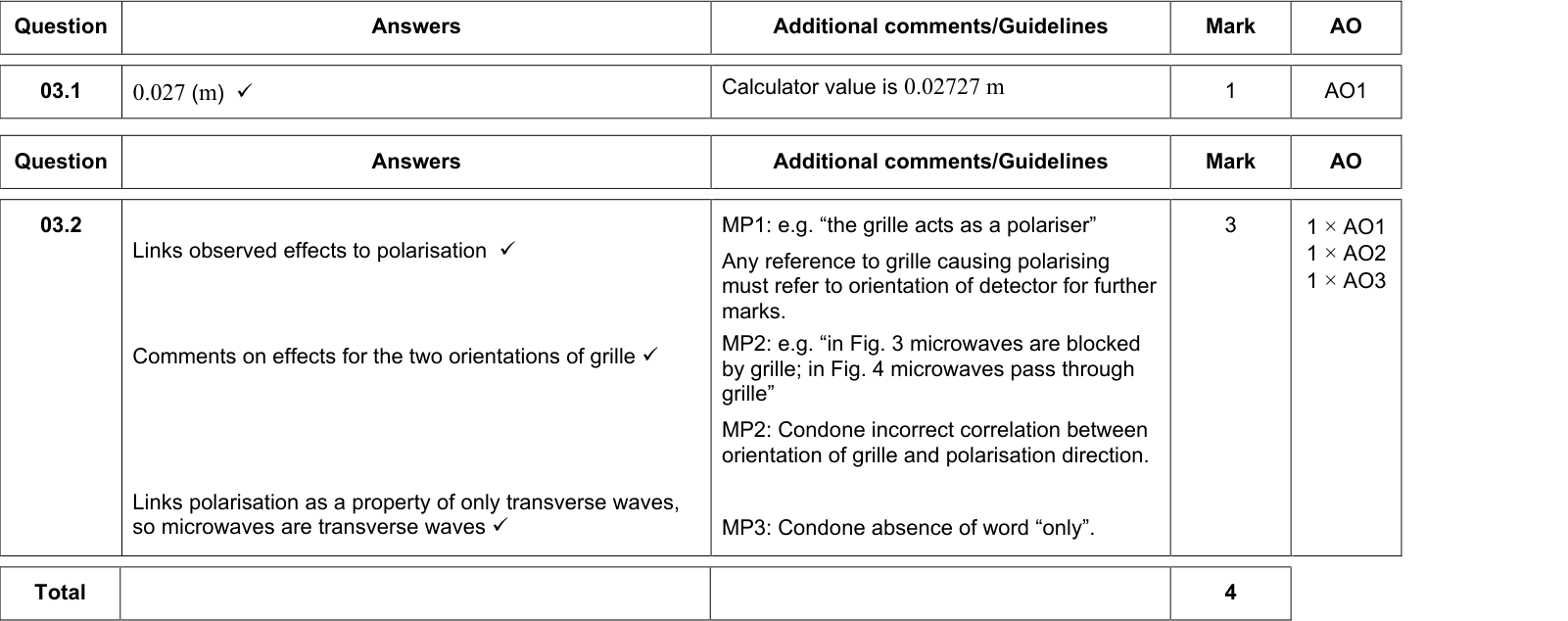
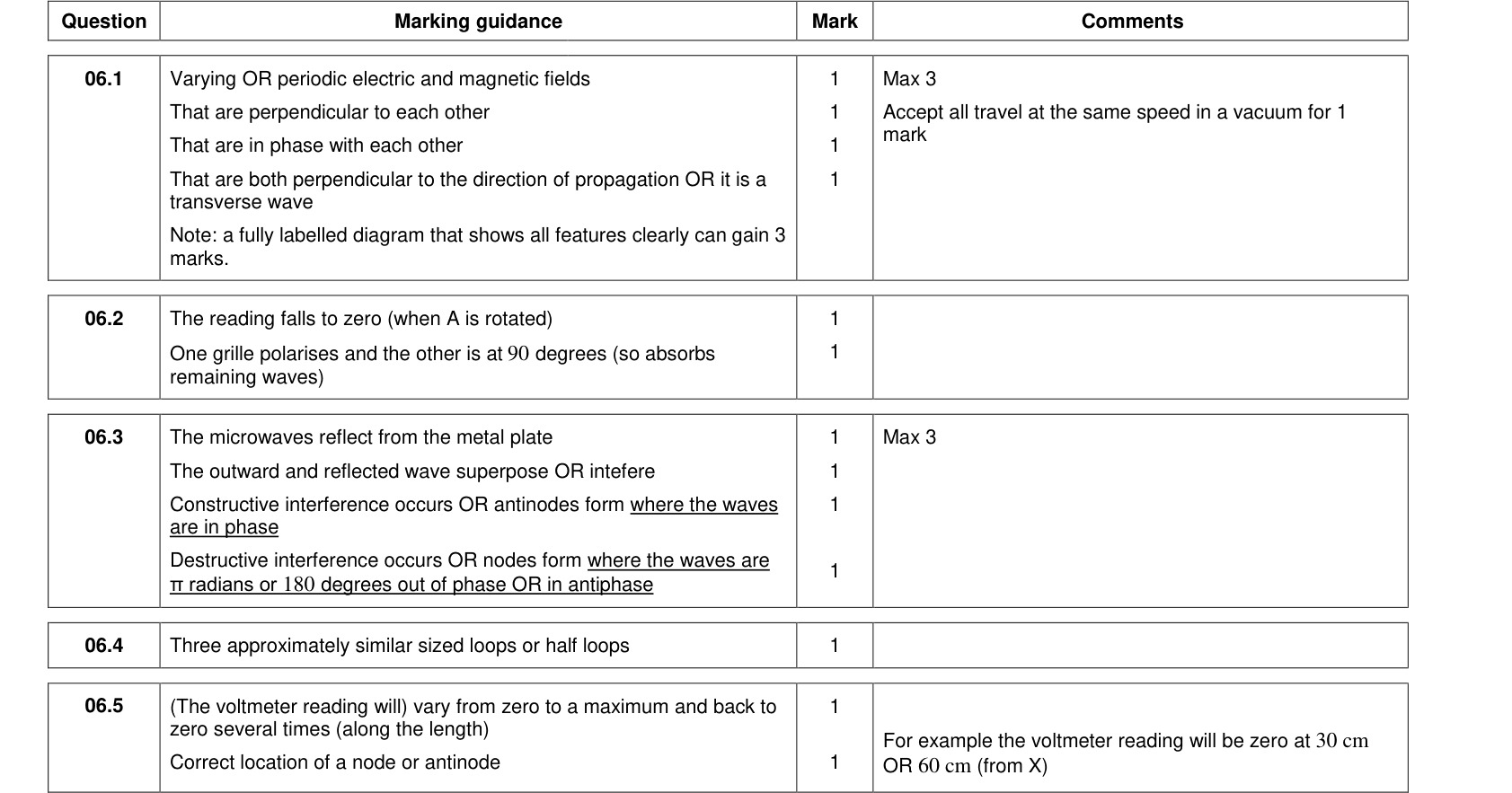
- Microwaves: a microwave transmitter faces a metal reflector. Moving a detector between them shows a series of maxima (antinodes) and minima (nodes). The distance between adjacent minima is $\lambda/2$. Measuring across many nodes gives an accurate $\lambda$; with the known frequency you can find $c = f\lambda$.
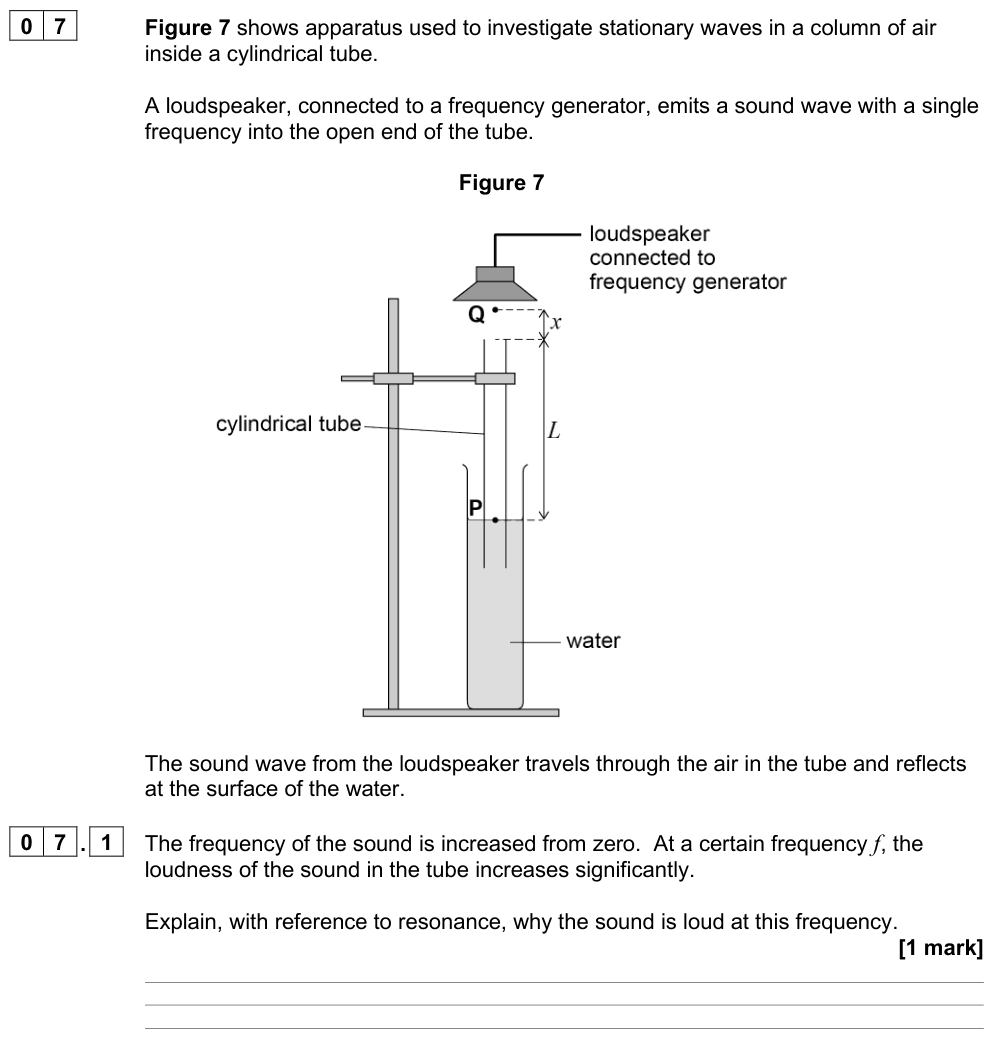
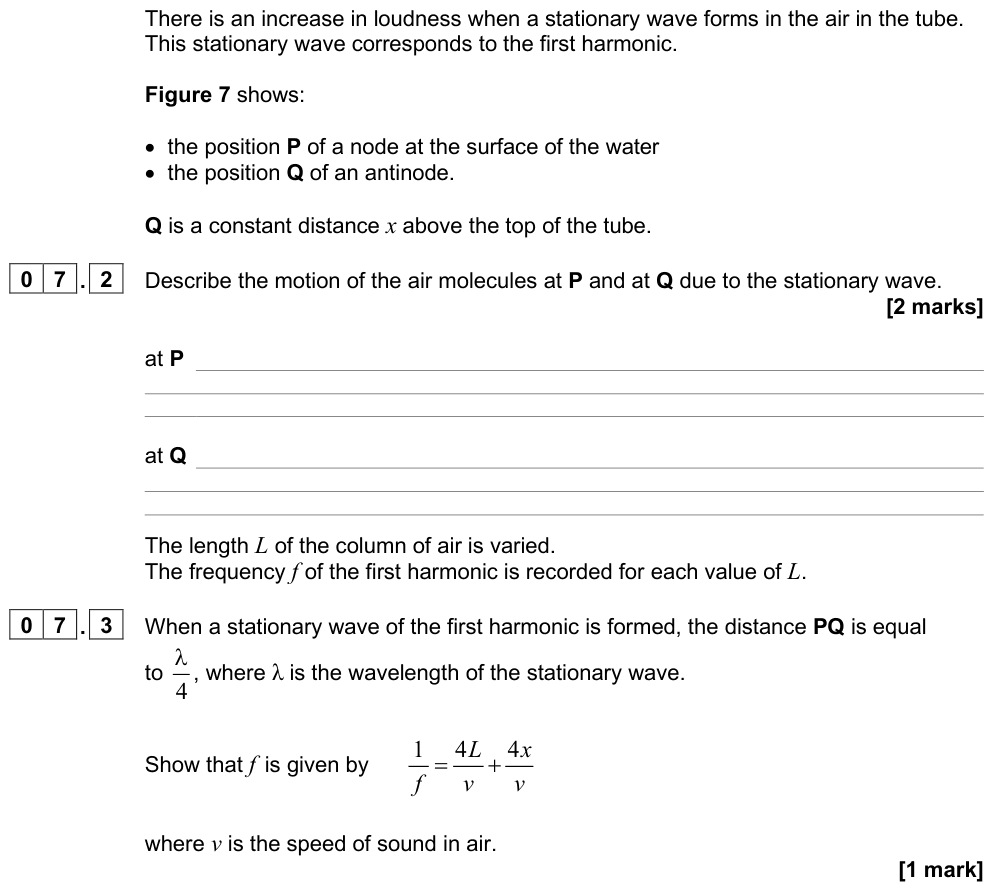
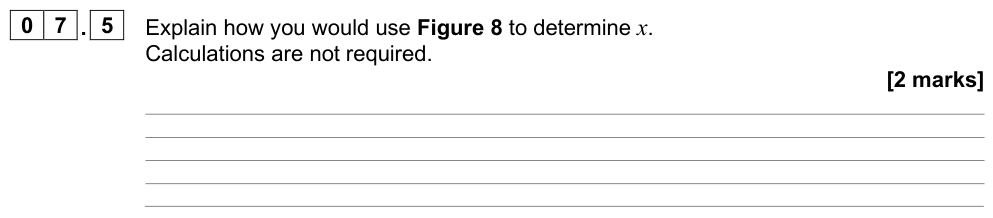
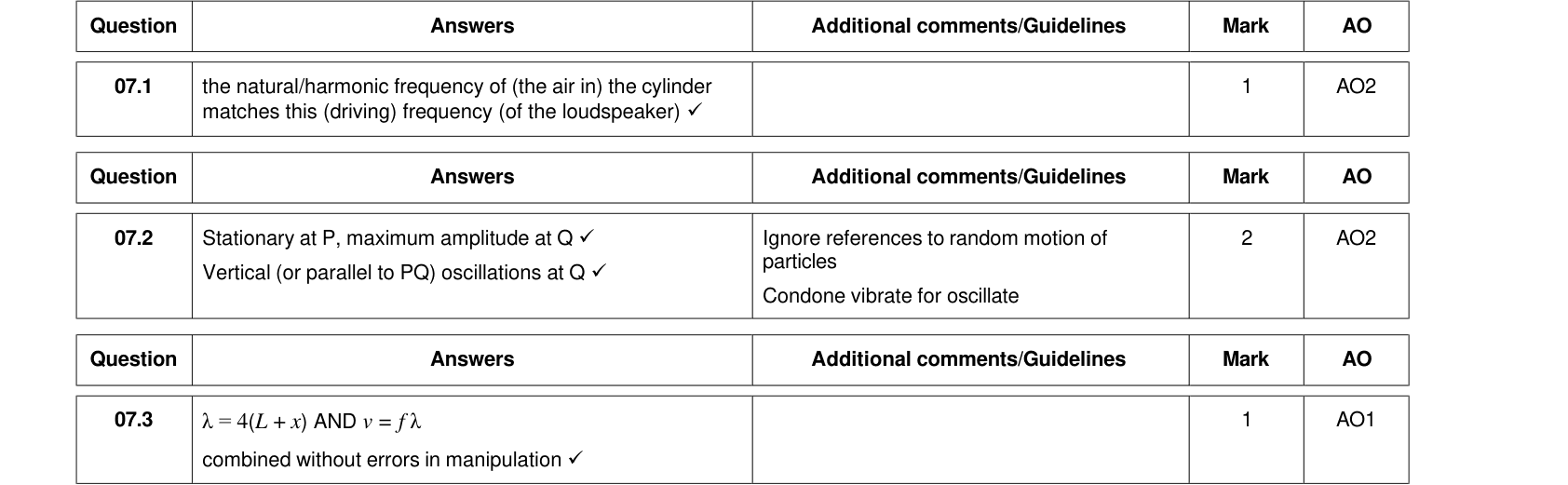
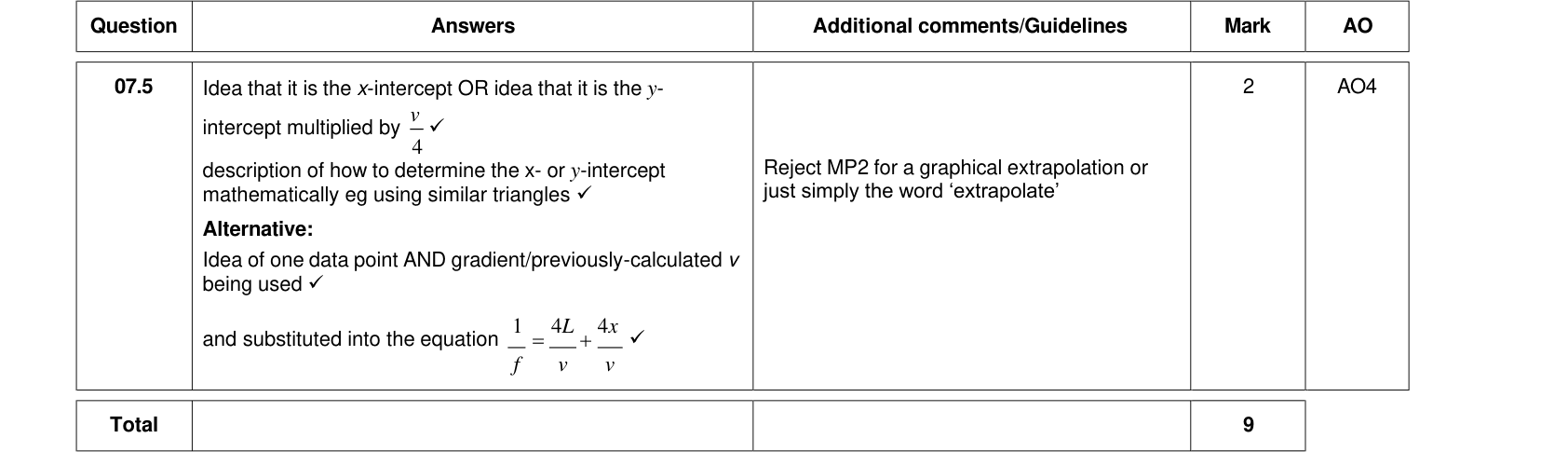
- Sound: a loudspeaker facing a wall, or an air column in a tube, sets up stationary sound waves. At a closed end the air cannot move, so there is a displacement node; at an open end there is a displacement antinode. Resonance occurs at frequencies where a whole number of these patterns fits. Measuring the spacing of nodes with a microphone (or the resonant lengths of a tube) gives the wavelength and the speed of sound.
Summary
- Superposition: resultant displacement = sum of individual displacements.
- Stationary wave: two waves of the same frequency travelling in opposite directions; nodes (no motion) and antinodes (maximum amplitude), λ/2 apart.
- No energy transfer; amplitude varies with position; points between adjacent nodes are in phase.
- Strings: $L = n\lambda/2$; $f_1 = \dfrac{1}{2L}\sqrt{T/\mu}$.
- Microwaves and sound: nodes λ/2 apart allow λ (and wave speed) to be measured.