Resistivity
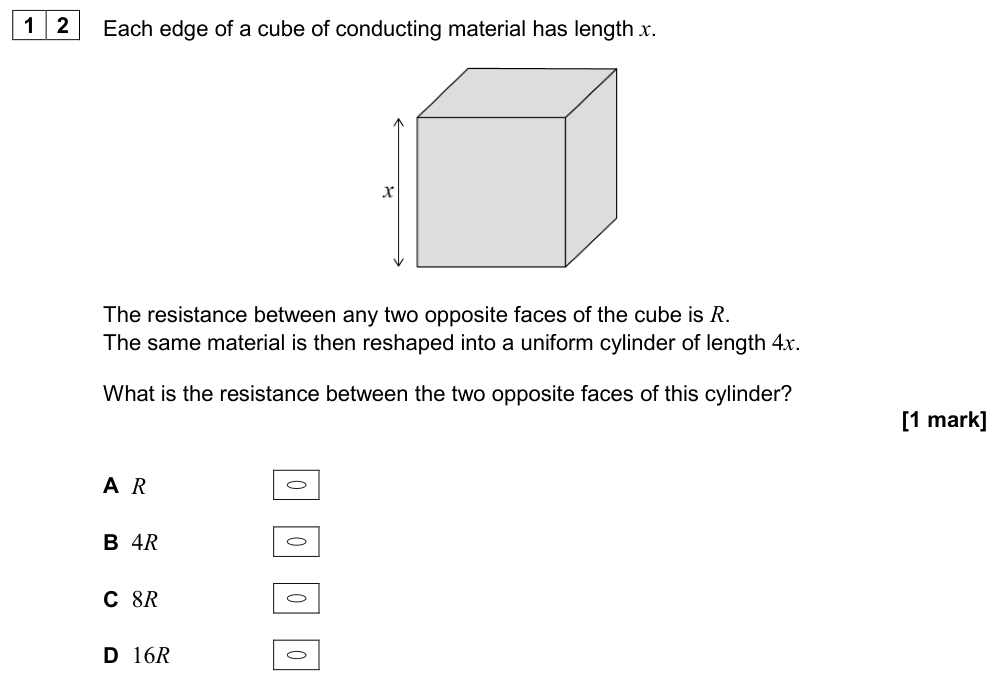
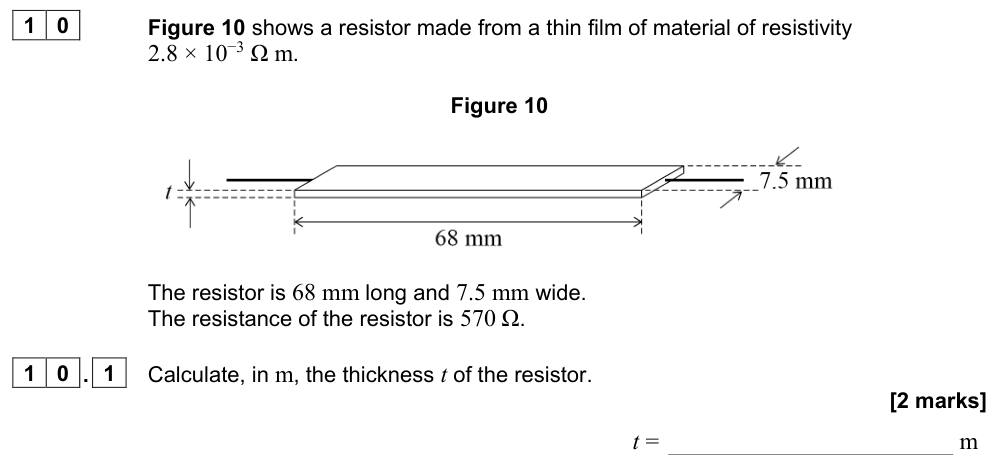
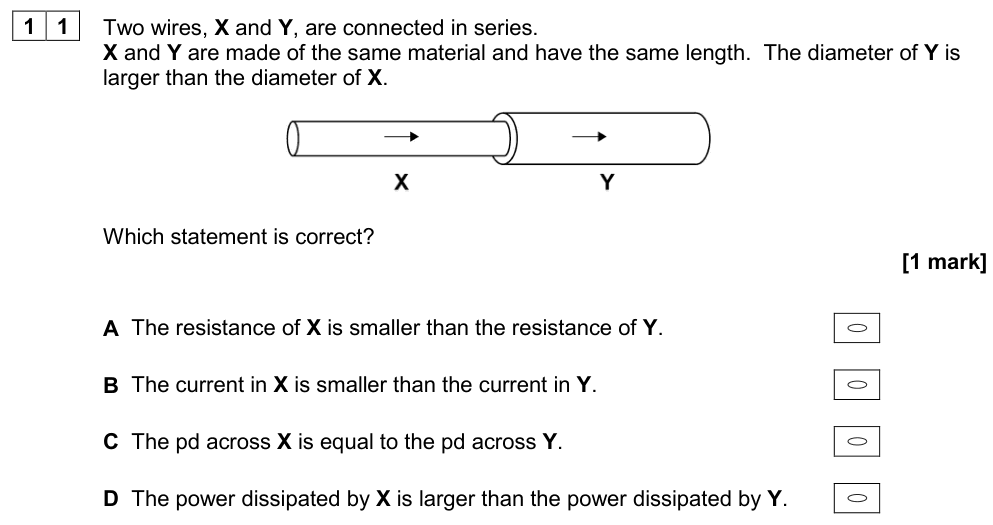
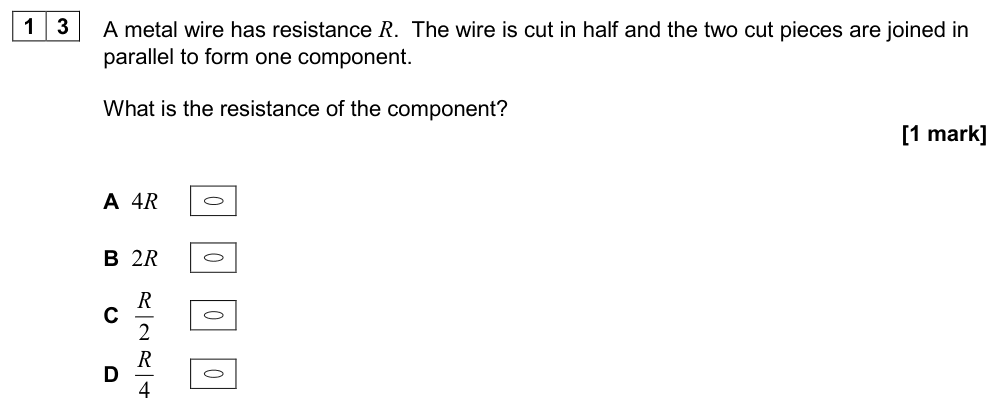
The resistance of a wire depends on its length, its cross-sectional area and the material it is made from:
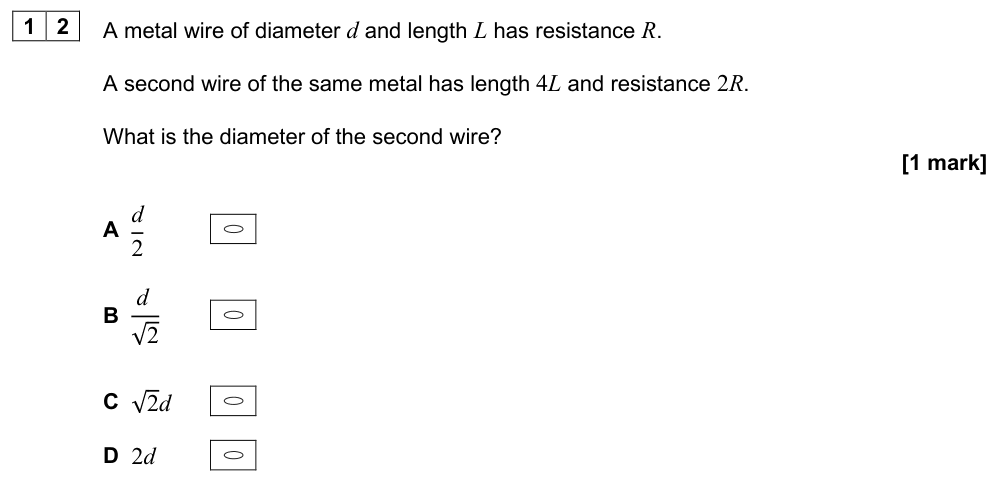
- $R \propto L$: a longer wire means electrons collide with more ions on their way through.
- $R \propto \dfrac{1}{A}$: a thicker wire has more paths (more charge carriers side by side) for the current.
The constant of proportionality is the resistivity $\rho$ of the material.
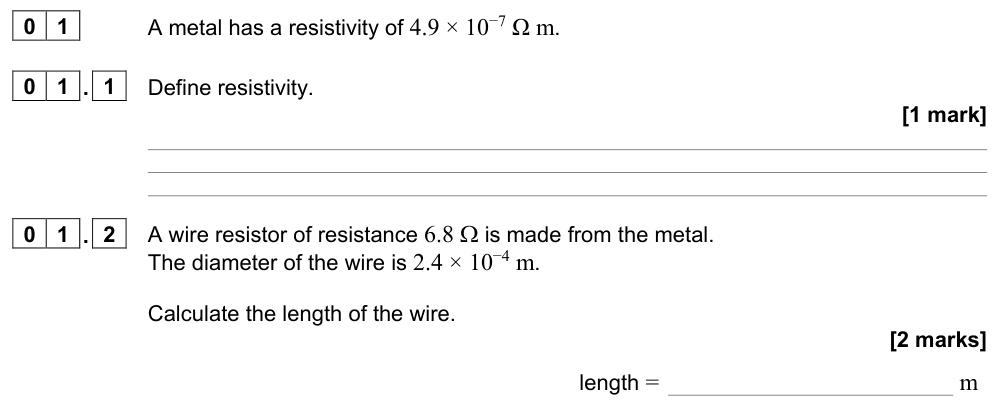
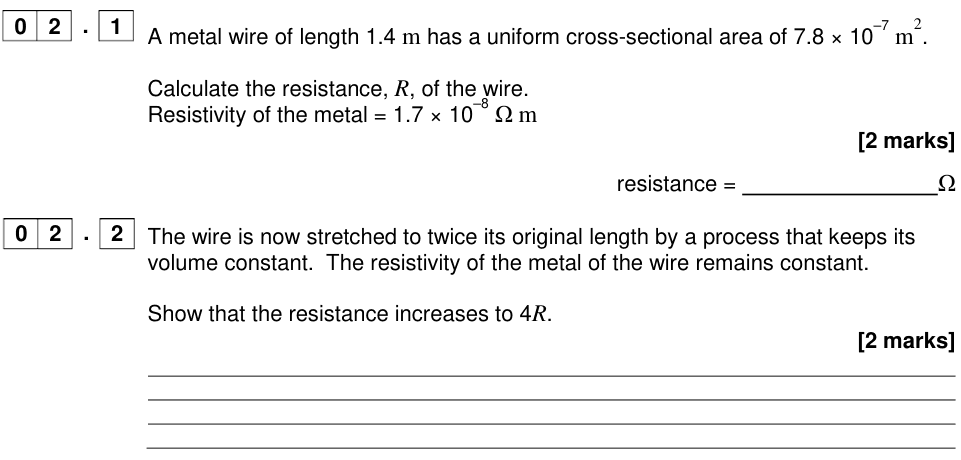
Resistivity
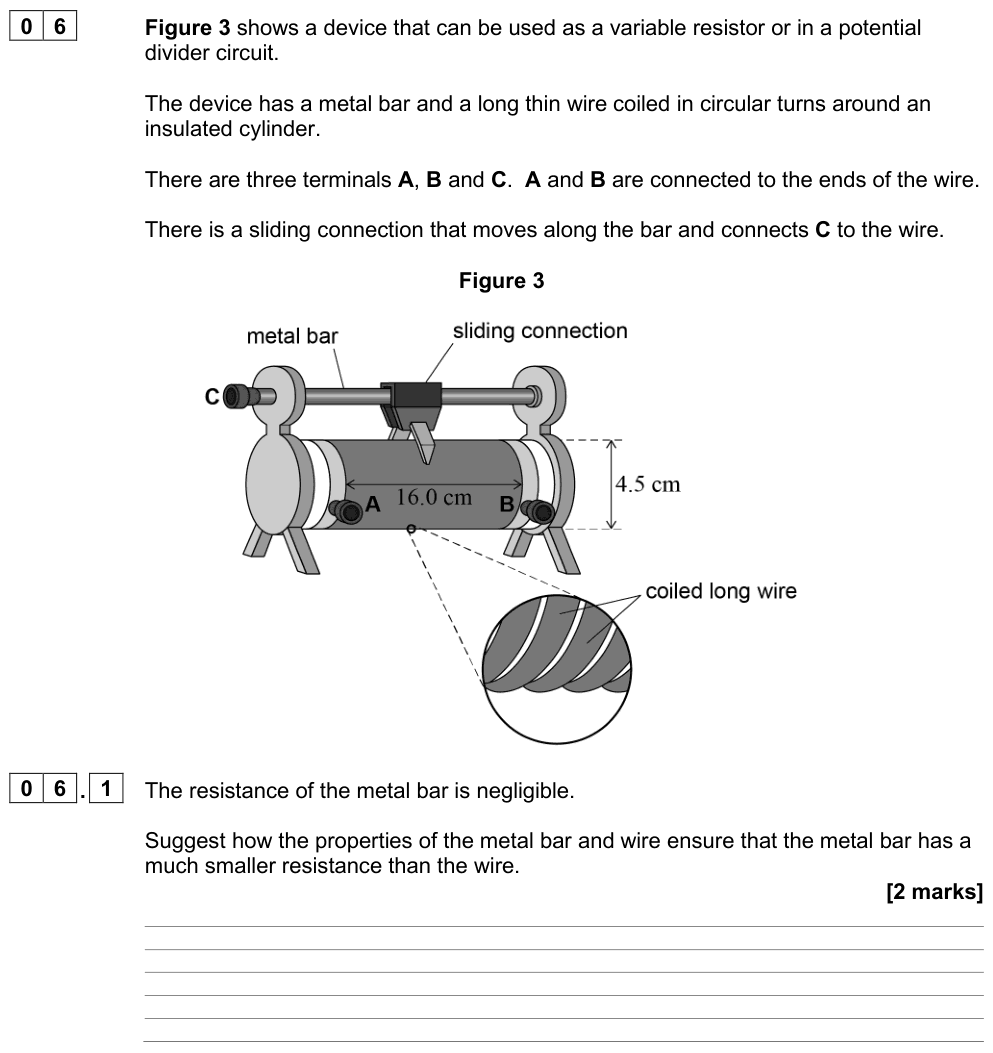
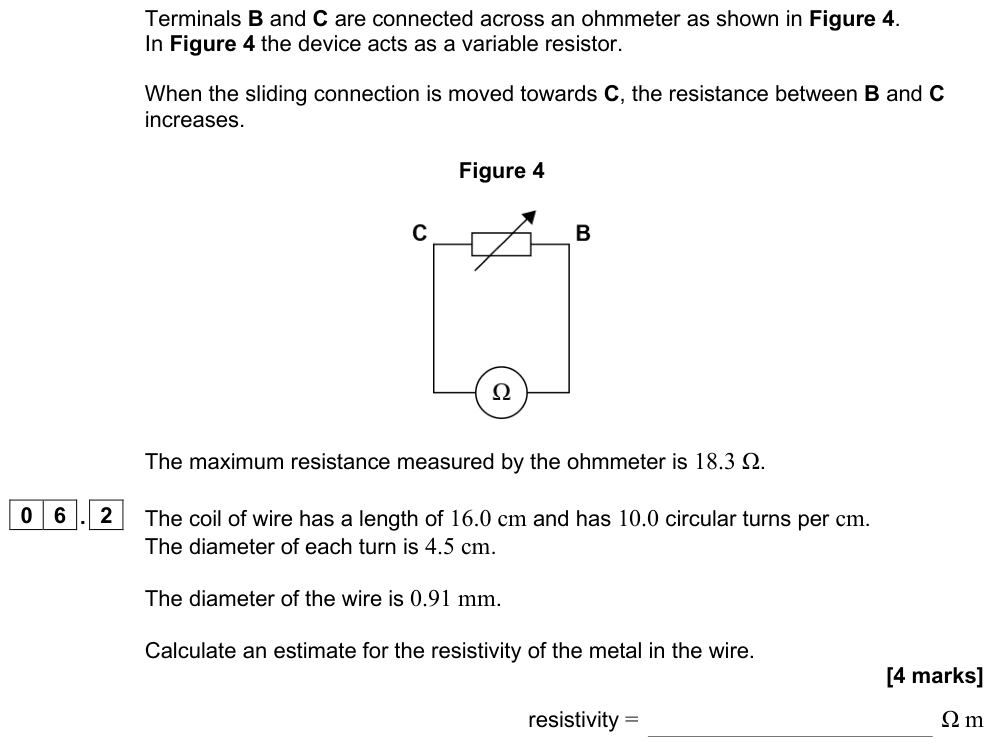
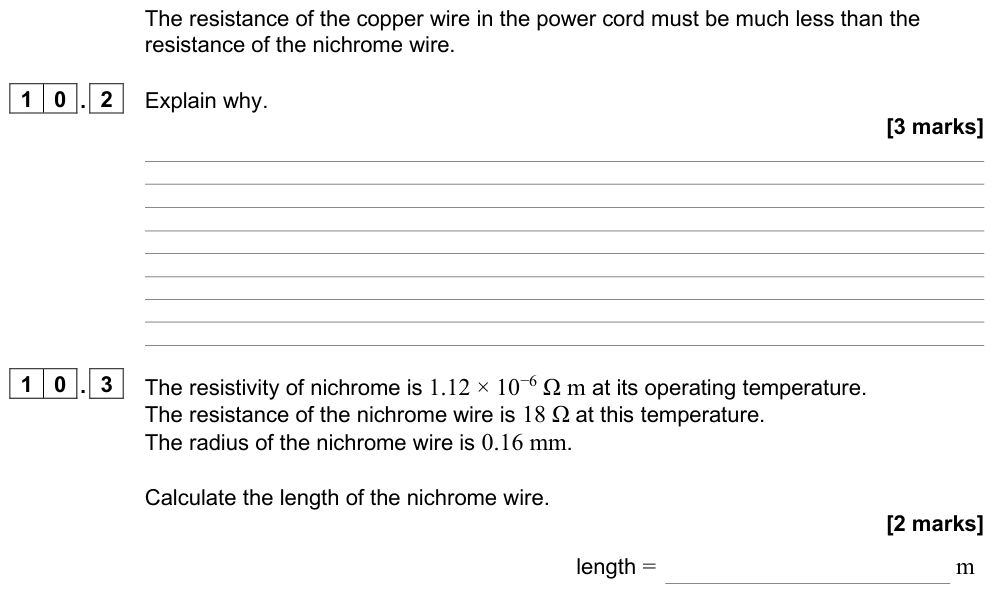
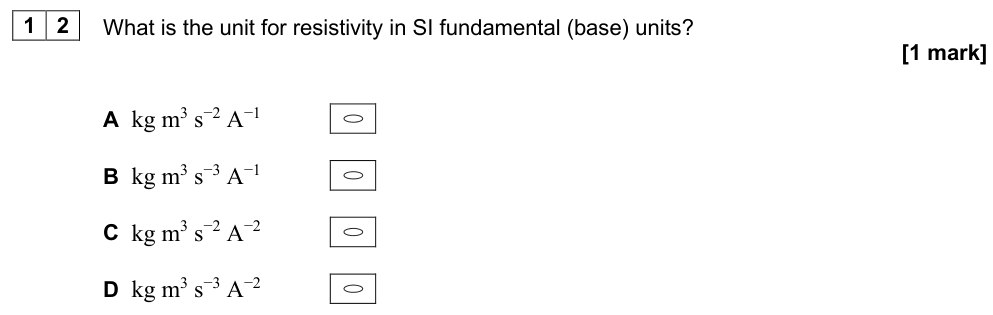
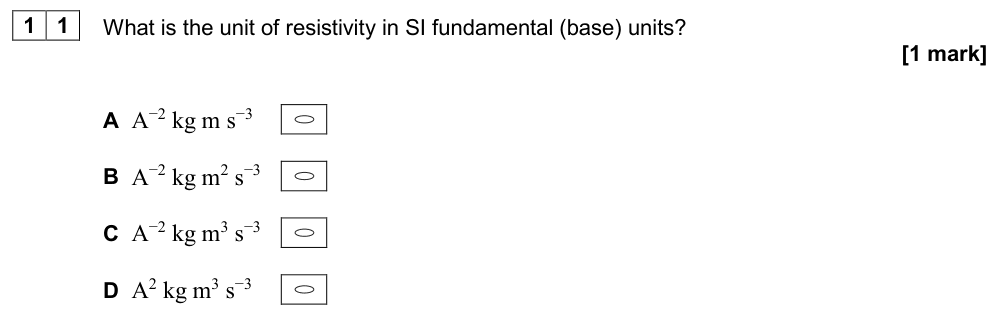
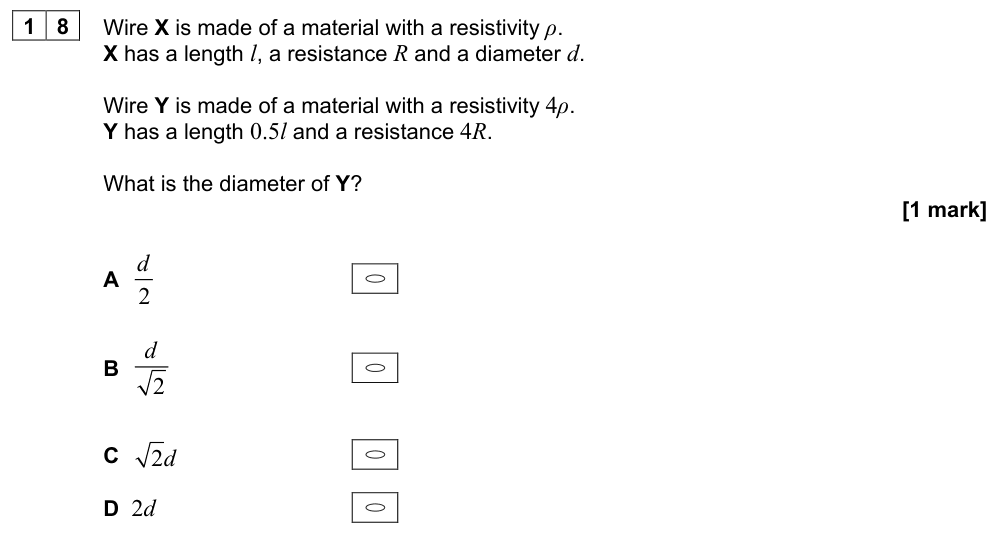
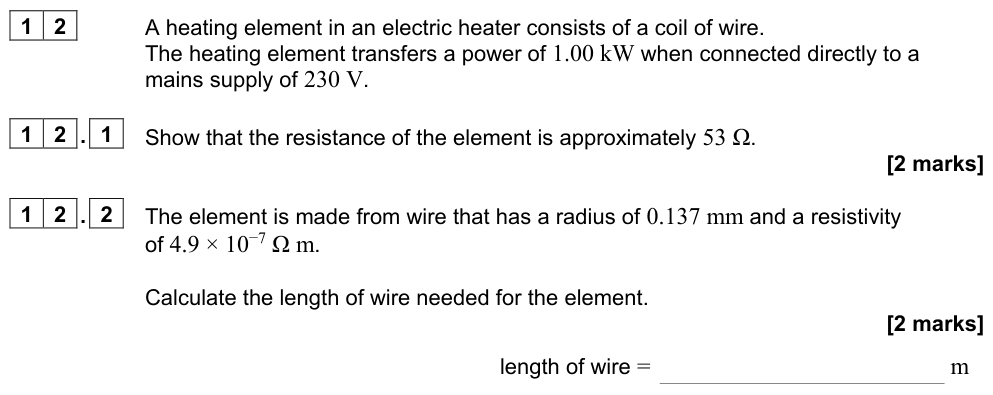
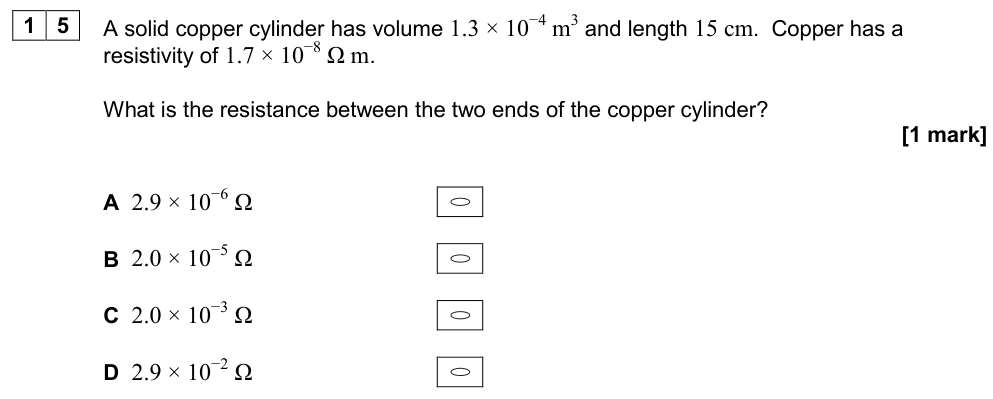
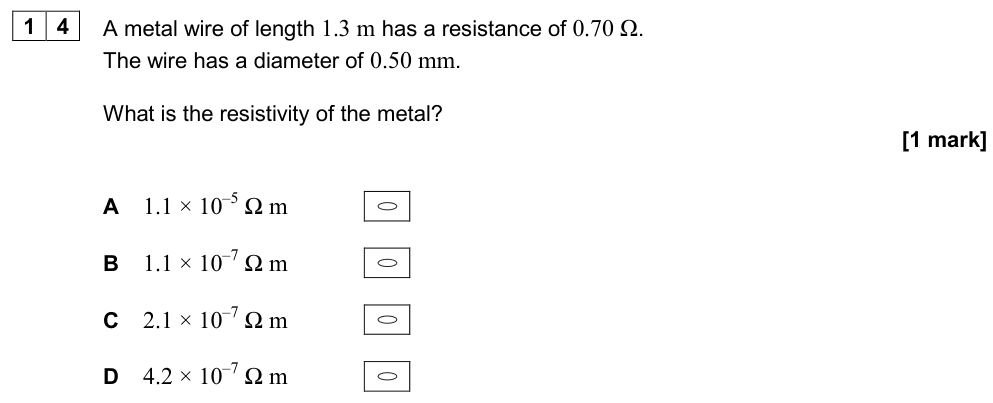
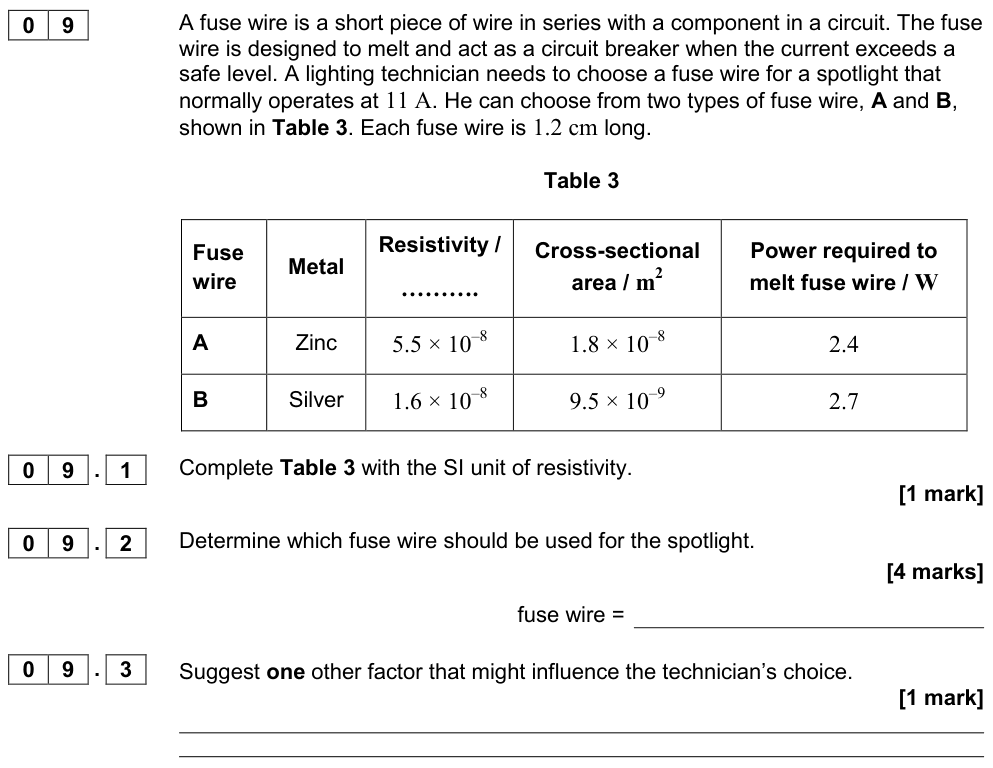
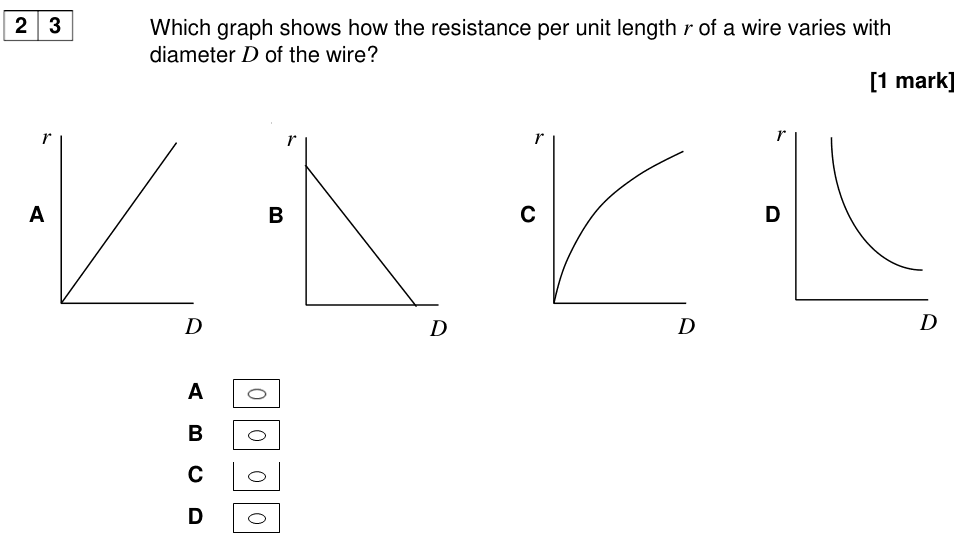
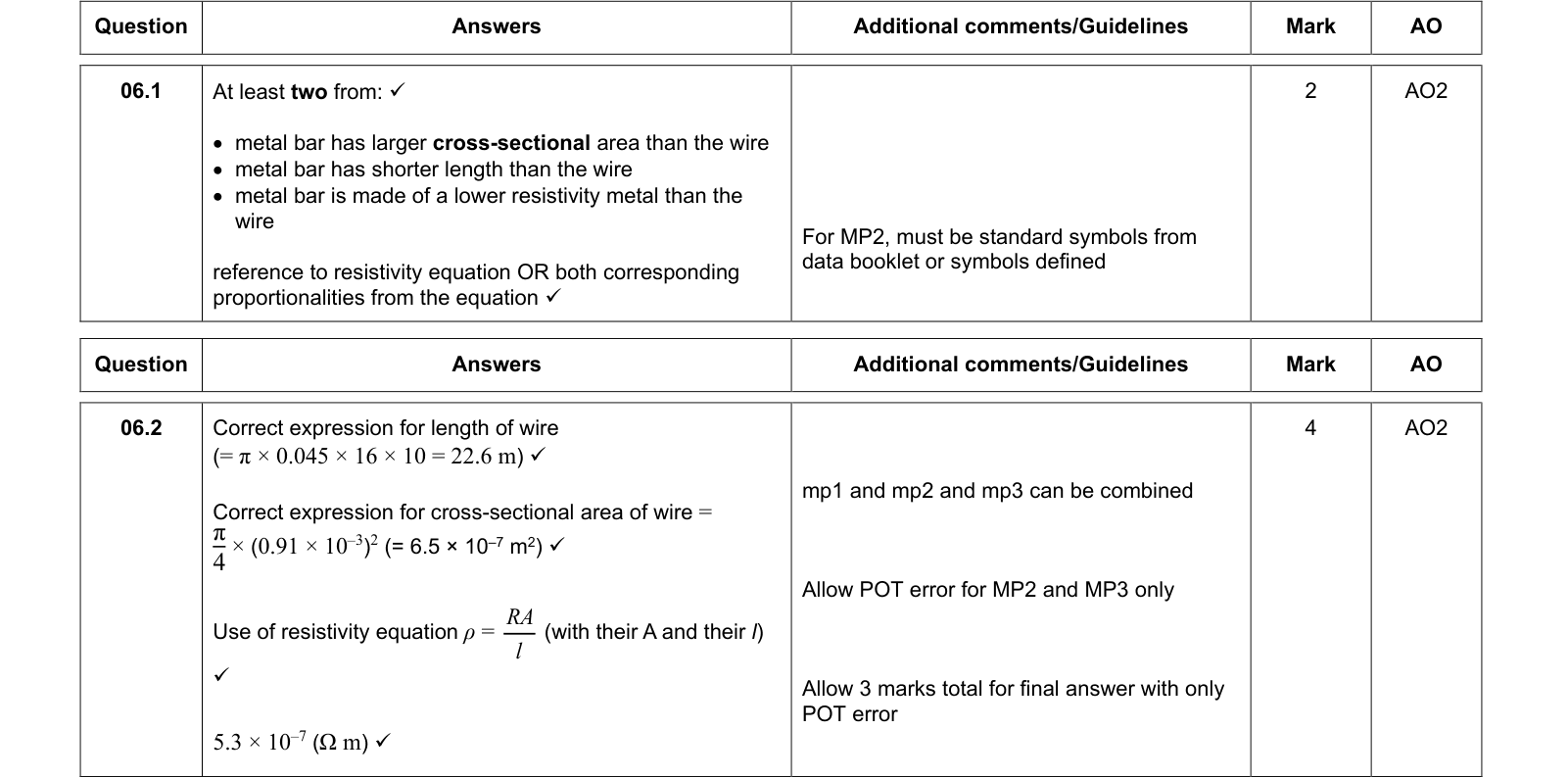
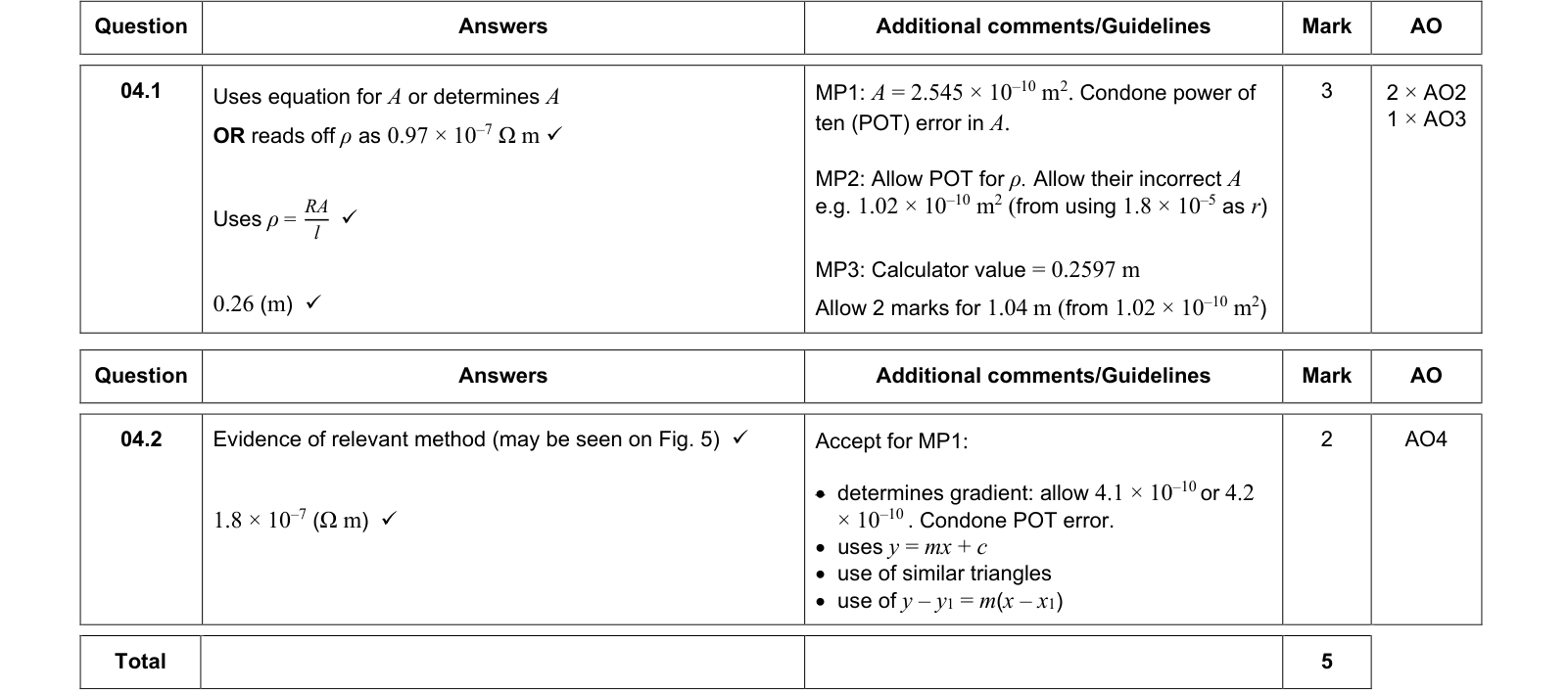
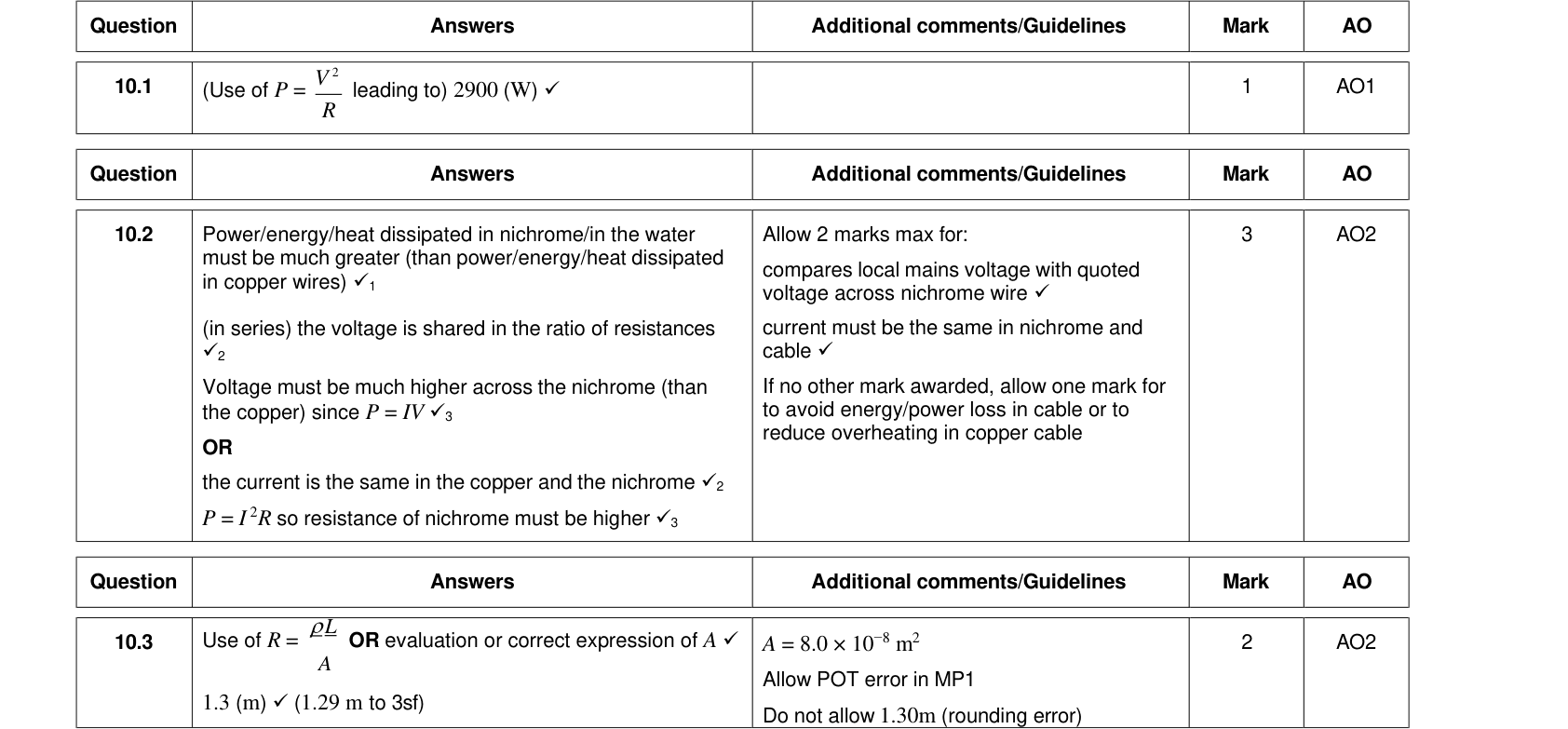
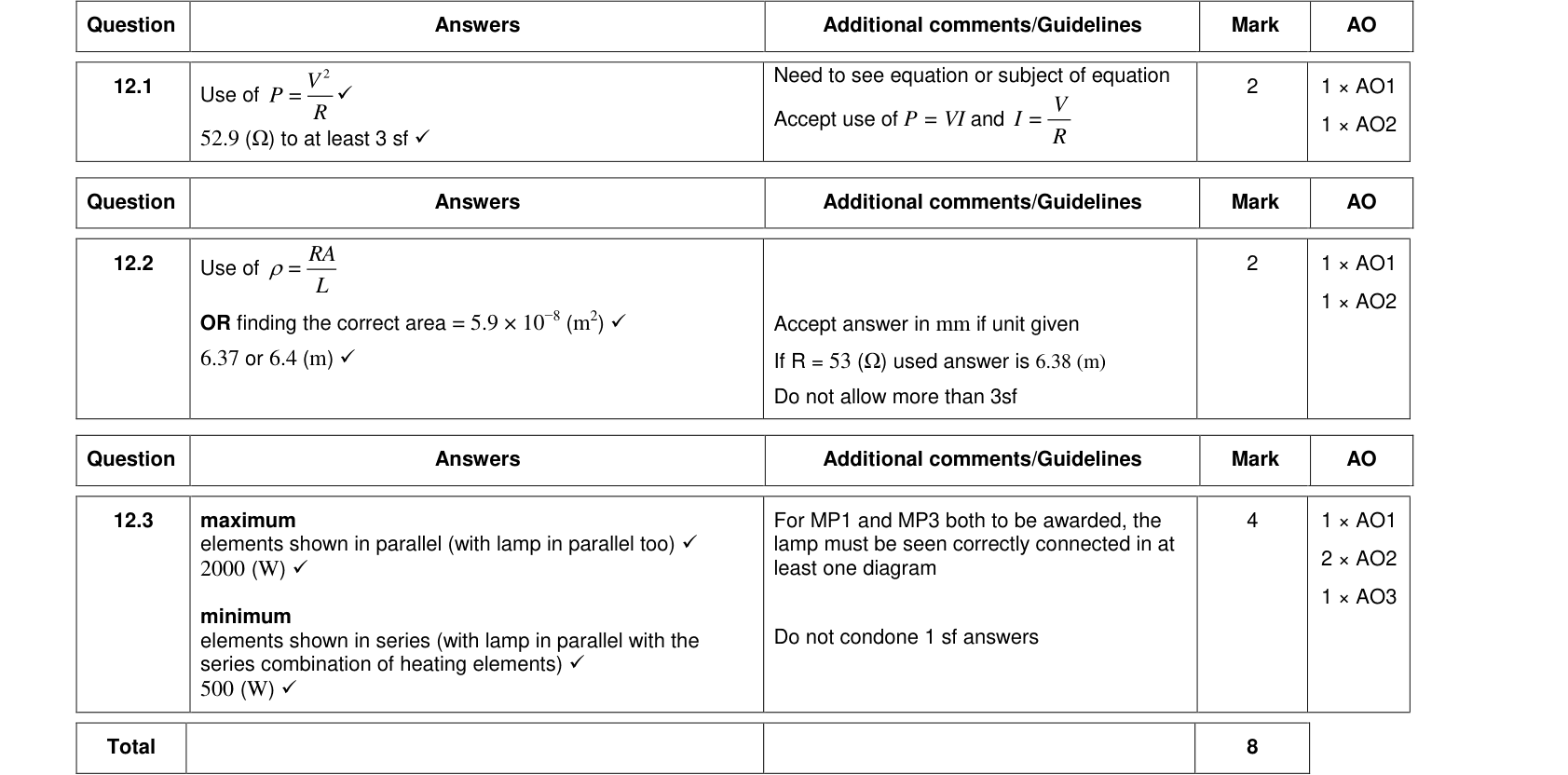
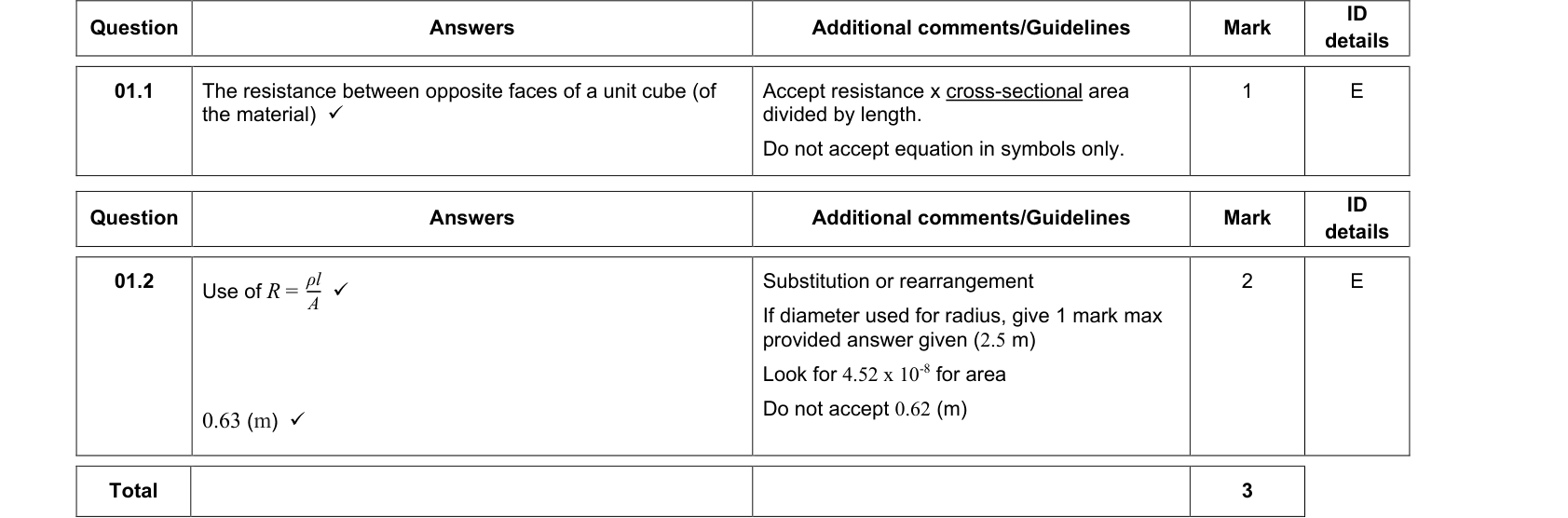
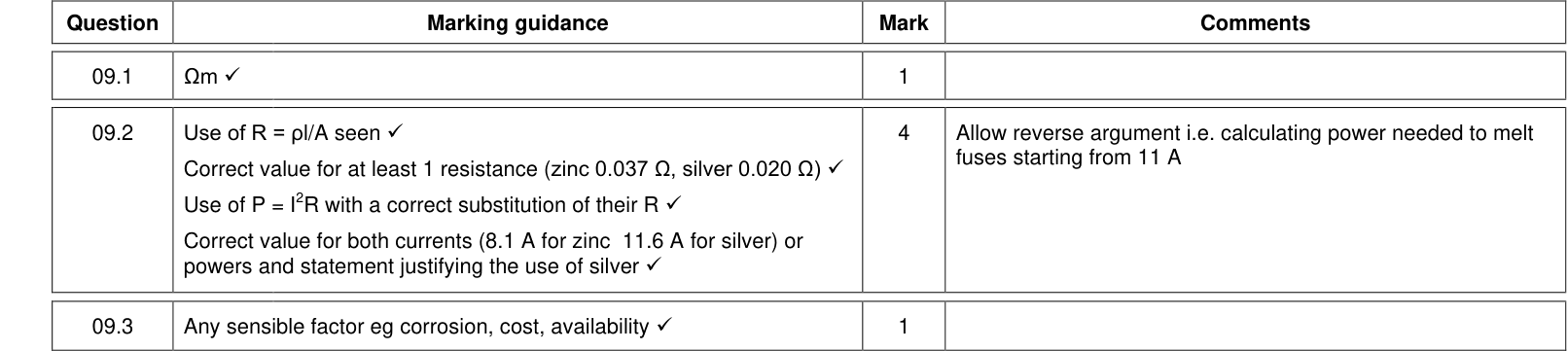
$$R = \frac{\rho L}{A} \qquad \Longleftrightarrow \qquad \rho = \frac{RA}{L}$$
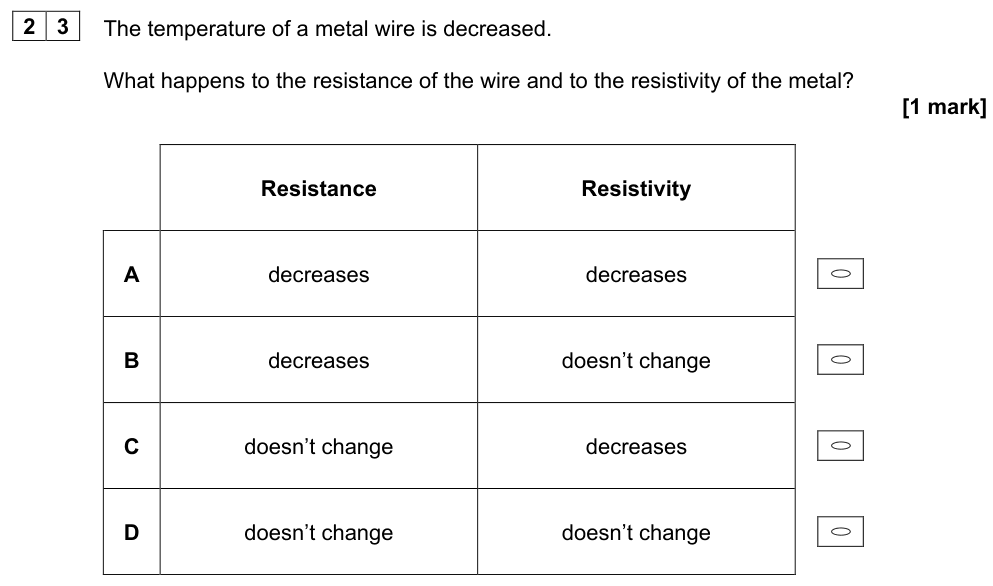
Unit of resistivity: Ω m (ohm metre). Resistivity is a property of the material at a given temperature, not of a particular wire.
| Material | Resistivity at 20 °C / Ω m | Type |
|---|---|---|
| silver | $1.6 \times 10^{-8}$ | metal (conductor) |
| copper | $1.7 \times 10^{-8}$ | metal |
| constantan | $4.9 \times 10^{-7}$ | alloy (used for wires whose resistance should not change with temperature) |
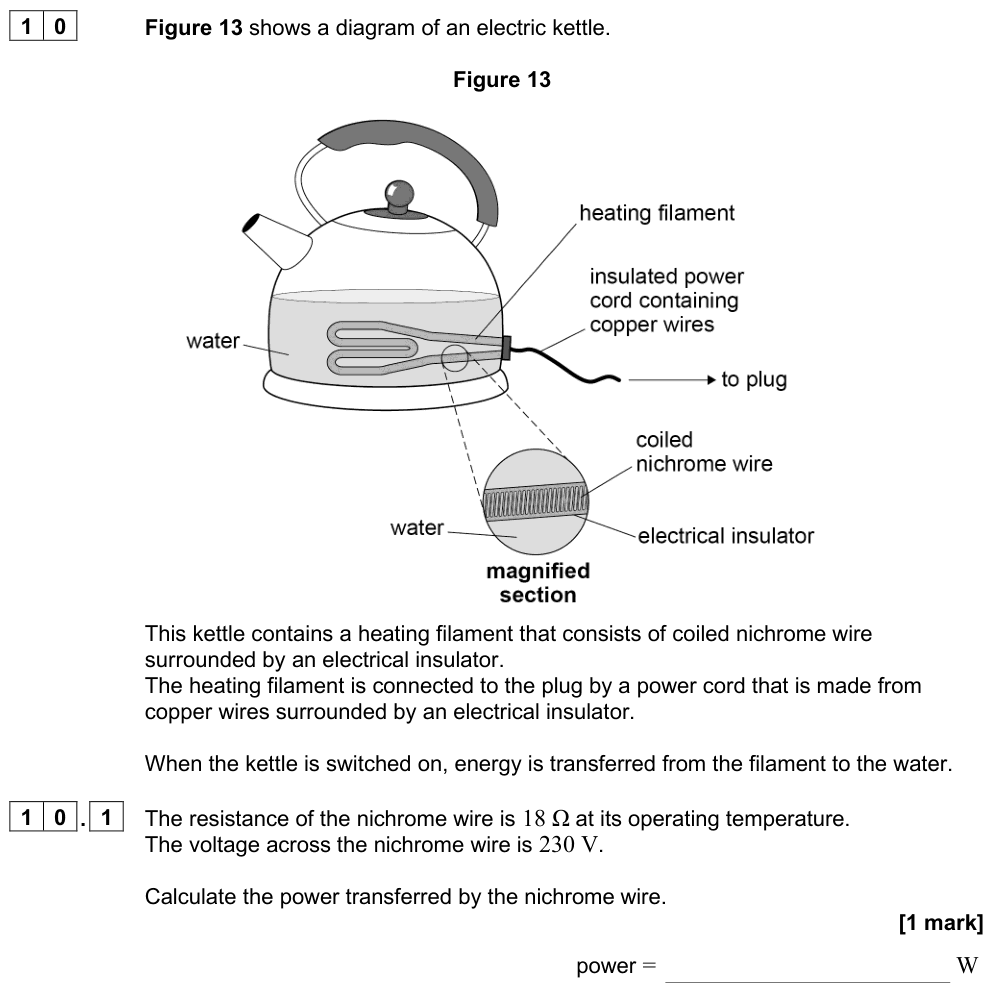
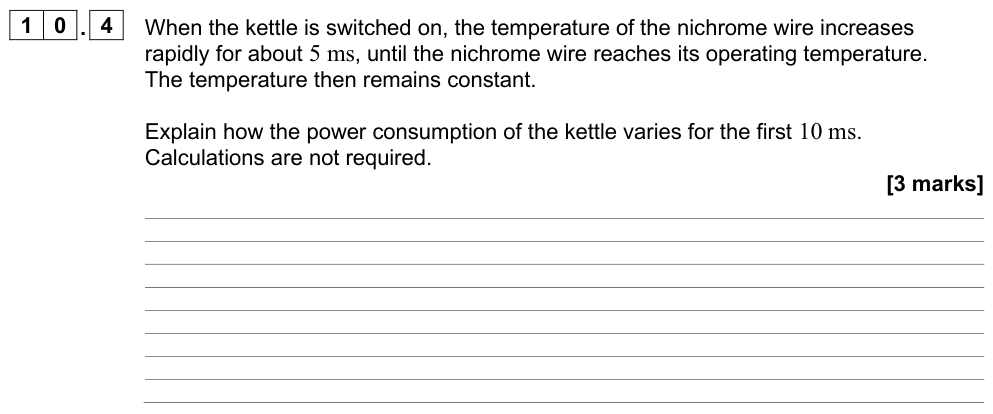
| nichrome | $1.1 \times 10^{-6}$ | alloy (heating elements) |
| silicon | ~ $2 \times 10^{3}$ | semiconductor |
| glass | ~ $10^{12}$ | insulator |
Worked example: copper wire
Find the resistance of 50 m of copper wire of diameter 0.80 mm.
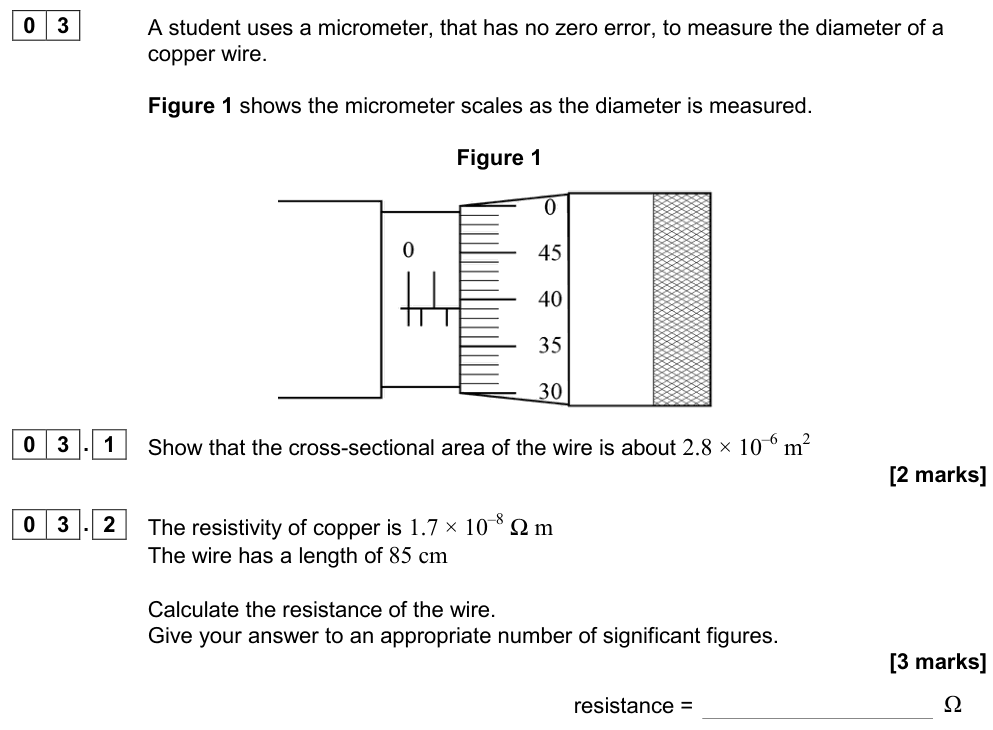
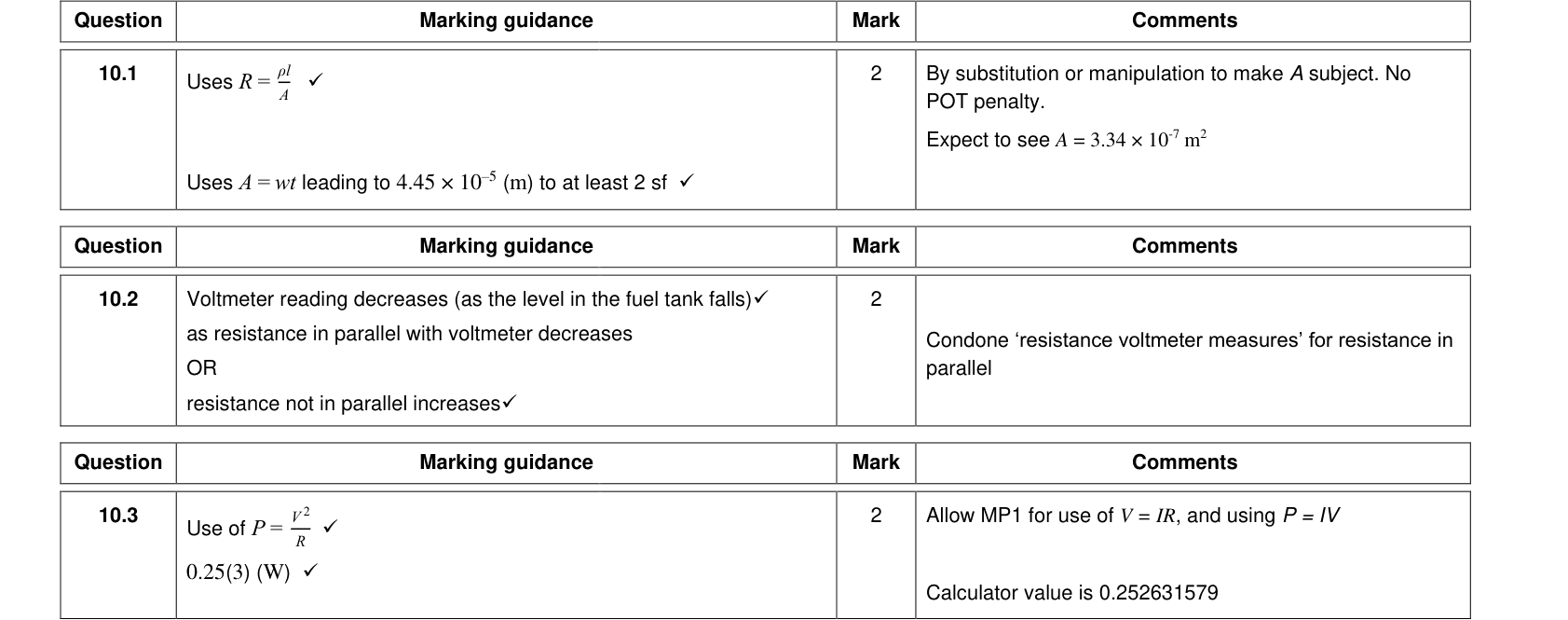
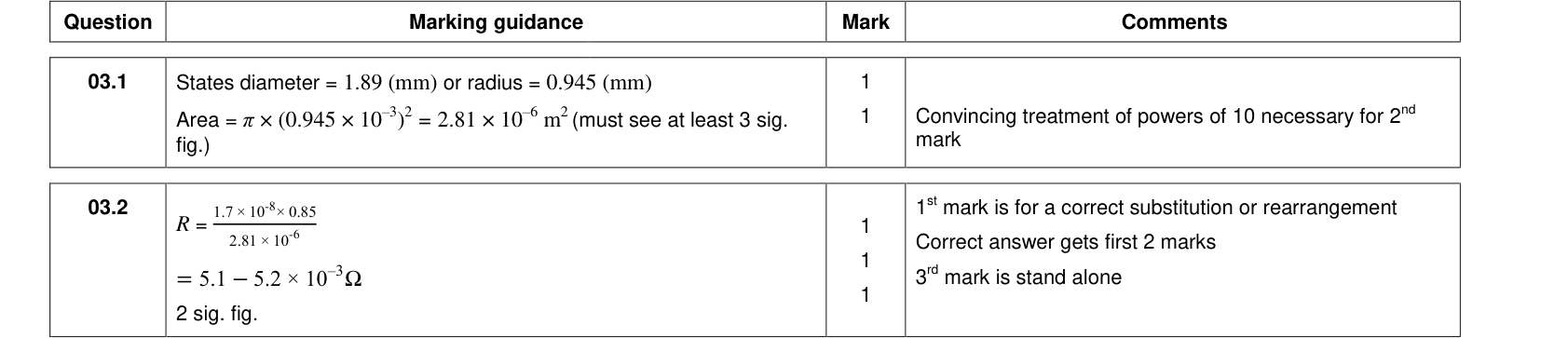
$A = \pi r^2 = \pi (0.40 \times 10^{-3})^2 = 5.03 \times 10^{-7}\ \text{m}^2$.
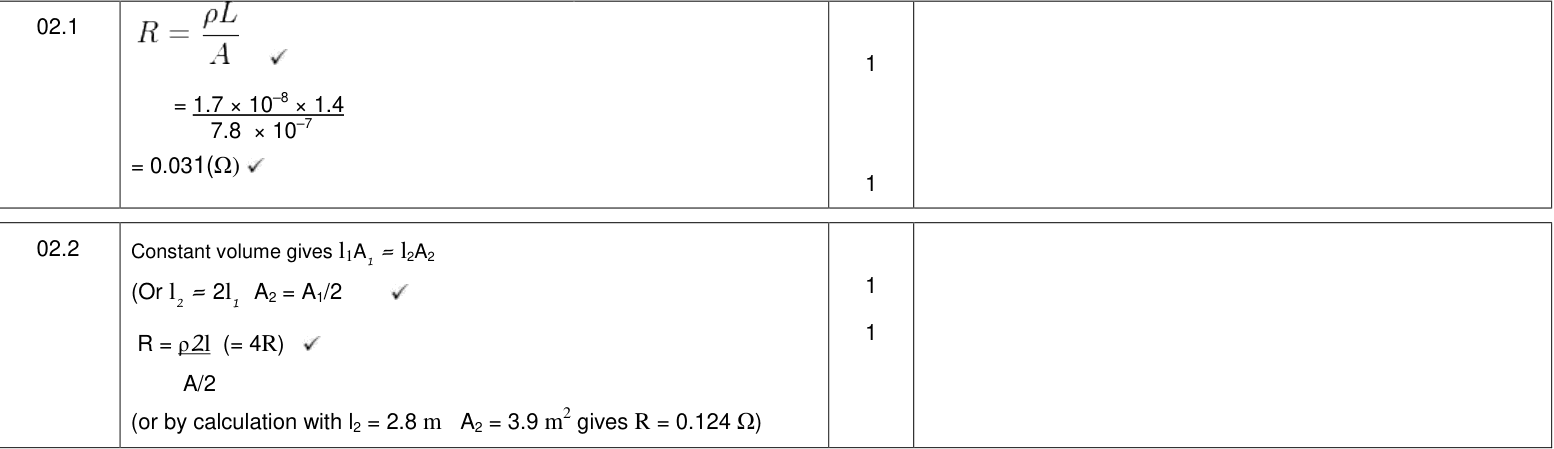
$R = \dfrac{\rho L}{A} = \dfrac{1.7 \times 10^{-8} \times 50}{5.03 \times 10^{-7}} = 1.7\ \Omega$.
Exam tip: scaling questions
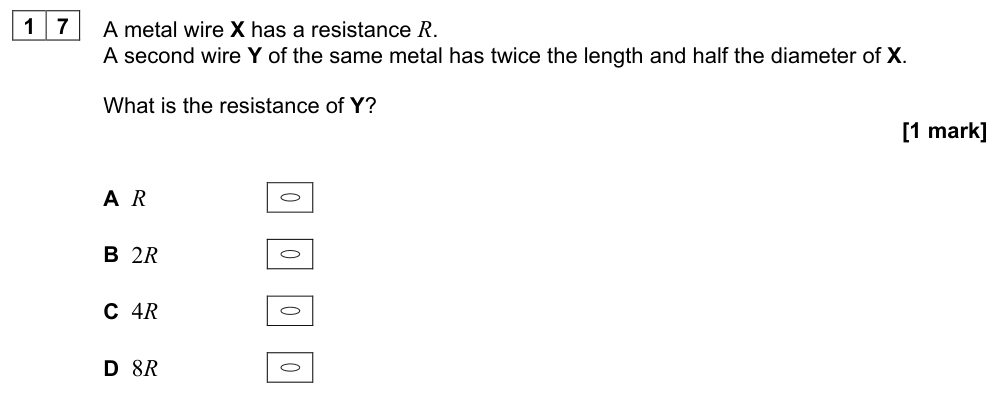
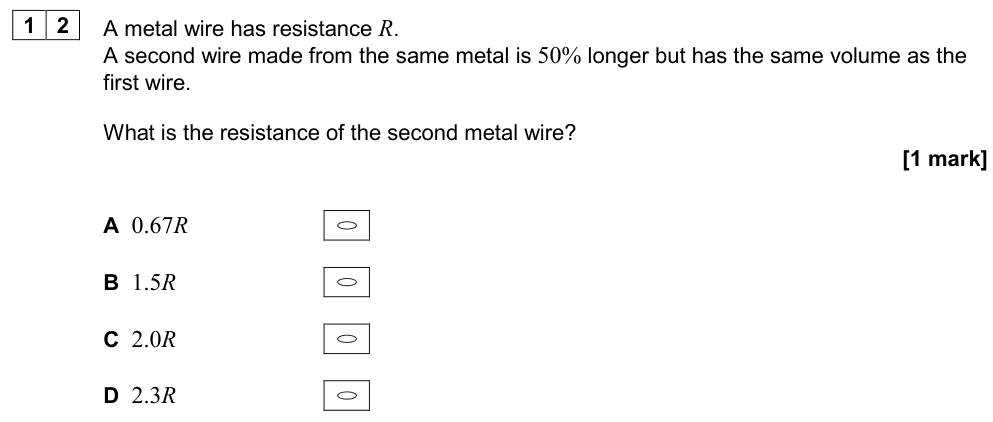
If a wire is stretched so that its length doubles while its volume stays constant, its cross-sectional area halves. So the resistance becomes $2 \times 2 = 4$ times larger. If the diameter halves, the area falls to a quarter and $R$ is 4 times larger.
Measuring resistivity
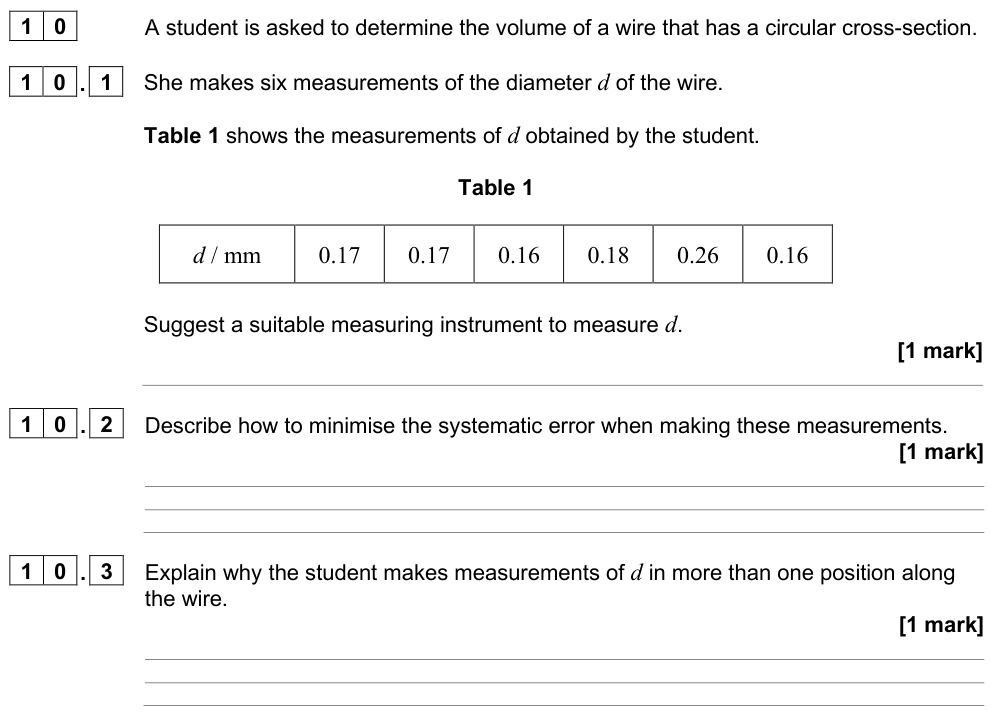
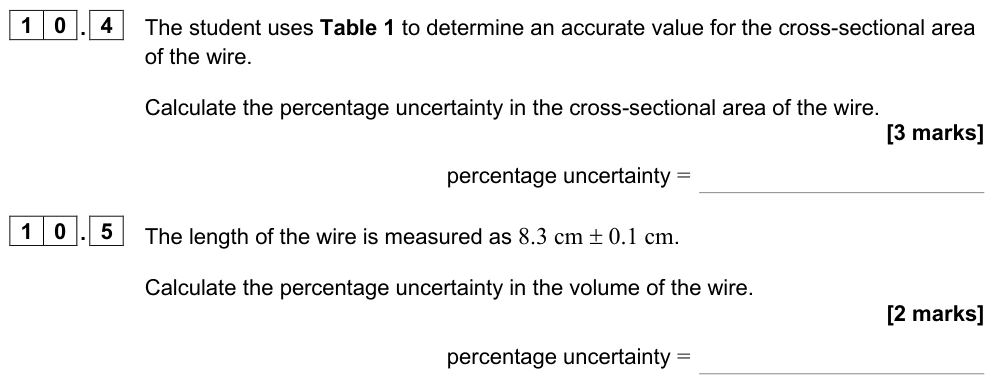
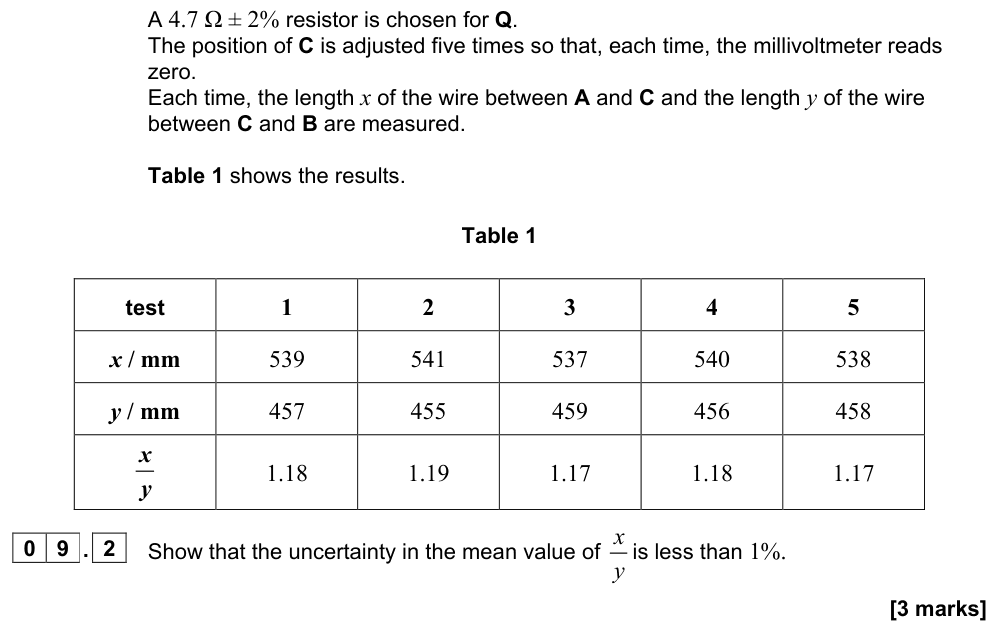
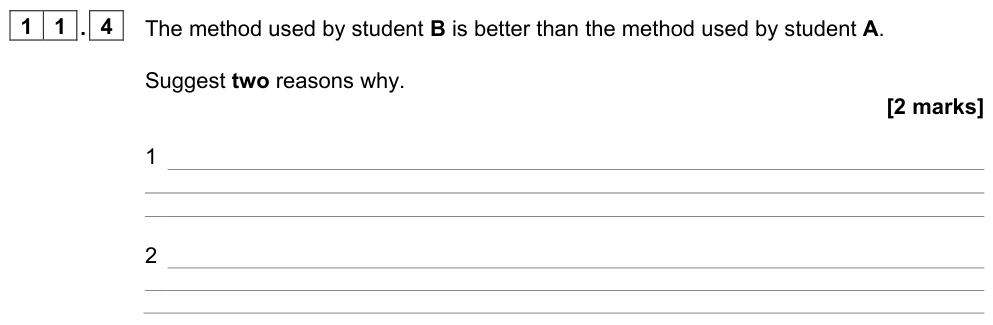
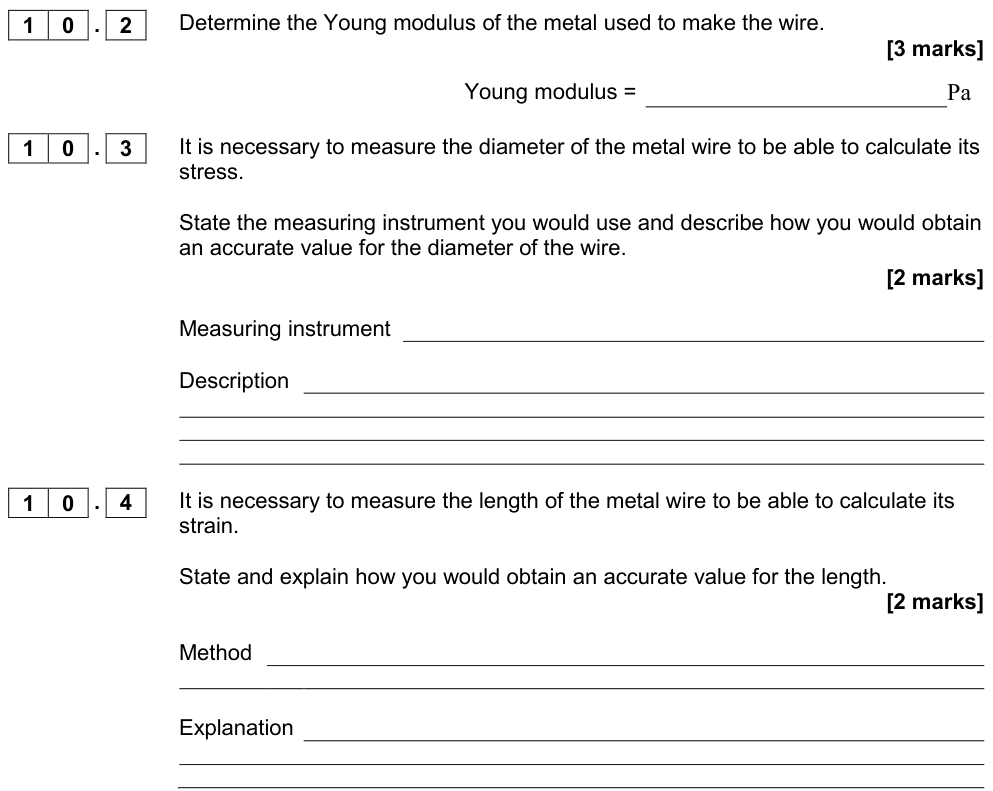
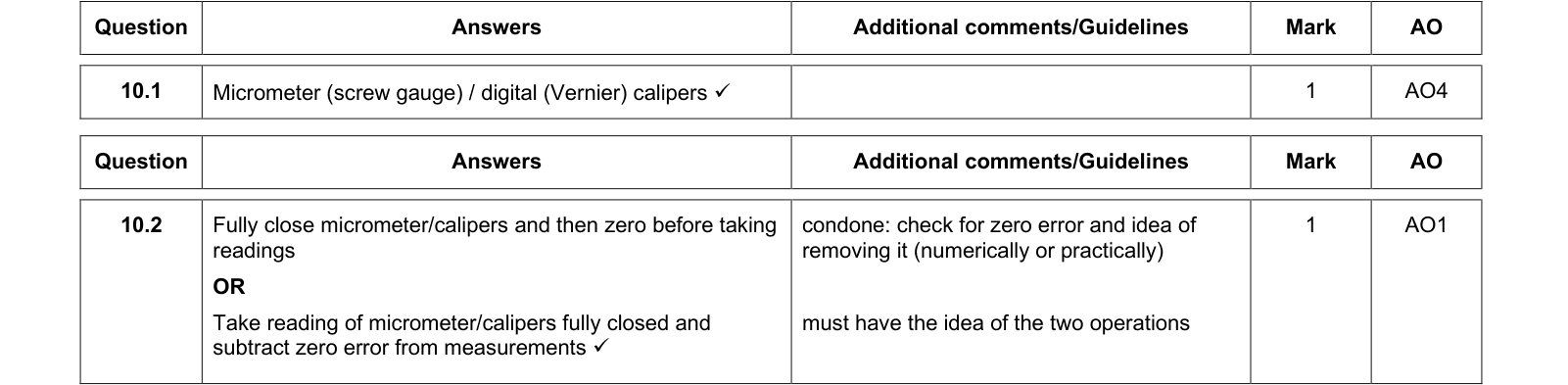
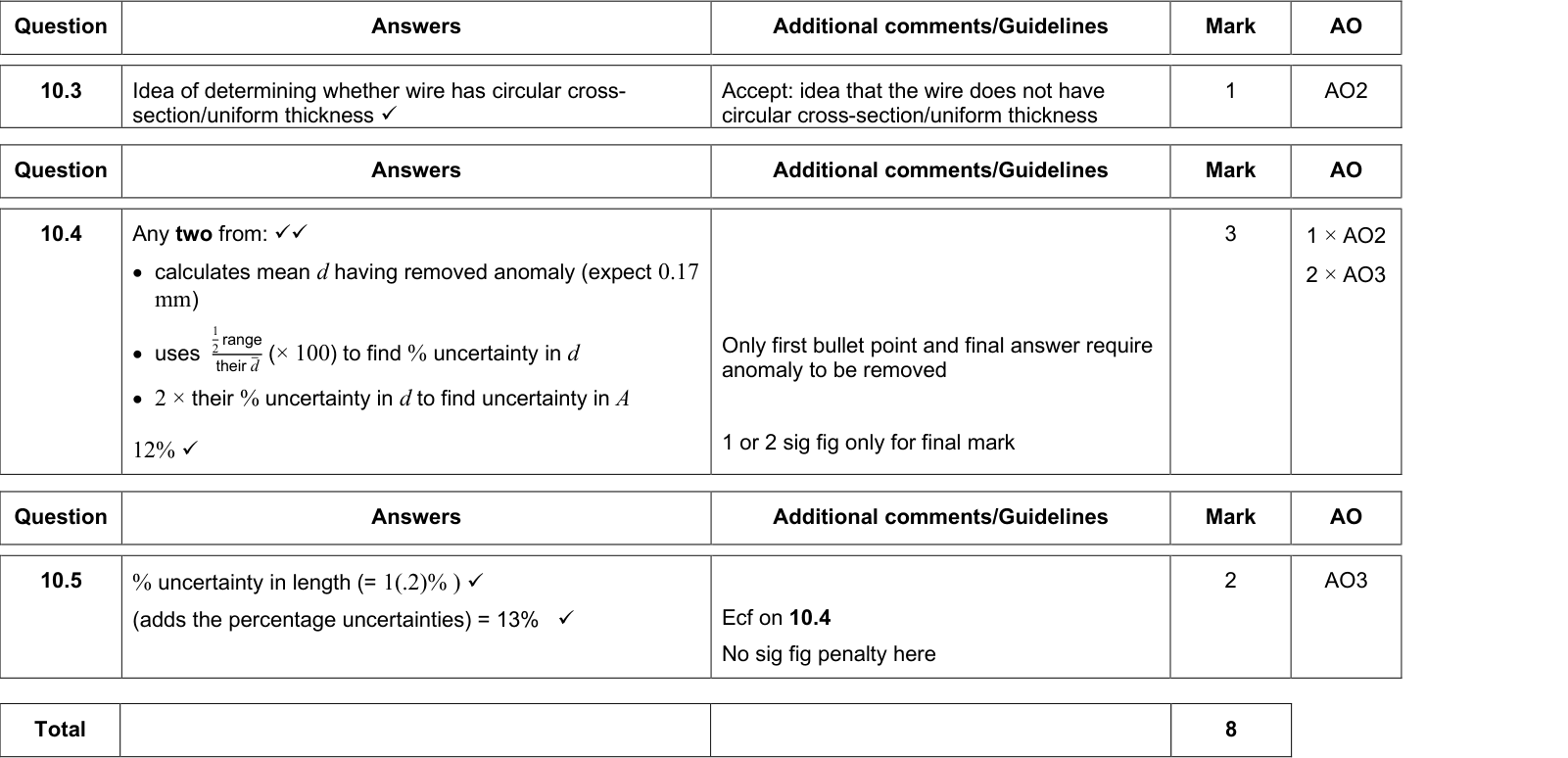
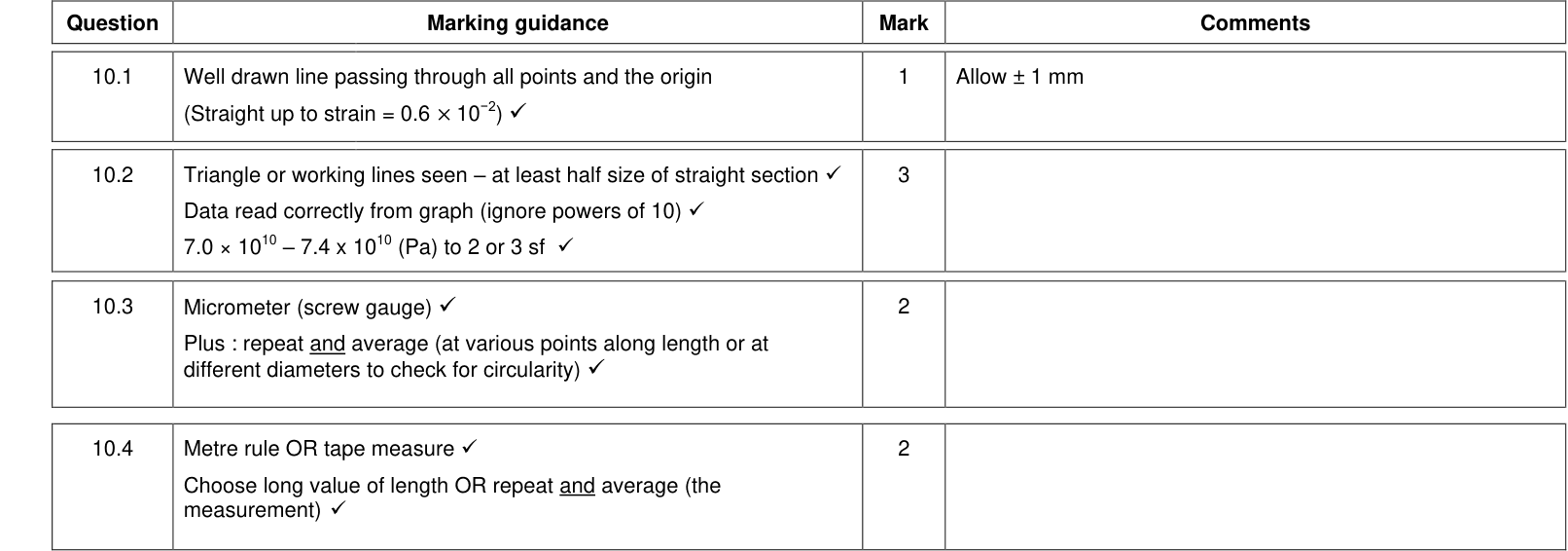
- Measure the diameter of the wire with a micrometer at several points and orientations; take the mean and calculate $A = \pi d^2/4$.
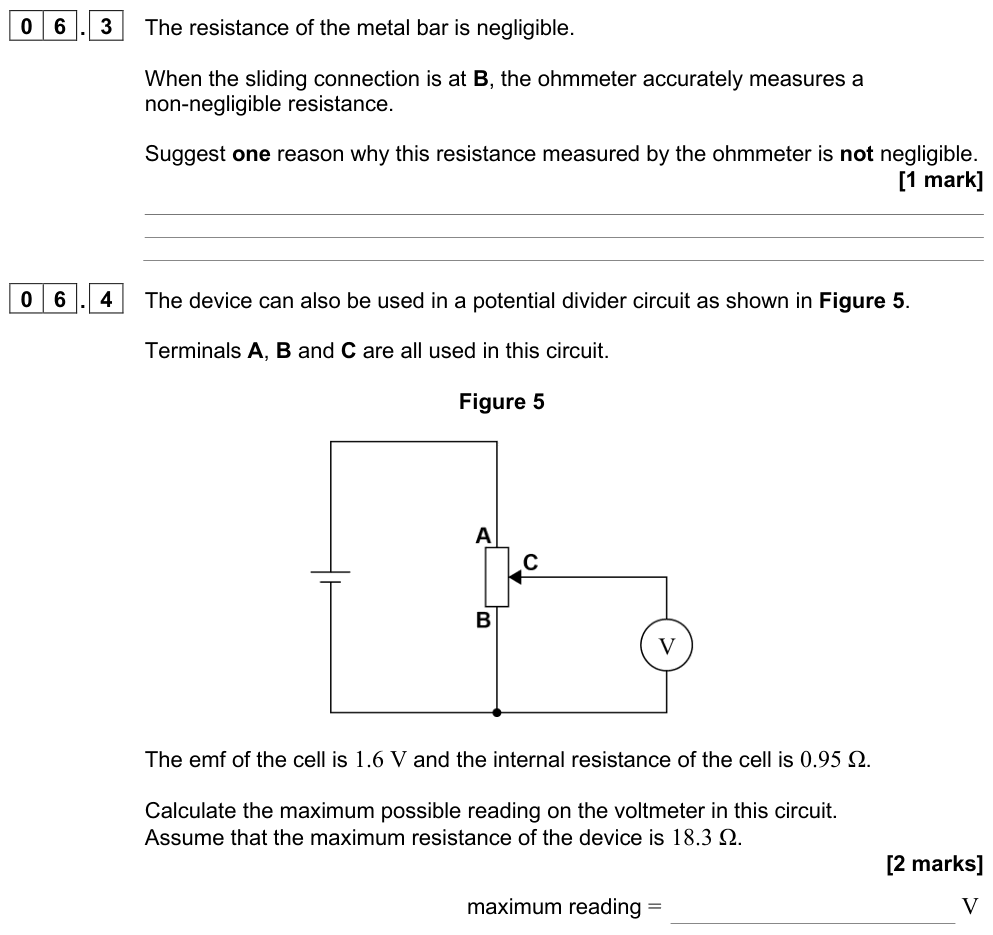
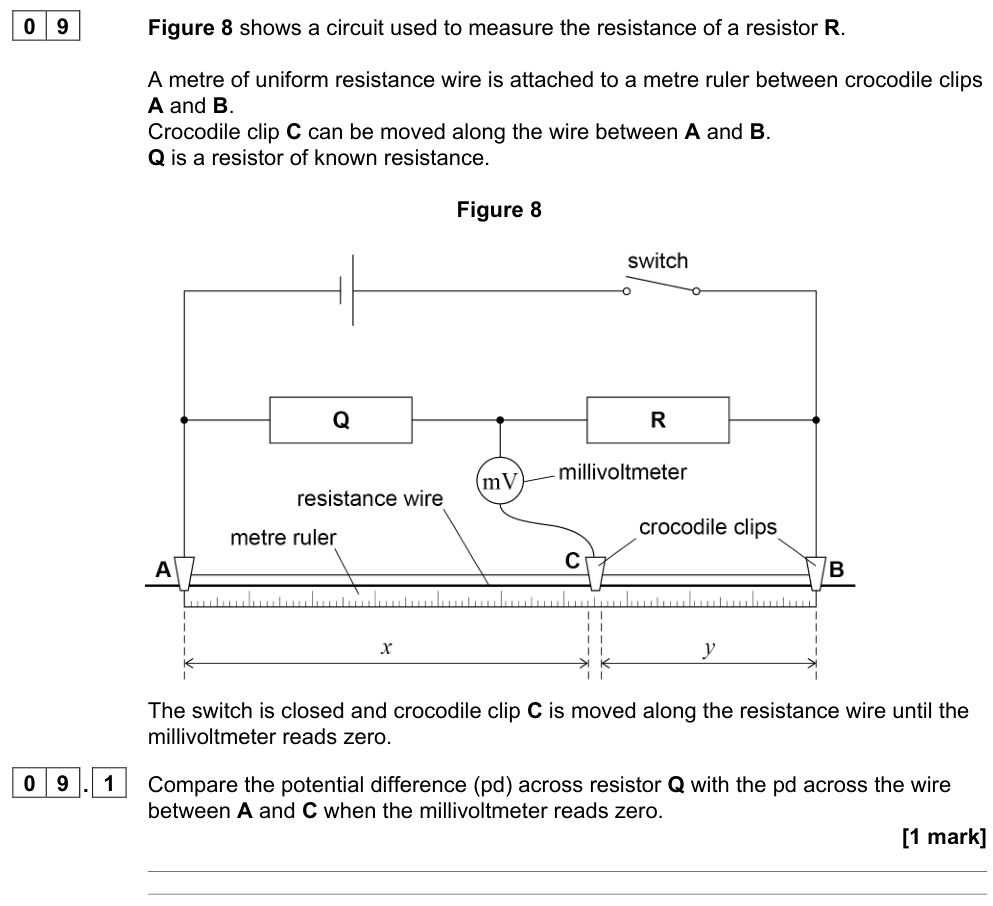
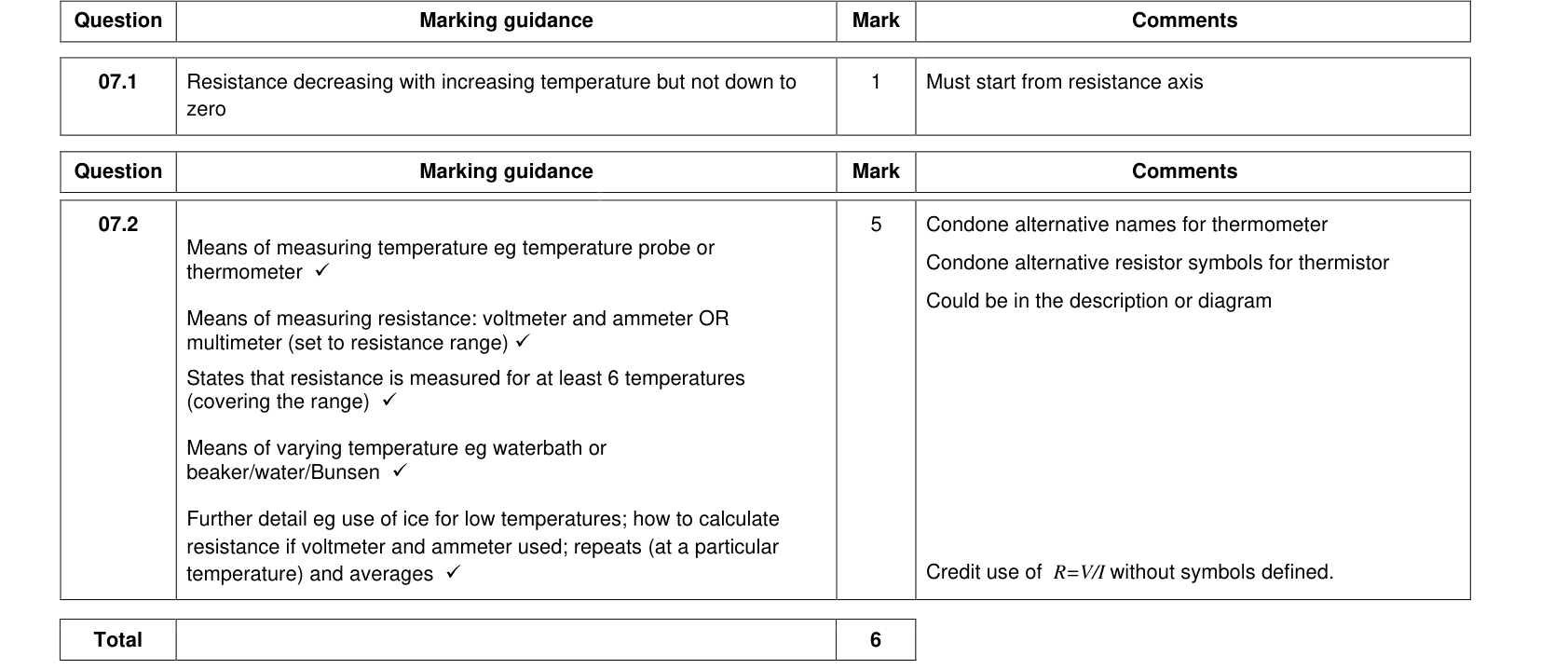
- Connect a length of wire to a circuit with an ammeter, a voltmeter across the measured length, and a low current (to avoid heating). Use crocodile clips to vary the length $L$ (measured with a metre rule).
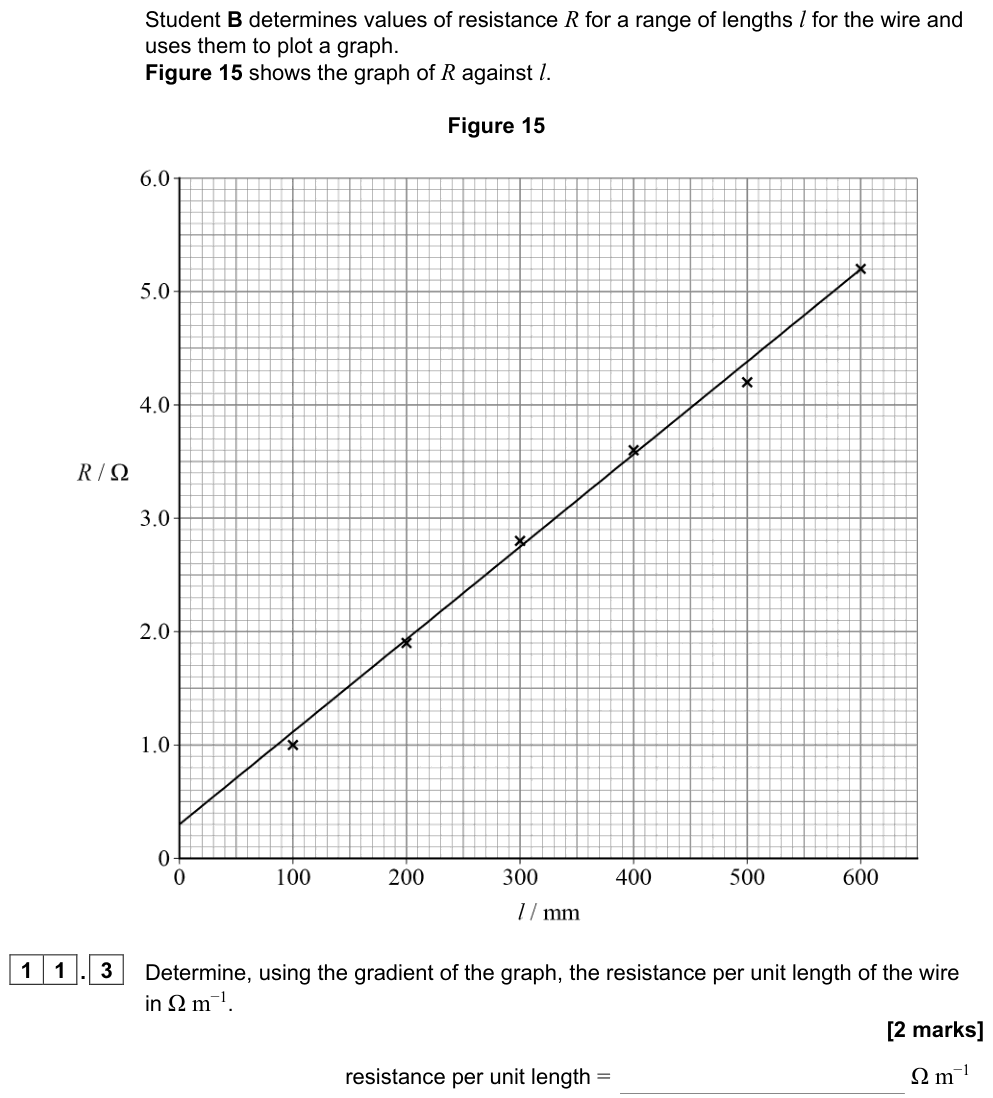
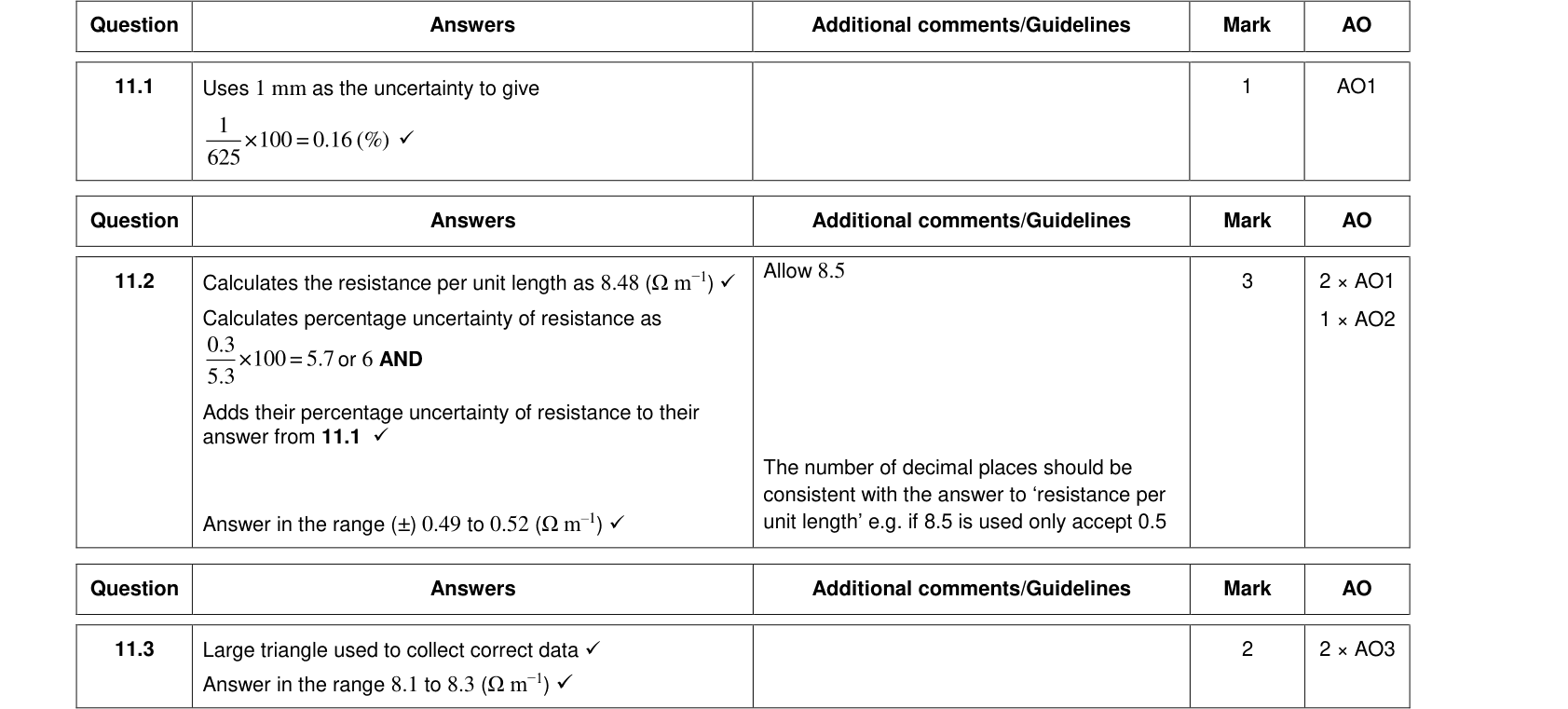
- Calculate $R = V/I$ for several lengths. Plot $R$ against $L$: a straight line through the origin with gradient $= \rho/A$, so $\rho = \text{gradient} \times A$.
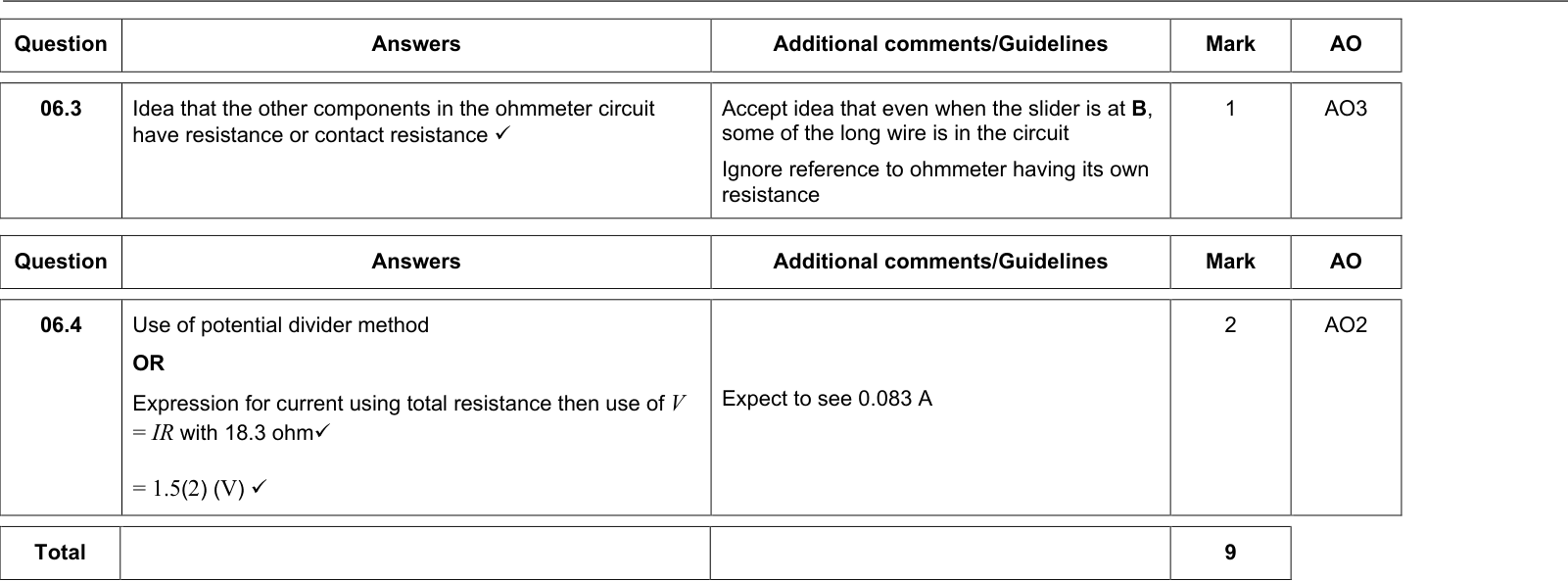
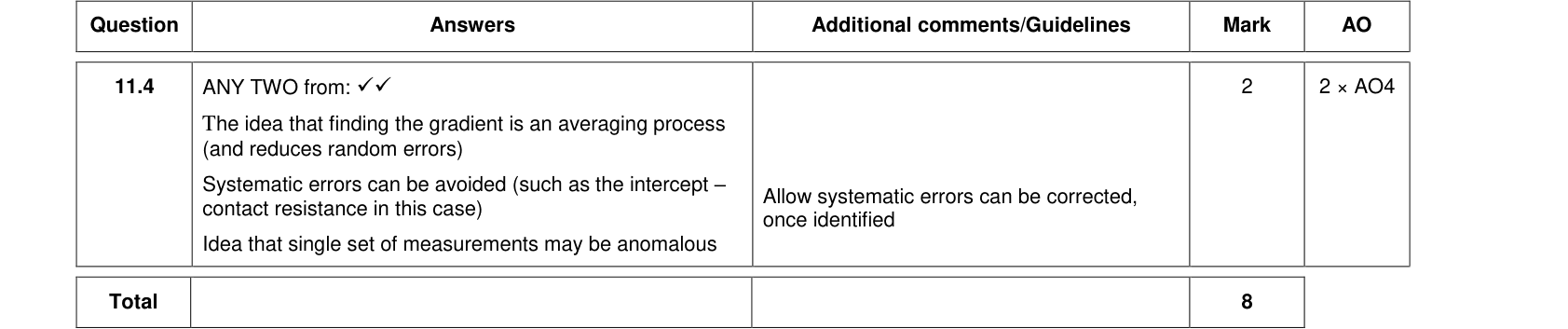
- A non-zero intercept shows a systematic error, e.g. contact resistance at the clips. Using the gradient removes its effect.
Effect of temperature on resistance
Metals
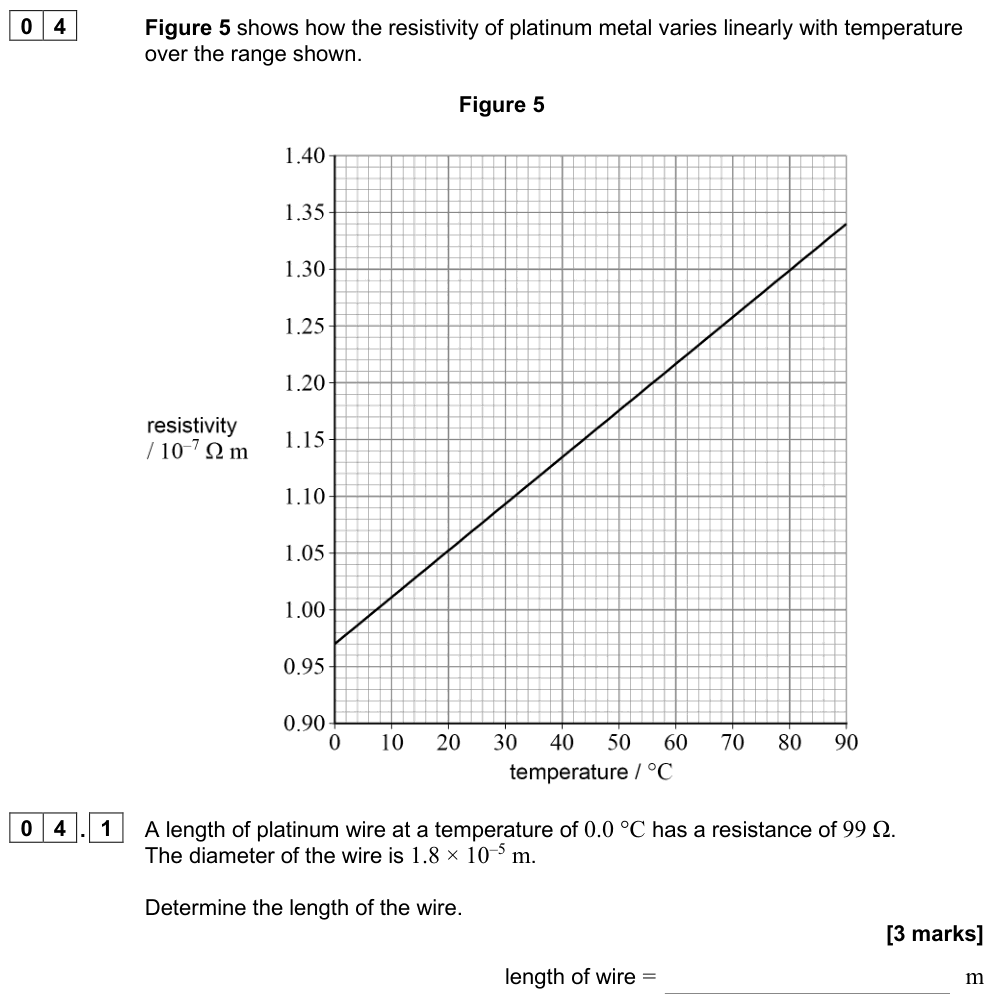
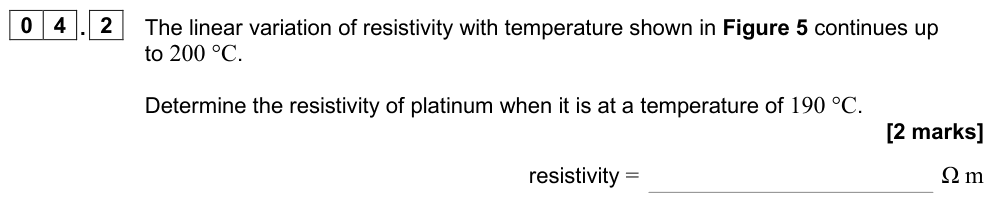
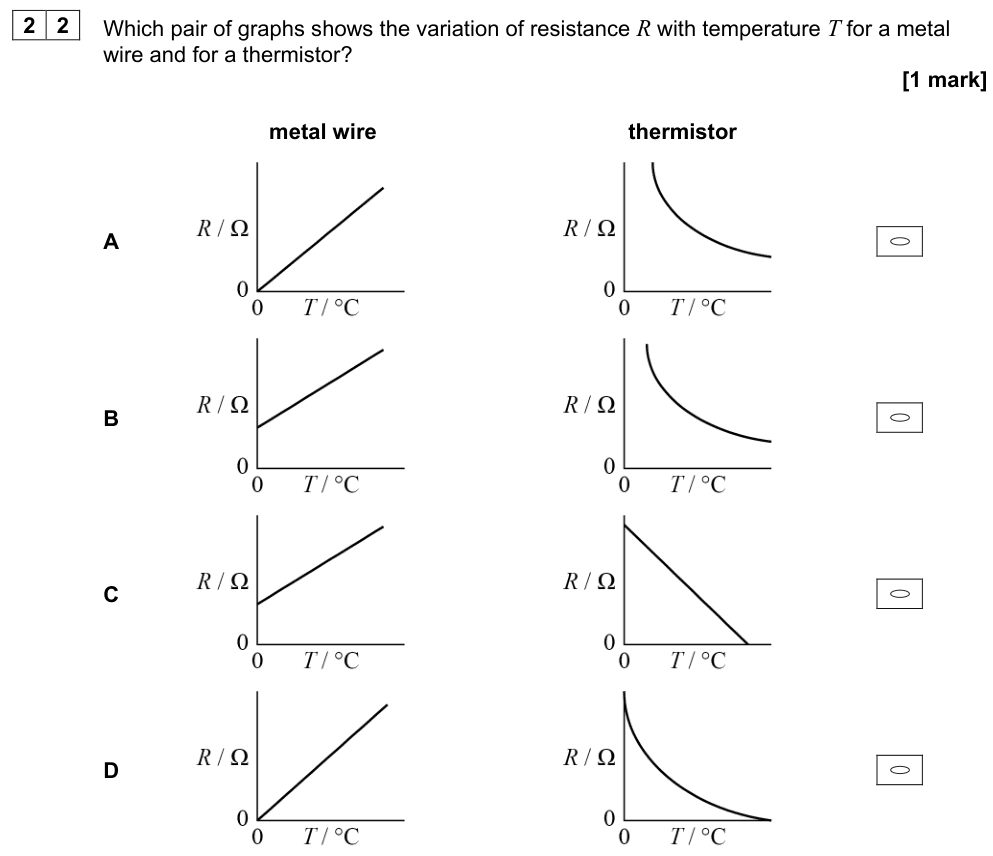
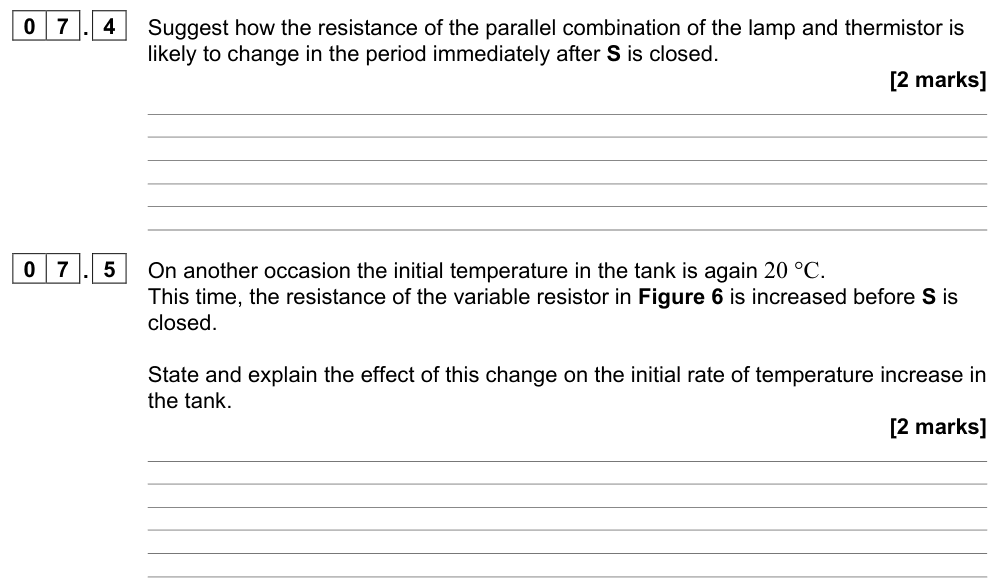
In a metal the number of free electrons is fixed. As temperature increases, the positive ions vibrate more, so electrons collide with them more often. The resistance of a metal increases with temperature (approximately linearly over normal ranges).
NTC thermistors
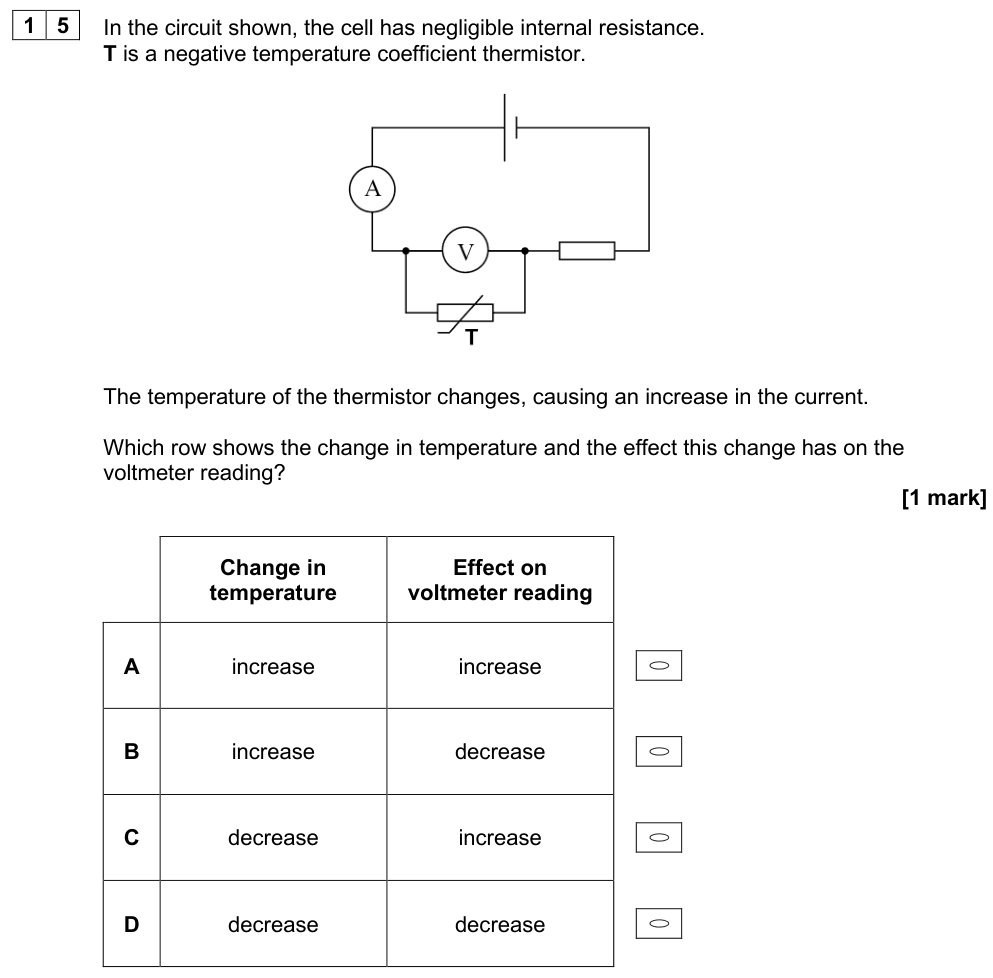
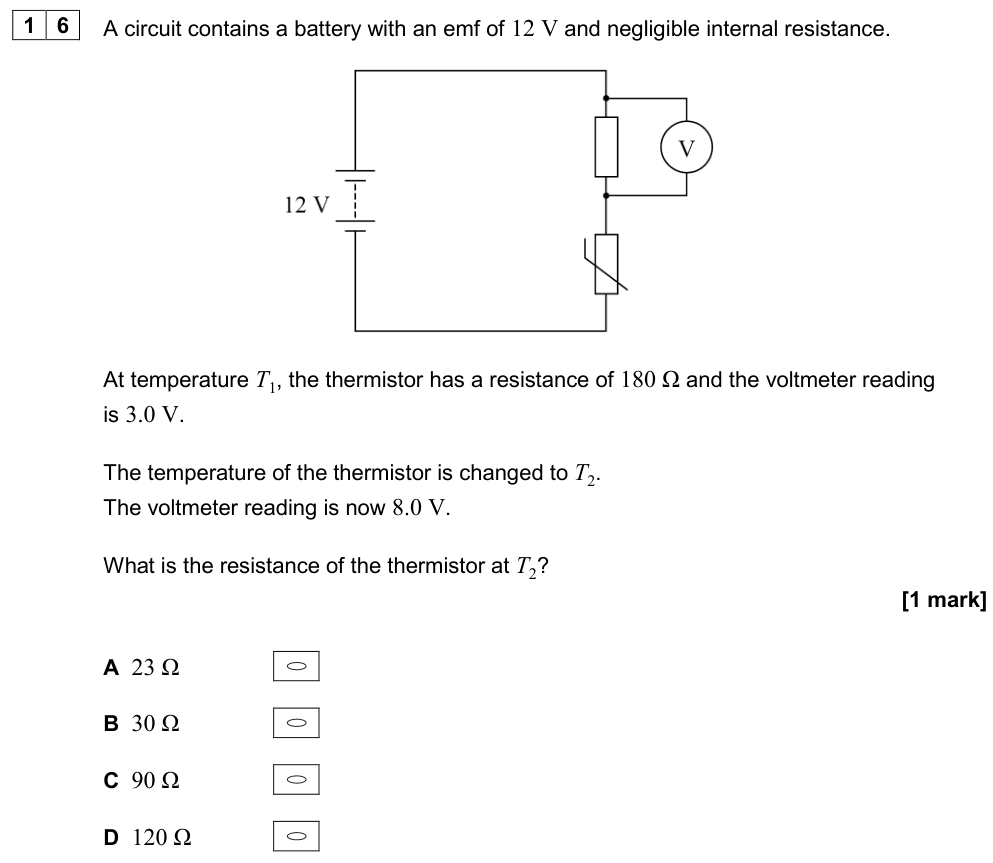
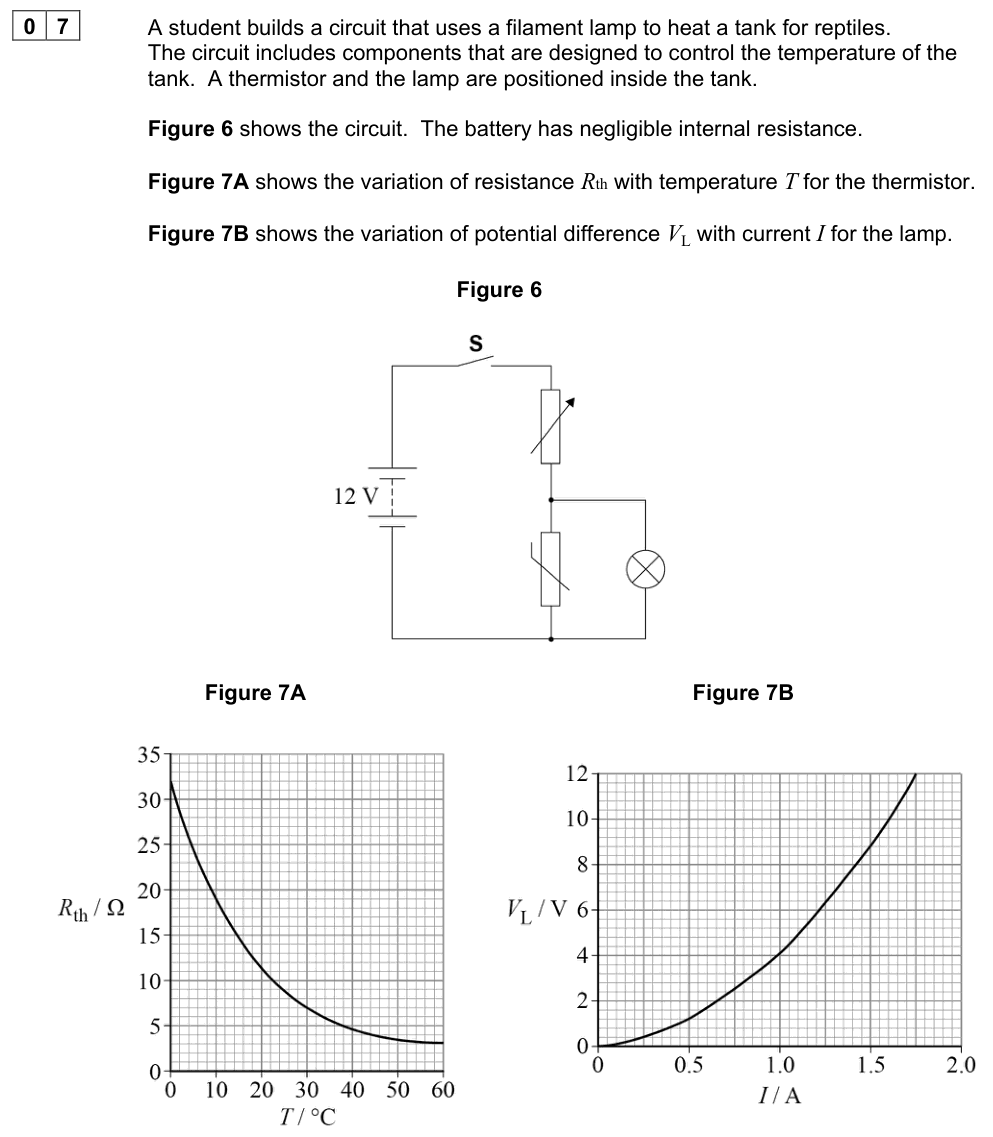
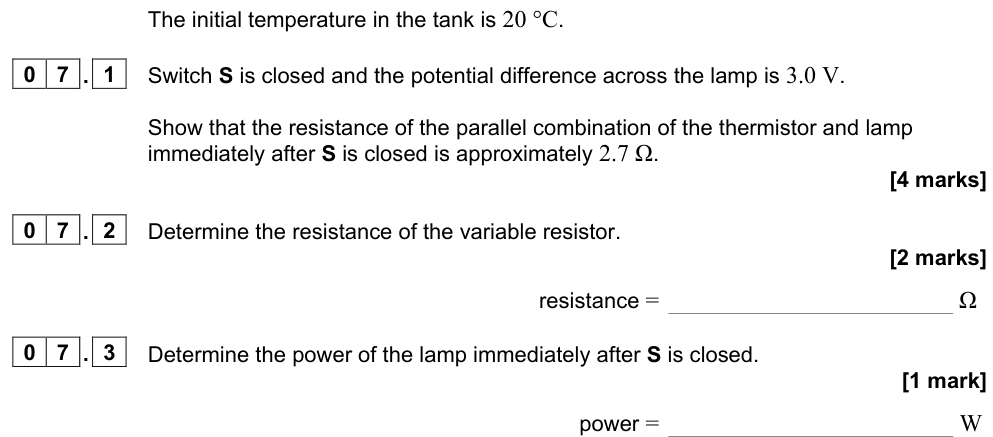
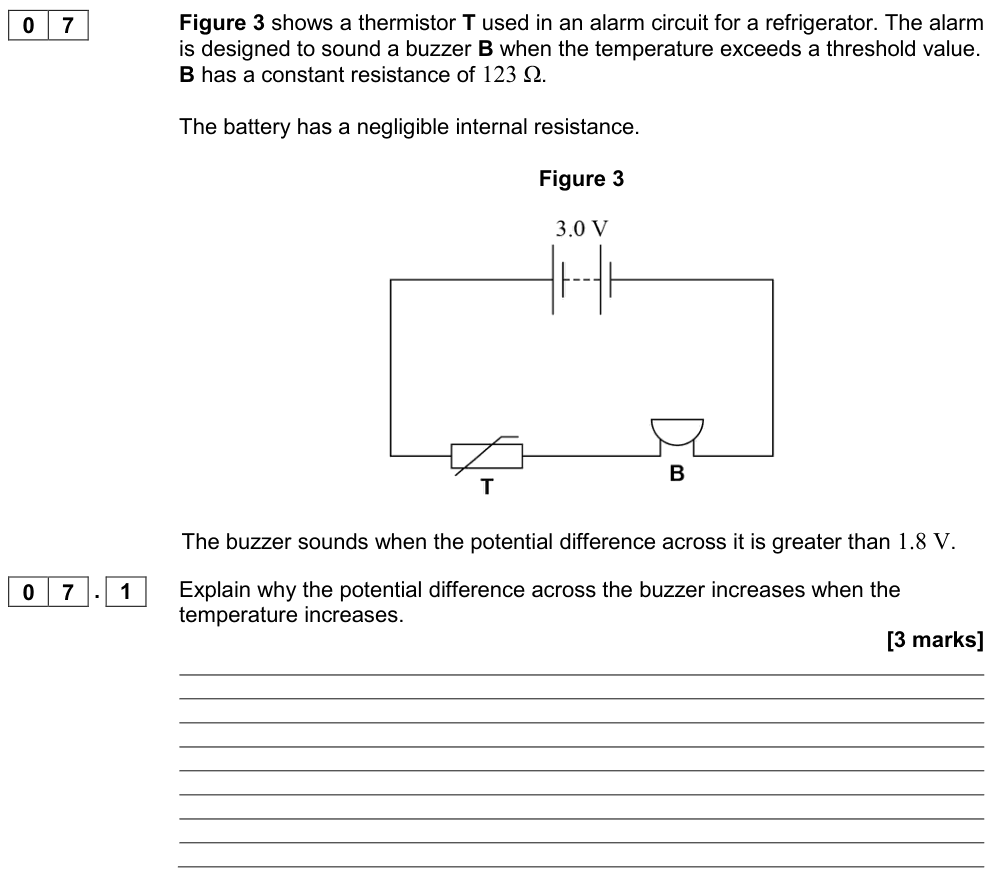
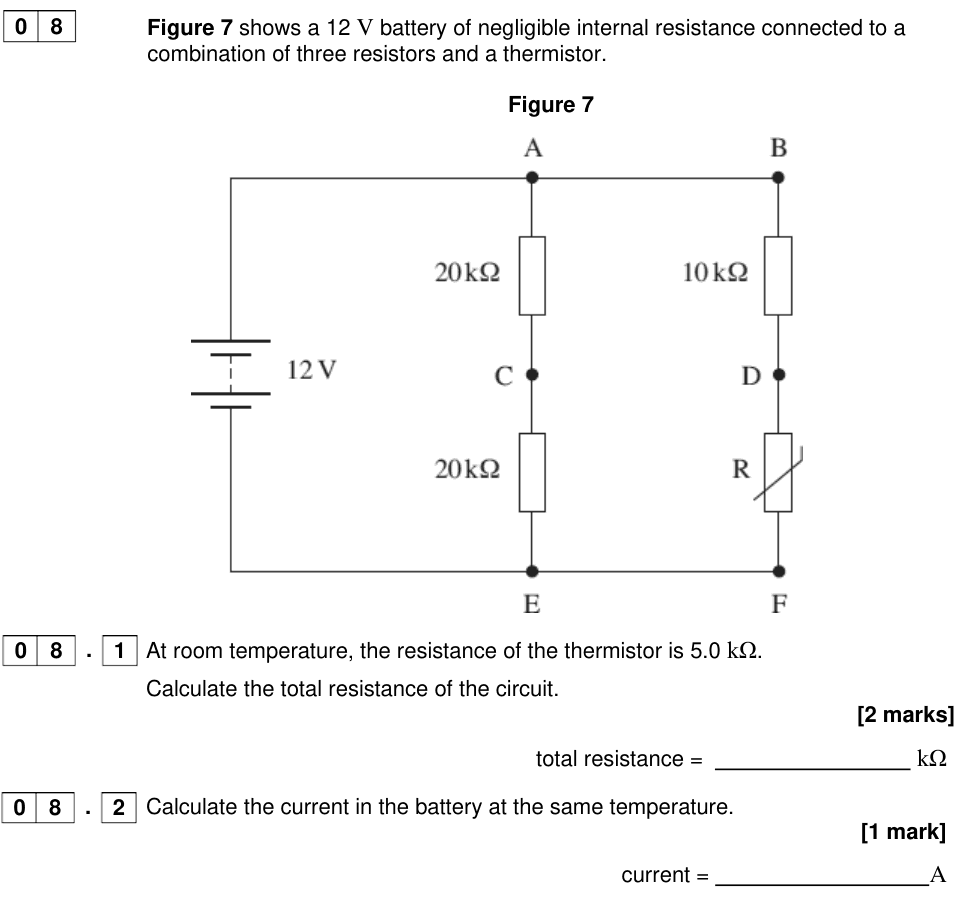
A thermistor is a resistor made of a semiconductor whose resistance changes greatly with temperature. You only need to know negative temperature coefficient (NTC) thermistors:
NTC thermistor
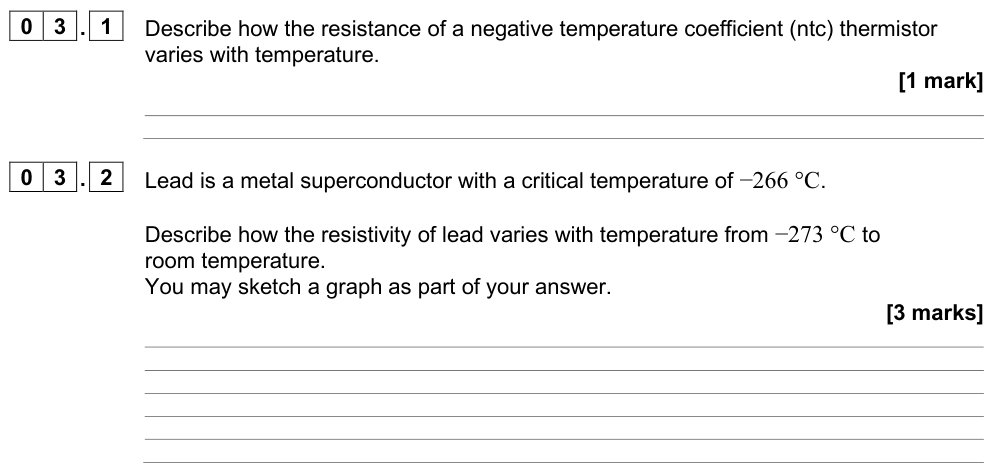
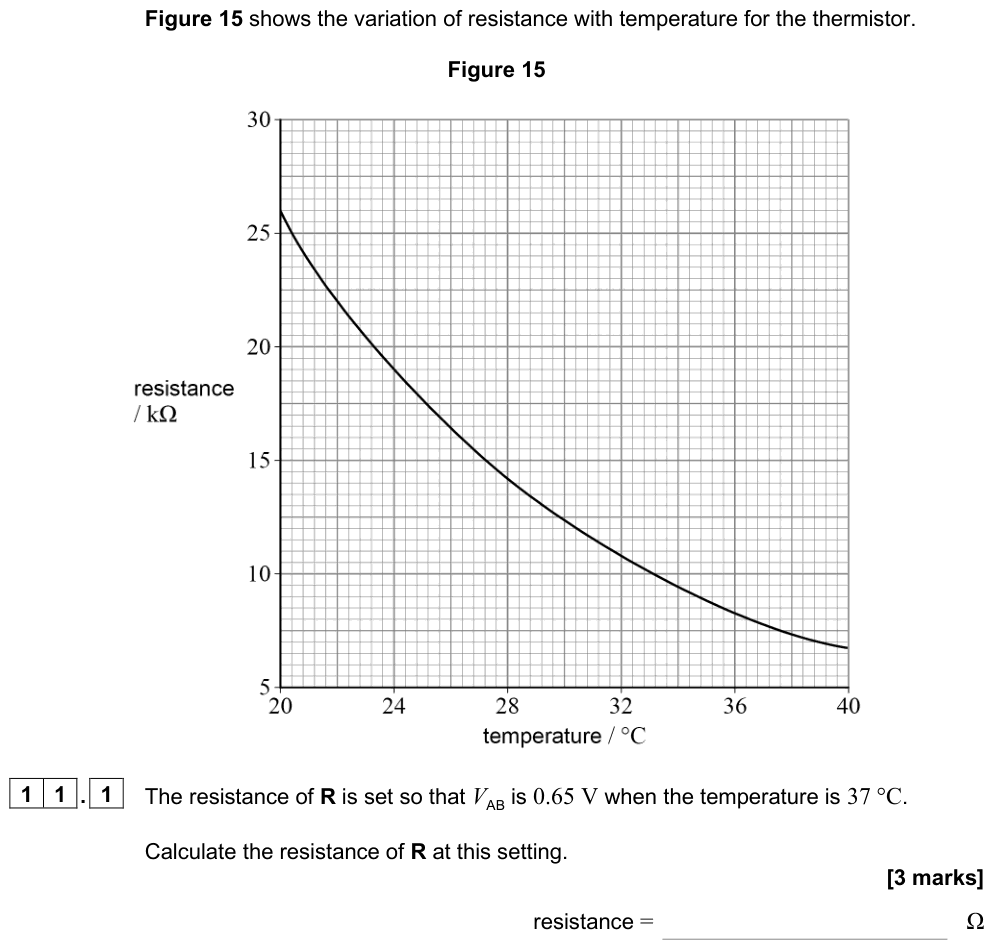
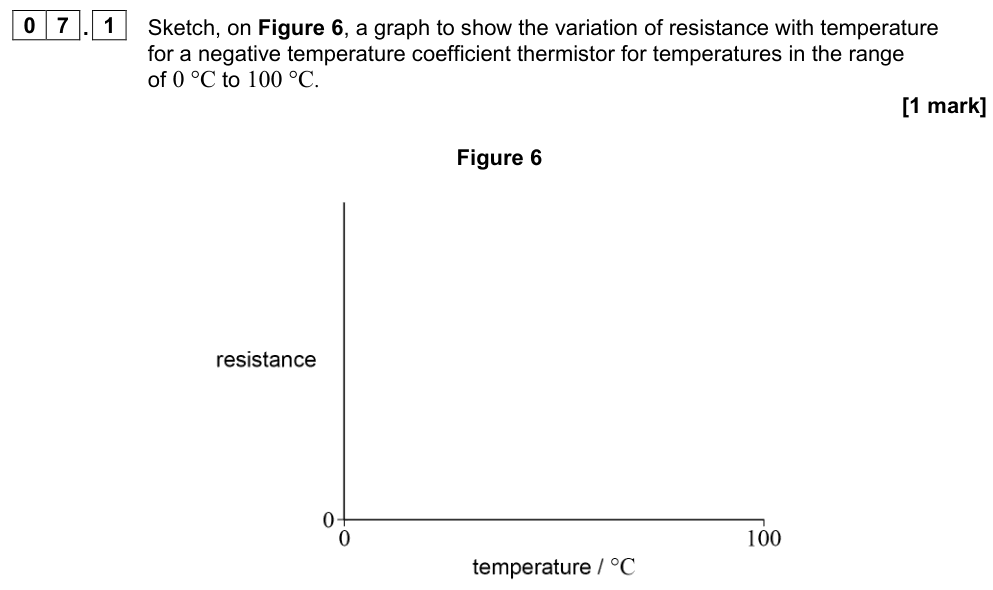
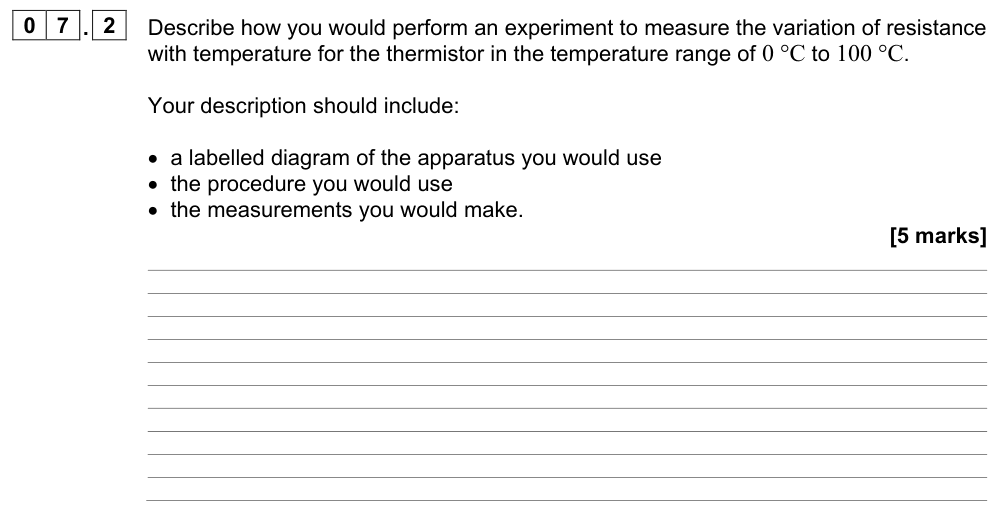
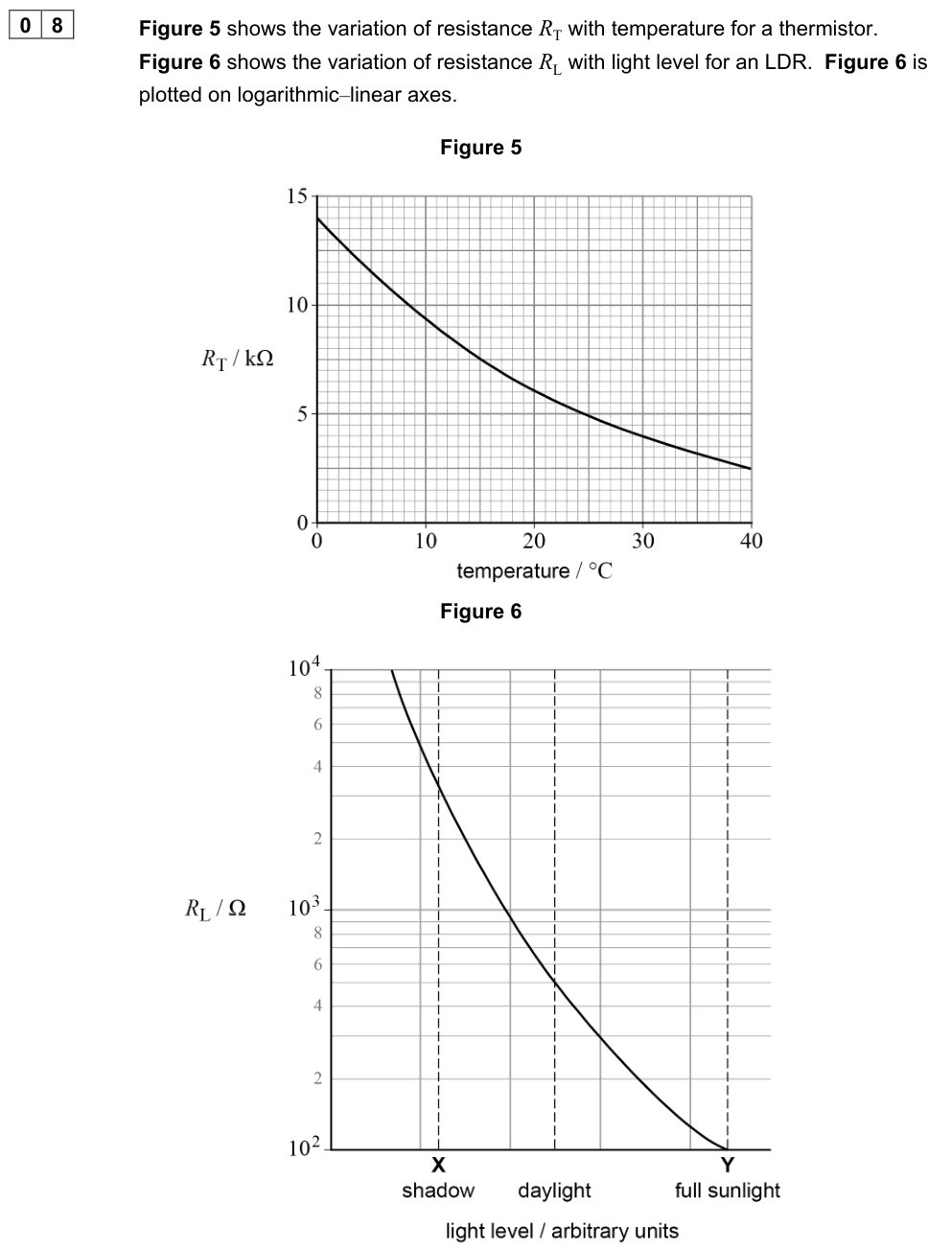
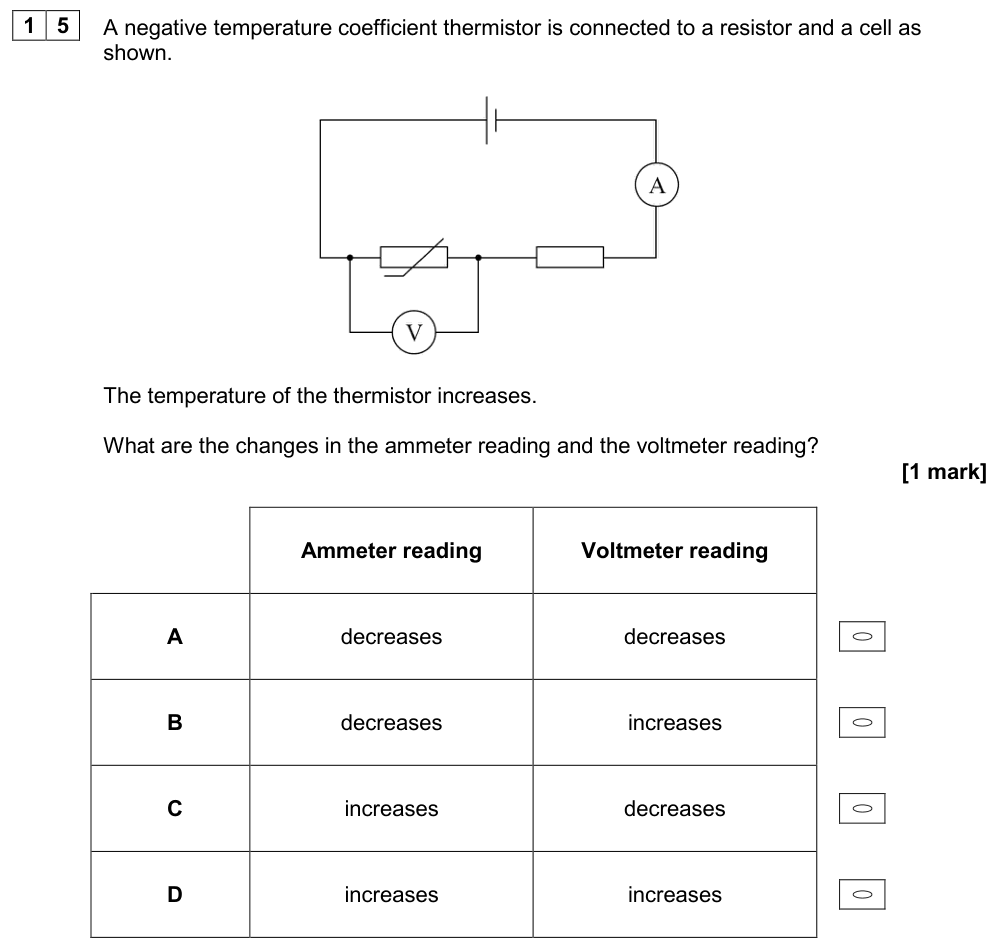
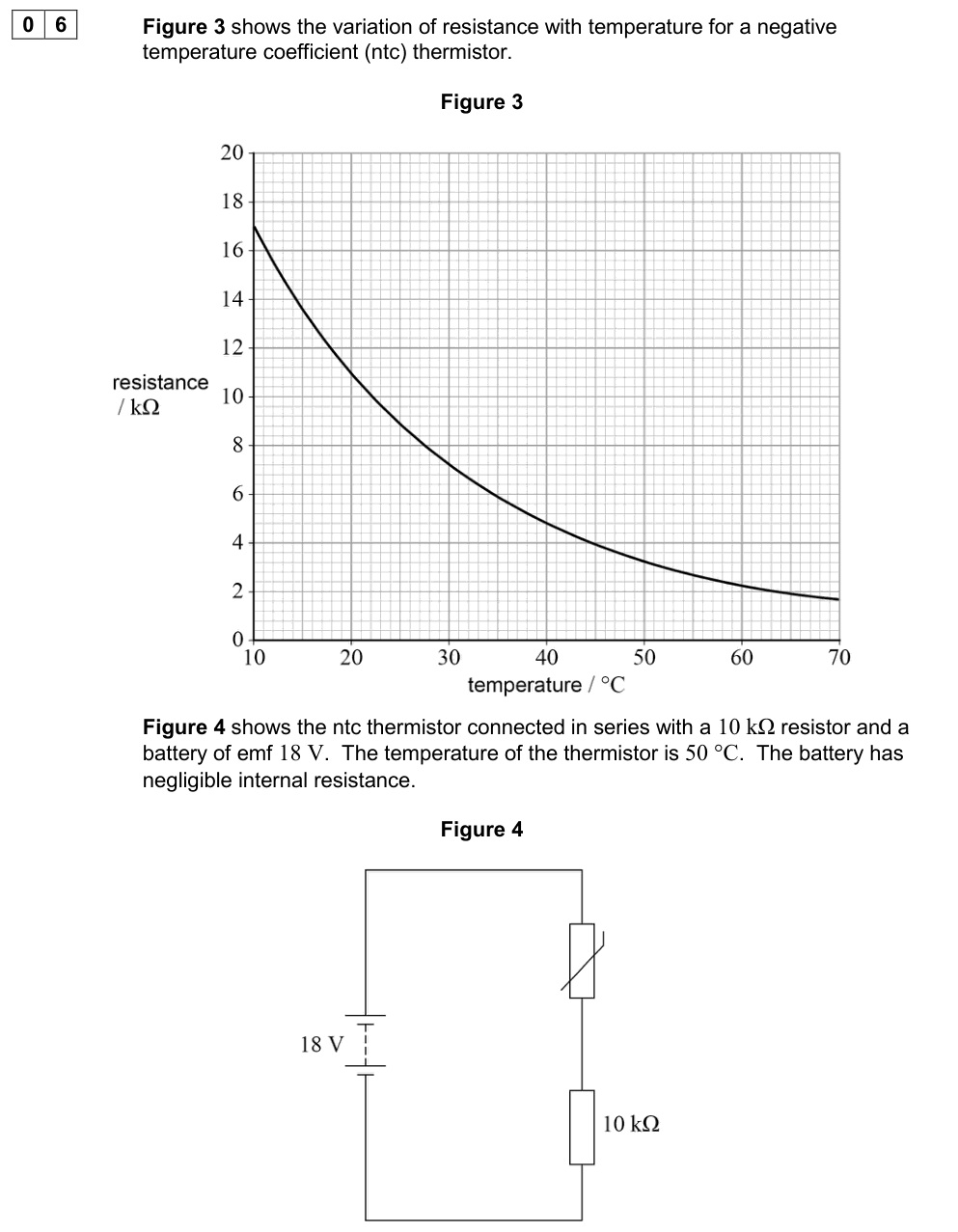
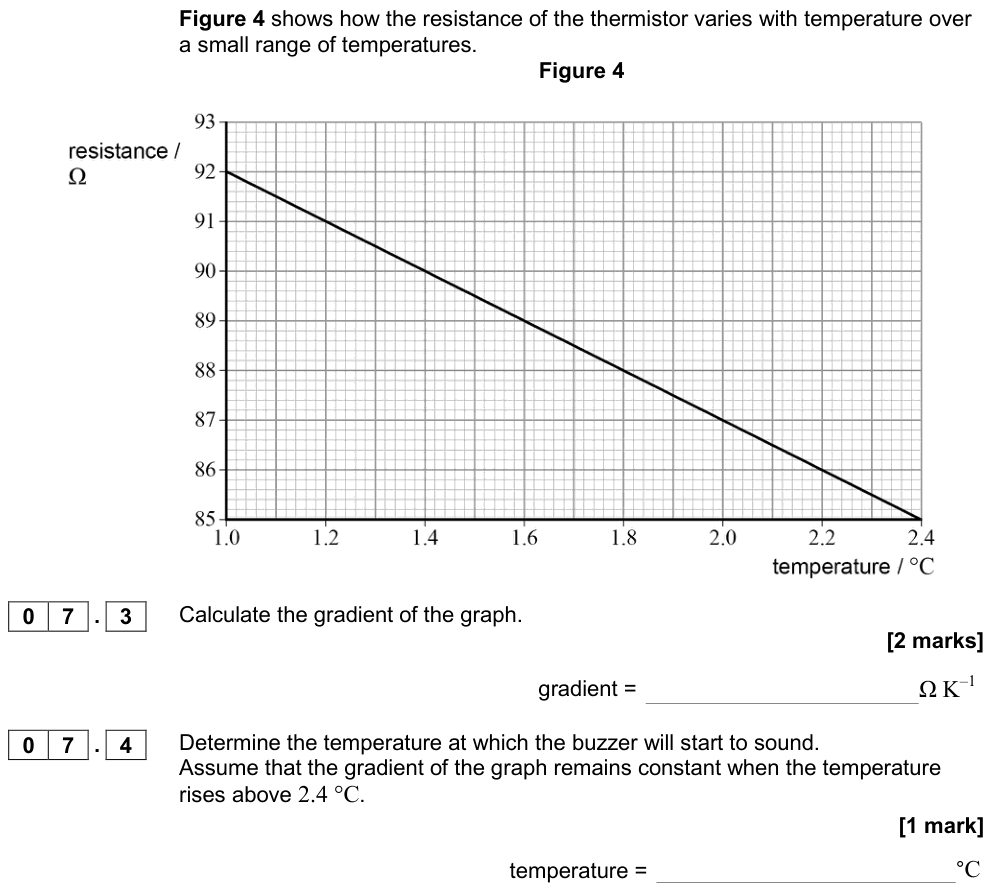
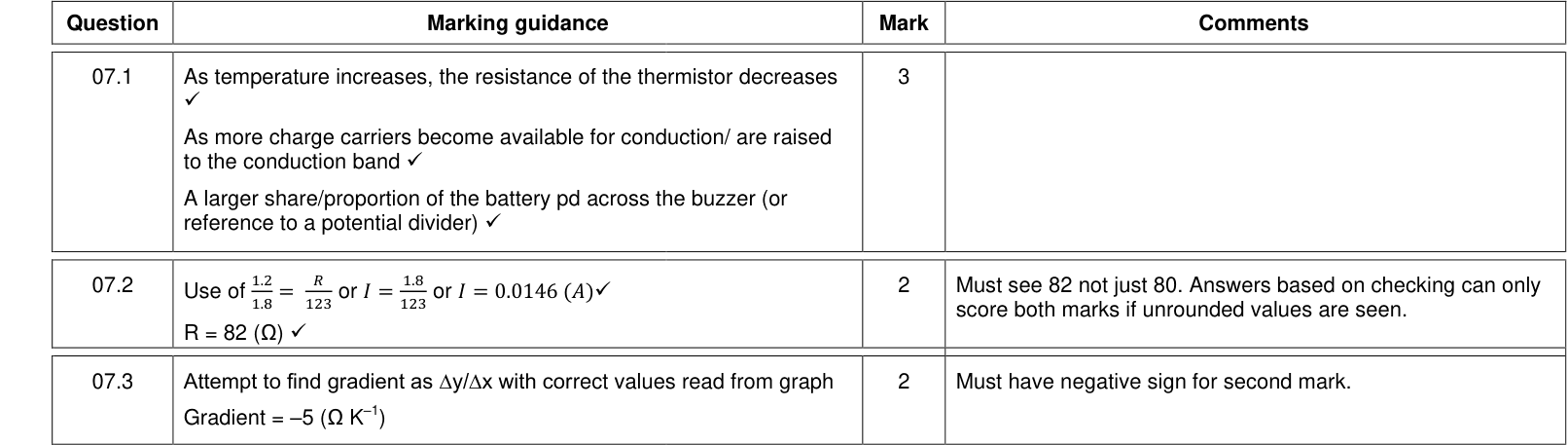
The resistance of an NTC thermistor decreases (very steeply, non-linearly) as its temperature increases.
Why? In a semiconductor, heating gives more electrons enough energy to break free and become charge carriers. The number of charge carriers increases greatly with temperature. This effect outweighs the increased lattice vibrations, so the resistance falls.
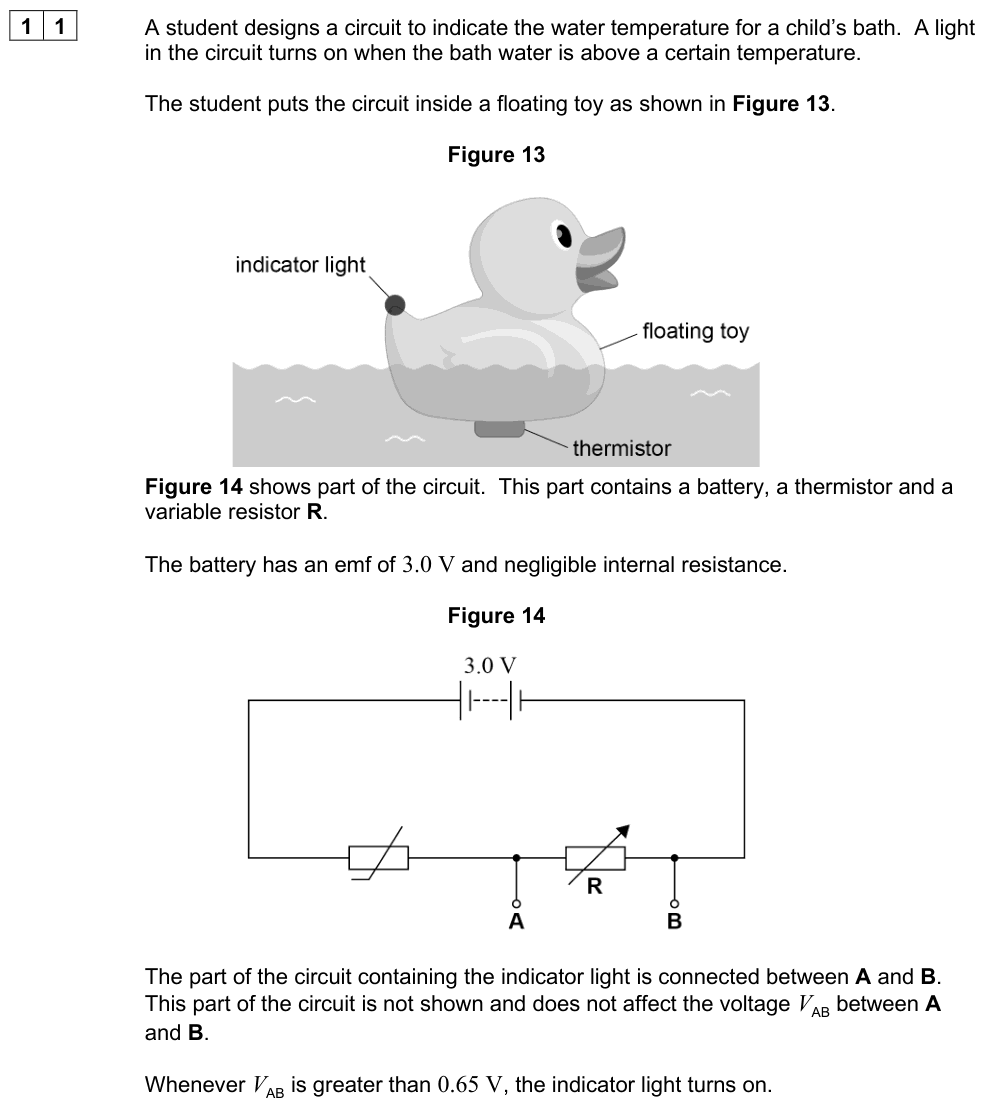
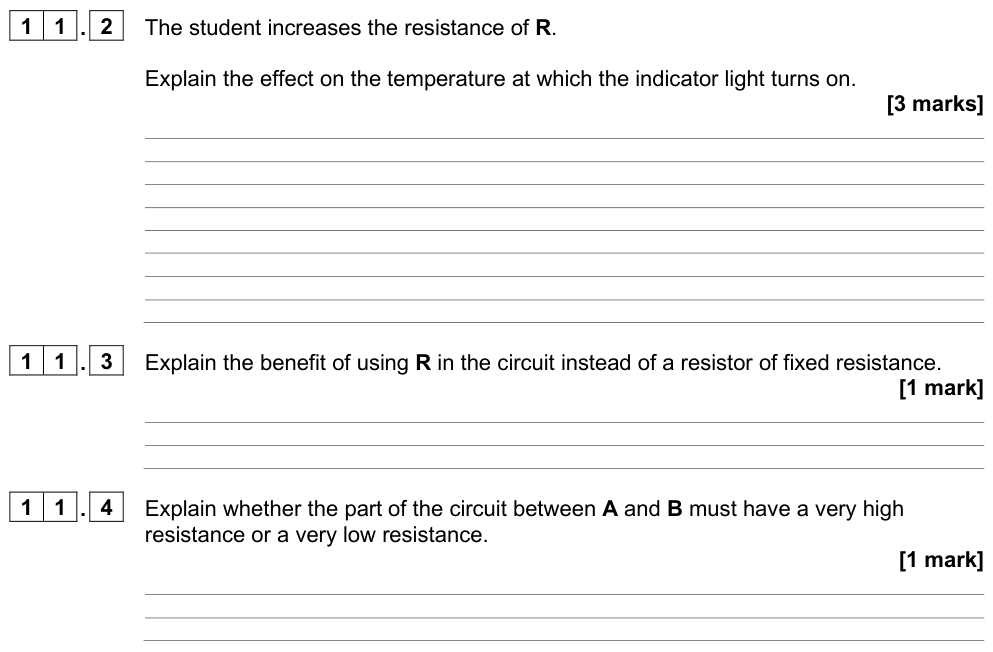
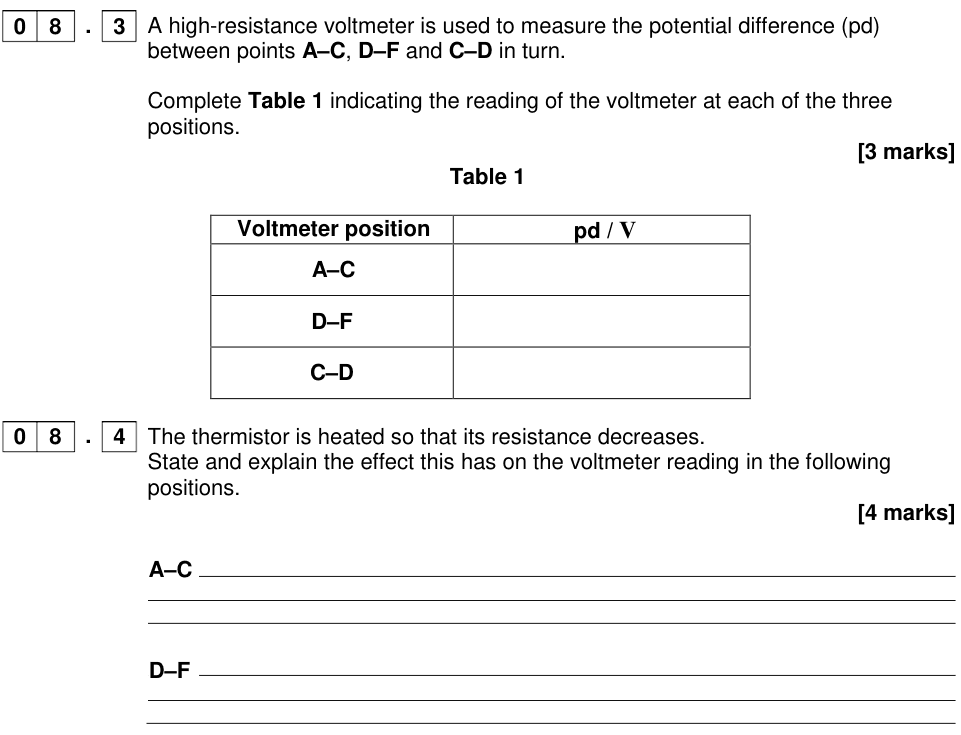
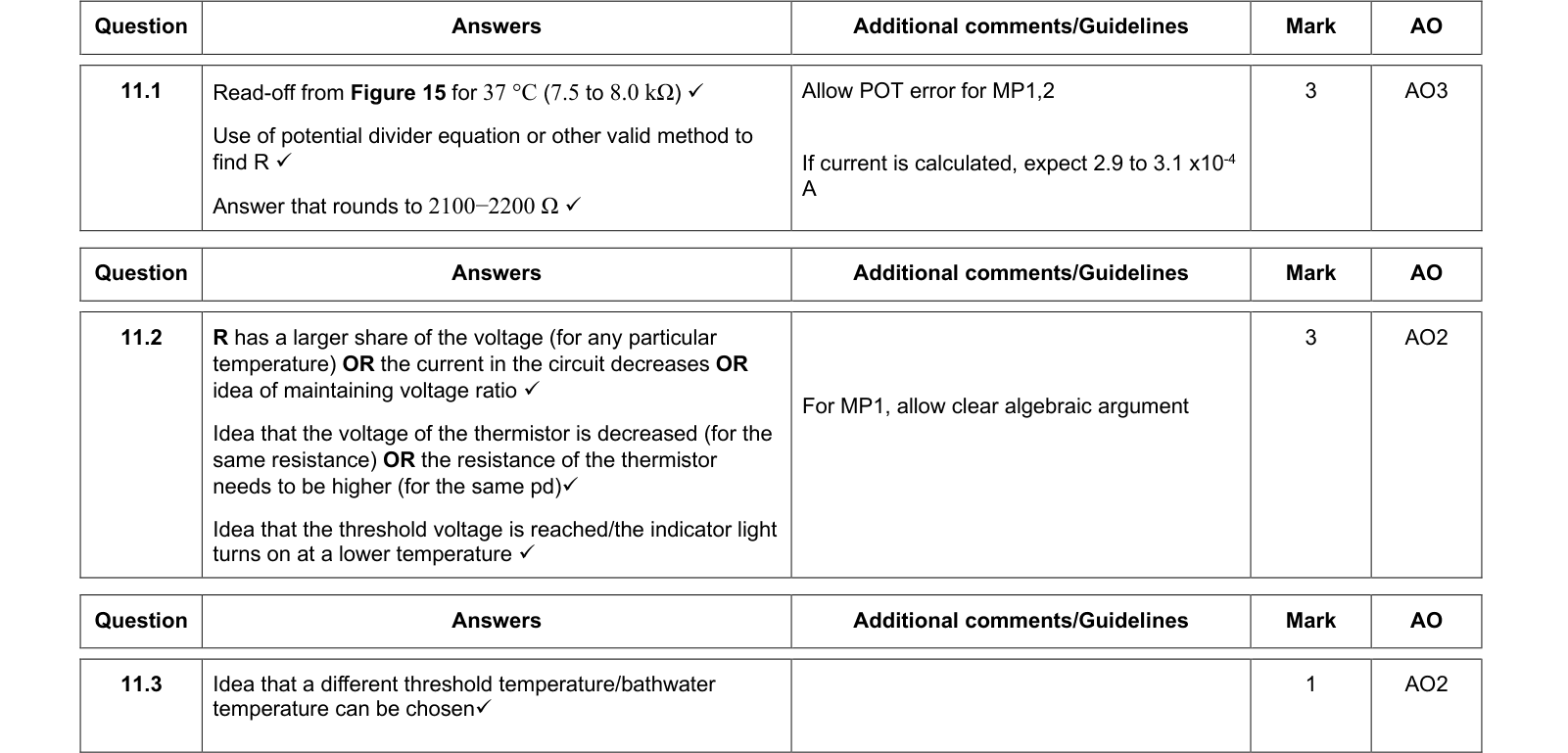
Applications of thermistors: temperature sensors in thermostats, fire alarms, car engine sensors and electronic thermometers, usually as part of a potential divider (next-but-one chapter). A resistance–temperature calibration graph converts a resistance reading into a temperature.
Superconductivity
Superconductor
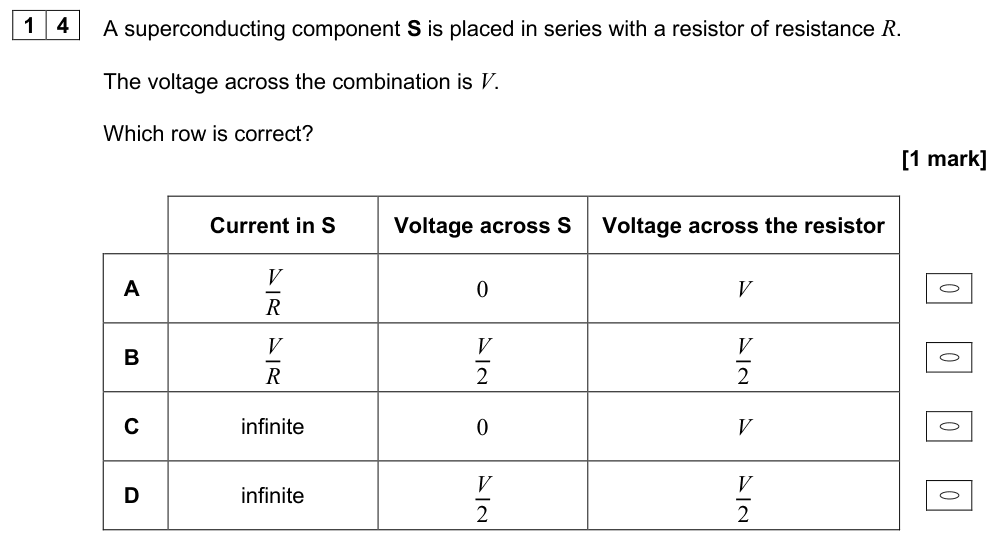
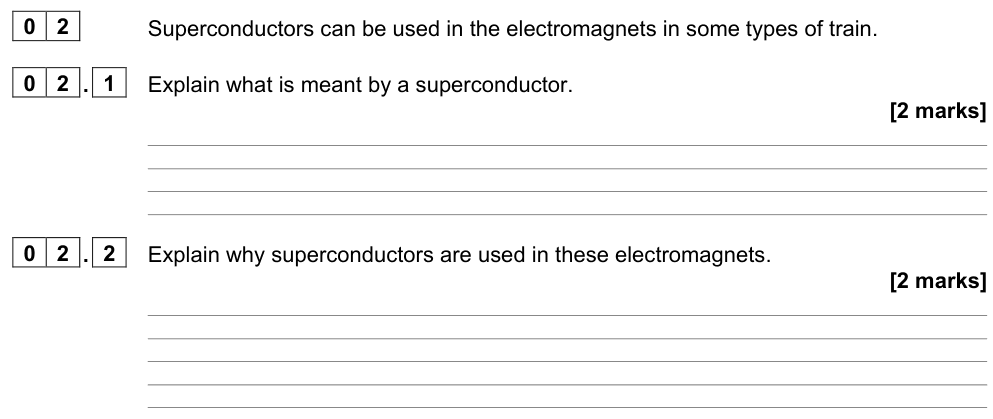
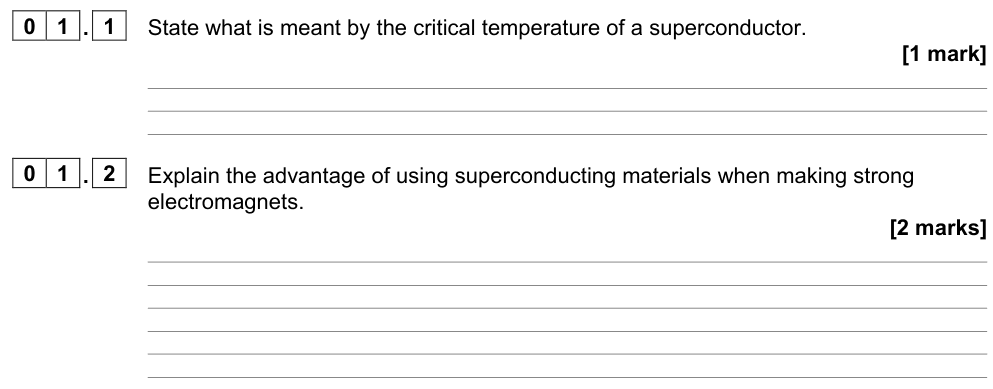
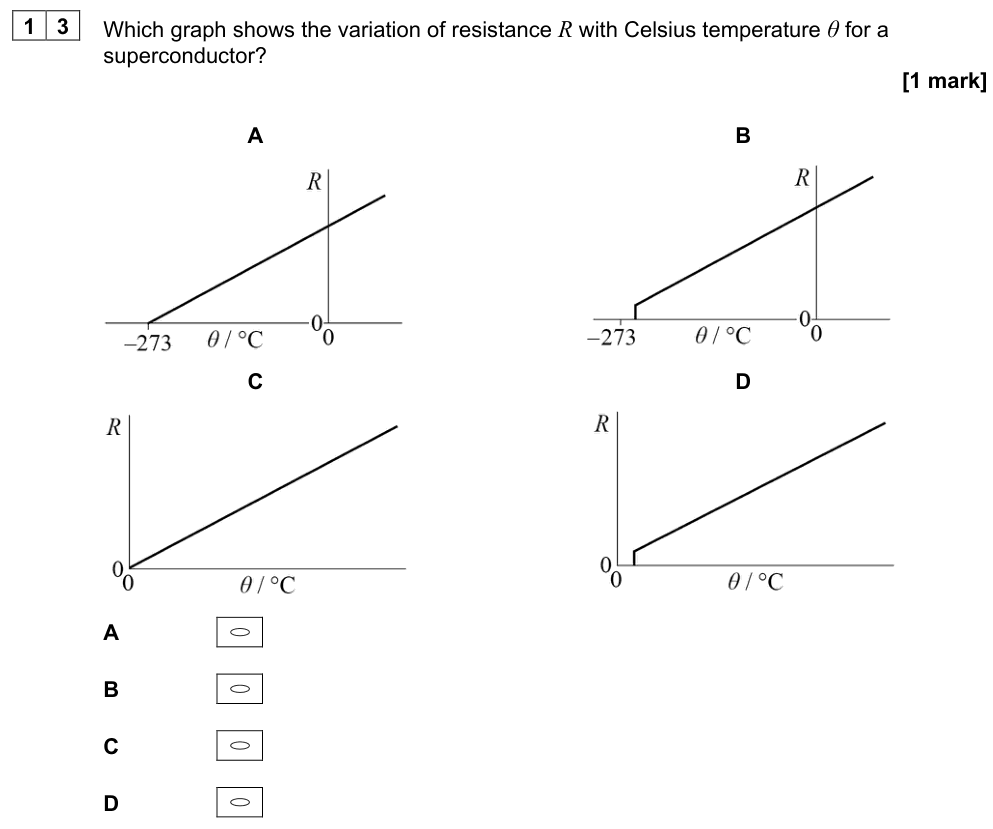
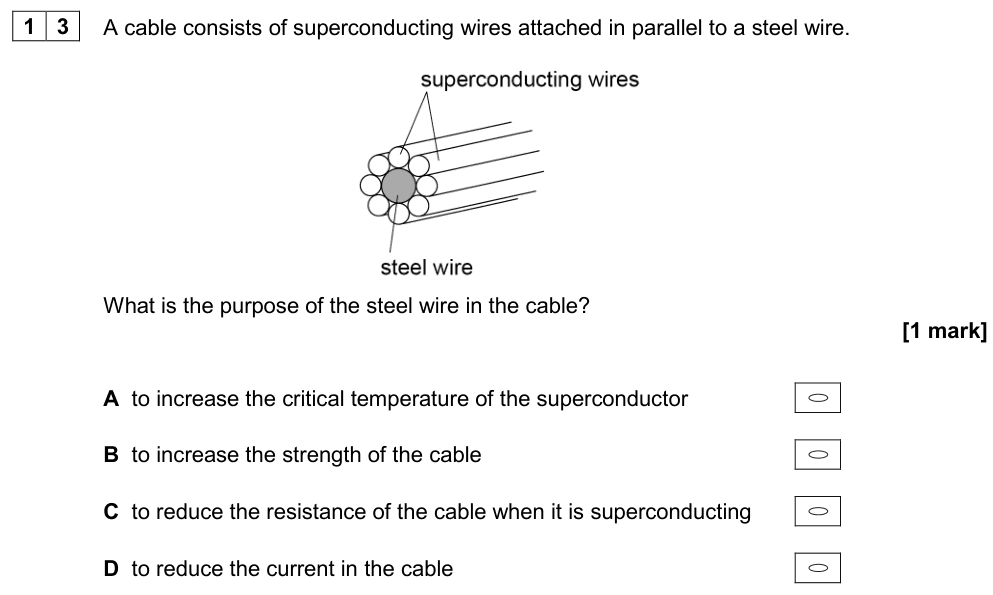
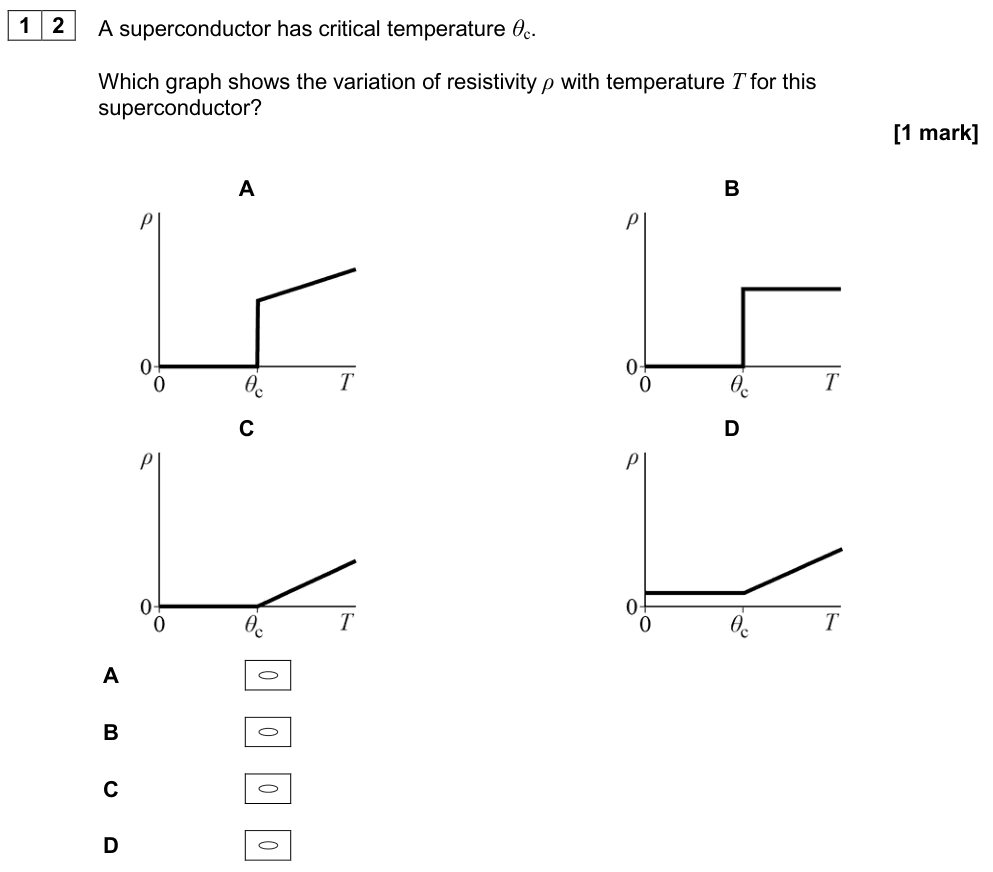
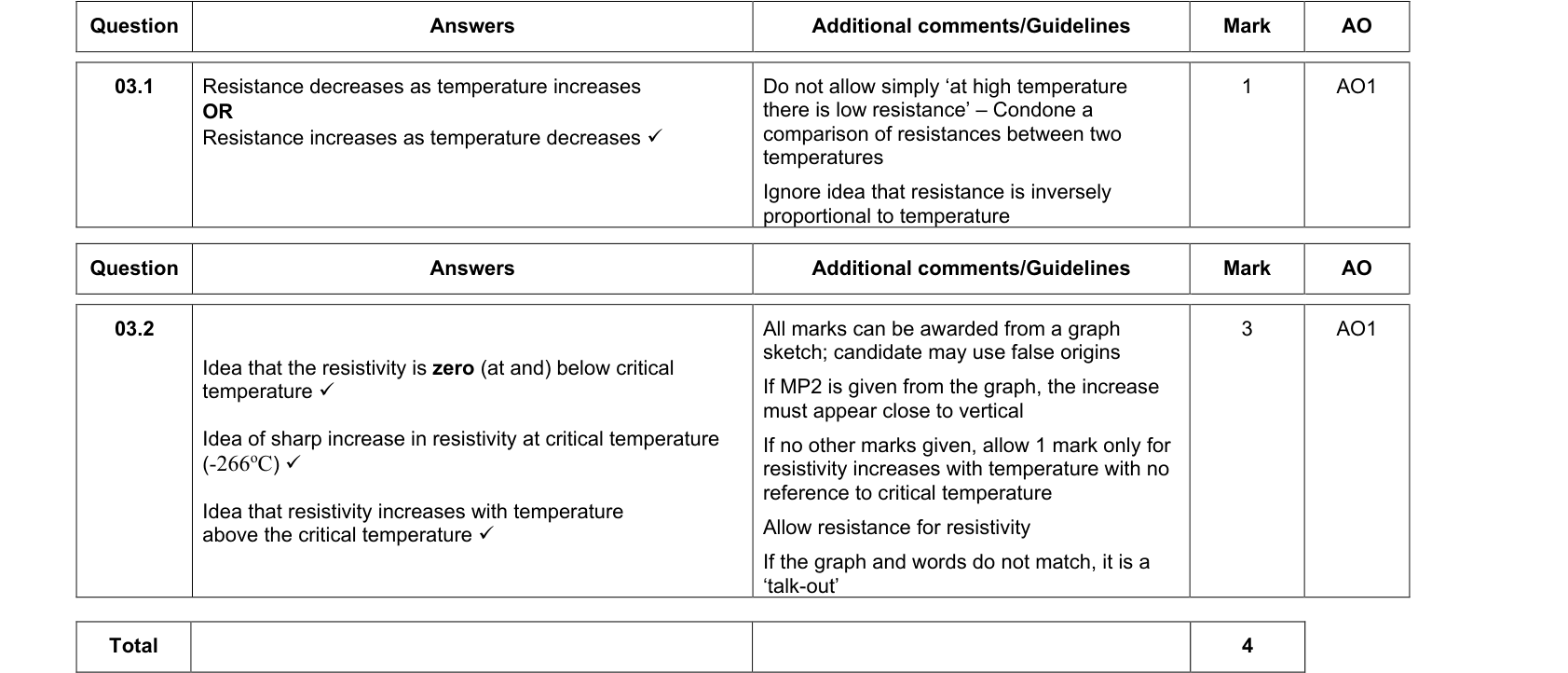
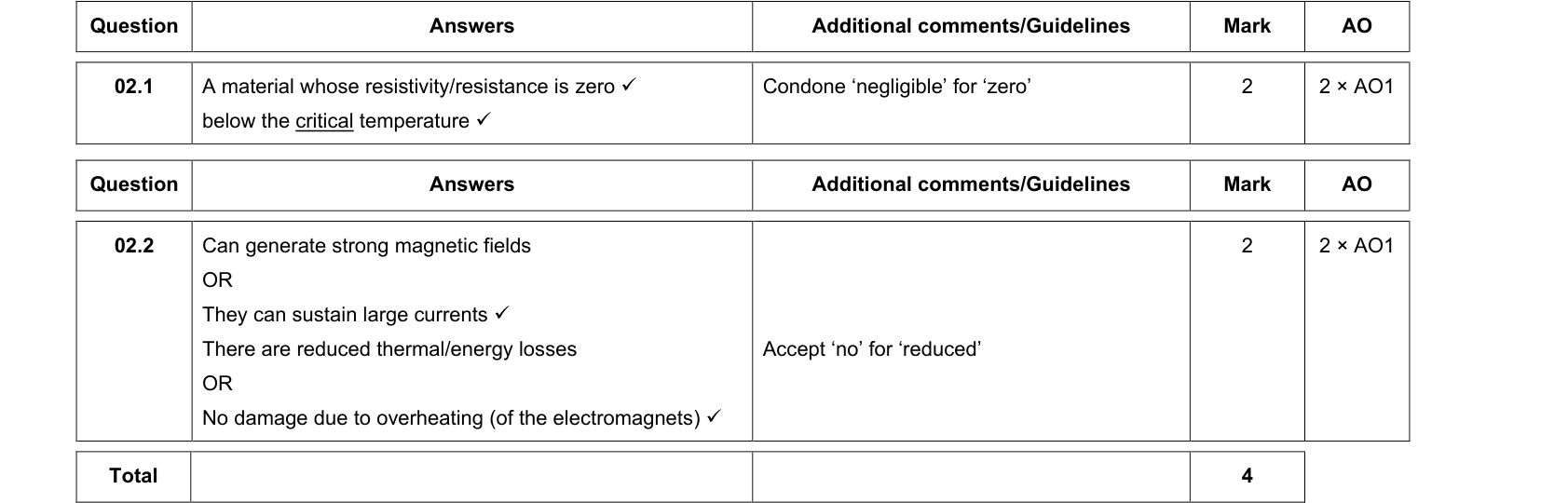
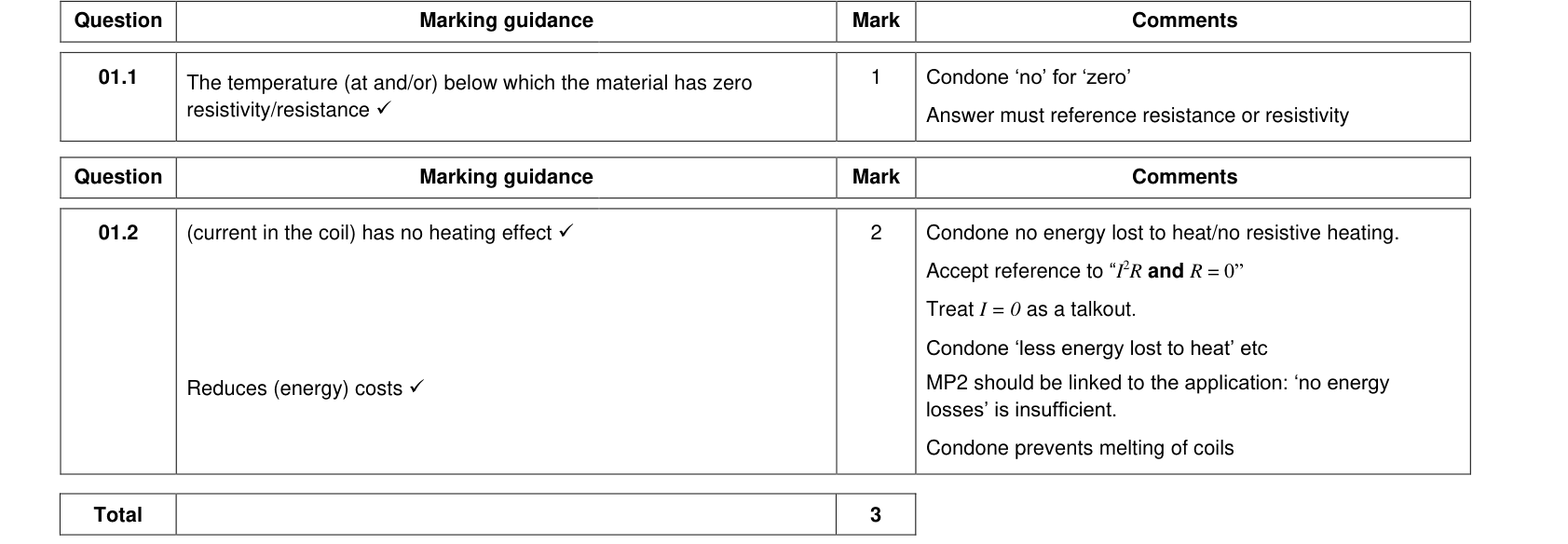
A superconductor is a material that has zero resistivity (zero resistance) at and below a critical temperature $T_c$, which depends on the material.
- Above $T_c$ the material behaves like an ordinary conductor. At $T_c$ its resistance drops suddenly to zero.
- Most critical temperatures are very low (a few kelvin for metals such as mercury and lead). "High-temperature" ceramic superconductors work below about 77–130 K, so they can be cooled with liquid nitrogen.
- With zero resistance, a current can flow without any energy being transferred to thermal energy.
Applications:
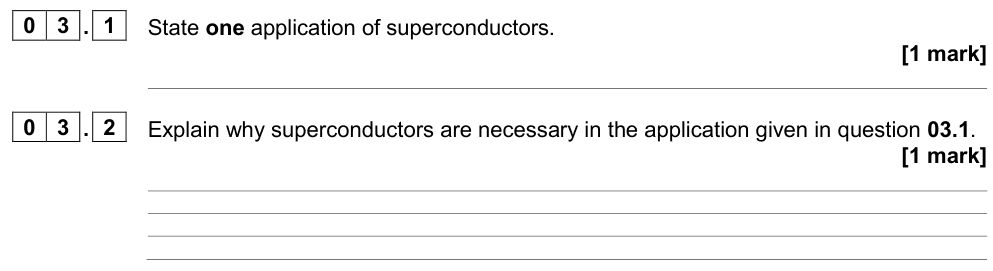
- Very strong magnetic fields: large currents with no heating in the coils of MRI scanners, particle accelerators and maglev trains.
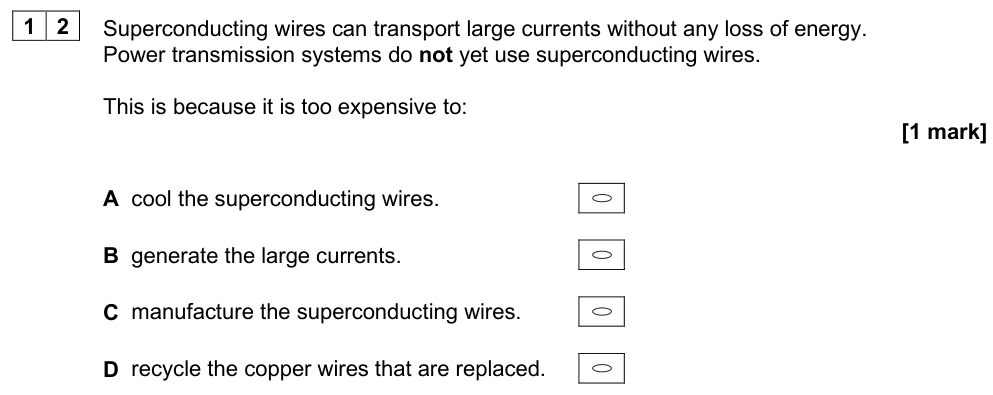
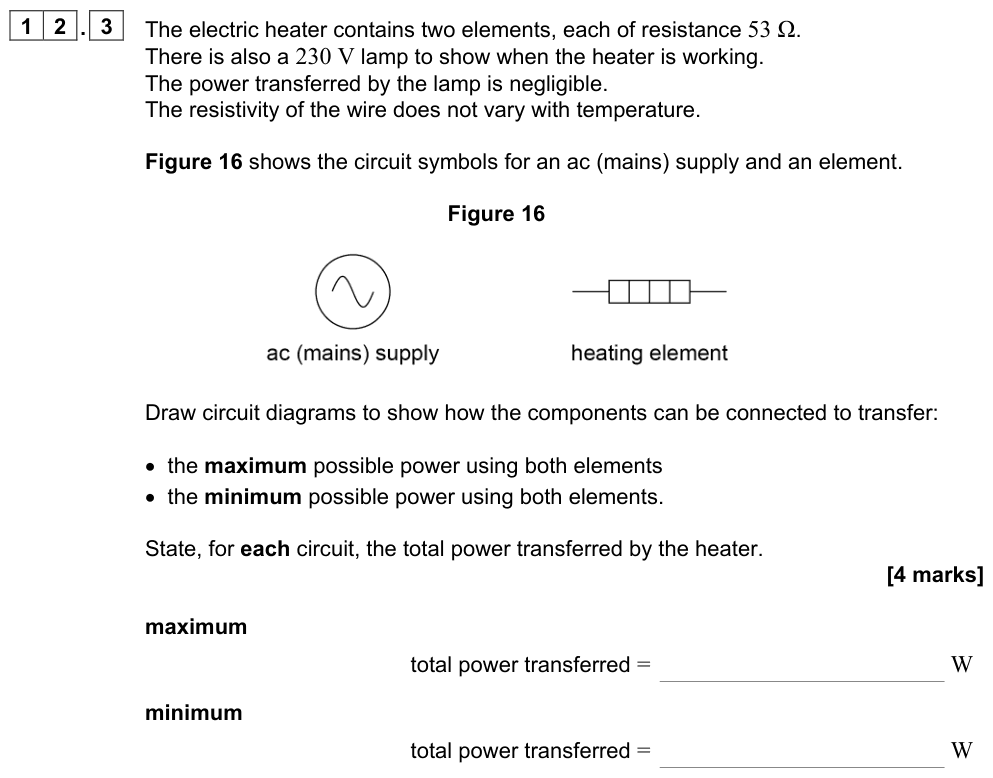
- Loss-free power transmission: no $I^2R$ heating losses in the cables (not yet widely used, because of the cost of cooling the cables).
Common mistake
Superconductors have zero resistance, not "very low" resistance. The change happens suddenly at the critical temperature.
Summary
- $R = \rho L/A$; resistivity in Ω m is a property of the material.
- Metals: resistance rises with temperature (more lattice vibration).
- NTC thermistors: resistance falls steeply with temperature (more charge carriers); used as temperature sensors.
- Superconductors: zero resistivity at and below the critical temperature; used for strong electromagnets and potentially loss-free power transmission.