Refraction and refractive index
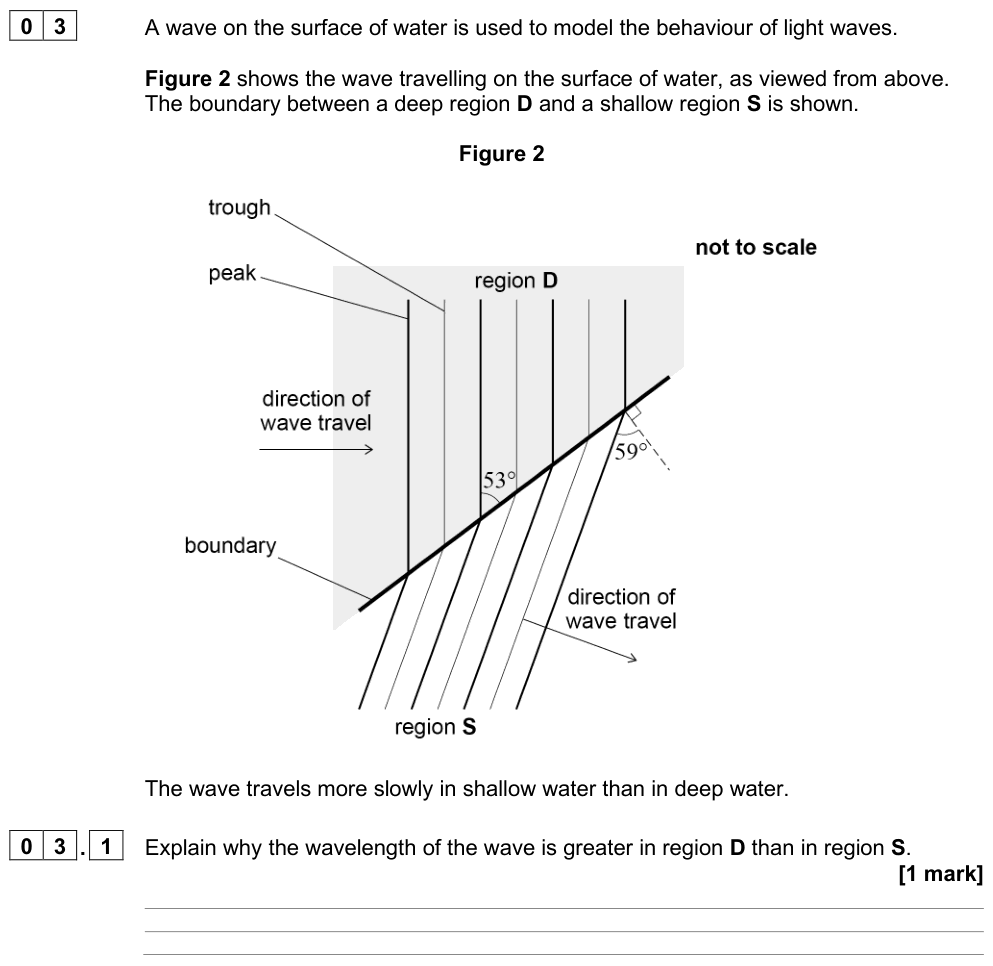
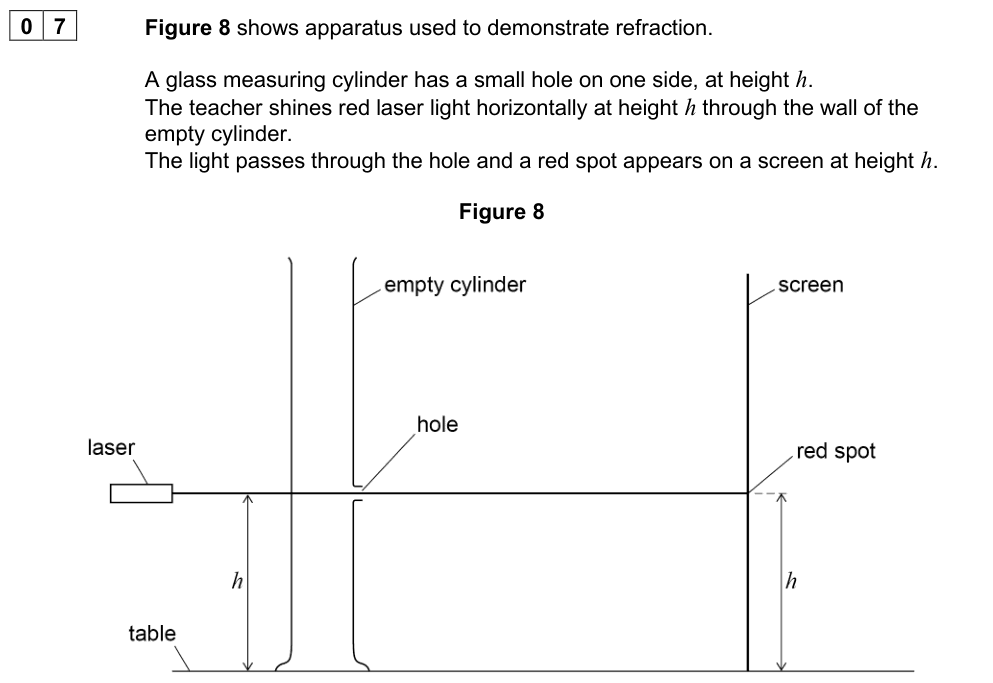
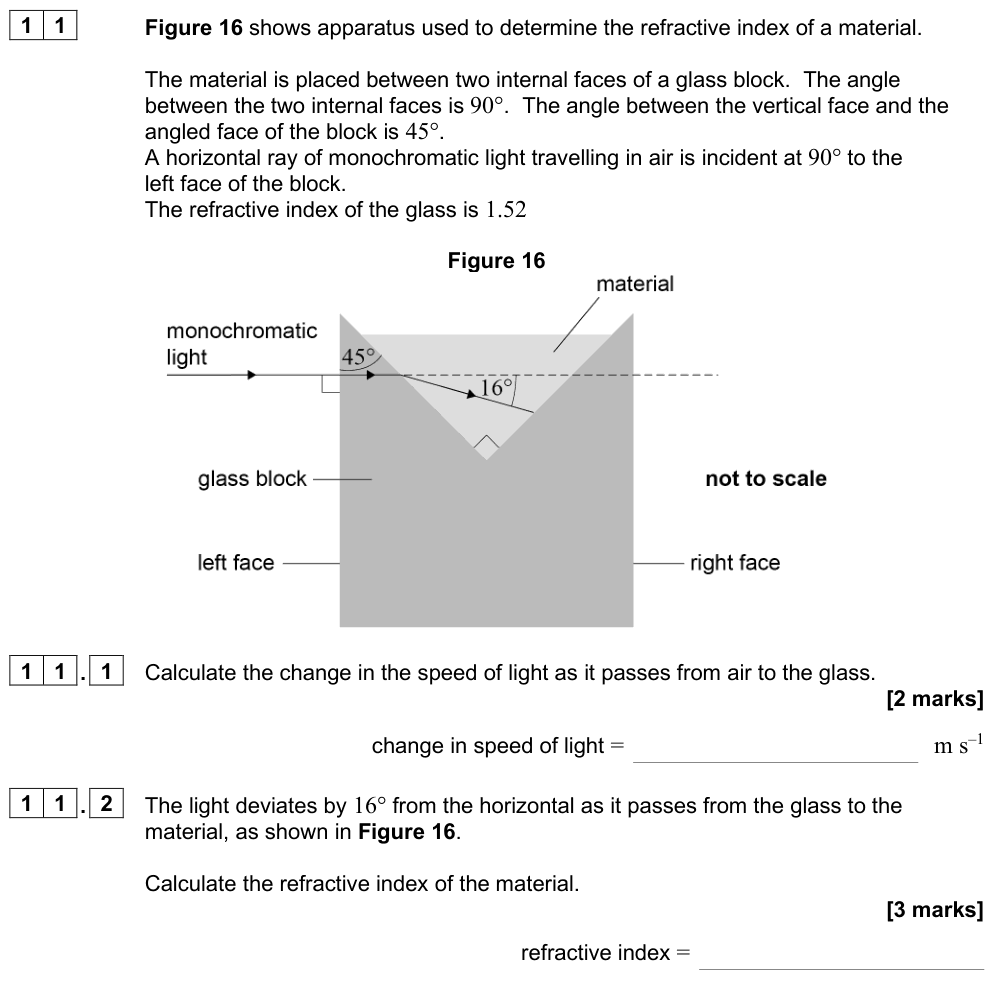
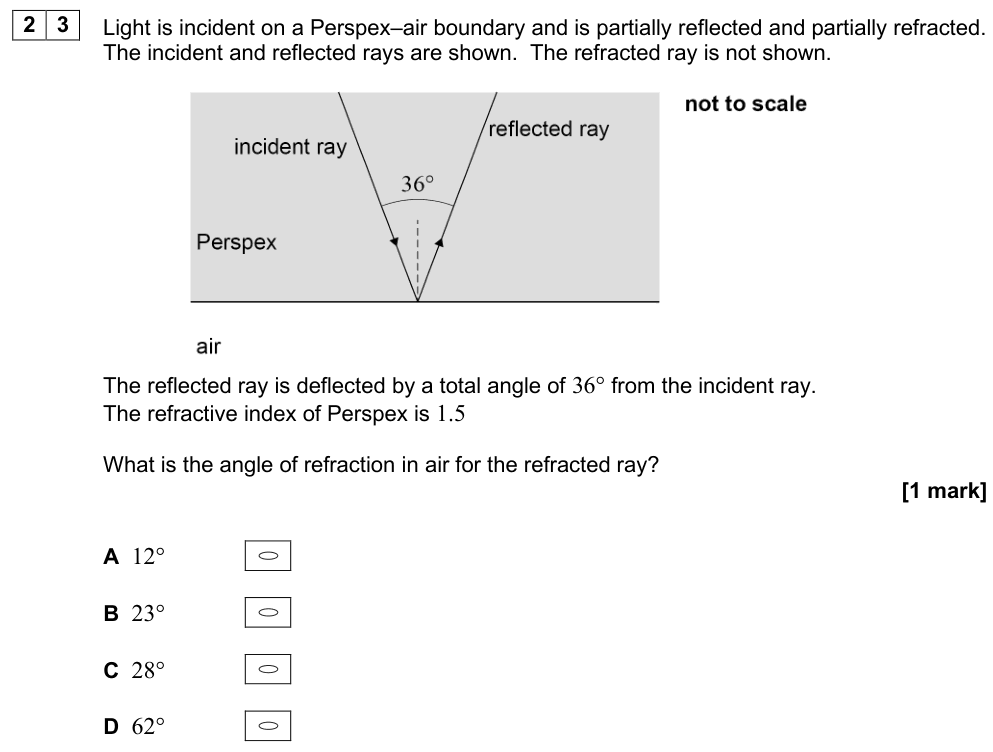
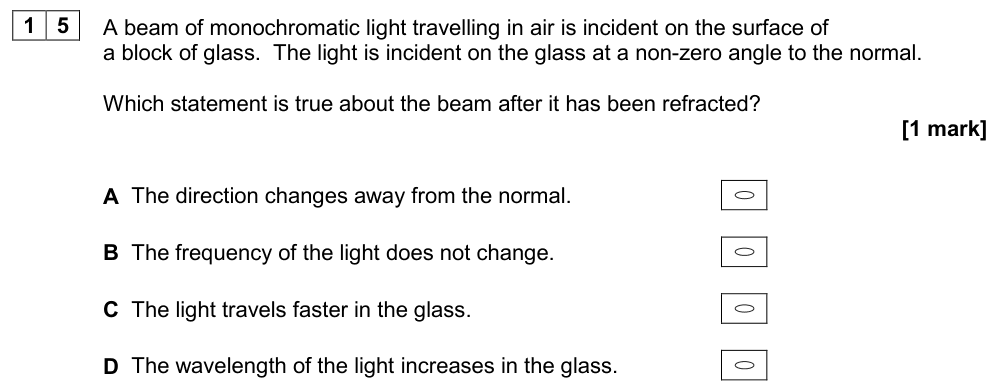
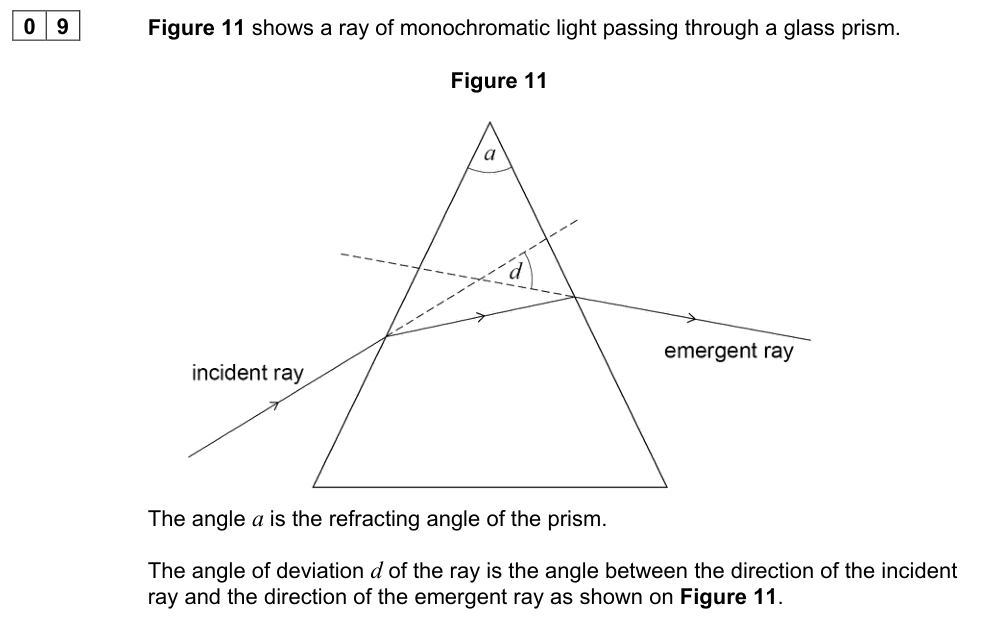
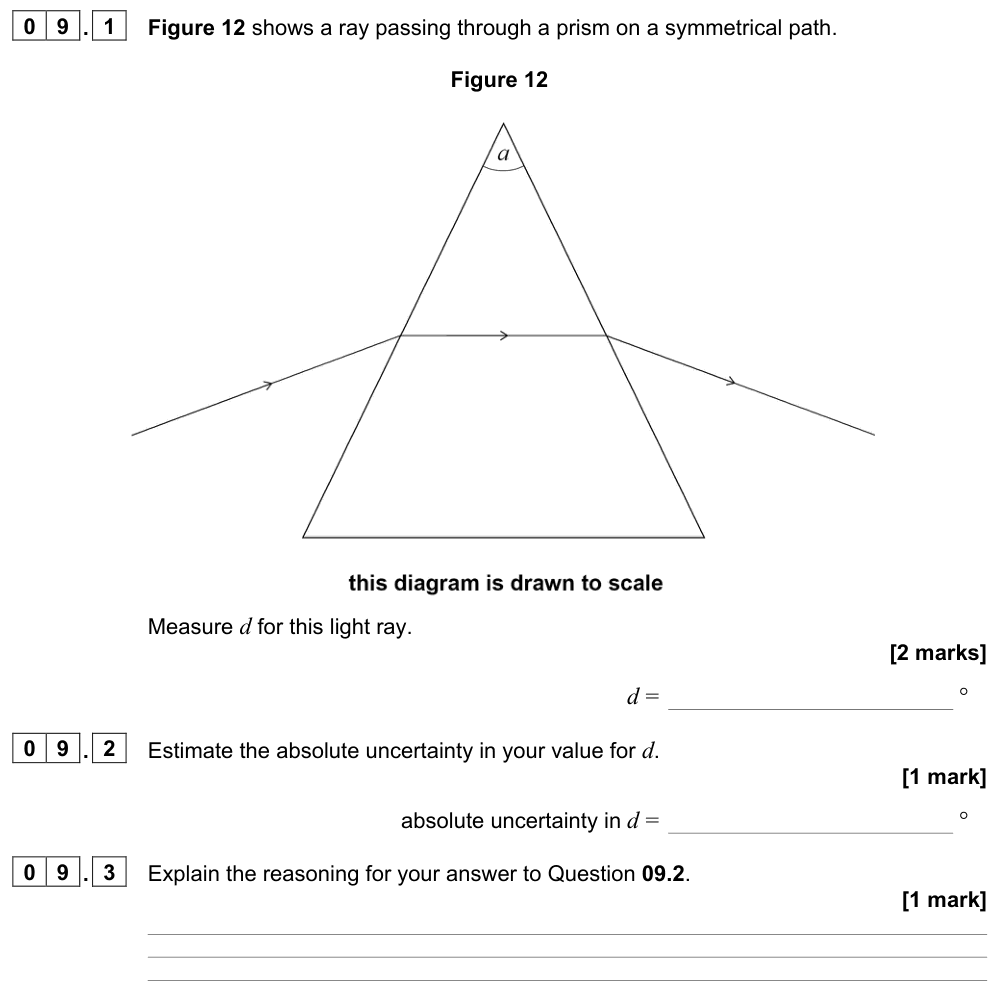
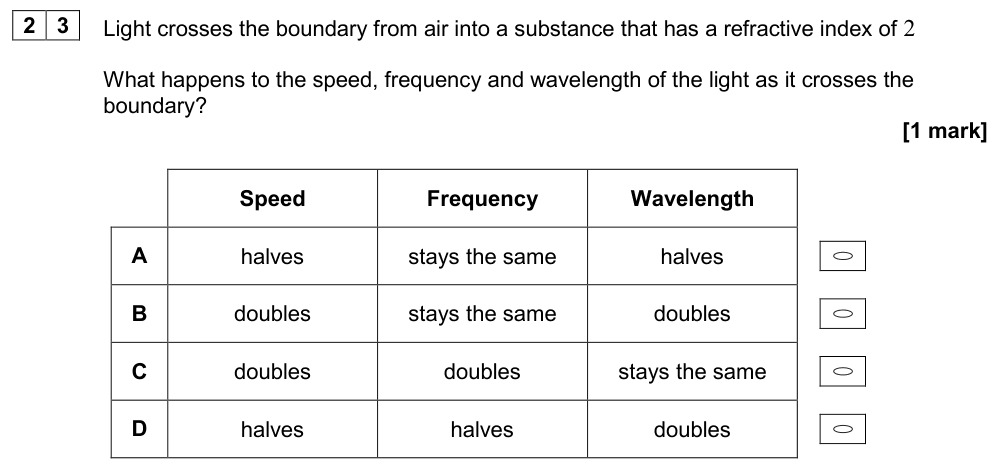
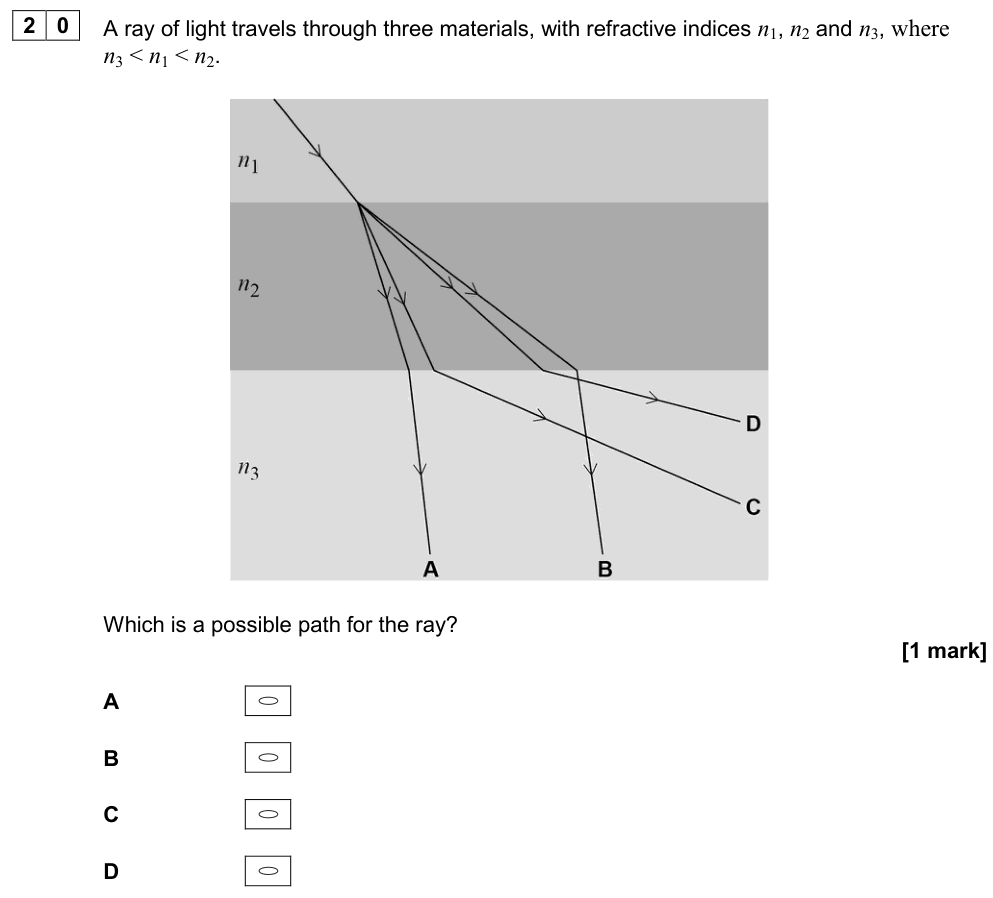
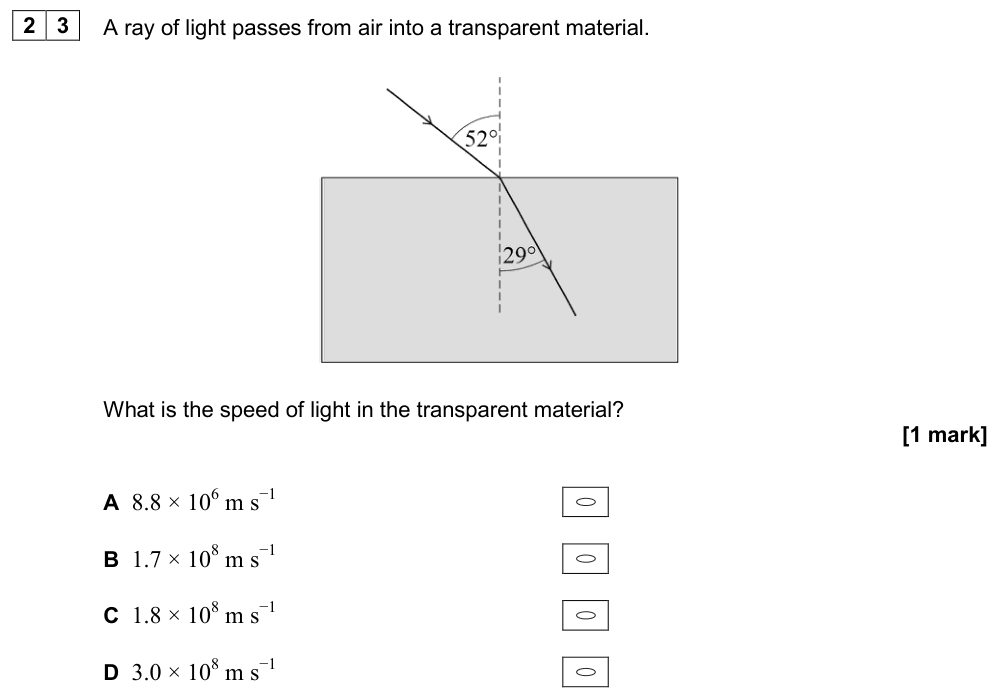
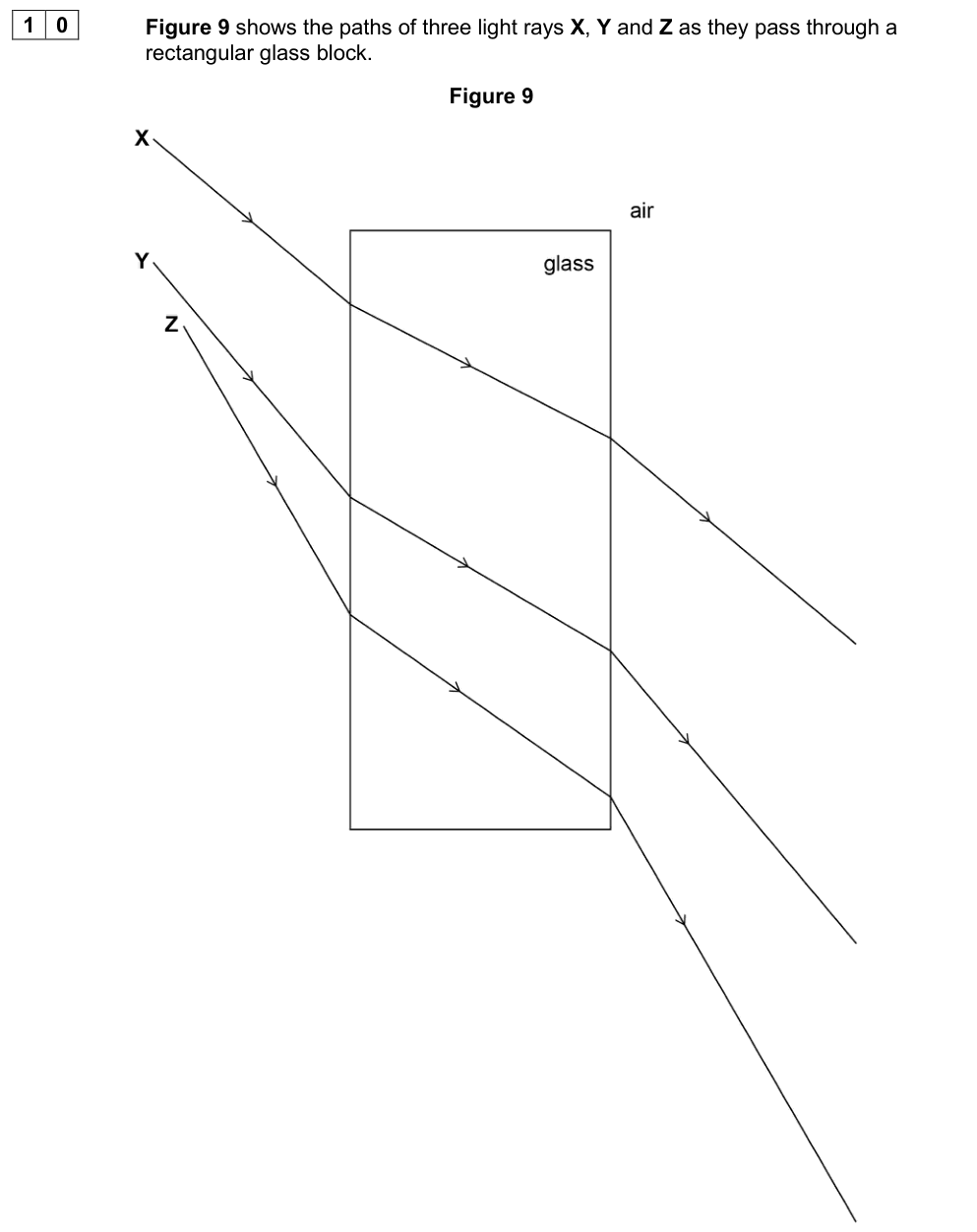
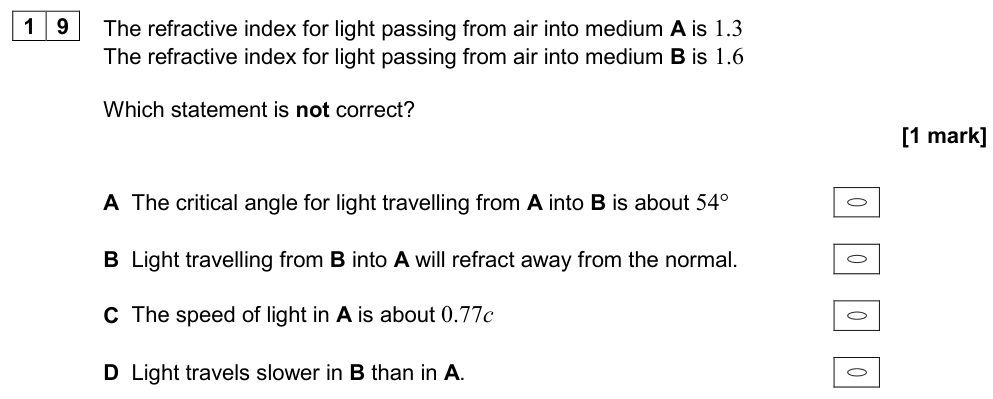
Refraction is the change in direction of a wave when it crosses a boundary between two media at an angle, because its speed changes. Light slows down when it enters a denser optical medium (e.g. air → glass) and bends towards the normal. It speeds up and bends away from the normal when it leaves.
Refractive index
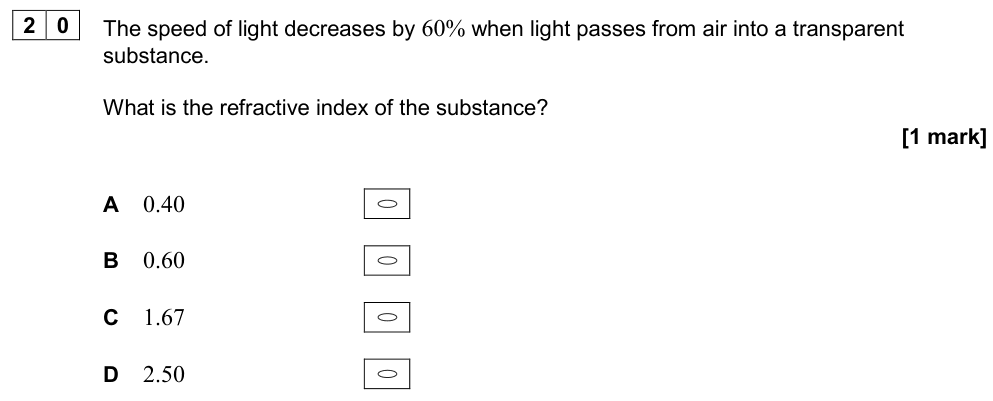
The absolute refractive index of a substance is
$$n = \frac{c}{c_s}$$
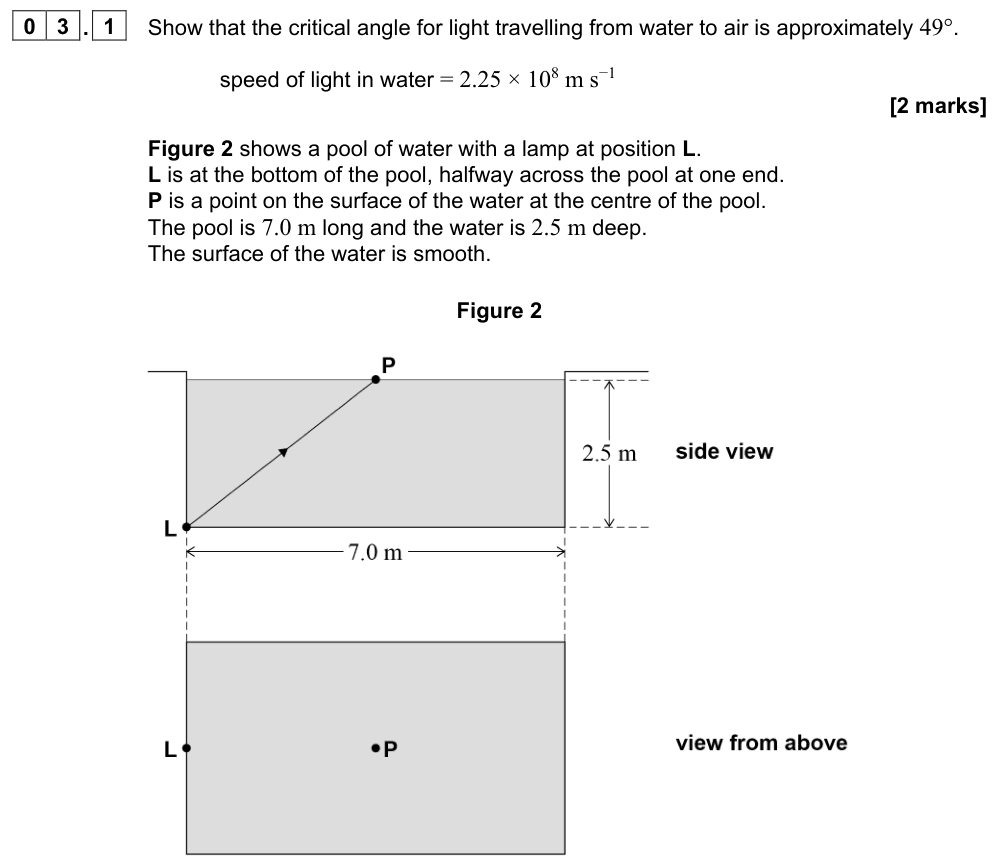
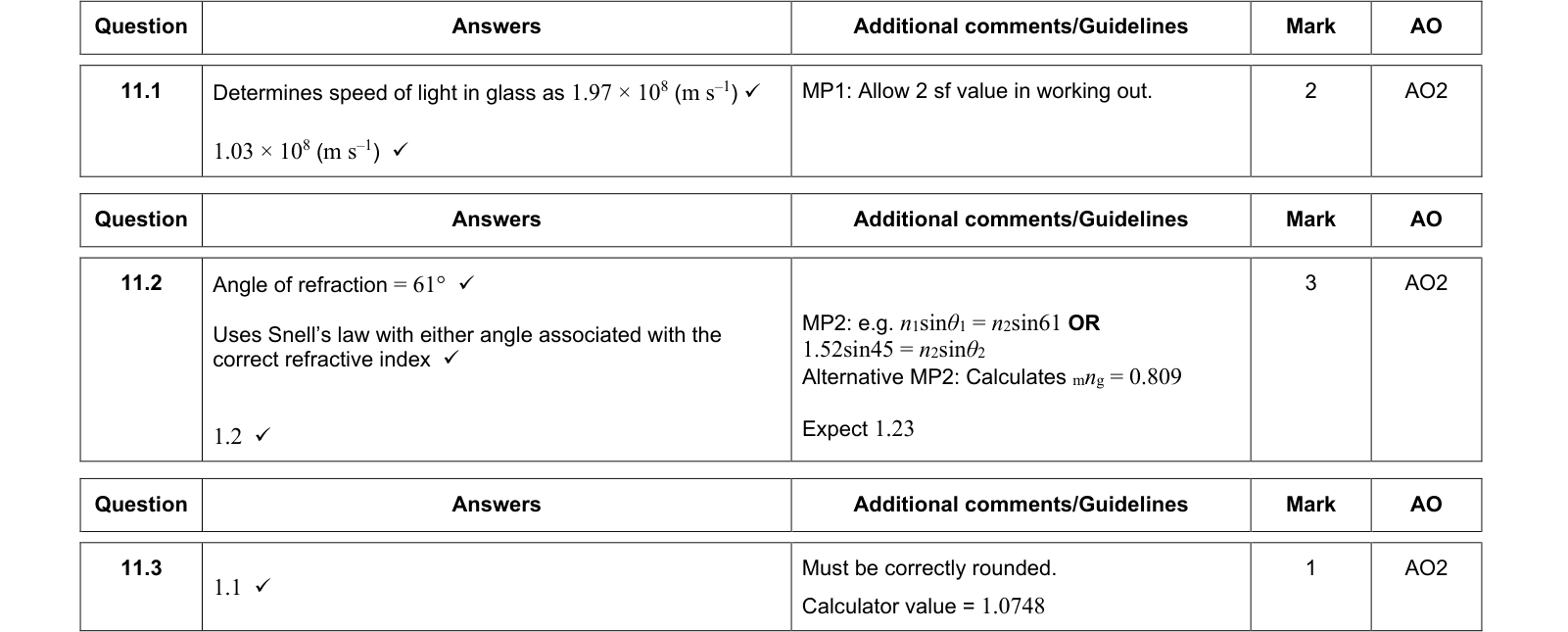
where $c$ is the speed of light in a vacuum and $c_s$ is the speed of light in the substance. $n$ has no unit and is always ≥ 1. The refractive index of air is approximately 1.
| Material | Refractive index |
|---|---|
| air | 1.00 |
| water | 1.33 |
| glass | 1.5 (about 1.45–1.7) |
| diamond | 2.42 |
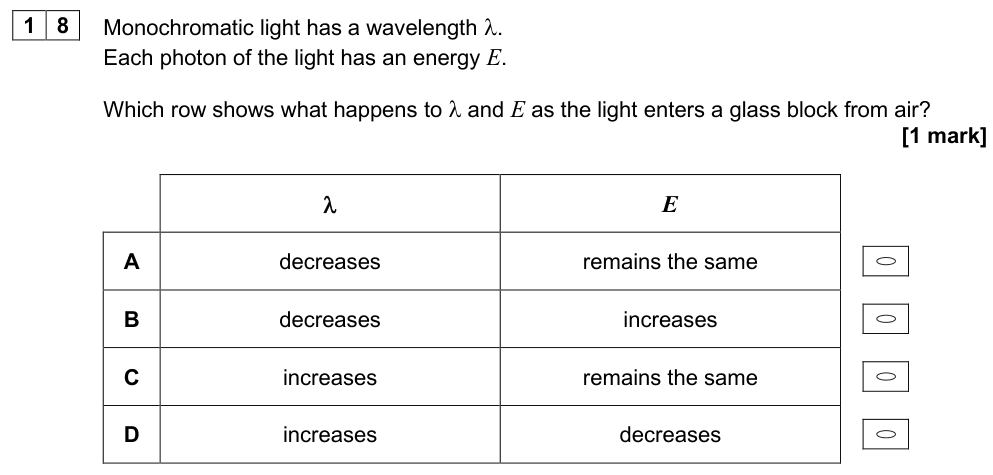
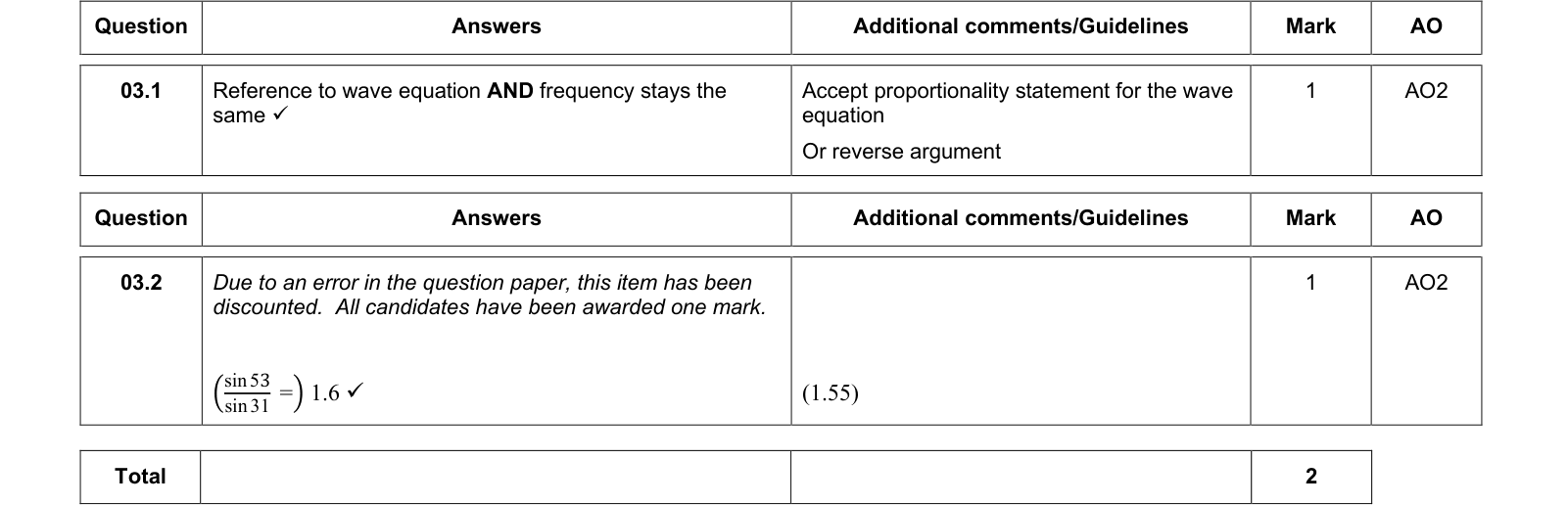
The frequency stays the same at a boundary, so the wavelength changes in the same ratio as the speed: $\lambda_s = \lambda/n$.
Snell's law
Snell's law
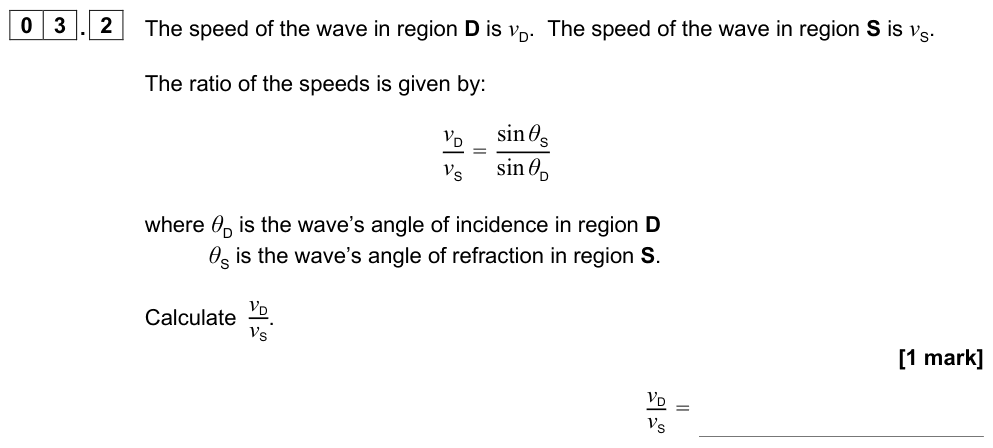
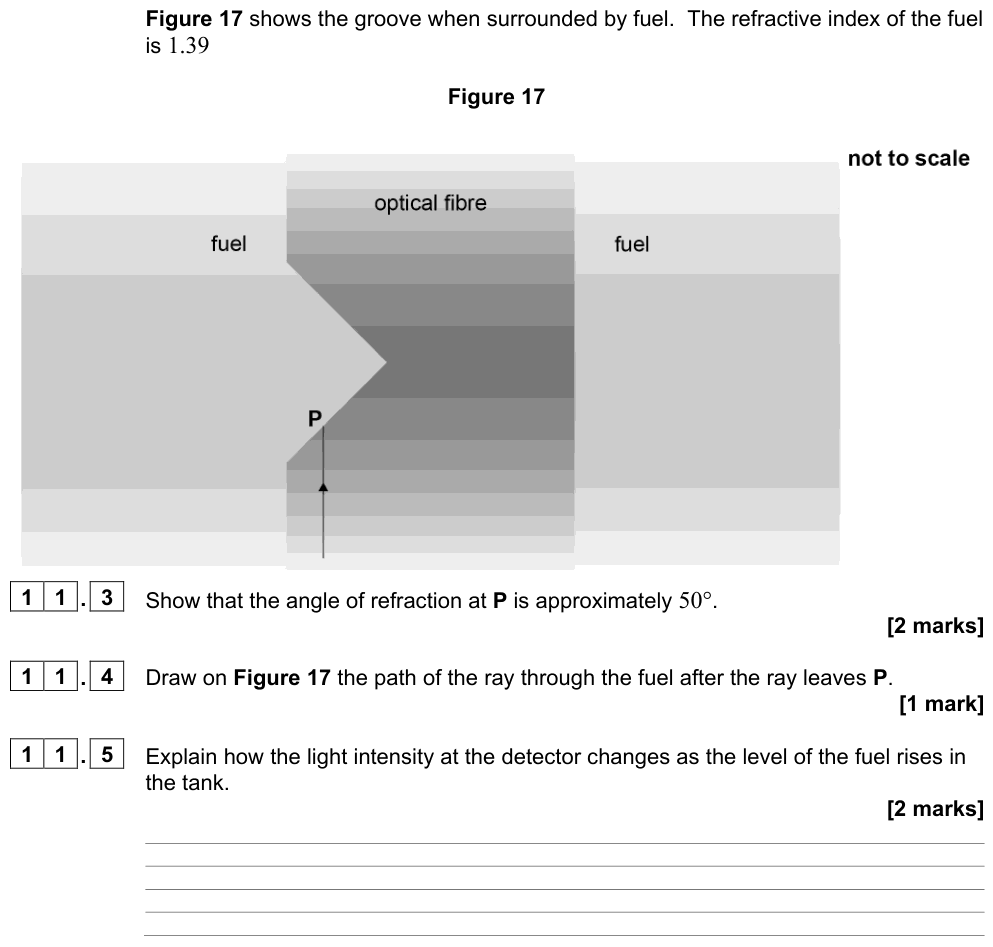
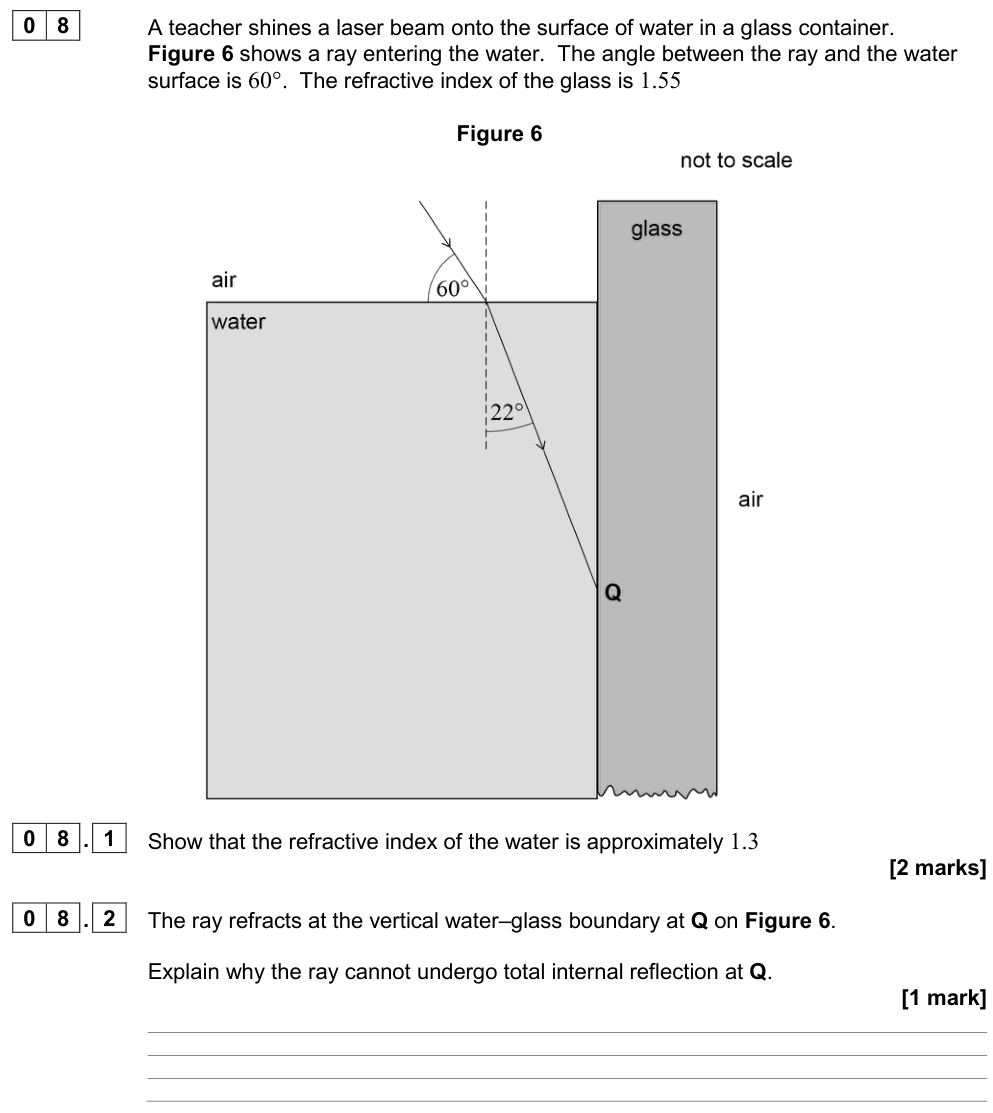
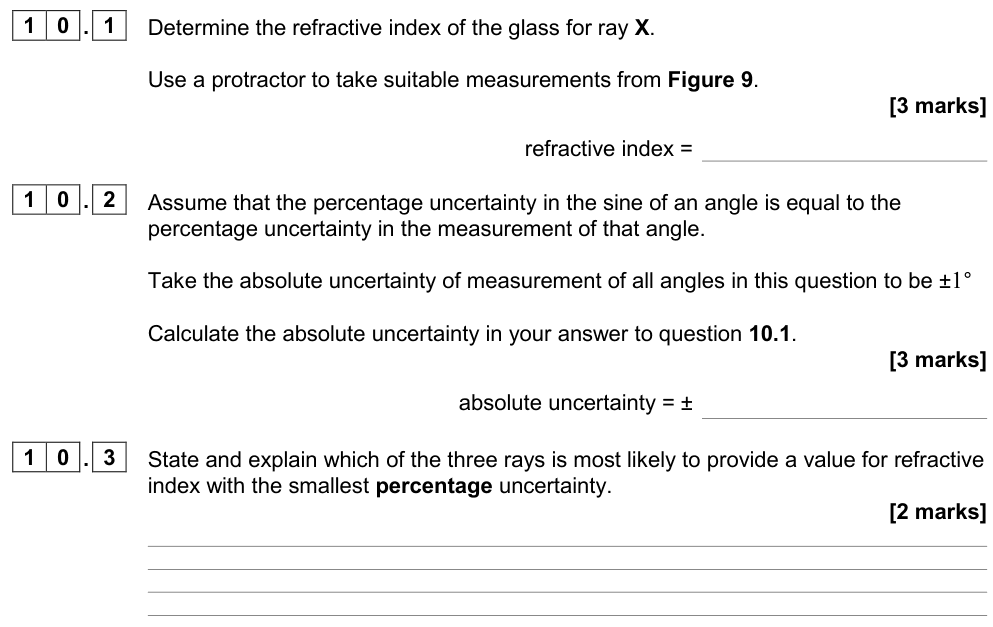
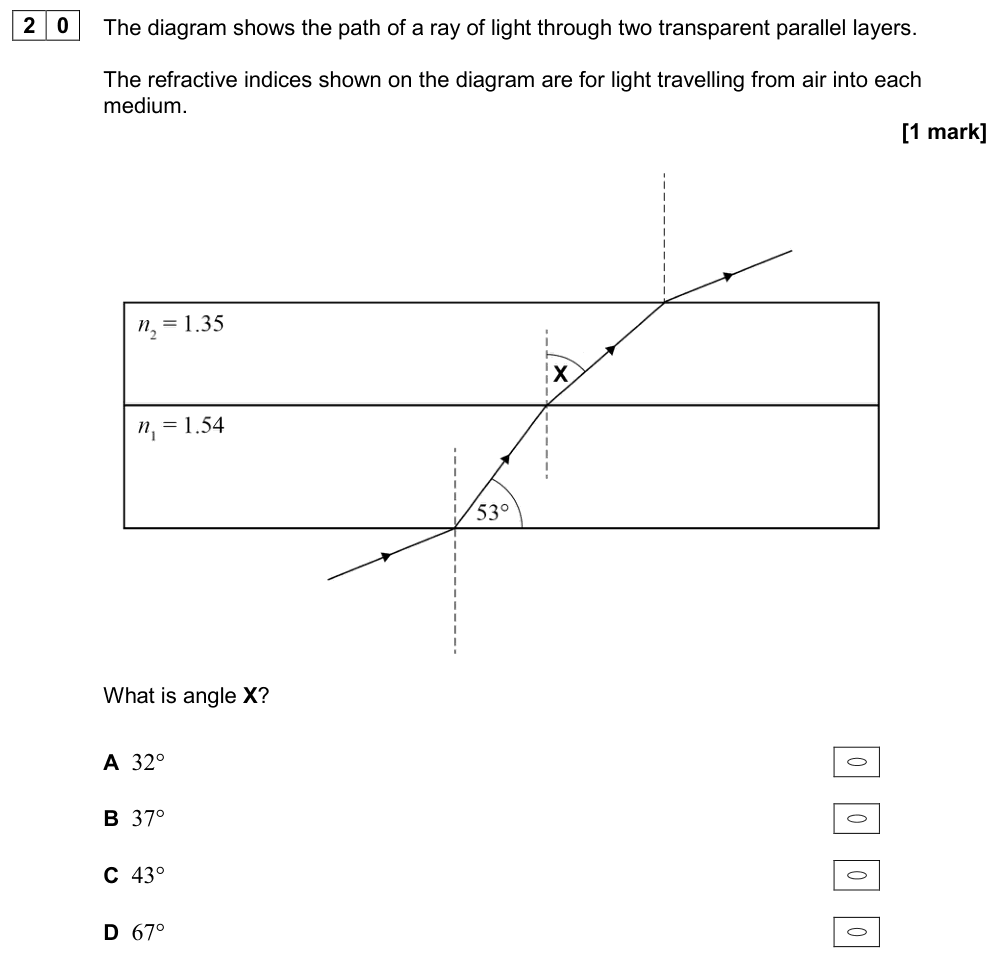
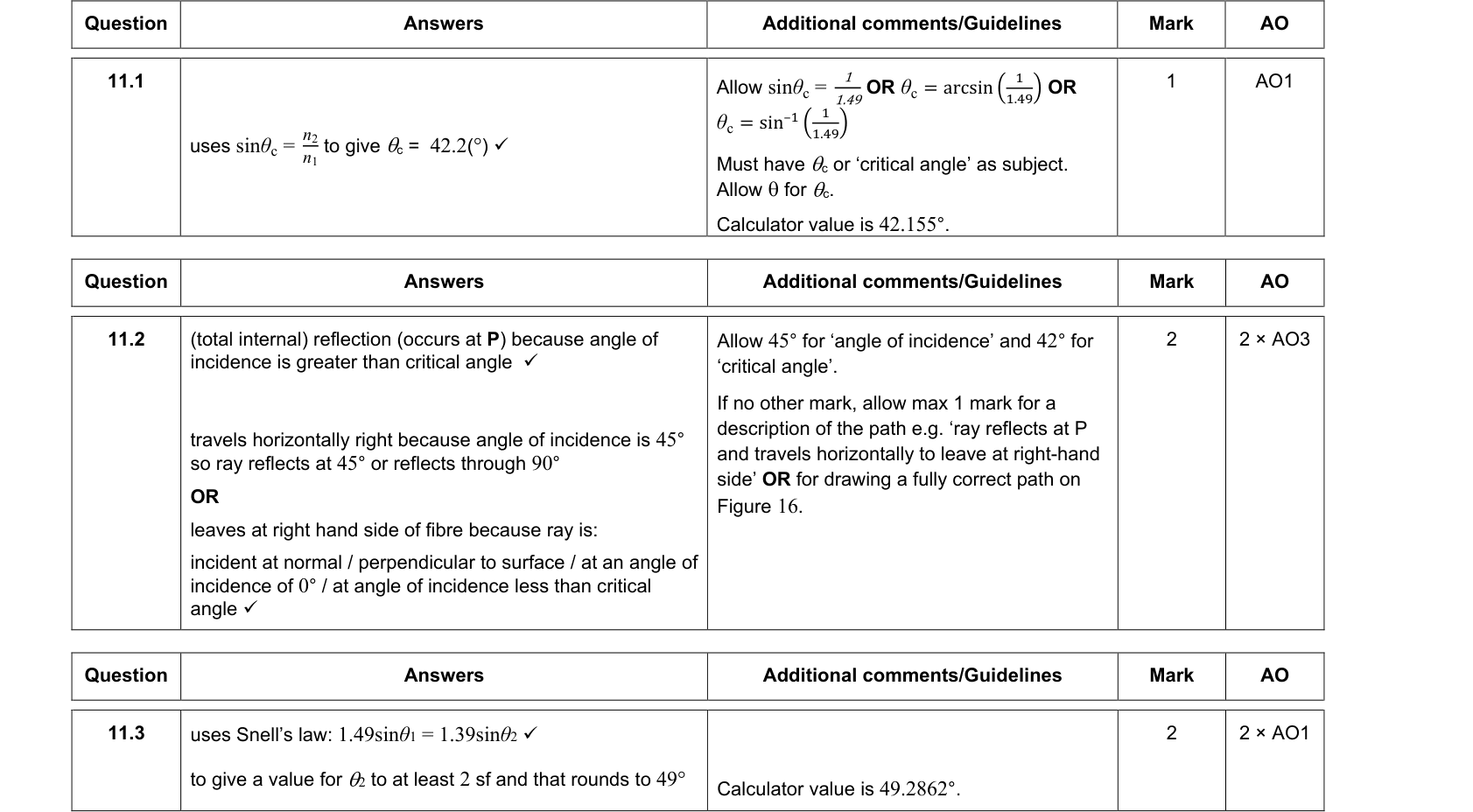
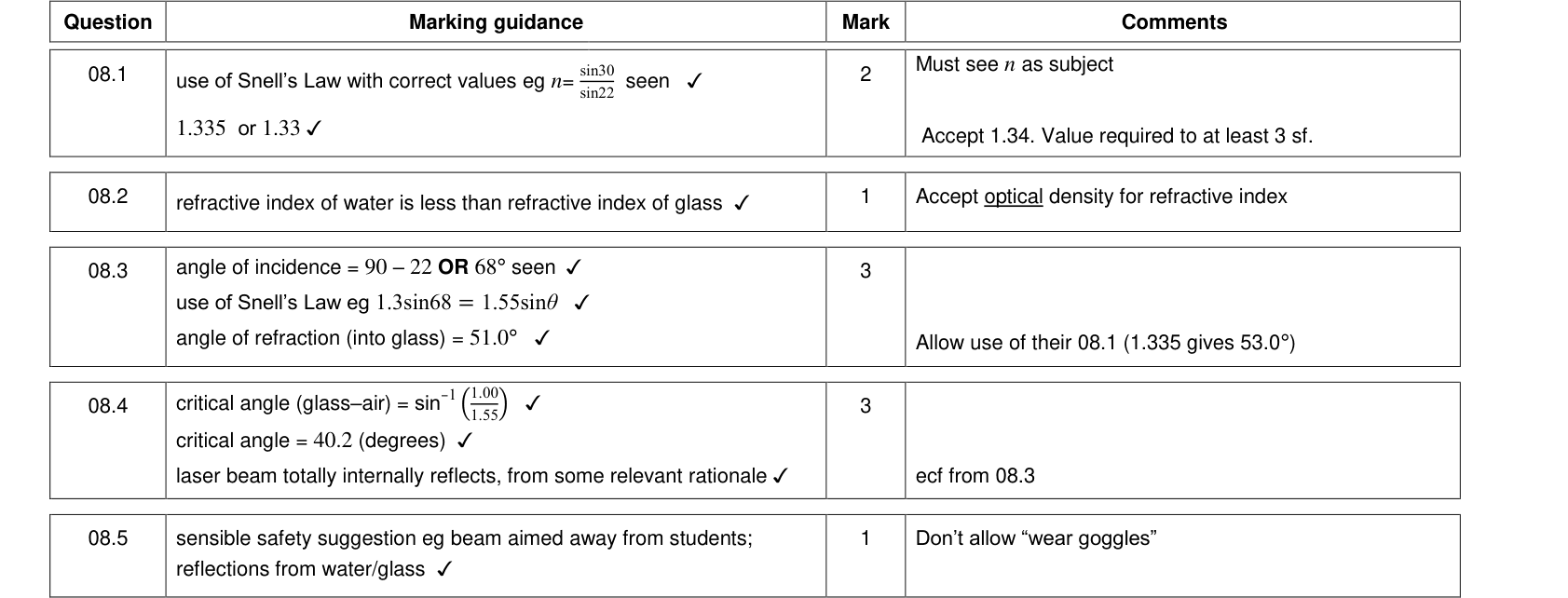
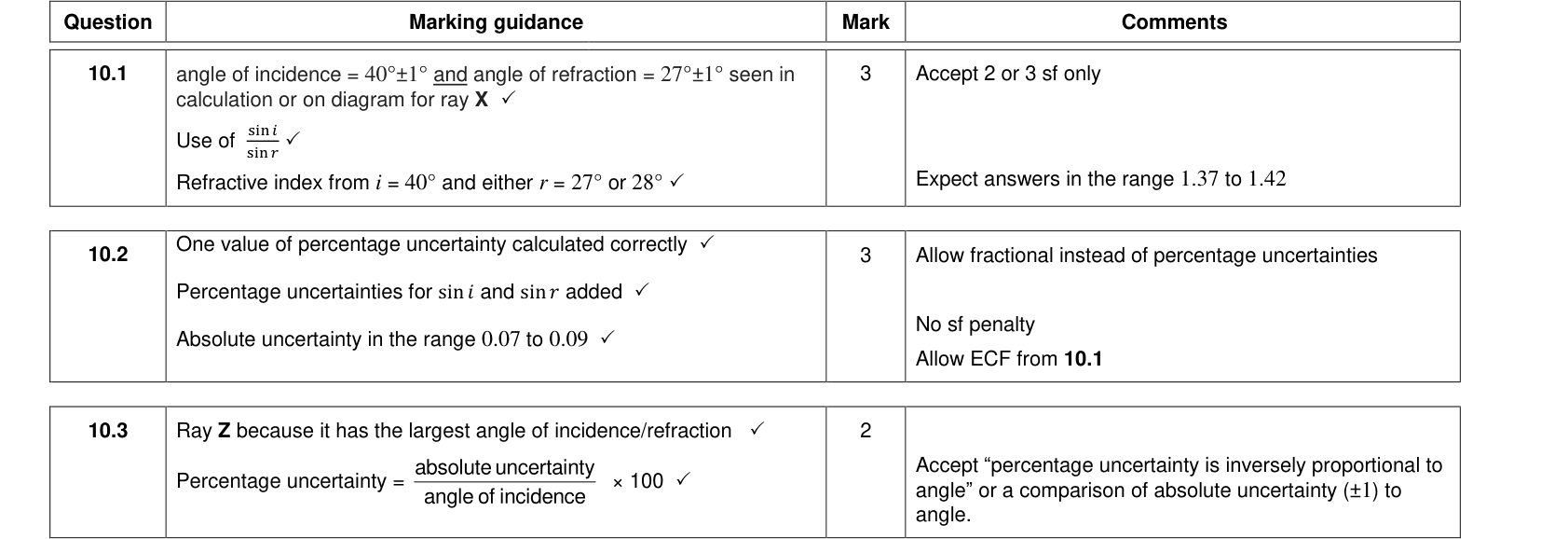
$$n_1\sin\theta_1 = n_2\sin\theta_2$$
Angles are measured from the normal. $n_1$ and $\theta_1$ refer to the medium the light is coming from.
Worked example: air to glass
Light enters glass ($n = 1.52$) from air at an angle of incidence of 40°.
$1.00 \times \sin40^\circ = 1.52\sin\theta_2 \Rightarrow \sin\theta_2 = 0.423 \Rightarrow \theta_2 = 25.0^\circ$.
Total internal reflection
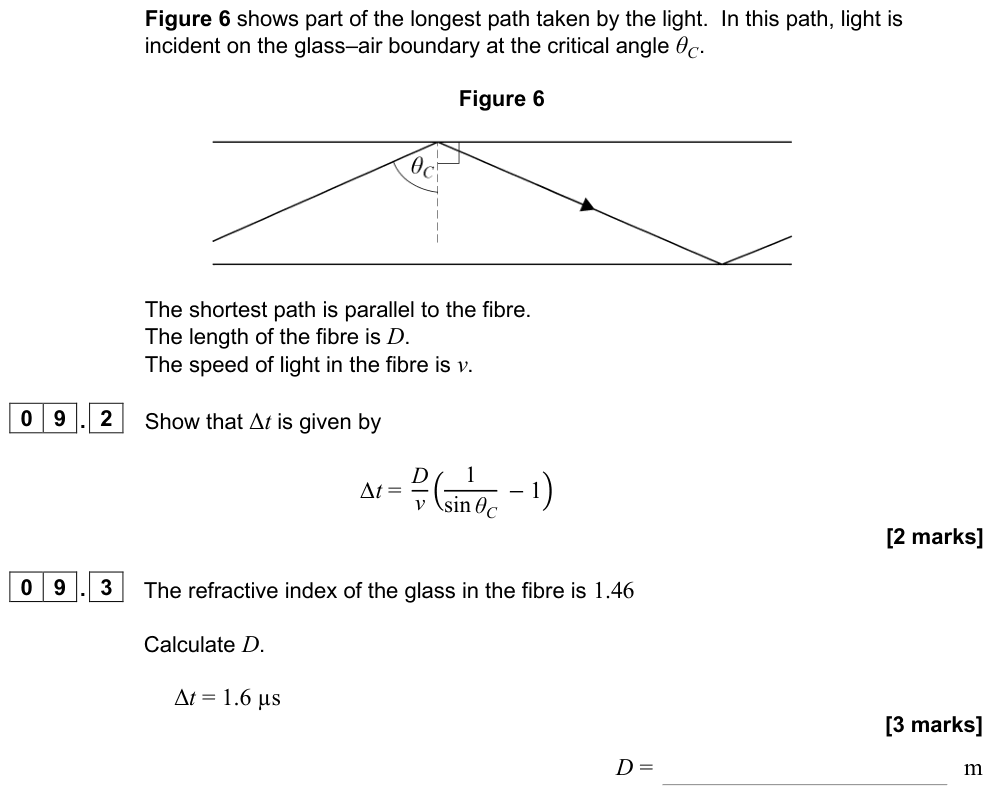
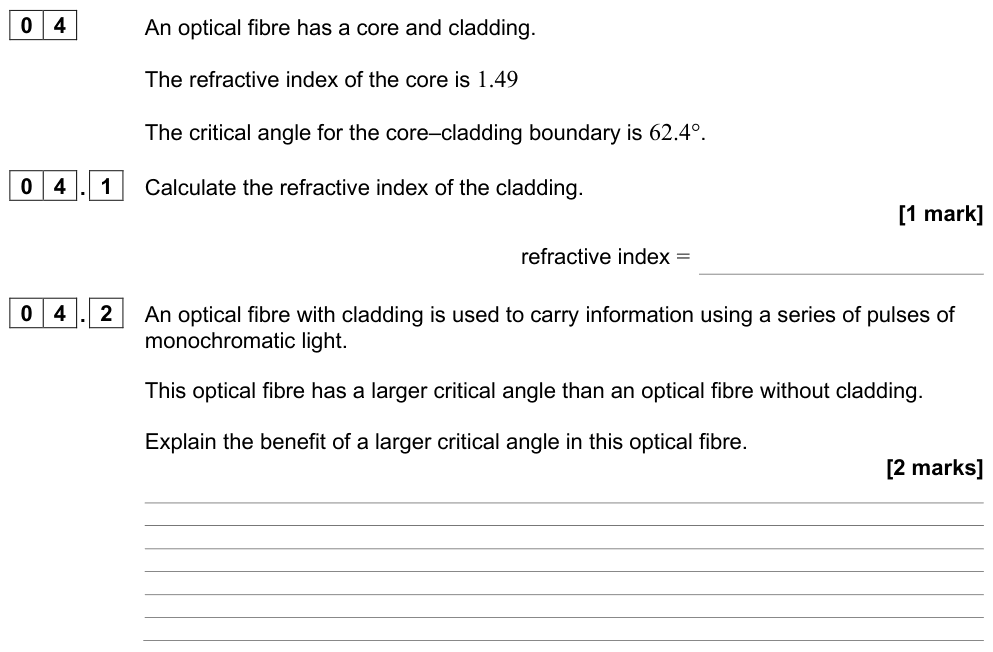
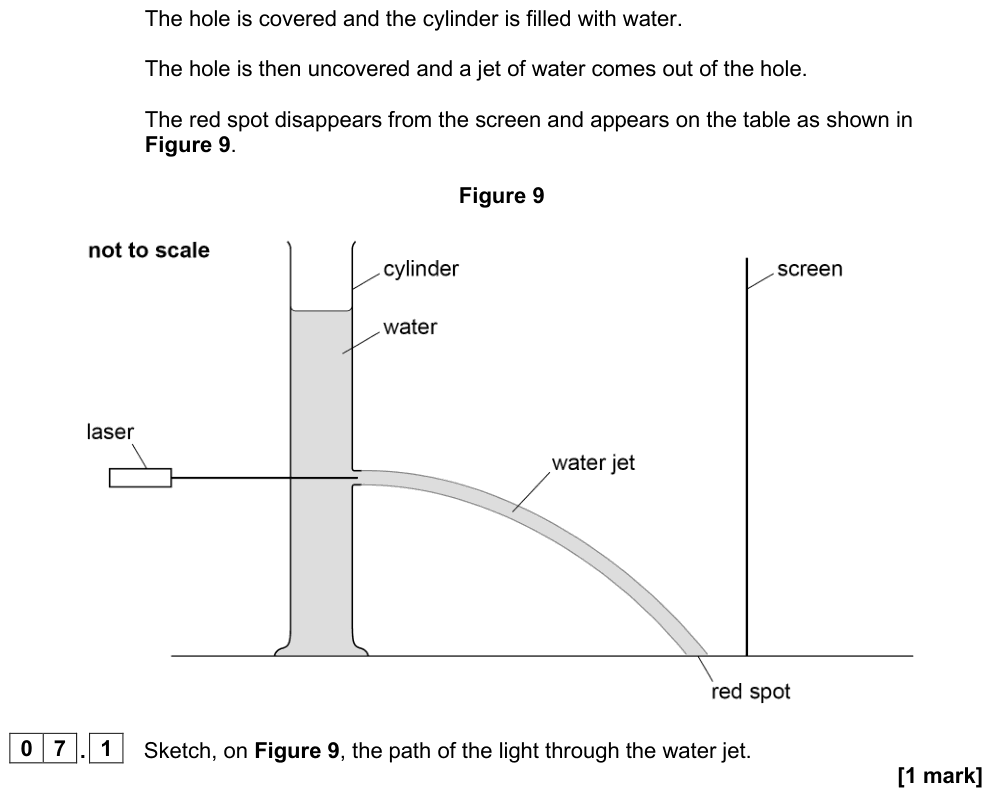
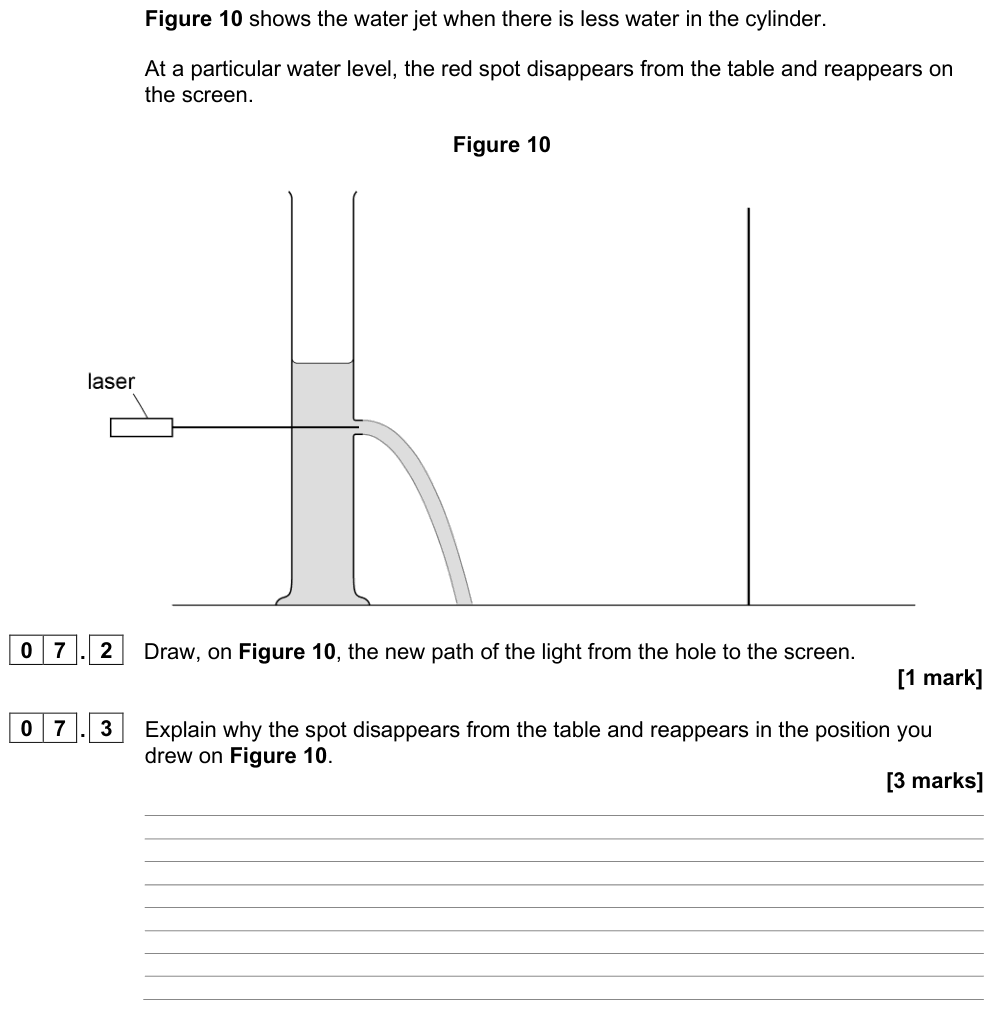
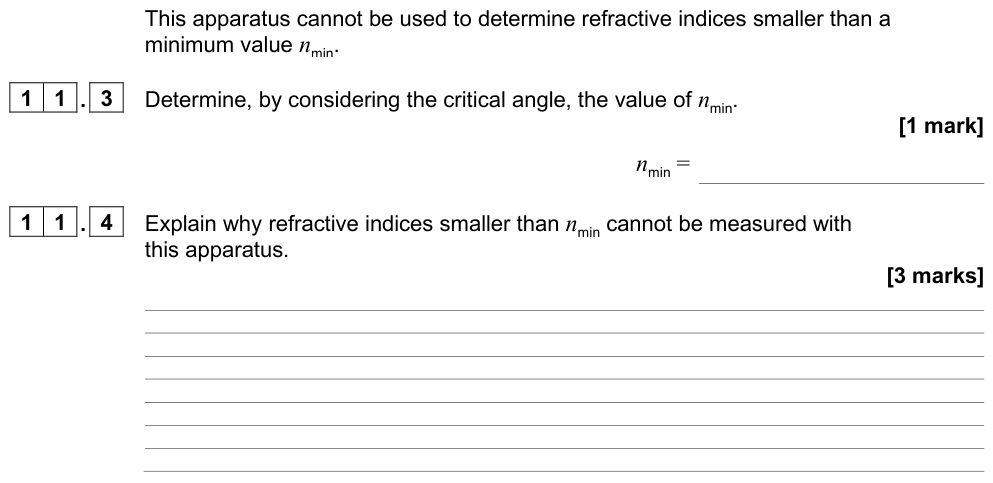
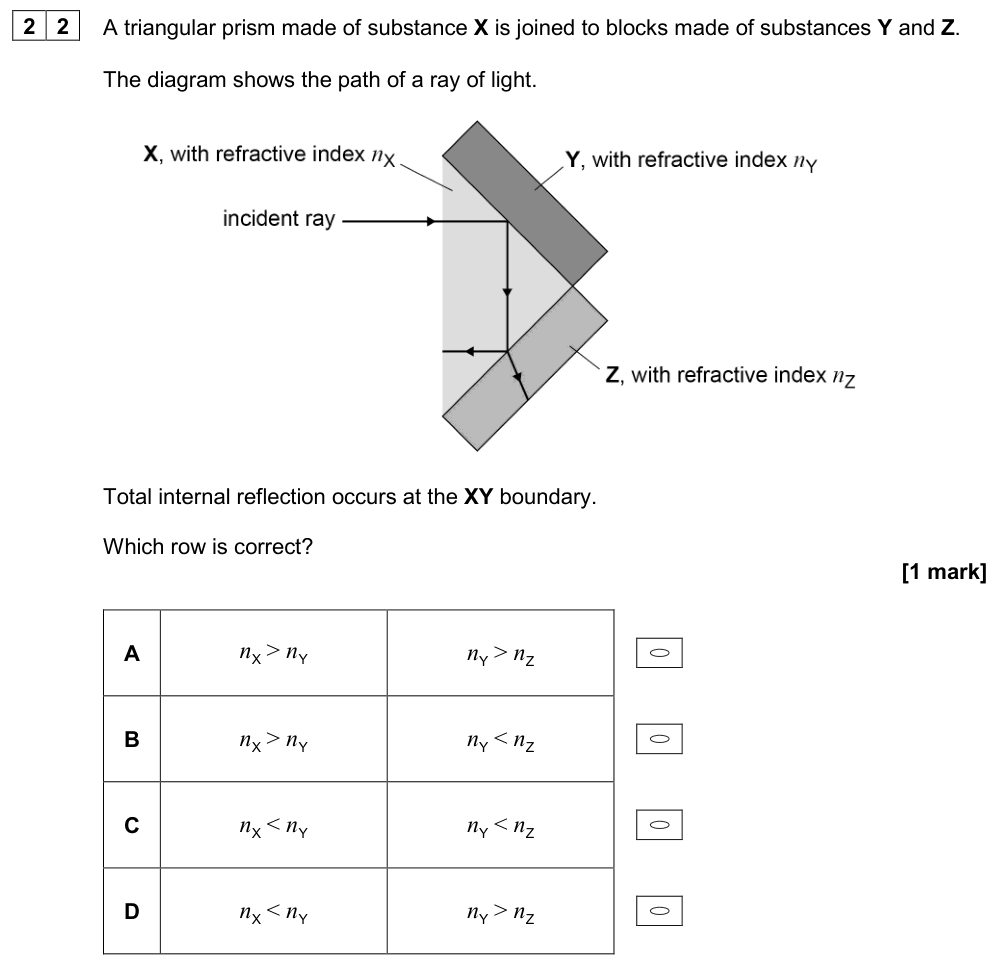
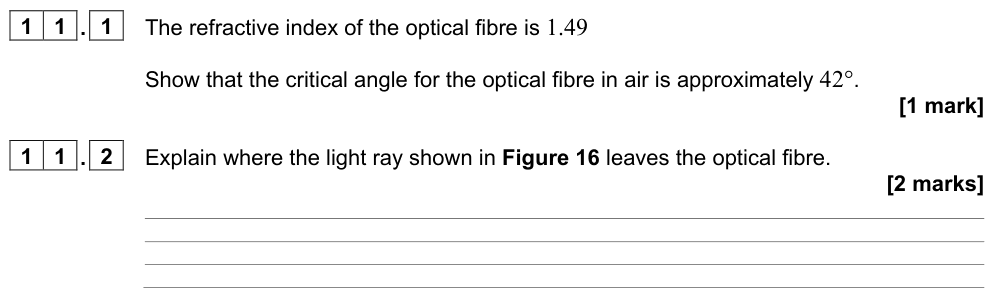
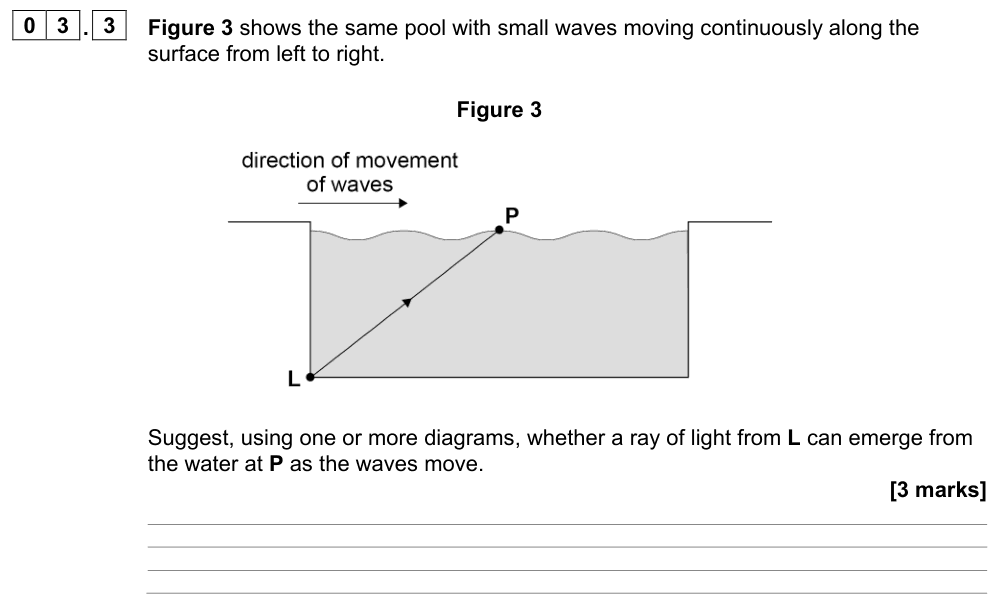
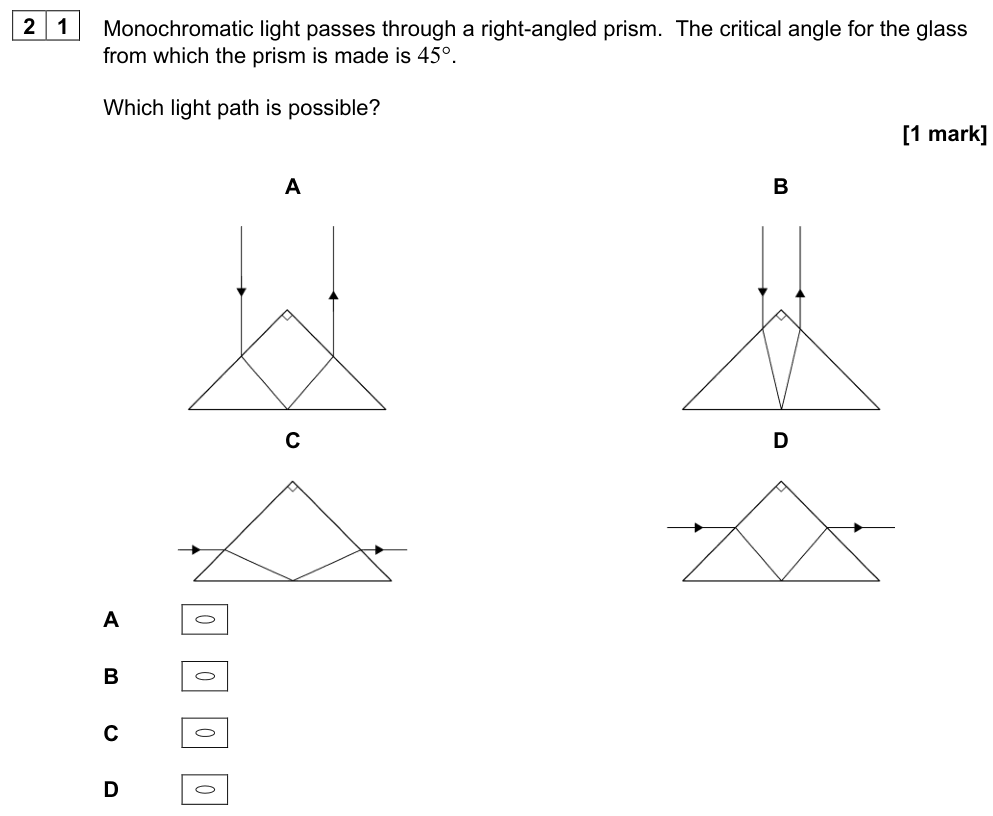
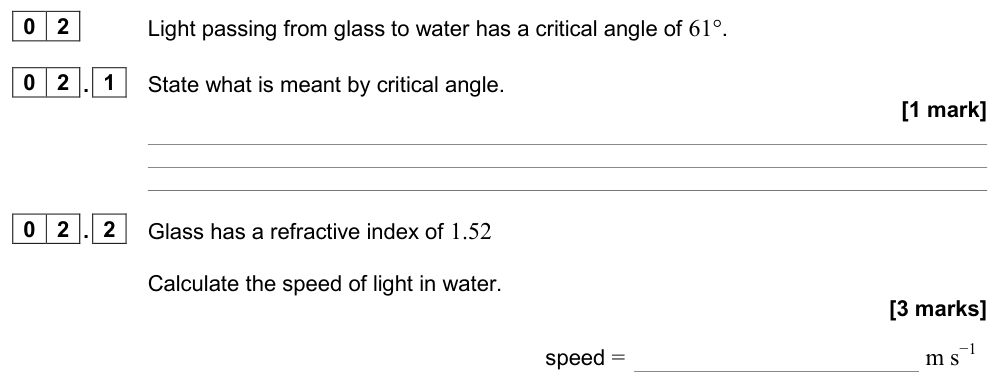
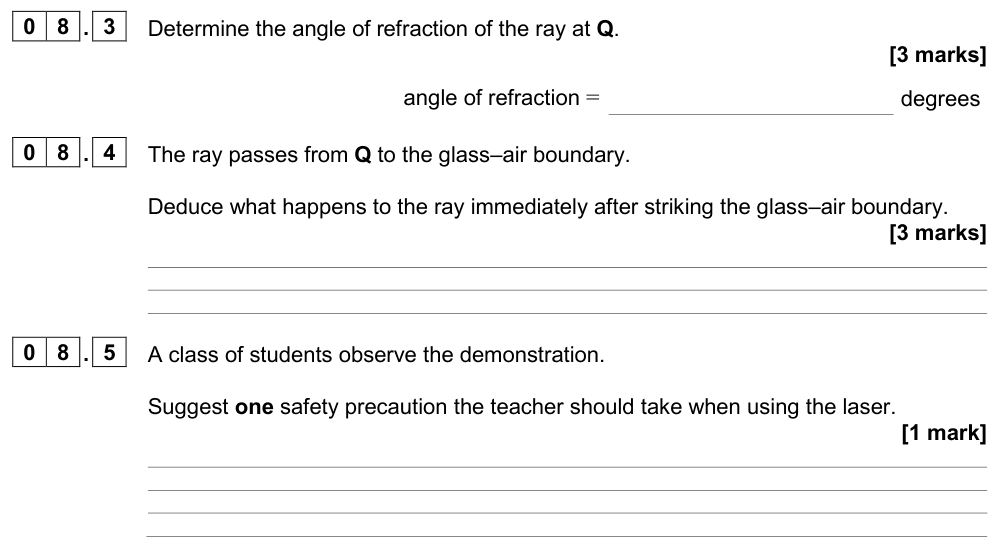
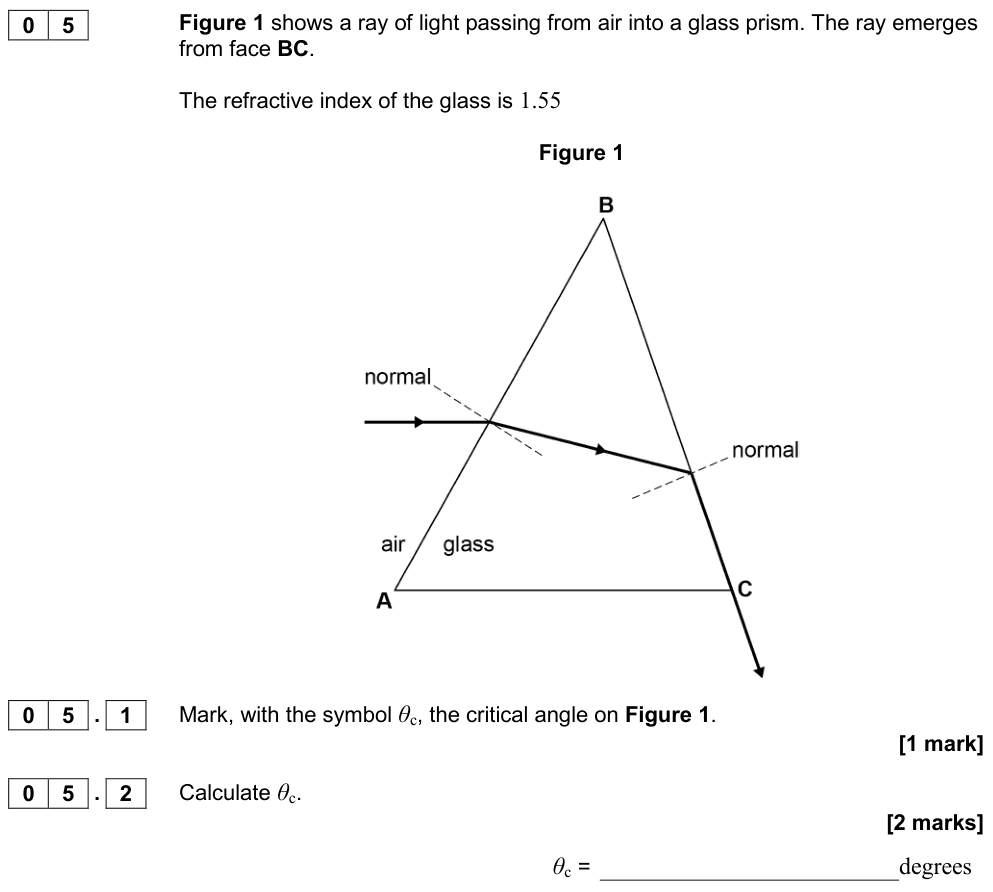
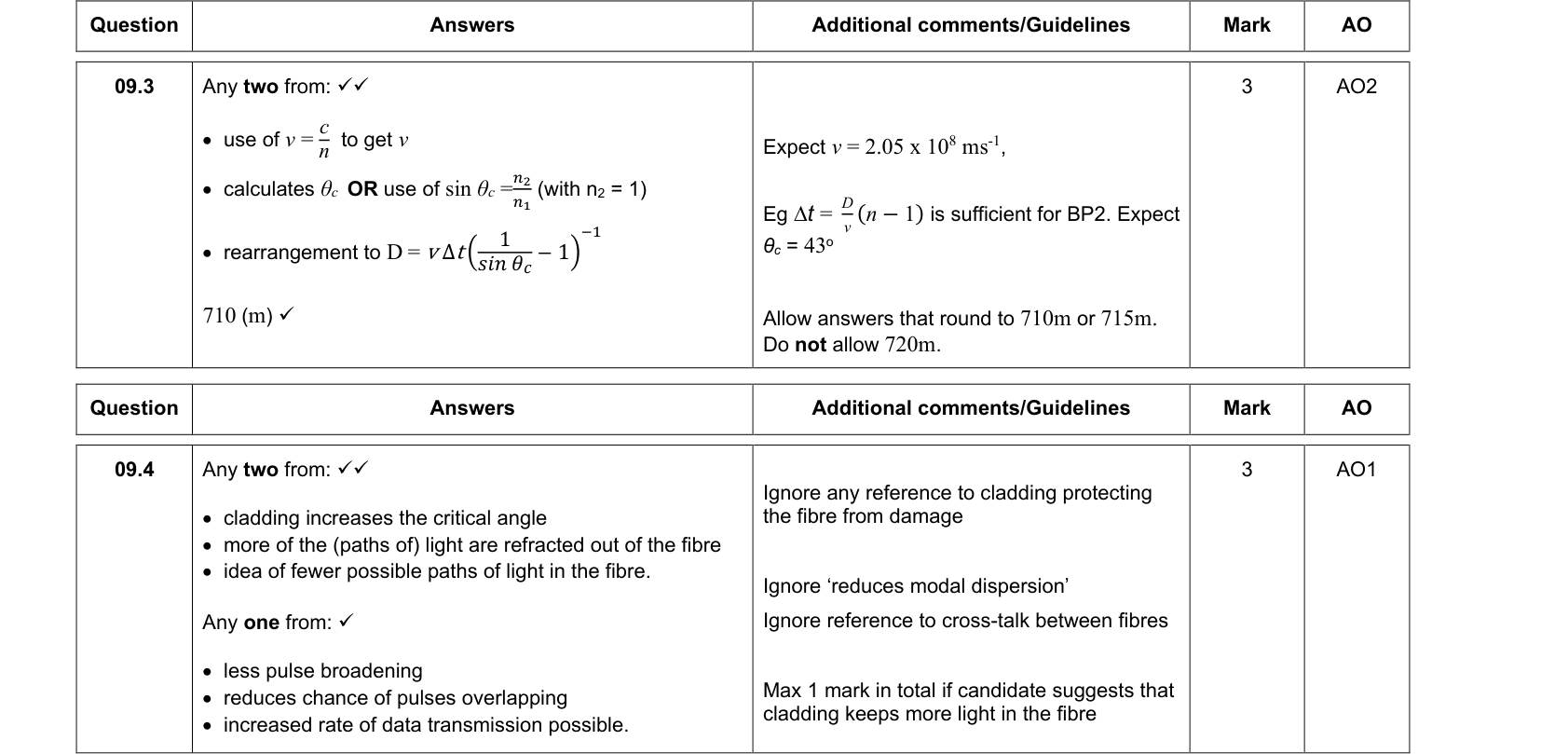
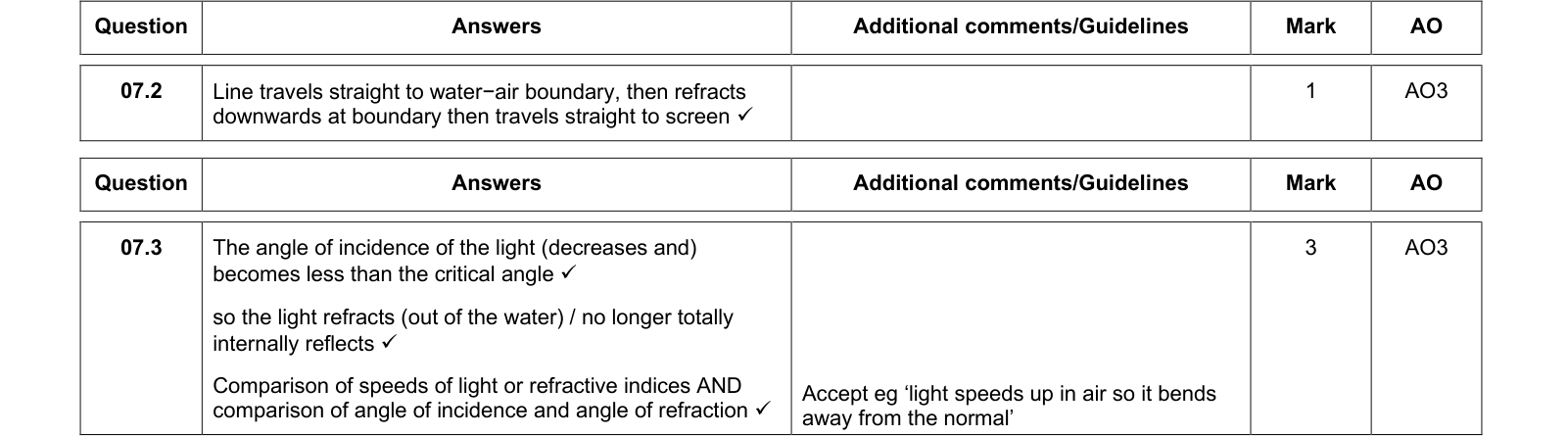
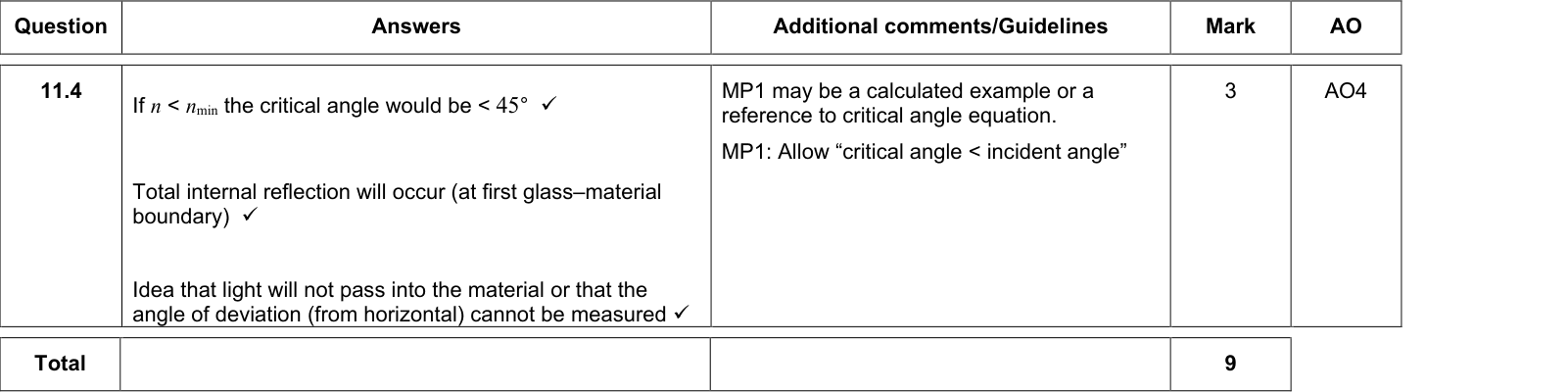
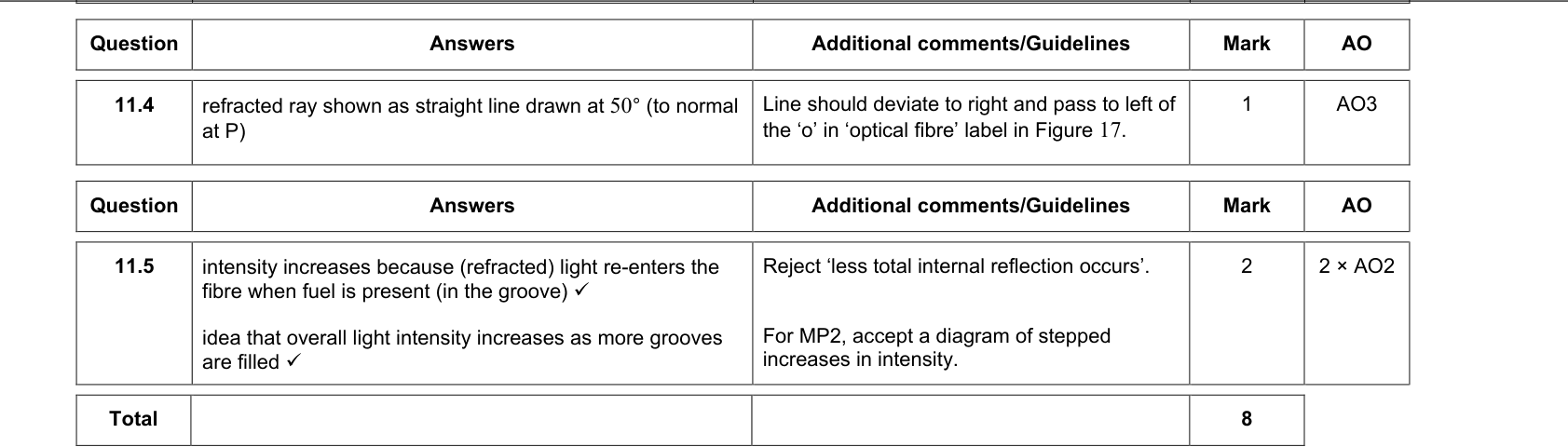
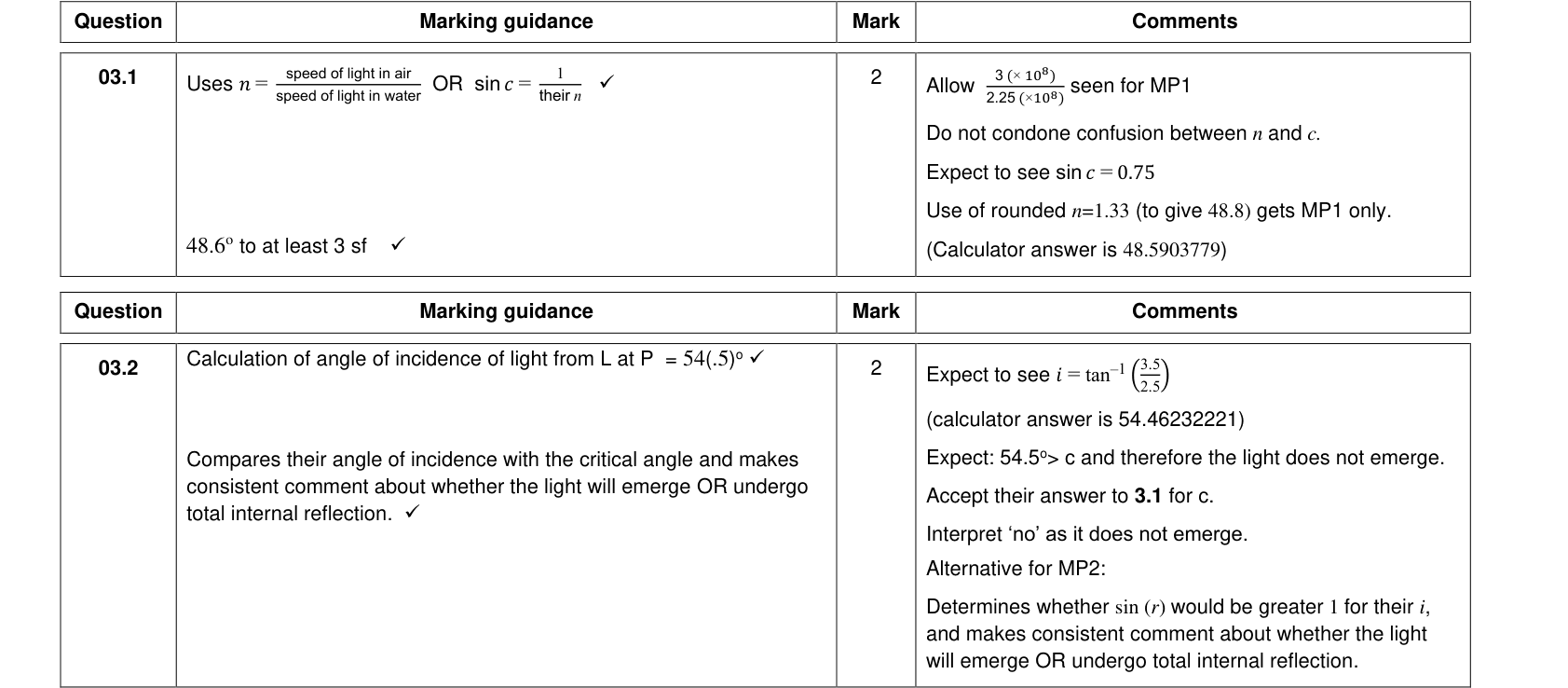
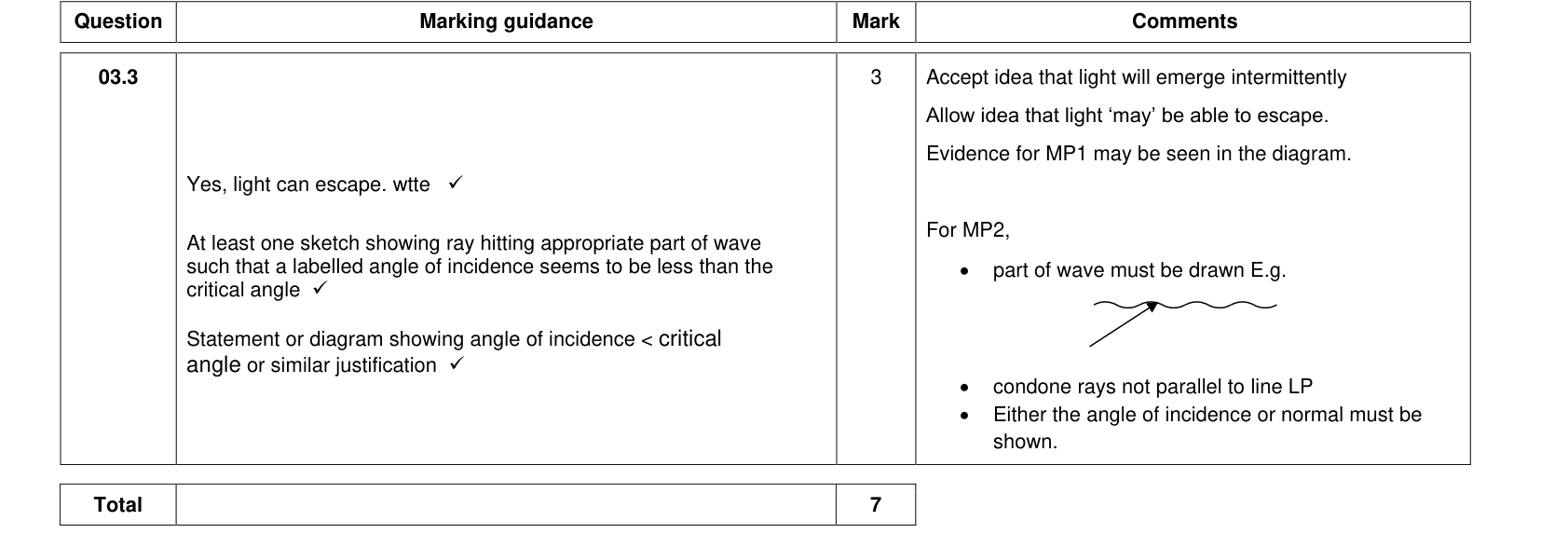
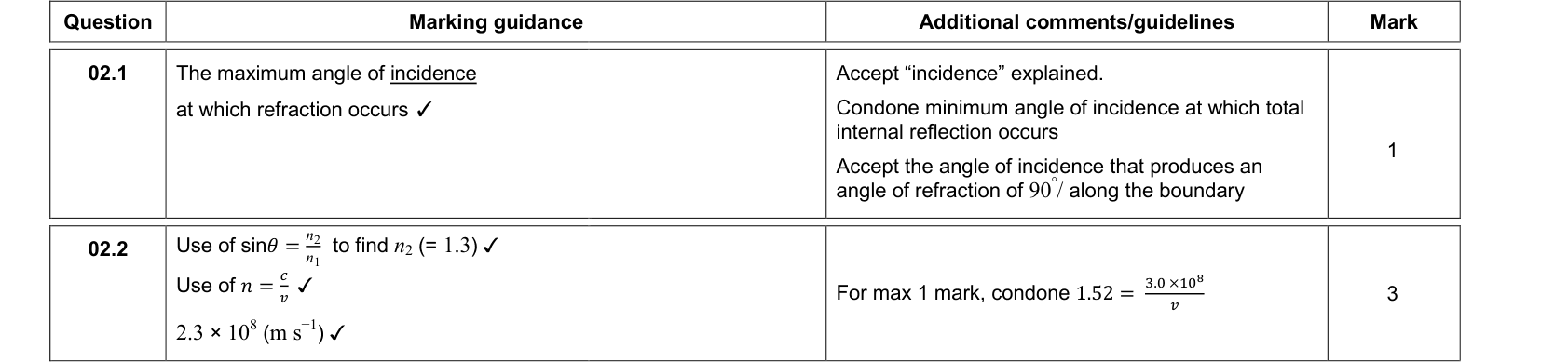
When light travels from a more optically dense medium to a less dense one ($n_1 > n_2$), it bends away from the normal. As the angle of incidence increases, the refracted ray gets closer to the boundary. At the critical angle $\theta_c$ the angle of refraction is 90°. For any angle of incidence greater than $\theta_c$, all the light is reflected: total internal reflection (TIR).
Critical angle
Setting $\theta_2 = 90^\circ$ in Snell's law:
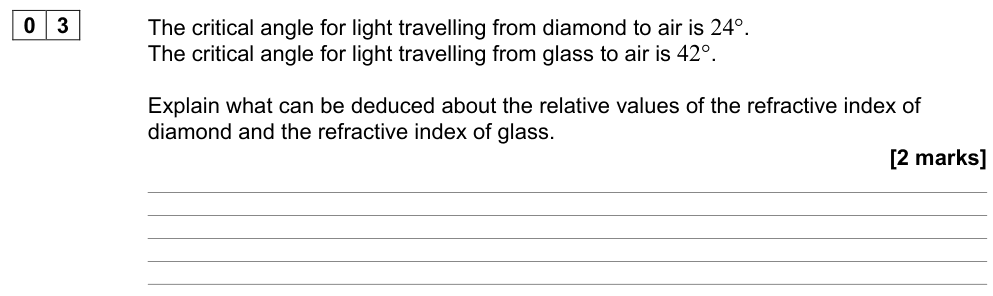
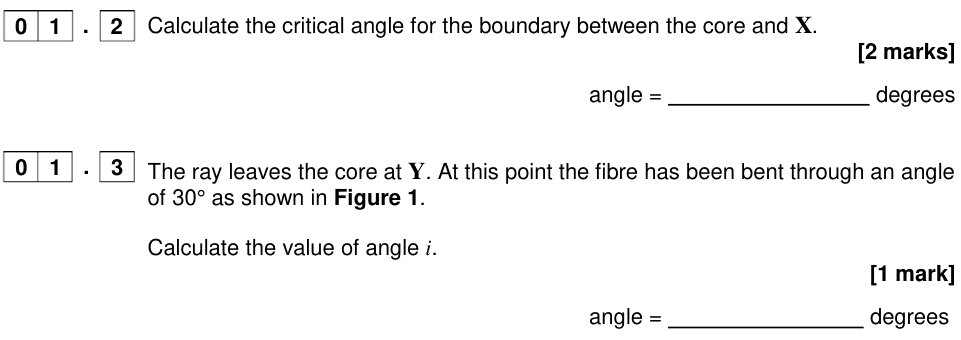
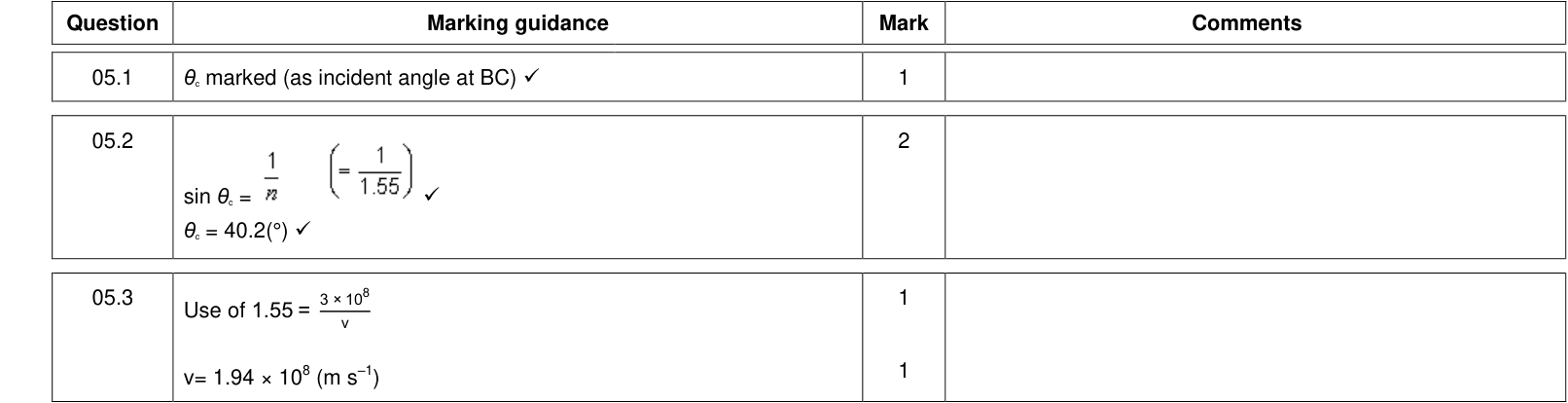
$$\sin\theta_c = \frac{n_2}{n_1} \qquad (n_1 > n_2)$$
For a material in air: $\sin\theta_c = \dfrac{1}{n}$.
Conditions for total internal reflection:
- The light travels from a higher to a lower refractive index.
- The angle of incidence is greater than the critical angle.
Worked example
Glass $n = 1.50$ in air: $\sin\theta_c = 1/1.50$, $\theta_c = 41.8^\circ$. In water ($n = 1.33$): $\sin\theta_c = 1.33/1.50 = 0.887$, $\theta_c = 62.5^\circ$. The critical angle is larger when the outer medium has a refractive index closer to that of the glass.
Optical fibres
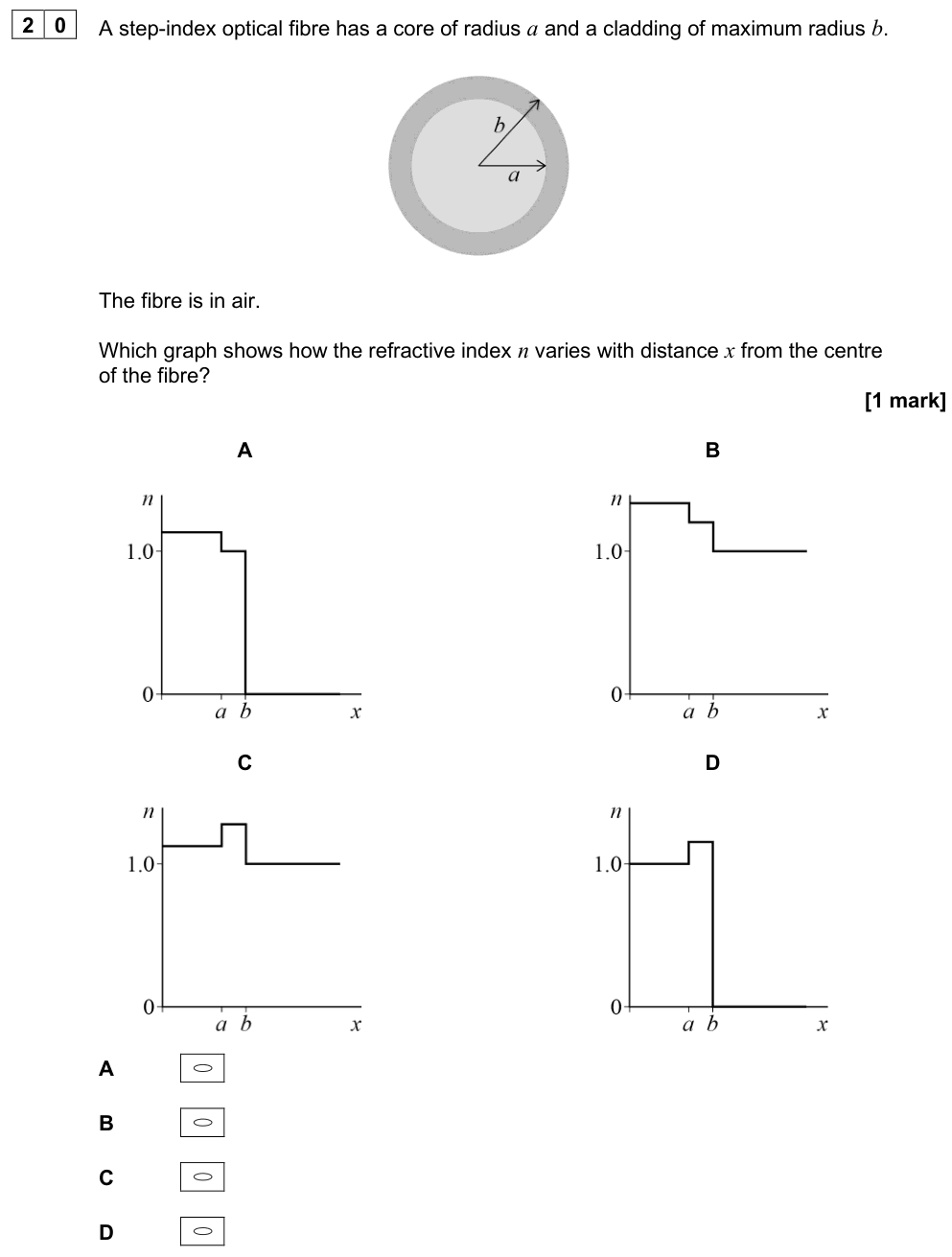
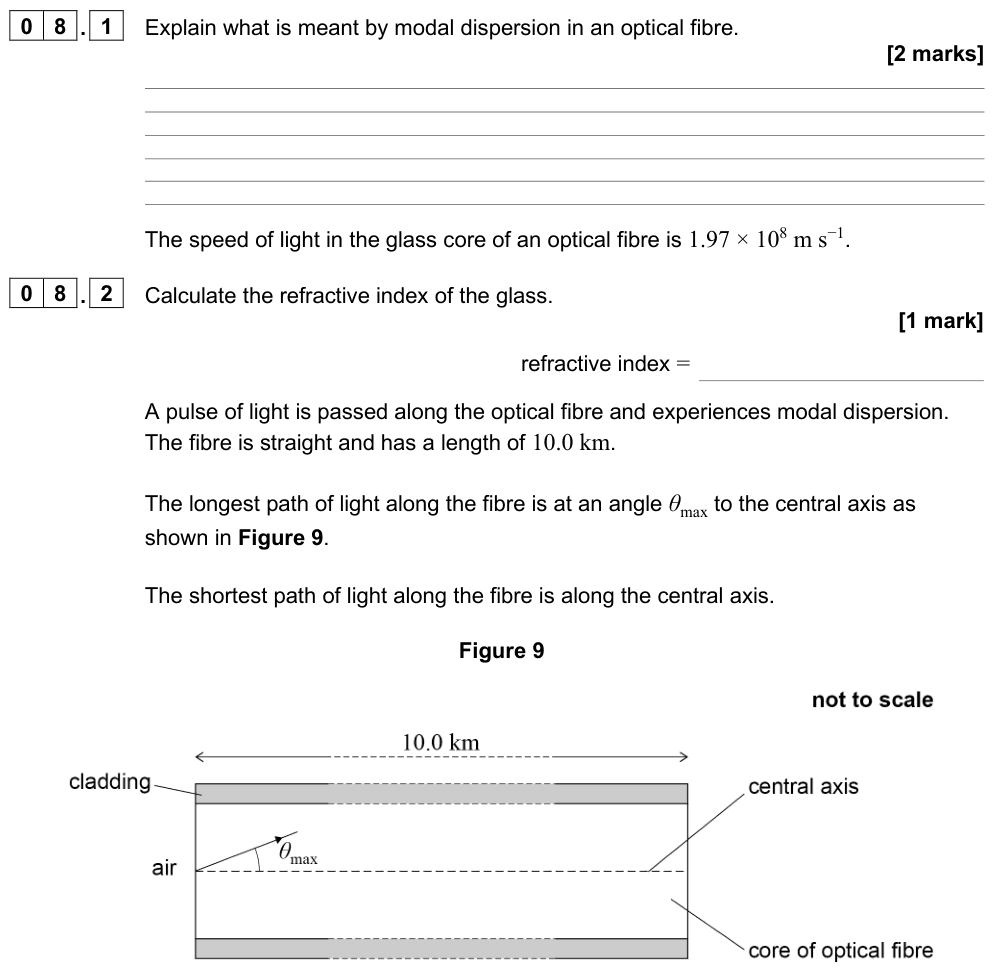
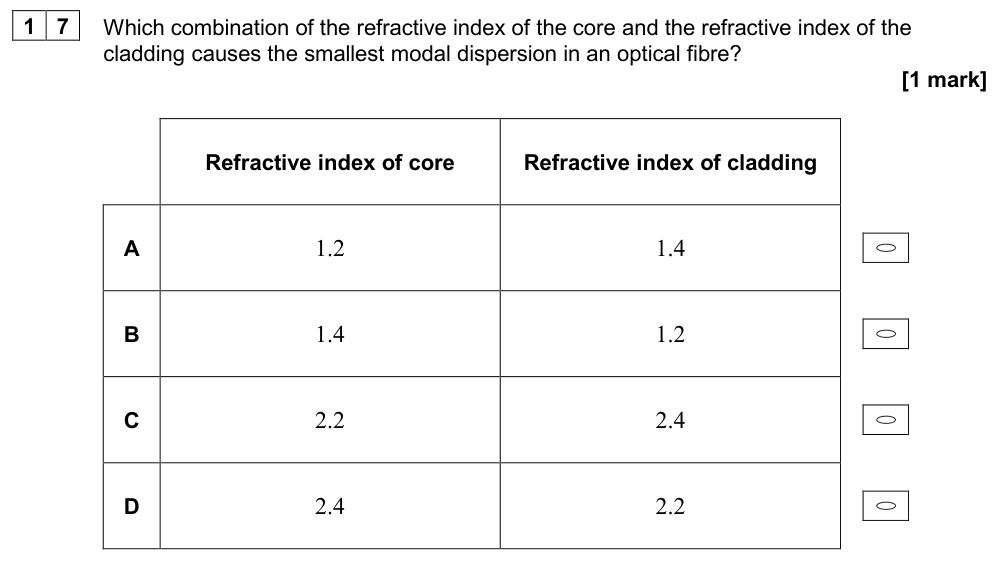
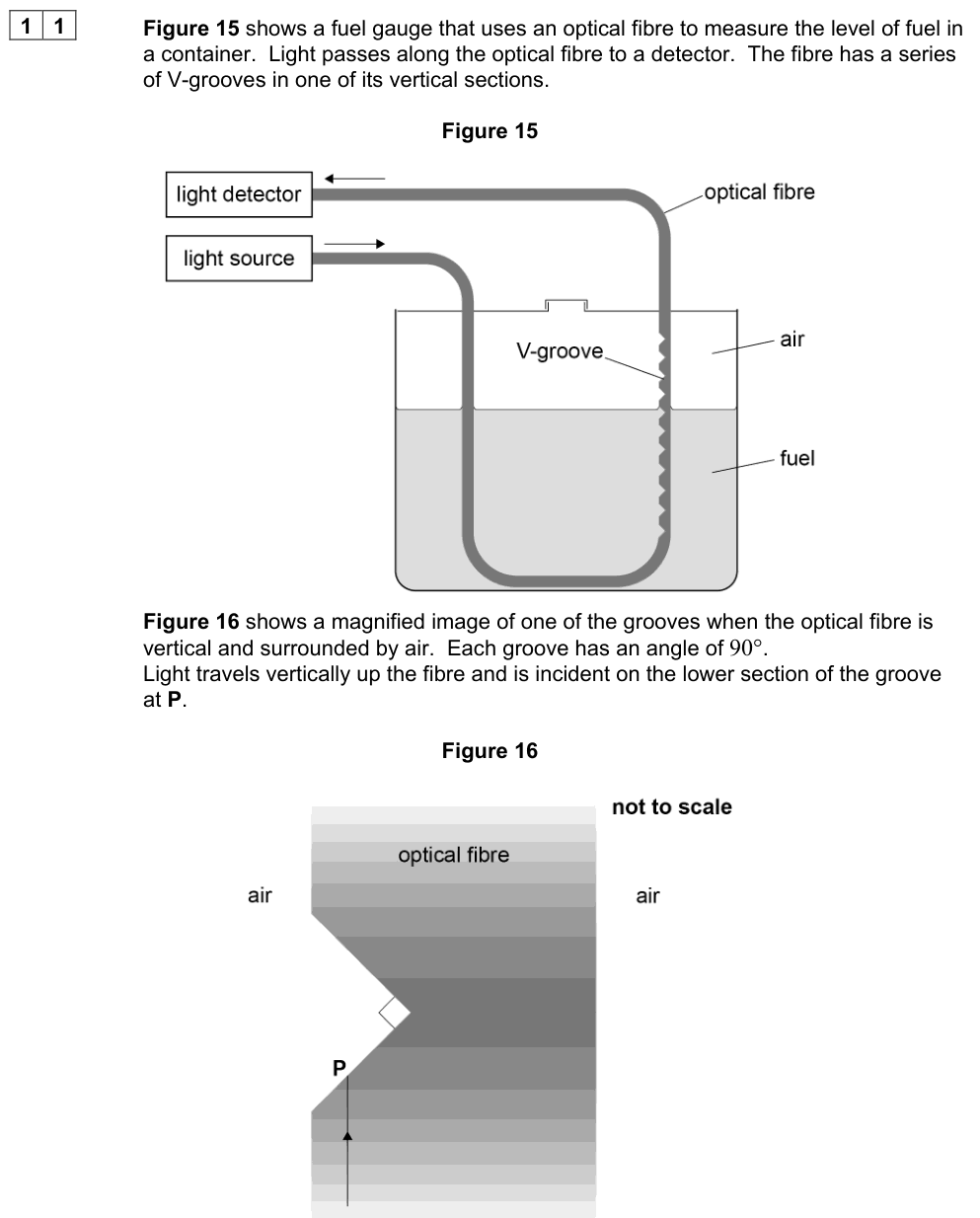
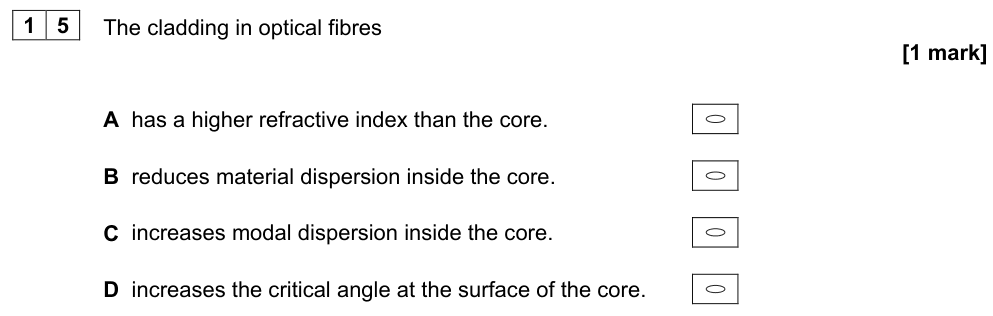
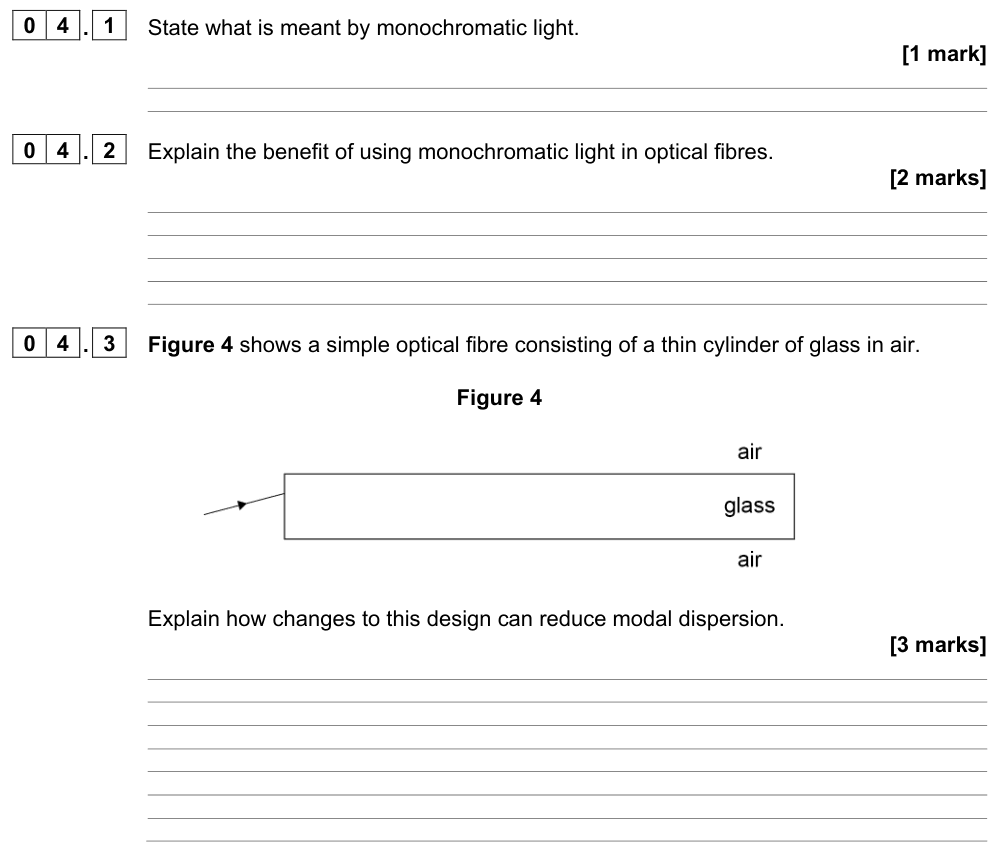
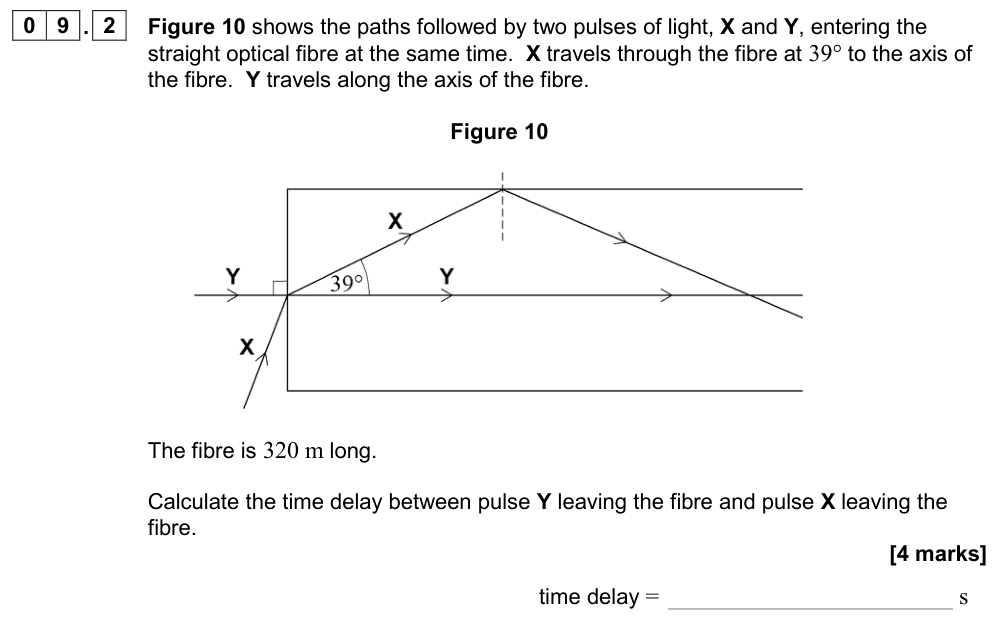
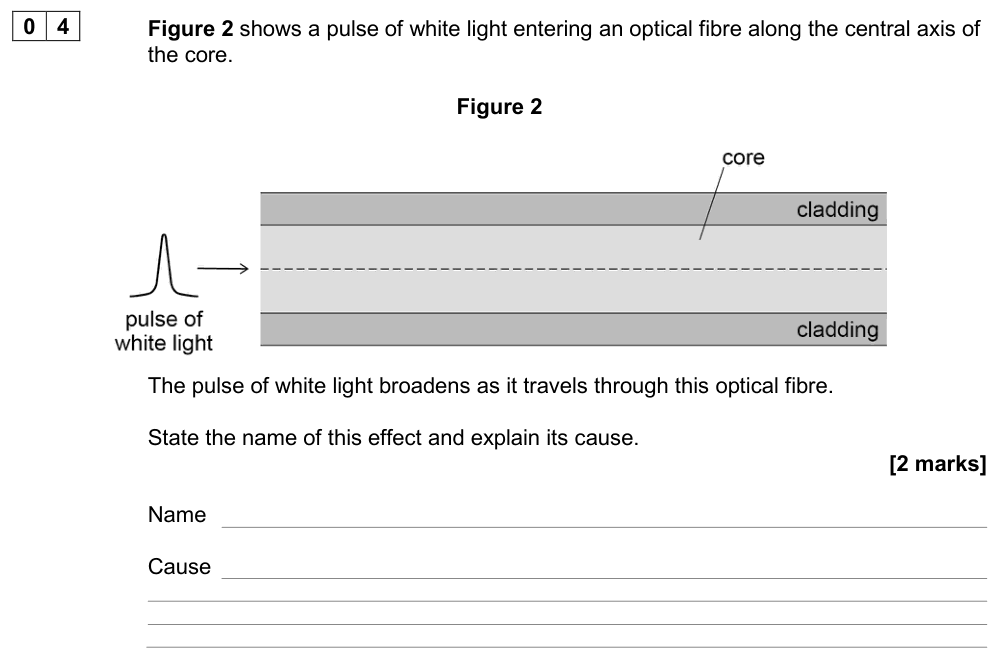
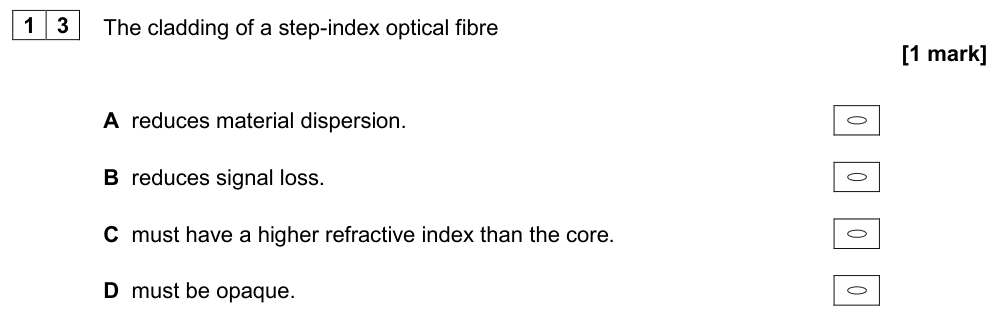
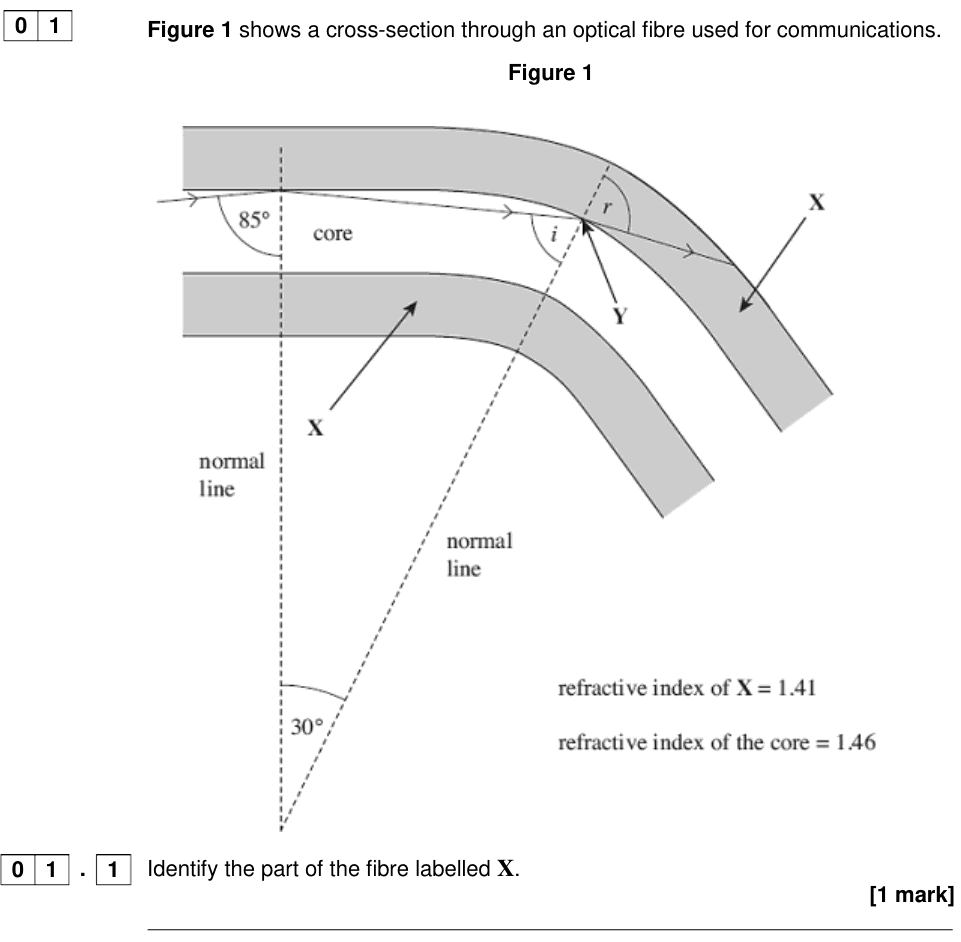
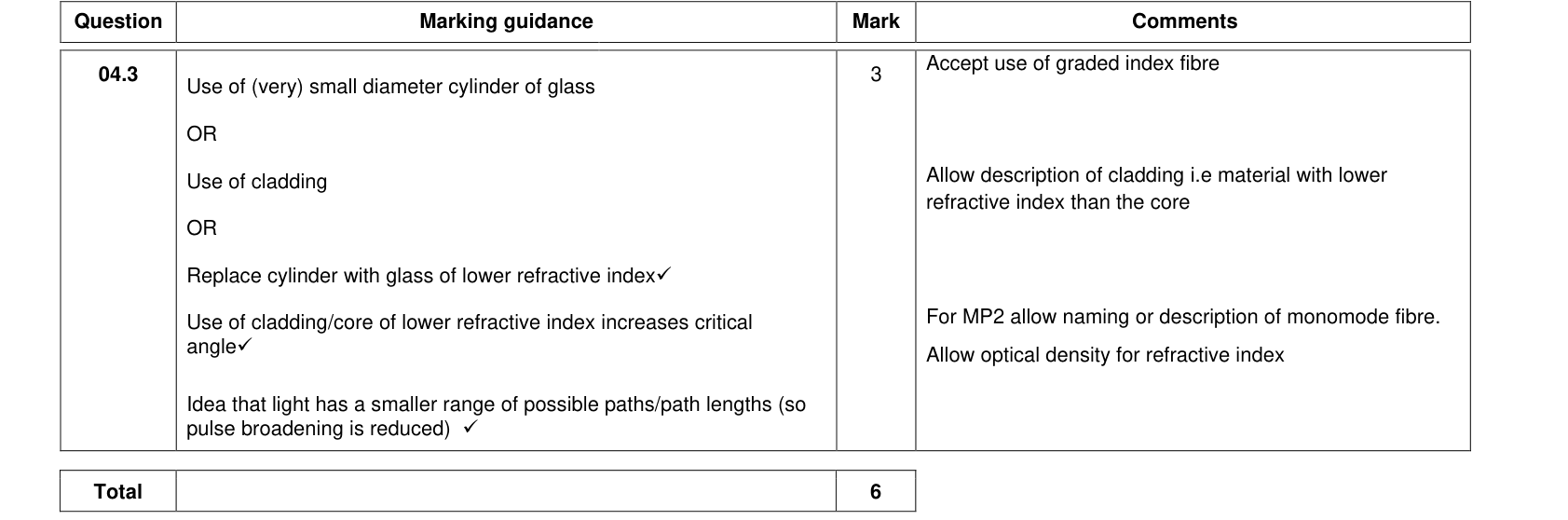
A step-index optical fibre has a thin glass core of high refractive index surrounded by a cladding of slightly lower refractive index. Light entering the end of the core strikes the core–cladding boundary at angles greater than the critical angle and is totally internally reflected along the fibre, even round gentle bends.
Why the cladding is needed
- It keeps the core–cladding boundary clean and protected. Scratches or contact with another fibre would otherwise let light escape.
- It prevents crossover of signals between fibres touching each other in a bundle.
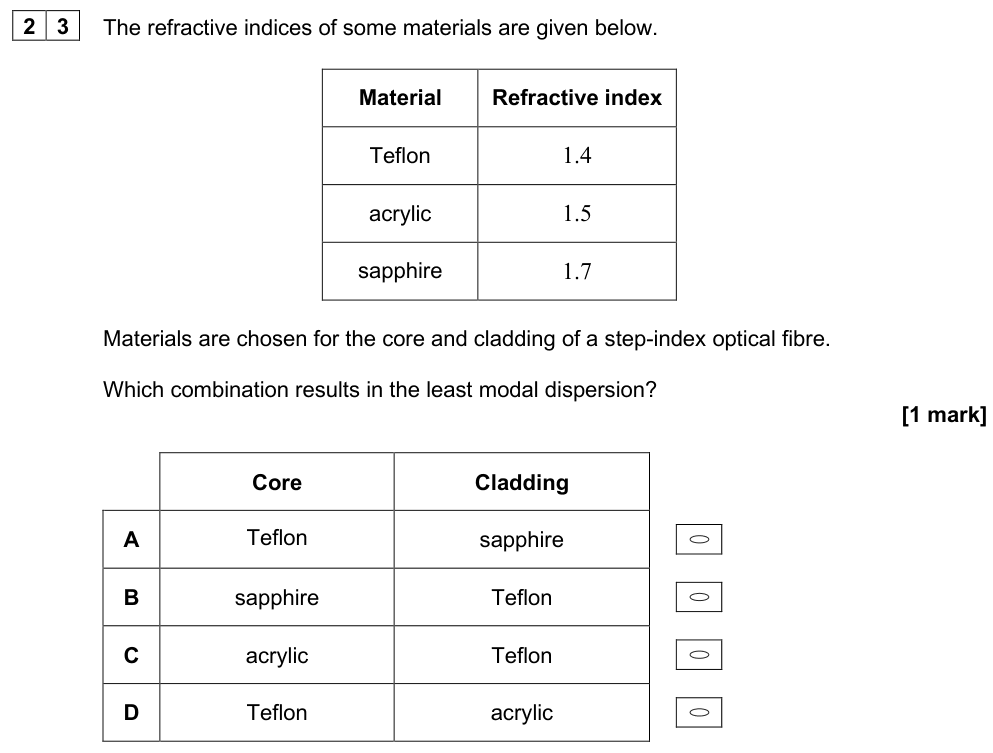
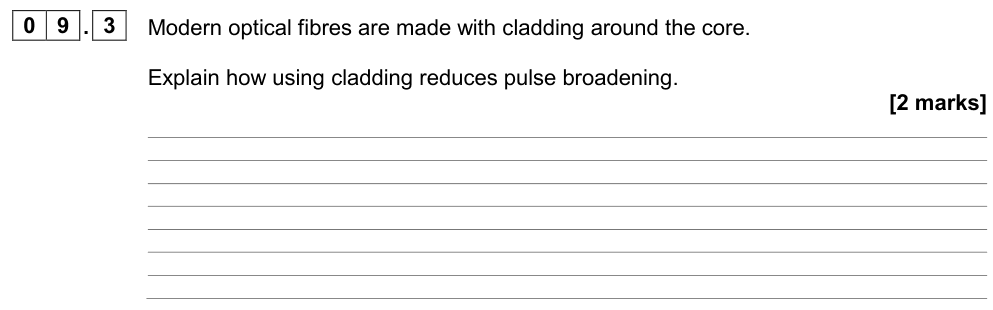
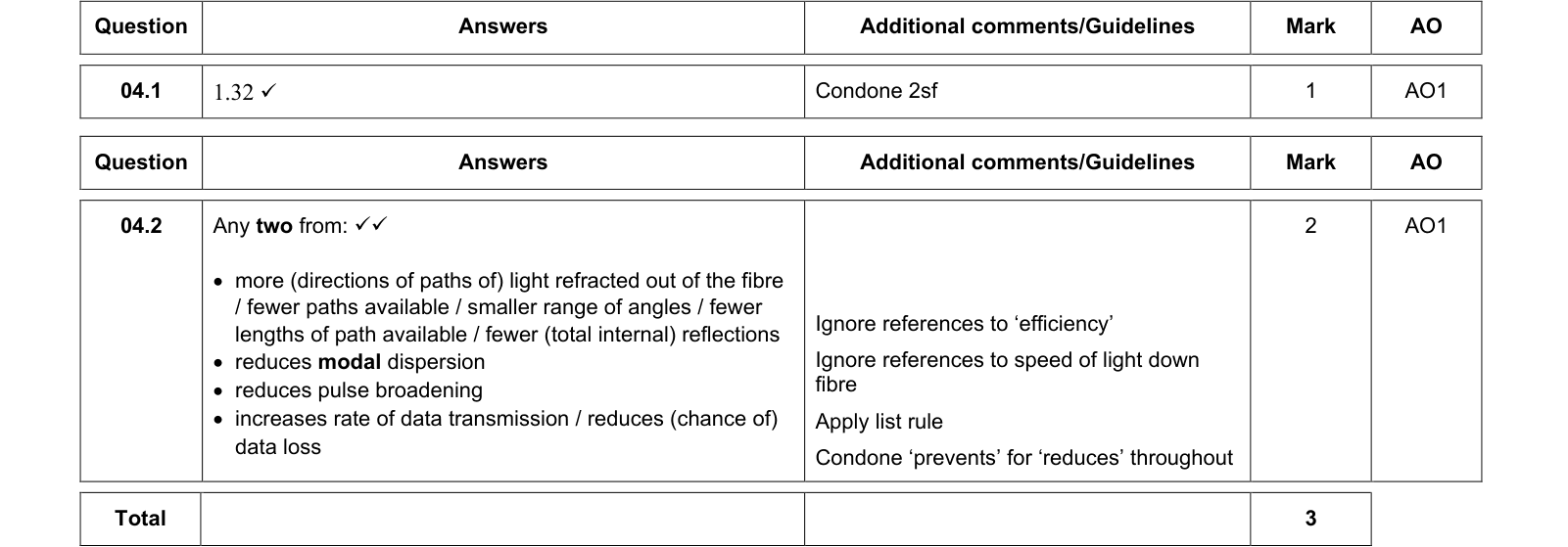
- Because its refractive index is only slightly lower, the critical angle is large, so only rays travelling nearly parallel to the axis are guided. This reduces modal dispersion.
Dispersion and pulse broadening
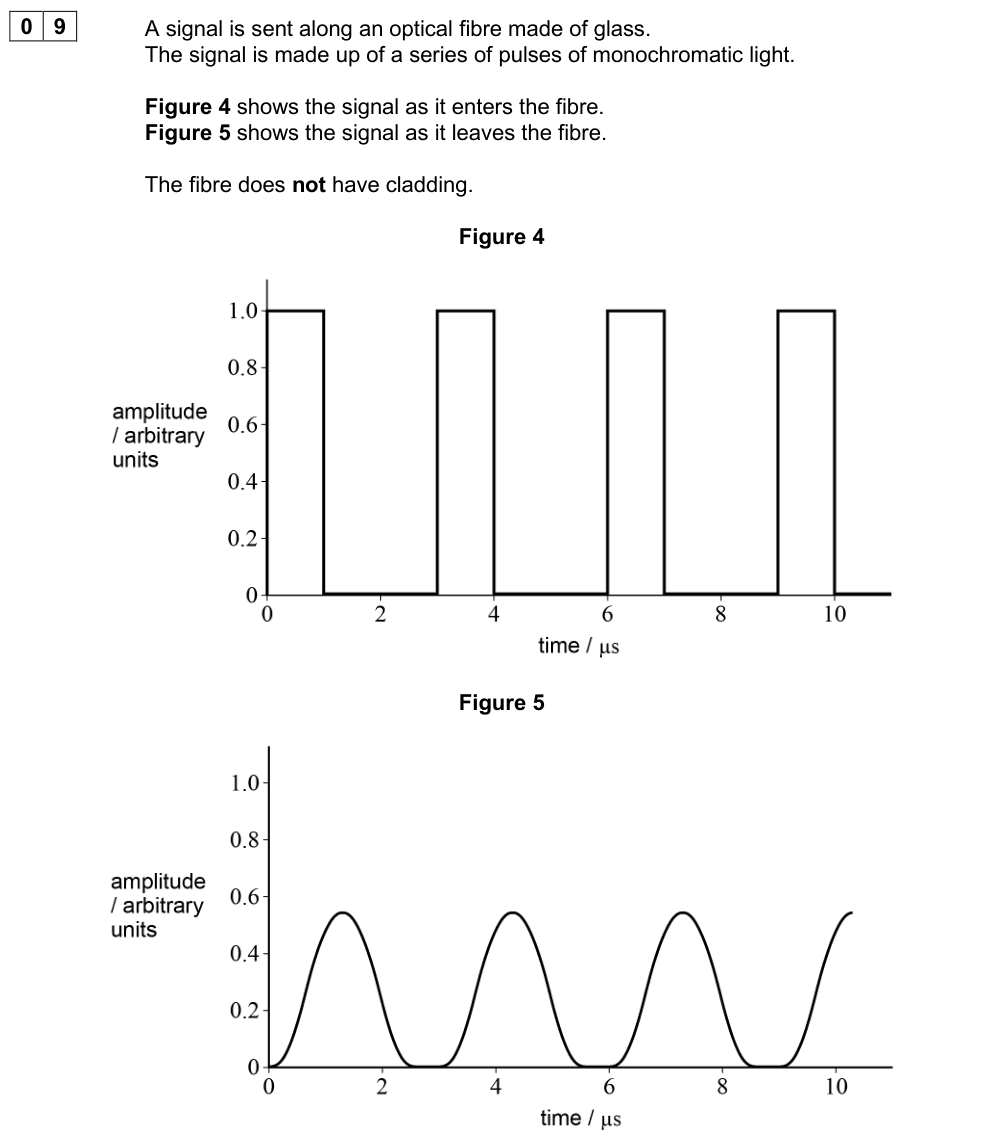
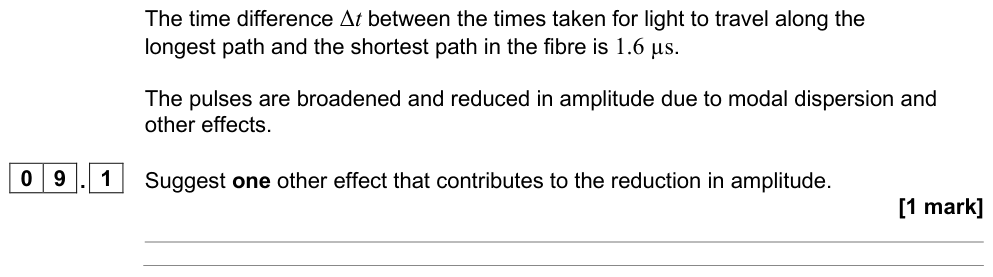
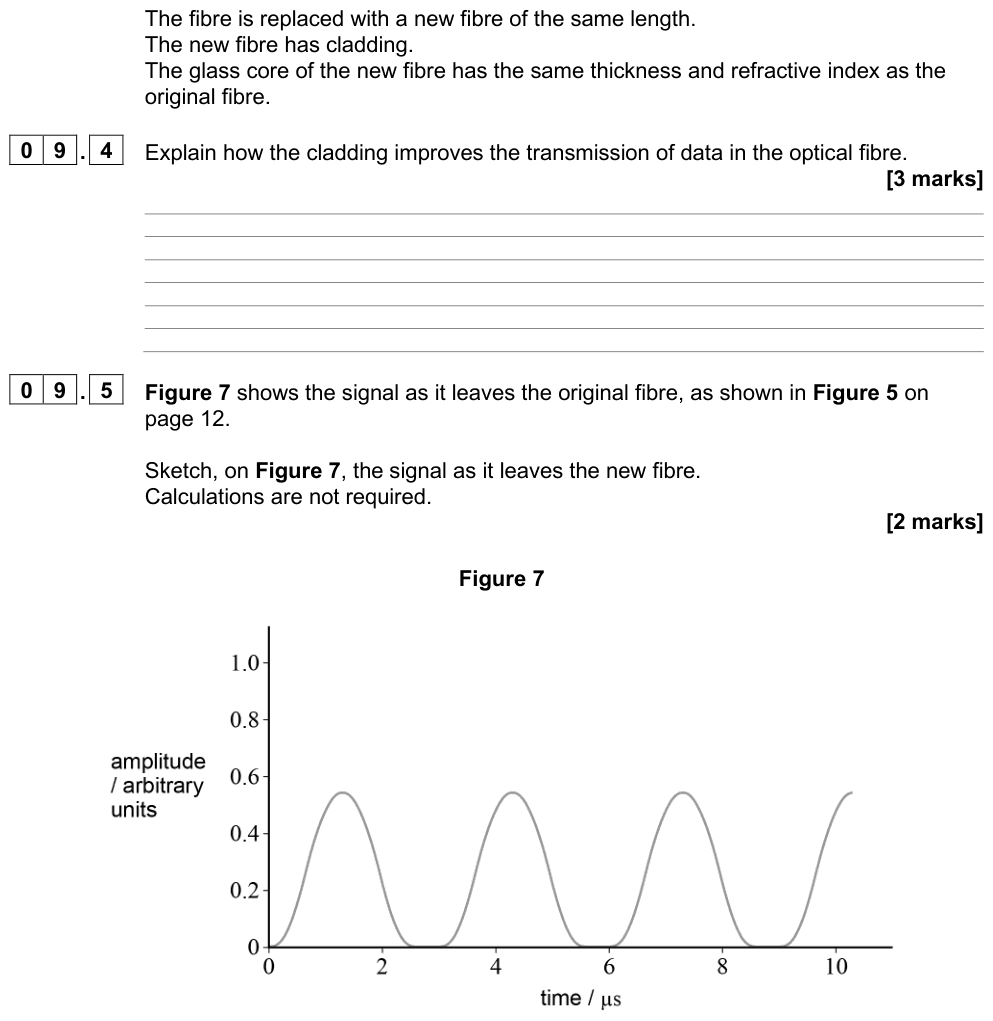
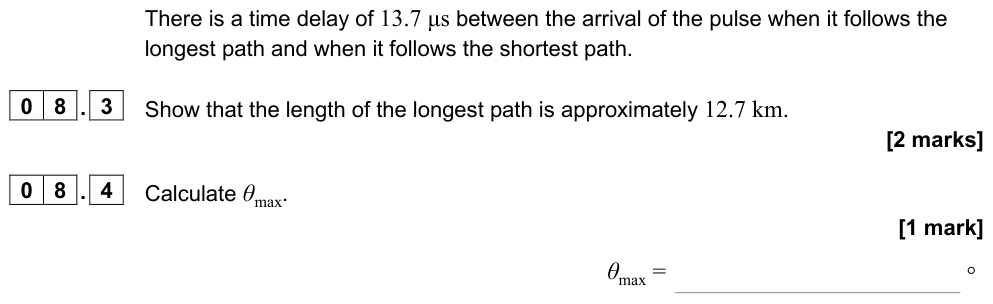
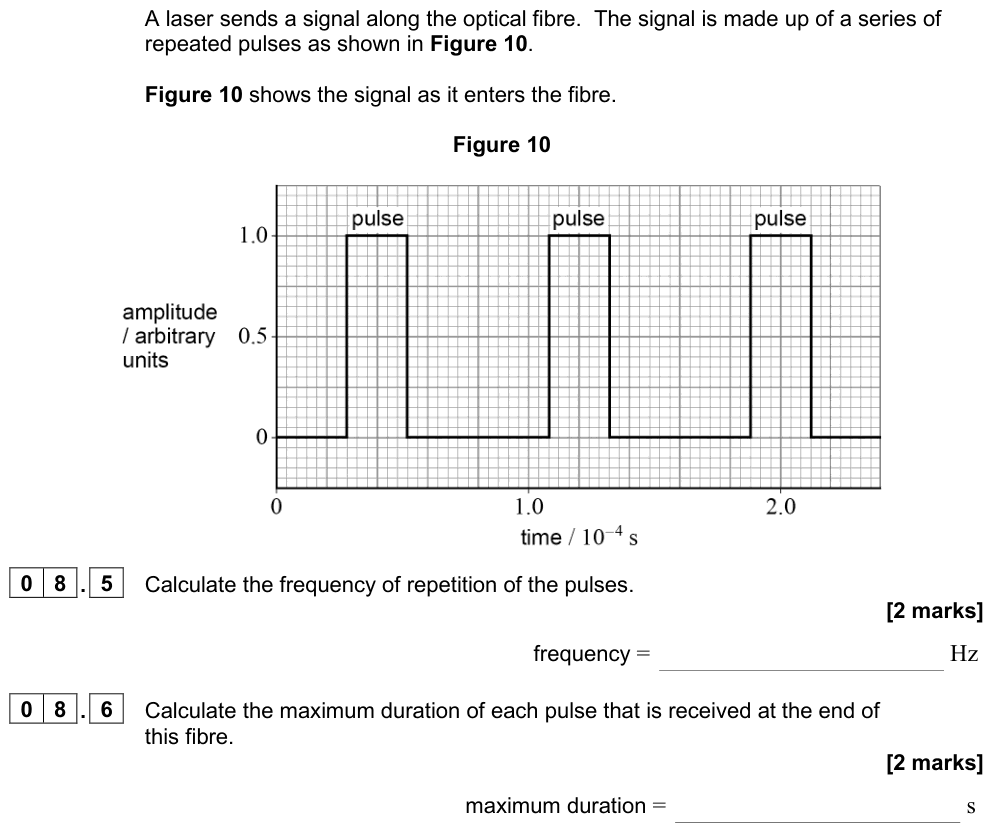
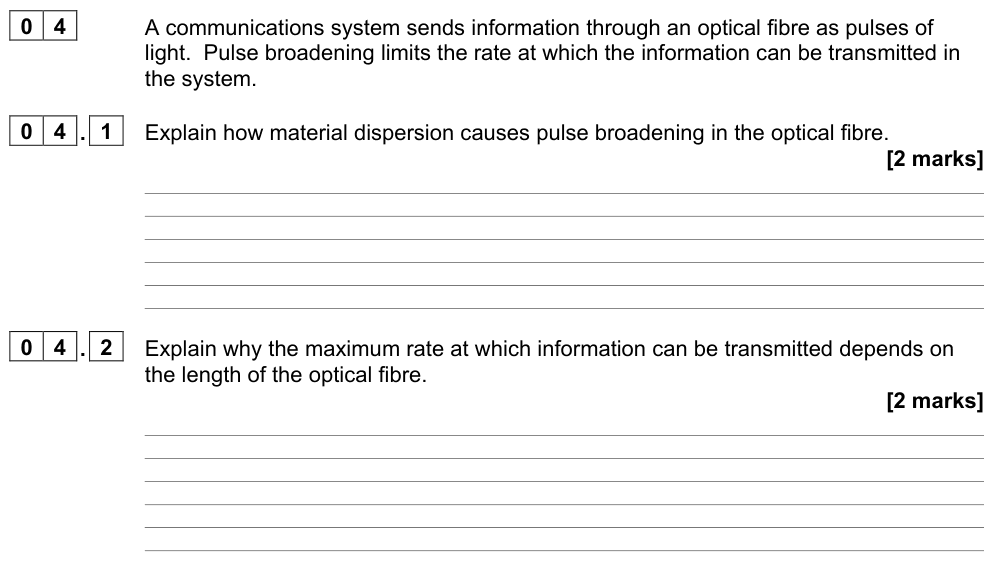
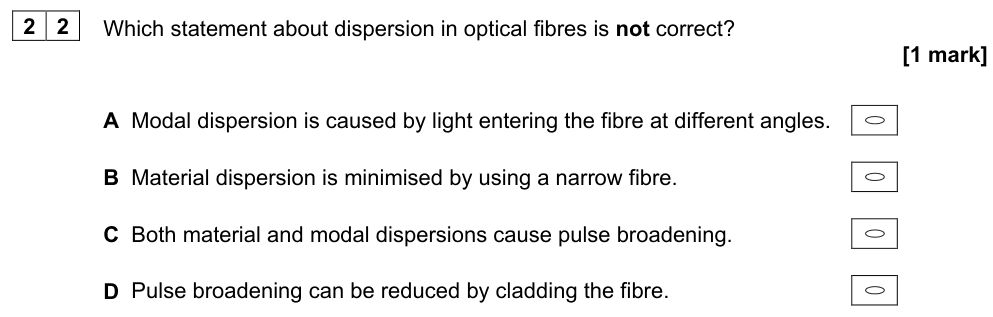
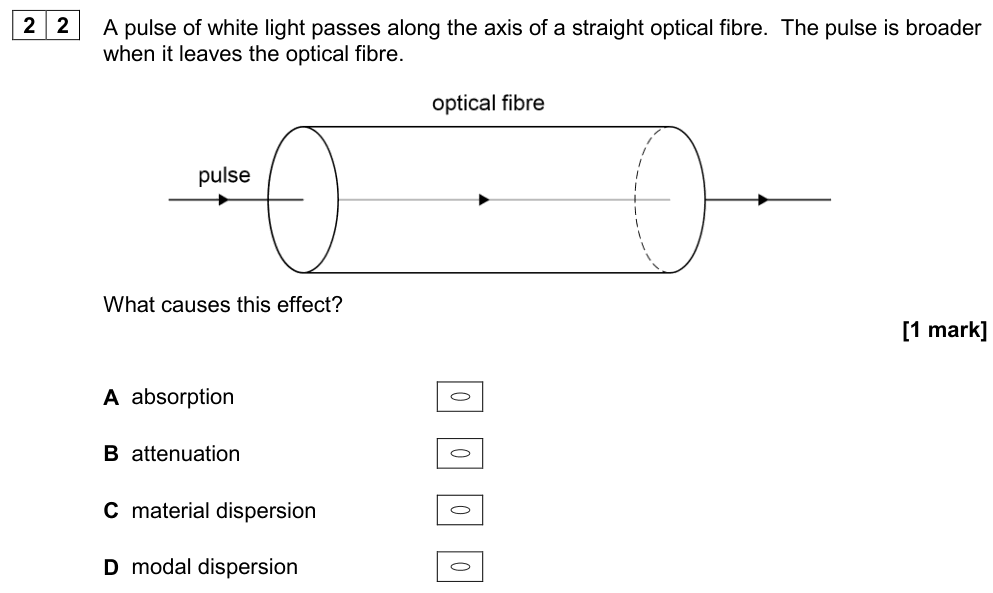
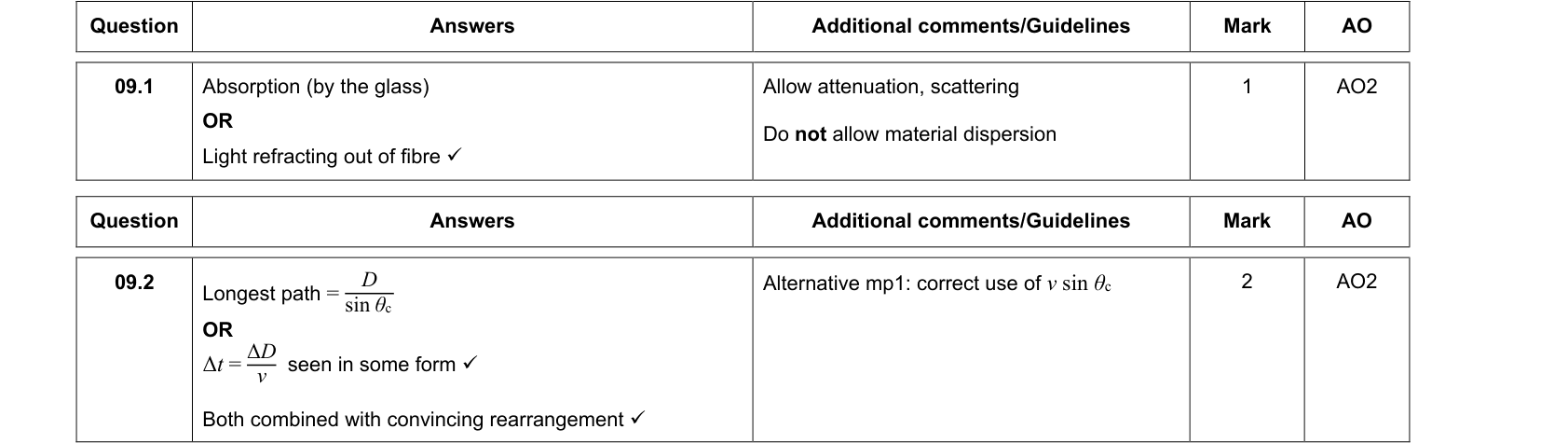
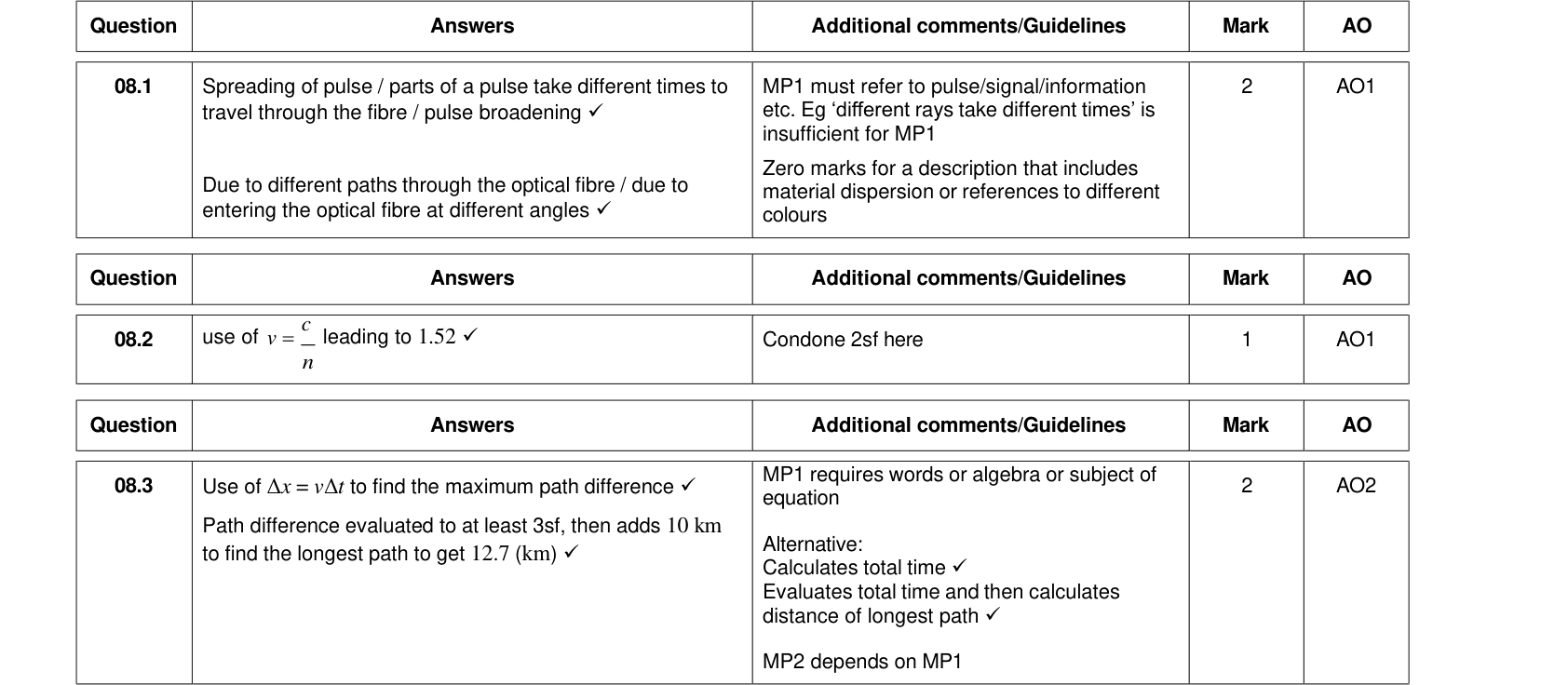
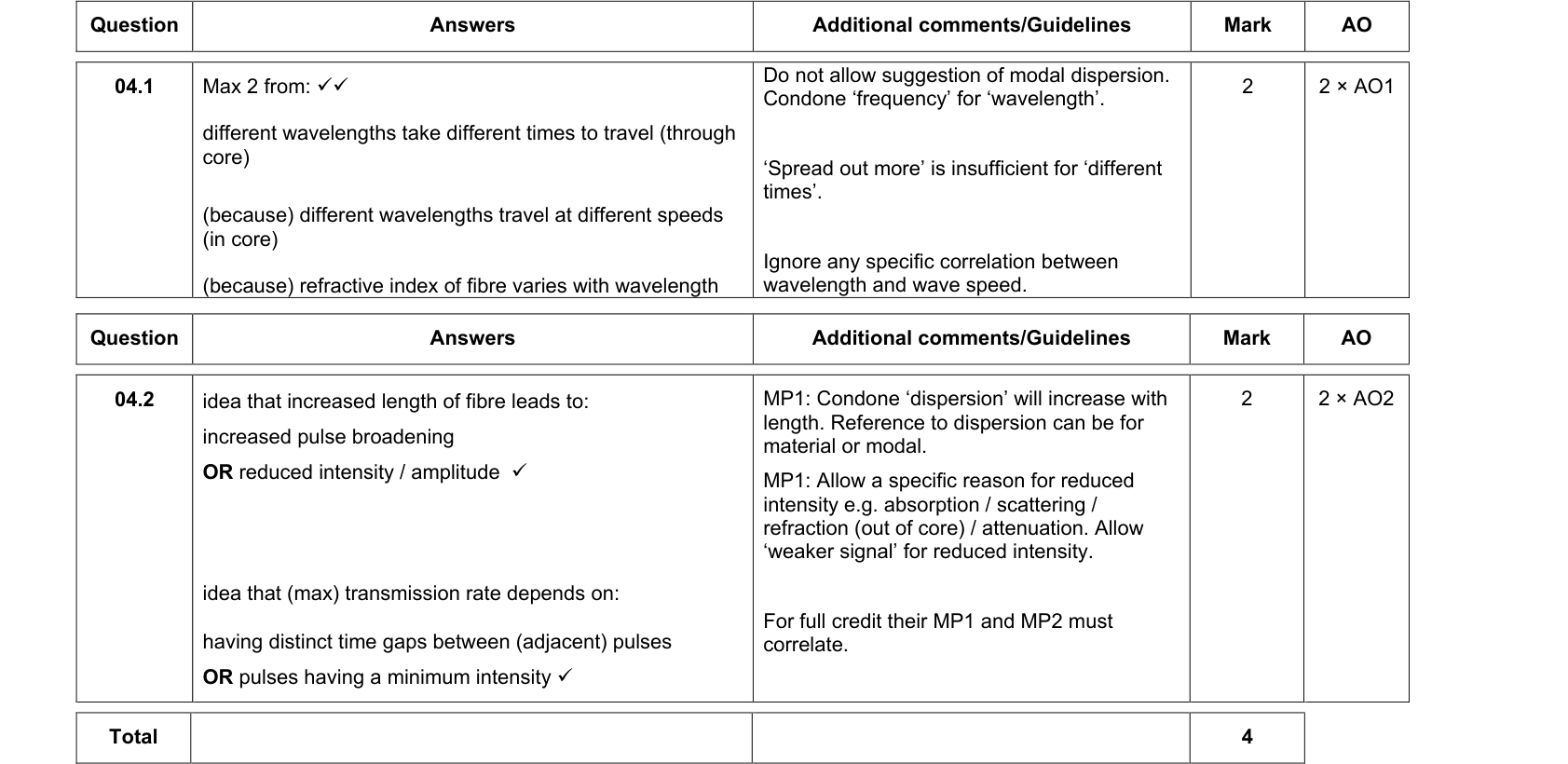
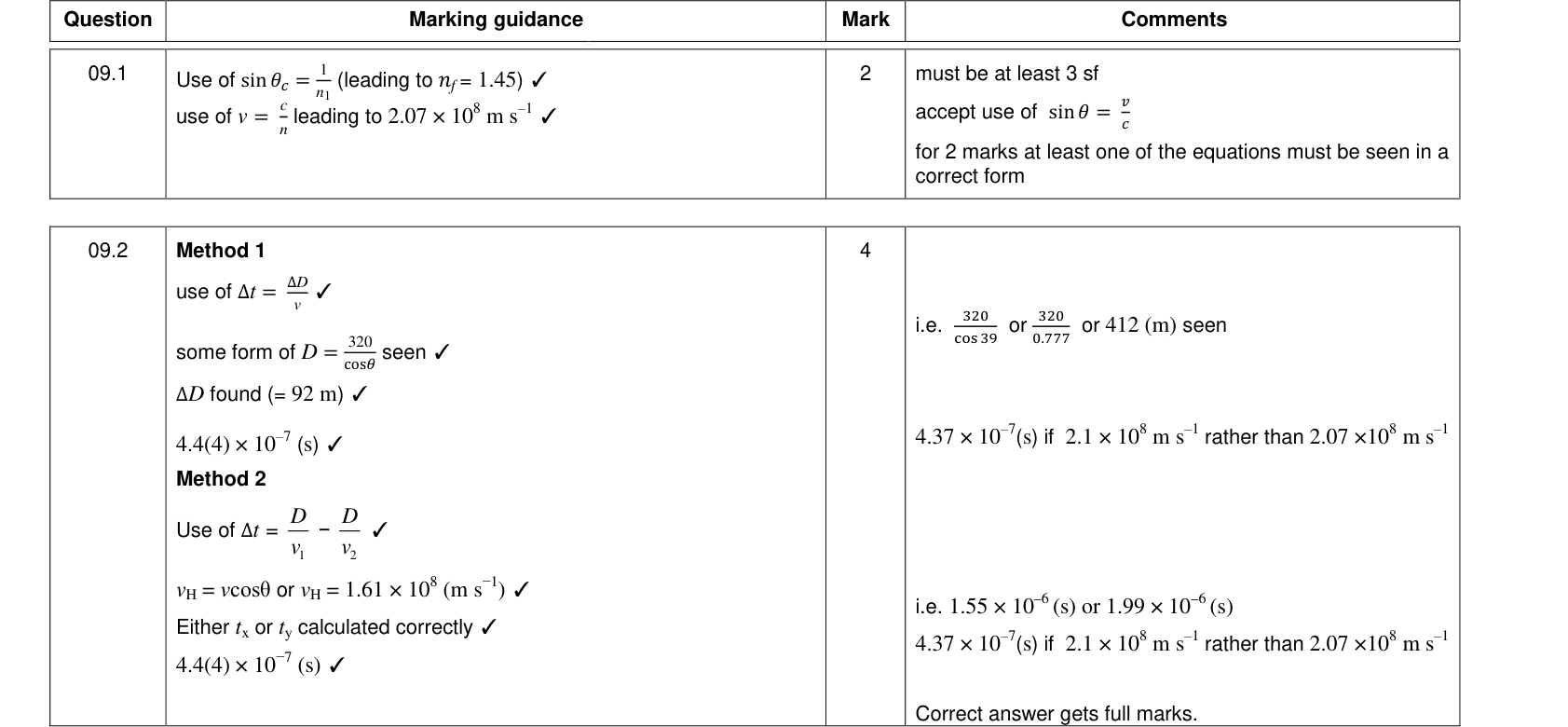
Signals are sent as pulses of light. If a pulse spreads out in time as it travels (pulse broadening), neighbouring pulses can overlap, the signal becomes unreadable, and the rate at which data can be sent is limited.
| Type | Cause | How to reduce it |
|---|---|---|
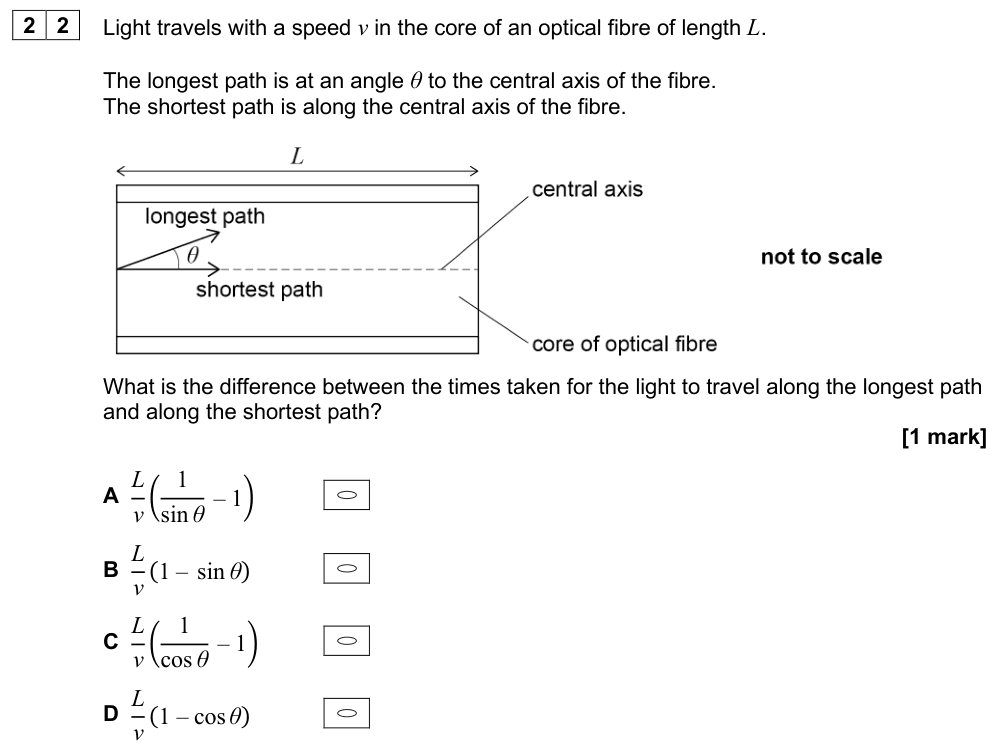
| Modal dispersion | rays entering at different angles take paths of different lengths (the axial ray has the shortest path), so they arrive at different times | use a very narrow core (single-mode fibre); make the cladding's refractive index close to the core's |
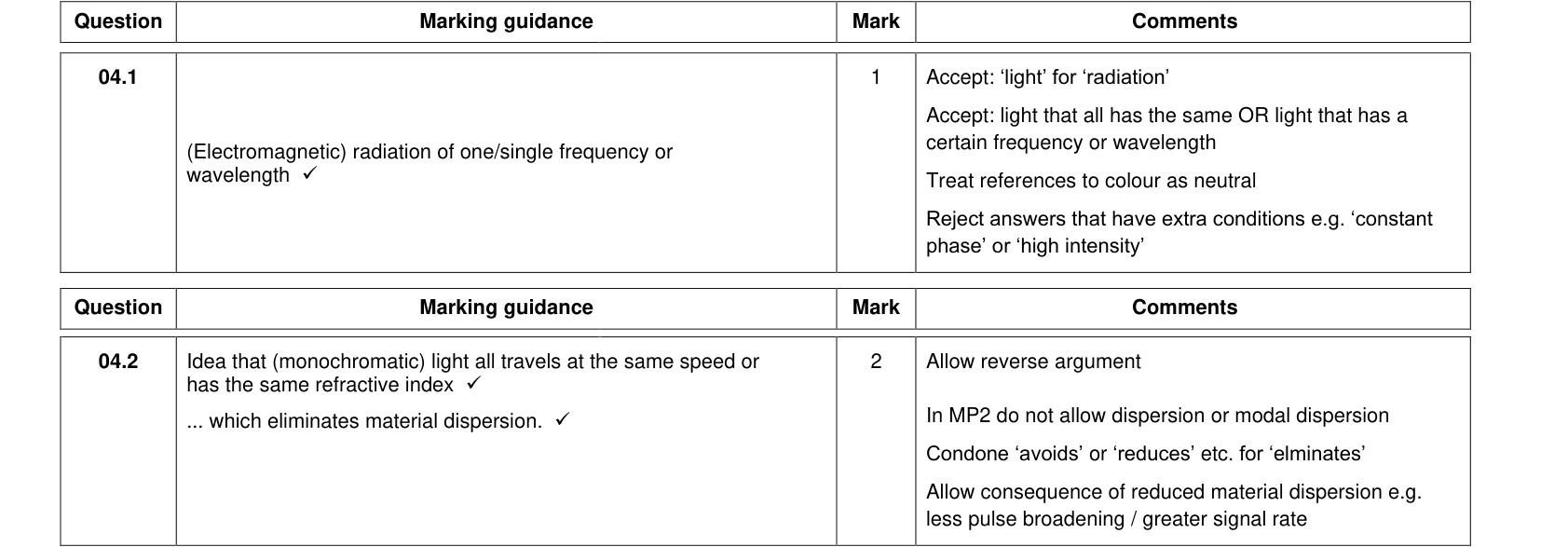
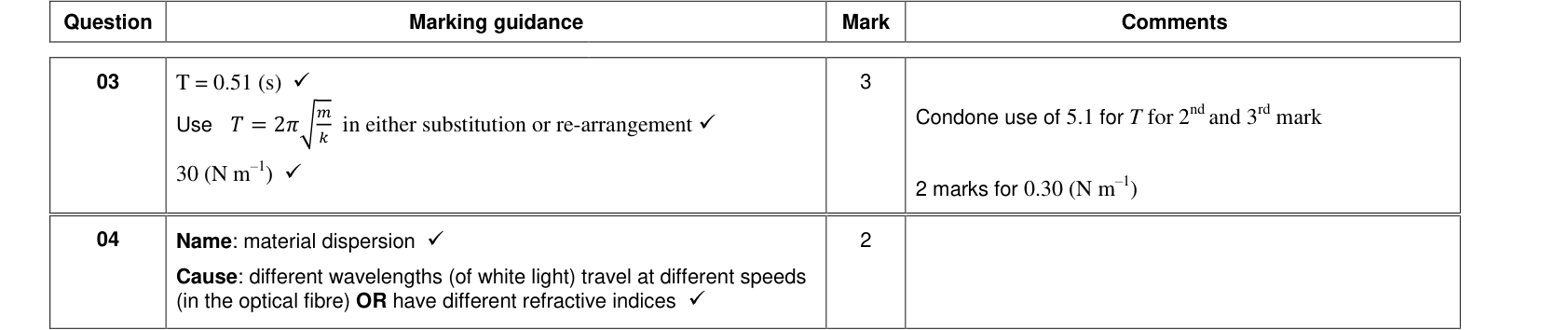
| Material (chromatic) dispersion | different wavelengths travel at different speeds in glass (refractive index depends on wavelength), so they arrive at different times | use monochromatic light (a single wavelength, e.g. from a laser) |
Absorption
Some of the light energy is absorbed by the glass as it travels, so the amplitude (intensity) of the signal decreases. Long fibres need repeaters/amplifiers to regenerate the signal. Very pure glass and wavelengths in the infrared where absorption is least are used.
Exam tip
Dispersion spreads the pulse in time (it gets wider); absorption reduces its amplitude (it gets smaller). Questions often ask you to sketch the output pulse: draw it lower and wider than the input pulse.
Uses
- Communications: high data rates, low losses, no electrical interference, secure, light and thin.
- Endoscopes: a bundle of fibres carries light into the body and a coherent bundle carries an image back out.
Summary
- $n = c/c_s$; air ≈ 1. Snell's law $n_1\sin\theta_1 = n_2\sin\theta_2$.
- TIR when going from higher to lower $n$ with angle of incidence > $\theta_c$; $\sin\theta_c = n_2/n_1$.
- Step-index fibre: core (high n) and cladding (slightly lower n) to protect the boundary and reduce modal dispersion.
- Modal dispersion: different paths (narrow core). Material dispersion: different speeds for different λ (monochromatic light). Absorption reduces amplitude.