Diffraction
Diffraction
Diffraction is the spreading out of waves when they pass through a gap or around an obstacle.
- Diffraction is most noticeable when the gap width is similar to the wavelength.
- A gap much wider than the wavelength gives very little spreading.
- Diffraction does not change the wavelength, frequency or speed of the wave.
Single-slit diffraction
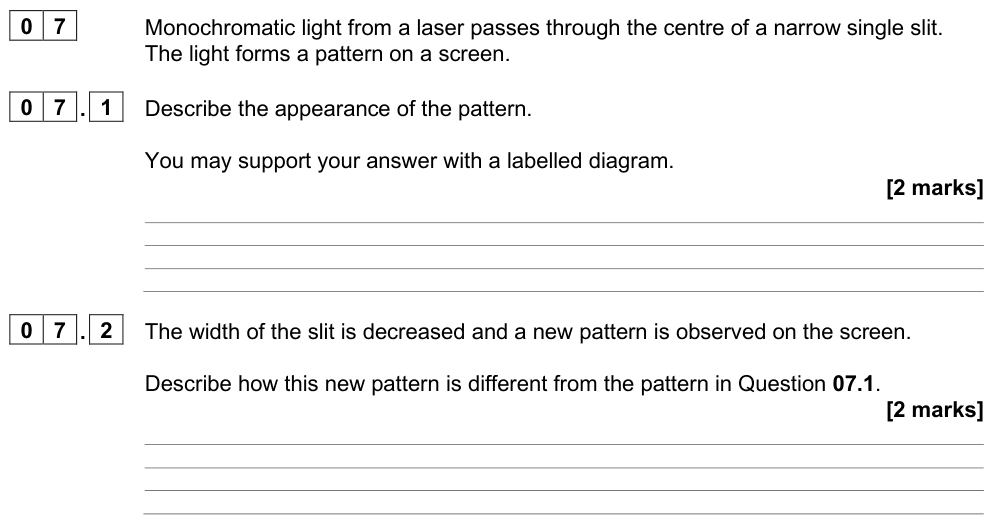
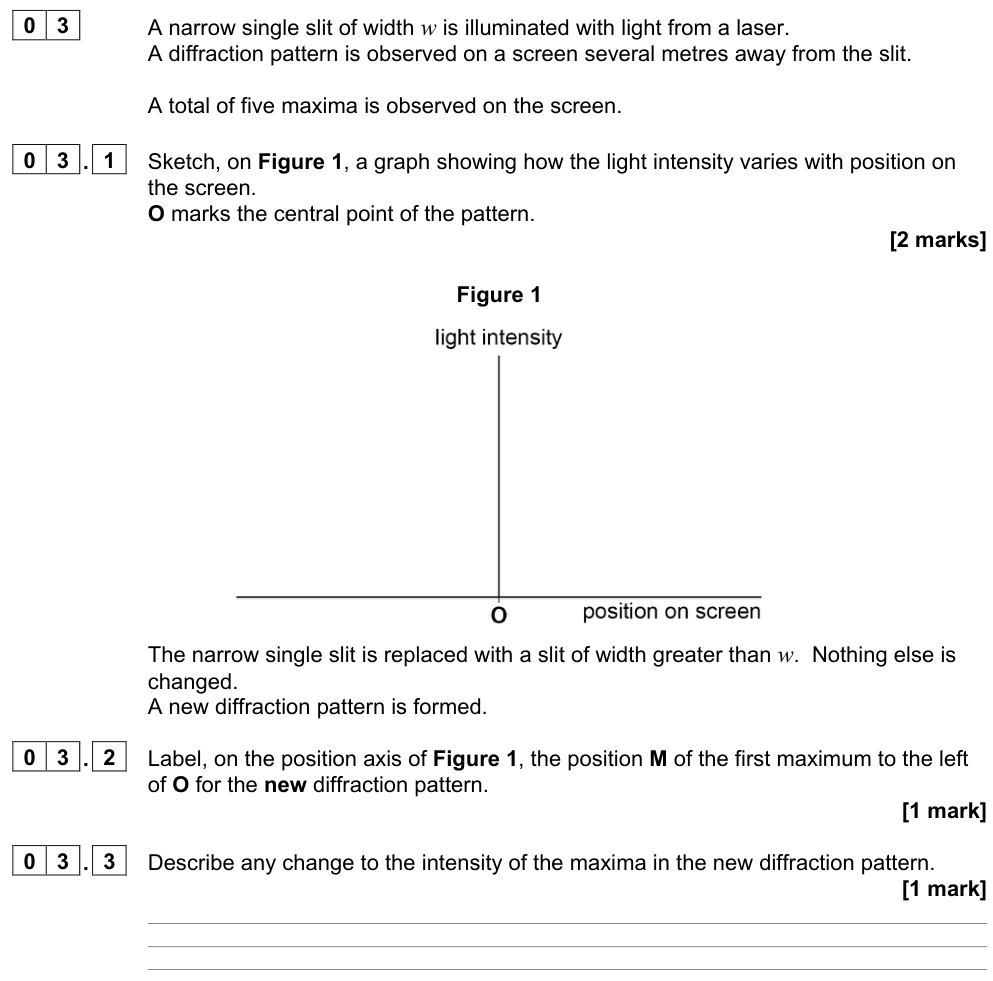
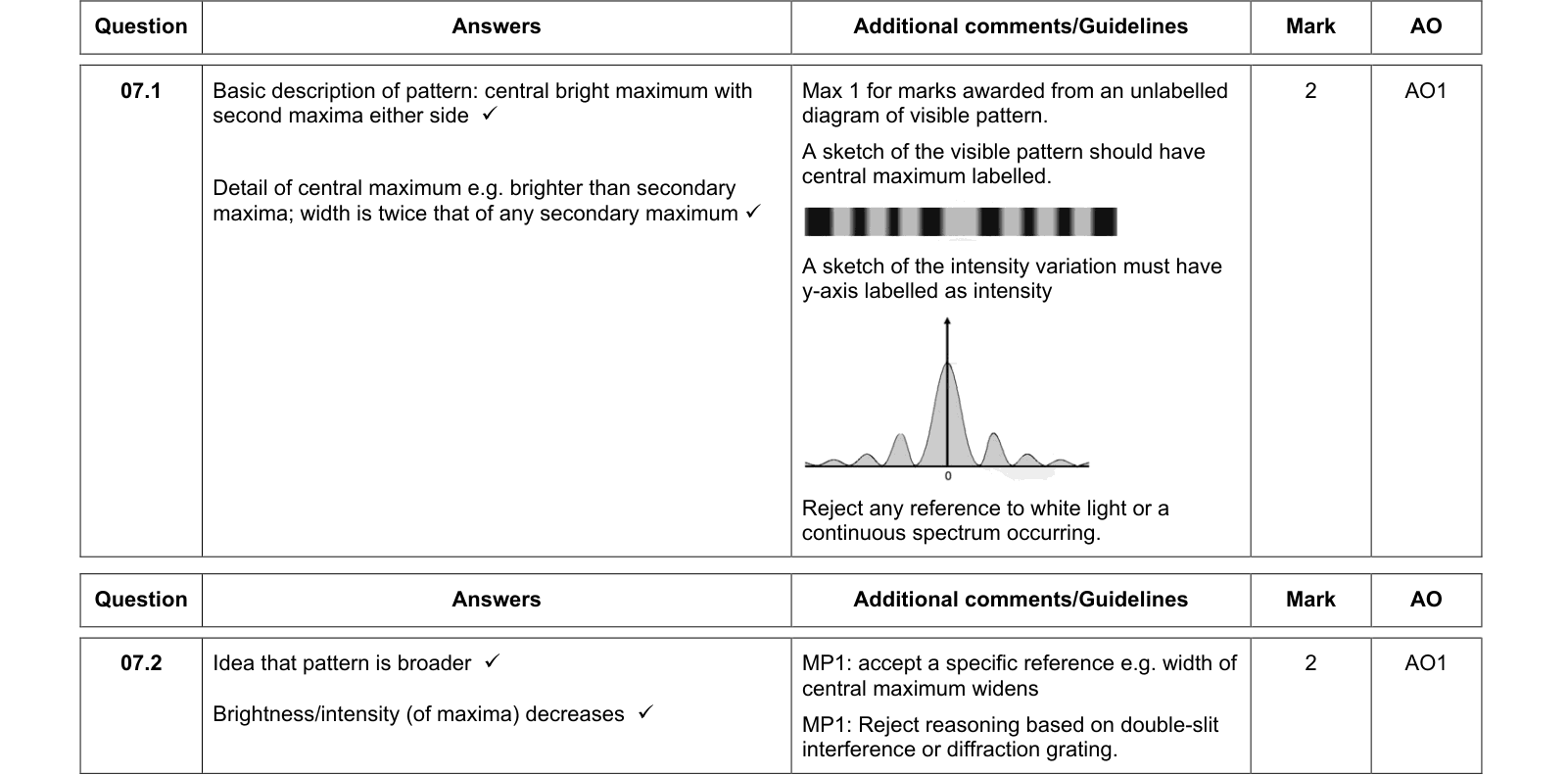
When monochromatic light (e.g. from a laser) passes through a narrow single slit, the pattern on a screen has:
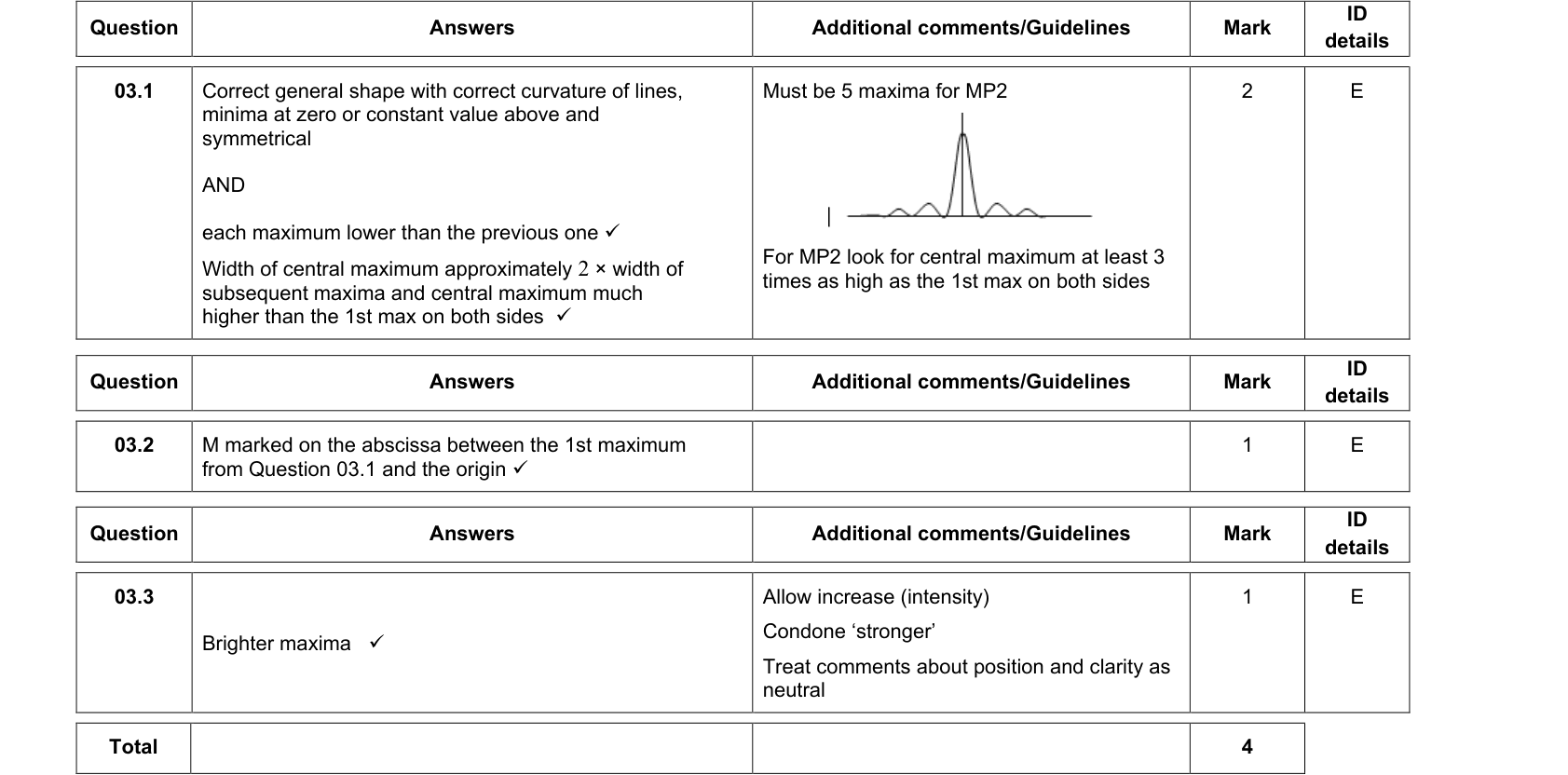
- a wide, bright central maximum,
- weaker side maxima on each side, each half the width of the central maximum,
- dark fringes (minima) between them,
- intensity of the side maxima falling off rapidly away from the centre.
Width of the central maximum (qualitative)
The central maximum becomes wider when:
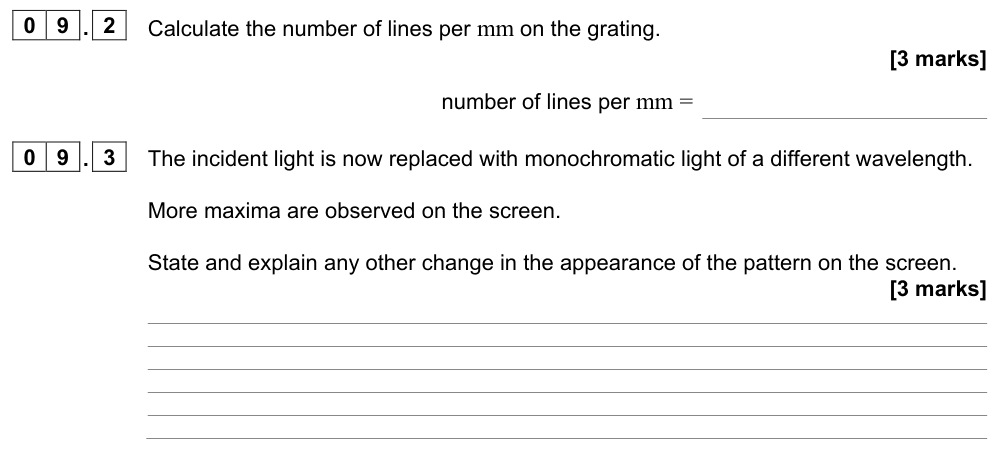
- the wavelength increases (red light spreads more than blue), or
- the slit width decreases (a narrower slit diffracts more).
(The intensity–angle graph is not required for single slits.)
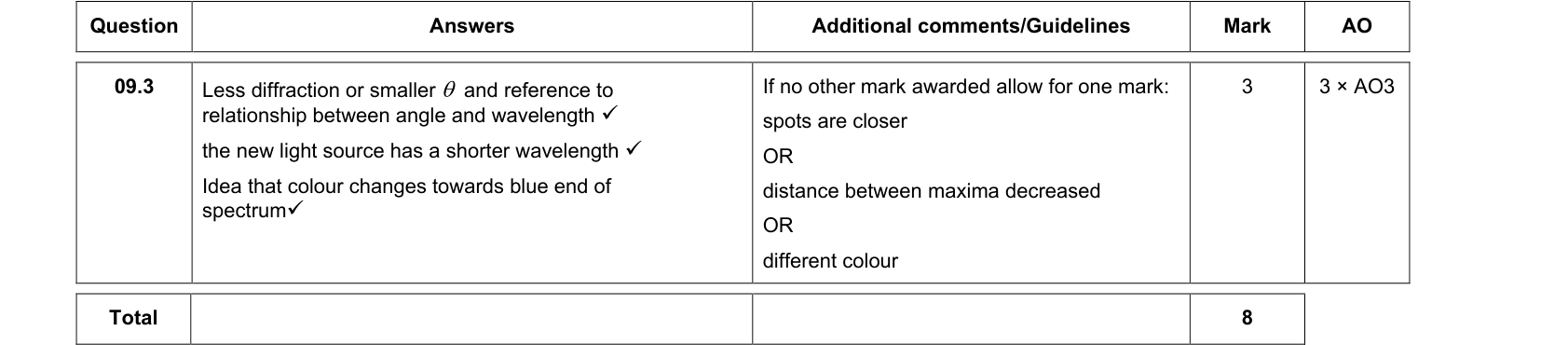
With white light, the central maximum is white (all colours overlap) but its edges are coloured. The side maxima are spectra with blue/violet on the inside and red on the outside, because longer wavelengths diffract more.
Note: a narrower slit also lets less light through, so the pattern is dimmer.
The diffraction grating
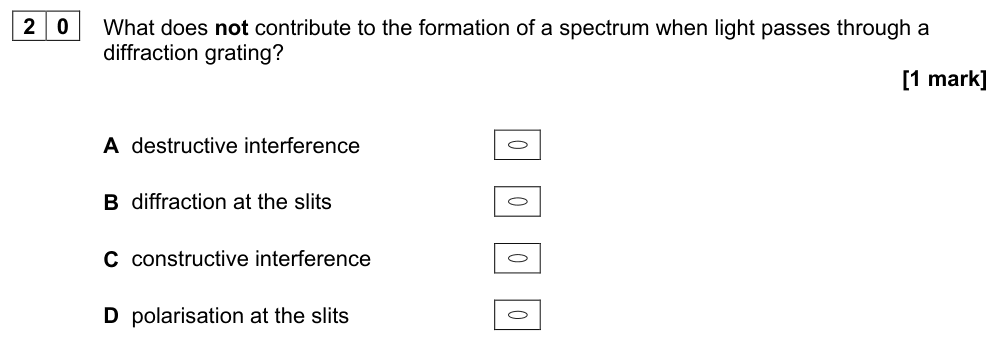
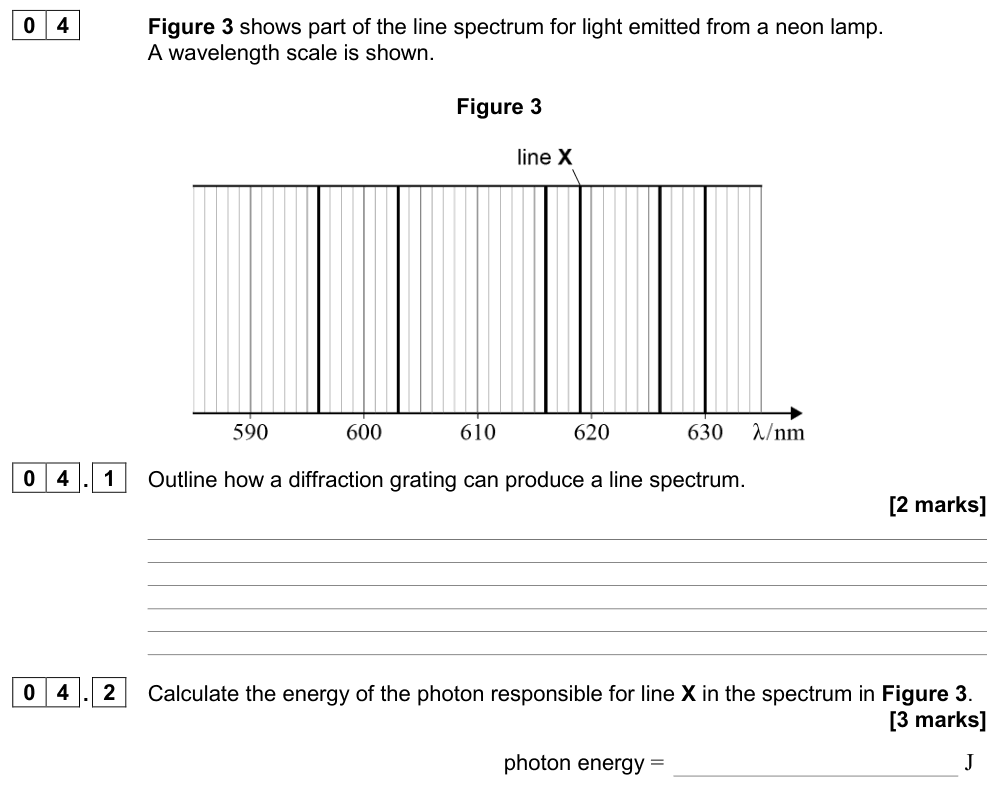
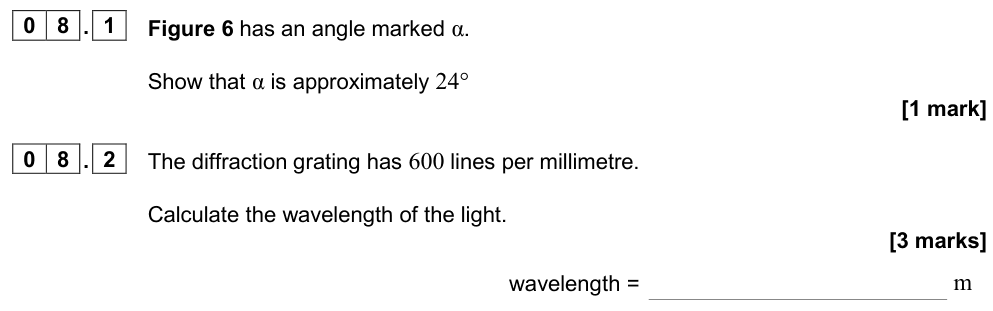
A plane transmission diffraction grating is a plate with a very large number of equally spaced, parallel slits (often 300–600 lines per mm). Light diffracts through every slit and the waves interfere. Because there are so many slits, the maxima are very sharp and bright, with almost total darkness in between. This makes gratings far better than double slits for measuring wavelengths accurately.
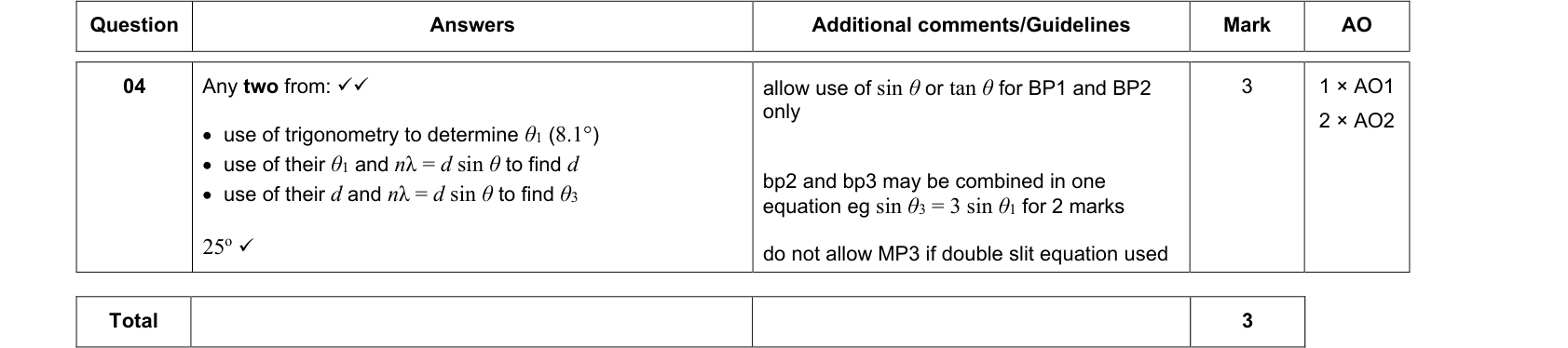
Deriving $d\sin\theta = n\lambda$
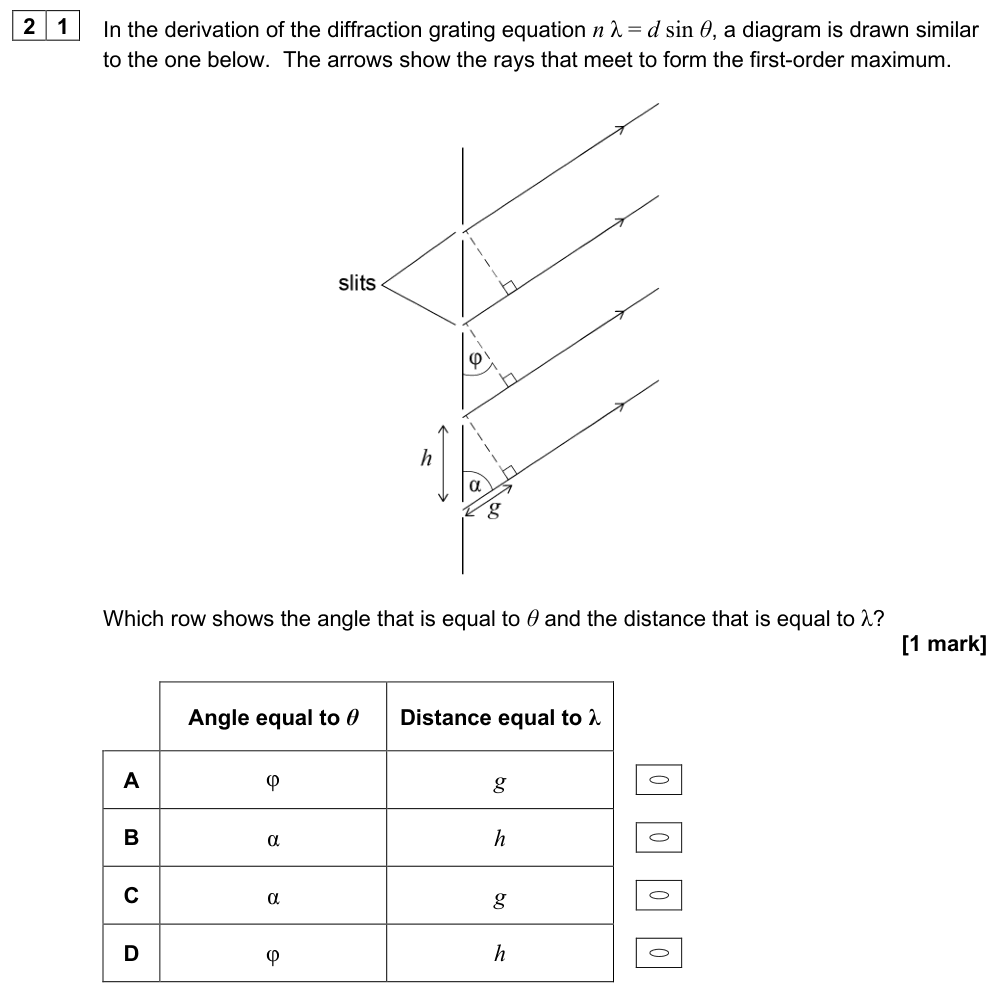
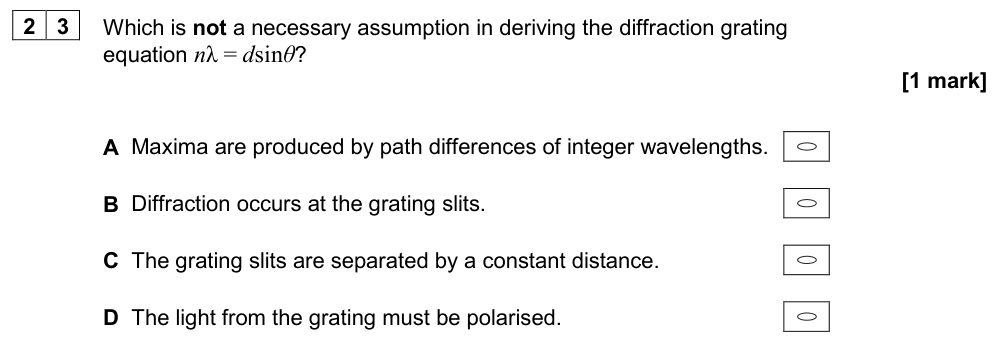
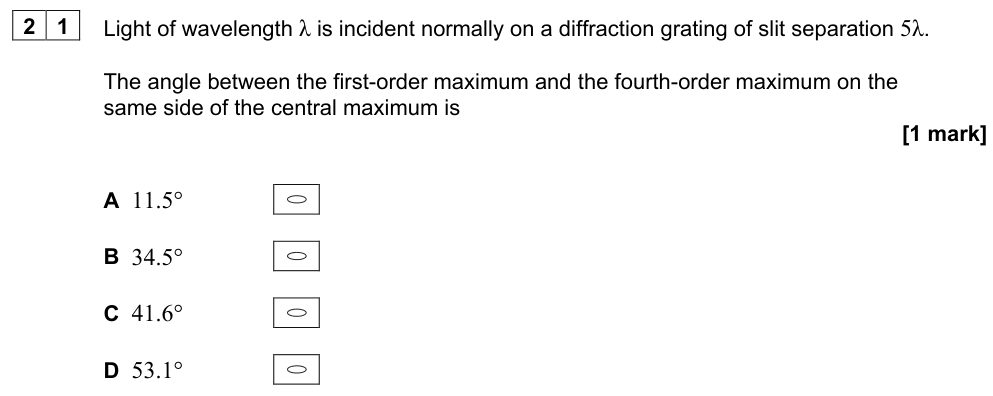
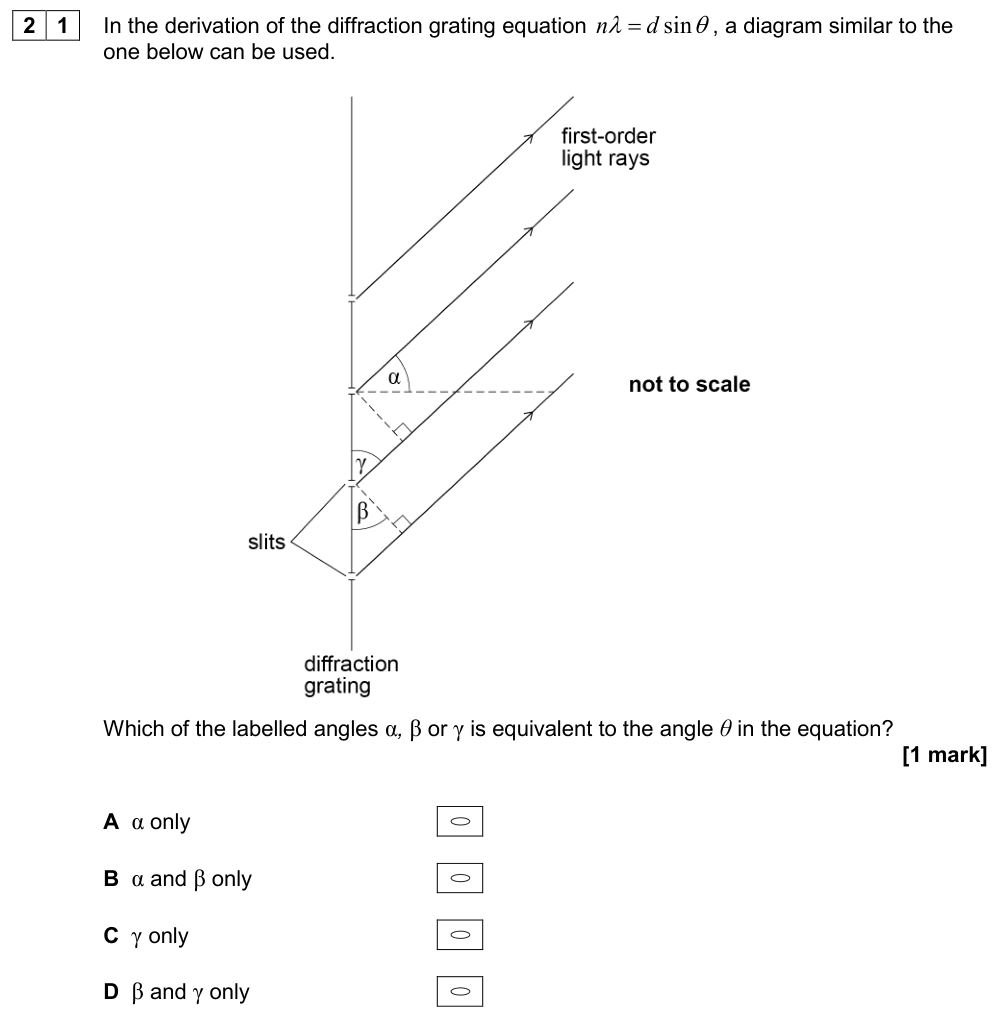
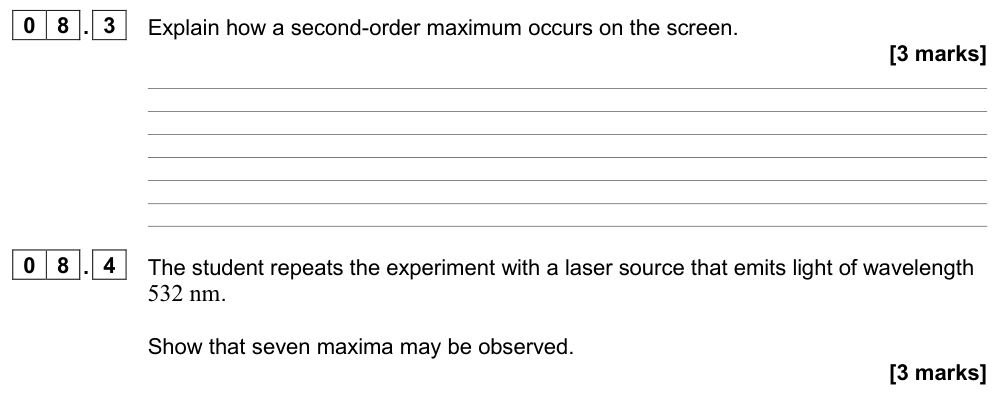
Consider monochromatic light at normal incidence on a grating with slit spacing $d$. Waves leaving adjacent slits at angle $\theta$ to the normal have a path difference of $d\sin\theta$ (from the right-angled triangle formed by the slit spacing and the wavefronts). For a maximum, waves from all slits must arrive in phase, so the path difference between adjacent slits must be a whole number of wavelengths:
The diffraction grating equation
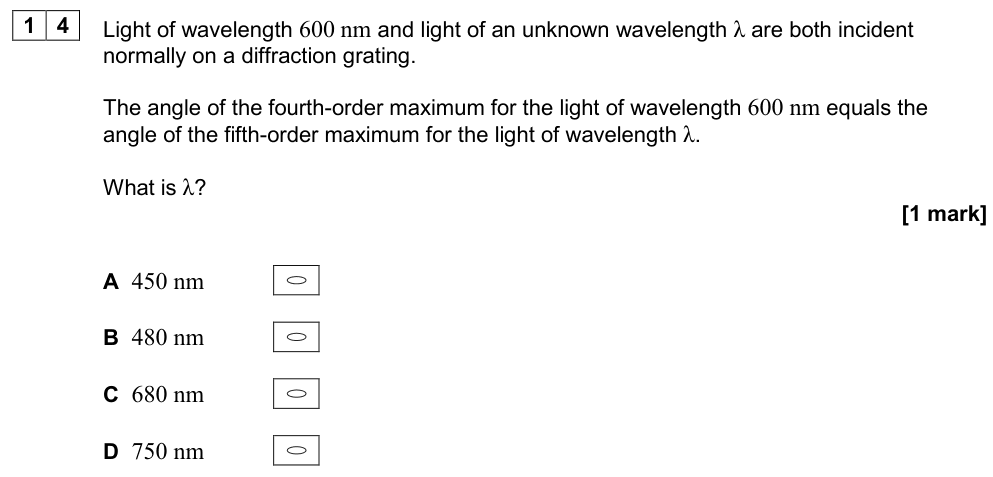
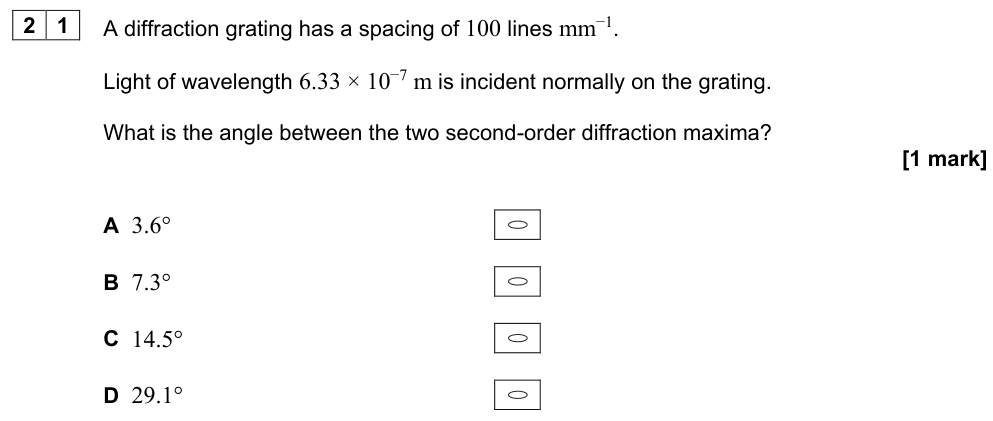
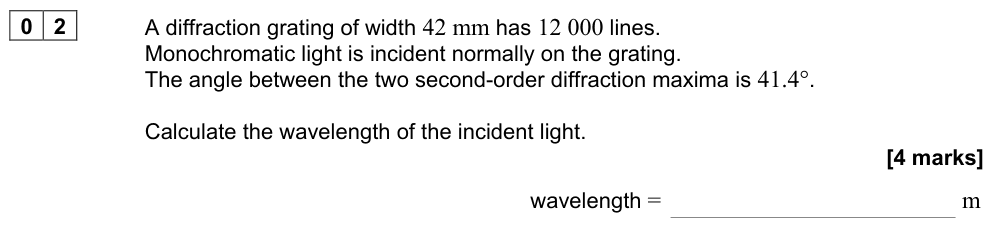
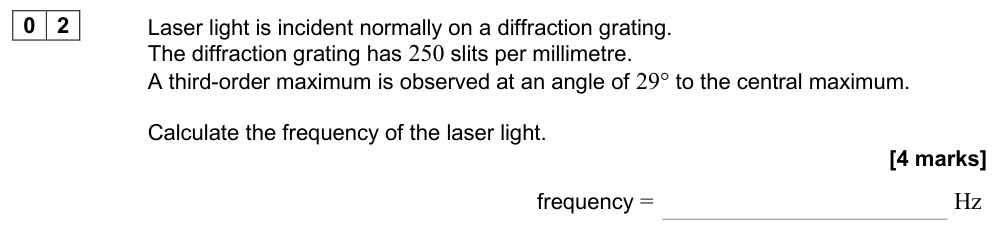
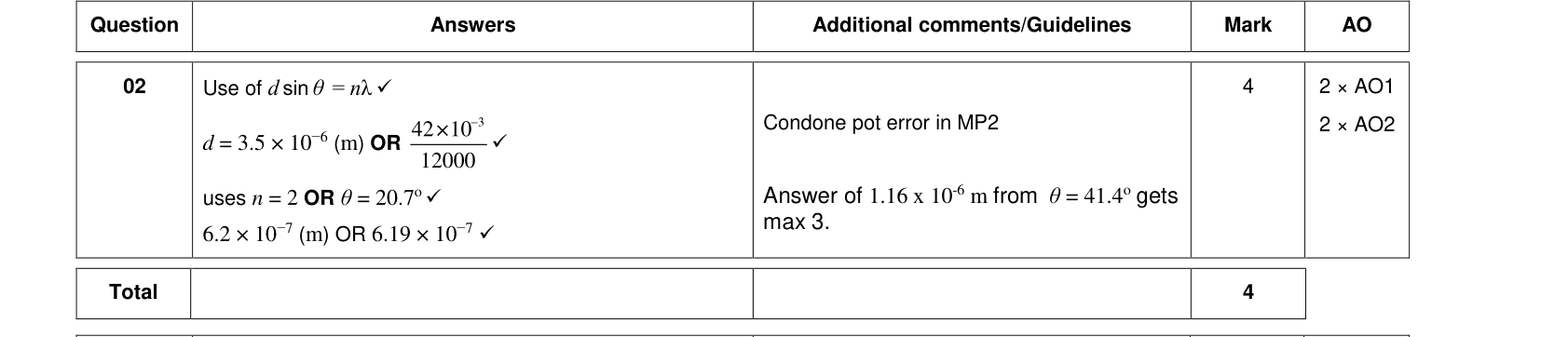
$$d\sin\theta = n\lambda$$
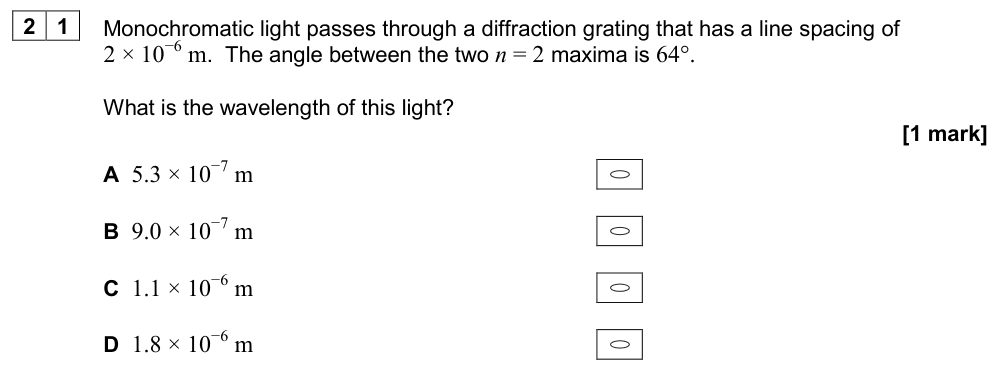
$d$ = slit spacing (grating spacing), $\theta$ = angle between the $n$th-order maximum and the straight-through (zero-order) direction, $n$ = order (0, 1, 2, …).
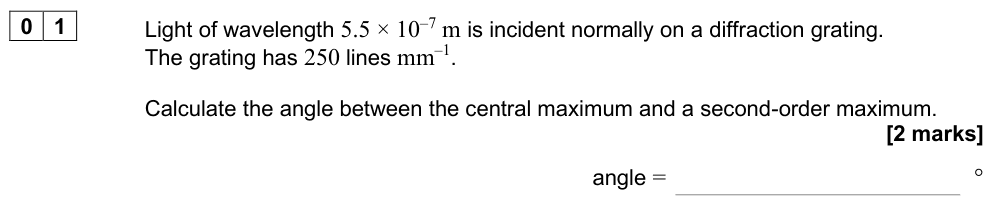
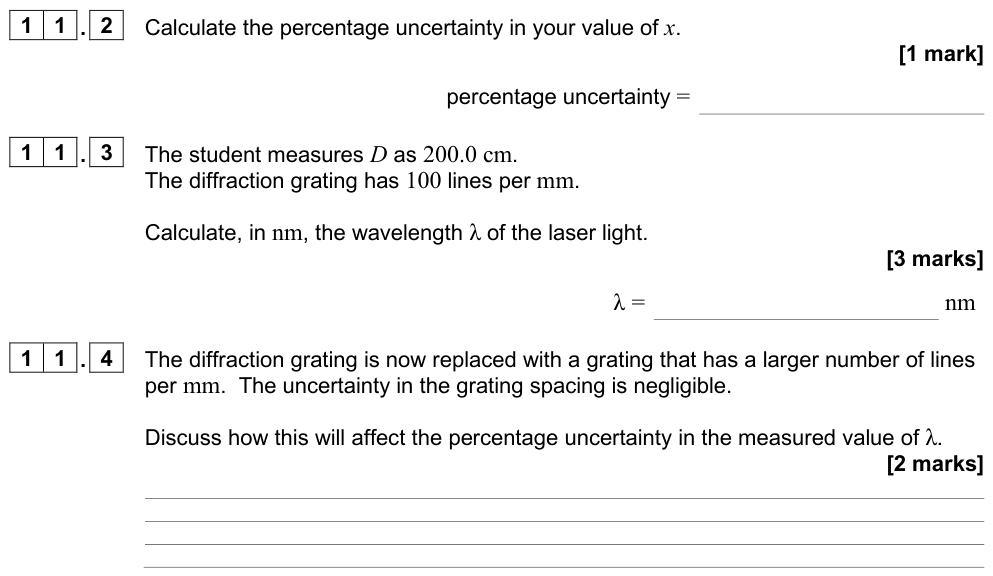
If the grating has $N$ lines per metre, $d = \dfrac{1}{N}$.
Common mistake
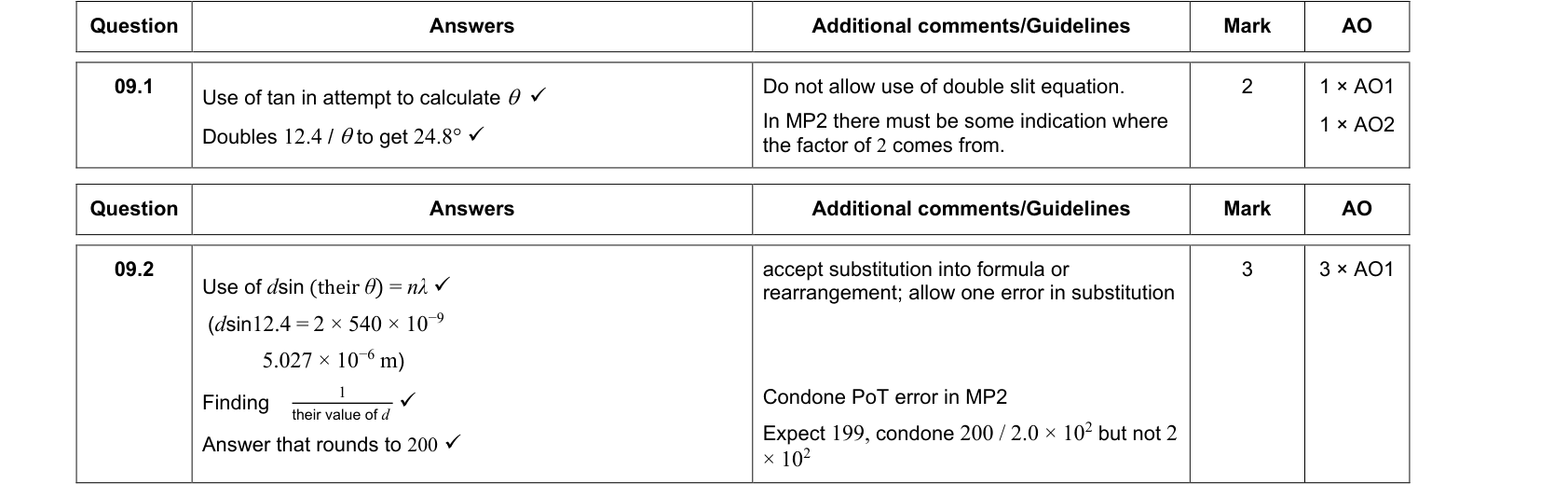
Convert "lines per mm" to the spacing in metres: 300 lines mm⁻¹ → $N = 3.0 \times 10^{5}\ \text{m}^{-1}$ → $d = 3.3 \times 10^{-6}\ \text{m}$. Also, $\theta$ is measured from the central (zero-order) maximum, not between two orders. If you are given the angle between the two first-order maxima, halve it.
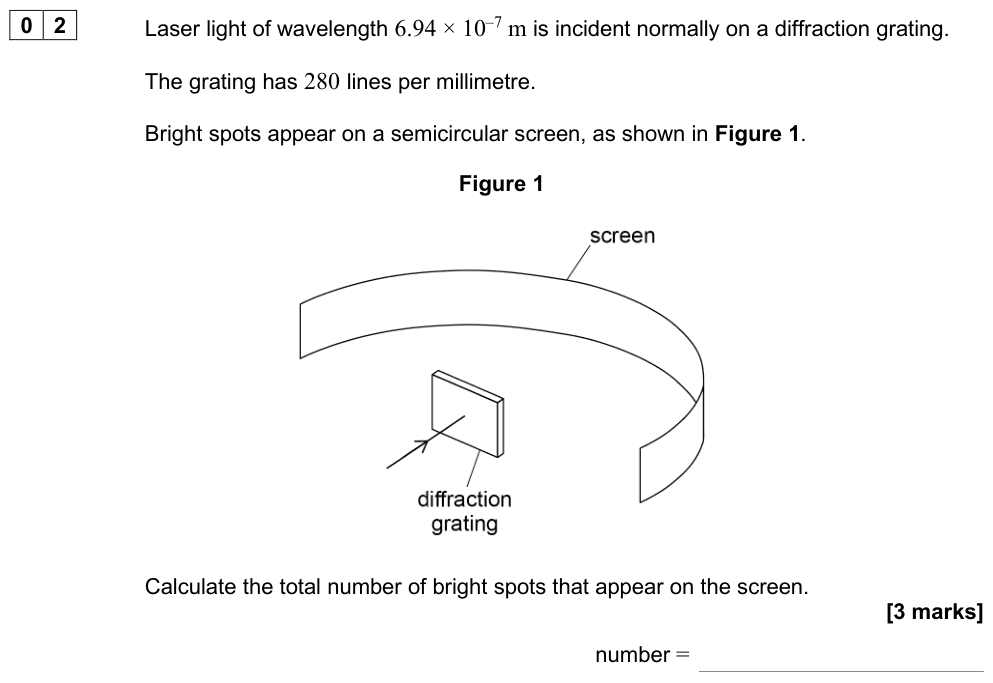
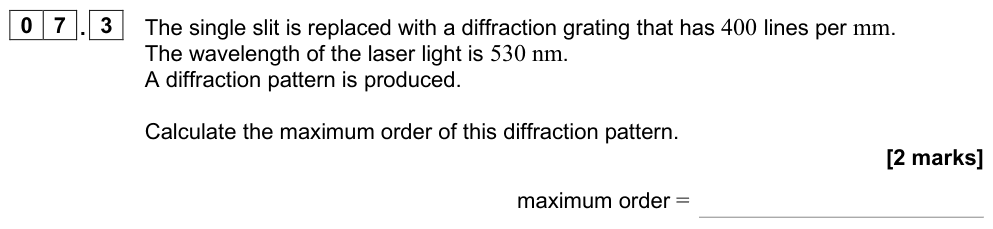
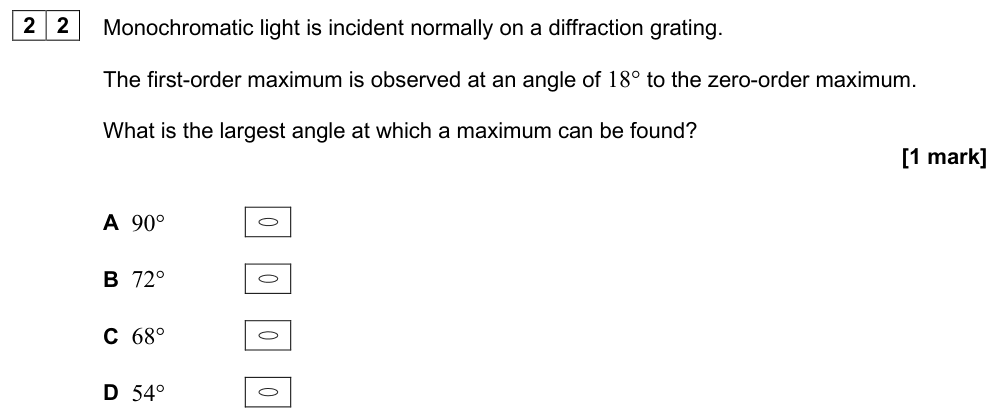
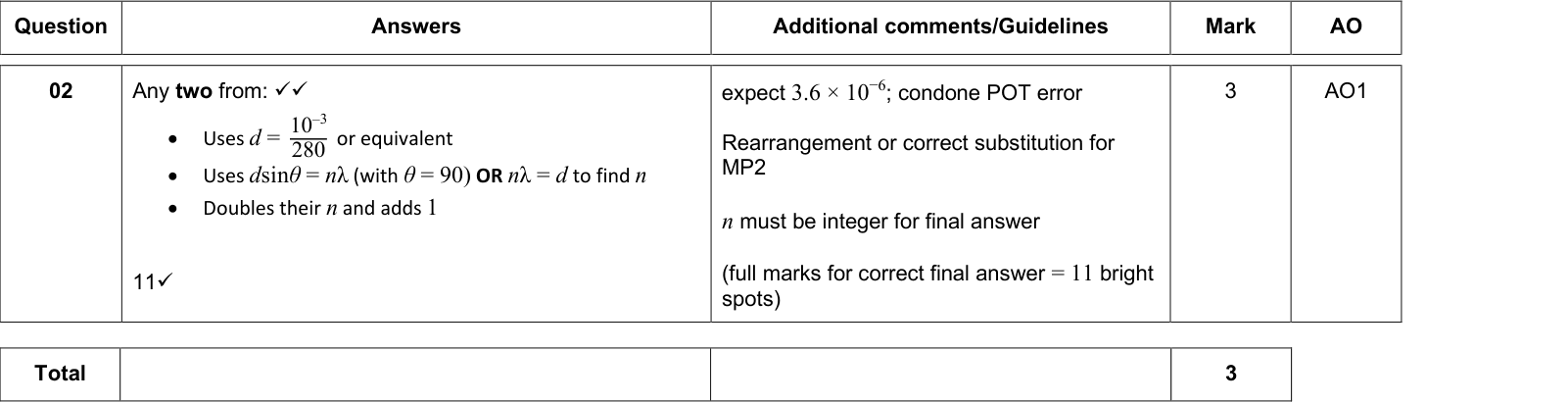
Maximum order
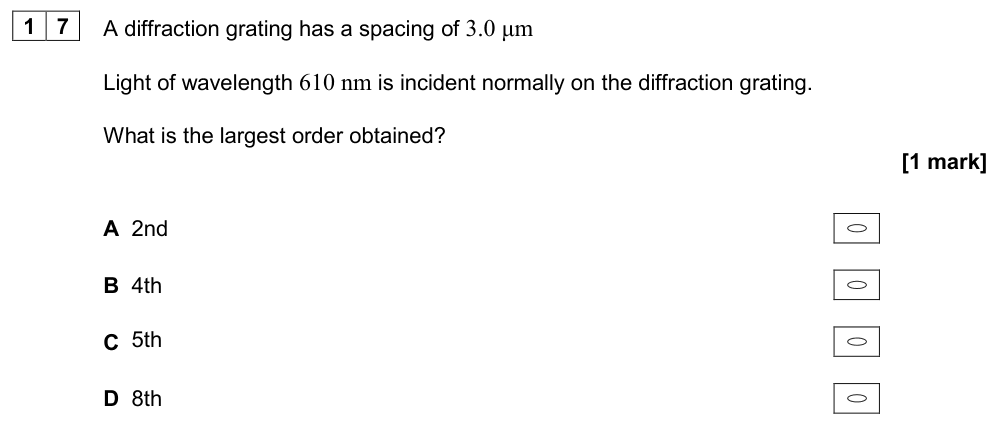
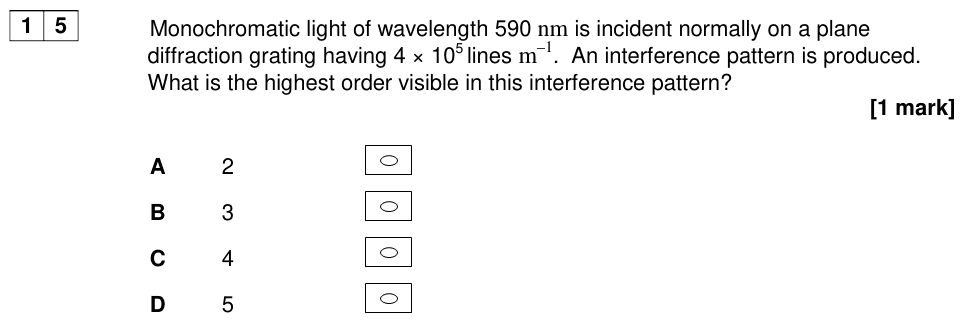
Since $\sin\theta \le 1$, the highest order visible is the largest whole number $n$ with
$$n \le \frac{d}{\lambda}$$
Worked example
Light of wavelength 589 nm falls normally on a grating with 600 lines per mm.
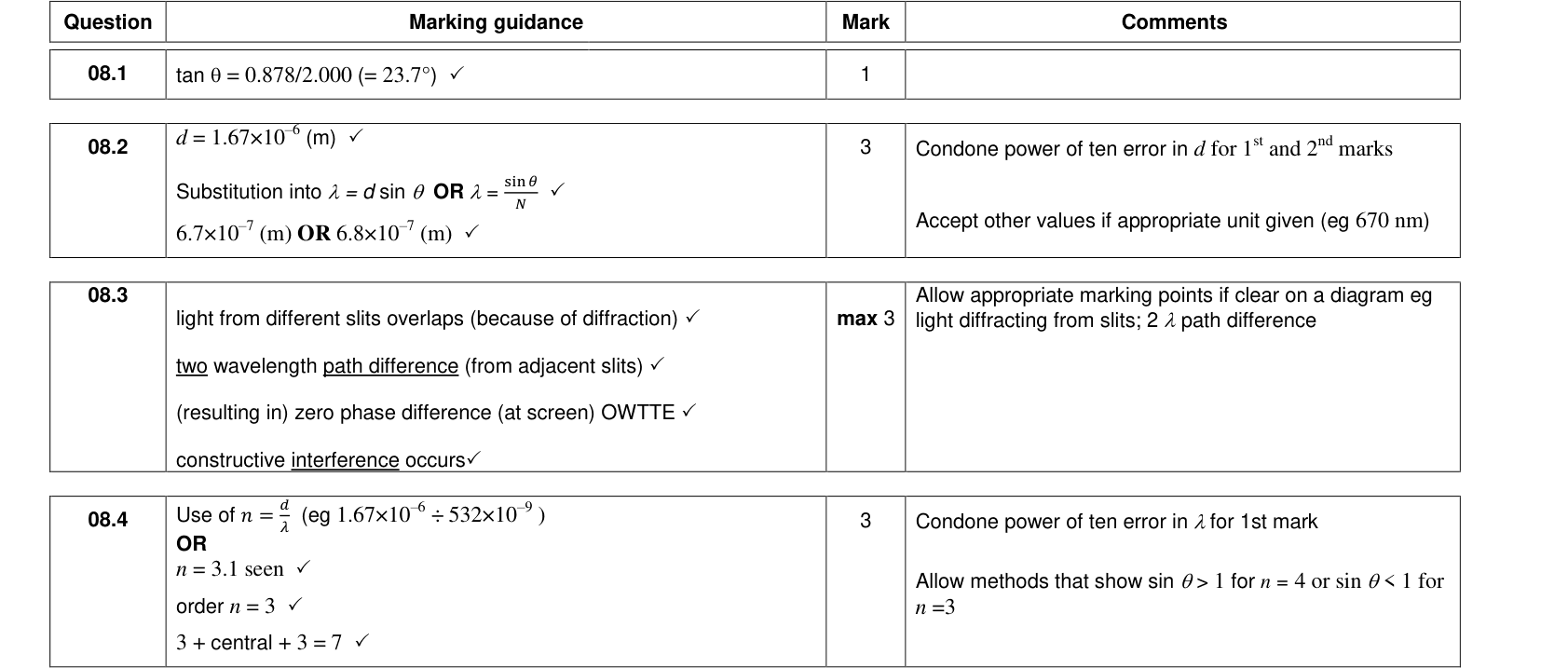
$d = 1/(6.00 \times 10^{5}) = 1.67 \times 10^{-6}\ \text{m}$.
First order: $\sin\theta_1 = \dfrac{589 \times 10^{-9}}{1.67 \times 10^{-6}} = 0.353$, so $\theta_1 = 20.7^\circ$.
Maximum order: $d/\lambda = 2.83$, so $n_{\max} = 2$. The total number of maxima visible is $2 \times 2 + 1 = 5$.
White light and spectra
With white light, the zero-order maximum is white. Each other order is a spectrum with violet nearest the centre and red furthest out. Higher-order spectra are more spread out and can overlap (e.g. the red end of the second order with the violet end of the third).
Applications of diffraction gratings
- Spectrometers and spectroscopy: measuring the wavelengths of line spectra to identify elements (in stars, in labs, in chemical analysis).
- Separating the wavelengths in light from distant stars to measure their composition and motion.
- Telecommunications (separating signals of different wavelengths in fibres).
- X-ray crystallography: the regular rows of atoms in a crystal act as a grating for X-rays (spacing ~ $10^{-10}$ m), revealing crystal structures.
Measuring wavelength with a grating (part of Required practical 5)
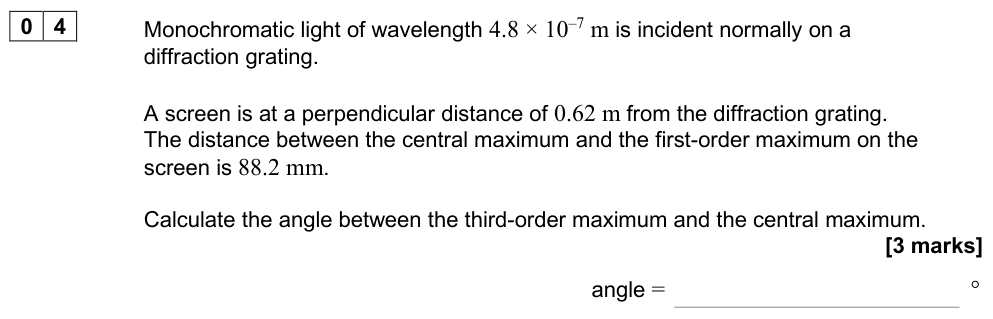
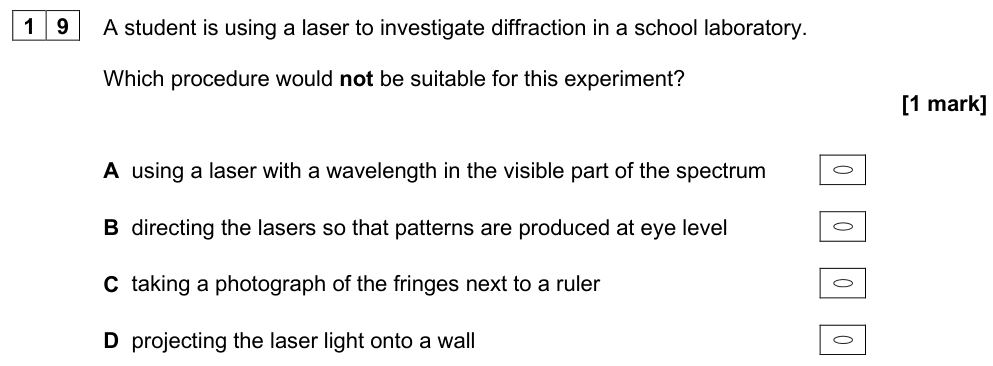
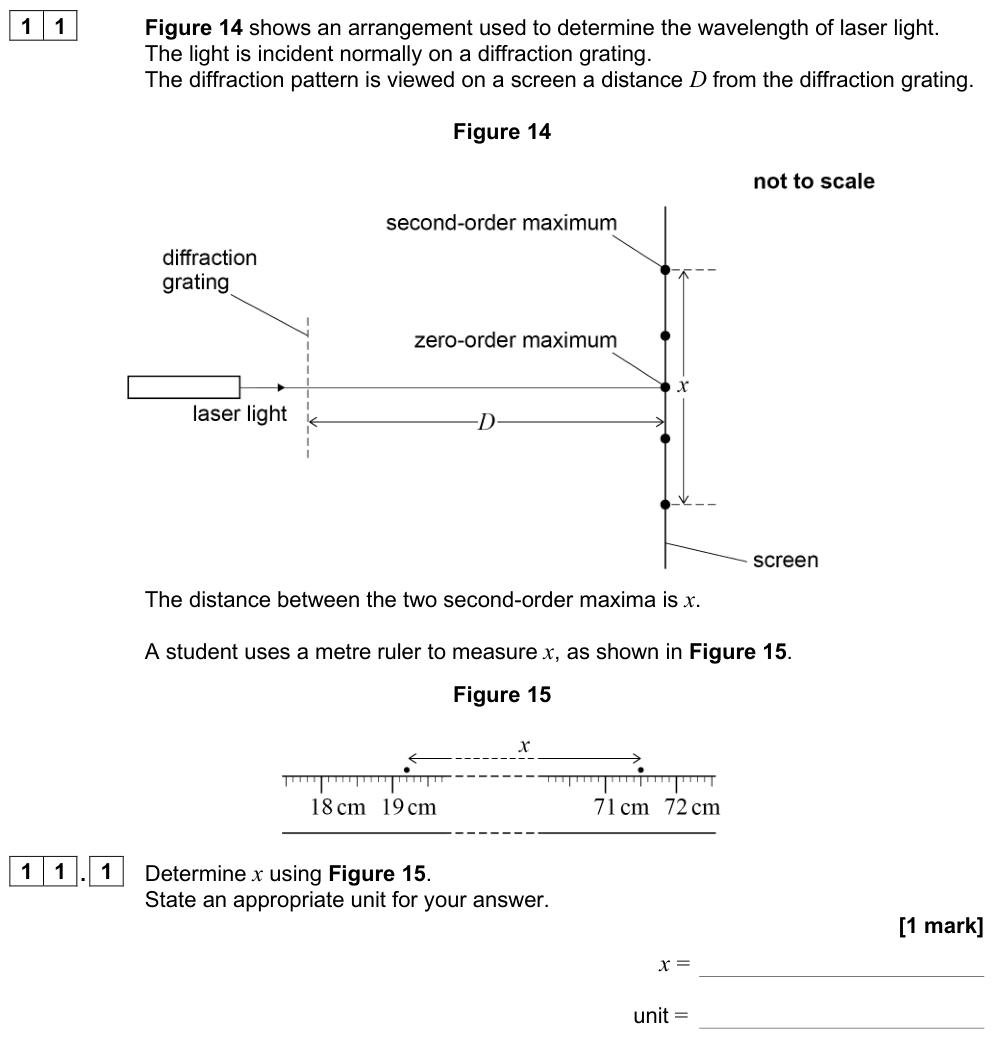
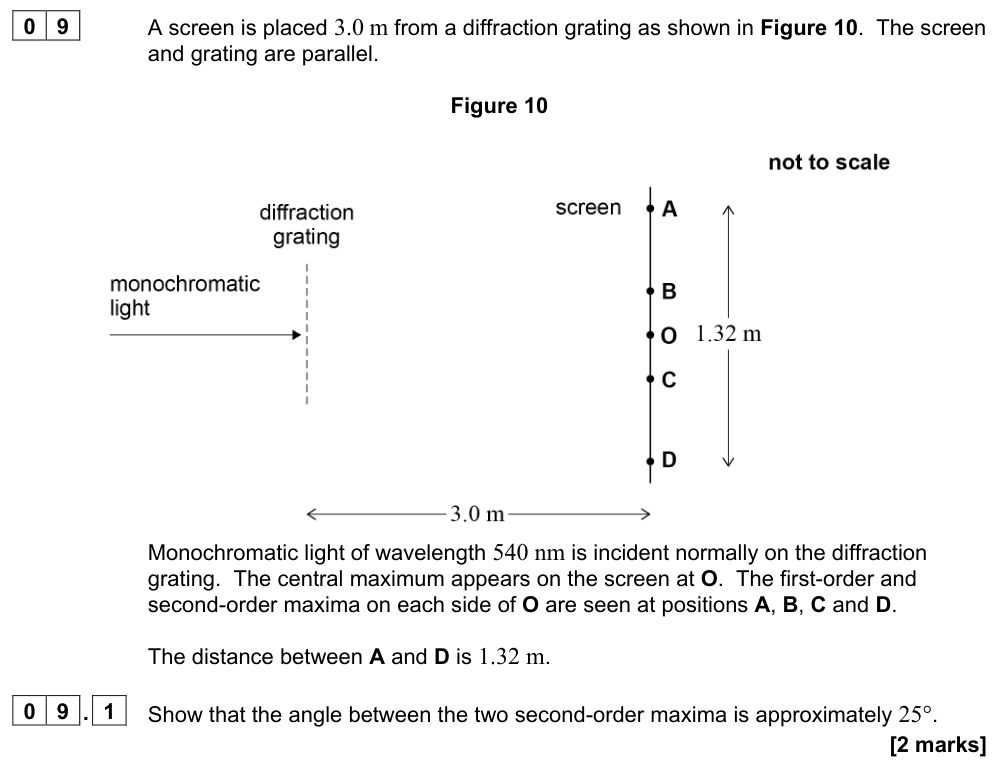
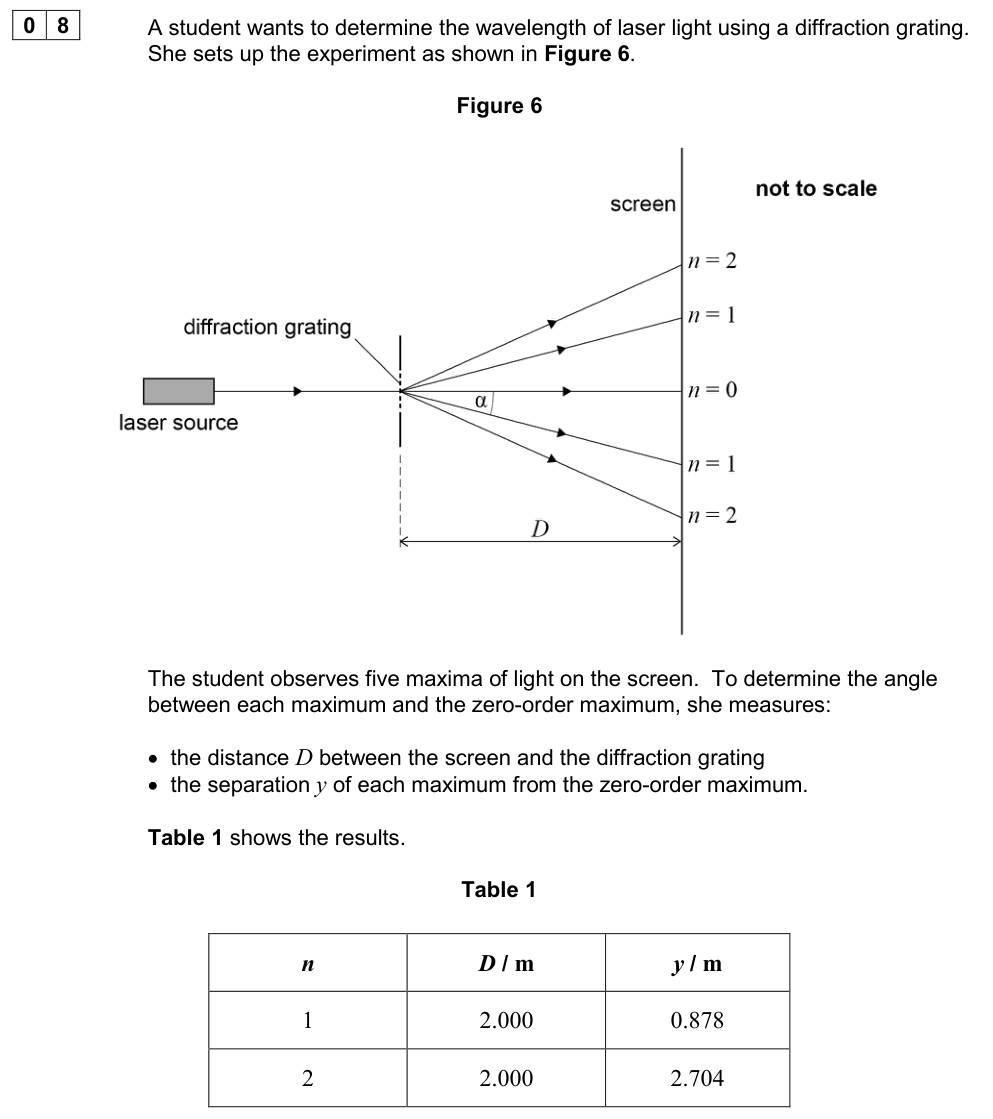
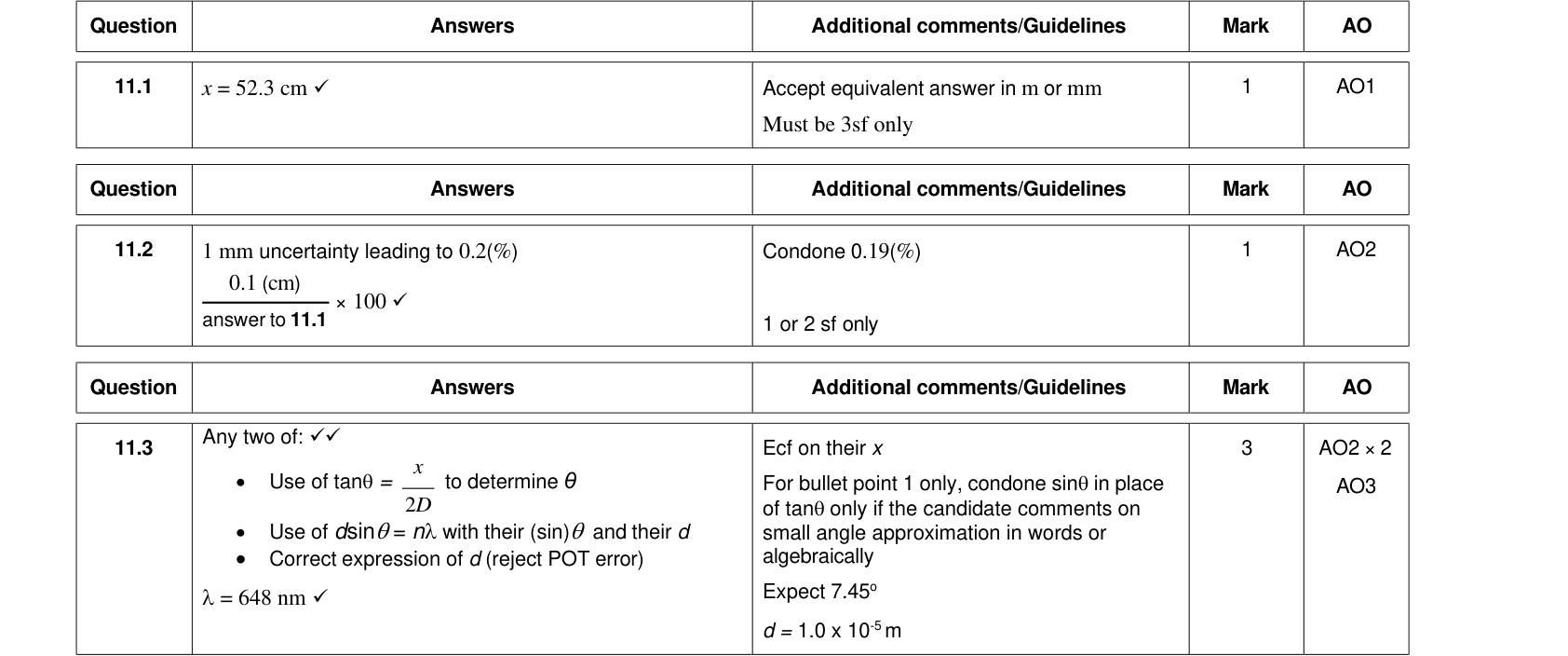
Shine a laser normally through a grating onto a screen a distance $D$ away. Measure the distance $x$ from the central maximum to the $n$th-order maximum on each side and average. Then $\tan\theta = x/D$, so find $\theta$ and use $\lambda = d\sin\theta/n$. Using higher orders gives larger angles and smaller percentage uncertainty.
Summary
- Diffraction: spreading of waves through a gap; greatest when gap ≈ wavelength.
- Single slit: wide central maximum, twice the width of the side maxima; wider for longer λ or narrower slit.
- Grating: $d\sin\theta = n\lambda$ at normal incidence, $d = 1/N$; sharp, bright maxima.
- Maximum order: largest integer $n \le d/\lambda$.
- Uses: spectroscopy, astronomy, crystallography.