The photon model of light
Light and all electromagnetic radiation are emitted and absorbed in discrete packets of energy called photons (quanta).
Photon energy
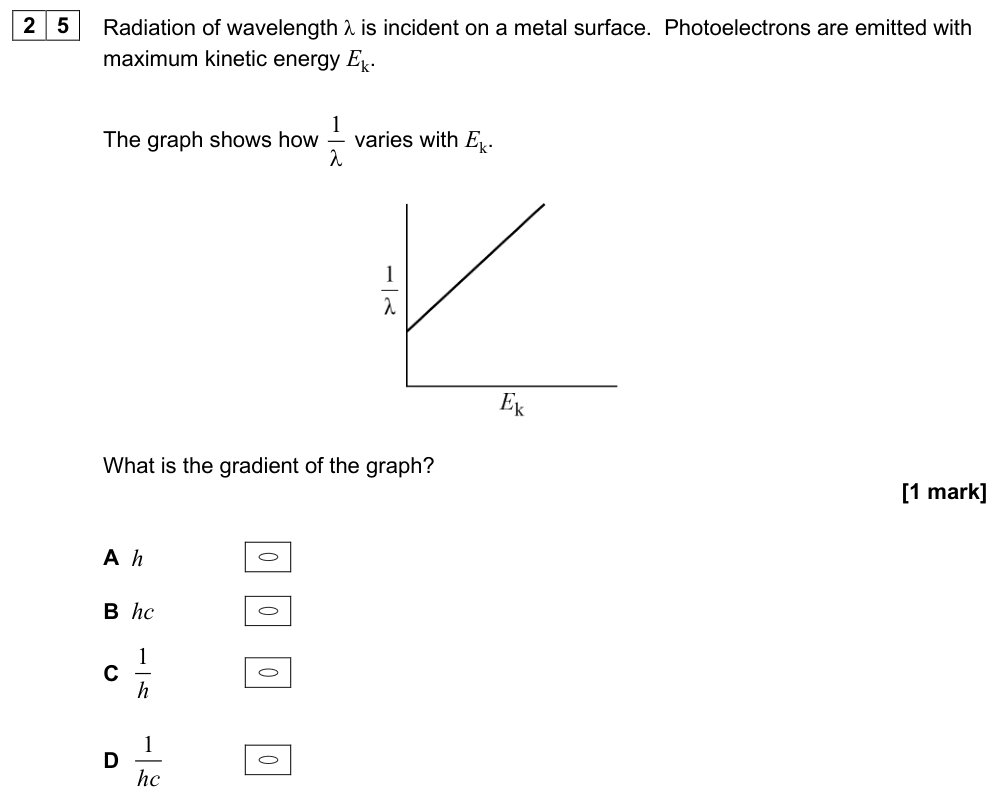
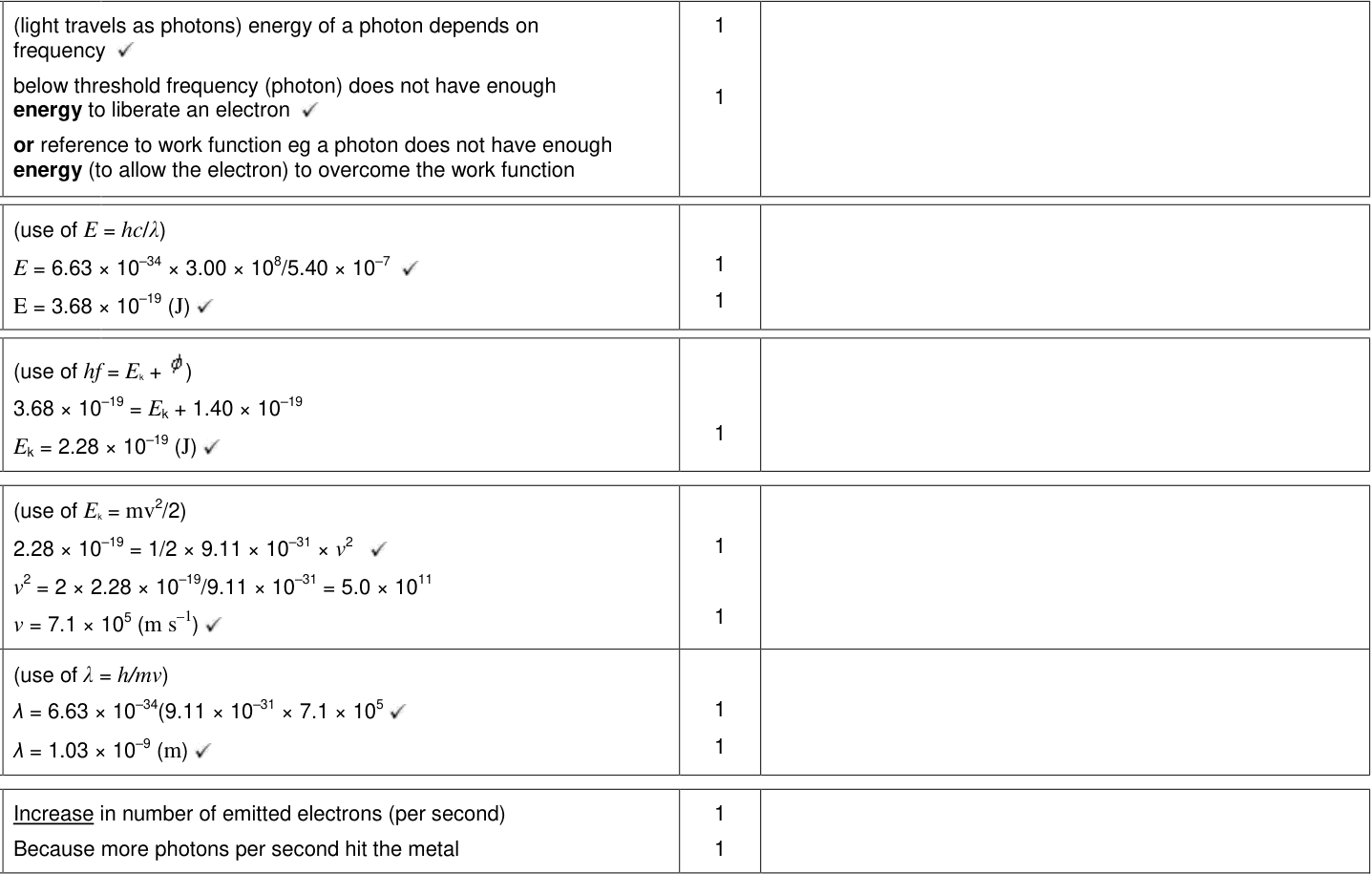
$$E = hf = \frac{hc}{\lambda}$$
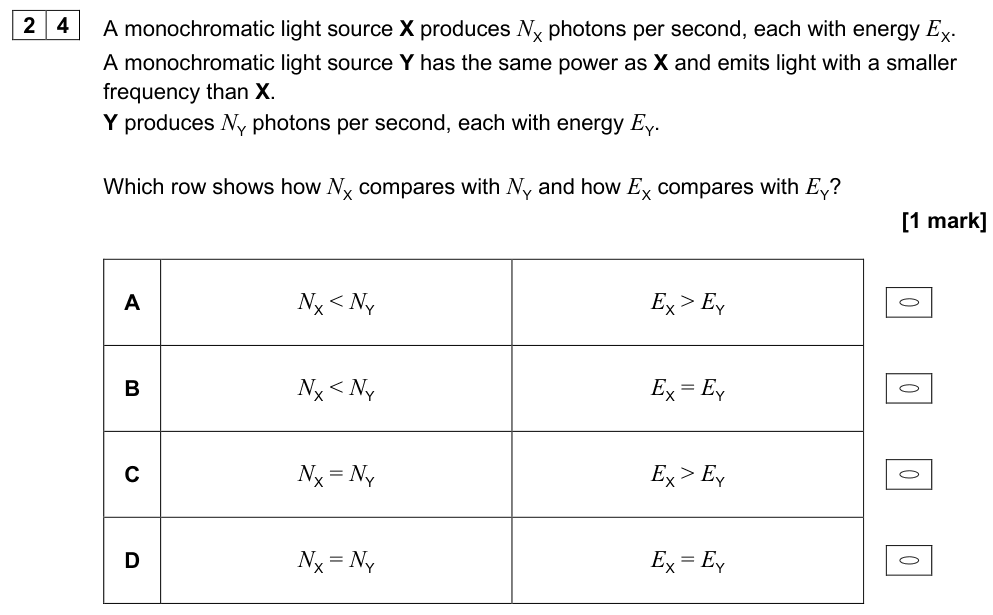
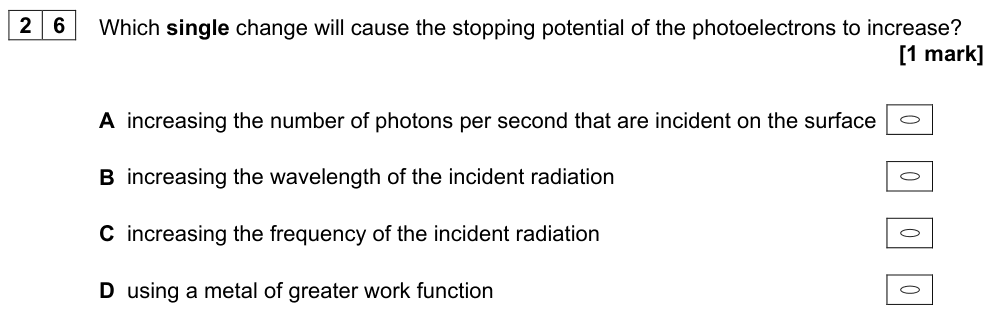
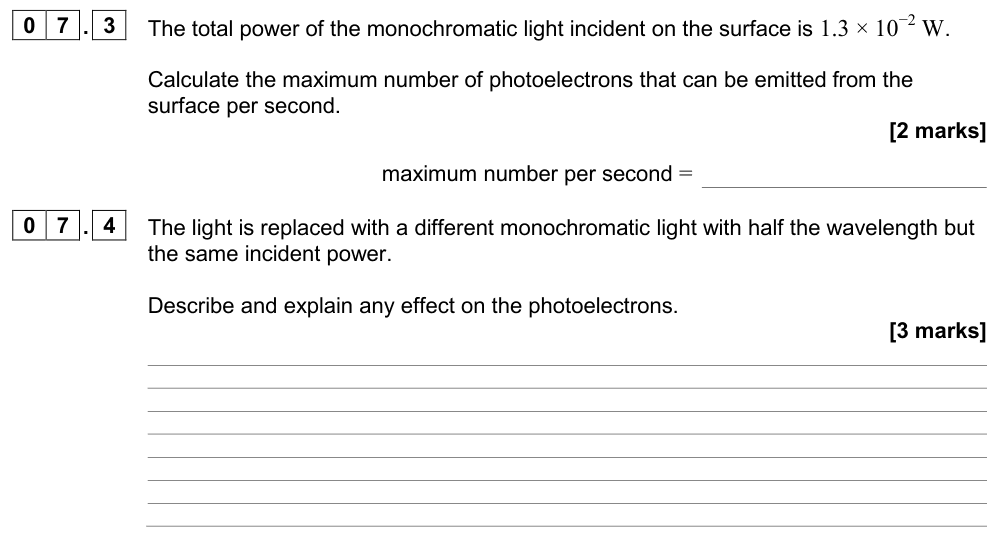
$h$ is the Planck constant, $6.63 \times 10^{-34}\ \text{J s}$. A photon's energy depends only on its frequency: higher frequency (shorter wavelength) → more energetic photons.
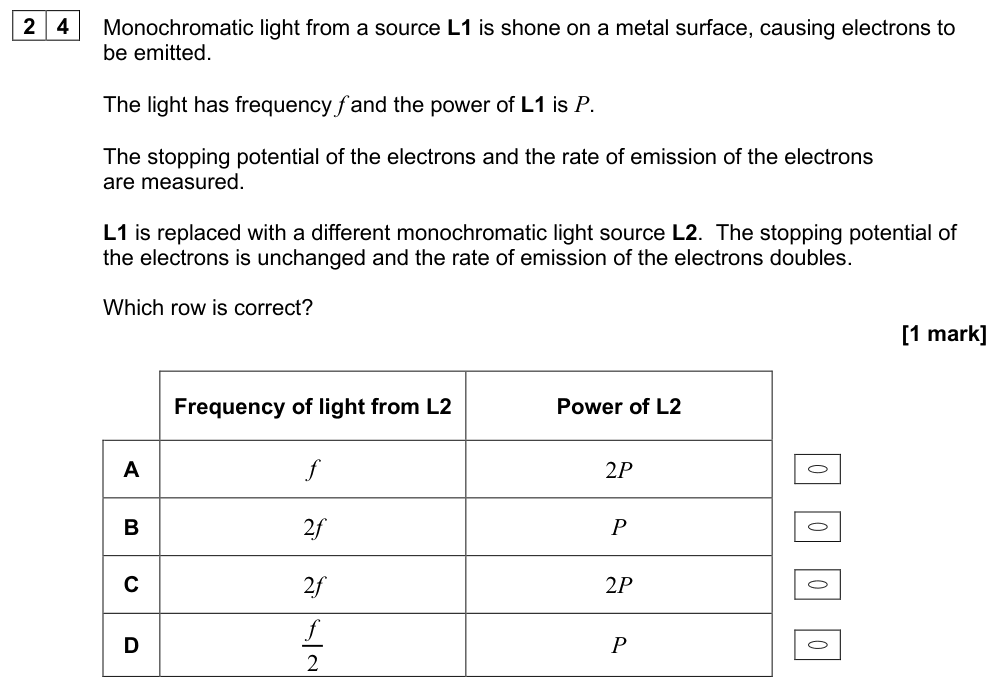
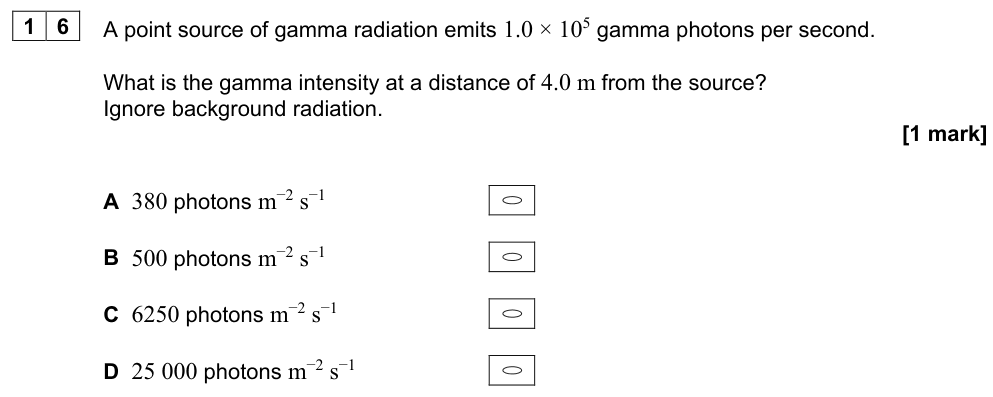
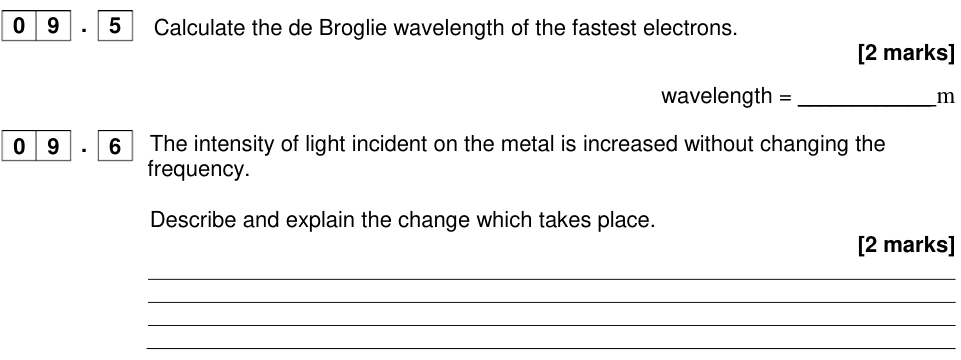
- The intensity of a beam (power per unit area) depends on the number of photons per second and their energy. A more intense beam of the same frequency means more photons per second, not more energetic photons.
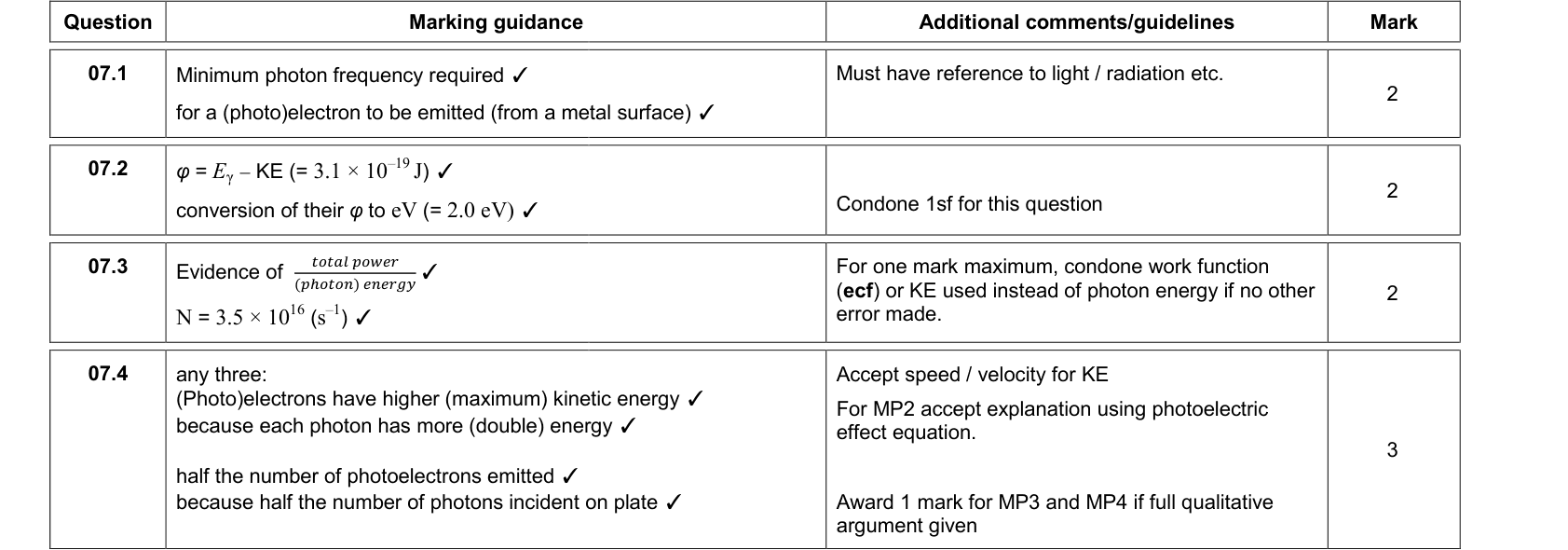
- Number of photons emitted per second by a source of power $P$: $\dfrac{P}{hf}$.
Worked example: photons from a laser
A 1.0 mW laser emits light of wavelength 650 nm.
$E = \dfrac{hc}{\lambda} = \dfrac{6.63 \times 10^{-34} \times 3.00 \times 10^{8}}{650 \times 10^{-9}} = 3.06 \times 10^{-19}\ \text{J}$ (1.9 eV).
Photons per second $= \dfrac{1.0 \times 10^{-3}}{3.06 \times 10^{-19}} = 3.3 \times 10^{15}$.
The photoelectric effect
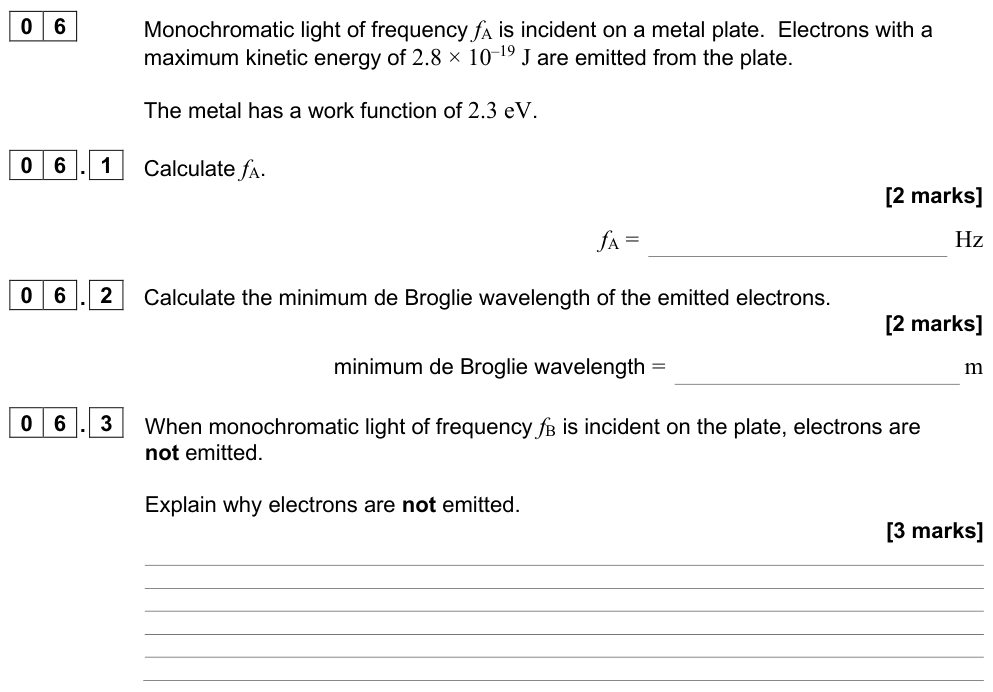
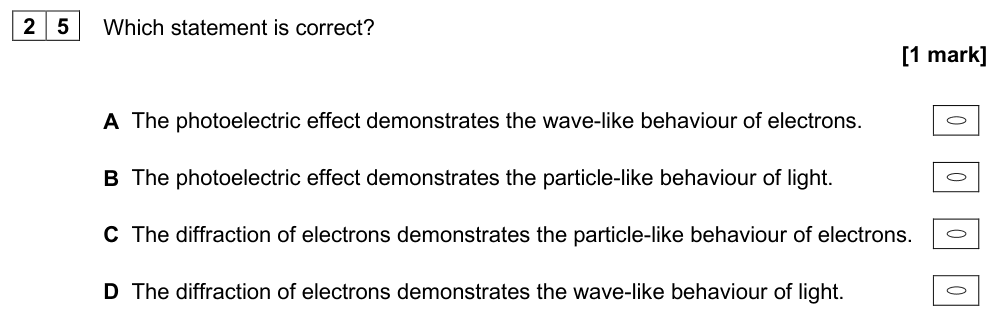
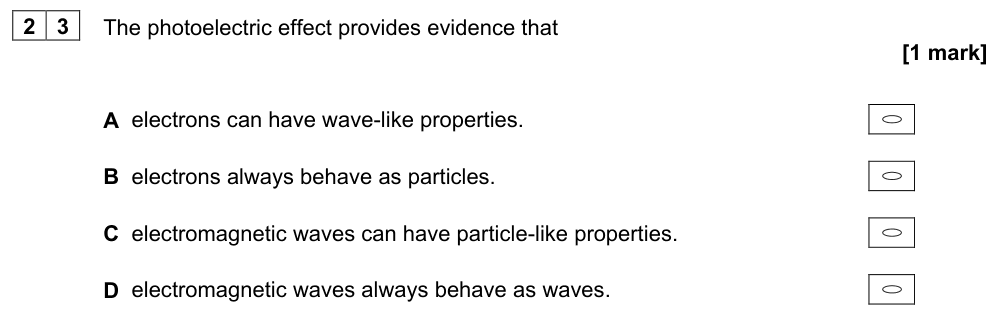
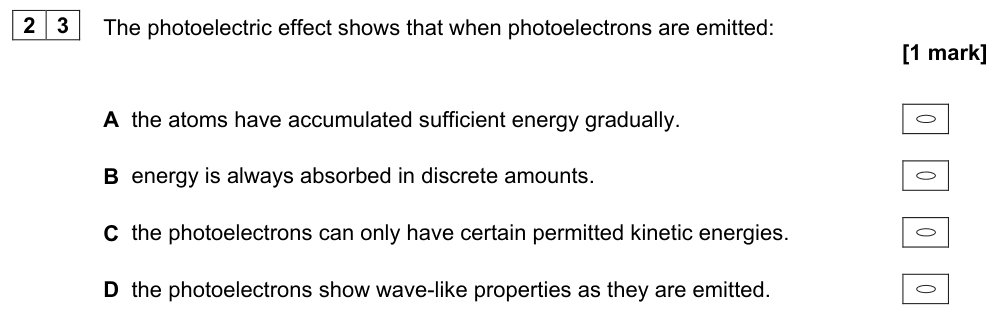
When electromagnetic radiation of high enough frequency (often ultraviolet) shines on a clean metal surface, electrons are emitted from the surface. These are called photoelectrons.
A classic demonstration: a negatively charged gold-leaf electroscope with a clean zinc plate on top. Ultraviolet light makes the leaf fall (electrons are emitted and the charge leaks away). Visible light, however bright, has no effect.
The observations
Key observations
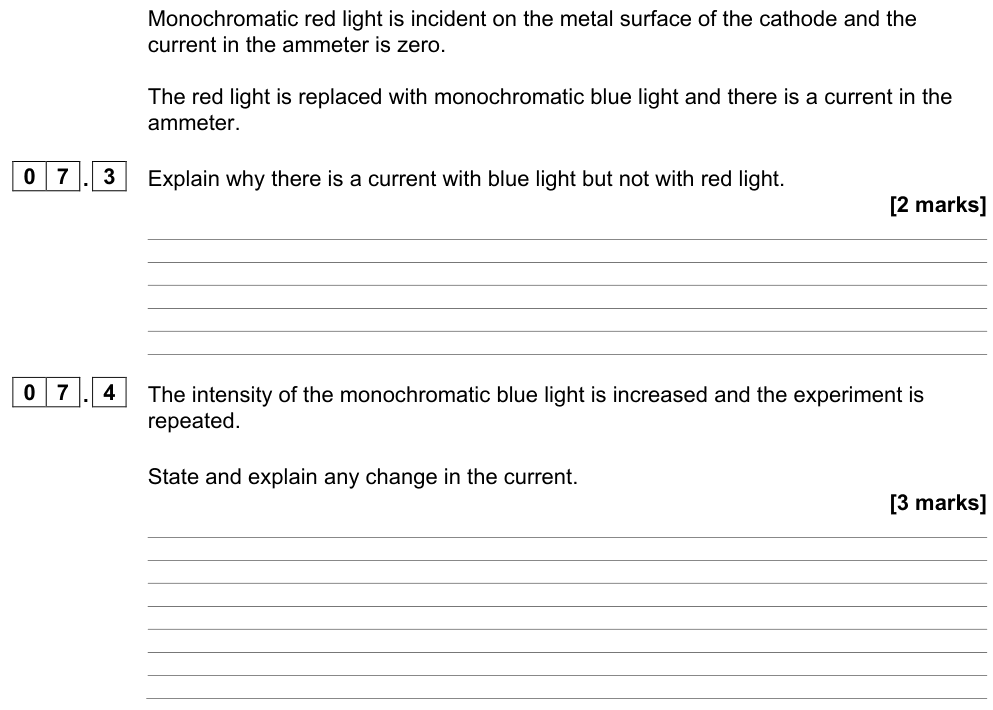
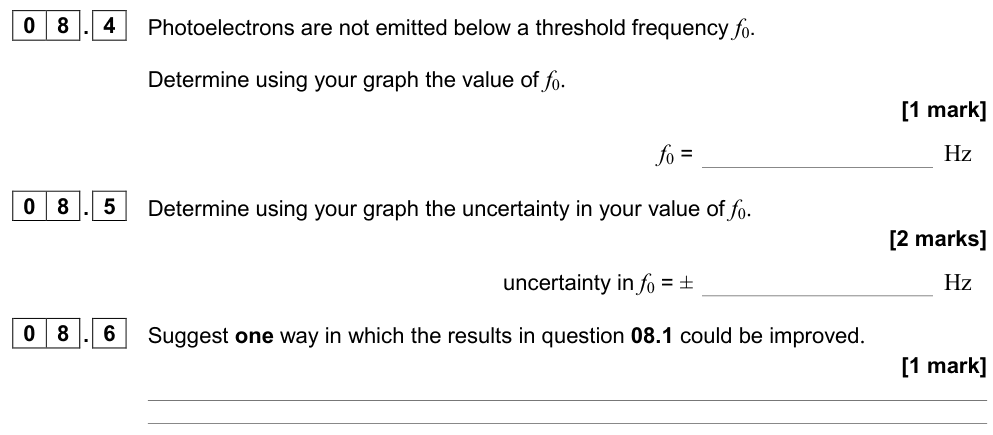
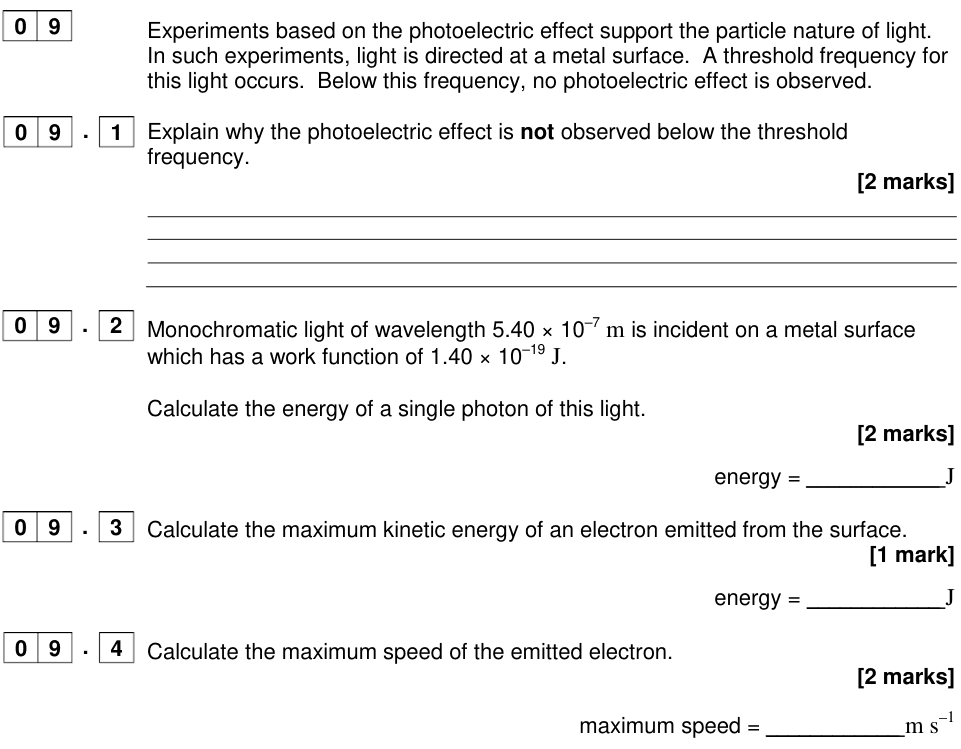
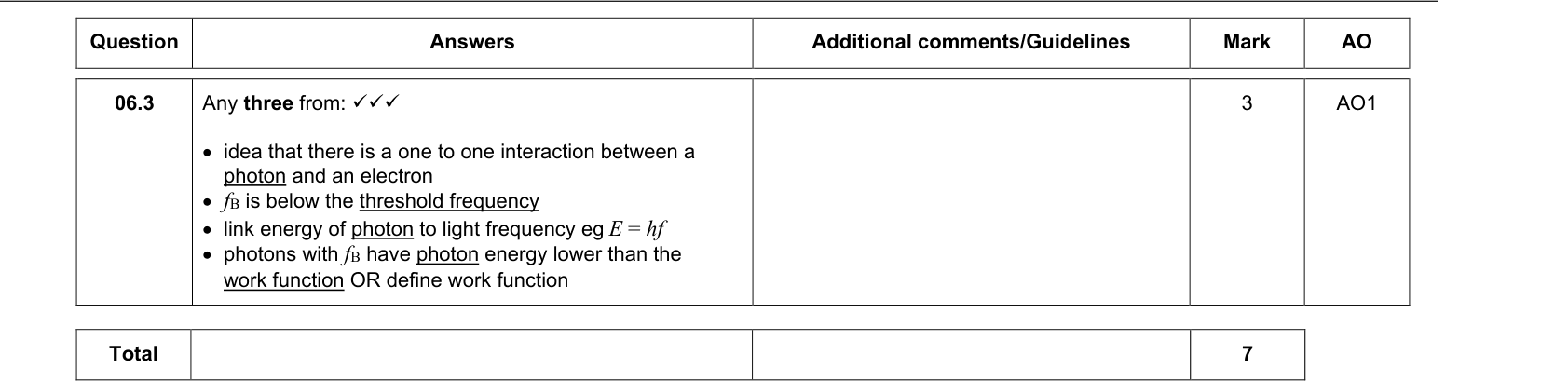
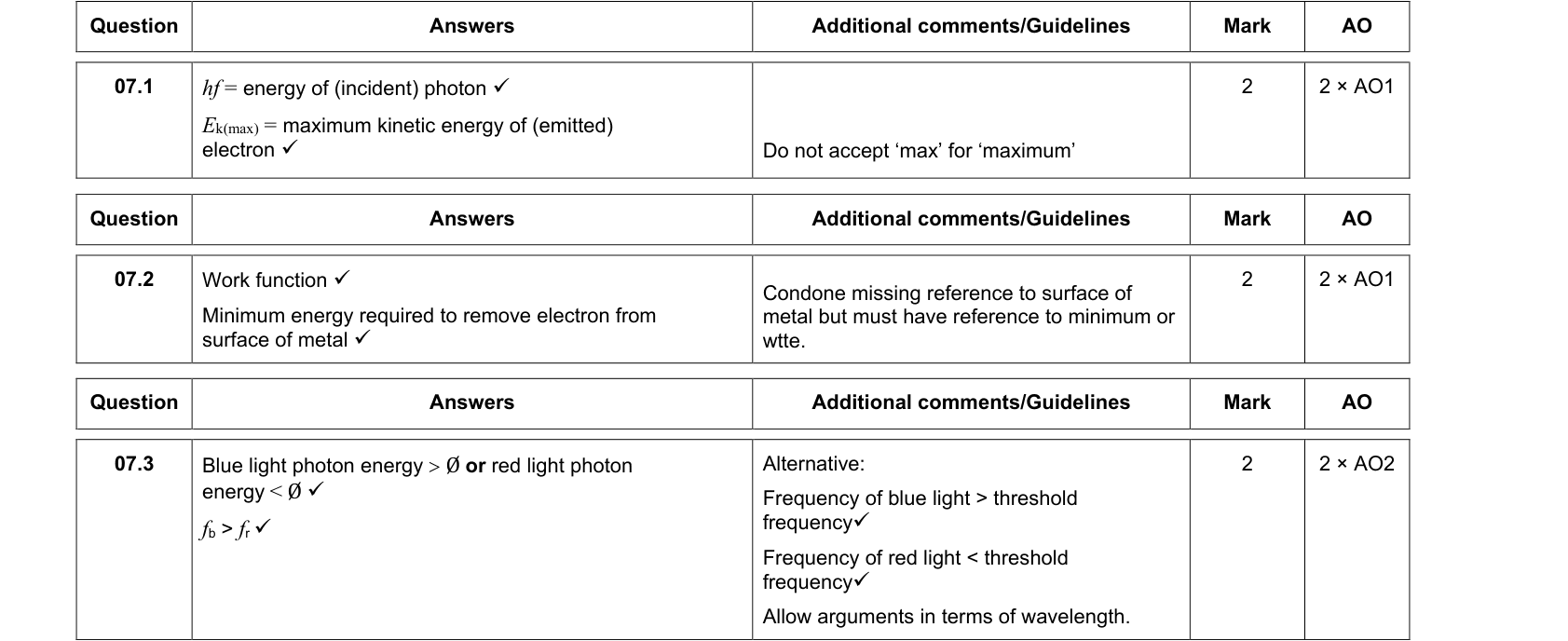
- Photoelectrons are emitted only if the frequency of the radiation is above a threshold frequency $f_0$, which depends on the metal. Below $f_0$ no electrons are emitted, however intense the radiation and however long it shines.
- Above $f_0$, emission is instantaneous, even with very weak radiation.
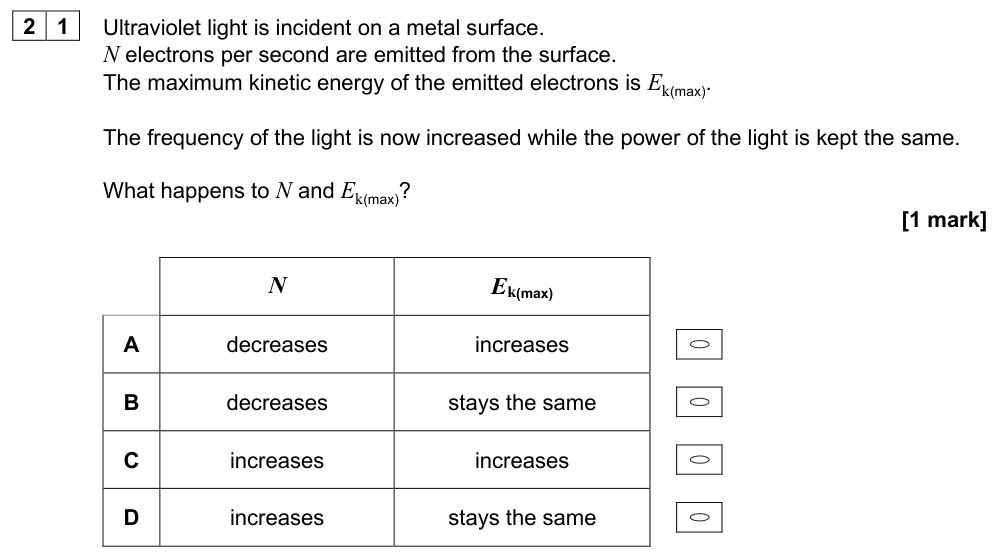
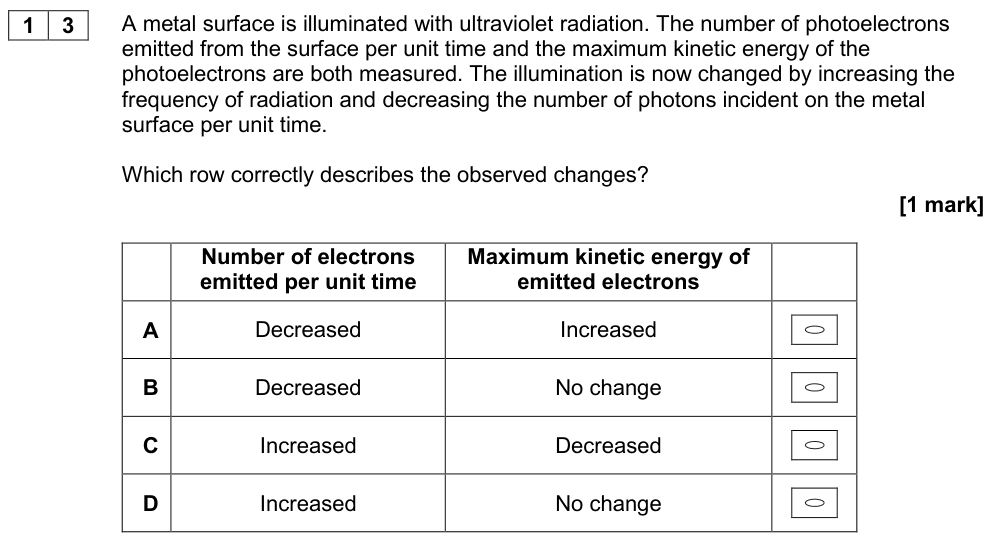
- The photoelectrons have a range of kinetic energies up to a maximum $E_{k(\max)}$, which increases with frequency but does not depend on intensity.
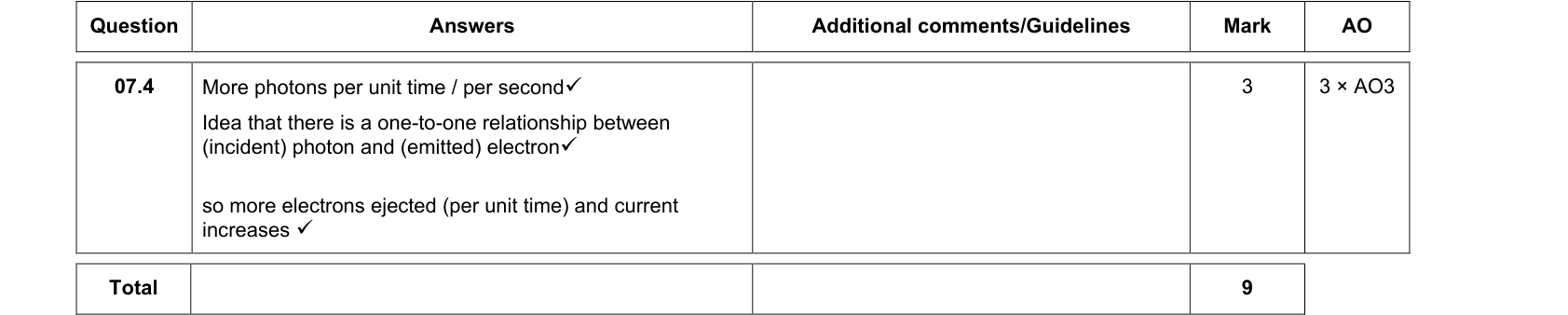
- The number of photoelectrons emitted per second (the photoelectric current) is proportional to the intensity of the radiation (for $f > f_0$).
Why the wave model fails
A wave model would predict that any frequency should eventually emit electrons if the light were bright enough or shone for long enough (energy builds up gradually), and that brighter light would give electrons more kinetic energy. Neither happens. The photon model explains all the observations.
The photon explanation
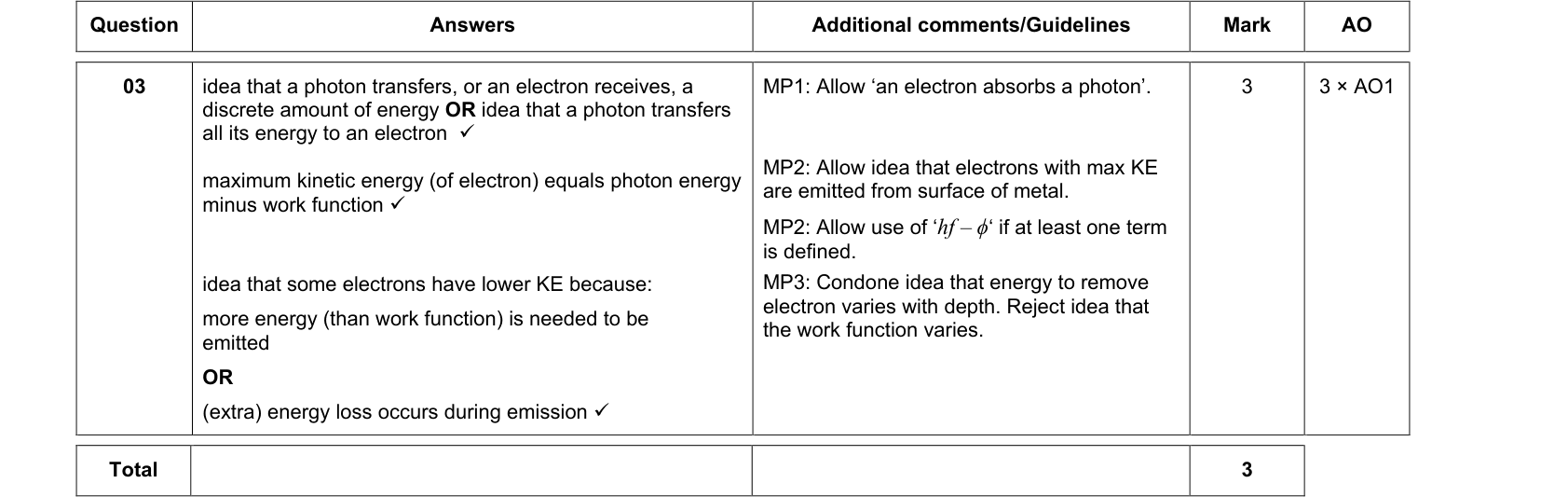
- Each photon interacts with one electron and gives it all its energy $hf$ (one-to-one interaction). The photon is absorbed.
- To escape, an electron must use a minimum energy, the work function $\phi$, to overcome the attraction of the metal.
Work function and threshold frequency
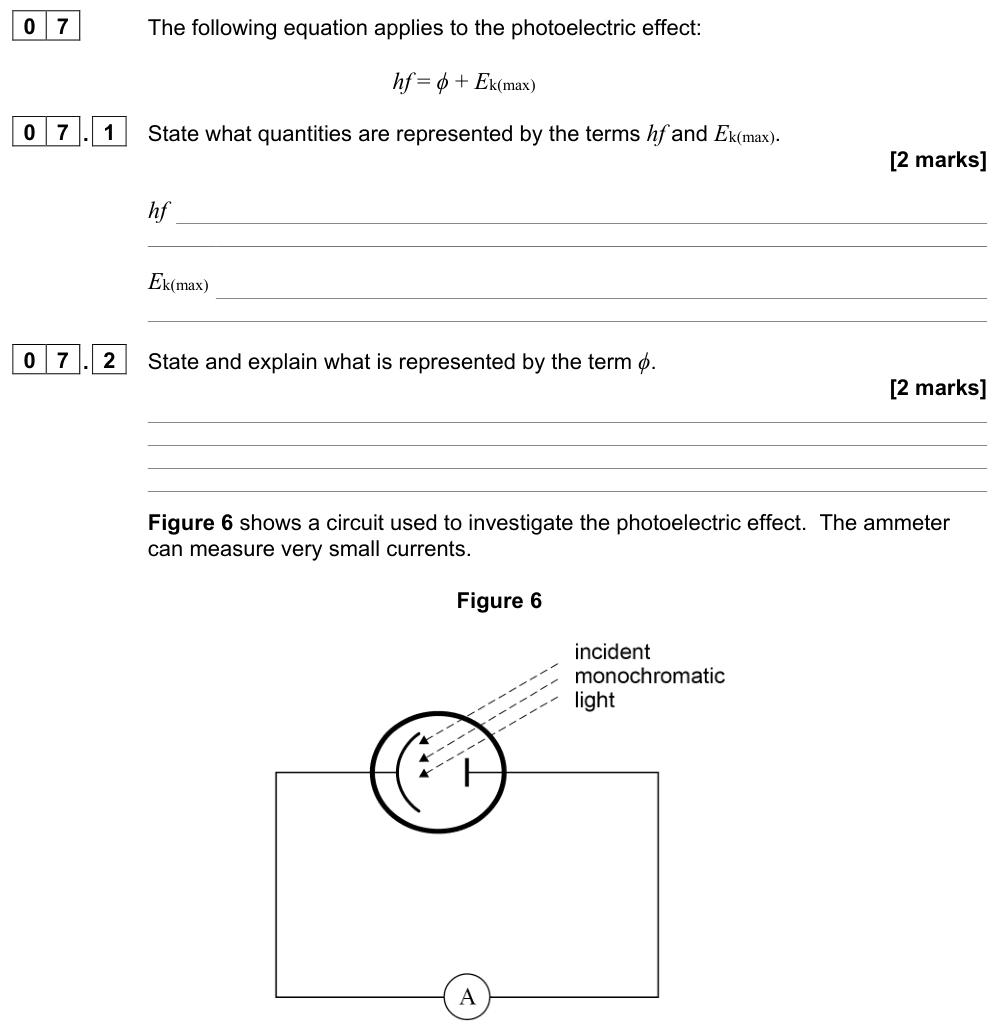
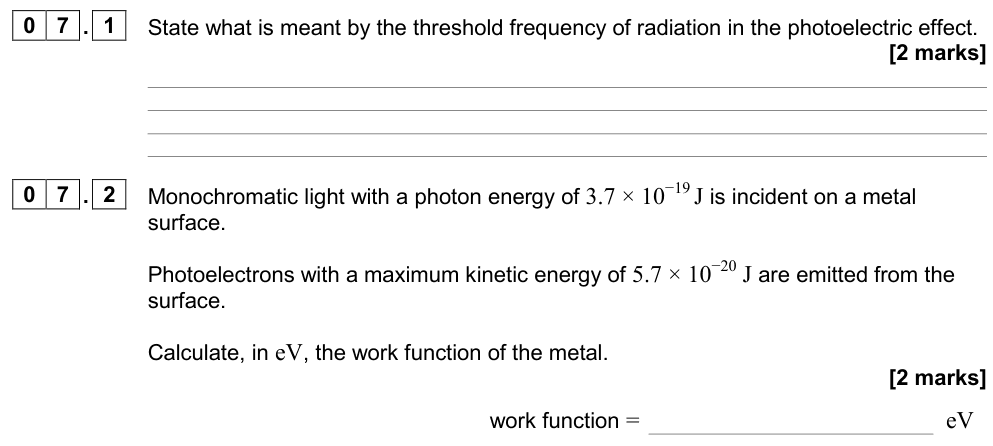
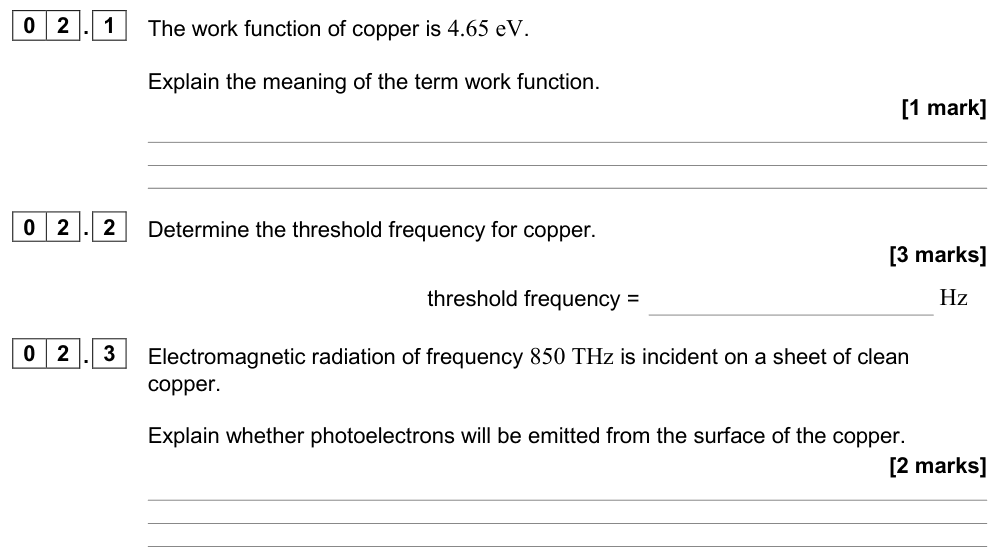
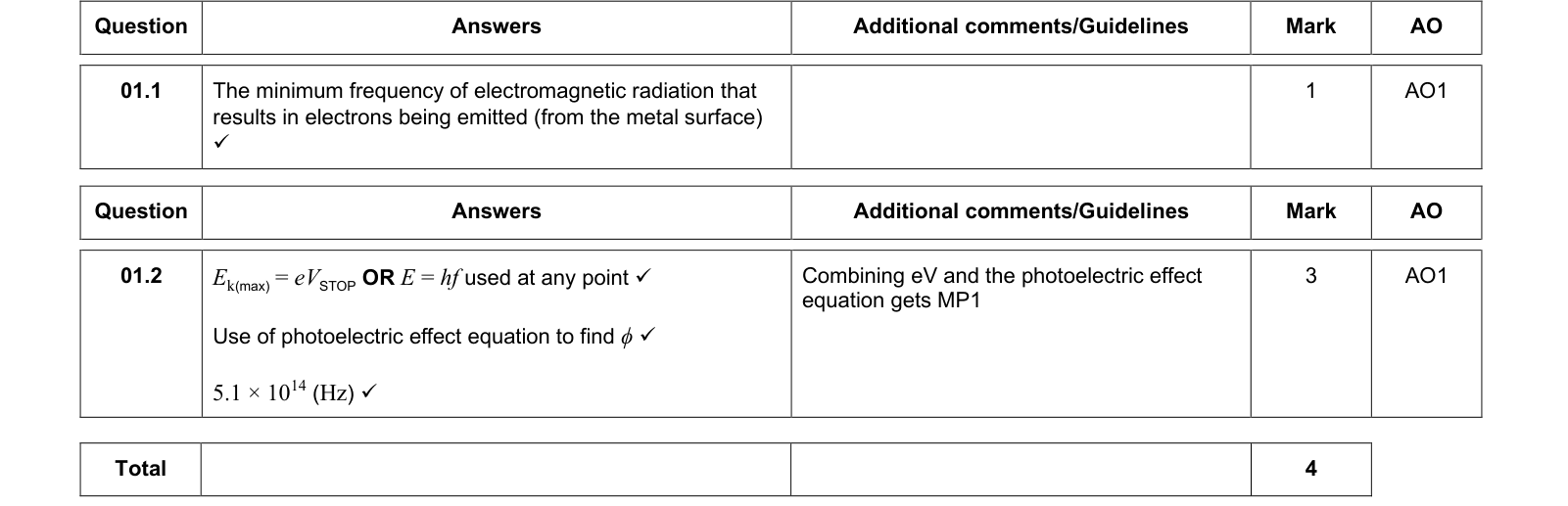
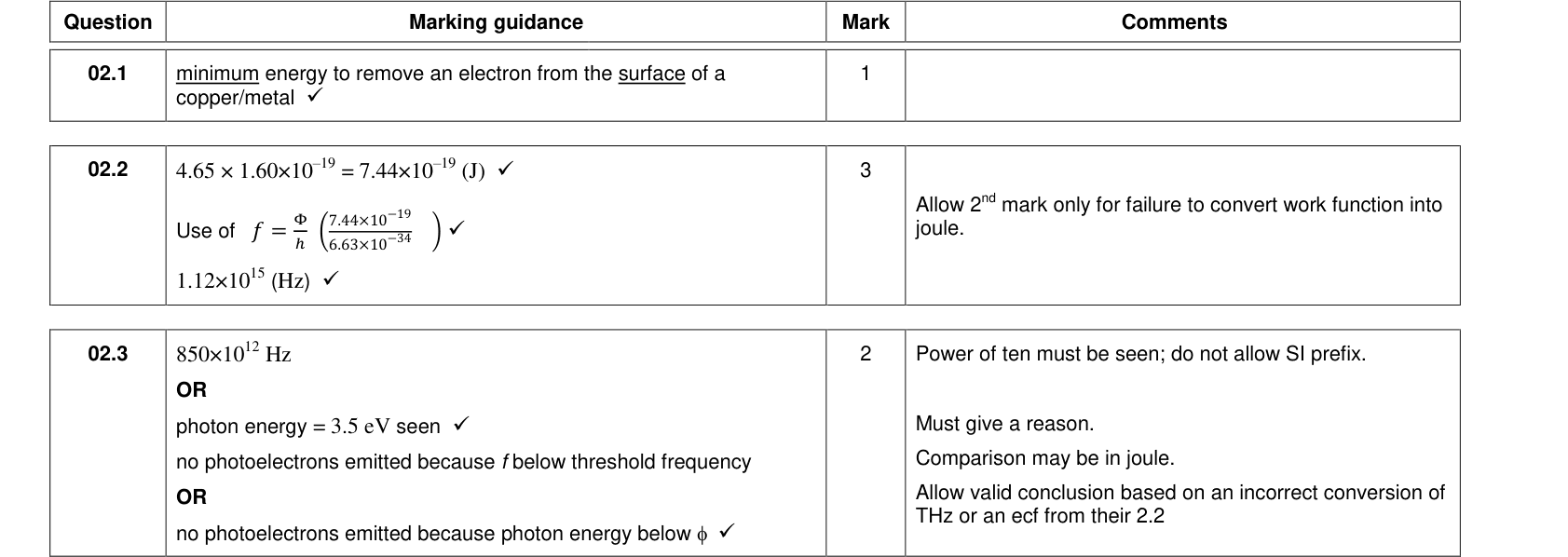
Work function $\phi$: the minimum energy needed to remove an electron from the surface of a metal.
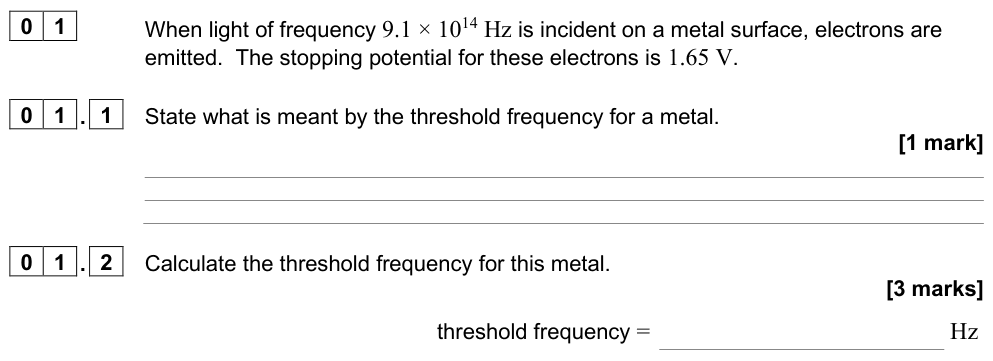
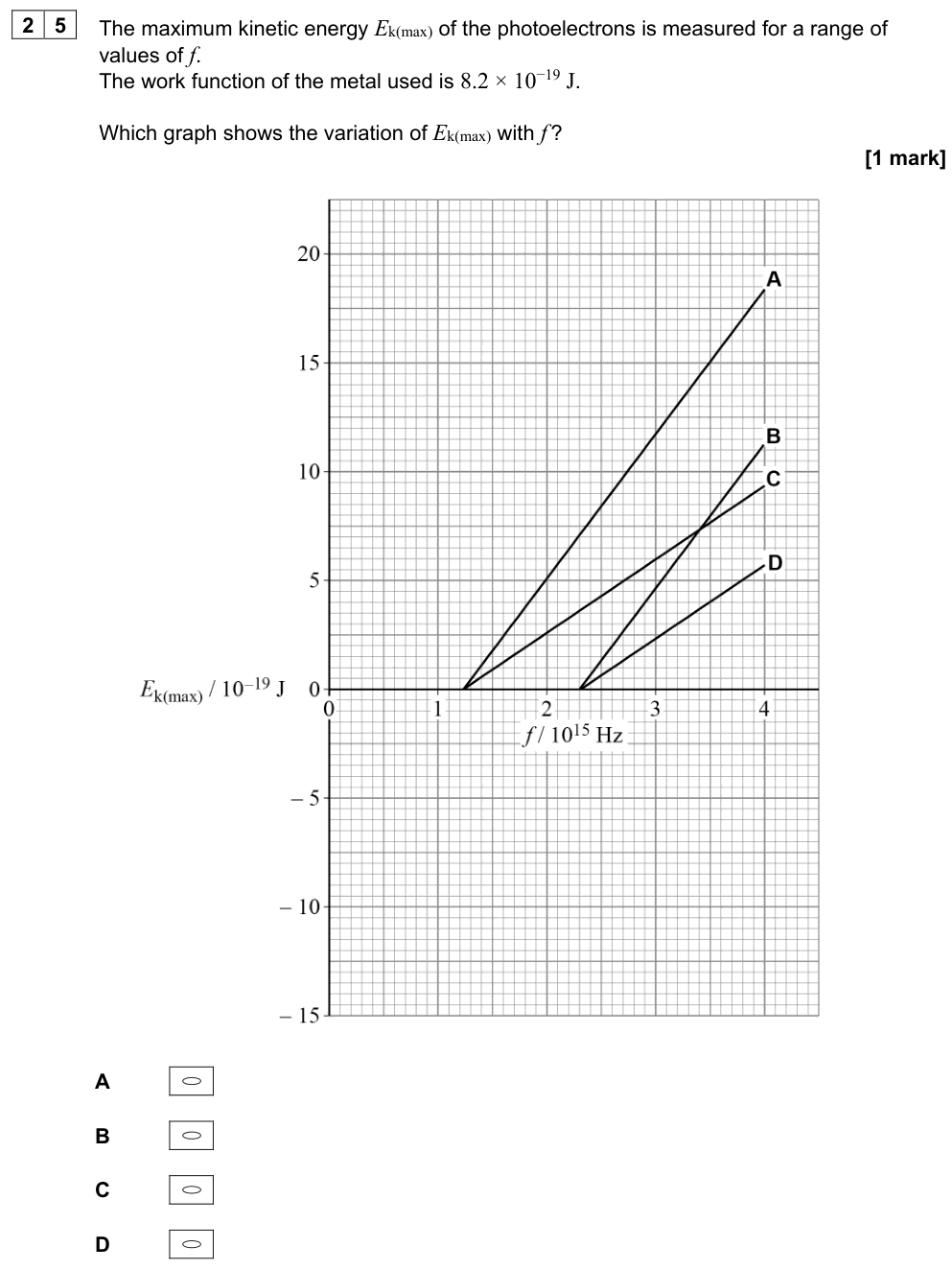
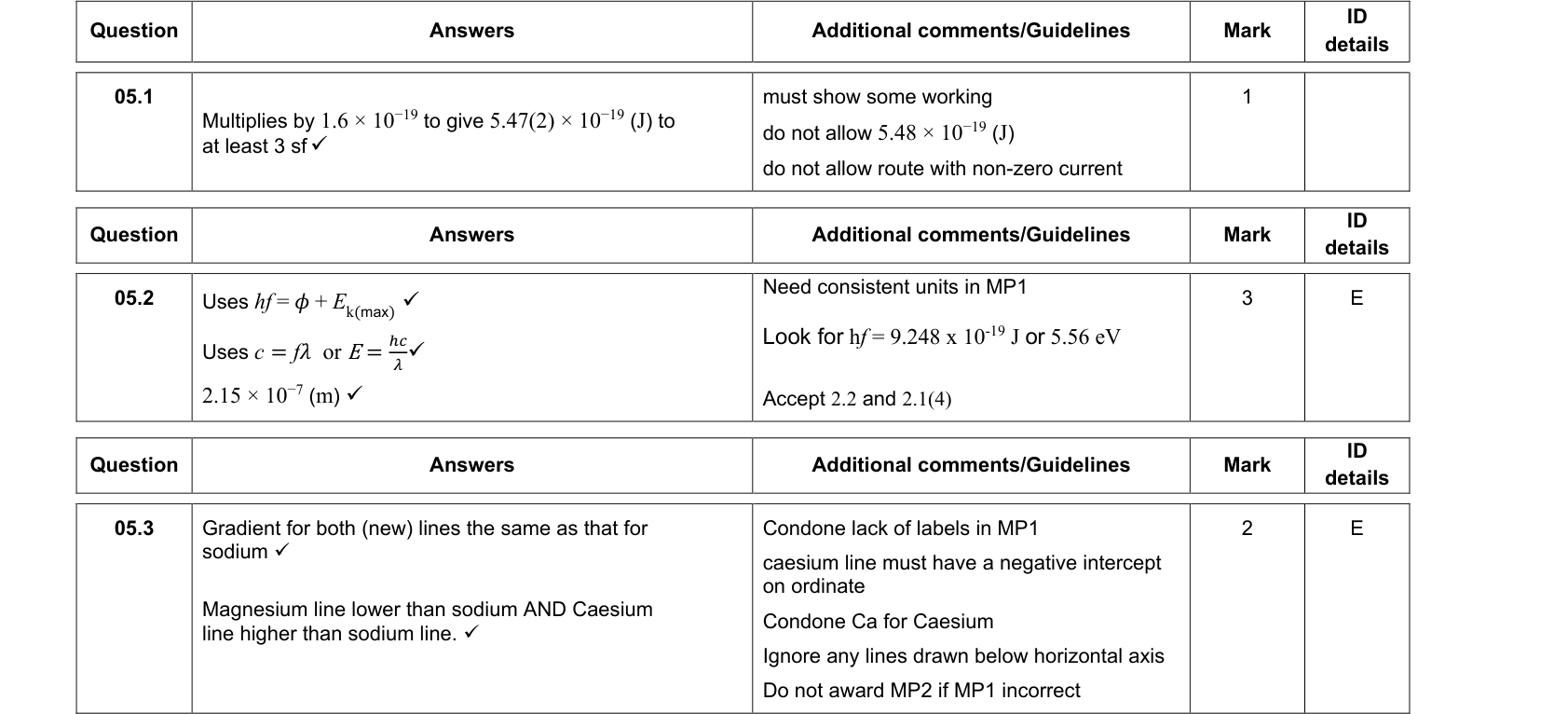
Threshold frequency $f_0$: the minimum frequency of radiation that can cause photoelectric emission: $hf_0 = \phi$, so $f_0 = \dfrac{\phi}{h}$.
- If $hf < \phi$ the electron cannot escape, and it cannot save up energy from several photons. So there is no emission below $f_0$ whatever the intensity.
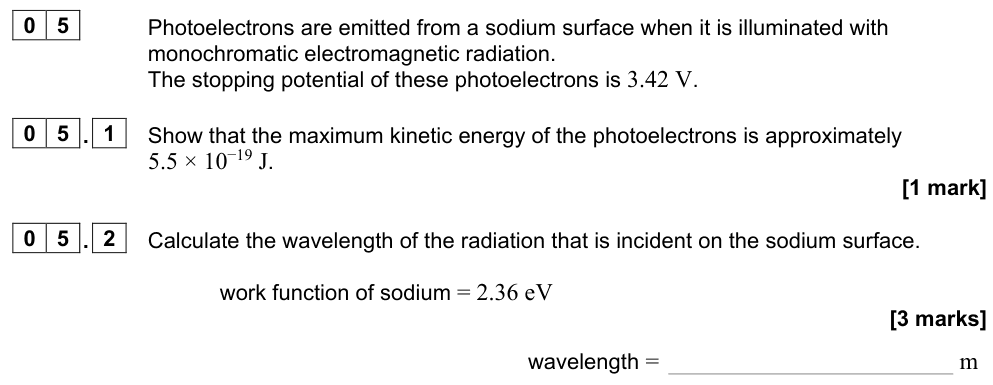
- The energy left over becomes kinetic energy. Electrons from the surface lose the least energy, so they have the maximum kinetic energy:
Photoelectric equation
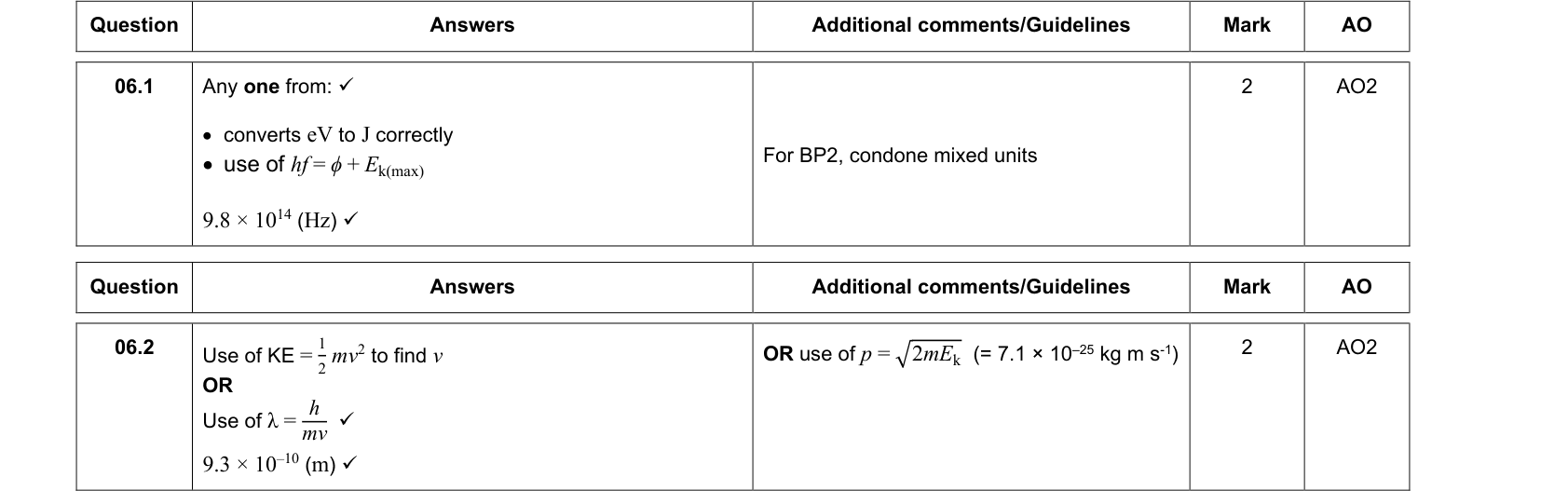
$$hf = \phi + E_{k(\max)}$$
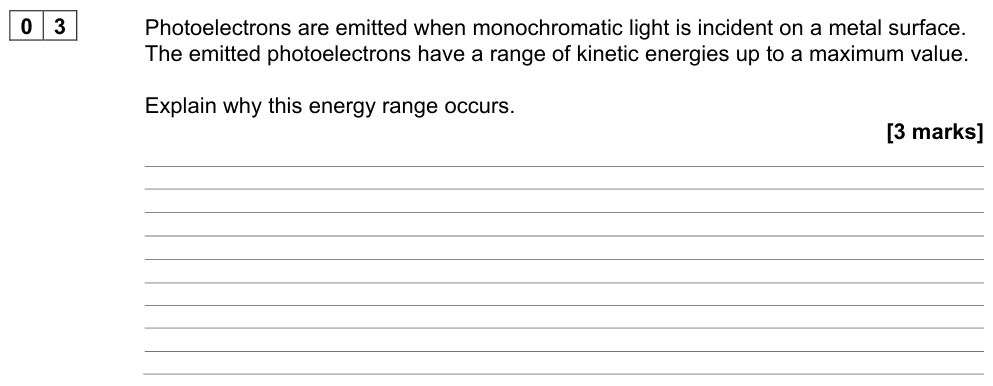
Electrons from deeper in the metal lose extra energy in collisions on the way out, so they emerge with less than $E_{k(\max)}$. That explains the range of kinetic energies.
- More intense radiation means more photons per second, so more electrons per second, but each electron still receives only one photon's worth of energy, so $E_{k(\max)}$ is unchanged.
Worked example
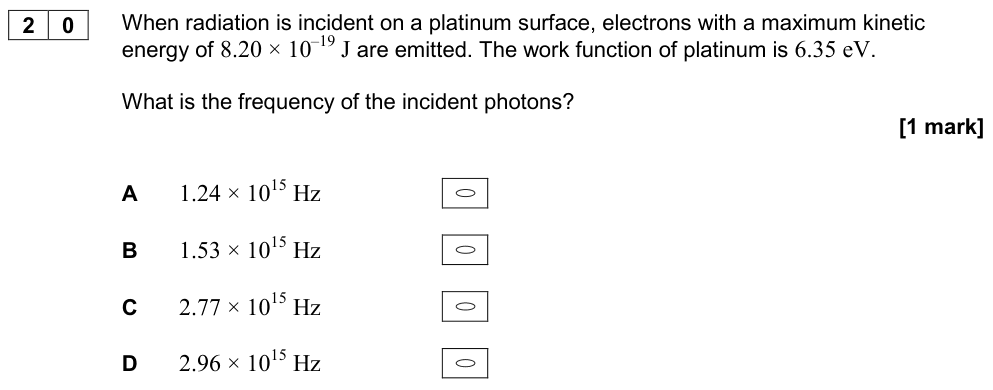
UV light of wavelength 200 nm falls on zinc, work function 4.30 eV.
Photon energy $= \dfrac{hc}{\lambda} = 9.95 \times 10^{-19}\ \text{J} = 6.22\ \text{eV}$.
$E_{k(\max)} = 6.22 - 4.30 = 1.92\ \text{eV} = 3.07 \times 10^{-19}\ \text{J}$.
Threshold frequency $f_0 = \dfrac{\phi}{h} = \dfrac{4.30 \times 1.60 \times 10^{-19}}{6.63 \times 10^{-34}} = 1.04 \times 10^{15}\ \text{Hz}$.
Stopping potential
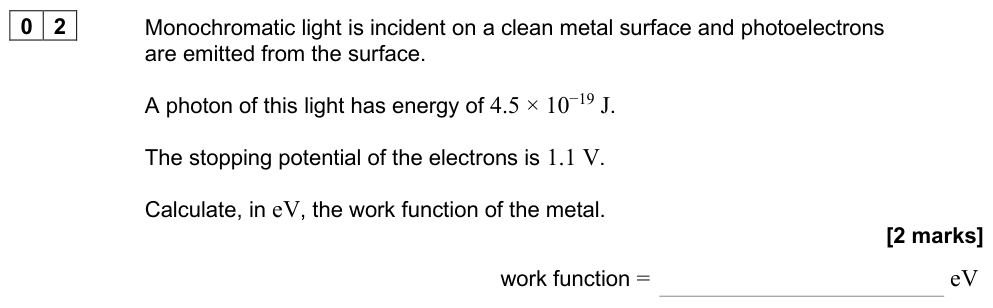
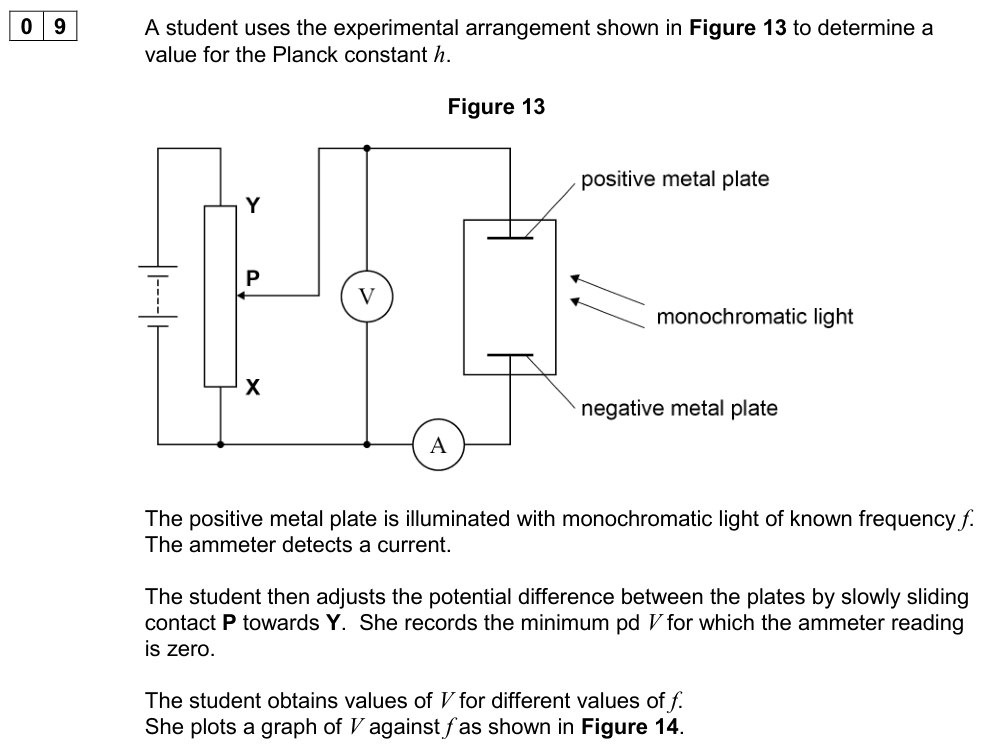
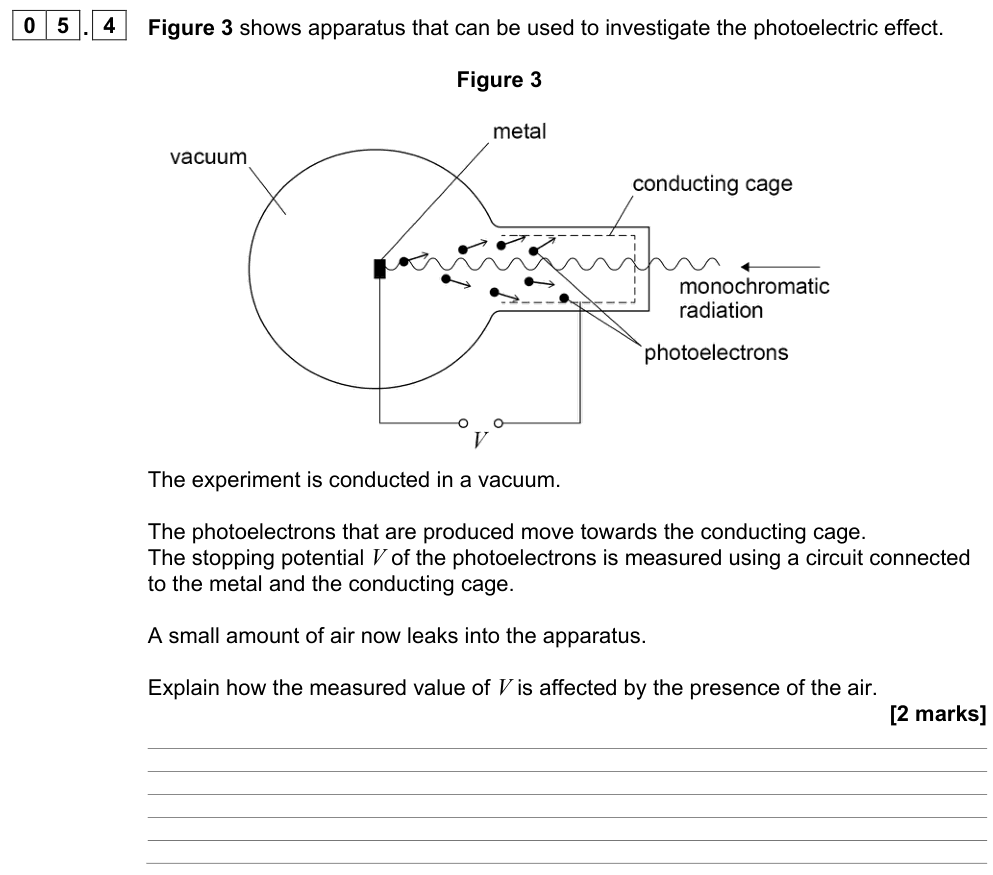
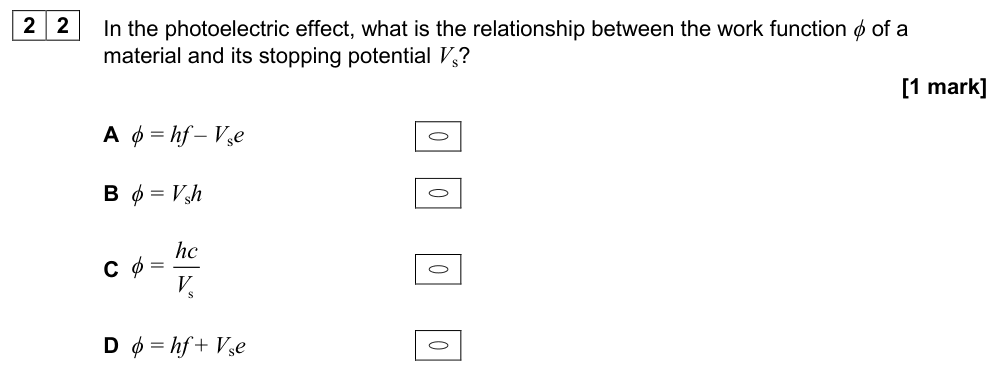
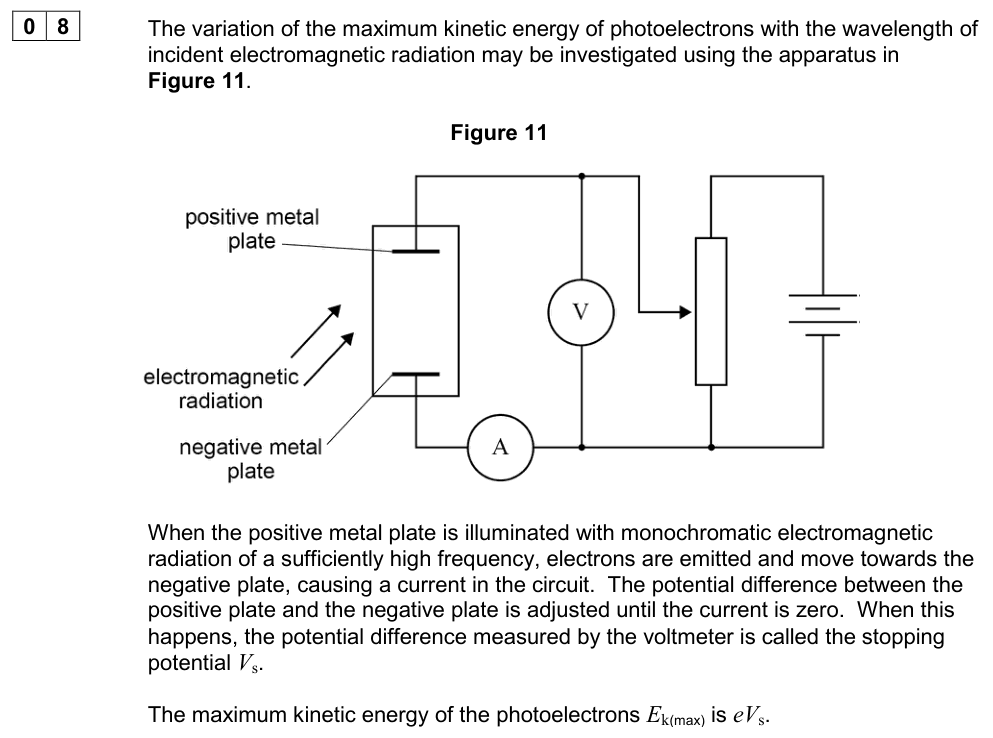
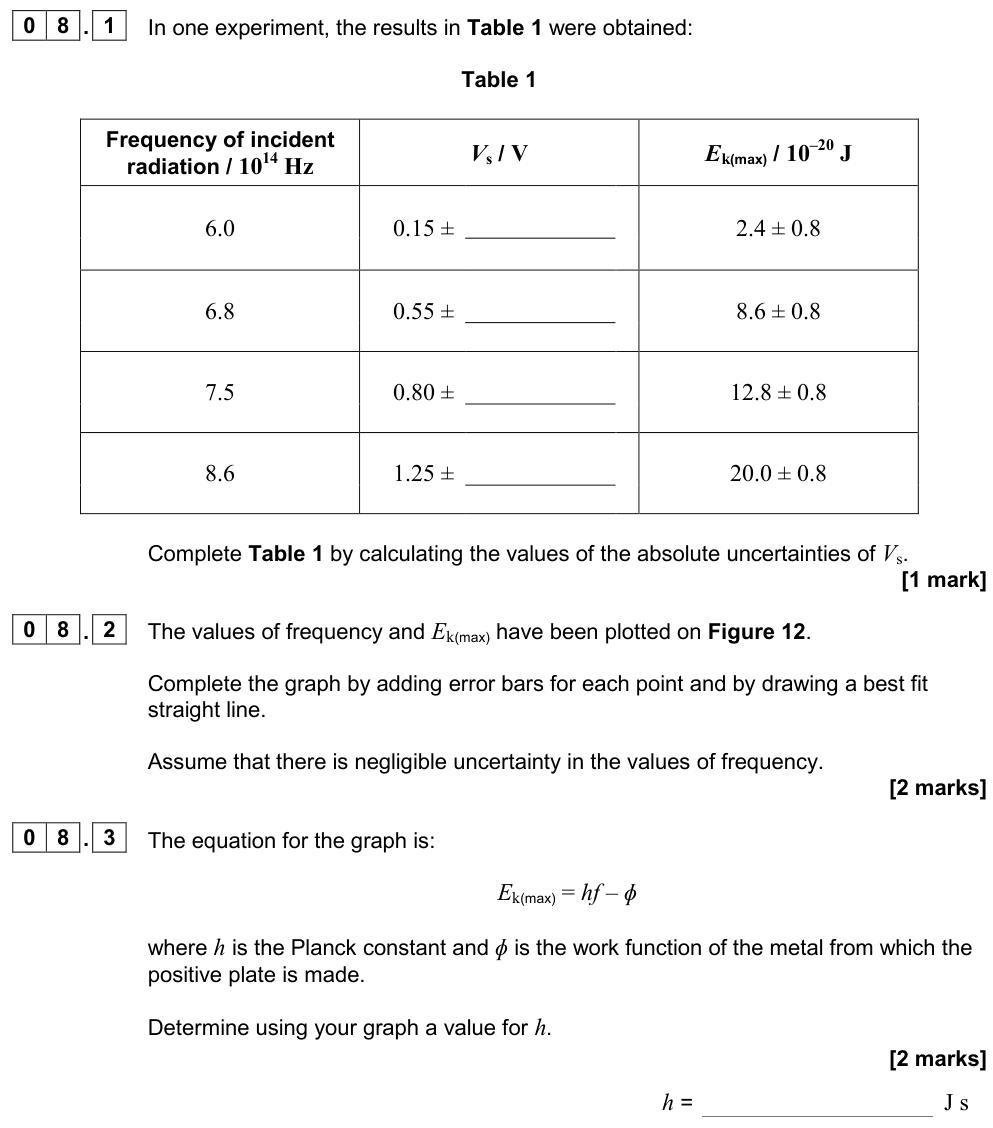
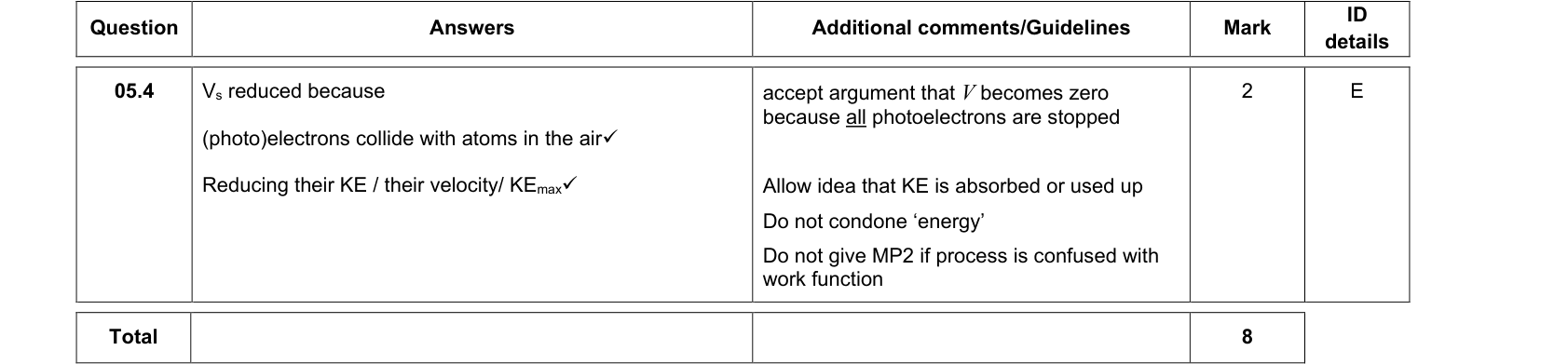
If the emitting plate is made positive relative to the collecting electrode, the photoelectrons are attracted back. The stopping potential $V_s$ is the minimum p.d. needed to stop even the most energetic photoelectrons, so the photoelectric current falls to zero:
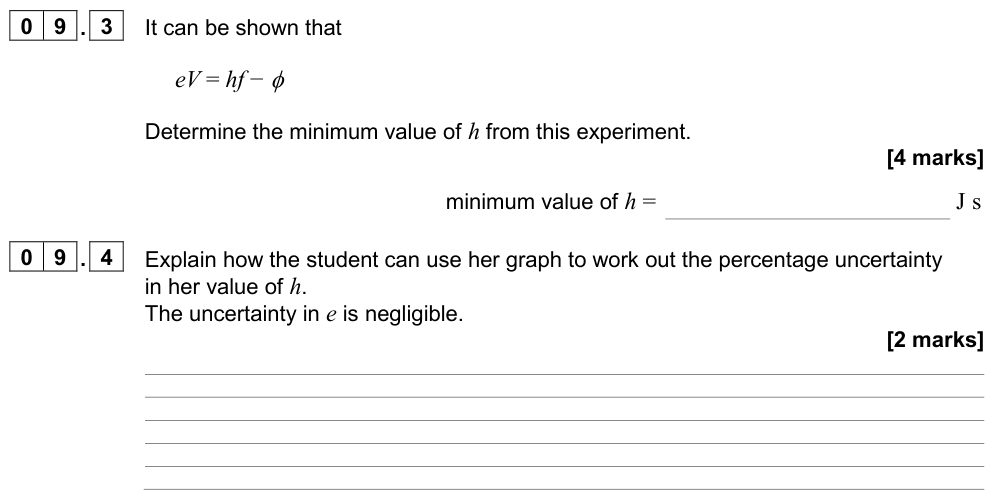
$$eV_s = E_{k(\max)} \qquad\Rightarrow\qquad hf = \phi + eV_s$$
So the stopping potential (in volts) has the same numerical value as $E_{k(\max)}$ in eV. (The experimental method for finding $V_s$ is not required.)
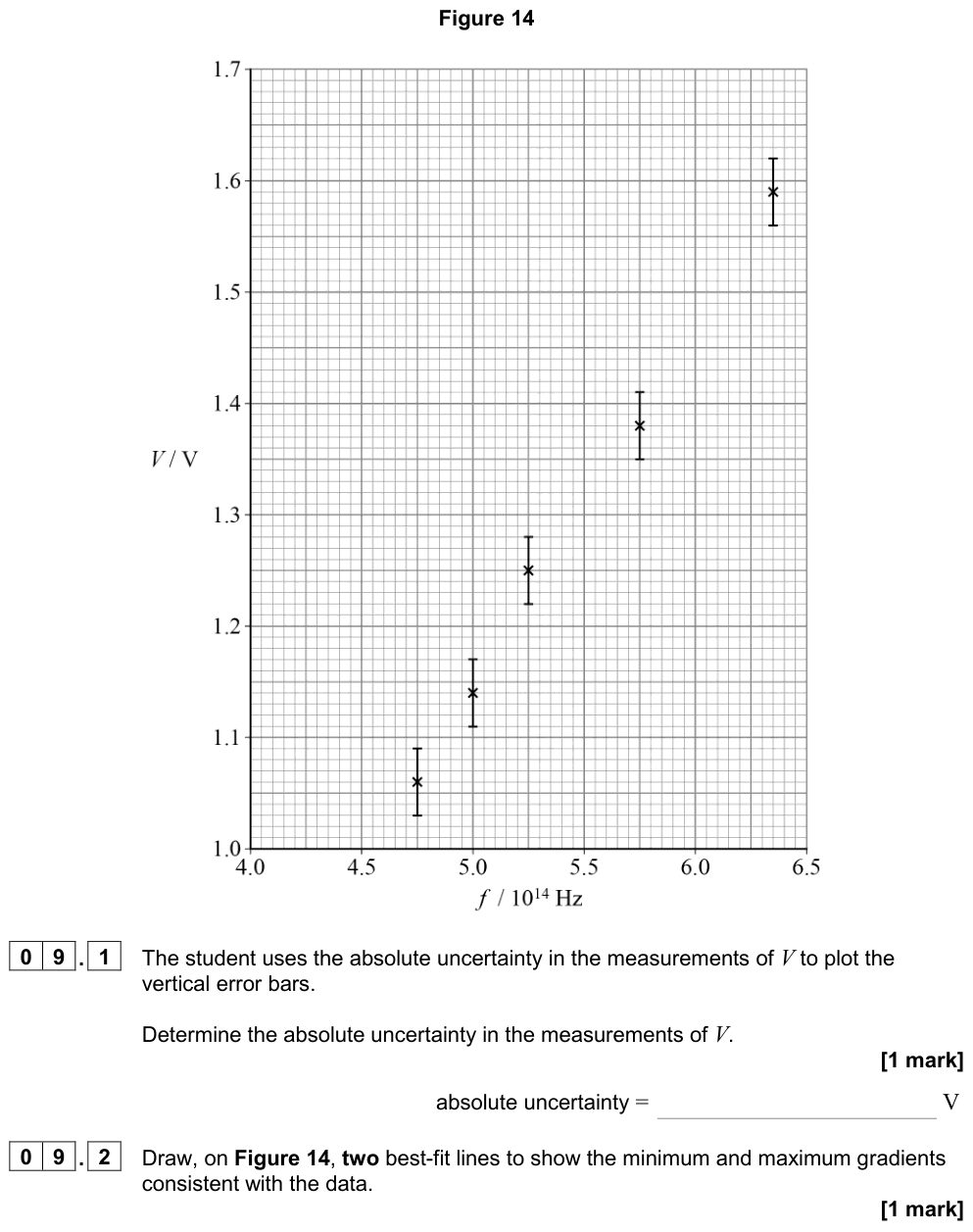
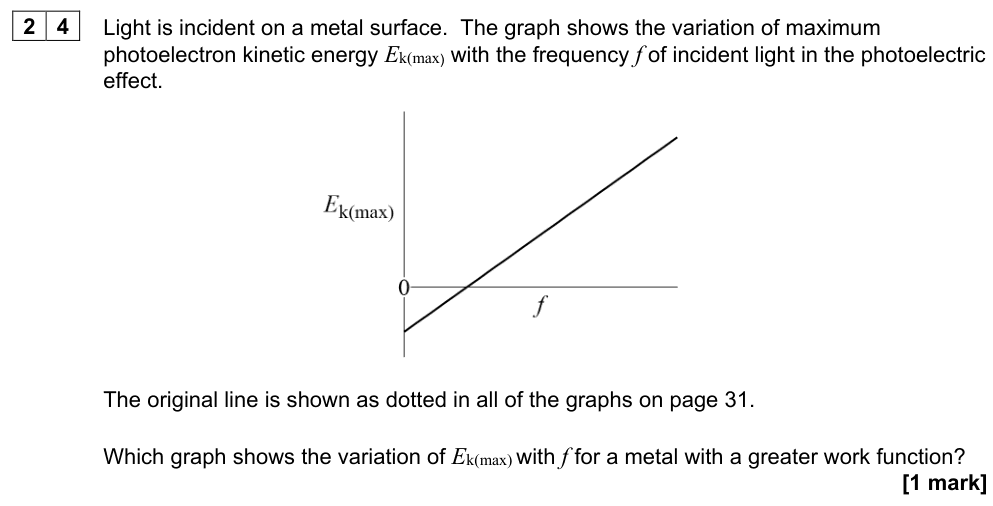
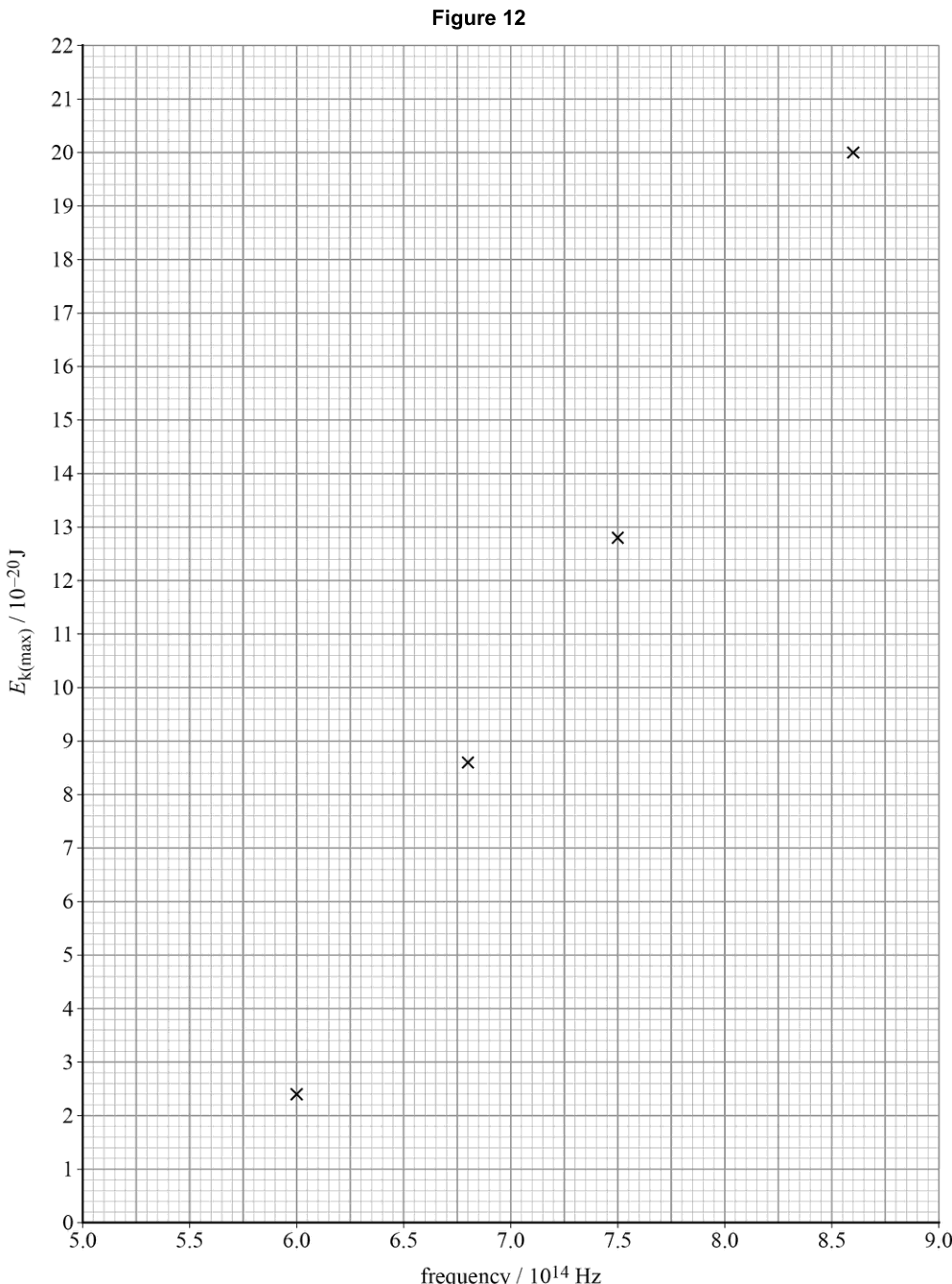
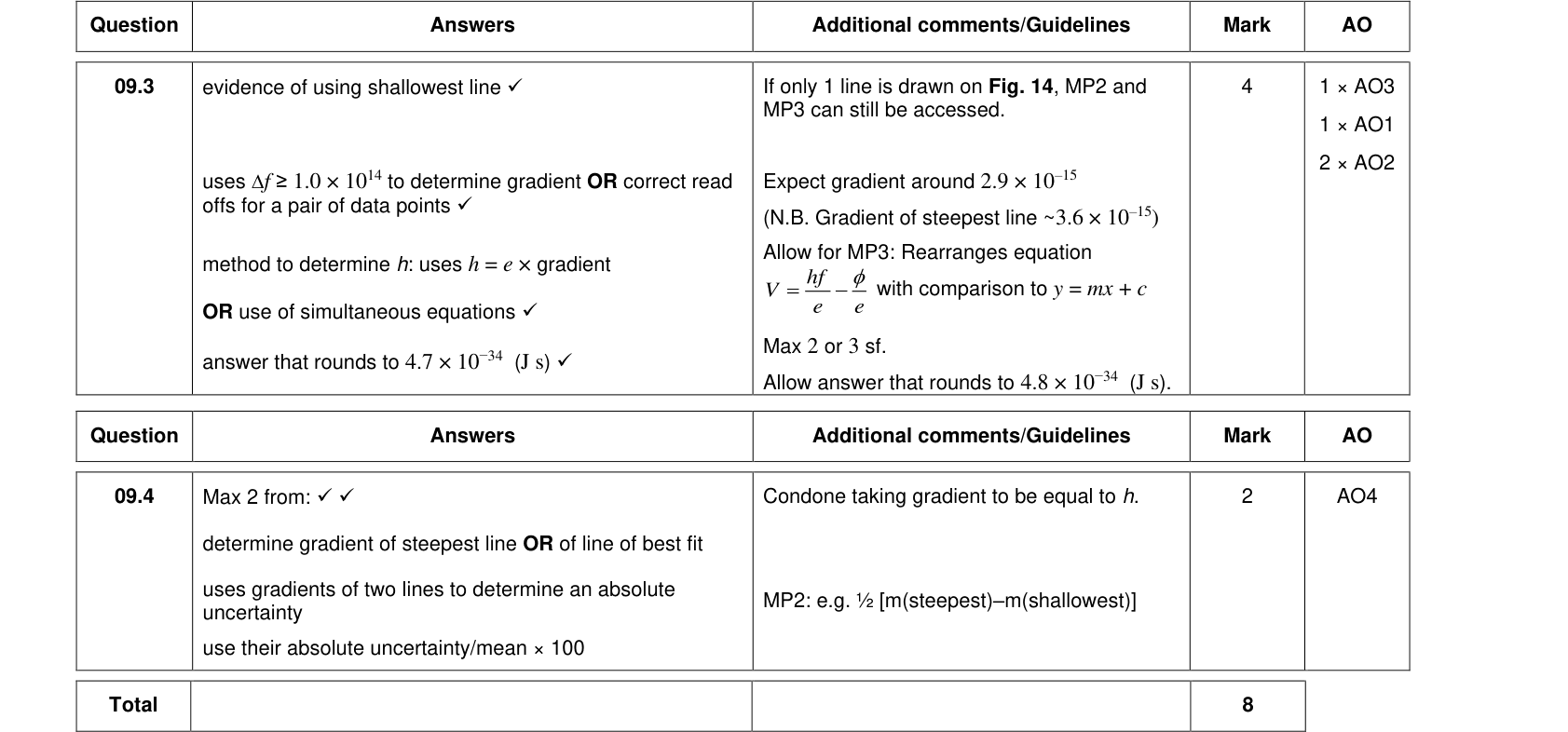
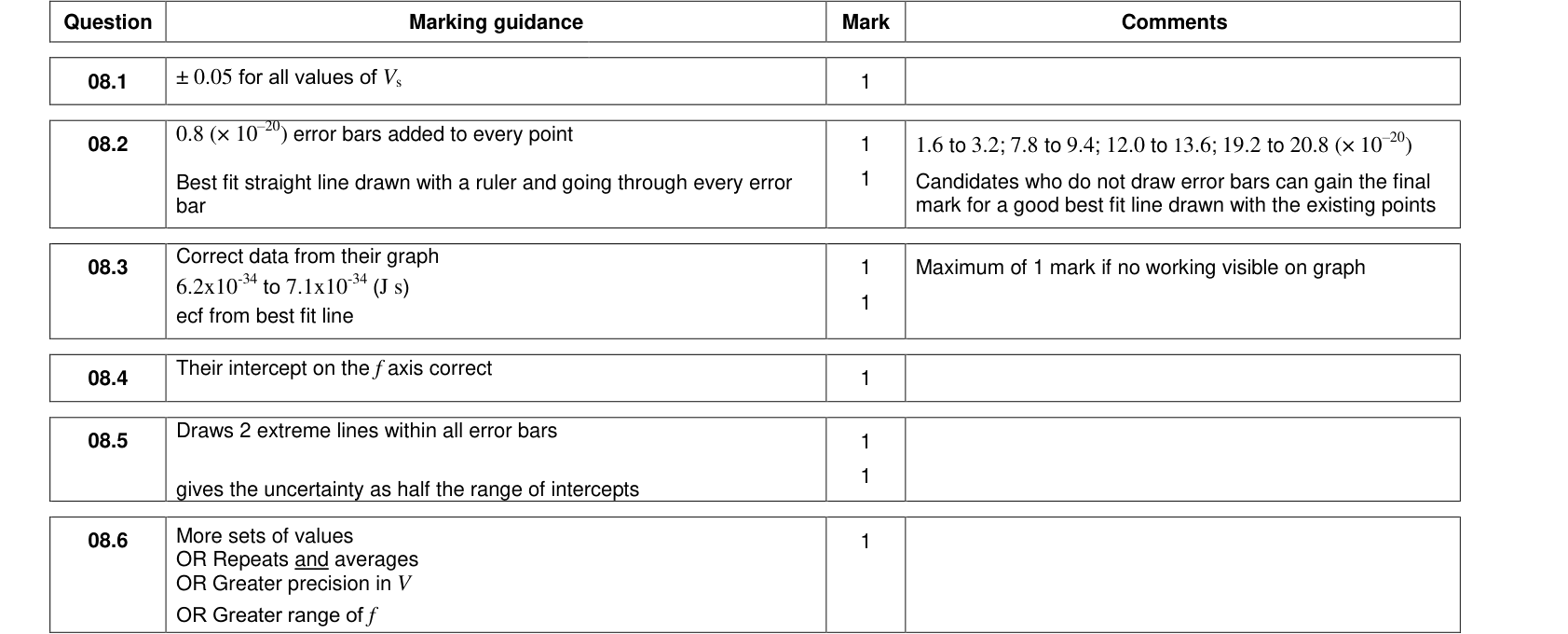
Graph of $E_{k(\max)}$ against frequency
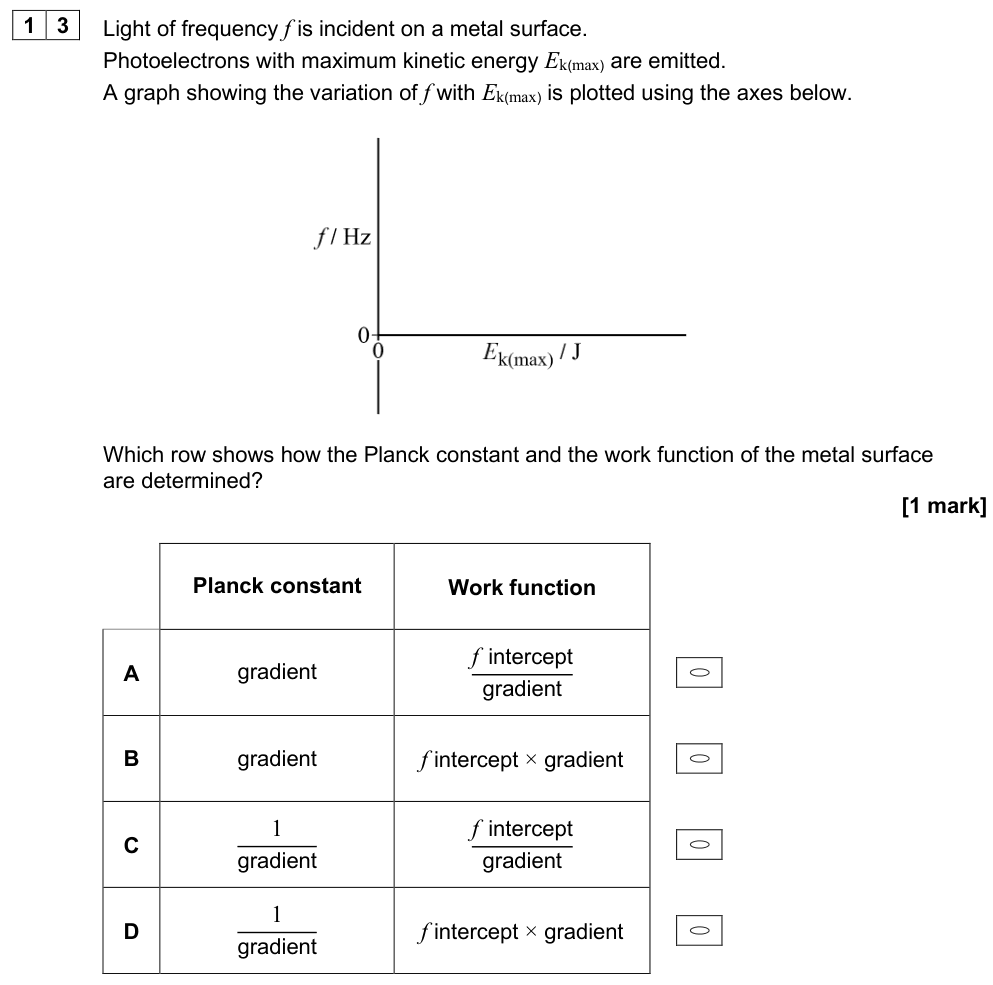
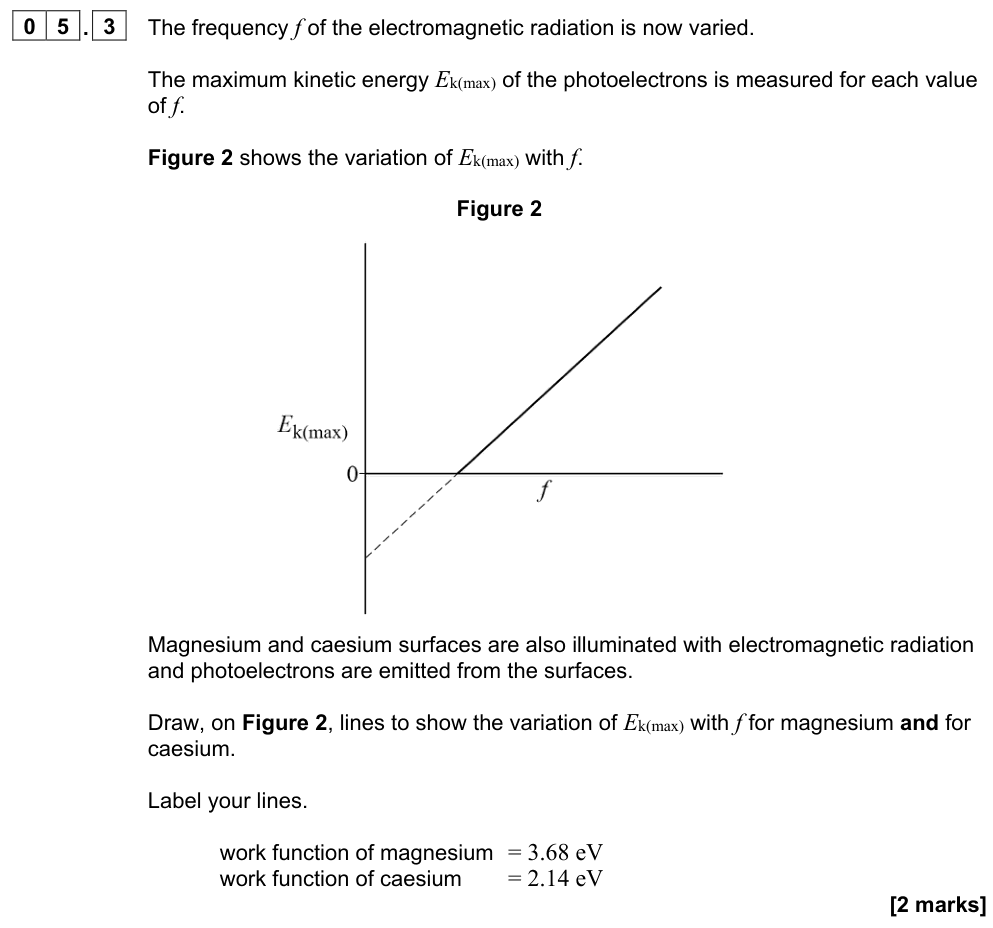
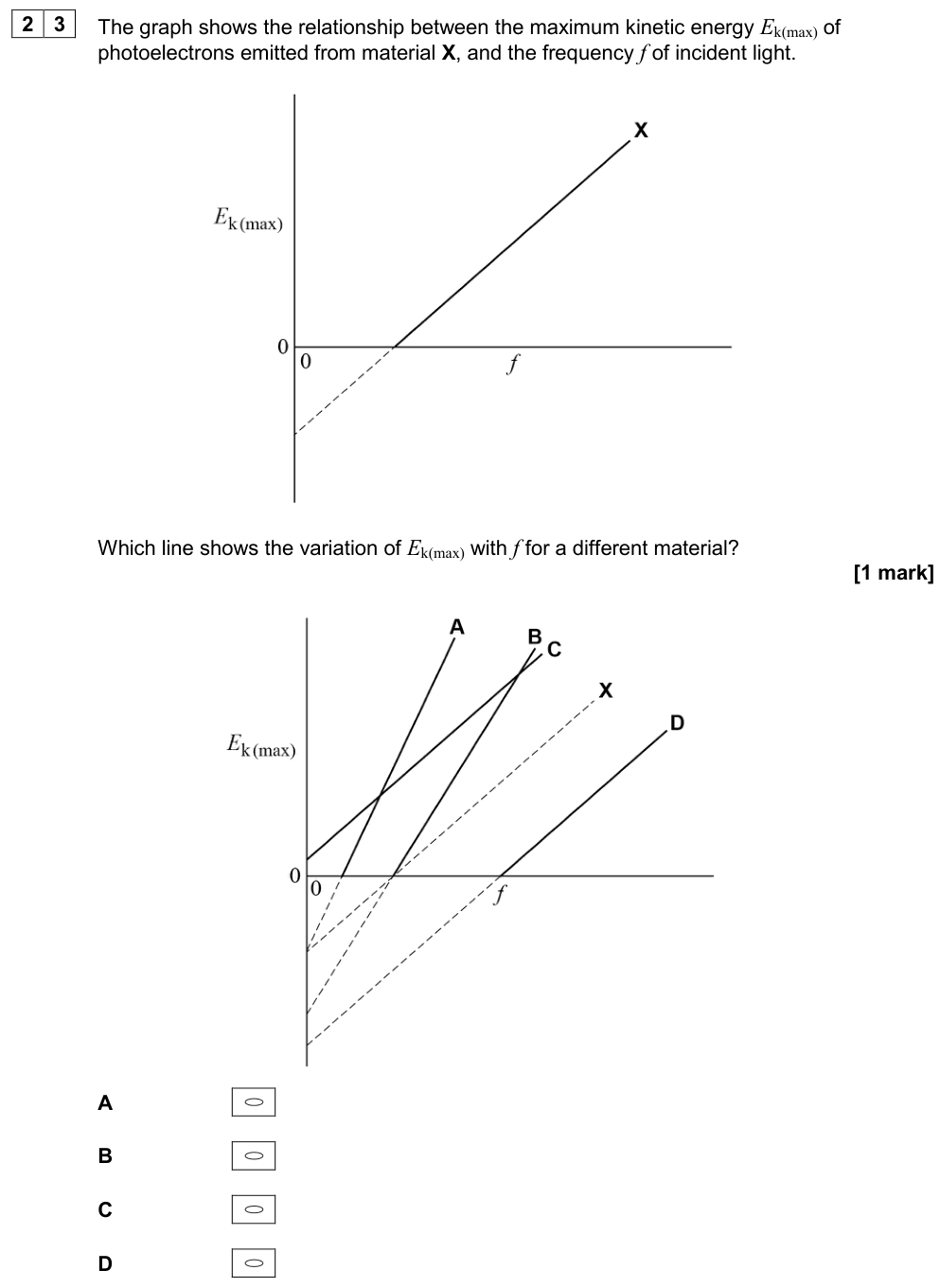
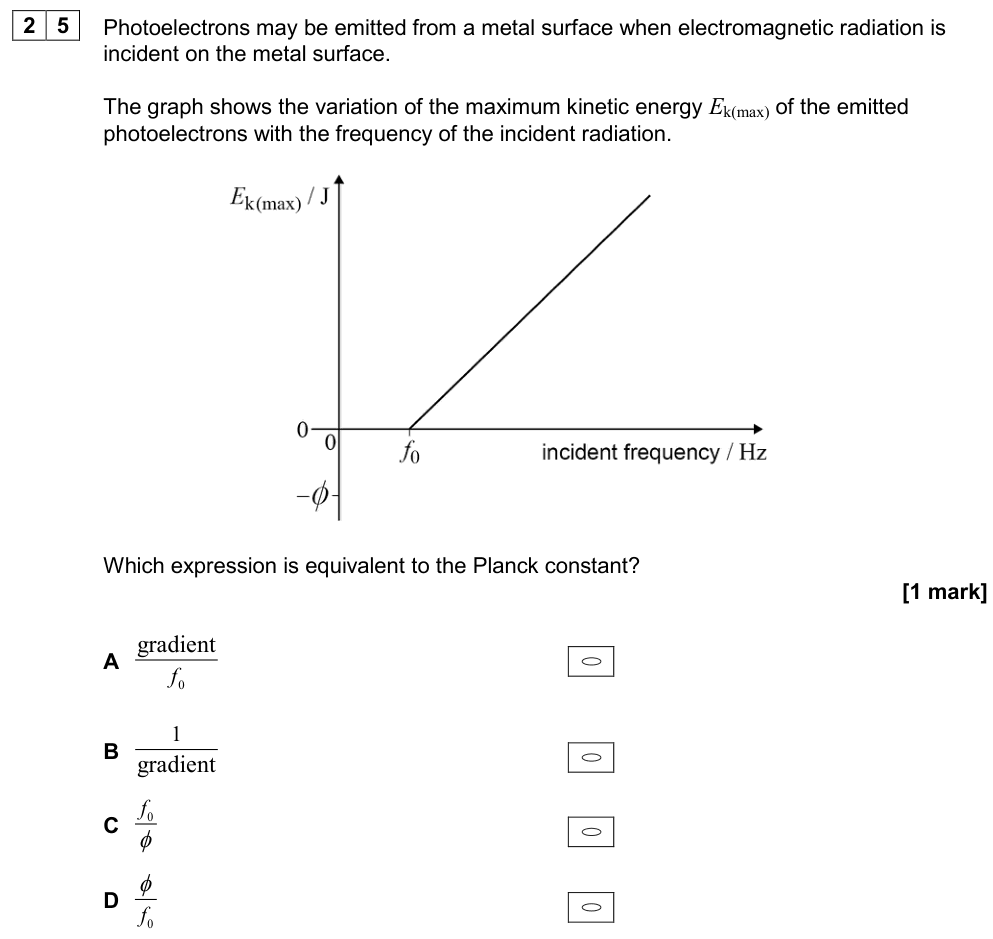
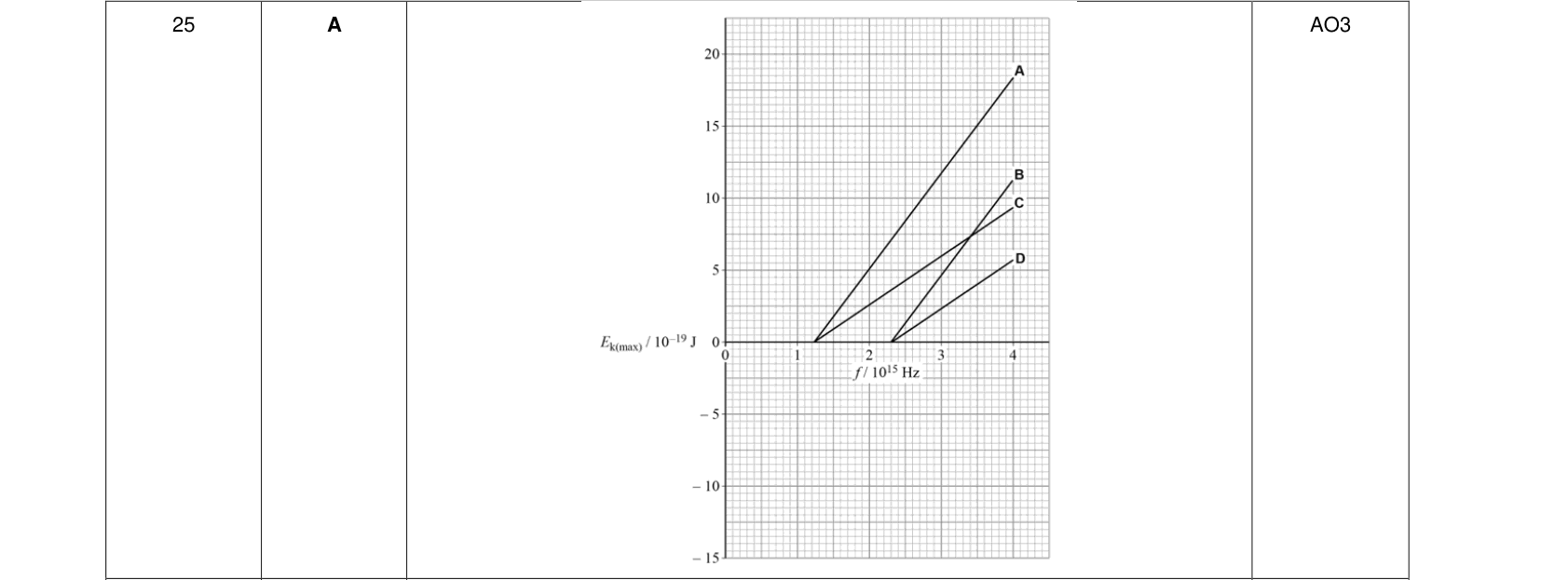
From $E_{k(\max)} = hf - \phi$, a graph of $E_{k(\max)}$ (y-axis) against $f$ (x-axis) is a straight line:
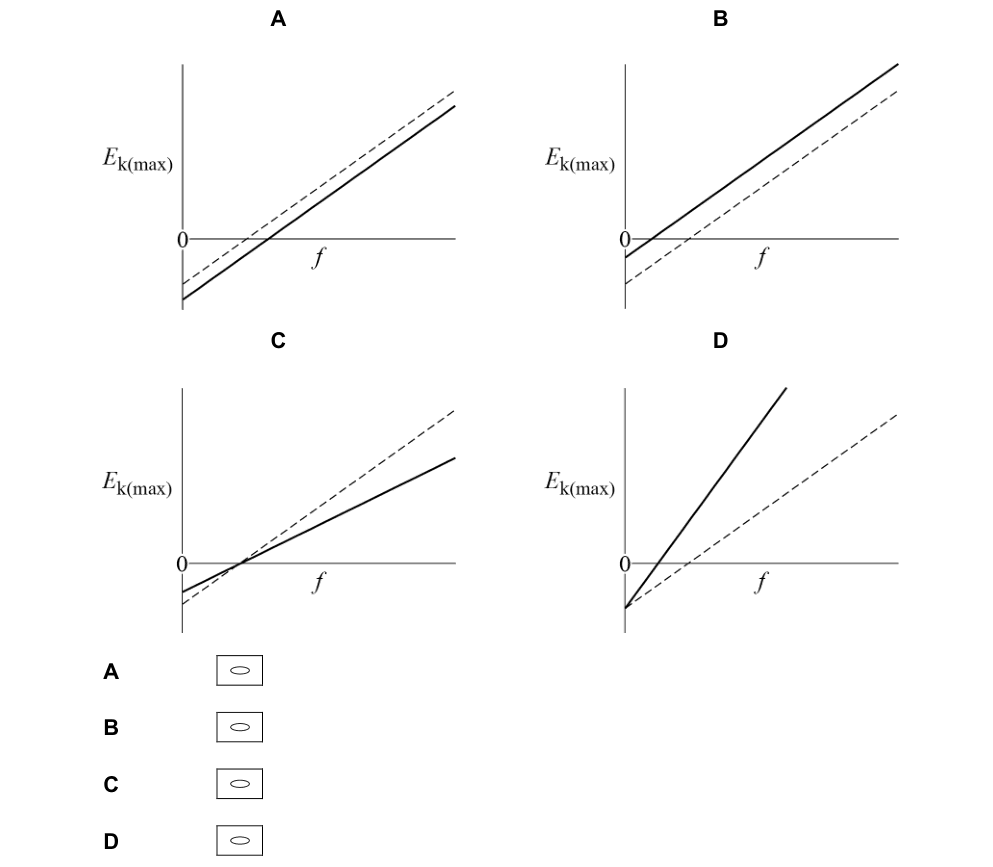
- Gradient = $h$ (the same for every metal, so lines for different metals are parallel).
- Intercept on the frequency axis = threshold frequency $f_0$.
- Extrapolated intercept on the energy axis = $-\phi$.
A metal with a larger work function has its line shifted to the right.
Summary
- Photons: $E = hf = hc/\lambda$; intensity ∝ number of photons per second.
- No emission below $f_0$ however intense; emission is instantaneous above $f_0$.
- $hf = \phi + E_{k(\max)}$; one photon gives all its energy to one electron.
- $E_{k(\max)}$ depends on frequency, not intensity; the number of electrons per second depends on intensity.
- $eV_s = E_{k(\max)}$; $E_{k(\max)}$–$f$ graph: gradient $h$, f-intercept $f_0$, y-intercept $-\phi$.