Oscillating systems
An oscillation is a repeated to-and-fro motion about an equilibrium position. Key terms:
| Term | Meaning |
|---|---|
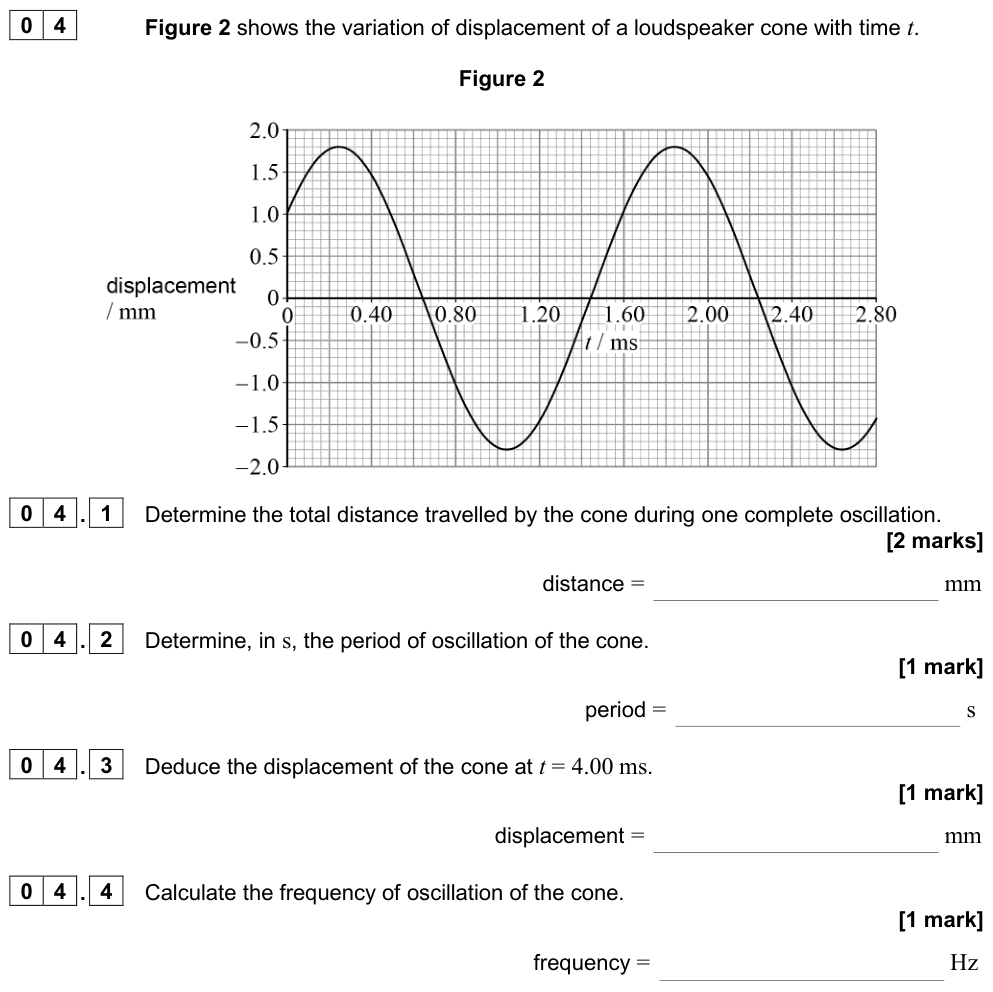
| Displacement $x$ | distance from the equilibrium position in a given direction |
| Amplitude $A$ | maximum displacement from equilibrium |
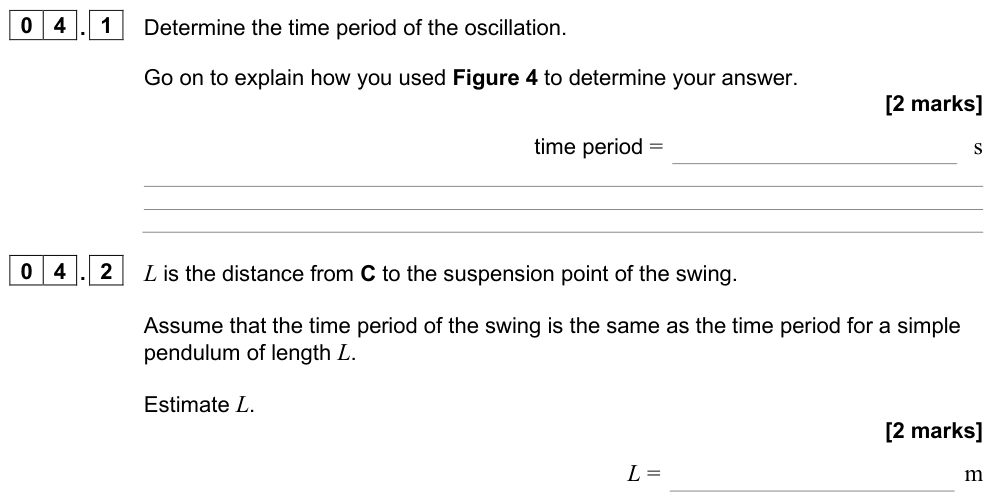
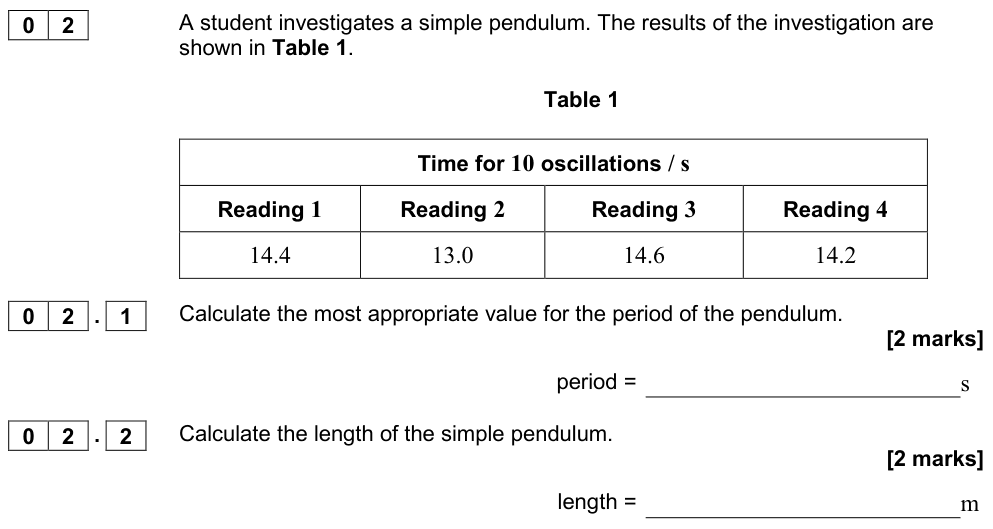
| Period $T$ | time for one complete oscillation |
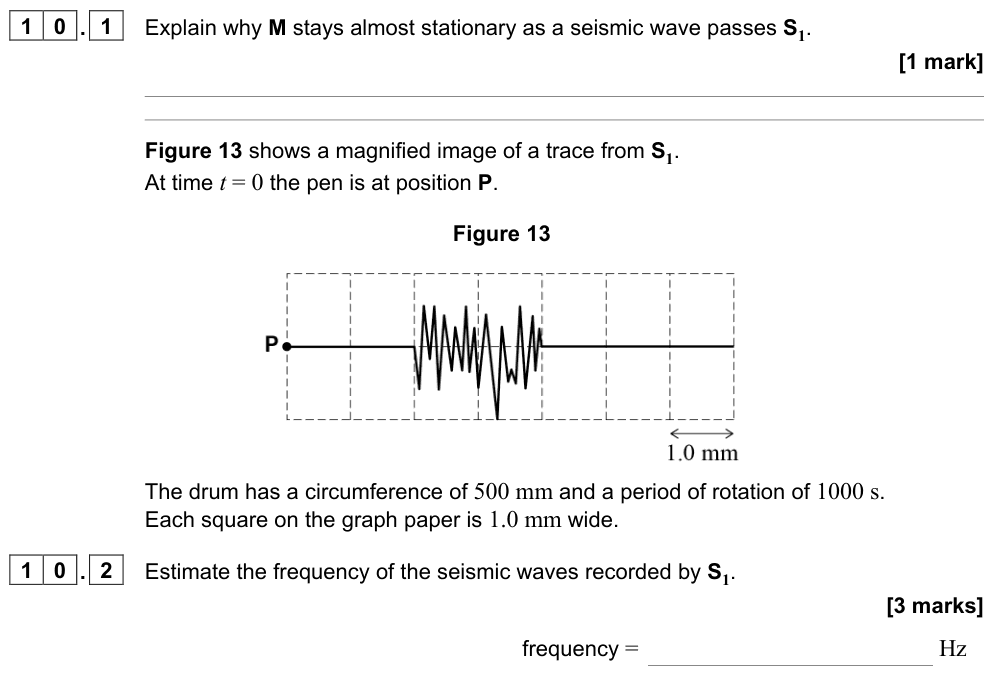
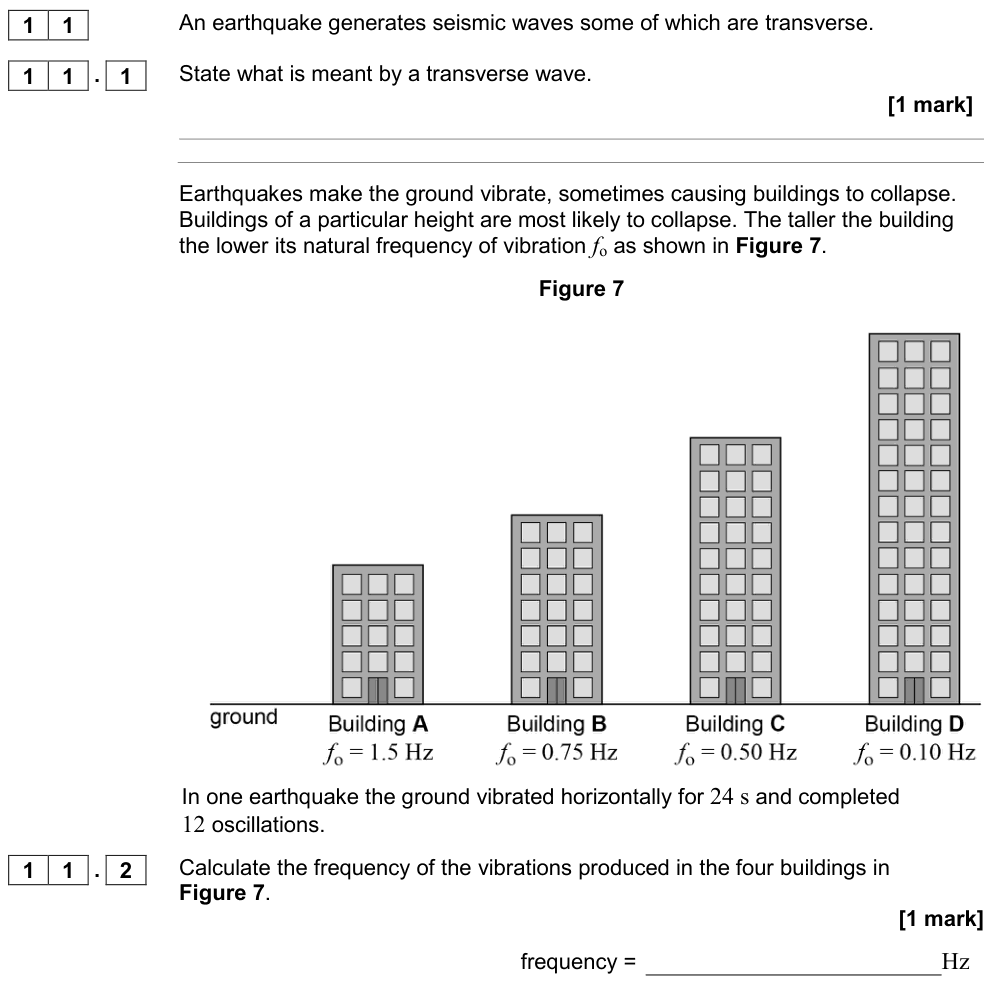
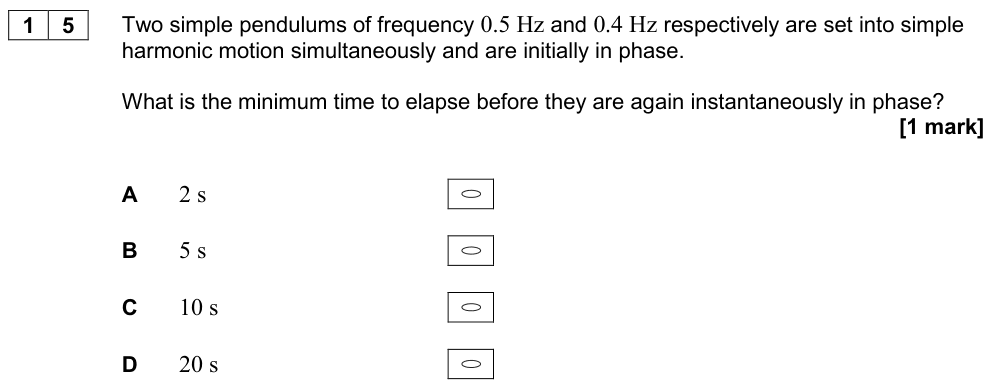
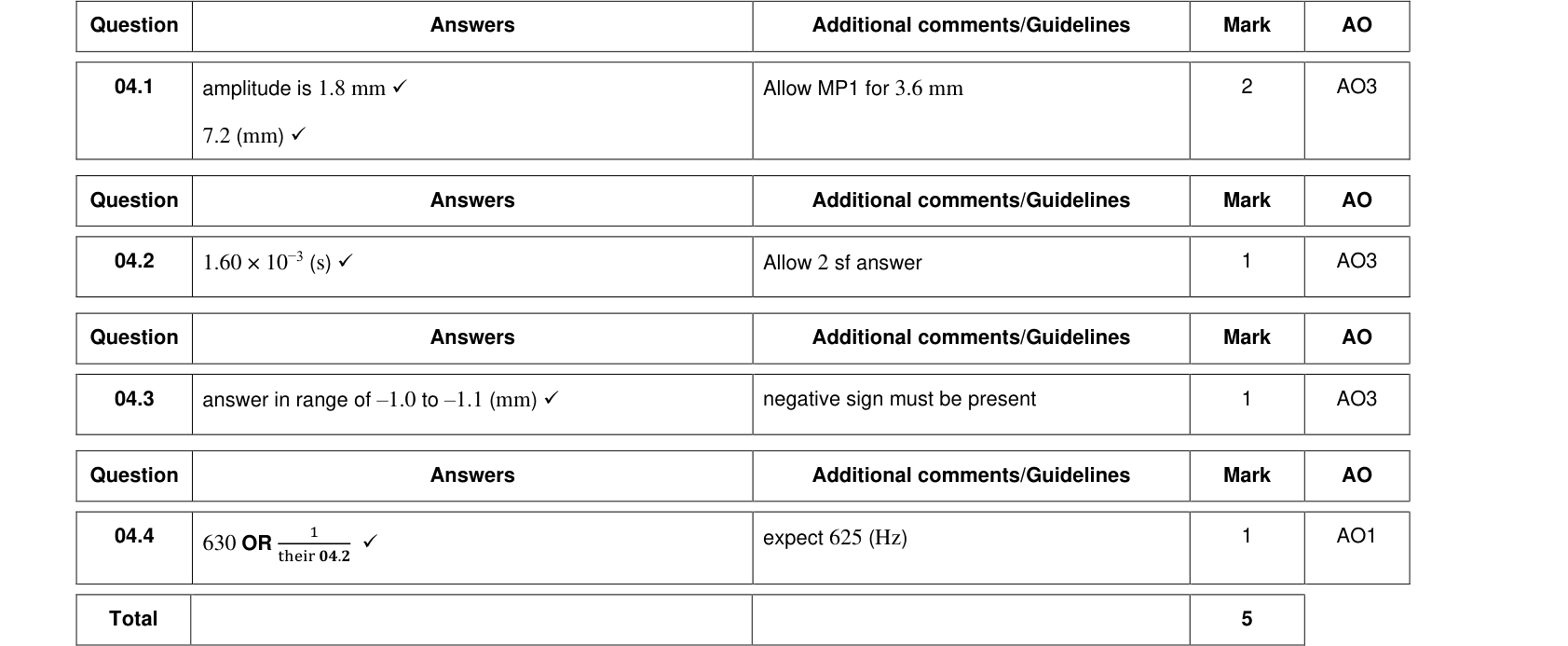
| Frequency $f$ | number of oscillations per second, $f = 1/T$ (Hz) |
When displaced, the system experiences a restoring force directed back towards equilibrium. Two simple systems oscillate with simple harmonic motion (studied in detail in Unit 3):
Periods of simple oscillating systems
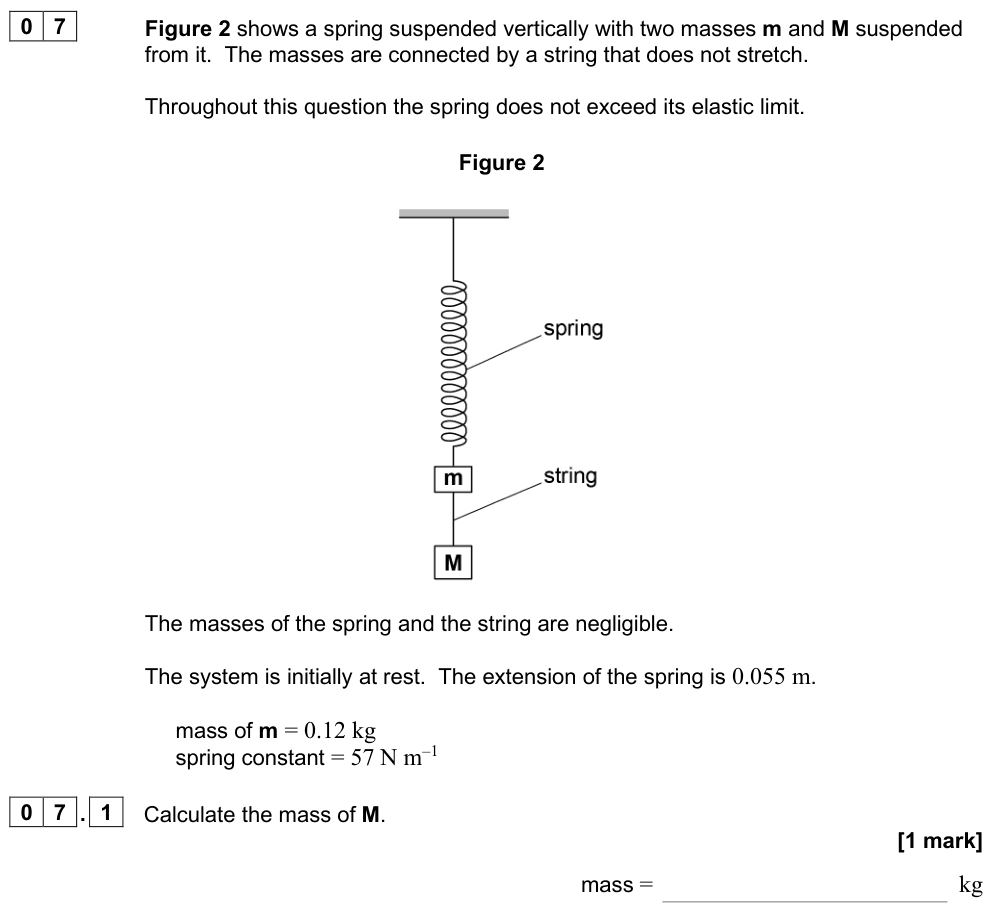
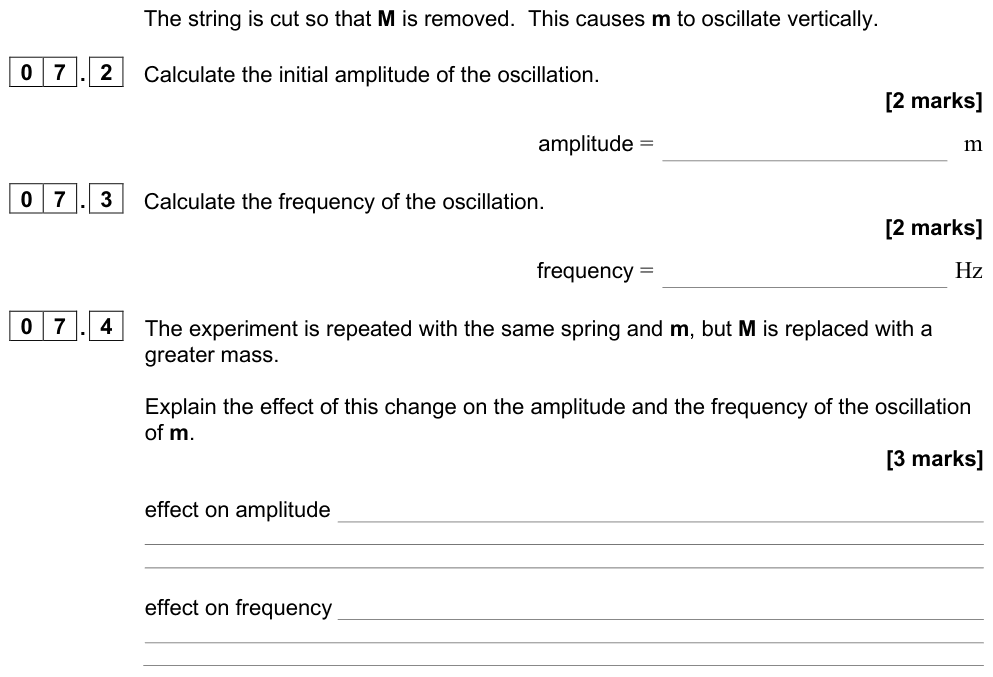
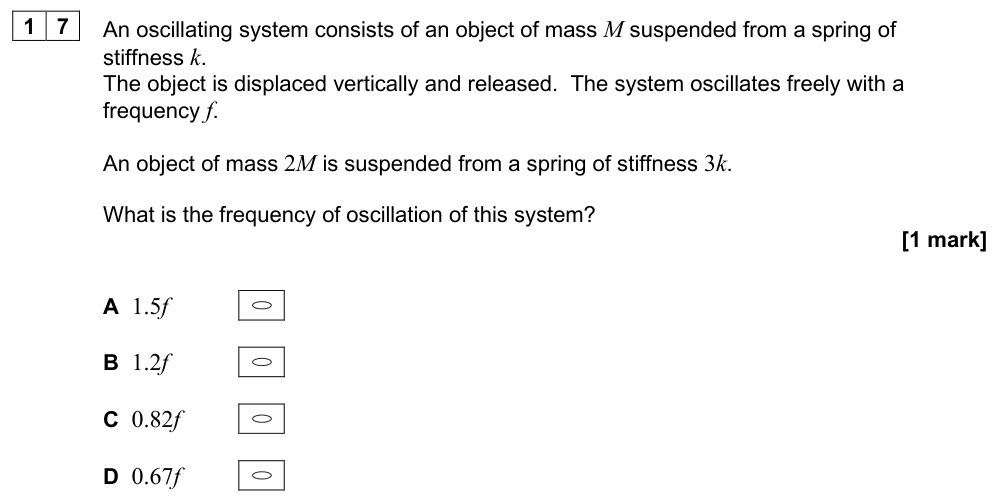
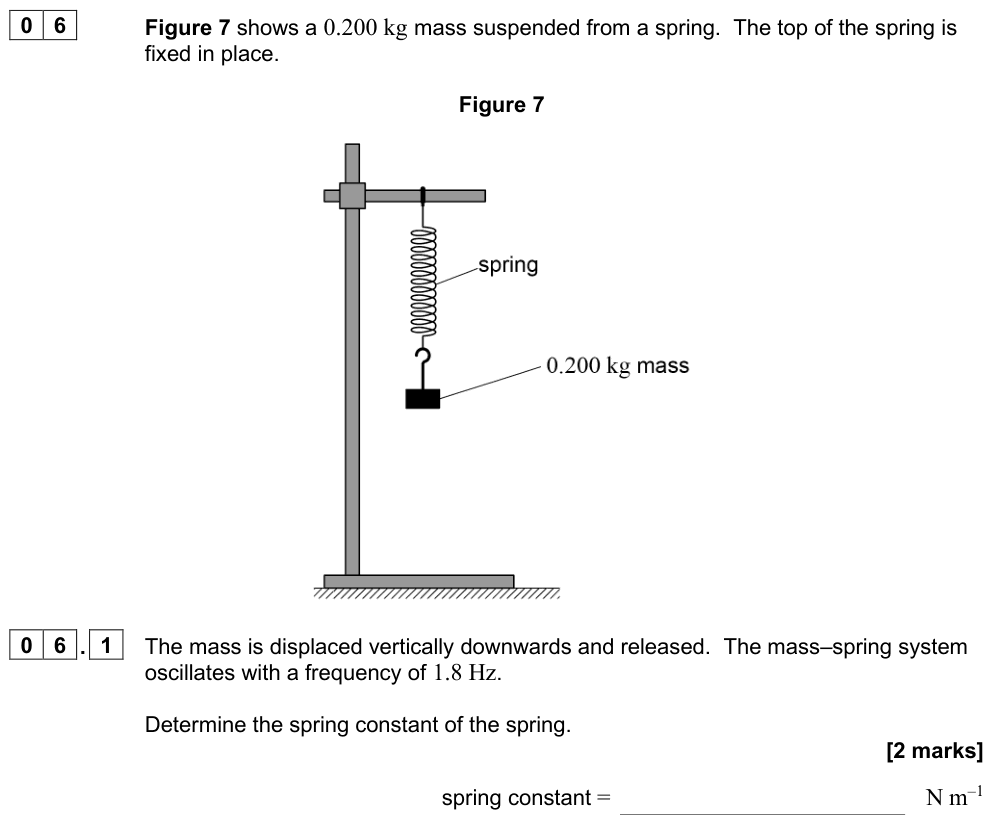
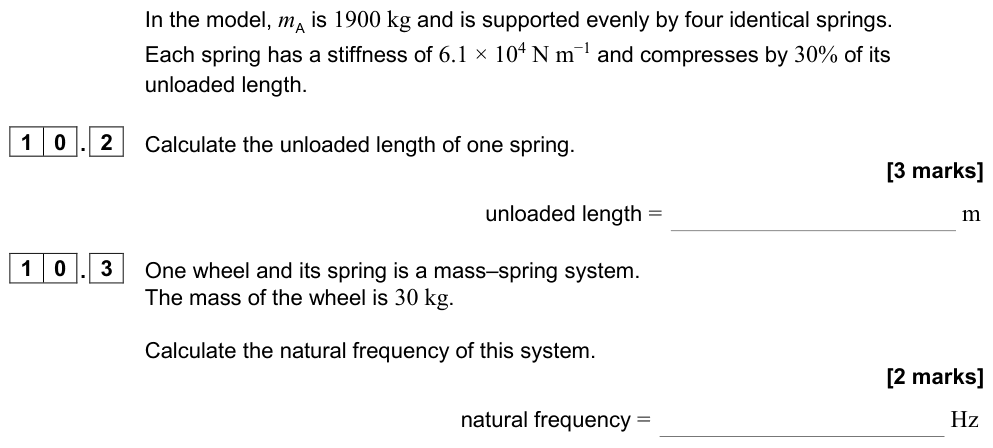
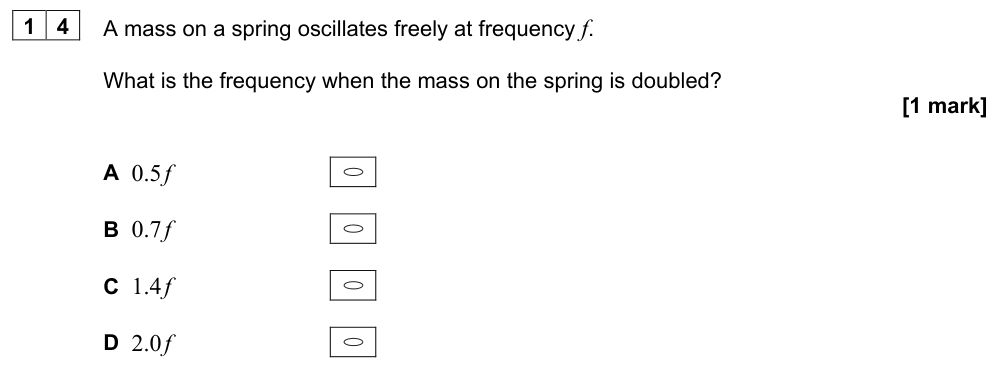
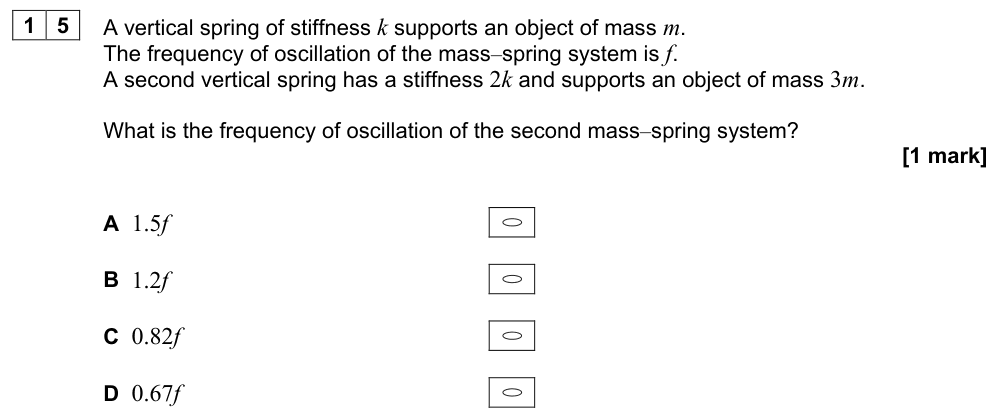
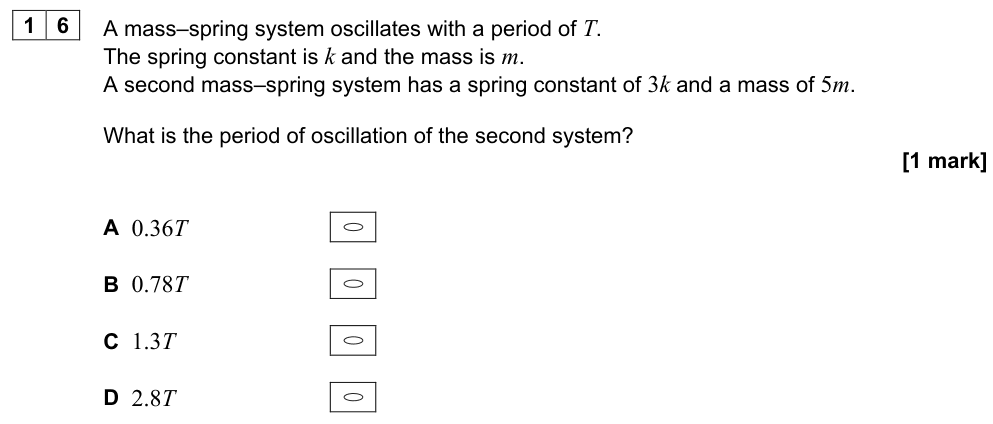
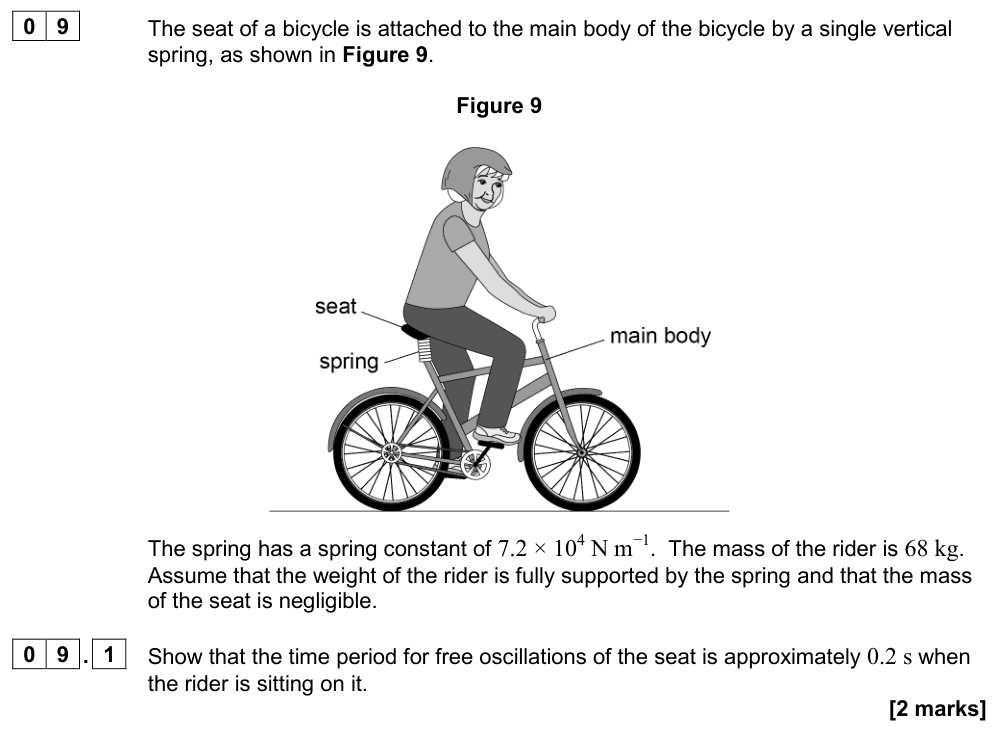
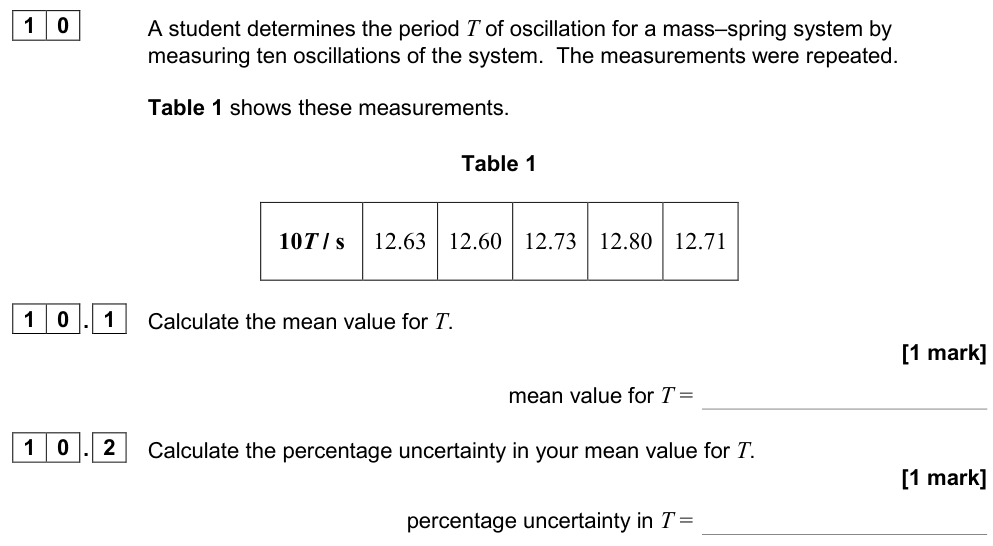
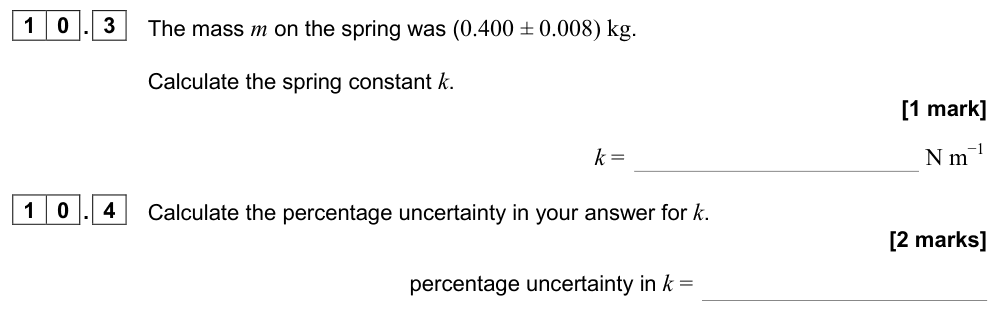
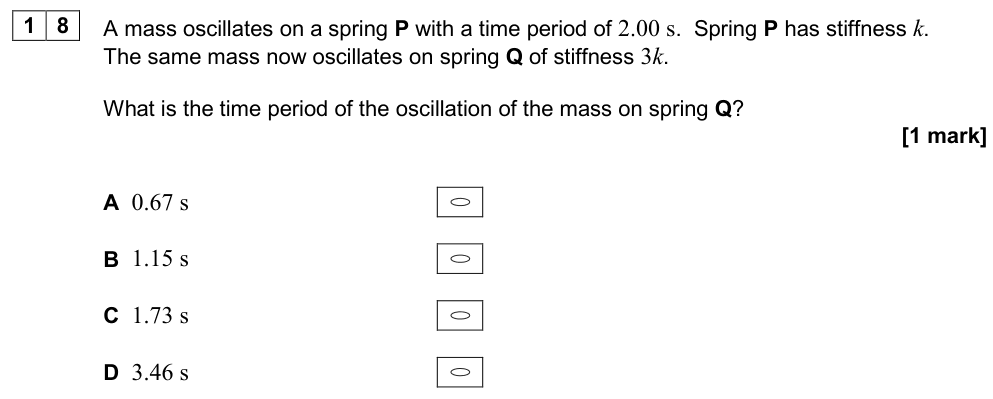
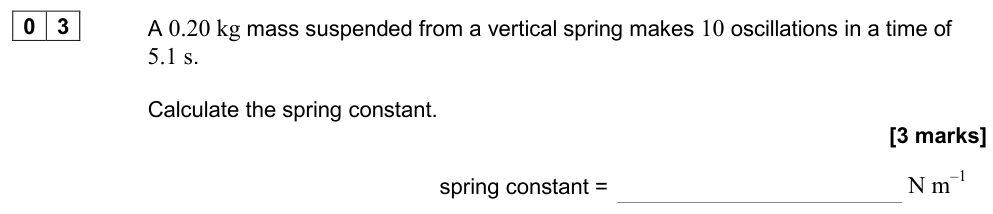
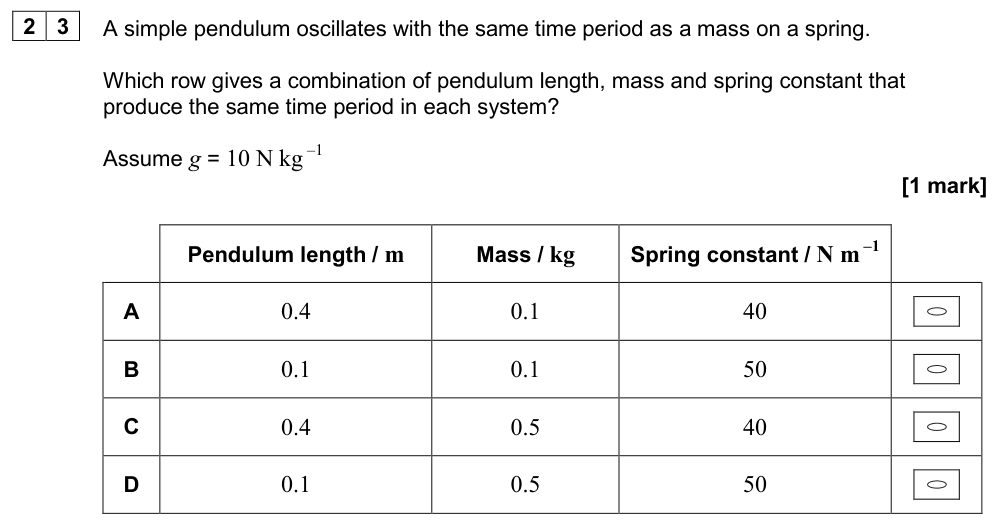
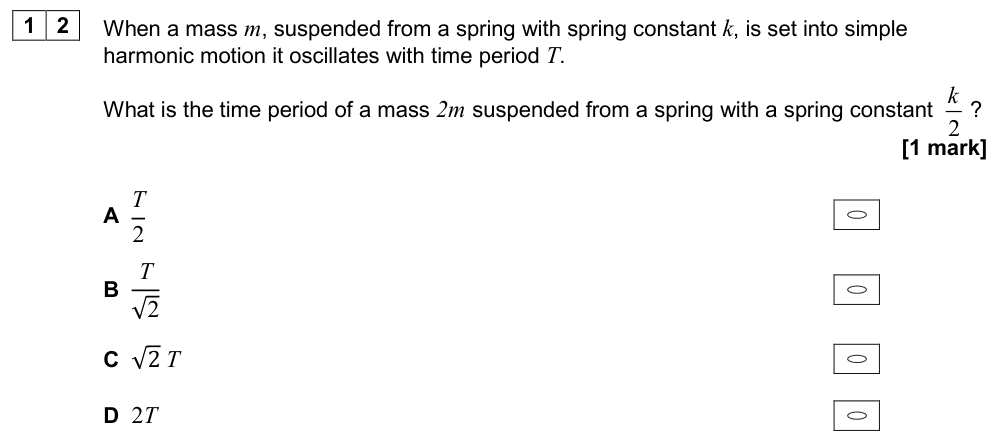
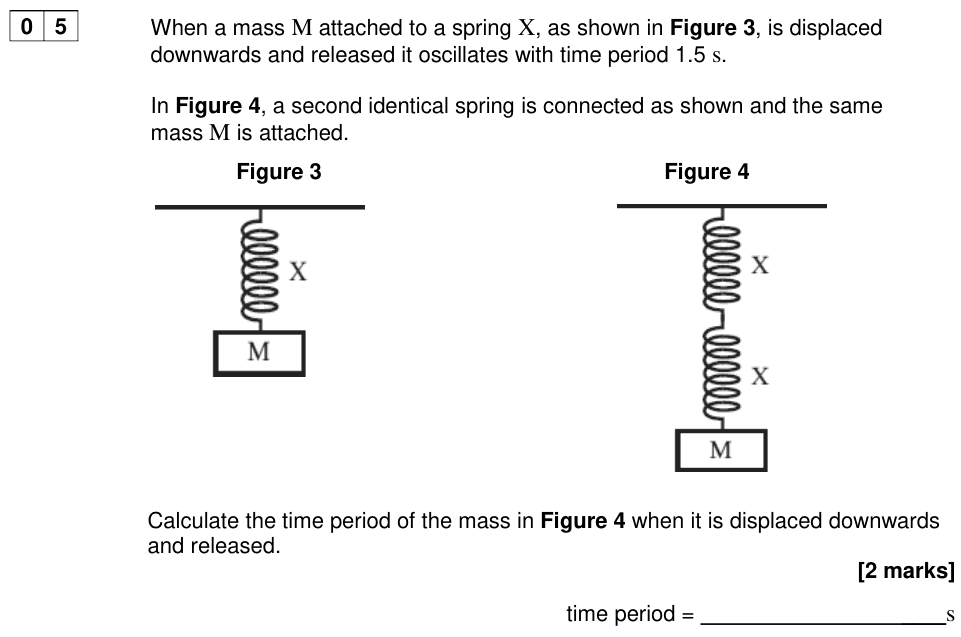
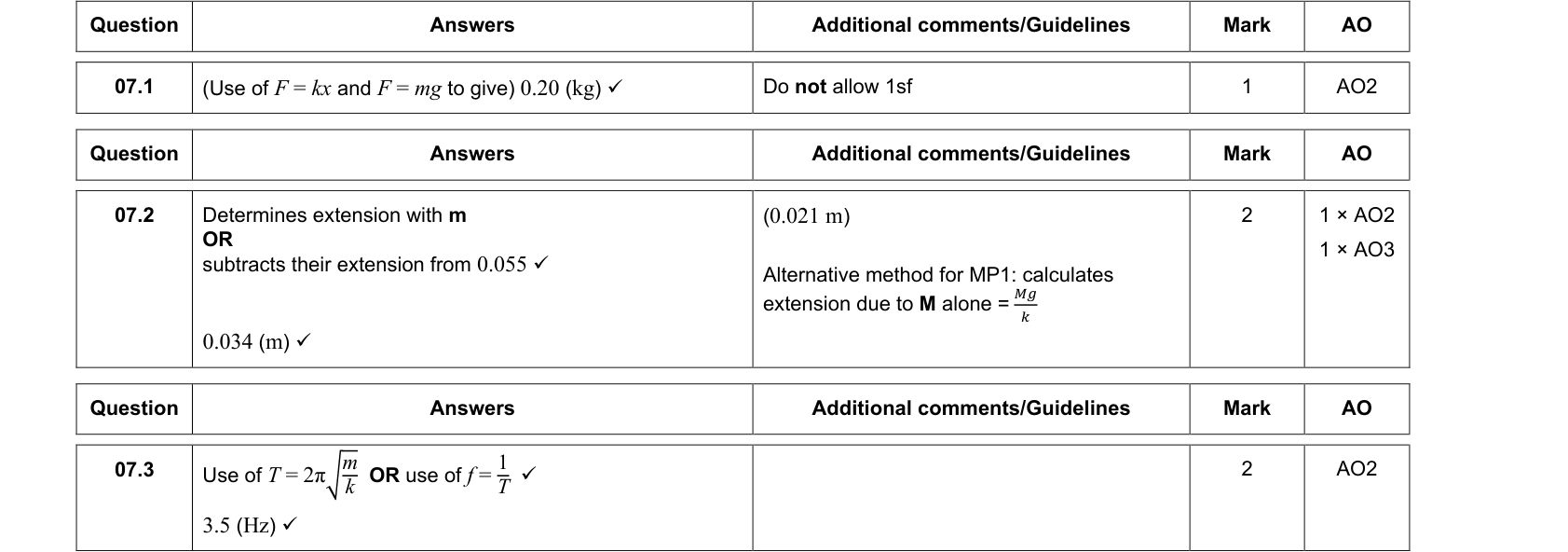
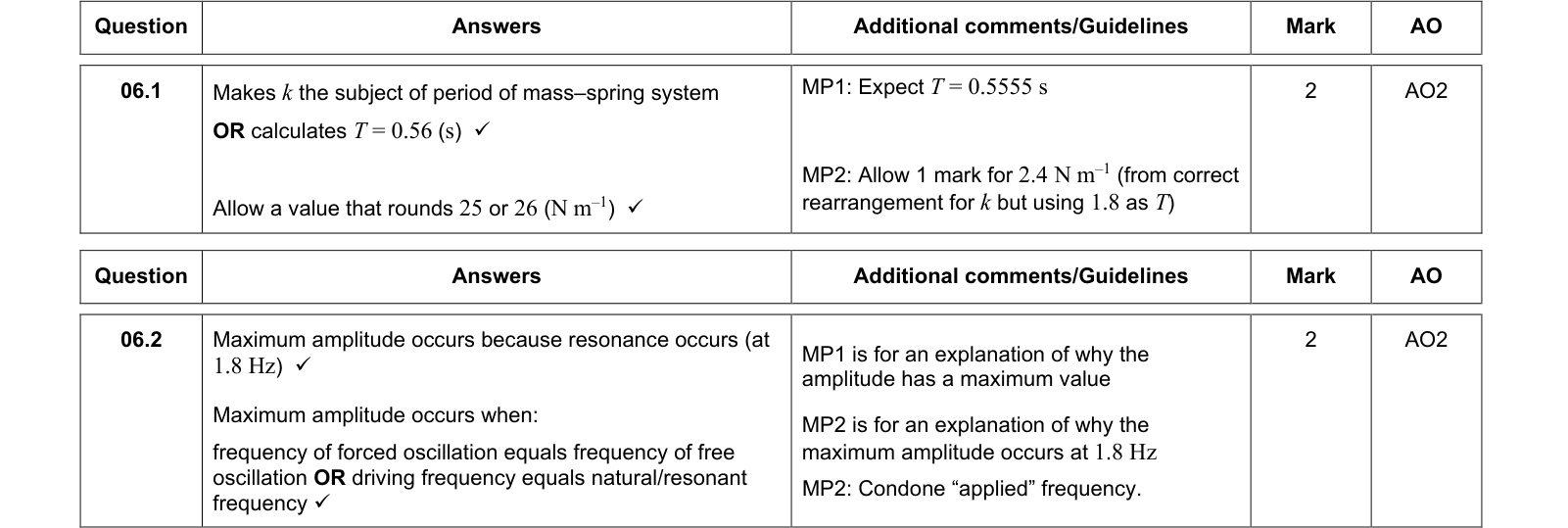
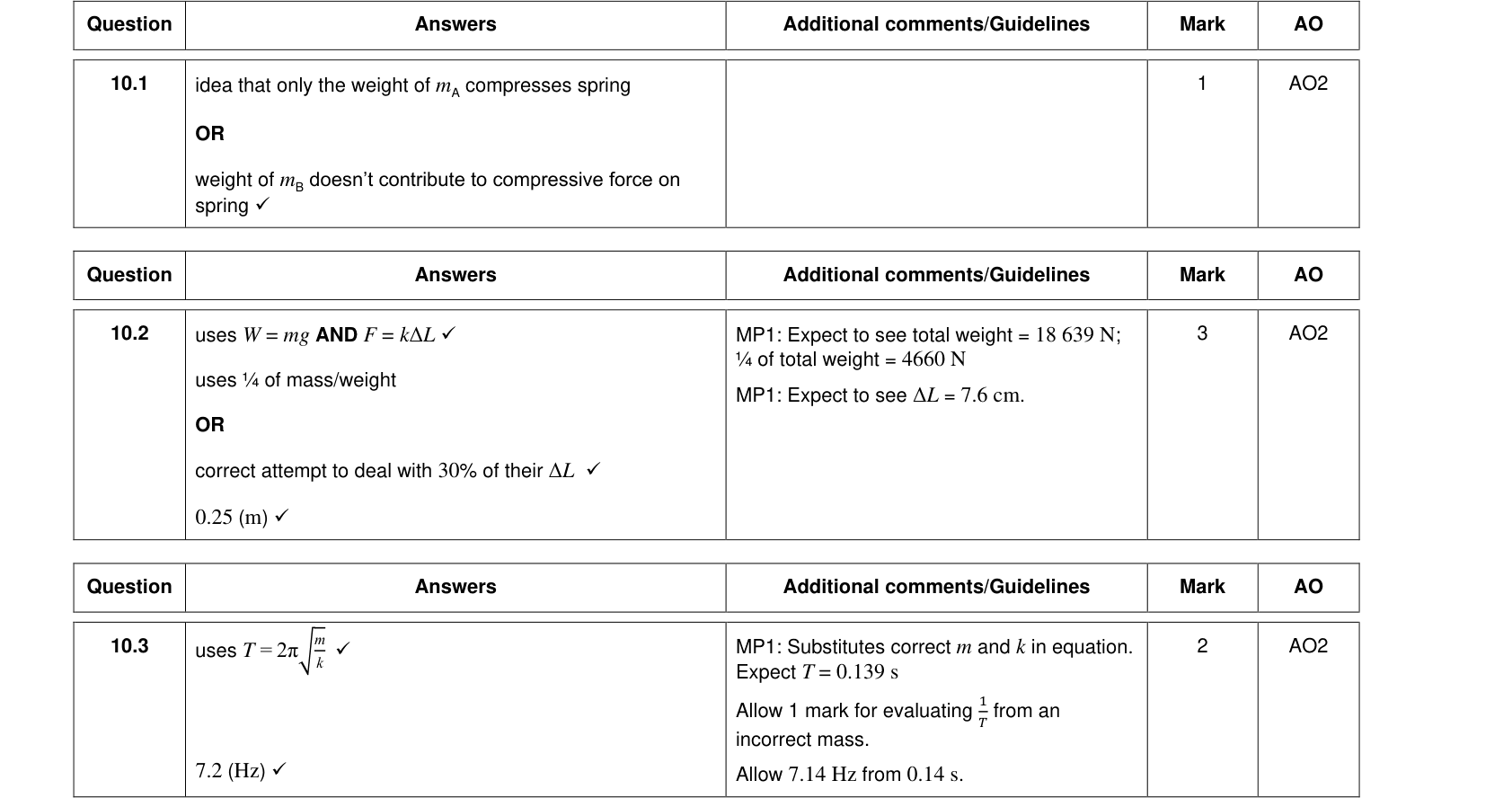
Mass–spring system: $$T = 2\pi\sqrt{\frac{m}{k}}$$
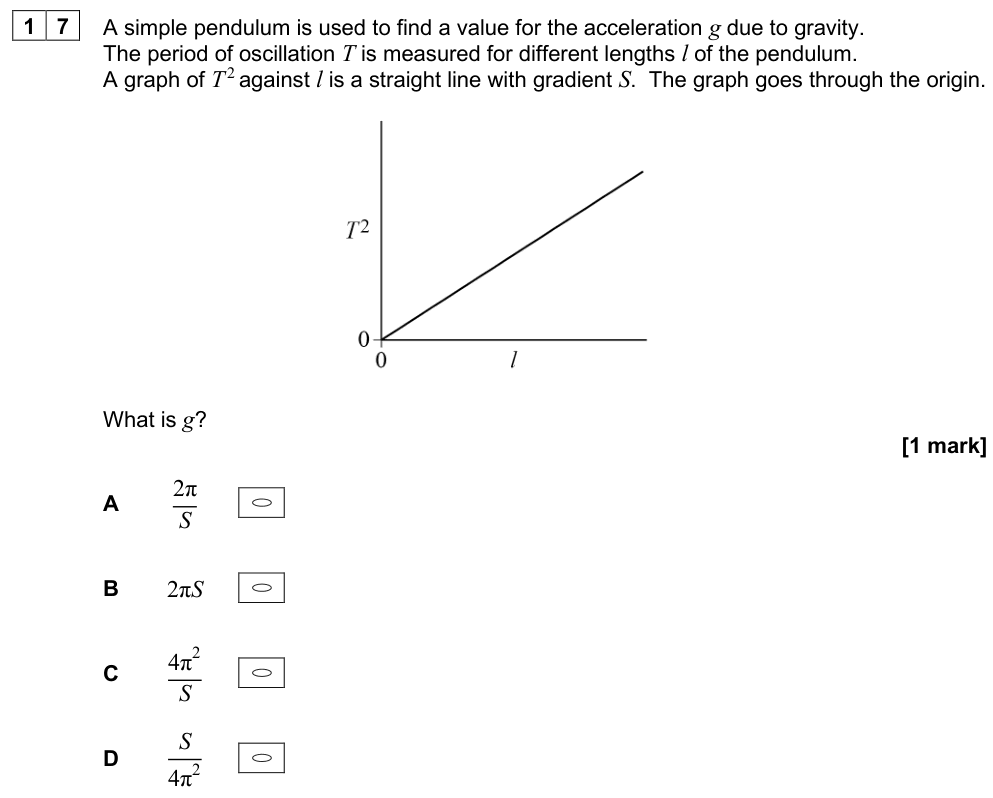
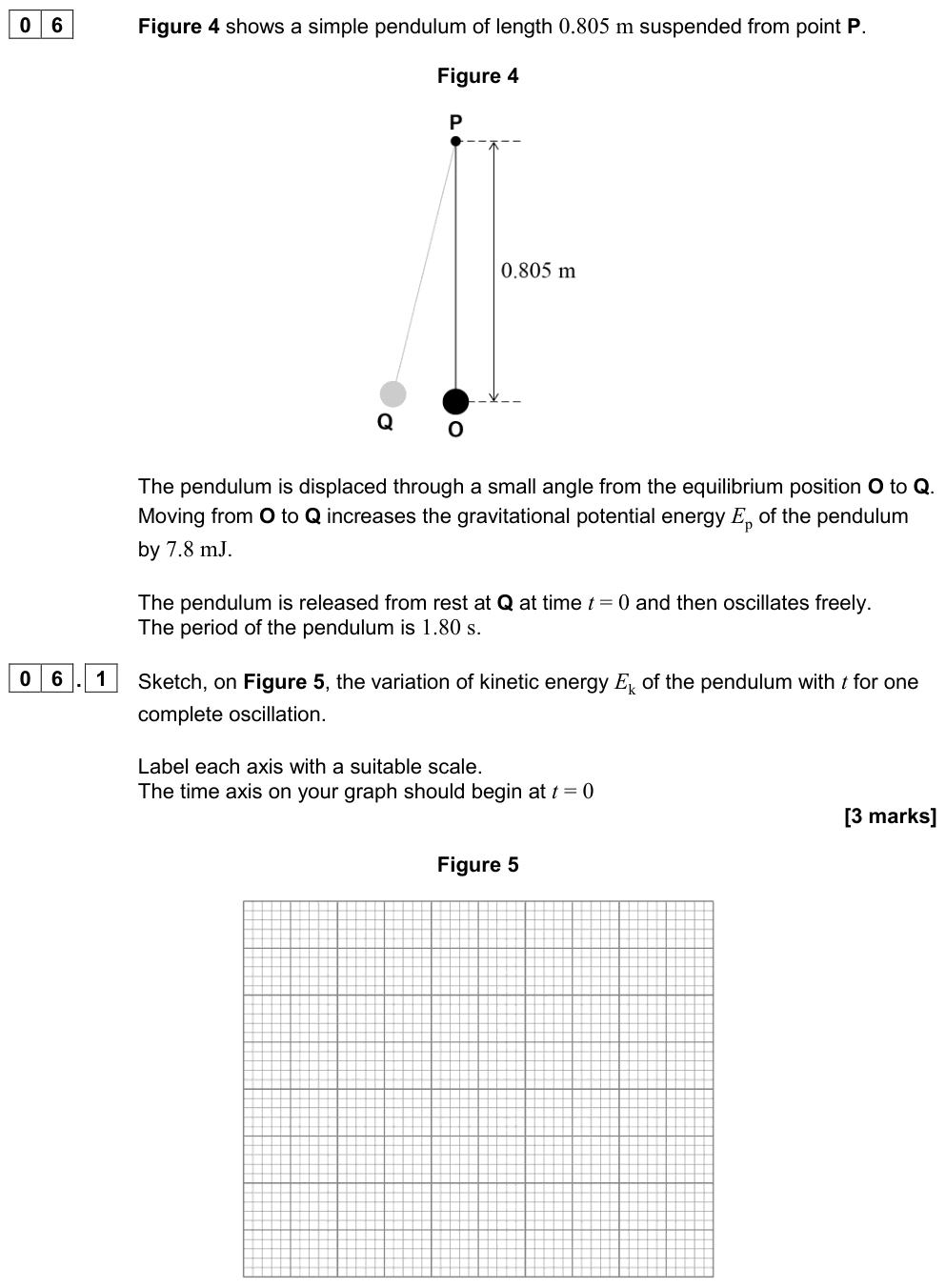
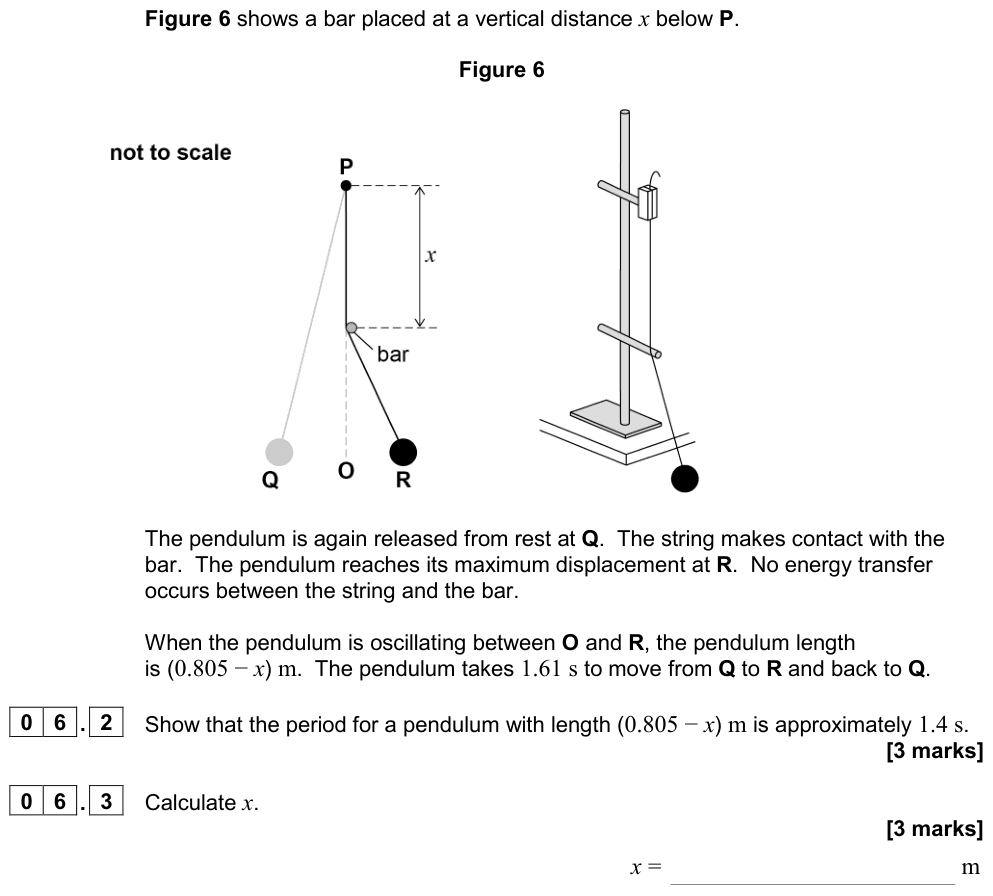
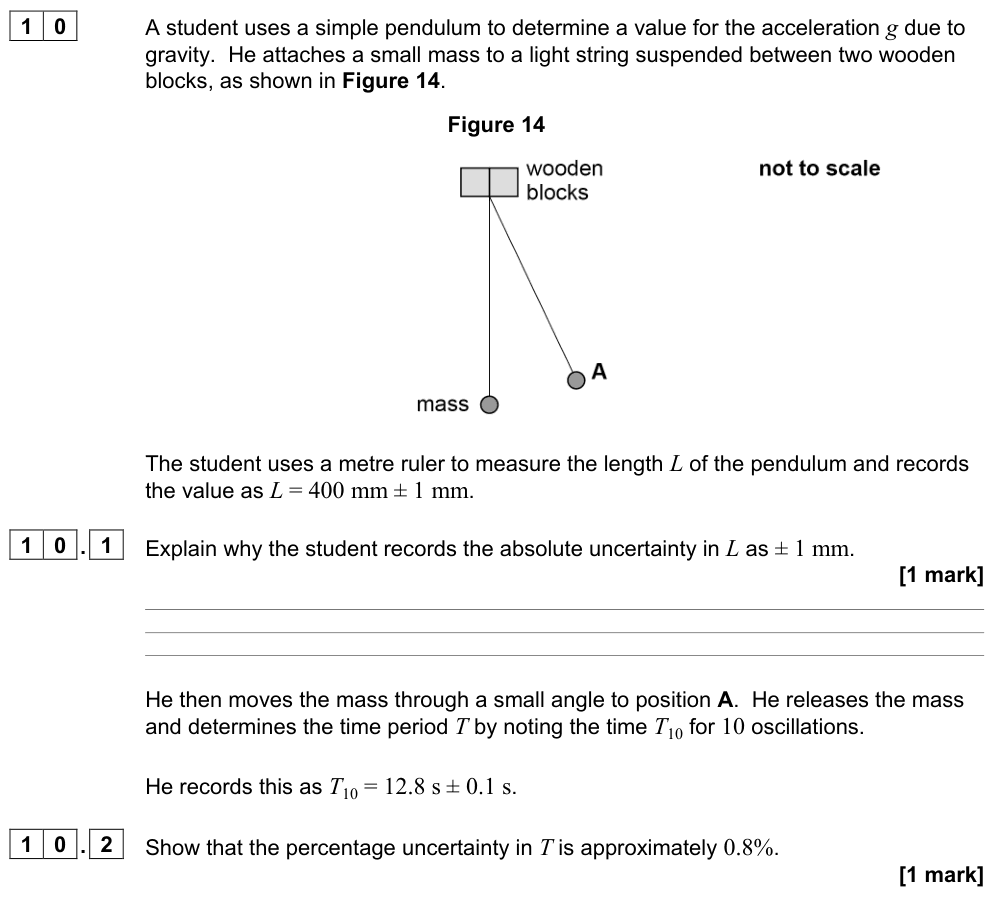
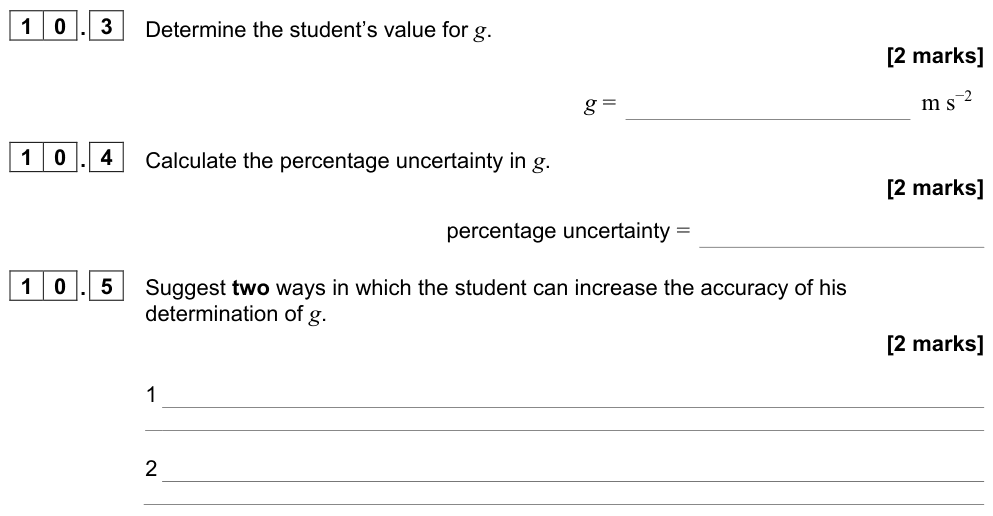
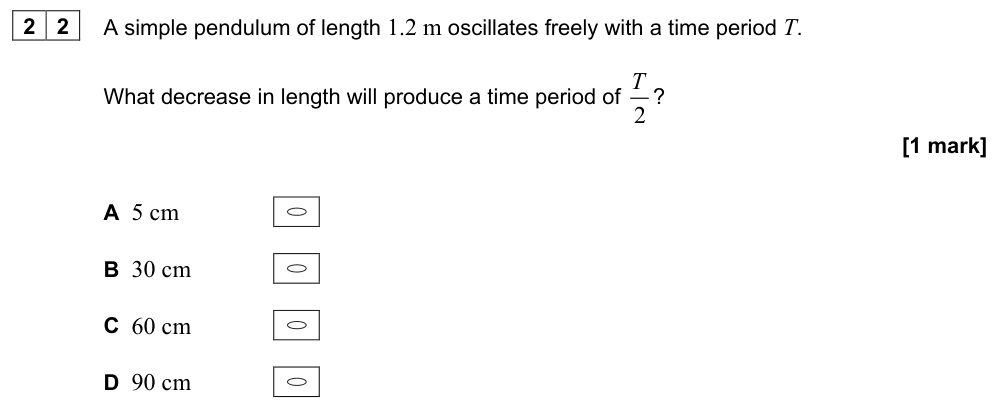
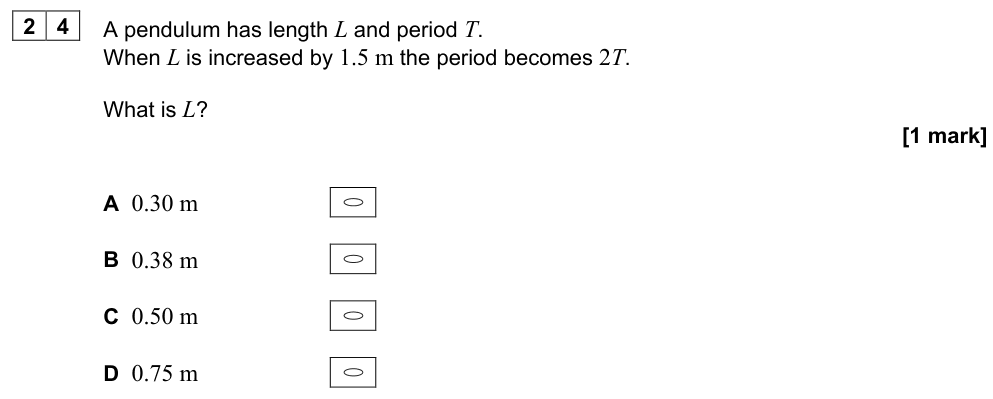
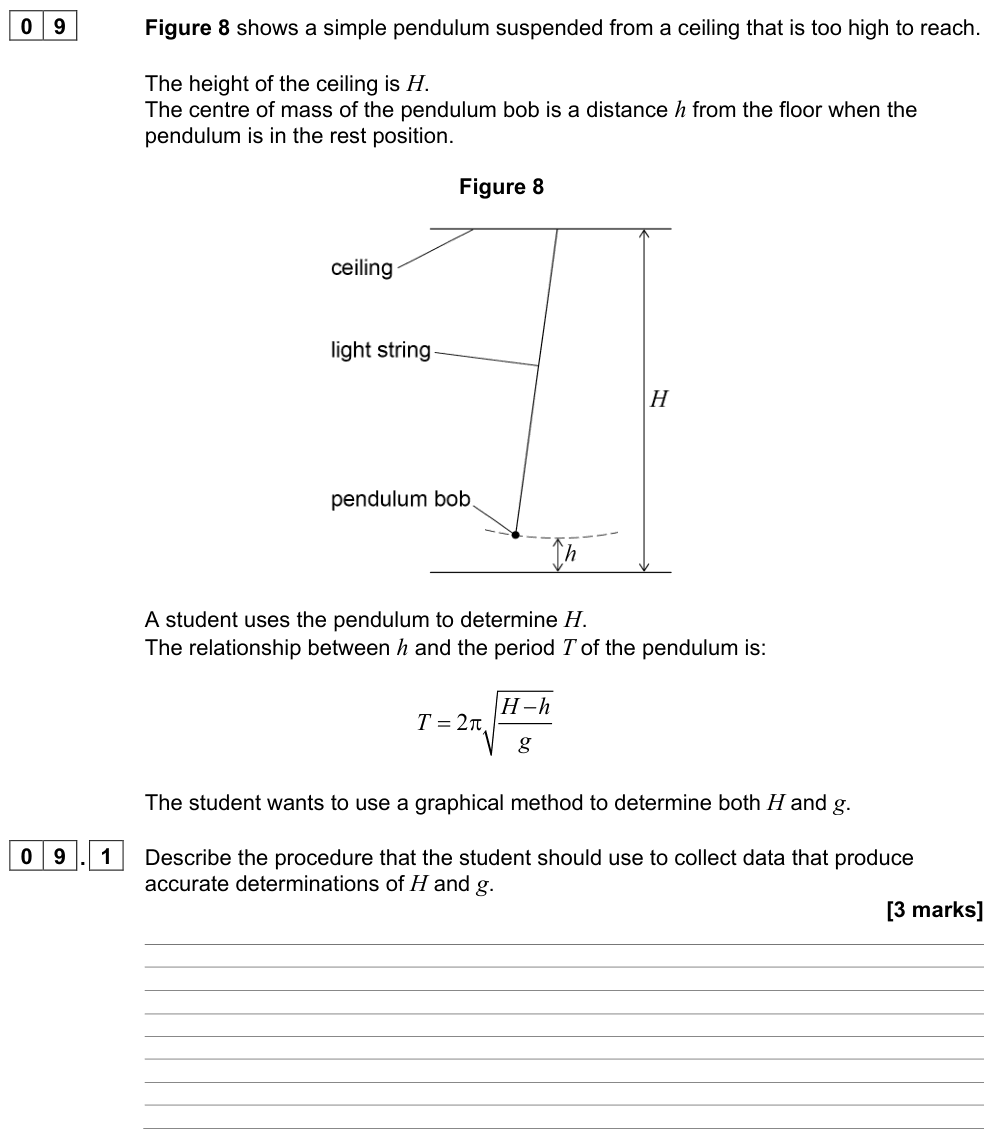
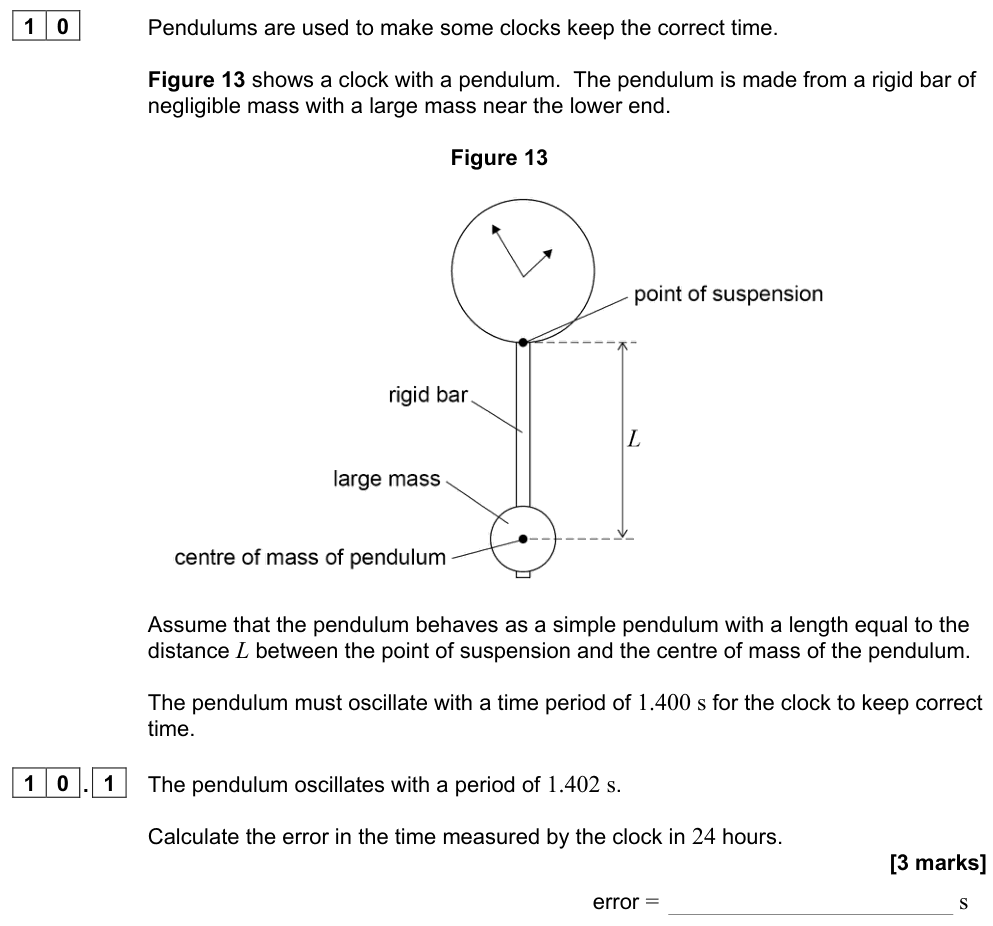
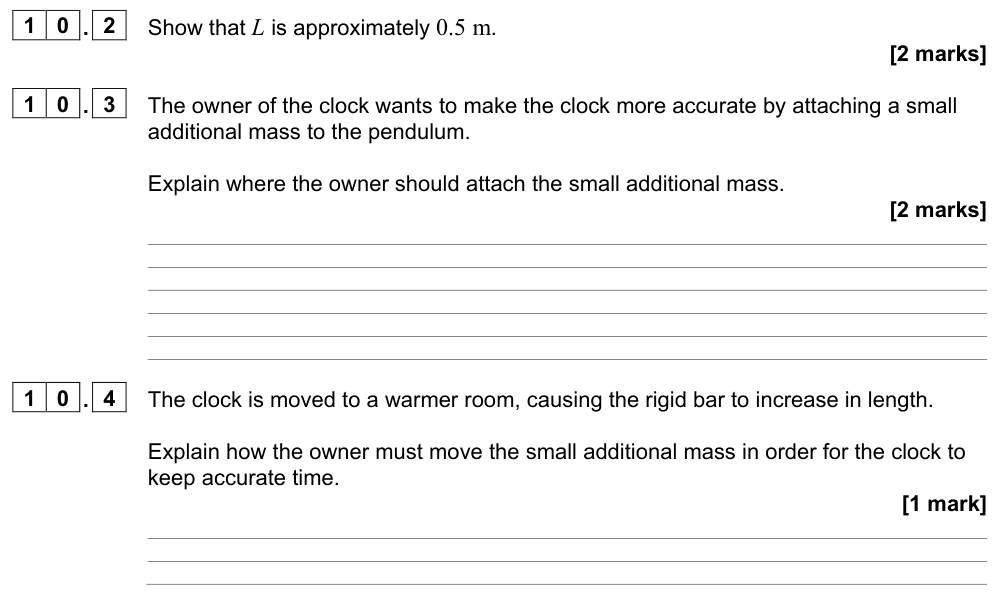
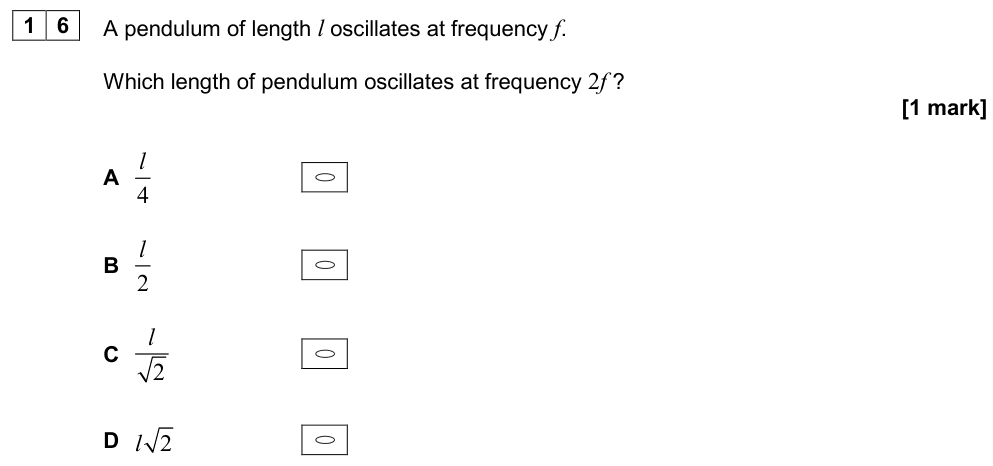
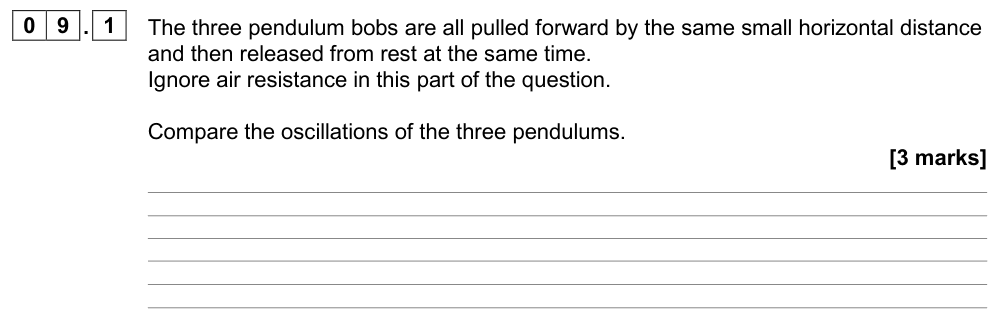
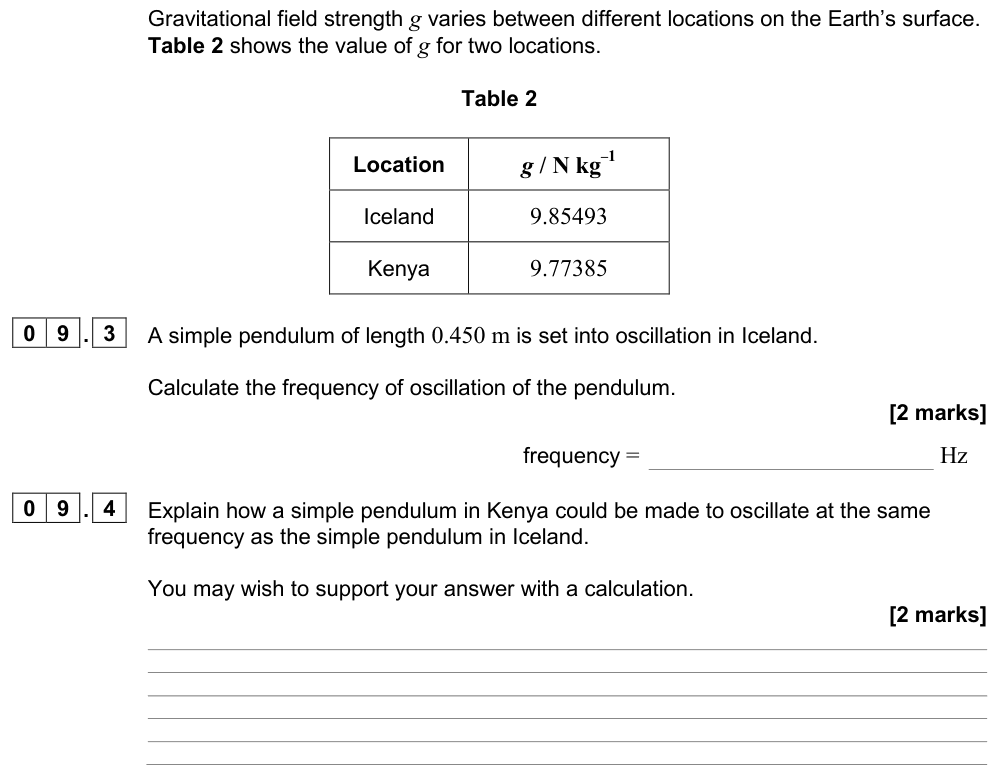
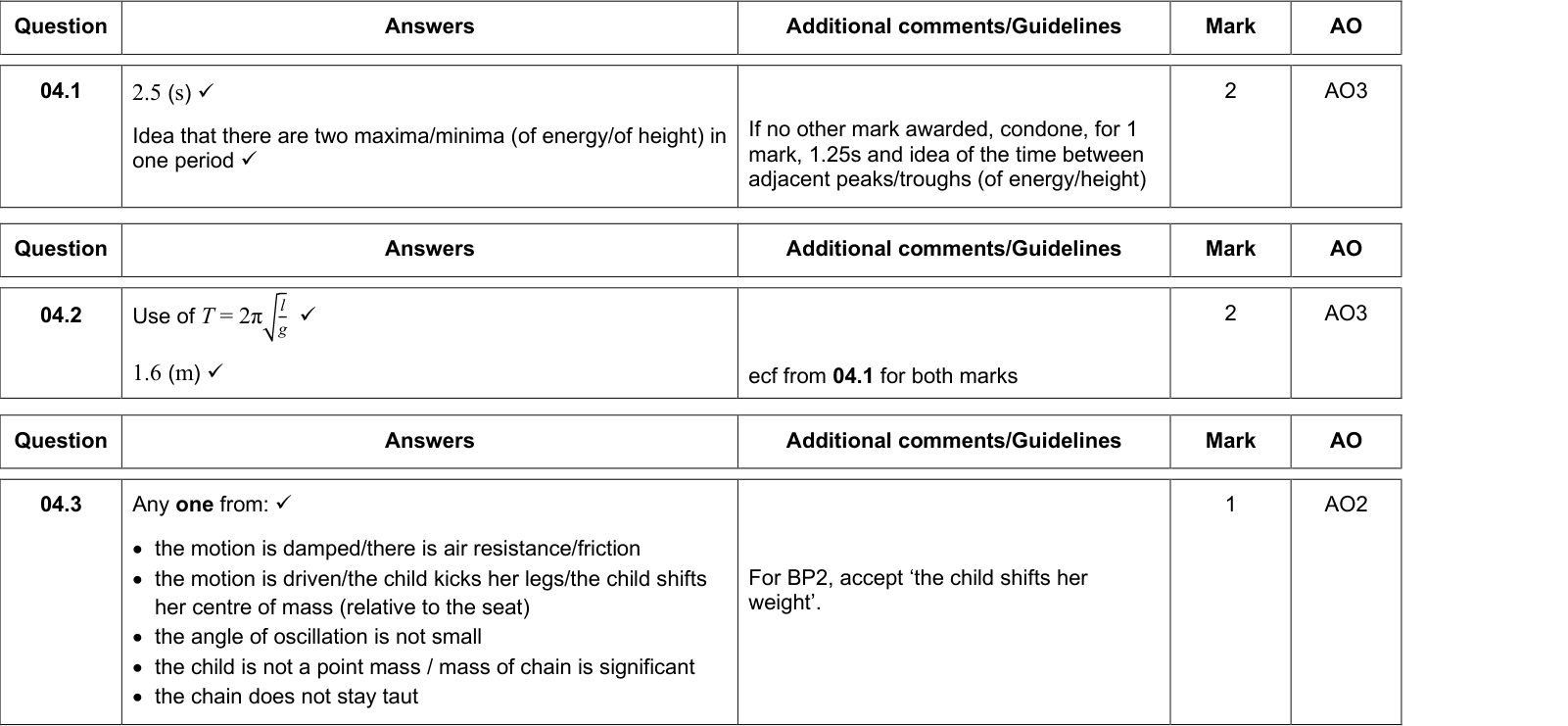
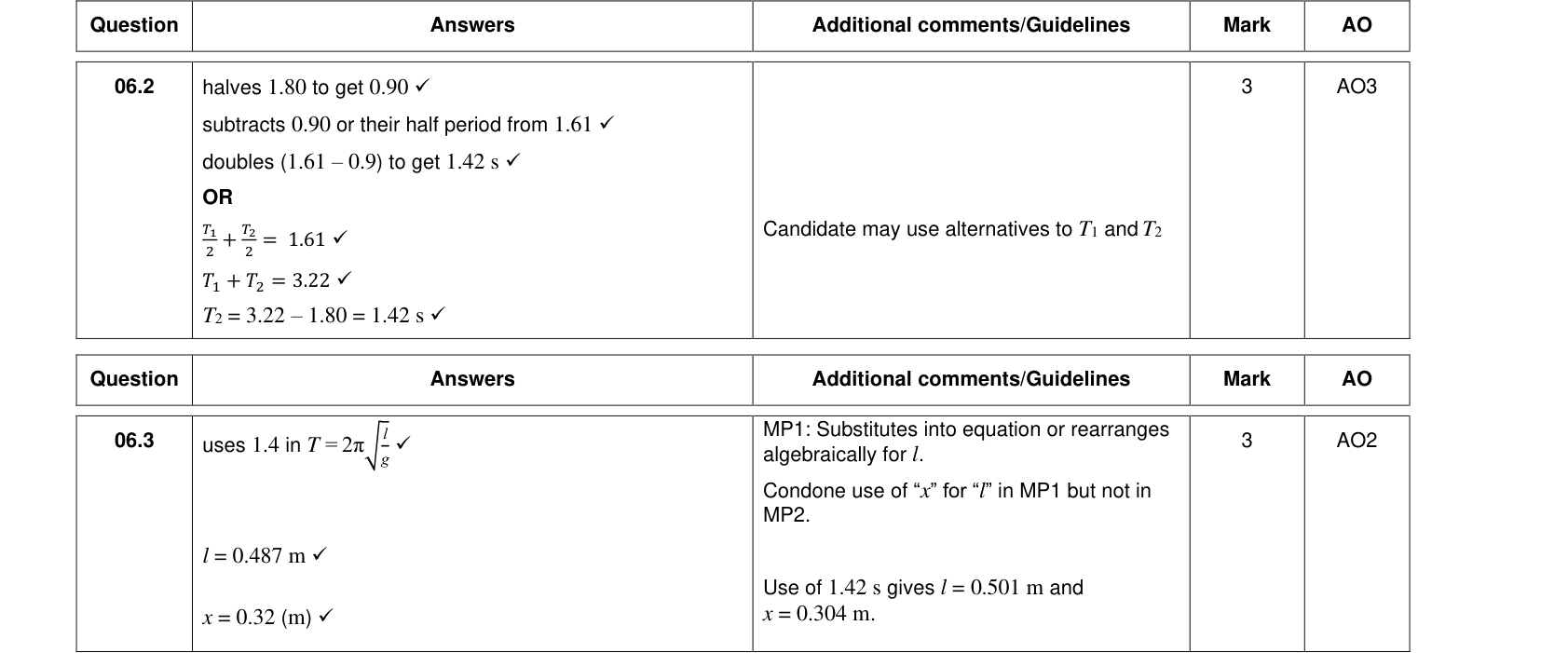
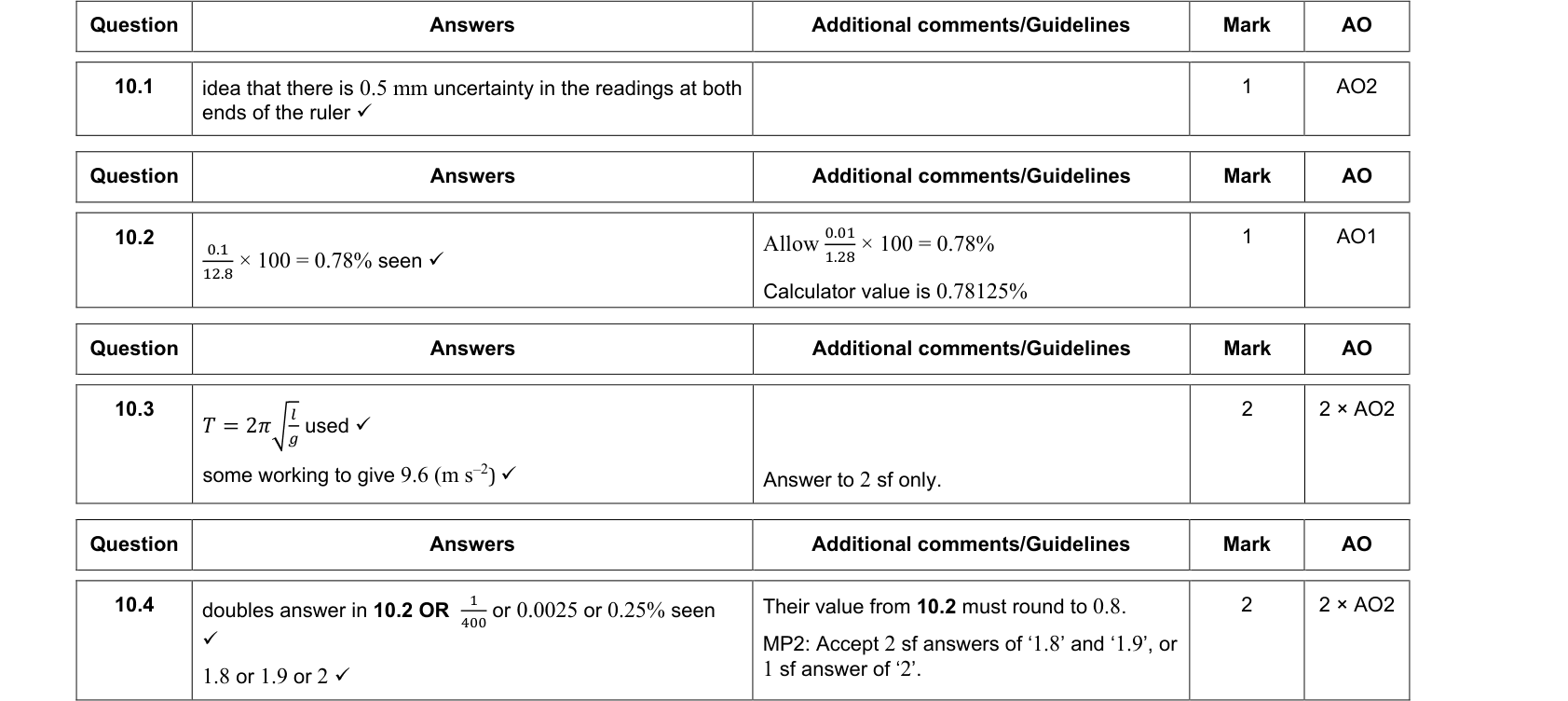
Simple pendulum (small amplitude, less than about 10°): $$T = 2\pi\sqrt{\frac{l}{g}}$$
$m$ = oscillating mass, $k$ = spring constant, $l$ = length from the pivot to the centre of mass of the bob, $g$ = gravitational field strength.
Important consequences:
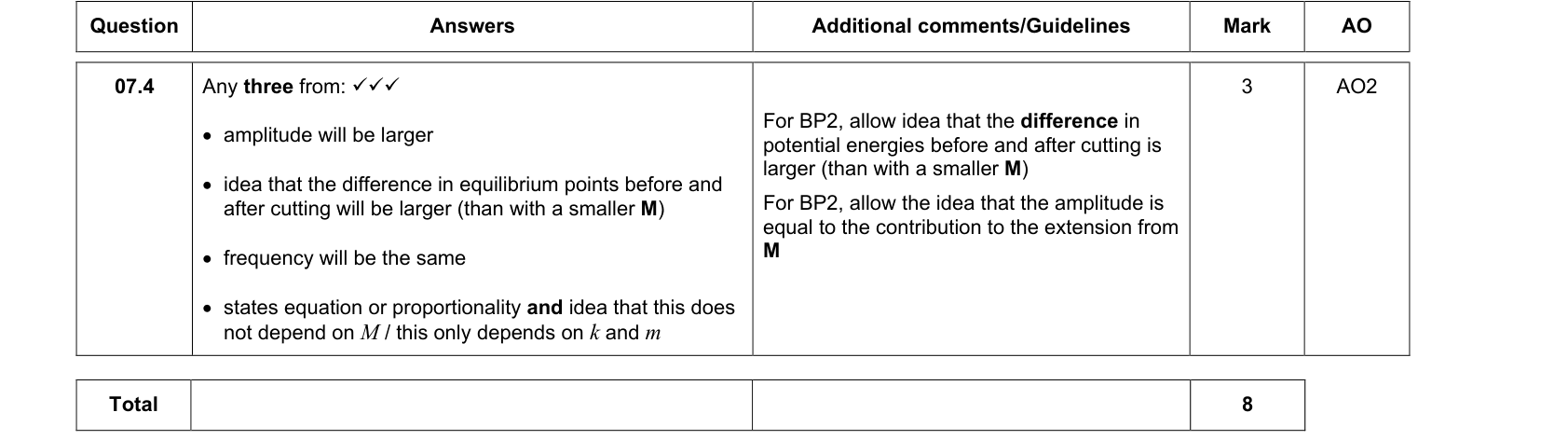
- The period of a mass–spring system does not depend on the amplitude or on $g$. It is the same on the Moon.
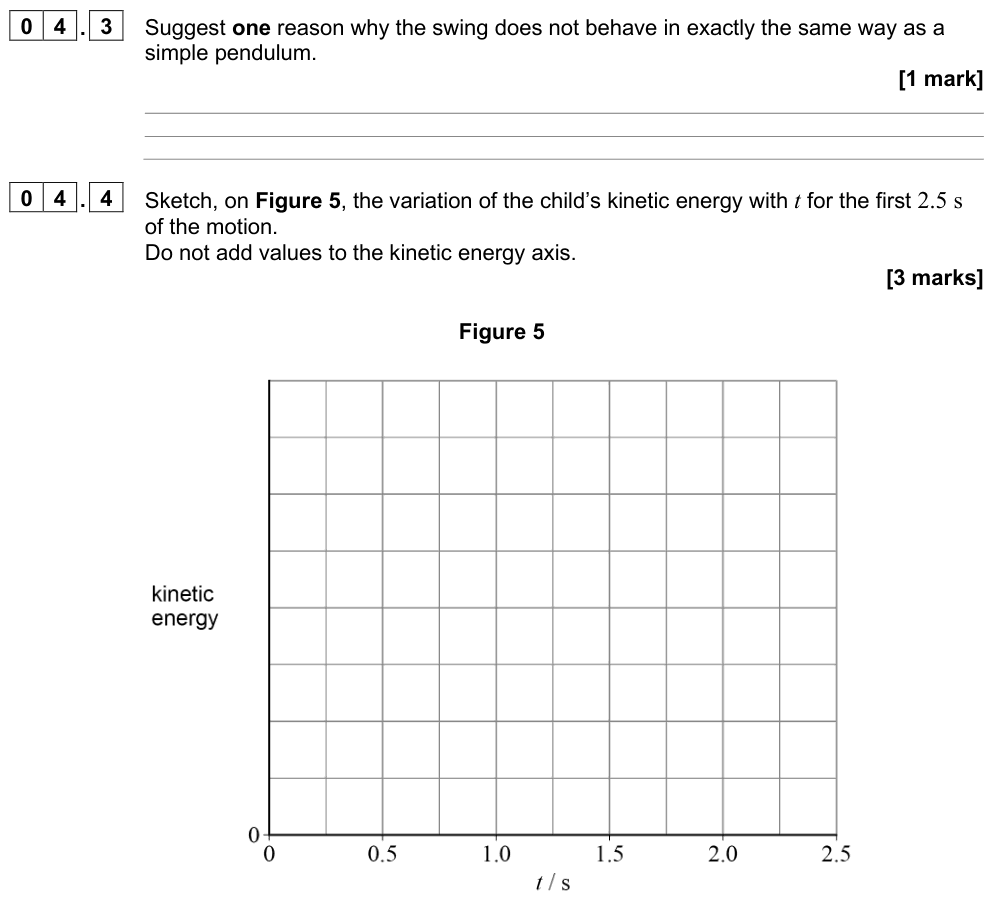
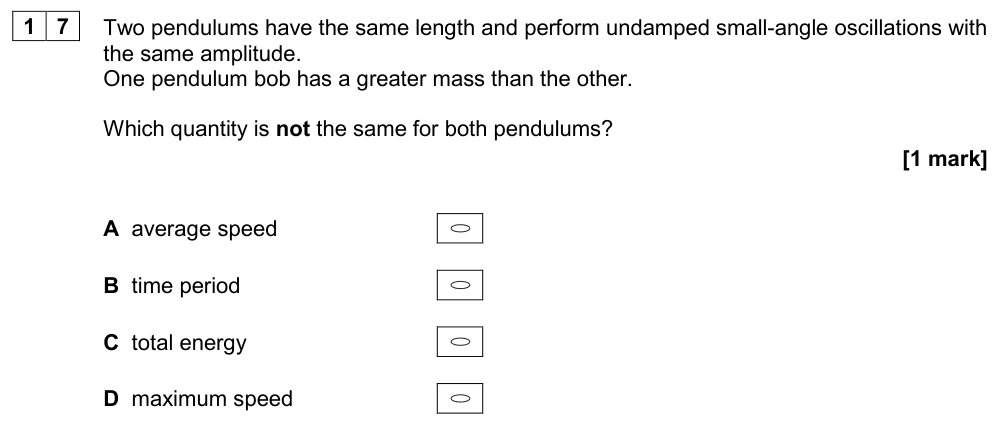
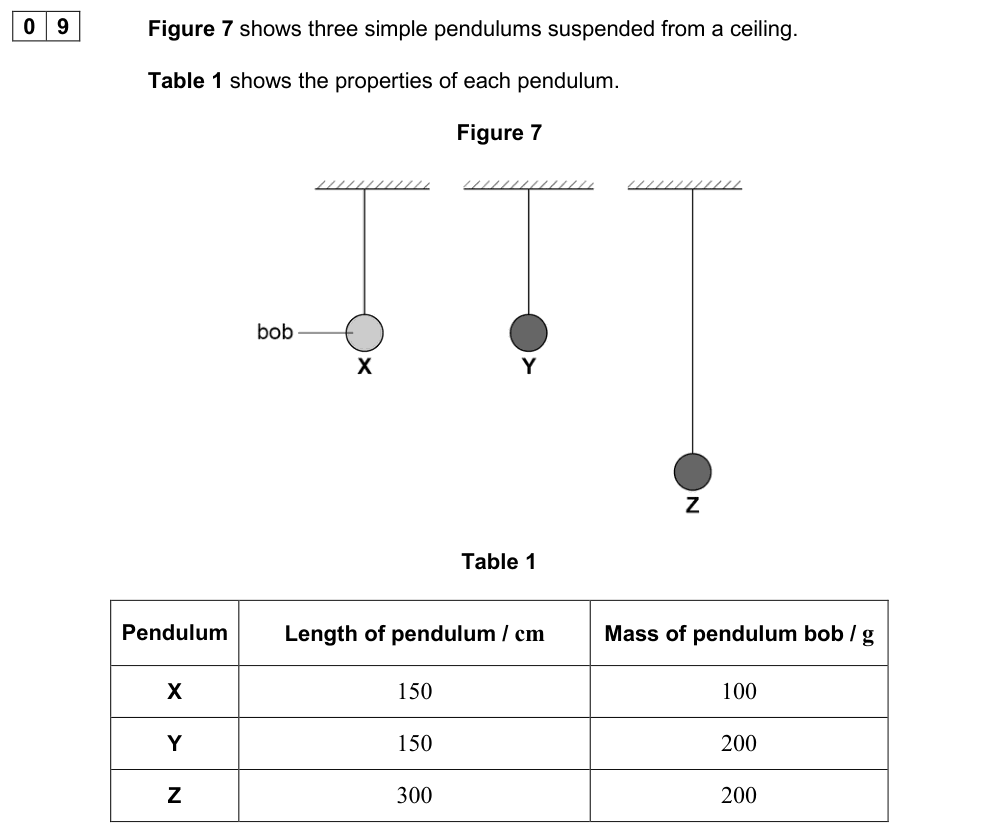
- The period of a pendulum does not depend on the mass of the bob or on the amplitude (for small angles). It depends only on the length and $g$.
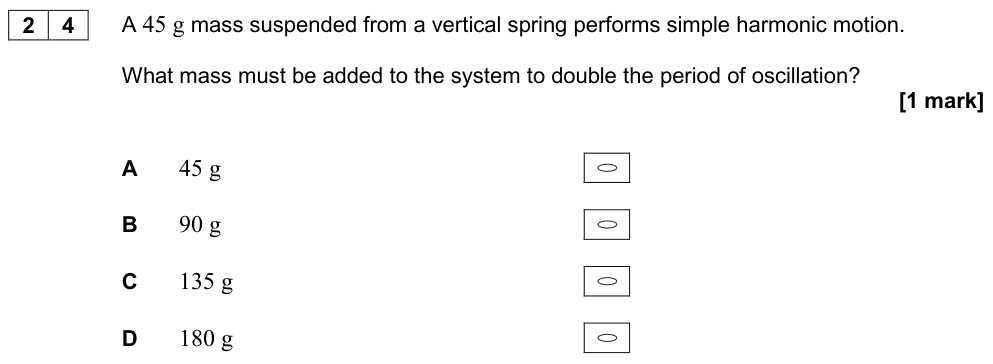
- To double the period you need four times the mass (spring) or four times the length (pendulum).
Worked example: pendulum clock
What length of pendulum has a period of exactly 2.0 s? $l = g\left(\dfrac{T}{2\pi}\right)^2 = 9.81 \times \left(\dfrac{2.0}{2\pi}\right)^2 = 0.99\ \text{m}$.
Energy in an oscillating system
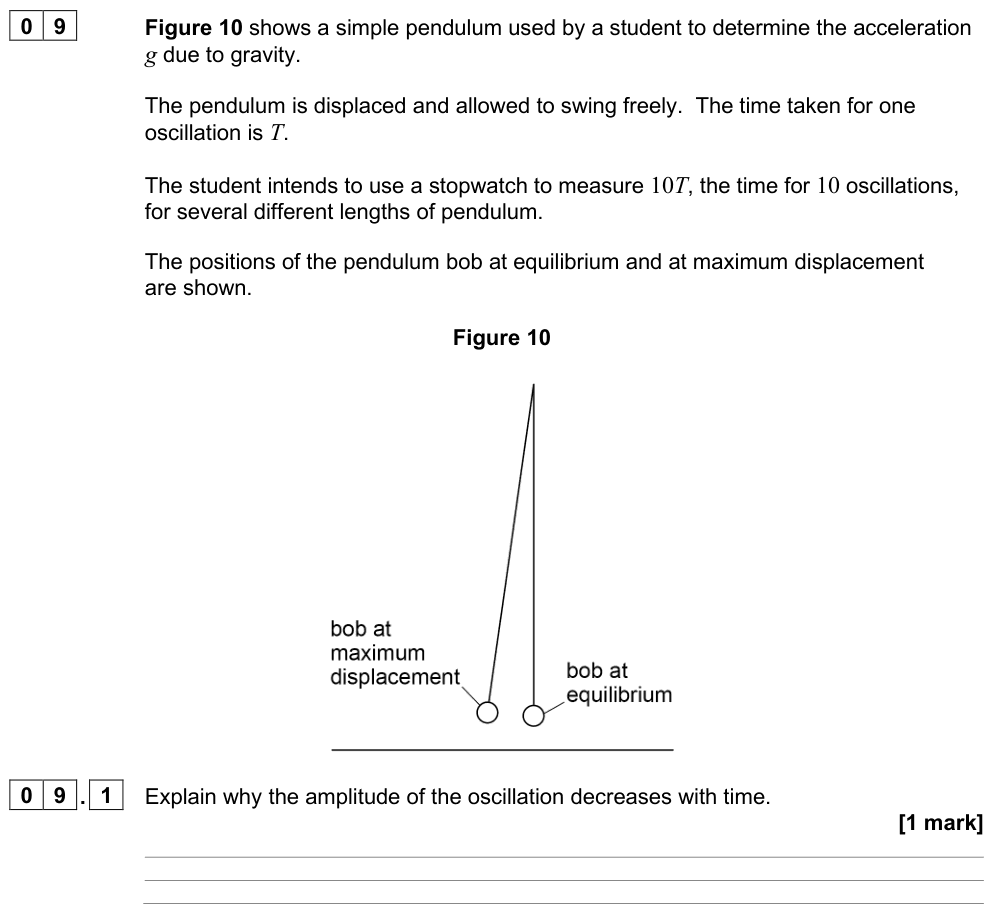
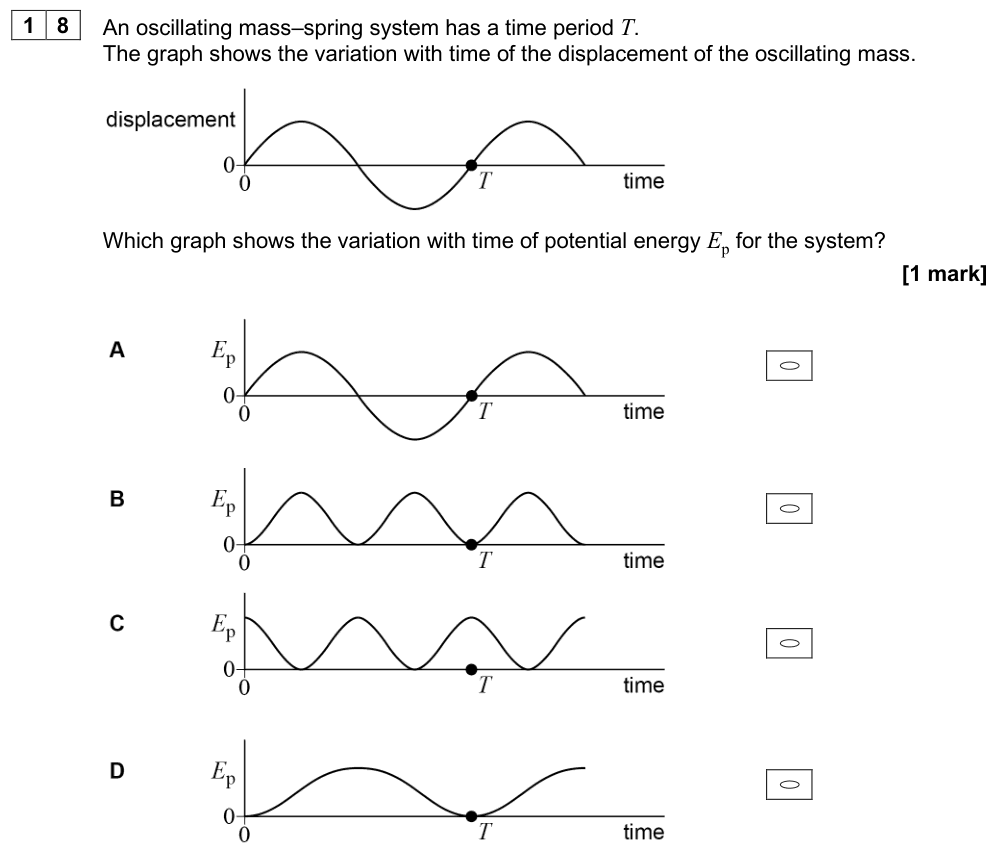
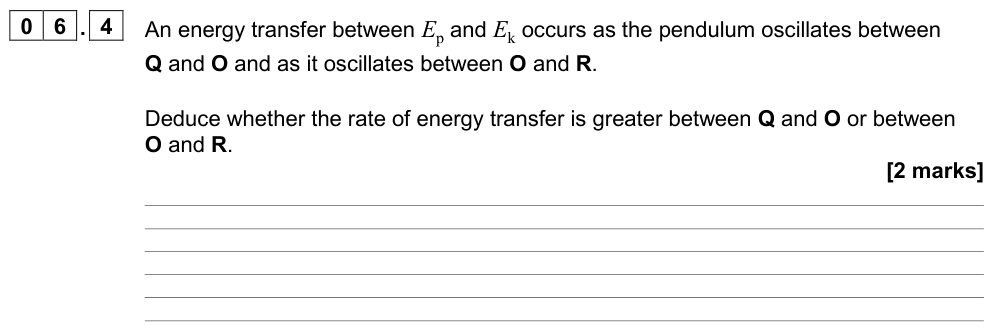
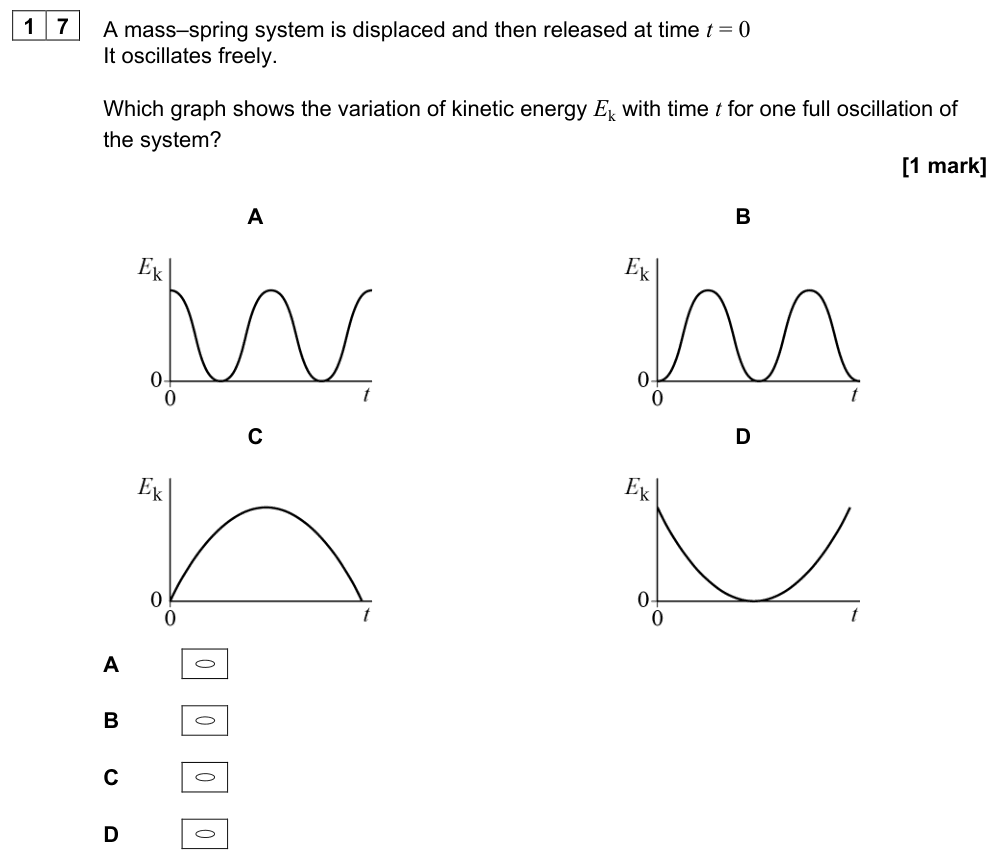
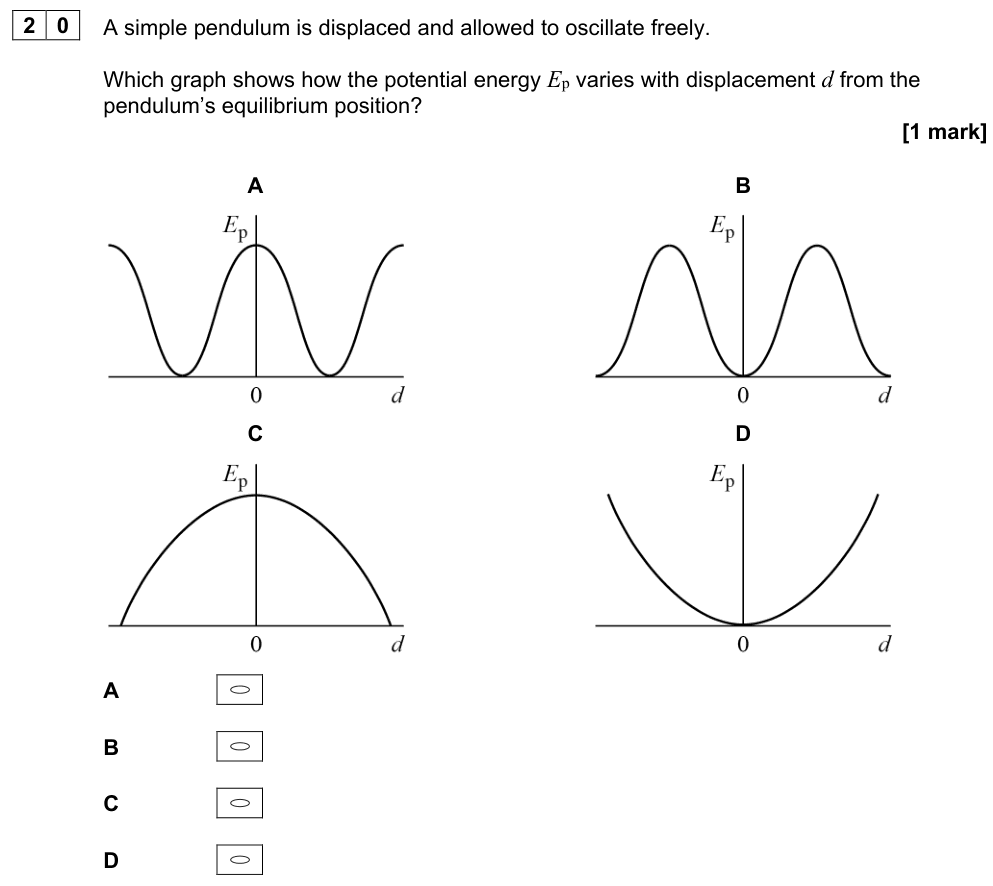
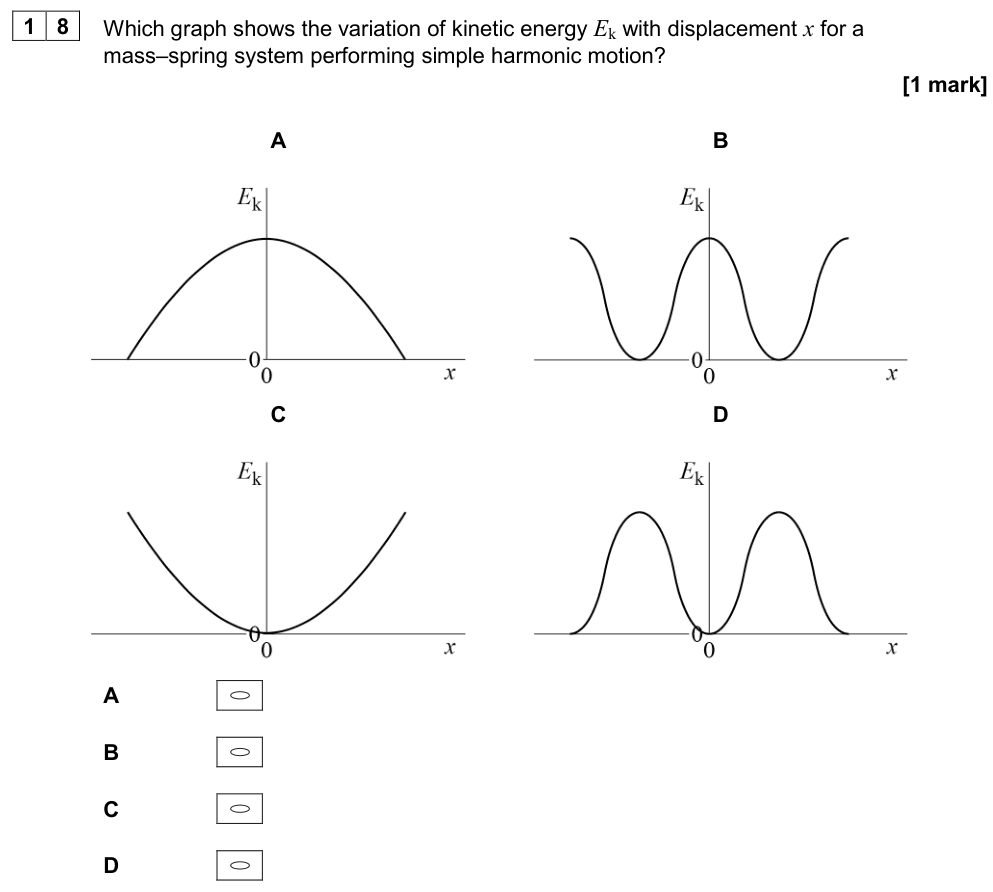
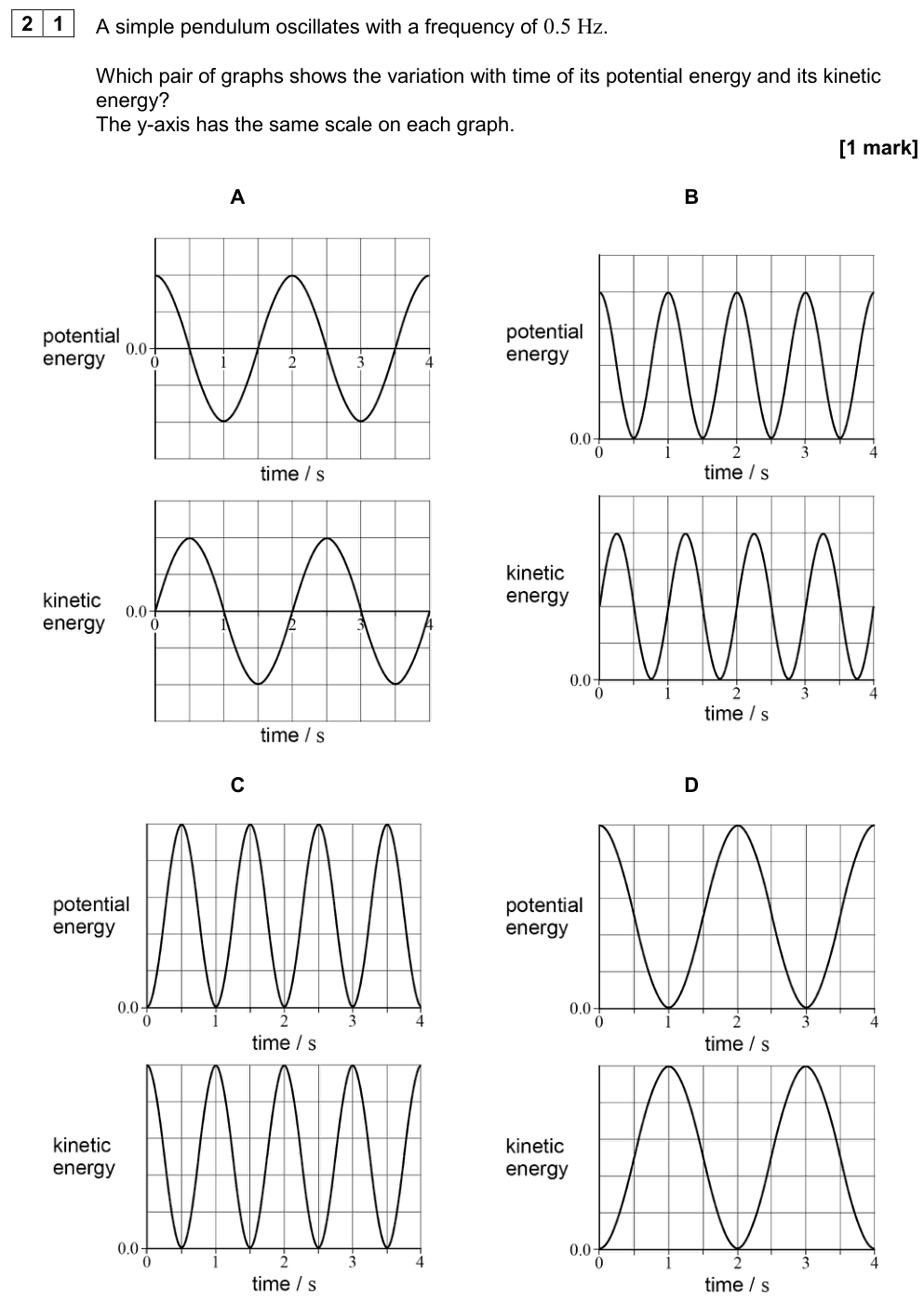
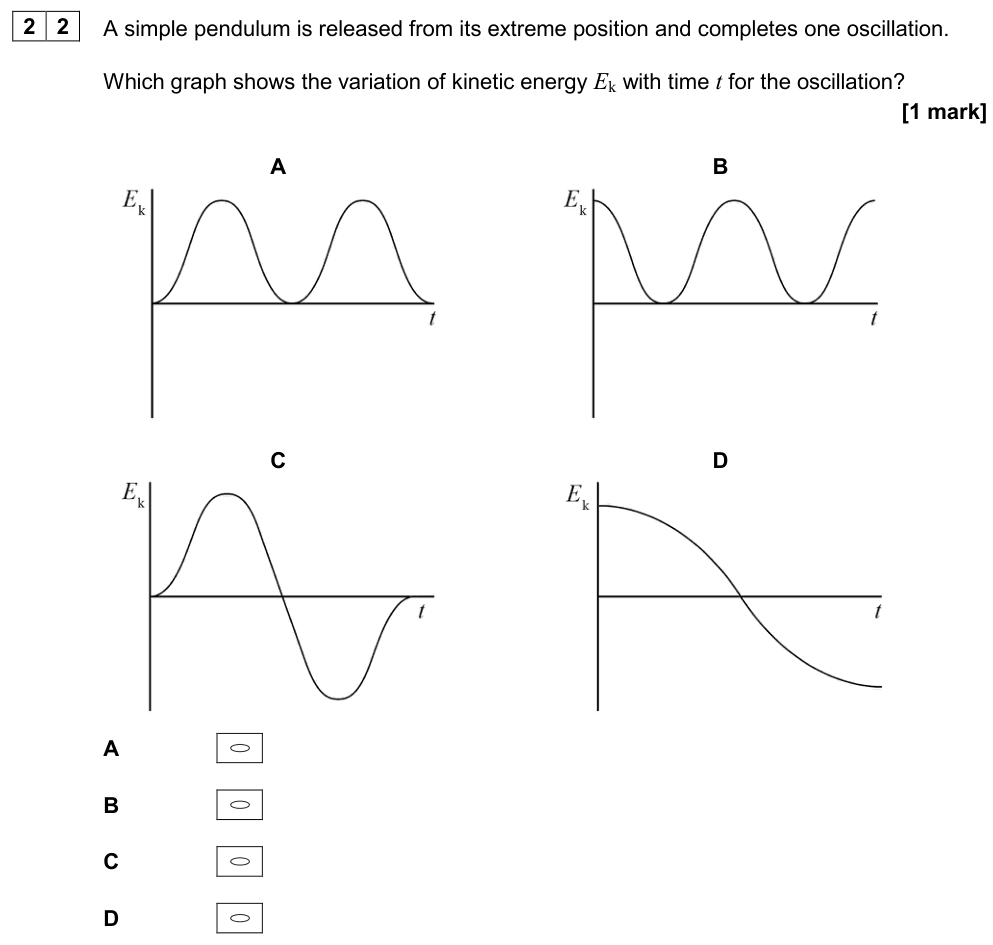
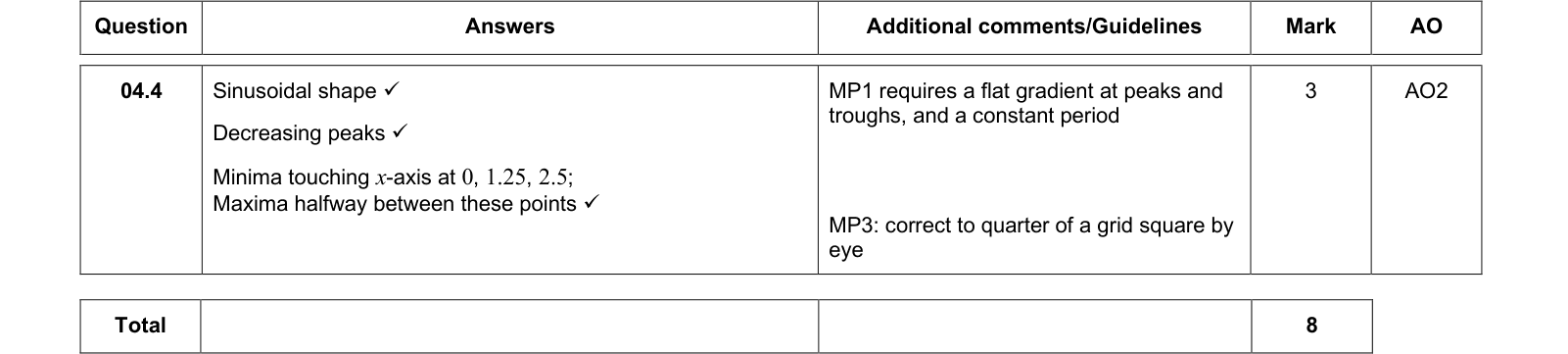
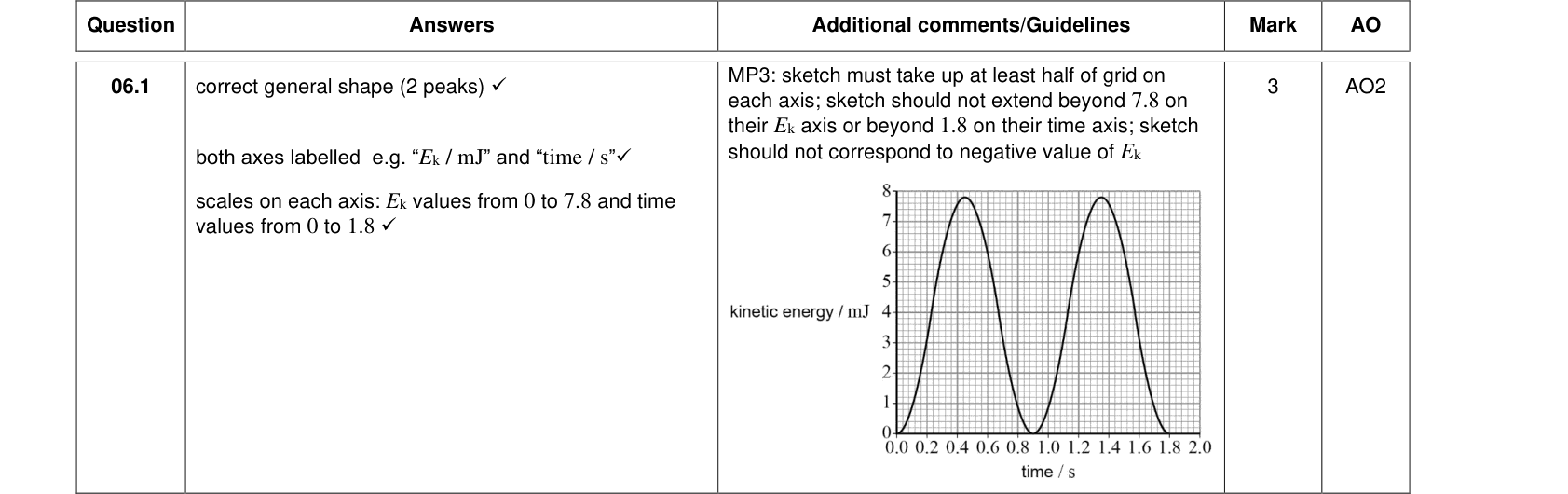
During an oscillation energy is continually exchanged between kinetic energy and potential energy (gravitational for a pendulum, elastic for a horizontal spring).
- At the equilibrium position: speed is maximum, so $E_k$ is maximum and $E_p$ is minimum.
- At maximum displacement (the amplitude): the object is momentarily at rest, so $E_k = 0$ and $E_p$ is maximum.
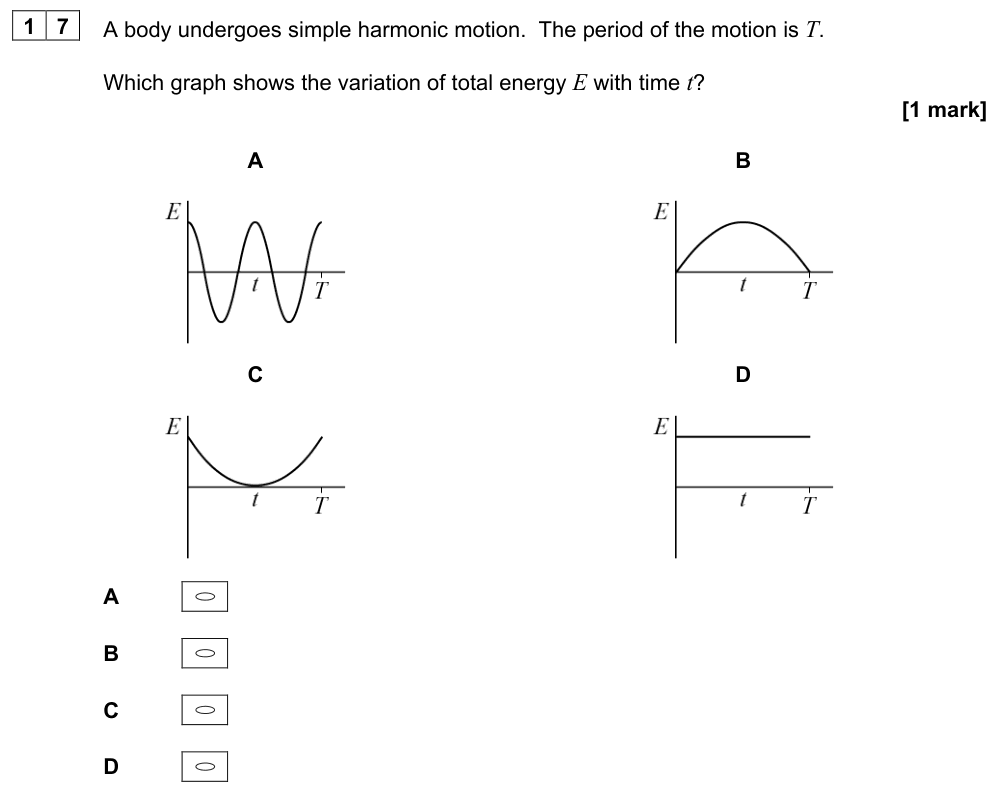
- With no damping the total energy is constant.
Damping
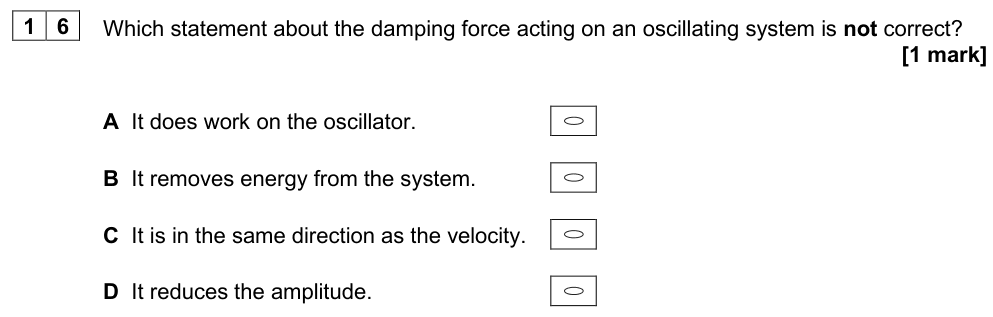
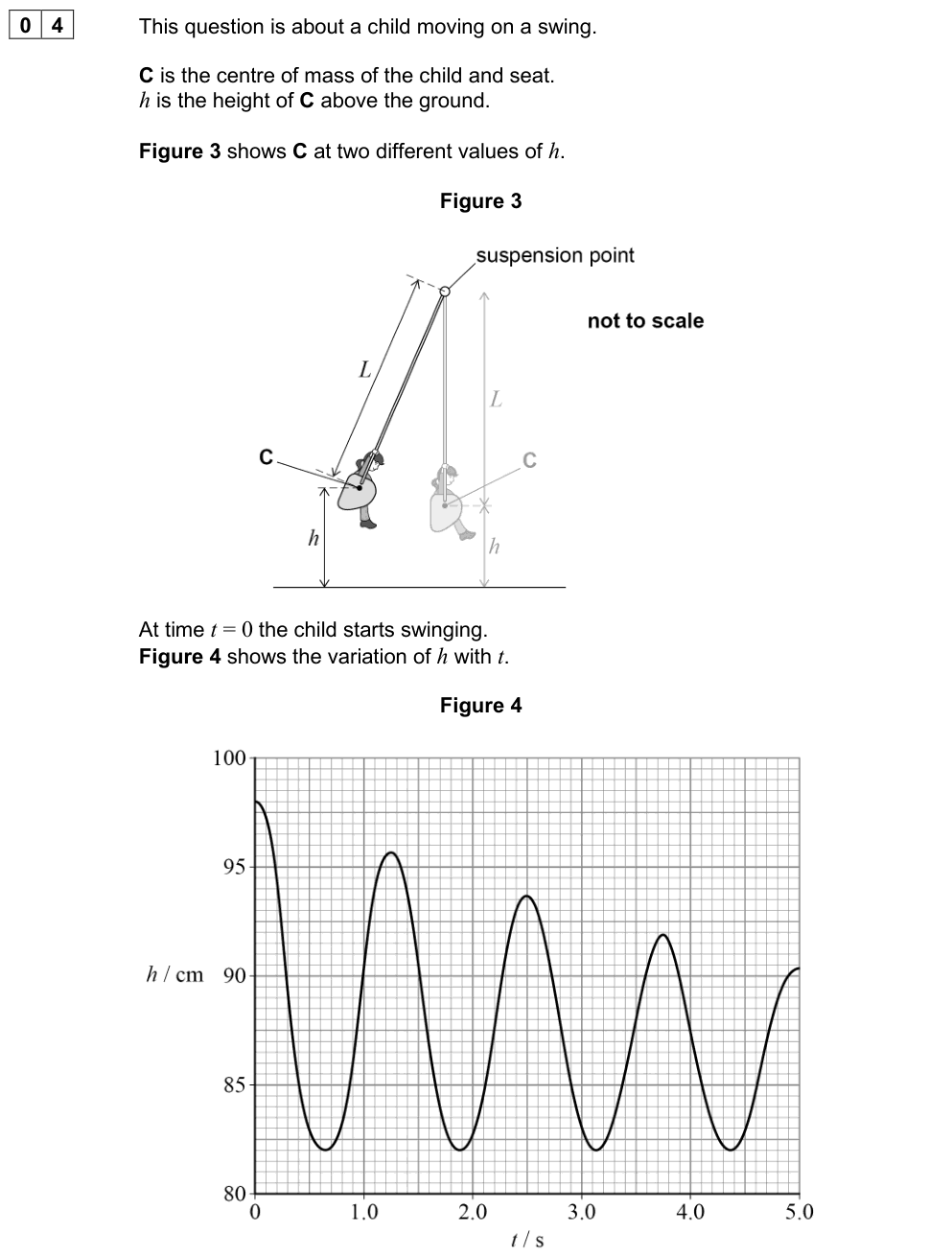
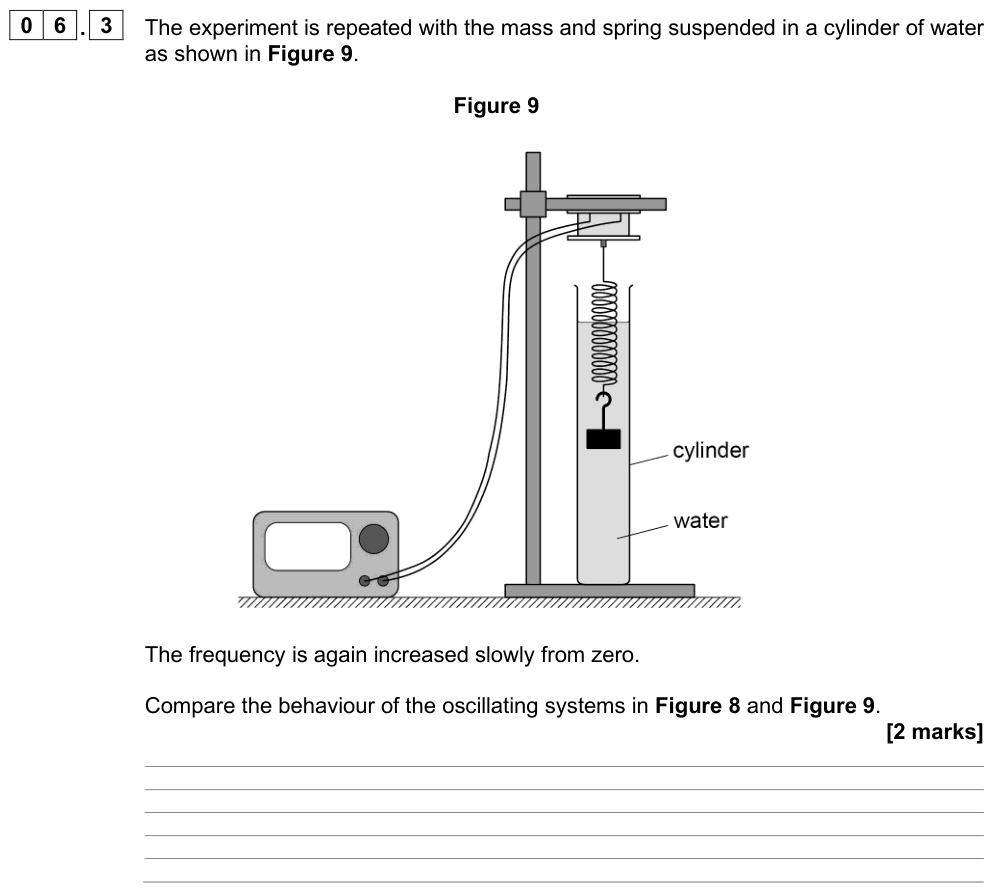
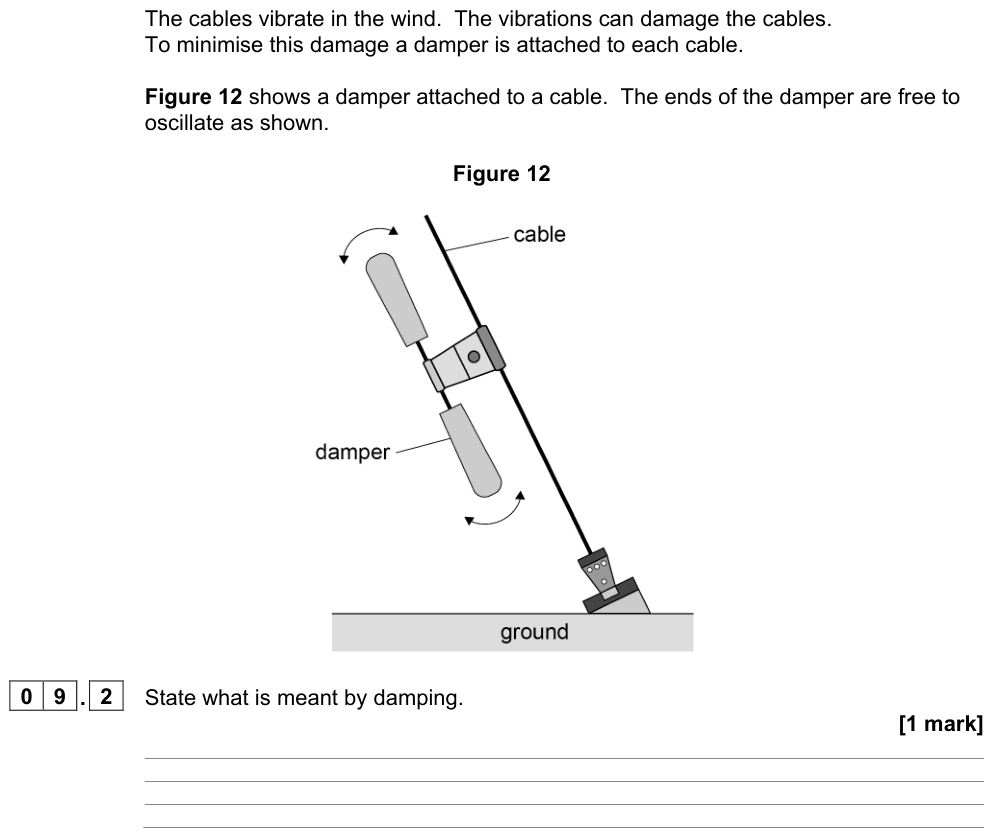
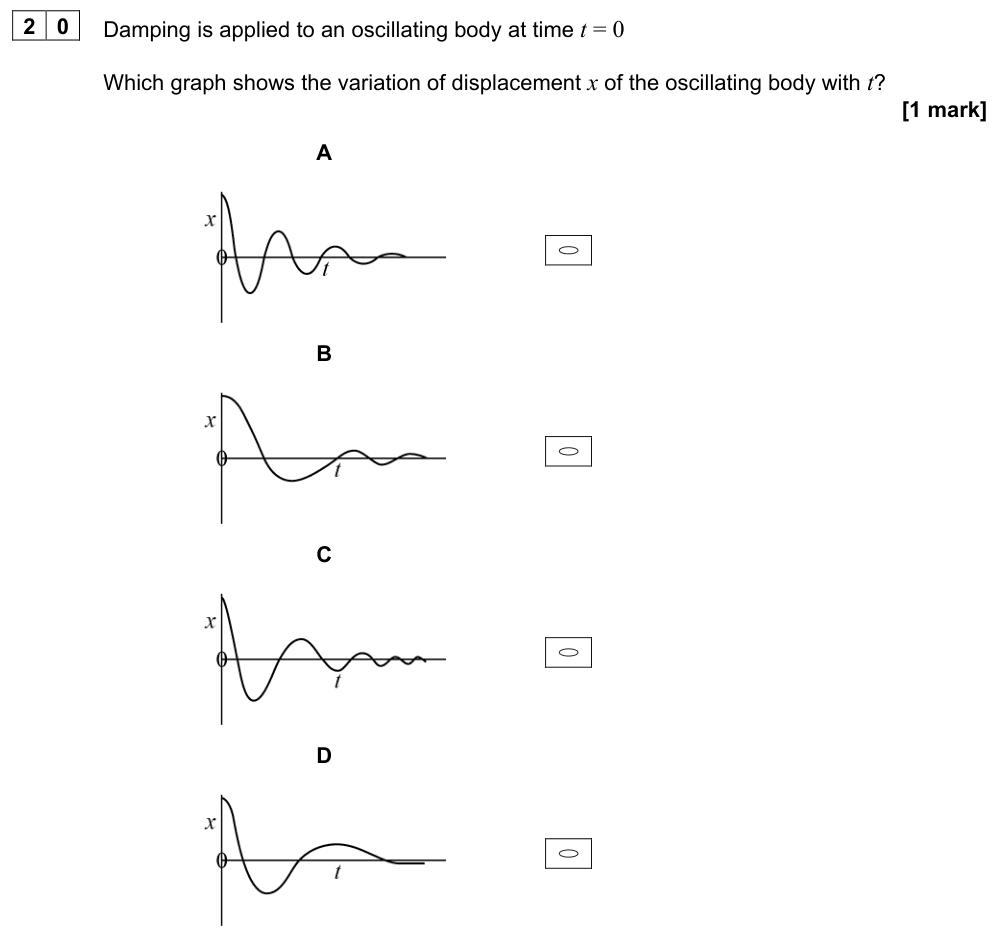
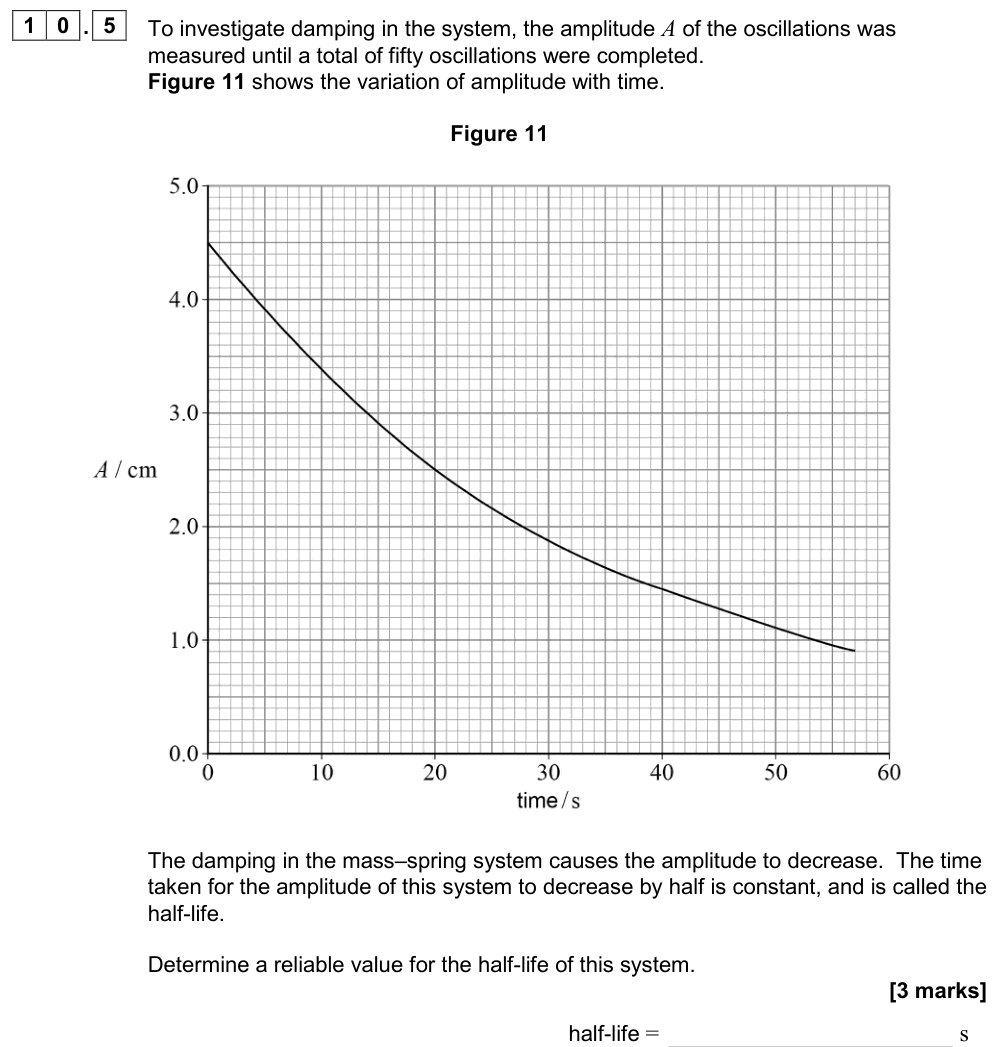
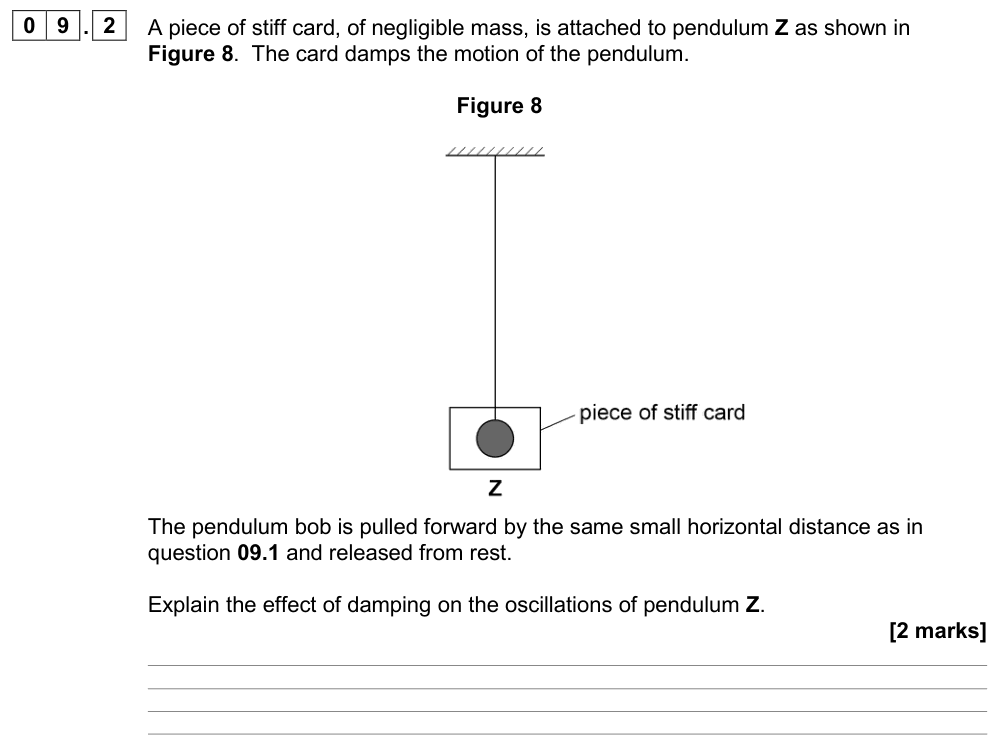
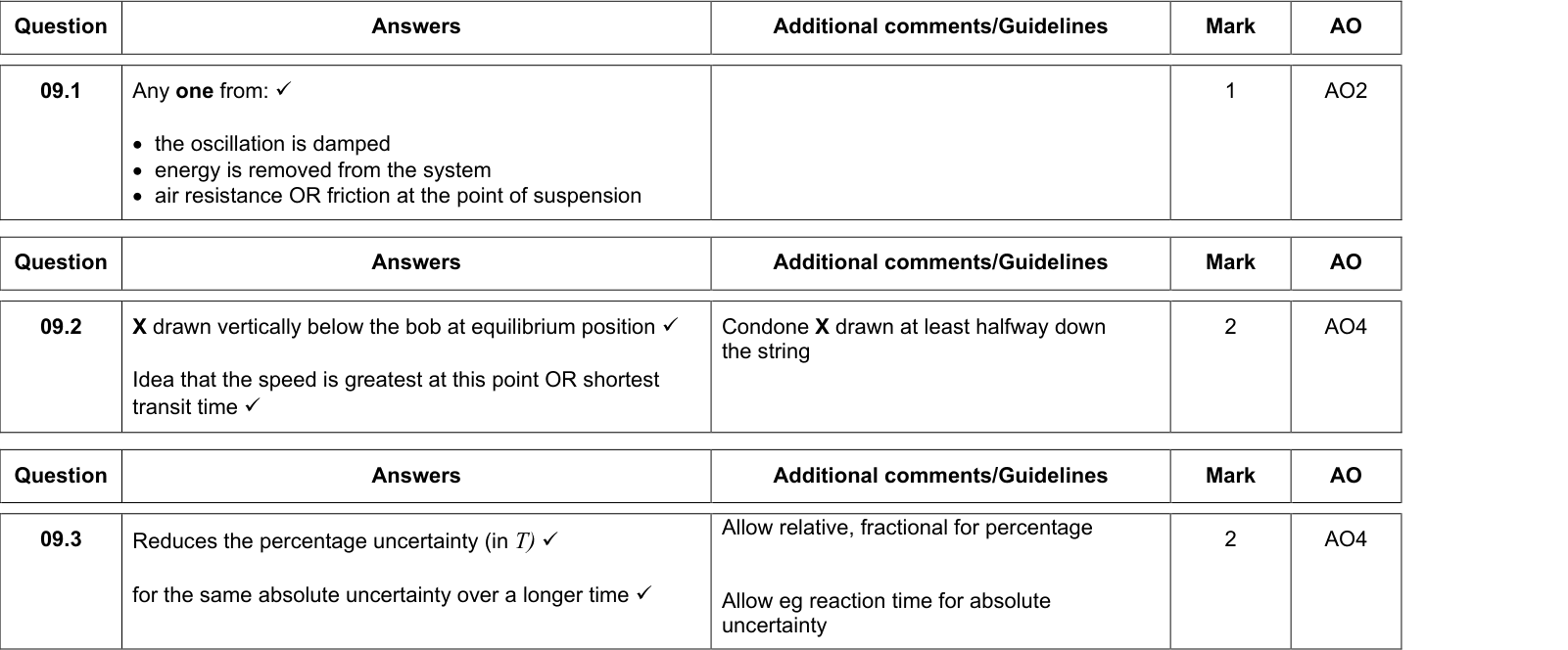
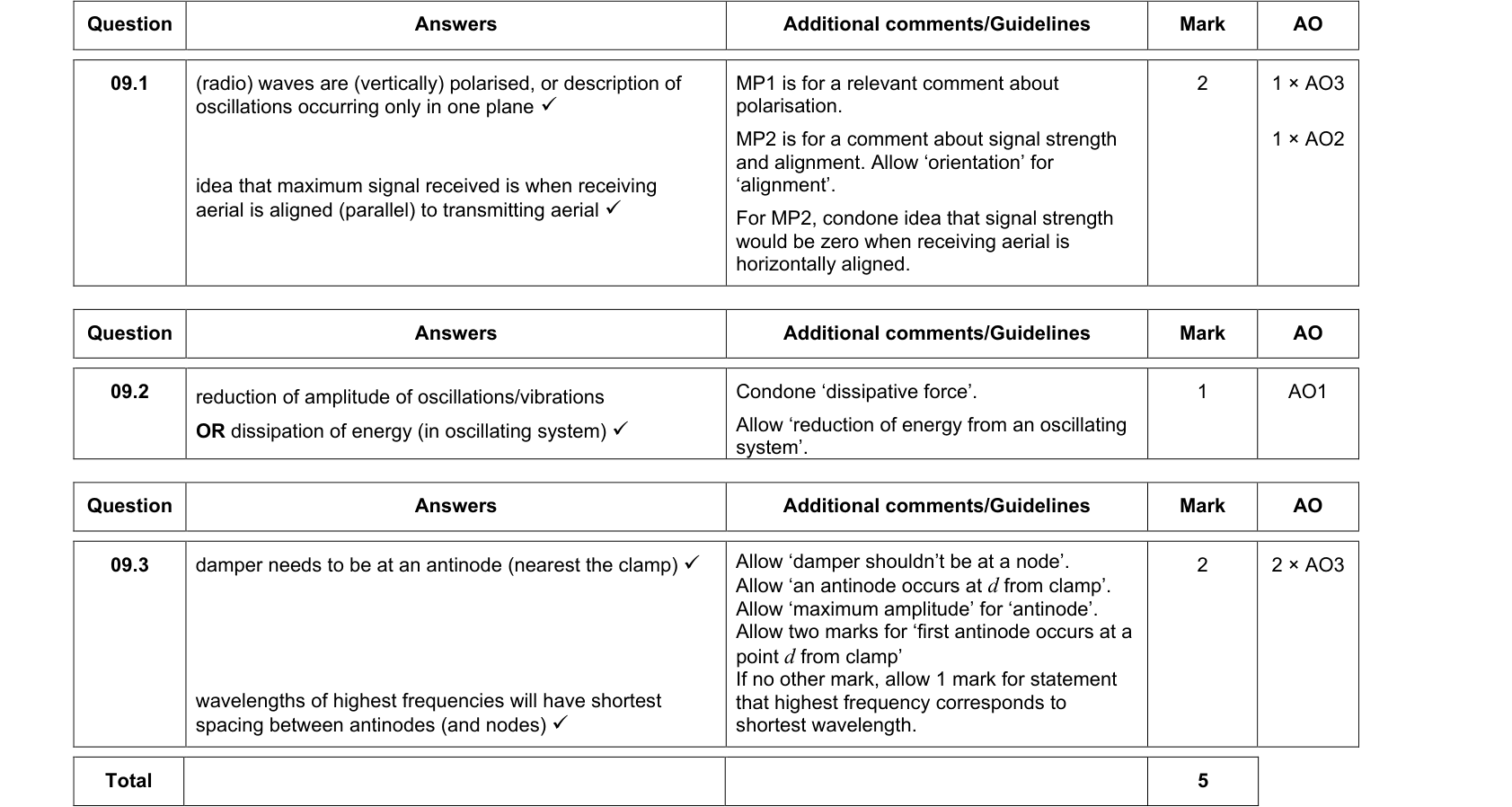
Damping is the effect of resistive (dissipative) forces, such as air resistance or friction, that transfer energy away from an oscillating system. The amplitude decreases over time. The period stays almost the same (for light damping).
| Type | Behaviour | Example |
|---|---|---|
| Light damping | oscillates with gradually decreasing amplitude | a pendulum in air |
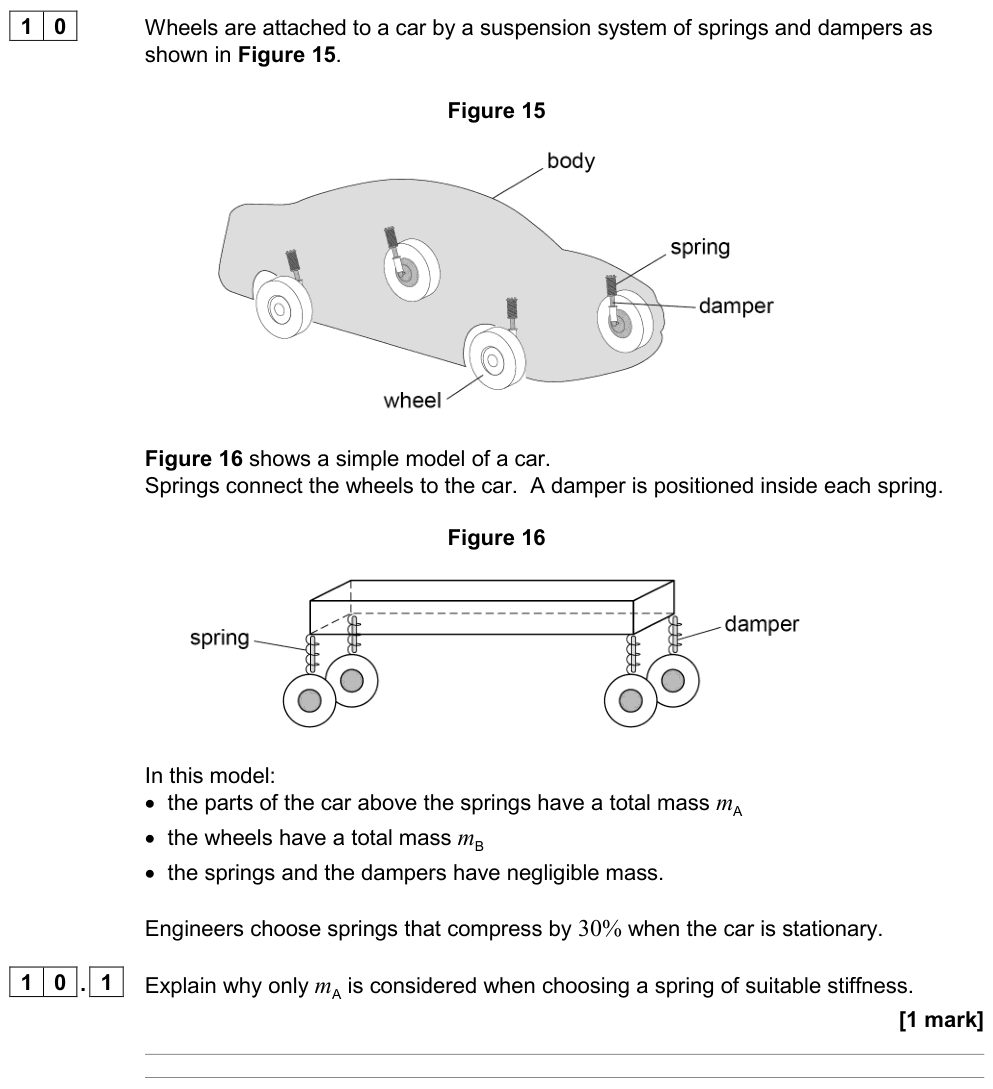
| Critical damping | returns to equilibrium in the shortest possible time without oscillating | car suspension, analogue meters |
| Heavy damping (overdamping) | returns to equilibrium slowly without oscillating | a door closer; pendulum in thick oil |
Free and forced vibrations
- Free vibration: after an initial disturbance, the system oscillates at its own natural frequency $f_0$ with no further energy input (amplitude constant if undamped).
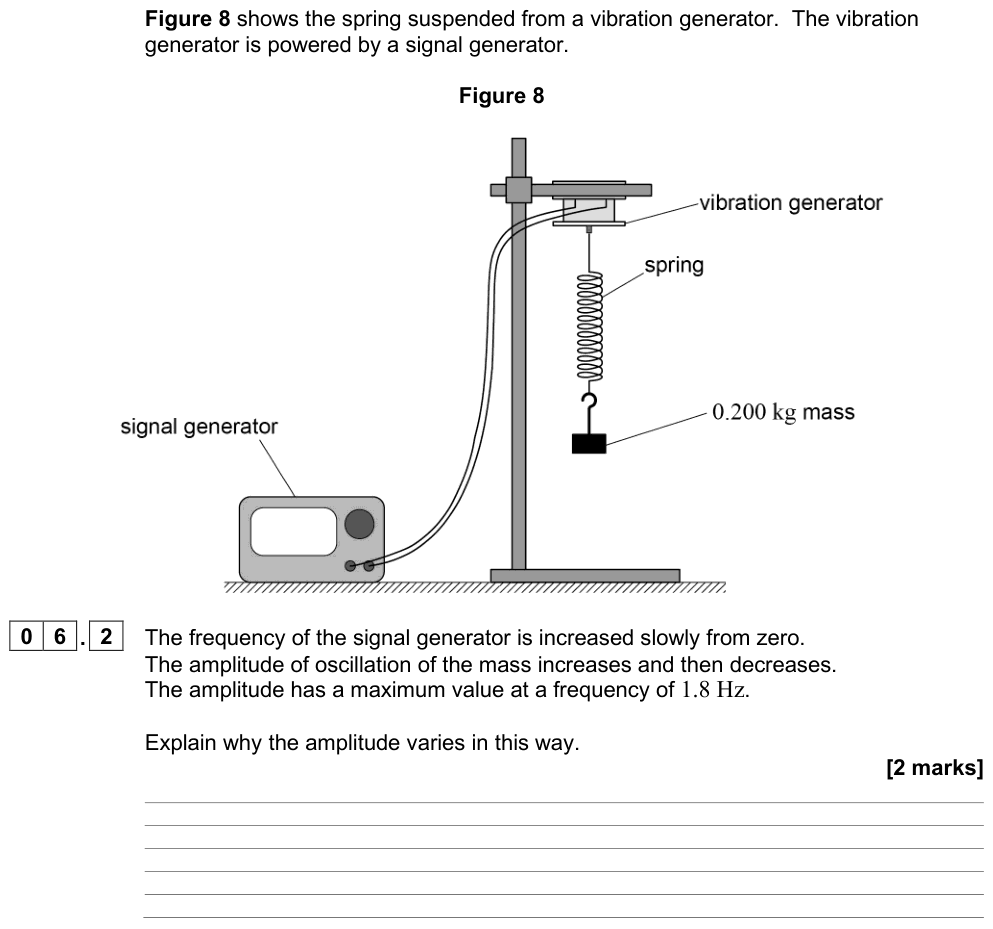
- Forced vibration: a periodic driving force makes the system oscillate at the driving frequency $f$, not at its natural frequency.
Resonance
Resonance
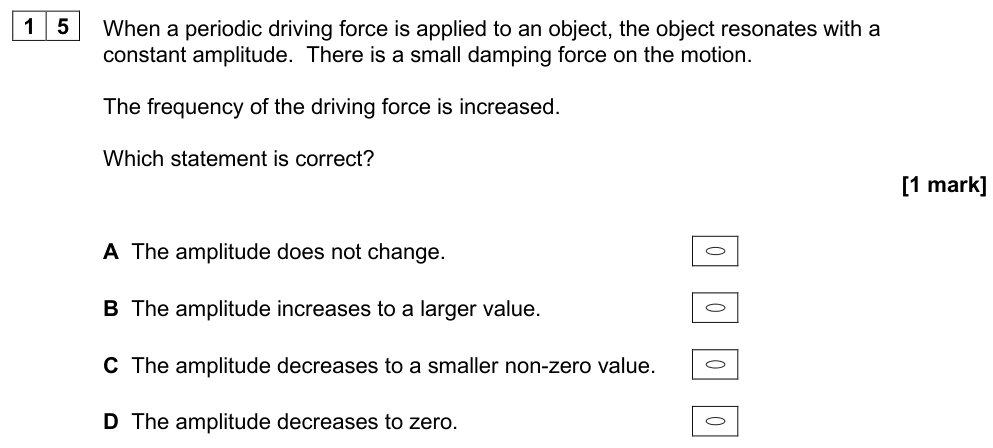
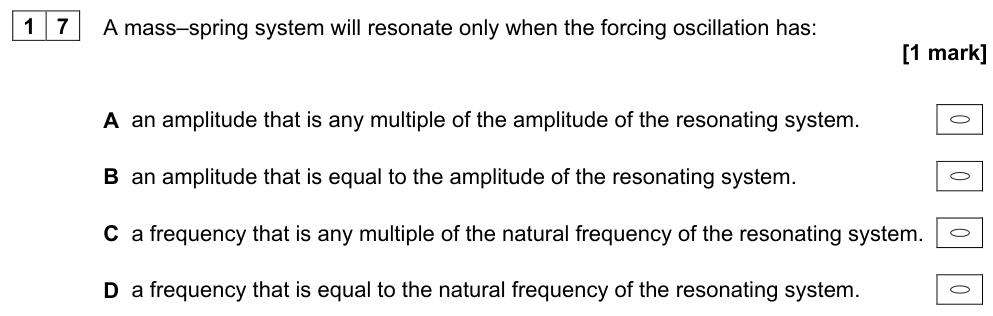
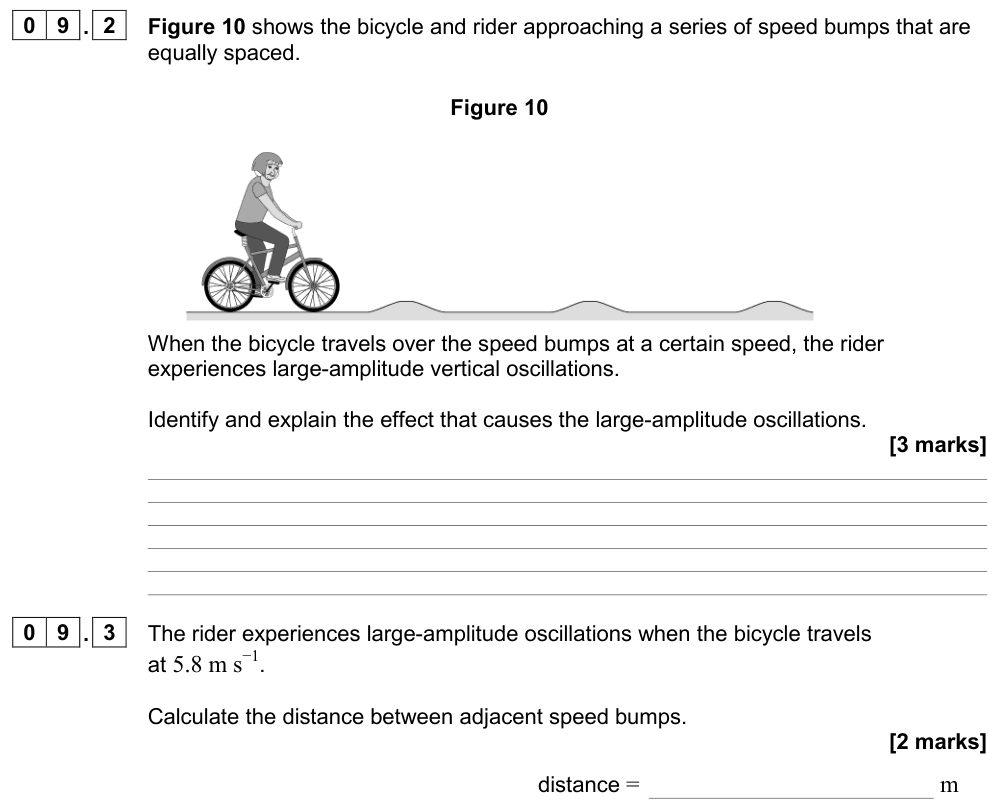
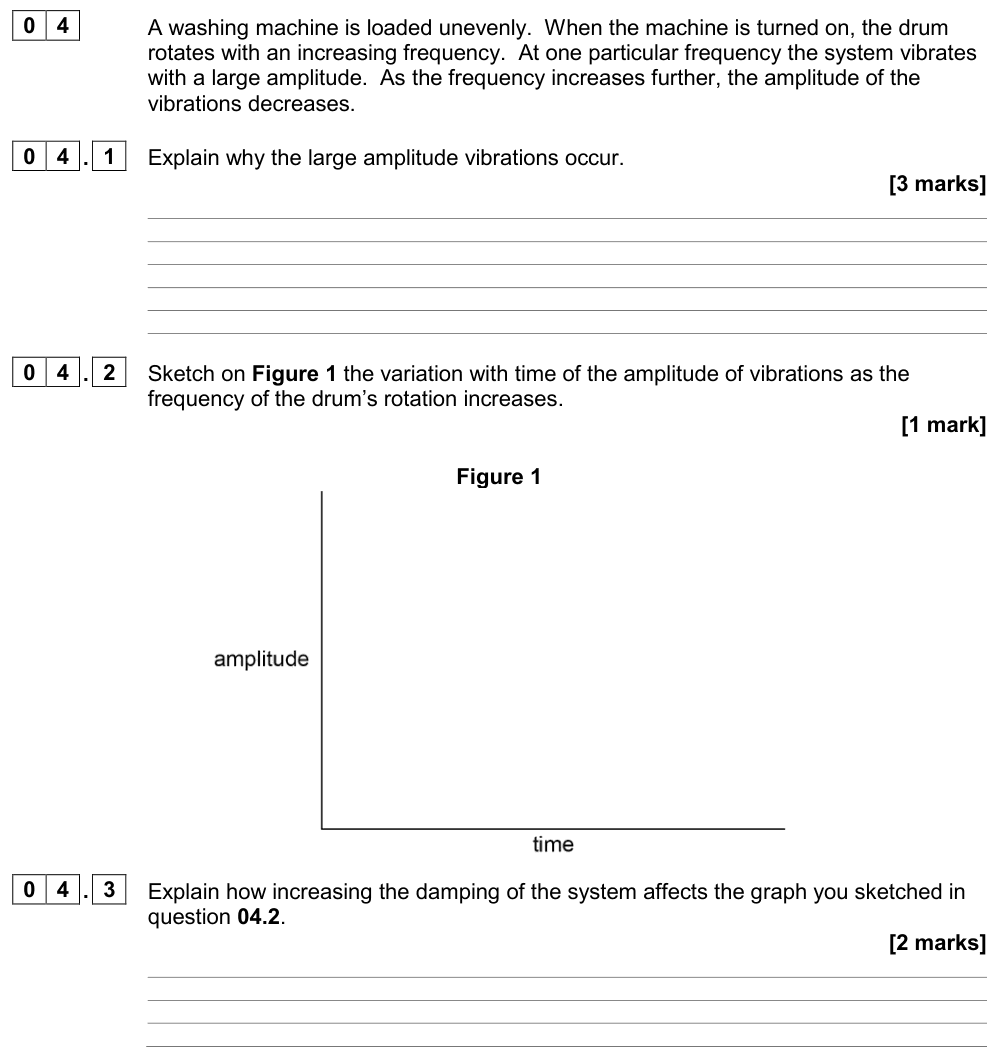
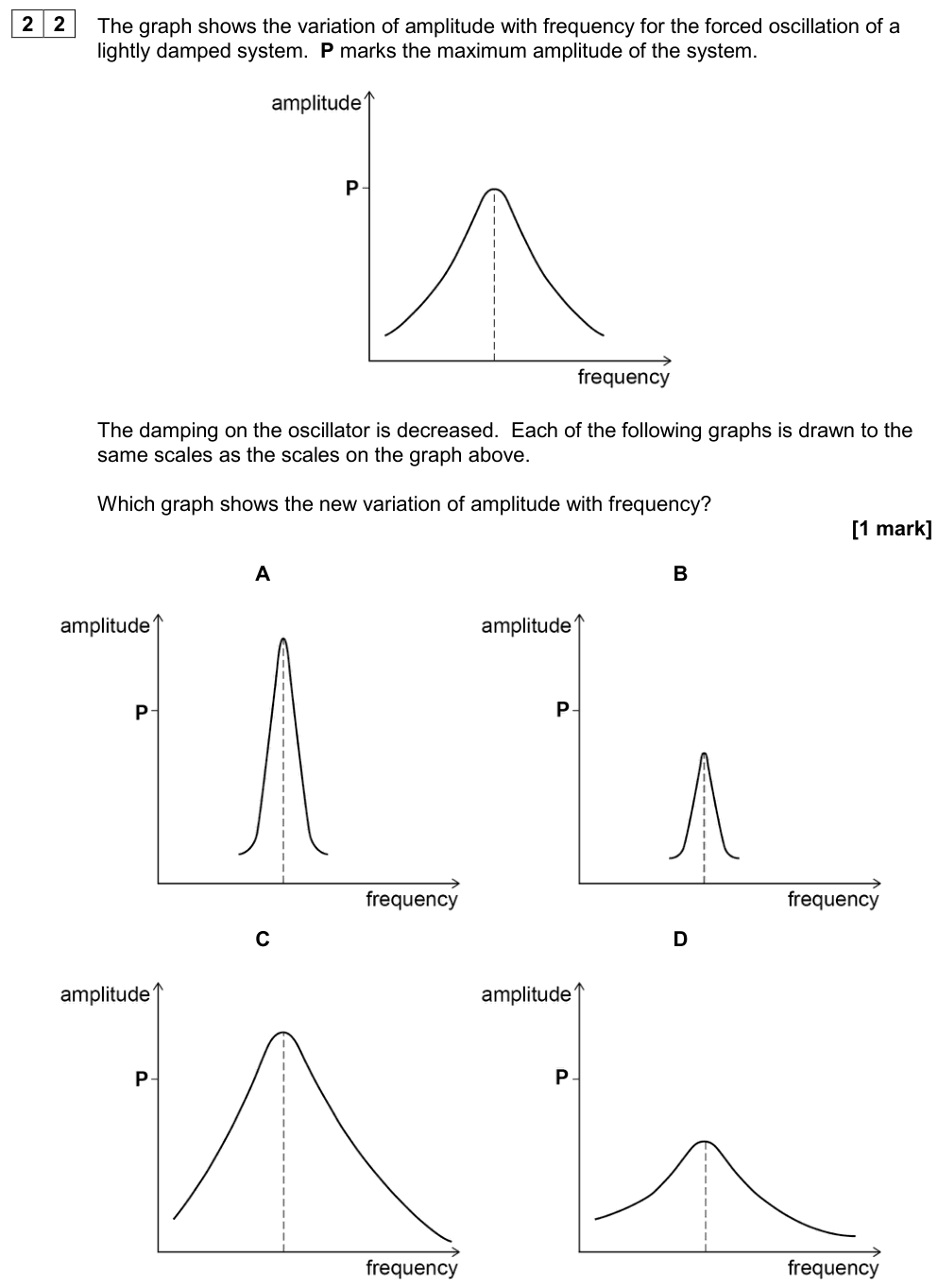
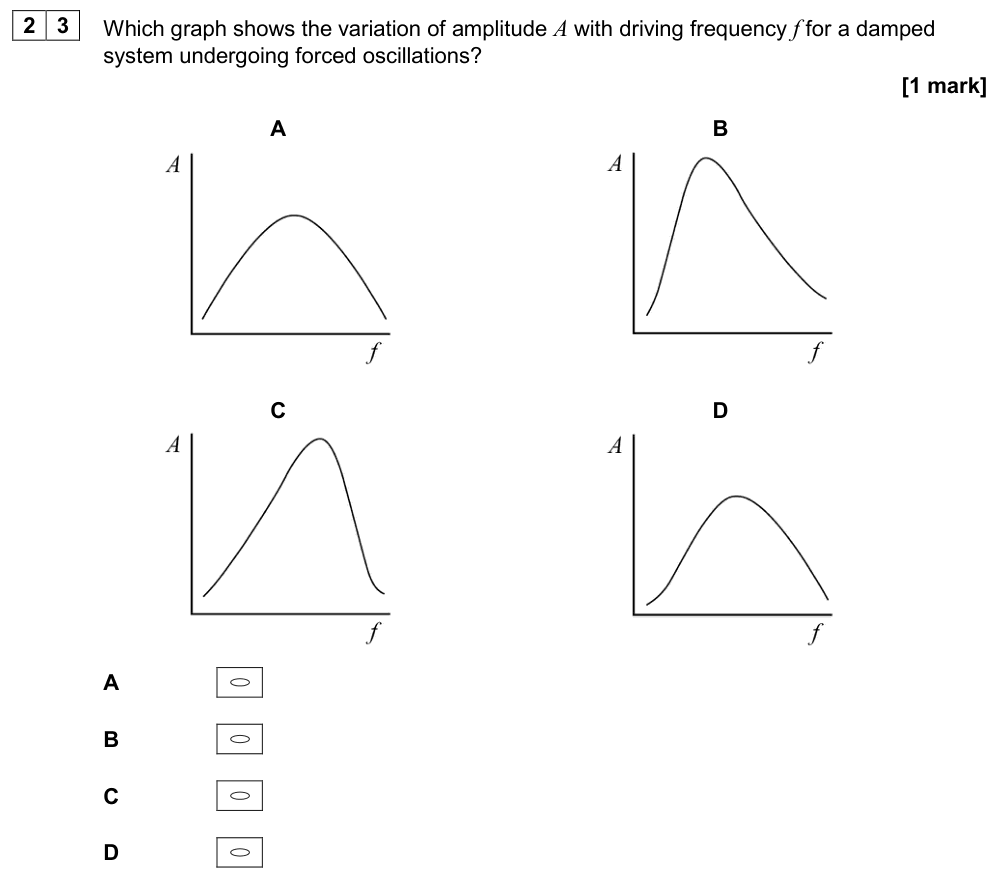
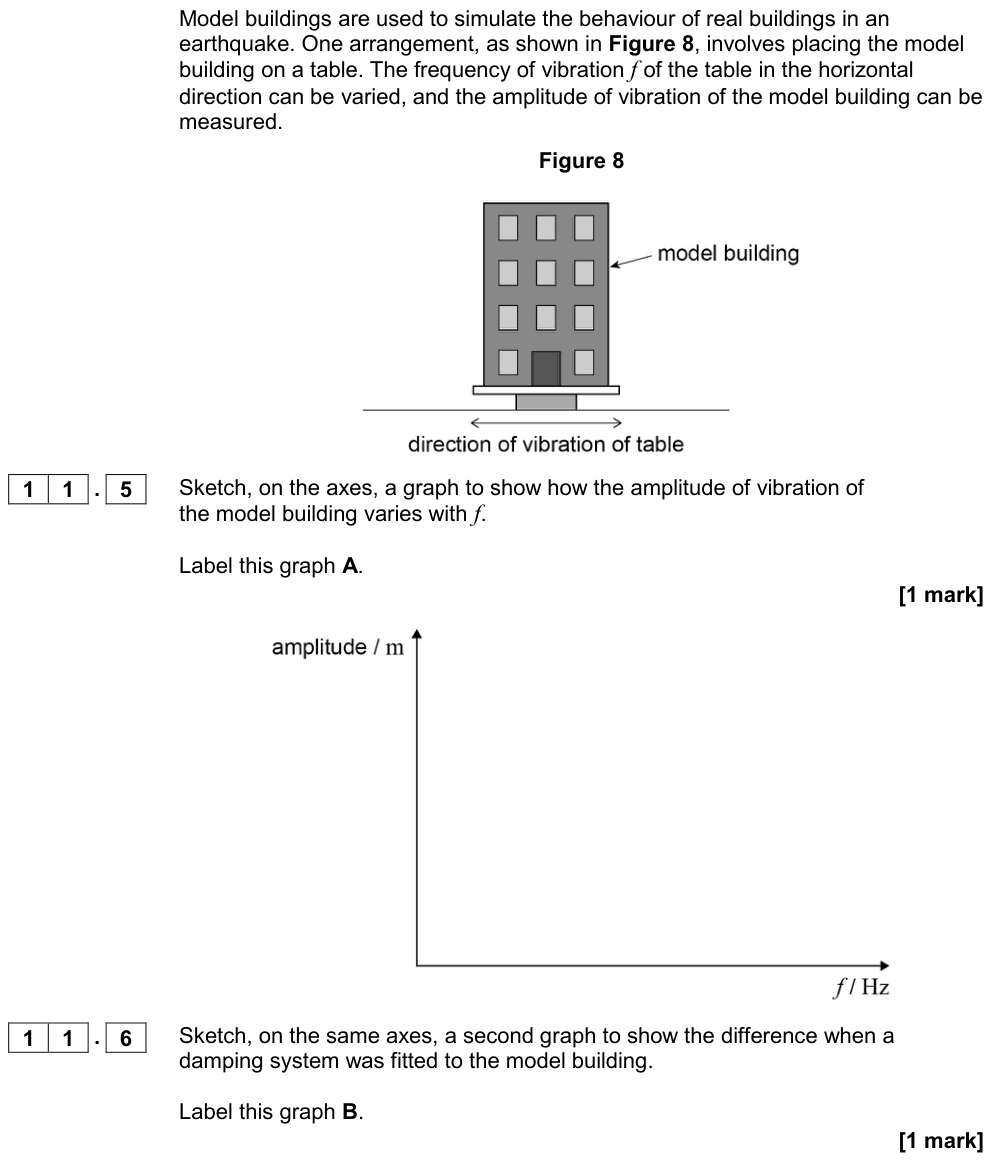
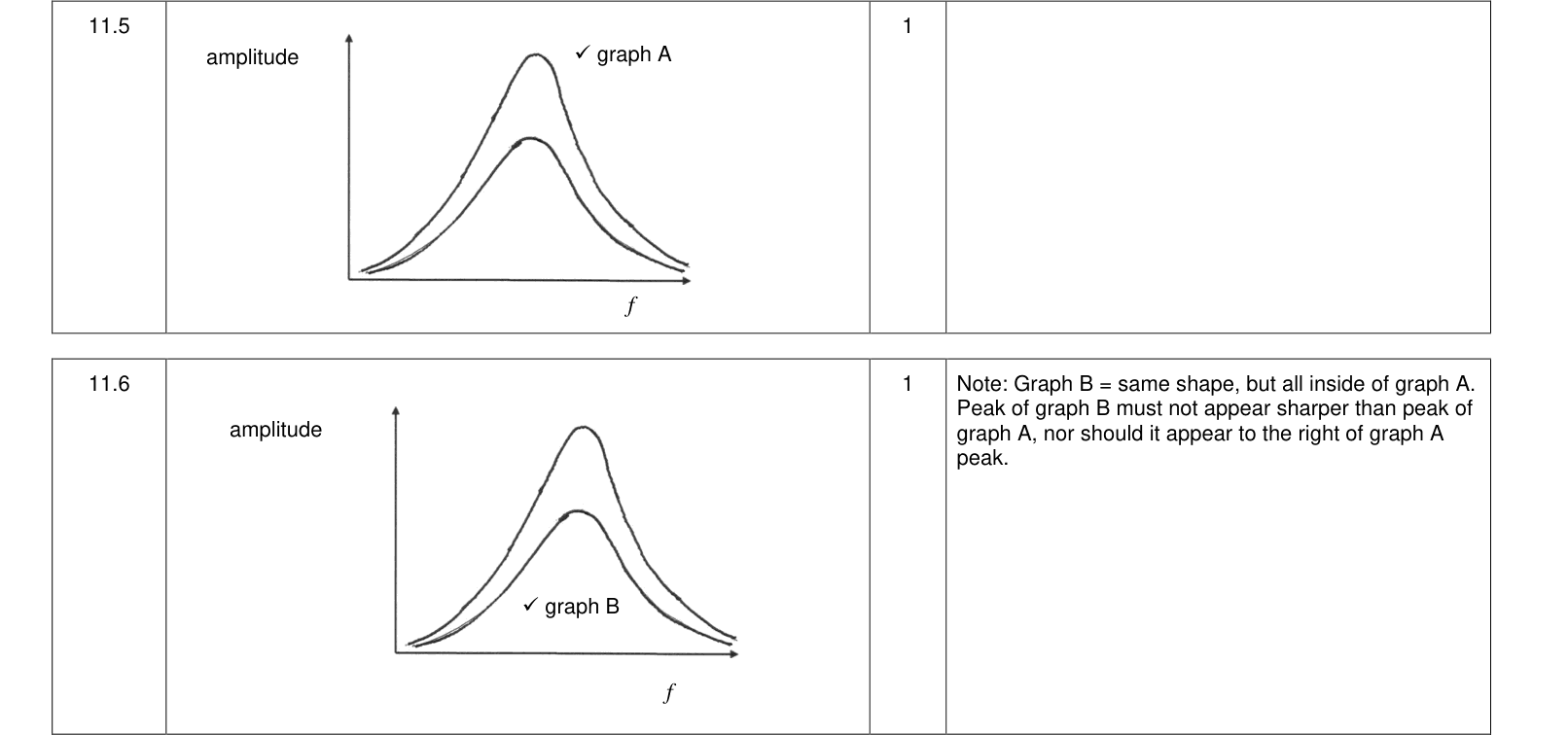
Resonance occurs when the driving frequency equals the natural frequency of the system. The system absorbs energy most efficiently and the amplitude becomes a maximum.
Effect of damping on resonance
Increasing the damping:
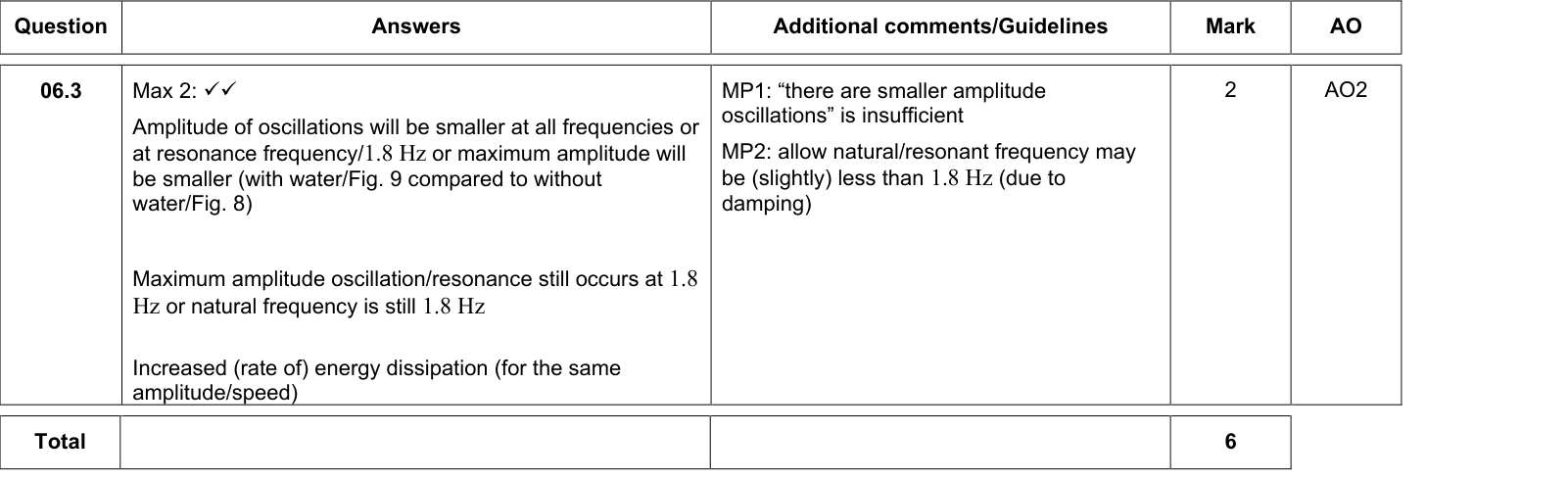
- reduces the maximum amplitude at resonance,
- makes the resonance peak broader (less sharp),
- shifts the peak slightly to a lower frequency.
At very low driving frequencies the amplitude equals the amplitude of the driver. At very high frequencies it tends to zero.
Examples of resonance
Useful: tuning a radio (the circuit resonates at the station's frequency), musical instruments (air columns and strings resonate; see Stationary waves), microwave ovens (water molecules), MRI scanners, Barton's pendulums demonstrations.
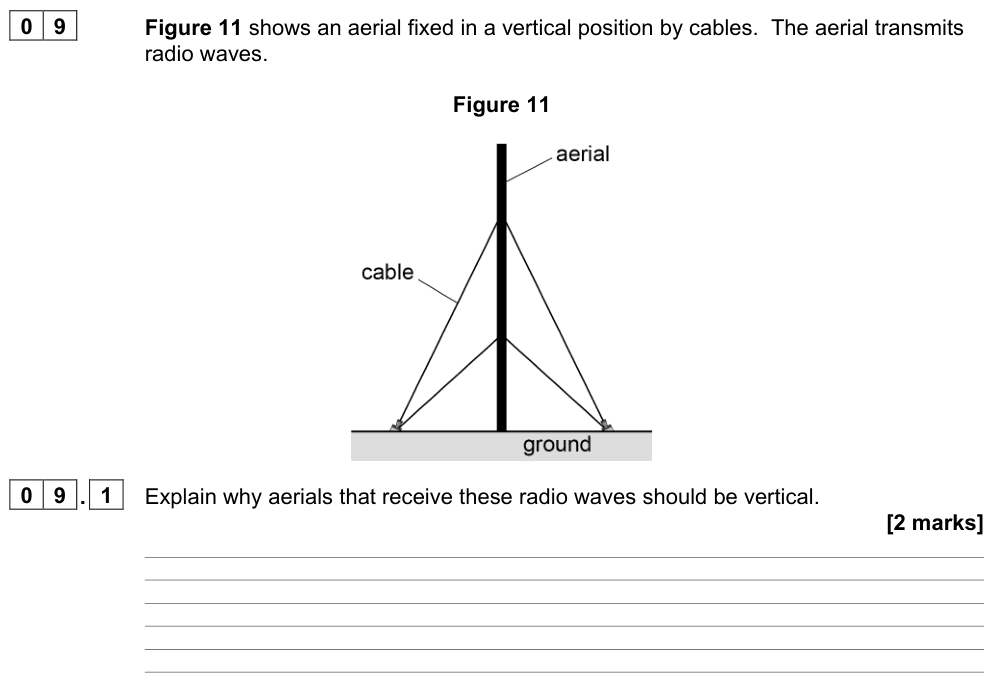
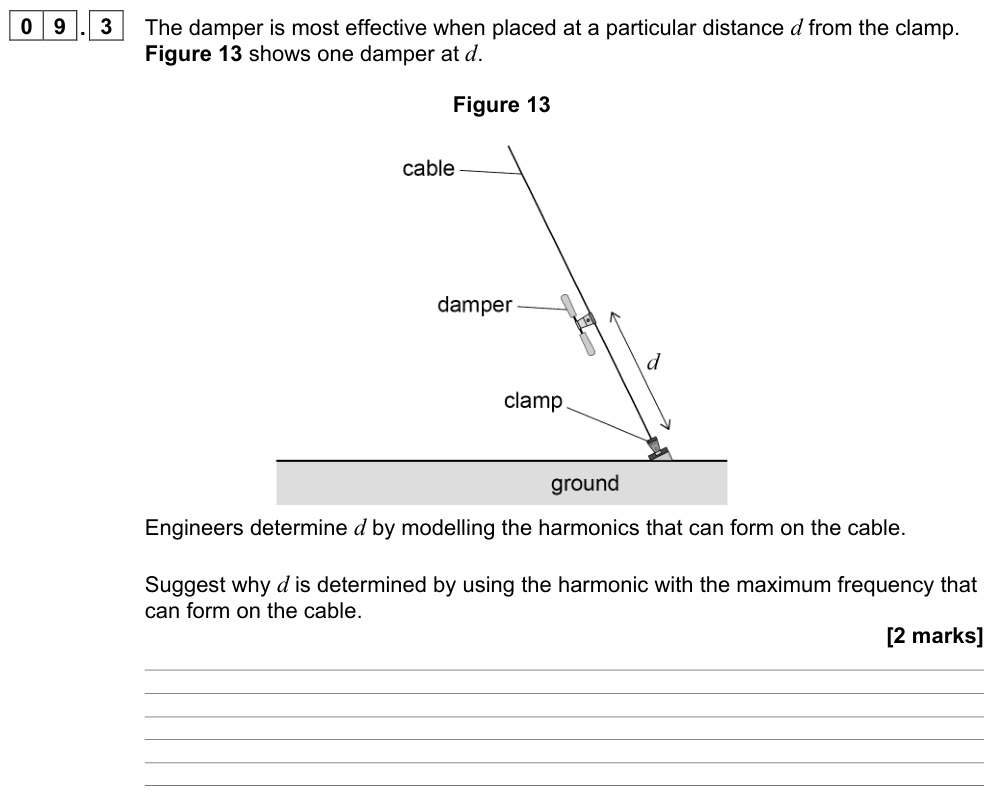
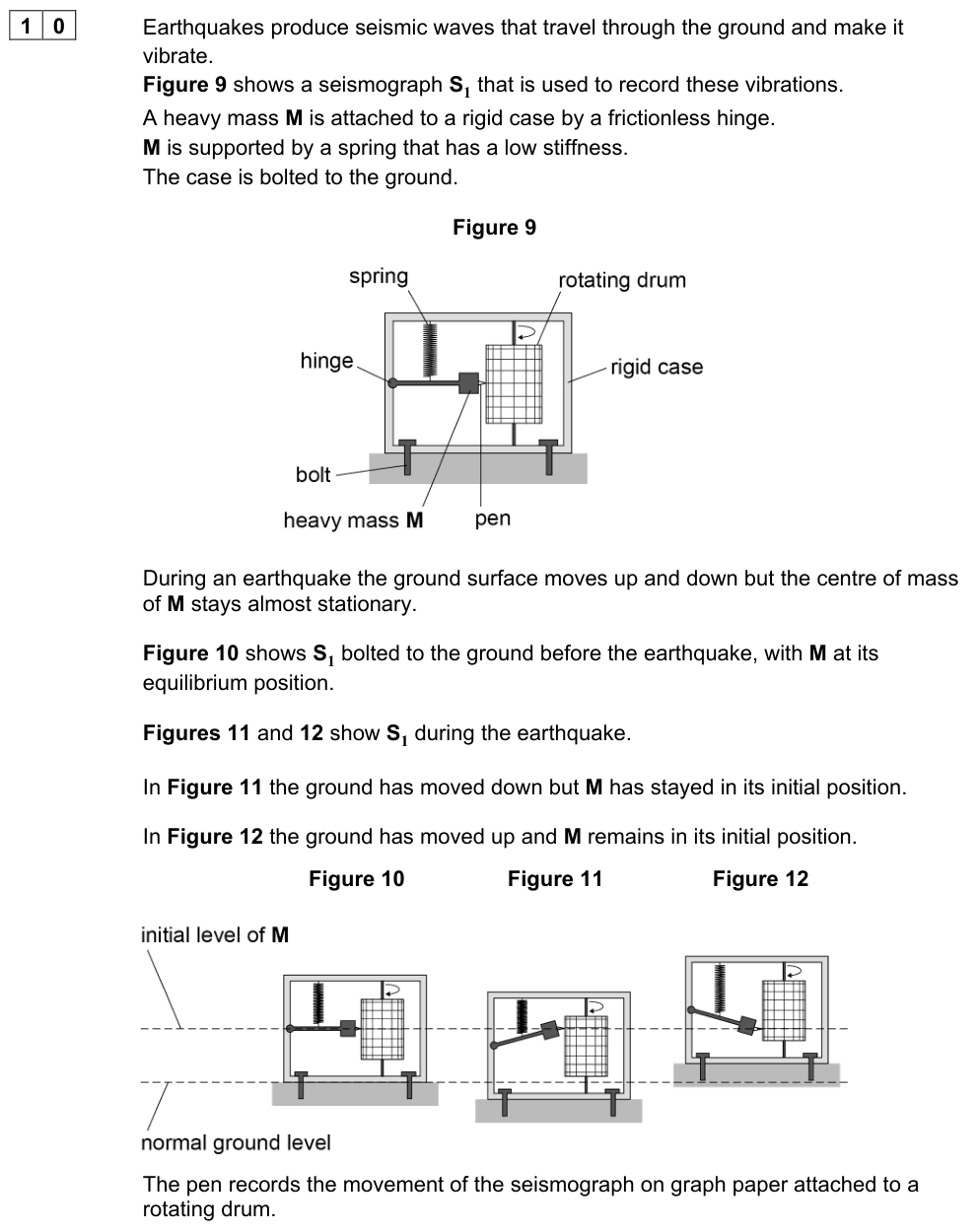
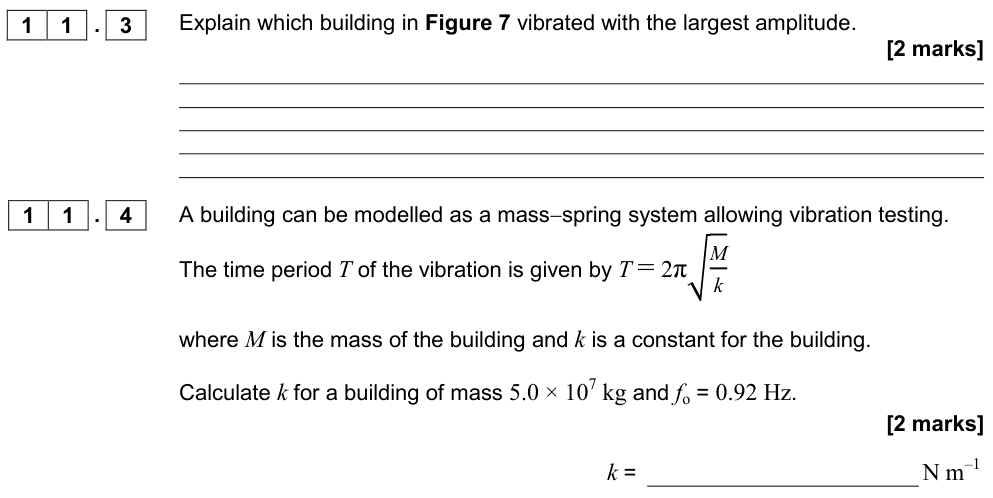
Problems: bridges and buildings set oscillating by wind, marching soldiers or earthquakes (the Tacoma Narrows bridge); car or washing-machine parts vibrating loudly at certain speeds; engine mounts. Engineers avoid damage by damping the structure (dampers, shock absorbers) and by designing it to have a natural frequency far from likely driving frequencies.
Required practical 4: mass–spring system and simple pendulum
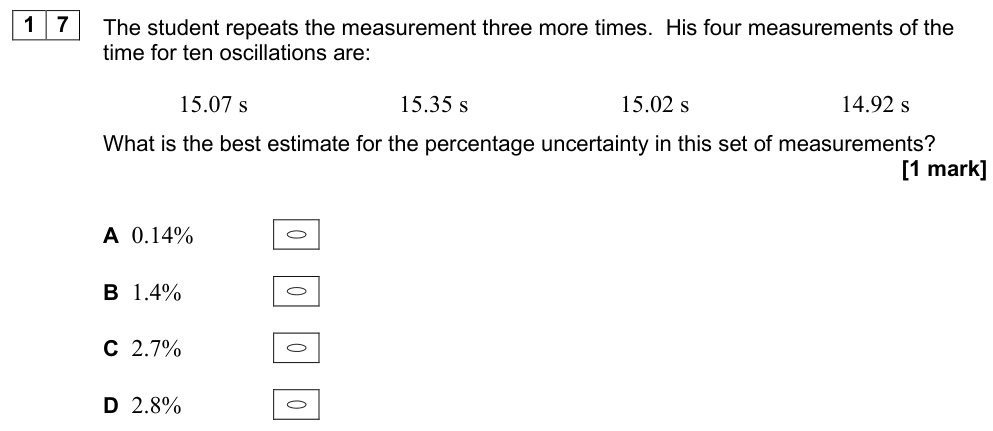
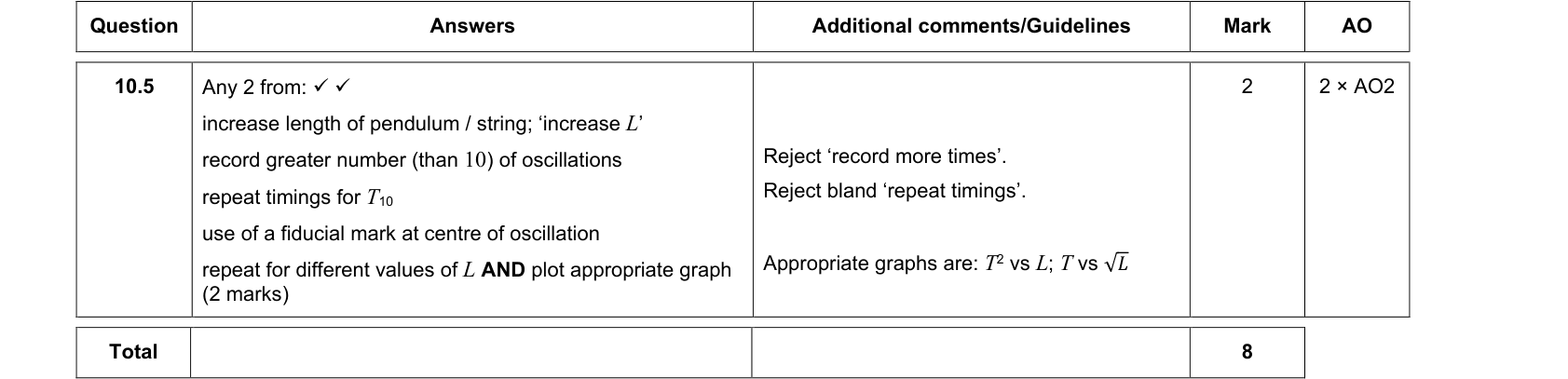
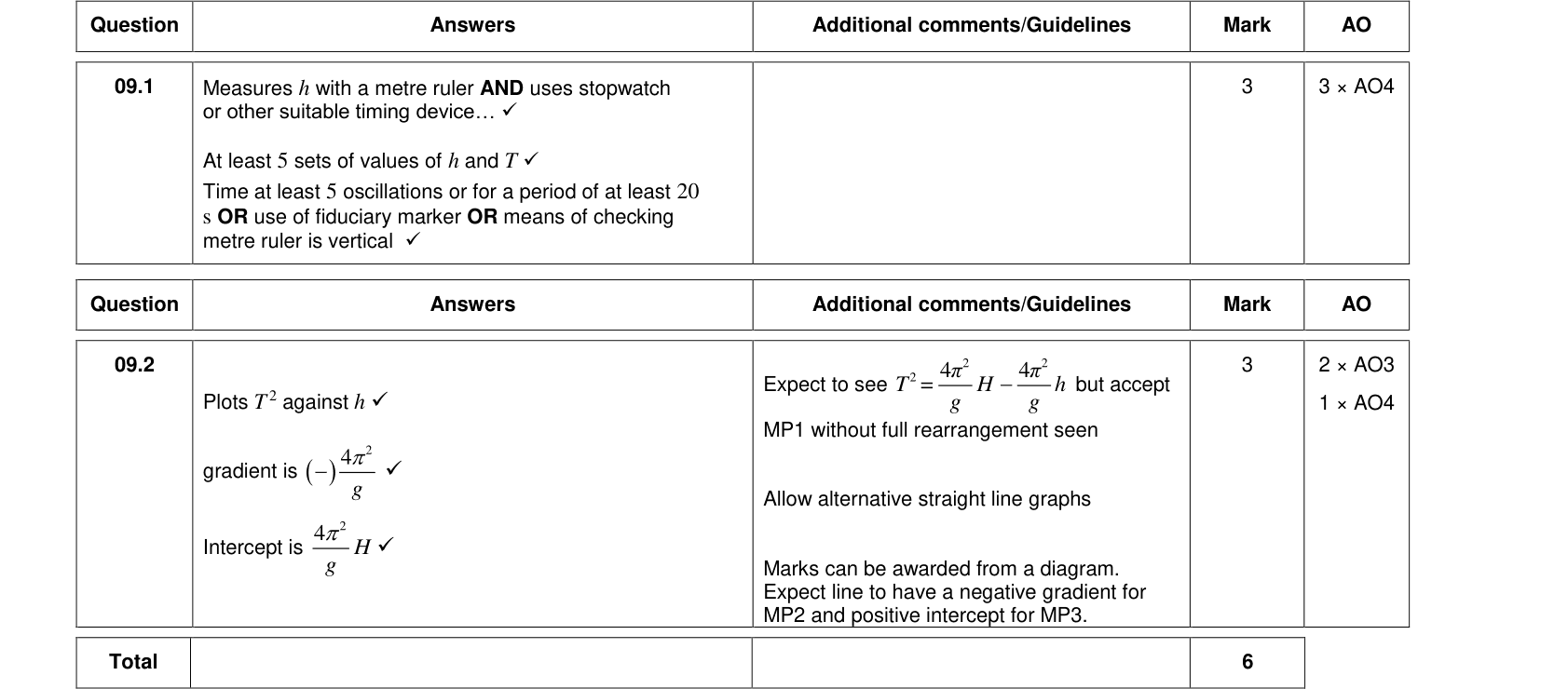
Pendulum: measure $l$ from the pivot to the centre of the bob. Displace it by a small angle (< 10°) and time 20 oscillations from a fiducial marker at the equilibrium position (where the bob moves fastest, so its passage is timed most precisely). Repeat and average. Vary $l$. Plot $T^2$ against $l$: a straight line through the origin with gradient $4\pi^2/g$, so $g = 4\pi^2/\text{gradient}$.
Mass–spring: time 20 vertical oscillations for different masses. Plot $T^2$ against $m$: straight line, gradient $= 4\pi^2/k$. (A small intercept may come from the mass of the spring itself.)
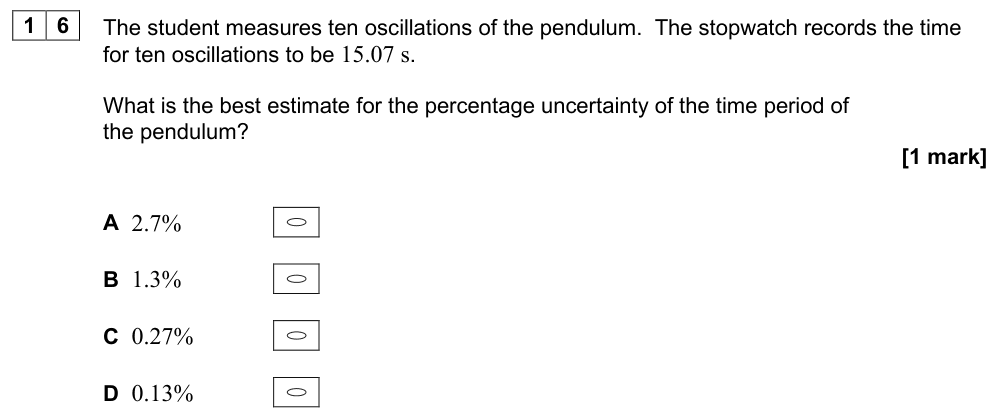
Timing many oscillations reduces the percentage uncertainty from reaction time.
Summary
- $T = 2\pi\sqrt{m/k}$ (mass–spring) and $T = 2\pi\sqrt{l/g}$ (pendulum); independent of amplitude.
- Energy swaps between $E_k$ (max at equilibrium) and $E_p$ (max at the extremes); total constant without damping.
- Damping removes energy: light, critical (fastest return, no oscillation), heavy.
- Resonance: driving frequency = natural frequency → maximum amplitude; more damping → lower, broader peak.