Scalars and vectors
Scalar and vector
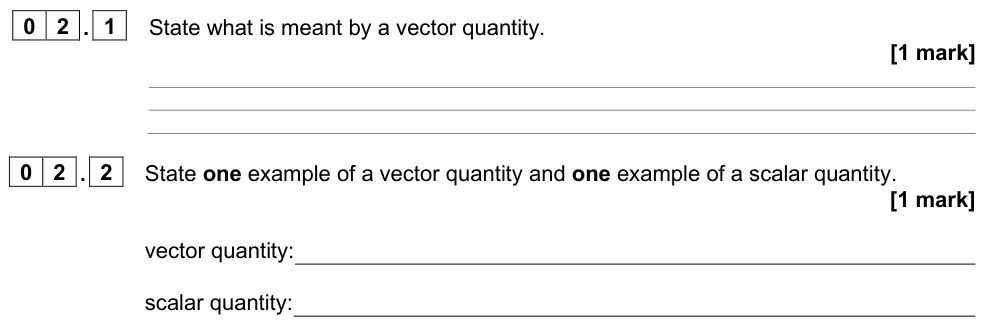
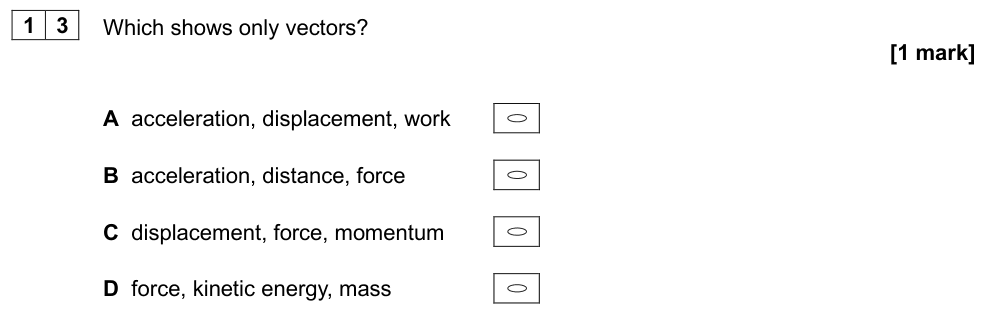
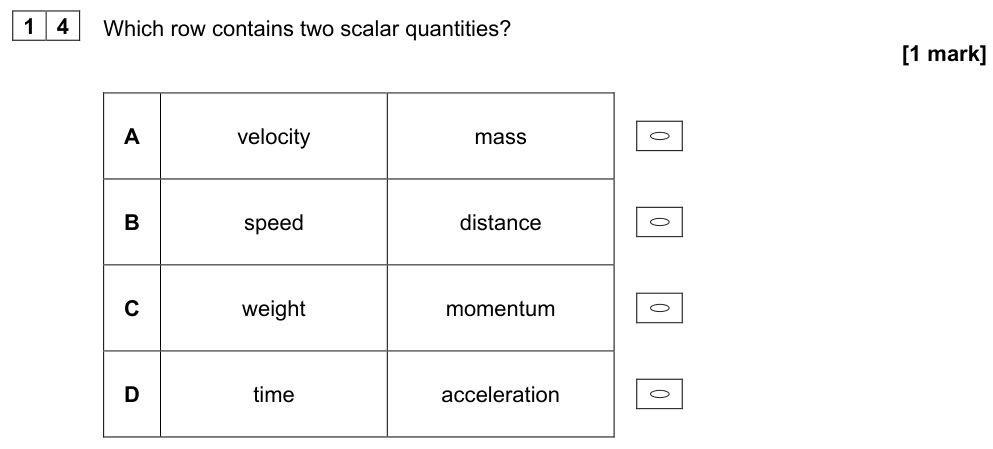
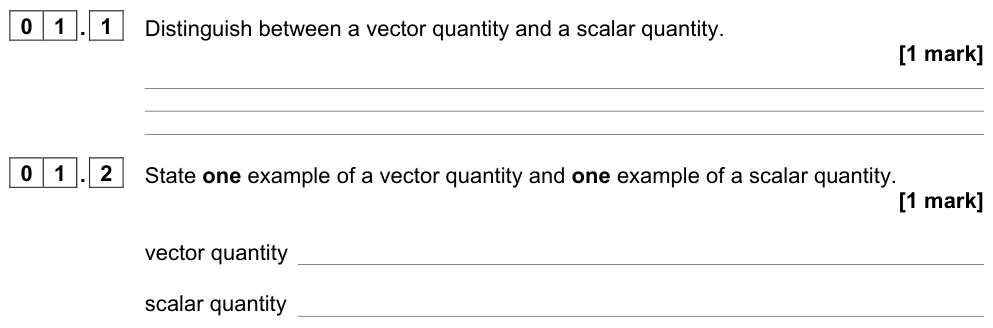
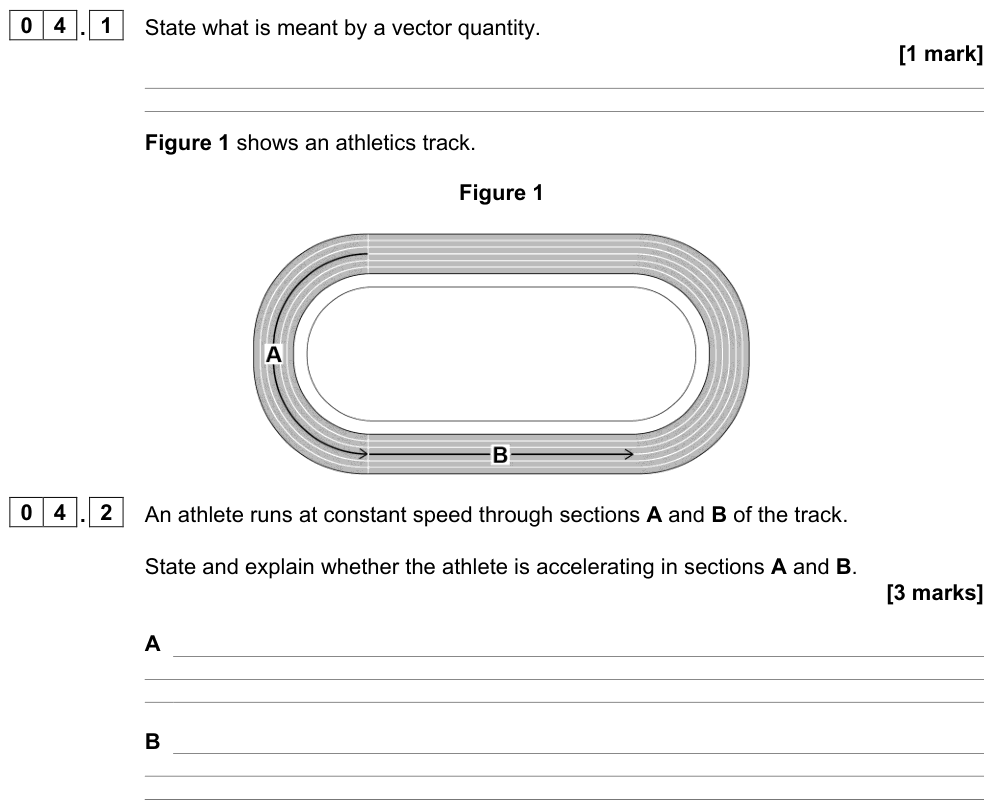
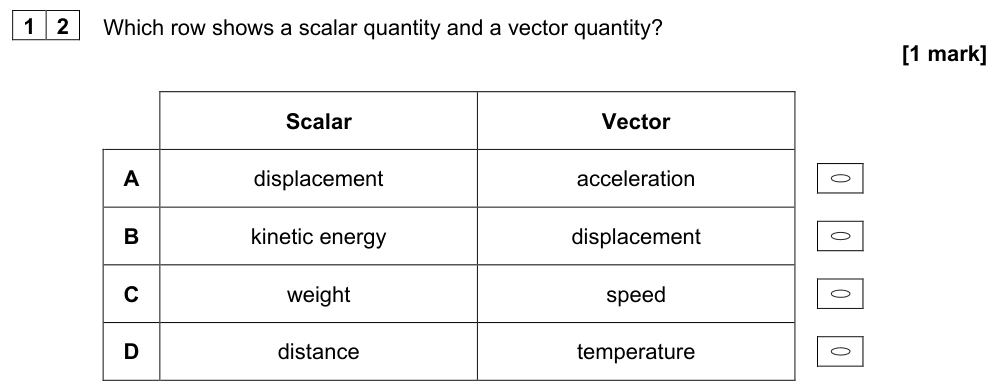
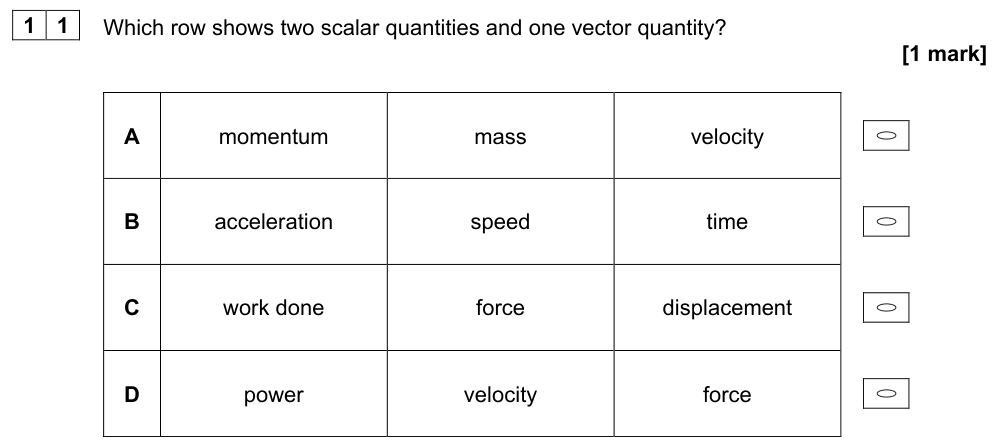
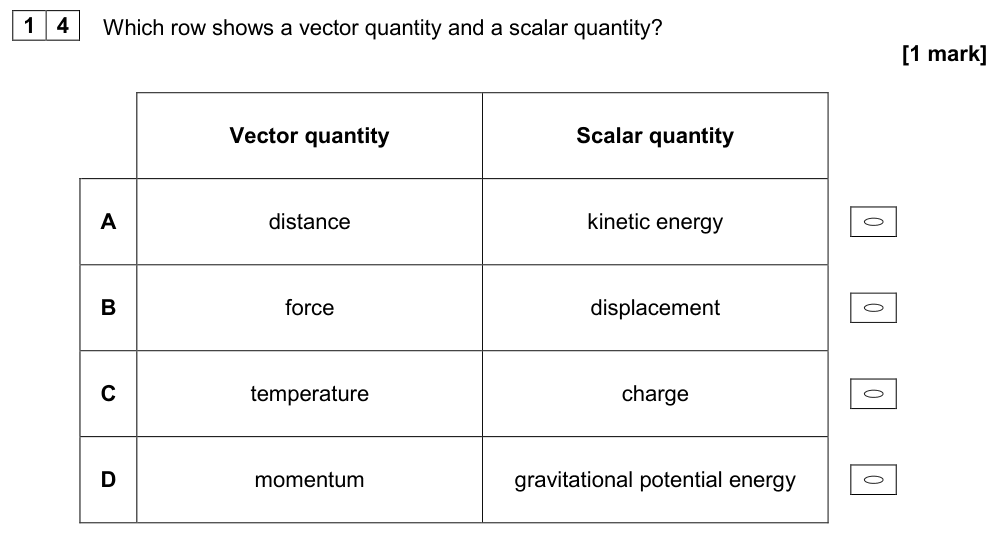
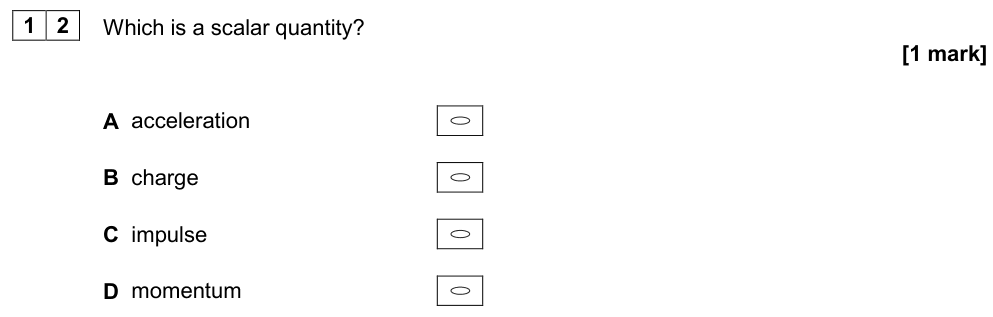
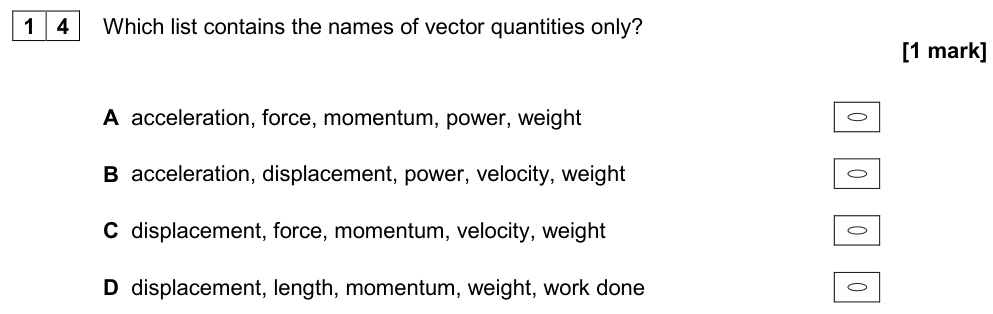
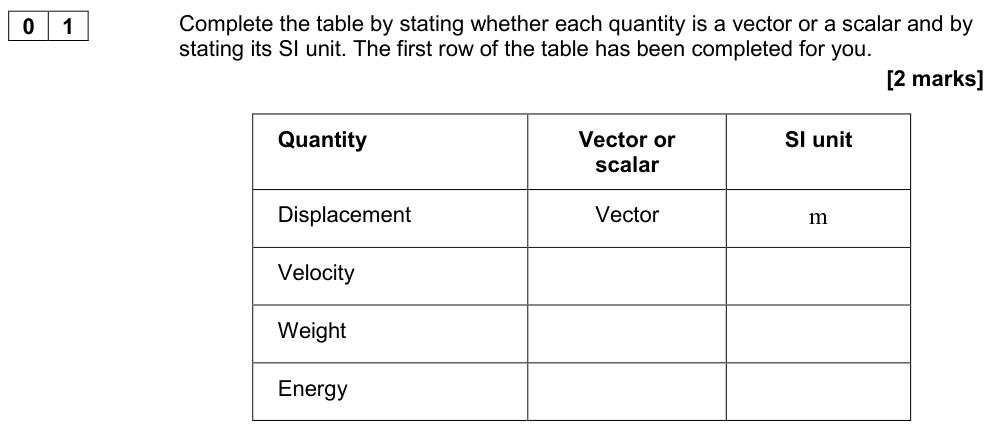
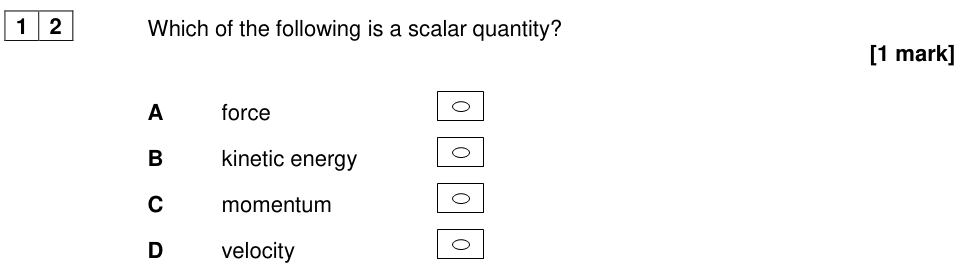
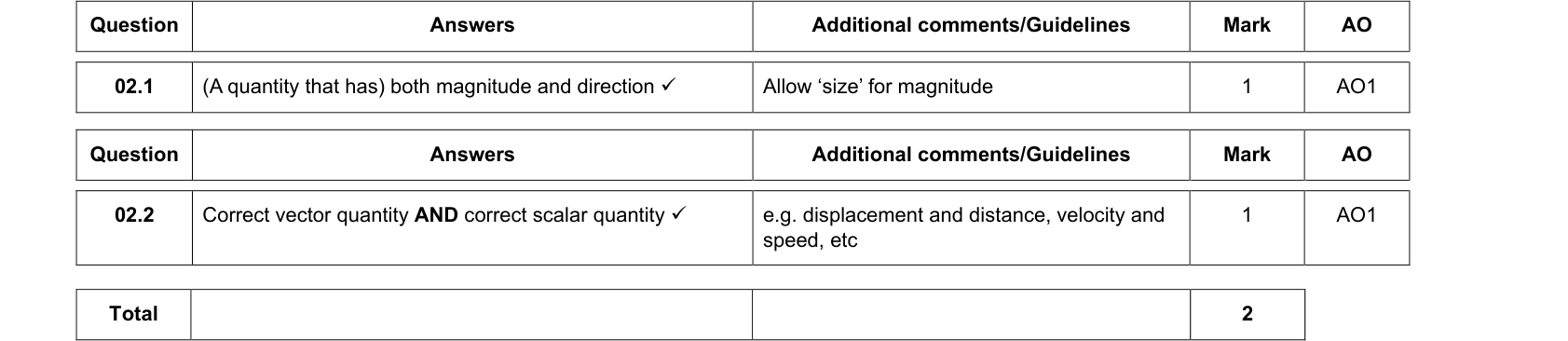
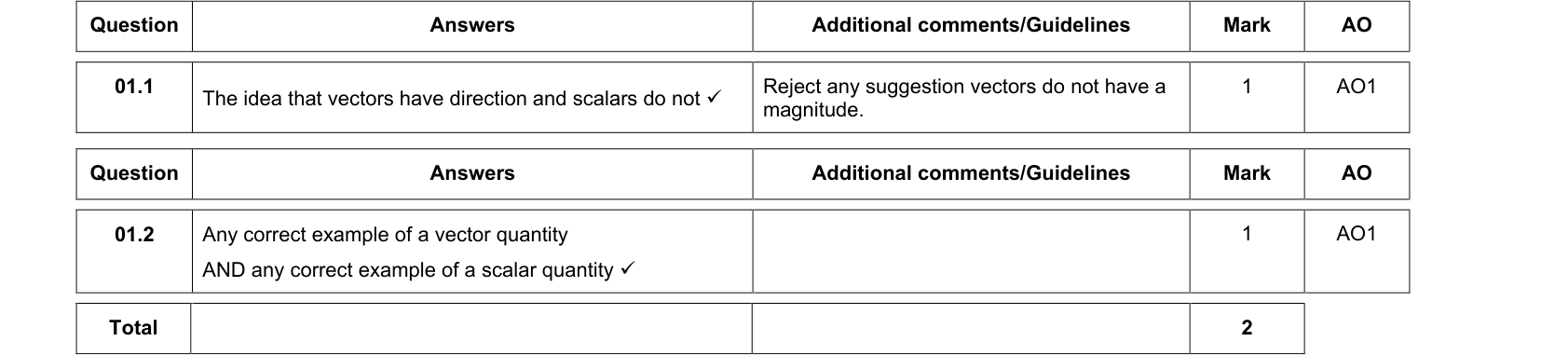
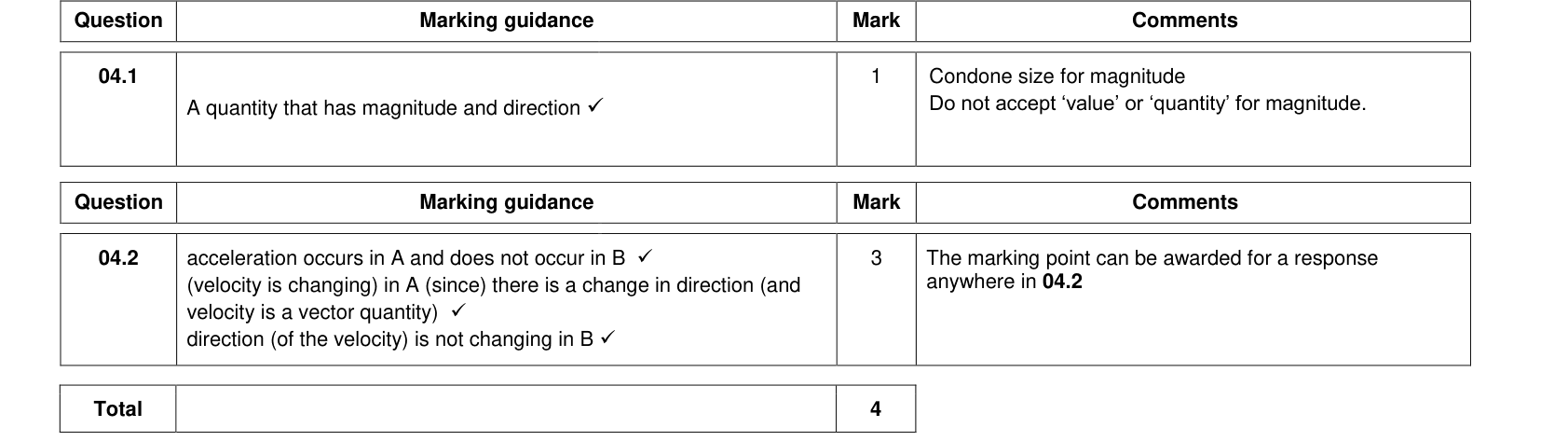
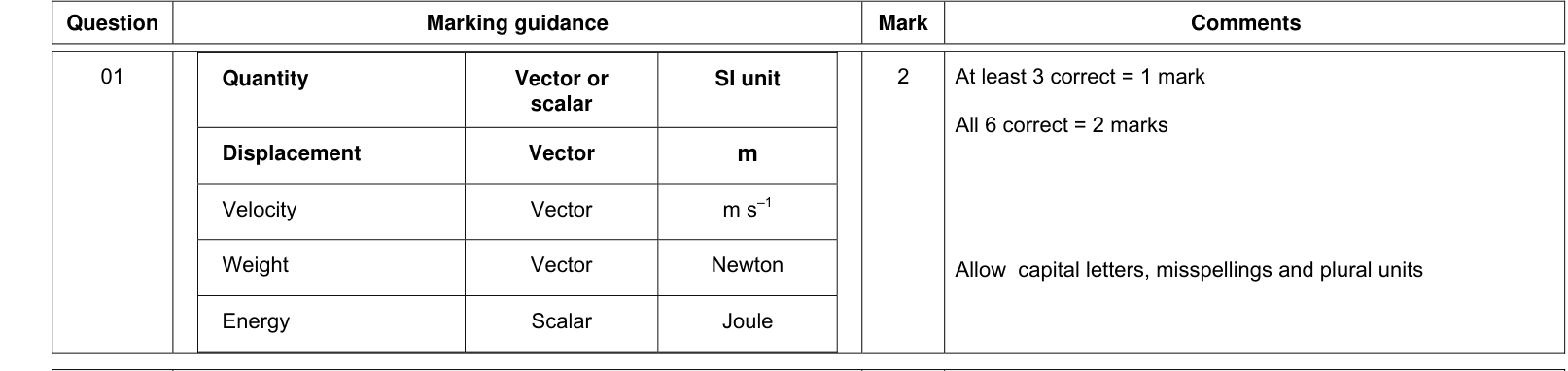
A scalar quantity has magnitude only (size and unit). A vector quantity has magnitude and direction.
| Scalars | Vectors |
|---|---|
| distance | displacement |
| speed | velocity |
| mass | weight (a force) |
| time | acceleration |
| energy, work, power | force |
| temperature | momentum, impulse |
| charge, density, pressure | electric/gravitational field strength |
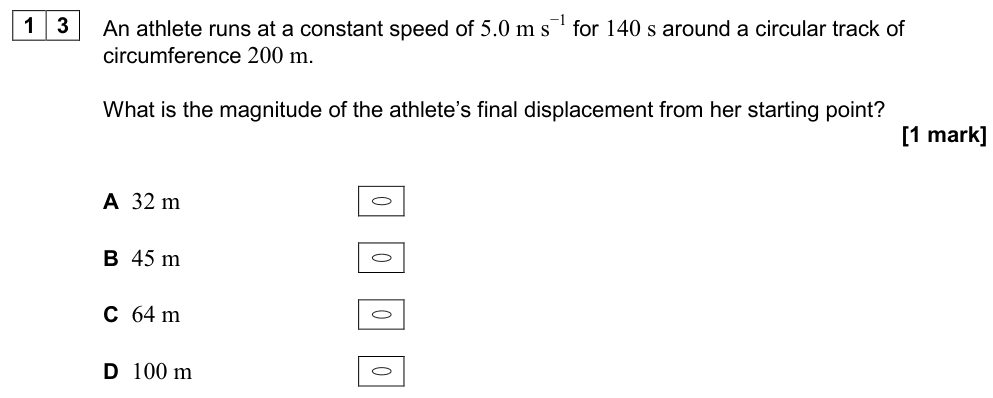
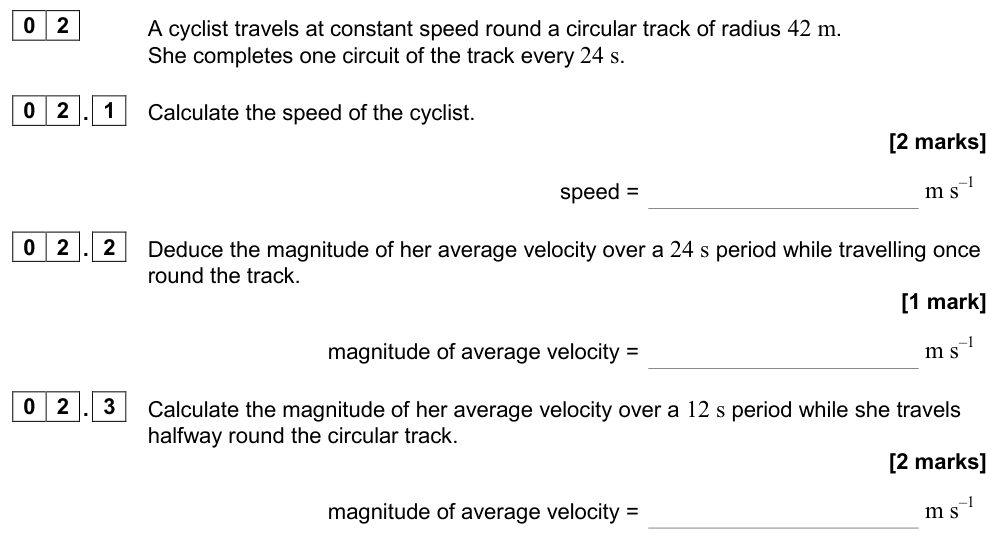
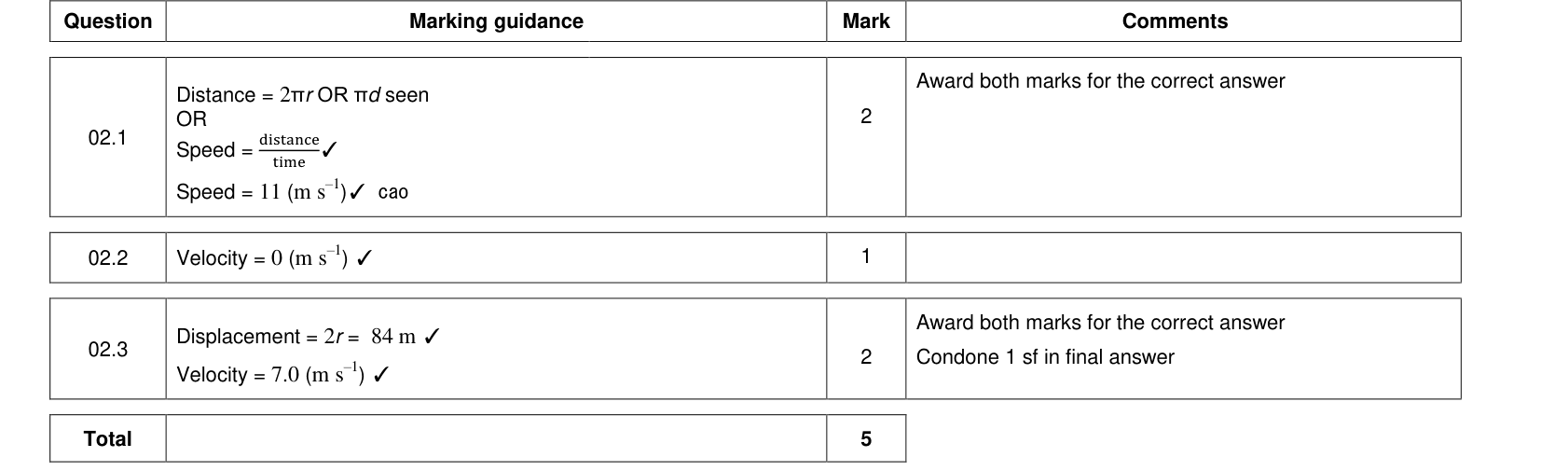
Pairs to learn: distance/displacement, speed/velocity and mass/weight. Distance is the total path length; displacement is the straight-line distance in a given direction from the start. An athlete who runs one full lap of a 400 m track has travelled a distance of 400 m but has a displacement of zero.
Common mistake
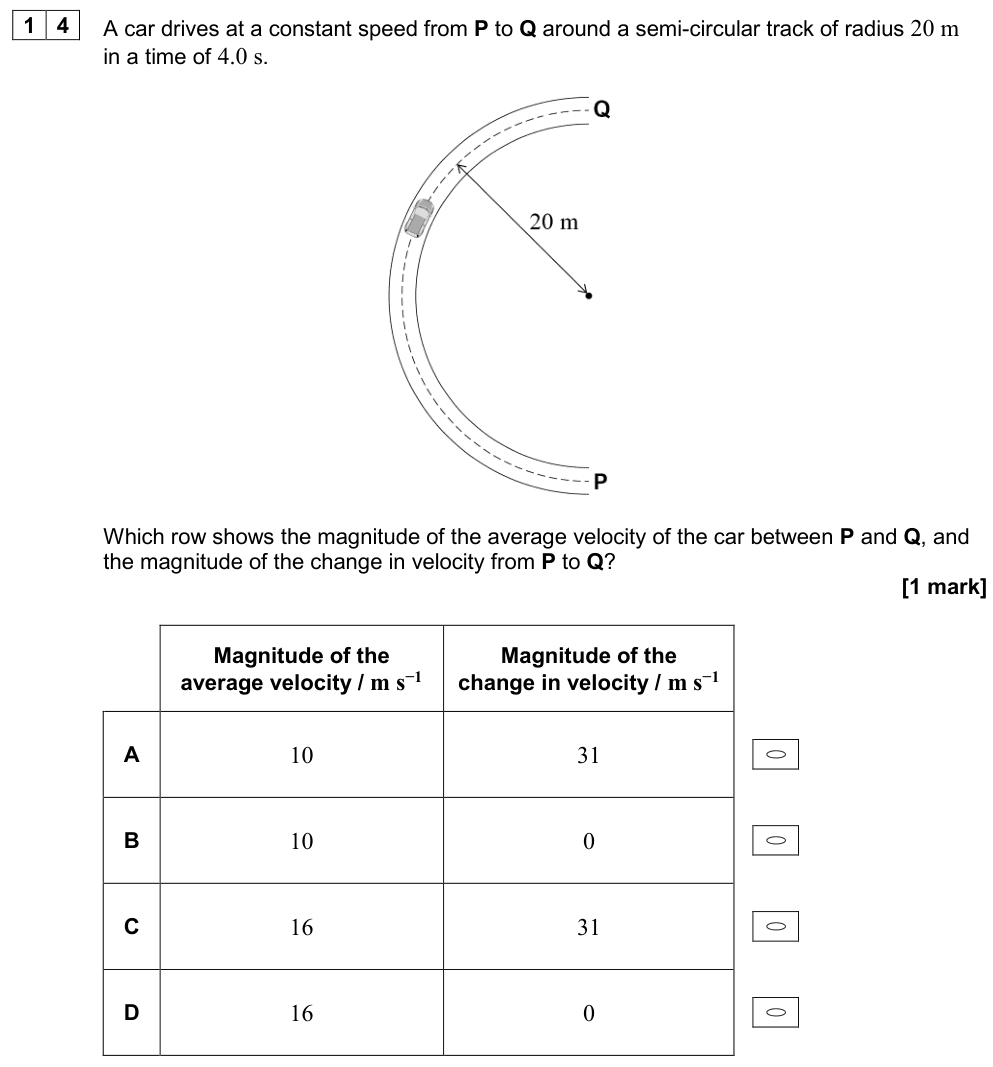
An object moving at constant speed in a circle has a changing velocity, because its direction changes. It is therefore accelerating, even though its speed does not change.
Vectors are drawn as arrows. The length of the arrow represents the magnitude and the arrow points in the direction of the vector. Vectors pointing in opposite directions have opposite signs. Choose one direction as positive and stick to it.
Adding vectors
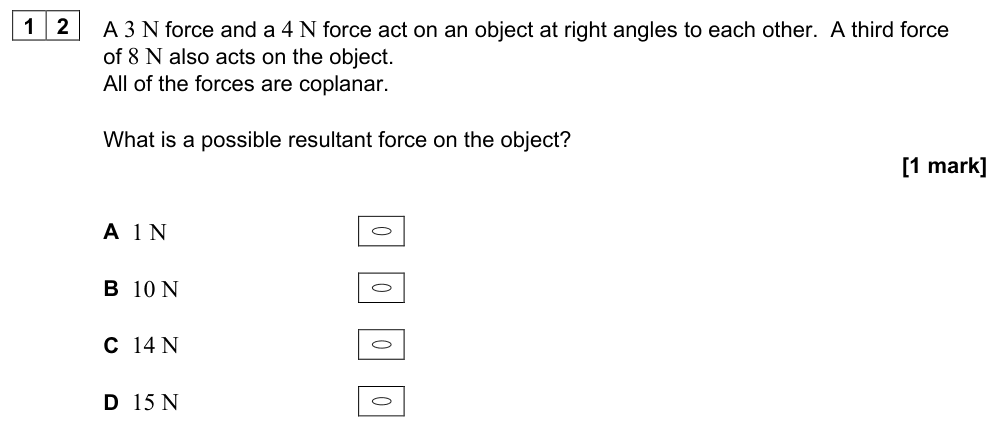
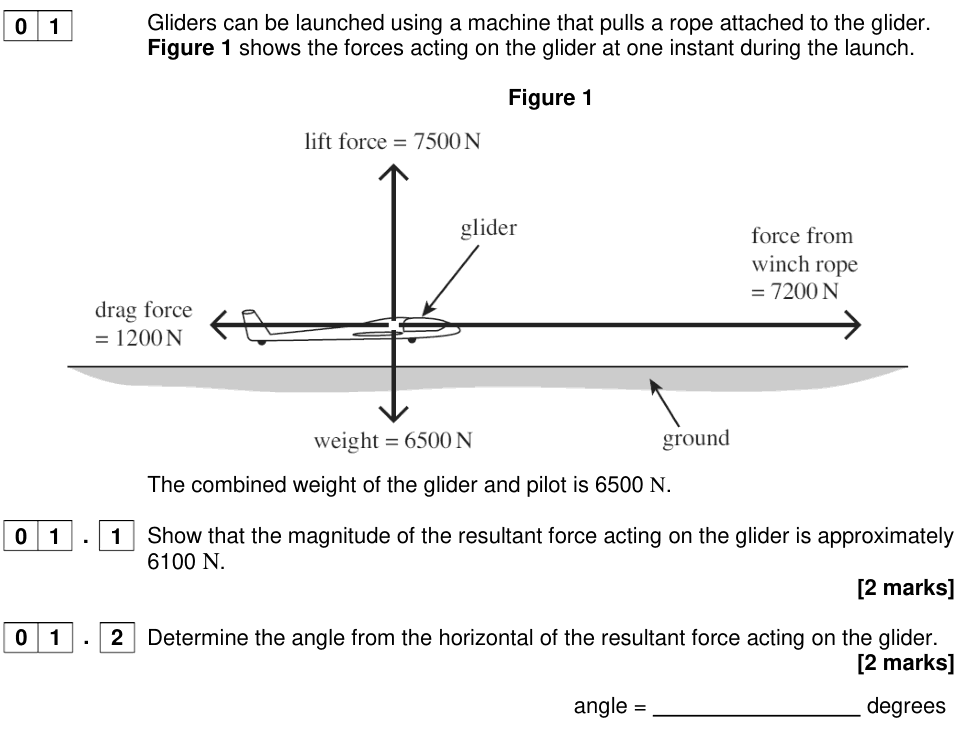
Two vectors are added tip-to-tail: draw the second vector starting from the tip of the first. The resultant goes from the tail of the first to the tip of the last.
Perpendicular vectors: calculation
For two perpendicular vectors $A$ and $B$:
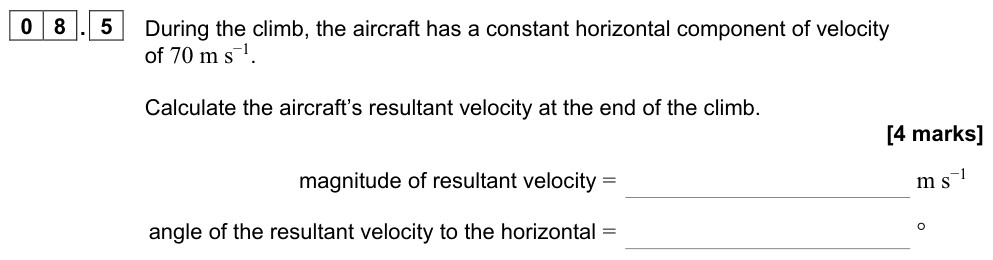
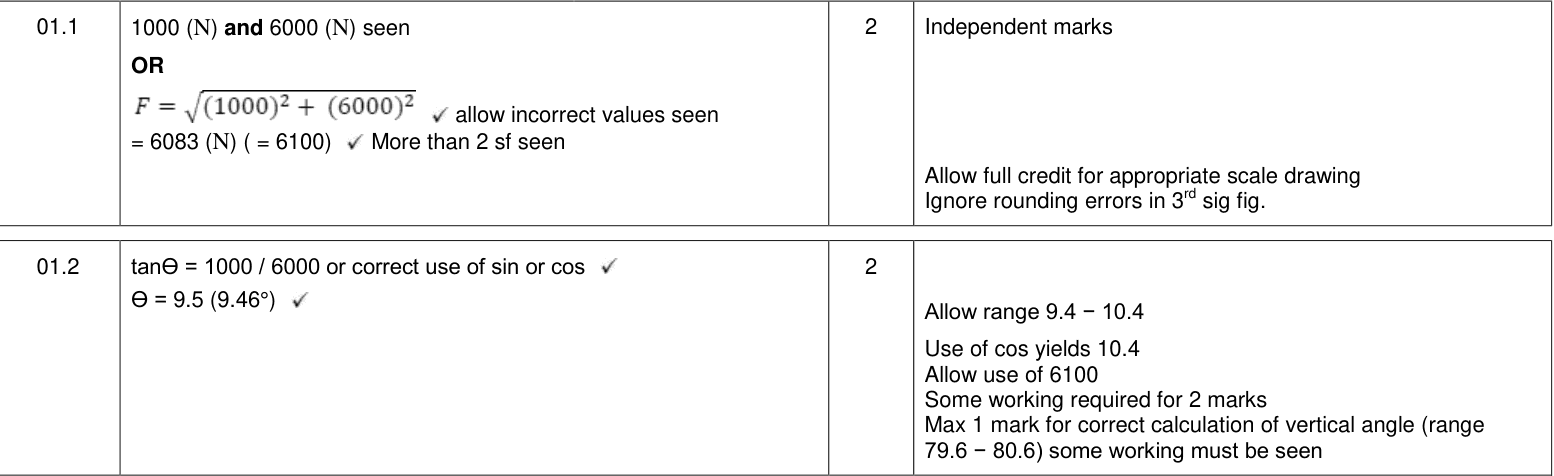
$$R = \sqrt{A^2 + B^2} \qquad \tan\theta = \frac{B}{A}$$
where $\theta$ is the angle between the resultant and vector $A$.
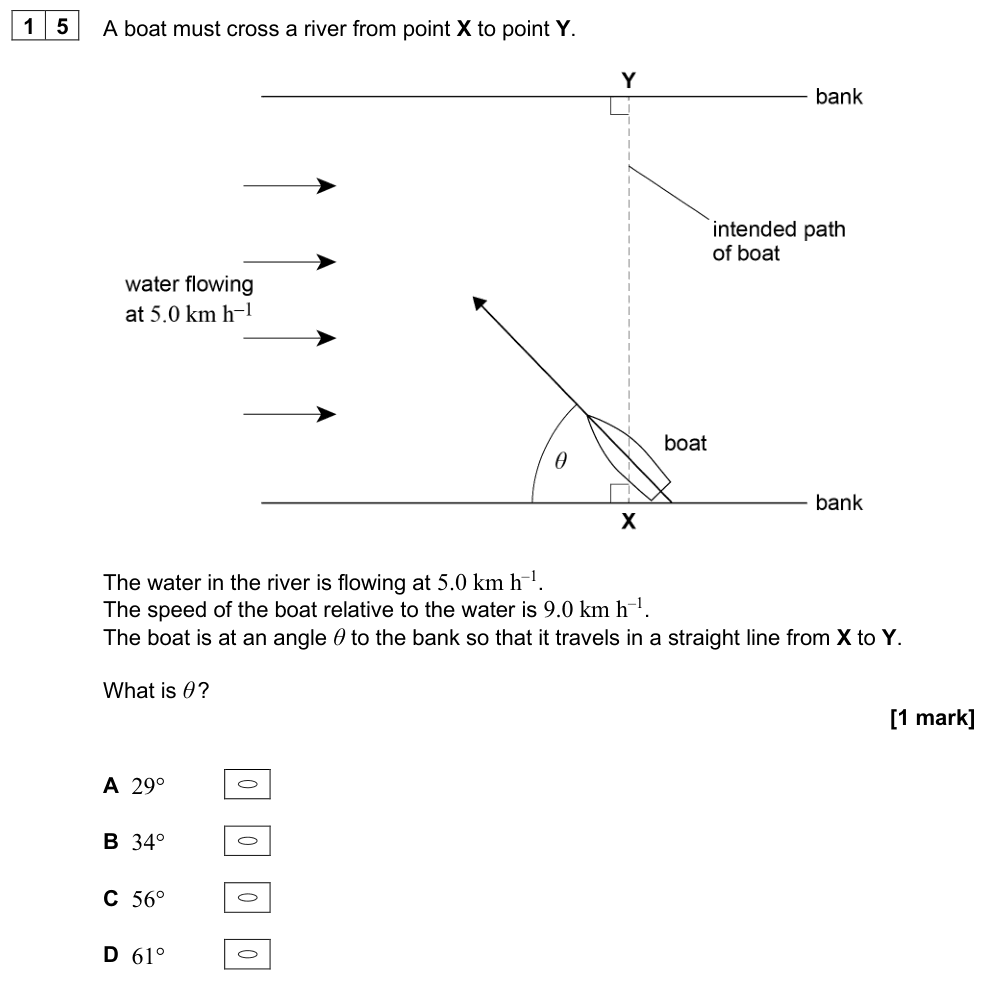
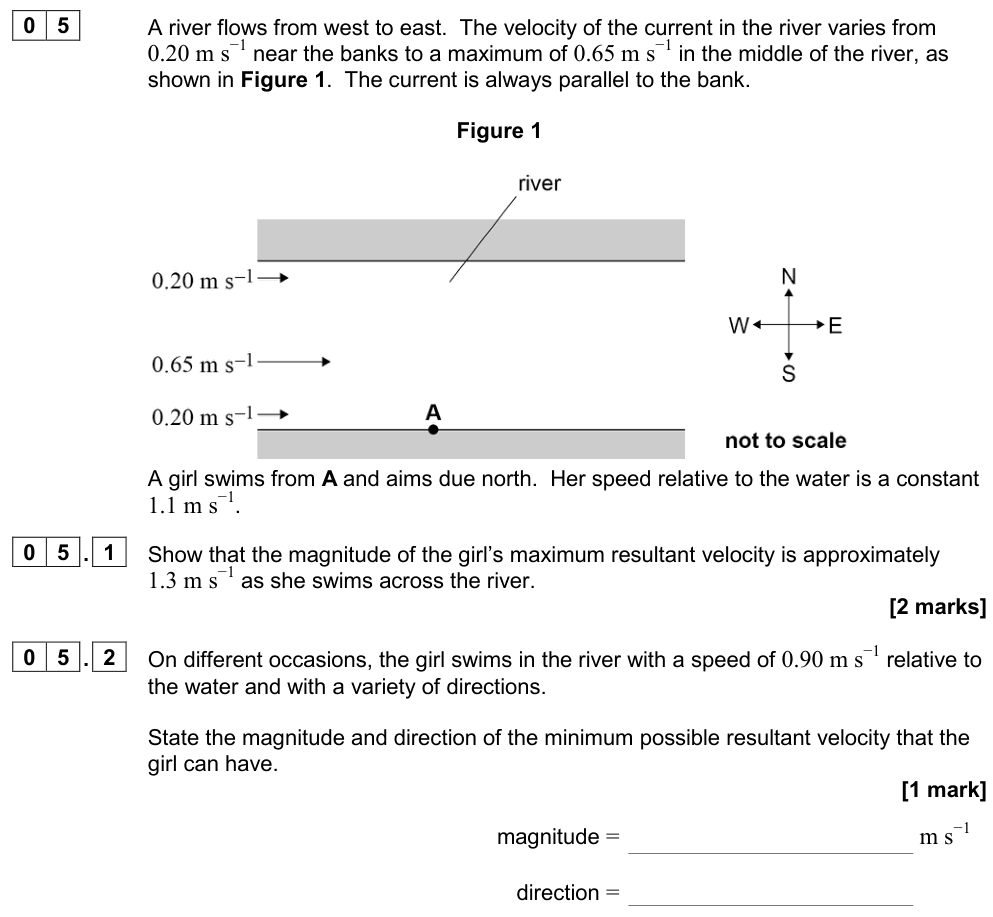
Worked example: velocity of a boat
A boat is steered due north at $4.0\ \text{m s}^{-1}$ relative to the water. The river flows due east at $3.0\ \text{m s}^{-1}$.
Resultant speed $= \sqrt{4.0^2 + 3.0^2} = 5.0\ \text{m s}^{-1}$.
Direction: $\tan\theta = 3.0/4.0$, so $\theta = 37^\circ$ east of north.
Non-perpendicular vectors: scale drawing
For vectors at any angle you can use an accurate scale drawing:
- Choose a scale (e.g. 1 cm = 10 N) and state it.
- Draw the first vector to scale at the correct angle using a protractor.
- Draw the second vector from the tip of the first.
- Measure the length and angle of the resultant, and convert back using the scale.
You can also resolve each vector into components (below), add the components, and then recombine. This is usually more accurate.
Resolving vectors into components
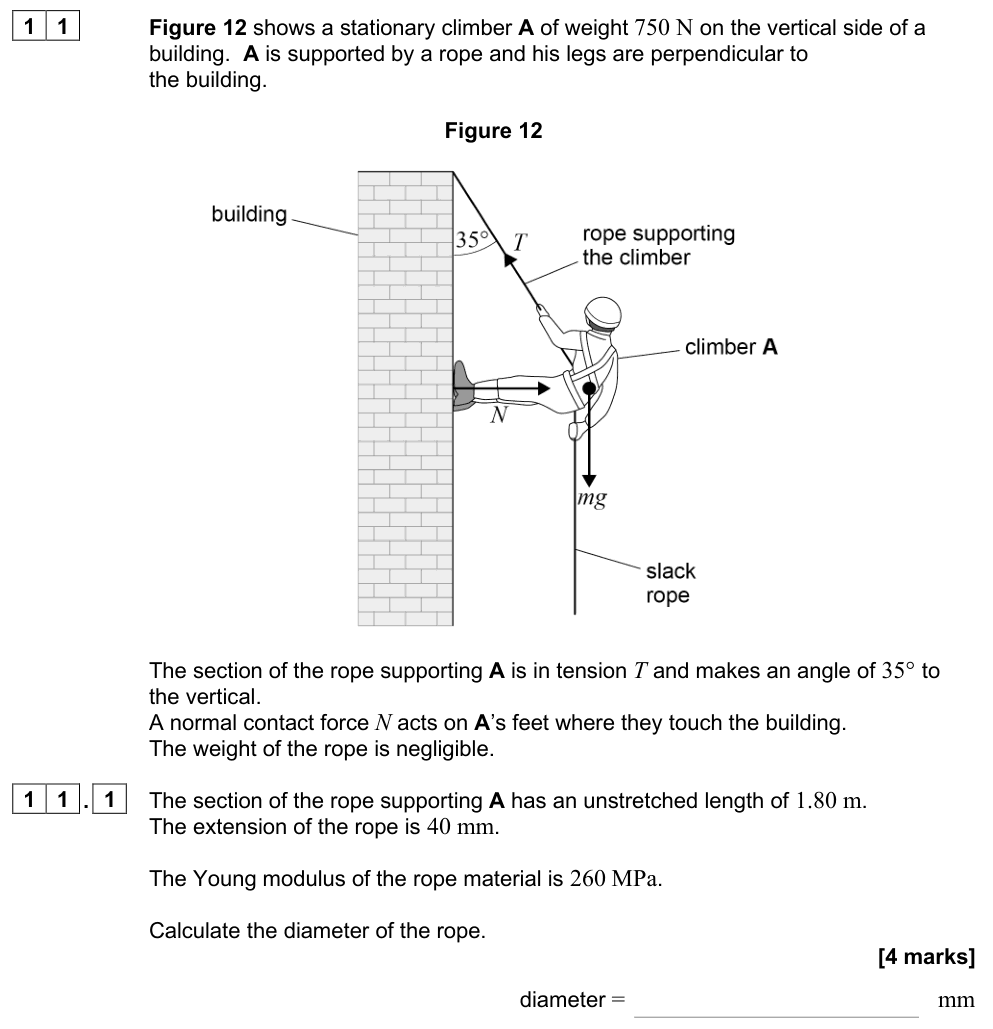
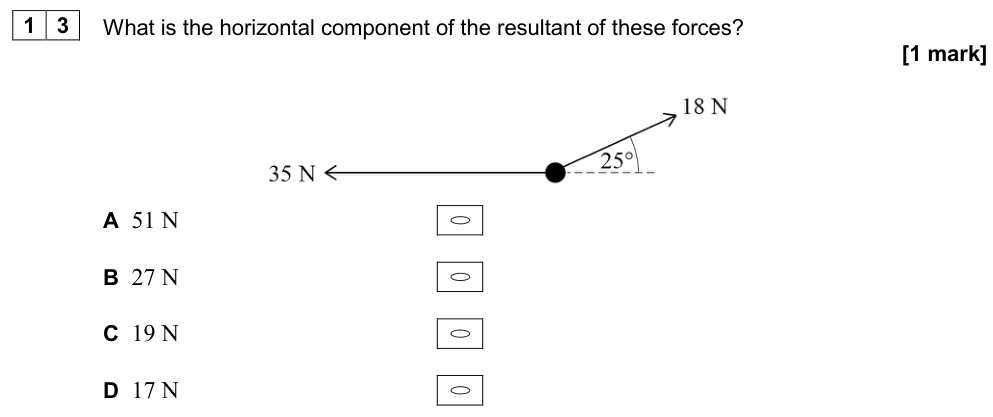
Any vector can be split into two perpendicular components that together have the same effect. For a vector $F$ at an angle $\theta$ to the horizontal:
$$F_x = F\cos\theta \qquad F_y = F\sin\theta$$
Exam tip: which is cos and which is sin?
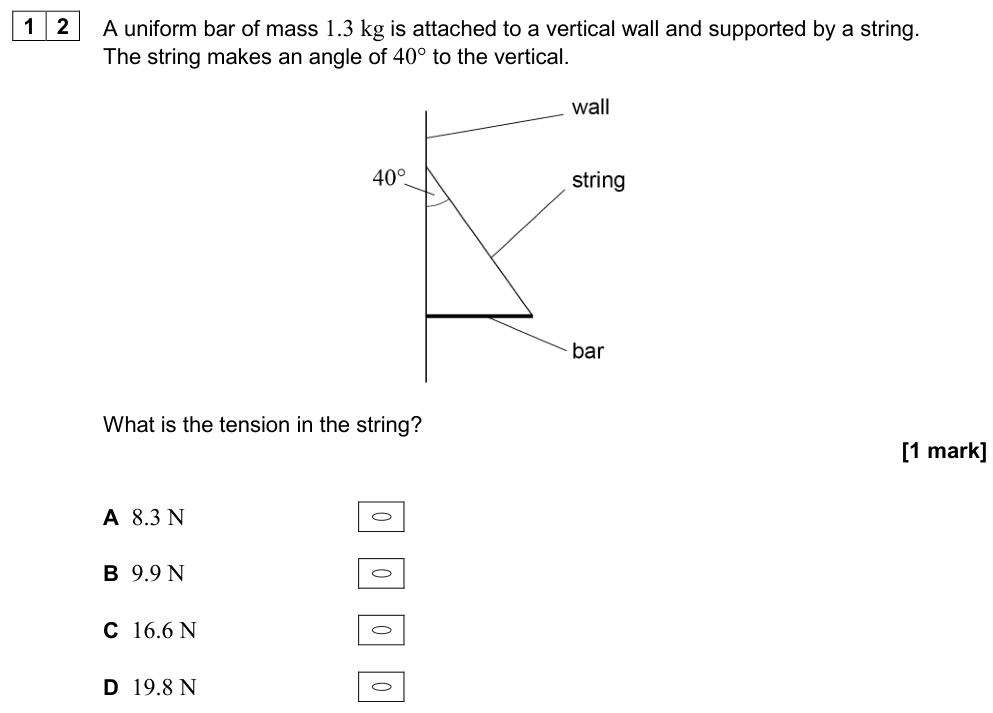
The component adjacent to the angle uses cos; the component opposite the angle uses sin. Always check which angle the question gives you: an angle to the vertical swaps sin and cos.
Objects on a slope
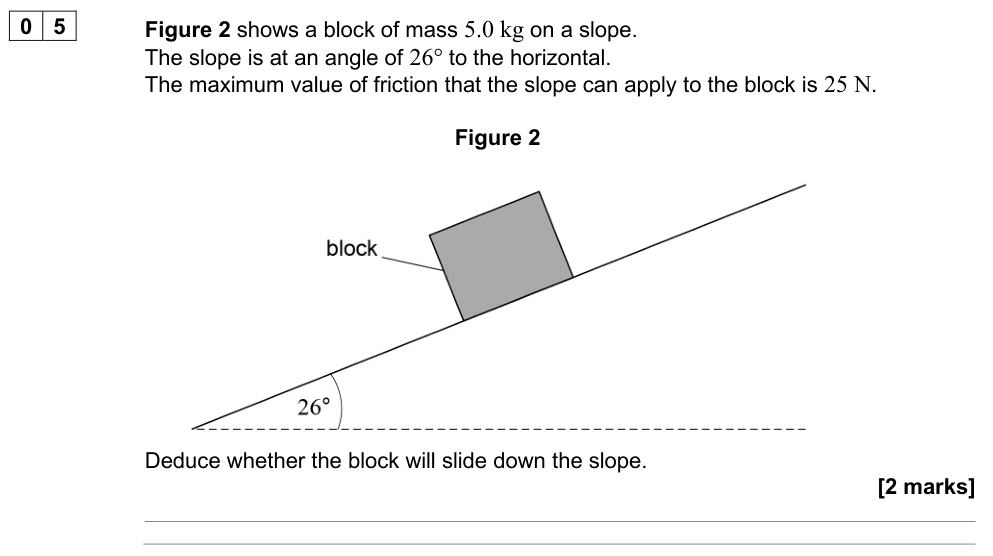
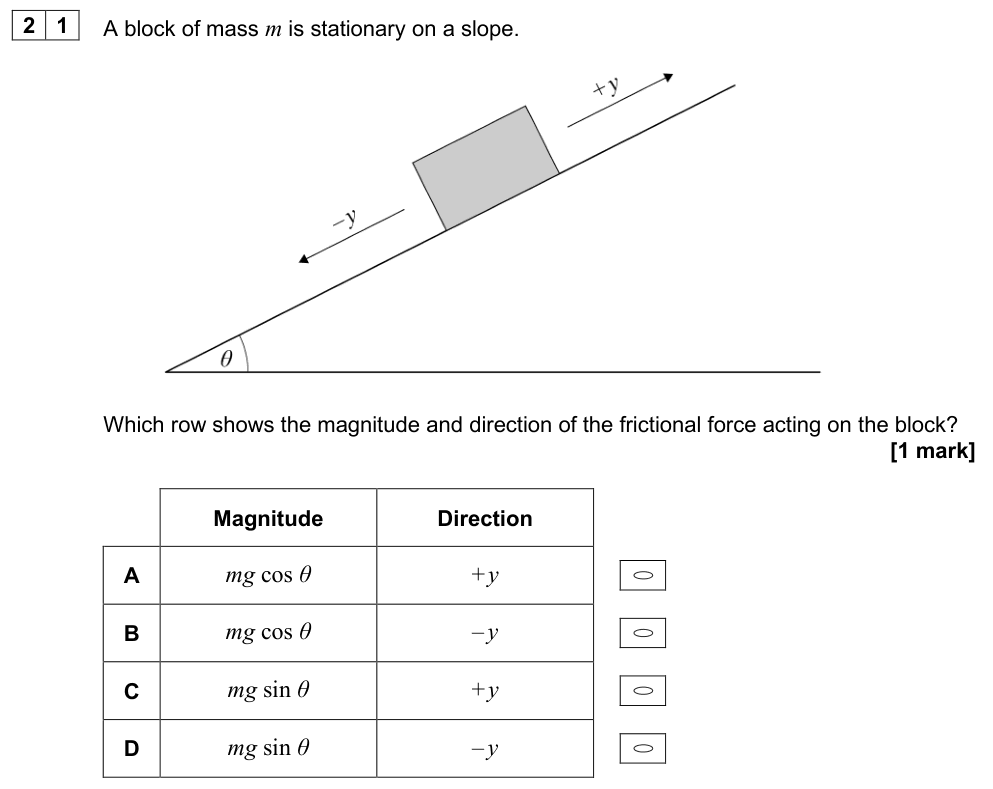
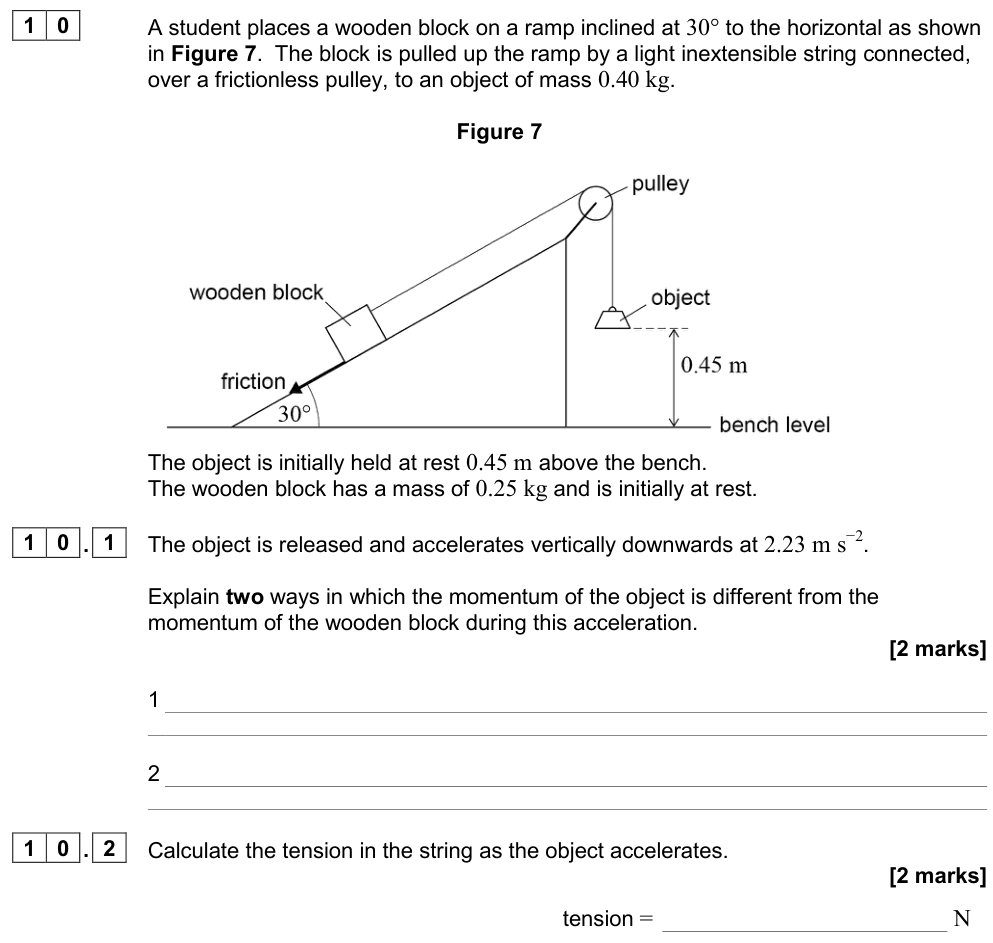
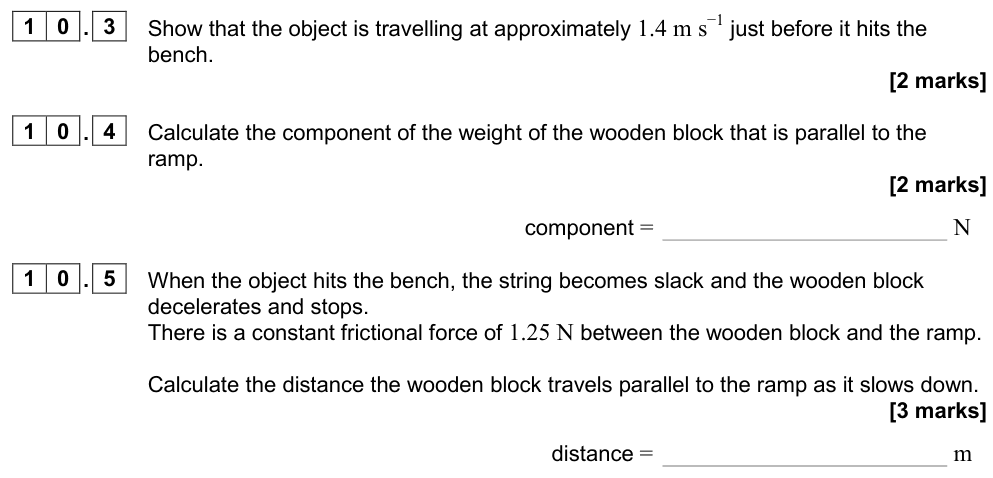
For an object of weight $W = mg$ on a slope inclined at angle $\theta$ to the horizontal, resolve the weight along and perpendicular to the slope:
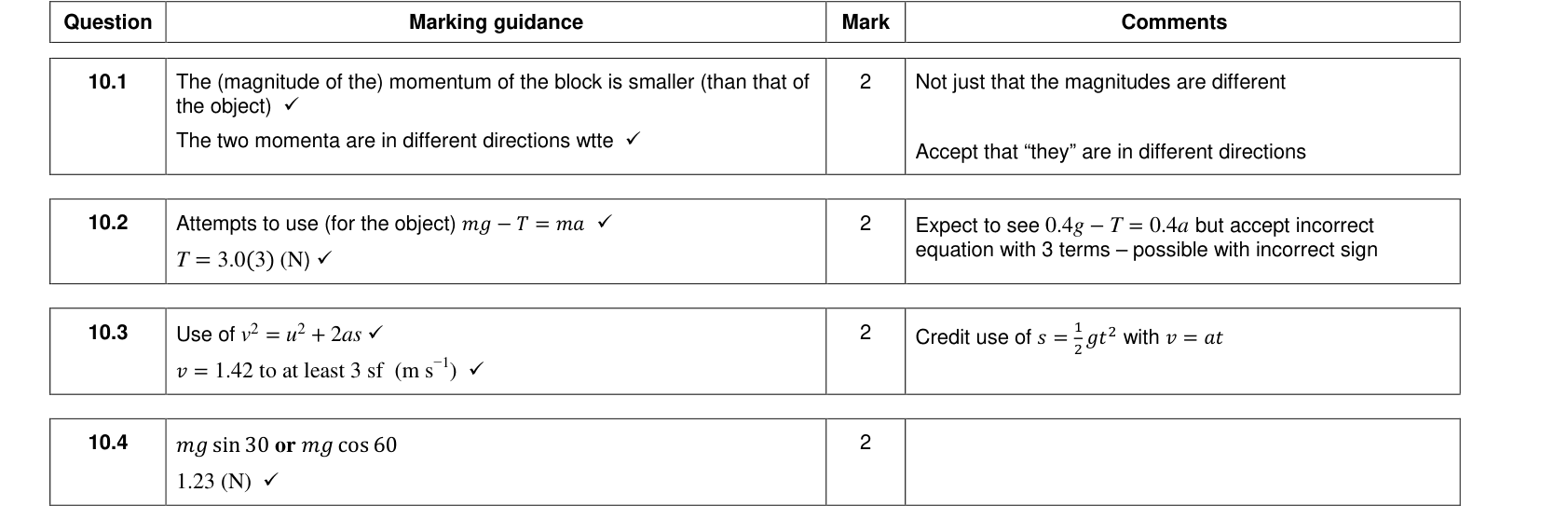
$$\text{component down the slope} = mg\sin\theta \qquad \text{component into the slope} = mg\cos\theta$$
The normal reaction balances the perpendicular component: $N = mg\cos\theta$. If the object is stationary or sliding at constant velocity, friction balances the component down the slope: $F = mg\sin\theta$.
Worked example: block on a slope
A 5.0 kg block rests on a slope at $30^\circ$ to the horizontal. Find the friction force and normal reaction.
Friction $= mg\sin30^\circ = 5.0 \times 9.81 \times 0.5 = 24.5\ \text{N}$ up the slope.
Normal reaction $= mg\cos30^\circ = 5.0 \times 9.81 \times 0.866 = 42.5\ \text{N}$.
Equilibrium of coplanar forces
Equilibrium
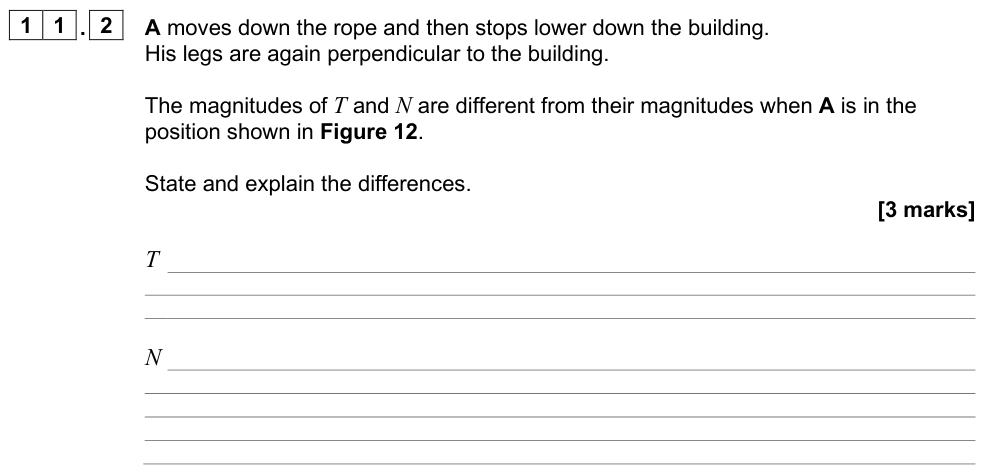
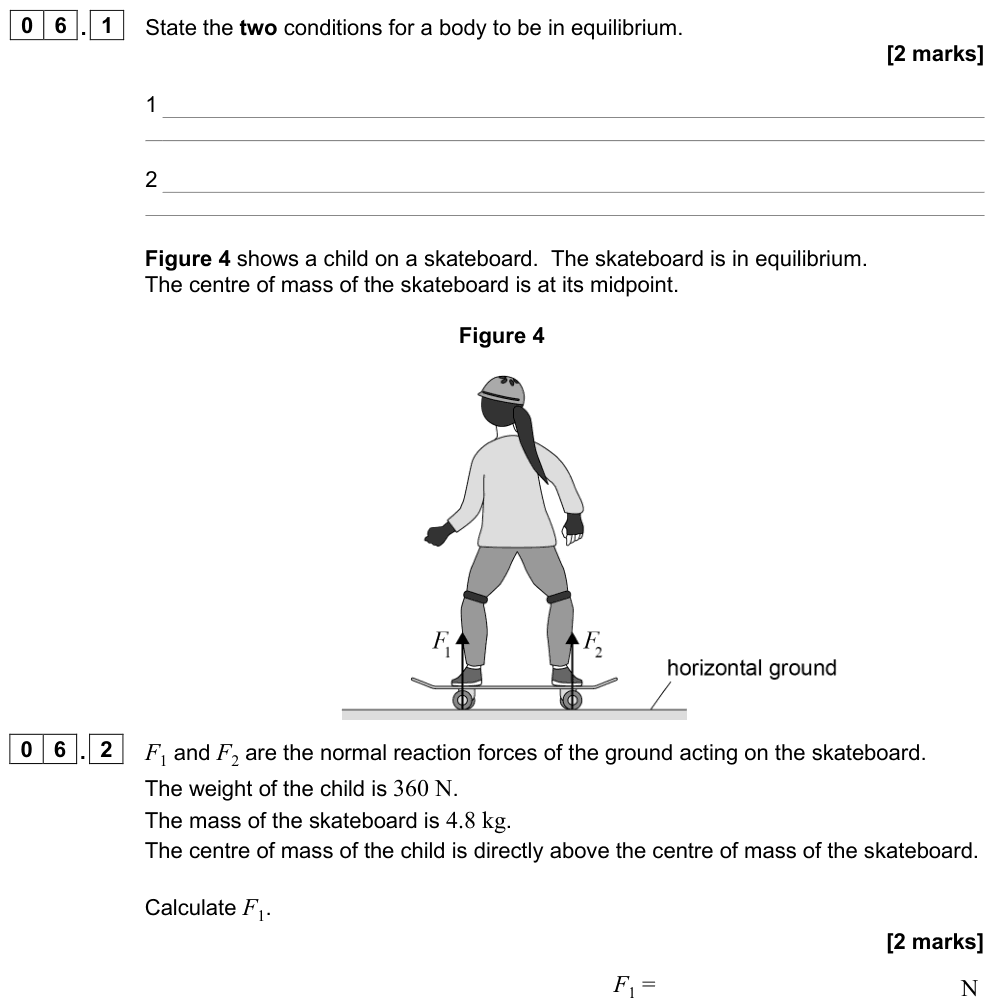
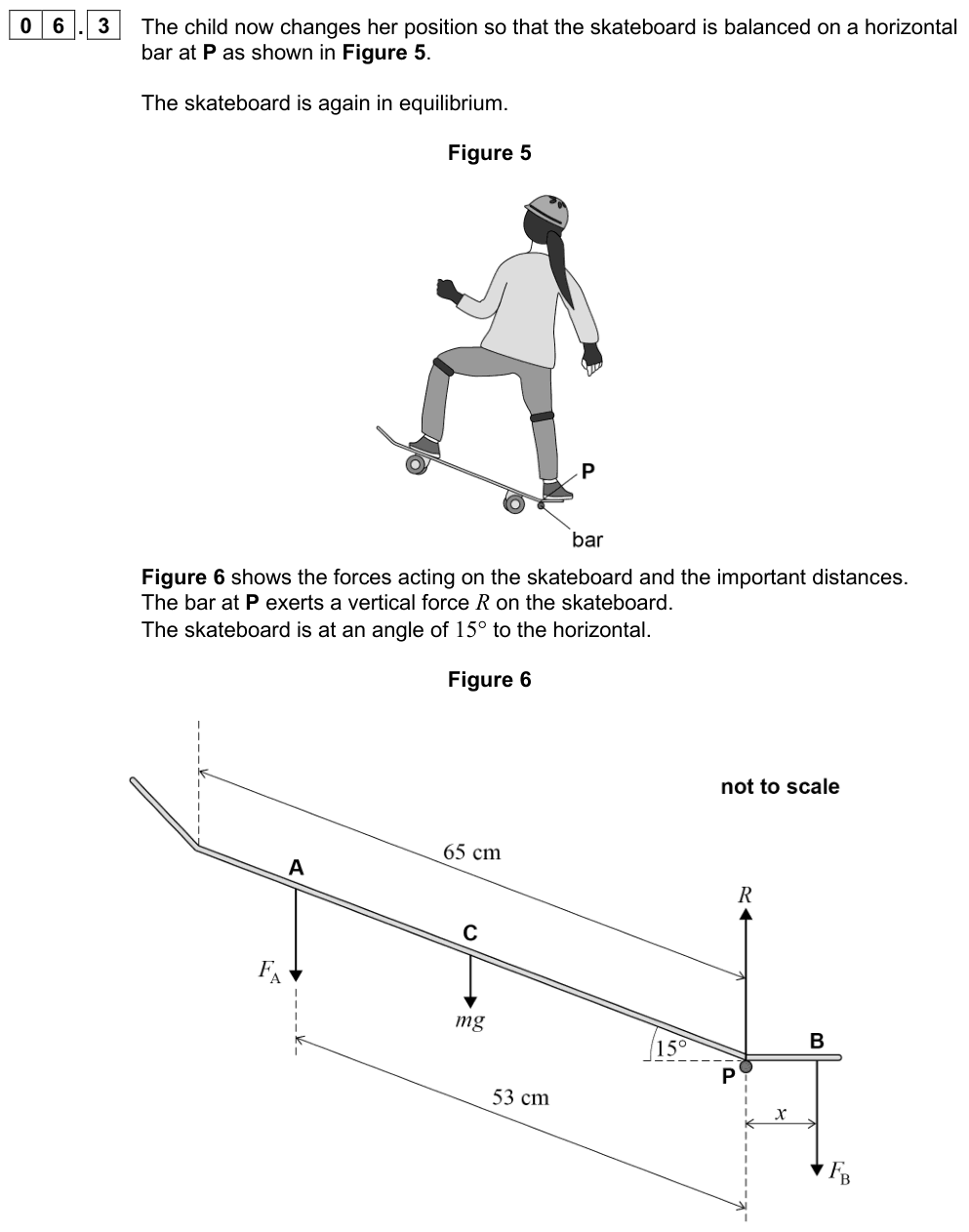
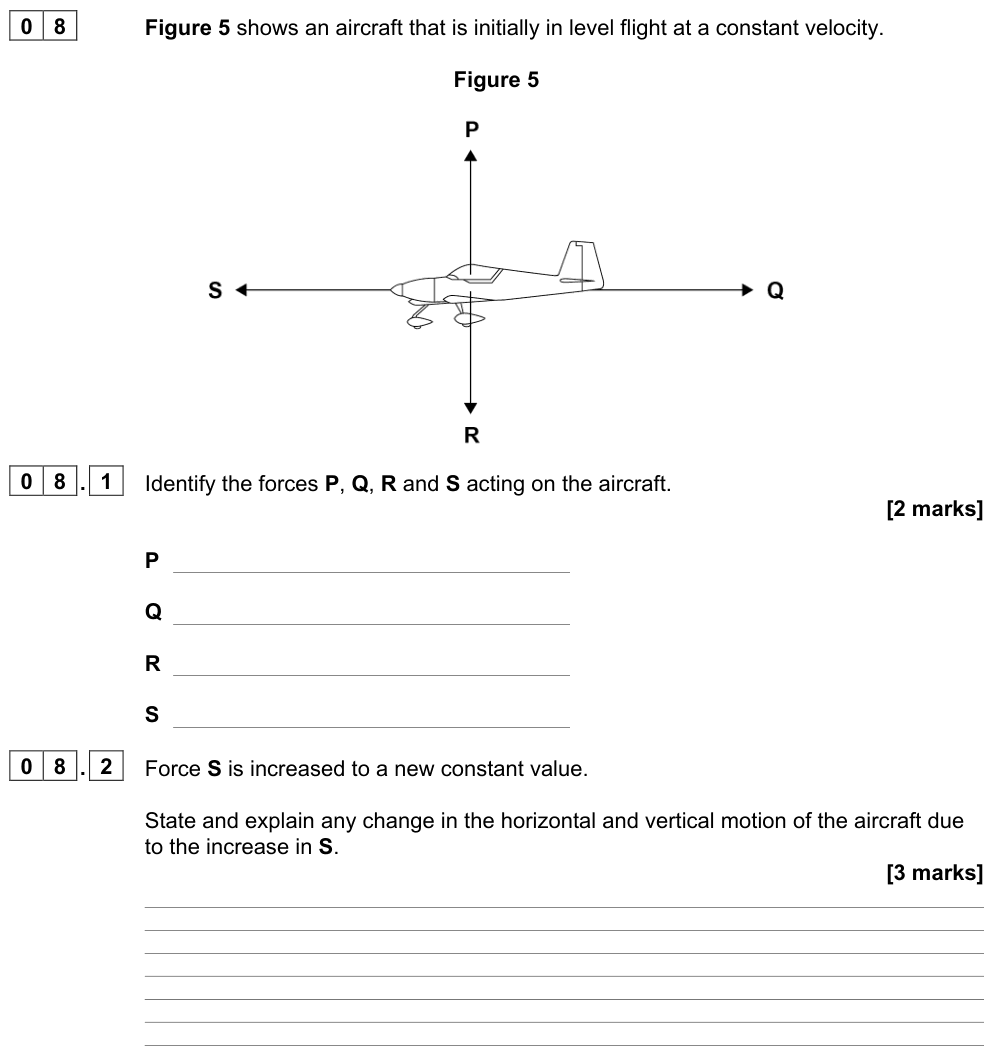
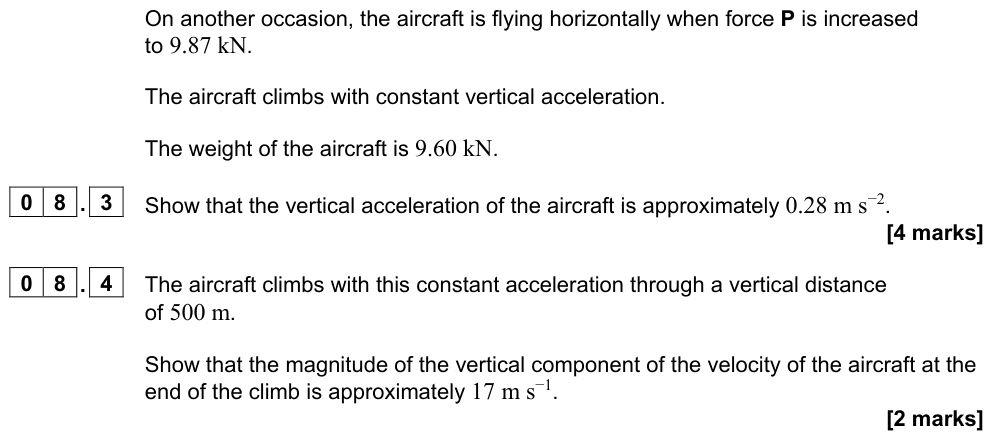
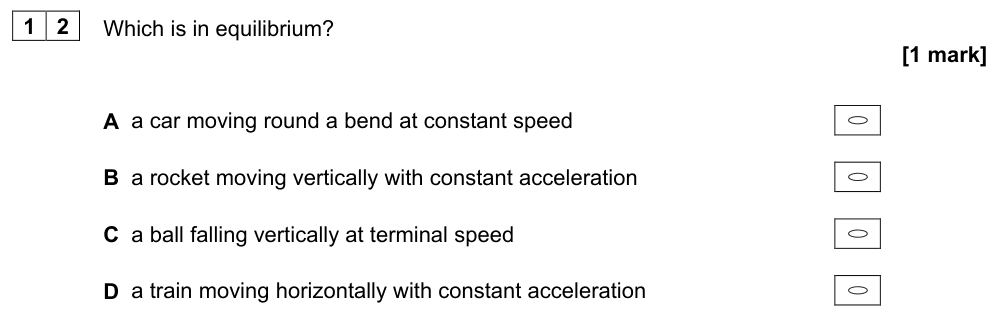
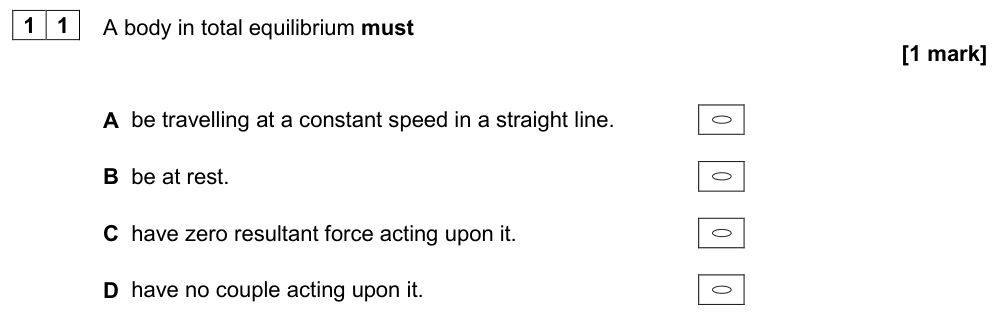
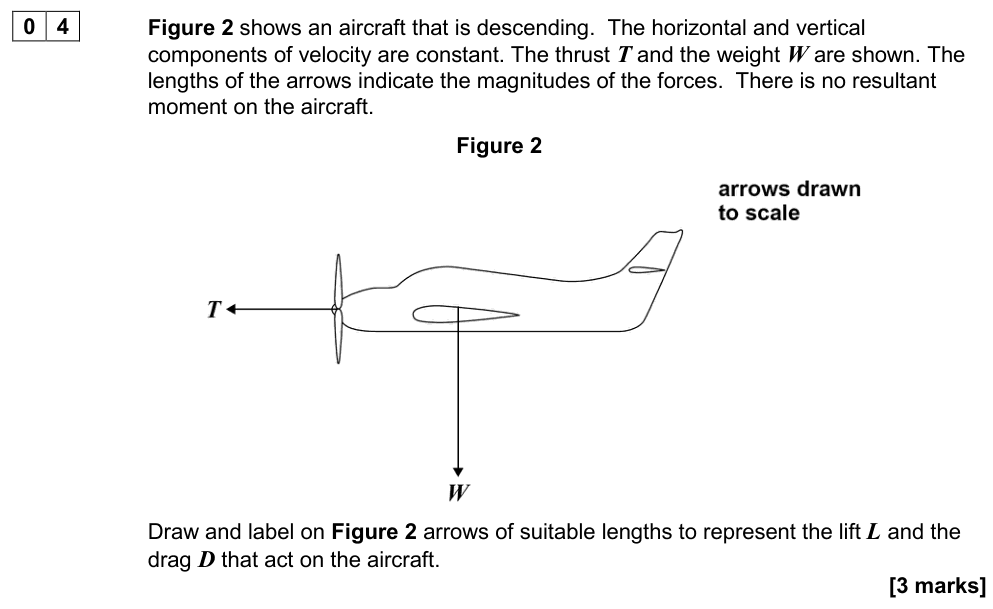
An object is in equilibrium when the resultant force on it is zero (and, for an extended object, the resultant moment is zero; see the next chapter). An object in equilibrium is either at rest or moving at constant velocity.
Two forces
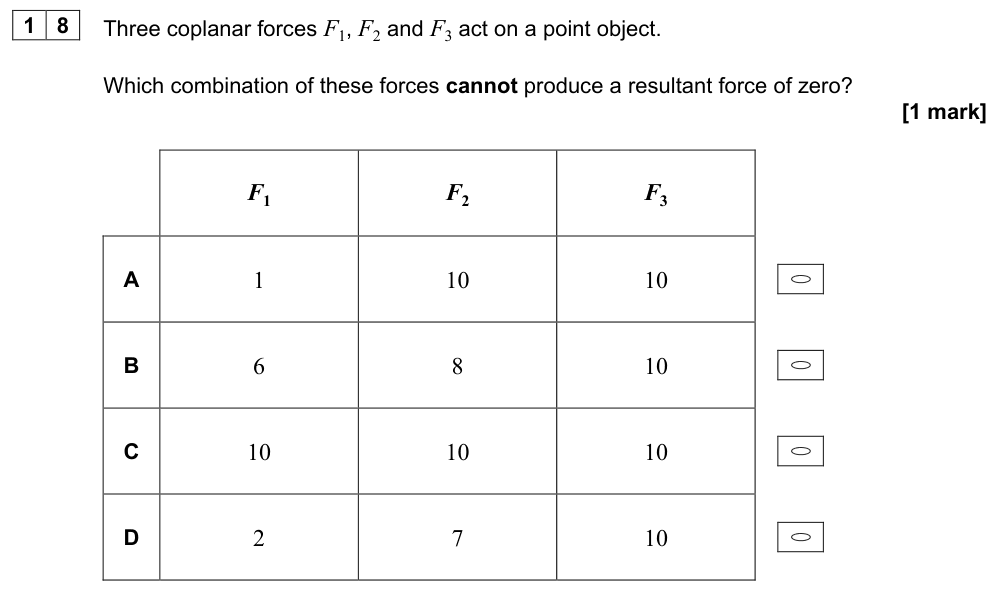
Two forces acting at a point are in equilibrium only if they are equal in magnitude, opposite in direction and act along the same line.
Three forces: the closed triangle
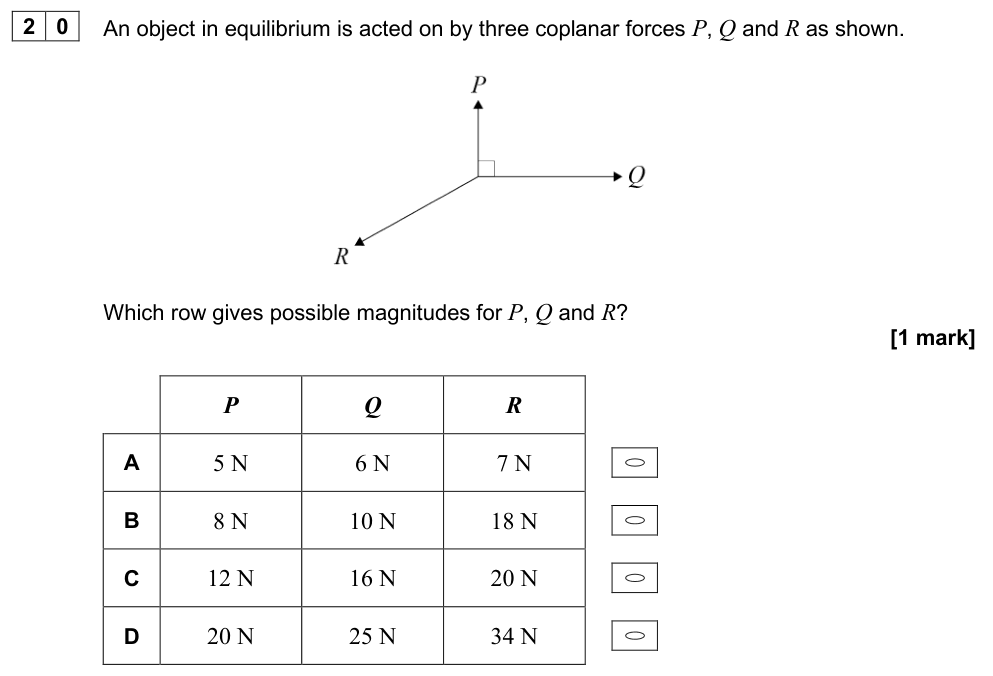
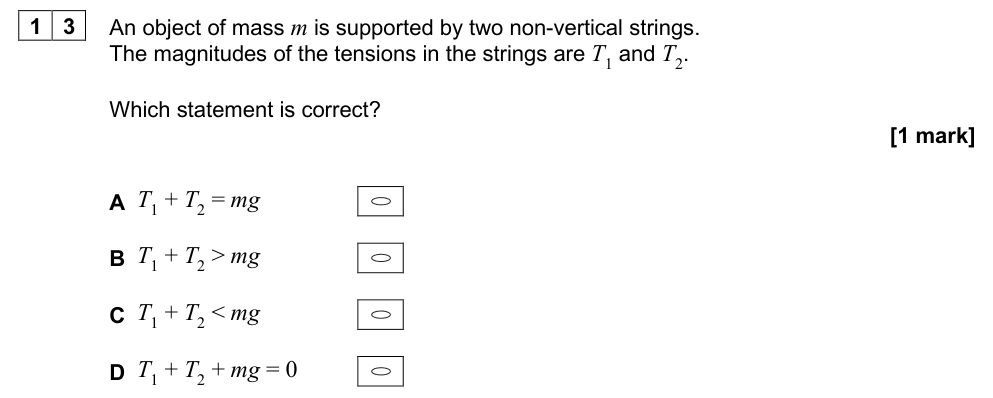
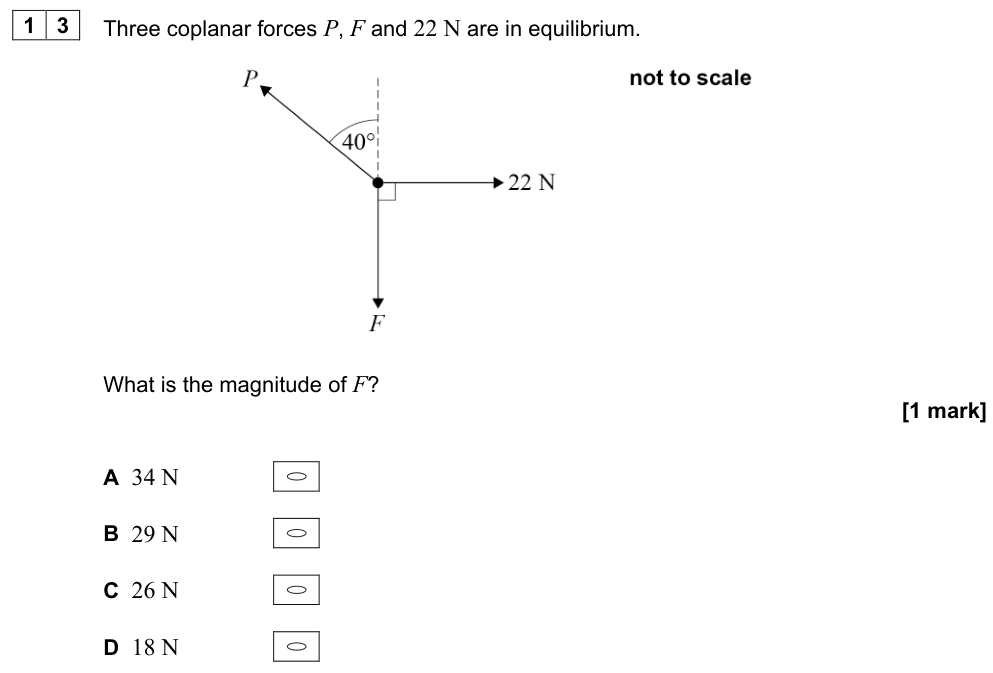
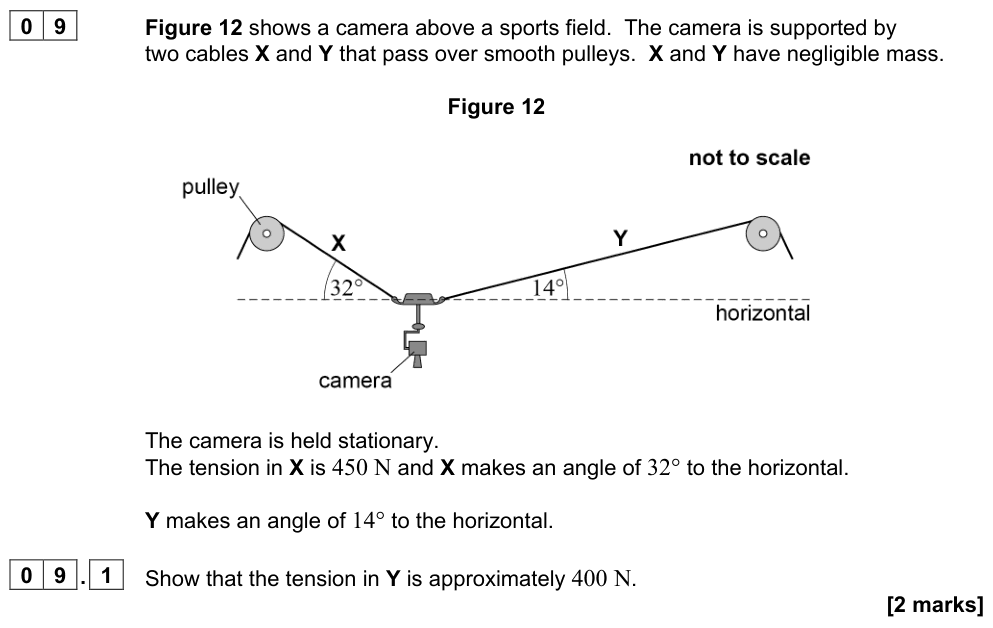
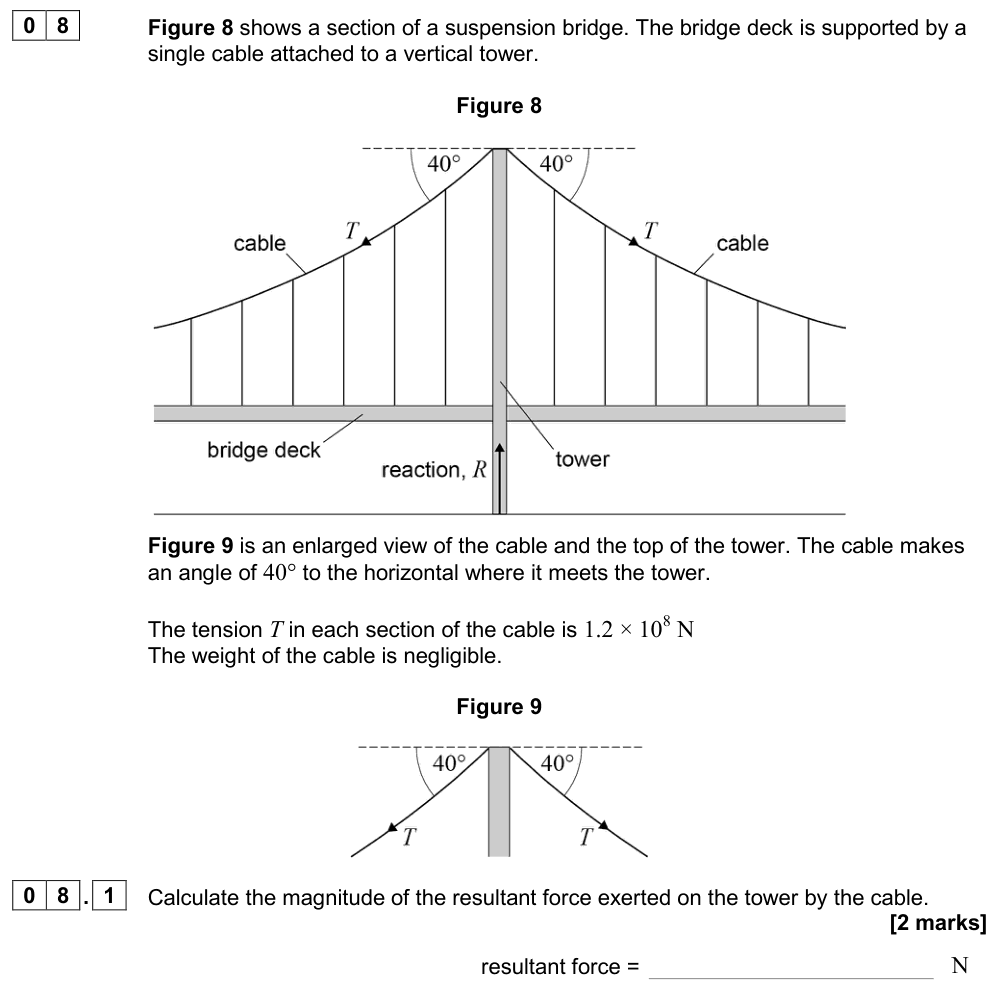
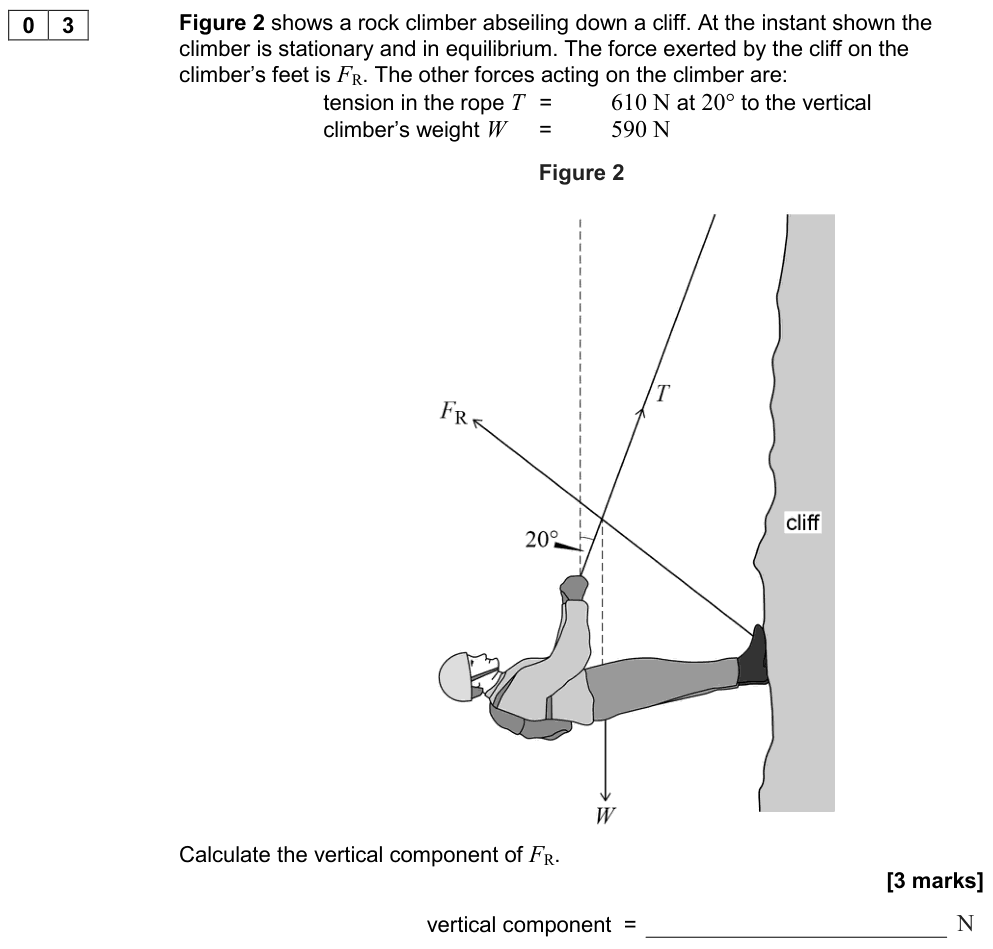
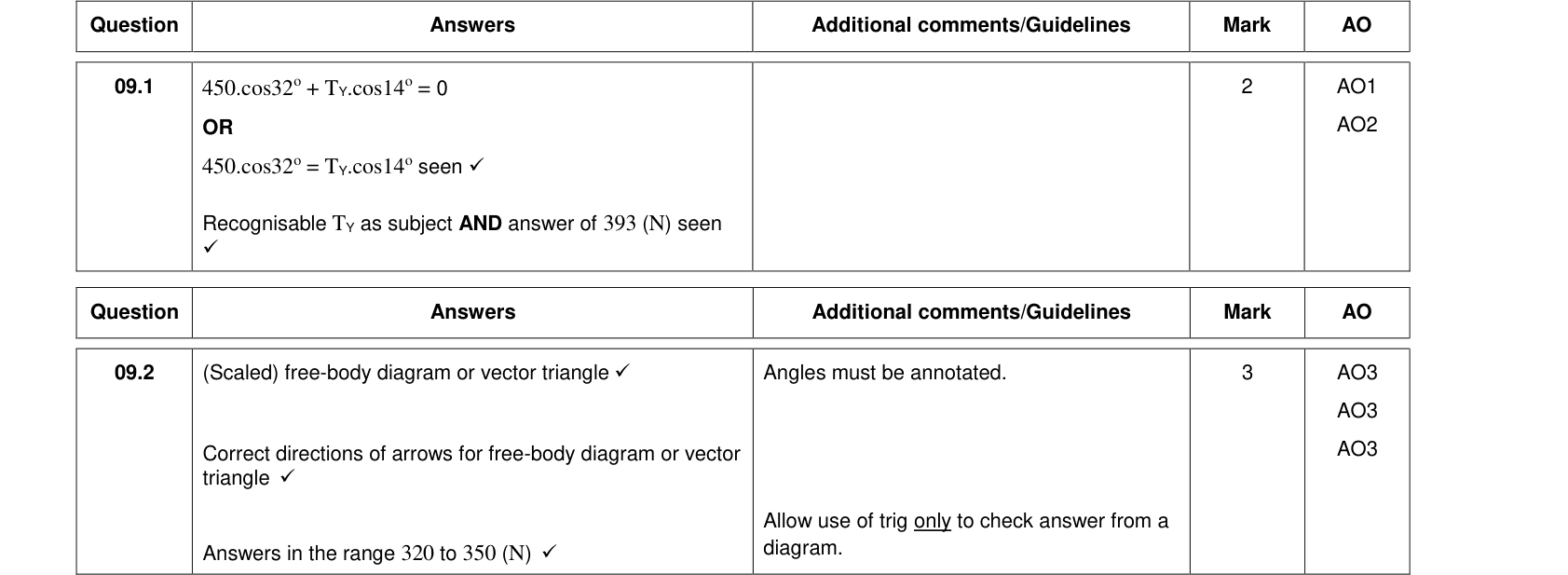
If three coplanar forces acting at a point are in equilibrium, then when they are drawn tip-to-tail they form a closed triangle. The resultant of any two forces is equal and opposite to the third.
Two methods for three-force problems:
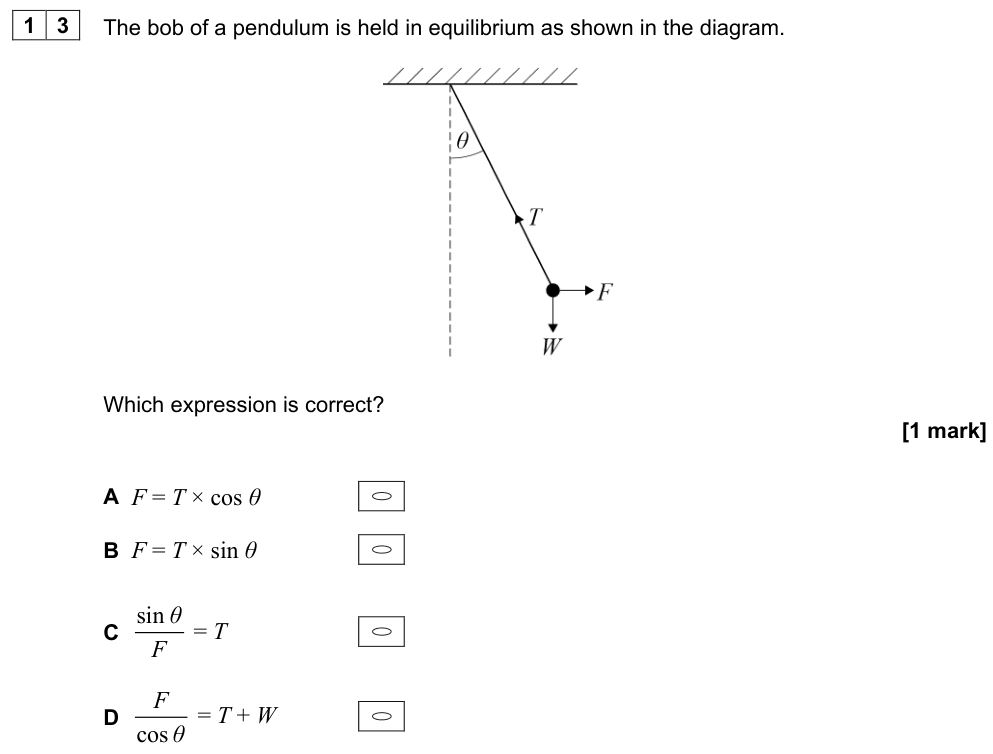
- Resolve every force into horizontal and vertical components. For equilibrium:
$$\sum F_x = 0 \quad \text{and} \quad \sum F_y = 0$$
- Draw the triangle of forces to scale (or use trigonometry / the sine rule on the triangle).
Worked example: hanging picture
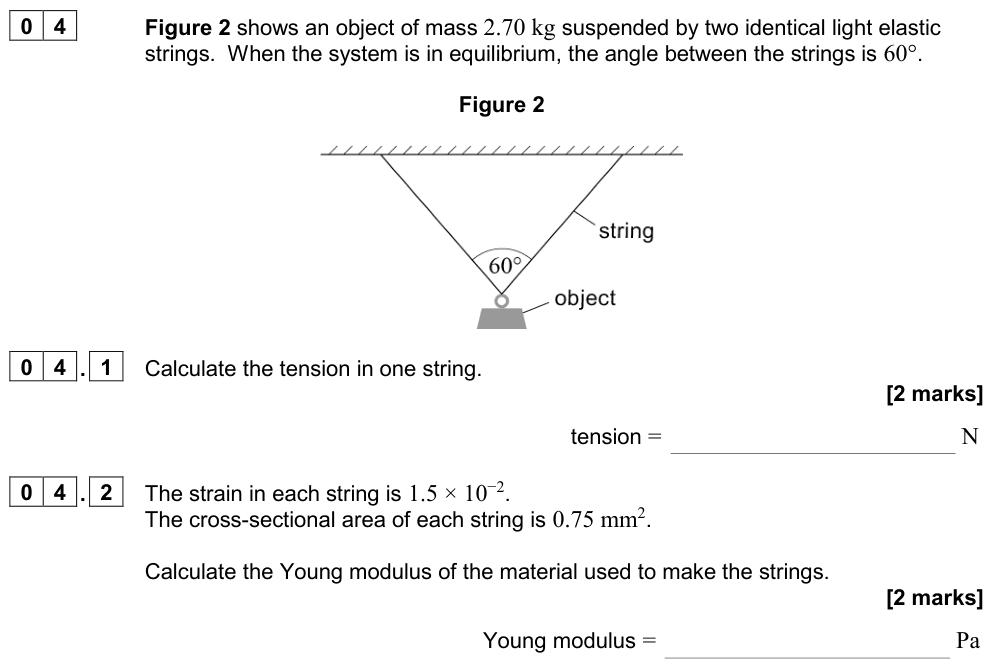
A picture of weight 20 N hangs from a nail by a string. Each half of the string makes an angle of $25^\circ$ with the horizontal. Find the tension $T$.
Horizontal components cancel by symmetry. Vertically:
$$2T\sin25^\circ = 20 \Rightarrow T = \frac{20}{2 \times 0.423} = 23.7\ \text{N}$$
The shallower the string, the smaller $\sin\theta$ and the larger the tension. This is why a washing line can never be pulled perfectly straight.
Worked example: three forces
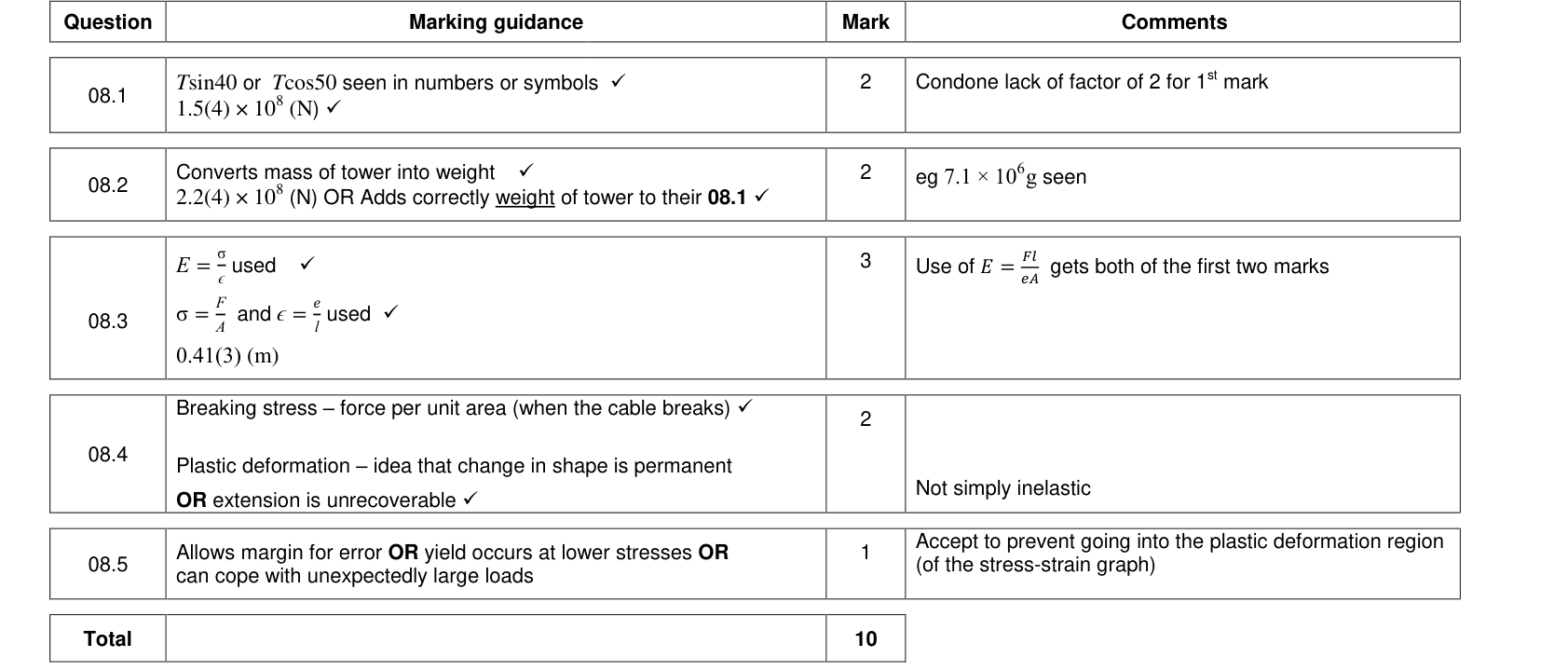
A lamp of weight 30 N hangs from two cables. Cable 1 makes $40^\circ$ with the vertical, cable 2 makes $60^\circ$ with the vertical. Find the tensions.
Horizontal: $T_1\sin40^\circ = T_2\sin60^\circ$
Vertical: $T_1\cos40^\circ + T_2\cos60^\circ = 30$
From the first equation $T_1 = 1.347\,T_2$. Substituting: $1.347T_2(0.766) + 0.5T_2 = 30 \Rightarrow 1.532\,T_2 = 30 \Rightarrow T_2 = 19.6\ \text{N}$ and $T_1 = 26.4\ \text{N}$.
Exam tip
"Constant velocity", "stationary", "terminal speed", "steady speed in a straight line" all mean resultant force = 0. Use these as a signal to resolve and set the sum of forces to zero.
Summary
- Scalars: magnitude only. Vectors: magnitude and direction.
- Add vectors tip-to-tail; use Pythagoras and $\tan\theta$ for perpendicular vectors, a scale drawing or components otherwise.
- Components: $F\cos\theta$ (adjacent) and $F\sin\theta$ (opposite). On a slope: $mg\sin\theta$ along, $mg\cos\theta$ perpendicular.
- Equilibrium: resultant force zero; three forces in equilibrium form a closed triangle.