Unstable nuclei and decay modes
Some nuclei are unstable. They decay spontaneously and randomly into a more stable nucleus, emitting radiation. You cannot predict when a particular nucleus will decay, and decay is not affected by temperature, pressure or chemical combination.
| Decay | What is emitted | Change to the nucleus | Typical cause |
|---|---|---|---|
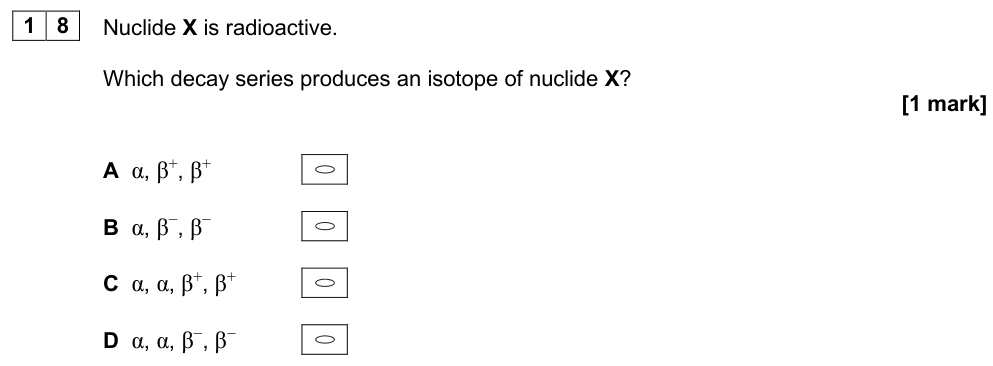
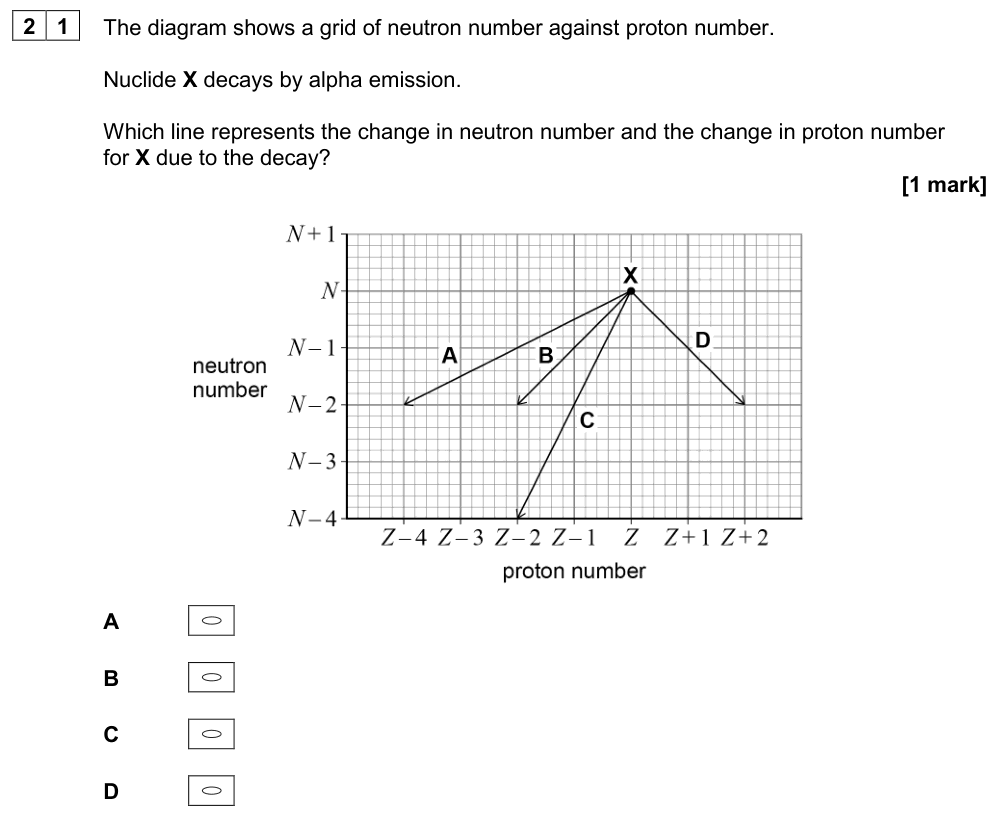
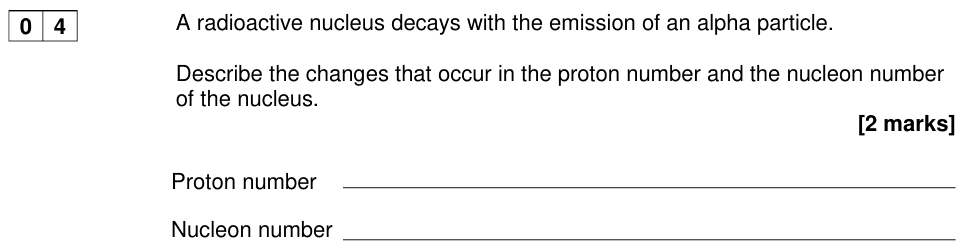
| alpha (α) | helium nucleus $^4_2$He (2p + 2n) | $Z \to Z - 2$, $A \to A - 4$ | nucleus too large/heavy |
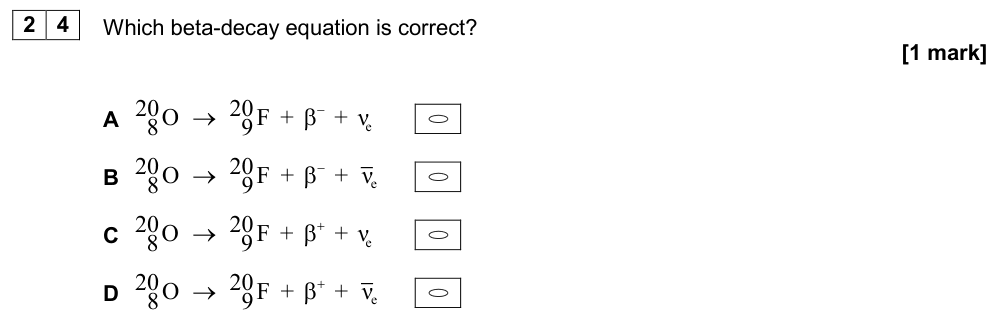
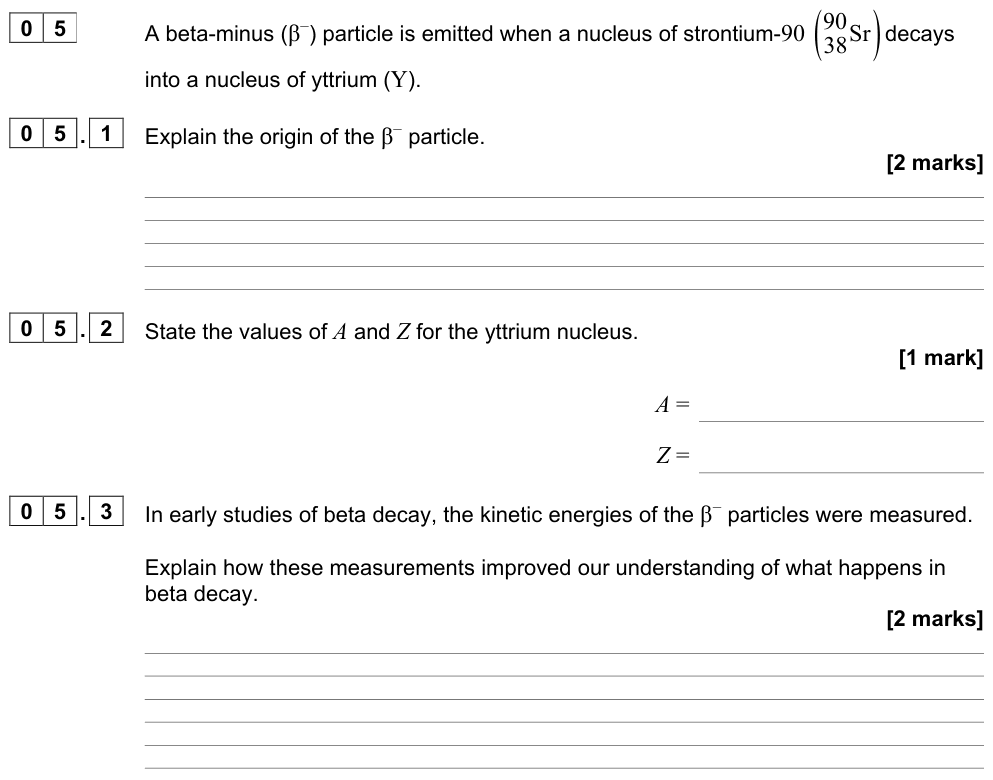
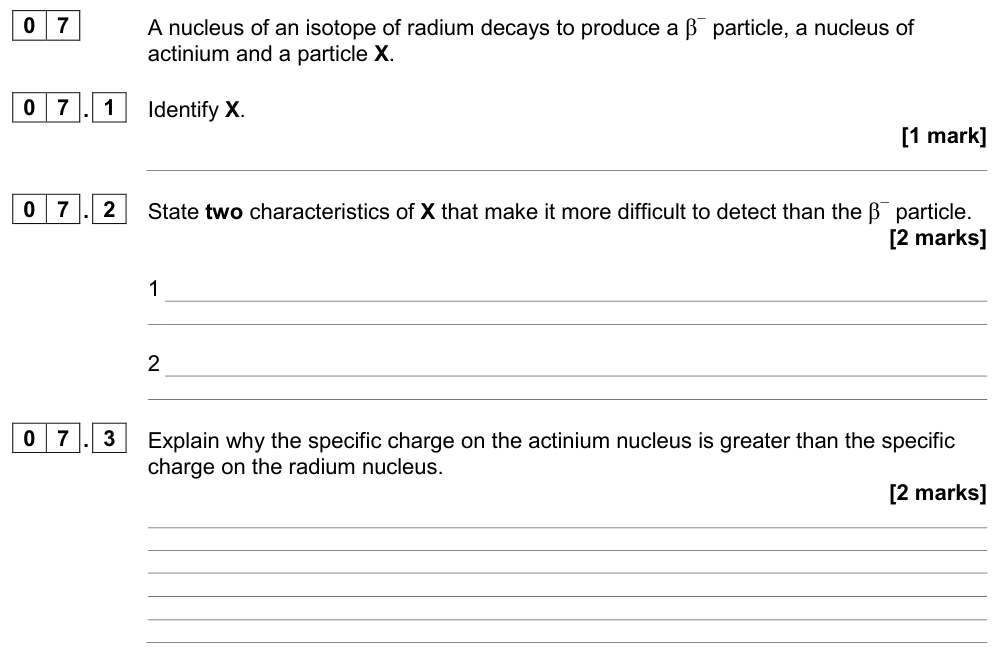
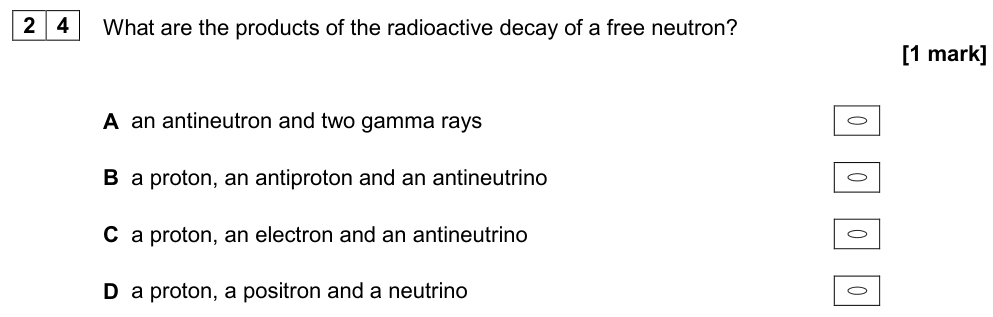
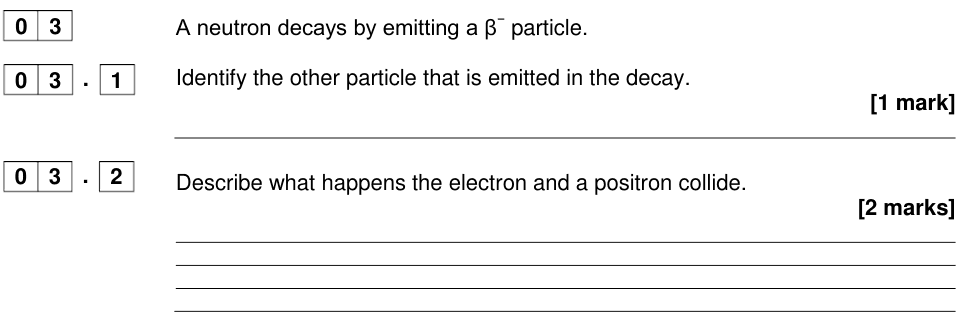
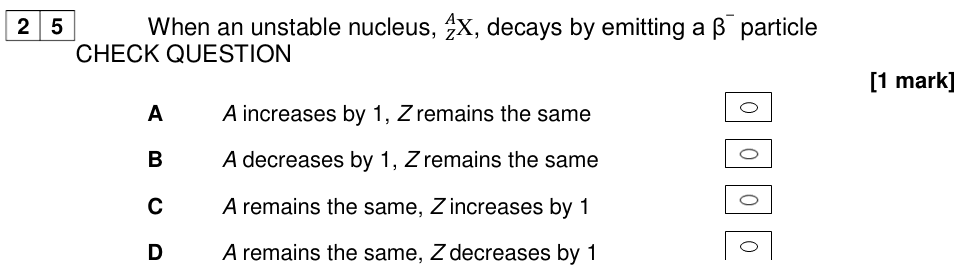
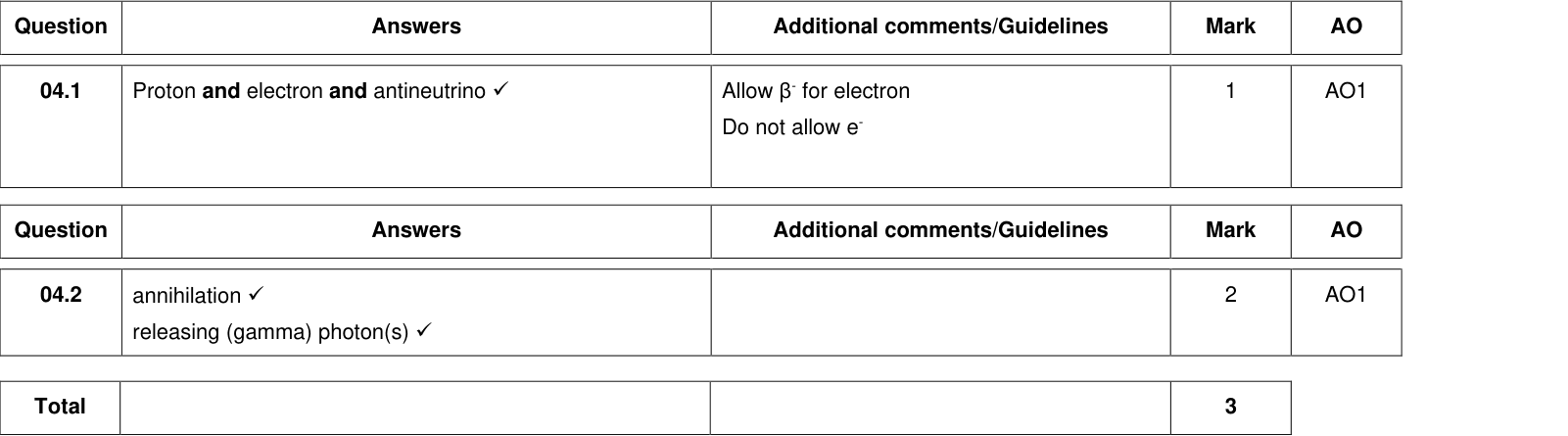
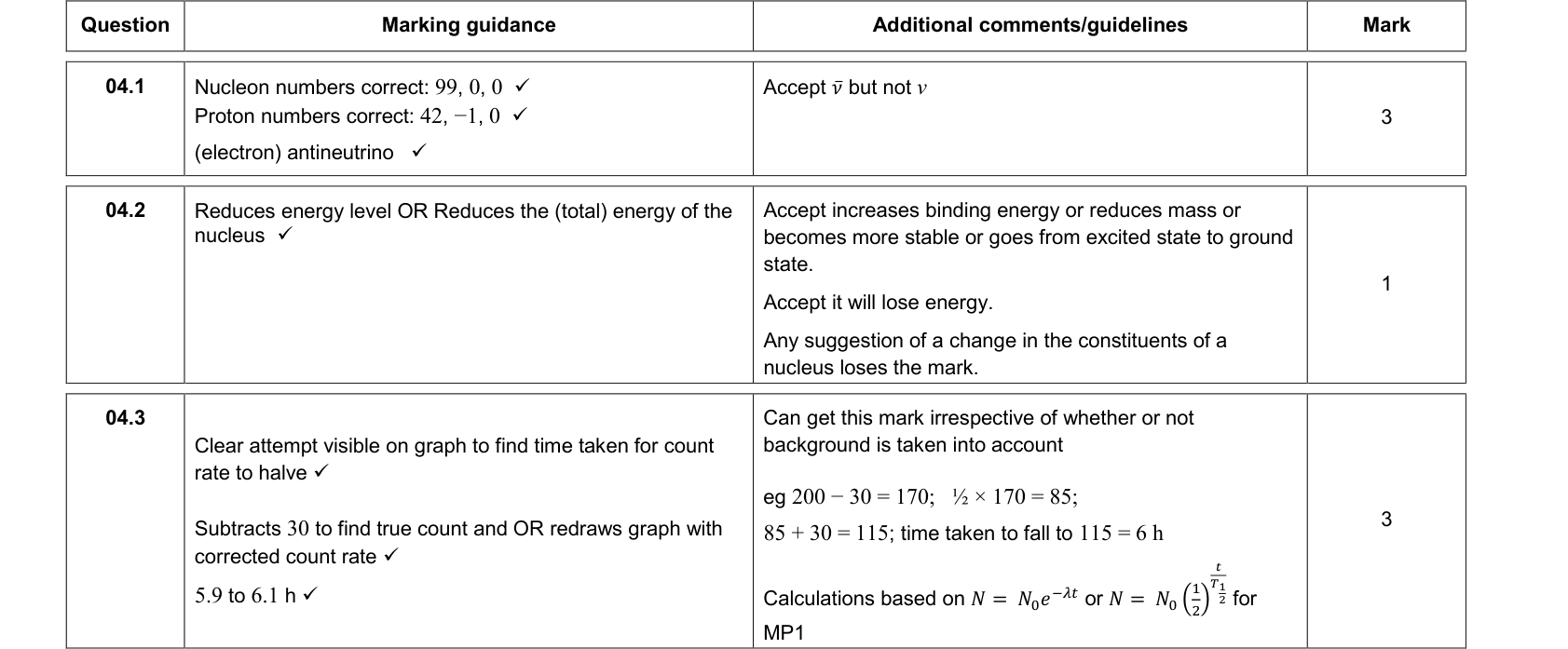
| beta-minus (β⁻) | electron $^{\ 0}_{-1}$e + antineutrino $\bar\nu_e$ | $Z \to Z + 1$, $A$ unchanged (n → p) | too many neutrons |
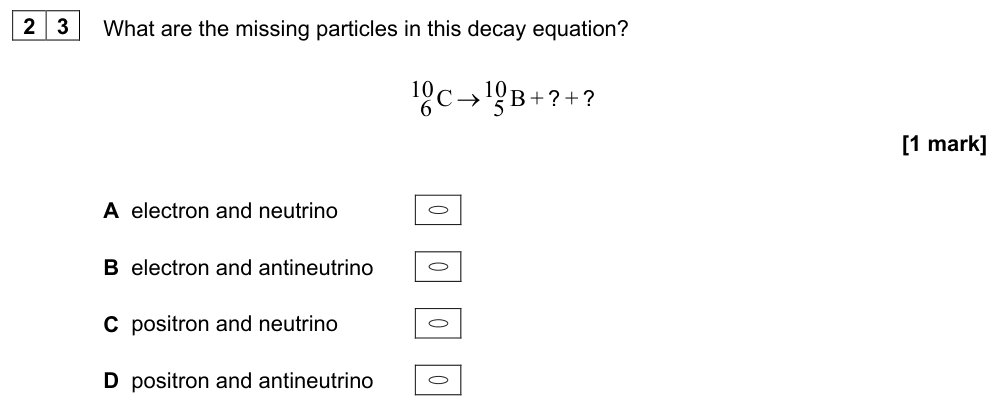
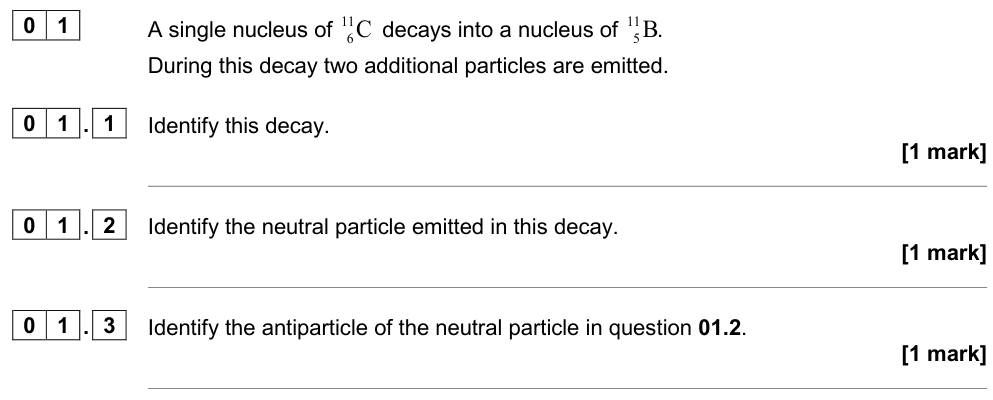
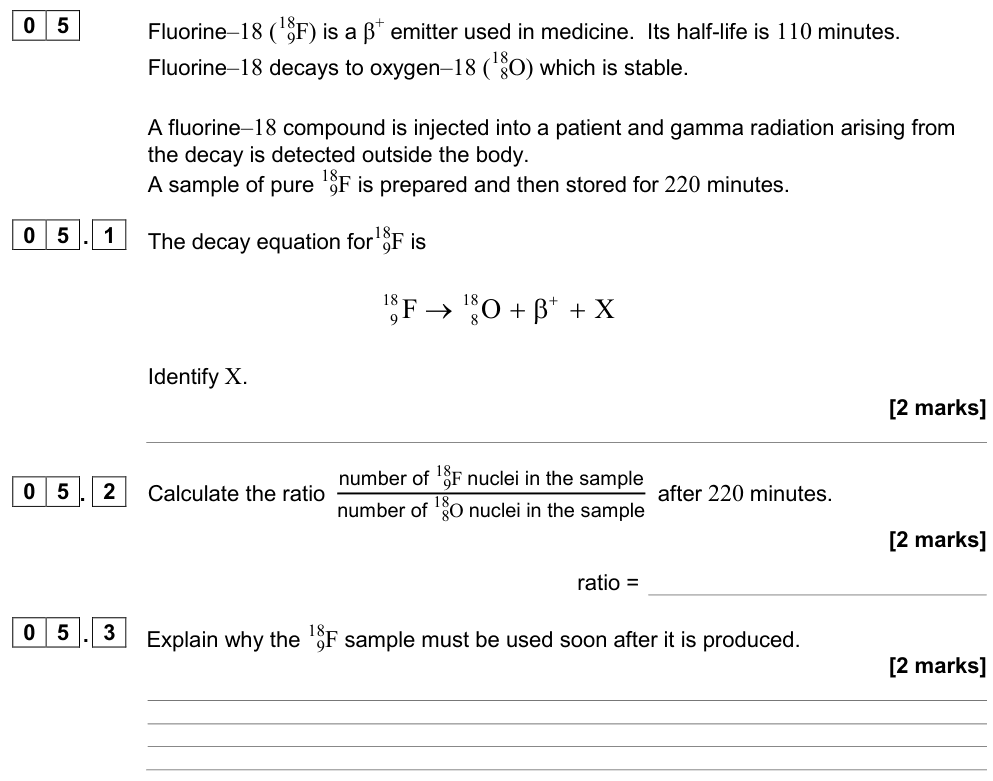
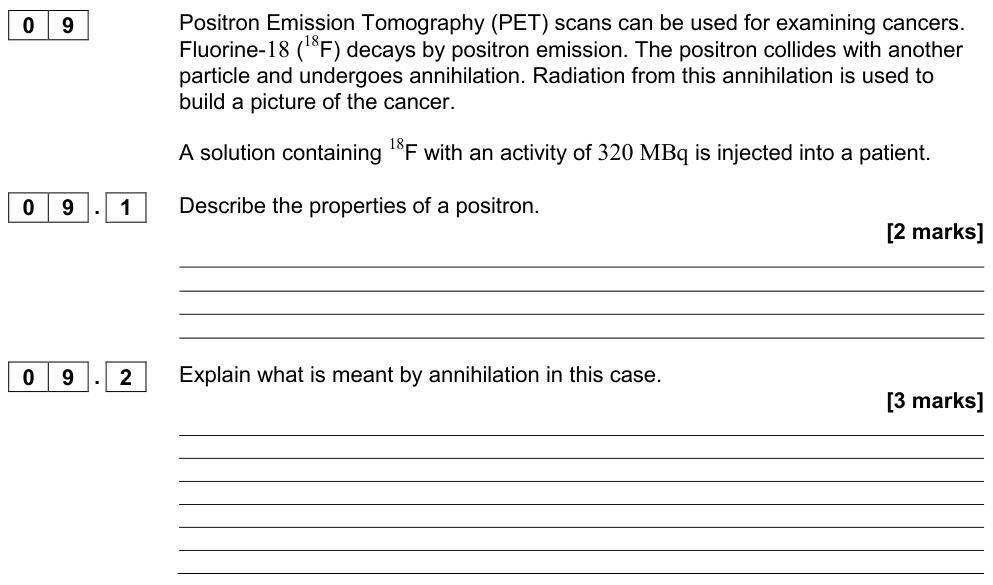
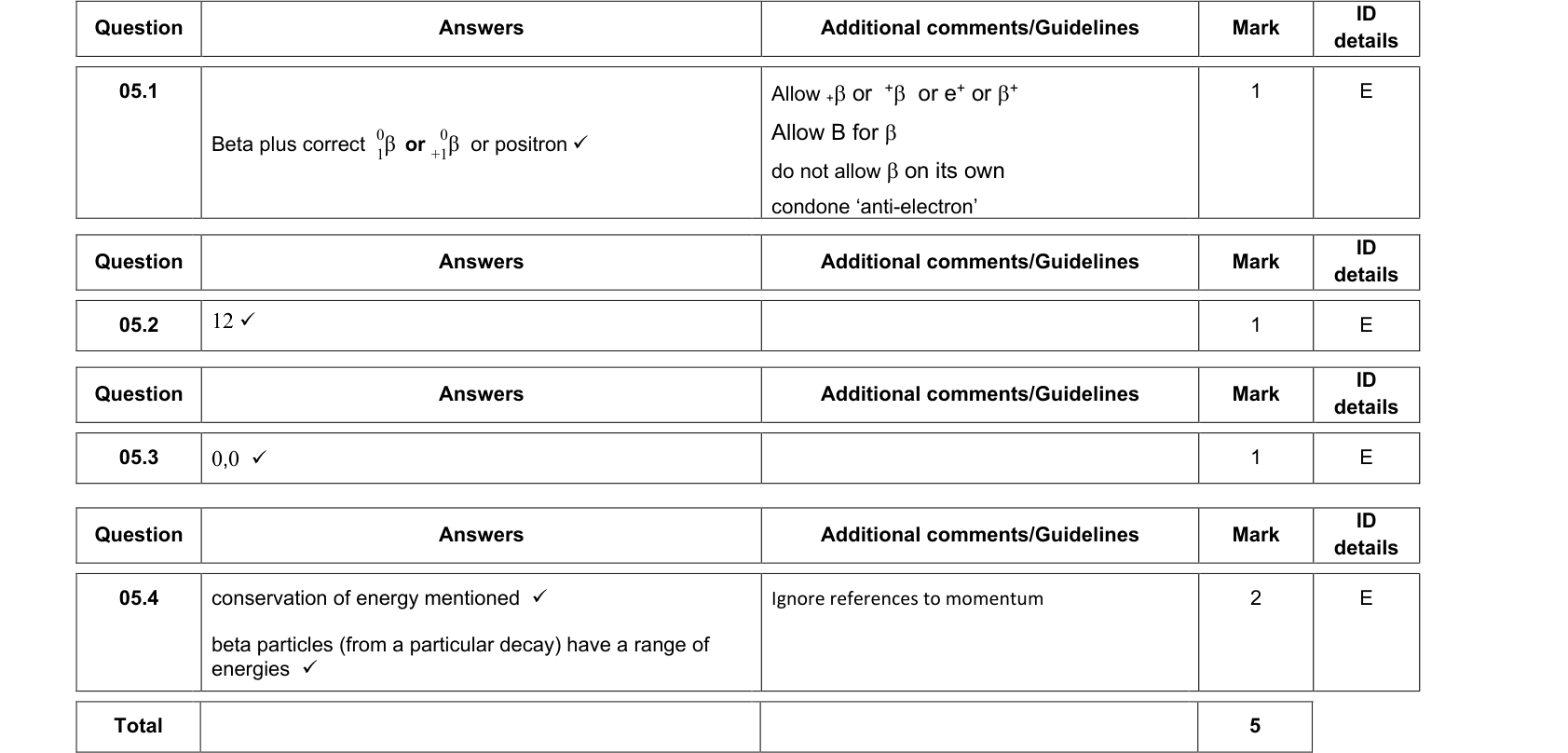
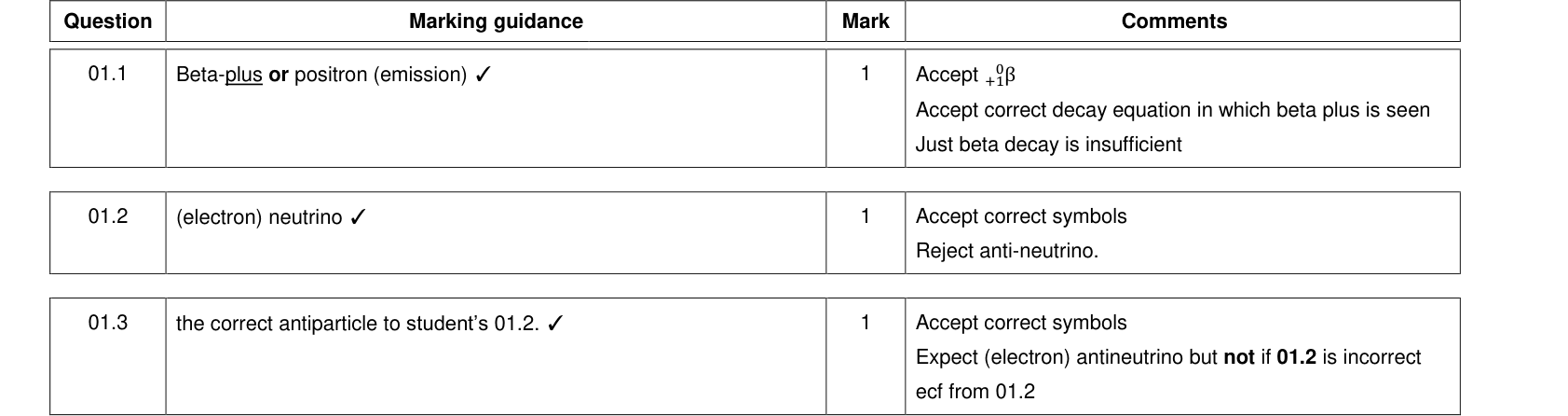
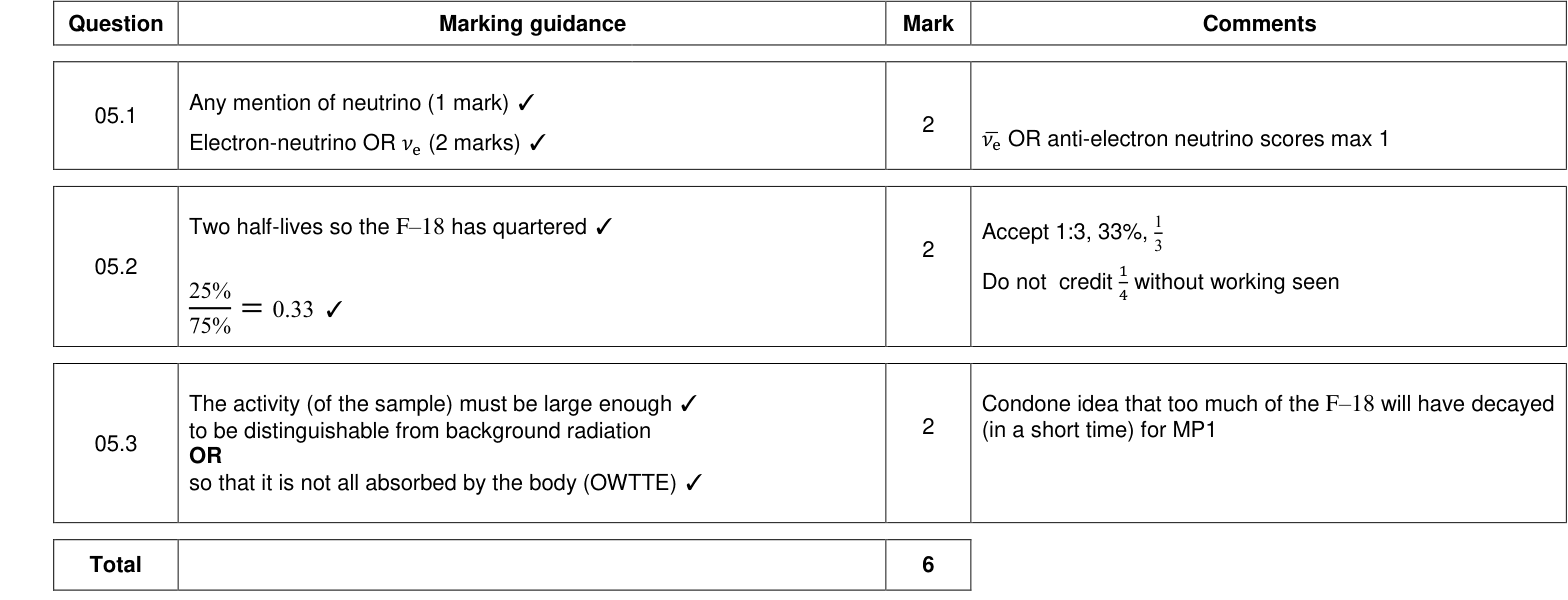
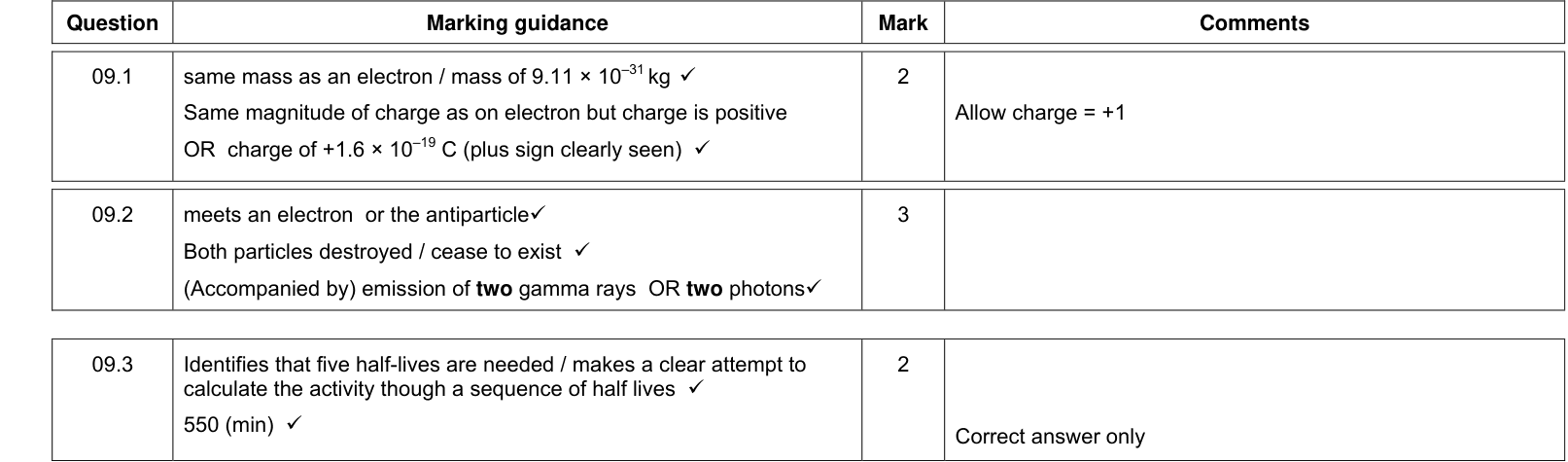
| beta-plus (β⁺) | positron $^0_{+1}$e + neutrino $\nu_e$ | $Z \to Z - 1$, $A$ unchanged (p → n) | too many protons |
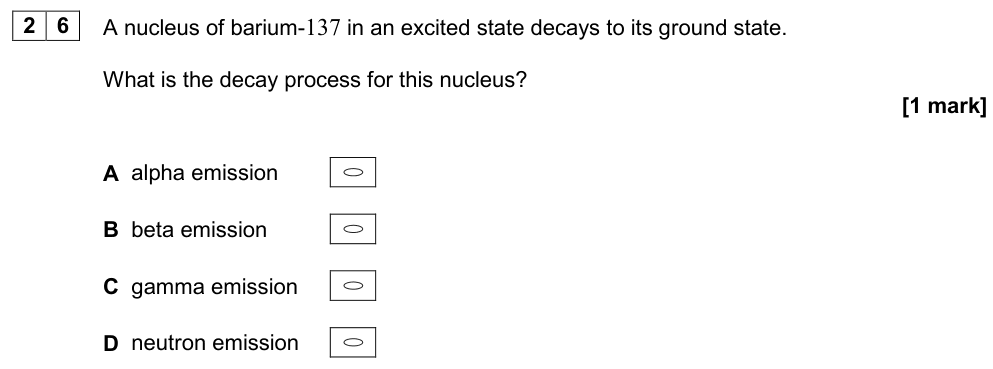
| gamma (γ) | high-energy photon | no change in $Z$ or $A$ | nucleus left in an excited state |
Decay equations
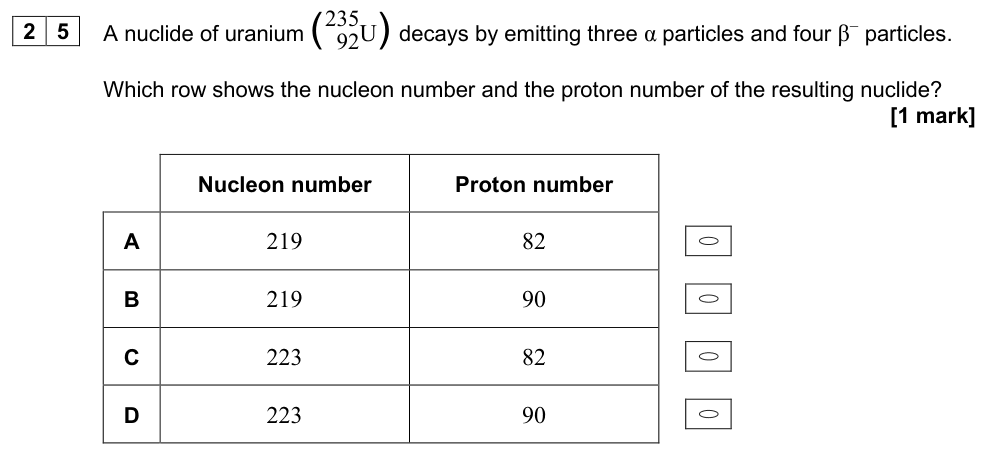
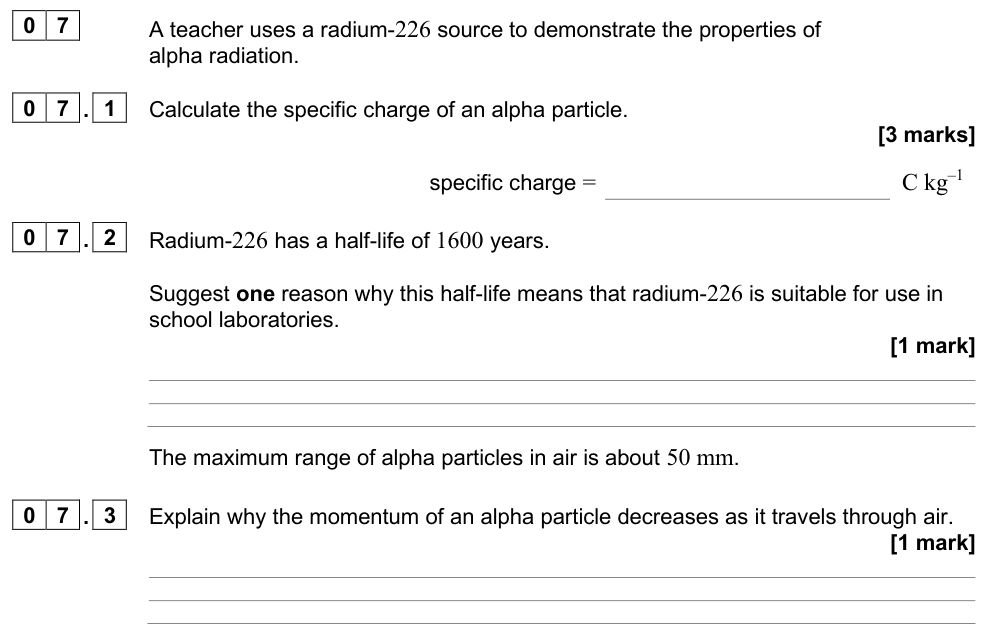
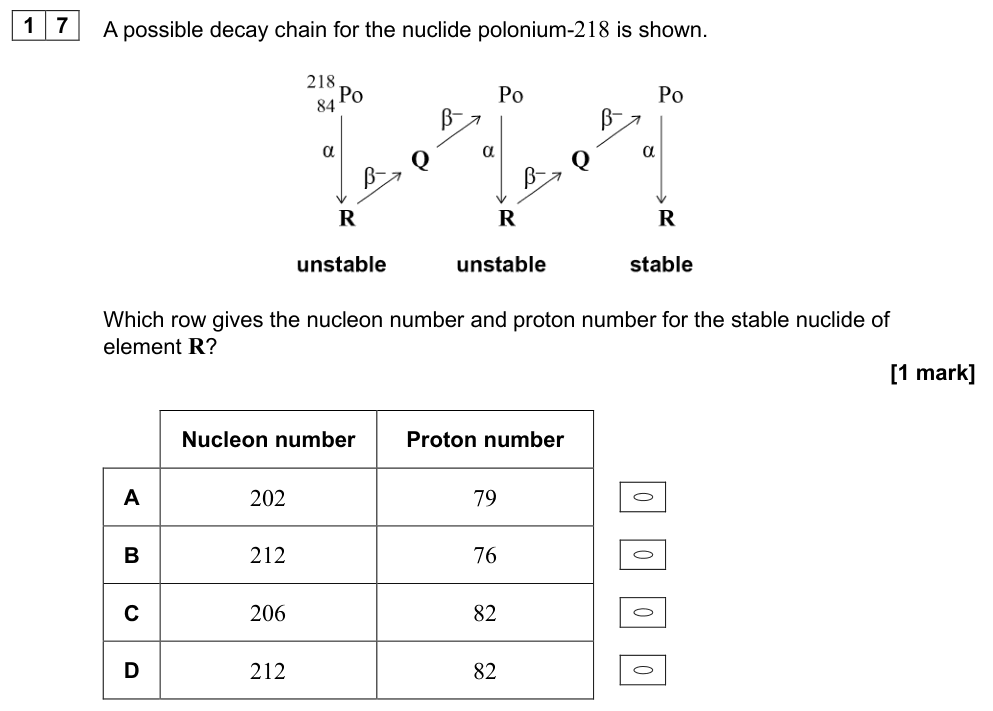
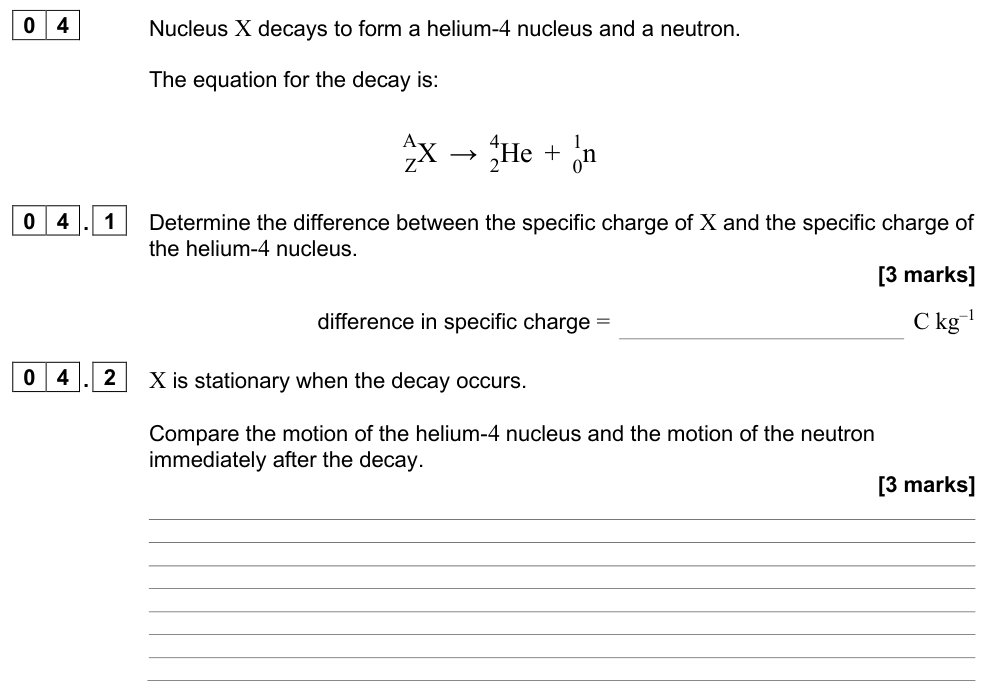
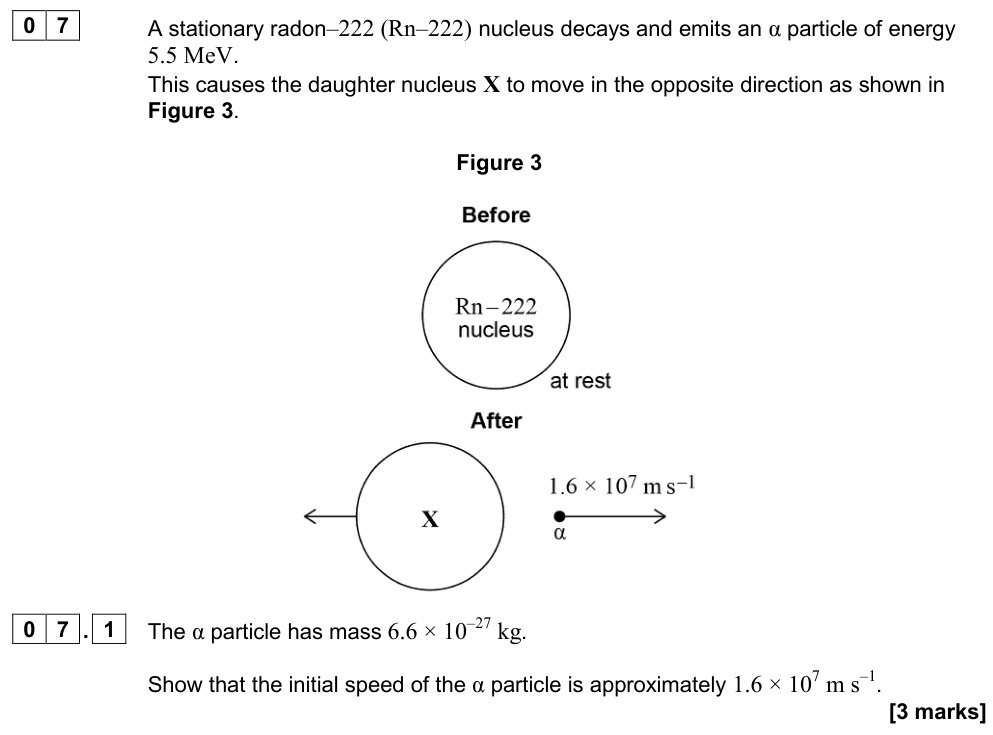
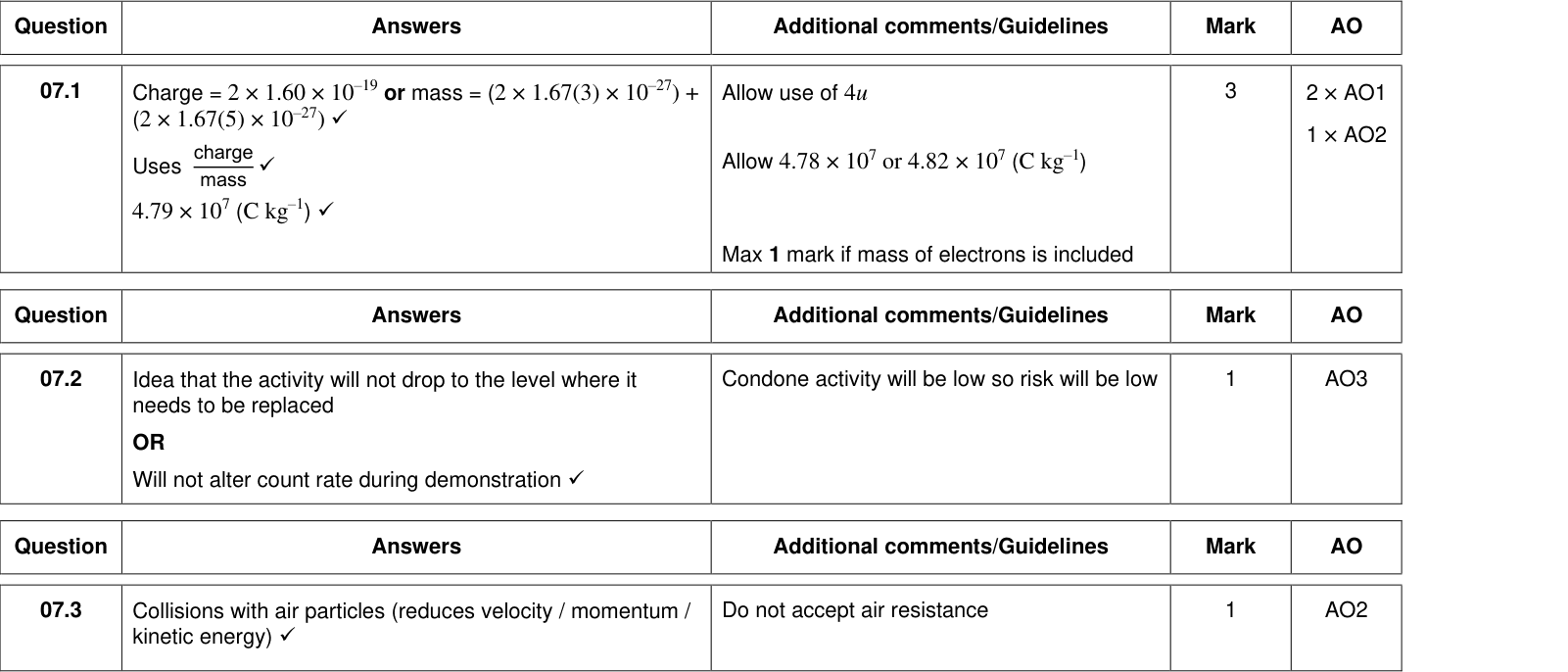
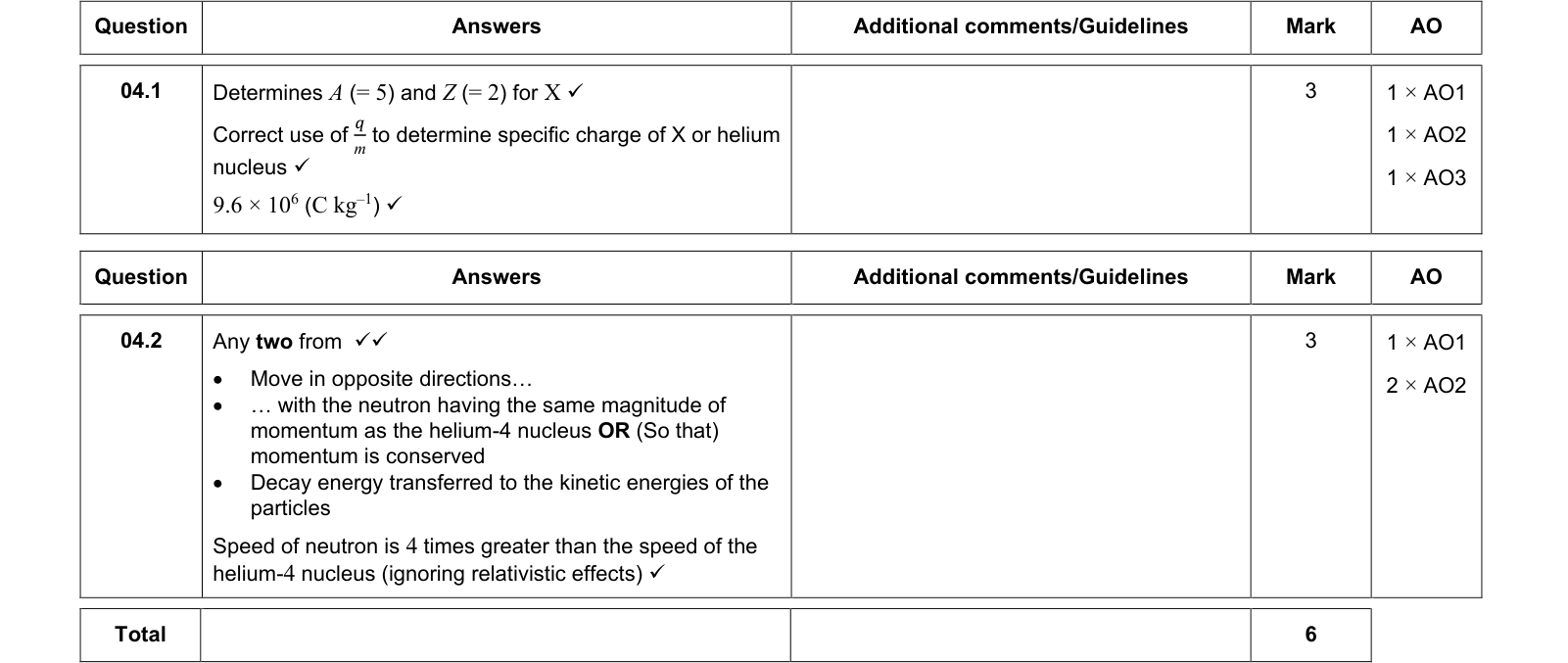
Alpha: $\ ^{A}_{Z}\text{X} \rightarrow\ ^{A-4}_{Z-2}\text{Y} +\ ^4_2\alpha$ e.g. $^{226}_{88}\text{Ra} \rightarrow\ ^{222}_{86}\text{Rn} +\ ^4_2\alpha$
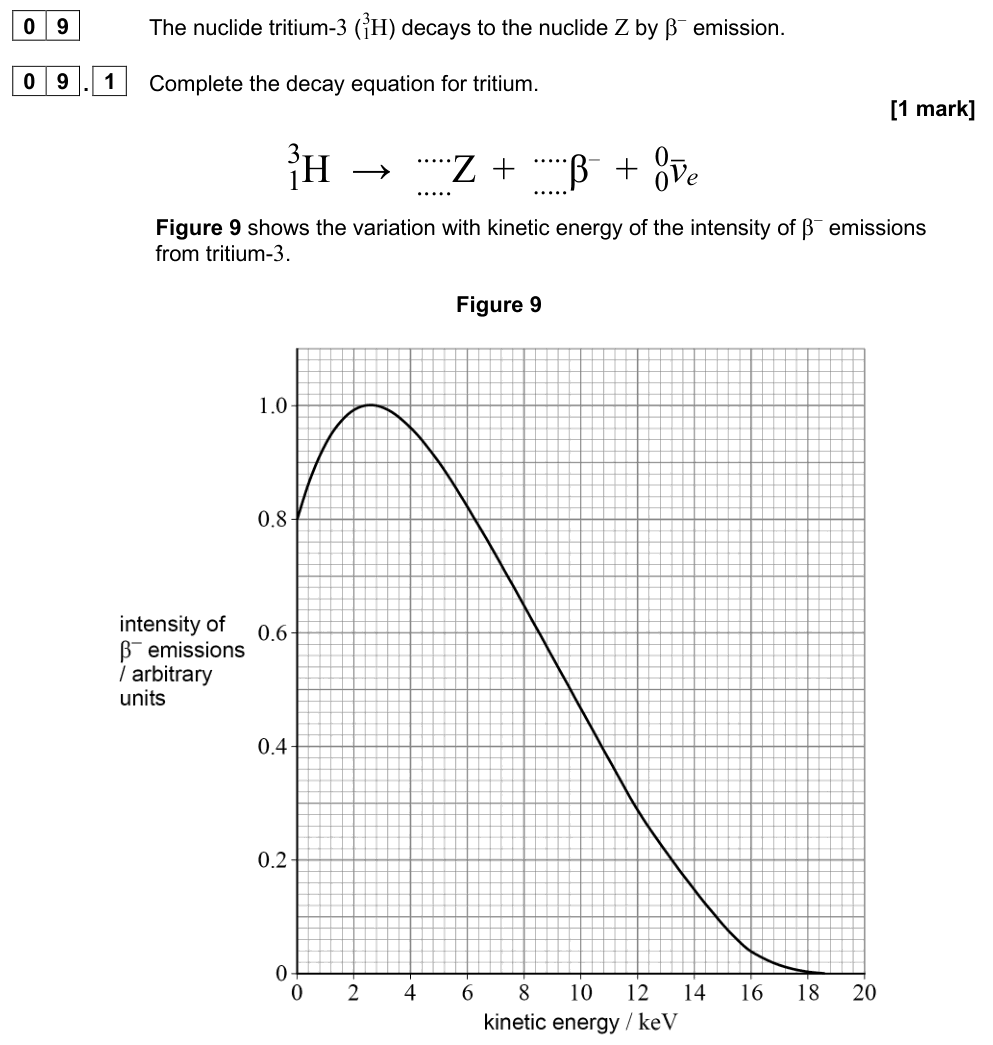
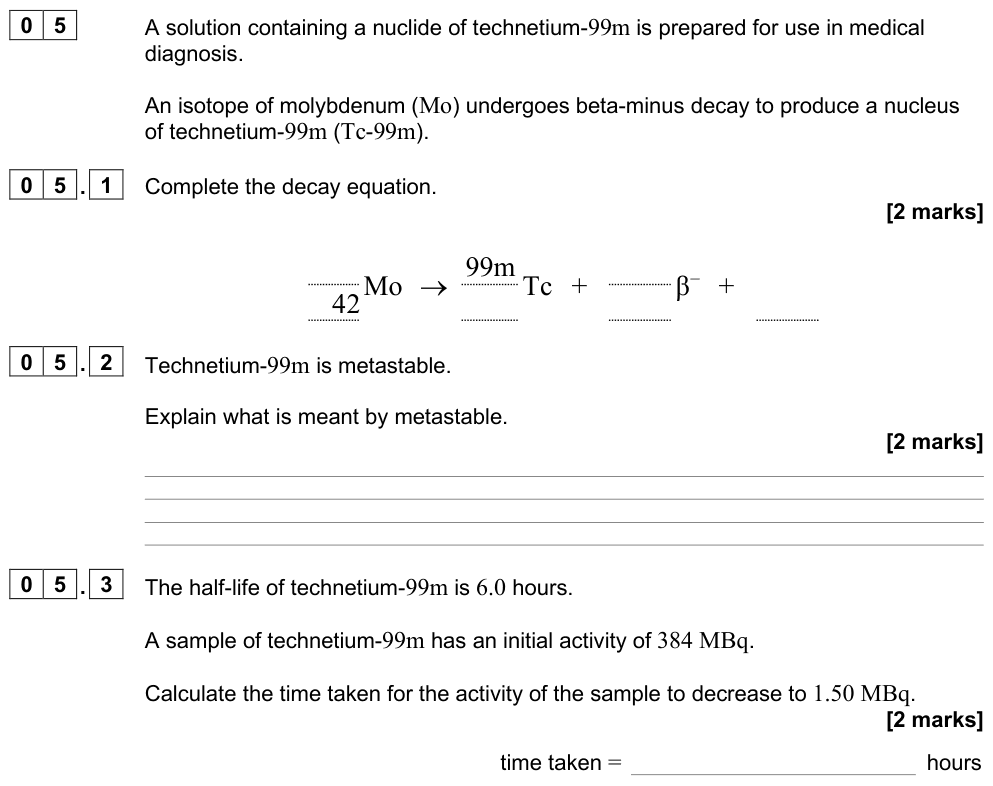
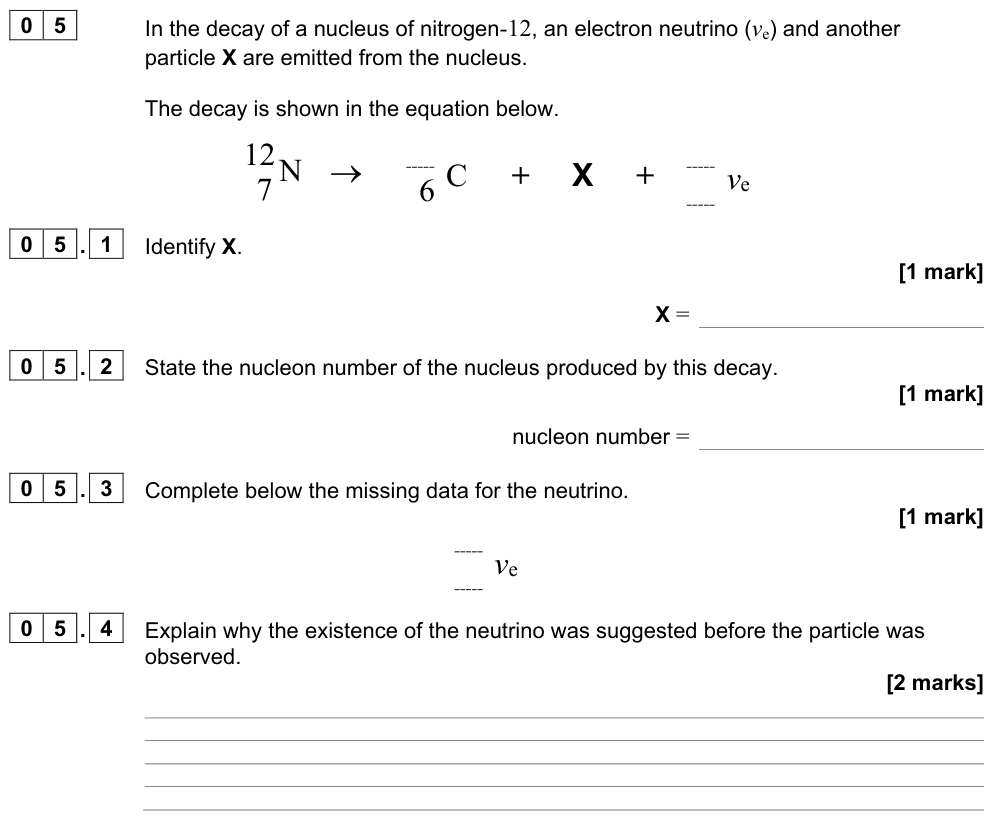
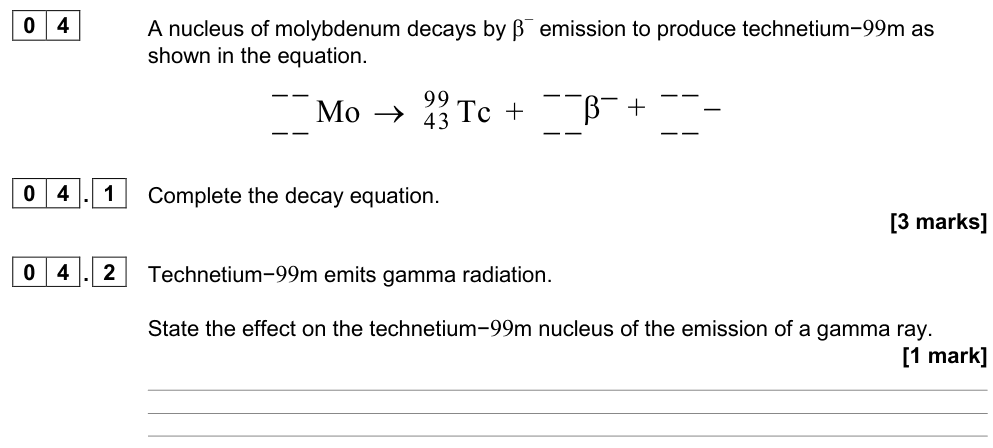
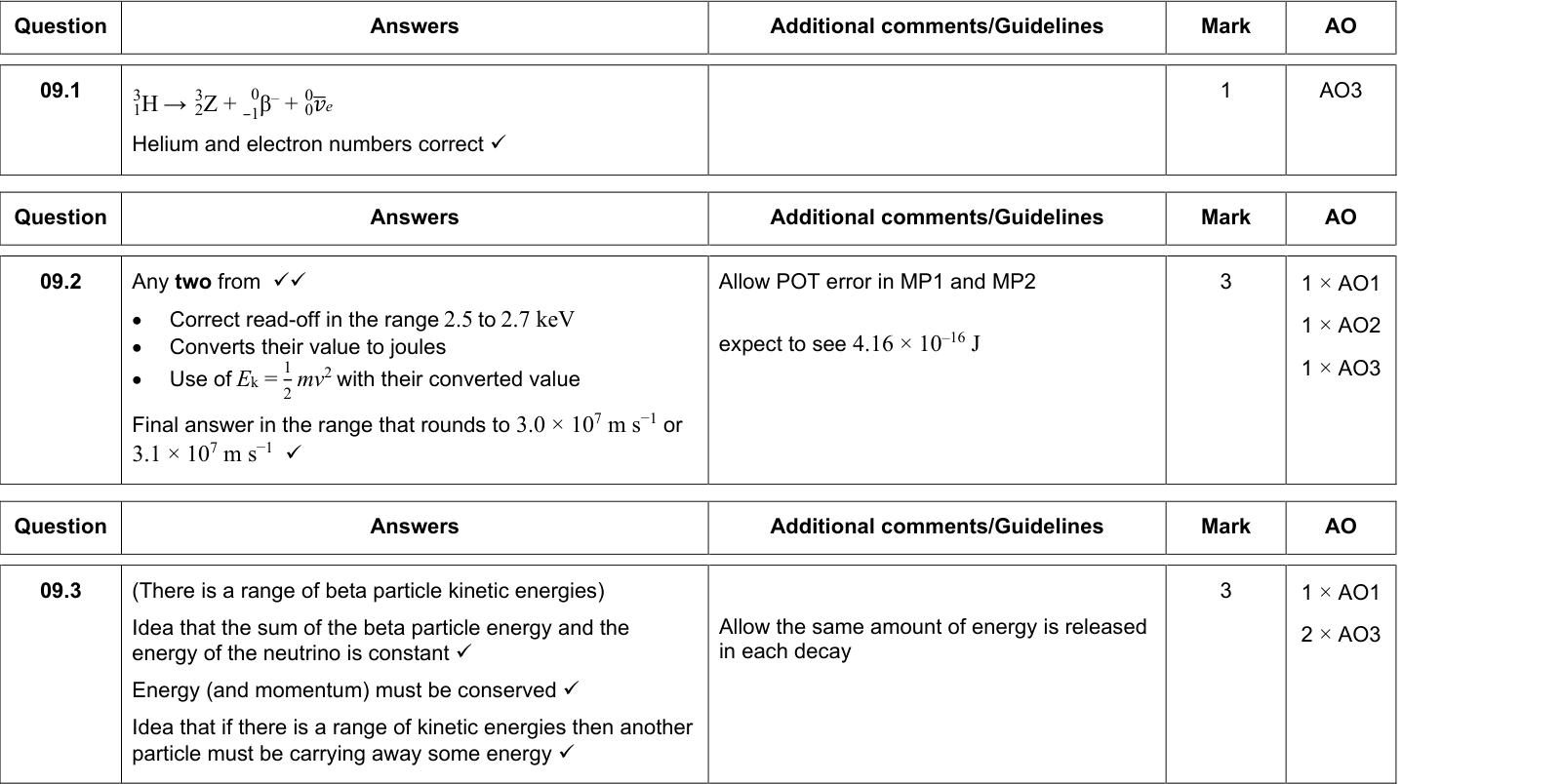
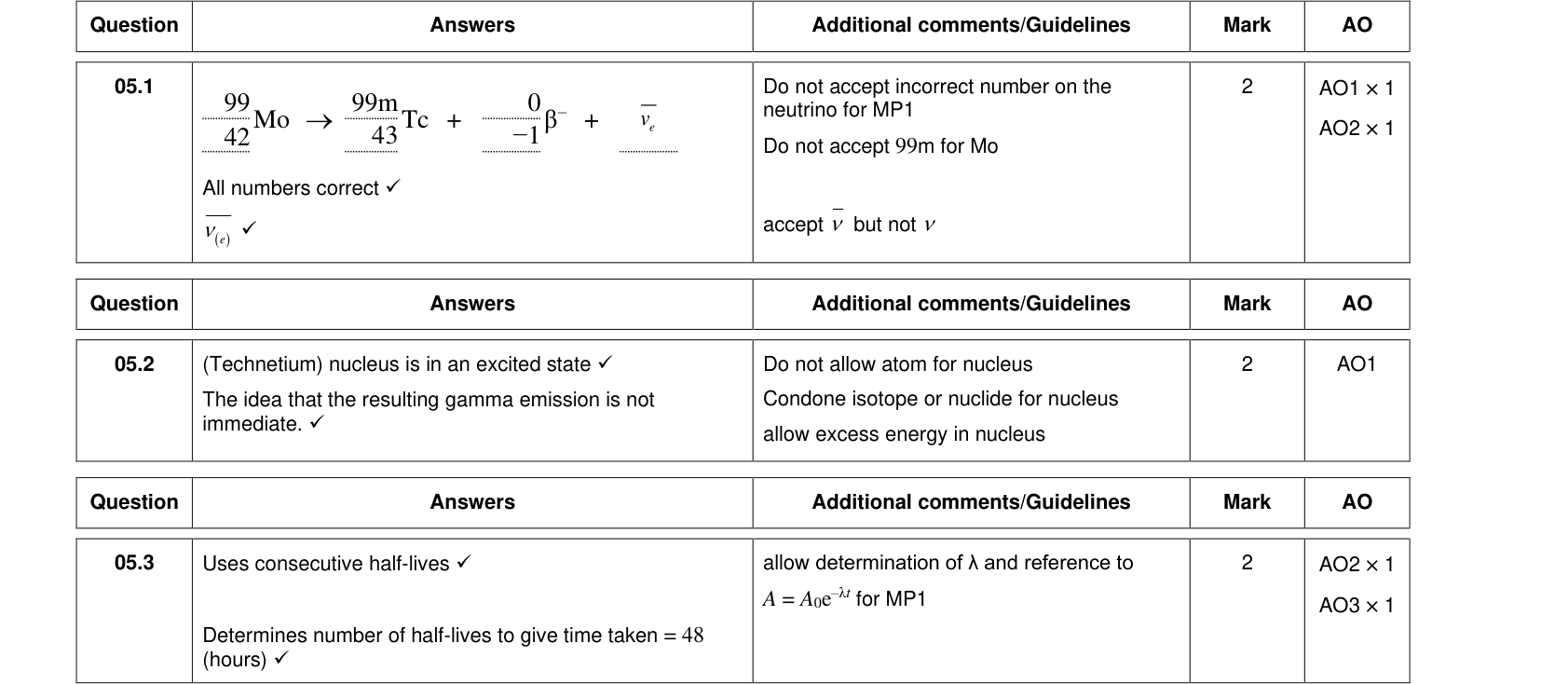
Beta-minus: $\ ^{A}_{Z}\text{X} \rightarrow\ ^{A}_{Z+1}\text{Y} +\ ^{\ 0}_{-1}\beta + \bar\nu_e$ e.g. $^{14}_{6}\text{C} \rightarrow\ ^{14}_{7}\text{N} +\ ^{\ 0}_{-1}\beta + \bar\nu_e$
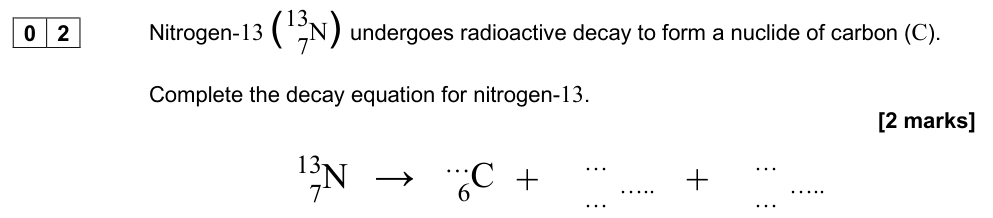
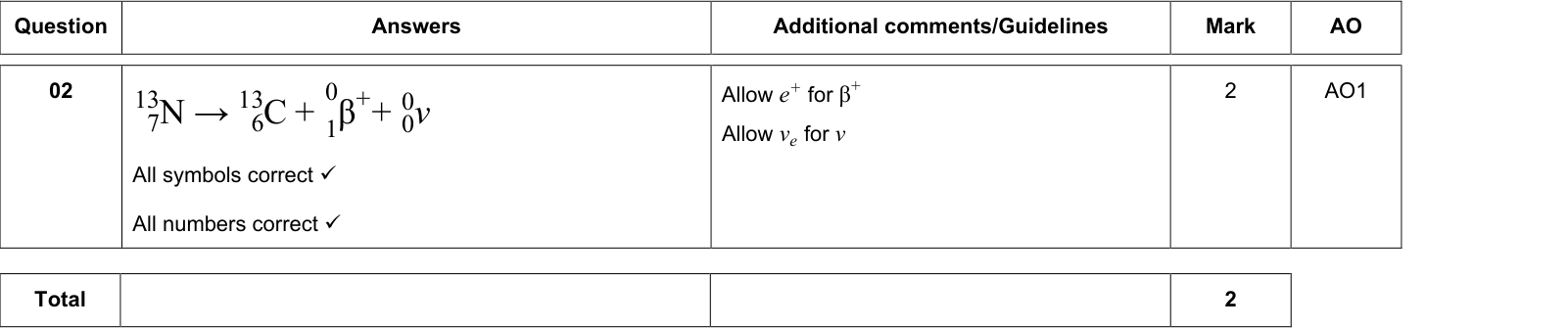
Beta-plus: $\ ^{A}_{Z}\text{X} \rightarrow\ ^{A}_{Z-1}\text{Y} +\ ^{0}_{+1}\beta + \nu_e$ e.g. $^{11}_{6}\text{C} \rightarrow\ ^{11}_{5}\text{B} +\ ^{0}_{+1}\beta + \nu_e$
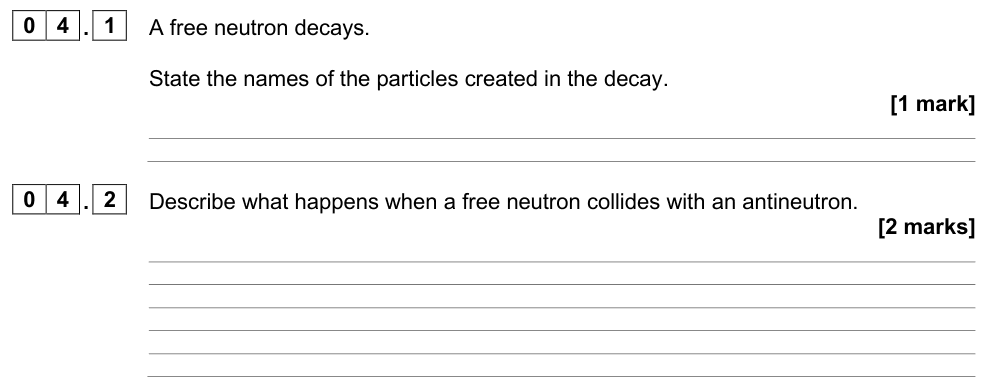
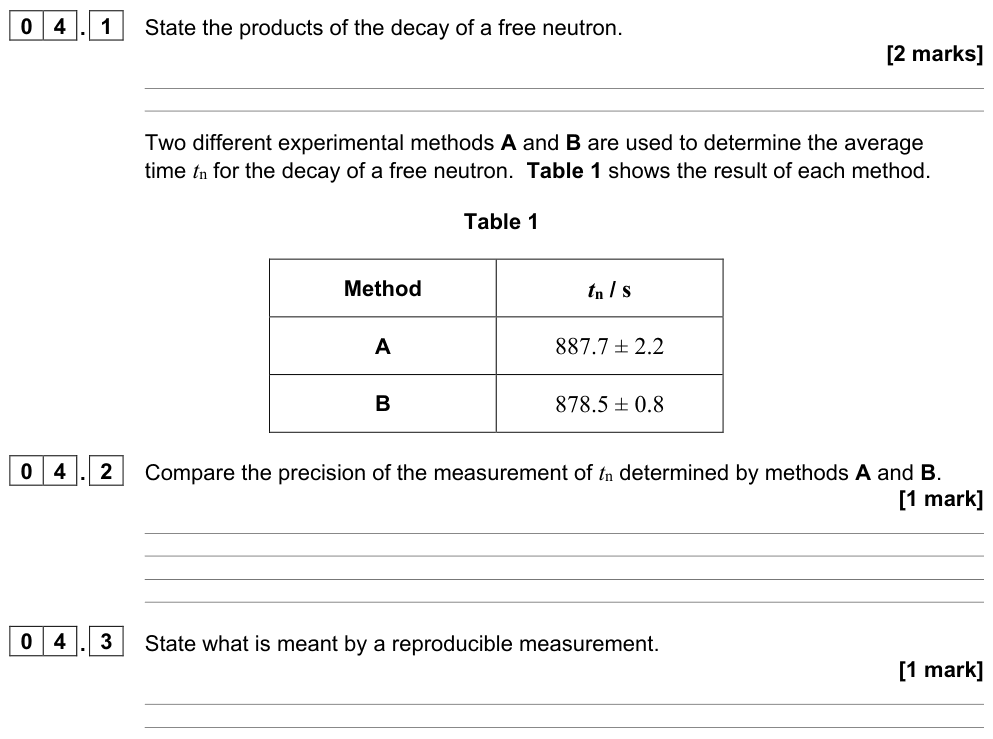
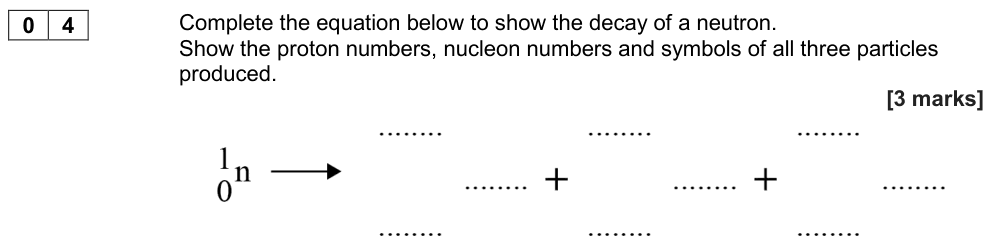
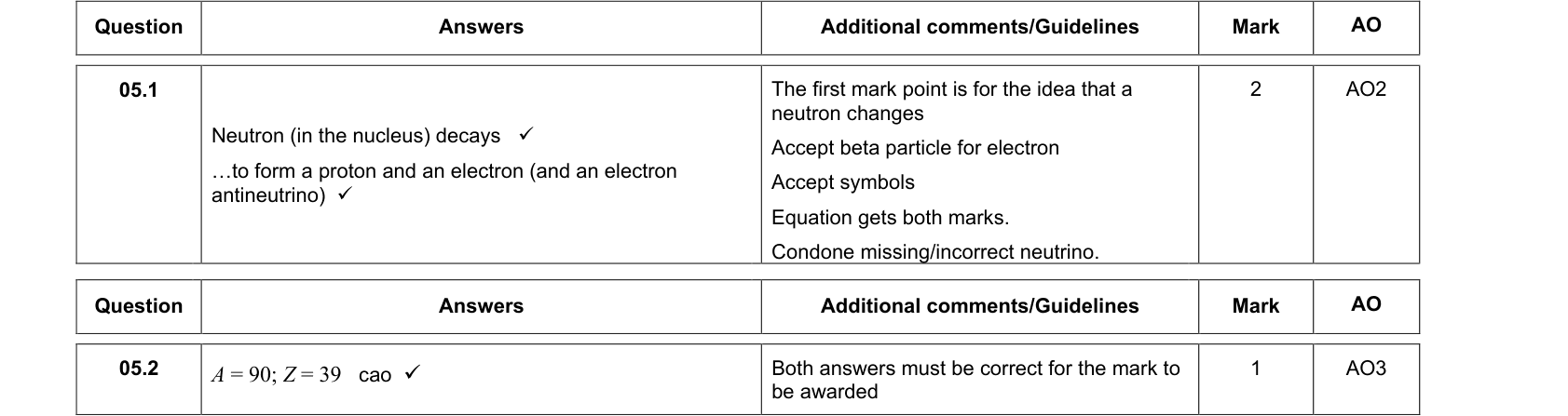
Free neutron: $\ ^{1}_{0}\text{n} \rightarrow\ ^{1}_{1}\text{p} +\ ^{\ 0}_{-1}\beta + \bar\nu_e$
In every equation the nucleon numbers balance (top line) and the proton/charge numbers balance (bottom line). A β⁻ particle has proton number −1; a β⁺ particle has +1; neutrinos have 0 for both.
Exam tip: decay chains
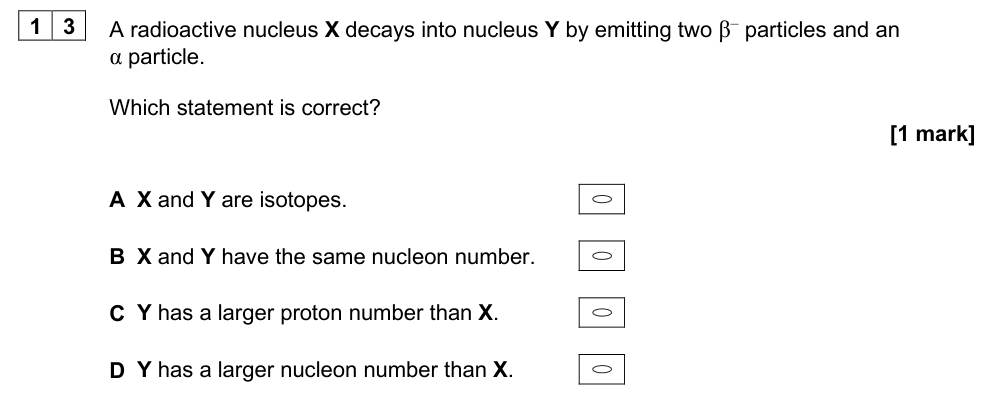
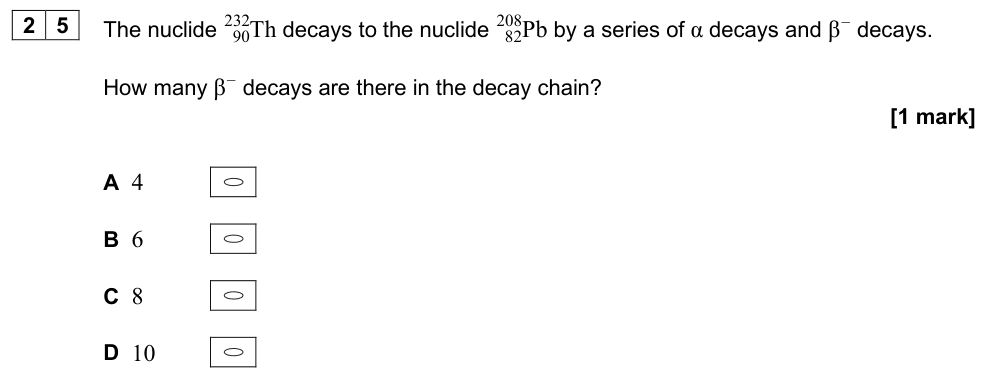
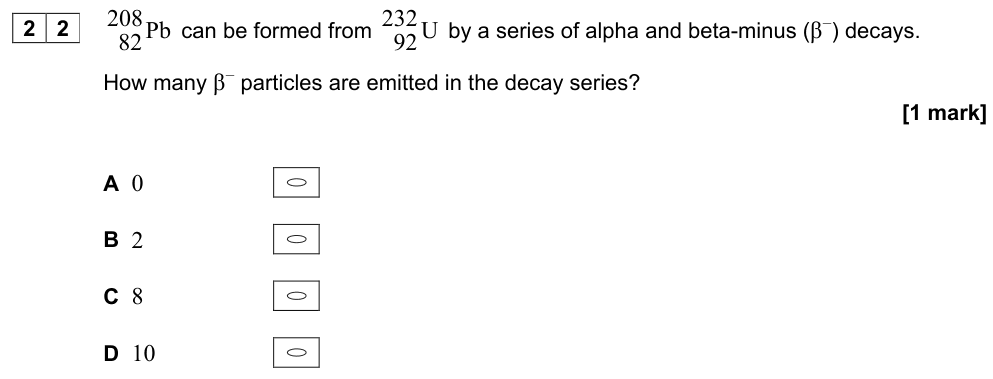
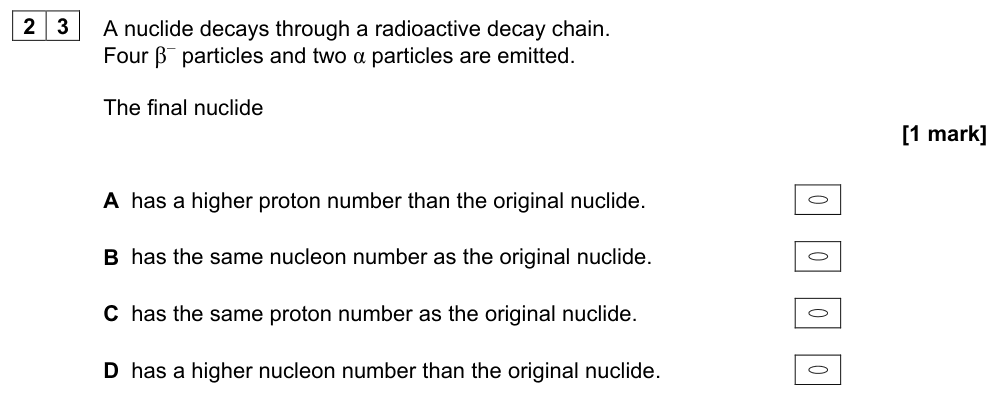
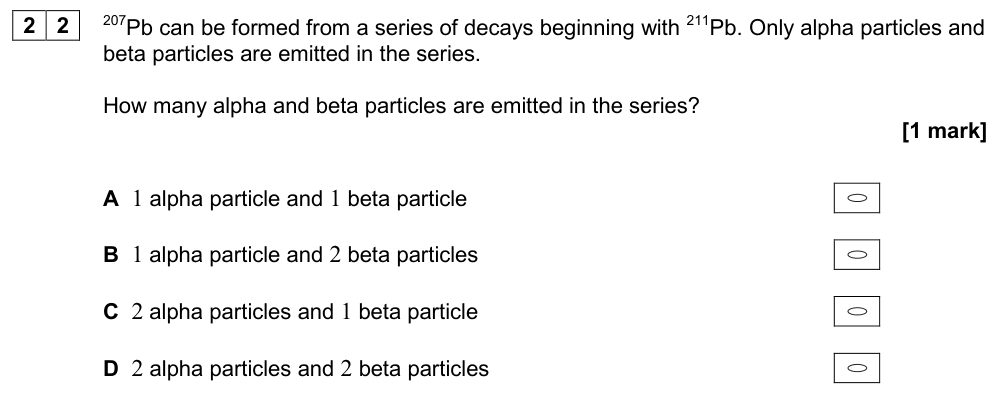
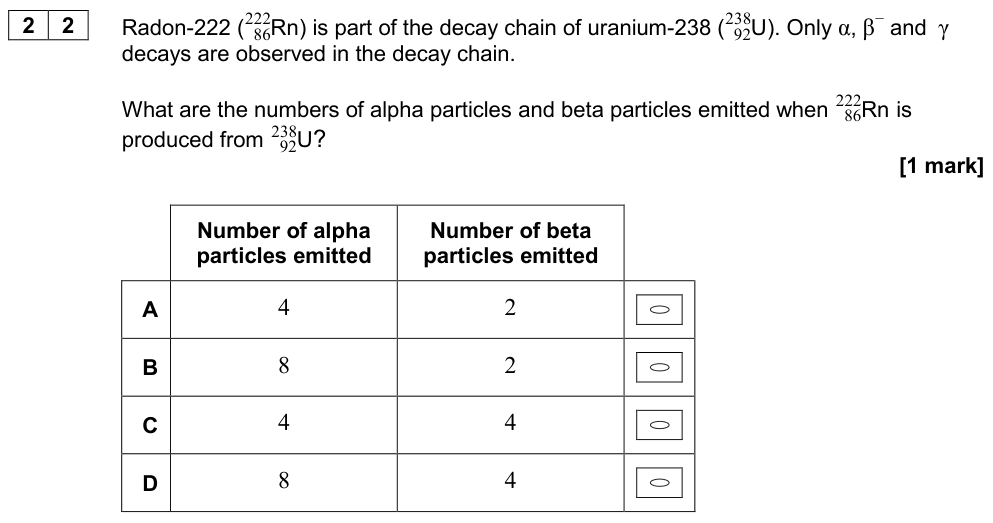
For a series of decays from $^{A_1}_{Z_1}$X to $^{A_2}_{Z_2}$Y: number of α decays $= \dfrac{A_1 - A_2}{4}$ (only α changes $A$). Then use the change in $Z$: each α reduces $Z$ by 2, each β⁻ increases $Z$ by 1.
Example: $^{238}_{92}$U → $^{206}_{82}$Pb. α decays $= 32/4 = 8$, which alone would reduce $Z$ by 16 to 76. To reach 82 needs 6 β⁻ decays.
The neutrino
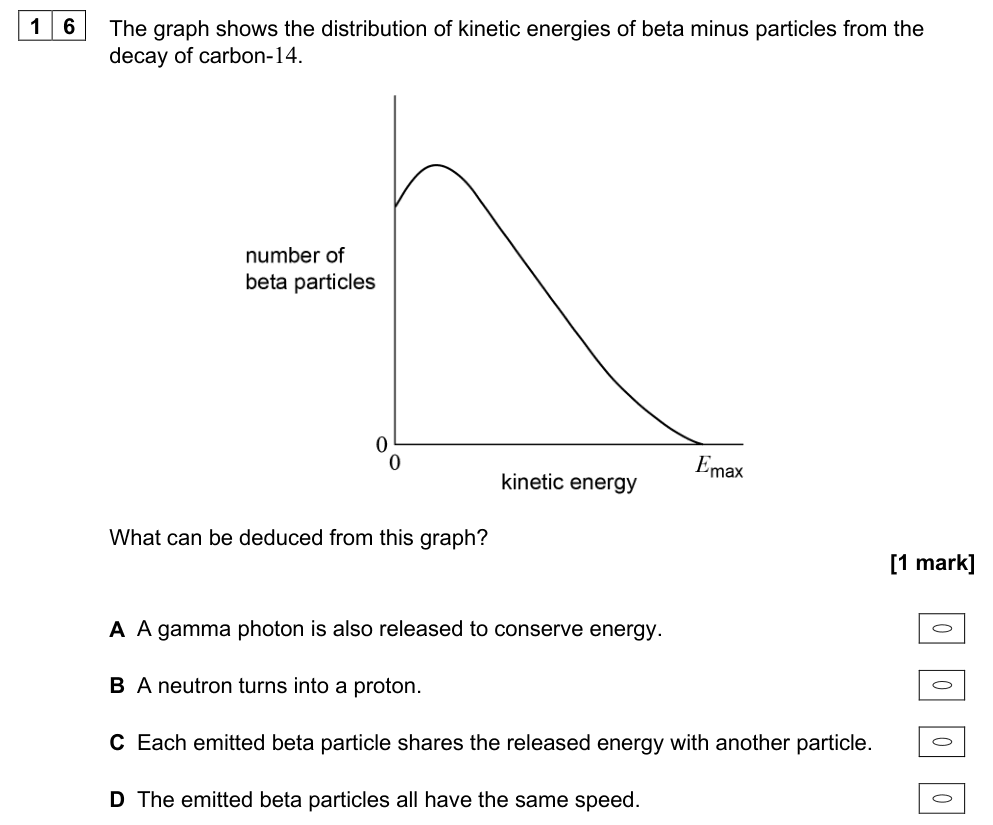
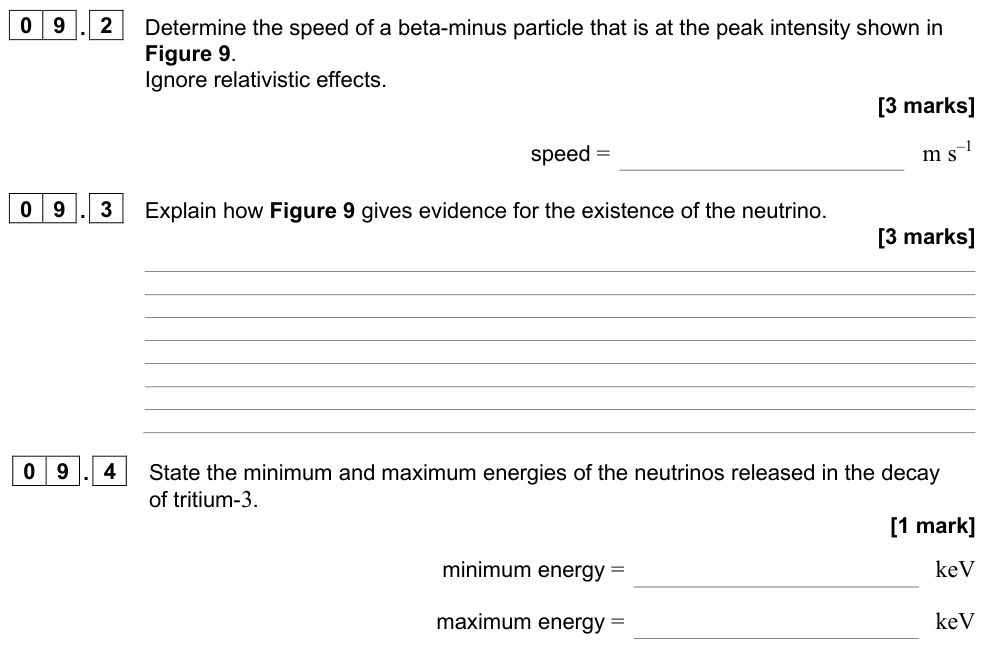
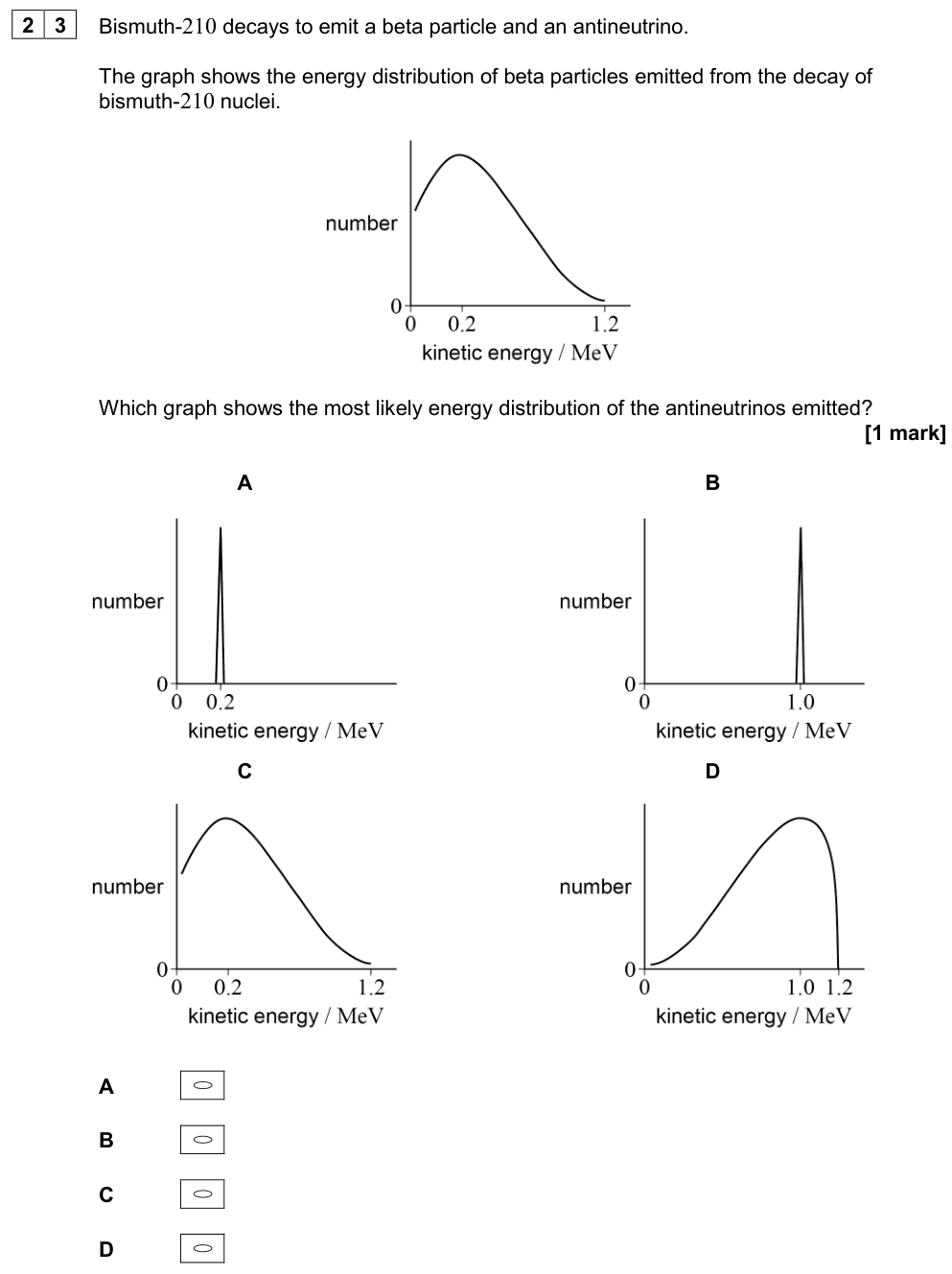
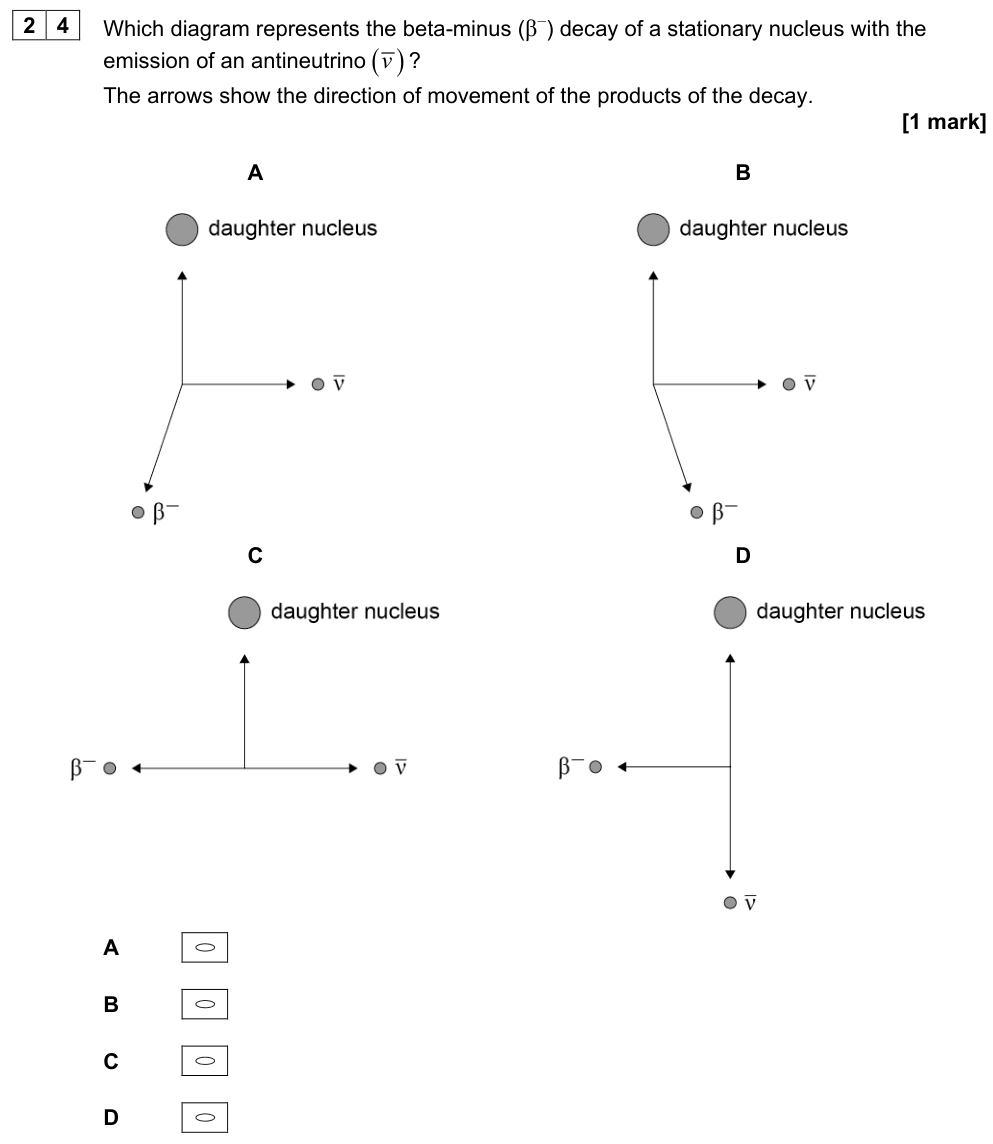
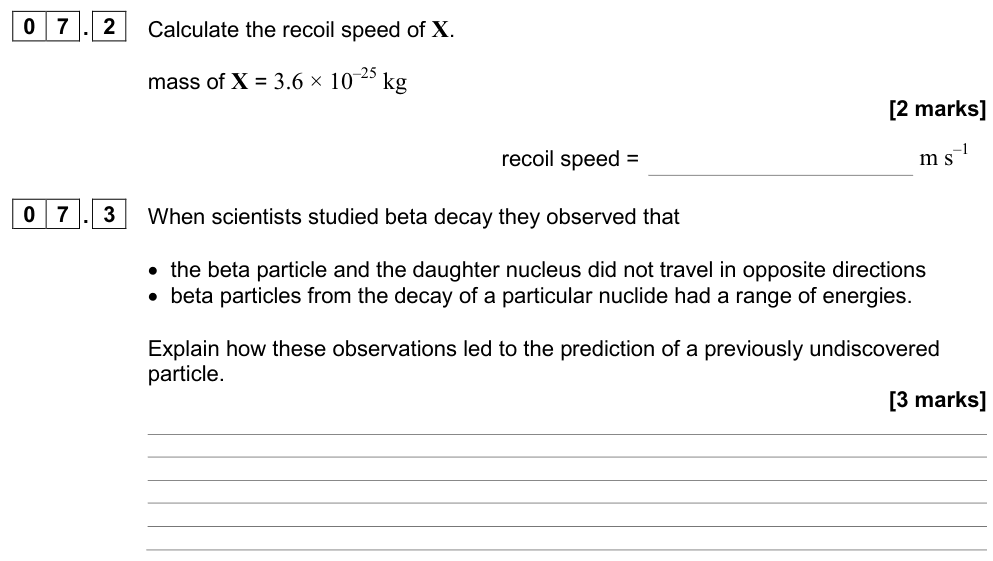
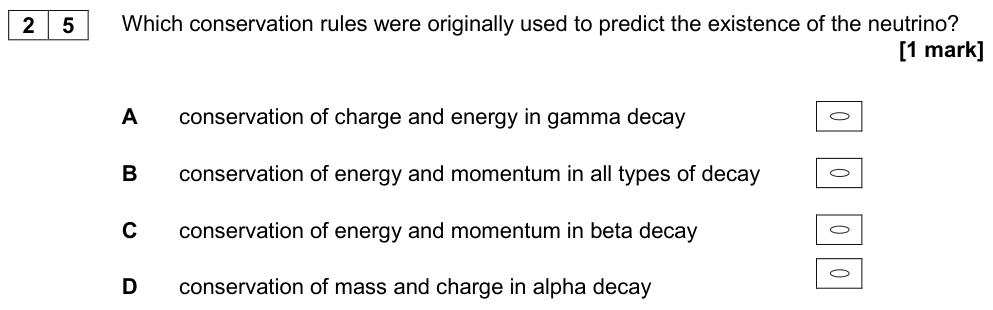
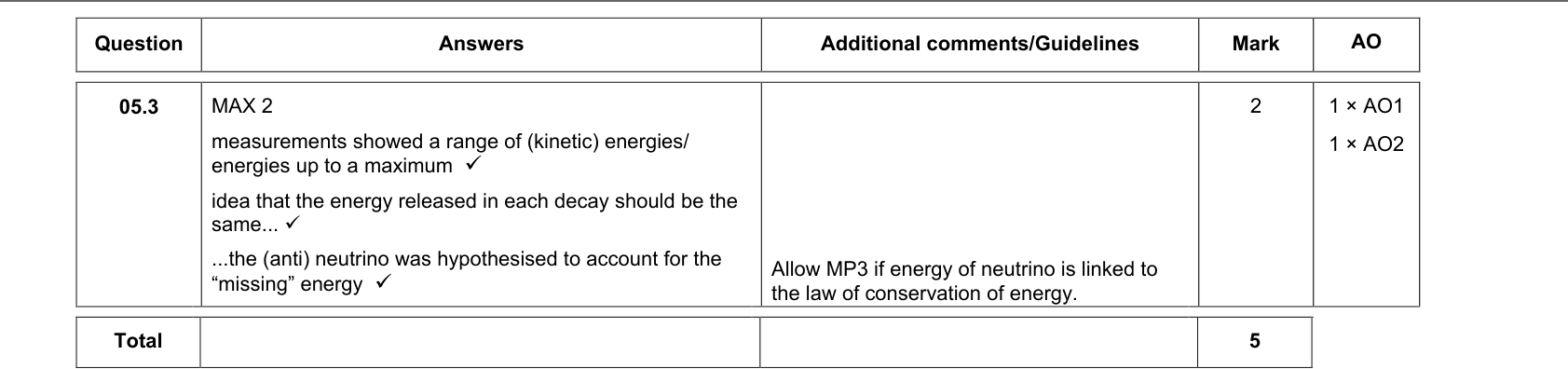
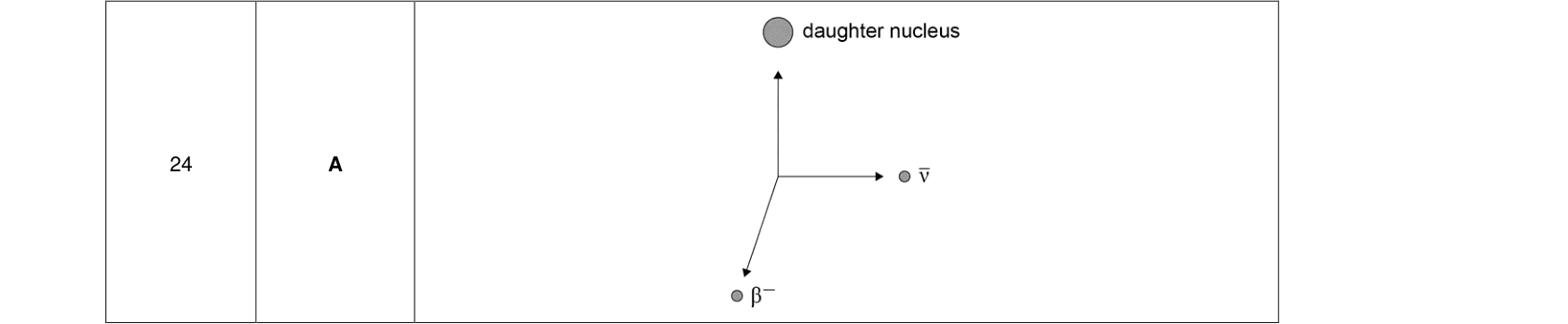
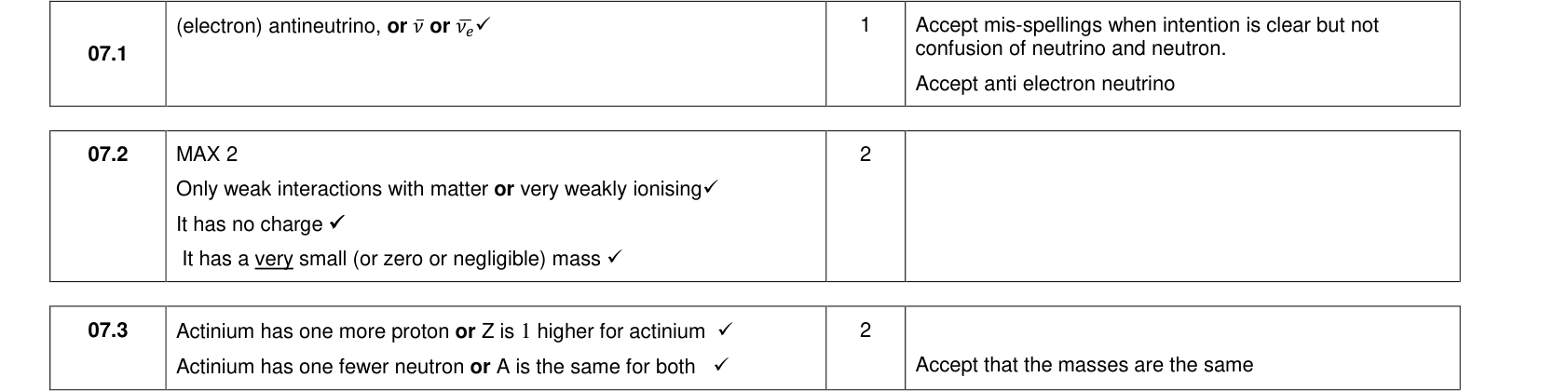
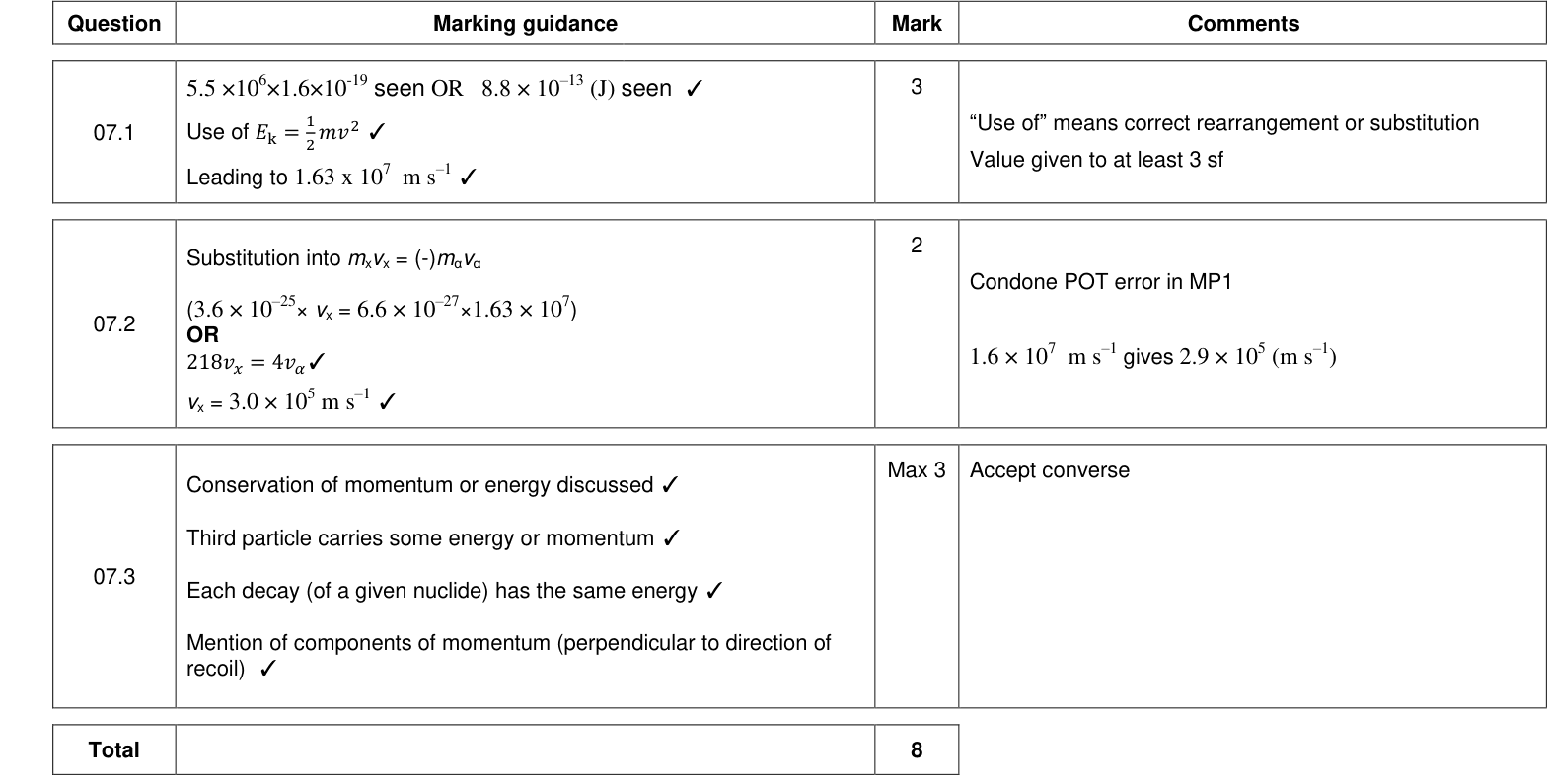
In β decay the β particles are emitted with a continuous range of kinetic energies, from zero up to a maximum. If only the β particle and the daughter nucleus were produced, conservation of energy and momentum would require every β particle to have the same energy. The neutrino (and antineutrino) was hypothesised to account for conservation of energy and momentum in β decay. The missing energy and momentum are carried away by this neutral, almost massless particle. It was detected about 25 years later.
Gamma emission and excited states
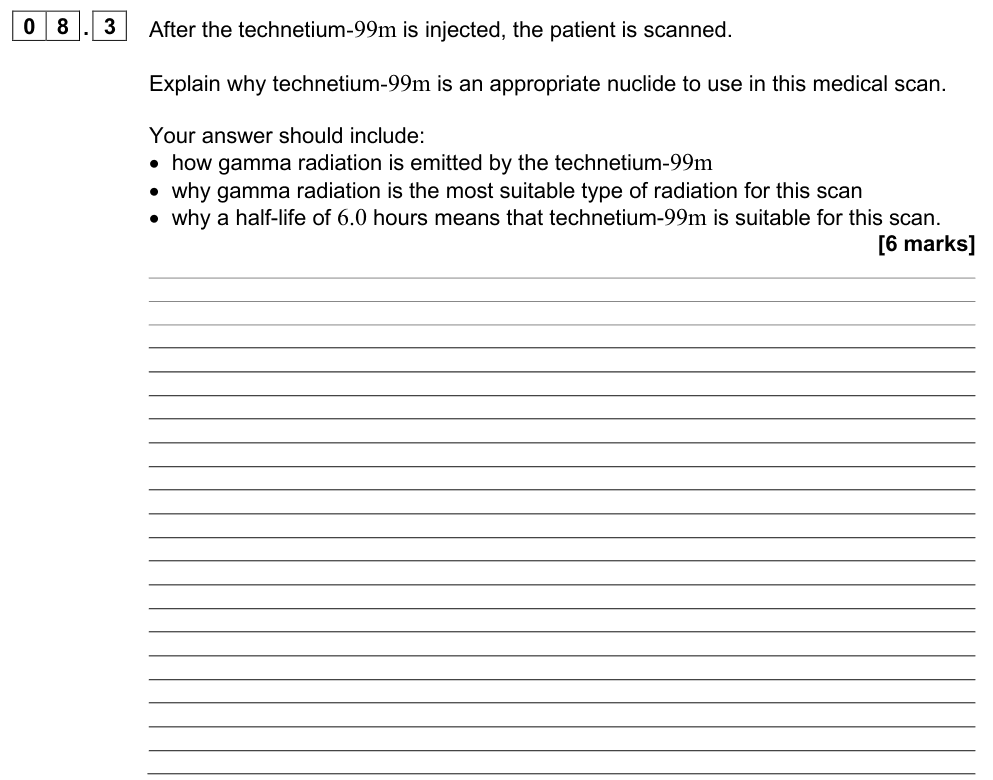
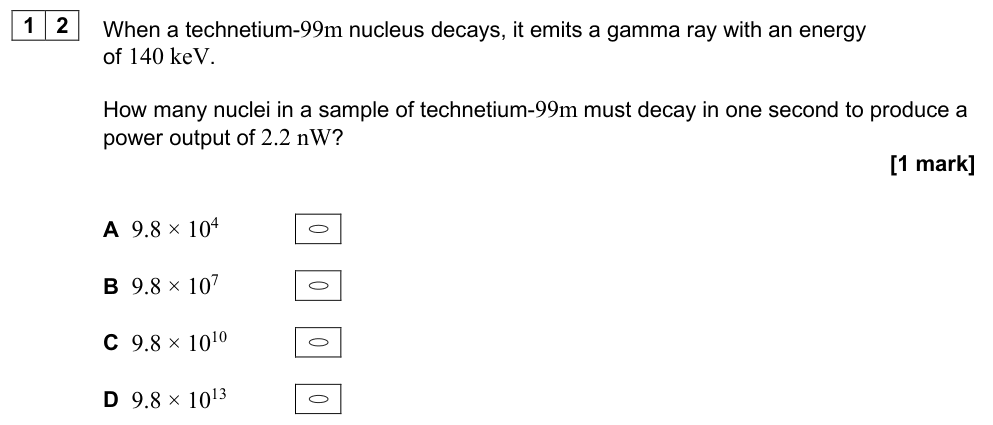
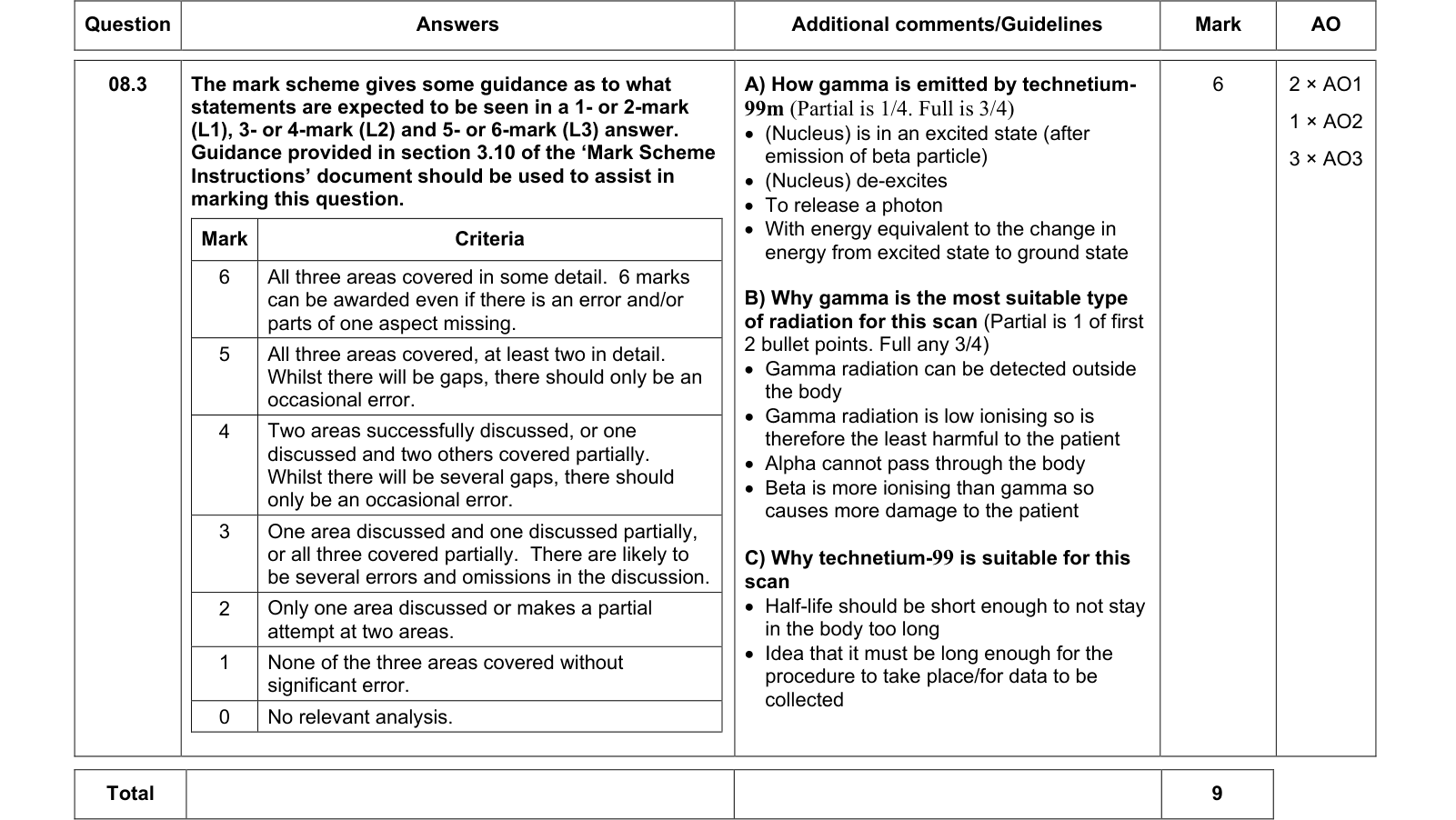
After α or β decay, the daughter nucleus is often left in an excited state (with excess energy). It drops to its ground state by emitting a gamma photon. The proton and nucleon numbers do not change.
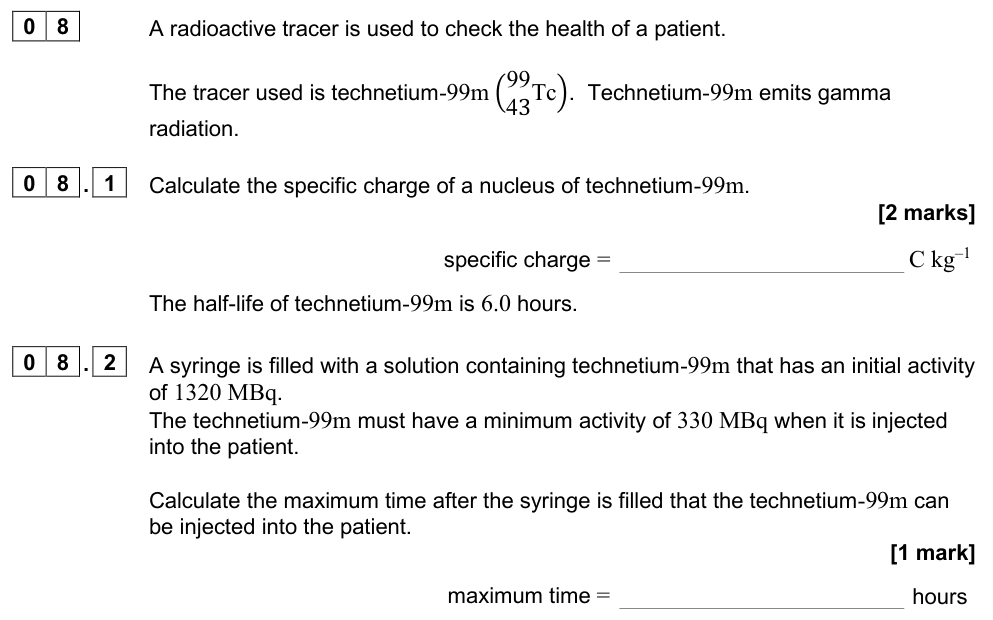
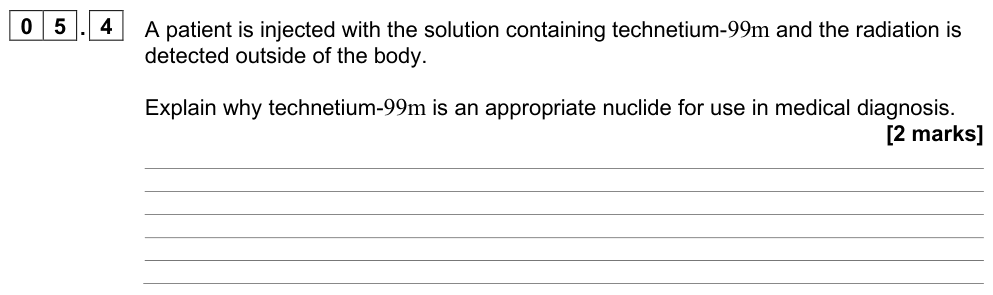
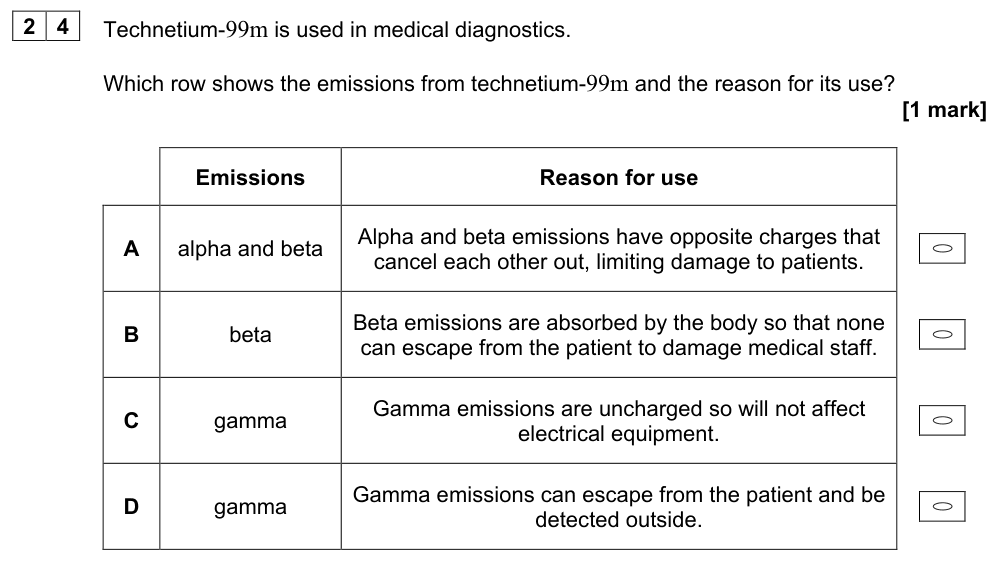
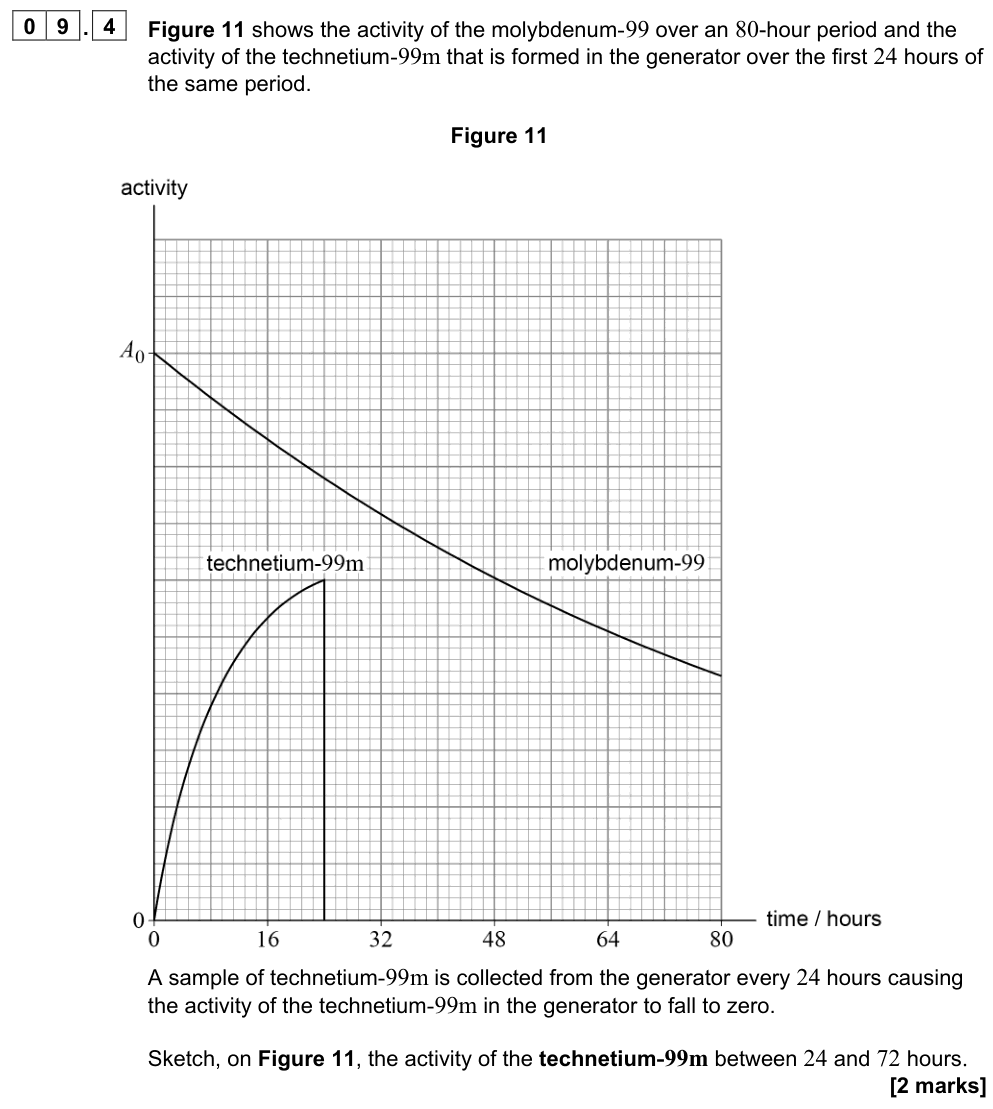
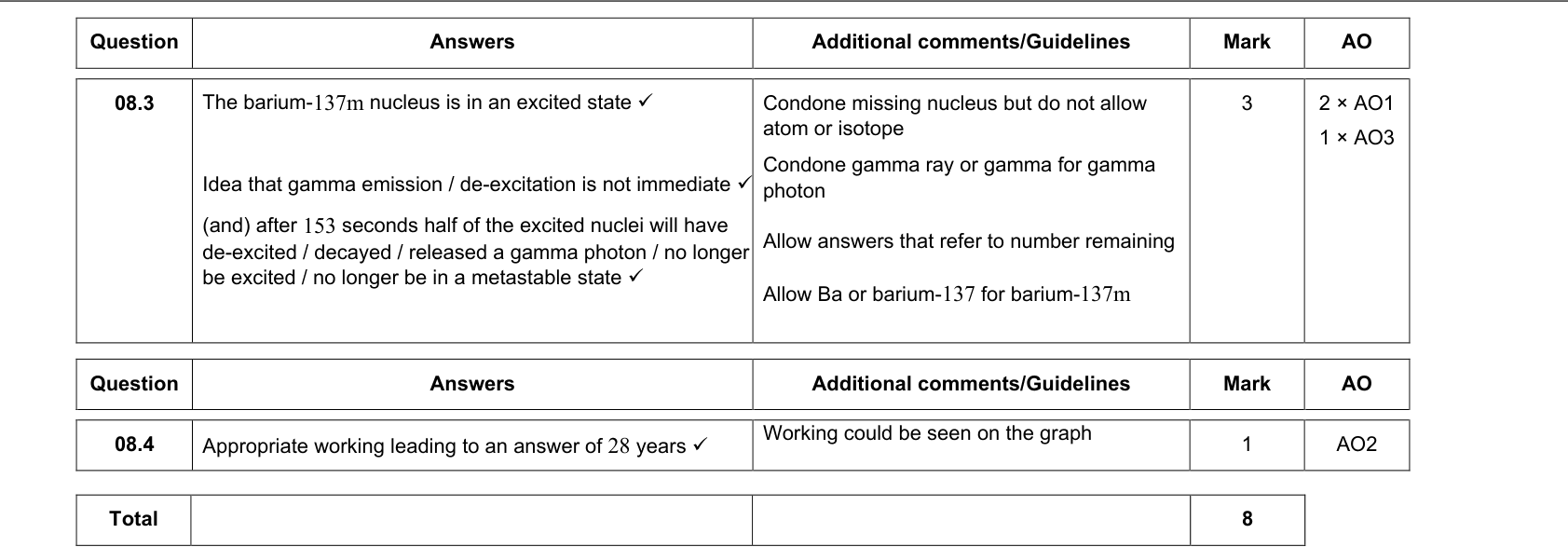
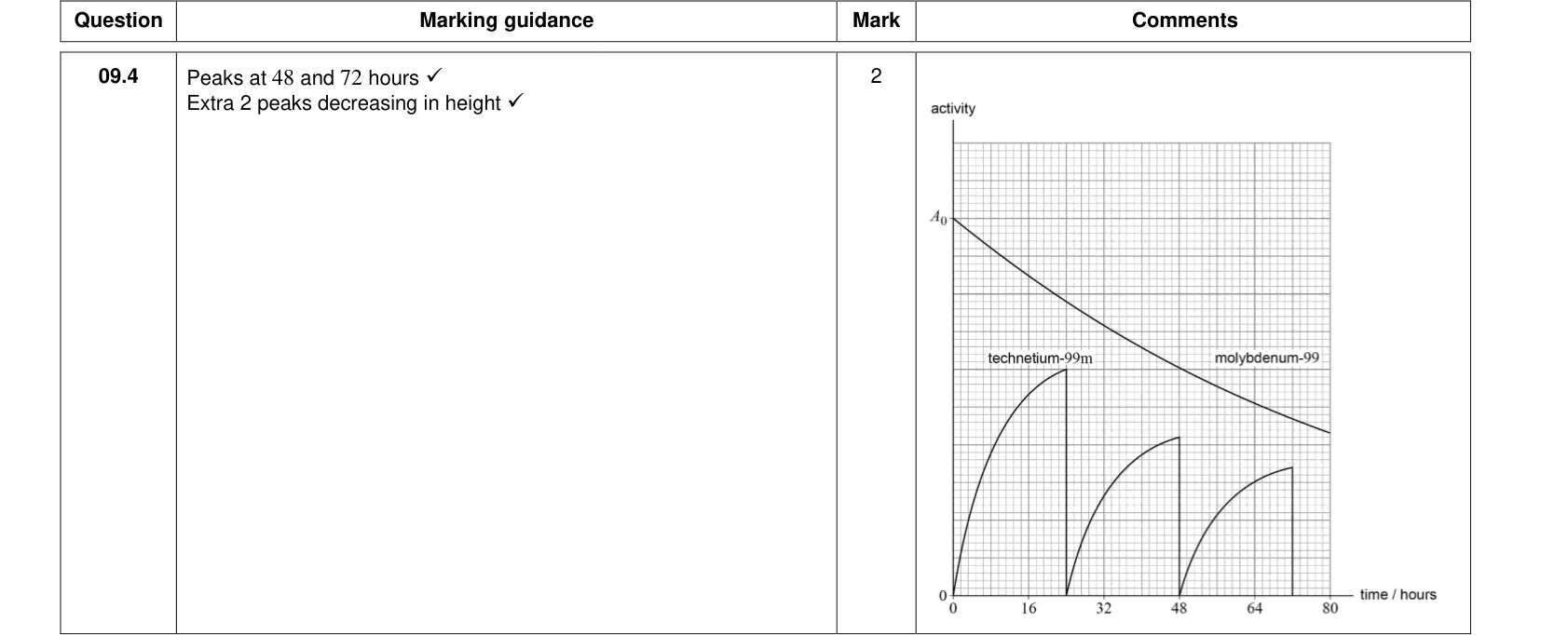
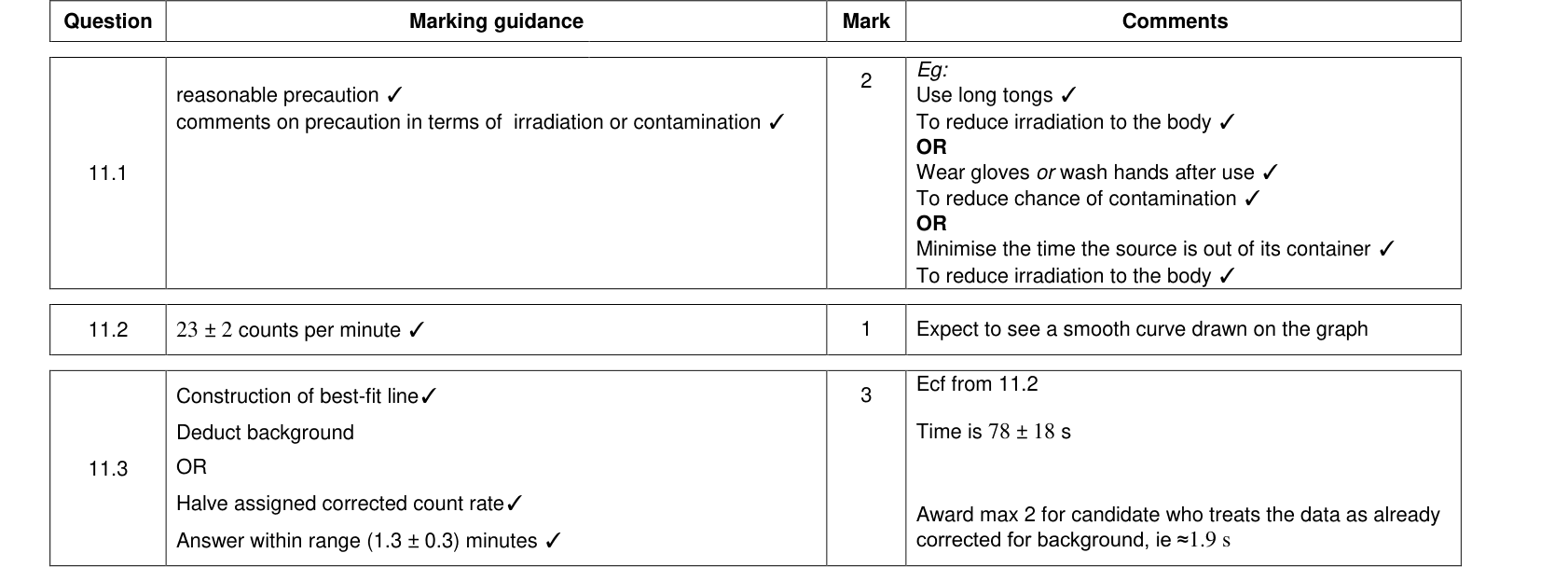
Technetium-99m (the m stands for metastable, a long-lived excited state) is used as a medical tracer:
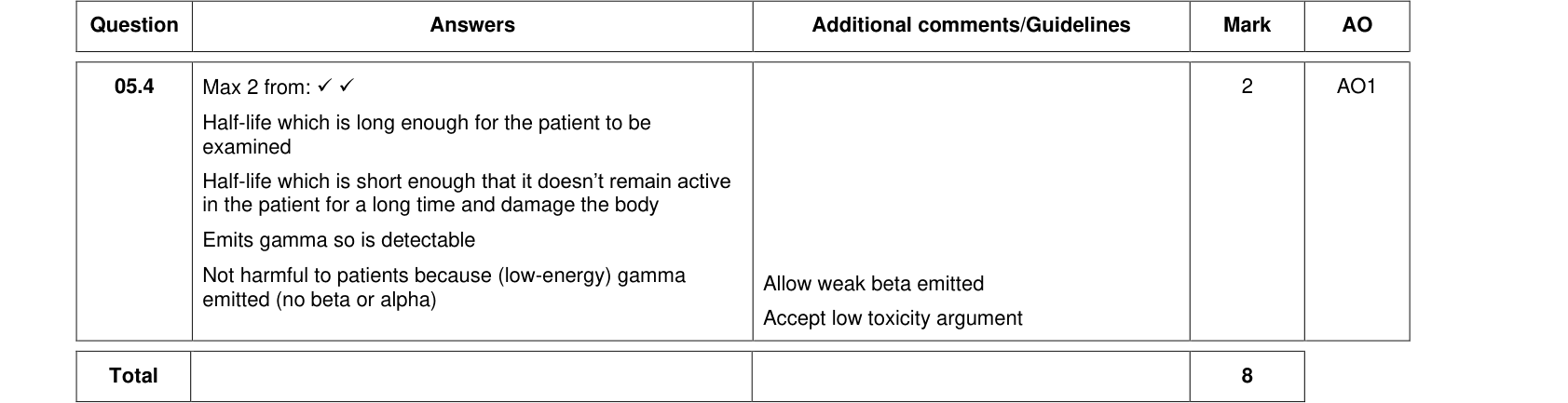
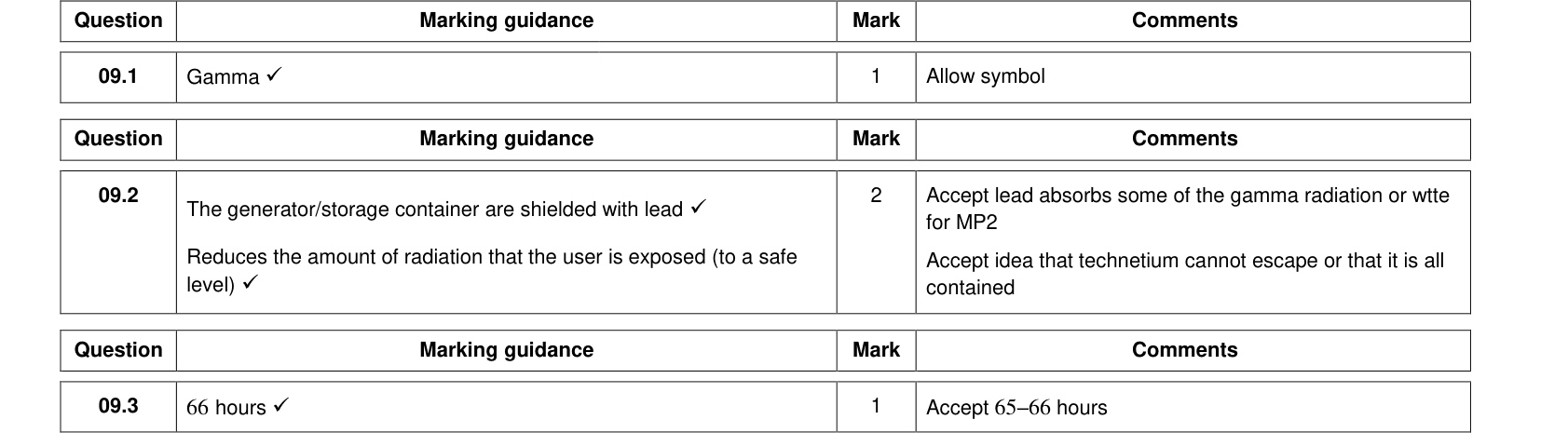
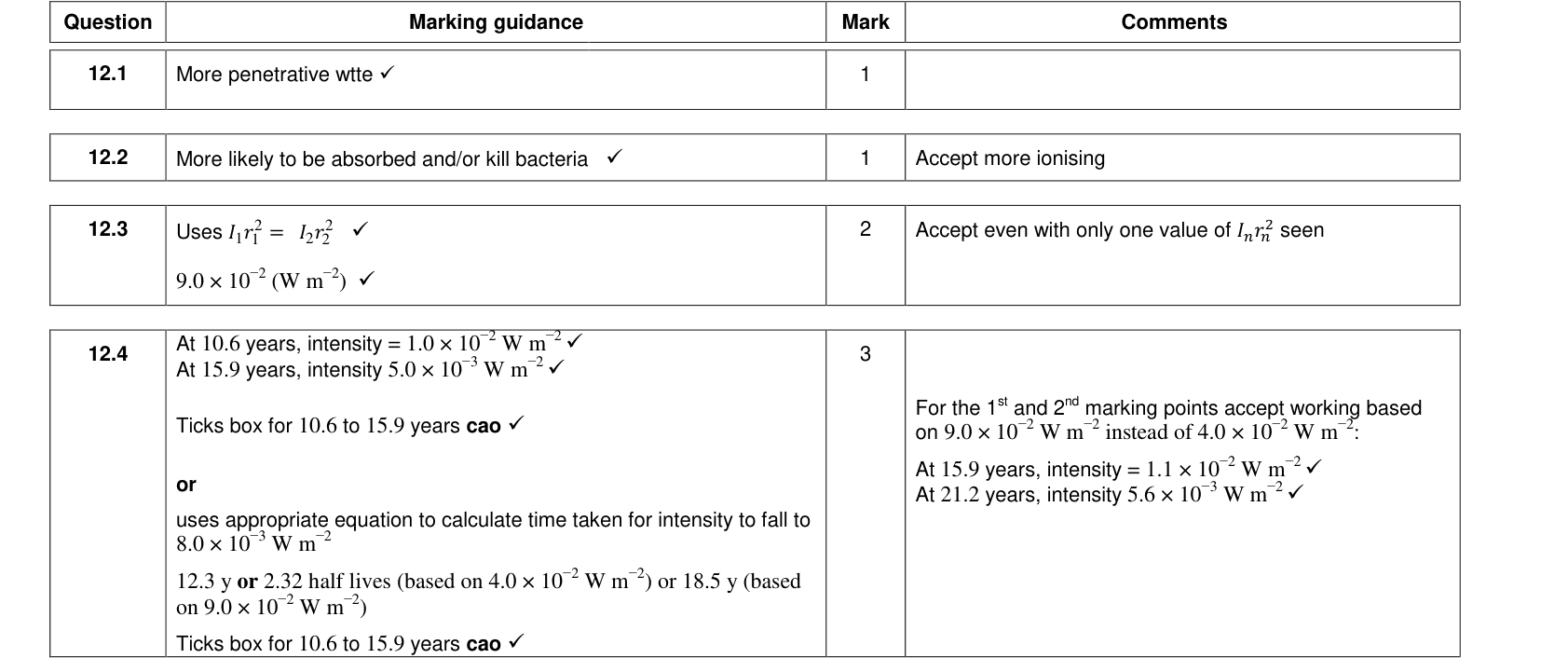
- it emits gamma radiation only, which passes out of the body to the detector (gamma camera) and is the least ionising radiation, so it does the least damage;
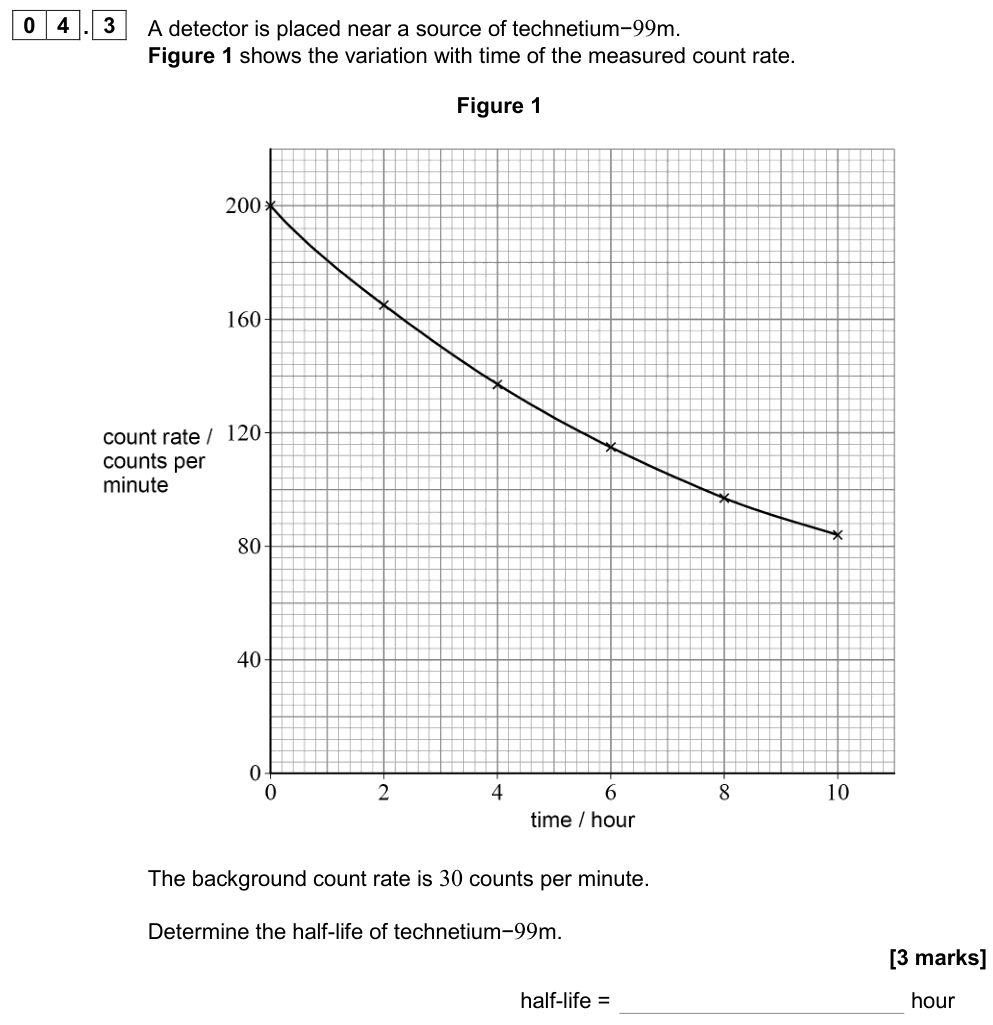
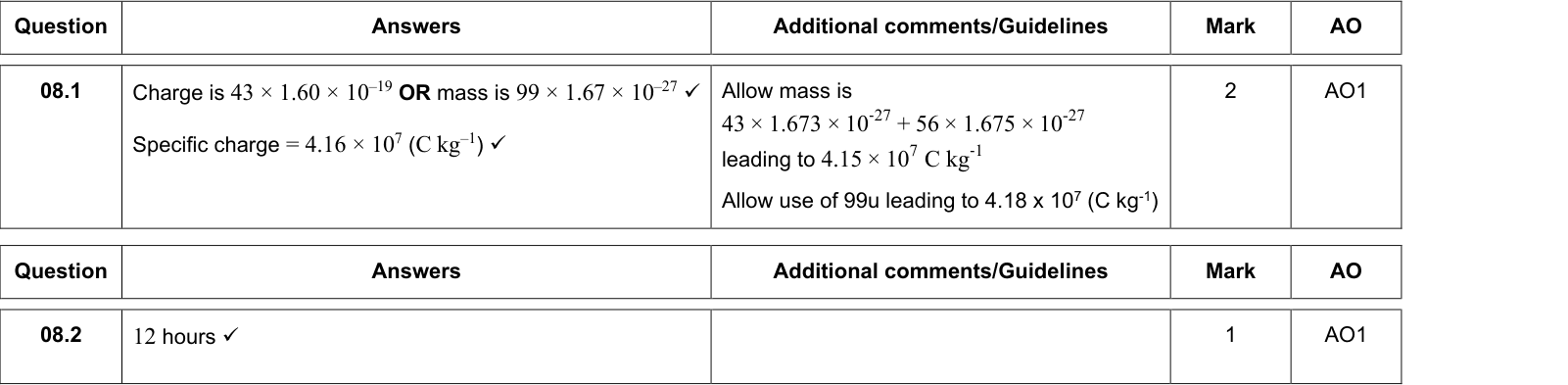
- its half-life of about 6 hours is long enough for the scan but short enough that the activity soon falls to safe levels;
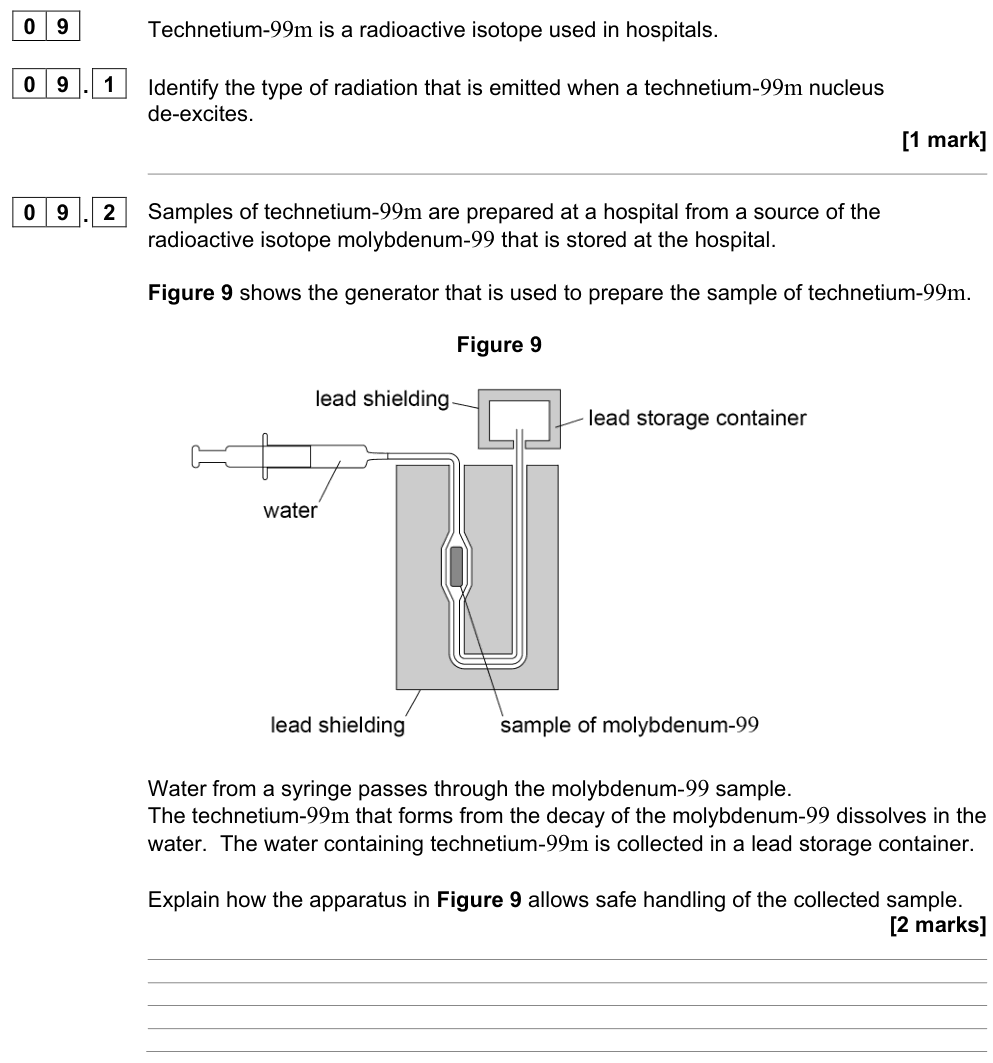
- it is made on site from molybdenum-99 (half-life 66 h) which decays by β⁻ to Tc-99m;
- it can be combined with different chemicals to target different organs.
Properties of α, β and γ radiation
| Property | α | β | γ |
|---|---|---|---|
| Nature | helium nucleus | fast electron (β⁻) or positron (β⁺) | EM photon |
| Charge | +2e | −e (β⁻) | 0 |
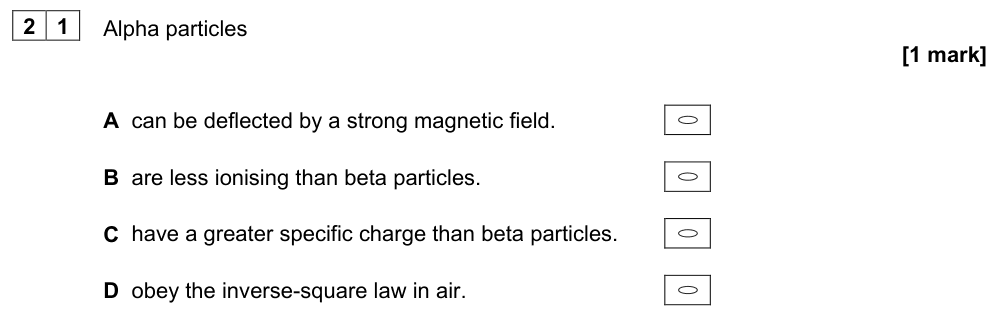
| Ionising ability | strongly ionising | moderately | weakly |
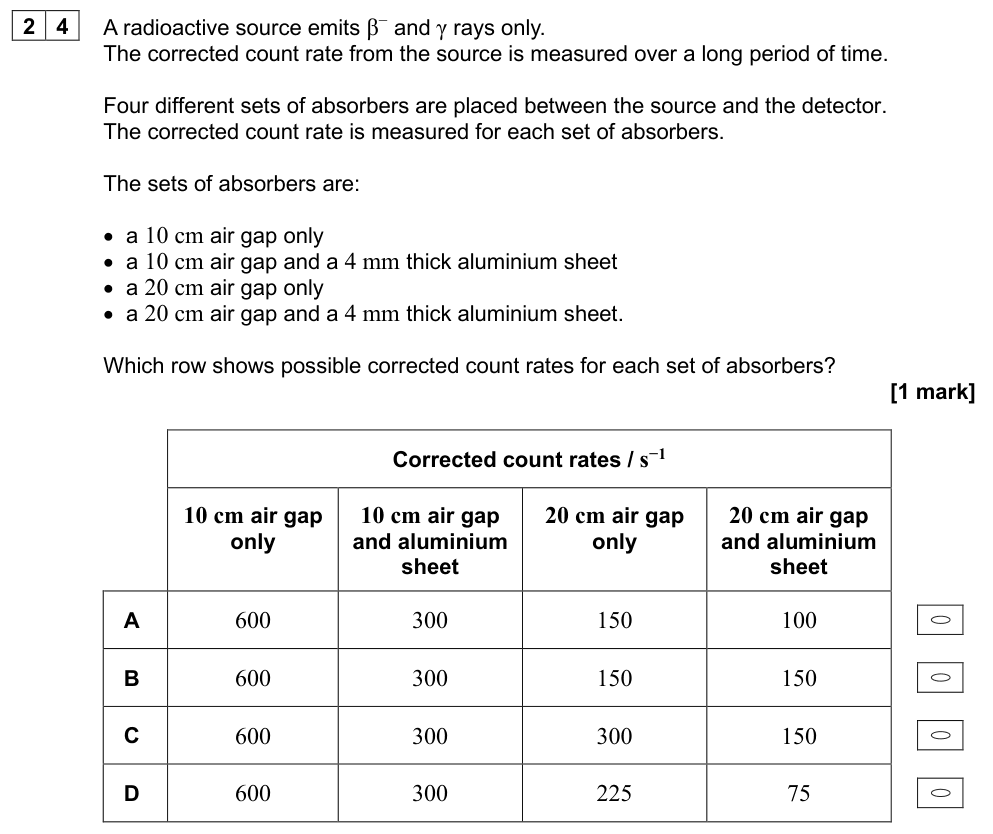
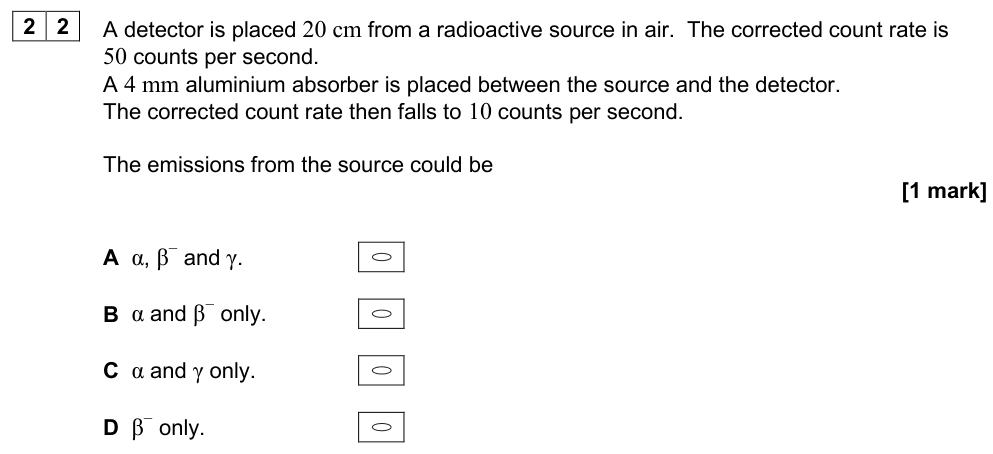
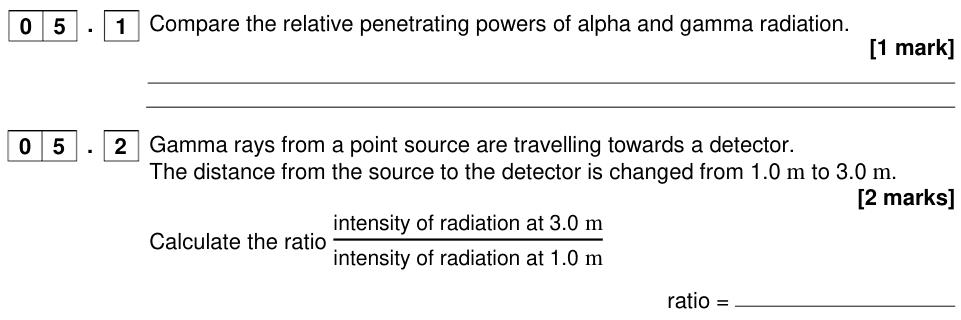
| Range in air | a few cm (~5 cm) | about 1 m | effectively unlimited (follows inverse-square law) |
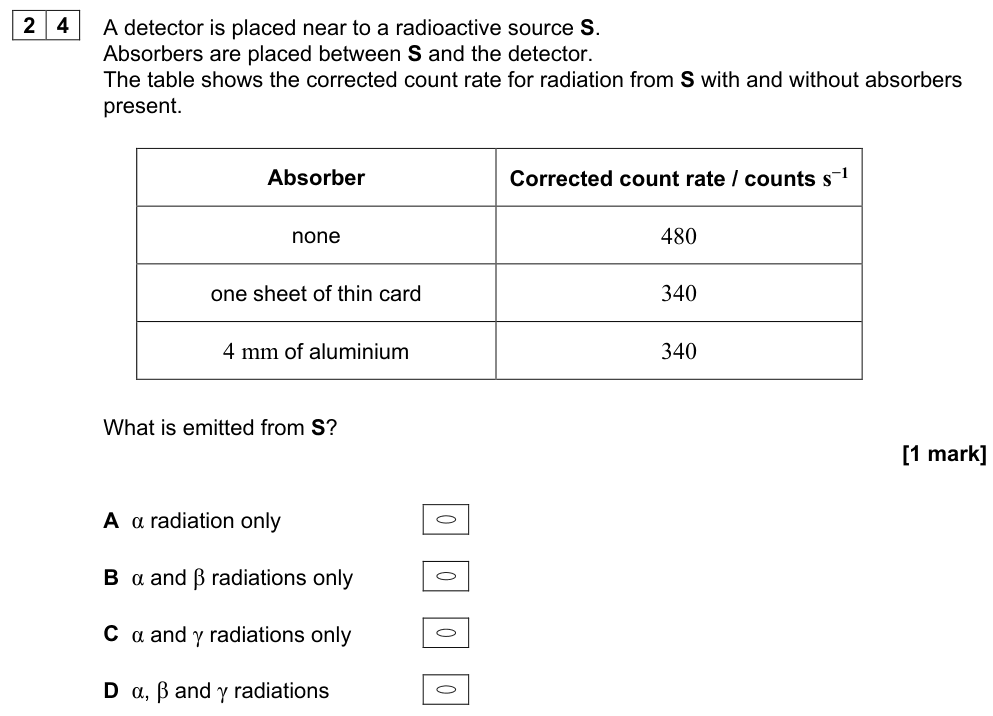
| Absorbed by | a sheet of paper, skin | a few mm of aluminium | several cm of lead / metres of concrete (intensity reduced, not stopped) |
| Deflected by E and B fields | yes (small deflection: heavy) | yes (large deflection, opposite way) | no |
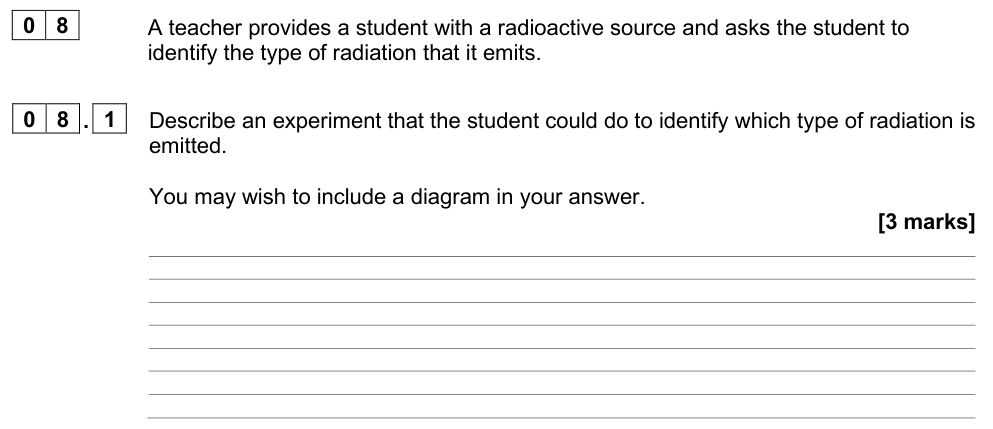
Identifying radiation by absorption
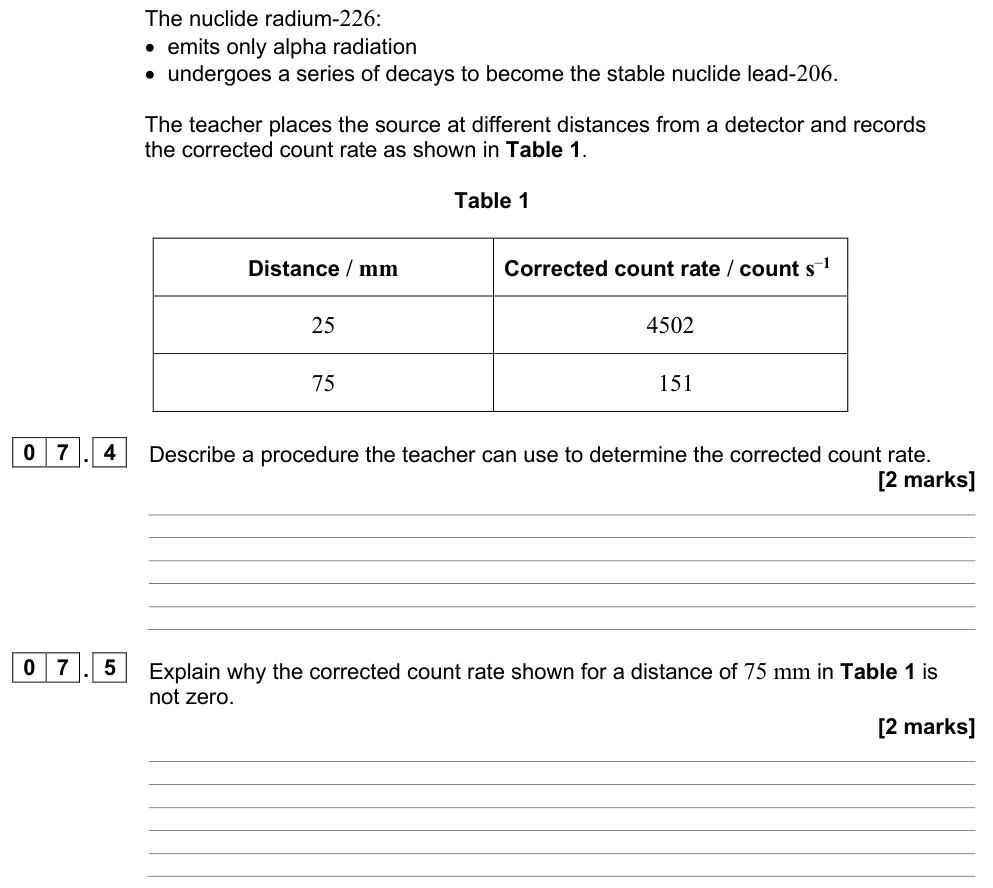
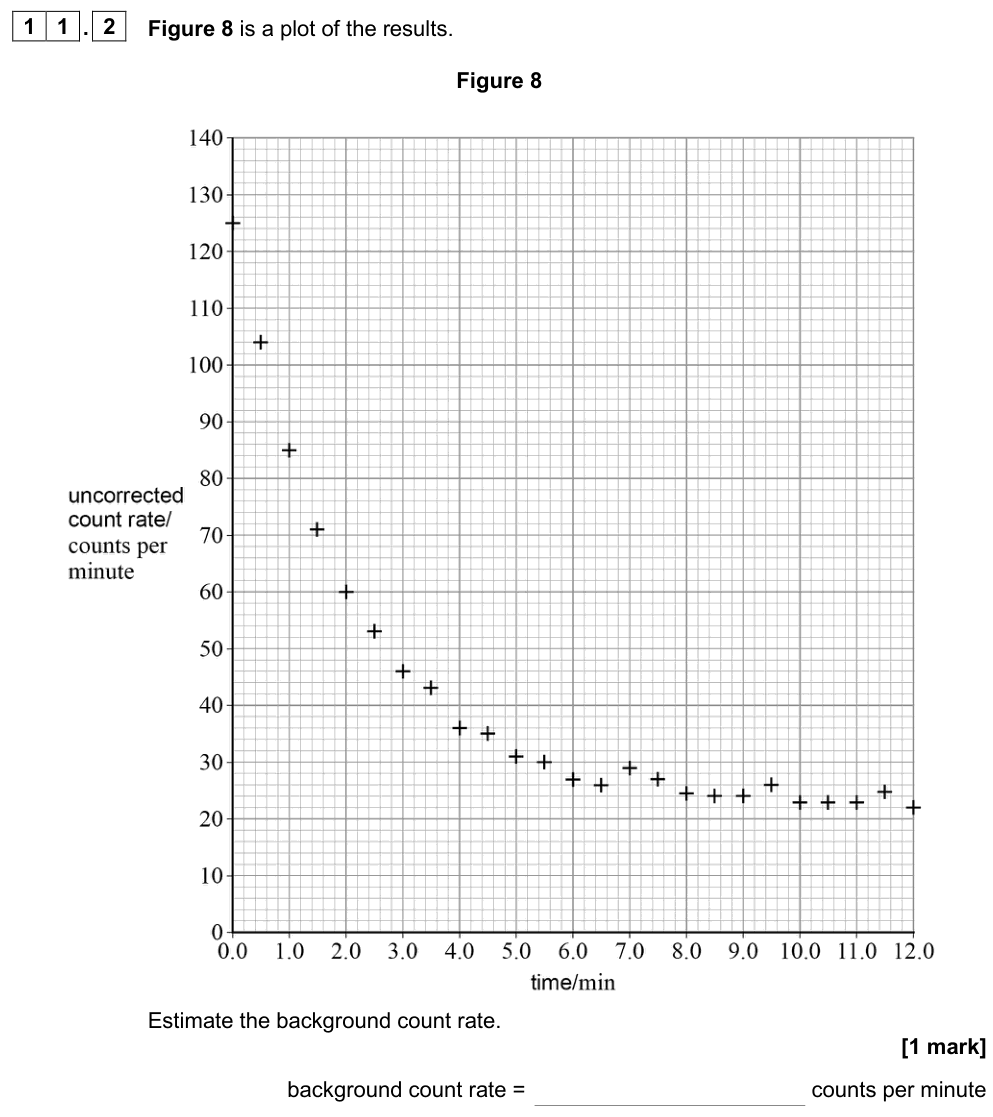
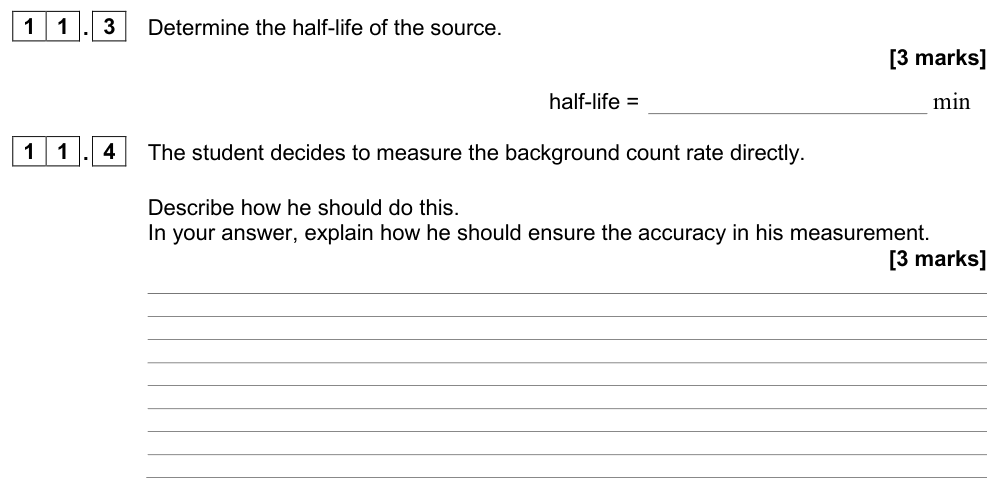
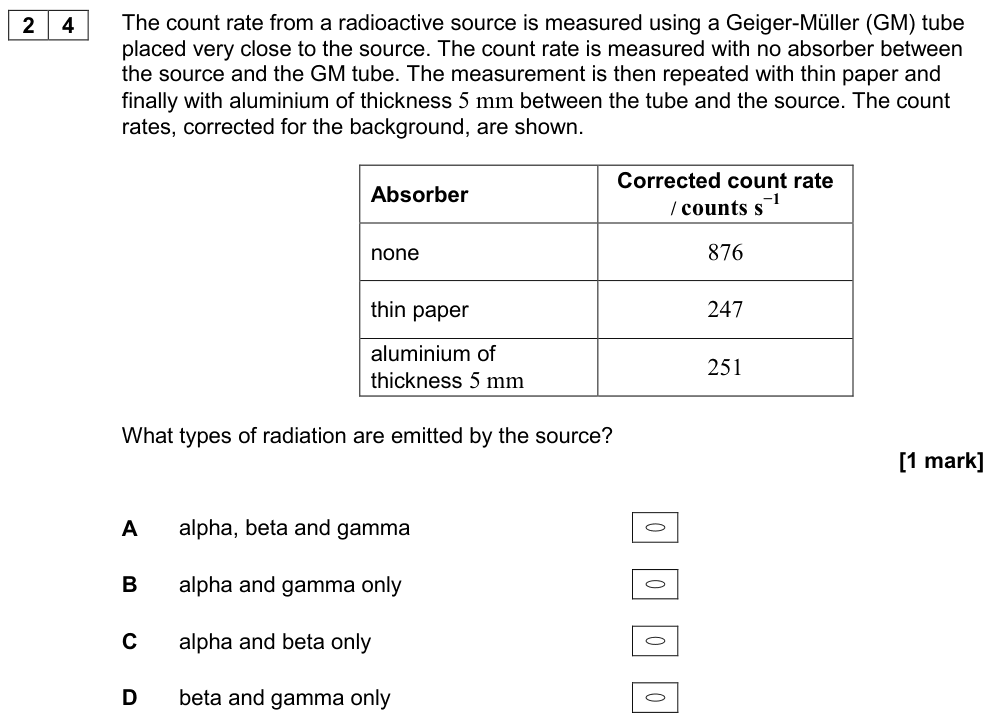
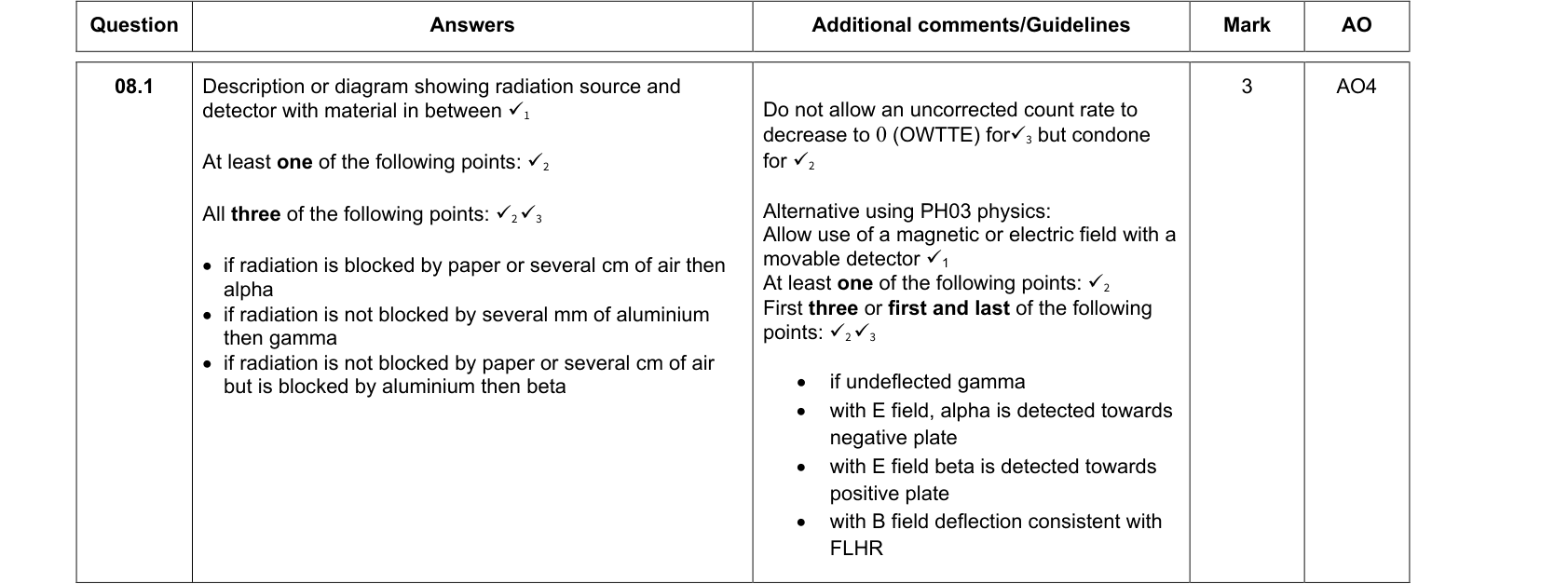
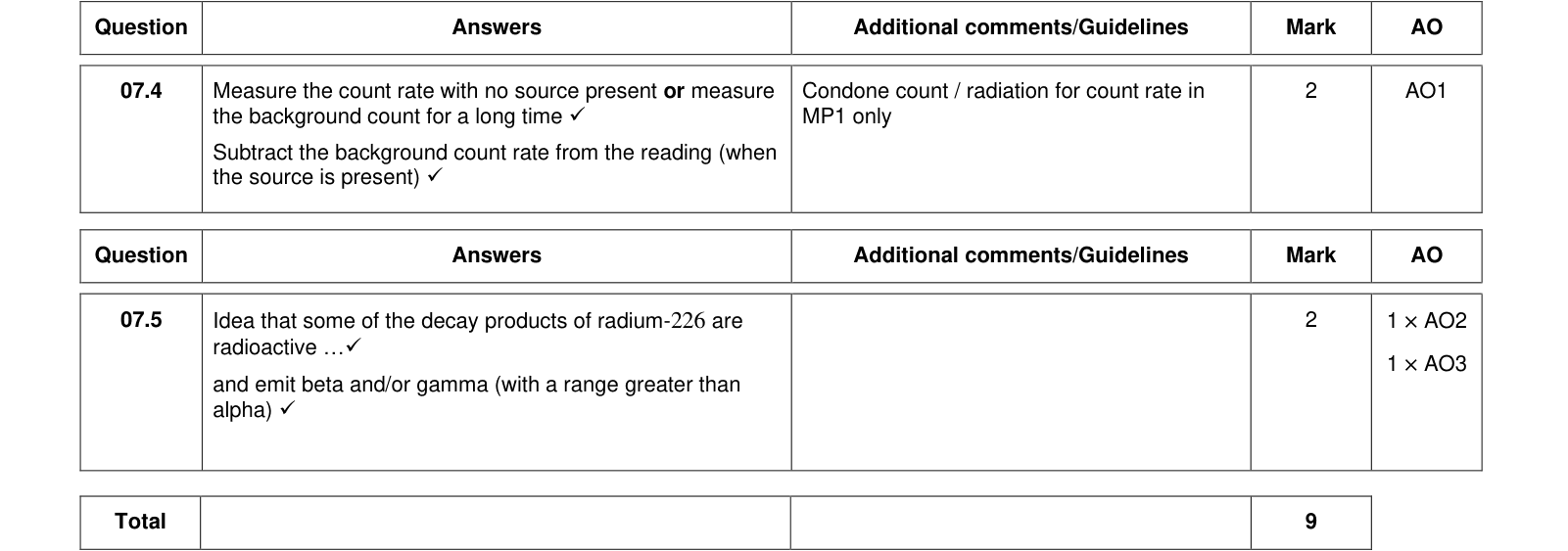
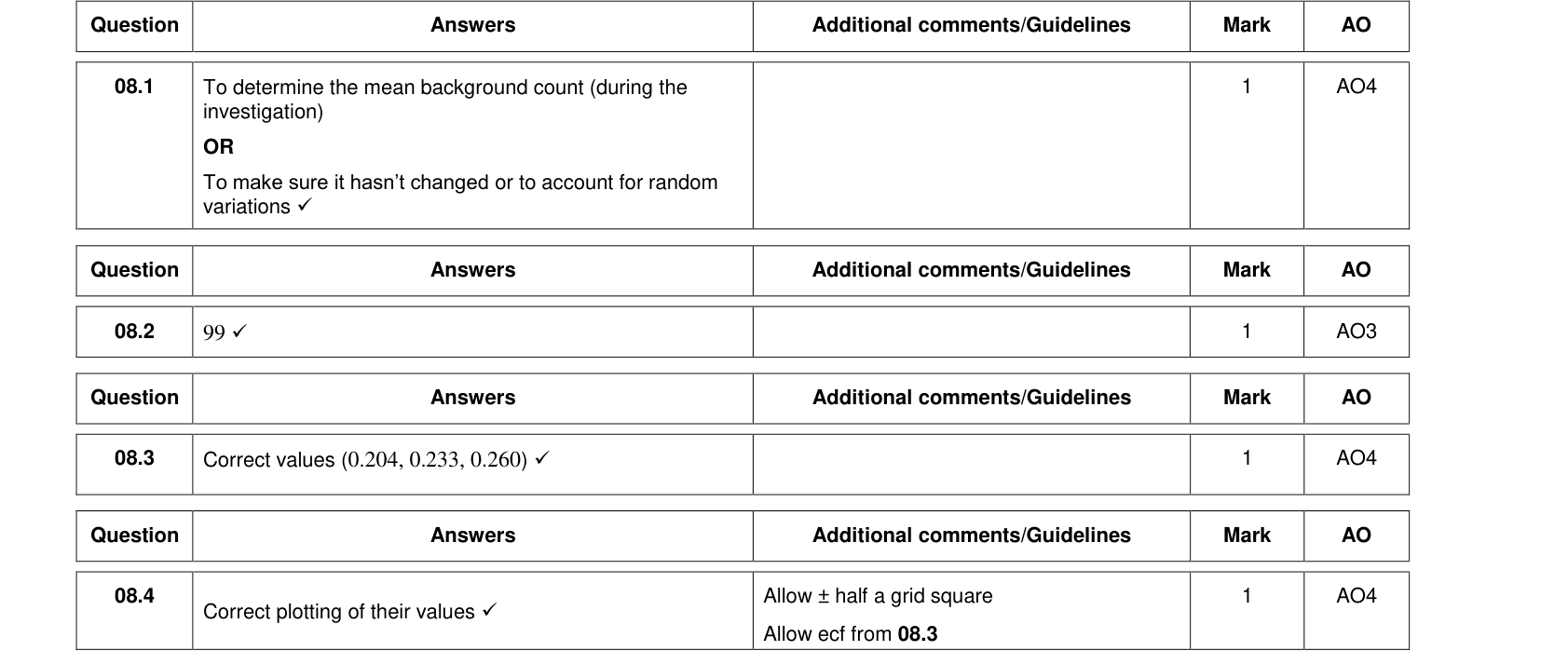
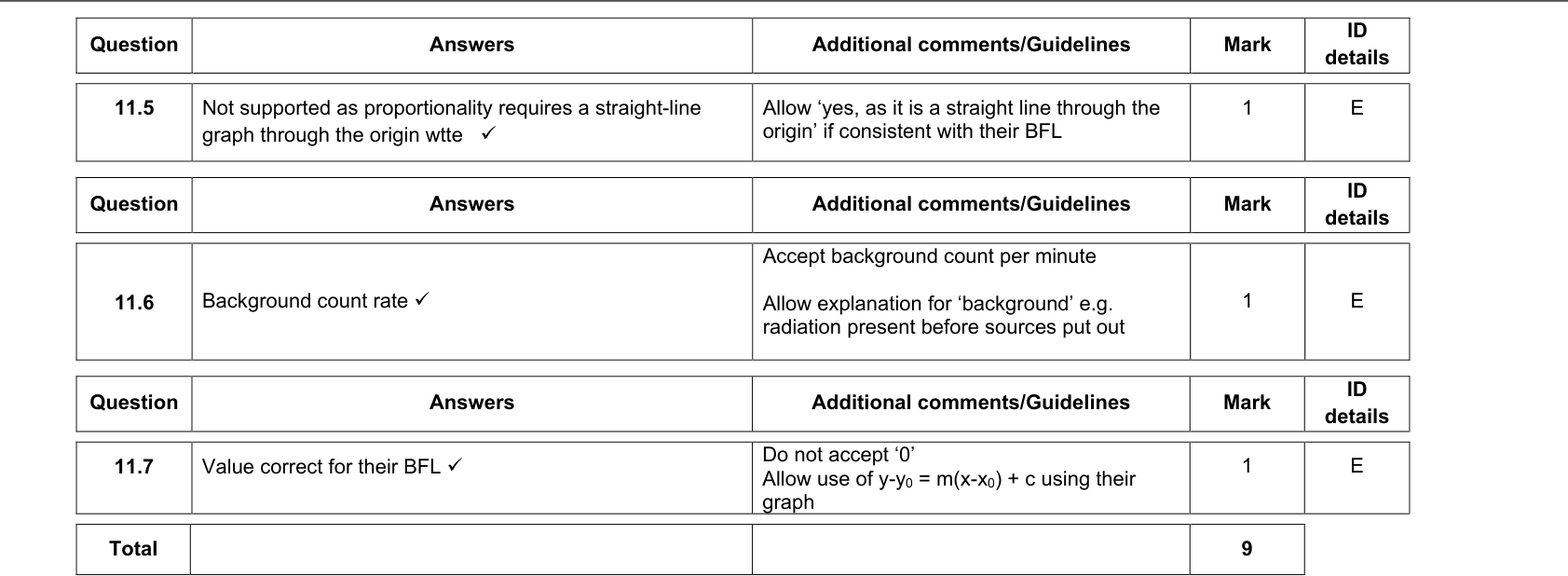
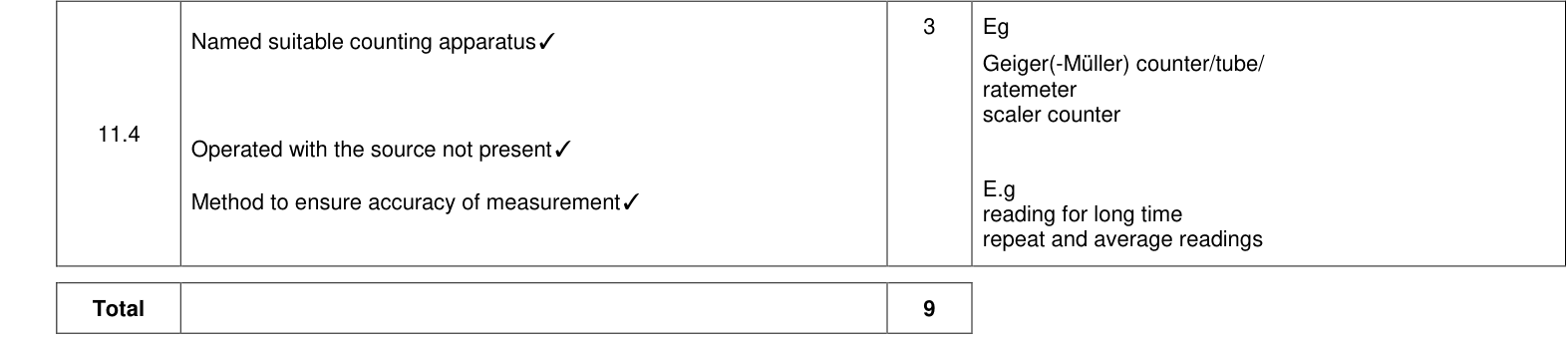
- Measure the background count rate with no source present.
- Place the source close to a Geiger–Müller (GM) tube and record the count rate.
- Insert paper: a large drop shows α is present.
- Insert 3 mm of aluminium: a further drop shows β is present.
- Insert a few cm of lead: if the count rate is still above background before the lead and drops with lead, γ is present.
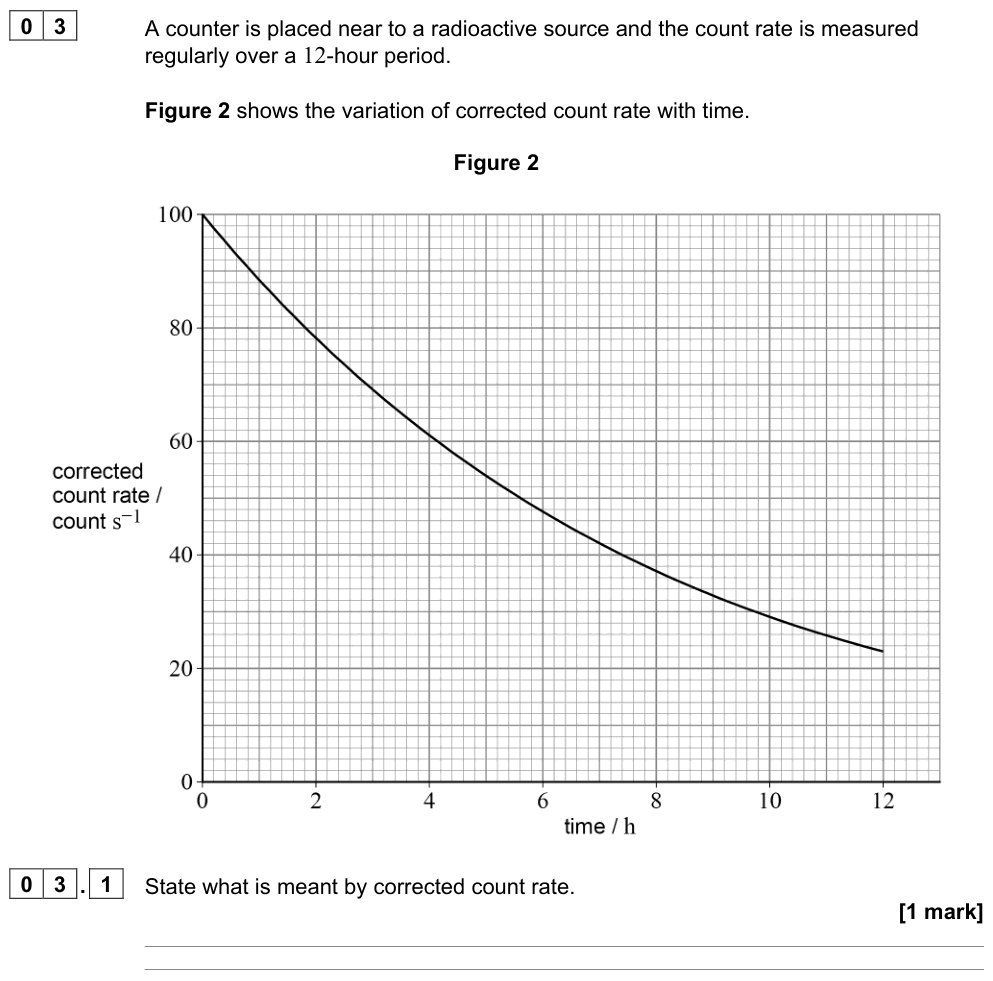
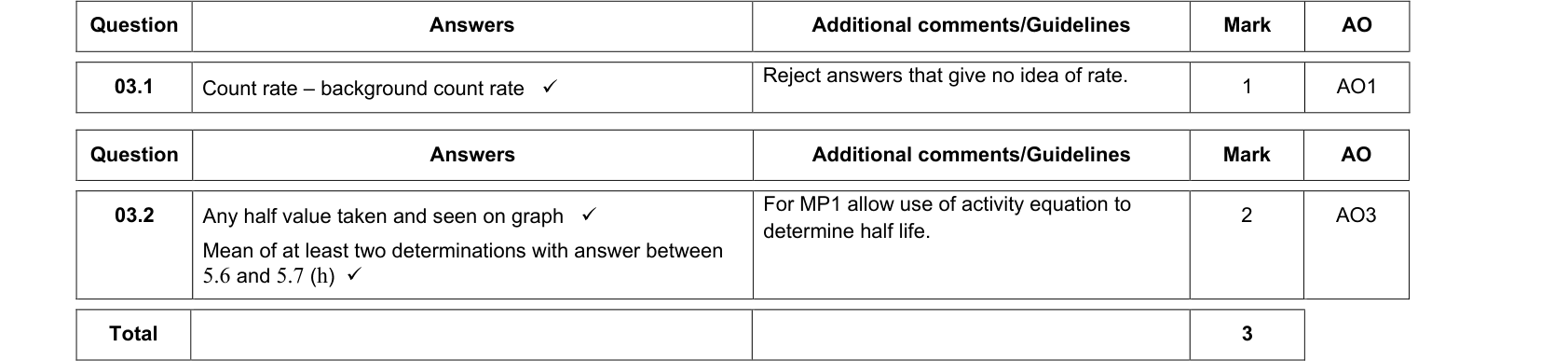
Always use the corrected count rate = measured count rate − background count rate.
Applications and hazards
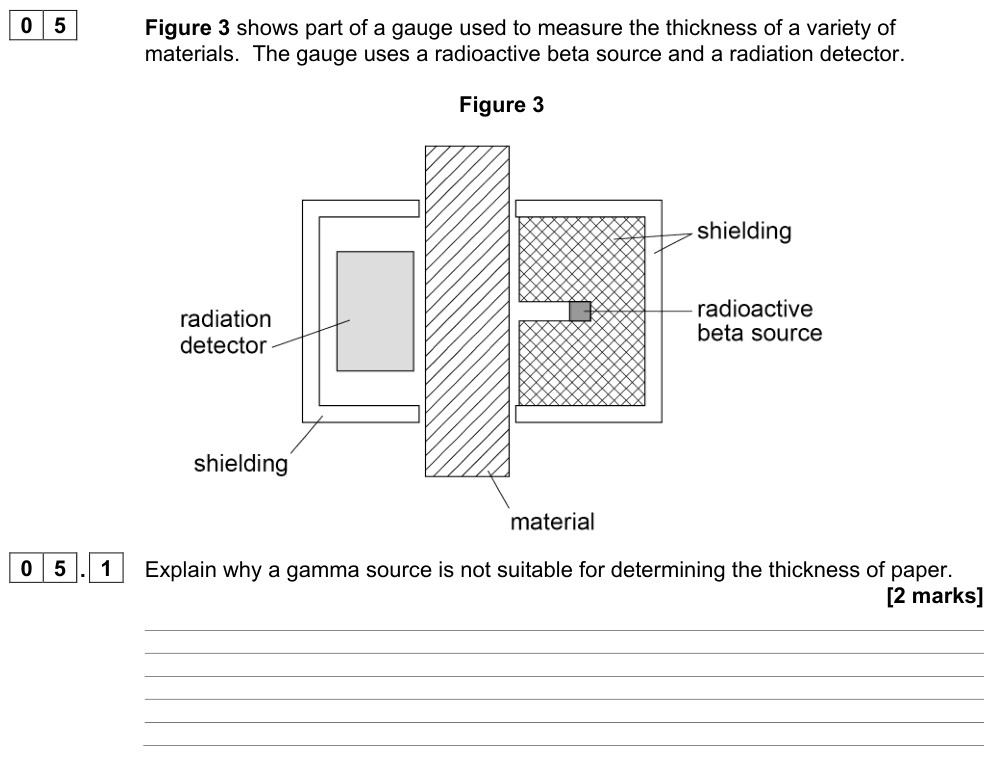
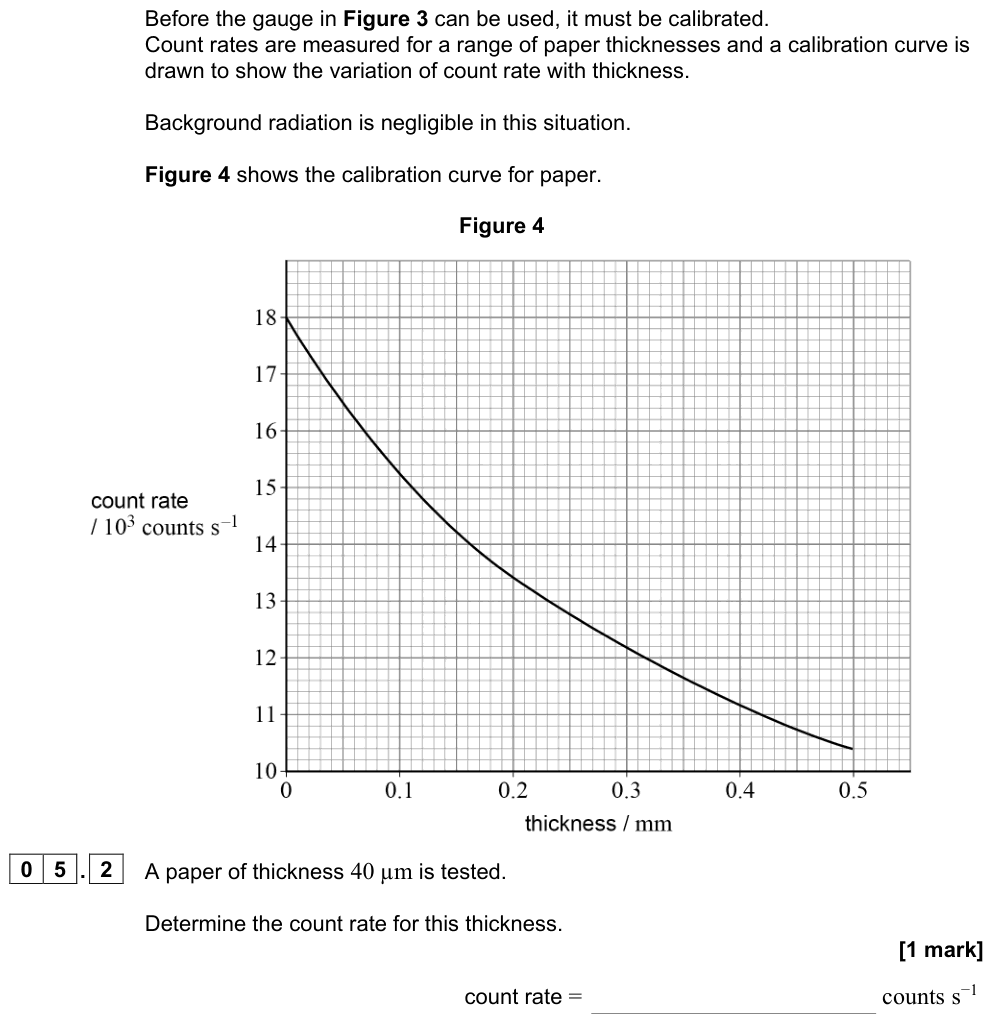
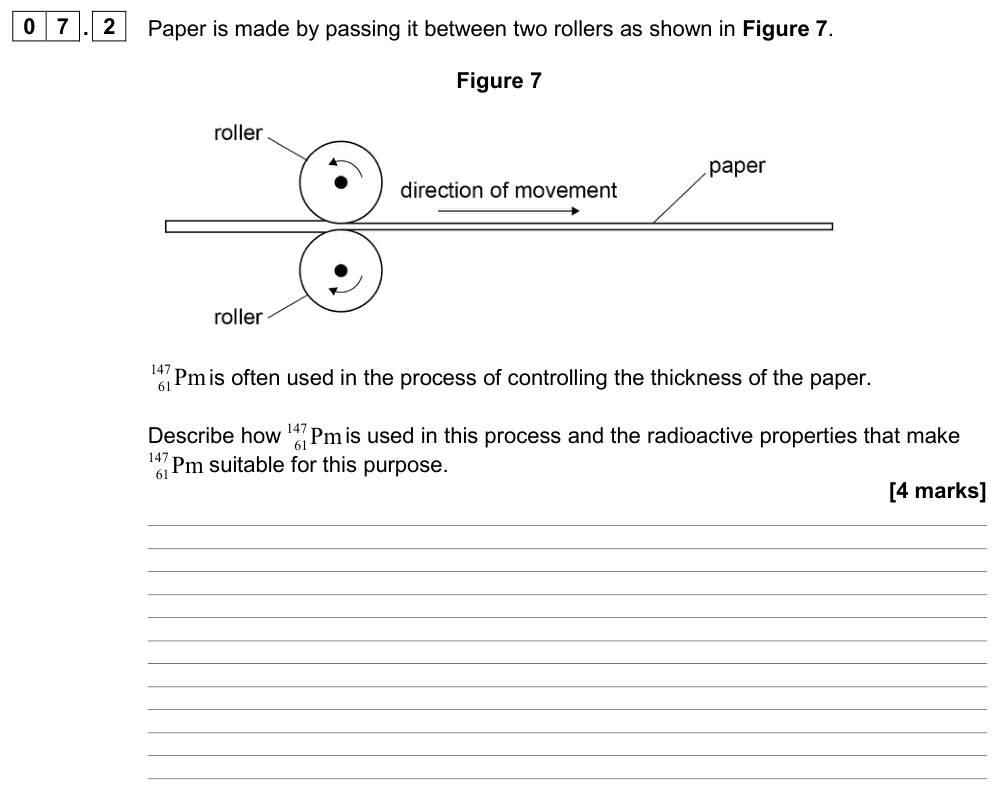
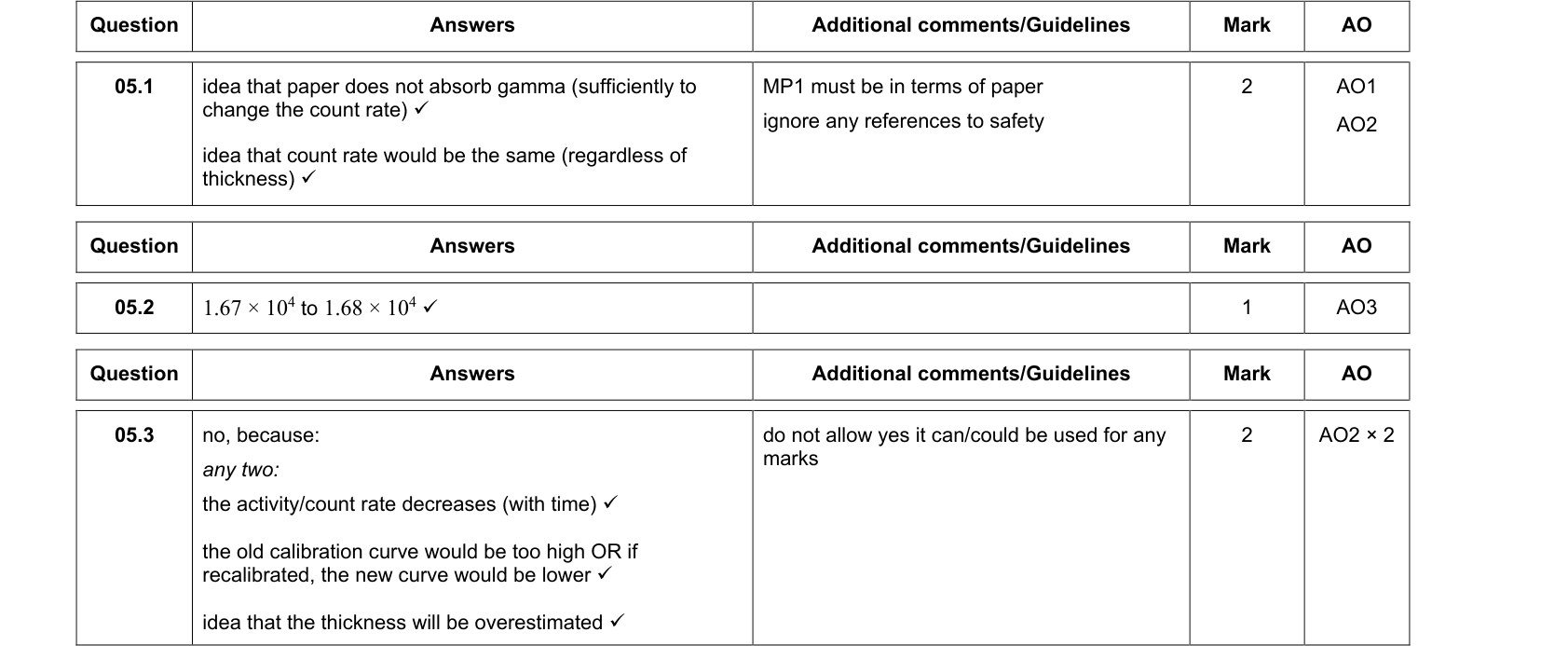
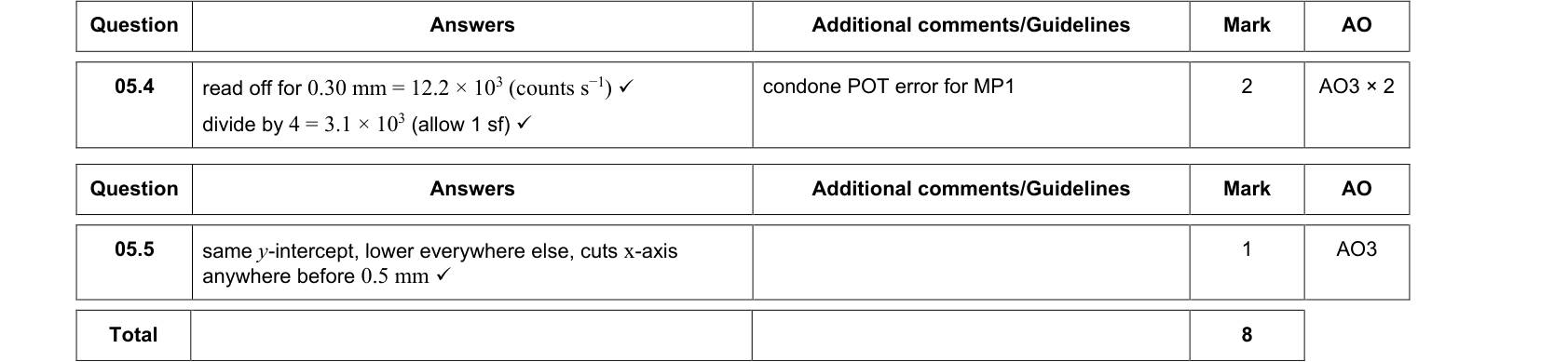
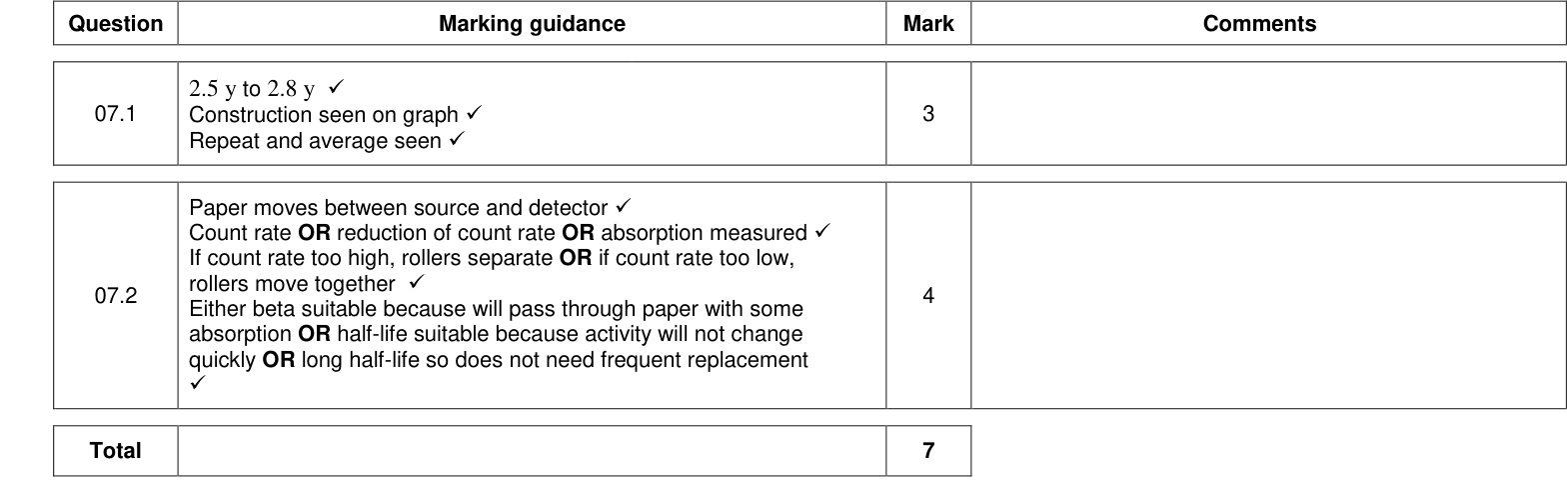
- Thickness gauges. A source on one side of a sheet and a detector on the other. If the sheet is too thick, the count rate falls and rollers adjust. Use β for paper, plastic and aluminium foil (α would be stopped completely; γ would pass through almost unchanged). Use γ for thick steel.
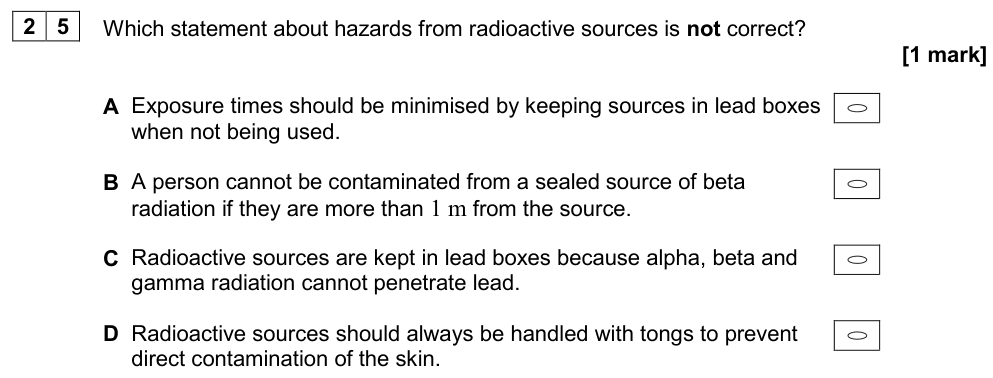
- Hazards. Outside the body α is least dangerous (stopped by skin) but inside the body (inhaled or ingested) it is the most dangerous because it is so strongly ionising. β and γ are hazardous from outside because they penetrate the body.
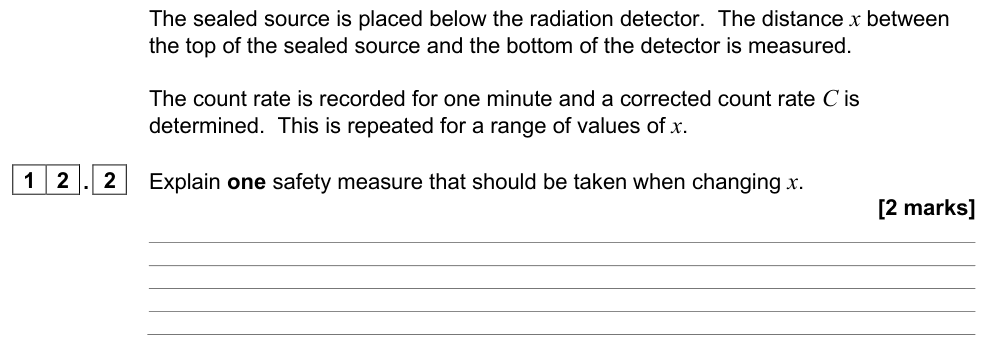
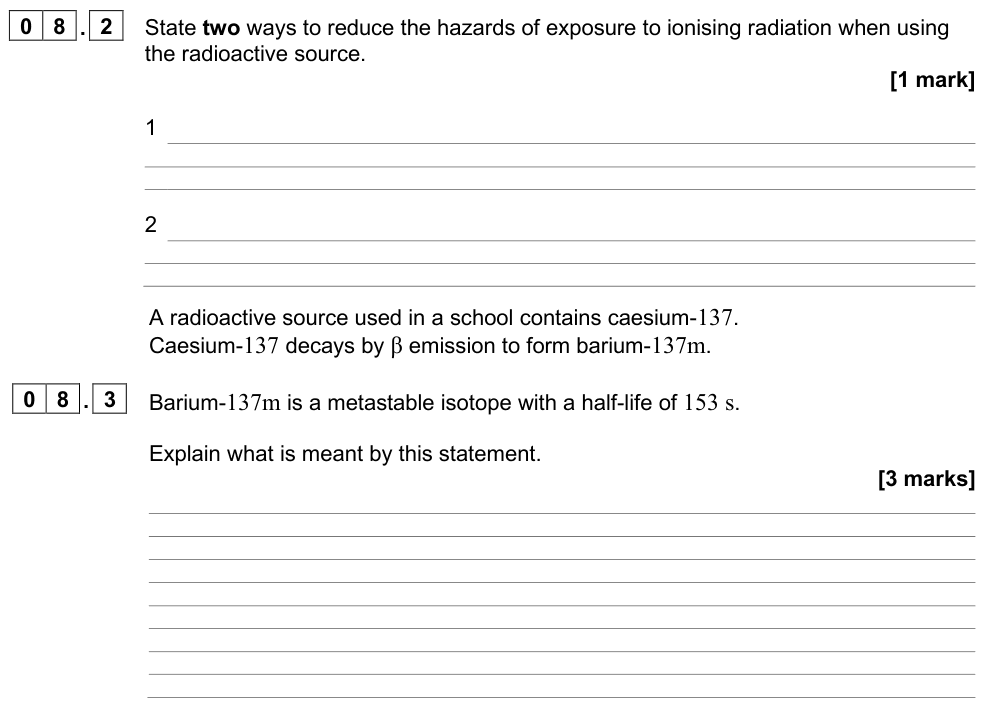
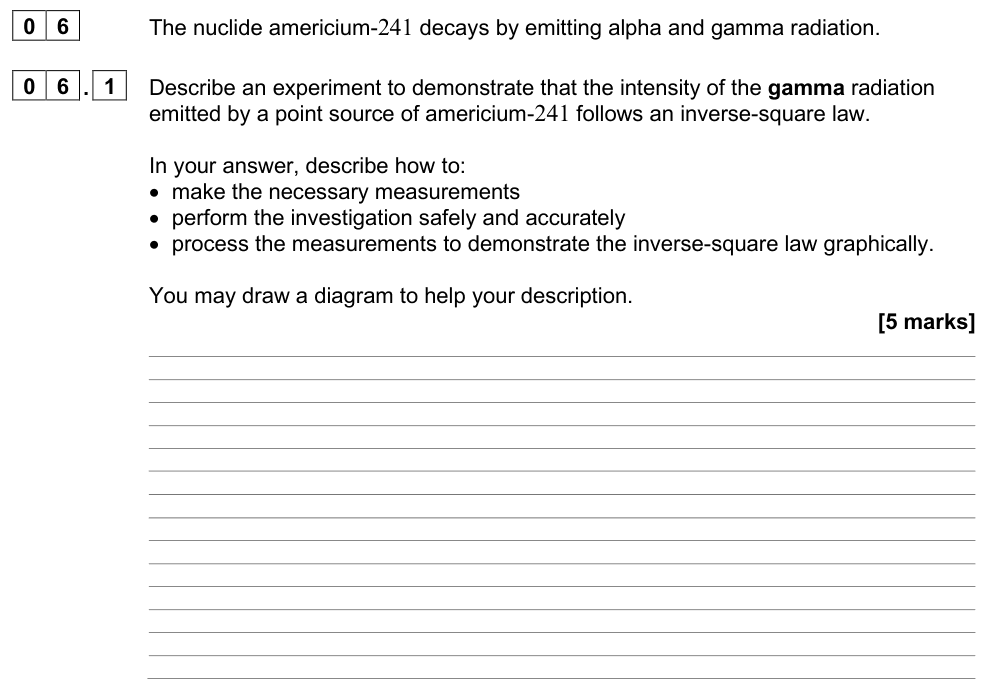
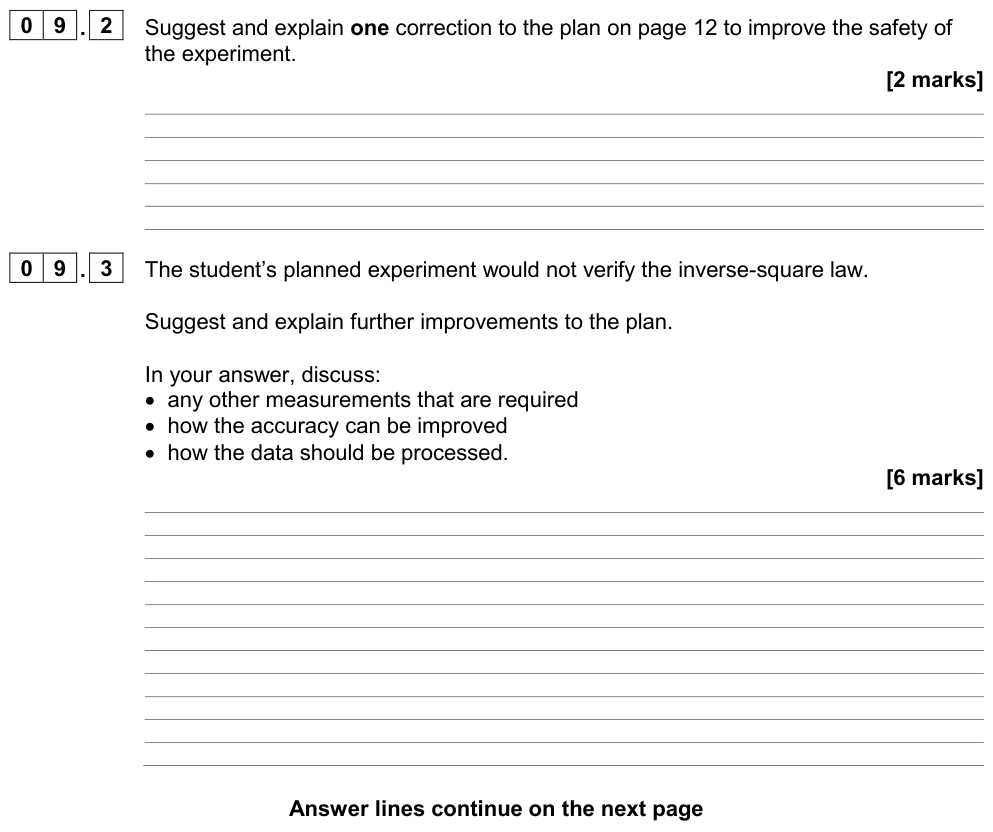
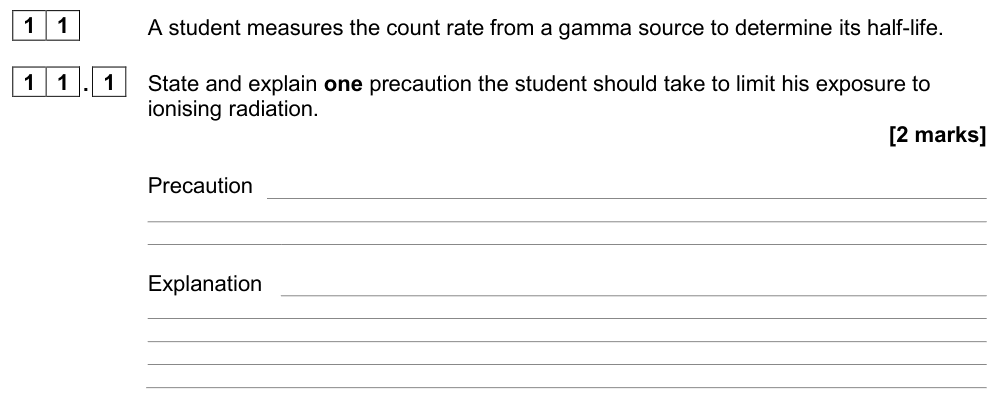
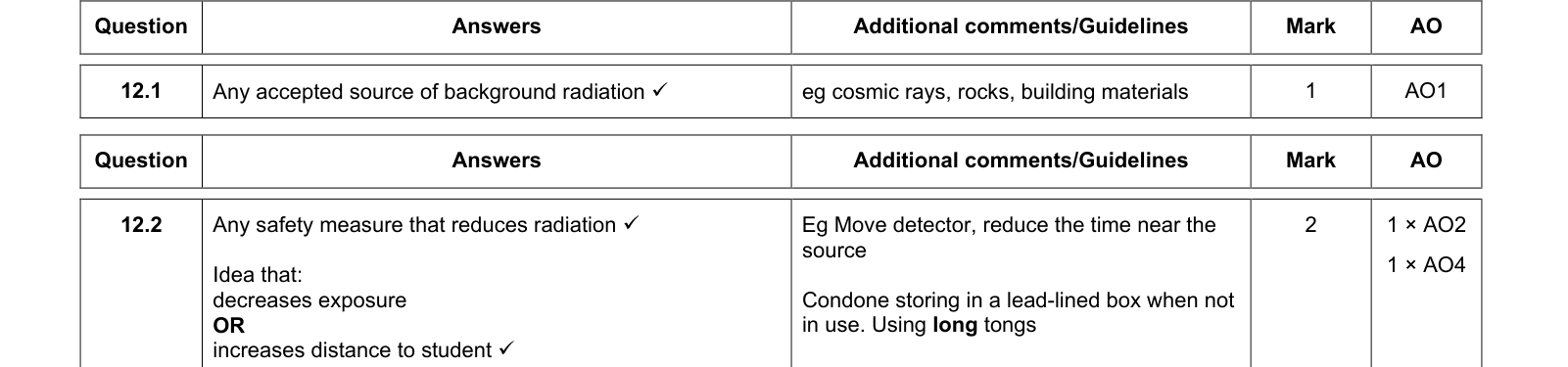
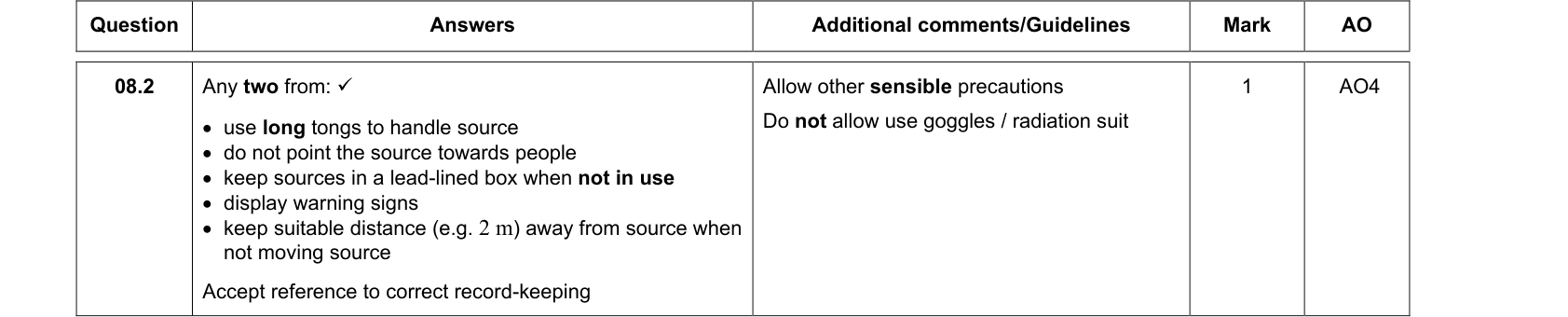
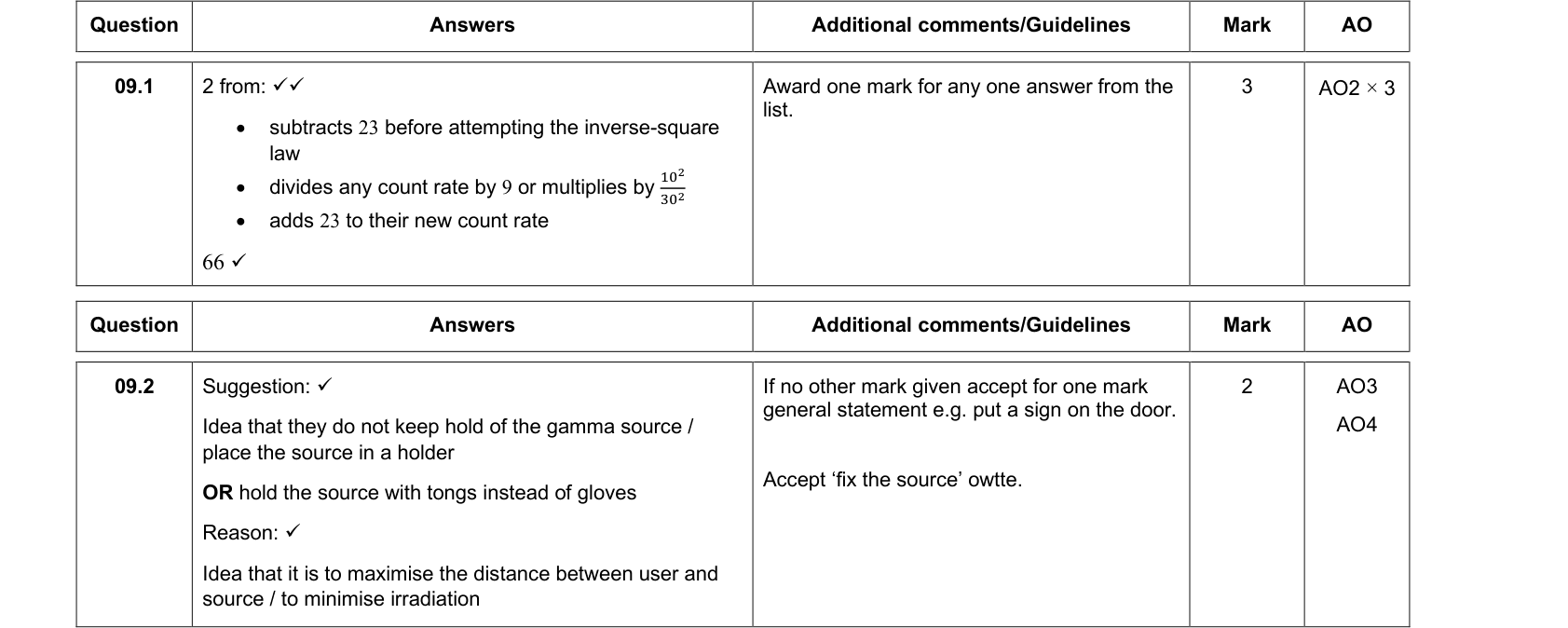
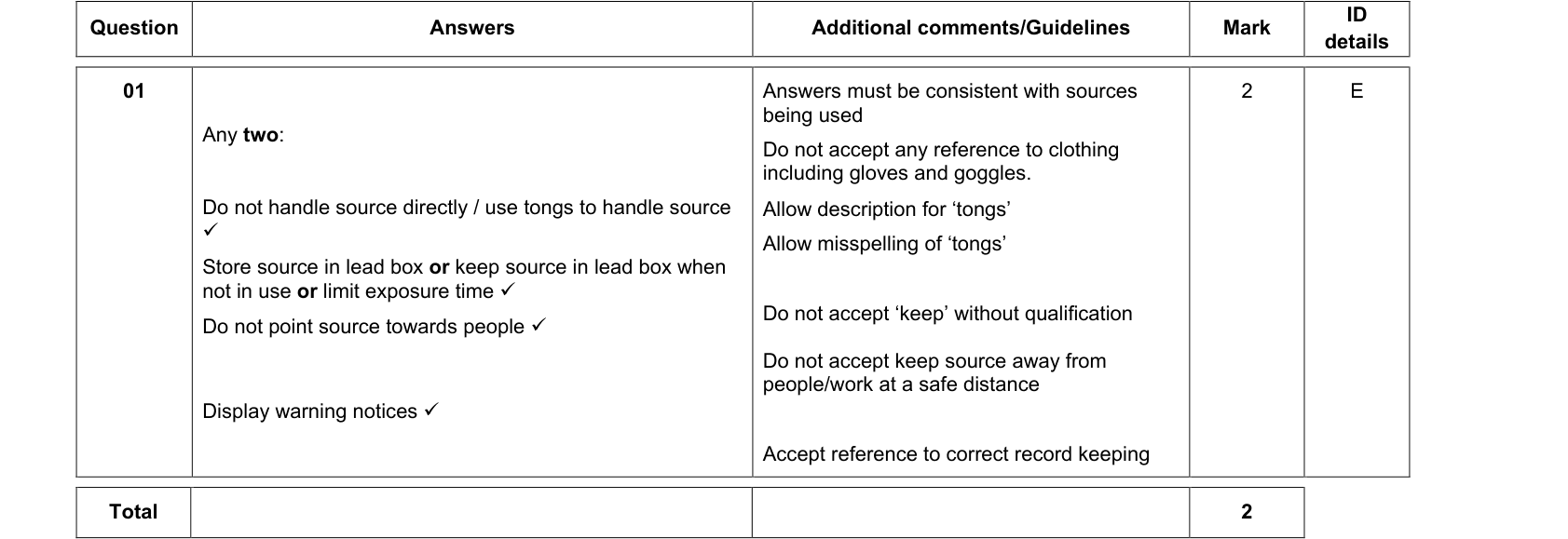
- Safe handling: store sources in lead-lined boxes; handle with long tongs (inverse-square law, increases distance); never point at people; minimise exposure time; keep the source as far away as possible; wash hands afterwards.
The inverse-square law for γ radiation
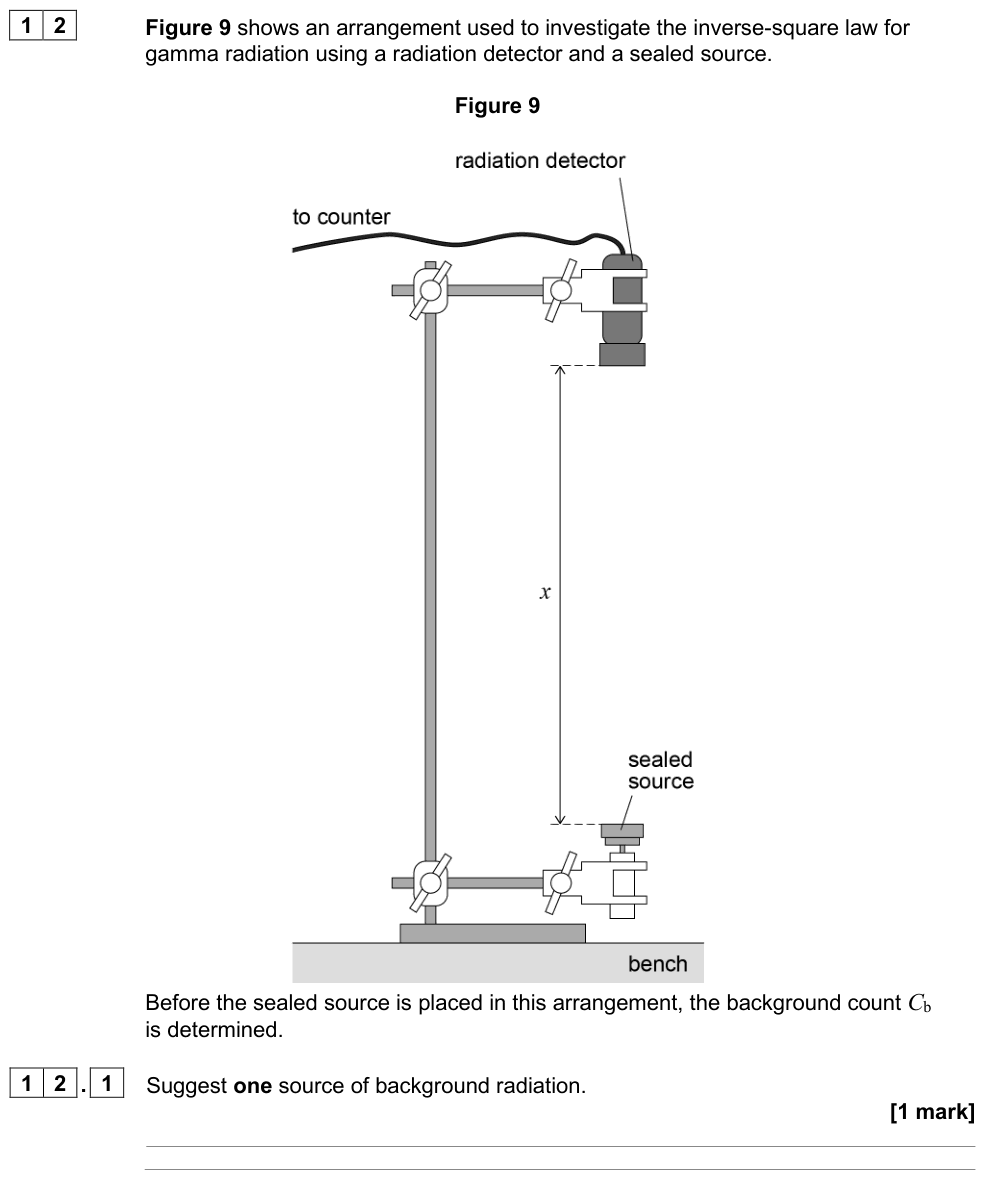
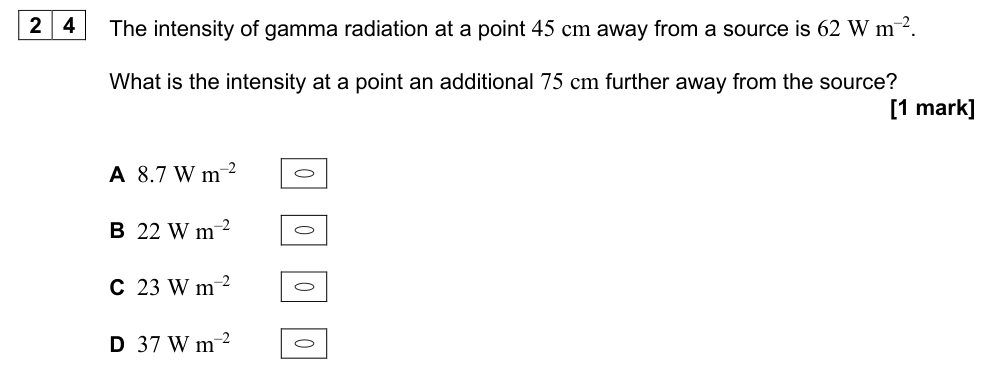
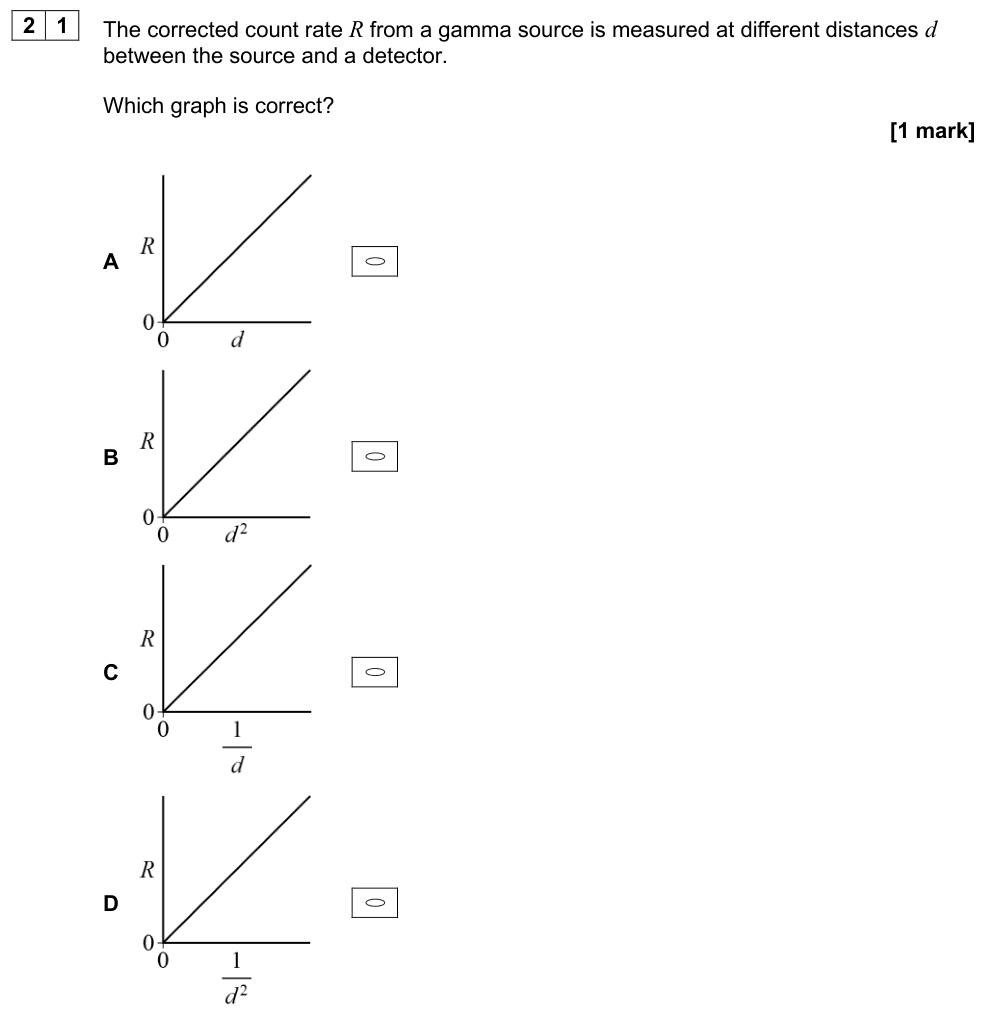
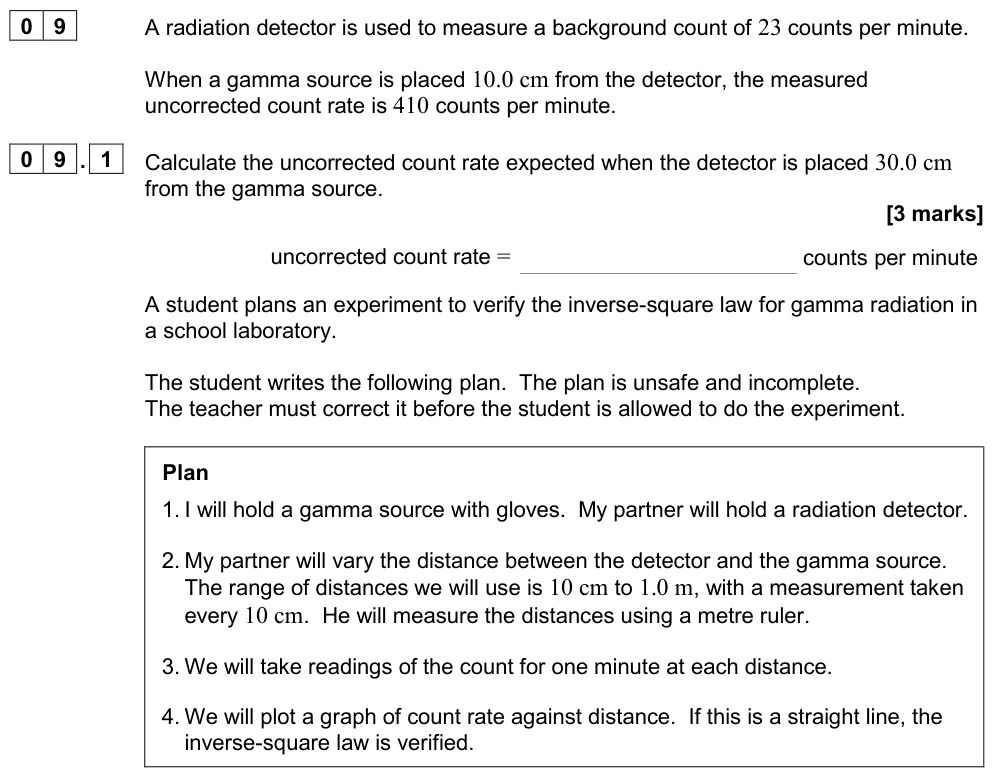
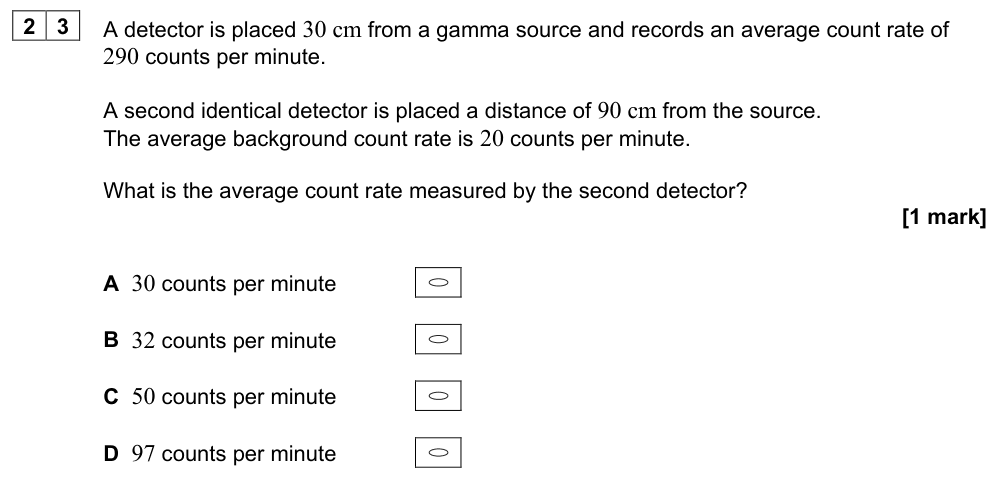
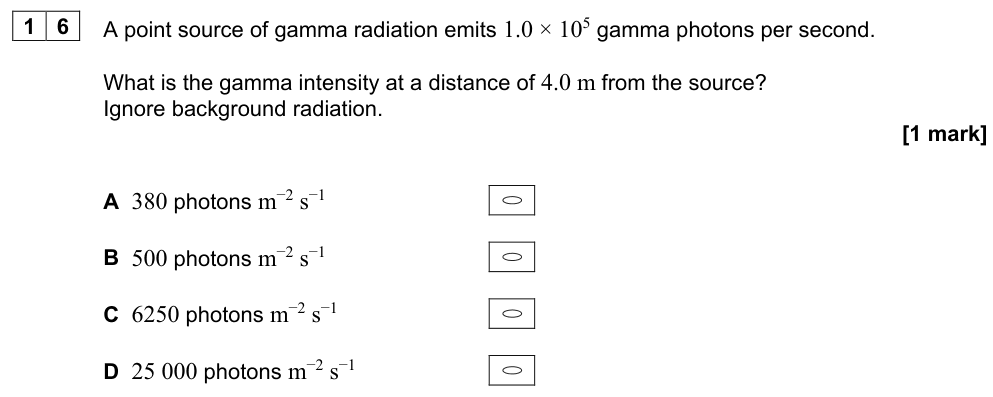
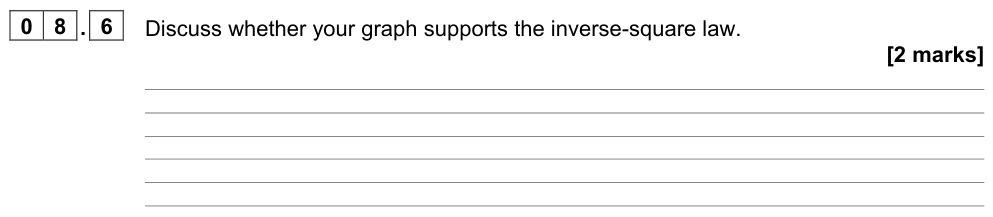
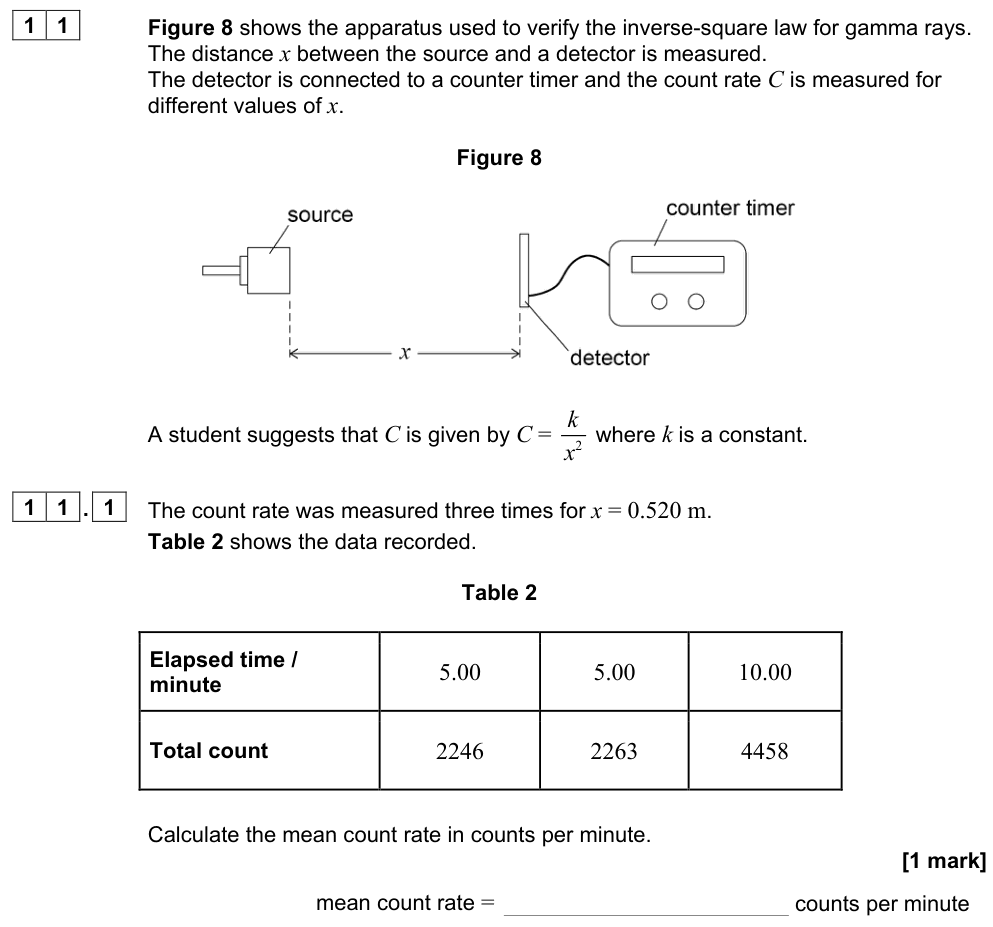
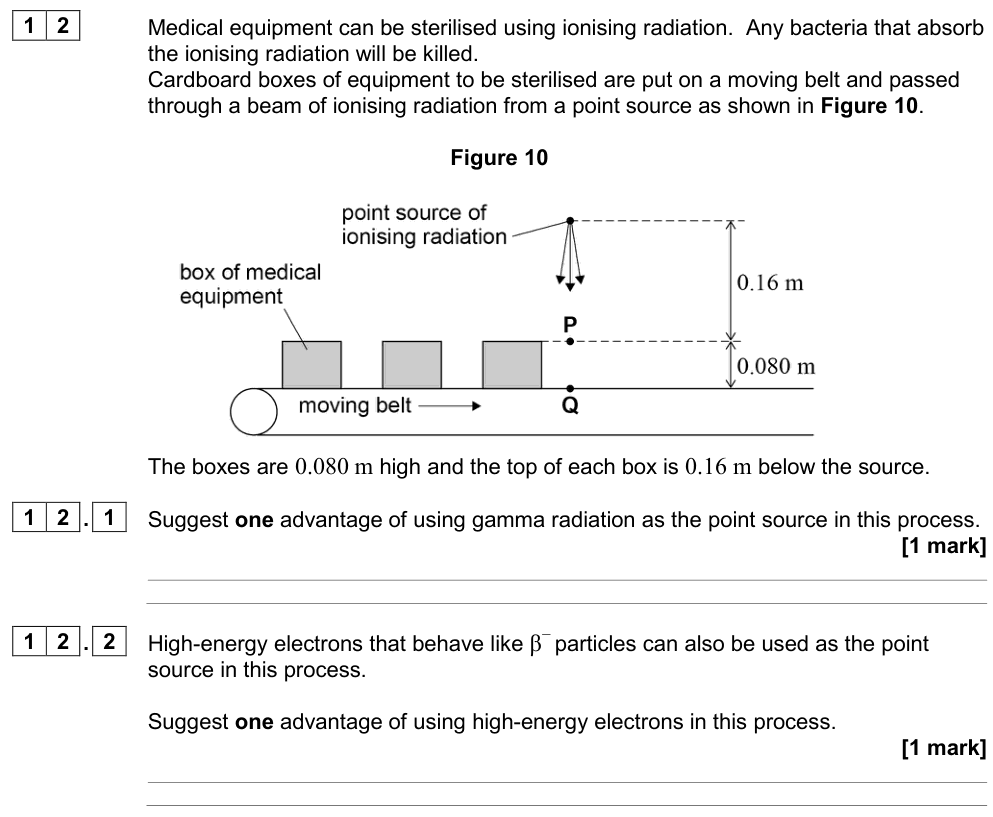
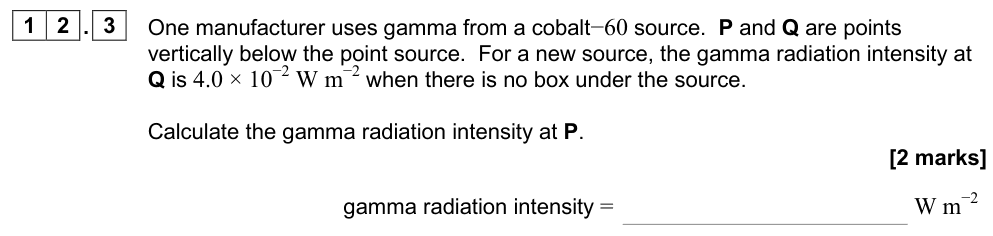
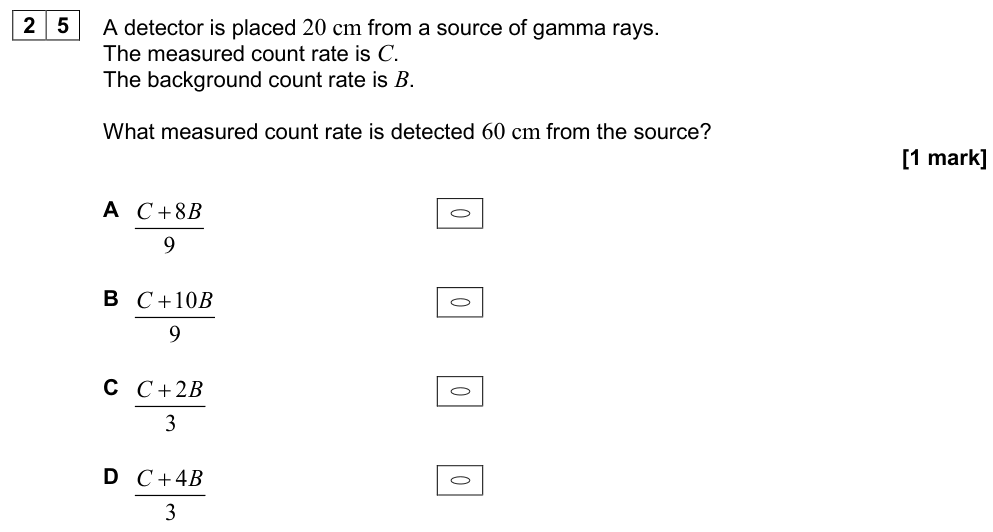
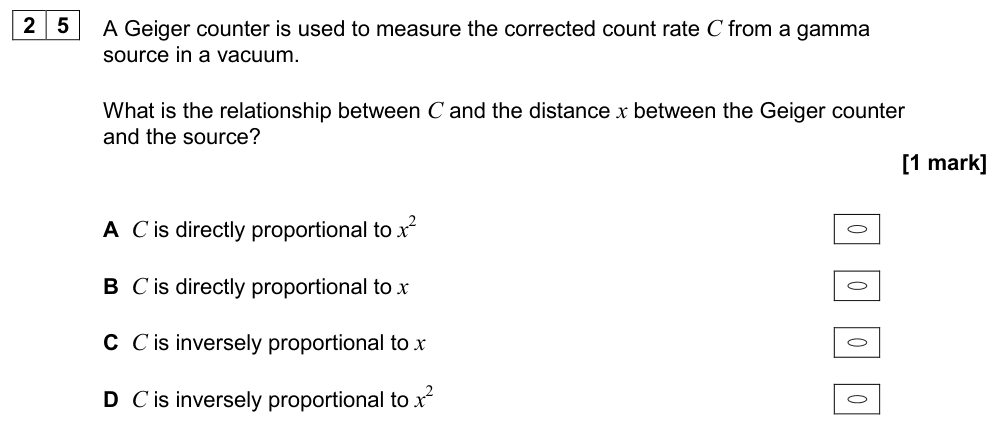
Gamma rays from a point source spread out in all directions and are hardly absorbed by air. The intensity falls with distance $x$ from a point source as:
$$I = \frac{k}{x^2} \qquad \text{(the specification writes } I = I_0/r^2\text{)}$$
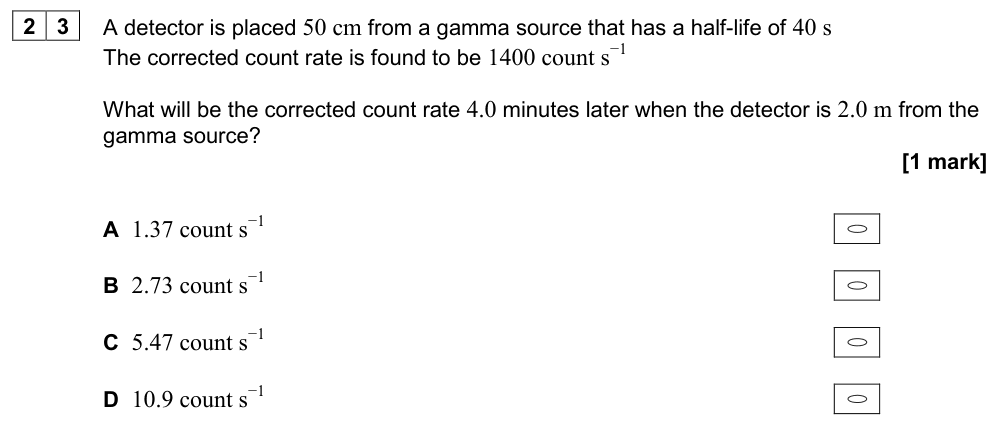
Doubling the distance reduces the intensity (and the corrected count rate) to one quarter. This is the reason for handling sources with tongs.
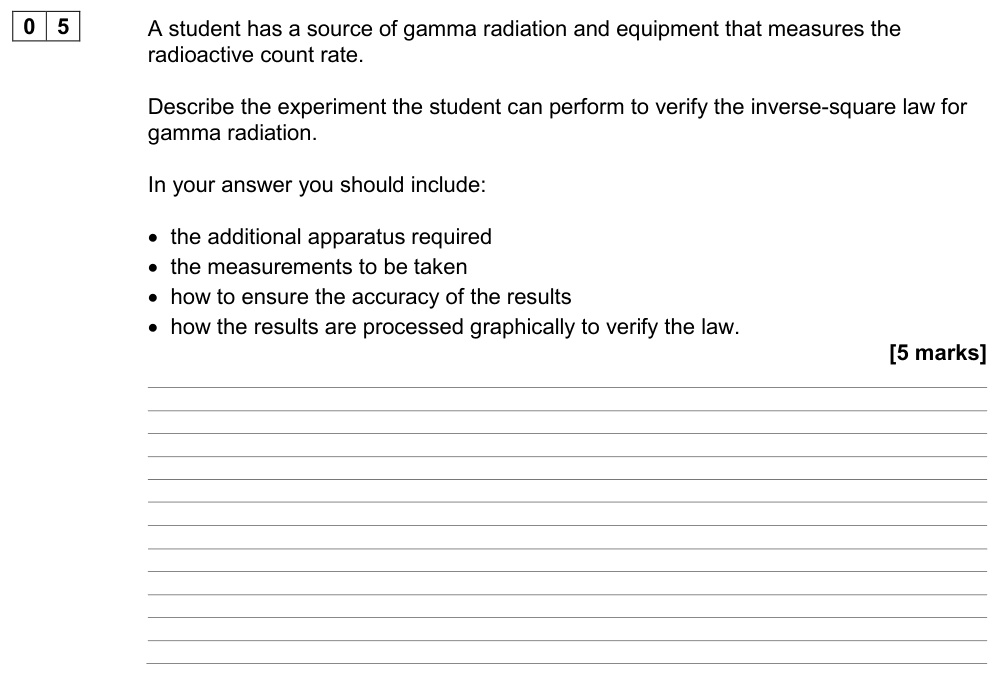
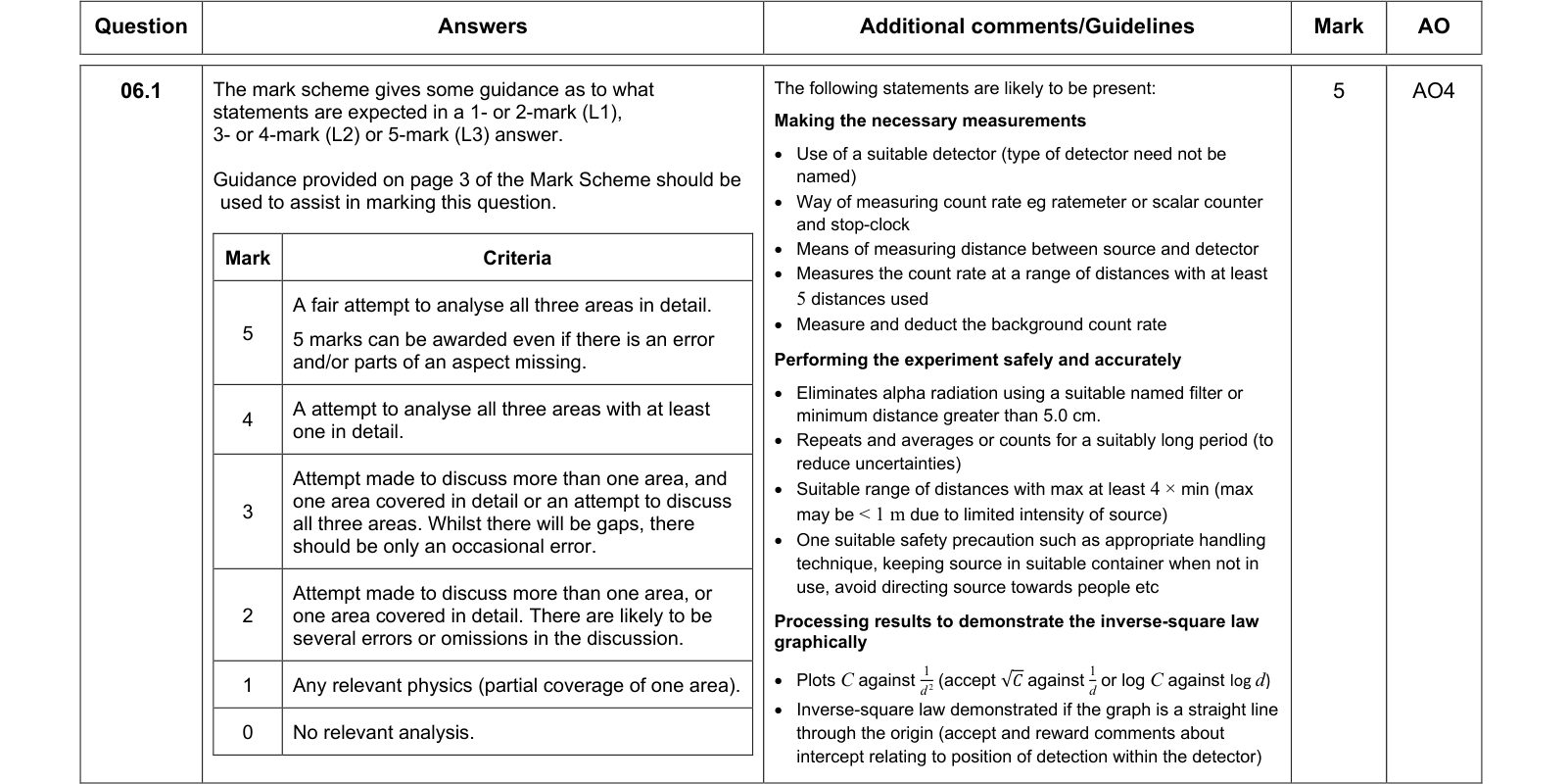
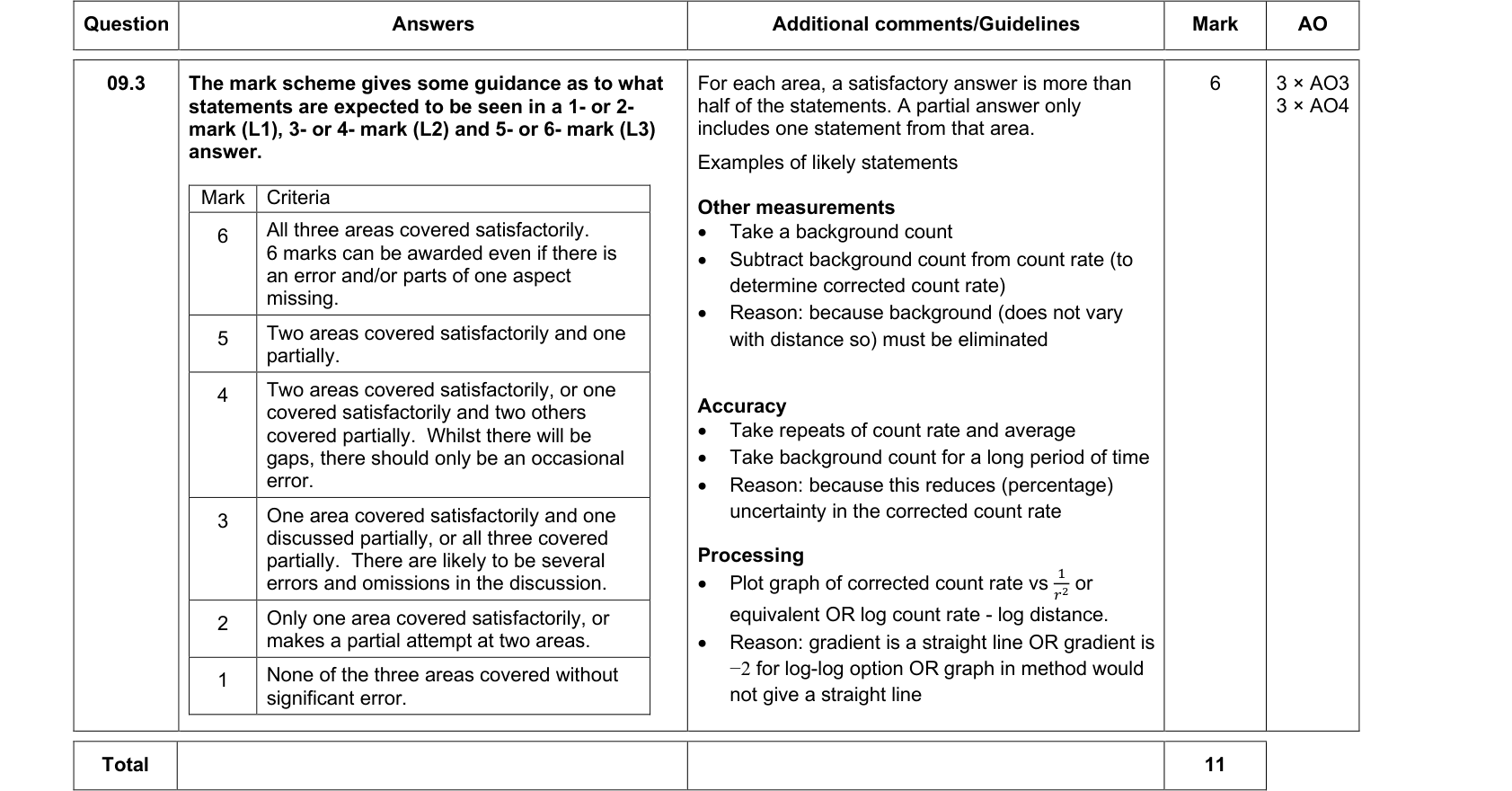
Verifying the inverse-square law for γ radiation
- Measure the background count rate.
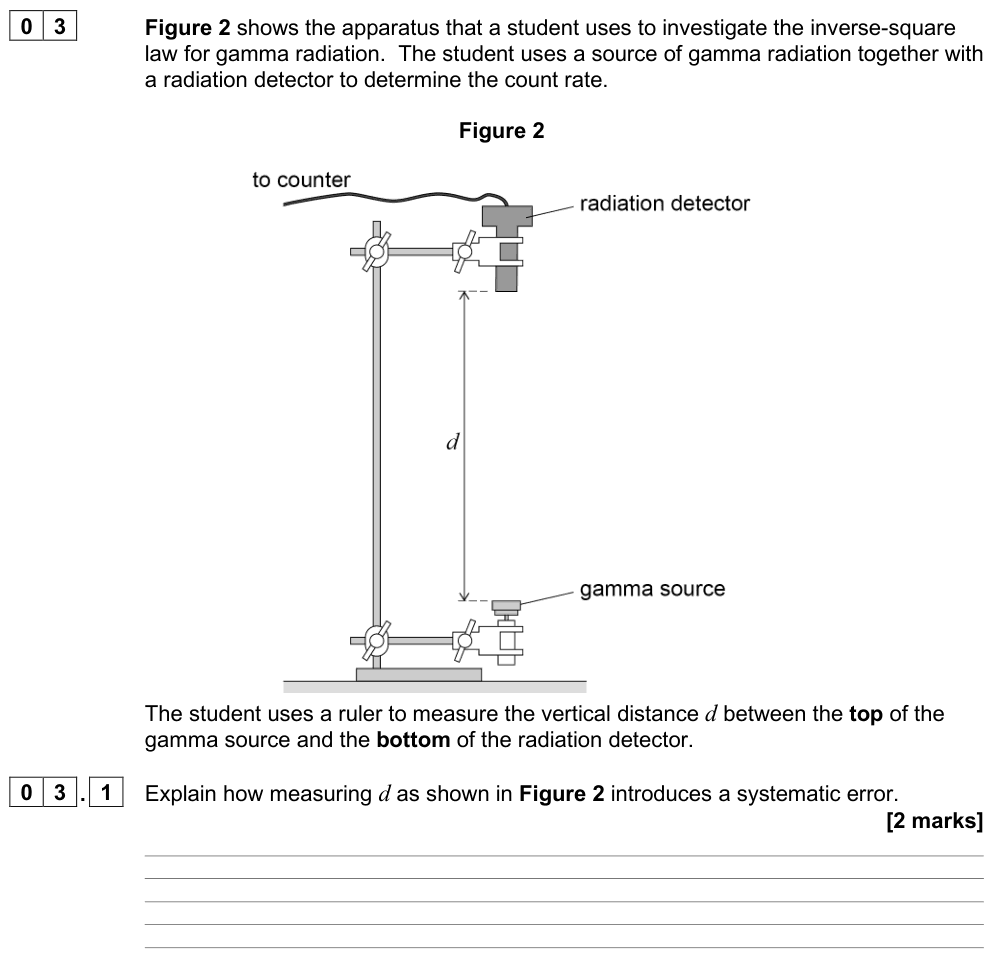
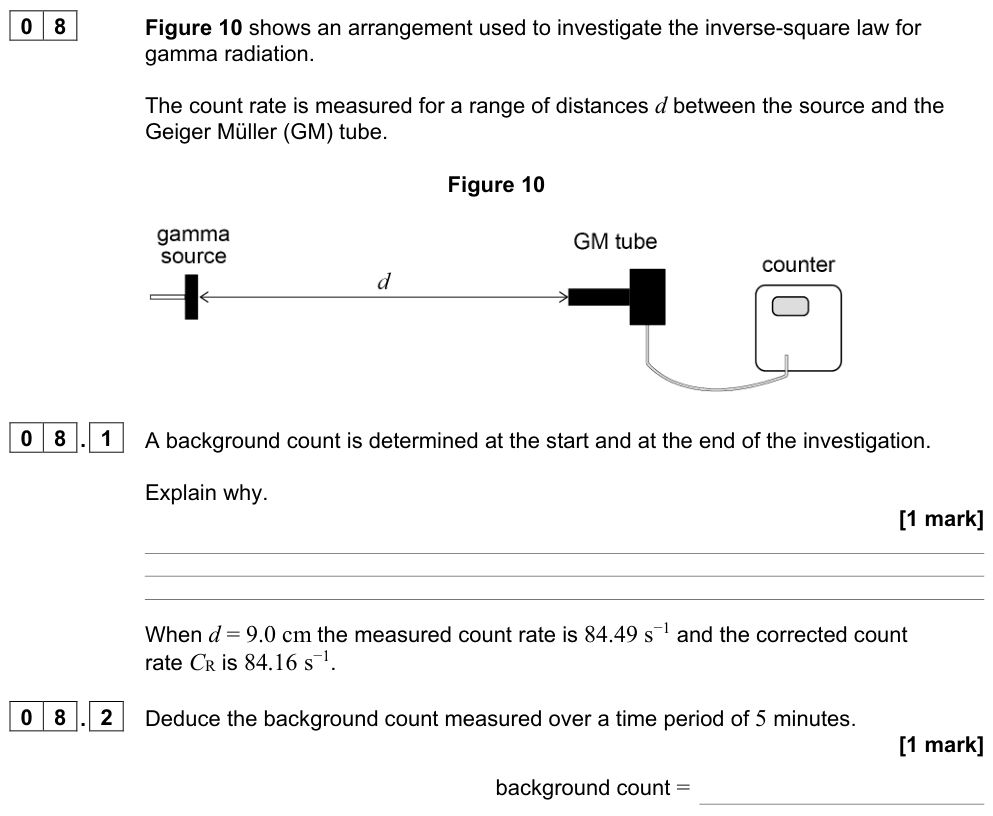
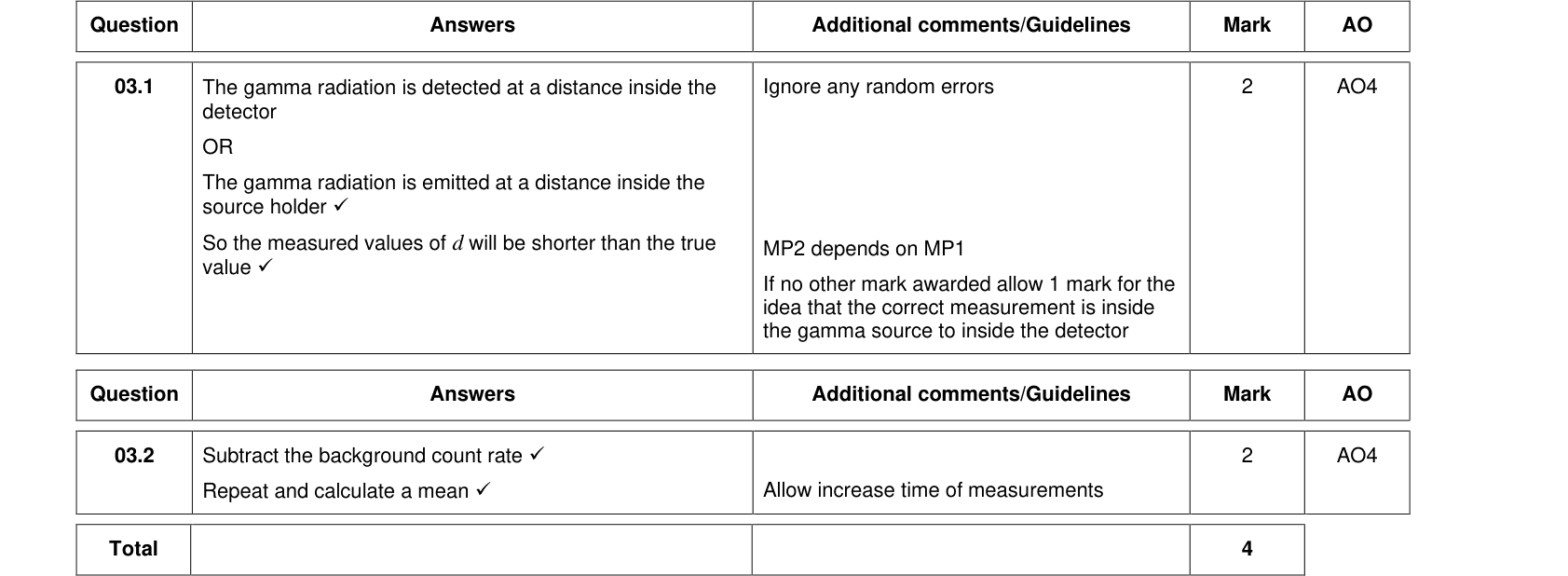
- Place a γ source at measured distances $d$ from the GM tube. Record counts over a fixed time (e.g. 2 minutes) to reduce the effect of random fluctuations.
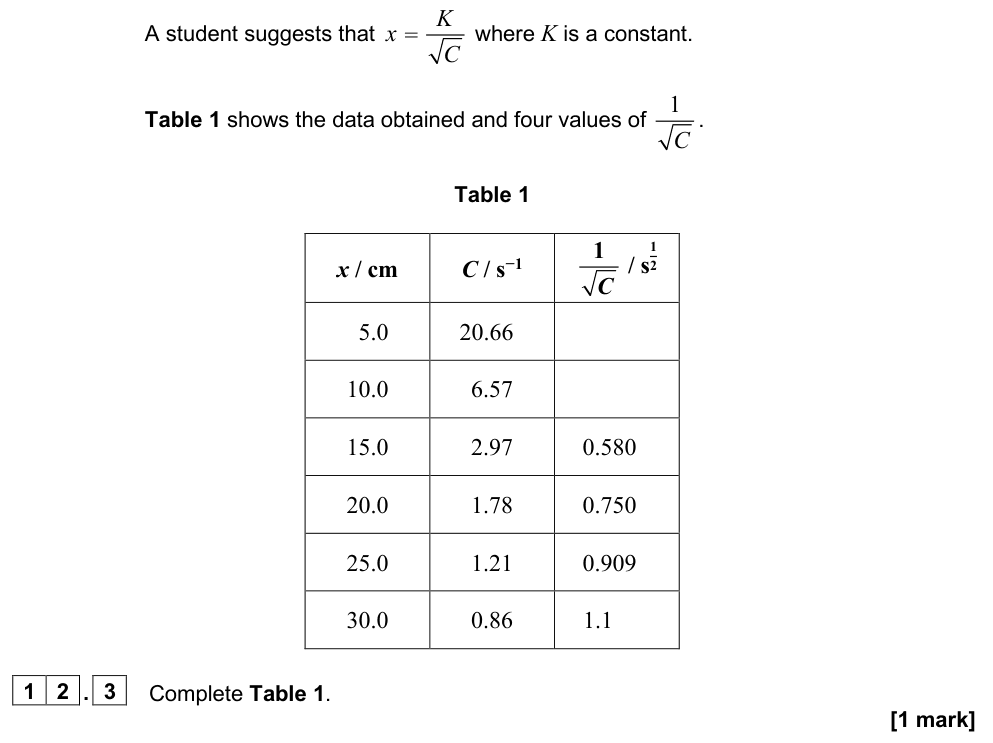
- Calculate the corrected count rate $C$.
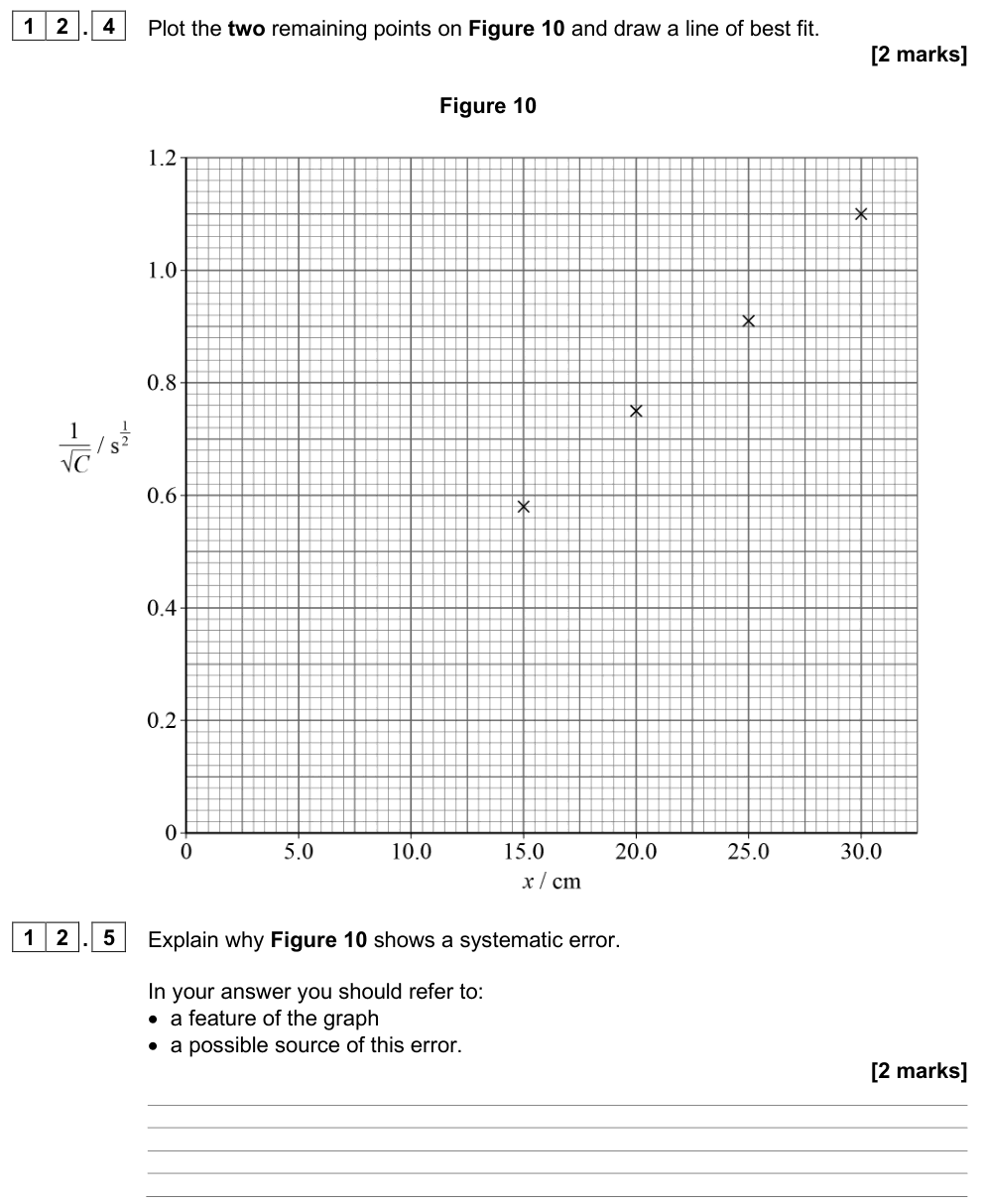
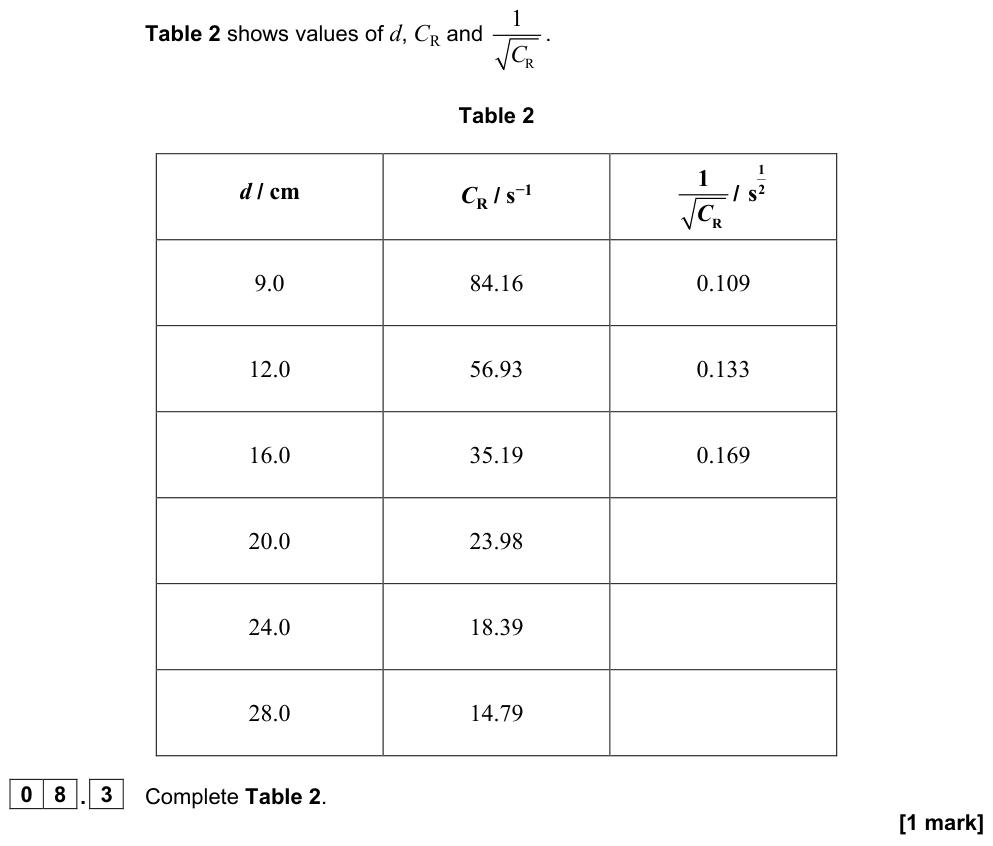
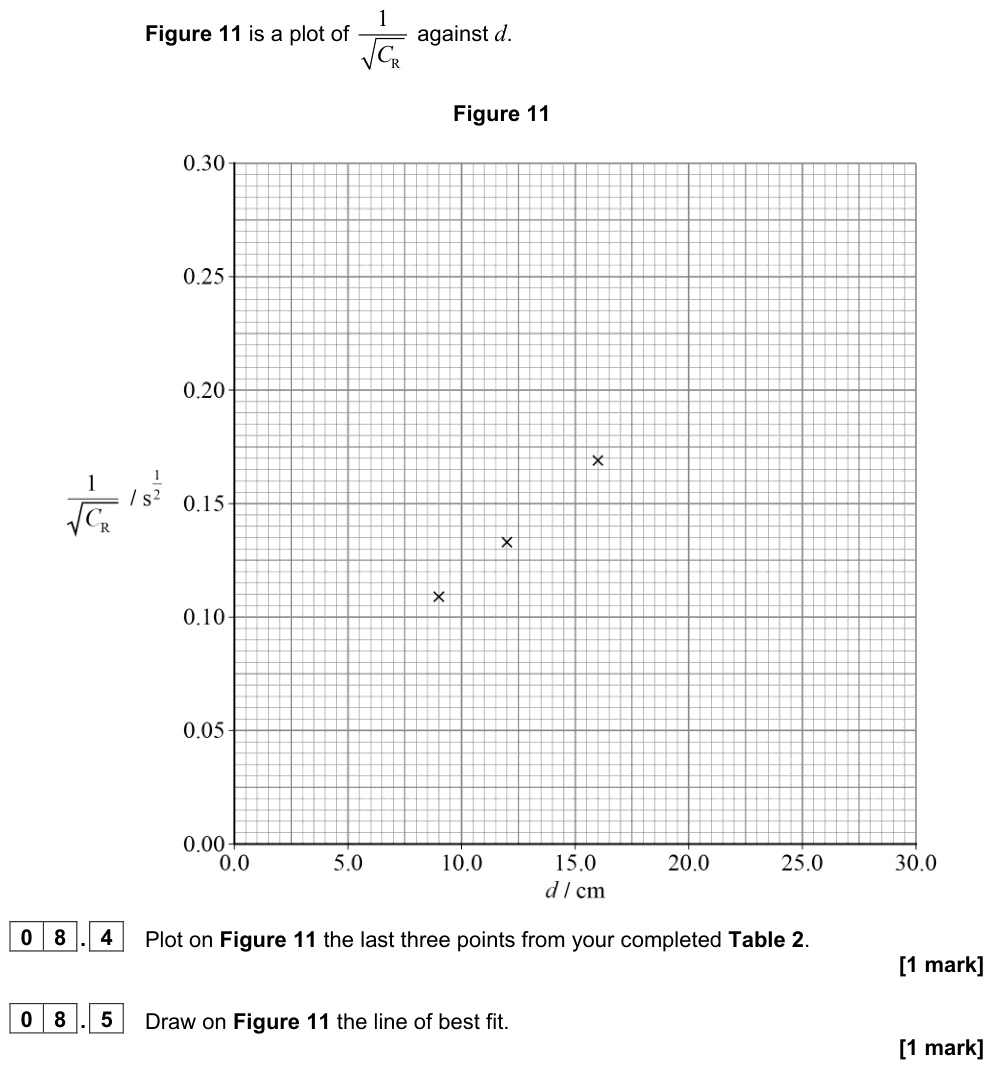
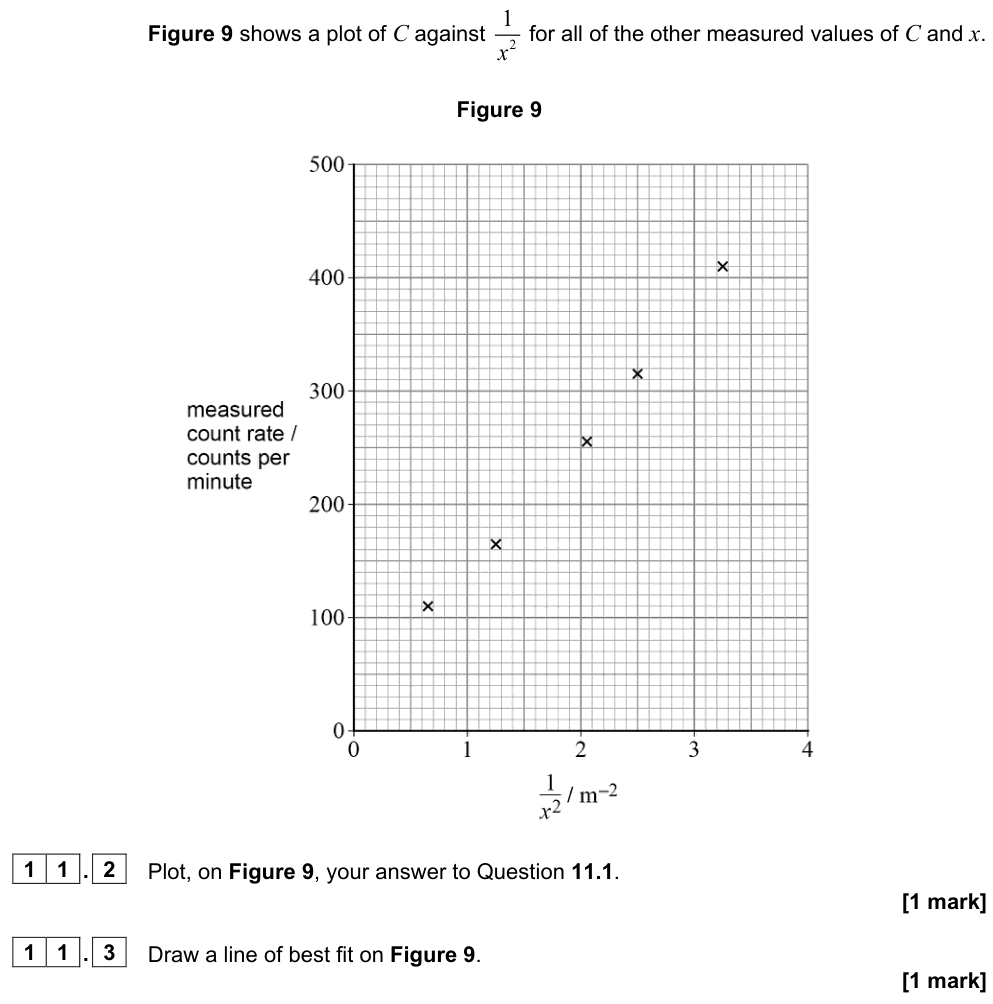
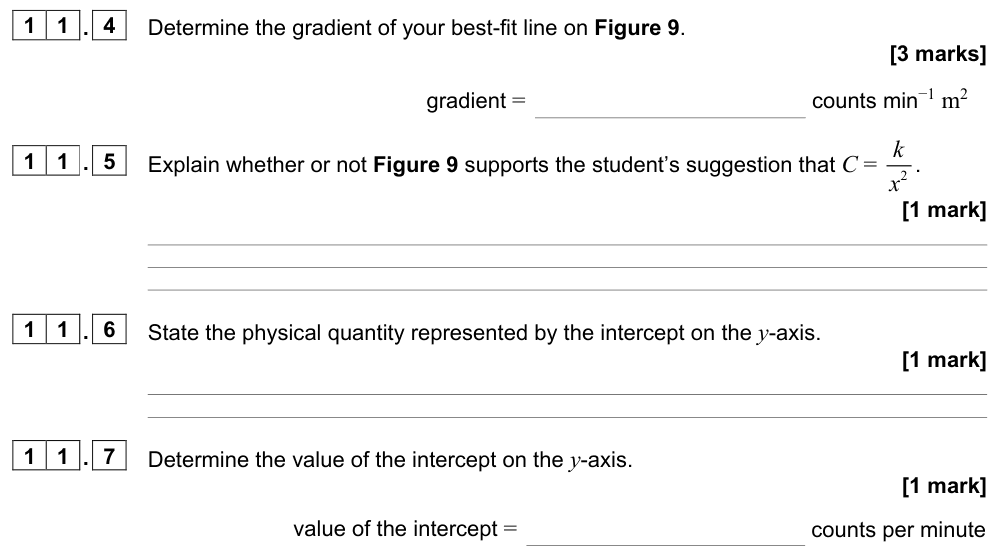
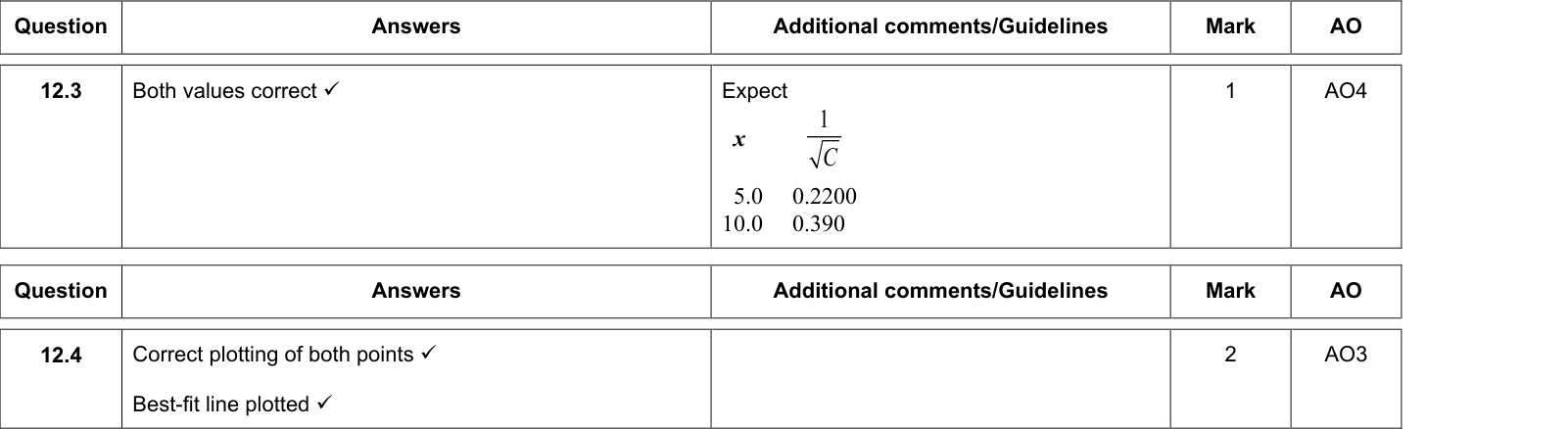
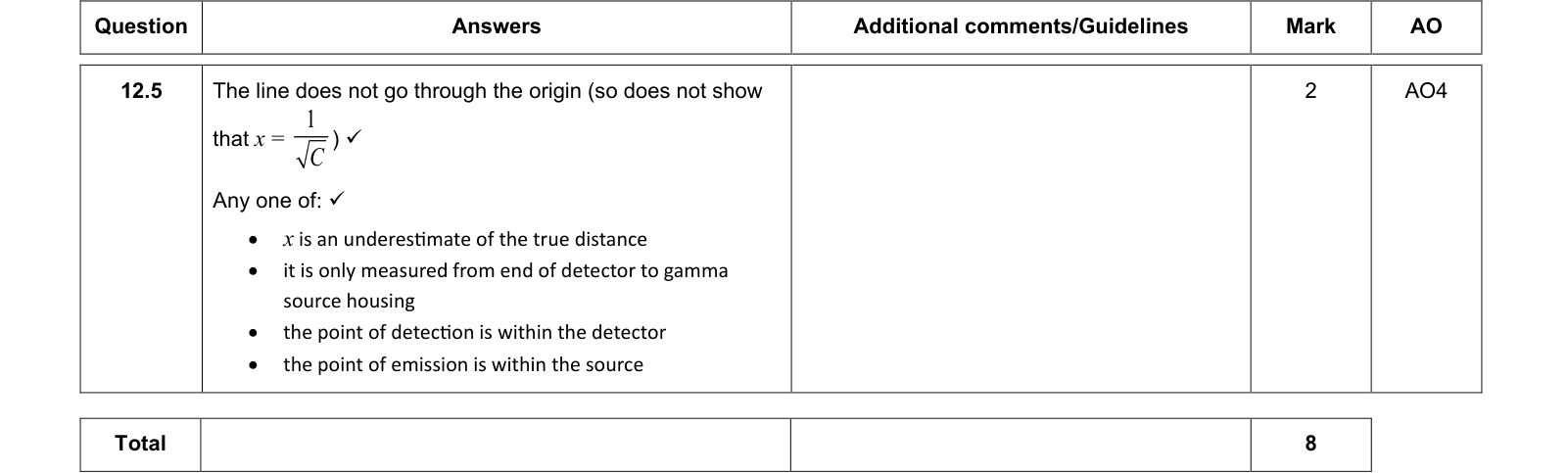
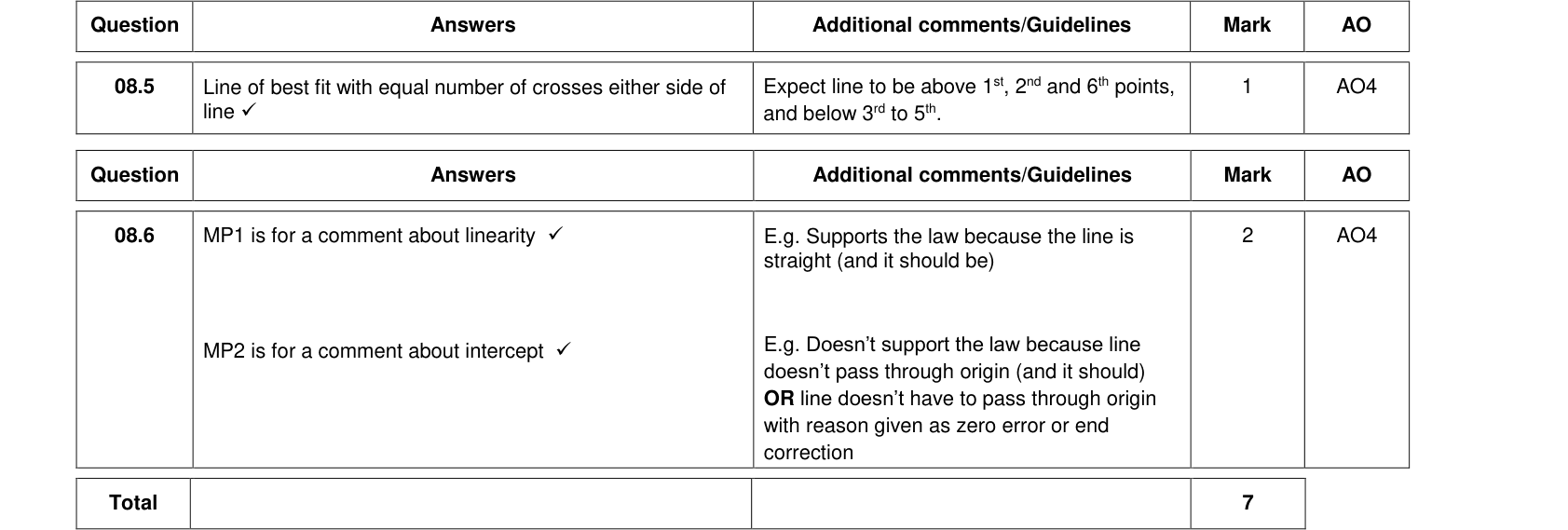
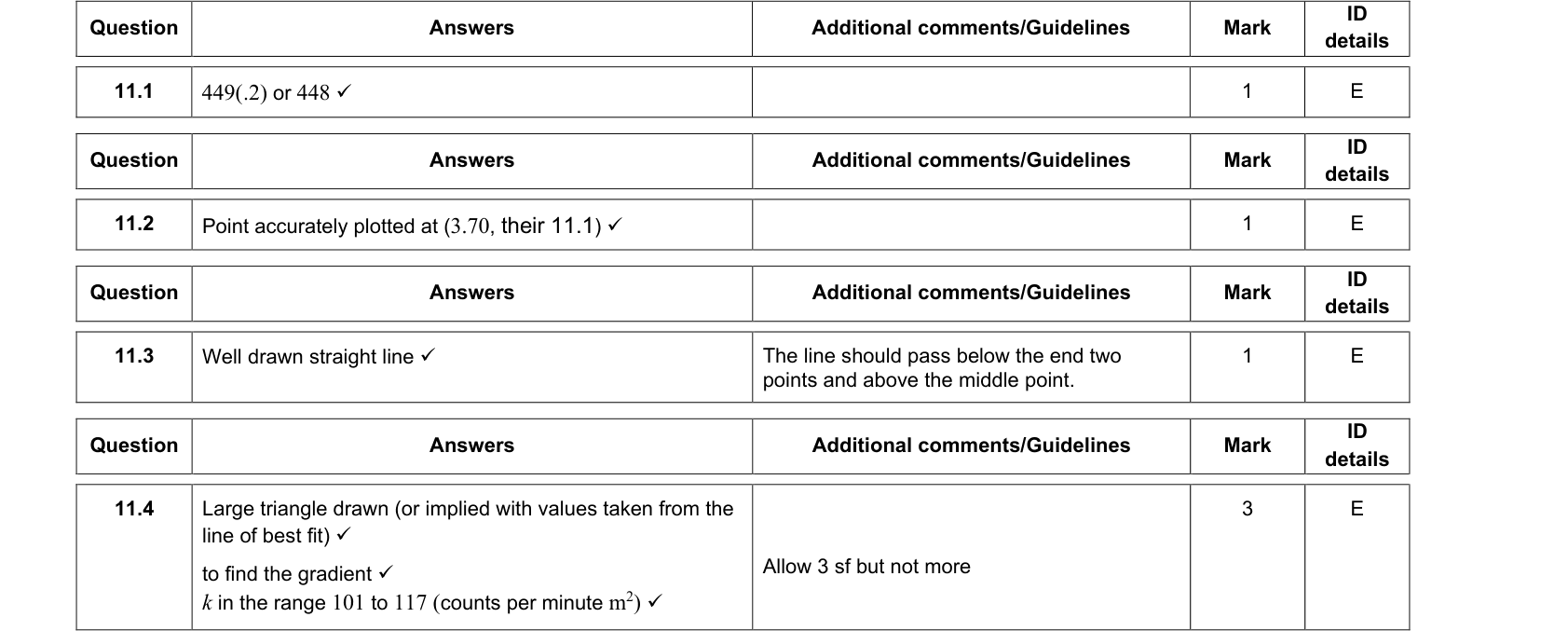
- The source and the sensitive point of the detector are not exactly where you measure from. If the true distance is $x = d + e$, then $C = k/(d + e)^2$, so $\dfrac{1}{\sqrt{C}} = \dfrac{d + e}{\sqrt{k}}$. A graph of $\dfrac{1}{\sqrt{C}}$ against $d$ is a straight line. The intercept on the $d$-axis gives $-e$. Alternatively, a graph of $C$ against $1/d^2$ should be a straight line through the origin if the law holds and $e$ is negligible.
Background radiation
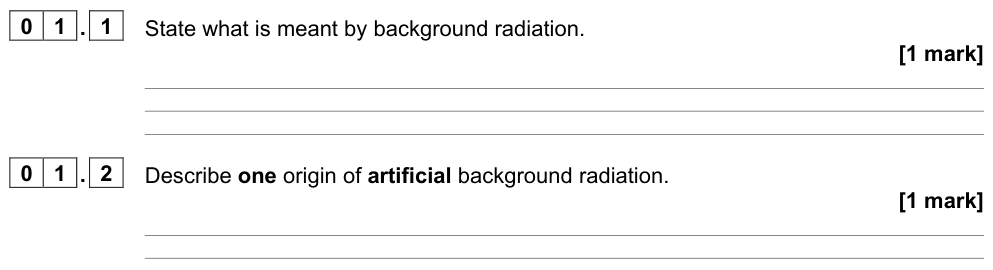
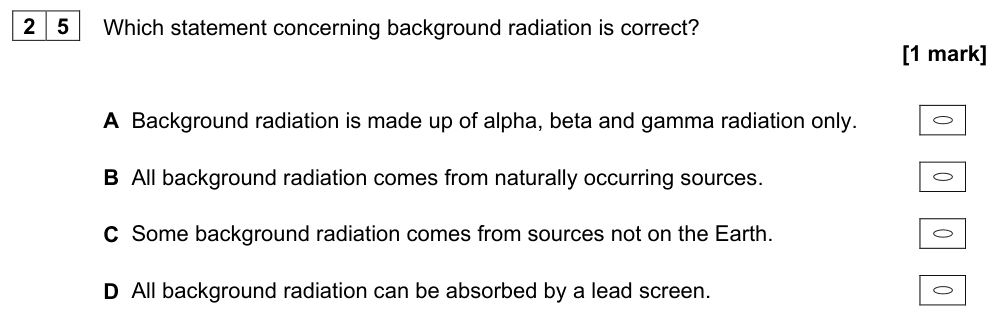
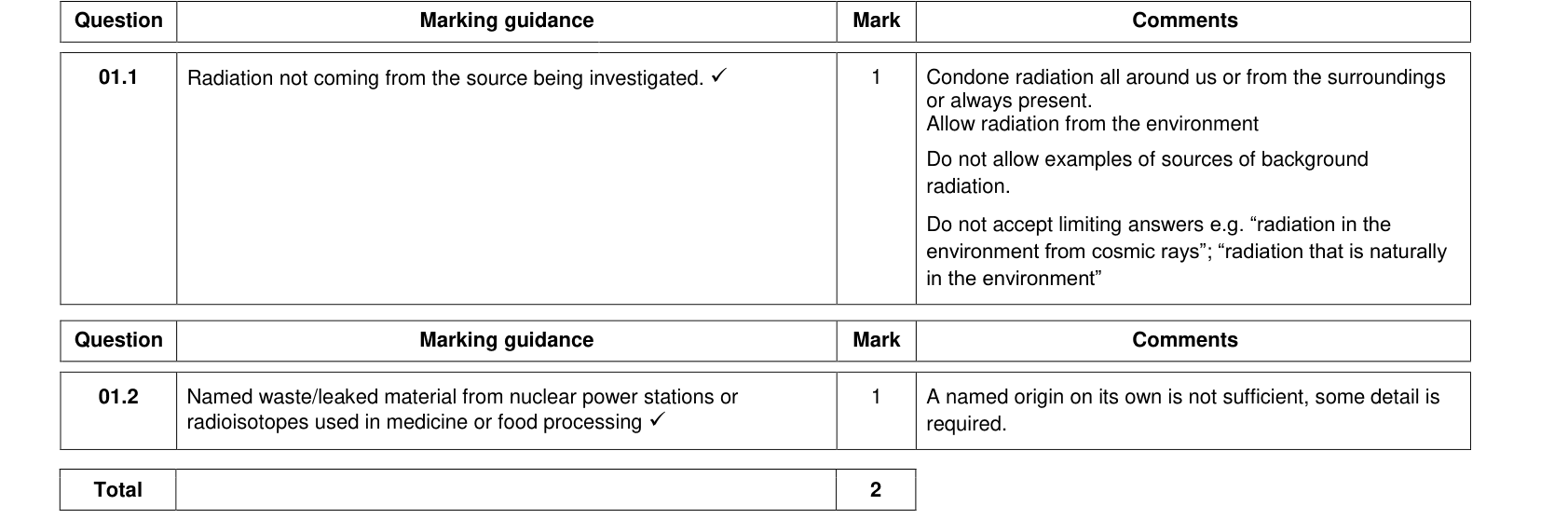
Background radiation is the ionising radiation around us all the time, from natural and artificial sources.
- Natural: radon gas from rocks and soil (the largest contribution in many places), cosmic rays from space, rocks and buildings, food and drink (e.g. potassium-40), carbon-14 in our bodies.
- Artificial: medical uses (X-rays, tracers), fallout from nuclear weapons tests and accidents, waste from nuclear power.
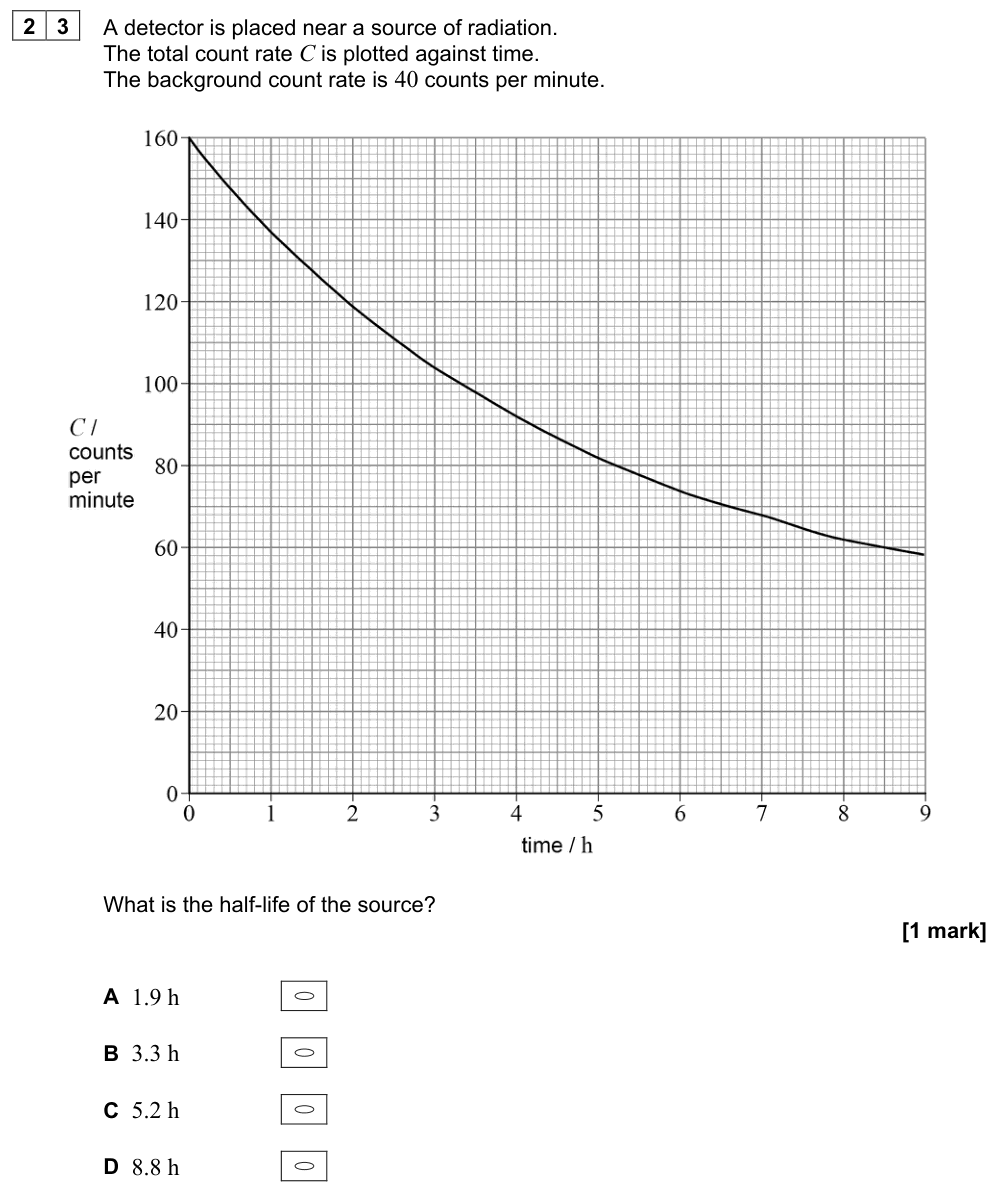
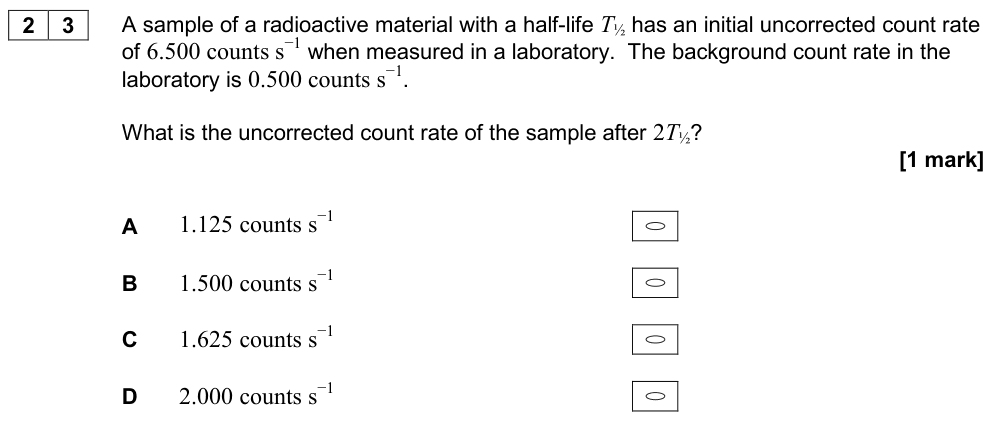
Subtract the average background count rate from every measurement: corrected count rate = measured − background.
Half-life
Half-life
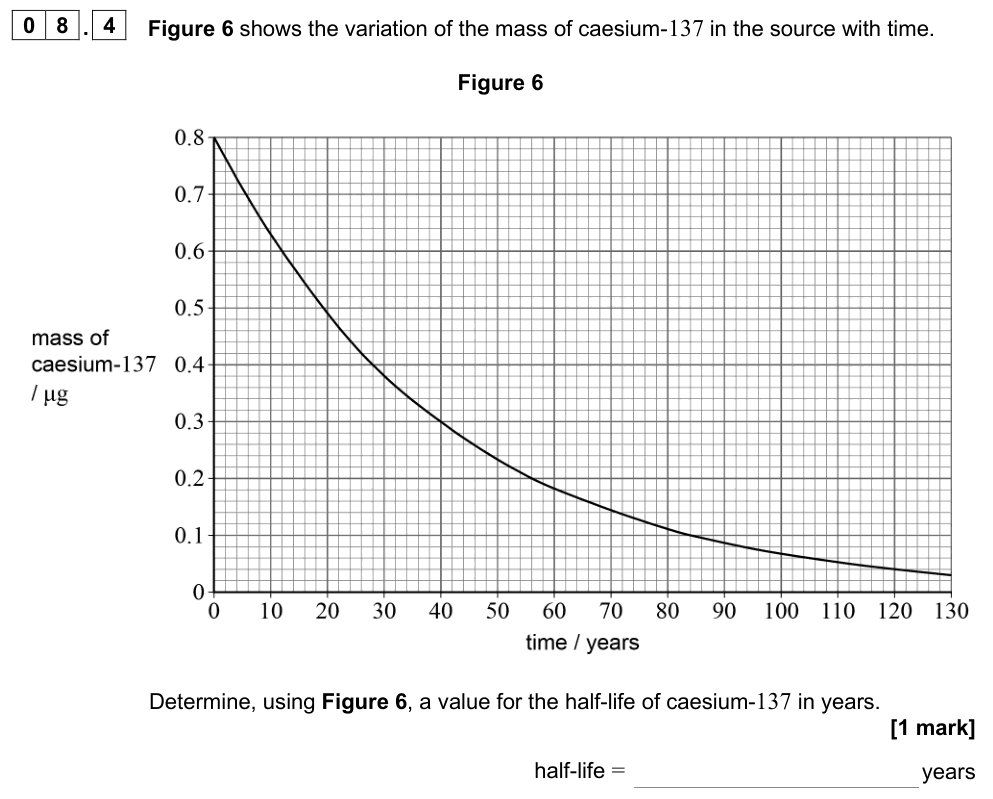
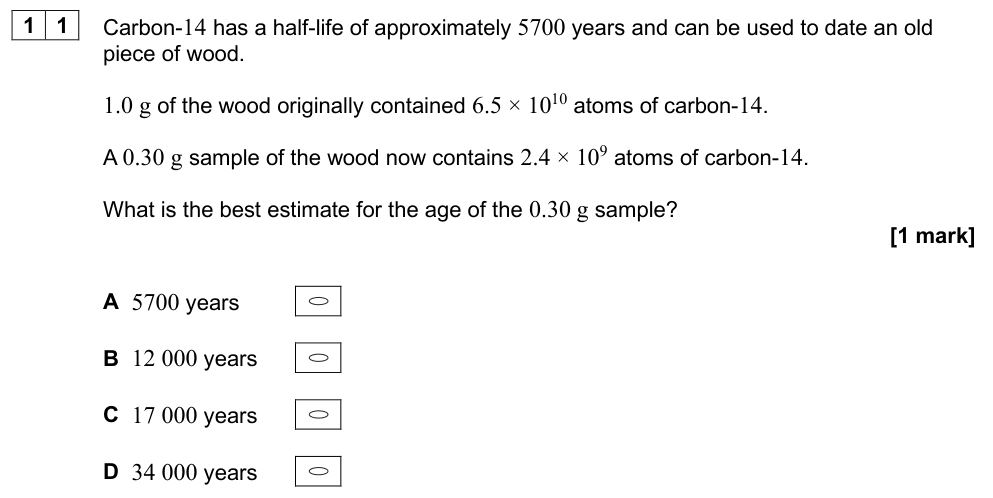
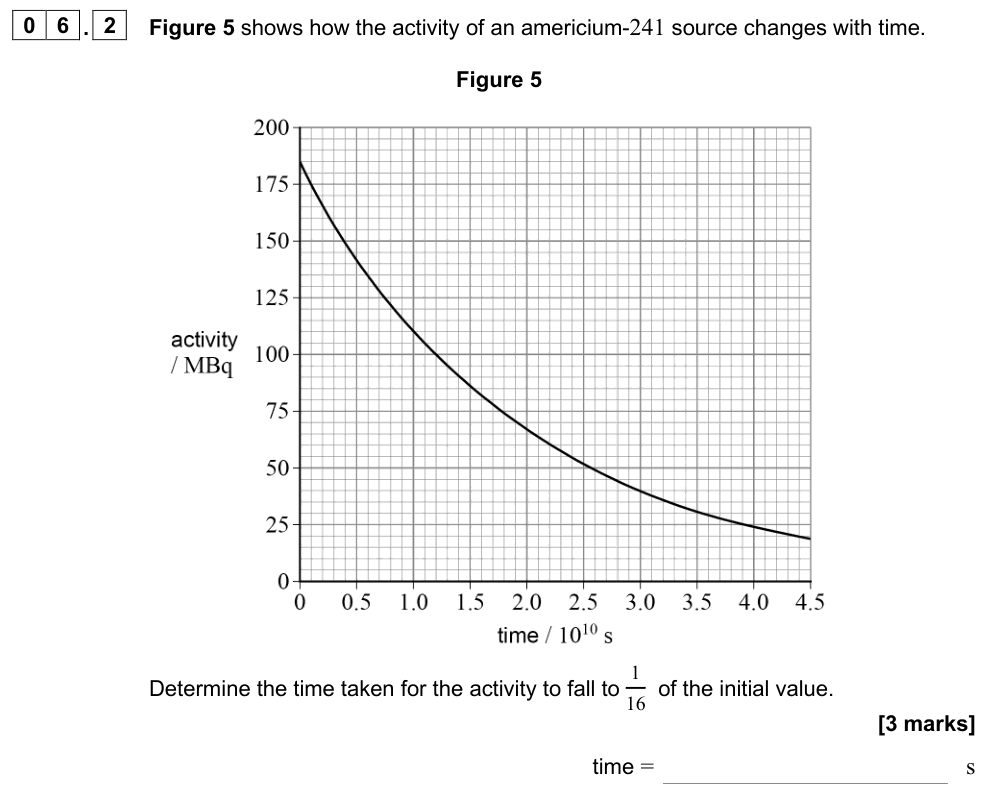
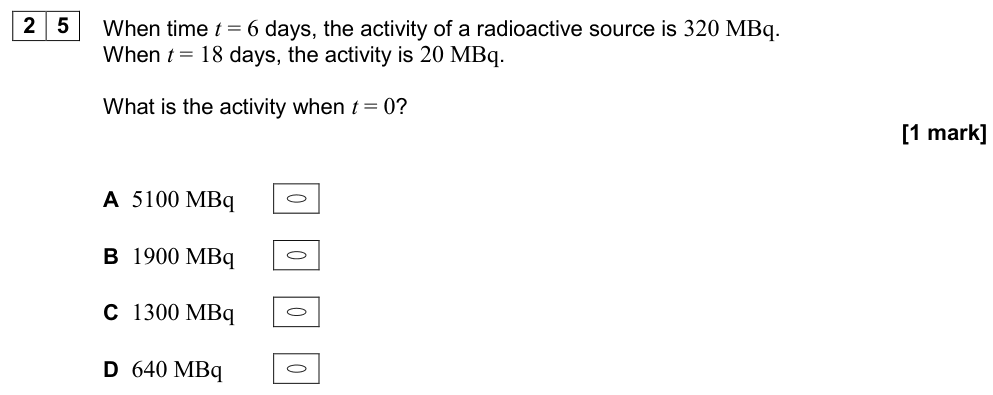
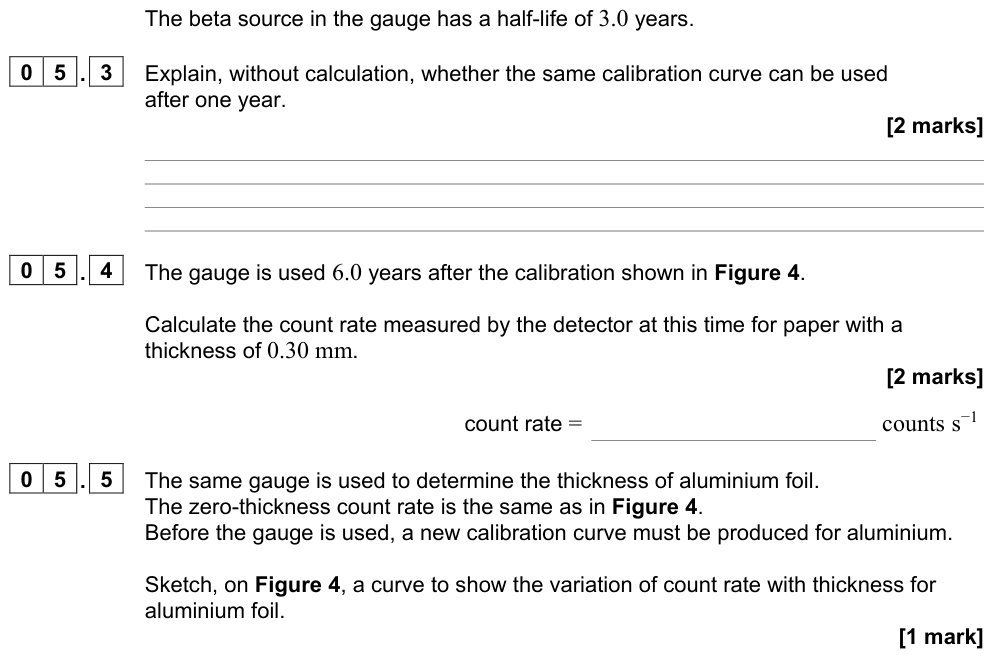
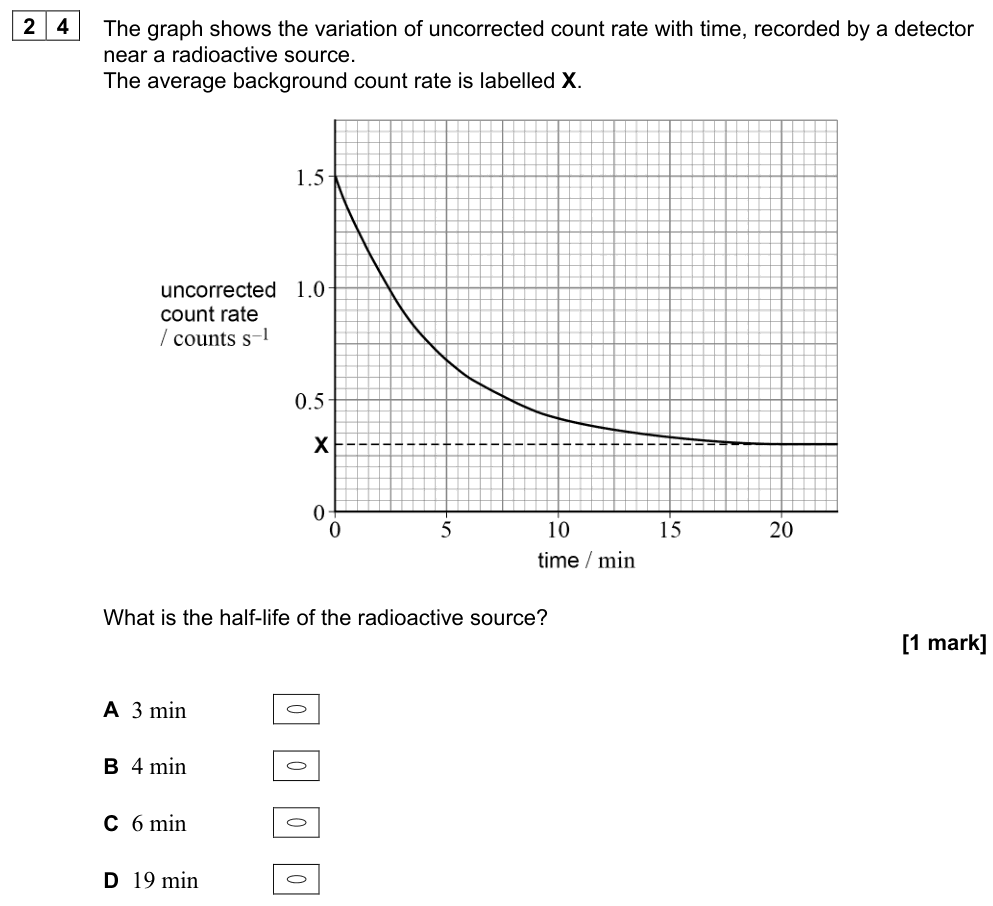
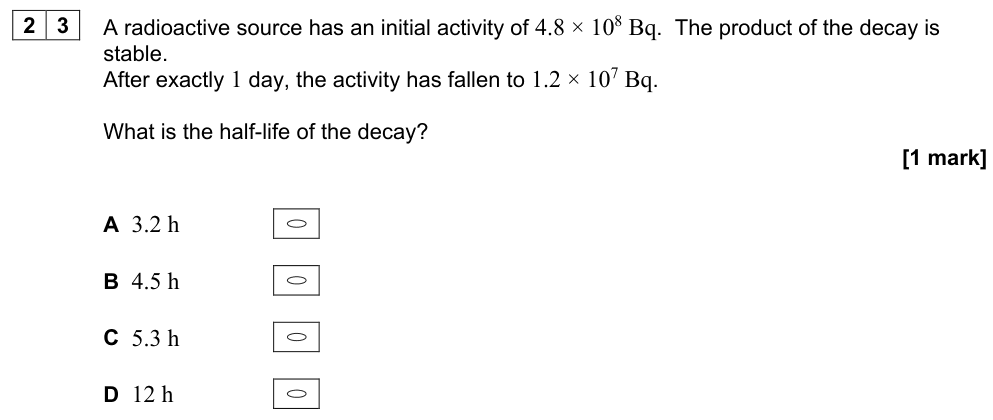
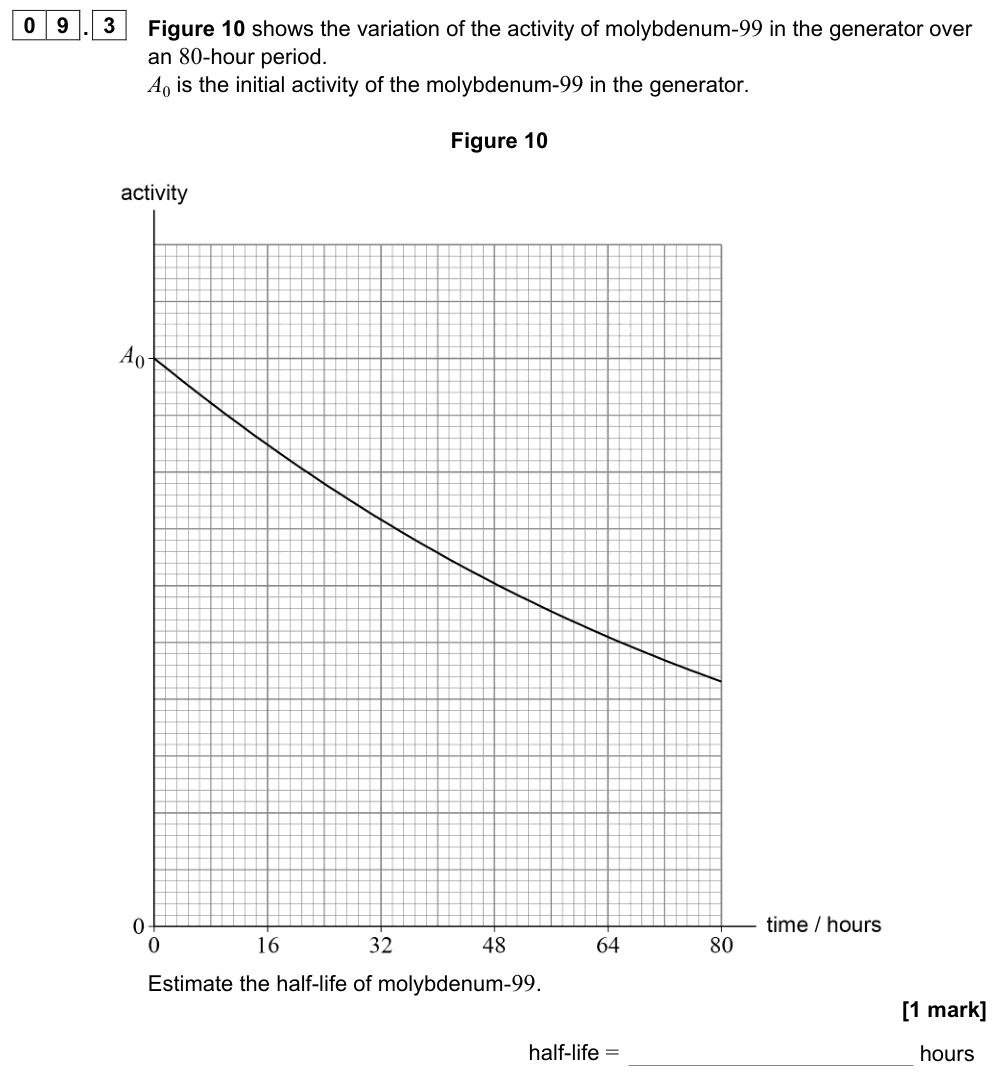
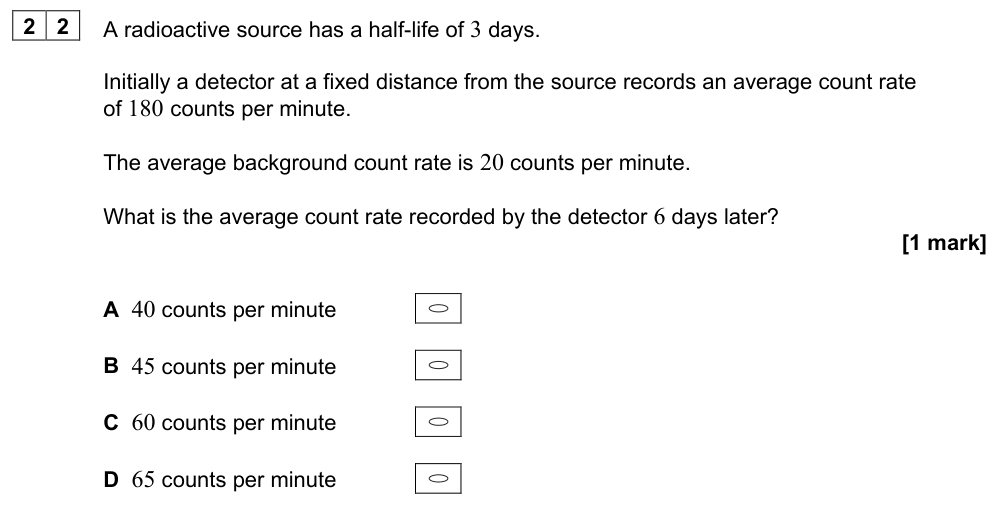
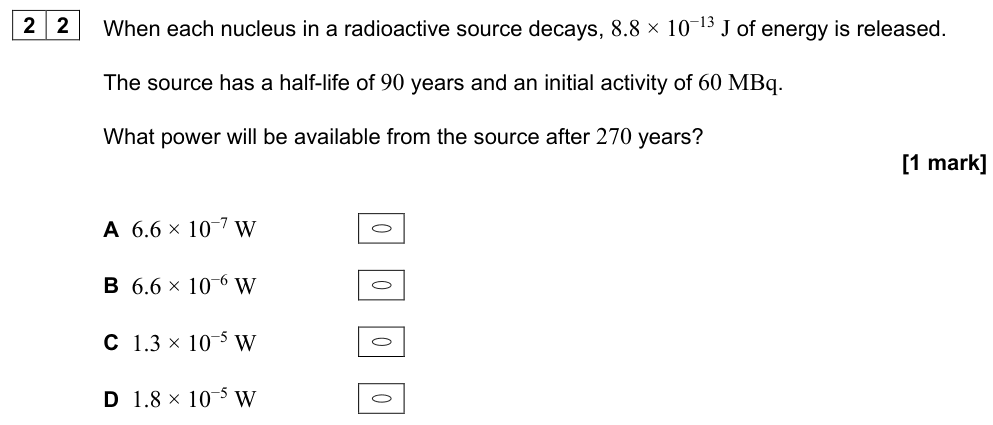
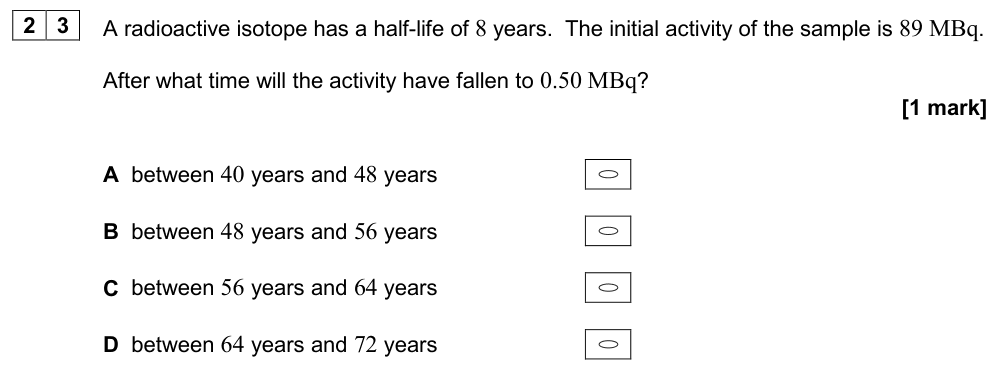
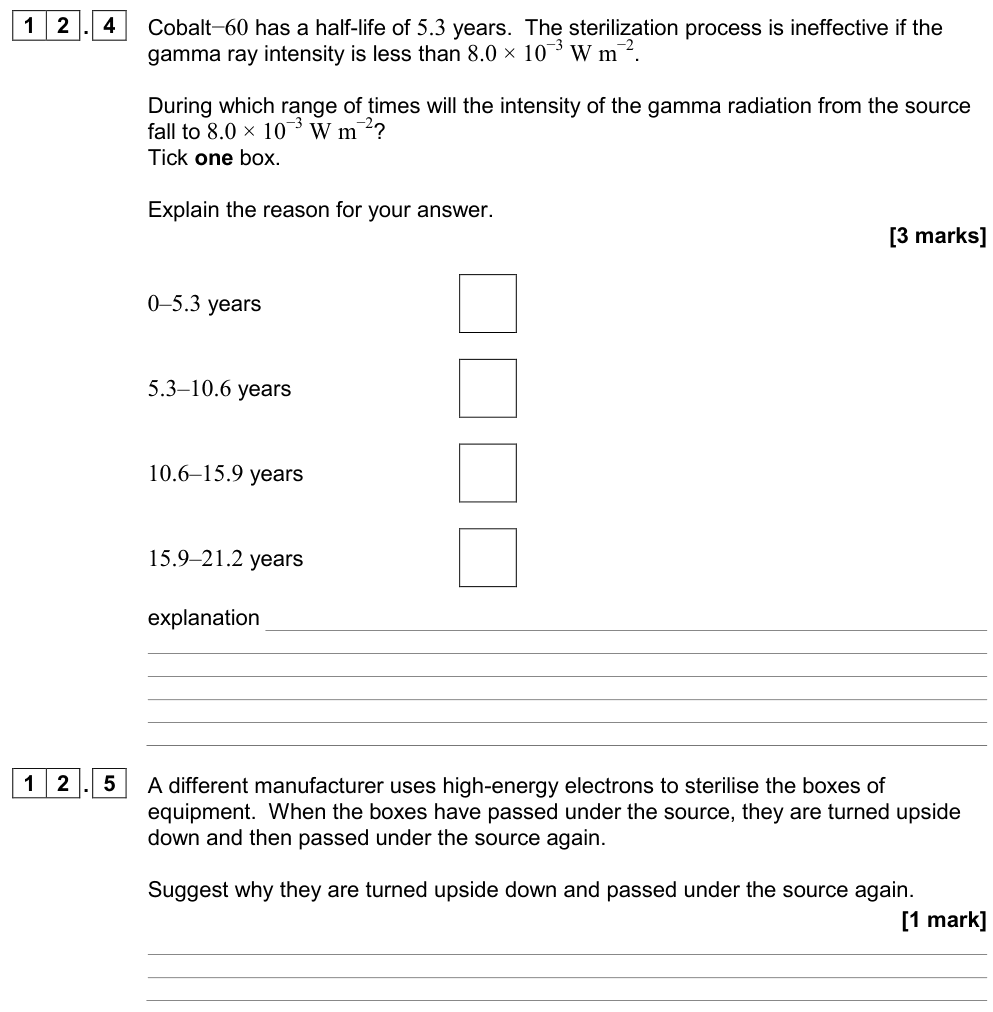
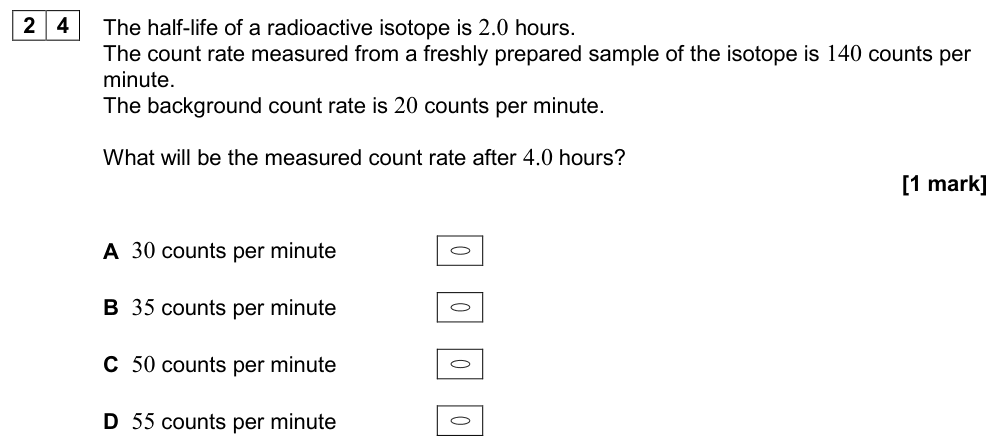
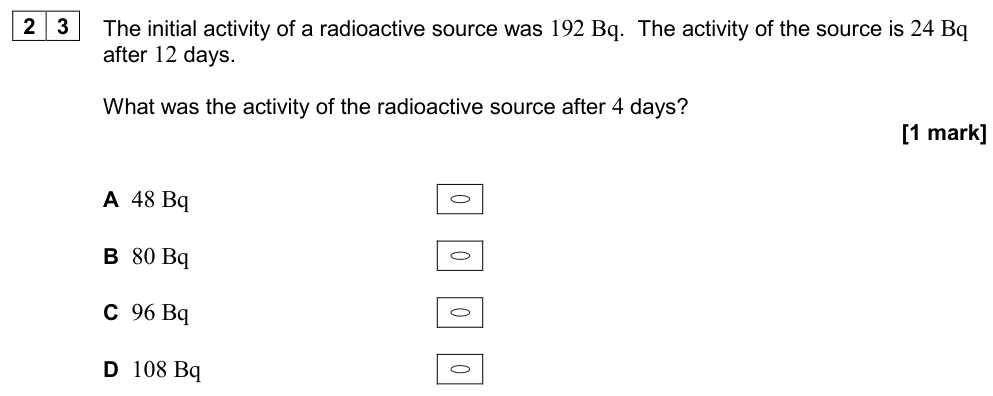
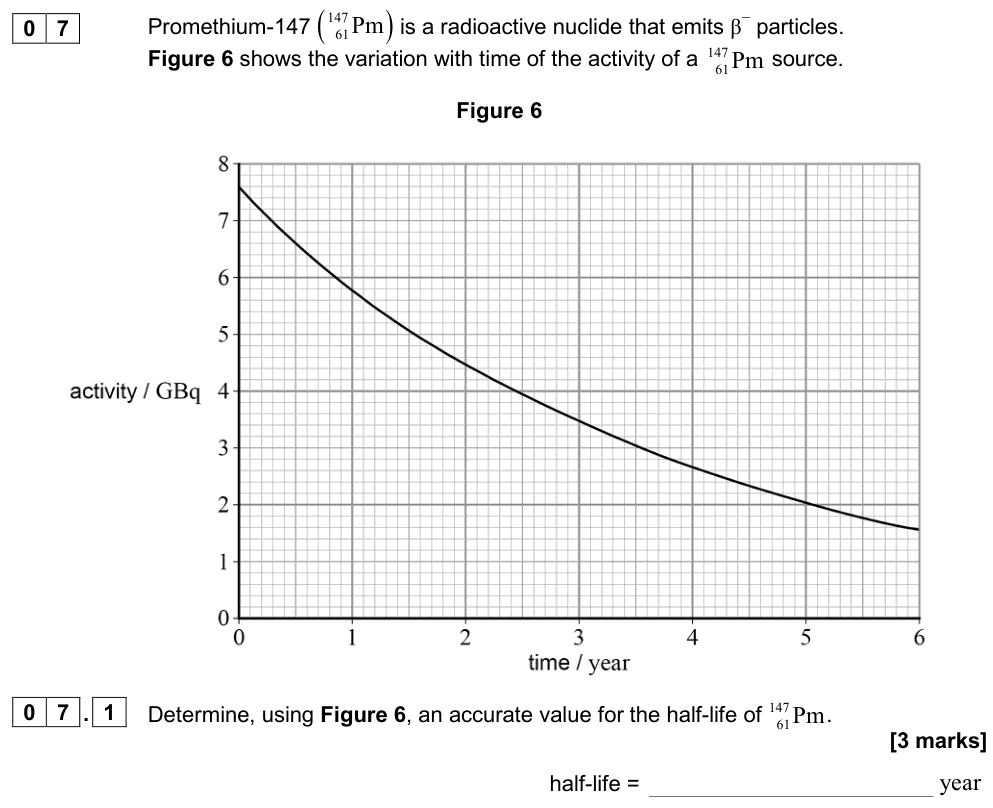
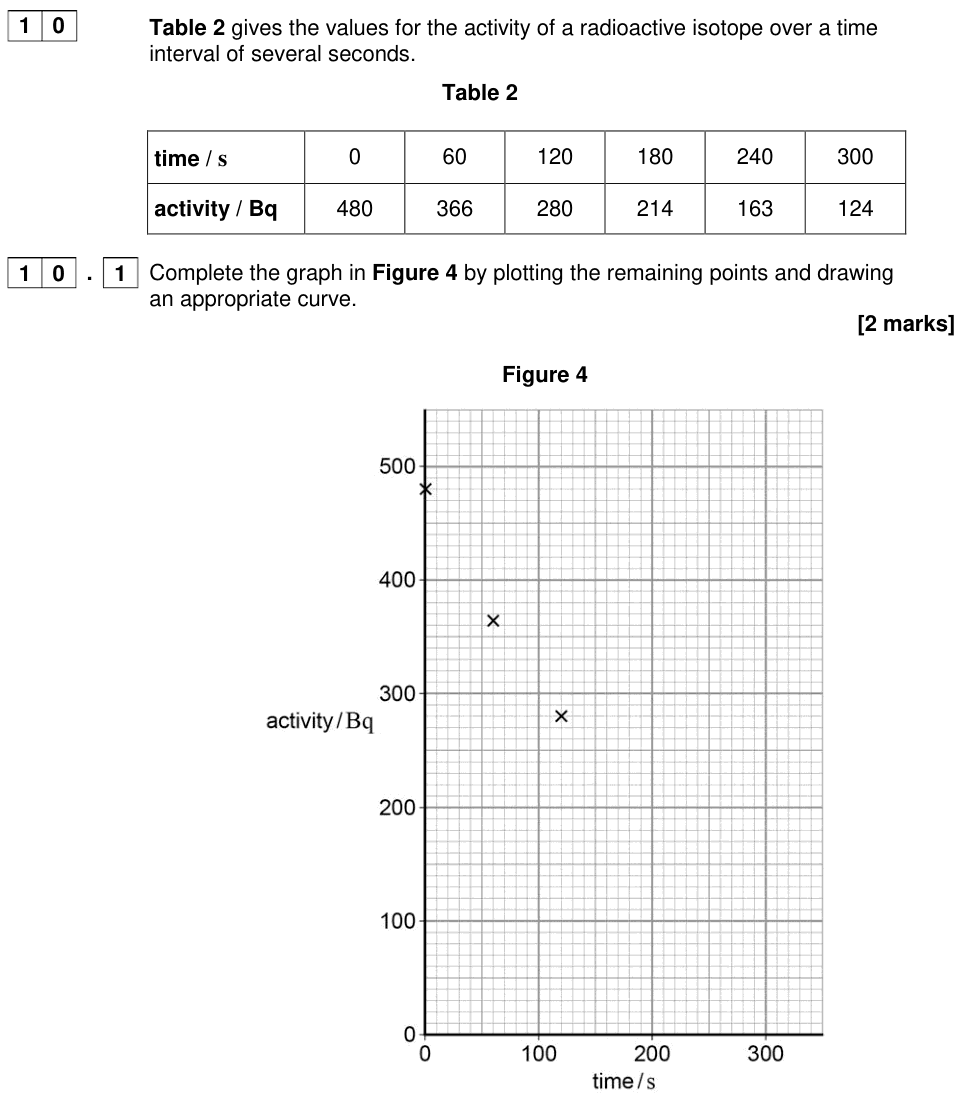
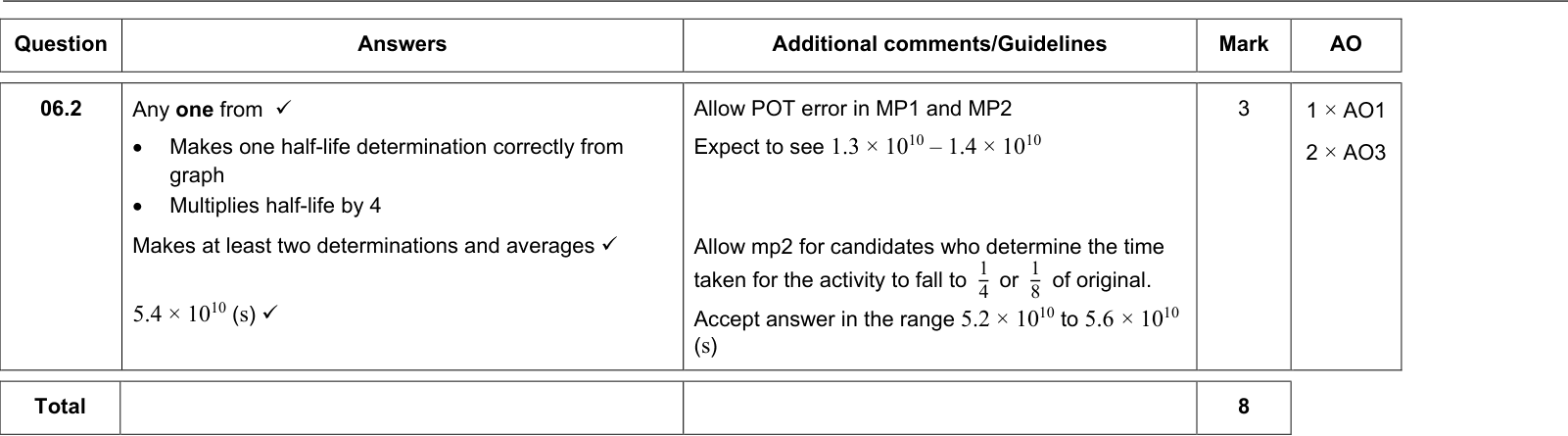
The half-life $T_{1/2}$ of a radioactive isotope is the average time taken for the number of undecayed nuclei (or the activity, or the count rate) to fall to half its initial value.
After $n$ half-lives, the fraction remaining is $\left(\tfrac12\right)^n$.
| Half-lives passed | 0 | 1 | 2 | 3 | 4 |
|---|---|---|---|---|---|
| Fraction remaining | 1 | 1/2 | 1/4 | 1/8 | 1/16 |
Finding half-life from a decay curve: read off the time for the corrected count rate to fall from any value to half that value. Do this several times from different starting points and take the mean.
Worked example: half-life with background
The measured count rate from a source is 520 counts per minute. The background is 40 counts per minute. The half-life is 3.0 hours. What is the measured count rate after 9.0 hours?
Corrected rate $= 480$; 9.0 h = 3 half-lives, so corrected rate $= 480/8 = 60$. Measured rate $= 60 + 40 = 100$ counts per minute.
At AS you only need whole numbers of half-lives. The exponential equations ($N = N_0e^{-\lambda t}$) are covered in Unit 3.
Summary
- α: $^4_2$He, $A-4$, $Z-2$. β⁻: n → p + e⁻ + $\bar\nu$, $Z+1$. β⁺: p → n + e⁺ + $\nu$, $Z-1$. γ: no change in $A$ or $Z$.
- The neutrino was proposed to conserve energy and momentum in β decay (continuous β energy spectrum).
- Penetration: α stopped by paper, β by a few mm of aluminium, γ reduced by lead. Ionisation: α > β > γ.
- γ obeys $I = k/x^2$. Always correct for background.
- Half-life: time for the number of nuclei/activity to halve; fraction left after $n$ half-lives $= (1/2)^n$.