Classifying particles
Physicists sort the particles they detect into families. You need a broad picture of this classification.
| Family | Members (examples) | Notes |
|---|---|---|
| Leptons | electron, muon, neutrino | fundamental particles: not made of anything smaller; not affected by the strong nuclear force |
| Hadrons: baryons | proton, neutron | heavier particles that feel the strong nuclear force; made of three quarks |
| Hadrons: mesons | pion, kaon | hadrons made of a quark and an antiquark; unstable |
| Exchange particles | photon | carries the electromagnetic force; also the particle of light (Unit 2) |
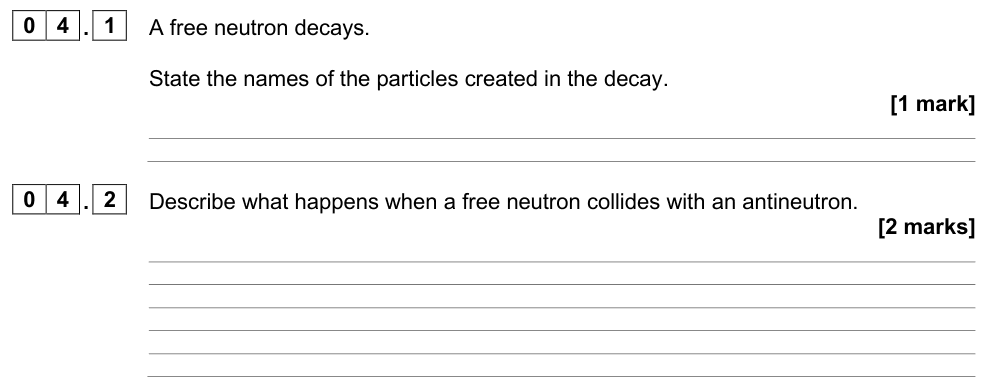
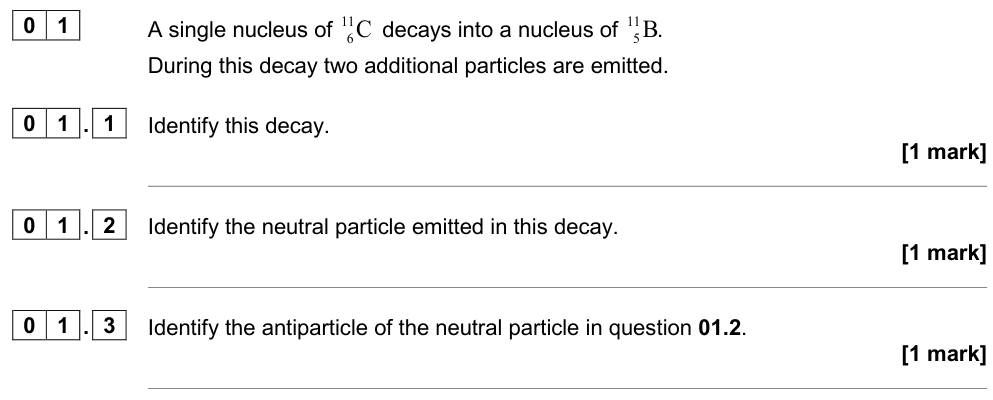
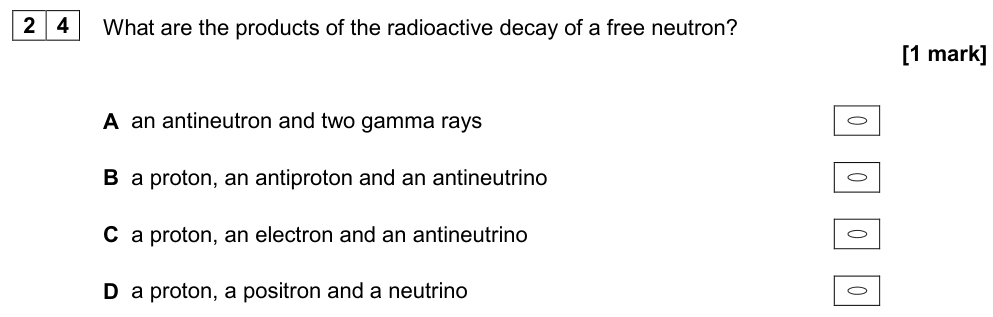
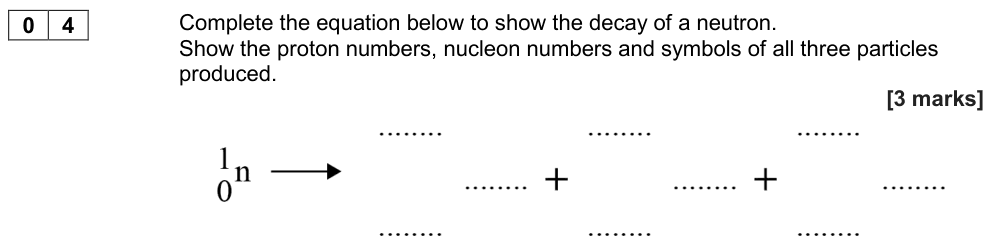
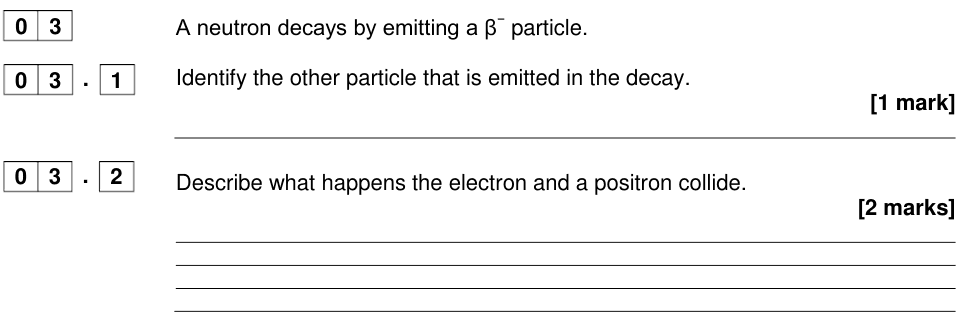
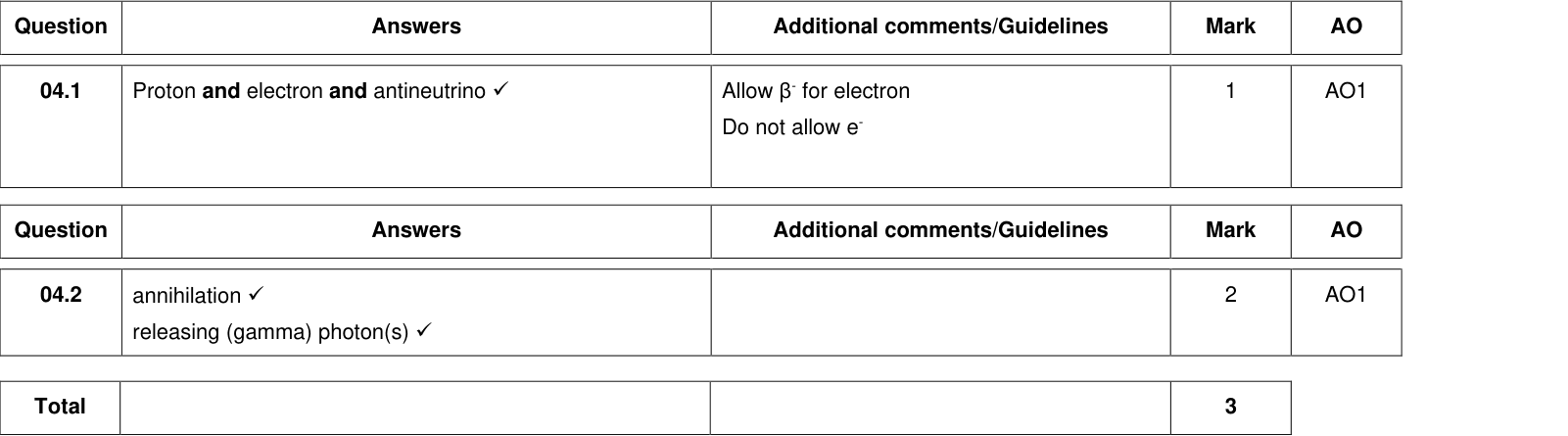
The proton is the only stable hadron. A free neutron is unstable and decays (half-life about 10 minutes):
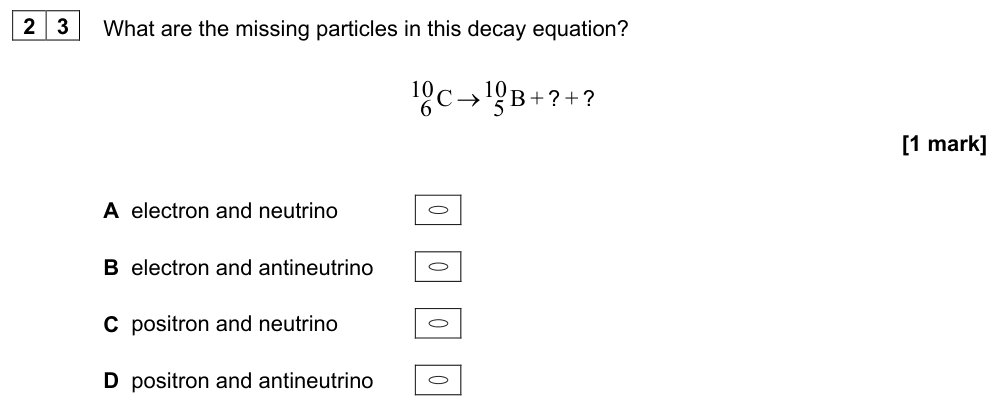
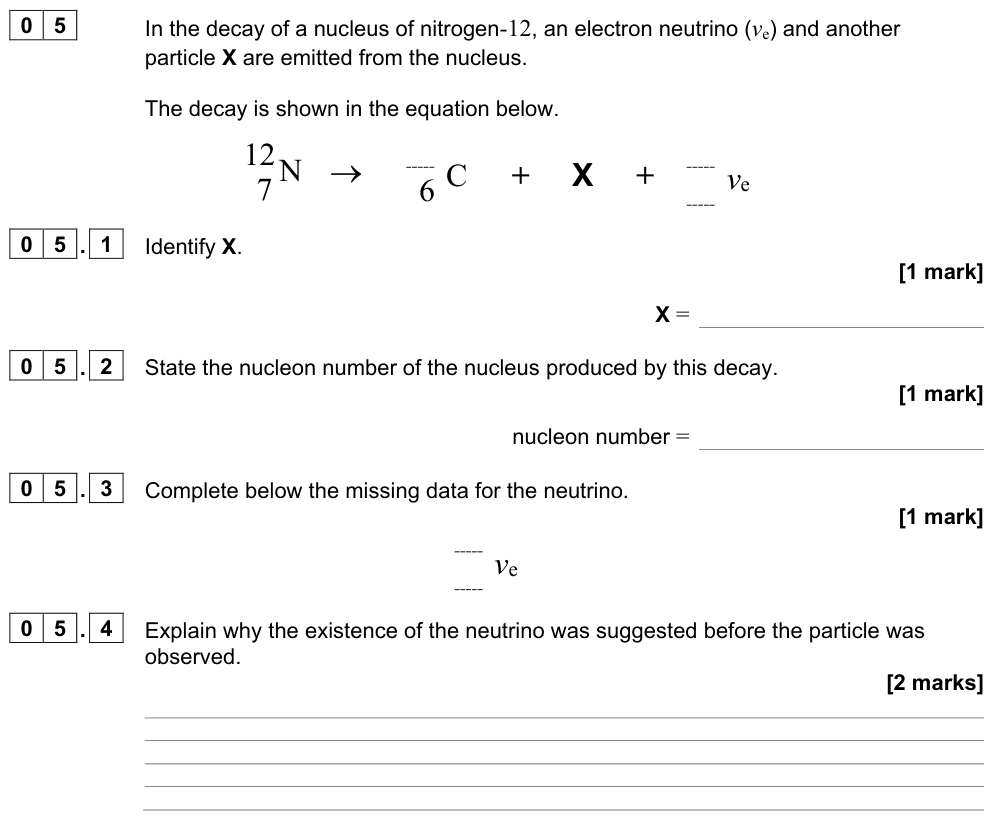
$$^{1}_{0}\text{n} \rightarrow\ ^{1}_{1}\text{p} +\ ^{\ 0}_{-1}\text{e} + \bar{\nu}_e$$
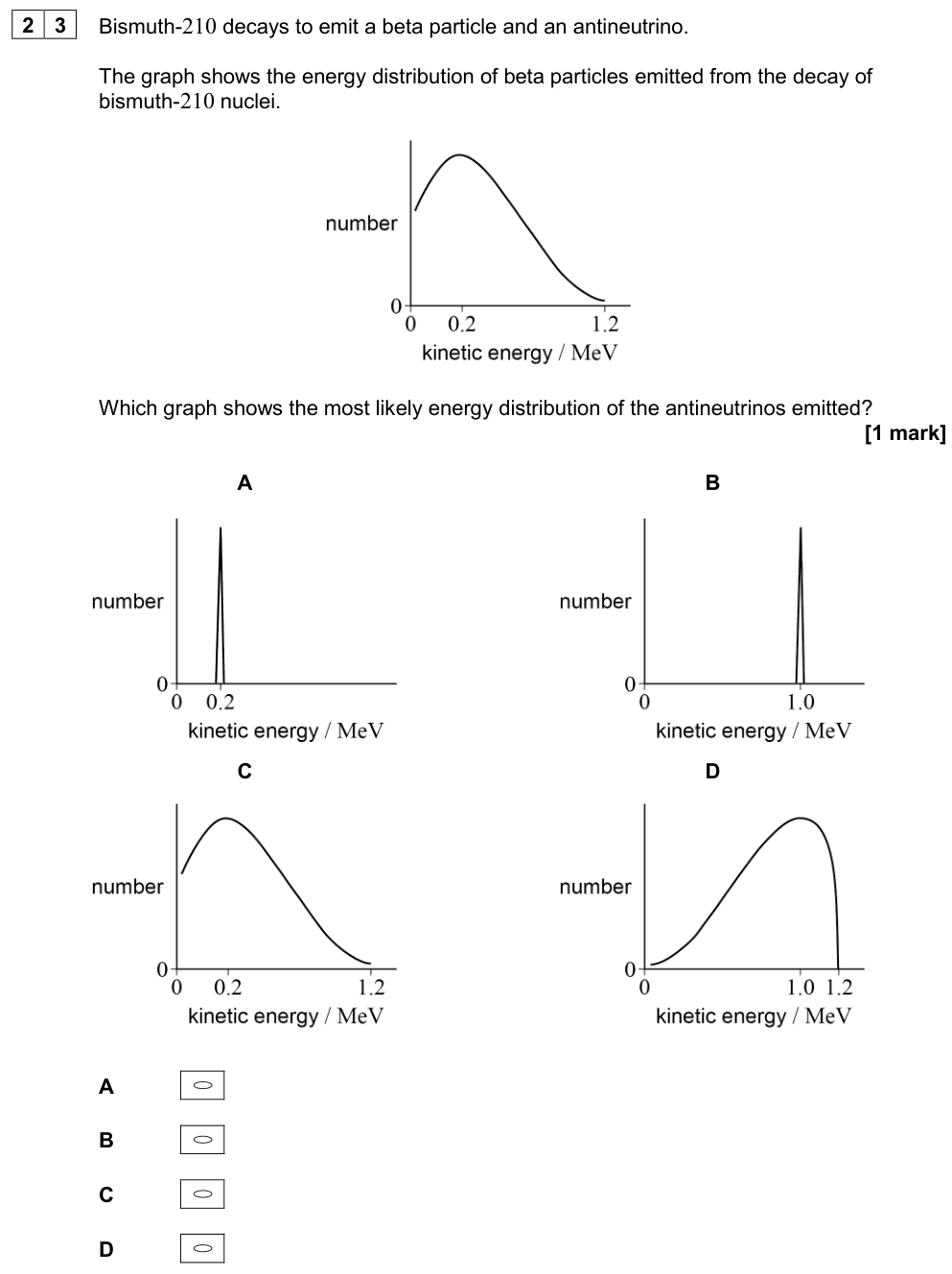
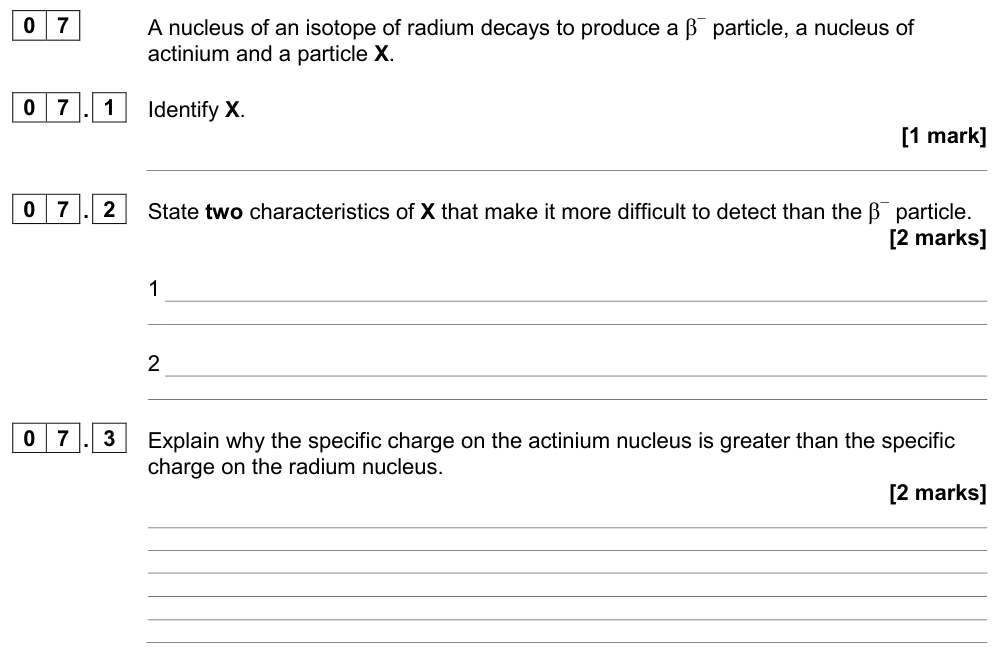
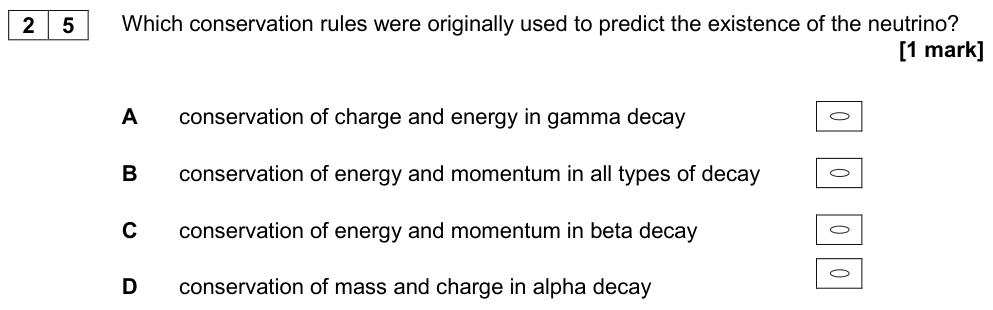
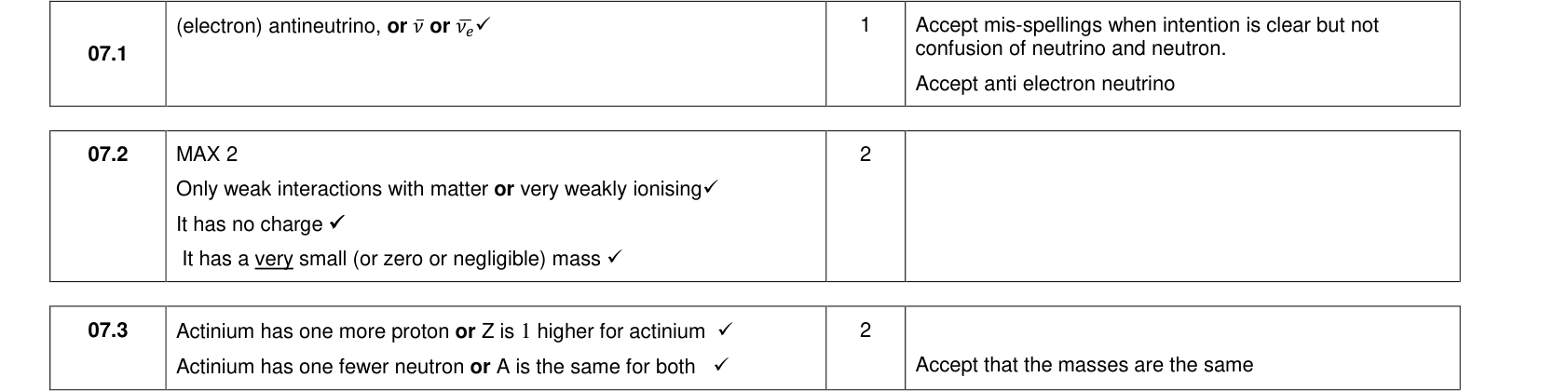
The neutrino ($\nu$) and antineutrino ($\bar\nu$) have no charge and almost no mass. They interact so weakly with matter that they are extremely hard to detect. (See the Radioactivity chapter for why they were predicted.)
Antiparticles
Antiparticles
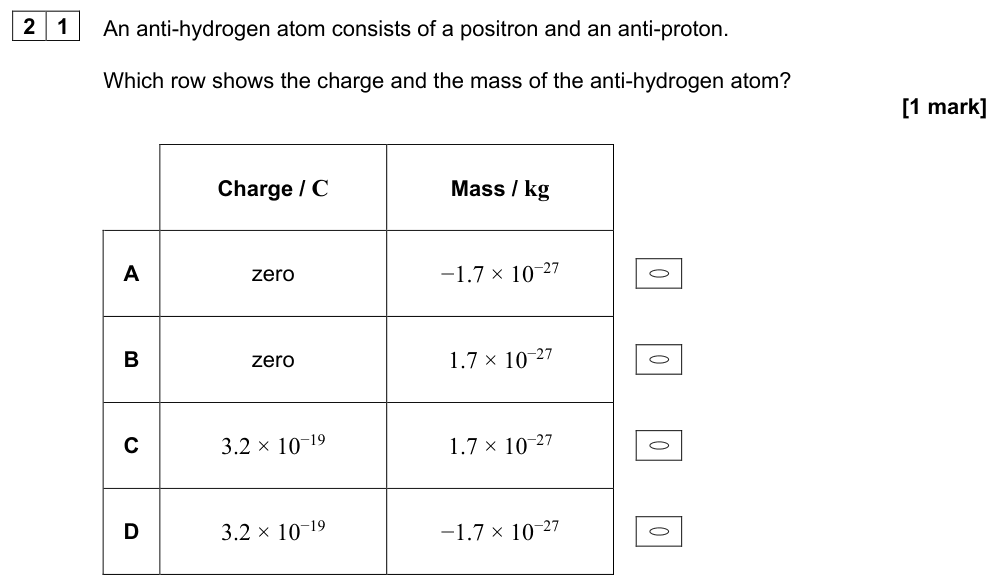
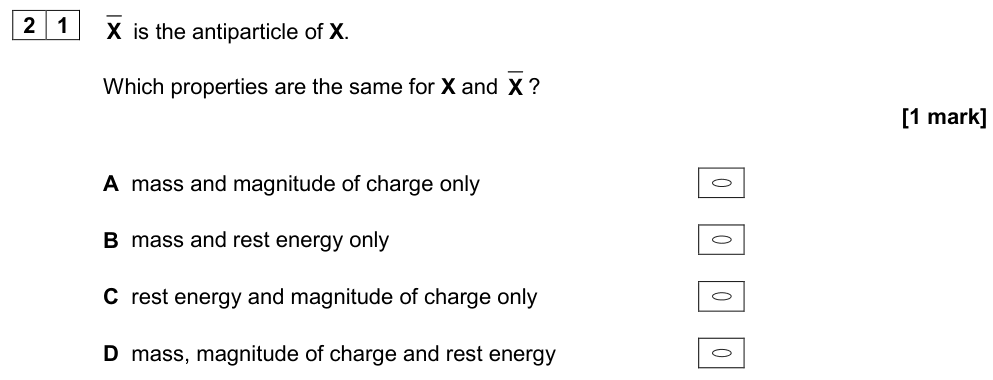
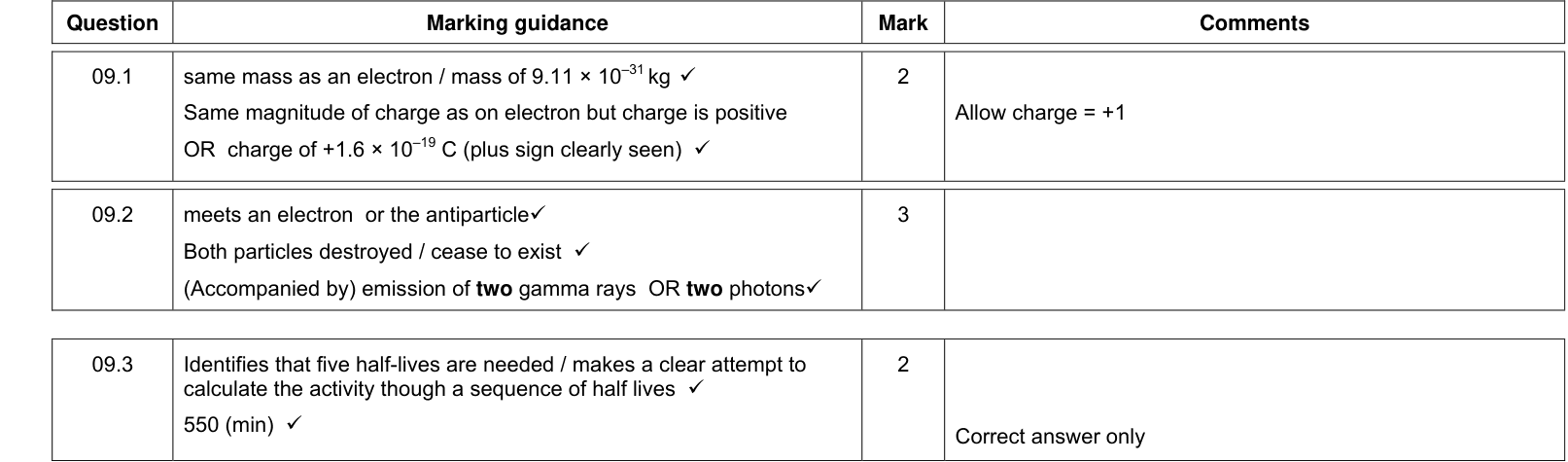
For every type of particle there is a corresponding antiparticle. An antiparticle has:
- the same mass (and so the same rest energy) as its particle,
- the opposite charge (if the particle is charged).
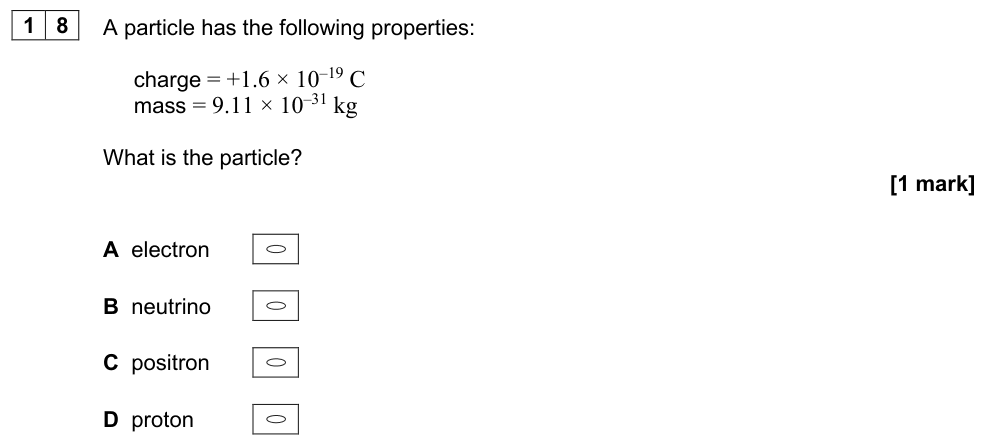
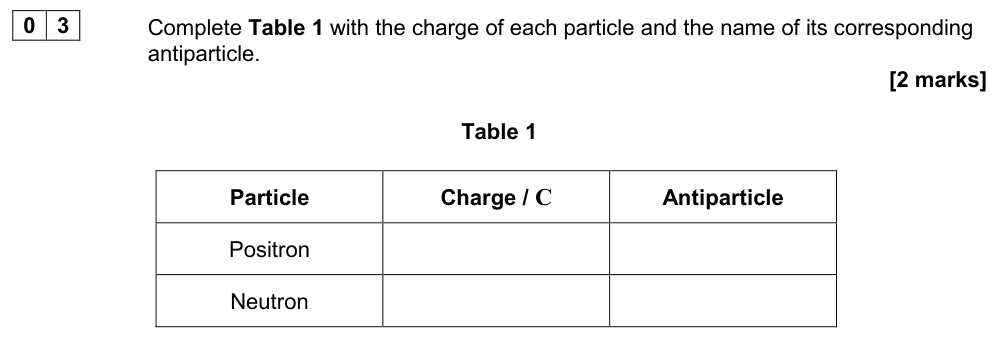
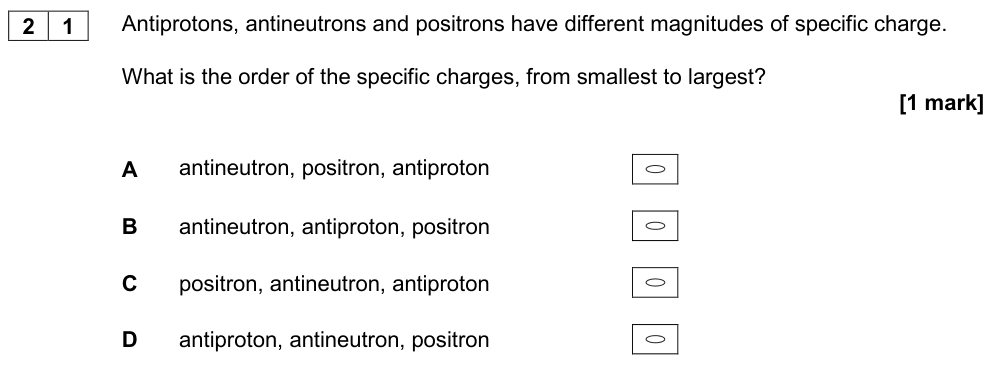
| Particle | Charge | Antiparticle | Charge | Rest energy / MeV |
|---|---|---|---|---|
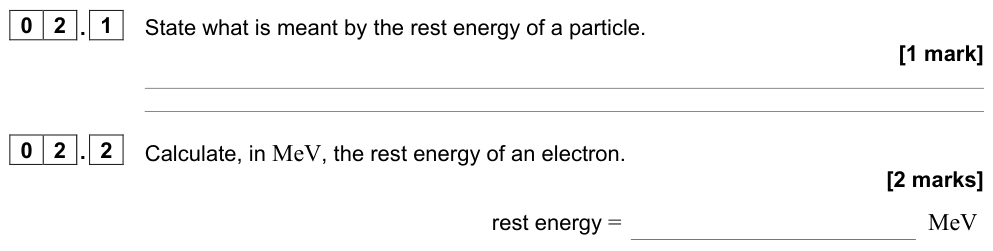
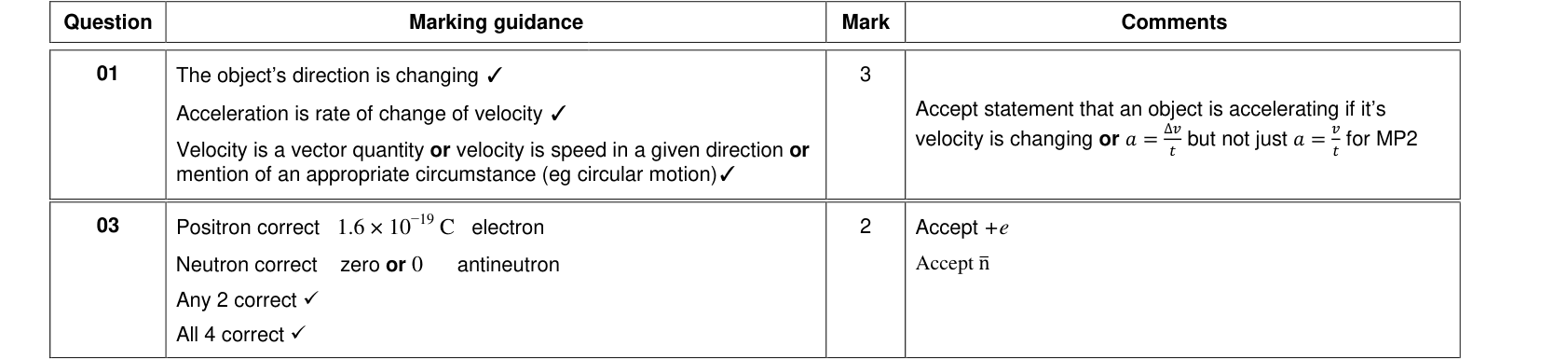
| electron $e^-$ | $-e$ | positron $e^+$ | $+e$ | 0.511 |
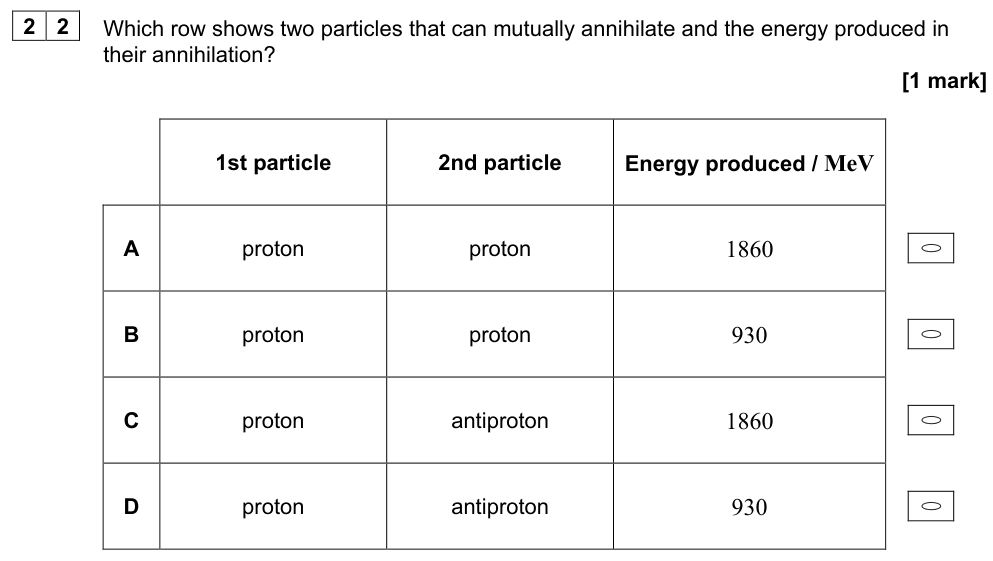
| proton $p$ | $+e$ | antiproton $\bar p$ | $-e$ | 938 |
| neutron $n$ | 0 | antineutron $\bar n$ | 0 | 940 |
| neutrino $\nu$ | 0 | antineutrino $\bar\nu$ | 0 | ≈ 0 |
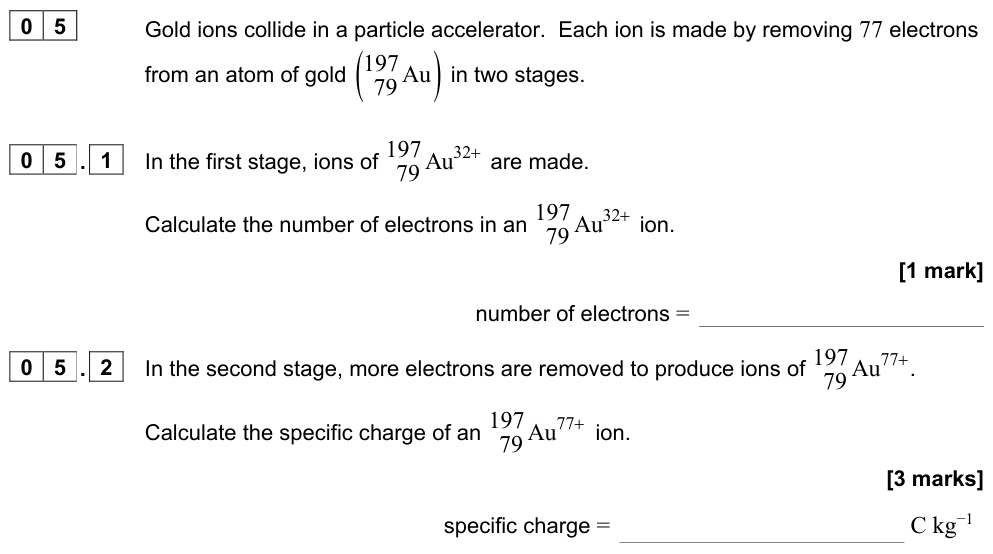
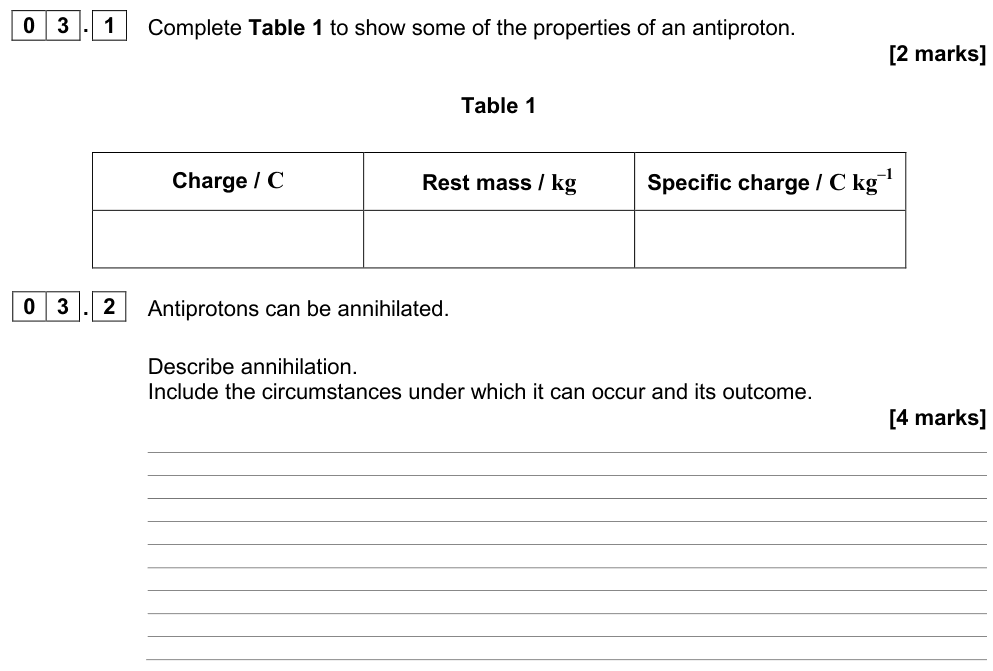
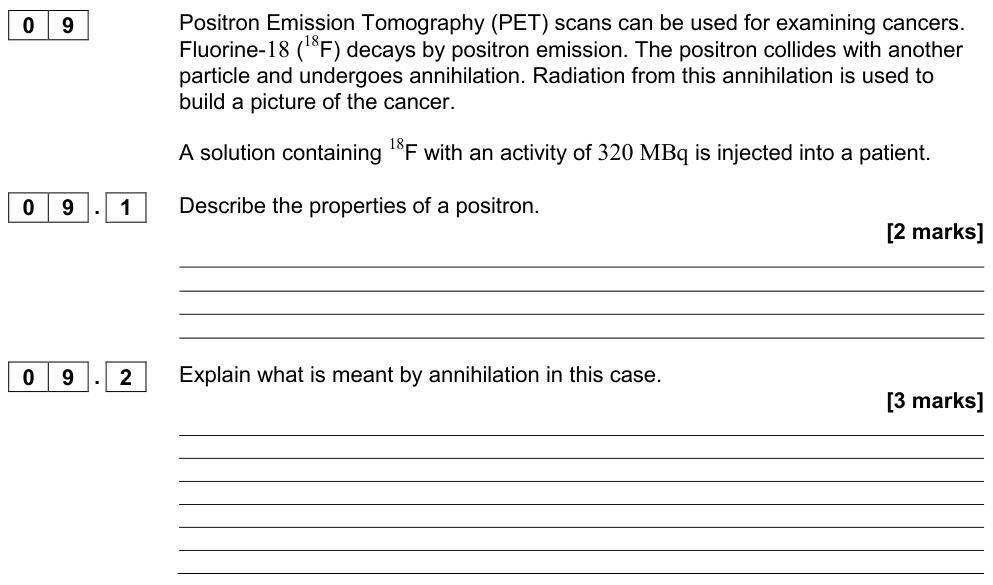
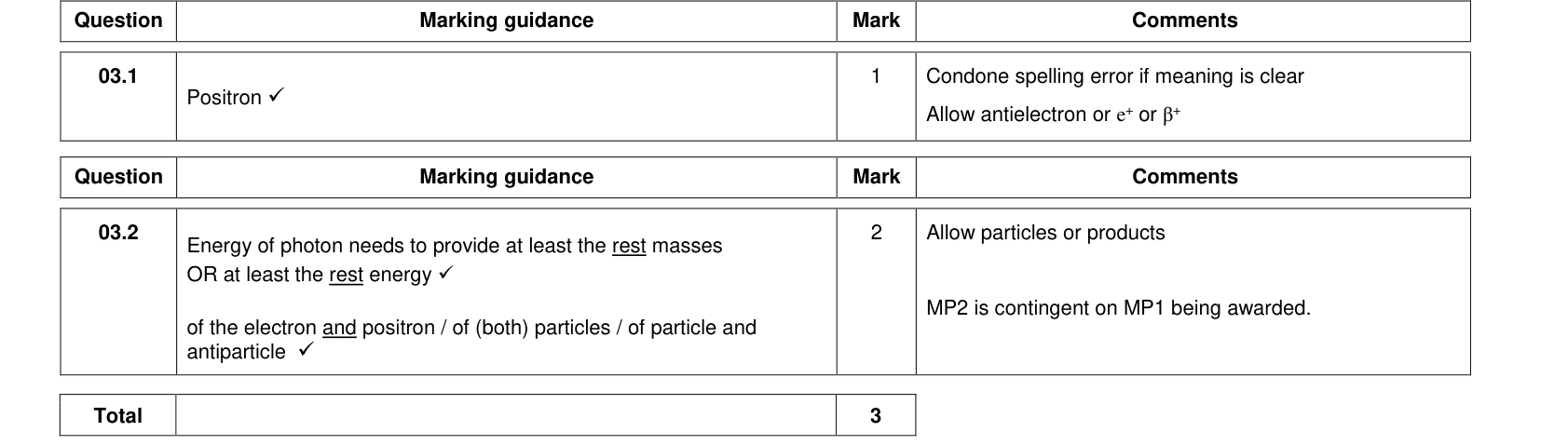
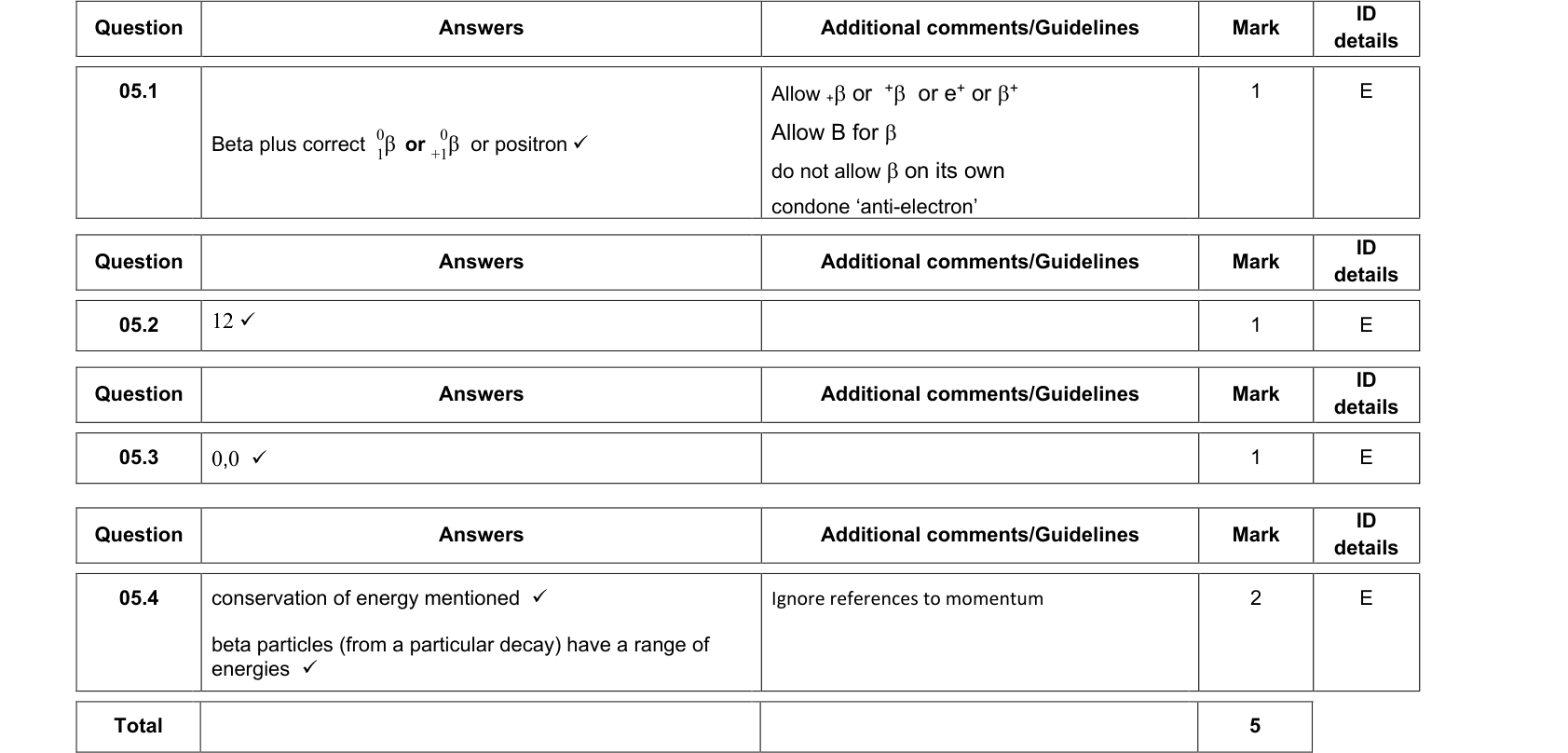
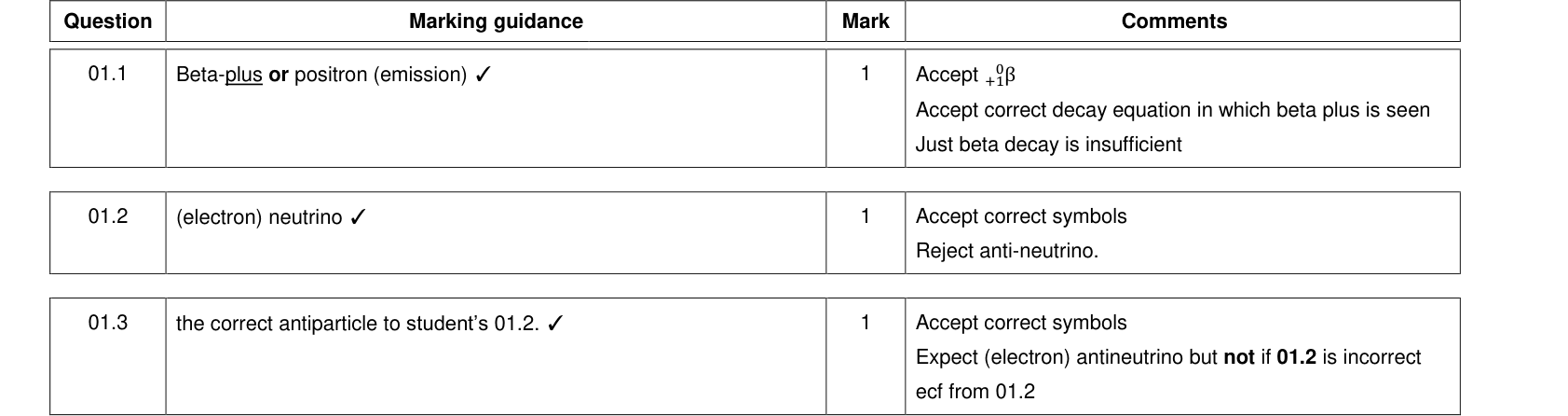
A particle and its antiparticle have the same magnitude of specific charge but opposite sign. Antiparticles are not exotic: positrons are emitted in $\beta^+$ decay and are used in PET scans in hospitals.
Rest energy
Rest energy
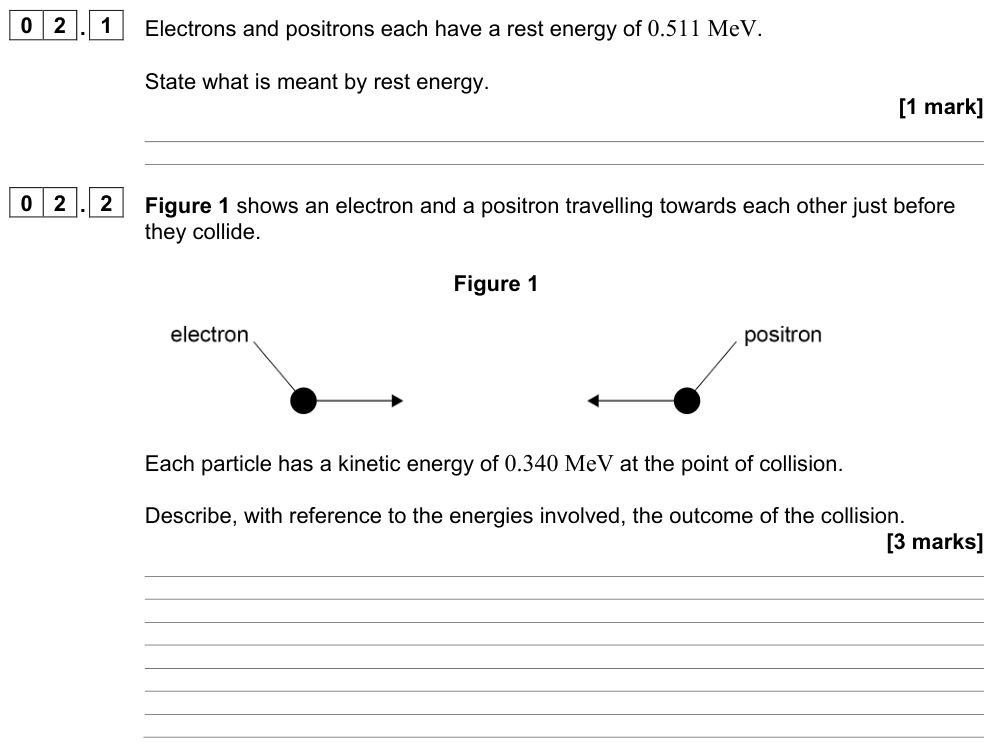
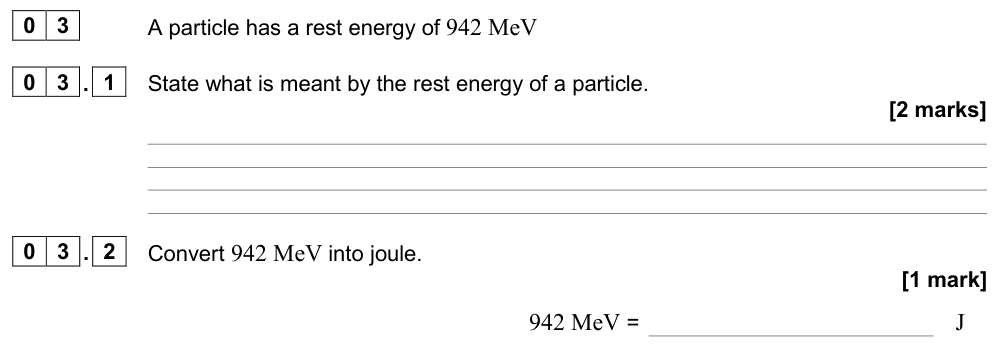
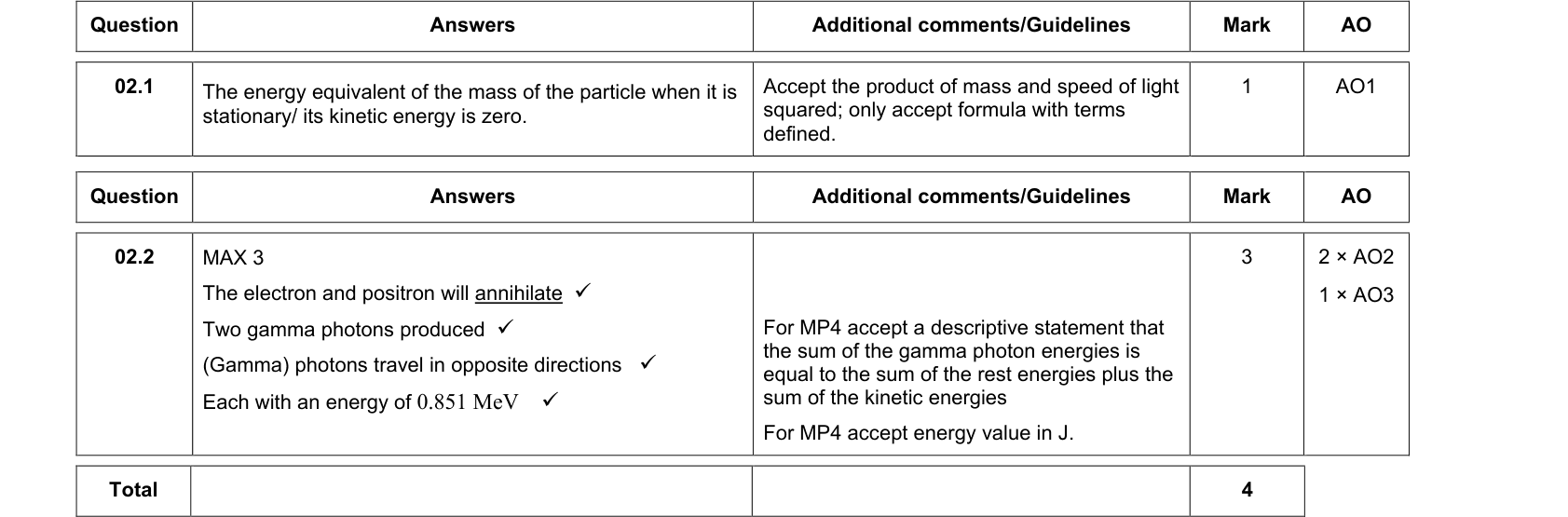
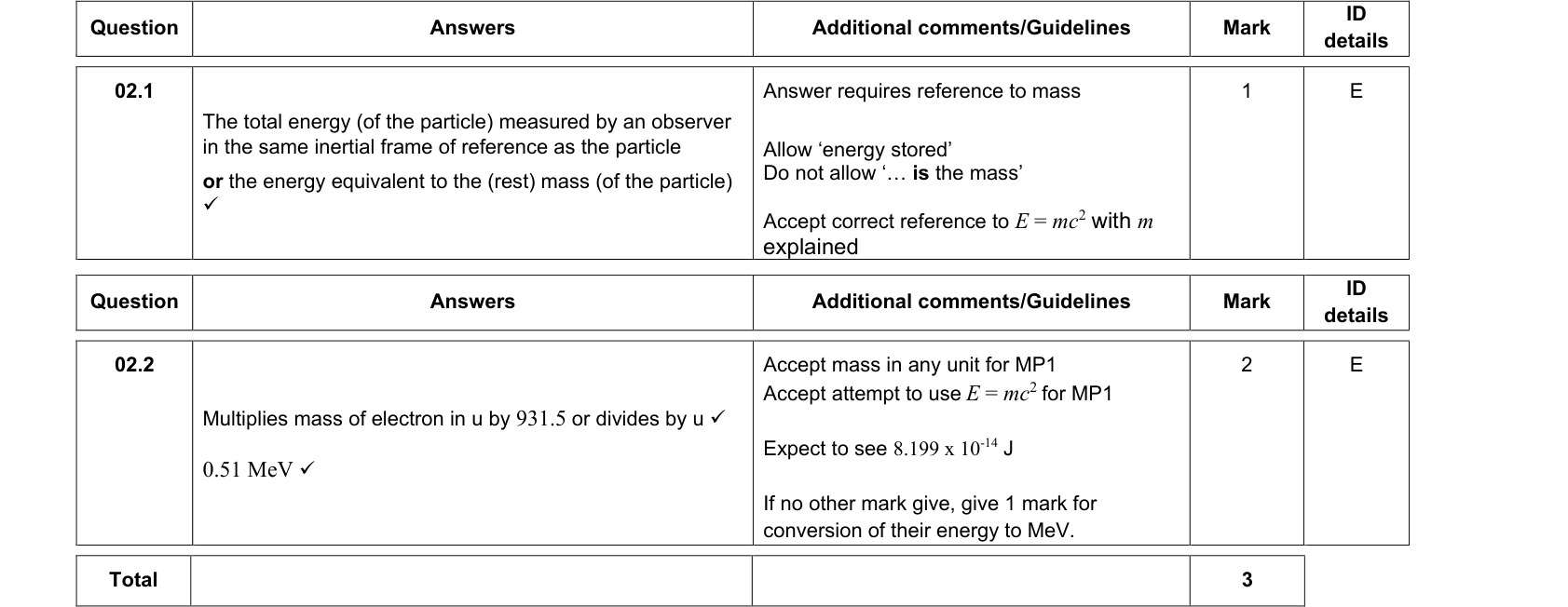
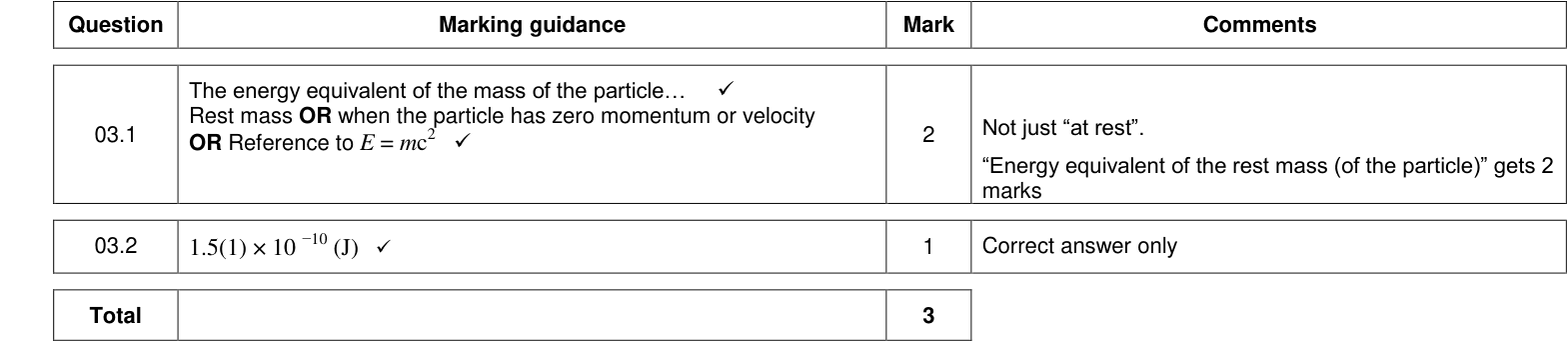
The rest energy of a particle is the energy equivalent of its mass when it is at rest (it has no kinetic energy). Mass is a form of energy.
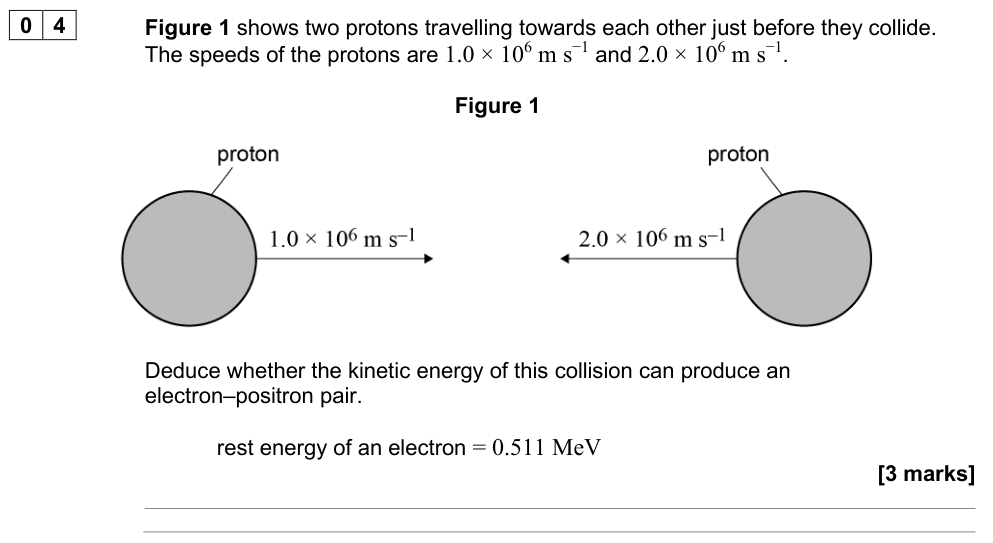
Rest energies are usually given in MeV, where $1\ \text{MeV} = 1.60 \times 10^{-13}\ \text{J}$.
Worked example: converting rest energy
The rest energy of a proton is 938 MeV. In joules: $938 \times 1.60 \times 10^{-13} = 1.50 \times 10^{-10}\ \text{J}$.
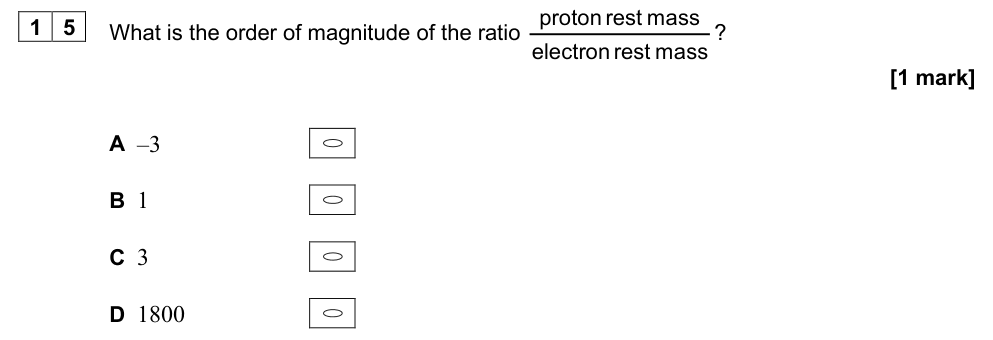
The rest energy of an electron (0.511 MeV) is about 1840 times smaller than that of a proton, the same as the ratio of their masses.
You are given rest energies in questions. You do not need to calculate them from $E = mc^2$ at AS.
Annihilation
Annihilation
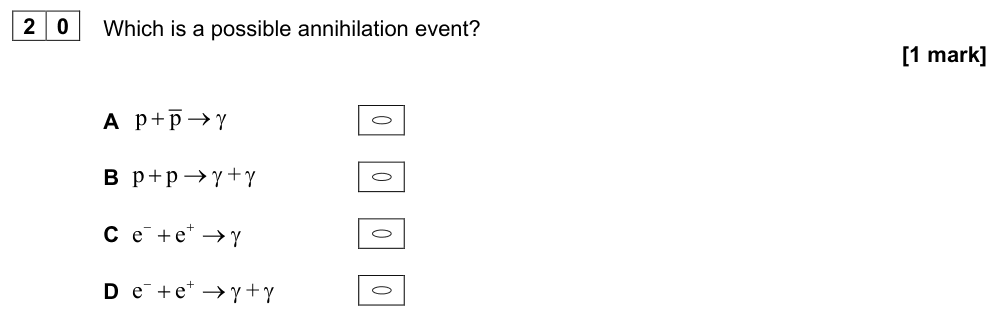
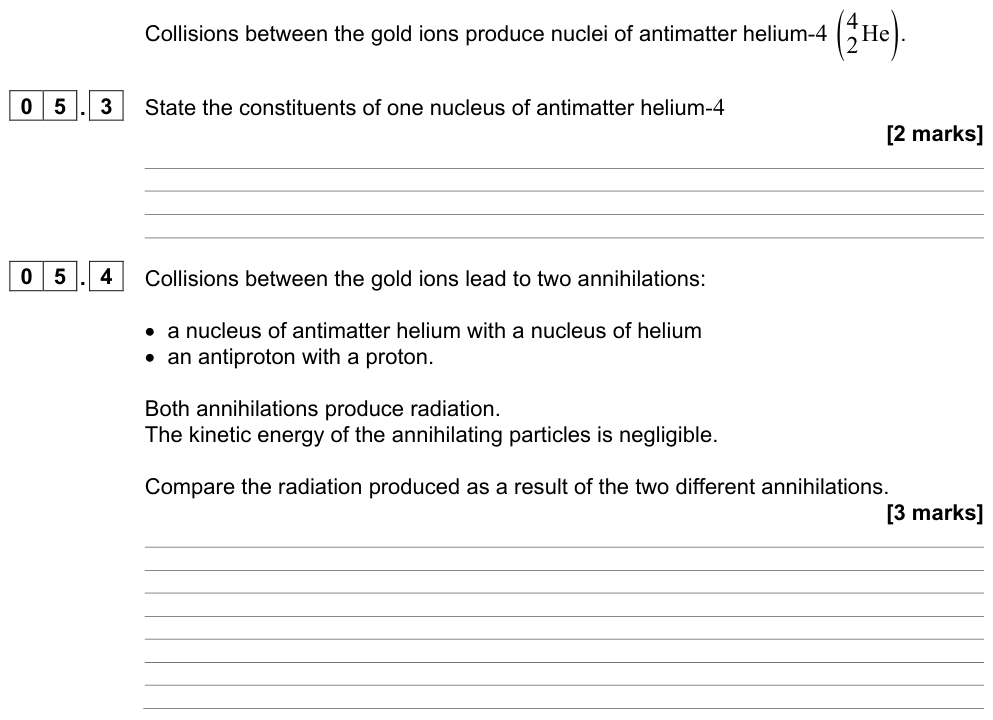
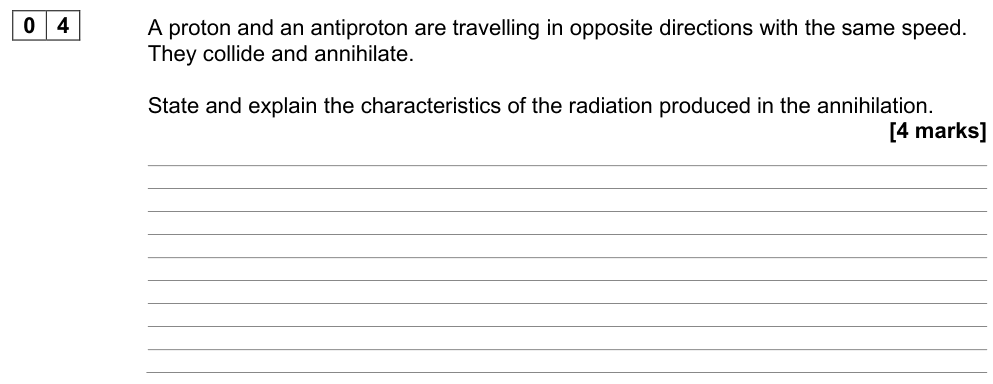
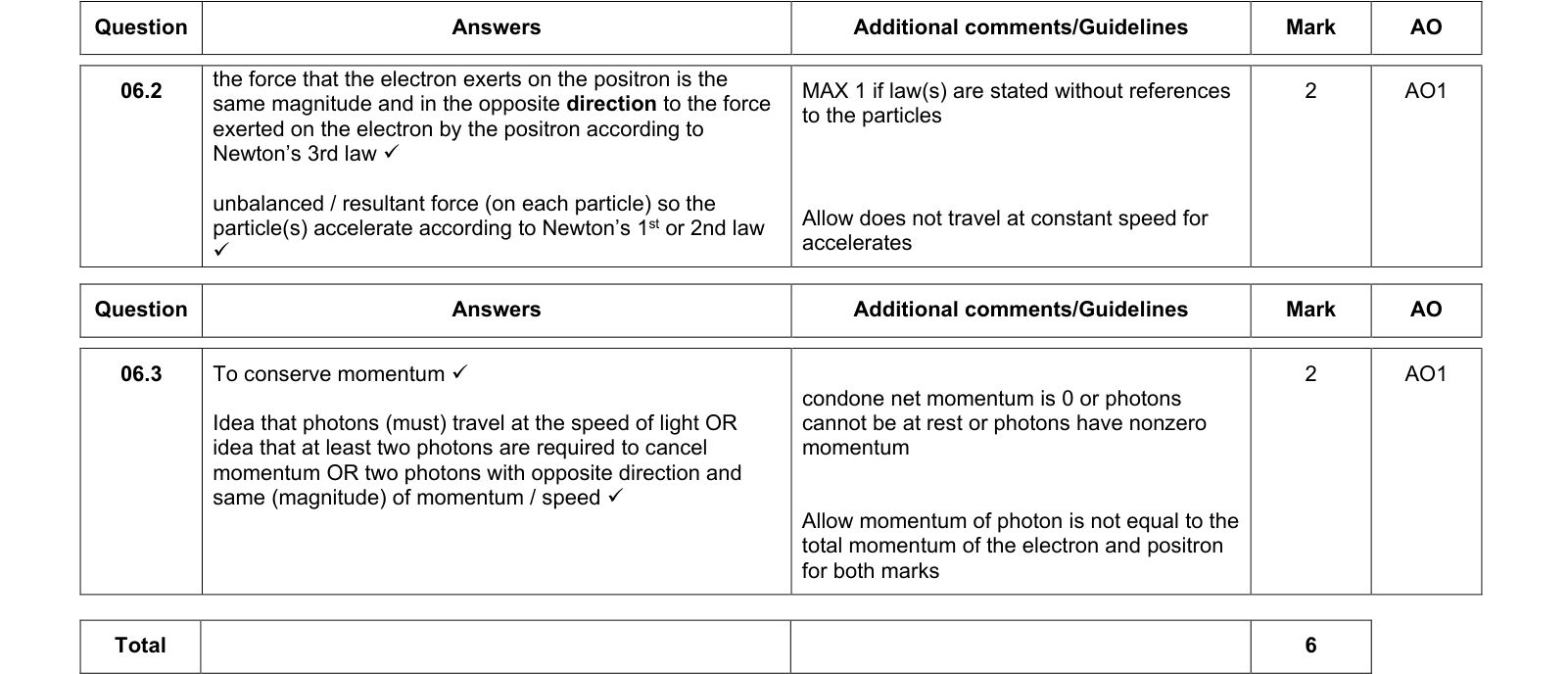
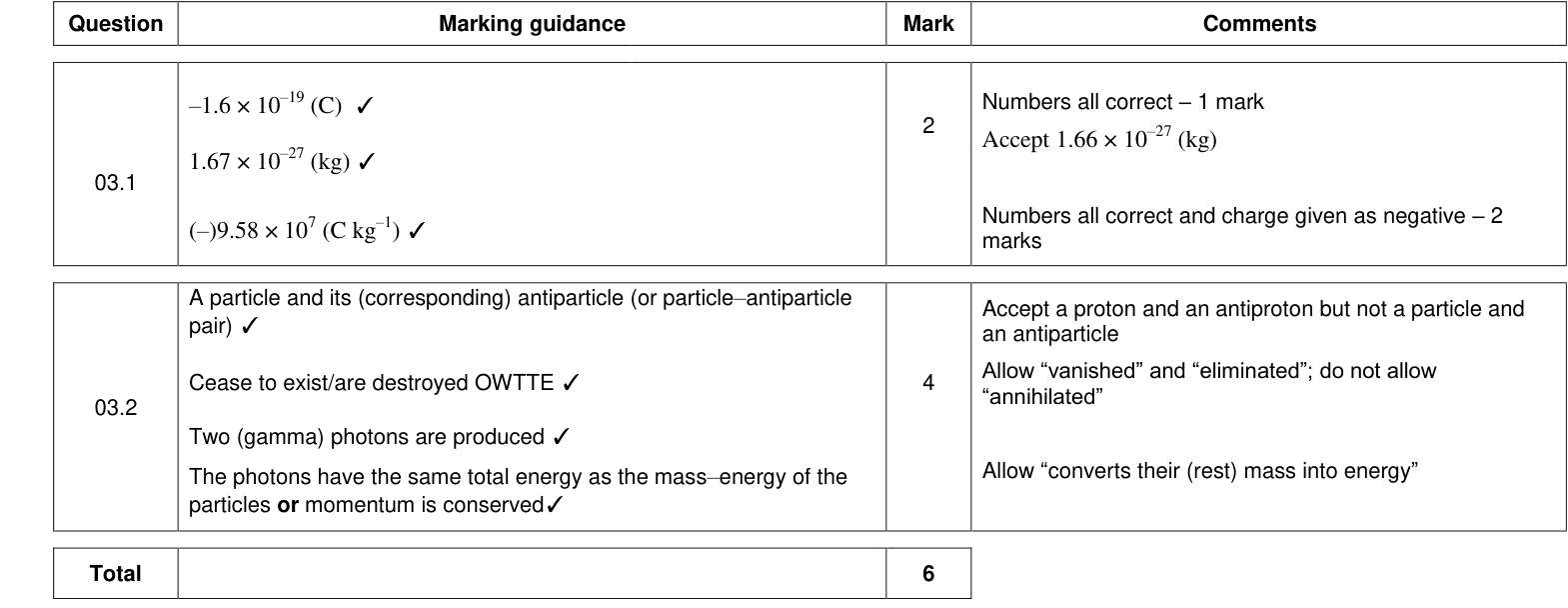
When a particle meets its antiparticle they annihilate: both particles are destroyed and their total energy (rest energy + kinetic energy) is converted into two photons (gamma rays).
$$e^- + e^+ \rightarrow \gamma + \gamma$$
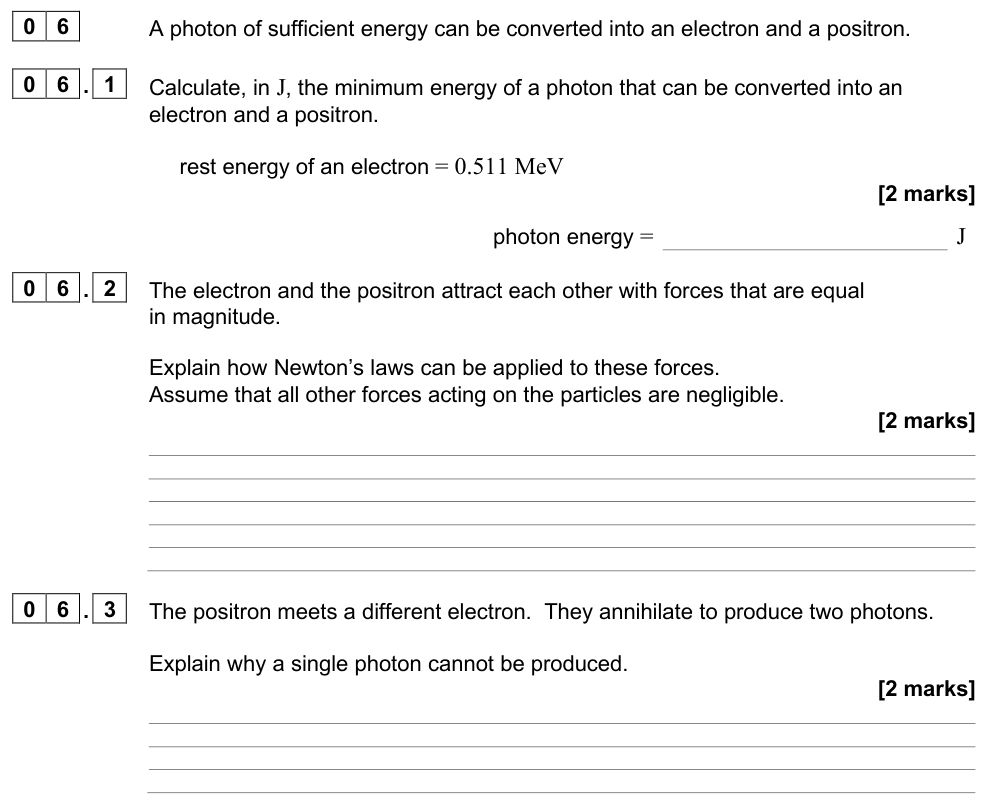
Why two photons? Momentum must be conserved. If the particles are moving towards each other with equal speeds, the total momentum before is zero. So the photons must travel in opposite directions with equal energies, so that their total momentum is also zero. A single photon could not have zero momentum.
Minimum photon energy in annihilation
If the particles have negligible kinetic energy, each photon has energy equal to the rest energy of one particle:
$$E_\gamma = E_{\text{rest}} \quad \text{(each photon)}$$
For an electron and positron: each photon has at least 0.511 MeV. If the particles also have kinetic energy, the photon energy is greater: $E_\gamma = E_{\text{rest}} + E_k$ (each photon, for equal and opposite motion).
Worked example: proton–antiproton annihilation
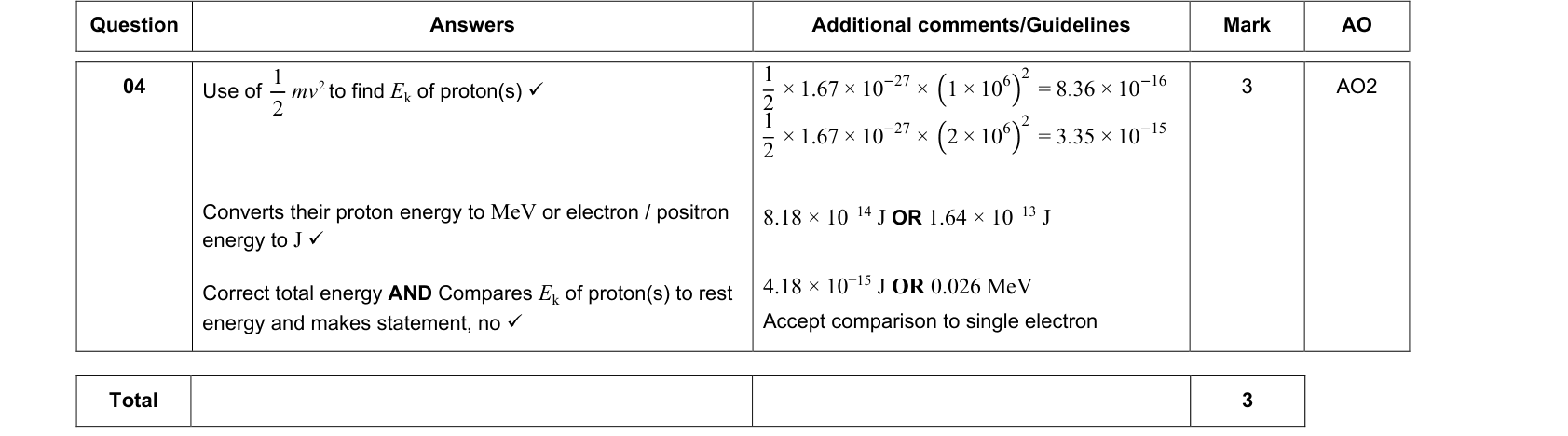
A proton and an antiproton, each with kinetic energy 15 MeV, collide head-on and annihilate. Find the energy of each photon.
Total energy $= 2 \times (938 + 15) = 1906\ \text{MeV}$; each photon carries $953\ \text{MeV} = 1.52 \times 10^{-10}\ \text{J}$.
PET scanning
In positron emission tomography (PET), a patient is given a tracer containing a $\beta^+$ emitter such as fluorine-18. Each emitted positron travels a millimetre or so before annihilating with an electron in the body. The two 0.511 MeV gamma photons travel in opposite directions and are detected at the same time by a ring of detectors. The annihilation point lies on the line joining the two detectors, which lets a computer build an image of where the tracer has collected.
Pair production
Pair production
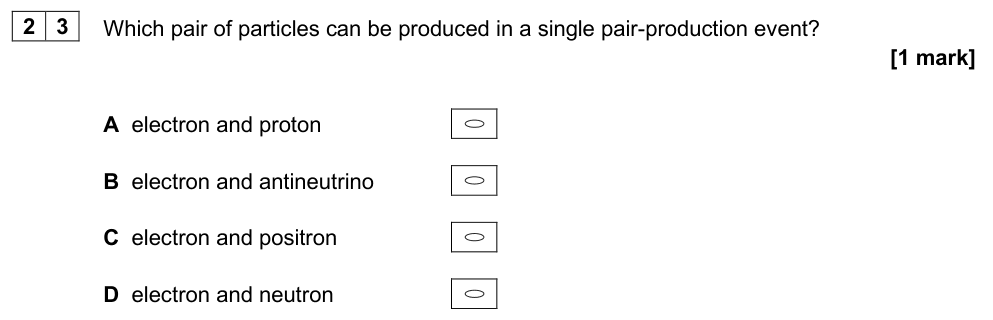
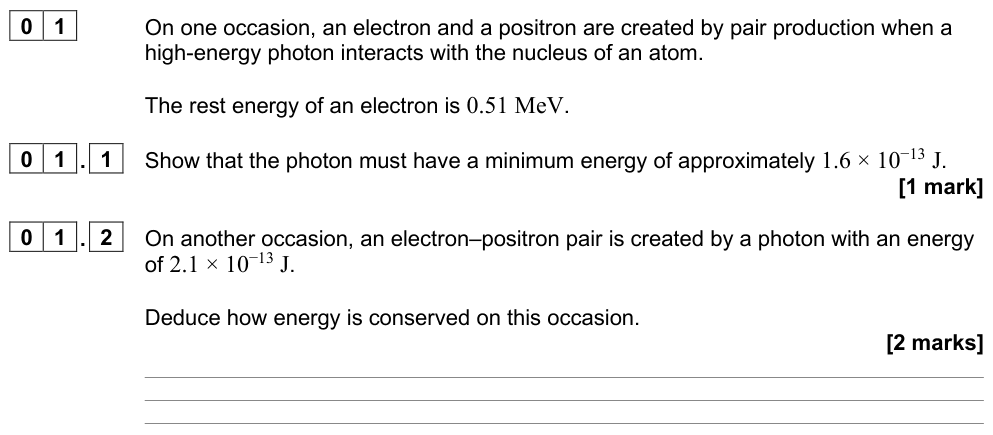
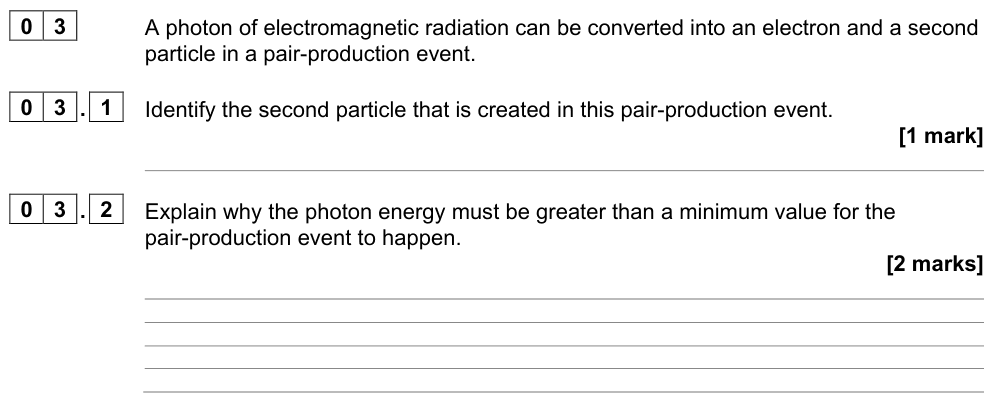
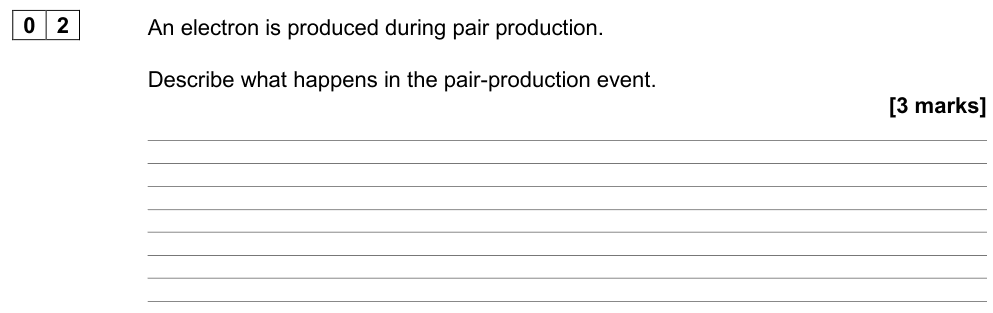
A high-energy photon can be converted into a particle and its antiparticle. This happens near a nucleus, which takes up some momentum so that momentum can be conserved.
$$\gamma \rightarrow e^- + e^+$$
Minimum photon energy for pair production
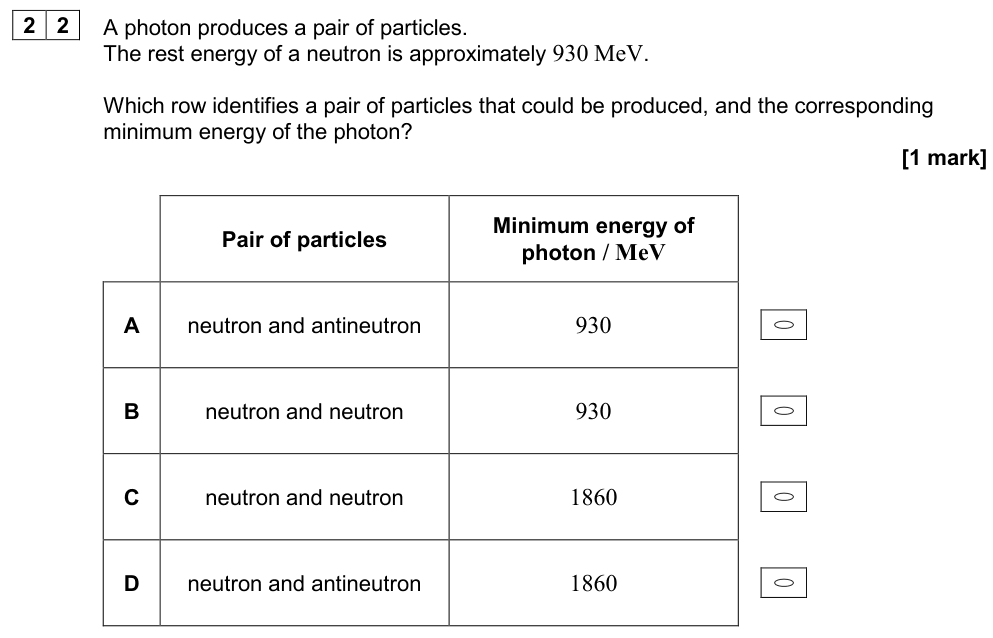
$$E_{\gamma,\min} = 2 \times \text{rest energy of the particle}$$
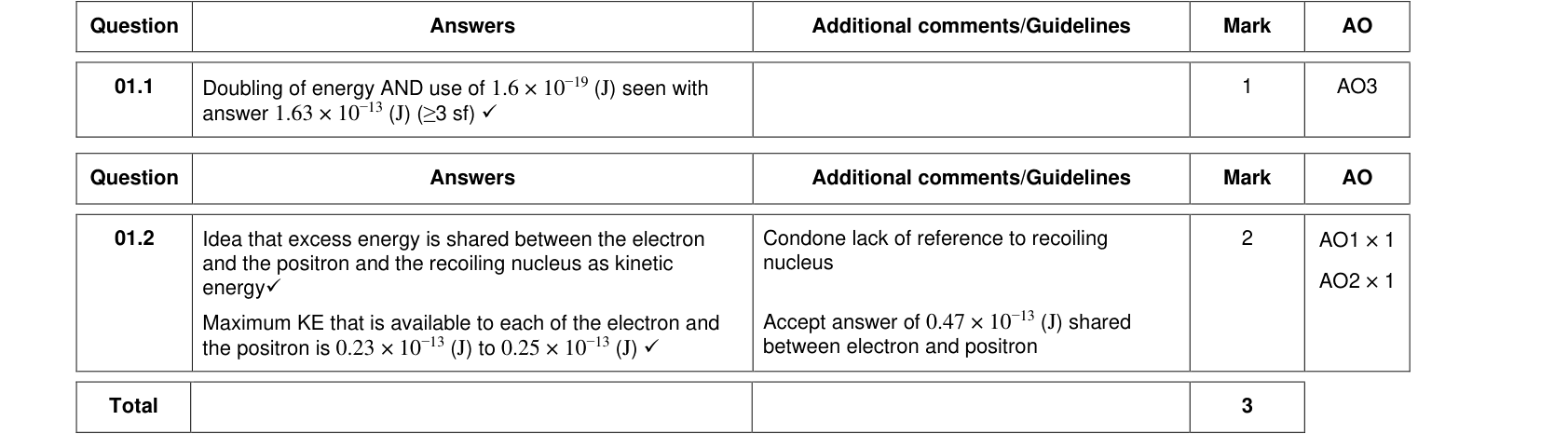
For an electron–positron pair: $E_{\min} = 2 \times 0.511 = 1.02\ \text{MeV}$. Any extra energy becomes the kinetic energy of the particles.
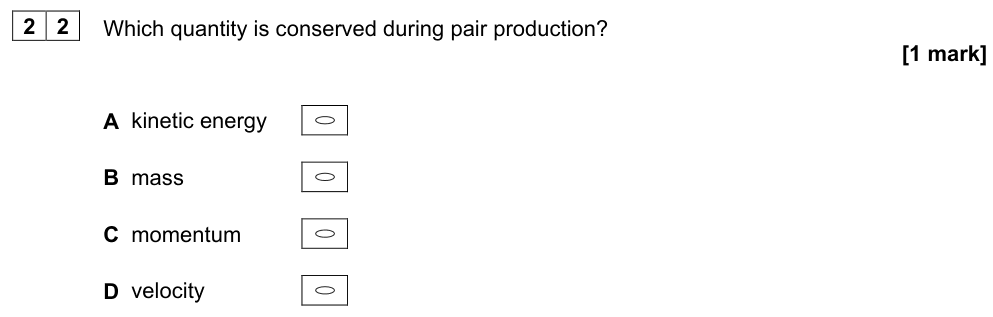
Conserved in pair production: energy, momentum and charge (the photon is neutral; $-e$ and $+e$ add to zero). Mass is not conserved: mass is created from energy.
Worked example: photon frequency for pair production
Calculate the minimum frequency of a photon that can produce a proton–antiproton pair.
$E_{\min} = 2 \times 938\ \text{MeV} = 1876 \times 1.60 \times 10^{-13} = 3.00 \times 10^{-10}\ \text{J}$.
$f = E/h = 3.00 \times 10^{-10}/6.63 \times 10^{-34} = 4.5 \times 10^{23}\ \text{Hz}$.
Common mistake
In annihilation the energy of each photon equals the rest energy of one particle (two photons). In pair production the one photon must supply the rest energy of both particles, so it needs twice the rest energy.
Summary
- Every particle has an antiparticle with the same mass/rest energy and opposite charge: $e^+$, $\bar p$, $\bar n$, $\bar\nu$.
- Rest energy: the energy equivalent of a particle's mass, usually in MeV ($1\ \text{MeV} = 1.60 \times 10^{-13}$ J).
- Annihilation: particle + antiparticle → two photons in opposite directions (momentum conservation); each photon ≥ rest energy of one particle.
- Pair production: photon → particle + antiparticle near a nucleus; photon energy ≥ 2 × rest energy.
- Free neutron decay: $n \to p + e^- + \bar\nu_e$.