Describing motion
| Quantity | Definition | Scalar/vector | Unit |
|---|---|---|---|
| Distance | total length of path travelled | scalar | m |
| Displacement $s$ | distance in a straight line from the start point, in a stated direction | vector | m |
| Speed | rate of change of distance | scalar | m s⁻¹ |
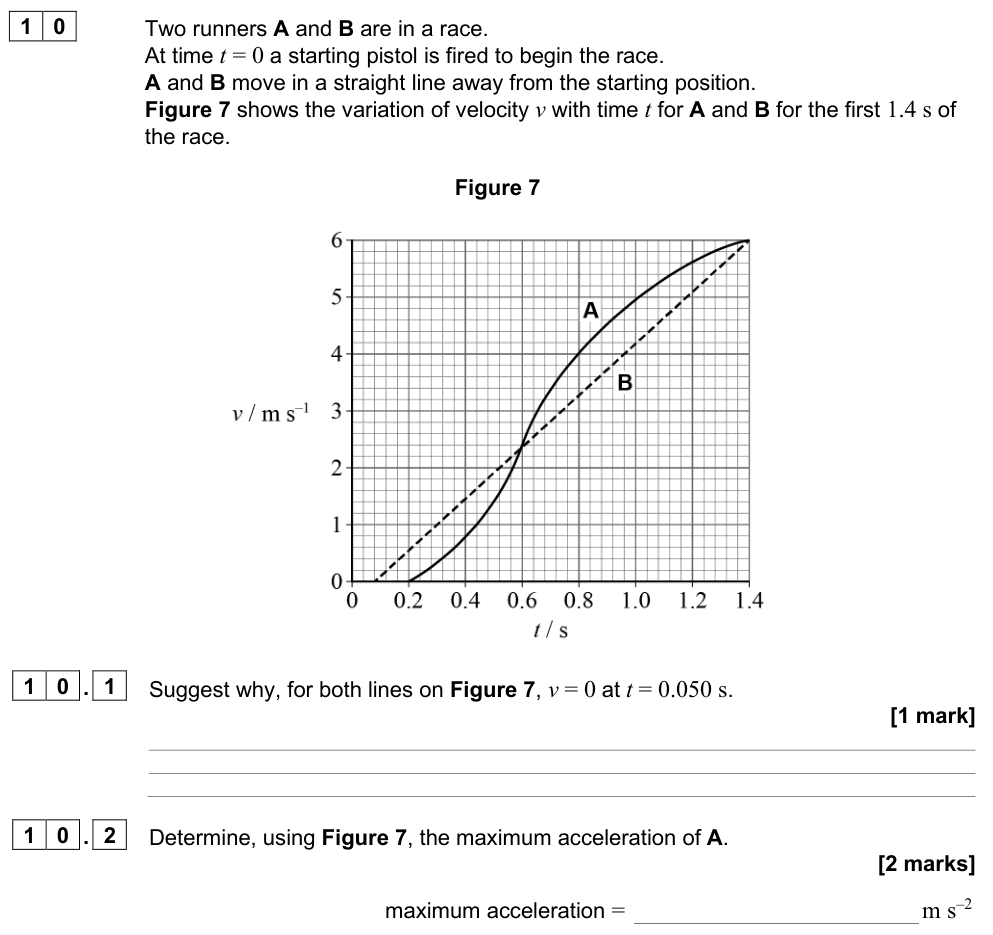
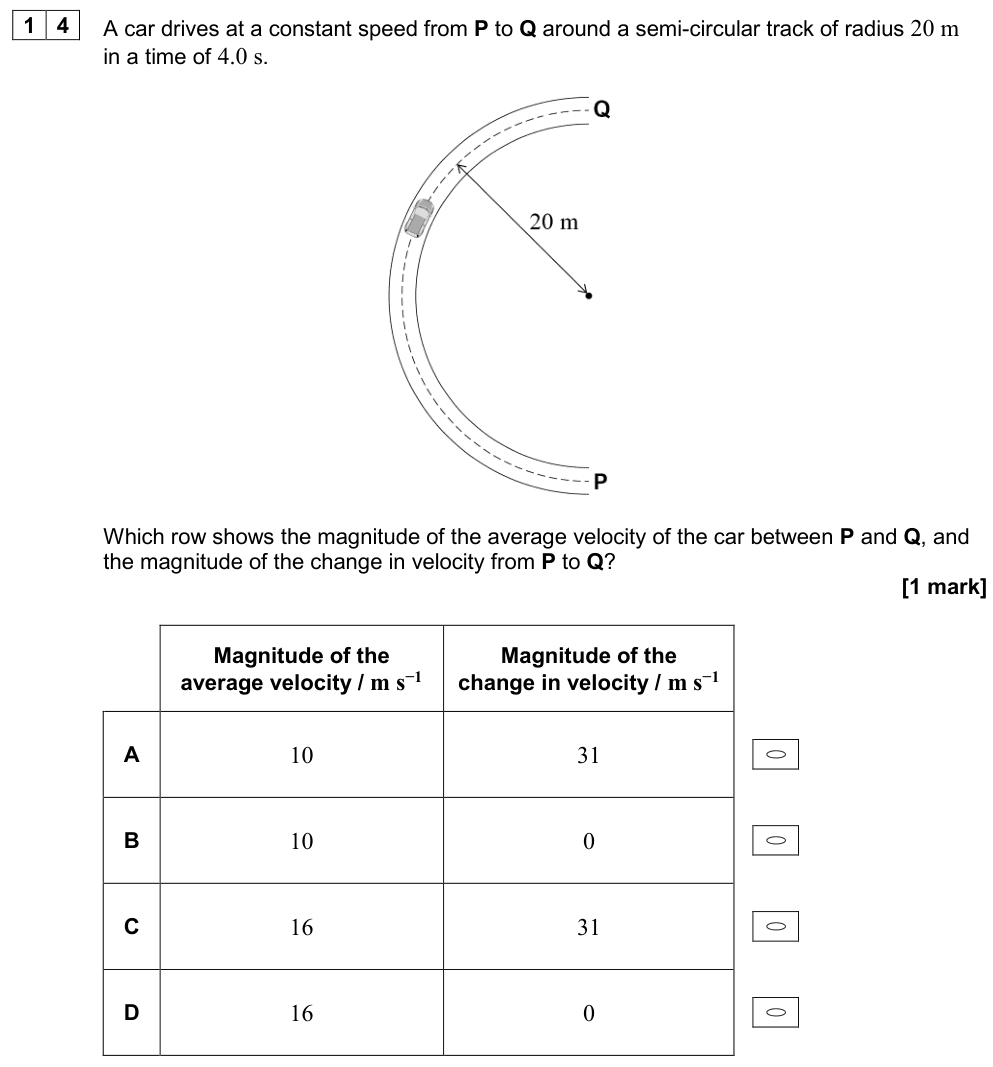
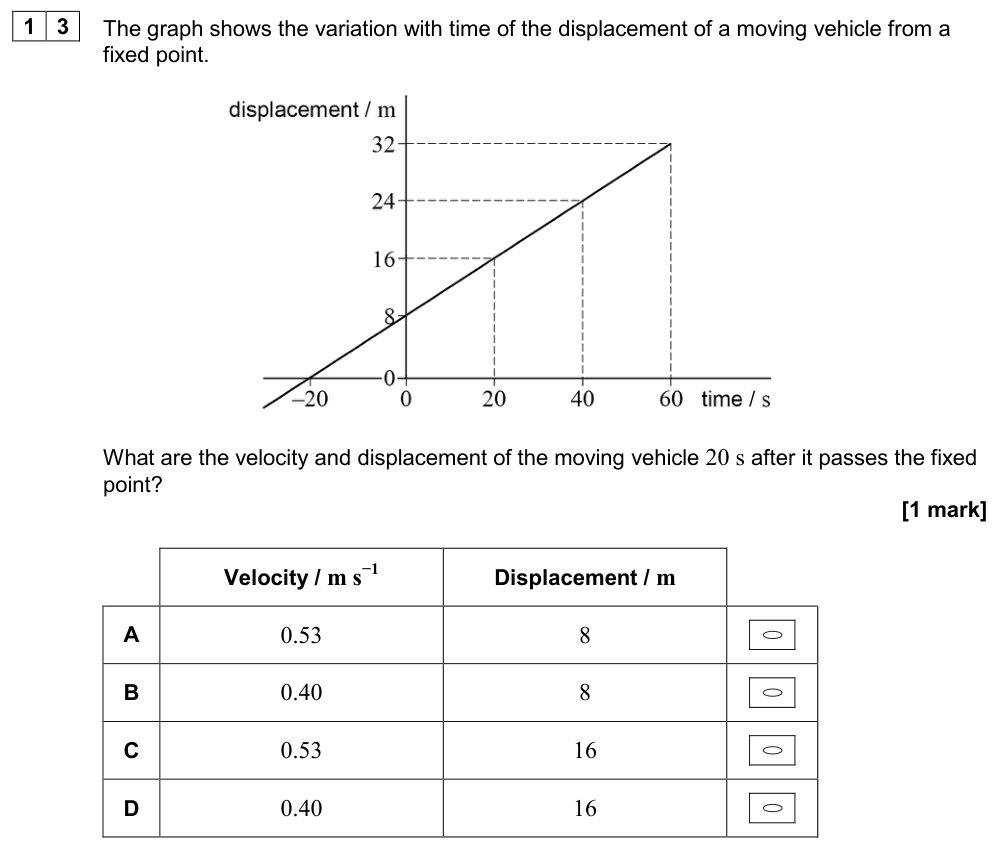
| Velocity $v$ | rate of change of displacement, $v = \dfrac{\Delta s}{\Delta t}$ | vector | m s⁻¹ |
| Acceleration $a$ | rate of change of velocity, $a = \dfrac{\Delta v}{\Delta t}$ | vector | m s⁻² |
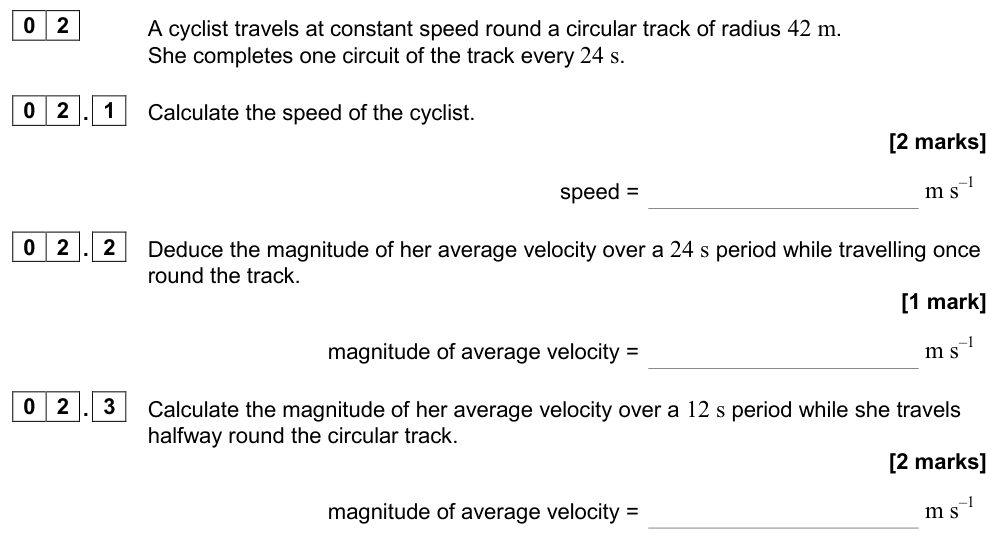
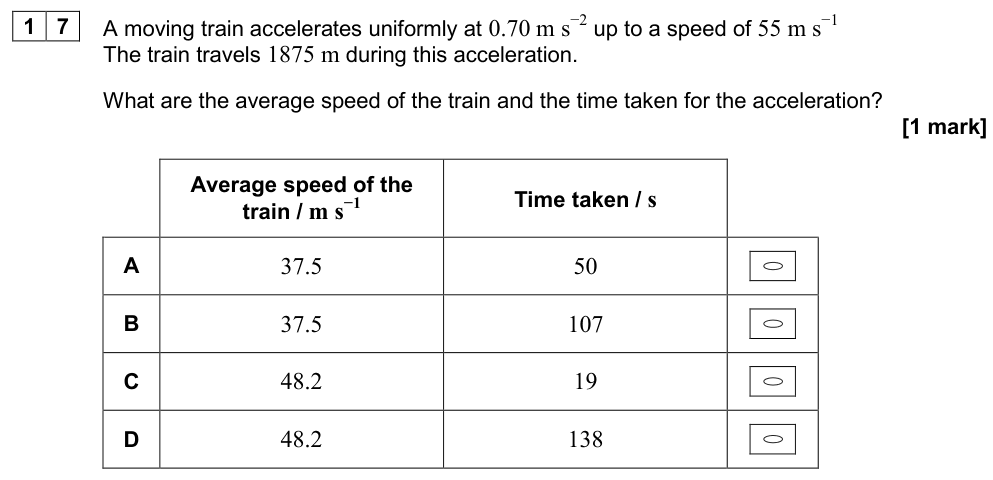
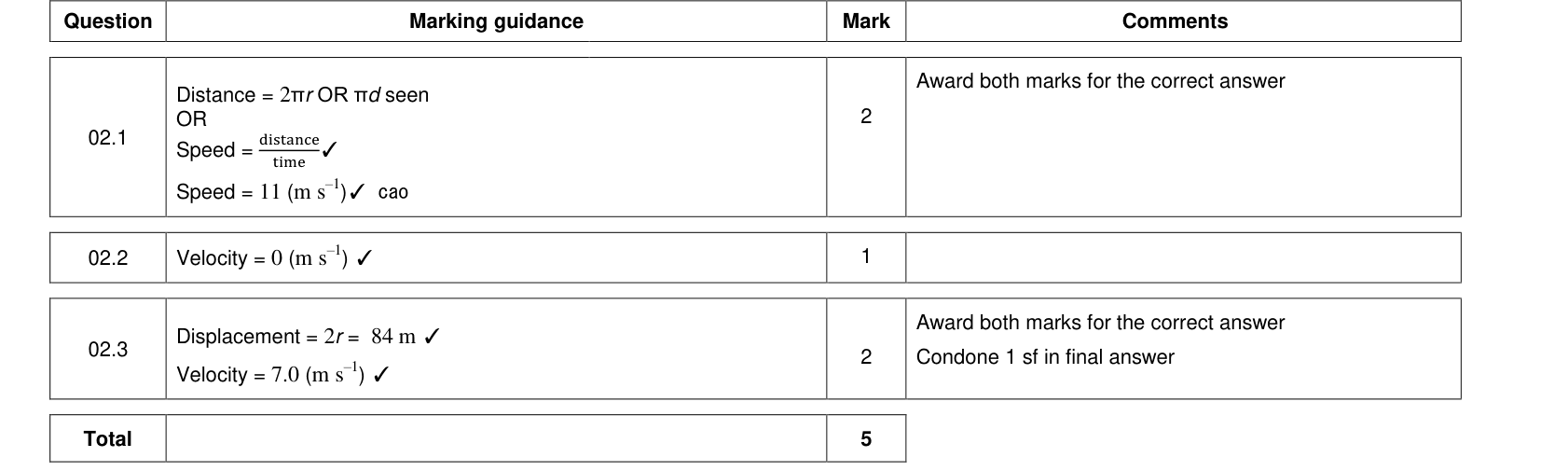
- Average speed = total distance ÷ total time. Average velocity = total displacement ÷ total time.
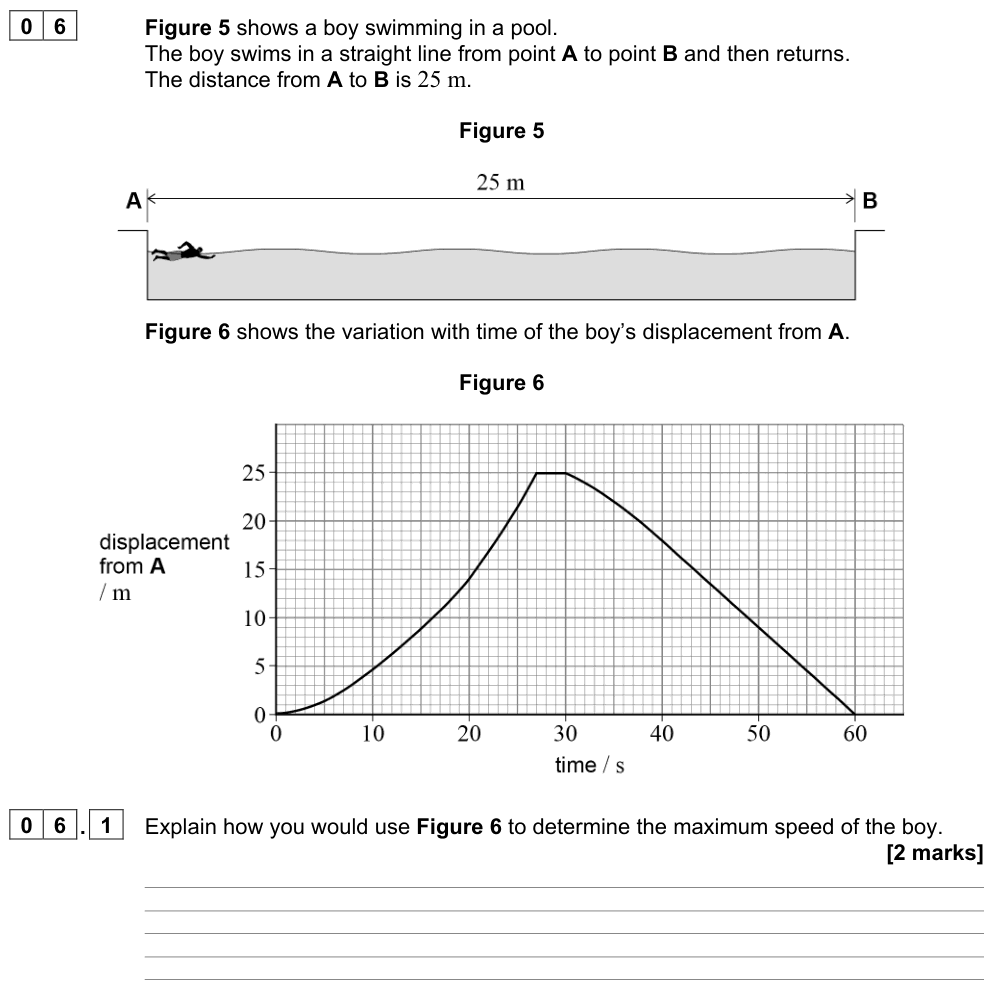
- Instantaneous speed/velocity is the value at one moment: the gradient of the displacement–time graph at that instant (draw a tangent).
- A negative acceleration means the acceleration is in the negative direction. It is a deceleration only if the object is moving in the positive direction.
Worked example: average speed vs average velocity
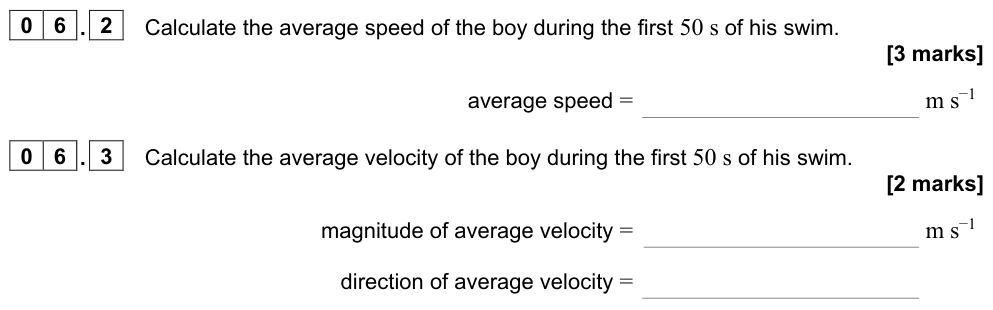
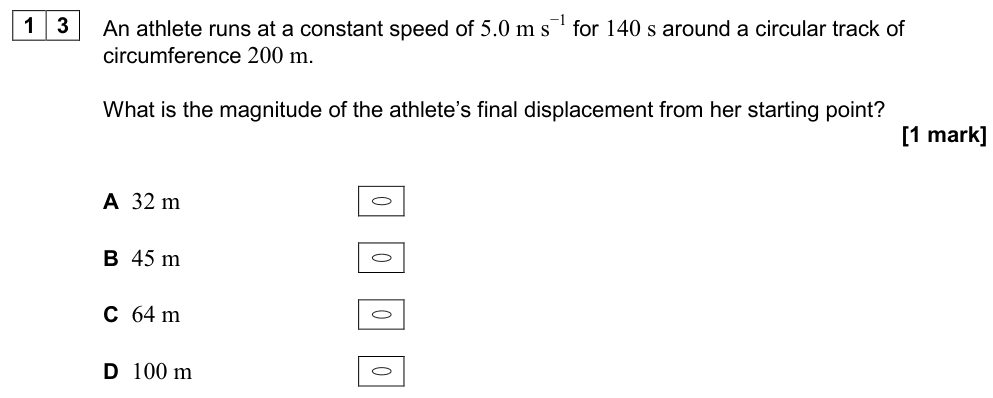
A swimmer swims 25 m to the end of a pool in 20 s and back in 30 s.
Average speed $= \dfrac{50}{50} = 1.0\ \text{m s}^{-1}$. Average velocity $= \dfrac{0}{50} = 0$, because the displacement is zero.
Motion graphs
What the gradients and areas mean
| Graph | Gradient | Area under graph |
|---|---|---|
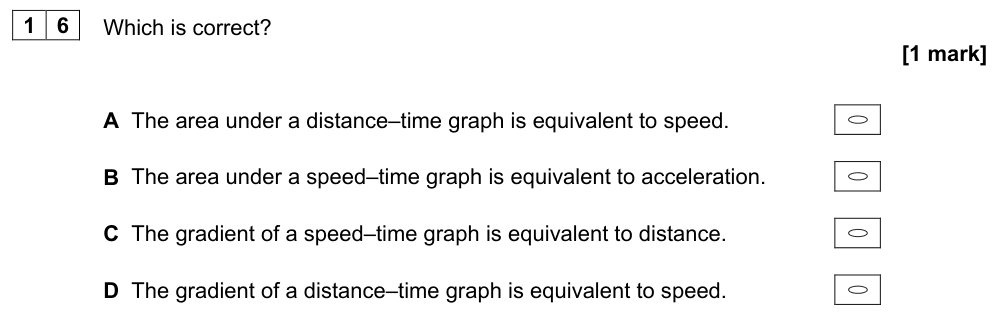
| displacement–time ($s$–$t$) | velocity | (no meaning) |
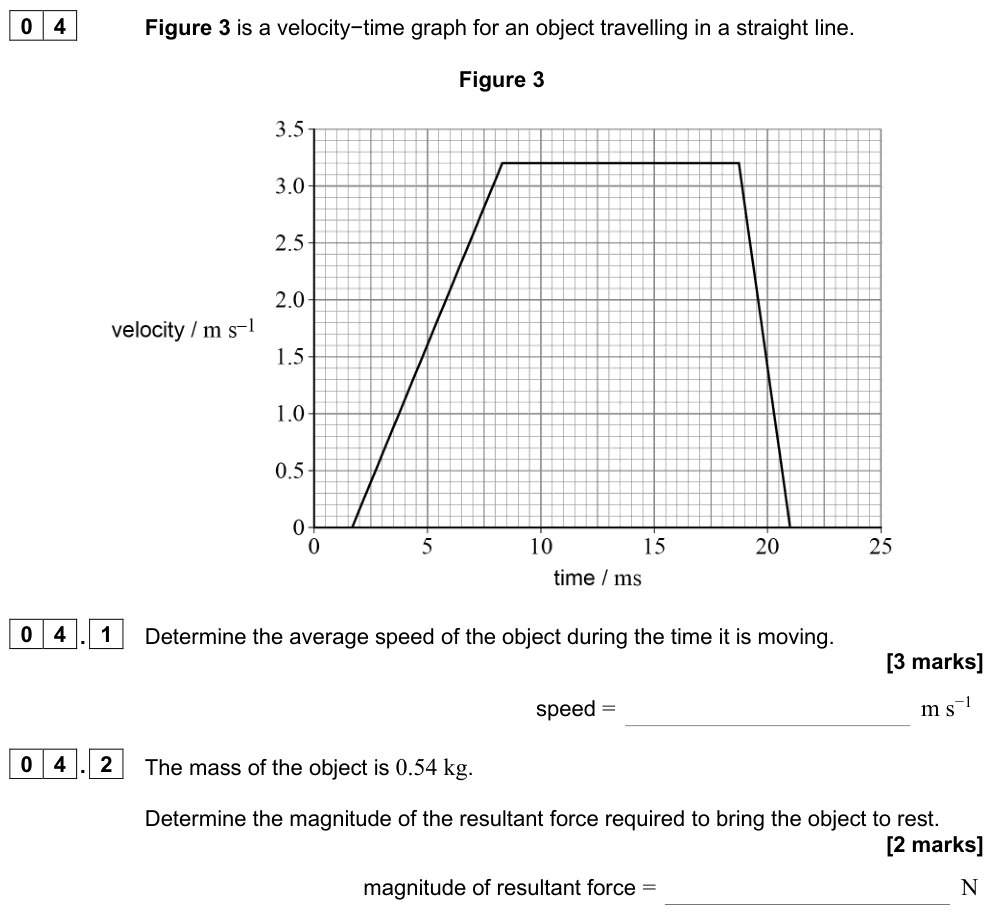
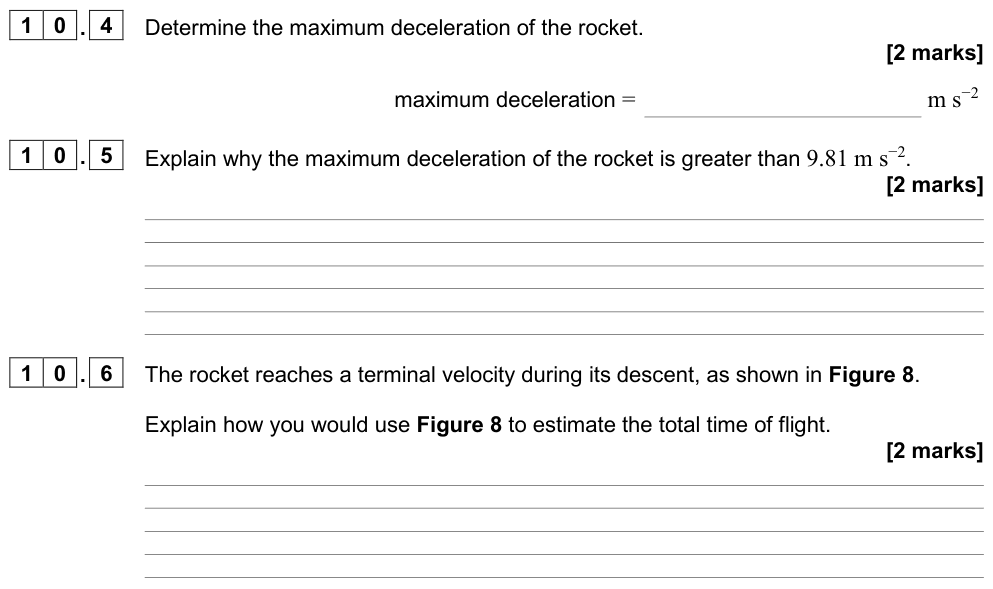
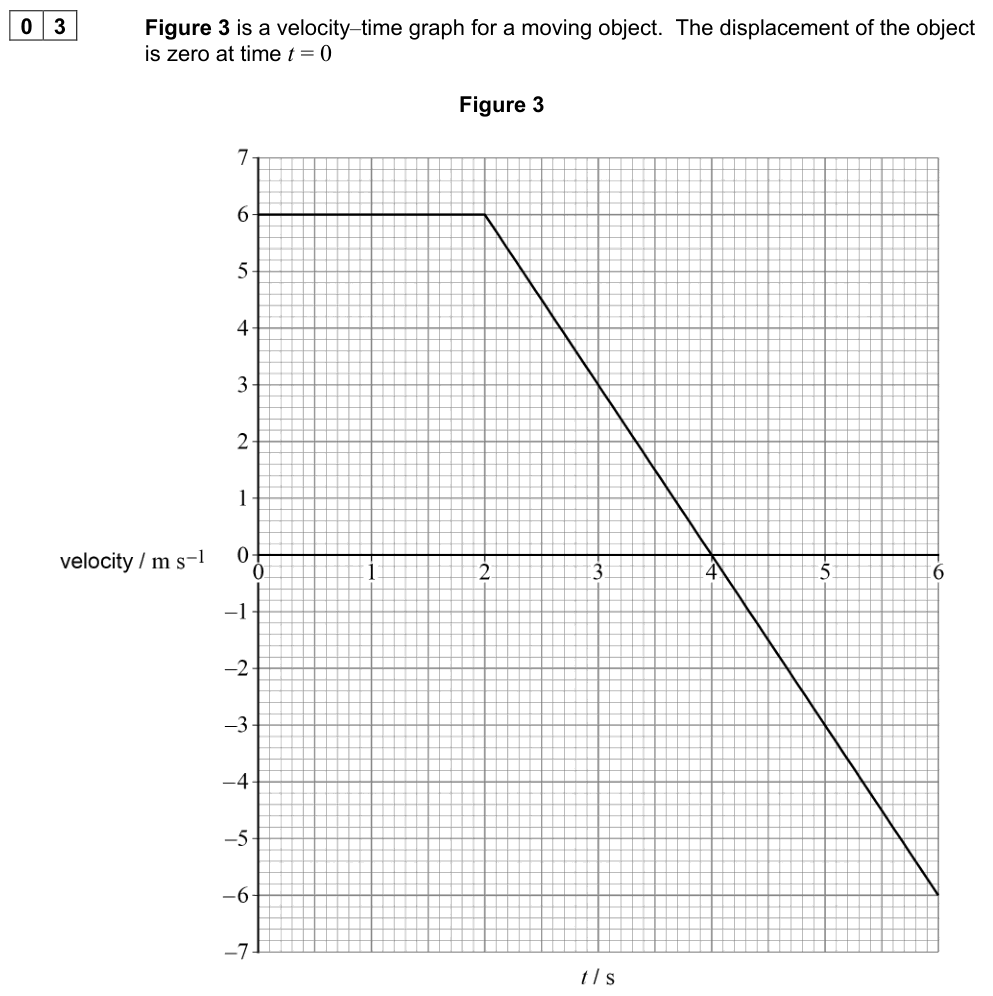
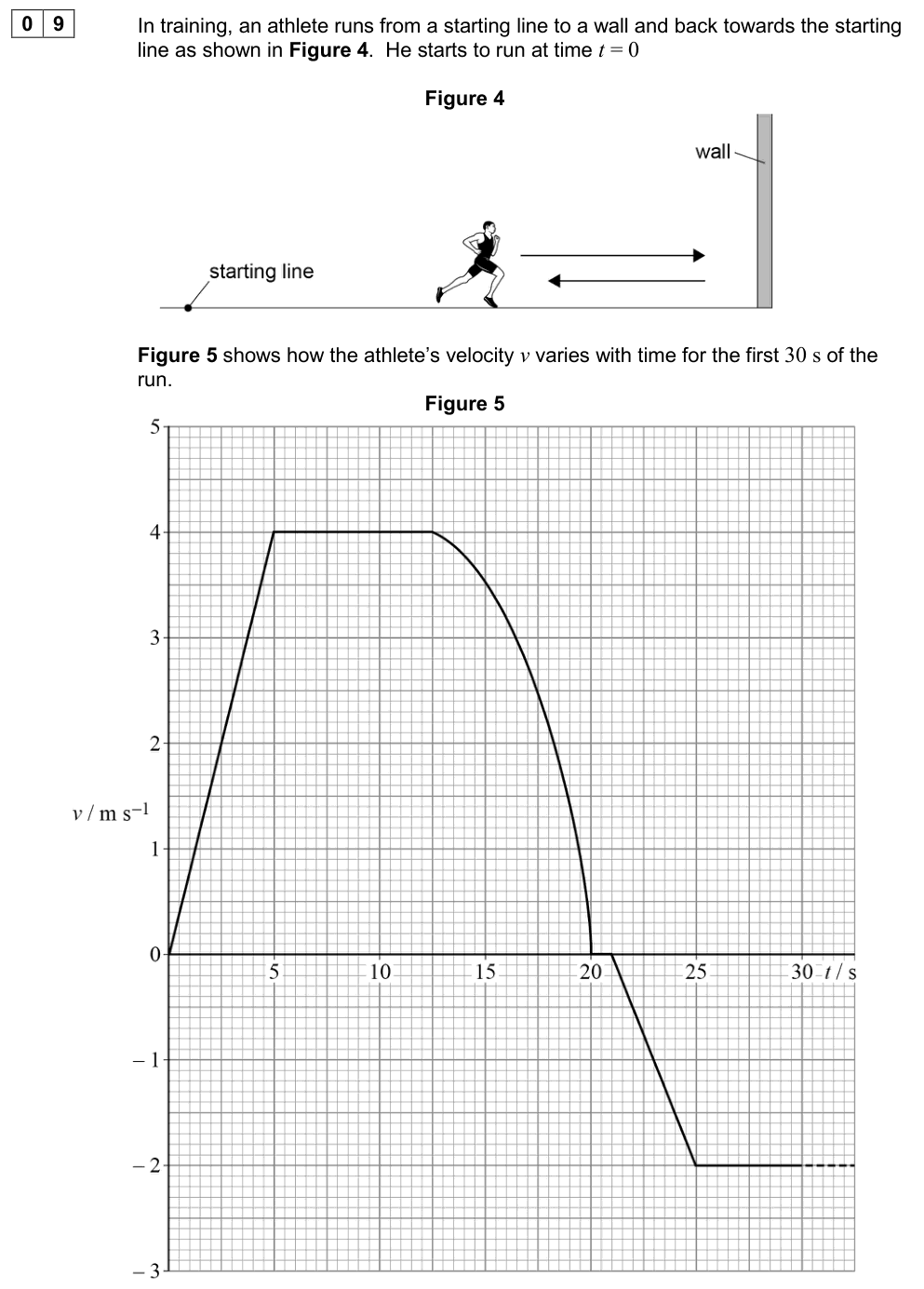
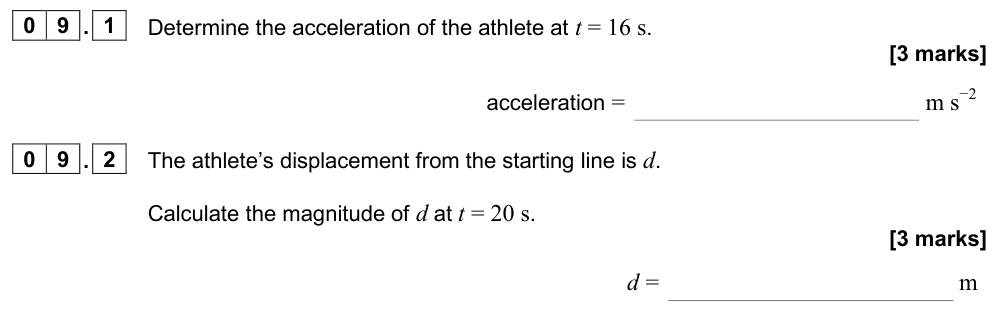
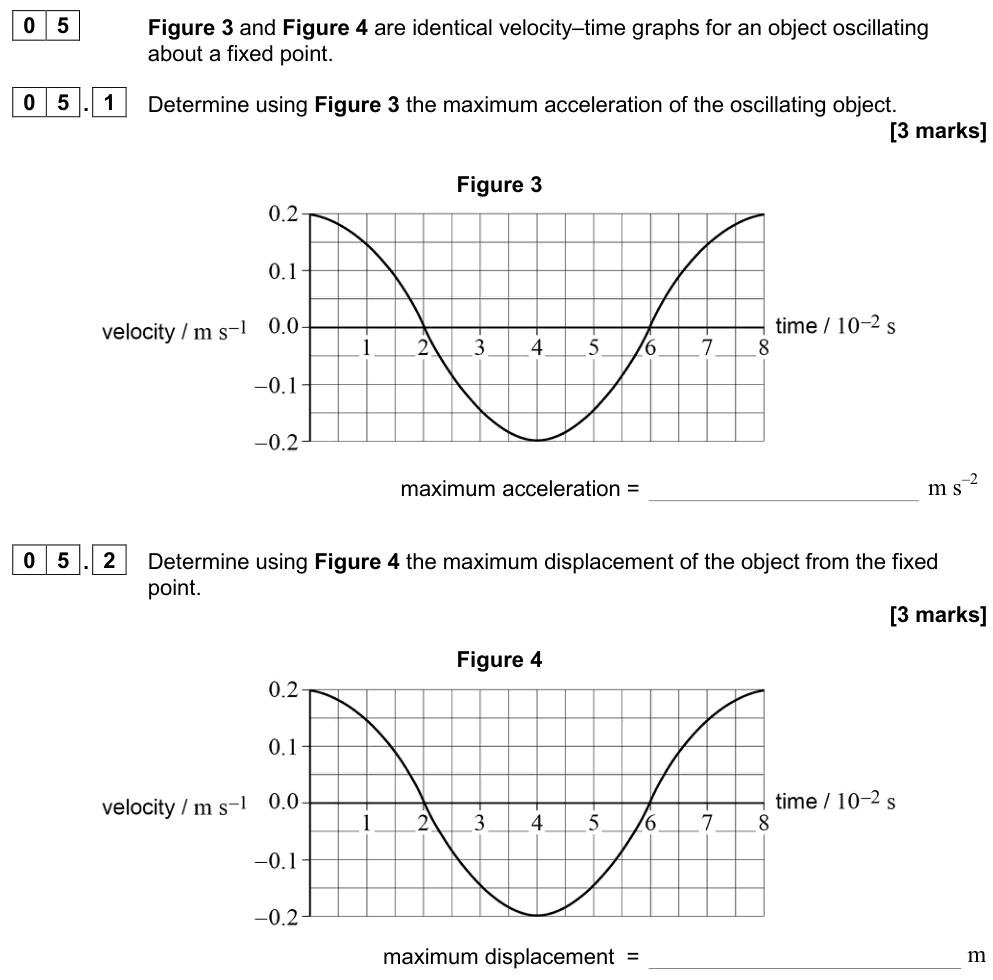
| velocity–time ($v$–$t$) | acceleration | displacement |
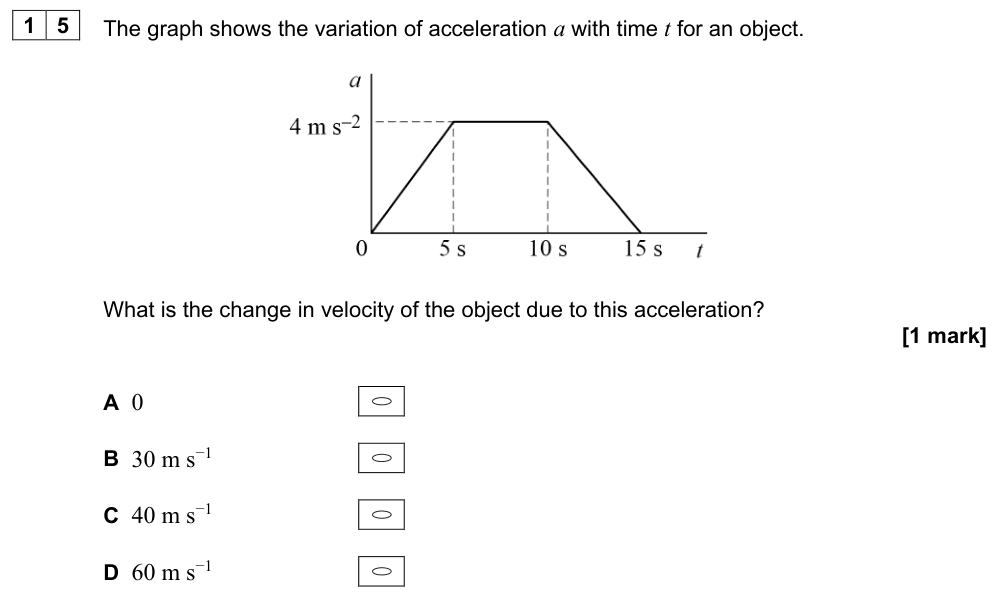
| acceleration–time ($a$–$t$) | (not needed) | change in velocity |
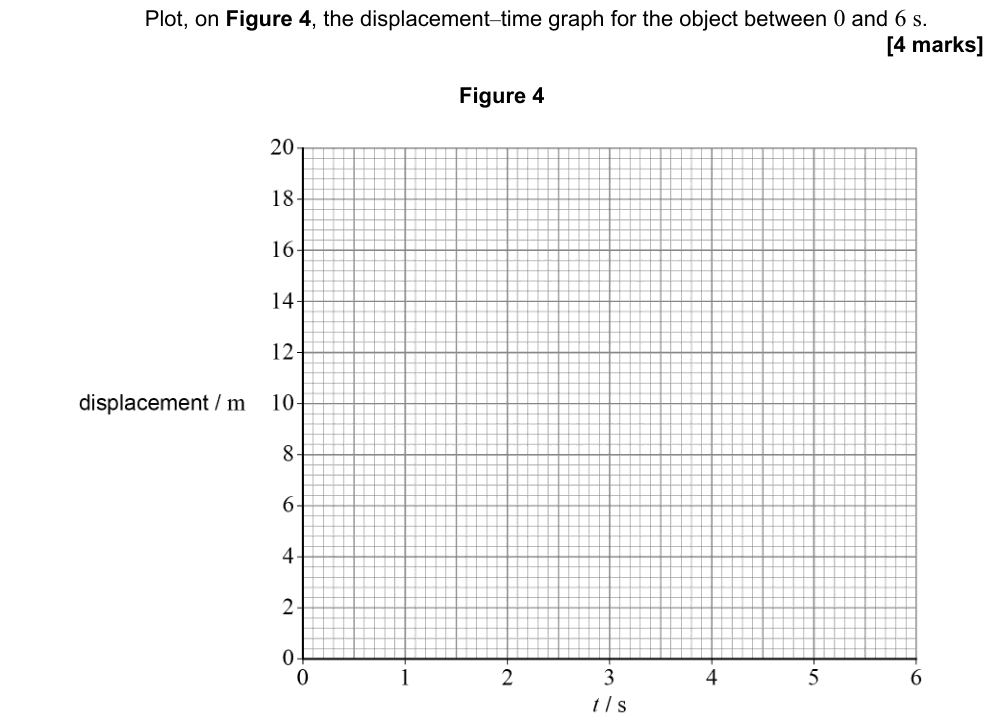
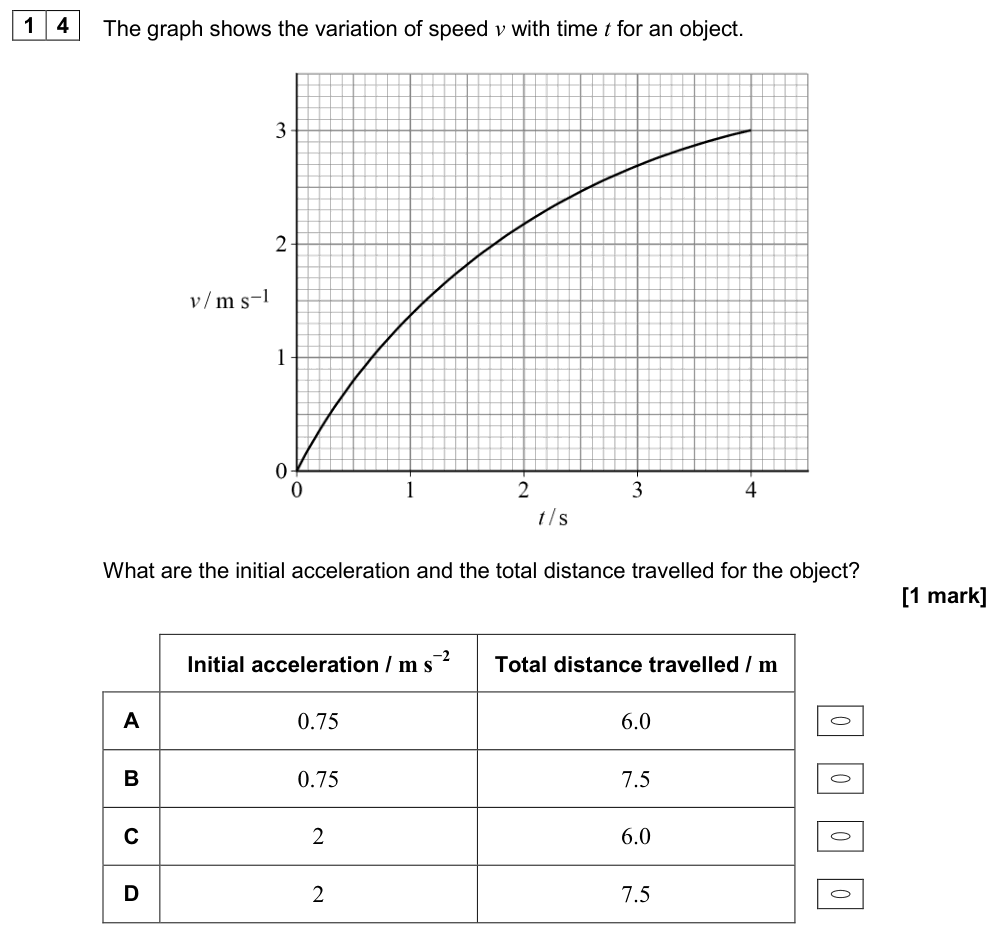
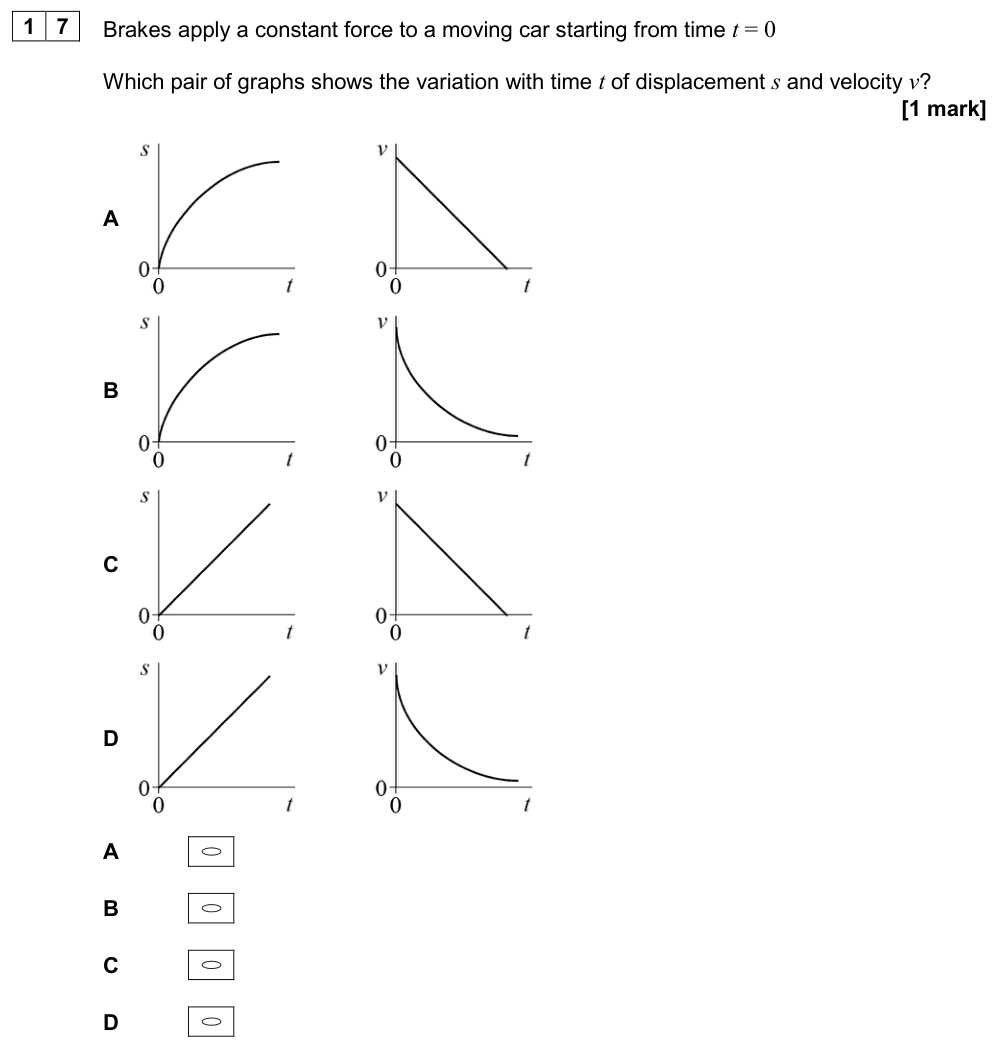
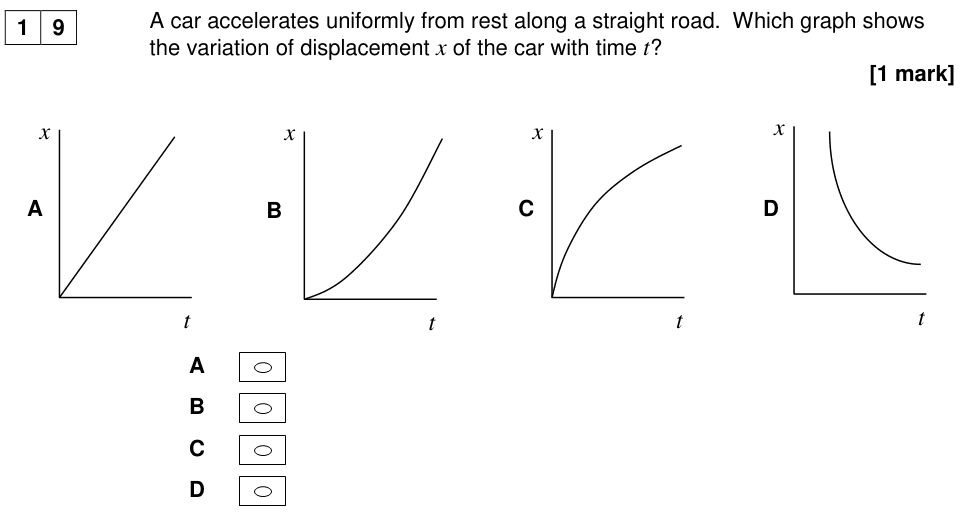
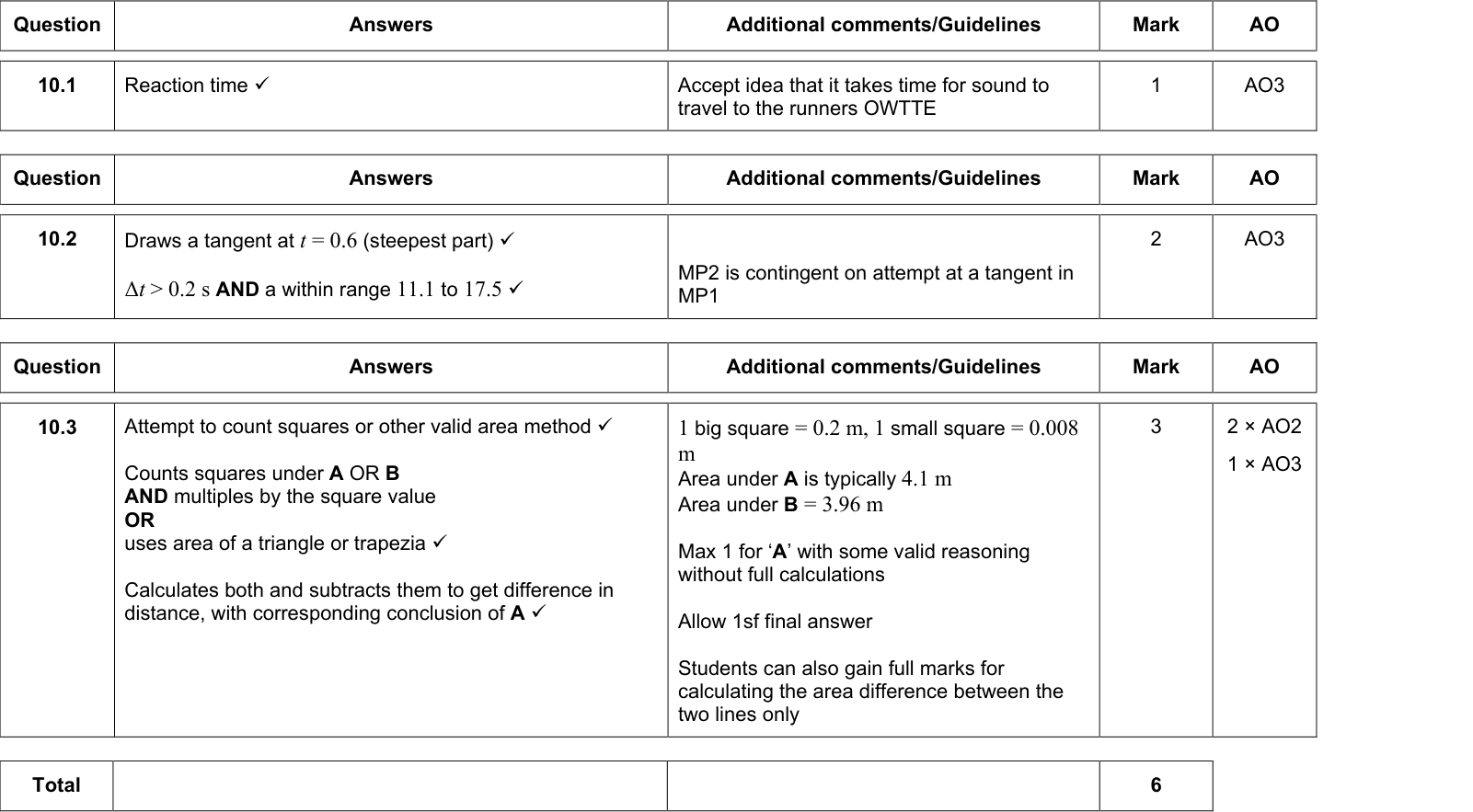
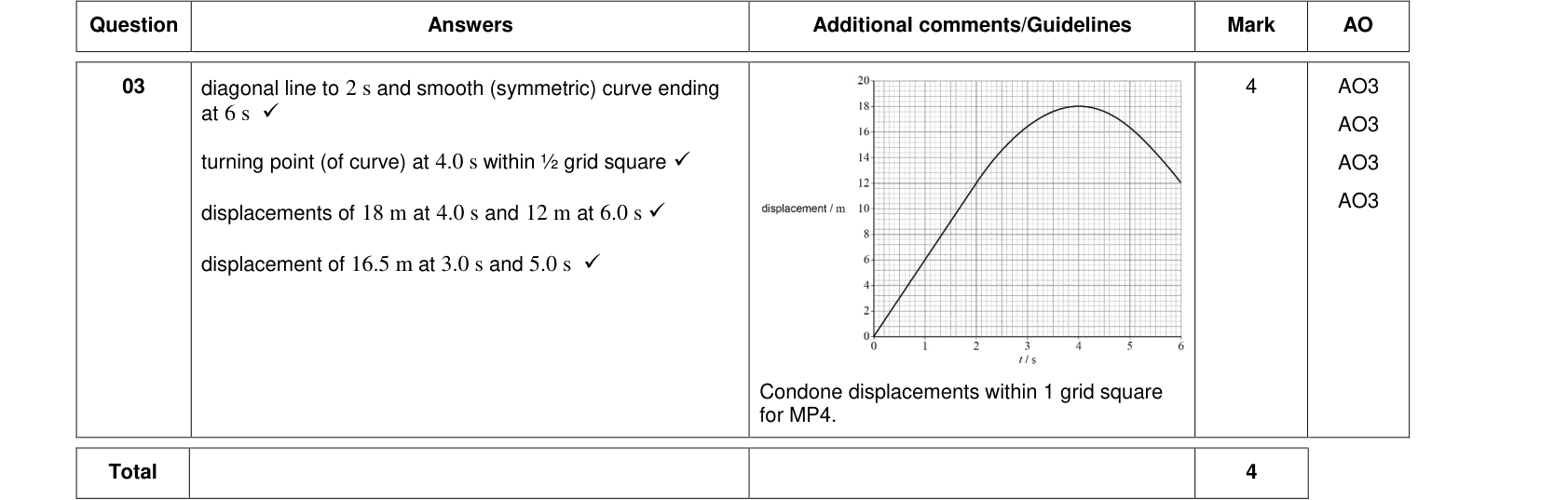
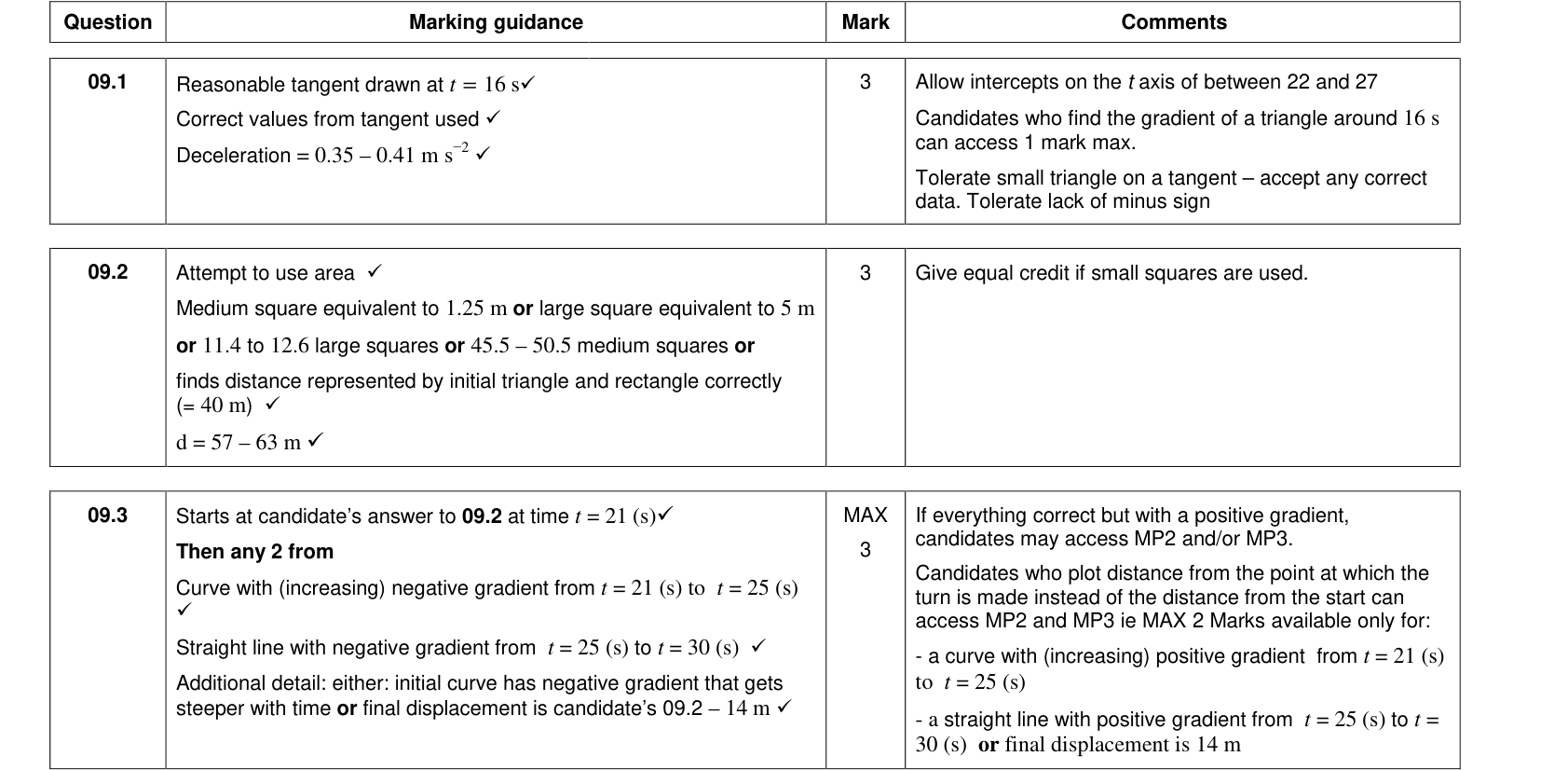
- On an $s$–$t$ graph a straight line means constant velocity. A curve means the velocity is changing. Find the instantaneous velocity from the gradient of the tangent.
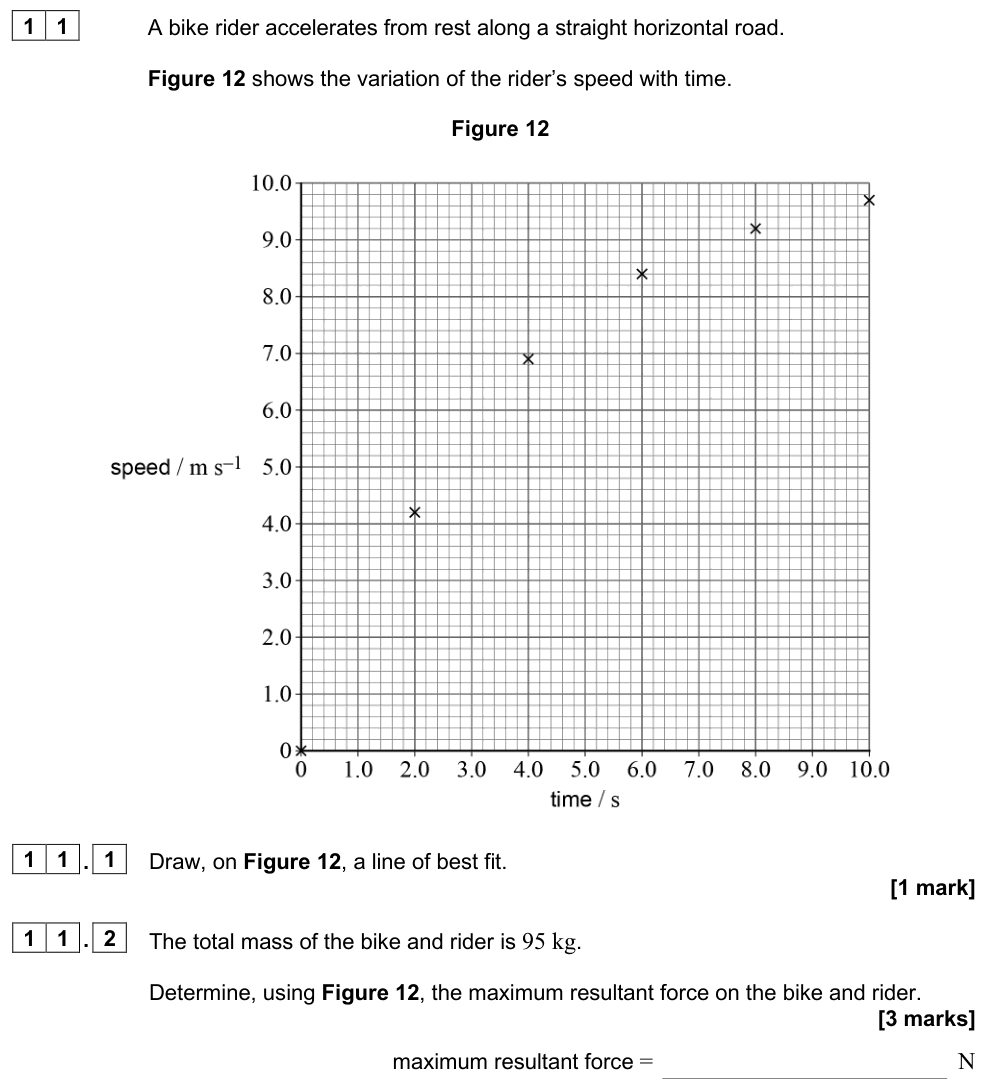
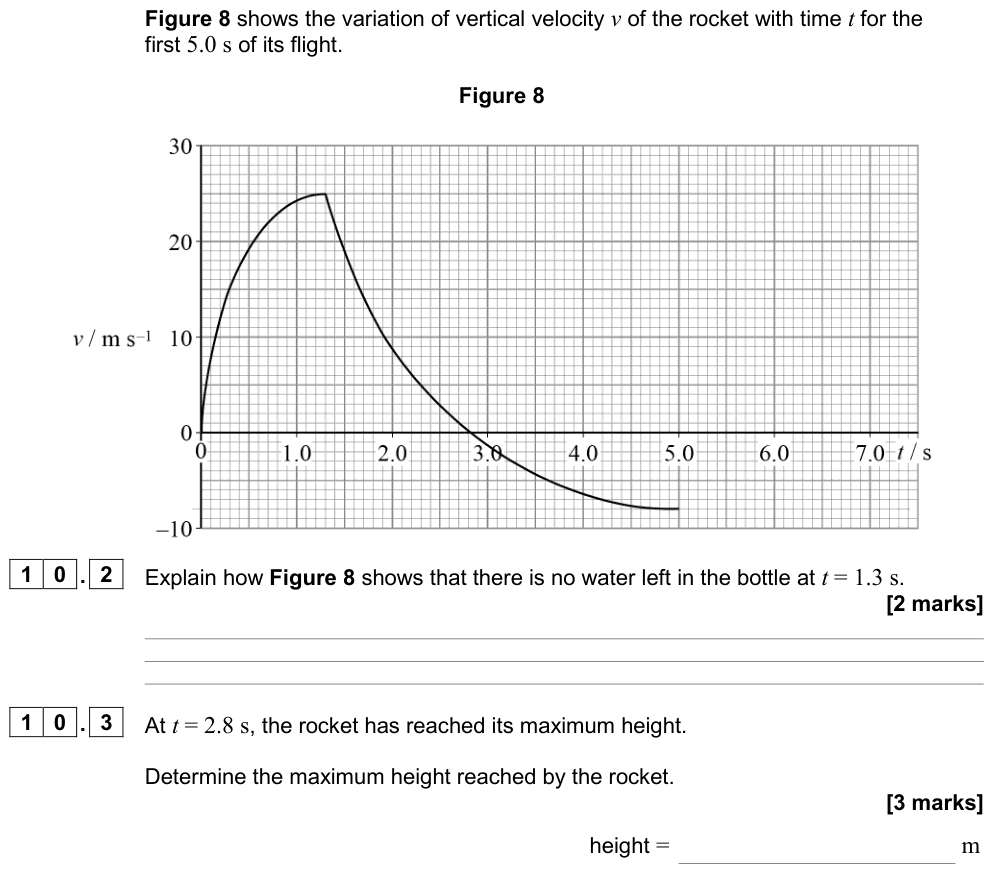
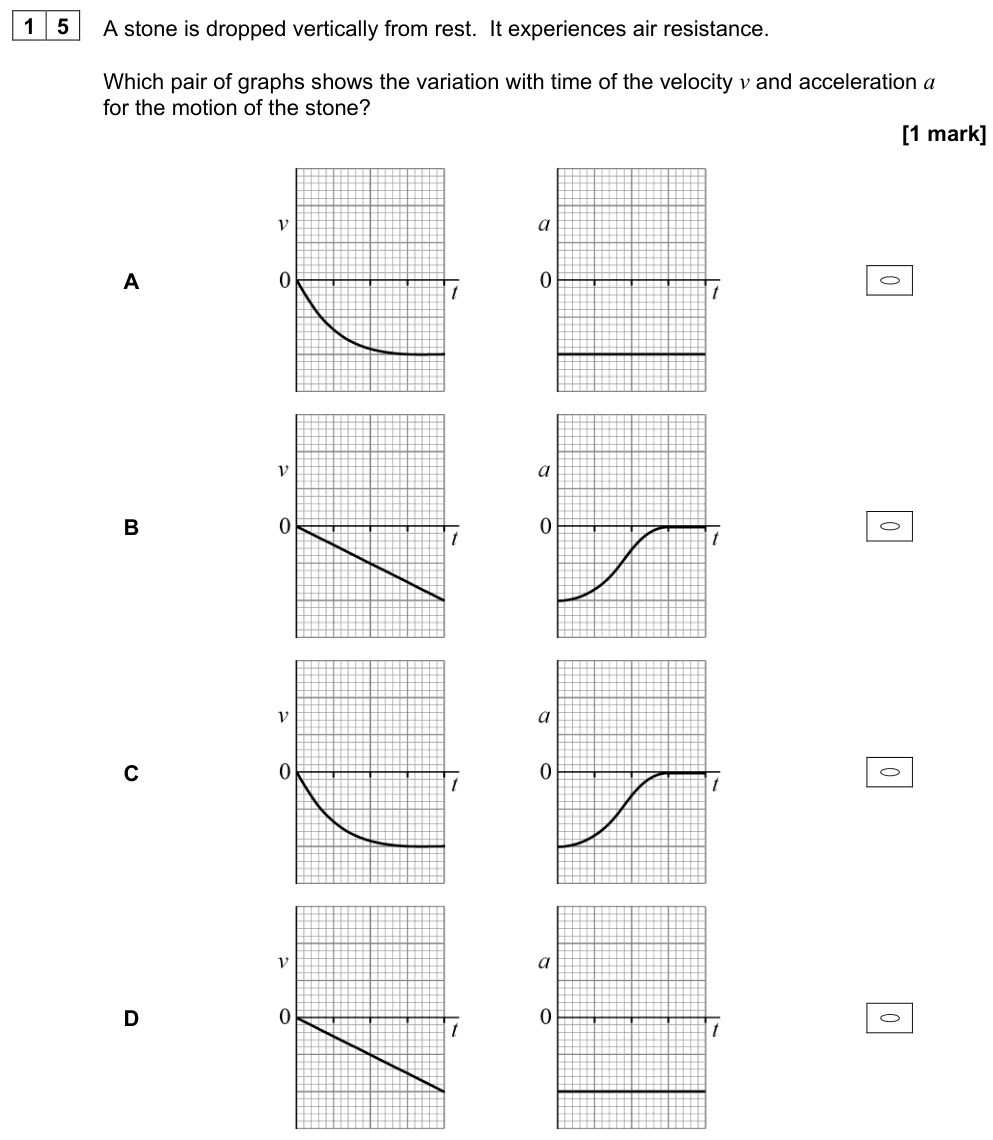
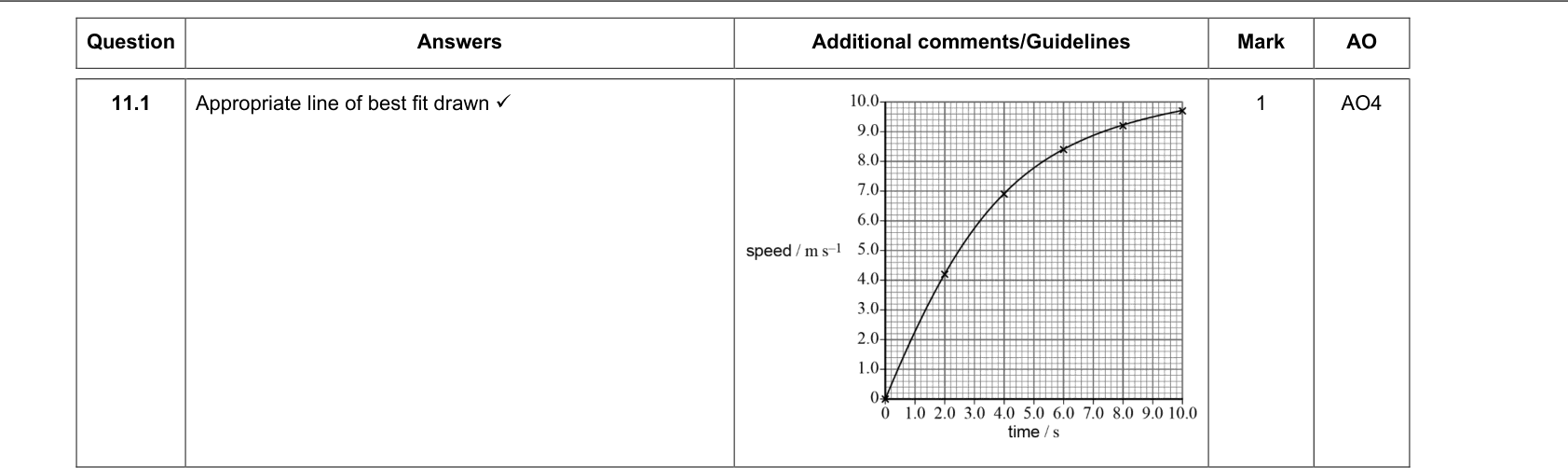
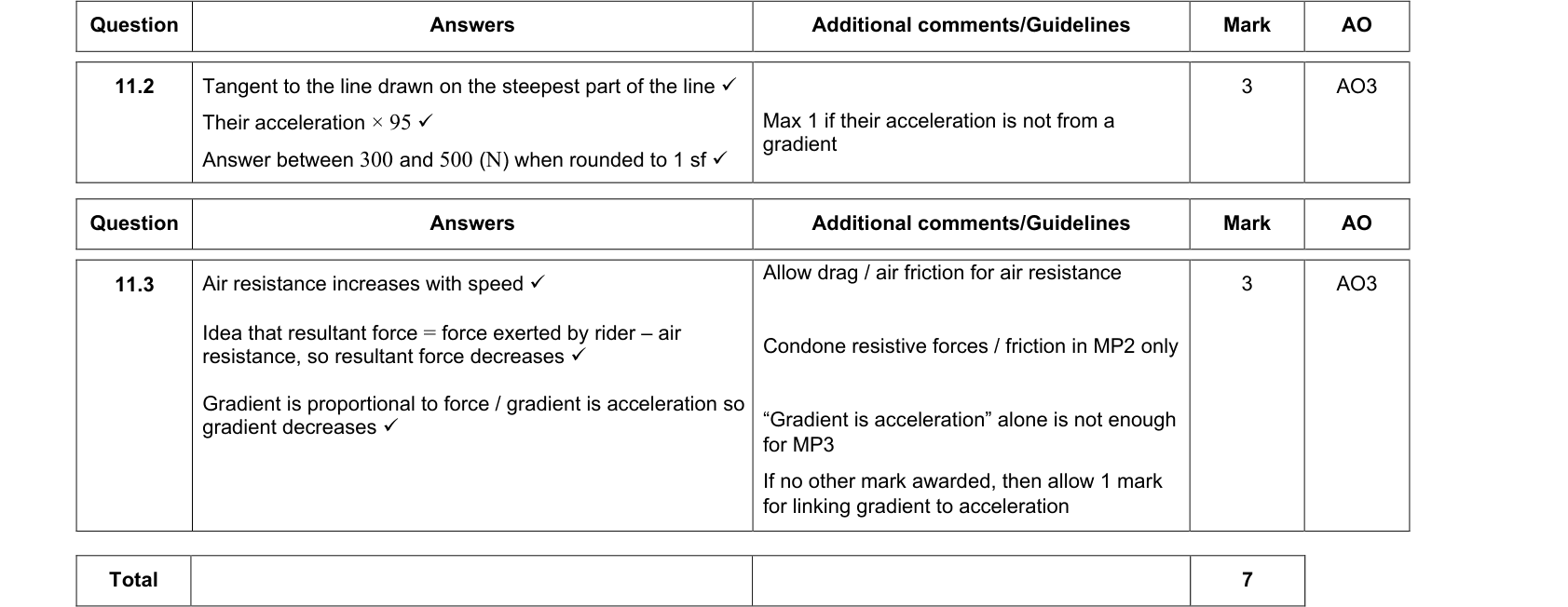
- On a $v$–$t$ graph a straight line means uniform (constant) acceleration. A curve means non-uniform acceleration.
- Areas below the time axis on a $v$–$t$ graph are negative displacements (moving backwards). Add them with their signs to get the net displacement, or add their sizes to get the total distance.
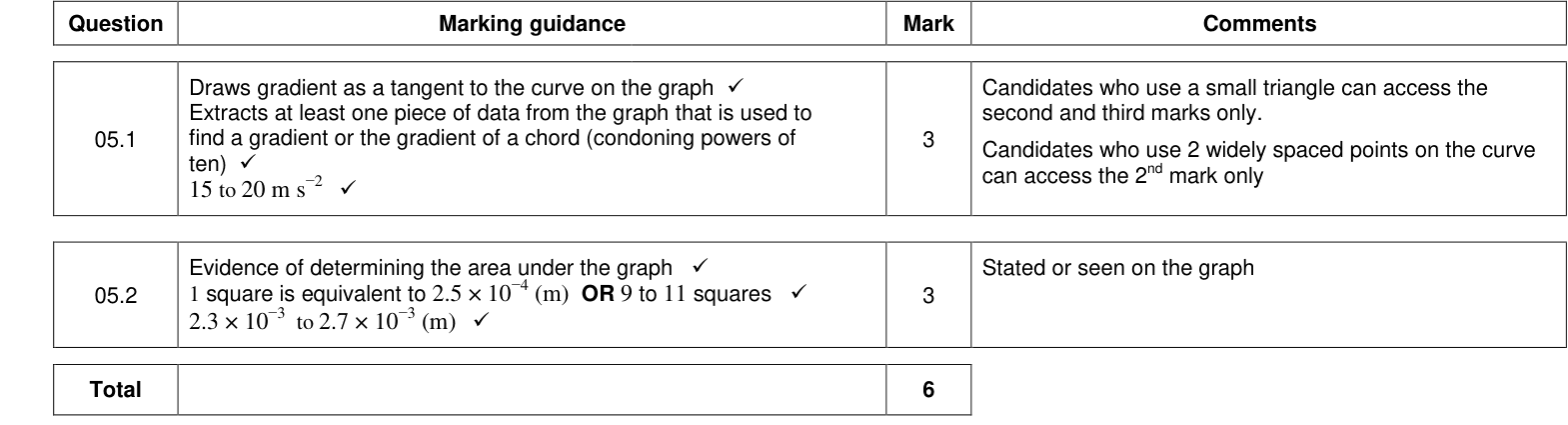
- For curved graphs, estimate the area by counting squares or by splitting it into trapezia.
Exam tip
When you calculate a gradient or area from a graph, always use the units on the axes (watch for km, ms, minutes) and use a large triangle for the gradient.
A bouncing ball
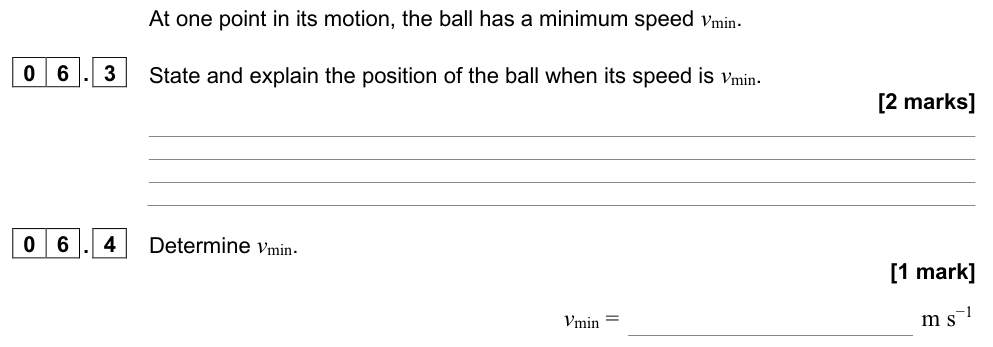
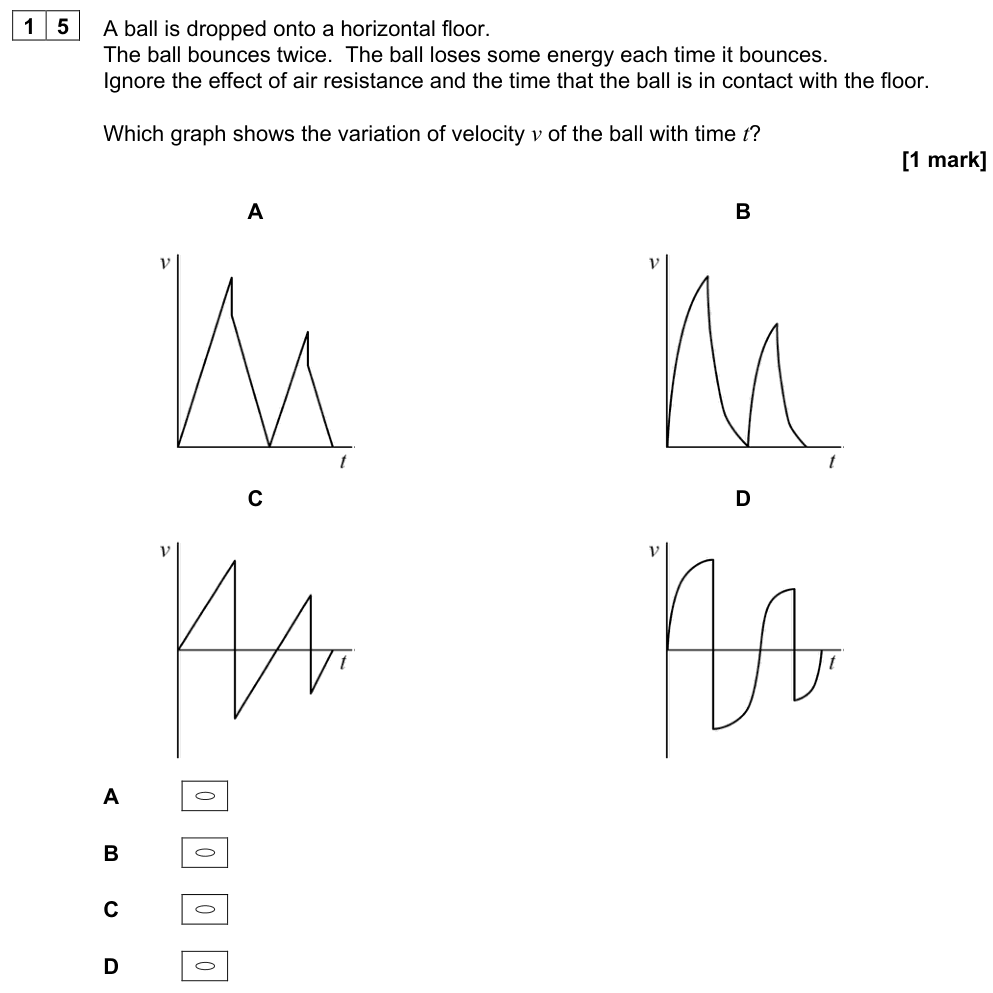
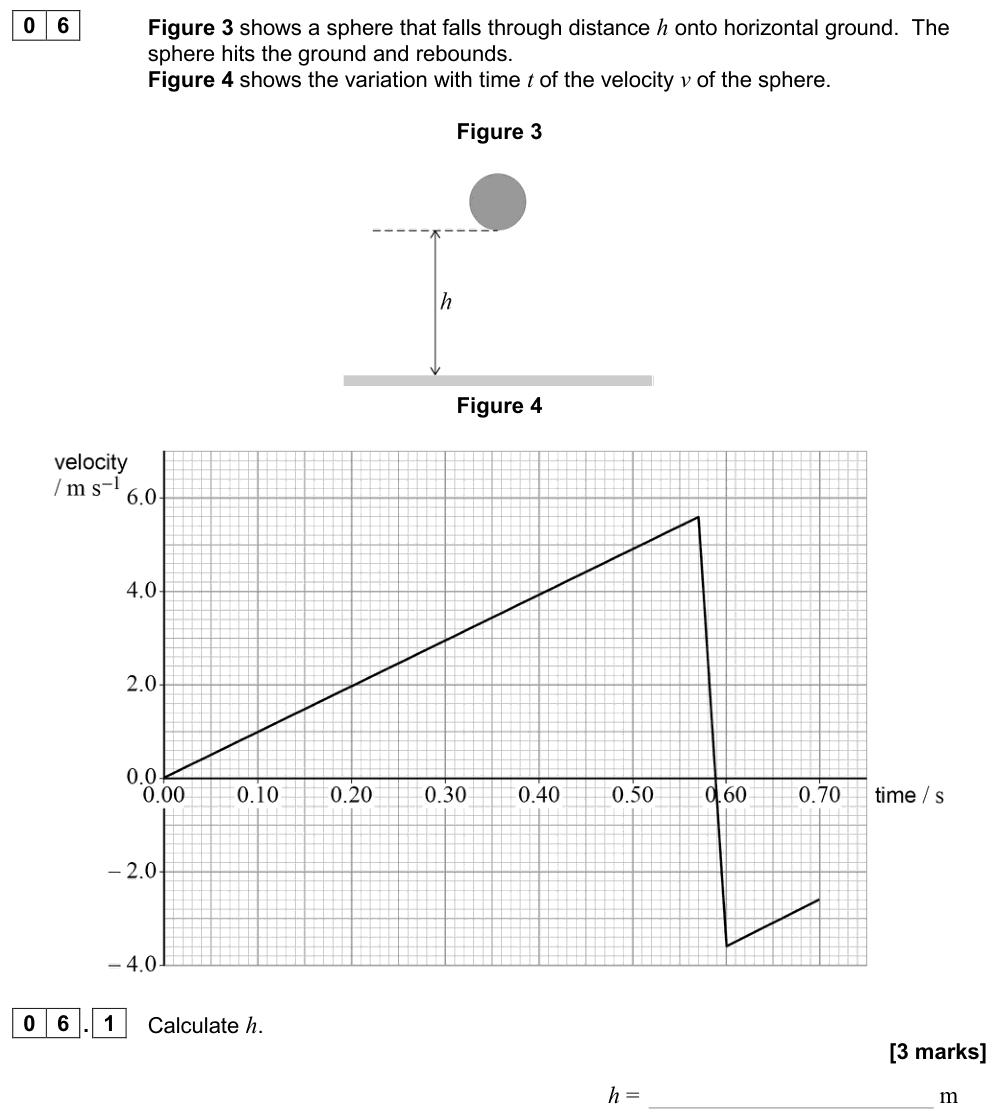
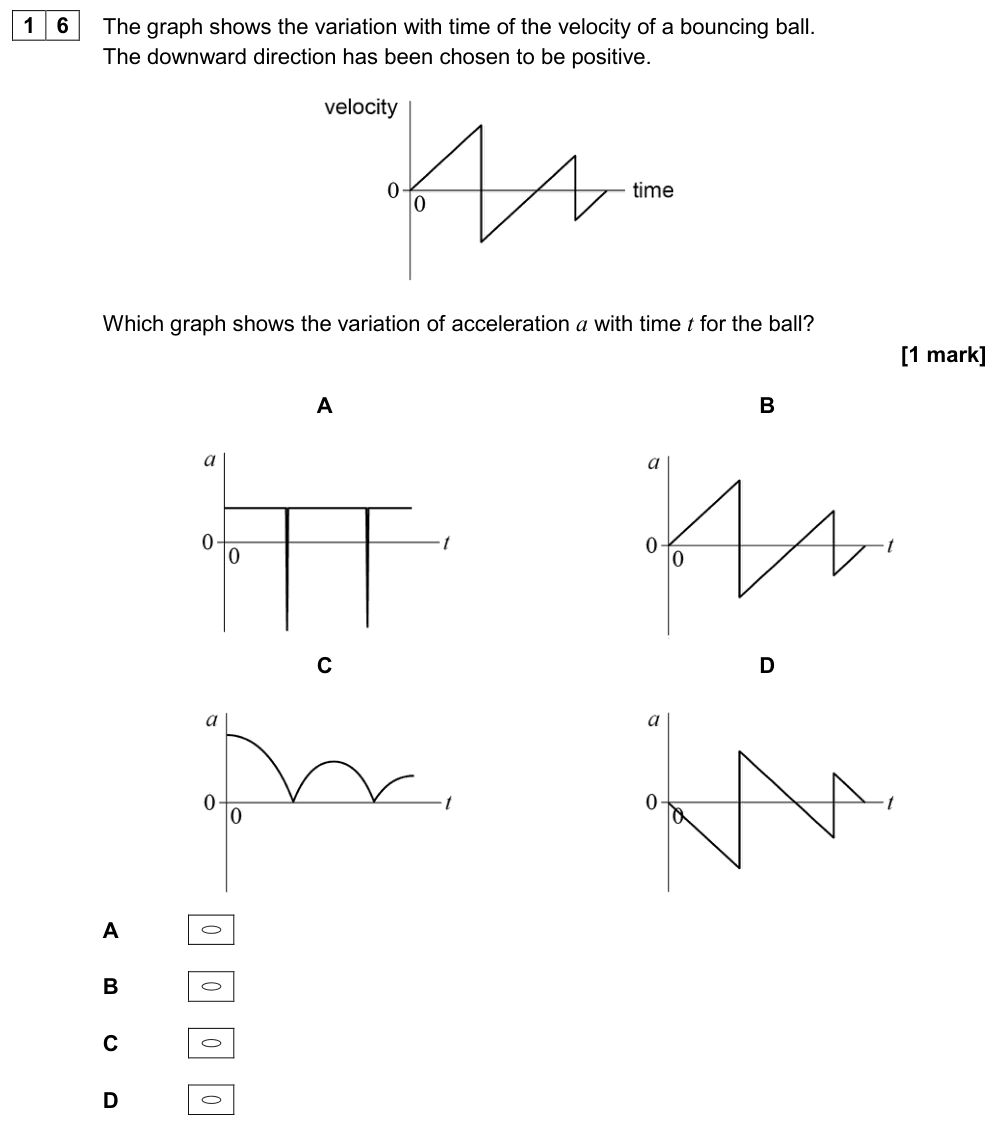
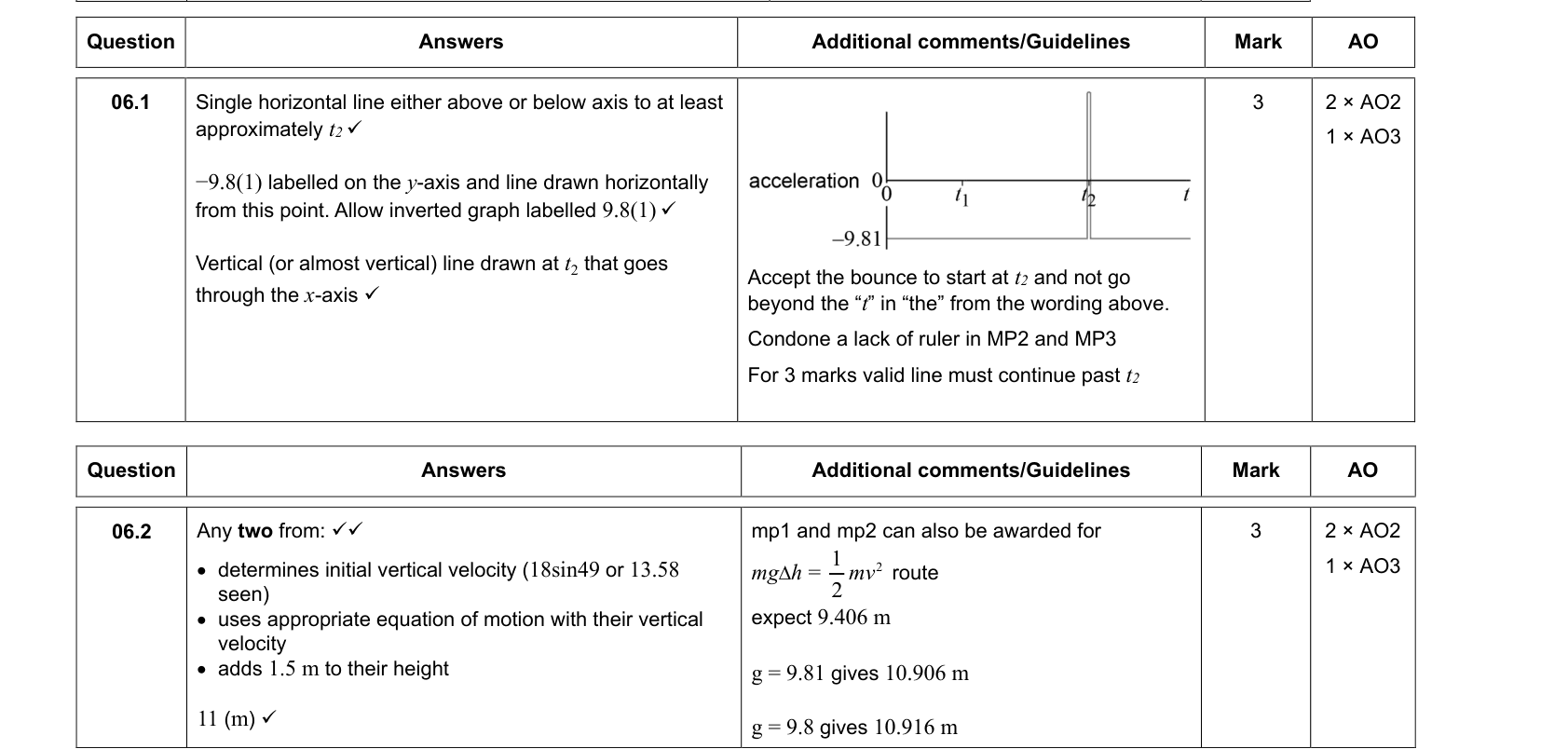
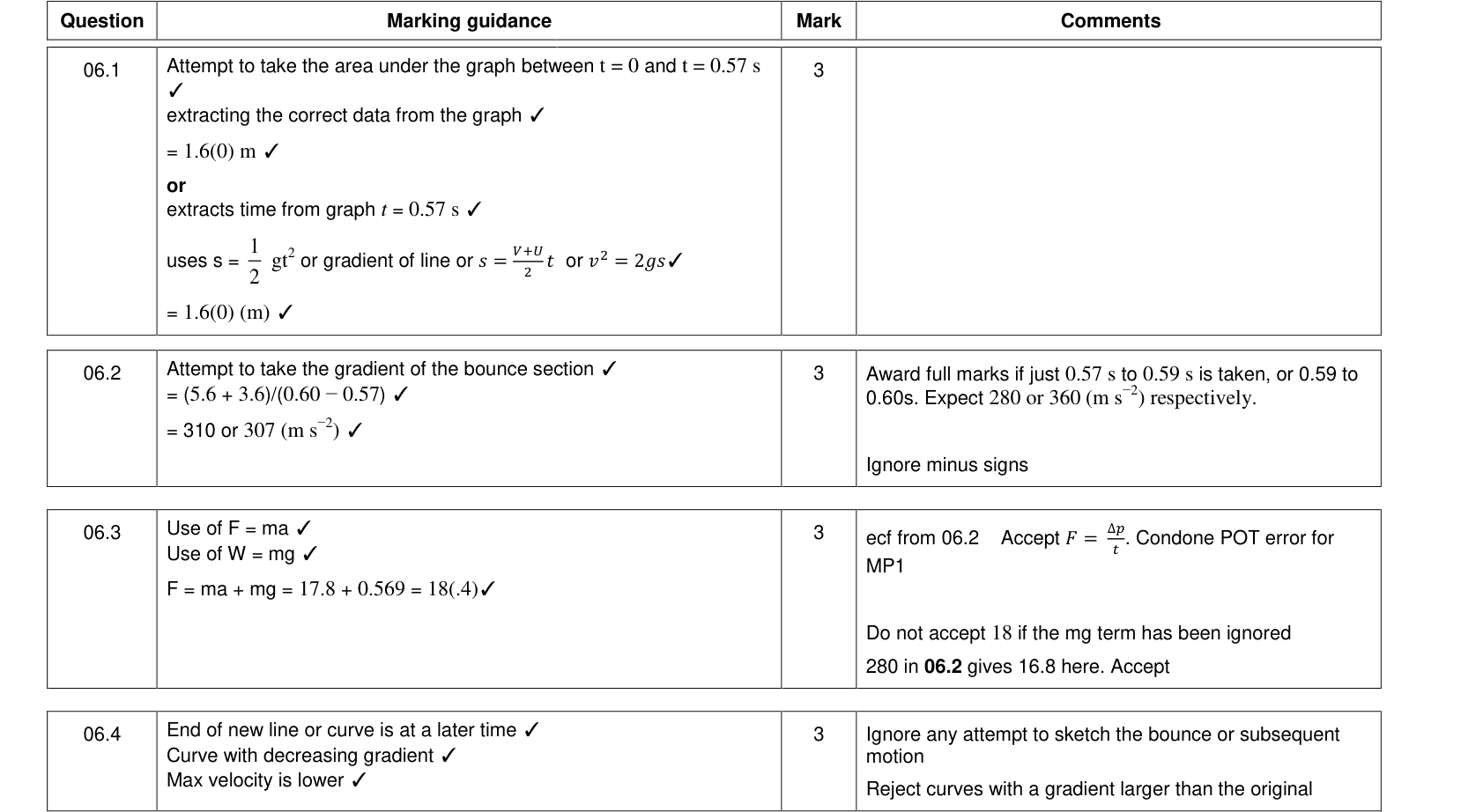
Take upwards as positive. A ball dropped from rest and bouncing several times has this velocity–time graph:
- The gradient of every straight section is $-g$ (the same whether the ball is rising or falling).
- The area of each triangle above the axis equals the height reached after that bounce.
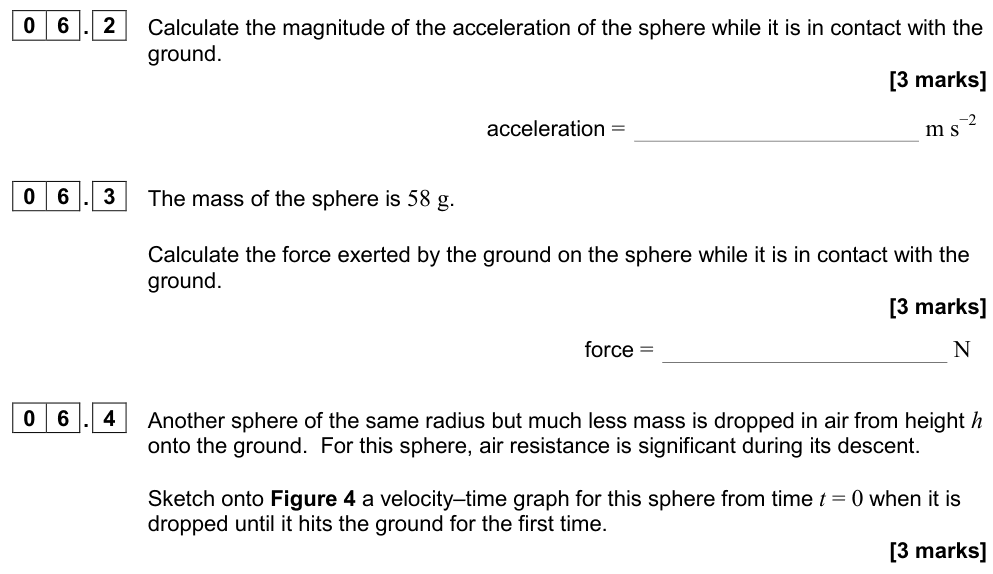
- During the brief contact with the ground the acceleration is very large and upwards.
The equations of uniform acceleration (suvat)
These apply only when the acceleration is constant. The symbols are $s$ (displacement), $u$ (initial velocity), $v$ (final velocity), $a$ (acceleration) and $t$ (time).
The suvat equations
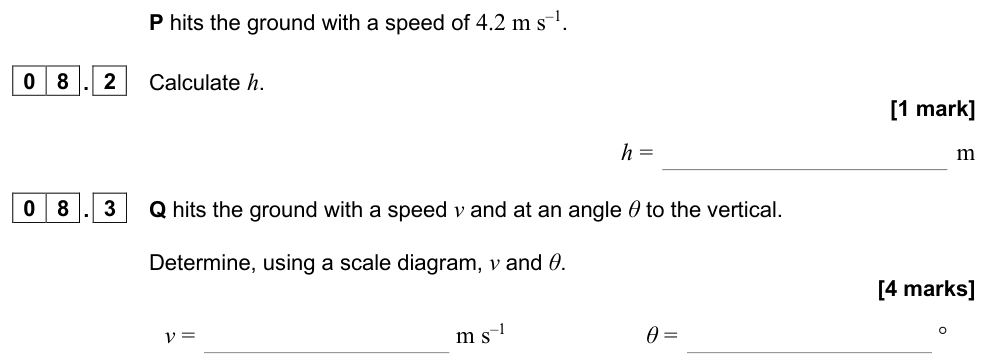
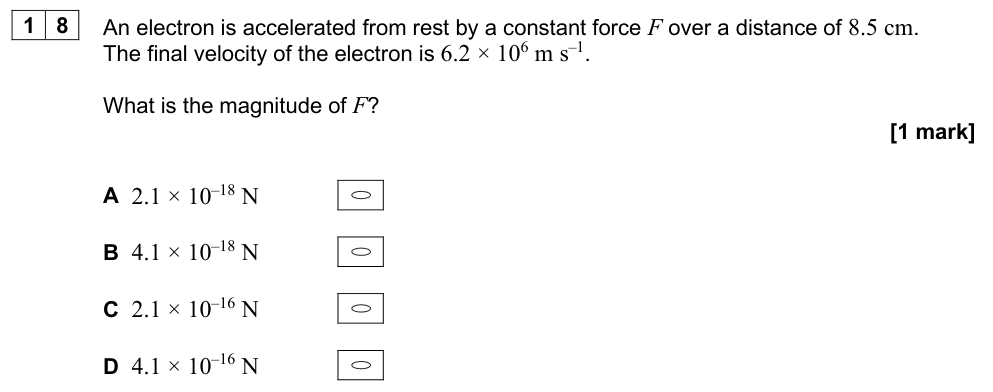
$$v = u + at$$ $$s = \left(\frac{u + v}{2}\right)t$$ $$s = ut + \tfrac12 at^2$$ $$v^2 = u^2 + 2as$$
Each equation leaves out one of the five quantities. Pick the equation that does not contain the quantity you neither know nor need.
Derivation from a $v$–$t$ graph. For uniform acceleration from $u$ to $v$ in time $t$, the graph is a straight line. The gradient gives $a = (v - u)/t$, so $v = u + at$. The area under the line (a trapezium) gives $s = \tfrac12(u + v)t$. Substituting $v = u + at$ gives $s = ut + \tfrac12at^2$. Eliminating $t$ gives $v^2 = u^2 + 2as$.
Worked example: braking car
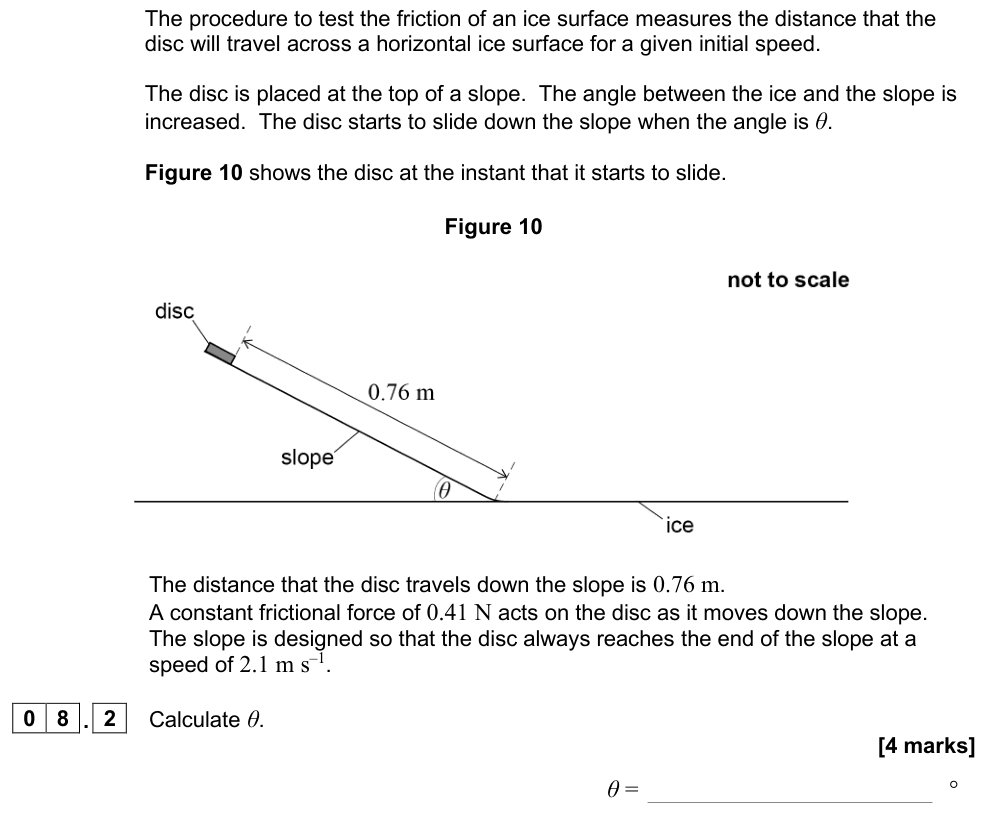
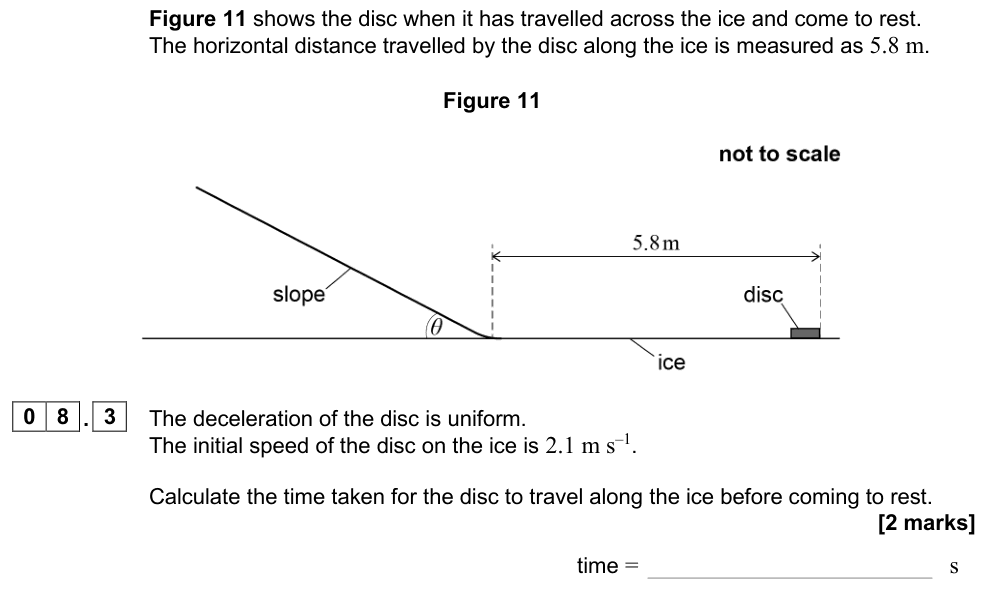
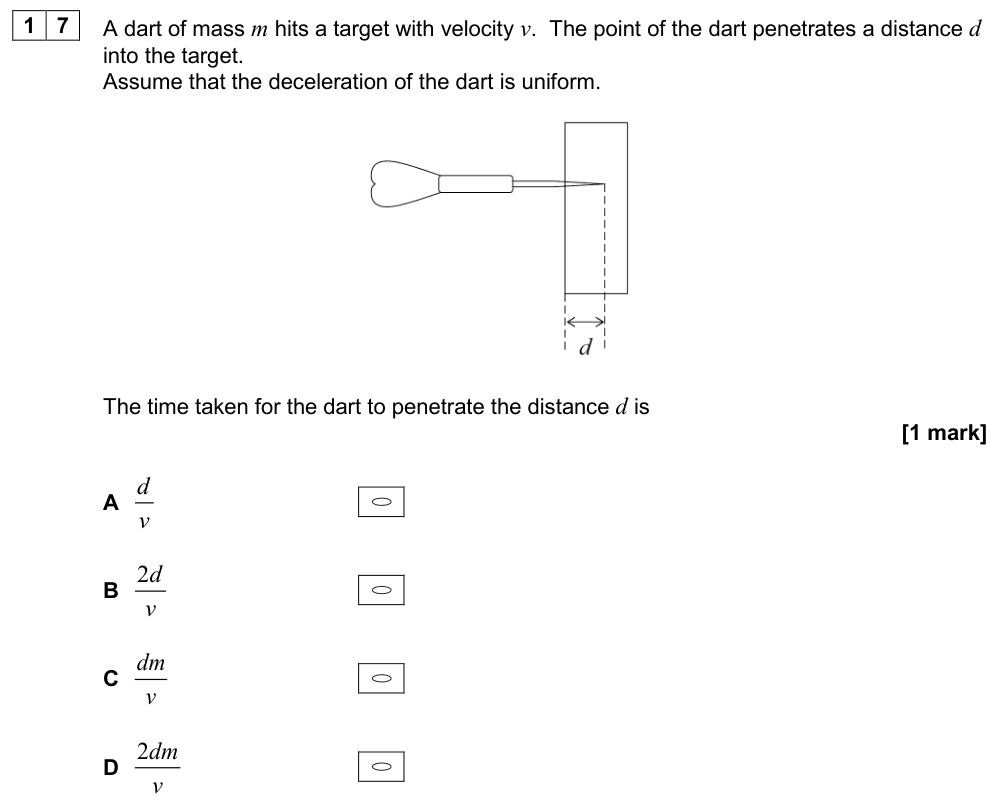
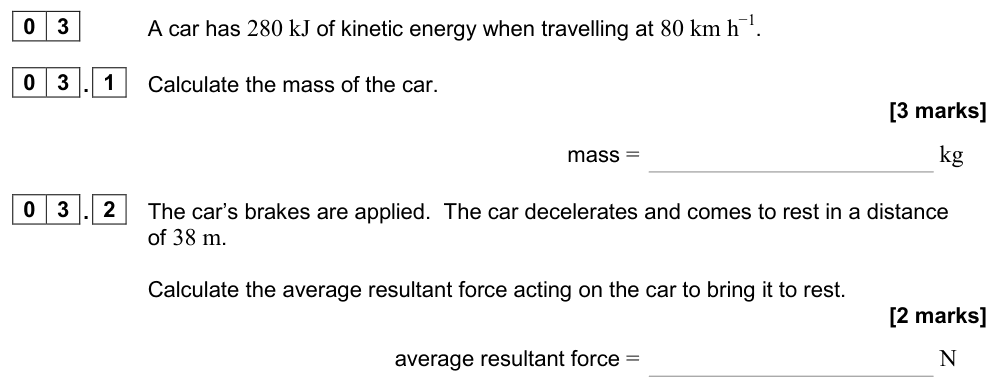
A car travelling at $25\ \text{m s}^{-1}$ brakes uniformly and stops in 40 m. Find the deceleration and the time taken.
$u = 25$, $v = 0$, $s = 40$. Use $v^2 = u^2 + 2as$: $0 = 625 + 80a \Rightarrow a = -7.8\ \text{m s}^{-2}$.
$t = \dfrac{v - u}{a} = \dfrac{0 - 25}{-7.8} = 3.2\ \text{s}$.
Common mistake
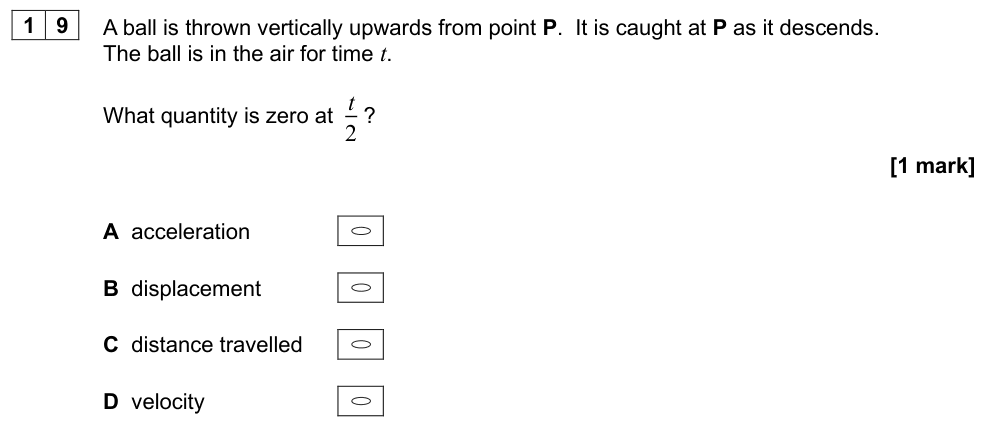
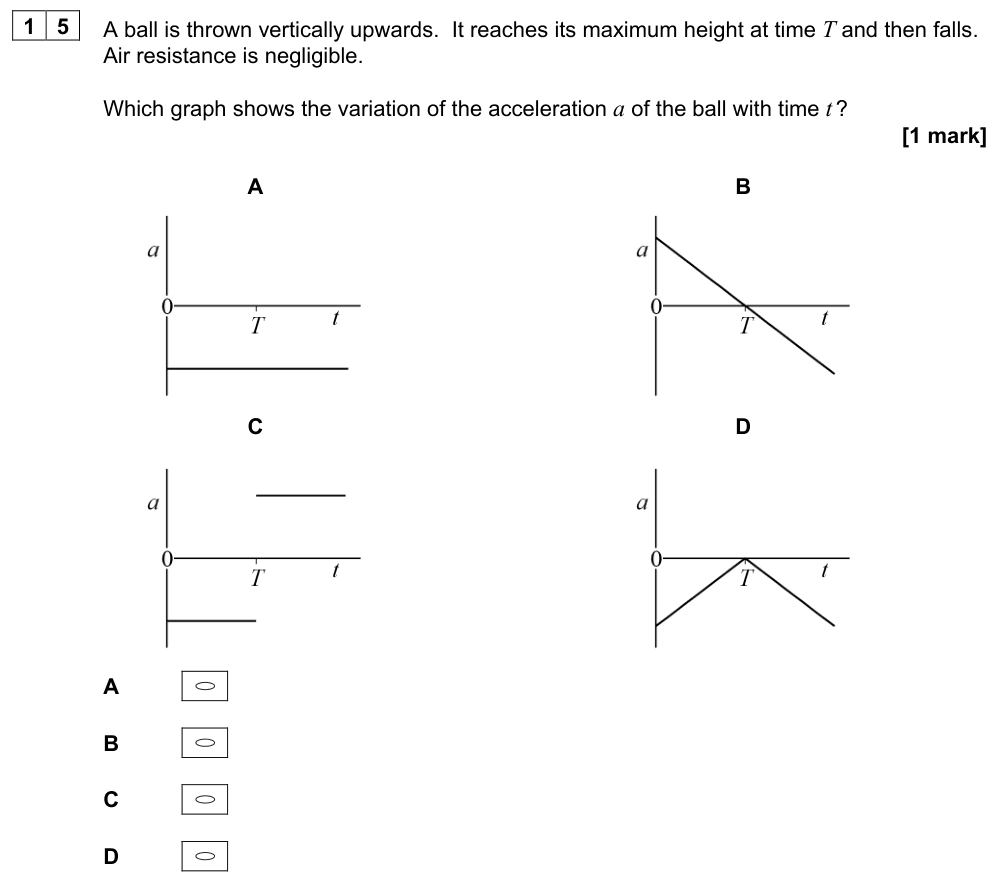
Signs matter. Choose a positive direction and give every vector ($s$, $u$, $v$, $a$) the correct sign. For a ball thrown up with up positive: $u > 0$ and $a = -9.81\ \text{m s}^{-2}$, including on the way down.
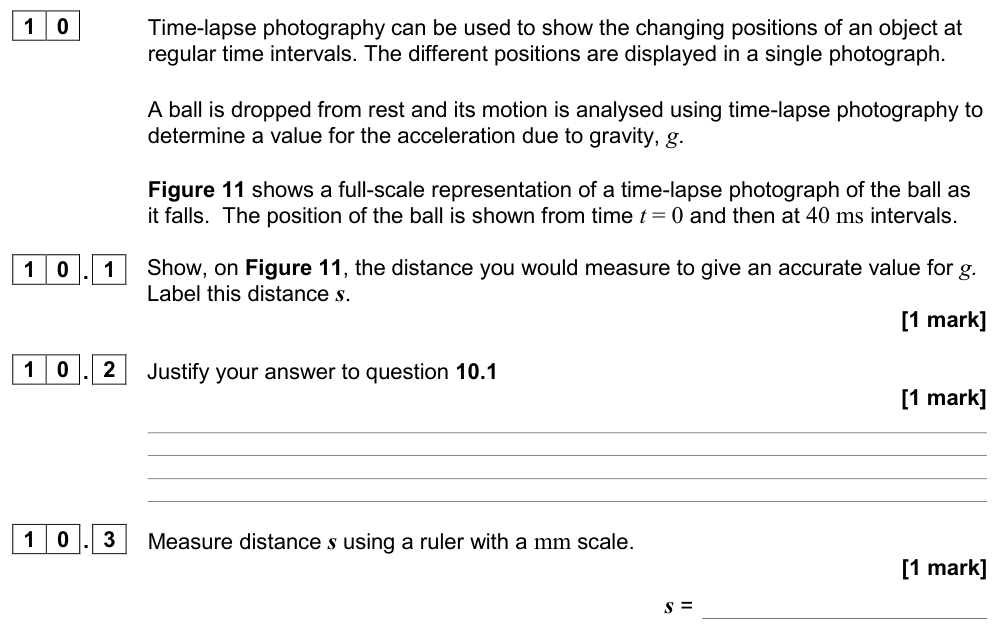
Free fall and the acceleration due to gravity
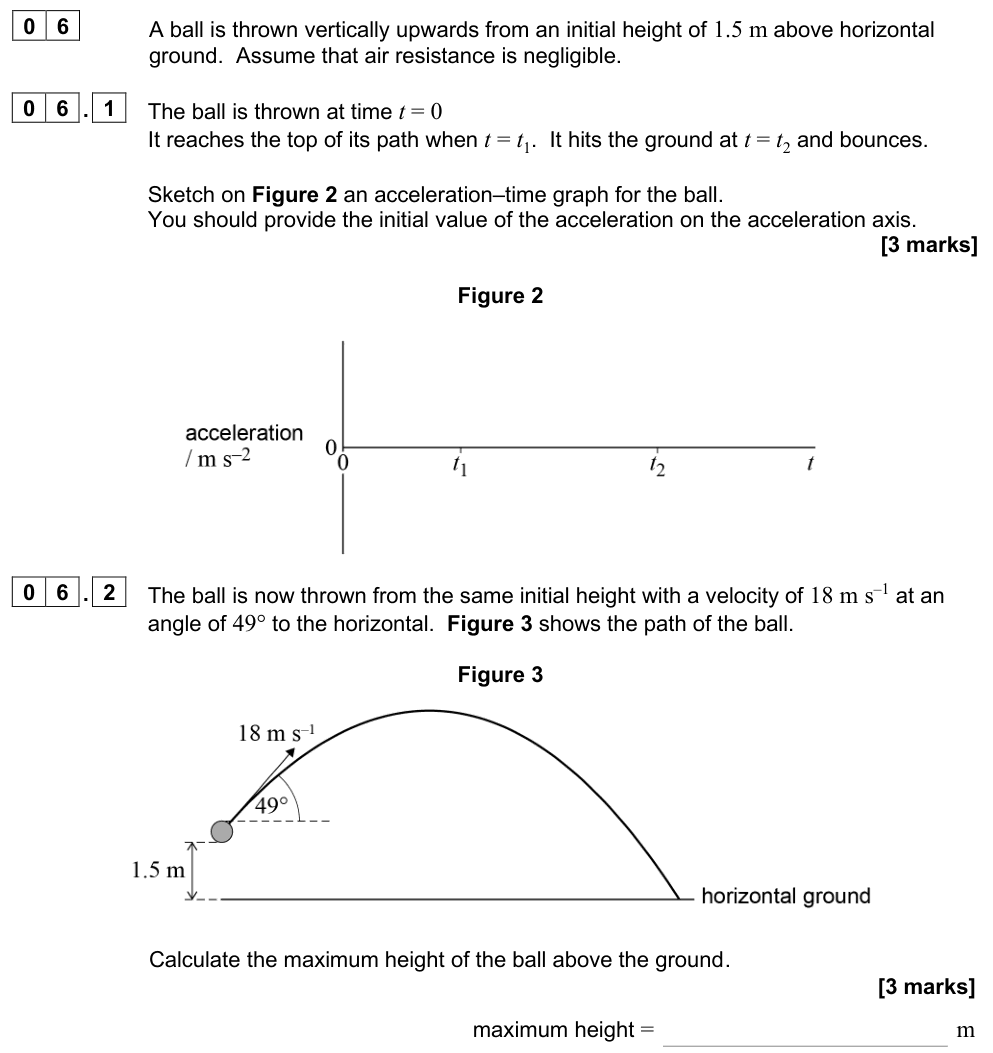
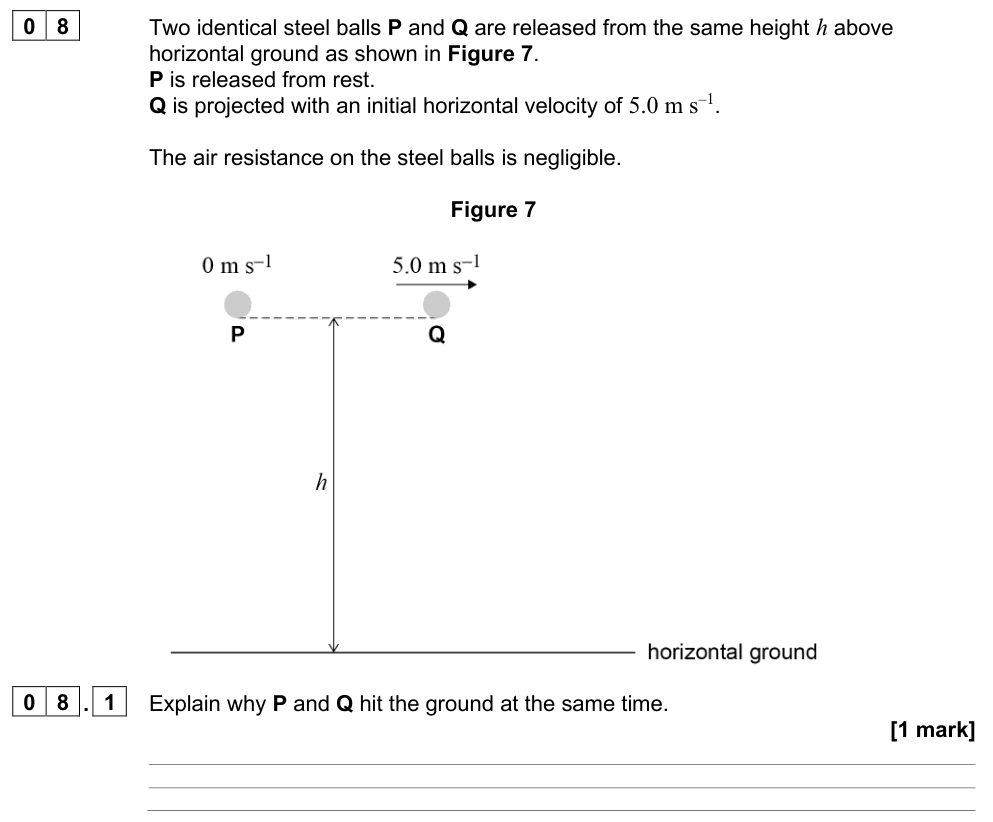
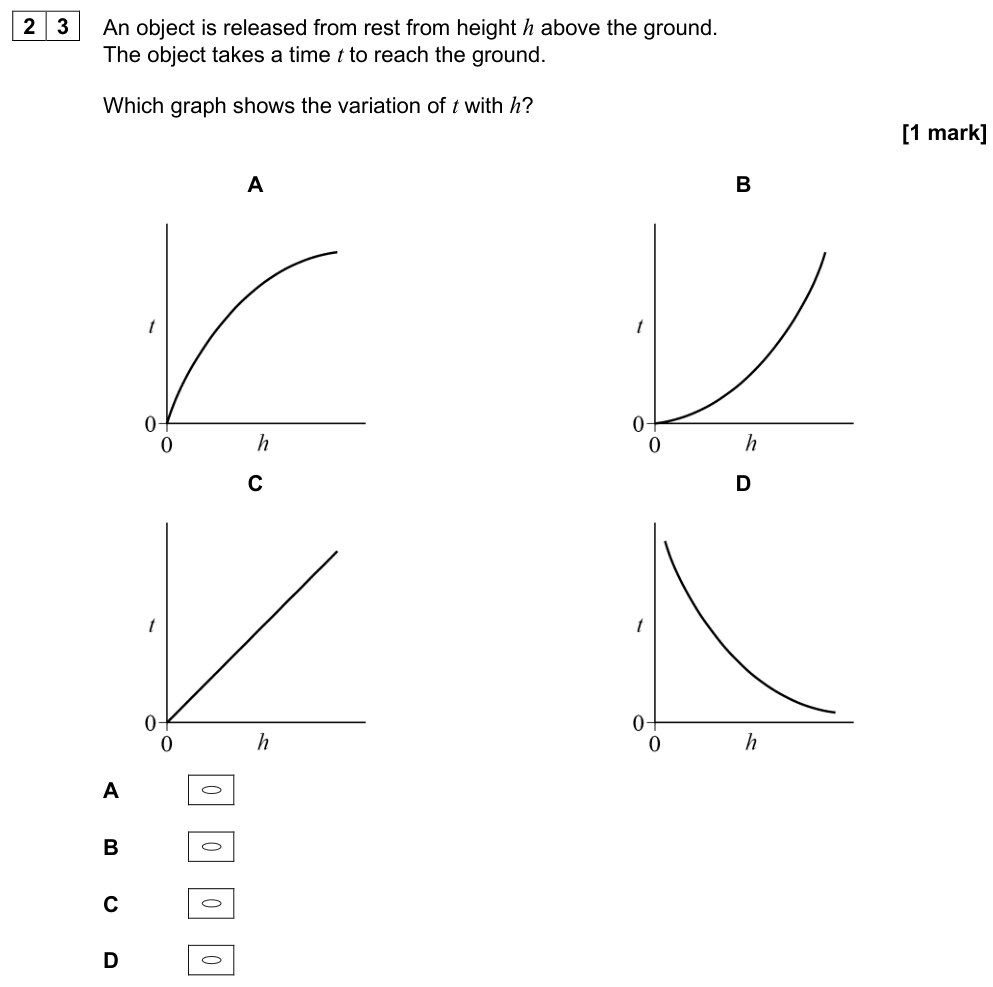
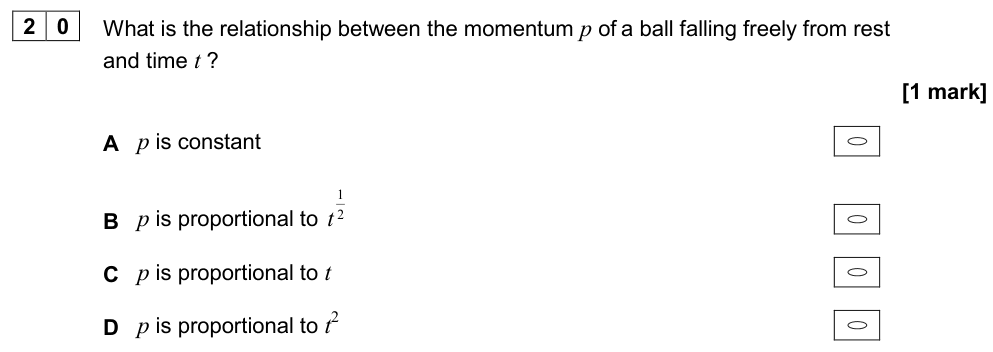
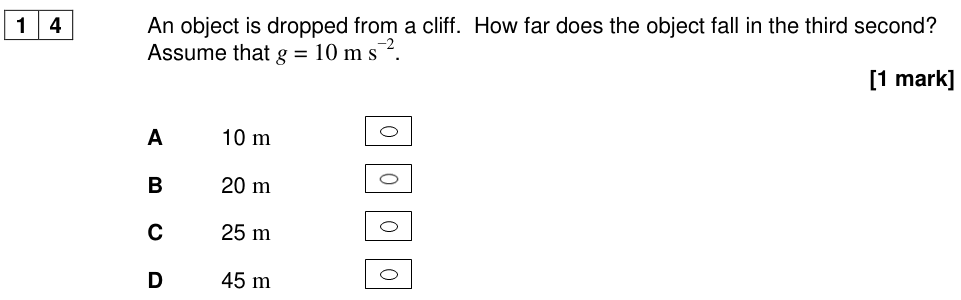
An object in free fall moves only under gravity (air resistance negligible). Near the Earth's surface, all objects fall with the same acceleration:
$$g = 9.81\ \text{m s}^{-2}\ \text{(downwards)}$$
Worked example: ball thrown upwards
A ball is thrown vertically upwards at $12\ \text{m s}^{-1}$. Find (a) the maximum height and (b) the time until it returns to the hand.
(a) At the top $v = 0$: $0 = 12^2 - 2(9.81)s \Rightarrow s = 7.3\ \text{m}$.
(b) When it returns, $s = 0$: $0 = 12t - \tfrac12(9.81)t^2 \Rightarrow t = \dfrac{2 \times 12}{9.81} = 2.4\ \text{s}$.
Stopping distances
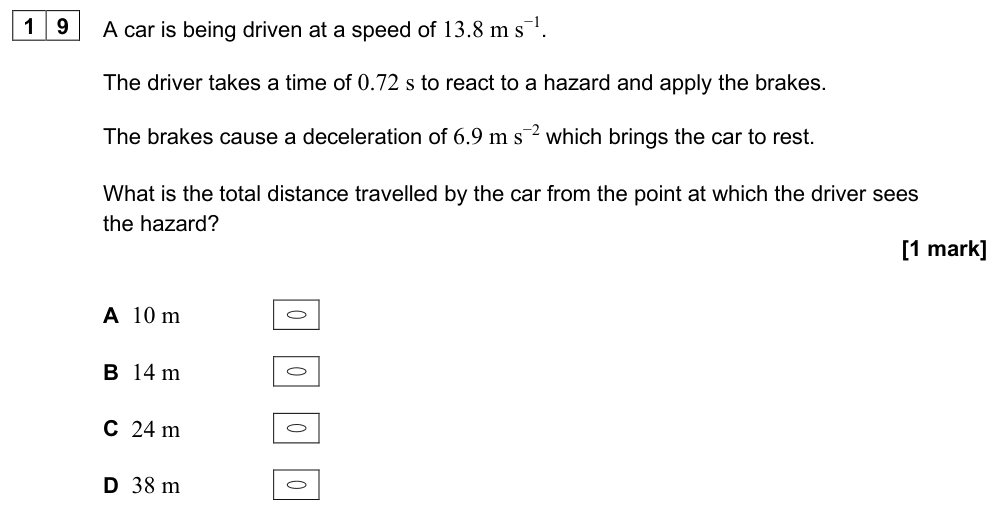
$$\text{stopping distance} = \text{thinking distance} + \text{braking distance}$$
- Thinking distance = speed × reaction time (constant speed). It is proportional to $u$.
- Braking distance $= \dfrac{u^2}{2a}$ for a constant deceleration $a$. It is proportional to $u^2$: doubling the speed quadruples the braking distance.
Required practical 1: determining g by a free-fall method
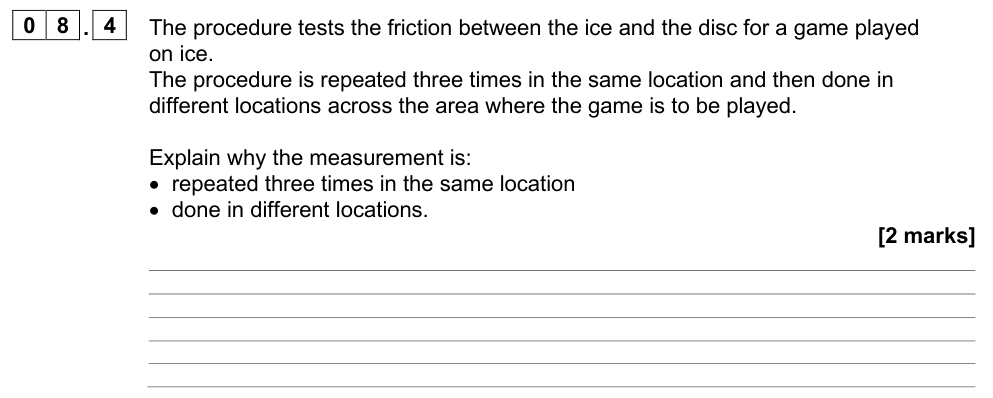
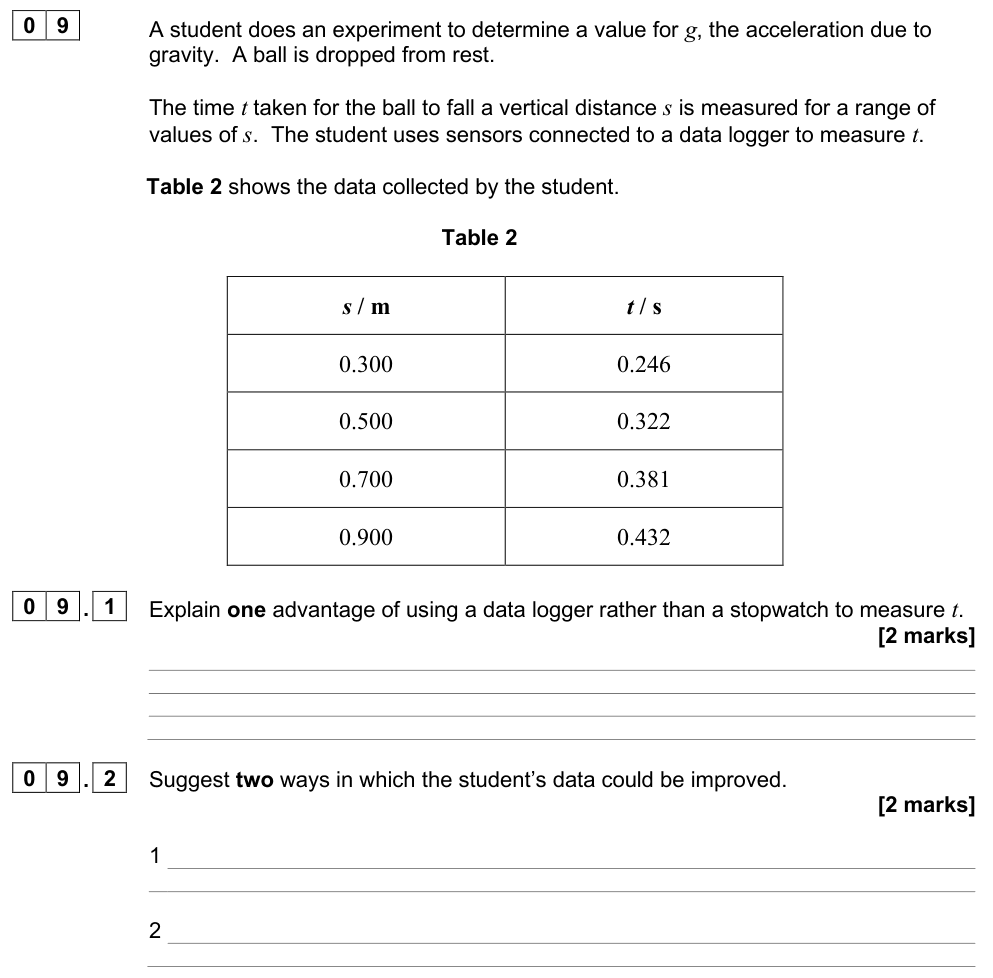
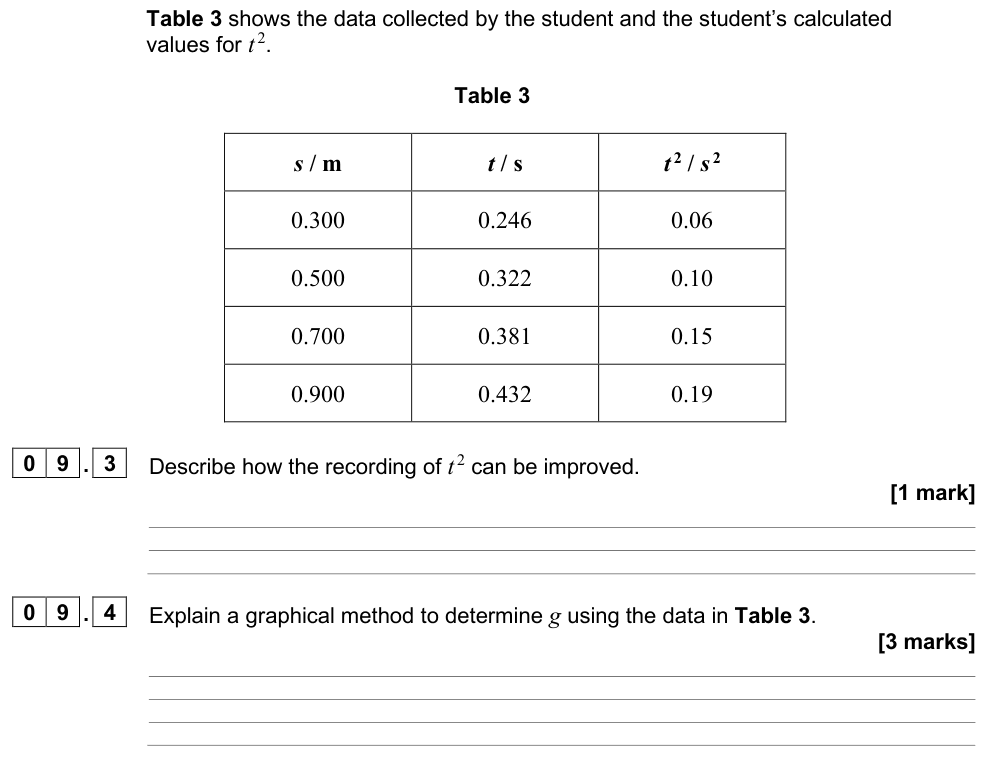
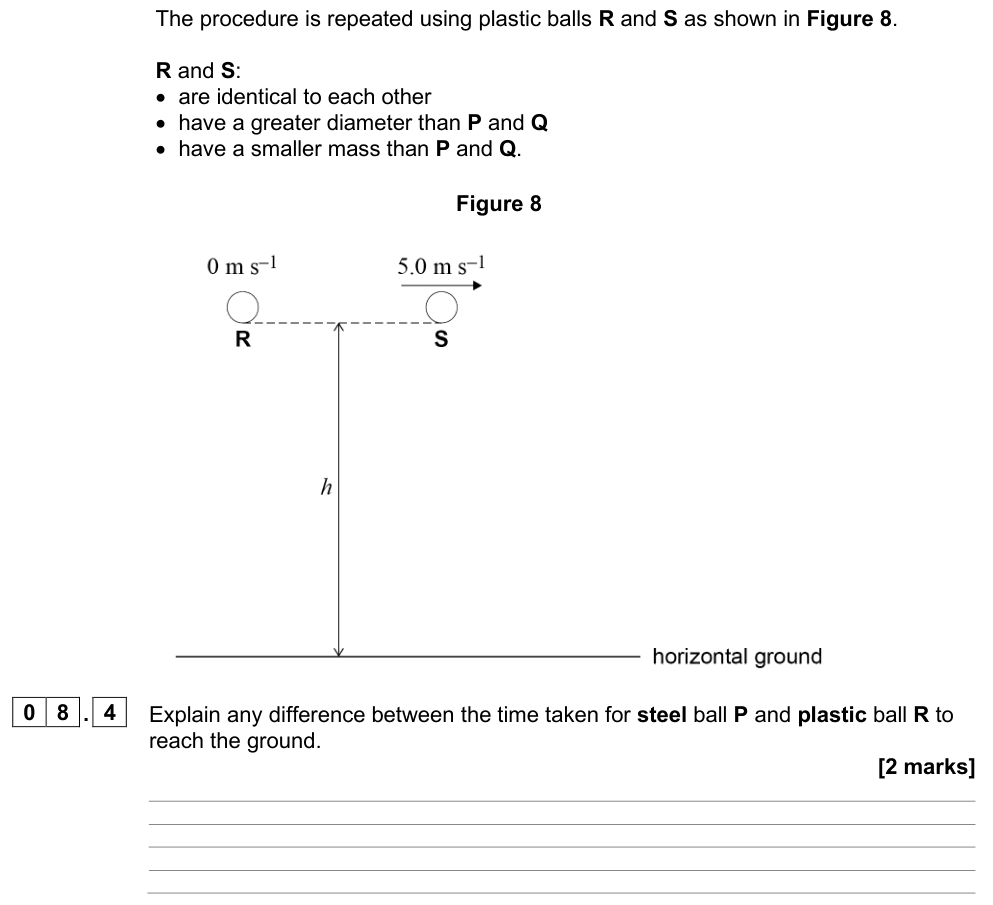
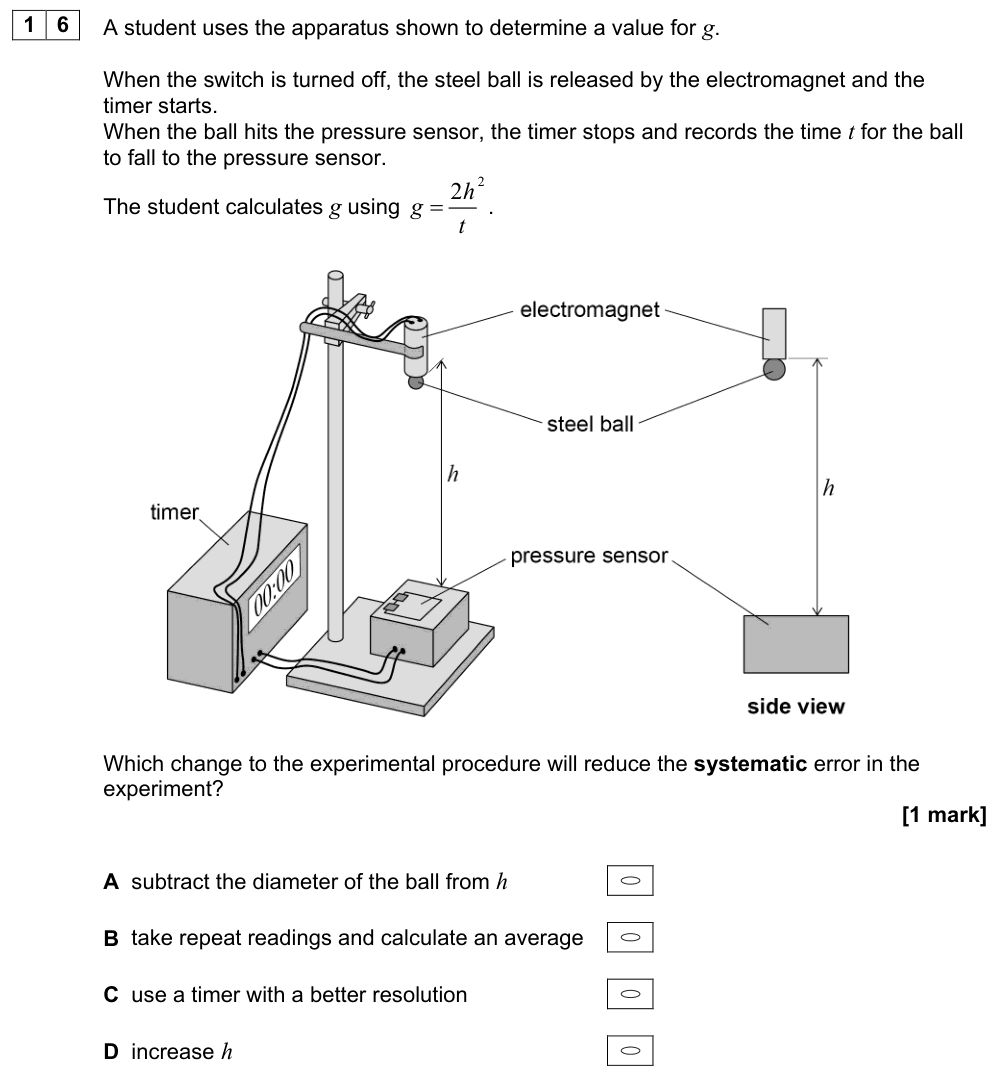
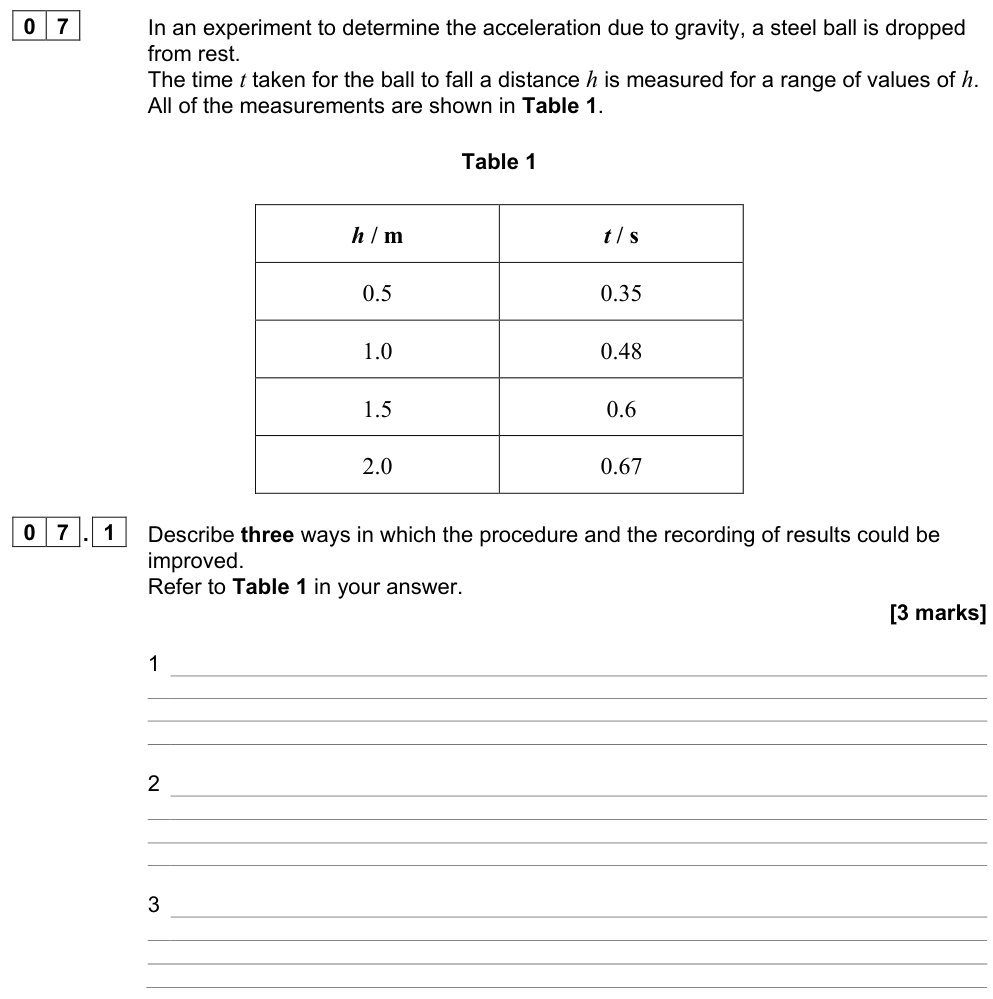
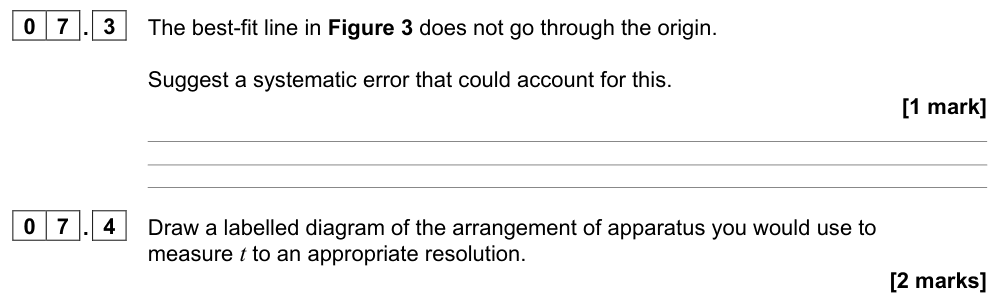
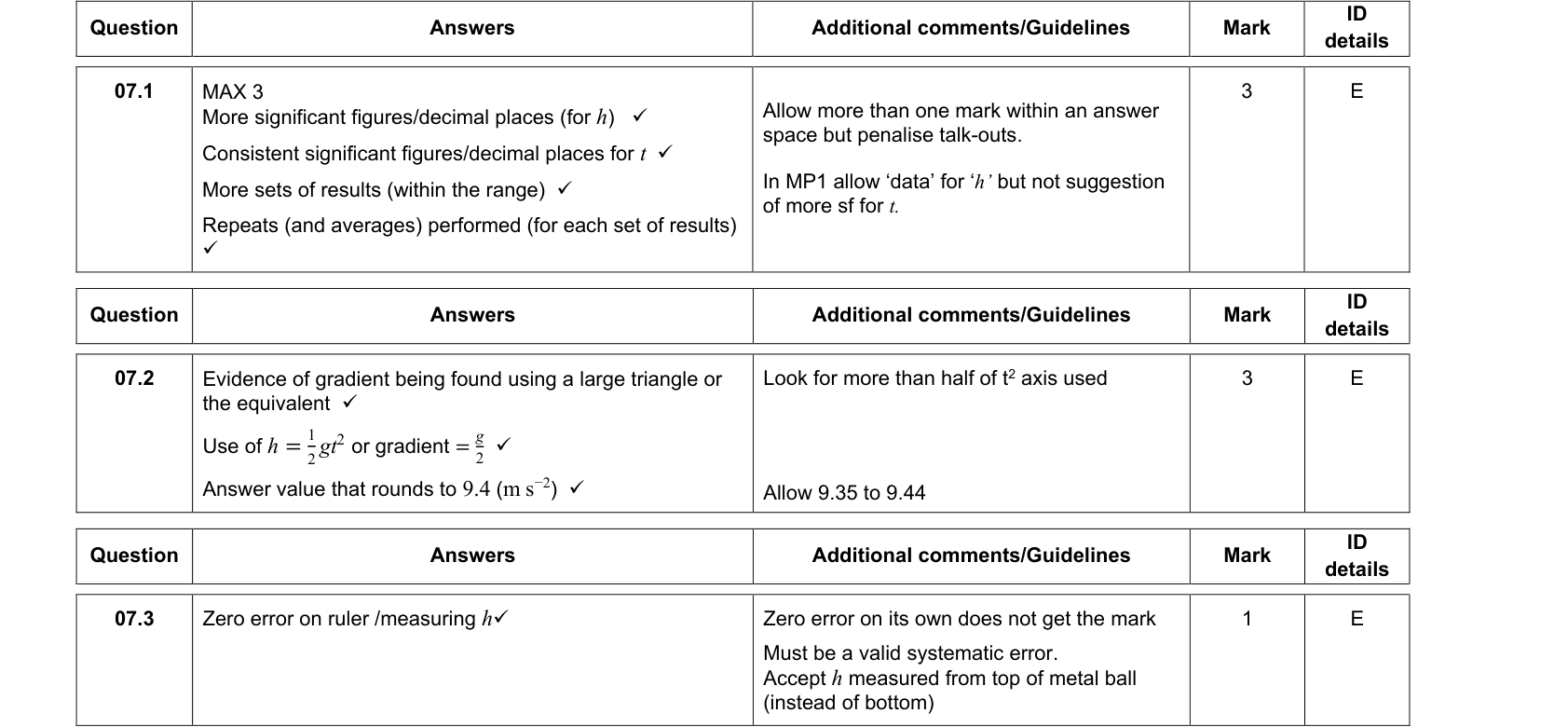
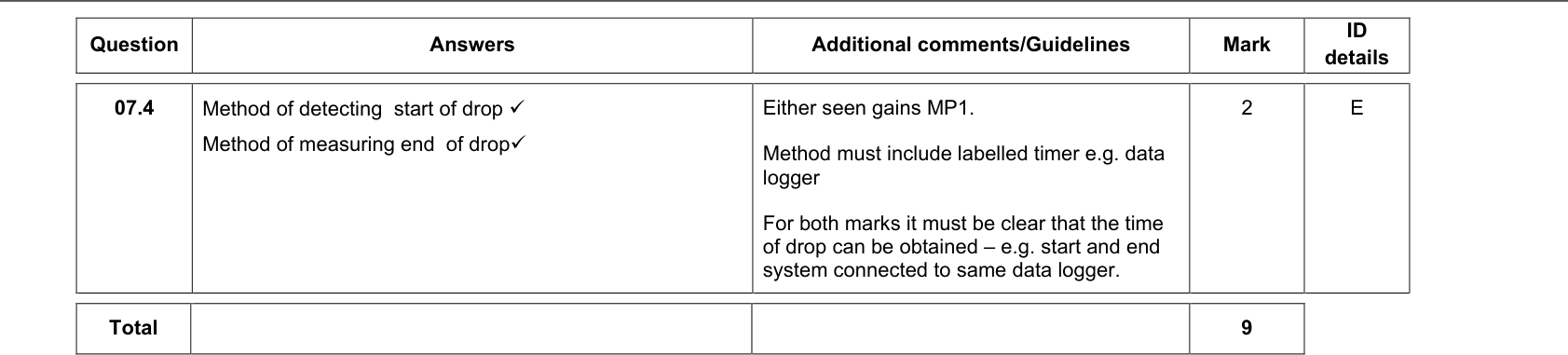
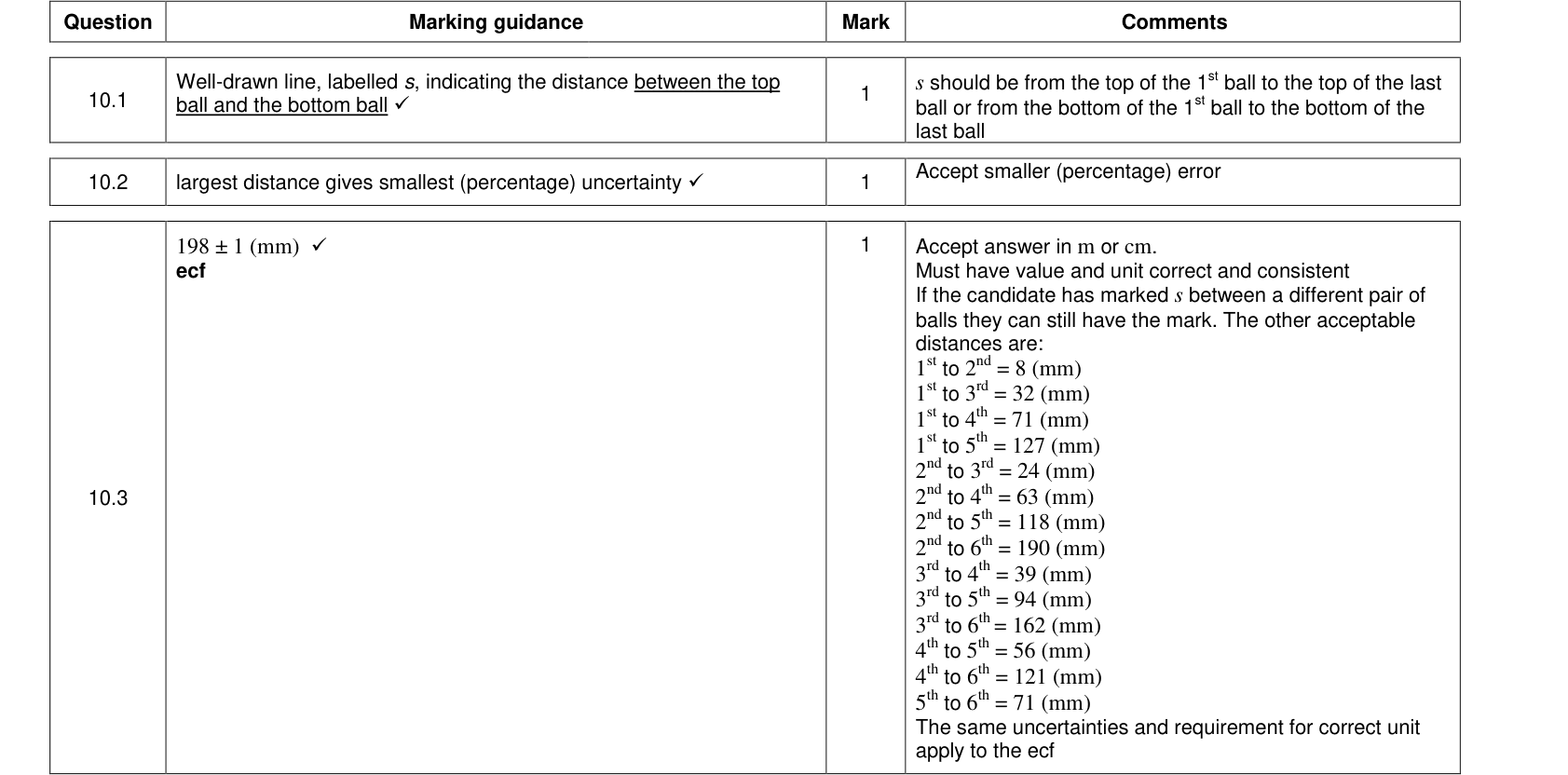
Method. A steel ball is held by an electromagnet above a trapdoor (or released above a light gate). Switching off the electromagnet releases the ball and starts an electronic timer. The ball opens the trapdoor at the bottom, which stops the timer. Measure the fall height $h$ (from the bottom of the ball to the trapdoor) with a metre rule. Repeat for 6–8 heights, three times each.
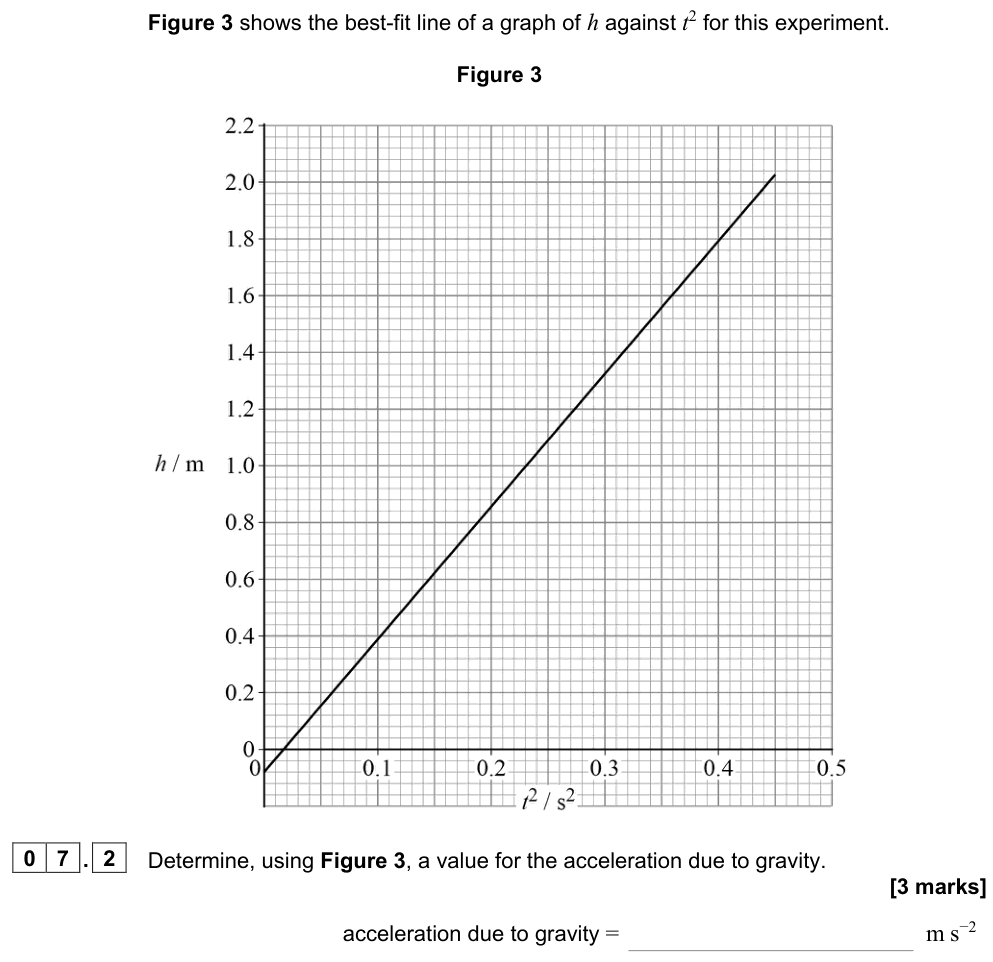
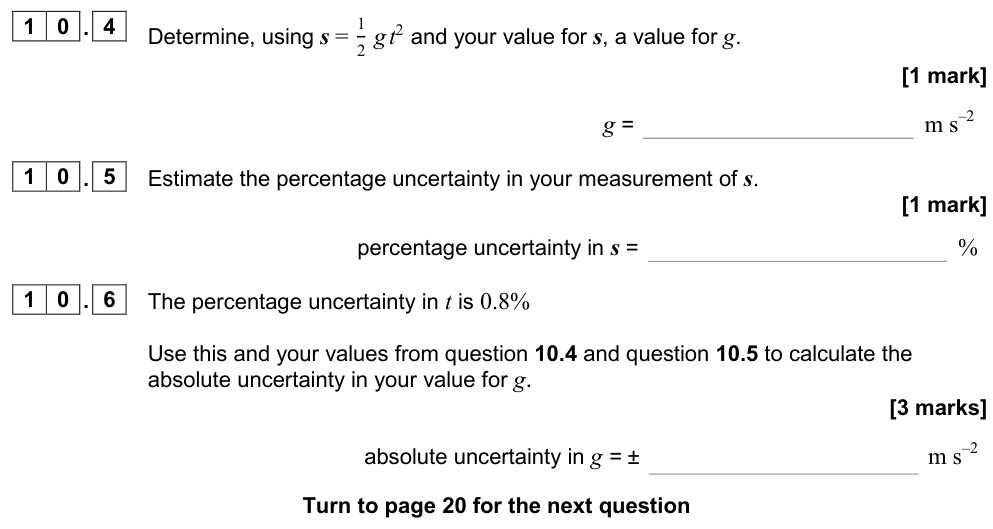
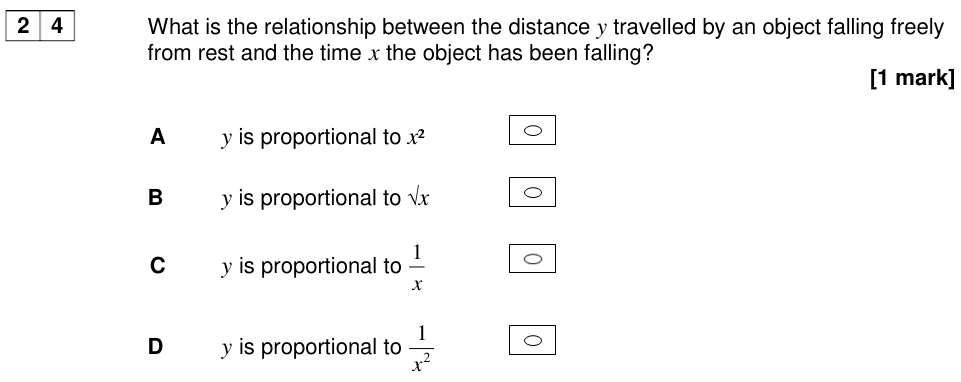
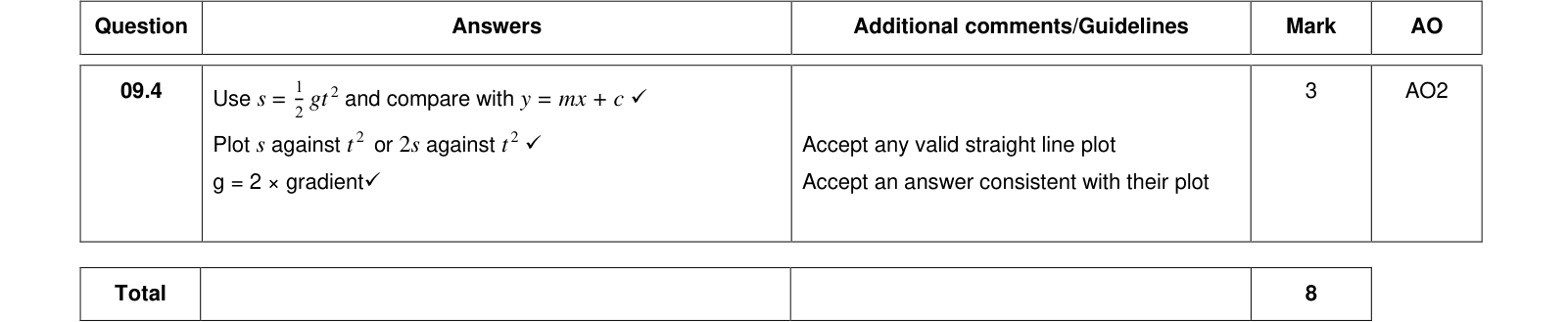
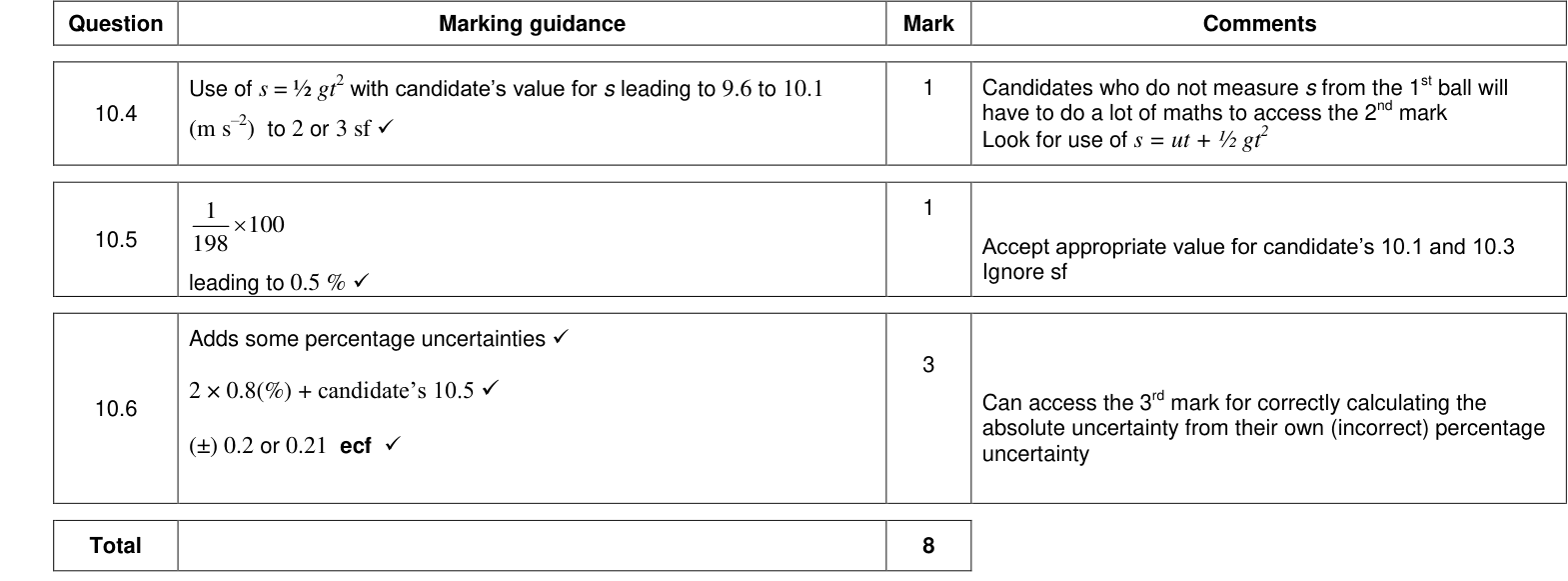
Analysis. The ball starts from rest, so $h = \tfrac12 g t^2$. Plot $h$ (y-axis) against $t^2$ (x-axis). The graph is a straight line through the origin with gradient $= g/2$, so $g = 2 \times \text{gradient}$.
Errors and improvements.
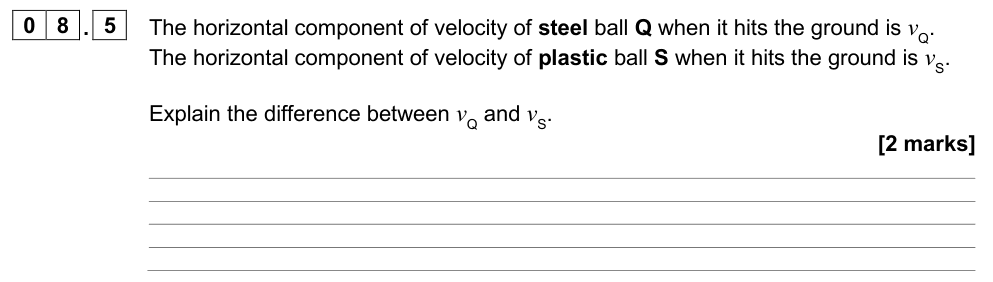
- A delay in the electromagnet releasing the ball adds a constant time to each reading. This systematic error shows up as an intercept on the graph. Using the gradient removes its effect on $g$.
- Measure $h$ to the bottom of the ball, at eye level, to avoid parallax.
- Air resistance is negligible for a small, dense ball over short distances.
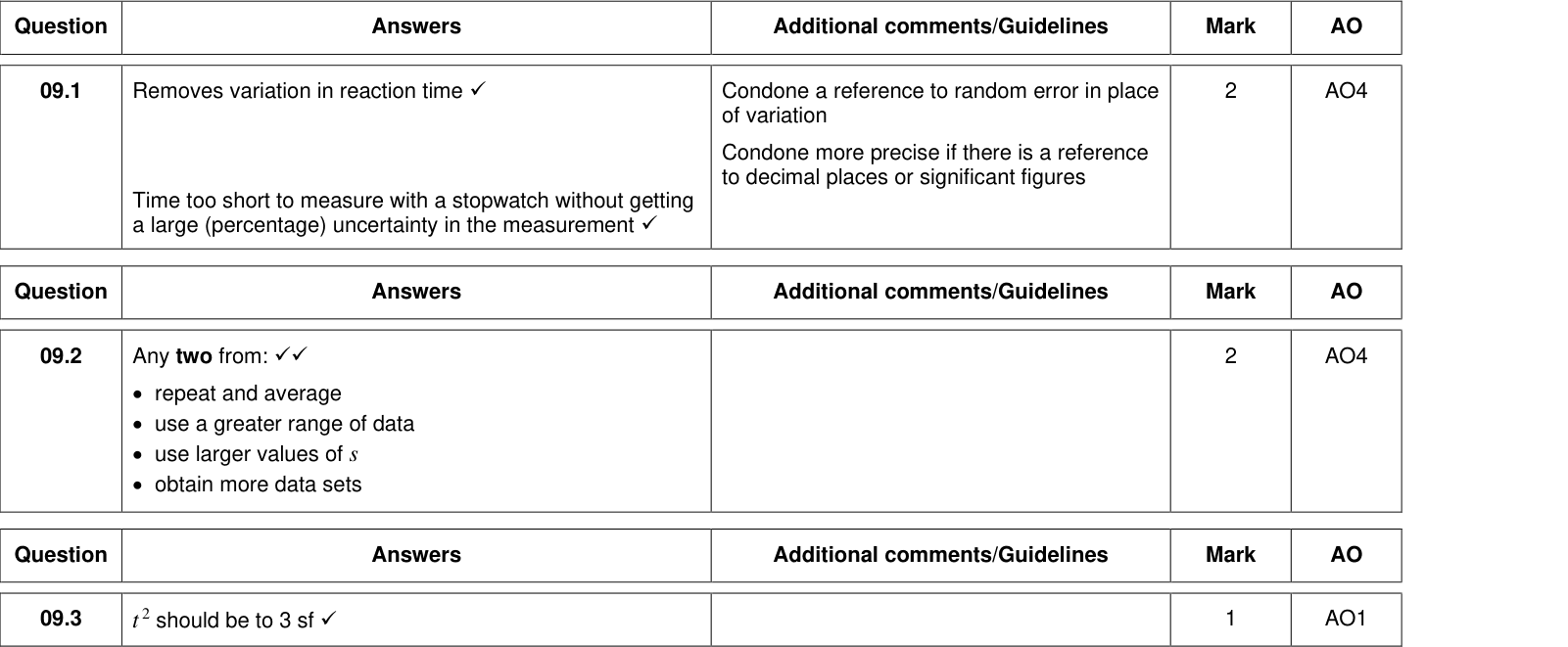
- Electronic timing removes human reaction time.
Summary
- Velocity = gradient of $s$–$t$; acceleration = gradient of $v$–$t$; displacement = area under $v$–$t$; change in velocity = area under $a$–$t$.
- The suvat equations hold only for constant acceleration. Choose a positive direction and use signs.
- Free fall: $a = g = 9.81\ \text{m s}^{-2}$ downwards; for a bouncing ball every flight section of the $v$–$t$ graph has gradient $-g$.
- Required practical 1: plot $h$ against $t^2$; $g = 2 \times$ gradient.