Momentum
Momentum
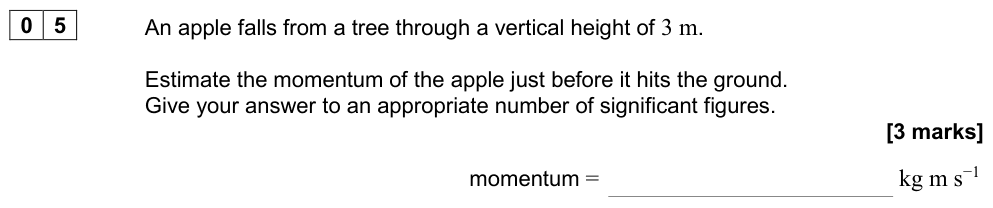
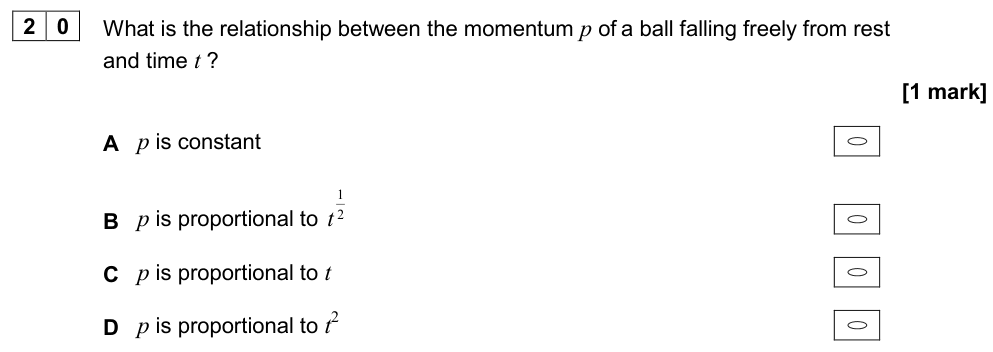
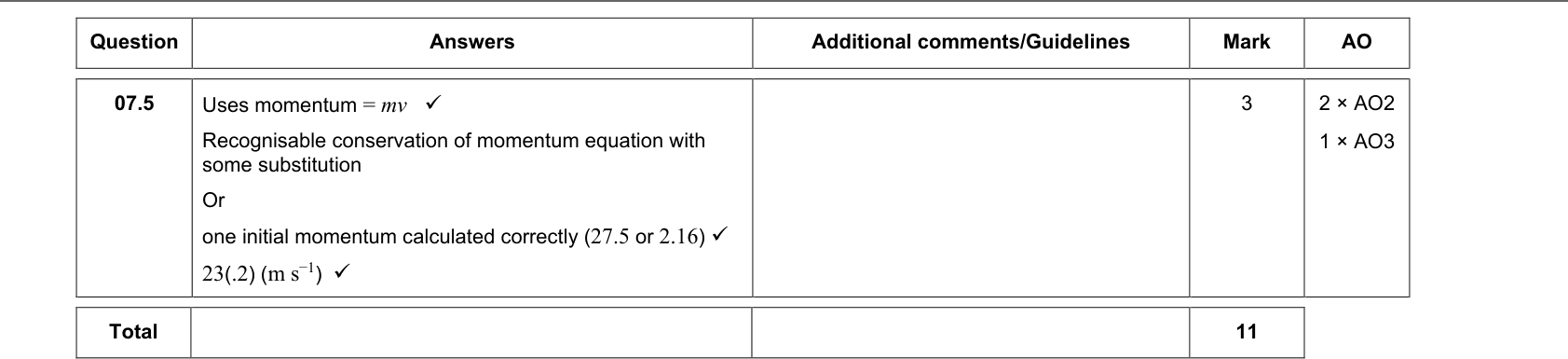
The momentum $p$ of an object is the product of its mass and velocity:
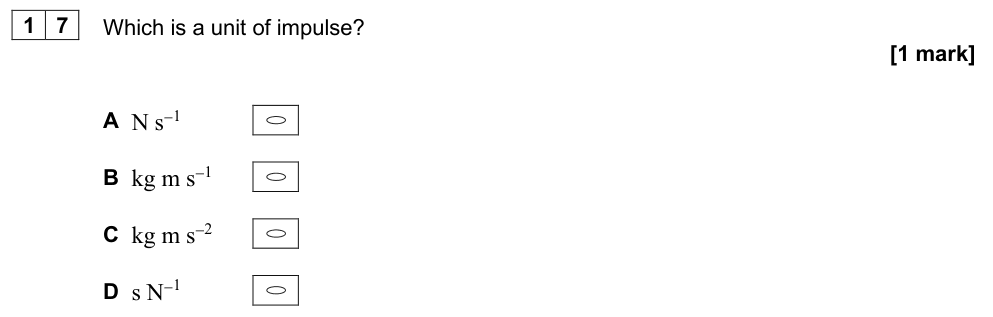
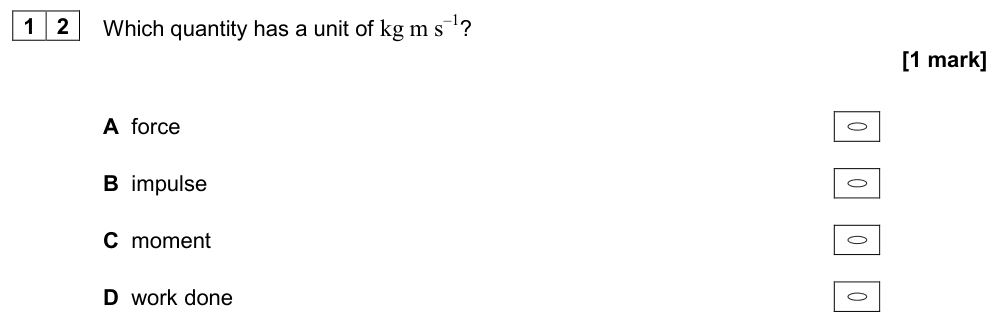
$$p = mv \qquad \text{unit: kg m s}^{-1} \text{ (equivalent to N s)}$$
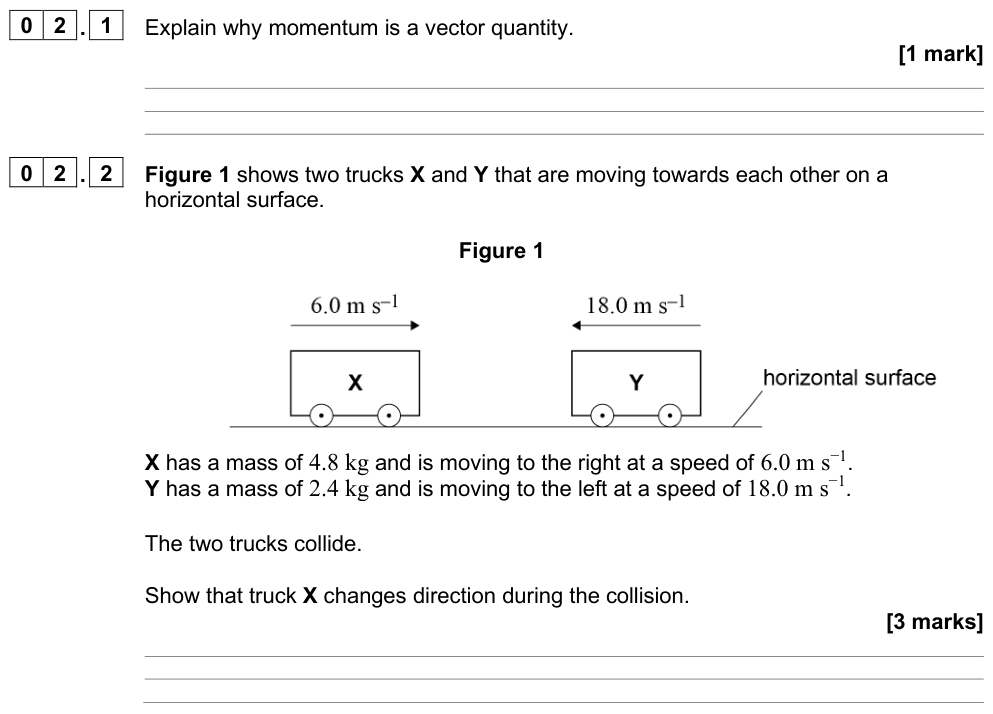
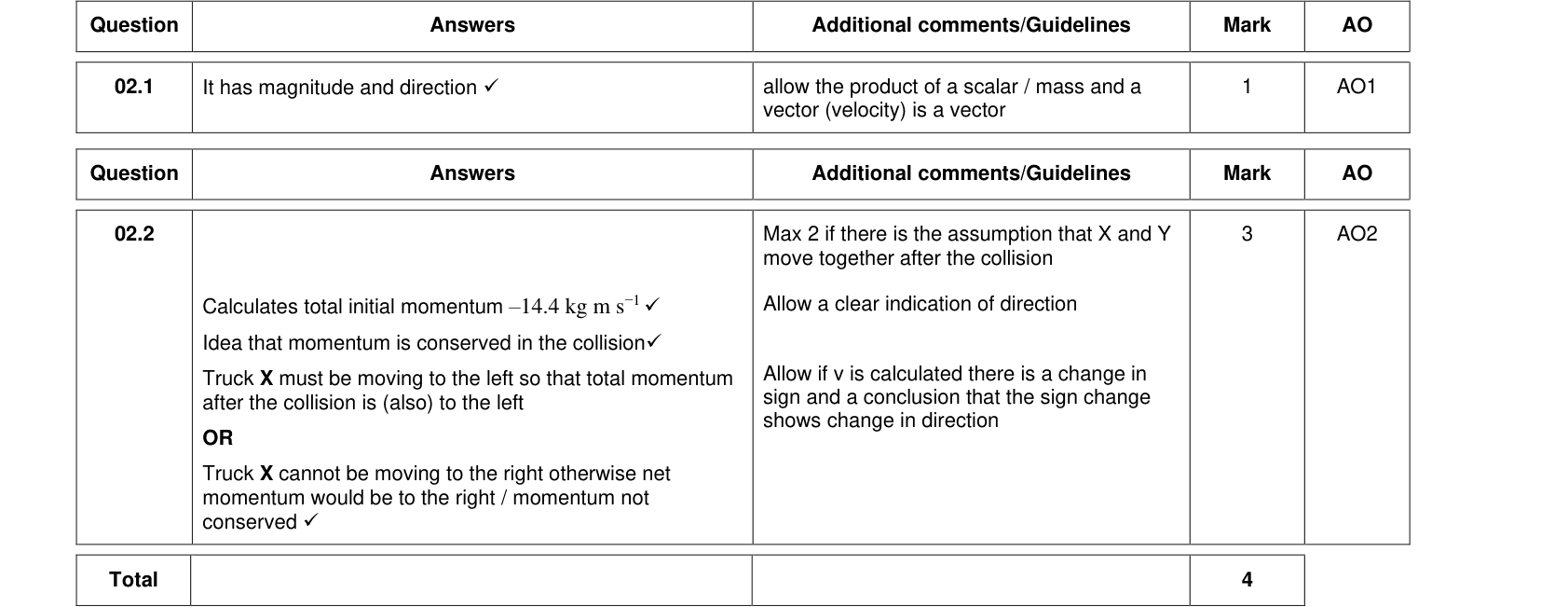
Momentum is a vector. It has the same direction as the velocity. In one-dimensional problems choose a positive direction: momentum to the left is negative if right is positive.
Conservation of linear momentum
Principle of conservation of momentum
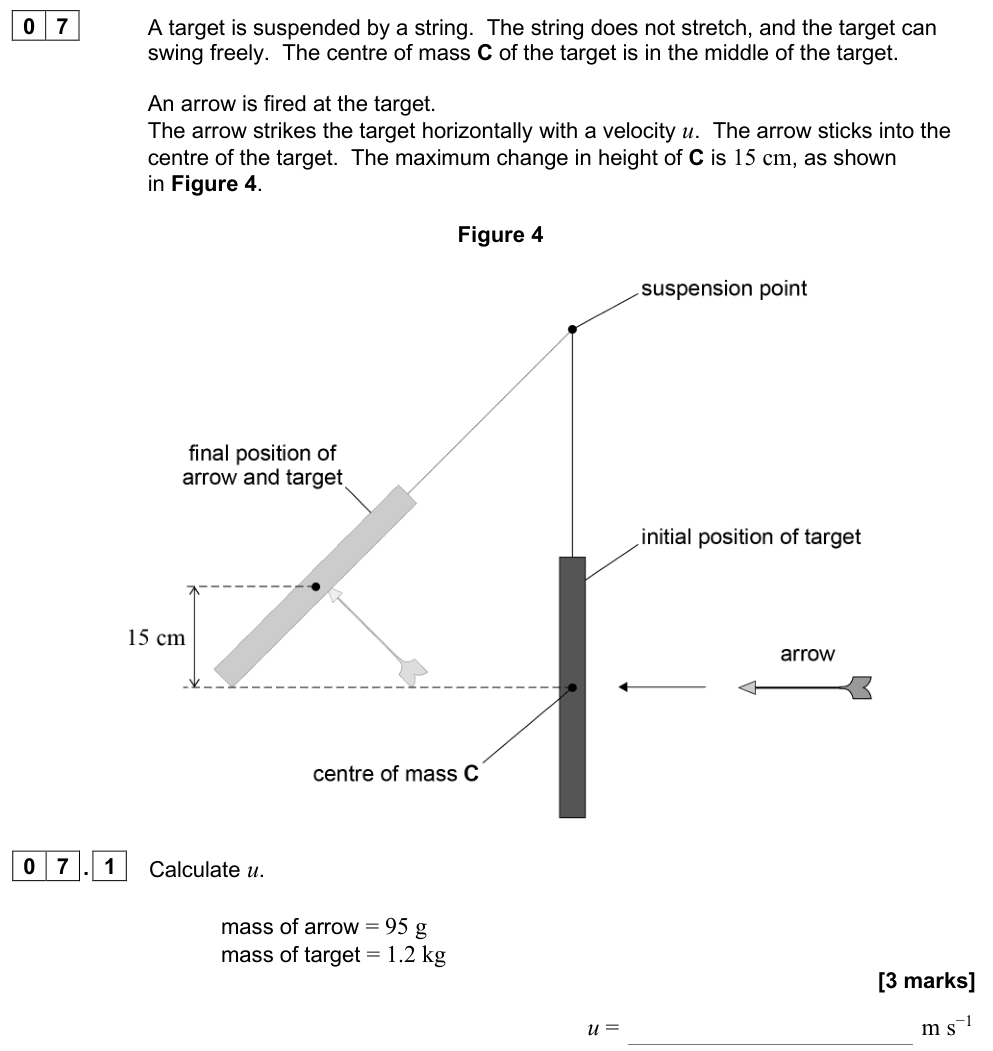
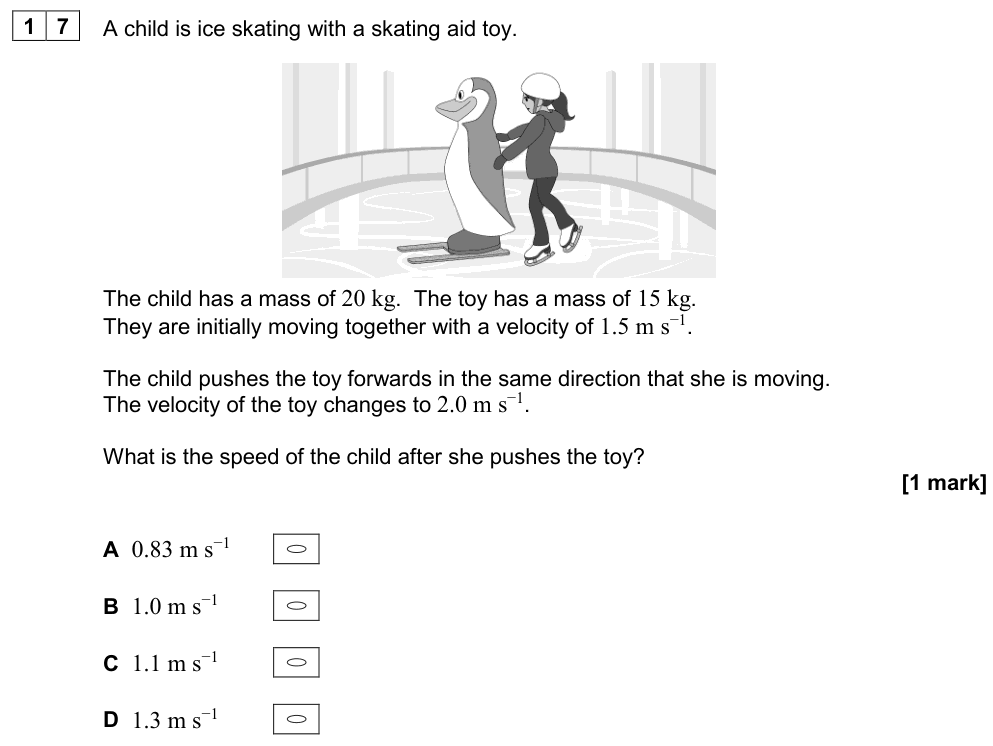
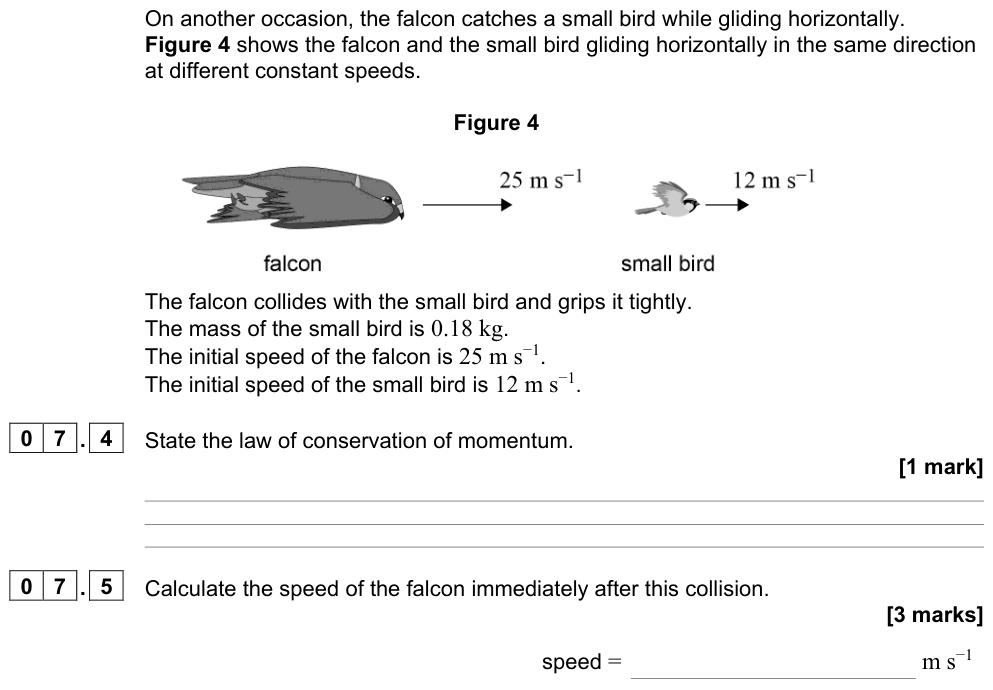
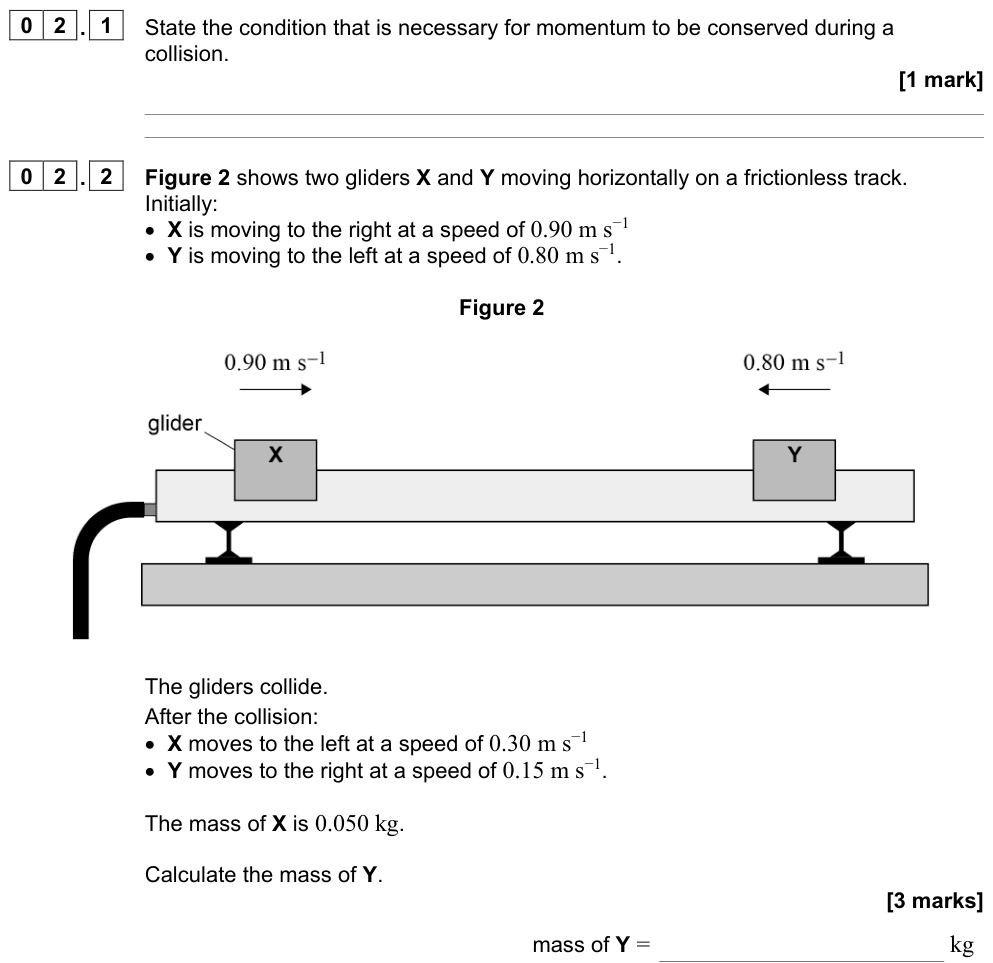
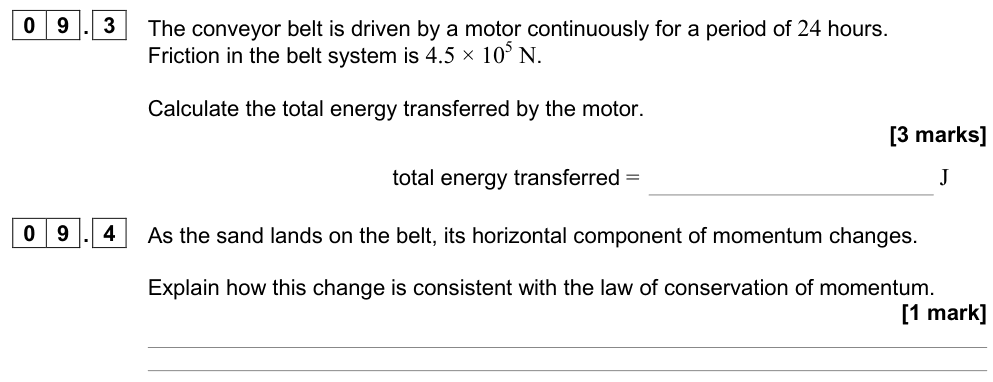
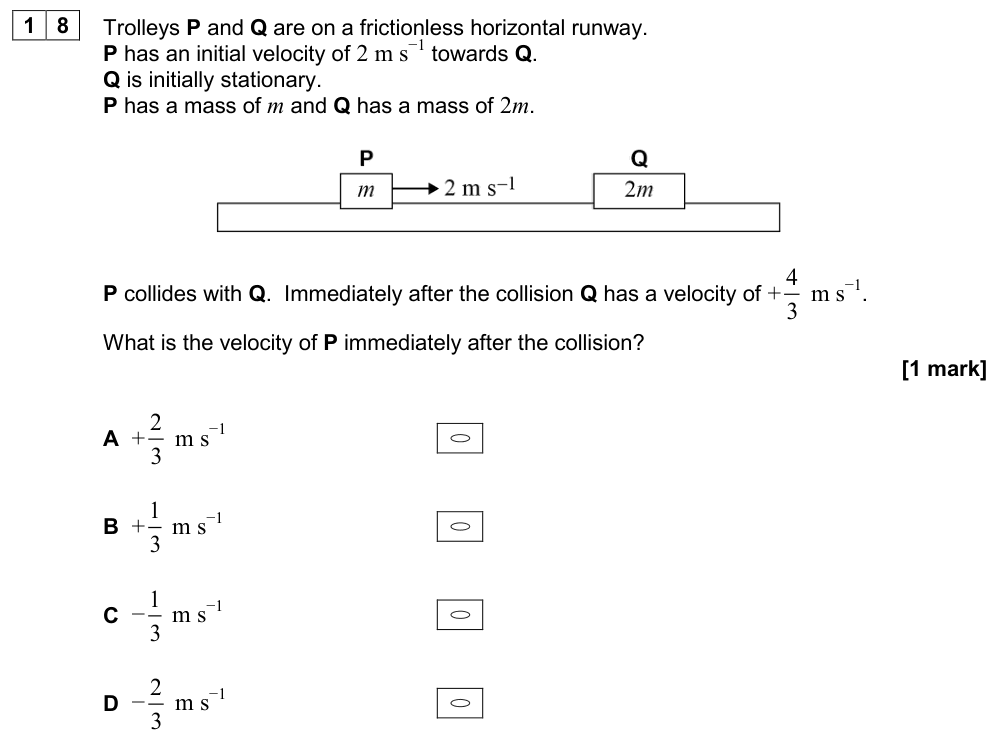
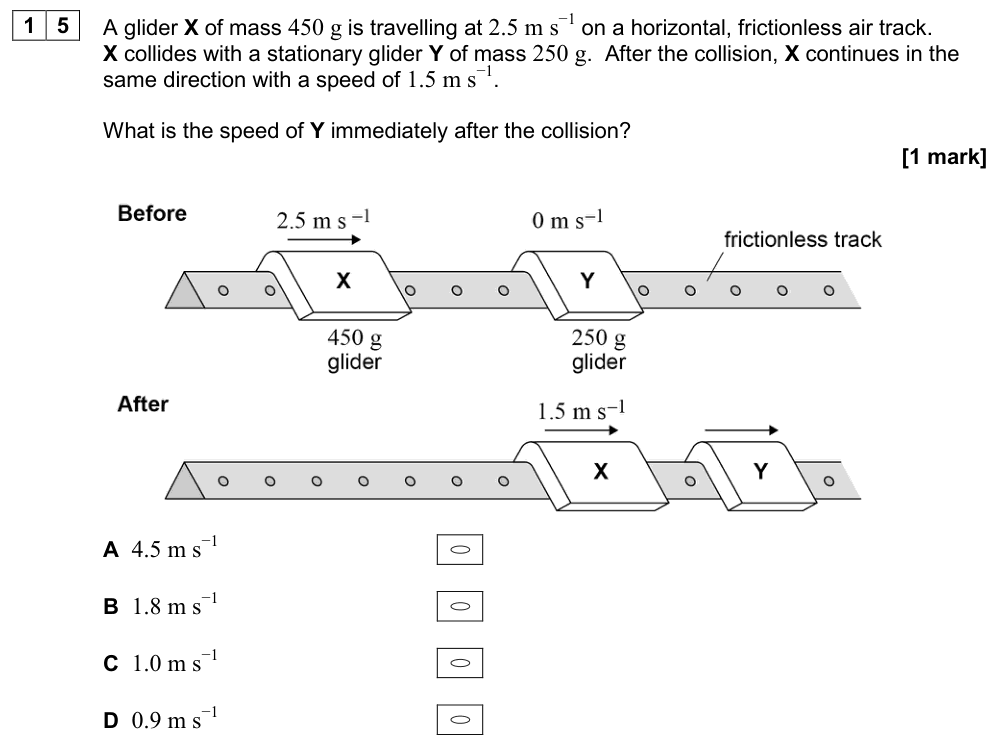
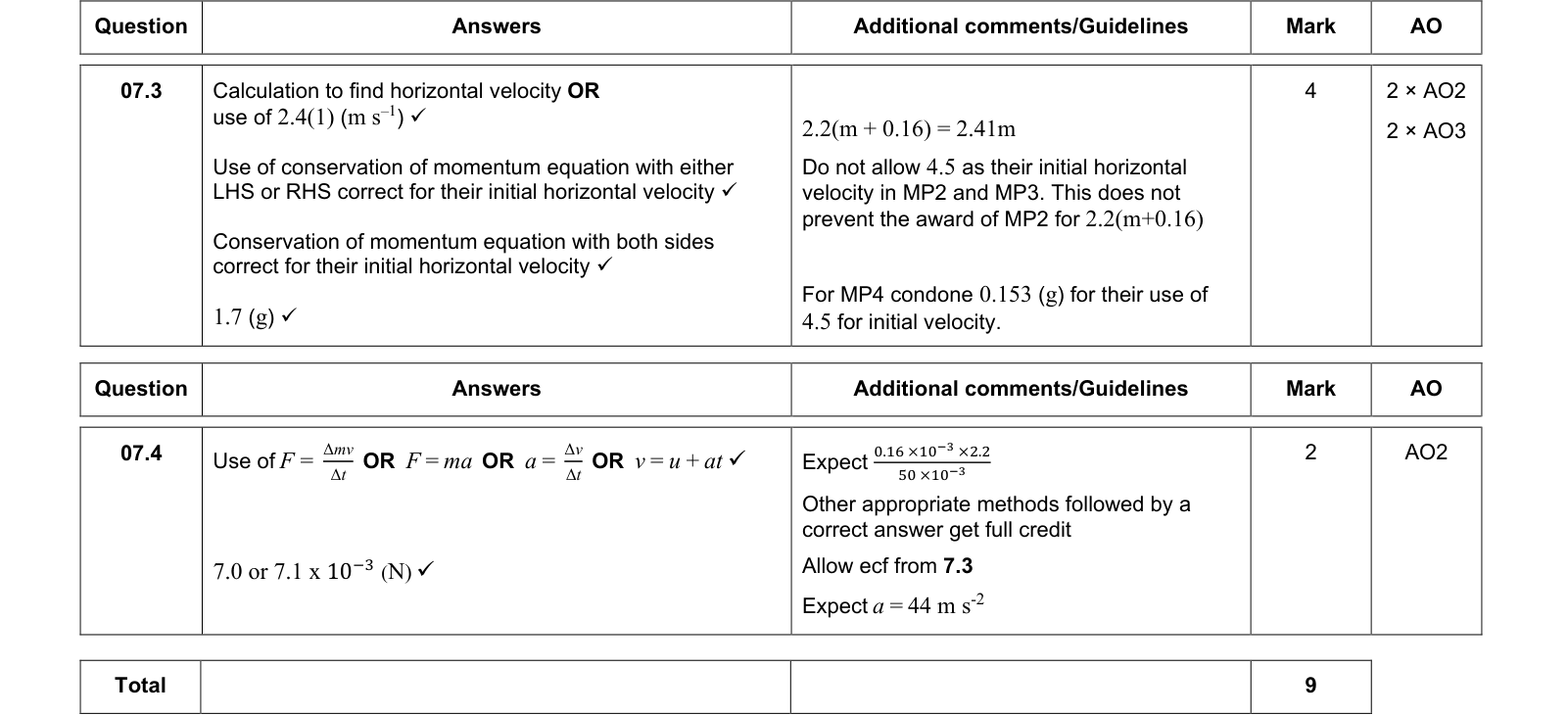
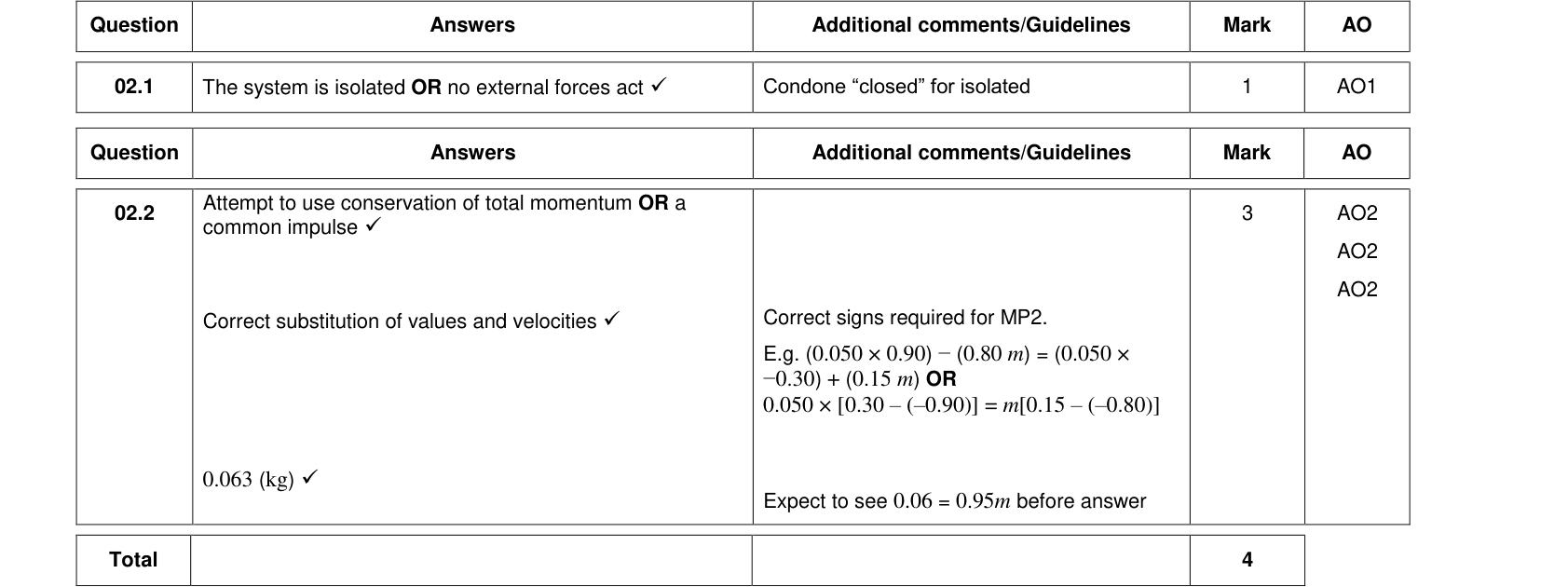
In any interaction (collision or explosion), the total momentum of a system remains constant, provided no external resultant force acts on the system (the system is closed or isolated).
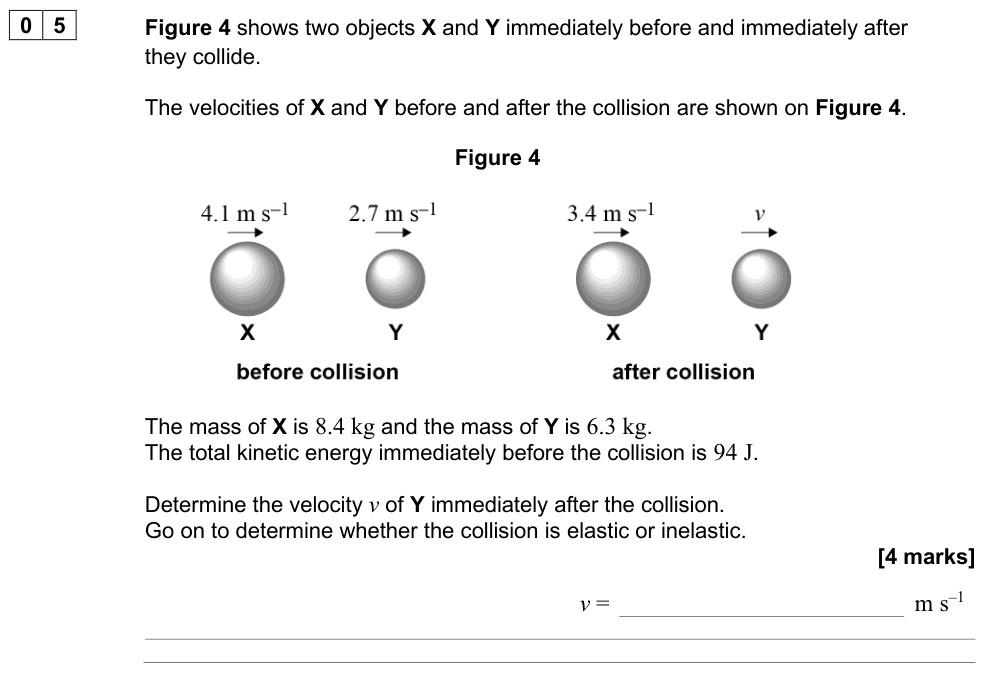
$$\text{total momentum before} = \text{total momentum after}$$ $$m_1u_1 + m_2u_2 = m_1v_1 + m_2v_2$$
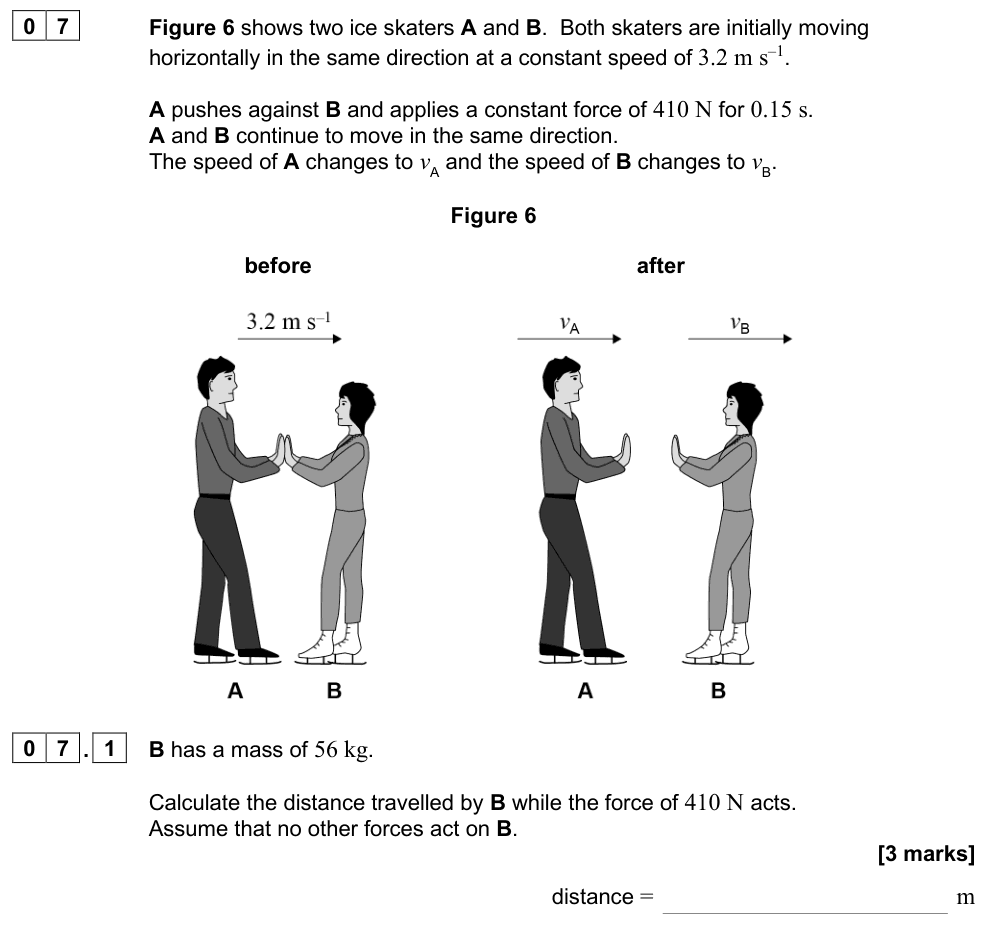
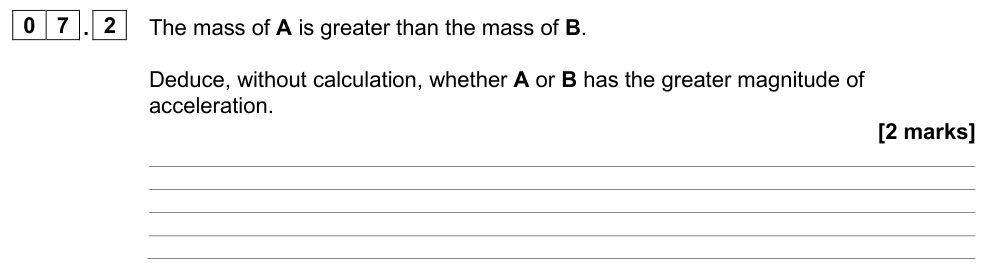
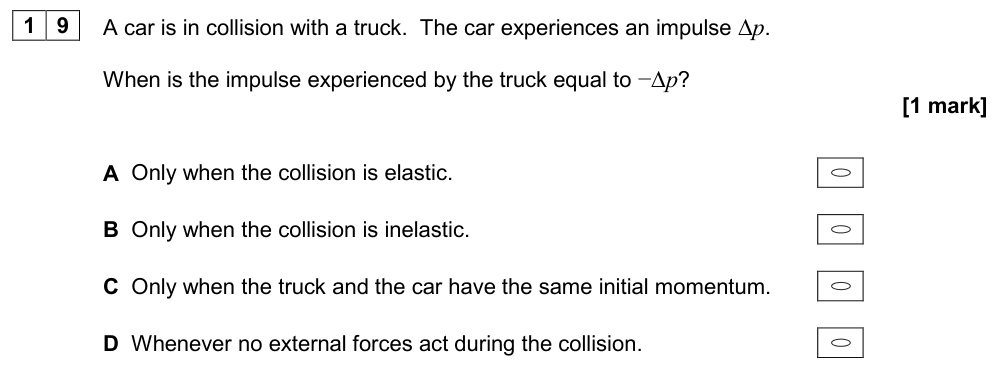
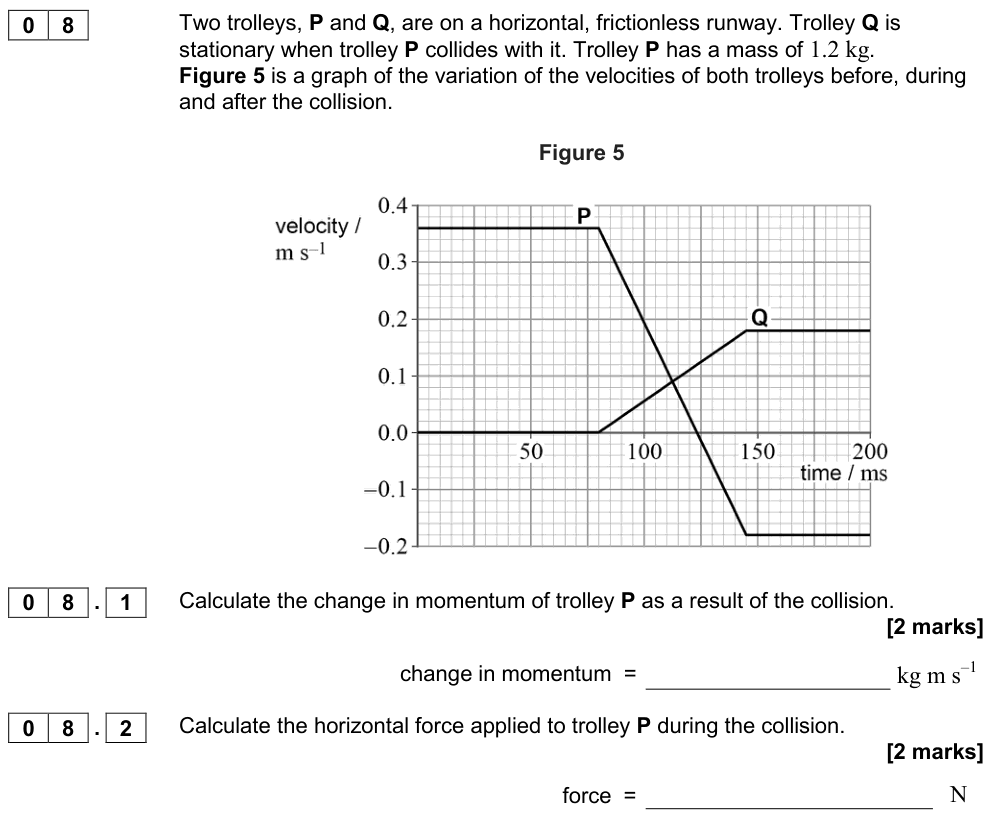
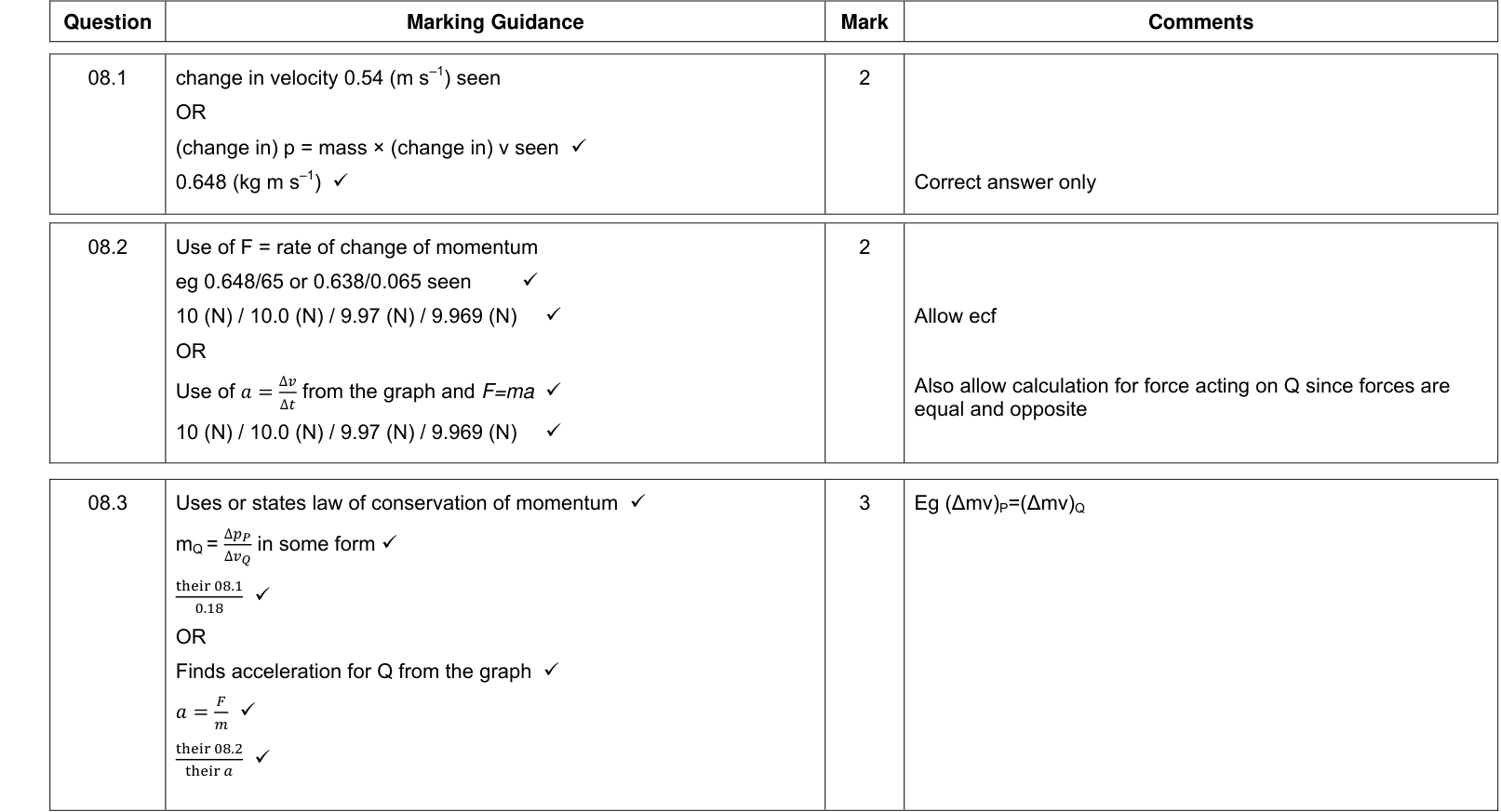
Conservation of momentum follows from Newton's second and third laws. During a collision A pushes on B and B pushes back on A with an equal and opposite force for the same time. So the change in momentum of A is equal and opposite to that of B, and the total does not change.
Worked example: trolleys stick together
A 2.0 kg trolley moving at $3.0\ \text{m s}^{-1}$ collides with a stationary 1.0 kg trolley. They stick together. Find their common velocity.
$2.0 \times 3.0 + 1.0 \times 0 = (2.0 + 1.0)v \Rightarrow v = 2.0\ \text{m s}^{-1}$.
Worked example: head-on collision
Ball A (0.40 kg) moving right at $5.0\ \text{m s}^{-1}$ hits ball B (0.60 kg) moving left at $2.0\ \text{m s}^{-1}$. After the collision A moves left at $1.0\ \text{m s}^{-1}$. Find B's velocity.
Right positive: $0.40(5.0) + 0.60(-2.0) = 0.40(-1.0) + 0.60v_B$
$2.0 - 1.2 = -0.40 + 0.60v_B \Rightarrow v_B = 2.0\ \text{m s}^{-1}$ to the right.
Elastic and inelastic collisions
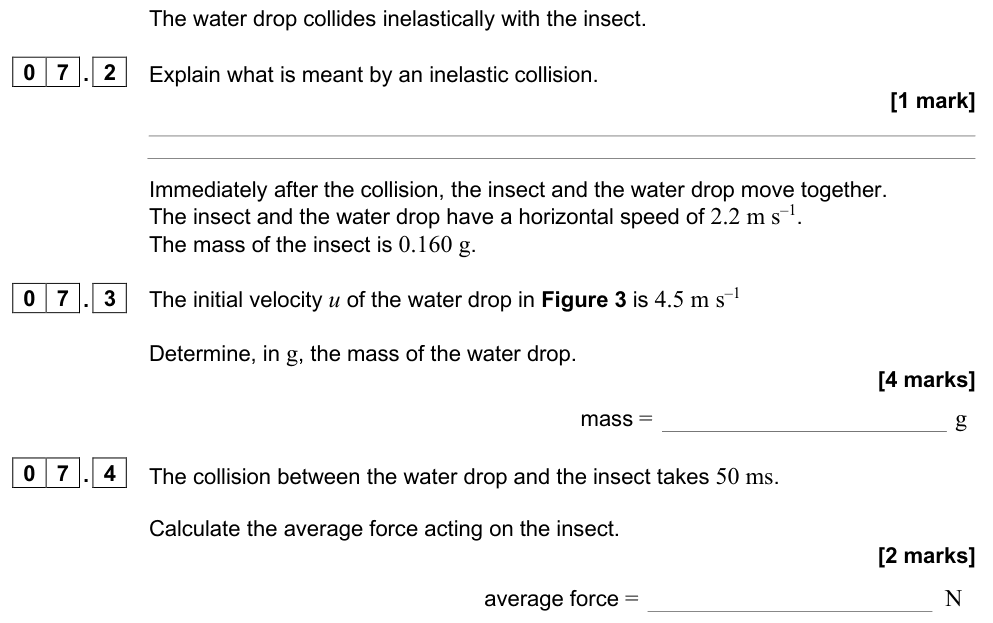
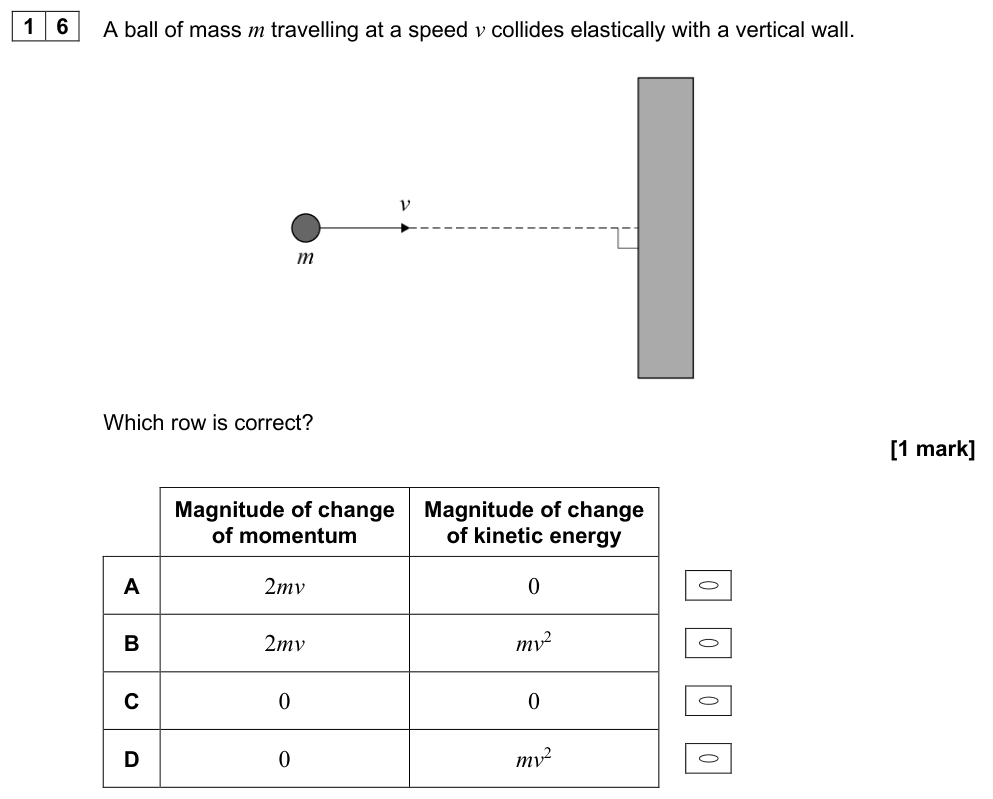
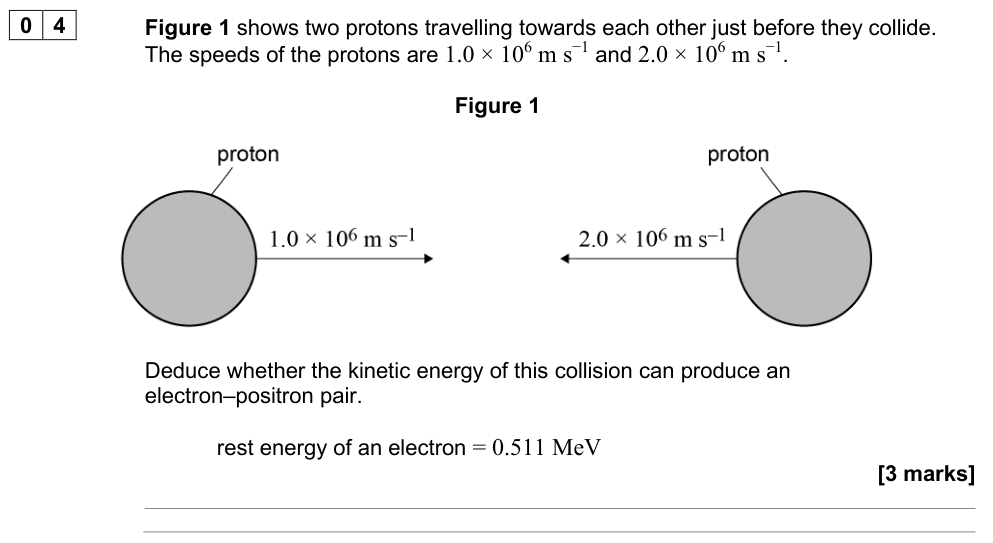
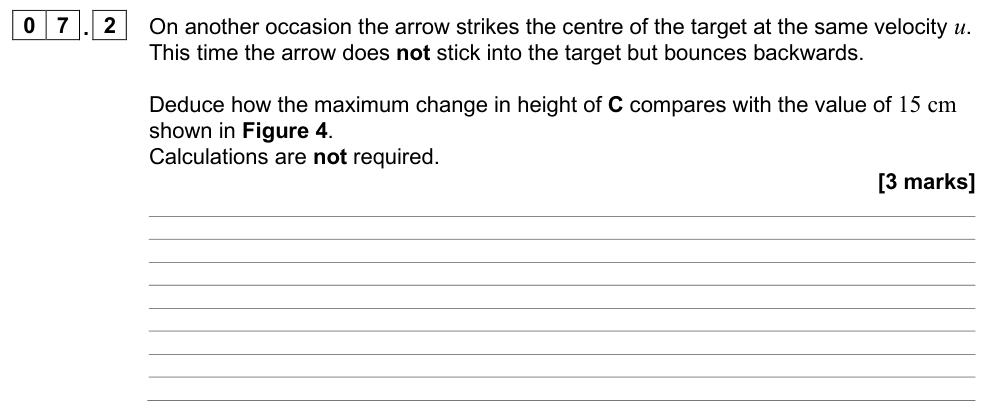
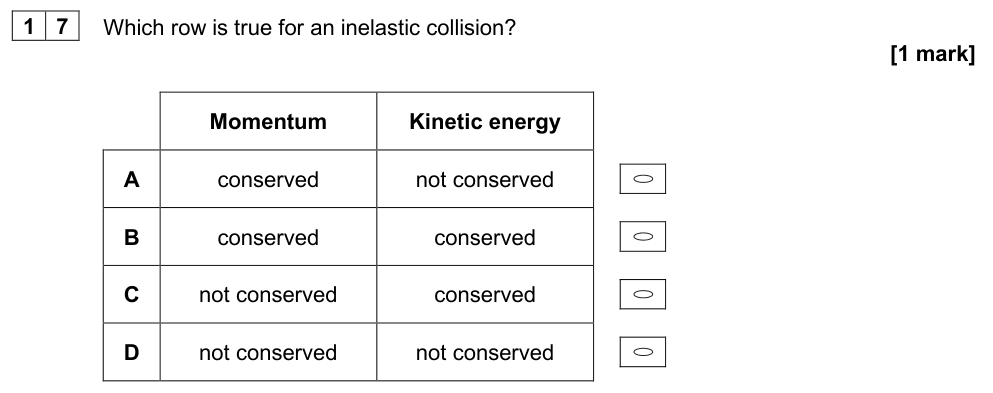
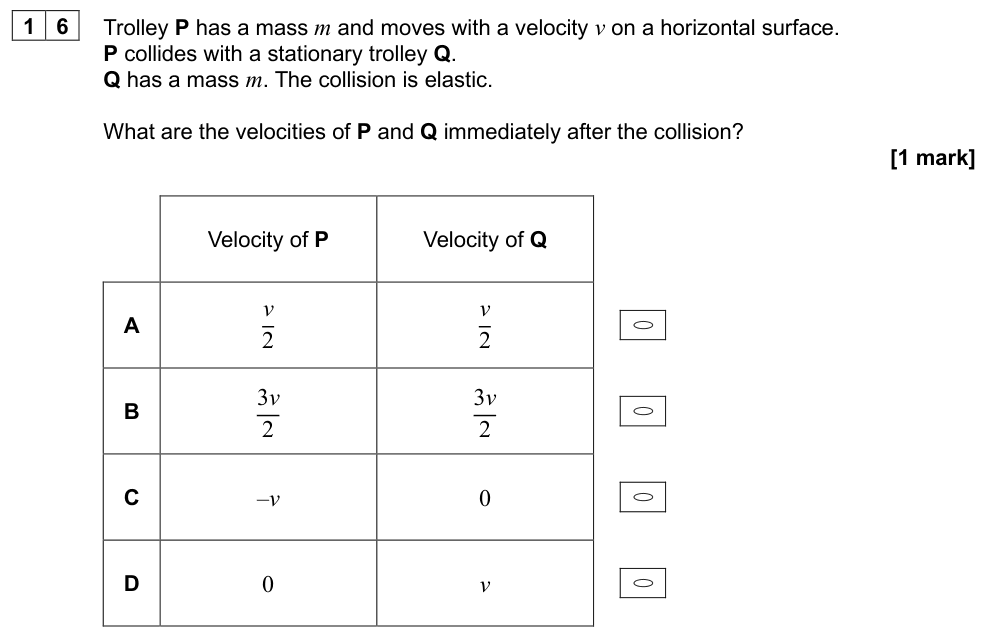
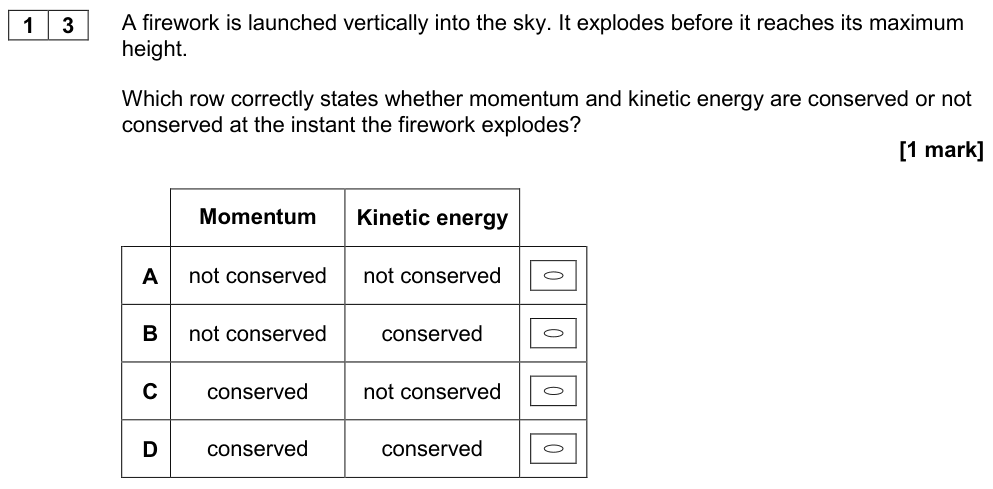
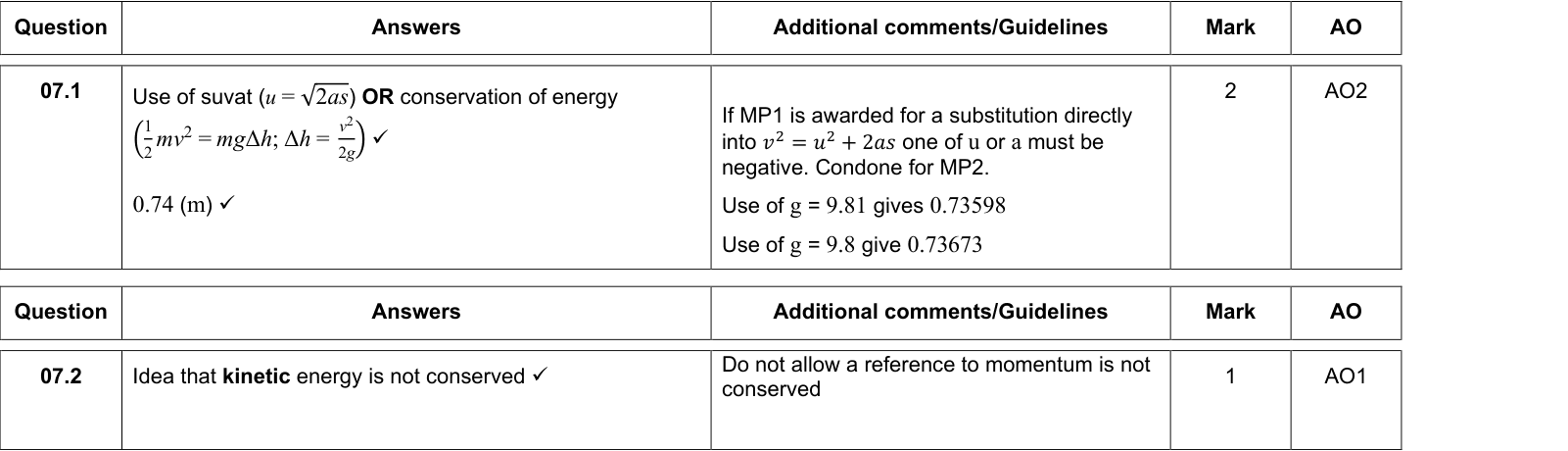
Momentum is always conserved in a collision (if there are no external forces). Kinetic energy may or may not be.
| Type | Momentum | Kinetic energy | Example |
|---|---|---|---|
| Elastic | conserved | conserved (total $E_k$ before = after) | gas molecules colliding; nearly true for snooker balls |
| Inelastic | conserved | not conserved (some $E_k$ is transferred to thermal energy, sound, deformation) | most real collisions; objects that stick together |
Total energy is always conserved. In an inelastic collision the "lost" kinetic energy has been transferred to other stores.
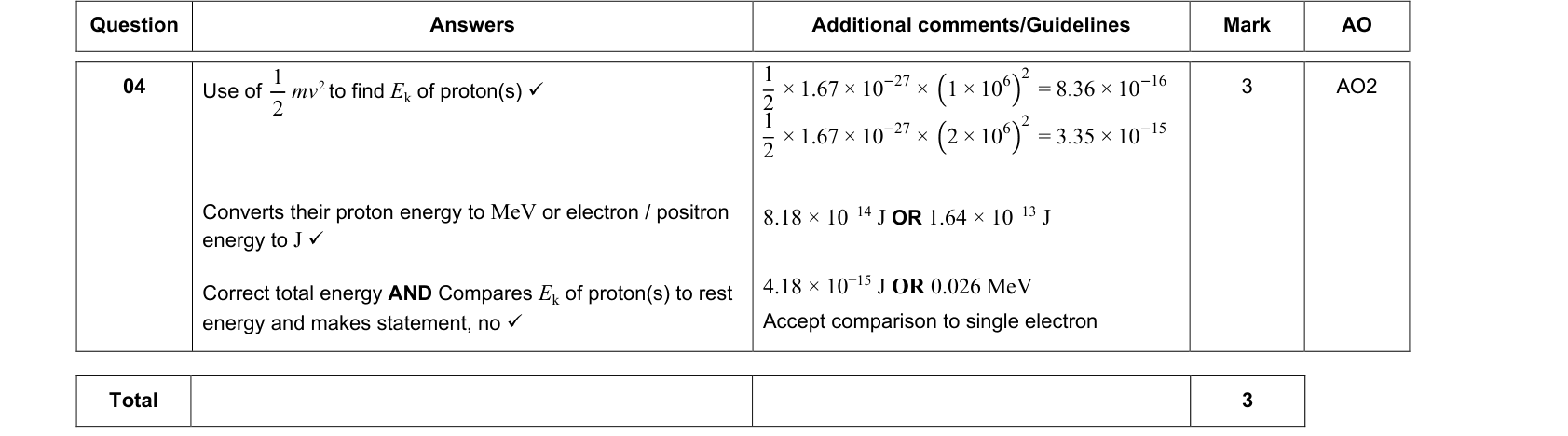
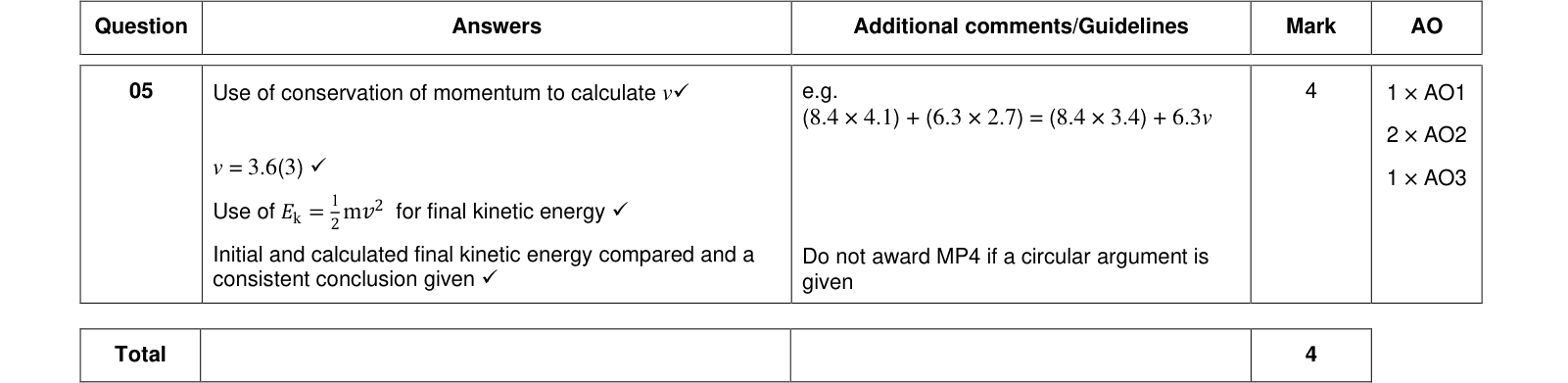
To test whether a collision is elastic, calculate the total kinetic energy before and after, using $E_k = \tfrac12mv^2$.
Worked example: is it elastic?
In the trolley example above: $E_k$ before $= \tfrac12(2.0)(3.0)^2 = 9.0\ \text{J}$; $E_k$ after $= \tfrac12(3.0)(2.0)^2 = 6.0\ \text{J}$. Kinetic energy has decreased, so the collision is inelastic. 3.0 J has been transferred to other forms.
Useful link between $E_k$ and $p$
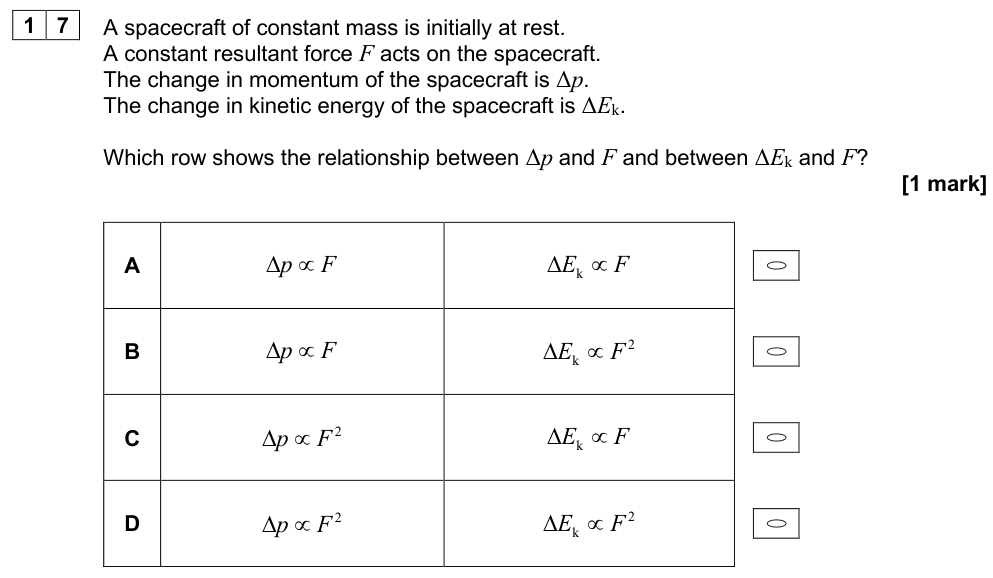
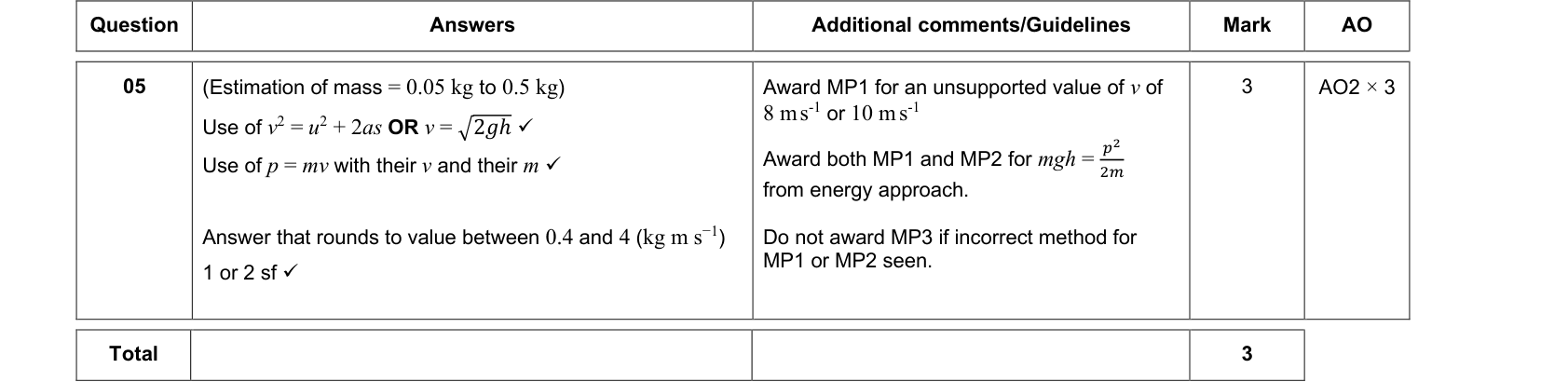
$$E_k = \frac{p^2}{2m}$$ Two objects with the same momentum: the lighter one has more kinetic energy.
Explosions
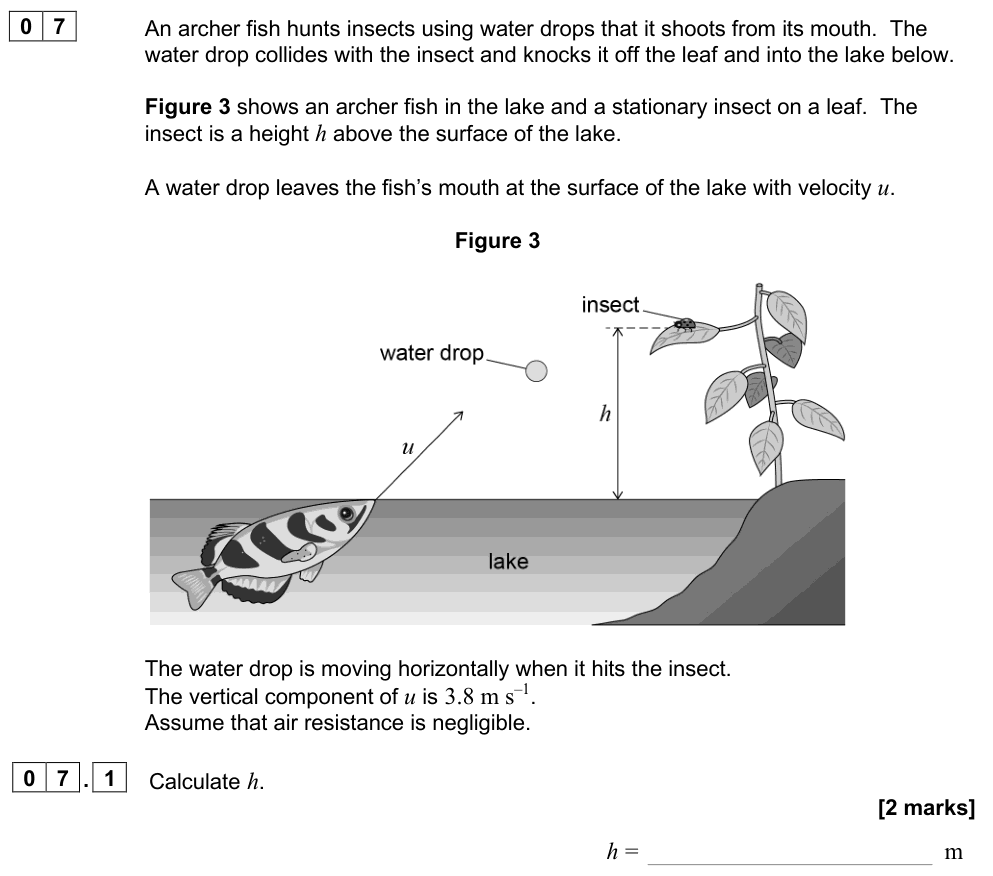
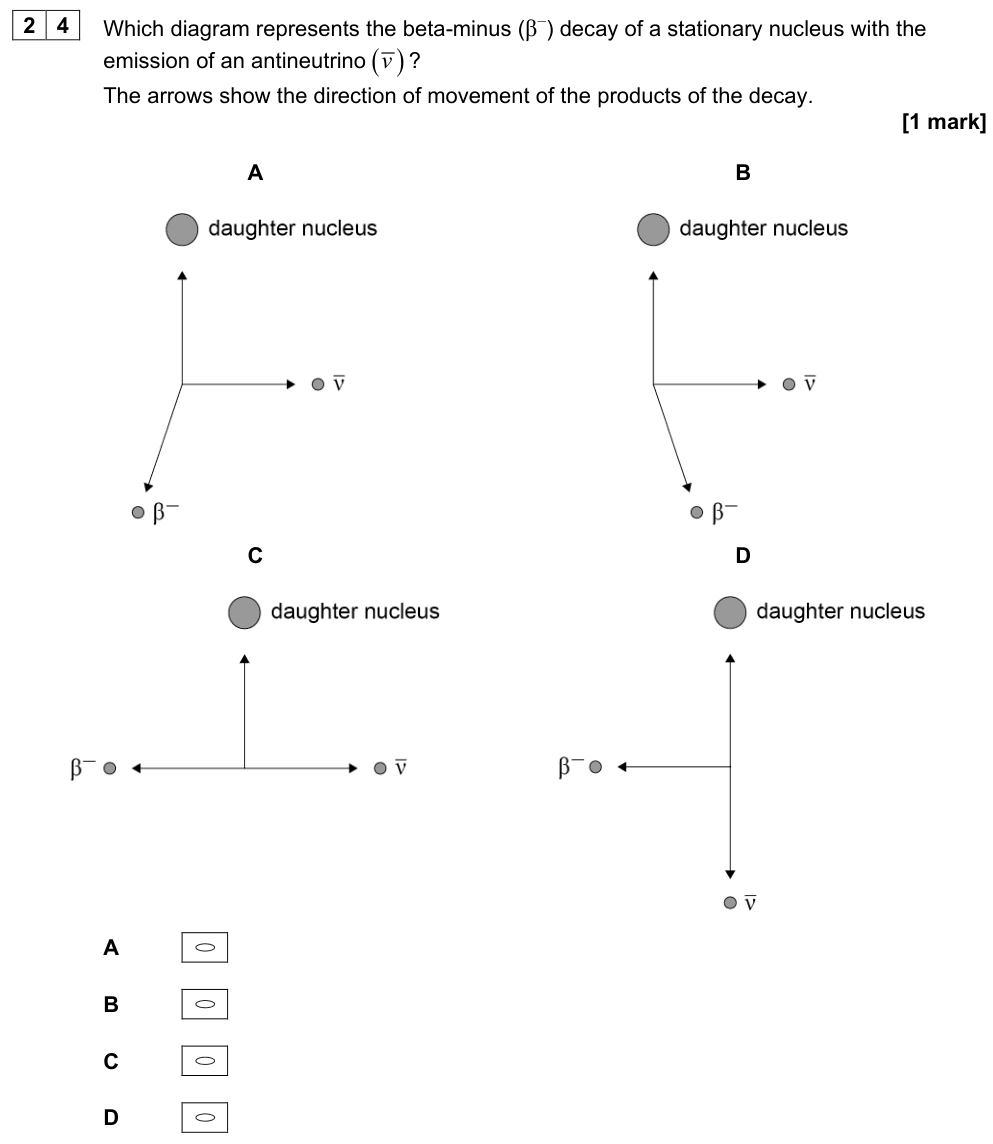
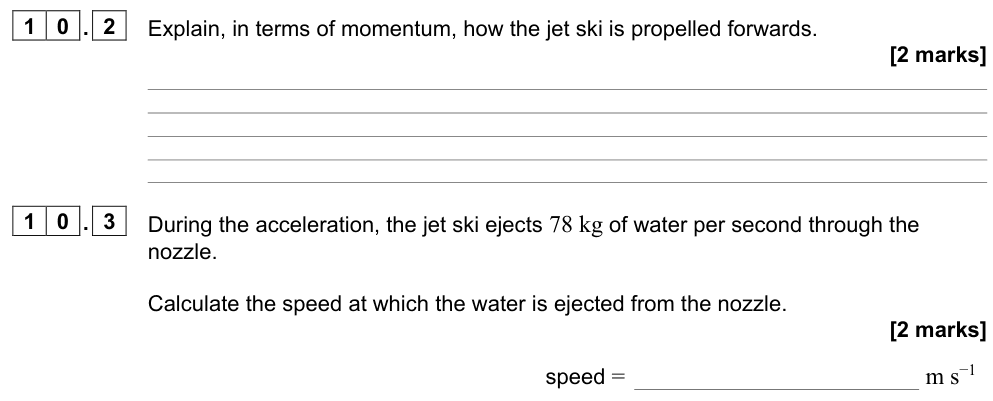
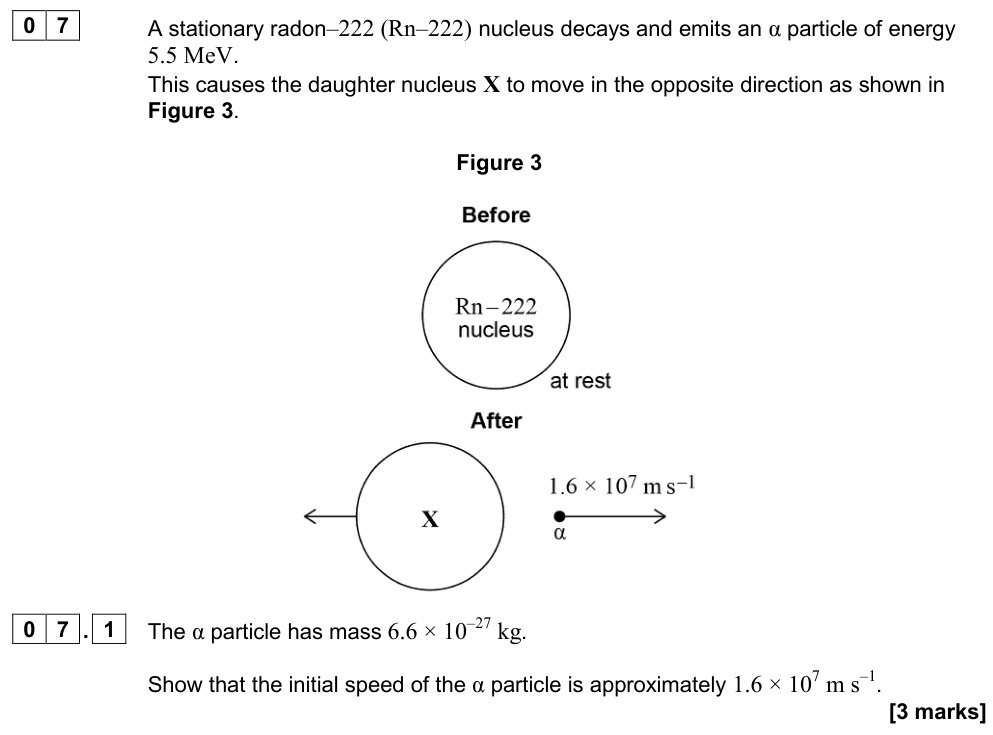
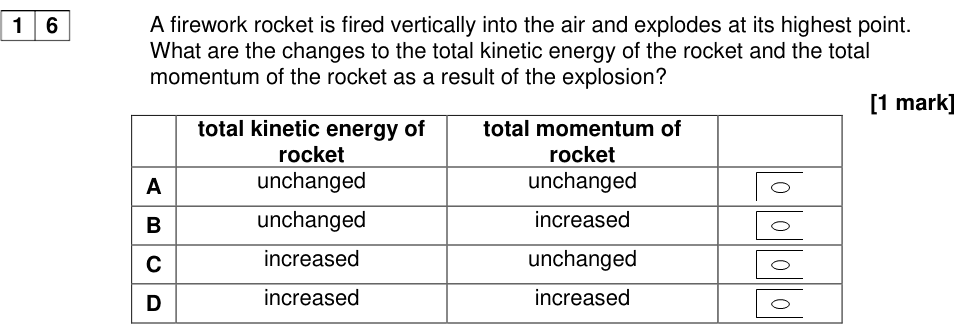
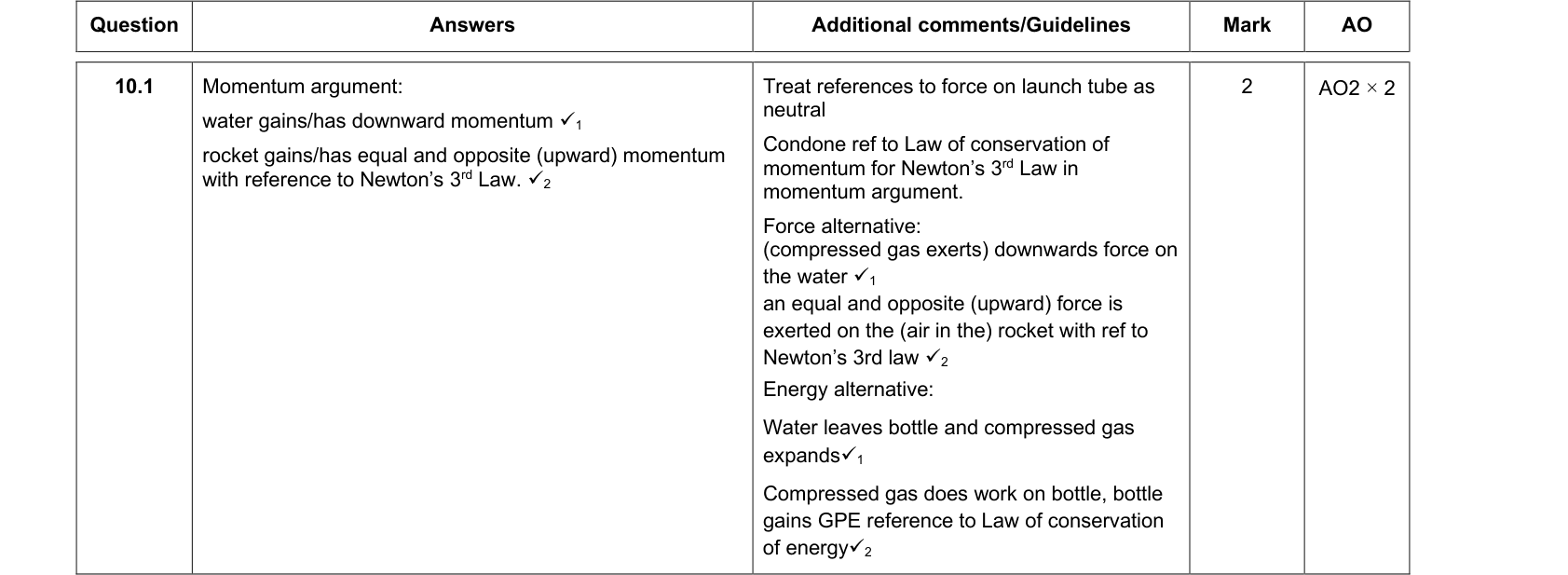
In an explosion, objects that were initially at rest fly apart. The total momentum is zero before, so it must be zero after: the pieces move off with equal and opposite momenta.
$$0 = m_1v_1 + m_2v_2 \quad \Rightarrow \quad m_1v_1 = -m_2v_2$$
The kinetic energy increases (it comes from chemical or elastic potential energy). The lighter piece moves faster and has more kinetic energy.
Worked example: recoil of a gun
A 4.0 kg rifle fires a 0.010 kg bullet at $400\ \text{m s}^{-1}$. Recoil velocity: $4.0v = -0.010 \times 400 \Rightarrow v = -1.0\ \text{m s}^{-1}$ (1.0 m s⁻¹ backwards).
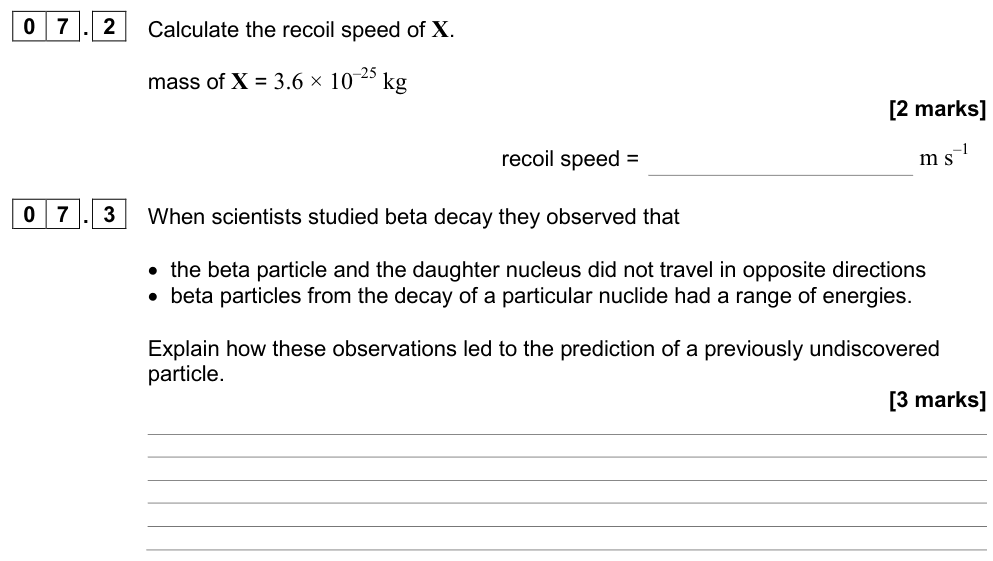
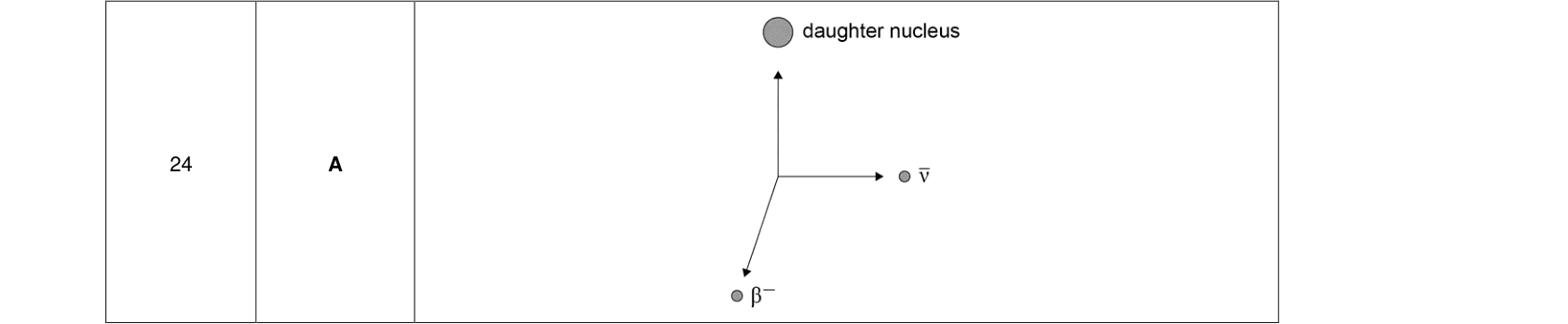
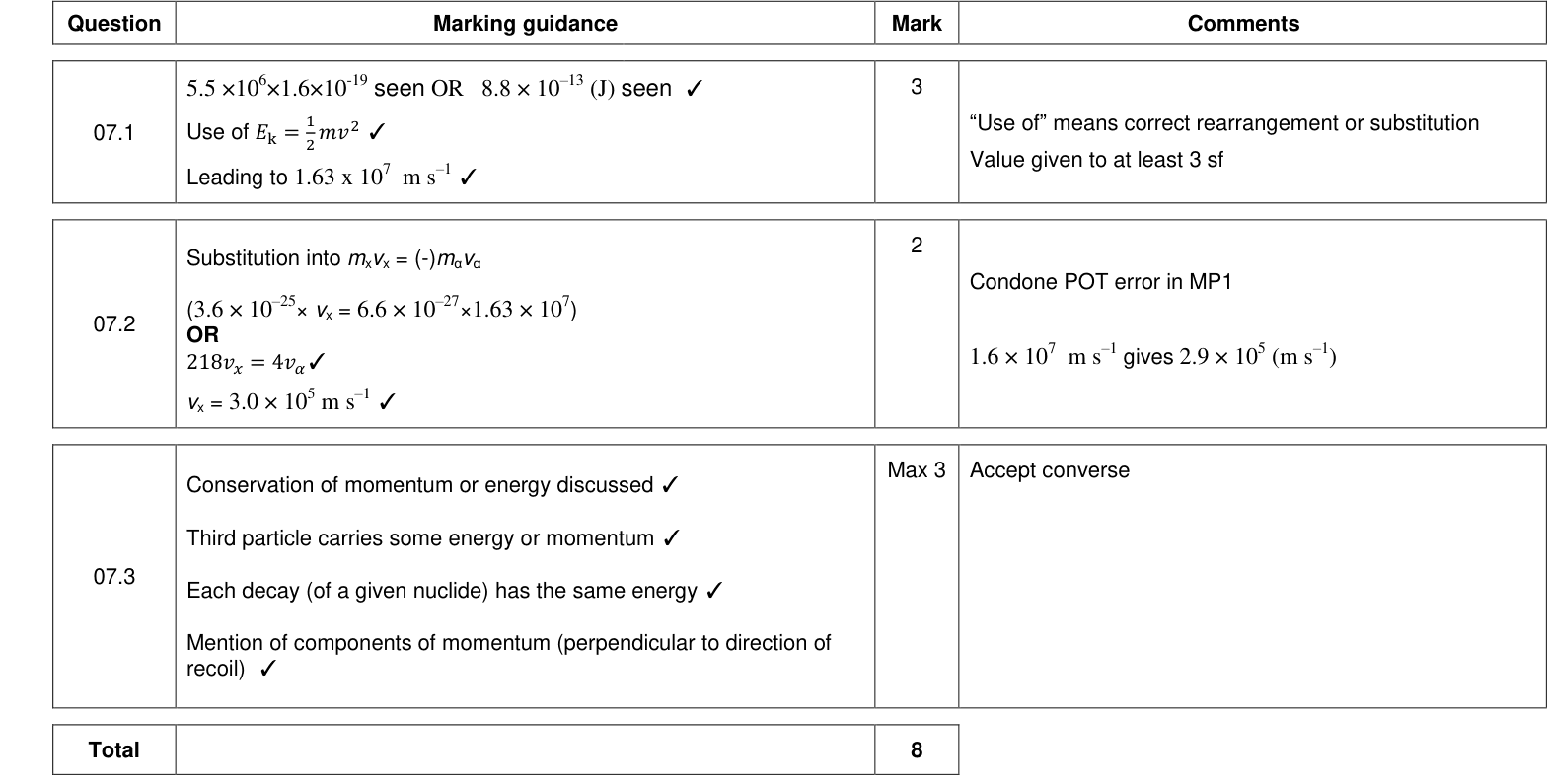
The same idea explains alpha decay: a stationary nucleus emits an alpha particle and the daughter nucleus recoils in the opposite direction with equal momentum.
Force and the rate of change of momentum
Newton's second law (general form)
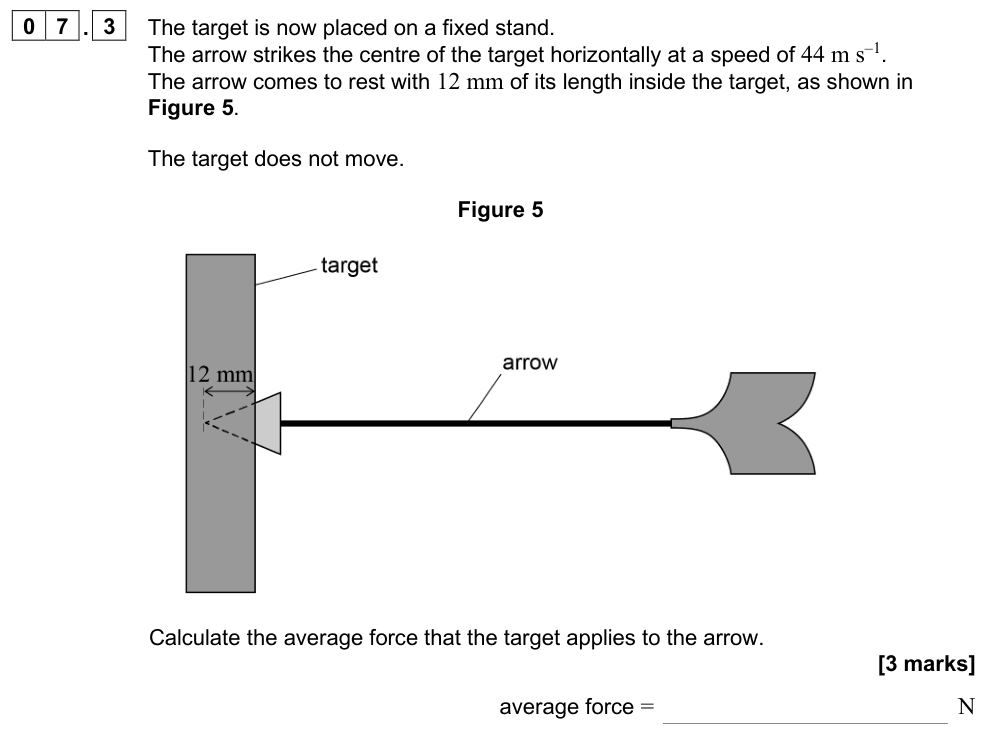
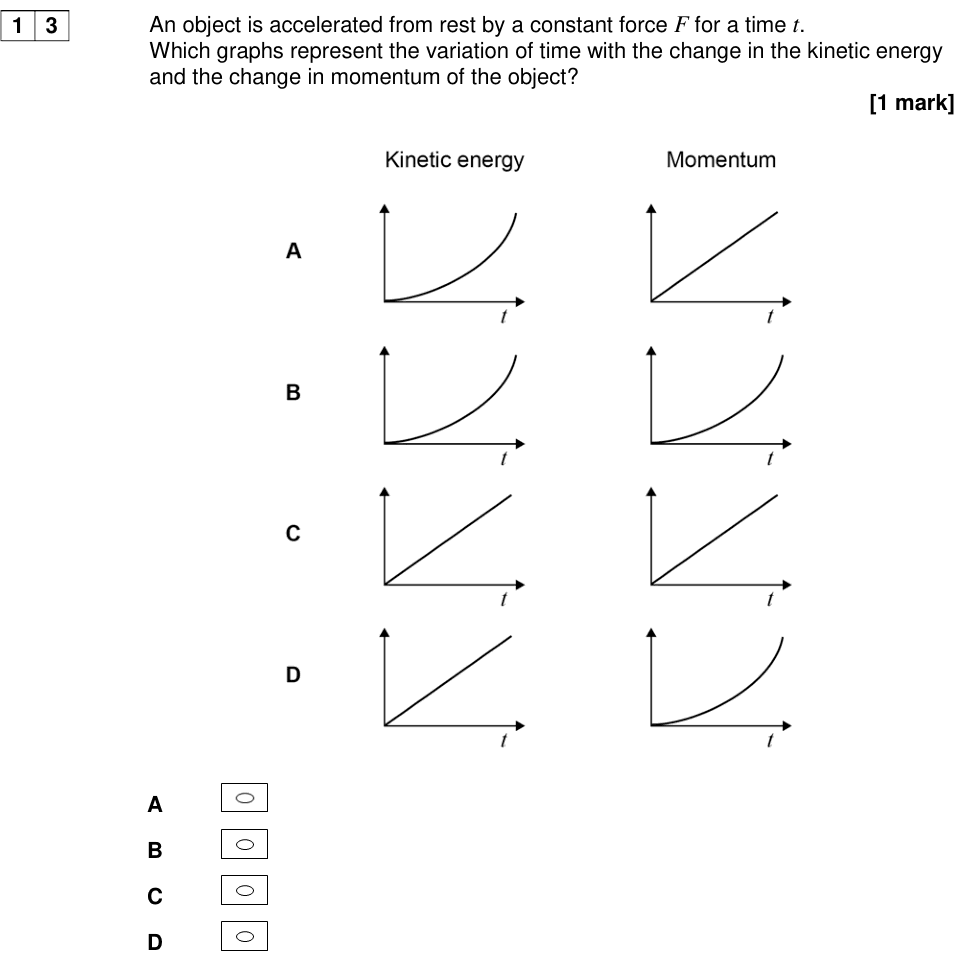
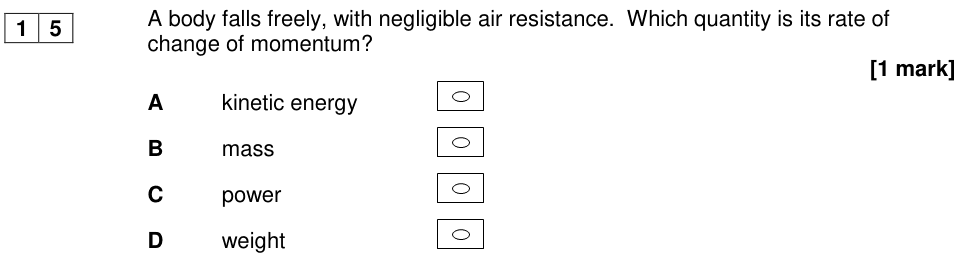
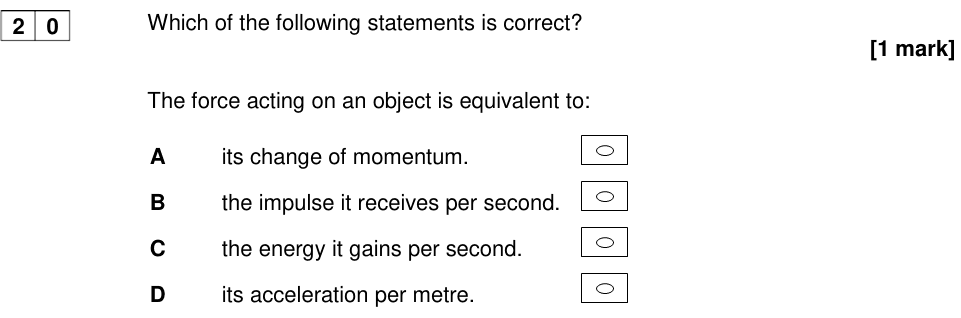
The resultant force on an object equals its rate of change of momentum:
$$F = \frac{\Delta(mv)}{\Delta t}$$
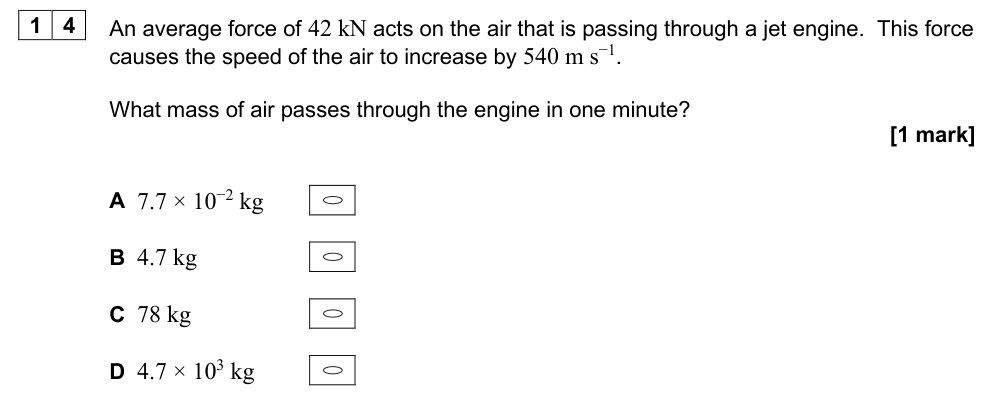
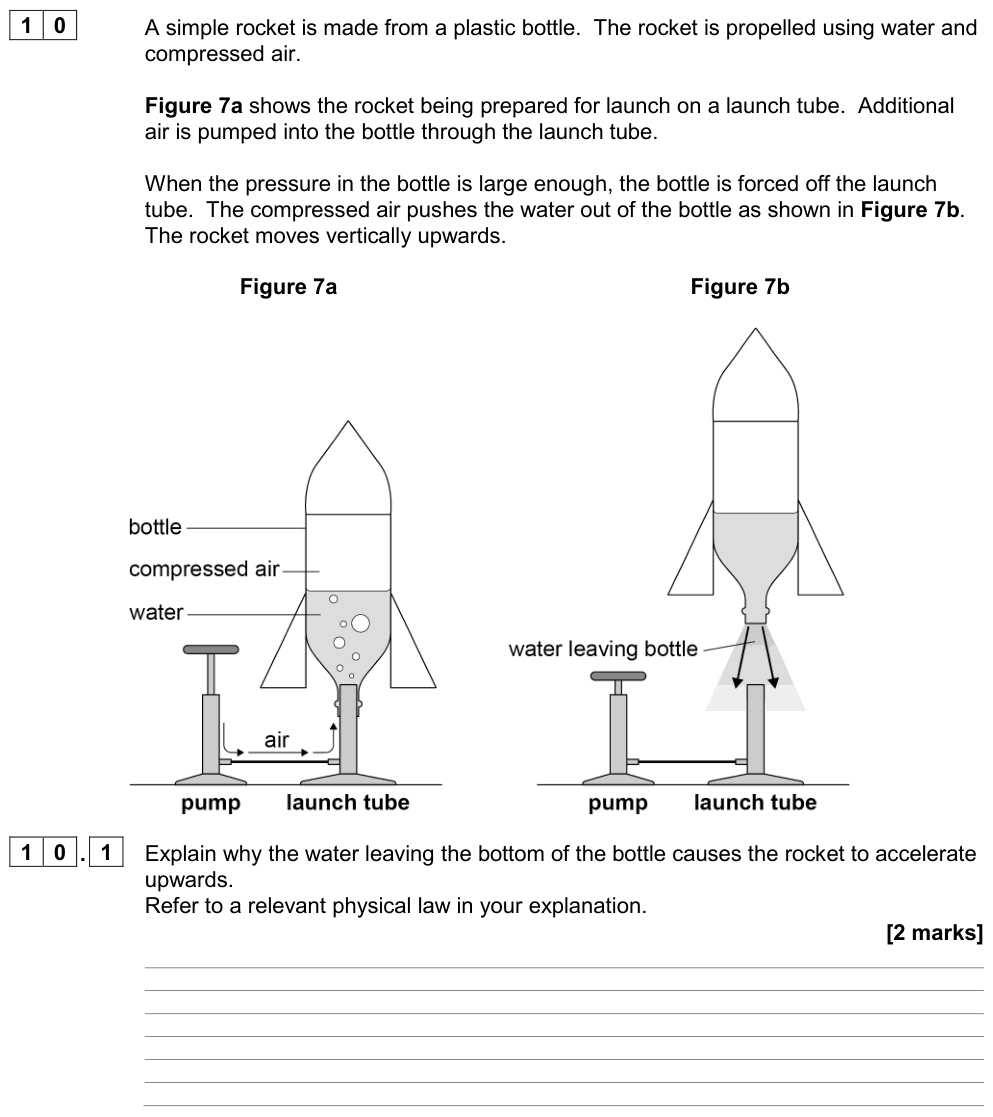
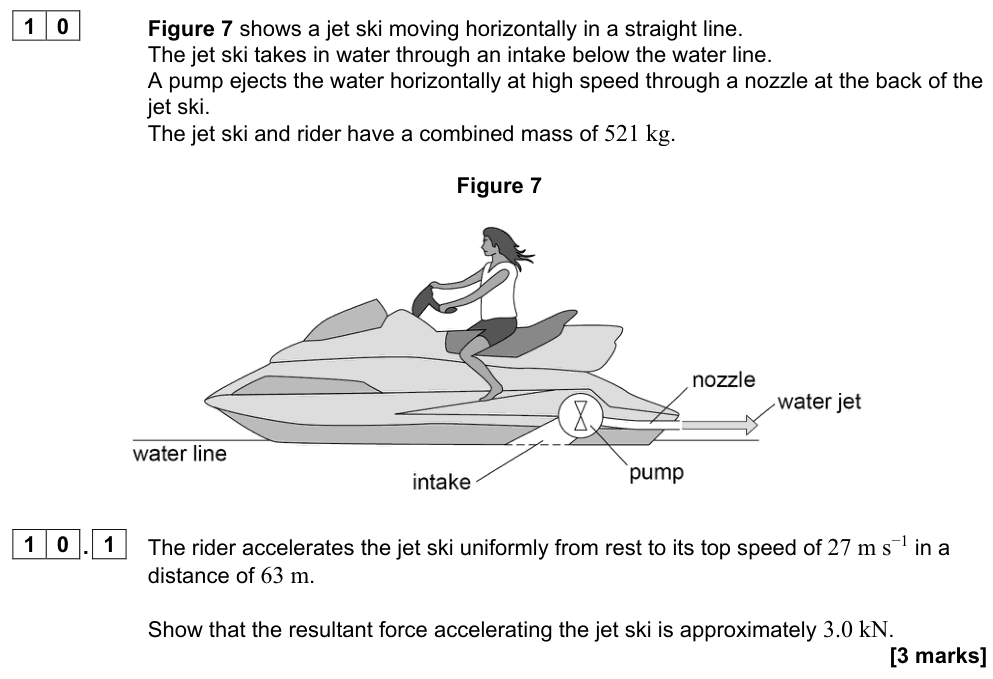
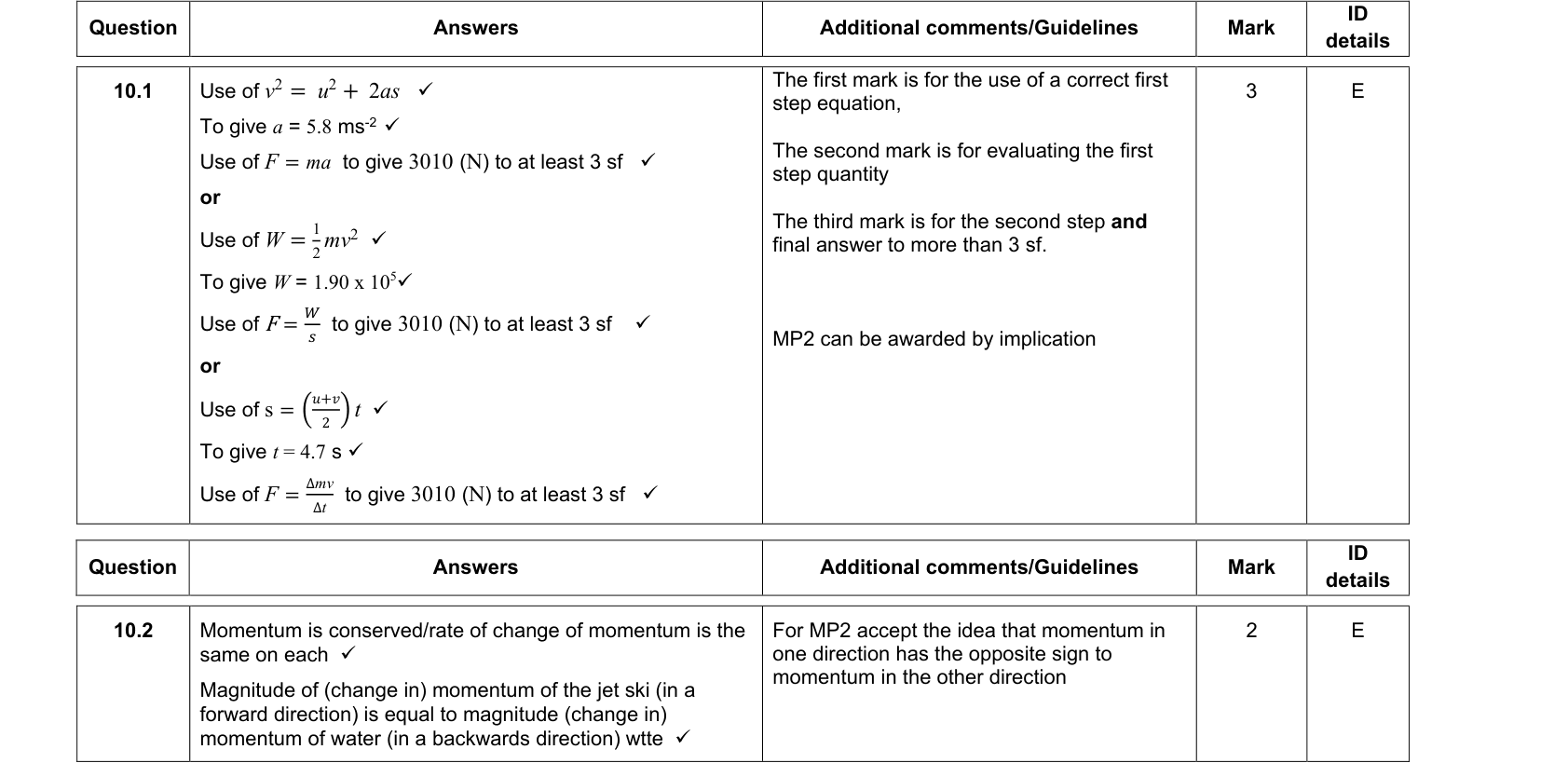
For a constant mass this becomes $F = m\dfrac{\Delta v}{\Delta t} = ma$. The general form also works when the mass changes, e.g. a rocket losing fuel, or a jet of water or air being deflected.
Worked example: water jet
A hose ejects $2.5\ \text{kg}$ of water per second at $12\ \text{m s}^{-1}$. The water hits a wall and stops. Force on the wall $=$ rate of change of momentum $= 2.5 \times 12 = 30\ \text{N}$.
Impulse
Impulse
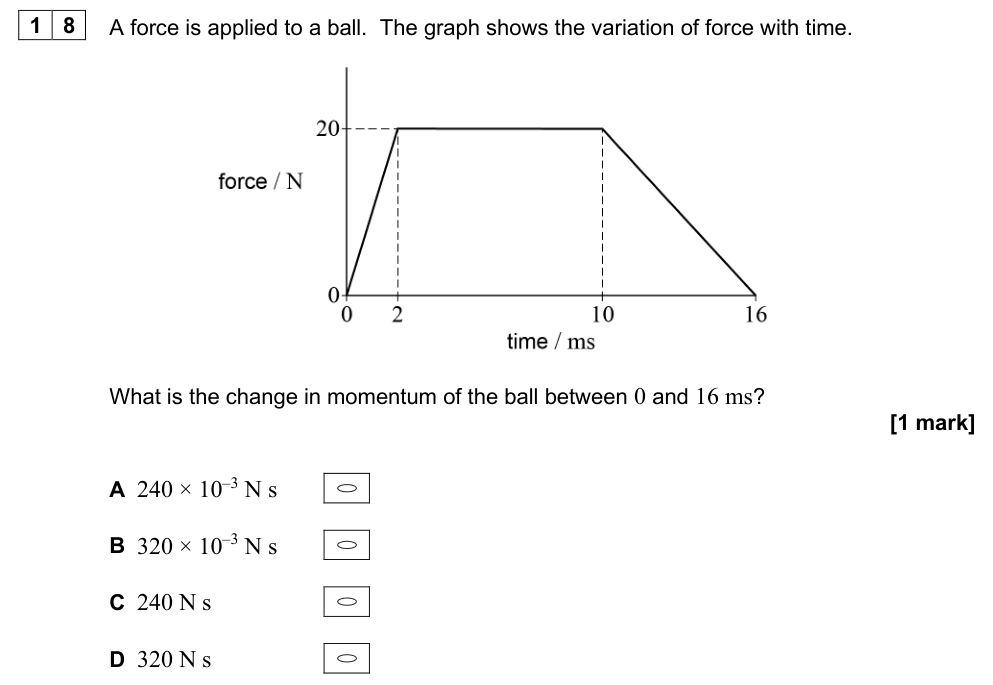
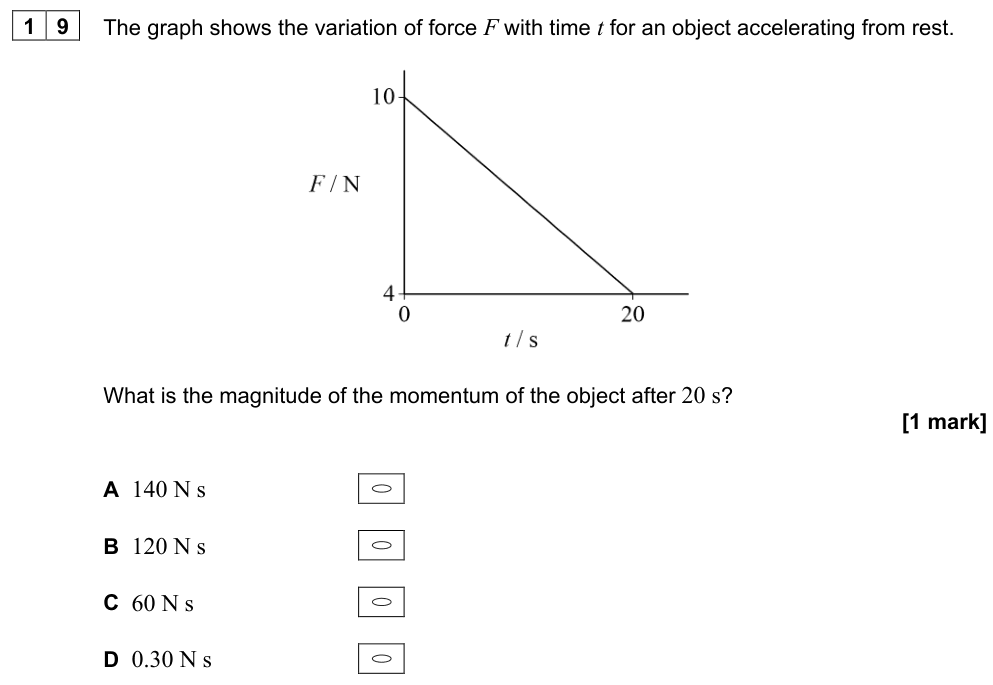
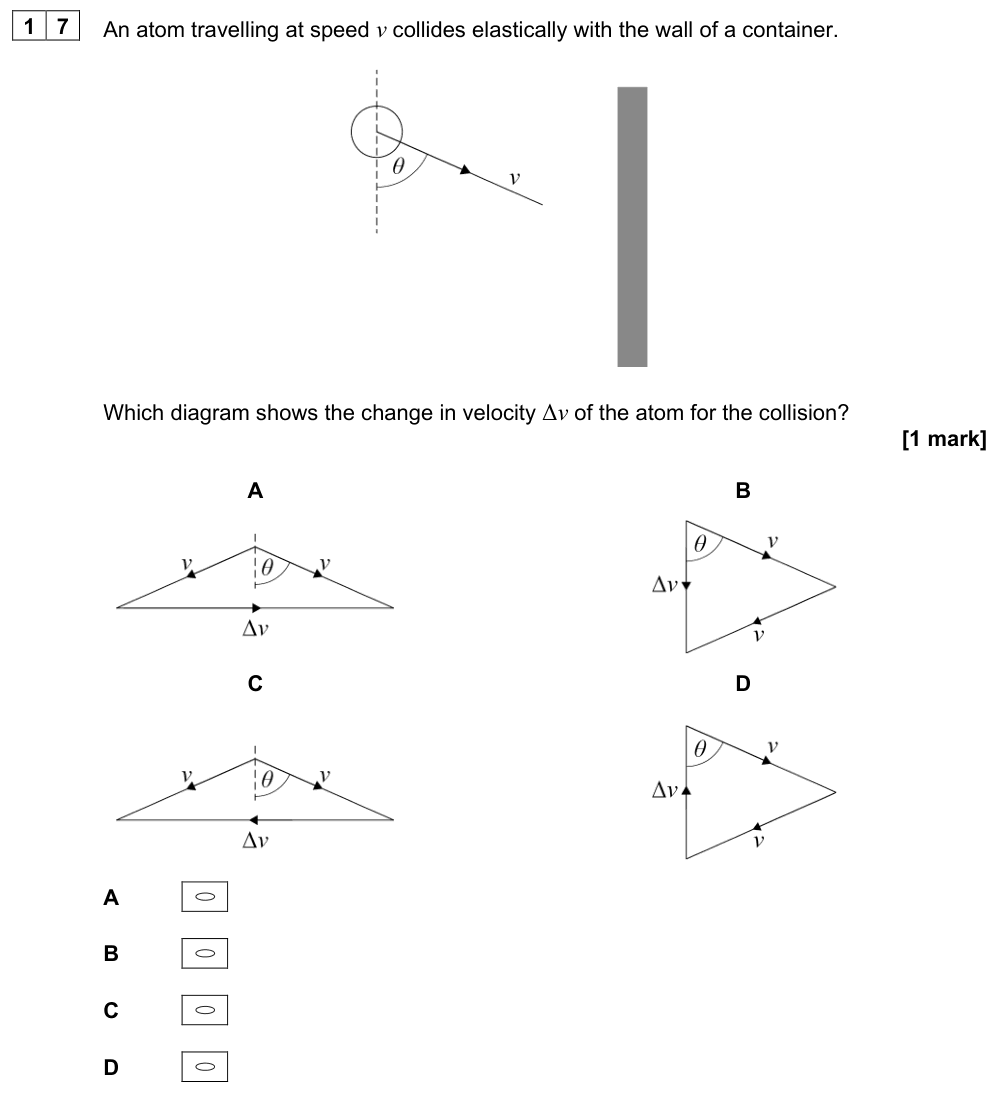
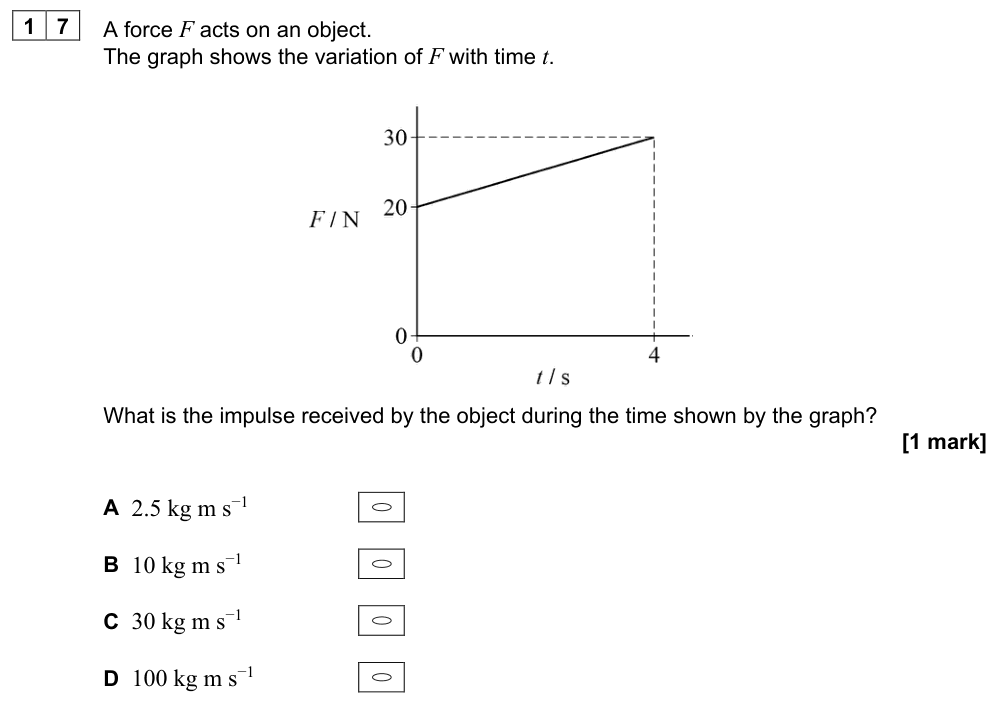
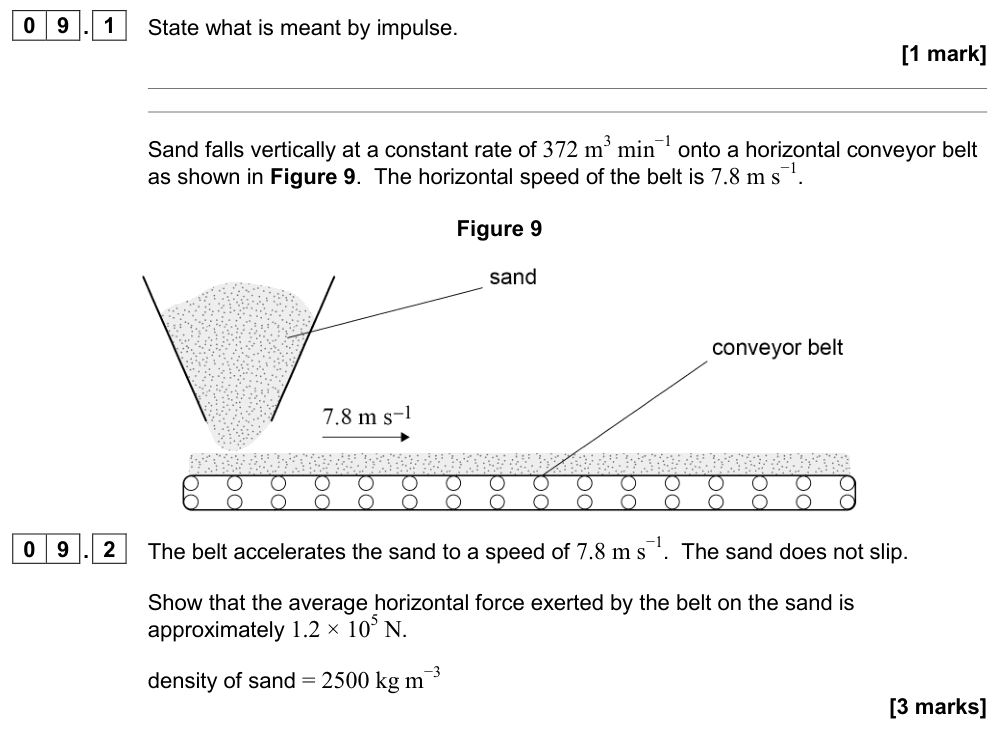
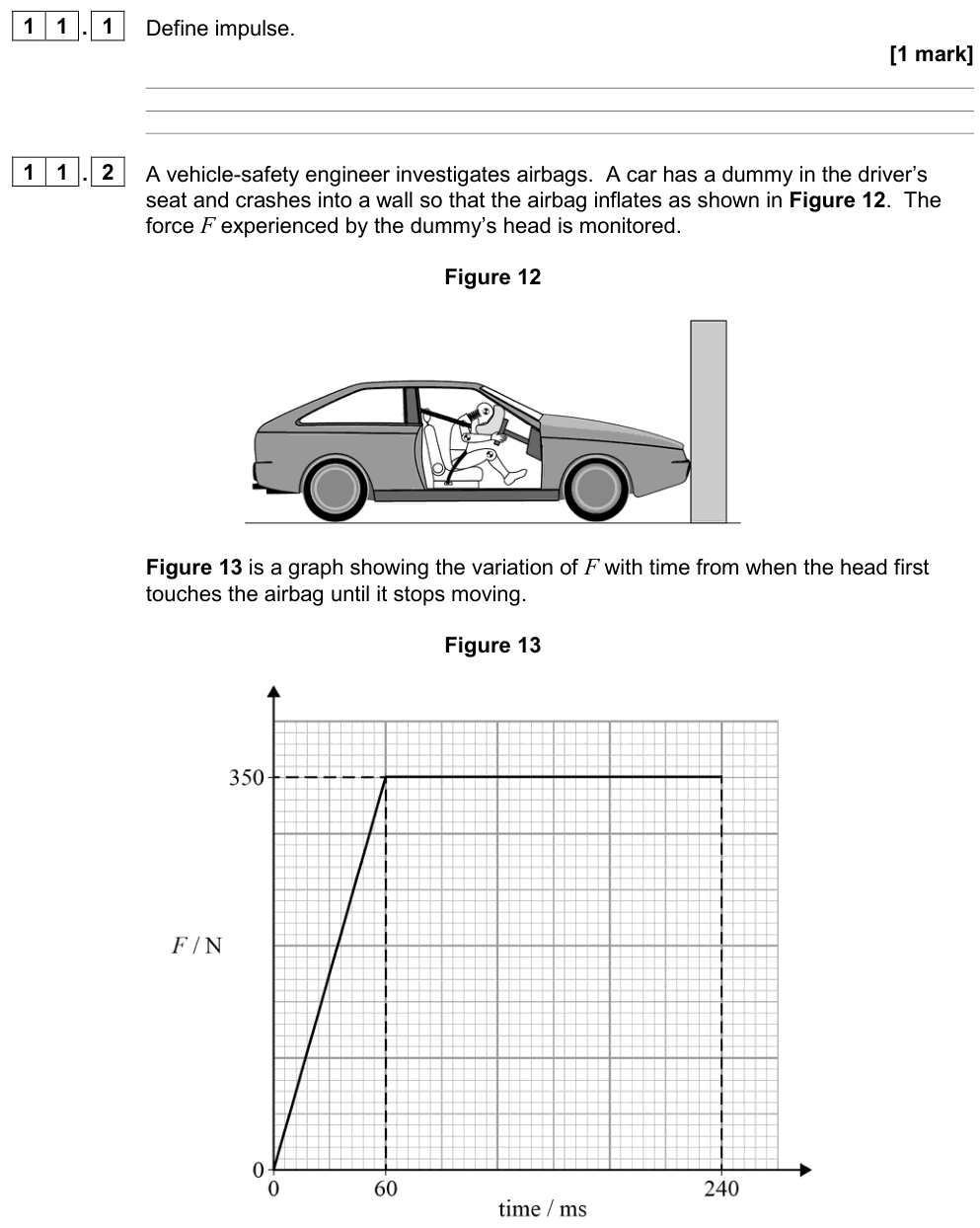
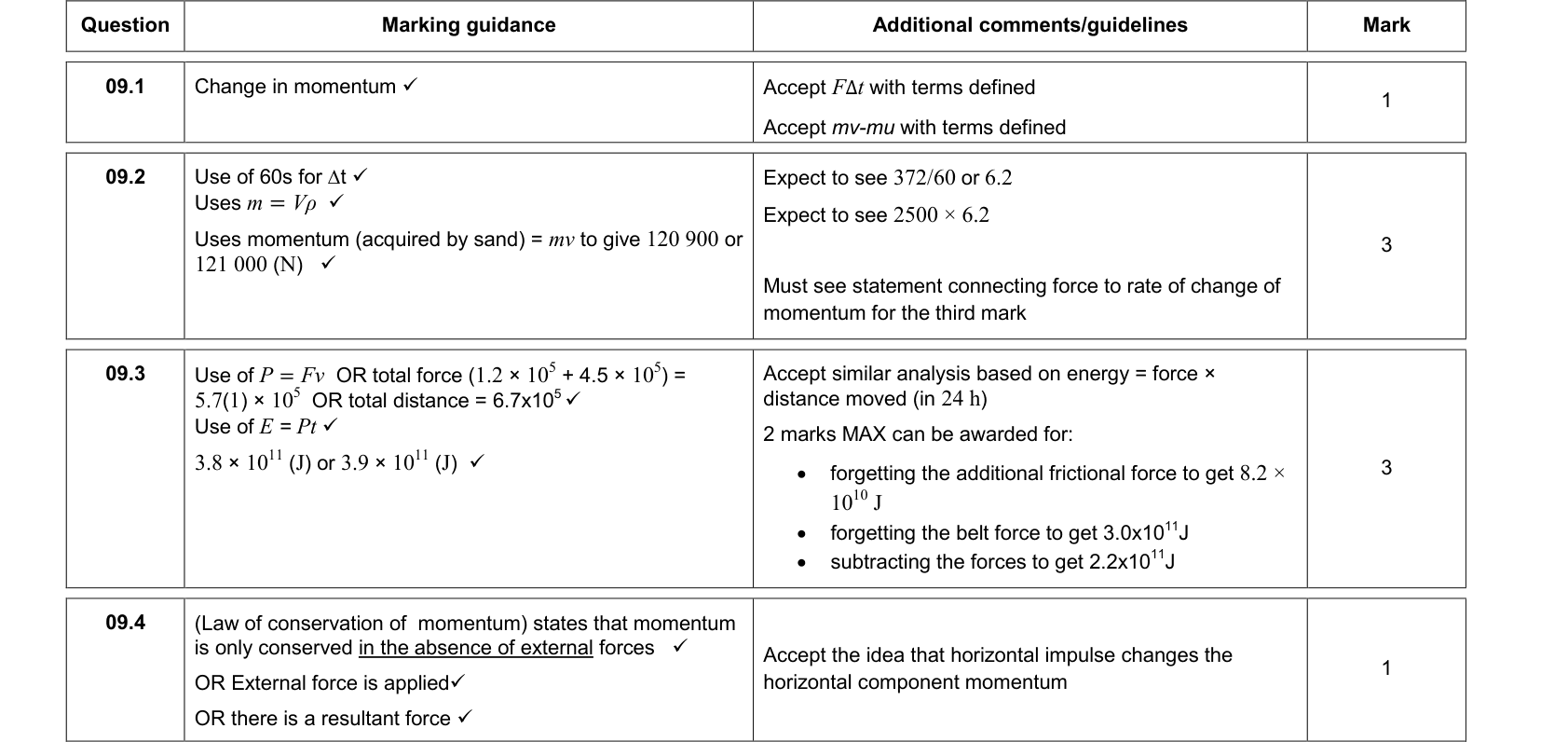
Impulse = force × time for which it acts = change in momentum:
$$F\Delta t = \Delta(mv) \qquad \text{unit: N s}$$
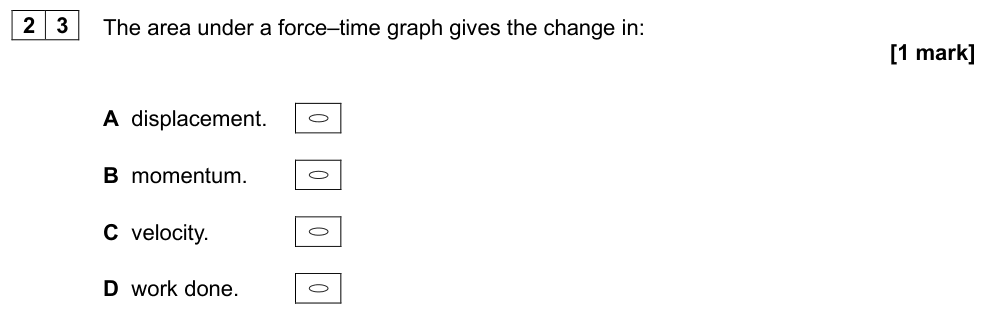
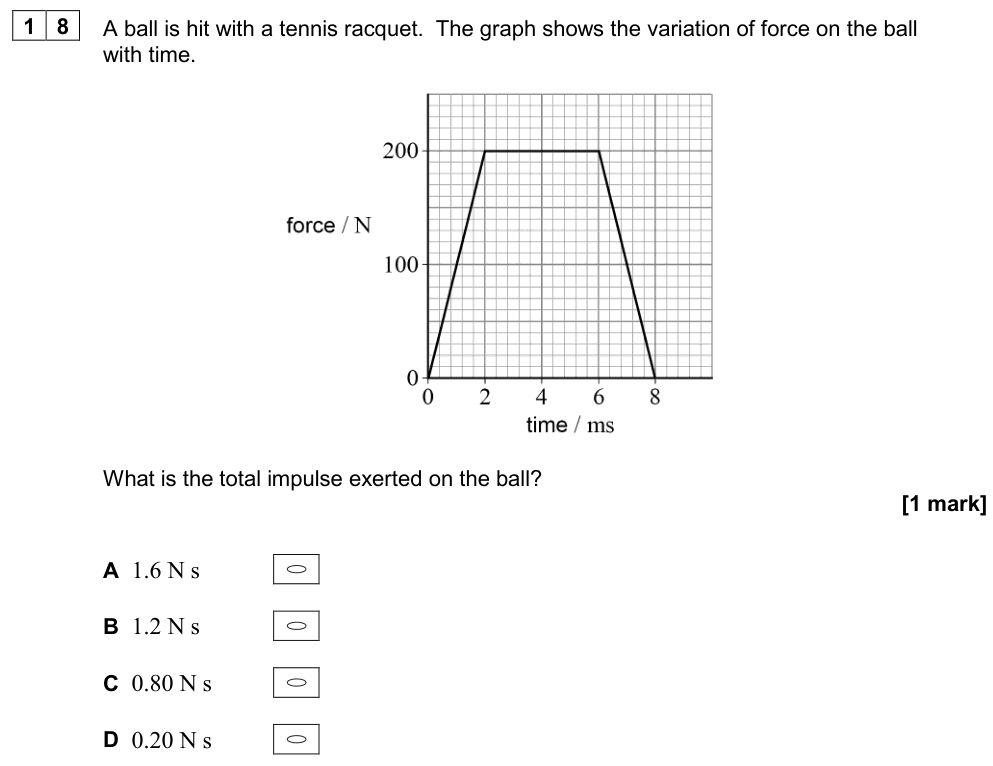
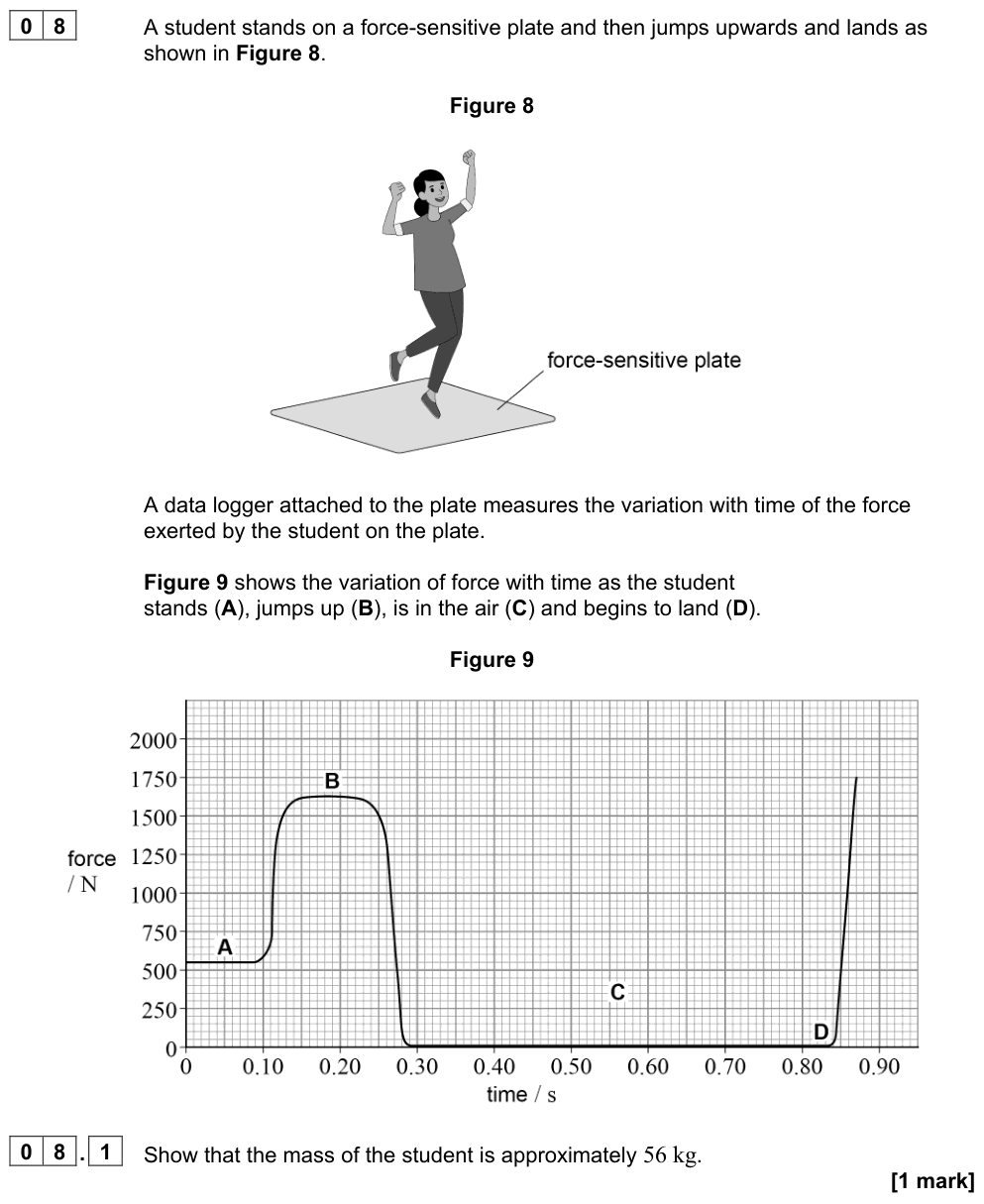
(for a constant force; for a varying force, impulse is the area under the force–time graph).
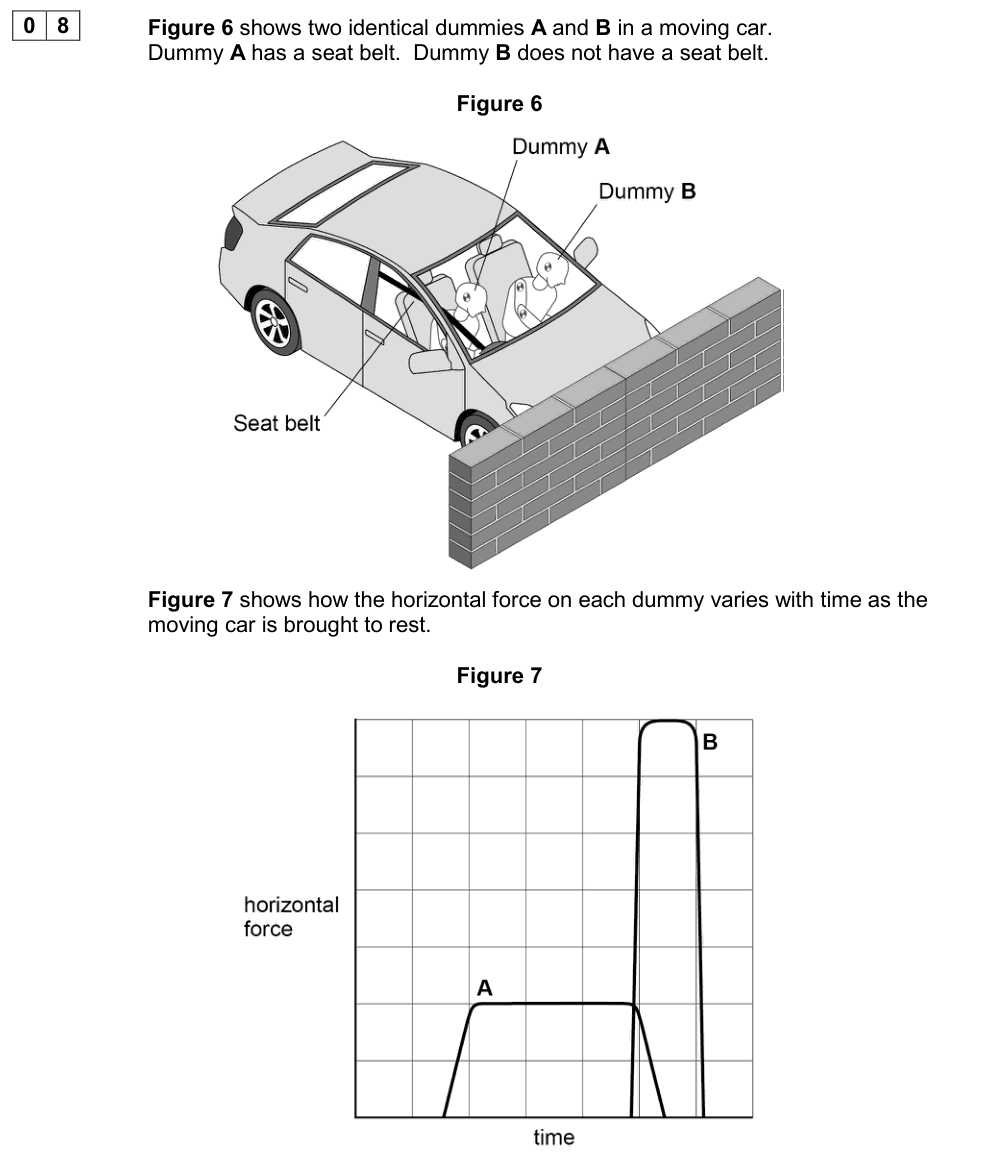
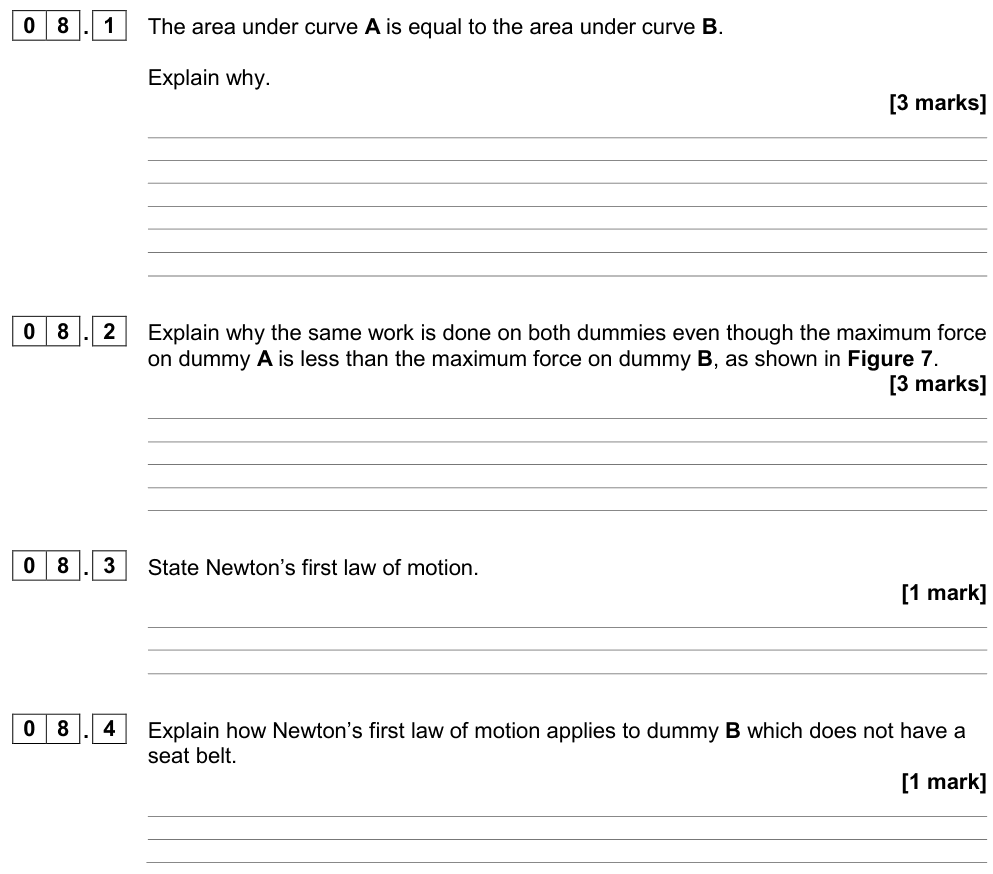
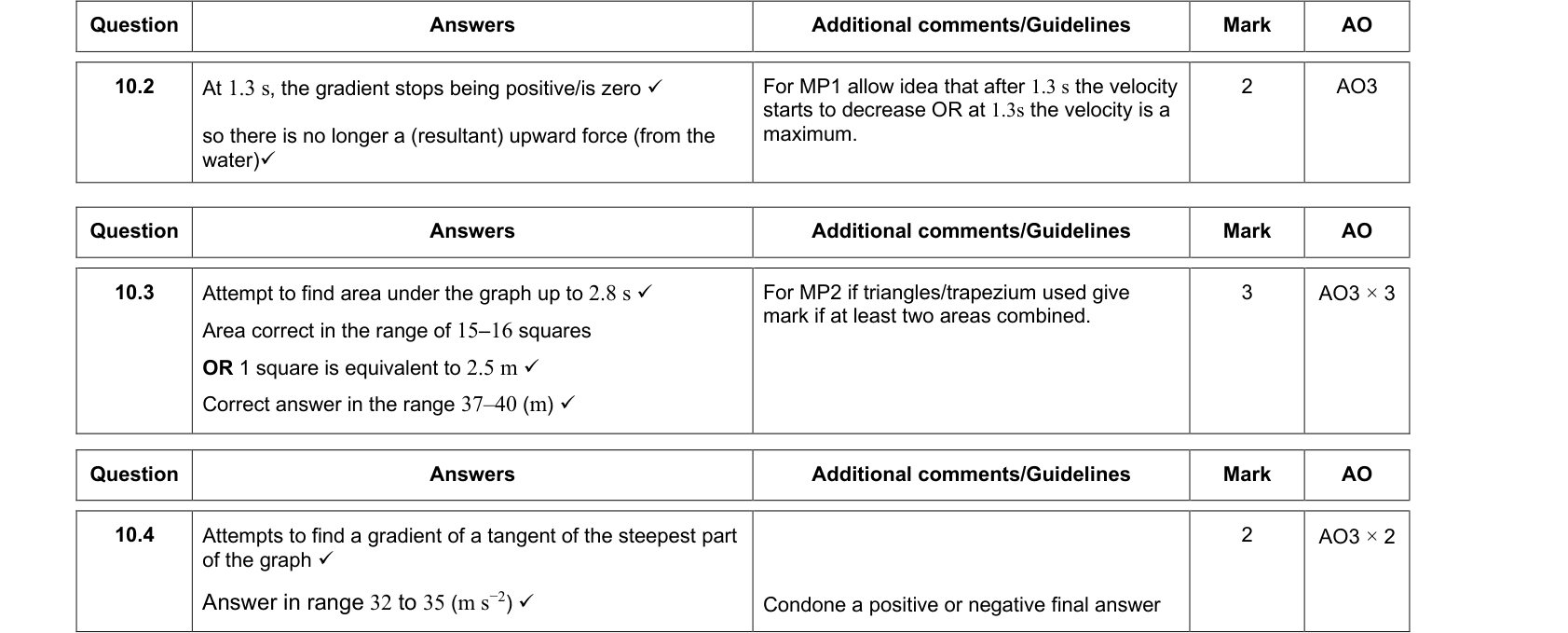
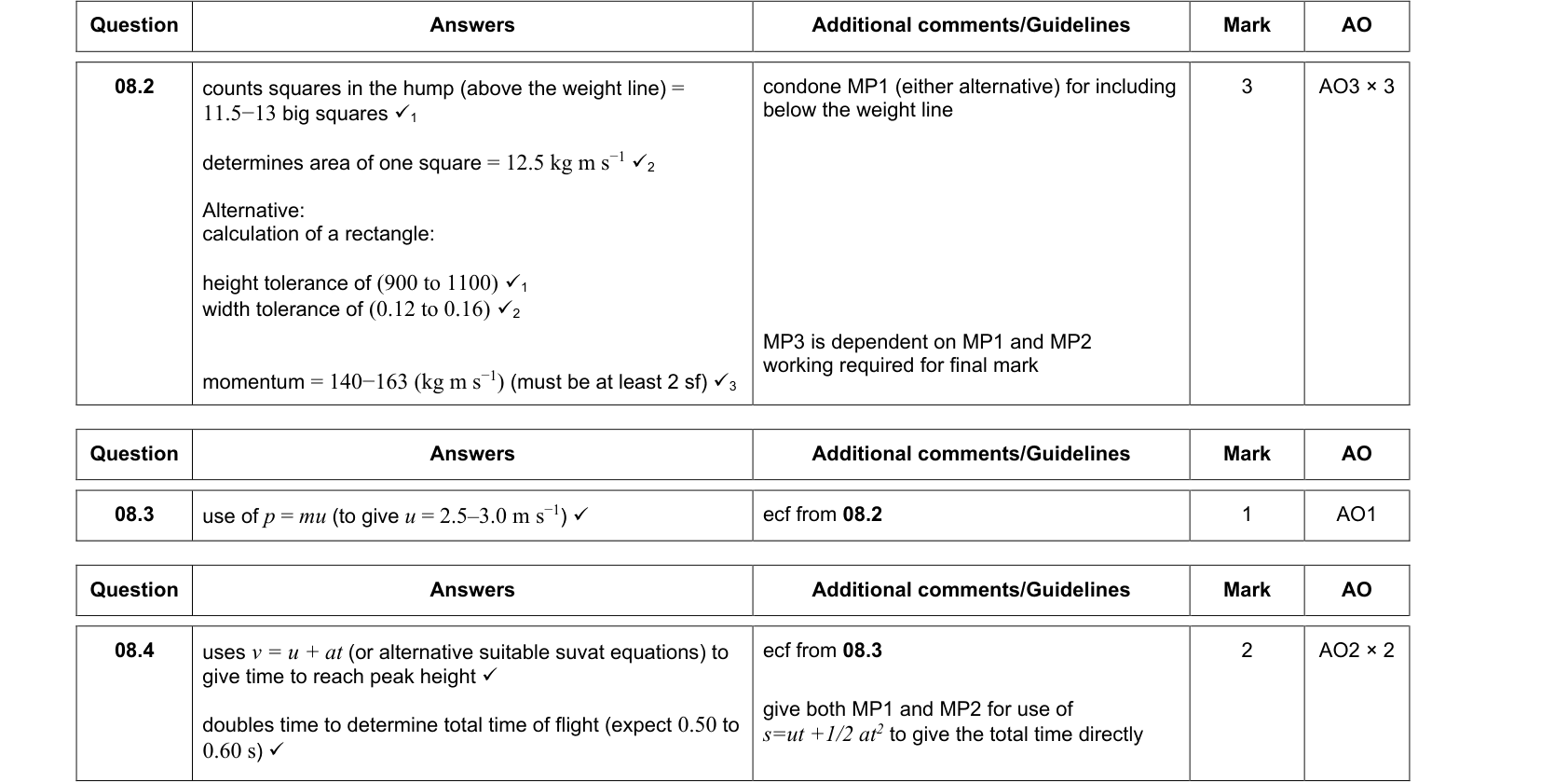
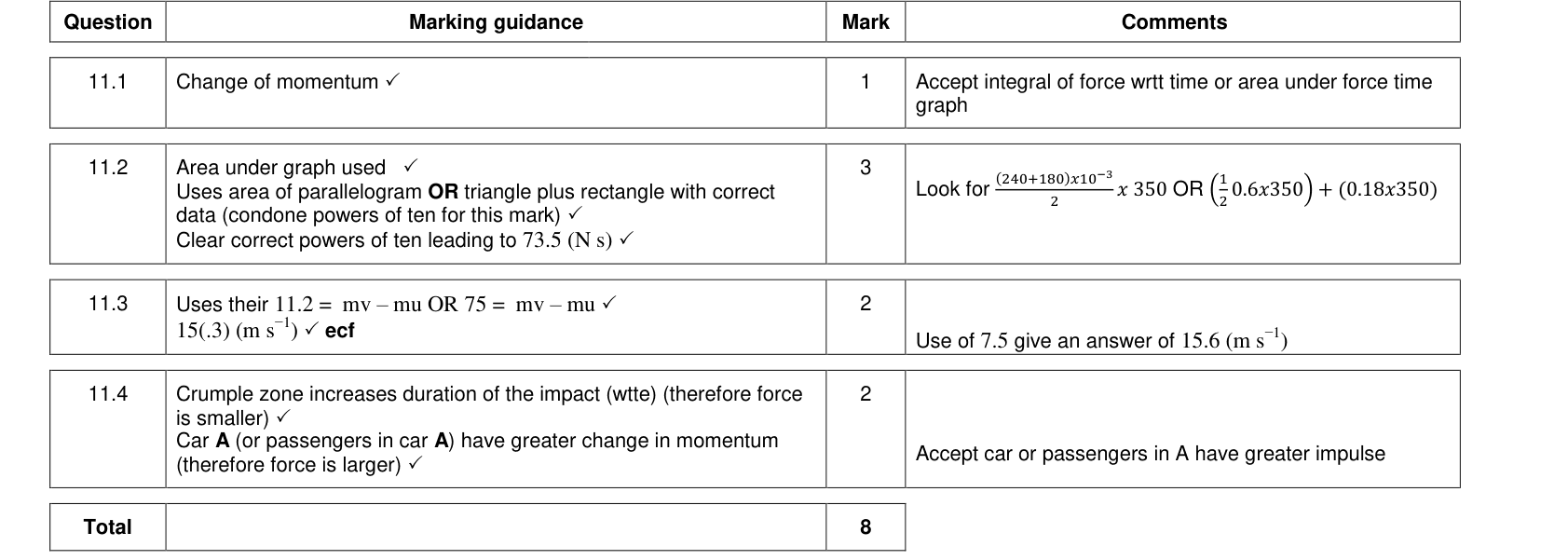
- The area under a force–time graph equals the impulse, which equals the change in momentum. For irregular graphs, count squares or split the area into triangles and rectangles.
- Impulse is a vector in the direction of the force.
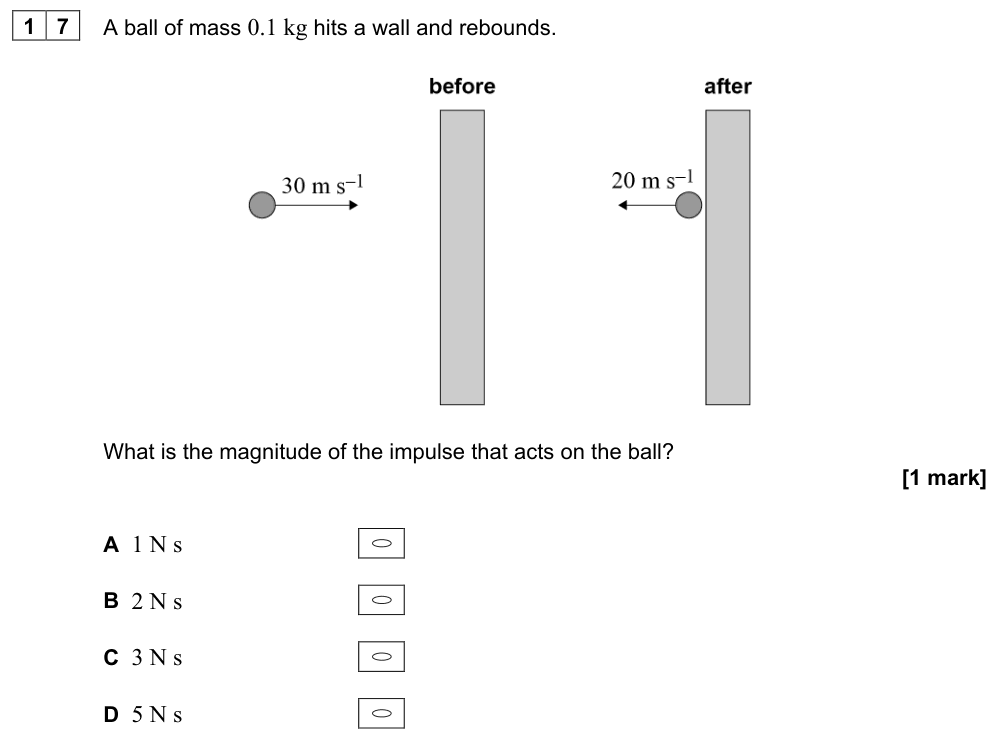
Worked example: ball bouncing off a wall
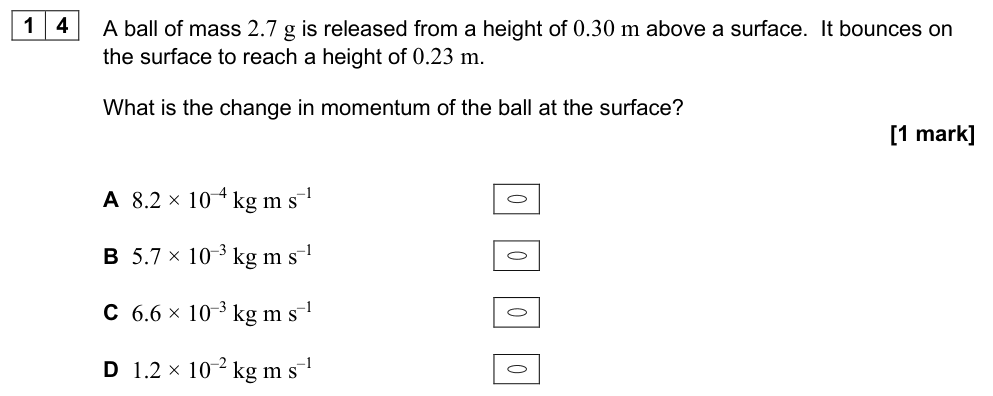
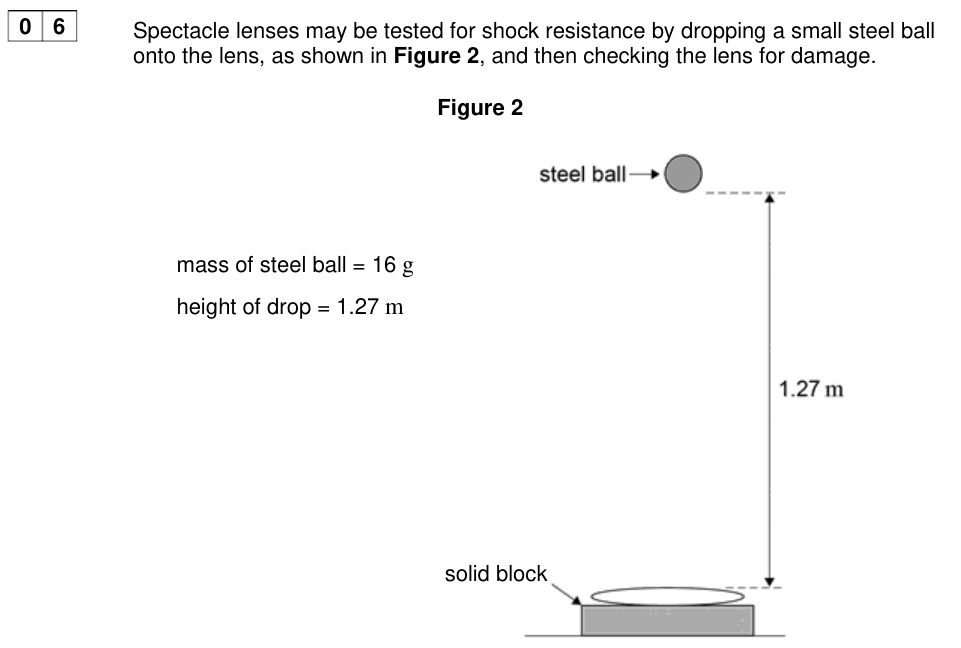
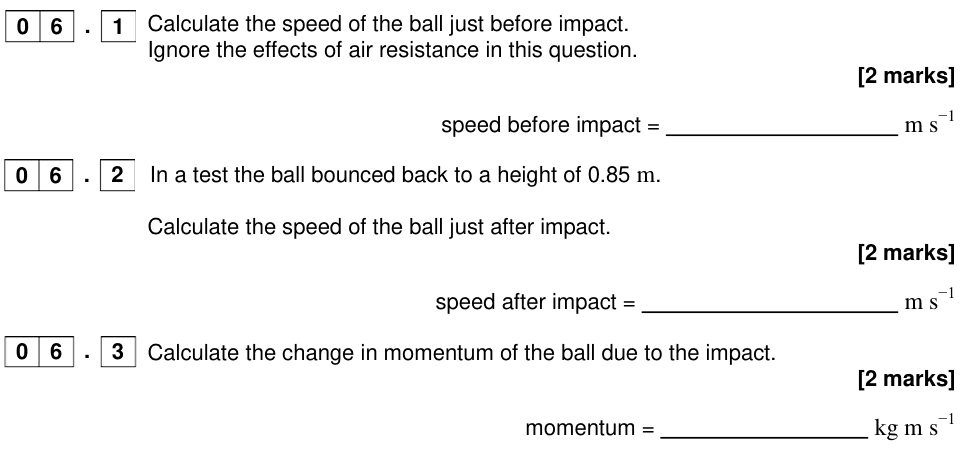
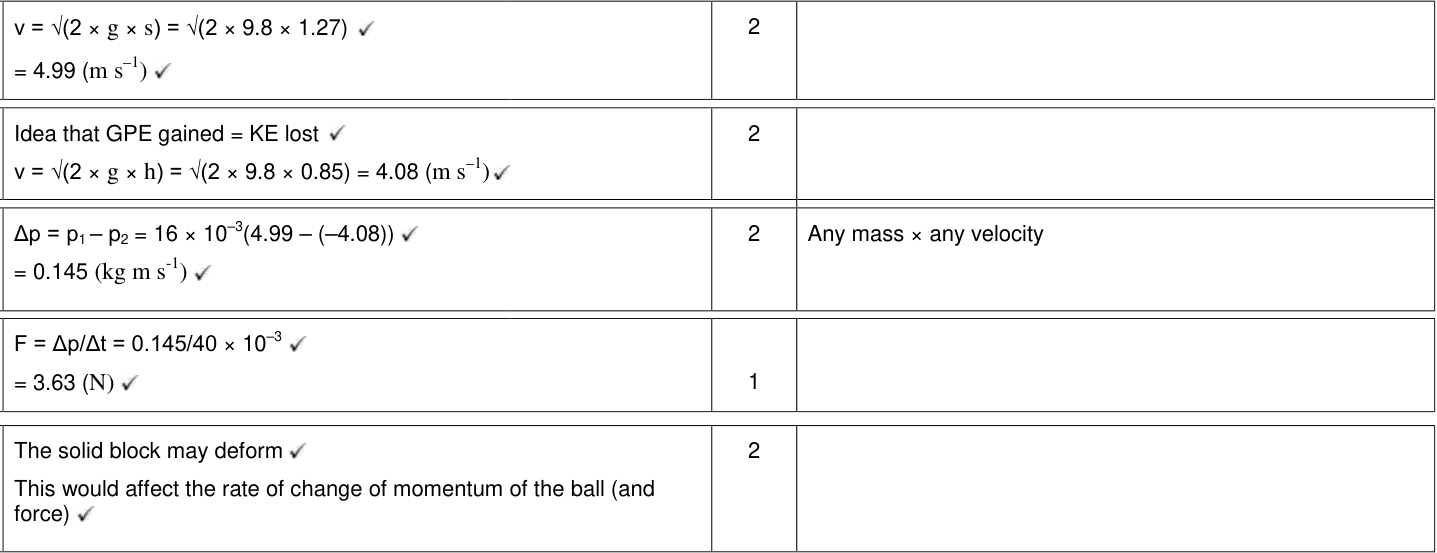
A 0.15 kg ball hits a wall at $20\ \text{m s}^{-1}$ and rebounds at $15\ \text{m s}^{-1}$ along the same line. The contact time is 0.020 s.
Taking the rebound direction as positive: $\Delta p = 0.15(15) - 0.15(-20) = 5.25\ \text{N s}$.
Average force $= \dfrac{5.25}{0.020} = 260\ \text{N}$.
Common mistake
When an object reverses direction the change in velocity is the sum of the speeds ($15 + 20 = 35$), not the difference, because the velocities have opposite signs.
Impact forces and contact times
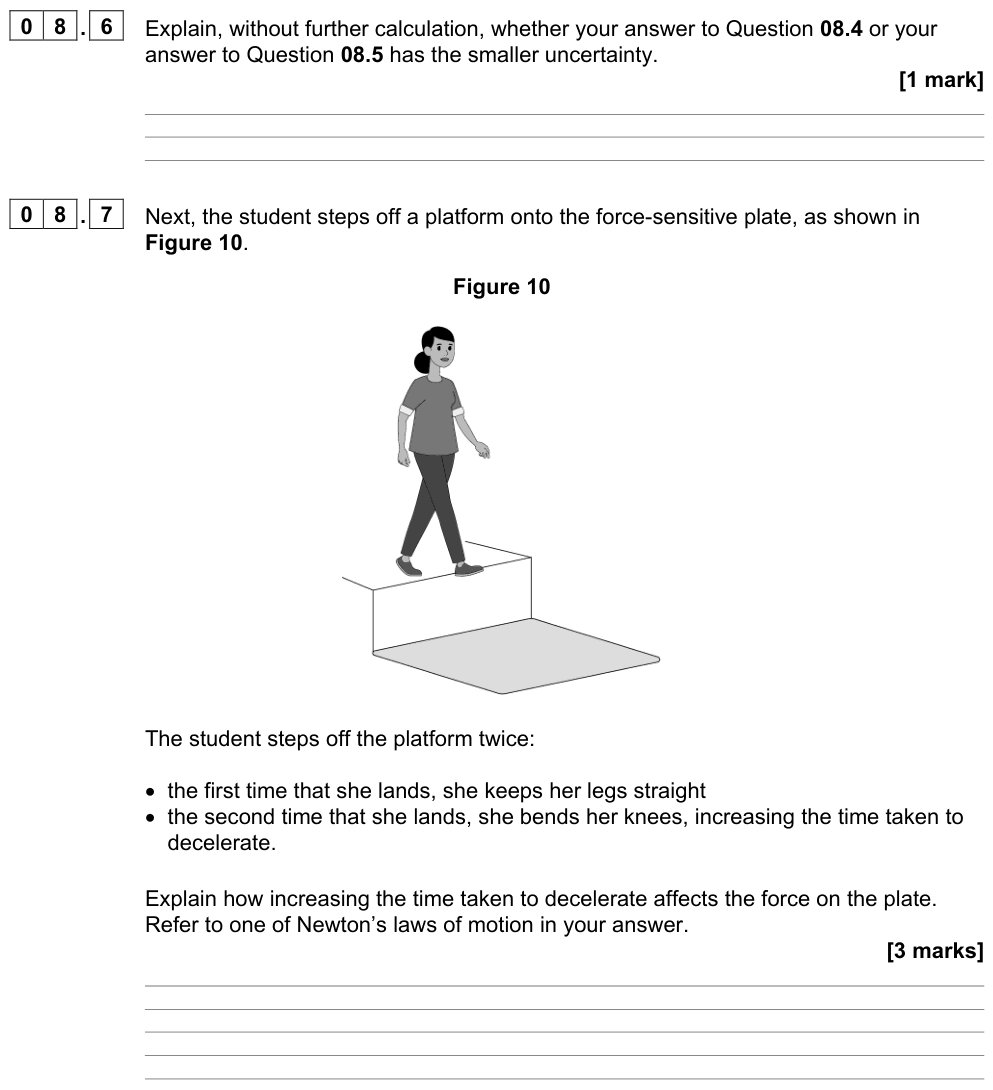
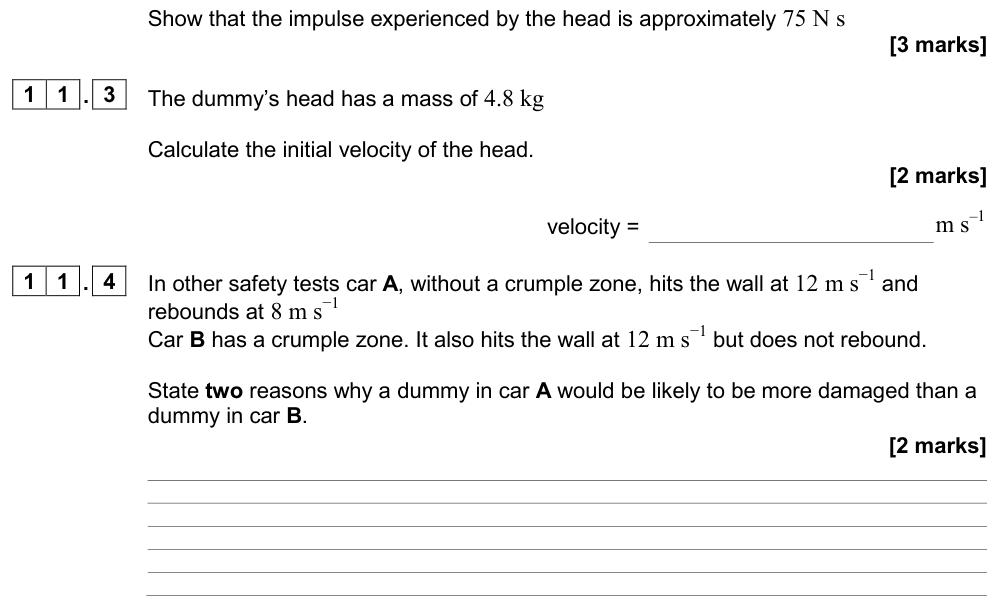
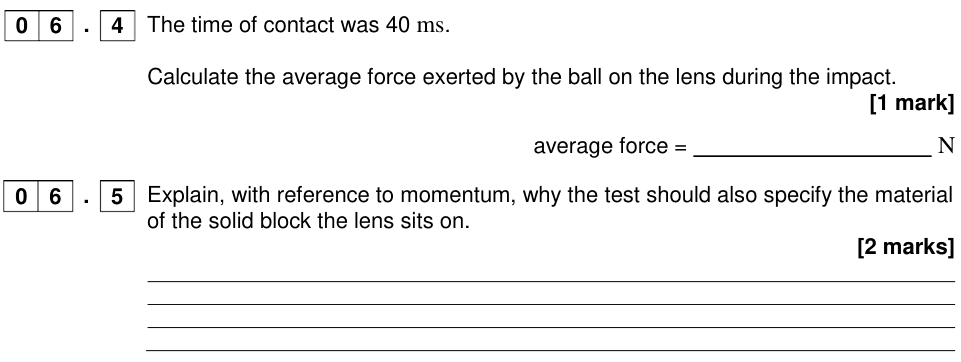
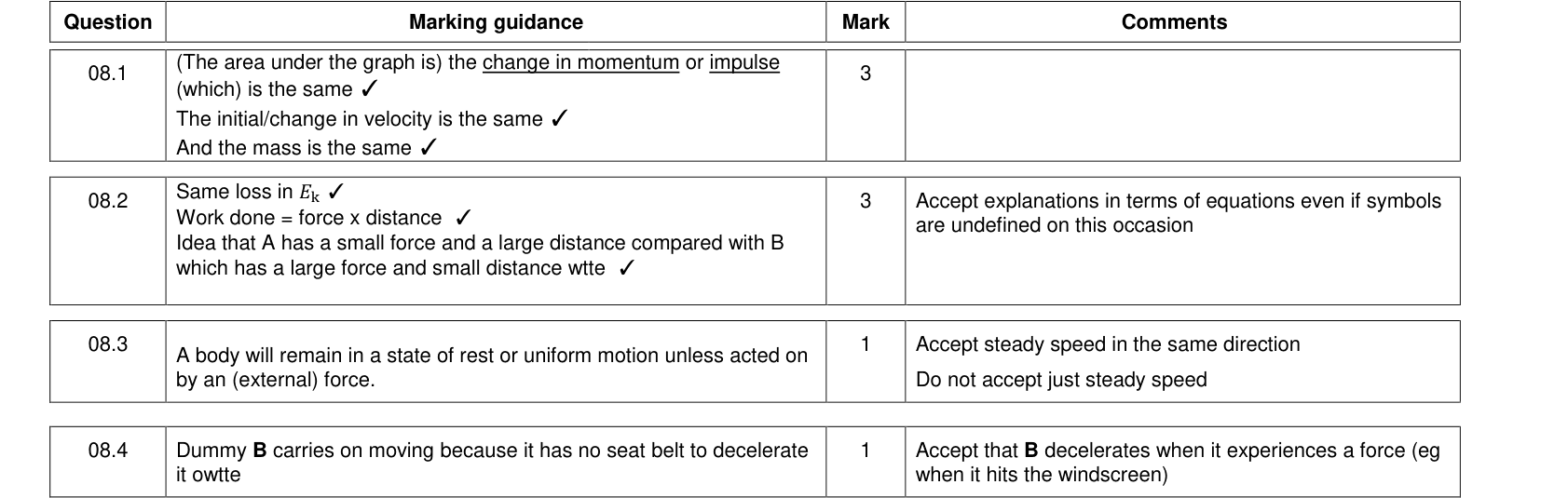
For a given change in momentum, $F = \dfrac{\Delta(mv)}{\Delta t}$: increasing the contact time reduces the average force.
- Crumple zones in cars deform over a longer time, so the passengers' momentum changes more slowly and the force on them is smaller.
- Airbags and seat belts increase the stopping time and spread the force over a larger area.
- Packaging (bubble wrap, polystyrene) increases the time of impact for a dropped object.
- Bending your knees when landing from a jump, or catching a cricket ball while moving your hands backwards, increases $\Delta t$.
- To maximise the force, reduce the contact time (e.g. a hammer hitting a nail). In sport, "following through" when kicking a football keeps the foot in contact for longer, giving a larger impulse and so a larger change in momentum.
Try the Force–time graph diagram in the Interactive tab to see that the same area (impulse) can be produced by a large force for a short time or a small force for a long time.
Summary
- $p = mv$ (vector, kg m s⁻¹ = N s). Total momentum is conserved when no external force acts.
- Elastic: kinetic energy conserved; inelastic: kinetic energy not conserved. Momentum is conserved in both.
- Explosions from rest: total momentum stays zero; pieces have equal and opposite momenta.
- $F = \Delta(mv)/\Delta t$; impulse $F\Delta t = \Delta(mv)$ = area under the force–time graph.
- Longer contact time → smaller force (crumple zones, airbags, packaging).