A simple model of the atom
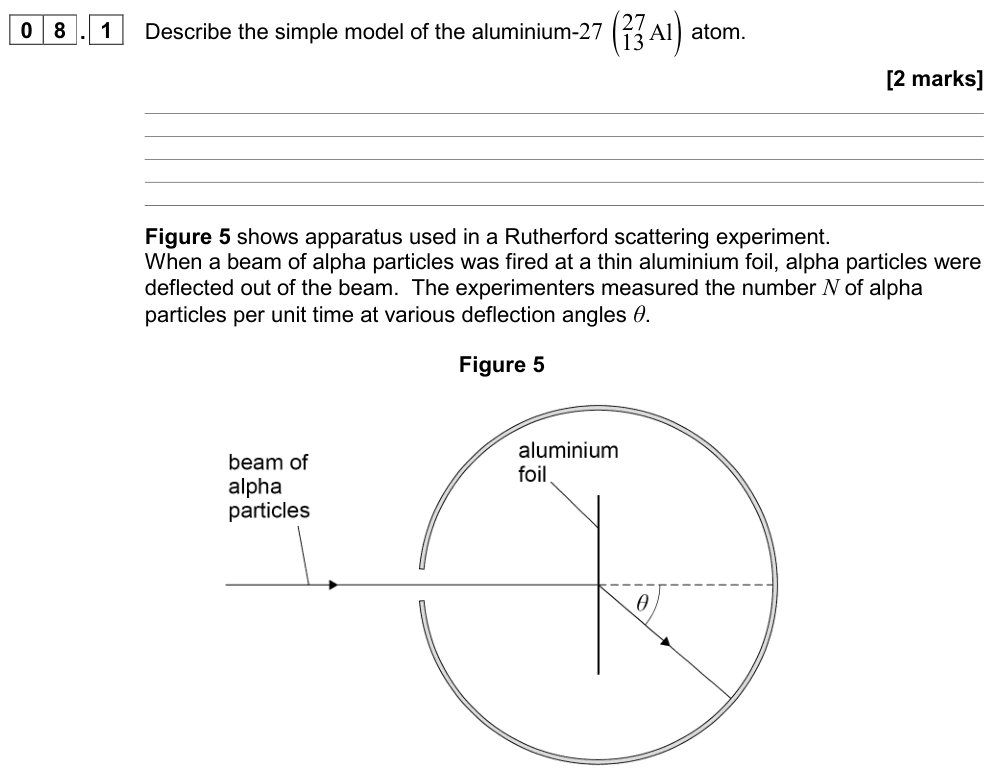
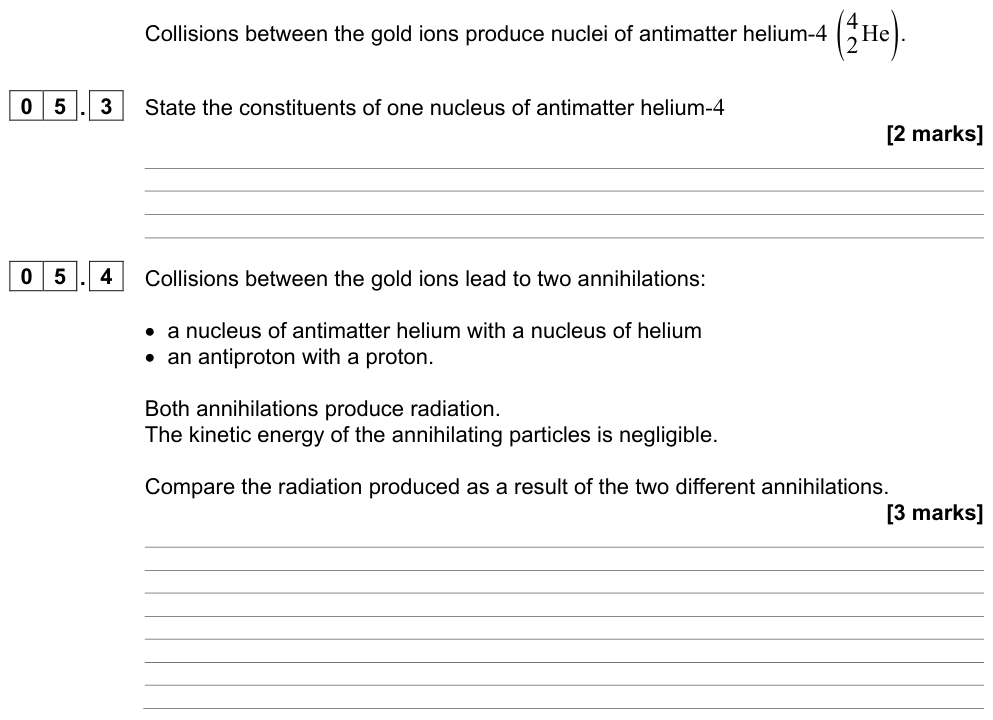
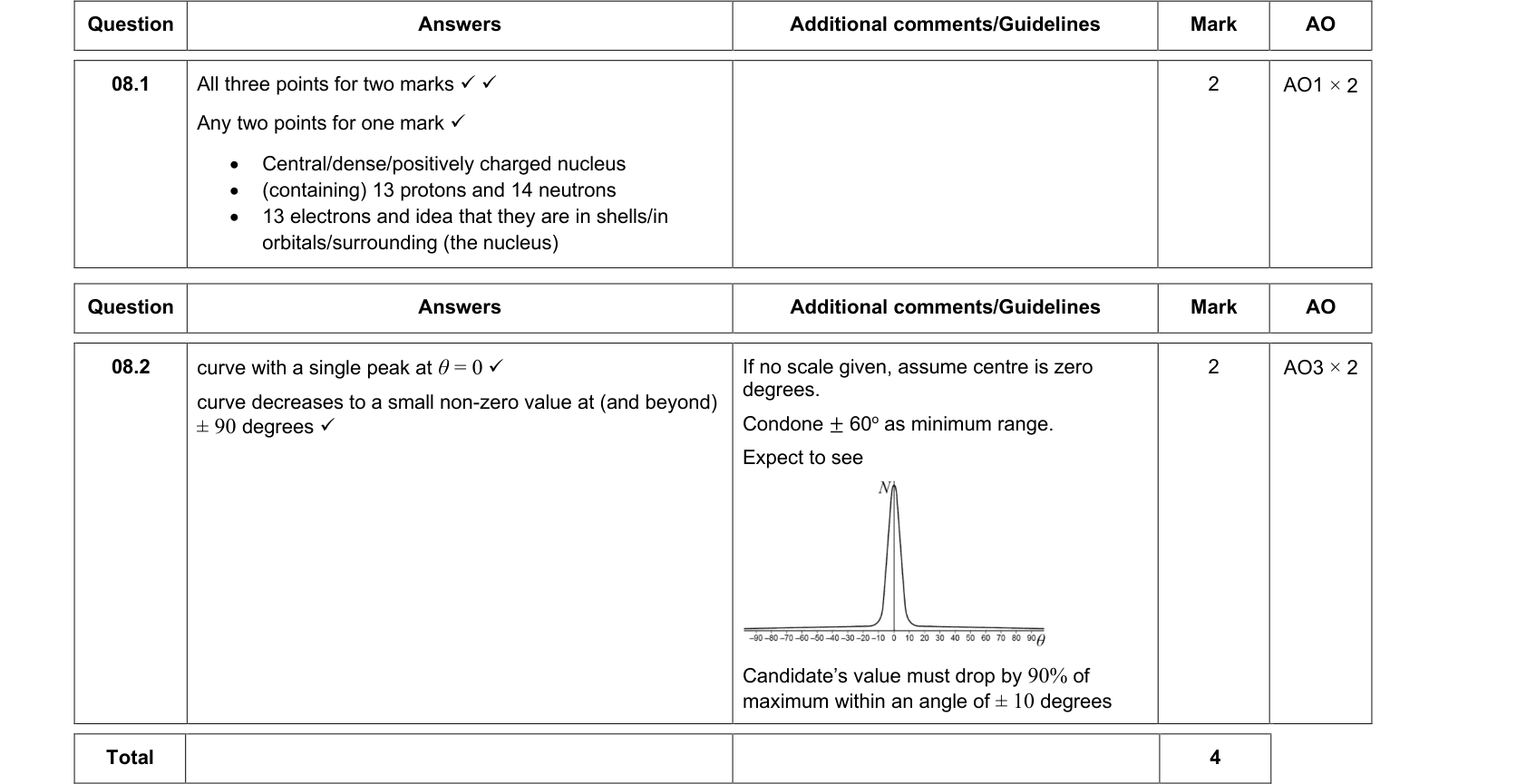
An atom has a tiny, dense, positively charged nucleus containing protons and neutrons (together called nucleons), surrounded by electrons in shells (energy levels).
| Particle | Charge / C | Relative charge | Mass / kg | Relative mass |
|---|---|---|---|---|
| proton | $+1.60 \times 10^{-19}$ | +1 | $1.673 \times 10^{-27}$ | 1 |
| neutron | 0 | 0 | $1.675 \times 10^{-27}$ | 1 |
| electron | $-1.60 \times 10^{-19}$ | −1 | $9.11 \times 10^{-31}$ | 1/1840 (≈ 0.0005) |
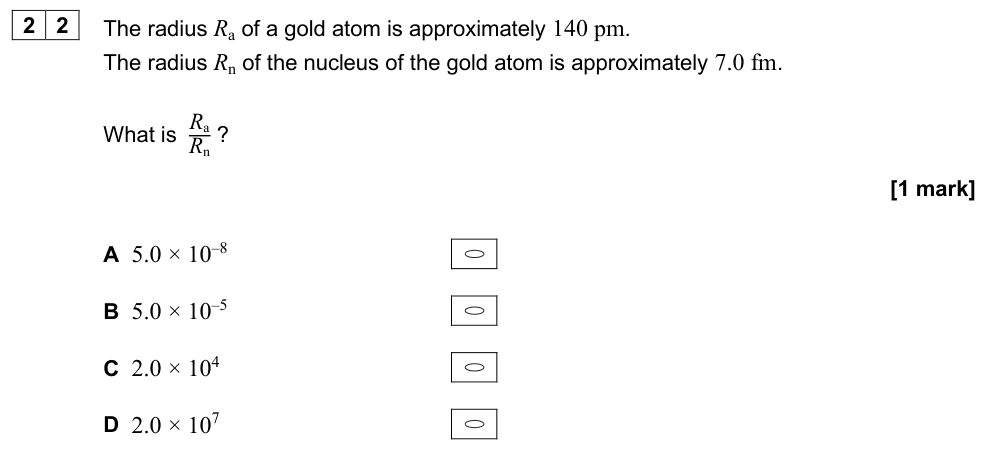
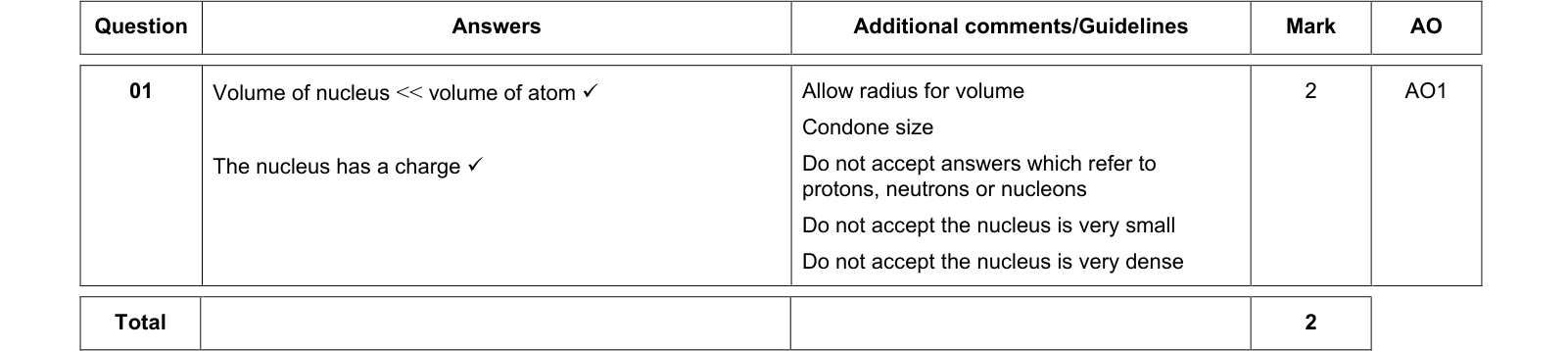
- The atom is about $10^{-10}$ m across. The nucleus is about $10^{-15}$–$10^{-14}$ m across, roughly 100 000 times smaller.
- Almost all the mass is in the nucleus. Most of the atom is empty space.
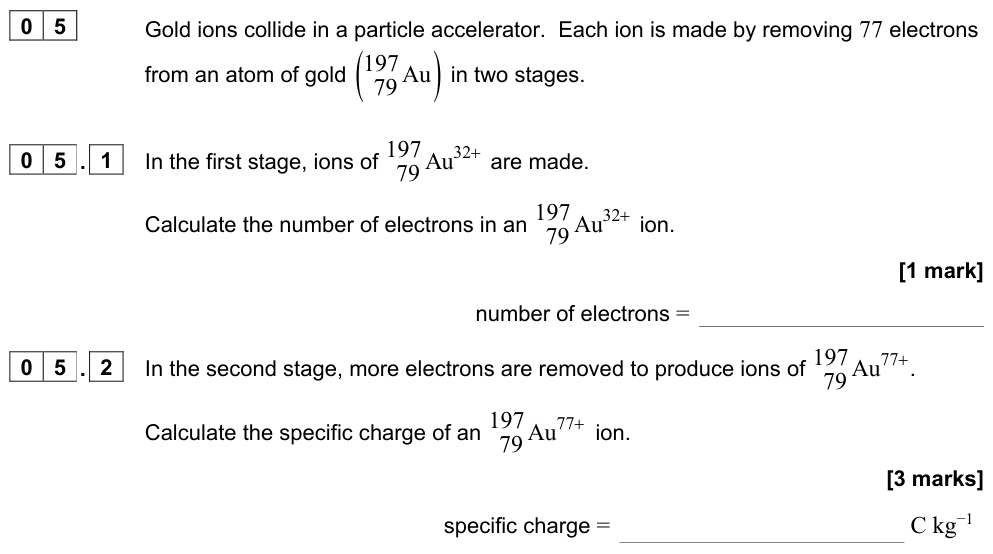
- A neutral atom has equal numbers of protons and electrons. An ion has gained or lost electrons. A positive ion has lost electrons.
Proton number, nucleon number and nuclide notation
Proton and nucleon number
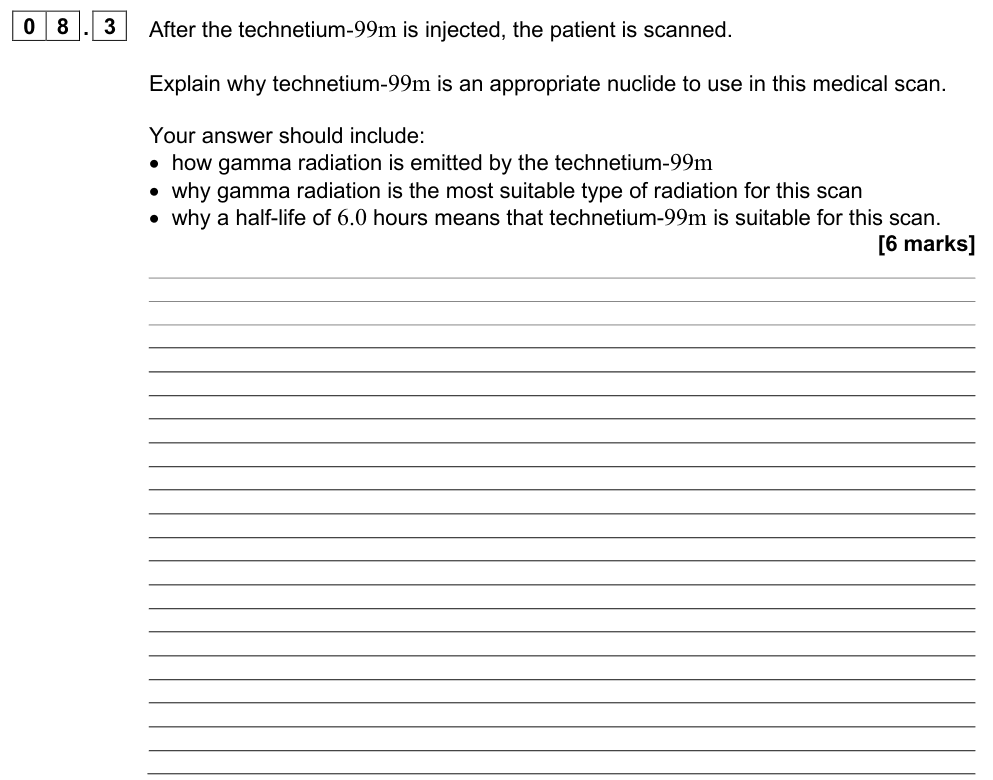
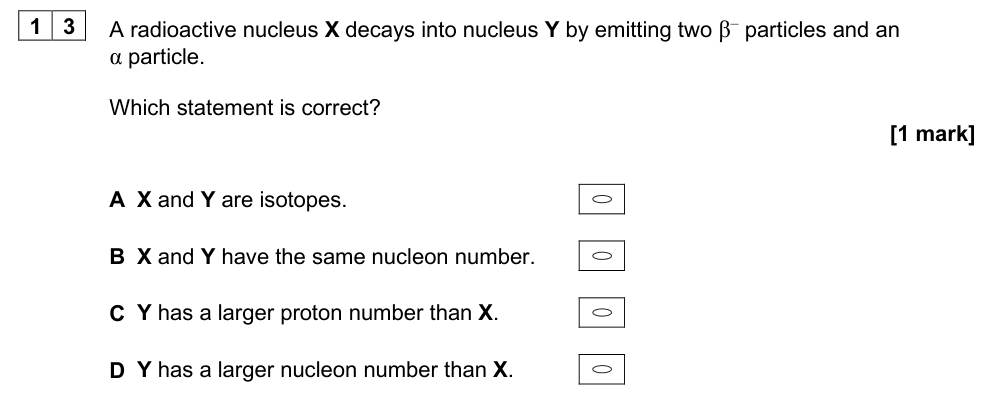
Proton number $Z$ (atomic number): the number of protons in the nucleus. It defines the element.
Nucleon number $A$ (mass number): the total number of protons and neutrons.
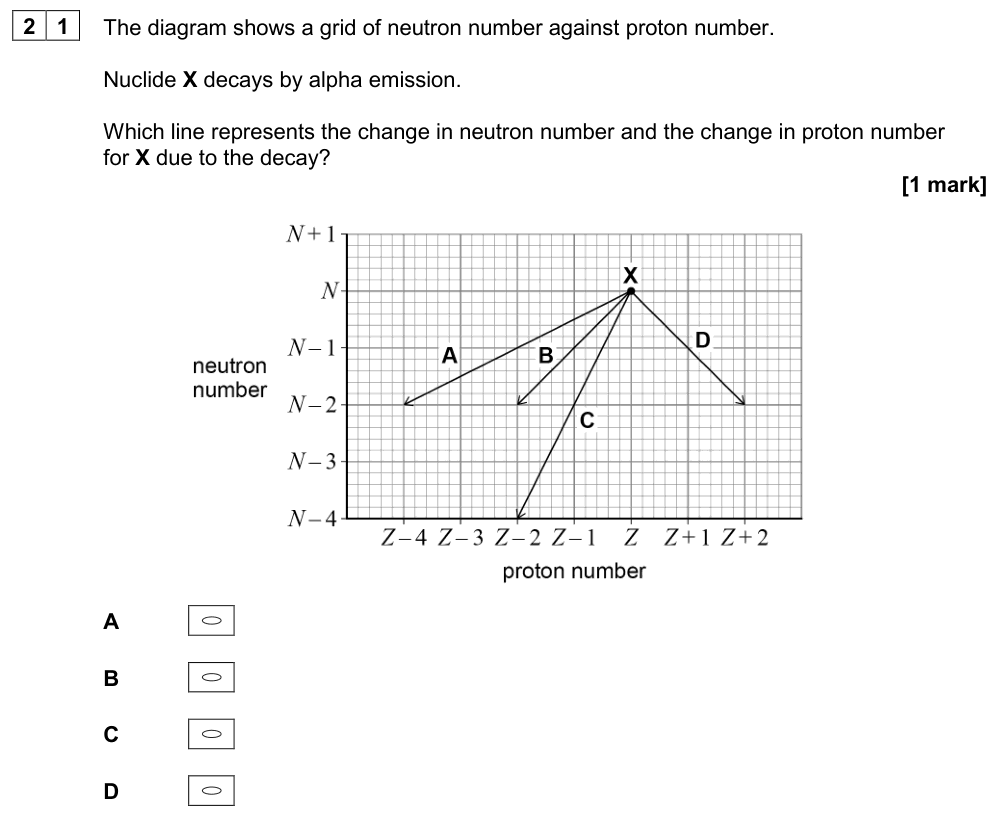
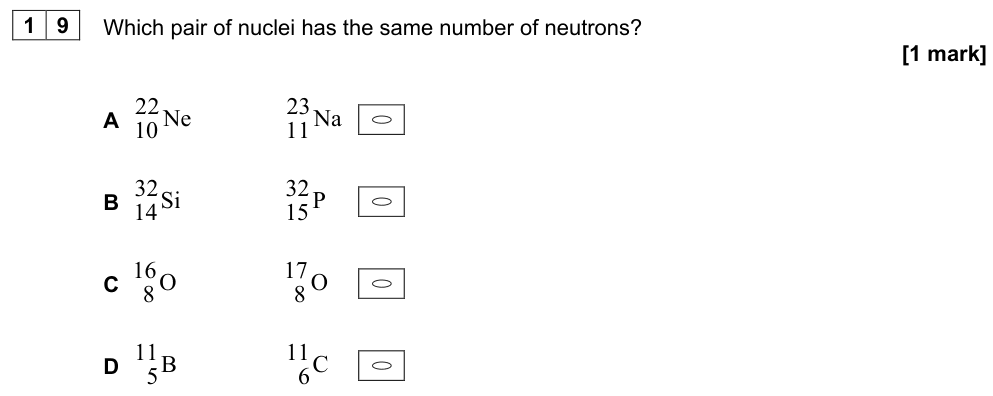
Number of neutrons $N = A - Z$.
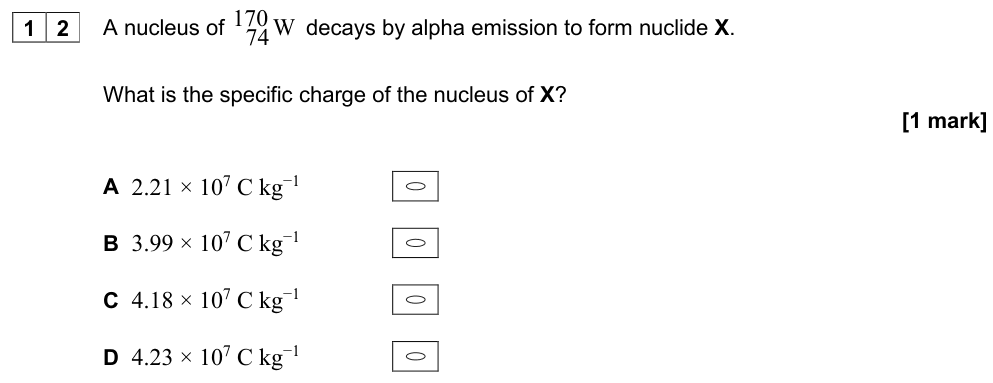
A nuclide is written in the notation
$${}^{A}_{Z}\text{X} \qquad \text{e.g.}\quad {}^{12}_{6}\text{C},\ \ {}^{238}_{92}\text{U},\ \ {}^{4}_{2}\text{He}$$
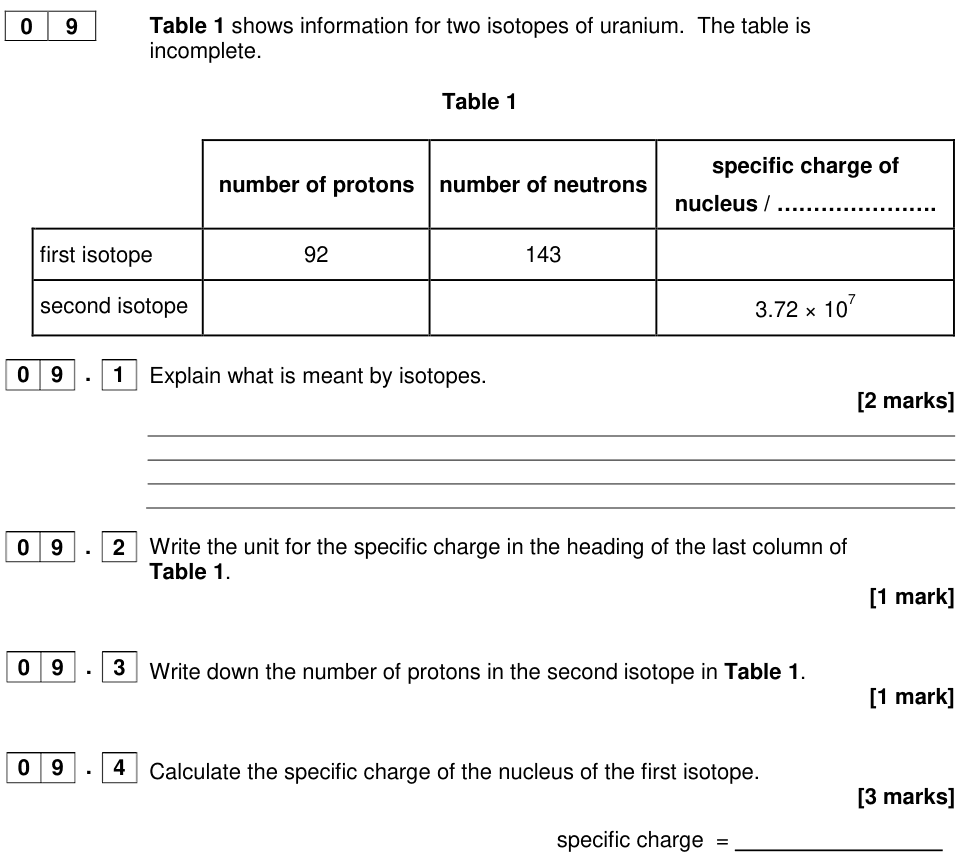
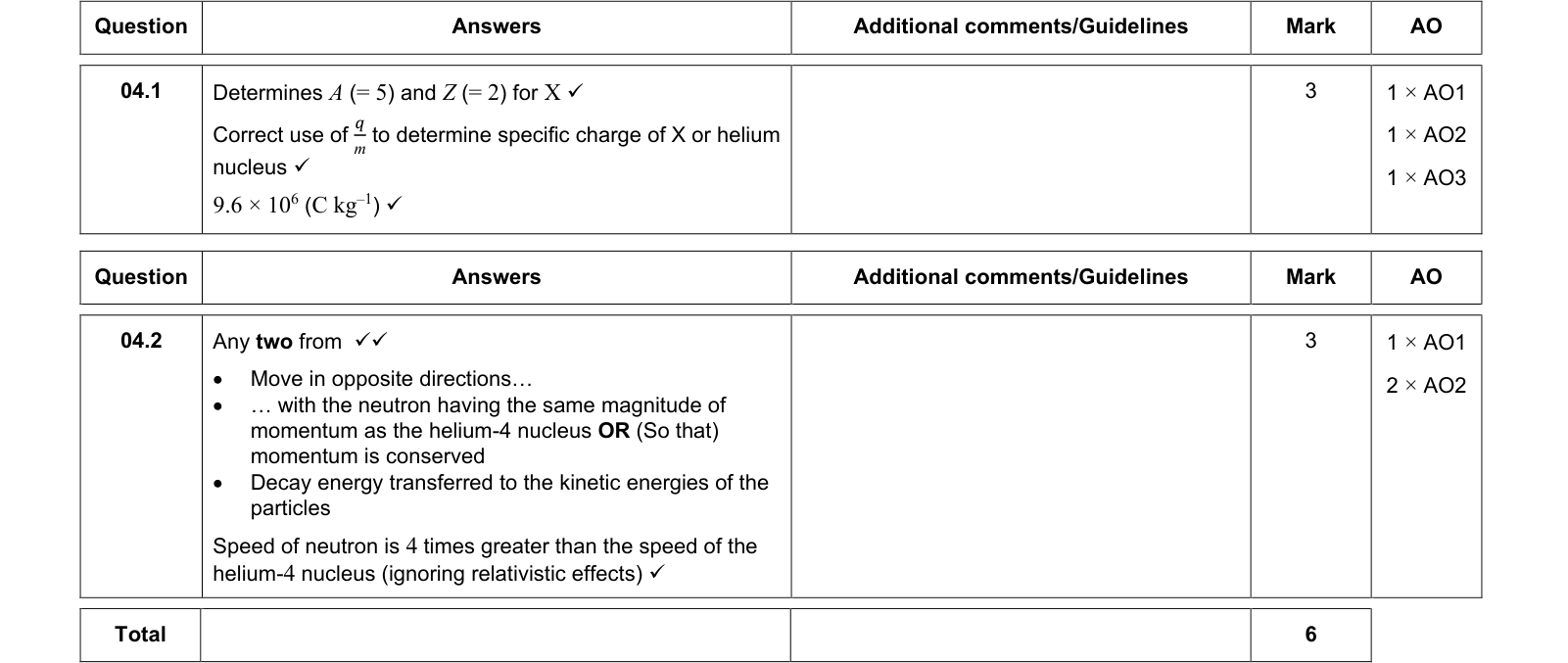
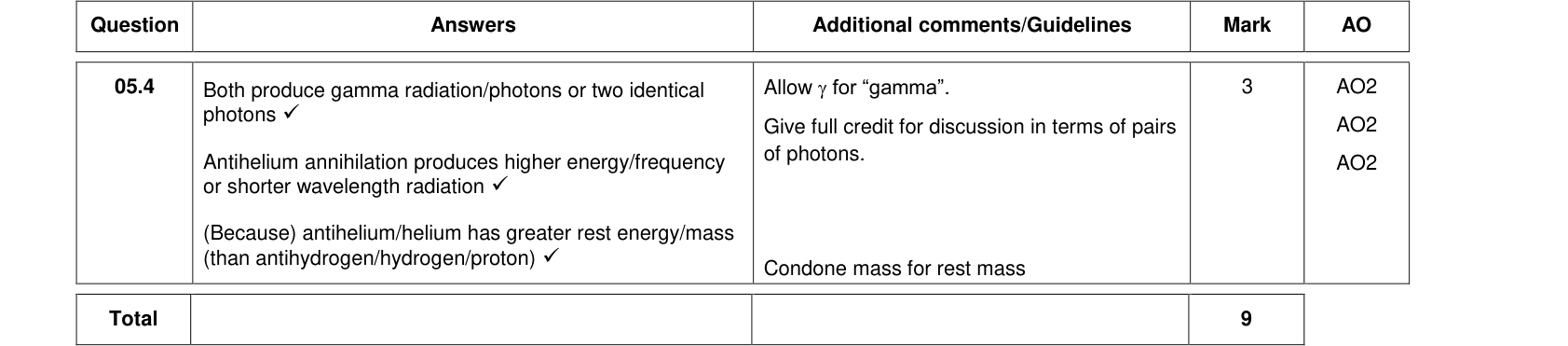
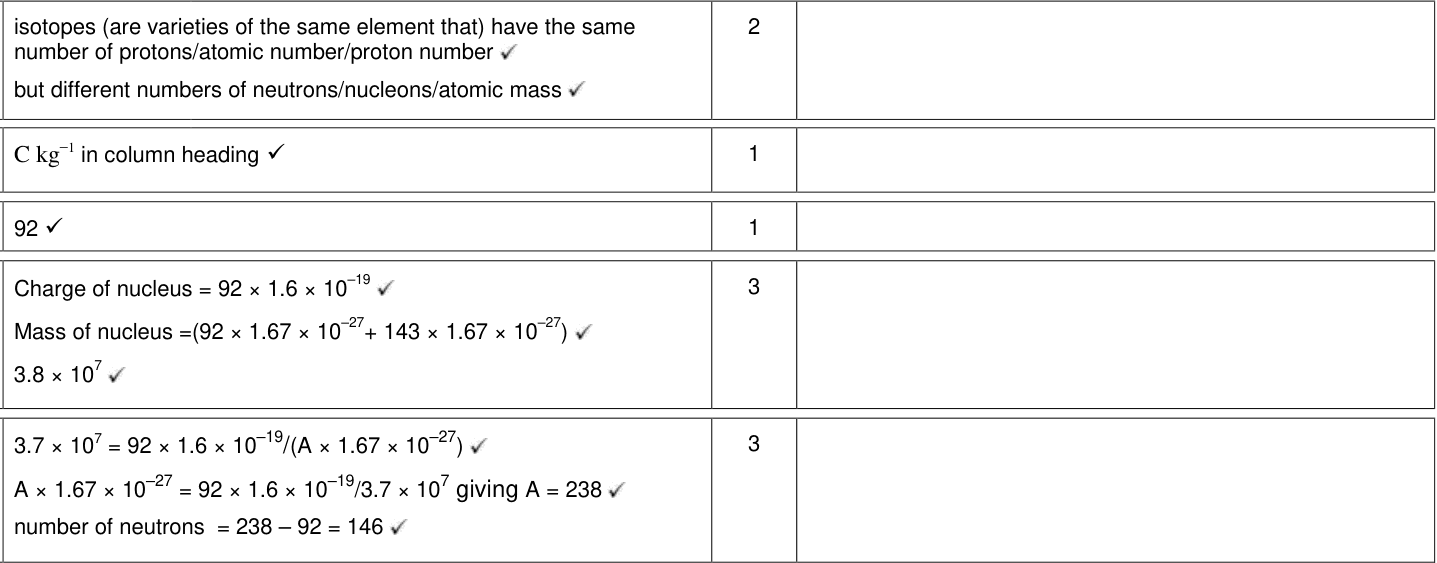
Isotopes are nuclei of the same element (same $Z$) with different numbers of neutrons (different $A$). Carbon-12 and carbon-14 are isotopes of carbon: both have 6 protons, but they have 6 and 8 neutrons. Isotopes have the same chemical properties but may differ in their nuclear stability.
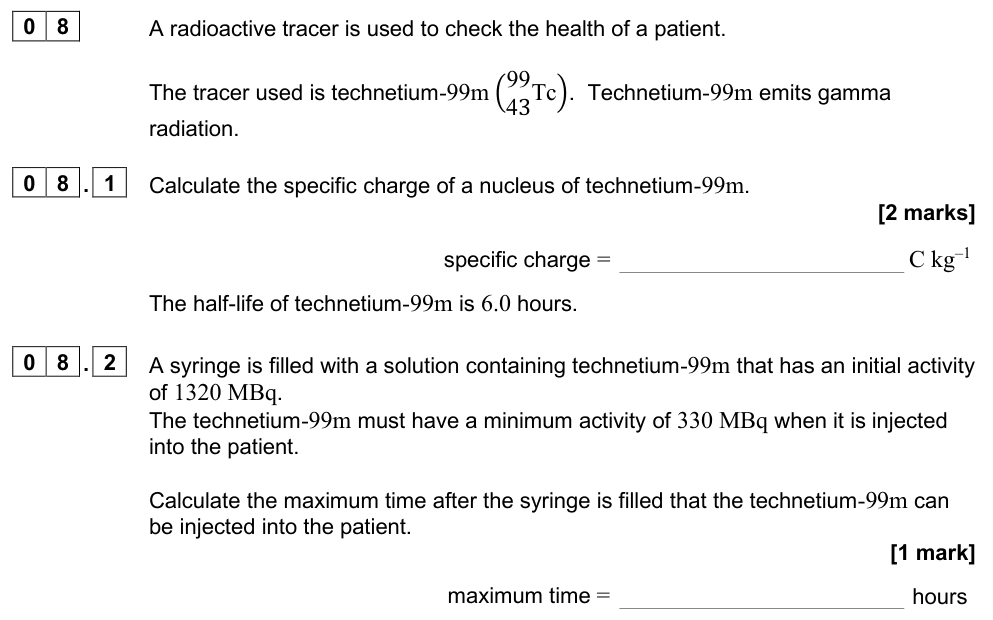
Specific charge
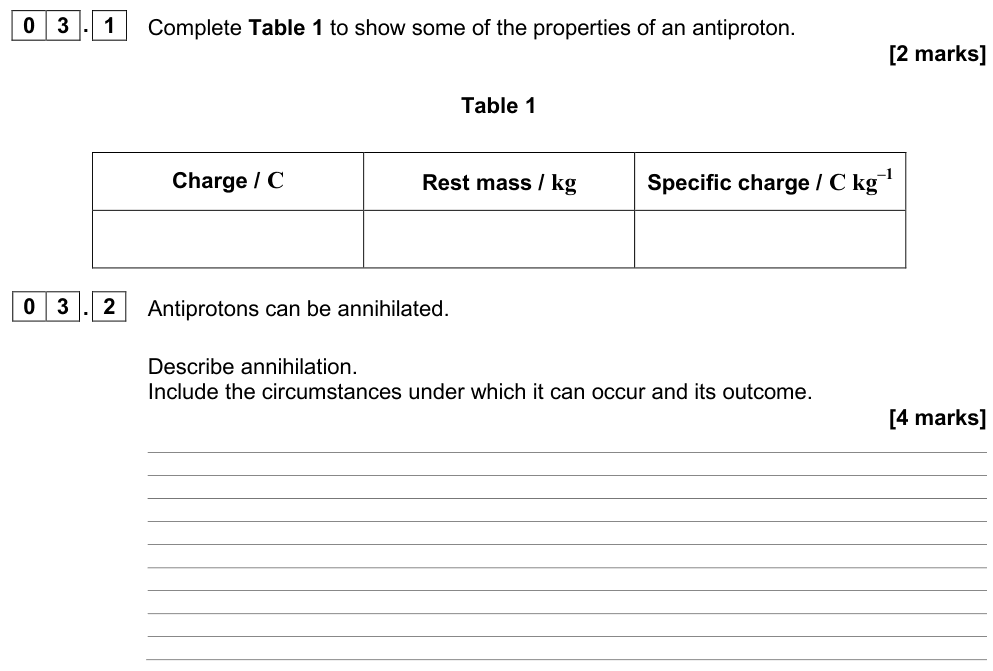
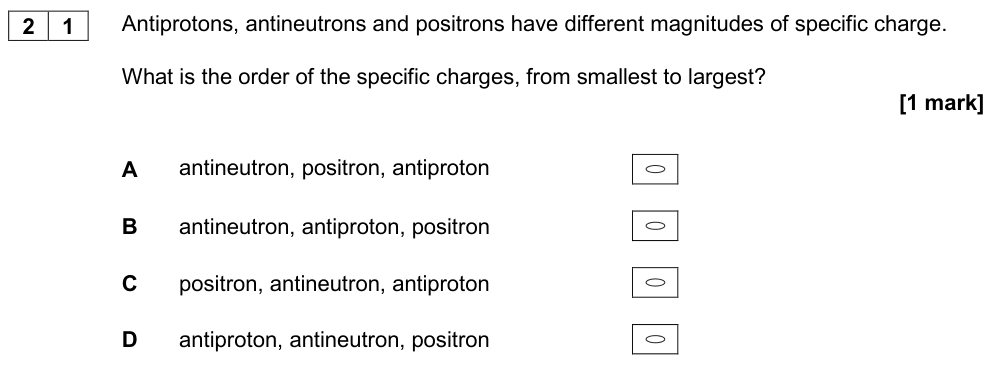
Specific charge
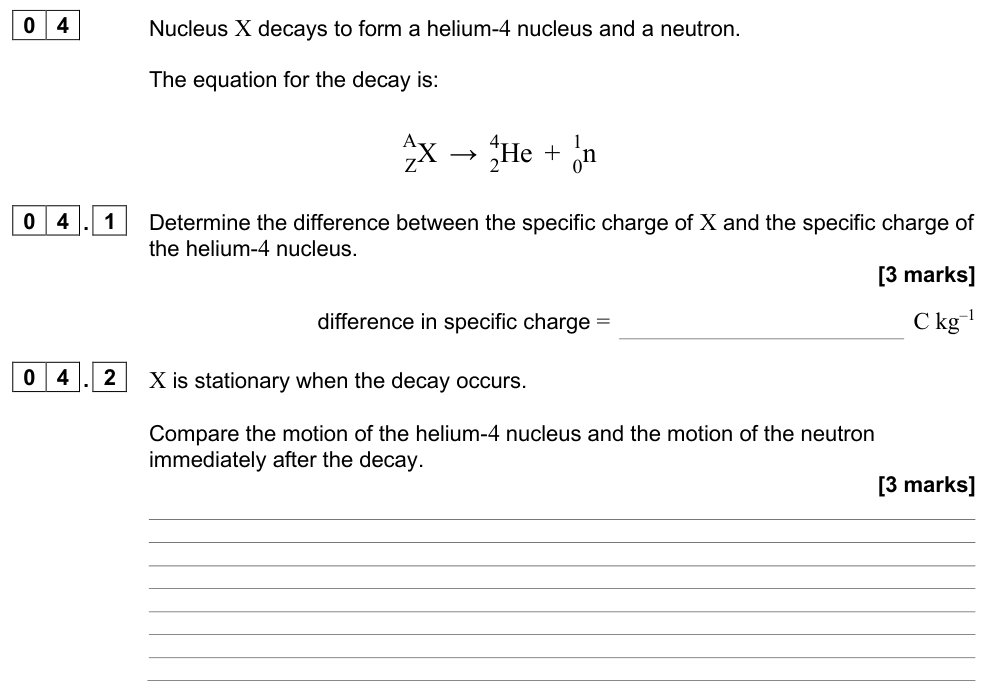
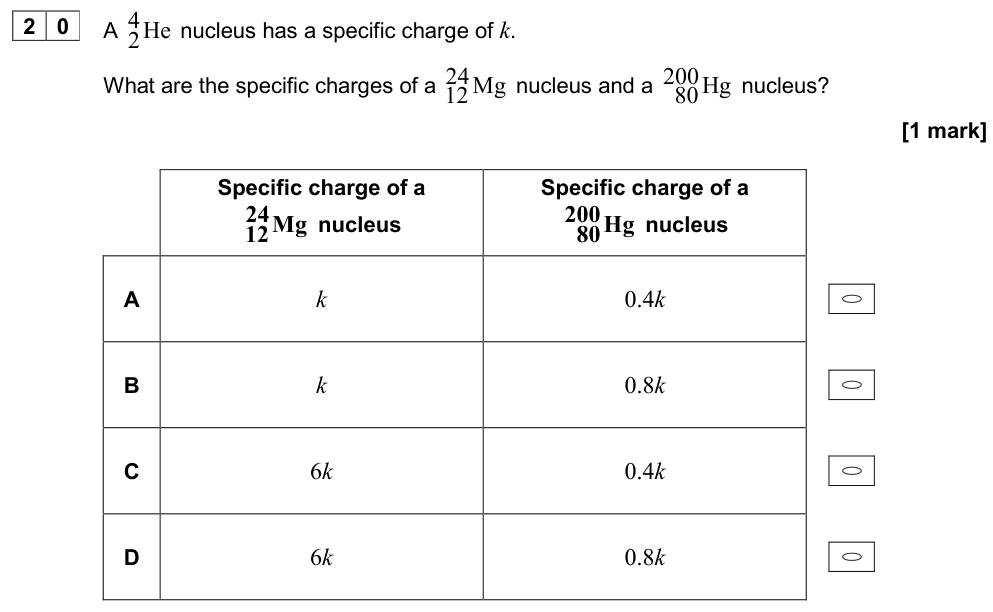
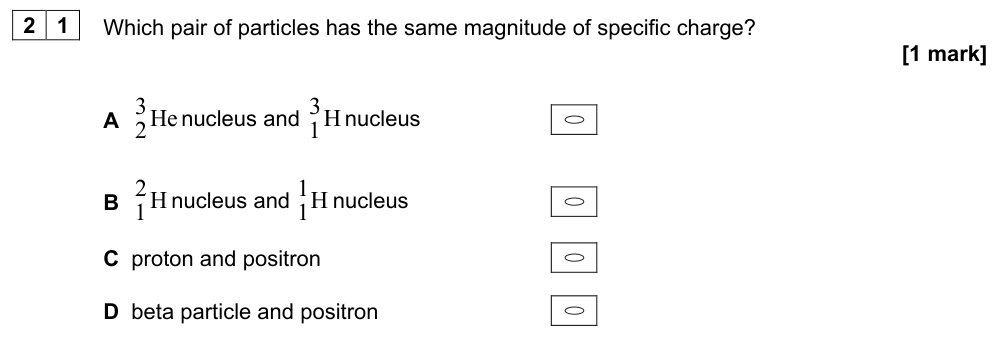
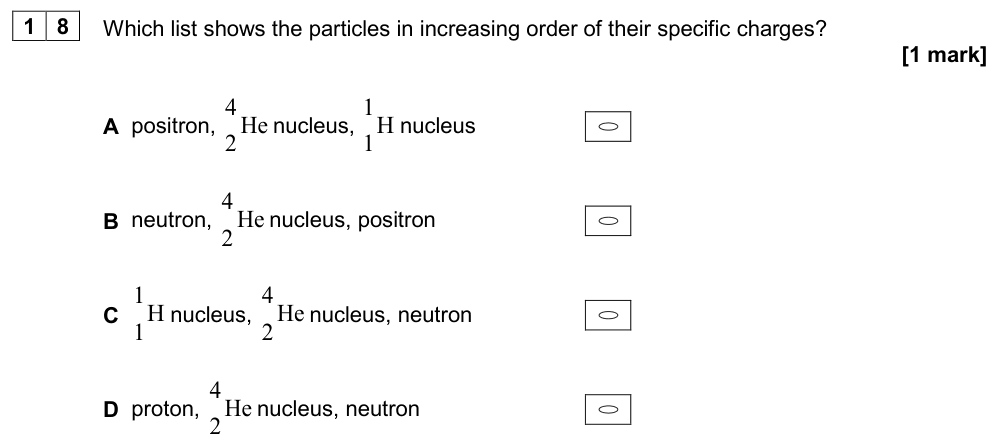
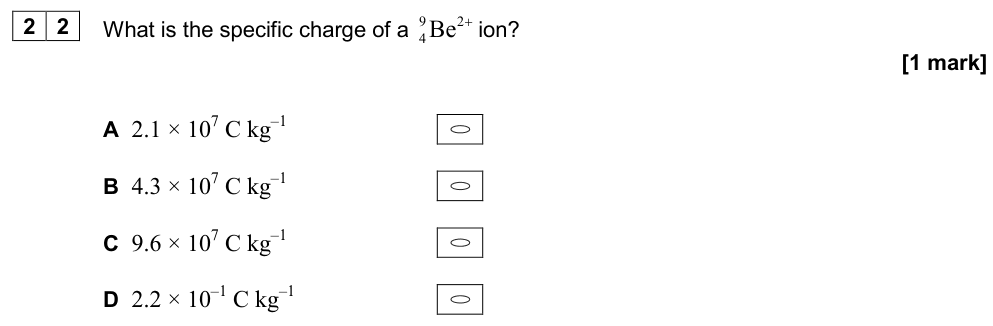
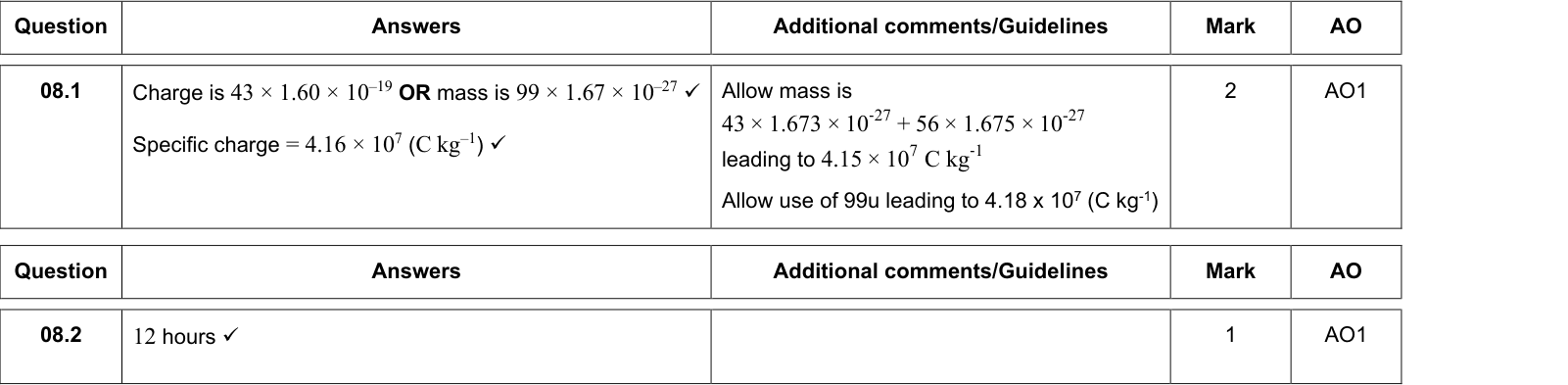
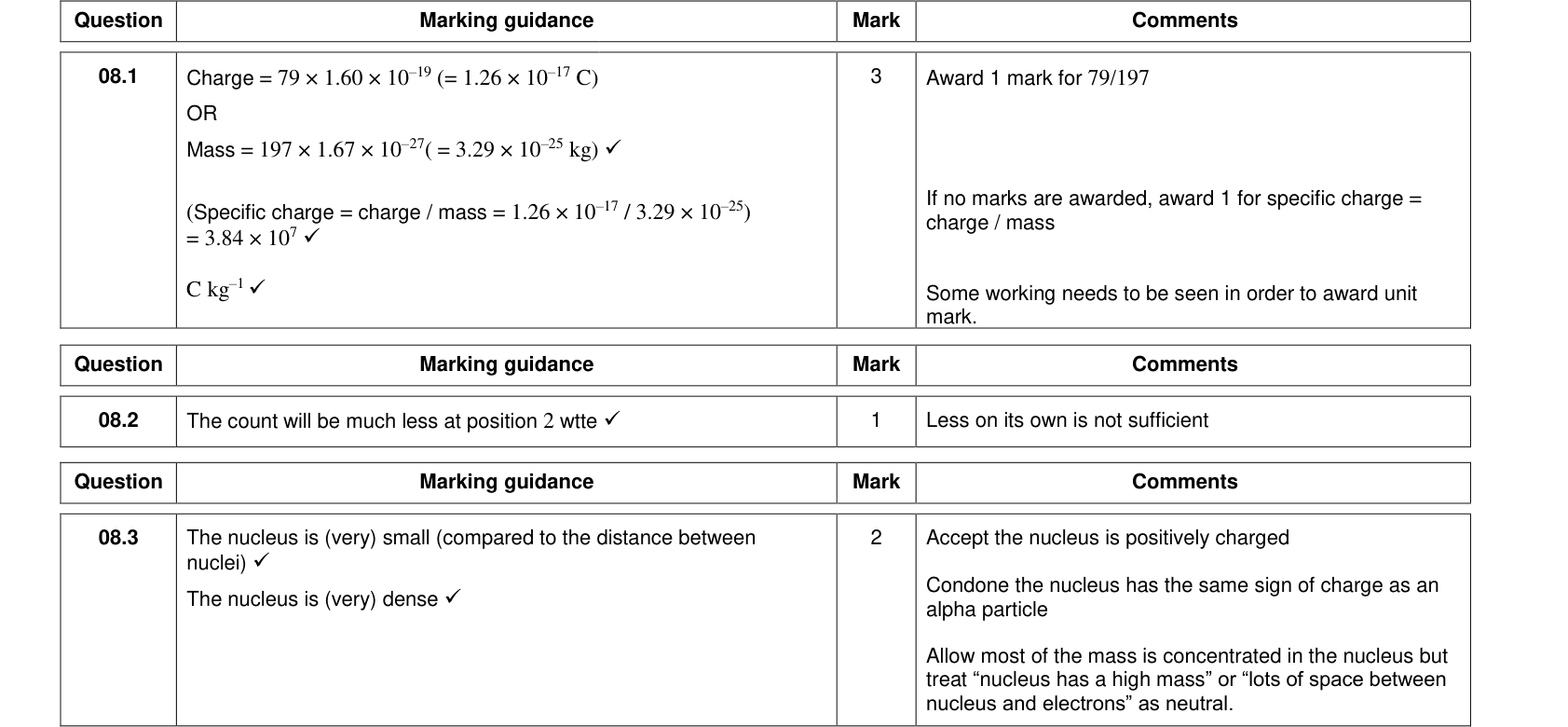
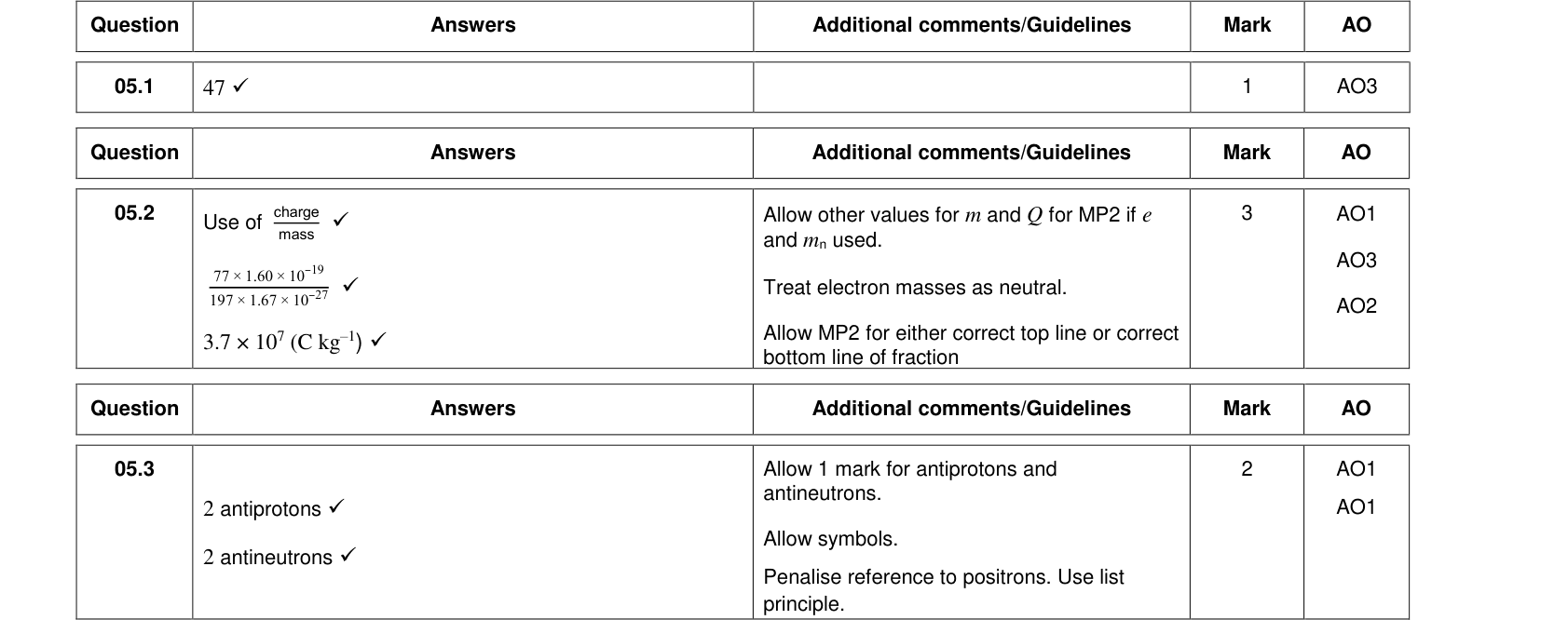
$$\text{specific charge} = \frac{\text{charge}}{\text{mass}} \qquad \text{unit: C kg}^{-1}$$
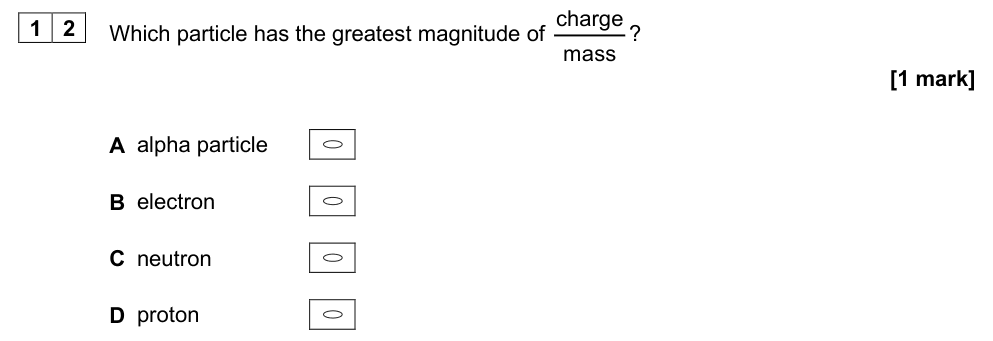
| Particle | Specific charge / C kg⁻¹ |
|---|---|
| electron | $\dfrac{1.60 \times 10^{-19}}{9.11 \times 10^{-31}} = 1.76 \times 10^{11}$ (magnitude) |
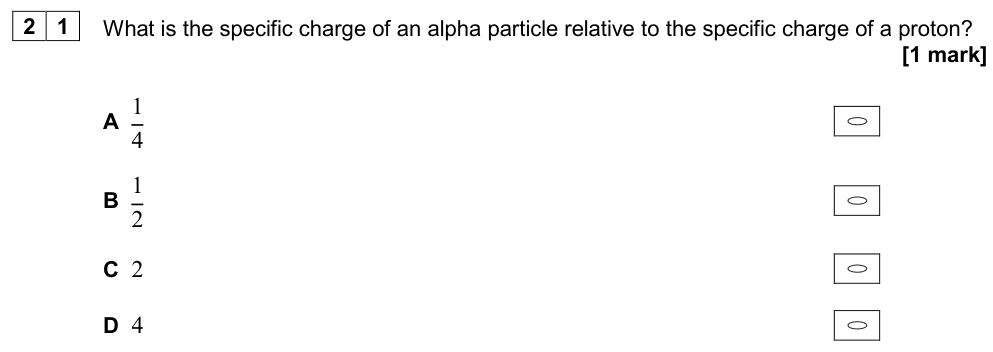
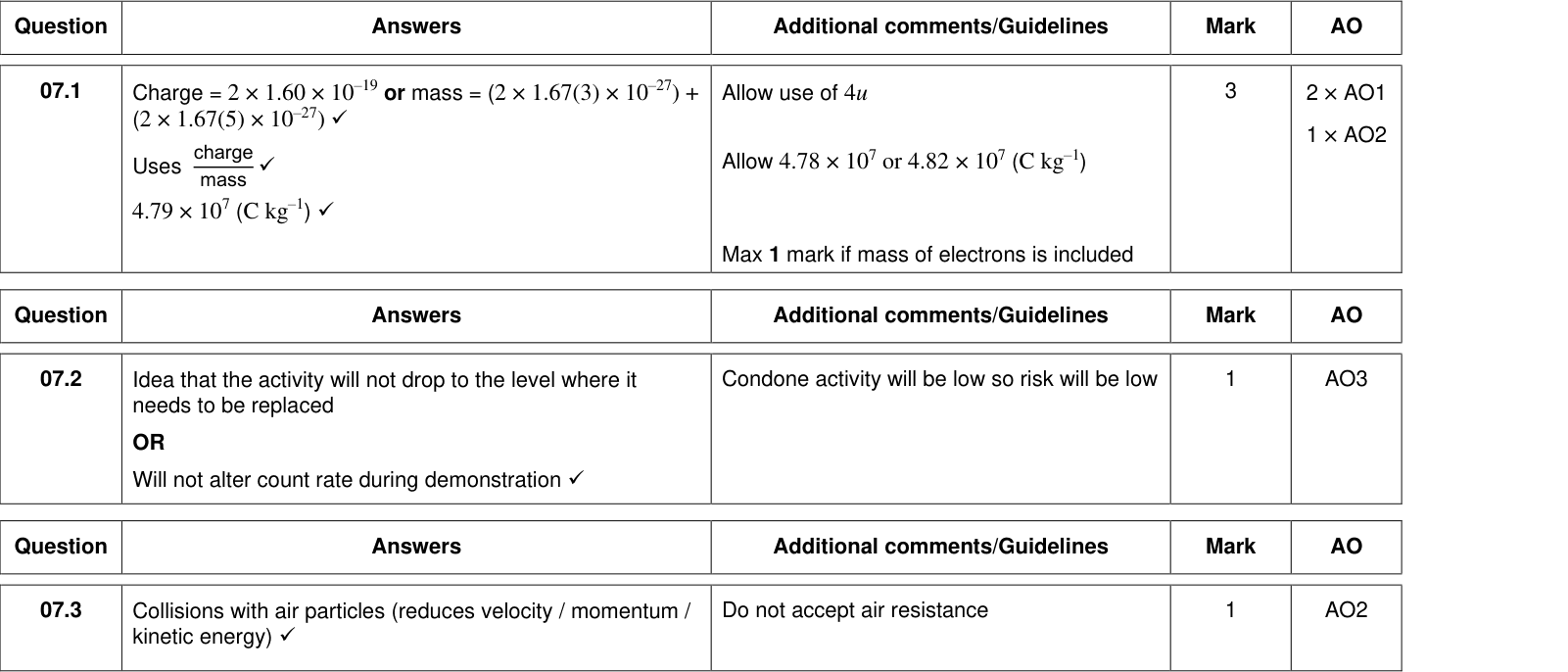
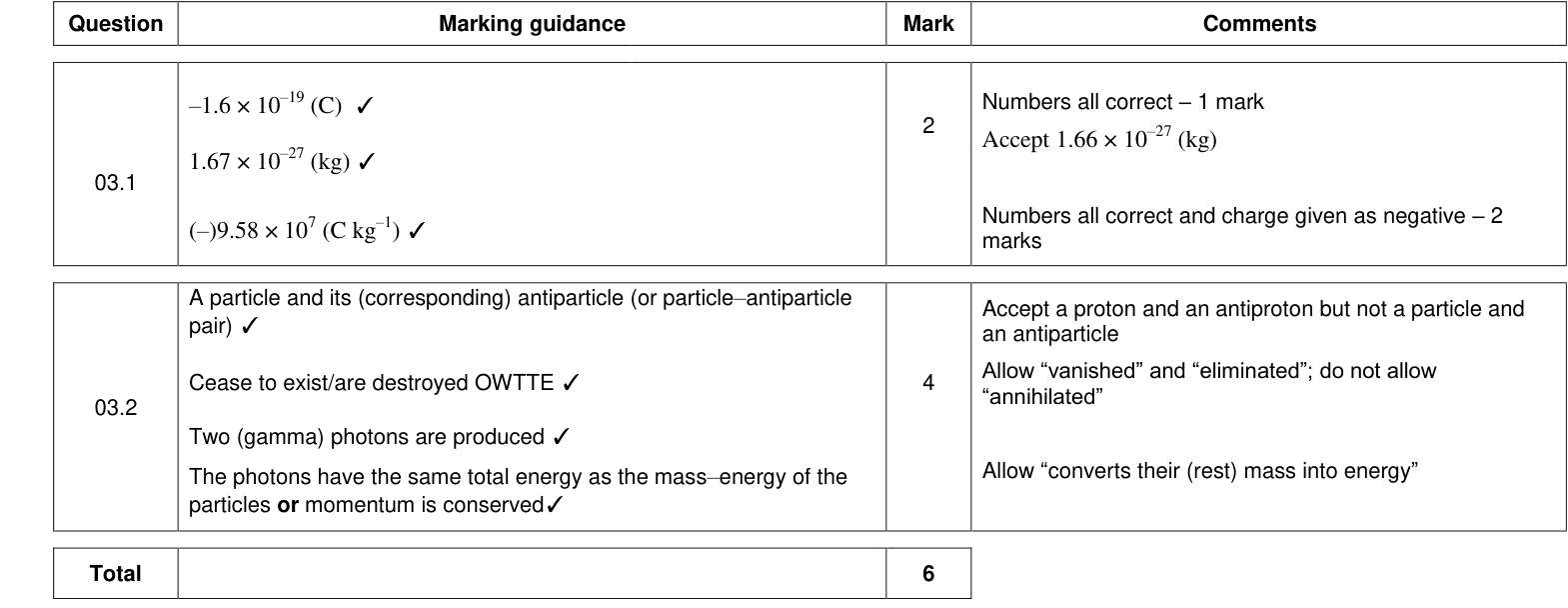
| proton | $\dfrac{1.60 \times 10^{-19}}{1.67 \times 10^{-27}} = 9.58 \times 10^{7}$ |
| neutron | 0 |
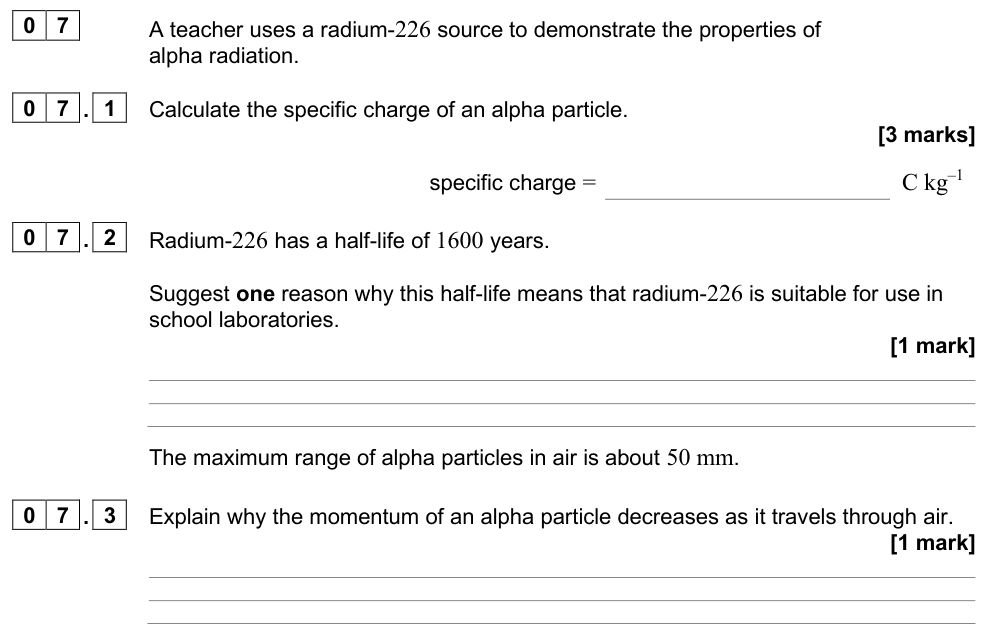
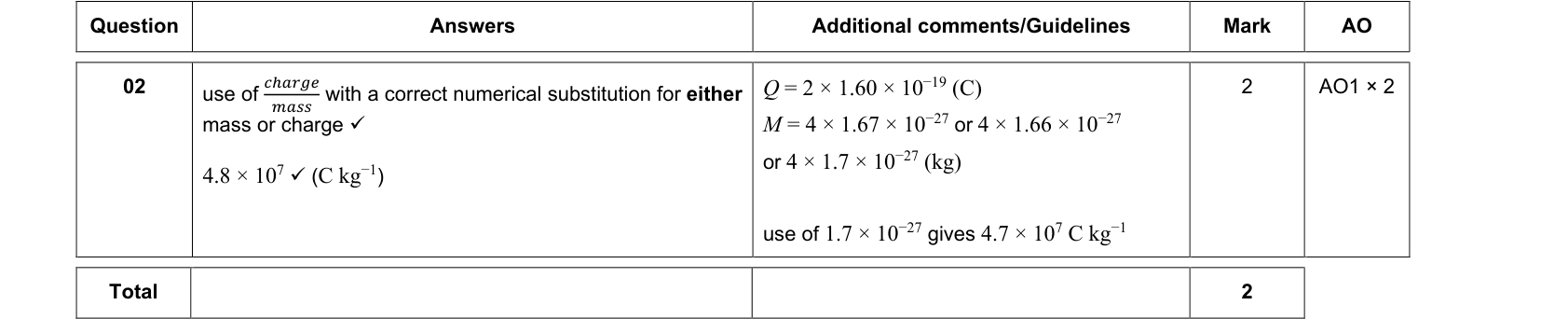
| alpha particle ($^4_2$He nucleus) | $\dfrac{2 \times 1.60 \times 10^{-19}}{4 \times 1.67 \times 10^{-27}} = 4.8 \times 10^{7}$ (half that of a proton) |
The electron has the largest specific charge of any of these particles, about 1840 times that of a proton.
Worked example: specific charge of a nucleus
Find the specific charge of a nucleus of $^{7}_{3}$Li.
Charge $= 3 \times 1.60 \times 10^{-19} = 4.80 \times 10^{-19}\ \text{C}$.
Mass $\approx 7 \times 1.67 \times 10^{-27} = 1.17 \times 10^{-26}\ \text{kg}$ (3 protons + 4 neutrons).
Specific charge $= \dfrac{4.80 \times 10^{-19}}{1.17 \times 10^{-26}} = 4.1 \times 10^{7}\ \text{C kg}^{-1}$.
Worked example: specific charge of an ion
A $^{23}_{11}$Na⁺ ion has lost one electron. Its charge is $+1.60 \times 10^{-19}$ C. Its mass is that of 23 nucleons plus 10 electrons, which is about $23 \times 1.67 \times 10^{-27} = 3.84 \times 10^{-26}$ kg (the electrons add only 0.02%).
Specific charge $= 4.2 \times 10^{6}\ \text{C kg}^{-1}$.
Common mistake
For a nucleus, use the charge of the protons only ($Ze$) and the mass of all the nucleons. For an ion, the charge is the number of electrons added or removed × $e$, not $Z$.
Evidence for the nucleus: Rutherford scattering
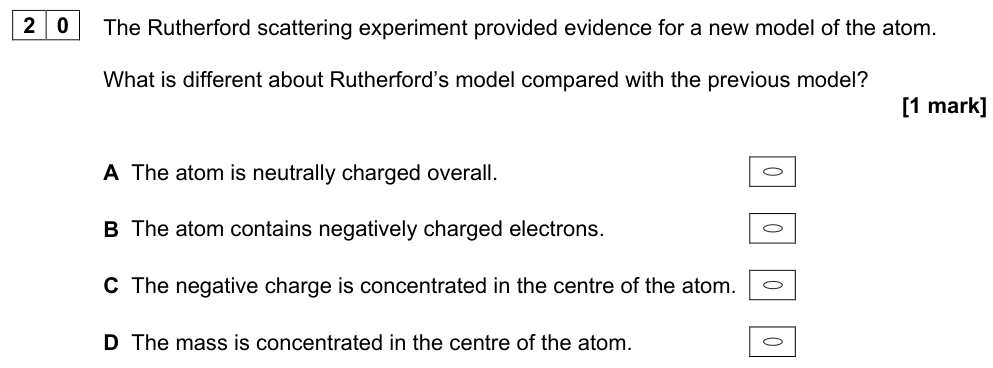
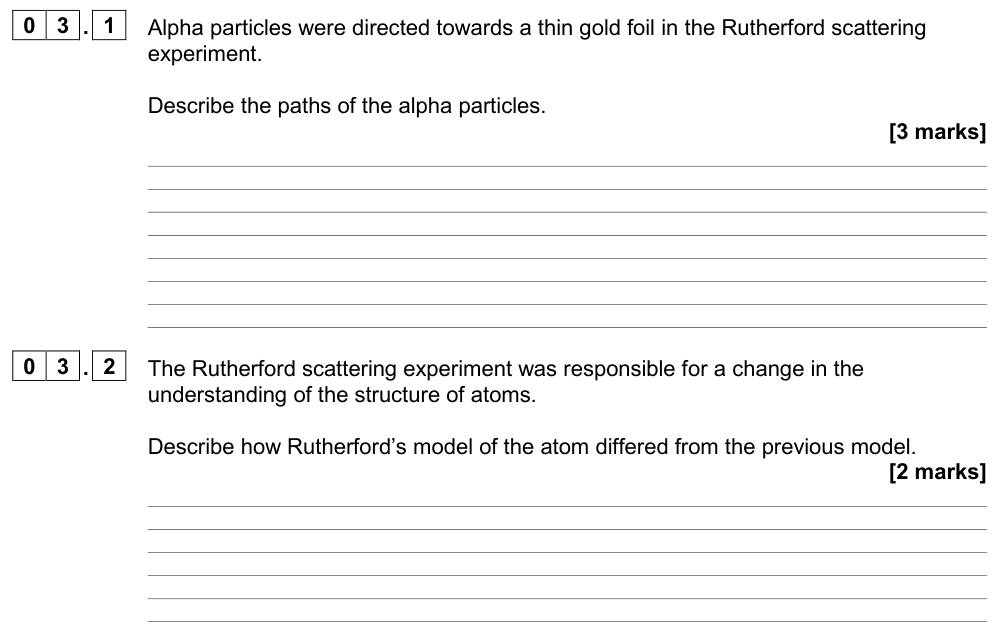
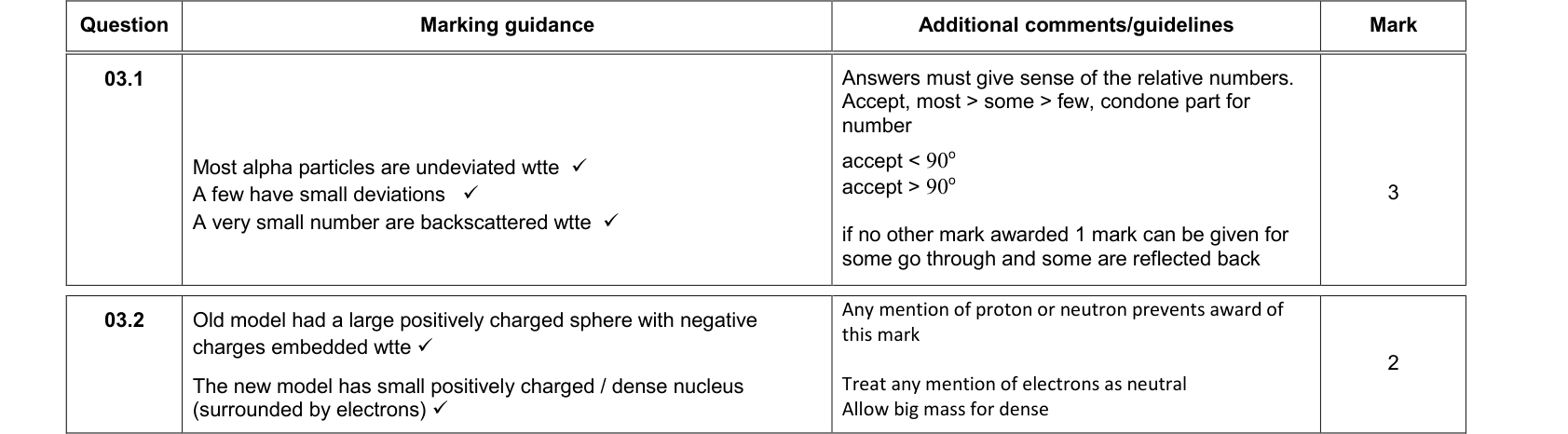
Before 1911 the accepted model was Thomson's "plum pudding" model: a sphere of positive charge with electrons embedded in it, the mass spread evenly through the atom.
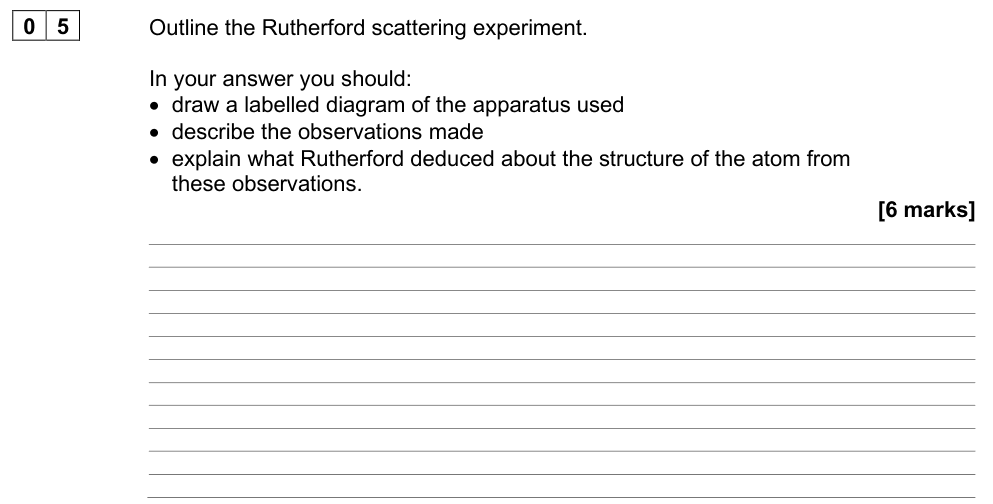
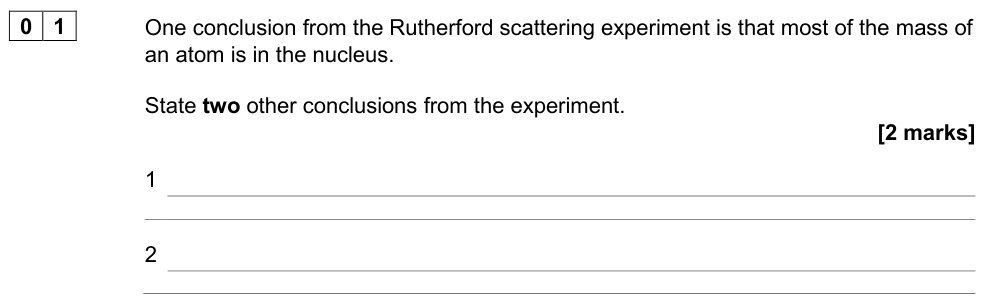
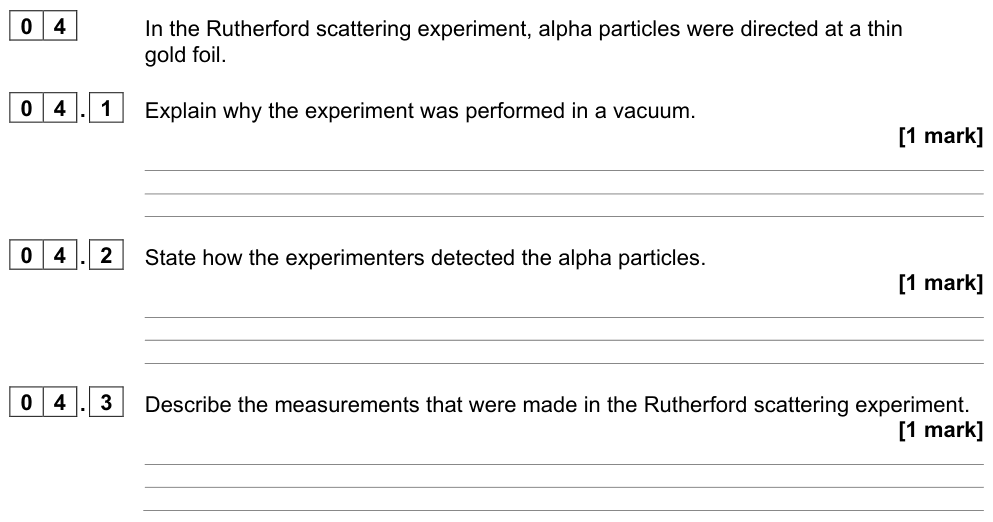
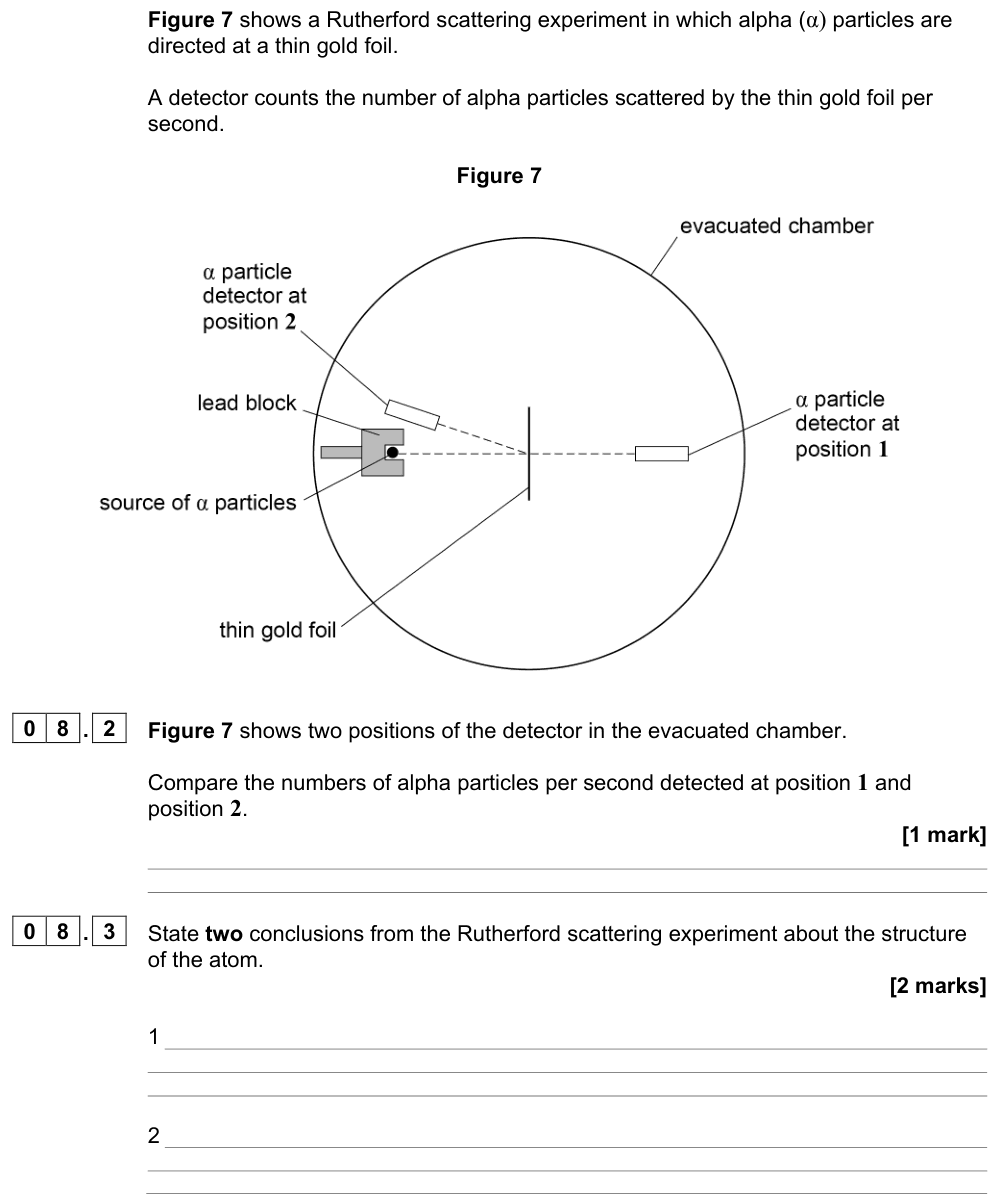
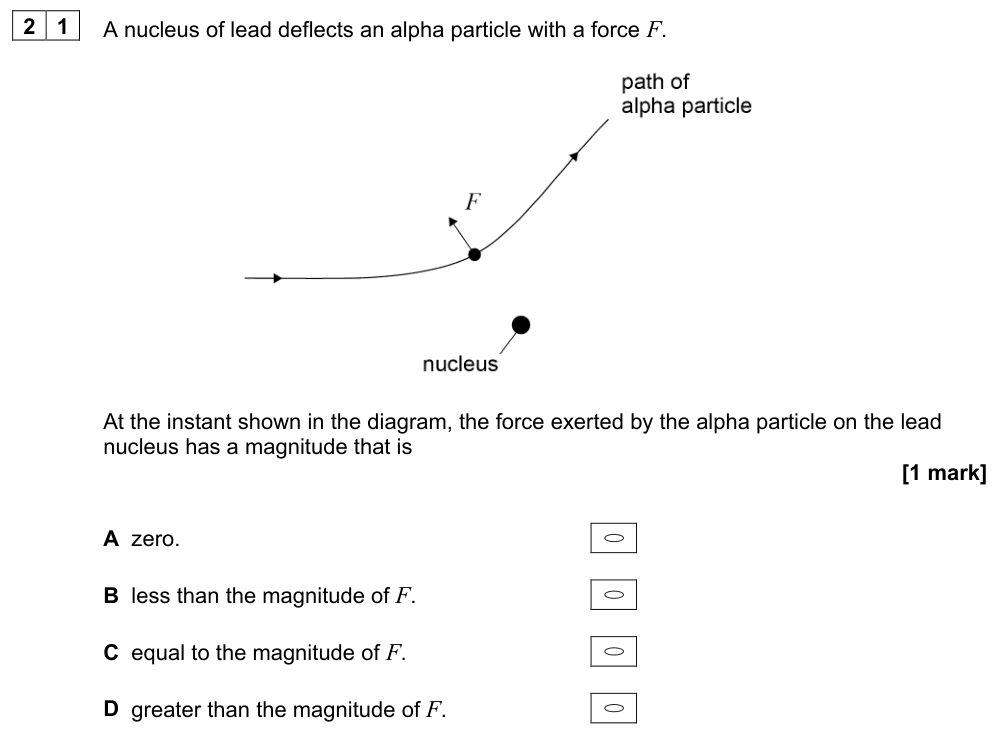
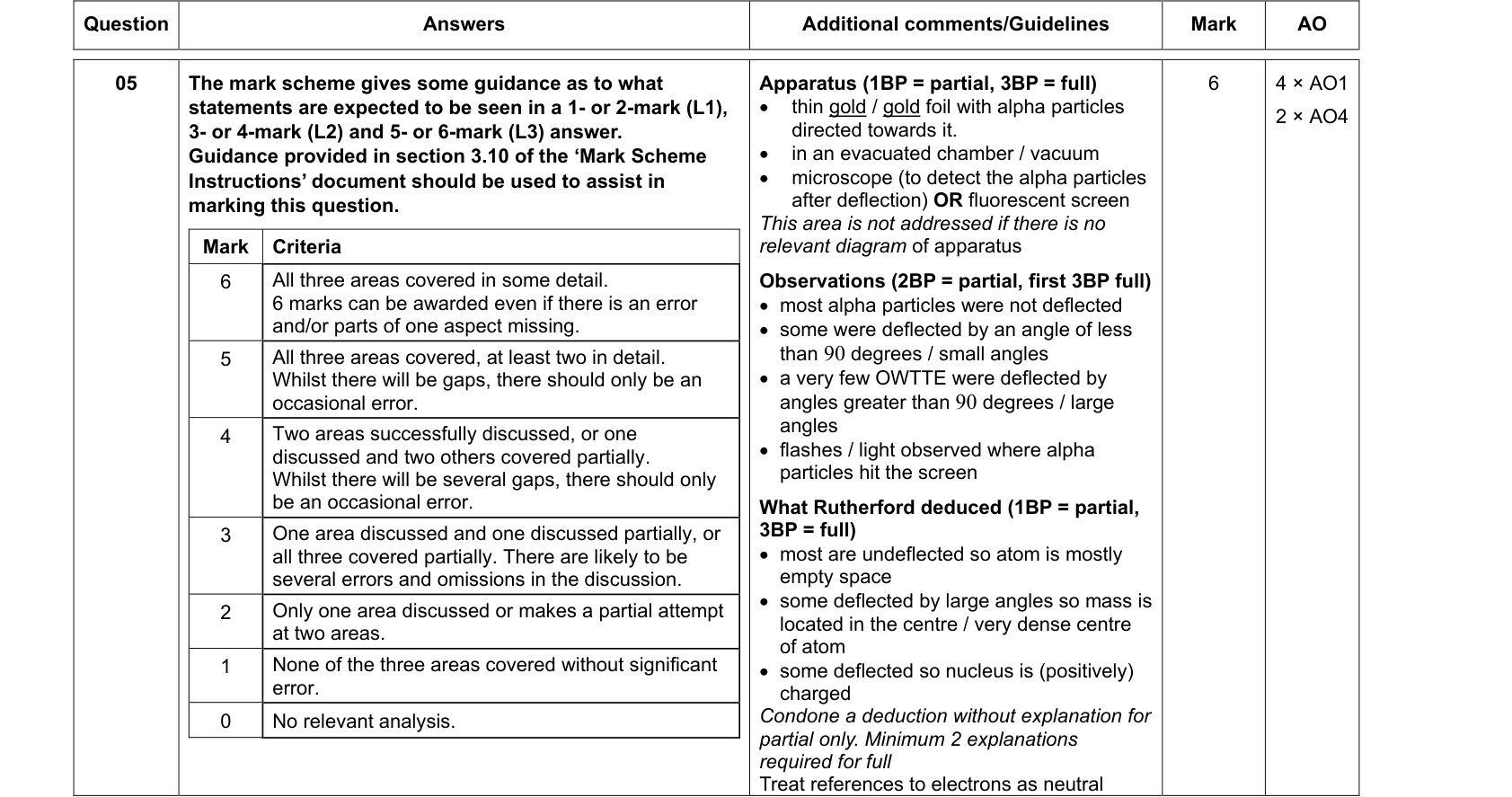
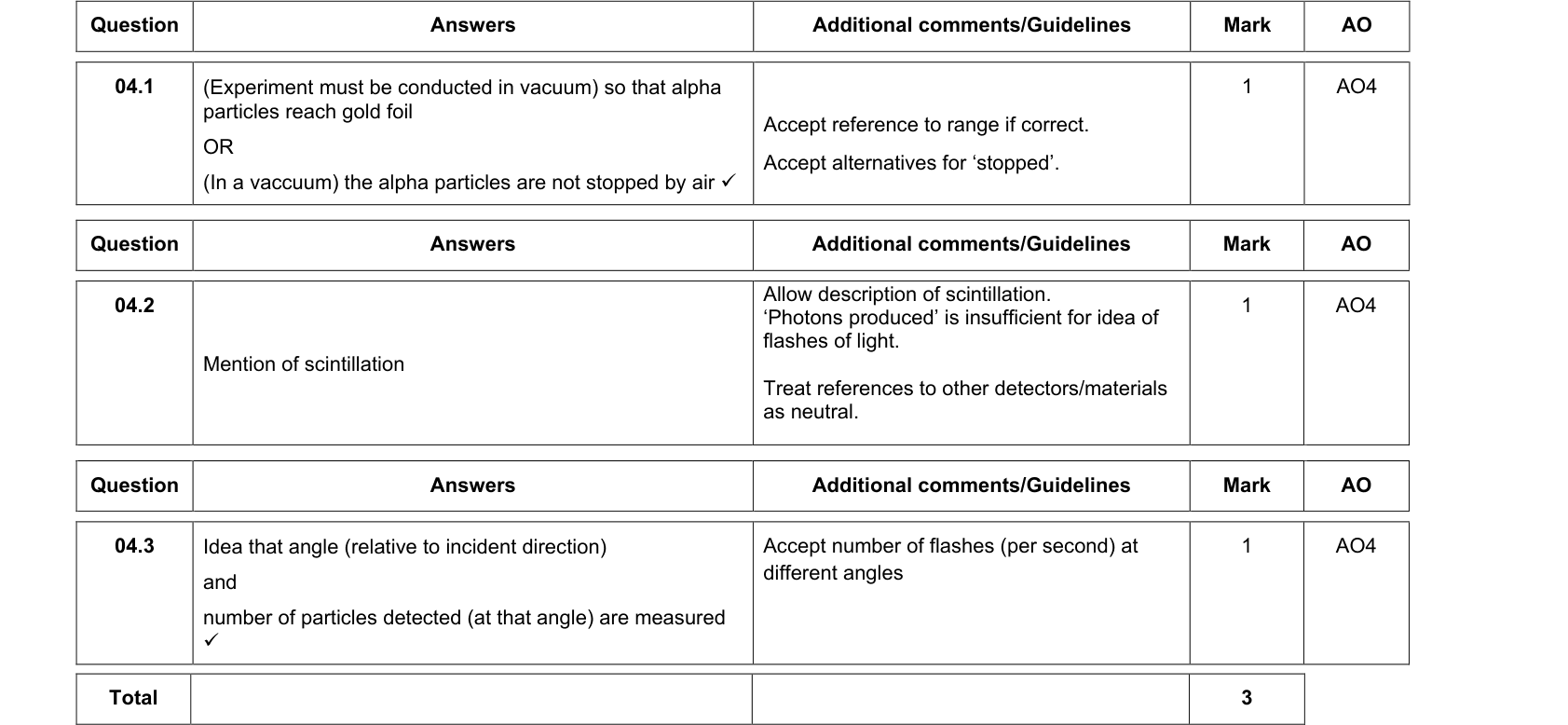
In the experiment designed by Rutherford and carried out by Geiger and Marsden, a narrow beam of alpha particles was fired at a very thin gold foil in a vacuum. A zinc sulfide screen viewed through a microscope detected the scattered alpha particles at different angles.
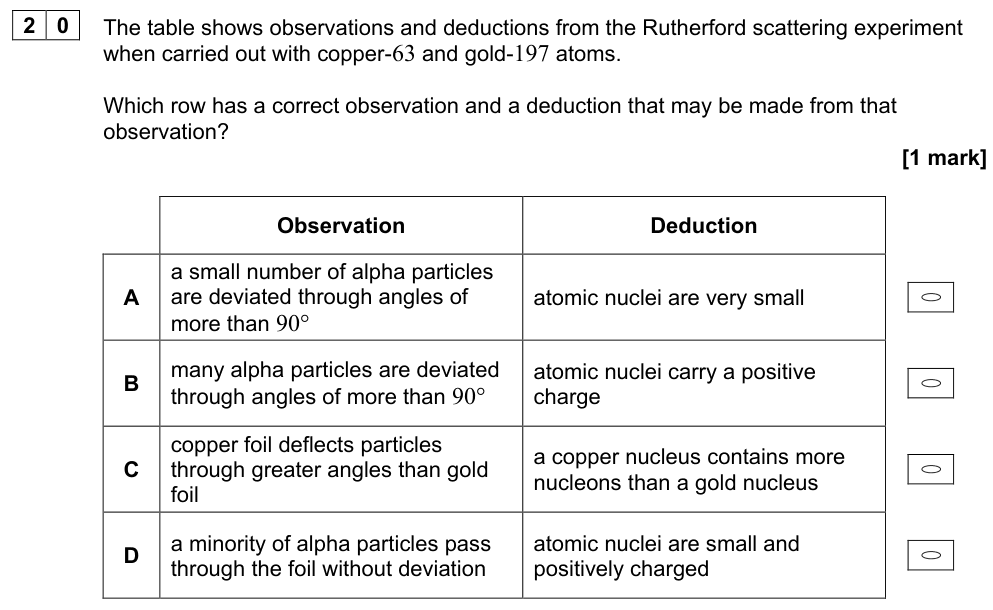
Observations and conclusions
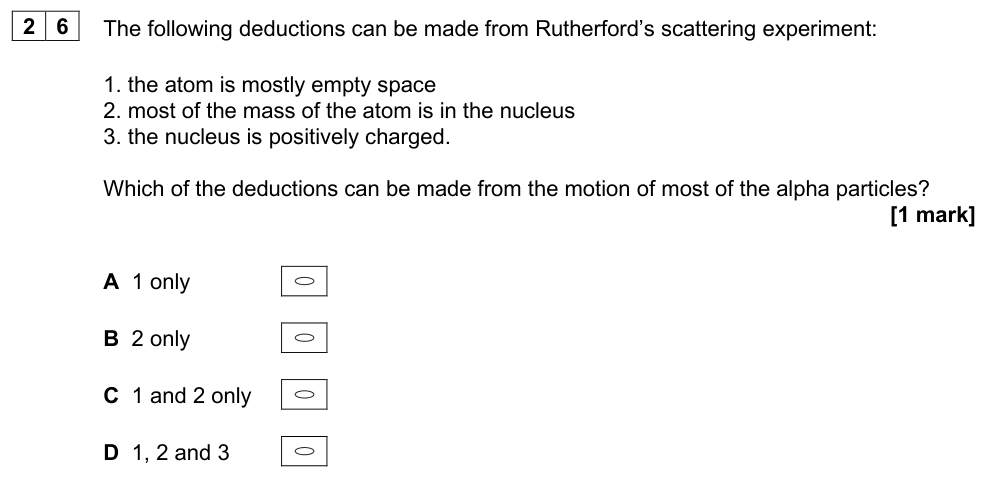
| Observation | Conclusion |
|---|---|
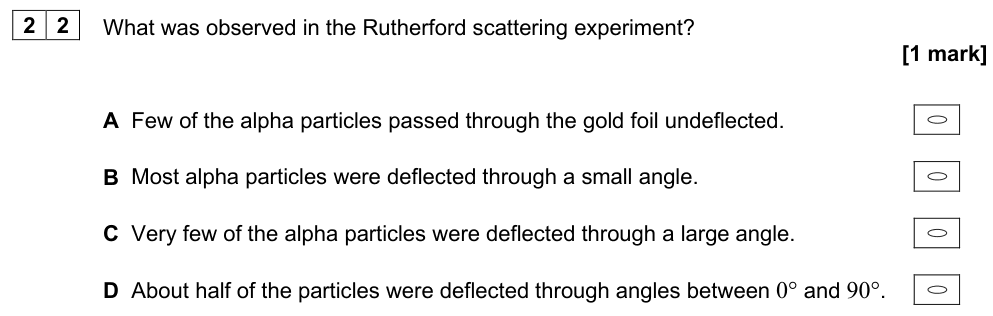
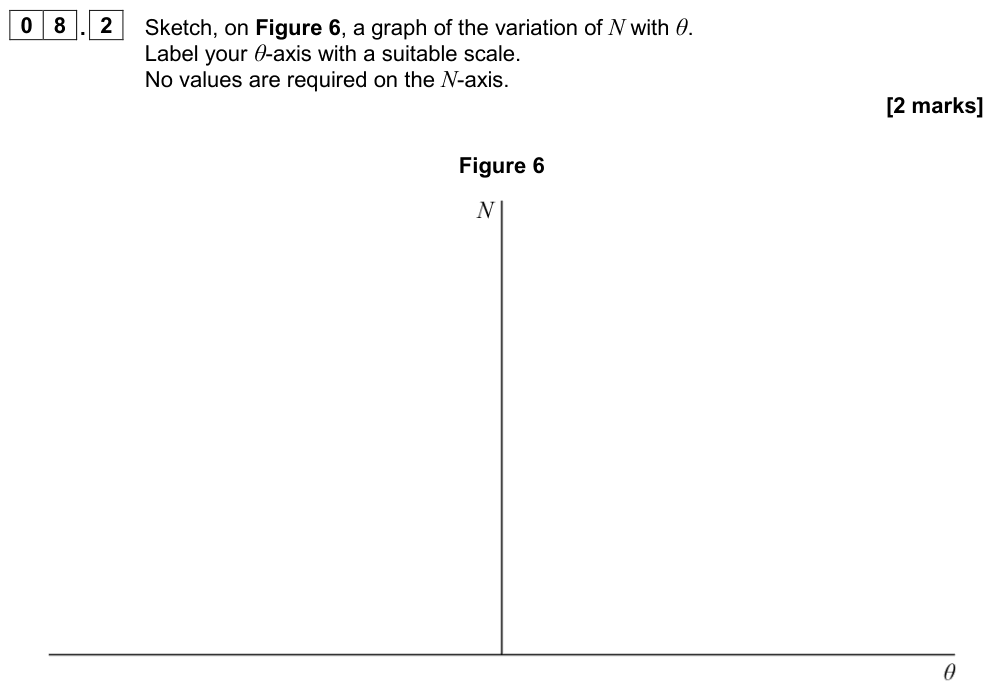
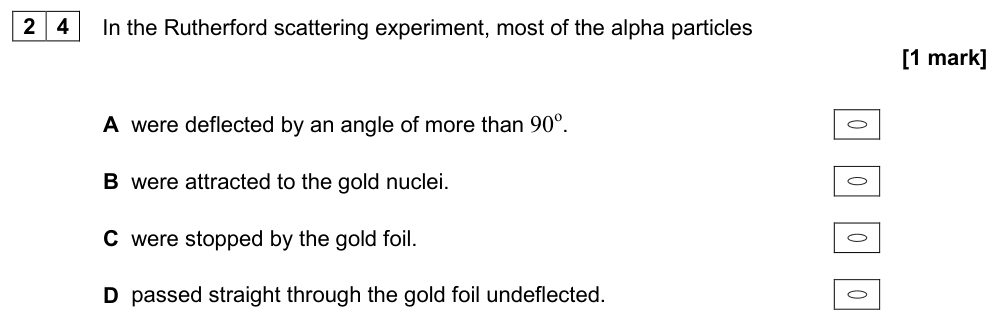
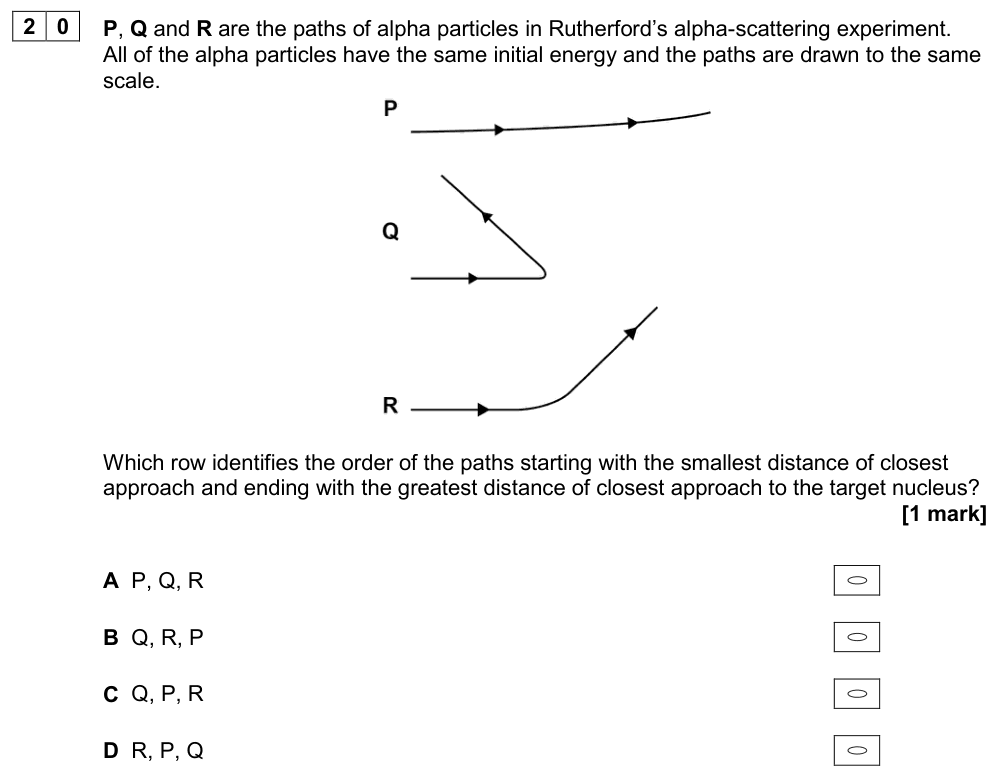
| Most alpha particles passed straight through with little or no deflection | Most of the atom is empty space |
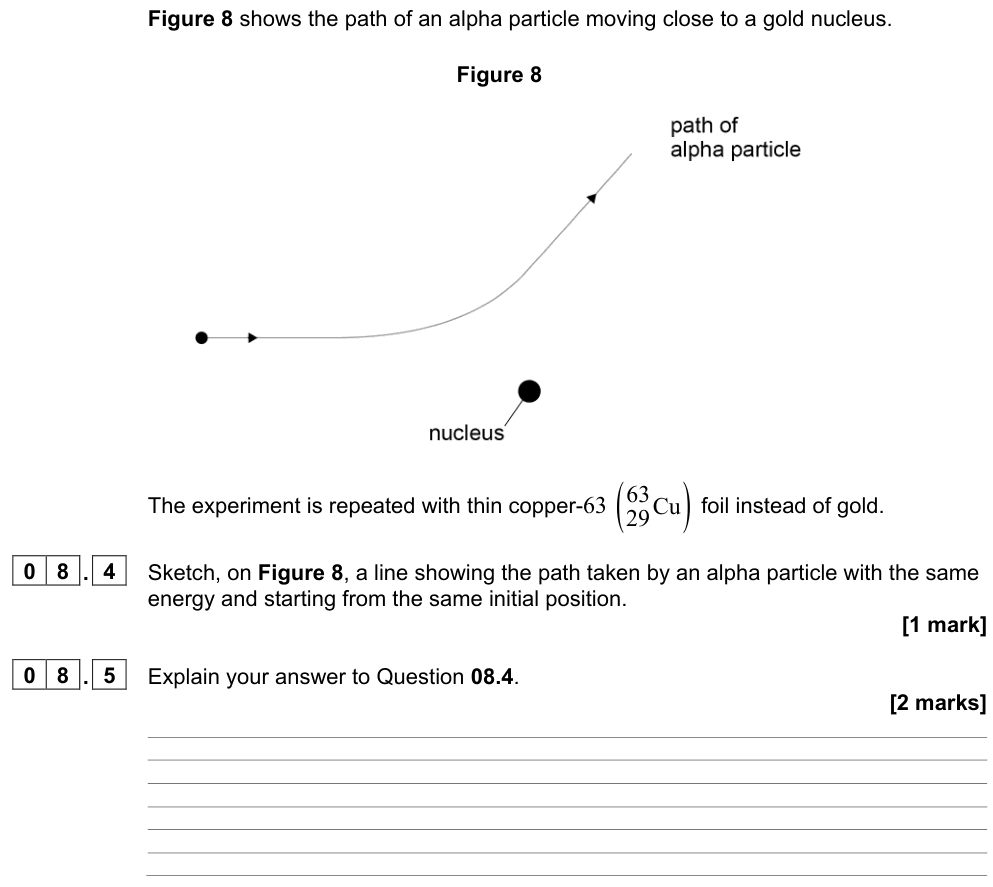
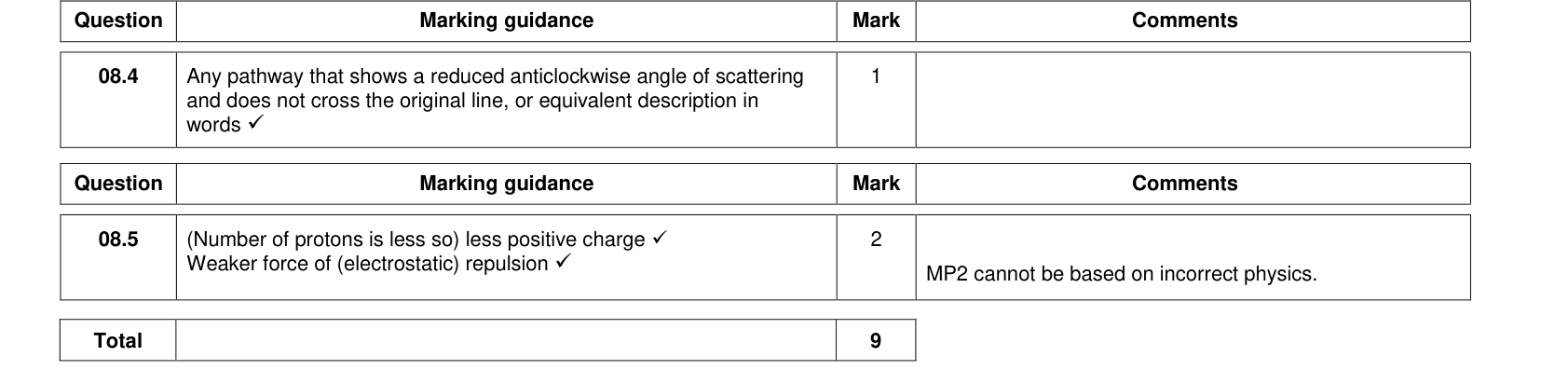
| Some were deflected through small angles | The nucleus is positively charged (it repels the positive alpha particles) |
| A very small number (about 1 in 8000) were deflected by more than 90° (bounced back) | Most of the mass and all the positive charge are concentrated in a tiny central nucleus |
The plum pudding model could not explain large-angle scattering, because spread-out charge could never exert a large enough force. The experiment was done in a vacuum so that the alpha particles were not absorbed by air, and with very thin foil so that each alpha particle was scattered by only one nucleus.
How models of the atom changed
- Dalton (1803): atoms are indivisible solid spheres.
- Thomson (1897): discovered the electron; plum pudding model.
- Rutherford (1911): nuclear model from alpha scattering.
- Bohr (1913): electrons in fixed energy levels (explains line spectra; see Unit 2).
- Chadwick (1932): discovered the neutron, explaining why nuclei have more mass than their protons alone.
Models change when new experimental evidence cannot be explained by the existing model. This is how scientific knowledge develops.
Summary
- Protons (+e, 1 u), neutrons (0, 1 u) in the nucleus; electrons (−e, 1/1840 u) around it.
- $^A_Z$X: $Z$ protons, $A - Z$ neutrons. Isotopes: same $Z$, different $A$.
- Specific charge = charge/mass (C kg⁻¹); largest for the electron.
- Rutherford scattering: most pass through (empty space), a few bounce back (small, dense, positive nucleus).