Physical quantities and SI base units
Every measurement in physics is a physical quantity: a number multiplied by a unit. A length of "3" means nothing. A length of $3\ \text{m}$ is a physical quantity.
$$\text{physical quantity} = \text{numerical value} \times \text{unit}$$
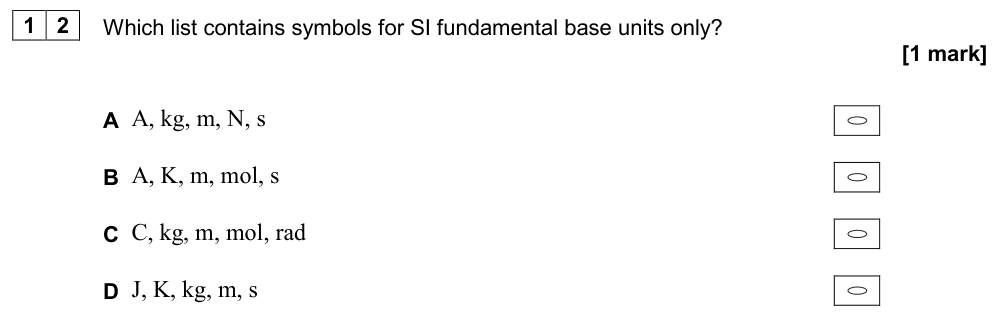
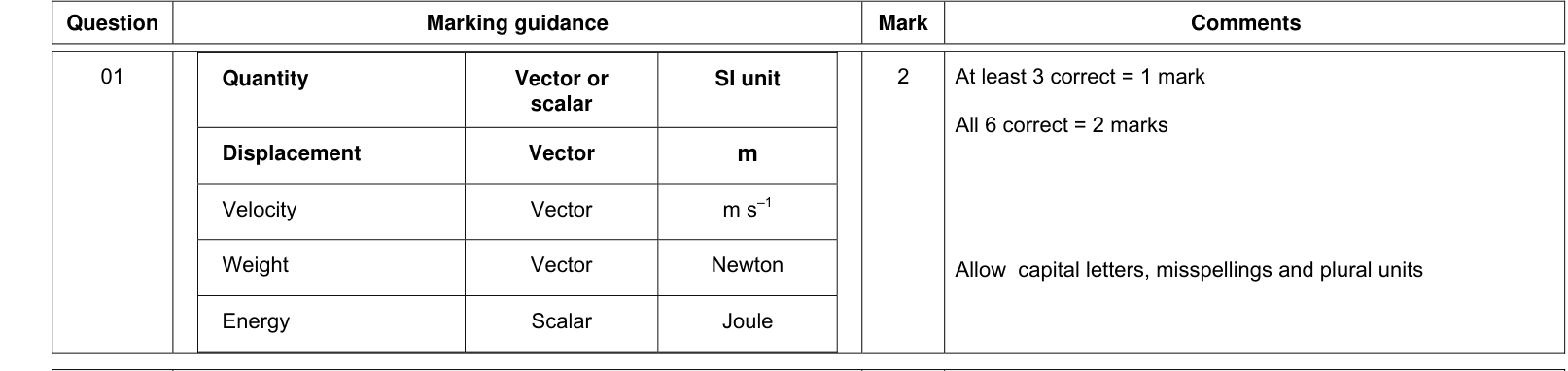
The International System of Units (SI) is built on a small set of base (fundamental) quantities. Every other unit is made from these. You need to know these six (the candela is not required):
| Base quantity | Symbol | SI base unit | Unit symbol |
|---|---|---|---|
| Mass | $m$ | kilogram | kg |
| Length | $l$, $s$, $x$ | metre | m |
| Time | $t$ | second | s |
| Electric current | $I$ | ampere | A |
| Temperature (thermodynamic) | $T$ | kelvin | K |
| Amount of substance | $n$ | mole | mol |
Common mistake
The base unit of mass is the kilogram, not the gram. Charge is not a base quantity: the coulomb is a derived unit ($1\ \text{C} = 1\ \text{A s}$). Temperature in °C is not an SI base unit; use kelvin ($T/\text{K} = \theta/^\circ\text{C} + 273$).
You do not have to recall the formal definitions of the base units, but you must be able to use them.
Derived units
A derived unit is a combination of base units. It comes from the defining equation of the quantity. To find the base units of any quantity:
- Write down a defining equation for the quantity.
- Replace each quantity with its base units.
- Simplify, using negative powers rather than fractions (e.g. $\text{m s}^{-2}$, not m/s²).
Worked example: base units of the newton, joule and watt
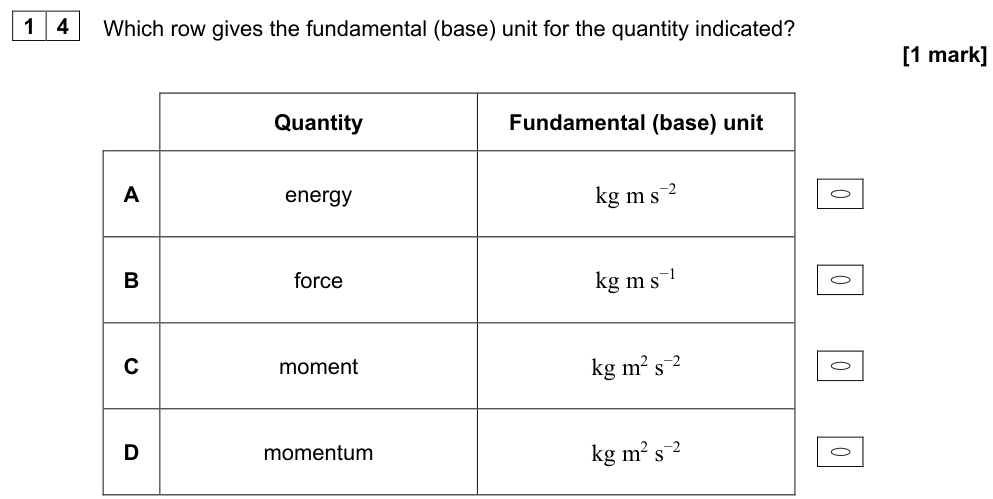
Force: $F = ma \Rightarrow [\text{N}] = \text{kg} \times \text{m s}^{-2} = \text{kg m s}^{-2}$
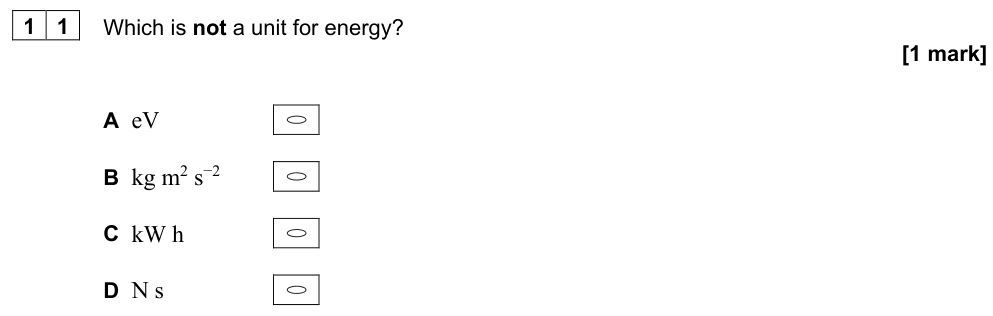
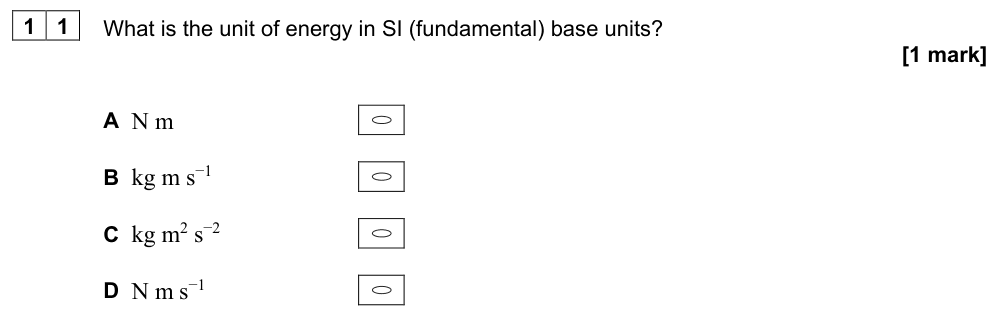
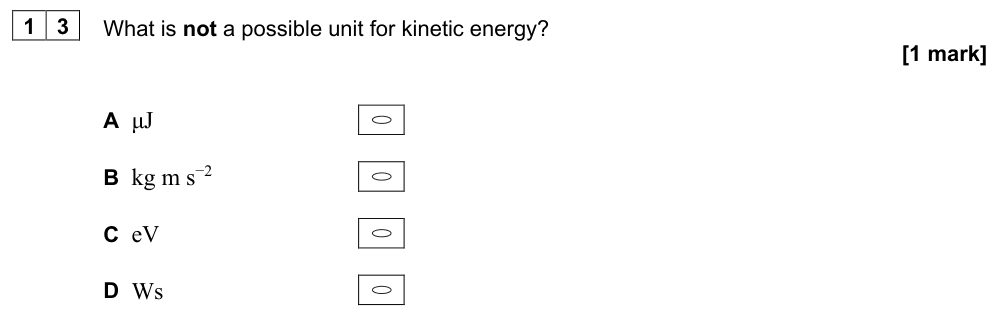
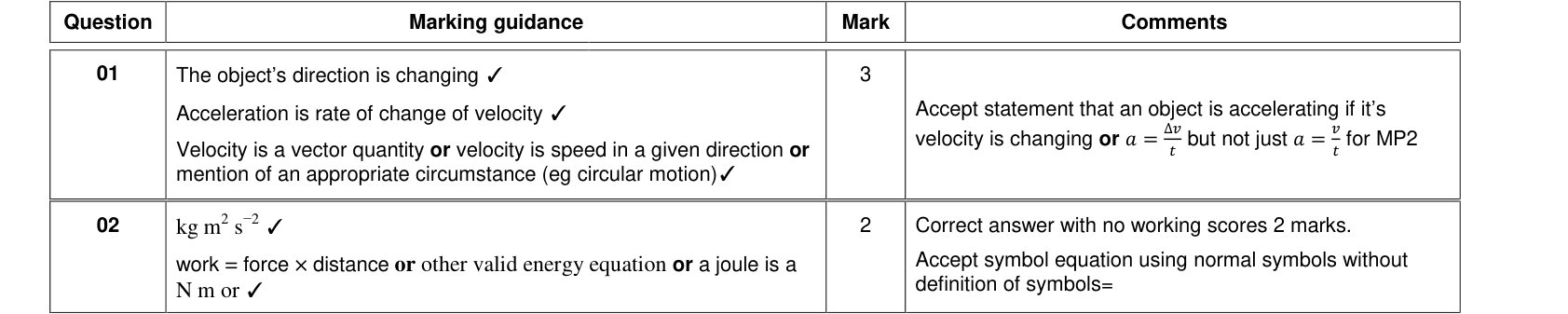
Energy/work: $W = Fs \Rightarrow [\text{J}] = \text{kg m s}^{-2} \times \text{m} = \text{kg m}^2\,\text{s}^{-2}$
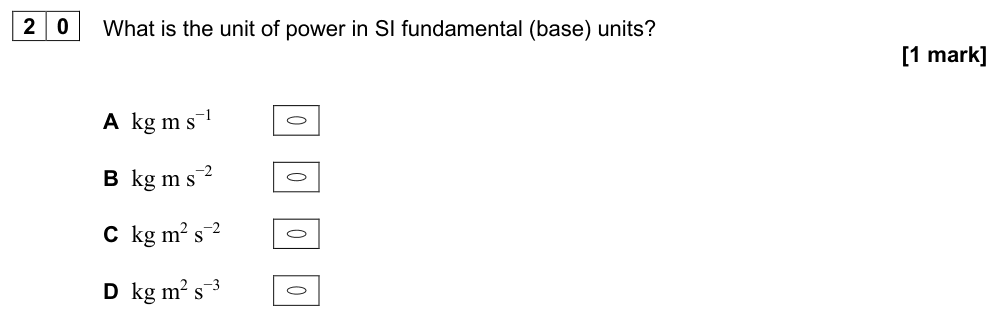
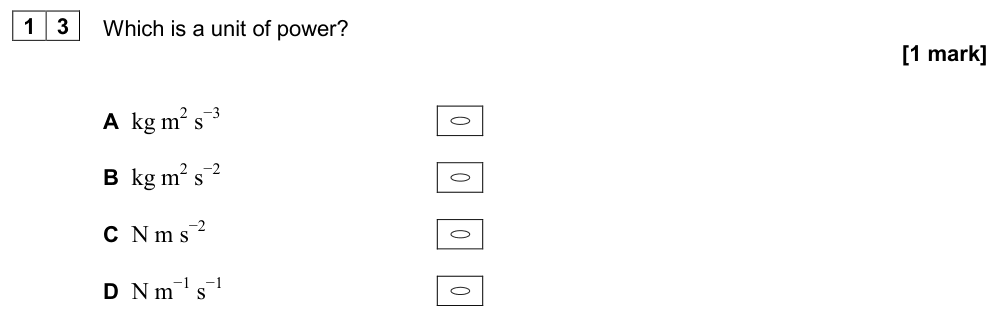
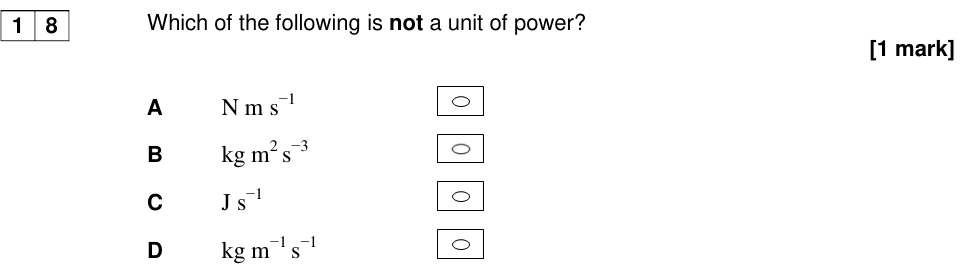
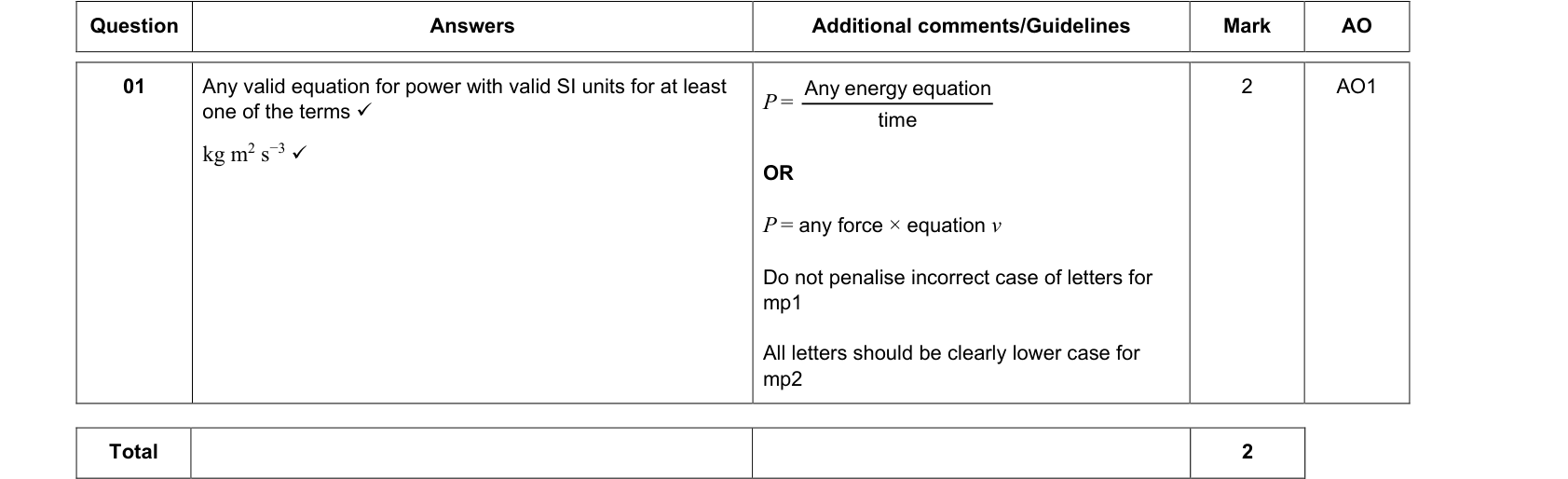
Power: $P = \dfrac{W}{t} \Rightarrow [\text{W}] = \dfrac{\text{kg m}^2\,\text{s}^{-2}}{\text{s}} = \text{kg m}^2\,\text{s}^{-3}$
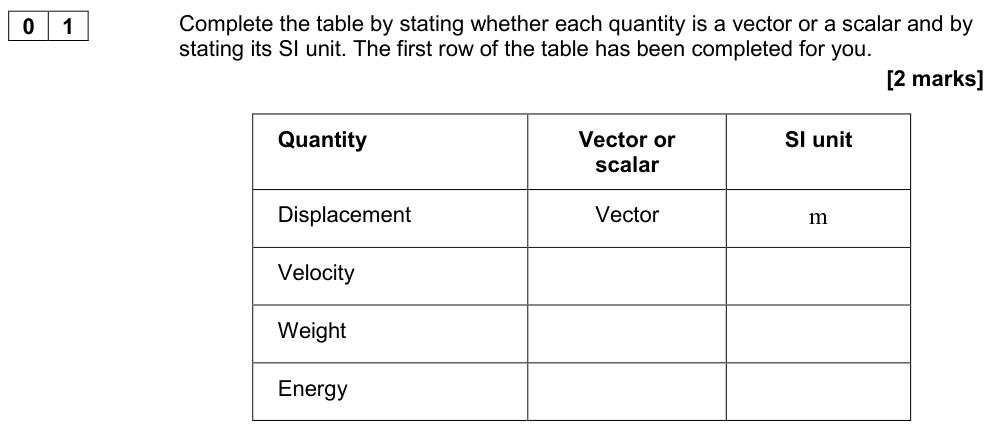
| Quantity | Defining equation | Derived unit | In base units |
|---|---|---|---|
| Velocity | $v = \Delta s/\Delta t$ | m s⁻¹ | m s⁻¹ |
| Acceleration | $a = \Delta v/\Delta t$ | m s⁻² | m s⁻² |
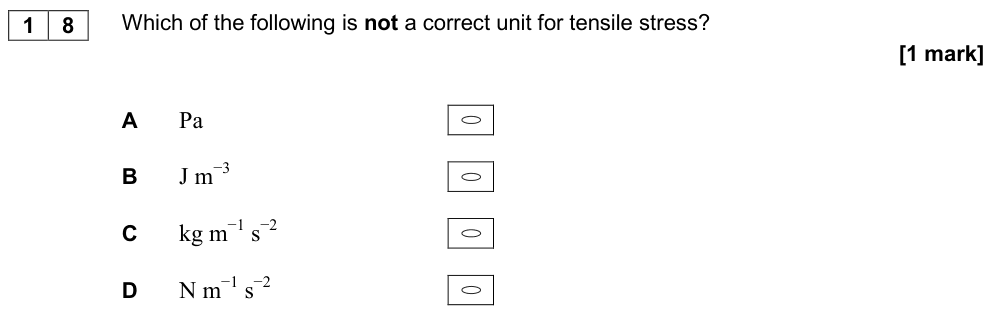
| Force | $F = ma$ | newton, N | kg m s⁻² |
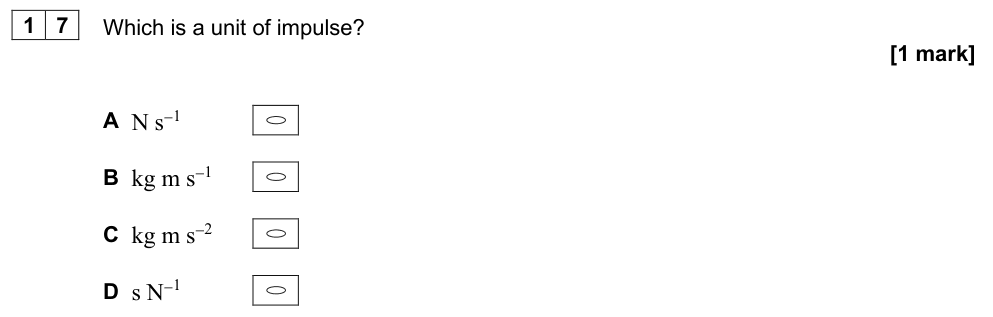
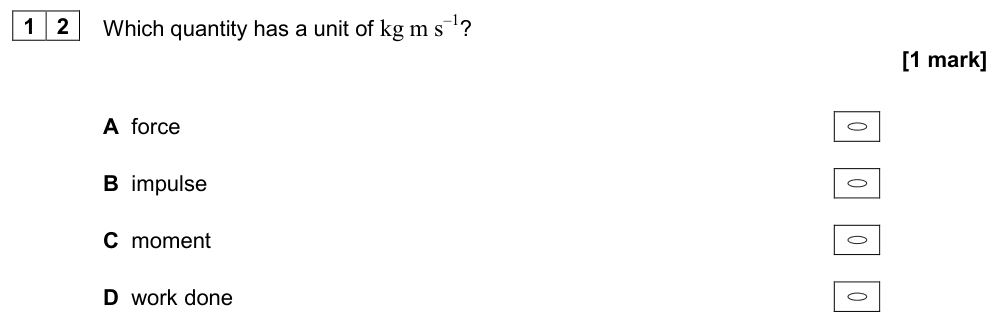
| Momentum | $p = mv$ | N s | kg m s⁻¹ |
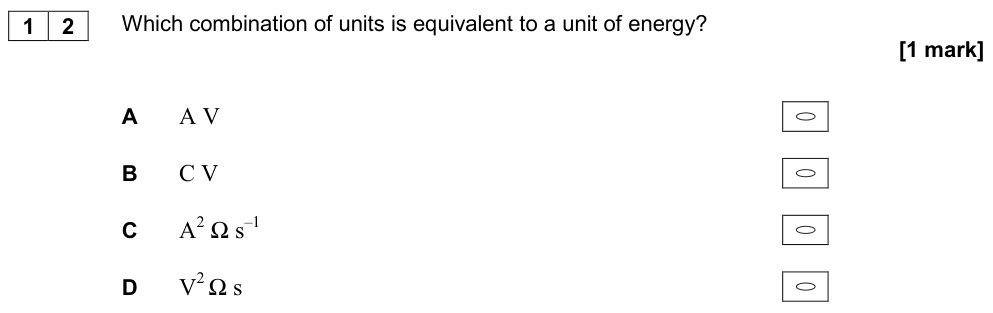
| Work, energy | $W = Fs$ | joule, J | kg m² s⁻² |
| Power | $P = W/t$ | watt, W | kg m² s⁻³ |
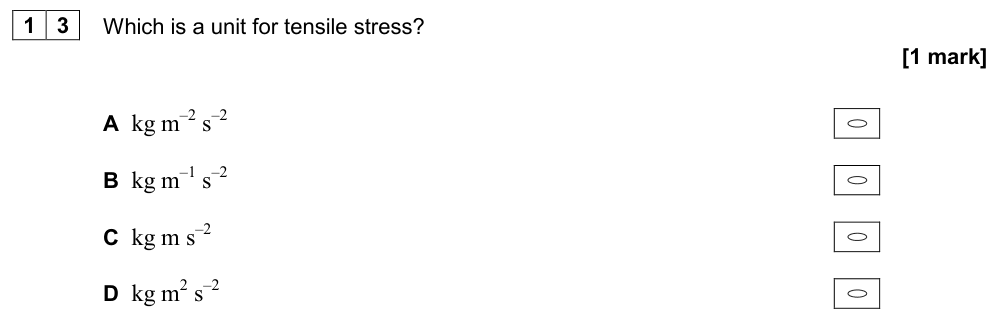
| Pressure, stress | $p = F/A$ | pascal, Pa | kg m⁻¹ s⁻² |
| Density | $\rho = m/V$ | kg m⁻³ | kg m⁻³ |
| Frequency | $f = 1/T$ | hertz, Hz | s⁻¹ |
| Charge | $Q = It$ | coulomb, C | A s |
| Potential difference | $V = W/Q$ | volt, V | kg m² s⁻³ A⁻¹ |
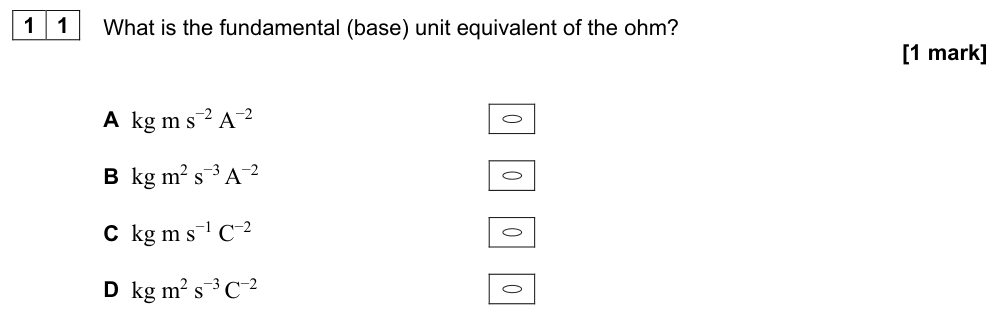
| Resistance | $R = V/I$ | ohm, Ω | kg m² s⁻³ A⁻² |
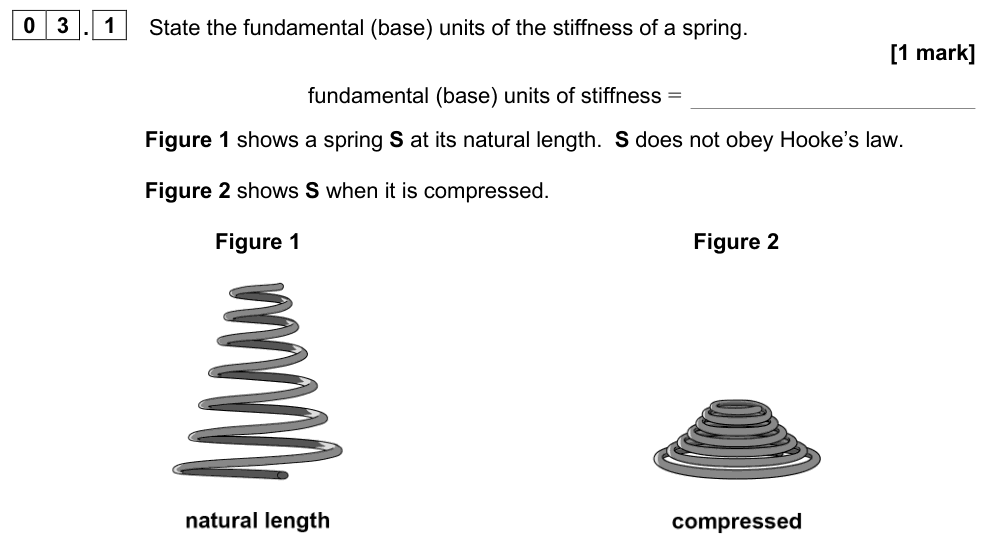
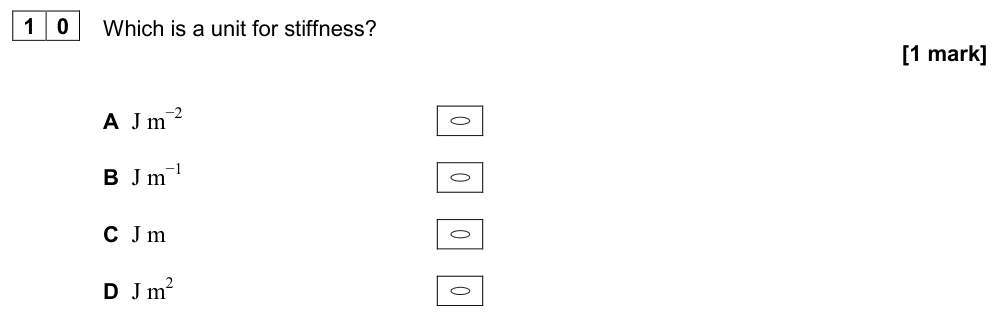
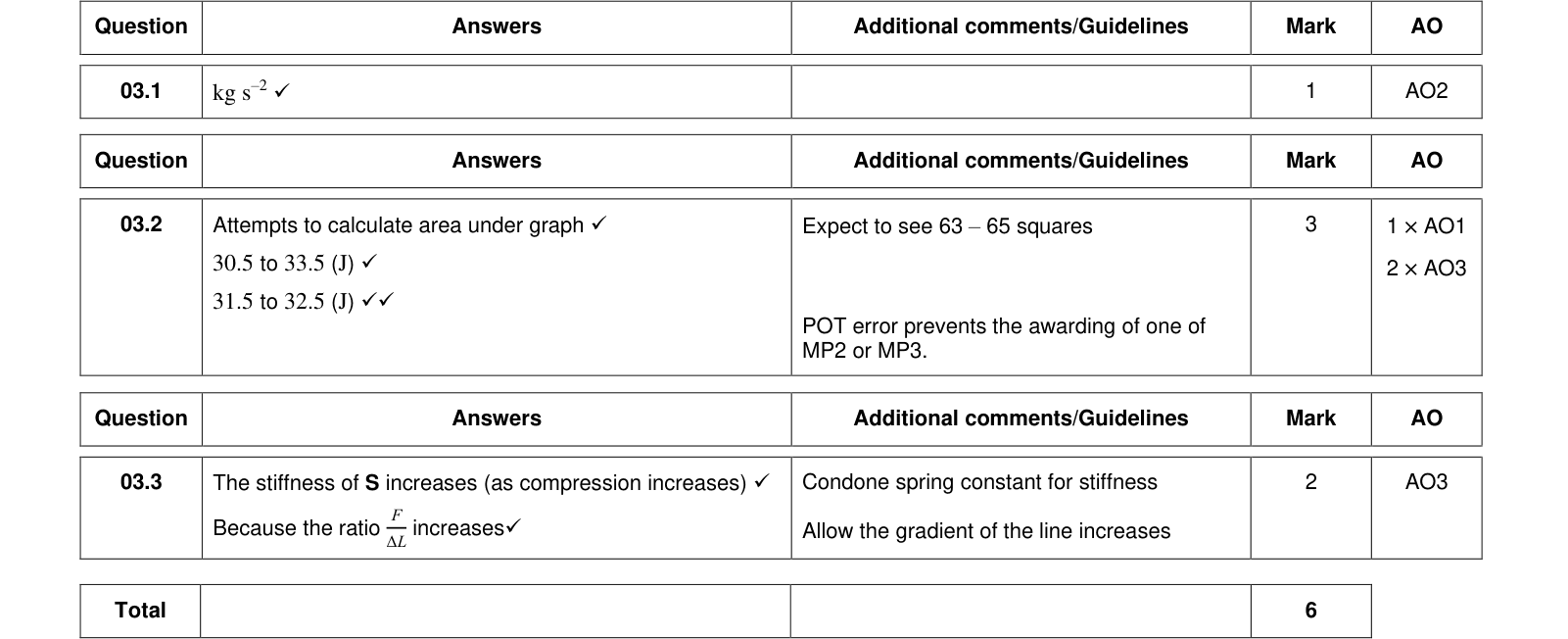
| Spring constant | $k = F/\Delta L$ | N m⁻¹ | kg s⁻² |
Worked example: base units of resistivity
Resistivity is defined by $\rho = \dfrac{RA}{L}$. Its unit is $\Omega\,\text{m}^2/\text{m} = \Omega\ \text{m}$.
In base units: $\Omega = \text{kg m}^2\,\text{s}^{-3}\,\text{A}^{-2}$, so $\Omega\ \text{m} = \text{kg m}^3\,\text{s}^{-3}\,\text{A}^{-2}$.
Checking an equation is homogeneous
An equation can only be correct if both sides have the same base units. This is a quick way to check a formula you half-remember, or to find the unit of a constant. For example, in $E_k = \tfrac{1}{2}mv^2$, the right-hand side has units $\text{kg} \times (\text{m s}^{-1})^2 = \text{kg m}^2\,\text{s}^{-2} = \text{J}$. ✓
Exam tip
Pure numbers such as $\tfrac12$, $2\pi$ and $\sqrt{2}$ have no units, so they never affect a units check. A correct units check does not prove an equation is right: $E_k = mv^2$ is homogeneous but wrong by a factor of 2.
Prefixes and standard form
Very large and very small values are written using standard form, $a \times 10^{n}$ where $1 \le a < 10$, or by using an SI prefix. You need to know these prefixes:
| Prefix | Symbol | Multiplier | Prefix | Symbol | Multiplier | |
|---|---|---|---|---|---|---|
| tera | T | $10^{12}$ | centi | c | $10^{-2}$ | |
| giga | G | $10^{9}$ | milli | m | $10^{-3}$ | |
| mega | M | $10^{6}$ | micro | μ | $10^{-6}$ | |
| kilo | k | $10^{3}$ | nano | n | $10^{-9}$ | |
| pico | p | $10^{-12}$ | ||||
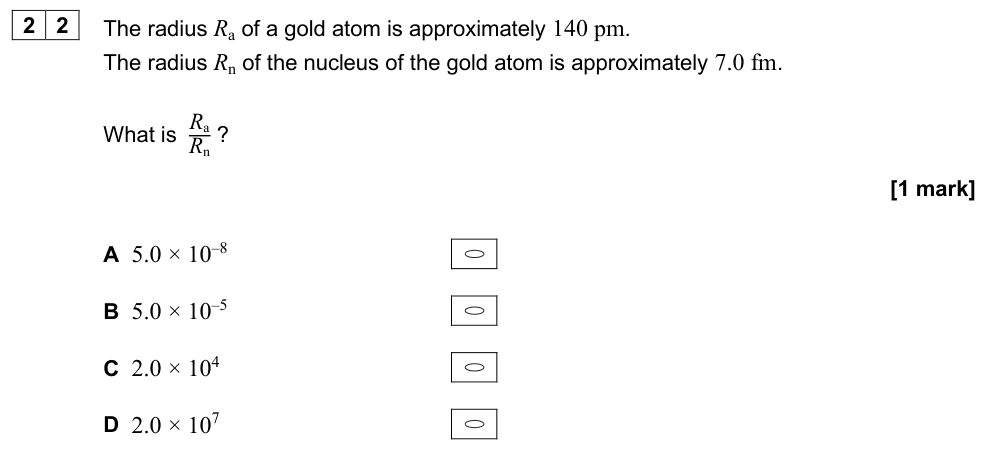
| femto | f | $10^{-15}$ |
To convert, replace the prefix symbol with its power of ten: $4.7\ \mu\text{F} = 4.7 \times 10^{-6}\ \text{F}$ and $2.5\ \text{GW} = 2.5 \times 10^{9}\ \text{W}$.
Squared and cubed units
When a unit with a prefix is squared or cubed, the prefix is squared or cubed too.
$$1\ \text{cm}^2 = (10^{-2}\ \text{m})^2 = 10^{-4}\ \text{m}^2 \qquad 1\ \text{mm}^3 = (10^{-3}\ \text{m})^3 = 10^{-9}\ \text{m}^3$$
Worked example: density conversion
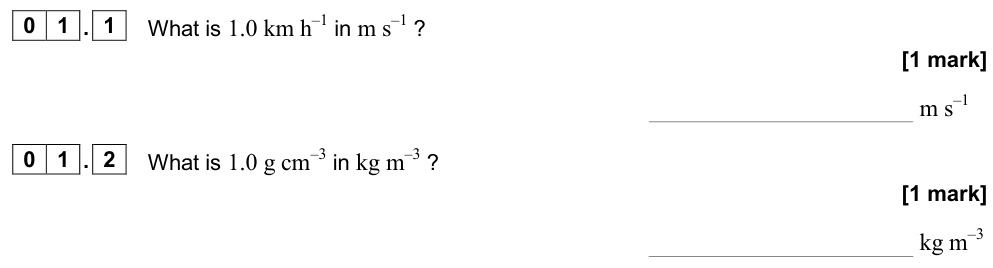
Convert $1.0\ \text{g cm}^{-3}$ to $\text{kg m}^{-3}$.
$1\ \text{g} = 10^{-3}\ \text{kg}$ and $1\ \text{cm}^3 = 10^{-6}\ \text{m}^3$, so
$$1.0\ \text{g cm}^{-3} = \frac{1.0 \times 10^{-3}\ \text{kg}}{10^{-6}\ \text{m}^3} = 1.0 \times 10^{3}\ \text{kg m}^{-3}$$
Water has a density of about $1000\ \text{kg m}^{-3}$. Remember this value; it is useful for checking answers.
Common mistake
$1\ \text{m}^2 = 10^{4}\ \text{cm}^2$, not $100\ \text{cm}^2$. A wire of cross-sectional area $0.20\ \text{mm}^2$ has an area of $0.20 \times 10^{-6}\ \text{m}^2 = 2.0 \times 10^{-7}\ \text{m}^2$.
Converting between units of the same quantity
The specification expects you to convert between different units of the same quantity, especially:
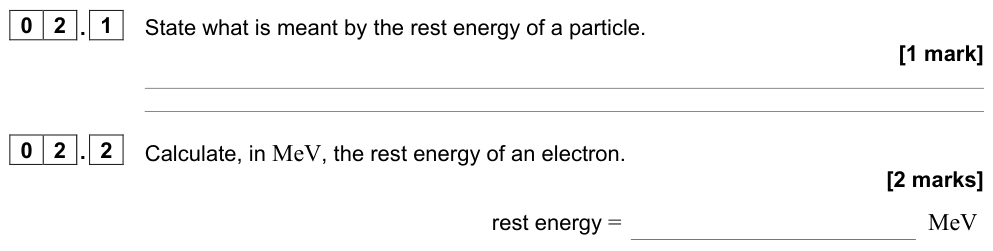
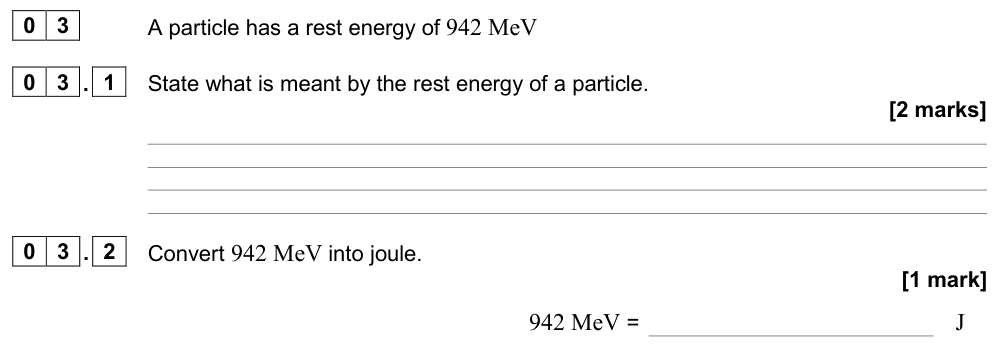
Electronvolts and joules. One electronvolt is the energy gained by one electron accelerated through a p.d. of 1 V:
$$1\ \text{eV} = 1.60 \times 10^{-19}\ \text{J} \qquad 1\ \text{MeV} = 1.60 \times 10^{-13}\ \text{J}$$
- eV → J: multiply by $1.60 \times 10^{-19}$
- J → eV: divide by $1.60 \times 10^{-19}$
Kilowatt-hours and joules. A kilowatt-hour is the energy transferred by a 1 kW device in 1 hour:
$$1\ \text{kW h} = 1000\ \text{W} \times 3600\ \text{s} = 3.6 \times 10^{6}\ \text{J}$$
Speed. $1\ \text{km h}^{-1} = \dfrac{1000\ \text{m}}{3600\ \text{s}} = 0.278\ \text{m s}^{-1}$, so divide km h⁻¹ by 3.6 to get m s⁻¹.
Worked example: rest energy in MeV
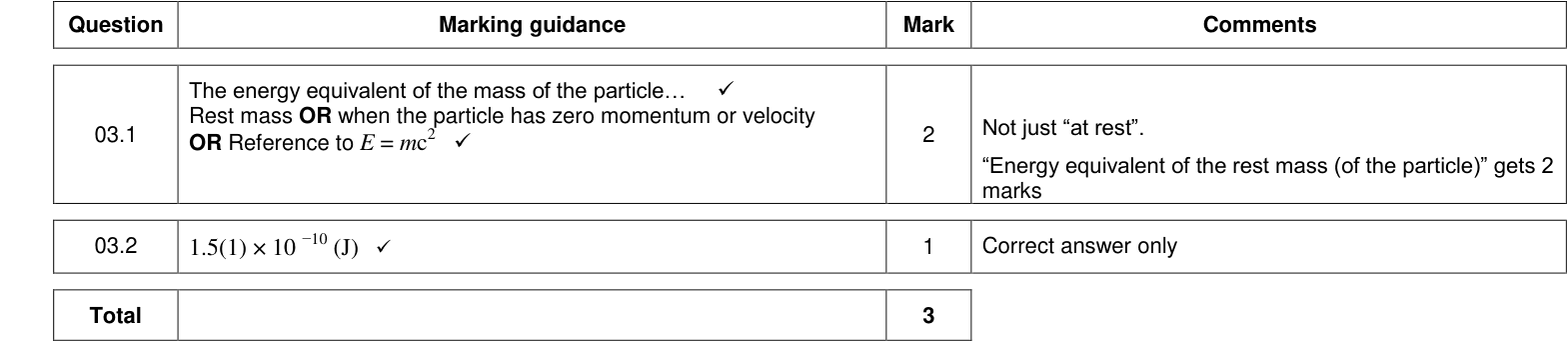
The rest energy of a proton is $1.50 \times 10^{-10}\ \text{J}$. Express this in MeV.
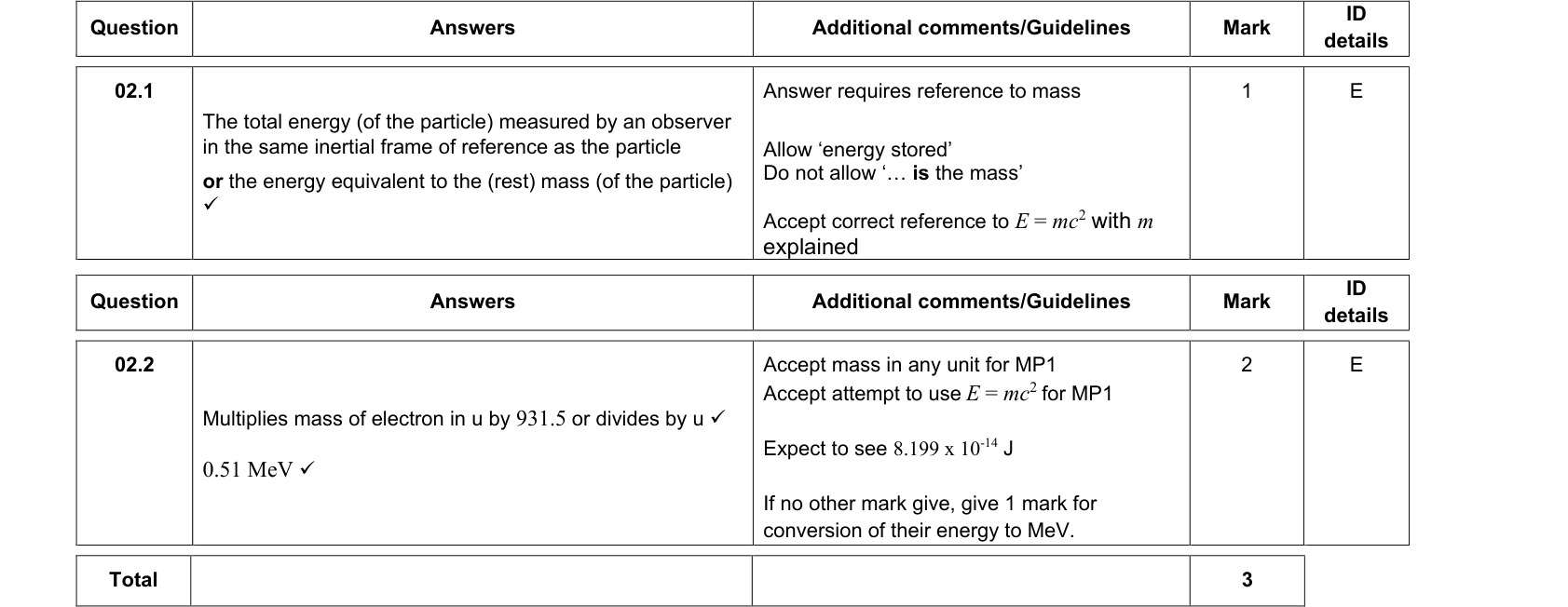
$$E = \frac{1.50 \times 10^{-10}}{1.60 \times 10^{-19}} = 9.38 \times 10^{8}\ \text{eV} = 938\ \text{MeV}$$
Worked example: kW h
A 2.4 kW kettle is used for 3 minutes. Energy $= 2.4\ \text{kW} \times \tfrac{3}{60}\ \text{h} = 0.12\ \text{kW h} = 0.12 \times 3.6 \times 10^{6} = 4.3 \times 10^{5}\ \text{J}$.
Note the difference between GW (a power: energy per second) and GW h (an energy).
Estimation and orders of magnitude
An order of magnitude is a power of ten. To estimate a quantity to the nearest order of magnitude, round it to the nearest power of ten. For example, $3 \times 10^{4}$ is of order $10^{4}$, and $7 \times 10^{4}$ is of order $10^{5}$.
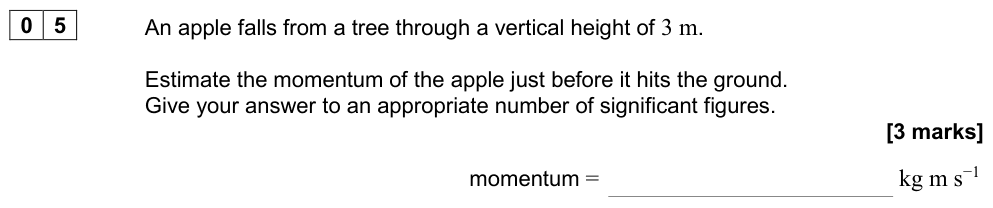
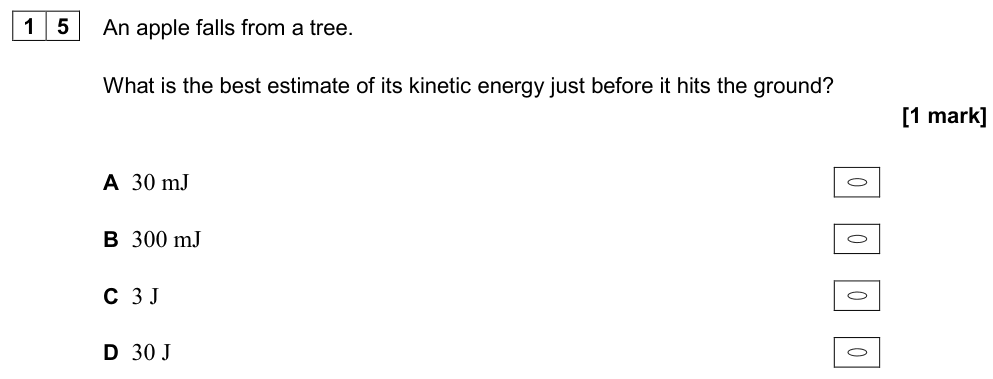
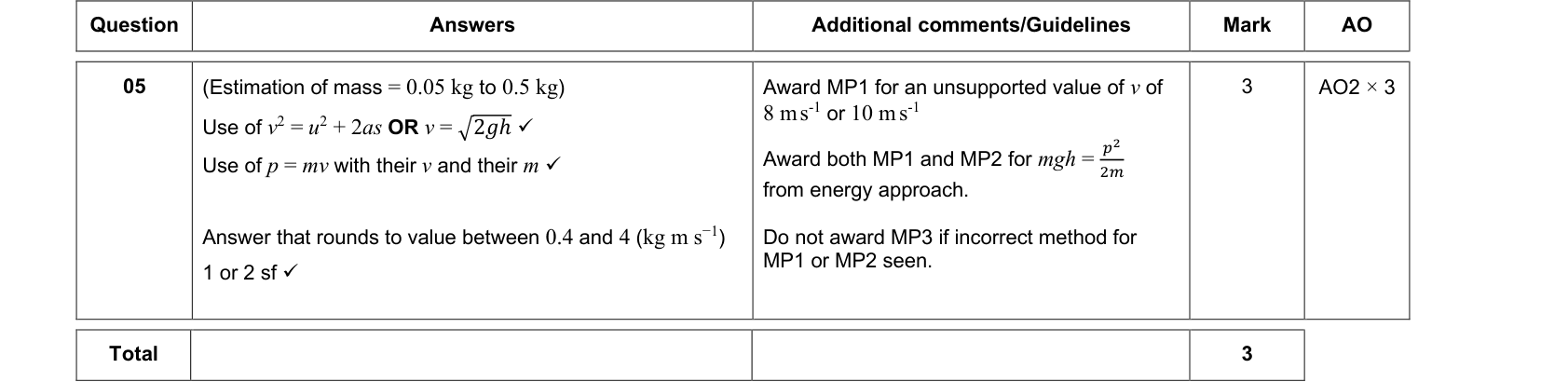
Estimation questions test whether you can choose sensible values and combine them using physics. Show every assumption you make.
| Useful value | Approximate size |
|---|---|
| Mass of an adult | 70 kg |
| Height of an adult | 1.7 m |
| Mass of a car | 1000–1500 kg |
| Walking speed | 1.5 m s⁻¹ |
| Sprinting speed | 10 m s⁻¹ |
| Speed of a car on a motorway | 30 m s⁻¹ |
| Height of one storey of a building | 3 m |
| Mass of an apple | 0.1 kg |
| Density of water | 1000 kg m⁻³ |
| Density of air | 1.2 kg m⁻³ |
| Atmospheric pressure | $1 \times 10^{5}$ Pa |
| Diameter of an atom | $10^{-10}$ m |
| Diameter of a nucleus | $10^{-15}$–$10^{-14}$ m |
| Wavelength of visible light | 400–700 nm |
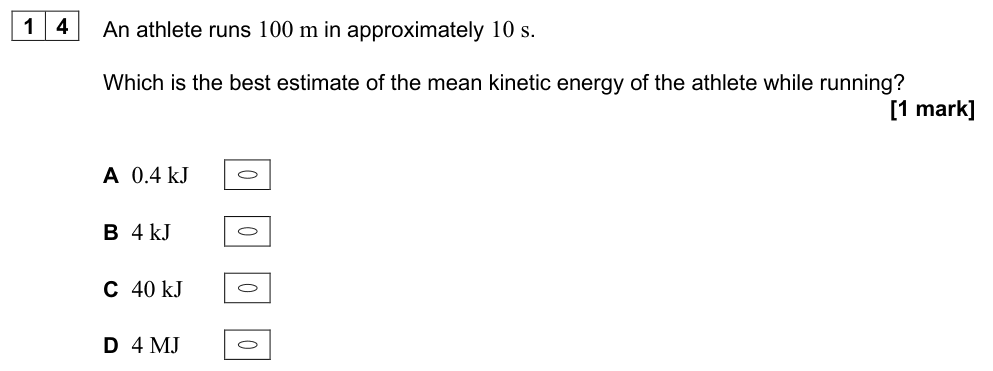
Worked example: estimating kinetic energy
Estimate the kinetic energy of a sprinter running a 100 m race.
Assume mass $m \approx 70\ \text{kg}$ and average speed $v \approx 100\ \text{m}/10\ \text{s} = 10\ \text{m s}^{-1}$.
$$E_k = \tfrac12 m v^2 \approx \tfrac12 \times 70 \times 10^2 = 3500\ \text{J} \approx 4\ \text{kJ}$$
The order of magnitude is $10^{3}$ J.
Worked example: power of a student running upstairs
A 60 kg student runs up a 3.0 m flight of stairs in about 2 s.
$$P = \frac{mg\Delta h}{t} = \frac{60 \times 9.81 \times 3.0}{2} \approx 900\ \text{W} \sim 10^{3}\ \text{W}$$
Exam tip
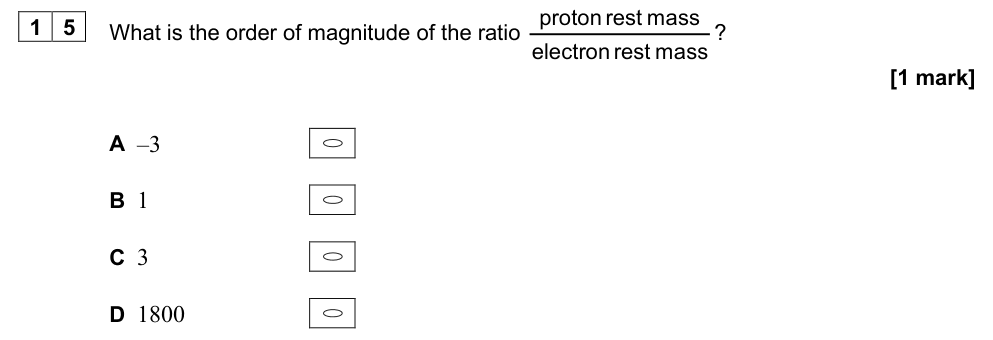
In multiple-choice estimation questions the options usually differ by factors of 10. Do a rough calculation using round numbers ($g \approx 10\ \text{m s}^{-2}$ is fine for estimates) and pick the closest power of ten.
Significant figures
The number of significant figures (s.f.) you quote should match the precision of the data. As a rule, give a final answer to the same number of s.f. as the least precise data value used (usually 2 or 3 s.f. in exam questions). Keep extra figures in intermediate steps to avoid rounding errors.
Summary
- Six base units: kg, m, s, A, K, mol. Everything else is derived.
- Find base units from a defining equation; both sides of a valid equation have the same units.
- Prefixes from f ($10^{-15}$) to T ($10^{12}$); square or cube the prefix along with the unit.
- $1\ \text{eV} = 1.60 \times 10^{-19}\ \text{J}$; $1\ \text{kW h} = 3.6 \times 10^{6}\ \text{J}$.
- Estimate with sensible values, show assumptions, and round to the nearest power of ten.